WO2018090480A1 - Procédé, appareil et dispositif de commutation de format de réseau - Google Patents
Procédé, appareil et dispositif de commutation de format de réseau Download PDFInfo
- Publication number
- WO2018090480A1 WO2018090480A1 PCT/CN2017/071183 CN2017071183W WO2018090480A1 WO 2018090480 A1 WO2018090480 A1 WO 2018090480A1 CN 2017071183 W CN2017071183 W CN 2017071183W WO 2018090480 A1 WO2018090480 A1 WO 2018090480A1
- Authority
- WO
- WIPO (PCT)
- Prior art keywords
- terminal device
- network
- target
- base station
- amount
- Prior art date
- Legal status (The legal status is an assumption and is not a legal conclusion. Google has not performed a legal analysis and makes no representation as to the accuracy of the status listed.)
- Ceased
Links
Images


Classifications
-
- H—ELECTRICITY
- H04—ELECTRIC COMMUNICATION TECHNIQUE
- H04W—WIRELESS COMMUNICATION NETWORKS
- H04W36/00—Hand-off or reselection arrangements
- H04W36/02—Buffering or recovering information during reselection ; Modification of the traffic flow during hand-off
-
- H—ELECTRICITY
- H04—ELECTRIC COMMUNICATION TECHNIQUE
- H04L—TRANSMISSION OF DIGITAL INFORMATION, e.g. TELEGRAPHIC COMMUNICATION
- H04L67/00—Network arrangements or protocols for supporting network services or applications
- H04L67/50—Network services
- H04L67/56—Provisioning of proxy services
- H04L67/568—Storing data temporarily at an intermediate stage, e.g. caching
-
- H—ELECTRICITY
- H04—ELECTRIC COMMUNICATION TECHNIQUE
- H04W—WIRELESS COMMUNICATION NETWORKS
- H04W68/00—User notification, e.g. alerting and paging, for incoming communication, change of service or the like
- H04W68/02—Arrangements for increasing efficiency of notification or paging channel
-
- H—ELECTRICITY
- H04—ELECTRIC COMMUNICATION TECHNIQUE
- H04L—TRANSMISSION OF DIGITAL INFORMATION, e.g. TELEGRAPHIC COMMUNICATION
- H04L69/00—Network arrangements, protocols or services independent of the application payload and not provided for in the other groups of this subclass
- H04L69/16—Implementation or adaptation of Internet protocol [IP], of transmission control protocol [TCP] or of user datagram protocol [UDP]
-
- H—ELECTRICITY
- H04—ELECTRIC COMMUNICATION TECHNIQUE
- H04L—TRANSMISSION OF DIGITAL INFORMATION, e.g. TELEGRAPHIC COMMUNICATION
- H04L69/00—Network arrangements, protocols or services independent of the application payload and not provided for in the other groups of this subclass
- H04L69/30—Definitions, standards or architectural aspects of layered protocol stacks
- H04L69/32—Architecture of open systems interconnection [OSI] 7-layer type protocol stacks, e.g. the interfaces between the data link level and the physical level
- H04L69/322—Intralayer communication protocols among peer entities or protocol data unit [PDU] definitions
- H04L69/329—Intralayer communication protocols among peer entities or protocol data unit [PDU] definitions in the application layer [OSI layer 7]
-
- H—ELECTRICITY
- H04—ELECTRIC COMMUNICATION TECHNIQUE
- H04W—WIRELESS COMMUNICATION NETWORKS
- H04W36/00—Hand-off or reselection arrangements
- H04W36/34—Reselection control
- H04W36/36—Reselection control by user or terminal equipment
Definitions
- the embodiments of the present invention relate to the field of communications technologies, and in particular, to a network standard switching method, apparatus, and device.
- network types for example, 2G, 3G, and 4G networks
- terminal devices can be switched in different networks according to actual needs.
- the priority of 2G, 3G, and 4G networks increases in turn.
- the terminal device needs to switch the high-priority network from the low-priority network, if the terminal device does not currently perform data transmission, the terminal device directly searches for the high-priority network and accesses the high-priority network; if the terminal device is currently For the data transmission, the terminal device usually forcibly disconnects the Packet Data Protocol (PDP) or the Public Data Network (PDN) to disconnect the network link that is currently undergoing data transmission. The data being transmitted will be lost, causing the user's service to be interrupted, resulting in poor reliability of the network standard handover.
- PDP Packet Data Protocol
- PDN Public Data Network
- the embodiment of the invention provides a network standard switching method, device and device, which improves the reliability of network standard switching.
- the embodiment of the present invention provides a network standard switching method. After the terminal device obtains a network standard switching instruction for indicating handover to a target network, the priority of the target network is greater than the first network of the terminal device currently located. Priority, the terminal device releases the network link between the terminal device and the currently accessed first base station, intercepts and caches the application layer data to be sent by the terminal device, and discards the packet switched PS sent by the first priority network to the terminal device. The paging message of the domain and the terminal device is switched to the target network.
- the terminal device intercepts and buffers the uplink application layer data that needs to be sent, and after the network handover succeeds, sends the intercepted uplink application layer data, thereby avoiding the uplink data.
- the second base station that is accessed after the terminal device is switched may perform the handover process with the first base station to obtain downlink data that the first base station does not successfully send to the terminal device, and send the downlink data to the terminal device, thereby avoiding loss of downlink data. .
- the terminal device releases the network link between the first base station and the currently accessed first base station, that is, the network link between the terminal device and the currently accessed first priority network (releasing the terminal device from the first priority network) Access layer connection).
- the network link between the terminal device and the currently accessed first priority network may involve multiple network devices, for example, a base station, a relay device, a control device, and the like.
- the network currently accessed by the terminal device is a first priority network (for example, a 3G network, such as WCDMA),
- the terminal device receives the network standard switching instruction that the user input switches to the high priority network (for example, 4G network) (for example, the user turns on the "4G network switch")
- the terminal device releases the first priority network that is currently connected with ( The network link between the 3G network) intercepts and caches the application layer data to be sent by the terminal device, discards the paging message of the packet switched PS domain sent by the first priority network to the terminal device, and switches the terminal device to the target The internet.
- the method before releasing the network link between the terminal device and the currently accessed first base station, the method further includes: acquiring an uplink data volume and a downlink data volume corresponding to the terminal device in the preset time period, where It is determined that the amount of uplink data is less than the first threshold, and the amount of downlink data is less than the second threshold.
- the network switching is performed only when the amount of data transmitted by the terminal device is small. This can reduce the impact of network switching on user services and further improve the reliability of network switching.
- the terminal device is separated. After the preset duration, the amount of uplink data and the amount of downlink data of the terminal device in the preset time period are obtained, until the obtained uplink data volume is smaller than the first threshold, and the obtained downlink data volume is smaller than the second threshold.
- the application layer data to be sent by the terminal device may be intercepted and cached by the following feasible implementation manner: the application layer is sent by the modem of the terminal device to the transmission control protocol TCP/Internet Protocol IP core of the terminal device.
- the data intercepts the instructions to enable the TCP/IP core of the terminal device to buffer the application layer data to be transmitted.
- the terminal device may be handed over to the target network by searching for the target network, determining the target base station corresponding to the target network, and requesting to establish a network link with the target base station.
- the terminal device may further send the buffered application layer data to be sent to the target base station through the target network, thereby ensuring that the uplink data is not lost.
- an embodiment of the present invention provides a network standard switching device, including an acquiring module, a link processing module, a data processing module, and a switching module, where
- the acquiring module is configured to obtain a network standard switching instruction, where the network standard switching instruction is used to indicate that the terminal device switches to a target network whose target system is a target system, and the priority of the target network is greater than the first priority of the network where the terminal device is currently located;
- the link processing module is configured to release a network link between the terminal device and the currently accessed first base station
- the data processing module is configured to: intercept and cache the application layer data to be sent by the terminal device, and discard the paging message of the packet switched PS domain sent by the first priority network to the terminal device;
- the switching module is used to switch the terminal device to the target network.
- the obtaining module is further configured to:
- the link processing module releases the terminal device and the currently accessed Before a network link between base stations, the acquisition module is also used to:
- the amount of the uplink data and the amount of the downlink data in the preset time period are obtained, until the obtained uplink data volume is less than the first threshold, and the obtained downlink data volume is less than the second threshold.
- the data processing module is specifically configured to:
- the application layer data interception instruction is sent by the modem of the terminal device to the transmission control protocol TCP/Internet Protocol IP core of the terminal device, so that the TCP/IP core of the terminal device caches the application layer data to be transmitted.
- the switching module is specifically configured to:
- the device further includes a sending module, where
- the sending module is configured to: after the switching module switches the terminal device to the target network, send the buffered application layer data to be sent to the target base station through the target network.
- an embodiment of the present invention provides a terminal device, including a processor, a memory, and a communication bus.
- the memory is used to store program instructions
- the communication bus is used to implement connection between components
- the processor is used to read the memory.
- the network standard switching instruction is used to indicate that the terminal device switches to a target network whose target system is a target system, and the priority of the target network is greater than the first priority of the network where the terminal device is currently located;
- the processor before the processor releases the network link between the terminal device and the currently accessed first base station, the processor is further configured to:
- the processor determines that the uplink data volume is greater than or equal to the first threshold, or the downlink data volume is greater than or equal to the second threshold, releasing, by the processor, the terminal device and the currently accessed first base station before the network link between the processors, the processor is also used to:
- the amount of the uplink data and the amount of the downlink data in the preset time period are obtained, until the obtained uplink data volume is less than the first threshold, and the obtained downlink data volume is less than the second threshold.
- the processor is specifically configured to:
- the application layer data interception instruction is sent by the modem of the terminal device to the transmission control protocol TCP/Internet Protocol IP core of the terminal device, so that the TCP/IP core of the terminal device caches the application layer data to be transmitted.
- the processor is specifically configured to:
- the terminal device further includes a transmitter, where
- the transmitter is configured to: after the processor switches the terminal device to the target network, send the buffered application layer data to be sent to the target base station by using the target network. .
- the network system switching method, device, and device provided by the embodiment of the present invention, in the process of the terminal device switching to the high priority network, the terminal device intercepts and buffers the uplink application layer data to be sent, and after the network switching succeeds, The intercepted uplink application layer data is sent again to avoid the loss of uplink data.
- the second base station that is accessed after the terminal device is switched may perform the handover process with the first base station to obtain downlink data that the first base station does not successfully send to the terminal device, and send the downlink data to the terminal device, thereby avoiding loss of downlink data.
- the network switching is performed in the process of transmitting a small amount of data by the terminal device, and the loss of the uplink data and the downlink data can be avoided, thereby improving the reliability of the network switching.
- FIG. 1 is a schematic diagram of an application scenario of a network standard handover method according to an embodiment of the present disclosure
- FIG. 2 is a schematic flowchart 1 of a network standard switching method according to an embodiment of the present invention
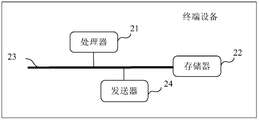
- FIG. 3 is a schematic structural diagram of a terminal device according to an embodiment of the present disclosure.
- FIG. 4 is a second schematic flowchart of a network standard handover method according to an embodiment of the present disclosure
- FIG. 5 is a schematic flowchart 3 of a network standard handover method according to an embodiment of the present disclosure
- FIG. 6 is a schematic structural diagram 1 of a network standard switching apparatus according to an embodiment of the present invention.
- FIG. 7 is a schematic structural diagram 2 of a network standard switching apparatus according to an embodiment of the present disclosure.
- FIG. 8 is a schematic structural diagram 1 of a terminal device according to an embodiment of the present disclosure.
- FIG. 9 is a schematic structural diagram 2 of a terminal device according to an embodiment of the present invention.
- FIG. 1 is a schematic diagram of an application scenario of a network standard switching method according to an embodiment of the present invention.
- a terminal device 101 can be a device such as a mobile phone or a computer.
- the priority of the second priority network 103 is higher than the priority of the first priority network 102, the terminal device 101 currently accesses the first priority network 102, and the terminal device 101 needs to switch to the second priority network 103.
- the first priority network 102 and the second priority network 103 may be a Code Division Multiple Access (CDMA) network, a Wideband Code Division Multiple Access (WCDMA) network, or the like.
- CDMA Code Division Multiple Access
- WCDMA Wideband Code Division Multiple Access
- the priority of the network is related to the network standard. For example, the priority of the 2G network may be 1, the priority of the 3G network may be 2, and the priority of the 4G network may be 3.
- the terminal device when the terminal device needs to switch from the low priority network to the high priority network, the terminal device disconnects the network link with the currently accessed base station, intercepts and buffers the uplink data to be sent, and discards the low data. Paging message of the Packet Switch (PS) domain sent by the priority network. After the network is successfully switched, the terminal device sends the intercepted uplink data again to avoid the loss of the uplink data. Further, the network after the terminal device is switched is also handed over to the network before the terminal device is switched, so that the switched network can be The downlink data that the network before the handover is not successfully sent is sent to the terminal device, so as to avoid the loss of the downlink data.
- PS Packet Switch
- FIG. 2 is a schematic flowchart 1 of a network standard handover method according to an embodiment of the present invention.
- the executor of the method may be a terminal device. Referring to FIG. 2, the method may include:
- the network standard switching instruction may be generated by the terminal device according to an operation input by the user in the terminal device. Specifically, when the user needs to switch the network that the terminal device accesses to the higher priority network, the user may select a target system of the target network to be switched to in the terminal device, so that the terminal device generates a network standard switching instruction.
- the network standard switching instruction may include a target system.
- FIG. 3 is a schematic structural diagram of a terminal device according to an embodiment of the present invention.
- a check box of multiple network standards is set in the terminal device, and the user can click on any selected box of the network standard. Among them, only one of the three selected boxes is selected at the same time.
- the network currently accessed by the terminal device is a 2G network, and the selected box corresponding to the 2G network is selected.
- the user can click on the selected box corresponding to the 3G network to input the target system in the terminal device.
- the terminal device generates a network standard switching instruction according to a target system (3G network) input by the user.
- the network standard switching instruction may include a target system (3G network)
- the terminal device can automatically perform high-priority network measurement during the running process, and when the terminal device measures the high-priority network (higher priority than the network currently accessed by the terminal device), the terminal device Network standard switching instructions can be automatically generated. For example, if the network currently accessed by the terminal device is a 2G network, the terminal device measures the high-priority (for example, 3G, 4G) network in real time or periodically during the operation of the terminal device. When the terminal device measures the 3G network, the terminal The device generates a network standard switching instruction including "3G" (target priority).
- 3G target priority
- the terminal device can also obtain the network standard switching instruction according to other feasible implementation manners, which is not specifically limited in this embodiment of the present invention.
- the terminal device may release the network link between the terminal device and the currently accessed first base station by using a feasible implementation manner: the terminal device sends a link release request to the first base station by using the modem to implement the release terminal. A network link between the device and the first base station.
- the terminal device may send a Connection Close request to the first base station to implement a network link between the terminal device and the first base station. If the network where the terminal device is currently located is a WCDMA network, the terminal device may send a Signaling Connection Release Indication to the first base station to release the network link between the terminal device and the first base station.
- the terminal device when the terminal device receives the network standard switching instruction, and the network standard switching instruction is used to indicate the handover to the 4G network, the terminal device checks the current high data rate (HDR) link layer state. . If the HDR link layer is in the connected state, the link is released, the upstream data stream is intercepted and buffered (the data is not disconnected), and the upstream data stream is started after the timer is expected to be 4s (this 4s time is used to block the uplink from the AP). The data is such that the link is not brought into the connected state again, and the PS paging from the network needs to be blocked.
- HDR high data rate
- the HDR link layer is in the non-connected state, directly forward the command to perform reselection, and the command is not cached. If the command has been cached, the system preferred mode command will be executed after 2 seconds. At this time, the link layer status is no longer judged, and the subsequent process is continued.
- the terminal device when the terminal device needs to send the application layer data, and the network link does not exist between the terminal device and the base station, the terminal device requests the base station corresponding to the current network to establish a network link.
- the terminal device receives the paging message of the PS domain sent by the network, if there is no network link between the terminal device and the network side, the terminal device also requests the base station corresponding to the current network to establish a network link.
- the terminal device may intercept and cache the uplink application layer data to be sent by the terminal device, and discard the paging message of the packet switched PS domain sent by the first priority network to the terminal device. In this way, it is possible to effectively prevent the terminal device from re-establishing a network link with the network of the first priority.
- the terminal device can intercept and cache the application layer data to be sent by the terminal device by using a feasible implementation manner: the terminal device sends an application layer data interception instruction to the TCP/IP core of the terminal device by using a modem of the terminal device, so that the terminal The TCP/IP core of the device caches the application layer data to be sent and cancels the application layer data to be sent.
- the TCP/IP core is located in an application layer processor of the terminal device.
- the application layer data may be data corresponding to an application in the terminal device. When the terminal device sends data, it needs to send data through the TCP/IP core of the terminal device.
- the application layer data interception instruction can be sent to the TCP/IP core through the modem, so that the TCP/IP kernel can intercept the instruction according to the application layer data.
- the application layer data to be sent is intercepted and cached.
- the TCP/IP core can cancel sending the application layer data to be sent, and cache the application layer data to be sent.
- the terminal device After the terminal device releases the network link with the first base station, intercepts and caches the application layer data to be sent, and discards the paging message of the packet switched PS domain sent by the first priority network to the terminal device, the terminal device You can switch to the target network.
- the terminal device may search for the target network, determine the target base station corresponding to the target network, and request to establish a network link with the target base station, so as to implement the terminal device to access the target network.
- the terminal device may send the application layer data to be sent to the target base station through the target network, so that the target base station processes the received application layer data, for example, Send application layer data to the corresponding application server. In this way, the problem of loss of uplink data sent by the terminal device during network switching can be effectively avoided.
- the first base station may continue to send data to the terminal device, but because the network link does not exist between the first base station and the terminal device, and the terminal device discards the PS from the first base station.
- the paging message of the domain the first base station cannot successfully send the downlink data to the terminal device, but the first base station can determine whether the downlink data is successfully sent.
- the first base station can buffer the downlink that is not successfully sent. data.
- the second base station that is accessed after the terminal device is switched may perform a handover process with the first base station to obtain downlink data that is not successfully sent by the first base station to the terminal device, and send the downlink data to the terminal. device.
- 3GPP 25331, Section 8.1.14 Signalling connection release indication procedure
- the signalling connection release indication procedure is used by the UE to indicate to the UTRAN that one of its signalling connections has been released The content releases the network link between the terminal device and the currently accessed first base station.
- 3GPP2 C.S0024, Section 7.7.6 Provides and Messages for the In Use Instance of the Protocol
- the access terminal shall send a Connection Close message to the access network and The content of the 6perform the cleanup procedures defined 7.7.6.1.2.1.2.) releases the network link between the terminal device and the currently accessed first base station.
- the network standard switching method provided by the embodiment of the present invention, in the process of the terminal device switching to the high priority network, the terminal device intercepts and buffers the uplink application layer data that needs to be sent, and sends the intercepted uplink application layer after the network switching succeeds. Data, to avoid the loss of uplink data.
- the second base station that is accessed after the terminal device is switched may perform the handover process with the first base station to obtain downlink data that the first base station does not successfully send to the terminal device, and send the downlink data to the terminal device, thereby avoiding loss of downlink data.
- the network switching is performed in the process of transmitting a small amount of data by the terminal device, and the loss of the uplink data and the downlink data can be avoided, thereby improving the reliability of the network switching.
- the terminal device may also acquire the uplink data volume and the downlink data in the preset time period before the terminal device performs the network standard handover.
- FIG. 4 is a schematic flowchart 2 of a network standard handover method according to an embodiment of the present invention. Referring to FIG. 4, the method may include:
- the terminal device After the terminal device obtains the network standard switching instruction, the terminal device acquires the uplink data volume and the downlink data volume of the terminal device in the preset time period.
- the preset time period may be a period of time before or after the terminal device receives the network standard switching instruction.
- the preset time period may be 2 seconds, 3 seconds, or the like. In the actual application process, the preset time period can be set according to actual needs.
- the amount of the uplink data may be the number of the packets sent by the terminal device to the base station in the preset time period, or may be the size of the data sent by the terminal device to the base station in the preset time period.
- the amount of the downlink data may be the number of the packets sent by the base station to the terminal device in the preset time period, or may be the size of the data sent by the base station to the terminal device in the preset time period.
- S403. Determine whether the uplink data amount is less than a first threshold, and whether the downlink data amount is less than a second threshold.
- the first threshold and the second threshold may be preset in the terminal device.
- the first threshold is the maximum amount of uplink data that can be directly switched by the network
- the second threshold is the maximum amount of downlink data that can be directly switched by the network.
- the first threshold is the maximum number of packets that can be directly switched by the network.
- the first threshold may be ten.
- the uplink data volume is the size of the data sent by the terminal device to the base station within the preset time period
- the first threshold is the maximum data traffic that can directly perform network switching.
- the first threshold can be 5 KB.
- the second threshold is the maximum number of packets that can directly perform network switching.
- the second threshold may be 15.
- the second threshold is the maximum data traffic that can directly perform network switching.
- the second threshold can be 8 KB.
- first threshold and the second threshold may be the same or different. In the actual application process, the first threshold and the second threshold may be set according to actual needs, which is not specifically limited in this embodiment of the present invention.
- the terminal device may also obtain the data rate of the terminal device in the preset time period, and determine whether to execute S404 according to the data rate of the terminal device in the preset time period; or the terminal device may also acquire the terminal device.
- the terminal device may also determine whether to execute S404 according to the amount of uplink data or only according to the amount of downlink data. This embodiment of the present invention does not specifically limit this.
- the interval is preset.
- the terminal device determines that the uplink data volume is greater than or equal to the first threshold, or the downlink data volume is greater than or equal to the second threshold, if the current uplink data volume or the downlink data volume is large, the network switching cannot be directly performed.
- the terminal device acquires the uplink data volume and the downlink data volume, and determines whether the uplink data volume is less than the first threshold and the downlink data volume is less than the second threshold. If yes, execute S405, if no, Then, after the preset duration is further separated, the uplink data volume and the downlink data volume are continuously acquired, and so on, until the obtained uplink data volume is smaller than the first threshold, and the downlink data volume is smaller than the second threshold.
- the terminal device may start the timer, and when the duration of the timer is equal to the preset duration, the terminal device acquires the uplink data volume and The amount of downlink data.
- the network where the terminal device is currently located is a CDMA network (2G network), and the terminal device currently establishes a network link with the base station 1.
- the network to which the terminal device needs to switch is a CDMA2000 network (3G network).
- FIG. 5 is a schematic flowchart 3 of a network standard handover method according to an embodiment of the present invention. Referring to FIG. 5, the method may include:
- the terminal device receives a network standard switching instruction input by the user, where the network standard switching instruction is used to instruct the terminal device to switch to the 3G network.
- the terminal device acquires an uplink data volume (8 packets) and a downlink data volume (10 packets) of the terminal device within 3 seconds.
- the first threshold is 10 messages and the second threshold is 15 messages.
- the terminal device determines that the uplink data volume (8 packets) is smaller than the first threshold (10 packets), and the downlink data volume (10 packets) is smaller than the second threshold (15 packets).
- the terminal device sends a Connection Close request to the base station 1.
- the base station 1 sends a Connection Close response to the terminal device.
- the terminal device intercepts and buffers uplink data that needs to be sent, and discards paging failure of the PS domain of the base station 1. interest.
- the uplink data is application layer data sent by the terminal device.
- the terminal device sends an application layer data interception instruction to the TCP/IP core through the modem, so that the TCP/IP core intercepts the uplink data to be sent, and caches the uplink application layer data.
- the terminal device searches for a 3G network, and determines a base station 2 that can provide a 3G network.
- the terminal device sends an access request to the base station 2.
- the base station 2 sends an access response to the terminal device.
- a network link is established between the terminal device and the base station 2 through S508-S509.
- the terminal device sends the intercepted uplink data to the base station 2.
- the base station 2 processes the uplink data.
- the base station 2 determines the base station 1 that is accessed before the terminal device switches.
- the base station 2 sends a data acquisition request to the base station 1, where the data acquisition request includes an identifier of the terminal device.
- the base station 1 acquires downlink data that is not successfully transmitted to the terminal device.
- the base station 1 transmits, to the base station 2, downlink data that is not successfully transmitted to the terminal device.
- the base station 2 sends the downlink data to the terminal device.
- the terminal device When the terminal device needs to switch from the 2G network to the 3G network, when the uplink data amount and the downlink data amount corresponding to the terminal device are both smaller than the corresponding threshold, the network switching is performed. Further, in the process of the terminal device switching from the 2G network to the 3G network, the terminal device buffers the transmitted uplink data (application layer data), and after the network handover succeeds, continues to send the buffered uplink data, thereby avoiding Loss of upstream data. Further, after the terminal device network handover succeeds, the base station 2 requests the base station 1 to acquire downlink data that the base station 1 has not successfully transmitted, and transmits downlink data that the base station 1 has not successfully transmitted to the terminal device, thereby avoiding downlink data. Loss, which in turn improves the reliability of network switching.
- the transmitted uplink data application layer data
- the base station 2 requests the base station 1 to acquire downlink data that the base station 1 has not successfully transmitted, and transmits downlink data that the base station 1 has not successfully transmitted to the terminal device
- FIG. 6 is a schematic structural diagram 1 of a network standard switching apparatus according to an embodiment of the present invention.
- the device may include an obtaining module 11, a link processing module 12, a data processing module 13, and a switching module 14, wherein
- the acquiring module 11 is configured to acquire a network standard switching instruction, where the network standard switching instruction is used to instruct the terminal device to switch to a target network whose target system is a target system, where the priority of the target network is greater than where the terminal device is currently located.
- the link processing module 12 is configured to release a network link between the terminal device and a currently accessed first base station;
- the data processing module 13 is configured to: intercept and cache the application layer data to be sent by the terminal device, and discard the paging message of the packet switched PS domain sent by the first priority network to the terminal device;
- the switching module 14 is configured to switch the terminal device to the target network.
- the network standard switching device provided by the embodiment of the present invention can perform the technical solutions shown in the foregoing method embodiments, and the implementation principles and beneficial effects thereof are similar, and details are not described herein.
- the acquiring module 11 is further configured to:
- the obtaining module 11 determines that the uplink data amount is greater than or equal to the first threshold. When the value, or the amount of the downlink data is greater than or equal to the second threshold, the acquiring module 11 further before the link processing module releases the network link between the terminal device and the currently accessed first base station. Used for:
- the amount of uplink data and the amount of downlink data of the terminal device in the preset time period are obtained, until the obtained uplink data volume is smaller than the first threshold, and the obtained downlink data volume is smaller than the first Two thresholds.
- the data processing module 13 is specifically configured to:
- the switching module 14 is specifically configured to:
- FIG. 7 is a schematic structural diagram 2 of a network standard switching apparatus according to an embodiment of the present invention.
- the device further includes a sending module 15, wherein
- the sending module 15 is configured to send the buffered application layer data to be sent to the target base station by using the target network after the switching module switches the terminal device to the target network.
- the network standard switching device provided by the embodiment of the present invention can perform the technical solutions shown in the foregoing method embodiments, and the implementation principles and beneficial effects thereof are similar, and details are not described herein.
- FIG. 8 is a schematic structural diagram 1 of a terminal device according to an embodiment of the present invention.
- the terminal device includes a processor 21, a memory 22, and a communication bus 23.
- the memory 22 is used to store program instructions, and the memory 22 may include one or more of a read only memory (ROM), a random access memory (RAM), and a disk storage.
- the communication bus 23 is used to implement a connection between components.
- the processor 21 may be a general-purpose central processing unit, one or more integrated circuits for controlling program execution, a hardware circuit developed using an FPGA, a baseband processor, etc., and the processor 21 is configured to read in the memory. Program instructions and perform the following operations:
- the network standard switching instruction is used to instruct the terminal device to switch to a target network whose target system is a target system, where the priority of the target network is greater than a first priority of the network where the terminal device is currently located ;
- the terminal device provided by the embodiment of the present invention can perform the technical solution shown in the foregoing method embodiment, and the implementation principle and the beneficial effects are similar, and details are not described herein again.
- the processor 21 before the processor 21 releases the network link between the terminal device and the currently accessed first base station, the processor 21 is further configured to:
- the processor 21 determines that the uplink data amount is greater than or equal to the first When the threshold, or the amount of downlink data is greater than or equal to the second threshold, the processor 21 is further used before the processor releases the network link between the terminal device and the currently accessed first base station. :
- the amount of uplink data and the amount of downlink data of the terminal device in the preset time period are obtained, until the obtained uplink data volume is smaller than the first threshold, and the obtained downlink data volume is smaller than the first Two thresholds.
- the processor 21 is specifically configured to:
- the processor 21 is specifically configured to:
- FIG. 9 is a schematic structural diagram 2 of a terminal device according to an embodiment of the present invention.
- the terminal device further includes a transmitter 24, wherein the transmitter 24 is configured to switch the terminal device to the target at the processor 21.
- the buffered application layer data to be sent is sent to the target base station through the target network.
- the terminal device provided by the embodiment of the present invention can perform the technical solution shown in the foregoing method embodiment, and the implementation principle and the beneficial effects are similar, and details are not described herein again.
Landscapes
- Engineering & Computer Science (AREA)
- Computer Networks & Wireless Communication (AREA)
- Signal Processing (AREA)
- Mobile Radio Communication Systems (AREA)
Abstract
Les modes de réalisation de la présente invention concernent un procédé, un appareil et un dispositif de commutation d'un format de réseau. Ledit procédé comprend les étapes suivantes consistant à : acquérir une instruction de commutation de format de réseau comprenant une priorité cible, l'instruction de commutation de format de réseau étant utilisée pour donner une instruction à un dispositif terminal de commuter vers un réseau cible dont le format est un format cible, la priorité du réseau cible étant plus grande que la priorité du réseau dans lequel le dispositif terminal se trouve actuellement ; et relâcher une liaison de réseau entre le dispositif terminal et une première station de base en cours d'accès, intercepter et mettre en mémoire tampon des données de couche d'application devant être envoyées par le dispositif terminal, rejeter un message de radiomessagerie d'un domaine à commutation de paquets (PS) qui est envoyé au dispositif terminal par un réseau ayant une première priorité, et commuter vers le réseau cible. La présente invention est utilisée pour améliorer la fiabilité des commutations de réseau.
Priority Applications (3)
| Application Number | Priority Date | Filing Date | Title |
|---|---|---|---|
| EP17871573.6A EP3534643B1 (fr) | 2016-11-21 | 2017-01-13 | Procédé et dispositif terminal de commutation de format de réseau |
| US16/462,709 US11122483B2 (en) | 2016-11-21 | 2017-01-13 | Network standard switching method and apparatus, and device |
| CN201780009364.8A CN108605256B (zh) | 2016-11-21 | 2017-01-13 | 网络制式切换方法、装置及设备 |
Applications Claiming Priority (2)
| Application Number | Priority Date | Filing Date | Title |
|---|---|---|---|
| CN201611037468.3 | 2016-11-21 | ||
| CN201611037468 | 2016-11-21 |
Publications (1)
| Publication Number | Publication Date |
|---|---|
| WO2018090480A1 true WO2018090480A1 (fr) | 2018-05-24 |
Family
ID=62145201
Family Applications (1)
| Application Number | Title | Priority Date | Filing Date |
|---|---|---|---|
| PCT/CN2017/071183 Ceased WO2018090480A1 (fr) | 2016-11-21 | 2017-01-13 | Procédé, appareil et dispositif de commutation de format de réseau |
Country Status (4)
| Country | Link |
|---|---|
| US (1) | US11122483B2 (fr) |
| EP (1) | EP3534643B1 (fr) |
| CN (1) | CN108605256B (fr) |
| WO (1) | WO2018090480A1 (fr) |
Cited By (1)
| Publication number | Priority date | Publication date | Assignee | Title |
|---|---|---|---|---|
| CN109257785A (zh) * | 2018-11-26 | 2019-01-22 | 努比亚技术有限公司 | 网络制式切换方法、终端及计算机可读存储介质 |
Families Citing this family (6)
| Publication number | Priority date | Publication date | Assignee | Title |
|---|---|---|---|---|
| CN112400303B (zh) * | 2019-01-31 | 2022-05-13 | 华为技术有限公司 | 一种网络切换的方法、设备及网络系统 |
| CN111343683A (zh) * | 2020-03-12 | 2020-06-26 | Oppo(重庆)智能科技有限公司 | 网络切换方法、装置、存储介质及终端 |
| CN111417173B (zh) * | 2020-03-31 | 2022-08-02 | 维沃移动通信有限公司 | 断流恢复方法及电子设备 |
| DE102021205449A1 (de) * | 2021-05-28 | 2022-12-01 | Robert Bosch Gesellschaft mit beschränkter Haftung | Verfahren zum Scheduling eines Datenpakets |
| US12342213B2 (en) * | 2021-05-28 | 2025-06-24 | Apple Inc. | Uplink traffic throughput enhancement |
| CN116567171B (zh) * | 2021-09-03 | 2024-04-23 | 荣耀终端有限公司 | 一种视频通话方法及电子设备 |
Citations (5)
| Publication number | Priority date | Publication date | Assignee | Title |
|---|---|---|---|---|
| CN101888675A (zh) * | 2009-05-14 | 2010-11-17 | 中兴通讯股份有限公司 | 一种长期演进系统中跨基站切换方法及系统 |
| US8218500B2 (en) * | 2007-04-30 | 2012-07-10 | Texas Instruments Incorporated | Pre-synchronization method for hard handovers in wireless networks |
| WO2012152128A1 (fr) * | 2011-05-10 | 2012-11-15 | 中兴通讯股份有限公司 | Procédé et système de transfert |
| CN103269504A (zh) * | 2013-05-16 | 2013-08-28 | 希姆通信息技术(上海)有限公司 | 一种智能切换数据网络的方法及装置 |
| CN103596230A (zh) * | 2012-08-14 | 2014-02-19 | 中国电信股份有限公司 | 基于网络负荷控制的网络间切换方法与装置 |
Family Cites Families (9)
| Publication number | Priority date | Publication date | Assignee | Title |
|---|---|---|---|---|
| US20020176382A1 (en) * | 2001-05-24 | 2002-11-28 | Telefonaktiebolaget Lm Ericsson (Publ) | Method and system for integration of second generation and third generation wireless networks |
| KR100602651B1 (ko) * | 2004-02-13 | 2006-07-19 | 삼성전자주식회사 | Tcp 커넥션 관리 장치 및 방법 |
| US8284701B2 (en) | 2007-06-22 | 2012-10-09 | Telefonaktiebolaget Lm Ericsson (Publ) | Response to CS paging request |
| CN101730176B (zh) * | 2008-10-28 | 2012-12-19 | 华为技术有限公司 | 网络重选中的寻呼控制方法、实体及系统 |
| US9215626B2 (en) * | 2010-06-25 | 2015-12-15 | Qualcomm Incorporated | System, apparatus, and method for utilizing network access parameters in wireless communication systems |
| US9750021B2 (en) * | 2012-06-18 | 2017-08-29 | Sharp Kabushiki Kaisha | Wireless communication system, wireless communication method, mobile station device, base station device, program, and recording medium |
| CN104144473B (zh) * | 2013-05-09 | 2019-12-20 | 中兴通讯股份有限公司 | 一种选择可用接入网络的方法及用户设备 |
| EP3177072B1 (fr) | 2014-07-23 | 2018-10-03 | Huawei Technologies Co. Ltd. | Dispositifs et procédés d'envoi de paquet de données et de traitement de données |
| CN112492675A (zh) * | 2016-06-28 | 2021-03-12 | 华为技术有限公司 | 传输方式的转换方法和装置 |
-
2017
- 2017-01-13 EP EP17871573.6A patent/EP3534643B1/fr active Active
- 2017-01-13 CN CN201780009364.8A patent/CN108605256B/zh active Active
- 2017-01-13 WO PCT/CN2017/071183 patent/WO2018090480A1/fr not_active Ceased
- 2017-01-13 US US16/462,709 patent/US11122483B2/en active Active
Patent Citations (5)
| Publication number | Priority date | Publication date | Assignee | Title |
|---|---|---|---|---|
| US8218500B2 (en) * | 2007-04-30 | 2012-07-10 | Texas Instruments Incorporated | Pre-synchronization method for hard handovers in wireless networks |
| CN101888675A (zh) * | 2009-05-14 | 2010-11-17 | 中兴通讯股份有限公司 | 一种长期演进系统中跨基站切换方法及系统 |
| WO2012152128A1 (fr) * | 2011-05-10 | 2012-11-15 | 中兴通讯股份有限公司 | Procédé et système de transfert |
| CN103596230A (zh) * | 2012-08-14 | 2014-02-19 | 中国电信股份有限公司 | 基于网络负荷控制的网络间切换方法与装置 |
| CN103269504A (zh) * | 2013-05-16 | 2013-08-28 | 希姆通信息技术(上海)有限公司 | 一种智能切换数据网络的方法及装置 |
Non-Patent Citations (1)
| Title |
|---|
| See also references of EP3534643A4 |
Cited By (1)
| Publication number | Priority date | Publication date | Assignee | Title |
|---|---|---|---|---|
| CN109257785A (zh) * | 2018-11-26 | 2019-01-22 | 努比亚技术有限公司 | 网络制式切换方法、终端及计算机可读存储介质 |
Also Published As
| Publication number | Publication date |
|---|---|
| EP3534643A1 (fr) | 2019-09-04 |
| CN108605256B (zh) | 2020-07-28 |
| US11122483B2 (en) | 2021-09-14 |
| US20190364476A1 (en) | 2019-11-28 |
| EP3534643A4 (fr) | 2019-09-04 |
| EP3534643B1 (fr) | 2021-07-28 |
| CN108605256A (zh) | 2018-09-28 |
Similar Documents
| Publication | Publication Date | Title |
|---|---|---|
| CN108605256B (zh) | 网络制式切换方法、装置及设备 | |
| JP6924830B2 (ja) | パケット送信方法および装置、チップ、ならびに端末 | |
| US10425868B2 (en) | Apparatus, system, and method for preventing TCP connection interruption | |
| US10165618B2 (en) | Service processing method and device | |
| CN113055373B (zh) | 数据传输方法和通信设备 | |
| US20160165572A1 (en) | Method of transmission scheme switch, ue and base station | |
| EP2938025B1 (fr) | Procédé de retransmission de données lors d'une transmission de service de coordination et passerelle de réseau d'accès correspondante | |
| US20170099229A1 (en) | Relay device and relay method | |
| WO2014094260A1 (fr) | Procédé, dispositif et système pour un retour dans un réseau de type évolution à long terme après un appel | |
| CN102246555A (zh) | 切换处理方法、基站及中继节点 | |
| WO2017101076A1 (fr) | Procédé et appareil de transmission de message de notification de données de liaison descendante | |
| US11109265B2 (en) | Method and apparatus for transmitting control message in software defined network-based mobile communication system | |
| CN102833798B (zh) | 业务切换处理方法、装置和系统 | |
| WO2013107035A1 (fr) | Procédé et dispositif permettant de détecter la reprise d'une cellule interrompue | |
| WO2017000694A1 (fr) | Procédé et dispositif de réacheminement de données | |
| US20150095413A1 (en) | Method for providing service information, apparatus, and network system | |
| WO2017004805A1 (fr) | Procédé et dispositif de transmission de données | |
| CN105991468B (zh) | 一种Diameter拥塞响应的处理方法及装置 | |
| WO2022152257A1 (fr) | Procédé d'échange d'informations pour service de multidiffusion et station de base | |
| WO2012051953A1 (fr) | Procédé et dispositif de traitement d'une demande de service | |
| KR102508923B1 (ko) | 대역폭 정보 제공 방법 및 이를 위한 장치 | |
| EP3422658B1 (fr) | Dispositif de communication et procédé pour demande de ressources de communication | |
| CN106470450A (zh) | 一种td-scdma系统拥塞控制的方法及装置 | |
| CN119521302A (zh) | 信息处理方法、处理装置、通信设备及可读存储介质 | |
| CN117015073A (zh) | 数据反传控制方法、装置、mr-dc系统及网元 |
Legal Events
| Date | Code | Title | Description |
|---|---|---|---|
| 121 | Ep: the epo has been informed by wipo that ep was designated in this application |
Ref document number: 17871573 Country of ref document: EP Kind code of ref document: A1 |
|
| NENP | Non-entry into the national phase |
Ref country code: DE |
|
| ENP | Entry into the national phase |
Ref document number: 2017871573 Country of ref document: EP Effective date: 20190531 |