WO2018092654A1 - 脂肪肝治療用組成物 - Google Patents
脂肪肝治療用組成物 Download PDFInfo
- Publication number
- WO2018092654A1 WO2018092654A1 PCT/JP2017/040244 JP2017040244W WO2018092654A1 WO 2018092654 A1 WO2018092654 A1 WO 2018092654A1 JP 2017040244 W JP2017040244 W JP 2017040244W WO 2018092654 A1 WO2018092654 A1 WO 2018092654A1
- Authority
- WO
- WIPO (PCT)
- Prior art keywords
- fatty liver
- composition
- extract
- treatment
- liver
- Prior art date
- Legal status (The legal status is an assumption and is not a legal conclusion. Google has not performed a legal analysis and makes no representation as to the accuracy of the status listed.)
- Ceased
Links
Classifications
-
- A—HUMAN NECESSITIES
- A61—MEDICAL OR VETERINARY SCIENCE; HYGIENE
- A61K—PREPARATIONS FOR MEDICAL, DENTAL OR TOILETRY PURPOSES
- A61K36/00—Medicinal preparations of undetermined constitution containing material from algae, lichens, fungi or plants, or derivatives thereof, e.g. traditional herbal medicines
- A61K36/18—Magnoliophyta (angiosperms)
- A61K36/185—Magnoliopsida (dicotyledons)
- A61K36/25—Araliaceae (Ginseng family), e.g. ivy, aralia, schefflera or tetrapanax
- A61K36/258—Panax (ginseng)
-
- A—HUMAN NECESSITIES
- A61—MEDICAL OR VETERINARY SCIENCE; HYGIENE
- A61K—PREPARATIONS FOR MEDICAL, DENTAL OR TOILETRY PURPOSES
- A61K36/00—Medicinal preparations of undetermined constitution containing material from algae, lichens, fungi or plants, or derivatives thereof, e.g. traditional herbal medicines
- A61K36/06—Fungi, e.g. yeasts
- A61K36/07—Basidiomycota, e.g. Cryptococcus
- A61K36/076—Poria
-
- A—HUMAN NECESSITIES
- A61—MEDICAL OR VETERINARY SCIENCE; HYGIENE
- A61K—PREPARATIONS FOR MEDICAL, DENTAL OR TOILETRY PURPOSES
- A61K36/00—Medicinal preparations of undetermined constitution containing material from algae, lichens, fungi or plants, or derivatives thereof, e.g. traditional herbal medicines
- A61K36/18—Magnoliophyta (angiosperms)
- A61K36/185—Magnoliopsida (dicotyledons)
- A61K36/23—Apiaceae or Umbelliferae (Carrot family), e.g. dill, chervil, coriander or cumin
- A61K36/233—Bupleurum
-
- A—HUMAN NECESSITIES
- A61—MEDICAL OR VETERINARY SCIENCE; HYGIENE
- A61K—PREPARATIONS FOR MEDICAL, DENTAL OR TOILETRY PURPOSES
- A61K36/00—Medicinal preparations of undetermined constitution containing material from algae, lichens, fungi or plants, or derivatives thereof, e.g. traditional herbal medicines
- A61K36/18—Magnoliophyta (angiosperms)
- A61K36/185—Magnoliopsida (dicotyledons)
- A61K36/28—Asteraceae or Compositae (Aster or Sunflower family), e.g. chamomile, feverfew, yarrow or echinacea
- A61K36/284—Atractylodes
-
- A—HUMAN NECESSITIES
- A61—MEDICAL OR VETERINARY SCIENCE; HYGIENE
- A61K—PREPARATIONS FOR MEDICAL, DENTAL OR TOILETRY PURPOSES
- A61K36/00—Medicinal preparations of undetermined constitution containing material from algae, lichens, fungi or plants, or derivatives thereof, e.g. traditional herbal medicines
- A61K36/18—Magnoliophyta (angiosperms)
- A61K36/185—Magnoliopsida (dicotyledons)
- A61K36/36—Caryophyllaceae (Pink family), e.g. babysbreath or soapwort
-
- A—HUMAN NECESSITIES
- A61—MEDICAL OR VETERINARY SCIENCE; HYGIENE
- A61K—PREPARATIONS FOR MEDICAL, DENTAL OR TOILETRY PURPOSES
- A61K36/00—Medicinal preparations of undetermined constitution containing material from algae, lichens, fungi or plants, or derivatives thereof, e.g. traditional herbal medicines
- A61K36/18—Magnoliophyta (angiosperms)
- A61K36/185—Magnoliopsida (dicotyledons)
- A61K36/40—Cornaceae (Dogwood family)
-
- A—HUMAN NECESSITIES
- A61—MEDICAL OR VETERINARY SCIENCE; HYGIENE
- A61K—PREPARATIONS FOR MEDICAL, DENTAL OR TOILETRY PURPOSES
- A61K36/00—Medicinal preparations of undetermined constitution containing material from algae, lichens, fungi or plants, or derivatives thereof, e.g. traditional herbal medicines
- A61K36/18—Magnoliophyta (angiosperms)
- A61K36/185—Magnoliopsida (dicotyledons)
- A61K36/48—Fabaceae or Leguminosae (Pea or Legume family); Caesalpiniaceae; Mimosaceae; Papilionaceae
- A61K36/481—Astragalus (milkvetch)
-
- A—HUMAN NECESSITIES
- A61—MEDICAL OR VETERINARY SCIENCE; HYGIENE
- A61K—PREPARATIONS FOR MEDICAL, DENTAL OR TOILETRY PURPOSES
- A61K36/00—Medicinal preparations of undetermined constitution containing material from algae, lichens, fungi or plants, or derivatives thereof, e.g. traditional herbal medicines
- A61K36/18—Magnoliophyta (angiosperms)
- A61K36/185—Magnoliopsida (dicotyledons)
- A61K36/48—Fabaceae or Leguminosae (Pea or Legume family); Caesalpiniaceae; Mimosaceae; Papilionaceae
- A61K36/482—Cassia, e.g. golden shower tree
-
- A—HUMAN NECESSITIES
- A61—MEDICAL OR VETERINARY SCIENCE; HYGIENE
- A61K—PREPARATIONS FOR MEDICAL, DENTAL OR TOILETRY PURPOSES
- A61K36/00—Medicinal preparations of undetermined constitution containing material from algae, lichens, fungi or plants, or derivatives thereof, e.g. traditional herbal medicines
- A61K36/18—Magnoliophyta (angiosperms)
- A61K36/185—Magnoliopsida (dicotyledons)
- A61K36/48—Fabaceae or Leguminosae (Pea or Legume family); Caesalpiniaceae; Mimosaceae; Papilionaceae
- A61K36/488—Pueraria (kudzu)
-
- A—HUMAN NECESSITIES
- A61—MEDICAL OR VETERINARY SCIENCE; HYGIENE
- A61K—PREPARATIONS FOR MEDICAL, DENTAL OR TOILETRY PURPOSES
- A61K36/00—Medicinal preparations of undetermined constitution containing material from algae, lichens, fungi or plants, or derivatives thereof, e.g. traditional herbal medicines
- A61K36/18—Magnoliophyta (angiosperms)
- A61K36/185—Magnoliopsida (dicotyledons)
- A61K36/53—Lamiaceae or Labiatae (Mint family), e.g. thyme, rosemary or lavender
- A61K36/537—Salvia (sage)
-
- A—HUMAN NECESSITIES
- A61—MEDICAL OR VETERINARY SCIENCE; HYGIENE
- A61K—PREPARATIONS FOR MEDICAL, DENTAL OR TOILETRY PURPOSES
- A61K36/00—Medicinal preparations of undetermined constitution containing material from algae, lichens, fungi or plants, or derivatives thereof, e.g. traditional herbal medicines
- A61K36/18—Magnoliophyta (angiosperms)
- A61K36/185—Magnoliopsida (dicotyledons)
- A61K36/64—Orobanchaceae (Broom-rape family)
-
- A—HUMAN NECESSITIES
- A61—MEDICAL OR VETERINARY SCIENCE; HYGIENE
- A61K—PREPARATIONS FOR MEDICAL, DENTAL OR TOILETRY PURPOSES
- A61K36/00—Medicinal preparations of undetermined constitution containing material from algae, lichens, fungi or plants, or derivatives thereof, e.g. traditional herbal medicines
- A61K36/18—Magnoliophyta (angiosperms)
- A61K36/185—Magnoliopsida (dicotyledons)
- A61K36/70—Polygonaceae (Buckwheat family), e.g. spineflower or dock
- A61K36/704—Polygonum, e.g. knotweed
-
- A—HUMAN NECESSITIES
- A61—MEDICAL OR VETERINARY SCIENCE; HYGIENE
- A61K—PREPARATIONS FOR MEDICAL, DENTAL OR TOILETRY PURPOSES
- A61K36/00—Medicinal preparations of undetermined constitution containing material from algae, lichens, fungi or plants, or derivatives thereof, e.g. traditional herbal medicines
- A61K36/18—Magnoliophyta (angiosperms)
- A61K36/185—Magnoliopsida (dicotyledons)
- A61K36/70—Polygonaceae (Buckwheat family), e.g. spineflower or dock
- A61K36/708—Rheum (rhubarb)
-
- A—HUMAN NECESSITIES
- A61—MEDICAL OR VETERINARY SCIENCE; HYGIENE
- A61K—PREPARATIONS FOR MEDICAL, DENTAL OR TOILETRY PURPOSES
- A61K36/00—Medicinal preparations of undetermined constitution containing material from algae, lichens, fungi or plants, or derivatives thereof, e.g. traditional herbal medicines
- A61K36/18—Magnoliophyta (angiosperms)
- A61K36/185—Magnoliopsida (dicotyledons)
- A61K36/73—Rosaceae (Rose family), e.g. strawberry, chokeberry, blackberry, pear or firethorn
- A61K36/734—Crataegus (hawthorn)
-
- A—HUMAN NECESSITIES
- A61—MEDICAL OR VETERINARY SCIENCE; HYGIENE
- A61K—PREPARATIONS FOR MEDICAL, DENTAL OR TOILETRY PURPOSES
- A61K36/00—Medicinal preparations of undetermined constitution containing material from algae, lichens, fungi or plants, or derivatives thereof, e.g. traditional herbal medicines
- A61K36/18—Magnoliophyta (angiosperms)
- A61K36/185—Magnoliopsida (dicotyledons)
- A61K36/75—Rutaceae (Rue family)
- A61K36/752—Citrus, e.g. lime, orange or lemon
-
- A—HUMAN NECESSITIES
- A61—MEDICAL OR VETERINARY SCIENCE; HYGIENE
- A61K—PREPARATIONS FOR MEDICAL, DENTAL OR TOILETRY PURPOSES
- A61K36/00—Medicinal preparations of undetermined constitution containing material from algae, lichens, fungi or plants, or derivatives thereof, e.g. traditional herbal medicines
- A61K36/18—Magnoliophyta (angiosperms)
- A61K36/185—Magnoliopsida (dicotyledons)
- A61K36/81—Solanaceae (Potato family), e.g. tobacco, nightshade, tomato, belladonna, capsicum or jimsonweed
- A61K36/815—Lycium (desert-thorn)
-
- A—HUMAN NECESSITIES
- A61—MEDICAL OR VETERINARY SCIENCE; HYGIENE
- A61K—PREPARATIONS FOR MEDICAL, DENTAL OR TOILETRY PURPOSES
- A61K36/00—Medicinal preparations of undetermined constitution containing material from algae, lichens, fungi or plants, or derivatives thereof, e.g. traditional herbal medicines
- A61K36/18—Magnoliophyta (angiosperms)
- A61K36/88—Liliopsida (monocotyledons)
- A61K36/884—Alismataceae (Water-plantain family)
-
- A—HUMAN NECESSITIES
- A61—MEDICAL OR VETERINARY SCIENCE; HYGIENE
- A61K—PREPARATIONS FOR MEDICAL, DENTAL OR TOILETRY PURPOSES
- A61K36/00—Medicinal preparations of undetermined constitution containing material from algae, lichens, fungi or plants, or derivatives thereof, e.g. traditional herbal medicines
- A61K36/18—Magnoliophyta (angiosperms)
- A61K36/88—Liliopsida (monocotyledons)
- A61K36/894—Dioscoreaceae (Yam family)
- A61K36/8945—Dioscorea, e.g. yam, Chinese yam or water yam
-
- A—HUMAN NECESSITIES
- A61—MEDICAL OR VETERINARY SCIENCE; HYGIENE
- A61P—SPECIFIC THERAPEUTIC ACTIVITY OF CHEMICAL COMPOUNDS OR MEDICINAL PREPARATIONS
- A61P1/00—Drugs for disorders of the alimentary tract or the digestive system
- A61P1/16—Drugs for disorders of the alimentary tract or the digestive system for liver or gallbladder disorders, e.g. hepatoprotective agents, cholagogues, litholytics
-
- A—HUMAN NECESSITIES
- A61—MEDICAL OR VETERINARY SCIENCE; HYGIENE
- A61P—SPECIFIC THERAPEUTIC ACTIVITY OF CHEMICAL COMPOUNDS OR MEDICINAL PREPARATIONS
- A61P3/00—Drugs for disorders of the metabolism
- A61P3/08—Drugs for disorders of the metabolism for glucose homeostasis
- A61P3/10—Drugs for disorders of the metabolism for glucose homeostasis for hyperglycaemia, e.g. antidiabetics
-
- A—HUMAN NECESSITIES
- A61—MEDICAL OR VETERINARY SCIENCE; HYGIENE
- A61P—SPECIFIC THERAPEUTIC ACTIVITY OF CHEMICAL COMPOUNDS OR MEDICINAL PREPARATIONS
- A61P43/00—Drugs for specific purposes, not provided for in groups A61P1/00-A61P41/00
-
- A—HUMAN NECESSITIES
- A61—MEDICAL OR VETERINARY SCIENCE; HYGIENE
- A61P—SPECIFIC THERAPEUTIC ACTIVITY OF CHEMICAL COMPOUNDS OR MEDICINAL PREPARATIONS
- A61P9/00—Drugs for disorders of the cardiovascular system
Definitions
- the present invention relates to a composition for the treatment of fatty liver prescribed based on clinical clinical studies.
- liver dysfunctions that affect one out of four Japanese people are fatty liver.
- Fatty liver is one of the lifestyle-related diseases, but most of them are asymptomatic, and are often noticed only after receiving a medical checkup or a medical checkup. If fatty liver is left untreated, it may progress to cirrhosis or hepatitis.
- Treatment of fatty liver includes diet therapy, exercise therapy, drug therapy, etc. Dietary therapy and exercise therapy are important, but it is necessary to change lifestyle habits, which is difficult for patients.
- Urso As therapeutic agents for fatty liver in Western medicine, ursodeoxycholic acid (referred to as “urso”), polyenephosphatidylcholine, diisopropylamine dichloroacetate and the like are known. Urso is a so-called liver protectant for chronic hepatitis and does not actually treat fatty liver. Polyene phosphatidylcholine and dichloroacetic acid diisopropylamine are also intended to indirectly improve fatty liver, and do not treat fatty liver itself.
- the present invention provides a composition for treating fatty liver (Chinese formula) that can significantly improve fatty liver, particularly fatty liver that is not improved by conventional diet therapy, exercise therapy and / or drug therapy.
- a composition for treating fatty liver (Chinese formula) that can significantly improve fatty liver, particularly fatty liver that is not improved by conventional diet therapy, exercise therapy and / or drug therapy.
- an object of the present invention is to divide fatty liver into a plurality of types and to provide a composition for treating fatty liver that is more effective for each type (Chinese prescription).
- composition for treating fatty liver comprising extracts of carrot, biakujutsu, mountain, takusha, and ketsumeishi. 2.
- composition for treating fatty liver according to 4 which is used for treating fatty liver associated with cardiovascular disease. 6).
- fatty liver can be divided into a plurality of types, and an effective composition for treating fatty liver (Chinese prescription) can be provided for each type.
- composition for the treatment of fatty liver of the present invention (hereinafter referred to as the composition of the present invention) is composed of carrots, white birch, sanza, takusha and ketsumeishi. It contains an extract.
- extract means an extract.
- fatty liver In Western medicine, fatty liver is often treated as a uniform drug in one category. However, in Kampo, fatty liver is divided into five types, and treatment using the optimal prescription for each type is performed. In the treatment of fatty liver according to the present invention, an optimum formulation is prepared according to the type of fatty liver, but it contains at least the above five components.
- the present invention provides prescriptions particularly suitable for the following three types.
- A. Standard type a group of patients with no special morbidity or history other than fatty liver.
- Cardiovascular disease type a group of patients with or having a history of cardiovascular disease other than fatty liver
- Diabetes type Group of patients with diabetes other than fatty liver
- composition for treating fatty liver of the present invention for standard fatty liver includes, in addition to the above-mentioned five components, , Extract of Tachibana bark, saiko, and yellow eel.
- composition for the treatment of fatty liver of the present invention for cardiovascular disease type fatty liver includes, in addition to the above five components, carrot, Contains extracts from Kakkon, Kashyu, Ofukyu, and River Kyukyu.
- the composition for treating fatty liver of the present invention for diabetic fatty liver includes, in addition to the above five components, Tochu and Kushi , Extract of sanjuyu, sanyaku and sanshuyu.
- composition of the present invention improvement in liver function was significantly observed even for fatty liver patients who had not been improved by conventional treatment. Specifically, an increase in the blood concentration of adiponectin, which is a secreted protein secreted from fat cells, and a decrease in the blood concentration of transaminase that is abundant in hepatocytes were confirmed. This will be described in detail in test examples to be described later.
- the composition of the present invention contains various kinds of Chinese herbal medicines, and has a therapeutic effect on fatty liver due to the synergistic effect of various components.
- the present inventors have devised the composition of the present invention, that is, a combination of herbal medicines, based on knowledge and experience regarding herbal medicines.
- Mr. Liu one of the inventors, devised the Kampo prescription of the present invention.
- Masanori Nasu another inventor, is an expert in the procurement, processing, extraction and quality control of herbal medicines. From the Kampo formula of the present invention devised by Mr. Liu, the composition of the present invention was completed by optimizing it as an extract to be actually administered to a patient.
- each herbal medicine used in the claims of the present application is based on the heading of “Chinese medicine large dictionary 1 drug edition” (People's Hygiene Publishing Co., Ltd., edited by Yuyusha Co., Ltd.). As can be seen from the description below, the same herbal medicine may have several aliases. Therefore, even if the herbal medicine labeled with another name is the same as the herbal medicine used in the present invention.
- a table summarizing the names of herbal medicines and aliases used in the claims is shown below.
- ginseng used in the composition of the present invention benign ginseng (also referred to as ginseng and ginseng) and red ginseng, which are considered to be highly effective, are preferable.
- White birch ⁇ Origin plant: Atracty-lodes Ovata DC. Roots / Ingredients: Main components are atractilol, atractilon, etc. ⁇ Origin: Zhejiang, Anhui, etc. ⁇ Taste: sweet, bitter, warm. Enter spleen / stomach / Efficacy: healthy spleen, benefit, dryness / dissipation, water utilization, antiperspiration / clinical application: splenic stomach weakness, food malaise, indigestion, frailty, excretion, vomiting, dizziness, Cure edema, jaundice, dampness, piss disadvantage, self-sweat, fetal anxiety
- Hawthorn fruit is crategolic acid, tartaric acid, citric acid, malic acid, flavonoid, lactone, Contains glycosides, vitamin C, tannins, bioquercetin and the like.
- Hawthorn fruit contains crategolic acid, citric acid, malic acid, tannin, saponin, vitamin C and the like.
- Production area Shandong, Hebei, Henan, Jiangsu, etc.
- Taste acid, sweet, slightly warm.
- Takusha ⁇ Origin plants: Tubers of the mosquito family plant (Alisma orientalis (Sam.) Juzep.) ⁇ Ingredients: Triterpenoids such as allisol and its acetate ester, essential oils, alkaloids, resins, asparagine, etc. ⁇ Production area: Fujian, Sichuan, Jiangxi Taste: Sweet, cold. Entering kidney / bladder medicinal effects: Water use, moisture, excretion fever, diuresis, anti-fatty liver ⁇ Clinical application: urinary disadvantage, hydrops, beriberi, diarrhea, swallowing, dizziness, gonorrhea, urinary blood, white band
- Ketsumeiko ⁇ Plant of origin: Seeds of legumes Cassia obtusifolia L. or Cassia tora L. ⁇ Ingredients: chrysophanol, emodin-6-methyl ether, obtusifolin, obtusin, aurantio-oftussin, Anthraquinone compounds such as Chrysoobtusin and Chrysobutanoic acid-9-anthrone, carotenes, origin: Anhui, Jiangsu, Zhejiang, Guangxi, Guangdong, Sichuan, etc., taste: bitter, cool.
- Daio ⁇ Origin: Rheum palmatum L., Rheum officinale Baill., Rheum tangticum Maxim. Et Regel, roots and rhizomes / components: Anthraquinone derivatives sennoside AF , Aloe emodin, rain, chrysophanol etc. In addition, phenol trachrison, catechol tannin catechol, etc. ⁇ Origin: Gansu, Aomi, Sichuan, taste: bitter, cold.
- Saiko Origin plants: Roots and components of the ciraceae plants Manchuria chinense DC, Bupleurum chinense DC. Or Bukuleurum scorzonerifolium Willd., Etc. Contains ⁇ -spinasterol and essential oils.
- the roots of Okushima psycho include saponin, adonitol, ⁇ -spinasterol and essential oil.
- ⁇ Production areas Liaoning, Gansu, Hebei, Henan, Hubei, Jiangsu, Sichuan, etc.
- Taste bitter, cold.
- Tanshinone I AB Cryptotanshinone, Hydroxytanshinone II A, Dihydrotanshinone, Mectansinoneate, Miltyron, danshexinkum ABC, ⁇ - Sitosterol, 3.4-dihydroxybenzaldehyde, catechin, rutin, vitamin E, etc. Origin: Hebei, Anhui, Jiangsu, Sichuan, etc. Taste: bitter, cool.
- Kakkon ⁇ Plant of origin: Roots / components of leguminous plant kudu (Pueraria lobata (Willd.) Ohwi): Contains flavones such as puerarin, puerarin xyloside, daidzein, daidin, and also contains ⁇ -sitosterol, arachidonic acid, etc. Henan, Hunan, Zhejiang, Sichuan, taste: sweet, spicy, flat. Enters spleen / stomach / Efficacy: Antipyretic fever, rash, Itsu, antipruritic / clinical application: cures cold fever, strong headache, measles sterility, fever exhaustion, excretion, dysentery. Cures severe neck pain and angina due to hypertension
- Efficacy prosthetic kidney, blood-feeding astringent, bloody, dizziness, tinnitus, insomnia, early white hair, low back and knee softness, limb paralysis, arthralgia, dreaming, lubrication, Healing, collapse, diarrhea, diarrhea, hypertension, chronic hepatitis, cutaneous pruritus, intestinal stool, detoxification, drought, intestinal dry constipation, hemorrhoids, kyu
- Kushishi -Origin plants Fruits of the solanaceous plant Lycium barbarum L. or L. chinense Mill.-Ingredients: betaine, fissarien, etc.-Origin: Ningxia, Gansu, Hebei, etc.-Taste: sweet, flat.
- Meat ⁇ Ju ⁇ ⁇ ⁇ Plant of origin Cistanche deserticola Y. C. Ma scale fleshy stalk ⁇ Ingredients: Alkaloids, crystalline neutral substances, etc. ⁇ Origin: Inner Mongolia, etc. ⁇ Taste: sweet, sweet, and warm. Entering kidney / colon merit / Efficacy: Prosthesis positive, positive spermatogonia, Junjun stool / Clinical application: Yin, early excretion, sperm, sterility, urine, lumbar knee acid softness, musculoskeletal weakness, bloody constipation
- Sanyaku -Origin plant Rhizome of Dioscorea batatas Decne.-Ingredients: dopamine, abscisin II, choline, tannin and various amino acids, etc.-Origin: Henan, Shanxi, Hebei, Shaanxi, etc.-Taste: sweet, flat .
- Sanshuyu Origin plant Pulp of cornus officinalis Sieb. Et Zucc. Ingredients: Moroniside, 7-methyl-moroniside, seroside, loganin, cornin, ursolic acid, gallic acid, malic acid, tartaric acid, tannin, saponin Etc., production area: Zhejiang, Henan, Anhui, Shaanxi, Shanxi, Shandong, Sichuan, etc., taste: acid, mild.
- Efficacy supplementary kidney liver, astringent sweat, clinical application: scalp, dizziness, tinnitus, hip and knee acid softness, excretion of spermatozoa, urine, frequent incontinence of elderly urine, non-sweat, menorrhagia, leakage Cure insecurity
- the composition of the present invention is a mixture of extracts extracted from the above herbal medicines.
- Each herbal medicine is made into a size suitable for extraction and mixed at a predetermined ratio, and then the extract is extracted.
- the herbal medicine extract used in the present invention is an extract extracted with water.
- the herbal medicine bag needs to have a strength that does not hinder the extraction of the herbal extract and cannot be broken even when squeezed with a strong force.
- a raw material of the herbal medicine bag for example, a medical product 04, a molded product, a general medical device, a medical gauze type 1 (100% cotton), a width 30 cm ⁇ a length 10 m is preferable.
- the material is processed into a rectangular bag having an appropriate size (for example, width 18 cm ⁇ height 25 cm).
- an appropriate size for example, width 18 cm ⁇ height 25 cm.
- a strong pressure is applied to the herbal medicine bag, so it is desirable to triple the material (gauze) so that the bag does not break.
- the string for tying the bag mouth is made of the same material triple and processed into an appropriate size (for example, width 1.5 cm ⁇ length 60 cm).
- the extract For extraction of the extract, it is preferable to first immerse in water from which the chlorinated components have been removed for 12 hours. Then, it is heated and kept in a boiled state until the herbal medicine components are sufficiently extracted.
- the holding time in the boiled state is usually about 5 to 10 hours, but may be set as appropriate.
- the blending ratio of each herbal extract in the composition of the present invention should be adjusted as appropriate according to the quality of the obtained herbal medicine, etc., but for the essential herbal medicine, the weight ratio of each herbal medicine to be mixed, for example, Range.
- Crude drug name weight ratio range Carrot 1-10, preferably 3-8 Egret 5-20, preferably 8-15 Mountain ⁇ za ⁇ 10-40, preferably 15-40 10-30, preferably 15-30 Reiko 5-20, preferably 8-20
- the blending ratio of each herbal extract added in the case of standard fatty liver is, for example, in the following range in terms of the weight ratio of each herbal medicine to be mixed.
- Crude drug name weight ratio range ⁇ 5-20, preferably 8-20 Large yellow 1-10, preferably 2-5 Tachibana bark 5-20, preferably 5-15 Shiba 1-10, preferably 3-8 Yellow: 10-30, preferably 15-30
- the blending ratio of each herbal extract added in the case of cardiovascular disease type fatty liver is, for example, in the following range in terms of the weight ratio of each herbal medicine to be mixed.
- Crude drug name weight ratio range Tansan 10-30, preferably 15-30 Kakkon 5-20, preferably 8-20 What number 5-20, preferably 8-20 5 to 20, preferably 8 to 20 River 5-20, preferably 8-20
- the blending ratio of each herbal extract to be added in the case of diabetic fatty liver is, for example, in the following range in terms of the weight ratio of each herbal medicine to be mixed.
- additives generally used in pharmaceuticals including Chinese medicine may be added within a range (type and amount) that does not affect the treatment of fatty liver.
- the additive that may be optionally added includes, for example, a sweetener for adjusting the taste of the composition of the present invention.
- natural additives such as honey (brown), brown sugar, sugar beet, etc. Sweeteners are mentioned.
- the above-mentioned sugar cannot be added.
- the blending amount of the above optional additive component may be in a range that does not affect the therapeutic effect of fatty liver.
- the total amount of the predetermined herbal extract is within the range of 5 to 10 parts by weight with respect to 100 parts by weight. Preferably there is.
- the dosage form of the composition of the present invention is not particularly limited as long as it can be administered orally. Although it is basically a liquid, it may be powdered or granulated by means such as freeze-drying, and further may be a tablet or capsule.
- the dose when orally administering the composition of the present invention as a liquid is not particularly limited, but is usually about 200 mL per day.
- the number of administrations per day is not particularly limited, but for example, it is desirable to administer both before breakfast and before bedtime, both on an empty stomach. Moreover, it is preferable to avoid eating for about 30 minutes after administration.
- the administration period was until improvement of fatty liver was observed, but according to the following test, significant improvement was observed in about 3 months.
- Example A Manufacture of extract for type A (standard type) In the manufacture of an extract, the following two extraction operations and one concentration operation were performed using the extractor. In the first “herbal extract extraction”, the crude drugs of the composition for Type A shown in Table 2 below are mixed at a predetermined ratio, and a total of 120 g of the herbal mixture is added to the herbal bag (width 18 cm ⁇ height 25 cm; gauze (Those made in triplicate). The two herbal medicine bags (120 g ⁇ 2) were soaked in 5,000 ml of water for 12 hours and then put into a herbal medicine extractor, and the thermoswitch extraction operation time was set to 180 minutes (3 hours).
- the herbal medicine extractor was set so that when the internal temperature reached 92 ° C or higher, the extraction time display thermoswitch was automatically turned on. In addition, it takes about 80 seconds for the internal temperature to rise by 1 ° C. Since the temperature of the mixed water charged was 12 ° C., it took about 106 minutes to reach 92 ° C. and the thermoswitch was activated. The internal temperature after the thermoswitch was activated increased to 106 ° C at the maximum. Therefore, as the first crude drug extract extraction time, a total of 286 minutes (4 hours 46 minutes) was required for the preparation for operation, ie, 106 minutes + herbal extract extraction time 180 minutes.
- the crude drug extractor switch When the crude drug extractor switch was turned off, 3,000 ml of the extract was taken out from the inside. At this time, the bag of the mixed herbal medicine and the extract remaining liquid were left in the extraction machine cabinet. In the first extraction, the amount of steam discharged to the outside was about 1,200 ml.
- thermoswitch In the second “herbal extract extraction”, 3,000 ml of water was newly added into the cabinet, and the thermoswitch was set to 120 minutes. The internal temperature at the start of the second extraction was 55 ° C, so it took about 50 minutes to prepare for the operation until the thermoswitch was turned on, and 120 minutes to extract the herbal extract for a total of 170 minutes (2 hours and 50 minutes) Cost.
- thermoswitch When the above thermoswitch was turned off, all the extract in the cabinet was taken out, then the herbal medicine bag was taken out and squeezed, and the obtained extract was added to the second extract.
- the amount of steam discharged to the outside was about 800 ml, and the mixed crude drug residue containing water after squeezing was about 600 g. Therefore, the amount of the extract obtained by the second extraction was about 2,400 ml.
- Example B Manufacture of extract for type B (hypertensive type) About 4 for type B extract, except that the crude drugs shown in Table 2 below were used in the weights shown in Table 2, respectively. 800 ml were obtained.
- Example C Manufacture of extract for type C (diabetic combined type) About 4 for type C extract, except that the crude drugs shown in Table 2 below were used in the weights shown in Table 2, respectively. 700 ml were obtained.
- Test examples The classification of test subjects, test data, and findings in the following tests are based on Prof. Atsushi Kurihara, Professor, Tokyo Women's Medical University.
- ⁇ Subject> Abdominal ultrasonography confirmed fatty liver, and 15 patients with either AST (aspartate aminotransferase) or ALT (alanine aminotransferase) exceeding the reference value of 20 IU / L were selected as subjects. In both cases, no treatment effect was observed in diet therapy and exercise therapy. Fifteen patients were classified into the following three types in consideration of five clinical and medical medical classifications and a Western medical viewpoint.
- Type A Patients with fatty liver only (3 cases)
- Type B Patients with hypertension (7 patients) (antihypertensive agent is administered, systolic blood pressure is 140 mmHg or higher, or diastolic blood pressure is 90 mmHg or higher (based on the Japan Hypertension Society Guidelines 2004 version))
- Type C Patients with diabetes (7 cases) (Fasting blood glucose level of 126 mg / dl or higher, or occasional blood glucose level of 200 mg / dl or higher (based on Japan Diabetes Society Guidelines 2006-2007))
- the extract prepared in Examples A to C was orally administered twice a day in the morning and evening for 3 months.
- twice a day is impossible, it was set as the drink once a day.
- the administration period was 3 months from the start of administration. During the administration period, subjects were not instructed to give any special dietary guidance, drinking restrictions, or exercise therapy, and left to each subject's free will.
- Total protein Total protein in blood (g / dL)
- Albumin Amount of albumin in blood (g / dL)
- AST Aspartate aminotransferase (U / L)
- ALT Alanine aminotransferase (U / L)
- ⁇ GTP r-glutamyl transpeptidase (U / L)
- HbA1c Glycohemoglobin A1c (%)
- T-Cho total cholesterol (mg / dL)
- HDL-C high density cholesterol (mg / dL)
- LDL-C Low density cholesterol (mg / dL)
- TG neutral fat (mg / dL)
- CT viscera area of visceral fat (cm 2 ) by computed tomography (CT)
- CT viscera area of visceral fat (cm 2 ) by computed tomography (CT)
- CT viscera area of visceral fat (cm 2 ) by
- AST and ALT The decrease in AST and ALT was thought to be due to the reduction in the degree of liver fat deposition. Moreover, the fact that the adiponectin level, which is a marker of metabolic syndrome, showed a tendency to increase indicates a decrease in visceral fat. That is, it is expected that adiponectin, which is a good adipocytokine produced in visceral fat cells, increases, and activation of glucose metabolism and suppression of obesity occur. Obesity was also examined by body weight, but there was no change. Although the change in body weight was not recognized, the decrease in fat deposition in the liver clearly shows that the extract used this time is useful for fatty liver.
- composition (extract) of the present invention is very useful for the treatment of fatty liver.
- the composition (extract) of the present invention is very useful for treating fatty liver that is not improved by diet therapy, exercise therapy, or Western medical treatment. If the composition (extract) of the present invention is used in combination with diet therapy and / or exercise therapy, an excellent therapeutic effect can be expected.
Landscapes
- Health & Medical Sciences (AREA)
- Natural Medicines & Medicinal Plants (AREA)
- Life Sciences & Earth Sciences (AREA)
- Pharmacology & Pharmacy (AREA)
- Chemical & Material Sciences (AREA)
- Engineering & Computer Science (AREA)
- Veterinary Medicine (AREA)
- Public Health (AREA)
- General Health & Medical Sciences (AREA)
- Medicinal Chemistry (AREA)
- Animal Behavior & Ethology (AREA)
- Mycology (AREA)
- Medical Informatics (AREA)
- Epidemiology (AREA)
- Microbiology (AREA)
- Botany (AREA)
- Biotechnology (AREA)
- Alternative & Traditional Medicine (AREA)
- Bioinformatics & Cheminformatics (AREA)
- Chemical Kinetics & Catalysis (AREA)
- Organic Chemistry (AREA)
- Nuclear Medicine, Radiotherapy & Molecular Imaging (AREA)
- General Chemical & Material Sciences (AREA)
- Diabetes (AREA)
- Hematology (AREA)
- Obesity (AREA)
- Emergency Medicine (AREA)
- Endocrinology (AREA)
- Cardiology (AREA)
- Heart & Thoracic Surgery (AREA)
- Gastroenterology & Hepatology (AREA)
- Medicines Containing Plant Substances (AREA)
Abstract
人参(にんじん)、白朮(びゃくじゅつ)、山▲ざ▼(さんざ)、沢瀉(たくしゃ)及び決明子(けつめいし)のエキスを含む脂肪肝治療用組成物。
Description
本発明は、臨床中醫学に基づいて処方された脂肪肝治療用組成物に関する。
日本人の4人に1人が罹ると言われる肝機能障害の多くは脂肪肝である。脂肪肝は生活習慣病の1つであるが、殆どが無症状のため、健康診断や人間ドックで指摘を受けて初めて気づくケースが多い。脂肪肝は放置したままにすると肝硬変や肝炎に進行する場合がある。
脂肪肝の治療は、食事療法、運動療法、薬物療法等がある。食事療法や運動療法は重要ではあるが、生活習慣を変えることが必要であり、これは患者にとってなかなか困難なことである。
西洋医学における脂肪肝の治療薬としては、ウルソデオキシコール酸(「ウルソ」と呼ばれる)、ポリエンホスファチジルコリン、ジクロロ酢酸ジイソプロピルアミン等が知られている。ウルソは慢性肝炎のいわゆる肝庇護剤であり、実際には脂肪肝を治療するものではない。ポリエンホスファチジルコリン、ジクロロ酢酸ジイソプロピルアミンも、間接的に脂肪肝を改善することを目的としており、脂肪肝自体を治療するものではない。
漢方でも脂肪肝に使用される処方が知られており、よく使われているのは「防風通聖散(ボウフウツウショウサン)」、「大柴胡湯(ダイサイコトウ)」、「桃核承気湯(トウカクジョウキトウ)」等が挙げられる。しかし、これらも脂肪肝に直接効くものではなく、体質改善が主な効果であると言われている。
さらに、従来の西洋医学における薬物治療でも、漢方薬による治療でも、脂肪肝を有意に改善することはできない場合があった。
本発明は、脂肪肝、特に従来の食事療法、運動療法及び/又は薬物療法によっては改善が見られない脂肪肝であっても有意に改善できる脂肪肝治療用組成物(漢方処方)を提供することを目的とする。
さらに、本発明は、脂肪肝を複数のタイプに分け、それぞれのタイプに対してより有効な脂肪肝治療用組成物(漢方処方)を提供することを目的とする。
さらに、本発明は、脂肪肝を複数のタイプに分け、それぞれのタイプに対してより有効な脂肪肝治療用組成物(漢方処方)を提供することを目的とする。
本発明によれば、以下の脂肪肝治療用組成物が提供される。
1.人参(にんじん)、白朮(びゃくじゅつ)、山▲ざ▼(さんざ)、沢瀉(たくしゃ)及び決明子(けつめいし)のエキスを含む脂肪肝治療用組成物。
2.さらに、茯苓(ぶくりょう)、大黄(だいおう)、橘皮(きつひ)、柴胡(さいこ)及び黄▲ぎ▼(おうぎ)のエキスを含む、1に記載の脂肪肝治療用組成物。
3.脂肪肝以外の疾患を伴わない脂肪肝の治療に用いる、2に記載の脂肪肝治療用組成物。
4.さらに、丹参(たんじん)、葛根(かっこん)、何首烏(かしゅう)、王不留行(おおふるぎょう)及び川▲きゅう▼(せんきゅう)のエキスを含む、1に記載の脂肪肝治療用組成物。
5.心臓血管疾患を伴う脂肪肝の治療に用いる、4に記載の脂肪肝治療用組成物。
6.さらに、杜仲(とちゅう)、枸杞子(くこし)、肉▲じゅ▼蓉(にくじゅよう)、山薬(さんやく)及び山茱萸(さんしゅゆ)のエキスを含む、1に記載の脂肪肝治療用組成物。
7.糖尿病を伴う脂肪肝の治療に用いる、6に記載の脂肪肝治療用組成物。
1.人参(にんじん)、白朮(びゃくじゅつ)、山▲ざ▼(さんざ)、沢瀉(たくしゃ)及び決明子(けつめいし)のエキスを含む脂肪肝治療用組成物。
2.さらに、茯苓(ぶくりょう)、大黄(だいおう)、橘皮(きつひ)、柴胡(さいこ)及び黄▲ぎ▼(おうぎ)のエキスを含む、1に記載の脂肪肝治療用組成物。
3.脂肪肝以外の疾患を伴わない脂肪肝の治療に用いる、2に記載の脂肪肝治療用組成物。
4.さらに、丹参(たんじん)、葛根(かっこん)、何首烏(かしゅう)、王不留行(おおふるぎょう)及び川▲きゅう▼(せんきゅう)のエキスを含む、1に記載の脂肪肝治療用組成物。
5.心臓血管疾患を伴う脂肪肝の治療に用いる、4に記載の脂肪肝治療用組成物。
6.さらに、杜仲(とちゅう)、枸杞子(くこし)、肉▲じゅ▼蓉(にくじゅよう)、山薬(さんやく)及び山茱萸(さんしゅゆ)のエキスを含む、1に記載の脂肪肝治療用組成物。
7.糖尿病を伴う脂肪肝の治療に用いる、6に記載の脂肪肝治療用組成物。
本発明によれば、脂肪肝を有意に改善できる脂肪肝治療用組成物(漢方処方)が提供できる。
本発明によれば、脂肪肝を複数のタイプに分け、それぞれのタイプに対して有効な脂肪肝治療用組成物(漢方処方)を提供することができる。
本発明によれば、脂肪肝を複数のタイプに分け、それぞれのタイプに対して有効な脂肪肝治療用組成物(漢方処方)を提供することができる。
本発明の脂肪肝治療用組成物(以下、本発明の組成物という)は、人参(にんじん)、白朮(びゃくじゅつ)、山▲ざ▼(さんざ)、沢瀉(たくしゃ)及び決明子(けつめいし)のエキスを含むことを特徴とする。
ここで、「エキス」とは、抽出物を意味する。
ここで、「エキス」とは、抽出物を意味する。
西洋医学においては、脂肪肝は1つのカテゴリーとして一律の薬物治療が行われることが多い。しかし漢方においては、脂肪肝は5種類に分けられ、それぞれのタイプに対して最適な処方を用いた治療が行われる。
本発明による脂肪肝の治療では、脂肪肝のタイプに応じて最適な処方を調製するが、少なくとも上記5種類の成分を含む。
本発明による脂肪肝の治療では、脂肪肝のタイプに応じて最適な処方を調製するが、少なくとも上記5種類の成分を含む。
5種類に分類される脂肪肝患者群のうち、本発明では、特に、次の3タイプに好適な処方を提供する。
A.標準型:脂肪肝以外に特別な罹患若しくは罹患歴のない患者群
B.心臓血管疾患型:脂肪肝以外に心臓血管疾患に罹患若しくは罹患歴のある患者群
C.糖尿病型:脂肪肝以外に糖尿病に罹患している患者群
A.標準型:脂肪肝以外に特別な罹患若しくは罹患歴のない患者群
B.心臓血管疾患型:脂肪肝以外に心臓血管疾患に罹患若しくは罹患歴のある患者群
C.糖尿病型:脂肪肝以外に糖尿病に罹患している患者群
標準型の脂肪肝に対する本発明の脂肪肝治療用組成物(以下、標準型脂肪肝用組成物という)は、上記5種類の成分に加えて、茯苓(ぶくりょう)、大黄(だいおう)、橘皮(きつひ)、柴胡(さいこ)及び黄▲ぎ▼(おうぎ)のエキスを含む。
心臓血管疾患型の脂肪肝に対する本発明の脂肪肝治療用組成物(以下、心臓血管疾患型脂肪肝用組成物という)は、上記5種類の成分に加えて、丹参(たんじん)、葛根(かっこん)、何首烏(かしゅう)、王不留行(おおふるぎょう)及び川▲きゅう▼(せんきゅう)のエキスを含む。
糖尿病型の脂肪肝に対する本発明の脂肪肝治療用組成物(以下、糖尿病型脂肪肝用組成物という)は、上記5種類の成分に加えて、杜仲(とちゅう)、枸杞子(くこし)、肉従蓉(にくじゅよう)、山薬(さんやく)及び山茱萸(さんしゅゆ)のエキスを含む。
本発明の組成物によれば、従来の治療によって改善が見られなかった脂肪肝患者に対しても、肝機能の改善が有意に認められた。
具体的には、脂肪細胞から分泌される分泌タンパク質であるアディポネクチンの血中濃度の増加や、肝細胞中に多く存在するトランスアミナーゼの血中濃度の低下が確認された。後記する試験例において詳細に説明する。
具体的には、脂肪細胞から分泌される分泌タンパク質であるアディポネクチンの血中濃度の増加や、肝細胞中に多く存在するトランスアミナーゼの血中濃度の低下が確認された。後記する試験例において詳細に説明する。
本発明の組成物は、多種類の漢方生薬を含み、各種の成分の相乗効果によって脂肪肝治療効果が得られるものである。本発明者らは、漢方薬に関する知識、経験に基づいて、本発明の組成物、即ち、漢方生薬の組み合わせを考案した。
発明者の一人である劉大器氏は、本発明の漢方処方を考案した。劉氏は、現在、世界唯一の六診・十治によるオーダーメード醫療のシステムの運用及び臨床中醫学に基づく経典栄養学研究=食餌療法(食養生による疾病の預防及び治療)において、中国を代表する研究家である。
また、もう一人の発明者である那須正則氏は、漢方生薬の調達、加工、エキス抽出及び品質管理のエキスパートである。劉氏が考案した本発明の漢方処方から、実際に患者に投与するエキスとして最適化し、本発明の組成物を完成させた。
本願の特許請求の範囲で用いた各漢方生薬の名称は、「漢方医学大辞典 1 薬物篇」(人民衛生出版社責任編集、株式会社雄渾社発行)の見出しに基づいている。下記説明からわかるように、同一の漢方生薬に幾つもの別名が付されている場合がある。従って、別名で標記された漢方生薬であっても、本発明で用いる漢方生薬と同じである。特許請求の範囲で用いた漢方生薬名と別名とを集約した表を下記に示す。

以下、本発明の組成物に用いられる漢方生薬の起源植物、主な成分、産地、性味、効能、効果、臨床応用等について個々に説明する。効能、効果、臨床応用は、個々の生薬についてのものである。生薬を組み合わせて用いた場合の効能等ではない。
1.共通に用いる成分
人参(にんじん):
・起源植物:ウコギ科植物のチョウセンニンジン(Panax ginseng)の根。
・成分:13種類以上のパナキソサイド(ジンセノサイドともいう)を含有。主成分はサポニン
・産地:吉林・遼寧等
・性味:甘・微苦、温。脾・肺経に入る
・効能:気を補い脱を固め、肺を補い脾を益し、生津、安神、益智
・効果:人体の非特異性抵抗力を高め、その発病傾向を改変し、正常に回復させることができる。
人参(にんじん):
・起源植物:ウコギ科植物のチョウセンニンジン(Panax ginseng)の根。
・成分:13種類以上のパナキソサイド(ジンセノサイドともいう)を含有。主成分はサポニン
・産地:吉林・遼寧等
・性味:甘・微苦、温。脾・肺経に入る
・効能:気を補い脱を固め、肺を補い脾を益し、生津、安神、益智
・効果:人体の非特異性抵抗力を高め、その発病傾向を改変し、正常に回復させることができる。
本発明の組成物に用いる人参としては、効力が高いとされている別直参(朝鮮参、高麗参とも言う)や紅人参が好ましい。
白朮(びゃくじゅつ):
・起源植物:キク科植物オオバナオケラ(Atracty-lodes Ovata DC.)の根
・成分:主成分はアトラクチロール、アトラクチロン等
・産地:浙江・安徽等
・性味:甘、苦、温。脾・胃経に入る
・効能:健脾、益気、燥湿、消痰、利水、止汗
・臨床応用:脾胃虚弱、食小倦怠、消化不良、虚張、泄寫、痰飲、眩暈、水腫、黄疸、湿ひ、小便不利、自汗、胎動不安を治す
・起源植物:キク科植物オオバナオケラ(Atracty-lodes Ovata DC.)の根
・成分:主成分はアトラクチロール、アトラクチロン等
・産地:浙江・安徽等
・性味:甘、苦、温。脾・胃経に入る
・効能:健脾、益気、燥湿、消痰、利水、止汗
・臨床応用:脾胃虚弱、食小倦怠、消化不良、虚張、泄寫、痰飲、眩暈、水腫、黄疸、湿ひ、小便不利、自汗、胎動不安を治す
山▲ざ▼(さんざ):
・起源植物:バラ科植物オオサンザシ(Crataegus pinnatifida Bge.)、又はサンザシ(Crataegus cuneata Sieb. et Zucc.)の果実
・成分:オオサンザシの果実はクラテゴリン酸、酒石酸、クエン酸、リンゴ酸、フラボノイド、ラクトン、配糖体、ビタミンC、タンニン、ビオクエルセチン等を含有する。サンザシの果実はクラテゴリン酸、クエン酸、リンゴ酸、タンニン、サポニン、ビタミンC等を含有する。
・産地:山東・河北・河南・江蘇等
・性味:酸・甘、微温。脾・胃・肝経に入る
・効能:消食化積、散▲お▼。胃液の消化酵素を増加させて消化を助ける、血脂をやや降下させる
・臨床応用:肉積食滞、腹痛泄瀉、細菌性赤痢、痰飲痞満呑酸、黄疸、疝気偏墜脹痛を治す。過脂肪血症の治療
・起源植物:バラ科植物オオサンザシ(Crataegus pinnatifida Bge.)、又はサンザシ(Crataegus cuneata Sieb. et Zucc.)の果実
・成分:オオサンザシの果実はクラテゴリン酸、酒石酸、クエン酸、リンゴ酸、フラボノイド、ラクトン、配糖体、ビタミンC、タンニン、ビオクエルセチン等を含有する。サンザシの果実はクラテゴリン酸、クエン酸、リンゴ酸、タンニン、サポニン、ビタミンC等を含有する。
・産地:山東・河北・河南・江蘇等
・性味:酸・甘、微温。脾・胃・肝経に入る
・効能:消食化積、散▲お▼。胃液の消化酵素を増加させて消化を助ける、血脂をやや降下させる
・臨床応用:肉積食滞、腹痛泄瀉、細菌性赤痢、痰飲痞満呑酸、黄疸、疝気偏墜脹痛を治す。過脂肪血症の治療
沢瀉(たくしゃ):
・起源植物:オモダカ科植物サジオモダカ(Alisma orientalis(Sam.)Juzep.)の塊茎
・成分:アリソール及びその酢酸エステル等のトリテルペノイド、精油、アルカロイド、樹脂、アスパラギン等
・産地:福建・四川・江西
・性味:甘、寒。腎・膀胱経に入る
・効能:利水、滲湿、泄熱、利尿、抗脂肪肝
・臨床応用:小便不利、水腫脹満、脚気、下痢、痰飲、眩暈、淋病、尿血、白帯下を治す
・起源植物:オモダカ科植物サジオモダカ(Alisma orientalis(Sam.)Juzep.)の塊茎
・成分:アリソール及びその酢酸エステル等のトリテルペノイド、精油、アルカロイド、樹脂、アスパラギン等
・産地:福建・四川・江西
・性味:甘、寒。腎・膀胱経に入る
・効能:利水、滲湿、泄熱、利尿、抗脂肪肝
・臨床応用:小便不利、水腫脹満、脚気、下痢、痰飲、眩暈、淋病、尿血、白帯下を治す
決明子(けつめいし):
・起源植物:マメ科植物エビスグサ(Cassia obtusifolia L.)又は小決明(Cassia tora L.)の種子
・成分:クリソファノール、エモジン-6-メチルエーテル、オブツシフォrイン、オブツシン、アウランチオ-オブツシン、クリソオブツシン、クリソファン酸-9-アントロン等のアントラキノン化合物、カロテン
・産地:安徽・江蘇・浙江・広西・広東・四川等
・性味:苦、涼。肝経・腎経に入る
・効能:清肝明目、潤腸通便
・臨床応用:目赤腫痛、羞明多涙、青盲内障、角膜潰瘍、高血圧頭痛、眩暈、肝炎、習慣性便秘を治す
・起源植物:マメ科植物エビスグサ(Cassia obtusifolia L.)又は小決明(Cassia tora L.)の種子
・成分:クリソファノール、エモジン-6-メチルエーテル、オブツシフォrイン、オブツシン、アウランチオ-オブツシン、クリソオブツシン、クリソファン酸-9-アントロン等のアントラキノン化合物、カロテン
・産地:安徽・江蘇・浙江・広西・広東・四川等
・性味:苦、涼。肝経・腎経に入る
・効能:清肝明目、潤腸通便
・臨床応用:目赤腫痛、羞明多涙、青盲内障、角膜潰瘍、高血圧頭痛、眩暈、肝炎、習慣性便秘を治す
2.脂肪肝のタイプによって追加する成分
A.標準型に追加する漢方生薬
茯苓(ぶくりょう):
・起源植物:サルノコシカケ科植物マツホド(Poria cocos (Schw.) Wolf)の菌核を乾燥したもの
・産地:安徽、湖北、河南、雲南
・成分:ツムロス酸、パキム酸、エブリコ酸、デヒドロエブリコ酸、ピニコリン酸等のトリテルペン成分及びβ-パキマン、エルゴステロール、レシチン等
・性味:甘・淡、平。心・脾・腎経に入る
・効能:利水滲湿、健脾和胃、寧心安神
・臨床応用:小便不利、水腫脹満、痰飲咳嗽、食少かん悶、下痢、めまい、心悸、失眠を治す
A.標準型に追加する漢方生薬
茯苓(ぶくりょう):
・起源植物:サルノコシカケ科植物マツホド(Poria cocos (Schw.) Wolf)の菌核を乾燥したもの
・産地:安徽、湖北、河南、雲南
・成分:ツムロス酸、パキム酸、エブリコ酸、デヒドロエブリコ酸、ピニコリン酸等のトリテルペン成分及びβ-パキマン、エルゴステロール、レシチン等
・性味:甘・淡、平。心・脾・腎経に入る
・効能:利水滲湿、健脾和胃、寧心安神
・臨床応用:小便不利、水腫脹満、痰飲咳嗽、食少かん悶、下痢、めまい、心悸、失眠を治す
大黄(だいおう):
・起源植物:タデ科植物キンモンダイオウ(Rheum palmatum L.)、トウダイオウ(Rheum officinale Baill.)、鶏爪ダイオウ(Rheum tangticum Maxim. et Regel)の根及び根茎
・成分:アントラキノン誘導体のセンノサイドA~F、アロエエモジン、レイン、クリソファノール等。その他、フェノールのトラクリゾン、カテコールタンニンのカテコール等
・産地:甘粛・青海・四川
・性味:苦、寒。胃・大腸・肝経に入る
・効能:瀉熱毒、蕩積滞、行▲お▼血
・臨床応用:実熱便秘、譫語発狂、食積停滞、腹痛瀉痢、湿熱黄疸、淋濁、溲赤、癰腫瘡瘍、暴眼赤痛を治す。吐血、衂血、血▲お▼閉経、▲ちょう▼▲か▼を治す。
・起源植物:タデ科植物キンモンダイオウ(Rheum palmatum L.)、トウダイオウ(Rheum officinale Baill.)、鶏爪ダイオウ(Rheum tangticum Maxim. et Regel)の根及び根茎
・成分:アントラキノン誘導体のセンノサイドA~F、アロエエモジン、レイン、クリソファノール等。その他、フェノールのトラクリゾン、カテコールタンニンのカテコール等
・産地:甘粛・青海・四川
・性味:苦、寒。胃・大腸・肝経に入る
・効能:瀉熱毒、蕩積滞、行▲お▼血
・臨床応用:実熱便秘、譫語発狂、食積停滞、腹痛瀉痢、湿熱黄疸、淋濁、溲赤、癰腫瘡瘍、暴眼赤痛を治す。吐血、衂血、血▲お▼閉経、▲ちょう▼▲か▼を治す。
橘皮(きつひ):
・起源植物:ミカン科植物ポンカン(Citrus reticulata Blanco)或いはその変種の熟した皮
・成分:リモネン、ヘスペリジン、ネオヘスペリジン、タンゲチン、シトロミチン、5-ノルシトロミチン
・産地:四川・浙江・福建等
・性味:辛・苦、温。脾・肺経に入る
・効能:理気、健脾、燥湿、化痰
・臨床応用:脾胃気滞、かん腹脹満、消化不良、嘔吐、やく逆を治す。湿痰壅滞、胸膈満悶、咳嗽多痰を治す
・起源植物:ミカン科植物ポンカン(Citrus reticulata Blanco)或いはその変種の熟した皮
・成分:リモネン、ヘスペリジン、ネオヘスペリジン、タンゲチン、シトロミチン、5-ノルシトロミチン
・産地:四川・浙江・福建等
・性味:辛・苦、温。脾・肺経に入る
・効能:理気、健脾、燥湿、化痰
・臨床応用:脾胃気滞、かん腹脹満、消化不良、嘔吐、やく逆を治す。湿痰壅滞、胸膈満悶、咳嗽多痰を治す
柴胡(さいこ):
・起源植物:セリ科植物マンシュウミシマサイコ、ヒロハミシマサイコ(Bupleurum chinense DC.)又はオクミシマサイコ(Bupleurum scorzonerifolium Willd.)等の根
・成分:マンシュウミシマサイコの根はサイコサポニンA,C,D、ルチン、アドニトール、α-スピナステロール及び精油等を含む。オクシマサイコの根はサポニン、アドニトール、α-スピナステロール及び精油等を含む。
・産地:遼寧・甘粛・河北・河南・湖北・江蘇・四川等
・性味:苦、微寒。肝・胆経に入る
・効能:和解表里・疏肝・升陽
・臨床応用:上気道感染症、マラリア、発熱悪寒、胸満脇痛、肝炎、胆道感染症、胆嚢炎、月経不順、子宮脱、脱肛を治す。
・起源植物:セリ科植物マンシュウミシマサイコ、ヒロハミシマサイコ(Bupleurum chinense DC.)又はオクミシマサイコ(Bupleurum scorzonerifolium Willd.)等の根
・成分:マンシュウミシマサイコの根はサイコサポニンA,C,D、ルチン、アドニトール、α-スピナステロール及び精油等を含む。オクシマサイコの根はサポニン、アドニトール、α-スピナステロール及び精油等を含む。
・産地:遼寧・甘粛・河北・河南・湖北・江蘇・四川等
・性味:苦、微寒。肝・胆経に入る
・効能:和解表里・疏肝・升陽
・臨床応用:上気道感染症、マラリア、発熱悪寒、胸満脇痛、肝炎、胆道感染症、胆嚢炎、月経不順、子宮脱、脱肛を治す。
黄▲ぎ▼(おうぎ):
・起源植物:マメ科植物キバナオウギ(Astragalus membranaceus(Fisch.)Bge.)又はモウコモメンズル(Astragalus mongholicus Bge.)等の根
・成分:コリン、グリシンベタイン、クマリン、フラボノイド化合物、サポニン、アミノ酸及び微量の葉酸等
・産地:甘粛・内蒙古及び東北各地
・性味:甘、微温。脾・肺経に入る
・効能:補中益気、固表、利水、托膿毒、生肌
・臨床応用:脾胃虚弱、食欲不振、倦怠、気虚血脱、崩漏、白帯下、慢性下痢、脱肛、子宮脱垂、胃下垂、腎下垂を治す。表虚自汗、盗汗に応用する。気虚水腫、慢性腎炎を治す。癰疽の長く破れずあるいは久しく潰れて癒合しないものを治す。消化性潰瘍の治療にも用いる。
・起源植物:マメ科植物キバナオウギ(Astragalus membranaceus(Fisch.)Bge.)又はモウコモメンズル(Astragalus mongholicus Bge.)等の根
・成分:コリン、グリシンベタイン、クマリン、フラボノイド化合物、サポニン、アミノ酸及び微量の葉酸等
・産地:甘粛・内蒙古及び東北各地
・性味:甘、微温。脾・肺経に入る
・効能:補中益気、固表、利水、托膿毒、生肌
・臨床応用:脾胃虚弱、食欲不振、倦怠、気虚血脱、崩漏、白帯下、慢性下痢、脱肛、子宮脱垂、胃下垂、腎下垂を治す。表虚自汗、盗汗に応用する。気虚水腫、慢性腎炎を治す。癰疽の長く破れずあるいは久しく潰れて癒合しないものを治す。消化性潰瘍の治療にも用いる。
B.心臓血管疾患型に追加する漢方生薬
丹参(たんじん):
・起源植物:シソ科植物タンジン(Salvia miltiorrhiza Bge.)の根
・成分:タンシノン I. I A. B. クリプトタンシノン、ヒドロキシタンシノンII A、ジヒドロタンシノン、メタクタンシノネイト、ミルチロン、danshexinkum A. B. C.、β-シトステロール、3.4-ジヒドロキシベンズアルデヒド、カテキン、ルチン、ビタミンE等
・産地:河北・安徽・江蘇・四川等
・性味:苦・涼。心・肝経に入る
・効能:活血▲きょ▼▲お▼、安神寧心
・臨床応用:月経不順、閉経、産後お滞腹痛、冠動脈性心臓病、狭心症、▲ちょう▼▲か▼積聚、風湿脾痛、心悸、不眠症を治す
丹参(たんじん):
・起源植物:シソ科植物タンジン(Salvia miltiorrhiza Bge.)の根
・成分:タンシノン I. I A. B. クリプトタンシノン、ヒドロキシタンシノンII A、ジヒドロタンシノン、メタクタンシノネイト、ミルチロン、danshexinkum A. B. C.、β-シトステロール、3.4-ジヒドロキシベンズアルデヒド、カテキン、ルチン、ビタミンE等
・産地:河北・安徽・江蘇・四川等
・性味:苦・涼。心・肝経に入る
・効能:活血▲きょ▼▲お▼、安神寧心
・臨床応用:月経不順、閉経、産後お滞腹痛、冠動脈性心臓病、狭心症、▲ちょう▼▲か▼積聚、風湿脾痛、心悸、不眠症を治す
葛根(かっこん):
・起源植物:マメ科植物クズ(Pueraria lobata(Willd.)Ohwi)の根
・成分:プエラリン、プエラリンキシロサイド、ダイゼイン、ダイジン等のフラボンを含み、β-シトステロール、アラキドン酸等をも含む
・産地:河南・湖南・浙江・四川
・性味:甘・辛、平。脾・胃経に入る
・効能:解肌退熱、透疹、生津、止瀉
・臨床応用:感冒発熱、頭痛項強、麻疹透発不暢、熱病煩渇、泄瀉、赤痢を治す。高血圧症による頸項強痛、狭心症を治す
・起源植物:マメ科植物クズ(Pueraria lobata(Willd.)Ohwi)の根
・成分:プエラリン、プエラリンキシロサイド、ダイゼイン、ダイジン等のフラボンを含み、β-シトステロール、アラキドン酸等をも含む
・産地:河南・湖南・浙江・四川
・性味:甘・辛、平。脾・胃経に入る
・効能:解肌退熱、透疹、生津、止瀉
・臨床応用:感冒発熱、頭痛項強、麻疹透発不暢、熱病煩渇、泄瀉、赤痢を治す。高血圧症による頸項強痛、狭心症を治す
何首烏(かしゅう)
・起源植物:タデ科植物ツルドクダミ(Polygonum multiflorum Thunb.)の塊根
・成分:クリソファノール、エモジン、レイン、フィスシオン、クリソファン酸アントロン、レシチン等
・産地:河南・湖北・貴州・四川・江蘇・広西等
・性味:苦・亜麻、渋、微温。帰経は甘・腎経に入る
・効能:補肝益腎、養血渋精、血虚、目眩、耳鳴、不眠、鬚髪早白、腰膝軟弱、肢体麻痺、関節酸痛、夢精、滑精、崩漏、帯下、久痢、高血圧症、慢性肝炎、皮膚掻痒、潤腸通便、解毒、戴瘧、腸燥便秘、瘰癧、久瘧を治す
・起源植物:タデ科植物ツルドクダミ(Polygonum multiflorum Thunb.)の塊根
・成分:クリソファノール、エモジン、レイン、フィスシオン、クリソファン酸アントロン、レシチン等
・産地:河南・湖北・貴州・四川・江蘇・広西等
・性味:苦・亜麻、渋、微温。帰経は甘・腎経に入る
・効能:補肝益腎、養血渋精、血虚、目眩、耳鳴、不眠、鬚髪早白、腰膝軟弱、肢体麻痺、関節酸痛、夢精、滑精、崩漏、帯下、久痢、高血圧症、慢性肝炎、皮膚掻痒、潤腸通便、解毒、戴瘧、腸燥便秘、瘰癧、久瘧を治す
王不留行(おうふるぎょう)
・起源植物:ナデシコ科植物麦藍菜(Vaccaria segetalis(Neck.)Garcke)の種
・成分:vacsegoside、vaccarin等
・産地:河北・山東・遼寧
・性味:苦、平。肝・胃経に入る
・効能:行血通経、下乳消腫
・臨床応用:閉経、乳汁不通、乳腺炎、睾丸炎、癰腫疔瘡を治す
・起源植物:ナデシコ科植物麦藍菜(Vaccaria segetalis(Neck.)Garcke)の種
・成分:vacsegoside、vaccarin等
・産地:河北・山東・遼寧
・性味:苦、平。肝・胃経に入る
・効能:行血通経、下乳消腫
・臨床応用:閉経、乳汁不通、乳腺炎、睾丸炎、癰腫疔瘡を治す
川▲きゅう▼(せんきゅう)
・起源植物:セリ科植物Ligusticum chuanxiong Hortの根茎
・成分:精油、アルカロイド、ブチルフタライド、セダオニン酸ラクトン、フェルラ酸、フェニル酢酸メタクリレート等
・産地:四川
・性味:辛、温。肝・肝・心包経に入る
・効能:活血行気、散風止痛
・臨床応用:月経不順、産後▲お▼滞腹痛、痛経、閉経、胸脇張痛、冠動脈性心臓病狭心症を治す。感冒風寒、偏正頭痛、風寒痺痛、癰疽瘡瘍、打撲傷を治す
・起源植物:セリ科植物Ligusticum chuanxiong Hortの根茎
・成分:精油、アルカロイド、ブチルフタライド、セダオニン酸ラクトン、フェルラ酸、フェニル酢酸メタクリレート等
・産地:四川
・性味:辛、温。肝・肝・心包経に入る
・効能:活血行気、散風止痛
・臨床応用:月経不順、産後▲お▼滞腹痛、痛経、閉経、胸脇張痛、冠動脈性心臓病狭心症を治す。感冒風寒、偏正頭痛、風寒痺痛、癰疽瘡瘍、打撲傷を治す
C.糖尿病型に追加する漢方生薬
杜仲(とちゅう)
・起源植物:トチュウ科植物トチュウ(Eucommia ulmoides Oliv.)の樹皮
・成分:ガタパーチャ、ピノレシノールジグルコシド、オイコミオール、アジュゴシドハルパギド等
・産地:四川・陝西・湖北・河南・貴州・雲南
・性味:甘・微辛、温。肝・腎経に入る
・効能:補肝腎、壮筋骨、安胎、降血圧
・臨床応用:腰膝酸痛、筋骨痿弱、陰萎、尿意頻数、前兆流産、高血圧病を治す
杜仲(とちゅう)
・起源植物:トチュウ科植物トチュウ(Eucommia ulmoides Oliv.)の樹皮
・成分:ガタパーチャ、ピノレシノールジグルコシド、オイコミオール、アジュゴシドハルパギド等
・産地:四川・陝西・湖北・河南・貴州・雲南
・性味:甘・微辛、温。肝・腎経に入る
・効能:補肝腎、壮筋骨、安胎、降血圧
・臨床応用:腰膝酸痛、筋骨痿弱、陰萎、尿意頻数、前兆流産、高血圧病を治す
枸杞子(くこし)
・起源植物:ナス科植物ナガバクコ(Lycium barbarum L.)又はクコ(L. chinense Mill.)の果実
・成分:ベタイン、フィサリエン等
・産地:寧夏・甘粛・河北等
・性味:甘、平。肝・腎経に入る
・効能:補腎益精、養肝明目
・臨床応用:肝腎陰虚、腰膝酸軟、めまい、視力減退、消渇遺精を治す
・起源植物:ナス科植物ナガバクコ(Lycium barbarum L.)又はクコ(L. chinense Mill.)の果実
・成分:ベタイン、フィサリエン等
・産地:寧夏・甘粛・河北等
・性味:甘、平。肝・腎経に入る
・効能:補腎益精、養肝明目
・臨床応用:肝腎陰虚、腰膝酸軟、めまい、視力減退、消渇遺精を治す
肉▲じゅ▼蓉(にくじゅよう)
・起源植物:ハマウツボ科植物Cistanche deserticola Y. C. Maの鱗片を帯びる肉質茎
・成分:アルカロイド、結晶性中性物質等
・産地:内蒙古等
・性味:甘・鹹、温。腎・大腸経に入る
・効能:補腎陽、益精血、潤腸通便
・臨床応用:陰萎、早泄、遺精、不孕、遺尿、腰膝酸軟、筋骨痿弱、血枯便秘を治す
・起源植物:ハマウツボ科植物Cistanche deserticola Y. C. Maの鱗片を帯びる肉質茎
・成分:アルカロイド、結晶性中性物質等
・産地:内蒙古等
・性味:甘・鹹、温。腎・大腸経に入る
・効能:補腎陽、益精血、潤腸通便
・臨床応用:陰萎、早泄、遺精、不孕、遺尿、腰膝酸軟、筋骨痿弱、血枯便秘を治す
山薬(さんやく)
・起源植物:ヤマノイモ科植物ナガイモ(Dioscorea batatas Decne.)の根茎
・成分:ドーパミン、アブシシンII、コリン、タンニン及び多種のアミノ酸等
・産地:河南・山西・河北・陝西等
・性味:甘、平。脾・肺・腎経に入る
・効能:健脾胃、益肺腎、補虚羸
・臨床応用:脾虚泄瀉、肺虚咳嗽、消渇、小便頻数、遺精、虚労羸痩、食少倦怠、慢性腎炎、小児遺尿、白帯下を治す
・起源植物:ヤマノイモ科植物ナガイモ(Dioscorea batatas Decne.)の根茎
・成分:ドーパミン、アブシシンII、コリン、タンニン及び多種のアミノ酸等
・産地:河南・山西・河北・陝西等
・性味:甘、平。脾・肺・腎経に入る
・効能:健脾胃、益肺腎、補虚羸
・臨床応用:脾虚泄瀉、肺虚咳嗽、消渇、小便頻数、遺精、虚労羸痩、食少倦怠、慢性腎炎、小児遺尿、白帯下を治す
山茱萸(さんしゅゆ)
・起源植物:ミズキ科植物サンシュユ(Cornus officinalis Sieb. et Zucc.)の果肉
・成分:モロニサイド、7-メチル-モロニサイド、スエロシド、ロガニン、コルニン、ウルソール酸、没食子酸、リンゴ酸、酒石酸、タンニン、サポニン等
・産地:浙江・河南・安徽・陝西・山西・山東・四川等
・性味:酸、微温。肝・腎経に入る
・効能:補益腎肝、渋精斂汗
・臨床応用:頭暈、目眩、耳鳴、腰膝酸軟、遺精滑泄、遺尿、老人尿頻失禁、虚汗不止、月経過多、漏下不止を治す
・起源植物:ミズキ科植物サンシュユ(Cornus officinalis Sieb. et Zucc.)の果肉
・成分:モロニサイド、7-メチル-モロニサイド、スエロシド、ロガニン、コルニン、ウルソール酸、没食子酸、リンゴ酸、酒石酸、タンニン、サポニン等
・産地:浙江・河南・安徽・陝西・山西・山東・四川等
・性味:酸、微温。肝・腎経に入る
・効能:補益腎肝、渋精斂汗
・臨床応用:頭暈、目眩、耳鳴、腰膝酸軟、遺精滑泄、遺尿、老人尿頻失禁、虚汗不止、月経過多、漏下不止を治す
次に、本発明の組成物の製造方法について説明する。
本発明の組成物は、具体的には、上記漢方生薬から抽出したエキスの混合物である。
各生薬を、抽出に適した大きさにし、所定の割合で混合した後にエキスを抽出する。
本発明で用いる漢方生薬のエキスは、水で抽出したエキスである。
本発明の組成物は、具体的には、上記漢方生薬から抽出したエキスの混合物である。
各生薬を、抽出に適した大きさにし、所定の割合で混合した後にエキスを抽出する。
本発明で用いる漢方生薬のエキスは、水で抽出したエキスである。
生薬エキス抽出作業には、生薬エキスを効率よく抽出するために、混合した生薬を1つにまとめる生薬袋を用いることが好ましい。生薬袋は、生薬エキスの抽出を妨げることがなく、かつ強い力で絞っても破れない強度を有していることが必要である。
生薬袋の素材としては、例えば、医療用品04 成形用品 一般医療機器 医療ガーゼ タイプ1(綿100%) 幅30cm×長さ10mのものが好ましい。
上記素材を、適当なサイズ(例えば、幅18cm×高さ25cm)の長方形の袋に加工する。生薬を絞る作業の際には、生薬袋に強い圧力がかかるため、袋が切れないように上記素材(ガーゼ)を3重にすることが望ましい。
また、袋の口(袋の上部)を縛る紐も同様の素材を3重にし、適当なサイズ(例えば、幅1.5cm×長さ60cm)に加工することが望ましい。
上記素材を、適当なサイズ(例えば、幅18cm×高さ25cm)の長方形の袋に加工する。生薬を絞る作業の際には、生薬袋に強い圧力がかかるため、袋が切れないように上記素材(ガーゼ)を3重にすることが望ましい。
また、袋の口(袋の上部)を縛る紐も同様の素材を3重にし、適当なサイズ(例えば、幅1.5cm×長さ60cm)に加工することが望ましい。
エキスの抽出は、先ずカルキ成分を除去した水に12時間浸けておくことが好ましい。その後加熱し、生薬成分が十分に抽出されるまで、沸騰した状態で保持する。沸騰した状態で保持する時間は、通常5~10時間程度であるが、適宜設定すればよい。
本発明の組成物中における各生薬エキスの配合割合は、入手できた生薬の品質等に応じて適宜調整すべきであるが、必須の生薬については、混合する各生薬の重量比で、例えば次の範囲である。
生薬名 重量比範囲
人参 1~10、好ましくは3~8
白朮 5~20、好ましくは8~15
山▲ざ▼ 10~40、好ましくは15~40
沢瀉 10~30、好ましくは15~30
決明子 5~20、好ましくは8~20
生薬名 重量比範囲
人参 1~10、好ましくは3~8
白朮 5~20、好ましくは8~15
山▲ざ▼ 10~40、好ましくは15~40
沢瀉 10~30、好ましくは15~30
決明子 5~20、好ましくは8~20
標準型脂肪肝の場合に追加する各生薬エキスの配合割合としては、混合する各生薬の重量比で、例えば次の範囲である。
生薬名 重量比範囲
茯苓 5~20、好ましくは8~20
大黄 1~10、好ましくは2~5
橘皮 5~20、好ましくは5~15
柴胡 1~10、好ましくは3~8
黄▲ぎ▼ 10~30、好ましくは15~30
生薬名 重量比範囲
茯苓 5~20、好ましくは8~20
大黄 1~10、好ましくは2~5
橘皮 5~20、好ましくは5~15
柴胡 1~10、好ましくは3~8
黄▲ぎ▼ 10~30、好ましくは15~30
心臓血管疾患型脂肪肝の場合に追加する各生薬エキスの配合割合としては、混合する各生薬の重量比で、例えば次の範囲である。
生薬名 重量比範囲
丹参 10~30、好ましくは15~30
葛根 5~20、好ましくは8~20
何首烏 5~20、好ましくは8~20
王不留行 5~20、好ましくは8~20
川▲きゅう▼ 5~20、好ましくは8~20
生薬名 重量比範囲
丹参 10~30、好ましくは15~30
葛根 5~20、好ましくは8~20
何首烏 5~20、好ましくは8~20
王不留行 5~20、好ましくは8~20
川▲きゅう▼ 5~20、好ましくは8~20
糖尿病型脂肪肝の場合に追加する各生薬エキスの配合割合としては、混合する各生薬の重量比で、例えば次の範囲である。
生薬名 重量比範囲
杜仲 10~30、好ましくは15~30
枸杞子 5~20、好ましくは8~20
肉▲じゅ▼蓉 5~20、好ましくは8~20
山薬 10~30、好ましくは10~25
山茱萸 10~30、好ましくは10~25
生薬名 重量比範囲
杜仲 10~30、好ましくは15~30
枸杞子 5~20、好ましくは8~20
肉▲じゅ▼蓉 5~20、好ましくは8~20
山薬 10~30、好ましくは10~25
山茱萸 10~30、好ましくは10~25
本発明の組成物には、脂肪肝治療に影響を及ぼすことがない範囲(種類及び量)で、漢方薬を含む医薬品に一般的に用いられている添加物を添加してもよい。
任意に添加してもよい添加物としては、例えば、本発明の組成物の味を調整するための甘味料が挙げられ、具体的には、蜂蜜(ほうみつ)、黒砂糖、甜菜等の天然甘味料が挙げられる。但し、糖尿病合併型脂肪肝の場合には、上記糖分の添加は不可である。
任意に添加してもよい添加物としては、例えば、本発明の組成物の味を調整するための甘味料が挙げられ、具体的には、蜂蜜(ほうみつ)、黒砂糖、甜菜等の天然甘味料が挙げられる。但し、糖尿病合併型脂肪肝の場合には、上記糖分の添加は不可である。
上記の任意添加成分の配合量は、脂肪肝の治療効果に影響を及ぼさない範囲であればよく、例えば、上記所定の生薬エキス全量を100重量部に対して5~10重量部の範囲内であることが好ましい。
本発明の組成物の剤形は、経口投与可能な形態であれば特に限定されない。基本的には液剤であるが、これをフリーズドライ等の手段で粉末若しくは顆粒としてもよいし、さらに錠剤や、カプセル剤としてもよい。
本発明の組成物を液剤として経口投与する場合の投与量は特に限定されないが、通常、1日200mL程度である。1日の投与回数は特に限定されないが、例えば、朝食前と就寝前の2回、いずれも空腹時に投与することが望ましい。
また、投与後30分間程度は、食事を避けることが好ましい。
投与期間は脂肪肝の改善が見られるまでであるが、下記試験によれば、3ヶ月程度で有意な改善が見られた。
また、投与後30分間程度は、食事を避けることが好ましい。
投与期間は脂肪肝の改善が見られるまでであるが、下記試験によれば、3ヶ月程度で有意な改善が見られた。
以下、本発明の組成物を製造し、実際に患者に投与したときの脂肪肝の改善状況を確認した試験例を示すことで、本発明をより具体的に説明する。
生薬エキスの抽出には、我が国において圧倒的なシェアーを誇る漢方薬抽出機である、SHOWA TSUSHO CO’LTD.社製「抽出機 HRS-705」を使用した。
実施例A:タイプA(標準型)用のエキスの製造
エキスの製造では、上記抽出機を用いて、下記の2回の抽出作業及び1回の濃縮作業を実施した。
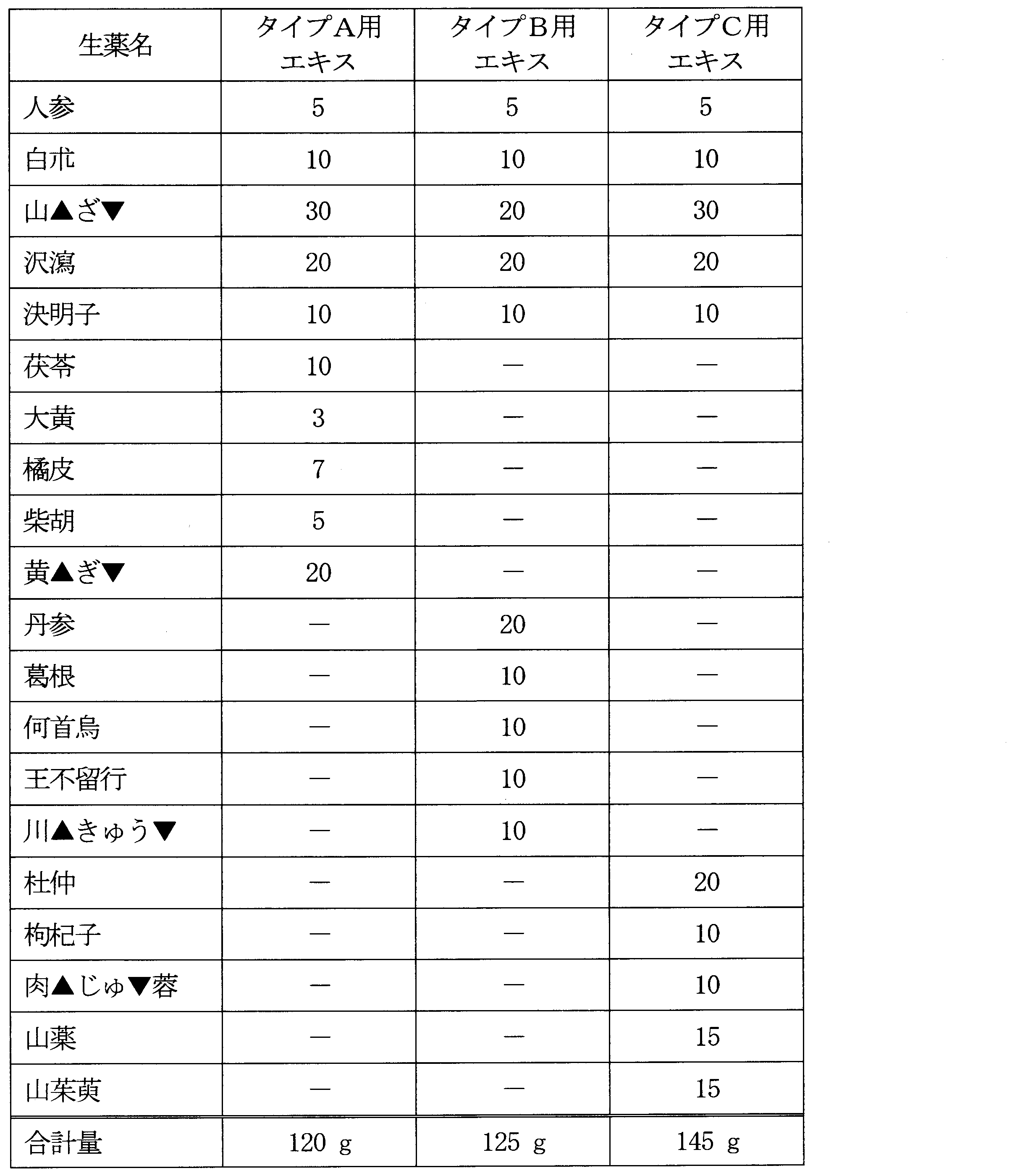
第1回目の「生薬エキス抽出作業」は、下記表2に示すタイプA用組成物の生薬を所定の割合で混合し、生薬混合物合計120gを、生薬袋(幅18cm×高さ25cm;ガーゼを3重にして作成したもの)に入れた。この生薬袋2袋(120g×2)を5,000mlの水に12時間浸した後、生薬抽出機に投入し、サーモスイッチの抽出作動時間を180分(3時間)に設定した。
エキスの製造では、上記抽出機を用いて、下記の2回の抽出作業及び1回の濃縮作業を実施した。
第1回目の「生薬エキス抽出作業」は、下記表2に示すタイプA用組成物の生薬を所定の割合で混合し、生薬混合物合計120gを、生薬袋(幅18cm×高さ25cm;ガーゼを3重にして作成したもの)に入れた。この生薬袋2袋(120g×2)を5,000mlの水に12時間浸した後、生薬抽出機に投入し、サーモスイッチの抽出作動時間を180分(3時間)に設定した。
生薬抽出機は庫内温度が摂氏92℃以上になると自動的に抽出時間表示のサーモスイッチがONになり作動するようにセットした。また、庫内温度が1℃上昇するのに約80秒を要する。投入した混合水温度が12℃だったので、92℃に達してサーモスイッチが作動するまで約106分かかった。サーモスイッチが作動した後の庫内温度は最高で106℃まで上昇した。
因って、第1回目の生薬エキス抽出時間としては、作動準備に106分+生薬エキス抽出時間180分の合計286分(4時間46分)を要した。
因って、第1回目の生薬エキス抽出時間としては、作動準備に106分+生薬エキス抽出時間180分の合計286分(4時間46分)を要した。
生薬抽出機のスイッチがOFFになった時点で庫内より抽出液を3,000ml取り出した。このとき、混合生薬の袋及びエキス残液は抽出機庫内に残留させた。
第1回目の抽出では、庫外への蒸気排出量は約1,200mlであった。
第1回目の抽出では、庫外への蒸気排出量は約1,200mlであった。
第2回目の「生薬エキス抽出」は、新たに水3,000mlを庫内に追加投入し、サーモスイッチを120分に設定した。
第2回目の抽出開始時点での庫内温度は55℃だったので、サーモスイッチがONになるまでの作動準備に約50分+生薬エキス抽出に120分の合計170分(2時間50分)を要した。
第2回目の抽出開始時点での庫内温度は55℃だったので、サーモスイッチがONになるまでの作動準備に約50分+生薬エキス抽出に120分の合計170分(2時間50分)を要した。
上記のサーモスイッチがOFFになった時点で庫内の抽出液を全て取り出した後、生薬袋を取り出して絞り、得られた抽出液を第2回目の抽出液に加えた。
第2回目の抽出では、庫外への蒸気排出量は約800mlであり、絞った後の水分を含んだ混合生薬残滓は約600gであった。従って、第2回目の抽出で得られた抽出液量は約2,400mlであった。
第2回目の抽出では、庫外への蒸気排出量は約800mlであり、絞った後の水分を含んだ混合生薬残滓は約600gであった。従って、第2回目の抽出で得られた抽出液量は約2,400mlであった。
濃縮作業では、第1回目と第2回目の抽出で得られた生薬エキス抽出液の合計5,400mlを抽出機に再投入し、サーモスイッチを90分に設定して抽出液を濃縮した。
濃縮作業では、約600mlの蒸気が排出されたので、最終的に約4,800mlの生薬エキス抽出液が得られた。
この生薬エキス抽出液を、アルミ製パックに100ml毎に充填した。生薬エキスが充填されたアルミ製パックは、スチームコンベンションにて100℃で40分間の加熱殺菌を施した。
濃縮作業では、約600mlの蒸気が排出されたので、最終的に約4,800mlの生薬エキス抽出液が得られた。
この生薬エキス抽出液を、アルミ製パックに100ml毎に充填した。生薬エキスが充填されたアルミ製パックは、スチームコンベンションにて100℃で40分間の加熱殺菌を施した。
実施例B:タイプB(高血圧合併型)用のエキスの製造
下記表2に示す生薬を、それぞれ表2に示す重量で用いた他は、実施例Aと同様にして、タイプB用エキス約4,800mlを得た。
下記表2に示す生薬を、それぞれ表2に示す重量で用いた他は、実施例Aと同様にして、タイプB用エキス約4,800mlを得た。
実施例C:タイプC(糖尿病合併型)用のエキスの製造
下記表2に示す生薬を、それぞれ表2に示す重量で用いた他は、実施例Aと同様にして、タイプC用エキス約4,700mlを得た。
下記表2に示す生薬を、それぞれ表2に示す重量で用いた他は、実施例Aと同様にして、タイプC用エキス約4,700mlを得た。
試験例
下記試験における、被験者のタイプの分類、検査データ及び所見は、東京女子医科大学 教授 医学博士栗原毅先生によるものである。
下記試験における、被験者のタイプの分類、検査データ及び所見は、東京女子医科大学 教授 医学博士栗原毅先生によるものである。
<被験者>
腹部超音波検査にて脂肪肝を認め、AST(アスパラギン酸アミノトランスフェラーゼ),ALT(アラニンアミノトランスフェラーゼ)のいずれかの値が基準値20IU/Lを超えている患者15名を被験者として選定した。いずれも、食事療法、運動療法で治療効果が認められなかった患者であった。
15名の患者を、5種類の臨床中医学的な分類と、西洋医学的な観点とを考慮して下記3タイプに分類した。
タイプA:脂肪肝のみ認めた患者(3例)
タイプB:高血圧を合併している患者(7例)(降圧剤を投与されており、収縮期血圧が140mmHg以上、又は拡張期血圧が90mmHg以上(日本高血圧学会ガイドライン2004年度版に基づく)の患者)
タイプC:糖尿病を合併している患者(7例)(空腹時血糖値が126mg/dl以上、又は随時血糖値が200mg/dl以上(日本糖尿病学会ガイドライン2006~2007年に基づく)の患者)
腹部超音波検査にて脂肪肝を認め、AST(アスパラギン酸アミノトランスフェラーゼ),ALT(アラニンアミノトランスフェラーゼ)のいずれかの値が基準値20IU/Lを超えている患者15名を被験者として選定した。いずれも、食事療法、運動療法で治療効果が認められなかった患者であった。
15名の患者を、5種類の臨床中医学的な分類と、西洋医学的な観点とを考慮して下記3タイプに分類した。
タイプA:脂肪肝のみ認めた患者(3例)
タイプB:高血圧を合併している患者(7例)(降圧剤を投与されており、収縮期血圧が140mmHg以上、又は拡張期血圧が90mmHg以上(日本高血圧学会ガイドライン2004年度版に基づく)の患者)
タイプC:糖尿病を合併している患者(7例)(空腹時血糖値が126mg/dl以上、又は随時血糖値が200mg/dl以上(日本糖尿病学会ガイドライン2006~2007年に基づく)の患者)
<投与方法>
各タイプに対して上記実施例A~Cで製造したエキスを、1日2回、朝、夕、3ヶ月間経口投与した。尚、1日2回が不可能な例では、1日1回の飲料とした。
投与期間は、投与開始から3ヶ月間とした。
投与期間中、被験者には、特別な食事指導、飲酒の規制及び運動療法は一切指示せず、各被験者の自由意思に任せた。
各タイプに対して上記実施例A~Cで製造したエキスを、1日2回、朝、夕、3ヶ月間経口投与した。尚、1日2回が不可能な例では、1日1回の飲料とした。
投与期間は、投与開始から3ヶ月間とした。
投与期間中、被験者には、特別な食事指導、飲酒の規制及び運動療法は一切指示せず、各被験者の自由意思に任せた。
<経過観察>
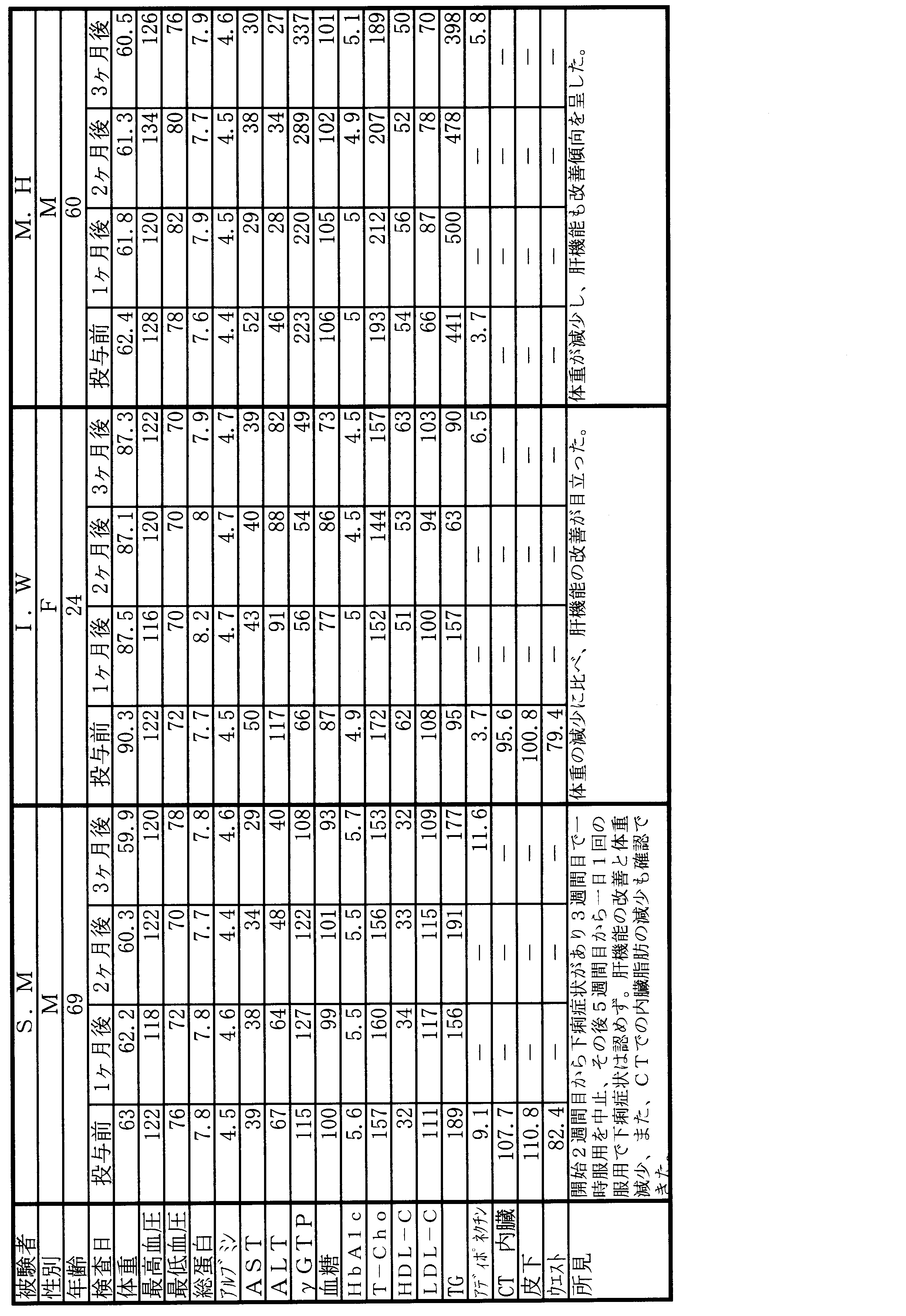
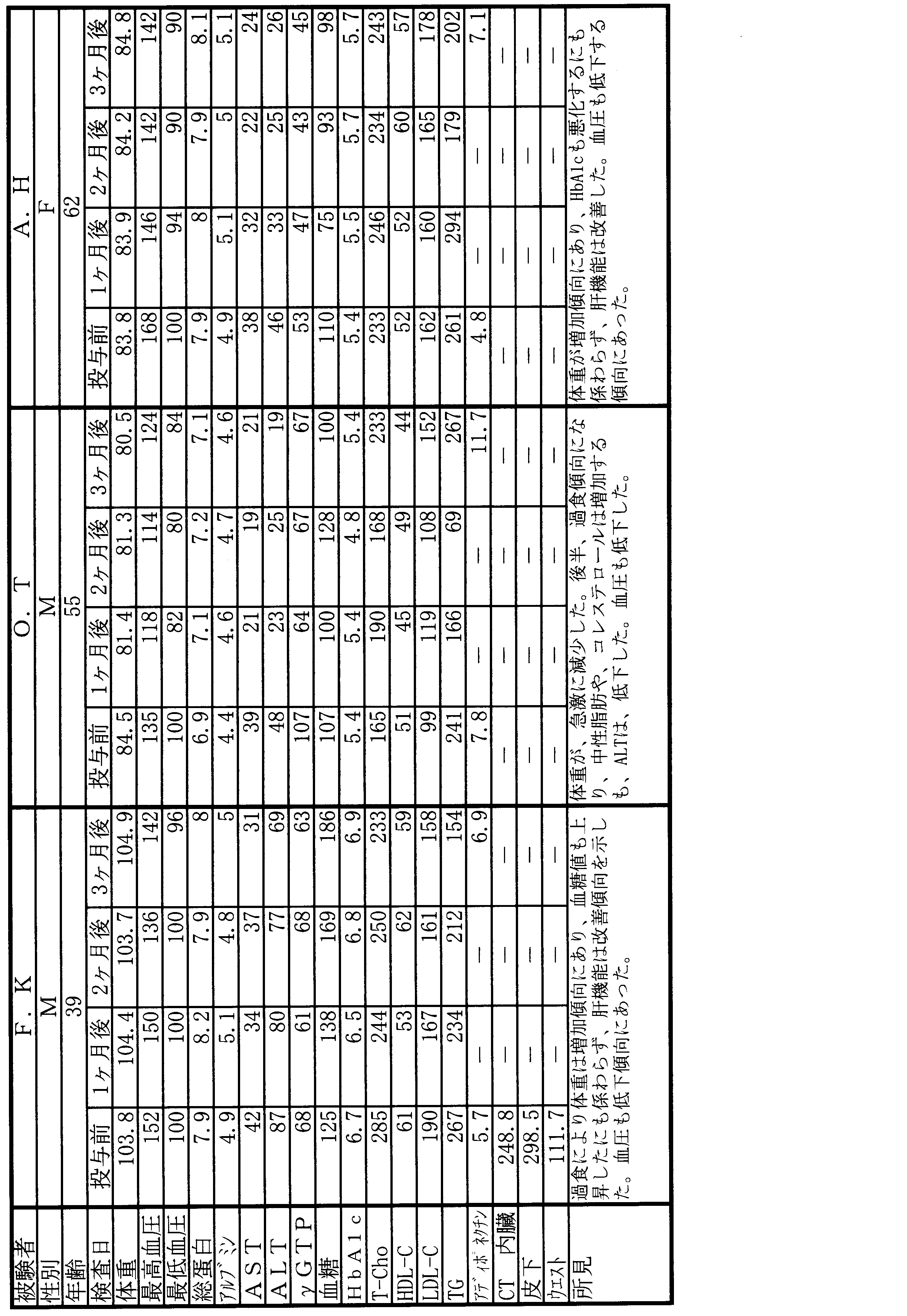
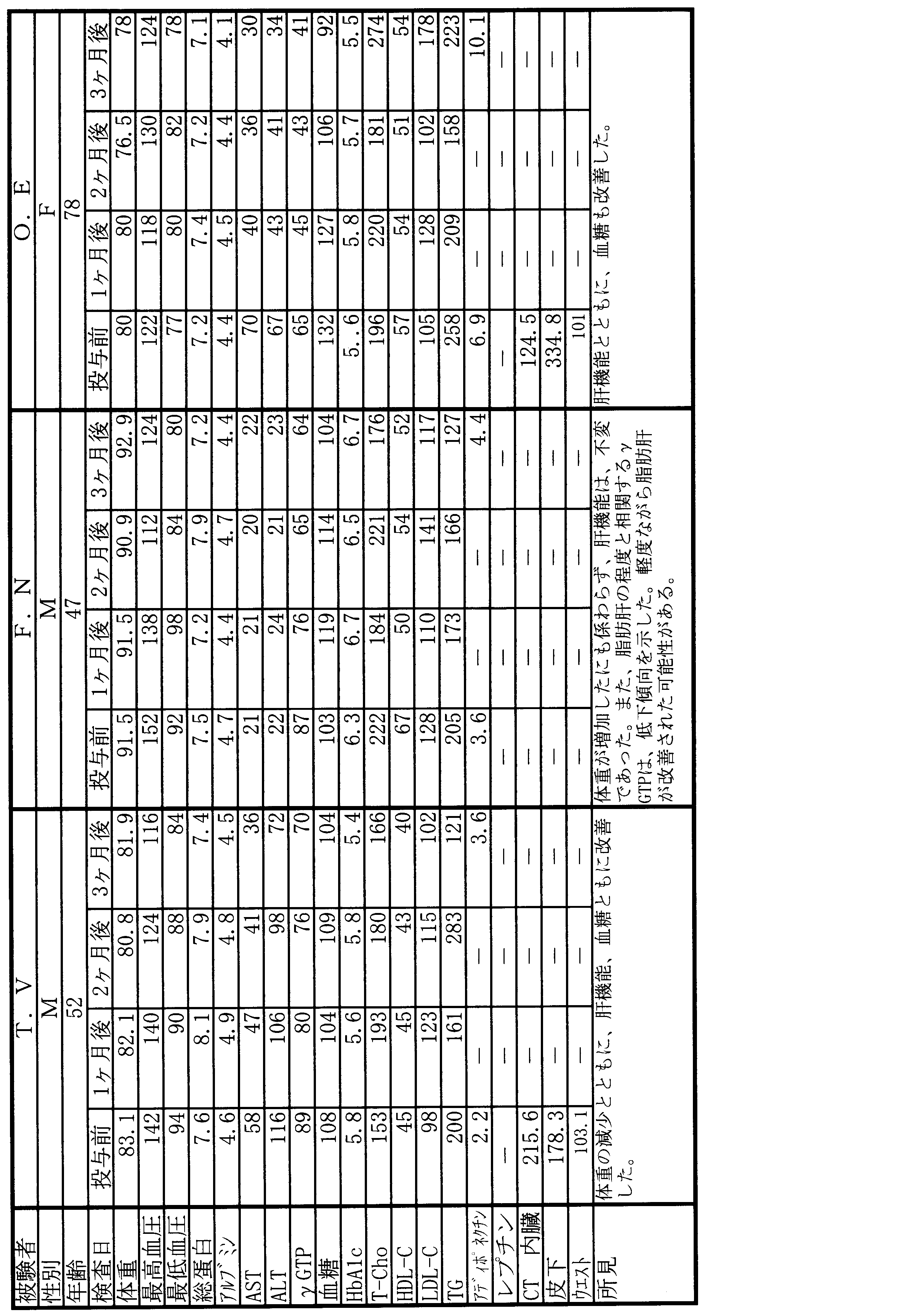
試験開始前、途中1ヶ月毎の経時的に血液検査を実施し、統計処理にて有意差を検定た。検査結果及び所見を、タイプAの被験者については下記表3、タイプBの被験者については下記表4-1及び4-2、タイプCの被験者については下記表5-1及び5-2に示す。
試験開始前、途中1ヶ月毎の経時的に血液検査を実施し、統計処理にて有意差を検定た。検査結果及び所見を、タイプAの被験者については下記表3、タイプBの被験者については下記表4-1及び4-2、タイプCの被験者については下記表5-1及び5-2に示す。

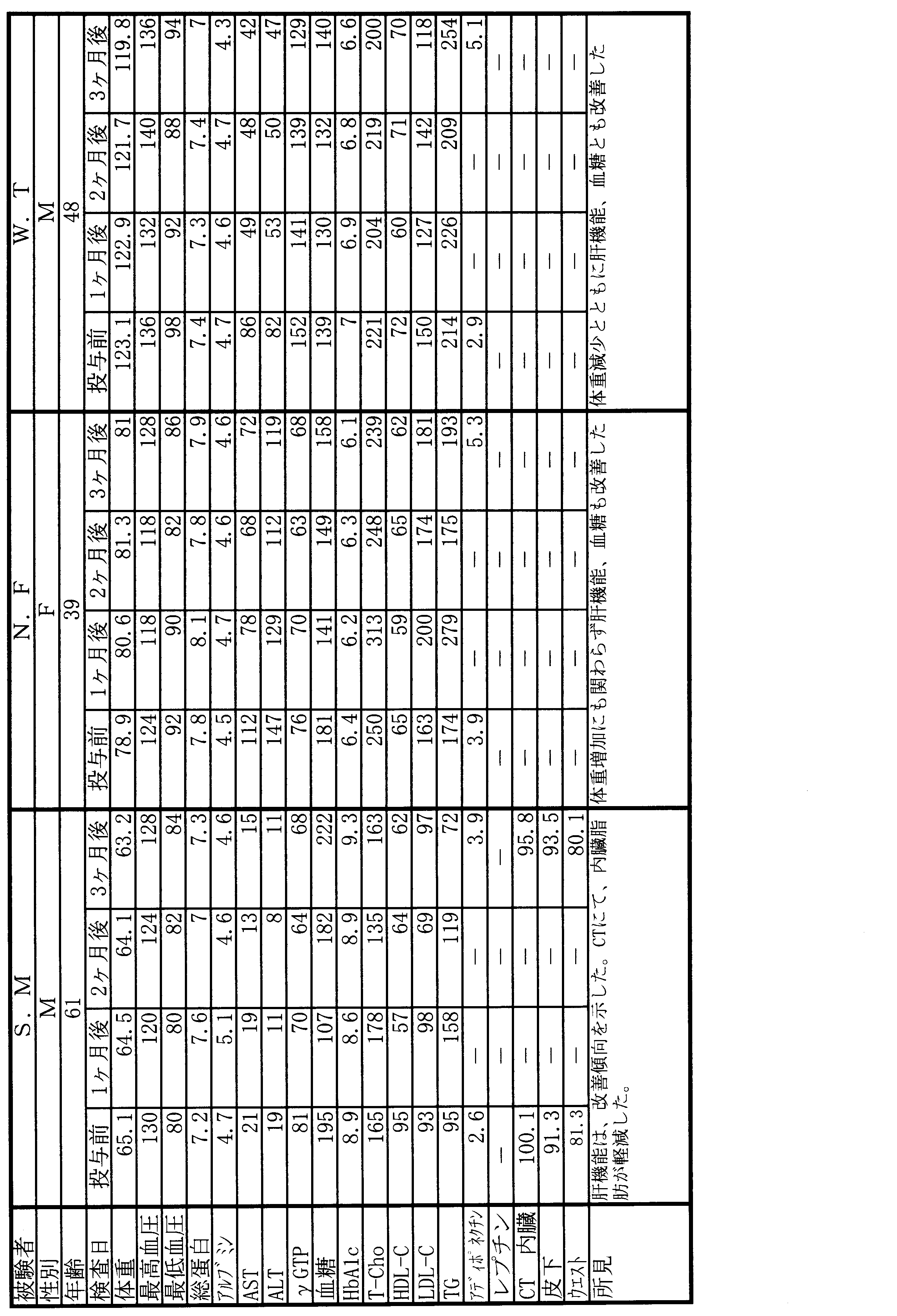
上記表中の検査項目は、いずれも臨床で通常用いられている検査方法で測定した。数値の単位を括弧内に示す。
総蛋白:血中総蛋白質量(g/dL)
アルブミン:血中のアルブミン量(g/dL)
AST:アスパラギン酸アミノトランスフェラーゼ(U/L)
ALT:アラニンアミノトランスフェラーゼ(U/L)
γGTP:r-グルタミルトランスペプチターゼ(U/L)
HbA1c:グリコヘモグロビンA1c(%)
T-Cho:総コレステロール(mg/dL)
HDL-C:高密度コレステロール(mg/dL)
LDL-C:低密度コレステロール(mg/dL)
TG:中性脂肪(mg/dL)
CT 内臓:コンピュータ断層撮影(CT)による内臓脂肪の面積(cm2)
皮下:コンピュータ断層撮影(CT)による皮下脂肪の面積(cm2)
ウエスト:胴囲(cm)
総蛋白:血中総蛋白質量(g/dL)
アルブミン:血中のアルブミン量(g/dL)
AST:アスパラギン酸アミノトランスフェラーゼ(U/L)
ALT:アラニンアミノトランスフェラーゼ(U/L)
γGTP:r-グルタミルトランスペプチターゼ(U/L)
HbA1c:グリコヘモグロビンA1c(%)
T-Cho:総コレステロール(mg/dL)
HDL-C:高密度コレステロール(mg/dL)
LDL-C:低密度コレステロール(mg/dL)
TG:中性脂肪(mg/dL)
CT 内臓:コンピュータ断層撮影(CT)による内臓脂肪の面積(cm2)
皮下:コンピュータ断層撮影(CT)による皮下脂肪の面積(cm2)
ウエスト:胴囲(cm)
<考察>
全ての被験者で、エキス服用前に比し、3ヶ月後でAST値(P=0.011)及び最高血圧値(P=0.025)が有意に低下した。
また、ALT値(P=0.066)に低下傾向が見られ、アディポネクチン値(0.063)が増加傾向を示した。
上記以外の検査値には特に変化は認めなかったが、悪化した値は無かった。
2名の被験者について、CTにて臍部での内臓脂肪面積を計測し経過を観察したところ、いずれも内臓脂肪面積が減少していた。
全ての被験者で、エキス服用前に比し、3ヶ月後でAST値(P=0.011)及び最高血圧値(P=0.025)が有意に低下した。
また、ALT値(P=0.066)に低下傾向が見られ、アディポネクチン値(0.063)が増加傾向を示した。
上記以外の検査値には特に変化は認めなかったが、悪化した値は無かった。
2名の被験者について、CTにて臍部での内臓脂肪面積を計測し経過を観察したところ、いずれも内臓脂肪面積が減少していた。
AST、ALTが低下したことは、肝臓の脂肪沈着の程度が軽減したことに起因すると考えられた。また、メタボリックシンドロームのマーカーであるアディポネクチン値が、上昇傾向を呈したことは、内臓脂肪の減少を表わしている。即ち、内臓脂肪細胞で産生される善玉のアディポサイトカインであるアディポネクチンが増加し、糖代謝の活性化や肥満の抑制が起きることが期待される。
肥満に関しても体重で検討したが、変動は見られなかった。体重の変動が認められなかったにも関わらず、肝臓での脂肪沈着が低下したことは、今回使用したエキスが、脂肪肝に有用であることを端的に表わしている。
各例を一例ごとに検討すると(表参照)、多くの被験者で、体重増加、あるいはHbA1c、TG(中性脂肪)が上昇していても、AST,ALTの低下が認められた。
また、敢えて食事・飲酒・運動療法等の一切の規制を設けず、被験者自信の全くの自由意思に任せた、厳しい条件下での試験であるにも関わらず、脂肪肝或いは肝機能に対する改善効果を確認できたことは、客観的事実として、現在処方されている医薬品に比べ、極めて優位な効果を有すると言える。
肥満に関しても体重で検討したが、変動は見られなかった。体重の変動が認められなかったにも関わらず、肝臓での脂肪沈着が低下したことは、今回使用したエキスが、脂肪肝に有用であることを端的に表わしている。
各例を一例ごとに検討すると(表参照)、多くの被験者で、体重増加、あるいはHbA1c、TG(中性脂肪)が上昇していても、AST,ALTの低下が認められた。
また、敢えて食事・飲酒・運動療法等の一切の規制を設けず、被験者自信の全くの自由意思に任せた、厳しい条件下での試験であるにも関わらず、脂肪肝或いは肝機能に対する改善効果を確認できたことは、客観的事実として、現在処方されている医薬品に比べ、極めて優位な効果を有すると言える。
本発明の組成物(エキス)は、脂肪肝の治療に非常に有用である。
本発明の組成物(エキス)は、食事療法、運動療法、西洋医学的治療によって改善しない脂肪肝を治療するのに非常に有用である。
本発明の組成物(エキス)は、食事療法及び/又は運動療法を併用すれば、抜群の治療効果が期待できる。
本発明の組成物(エキス)は、食事療法、運動療法、西洋医学的治療によって改善しない脂肪肝を治療するのに非常に有用である。
本発明の組成物(エキス)は、食事療法及び/又は運動療法を併用すれば、抜群の治療効果が期待できる。
上記に本発明の実施形態及び/又は実施例を幾つか詳細に説明したが、当業者は、本発明の新規な教示及び効果から実質的に離れることなく、これら例示である実施形態及び/又は実施例に多くの変更を加えることが容易である。従って、これらの多くの変更は本発明の範囲に含まれる。
この明細書に記載の文献及び本願のパリ優先の基礎となる日本出願明細書の内容を全てここに援用する。
この明細書に記載の文献及び本願のパリ優先の基礎となる日本出願明細書の内容を全てここに援用する。
Claims (7)
- 人参(にんじん)、白朮(びゃくじゅつ)、山▲ざ▼(さんざ)、沢瀉(たくしゃ)及び決明子(けつめいし)のエキスを含む脂肪肝治療用組成物。
- さらに、茯苓(ぶくりょう)、大黄(だいおう)、橘皮(きつひ)、柴胡(さいこ)及び黄▲ぎ▼(おうぎ)のエキスを含む、請求項1に記載の脂肪肝治療用組成物。
- 脂肪肝以外の疾患を伴わない脂肪肝の治療に用いる、請求項2に記載の脂肪肝治療用組成物。
- さらに、丹参(たんじん)、葛根(かっこん)、何首烏(かしゅう)、王不留行(おおふるぎょう)及び川▲きゅう▼(せんきゅう)のエキスを含む、請求項1に記載の脂肪肝治療用組成物。
- 心臓血管疾患を伴う脂肪肝の治療に用いる、請求項4に記載の脂肪肝治療用組成物。
- さらに、杜仲(とちゅう)、枸杞子(くこし)、肉▲じゅ▼蓉(にくじゅよう)、山薬(さんやく)及び山茱萸(さんしゅゆ)のエキスを含む、請求項1に記載の脂肪肝治療用組成物。
- 糖尿病を伴う脂肪肝の治療に用いる、請求項6に記載の脂肪肝治療用組成物。
Priority Applications (3)
| Application Number | Priority Date | Filing Date | Title |
|---|---|---|---|
| CN201780071313.8A CN109996552A (zh) | 2016-11-18 | 2017-11-08 | 脂肪肝治疗用组合物 |
| EP17872232.8A EP3653219A4 (en) | 2016-11-18 | 2017-11-08 | COMPOSITION FOR THE TREATMENT OF HEPATIC STEATOSIS |
| US16/461,144 US10849950B2 (en) | 2016-11-18 | 2017-11-08 | Composition for treating fatty liver |
Applications Claiming Priority (2)
| Application Number | Priority Date | Filing Date | Title |
|---|---|---|---|
| JP2016224986A JP6145552B1 (ja) | 2016-11-18 | 2016-11-18 | 脂肪肝治療用組成物 |
| JP2016-224986 | 2016-11-18 |
Publications (1)
| Publication Number | Publication Date |
|---|---|
| WO2018092654A1 true WO2018092654A1 (ja) | 2018-05-24 |
Family
ID=59061132
Family Applications (1)
| Application Number | Title | Priority Date | Filing Date |
|---|---|---|---|
| PCT/JP2017/040244 Ceased WO2018092654A1 (ja) | 2016-11-18 | 2017-11-08 | 脂肪肝治療用組成物 |
Country Status (5)
| Country | Link |
|---|---|
| US (1) | US10849950B2 (ja) |
| EP (1) | EP3653219A4 (ja) |
| JP (1) | JP6145552B1 (ja) |
| CN (1) | CN109996552A (ja) |
| WO (1) | WO2018092654A1 (ja) |
Cited By (1)
| Publication number | Priority date | Publication date | Assignee | Title |
|---|---|---|---|---|
| WO2022021779A1 (zh) * | 2020-07-28 | 2022-02-03 | 深圳市老年医学研究所 | 用于高脂血和脂肪肝的药膳食疗产品组合物及其制备方法 |
Families Citing this family (5)
| Publication number | Priority date | Publication date | Assignee | Title |
|---|---|---|---|---|
| CN111643591A (zh) * | 2020-07-29 | 2020-09-11 | 汕头市中医医院 | 一种健脾益肾中药组合物及其应用 |
| CN114796366B (zh) * | 2022-03-30 | 2023-08-01 | 广州中医药大学第一附属医院 | 一种中药组合物及其应用 |
| CN115400168A (zh) * | 2022-10-31 | 2022-11-29 | 云南中医药大学 | 一种中药组合物 |
| CN116440205B (zh) * | 2023-04-21 | 2025-02-18 | 常德市第一中医医院 | 一种防治非酒精性脂肪肝的茶饮及其制备方法 |
| CN117982720B (zh) * | 2024-04-01 | 2024-06-04 | 成都中医药大学 | 一种预防损伤放松肌肉的中药材凝胶敷料及其制备方法 |
Citations (3)
| Publication number | Priority date | Publication date | Assignee | Title |
|---|---|---|---|---|
| JPH0159248B2 (ja) * | 1980-10-21 | 1989-12-15 | Zeria Pharm Co Ltd | |
| CN101112432A (zh) * | 2007-08-23 | 2008-01-30 | 重庆市中药研究院 | 一种治疗脂肪肝的中成药及其制备方法 |
| JP2014076962A (ja) * | 2012-10-10 | 2014-05-01 | Sakamoto Yakusoen:Kk | 脂肪肝抑制剤 |
Family Cites Families (8)
| Publication number | Priority date | Publication date | Assignee | Title |
|---|---|---|---|---|
| JP4205188B2 (ja) | 1997-10-01 | 2009-01-07 | 一丸ファルコス株式会社 | メイラード反応阻害剤 |
| CN101015668A (zh) * | 2007-01-16 | 2007-08-15 | 李卓伦 | 治疗脂肪肝的药物 |
| CN101745077A (zh) * | 2009-09-07 | 2010-06-23 | 湖南康普制药有限公司 | 一种治疗脂肪肝、酒精性肝炎及并发症的中药复方制剂 |
| CN101869687B (zh) * | 2010-06-10 | 2011-11-16 | 银小龙 | 治疗脂肪肝、酒精肝,降血脂、降转氨酶的药物 |
| CN103977112B (zh) * | 2014-05-28 | 2016-08-24 | 新乡医学院第一附属医院 | 一种治疗酒精肝的中药 |
| FR3027228B1 (fr) | 2014-10-20 | 2016-12-09 | Valbiotis | Composition comprenant un melange d'extraits vegetaux et utilisation pour agir sur le metabolisme glucidique et/ou lipidique |
| CN104857377B (zh) * | 2015-05-21 | 2018-05-01 | 圣原健康产业有限公司 | 改善脂肪肝的中药提取物及其制备方法与按摩膏 |
| CN105250890A (zh) * | 2015-08-28 | 2016-01-20 | 毕国风 | 一种治疗高脂血症中药 |
-
2016
- 2016-11-18 JP JP2016224986A patent/JP6145552B1/ja active Active
-
2017
- 2017-11-08 US US16/461,144 patent/US10849950B2/en active Active
- 2017-11-08 EP EP17872232.8A patent/EP3653219A4/en not_active Withdrawn
- 2017-11-08 WO PCT/JP2017/040244 patent/WO2018092654A1/ja not_active Ceased
- 2017-11-08 CN CN201780071313.8A patent/CN109996552A/zh active Pending
Patent Citations (3)
| Publication number | Priority date | Publication date | Assignee | Title |
|---|---|---|---|---|
| JPH0159248B2 (ja) * | 1980-10-21 | 1989-12-15 | Zeria Pharm Co Ltd | |
| CN101112432A (zh) * | 2007-08-23 | 2008-01-30 | 重庆市中药研究院 | 一种治疗脂肪肝的中成药及其制备方法 |
| JP2014076962A (ja) * | 2012-10-10 | 2014-05-01 | Sakamoto Yakusoen:Kk | 脂肪肝抑制剤 |
Non-Patent Citations (1)
| Title |
|---|
| See also references of EP3653219A4 * |
Cited By (1)
| Publication number | Priority date | Publication date | Assignee | Title |
|---|---|---|---|---|
| WO2022021779A1 (zh) * | 2020-07-28 | 2022-02-03 | 深圳市老年医学研究所 | 用于高脂血和脂肪肝的药膳食疗产品组合物及其制备方法 |
Also Published As
| Publication number | Publication date |
|---|---|
| US10849950B2 (en) | 2020-12-01 |
| EP3653219A4 (en) | 2020-07-08 |
| JP6145552B1 (ja) | 2017-06-14 |
| JP2018080142A (ja) | 2018-05-24 |
| EP3653219A1 (en) | 2020-05-20 |
| CN109996552A (zh) | 2019-07-09 |
| US20200078429A1 (en) | 2020-03-12 |
Similar Documents
| Publication | Publication Date | Title |
|---|---|---|
| JP6145552B1 (ja) | 脂肪肝治療用組成物 | |
| CN104757669B (zh) | 一种降压降脂保健饮料及其制备方法 | |
| CN103301267A (zh) | 一种治疗高血压和/或动脉粥样硬化的中药组合物及应用 | |
| CN114712466B (zh) | 一种具有减肥养颜功效的药物及其制备方法 | |
| CN118021901A (zh) | 一种补肾中药组合物 | |
| CN103041306A (zh) | 用于治疗妇女更年期综合征的中药组合物及其制备方法 | |
| CN113750176A (zh) | 一种中药组合物、中药合剂及其制备方法和应用 | |
| CN104984141A (zh) | 一种治疗便秘的方剂及其制备方法 | |
| CN110841033A (zh) | 一种防治血虚寒凝型痛经的中药保健腰带及其制备方法 | |
| CN114712470B (zh) | 一种治疗男士肾亏的药物及其制备方法 | |
| CN104623247A (zh) | 一种治疗慢性肠炎的中药制剂 | |
| CN105311469A (zh) | 一种具有抗癌功效的制剂及制法 | |
| CN119587659A (zh) | 一种健脾祛湿的中药组合物及其制备与应用 | |
| CN119970929A (zh) | 一种减肥中药组合物及其制备方法 | |
| TW202333761A (zh) | 用於預防、改善或緩和痰濕相關症狀之組合物 | |
| CN119970897A (zh) | 一种治疗帕金森病的中药组合物及其制备方法 | |
| CN105106469A (zh) | 主治卵巢癌的中药组合物及制法 | |
| CN119970983A (zh) | 一种治疗慢性冠脉综合征、消退冠状动脉、颈动脉斑块的中药组合物及其制备方法、应用 | |
| CN104825980A (zh) | 一种治疗腹泻的中药制剂 | |
| CN115317563A (zh) | 一种保健养生的中药制剂及其制备方法 | |
| CN104623250A (zh) | 治疗乳腺炎的行气破瘀药物及制备方法 | |
| CN106668452A (zh) | 一种治疗心肌炎的中药制剂 | |
| CN105560411A (zh) | 治疗慢性痢疾的温脾祛寒制剂 | |
| CN104587018A (zh) | 阴虚燥热型糖尿病养阴清热药剂及制备方法 | |
| CN104740430A (zh) | 一种治疗阑尾炎的清热解毒剂及制法 |
Legal Events
| Date | Code | Title | Description |
|---|---|---|---|
| NENP | Non-entry into the national phase |
Ref country code: DE |
|
| ENP | Entry into the national phase |
Ref document number: 2017872232 Country of ref document: EP Effective date: 20190618 |