WO2018097257A1 - Procédé d'édition du génome - Google Patents
Procédé d'édition du génome Download PDFInfo
- Publication number
- WO2018097257A1 WO2018097257A1 PCT/JP2017/042256 JP2017042256W WO2018097257A1 WO 2018097257 A1 WO2018097257 A1 WO 2018097257A1 JP 2017042256 W JP2017042256 W JP 2017042256W WO 2018097257 A1 WO2018097257 A1 WO 2018097257A1
- Authority
- WO
- WIPO (PCT)
- Prior art keywords
- sequence
- genome editing
- homology arm
- dna
- region
- Prior art date
- Legal status (The legal status is an assumption and is not a legal conclusion. Google has not performed a legal analysis and makes no representation as to the accuracy of the status listed.)
- Ceased
Links
Images


Classifications
-
- C—CHEMISTRY; METALLURGY
- C12—BIOCHEMISTRY; BEER; SPIRITS; WINE; VINEGAR; MICROBIOLOGY; ENZYMOLOGY; MUTATION OR GENETIC ENGINEERING
- C12N—MICROORGANISMS OR ENZYMES; COMPOSITIONS THEREOF; PROPAGATING, PRESERVING, OR MAINTAINING MICROORGANISMS; MUTATION OR GENETIC ENGINEERING; CULTURE MEDIA
- C12N15/00—Mutation or genetic engineering; DNA or RNA concerning genetic engineering, vectors, e.g. plasmids, or their isolation, preparation or purification; Use of hosts therefor
- C12N15/09—Recombinant DNA-technology
- C12N15/87—Introduction of foreign genetic material using processes not otherwise provided for, e.g. co-transformation
- C12N15/90—Stable introduction of foreign DNA into chromosome
-
- A—HUMAN NECESSITIES
- A01—AGRICULTURE; FORESTRY; ANIMAL HUSBANDRY; HUNTING; TRAPPING; FISHING
- A01K—ANIMAL HUSBANDRY; AVICULTURE; APICULTURE; PISCICULTURE; FISHING; REARING OR BREEDING ANIMALS, NOT OTHERWISE PROVIDED FOR; NEW BREEDS OF ANIMALS
- A01K67/00—Rearing or breeding animals, not otherwise provided for; New or modified breeds of animals
- A01K67/027—New or modified breeds of vertebrates
-
- C—CHEMISTRY; METALLURGY
- C12—BIOCHEMISTRY; BEER; SPIRITS; WINE; VINEGAR; MICROBIOLOGY; ENZYMOLOGY; MUTATION OR GENETIC ENGINEERING
- C12N—MICROORGANISMS OR ENZYMES; COMPOSITIONS THEREOF; PROPAGATING, PRESERVING, OR MAINTAINING MICROORGANISMS; MUTATION OR GENETIC ENGINEERING; CULTURE MEDIA
- C12N15/00—Mutation or genetic engineering; DNA or RNA concerning genetic engineering, vectors, e.g. plasmids, or their isolation, preparation or purification; Use of hosts therefor
- C12N15/09—Recombinant DNA-technology
- C12N15/10—Processes for the isolation, preparation or purification of DNA or RNA
- C12N15/102—Mutagenizing nucleic acids
-
- C—CHEMISTRY; METALLURGY
- C12—BIOCHEMISTRY; BEER; SPIRITS; WINE; VINEGAR; MICROBIOLOGY; ENZYMOLOGY; MUTATION OR GENETIC ENGINEERING
- C12N—MICROORGANISMS OR ENZYMES; COMPOSITIONS THEREOF; PROPAGATING, PRESERVING, OR MAINTAINING MICROORGANISMS; MUTATION OR GENETIC ENGINEERING; CULTURE MEDIA
- C12N15/00—Mutation or genetic engineering; DNA or RNA concerning genetic engineering, vectors, e.g. plasmids, or their isolation, preparation or purification; Use of hosts therefor
- C12N15/09—Recombinant DNA-technology
- C12N15/87—Introduction of foreign genetic material using processes not otherwise provided for, e.g. co-transformation
- C12N15/90—Stable introduction of foreign DNA into chromosome
- C12N15/902—Stable introduction of foreign DNA into chromosome using homologous recombination
- C12N15/907—Stable introduction of foreign DNA into chromosome using homologous recombination in mammalian cells
-
- C—CHEMISTRY; METALLURGY
- C12—BIOCHEMISTRY; BEER; SPIRITS; WINE; VINEGAR; MICROBIOLOGY; ENZYMOLOGY; MUTATION OR GENETIC ENGINEERING
- C12N—MICROORGANISMS OR ENZYMES; COMPOSITIONS THEREOF; PROPAGATING, PRESERVING, OR MAINTAINING MICROORGANISMS; MUTATION OR GENETIC ENGINEERING; CULTURE MEDIA
- C12N2310/00—Structure or type of the nucleic acid
- C12N2310/10—Type of nucleic acid
- C12N2310/20—Type of nucleic acid involving clustered regularly interspaced short palindromic repeats [CRISPR]
Definitions
- the present invention relates to a genome editing method and the like.
- mice are used by researchers all over the world to analyze gene functions at the individual level.
- a conditional knockout mouse is one of the most commonly used genetically modified mice because it can control gene expression in a cell tissue-specific and time-specific manner.
- a conditional knockout mouse is produced by crossing a “Cre mouse” in which a Cre expression cassette is incorporated with a “flox mouse” in which a target gene or a part thereof is sandwiched between loxP sequences.
- Cre mice and flox mice mouse ES cells have been mainly used so far, or a part of them or a Cre expression cassette was knocked into ES cells by homologous recombination, and the obtained cells were used as mouse embryos. The blastocyst is injected, the embryo is transplanted into a pseudopregnant female mouse, and a Cre mouse or a flox mouse is produced via a chimeric mouse.
- the present invention provides a new genome that can be introduced more easily and efficiently even if it is a mutation in a relatively long region or a plurality of mutations in a relatively long region (for example, insertion of two loxP sequences). It is an object to provide an editing method.
- the present inventor has (a) an artificial nuclease system that cuts both ends of the genome editing target region, and (b) from the 5 ′ side, a 5 ′ side homology arm sequence, a donor DNA sequence, 3′-side homology arm sequence is included, the 5′-side homology arm sequence is a homologous sequence of one of the base sequences outside the genome editing target region, and the 3′-side homology arm It was found that genome editing can be performed easily and efficiently by using two single-stranded DNAs whose sequences are homologous to the other base sequence outside the genome editing target region. .
- the CRISPR / Cas system is used as an artificial nuclease system, and a single-stranded DNA containing a donor DNA sequence containing two recombination enzyme recognition sequences and introduced into a target by electroporation.
- an individual having the recombination enzyme recognition sequence added to both ends of the genome editing target region of the two alleles was obtained.
- the production period of the target individual could be greatly shortened.
- the present inventor has found that the above efficiency can be increased by adopting a relatively long strand as the 5′-side homology arm in the single-stranded DNA, and has completed the present invention.
- the present invention includes the following embodiments: [1] (a) An artificial nuclease system that cuts both ends of the genome editing target region, and (b) from the 5 ′ side, the 5 ′ side homology arm sequence, the donor DNA sequence, and the 3 ′ side homology arm sequence are arranged in this order.
- the 5 ′ homology arm sequence is a homologous sequence of one base sequence outside the genome editing target region
- the 3 ′ side homology arm sequence is the other homologous sequence outside the genome editing target region.
- a method for producing a genome-edited cell or non-human organism comprising a step of introducing a single-stranded DNA, which is a homologous sequence of a base sequence, into the cell or non-human organism.
- [8] (a) An artificial nuclease system that cuts both ends of the genome editing target region, and (b) from the 5 ′ side, the 5 ′ side homology arm sequence, the donor DNA sequence, and the 3 ′ side homology arm sequence are arranged in this order.
- the 5 ′ homology arm sequence is a homologous sequence of one base sequence outside the genome editing target region
- the 3 ′ side homology arm sequence is the other homologous sequence outside the genome editing target region.
- a composition for genome editing comprising single-stranded DNA that is a homologous sequence of a base sequence.
- the 5 ′ homology arm sequence is a homologous sequence of one base sequence outside the genome editing target region
- the 3 ′ side homology arm sequence is the other homologous sequence outside the genome editing target region.
- a genome editing kit comprising a single-stranded DNA that is a homologous sequence of a base sequence.
- a relatively long region mutation or a plurality of mutations in a relatively long region (for example, such as non-patent document 1) that is difficult with a conventional method using a relatively short single-stranded oligo (ssODN) (for example, Even insertion of two loxP sequences) can be introduced more conveniently and efficiently.
- ssODN relatively short single-stranded oligo
- introduction of various tools into the genome editing target cell can be performed by electroporation.
- the microinjection method is usually employed, but genome editing can be performed more simply and efficiently by employing this electroporation method.
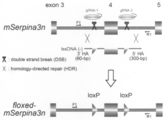
- mSerpina3n represents genomic DNA before genome editing
- lssDNA represents single-stranded DNA
- floxed-mSerpina3n represents genomic DNA after genome editing.
- the scissors picture shows the site cleaved by the CRISPR / Cas system (the area between the two scissors pictures is the genome editing target area), and gRNA-1 and gRNA-2 seem to cut both ends of the genomic editing target area
- 5′HA indicates a 5 ′ homology arm (base length in parentheses)
- 3′HA indicates a 3 ′ homology arm (base in parentheses) (Long)
- the triangle indicates the loxP sequence
- the orientation of the triangle in the horizontal direction indicates the orientation of the loxP sequence
- the x between mSerpina3n and lssDNA indicates that the region is a homologous sequence.
- plasmid DNA containing a nicking endonuclease recognition site is prepared in “Plasmid preparation”, the plasmid DNA is digested with nicking endonuclease in “Nicking enzyme”, and the digest is subjected to agarose gel electrophoresis in “Gel electrophoresis”.
- Garose gel electrophoresis single-stranded DNA is extracted from a gel containing a band that matches the target single-stranded DNA.
- the scheme of genome editing test 5 (Example 5) is shown.
- rVapb indicates genomic DNA before genome editing
- lSODN indicates single-stranded DNA
- floxed-rVapb indicates genomic DNA after genome editing.
- the scissors picture shows the site cleaved by the CRISPR / Cas system (the area between the two scissors pictures is the genome editing target area), and gRNA-1 and gRNA-2 seem to cut both ends of the genomic editing target area Shows the two guide RNAs designed in Fig.
- arrows (F1 and R1) indicate the positions of the PCR primers used for genotyping, the direction of the arrows indicate the direction of the primers (5 ' ⁇ 3'), 5 ⁇ HA indicates a 5 ⁇ homology arm (base length in parentheses), 3 ⁇ HA indicates a 3 'homology arm (base length in parentheses), a triangle indicates a loxP sequence, and the orientation of the triangle in the horizontal direction is loxP Indicates the orientation of the sequence, x between rVapb and lsODN indicates that the region is a homologous sequence, T or C in exon 4 indicates the base to be mutated by genome editing, P56S indicates the rVapb protein due to the mutation 56th amino acid (proline) in serine Indicating that different.
- amino acid sequence identity refers to the degree of amino acid sequence match between two or more comparable amino acid sequences. Therefore, the higher the identity between two amino acid sequences, the higher the identity or similarity of those sequences.
- the level of amino acid sequence identity is determined, for example, using FASTA, a sequence analysis tool, using default parameters. Or the algorithm BLAST by Karlin and Altschul (KarlinS, Altschul SF. “Methods for assessing the statistical significance of molecular sequence features by using general scoringschemes” Proc Natl Acad Sci USA. 87: 2264-2ul (Sci. “Applications and statistics for multiple high-scoring segments in molecular sequences.” Proc Natl Acad Sci USA.
- conservative substitution means that an amino acid residue is substituted with an amino acid residue having a similar side chain.
- substitution with amino acid residues having basic side chains such as lysine, arginine, and histidine is a conservative substitution.
- amino acid residues having acidic side chains such as aspartic acid and glutamic acid
- amino acid residues having non-charged polar side chains such as glycine, asparagine, glutamine, serine, threonine, tyrosine, and cysteine
- Amino acid residues with non-polar side chains such as proline, phenylalanine, methionine, and tryptophan
- Amino acid residues with ⁇ -branched side chains such as threonine, valine, and isoleucine
- Aromatic side chains such as tyrosine, phenylalanine, tryptophan, and histidine
- substitutions between amino acid residues are conservative substitutions.
- nucleotides such as DNA and RNA used exogenously may be subjected to known chemical modifications, as exemplified below.
- Replacing phosphate residues (phosphates) of each nucleotide with chemically modified phosphate residues such as phosphorothioate (PS), methylphosphonate, phosphorodithionate, etc. to prevent degradation by hydrolases such as nucleases Can do.
- the hydroxyl group at the 2-position of the sugar (ribose) of each ribonucleotide is represented by —OR (R is, for example, CH 3 (2′-O-Me), CH 2 CH 2 OCH 3 (2′-O-MOE), CH 2 CH 2 NHC (NH) NH 2 , CH2CONHCH3, CH2CH2CN, etc.).
- R is, for example, CH 3 (2′-O-Me), CH 2 CH 2 OCH 3 (2′-O-MOE), CH 2 CH 2 NHC (NH) NH 2 , CH2CONHCH3, CH2CH2CN, etc.
- the base moiety pyrimidine, purine
- the phosphoric acid part and the hydroxyl part can be modified with biotin, amino group, lower alkylamine group, acetyl group, etc., it is not limited thereto.
- BNA LNA
- BNA LNA
- the conformation of the sugar moiety is fixed to the N type by crosslinking the 2 ′ oxygen and 4 ′ carbon of the sugar moiety of the nucleotide can also be preferably used.
- the present invention is a genome editing method, a method for producing a genome-edited cell or a non-human organism, and a composition for genome editing, using two kinds of materials (material (a) and material (b)). Products, genome editing kits, etc. Hereinafter, these materials will be described.
- the material (a) is an artificial nuclease system that cuts both ends of the genome editing target region.
- the genome editing target region is an arbitrary region on the genomic DNA of the genome editing target cell or organism, and is a target region that is replaced with a donor DNA sequence described later by genome editing.
- the length of the genome editing target region is not particularly limited.
- the length is, for example, 10 bases or more, preferably 30 bases or more, more preferably 60 bases or more, still more preferably 100 bases or more, even more preferably 150 bases or more, even more preferably 200 bases
- the length is 10000 base length or less, preferably 5000 base length or less, more preferably 2000 base length or less, still more preferably 1000 base length or less, and still more preferably 800 base length or less.
- Genomic editing target cells and organisms are not particularly limited as long as they are cells and organisms that can be genome-edited by an artificial nuclease system.
- Examples of cells for genome editing include cells derived from various tissues or of various properties, such as blood cells, hematopoietic stem cells / progenitor cells, gametes (sperm, ovum), fertilized eggs, embryonic cells of each stage of embryo (for example, 1 cell) Embryo, 2-cell embryo, 4-cell embryo, 8-cell embryo, 16-cell embryo, morula, etc.), fibroblast, epithelial cell, vascular endothelial cell, nerve cell, hepatocyte, keratinocyte , Muscle cells, epidermal cells, endocrine cells, ES cells, iPS cells, tissue stem cells, cancer cells and the like.
- organisms subject to genome editing include mammals such as humans, monkeys, mice, rats, guinea pigs, hamsters, pigs, cows, goats, sheep, dogs, cats, and rabbits; amphibian animals such as Xenopus; zebrafish and medaka , Fish such as tiger puffer, tuna and red sea bream; chordae such as sea squirt; arthropods such as Drosophila and silkworm; animals such as Arabidopsis, tomato, soybean, rice, wheat, corn, rapeseed and tobacco: yeast , Fungi such as red mold: Examples include bacteria such as Escherichia coli, Bacillus subtilis and cyanobacteria.
- the mammal is preferably a rodent such as a mouse, rat, guinea pig or hamster, and particularly preferably a mouse or rat.
- the genome editing target region is a donor described later.
- An organism replaced with a DNA sequence can be obtained more simply and efficiently.
- condition-specific gene mutant for example, a conditional knockout body
- a recombinase and its recognition sequence for example, Cre-loxP system or FLP-FRT system
- a fertilized egg containing a recombinant enzyme expression cassette for example, a fertilized egg fertilized with a sperm containing an expression cassette of Cre or FLP
- two recombinant enzyme recognition sequences described later as donor DNA
- the recombinant enzyme expression cassette is not particularly limited as long as it is DNA capable of expressing the recombinant enzyme in cells.
- a typical example of a recombinant enzyme expression cassette is a DNA containing a promoter and a recombinant enzyme coding sequence placed under the control of the promoter.
- the promoter of the expression cassette is not particularly limited, and for example, promoters whose transcriptional activity varies depending on various conditions such as tissue-specific promoters, time-specific promoters, drug-responsive promoters, and the like can be widely used.
- the cutting at both ends of the genome editing target region is, in other words, cutting at one end and the other end of the genome editing target region. More specifically, a break between a base pair at one end of the genome editing target region and a base pair adjacent outside the base pair (outside of the genome editing target region), and at the other end of the genome editing target region This is a cleavage between a base pair and a base pair adjacent outside the base pair (outside the genome editing target region). As a result, a DNA fragment including the genome editing target region is generated from the genomic DNA.
- the artificial nuclease system is not particularly limited as long as it is a system that can cleave any two sites on the genomic DNA to generate a cleaved fragment.
- Examples of the artificial nuclease system include a CRISPR / Cas system, a TALEN system, a ZFN system, and a PPR system.
- the CRISPR / Cas system uses a Cas protein that is a nuclease (RGN; RNA-guided nuclease) and a guide RNA (gRNA).
- RGN nuclease
- gRNA guide RNA
- the TALEN system uses an artificial nuclease (TALEN) that contains the DNA-binding domain of a transcriptional activator-like (TAL) effector in addition to a DNA cleavage domain (eg, FokI domain) (eg, US Pat. No. 8470973, US Pat. No. 8,586,363). issue).
- TALEN a transcriptional activator-like
- FokI domain eg, US Pat. No. 8470973, US Pat. No. 8,586,363
- TALEN binds to the target site via the DNA binding domain, where it cleaves the DNA.
- the DNA binding domain that binds to the target site is designed according to a known scheme (for example, Zhang, Feng et. Al. (2011) Nature Biotechnology 29 (2); this paper is incorporated herein by reference). be able to.
- the ZFN system uses an artificial nuclease (ZFN) containing a nucleic acid cleavage domain conjugated to a DNA binding domain containing a zinc finger array (eg, US Pat. Nos. 6,265,196, 8,524,500, 7,788,121, European Patent 17,209,95).
- ZFN artificial nuclease
- a DNA binding domain containing a zinc finger array eg, US Pat. Nos. 6,265,196, 8,524,500, 7,788,121, European Patent 17,209,95.
- PPR pentatricopeptiderepeat fused with a nuclease domain
- PPR pentatricopeptiderepeat fused with a nuclease domain
- CRISPR / Cas systems typically include Cas components such as Cas protein, Cas mRNA, and Cas protein expression cassettes, as well as guide RNAs designed to cleave both ends of the genome editing region, and guides such as the expression cassettes. Consists of RNA components. Hereinafter, each component will be described.
- Cas component material (a1)
- Examples of the Cas component include Cas protein, Cas mRNA, Cas protein expression cassette and the like.
- the Cas component may be a single type or a combination of two or more types.
- the Cas protein is not particularly limited as long as it is used in the CRISPR / Cas system.
- the Cas protein can bind to a target site of genomic DNA in a complex with a guide RNA and can cleave the target site into double strands.
- Various things can be used.
- target site refers to a PAM (Proto-spacer Adjacent Motif) sequence and a length of 17 to 30 bases (preferably 18 to 25 bases, more preferably 19 to 22 bases) adjacent to the 5 ′ side thereof. It is a site on genomic DNA consisting of a DNA strand (target strand) consisting of a sequence of a length (particularly preferably 20 bases) and its complementary DNA strand (non-target strand).
- PAM Proto-spacer Adjacent Motif
- Cas proteins derived from various organisms are known. Examples of Cas proteins include Cas9 protein derived from S.pyogenes (type II), Cas9 protein derived from S. solfataricus (type I-A1), and S. solfataricus derived.
- Cas9 protein (type I-A2), Cas9 protein derived from H.walsbyl (type IB), Cas9 protein derived from E.coli (IE type), Cas9 protein derived from E.coli (IF type), derived from P.aeruginosa Cas9 protein (IF type), Cas9 protein from S.Therophilus (type II-A), Cas9 protein from S.agalactiae (type II-A), Cas9 protein from S.aureus, Cas9 protein from N.meningitidis And Cas9 protein derived from T. denticola.
- Cas9 protein is preferable, and Cas9 protein inherently contained in bacteria belonging to the genus Streptococcus is more preferable.
- Cas protein it is also possible to utilize Cpf1 protein.
- the Cpf1 protein is preferably a Cpf1 protein derived from Lachnospiraceae bacterium or Acidaminococcus sp.
- the PAM sequence varies depending on the type of Cas protein used.
- the PAM sequence corresponding to Cas9 protein derived from S.pyogenes (type II) is 5′-NGG
- the PAM sequence corresponding to Cas9 protein derived from S. solfataricus (type I-A1) is 5′-CCN.
- the PAM sequence corresponding to Cas9 protein (type I-A2) from S. solfataricus is 5 ⁇ -TCN
- the PAM sequence corresponding to Cas9 protein (type IB) from H.walsbyl is 5 ⁇ -TTC Yes
- IE type is 5′-AWG
- the PAM sequence corresponding to the Cas9 protein derived from E. coli (IF type) is 5′-CC
- the PAM sequence corresponding to Cas9 protein (IF type) derived from P.aeruginosa is 5′-CC
- the PAM sequence corresponding to Cas.9 protein (II-A type) derived from S. Thermophilus is 5′-NNAGAA
- the PAM sequence corresponding to the Cas9 protein (type II-A) derived from S.agalactiae is 5′-NGG
- the PAM sequence corresponding to the Cas9 protein derived from S.aureus is 5′-NGRRT or 5′-NGRRN.
- the PAM sequence corresponding to the Cas9 protein derived from dis is 5′-NNNNGATT, and the PAM sequence corresponding to the Cas9 protein derived from T. denticola is 5′-NAAAAC.
- the PAM sequence of Cpf1 is, for example, 5′-TTN or 5′-TTTN.
- Cas protein may have a mutation as long as nuclease activity is not impaired.
- the Cas protein has, for example, 85% or more, preferably 90% or more, more preferably 95% or more, and further preferably 98% or more identity with the amino acid sequence of the original wild-type Cas protein.
- It may be a protein having an amino acid sequence and having an activity (activity of binding to and cleaving the target site of genomic DNA in a complex with a guide RNA).
- the Cas protein may be one or more (for example, 2 to 100, preferably 2 to 50, more preferably 2 to 20) with respect to the amino acid sequence of the original wild-type Cas protein.
- amino acids more preferably 2 to 10, more preferably 2 to 5, particularly preferably 2 amino acids substituted, deleted, added or inserted, and its activity (guide RNA) And a protein having an activity of binding to a target site of genomic DNA in a complex with the target site and cleaving the target strand or non-target strand of the target site.
- the “activity” can be evaluated in vitro or in vivo according to or according to a known method.
- the mutation is preferably a conservative substitution.
- nCas protein a Cas9 protein (nCas protein) in which a mutation is introduced into one of the catalytic sites and exhibits nickase activity can also be used.
- nCas protein By using nCas protein, off-target action can be reduced.
- Cas protein may be chemically modified as long as it has the above “activity”.
- the Cas protein may be any one of a carboxyl group (—COOH), a carboxylate (—COO ⁇ ), an amide (—CONH 2 ), or an ester (—COOR) at the C-terminus.
- R in the ester for example, a C 1-6 alkyl group such as methyl, ethyl, n-propyl, isopropyl, n-butyl; for example, a C 3-8 cycloalkyl group such as cyclopentyl, cyclohexyl; C 6-12 aryl groups such as ⁇ -naphthyl; phenyl-C 1-2 alkyl groups such as benzyl and phenethyl; C 7- such as ⁇ -naphthyl-C 1-2 alkyl groups such as ⁇ -naphthylmethyl; 14 aralkyl group; pivaloyloxymethyl group is used.
- a C 1-6 alkyl group such as methyl, ethyl, n-propyl, isopropyl, n-butyl
- a C 3-8 cycloalkyl group such as cyclopentyl, cyclohexyl
- a carboxyl group (or carboxylate) other than the C-terminus may be amidated or esterified.
- ester for example, the above-mentioned C-terminal ester or the like is used.
- the amino group of the N-terminal amino acid residue is protected with a protecting group (for example, a C 1-6 acyl group such as C 1-6 alkanoyl such as formyl group, acetyl group, etc.)
- N-terminal glutamine residue that can be cleaved in vivo is pyroglutamine oxidized, substituent on the side chain of amino acid in the molecule (eg, —OH, —SH, amino group, imidazole group, indole) Group, guanidino group, etc.) protected with an appropriate protecting group (for example, C 1-6 acyl group such as C 1-6 alkanoyl group such as formyl group, acetyl group, etc.) or sugar chain is bound
- a protecting group for example, a C 1-6 acyl group such as C 1-6 alkanoyl such as formyl group, acetyl group, etc.
- C 1-6 acyl group such as C 1-6 alkanoy
- a protein such as a known protein tag, a signal sequence, or an enzyme protein may be added thereto.
- the protein tag include biotin, His tag, FLAG tag, Halo tag, MBP tag, HA tag, Myc tag, V5 tag, and PA tag.
- the signal sequence include a nuclear translocation signal.
- enzyme proteins include various histone modifying enzymes and deaminases.
- Cas protein may be in the form of a pharmaceutically acceptable salt with an acid or a base.
- the salt is not particularly limited as long as it is a pharmaceutically acceptable salt, and either an acidic salt or a basic salt can be employed.
- acidic salts include inorganic acid salts such as hydrochloride, hydrobromide, sulfate, nitrate, phosphate; acetate, propionate, tartrate, fumarate, maleate, Organic acid salts such as malate, citrate, methanesulfonate, and paratoluenesulfonate; amino acid salts such as aspartate and glutamate.
- Examples of basic salts include alkali metal salts such as sodium salts and potassium salts; alkaline earth metal salts such as calcium salts and magnesium salts.
- the Cas protein may be in the form of a solvate.
- the solvent is not particularly limited as long as it is pharmaceutically acceptable, and examples thereof include water, ethanol, glycerol, acetic acid and the like.
- Cas mRNA is not particularly limited as long as it contains a Cas protein coding sequence and can be expressed in a cell of a genome editing target cell or a genome editing target organism so that the Cas protein can be expressed.
- Cas mRNA is a 5 ′ untranslated region including various sequences and various modified structures, for example, 5 ′ cap structure, Shine-Dalgarno sequence, Kozak sequence, IRES, etc .; polyadenylation signal, AU 3 'untranslated regions including rich elements, GU rich elements, etc. can be included.
- the Cas protein expression cassette is not particularly limited as long as it is DNA capable of expressing Cas protein in cells of the genome editing target cell or genome editing target organism.
- a typical example of a Cas protein expression cassette is a DNA containing a promoter and a Cas protein coding sequence placed under the control of the promoter.
- the promoter included in the Cas protein expression cassette is not particularly limited.
- various pol II promoters can be used.
- the pol II promoter is not particularly limited.
- CMV promoter, EF1 promoter, Examples include SV40 promoter, MSCV promoter, hTERT promoter, ⁇ -actin promoter, CAG promoter and the like.
- the Cas protein expression cassette may be contained on the same DNA (one molecule of DNA) as that of the guide RNA expression cassette described later, or may be contained on separate DNA (different DNA molecules).
- the Cas protein expression cassette may contain other elements (for example, a multiple cloning site (MCS), a drug resistance gene, a replication origin, etc.) as necessary.
- MCS multiple cloning site
- the promoter and Cas protein coding sequence are arranged in this order from the 5 ′ side, preferably between the promoter and Cas protein coding sequence (preferably either or both)
- MCS is arranged on the 3 ′ side (preferably adjacent) of the coding sequence of Cas protein.
- the MCS is not particularly limited as long as it contains a plurality of (for example, 2 to 50, preferably 2 to 20, more preferably 2 to 10) restriction enzyme sites.
- Examples of drug resistance genes include chloramphenicol resistance gene, tetracycline resistance gene, neomycin resistance gene, erythromycin resistance gene, spectinomycin resistance gene, kanamycin resistance gene, hygromycin resistance gene, puromycin resistance gene and the like. .
- the Cas protein expression cassette alone may constitute a vector together with other sequences.
- the type of vector is not particularly limited, and examples thereof include plasmid vectors such as animal cell expression plasmids; virus vectors such as retroviruses, lentiviruses, adenoviruses, adeno-associated viruses, herpesviruses, and Sendai viruses; and Agrobacterium vectors. Can be mentioned.
- the above Cas component can be easily produced according to a known genetic engineering technique. For example, it can be prepared using PCR, restriction enzyme cleavage, DNA ligation technology, in vitro transcription / translation technology, recombinant protein production technology, and the like.
- guide RNA component material (a2)
- examples of the guide RNA component include guide RNA designed to cut both ends of the genome editing target region, an expression cassette thereof, and the like.
- the guide RNA component may be a single type or a combination of two or more types.
- the guide RNA is not particularly limited as long as it is used in the CRISPR / Cas system.
- the guide RNA binds to the target site of the genomic DNA and binds to the Cas protein to induce the Cas protein to the target site of the genomic DNA.
- Various possibilities can be used.
- the guide RNA has a sequence (sometimes referred to as a crRNA (CRISPR RNA) sequence) that is involved in binding to the target site of genomic DNA, and this crRNA sequence excludes the PAM sequence complementary sequence of the non-target strand.
- the guide RNA can bind to the target site of the genomic DNA by binding complementarily (preferably complementary and specific) to the sequence.
- the sequence that binds to the target sequence is, for example, 90% or more, preferably 95% or more, more preferably 98% or more, still more preferably 99% or more, particularly preferably the target strand. 100% identity.
- 12 bases on the 3 ′ side of the sequence that binds to the target sequence are important for binding of the guide RNA to the target site. For this reason, if the sequence that binds to the target sequence in the crRNA sequence is not exactly the same as the target strand, the base that is different from the target strand is 12 bases on the 3 ′ side of the sequence that binds to the target sequence. It is preferable to exist other than.
- the guide RNA has a sequence involved in binding to the Cas9 protein (sometimes referred to as a tracrRNA (trans-activating crRNA) sequence), and the tracrRNA sequence is By binding to Cas9 protein, Cas9 protein can be induced to the target site of genomic DNA.
- tracrRNA trans-activating crRNA
- the tracrRNA sequence is not particularly limited.
- the tracrRNA sequence is typically an RNA consisting of a sequence with a length of about 50 to 100 bases capable of forming multiple (usually three) stem loops, and the sequence varies depending on the type of Cas protein used. .
- As the tracrRNA sequence various known sequences can be adopted depending on the type of Cas protein to be used.
- the form of the guide RNA including the crRNA sequence and the tracrRNA sequence may be a single-stranded RNA (sgRNA) including the crRNA sequence and the tracrRNA sequence, or the RNA including the crRNA sequence and the RNA including the tracrRNA sequence are complementary. It may be an RNA complex formed by binding.
- sgRNA single-stranded RNA
- Cpf1 protein binds to crRNA, but tracrRNA is unnecessary in the guide RNA.
- Cas9 protein also differs in that it produces blunt ends as a result of cleaving the target double-stranded DNA, whereas Cpf1 protein produces protruding ends.
- the guide RNA designed to cut both ends of the genome editing target region is not particularly limited as long as it is a guide RNA whose target site is designed so that both ends of the genome editing target region are cut by the Cas protein. It can be designed easily based on information. Cleavage of both ends of the region is performed by a guide RNA (gRNA 1) designed to cut one end and a guide RNA (gRNA 2) designed to cut the other end.
- gRNA 1 and the sequence of the target site of gRNA 2 may be the same, it is preferable that they are different from the viewpoint of further reducing the off-target effect.
- nCas protein for example, a guide RNA targeting one place (two places in total) can be used for each double-stranded strand at the target site.
- the guide RNA expression cassette is not particularly limited as long as it is DNA that can express (transcribe) guide RNA in the cells of the genome editing target cell or the genome editing target organism.
- the guide RNA is a single-stranded RNA containing a crRNA sequence and a tracr RNA sequence
- a typical example of the guide RNA expression cassette is a promoter and a guide RNA coding sequence arranged under the control of the promoter. DNA which has is mentioned.
- the guide RNA when the guide RNA is an RNA complex formed by complementary binding of RNA containing a crRNA sequence and RNA containing a tracrRNA sequence, typical examples of the guide RNA expression cassette include a promoter, and An expression cassette containing the “RNA containing crRNA sequence” coding sequence placed under the control of the promoter (sometimes referred to as “crRNA expression cassette” for convenience), a promoter, and placed under the control of the promoter A combination with an expression cassette (sometimes referred to as a “tracrRNA expression cassette” for convenience) containing an “RNA containing a tracrRNA sequence” coding sequence.
- the promoter contained in the guide RNA expression cassette is not particularly limited, and a pol II promoter can be used, but a pol III promoter is preferable from the viewpoint of performing transcription of a relatively short RNA more accurately.
- the pol III promoter is not particularly limited, and examples thereof include mouse and human U6-snRNA promoter, human H1-RNase P RNA promoter, human valine-tRNA promoter, and the like.
- the guide RNA expression cassette is a combination of a crRNA expression cassette and a tracrRNA expression cassette
- these two expression cassettes may be contained on the same DNA (one molecule of DNA), or each may be a separate DNA It may be contained on (different DNA molecules).
- the guide RNA expression cassette may be contained on the same DNA (one molecule of DNA) as the above-mentioned Cas protein expression cassette, or may be contained on separate DNA (different DNA molecules).
- the guide RNA expression cassette may contain other elements (for example, a multicloning site (MCS), a drug resistance gene, a replication origin, etc.) as necessary.
- MCS multicloning site
- the guide RNA expression cassette is arranged in the order of the promoter and the coding sequence of the crRNA sequence from the 5 ′ side, preferably between the promoter and the coding sequence of the crRNA sequence (preferably either or both)
- MCS is arranged on the 3 ′ side (preferably adjacent) of the coding sequence of the crRNA sequence.
- the MCS is not particularly limited as long as it contains a plurality of (for example, 2 to 50, preferably 2 to 20, more preferably 2 to 10) restriction enzyme sites.
- Examples of drug resistance genes include chloramphenicol resistance gene, tetracycline resistance gene, neomycin resistance gene, erythromycin resistance gene, spectinomycin resistance gene, kanamycin resistance gene, hygromycin resistance gene, puromycin resistance gene and the like. .
- the guide RNA expression cassette may be used alone or together with other sequences to constitute a vector.
- the type of vector is not particularly limited, and examples thereof include plasmid vectors such as animal cell expression plasmids; virus vectors such as retroviruses, lentiviruses, adenoviruses, adeno-associated viruses, herpesviruses, and Sendai viruses; and Agrobacterium vectors. Can be mentioned.
- the guide RNA component described above can be easily prepared according to a known genetic engineering technique. For example, it can be prepared using PCR, restriction enzyme cleavage, DNA ligation technology, in vitro transcription / translation technology, recombinant protein production technology, and the like.
- the material (b) is a single-stranded DNA containing a base sequence arranged in this order from the 5 ′ side to the 5 ′ side homology arm sequence, the donor DNA sequence, and the 3 ′ side homology arm sequence.
- the 5 ′ side homology arm sequence is a homologous sequence of one base sequence outside the genome editing target region
- the 3 ′ side homology arm sequence is a homologous sequence of the other base sequence outside the genome editing target region.
- the 5′-side homology arm sequence is the homologous sequence of the base sequence outside the 5 ′ side of the genomic editing target region sense strand
- the 3′-side homology arm sequence is the genome editing This is a homologous sequence of the base sequence 3 ′ outside the sense strand of the target region.
- the 5′-side homology arm sequence is a homologous sequence of the base sequence outside the 5 ′ side of the genomic editing target region antisense strand
- the 3′-side homology arm sequence is Genomic editing target region This is a homologous sequence of the base sequence 3 'outside the antisense strand.
- the identity of the 5′-side homology arm sequence with respect to one base sequence outside the genome editing target region is, for example, 80% or more, preferably 85% or more, more preferably 90% or more, still more preferably 95% or more, more More preferably, it is 97% or more, more preferably 98% or more, still more preferably 99% or more, and still more preferably 100%.
- the identity of the 3′-side homology arm sequence to the other base sequence outside the genome editing region is, for example, 80% or more, preferably 85% or more, more preferably 90% or more, and even more preferably 95% or more, more More preferably, it is 97% or more, more preferably 98% or more, still more preferably 99% or more, and still more preferably 100%.
- the length of the 5′-side homology arm sequence is not particularly limited.
- the length is 10 bases or more, preferably 20 bases or more, more preferably 30 bases or more, more preferably 40 bases or more, and still more preferably 50 base length or more, more preferably 60 base length or more, still more preferably 80 base length or more, still more preferably 100 base length or more, still more preferably 110 base length or more, still more preferably 130 base length or more, Even more preferably 150 base length or more, still more preferably 200 base length or more, still more preferably 250 base length or more (for example, 260 base length or more, 270 base length or more, 280 base length or more, 290 base length or more, 300 Base length or more, 310 base length or more), for example, 2000 base length or less, preferably 1000 base length or less, more preferably 600 base length or less, and further preferably 400 base length or less.
- the lower length is more preferably 350 bases or less.
- the range of the length of the 5′-side homology arm sequence can be arbitrarily combined with the above upper limit and lower limit, for example, 10 to 2000 base length, 10 to 1000 base length, 10 to 600 base length, 40 ⁇ 600 base length, 50-600 base length, 60-600 base length, 80-600 base length, 100-600 base length, 110-600 base length, 130-600 base length, 150-600 base length, 200-600
- the base length is 250 to 600 bases (for example, 260 to 600 bases), 200 to 400 bases, 200 to 350 bases, 250 to 350 bases (for example, 260 to 350 bases).
- the length of the 3′-side homology arm sequence is not particularly limited.
- the length is 10 bases or more, preferably 20 bases or more, more preferably 30 bases or more, still more preferably 40 bases or more, and even more preferably 50 bases or more, for example, 2000 bases or less, preferably 1000 bases or less, more preferably 600 bases or less, more preferably 400 bases or less, even more preferably 200 bases or less, even more preferably 150 Base length or less, more preferably 100 base length or less, and still more preferably 80 base length or less.
- the range of the length of the 3′-side homology arm sequence can be a range in which the above upper limit and lower limit are arbitrarily combined.
- the length is 10 to 2000 bases, 10 to 1000 bases, 10 to 600 bases, 10 -400 base length, 20-400 base length, 30-400 base length, 30-200 base length, 30-150 base length, 30-100 base length, 40-100 base length, 50-100 base length, 50-80 Base length.
- the donor DNA sequence can be a sequence in which a mutation (for example, base substitution, deletion, addition, or insertion) is introduced into the genome editing target region.
- the donor DNA sequence can include a foreign DNA sequence.
- the foreign DNA sequence include a recombinant enzyme recognition sequence (eg, loxP sequence, FRT sequence), a recombinant enzyme (eg, Cre or FLP) expression cassette, a drug resistance gene expression cassette, a negative selection marker expression cassette, a fluorescent protein Examples include expression cassettes.
- the donor DNA sequence can be a sequence obtained by introducing a foreign DNA sequence into the genome editing target region (or its mutant sequence).
- Non-Patent Document 1 Non-Patent Document 1, etc.
- mutations for example, insertion of two loxP sequences
- the donor DNA sequence contains two or more mutations, foreign DNA sequences, etc. to the genome editing target region, preferably at least two of them are 50 bases or more in length (more preferably 100 bases or more in length,
- the advantages of the present invention can be particularly exploited when they are separated by a distance of preferably 200 bases or more, more preferably 300 bases or more.
- the length of the donor DNA sequence is not particularly limited.
- the length is, for example, 10 bases or more, preferably 30 bases or more, more preferably 60 bases or more, still more preferably 100 bases or more, even more preferably 150 bases or more, even more preferably 200 bases
- the length is 10000 base length or less, preferably 5000 base length or less, more preferably 2000 base length or less, still more preferably 1000 base length or less, and still more preferably 800 base length or less.
- Longer donor DNA sequences can take full advantage of the present invention.
- the identity of the donor DNA sequence with respect to the genome editing target region is not particularly limited.
- the identity is, for example, 20% or more, preferably 40% or more, more preferably 60% or more, still more preferably 70% or more, and still more preferably 80% or more.
- the base sequence of single-stranded DNA is usually 5 ′ side, 5 ′ side homology arm sequence, donor DNA sequence, 3 ′ side homology arm sequence, 5 ′ side homology arm sequence, donor DNA
- the base sequence is composed only of the sequence and the 3′-side homology arm sequence, but is not limited to this as long as the genome editing efficiency of the present invention is not significantly impaired.
- an arbitrary sequence is added to the base sequence. It may be.
- the identity of the base sequence consisting of the 5 ′ side homology arm sequence and the arbitrary sequence to one base sequence outside the genome editing target region Is, for example, 80% or more, preferably 85% or more, more preferably 90% or more, still more preferably 95% or more, still more preferably 97% or more, still more preferably 98% or more, and even more preferably 99%. Above, more preferably 100%.
- the identity of the base sequence consisting of the 3 ′ side homology arm sequence and the arbitrary sequence to the other base sequence outside the genome editing target region Is, for example, 80% or more, preferably 85% or more, more preferably 90% or more, still more preferably 95% or more, still more preferably 97% or more, still more preferably 98% or more, and even more preferably 99%. Above, more preferably 100%.
- Single-stranded DNA can be easily prepared according to a known genetic engineering technique. For example, it can be prepared using PCR, restriction enzyme cleavage, DNA ligation technology, and the like. In addition, according to the previous report (Yoshimi, K. et al. SsODN-mediated knock-in with CRISPR-Cas for large genomic regions in zygotes. Nat Commun 7, 10431 (2016).) A plasmid DNA containing a nicking endonuclease recognition site is prepared, the plasmid DNA is digested with nicking endonuclease, and the resulting digest is subjected to agarose gel electrophoresis and contains a band corresponding to the target single-stranded DNA. By extracting single-stranded DNA from the gel, it can also be more easily and efficiently produced.
- Genome editing method method for producing genome-edited cells or organisms
- the method comprising the step of introducing the materials (a) and (b) into cells or genome-editing organisms, the genomes of these cells or organisms are obtained. Editing, more specifically, the genome editing target region can be replaced with an arbitrary donor DNA sequence.
- the method for introducing the materials (a) and (b) is not particularly limited, and can be appropriately selected according to the type of the target cell or organism and the type of material (whether it is a nucleic acid or a protein).
- Examples of the introduction method include electroporation, microinjection, DEAE-dextran treatment, lipofection, nanoparticle-mediated transfection, and virus-mediated nucleic acid delivery.
- the materials (a) and (b) are all nucleic acids (especially when the material a is a guide RNA and a Cas mRNA), it can be introduced more easily and efficiently by employing electroporation. .
- the electroporation can be performed, for example, according to a report (Japanese Patent Laid-Open No. 2015-070825) or according to an example described later.
- the mode of introduction of the materials (a) and (b) is not particularly limited as long as all the materials (a) and (b) are finally delivered into the target cell or organism.
- the materials (a) and (b) can be introduced simultaneously, sequentially or separately over a period of time.
- genome editing occurs in the target cell or target organism.
- Cells or organisms can be obtained in which the region to be edited has been replaced with any donor DNA sequence. If the materials (a) and (b) are introduced into a fertilized egg, the resulting fertilized egg is cultured for a certain period of time if necessary, then transplanted into the uterus of a pseudopregnant female individual, and a child born from the individual.
- a genome-edited organism that is, the genome editing target region is replaced with an arbitrary donor DNA sequence.
- Genome Editing Kit Genome Editing Composition
- Genome Editing Composition The above materials (a) and (b) can be used as a genome editing composition in which they are integrated or can be used as a kit. .
- the genome editing composition is not particularly limited as long as it contains the materials (a) and (b), and may further contain other components as necessary.
- Other components are not particularly limited as long as they are pharmaceutically acceptable components.
- the genome editing kit is not particularly limited as long as the materials (a) and (b) are included separately or integrally, and if necessary, a nucleic acid introduction reagent, a protein introduction reagent, a buffer solution, etc. Other reagents and instruments necessary for carrying out the genome editing method of the present invention may be included as appropriate.
- Genome editing test 1 wild-type mouse, Serpina3n gene, microinjection
- mouse Serpina3a serine peptidase inhibitor clade A member 3A
- this region was replaced with a sequence having loxP sequences added to both ends of the region. Specifically, according to the scheme shown in FIG.
- RNA was designed using a software tool (crispr.genome-engineering.org).
- Guide RNA designed to cut one end of the genome editing target region SEQ ID NO: 1 (Serpina3a gRNA-1, the sequence of the target site (target strand) is SEQ ID NO: 2), and the other end
- SEQ ID NO: 3 In vitro transcription using guide RNA designed to cleave (Serpina3a gRNA-2, target site (target strand) sequence is SEQ ID NO: 3) and double-stranded DNA (synthesized by Integrated DNA Technologies) as a template Synthesized using a kit (MEGAshortscript T7 Transcription Kit, Life Technologies).
- Example 1-2 Preparation of Cas9 mRNA> In vitro transcription kit (MEGAshortscript T7 Transcription Kit, Life Technologies) using a linearized plasmid (pCas9-polyA, Addgene ID # 72602) containing a sequence with a polyA tail added downstream of the Cas9 coding sequence And purified using a purification kit (MEGAClear kit, Life Technologies).
- MEGAshortscript T7 Transcription Kit Life Technologies
- the artificial DNA synthesis service (GeneArt (registered trademark), Thermo Fisher Scientific) is used for the plasmid DNA containing the base sequence of the single-stranded DNA and the nicking endonuclease recognition sites arranged on both sides of the base sequence. And synthesized.
- the obtained plasmid DNA was digested with a nicking endonuclease that recognizes both sides of the single-stranded DNA base sequence, and the resulting digest was subjected to agarose gel electrophoresis.
- a band matching the target single-stranded DNA is cut out, and the target single-stranded DNA is extracted from the obtained gel using a DNA extraction kit (NucleoSpin (registered trademark) Gel and PCR Clean-up, manufactured by Takara Bio Inc.). did.
- Example 1-4 Introduction to fertilized eggs and genotyping> C57BL / 6J Jcl female mice were superovulated by injection of pregnant mare gonadotropin (Asuka Pharmaceutical Co., Ltd.) and human chorionic gonadotropin (Asuka Pharmaceutical Co., Ltd.). Pronuclear embryos were collected from the obtained superovulated mice and cultured in KSOM medium (Arc Resource). The guide RNA (25 ng / ⁇ L), Cas9 mRNA (50 ng / ⁇ L), and single-stranded DNA (50 ng / ⁇ L) prepared above were transferred to the male pronucleus in the embryo using a micromanipulator (Narishige). Microinjected.
- Embryos were cultured and the two-cell stage embryos were transferred into the uterus of pseudopregnant female mice. Genomic typing is performed by extracting genomic DNA from the tail of the born mouse (F0 mouse), PCR using a primer set designed outside the region to be edited, and sequencing the resulting PCR fragment. It was.
- Example 1 The results are shown in Table 1 at the end (Mouse C57B6 Serpina3n MI stage). As shown in Table 1, F0 mice having an allele in which the region to be genome-edited is replaced with a sequence in which loxP sequences are added to both ends of the region at a high efficiency of 16.1% of the born mice (ie, A mouse that successfully edited the target genome) was obtained.
- this F0 mouse was crossed with a C57BL / 6J Jcl mouse, and the resulting F1 mouse was genotyped. As a result, it was confirmed that the target genome-edited allele was transmitted to the germline.
- Example 2 Genome editing test 2 (wild-type mouse, Tyr gene, microinjection) Using exon 2 of mouse Tyr (Tyrosinase) gene and its surrounding region as a region to be edited, the region was replaced with a sequence in which loxP sequences were added to both ends of the region.
- the genome editing target region is SEQ ID NO: 5
- Tyr gRNA-1 target site (non-target strand) sequence is SEQ ID NO: 6) and Tyr gRNA-2 (target site (non-target strand) as guide RNAs
- the sequence of SEQ ID NO: 7) is used as a single-stranded DNA from the 5 ′ side to the 5′-side homology arm sequence (genome editing target region antisense strand (complementary sequence of SEQ ID NO: 5) 5 ′ outside of about 300 Base length sequence), loxP sequence (reverse direction), genome editing region antisense strand sequence (complementary sequence of SEQ ID NO: 5), loxP sequence (reverse direction), 3'-side homology arm sequence (genome editing region antisense) Example 1 except that a single-stranded DNA consisting of a base sequence (SEQ ID NO: 8) arranged in the order of the strand (complementary sequence of SEQ ID NO: 5) 3 ′ outside the sequence 3 ′ outside is used.
- this F0 mouse was crossed with a C57BL / 6J Jcl mouse, and the resulting F1 mouse was genotyped. As a result, it was confirmed that the target genome-edited allele was transmitted to the germline.
- Example 3 Genome editing test 3 (wild-type mouse, Serpina3n gene, electroporation) The introduction of guide RNA, Cas9 mRNA, and single-stranded DNA was carried out in the same manner as in Example 1 except that the introduction was carried out by the electroporation method according to a previously reported (JP-A-2015-070825) instead of the microinjection method. I went.
- the conditions for the electroporation method are as follows. Guide RNA (100 ng / ⁇ L), Cas9 mRNA (400 ng / ⁇ L), and single-stranded DNA (40 ng / ⁇ L) are transferred to the pronuclear embryo using an electroporator (NEPA21 Super Electroporator, Nepa Gene) Introduced.
- the conditions for the pouring pulse are voltage: 225 V, pulse width: 1-2.5 ms, pulse interval: 50 ms, frequency: 4 times, polarity: +, and the conditions for the first and second transfer pulses are voltage: 20 V, pulse Width: 50 ms, pulse interval: 50 ms, frequency: 5 times, polarity: ⁇ .
- this F0 mouse was crossed with a Cre-driver mouse (B6.Cg-Tg (CAG-Cre) CZ-MO2Osb, RBRC01828), and the obtained F1 mouse was analyzed. It was confirmed that a deletion occurred.
- Example 4 Genome editing test 4 (wild-type mouse, Mct4 gene, electroporation) Using exon 4 of mouse Mct4 (Monocarboxylate transporter 4) gene and its surrounding region as a region to be edited, the region was replaced with a sequence in which loxP sequences were added to both ends of the region.
- Mct4 Monocarboxylate transporter 4
- the genome editing target region is SEQ ID NO: 9, and Mct4 gRNA-1 (target site (target strand) sequence is SEQ ID NO: 10) and Mct4 gRNA-2 (target site (target strand) sequence as guide RNAs Is used as a single-stranded DNA from the 5 ′ side to the 5 ′ side homology arm sequence (sequence of about 300 bases outside the 5 ′ outside of the genome editing target region sense strand (SEQ ID NO: 9)), loxP sequence, genome editing target region sense strand sequence (SEQ ID NO: 9), loxP sequence, 3'-side homology arm sequence (sequence approximately 50 bases outside 3 'of genome editing target region sense strand (SEQ ID NO: 9))
- Genome editing test 5 wild type rat, Vapb gene, electroporation
- Exon 2 of the rat Vapb (vesicle-associated membrane protein-associated protein B / C) gene and its surrounding region are targeted for genome editing, and this region is mutated into this region (the 56th amino acid from the N-terminus of the Vapb protein ( mutation are mutated proline) to serine: CCC ⁇ T CC) is replaced by the two ends loxP sequences, which are added to the sequence of a region has been introduced. Specifically, according to the scheme shown in FIG.
- Example 5-1 Preparation of guide RNA> Guide RNA designed to cut one end of the genome editing region (SEQ ID NO: 13) (Vapb gRNA-1, the sequence of the target site (target strand) is SEQ ID NO: 14), and the other end A guide RNA designed to cleave (Vapb gRNA-2, the sequence of the target site (target strand) is SEQ ID NO: 15) was synthesized in the same manner as in Example 1-1.
- Vapb gRNA-1 the sequence of the target site (target strand) is SEQ ID NO: 14
- Vapb gRNA-2 the sequence of the target site (target strand) is SEQ ID NO: 15
- Example 5-2 Preparation of Cas9 mRNA> Prepared in the same manner as in Example 1-2.
- Example 5-3 Preparation of single-stranded DNA> From 5 ′ side, 5 ′ side homology arm sequence (sequence of about 250 base length outside 5 ′ of genome editing target region sense strand (SEQ ID NO: 13)), loxP sequence, genome editing target region sense strand sequence (SEQ ID NO: 13) ), The sequence formed by mutating the 178th base (cytosine) from the 5 ′ end to thymine (SEQ ID NO: 16), loxP sequence, 3 ′ side homology arm sequence (genome editing target region sense strand (SEQ ID NO: 13) A single-stranded DNA consisting of a base sequence (SEQ ID NO: 17) arranged in the order of 'outside about 60 bases in length' was prepared in the same manner as in Example 1-3.
- 5 ′ side homology arm sequence sequence of about 250 base length outside 5 ′ of genome editing target region sense strand (SEQ ID NO: 13)
- loxP sequence genome editing target region sense strand sequence
- Example 5-4 Introduction to fertilized eggs and genotyping> Example 3 and Example 3 except that F344 / Jcl female rats were used as fertilized egg collection rats, and m-KRB (modified Krebs-Ringer Bicarbonate) medium (manufactured by Ark Resource) was used as the culture medium for pronuclear embryos. It carried out similarly.
- m-KRB modified Krebs-Ringer Bicarbonate
- Example 5 The results are shown in Table 1 at the end (Rat F344 Vapb EL stage). As shown in Table 1, the genome editing region is mutated into the region with a high efficiency of 50.0% of born rats (mutation that mutates the 56th amino acid (proline) from the N-terminal of Vapb protein to serine: CCC ⁇ T CC) F0 rats with alleles replaced by loxP sequences, which are additional sequences at both ends of the region is formed by introducing (i.e., rat) was obtained genome editing object is successful.
- Example 6 Genome editing test 6 (Cre mouse, Serpina3n gene, microinjection) In vitro fertilization using sperm of Cre-driver male mice (Emx1-cre, RBRC00808: mice that express Cre protein in cortical neurons and glia) as the target for introduction of guide RNA, Cas9 mRNA, and single-stranded DNA The same procedure as in Example 1 was conducted except that fertilized eggs of C57BL / 6J Jcl female mice were used.
- mice having an allele in which the region to be genome-edited is replaced with a sequence in which loxP sequences are added to both ends of the region at a high efficiency of 12.5% of born mice ie, A mouse that successfully edited the target genome was obtained.
- Genome editing test 7 (Cre mouse, Serpina3n gene, electroporation) Guide RNA, Cas9 mRNA, and single-stranded DNA were introduced in the same manner as in Example 6 except that electroporation was used.
- “Species” and “Strain” indicate species and strains of the genome editing target organism.
- “Target” indicates the name of the gene to be edited.
- “Transfer methods” indicates a method in which guide RNA, Cas9 mRNA, and single-stranded DNA are introduced.
- MI indicates a microinjection method
- EL indicates an electroporation method.
- Embryos injected indicates the number of embryos into which guide RNA, Cas9 mRNA, and single-stranded DNA have been introduced.
- “Embryos transferred” indicates the number of embryos transferred to the uterus of a pseudopregnant female individual, and the ratio (%) of the number to the number of “Embryos injected”.
- “Live births” indicates the number of individuals born and the ratio (%) of the number to the number of “Embryos transferred”.
- “LD” means the number of individuals having an allele in which a relatively large region including part or all of the region to be edited is deleted, and the ratio of the number of individuals to the number of individuals of “Live births” (% ).
- “LoxP” indicates the number of individuals having an allele into which only one loxP site is introduced, and the ratio of the number of individuals to the number of individuals of “Live births”.
- “Flox” is the number of individuals whose genome editing target region has an allele replaced with a sequence in which loxP sequences are added to both ends of the region (that is, the number of individuals whose target genome editing was successful), and the individual The percentage of the number of “Live births” to the number of individuals is shown. “Conditional” is the number of individuals in which both two alleles are flox alleles, the total number of individuals having flox alleles and LD alleles, and the ratio of the total number to the number of individuals in “Live births”. Show. As a result of genotyping F1 mice obtained by crossing "flox allele” individuals with wild-type individuals, it was confirmed that "flox allele” transmits germline. Indicates the number of individuals.
- Cre-loxP is the result of analyzing the F1 mouse obtained by crossing the individual of "flox allele” with the Cre-driver individual, or the Cre-expressing tissue of F0 mouse (Example 7). The number of individuals in which deletion between loxP sequences was confirmed to occur in the Cre-expressing tissue is shown. “-” Indicates that analysis is not performed. In “Live births”, other than “LD allele”, “loxP allele” and “flox allele”, several 5 to several tens of bases were deleted around the 5 ′ end and / or 3 ′ end of the genome editing target region. Individuals with alleles were also seen.
- the present invention cells and organisms into which foreign DNA has been introduced onto the genome can be produced simply and efficiently.
- the present invention is widely used not only for research purposes such as the production of laboratory animals, but also in the medical field such as regenerative medicine, the agricultural field such as the production of crops having useful traits, and the industrial field such as the production of useful substances using microorganisms. Use in the industrial field is expected.
- SEQ ID NO: 2 Serpina3a gRNA-1 target strand SEQ ID NO: 3 ⁇ 223> Serpina3a gRNA-2 target strand SEQ ID NO: 4 ⁇ 223> Single-stranded DNA against Serpina3a SEQ ID NO: 6 ⁇ 223> Tyr gRNA-1 non-target strand SEQ ID NO: 7 ⁇ 223> Tyr gRNA-2 non-target strand SEQ ID NO: 8 ⁇ 223> Single-stranded DNA against Tyr SEQ ID NO: 10 ⁇ 223> Mct4 gRNA-1 target strand SEQ ID NO: 11 ⁇ 223> Mct4 gRNA-2 target strand SEQ ID NO: 12 ⁇ 223> Single-stranded DNA for Mct4 SEQ ID NO: 14 ⁇ 223> Vapb gRNA-1 target strand SEQ ID NO: 15 ⁇ 223> Vapb gRNA-2 target strand SEQ ID NO: 16 ⁇ 223> Mutated genome editing region SEQ ID NO:
Landscapes
- Life Sciences & Earth Sciences (AREA)
- Genetics & Genomics (AREA)
- Health & Medical Sciences (AREA)
- Engineering & Computer Science (AREA)
- Chemical & Material Sciences (AREA)
- Zoology (AREA)
- Bioinformatics & Cheminformatics (AREA)
- Wood Science & Technology (AREA)
- Organic Chemistry (AREA)
- Biotechnology (AREA)
- General Engineering & Computer Science (AREA)
- Biomedical Technology (AREA)
- Molecular Biology (AREA)
- Biochemistry (AREA)
- Physics & Mathematics (AREA)
- Plant Pathology (AREA)
- General Health & Medical Sciences (AREA)
- Biophysics (AREA)
- Microbiology (AREA)
- Mycology (AREA)
- Environmental Sciences (AREA)
- Crystallography & Structural Chemistry (AREA)
- Cell Biology (AREA)
- Animal Behavior & Ethology (AREA)
- Animal Husbandry (AREA)
- Biodiversity & Conservation Biology (AREA)
- Micro-Organisms Or Cultivation Processes Thereof (AREA)
Abstract
La présente invention concerne un procédé permettant de produire une cellule éditée par le génome ou un organisme non humain, ledit procédé comprenant une étape consistant à introduire, dans une cellule ou un organisme non humain, (a) un système de nucléase artificielle qui clive les deux extrémités d'une région qui doit être éditée par le génome, et (b) un ADN monocaténaire comprenant une séquence de base dans laquelle une séquence de bras d'homologie 5', une séquence d'ADN donneur et une séquence de bras d'homologie 3' sont agencées dans cet ordre à partir de son extrémité 5', la séquence de bras d'homologie 5' étant une séquence homologue à une séquence de base à l'extérieur de la région qui doit être éditée par le génome, et la séquence de bras d'homologie 3' étant une séquence homologue à l'autre séquence de base à l'extérieur de la région qui doit être éditée par le génome.
Priority Applications (4)
| Application Number | Priority Date | Filing Date | Title |
|---|---|---|---|
| US16/463,883 US20200029538A1 (en) | 2016-11-28 | 2017-11-24 | Genome editing method |
| EP17874261.5A EP3546575B1 (fr) | 2016-11-28 | 2017-11-24 | Procédé d'édition du génome |
| CN201780084482.5A CN110214185A (zh) | 2016-11-28 | 2017-11-24 | 基因组编辑方法 |
| JP2018552981A JP6948718B2 (ja) | 2016-11-28 | 2017-11-24 | ゲノム編集方法 |
Applications Claiming Priority (2)
| Application Number | Priority Date | Filing Date | Title |
|---|---|---|---|
| JP2016229976 | 2016-11-28 | ||
| JP2016-229976 | 2016-11-28 |
Publications (1)
| Publication Number | Publication Date |
|---|---|
| WO2018097257A1 true WO2018097257A1 (fr) | 2018-05-31 |
Family
ID=62195190
Family Applications (1)
| Application Number | Title | Priority Date | Filing Date |
|---|---|---|---|
| PCT/JP2017/042256 Ceased WO2018097257A1 (fr) | 2016-11-28 | 2017-11-24 | Procédé d'édition du génome |
Country Status (5)
| Country | Link |
|---|---|
| US (1) | US20200029538A1 (fr) |
| EP (1) | EP3546575B1 (fr) |
| JP (2) | JP6948718B2 (fr) |
| CN (1) | CN110214185A (fr) |
| WO (1) | WO2018097257A1 (fr) |
Cited By (12)
| Publication number | Priority date | Publication date | Assignee | Title |
|---|---|---|---|---|
| JPWO2020204159A1 (fr) * | 2019-04-05 | 2020-10-08 | ||
| WO2020243368A1 (fr) * | 2019-05-29 | 2020-12-03 | Monsanto Technology Llc | Procédés et compositions pour générer des allèles dominants à l'aide d'édition de génome |
| US11236313B2 (en) | 2016-04-13 | 2022-02-01 | Editas Medicine, Inc. | Cas9 fusion molecules, gene editing systems, and methods of use thereof |
| US11597924B2 (en) | 2016-03-25 | 2023-03-07 | Editas Medicine, Inc. | Genome editing systems comprising repair-modulating enzyme molecules and methods of their use |
| US11667911B2 (en) | 2015-09-24 | 2023-06-06 | Editas Medicine, Inc. | Use of exonucleases to improve CRISPR/CAS-mediated genome editing |
| US11680268B2 (en) | 2014-11-07 | 2023-06-20 | Editas Medicine, Inc. | Methods for improving CRISPR/Cas-mediated genome-editing |
| JP2023099142A (ja) * | 2017-10-03 | 2023-07-11 | ジュノー セラピューティクス インコーポレイテッド | Hpv特異的結合分子 |
| JPWO2023190848A1 (fr) * | 2022-03-30 | 2023-10-05 | ||
| US11866726B2 (en) | 2017-07-14 | 2024-01-09 | Editas Medicine, Inc. | Systems and methods for targeted integration and genome editing and detection thereof using integrated priming sites |
| US12024711B2 (en) | 2019-05-29 | 2024-07-02 | Monsanto Technology Llc | Methods and compositions for generating dominant short stature alleles using genome editing |
| US12201699B2 (en) | 2014-10-10 | 2025-01-21 | Editas Medicine, Inc. | Compositions and methods for promoting homology directed repair |
| WO2025206046A1 (fr) * | 2024-03-27 | 2025-10-02 | 住友化学株式会社 | Procédé d'inactivation de séquence nucléotidique souhaitée, procédé de production d'une cellule knock-in, et kit |
Families Citing this family (3)
| Publication number | Priority date | Publication date | Assignee | Title |
|---|---|---|---|---|
| CN113831407B (zh) | 2016-05-20 | 2024-06-11 | 瑞泽恩制药公司 | 用于使用多个引导rna来破坏免疫耐受性的方法 |
| US20250027116A1 (en) * | 2021-09-24 | 2025-01-23 | Immunocan Biotech Co. Ltd. | Methods for large-size chromosomal transfer and modified chromosomes and organisims using same |
| WO2025106522A1 (fr) * | 2023-11-13 | 2025-05-22 | Massachusetts Institute Of Technology | Réglage de l'expression de transgène chloroplaste à partir d'opéron synthétique |
Citations (6)
| Publication number | Priority date | Publication date | Assignee | Title |
|---|---|---|---|---|
| US6265196B1 (en) | 1996-05-07 | 2001-07-24 | Johns Hopkins University | Methods for inactivating target DNA and for detecting conformational change in a nucleic acid |
| EP1720995A2 (fr) | 2004-02-05 | 2006-11-15 | Sangamo Biosciences Inc. | Procedes et compositions pour le clivage et la recombinaison cibles |
| US8470973B2 (en) | 2009-01-12 | 2013-06-25 | Ulla Bonas | Modular DNA-binding domains and methods of use |
| US8586363B2 (en) | 2009-12-10 | 2013-11-19 | Regents Of The University Of Minnesota | TAL effector-mediated DNA modification |
| WO2014131833A1 (fr) | 2013-02-27 | 2014-09-04 | Helmholtz Zentrum München Deutsches Forschungszentrum Für Gesundheit Und Umwelt (Gmbh) | Édition de gène dans l'ovocyte au moyen de cas9 nucléases |
| JP2015070825A (ja) | 2013-10-04 | 2015-04-16 | 国立大学法人京都大学 | エレクトロポレーションを利用した哺乳類の遺伝子改変方法 |
Family Cites Families (7)
| Publication number | Priority date | Publication date | Assignee | Title |
|---|---|---|---|---|
| CA2720903C (fr) * | 2008-04-14 | 2019-01-15 | Sangamo Biosciences, Inc. | Constructions donneuses lineaires pour une integration ciblee |
| CN104540382A (zh) * | 2012-06-12 | 2015-04-22 | 弗·哈夫曼-拉罗切有限公司 | 用于产生条件性敲除等位基因的方法和组合物 |
| EP3988649B1 (fr) * | 2013-09-18 | 2024-11-27 | Kymab Limited | Procédés, cellules et organismes |
| WO2016077429A1 (fr) * | 2014-11-12 | 2016-05-19 | Recombinetics, Inc. | Modifications hétérozygotes de gènes suppresseurs de tumeur et modèle porcin de neurofibromatose de type 1 |
| JP6354100B2 (ja) * | 2015-02-19 | 2018-07-11 | 国立大学法人徳島大学 | Cas9 mRNAを哺乳動物の受精卵にエレクトロポレーションにより導入する方法 |
| WO2017173092A1 (fr) * | 2016-03-31 | 2017-10-05 | The Regents Of The University Of California | Procédés d'édition de génome dans les zygotes |
| US11236313B2 (en) * | 2016-04-13 | 2022-02-01 | Editas Medicine, Inc. | Cas9 fusion molecules, gene editing systems, and methods of use thereof |
-
2017
- 2017-11-24 WO PCT/JP2017/042256 patent/WO2018097257A1/fr not_active Ceased
- 2017-11-24 JP JP2018552981A patent/JP6948718B2/ja active Active
- 2017-11-24 EP EP17874261.5A patent/EP3546575B1/fr active Active
- 2017-11-24 CN CN201780084482.5A patent/CN110214185A/zh active Pending
- 2017-11-24 US US16/463,883 patent/US20200029538A1/en not_active Abandoned
-
2021
- 2021-09-13 JP JP2021148385A patent/JP7257062B2/ja active Active
Patent Citations (8)
| Publication number | Priority date | Publication date | Assignee | Title |
|---|---|---|---|---|
| US6265196B1 (en) | 1996-05-07 | 2001-07-24 | Johns Hopkins University | Methods for inactivating target DNA and for detecting conformational change in a nucleic acid |
| US7888121B2 (en) | 2003-08-08 | 2011-02-15 | Sangamo Biosciences, Inc. | Methods and compositions for targeted cleavage and recombination |
| US8524500B2 (en) | 2003-08-08 | 2013-09-03 | Sangamo Biosciences, Inc. | Methods and compositions for targeted cleavage and recombination |
| EP1720995A2 (fr) | 2004-02-05 | 2006-11-15 | Sangamo Biosciences Inc. | Procedes et compositions pour le clivage et la recombinaison cibles |
| US8470973B2 (en) | 2009-01-12 | 2013-06-25 | Ulla Bonas | Modular DNA-binding domains and methods of use |
| US8586363B2 (en) | 2009-12-10 | 2013-11-19 | Regents Of The University Of Minnesota | TAL effector-mediated DNA modification |
| WO2014131833A1 (fr) | 2013-02-27 | 2014-09-04 | Helmholtz Zentrum München Deutsches Forschungszentrum Für Gesundheit Und Umwelt (Gmbh) | Édition de gène dans l'ovocyte au moyen de cas9 nucléases |
| JP2015070825A (ja) | 2013-10-04 | 2015-04-16 | 国立大学法人京都大学 | エレクトロポレーションを利用した哺乳類の遺伝子改変方法 |
Non-Patent Citations (18)
| Title |
|---|
| "NCBI", Database accession no. WP_035635841 |
| BENJAMIN, P. ET AL., NATURE, vol. 523, 2015, pages 481 - 485 |
| BERGERKIMMEL: "Guide to Molecular Cloning Techniques Methods in Enzymology", vol. 152, 1987, ACADEMIC PRESS |
| DATABASE Nucleotide [online] 11 April 2007 (2007-04-11), STRAUSBERG, R. L. ET AL.: "Homo sapiens empty spiracles homeobox 1, mRNA (cDNA clone MGC:48662 IMAGE: 5260039), complete cds", XP055605166, Database accession no. BC045762.1 * |
| HIRANO, S. ET AL., MOLECULAR CELL, vol. 61, 2016, pages 886 - 894 |
| KARLINSALTSCHUL SF: "Applications and statistics for multiple high-scoring segments in molecular sequences", PROC NATL ACAD SCI USA., vol. 90, 1993, pages 5873 - 7, XP001030852, DOI: doi:10.1073/pnas.90.12.5873 |
| KARLINSALTSCHUL SF: "Methods for assessing the statistical significance of molecular sequence features by using general scoring schemes", PROC NATL ACAD SCI USA., vol. 87, 1990, pages 2264 - 2268 |
| MA, Y. ET AL.: "Generating rats with conditional alleles using CRISPR/Cas9", CELL RESEARCH, vol. 24, no. 1, January 2014 (2014-01-01), pages 122 - 125, XP055605167 * |
| MASHIMO, T.: "Animal models of human diseases created by genome editing technology", CONGENITAL ANOMALIES, vol. 57, no. 6, August 2017 (2017-08-01), pages A1, XP009515824, DOI: 10.1111/cga.12253 * |
| NAKAGAWA, Y. ET AL.: "Ultra-superovulation for the CRISPR-Cas9-mediated production of gene -knockout, single-amino-acid-substituted, and floxed mice", BIOLOGY OPEN, vol. 5, 15 August 2016 (2016-08-15), pages 1142 - 1148, XP055516911, doi:10.1242/bio.019349 * |
| NAKAMURA ET AL., PLANT CELL PHYSIOL, vol. 53, 2012, pages 1171 - 1179 |
| RAN, F. A. ET AL.: "Double nicking by RNA-guided CRISPR Cas9 for enhanced genome editing specificity", CELL, vol. 154, 2013, pages 1380 - 1389, XP055299681, doi:10.1016/j.cell.2013.08.021 * |
| SANDER JDJOUNG JK: "CRISPR-Cas systems for editing, regulating and targeting genomes", NAT BIOTECHNOL., vol. 32, no. 4, April 2014 (2014-04-01), pages 347 - 55, XP055481941, DOI: doi:10.1038/nbt.2842 |
| See also references of EP3546575A4 |
| YANG, H. ET AL.: "One-step generation of mice carrying reporter and conditional alleles by CRISPR/Cas-mediated genome engineering", CELL, vol. 154, 2013, pages 1370 - 1379, XP028716273, doi:10.1016/j.cell.2013.08.022 * |
| YOSHIMI, K. ET AL.: "ssODN-mediated knock-in with CRISPR-Cas for large genomic regions in zygotes", NAT COMMUN, vol. 7, 2016, pages 10431 |
| YOSHIMI, K. ET AL.: "ssODN-mediated knock-in with CRISPR-Cas for large genomic regions in zygotes", NATURE COMMUNICATIONS, vol. 7, 20 January 2016 (2016-01-20), pages 10431, XP055361121 * |
| ZHANG, FENG, NATURE BIOTECHNOLOGY, vol. 29, no. 2, 2011 |
Cited By (20)
| Publication number | Priority date | Publication date | Assignee | Title |
|---|---|---|---|---|
| US12201699B2 (en) | 2014-10-10 | 2025-01-21 | Editas Medicine, Inc. | Compositions and methods for promoting homology directed repair |
| US11680268B2 (en) | 2014-11-07 | 2023-06-20 | Editas Medicine, Inc. | Methods for improving CRISPR/Cas-mediated genome-editing |
| US11667911B2 (en) | 2015-09-24 | 2023-06-06 | Editas Medicine, Inc. | Use of exonucleases to improve CRISPR/CAS-mediated genome editing |
| US11597924B2 (en) | 2016-03-25 | 2023-03-07 | Editas Medicine, Inc. | Genome editing systems comprising repair-modulating enzyme molecules and methods of their use |
| US11236313B2 (en) | 2016-04-13 | 2022-02-01 | Editas Medicine, Inc. | Cas9 fusion molecules, gene editing systems, and methods of use thereof |
| US12049651B2 (en) | 2016-04-13 | 2024-07-30 | Editas Medicine, Inc. | Cas9 fusion molecules, gene editing systems, and methods of use thereof |
| US11866726B2 (en) | 2017-07-14 | 2024-01-09 | Editas Medicine, Inc. | Systems and methods for targeted integration and genome editing and detection thereof using integrated priming sites |
| JP2023099142A (ja) * | 2017-10-03 | 2023-07-11 | ジュノー セラピューティクス インコーポレイテッド | Hpv特異的結合分子 |
| WO2020204159A1 (fr) * | 2019-04-05 | 2020-10-08 | 国立大学法人大阪大学 | Procédé de production cellules knock-in |
| JPWO2020204159A1 (fr) * | 2019-04-05 | 2020-10-08 | ||
| JP7426120B2 (ja) | 2019-04-05 | 2024-02-01 | 国立大学法人大阪大学 | ノックイン細胞の作製方法 |
| JP2022534381A (ja) * | 2019-05-29 | 2022-07-29 | モンサント テクノロジー エルエルシー | ゲノム編集を使用してドミナントアレルを生成する方法及び組成物 |
| US12024711B2 (en) | 2019-05-29 | 2024-07-02 | Monsanto Technology Llc | Methods and compositions for generating dominant short stature alleles using genome editing |
| CN114008203A (zh) * | 2019-05-29 | 2022-02-01 | 孟山都技术公司 | 使用基因组编辑产生显性等位基因的方法和组合物 |
| WO2020243368A1 (fr) * | 2019-05-29 | 2020-12-03 | Monsanto Technology Llc | Procédés et compositions pour générer des allèles dominants à l'aide d'édition de génome |
| US12473564B2 (en) | 2019-05-29 | 2025-11-18 | Monsanto Technology Llc | Methods and compositions for generating dominant alleles using genome editing |
| JP7842565B2 (ja) | 2019-05-29 | 2026-04-08 | モンサント テクノロジー エルエルシー | ゲノム編集を使用してドミナントアレルを生成する方法及び組成物 |
| WO2023190848A1 (fr) * | 2022-03-30 | 2023-10-05 | 国立研究開発法人産業技術総合研究所 | Polynucléotide constitué d'un seul brin et son utilisation pour l'édition génomique |
| JPWO2023190848A1 (fr) * | 2022-03-30 | 2023-10-05 | ||
| WO2025206046A1 (fr) * | 2024-03-27 | 2025-10-02 | 住友化学株式会社 | Procédé d'inactivation de séquence nucléotidique souhaitée, procédé de production d'une cellule knock-in, et kit |
Also Published As
| Publication number | Publication date |
|---|---|
| US20200029538A1 (en) | 2020-01-30 |
| CN110214185A (zh) | 2019-09-06 |
| JP2022002519A (ja) | 2022-01-11 |
| EP3546575B1 (fr) | 2024-07-17 |
| JPWO2018097257A1 (ja) | 2019-11-07 |
| JP6948718B2 (ja) | 2021-10-13 |
| JP7257062B2 (ja) | 2023-04-13 |
| EP3546575A4 (fr) | 2019-12-11 |
| EP3546575A1 (fr) | 2019-10-02 |
Similar Documents
| Publication | Publication Date | Title |
|---|---|---|
| JP7257062B2 (ja) | ゲノム編集方法 | |
| JP6700306B2 (ja) | 受精前の卵細胞、受精卵、及び標的遺伝子の改変方法 | |
| JP5320546B2 (ja) | Tol1因子のトランスポザーゼ及びそれを用いたDNA導入システム | |
| CN107090470B (zh) | 经遗传修饰的动物及其生成方法 | |
| CN101297031B (zh) | 在脊椎动物中作为遗传操作和分析工具的piggyBac | |
| AU2014205134B2 (en) | Hornless livestock | |
| AU2013277214C1 (en) | Genetically edited animals and methods for making the same | |
| US20150128300A1 (en) | Methods and compositions for generating conditional knock-out alleles | |
| AU2023200913A1 (en) | Pathogen-resistant animals having modified cd163 genes | |
| US20190223417A1 (en) | Genetically modified animals having increased heat tolerance | |
| CN116406383A (zh) | FokI核酸酶结构域的突变体 | |
| JP7236718B2 (ja) | ゲノム編集技術 | |
| HK1243127A1 (en) | Genetically modified animals and methods for making the same | |
| HK1125969A (en) | Piggybac as a tool for genetic manipulation and analysis in vertebrates |
Legal Events
| Date | Code | Title | Description |
|---|---|---|---|
| DPE2 | Request for preliminary examination filed before expiration of 19th month from priority date (pct application filed from 20040101) | ||
| 121 | Ep: the epo has been informed by wipo that ep was designated in this application |
Ref document number: 17874261 Country of ref document: EP Kind code of ref document: A1 |
|
| ENP | Entry into the national phase |
Ref document number: 2018552981 Country of ref document: JP Kind code of ref document: A |
|
| NENP | Non-entry into the national phase |
Ref country code: DE |
|
| ENP | Entry into the national phase |
Ref document number: 2017874261 Country of ref document: EP Effective date: 20190628 |