WO2018097604A1 - Acier austénitique présentant une excellente résistance à haute température - Google Patents
Acier austénitique présentant une excellente résistance à haute température Download PDFInfo
- Publication number
- WO2018097604A1 WO2018097604A1 PCT/KR2017/013371 KR2017013371W WO2018097604A1 WO 2018097604 A1 WO2018097604 A1 WO 2018097604A1 KR 2017013371 W KR2017013371 W KR 2017013371W WO 2018097604 A1 WO2018097604 A1 WO 2018097604A1
- Authority
- WO
- WIPO (PCT)
- Prior art keywords
- weight
- austenitic steel
- high temperature
- less
- present
- Prior art date
- Legal status (The legal status is an assumption and is not a legal conclusion. Google has not performed a legal analysis and makes no representation as to the accuracy of the status listed.)
- Ceased
Links
Images




Classifications
-
- C—CHEMISTRY; METALLURGY
- C22—METALLURGY; FERROUS OR NON-FERROUS ALLOYS; TREATMENT OF ALLOYS OR NON-FERROUS METALS
- C22C—ALLOYS
- C22C38/00—Ferrous alloys, e.g. steel alloys
- C22C38/02—Ferrous alloys, e.g. steel alloys containing silicon
-
- C—CHEMISTRY; METALLURGY
- C22—METALLURGY; FERROUS OR NON-FERROUS ALLOYS; TREATMENT OF ALLOYS OR NON-FERROUS METALS
- C22C—ALLOYS
- C22C38/00—Ferrous alloys, e.g. steel alloys
- C22C38/18—Ferrous alloys, e.g. steel alloys containing chromium
- C22C38/34—Ferrous alloys, e.g. steel alloys containing chromium with more than 1.5% by weight of silicon
-
- C—CHEMISTRY; METALLURGY
- C22—METALLURGY; FERROUS OR NON-FERROUS ALLOYS; TREATMENT OF ALLOYS OR NON-FERROUS METALS
- C22C—ALLOYS
- C22C38/00—Ferrous alloys, e.g. steel alloys
- C22C38/18—Ferrous alloys, e.g. steel alloys containing chromium
- C22C38/40—Ferrous alloys, e.g. steel alloys containing chromium with nickel
- C22C38/58—Ferrous alloys, e.g. steel alloys containing chromium with nickel with more than 1.5% by weight of manganese
-
- C—CHEMISTRY; METALLURGY
- C21—METALLURGY OF IRON
- C21D—MODIFYING THE PHYSICAL STRUCTURE OF FERROUS METALS; GENERAL DEVICES FOR HEAT TREATMENT OF FERROUS OR NON-FERROUS METALS OR ALLOYS; MAKING METAL MALLEABLE, e.g. BY DECARBURISATION OR TEMPERING
- C21D2211/00—Microstructure comprising significant phases
- C21D2211/001—Austenite
Definitions
- the present invention is an austenitic steel having excellent high temperature strength, more specifically, a heat resistant stainless steel used at high temperature, such as a turbocharger or an automobile exhaust system, and nickel, which is an expensive alloy element contained in a large amount in this alloy. While replacing (Ni) with a low-cost alloying element, the present invention relates to the high temperature properties equivalent to those of conventional heat-resistant stainless steel.
- High temperature austenitic steels have been used for automotive turbochargers and exhaust systems because they not only have excellent hardness, strength, thermo-mechanical fatigue life and fracture toughness, but also have thermally stable microstructures.
- the turbocharger improves the output of the engine by compressing and supplying a large amount of air into the cylinder of the engine.
- the turbocharger uses the exhaust gas emitted from the engine to rotate the turbine wheel in the turbine housing. It is composed of a structure for supplying to the engine by rotating a compressor wheel (compressor wheel) in a compressor housing (compressor housing) for transmitting the rotational force generated during the rotation of the wheel to compress the air of the atmosphere.
- the turbine housing housing the turbine wheel Since the turbine housing housing the turbine wheel is in constant contact with the exhaust gas of 800-900 ° C emitted from the engine, the turbine housing is subjected to extremely high thermal shock depending on the engine output, so that the turbine housing maintains excellent strength and shape at high temperatures. It requires performance to maintain.
- high temperature austenitic steel such as SCH 22 type heat resistant stainless steel is currently used.
- Such heat resistant stainless steel has 20 weight of Ni, an expensive alloying element, in order to increase the stability of the austenitic structure at high temperature. It adds more than%, and has become one cause of raising the manufacturing cost of a turbine housing.
- Korean Patent Publication No. 2016-0091041 discloses C: 0.4 to 0.5% by weight, Si: 1.0 to 2.0% by weight, Mn: 1.0 to 2.0% by weight, Ni: 9.0 to 12.0% by weight, Cr. : 21-24% by weight, Nb: 1.0-2.5% by weight, W: 0.5-3.5% by weight, by adding Nb and W by significantly reducing the content of Ni through an alloy containing the remaining Fe and other unavoidable impurities To improve castability and high temperature strength, a technique is disclosed.
- Nb and W added to replace Ni is not only an expensive alloy element, but in the case of Nb, castability can be improved, but there is a problem of increasing the brittleness of the alloy when forming Nb carbide.
- the present invention is to solve the problem of providing an austenitic steel that can achieve a good strength at high temperatures by reducing the Ni content and manufacturing at a low cost and at the same time maintaining the ratio of M7C3 phase to a minimum while minimizing the formation of microstructured ferrite phase. We assume problem to do.
- C 0.4 to 0.5% by weight, Si: 1.0 to 2.0% by weight, Mn: 5.0 to 8.0% by weight, Ni: 13.5 to 16.5% by weight, Cr: 23 to 26 wt%, comprising a balance of Fe and other unavoidable impurities, provides the alloy ratio of the Mn content to the Ni content of the elements, C Mn / C Ni of 0.3 to 0.9 is excellent high-temperature strength of austenitic steel for holding the scope.
- the austenitic steel according to the present invention while maintaining the austenitic structure at high temperature, replaces with a relatively inexpensive alloy element Mn such that Ni is a predetermined ratio, removes Nb and W, while minimizing the formation of ferrite phase M 7 C
- a relatively inexpensive alloy element Mn such that Ni is a predetermined ratio
- removes Nb and W while minimizing the formation of ferrite phase M 7 C
- the high temperature strength at 900 °C to 125MPa or more, excellent shape retention performance can be suitably used for the turbine housing of the turbocharger.
- the austenitic steel according to the present invention can achieve a price reduction of 20% or more compared to austenitic steel containing 20% or more of Ni.
- Example 2 is a microstructure photograph of Example 2 and Comparative Example 3 of the present invention.
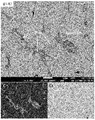
- Figure 3 shows the microstructure picture of Example 2 of the present invention and the EDS mapping results of carbon (C) and chromium (Cr).
- Figure 4 shows the microstructure photograph of Comparative Example 1 of the present invention and the EDS mapping results of carbon (C) and chromium (Cr).
- Figure 5 shows the results of the tensile test at 25 °C of austenitic steel according to Examples 1, 2 and Comparative Examples 1 to 3 of the present invention.
- Figure 6 shows the results of the high temperature tensile test at 900 °C of austenitic steel according to Examples 1, 2 and Comparative Examples 1 to 3 of the present invention.
- the inventors of the present invention have studied alloys that can achieve high temperature strength capable of withstanding a high temperature environment of 900 ° C. or higher and at the same time reduce the content of Ni while excluding elements that form expensive and carbides such as Nb and W. As a small amount of Ni added to maintain the austenite structure at a high temperature, while the Mn is replaced by a predetermined ratio without using alloying elements such as Nb and W, excellent high temperature strength can be realized.
- the present invention has been found.
- Austenitic steel according to the present invention C: 0.4 to 0.5% by weight, Si: 1.0 to 2.0% by weight, Mn: 5.0 to 8.0% by weight, Ni: 13.5 to 16.5% by weight, Cr: 23 to 26% by weight, the rest Fe and other unavoidable impurities, characterized in that the ratio of the Mn content to the Ni content of the alloying elements, CMn / CNi is maintained in the range 0.3 ⁇ 0.9.
- the reason for the selection of the composition of the austenitic steel according to the present invention is as follows.
- C is known to be a strong austenite stabilizing element, and it is also strengthened in the matrix structure and plays an important role in strength at high temperatures.
- carbides and alloying elements such as Cr included in the present invention it improves the castability of the liquid phase and the high temperature strength.
- at least 0.4% by weight of carbon is required, and when it exceeds 0.5% by weight, the above range is preferable because the coarsening of carbides may lead to deterioration of overall mechanical properties and creep resistance.
- Si has an effect of improving the high temperature oxidation resistance, and serves as a reducing agent in the molten alloy.
- Si improves oxidation resistance by playing a role in preventing oxidation by Cr.
- the silicon oxide particles formed by Si are precipitated under the film formed on the alloy surface by Cr to assist in the formation of the passivation film, and suppress the unnecessary escape of Cr ions.
- This effect of Si is further enhanced at high temperatures. If less than 1.0% by weight, it is difficult to sufficiently obtain the effect of Si, and when excessively added Si, lowers the high temperature creep resistance, and as a ferrite stabilizing element, destabilizes the austenite matrix, and therefore 2.0% by weight or less Must be added. More preferable content of Si is 1.0 to 1.5 weight%.
- Mn acts as an austenite stabilizing element and, like Si, acts as a reducing agent in the melt.
- the Ni content is reduced, it is difficult to maintain the austenite structure when the Mn content is less than 5.0 wt%, and when it exceeds 9.0 wt%, deterioration of oxidation resistance and high temperature formability at high temperature is achieved. Therefore, it is maintained at 9.0 weight% or less. More preferable content of Mn is 5.5 to 8.0% by weight.
- Ni is an austenite stabilizing element, which is essential for improving mechanical properties including corrosion resistance and corrosion resistance and oxidation resistance. If Ni is less than 13.5% by weight, high temperature strength is lowered. This is because the reducing effect is less desirable.
- Cr is the most important element of excellent oxidation resistance and corrosion resistance of stainless steel, and it forms a stable passivation film of Cr2O3 type on the surface of alloy to improve corrosion resistance.
- Cr is preferably added at least 23% by weight in order to improve corrosion resistance, and since Cr may form a ferrite phase when excessively added as a ferrite stabilizing element, a large amount of carbide may be formed, so it is limited to 26% by weight or less.
- the ratio of the Mn content to the Ni content in the alloying element is less than 0.3, the amount of Ni replacement is not sufficient, so the economic efficiency is not high, and when the ratio is more than 0.9, excellent high temperature strength is not obtained. More preferable ranges are 0.3-0.6.
- the austenitic steel according to the present invention may be 125MPa or more, preferably 128MPa or more, more preferably 130Mpa or more.
- P is a component that is inevitably incorporated as an impurity, and P is preferably maintained at 0.04% by weight or less, and more preferably 0.03% by weight or less since P may segregate in the alloy and adversely affect the physical properties of the alloy.
- S forms a sulfide such as MnS in the alloy to improve the processability of the alloy, but sulfide deteriorates the overall physical properties of the alloy, so it is preferable to keep it at 0.04% by weight or less.
- the Ni eq represented by the following [Formula 1] is 31 to 32, and the Creq represented by the following [Formula 2] is 25 so that the austenitic structure can be stably maintained at high temperature. It is preferable that it is -28.
- Ni eq % Ni + 30% C + 0.87% Mn-0.33% Cu + 30 (% N-0.045)
- the austenitic steel according to the invention serve to when fine textural percentage of ferrite structure is more than 1% in the area ratio is not preferable to lower the stability at high temperatures, M 7 C 3 phase increases the room temperature and high temperature strength Therefore, 2% or more is preferable. However, if the content of Mn is increased in order to increase the area ratio of M 7 C 3 phase, the area ratio of the ferrite phase increases, so the area ratio of M 7 C 3 phase is preferably 2 to 3%.
- Table 1 below shows the compositions of Comparative Example 1, Comparative Example 2 and Comparative Example 3 in which the ratio of Ni and Mn was changed for comparison with Examples 1 and 2 of the austenitic steel according to the present invention. will be.
- Example 1 Steel grade Composition (% by weight) C Si Mn P S Ni Cr Fe Comparative Example 1 0.40 1.2 1.0 Less than 0.04 Less than 0.04 20 25 Bal. Comparative Example 2 0.40 1.2 3.3 Less than 0.04 Less than 0.04 18 25 Bal. Example 1 0.40 1.2 5.6 Less than 0.04 Less than 0.04 16 25 Bal. Example 2 0.40 1.2 7.9 Less than 0.04 Less than 0.04 14 25 Bal. Comparative Example 3 0.40 1.2 10.2 Less than 0.04 Less than 0.04 12 25 Bal.
- the specimens thus obtained were analyzed for phases using XRD and EBSD (Electron Back-scatter Diffraction), and microstructures were analyzed using a microscope and EDS. Room temperature (25 ° C) and high temperature (900 ° C) Tensile tests were performed at and phase fractions were measured.
- FIG. 1 shows XRD analysis results of austenitic steels according to Examples 1 and 2 and Comparative Examples 1 to 3 of the present invention.
- 2 is a microstructure photograph of Example 2 and Comparative Example 3 of the present invention
- Figure 3 is a microstructure photograph of Example 2 of the present invention and shows the results of EDS mapping of carbon (C) and chromium (Cr)
- Figure 4 shows the microstructure photograph of Comparative Example 1 of the present invention and the EDS mapping results of carbon (C) and chromium (Cr).
- Table 2 shows the results of the ferrite phase and M 7 C 3 phase measure the fraction occupied in a microstructure using the EBSD lectures, identified in Figs.
- Example 1 of the present invention did not appear a ferrite phase, in the case of Example 2, as shown in Figure 2, a very small amount of ferrite was detected as 0.1% or less.
- M 7 C 3 phase so the function of increasing the room temperature and high temperature strength, it is advantageous to increase the high temperature strength.
- the ferrite phase is increased, the stability of the austenite phase is lowered, and the high temperature properties are drastically lowered.
- the fraction of the phase is preferably increased while suppressing the ferrite phase to 1% or less (preferably 0.1% or less).
- Figure 5 shows the results of the tensile test at 25 °C of austenitic steel according to Examples 1, 2 and Comparative Examples 1 to 3 of the present invention
- Figure 6 is Example 1, 2 and Comparative Examples 1 to 3 of the present invention It shows the results of high temperature tensile test at 900 °C of austenitic steel according to.
- Table 3 below shows the tensile test results of FIGS. 5 and 6.
- Example 1 307 ⁇ 4 612 ⁇ 7 52.0 ⁇ 2.1 108 ⁇ 2 129 ⁇ 1 44.7 ⁇ 8.6 Comparative Example 2 338 ⁇ 4 629 ⁇ 2 60.2 ⁇ 5.1 113 ⁇ 6 132 ⁇ 7 50.4 ⁇ 3.4
- Examples 1 and 2 of the present invention are equivalent to room temperature tensile strength when compared with Comparative Example 1 containing 20% by weight of Ni and Comparative Example 2 containing 18% by weight of Ni. Or better, and exhibits equivalent properties even at high temperature tensile properties.
- Comparative Example 3 having a Ni content of 12% by weight, the tensile strength at room temperature is very high, but the tensile strength at high temperature is remarkably decreased, so it is not suitable for the housing of a turbocharger requiring durability at a temperature of 900 ° C or higher. .
- the austenitic steel according to the embodiment of the present invention in particular, in comparison with Comparative Example 1, while reducing the Ni content of 4 to 6% while maintaining the high temperature tensile characteristics equal to or higher, thereby achieving excellent high temperature characteristics at low cost.
Landscapes
- Chemical & Material Sciences (AREA)
- Engineering & Computer Science (AREA)
- Materials Engineering (AREA)
- Mechanical Engineering (AREA)
- Metallurgy (AREA)
- Organic Chemistry (AREA)
- Turbine Rotor Nozzle Sealing (AREA)
- Heat Treatment Of Steel (AREA)
Abstract
La présente invention se rapporte à un acier austénitique, qui peut obtenir des propriétés à haute température égales ou supérieures à celles de l'acier inoxydable résistant à la chaleur classique, tout en remplaçant le nickel (Ni), qui est un élément d'alliage onéreux riche dans un acier inoxydable résistant à la chaleur utilisé à une température très élevée comme pour un turbocompresseur, avec un élément en alliage à bas coût. L'acier austénitique selon la présente invention comprend entre 0,4 et 0,5 % en poids de carbone (C), entre 1,0 et 2,0 % en poids de silicium (Si), entre 5 et 8,0 % en poids de manganèse (Mn), entre 13,5 et 16,5 % en poids de nickel (Ni), entre 23 et 26 % en poids de chrome (Cr), le reste étant du fer (Fe) et d'autres impuretés inévitables, le rapport CMn/CNi entre la teneur en manganèse (Mn) et la teneur en nickel (Ni) dans l'élément d'alliage étant maintenu dans la plage allant de 0,3 à 0,9.
Priority Applications (1)
| Application Number | Priority Date | Filing Date | Title |
|---|---|---|---|
| CN201780014102.0A CN108699661A (zh) | 2016-11-25 | 2017-11-22 | 高温强度优异的奥氏体钢 |
Applications Claiming Priority (2)
| Application Number | Priority Date | Filing Date | Title |
|---|---|---|---|
| KR10-2016-0158429 | 2016-11-25 | ||
| KR1020160158429A KR101809853B1 (ko) | 2016-11-25 | 2016-11-25 | 고온강도가 우수한 오스테나이트강 |
Publications (1)
| Publication Number | Publication Date |
|---|---|
| WO2018097604A1 true WO2018097604A1 (fr) | 2018-05-31 |
Family
ID=60937000
Family Applications (1)
| Application Number | Title | Priority Date | Filing Date |
|---|---|---|---|
| PCT/KR2017/013371 Ceased WO2018097604A1 (fr) | 2016-11-25 | 2017-11-22 | Acier austénitique présentant une excellente résistance à haute température |
Country Status (3)
| Country | Link |
|---|---|
| KR (1) | KR101809853B1 (fr) |
| CN (1) | CN108699661A (fr) |
| WO (1) | WO2018097604A1 (fr) |
Cited By (3)
| Publication number | Priority date | Publication date | Assignee | Title |
|---|---|---|---|---|
| EP3636792A1 (fr) * | 2018-10-12 | 2020-04-15 | Borgwarner Inc. | Nouveaux alliages austénitiques pour turbocompresseurs |
| EP3933064A1 (fr) * | 2020-07-01 | 2022-01-05 | Garrett Transportation I Inc. | Alliages d'acier inoxydable austénitique et composants cinématiques de turbocompresseur formés à partir d'alliages d'acier inoxydable |
| US11414734B2 (en) | 2018-09-25 | 2022-08-16 | Garrett Transportation I Inc | Austenitic stainless steel alloys and turbocharger kinematic components formed from stainless steel alloys |
Families Citing this family (2)
| Publication number | Priority date | Publication date | Assignee | Title |
|---|---|---|---|---|
| CN113695519A (zh) * | 2021-08-30 | 2021-11-26 | 西峡飞龙特种铸造有限公司 | 一种铸钢工艺 |
| CN115213352B (zh) * | 2022-08-12 | 2024-02-02 | 肇庆匹思通机械有限公司 | 一种涡壳成型工艺 |
Citations (5)
| Publication number | Priority date | Publication date | Assignee | Title |
|---|---|---|---|---|
| JPH05148591A (ja) * | 1991-11-27 | 1993-06-15 | Aichi Steel Works Ltd | 被削性の優れた排気弁用鋼 |
| JPH11323479A (ja) * | 1998-05-13 | 1999-11-26 | Toyota Central Res & Dev Lab Inc | 耐熱鋳鋼 |
| KR100428572B1 (ko) * | 1999-12-09 | 2004-04-28 | 주식회사 포스코 | 내열강도 및 내산화성이 우수한 내열스테인레스강 |
| KR100766251B1 (ko) * | 2006-06-09 | 2007-10-12 | 주식회사 포스코 | 고온특성이 우수한 니켈 저감형 오스테나이트계 내열스테인레스강. |
| JP2014208875A (ja) * | 2013-03-22 | 2014-11-06 | トヨタ自動車株式会社 | オーステナイト系耐熱鋳鋼およびその製造方法 |
Family Cites Families (4)
| Publication number | Priority date | Publication date | Assignee | Title |
|---|---|---|---|---|
| FR2527636B1 (fr) * | 1982-05-26 | 1986-04-04 | Ugine Aciers | Acier refractaire de moulage resistant a l'abrasion et a la deformation a tres haute temperature en atmosphere contenant des oxydes de soufre |
| CN1056197C (zh) * | 1995-11-27 | 2000-09-06 | 江苏永进泵阀厂 | 新型耐蚀耐磨不锈钢及其生产工艺 |
| CN102159744B (zh) * | 2009-06-24 | 2013-05-29 | 日立金属株式会社 | 高温强度优异的发动机阀用耐热钢 |
| CN102086498A (zh) * | 2009-12-04 | 2011-06-08 | 沈阳鑫火铸造有限公司 | 一种高Cr高Ni抗氧化耐热钢 |
-
2016
- 2016-11-25 KR KR1020160158429A patent/KR101809853B1/ko active Active
-
2017
- 2017-11-22 CN CN201780014102.0A patent/CN108699661A/zh active Pending
- 2017-11-22 WO PCT/KR2017/013371 patent/WO2018097604A1/fr not_active Ceased
Patent Citations (5)
| Publication number | Priority date | Publication date | Assignee | Title |
|---|---|---|---|---|
| JPH05148591A (ja) * | 1991-11-27 | 1993-06-15 | Aichi Steel Works Ltd | 被削性の優れた排気弁用鋼 |
| JPH11323479A (ja) * | 1998-05-13 | 1999-11-26 | Toyota Central Res & Dev Lab Inc | 耐熱鋳鋼 |
| KR100428572B1 (ko) * | 1999-12-09 | 2004-04-28 | 주식회사 포스코 | 내열강도 및 내산화성이 우수한 내열스테인레스강 |
| KR100766251B1 (ko) * | 2006-06-09 | 2007-10-12 | 주식회사 포스코 | 고온특성이 우수한 니켈 저감형 오스테나이트계 내열스테인레스강. |
| JP2014208875A (ja) * | 2013-03-22 | 2014-11-06 | トヨタ自動車株式会社 | オーステナイト系耐熱鋳鋼およびその製造方法 |
Cited By (6)
| Publication number | Priority date | Publication date | Assignee | Title |
|---|---|---|---|---|
| US11414734B2 (en) | 2018-09-25 | 2022-08-16 | Garrett Transportation I Inc | Austenitic stainless steel alloys and turbocharger kinematic components formed from stainless steel alloys |
| EP3636792A1 (fr) * | 2018-10-12 | 2020-04-15 | Borgwarner Inc. | Nouveaux alliages austénitiques pour turbocompresseurs |
| CN111041386A (zh) * | 2018-10-12 | 2020-04-21 | 博格华纳公司 | 用于涡轮增压器的新颖的奥氏体合金 |
| US11434556B2 (en) | 2018-10-12 | 2022-09-06 | Borgwarner Inc. | Austenitic alloys for turbochargers |
| EP4528082A3 (fr) * | 2018-10-12 | 2025-10-22 | Borgwarner Inc. | Carter de turbocompresseur coulée en alliage austénitique à base de fer |
| EP3933064A1 (fr) * | 2020-07-01 | 2022-01-05 | Garrett Transportation I Inc. | Alliages d'acier inoxydable austénitique et composants cinématiques de turbocompresseur formés à partir d'alliages d'acier inoxydable |
Also Published As
| Publication number | Publication date |
|---|---|
| CN108699661A (zh) | 2018-10-23 |
| KR101809853B1 (ko) | 2017-12-26 |
Similar Documents
| Publication | Publication Date | Title |
|---|---|---|
| WO2018097604A1 (fr) | Acier austénitique présentant une excellente résistance à haute température | |
| KR101373488B1 (ko) | 구상 흑연 주철 | |
| WO2019022283A1 (fr) | Alliage à entropie moyenne ayant d'excellentes caractéristiques cryogéniques | |
| WO2022108173A1 (fr) | Acier inoxydable austénitique à haute résistance présentant une ténacité à basse température améliorée dans un environnement hydrogène | |
| WO2017111251A1 (fr) | Acier inoxydable austénitique présentant des propriétés de résistance au fluage et une résistance à la traction améliorées et son procédé de fabrication | |
| WO2018088652A1 (fr) | Acier inoxydable austénitique ayant une résistance améliorée à la fragilisation par l'hydrogène et récipient pour gaz hydrogène à haute pression l'utilisant | |
| KR101013843B1 (ko) | 고온 강도 및 내산화성이 우수한 고 규소 페라이트계cgi 흑연주철 | |
| WO2015137627A1 (fr) | Fonte à graphite sphéroïdale résistante à la chaleur, son procédé de fabrication et système d'échappement de moteur la comprenant | |
| WO2016117731A1 (fr) | Acier moulé austénitique thermorésistant et carter de turbine pour turbocompresseur l'utilisant | |
| WO2014209064A1 (fr) | Tôle d'acier à haute résistance et procédé de fabrication associé | |
| WO2020085858A1 (fr) | Acier austénitique cryogénique à haute teneur en manganèse ayant une forme excellente, et son procédé de fabrication | |
| EP2262917B1 (fr) | Fonte à graphite nodulaire résistante à la chaleur ni-25 pour une utilisation dans des systèmes d'échappement | |
| WO2019022460A1 (fr) | Acier austénitique présentant une excellente résistance à température élevée | |
| WO2015126083A1 (fr) | Fonte à graphite sphéroïdal pour élément de système d'échappement de moteur | |
| KR100435324B1 (ko) | 고온 내산화성을 갖는 내열구상흑연주철 | |
| KR101845761B1 (ko) | 배기계용 페라이트계 구상흑연주철 | |
| WO2024128476A1 (fr) | Acier inoxydable austénitique présentant une résistance améliorée à la fragilisation par l'hydrogène et une ténacité aux chocs à basse température, et son procédé de fabrication | |
| EP0359085A1 (fr) | Aciers de coulée, résistant aux températures élevées | |
| WO2019107699A1 (fr) | Acier austénitique ayant une résistance à la température ambiante et à haute température par une réduction du chrome (cr) | |
| WO2018016878A1 (fr) | Acier moulé résistant à la chaleur pour carter de turbine de turbocompresseur, nécessitant moins de tungstène, et carter de turbine de turbocompresseur l'utilisant | |
| WO2020130279A1 (fr) | Acier inoxydable à haute résistance mécanique | |
| KR102135185B1 (ko) | 상온 및 고온 강도가 우수한 오스테나이트강 | |
| EP0109040A2 (fr) | Fonte à graphite sphéroidal résistant aux températures élevées | |
| CN113897536B (zh) | 一种韧性和高温性能优异的球墨铸铁的制备方法 | |
| KR101438825B1 (ko) | 페라이트계 구상흑연 주철재 |
Legal Events
| Date | Code | Title | Description |
|---|---|---|---|
| 121 | Ep: the epo has been informed by wipo that ep was designated in this application |
Ref document number: 17874042 Country of ref document: EP Kind code of ref document: A1 |
|
| NENP | Non-entry into the national phase |
Ref country code: DE |
|
| 122 | Ep: pct application non-entry in european phase |
Ref document number: 17874042 Country of ref document: EP Kind code of ref document: A1 |