WO2018105682A1 - Produit solide contenant un copolymère greffé et utilisation correspondante - Google Patents
Produit solide contenant un copolymère greffé et utilisation correspondante Download PDFInfo
- Publication number
- WO2018105682A1 WO2018105682A1 PCT/JP2017/043926 JP2017043926W WO2018105682A1 WO 2018105682 A1 WO2018105682 A1 WO 2018105682A1 JP 2017043926 W JP2017043926 W JP 2017043926W WO 2018105682 A1 WO2018105682 A1 WO 2018105682A1
- Authority
- WO
- WIPO (PCT)
- Prior art keywords
- polymer
- solid
- center
- core
- abs
- Prior art date
- Legal status (The legal status is an assumption and is not a legal conclusion. Google has not performed a legal analysis and makes no representation as to the accuracy of the status listed.)
- Ceased
Links
Images
Classifications
-
- C—CHEMISTRY; METALLURGY
- C08—ORGANIC MACROMOLECULAR COMPOUNDS; THEIR PREPARATION OR CHEMICAL WORKING-UP; COMPOSITIONS BASED THEREON
- C08F—MACROMOLECULAR COMPOUNDS OBTAINED BY REACTIONS ONLY INVOLVING CARBON-TO-CARBON UNSATURATED BONDS
- C08F255/00—Macromolecular compounds obtained by polymerising monomers on to polymers of hydrocarbons as defined in group C08F10/00
-
- C—CHEMISTRY; METALLURGY
- C08—ORGANIC MACROMOLECULAR COMPOUNDS; THEIR PREPARATION OR CHEMICAL WORKING-UP; COMPOSITIONS BASED THEREON
- C08F—MACROMOLECULAR COMPOUNDS OBTAINED BY REACTIONS ONLY INVOLVING CARBON-TO-CARBON UNSATURATED BONDS
- C08F255/00—Macromolecular compounds obtained by polymerising monomers on to polymers of hydrocarbons as defined in group C08F10/00
- C08F255/02—Macromolecular compounds obtained by polymerising monomers on to polymers of hydrocarbons as defined in group C08F10/00 on to polymers of olefins having two or three carbon atoms
- C08F255/04—Macromolecular compounds obtained by polymerising monomers on to polymers of hydrocarbons as defined in group C08F10/00 on to polymers of olefins having two or three carbon atoms on to ethylene-propylene copolymers
-
- C—CHEMISTRY; METALLURGY
- C08—ORGANIC MACROMOLECULAR COMPOUNDS; THEIR PREPARATION OR CHEMICAL WORKING-UP; COMPOSITIONS BASED THEREON
- C08L—COMPOSITIONS OF MACROMOLECULAR COMPOUNDS
- C08L23/00—Compositions of homopolymers or copolymers of unsaturated aliphatic hydrocarbons having only one carbon-to-carbon double bond; Compositions of derivatives of such polymers
- C08L23/02—Compositions of homopolymers or copolymers of unsaturated aliphatic hydrocarbons having only one carbon-to-carbon double bond; Compositions of derivatives of such polymers not modified by chemical after-treatment
-
- B—PERFORMING OPERATIONS; TRANSPORTING
- B01—PHYSICAL OR CHEMICAL PROCESSES OR APPARATUS IN GENERAL
- B01D—SEPARATION
- B01D39/00—Filtering material for liquid or gaseous fluids
- B01D39/14—Other self-supporting filtering material ; Other filtering material
- B01D39/16—Other self-supporting filtering material ; Other filtering material of organic material, e.g. synthetic fibres
-
- B—PERFORMING OPERATIONS; TRANSPORTING
- B01—PHYSICAL OR CHEMICAL PROCESSES OR APPARATUS IN GENERAL
- B01D—SEPARATION
- B01D39/00—Filtering material for liquid or gaseous fluids
- B01D39/14—Other self-supporting filtering material ; Other filtering material
- B01D39/16—Other self-supporting filtering material ; Other filtering material of organic material, e.g. synthetic fibres
- B01D39/1669—Cellular material
- B01D39/1676—Cellular material of synthetic origin
-
- B—PERFORMING OPERATIONS; TRANSPORTING
- B01—PHYSICAL OR CHEMICAL PROCESSES OR APPARATUS IN GENERAL
- B01D—SEPARATION
- B01D39/00—Filtering material for liquid or gaseous fluids
- B01D39/14—Other self-supporting filtering material ; Other filtering material
- B01D39/16—Other self-supporting filtering material ; Other filtering material of organic material, e.g. synthetic fibres
- B01D39/1692—Other shaped material, e.g. perforated or porous sheets
-
- C—CHEMISTRY; METALLURGY
- C08—ORGANIC MACROMOLECULAR COMPOUNDS; THEIR PREPARATION OR CHEMICAL WORKING-UP; COMPOSITIONS BASED THEREON
- C08F—MACROMOLECULAR COMPOUNDS OBTAINED BY REACTIONS ONLY INVOLVING CARBON-TO-CARBON UNSATURATED BONDS
- C08F255/00—Macromolecular compounds obtained by polymerising monomers on to polymers of hydrocarbons as defined in group C08F10/00
- C08F255/02—Macromolecular compounds obtained by polymerising monomers on to polymers of hydrocarbons as defined in group C08F10/00 on to polymers of olefins having two or three carbon atoms
-
- C—CHEMISTRY; METALLURGY
- C08—ORGANIC MACROMOLECULAR COMPOUNDS; THEIR PREPARATION OR CHEMICAL WORKING-UP; COMPOSITIONS BASED THEREON
- C08F—MACROMOLECULAR COMPOUNDS OBTAINED BY REACTIONS ONLY INVOLVING CARBON-TO-CARBON UNSATURATED BONDS
- C08F291/00—Macromolecular compounds obtained by polymerising monomers on to macromolecular compounds according to more than one of the groups C08F251/00 - C08F289/00
-
- C—CHEMISTRY; METALLURGY
- C08—ORGANIC MACROMOLECULAR COMPOUNDS; THEIR PREPARATION OR CHEMICAL WORKING-UP; COMPOSITIONS BASED THEREON
- C08J—WORKING-UP; GENERAL PROCESSES OF COMPOUNDING; AFTER-TREATMENT NOT COVERED BY SUBCLASSES C08B, C08C, C08F, C08G or C08H
- C08J5/00—Manufacture of articles or shaped materials containing macromolecular substances
- C08J5/04—Reinforcing macromolecular compounds with loose or coherent fibrous material
- C08J5/0405—Reinforcing macromolecular compounds with loose or coherent fibrous material with inorganic fibres
- C08J5/042—Reinforcing macromolecular compounds with loose or coherent fibrous material with inorganic fibres with carbon fibres
-
- C—CHEMISTRY; METALLURGY
- C08—ORGANIC MACROMOLECULAR COMPOUNDS; THEIR PREPARATION OR CHEMICAL WORKING-UP; COMPOSITIONS BASED THEREON
- C08J—WORKING-UP; GENERAL PROCESSES OF COMPOUNDING; AFTER-TREATMENT NOT COVERED BY SUBCLASSES C08B, C08C, C08F, C08G or C08H
- C08J5/00—Manufacture of articles or shaped materials containing macromolecular substances
- C08J5/18—Manufacture of films or sheets
-
- C—CHEMISTRY; METALLURGY
- C08—ORGANIC MACROMOLECULAR COMPOUNDS; THEIR PREPARATION OR CHEMICAL WORKING-UP; COMPOSITIONS BASED THEREON
- C08J—WORKING-UP; GENERAL PROCESSES OF COMPOUNDING; AFTER-TREATMENT NOT COVERED BY SUBCLASSES C08B, C08C, C08F, C08G or C08H
- C08J5/00—Manufacture of articles or shaped materials containing macromolecular substances
- C08J5/24—Impregnating materials with prepolymers which can be polymerised in situ, e.g. manufacture of prepregs
-
- C—CHEMISTRY; METALLURGY
- C08—ORGANIC MACROMOLECULAR COMPOUNDS; THEIR PREPARATION OR CHEMICAL WORKING-UP; COMPOSITIONS BASED THEREON
- C08J—WORKING-UP; GENERAL PROCESSES OF COMPOUNDING; AFTER-TREATMENT NOT COVERED BY SUBCLASSES C08B, C08C, C08F, C08G or C08H
- C08J5/00—Manufacture of articles or shaped materials containing macromolecular substances
- C08J5/24—Impregnating materials with prepolymers which can be polymerised in situ, e.g. manufacture of prepregs
- C08J5/241—Impregnating materials with prepolymers which can be polymerised in situ, e.g. manufacture of prepregs using inorganic fibres
- C08J5/243—Impregnating materials with prepolymers which can be polymerised in situ, e.g. manufacture of prepregs using inorganic fibres using carbon fibres
-
- C—CHEMISTRY; METALLURGY
- C08—ORGANIC MACROMOLECULAR COMPOUNDS; THEIR PREPARATION OR CHEMICAL WORKING-UP; COMPOSITIONS BASED THEREON
- C08J—WORKING-UP; GENERAL PROCESSES OF COMPOUNDING; AFTER-TREATMENT NOT COVERED BY SUBCLASSES C08B, C08C, C08F, C08G or C08H
- C08J5/00—Manufacture of articles or shaped materials containing macromolecular substances
- C08J5/24—Impregnating materials with prepolymers which can be polymerised in situ, e.g. manufacture of prepregs
- C08J5/249—Impregnating materials with prepolymers which can be polymerised in situ, e.g. manufacture of prepregs characterised by the additives used in the prepolymer mixture
-
- C—CHEMISTRY; METALLURGY
- C08—ORGANIC MACROMOLECULAR COMPOUNDS; THEIR PREPARATION OR CHEMICAL WORKING-UP; COMPOSITIONS BASED THEREON
- C08J—WORKING-UP; GENERAL PROCESSES OF COMPOUNDING; AFTER-TREATMENT NOT COVERED BY SUBCLASSES C08B, C08C, C08F, C08G or C08H
- C08J9/00—Working-up of macromolecular substances to porous or cellular articles or materials; After-treatment thereof
- C08J9/24—Working-up of macromolecular substances to porous or cellular articles or materials; After-treatment thereof by surface fusion and bonding of particles to form voids, e.g. sintering
-
- C—CHEMISTRY; METALLURGY
- C08—ORGANIC MACROMOLECULAR COMPOUNDS; THEIR PREPARATION OR CHEMICAL WORKING-UP; COMPOSITIONS BASED THEREON
- C08L—COMPOSITIONS OF MACROMOLECULAR COMPOUNDS
- C08L51/00—Compositions of graft polymers in which the grafted component is obtained by reactions only involving carbon-to-carbon unsaturated bonds; Compositions of derivatives of such polymers
- C08L51/003—Compositions of graft polymers in which the grafted component is obtained by reactions only involving carbon-to-carbon unsaturated bonds; Compositions of derivatives of such polymers grafted on to macromolecular compounds obtained by reactions only involving unsaturated carbon-to-carbon bonds
-
- C—CHEMISTRY; METALLURGY
- C08—ORGANIC MACROMOLECULAR COMPOUNDS; THEIR PREPARATION OR CHEMICAL WORKING-UP; COMPOSITIONS BASED THEREON
- C08L—COMPOSITIONS OF MACROMOLECULAR COMPOUNDS
- C08L61/00—Compositions of condensation polymers of aldehydes or ketones; Compositions of derivatives of such polymers
- C08L61/04—Condensation polymers of aldehydes or ketones with phenols only
-
- C—CHEMISTRY; METALLURGY
- C08—ORGANIC MACROMOLECULAR COMPOUNDS; THEIR PREPARATION OR CHEMICAL WORKING-UP; COMPOSITIONS BASED THEREON
- C08L—COMPOSITIONS OF MACROMOLECULAR COMPOUNDS
- C08L63/00—Compositions of epoxy resins; Compositions of derivatives of epoxy resins
-
- C—CHEMISTRY; METALLURGY
- C09—DYES; PAINTS; POLISHES; NATURAL RESINS; ADHESIVES; COMPOSITIONS NOT OTHERWISE PROVIDED FOR; APPLICATIONS OF MATERIALS NOT OTHERWISE PROVIDED FOR
- C09D—COATING COMPOSITIONS, e.g. PAINTS, VARNISHES OR LACQUERS; FILLING PASTES; CHEMICAL PAINT OR INK REMOVERS; INKS; CORRECTING FLUIDS; WOODSTAINS; PASTES OR SOLIDS FOR COLOURING OR PRINTING; USE OF MATERIALS THEREFOR
- C09D133/00—Coating compositions based on homopolymers or copolymers of compounds having one or more unsaturated aliphatic radicals, each having only one carbon-to-carbon double bond, and at least one being terminated by only one carboxyl radical, or of salts, anhydrides, esters, amides, imides, or nitriles thereof; Coating compositions based on derivatives of such polymers
- C09D133/04—Homopolymers or copolymers of esters
-
- C—CHEMISTRY; METALLURGY
- C09—DYES; PAINTS; POLISHES; NATURAL RESINS; ADHESIVES; COMPOSITIONS NOT OTHERWISE PROVIDED FOR; APPLICATIONS OF MATERIALS NOT OTHERWISE PROVIDED FOR
- C09D—COATING COMPOSITIONS, e.g. PAINTS, VARNISHES OR LACQUERS; FILLING PASTES; CHEMICAL PAINT OR INK REMOVERS; INKS; CORRECTING FLUIDS; WOODSTAINS; PASTES OR SOLIDS FOR COLOURING OR PRINTING; USE OF MATERIALS THEREFOR
- C09D133/00—Coating compositions based on homopolymers or copolymers of compounds having one or more unsaturated aliphatic radicals, each having only one carbon-to-carbon double bond, and at least one being terminated by only one carboxyl radical, or of salts, anhydrides, esters, amides, imides, or nitriles thereof; Coating compositions based on derivatives of such polymers
- C09D133/04—Homopolymers or copolymers of esters
- C09D133/06—Homopolymers or copolymers of esters of esters containing only carbon, hydrogen and oxygen, the oxygen atom being present only as part of the carboxyl radical
- C09D133/08—Homopolymers or copolymers of acrylic acid esters
-
- C—CHEMISTRY; METALLURGY
- C09—DYES; PAINTS; POLISHES; NATURAL RESINS; ADHESIVES; COMPOSITIONS NOT OTHERWISE PROVIDED FOR; APPLICATIONS OF MATERIALS NOT OTHERWISE PROVIDED FOR
- C09D—COATING COMPOSITIONS, e.g. PAINTS, VARNISHES OR LACQUERS; FILLING PASTES; CHEMICAL PAINT OR INK REMOVERS; INKS; CORRECTING FLUIDS; WOODSTAINS; PASTES OR SOLIDS FOR COLOURING OR PRINTING; USE OF MATERIALS THEREFOR
- C09D151/00—Coating compositions based on graft polymers in which the grafted component is obtained by reactions only involving carbon-to-carbon unsaturated bonds; Coating compositions based on derivatives of such polymers
-
- C—CHEMISTRY; METALLURGY
- C09—DYES; PAINTS; POLISHES; NATURAL RESINS; ADHESIVES; COMPOSITIONS NOT OTHERWISE PROVIDED FOR; APPLICATIONS OF MATERIALS NOT OTHERWISE PROVIDED FOR
- C09D—COATING COMPOSITIONS, e.g. PAINTS, VARNISHES OR LACQUERS; FILLING PASTES; CHEMICAL PAINT OR INK REMOVERS; INKS; CORRECTING FLUIDS; WOODSTAINS; PASTES OR SOLIDS FOR COLOURING OR PRINTING; USE OF MATERIALS THEREFOR
- C09D151/00—Coating compositions based on graft polymers in which the grafted component is obtained by reactions only involving carbon-to-carbon unsaturated bonds; Coating compositions based on derivatives of such polymers
- C09D151/003—Coating compositions based on graft polymers in which the grafted component is obtained by reactions only involving carbon-to-carbon unsaturated bonds; Coating compositions based on derivatives of such polymers grafted on to macromolecular compounds obtained by reactions only involving unsaturated carbon-to-carbon bonds
-
- C—CHEMISTRY; METALLURGY
- C09—DYES; PAINTS; POLISHES; NATURAL RESINS; ADHESIVES; COMPOSITIONS NOT OTHERWISE PROVIDED FOR; APPLICATIONS OF MATERIALS NOT OTHERWISE PROVIDED FOR
- C09D—COATING COMPOSITIONS, e.g. PAINTS, VARNISHES OR LACQUERS; FILLING PASTES; CHEMICAL PAINT OR INK REMOVERS; INKS; CORRECTING FLUIDS; WOODSTAINS; PASTES OR SOLIDS FOR COLOURING OR PRINTING; USE OF MATERIALS THEREFOR
- C09D151/00—Coating compositions based on graft polymers in which the grafted component is obtained by reactions only involving carbon-to-carbon unsaturated bonds; Coating compositions based on derivatives of such polymers
- C09D151/06—Coating compositions based on graft polymers in which the grafted component is obtained by reactions only involving carbon-to-carbon unsaturated bonds; Coating compositions based on derivatives of such polymers grafted on to homopolymers or copolymers of aliphatic hydrocarbons containing only one carbon-to-carbon double bond
-
- C—CHEMISTRY; METALLURGY
- C09—DYES; PAINTS; POLISHES; NATURAL RESINS; ADHESIVES; COMPOSITIONS NOT OTHERWISE PROVIDED FOR; APPLICATIONS OF MATERIALS NOT OTHERWISE PROVIDED FOR
- C09D—COATING COMPOSITIONS, e.g. PAINTS, VARNISHES OR LACQUERS; FILLING PASTES; CHEMICAL PAINT OR INK REMOVERS; INKS; CORRECTING FLUIDS; WOODSTAINS; PASTES OR SOLIDS FOR COLOURING OR PRINTING; USE OF MATERIALS THEREFOR
- C09D175/00—Coating compositions based on polyureas or polyurethanes; Coating compositions based on derivatives of such polymers
- C09D175/04—Polyurethanes
-
- C—CHEMISTRY; METALLURGY
- C09—DYES; PAINTS; POLISHES; NATURAL RESINS; ADHESIVES; COMPOSITIONS NOT OTHERWISE PROVIDED FOR; APPLICATIONS OF MATERIALS NOT OTHERWISE PROVIDED FOR
- C09D—COATING COMPOSITIONS, e.g. PAINTS, VARNISHES OR LACQUERS; FILLING PASTES; CHEMICAL PAINT OR INK REMOVERS; INKS; CORRECTING FLUIDS; WOODSTAINS; PASTES OR SOLIDS FOR COLOURING OR PRINTING; USE OF MATERIALS THEREFOR
- C09D7/00—Features of coating compositions, not provided for in group C09D5/00; Processes for incorporating ingredients in coating compositions
- C09D7/40—Additives
- C09D7/65—Additives macromolecular
-
- C—CHEMISTRY; METALLURGY
- C09—DYES; PAINTS; POLISHES; NATURAL RESINS; ADHESIVES; COMPOSITIONS NOT OTHERWISE PROVIDED FOR; APPLICATIONS OF MATERIALS NOT OTHERWISE PROVIDED FOR
- C09D—COATING COMPOSITIONS, e.g. PAINTS, VARNISHES OR LACQUERS; FILLING PASTES; CHEMICAL PAINT OR INK REMOVERS; INKS; CORRECTING FLUIDS; WOODSTAINS; PASTES OR SOLIDS FOR COLOURING OR PRINTING; USE OF MATERIALS THEREFOR
- C09D7/00—Features of coating compositions, not provided for in group C09D5/00; Processes for incorporating ingredients in coating compositions
- C09D7/40—Additives
- C09D7/66—Additives characterised by particle size
- C09D7/69—Particle size larger than 1000 nm
-
- C—CHEMISTRY; METALLURGY
- C09—DYES; PAINTS; POLISHES; NATURAL RESINS; ADHESIVES; COMPOSITIONS NOT OTHERWISE PROVIDED FOR; APPLICATIONS OF MATERIALS NOT OTHERWISE PROVIDED FOR
- C09D—COATING COMPOSITIONS, e.g. PAINTS, VARNISHES OR LACQUERS; FILLING PASTES; CHEMICAL PAINT OR INK REMOVERS; INKS; CORRECTING FLUIDS; WOODSTAINS; PASTES OR SOLIDS FOR COLOURING OR PRINTING; USE OF MATERIALS THEREFOR
- C09D7/00—Features of coating compositions, not provided for in group C09D5/00; Processes for incorporating ingredients in coating compositions
- C09D7/40—Additives
- C09D7/70—Additives characterised by shape, e.g. fibres, flakes or microspheres
-
- C—CHEMISTRY; METALLURGY
- C10—PETROLEUM, GAS OR COKE INDUSTRIES; TECHNICAL GASES CONTAINING CARBON MONOXIDE; FUELS; LUBRICANTS; PEAT
- C10M—LUBRICATING COMPOSITIONS; USE OF CHEMICAL SUBSTANCES EITHER ALONE OR AS LUBRICATING INGREDIENTS IN A LUBRICATING COMPOSITION
- C10M107/00—Lubricating compositions characterised by the base-material being a macromolecular compound
- C10M107/20—Lubricating compositions characterised by the base-material being a macromolecular compound containing oxygen
- C10M107/22—Macromolecular compounds obtained by reactions only involving carbon-to-carbon unsaturated bonds
- C10M107/28—Macromolecular compounds obtained by reactions only involving carbon-to-carbon unsaturated bonds containing monomers having an unsaturated radical bound to a carboxyl radical, e.g. acrylate
-
- C—CHEMISTRY; METALLURGY
- C10—PETROLEUM, GAS OR COKE INDUSTRIES; TECHNICAL GASES CONTAINING CARBON MONOXIDE; FUELS; LUBRICANTS; PEAT
- C10M—LUBRICATING COMPOSITIONS; USE OF CHEMICAL SUBSTANCES EITHER ALONE OR AS LUBRICATING INGREDIENTS IN A LUBRICATING COMPOSITION
- C10M107/00—Lubricating compositions characterised by the base-material being a macromolecular compound
- C10M107/20—Lubricating compositions characterised by the base-material being a macromolecular compound containing oxygen
- C10M107/30—Macromolecular compounds obtained otherwise than by reactions only involving carbon-to-carbon unsaturated bonds
-
- C—CHEMISTRY; METALLURGY
- C10—PETROLEUM, GAS OR COKE INDUSTRIES; TECHNICAL GASES CONTAINING CARBON MONOXIDE; FUELS; LUBRICANTS; PEAT
- C10M—LUBRICATING COMPOSITIONS; USE OF CHEMICAL SUBSTANCES EITHER ALONE OR AS LUBRICATING INGREDIENTS IN A LUBRICATING COMPOSITION
- C10M171/00—Lubricating compositions characterised by purely physical criteria, e.g. containing as base-material, thickener or additive, ingredients which are characterised exclusively by their numerically specified physical properties, i.e. containing ingredients which are physically well-defined but for which the chemical nature is either unspecified or only very vaguely indicated
-
- C—CHEMISTRY; METALLURGY
- C08—ORGANIC MACROMOLECULAR COMPOUNDS; THEIR PREPARATION OR CHEMICAL WORKING-UP; COMPOSITIONS BASED THEREON
- C08J—WORKING-UP; GENERAL PROCESSES OF COMPOUNDING; AFTER-TREATMENT NOT COVERED BY SUBCLASSES C08B, C08C, C08F, C08G or C08H
- C08J2363/00—Characterised by the use of epoxy resins; Derivatives of epoxy resins
-
- C—CHEMISTRY; METALLURGY
- C08—ORGANIC MACROMOLECULAR COMPOUNDS; THEIR PREPARATION OR CHEMICAL WORKING-UP; COMPOSITIONS BASED THEREON
- C08J—WORKING-UP; GENERAL PROCESSES OF COMPOUNDING; AFTER-TREATMENT NOT COVERED BY SUBCLASSES C08B, C08C, C08F, C08G or C08H
- C08J2451/00—Characterised by the use of graft polymers in which the grafted component is obtained by reactions only involving carbon-to-carbon unsaturated bonds; Derivatives of such polymers
- C08J2451/06—Characterised by the use of graft polymers in which the grafted component is obtained by reactions only involving carbon-to-carbon unsaturated bonds; Derivatives of such polymers grafted on to homopolymers or copolymers of aliphatic hydrocarbons containing only one carbon-to-carbon double bond
-
- C—CHEMISTRY; METALLURGY
- C08—ORGANIC MACROMOLECULAR COMPOUNDS; THEIR PREPARATION OR CHEMICAL WORKING-UP; COMPOSITIONS BASED THEREON
- C08L—COMPOSITIONS OF MACROMOLECULAR COMPOUNDS
- C08L2207/00—Properties characterising the ingredient of the composition
- C08L2207/02—Heterophasic composition
-
- C—CHEMISTRY; METALLURGY
- C08—ORGANIC MACROMOLECULAR COMPOUNDS; THEIR PREPARATION OR CHEMICAL WORKING-UP; COMPOSITIONS BASED THEREON
- C08L—COMPOSITIONS OF MACROMOLECULAR COMPOUNDS
- C08L2207/00—Properties characterising the ingredient of the composition
- C08L2207/53—Core-shell polymer
-
- C—CHEMISTRY; METALLURGY
- C10—PETROLEUM, GAS OR COKE INDUSTRIES; TECHNICAL GASES CONTAINING CARBON MONOXIDE; FUELS; LUBRICANTS; PEAT
- C10M—LUBRICATING COMPOSITIONS; USE OF CHEMICAL SUBSTANCES EITHER ALONE OR AS LUBRICATING INGREDIENTS IN A LUBRICATING COMPOSITION
- C10M2209/00—Organic macromolecular compounds containing oxygen as ingredients in lubricant compositions
- C10M2209/02—Macromolecular compounds obtained by reactions only involving carbon-to-carbon unsaturated bonds
- C10M2209/08—Macromolecular compounds obtained by reactions only involving carbon-to-carbon unsaturated bonds containing monomers having an unsaturated radical bound to a carboxyl radical, e.g. acrylate type
- C10M2209/084—Acrylate; Methacrylate
- C10M2209/0845—Acrylate; Methacrylate used as base material
-
- C—CHEMISTRY; METALLURGY
- C10—PETROLEUM, GAS OR COKE INDUSTRIES; TECHNICAL GASES CONTAINING CARBON MONOXIDE; FUELS; LUBRICANTS; PEAT
- C10M—LUBRICATING COMPOSITIONS; USE OF CHEMICAL SUBSTANCES EITHER ALONE OR AS LUBRICATING INGREDIENTS IN A LUBRICATING COMPOSITION
- C10M2209/00—Organic macromolecular compounds containing oxygen as ingredients in lubricant compositions
- C10M2209/10—Macromolecular compoundss obtained otherwise than by reactions only involving carbon-to-carbon unsaturated bonds
- C10M2209/1006—Macromolecular compoundss obtained otherwise than by reactions only involving carbon-to-carbon unsaturated bonds used as thickening agents
-
- C—CHEMISTRY; METALLURGY
- C10—PETROLEUM, GAS OR COKE INDUSTRIES; TECHNICAL GASES CONTAINING CARBON MONOXIDE; FUELS; LUBRICANTS; PEAT
- C10M—LUBRICATING COMPOSITIONS; USE OF CHEMICAL SUBSTANCES EITHER ALONE OR AS LUBRICATING INGREDIENTS IN A LUBRICATING COMPOSITION
- C10M2209/00—Organic macromolecular compounds containing oxygen as ingredients in lubricant compositions
- C10M2209/10—Macromolecular compoundss obtained otherwise than by reactions only involving carbon-to-carbon unsaturated bonds
- C10M2209/101—Condensation polymers of aldehydes or ketones and phenols, e.g. Also polyoxyalkylene ether derivatives thereof
- C10M2209/1013—Condensation polymers of aldehydes or ketones and phenols, e.g. Also polyoxyalkylene ether derivatives thereof used as base material
-
- C—CHEMISTRY; METALLURGY
- C10—PETROLEUM, GAS OR COKE INDUSTRIES; TECHNICAL GASES CONTAINING CARBON MONOXIDE; FUELS; LUBRICANTS; PEAT
- C10N—INDEXING SCHEME ASSOCIATED WITH SUBCLASS C10M RELATING TO LUBRICATING COMPOSITIONS
- C10N2050/00—Form in which the lubricant is applied to the material being lubricated
- C10N2050/08—Solids
Definitions
- the present invention relates to a graft copolymer-containing solid and its use.
- Polyolefins have many excellent features such as chemical resistance and mechanical properties, but have the disadvantage of low affinity with polar substances because they are nonpolar polymers.
- polyolefin is modified by adding a polar group derived from an organic carboxylic acid having a carbon-carbon double bond to the polyolefin by a graft reaction using an organic peroxide as an initiator. The method is being used.
- a method of blending a modifier with the polyolefin and extruding the polyolefin in a molten state using an extruder or the like to modify under high temperature and high shear (melting method), or using the polyolefin as a solvent is employed.
- These modified polymers obtained by the conventional modification methods have some physical properties of the raw material polymer significantly changed before and after modification.
- the shape of the raw material polymer cannot be maintained before and after modification, and the molecular weight changes significantly with crosslinking and decomposition. For this reason, it is unsuitable when it is desired to modify only the surface of the polymer while maintaining the characteristic properties of the raw material polymer.
- surface coating which is a conventionally known polymer surface modification method, or electron beam irradiation or corona treatment, is difficult to impart a sufficient amount of surface functional groups, and is also used in a time environment or surface cleaning environment. There is a problem that the amount of functional groups is reduced.
- Patent Document 1 As an example of study that achieves both a graft amount and a molecular weight, a solid phase modification method in which modification is performed at a temperature below the melting point of a polyolefin polymer has been studied (Patent Document 1).
- Patent Document 1 a solid phase modification method in which modification is performed at a temperature below the melting point of a polyolefin polymer has been studied.
- Patent Document 1 a solvent having a good affinity with the solid is used, and as a result, the structure and molecular weight of the graft uniformly into the solid phase tend to change, This method is not suitable when it is desired to graft functional groups only on the polymer surface while maintaining the physical properties.
- polyolefins are used in various technical fields.
- paint materials have been used for the purpose of protecting the surfaces of various applications
- urethane paints have been used in a wide range of applications such as various industrial machines, automobiles, building materials, and home appliances.
- urethane coatings used for sliding parts that come into contact with plastics, metals, glass, and the like are required to have excellent slidability and wear resistance.
- paints using water are used more frequently than paints using a solvent from the viewpoint of occupational safety and health, such as the viewpoint of protecting the global environment in recent years and the influence of the solvent suction on the human body.
- Various studies have been made so far for improving the sliding property and wear resistance of the paint.
- slidability and scratch resistance can be achieved by adding ultra-high molecular weight polyethylene powder having predetermined properties such as a viscosity average molecular weight of 100,000 to 10,000,000 to the coating material.
- a technique that improves the above is known (Patent Document 3).
- Patent Document 4 the technique which improved slidability and abrasion resistance by adding a polytetrafluoroethylene and scale-like solid lubricant to a coating material is disclosed (patent document 4).
- the friction coefficient of the coating film is surely reduced, and improvement in scratch resistance and wear resistance is recognized.
- the interfacial adhesion between the coating film and the ultrahigh molecular weight polyethylene powder or polytetrafluoroethylene is weak, the wear resistance is not yet satisfactory and there is room for improvement.
- the dispersibility between the additive and water is poor.
- ultra-high molecular weight polyethylene powder it floats on the surface of the water.
- polytetrafluoroethylene it settles and handling is poor. The problem remains.
- curable epoxy resins are widely used as electrical and electronic materials, paints, adhesives, fiber reinforced composite materials, etc. because they are excellent in heat resistance, electrical properties, mechanical properties, and the like.
- the curable phenolic resin is excellent in mechanical properties, electrical properties, heat resistance and adhesiveness, and is used as a binder for friction materials such as disc pads and drum brake linings. In these applications, excellent slidability and wear resistance are required in the portion that contacts and slides with plastic, metal, glass and the like.
- Patent Document 3 The technique described in Patent Document 3 is known from the viewpoint of improving slidability and wear resistance, but has the problems described above. Further, a composition for forming a lubricating film containing a lubricant imparting agent such as silicone oil together with an ultraviolet curable resin has been disclosed (Patent Document 5). For example, a low molecular weight siloxane contained in the composition by thermal decomposition is disclosed. There are problems such as causing various defects due to precipitation.
- a fiber reinforced composite material obtained by impregnating a reinforced fiber base material with a resin is used in a wide range of applications as a material having both light weight and mechanical properties.
- carbon fiber reinforced composite material with carbon fiber base material impregnated with thermosetting resin is excellent in specific strength, specific rigidity, and heat resistance, and is used for aircraft structural members, wind power blades, automobile members, electronic devices.
- the demand is increasing year by year.
- thermosetting resin having excellent impregnation and heat resistance
- an epoxy resin a phenol resin, a melanin resin, a bismaleimide resin, an unsaturated polyester resin, or the like is used.
- epoxy resins are widely used because they are excellent in heat resistance and moldability, and have high mechanical properties when made into a carbon fiber composite material.
- a fiber reinforced composite material having high specific strength, specific rigidity, and heat resistance can be produced by laminating a plurality of prepregs in an arbitrary direction and curing the resin by heating.
- carbon fiber composite materials have been studied in order to increase the strength and rigidity (elastic modulus) of the matrix resin after curing in order to make the best use of the high mechanical properties of carbon fibers.
- the high-rigidity matrix resin has low toughness, cracks may occur in the matrix resin due to external forces such as impact, and there has been a problem in safety and durability in actual use.
- composite materials in which prepregs are laminated have a problem of deterioration of mechanical properties due to interlayer fracture, and various methods for improving interlayer fracture toughness have been studied. Among them, many methods have been proposed in which a material different from the matrix resin is dispersed between layers to absorb the fracture energy generated by stress loading.
- Patent Document 6 a technique for dispersing polyamide particles in a matrix resin has been proposed.
- polyamide has a property that its mechanical properties are lowered by moisture absorption, there is a problem that the mechanical properties of the fiber-reinforced composite material change with time.
- Patent Documents 7 and 8 techniques for improving interlaminar fracture toughness in shear mode (mode II) by dispersing silicone particles and urethane particles in a matrix resin have been proposed.
- Patent Document 10 a technique for dispersing ultrahigh molecular weight polyethylene particles in a matrix resin has been proposed (Patent Document 10), and an improvement in interlaminar fracture toughness has been reported, but there has been a demand for further improvement.
- hydrophilic porous sheets are useful as filtration filters, adsorption buffer materials, solution holding materials, and separator sheets used in various industrial machines, automobiles, and building materials.
- a sintered sheet is known as such a porous sheet.
- a sintered sheet can be obtained by sintering polyolefin particles, since the unmodified polyolefin particles are nonpolar, the sintered sheet obtained by sintering the unmodified polyolefin particles is poor in hydrophilicity.
- methods for modifying polyolefin particles include a method using a peroxide and a method of reacting a radical generated by electron beam irradiation with a reactive group (Patent Document 11).
- the modified polyolefin particles obtained by these methods are not suitable for the production of sintered sheets because the crosslinking reaction of the polyolefin proceeds.
- Patent Documents 12 and 13 As a method for producing a sintered sheet of polyolefin particles having hydrophilicity, a method in which polyolefin particles are sintered and then subjected to modification or plasma treatment (Patent Documents 12 and 13), hydrophilic particles are mixed with polyolefin particles using a mixer. After that, there is a method of sintering (Patent Document 14).
- Patent Documents 12 to 14 may cause a significant decrease in the strength of the sintered sheet due to the polyolefin cross-linking reaction that occurs in the production process. There was room.
- Patent Document 2 since the graft reaction is performed in a solution using a solvent having high affinity with the polymer, the shape of the raw material polymer cannot be maintained. Further, in Non-Patent Document 1, only maleic anhydride grafting reaction to polypropylene is exemplified, and since solid phase modification is performed in an organic solvent having high affinity with polypropylene, the interior of the solid phase can be obtained as in Patent Document 1. Uniformly grafted. Further, Non-Patent Document 2 exemplifies the surface modification method of the polymer, but the molecular structure of the obtained polymer is not mentioned and the grafting rate is low.
- a core-shell type graft copolymer having a functional group only on the surface of the polymer and capable of realizing a high grafting rate has not yet been created.
- an object of the present invention is to provide a core-shell type graft copolymer in which various functional groups are introduced at a high ratio only on the surface of the polymer while substantially maintaining the physical properties and shape of the raw material polymer.
- the purpose of the present invention is to provide a gradient graft copolymer in which various functional groups are introduced at a higher rate near the surface than the center of the polymer while substantially maintaining the physical properties and shape of the raw polymer. It is to be.
- the object of the present invention is to provide a coating composition and an aqueous dispersion composition capable of forming a film having good dispersibility in water-based paint and excellent wear resistance, and a cured product having excellent wear resistance.
- a curable resin composition that can be obtained, a sliding part using the curable resin composition, a fiber reinforced composite material having excellent interlaminar fracture toughness and heat resistance, and a fiber reinforced composite material using the prepreg Is to provide.
- an object of the present invention is to provide a sintered sheet having high hydrophilicity and strength.
- the present invention relates to the following [1] to [38].
- a core-shell polymer solid comprising a graft copolymer (C) having a main chain portion derived from a precursor polymer (A) and a graft portion derived from a polymer (B) different from the polymer (A). And the solid core part (a) includes a main chain part derived from the precursor polymer (A), and the shell part (b) includes a graft part derived from the polymer (B).
- the absorbance (Abs) at the center (x), the middle point (y), and the point (z) satisfies the following relationship.
- X is the value of Abs (key band of polymer (B)) / Abs (key band of polymer (A)) at the center (x), and Y is Abs (polymer (B) at midpoint (y). ) Key band) / Abs (polymer (A) key band), and Z is Abs (polymer (B) key band) / Abs (polymer (A) key band at point (z). ) Value.
- the precursor polymer (A) is a polymer composed of one or more ⁇ -olefins selected from ⁇ -olefins having 2 to 18 carbon atoms.
- polymer (B) is a polymer of monomer components containing at least one monomer (b1) having an ethylenically unsaturated group and a polar functional group in the same molecule.
- Grafting rate (%) [Mass of polymer (B) / Mass of precursor polymer (A)] ⁇ 100 [7]
- a solid (B) containing the precursor polymer (A) is grafted with a polymer (B) different from the polymer (A) while maintaining its shape, and a structural unit derived from the polymer (A) is obtained.
- the core shell according to any one of [1] to [6], wherein a solid material having a core part (a) containing and a shell part (b) containing a structural unit derived from the polymer (B) is produced. Of manufacturing a solid polymer.
- Particle (S) which is a core-shell type polymer solid material according to [1], [4], [5] or [6] (provided that “center of solid material (x) in the requirement (I)”) "Is a" center (x) of particles (S) ”) and an aqueous dispersion composition containing water.
- the coating composition according to [12] or [13] is applied to a wood material, a building material, a civil engineering material, an automobile material, a terminal material, an electric / electronic material, an OA equipment material, a sports equipment material, or a footwear.
- Particle (S) which is a core-shell type copolymer solid material according to [1], [4], [5] or [6] (provided that “center of solid material (x) in the requirement (I)”) “Is a“ center (x) of particles (S) ”), a curable resin composition containing a curable resin (D) and a curing agent (E).
- curable resin composition according to [16] or [17], wherein the curable resin (D) includes one or more selected from an epoxy resin and a phenol resin.
- a prepreg comprising a reinforcing fiber (F) and a resin composition (G), wherein the resin composition (G) is described in [1], [4], [5] or [6].
- thermosetting resin (H) is an epoxy resin
- curing agent (I) is an epoxy curing agent
- At least the particles (S) that are the core-shell polymer solid according to [1], [4], [5], or [6] (provided that “the center of the solid ( x) ”is a sintered sheet obtained by sintering“ the center (x) of the particles (S) ”.
- a filtration filter, a humidifying element or an ink absorber for a printer comprising the sintered sheet according to [27] or [28].
- An inclined polymer solid comprising a graft copolymer (C) having a main chain portion derived from a precursor polymer (A) and a graft portion derived from a polymer (B) different from the polymer (A)
- the center (x) of the solid matter, the point (z) on the surface where the distance from the center (x) to the surface is the shortest, and the midpoint of the line connecting the center (x) and the point (z) In the infrared absorption spectroscopy measurement of the cross section passing through y), the gradient polymer solid material in which the absorbance (Abs) at the center (x), the midpoint (y), and the point (z) satisfies the following relationship.
- X is the value of Abs (key band of polymer (B)) / Abs (key band of polymer (A)) at the center (x), and Y is Abs (polymer (B) at midpoint (y). ) Key band) / Abs (polymer (A) key band), and Z is Abs (polymer (B) key band) / Abs (polymer (A) key band at point (z). ) Value.
- the precursor polymer (A) is a polymer composed of one or more ⁇ -olefins selected from ⁇ -olefins having 2 to 18 carbon atoms. 2.
- polymer (B) is a polymer of a monomer component containing at least one monomer having an ethylenically unsaturated group and a polar functional group in the same molecule.
- the gradient polymer solid according to any one of the above.
- Grafting rate (%) [Mass of polymer (B) / Mass of precursor polymer (A)] ⁇ 100 [36] Any one of the above [30] to [35], in which a solid (B) containing a precursor polymer (A) is grafted with a polymer (B) different from the polymer (A) while maintaining its shape.
- the core-shell type graft copolymer in which various functional groups are introduced at a high ratio only on the surface of the polymer makes it possible to maintain affinity with other materials that have been difficult with the raw material polymer while taking advantage of the characteristics of the raw material polymer. It is expected that sex can be expressed.
- the gradient type graft copolymer in which various functional groups are introduced at a higher ratio near the surface than the center of the polymer makes it difficult to use the raw material polymer while maintaining the characteristics of the raw material polymer. It is expected that affinity with materials can be expressed.
- a coating composition capable of forming a film having good dispersibility in water-based paints and excellent wear resistance and slidability, and Aqueous dispersion composition, curable resin composition capable of obtaining cured product excellent in abrasion resistance and sliding property, sliding component using said curable resin composition, and excellent interlaminar fracture toughness and heat resistance It is possible to provide a prepreg from which a fiber-reinforced composite material having both properties can be obtained and a fiber-reinforced composite material using the prepreg.
- a sintered sheet having high hydrophilicity and strength can be provided.
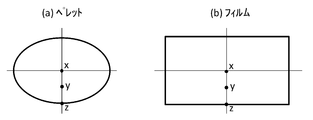
- FIG. 1 is a schematic cross-sectional view illustrating each point in a polymer solid.
- the present invention relates to a core-shell polymer solid, wherein the solid has a main chain portion derived from a precursor polymer (A) and a graft portion derived from a polymer (B) different from the polymer (A).
- a graft part containing a copolymer (C) wherein the solid core part (a) contains a main chain part derived from the precursor polymer (A), and the shell part (b) comes from the polymer (B);
- the following requirement (I) is satisfied.
- the absorbance (Abs) at the center (x), the middle point (y), and the point (z) satisfies the following relationship.
- Z is not particularly limited, but is usually 100, preferably 80, more preferably 50, and further preferably 30.
- the present invention also relates to a gradient polymer solid, wherein the solid is a main chain portion derived from the precursor polymer (A) and a graft portion derived from a polymer (B) different from the polymer (A).
- the solid is a main chain portion derived from the precursor polymer (A) and a graft portion derived from a polymer (B) different from the polymer (A).
- a graft copolymer (C) obtained by grafting a polymer (B) different from (A) on the precursor polymer (A) while maintaining the shape of (A) It is.
- the center (x) of the solid matter, the point (z) on the surface where the distance from the center (x) to the surface is the shortest, and the midpoint of the line segment connecting the center (x) and the point (z) In the infrared absorption spectroscopy measurement of the cross section passing through (y), the absorbance (Abs) at the center (x), the midpoint (y), and the point (z) satisfies the following relationship.
- Z X ⁇ 0.01 Y ⁇ 0.01 Z ⁇ 0.01 and, X ⁇ Y ⁇ Z
- the upper limit of Z is not particularly limited, but is usually 100, preferably 80, more preferably 50, and further preferably 30.
- X is the value of Abs (key band of polymer (B)) / Abs (key band of polymer (A)) at the center (x)
- Y is the value of Abs (polymer (B) key band) / Abs (polymer (A) key band) at the midpoint (y)
- Z is a value of Abs (polymer (B) key band) / Abs (polymer (A) key band) at the point (z).
- Abs means the absorbance in the key band of polymer (A)
- Abs means the absorbance in the key band of polymer (B)
- the key band is selected from the characteristic infrared absorption of the functional group of each polymer in infrared absorption spectroscopy measurement.
- polyolefin can be used as will be described later.
- CH 2 variable vibration if it is an ethylene polymer, CH 2 variable vibration, and if it is a propylene polymer or ethylene / propylene copolymer, CH 3 variable vibration is present. It can be a key band.
- CH 3 bending vibration can be a key band (for example, Example F4 to be described later), but when the influence of the polymer (B) is considered, CH 2 bending vibration is a key.
- a band can be selected (for example, Example F5 described later).
- CH 3 bending vibration can also be a key band for a polymer mainly containing butene and a polymer mainly containing 4-methylpentene-1.
- a characteristic band of an aromatic ring can be used as a key band.
- the polymer (A) a polymer other than polyolefin can be used as described later.
- the keyband is selected from the characteristic infrared absorption of each polymer.
- C O stretching vibration is mentioned.
- the polymer (B) is different from the polymer (A) as described later.
- the key band of the polymer (B) is selected from the characteristic infrared absorption of the functional group of each polymer and, as described above, the one that can be easily distinguished from the key band of the polymer (A) is selected.
- C O stretching vibration for a carboxyl group-containing polymer
- OH stretching vibration for a hydroxyl group-containing polymer OH stretching vibration for a hydroxyl group-containing polymer
- NH stretching vibration for an amine NH stretching vibration for an amine
- C O for an amide group-containing polymer. O stretching vibration is mentioned.
- the center (x) of the polymer solid means the center of gravity of the polymer solid.
- the center (x) of the particle (S) means the particle (S ) Means the center of gravity.
- FIG. 1A is a cross-sectional view illustrating the center (x), midpoint (y), and point (z) in the pellet
- FIG. 1B is a cross-sectional view illustrating each point in the film. is there.
- the core-shell type polymer solid of the present invention is preferably in the form of particles, and hereinafter the particulate core-shell type polymer solid is also referred to as “particle (S)”. That is, the particle (S) includes a core shell including a graft copolymer (C) having a main chain portion derived from the precursor polymer (A) and a graft portion derived from a polymer (B) different from the polymer (A).
- a graft polymer portion in which the core portion (a) of the solid material includes a main chain portion derived from the precursor polymer (A) and the shell portion (b) is derived from the polymer (B). Including.
- the particle (S) includes the center (x) of the particle (S), the point (z) on the surface where the distance from the center (x) to the surface is shortest, and the center (x) and the point (z).
- the relationship (X ⁇ 0. 01, Y ⁇ 0.01, Z ⁇ 0.01).
- the central portion of the particle (S) is composed of the precursor polymer (A), and the surface portion of the particle (S) has a graft portion.
- a graft reaction occurs on the surface of the precursor polymer particles, and particles (S) having a surface portion grafted are formed.
- Particles (S) with excellent dispersibility can be obtained by efficiently grafting the particle surface. That is, when the particles (S) satisfy the requirement (I), an aqueous dispersion composition having excellent dispersibility can be obtained.
- the particle surface portion is efficiently grafted, interfacial adhesion between the curable resin (D) and the particles (S) described later is improved, and a curable resin composition having excellent wear resistance is obtained. And a sliding component using the same is obtained.
- the particle surface is efficiently grafted, the interfacial adhesion between the thermosetting resin (H) and the particles (S) described later is improved, the interlaminar fracture toughness is improved, and high heat resistance is achieved. Is obtained.
- Polyolefin can be used as the precursor polymer (A).
- the polyolefin for example, a polymer composed of one or more ⁇ -olefins selected from ⁇ -olefins having 2 to 18 carbon atoms is employed.
- polymer examples include ethylene, propylene, butene-1, pentene-1, 2-methylbutene-1, 3-methylbutene-1, hexene-1, 3-methylpentene-1, 4-methylpentene-1, 3,3-dimethylbutene-1, heptene-1, methylhexene-1, dimethylpentene-1, trimethylbutene-1, ethylpentene-1, octene-1, methylpentene-1, dimethylhexene-1, trimethylpentene- 1, ethylhexene-1, methylethylpentene-1, diethylbutene-1, propylpentene-1, decene-1, methylnonene-1, dimethyloctene-1, trimethylheptene-1, ethyloctene-1, methylethylhept ⁇ -olefins such as ten-1, diethylhexene-1, dodecene-1 and
- copolymer examples include an ethylene / propylene random copolymer, an ethylene / butene random copolymer, a propylene / butene random copolymer, an ethylene / propylene / butene random copolymer, and 4-methylpentene.
- preferred polymers include ethylene-based polymer, propylene-based polymer, butene-based polymer, 4-methylpentene-1-based polymer. Can be mentioned. Among these, a polymer containing ethylene as a main component is preferable.
- the polymer having a monomer as a main component means that the content of the structural unit derived from the main component monomer is usually 60 mol% or more, preferably 80 mol%, in 100 mol% of the structural units derived from all monomers.
- the above polymer is said.
- the polyolefin may be a polymer mainly composed of a cyclic olefin, a non-conjugated diene, or an aromatic olefin. These olefins may be used alone or in combination of two or more.
- the content of the structural unit derived from the olefin as the comonomer is usually 50 mol% or less, preferably 40 mol% or less, more preferably 30 mol% or less.
- a homopolymer of tetracyclododecene, norbornene, styrene or A copolymer can be preferably used.
- olefins for example, ethylene-propylene-nonconjugated diene copolymers using non-conjugated dienes such as 5-ethylidene norbornene, 5-methylnorbornene, 5-vinylnorbornene, dicyclopentadiene, 1,4-pentadiene, etc. Rubber (EPDM) or the like is also preferably used.
- the above polyolefins can be used singly or in combination of two or more.
- polyolefins can be used in both isotactic and syndiotactic structures, and there are no particular restrictions on the stereoregularity.
- the precursor polymer (A) in addition to the above polyolefin, ethylene / polar group-containing vinyl copolymer, polystyrene, polyamide, acrylic resin, polyphenylene sulfide resin, polyether ether ketone resin, polyester resin, polysulfone, polyphenylene oxide, polyimide , Polyetherimide, polycarbonate, acrylonitrile / butadiene / styrene copolymer (ABS), conjugated diene rubber, styrene rubber, phenol resin, melamine resin, silicone resin, epoxy resin and the like.
- ABS acrylonitrile / butadiene / styrene copolymer
- These resins may contain one kind or two or more kinds, and are preferably styrene-based rubbers, specifically, styrene-butadiene-styrene-based SBS rubber, styrene-butadiene-butylene-styrene-based SBBS rubber. And styrene / ethylene / butylene / styrene-based SEBS rubber.
- the precursor polymer (A) may be in the form of particles such as powders and pellets, in the form of films, sheets, fibers, nonwoven fabrics, etc., or may be a fired body of particles such as powders and pellets, Polymers having shapes obtained from various molding processes can be used.
- a particle-shaped polymer can be used, and the average particle size is preferably 150 ⁇ m or less. More preferably, it is the same as the average particle diameter of particles (S) described later.
- polyolefin resin a polymer comprising one or more ⁇ -olefins selected from ⁇ -olefins having 2 to 18 carbon atoms
- polyolefin resin a polymer comprising one or more ⁇ -olefins selected from ⁇ -olefins having 2 to 18 carbon atoms
- polyolefin resin a polymer comprising one or more ⁇ -olefins selected from ⁇ -olefins having 2 to 18 carbon atoms.
- the precursor polymer (A) can contain any known material as long as its unique properties are not changed.
- the blending amount of the known material is usually 20% by mass or less, preferably 10% by mass or less.
- any polymer that is different from the precursor polymer (A) can be used without particular limitation as long as the effects of the present invention are achieved.
- the polymer (B) may be introduced into the precursor polymer (A) to obtain the graft copolymer (C), and the monomer (b) of the polymer (B) may be converted into the precursor polymer (A).
- the graft copolymer (C) may be obtained by introducing the polymer (B) by a method of polymerizing in the presence of.
- the monomer (b1) having an ethylenically unsaturated group and a polar functional group in the same molecule is graft-polymerized on the surface of the precursor polymer (A) to form a polymer (B).
- the graft copolymer (C) obtained by forming is mentioned.
- the monomer capable of forming the polymer (B) by polymerization may be referred to as “monomer (b)”.
- a polymer (B) the polymer of the monomer (b1) which has an ethylenically unsaturated group and a polar functional group in the same molecule can be mentioned suitably, for example.
- hydrophilicity can be imparted to the graft copolymer (C), and thus a sintered sheet having excellent hydrophilicity can be easily obtained as will be described later.
- the monomer (b1) having an ethylenically unsaturated group and a polar functional group in the same molecule a hydroxyl group-containing ethylenically unsaturated compound, an amino group-containing ethylenically unsaturated compound, and an epoxy group-containing ethylenic compound
- examples include unsaturated compounds, nitrogen-containing aromatic vinyl compounds, lactam structure-containing ethylenically unsaturated compounds, unsaturated carboxylic acids and derivatives thereof, vinyl ester compounds, nitrile group-containing unsaturated compounds, vinyl chloride, and vinyl silane compounds. These can be used alone or in combination of two or more.
- the polar functional group is preferably a hydroxyl group or an epoxy group from the viewpoint of hydrophilicity when, for example, a sintered sheet described below is produced.
- hydroxyl group-containing ethylenically unsaturated compound examples include hydroxyethyl (meth) acrylate, 2-hydroxypropyl (meth) acrylate, 3-hydroxypropyl (meth) acrylate, and 2-hydroxy-3-phenoxy-propyl (meth) acrylate.
- An amino group-containing ethylenically unsaturated compound is a compound having an ethylenic double bond and an amino group.
- Examples of such a compound include at least one amino group and a substituted amino group represented by the following formula:
- a vinyl-type monomer is mentioned.
- R 6 represents a hydrogen atom, a methyl group or an ethyl group
- R 7 represents a hydrogen atom, an alkyl group having 1 to 12 carbon atoms, preferably 1 to 8 carbon atoms, or 6 to 12 carbon atoms, preferably 6-8 cycloalkyl groups.
- the above alkyl group and cycloalkyl group may further have a substituent.
- amino group-containing ethylenically unsaturated compounds include aminoethyl (meth) acrylate, propylaminoethyl (meth) acrylate, 2- (dimethylamino) ethyl methacrylate, aminopropyl (meth) acrylate, and methacrylic acid.
- Alkyl ester derivatives of (meth) acrylic acid such as phenylaminoethyl and cyclohexylaminoethyl methacrylate; vinylamine derivatives such as N-vinyldiethylamine and N-acetylvinylamine; allylamine, methacrylamine, N-methyl (meta ) Allylamine derivatives such as acrylamine; (meth) acrylamide, N-methyl (meth) acrylamide, N, N-dimethyl (meth) acrylamide and N, N-dimethylaminopropyl (meth) acrylamide Aminostyrene such as p- aminostyrene; acrylamide derivative 6-aminohexyl succinimide include 2-aminoethyl succinimide. Of these, aminoethyl (meth) acrylate, propylaminoethyl (meth) acrylate, (meth) acrylamide and N, N-dimethyl (
- the epoxy group-containing ethylenically unsaturated compound is a monomer having at least one polymerizable unsaturated bond and epoxy group in one molecule.
- examples of the epoxy group-containing ethylenically unsaturated compound include glycidyl (meth) acrylate, mono and diglycidyl esters of maleic acid, mono and diglycidyl esters of fumaric acid, mono and diglycidyl esters of crotonic acid, and tetrahydrophthalic acid.
- Mono and diglycidyl esters mono and glycidyl esters of itaconic acid, mono and diglycidyl esters of butenetricarboxylic acid, mono and diglycidyl esters of citraconic acid, endo-cis-bicyclo [2.2.1] hept-5-ene Mono- and diglycidyl esters of -2,3-dicarboxylic acid (Nadic acid TM ), endo-cis-bicyclo [2.2.1] hept-5-ene-2-methyl-2,3-dicarboxylic acid (Methyl Nadic) mono- and diglycidyl of acid TM) Esters, dicarboxylic mono- and alkyl glycidyl esters such as mono- and glycidyl esters of allyl succinic acid (alkyl group having 1 to 12 carbon atoms in the case of mono-glycidyl esters), alkyl-glycidyl esters of p-sty
- nitrogen-containing aromatic vinyl compound examples include 4-vinylpyridine, 2-vinylpyridine, 5-ethyl-2-vinylpyridine, 2-methyl-5-vinylpyridine, 2-isopropenylpyridine, 2-vinylquinoline, Examples thereof include 3-vinylisoquinoline and N-vinylcarbazole.
- lactam structure-containing ethylenically unsaturated compound examples include N-vinylpyrrolidone.
- unsaturated carboxylic acid examples include (meth) acrylic acid, maleic acid, nadic acid, fumaric acid, tetrahydrophthalic acid, itaconic acid, citraconic acid, crotonic acid, isocrotonic acid, norbornene dicarboxylic acid, and bicyclo [2.2. 1]
- unsaturated carboxylic acids such as hept-2-ene-5,6-dicarboxylic acid.
- Examples of the unsaturated carboxylic acid derivative include —C ( ⁇ O) —X (where X is a 15th carboxylic acid anhydride, acid halide, amide, imide, ester (eg, alkyl ester)).
- Derivatives having a structure of atoms selected from group ⁇ 17 elements), and specific examples thereof include maleenyl chloride, maleenylimide, maleic anhydride, itaconic anhydride, citraconic anhydride, tetrahydrophthalic anhydride, bicyclo [2 2.1] Hept-2-ene-5,6-dicarboxylic anhydride, dimethyl maleate, monomethyl maleate, diethyl maleate, diethyl fumarate, dimethyl itaconate, diethyl citraconic acid, dimethyl tetrahydrophthalate, bicyclo [2.2.1] Hept-2-ene-5,6-dicarboxylate dimethyl, (meth) act Methyl methacrylate,
- (meth) acrylic acid, methyl (meth) acrylate, ethyl (meth) acrylate, (meth) acrylamide, maleic anhydride, and tetrahydrofurfuryl (meth) acrylate are preferable.
- (meth) acrylic acid, maleic anhydride, methyl (meth) acrylate, ethyl (meth) acrylate, and tetrahydrofurfuryl (meth) acrylate are particularly preferable.
- vinyl ester compound examples include vinyl acetate, vinyl propionate, vinyl n-butyrate, vinyl isobutyrate, vinyl pivalate, vinyl caproate, vinyl versatate, vinyl laurate, vinyl stearate, vinyl benzoate, p -(T-butyl) vinyl benzoate, vinyl salicylate, vinyl cyclohexanecarboxylate.
- nitrile group-containing unsaturated compound examples include (meth) acrylonitrile, fumaronitrile, allyl cyanide, and cyanoethyl acrylate. Among these, (meth) acrylonitrile is preferable.
- graft monomer (b1) the monomer (b1) having an ethylenically unsaturated group and a polar functional group in the same molecule is referred to as “graft monomer (b1)” or simply “monomer (b1)”. There are times.
- the grafting rate (specifically, the grafting rate of the grafted monomer (b)) is usually 1% or more, preferably 3% or more, more preferably Is 5% or more, more preferably 8% or more.
- the grafting rate is usually 1% or more, preferably 3% or more, more preferably Is 5% or more, more preferably 8% or more.
- the total grafting rate is preferably 1% or more, and the total of these grafting rates is preferably 3% or more, more preferably Is 5% or more, more preferably 8% or more.
- the grafting rate is shown by the following formula.
- the graft copolymer (C) includes, in addition to the monomer (b1) having an ethylenically unsaturated group and a polar functional group in the same molecule, a monomer having an ethylenically unsaturated group, A monomer other than the body (b1) (hereinafter also referred to as “monomer (b2)”) may be further included in a grafted state.
- the graft copolymer (C) has a structure in which a repeating unit derived from the monomer (b1) and a repeating unit derived from the monomer (b2) are introduced into the precursor polymer (A). Have.
- Examples of the monomer (b2) that can optionally be additionally grafted to the precursor polymer (A) include aromatic vinyl compounds other than the nitrogen-containing aromatic vinyl compound.
- aromatic vinyl compounds other than the nitrogen-containing aromatic vinyl compound.
- R 8 and R 9 may be the same as or different from each other, and each represents a hydrogen atom or an alkyl group having 1 to 3 carbon atoms. Specifically, a methyl group, an ethyl group, a propyl group, and an isopropyl group Is mentioned.
- R 10 independently represents a hydrocarbon group or halogen atom having 1 to 3 carbon atoms, specifically, a methyl group, an ethyl group, a propyl group and an isopropyl group, and a chlorine atom, a bromine atom and an iodine atom. Can be mentioned.
- N represents an integer of usually 0 to 5, preferably 1 to 5.
- aromatic vinyl compounds include styrene, ⁇ -methylstyrene, o-methylstyrene, p-methylstyrene, m-methylstyrene, p-chlorostyrene, m-chlorostyrene and p-chloro.
- aromatic vinyl compounds include styrene, ⁇ -methylstyrene, o-methylstyrene, p-methylstyrene, m-methylstyrene, p-chlorostyrene, m-chlorostyrene and p-chloro.
- examples include methylstyrene, and among these, styrene is preferable.
- the graft copolymer (C) has a main chain portion derived from the precursor polymer (A) and a graft portion derived from the polymer (B). Graft copolymer (C) improves the disadvantage that the precursor polymer (A) has low affinity with other materials depending on the type and grafting rate of the monomer (b) grafted to the precursor polymer (A). can do.
- the graft copolymer (C) and the precursor polymer (A) which is a precursor thereof are both solid bodies having a certain shape, but may take any shape.
- the solid having a certain shape include particles, powders, pellets, chips, granules, beads, fiber pieces, non-woven fabric pieces, film pieces, and sheet pieces. Among these, one type of shape may be taken, and solids of a plurality of shapes may be mixed.
- the solid containing the graft copolymer (C) and / or its precursor polymer (A) is usually 0.0001 mm or more and 1000 mm or less, preferably 0.0001 mm or more and 800 mm or less, more preferably 0. 0.001 mm or more and 100 mm or less, more preferably 0.0001 mm or more and 10 mm or less, more preferably 0.001 mm or more and 2.5 mm or less, particularly preferably 0.005 mm or more and 1.5 mm or less, particularly Preferably, it has an average particle diameter of 0.01 mm or more and 0.7 mm or less.
- Average particle size measurement methods include classification using a sieve, natural sedimentation method, centrifugal sedimentation method, Coulter method (Coulter principle), dynamic light scattering method, image analysis method, laser light diffraction scattering method, ultracentrifugation sedimentation Methods are known, but any measurement method can be used depending on the shape and purpose of the sample.
- the Coulter method Coulter principle
- the laser light diffraction scattering method when the average particle size is less than 1 mm
- the classification method average particle size
- the average particle diameter can be obtained by an optical microscope (when the average particle diameter is 1 mm or more).
- the thickness measured with a thickness meter may be used, or the thickness may be obtained by cross-sectional observation using an optical microscope. Also in the case of powder particles, the average particle size can be obtained by image analysis of a photograph taken with a microscope.
- the precursor polymer (A) serving as the core part (a) has the above average particle size, so that the handling workability at the time of molding processing or mixing with other materials is good. Become.
- the particles (S) usually have an average particle size of 150 ⁇ m or less, preferably 100 ⁇ m or less, more preferably 60 ⁇ m or less, and particularly preferably 40 ⁇ m or less.
- the preferable lower limit of the average particle diameter is 1 ⁇ m, more preferably 5 ⁇ m.
- the Coulter method (Coulter principle) can be used.
- the solid containing the graft copolymer (C) and / or its precursor polymer (A) is a molded product, it is usually 0.0001 mm or more and 50 mm or less, preferably 0.0001 mm or more and 10 mm or less. Preferably it has an average thickness or diameter of 0.001 mm or more and 2.5 mm or less, more preferably 0.005 mm or more and 1.5 mm or less, particularly preferably 0.01 mm or more and 0.7 mm or less. .
- the molding method any known method can be used. Specifically, it can be produced by injection molding, blow molding, press molding, calendar molding, extrusion molding, stamping molding, or the like. In extrusion molding, a sheet or film (unstretched), a pipe, a tube, an electric wire and the like can be formed. In particular, an injection molding method, a press molding method, and an extrusion molding method are preferable.
- the stretched film is produced by using the above extruded sheet or extruded film (unstretched) as a raw material, for example, by a tenter method (longitudinal and transverse stretching, transverse and longitudinal stretching), simultaneous biaxial stretching method, uniaxial stretching method, blown film molding. You can also
- the fibers include polyolefin fibers, wholly aromatic polyamide fibers, aliphatic polyamide fibers, polyester fibers, cellulose fibers, and carbon fibers. Furthermore, what decomposed
- the production method for obtaining the polymer solid containing the above-mentioned graft copolymer (C) is not particularly limited as long as the polymer solid containing the obtained graft copolymer (C) satisfies the above-mentioned requirements.
- the polymer (B) is grafted to the solid containing the precursor polymer (A) while maintaining its shape.
- Solvents used in the grafting reaction include water; aromatic hydrocarbon solvents such as benzene, toluene, xylene, aliphatic hydrocarbon solvents such as pentane, hexane, heptane, octane, nonane, decane, cyclohexane, methylcyclohexane, Alicyclic hydrocarbon solvents such as decahydronaphthalene, chlorinated hydrocarbon solvents such as chlorobenzene, dichlorobenzene, trichlorobenzene, methylene chloride, chloroform, carbon tetrachloride, tetrachloroethylene, 1-methyl-2- Pyrrolidone, ethylene carbonate, propylene carbonate, ⁇ -butyrolactone, N-methyl-2-pyrrolidone, propylene glycol monomethyl ether acetate, tributyl acetyl citrate, 2,4-pentadiene, dimethyl sul
- Examples include alcohols; ethers such as ethyl ether, ethylene glycol monomethyl ether, anisole, phenyl ether, dioxane, and tetrahydrofuran; and esters such as ethyl acetate and butyl acetate. Of these, water is preferred.
- Solvents can be used alone or in combination of two or more.
- the said manufacturing method there is no restriction
- the precursor polymer (A) may be impregnated with the monomer (b) or alkyl boron in advance.
- a known chain transfer agent can be used in combination.
- the precursor polymer (A) when the precursor polymer (A) is impregnated with alkyl boron in advance, a gradient polymer is easily obtained.
- the amount of the monomer (b) relative to the precursor polymer (A) is large even without pre-impregnation with alkyl boron, the permeability of the monomer (b) to the precursor polymer (A) increases. Therefore, the modification proceeds to the inside, and a gradient polymer is easily obtained.
- the order of contact with oxygen since it becomes a reaction starting point, a method in which alkyl boron is introduced and then contacted with oxygen is preferable. Moreover, it is preferable that the monomer (b) to be used is previously purged with residual oxygen by performing a nitrogen aeration treatment.
- the graft reaction may be carried out by using known additives such as antioxidants such as hindered phenol compounds, process stabilizers, heat stabilizers, heat aging agents, weathering stabilizers.
- nitroxy radicals such as antistatic agent, anti-slip agent, anti-blocking agent, anti-fogging agent, lubricant, pigment, dye, nucleating agent, plasticizer, hydrochloric acid absorbent, flame retardant, anti-blooming agent, piperidine
- additives such as a radical scavenger, a known softener, a tackifier, a processing aid, an adhesion promoter, a filler such as carbon fiber, glass fiber, and whisker can be used in combination.
- other polymer compounds can be blended in small amounts without departing from the spirit of the present invention.
- any apparatus that can be mixed and heated can be used without particular limitation.
- both vertical and horizontal reactors can be used.
- Specific examples include a fluidized bed, a moving bed, a loop reactor, a horizontal reactor with a stirring blade, a vertical reactor with a stirring blade, and a rotating drum.
- a multi-axis / spinning / revolution combined mixer such as a planetary mixer, a kneader, a paddle dryer, a Henschel mixer, a static mixer, a V blender, a tumbler, and a nauter mixer can also be used.
- a solvent capable of dissolving the monomer (b1) or homopolymer having an unreacted ethylenically unsaturated group and a polar functional group in the same molecule It is possible to obtain the characteristics defined in the invention.
- solvents include water; aliphatic hydrocarbons such as hexane, heptane, decane, and cyclohexane; aromatic hydrocarbons such as benzene, toluene, and xylene; acetone, methyl ethyl ketone, methyl isobutyl ketone, acetophenone, benzophenone, and cyclohexanone.
- Ketones such as benzyl alcohol, 1-butanol, 2-butanol, t-butanol, 1-pentanol, 2-pentanol, 3-pentanol, 2-ethyl-1-hexanol, normal propyl alcohol, isopropyl alcohol, ethanol Alcohols such as methanol; ethers such as ethyl ether, ethylene glycol monomethyl ether, anisole, phenyl ether, dioxane and tetrahydrofuran; esters such as ethyl acetate and butyl acetate; And, a mixed solvent consisting of two or more thereof. Preferred are ketones and alcohols, and acetone and methanol are particularly preferred.
- the washing temperature can be room temperature or higher as long as the shape of the graft copolymer (C) after the graft reaction is maintained, but is preferably room temperature to 110 ° C, more preferably 40 to 100 ° C, and still more preferably Is 50-80 ° C.
- the cleaning temperature is set higher than the boiling point of the cleaning solvent at atmospheric pressure, it is preferably performed in a sealed state in order to prevent volatilization of the cleaning solvent.
- a carboxyl group that may be contained in the graft copolymer (C) may be neutralized using a neutralizing agent.
- the neutralizing agent include ammonia, monomethylamine, monoethylamine, dimethylamine, trimethylamine, triethylamine, ethyldimethylamine, sodium hydroxide, and potassium hydroxide.
- the core-shell type or gradient type polymer solid of the present invention includes, for example, various polymer alloy compatibilizers and modifiers, adhesives, varnishes, aqueous dispersions, liquid viscosity modifiers, coating materials such as powder paints, etc. It is suitable for use.
- the core-shell type or gradient type polymer solid of the present invention is based on at least one selected from (1) to (3) and at least one selected from the above-mentioned fillers such as carbon fiber and glass fiber. It is also suitably used for compatibilizers and modifiers in reinforced resins.
- any known method can be used for molding these various polymer alloys. Specifically, air-cooled inflation molding, air-cooled two-stage cooling inflation molding, high-speed inflation molding, T-die film molding, water-cooled inflation molding, pipe molding, profile extrusion, wire coating, filament extrusion extrusion molding, injection molding, blow molding , Press molding, stamping mold molding, calendar molding, and the like.
- the molded body obtained by such a method is used in a wide range of applications from household items such as daily necessities and recreational uses to general industrial uses and industrial supplies.
- household items such as daily necessities and recreational uses to general industrial uses and industrial supplies.
- seat, a fiber is mentioned.
- Automotive parts include, for example, front doors, foil caps, gasoline tanks, seats (filling, outer material, etc.), belts, ceilings, compatible tops, armrests, door trims, rear package trays, carpets, mats, sun visors, and foil covers.
- Examples include ceiling plates, partition plates, side walls, carpets, wallpaper, wall covering materials, exterior materials, interior materials, roof materials, soundproof plates, heat insulating plates, and window materials.
- Home appliance material parts, communication equipment parts, electrical parts, electronic parts include, for example, printers, personal computers, word processors, keyboards, PDAs (small information terminals), headphone stereos, mobile phones, telephones, facsimiles, copiers, ECRs (electronics).
- Cash register calculators, electronic notebooks, electronic dictionaries, cards, holders, stationery and other office and office equipment; washing machines, refrigerators, vacuum cleaners, microwave ovens, lighting equipment, game machines, irons, bags, and other household appliances AV equipment such as TVs, VTRs, video cameras, radio cassette recorders, tape recorders, mini-discs, CD players, speakers, liquid crystal displays; connectors, relays, capacitors, switches, printed circuit boards, coil bobbins, semiconductor encapsulating materials, electric wires, cables, Examples include transformers, deflection yokes, distribution boards, and watches.
- AV equipment such as TVs, VTRs, video cameras, radio cassette recorders, tape recorders, mini-discs, CD players, speakers, liquid crystal displays; connectors, relays, capacitors, switches, printed circuit boards, coil bobbins, semiconductor encapsulating materials, electric wires, cables, Examples include transformers, deflection yokes, distribution boards, and watches.
- Daily commodities such as clothes, curtains, sheets, plywood, synthetic fibers, carpets, doormats, sheets, buckets, hoses, containers, glasses, bags, cases, goggles, skis, rackets, tents, musical instruments, etc. Sports equipment.
- ⁇ Adhesive and adhesive layer of laminate> When the core-shell type or gradient type polymer solid of the present invention is used as an adhesive, polystyrene, ethylene / vinyl alcohol copolymer, ionomer resin, polyurethane, polyamide, polyester, polyphenylene ether, polycarbonate, polyacetal, polyphenylene sulfide, polysulfone, poly Various engineering plastics such as ether ketone, polyether ether ketone, polyimide, etc., and polymer alloy compatibilizers and modifiers for various polyolefins described in the above ⁇ Precursor polymer (A)> section, nitrile Rubber, butadiene rubber, chloroprene rubber, butyl rubber, isoprene rubber, styrene-isoprene-styrene block copolymer, styrene-butadiene-styrene block copolymer, hydrogenated styrene - but
- the core-shell type or gradient polymer solid of the present invention when used as an adhesive, may be used alone, but as a thermoplastic resin composition containing a core-shell type or gradient polymer solid and an unmodified resin. More preferably, it is used.
- the unmodified resin the polyolefin described in the section ⁇ Precursor polymer (A)> is preferably used.
- thermoplastic resin composition containing such a core-shell type or graded polymer solid and an unmodified resin can be produced using a known method, for example, produced by any of the following methods. can do.
- An unmodified resin, a core-shell type or gradient type polymer solid of the present invention, and other components added as desired are mixed with an appropriate good solvent (for example; hexane, heptane, decane, cyclohexane, benzene, toluene and A hydrocarbon solvent such as xylene) and then removing the solvent.
- an appropriate good solvent for example; hexane, heptane, decane, cyclohexane, benzene, toluene and A hydrocarbon solvent such as xylene
- a layer made of a polyolefin resin preferably a polyolefin described in the above section ⁇ Precursor polymer (A)> (hereinafter referred to as “base material”)
- base material a layer made of a polyolefin resin, preferably a polyolefin described in the above section ⁇ Precursor polymer (A)>
- base material a laminate including an adhesive layer and a layer made of a polar resin in this order is preferable.
- the core-shell or gradient polymer solid of the present invention may be used alone, but the thermoplastic resin composition containing the core-shell or gradient polymer solid and an unmodified resin. More preferably, it is used as a product.
- the unmodified resin the polyolefin described in the section ⁇ Precursor polymer (A)> is preferably used.
- thermoplastic resin composition containing a core-shell type or graded polymer solid and an unmodified resin can be produced, for example, by a known method as described in the above (1) to (4). .
- the substrate is usually in the form of a sheet or film.
- the thickness of the substrate can be appropriately selected depending on the material, shape, application, etc. of the substrate, but is preferably 0.01 mm or more, more preferably 0.03 mm or more in order to maintain the rigidity as the substrate. .
- the thickness of the base material is preferably 10 mm or less, more preferably 2 mm or less from the viewpoint of ease of handling.
- the thickness of the adhesive layer containing the adhesive of the present invention is preferably 0.001 mm or more, more preferably 0.003 mm or more in order to sufficiently obtain an adhesive function. However, even if it is too thick, the effect is not changed and the cost is increased. Therefore, the thickness of the adhesive layer is preferably 0.3 mm or less, more preferably 0.1 mm or less.
- the polar resin examples include ethylene / vinyl alcohol copolymer (EVOH), polyamide such as polyamide-6, polyamide-66, and polyamide 6T, and polyester such as polyethylene terephthalate and polybutylene terephthalate. It is done.
- EVOH ethylene / vinyl alcohol copolymer
- polyamide such as polyamide-6, polyamide-66, and polyamide 6T
- polyester such as polyethylene terephthalate and polybutylene terephthalate. It is done.
- the thickness of the layer made of polar resin is preferably 0.001 mm or more, more preferably 0.003 mm or more.
- the thickness of the layer made of a polar resin is preferably 0.3 mm or less, more preferably 0.1 mm or less.
- the manufacturing method of such a laminate can be a conventionally known one, and is not particularly limited.
- the laminate is obtained by, for example, a coextrusion injection method or a heat laminating method.
- shape of the obtained laminated body is not specifically limited, For example, shapes, such as a bottle, a cup, a tube, a sheet
- these laminates include, for example, bottles such as shampoos and detergents, seasoning bottles such as edible oil and soy sauce, beverage bottles such as mineral water and juice, lunch boxes, and bowls for steaming tea.
- the said varnish contains the said solid and a solvent.
- the solvent include aromatic hydrocarbon solvents such as benzene, toluene, and xylene, aliphatic hydrocarbon solvents such as pentane, hexane, heptane, octane, nonane, and decane, cyclohexane, methylcyclohexane, and decahydro.
- Examples thereof include alicyclic hydrocarbon solvents such as naphthalene, and chlorinated hydrocarbon solvents such as chlorobenzene, dichlorobenzene, trichlorobenzene, methylene chloride, chloroform, carbon tetrachloride, and tetrachloroethylene.
- chlorinated hydrocarbon solvents such as chlorobenzene, dichlorobenzene, trichlorobenzene, methylene chloride, chloroform, carbon tetrachloride, and tetrachloroethylene.
- Solvents can be used alone or in combination of two or more.
- the concentration of solid content in the varnish is usually 1 to 99% by mass, preferably 10 to 90% by mass.
- the poor solvent examples include alcohol solvents such as methanol, ethanol, n-propanol, iso-propanol, n-butanol, sec-butanol and tert-butanol, ketone solvents such as acetone, methyl ethyl ketone and methyl isobutyl ketone, and acetic acid.
- ester solvents such as ether and dimethyl phthalate
- ether solvents such as dimethyl ether, diethyl ether, di-n-amyl ether, tetrahydrofuran, and dioxyanisole.
- the amount of the poor solvent can be, for example, 0.1 to 100 parts by mass with respect to 100 parts by mass of the swelling solvent.
- Aqueous dispersion When the core-shell type or gradient polymer solid of the present invention is used as an aqueous dispersion, a core-shell type or gradient type grafted with a monomer having an ethylenically unsaturated group and a carboxyl group in the same molecule It is particularly preferable to use the graft copolymer (C), and the aqueous dispersion can be produced by a known method, for example, by neutralizing a carboxyl group using a neutralizing agent as necessary and dispersing in water. is there.
- the neutralizing agent include ammonia, monomethylamine, monoethylamine, dimethylamine, trimethylamine, triethylamine, ethyldimethylamine, sodium hydroxide, and potassium hydroxide.
- nonionic surfactants anionic surfactants, cationic surfactants and antifoaming agents can be used, and as an optional component, the solvent described in the above “varnish” section can be used. It can also be used together. That is, the aqueous dispersion contains a graft copolymer or a salt of the graft copolymer and the neutralizing agent and water, and if necessary, a nonionic surfactant, an anionic surfactant, a cationic surfactant. It may further contain a surfactant such as an agent, an antifoaming agent, the solvent described in the above “Varnish” section, and the like.
- varnishes or aqueous dispersions are used as binders or antiwear agents for paints and inks used in various fields such as automobiles, electrical and electronic parts, construction and packaging materials, dyeing aids, dispersion aids such as pigments, Anti-blocking agent, anti-corrosive paint additive, primer, coating agent, adhesive, floor polish, car wax, glass fiber and carbon fiber sizing agent, paper softener, coated paper paint additive, It can be suitably used as a urethane foam, a release agent for rubber molding, and a toner release agent.
- the aqueous dispersion composition of the present invention contains the particles (S) and water described above.
- the content of the particles (S) is usually 0.1 to 70% by mass, preferably 0.5 to 50% by mass, more preferably 1 to 30% by mass.
- the water content is usually 10 to 99% by mass, preferably 30 to 90% by mass, more preferably 50 to 80% by mass.
- the aqueous dispersion composition of the present invention may contain one or more resins selected from urethane resins and acrylic resins in addition to the particles (S) and water.
- the content of the resin is usually 10 to 60 parts by mass, preferably 20 to 50 parts by mass with respect to 100 parts by mass of water.
- One or more resins selected from the particles (S), urethane resins and acrylic resins contained in the aqueous dispersion composition of the present invention are particularly limited as long as they are dissolved or dispersed in an aqueous medium. However, it is preferably in a dispersed state in that a film-forming product having a high solid content concentration can be prepared.
- the aqueous dispersion composition of the present invention can contain an acid-modified polyolefin compound and / or a fatty acid compound, if necessary, in order to stabilize the aqueous dispersion such as particles (S).
- an ionomer resin and / or a low molecular weight olefin polymer can be included.
- the aqueous dispersion composition of the present invention may further contain a nonionic surfactant, an anionic surfactant, a cationic surfactant or an antifoaming agent, if necessary, and an alcohol solvent. Further, a poor solvent such as a ketone solvent or an ether solvent can be used in combination.
- aqueous means a state where the resin is dispersed in water and / or a state where a part of the resin is dissolved, and includes “water dispersion”.
- the aqueous dispersion composition of the present invention can be produced by mixing particles (S) and water.
- it can be obtained by adding the particles (S) to an aqueous urethane resin or acrylic dispersion prepared by a known method.
- a polyurethane resin obtained by the reaction of an isocyanate group-terminated prepolymer obtained by reacting at least an active hydrogen group-containing compound containing a diisocyanate, a diol, and a hydrophilic group with a chain extender containing a polyamine is dispersed in water.
- the aqueous dispersion composition of the present invention can be produced by adding particles (S) to the resulting polyurethane dispersion.
- aqueous dispersion composition of the present invention is used for, for example, applications such as various polymer alloy compatibilizers and modifiers, adhesives, varnishes, aqueous dispersions, liquid viscosity modifiers, powder coating materials, and the like. Is preferred.
- Aqueous dispersion compositions are binders or antiwear agents for paints and inks used in various fields such as automobiles, electrical and electronic parts, construction and packaging materials, anti-blocking agents such as pigments, anti-blocking agents.
- Anticorrosive paint additive, primer, coating agent, adhesive, floor polish, car wax, glass fiber and carbon fiber sizing agent, paper softener, coated paper paint additive, urethane foam It can be suitably used as a release agent for rubber molding and a toner release agent.
- the coating composition of the present invention includes the aqueous dispersion composition of the present invention, and preferably further includes one or more resins selected from urethane resins and acrylic resins.
- the content of the resin is usually 10 to 60 parts by mass, preferably 20 to 50 parts by mass with respect to 100 parts by mass of water.
- the urethane resin can have a carboxyl group, a sulfonyl group and an ethylene oxide group in the molecule.
- components used for introducing these atomic groups include 2,2-dimethylol lactic acid, 2,2-dimethylol propionic acid, 2,2-dimethylol butanoic acid, and 2,2-dimethylol valeric acid.
- Examples of the method for producing the urethane resin include the following methods. For example, using a polyfunctional isocyanate compound or a compound having an active hydrogen group capable of reacting with an isocyanate group, an appropriate organic ratio with an equivalent ratio such that the isocyanate group becomes excessive or an equivalent ratio such that the active hydrogen group becomes excessive There is a method for producing a resin having a urethane bond in the molecule by reacting in the presence or absence of a solvent.
- the acrylic resin can be obtained by polymerizing an unsaturated monomer mixture selected from a hydroxyl group-containing unsaturated monomer, an acid group-containing unsaturated monomer, and other unsaturated monomers.
- the hydroxyl group-containing unsaturated monomer include hydroxyethyl (meth) acrylate, hydroxypropyl methacrylate, hydroxybutyl acrylate, Plaxel FM1 ( ⁇ -caprolactone-modified hydroxyethyl methacrylate, manufactured by Daicel Chemical Industries), polyethylene glycol mono (meth) acrylate, Examples include polypropylene glycol mono (meth) acrylate.
- Examples of the acid group-containing unsaturated monomer include carboxylic acids such as (meth) acrylic acid, itaconic acid, crotonic acid, and maleic acid.
- Examples of other unsaturated monomers include ester group-containing acrylic monomers such as methyl, ethyl, propyl, butyl, hexyl, ethylhexyl, and lauryl of (meth) acrylic acid; carboxyls such as vinyl alcohol, acetic acid, and propionic acid.
- Vinyl alcohol ester monomers with acids unsaturated hydrocarbon monomers such as styrene, ⁇ -methylstyrene, vinyl naphthalene, butadiene, and isoprene; nitrile monomers such as (meth) acrylonitrile; (meth) Examples include (meth) acrylamide monomers such as acrylamide, N-methylolacrylamide, N, N-dimethylacrylamide, and diacetoneacrylamide.
- the coating composition of the present invention is applied to a substrate and dried to form a film on the substrate to obtain a film-formed product.
- substrate For example, woody material, building material, civil engineering material, automobile material, terminal material, electrical and electronic material, OA equipment material, sports equipment material, footwear material, fiber flocking material , And packaging materials.
- drying for example, it is usually dried in an atmosphere of 23 to 200 ° C., preferably 23 to 100 ° C., usually for 10 to 180 minutes, preferably for 20 to 60 minutes.
- the curable resin composition of this invention contains particle
- the content of the particles (S) in the curable resin composition of the present invention is preferably in the range of 1 to 30% by mass, more preferably 2 to 20% by mass.
- a curing agent (E) and a resin that is cured by external energy such as heat, light, and electron beam to form a three-dimensional cured product at least partially are preferably used.
- a thermosetting resin is particularly preferable.
- thermosetting resin examples include epoxy resin, phenol resin, melanin resin, bismaleimide resin, unsaturated polyester resin, vinyl ester resin, and benzoxazine resin, and epoxy resin and phenol resin are preferably used.
- any conventionally known epoxy resin can be used and is not particularly limited. Specifically, bisphenol type epoxy resin, alcohol type epoxy resin, biphenyl type epoxy resin, naphthalene type epoxy resin, dicyclopentadiene type epoxy resin, diphenylfluorene type epoxy resin, hydrophthalic acid type epoxy resin, dimer acid type epoxy resin, Bifunctional epoxy resins such as alicyclic epoxy resins, glycidyl ether type epoxy resins such as tetrakis (glycidyloxyphenyl) ethane, tris (glycidyloxyphenyl) methane, glycidylamine type epoxy resins such as tetraglycidyldiaminodiphenylmethane, naphthalene Type epoxy resin, novolac type epoxy resin phenol novolac type epoxy resin, cresol novolac type epoxy resin, etc., phenol type epoxy resin, etc. Such as multifunctional epoxy resins. Furthermore, various modified epoxy resins such as
- the phenol resin is a polymer of a phenol compound and a compound having a divalent linking group.
- phenol resins include phenol novolak resins, residues obtained by removing bisphenol from novolaks, resol type phenol resins, phenol-dicyclopentadiene resins, phenol aralkyl resins, biphenyl aralkyl resins, naphthol aralkyl resins.
- aniline aralkyl resins can be used alone or in combination.
- phenol novolac resins are preferable because they are easily available and inexpensive.
- the content of the curable resin (D) in the curable resin composition of the present invention is preferably more than 0% by mass and 99% by mass or less, and more preferably in the range of 60 to 85% by mass.
- a known curing agent that cures the curable resin (D) is used.
- a curing agent for the epoxy resin for example, a compound having an active group capable of reacting with an epoxy group is used.
- aliphatic polyamines for example, aliphatic polyamines, aromatic polyamines, polyamide resins, secondary and tertiary amines, aminobenzoic acid esters, various acid anhydrides, phenol novolac resins, cresol novolac resins, polyphenol compounds, imidazole derivatives, tetramethylguanidine
- examples include thiourea addition amines, carboxylic acid anhydrides such as methylhexahydrophthalic anhydride, carboxylic acid hydrazides, carboxylic acid amides, polymercaptans and Lewis acid complexes such as boron trifluoride ethylamine complexes.
- These curing agents may be used alone or in combination.
- an epoxy resin cured product having good heat resistance By using an aromatic polyamine as a curing agent, an epoxy resin cured product having good heat resistance can be obtained.
- aromatic polyamines diaminodiphenyl sulfone or a derivative thereof, or various isomers thereof are curing agents suitable for obtaining a cured epoxy resin having good heat resistance.
- Examples of the curing agent for the phenol resin molding material include paraformaldehyde and hexamethylenetetramine (hexamine).
- the preferable content of the curing agent (E) varies depending on the types of the curable resin (D) and the curing agent (E), and can be appropriately set.
- the content of the curing agent (E) in the curable resin composition of the present invention is preferably 1 to 40 parts by mass, more preferably 10 to 100 parts by mass with respect to 100 parts by mass of the curable resin (D).
- the range is 40 parts by mass.
- the curable resin composition of the present invention may contain a thermoplastic resin other than the particles (S), the curable resin (D), and the curing agent (E) as long as the effects of the present invention are not impaired.
- the curable resin composition of the present invention may further include a curing accelerator, a reactive diluent, a filler, an anti-aging agent, a flame retardant, a pigment, a coupling agent, a fiber, a lubricant, and the like as necessary.
- a curing accelerator e.g., a curing accelerator
- a reactive diluent e.g., a filler
- the curable resin composition according to the present invention is obtained by mixing the above-described particles (S), the curable resin (D), the curing agent (E), and other optionally used components by a known method. Obtainable.
- the curable resin composition of the present invention is produced by adding particles (S) and a curing agent (E) to a curable resin (D) such as a liquid epoxy resin or a powdery phenol resin, mixing and curing. can do.
- a curable resin such as a liquid epoxy resin or a powdery phenol resin
- the curable resin (D) may be added in the process of producing the curable resin composition, and immediately before attempting to cure the curable resin composition, all other than the curable resin (D). May be added to a composition comprising the following components.
- the curing agent (E) may be added in the process of producing the curable resin composition, and includes all components other than the curing agent (E) immediately before attempting to cure the curable resin composition. It may be added to the composition.
- the particles (S) may be added in the process of producing the curable resin composition, and the composition containing all components other than the particles (S) immediately before the curable resin composition is to be cured. May be added.
- the catalyst curing agent
- the solvent the plasticizer
- the filler the colorant
- the additive may be added in the process of producing the curable resin composition. It may be added to the curable resin composition immediately before attempting to cure.
- a part of the other components is added and immediately before the curable resin composition is cured, These components may be added to the curable resin composition.
- the conditions for curing the curable resin composition of the present invention may be any of curing at normal temperature, thermal curing, photocuring, and electron beam curing.
- cured material obtained from a curable resin composition is not ask
- a well-known method can be used.
- a cured product having a desired shape can be obtained by applying or casting a curable resin composition and curing the composition as it is. That is, in the present invention, a molded body formed from the curable resin composition is also provided.
- the curable resin composition obtained by this invention is suitable for various uses, such as a molded object, a coating material, an elastic coating material, and a waterproof material.
- Curable resin compositions are used in various fields such as automobiles, electrical and electronic parts, construction and packaging materials, binders for paints and inks, binders for friction materials, antiwear agents, additives for anticorrosive paints, primers Suitable as raw materials for coating agents, adhesives, floor polishes, car wax, glass fiber and carbon fiber binders, softeners for paper, additives for coated paper paints, release agents for rubber molding, toner release agents, etc. Can be used for In particular, it can be suitably used as various sliding parts because of its excellent wear resistance.
- the curable resin composition of the present invention can be cured by a known method and used as a cured product.
- cured material is applicable to the use of a well-known epoxy resin hardened
- Sliding parts include, for example, automobile interior and exterior metals and resins, various rubbers, electrical product coatings, fiber reinforced composite materials, disk pads, friction brake binders such as drum brake linings, and various protective liner materials. Used for etc.
- the prepreg of the present invention includes a reinforcing fiber (F) and a resin composition (G), and the resin composition (G) contains the particles (S), the thermosetting resin (H), and the curing agent (I) described above. including.
- the reinforcing fiber (F) examples include glass fiber, carbon fiber, aramid fiber, and boron fiber. Two or more of these fibers may be mixed and used. Among these, carbon fibers having light weight and high mechanical properties are preferable.
- the form of the reinforcing fiber (F) is not particularly limited, and examples thereof include continuous fiber aligned in one direction, single tow, roving, woven fabric, mat, knit, braid, nonwoven fabric, and paper.
- a composite material using continuous fibers arranged in one direction and a form in which the fibers are woven are suitable for expressing high mechanical properties.
- the resin composition (G) includes particles (S), a thermosetting resin (H), and a curing agent (I).
- the resin composition (G) contains 0.1 to 20% by mass of particles (S), preferably 0.3 to 16% by mass, more preferably 0.5 to 10% by mass, and particularly preferably 0.5 to 8% by mass. It comprises mass%.
- the content of the particles (S) is preferably not less than the above lower limit value in improving the interlaminar fracture toughness of the obtained fiber reinforced composite material, and not more than the above upper limit value is the strength and elasticity of the fiber reinforced composite material. It is preferable in terms of mechanical properties such as rate and heat resistance.
- the particle (S) may be either a non-crosslinked body or a crosslinked body, but the crosslinked body has a higher elastic modulus than the non-crosslinked body, and the mechanical properties of the thermosetting resin (H) are greatly reduced. Therefore, the interlaminar fracture toughness can be further improved, and a fiber-reinforced composite material having high heat resistance can be obtained.
- the particle (S) which is a crosslinked product As a method for producing the particle (S) which is a crosslinked product, a method of treating the particle (S) which is a non-crosslinked product with an organic oxide, a method of irradiating the particle (S) with radiation, and a particle (S) And silane treatment.
- the particle (S) which is a crosslinked body usually has the same particle shape as the particle (S) before being crosslinked. For example, by irradiating the particles (S) that are non-crosslinked bodies with radiation, the molecular chains are broken and crosslinked, and as a result, the molecular chains are combined at the crosslinking points to obtain a crosslinked body.
- the radiation there are ⁇ rays, ⁇ rays, ⁇ rays, electron rays, ions, etc., and any of them can be used, but electron rays and ⁇ rays are suitable.
- By crosslinking deformation at high temperature is further suppressed, and the effect of maintaining the particle shape can be expected. Therefore, it is preferable to use particles (S) that are crosslinked bodies.
- the irradiation dose is usually 50 to 700 kGy, preferably 100 to 500 kGy.
- the irradiation dose is within the above range, it is preferable because the crosslinking reaction proceeds efficiently.
- the irradiation dose is less than or equal to the above upper limit, the deterioration of the particles (S) is suppressed, and when the irradiation dose is greater than or equal to the lower limit, the cross-linking of the polymer chain proceeds at a sufficient speed. Is preferable.
- the particle (S) as a crosslinked product may be produced by crosslinking the precursor polymer (A) in a particle shape, and then introducing the polymer (B) to introduce a graft copolymer (C).
- the method of obtaining the core-shell type polymer solid substance containing) is also mentioned.
- a method for crosslinking the precursor polymer (A) the same method as the method for crosslinking the non-crosslinked particles (S) described above can be used.
- the particle (S) is added to liquid paraffin, heated to 180 ° C., and then cooled to room temperature. At this time, it can be determined whether or not the particle shape is maintained.
- the non-crosslinked product is dissolved in liquid paraffin to form a gel, but the crosslinked product retains the particle shape.
- thermosetting resin (H) serving as the matrix resin, a resin that is cured by heat and at least partially forms a three-dimensional cured product is preferably used.
- thermosetting resin (H) include an epoxy resin, a phenol resin, a melanin resin, a bismaleimide resin, an unsaturated polyester resin, a vinyl ester resin, and a benzoxazine resin, and an epoxy resin is particularly preferably used. It is done.
- any conventionally known epoxy resin can be used and is not particularly limited. Specifically, bisphenol type epoxy resin, alcohol type epoxy resin, biphenyl type epoxy resin, naphthalene type epoxy resin, dicyclopentadiene type epoxy resin, diphenylfluorene type epoxy resin, hydrophthalic acid type epoxy resin, dimer acid type epoxy resin, Bifunctional epoxy resins such as alicyclic epoxy resins, glycidyl ether type epoxy resins such as tetrakis (glycidyloxyphenyl) ethane, tris (glycidyloxyphenyl) methane, glycidylamine type epoxy resins such as tetraglycidyldiaminodiphenylmethane, naphthalene Type epoxy resin, novolac type epoxy resin phenol novolac type epoxy resin, cresol novolac type epoxy resin, etc., phenol type epoxy resin, etc. Such as multifunctional epoxy resins. Furthermore, various modified epoxy resins such as
- the content of the thermosetting resin (H) in the resin composition (G) is preferably 50 to 99% by mass, more preferably 60 to 85% by mass.
- Curing agent (I) a known curing agent that cures the thermosetting resin (H) is used.
- an epoxy curing agent that is a curing agent for an epoxy resin a compound having an active group capable of reacting with an epoxy group is used.
- aliphatic polyamines for example, aliphatic polyamines, aromatic polyamines, polyamide resins, secondary and tertiary amines, aminobenzoic acid esters, various acid anhydrides, phenol novolac resins, cresol novolac resins, polyphenol compounds, imidazole derivatives, tetramethylguanidine
- examples include thiourea addition amines, carboxylic acid anhydrides such as methylhexahydrophthalic anhydride, carboxylic acid hydrazides, carboxylic acid amides, polymercaptans and Lewis acid complexes such as boron trifluoride ethylamine complexes.
- These curing agents may be used alone or in combination.
- an aromatic polyamine as a curing agent, a cured epoxy resin with good heat resistance can be obtained.
- diaminodiphenyl sulfone or a derivative thereof, or various isomers thereof are curing agents suitable for obtaining a cured epoxy resin having good heat resistance.
- a combination of dicyandiamide and a urea compound such as 3,4-dichlorophenyl-1,1-dimethylurea or imidazoles as a curing agent
- high heat resistance and water resistance can be obtained while curing at a relatively low temperature.
- a cured product having a lower water absorption than the amine compound curing is obtained.
- a latent product of these curing agents for example, a microencapsulated product, the storage stability of the prepreg, in particular, tackiness and draping properties hardly change even when left at room temperature.
- the preferable addition amount of the curing agent (I) varies depending on the types of the thermosetting resin (H) and the curing agent (I), and can be appropriately set with reference to the addition amount in the conventional prepreg.
- the addition amount of the curing agent (I) is preferably in the range of 1 to 30 parts by mass, more preferably 10 to 25 parts by mass with respect to 100 parts by mass of the thermosetting resin (H).
- the curing agent is generally stoichiometrically 0.7-1.3, preferably 0.8-1.
- the addition of 2 is preferable from the viewpoints of mechanical properties and heat resistance of the fiber-reinforced composite material.
- the resin composition (G) may contain a thermoplastic resin other than the thermosetting resin (H), the curing agent (I) and the particles (S) as long as the effects of the present invention are not impaired.
- the content of the thermoplastic resin in the resin composition (G) is usually 30% by mass or less, preferably 20% by mass or less, more preferably 10% by mass or less.
- the resin composition (G) may further contain various additives such as a curing accelerator, a reactive diluent, a filler, an anti-aging agent, a flame retardant, and a pigment as necessary.
- various additives such as a curing accelerator, a reactive diluent, a filler, an anti-aging agent, a flame retardant, and a pigment as necessary.
- the content of various additives in the resin composition (G) is usually 10% by mass or less, preferably 5% by mass or less.
- the method for producing the resin composition (G) is not particularly limited, and any conventionally known method may be used.
- the thermosetting resin (H) is an epoxy resin
- the kneading temperature applied during the production of the resin composition (G) can be in the range of 10 to 200 ° C. When it exceeds 200 ° C., thermal deterioration of the epoxy resin or partial curing reaction starts, and the storage stability of the resulting resin composition (G) and the prepreg using the resin composition (G) may be lowered.
- the temperature is lower than 10 ° C., the viscosity of the resin composition (G) is high, and it may be difficult to knead substantially.
- the temperature is preferably 20 to 180 ° C, more preferably 30 to 170 ° C.
- a conventionally known apparatus can be used. Examples thereof include a roll mill, a planetary mixer, a kneader, an extruder, a Banbury mixer, a mixing vessel provided with a stirring blade, and a horizontal mixing vessel.
- the kneading of each component can be performed in the air or in an inert gas atmosphere.
- an atmosphere in which temperature and humidity are controlled is preferable.
- a low humidity atmosphere such as a temperature controlled at a constant temperature of 30 ° C. or lower or a relative humidity of 50% RH or lower.
- each component may be performed in a single stage, or may be performed in multiple stages by sequentially adding each component. Moreover, when adding sequentially, it can add in arbitrary orders, but it is preferable to add a hardening
- the prepreg of the present invention can be produced by impregnating the reinforcing fiber (F) with the resin composition (G).
- the method for producing the prepreg of the present invention is not particularly limited, and can be produced using any conventionally known method.
- a hot melt method in which the resin composition (G) obtained above is applied onto a release film on a thin film, and the resin film obtained by peeling is impregnated into a sheet-like reinforcing fiber (F).
- a solvent method in which the resin composition (G) is varnished with a solvent and the reinforced varnish (F) is impregnated with the varnish.
- the hot melt method is preferable from the viewpoint of handling properties and mechanical properties of the obtained fiber-reinforced composite material.
- the preferred range of the content of the reinforcing fiber (F) in the obtained prepreg differs depending on the type and form of the reinforcing fiber (F) and the composition of the resin composition (G). It is preferable that the reinforcing fiber (F) is included.
- the fiber-reinforced composite material of the present invention is obtained by curing the prepreg of the present invention.
- the prepreg can be used as a single layer or laminated, it is generally used by laminating. That is, the prepreg of the present invention is appropriately cut and then laminated as necessary, and is heated and pressurized with an autoclave, a hot press or the like to be thermally cured and formed into a desired shape.
- the thermosetting conditions are determined by the thermosetting resin and the curing agent used.
- the curing temperature is, for example, 100 to 300 ° C., preferably 150 to 200 ° C.
- the curing time is, for example, 30 minutes to 10 hours, preferably 1 to 10 hours.
- the method for stacking the prepreg is not particularly specified, and may be selected depending on the product design and the like. For example, pseudo-isotropic, unidirectional, ⁇ 45 ° stacking or the like is used. However, when two or more layers are stacked in the same direction, it is desirable from the viewpoint of reinforcing efficiency that the same kind of carbon fibers are stacked so as not to overlap.
- Examples of the shape of the molded body include a flat plate, a cylindrical shape, and the like, and a three-dimensional shape obtained by lamination molding of a prepreg.
- the orientation angle and thickness of the fiber may be determined according to the required performance of the obtained fiber-reinforced composite material.
- the sheet of the present invention is a sintered sheet formed by sintering at least the above-described particles (S), that is, a sintered sheet formed of a sintered body of at least particles (S). Since the sintered sheet of the present invention has a sintered body of particles (S) made of the above-described core-shell type polymer solid, it has high hydrophilicity and high strength.
- the water absorption rate of the sintered sheet of the present invention is usually 50% or more, preferably 75 to 100%, more preferably 80 to 100%. Details of measurement conditions for water absorption are described in the Examples.
- the tensile strength of the sintered sheet of the present invention is usually 3 MPa or more, preferably 4 to 10 MPa, more preferably 6 to 10 MPa. Details of tensile strength measurement conditions are described in the Examples.
- the sintered sheet of the present invention preferably has pores and is useful as a porous sheet imparted with hydrophilicity.
- the porosity of the sheet is preferably 20 to 45%, more preferably 30 to 45%, and still more preferably 35 to 45%.
- Such an embodiment is preferable from the viewpoint of water absorption and strength.
- the holes may be uniform or non-uniform throughout the sheet.
- the porosity is calculated by an equation of [(true density ⁇ apparent density) / true density] ⁇ 100 (%).
- the true density (g / cm 3 ) is the particle density
- the apparent density (g / cm 3 ) is the value obtained by dividing the mass of the sintered sheet by the volume calculated from the outer dimensions of the sintered sheet. It is.
- particles other than the particles (S) may be used together with the particles (S).
- the other particles include polymer particles that are not graft-modified.
- the polymer constituting the polymer particles is a polymer such as polyolefin described as the precursor polymer (A) described above. Specifically, the polyolefin particles are not graft-modified.
- the sintered sheet of the present invention may have, on the surface or inside thereof, a member such as a woven fabric, a knitted fabric, a non-woven fabric, a cloth, a porous sheet, a wire mesh, or the like that does not significantly inhibit the water absorption.
- the sintered sheet of the present invention has a non-hydrophilic sheet (such as a non-moisture permeable or non-water permeable sheet) on the surface or inside thereof so that the influence of absorbed moisture does not affect the surroundings. May be.
- the sintered sheet of the present invention is excellent in hydrophilicity and strength, it can be used in general industrial applications. Also, it can be used in the field of electronics such as ink absorbers for printers, solid electrolyte supports, and fuel cell members; Filters, specifically, filtration filters used in various industrial machines, automobiles and building materials, filtration filters for artificial dialysis, filtration filters such as bioanalytical kits; humidifying elements, adsorption buffer materials, solution holding materials, separators It can be suitably used as a sheet (for example, these are used in various industrial machines, automobiles, and building materials).
- electronics such as ink absorbers for printers, solid electrolyte supports, and fuel cell members; Filters, specifically, filtration filters used in various industrial machines, automobiles and building materials, filtration filters for artificial dialysis, filtration filters such as bioanalytical kits; humidifying elements, adsorption buffer materials, solution holding materials, separators It can be suitably used as a sheet (for example, these are used in various industrial machines,
- the sintered sheet of the present invention may be produced, for example, by filling at least the particles (S) in a mold and sintering, or depositing at least the particles (S) on a substrate and sintering. You may manufacture by doing.
- the amount of particles (S) used is usually 10% by mass or more, preferably 50% by mass or more, and more preferably 80% by mass or more, in 100% by mass of all particles.
- particles other than the particles (S) for example, polymer particles that are not graft-modified, can be used together with the particles (S).
- the particles (S) and other particles can be mixed using an apparatus such as a Henschel mixer, a tumbler mixer, a ladies mixer, a high-speed fluid mixer, or a V-type mixer.
- an apparatus such as a Henschel mixer, a tumbler mixer, a ladies mixer, a high-speed fluid mixer, or a V-type mixer.
- At least one additive selected from a heat stabilizer, a weathering agent, a deodorant, a deodorant, a fungicide, an antibacterial agent, a fragrance, and a filler is added to particles containing particles (S). Then, it may be sintered.
- a heat stabilizer e.g., a weathering agent
- a deodorant e.g., a deodorant
- a fungicide e.g., a fungicide
- an antibacterial agent e.g., a fragrance
- a filler e.g., a filler.
- spreading agents such as a liquid paraffin.
- the heating temperature during sintering is not particularly limited as long as, for example, the particles (S) are bound to each other, and is usually 140 ° C. or higher, preferably 140 to 200 ° C., more preferably 150 to 180 ° C.
- the heating time is usually 10 minutes or longer, preferably 20 to 120 minutes, more preferably 30 to 100 minutes, although it depends on the sheet shape and the like.
- a heating method for sintering for example, a hot air dryer may be used, or a method such as electric dielectric heating or electric resistance heating may be used.
- Sintering is preferably performed so as to leave gaps (holes) between the particles (S).
- the surface layer of the particles (S) is heat-bonded, whereby holes can be easily formed.
- Sintering can be performed under no pressure or under pressure.
- the material of the mold and the substrate examples include iron, stainless steel, brass, and aluminum.
- the shape of the mold is not particularly limited as long as it has a space that can be formed into a sheet shape. Note that when the particles are filled in a mold or deposited on a substrate, a vibration type apparatus can be used.
- the sintered sheet of the present invention can be obtained by the above-described sintering molding.
- ⁇ Infrared absorption spectroscopy measurement> In the case of a sample having a particle size or thickness of 0.05 mm or more, a cross section was prepared that passed through the center (x) of the sample and the point (z) on the surface where the distance from the center (x) to the surface of the sample was the shortest. Thereafter, each measurement point (center (x), point (z), center (x) and point (z), and center (x) and point (z) are obtained using a micro-infrared spectroscopy (FTS-7000 / UMA600) manufactured by VARIAN). ) was measured by the total reflection (ATR) method. The measurement range was 4000 cm ⁇ 1 to 600 cm ⁇ 1 , the resolution was 4 cm ⁇ 1 , and the number of integrations was 128 times.
- FTS-7000 / UMA600 micro-infrared spectroscopy
- the cross-sectional thickness passing through the center (x) of the sample and the point (z) on the surface where the distance from the center (x) to the surface of the sample is the shortest.
- the section was prepared using a microtome, the section was collected on a substrate (ZnS), and each measurement location (center (x), point (z) was made using nanoscale infrared spectroscopy (nanoIR2) manufactured by ANASYS INSTRUMENTS. ) And the midpoint (y) of the line segment connecting the center (x) and the point (z) were measured by the AFM-IR method.
- the measurement range was 2000 cm ⁇ 1 to 900 cm ⁇ 1 and the resolution was 4 cm ⁇ 1 .
- the mass of the polymer (B) (graft polymer, graft portion) can be determined from the difference between the mass after the graft reaction and the mass of the precursor polymer (A). When the mass increase is slight, it can be determined by 1 H-NMR measurement.
- Grafting rate (%) [Mass of polymer (B) / Mass of precursor polymer (A)] ⁇ 100 ⁇ Average particle size of powder particles> The average particle size of the powder particles was measured by a Coulter counter method (Coulter method).
- ⁇ Average particle size of pellet> The diameters of 30 pellets were randomly measured with a stereomicroscope and averaged.
- Example A1 An ultra high molecular weight polyethylene (PE) powder (Mitsui Chemicals, Mipelon (trademark) XM-221U) having an average particle size of 0.03 mm was used as the precursor polymer (A), and 2-hydroxy methacrylate was used as the graft monomer (b1). Ethyl (HEMA) was used.
- PE polyethylene
- HEMA Ethyl
- the produced polymer was filtered through a glass filter, sufficiently washed with acetone, and vacuum-dried at 60 ° C. for 8 hours.
- Example A2 As the precursor polymer (A), an ultra high molecular weight PE powder (Miplon XM-221U, manufactured by Mitsui Chemicals, Inc.) having an average particle size of 0.03 mm was used, and glycidyl methacrylate (GMA) was used as the graft monomer (b1).
- PE powder Moplon XM-221U, manufactured by Mitsui Chemicals, Inc.
- GMA glycidyl methacrylate
- the produced polymer was filtered through a glass filter, sufficiently washed with acetone, and vacuum-dried at 60 ° C. for 8 hours.
- PP random polypropylene
- MMA methacrylic acid
- the produced polymer was filtered through a glass filter, sufficiently washed with acetone, and vacuum-dried at 60 ° C. for 8 hours.
- the produced polymer was filtered through a glass filter, sufficiently washed with acetone, and vacuum-dried at 60 ° C. for 8 hours.
- the produced polymer was filtered through a glass filter, sufficiently washed with acetone, and vacuum-dried at 60 ° C. for 8 hours.
- the produced polymer was filtered through a glass filter, sufficiently washed with acetone, and vacuum-dried at 60 ° C. for 8 hours.
- Example A7 As the precursor polymer (A), homo PP (manufactured by Prime Polymer Co., Ltd., F113G) was extruded using a T-die and cut into 4 cm ⁇ 4 cm from a cast film having an average thickness of 0.05 mm. Further, methyl methacrylate (MMA) was used as the graft monomer (b1).
- MMA methyl methacrylate
- Example A8 An ultra-high molecular weight PE powder having an average particle size of 0.03 mm (Miperon XM-221U, manufactured by Mitsui Chemicals Inc.) is used as the precursor polymer (A), and 2-hydroxyethyl methacrylate (HEMA) is used as the graft monomer (b1). It was.
- the produced polymer was filtered through a glass filter, sufficiently washed with acetone, and vacuum-dried at 60 ° C. for 8 hours.
- Example A9 As the precursor polymer (A), a PP non-woven fabric having an average thickness of 0.222 mm molded by the melt blown method was cut into 10 cm ⁇ 12.5 cm (0.124 g). Further, methyl methacrylate (MMA) was used as the graft monomer (b1).
- MMA methyl methacrylate
- the produced polymer was filtered through a glass filter, sufficiently washed with acetone, and vacuum-dried at 60 ° C. for 8 hours.
- Example A10 An aqueous dispersion of the core-shell type graft copolymer obtained in Example A1 was prepared by the following method. A 50 mL glass container was charged with 1 g of polymer, 25 mL of pure water and a stirrer, and stirred at room temperature for 1 hour using a magnetic stirrer to prepare an aqueous dispersion.
- Example A11 The same procedure as in Example A10 was conducted except that the polymer obtained in Example A2 was used.
- Example A10 was the same as Example A10 except that the polymer obtained in Example A8 was used.
- Example A4 Water was used in the same manner as in Example A10 except that the precursor polymer used in Example A1, Example A2 and Example A8, ultra-high molecular weight PE powder (Miperon XM-221U, manufactured by Mitsui Chemicals, Inc.) was used. The dispersibility was evaluated.
- ⁇ Uniform dispersion of the polymer can be confirmed visually after 60 seconds from stopping stirring.
- ⁇ After 5 seconds from stopping stirring, the uniform dispersion of the polymer can be visually confirmed.
- the phase separation interface can be visually confirmed 60 seconds after stirring is stopped.
- phase separation interface can be visually confirmed after 5 seconds of stirring.
- Example B1 It carried out like Example A1 mentioned above and obtained the particle
- an aqueous urethane resin Takelac WS-6021 made by Mitsui Chemicals
- this aqueous dispersion composition was applied to an EPDM substrate previously coated with a primer (Mitsui Chemicals Unistal P-501), The film was dried at 70 ° C. for 30 minutes to obtain a film molded product.
- Example B2 It carried out like Example A2 mentioned above and obtained the particle
- Aqueous urethane resin (Takelac WS-6021 manufactured by Mitsui Chemicals) is applied to a substrate made of EPDM previously coated with a primer (Unistol P-501 manufactured by Mitsui Chemicals), dried in an atmosphere at 70 ° C. for 30 minutes, and a film molded product Got.
- Example B2 instead of the particles (S1) or (S3), the precursor polymer (A) used in Example A1 and Example A2 was used except that ultra-high molecular weight PE powder (Miperon XM-221U, manufactured by Mitsui Chemicals) was used. Obtained an aqueous dispersion composition and a film molded article in the same manner as in Examples B1 and B2.
- ultra-high molecular weight PE powder Moperon XM-221U, manufactured by Mitsui Chemicals
- each particle was added to an aqueous urethane resin, stirred, and dispersed in an aqueous dispersion composition, the state after dispersion was observed, and the dispersibility was evaluated according to the following criteria.
- ⁇ Uniform dispersion of the polymer can be confirmed visually after 60 seconds from stopping stirring.
- ⁇ After 5 seconds from stopping stirring, the uniform dispersion of the polymer can be visually confirmed.
- the phase separation interface can be visually confirmed 60 seconds after stirring is stopped.
- phase separation interface can be visually confirmed after 5 seconds of stirring.
- ⁇ Abrasion resistance evaluation> Using the obtained film molded article, the film surface is brought into contact with a glass plate (tip R10), a 500 g load is applied to the film molded article at room temperature, and the film is slid back and forth 40,000 times at a speed of 48 times per minute. The mass difference before and after that was determined as the amount of wear. Furthermore, the dynamic friction coefficients of the first, 2000th, 20000th, 30000th and 40000th reciprocating sliding were measured.
- Example C1 It carried out similarly to Example A1 mentioned above, and obtained the solid substance which is a 103.4g graft copolymer.
- a 150 mL plastic container 2 g of the obtained graft copolymer, 15 g of epoxy resin (trade name: jER828, manufactured by Mitsubishi Chemical Corporation), modified aromatic amine as a curing agent (trade name: jER Cure W, manufactured by Mitsubishi Chemical Corporation) 5 g was charged, stirred at 2000 rpm for 2 minutes using a rotation and revolution type defoaming mixer, and further defoamed for 3 minutes to obtain a curable resin composition.
- epoxy resin trade name: jER828, manufactured by Mitsubishi Chemical Corporation
- modified aromatic amine as a curing agent trade name: jER Cure W
- the obtained curable resin composition was poured into a Teflon (registered trademark) petri dish and cured at 120 ° C. for 2 hours and then at 170 ° C. for 2 hours to prepare a sample which is a flat plate molded product.
- Teflon registered trademark
- Example C2 It carried out like Example A2 mentioned above, and obtained the solid substance which is 108.2 g of graft copolymers. Using this solid, the subsequent steps were performed in the same manner as in Example C1.
- Example C1 The same procedure as in Example C1 except that the graft copolymer was not used.
- Example C2 The same procedure as in Example C1 was conducted except that 2 g of ultra high molecular weight PE powder (Mitsui Chemical Co., Ltd., Mipelon XM-221U) having an average particle size of 0.03 mm was used instead of 2 g of the graft copolymer.
- PE powder Mitsubishi Chemical Co., Ltd., Mipelon XM-221U
- prepreg and fiber reinforced composite materials Production and evaluation of the following prepregs were performed in an atmosphere at a temperature of 25 ° C. ⁇ 2 ° C. and a relative humidity of 50% unless otherwise specified.
- Epoxy resin (trade name: jER828, manufactured by Mitsubishi Chemical Corporation) is used as the thermosetting resin that is the base material of the matrix resin, and a modified aromatic amine (trade name: jER Cure W, manufactured by Mitsubishi Chemical Corporation) is used as the curing agent.
- the blending amount was 25 parts of modified aromatic amine with respect to 100 parts of epoxy resin. These were mixed to prepare a mixture (hereinafter also referred to as “mixture 1”).
- any one of the particles (S1) to (S4) obtained above and an ultra high molecular weight PE powder having an average particle size of 0.03 mm (Mipeller (trademark) XM-221U, manufactured by Mitsui Chemicals, Inc.) Added at the concentrations shown in Tables 2D and 3D (the amount of the resin composition obtained is 100% by mass), stirred and mixed with a hot stirrer under conditions of 600 rpm and 100 ° C. for 24 hours, and then a varnish-like resin composition Was made.
- a 12-layer laminated prepreg was produced by a hand lay-up method. While applying a pressure of 4 kPa, the laminated prepreg was cured at 100 ° C. for 2 hours and then at 175 ° C. for 4 hours to prepare a flat plate sample as a fiber-reinforced composite material.
- Example D1 The mixture 1 prepared in Example D1 and the like was stirred and mixed with a hot stirrer at 600 rpm and 100 ° C. for 24 hours to prepare a varnish-like resin composition. Using this resin composition, flat plate samples were produced in the subsequent steps in the same manner as in Example D1 and the like.
- ⁇ Tensile strength and tensile modulus of composite material The tensile strength and tensile modulus were measured by a tensile test. An aluminum tab having a length of 50 mm was attached to both ends of a test piece having a width of 20 mm and a length of 200 mm. A Tensilon universal testing machine (RTC-1350A, manufactured by Orientec Co., Ltd.) was used and the test speed was 1 mm / min.
- ⁇ Bending strength and flexural modulus of composite material The bending strength and the bending elastic modulus were measured by a three-point bending test described in JIS K7074. A test piece having a width of 15 mm and a length of 100 mm was prepared, and an Instron universal testing machine (Type 55R4026, manufactured by Instron) was used at a test speed of 5 mm / min.
- the mode II interlaminar fracture toughness value was measured by ENF (End Notched Flexure) test. An initial crack having an initial crack length of 40 mm was introduced into a test piece having a width of 25 mm, a length of 140 mm, and a thickness of 3 mm. Using an Instron universal tester (Type 55R4026, manufactured by Instron), the mode II interlaminar fracture toughness value was determined by a three-point bending test. The test speed was 0.5 mm / min.
- Examples E1 to E2 Comparative Examples E1 to E3
- Fabrication of Sintered Sheet The particles obtained in the production example or the particles of the reference example are vibration filled into a mold (dimensions: thickness 2 mm, width 100 mm, height 100 mm). Then, it was heated for 60 minutes at a temperature of 150 ° C. to carry out sintering molding to obtain a sintered sheet having a thickness of 2 mm.
- the true density (g / cm 3 ) is the density of the polyolefin particles
- the apparent density (g / cm 3 ) is the mass of the sintered sheet divided by the volume calculated from the outer dimensions of the sintered sheet. Value.
- the sintered sheet made of unmodified polyolefin particles had low hydrophilicity.
- Sintered sheets made of polyolefin particles modified under conditions with a small amount of electron beam irradiation had low strength and low hydrophilicity.
- denatured on the conditions with a large electron beam irradiation amount was not able to be sintered.
- the sintered sheet consisting of specific particles (S) maintained strength and high hydrophilicity.
- TBB tributyl boron
- the produced polymer was filtered through a glass filter, sufficiently washed with acetone, and vacuum-dried at 60 ° C. for 8 hours.
- TBB tributyl boron
- the produced polymer was filtered through a glass filter, sufficiently washed with acetone, and vacuum-dried at 60 ° C. for 8 hours.
- the produced polymer was filtered through a glass filter, sufficiently washed with acetone, and vacuum-dried at 60 ° C. for 8 hours.
- the produced polymer was filtered through a glass filter, sufficiently washed with acetone, and vacuum-dried at 60 ° C. for 8 hours.
- the produced polymer was filtered through a glass filter, sufficiently washed with acetone, and vacuum-dried at 60 ° C. for 8 hours.
- the produced polymer was filtered through a glass filter, sufficiently washed with acetone, and vacuum-dried at 60 ° C. for 8 hours.
- the produced polymer was filtered through a glass filter, sufficiently washed with acetone, and vacuum-dried at 60 ° C. for 8 hours.
- Example F8 Polycarbonate pellets having an average particle size of 6 mm (Panlite L-1225Y, manufactured by Teijin Ltd.) were used as the precursor polymer (A), and methyl methacrylate (MMA) was used as the graft monomer (b1).
- the produced polymer was filtered through a glass filter, sufficiently washed with acetone, and vacuum-dried at 60 ° C. for 8 hours.
- Example F9 As the precursor polymer (A), homo PP (manufactured by Prime Polymer Co., Ltd., F113G) was extruded using a T-die and cut into 4 cm ⁇ 4 cm from a cast film having an average thickness of 0.05 mm. Further, methyl methacrylate (MMA) was used as the graft monomer (b1).
- MMA methyl methacrylate
- the produced polymer was filtered through a glass filter, sufficiently washed with acetone, and vacuum-dried at 60 ° C. for 8 hours.
- Example F10 Using Yubase-4 (manufactured by SK Lubricants), after preparing a 10% by weight solution (polymer concentrate) of the gradient graft copolymer obtained in Example F1, Yubase-4 as a base oil and as a pour point depressant Each of LeBlanc 165 (manufactured by Toho Chemical Co., Ltd.) was mixed to prepare a lubricating oil composition.
- Example F4 A lubricating oil composition was prepared in the same manner as in Example F10 except that the polymer obtained in Reference Example F1 was used.
- Example F5 A lubricating oil composition was prepared in the same manner as in Example F10 except that an ethylene / propylene random copolymer, which was the precursor polymer used in Example F1 and Reference Example F1, was used.
- Viscosity characteristics The kinematic viscosity and viscosity index were measured by measuring the kinematic viscosity at 100 ° C. and 40 ° C. according to the method described in JIS K2283. Was calculated.
- SSI Shear Stability Index
- a core-shell type graft copolymer in which various functional groups are introduced at a high ratio only on the surface of the polymer or a gradient type graft copolymer in which various functional groups are introduced at a higher ratio near the surface than the center of the polymer.
- the use of the molded article of the present invention is not particularly limited, it can be suitably used as a coating material for various polymer alloy compatibilizers and modifiers, adhesives, varnishes, aqueous dispersions, powder paints, and the like.
Landscapes
- Chemical & Material Sciences (AREA)
- Organic Chemistry (AREA)
- Engineering & Computer Science (AREA)
- Chemical Kinetics & Catalysis (AREA)
- Materials Engineering (AREA)
- Health & Medical Sciences (AREA)
- Polymers & Plastics (AREA)
- Medicinal Chemistry (AREA)
- Life Sciences & Earth Sciences (AREA)
- Wood Science & Technology (AREA)
- Manufacturing & Machinery (AREA)
- Inorganic Chemistry (AREA)
- Oil, Petroleum & Natural Gas (AREA)
- General Chemical & Material Sciences (AREA)
- Emergency Medicine (AREA)
- Nanotechnology (AREA)
- Graft Or Block Polymers (AREA)
- Compositions Of Macromolecular Compounds (AREA)
- Filtering Materials (AREA)
- Manufacture Of Macromolecular Shaped Articles (AREA)
- Reinforced Plastic Materials (AREA)
- Paints Or Removers (AREA)
Abstract
Priority Applications (5)
| Application Number | Priority Date | Filing Date | Title |
|---|---|---|---|
| JP2018555058A JP7224184B2 (ja) | 2016-12-09 | 2017-12-07 | グラフトコポリマー含有固形物およびその用途 |
| KR1020197015984A KR102206701B1 (ko) | 2016-12-09 | 2017-12-07 | 그래프트 코폴리머 함유 고형물 및 그의 용도 |
| CN201780075544.6A CN110062780A (zh) | 2016-12-09 | 2017-12-07 | 含接枝共聚物的固体物质及其用途 |
| US16/466,607 US20200071443A1 (en) | 2016-12-09 | 2017-12-07 | Graft copolymer-containing solid product and use thereof |
| EP17879614.0A EP3553101A4 (fr) | 2016-12-09 | 2017-12-07 | Produit solide contenant un copolymère greffé et utilisation correspondante |
Applications Claiming Priority (14)
| Application Number | Priority Date | Filing Date | Title |
|---|---|---|---|
| JP2016239294 | 2016-12-09 | ||
| JP2016239295 | 2016-12-09 | ||
| JP2016-239294 | 2016-12-09 | ||
| JP2016-239295 | 2016-12-09 | ||
| JP2017-024876 | 2017-02-14 | ||
| JP2017024876 | 2017-02-14 | ||
| JP2017038368 | 2017-03-01 | ||
| JP2017-038368 | 2017-03-01 | ||
| JP2017121268 | 2017-06-21 | ||
| JP2017-121268 | 2017-06-21 | ||
| JP2017-182494 | 2017-09-22 | ||
| JP2017182494 | 2017-09-22 | ||
| JP2017232592 | 2017-12-04 | ||
| JP2017-232592 | 2017-12-04 |
Publications (1)
| Publication Number | Publication Date |
|---|---|
| WO2018105682A1 true WO2018105682A1 (fr) | 2018-06-14 |
Family
ID=62491164
Family Applications (1)
| Application Number | Title | Priority Date | Filing Date |
|---|---|---|---|
| PCT/JP2017/043926 Ceased WO2018105682A1 (fr) | 2016-12-09 | 2017-12-07 | Produit solide contenant un copolymère greffé et utilisation correspondante |
Country Status (7)
| Country | Link |
|---|---|
| US (1) | US20200071443A1 (fr) |
| EP (1) | EP3553101A4 (fr) |
| JP (1) | JP7224184B2 (fr) |
| KR (1) | KR102206701B1 (fr) |
| CN (1) | CN110062780A (fr) |
| TW (1) | TWI759374B (fr) |
| WO (1) | WO2018105682A1 (fr) |
Cited By (7)
| Publication number | Priority date | Publication date | Assignee | Title |
|---|---|---|---|---|
| CN109233613A (zh) * | 2018-07-11 | 2019-01-18 | 王兰玺 | 一种基于聚酰亚胺树脂的耐高温涂料及其制备方法 |
| JP2020122119A (ja) * | 2019-01-31 | 2020-08-13 | 三井化学株式会社 | 潤滑油用粘度指数向上剤および潤滑油組成物 |
| JP2021102689A (ja) * | 2019-12-25 | 2021-07-15 | 三井化学株式会社 | 粉体塗料および該粉体塗料の塗装品 |
| JP2021102690A (ja) * | 2019-12-25 | 2021-07-15 | 三井化学株式会社 | 粉体塗料および粉体塗料の塗装品 |
| JP2021530594A (ja) * | 2018-07-18 | 2021-11-11 | アルケマ フランス | 焼結物品を形成するのに有用な組成物及び方法 |
| JP2022015083A (ja) * | 2020-07-08 | 2022-01-21 | 三井化学株式会社 | グラフト共重合体およびその製造方法 |
| JP2022015082A (ja) * | 2020-07-08 | 2022-01-21 | 三井化学株式会社 | グラフト共重合体およびその製造方法 |
Families Citing this family (4)
| Publication number | Priority date | Publication date | Assignee | Title |
|---|---|---|---|---|
| US12466944B2 (en) * | 2018-03-07 | 2025-11-11 | Maruzen Petrochemical Co., Ltd. | Core/shell type polymer microparticles, dispersion of particles, and method for producing said microparticles |
| CN112680084A (zh) * | 2020-12-29 | 2021-04-20 | 广东花王涂料有限公司 | 一种水性木器漆及其制备方法 |
| DE102022110683A1 (de) | 2022-05-02 | 2023-11-02 | Delcotex Delius Techtex Gmbh & Co. Kg | Prepreg-Lage und deren Verwendung |
| CN120818094A (zh) * | 2025-09-17 | 2025-10-21 | 中国科学院宁波材料技术与工程研究所 | 一种聚丙烯的接枝改性方法及接枝改性聚丙烯 |
Citations (23)
| Publication number | Priority date | Publication date | Assignee | Title |
|---|---|---|---|---|
| US3141862A (en) | 1961-03-01 | 1964-07-21 | Exxon Research Engineering Co | Graft copolymerization using boron alkyls in the presence of oxygen as catalysts |
| JPS4844386A (fr) * | 1971-10-09 | 1973-06-26 | ||
| JPS541358B1 (fr) * | 1969-10-29 | 1979-01-23 | ||
| JPS5443595A (en) * | 1977-09-12 | 1979-04-06 | Showa Electric Wire & Cable Co | Method of forming bridged polyethylene cable connector |
| JPS585931B2 (ja) | 1975-03-14 | 1983-02-02 | 株式会社クラレ | スポンジケイセイセイオヨビ タイキユウセイノリヨウコウナ シ−トザイリヨウノセイゾウホウ |
| JPH07149843A (ja) * | 1993-11-29 | 1995-06-13 | Kanegafuchi Chem Ind Co Ltd | 改質ポリオレフィン系樹脂組成物の製法およびそれからえられた改質ポリオレフィン系樹脂組成物、ならびにそれを含有してなるポリオレフィン系樹脂組成物 |
| JPH09111179A (ja) | 1995-10-13 | 1997-04-28 | Akurosu Kk | ウェザーストリップ及びウェザーストリップ用塗料組成物 |
| JPH11223821A (ja) * | 1997-07-14 | 1999-08-17 | Sekisui Finechem Co Ltd | 液晶表示素子用スペーサ及びそれを用いた液晶表示素子 |
| JP2004176054A (ja) | 2002-11-13 | 2004-06-24 | Asahi Glass Co Ltd | 活性エネルギー線硬化型被覆用組成物及びプラスチック成形品 |
| JP3686172B2 (ja) | 1996-07-03 | 2005-08-24 | 旭化成ケミカルズ株式会社 | 吸湿・吸水性成形体 |
| JP2009221460A (ja) | 2008-02-19 | 2009-10-01 | Toray Ind Inc | ポリアミド微粒子、プリプレグ及び炭素繊維強化複合材料 |
| JP2010241885A (ja) * | 2009-04-02 | 2010-10-28 | Mitsui Chemicals Inc | コアシェル型粒子、その製造方法および用途 |
| JP2011026508A (ja) * | 2009-07-28 | 2011-02-10 | Sekisui Plastics Co Ltd | 発泡性ポリスチレン系樹脂粒子、予備発泡粒子、発泡成形体とその製造方法 |
| JP2011057907A (ja) | 2009-09-12 | 2011-03-24 | Toho Tenax Co Ltd | 熱硬化性樹脂組成物とそれを用いたプリプレグ |
| JP2011080013A (ja) | 2009-10-09 | 2011-04-21 | Mitsui Chemicals Inc | ポリオレフィン微粒子ならびに変性ポリオレフィン微粒子、これらを含む樹脂組成物、およびその用途 |
| JP2012193322A (ja) | 2011-03-18 | 2012-10-11 | Toray Ind Inc | プリプレグ、および炭素繊維強化複合材料 |
| JP2013170231A (ja) | 2012-02-21 | 2013-09-02 | Asahi Kasei Chemicals Corp | 塗料 |
| JP2013203863A (ja) * | 2012-03-28 | 2013-10-07 | Sekisui Plastics Co Ltd | 改質樹脂粒子ならびにその発泡性改質樹脂粒子、予備発泡粒子および発泡成形体 |
| JP2014009280A (ja) | 2012-06-29 | 2014-01-20 | Jx Nippon Oil & Energy Corp | 繊維強化複合材料 |
| JP2014196444A (ja) * | 2013-03-29 | 2014-10-16 | 積水化成品工業株式会社 | ポリスチレン系複合樹脂粒子とその製造方法、発泡性粒子、発泡粒子及び発泡成形体 |
| WO2016039461A1 (fr) | 2014-09-12 | 2016-03-17 | 三井化学株式会社 | Particules de polyoléfine modifiée et leur procédé de production |
| WO2016136540A1 (fr) | 2015-02-26 | 2016-09-01 | 三井化学株式会社 | Préimprégné, et matériau composite renforcé par des fibres |
| JP2016194065A (ja) | 2015-03-31 | 2016-11-17 | 日東電工株式会社 | 親水性超高分子量プラスチック多孔質シート及びその製造方法 |
Family Cites Families (7)
| Publication number | Priority date | Publication date | Assignee | Title |
|---|---|---|---|---|
| US4990279A (en) * | 1989-04-21 | 1991-02-05 | Hercules Incorporated | Electrorheological fluids |
| FR2729150A1 (fr) * | 1995-01-06 | 1996-07-12 | Rhone Poulenc Chimie | Poudres redispersables dans l'eau de polymeres filmogenes a structure "coeur/ecorce" |
| EP0776917B1 (fr) * | 1995-11-29 | 2002-05-29 | Vantico AG | Particules de polymère à structure core-shell et compositions de résines époxydes les contenant |
| JP3141862B2 (ja) | 1998-11-13 | 2001-03-07 | 東レ株式会社 | タイヤコードおよびタイヤ |
| CN101357962A (zh) * | 2008-09-09 | 2009-02-04 | 东南大学 | 一步法制备羧基功能化的核壳纳米高分子微球 |
| CN103068865B (zh) * | 2010-07-09 | 2016-01-13 | 路博润高级材料公司 | 结构化的丙烯酸酯共聚物增稠剂 |
| JP6392567B2 (ja) * | 2014-07-04 | 2018-09-19 | 三井化学株式会社 | 硬化性樹脂組成物、添加剤用組成物およびその用途 |
-
2017
- 2017-12-07 WO PCT/JP2017/043926 patent/WO2018105682A1/fr not_active Ceased
- 2017-12-07 KR KR1020197015984A patent/KR102206701B1/ko active Active
- 2017-12-07 US US16/466,607 patent/US20200071443A1/en not_active Abandoned
- 2017-12-07 JP JP2018555058A patent/JP7224184B2/ja active Active
- 2017-12-07 TW TW106142940A patent/TWI759374B/zh active
- 2017-12-07 EP EP17879614.0A patent/EP3553101A4/fr not_active Withdrawn
- 2017-12-07 CN CN201780075544.6A patent/CN110062780A/zh active Pending
Patent Citations (23)
| Publication number | Priority date | Publication date | Assignee | Title |
|---|---|---|---|---|
| US3141862A (en) | 1961-03-01 | 1964-07-21 | Exxon Research Engineering Co | Graft copolymerization using boron alkyls in the presence of oxygen as catalysts |
| JPS541358B1 (fr) * | 1969-10-29 | 1979-01-23 | ||
| JPS4844386A (fr) * | 1971-10-09 | 1973-06-26 | ||
| JPS585931B2 (ja) | 1975-03-14 | 1983-02-02 | 株式会社クラレ | スポンジケイセイセイオヨビ タイキユウセイノリヨウコウナ シ−トザイリヨウノセイゾウホウ |
| JPS5443595A (en) * | 1977-09-12 | 1979-04-06 | Showa Electric Wire & Cable Co | Method of forming bridged polyethylene cable connector |
| JPH07149843A (ja) * | 1993-11-29 | 1995-06-13 | Kanegafuchi Chem Ind Co Ltd | 改質ポリオレフィン系樹脂組成物の製法およびそれからえられた改質ポリオレフィン系樹脂組成物、ならびにそれを含有してなるポリオレフィン系樹脂組成物 |
| JPH09111179A (ja) | 1995-10-13 | 1997-04-28 | Akurosu Kk | ウェザーストリップ及びウェザーストリップ用塗料組成物 |
| JP3686172B2 (ja) | 1996-07-03 | 2005-08-24 | 旭化成ケミカルズ株式会社 | 吸湿・吸水性成形体 |
| JPH11223821A (ja) * | 1997-07-14 | 1999-08-17 | Sekisui Finechem Co Ltd | 液晶表示素子用スペーサ及びそれを用いた液晶表示素子 |
| JP2004176054A (ja) | 2002-11-13 | 2004-06-24 | Asahi Glass Co Ltd | 活性エネルギー線硬化型被覆用組成物及びプラスチック成形品 |
| JP2009221460A (ja) | 2008-02-19 | 2009-10-01 | Toray Ind Inc | ポリアミド微粒子、プリプレグ及び炭素繊維強化複合材料 |
| JP2010241885A (ja) * | 2009-04-02 | 2010-10-28 | Mitsui Chemicals Inc | コアシェル型粒子、その製造方法および用途 |
| JP2011026508A (ja) * | 2009-07-28 | 2011-02-10 | Sekisui Plastics Co Ltd | 発泡性ポリスチレン系樹脂粒子、予備発泡粒子、発泡成形体とその製造方法 |
| JP2011057907A (ja) | 2009-09-12 | 2011-03-24 | Toho Tenax Co Ltd | 熱硬化性樹脂組成物とそれを用いたプリプレグ |
| JP2011080013A (ja) | 2009-10-09 | 2011-04-21 | Mitsui Chemicals Inc | ポリオレフィン微粒子ならびに変性ポリオレフィン微粒子、これらを含む樹脂組成物、およびその用途 |
| JP2012193322A (ja) | 2011-03-18 | 2012-10-11 | Toray Ind Inc | プリプレグ、および炭素繊維強化複合材料 |
| JP2013170231A (ja) | 2012-02-21 | 2013-09-02 | Asahi Kasei Chemicals Corp | 塗料 |
| JP2013203863A (ja) * | 2012-03-28 | 2013-10-07 | Sekisui Plastics Co Ltd | 改質樹脂粒子ならびにその発泡性改質樹脂粒子、予備発泡粒子および発泡成形体 |
| JP2014009280A (ja) | 2012-06-29 | 2014-01-20 | Jx Nippon Oil & Energy Corp | 繊維強化複合材料 |
| JP2014196444A (ja) * | 2013-03-29 | 2014-10-16 | 積水化成品工業株式会社 | ポリスチレン系複合樹脂粒子とその製造方法、発泡性粒子、発泡粒子及び発泡成形体 |
| WO2016039461A1 (fr) | 2014-09-12 | 2016-03-17 | 三井化学株式会社 | Particules de polyoléfine modifiée et leur procédé de production |
| WO2016136540A1 (fr) | 2015-02-26 | 2016-09-01 | 三井化学株式会社 | Préimprégné, et matériau composite renforcé par des fibres |
| JP2016194065A (ja) | 2015-03-31 | 2016-11-17 | 日東電工株式会社 | 親水性超高分子量プラスチック多孔質シート及びその製造方法 |
Non-Patent Citations (4)
| Title |
|---|
| JOURNAL OF POLYMER SCIENCE, vol. 47, 2009, pages 6163 - 6167 |
| MACROMOLECULES, vol. 38, 2005, pages 8966 - 8970 |
| OKAMURA, HIROKAZU ET AL.: "Generation of Radical Species on Polypropylene by Alkylborane-Oxygen System and Its Application to Graft Polymerization", JOURNAL OF POLYMER SCIENCE . PART A''. POLYMER CHEMISTRY, vol. 47, no. 22, 2009, pages 6163 - 6167, XP055509840 * |
| See also references of EP3553101A4 |
Cited By (11)
| Publication number | Priority date | Publication date | Assignee | Title |
|---|---|---|---|---|
| CN109233613A (zh) * | 2018-07-11 | 2019-01-18 | 王兰玺 | 一种基于聚酰亚胺树脂的耐高温涂料及其制备方法 |
| JP2021530594A (ja) * | 2018-07-18 | 2021-11-11 | アルケマ フランス | 焼結物品を形成するのに有用な組成物及び方法 |
| JP7434270B2 (ja) | 2018-07-18 | 2024-02-20 | アルケマ フランス | 焼結物品を形成するのに有用な組成物及び方法 |
| JP2020122119A (ja) * | 2019-01-31 | 2020-08-13 | 三井化学株式会社 | 潤滑油用粘度指数向上剤および潤滑油組成物 |
| JP7261596B2 (ja) | 2019-01-31 | 2023-04-20 | 三井化学株式会社 | 潤滑油用粘度指数向上剤および潤滑油組成物 |
| JP2021102689A (ja) * | 2019-12-25 | 2021-07-15 | 三井化学株式会社 | 粉体塗料および該粉体塗料の塗装品 |
| JP2021102690A (ja) * | 2019-12-25 | 2021-07-15 | 三井化学株式会社 | 粉体塗料および粉体塗料の塗装品 |
| JP2022015083A (ja) * | 2020-07-08 | 2022-01-21 | 三井化学株式会社 | グラフト共重合体およびその製造方法 |
| JP2022015082A (ja) * | 2020-07-08 | 2022-01-21 | 三井化学株式会社 | グラフト共重合体およびその製造方法 |
| JP7546392B2 (ja) | 2020-07-08 | 2024-09-06 | 三井化学株式会社 | グラフト共重合体およびその製造方法 |
| JP7546391B2 (ja) | 2020-07-08 | 2024-09-06 | 三井化学株式会社 | グラフト共重合体およびその製造方法 |
Also Published As
| Publication number | Publication date |
|---|---|
| TWI759374B (zh) | 2022-04-01 |
| KR102206701B1 (ko) | 2021-01-25 |
| JPWO2018105682A1 (ja) | 2019-10-24 |
| US20200071443A1 (en) | 2020-03-05 |
| EP3553101A4 (fr) | 2020-12-16 |
| EP3553101A1 (fr) | 2019-10-16 |
| TW201825538A (zh) | 2018-07-16 |
| KR20190078617A (ko) | 2019-07-04 |
| CN110062780A (zh) | 2019-07-26 |
| JP7224184B2 (ja) | 2023-02-17 |
Similar Documents
| Publication | Publication Date | Title |
|---|---|---|
| JP7224184B2 (ja) | グラフトコポリマー含有固形物およびその用途 | |
| EP2805995B1 (fr) | Composition de résine de polypropylène renforcée par des fibres, matériau de moulage et préimprégné | |
| CN101384645B (zh) | 树脂分散体、涂料、层积体及其制造方法 | |
| EP3677639B1 (fr) | Agent d'encollage de fibre, matériau de renforcement inorganique, composition de résine et article moulé | |
| EP3246460B1 (fr) | Faisceau de fibres de renforcement et article moulé de résine thermoplastique renforcé de fibres de carbone, et procédé de fabrication de faisceau de fibres de renforcement | |
| KR20080015425A (ko) | 수성 수지 분산체 및 그 제조 방법, 도료, 그리고 적층체 | |
| EP2221339A1 (fr) | Adjuvant pour résine renforcée par des charges, composition de résine de polypropylène renforcée par des charges et article moulé à partir de cette composition | |
| US10730988B2 (en) | Modified polyolefin particles and methods for producing the same | |
| JP6107154B2 (ja) | プリプレグ | |
| WO2012086737A1 (fr) | Composition | |
| JP2018024766A (ja) | 成形材料 | |
| JP6975326B2 (ja) | コーティング剤、フィルム、積層体および電池ケース用包材 | |
| KR20150070106A (ko) | 박편화 흑연 유도체의 제조 방법 및 박편화 흑연·수지 복합 재료의 제조 방법 | |
| JP2013166922A (ja) | 成形材料 | |
| JP7581481B2 (ja) | 再生炭素繊維強化ポリオレフィン組成物およびその用途 | |
| CN112714782B (zh) | 树脂组合物、树脂膜以及层叠体 | |
| JP7280071B2 (ja) | 多孔質フィルムの製造方法 | |
| JP2018024765A (ja) | 繊維強化ポリプロピレン系樹脂組成物 | |
| JP7360249B2 (ja) | ポリマー被覆無機フィラー、及び、これを含む樹脂組成物、ドライフィルム、硬化物、電子部品 | |
| JP2018024762A (ja) | プリプレグ | |
| JP2021146681A (ja) | 積層体 | |
| EP4596785A1 (fr) | Dispersion aqueuse, faisceau de fibres de carbone et matériau unidirectionnel | |
| JP2020186354A (ja) | 変性ポリオレフィン、複合材およびその成形体 | |
| JP2020105367A (ja) | 樹脂組成物 | |
| JP2003238888A (ja) | 塗料用樹脂組成物およびその製造方法 |
Legal Events
| Date | Code | Title | Description |
|---|---|---|---|
| 121 | Ep: the epo has been informed by wipo that ep was designated in this application |
Ref document number: 17879614 Country of ref document: EP Kind code of ref document: A1 |
|
| ENP | Entry into the national phase |
Ref document number: 2018555058 Country of ref document: JP Kind code of ref document: A |
|
| ENP | Entry into the national phase |
Ref document number: 20197015984 Country of ref document: KR Kind code of ref document: A |
|
| NENP | Non-entry into the national phase |
Ref country code: DE |
|
| ENP | Entry into the national phase |
Ref document number: 2017879614 Country of ref document: EP Effective date: 20190709 |
|
| WWW | Wipo information: withdrawn in national office |
Ref document number: 2017879614 Country of ref document: EP |