WO2018111002A1 - Comprimé à désintégration orale comprenant un composé de carbamate - Google Patents
Comprimé à désintégration orale comprenant un composé de carbamate Download PDFInfo
- Publication number
- WO2018111002A1 WO2018111002A1 PCT/KR2017/014731 KR2017014731W WO2018111002A1 WO 2018111002 A1 WO2018111002 A1 WO 2018111002A1 KR 2017014731 W KR2017014731 W KR 2017014731W WO 2018111002 A1 WO2018111002 A1 WO 2018111002A1
- Authority
- WO
- WIPO (PCT)
- Prior art keywords
- disintegrating tablet
- formula
- oral
- disintegrant
- group
- Prior art date
- Legal status (The legal status is an assumption and is not a legal conclusion. Google has not performed a legal analysis and makes no representation as to the accuracy of the status listed.)
- Ceased
Links
Images
Classifications
-
- A—HUMAN NECESSITIES
- A61—MEDICAL OR VETERINARY SCIENCE; HYGIENE
- A61K—PREPARATIONS FOR MEDICAL, DENTAL OR TOILETRY PURPOSES
- A61K9/00—Medicinal preparations characterised by special physical form
- A61K9/0012—Galenical forms characterised by the site of application
- A61K9/0053—Mouth and digestive tract, i.e. intraoral and peroral administration
- A61K9/0056—Mouth soluble or dispersible forms; Suckable, eatable, chewable coherent forms; Forms rapidly disintegrating in the mouth; Lozenges; Lollipops; Bite capsules; Baked products; Baits or other oral forms for animals
-
- A—HUMAN NECESSITIES
- A61—MEDICAL OR VETERINARY SCIENCE; HYGIENE
- A61K—PREPARATIONS FOR MEDICAL, DENTAL OR TOILETRY PURPOSES
- A61K31/00—Medicinal preparations containing organic active ingredients
- A61K31/16—Amides, e.g. hydroxamic acids
-
- A—HUMAN NECESSITIES
- A61—MEDICAL OR VETERINARY SCIENCE; HYGIENE
- A61K—PREPARATIONS FOR MEDICAL, DENTAL OR TOILETRY PURPOSES
- A61K31/00—Medicinal preparations containing organic active ingredients
- A61K31/33—Heterocyclic compounds
- A61K31/395—Heterocyclic compounds having nitrogen as a ring hetero atom, e.g. guanethidine or rifamycins
- A61K31/41—Heterocyclic compounds having nitrogen as a ring hetero atom, e.g. guanethidine or rifamycins having five-membered rings with two or more ring hetero atoms, at least one of which being nitrogen, e.g. tetrazole
-
- A—HUMAN NECESSITIES
- A61—MEDICAL OR VETERINARY SCIENCE; HYGIENE
- A61K—PREPARATIONS FOR MEDICAL, DENTAL OR TOILETRY PURPOSES
- A61K47/00—Medicinal preparations characterised by the non-active ingredients used, e.g. carriers or inert additives; Targeting or modifying agents chemically bound to the active ingredient
- A61K47/06—Organic compounds, e.g. natural or synthetic hydrocarbons, polyolefins, mineral oil, petrolatum or ozokerite
- A61K47/26—Carbohydrates, e.g. sugar alcohols, amino sugars, nucleic acids, mono-, di- or oligo-saccharides; Derivatives thereof, e.g. polysorbates, sorbitan fatty acid esters or glycyrrhizin
-
- A—HUMAN NECESSITIES
- A61—MEDICAL OR VETERINARY SCIENCE; HYGIENE
- A61K—PREPARATIONS FOR MEDICAL, DENTAL OR TOILETRY PURPOSES
- A61K47/00—Medicinal preparations characterised by the non-active ingredients used, e.g. carriers or inert additives; Targeting or modifying agents chemically bound to the active ingredient
- A61K47/30—Macromolecular organic or inorganic compounds, e.g. inorganic polyphosphates
-
- A—HUMAN NECESSITIES
- A61—MEDICAL OR VETERINARY SCIENCE; HYGIENE
- A61K—PREPARATIONS FOR MEDICAL, DENTAL OR TOILETRY PURPOSES
- A61K9/00—Medicinal preparations characterised by special physical form
- A61K9/20—Pills, tablets, discs, rods
- A61K9/2004—Excipients; Inactive ingredients
- A61K9/2013—Organic compounds, e.g. phospholipids, fats
- A61K9/2018—Sugars, or sugar alcohols, e.g. lactose, mannitol; Derivatives thereof, e.g. polysorbates
-
- A—HUMAN NECESSITIES
- A61—MEDICAL OR VETERINARY SCIENCE; HYGIENE
- A61K—PREPARATIONS FOR MEDICAL, DENTAL OR TOILETRY PURPOSES
- A61K9/00—Medicinal preparations characterised by special physical form
- A61K9/20—Pills, tablets, discs, rods
- A61K9/2004—Excipients; Inactive ingredients
- A61K9/2022—Organic macromolecular compounds
- A61K9/2027—Organic macromolecular compounds obtained by reactions only involving carbon-to-carbon unsaturated bonds, e.g. polyvinyl pyrrolidone, poly(meth)acrylates
-
- A—HUMAN NECESSITIES
- A61—MEDICAL OR VETERINARY SCIENCE; HYGIENE
- A61K—PREPARATIONS FOR MEDICAL, DENTAL OR TOILETRY PURPOSES
- A61K9/00—Medicinal preparations characterised by special physical form
- A61K9/20—Pills, tablets, discs, rods
- A61K9/2004—Excipients; Inactive ingredients
- A61K9/2022—Organic macromolecular compounds
- A61K9/205—Polysaccharides, e.g. alginate, gums; Cyclodextrin
- A61K9/2054—Cellulose; Cellulose derivatives, e.g. hydroxypropyl methylcellulose
-
- A—HUMAN NECESSITIES
- A61—MEDICAL OR VETERINARY SCIENCE; HYGIENE
- A61K—PREPARATIONS FOR MEDICAL, DENTAL OR TOILETRY PURPOSES
- A61K9/00—Medicinal preparations characterised by special physical form
- A61K9/20—Pills, tablets, discs, rods
- A61K9/2004—Excipients; Inactive ingredients
- A61K9/2022—Organic macromolecular compounds
- A61K9/205—Polysaccharides, e.g. alginate, gums; Cyclodextrin
- A61K9/2059—Starch, including chemically or physically modified derivatives; Amylose; Amylopectin; Dextrin
-
- A—HUMAN NECESSITIES
- A61—MEDICAL OR VETERINARY SCIENCE; HYGIENE
- A61P—SPECIFIC THERAPEUTIC ACTIVITY OF CHEMICAL COMPOUNDS OR MEDICINAL PREPARATIONS
- A61P25/00—Drugs for disorders of the nervous system
- A61P25/06—Antimigraine agents
-
- A—HUMAN NECESSITIES
- A61—MEDICAL OR VETERINARY SCIENCE; HYGIENE
- A61P—SPECIFIC THERAPEUTIC ACTIVITY OF CHEMICAL COMPOUNDS OR MEDICINAL PREPARATIONS
- A61P25/00—Drugs for disorders of the nervous system
- A61P25/08—Antiepileptics; Anticonvulsants
-
- A—HUMAN NECESSITIES
- A61—MEDICAL OR VETERINARY SCIENCE; HYGIENE
- A61P—SPECIFIC THERAPEUTIC ACTIVITY OF CHEMICAL COMPOUNDS OR MEDICINAL PREPARATIONS
- A61P25/00—Drugs for disorders of the nervous system
- A61P25/24—Antidepressants
Definitions
- the present invention relates to oral disintegrating tablets and a method for preparing the same, containing the carbamate compound of Formula 1, an isomer thereof, or a pharmaceutically acceptable salt, solvate or hydrate thereof as an active ingredient:
- R 1 , R 2 , A 1 and A 2 are as defined herein.
- carbamate compound of Formula 1 and its preparation method are described in detail in WO 2006/112685 A1, WO 2010/150946 A1 and WO 2011/046380 A2, which are incorporated herein by reference.
- Specific examples of the carbamate compound of Formula 1 include carbamic acid (R) -1- (2-chlorophenyl) -2-tetrazol-2-yl) ethyl ester of Formula 2:
- the carbamate compound of Formula 1 or 2 is known to be effective in the treatment of epilepsy.
- Prescribing oral medications for people who are uncomfortable and having trouble swallowing can have a negative impact on treatment because they delay or avoid taking them.
- Oral disintegrating tablets disintegrate within seconds with only a small amount of saliva in the oral cavity, eliminating the need to swallow the tablets, thereby improving patient compliance with the medication.
- the more oral discomfort and residual feeling in the mouth will be easier to comply with the patient's medication compliance, there has been a continuous demand for the manufacturing technology of oral disintegrating tablets to minimize the foreign body feeling and residual feeling.
- the hardness of the tablet is made too low for rapid disintegration, the tablet is easily damaged and not easily transported and stored. If the hardness is prepared to compensate for this, the disintegration time in the oral cavity may be delayed. Eggplants require the preparation of oral disintegrating tablets.
- Zydis an orally disintegrating tablet developed and marketed by Alpischer, has the advantage of disintegrating rapidly in the oral cavity.However, since it is manufactured using freeze-drying technology, the stability of the preparation due to physical impact during distribution is achieved. This has the disadvantage of being difficult to secure.
- Korean Patent Laid-Open Publication No. 2001-0006835 discloses a method for preparing oral disintegrating tablets by direct stroke method, including spray-dried mannitol as a disintegrant and crospovidone as a co-disintegrant, but this method is relatively There is a disadvantage that the rate of dissolution in the oral cavity is poor.
- Korean Unexamined Patent Publication No. 2010-0008419 discloses a method for preparing oral disintegrating tablets which improves stability by dry mixing amlodipine after wet granulation of excipients to improve water instability of amlodipine.
- the component has a disadvantage that can lead to content unevenness due to the difference in particle size size between the wet granules and the active ingredient.
- the present invention is to contain the carbamate compound of Formula 1 or 2 as the active ingredient in order to improve the compliance of the patient who is afraid of swallowing behavior, showing rapid disintegration in the oral cavity and at the same time exhibits excellent hardness and friability It is to provide an oral disintegrating tablet having superiority and minimized the sense of foreign body and residual in the oral cavity and its preparation method.
- the present inventors prepared the granules by wet granulation method by adding a hydrophilic excipient and a disintegrant to the carbamate compound of Formula 1 or 2, and then mixed with the granules by adding a disintegrant, the high oral disintegration tablets obtained It has been found that it has a high hardness and low wear and tear, has a high disintegration rate, and minimizes foreign matter and residual feeling.
- first hydrophilic excipients of sugar alcohols and a second hydrophilic excipient selected from the group consisting of starch, microcrystalline cellulose, hydroxypropyl cellulose and lactose; And
- R 1 and R 2 are each independently selected from the group consisting of hydrogen, halogen, C 1 -C 8 alkyl, C 1 -C 8 haloalkyl, C 1 -C 8 thioalkoxy and C 1 -C 8 alkoxy,
- One of A 1 and A 2 is CH and the other is N.
- R 1 and R 2 are each independently selected from the group consisting of hydrogen, halogen and C 1 -C 8 alkyl.
- C 1 -C 8 haloalkyl is perfluoroalkyl.
- the carbamate compound of formula 1 is carbamic acid (R) -1- (2-chlorophenyl) -2-tetrazol-2-yl) ethyl ester of formula:
- the first hydrophilic excipient of sugar alcohols is selected from the group consisting of mannitol, sorbitol, xylitol, lactitol, maltitol and erythritol.
- the disintegrant of (i) and (ii) is selected from the group consisting of sodium starch glycolate, croscarmellose sodium, low-substituted hydroxypropyl cellulose and crospovidone.
- hydrophilic excipient of sugar alcohols selected from the group consisting of mannitol, sorbitol, xylitol, lactitol, maltitol and erythritol; And a second hydrophilic excipient selected from the group consisting of starch, microcrystalline cellulose, hydroxypropyl cellulose and lactose;
- a disintegrant selected from the group consisting of sodium starch glycolate, croscarmellose sodium, low substituted hydroxypropyl cellulose and crospovidone;
- an orally disintegrating tablet comprising a disintegrant selected from the group consisting of sodium starch glycolate, croscarmellose sodium, low-substituted hydroxypropylcellulose and crospovidone, mixed with the granules of (i). do.
- a disintegrant selected from the group consisting of sodium starch glycolate, croscarmellose sodium, low-substituted hydroxypropylcellulose and crospovidone
- the content of carbamate compound is 2.5 to 25% by weight, based on the total weight of the oral disintegrating tablet.
- the content of hydrophilic excipient is 65 to 90% by weight, based on the total weight of the orally disintegrating tablet.
- the weight ratio of the first hydrophilic excipient and the second hydrophilic excipient is 2: 1 to 10: 1, preferably 4: 1 to 8: 1.
- the content of the disintegrant in the granules of (i) is 1 to 10% by weight, preferably 2 to 5% by weight, based on the total weight of the oral disintegrating tablet.
- the disintegrant mixed in (ii) contains 60 to 80% of particles having a size of 40 to 600 ⁇ m, the content of 4 to 8 based on the total weight of the orally disintegrating tablet Weight percent.
- the oral disintegrating tablets are anxiety, depression, convulsions, epilepsy, migraine, bipolar disorder, drug abuse, smoking, attention deficit hyperactivity disorder (ADHD), obesity, sleep disorders, It is used in the treatment of neuropathic pain, stroke, cognitive impairment, neurodegeneration or muscle spasms.
- ADHD attention deficit hyperactivity disorder
- first hydrophilic excipients of sugar alcohols and a second hydrophilic excipient selected from the group consisting of starch, microcrystalline cellulose, hydroxypropyl cellulose and lactose; And
- step (b) preparing granules by wet granulation of the mixture of step (a);
- step (c) mixing the granules obtained in step (b) with a disintegrant
- step (d) lubricating and tableting the mixture obtained in step (c).
- R 1 and R 2 are each independently selected from the group consisting of hydrogen, halogen, C 1 -C 8 alkyl, C 1 -C 8 haloalkyl, C 1 -C 8 thioalkoxy and C 1 -C 8 alkoxy,
- One of A 1 and A 2 is CH and the other is N.
- R 1 and R 2 are each independently selected from the group consisting of hydrogen, halogen and C 1 -C 8 alkyl.
- C 1 -C 8 haloalkyl is perfluoroalkyl.
- the carbamate compound of formula 1 is carbamic acid (R) -1- (2-chlorophenyl) -2-tetrazol-2-yl) ethyl ester of formula:
- the first hydrophilic excipient of sugar alcohols is selected from the group consisting of mannitol, sorbitol, xylitol, lactitol, maltitol and erythritol.
- the disintegrant of step (a) and step (c) is selected from the group consisting of sodium starch glycolate, croscarmellose sodium, low substituted hydroxypropylcellulose and crospovidone.
- hydrophilic excipient of sugar alcohols selected from the group consisting of mannitol, sorbitol, xylitol, lactitol, maltitol and erythritol; And a second hydrophilic excipient selected from the group consisting of starch, microcrystalline cellulose, hydroxypropyl cellulose and lactose;
- a disintegrant selected from the group consisting of sodium starch glycolate, croscarmellose sodium, low substituted hydroxypropyl cellulose and crospovidone;
- step (b) preparing a granule from the mixture of step (a) by wet granulation
- step (c) mixing the granules obtained in step (b) with a disintegrant selected from the group consisting of sodium starch glycolate, croscarmellose sodium, low substituted hydroxypropylcellulose and crospovidone; And
- step (d) lubricating and tableting the mixture obtained in step (c) to provide a method for the preparation of oral disintegrating tablets.
- the content of carbamate compound is 2.5 to 25% by weight, based on the total weight of the oral disintegrating tablet.
- the content of hydrophilic excipient is 65 to 90% by weight, based on the total weight of the orally disintegrating tablet.
- the weight ratio of the first hydrophilic excipient and the second hydrophilic excipient is 2: 1 to 10: 1, preferably 4: 1 to 8: 1.
- the content of the disintegrant in step (a) is 1 to 10% by weight, preferably 2 to 5% by weight, based on the total weight of the oral disintegrating tablet.
- the disintegrant in step (c) contains 60 to 80% of particles having a size of 40 to 600 ⁇ m, the content of 4 to 8 weight based on the total weight of the orally disintegrating tablet %to be.
- the present invention provides oral disintegrating tablet prepared by the above method.
- the oral disintegrating tablets are anxiety, depression, convulsion, epilepsy (epilepsy), migraine, bipolar disorder, drug abuse, smoking, attention deficit hyperactivity disorder (ADHD), obesity, It is used in the treatment of sleep disorders, neuropathic pain, strokes, cognitive disorders, neurodegeneration or muscle spasms.
- Oral disintegrating tablets according to the present invention can be administered to patients who are uncomfortable and difficult to swallow the carbamate compound of Formula 1 or 2, it can increase the medication compliance of the patient.
- the drug can be administered to patients with epilepsy who have to keep blood drug concentration above the therapeutic concentration to prevent seizures in a timely manner to prevent subsequent recurrence of seizures, thereby preventing serious nerve damage and sequelae.
- Oral disintegrating tablets produced by the production method according to the present invention has a high hardness and low wear and tear, showing excellent storage, at the same time shows a fast disintegration rate in the oral cavity and exhibits an excellent effect of little foreign matter and residual feeling.
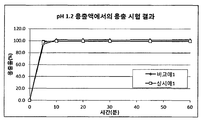
- Figure 1 shows the dissolution test results in Experiment 1 of the tablet prepared in Example 1 and Comparative Example 1.
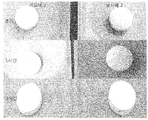
- Figure 2 shows the hygroscopicity measurement test results in Experiment 3 of the tablet prepared in Example 2 and Comparative Example 2.
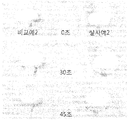
- Figure 3 shows the wet time measurement test results in Experiment 3 of the tablet prepared in Example 2 and Comparative Example 2.
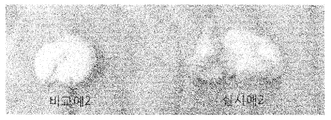
- Figure 4 shows the change confirming test results of the tablet by the oral pressure in Experimental Example 3 of the tablet prepared in Example 2 and Comparative Example 2.
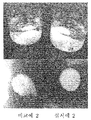
- Figure 5 shows the results of photographing the disintegration in the artificial saliva of Experimental Example 4 tablets prepared in Example 1 and Comparative Example 1 and the disintegration result solution.
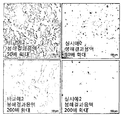
- FIG. 6 shows the results of disintegration in artificial saliva of Experimental Example 4 of the tablets prepared in Example 2 and Comparative Example 2, taken with an electron microscope (OLYMPUS).
- first hydrophilic excipients of sugar alcohols and a second hydrophilic excipient selected from the group consisting of starch, microcrystalline cellulose, hydroxypropyl cellulose and lactose; And
- a oral disintegrating tablet comprising a disintegrant mixed with the granules of (i):
- R 1 and R 2 are each independently selected from the group consisting of hydrogen, halogen, C 1 -C 8 alkyl, C 1 -C 8 haloalkyl, C 1 -C 8 thioalkoxy and C 1 -C 8 alkoxy,
- One of A 1 and A 2 is CH and the other is N.
- first hydrophilic excipients of sugar alcohols and a second hydrophilic excipient selected from the group consisting of starch, microcrystalline cellulose, hydroxypropyl cellulose and lactose; And
- step (b) preparing a granule from the mixture of step (a) by wet granulation
- step (c) mixing the granules obtained in step (b) with a disintegrant
- step (d) lubricating and tableting the mixture obtained in step (c).
- R 1 and R 2 are each independently selected from the group consisting of hydrogen, halogen and C 1 -C 8 alkyl.
- C 1 -C 8 haloalkyl is perfluoroalkyl.
- the carbamate compound of formula 1 is carbamic acid (R) -1- (2-chlorophenyl) -2-tetrazol-2-yl) ethyl ester of formula:
- the term "compound” or "active ingredient” is a concept including not only the compound itself, but also its isomers, or pharmaceutically acceptable salts, solvates or hydrates thereof. Therefore, in the present invention, the carbamate compound of Formula 1 is used to mean not only the compound but also an isomer thereof, or a pharmaceutically acceptable salt, solvate or hydrate thereof. Likewise, in the present invention, the carbamate compound of Formula 2 is not only carbamic acid (R) -1- (2-chlorophenyl) -2-tetrazol-2-yl) ethyl ester, but also isomers thereof, or pharmaceuticals thereof As used herein to mean all acceptable salts, solvates or hydrates.
- Pharmaceutically acceptable salts of carbamate compounds of Formula 1 include, for example, independently, acetate, benzenesulfonate, benzoate, bitartrate, calcium acetate, camsylate, carbonate, citrate, edde Tate, Edsylate, Estoleate, Ecylate, Fumarate, Gluceptate, Gluconate, Glutamate, Glycoylarsanylate, Hexyl resornate, Hydrabamine, Hydrobromide, Hydrochloride, Hydrogencar Carbonate, hydroxynaphthoate, iodide, isethionate, lactate, lactobionate, malate, maleate, mandelate, mesylate, methylnitrate, methylsulfate, no catenate, lead silicate, nitrate Latex, pamoate (embonate), pantothenate, phosphate / diphosphate, polygalacturone Yew.
- Salicylates stearates, subacetates, succinates or hemi-succinates, sulfates or hemi-sulfates, tannates, tartrates, oxalates or hemi-tartrates, the thiolates, triethiodes , Benzatin, chloroprocaine, choline, diethanolamine, ethylenediamine, meglumine, procaine, aluminum, ammonium, tetramethylammonium, calcium, lithium, magnesium, potassium, sodium and zinc and the like.
- Preparation of the carbamate compound of Formula 1 or 2 may be prepared by those skilled in the art using known compounds or compounds that can be easily prepared from the compound.
- the process for preparing the compound of Formula 1 is described in detail in WO 2006/112685 A1, WO 2010/150946 A1 and WO 2011/046380 A2, which are incorporated herein by reference.
- the compound of formula 1 may be chemically synthesized by the method described in the above document, but this is merely to present one exemplary method, the order of the unit operation, etc. can be selectively changed as necessary, the scope of the invention It is not intended to limit.
- oral disintegrating tablets may contain 2.5 to 25% by weight, or 5 to 10% by weight of the carbamate compound of Formula 1 or 2.
- the oral disintegrating tablet of the present invention may contain 1 to 30 mg, or 10 to 20 mg of the active ingredient.
- oral disintegrating tablets comprise granules prepared by wet granulation and disintegrants mixed with the granules.
- Methods for preparing oral disintegrating tablets include preparing granules by wet granulation and mixing the granules obtained in the above step with a disintegrant. Specifically, the carbamate compound of Formula 1, a hydrophilic excipient, and a disintegrant are mixed with water and the mixture is granulated. The wet-granule can then be dried.
- the type and amount of the hydrophilic excipient added in the wet granulation step is very important.
- the hydrophilic excipient having a high molecular weight or high viscosity forms a gel of high viscosity when hydrated by saliva in the oral cavity. Disintegration will be difficult to achieve, and there may be an unpleasant feeling in the oral cavity.
- Hydrophilic excipients include: first hydrophilic excipients of sugar alcohols; And a second hydrophilic excipient selected from the group consisting of starch, microcrystalline cellulose, hydroxypropyl cellulose and lactose.
- the amount of the hydrophilic excipient may be 65 to 90% by weight, specifically 75 to 85% by weight, based on the total weight of the oral disintegrating tablet.
- the first hydrophilic excipient of sugar alcohols may be selected from the group consisting of mannitol, sorbitol, xylitol lactitol, maltitol and erythritol. Specifically, it may be mannitol.
- examples of starch (ie, starch) in the second hydrophilic excipient include corn starch, pregelled starch, potato starch, flour starch, glutinous rice starch, sweet potato starch, tapioca starch, rice starch. , Beeswax corn starch and the like, but is not limited thereto.
- the second hydrophilic excipient may be pregelled starch (pregelatinized starch).
- the hydrophilic excipient is a mixture of sugar alcohol and starch, and more specifically, may be a mixture of mannitol and starch, but is not limited thereto, and each of the first hydrophilic excipient and the second hydrophilic excipient Combinations of two or more of other hydrophilic excipients having similar properties selected may also prepare oral disintegrating tablets of the present invention.
- the weight ratio of the first hydrophilic excipient and the second hydrophilic excipient is 2: 1 to 10: 1, specifically 4: 1 to 8: 1, more specifically 5: 1 to 7: 1.
- the appropriate composition and amount of the "first disintegrant” added in the wet granulation step and the “second disintegrant” added in the mixing step with the granules is important.
- the "first disintegrant” added in the wet granulation step may be the same or different from the “second disintegrant” added in the mixing step with the granules.
- the disintegrant may be at least one selected from the group consisting of sodium starch glycolate, croscarmellose sodium, low-substituted hydroxypropylcellulose and crospovidone in the wet granulation step or as the "first disintegrant" added in the granules. Specifically, it may be sodium starch glycolate.
- the content of the disintegrant is 1 to 10% by weight, specifically 2 to 5% by weight, based on the total weight of the oral disintegrating tablet.
- the hydrophilic excipient in the wet granulation step, after mixing the active ingredient and the disintegrant, the hydrophilic excipient may be mixed.
- the wet-granulate and the second disintegrant may be dry mixed.
- the disintegrant as the "second disintegrant" added in the mixing step with the granules may be one or more selected from the group consisting of sodium starch glycolate, croscarmellose sodium, low substituted hydroxypropylcellulose and crospovidone. Specifically, it may be crospovidone.
- the content of the disintegrant is preferably 4 to 8% by weight based on the total weight of the oral disintegrating tablet.
- the disintegrant added in the mixing step with the granules may be one containing 60 to 80% of the particles having a particle size of 40 to 600 ⁇ m. Among them, it may contain 80% or more of particles having a size of less than 40 to 100 ⁇ m.
- the orally disintegrating tablet comprises about 2.5 to 25% by weight, about 3 to 20% by weight, or about 5 to 10% by weight of the carbamate compound of Formula 1; About 65 to 90 weight percent, or about 75 to 85 weight percent hydrophilic excipient; And about 5 to 18 weight percent, or about 6 to 13 weight percent disintegrant.
- the orally disintegrating tablet may include a lubricant, a lubricant, a sweetener, and the like.
- suitable lubricants include magnesium stearate, calcium stearate, zinc stearate, talc, wax, boric acid, hydrogenated vegetable oil, sodium chlorate, magnesium lauryl sulfate, sodium oleate, Sodium acetate, sodium benzoate, polyethylene glycol, stearic acid, fatty acids, sodium stearyl fumarate, sodium lauryl sulfate and mixtures thereof can be used, but is not limited thereto.
- the lubricant is magnesium stearate or sodium lauryl sulfate.
- the amount of lubricant may be 0.1 to 5% by weight based on the total weight of the oral disintegrating tablet.
- suitable glidants include silica; Colloidal silicon dioxide, talc and the like can be used, but are not limited thereto.
- suitable sweeteners include aspartame, potassium acesulfame, sodium saccharate, neohesperidin dihydrochalcone, sucralose, saccharin, sugars (e.g. sucrose, glucose, lactose, fructose) Sugar alcohols (eg, mannitol, sorbitol, xylitol, erythritol) and mixtures thereof may be used, but is not limited thereto.
- the sweetening agent is aspartame, sucralose and / or saccharin.
- the content of the sweetener may be 0.1 to 5% by weight, preferably 0.2 to 3% by weight, based on the total weight of the oral disintegrating tablet.
- flavourant As other additives, a flavourant, a dye preservative, or the like may be further added.
- Oral disintegration tablets can be disintegrated within 60 seconds, or within 30 seconds in the oral cavity, according to the eleventh revised disintegration test method, specifically disintegrates within 20 seconds.
- oral disintegrating tablets were prepared according to the eleventh revised dissolution test method of the second method (paddle method, device 2), dissolution test solution 1 (900 ml), paddle rotation rate 50 times per minute and 80 of the active ingredient when eluted at 37 At least% can be eluted within 10 minutes, or at least 90% in 15 minutes.
- oral disintegrating tablets can measure the hardness and wear and tear in a conventional manner, and as a result of the measurement in that way, the hardness is 6 to 12 kp, the wear and tear is 1.0% or less, so the storage excellent. Specifically, since the hardness is 9 to 11 kp and the abrasion is 0.6% or less, the storage superiority is high.
- the oral disintegrating tablets are anxiety, depression, convulsion, epilepsy (epilepsy), migraine, bipolar disorder, substance abuse, smoking, attention deficit hyperactivity disorder (ADHD), obesity, sleep disorders, neuropathic pain ), Stroke, cognitive impairment, neurodegeneration or muscle spasms.
- the dosage of the carbamate compound of formula 1 or 2 for the prevention, alleviation or treatment of the disease will typically depend on the severity of the disease, the weight of the subject and the metabolic state.
- therapeutically effective amount for an individual patient is meant an amount sufficient to achieve a therapeutic effect.
- a therapeutically effective amount of the compound is administered once a day when administered to a human, 50 to 500 mg, 50 to 400 mg, 50 to 300 mg, 100 to 400 mg, 100 to 300 mg, 50 to 200 mg on a free form basis. Or 100-200 mg.
- it is 50-300 mg, More preferably, it is 50-200 mg.
- the dosage and dosage of the orally disintegrating tablet of the present invention is determined by the sex, age and other conditions of the patient, disease state and the like.
- the oral disintegrating tablet of the present invention is administrable 2 to 4 times a day at 4 to 12 hour intervals, and the dosage and interval may be adjusted as the case may be.
- Oral disintegrating tablets produced by the production method according to the present invention has a high hardness and low wear and tear, showing excellent storage, at the same time shows a fast disintegration rate in the oral cavity and exhibits an excellent effect of little foreign matter and residual feeling. This is made possible by the appropriate combination and amount of the two types of hydrophilic excipients and by the appropriate combination of disintegrants. In addition, the use of wet granulation, which is a relatively simple and economical method, minimizes foreign matter and residual feeling.
- carbamic acid (R) -1- (2-chlorophenyl) -2-tetrazol-2-yl) ethyl ester and sodium starch glycolate were mixed and appled in a 30 mesh sieve.
- Mannitol and pregelatinized starch were mixed and the sieves were washed with a 30 mesh sieve.
- the mixture was combined with an appropriate amount of purified water.
- the combined granules were dry post-mixed by adding crospovidone to the dry drying product for 1 hour in a 60 ° C. oven. After completion of the post-mixing, magnesium stearate was appointed by an apple in a 40 mesh sieve.
- Tableting with a single tablet machine (ERWEKA) produced 200 mg of orally disintegrating tablets per tablet.
- carbamic acid (R) -1- (2-chlorophenyl) -2-tetrazol-2-yl) ethyl ester and colloidal silicon dioxide were mixed and appled into a 30 mesh sieve.
- Microcrystalline cellulose, lactose monohydrate, and sodium starch glycolate were mixed and apologies with the 30 mesh sieve used previously.
- the mixture was lubricated with magnesium stearate by apple with a 40 mesh sieve. Tableting with a single tablet machine (ERWEKA) produced 200 mg of a rapid-release tablet per tablet.
- Example 1 and the fast-release tablets prepared in Comparative Example 1 were evaluated by testing with a device and a tester described in the Korean Pharmacopoeia (11 revision) dissolution test method. The test was carried out in a second method (paddle method, apparatus 2), dissolution test 900 ml of the first liquid, paddle rotation speed 50 times per minute, and 37 °C operating conditions. As a result, Example 1 and Comparative Example 1 showed the same elution result. The result graph is shown in FIG.
- the hardness of the tablets was determined by LOGAN INSTRUMENT CORP. The average value of each of the six was measured using HDT-300, and the degree of wear was measured by KUKJE ENG. CO. Using the FRIABILATOR of the company, the average of three test results which carried out a set of 10 tablets was described on the average. Measured. The results of the test are shown in Table 4 below.
- Example 2 In order to simulate the oral environment, the inside of the desiccator was saturated with potassium phosphate supersaturated solution to form a relative humidity of 95%, and the tablets of Example 2 and Comparative Example 2 were desiccated with a relative humidity of 95% without a separate packaging material. I put it in the gator and checked the change. As a result, in contrast to Comparative Example 2, which was not changed at all by external humidity, Example 2 confirmed that the surface of the tablet was roughened and swollen by impregnating moisture, and thus, Example 2 in a high humidity oral condition in which saliva was present. Can be expected to show rapid disintegration (see FIG. 2).
- Example 2 The tissue was placed on a planet and wetted with artificial saliva, and then the tablets of Example 2 and Comparative Example 2 were placed, respectively, and the time when the tablets were completely wet was measured. In addition, the same pressure was applied to each tablet which was completely wet, and the condition was confirmed.
- Example 2 swelled and swelled the whole tablet in 45 seconds, and Comparative Example 2 did not get wet as a whole after 60 seconds (see Fig. 3).
- Comparative Example 2 was pressed while maintaining the shape of the tablet (see the left picture of Figure 4), Example 2 showed the shape of the tablet completely distorted (Fig. 4 See photo on the right).
- the tablet of Example 2 may be expected to exhibit excellent disintegration ability.
- Example 2 and Comparative Example 2 were put in artificial saliva, respectively, and after the disintegration was confirmed, the solution after disintegration was taken 50 times and 200 times magnified under a microscope (OLYMPUS) to evaluate the possibility of foreign matter and residual feeling.
- OYMPUS optical microscope
Landscapes
- Health & Medical Sciences (AREA)
- Life Sciences & Earth Sciences (AREA)
- Chemical & Material Sciences (AREA)
- Veterinary Medicine (AREA)
- Medicinal Chemistry (AREA)
- Pharmacology & Pharmacy (AREA)
- Animal Behavior & Ethology (AREA)
- General Health & Medical Sciences (AREA)
- Public Health (AREA)
- Epidemiology (AREA)
- Chemical Kinetics & Catalysis (AREA)
- General Chemical & Material Sciences (AREA)
- Engineering & Computer Science (AREA)
- Zoology (AREA)
- Nutrition Science (AREA)
- Physiology (AREA)
- Pain & Pain Management (AREA)
- Neurosurgery (AREA)
- Organic Chemistry (AREA)
- Nuclear Medicine, Radiotherapy & Molecular Imaging (AREA)
- Neurology (AREA)
- Biomedical Technology (AREA)
- Bioinformatics & Cheminformatics (AREA)
- Molecular Biology (AREA)
- Biophysics (AREA)
- Biochemistry (AREA)
- Inorganic Chemistry (AREA)
- Oil, Petroleum & Natural Gas (AREA)
- Psychiatry (AREA)
- Medicinal Preparation (AREA)
- Pharmaceuticals Containing Other Organic And Inorganic Compounds (AREA)
Abstract
Priority Applications (8)
| Application Number | Priority Date | Filing Date | Title |
|---|---|---|---|
| JP2019531638A JP7090616B2 (ja) | 2016-12-14 | 2017-12-14 | カルバメート化合物を含む口腔内崩壊錠 |
| CN201780086482.9A CN110475544B (zh) | 2016-12-14 | 2017-12-14 | 包含氨基甲酸酯化合物的口腔崩解片 |
| KR1020197018405A KR102456819B1 (ko) | 2016-12-14 | 2017-12-14 | 카바메이트 화합물을 포함하는 구강 붕해 정제 |
| ES17879982T ES2898457T3 (es) | 2016-12-14 | 2017-12-14 | Comprimido de disgregación oral que comprende un compuesto de carbamato |
| EP17879982.1A EP3556345B1 (fr) | 2016-12-14 | 2017-12-14 | Comprimé à désintégration orale comprenant un composé de carbamate |
| US16/469,268 US12409164B2 (en) | 2016-12-14 | 2017-12-14 | Orally disintegrated tablet comprising carbamate compound |
| CA3046296A CA3046296C (fr) | 2016-12-14 | 2017-12-14 | Comprime a desintegration orale comprenant un compose de carbamate |
| US19/297,193 US20250367168A1 (en) | 2016-12-14 | 2025-08-12 | Orally disintegrated tablet comprising carbamate compound |
Applications Claiming Priority (2)
| Application Number | Priority Date | Filing Date | Title |
|---|---|---|---|
| KR20160170434 | 2016-12-14 | ||
| KR10-2016-0170434 | 2016-12-14 |
Related Child Applications (2)
| Application Number | Title | Priority Date | Filing Date |
|---|---|---|---|
| US16/469,268 A-371-Of-International US12409164B2 (en) | 2016-12-14 | 2017-12-14 | Orally disintegrated tablet comprising carbamate compound |
| US19/297,193 Continuation US20250367168A1 (en) | 2016-12-14 | 2025-08-12 | Orally disintegrated tablet comprising carbamate compound |
Publications (1)
| Publication Number | Publication Date |
|---|---|
| WO2018111002A1 true WO2018111002A1 (fr) | 2018-06-21 |
Family
ID=62558988
Family Applications (1)
| Application Number | Title | Priority Date | Filing Date |
|---|---|---|---|
| PCT/KR2017/014731 Ceased WO2018111002A1 (fr) | 2016-12-14 | 2017-12-14 | Comprimé à désintégration orale comprenant un composé de carbamate |
Country Status (7)
| Country | Link |
|---|---|
| US (2) | US12409164B2 (fr) |
| EP (1) | EP3556345B1 (fr) |
| JP (1) | JP7090616B2 (fr) |
| KR (1) | KR102456819B1 (fr) |
| CN (1) | CN110475544B (fr) |
| ES (1) | ES2898457T3 (fr) |
| WO (1) | WO2018111002A1 (fr) |
Cited By (3)
| Publication number | Priority date | Publication date | Assignee | Title |
|---|---|---|---|---|
| CN113242735A (zh) * | 2018-09-21 | 2021-08-10 | 爱思开生物制药株式会社 | 使用氨基甲酸酯化合物预防、缓解或治疗并发的癫痫发作 |
| EP3868375A4 (fr) * | 2018-10-19 | 2022-06-29 | SK Biopharmaceuticals Co., Ltd. | Utilisation d'un composé de carbamate pour prévenir, soulager ou traiter la neuropathie diabétique périphérique ou la neuropathie périphérique induite par chimiothérapie |
| JP2023503088A (ja) * | 2019-11-22 | 2023-01-26 | エスケー バイオファーマスティカルズ カンパニー リミテッド | カルバメート化合物を含む経口用医薬組成物及びその製造方法 |
Families Citing this family (5)
| Publication number | Priority date | Publication date | Assignee | Title |
|---|---|---|---|---|
| JP7258902B2 (ja) * | 2017-11-14 | 2023-04-17 | エスケー バイオファーマスティカルズ カンパニー リミテッド | 脆弱x症候群、アンジェルマン症候群又はレット症候群を含む発達障害の軽減又は治療のためのカルバメート化合物の使用 |
| EP4193987A4 (fr) * | 2020-08-06 | 2024-08-21 | SK Biopharmaceuticals Co., Ltd. | Composition orale solide comprenant un composé carbamate et son procédé de préparation |
| CN115974799B (zh) * | 2021-10-14 | 2024-08-13 | 成都百裕制药股份有限公司 | 氨基甲酸酯取代的醇衍生物及其在医药上的应用 |
| CN116143717B (zh) * | 2021-11-22 | 2025-05-06 | 康百达(四川)生物医药科技有限公司 | 一种氘代氨基甲酸酯化合物及其在医药上的应用 |
| CN119656136B (zh) * | 2024-12-16 | 2025-12-19 | 江苏知原药业股份有限公司 | 一种提高生物利用度的氨甲环酸口腔溶解系统 |
Citations (8)
| Publication number | Priority date | Publication date | Assignee | Title |
|---|---|---|---|---|
| KR20010006835A (ko) | 1999-03-25 | 2001-01-26 | 김선진 | 경구용 속붕해정 |
| WO2006112685A1 (fr) | 2005-04-22 | 2006-10-26 | Sk Holdings Co., Ltd. | Composes azole neurotherapeutiques |
| KR20100008419A (ko) | 2008-07-16 | 2010-01-26 | 동아제약주식회사 | 안정성이 개선된 암로디핀 속붕해성 정제 및 그의 제조방법 |
| KR20100031282A (ko) * | 2008-09-12 | 2010-03-22 | 보령제약 주식회사 | 메만틴염산염 구강 속붕해정 |
| WO2010150946A1 (fr) | 2009-06-22 | 2010-12-29 | Sk Holdings Co., Ltd. | Procédé de préparation d'ester (r)-1-aryl-2-tétrazolyl-éthylique de l'acide carbamique |
| WO2011046380A2 (fr) | 2009-10-15 | 2011-04-21 | Sk Holdings Co.,Ltd. | Procédé pour la préparation d'ester (r)-1-aryl-2-tétrazolyléthylique de l'acide carbamique |
| KR20140001236A (ko) * | 2010-12-02 | 2014-01-06 | 앱탈리스 파마테크, 인코포레이티드 | 급속 분산성 과립, 구강 붕해성 정제 및 방법 |
| WO2014106962A1 (fr) * | 2013-01-07 | 2014-07-10 | 삼아제약 주식회사 | Nouvelle formulation de granules à dissolution rapide ayant une solubilité améliorée |
Family Cites Families (4)
| Publication number | Priority date | Publication date | Assignee | Title |
|---|---|---|---|---|
| JP2006070046A (ja) | 1999-06-18 | 2006-03-16 | Takeda Chem Ind Ltd | 速崩壊性固形製剤 |
| GB0204771D0 (en) * | 2002-02-28 | 2002-04-17 | Phoqus Ltd | Fast disintegrating tablets |
| JP5537943B2 (ja) * | 2007-09-27 | 2014-07-02 | 田辺三菱製薬株式会社 | 速崩壊性固形製剤 |
| TR200907554A1 (tr) * | 2009-10-06 | 2011-04-21 | Sanovel İlaç San.Ve Ti̇c.A.Ş. | Oral yolla dağılan pramıpexole bileşimleri. |
-
2017
- 2017-12-14 CN CN201780086482.9A patent/CN110475544B/zh active Active
- 2017-12-14 US US16/469,268 patent/US12409164B2/en active Active
- 2017-12-14 EP EP17879982.1A patent/EP3556345B1/fr active Active
- 2017-12-14 ES ES17879982T patent/ES2898457T3/es active Active
- 2017-12-14 WO PCT/KR2017/014731 patent/WO2018111002A1/fr not_active Ceased
- 2017-12-14 JP JP2019531638A patent/JP7090616B2/ja active Active
- 2017-12-14 KR KR1020197018405A patent/KR102456819B1/ko active Active
-
2025
- 2025-08-12 US US19/297,193 patent/US20250367168A1/en active Pending
Patent Citations (10)
| Publication number | Priority date | Publication date | Assignee | Title |
|---|---|---|---|---|
| KR20010006835A (ko) | 1999-03-25 | 2001-01-26 | 김선진 | 경구용 속붕해정 |
| WO2006112685A1 (fr) | 2005-04-22 | 2006-10-26 | Sk Holdings Co., Ltd. | Composes azole neurotherapeutiques |
| KR20080005437A (ko) * | 2005-04-22 | 2008-01-11 | 에스케이 주식회사 | 신경치료용 아졸 화합물 |
| KR20100008419A (ko) | 2008-07-16 | 2010-01-26 | 동아제약주식회사 | 안정성이 개선된 암로디핀 속붕해성 정제 및 그의 제조방법 |
| KR101046789B1 (ko) * | 2008-07-16 | 2011-07-05 | 동아제약주식회사 | 안정성이 개선된 암로디핀 속붕해성 정제 및 그의 제조방법 |
| KR20100031282A (ko) * | 2008-09-12 | 2010-03-22 | 보령제약 주식회사 | 메만틴염산염 구강 속붕해정 |
| WO2010150946A1 (fr) | 2009-06-22 | 2010-12-29 | Sk Holdings Co., Ltd. | Procédé de préparation d'ester (r)-1-aryl-2-tétrazolyl-éthylique de l'acide carbamique |
| WO2011046380A2 (fr) | 2009-10-15 | 2011-04-21 | Sk Holdings Co.,Ltd. | Procédé pour la préparation d'ester (r)-1-aryl-2-tétrazolyléthylique de l'acide carbamique |
| KR20140001236A (ko) * | 2010-12-02 | 2014-01-06 | 앱탈리스 파마테크, 인코포레이티드 | 급속 분산성 과립, 구강 붕해성 정제 및 방법 |
| WO2014106962A1 (fr) * | 2013-01-07 | 2014-07-10 | 삼아제약 주식회사 | Nouvelle formulation de granules à dissolution rapide ayant une solubilité améliorée |
Non-Patent Citations (1)
| Title |
|---|
| "the Korean Pharmacopeia" |
Cited By (6)
| Publication number | Priority date | Publication date | Assignee | Title |
|---|---|---|---|---|
| CN113242735A (zh) * | 2018-09-21 | 2021-08-10 | 爱思开生物制药株式会社 | 使用氨基甲酸酯化合物预防、缓解或治疗并发的癫痫发作 |
| EP3868375A4 (fr) * | 2018-10-19 | 2022-06-29 | SK Biopharmaceuticals Co., Ltd. | Utilisation d'un composé de carbamate pour prévenir, soulager ou traiter la neuropathie diabétique périphérique ou la neuropathie périphérique induite par chimiothérapie |
| US12465591B2 (en) | 2018-10-19 | 2025-11-11 | Sk Biopharmaceuticals Co., Ltd. | Use of carbamate compound for preventing, alleviating or treating diabetic peripheral neuropathy or chemotherapy-induced peripheral neuropathy |
| IL282287B1 (en) * | 2018-10-19 | 2026-04-01 | Sk Biopharmaceuticals Co Ltd | Drugs and pharmaceutical preparations containing a carbamate compound for use in the prevention, alleviation or treatment of diabetic peripheral neuropathy or chemotherapy-induced peripheral neuropathy |
| JP2023503088A (ja) * | 2019-11-22 | 2023-01-26 | エスケー バイオファーマスティカルズ カンパニー リミテッド | カルバメート化合物を含む経口用医薬組成物及びその製造方法 |
| JP7724776B2 (ja) | 2019-11-22 | 2025-08-18 | エスケー バイオファーマスティカルズ カンパニー リミテッド | カルバメート化合物を含む経口用医薬組成物及びその製造方法 |
Also Published As
| Publication number | Publication date |
|---|---|
| EP3556345A4 (fr) | 2020-06-17 |
| KR20190087569A (ko) | 2019-07-24 |
| EP3556345A1 (fr) | 2019-10-23 |
| US20210085646A1 (en) | 2021-03-25 |
| ES2898457T3 (es) | 2022-03-07 |
| KR102456819B1 (ko) | 2022-10-21 |
| US20250367168A1 (en) | 2025-12-04 |
| US12409164B2 (en) | 2025-09-09 |
| JP7090616B2 (ja) | 2022-06-24 |
| CN110475544B (zh) | 2024-03-01 |
| CA3046296A1 (fr) | 2018-06-21 |
| JP2020502109A (ja) | 2020-01-23 |
| EP3556345B1 (fr) | 2021-09-22 |
| CN110475544A (zh) | 2019-11-19 |
Similar Documents
| Publication | Publication Date | Title |
|---|---|---|
| WO2015102400A1 (fr) | Préparation composite pour une administration orale comportant de l'ézétimibe et de la rosuvastatine | |
| EP2797587A1 (fr) | Comprimé très robuste à délitement rapide et son procédé de fabrication | |
| WO2018070671A1 (fr) | Composition de comprimé oral de lénalidomide | |
| KR102456819B1 (ko) | 카바메이트 화합물을 포함하는 구강 붕해 정제 | |
| WO2020045940A1 (fr) | Composition pharmaceutique comprenant un agent antiplaquettaire et un inhibiteur de sécrétion d'acide gastrique | |
| WO2018097629A1 (fr) | Préparation à libération prolongée de varénicline et procédé pour sa production | |
| WO2020017808A1 (fr) | Comprimé à désintégration orale contenant de la nalfuron | |
| WO2022146089A1 (fr) | Formulation orale solide pour le nettoyage du côlon | |
| WO2022086238A1 (fr) | Comprimé à désintégration orale comprenant un composé dérivé de benzimidazole et procédé de préparation associé | |
| WO2016013795A1 (fr) | Preparation a liberation prolongee | |
| WO2019221488A1 (fr) | Formulation pharmaceutique comprenant de l'apixaban et son procédé de préparation | |
| WO2020180093A2 (fr) | Composition pharmaceutique contenant de l'oseltamivir | |
| WO2017146286A1 (fr) | Composition pharmaceutique à base d'extrait de feuille de ginkgo biloba utilisant une matrice de polymère hydrophile pour libération prolongée, et préparation à libération prolongée utilisant cette dernière | |
| WO2016003194A1 (fr) | Phosphate de ténofovir disoproxil, et composition pharmaceutique de celui-ci comprenant un délitant de sel non métallique et un lubrifiant de sel non-métallique | |
| WO2021125824A1 (fr) | Formulation pharmaceutique comprenant de la cibenzoline ou un sel de celle-ci | |
| WO2013169082A1 (fr) | Préparation orale à libération contrôlée de bosentan | |
| WO2023132699A1 (fr) | Comprimé à libération prolongée de carvédilol à conformité améliorée par réduction de la taille de comprimé à l'aide d'une technologie de comprimé à faible excipient ilet (innovation à faible excipient) | |
| WO2010008224A2 (fr) | Comprimés d’amlodipine à dissolution rapide à stabilité améliorée et leur procédé de fabrication | |
| WO2022139223A1 (fr) | Film à désintégration orale comprenant du naratriptan | |
| WO2018062941A1 (fr) | Composition pharmaceutique pour la prévention ou le traitement d'une démence et d'un dysfonctionnement cognitif, contenant du donépézil ou un sel de qualité pharmaceutique de celui-ci et de la mémantine ou un sel de qualité pharmaceutique de celle-ci, et son procédé de préparation | |
| WO2017155350A1 (fr) | Composition pharmaceutique pour administration par voie orale comprenant du (±)-2-[2- (3-carboxypropionyloxy)-3-diméthylaminopropoxy]-3'-méthoxybibenzyle ou des sels de celui-ci | |
| WO2024063537A1 (fr) | Composition pharmaceutique comprenant du sel de calcium sacubitrilㆍvalsartan | |
| WO2019117611A1 (fr) | Préparation à libération prolongée comprenant de la bépotastine ou un sel pharmaceutiquement acceptable de celle-ci | |
| WO2016108507A2 (fr) | Comprimé composite destiné à une administration orale comprenant de la mélatonine et de la sertraline | |
| WO2024162731A1 (fr) | Formulation pharmaceutique composite comprenant de la lobeglitazone et de la sitagliptine |
Legal Events
| Date | Code | Title | Description |
|---|---|---|---|
| 121 | Ep: the epo has been informed by wipo that ep was designated in this application |
Ref document number: 17879982 Country of ref document: EP Kind code of ref document: A1 |
|
| ENP | Entry into the national phase |
Ref document number: 3046296 Country of ref document: CA |
|
| ENP | Entry into the national phase |
Ref document number: 2019531638 Country of ref document: JP Kind code of ref document: A |
|
| NENP | Non-entry into the national phase |
Ref country code: DE |
|
| ENP | Entry into the national phase |
Ref document number: 20197018405 Country of ref document: KR Kind code of ref document: A |
|
| ENP | Entry into the national phase |
Ref document number: 2017879982 Country of ref document: EP Effective date: 20190715 |
|
| WWG | Wipo information: grant in national office |
Ref document number: 16469268 Country of ref document: US |