WO2018113584A1 - Fgfr4抑制剂、其制备方法与药学上的应用 - Google Patents
Fgfr4抑制剂、其制备方法与药学上的应用 Download PDFInfo
- Publication number
- WO2018113584A1 WO2018113584A1 PCT/CN2017/116186 CN2017116186W WO2018113584A1 WO 2018113584 A1 WO2018113584 A1 WO 2018113584A1 CN 2017116186 W CN2017116186 W CN 2017116186W WO 2018113584 A1 WO2018113584 A1 WO 2018113584A1
- Authority
- WO
- WIPO (PCT)
- Prior art keywords
- group
- alkyl
- hydrazine
- cycloalkyl
- halogen
- Prior art date
- Legal status (The legal status is an assumption and is not a legal conclusion. Google has not performed a legal analysis and makes no representation as to the accuracy of the status listed.)
- Ceased
Links
- 0 CC(C)(*)C(COC1)[C@@]1N Chemical compound CC(C)(*)C(COC1)[C@@]1N 0.000 description 15
- YQFDXFPYSVYJHF-HBKYNEJXSA-N CC(C)(C)CNc1c(cc(N[C@H](COC2)[C@H]2NC(C=C)=O)nc2)c2nc(-c(c(Cl)c(cc2OCC3OC(CNc4c(cc(N[C@H](COC5)[C@H]5NC(C=C)=O)nc5)c5nc(-c(c(Cl)c(cc5OC)OC)c5Cl)n4)CC3)OC)c2Cl)n1 Chemical compound CC(C)(C)CNc1c(cc(N[C@H](COC2)[C@H]2NC(C=C)=O)nc2)c2nc(-c(c(Cl)c(cc2OCC3OC(CNc4c(cc(N[C@H](COC5)[C@H]5NC(C=C)=O)nc5)c5nc(-c(c(Cl)c(cc5OC)OC)c5Cl)n4)CC3)OC)c2Cl)n1 YQFDXFPYSVYJHF-HBKYNEJXSA-N 0.000 description 1
- VXFOUTUHGRGHNS-FUHWJXTLSA-N CC(C)(C)CNc1c(cc(N[C@H](COCC2)[C@H]2NC(C=C)=O)nc2)c2nc(-c(c(Cl)c(cc2OC)OC)c2Cl)n1 Chemical compound CC(C)(C)CNc1c(cc(N[C@H](COCC2)[C@H]2NC(C=C)=O)nc2)c2nc(-c(c(Cl)c(cc2OC)OC)c2Cl)n1 VXFOUTUHGRGHNS-FUHWJXTLSA-N 0.000 description 1
- SFIADDJLFYFDGK-PKPIPKONSA-N CC(C)(C)OC(N[C@@H](COC1)C1O)=O Chemical compound CC(C)(C)OC(N[C@@H](COC1)C1O)=O SFIADDJLFYFDGK-PKPIPKONSA-N 0.000 description 1
- ZOMYJEOZZDHUKI-WZJLIZBTSA-N CC(C)(C1)CN1c1c(cc(N[C@H](COC2)[C@H]2NC(C=C)=O)nc2)c2nc(-c(c(Cl)c(cc2OCCOC(C3)CN3c3c(cc(N[C@H](COC4)[C@H]4NC(C=C)=O)nc4)c4nc(-c(c(F)c(cc4OC)OC)c4F)n3)OC)c2Cl)n1 Chemical compound CC(C)(C1)CN1c1c(cc(N[C@H](COC2)[C@H]2NC(C=C)=O)nc2)c2nc(-c(c(Cl)c(cc2OCCOC(C3)CN3c3c(cc(N[C@H](COC4)[C@H]4NC(C=C)=O)nc4)c4nc(-c(c(F)c(cc4OC)OC)c4F)n3)OC)c2Cl)n1 ZOMYJEOZZDHUKI-WZJLIZBTSA-N 0.000 description 1
- FHVJVZACDWTWOC-UHFFFAOYSA-N CC(C)SCCNc1nc(-c(c(Cl)c(cc2OC)OC)c2Cl)cc2c1nc(Nc1c(C)cccc1NC(C=C)=O)nc2 Chemical compound CC(C)SCCNc1nc(-c(c(Cl)c(cc2OC)OC)c2Cl)cc2c1nc(Nc1c(C)cccc1NC(C=C)=O)nc2 FHVJVZACDWTWOC-UHFFFAOYSA-N 0.000 description 1
- RIMVPAMMLFVLHE-UHFFFAOYSA-N CC(C)c([nH]nc1)c1NC Chemical compound CC(C)c([nH]nc1)c1NC RIMVPAMMLFVLHE-UHFFFAOYSA-N 0.000 description 1
- HSCQGRXTVZWHJR-AZUAARDMSA-N CC(C)c(c(-c(ncc1c2)cc1cnc2N[C@H](COCC1)[C@H]1NC(C=C)=O)c(c(OC)c1)F)c1OC Chemical compound CC(C)c(c(-c(ncc1c2)cc1cnc2N[C@H](COCC1)[C@H]1NC(C=C)=O)c(c(OC)c1)F)c1OC HSCQGRXTVZWHJR-AZUAARDMSA-N 0.000 description 1
- ZQKIONWPWLELRU-CVEARBPZSA-N CC(C1)(CN1c1c(cc(N[C@H](COC2)[C@H]2NC(C=C)=O)nc2)c2nc(-c(c(Cl)c(cc2OC)OC)c2Cl)n1)O Chemical compound CC(C1)(CN1c1c(cc(N[C@H](COC2)[C@H]2NC(C=C)=O)nc2)c2nc(-c(c(Cl)c(cc2OC)OC)c2Cl)n1)O ZQKIONWPWLELRU-CVEARBPZSA-N 0.000 description 1
- CXSXWNUTJNMTOC-FUHWJXTLSA-N CC(C1)(CN1c1c(cc(N[C@H](COCC2)[C@H]2NC(C=C)=O)nc2)c2nc(-c(c(Cl)c(cc2OC)OC)c2Cl)n1)OC Chemical compound CC(C1)(CN1c1c(cc(N[C@H](COCC2)[C@H]2NC(C=C)=O)nc2)c2nc(-c(c(Cl)c(cc2OC)OC)c2Cl)n1)OC CXSXWNUTJNMTOC-FUHWJXTLSA-N 0.000 description 1
- CDAOZQUUZAPRNP-DLBZAZTESA-N CC(N(C[C@@H]1NC(C=C)=O)C[C@H]1Nc1nc(cnc(-c(c(Cl)c(cc2OC)OC)c2Cl)c2)c2cn1)=O Chemical compound CC(N(C[C@@H]1NC(C=C)=O)C[C@H]1Nc1nc(cnc(-c(c(Cl)c(cc2OC)OC)c2Cl)c2)c2cn1)=O CDAOZQUUZAPRNP-DLBZAZTESA-N 0.000 description 1
- JUECBJJRBZVNPI-UHFFFAOYSA-N CC/S(/CCNc1nc(-c(c(Cl)c(cc2OC)OC)c2Cl)cc2c1nc(Nc1c(C)cccc1NC(C=C)=O)nc2)=[O]/C Chemical compound CC/S(/CCNc1nc(-c(c(Cl)c(cc2OC)OC)c2Cl)cc2c1nc(Nc1c(C)cccc1NC(C=C)=O)nc2)=[O]/C JUECBJJRBZVNPI-UHFFFAOYSA-N 0.000 description 1
- NDRDMDBCLRITOU-UHFFFAOYSA-N CC1N=C(c([n](CCOC)nc2)c2N)N=C2C=NC(c(c(Cl)c(cc3OC)OC)c3Cl)=CC12 Chemical compound CC1N=C(c([n](CCOC)nc2)c2N)N=C2C=NC(c(c(Cl)c(cc3OC)OC)c3Cl)=CC12 NDRDMDBCLRITOU-UHFFFAOYSA-N 0.000 description 1
- BLQYUSUMTOZLTR-UHFFFAOYSA-N CC1OCCOC1I Chemical compound CC1OCCOC1I BLQYUSUMTOZLTR-UHFFFAOYSA-N 0.000 description 1
- SAOSSHXEVAMRAX-UHFFFAOYSA-N CCNc1nc(-c(c(Cl)c(cc2OC)OC)c2Cl)cc2c1nc(Nc1c(C)cccc1NC(C=C)=O)nc2 Chemical compound CCNc1nc(-c(c(Cl)c(cc2OC)OC)c2Cl)cc2c1nc(Nc1c(C)cccc1NC(C=C)=O)nc2 SAOSSHXEVAMRAX-UHFFFAOYSA-N 0.000 description 1
- VAOLERUZNGXJNT-RBUKOAKNSA-N CN(C)CCN(C[C@@H]1NC(C=C)=O)C[C@H]1Nc1nc(cnc(-c(c(Cl)c(cc2OC)OC)c2Cl)c2)c2cn1 Chemical compound CN(C)CCN(C[C@@H]1NC(C=C)=O)C[C@H]1Nc1nc(cnc(-c(c(Cl)c(cc2OC)OC)c2Cl)c2)c2cn1 VAOLERUZNGXJNT-RBUKOAKNSA-N 0.000 description 1
- ZNDBDJNBOYSUMK-FYZVQMPESA-N CN(CCOc(c(Cl)c1-c2nc(N(C3)CC3(F)F)c(cc(N[C@H](COC3)[C@H]3NC(C=C)=O)nc3)c3n2)cc(OC)c1Cl)C(C1)CN1c1c(cc(N[C@H](COC2)[C@H]2NC(C=C)=O)nc2)c2nc(-c(c(Cl)c(cc2OC)OC)c2Cl)n1 Chemical compound CN(CCOc(c(Cl)c1-c2nc(N(C3)CC3(F)F)c(cc(N[C@H](COC3)[C@H]3NC(C=C)=O)nc3)c3n2)cc(OC)c1Cl)C(C1)CN1c1c(cc(N[C@H](COC2)[C@H]2NC(C=C)=O)nc2)c2nc(-c(c(Cl)c(cc2OC)OC)c2Cl)n1 ZNDBDJNBOYSUMK-FYZVQMPESA-N 0.000 description 1
- VYYMWSAVNLFPRQ-JKSUJKDBSA-N CN(C[C@@H]1NC(C=C)=O)C[C@H]1Nc1nc(cnc(-c(c(Cl)c(cc2OC)OC)c2Cl)c2)c2cn1 Chemical compound CN(C[C@@H]1NC(C=C)=O)C[C@H]1Nc1nc(cnc(-c(c(Cl)c(cc2OC)OC)c2Cl)c2)c2cn1 VYYMWSAVNLFPRQ-JKSUJKDBSA-N 0.000 description 1
- SFAPWPBLHXSHQS-UHFFFAOYSA-N CN1C(CNc2c3nc([N-]C4COCC4)ncc3cc(-c(cc(cc3OC)OC)c3Cl)n2)CCC1 Chemical compound CN1C(CNc2c3nc([N-]C4COCC4)ncc3cc(-c(cc(cc3OC)OC)c3Cl)n2)CCC1 SFAPWPBLHXSHQS-UHFFFAOYSA-N 0.000 description 1
- AVYZSFIWDWUUAE-UHFFFAOYSA-N CN1C(CNc2c3nc([NH-])ncc3cc(-c(cccc3OC)c3Cl)n2)CCC1 Chemical compound CN1C(CNc2c3nc([NH-])ncc3cc(-c(cccc3OC)c3Cl)n2)CCC1 AVYZSFIWDWUUAE-UHFFFAOYSA-N 0.000 description 1
- WUBUVBLYGNUHER-UHFFFAOYSA-N CN1C(CNc2c3nc([NH-])ncc3cc(-c(cccc3OC)c3F)n2)CCC1 Chemical compound CN1C(CNc2c3nc([NH-])ncc3cc(-c(cccc3OC)c3F)n2)CCC1 WUBUVBLYGNUHER-UHFFFAOYSA-N 0.000 description 1
- UBLDLXGLFZXXGU-UHFFFAOYSA-N CN1CCN(CCNc2c3nc([N-]C4COCC4)ncc3cc(-c(cc(cc3OC)OC)c3Cl)n2)CC1 Chemical compound CN1CCN(CCNc2c3nc([N-]C4COCC4)ncc3cc(-c(cc(cc3OC)OC)c3Cl)n2)CC1 UBLDLXGLFZXXGU-UHFFFAOYSA-N 0.000 description 1
- RKUJXWVZIMVYTB-UHFFFAOYSA-N CN1CCN(CCNc2c3nc([N-]C4COCC4)ncc3cc(-c(cccc3OC)c3Cl)n2)CC1 Chemical compound CN1CCN(CCNc2c3nc([N-]C4COCC4)ncc3cc(-c(cccc3OC)c3Cl)n2)CC1 RKUJXWVZIMVYTB-UHFFFAOYSA-N 0.000 description 1
- WCRXSVGDDGPLKW-UHFFFAOYSA-N CN1CCN(CCNc2c3nc([N-]C4COCC4)ncc3cc(-c3cc(OC)cc(OC)c3)n2)CC1 Chemical compound CN1CCN(CCNc2c3nc([N-]C4COCC4)ncc3cc(-c3cc(OC)cc(OC)c3)n2)CC1 WCRXSVGDDGPLKW-UHFFFAOYSA-N 0.000 description 1
- OIGFTDAMHNYGKJ-KGLIPLIRSA-N CNc1nc(-c(c(Cl)c(cc2OC)OC)c2Cl)nc2c1cc(N[C@H](COC1)[C@H]1NC(C=C)=O)nc2 Chemical compound CNc1nc(-c(c(Cl)c(cc2OC)OC)c2Cl)nc2c1cc(N[C@H](COC1)[C@H]1NC(C=C)=O)nc2 OIGFTDAMHNYGKJ-KGLIPLIRSA-N 0.000 description 1
- ZVGIBNBFPCYIQB-SJORKVTESA-N COC(C1)CN1c1c(cc(N[C@H](COC2)[C@H]2NC(C=C)=O)nc2)c2nc(-c(c(Cl)c(cc2OC)OC)c2Cl)n1 Chemical compound COC(C1)CN1c1c(cc(N[C@H](COC2)[C@H]2NC(C=C)=O)nc2)c2nc(-c(c(Cl)c(cc2OC)OC)c2Cl)n1 ZVGIBNBFPCYIQB-SJORKVTESA-N 0.000 description 1
- FMVRMRFHDILQTL-FUHWJXTLSA-N COC(C1)CN1c1c(cc(N[C@H](COCC2)[C@H]2NC(C=C)=O)nc2)c2nc(-c(c(Cl)c(cc2OC)OC)c2Cl)n1 Chemical compound COC(C1)CN1c1c(cc(N[C@H](COCC2)[C@H]2NC(C=C)=O)nc2)c2nc(-c(c(Cl)c(cc2OC)OC)c2Cl)n1 FMVRMRFHDILQTL-FUHWJXTLSA-N 0.000 description 1
- NYEPFHIQEOHFSJ-DOTOQJQBSA-N COCCNc1nc(-c(c(Cl)c(cc2OC)OC)c2Cl)nc2c1cc(N[C@H](COCC1)[C@H]1NC(C=C)=O)nc2 Chemical compound COCCNc1nc(-c(c(Cl)c(cc2OC)OC)c2Cl)nc2c1cc(N[C@H](COCC1)[C@H]1NC(C=C)=O)nc2 NYEPFHIQEOHFSJ-DOTOQJQBSA-N 0.000 description 1
- WEDSYFDSTSMCEZ-UHFFFAOYSA-N COCC[n](cc1Nc2nc(cnc(-c(c(Cl)c(cc3OC)OC)c3Cl)c3)c3cn2)nc1NC(C=C)=O Chemical compound COCC[n](cc1Nc2nc(cnc(-c(c(Cl)c(cc3OC)OC)c3Cl)c3)c3cn2)nc1NC(C=C)=O WEDSYFDSTSMCEZ-UHFFFAOYSA-N 0.000 description 1
- DHYVEZOZYOZZDT-UHFFFAOYSA-N COCC[n]1ncc(NC(C=C)=O)c1-c1ncc(cc(-c(c(Cl)c(cc2OC)OC)c2Cl)nc2)c2c1 Chemical compound COCC[n]1ncc(NC(C=C)=O)c1-c1ncc(cc(-c(c(Cl)c(cc2OC)OC)c2Cl)nc2)c2c1 DHYVEZOZYOZZDT-UHFFFAOYSA-N 0.000 description 1
- VQXLPDGLBOUORF-UHFFFAOYSA-N COCC[n]1ncc(NC(C=C)=O)c1-c1ncc(cc(-c(c(Cl)c(cc2OC)OC)c2Cl)nc2)c2n1 Chemical compound COCC[n]1ncc(NC(C=C)=O)c1-c1ncc(cc(-c(c(Cl)c(cc2OC)OC)c2Cl)nc2)c2n1 VQXLPDGLBOUORF-UHFFFAOYSA-N 0.000 description 1
- DWGUTMXOJXROSB-UHFFFAOYSA-N COCC[n]1ncc([N+]([O-])=O)c1-c1ncc(cc(-c(c(Cl)c(cc2OC)OC)c2Cl)nc2)c2n1 Chemical compound COCC[n]1ncc([N+]([O-])=O)c1-c1ncc(cc(-c(c(Cl)c(cc2OC)OC)c2Cl)nc2)c2n1 DWGUTMXOJXROSB-UHFFFAOYSA-N 0.000 description 1
- QQHGADFWDRTGMG-AZUAARDMSA-N COc(c(C1CC1)c1-c2cc(cnc(N[C@H](COCC3)[C@H]3NC(C=C)=O)c3)c3cn2)cc(OC)c1Cl Chemical compound COc(c(C1CC1)c1-c2cc(cnc(N[C@H](COCC3)[C@H]3NC(C=C)=O)c3)c3cn2)cc(OC)c1Cl QQHGADFWDRTGMG-AZUAARDMSA-N 0.000 description 1
- QXJBPVBEBUJVEQ-FUHWJXTLSA-N COc(c(Cl)c1-c2ncc(cc(N[C@H](COCC3)[C@H]3NC(C=C)=O)nc3)c3c2)cc2c1OCCO2 Chemical compound COc(c(Cl)c1-c2ncc(cc(N[C@H](COCC3)[C@H]3NC(C=C)=O)nc3)c3c2)cc2c1OCCO2 QXJBPVBEBUJVEQ-FUHWJXTLSA-N 0.000 description 1
- XEOPSONGGKRHMS-FUHWJXTLSA-N COc(c(F)c1-c2ncc(cc(N[C@H](COCC3)[C@H]3NC(C=C)=O)nc3)c3c2)cc2c1OCCO2 Chemical compound COc(c(F)c1-c2ncc(cc(N[C@H](COCC3)[C@H]3NC(C=C)=O)nc3)c3c2)cc2c1OCCO2 XEOPSONGGKRHMS-FUHWJXTLSA-N 0.000 description 1
- AHXKWQQHTLDNSN-UHFFFAOYSA-N COc(cc(c(Cl)c1-c(cc2cn3)nc(Cl)c2nc3SC)OC)c1Cl Chemical compound COc(cc(c(Cl)c1-c(cc2cn3)nc(Cl)c2nc3SC)OC)c1Cl AHXKWQQHTLDNSN-UHFFFAOYSA-N 0.000 description 1
- WRESYYHJEZDCSM-UHFFFAOYSA-N COc(cc(c(Cl)c1-c(nc(C2CC2)c2n3)cc2cnc3SC)OC)c1Cl Chemical compound COc(cc(c(Cl)c1-c(nc(C2CC2)c2n3)cc2cnc3SC)OC)c1Cl WRESYYHJEZDCSM-UHFFFAOYSA-N 0.000 description 1
- MHLPEVGWWYXTTJ-LSDHHAIUSA-N COc(cc(c(Cl)c1-c(nc2)cc3c2nc(N[C@H](CNC2)[C@H]2NC(C=C)=O)nc3)OC)c1Cl Chemical compound COc(cc(c(Cl)c1-c(nc2)cc3c2nc(N[C@H](CNC2)[C@H]2NC(C=C)=O)nc3)OC)c1Cl MHLPEVGWWYXTTJ-LSDHHAIUSA-N 0.000 description 1
- VBVRQZGDJJVRKF-DLBZAZTESA-N COc(cc(c(Cl)c1-c(nc2NCC3CC3)cc3c2nc(N[C@H](COC2)[C@H]2NC(C=C)=O)nc3)OC)c1Cl Chemical compound COc(cc(c(Cl)c1-c(nc2NCC3CC3)cc3c2nc(N[C@H](COC2)[C@H]2NC(C=C)=O)nc3)OC)c1Cl VBVRQZGDJJVRKF-DLBZAZTESA-N 0.000 description 1
- NMRAWNZWFFJHBL-UHFFFAOYSA-N COc(cc(c(Cl)c1-c(ncc2c3)cc2cnc3Cl)OC)c1Cl Chemical compound COc(cc(c(Cl)c1-c(ncc2c3)cc2cnc3Cl)OC)c1Cl NMRAWNZWFFJHBL-UHFFFAOYSA-N 0.000 description 1
- NYCIGWUMSNTYGH-DOTOQJQBSA-N COc(cc(c(Cl)c1-c(ncc2c3)cc2cnc3N[C@H](COCC2)[C@H]2NC(C=C)=O)OC)c1Cl Chemical compound COc(cc(c(Cl)c1-c(ncc2c3)cc2cnc3N[C@H](COCC2)[C@H]2NC(C=C)=O)OC)c1Cl NYCIGWUMSNTYGH-DOTOQJQBSA-N 0.000 description 1
- GKUYXWRIUOCBJD-UHFFFAOYSA-N COc(cc(c(Cl)c1-c2cc3cnc(CNC(C=C)=O)cc3cn2)OC)c1Cl Chemical compound COc(cc(c(Cl)c1-c2cc3cnc(CNC(C=C)=O)cc3cn2)OC)c1Cl GKUYXWRIUOCBJD-UHFFFAOYSA-N 0.000 description 1
- PVKXWKADWNMMOQ-UHFFFAOYSA-N COc(cc(c(Cl)c1-c2cc3cnc(CNC(C=C)=O)nc3cn2)OC)c1Cl Chemical compound COc(cc(c(Cl)c1-c2cc3cnc(CNC(C=C)=O)nc3cn2)OC)c1Cl PVKXWKADWNMMOQ-UHFFFAOYSA-N 0.000 description 1
- XQYLMZTYRXWLRT-PKOBYXMFSA-N COc(cc(c(Cl)c1-c2nc(N(C3)CC33COCC3)c(cc(N[C@H](COCC3)[C@H]3NC(C=C)=O)nc3)c3n2)OC)c1Cl Chemical compound COc(cc(c(Cl)c1-c2nc(N(C3)CC33COCC3)c(cc(N[C@H](COCC3)[C@H]3NC(C=C)=O)nc3)c3n2)OC)c1Cl XQYLMZTYRXWLRT-PKOBYXMFSA-N 0.000 description 1
- UDVJTJYBLINDNM-CVEARBPZSA-N COc(cc(c(Cl)c1-c2nc(N(C3)CC3C(F)(F)F)c(cc(N[C@H](COC3)[C@H]3NC(C=C)=O)nc3)c3n2)OC)c1Cl Chemical compound COc(cc(c(Cl)c1-c2nc(N(C3)CC3C(F)(F)F)c(cc(N[C@H](COC3)[C@H]3NC(C=C)=O)nc3)c3n2)OC)c1Cl UDVJTJYBLINDNM-CVEARBPZSA-N 0.000 description 1
- OAGDEFGABWOAJD-FUHWJXTLSA-N COc(cc(c(Cl)c1-c2nc(N3CCOCC3)c(cc(N[C@H](COCC3)[C@H]3NC(C=C)=O)nc3)c3n2)OC)c1Cl Chemical compound COc(cc(c(Cl)c1-c2nc(N3CCOCC3)c(cc(N[C@H](COCC3)[C@H]3NC(C=C)=O)nc3)c3n2)OC)c1Cl OAGDEFGABWOAJD-FUHWJXTLSA-N 0.000 description 1
- JGQVDVPJZIQKPH-IIZJFRANSA-N COc(cc(c(Cl)c1-c2nc(NC(CC3)CC3(F)F)c(cc(N[C@H](COC3)[C@H]3NC(C=C)=O)nc3)c3n2)OC)c1Cl Chemical compound COc(cc(c(Cl)c1-c2nc(NC(CC3)CC3(F)F)c(cc(N[C@H](COC3)[C@H]3NC(C=C)=O)nc3)c3n2)OC)c1Cl JGQVDVPJZIQKPH-IIZJFRANSA-N 0.000 description 1
- XTEGGKMBWRUMDA-MSOLQXFVSA-N COc(cc(c(Cl)c1-c2nc(NC3CCOCC3)c(cc(N[C@H](COC3)[C@H]3NC(C=C)=O)nc3)c3n2)OC)c1Cl Chemical compound COc(cc(c(Cl)c1-c2nc(NC3CCOCC3)c(cc(N[C@H](COC3)[C@H]3NC(C=C)=O)nc3)c3n2)OC)c1Cl XTEGGKMBWRUMDA-MSOLQXFVSA-N 0.000 description 1
- OVYIEZHORDCGFC-IIZJFRANSA-N COc(cc(c(Cl)c1-c2nc(NC3COCC3)c(cc(N[C@H](COC3)[C@H]3NC(C=C)=O)nc3)c3n2)OC)c1Cl Chemical compound COc(cc(c(Cl)c1-c2nc(NC3COCC3)c(cc(N[C@H](COC3)[C@H]3NC(C=C)=O)nc3)c3n2)OC)c1Cl OVYIEZHORDCGFC-IIZJFRANSA-N 0.000 description 1
- ULIZQKMRZDFBGF-IYSUZNMVSA-N COc(cc(c(Cl)c1-c2nc(NCC3OCCC3)c(cc(N[C@H](COCC3)[C@H]3NC(C=C)=O)nc3)c3n2)OC)c1Cl Chemical compound COc(cc(c(Cl)c1-c2nc(NCC3OCCC3)c(cc(N[C@H](COCC3)[C@H]3NC(C=C)=O)nc3)c3n2)OC)c1Cl ULIZQKMRZDFBGF-IYSUZNMVSA-N 0.000 description 1
- DNLDKNOGLIIVQG-WZJLIZBTSA-N COc(cc(c(Cl)c1-c2nc(NCc3c[n](CCOc(c(Cl)c4-c5nc(cnc(N[C@H](COC6)[C@H]6NC(C=C)=O)c6)c6c(NC6CC6)n5)cc(OC)c4Cl)nc3)c(cc(N[C@H](COC3)[C@H]3NC(C=C)=O)nc3)c3n2)OC)c1Cl Chemical compound COc(cc(c(Cl)c1-c2nc(NCc3c[n](CCOc(c(Cl)c4-c5nc(cnc(N[C@H](COC6)[C@H]6NC(C=C)=O)c6)c6c(NC6CC6)n5)cc(OC)c4Cl)nc3)c(cc(N[C@H](COC3)[C@H]3NC(C=C)=O)nc3)c3n2)OC)c1Cl DNLDKNOGLIIVQG-WZJLIZBTSA-N 0.000 description 1
- NALXDKWLMWIMBD-DTUNNODKSA-N COc(cc(c(Cl)c1-c2nc(NCc3c[n](CCOc(c(Cl)c4-c5nc(cnc(N[C@H](COCC6)[C@H]6NC(C=C)=O)c6)c6c(N(C6)CC6(F)F)n5)cc(OC)c4Cl)nc3)c(cc(N[C@H](COCC3)[C@H]3NC(C=C)=O)nc3)c3n2)OC)c1Cl Chemical compound COc(cc(c(Cl)c1-c2nc(NCc3c[n](CCOc(c(Cl)c4-c5nc(cnc(N[C@H](COCC6)[C@H]6NC(C=C)=O)c6)c6c(N(C6)CC6(F)F)n5)cc(OC)c4Cl)nc3)c(cc(N[C@H](COCC3)[C@H]3NC(C=C)=O)nc3)c3n2)OC)c1Cl NALXDKWLMWIMBD-DTUNNODKSA-N 0.000 description 1
- OCIFSUUDTDFWFO-CVEARBPZSA-N COc(cc(c(Cl)c1-c2nc(cnc(N[C@H](COC3)[C@H]3NC(C=C)=O)c3)c3c(N3CCC3)n2)OC)c1Cl Chemical compound COc(cc(c(Cl)c1-c2nc(cnc(N[C@H](COC3)[C@H]3NC(C=C)=O)c3)c3c(N3CCC3)n2)OC)c1Cl OCIFSUUDTDFWFO-CVEARBPZSA-N 0.000 description 1
- RVLMDGXSYCBFNY-RNYWFIABSA-N COc(cc(c(Cl)c1-c2nc(cnc(N[C@H](COCC3)[C@H]3NC(C=C)=O)c3)c3c(NC(CC3)CC3(F)F)n2)OC)c1Cl Chemical compound COc(cc(c(Cl)c1-c2nc(cnc(N[C@H](COCC3)[C@H]3NC(C=C)=O)c3)c3c(NC(CC3)CC3(F)F)n2)OC)c1Cl RVLMDGXSYCBFNY-RNYWFIABSA-N 0.000 description 1
- AKLDQFXEVNTZCS-DOTOQJQBSA-N COc(cc(c(Cl)c1-c2nc(cnc(N[C@H](COCC3)[C@H]3NC(C=C)=O)c3)c3c(NC3CC3)n2)OC)c1Cl Chemical compound COc(cc(c(Cl)c1-c2nc(cnc(N[C@H](COCC3)[C@H]3NC(C=C)=O)c3)c3c(NC3CC3)n2)OC)c1Cl AKLDQFXEVNTZCS-DOTOQJQBSA-N 0.000 description 1
- PRSKUBFEBPCUGJ-PKOBYXMFSA-N COc(cc(c(Cl)c1-c2nc(cnc(N[C@H](COCC3)[C@H]3NC(C=C)=O)c3)c3c(NC3CCOCC3)n2)OC)c1Cl Chemical compound COc(cc(c(Cl)c1-c2nc(cnc(N[C@H](COCC3)[C@H]3NC(C=C)=O)c3)c3c(NC3CCOCC3)n2)OC)c1Cl PRSKUBFEBPCUGJ-PKOBYXMFSA-N 0.000 description 1
- XCIATMRTFPFOEH-RNYWFIABSA-N COc(cc(c(Cl)c1-c2nc(cnc(N[C@H](COCC3)[C@H]3NC(C=C)=O)c3)c3c(NC3COCC3)n2)OC)c1Cl Chemical compound COc(cc(c(Cl)c1-c2nc(cnc(N[C@H](COCC3)[C@H]3NC(C=C)=O)c3)c3c(NC3COCC3)n2)OC)c1Cl XCIATMRTFPFOEH-RNYWFIABSA-N 0.000 description 1
- XHHVUTMTTACSBO-FUHWJXTLSA-N COc(cc(c(Cl)c1-c2nc(cnc(N[C@H](COCC3)[C@H]3NC(C=C)=O)c3)c3c(NCC3CC3)n2)OC)c1Cl Chemical compound COc(cc(c(Cl)c1-c2nc(cnc(N[C@H](COCC3)[C@H]3NC(C=C)=O)c3)c3c(NCC3CC3)n2)OC)c1Cl XHHVUTMTTACSBO-FUHWJXTLSA-N 0.000 description 1
- UBFRTYAZIIYYKZ-CVEARBPZSA-N COc(cc(c(Cl)c1-c2ncc(cc(N[C@H](CNC3)[C@H]3NC(C=C)=O)nc3)c3c2)OC)c1Cl Chemical compound COc(cc(c(Cl)c1-c2ncc(cc(N[C@H](CNC3)[C@H]3NC(C=C)=O)nc3)c3c2)OC)c1Cl UBFRTYAZIIYYKZ-CVEARBPZSA-N 0.000 description 1
- ABFOHCPDUATRRL-UHFFFAOYSA-N COc(cc(c(Cl)c1C(C(N(CC(F)(F)F)c2c3)=O)=Cc2cnc3Cl)OC)c1Cl Chemical compound COc(cc(c(Cl)c1C(C(N(CC(F)(F)F)c2c3)=O)=Cc2cnc3Cl)OC)c1Cl ABFOHCPDUATRRL-UHFFFAOYSA-N 0.000 description 1
- ZAWXFRVNUVKYSG-XJKSGUPXSA-N COc(cc(c(F)c1-c(nc2)cc3c2nc(N[C@H](COCC2)[C@H]2NC(C=C)=O)nc3)OC)c1F Chemical compound COc(cc(c(F)c1-c(nc2)cc3c2nc(N[C@H](COCC2)[C@H]2NC(C=C)=O)nc3)OC)c1F ZAWXFRVNUVKYSG-XJKSGUPXSA-N 0.000 description 1
- BSRMDHUGOOBBRG-CVEARBPZSA-N COc(cc(c(F)c1-c2nc(cnc(N[C@H](COC3)[C@H]3NC(C=C)=O)c3)c3c(NC3CC3)n2)OC)c1F Chemical compound COc(cc(c(F)c1-c2nc(cnc(N[C@H](COC3)[C@H]3NC(C=C)=O)c3)c3c(NC3CC3)n2)OC)c1F BSRMDHUGOOBBRG-CVEARBPZSA-N 0.000 description 1
- MJRRHCGXDGPMOF-FUHWJXTLSA-N COc(cc(c(F)c1-c2nc(cnc(N[C@H](COCC3)[C@H]3NC(C=C)=O)c3)c3c(NCC3CC3)n2)OC)c1F Chemical compound COc(cc(c(F)c1-c2nc(cnc(N[C@H](COCC3)[C@H]3NC(C=C)=O)c3)c3c(NCC3CC3)n2)OC)c1F MJRRHCGXDGPMOF-FUHWJXTLSA-N 0.000 description 1
- USBWBOYESOSDKW-CVEARBPZSA-N COc(cc(c(F)c1-c2ncc(cc(N[C@H](CNC3)[C@H]3NC(C=C)=O)nc3)c3c2)OC)c1F Chemical compound COc(cc(c(F)c1-c2ncc(cc(N[C@H](CNC3)[C@H]3NC(C=C)=O)nc3)c3c2)OC)c1F USBWBOYESOSDKW-CVEARBPZSA-N 0.000 description 1
- DNACZLWLHLHFAZ-DOTOQJQBSA-N COc(cc(c(F)c1-c2ncc(cc(N[C@H](COCC3)[C@H]3NC(C=C)=O)nc3)c3c2)OC)c1F Chemical compound COc(cc(c(F)c1-c2ncc(cc(N[C@H](COCC3)[C@H]3NC(C=C)=O)nc3)c3c2)OC)c1F DNACZLWLHLHFAZ-DOTOQJQBSA-N 0.000 description 1
- BEFCGYMDQVEWRL-UHFFFAOYSA-N COc1cc(-c(nc2)cc(c(N)n3)c2nc3Cl)cc(OC)c1 Chemical compound COc1cc(-c(nc2)cc(c(N)n3)c2nc3Cl)cc(OC)c1 BEFCGYMDQVEWRL-UHFFFAOYSA-N 0.000 description 1
- MRBQFUGNIFMKEK-UHFFFAOYSA-N COc1cc(C(C(N(CC(F)(F)F)c2c3)=O)=Cc2cnc3Cl)cc(OC)c1 Chemical compound COc1cc(C(C(N(CC(F)(F)F)c2c3)=O)=Cc2cnc3Cl)cc(OC)c1 MRBQFUGNIFMKEK-UHFFFAOYSA-N 0.000 description 1
- XQTMQEWLZJYFFT-UHFFFAOYSA-N COc1cc(C(NC(c2n3)=O)=Cc2cnc3SC)cc(OC)c1 Chemical compound COc1cc(C(NC(c2n3)=O)=Cc2cnc3SC)cc(OC)c1 XQTMQEWLZJYFFT-UHFFFAOYSA-N 0.000 description 1
- FFPAFDDLAGTGPQ-UHFFFAOYSA-N COc1cc(CC(O)=O)cc(OC)c1 Chemical compound COc1cc(CC(O)=O)cc(OC)c1 FFPAFDDLAGTGPQ-UHFFFAOYSA-N 0.000 description 1
- ROVRLKWJANPZPE-UHFFFAOYSA-N COc1cc(OC)cc(-c(cc2cn3)nc(OC)c2nc3SC)c1 Chemical compound COc1cc(OC)cc(-c(cc2cn3)nc(OC)c2nc3SC)c1 ROVRLKWJANPZPE-UHFFFAOYSA-N 0.000 description 1
- ZOMLOVRMYGYMGB-UHFFFAOYSA-N COc1cc(OC)cc(-c(nc2)cc(cn3)c2nc3Cl)c1 Chemical compound COc1cc(OC)cc(-c(nc2)cc(cn3)c2nc3Cl)c1 ZOMLOVRMYGYMGB-UHFFFAOYSA-N 0.000 description 1
- SZVXZTZNTCTXSV-UHFFFAOYSA-N COc1cc(OC)cc(C(C(Oc2c3)=O)=Cc2cnc3Cl)c1 Chemical compound COc1cc(OC)cc(C(C(Oc2c3)=O)=Cc2cnc3Cl)c1 SZVXZTZNTCTXSV-UHFFFAOYSA-N 0.000 description 1
- RBWVBVODCZQOGK-QFXDAVMSSA-N COc1cccc(-c2nc(NCC3OCCC3)c3nc(N[C@H](COC4)[C@H]4NC4OC4C=C)ncc3c2)c1Cl Chemical compound COc1cccc(-c2nc(NCC3OCCC3)c3nc(N[C@H](COC4)[C@H]4NC4OC4C=C)ncc3c2)c1Cl RBWVBVODCZQOGK-QFXDAVMSSA-N 0.000 description 1
- OWNDZHMBIMNUKK-VHSSKADRSA-N C[C@@H](C1CC1)Nc1nc(-c(c(Cl)c(cc2OC)OC)c2Cl)nc2c1cc(N[C@H](COC1)[C@H]1NC(C=C)=O)nc2 Chemical compound C[C@@H](C1CC1)Nc1nc(-c(c(Cl)c(cc2OC)OC)c2Cl)nc2c1cc(N[C@H](COC1)[C@H]1NC(C=C)=O)nc2 OWNDZHMBIMNUKK-VHSSKADRSA-N 0.000 description 1
- JVWVSYSIPZGRIB-VHSSKADRSA-N C[C@@H](C1CC1)Nc1nc(-c(c(F)c(cc2OC)OC)c2F)nc2c1cc(N[C@H](COC1)[C@H]1NC(C=C)=O)nc2 Chemical compound C[C@@H](C1CC1)Nc1nc(-c(c(F)c(cc2OC)OC)c2F)nc2c1cc(N[C@H](COC1)[C@H]1NC(C=C)=O)nc2 JVWVSYSIPZGRIB-VHSSKADRSA-N 0.000 description 1
- AZUPLLIWAODEOC-DRTUJZOKSA-N C[n](cc1NC(C=C)=O)nc1Nc1nc(cnc(-c(c(Cl)c(cc2OCC(C[C@@H]3NC(C=C)=O)OC[C@H]3Nc3cc(cnc(-c4c(C5CC5)c(OC)cc(OC)c4F)c4)c4cn3)OC)c2Cl)c2)c2cn1 Chemical compound C[n](cc1NC(C=C)=O)nc1Nc1nc(cnc(-c(c(Cl)c(cc2OCC(C[C@@H]3NC(C=C)=O)OC[C@H]3Nc3cc(cnc(-c4c(C5CC5)c(OC)cc(OC)c4F)c4)c4cn3)OC)c2Cl)c2)c2cn1 AZUPLLIWAODEOC-DRTUJZOKSA-N 0.000 description 1
- WFTNLDMOJUFUOV-UHFFFAOYSA-N C[n](cc1NC(C=C)=O)nc1Nc1ncc(cc(-c(c(Cl)c(cc2OC)OC)c2Cl)nc2)c2c1 Chemical compound C[n](cc1NC(C=C)=O)nc1Nc1ncc(cc(-c(c(Cl)c(cc2OC)OC)c2Cl)nc2)c2c1 WFTNLDMOJUFUOV-UHFFFAOYSA-N 0.000 description 1
- SKEDTCAUHYEWMU-UHFFFAOYSA-N C[n](cc1[N+]([O-])=O)nc1Nc(ncc1c2)nc1c(NCC1CC1)nc2-c(c(Cl)c(cc1OC)OC)c1Cl Chemical compound C[n](cc1[N+]([O-])=O)nc1Nc(ncc1c2)nc1c(NCC1CC1)nc2-c(c(Cl)c(cc1OC)OC)c1Cl SKEDTCAUHYEWMU-UHFFFAOYSA-N 0.000 description 1
- DDDZDPHKSAKFEX-UHFFFAOYSA-N Cc(cccc1NC(C=C)=O)c1Nc1nc(c(N(C)C)nc(-c(c(Cl)c(cc2OC)OC)c2Cl)c2)c2cn1 Chemical compound Cc(cccc1NC(C=C)=O)c1Nc1nc(c(N(C)C)nc(-c(c(Cl)c(cc2OC)OC)c2Cl)c2)c2cn1 DDDZDPHKSAKFEX-UHFFFAOYSA-N 0.000 description 1
- LZIAEBHDBBBHIC-UHFFFAOYSA-N Cc(cccc1NC(C=C)=O)c1Nc1nc(c(N(C)CC2CC2)nc(-c(c(Cl)c(cc2OC)OC)c2Cl)c2)c2cn1 Chemical compound Cc(cccc1NC(C=C)=O)c1Nc1nc(c(N(C)CC2CC2)nc(-c(c(Cl)c(cc2OC)OC)c2Cl)c2)c2cn1 LZIAEBHDBBBHIC-UHFFFAOYSA-N 0.000 description 1
- HUPMYMDFEKGNJX-UHFFFAOYSA-N Cc(cccc1NC(C=C)=O)c1Nc1nc(c(NC(C2)CC2(F)F)nc(-c(c(Cl)c(cc2OC)OC)c2Cl)c2)c2cn1 Chemical compound Cc(cccc1NC(C=C)=O)c1Nc1nc(c(NC(C2)CC2(F)F)nc(-c(c(Cl)c(cc2OC)OC)c2Cl)c2)c2cn1 HUPMYMDFEKGNJX-UHFFFAOYSA-N 0.000 description 1
- SQNQMHWLZHSEMZ-UHFFFAOYSA-N Cc(cccc1NC(C=C)=O)c1Nc1nc(c(NC(CC2)CC2(F)F)nc(-c(c(Cl)c(cc2OC)OC)c2Cl)c2)c2cn1 Chemical compound Cc(cccc1NC(C=C)=O)c1Nc1nc(c(NC(CC2)CC2(F)F)nc(-c(c(Cl)c(cc2OC)OC)c2Cl)c2)c2cn1 SQNQMHWLZHSEMZ-UHFFFAOYSA-N 0.000 description 1
- BAFJBIJJOZDRQK-UHFFFAOYSA-N Cc(cccc1NC(C=C)=O)c1Nc1nc(c(NC)nc(-c(c(Cl)c(cc2OC)OC)c2Cl)c2)c2cn1 Chemical compound Cc(cccc1NC(C=C)=O)c1Nc1nc(c(NC)nc(-c(c(Cl)c(cc2OC)OC)c2Cl)c2)c2cn1 BAFJBIJJOZDRQK-UHFFFAOYSA-N 0.000 description 1
- JJESFFIVRGCPQO-UHFFFAOYSA-N Cc(cccc1NC(C=C)=O)c1Nc1nc(c(NCC(F)(F)F)nc(-c(c(Cl)c(cc2OC)OC)c2Cl)c2)c2cn1 Chemical compound Cc(cccc1NC(C=C)=O)c1Nc1nc(c(NCC(F)(F)F)nc(-c(c(Cl)c(cc2OC)OC)c2Cl)c2)c2cn1 JJESFFIVRGCPQO-UHFFFAOYSA-N 0.000 description 1
- PGUVWIVTSXAVIC-UHFFFAOYSA-N Cc(cccc1NC(C=C)=O)c1Nc1nc(c(NCC2CC2)nc(-c(c(Cl)c(cc2OC)OC)c2Cl)c2)c2cn1 Chemical compound Cc(cccc1NC(C=C)=O)c1Nc1nc(c(NCC2CC2)nc(-c(c(Cl)c(cc2OC)OC)c2Cl)c2)c2cn1 PGUVWIVTSXAVIC-UHFFFAOYSA-N 0.000 description 1
- ZZSXAPSTPPNBHI-UHFFFAOYSA-N Cc(cccc1NC(C=C)=O)c1Nc1nc(c(NCC2CC2)nc(-c(c(F)c(cc2OC)OC)c2F)c2)c2cn1 Chemical compound Cc(cccc1NC(C=C)=O)c1Nc1nc(c(NCC2CC2)nc(-c(c(F)c(cc2OC)OC)c2F)c2)c2cn1 ZZSXAPSTPPNBHI-UHFFFAOYSA-N 0.000 description 1
- FVQIVKAIHIQJHG-UHFFFAOYSA-N Cc(cccc1NC(C=C)=O)c1Nc1nc(c(NCCCN(C)C)nc(-c(c(Cl)c(cc2OC)OC)c2Cl)c2)c2cn1 Chemical compound Cc(cccc1NC(C=C)=O)c1Nc1nc(c(NCCCN(C)C)nc(-c(c(Cl)c(cc2OC)OC)c2Cl)c2)c2cn1 FVQIVKAIHIQJHG-UHFFFAOYSA-N 0.000 description 1
- BTZKHXLUHRMCQB-UHFFFAOYSA-N Cc(cccc1NC(C=C)=O)c1Nc1nc(c(NCCN(C)C)nc(-c(c(Cl)c(cc2OC)OC)c2Cl)c2)c2cn1 Chemical compound Cc(cccc1NC(C=C)=O)c1Nc1nc(c(NCCN(C)C)nc(-c(c(Cl)c(cc2OC)OC)c2Cl)c2)c2cn1 BTZKHXLUHRMCQB-UHFFFAOYSA-N 0.000 description 1
- QHFZQQPYNQNKIM-UHFFFAOYSA-N Cc(cccc1NC(C=C)=O)c1Nc1nc(c(NCCO)nc(-c(c(Cl)c(cc2OC)OC)c2Cl)c2)c2cn1 Chemical compound Cc(cccc1NC(C=C)=O)c1Nc1nc(c(NCCO)nc(-c(c(Cl)c(cc2OC)OC)c2Cl)c2)c2cn1 QHFZQQPYNQNKIM-UHFFFAOYSA-N 0.000 description 1
- QVNCQNLUWOVFME-UHFFFAOYSA-N Cc(cccc1NC(C=C)=O)c1Nc1nc(c(NCCOC)nc(-c(c(Cl)c(cc2OC)OC)c2Cl)c2)c2cn1 Chemical compound Cc(cccc1NC(C=C)=O)c1Nc1nc(c(NCCOC)nc(-c(c(Cl)c(cc2OC)OC)c2Cl)c2)c2cn1 QVNCQNLUWOVFME-UHFFFAOYSA-N 0.000 description 1
- TUAKVZRBDCKUFB-UHFFFAOYSA-N Cc1cccc(NC(C=C)=O)c1Nc(ncc1c2)nc1c(NCC1CCCC1)nc2-c(c(Cl)c(cc1OCCN2CCC(CNc3c4nc(Nc(c(C)ccc5)c5NC(C=C)=O)ncc4cc(-c(c(Cl)c(cc4OC)OC)c4Cl)n3)CC2)OC)c1Cl Chemical compound Cc1cccc(NC(C=C)=O)c1Nc(ncc1c2)nc1c(NCC1CCCC1)nc2-c(c(Cl)c(cc1OCCN2CCC(CNc3c4nc(Nc(c(C)ccc5)c5NC(C=C)=O)ncc4cc(-c(c(Cl)c(cc4OC)OC)c4Cl)n3)CC2)OC)c1Cl TUAKVZRBDCKUFB-UHFFFAOYSA-N 0.000 description 1
- FLYVFQJOCSDKLV-UHFFFAOYSA-N Cc1cccc(NC(C=C)=O)c1Nc(ncc1c2)nc1c(NCC1CCOCC1)nc2-c(c(Cl)c(cc1OC)OC)c1Cl Chemical compound Cc1cccc(NC(C=C)=O)c1Nc(ncc1c2)nc1c(NCC1CCOCC1)nc2-c(c(Cl)c(cc1OC)OC)c1Cl FLYVFQJOCSDKLV-UHFFFAOYSA-N 0.000 description 1
- OYKKEKZYLCHTKF-UHFFFAOYSA-N Cc1cccc(NC(C=C)=O)c1Nc(ncc1c2)nc1c(NCC1CN(C)C1)nc2-c(c(Cl)c(cc1OC)OC)c1Cl Chemical compound Cc1cccc(NC(C=C)=O)c1Nc(ncc1c2)nc1c(NCC1CN(C)C1)nc2-c(c(Cl)c(cc1OC)OC)c1Cl OYKKEKZYLCHTKF-UHFFFAOYSA-N 0.000 description 1
- BOIHHEZCHXJQST-UHFFFAOYSA-N Cc1cccc(NC(C=C)=O)c1Nc(ncc1c2)nc1c(NCC1CN(C)CC1)nc2-c(c(Cl)c(cc1OC)OC)c1Cl Chemical compound Cc1cccc(NC(C=C)=O)c1Nc(ncc1c2)nc1c(NCC1CN(C)CC1)nc2-c(c(Cl)c(cc1OC)OC)c1Cl BOIHHEZCHXJQST-UHFFFAOYSA-N 0.000 description 1
- GTEPOHCZSVOXBI-UHFFFAOYSA-N Cc1cccc(NC(C=C)=O)c1Nc(ncc1c2)nc1c(NCC1COC1)nc2-c(c(Cl)c(cc1OC)OC)c1Cl Chemical compound Cc1cccc(NC(C=C)=O)c1Nc(ncc1c2)nc1c(NCC1COC1)nc2-c(c(Cl)c(cc1OC)OC)c1Cl GTEPOHCZSVOXBI-UHFFFAOYSA-N 0.000 description 1
- MOBSJPIIJUGNRJ-UHFFFAOYSA-N Cc1cccc(NC(C=C)=O)c1Nc(ncc1c2)nc1c(NCC1COCC1)nc2-c(c(Cl)c(cc1OC)OC)c1Cl Chemical compound Cc1cccc(NC(C=C)=O)c1Nc(ncc1c2)nc1c(NCC1COCC1)nc2-c(c(Cl)c(cc1OC)OC)c1Cl MOBSJPIIJUGNRJ-UHFFFAOYSA-N 0.000 description 1
- XASDEIRRWOUEDU-UHFFFAOYSA-N Cc1cccc(NC(C=C)=O)c1Nc(ncc1c2)nc1c(NCC1N(C)CCC1)nc2-c(c(Cl)c(cc1OC)OC)c1Cl Chemical compound Cc1cccc(NC(C=C)=O)c1Nc(ncc1c2)nc1c(NCC1N(C)CCC1)nc2-c(c(Cl)c(cc1OC)OC)c1Cl XASDEIRRWOUEDU-UHFFFAOYSA-N 0.000 description 1
- LITMRZOANITCGK-UHFFFAOYSA-N Cc1cccc(NC(C=C)=O)c1Nc(ncc1c2)nc1c(NCC1OCCC1)nc2-c(c(Cl)c(cc1OC)OC)c1Cl Chemical compound Cc1cccc(NC(C=C)=O)c1Nc(ncc1c2)nc1c(NCC1OCCC1)nc2-c(c(Cl)c(cc1OC)OC)c1Cl LITMRZOANITCGK-UHFFFAOYSA-N 0.000 description 1
- IPUORPBDRMWBCS-UHFFFAOYSA-N Cc1cccc(NC(C=C)=O)c1Nc(ncc1c2)nc1c(NCCc1ccccc1)nc2-c(c(Cl)c(cc1OC)OC)c1Cl Chemical compound Cc1cccc(NC(C=C)=O)c1Nc(ncc1c2)nc1c(NCCc1ccccc1)nc2-c(c(Cl)c(cc1OC)OC)c1Cl IPUORPBDRMWBCS-UHFFFAOYSA-N 0.000 description 1
- PPWJTWBUJDYFDK-UHFFFAOYSA-N Cc1cccc(NC(C=C)=O)c1Nc1nc(c(NC2CCN(C)CC2)nc(-c(c(Cl)c(cc2OC)OC)c2Cl)c2)c2cn1 Chemical compound Cc1cccc(NC(C=C)=O)c1Nc1nc(c(NC2CCN(C)CC2)nc(-c(c(Cl)c(cc2OC)OC)c2Cl)c2)c2cn1 PPWJTWBUJDYFDK-UHFFFAOYSA-N 0.000 description 1
- KDRYRAFTFHTAOT-UHFFFAOYSA-N Cc1cccc(NC(C=C)=O)c1Nc1nc(c(NC2CCOCC2)nc(-c(c(Cl)c(cc2OC)OC)c2Cl)c2)c2cn1 Chemical compound Cc1cccc(NC(C=C)=O)c1Nc1nc(c(NC2CCOCC2)nc(-c(c(Cl)c(cc2OC)OC)c2Cl)c2)c2cn1 KDRYRAFTFHTAOT-UHFFFAOYSA-N 0.000 description 1
- HETKMPRWQIZZDD-UHFFFAOYSA-N Cc1cccc(NC(C=C)=O)c1Nc1nc(c(NC2CN(C)C2)nc(-c(c(Cl)c(cc2OC)OC)c2Cl)c2)c2cn1 Chemical compound Cc1cccc(NC(C=C)=O)c1Nc1nc(c(NC2CN(C)C2)nc(-c(c(Cl)c(cc2OC)OC)c2Cl)c2)c2cn1 HETKMPRWQIZZDD-UHFFFAOYSA-N 0.000 description 1
- KDBYGGCHERXCJD-UHFFFAOYSA-N Cc1cccc(NC(C=C)=O)c1Nc1nc(c(NC2CN(C)CC2)nc(-c(c(Cl)c(cc2OC)OC)c2Cl)c2)c2cn1 Chemical compound Cc1cccc(NC(C=C)=O)c1Nc1nc(c(NC2CN(C)CC2)nc(-c(c(Cl)c(cc2OC)OC)c2Cl)c2)c2cn1 KDBYGGCHERXCJD-UHFFFAOYSA-N 0.000 description 1
- SPPUCSINRJWUMG-UHFFFAOYSA-N Cc1cccc(NC(C=C)=O)c1Nc1nc(c(NC2COC2)nc(-c(c(Cl)c(cc2OC)OC)c2Cl)c2)c2cn1 Chemical compound Cc1cccc(NC(C=C)=O)c1Nc1nc(c(NC2COC2)nc(-c(c(Cl)c(cc2OC)OC)c2Cl)c2)c2cn1 SPPUCSINRJWUMG-UHFFFAOYSA-N 0.000 description 1
- QTDZKGHXFPFCAN-UHFFFAOYSA-N Cc1cccc(NC(C=C)=O)c1Nc1nc(c(NC2COCC2)nc(-c(c(Cl)c(cc2OC)OC)c2Cl)c2)c2cn1 Chemical compound Cc1cccc(NC(C=C)=O)c1Nc1nc(c(NC2COCC2)nc(-c(c(Cl)c(cc2OC)OC)c2Cl)c2)c2cn1 QTDZKGHXFPFCAN-UHFFFAOYSA-N 0.000 description 1
- PEAOEIWYQVXZMB-UHFFFAOYSA-N Clc(cc1)ncc1Br Chemical compound Clc(cc1)ncc1Br PEAOEIWYQVXZMB-UHFFFAOYSA-N 0.000 description 1
- XKJCHHZQLQNZHY-UHFFFAOYSA-N O=C(c1c2cccc1)NC2=O Chemical compound O=C(c1c2cccc1)NC2=O XKJCHHZQLQNZHY-UHFFFAOYSA-N 0.000 description 1
- MAGFXBKNQAAQQA-UHFFFAOYSA-N O=Cc1cc(Cl)ncc1Br Chemical compound O=Cc1cc(Cl)ncc1Br MAGFXBKNQAAQQA-UHFFFAOYSA-N 0.000 description 1
- QUTHIVPADSLFBK-UHFFFAOYSA-N Oc1cc(Cl)ncc1C=O Chemical compound Oc1cc(Cl)ncc1C=O QUTHIVPADSLFBK-UHFFFAOYSA-N 0.000 description 1
Classifications
-
- A—HUMAN NECESSITIES
- A61—MEDICAL OR VETERINARY SCIENCE; HYGIENE
- A61K—PREPARATIONS FOR MEDICAL, DENTAL OR TOILETRY PURPOSES
- A61K31/00—Medicinal preparations containing organic active ingredients
- A61K31/33—Heterocyclic compounds
- A61K31/395—Heterocyclic compounds having nitrogen as a ring hetero atom, e.g. guanethidine or rifamycins
- A61K31/435—Heterocyclic compounds having nitrogen as a ring hetero atom, e.g. guanethidine or rifamycins having six-membered rings with one nitrogen as the only ring hetero atom
- A61K31/4353—Heterocyclic compounds having nitrogen as a ring hetero atom, e.g. guanethidine or rifamycins having six-membered rings with one nitrogen as the only ring hetero atom ortho- or peri-condensed with heterocyclic ring systems
- A61K31/437—Heterocyclic compounds having nitrogen as a ring hetero atom, e.g. guanethidine or rifamycins having six-membered rings with one nitrogen as the only ring hetero atom ortho- or peri-condensed with heterocyclic ring systems the heterocyclic ring system containing a five-membered ring having nitrogen as a ring hetero atom, e.g. indolizine, beta-carboline
-
- A—HUMAN NECESSITIES
- A61—MEDICAL OR VETERINARY SCIENCE; HYGIENE
- A61K—PREPARATIONS FOR MEDICAL, DENTAL OR TOILETRY PURPOSES
- A61K31/00—Medicinal preparations containing organic active ingredients
- A61K31/33—Heterocyclic compounds
- A61K31/395—Heterocyclic compounds having nitrogen as a ring hetero atom, e.g. guanethidine or rifamycins
- A61K31/435—Heterocyclic compounds having nitrogen as a ring hetero atom, e.g. guanethidine or rifamycins having six-membered rings with one nitrogen as the only ring hetero atom
- A61K31/4353—Heterocyclic compounds having nitrogen as a ring hetero atom, e.g. guanethidine or rifamycins having six-membered rings with one nitrogen as the only ring hetero atom ortho- or peri-condensed with heterocyclic ring systems
- A61K31/4375—Heterocyclic compounds having nitrogen as a ring hetero atom, e.g. guanethidine or rifamycins having six-membered rings with one nitrogen as the only ring hetero atom ortho- or peri-condensed with heterocyclic ring systems the heterocyclic ring system containing a six-membered ring having nitrogen as a ring heteroatom, e.g. quinolizines, naphthyridines, berberine, vincamine
-
- A—HUMAN NECESSITIES
- A61—MEDICAL OR VETERINARY SCIENCE; HYGIENE
- A61K—PREPARATIONS FOR MEDICAL, DENTAL OR TOILETRY PURPOSES
- A61K31/00—Medicinal preparations containing organic active ingredients
- A61K31/33—Heterocyclic compounds
- A61K31/395—Heterocyclic compounds having nitrogen as a ring hetero atom, e.g. guanethidine or rifamycins
- A61K31/495—Heterocyclic compounds having nitrogen as a ring hetero atom, e.g. guanethidine or rifamycins having six-membered rings with two or more nitrogen atoms as the only ring heteroatoms, e.g. piperazine or tetrazines
- A61K31/505—Pyrimidines; Hydrogenated pyrimidines, e.g. trimethoprim
-
- A—HUMAN NECESSITIES
- A61—MEDICAL OR VETERINARY SCIENCE; HYGIENE
- A61K—PREPARATIONS FOR MEDICAL, DENTAL OR TOILETRY PURPOSES
- A61K31/00—Medicinal preparations containing organic active ingredients
- A61K31/33—Heterocyclic compounds
- A61K31/395—Heterocyclic compounds having nitrogen as a ring hetero atom, e.g. guanethidine or rifamycins
- A61K31/495—Heterocyclic compounds having nitrogen as a ring hetero atom, e.g. guanethidine or rifamycins having six-membered rings with two or more nitrogen atoms as the only ring heteroatoms, e.g. piperazine or tetrazines
- A61K31/505—Pyrimidines; Hydrogenated pyrimidines, e.g. trimethoprim
- A61K31/506—Pyrimidines; Hydrogenated pyrimidines, e.g. trimethoprim not condensed and containing further heterocyclic rings
-
- A—HUMAN NECESSITIES
- A61—MEDICAL OR VETERINARY SCIENCE; HYGIENE
- A61K—PREPARATIONS FOR MEDICAL, DENTAL OR TOILETRY PURPOSES
- A61K31/00—Medicinal preparations containing organic active ingredients
- A61K31/33—Heterocyclic compounds
- A61K31/395—Heterocyclic compounds having nitrogen as a ring hetero atom, e.g. guanethidine or rifamycins
- A61K31/495—Heterocyclic compounds having nitrogen as a ring hetero atom, e.g. guanethidine or rifamycins having six-membered rings with two or more nitrogen atoms as the only ring heteroatoms, e.g. piperazine or tetrazines
- A61K31/505—Pyrimidines; Hydrogenated pyrimidines, e.g. trimethoprim
- A61K31/517—Pyrimidines; Hydrogenated pyrimidines, e.g. trimethoprim ortho- or peri-condensed with carbocyclic ring systems, e.g. quinazoline, perimidine
-
- A—HUMAN NECESSITIES
- A61—MEDICAL OR VETERINARY SCIENCE; HYGIENE
- A61K—PREPARATIONS FOR MEDICAL, DENTAL OR TOILETRY PURPOSES
- A61K31/00—Medicinal preparations containing organic active ingredients
- A61K31/33—Heterocyclic compounds
- A61K31/395—Heterocyclic compounds having nitrogen as a ring hetero atom, e.g. guanethidine or rifamycins
- A61K31/495—Heterocyclic compounds having nitrogen as a ring hetero atom, e.g. guanethidine or rifamycins having six-membered rings with two or more nitrogen atoms as the only ring heteroatoms, e.g. piperazine or tetrazines
- A61K31/505—Pyrimidines; Hydrogenated pyrimidines, e.g. trimethoprim
- A61K31/519—Pyrimidines; Hydrogenated pyrimidines, e.g. trimethoprim ortho- or peri-condensed with heterocyclic rings
-
- A—HUMAN NECESSITIES
- A61—MEDICAL OR VETERINARY SCIENCE; HYGIENE
- A61P—SPECIFIC THERAPEUTIC ACTIVITY OF CHEMICAL COMPOUNDS OR MEDICINAL PREPARATIONS
- A61P35/00—Antineoplastic agents
-
- C—CHEMISTRY; METALLURGY
- C07—ORGANIC CHEMISTRY
- C07D—HETEROCYCLIC COMPOUNDS
- C07D239/00—Heterocyclic compounds containing 1,3-diazine or hydrogenated 1,3-diazine rings
- C07D239/70—Heterocyclic compounds containing 1,3-diazine or hydrogenated 1,3-diazine rings condensed with carbocyclic rings or ring systems
- C07D239/72—Quinazolines; Hydrogenated quinazolines
- C07D239/78—Quinazolines; Hydrogenated quinazolines with hetero atoms directly attached in position 2
- C07D239/84—Nitrogen atoms
-
- C—CHEMISTRY; METALLURGY
- C07—ORGANIC CHEMISTRY
- C07D—HETEROCYCLIC COMPOUNDS
- C07D471/00—Heterocyclic compounds containing nitrogen atoms as the only ring hetero atoms in the condensed system, at least one ring being a six-membered ring with one nitrogen atom, not provided for by groups C07D451/00 - C07D463/00
- C07D471/02—Heterocyclic compounds containing nitrogen atoms as the only ring hetero atoms in the condensed system, at least one ring being a six-membered ring with one nitrogen atom, not provided for by groups C07D451/00 - C07D463/00 in which the condensed system contains two hetero rings
- C07D471/04—Ortho-condensed systems
-
- C—CHEMISTRY; METALLURGY
- C07—ORGANIC CHEMISTRY
- C07D—HETEROCYCLIC COMPOUNDS
- C07D475/00—Heterocyclic compounds containing pteridine ring systems
-
- C—CHEMISTRY; METALLURGY
- C07—ORGANIC CHEMISTRY
- C07D—HETEROCYCLIC COMPOUNDS
- C07D491/00—Heterocyclic compounds containing in the condensed ring system both one or more rings having oxygen atoms as the only ring hetero atoms and one or more rings having nitrogen atoms as the only ring hetero atoms, not provided for by groups C07D451/00 - C07D459/00, C07D463/00, C07D477/00 or C07D489/00
- C07D491/02—Heterocyclic compounds containing in the condensed ring system both one or more rings having oxygen atoms as the only ring hetero atoms and one or more rings having nitrogen atoms as the only ring hetero atoms, not provided for by groups C07D451/00 - C07D459/00, C07D463/00, C07D477/00 or C07D489/00 in which the condensed system contains two hetero rings
- C07D491/04—Ortho-condensed systems
- C07D491/044—Ortho-condensed systems with only one oxygen atom as ring hetero atom in the oxygen-containing ring
-
- C—CHEMISTRY; METALLURGY
- C07—ORGANIC CHEMISTRY
- C07D—HETEROCYCLIC COMPOUNDS
- C07D491/00—Heterocyclic compounds containing in the condensed ring system both one or more rings having oxygen atoms as the only ring hetero atoms and one or more rings having nitrogen atoms as the only ring hetero atoms, not provided for by groups C07D451/00 - C07D459/00, C07D463/00, C07D477/00 or C07D489/00
- C07D491/02—Heterocyclic compounds containing in the condensed ring system both one or more rings having oxygen atoms as the only ring hetero atoms and one or more rings having nitrogen atoms as the only ring hetero atoms, not provided for by groups C07D451/00 - C07D459/00, C07D463/00, C07D477/00 or C07D489/00 in which the condensed system contains two hetero rings
- C07D491/04—Ortho-condensed systems
- C07D491/044—Ortho-condensed systems with only one oxygen atom as ring hetero atom in the oxygen-containing ring
- C07D491/052—Ortho-condensed systems with only one oxygen atom as ring hetero atom in the oxygen-containing ring the oxygen-containing ring being six-membered
-
- C—CHEMISTRY; METALLURGY
- C07—ORGANIC CHEMISTRY
- C07D—HETEROCYCLIC COMPOUNDS
- C07D491/00—Heterocyclic compounds containing in the condensed ring system both one or more rings having oxygen atoms as the only ring hetero atoms and one or more rings having nitrogen atoms as the only ring hetero atoms, not provided for by groups C07D451/00 - C07D459/00, C07D463/00, C07D477/00 or C07D489/00
- C07D491/02—Heterocyclic compounds containing in the condensed ring system both one or more rings having oxygen atoms as the only ring hetero atoms and one or more rings having nitrogen atoms as the only ring hetero atoms, not provided for by groups C07D451/00 - C07D459/00, C07D463/00, C07D477/00 or C07D489/00 in which the condensed system contains two hetero rings
- C07D491/06—Peri-condensed systems
-
- C—CHEMISTRY; METALLURGY
- C07—ORGANIC CHEMISTRY
- C07D—HETEROCYCLIC COMPOUNDS
- C07D491/00—Heterocyclic compounds containing in the condensed ring system both one or more rings having oxygen atoms as the only ring hetero atoms and one or more rings having nitrogen atoms as the only ring hetero atoms, not provided for by groups C07D451/00 - C07D459/00, C07D463/00, C07D477/00 or C07D489/00
- C07D491/02—Heterocyclic compounds containing in the condensed ring system both one or more rings having oxygen atoms as the only ring hetero atoms and one or more rings having nitrogen atoms as the only ring hetero atoms, not provided for by groups C07D451/00 - C07D459/00, C07D463/00, C07D477/00 or C07D489/00 in which the condensed system contains two hetero rings
- C07D491/10—Spiro-condensed systems
- C07D491/107—Spiro-condensed systems with only one oxygen atom as ring hetero atom in the oxygen-containing ring
-
- C—CHEMISTRY; METALLURGY
- C07—ORGANIC CHEMISTRY
- C07D—HETEROCYCLIC COMPOUNDS
- C07D495/00—Heterocyclic compounds containing in the condensed system at least one hetero ring having sulfur atoms as the only ring hetero atoms
- C07D495/02—Heterocyclic compounds containing in the condensed system at least one hetero ring having sulfur atoms as the only ring hetero atoms in which the condensed system contains two hetero rings
- C07D495/04—Ortho-condensed systems
-
- C—CHEMISTRY; METALLURGY
- C07—ORGANIC CHEMISTRY
- C07D—HETEROCYCLIC COMPOUNDS
- C07D498/00—Heterocyclic compounds containing in the condensed system at least one hetero ring having nitrogen and oxygen atoms as the only ring hetero atoms
- C07D498/02—Heterocyclic compounds containing in the condensed system at least one hetero ring having nitrogen and oxygen atoms as the only ring hetero atoms in which the condensed system contains two hetero rings
- C07D498/08—Bridged systems
-
- C—CHEMISTRY; METALLURGY
- C07—ORGANIC CHEMISTRY
- C07D—HETEROCYCLIC COMPOUNDS
- C07D513/00—Heterocyclic compounds containing in the condensed system at least one hetero ring having nitrogen and sulfur atoms as the only ring hetero atoms, not provided for in groups C07D463/00, C07D477/00 or C07D499/00 - C07D507/00
- C07D513/02—Heterocyclic compounds containing in the condensed system at least one hetero ring having nitrogen and sulfur atoms as the only ring hetero atoms, not provided for in groups C07D463/00, C07D477/00 or C07D499/00 - C07D507/00 in which the condensed system contains two hetero rings
- C07D513/04—Ortho-condensed systems
-
- Y—GENERAL TAGGING OF NEW TECHNOLOGICAL DEVELOPMENTS; GENERAL TAGGING OF CROSS-SECTIONAL TECHNOLOGIES SPANNING OVER SEVERAL SECTIONS OF THE IPC; TECHNICAL SUBJECTS COVERED BY FORMER USPC CROSS-REFERENCE ART COLLECTIONS [XRACs] AND DIGESTS
- Y02—TECHNOLOGIES OR APPLICATIONS FOR MITIGATION OR ADAPTATION AGAINST CLIMATE CHANGE
- Y02P—CLIMATE CHANGE MITIGATION TECHNOLOGIES IN THE PRODUCTION OR PROCESSING OF GOODS
- Y02P20/00—Technologies relating to chemical industry
- Y02P20/50—Improvements relating to the production of bulk chemicals
- Y02P20/55—Design of synthesis routes, e.g. reducing the use of auxiliary or protecting groups
Definitions
- the invention belongs to the field of drug synthesis, and in particular relates to a FGFR4 inhibitor, a preparation method thereof and a pharmaceutical application.
- Fibroblast growth factor is a family of 22 structurally related polypeptides with diverse biological activities that regulate cell proliferation, differentiation, migration, and in limb development, angiogenesis, tissue repair, and tumor formation. It plays a major role in the process (Eswarakumar et al., 2005 Cytokine Growth Factor Rev 16: 139-149; Ornitz and Itoh, 2001 Genome Bio 12: Reviews 3005).
- the corresponding receptor for FGF belongs to a family of RPTKs of receptor tyrosine kinases.
- Four receptors for FGFR1, FGFR2, FGFR3 and FGFR4 have been discovered (Ullrich and Schlessinger, 1990 Cell 61: 203). Their interaction with the corresponding ligand FGF leads to receptor dimerization and autophosphorylation, which initiates multiple signaling cascades downstream including MAPK and AKT (Powers et al., 2000 Endocr Relat Cancer 7: 165- 197).
- FGFR1-3 has been found to be overexpressed, mutated, translocated, and considered to be in a variety of tumors including myeloma, breast, gastric, colon, bladder, mesenteric, and hepatocellular carcinomas.
- Genes driving cancer (Chesi et al., 2001 Blood 97: 729-726; Gowardhan et al., 2005 Br J Cancer 92: 320-327; Jaakkola et al., 1993 Int J Cancer 54: 378-282; Jang et al., 2001 Cancer Res 61:3541-3543), there have also been some FGFR inhibitors in the clinical and preclinical development process.
- FGFR1 can regulate the level of intracellular phosphorylation, so pan-FGFR inhibitors pose safety concerns.
- Hepatocellular carcinoma is one of the leading causes of cancer-related deaths in China and one of the fastest growing cancers per year (Shariff et al., 2009 Expert Rev Gastroenterol Hepato 13: 353-367).
- the current first-line treatment option is sorafenni, and there are no approved second-line drugs, and there is still a need for targeted drugs with anti-tumor agents.
- FGFR4 is a dominant FGFR present in human hepatocytes, and its high expression in hepatocytes is thought to be associated with the aggressiveness of hepatocellular tumors. Therefore, FGFR4 plays a very important role in liver cancer.
- FGF19 and FGFR4 are also thought to be related to the aggressiveness of other cancer types (such as gastric cancer, prostate cancer, lung cancer, colorectal cancer, pancreatic cancer, ovarian cancer) (Ye et al, 2011 Cancer 5304-5313; Xu et Al, 2011 BMC Cancer 11:84; Fawdar et al, 2013 PNAS 110: 12426-12431).
- FGFR inhibitors have entered the clinical research stage as anti-tumor drugs, but these are mainly inhibitors of FGFR1, 2 and 3, and the inhibition of FGFR4 activity is weak, and the inhibition of FGFR1-3 has hyperphosphatemia.
- target related side effects Highly selective inhibitor of FGFR4 can effectively treat cancer diseases caused by abnormal FGFR4 signaling pathway, and can avoid the side effects of hyperphosphatemia caused by FGFR1-3 inhibition.
- Highly selective small molecule inhibitors against FGFR4 in tumor targeted therapy The field has significant application prospects. Therefore, the development of a novel anti-tumor agent that can selectively target FGFR4 as a good drug candidate will meet the needs of domestic liver cancer and other tumor-targeted drugs, and bring the advantages of better safety and specificity.
- a first aspect of the invention provides a compound of formula (I), a stereoisomer thereof or a pharmaceutically acceptable salt thereof:
- X 1 is selected from -C(R 7 )- or N;
- X 2 , X 3 , X 5 are each independently selected from -(CR 8 ) n -, -C(O)-, -N(R 9 )-, N, O or S;
- X 4 is selected from C or N;
- Z is selected from C 1-8 alkylene, C 2-8 alkenylene, C 2-8 metaalkynyl , C 3-8 cycloalkyl, 3-10 membered heterocyclic, C 5-10 Or a 5-10 membered heteroaryl group, the above group optionally further selected from one or more selected from the group consisting of hydrazine, halogen, cyano, nitro, azide, C 1-8 alkyl, C 2-8 olefin , C 2-8 alkynyl, C 3-8 cycloalkyl, 3-10 membered heterocyclyl, C 5-10 aryl, 5-10 membered heteroaryl, -C 0-8 -S(O r R 10 , -C 0-8 -OR 11 , -C 0-8 -C(O)OR 11 , -C 0-8 -C(O)R 12 , -C 0-8 -OC(O) R 12 , -C 0-8 -NR 13 R 14
- R 1 is selected from the group consisting of hydrogen, hydrazine, C 1-8 alkyl, C 1-8 alkoxy C 1-8 alkyl, C 3-8 cycloalkoxy C 1-8 alkyl, C 3-8 cycloalkyl C 1-8 alkyl, C 2-8 alkenyl, C 2-8 alkynyl, C 3-8 cycloalkyl, 3-10 membered heterocyclic, C 5-10 aryl, 5-10 a heteroaryl group or a C 1-8 alkanoyl group;
- R 2 , R 3 , R 4 , R 5 , R 6 , and R 7 are each independently selected from the group consisting of hydrogen, hydrazine, halogen, cyano, nitro, azide, C 1-8 alkyl, C 2-8 chain.
- the above groups are optionally further further selected from one or more selected from the group consisting of hydrazine, halogen, cyano, nitro, azide, C 1-8 alkyl, C 2-8 alkenyl, C 2-8 alkynyl, Halogen substituted C 1-8 alkyl, C 3-8 cycloalkyl, 3-10 membered heterocyclic, C 5-10 aryl, 5-10 membered heteroaryl, -C 0-8 -S(O) r R 10 , -C 0-8 -OR 11 , -C 0-8 -C(O)OR 11 , -C 0-8 -C(O)R 12 , -C 0-8 -OC(O)R 12 , -C 0-8 -NR 13 R 14 , -C 0-8 -C(O)NR 13 R 14 , -C 0-8 -N(R 13 )-C(O)R 12 or -C 0 Substituted by
- R 8 is selected from the group consisting of hydrogen, hydrazine, halogen, cyano, nitro, azide, C 1-8 alkyl, C 2-8 alkenyl, C 2-8 alkynyl, C 3-8 cycloalkyl 3-10 membered heterocyclic group, C 5-10 aryl group, 5-10 membered heteroaryl group, -C 0-8 -S(O) r R 10 , -C 0-8 -S(O)(NR 9 ) R 10 , -C 0-8 -P(O)(R 10 ) 2 , -C 0-8 -OR 11 , -C 0-8 -C(O)OR 11 , -C 0-8 -C (O)R 12 , -C 0-8 -OC(O)R 12 , -C 0-8 -NR 13 R 14 , -C 0-8 -C(O)NR 13 R 14 , -C 0-8 -N(
- the above groups are optionally further further selected from one or more selected from the group consisting of hydrazine, halogen, cyano, nitro, azide, C 1-8 alkyl, C 2-8 alkenyl, C 2-8 alkynyl, Halogen substituted C 1-8 alkyl, C 3-8 cycloalkyl, 3-10 membered heterocyclic, C 5-10 aryl, 5-10 membered heteroaryl, -C 0-8 -S(O) r R 10 , -C 0-8 -OR 11 , -C 0-8 -C(O)OR 11 , -C 0-8 -C(O)R 12 , -C 0-8 -OC(O)R 12 , -C 0-8 -NR 13 R 14 , -C 0-8 -C(O)NR 13 R 14 , -C 0-8 -N(R 13 )-C(O)R 12 or -C 0 Substituted by
- R 9 is selected from the group consisting of hydrogen, hydrazine, C 1-8 alkyl, C 2-8 alkenyl, C 2-8 alkynyl, C 3-8 cycloalkyl, 3-10 membered heterocyclic, C 5 - a 10 aryl group, a 5-10 membered heteroaryl group or a C 1-8 alkanoyl group, the above group optionally further selected from one or more selected from the group consisting of hydrazine, halogen, cyano, nitro, azide, C 1-8 Alkyl, C 2-8 alkenyl, C 2-8 alkynyl, halo substituted C 1-8 alkyl, C 3-8 cycloalkyl, 3-10 membered heterocyclyl, C 5-10 aryl 5-10 membered heteroaryl, -C 0-8 -S(O) r R 10 , -C 0-8 -OR 11 , -C 0-8 -C(O)OR 11 , -
- R 10 is selected from the group consisting of hydrogen, hydrazine, C 1-8 alkyl, C 2-8 alkenyl, C 3-8 cycloalkyl, 3-10 membered heterocyclic, halo-substituted C 1-8 alkyl, C 5 a -10 aryl group, a 5-10 membered heteroaryl group, an amino group, a mono C 1-8 alkylamino group, a di C 1-8 alkylamino group or a C 1-8 alkanoylamino group;
- R 12 is selected from the group consisting of hydrogen, hydrazine, C 1-8 alkyl, C 2-8 alkenyl, C 2-8 alkynyl, C 1-8 alkoxy, C 3-8 cycloalkyl, C 3- 8- cycloalkoxy, 3-10 membered heterocyclic, 3-10 membered heterocyclooxy, C 5-10 aryl, 5-10 membered heteroaryl, C 5-10 aryloxy or 5-10 member Heteroaryloxy, the above groups are optionally mono- or polysubstituted by hydrazine, halogen, cyano, C 1-8 alkyl, C 1-8 alkoxy, C 1-8 alkylthio , C 3-8 cycloalkyl, 3-10 membered heterocyclic, C 5-10 aryl, 5-10 membered heteroaryl, C 1-8 alkylsulfonyl, C 1-8 alkylsulfonylamino , amino, mono C 1-8 alkylamino, di
- R 13 and R 14 are each independently selected from the group consisting of hydrogen, hydrazine, C 1-8 alkyl, C 2-8 alkenyl, C 2-8 alkynyl, C 3-8 cycloalkyl, 3-10 membered hetero a cyclic group, a C 5-10 aryl group, a 5-10 membered heteroaryl group, a C 1-8 alkylsulfonyl group or a C 1-8 alkanoyl group, or alternatively, R 13 , R 14 and a directly attached nitrogen atom thereof 4-10 membered heterocyclic group,
- n 0 or 1
- n 0, 1 or 2;
- r 0, 1 or 2;
- X 3 is selected from -(CR 8 ) n -
- X 2 is selected from -C(O)-
- X 4 is selected from C
- X 5 is selected from -N(R 9 )-, N, O or S
- X 3 is selected from -C(O)-
- X 2 is selected from -N(R 9 )-
- Z is selected from C 1-8 alkyl, C 2-8 alkenyl, C 2-8 Alkenyl or phenyl.
- the compound of the formula (I), a stereoisomer thereof or a pharmaceutically acceptable salt thereof, Z is selected from the group consisting of C 1-4 alkylene, C 2-4 alkenylene, C 2 a 4 -alkynylene group, a C 3-6 cycloalkyl group, a 3-8 membered heterocyclic group, a C 5-8 aryl group or a 5-8 membered heteroaryl group, the above group optionally further selected by one or more From hydrazine, halogen, cyano, nitro, azido, C 1-4 alkyl, C 2-4 alkenyl, C 2-4 alkynyl, C 3-6 cycloalkyl, 3-8 Heterocyclyl, C 5-8 aryl, 5-8 membered heteroaryl, -C 0-4 -S(O) r R 10 , -C 0-4 -OR 11 , -C 0-4 -C( O) OR 11 ,
- R 1 is selected from the group consisting of hydrogen, hydrazine, C 1-4 alkyl, C 1-4 alkoxy C 1-4 alkyl, C 3-6 cycloalkoxy C 1-4 alkyl, C 3-6 cycloalkyl C 1-4 alkyl, C 2-4 alkenyl, C 2-4 alkynyl, C 3-6 cycloalkyl, 3-8 membered heterocyclic, C 5-8 aryl, 5-8 a heteroaryl group or a C 1-4 alkanoyl group;
- R 2 , R 3 , R 4 , R 5 , R 6 , and R 7 are each independently selected from the group consisting of hydrogen, hydrazine, halogen, cyano, nitro, azide, C 1-4 alkyl, C 2-4 chain Alkenyl, C 2-4 alkynyl, C 3-6 cycloalkyl, 3-8 membered heterocyclyl, -C 0-4 -S(O) r R 10 , -C 0-4 -S(O (NR 9 )R 10 , -C 0-4 -P(O)(R 10 ) 2 , -C 0-4 -OR 11 , -C 0-4 -C(O)OR 11 , -C 0- 4 -C(O)R 12 , -C 0-4 -OC(O)R 12 , -C 0-4 -NR 13 R 14 , -C 0-4 -C(O)NR 13 R 14 , -C
- the above groups are optionally further further selected from one or more selected from the group consisting of hydrazine, halogen, cyano, nitro, azide, C 1-4 alkyl, C 2-4 alkenyl, C 2-4 alkynyl, Halogen substituted C 1-4 alkyl, C 3-4 cycloalkyl, 3-8 membered heterocyclic, C 5-8 aryl, 5-8 membered heteroaryl, -C 0-4 -S(O) r R 10 , -C 0-4 -OR 11 , -C 0-4 -C(O)OR 11 , -C 0-4 -C(O)R 12 , -C 0-4 -OC(O)R 12 , -C 0-4 -NR 13 R 14 , -C 0-4 -C(O)NR 13 R 14 , -C 0-4 -N(R 13 )-C(O)R 12 or -C 0 Substituted by
- the compound of the formula (I), a stereoisomer thereof or a pharmaceutically acceptable salt thereof, Z is selected from a C 1-2 alkylene group or the following structure:
- the above groups are optionally further further selected from one or more selected from the group consisting of hydrazine, halogen, cyano, nitro, azide, C 1-4 alkyl, C 2-4 alkenyl, C 2-4 alkynyl, C 3-6 cycloalkyl, 3-8 membered heterocyclic, C 5-8 aryl, 5-8 membered heteroaryl, -C 0-4 -S(O) r R 10 , -C 0-4 -OR 11 , -C 0-4 -C(O)OR 11 , -C 0-4 -C(O)R 12 , -C 0-4 -OC(O)R 12 , -C 0-4 -NR 13 R 14 , -C 0-4 -C(O)NR 13 R 14 , -C 0-4 -N(R 13 )-C(O)R 12 or -C 0-4 -N(R 13 )- Substituted by a
- the compound of the formula (I), a stereoisomer thereof or a pharmaceutically acceptable salt thereof, R 1 is selected from the group consisting of hydrogen, hydrazine, methyl, isopropyl, methoxyethyl, and a ring. Propoxymethyl, cyclopropylmethyl, allyl, cyclopropyl or acetyl;
- R 2 , R 3 , R 4 and R 5 are each independently selected from the group consisting of hydrogen, hydrazine, halogen, C 1-4 alkyl, C 2-4 alkenyl, C 2-4 alkynyl, C 3-6 ring
- the atoms together form a C 5-8 cycloalkyl, a 5-8 membered heterocyclyl, a 5-8 membered aryl or a 5-8 membered heteroaryl group, the above group optionally further selected from one or more selected from the group consisting of hydrazine and halogen.
- R 6 is selected from hydrogen or hydrazine.
- R 2 , R 3 , R 4 and R 5 are each independently selected from the group consisting of hydrogen, hydrazine, chlorine, fluorine, methyl, isopropyl, allyl, ethynyl, cyclopropyl, 3-oxetanyl, Trifluoromethyl, trimethylmethyl, -C 0-4 -OR 11 or -C 0-4 -NR 13 R 14 , or R 2 and R 4 , R 3 and R 5 and the carbon atom directly attached thereto Forming together a 5-8 membered heterocyclic group selected from oxygen or nitrogen, the 5-8 membered heterocyclic group optionally further selected from one or more selected from the group consisting of hydrazine, halogen, cyano, nitro, and Nitro, C 1-4 alkyl, C 2-4 alkenyl, C 2-4 alkynyl, halo substituted C 1-4 alkyl, C 3-4 cycloalkyl, 3-8 membered heterocyclic , C 5-8
- R 6 is selected from hydrogen or hydrazine.
- the compound of the formula (I), a stereoisomer thereof or a pharmaceutically acceptable salt thereof is selected from the group consisting of the following compounds of the formula (IIa):
- X 3 is selected from -N(R 9 )-, N, O or S;
- Z is selected from C 1-2 alkylene or the following structure:
- the above groups are optionally further further selected from one or more selected from the group consisting of hydrazine, halogen, cyano, nitro, azide, C 1-4 alkyl, C 2-4 alkenyl, C 2-4 alkynyl, C 3-6 cycloalkyl, 3-8 membered heterocyclic group, C 5-8 aryl, 5-8 membered heteroaryl, -C 0-4 -S(O) r R 10 , -C 0-4 -OR 11 , -C 0-4 -C(O)OR 11 , -C 0-4 -C(O)R 12 , -C 0-4 -OC(O)R 12 , -C 0-4 -NR 13 R 14 , -C 0-4 -C(O)NR 13 R 14 , -C 0-4 -N(R 13 )-C(O)R 12 or -C 0-4 -N(R 13 )- Substituted by
- R 2 , R 3 , R 4 and R 5 are each independently selected from the group consisting of hydrogen, hydrazine, chlorine, fluorine, methyl, isopropyl, allyl, ethynyl, cyclopropyl, 3-oxetanyl, Trifluoromethyl, trimethylmethyl, -C 0-4 -OR 11 or -C 0-4 -NR 13 R 14 , or R 2 and R 4 , R 3 and R 5 and the carbon atom directly attached thereto Forming together a 5-8 membered heterocyclic group selected from oxygen or nitrogen, the 5-8 membered heterocyclic group optionally further selected from one or more selected from the group consisting of hydrazine, halogen, cyano, nitro, and Nitro, C 1-4 alkyl, C 2-4 alkenyl, C 2-4 alkynyl, halo substituted C 1-4 alkyl, C 3-4 cycloalkyl, 3-8 membered heterocyclic , C 5-8
- R 7 is selected from the group consisting of hydrogen, hydrazine, chlorine, fluorine, hydroxy, allyl, ethynyl, cyclopropyl, 3-oxetanyl, trifluoromethyl, trimethyl, -C 0-4 -OR 11 or -C 0-4 -NR 13 R 14 ;
- R 9 is selected from hydrogen, hydrazine, C 1-4 alkyl, C 3-6 cycloalkyl or 3-8 membered heterocyclic group, and the above group is further further selected from one or more selected from the group consisting of hydrazine, halogen, and cyano.
- X 1 , X 2 , X 5 , R 8 , R 10 , R 11 , R 12 , R 13 , R 14 , m, n, r are as defined above.
- the compound of the formula (I), a stereoisomer thereof or a pharmaceutically acceptable salt thereof is selected from the following formula (IIIa-1), (IIIa-2), (IIIa-3) or (IIIa-4) compound:
- Z is selected from C 1-2 alkylene or the following structure:
- the above groups are optionally further further selected from one or more selected from the group consisting of hydrazine, halogen, cyano, nitro, azide, C 1-4 alkyl, C 2-4 alkenyl, C 2-4 alkynyl, C 3-6 cycloalkyl, 3-8 membered heterocyclic, C 5-8 aryl, 5-8 membered heteroaryl, -C 0-4 -S(O) r R 10 , -C 0-4 -OR 11 , -C 0-4 -C(O)OR 11 , -C 0-4 -C(O)R 12 , -C 0-4 -OC(O)R 12 , -C 0-4 -NR 13 R 14 , -C 0-4 -C(O)NR 13 R 14 , -C 0-4 -N(R 13 )-C(O)R 12 or -C 0-4 -N(R 13 )- Substituted by a
- R 2 , R 3 , R 4 and R 5 are each independently selected from the group consisting of hydrogen, hydrazine, chlorine, fluorine, hydroxy, methyl, isopropyl, cyclopropyl, 3-oxetanyl, trifluoromethyl, Tris-methyl or -OR 11 , or R 2 and R 4 , R 3 and R 5 together with the carbon atom to which they are directly bonded form a 5-8 membered heterocyclic group selected from oxygen or nitrogen;
- R 7 is selected from the group consisting of hydrogen, hydrazine, chlorine, fluorine, hydroxyl, cyclopropyl or -OR 11 ;
- R 9 is selected from hydrogen, hydrazine, C 1-4 alkyl, C 3-6 cycloalkyl or 3-8 membered heterocyclic group, and the above group is further further selected from one or more selected from the group consisting of hydrazine, halogen, C 1 -4 alkyl, halo substituted C 1-4 alkyl, C 3-6 cycloalkyl, 3-8 membered heterocyclyl, -C 0-4 -OR 11 , -C 0-4 -NR 13 R 14 or Substituted by a substituent of -C 0-4 -C(O)NR 13 R 14 ;
- X 1 , X 5 , R 8 , R 10 , R 11 , R 12 , R 13 , R 14 , m, n, r are as defined in claim 1.
- the compound of the formula (I), a stereoisomer thereof or a pharmaceutically acceptable salt thereof is selected from the group consisting of the compound of the formula (IVa-1):
- X 5 is selected from -CH- or N;
- Z is selected from C 1-2 alkylene or the following structure:
- the above groups are optionally further further selected from one or more selected from the group consisting of hydrazine, halogen, cyano, nitro, azide, C 1-4 alkyl, C 2-4 alkenyl, C 2-4 alkynyl, C 3-6 cycloalkyl, 3-8 membered heterocyclic, C 5-8 aryl, 5-8 membered heteroaryl, -C 0-4 -S(O) r R 10 , -C 0-4 -OR 11 , -C 0-4 -C(O)OR 11 , -C 0-4 -C(O)R 12 , -C 0-4 -OC(O)R 12 , -C 0-4 -NR 13 R 14 , -C 0-4 -C(O)NR 13 R 14 , -C 0-4 -N(R 13 )-C(O)R 12 or -C 0-4 -N(R 13 )- Substituted by a
- R 2 , R 3 , R 4 and R 5 are each independently selected from the group consisting of hydrogen, hydrazine, chlorine, fluorine, hydroxy, methyl, isopropyl, cyclopropyl, 3-oxetanyl, trifluoromethyl, Tris-methyl or -OR 11 , or R 2 and R 4 , R 3 and R 5 together with the carbon atom to which they are directly bonded form a 5-8 membered heterocyclic group selected from oxygen or nitrogen;
- R 7 is selected from the group consisting of hydrogen, hydrazine, chlorine, fluorine, hydroxyl, cyclopropyl or -OR 11 ;
- R 8 is selected from the group consisting of hydrogen, hydrazine, halogen, cyano, nitro, azide, C 1-8 alkyl, C 2-8 alkenyl, C 2-8 alkynyl, C 3-8 cycloalkyl 3-10 membered heterocyclic group, C 5-10 aryl group, 5-10 membered heteroaryl group, -C 0-8 -S(O) r R 10 , -C 0-8 -S(O)(NR 9 ) R 10 , -C 0-8 -P(O)(R 10 ) 2 , -C 0-8 -OR 11 , -C 0-8 -C(O)OR 11 , -C 0-8 -C (O)R 12 , -C 0-8 -OC(O)R 12 , -C 0-8 -NR 13 R 14 , -C 0-8 -C(O)NR 13 R 14 , -C 0-8 -N(
- the above groups are optionally further further selected from one or more selected from the group consisting of hydrazine, halogen, cyano, nitro, azide, C 1-4 alkyl, C 2-4 alkenyl, C 2-4 alkynyl, Halogen substituted C 1-4 alkyl, C 3-6 cycloalkyl, 3-8 membered heterocyclic, C 5-8 aryl, 5-8 membered heteroaryl, -C 0-4 -S(O) r R 10 , -C 0-4 -OR 11 , -C 0-4 -C(O)OR 11 , -C 0-4 -C(O)R 12 , -C 0-4 -OC(O)R 12 , -C 0-4 -NR 13 R 14 , -C 0-4 -C(O)NR 13 R 14 , -C 0-4 -N(R 13 )-C(O)R 12 or -C 0 Substituted by
- X 1 , R 10 , R 11 , R 12 , R 13 , R 14 , m, n, and r are as defined above.
- the compound of the formula (I), a stereoisomer thereof or a pharmaceutically acceptable salt thereof, R 8 is selected from the group consisting of hydrogen, hydrazine, halogen, cyano, C 1-8 alkyl, C 2-8 alkenyl, C 2-8 alkynyl, C 3-8 cycloalkyl, 3-10 membered heterocyclic, C 5-10 aryl, 5-10 membered heteroaryl, -C 0- 8 -OR 11 , -C 0-8 -NR 13 R 14 , -C 0-8 -N(R 13 )-C(O)R 12 or -C 0-8 -N(R 13 )-C(O ) OR 11 ,
- the above groups are optionally further further selected from one or more selected from the group consisting of hydrazine, halogen, cyano, nitro, azide, C 1-4 alkyl, C 2-4 alkenyl, C 2-4 alkynyl, Halogen substituted C 1-4 alkyl, C 3-6 cycloalkyl, 3-8 membered heterocyclic, C 5-8 aryl, 5-8 membered heteroaryl, -C 0-4 -S(O) r R 10 , -C 0-4 -OR 11 , -C 0-4 -C(O)OR 11 , -C 0-4 -C(O)R 12 , -C 0-4 -OC(O)R 12 , -C 0-4 -NR 13 R 14 , -C 0-4 -C(O)NR 13 R 14 , -C 0-4 -N(R 13 )-C(O)R 12 or -C 0 Substituted by
- the compound of the formula (I), a stereoisomer thereof or a pharmaceutically acceptable salt thereof is selected from the group consisting of the following compound of the formula (IIb):
- X 3 is selected from -(CR 8 ) n - or -C(O)-;
- Z is selected from C 1-2 alkylene or the following structure:
- the above groups are optionally further further selected from one or more selected from the group consisting of hydrazine, halogen, cyano, nitro, azide, C 1-4 alkyl, C 2-4 alkenyl, C 2-4 alkynyl, C 3-6 cycloalkyl, 3-8 membered heterocyclic, C 5-8 aryl, 5-8 membered heteroaryl, -C 0-4 -S(O) r R 10 , -C 0-4 -OR 11 , -C 0-4 -C(O)OR 11 , -C 0-4 -C(O)R 12 , -C 0-4 -OC(O)R 12 , -C 0-4 -NR 13 R 14 , -C 0-4 -C(O)NR 13 R 14 , -C 0-4 -N(R 13 )-C(O)R 12 or -C 0-4 -N(R 13 )- Substituted by a
- R 2 , R 3 , R 4 and R 5 are each independently selected from the group consisting of hydrogen, hydrazine, chlorine, fluorine, methyl, isopropyl, allyl, ethynyl, cyclopropyl, 3-oxetanyl, Trifluoromethyl, trimethylmethyl, -C 0-4 -OR 11 or -C 0-4 -NR 13 R 14 , or R 2 and R 4 , R 3 and R 5 and the carbon atom directly attached thereto Forming together a 5-8 membered heterocyclic group selected from oxygen or nitrogen, the 5-8 membered heterocyclic group optionally further selected from one or more selected from the group consisting of hydrazine, halogen, cyano, nitro, and Nitro, C 1-4 alkyl, C 2-4 alkenyl, C 2-4 alkynyl, halo substituted C 1-4 alkyl, C 3-4 cycloalkyl, 3-8 membered heterocyclic , C 5-8
- R 7 is selected from the group consisting of hydrogen, hydrazine, chlorine, fluorine, hydroxy, allyl, ethynyl, cyclopropyl, 3-oxetanyl, trifluoromethyl, trimethyl, -C 0-4 -OR 11 or -C 0-4 -NR 13 R 14 ;
- R 9 is selected from hydrogen, hydrazine, C 1-4 alkyl, C 3-6 cycloalkyl or 3-8 membered heterocyclic group, and the above group is further further selected from one or more selected from the group consisting of hydrazine, halogen, and cyano.
- X 1 , X 2 , X 5 , R 8 , R 10 , R 11 , R 12 , R 13 , R 14 , m, n, r are as defined above;
- X 3 is selected from -(CR 8 ) n -, X 2 is selected from -C(O)-, and X 5 is selected from -N(R 9 )-, N, O or S; when X 3 is selected From -C(O)-, X 2 is selected from -N(R 9 )-, and Z is selected from C 1-4 alkyl or phenyl.
- the compound of the formula (I), a stereoisomer thereof or a pharmaceutically acceptable salt thereof is selected from the group consisting of the following compounds of the formula (IIIb-1) or (IIIb-2):
- Z is selected from C 1-2 alkylene or the following structure:
- the above groups are optionally further further selected from one or more selected from the group consisting of hydrazine, halogen, cyano, nitro, azide, C 1-4 alkyl, C 2-4 alkenyl, C 2-4 alkynyl, C 3-6 cycloalkyl, 3-8 membered heterocyclic, C 5-8 aryl, 5-8 membered heteroaryl, -C 0-4 -S(O) r R 10 , -C 0-4 -OR 11 , -C 0-4 -C(O)OR 11 , -C 0-4 -C(O)R 12 , -C 0-4 -OC(O)R 12 , -C 0-4 -NR 13 R 14 , -C 0-4 -C(O)NR 13 R 14 , -C 0-4 -N(R 13 )-C(O)R 12 or -C 0-4 -N(R 13 )- Substituted by a
- R 2 , R 3 , R 4 and R 5 are each independently selected from the group consisting of hydrogen, hydrazine, chlorine, fluorine, hydroxy, methyl, isopropyl, cyclopropyl, 3-oxetanyl, trifluoromethyl, Tris-methyl or -OR 11 , or R 2 and R 4 , R 3 and R 5 together with the carbon atom to which they are directly bonded form a 5-8 membered heterocyclic group selected from oxygen or nitrogen;
- R 7 is selected from the group consisting of hydrogen, hydrazine, chlorine, fluorine, hydroxyl, cyclopropyl or -OR 11 ;
- X 1 , R 10 , R 11 , R 12 , R 13 , R 14 , m, r are as defined above.
- the compound of the formula (I), a stereoisomer thereof or a pharmaceutically acceptable salt thereof is selected from the group consisting of the following compounds of the formula (IIIb-3):
- R 2 , R 3 , R 4 and R 5 are each independently selected from the group consisting of hydrogen, hydrazine, chlorine, fluorine, hydroxyl, methyl, isopropyl, cyclopropyl, 3-oxetanyl, and trifluoromethyl.
- R 7 is selected from the group consisting of hydrogen, hydrazine, chlorine, fluorine, hydroxyl, cyclopropyl or -OR 11 ;
- R 9 is selected from hydrogen, hydrazine, C 1-4 alkyl, C 3-6 cycloalkyl or 3-8 membered heterocyclic group, and the above group is further further selected from one or more selected from the group consisting of hydrazine, halogen, C 1 -4 alkyl, halo substituted C 1-4 alkyl, C 3-6 cycloalkyl, 3-8 membered heterocyclyl, -C 0-4 -OR 11 , -C 0-4 -NR 13 R 14 or Substituted by a substituent of -C 0-4 -C(O)NR 13 R 14 ;
- X 1 , R 8 , R 10 , R 11 , R 13 , R 14 and n are as defined above.
- the compound of the formula (I), a stereoisomer thereof or a pharmaceutically acceptable salt thereof includes, but is not limited to, the following compounds:
- X is a leaving group, preferably from chlorine, bromine, methylthio, methylsulfonyl or methoxy; R is selected from nitro, cyano or azide; Pg is an amino protecting group, preferably from tert-butyl Oxycarbonyl, benzyloxycarbonyl, 2-biphenyl-2-propoxycarbonyl or p-toluenesulfonyl; X 1 , X 2 , X 3 , X 4 , X 5 , R 1 , R 2 , R 3 , R 4 R 5 , R 6 , R 7 , R 8 , R 9 , R 10 , R 11 , R 12 , R 13 , R 14 , m, n and r are as defined above.
- the corresponding compound when X is selected from the group consisting of a methylsulfonyl group, the corresponding compound can be obtained by an oxidation reaction with an oxidizing agent such as m-CPBA (m-chloroperoxybenzoic acid) when R is a methylthio group.
- an oxidizing agent such as m-CPBA (m-chloroperoxybenzoic acid) when R is a methylthio group.
- the optional conversion reaction between different substituents depending on the substituent means that, if necessary, after the condensation reaction, according to X 1 , X 2 , X 3 , X 4 , X 5 , R 1 , R 2 , R 3 , R 4 , R 5 , R 6 , R 7 , R 8 , R 9 , R 10 , R 11 , R 12 , R 13 , R 14 Substituent conversion is carried out by routine experimentation in the art under the conditions of chemical synthesis under the conditions of the substituent definition.
- a third aspect of the invention provides a pharmaceutical composition
- a pharmaceutical composition comprising a therapeutically effective amount of a compound of the above formula (I), a stereoisomer thereof, or a pharmaceutically acceptable salt thereof, and a pharmaceutically acceptable carrier.
- a fourth aspect of the invention provides a compound of the above formula (I), a stereoisomer thereof or a pharmaceutically acceptable salt thereof, or the use of the aforementioned pharmaceutical composition for the preparation of a medicament for FGFR4 inhibitor.
- the fifth aspect of the present invention provides a compound represented by the above formula (I), a stereoisomer thereof or a pharmaceutically acceptable salt thereof, or the use of the aforementioned pharmaceutical composition for the preparation of a medicament for treating cancer.
- the cancer is prostate cancer, liver cancer, pancreatic cancer, esophageal cancer, gastric cancer, lung cancer, breast cancer, ovarian cancer, colon cancer, skin cancer, glioblastoma or rhabdomyosarcoma.
- a sixth aspect of the invention provides a compound represented by the above formula (I), a stereoisomer thereof or a pharmaceutically acceptable salt thereof, or the aforementioned pharmaceutical composition, which is used as an FGFR4 inhibitor.
- the cancer is prostate cancer, liver cancer, pancreatic cancer, esophageal cancer, gastric cancer, lung cancer, breast cancer, ovarian cancer, colon cancer, skin cancer, glioblastoma or rhabdomyosarcoma.
- the eighth aspect of the present invention provides a method for inhibiting FGFR4, which comprises administering to a patient in need of treatment a therapeutically effective amount of the compound of the above formula (I), a stereoisomer thereof or a pharmaceutically acceptable salt thereof, Or the aforementioned pharmaceutical composition.
- a ninth aspect of the invention provides a method of treating cancer, which comprises administering to a patient in need of treatment a therapeutically effective amount of a compound of the above formula (I), a stereoisomer thereof or a pharmaceutically acceptable salt thereof, Or the aforementioned pharmaceutical composition.
- the cancer is prostate cancer, liver cancer, pancreatic cancer, esophageal cancer, gastric cancer, lung cancer, breast cancer, ovarian cancer, colon cancer, skin cancer, glioblastoma or rhabdomyosarcoma.
- the series of compounds developed by the invention have strong inhibitory effect on FGFR4 kinase activity and have very high selectivity, and can be widely applied for the preparation of cancer, especially prostate cancer, liver cancer, pancreatic cancer, esophageal cancer, gastric cancer, lung cancer, Drugs for breast cancer, ovarian cancer, colon cancer, skin cancer, glioblastoma or rhabdomyosarcoma are expected to be developed into a new generation of FGFR4 inhibitor drugs.
- Can be widely used in the preparation of drugs for the treatment of cancer especially prostate cancer, liver cancer, pancreatic cancer, esophageal cancer, stomach cancer, lung cancer, breast cancer, ovarian cancer, colon cancer, skin cancer, glioblastoma or rhabdomyosarcoma, is expected to develop Into a new generation of FGFR4 inhibitor drugs. . On the basis of this, the present invention has been completed.
- Alkyl means a straight-chain or branched-chain saturated aliphatic hydrocarbon group, for example, "C 1-8 alkyl” means a straight-chain alkyl group having from 1 to 8 carbon atoms and a branched alkyl group, including but Not limited to methyl, ethyl, n-propyl, isopropyl, n-butyl, isobutyl, tert-butyl, sec-butyl, n-pentyl, 1,1-dimethylpropyl, 1,2- Dimethylpropyl, 2,2-dimethylpropyl, 1-ethylpropyl, 2-methylbutyl, 3-methylbutyl, n-hexyl, 1-ethyl-2-methylpropane 1,1,2-trimethylpropyl, 1,1-dimethylbutyl, 1,2-dimethylbutyl, 2,2-dimethylbutyl, 1,3-dimethyl Butyl, 2-ethylbutyl, 2-methyl
- Alkyl group may be optionally substituted or unsubstituted.
- the substituent is preferably one or more groups independently selected from deuterium, halogen, cyano, nitro, azido group, C 1 -8 alkyl, halo substituted C 1-8 alkyl, C 2-8 alkenyl, C 2-8 alkynyl, C 3-8 cycloalkyl, 3-10 membered heterocyclyl, C 5-10 Aryl, 5-10 membered heteroaryl, -C 0-8 -S(O) r R 10 , -C 0-8 -OR 11 , -C 0-8 -C(O)OR 11 , -C 0 -8 -C(O)R 12 , -C 0-8 -OC(O)R 12 , -C 0-8 -NR 13 R 14 , -C 0-8 -C(O)NR 13 R 14 ,-Substituents of C 0-8 -N(R
- Cycloalkyl means a saturated or partially unsaturated monocyclic or polycyclic cyclic hydrocarbon substituent, for example, "C 3-8 cycloalkyl” refers to a cycloalkyl group of 3 to 8 carbon atoms, which is divided into a single ring. a cycloalkyl, polycyclic cycloalkyl group, wherein:
- Monocyclic cycloalkyl groups include, but are not limited to, cyclopropyl, cyclobutyl, cyclopentyl, cyclopentenyl, cyclohexyl, cyclohexenyl, cyclohexadienyl, cycloheptyl, cycloheptatrienyl, Cyclooctyl and the like.
- Polycyclic cycloalkyl groups include spiro, fused, and bridged cycloalkyl groups.
- “Spirocycloalkyl” refers to a polycyclic group that shares a carbon atom (called a spiro atom) between the monocyclic rings. These may contain one or more double bonds, but none of the rings have a fully conjugated pi-electron system.
- the spirocycloalkyl group is classified into a monospirocycloalkyl group, a bispirocycloalkyl group or a polyspirocycloalkyl group depending on the number of common spiro atoms between the ring and the ring, and the spirocycloalkyl group includes, but is not limited to:
- fused cycloalkyl refers to an all-carbon polycyclic group in which each ring of the system shares an adjacent pair of carbon atoms with other rings in the system, wherein one or more of the rings may contain one or more double bonds, but None of the rings have a fully conjugated ⁇ -electron system. Depending on the number of constituent rings, it may be classified into bicyclic, tricyclic, tetracyclic or polycyclic fused ring alkyl groups, and fused cycloalkyl groups include, but are not limited to:
- Bridge cycloalkyl refers to an all-carbon polycyclic group in which two rings share two carbon atoms that are not directly bonded, which may contain one or more double bonds, but none of the rings have a fully conjugated pi-electron system . According to the number of constituent rings, it can be divided into bicyclic, tricyclic, tetracyclic or polycyclic bridged cycloalkyl groups, and bridged cycloalkyl groups include but are not limited to:
- the cycloalkyl ring may be fused to an aryl, heteroaryl or heterocycloalkyl ring, wherein the ring to which the parent structure is attached is a cycloalkyl group including, but not limited to, indanyl, tetrahydronaphthyl , benzocycloheptyl and the like.
- the cycloalkyl group may be optionally substituted or unsubstituted, and when substituted, the substituent is preferably one or more of the following groups, independently selected from the group consisting of hydrazine, halogen, cyano, nitro, azide, C.
- Heterocyclyl means a saturated or partially unsaturated monocyclic or polycyclic cyclic hydrocarbon substituent wherein one or more of the ring atoms are selected from nitrogen, oxygen or S(O) r (where r is an integer 0, 1, 2 a hetero atom, but excluding the ring portion of -OO-, -OS- or -SS-, the remaining ring atoms being carbon.
- r is an integer 0, 1, 2 a hetero atom, but excluding the ring portion of -OO-, -OS- or -SS-, the remaining ring atoms being carbon.
- r is an integer 0, 1, 2 a hetero atom, but excluding the ring portion of -OO-, -OS- or -SS-, the remaining ring atoms being carbon.
- r is an integer 0, 1, 2 a hetero atom, but excluding the ring portion of -OO-, -OS- or -SS-, the remaining ring atoms being carbon.
- Monocyclic heterocyclic groups include, but are not limited to, pyrrolidinyl, piperidinyl, piperazinyl, morpholinyl, thiomorpholinyl, homopiperazinyl and the like.
- Polycyclic heterocyclic groups include spiro, fused, and bridged heterocyclic groups.
- “Spiroheterocyclyl” refers to a polycyclic heterocyclic group in which one atom (called a spiro atom) is shared between a single ring, wherein one or more ring atoms are selected from nitrogen, oxygen or S(O) r (where r is an integer) The heteroatoms of 0, 1, 2), and the remaining ring atoms are carbon. These may contain one or more double bonds, but none of the rings have a fully conjugated pi-electron system.
- the spiroheterocyclyl group is classified into a monospiroheterocyclic group, a dispiroheterocyclic group or a polyspiroheterocyclic group depending on the number of common spiro atoms between the ring and the ring.
- Spiroheterocyclyl includes, but is not limited to:
- “Fused heterocyclyl” refers to a polycyclic heterocyclic group in which each ring of the system shares an adjacent pair of atoms with other rings in the system, and one or more rings may contain one or more double bonds, but none
- the ring has a fully conjugated pi-electron system in which one or more ring atoms are selected from the group consisting of nitrogen, oxygen or S(O) r (wherein r is an integer of 0, 1, 2) heteroatoms, the remaining ring atoms being carbon.
- the bicyclic, tricyclic, tetracyclic or polycyclic fused heterocycloalkyl group may be classified according to the number of constituent rings, and the fused heterocyclic group includes but is not limited to:
- Bridge heterocyclyl refers to a polycyclic heterocyclic group in which any two rings share two atoms that are not directly bonded, and these may contain one or more double bonds, but none of the rings have a fully conjugated pi-electron system, One or more of the ring atoms are selected from the group consisting of nitrogen, oxygen or S(O) r (wherein r is an integer of 0, 1, 2) heteroatoms, and the remaining ring atoms are carbon.
- the bicyclic, tricyclic, tetracyclic or polycyclic bridged heterocyclic group may be classified according to the number of constituent rings, and the bridged heterocyclic group includes but is not limited to:
- the heterocyclyl ring may be fused to an aryl, heteroaryl or cycloalkyl ring, wherein the ring to which the parent structure is attached is a heterocyclic group including, but not limited to:
- the heterocyclic group may be optionally substituted or unsubstituted, and when substituted, the substituent is preferably one or more of the following groups, independently selected from the group consisting of hydrazine, halogen, cyano, nitro, azide, C.
- Aryl means an all-carbon monocyclic or fused polycyclic (ie, a ring that shares a pair of adjacent carbon atoms) groups having a polycyclic ring of a conjugated ⁇ -electron system (ie, having a ring adjacent to a carbon atom) a group, for example, "C 5-10 aryl” means an all-carbon aryl group having 5 to 10 carbons, and "5-10 membered aryl group” means an all-carbon aryl group having 5 to 10 carbons, including It is not limited to phenyl and naphthyl.
- the aryl ring may be fused to a heteroaryl, heterocyclyl or cycloalkyl ring, wherein the ring to which the parent structure is attached is an aryl ring including, but not limited to:
- the aryl group may be substituted or unsubstituted, and when substituted, the substituent is preferably one or more of the following groups independently selected from halogen, cyano, nitro, azide, C 1-8 alkyl. , C 2-8 alkenyl, C 2-8 alkynyl, halogen substituted C 1-8 alkyl, C 3-8 cycloalkyl, 3-10 membered heterocyclic, C 5-10 aryl, 5 -10-membered heteroaryl, -C 0-8 -S(O) r R 10 , -C 0-8 -OR 11 , -C 0-8 -C(O)OR 11 , -C 0-8 -C (O)R 12 , -C 0-8 -OC(O)R 12 , -C 0-8 -NR 13 R 14 , -C 0-8 -C(O)NR 13 R 14 , -C 0-8 Substituted by a substituent of
- Heteroaryl refers to a heteroaromatic system containing from 1 to 4 heteroatoms including nitrogen, oxygen and a hetero atom of S(O)r (wherein r is an integer of 0, 1, 2), for example, 5-7 membered heteroaryl refers to a heteroaromatic system containing 5 to 7 ring atoms, and 5-10 membered heteroaryl refers to a heteroaromatic system containing 5 to 10 ring atoms, including but not limited to furyl, thiophene.
- Base pyridyl, pyrrolyl, N-alkylpyrrolyl, pyrimidinyl, pyrazinyl, imidazolyl, tetrazolyl, and the like.
- the heteroaryl ring may be fused to an aryl, heterocyclic or cycloalkyl ring wherein the ring to which the parent structure is attached is a heteroaryl ring including, but not limited to:
- the heteroaryl group may be optionally substituted or unsubstituted, and when substituted, the substituent is preferably one or more of the following groups, independently selected from the group consisting of hydrazine, halogen, cyano, nitro, azide, C.
- Alkenyl refers to an alkyl group as defined above consisting of at least two carbon atoms and at least one carbon-carbon double bond, for example, C 2-8 alkenyl refers to a straight or branched chain containing from 2 to 8 carbons. Alkenyl. These include, but are not limited to, vinyl, 1-propenyl, 2-propenyl, 1-, 2- or 3-butenyl, and the like.
- the alkenyl group may be substituted or unsubstituted, and when substituted, the substituent is preferably one or more of the following groups independently selected from the group consisting of hydrazine, halogen, cyano, nitro, azide, C 1-8.
- Alkynyl means an alkyl radical as defined above consisting of at least two carbon atoms and at least one carbon-carbon triple bond, for example, C2-8 alkynyl refers to a straight or branched chain containing from 2 to 8 carbons. Alkynyl. These include, but are not limited to, ethynyl, 1-propynyl, 2-propynyl, 1-, 2- or 3-butynyl, and the like.
- the alkynyl group may be substituted or unsubstituted, and when substituted, the substituent is preferably one or more of the following groups independently selected from the group consisting of hydrazine, halogen, cyano, nitro, azide, C 1-8.
- Alkoxy means -O-(alkyl) wherein alkyl is as defined above, for example, "C 1-8 alkoxy” refers to an alkyloxy group containing from 1 to 8 carbons, including but not It is limited to methoxy, ethoxy, propoxy, butoxy and the like.
- the alkoxy group may be optionally substituted or unsubstituted, and when substituted, the substituent, preferably one or more of the following groups, independently selected from the group consisting of hydrazine, halogen, cyano, nitro, azide, C 1-8 alkyl, halo substituted C 1-8 alkyl, C 2-8 alkenyl, C 2-8 alkynyl, C 3-8 cycloalkyl, 3-10 membered heterocyclyl, C 5 -10 aryl, 5-10 membered heteroaryl, -C 0-8 -S(O) r R 10 , -C 0-8 -OR 11 , -C 0-8 -C(O)OR 11 ,- C 0-8 -C(O)R 12 , -C 0-8 -OC(O)R 12 , -C 0-8 -NR 13 R 14 , -C 0-8 -C(O)NR 13 R 14 Substituted by a
- Cycloalkoxy refers to and -O-(unsubstituted cycloalkyl), wherein cycloalkyl is as defined above, for example, “C 3-8 cycloalkoxy” refers to 3-8 carbons. Cycloalkyloxy groups include, but are not limited to, cyclopropoxy, cyclobutoxy, cyclopentyloxy, cyclohexyloxy and the like.
- the cycloalkoxy group may be optionally substituted or unsubstituted, and when substituted, the substituent is preferably one or more of the following groups, independently selected from the group consisting of hydrazine, halogen, cyano, nitro, azide, C 1-8 alkyl, halo substituted C 1-8 alkyl, C 2-8 alkenyl, C 2-8 alkynyl, C 3-8 cycloalkyl, 3-10 membered heterocyclyl, C 5 -10 aryl, 5-10 membered heteroaryl, -C 0-8 -S(O) r R 10 , -C 0-8 -OR 11 , -C 0-8 -C(O)OR 11 ,- C 0-8 -C(O)R 12 , -C 0-8 -OC(O)R 12 , -C 0-8 -NR 13 R 14 , -C 0-8 -C(O)NR 13 R 14 Substituted
- 3-10 membered heterocyclic oxy refers to -O-(unsubstituted 3-10 membered heterocyclic group) wherein 3-10 membered heterocyclic group is as defined above, 3-10 membered heterocyclic oxy group.
- the substituent is preferably one or more of the following groups, independently selected from the group consisting of hydrazine, halogen, cyano, nitro, azide, C 1-8 Alkyl, halogen substituted C 1-8 alkyl, C 2-8 alkenyl, C 2-8 alkynyl, C 3-8 cycloalkyl, 3-10 membered heterocyclyl, C 5-10 aryl 5-10 membered heteroaryl, -C 0-8 -S(O) r R 10 , -C 0-8 -OR 11 , -C 0-8 -C(O)OR 11 , -C 0-8 -C(O)R 12 , -C 0-8 -OC(O)R 12 , -C 0-8 -NR 13 R 14 , -C 0-8 -C(O)NR 13 R 14 , -C 0-10 -C(O)NR 13 R 14 , -C 0 Substituted by hydr
- C 5-10 aryloxy means both -O-(unsubstituted C 5-10 aryl) wherein the C 5-10 aryl group is as defined above, and the C 5-10 aryloxy group may be optionally Substituted or unsubstituted, when substituted, the substituent is preferably one or more of the following groups, independently selected from the group consisting of hydrazine, halogen, cyano, nitro, azide, C 1-8 alkyl, halo Substituted C 1-8 alkyl, C 2-8 alkenyl, C 2-8 alkynyl, C 3-8 cycloalkyl, 3-10 membered heterocyclyl, C 5-10 aryl, 5-10 N-heteroaryl, -C 0-8 -S(O) r R 10 , -C 0-8 -OR 11 , -C 0-8 -C(O)OR 11 , -C 0-8 -C(O R 12 ,
- 5-10 membered heteroaryloxy means -O-(unsubstituted 5-10 membered heteroaryl) wherein 5-10 membered heteroaryl is as defined above, 5-10 membered heteroaryloxy It may be optionally substituted or unsubstituted, and when substituted, the substituent is preferably one or more of the following groups, independently selected from the group consisting of hydrazine, halogen, cyano, nitro, azide, C 1-8 Alkyl, halogen substituted C 1-8 alkyl, C 2-8 alkenyl, C 2-8 alkynyl, C 3-8 cycloalkyl, 3-10 membered heterocyclyl, C 5-10 aryl 5-10 membered heteroaryl, -C 0-8 -S(O) r R 10 , -C 0-8 -OR 11 , -C 0-8 -C(O)OR 11 , -C 0-8 -C(O)R 12 , -C —
- C 1-8 alkanoyl refers to a monovalent atomic group remaining after the C 1-8 alkyl acid has been removed from the hydroxy group, and is also generally referred to as "C 0-7 -C(O)-", for example, “C 1 -C"(O)-” means acetyl; “C 2 -C(O)-” means propionyl; “C 3 -C(O)-” means butyryl or isobutyryl.
- -C 0-8 -OR 11 means that the oxygen atom in -OR 11 is attached to a C 0-8 alkyl group, wherein the C 0 alkyl group means a bond, and the C 1-8 alkyl group is as defined above.
- -C 0-8 -NR 13 R 14 means that the nitrogen atom in -NR 13 R 14 is bonded to a C 0-8 alkyl group, wherein the C 0 alkyl group means a bond, and the C 1-8 alkyl group is as defined above. Said.
- Halo-substituted C 1-8 alkyl refers to a hydrogen on the alkyl group optionally substituted with a fluorine, chlorine, bromine or iodine atom, including 1 to 8 carbon alkyl groups, including but not limited to difluoromethyl, Chloromethyl, dibromomethyl, trifluoromethyl, trichloromethyl, tribromomethyl, and the like.
- the hydrogen on the "halo-substituted C 1-8 alkoxy" alkyl group is optionally a 1-8 carbon alkoxy group substituted with a fluorine, chlorine, bromine or iodine atom.
- fluorine chlorine, bromine or iodine atom.
- these include, but are not limited to, difluoromethoxy, dichloromethoxy, dibromomethoxy, trifluoromethoxy, trichloromethoxy, tribromomethoxy, and the like.
- Halogen means fluoro, chloro, bromo or iodo.
- THF refers to tetrahydrofuran.
- EA/EtOAc refers to ethyl acetate.
- MeOH refers to methanol.
- EtOH refers to ethanol.
- PivOH refers to trimethylacetic acid.
- DMSO dimethyl sulfoxide.
- DMF means N,N-dimethylformamide.
- DIPEA refers to diisopropylethylamine.
- CH 3 CN means ⁇ .
- PE means petroleum ether.
- DCM/CH 2 Cl 2 means dichloromethane.
- DCE dichloroethane
- DMA dimethylacetamide
- Et 3 N triethylamine
- NH 4 Cl ammonium chloride
- NMP N-methylpyrrolidone
- HOAc acetic acid
- TFA trifluoroacetic acid
- MeI means methyl iodide.
- KI means potassium iodide.
- MsCl nail sulfonyl chloride.
- SO 2 Cl 2 means sulfonyl chloride.
- POCl 3 refers to phosphorus oxychloride.
- MeONa means sodium methoxide.
- NaHCO 3 refers to sodium bicarbonate.
- Na 2 SO 4 refers to sodium sulfate.
- K 2 CO 3 refers to potassium carbonate.
- NaN 3 refers to sodium azide.
- NaH refers to sodium hydride.
- CuI refers to cuprous iodide.
- PPA polyphosphoric acid.
- m-CPBA refers to m-chloroperoxybenzoic acid.
- MnO 2 refers to manganese dioxide.
- LiAlH 4 refers to lithium aluminum hydride.
- LiOH refers to lithium hydroxide.
- NaOAc refers to sodium acetate.
- NaNO 2 refers to sodium nitrite.
- AgNO 3 refers to silver nitrate.
- Boc 2 O refers to di-tert-butyl dicarbonate.
- LiCl means lithium chloride.
- Zn(CN) 2 refers to zinc cyanide.
- IBX means 2-iodobenzoic acid.
- Pd/C means palladium carbon.
- Pd(OAc) 2 refers to palladium acetate.
- PPh 3 refers to triphenylphosphine.
- Pd(PPh 3 ) 2 Cl 2 refers to bistriphenylphosphine palladium dichloride.
- Pd 2 (dba) 3 refers to tris(dibenzylideneacetone) dipalladium.
- Pd(dppf)Cl 2 means [1,1'-bis(diphenylphosphino)ferrocene]palladium dichloride.
- Pd(PPh 3 ) 4 refers to tetrakis(triphenylphosphine)palladium.
- brett-phos refers to dicyclohexyl [3,6-dimethoxy-2',4',6'-triisopropyl[1,1'-biphenyl]-2-yl]phosphine.
- heterocyclic group optionally substituted by an alkyl group means that an alkyl group may be, but not necessarily, present, and the description includes the case where the heterocyclic group is substituted with an alkyl group and the case where the heterocyclic group is not substituted with an alkyl group.
- Substituted means that one or more hydrogen atoms in the group are each independently substituted with a corresponding number of substituents. It goes without saying that the substituents are only in their possible chemical positions, and those skilled in the art will be able to determine (by experiment or theory) substitutions that may or may not be possible without undue effort. For example, an amino group or a hydroxyl group having a free hydrogen may be unstable when combined with a carbon atom having an unsaturated bond such as an olefin.
- “Pharmaceutical composition” means a mixture comprising one or more of the compounds described herein, or a physiologically/pharmaceutically acceptable salt or prodrug thereof, and other chemical components, as well as other components such as physiological/pharmaceutically acceptable carriers. And excipients.
- the purpose of the pharmaceutical composition is to promote the administration of the organism, which facilitates the absorption of the active ingredient and thereby exerts biological activity.
- the structure of the compound of the present invention is determined by nuclear magnetic resonance (NMR) or/and liquid chromatography-mass spectrometry (LC-MS).
- NMR chemical shift ( ⁇ ) is given in parts per million (ppm).
- NMR was measured using a Bruker AVANCE-400 nuclear magnetic apparatus, and the solvent was deuterated dimethyl sulfoxide (DMSO-d 6 ), deuterated methanol (CD 3 OD) and deuterated chloroform (CDCl 3 ).
- the internal standard was four.
- Methyl silane (TMS) Methyl silane
- LC-MS was determined by LC-MS using an Agilent 6120 mass spectrometer.
- the HPLC was measured using an Agilent 1200 DAD high pressure liquid chromatograph (Sunfire C18 150 x 4.6 mm column) and a Waters 2695-2996 high pressure liquid chromatograph (Gimini C18 150 x 4.6 mm column).
- the thin layer chromatography silica gel plate uses Yantai Yellow Sea HSGF254 or Qingdao GF254 silica gel plate.
- the specification for TLC is 0.15mm ⁇ 0.20mm, and the specification for separation and purification of thin layer chromatography is 0.4mm ⁇ 0.5mm.
- Column chromatography generally uses Yantai Huanghai silica gel 200-300 mesh silica gel as a carrier.
- the third step preparation of 6-chloro-4-methoxy nicotine aldehyde
- the fourth step preparation of 6-chloro-4-hydroxy nicotine aldehyde
- Step 6 Preparation of 7-chloro-3-(2,6-dichloro-3,5-dimethoxyphenyl)-2H-pyrano[3,2-c]pyridin-2-one
- Oxalyl chloride (12.7 g, 100 mmol) was added to a suspension of 2-chloro-5-nitroiso-nicotonic acid (16 g, 80 mmol) in dichloromethane (150 mL). After the addition was completed, the reaction solution was stirred at room temperature for 3 hours. Methanol (100 mL) was added, and the reaction mixture was stirred at room temperature for further 4 hr and dried. The crude product was dissolved with EtOAc (EtOAc) (EtOAcjjjjjjjj Yield: 98%).
- the third step preparation of methyl 2-(3,5-dimethoxyphenyl)-5-nitroisonicotine
- Step 4 Preparation of methyl 5-amino-2-(3,5-dimethoxyphenyl)isonigubutanoate
- 6-(3,5-Dimethoxyphenyl)pyrido[3,4-d]pyrimidine-2,4(1H,3H)-dione 5.0 g, 16.7 mmol
- phosphorus oxychloride 50 mL
- N,N-diethylaniline 3 mL
- Step 8 Preparation of 2-chloro-6-(3,5-dimethoxyphenyl)pyrido[3,4-d]pyrimidine
- Step 9 Preparation of 2-chloro-6-(2,6-dichloro-3,5-dimethoxyphenyl)pyrido[3,4-d]pyrimidine
- Second step Preparation of methyl 2-chloro-5-((3,5-dimethoxyphenyl)ethynyl)iso-n-butyric acid
- Methyl 5-bromo-2-chloroisoglutamate (30 g, 120 mmol) was dissolved in 1,4-dioxane (300 mL), then 3,5-dimethoxyphenylacetylene (20.4 g, 120 mmol).
- CuI (2.28 g, 12 mmol)
- Pd(dppf)Cl 2 (4.2 g, 6 mmol)
- Et 3 N (12.0 g, 120 mmol) were taken up in vacuo, N 2 protected and heated to 60 ° C for 6 hours. The reaction was complete, filtered and concentrated.
- the third step preparation of 7-chloro-3-(3,5-dimethoxyphenyl)-1H-pyrano[4,3-c]pyridin-1-one
- Second step Preparation of 7-chloro-3-(3,5-dimethoxyphenyl)-2-methyl-2,6-naphthyridin-1(2H)-one
- the third step 7-chloro-3-(2,6-dichloro-3,5-dimethoxyphenyl)-2-methyl-2,6-naphthyridin-1(2H)-one preparation
- 5-Amino-2-chloroisoglutamic acid (4.0 g, 23 mmol) was added to SOCl 2 (50 mL), heated to 80 ° C, and stirred for 4 hr. The reaction was completed and cooled to room temperature. Concentration, the obtained crude product was dissolved in anhydrous THF (20 mL), cooled in ice water, and concentrated aqueous ammonia (100 mL). CH 2 Cl 2 (100mL) and extracted five times, and the combined organic phases were dried over anhydrous Na 2 SO 4. Filtration and concentration gave the compound 5-amino-2-chloroisocarbamide (3.5 g, yield: 88%).
- the third step preparation of 6-chloro-4-((2,2,2-trifluoroethyl)amino)nicotine
- 6-Chloro-4-((2,2,2-trifluoroethyl)amino)nicotinaldehyde (0.86 g, 3.61 mmol) was dissolved in DMF (20 mL), then 3,5-dimethoxyphenylacetate The ester (760 mg, 3.61 mmol) and K 2 CO 3 (1.5 g, 10.84 mmol) were heated to 110 ° C for 3 hours.
- Step 5 7-Chloro-3-(2,6-dichloro-3,5-dimethoxyphenyl)-1-(2,2,2-trifluoroethyl)-1,6-diaza Preparation of naphthalene-2(1H)-one
- the first step preparation of 5-bromo-2-chloroiso-nicotine
- Second step Preparation of 2-chloro-5-((3,5-dimethoxyphenyl)ethynyl)iso-n-butyraldehyde
- the third step preparation of 2-chloro-5-((3,5-dimethoxyphenyl)ethynyl)iso-n-butyraldehyde oxime
- the fourth step preparation of 7-chloro-3-(3,5-dimethoxyphenyl)-2,6-naphthyridine-2-oxidation
- Second step Preparation of 7-chloro-N-(cyclopropylmethyl)-3-(3,5-dimethoxyphenyl)-2,6-naphthyridin-1-amine
- the third step 7-chloro-N-(cyclopropylmethyl)-3-(2,6-dichloro-3,5-dimethoxyphenyl)-2,6-naphthyridine-1- Preparation of amine
- Methyl 5-bromo-2-(methylthio)pyrimidine-4-carboxylate (2631 mg, 10.0 mmol), 1-ethynyl-3,5-dimethoxybenzene (1622 mg, 10.0 mmol) dissolved in dry THF (50mL), pumping gas, nitrogen protection. Then, Et 3 N (2.8 mL, 20.0 mmol), Pd(PPh 3 ) 2 Cl 2 (702 mg, 1.0 mmol), PPh 3 (525 mg, 2.0 mmol) and CuI (190 mg, 1.0 mmol) were added. Heat to 90 ° C and stir the reaction overnight.
- Step 5 Preparation of 6-(3,5-dimethoxyphenyl)-8-methoxy-2-(methylthio)pyrido[3,4-d]pyrimidine
- 6-(3,5-Dimethoxyphenyl)-2-(methylthio)pyrido[3,4-d]pyrimidin-8(7H)-one 100 mg, 0.304 mmol
- silver carbonate 109 mg, Toluene (3 mL)
- iodomethane 431 mg, 3.036 mmol
- Step 6 Preparation of 6-(2,6-dichloro-3,5-dimethoxyphenyl)-8-methoxy-2-(methylthio)pyrido[3,4-d]pyrimidine
- 6-(3,5-Dimethoxyphenyl)-2-(methylthio)pyrido[3,4-d]pyrimidin-8(7H)-one (20.0 mg, 0.061 mmol) and N,N- diisopropylethylamine (78mg, 0.610mmol) was added acetonitrile (2mL), was added POCl 3 (0.8mL). Heat to 90 ° C and stir the reaction overnight. Evaporate under reduced pressure to remove the solvent. It was diluted with EtOAc (10 mL) and washed with aq. The organic phase was separated, washed with brine and dried over anhydrous sodium sulfate.
- the compound 2,6-difluoro-3,5-dimethoxyaniline (27.0 g, 143 mmol) was added to a 6.0 M hydrochloric acid solution (240 mL), and an aqueous NaNO 2 solution (10.35 g, 150 mmol) was slowly added dropwise under ice-cooling. 30 mL water). After the completion of the dropwise addition for 25 minutes, the reaction was continued for 15 minutes to give an orange-brown suspension which was then added to aqueous KI (94.9 g, 570 mmol, 150 mL of water). The temperature was raised to room temperature, and the reaction was stirred for 30 minutes to precipitate a solid. Filtered, washed with water to obtain a crude product.
- Second step Preparation of (2,6-difluoro-3,5-dimethoxyphenylacetylene)-based trimethylsilane
- the third step preparation of 3-ethynyl-2,4-difluoro-1,5-dimethoxybenzene
- Step 5 Preparation of 5-((2,6-difluoro-3,5-dimethoxyphenyl)ethynyl)-2-(methylthio)pyrimidine-4-carboxylic acid
- Step 7 6-(2,6-Difluoro-3,5-dimethoxyphenyl)-2-(methylthio)pyrido[3,4-d]pyrimidin-8(7H)-one preparation
- Step 8 Preparation of 8-chloro-6-(2,6-difluoro-3,5-dimethoxyphenyl)-2-(methylthio)pyrido[3,4-d]pyrimidine
- Step 9 N-(cyclopropylmethyl)-6-(2,6-difluoro-3,5-dimethoxyphenyl)-2-(methylthio)pyrido[3,4-d Preparation of pyrimidine-8-amine
- Second step Preparation of 8-cyclopropyl-6-(2,6-dichloro-3,5-dimethoxyphenyl)-2-(methylthio)pyrido[3,4-d]pyrimidine
- Step 3 Preparation of tert-butyl((3S,4S)-4-azidotetrahydro-2H-pyran-3-yl)carbamate
- Second step Preparation of tert-butyl ((3R,4S)-4-(1,3-dicarbonylisoindoline-2-yl)tetrahydrofuran-3-yl)carbamate
- reaction solution was then directly concentrated and subjected to column chromatography (eluent: PE/EA 15-30%) to give the compound tert-butyl((3R,4S)-4-(1,3-dicarbonylisoindoline). -2-yl)tetrahydrofuran-3-yl)carbamate (950 mg) crude.
- Second step 7-((2-Amino-6-methylphenyl)amino)-3-(2,6-dichloro-3,5-dimethoxyphenyl)-2-methyl-2, Preparation of 6-naphthyridin-1(2H)-one
- the third step N-(2-((7-(2,6-dichloro-3,5-dimethoxyphenyl)-6-methyl-5-carbonyl-5,6-dihydro-2, Preparation of 6-naphthyridin-3-yl)amino)-3-methylphenyl)acrylamide
- Example 2-75 was prepared by referring to the synthesis method of Example 1:
- N-(cyclopropylmethyl)-6-(2,6-dichloro-3,5-dimethoxyphenyl)-2-(methylthio)pyrido[3,4-d]pyrimidine-8 The amine (210 mg, 0.465 mmol) was dissolved in dichloromethane (6 mL) and then m-chloroperoxybenzoic acid (200 mg, 1.. The reaction was stirred at room temperature for 18 hours. The reaction was completed, saturated sodium sulfite solution (5 mL) was added and stirred for 5 min. The organic layer was washed with saturated sodium hydrogen carbonate and brine and dried over anhydrous sodium sulfate.
- N 8 -(cyclopropylmethyl)-6-(2,6-dichloro-3,5-dimethoxyphenyl)-N 2 -(1-methyl-4-nitro-1H-pyrazole -3-yl)pyrido[3,4-d]pyrimidine-2,8-diamine (40 mg, 0.074 mmol) was dissolved in methanol (10 mL), followed by triethylamine (3 drops) and Pd/C (20 mg) , 10% content), stirred under a hydrogen balloon at room temperature for 45 minutes.
- N 2 -(4-Amino-1-methyl-1H-pyrazol-3-yl)-N 8 -(cyclopropylmethyl)-6-(2,6-dichloro-3,5-dimethyl oxyphenyl) pyrido [3,4-d] pyrimidine-2,8-diamine (30mg, 0.058mmol) was dissolved in THF / H 2 O (8mL / 2mL), was added NaHCO 3 (33mg, 0.39mmol), Acetyl chloride (7 mg, 0.078 mmol, dissolved in 1 mL of THF) was added dropwise under ice bath.
- Second step ( ⁇ )-N-((3R,4S)-4-((6-(2,6-dichloro-3,5-dimethoxyphenyl)pyrido[3,4-d] Preparation of pyrimidin-2-yl)amino)tetrahydrofuran-3-yl)acrylamide
- the third step N-((3S,4S)-3-((6-(2,6-dichloro-3,5-dimethoxyphenyl)pyrido[3,4-d]pyrimidin-2- Of amino)amino)tetrahydro-2H-pyran-4-yl)acrylamide
- N-(cyclopropylmethyl)-6-(2,6-dichloro-3,5-dimethoxyphenyl)-2-(methylthio)pyrido[3,4-d]pyrimidine-8 The amine (210 mg, 0.465 mmol) was dissolved in dichloromethane (6 mL) and then m-chloroperoxybenzoic acid (200 mg, 1.. The reaction was stirred at room temperature for 18 hours. The reaction was completed, saturated sodium sulfite solution (5 mL) was added and stirred for 5 min. The organic layer was washed with saturated sodium hydrogen carbonate and brine and dried over anhydrous sodium sulfate.
- the third step ( ⁇ )-N-((3R,4S)-4-((8-((cyclopropylmethyl)amino)-6-(2,6-dichloro-3,5-dimethyl) Preparation of oxyphenyl)pyrido[3,4-d]pyrimidin-2-yl)amino)tetrahydrofuran-3-yl)acrylamide
- Second step tert-butyl ((3R,4S)-4-((8-chloro-6-(2,6-dichloro-3,5-dimethoxyphenyl)pyrido[3,4-d Preparation of pyrimidin-2-yl)amino)tetrahydrofuran-3-yl)carbamate
- Step 5 N-((3R,4S)-4-((6-(2,6-Dichloro-3,5-dimethoxyphenyl)-8-(methylamino)pyridin[3, Preparation of 4-d]pyrimidin-2-yl)amino)tetrahydrofuran-3-yl)acrylamide
- the third step N-((3S,4S)-4-azidotetrahydro-2H-pyran-3-yl)-6-(2,6-difluoro-3,5-dimethoxyphenyl) 8-(3-methoxyazetidin-1-yl)pyrido[3,4-d]pyrimidin-2-amine
- N-((3S,4S)-4-azidotetrahydro-2H-pyran-3-yl)-6-(2,6-difluoro-3,5-dimethoxyphenyl)-8-( 3-methoxyazetidin-1-yl)pyrido[3,4-d]pyrimidin-2-amine (350 mg, 0.662 mmol) was dissolved in THF (10 mL) and water (1 mL). Phosphorus (521 mg, 1.99 mmol) was heated to 80 degrees and stirred for 16 hours.
- Step 5 N-((3S,4S)-3-((6-(2,6-Difluoro-3,5-dimethoxyphenyl)-8-(3-methoxyazetidine- Preparation of 1-yl)pyrido[3,4-d]pyrimidin-2-yl)amino)tetrahydro-2H-pyran-4-yl)acrylamide
- the third step N-(5-(6-(2,6-dichloro-3,5-dimethoxyphenyl)pyrido[3,4-d]pyrimidin-2-yl)-1-(2) Of -methoxyethyl)-1H-pyrazol-4-yl)acrylamide
- the present invention uses the FGFR4 Caliper Assay to determine the properties of a compound against FGFR4 inhibitory activity.
- the specific experimental process is as follows:
- the kinase reaction carried out in the present invention was carried out in a 384-well plate, and 12.5 ⁇ M of FGFR4 and 65 ⁇ M of ATP and 1 ⁇ M of peptide (5Fluo Ahx KKKKEEIYFFFG NH2) were respectively taken;
- Stop the reaction by adding a stop solution 100 mM HEPES, pH 7.5, 5% DMSO, 0.1% Caliper coating reagent, 10 mM EDTA and 0.015% Brij35;
- the present invention employs (Cell Titer Glo (CTG) experiment) to evaluate the functional effects of compounds on cell proliferation.
- Huh7 hepatocellular carcinoma cells (Catalog No. TChU182) from the Chinese Academy of Sciences cell bank were used in DMEM high glucose (Gibco, cat. No. 1773536), 10% fetal bovine serum (Gibco, 10099-141) at 37 ° C, 5% Culture in a CO 2 incubator.
- Compound-mediated inhibition of cell proliferation/survival was assessed by quantification of cellular ATP levels using CTG reagent (Promega, #G7573).
- the specific experimental process is as follows:
- the dose effect was evaluated by 5-fold serial dilution of the test compound, starting from 10 ⁇ M;
- the series of compounds of the present invention have a strong inhibitory effect on FGFR4 kinase activity.
- the series of compounds of the present invention have a strong inhibitory effect on the proliferation activity of HuH-7 cells highly expressed by FGFR4.
Landscapes
- Chemical & Material Sciences (AREA)
- Organic Chemistry (AREA)
- Health & Medical Sciences (AREA)
- Medicinal Chemistry (AREA)
- Pharmacology & Pharmacy (AREA)
- Life Sciences & Earth Sciences (AREA)
- Animal Behavior & Ethology (AREA)
- General Health & Medical Sciences (AREA)
- Public Health (AREA)
- Veterinary Medicine (AREA)
- Epidemiology (AREA)
- Chemical Kinetics & Catalysis (AREA)
- General Chemical & Material Sciences (AREA)
- Nuclear Medicine, Radiotherapy & Molecular Imaging (AREA)
- Pharmaceuticals Containing Other Organic And Inorganic Compounds (AREA)
- Nitrogen Condensed Heterocyclic Rings (AREA)
- Heterocyclic Carbon Compounds Containing A Hetero Ring Having Oxygen Or Sulfur (AREA)
- Nitrogen And Oxygen Or Sulfur-Condensed Heterocyclic Ring Systems (AREA)
- Pyridine Compounds (AREA)
Abstract
Description


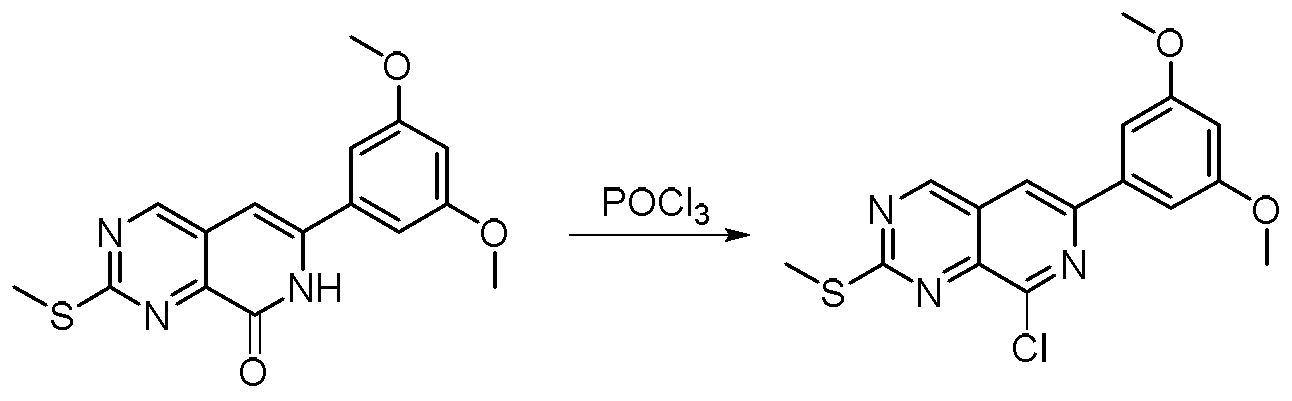


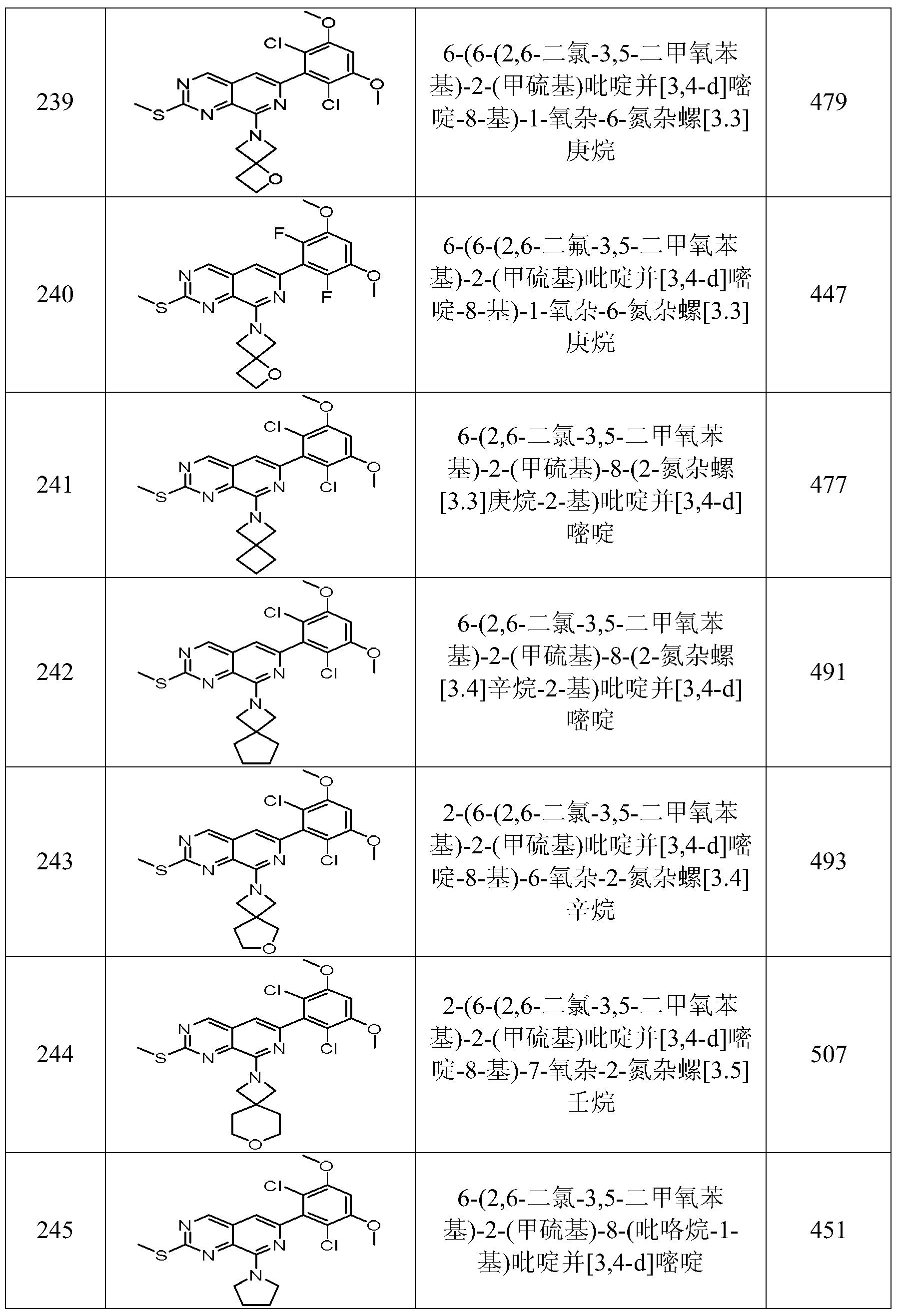


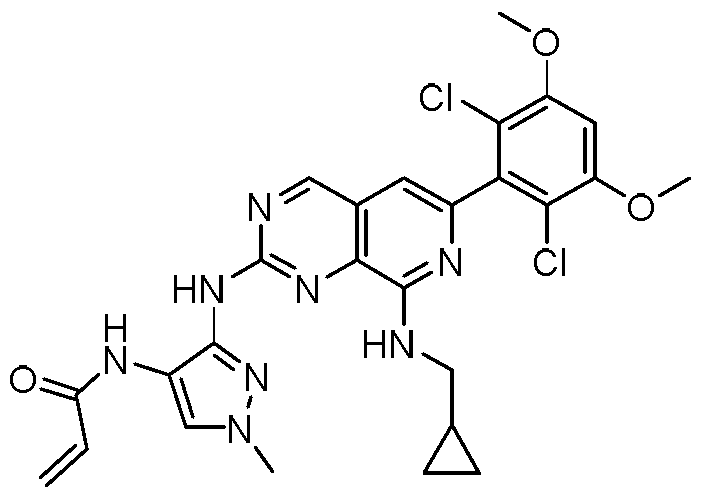


Claims (22)
- 式(I)化合物、其立体异构体或其药学上可接受盐:
 其中,X1选自-C(R7)-或N;X2、X3、X5各自独立的选自-(CR8)n-、-C(O)-、-N(R9)-、N、O或S;X4选自C或N;Z选自C1-8亚烷基、C2-8亚链烯基、C2-8亚链炔基、C3-8环烷基、3-10元杂环基、C5-10芳基或5-10元杂芳基,上述基团任选进一步被一个或多个选自氘、卤素、氰基、硝基、叠氮基、C1-8烷基、C2-8链烯基、C2-8链炔基、C3-8环烷基、3-10元杂环基、C5-10芳基、5-10元杂芳基、-C0-8-S(O)rR10、-C0-8-O-R11、-C0-8-C(O)OR11、-C0-8-C(O)R12、-C0-8-O-C(O)R12、-C0-8-NR13R14、-C0-8-C(O)NR13R14、-C0-8-N(R13)-C(O)R12或-C0-8-N(R13)-C(O)OR11的取代基所取代,上述基团再任选进一步被一个或多个选自氘、卤素、氰基、硝基、叠氮基、C1-8烷基、C2-8链烯基、C2-8链炔基、卤取代C1-8烷基、C3-8环烷基、3-10元杂环基、C5-10芳基、5-10元杂芳基、-C0-8-S(O)rR10、-C0-8-O-R11、-C0-8-C(O)OR11、-C0-8-C(O)R12、-C0-8-O-C(O)R12、-C0-8-NR13R14、-C0-8-C(O)NR13R14、-C0-8-N(R13)-C(O)R12或-C0-8-N(R13)-C(O)OR11的取代基所取代;R1选自氢、氘、C1-8烷基、C1-8烷氧C1-8烷基、C3-8环烷氧基C1-8烷基、C3-8环烷基C1-8烷基、C2-8链烯基、C2-8链炔基、C3-8环烷基、3-10元杂环基、C5-10芳基、5-10元杂芳基或C1-8烷酰基;R2、R3、R4、R5、R6、R7各自独立的选自氢、氘、卤素、氰基、硝基、叠氮基、C1-8烷基、C2-8链烯基、C2-8链炔基、C3-8环烷基、3-10元杂环基、-C0-8-S(O)rR10、-C0-8-S(O)(NR9)R10、-C0-8-P(O)(R10)2、-C0-8-O-R11、-C0-8-C(O)OR11、-C0-8-C(O)R12、-C0-8-O-C(O)R12、-C0-8-NR13R14、-C0-8-C(O)NR13R14、-C0-8-N(R13)-C(O)R12或-C0-8-N(R13)-C(O)OR11,或者,R2与R4、R3与R5、R4与R6、R5与R6和其直接相连的碳原子一起形成C5-10环烷基、5-10元杂环基、5-10元芳基或5-10元杂芳基,上述基团任选进一步被一个或多个选自氘、卤素、氰基、硝基、叠氮基、C1-8烷基、C2-8链烯基、C2-8链炔基、卤取代C1-8烷基、C3-8环烷基、3-10元杂环基、C5-10芳基、5-10元杂芳基、-C0-8-S(O)rR10、-C0-8-O-R11、-C0-8-C(O)OR11、-C0-8-C(O)R12、-C0-8-O-C(O)R12、- C0-8-NR13R14、-C0-8-C(O)NR13R14、-C0-8-N(R13)-C(O)R12或-C0-8-N(R13)-C(O)OR11的取代基所取代;R8选自氢、氘、卤素、氰基、硝基、叠氮基、C1-8烷基、C2-8链烯基、C2-8链炔基、C3 -8环烷基、3-10元杂环基、C5-10芳基、5-10元杂芳基、-C0-8-S(O)rR10、-C0-8-S(O)(NR9)R10、-C0-8-P(O)(R10)2、-C0-8-O-R11、-C0-8-C(O)OR11、-C0-8-C(O)R12、-C0-8-O-C(O)R12、-C0-8-NR13R14、-C0-8-C(O)NR13R14、-C0-8-N(R13)-C(O)R12或-C0-8-N(R13)-C(O)OR11,上述基团任选进一步被一个或多个选自氘、卤素、氰基、硝基、叠氮基、C1-8烷基、C2-8链烯基、C2-8链炔基、卤取代C1-8烷基、C3-8环烷基、3-10元杂环基、C5-10芳基、5-10元杂芳基、-C0-8-S(O)rR10、-C0-8-O-R11、-C0-8-C(O)OR11、-C0-8-C(O)R12、-C0-8-O-C(O)R12、-C0-8-NR13R14、-C0-8-C(O)NR13R14、-C0-8-N(R13)-C(O)R12或-C0-8-N(R13)-C(O)OR11的取代基所取代,上述基团再任选进一步被一个或多个选自氘、卤素、氰基、硝基、叠氮基、C1-8烷基、C2-8链烯基、C2-8链炔基、卤取代C1-8烷基、C3-8环烷基、3-10元杂环基、C5-10芳基、5-10元杂芳基、-C0-8-S(O)rR10、-C0-8-O-R11、-C0-8-C(O)OR11、-C0-8-C(O)R12、-C0-8-O-C(O)R12、-C0-8-NR13R14、-C0-8-C(O)NR13R14、-C0-8-N(R13)-C(O)R12或-C0-8-N(R13)-C(O)OR11的取代基所取代;R9选自氢、氘、C1-8烷基、C2-8链烯基、C2-8链炔基、C3-8环烷基、3-10元杂环基、C5-10芳基、5-10元杂芳基或C1-8烷酰基,上述基团任选进一步被一个或多个选自氘、卤素、氰基、硝基、叠氮基、C1-8烷基、C2-8链烯基、C2-8链炔基、卤取代C1-8烷基、C3-8环烷基、3-10元杂环基、C5-10芳基、5-10元杂芳基、-C0-8-S(O)rR10、-C0-8-O-R11、-C0-8-C(O)OR11、-C0-8-C(O)R12、-C0-8-O-C(O)R12、-C0-8-NR13R14、-C0-8-C(O)NR13R14、-C0-8-N(R13)-C(O)R12或-C0-8-N(R13)-C(O)OR11的取代基所取代;R10选自氢、氘、C1-8烷基、C2-8链烯基、C3-8环烷基、3-10元杂环基、卤取代C1-8烷基、C5-10芳基、5-10元杂芳基、氨基、单C1-8烷基氨基、二C1-8烷基氨基或C1-8烷酰氨基;R11选自氢、氘、C1-8烷基、C2-8链烯基、C2-8链炔基、C3-8环烷基、3-10元杂环基、C5-10芳基或5-10元杂芳基,上述基团任选地被以下基团单取代或多取代:氘、卤素、氰基、C1-8烷基、C1-8烷氧基、C1-8烷硫基、C3-8环烷基、3-10元杂环基、C5-10芳基、5-10元杂芳基、C1-8烷基磺酰基、C1-8烷基磺酰胺基、氨基、单C1-8烷基氨基、二C1-8烷基氨基、=O或羟基;R12选自氢、氘、C1-8烷基、C2-8链烯基、C2-8链炔基、C1-8烷氧基、C3-8环烷基、C3-8环烷氧基、3-10元杂环基、3-10元杂环氧基、C5-10芳基、5-10元杂芳基、C5-10芳氧基或5-10元杂芳氧基,上述基团任选地被以下基团单取代或多取代:氘、卤素、氰基、C1-8烷基、C1-8烷氧基、C1-8烷硫基、C3-8环烷基、3-10元杂环基、C5-10芳基、5-10元杂芳基、C1-8烷基磺酰基、C1-8烷基磺酰胺基、氨基、单C1-8烷基氨基、二C1-8烷基氨基、=O或羟基;R13、R14各自独立的选自氢、氘、C1-8烷基、C2-8链烯基、C2-8链炔基、C3-8环烷基、3-10元杂环基、C5-10芳基、5-10元杂芳基、C1-8烷基磺酰基或C1-8烷酰基,或者,R13、R14和其直接相连的氮原子一起形成4-10元杂环基,上述基团任选地被以下基团单取代或多取代:氘、卤素、C1-8烷基、C1-8烷氧基、C1-8烷硫基、C3-8环烷基、3-10元杂环基、C5-10芳基、5-10元杂芳基、C1-8烷基磺酰基、C1-8烷基磺酰胺基、氨基、单C1-8烷基氨基、二C1-8烷基氨基、=O或羟基;m为0或1;n为0、1或2;r为0、1或2;条件是,当X3选自-(CR8)n-时,X2选自-C(O)-,X4选自C,X5选自-N(R9)-、N、O或S;当X3选自-C(O)-时,X2选自-N(R9)-,且Z选自C1-8烷基、C2-8链烯基、C2-8链炔基或苯基。
 - 根据权利要求1所述的式(I)化合物、其立体异构体或其药学上可接受盐,其特征在于,Z选自C1-4亚烷基、C2-4亚链烯基、C2-4亚链炔基、C3-6环烷基、3-8元杂环基、C5-8芳基或5-8元杂芳基,上述基团任选进一步被一个或多个选自氘、卤素、氰基、硝基、叠氮基、C1-4烷基、C2-4链烯基、C2-4链炔基、C3-6环烷基、3-8元杂环基、C5-8芳基、5-8元杂芳基、-C0-4-S(O)rR10、-C0-4-O-R11、-C0-4-C(O)OR11、-C0-4-C(O)R12、-C0-4-O-C(O)R12、-C0-4-NR13R14、-C0-4-C(O)NR13R14、-C0-4-N(R13)-C(O)R12或-C0-4-N(R13)-C(O)OR11的取代基所取代,上述基团再任选进一步被一个或多个选自氘、卤素、氰基、硝基、叠氮基、C1-4烷基、C2-4链烯基、C2-4链炔基、卤取代C1-4烷基、C3-6环烷基、3-8元杂环基、C5-8芳基、5-8元杂芳基、-C0-4-S(O)rR10、-C0-4-O-R11、-C0-4-C(O)OR11、-C0-4-C(O)R12、-C0-4-O-C(O)R12、-C0-4-NR13R14、-C0-4-C(O)NR13R14、-C0-4-N(R13)-C(O)R12或-C0-4-N(R13)-C(O)OR11的取代基所取代;R1选自氢、氘、C1-4烷基、C1-4烷氧C1-4烷基、C3-6环烷氧基C1-4烷基、C3-6环烷基C1-4烷基、C2-4链烯基、C2-4链炔基、C3-6环烷基、3-8元杂环基、C5-8芳基、5-8元杂芳基或C1-4烷酰基;R2、R3、R4、R5、R6、R7各自独立的选自氢、氘、卤素、氰基、硝基、叠氮基、C1-4烷基、C2-4链烯基、C2-4链炔基、C3-6环烷基、3-8元杂环基、-C0-4-S(O)rR10、-C0-4-S(O)(NR9)R10、-C0-4-P(O)(R10)2、-C0-4-O-R11、-C0-4-C(O)OR11、-C0-4-C(O)R12、-C0-4-O-C(O)R12、-C0 -4-NR13R14、-C0-4-C(O)NR13R14、-C0-4-N(R13)-C(O)R12或-C0-4-N(R13)-C(O)OR11,或者,R2与R4、R3与R5、R4与R6、R5与R6和其直接相连的碳原子一起形成C5-8环烷基、5-8元杂环基、5-8元芳基或5-8元杂芳基,上述基团任选进一步被一个或多个选自氘、卤素、氰基、硝基、叠氮基、C1-4烷基、C2-4链烯基、C2-4链炔基、卤取代C1-4烷基、C3-4环烷基、3-8元杂环基、C5-8芳基、5-8元杂芳基、-C0-4-S(O)rR10、-C0-4-O-R11、-C0-4-C(O)OR11、-C0-4-C(O)R12、-C0-4-O-C(O)R12、-C0-4-NR13R14、-C0-4-C(O)NR13R14、-C0-4-N(R13)-C(O)R12或-C0-4-N(R13)-C(O)OR11的取代基所取代。
- 根据权利要求1所述的式(I)化合物、其立体异构体或其药学上可接受盐,其特征在于,Z选自C1-2亚烷基或如下结构:
 上述基团任选进一步被一个或多个选自氘、卤素、氰基、硝基、叠氮基、C1-4烷基、C2-4链烯基、C2-4链炔基、C3-6环烷基、3-8元杂环基、C5-8芳基、5-8元杂芳基、-C0-4-S(O)rR10、-C0-4-O-R11、-C0-4-C(O)OR11、-C0-4-C(O)R12、-C0-4-O-C(O)R12、-C0-4-NR13R14、-C0-4-C(O)NR13R14、-C0-4-N(R13)-C(O)R12或-C0-4-N(R13)-C(O)OR11的取代基所取代,上述基团再任选进一步被一个或多个选自氘、卤素、氰基、硝基、叠氮基、C1-4烷基、C2-4链烯基、C2-4链炔基、卤取代C1-4烷基、C3-6环烷基、3-8元杂环基、C5-8芳基、5-8元杂芳基、-C0-4-S(O)rR10、-C0-4-O-R11、-C0-4-C(O)OR11、-C0-4-C(O)R12、-C0-4-O-C(O)R12、-C0-4-NR13R14、-C0-4-C(O)NR13R14、-C0-4-N(R13)-C(O)R12或-C0-4-N(R13)-C(O)OR11的取代基所取代。
 - 根据权利要求1所述的式(I)化合物、其立体异构体或其药学上可接受盐,其特征在于,R1选自氢、氘、甲基、异丙基、甲氧乙基、环丙氧甲基、环丙甲基、烯丙基、环丙基或乙酰基;R2、R3、R4、R5各自独立的选自氢、氘、卤素、C1-4烷基、C2-4链烯基、C2-4链炔基、C3-6环烷基、3-8元杂环基、-C0-4-O-R11或-C0-4-NR13R14,或者,R2与R4、R3与R5和其直接相连的碳原子一起形成C5-8环烷基、5-8元杂环基、5-8元芳基或5-8元杂芳基,上述基团任选进一步被一个或多个选自氘、卤素、氰基、硝基、叠氮基、C1-4烷基、C2-4链烯基、C2-4链炔基、卤取代C1-4烷基、C3-4环烷基、3-8元杂环基、C5-8芳基、5-8元杂芳基、-C0-4-S(O)rR10、-C0-4-O-R11、-C0-4-C(O)OR11、-C0-4-C(O)R12、-C0-4-O-C(O)R12、-C0-4-NR13R14、-C0-4-C(O)NR13R14、-C0-4-N(R13)-C(O)R12或-C0-4-N(R13)-C(O)OR11的取代基所取代;R6选自氢或氘。
- 根据权利要求1所述的式(I)化合物、其立体异构体或其药学上可接受盐,其特征在于,R1选自氢、氘、甲基或环丙甲基;R2、R3、R4、R5各自独立的选自氢、氘、氯、氟、甲基、异丙基、烯丙基、乙炔基、环丙基、3-氧杂环丁基、三氟甲基、三氘甲基、-C0-4-O-R11或-C0-4-NR13R14,或者,R2与R4、R3与R5和其直接相连的碳原子一起形成5-8元杂环基,所述杂原子选自氧或氮,所述5-8元杂环基任选进一步被一个或多个选自氘、卤素、氰基、硝基、叠氮基、C1-4烷基、C2-4链烯基、C2-4链炔基、卤取代C1-4烷基、C3-4环烷基、3-8元杂环基、C5-8芳基、5-8元杂芳基、-C0-4-S(O)rR10、-C0-4-O-R11、-C0-4-C(O)OR11、-C0-4-C(O)R12、-C0- 4-O-C(O)R12、-C0-4-NR13R14、-C0-4-C(O)NR13R14、-C0-4-N(R13)-C(O)R12或-C0-4-N(R13)-C(O)OR11的取代基所取代;R6选自氢或氘。
- 根据权利要求1所述的式(I)化合物、其立体异构体或其药学上可接受盐,其特征在于,选自如下式(Ⅱa)化合物:
 其中,X3选自-N(R9)-、N、O或S;Z选自C1-2亚烷基或如下结构:
 上述基团任选进一步被一个或多个选自氘、卤素、氰基、硝基、叠氮基、C1-4烷基、C2-4链烯基、C2-4链炔基、C3-6环烷基、3-8元杂环基、C5-8芳基、5-8元杂芳基、-C0-4-S(O)rR10、-C0-4-O-R11、-C0-4-C(O)OR11、-C0-4-C(O)R12、-C0-4-O-C(O)R12、-C0-4-NR13R14、-C0-4-C(O)NR13R14、-C0-4-N(R13)-C(O)R12或-C0-4-N(R13)-C(O)OR11的取代基所取代,上述基团再任选进一步被一个或多个选自氘、卤素、氰基、硝基、叠氮基、C1-4烷基、C2-4链烯基、C2-4链炔基、卤取代C1-4烷基、C3-6环烷基、3-8元杂环基、C5-8芳基、5-8元杂芳基、-C0-4-S(O)rR10、-C0-4-O-R11、-C0-4-C(O)OR11、-C0-4-C(O)R12、-C0-4-O-C(O)R12、-C0-4-NR13R14、-C0-4-C(O)NR13R14、-C0-4-N(R13)-C(O)R12或-C0-4-N(R13)-C(O)OR11的取代基所取代;R2、R3、R4、R5各自独立的选自氢、氘、氯、氟、甲基、异丙基、烯丙基、乙炔基、环丙基、3-氧杂环丁基、三氟甲基、三氘甲基、-C0-4-O-R11或-C0-4-NR13R14,或者,R2与R4、R3与R5和其直接相连的碳原子一起形成5-8元杂环基,所述杂原子选自氧或氮,所述5-8元杂环基任选进一步被一个或多个选自氘、卤素、氰基、硝基、叠 氮基、C1-4烷基、C2-4链烯基、C2-4链炔基、卤取代C1-4烷基、C3-4环烷基、3-8元杂环基、C5-8芳基、5-8元杂芳基、-C0-4-S(O)rR10、-C0-4-O-R11、-C0-4-C(O)OR11、-C0-4-C(O)R12、-C0- 4-O-C(O)R12、-C0-4-NR13R14、-C0-4-C(O)NR13R14、-C0-4-N(R13)-C(O)R12或-C0-4-N(R13)-C(O)OR11的取代基所取代;R7选自氢、氘、氯、氟、羟基、烯丙基、乙炔基、环丙基、3-氧杂环丁基、三氟甲基、三氘甲基、-C0-4-O-R11或-C0-4-NR13R14;R9选自氢、氘、C1-4烷基、C3-6环烷基或3-8元杂环基,上述基团任选进一步被一个或多个选自氘、卤素、氰基、硝基、叠氮基、C1-4烷基、C2-4链烯基、C2-4链炔基、卤取代C1-4烷基、C3-6环烷基、3-8元杂环基、C5-8芳基、5-8元杂芳基、-C0-4-S(O)rR10、-C0-4-O-R11、-C0-4-C(O)OR11、-C0-4-C(O)R12、-C0-4-O-C(O)R12、-C0-4-NR13R14、-C0-4-C(O)NR13R14、-C0-4-N(R13)-C(O)R12或-C0-4-N(R13)-C(O)OR11的取代基所取代;X1、X2、X5、R8、R10、R11、R12、R13、R14、m、n、r如权利要求1所述。
 - 根据权利要求6所述的式(I)化合物、其立体异构体或其药学上可接受盐,其特征在于,选自如下式(Ⅲa-1)、(Ⅲa-2)、(Ⅲa-3)或(Ⅲa-4)化合物:
 其中,Z选自C1-2亚烷基或如下结构:
 上述基团任选进一步被一个或多个选自氘、卤素、氰基、硝基、叠氮基、C1-4烷基、C2-4链烯基、C2-4链炔基、C3-6环烷基、3-8元杂环基、C5-8芳基、5-8元杂芳基、-C0-4-S(O)rR10、-C0-4-O-R11、-C0-4-C(O)OR11、-C0-4-C(O)R12、-C0-4-O-C(O)R12、-C0-4-NR13R14、-C0-4-C(O)NR13R14、-C0-4-N(R13)-C(O)R12或-C0-4-N(R13)-C(O)OR11的取代基所取代,上述基团再任选进一步被一个或多个选自氘、卤素、氰基、硝基、叠氮基、C1-4烷基、C2-4链烯基、C2-4链炔基、卤取代C1-4烷基、C3-6环烷基、3-8元杂环基、C5-8芳基、5-8元杂芳基、 -C0-4-S(O)rR10、-C0-4-O-R11、-C0-4-C(O)OR11、-C0-4-C(O)R12、-C0-4-O-C(O)R12、-C0-4-NR13R14、-C0-4-C(O)NR13R14、-C0-4-N(R13)-C(O)R12或-C0-4-N(R13)-C(O)OR11的取代基所取代;R2、R3、R4、R5各自独立的选自氢、氘、氯、氟、羟基、甲基、异丙基、环丙基、3-氧杂环丁基、三氟甲基、三氘甲基或-O-R11,或者,R2与R4、R3与R5和其直接相连的碳原子一起形成5-8元杂环基,所述杂原子选自氧或氮;R7选自氢、氘、氯、氟、羟基、环丙基或-O-R11;R9选自氢、氘、C1-4烷基、C3-6环烷基或3-8元杂环基,上述基团任选进一步被一个或多个选自氘、卤素、C1-4烷基、卤取代C1-4烷基、C3-6环烷基、3-8元杂环基、-C0-4-O-R11、-C0-4-NR13R14或-C0-4-C(O)NR13R14的取代基所取代;X1、X5、R8、R10、R11、R12、R13、R14、m、n、r如权利要求1所述。
 - 根据权利要求7所述的式(I)化合物、其立体异构体或其药学上可接受盐,其特征在于,选自式(Ⅳa-1)化合物:
 其中,X5选自-CH-或N;Z选自C1-2亚烷基或如下结构:
 上述基团任选进一步被一个或多个选自氘、卤素、氰基、硝基、叠氮基、C1-4烷基、C2-4链烯基、C2-4链炔基、C3-6环烷基、3-8元杂环基、C5-8芳基、5-8元杂芳基、-C0-4-S(O)rR10、-C0-4-O-R11、-C0-4-C(O)OR11、-C0-4-C(O)R12、-C0-4-O-C(O)R12、-C0-4-NR13R14、-C0-4-C(O)NR13R14、-C0-4-N(R13)-C(O)R12或-C0-4-N(R13)-C(O)OR11的取代基所取代,上述基团再任选进一步被一个或多个选自氘、卤素、氰基、硝基、叠氮基、C1-4烷基、C2-4链烯基、C2-4链炔基、卤取代C1-4烷基、C3-6环烷基、3-8元杂环基、C5-8芳基、5-8元杂芳基、-C0-4-S(O)rR10、-C0-4-O-R11、-C0-4-C(O)OR11、-C0-4-C(O)R12、-C0-4-O-C(O)R12、-C0-4-NR13R14、-C0-4-C(O)NR13R14、-C0-4-N(R13)-C(O)R12或-C0-4-N(R13)-C(O)OR11的取代基所取代;R2、R3、R4、R5各自独立的选自氢、氘、氯、氟、羟基、甲基、异丙基、环丙基、3-氧杂环丁基、三氟甲基、三氘甲基或-O-R11,或者,R2与R4、R3与R5和其直接相连的碳原子一起形成5-8元杂环基,所述杂原子选自氧或氮;R7选自氢、氘、氯、氟、羟基、环丙基或-O-R11;R8选自氢、氘、卤素、氰基、硝基、叠氮基、C1-8烷基、C2-8链烯基、C2-8链炔基、C3 -8环烷基、3-10元杂环基、C5-10芳基、5-10元杂芳基、-C0-8-S(O)rR10、-C0-4-S(O)(NR9)R10、-C0-8-P(O)(R10)2、-C0-8-O-R11、-C0-8-C(O)OR11、-C0-8-C(O)R12、-C0-8-O-C(O)R12、-C0-8-NR13R14、-C0-8-C(O)NR13R14、-C0-8-N(R13)-C(O)R12或-C0-8-N(R13)-C(O)OR11,上述基团任选进一步被一个或多个选自氘、卤素、氰基、硝基、叠氮基、C1-4烷基、C2-4链烯基、C2-4链炔基、卤取代C1-4烷基、C3-6环烷基、3-8元杂环基、C5-8芳基、5-8元杂芳基、-C0-4-S(O)rR10、-C0-4-O-R11、-C0-4-C(O)OR11、-C0-4-C(O)R12、-C0-4-O-C(O)R12、-C0-4-NR13R14、-C0-4-C(O)NR13R14、-C0-4-N(R13)-C(O)R12或-C0-4-N(R13)-C(O)OR11的取代基所取代,上述基团再任选进一步被一个或多个选自氘、卤素、氰基、硝基、叠氮基、C1-4烷基、C2- 4链烯基、C2-4链炔基、卤取代C1-4烷基、C3-6环烷基、3-8元杂环基、C5-8芳基、5-8元杂芳基、-C0-4-S(O)rR10、-C0-4-O-R11、-C0-4-C(O)OR11、-C0-4-C(O)R12、-C0-4-O-C(O)R12、-C0-4-NR13R14、-C0-4-C(O)NR13R14、-C0-4-N(R13)-C(O)R12或-C0-4-N(R13)-C(O)OR11的取代基所取代;X1、R10、R11、R12、R13、R14、m、n、r如权利要求1所述。
 - 根据权利要求8所述的式(I)化合物、其立体异构体或其药学上可接受盐,其特征在于,R8选自氢、氘、卤素、氰基、C1-8烷基、C2-8链烯基、C2-8链炔基、C3-8环烷基、3-10元杂环基、C5-10芳基、5-10元杂芳基、-C0-8-O-R11、-C0-8-NR13R14、-C0-8-N(R13)-C(O)R12或-C0-8-N(R13)-C(O)OR11,上述基团任选进一步被一个或多个选自氘、卤素、氰基、硝基、叠氮基、C1-4烷基、C2-4链烯基、C2-4链炔基、卤取代C1-4烷基、C3-6环烷基、3-8元杂环基、C5-8芳基、5-8元杂芳基、-C0-4-S(O)rR10、-C0-4-O-R11、-C0-4-C(O)OR11、-C0-4-C(O)R12、-C0-4-O-C(O)R12、-C0-4-NR13R14、-C0-4-C(O)NR13R14、-C0-4-N(R13)-C(O)R12或-C0-4-N(R13)-C(O)OR11的取代基所取代,上述基团再任选进一步被一个或多个选自氘、卤素、氰基、硝基、叠氮基、C1-4烷基、C2- 4链烯基、C2-4链炔基、卤取代C1-4烷基、C3-6环烷基、3-8元杂环基、C5-8芳基、5-8元杂芳基、-C0-4-S(O)rR10、-C0-4-O-R11、-C0-4-C(O)OR11、-C0-4-C(O)R12、-C0-4-O-C(O)R12、-C0-4-NR13R14、-C0-4-C(O)NR13R14、-C0-4-N(R13)-C(O)R12或-C0-4-N(R13)-C(O)OR11的取代基所取代。
- 根据权利要求1所述的式(I)化合物、其立体异构体或其药学上可接受盐,其特征在于,选自如下式(Ⅱb)化合物:
 其中,X3选自-(CR8)n-或-C(O)-;Z选自C1-2亚烷基或如下结构:
 上述基团任选进一步被一个或多个选自氘、卤素、氰基、硝基、叠氮基、C1-4烷基、C2-4链烯基、C2-4链炔基、C3-6环烷基、3-8元杂环基、C5-8芳基、5-8元杂芳基、-C0-4-S(O)rR10、-C0-4-O-R11、-C0-4-C(O)OR11、-C0-4-C(O)R12、-C0-4-O-C(O)R12、-C0-4-NR13R14、-C0-4-C(O)NR13R14、-C0-4-N(R13)-C(O)R12或-C0-4-N(R13)-C(O)OR11的取代基所取代;R2、R3、R4、R5各自独立的选自氢、氘、氯、氟、甲基、异丙基、烯丙基、乙炔基、环丙基、3-氧杂环丁基、三氟甲基、三氘甲基、-C0-4-O-R11或-C0-4-NR13R14,或者,R2与R4、R3与R5和其直接相连的碳原子一起形成5-8元杂环基,所述杂原子选自氧或氮,所述5-8元杂环基任选进一步被一个或多个选自氘、卤素、氰基、硝基、叠氮基、C1-4烷基、C2-4链烯基、C2-4链炔基、卤取代C1-4烷基、C3-4环烷基、3-8元杂环基、C5-8芳基、5-8元杂芳基、-C0-4-S(O)rR10、-C0-4-O-R11、-C0-4-C(O)OR11、-C0-4-C(O)R12、-C0- 4-O-C(O)R12、-C0-4-NR13R14、-C0-4-C(O)NR13R14、-C0-4-N(R13)-C(O)R12或-C0-4-N(R13)-C(O)OR11的取代基所取代;R7选自氢、氘、氯、氟、羟基、烯丙基、乙炔基、环丙基、3-氧杂环丁基、三氟甲基、三氘甲基、-C0-4-O-R11或-C0-4-NR13R14;R9选自氢、氘、C1-4烷基、C3-6环烷基或3-8元杂环基,上述基团任选进一步被一个或多个选自氘、卤素、氰基、硝基、叠氮基、C1-4烷基、C2-4链烯基、C2-4链炔基、卤取代C1-4烷基、C3-6环烷基、3-8元杂环基、C5-8芳基、5-8元杂芳基、-C0-4-S(O)rR10、-C0-4-O-R11、-C0-4-C(O)OR11、-C0-4-C(O)R12、-C0-4-O-C(O)R12、-C0-4-NR13R14、-C0-4-C(O)NR13R14、-C0-4-N(R13)-C(O)R12或-C0-4-N(R13)-C(O)OR11的取代基所取代;X1、X2、X5、R8、R10、R11、R12、R13、R14、m、n、r如权利要求1所述;条件是,当X3选自-(CR8)n-时,X2选自-C(O)-,X5选自-N(R9)-、N、O或S;当X3选自-C(O)-时,X2选自-N(R9)-,且Z选自C1-4烷基或苯基。
 - 根据权利要求10所述的式(I)化合物、其立体异构体或其药学上可接受盐,其特征在于,选自如下式(Ⅲb-1)或(Ⅲb-2)化合物:
 其中,Z选自C1-2亚烷基或如下结构:
 上述基团任选进一步被一个或多个选自氘、卤素、氰基、硝基、叠氮基、C1-4烷基、C2-4链烯基、C2-4链炔基、C3-6环烷基、3-8元杂环基、C5-8芳基、5-8元杂芳基、-C0-4-S(O)rR10、-C0-4-O-R11、-C0-4-C(O)OR11、-C0-4-C(O)R12、-C0-4-O-C(O)R12、-C0-4-NR13R14、-C0-4-C(O)NR13R14、-C0-4-N(R13)-C(O)R12或-C0-4-N(R13)-C(O)OR11的取代基所取代;R2、R3、R4、R5各自独立的选自氢、氘、氯、氟、羟基、甲基、异丙基、环丙基、3-氧杂环丁基、三氟甲基、三氘甲基或-O-R11,或者,R2与R4、R3与R5和其直接相连的碳原子一起形成5-8元杂环基,所述杂原子选自氧或氮;R7选自氢、氘、氯、氟、羟基、环丙基或-O-R11;X1、R10、R11、R12、R13、R14、m、r如权利要求1所述。
 - 根据权利要求10所述的式(I)化合物、其立体异构体或其药学上可接受盐,其特征在于,选自如下式(Ⅲb-3)化合物:
 其中,R2、R3、R4、R5各自独立的选自氢、氘、氯、氟、羟基、甲基、异丙基、环丙基、3-氧杂环丁基、三氟甲基、三氘甲基或-O-R11,或者,R2与R4、R3与R5和其直接相连的碳原子一起形成5-8元杂环基,所述杂原子选自氧或氮;R7选自氢、氘、氯、氟、羟基、环丙基或-O-R11;R9选自氢、氘、C1-4烷基、C3-6环烷基或3-8元杂环基,上述基团任选进一步被一个或多个选自氘、卤素、C1-4烷基、卤取代C1-4烷基、C3-6环烷基、3-8元杂环基、-C0-4-O-R11、-C0-4-NR13R14或-C0-4-C(O)NR13R14的取代基所取代;X1、R8、R10、R11、R13、R14、n如权利要求1所述。
 - 根据权利要求1-12任一所述的式(I)化合物、其立体异构体或其药学上可接受盐,其特征在于,选自如下化合物:


- 权利要求1-13任一所述的式(I)化合物、其立体异构体或其药学上可接受盐的制备方法,当m=1时,包括如下步骤:
 或者,
或者, 或者,
或者, 或者,
或者, 或者,当m=0时,包括如下步骤:
 任选的,根据取代基的不同,在不同的取代基之间进行转换反应;其中:X为离去基团,优选自氯、溴、甲硫基、甲磺酰基或甲氧基;R选自硝基、氰基或叠氮基;Pg为氨基保护基,优选自叔丁氧羰基、苄氧羰基、2-联苯基-2-丙氧羰基或对甲苯磺酰基;X1、X2、X3、X4、X5、R1、R2、R3、R4、R5、R6、R7、R8、R9、R10、R11、R12、R13、R14、m、n、r如权利要求1所定义。
 - 一种药物组合物,其包括治疗有效剂量的权利要求1-13任一所述的式(I)化合物、其立体异构体或其药学上可接受盐及可药用的载体。
- 权利要求1-13任一所述的式(I)化合物、其立体异构体或其药学上可接受盐,或权利要求15所述的药物组合物在制备FGFR4抑制剂药物中的应用。
- 根据权利要求1-13任一所述的式(I)所示的化合物、其立体异构体或其药学上可接受的盐,或权利要求15所述的药物组合物在制备治疗癌症的药物中的应用;优选的,所述癌症是前列腺癌、肝癌、胰腺癌、食管癌、胃癌、肺癌、乳腺癌、卵巢癌、结肠癌、皮肤癌、神经胶质母细胞瘤或横纹肌肉瘤。
- 根据权利要求1-13任一所述的式(I)化合物、其立体异构体或其药学上可接受盐,或权利要求15所述的药物组合物,其用作FGFR4抑制剂。
- 根据权利要求1-13任一所述的式(I)所示的化合物、其立体异构体或其药学上可接受的盐,或权利要求15所述的药物组合物,其用于治疗癌症;优选的,所述癌症是前列腺癌、肝癌、胰腺癌、食管癌、胃癌、肺癌、乳腺癌、卵巢癌、结肠癌、皮肤癌、神经胶质母细胞瘤或横纹肌肉瘤。
- 一种抑制FGFR4的方法,所述方法包括给予需要治疗的患者有效治疗量的权利要求1-13任一所述的式(I)化合物、其立体异构体或其药学上可接受盐,或权利要求15所述的药物组合物。
- 一种治疗癌症的方法,所述方法包括给予需要治疗的患者有效治疗量的权利要求1-13任一所述的式(I)所示的化合物、其立体异构体或其药学上可接受的盐,或权利要求15所述的药物组合物。
- 根据权利要求21所述的方法,其特征在于,所述癌症是前列腺癌、肝癌、胰腺癌、食管癌、胃癌、肺癌、乳腺癌、卵巢癌、结肠癌、皮肤癌、神经胶质母细胞瘤或横纹肌肉瘤。
Priority Applications (12)
| Application Number | Priority Date | Filing Date | Title |
|---|---|---|---|
| ES17883905T ES2926124T3 (es) | 2016-12-19 | 2017-12-14 | Inhibidor de FGFR4, método de preparación del mismo y uso farmacéutico del mismo |
| CA3042960A CA3042960C (en) | 2016-12-19 | 2017-12-14 | Fgfr4 inhibitor, preparation method therefor and pharmaceutical use thereof |
| AU2017378943A AU2017378943B2 (en) | 2016-12-19 | 2017-12-14 | FGFR4 inhibitor, preparation method therefor and pharmaceutical use thereof |
| DK17883905.6T DK3524603T3 (da) | 2016-12-19 | 2017-12-14 | Fgfr4-hæmmer, fremgangsmåde til fremstilling deraf og farmaceutisk anvendelse deraf |
| RU2019122913A RU2747260C2 (ru) | 2016-12-19 | 2017-12-14 | Ингибитор рфрф4, способ его получения и его фармацевтическое применение |
| EP17883905.6A EP3524603B1 (en) | 2016-12-19 | 2017-12-14 | Fgfr4 inhibitor, preparation method therefor and pharmaceutical use thereof |
| US16/348,957 US10968220B2 (en) | 2016-12-19 | 2017-12-14 | FGFR4 inhibitor, preparation method therefor and pharmaceutical use thereof |
| JP2019525831A JP6919922B2 (ja) | 2016-12-19 | 2017-12-14 | Fgfr4阻害剤、その製造方法と薬学的な応用 |
| CN201780051138.6A CN109661394B (zh) | 2016-12-19 | 2017-12-14 | Fgfr4抑制剂、其制备方法与药学上的应用 |
| KR1020197013213A KR102288281B1 (ko) | 2016-12-19 | 2017-12-14 | Fgfr4 억제제, 이의 제조 방법 및 약학적 응용 |
| PH12019501029A PH12019501029A1 (en) | 2016-12-19 | 2019-05-09 | Fgfr4 inhibitor, preparation method therefor and pharmaceutical use therefor |
| US17/139,552 US11555036B2 (en) | 2016-12-19 | 2020-12-31 | FGFR4 inhibitor, preparation method therefor and pharmaceutical use thereof |
Applications Claiming Priority (4)
| Application Number | Priority Date | Filing Date | Title |
|---|---|---|---|
| CN201611177188 | 2016-12-19 | ||
| CN201611177188.2 | 2016-12-19 | ||
| CN201710453749.5 | 2017-06-15 | ||
| CN201710453749 | 2017-06-15 |
Related Child Applications (2)
| Application Number | Title | Priority Date | Filing Date |
|---|---|---|---|
| US16/348,957 A-371-Of-International US10968220B2 (en) | 2016-12-19 | 2017-12-14 | FGFR4 inhibitor, preparation method therefor and pharmaceutical use thereof |
| US17/139,552 Continuation US11555036B2 (en) | 2016-12-19 | 2020-12-31 | FGFR4 inhibitor, preparation method therefor and pharmaceutical use thereof |
Publications (1)
| Publication Number | Publication Date |
|---|---|
| WO2018113584A1 true WO2018113584A1 (zh) | 2018-06-28 |
Family
ID=62624661
Family Applications (1)
| Application Number | Title | Priority Date | Filing Date |
|---|---|---|---|
| PCT/CN2017/116186 Ceased WO2018113584A1 (zh) | 2016-12-19 | 2017-12-14 | Fgfr4抑制剂、其制备方法与药学上的应用 |
Country Status (13)
| Country | Link |
|---|---|
| US (2) | US10968220B2 (zh) |
| EP (1) | EP3524603B1 (zh) |
| JP (1) | JP6919922B2 (zh) |
| KR (1) | KR102288281B1 (zh) |
| CN (1) | CN109661394B (zh) |
| AU (1) | AU2017378943B2 (zh) |
| CA (1) | CA3042960C (zh) |
| DK (1) | DK3524603T3 (zh) |
| ES (1) | ES2926124T3 (zh) |
| PH (1) | PH12019501029A1 (zh) |
| RU (1) | RU2747260C2 (zh) |
| TW (1) | TWI725266B (zh) |
| WO (1) | WO2018113584A1 (zh) |
Cited By (21)
| Publication number | Priority date | Publication date | Assignee | Title |
|---|---|---|---|---|
| WO2019080878A1 (en) * | 2017-10-24 | 2019-05-02 | Advent Pharma Co. Ltd. | HETEROCYCLES AS INHIBITORS OF THE FIBROBLAST GROWTH FACTOR RECEPTOR |
| WO2019145718A1 (en) * | 2018-01-24 | 2019-08-01 | Oxford University Innovation Limited | Compounds |
| WO2019223766A1 (zh) * | 2018-05-25 | 2019-11-28 | 上海和誉生物医药科技有限公司 | 一种fgfr抑制剂、其制备方法和在药学上的应用 |
| WO2019242587A1 (zh) * | 2018-06-19 | 2019-12-26 | 上海和誉生物医药科技有限公司 | 一种高选择性FGFR i抑制剂及其制备方法和应用 |
| CN111138459A (zh) * | 2018-11-06 | 2020-05-12 | 南京圣和药业股份有限公司 | Fgfr4抑制剂的光学异构体及其应用 |
| WO2020119606A1 (en) * | 2018-12-10 | 2020-06-18 | Guangdong Newopp Biopharmaceuticals Co., Ltd. | Heterocyclic compounds as inhibitors of fibroblast growth factor receptor |
| KR20200100429A (ko) * | 2019-02-18 | 2020-08-26 | 한국과학기술연구원 | 단백질 키나아제 저해 활성을 갖는 신규한 피리도[3,4-d]피리미딘-8-온 유도체 및 이를 포함하는 암의 예방, 개선 또는 치료용 약학 조성물 |
| WO2020177067A1 (en) * | 2019-03-05 | 2020-09-10 | Bioardis Llc | Aromatic derivatives, preparation methods, and medical uses thereof |
| US11149007B2 (en) | 2018-12-19 | 2021-10-19 | Celgene Corporation | Substituted 3-((3-aminophenyl)amino)piperidine-2,6-dione compounds, compositions thereof, and methods of treatment therewith |
| CN113527311A (zh) * | 2021-08-23 | 2021-10-22 | 中南大学湘雅医院 | Fgfr4抑制剂、组合物及其在药物制备中的用途 |
| CN113646314A (zh) * | 2019-03-08 | 2021-11-12 | 首药控股(北京)股份有限公司 | Fgfr4激酶抑制剂及其制备方法和用途 |
| JP2022515198A (ja) * | 2018-12-19 | 2022-02-17 | アレイ バイオファーマ インコーポレイテッド | FGFRチロシンキナーゼの阻害剤としての置換ピラゾロ[1,5-a]ピリジン化合物 |
| JP2022518823A (ja) * | 2019-01-29 | 2022-03-16 | シャンドン スアンズ ファーマ カンパニー,リミテッド | ヘキソングルコキナーゼ阻害剤およびその使用 |
| US11325889B2 (en) | 2018-12-19 | 2022-05-10 | Celgene Corporation | Substituted 3-((3-aminophenyl)amino)piperidine-2,6-dione compounds, compositions thereof, and methods of treatment therewith |
| WO2022109001A1 (en) | 2020-11-18 | 2022-05-27 | Deciphera Pharmaceuticals, Llc | Gcn2 and perk kinase inhibitors and methods of use thereof |
| RU2780168C1 (ru) * | 2019-02-18 | 2022-09-20 | Корея Инститьют Оф Сайенс Энд Текнолоджи | Новое производное пиридо [3,4-d] пиримидин-8-она, обладающее ингибирующей протеинкиназы активностью, и фармацевтическая композиция для предупреждения, облегчения или лечения рака, содержащее указанное выше |
| WO2023060904A1 (zh) * | 2021-10-14 | 2023-04-20 | 温州医科大学 | 一种作为fgfr4抑制剂的萘啶酮类化合物及其用途 |
| WO2023109776A1 (zh) | 2021-12-13 | 2023-06-22 | 上海和誉生物医药科技有限公司 | 一种fgfr4抑制剂酸式盐及其制备方法和应用 |
| WO2024251252A1 (zh) | 2023-06-09 | 2024-12-12 | 上海和誉生物医药科技有限公司 | 一种fgfr4抑制剂组合物、其制备方法和在药学上的应用 |
| WO2025119278A1 (zh) * | 2023-12-07 | 2025-06-12 | 无锡和誉生物医药科技有限公司 | 一种cd73抑制剂药物组合物,其制备方法和应用 |
| US12351571B2 (en) | 2018-12-19 | 2025-07-08 | Array Biopharma Inc. | Substituted quinoxaline compounds as inhibitors of FGFR tyrosine kinases |
Families Citing this family (7)
| Publication number | Priority date | Publication date | Assignee | Title |
|---|---|---|---|---|
| CN109745325B (zh) * | 2017-11-08 | 2022-02-15 | 上海翰森生物医药科技有限公司 | Fgfr4抑制剂、其制备方法和用途 |
| TWI821559B (zh) * | 2019-04-28 | 2023-11-11 | 大陸商上海和譽生物醫藥科技有限公司 | 一種cd73抑制劑,其製備方法和應用 |
| BR112022007208A2 (pt) * | 2019-10-30 | 2022-07-26 | Janssen Sciences Ireland Unlimited Co | Síntese de 3-nitro-n-(2,2,2-trifluoroetil)-4-piridinamina |
| CN114075212B (zh) * | 2020-08-14 | 2023-05-12 | 江苏恒瑞医药股份有限公司 | 稠合三环类衍生物、其制备方法及其在医药上的应用 |
| CN116410189B (zh) * | 2021-12-30 | 2024-08-06 | 中国科学院上海药物研究所 | 一种嘧啶并吡啶类化合物及其药用组合物和应用 |
| TW202412784A (zh) * | 2022-07-18 | 2024-04-01 | 美商依安彼克醫療有限公司 | 氮-喹唑啉化合物及使用方法 |
| TW202545531A (zh) * | 2024-01-17 | 2025-12-01 | 美商依安彼克醫療有限公司 | 氮—喹唑啉化合物之使用方法 |
Citations (3)
| Publication number | Priority date | Publication date | Assignee | Title |
|---|---|---|---|---|
| CN104540809A (zh) * | 2012-07-11 | 2015-04-22 | 蓝印药品公司 | 成纤维细胞生长因子受体的抑制剂 |
| CN105307657A (zh) * | 2013-03-15 | 2016-02-03 | 西建阿维拉米斯研究公司 | 杂芳基化合物和其用途 |
| CN105658642A (zh) * | 2013-10-25 | 2016-06-08 | 蓝图药品公司 | 纤维母细胞生长因子受体抑制剂 |
Family Cites Families (5)
| Publication number | Priority date | Publication date | Assignee | Title |
|---|---|---|---|---|
| WO2004063195A1 (en) * | 2003-01-03 | 2004-07-29 | Sloan-Kettering Institute For Cancer Research | Pyridopyrimidine kinase inhibitors |
| AU2009262068C1 (en) * | 2008-06-27 | 2015-07-02 | Celgene Car Llc | Heteroaryl compounds and uses thereof |
| WO2015108992A1 (en) * | 2014-01-15 | 2015-07-23 | Blueprint Medicines Corporation | Heterobicyclic compounds and their use as fgfr4 receptor inhibitors |
| WO2016115412A1 (en) * | 2015-01-18 | 2016-07-21 | Newave Pharmaceutical Llc | Dual-warhead covalent inhibitors of fgfr-4 |
| EP3470550B1 (en) * | 2016-02-24 | 2023-10-25 | Zincobre Ingenieria, S.L. | Electrode head for an electrolysis installation |
-
2017
- 2017-12-14 RU RU2019122913A patent/RU2747260C2/ru active
- 2017-12-14 EP EP17883905.6A patent/EP3524603B1/en active Active
- 2017-12-14 KR KR1020197013213A patent/KR102288281B1/ko active Active
- 2017-12-14 ES ES17883905T patent/ES2926124T3/es active Active
- 2017-12-14 DK DK17883905.6T patent/DK3524603T3/da active
- 2017-12-14 WO PCT/CN2017/116186 patent/WO2018113584A1/zh not_active Ceased
- 2017-12-14 CA CA3042960A patent/CA3042960C/en active Active
- 2017-12-14 AU AU2017378943A patent/AU2017378943B2/en active Active
- 2017-12-14 TW TW106143927A patent/TWI725266B/zh active
- 2017-12-14 CN CN201780051138.6A patent/CN109661394B/zh active Active
- 2017-12-14 US US16/348,957 patent/US10968220B2/en active Active
- 2017-12-14 JP JP2019525831A patent/JP6919922B2/ja active Active
-
2019
- 2019-05-09 PH PH12019501029A patent/PH12019501029A1/en unknown
-
2020
- 2020-12-31 US US17/139,552 patent/US11555036B2/en active Active
Patent Citations (3)
| Publication number | Priority date | Publication date | Assignee | Title |
|---|---|---|---|---|
| CN104540809A (zh) * | 2012-07-11 | 2015-04-22 | 蓝印药品公司 | 成纤维细胞生长因子受体的抑制剂 |
| CN105307657A (zh) * | 2013-03-15 | 2016-02-03 | 西建阿维拉米斯研究公司 | 杂芳基化合物和其用途 |
| CN105658642A (zh) * | 2013-10-25 | 2016-06-08 | 蓝图药品公司 | 纤维母细胞生长因子受体抑制剂 |
Non-Patent Citations (13)
| Title |
|---|
| CHESI ET AL., BLOOD, vol. 97, 2001, pages 729 - 726 |
| ESWARAKUMAR ET AL., CYTOKINE GROWTH FACTOR, 2005, pages 139 - 149 |
| FAWDAR ET AL., PNAS, vol. 110, 2013, pages 12426 - 12431 |
| GOWARDHAN ET AL., BR J CANCER, vol. 92, 2005, pages 320 - 327 |
| JAAKKOLA ET AL., INT J CANCER, vol. 54, 1993, pages 378 - 282 |
| JANG ET AL., CANCER RES, vol. 61, 2001, pages 3541 - 3543 |
| ORNITZITOH, GENOME BIOL2, 2001 |
| POWERS ET AL., ENDOCR RELAT CANCER, vol. 7, 2000, pages 165 - 197 |
| See also references of EP3524603A4 |
| SHARIFF ET AL., EXPERT REV GASTROENTEROL HEPATO, vol. 13, 2009, pages 353 - 367 |
| ULLRICHSCHLESSINGER, CELL, vol. 61, 1990, pages 203 |
| XU ET AL., BMC CANCER, vol. 11, 2011, pages 84 |
| YE ET AL., CANCER, 2011, pages 5304 - 5313 |
Cited By (45)
| Publication number | Priority date | Publication date | Assignee | Title |
|---|---|---|---|---|
| WO2019080878A1 (en) * | 2017-10-24 | 2019-05-02 | Advent Pharma Co. Ltd. | HETEROCYCLES AS INHIBITORS OF THE FIBROBLAST GROWTH FACTOR RECEPTOR |
| US12024506B2 (en) | 2018-01-24 | 2024-07-02 | The Institute Of Cancer Research: Royal Cancer Hospital | Compounds |
| WO2019145718A1 (en) * | 2018-01-24 | 2019-08-01 | Oxford University Innovation Limited | Compounds |
| WO2019223766A1 (zh) * | 2018-05-25 | 2019-11-28 | 上海和誉生物医药科技有限公司 | 一种fgfr抑制剂、其制备方法和在药学上的应用 |
| WO2019242587A1 (zh) * | 2018-06-19 | 2019-12-26 | 上海和誉生物医药科技有限公司 | 一种高选择性FGFR i抑制剂及其制备方法和应用 |
| CN111138459A (zh) * | 2018-11-06 | 2020-05-12 | 南京圣和药业股份有限公司 | Fgfr4抑制剂的光学异构体及其应用 |
| WO2020119606A1 (en) * | 2018-12-10 | 2020-06-18 | Guangdong Newopp Biopharmaceuticals Co., Ltd. | Heterocyclic compounds as inhibitors of fibroblast growth factor receptor |
| US11873283B2 (en) | 2018-12-19 | 2024-01-16 | Celgene Corporation | Substituted 3-((3-aminophenyl)amino)piperidine-2,6-dione compounds, compositions thereof, and methods of treatment therewith |
| US11149007B2 (en) | 2018-12-19 | 2021-10-19 | Celgene Corporation | Substituted 3-((3-aminophenyl)amino)piperidine-2,6-dione compounds, compositions thereof, and methods of treatment therewith |
| US12180207B2 (en) | 2018-12-19 | 2024-12-31 | Array Biopharma Inc. | Substituted pyrazolo[1,5-a]pyridine compounds as inhibitors of FGFR tyrosine kinases |
| US12351571B2 (en) | 2018-12-19 | 2025-07-08 | Array Biopharma Inc. | Substituted quinoxaline compounds as inhibitors of FGFR tyrosine kinases |
| JP2022515198A (ja) * | 2018-12-19 | 2022-02-17 | アレイ バイオファーマ インコーポレイテッド | FGFRチロシンキナーゼの阻害剤としての置換ピラゾロ[1,5-a]ピリジン化合物 |
| US12404241B2 (en) | 2018-12-19 | 2025-09-02 | Celgene Corporation | Substituted 3-((3-aminophenyl)amino)piperidine-2,6-dione compounds, compositions thereof, and methods of treatment therewith |
| US11325889B2 (en) | 2018-12-19 | 2022-05-10 | Celgene Corporation | Substituted 3-((3-aminophenyl)amino)piperidine-2,6-dione compounds, compositions thereof, and methods of treatment therewith |
| US12331038B2 (en) | 2019-01-29 | 2025-06-17 | Shandong Xuanzhu Pharma Co., Ltd. | Hexone glucokinase inhibitor and use thereof |
| AU2020214064B2 (en) * | 2019-01-29 | 2022-10-20 | Shandong Xuanzhu Pharma Co., Ltd. | Hexone glucokinase inhibitor and use thereof |
| JP2022518823A (ja) * | 2019-01-29 | 2022-03-16 | シャンドン スアンズ ファーマ カンパニー,リミテッド | ヘキソングルコキナーゼ阻害剤およびその使用 |
| JP7248255B2 (ja) | 2019-01-29 | 2023-03-29 | シャンドン スアンズ ファーマ カンパニー,リミテッド | ヘキソングルコキナーゼ阻害剤およびその使用 |
| AU2020225048B2 (en) * | 2019-02-18 | 2023-02-23 | Pharos Ibio Co., Ltd | Novel pyrido(3,4-d)pyrimidin-8-one derivative having protein kinase inhibitory activity, and pharmaceutical composition for preventing, alleviating, or treating cancer, comprising same |
| CN113646307A (zh) * | 2019-02-18 | 2021-11-12 | 韩国科学技术研究院 | 具有蛋白激酶抑制活性的新的吡啶并[3,4-d]嘧啶-8-酮衍生物和包含所述衍生物的用于预防、减轻或治疗癌症的药物组合物 |
| KR20200100429A (ko) * | 2019-02-18 | 2020-08-26 | 한국과학기술연구원 | 단백질 키나아제 저해 활성을 갖는 신규한 피리도[3,4-d]피리미딘-8-온 유도체 및 이를 포함하는 암의 예방, 개선 또는 치료용 약학 조성물 |
| EP3929195A4 (en) * | 2019-02-18 | 2022-11-30 | Korea Institute of Science and Technology | PYRIDO-3,4-D] PYRIMIDIN-8-ONE DERIVATIVES WITH PROTEIN KINASE INHIBITING ACTIVITY AND PHARMACEUTICAL COMPOSITION FOR THE PREVENTION, MITIGATION OR TREATMENT OF CANCER, CONTAINING THEM |
| JP2022521901A (ja) * | 2019-02-18 | 2022-04-13 | コリア・インスティテュート・オブ・サイエンス・アンド・テクノロジー | タンパク質キナーゼ阻害活性を有する新規なピリド[3,4-d]ピリミジン-8-オン誘導体およびこれを含む癌の予防、改善または治療用薬学組成物 |
| WO2020171499A1 (ko) * | 2019-02-18 | 2020-08-27 | 한국과학기술연구원 | 단백질 키나아제 저해 활성을 갖는 신규한 피리도[3,4-d]피리미딘-8-온 유도체 및 이를 포함하는 암의 예방, 개선 또는 치료용 약학 조성물 |
| KR102747104B1 (ko) * | 2019-02-18 | 2024-12-27 | 한국과학기술연구원 | 단백질 키나아제 저해 활성을 갖는 신규한 피리도[3,4-d]피리미딘-8-온 유도체 및 이를 포함하는 암의 예방, 개선 또는 치료용 약학 조성물 |
| JP7262599B2 (ja) | 2019-02-18 | 2023-04-21 | コリア・インスティテュート・オブ・サイエンス・アンド・テクノロジー | タンパク質キナーゼ阻害活性を有する新規なピリド[3,4-d]ピリミジン-8-オン誘導体およびこれを含む癌の予防、改善または治療用薬学組成物 |
| RU2780168C1 (ru) * | 2019-02-18 | 2022-09-20 | Корея Инститьют Оф Сайенс Энд Текнолоджи | Новое производное пиридо [3,4-d] пиримидин-8-она, обладающее ингибирующей протеинкиназы активностью, и фармацевтическая композиция для предупреждения, облегчения или лечения рака, содержащее указанное выше |
| US11976058B2 (en) | 2019-03-05 | 2024-05-07 | Bioardis Llc | Aromatic derivatives, preparation methods, and medical uses thereof |
| WO2020177067A1 (en) * | 2019-03-05 | 2020-09-10 | Bioardis Llc | Aromatic derivatives, preparation methods, and medical uses thereof |
| CN113646314B (zh) * | 2019-03-08 | 2023-12-08 | 首药控股(北京)股份有限公司 | Fgfr4激酶抑制剂及其制备方法和用途 |
| CN113646314A (zh) * | 2019-03-08 | 2021-11-12 | 首药控股(北京)股份有限公司 | Fgfr4激酶抑制剂及其制备方法和用途 |
| EP3936509A4 (en) * | 2019-03-08 | 2022-03-30 | Shouyao Holdings (Beijing) Co., Ltd. | FGFR4 KINAS INHIBITOR, METHOD OF PRODUCTION THEREOF AND USE THEREOF |
| WO2022109001A1 (en) | 2020-11-18 | 2022-05-27 | Deciphera Pharmaceuticals, Llc | Gcn2 and perk kinase inhibitors and methods of use thereof |
| CN113527311A (zh) * | 2021-08-23 | 2021-10-22 | 中南大学湘雅医院 | Fgfr4抑制剂、组合物及其在药物制备中的用途 |
| WO2023060904A1 (zh) * | 2021-10-14 | 2023-04-20 | 温州医科大学 | 一种作为fgfr4抑制剂的萘啶酮类化合物及其用途 |
| EP4393921A4 (en) * | 2021-10-14 | 2025-01-08 | Wenzhou Medical University | NALIDINONE COMPOUND AS FGFR4 INHIBITOR AND USE THEREOF |
| AU2022411531B2 (en) * | 2021-12-13 | 2025-01-16 | Abbisko Therapeutics Co., Ltd. | Fgfr4 inhibitor acid salt, preparation method therefor, and use thereof |
| JP2024544707A (ja) * | 2021-12-13 | 2024-12-03 | アビスコ セラピューティクス カンパニー リミテッド | Fgfr4阻害剤酸性塩およびその製造方法と使用 |
| WO2023109776A1 (zh) | 2021-12-13 | 2023-06-22 | 上海和誉生物医药科技有限公司 | 一种fgfr4抑制剂酸式盐及其制备方法和应用 |
| CN117642400A (zh) * | 2021-12-13 | 2024-03-01 | 上海和誉生物医药科技有限公司 | 一种fgfr4抑制剂酸式盐及其制备方法和应用 |
| JP7736357B2 (ja) | 2021-12-13 | 2025-09-09 | アビスコ セラピューティクス カンパニー リミテッド | Fgfr4阻害剤酸性塩およびその製造方法と使用 |
| CN117642400B (zh) * | 2021-12-13 | 2026-03-31 | 上海和誉生物医药科技有限公司 | 一种fgfr4抑制剂酸式盐及其制备方法和应用 |
| WO2024251252A1 (zh) | 2023-06-09 | 2024-12-12 | 上海和誉生物医药科技有限公司 | 一种fgfr4抑制剂组合物、其制备方法和在药学上的应用 |
| EP4725491A1 (en) | 2023-06-09 | 2026-04-15 | Abbisko Therapeutics Co., Ltd. | Fgfr4 inhibitor composition, preparation method therefor and pharmaceutical use thereof |
| WO2025119278A1 (zh) * | 2023-12-07 | 2025-06-12 | 无锡和誉生物医药科技有限公司 | 一种cd73抑制剂药物组合物,其制备方法和应用 |
Also Published As
| Publication number | Publication date |
|---|---|
| CN109661394A (zh) | 2019-04-19 |
| RU2019122913A (ru) | 2021-01-19 |
| US20190270742A1 (en) | 2019-09-05 |
| EP3524603B1 (en) | 2022-06-08 |
| AU2017378943B2 (en) | 2020-06-18 |
| TWI725266B (zh) | 2021-04-21 |
| US10968220B2 (en) | 2021-04-06 |
| CA3042960A1 (en) | 2018-06-28 |
| KR20190092376A (ko) | 2019-08-07 |
| AU2017378943A1 (en) | 2019-05-16 |
| CN109661394B (zh) | 2020-07-14 |
| RU2019122913A3 (zh) | 2021-01-19 |
| EP3524603A1 (en) | 2019-08-14 |
| DK3524603T3 (da) | 2022-07-04 |
| CA3042960C (en) | 2021-05-04 |
| EP3524603A4 (en) | 2020-04-22 |
| US20220348573A1 (en) | 2022-11-03 |
| US11555036B2 (en) | 2023-01-17 |
| PH12019501029A1 (en) | 2019-12-11 |
| TW201823245A (zh) | 2018-07-01 |
| RU2747260C2 (ru) | 2021-04-29 |
| JP2019537610A (ja) | 2019-12-26 |
| ES2926124T3 (es) | 2022-10-24 |
| JP6919922B2 (ja) | 2021-08-18 |
| KR102288281B1 (ko) | 2021-08-10 |
Similar Documents
| Publication | Publication Date | Title |
|---|---|---|
| CN109661394B (zh) | Fgfr4抑制剂、其制备方法与药学上的应用 | |
| CN112300173B (zh) | 一类含氮多环类化合物、制备方法和用途 | |
| CN112552294B (zh) | 含哌嗪杂环类衍生物抑制剂、其制备方法和应用 | |
| CN103420977B (zh) | 具有抗肿瘤活性的乙炔衍生物 | |
| CN106661056B (zh) | 作为酪蛋白激酶1δ/ε抑制剂的咪唑并哒嗪衍生物 | |
| CN111868058A (zh) | 一种fgfr抑制剂、其制备方法和在药学上的应用 | |
| CA3032921A1 (en) | Heterocyclic compounds as fgfr inhibitors | |
| WO2018045957A1 (zh) | 一种cdk4/6抑制剂及其制备方法和应用 | |
| CN105968115B (zh) | 喹啉类化合物、其制备方法、中间体、药物组合物和应用 | |
| BRPI0708615A2 (pt) | compostos de pirazol heterobicìclicos e métodos de uso | |
| CA2698753A1 (en) | Pyrazolo-pyridines as tyrosine kinase inhibitors | |
| WO2018214866A9 (zh) | 一种氮杂芳基衍生物、其制备方法和在药学上的应用 | |
| CN106187915A (zh) | 具有alk与egfr双重活性的抑制剂及其制备方法和应用 | |
| CN116891456A (zh) | 杂环类衍生物抑制剂、其制备方法和应用 | |
| CN115141202A (zh) | 嘧啶并吡嗪酮化合物及其用途 | |
| CA2883386A1 (en) | Aminoisoquinoline derivatives as protein kinase inhibitors | |
| WO2018233526A1 (zh) | 一种csf1r抑制剂及其制备方法和应用 | |
| CN110950867A (zh) | 一种fgfr4激酶抑制剂及其制备方法和用途 | |
| JP6960064B2 (ja) | 7H−ピロロ[2,3−d]ピリミジン−4−アミン誘導体 | |
| CN115260187A (zh) | 吡啶酮化合物及其用途 | |
| WO2023005928A1 (zh) | 8-氧-3-氮杂二环[3.2.1]辛烷类化合物或其盐及其制备方法和用途 | |
| TW202204351A (zh) | 具有大環結構的化合物及其用途 | |
| WO2019242587A1 (zh) | 一种高选择性FGFR i抑制剂及其制备方法和应用 | |
| TW201900644A (zh) | Fgfr4抑制劑及其制備與應用 | |
| WO2022063050A1 (zh) | 吡唑类化合物及其制备方法和用途 |
Legal Events
| Date | Code | Title | Description |
|---|---|---|---|
| 121 | Ep: the epo has been informed by wipo that ep was designated in this application |
Ref document number: 17883905 Country of ref document: EP Kind code of ref document: A1 |
|
| ENP | Entry into the national phase |
Ref document number: 3042960 Country of ref document: CA |
|
| ENP | Entry into the national phase |
Ref document number: 20197013213 Country of ref document: KR Kind code of ref document: A |
|
| ENP | Entry into the national phase |
Ref document number: 2019525831 Country of ref document: JP Kind code of ref document: A |
|
| ENP | Entry into the national phase |
Ref document number: 2017378943 Country of ref document: AU Date of ref document: 20171214 Kind code of ref document: A |
|
| ENP | Entry into the national phase |
Ref document number: 2017883905 Country of ref document: EP Effective date: 20190508 |
|
| NENP | Non-entry into the national phase |
Ref country code: DE |