WO2018116571A1 - Système de gestion de réception, système de gestion de colis et procédé de gestion d'informations de réception de colis - Google Patents
Système de gestion de réception, système de gestion de colis et procédé de gestion d'informations de réception de colis Download PDFInfo
- Publication number
- WO2018116571A1 WO2018116571A1 PCT/JP2017/035635 JP2017035635W WO2018116571A1 WO 2018116571 A1 WO2018116571 A1 WO 2018116571A1 JP 2017035635 W JP2017035635 W JP 2017035635W WO 2018116571 A1 WO2018116571 A1 WO 2018116571A1
- Authority
- WO
- WIPO (PCT)
- Prior art keywords
- recipient
- receipt
- management system
- package
- terminal
- Prior art date
- Legal status (The legal status is an assumption and is not a legal conclusion. Google has not performed a legal analysis and makes no representation as to the accuracy of the status listed.)
- Ceased
Links
Images






Classifications
-
- B—PERFORMING OPERATIONS; TRANSPORTING
- B65—CONVEYING; PACKING; STORING; HANDLING THIN OR FILAMENTARY MATERIAL
- B65G—TRANSPORT OR STORAGE DEVICES, e.g. CONVEYORS FOR LOADING OR TIPPING, SHOP CONVEYOR SYSTEMS OR PNEUMATIC TUBE CONVEYORS
- B65G61/00—Use of pick-up or transfer devices or of manipulators for stacking or de-stacking articles not otherwise provided for
-
- G—PHYSICS
- G06—COMPUTING OR CALCULATING; COUNTING
- G06Q—INFORMATION AND COMMUNICATION TECHNOLOGY [ICT] SPECIALLY ADAPTED FOR ADMINISTRATIVE, COMMERCIAL, FINANCIAL, MANAGERIAL OR SUPERVISORY PURPOSES; SYSTEMS OR METHODS SPECIALLY ADAPTED FOR ADMINISTRATIVE, COMMERCIAL, FINANCIAL, MANAGERIAL OR SUPERVISORY PURPOSES, NOT OTHERWISE PROVIDED FOR
- G06Q10/00—Administration; Management
- G06Q10/08—Logistics, e.g. warehousing, loading or distribution; Inventory or stock management
-
- G—PHYSICS
- G06—COMPUTING OR CALCULATING; COUNTING
- G06Q—INFORMATION AND COMMUNICATION TECHNOLOGY [ICT] SPECIALLY ADAPTED FOR ADMINISTRATIVE, COMMERCIAL, FINANCIAL, MANAGERIAL OR SUPERVISORY PURPOSES; SYSTEMS OR METHODS SPECIALLY ADAPTED FOR ADMINISTRATIVE, COMMERCIAL, FINANCIAL, MANAGERIAL OR SUPERVISORY PURPOSES, NOT OTHERWISE PROVIDED FOR
- G06Q30/00—Commerce
- G06Q30/02—Marketing; Price estimation or determination; Fundraising
Definitions
- the present invention relates to a system for managing delivered packages.
- Patent Document 1 Japanese Patent Application Laid-Open No. 2003-40458
- the delivery person takes the delivery slip stub to the collection and delivery center.
- the courier will update the state of the corresponding package on the homepage to “proxy received” based on the stubs taken home.
- the addressee takes out the premium tag from the package and notifies the information described in the delivery company.
- the courier confirms whether the package corresponding to the notified package ID is “proxy received”, and the stub taken back by the delivery person matches the package ID notified by the addressee. Thereafter, the home delivery company executes a premium corresponding to the points to the destination person.
- Patent Document 2 Japanese Patent Laid-Open No. 2007-176673 includes a step of receiving a delivery request code request signal from a consignee and a case where the consignee who has transmitted the delivery request code request signal is registered as a member. The step of transmitting a delivery request code including information on the designated delivery place to the consignee and the delivery request code presented by the consignee at the designated delivery place to receive the package delivered to the designated delivery place are received from the designated delivery place. The step of receiving and the step of collating the received delivery request code with the delivery request code previously sent to the consignee, and if they match, sending to the designated delivery place information that permits delivery of the package And a delivery method comprising:
- a typical example of the invention disclosed in the present application is as follows. That is, a reception management system for managing information related to receipt of a package, comprising a processor for executing a program and a storage device connected to the processor, and managing points for managing points given to recipients
- the database is accessible and the destination terminal is notified of the acceptance of the package delivered to the destination, the recipient information input to the destination terminal is received, and the delivery of the package to the recipient is received.
- After completion records information on completion of delivery of the package to the recipient, and updates the point management database so that a predetermined point is given to the recipient after the package is delivered from the recipient to the destination To do.
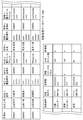
- FIG. 1 It is a figure which shows the structural example of a receipt management database. It is a figure which shows the structural example of a member database. It is a figure which shows the structural example of a point management database. It is a figure which shows the structural example of a point provision pattern. It is a figure which shows the example of the recipient registration screen displayed on an addressee terminal. It is a figure which shows the example of the receipt information registration screen displayed on a recipient terminal.
- FIG. 1 is a diagram showing a configuration of a package management system according to an embodiment of the present invention.
- the package management system includes a delivery center device 100 installed in a delivery center 1 of a carrier, an addressee terminal 31 used by an addressee 3 that is an addressee of the package to be delivered, and an address for the package to be delivered. It has a recipient terminal 41 used by a recipient 4 who receives on behalf of the person 3.
- the addressee terminal 31 and the recipient terminal 41 are connected to the distribution center apparatus 100 through a communication line.
- the delivery center device 100 includes a delivery management system 110 and a receipt management system 150.
- the delivery management system 110 manages the status of delivery from the sender 2 to the destination of the package received.
- the receipt management system 150 manages the designation of the recipient 4 by the addressee 3 and the assignment of points to the recipient 4.
- the delivery management system 110 and the receipt management system 150 are configured by general computers, and can be configured by an on-premises environment illustrated in FIG. 2A or a cloud environment illustrated in FIG. 2B.
- FIG. 2A is a diagram illustrating a logical configuration of the distribution center device 100 (the distribution management system 110 and the reception management system 150) according to the present embodiment.
- the distribution center device 100 shown in FIG. 2A is configured in an on-premises environment. That is, the distribution center device 100 is configured by a computer having a central processing unit (processor, memory), an auxiliary storage device, and a communication interface.
- a central processing unit processor, memory
- auxiliary storage device e.g., a hard disk drive
- communication interface e.g., a wireless communication interface
- a processor is a processing device that executes a program stored in a memory.
- the memory includes a ROM that is a nonvolatile storage element and a RAM that is a volatile storage element.
- the ROM stores an immutable program (for example, BIOS).
- BIOS basic input/output
- the RAM is a high-speed and volatile storage element such as a DRAM (Dynamic Random Access Memory), and temporarily stores a program executed by the processor and data used when the program is executed.
- the processor implements a delivery management system 110, a reception management system 150, and a communication unit 120 by executing a program.
- the delivery management system 110 includes a delivery information processing unit 111.
- the delivery information processing unit 111 manages the delivery status of the package using the delivery management database 161.
- the receipt management system 150 includes a receipt information processor 151, an e-mail processor 152, a point processor 153, and a receipt key processor 154.
- the receipt information processing unit 151 manages the delivery status of the package, such as designation of the recipient 4 by the recipient 3, delivery status of the package to the recipient 4, and delivery of the package from the recipient 4 to the recipient 3.
- the e-mail processing unit 152 creates an e-mail to be notified to the addressee 3 and the recipient 4 and transmits it via the communication unit 120.
- the point processing unit 153 manages the points held by the recipient 4 using the point management database 163.
- the receipt key processing unit 154 generates a receipt key that the recipient 4 uses when receiving the package, and manages the granting of points to the recipient 4 using the receipt management database 164.
- the communication unit 120 controls communication via the network 200.
- the auxiliary storage device constitutes the storage unit 160, and is a large-capacity non-volatile storage device such as a magnetic storage device (HDD) or a flash memory (SSD), for example. Stores data used at times. That is, the program is read from the auxiliary storage device, loaded into the memory, and executed by the CPU.
- HDD magnetic storage device
- SSD flash memory
- the storage unit 160 stores a delivery management database 161, a member database 162, a point management database 163, and a receipt management database 164.
- the delivery management database 161 is a database that is used by the delivery management system 110 and records information on packages to be delivered (see FIG. 9).
- the member database 162 is a database in which information of persons (members) who become the destination 3 and the recipient 4 is recorded (see FIG. 11).
- the point management database 163 is a database for managing points given to members (see FIGS. 12 and 13).
- the receipt management database 164 is a database in which information of the recipient 4 is recorded for each package (see FIG. 10).
- the delivery center device 100 may have an input interface and an output interface.
- the input interface is an interface that is connected to a keyboard, a mouse, and the like and receives input from an operator.
- the output interface is an interface that is connected to a display device, a printer, and the like and outputs the execution result of the program in a form that can be visually recognized by the operator.
- the distribution center device 100 may have an input interface and an output interface, and may be connected to a terminal through which an operator inputs and outputs data.
- the communication interface is a network interface device (for example, NIC) that controls communication with other devices according to a predetermined protocol.
- NIC network interface device
- the program executed by the processor is provided to the distribution center device 100 via a removable medium (CD-ROM, flash memory, etc.) or a network, and is stored in a nonvolatile auxiliary storage device that is a non-temporary storage medium. For this reason, the distribution center device 100 may have an interface for reading data from a removable medium.
- FIG. 2B is a diagram showing another logical configuration of the delivery management system 110 and the receipt management system 150 of the present embodiment.
- the delivery management system 110 and the receipt management system 150 of the present embodiment can adopt a cloud environment shown in FIG. 2B in addition to the on-premises environment shown in FIG. 2A.
- the delivery management system 110 and the receipt management system 150 are computer systems that are physically configured on a single computer, or a plurality of logical or physical computers, and on a plurality of physical computer resources. It may operate on a virtual machine constructed in the above.
- the distribution center device 100 installed in the distribution center 1 includes a terminal device (personal computer, tablet terminal, and the like) that includes a central processing unit (processor, memory), an auxiliary storage device, a communication interface, an input interface, and an output interface. Smartphone).
- the delivery management system 110 and the receipt management system 150 shown in FIG. 2B are configured by a central processing unit (processor, memory) on a virtual machine configured by physical computer resources, an auxiliary storage device, and a communication interface.
- a central processing unit processor, memory
- a virtual machine configured by physical computer resources, an auxiliary storage device, and a communication interface.
- each processing unit and the configuration of each database in the delivery management system 110 and the receipt management system 150 shown in FIG. 2B are the same as those of the delivery management system 110 and the receipt management system 150 shown in FIG. Is omitted.
- the processor implements the delivery management system 110, the reception management system 150, and the communication unit 120 by executing a program stored in the memory.
- the delivery management system 110 includes a delivery information processing unit 111.
- the delivery information processing unit 111 uses the delivery management database 161 to manage the package delivery status.
- the receipt management system 150 includes a receipt information processing unit 151, an email processing unit 152, and a receipt key processing unit 154.
- the communication unit 120 controls communication via the network 200.
- the storage unit 160 stores a delivery management database 161, a member database 162, and a receipt management database 164.
- the delivery management system 110 and the receipt management system 150 are connected to the external system 130 via the communication unit 120.
- the external system 130 includes a point processing unit 153 and a point management database 163.
- the point processing unit 153 manages the points held by the recipient 4 using the point management database 163.
- the point management database 163 is a database for managing points given to members (see FIGS. 12 and 13).
- the external system 130 is configured to manage points.
- a separate external system may be configured to manage points.
- FIG. 3 is a diagram showing a logical configuration of the addressee terminal 31 and the addressee terminal 41 of the present embodiment.
- the addressee terminal 31 and the recipient terminal 41 have basically the same configuration, and a terminal device (personal computer, tablet terminal) configured by a processor (CPU), a memory, an auxiliary storage device, a communication interface, an input interface, and an output interface. , Smartphones, etc.).
- a processor is a processing device that executes a program stored in a memory.
- the memory includes a ROM that is a nonvolatile storage element and a RAM that is a volatile storage element.
- the ROM stores an immutable program (for example, BIOS).
- BIOS basic input/output
- the RAM is a high-speed and volatile storage element such as a DRAM (Dynamic Random Access Memory), and temporarily stores a program executed by the processor and data used when the program is executed.
- the processor implements the reception management system 310 and the communication unit 320 by executing the program.
- the receipt management system 310 is one or a plurality of application programs including a receipt information processing unit 311, an email processing unit 312, and a receipt key processing unit 313.
- the receipt information processing unit 311 processes designation of the recipient 4 by the addressee 3 and designation of the receipt location and the reception date / time by the recipient 4.
- the e-mail processing unit 312 receives an e-mail from the receipt management system 150.
- the e-mail processing unit 312 may be a normal mailer.
- the e-mail processing unit 312 is an application installed in the addressee terminal 31.
- the e-mail processing unit 312 may be an application adapted to the notification method.
- the receipt key processing unit 154 manages the receipt key transmitted from the receipt management system 150.
- the communication unit 320 controls communication via the network 200.
- the input interface is an interface that receives input from the operator, and includes a touch panel, a keyboard, a mouse, and the like.
- the output interface is an interface that outputs the execution result of the program in a format that can be visually recognized by the operator, and includes a display device, a printer, and the like.
- the communication interface is a network interface device that controls communication with other devices according to a predetermined protocol.
- the sender 2 designates the name, address, telephone number, e-mail address, and member ID of the addressee 3 as a delivery destination, and requests the carrier to deliver the package (21). Either the e-mail address or the member ID designated by the sender 2 may be used. If the name, address, telephone number, etc. are already registered in association with the e-mail address or member ID, and e-mail can be obtained from information such as name, address, telephone number, etc., e-mail The address and member ID can be omitted. That is, the e-mail address and the member ID specify a method of contacting the addressee 3 by electronic communication means (e-mail, SNS, short message, push notification, etc.), and are added as necessary. That's fine.
- electronic communication means e-mail, SNS, short message, push notification, etc.
- the delivery information processing unit 111 of the delivery management system 110 registers the package information in the delivery management database 161.
- the receipt management system 150 of the delivery center 1 obtains information on the package delivery request from the delivery information processing unit 111, and the e-mail processing unit 152 sends the package acceptance to the addressee 3.
- a mail is created and transmitted to the network 200 via the communication unit 120 to notify the addressee 3 (22).
- the addressee 3 designates the addressee 4 using the addressee terminal 31 and transmits it to the distribution center device 100 (23).
- the recipient 4 may be a third party different from the recipient 3 or three recipients.
- the recipient terminal 31 functions as the recipient terminal 41.
- the recipient 4 may be a member designated in advance as will be described later.
- the receipt information processing unit 151 of the receipt management system 150 registers the information of the recipient 4 in the receipt management database 164.
- the receiving key processing unit 154 generates a receiving key, and the receiving information processing unit 151 transmits the receiving key to the recipient terminal 41 (24).
- the receiving key may be, for example, a two-dimensional bar code (QR code is a registered trademark) such as a bar code or a QR code that can be displayed on the screen of the recipient terminal 41, and a combination of numbers and characters.
- the receiving key may be a bit string that can be stored in the recipient terminal 41.
- the recipient terminal 41 When accepting that the recipient 4 becomes the recipient 4, the recipient terminal 41 stores the receipt key transmitted from the receipt management system 150 in the storage device. Then, the recipient terminal 41 displays a receipt information registration screen (FIG. 14B) for designating the receipt location and receipt date and time, and prompts the input of the receipt location and receipt date and time. The recipient 4 inputs the receipt location and date / time of the package on the receipt information input screen and transmits it to the receipt management system 150 (24).
- a receipt information registration screen FIG. 14B
- the recipient terminal 41 discards the receiving key transmitted from the receiving management system 150 without storing it in the storage device, and transmits a receiving rejection message to the receiving management system 150.
- the delivery center 1 delivers the package and delivers it to the recipient 4 (26).
- the delivery person collates the receipt key stored in the recipient terminal 41, determines that the receipt key is correct, determines that the recipient 4 is a valid recipient 4, and delivers the package.
- a two-dimensional barcode such as a barcode or QR code displayed on the screen of the recipient terminal 41
- a numeric string or a character string is read by a deliveryman's terminal, or delivered to the recipient terminal 41.
- the delivery member's terminal may read the receipt key stored in the recipient terminal 41 by connecting the worker's terminal with infrared communication or near field communication (for example, Bluetooth (Bluetooth is a registered trademark)).
- the delivery information processing unit 111 of the delivery management system 110 updates the status of the delivery management database 161.
- the receipt information processing unit 151 of the receipt management system 150 updates the receipt status flag in the receipt management database 164.
- the receipt information processing unit 151 of the receipt management system 150 When delivery to the recipient 4 is completed, the receipt information processing unit 151 of the receipt management system 150 notifies the recipient 3 of the completion of delivery (27). The addressee 3 can know that the package has arrived at the recipient 4 by the delivery completion notification.
- the recipient 4 delivers the received package to the destination 3 (28).
- the recipient 3 receives the package from the recipient 4 and then inputs the package receipt information to the recipient terminal 31.
- the addressee terminal 31 transmits a report of receipt of the input package to the receipt management system 150 (29).
- the receipt information processing unit 151 of the receipt management system 150 updates the receipt status flag of the receipt management database 164, and the delivery information processing unit 111 of the delivery management system 110 updates the status of the delivery management database 161.
- the point processing unit 153 of the receipt management system 150 refers to the point grant pattern table 165 (FIG. 13), determines the points to be given to the recipient 4,
- the management database 163 is updated (30).
- the addressee 3 evaluates the recipient 4 according to the contents of the delivery completion notification (31), inputs the evaluation result to the addressee terminal 31, and transmits it to the receipt management system 150.
- the receipt information processing unit 151 of the receipt management system 150 updates the average evaluation value of the member database 162.
- the notification described above is not an e-mail, but a message by SNS (Simple Notification Service), a short message specifying a transmission destination by the phone number of the mobile phone terminal, a push notification to an application installed on the terminal, etc. May be used.
- SNS Simple Notification Service
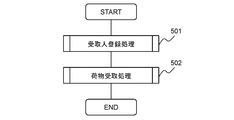
- FIG. 4 is a flowchart showing an outline of processing executed by the receipt management system 150.
- the receipt management system 150 Upon receipt of the delivery request information from the delivery management system 110, the receipt management system 150 activates a recipient registration process 501.
- the recipient registration process 501 the addressee 3 is notified of receipt of the package and the designation of the recipient 4 is accepted. Then, the recipient 4 registers the delivery request, and the recipient terminal 41 stores the receipt key, thereby confirming the recipient 4.
- the receipt management system 150 activates the package receipt process 502.
- the package receipt processing 502 after the receipt key stored in the recipient terminal 41 is collated, the recipient 4 receives the package and transmits a receipt completion notice by the recipient 4 to the destination terminal 31.
- the addressee 3 delivers the package from the addressee 4 to the addressee 3
- the addressee terminal 31 transmits a receipt completion notification by the addressee 3 to the receipt management system 150.
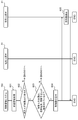
- FIG. 5 is a sequence diagram of the recipient registration processing 501 and shows the processing when the addressee 3 and the recipient 4 are registered before the package delivery request.
- the receipt information processing unit 151 of the receipt management system 150 acquires the delivery request information from the delivery management system 110 (601).
- the received information processing unit 151 determines whether the addressee 3 is registered in the member database 162 (602). If the addressee 3 is not registered in the member database 162, the process proceeds to step 611 in FIG. On the other hand, if the member ID of the addressee 3 is registered in the member database 162, the receiving information processing unit 151 registers the member ID, receiving location, and scheduled receiving date of the addressee 4 of the addressee 3 in the member database 162. It is determined whether it is done (603). Note that the addressee 3 itself may be registered as the recipient 4. In this case, the addressee 3 itself receives the package, and the addressee terminal 31 also functions as the addressee terminal 41.
- the process proceeds to step 611 in FIG.
- the receipt key processing unit 154 generates a receipt key and transmits the generated receipt key to the recipient terminal 41 (604).
- the recipient terminal 41 stores the receipt key transmitted from the receipt management system 150 in the nonvolatile memory (605).
- FIG. 6 is a sequence diagram of the recipient registration process 501 and shows a process in which the information of the recipient 4 is registered after a package delivery request.
- step 602 or 603 of the recipient registration process 501 (FIG. 5), that is, the recipient 3 is not registered in the member database 162, or the recipient 4, the recipient 4 of the recipient 3, the receiving location and the scheduled date of receipt are members. If it is not registered in the database 162, the receipt information processing unit 151 determines whether the e-mail address of the addressee 3 is registered in the delivery management database 161 (611). If the e-mail address of the addressee 3 is not registered in the delivery management database 161, the addressee 3 cannot be contacted. Therefore, the recipient registration process 501 is terminated and the package is set as normal delivery.
- the e-mail processing unit 152 transmits a package acceptance mail to the addressee 3 (612).
- the addressee terminal 31 when the e-mail processing unit 312 receives the package acceptance mail, the addressee terminal 31 determines whether the addressee 3 is a member (613). If the destination person 3 is already a member, the process proceeds to step 616. On the other hand, if the addressee 3 is not a member, the addressee terminal 31 displays a member registration information input screen and accepts the member registration of the addressee 3 (614). If the addressee 3 does not wish to register as a member, the subsequent processing cannot be executed. Therefore, the recipient registration processing 501 is terminated and the package is returned to normal delivery.
- the data that the addressee 3 desires to register as a member and is input to the member registration information input screen is transmitted from the addressee terminal 31 to the receipt management system 150 (615).
- the receipt information processing unit 151 of the receipt management system 150 registers the member information received from the addressee terminal 31 in the member database 162.
- the receipt information processing unit 311 of the addressee terminal 31 displays the recipient registration screen (FIG. 14A) and accepts the recipient 4 and the receipt deadline (616). Since the subsequent processing cannot be executed unless the recipient 3 inputs the recipient and the receipt deadline, the recipient registration processing 501 is terminated and the package is set as normal delivery. On the other hand, the addressee terminal 31 transmits information about the addressee 4 and the receipt time limit that the addressee 3 entered on the addressee registration screen to the receipt management system 150.
- the receipt management system 150 When the receipt management system 150 receives the recipient 4 and the receipt deadline information, the receipt information processing unit 151 of the receipt management system 150 refers to the member database 162 to identify the recipient 4 input by the addressee 3, Information about the recipient 4 is registered in the receipt management database 164.
- the receipt key processing unit 154 of the receipt management system 150 generates a receipt key to be transmitted to the recipient 4 and registers it in the receipt management database 164.
- the e-mail processing unit 152 of the receipt management system 150 creates an e-mail notifying that it has been designated as the recipient 4 and sends it to the recipient terminal 41 together with the receipt key generated by the receipt key processing unit 154 ( 617).
- the receipt key processing unit 313 stores the received receipt key in the memory (618).
- the recipient information processing unit 311 in the recipient terminal 41 determines whether the recipient 4 is a member (613). If the recipient 4 is already a member, the process proceeds to step 622. On the other hand, if the recipient 4 is not a member, the recipient terminal 41 displays a member registration information input screen and accepts the membership registration of the recipient 4 (620). If the recipient 4 does not wish to register as a member, the subsequent processing cannot be executed. Therefore, the recipient registration processing 501 is terminated, and the package is returned to normal delivery. At this time, the recipient terminal 41 discards the received receipt key.
- the data that the recipient 4 desires to register as a member and is entered on the member registration information input screen is transmitted from the recipient terminal 41 to the receipt management system 150 (621).
- the receipt information processing unit 151 of the receipt management system 150 registers the member information received from the recipient terminal 41 in the member database 162.
- the receipt information processing unit 311 of the recipient terminal 41 displays a receipt information registration screen (FIG. 14B) and accepts the receipt location and the receipt date and time (622). If the recipient 4 does not input the receipt location and the receipt date and time and refuses the receipt, the subsequent processing cannot be executed. Therefore, the recipient registration processing 501 is terminated and the package is set as normal delivery. On the other hand, the recipient terminal 41 transmits information on the receipt location and receipt date and time input by the recipient 4 to the receipt management system 150.
- the receipt management system 150 When the receipt management system 150 receives the information on the receipt location and the receipt date and time, the receipt information processing unit 151 of the receipt management system 150 registers the receipt location and the scheduled receipt date in the receipt management database 164 (623).
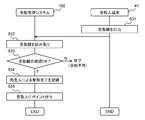
- FIG. 7 is a sequence diagram of the package receipt process 502, and shows the process when the addressee 3 is the recipient 4.
- the recipient 4 When the package is transported to the receiving location designated by the recipient 4 (addressee 3) (or when the recipient 4 goes to the delivery center 1 to receive the package), the recipient 4 follows the request of the deliveryman. Then, the recipient terminal 41 is operated to output the receipt key (631).
- the delivery member reads the receipt key output from the recipient terminal 41 using the terminal he / she possesses, and transmits it to the receipt management system 150 (632).
- the output of the receipt key from the recipient terminal 41 and the reading of the receipt key by the receipt management system 150 are a two-dimensional barcode such as a barcode or QR code displayed on the screen of the recipient terminal 41, a number
- the receiver terminal 41 is connected to the recipient terminal 41 by infrared communication or near field communication (for example, Bluetooth). You may read the receiving key stored in.
- the receipt key processing unit 154 of the receipt management system 150 collates the receipt key output from the recipient terminal 41 (633). If the receipt key is correct, the receipt key processing unit 154 determines that the receipt key processing unit 154 is a valid recipient 4 and removes the package. hand over. On the other hand, if the receipt key is not correct, it is determined that the recipient 4 is wrong, and the addressee 3 is notified of the failure to deliver the package to the recipient 4.
- the terminal of the delivery person may store the receipt key in advance, collate the receipt key output by the recipient terminal 41, and transmit the result of the comparison to the receipt management system 150.
- the delivery information processing unit 111 of the delivery management system 110 records the completion of receipt by the addressee 3 in the delivery management database 161 after the delivery member delivers the package.
- the receipt information processing unit 151 of the receipt management system 150 records the receipt completion by the addressee 3 in the receipt management database 164 (634).
- the point processing unit 153 of the receipt management system 150 gives points to the recipient 4 with reference to the point grant pattern table 165 and updates the point management database 163 (635).
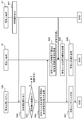
- FIG. 8 is a sequence diagram of the package receiving process 502, and shows a process when the addressee 3 and the addressee 4 are different.
- the recipient 4 When the package is transported to the receiving location designated by the recipient 4 (or when the recipient 4 goes to the distribution center 1 to receive the package), the recipient 4 receives the recipient's terminal 41 according to the request of the delivery person. To output the receiving key (641).
- the delivery member reads the receipt key output by the recipient 4 using the terminal he possesses, and transmits it to the receipt management system 150 (642).
- the receipt key processing unit 154 of the receipt management system 150 collates the receipt key output from the recipient terminal 41 (643). If the receipt key is correct, the receipt key processing unit 154 determines that the receipt key processing unit 154 is a valid recipient 4 and removes the package. hand over. On the other hand, when the receipt key is not correct, it is determined that the recipient 4 is wrong, and the destination 3 is notified accordingly.
- the delivery key is collated by the delivery person's terminal storing the receipt key in advance, collating the receipt key output by the recipient terminal 41, and transmitting the result of the collation to the receipt management system 150. Also good.
- the e-mail processing unit 152 of the receipt management system 150 transmits a receipt completion notice and a package receipt report request by the recipient 4 to the addressee terminal 31 (644).
- the receipt completion notification and the package receipt report request by the recipient 4 may include a link for a screen for the recipient 3 to input receipt completion and a link for a screen for entering the recipient evaluation.
- the e-mail processing unit 312 of the addressee terminal 31 receives the receipt completion notification and the package receipt report request by the recipient 4 (645).
- the addressee 3 When the addressee 3 delivers the package from the addressee 4, the addressee 3 operates the addressee terminal 31 and transmits a receipt report by the addressee 3 to the receipt management system 150 (646).
- the receipt information processing unit 151 of the receipt management system 150 records the receipt completion by the addressee 3 in the receipt management database 164. Further, the delivery information processing unit 111 of the delivery management system 110 records the completion of receipt by the addressee 3 in the delivery management database 161. Further, the point processing unit 153 of the receipt management system 150 gives points to the recipient 4 with reference to the point grant pattern table 165, and updates the point management database 163 (647).
- the addressee 3 operates the addressee terminal 31 and transmits a recipient evaluation result (648).
- the receipt information processing unit 151 of the receipt management system 150 updates the member database 162 using the received recipient evaluation result.
- FIG. 9 is a diagram illustrating a configuration example of the delivery management database 161.
- the delivery management database 161 is a database that is used by the delivery management system 110 to record information on a package to be delivered, and includes a package ID, a sender name, a sender address, a sender telephone number, a destination person name, a destination person address, and a destination person. Includes phone number, recipient member ID, recipient email address, goods, estimated delivery date, status, and shipping.
- the package ID is a number for uniquely identifying the package to be delivered.
- the item is a type of contents of the package.
- the scheduled delivery date is the scheduled delivery date of the package.
- the status is the status of delivery of the package.
- the postage is a delivery fee for the package.
- FIG. 10 is a diagram showing a configuration example of the receipt management database 164. As shown in FIG. 10
- the receipt management database 164 is a database in which information of the recipient 4 is recorded for each package.
- the package ID, the recipient name, the recipient address, the recipient phone number, the recipient member ID, the recipient e-mail address, the recipient It includes name, recipient telephone number, recipient member ID, recipient email address, recipient location, scheduled receipt date, receipt key, receipt status flag, number of granted points, and evaluation value.
- the package ID is a number for uniquely identifying the package to be delivered.
- the receiving place and the scheduled receiving date are the place and date where the recipient 4 wishes to receive the package, respectively.
- the receipt key is a key that is collated when the package is received.
- the receipt status flag is data indicating whether the recipient 4 has received the package.
- the number of granted points is the number of points given to the recipient 4 by receiving the package.
- the evaluation value is a result of evaluation of the recipient 4 input by the addressee 3 in transporting the package.
- the receipt management database 164 is configured separately from the delivery management database 161, but may be configured as one database together with the delivery management database 161.
- FIG. 11 is a diagram illustrating a configuration example of the member database 162.
- the member database 162 is a database in which information of the person (member) who becomes the addressee 3 and the recipient 4 is recorded.
- a person telephone number, a recipient member ID, a recipient e-mail address, a receiving place, a scheduled receiving date, and an average evaluation value are included.
- the member ID is a number for uniquely identifying the member.
- the designated collection / delivery center is a collection / delivery center used for delivering packages to the member.
- the recipient name, recipient telephone number, recipient member ID, and recipient email address are the recipient name, phone number, member ID, and email address designated by the member in advance.
- the receiving place and the scheduled receiving date are the place where the recipient 4 receives the package and the date on which it can be received. Note that the scheduled receipt date may be a date and time in the future that designates a period during which the recipient 4 can receive the package (for example, from 10:00 to 12:00 on Thursday).
- the average evaluation value is an average value of results obtained by evaluating the member in the past.
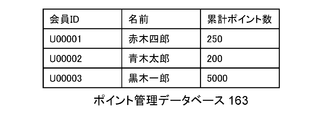
- FIG. 12 is a diagram illustrating a configuration example of the point management database 163.
- the point management database 163 is a database for managing points given to members, and includes a member ID, a name, and a cumulative number of points.
- the member ID is a number for uniquely identifying the member.
- the cumulative number of points is a cumulative value of the number of points given to the member.
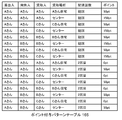
- FIG. 13 is a diagram illustrating a configuration example of the point grant pattern table 165.
- the point grant pattern table 165 is a database in which patterns of points to be granted are registered and referred to when giving points to members, and includes a sender, a recipient, a recipient, a receiving place, the number of deliveries, and points. .
- the point grant pattern table 165 may be configured as a separate table in the point management database 163 or may be configured separately from the point management database 163.
- the number of deliveries is the addressee 3 or recipient in the first delivery, or in the second and subsequent deliveries (when the recipient 3 and recipient 4 are absent in the first delivery). 4 is shown.
- the point is the number of points given in a combination of the sender, the recipient, the recipient, the receiving place, and the number of deliveries.
- the first delivery is given more points than the second and subsequent deliveries, and the points received at the center are given more points than those received at home.
- FIG. 14A is a diagram showing an example of a recipient registration screen displayed on the addressee terminal 31.
- the recipient registration screen is displayed by operating the link included in the package acceptance mail.
- the recipient registration screen includes a recipient email address entry field, a recipient evaluation display area, a receipt expiration date entry field, a cancel button, an evaluation display button, and a confirmation button.
- the addressee 3 designates the addressee 4 by inputting the e-mail address of the addressee 4 on the addressee registration screen, and acquires the average evaluation value of the member stored in the member database 162 by operating the evaluation display button.
- the inputted evaluation of the recipient 4 can be displayed in the recipient evaluation display area.
- the addressee 3 designates the time limit for receipt by the addressee 4, operates the confirm button, and transmits the input information of the addressee 4 from the addressee terminal 31 to the receipt management system 150.
- the normal home delivery can be selected by operating the cancel button.
- the addressee 3 can receive the package by himself / herself by designating him / her as a recipient.
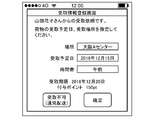
- FIG. 14B is a diagram showing an example of a receipt information registration screen displayed on the recipient terminal 41.
- the receipt information registration screen is displayed by selecting the link included in the recipient designation notification email.
- the receipt information registration screen includes a receiving location input field, a scheduled receiving date input field, a receiving time zone input field, a non-receivable button, and a confirm button.
- the recipient 4 On the receipt information registration screen, the recipient 4 inputs a place where the package is desired to be received, a date when the package is desired to be received, and a time period when the recipient is desired to receive, operates the confirm button, and receives the input information. Transmits to the receipt management system 150.
- the receipt information processing unit 151 of the receipt management system 150 deletes the recipient information from the receipt management database 164, and the e-mail processing unit 152 of the receipt management system 150 causes the designated recipient 4 to receive the package.
- the recipient terminal 31 is notified by e-mail that it cannot be received, and further the registration of the recipient 4 is prompted.
- the receipt management system 150 notifies the addressee terminal 31 of acceptance of the package delivered to the addressee 3, and the addressee terminal 31 receives the input receipt.
- the information of the person 4 is transmitted to the receipt management system 150, and after the delivery of the package to the recipient 4 is completed, the receipt management system 150 records the information on the completion of the delivery of the package to the recipient 4. Since a predetermined point is given to the recipient 4 after the package is delivered to the person 3, the recipient 4 can receive the package on behalf of the recipient 3 even when the addressee 3 is not present. Can be reduced. In addition, the recipient 4 can benefit from the points.
- the receipt management system 150 transmits a receipt key to the recipient terminal 41 specified based on the information of the recipient 4 designated by the recipient 3, and the recipient terminal 41 stores the received receipt key in the storage device. After storing and collating the receipt key output from the recipient terminal 41, the package is delivered to the recipient 4, and the receipt management system 150 records information on completion of delivery of the package to the recipient 4. The package can be delivered to the correct designated recipient 4.
- the receipt management system 150 since the receipt management system 150 notifies the recipient terminal 31 of the completion of delivery of the package to the recipient 4, the recipient 3 can be triggered to receive delivery of the package from the recipient 4.
- the receipt management system 150 updates the evaluation of the recipient 4 using the evaluation transmitted from the addressee terminal 31, and the addressee terminal 31 displays the evaluation of the addressee 4. An index for selecting the person 4 can be presented.
- the receipt management system 150 stores a point grant pattern table 165 that is referred to when determining the points to be given to the recipient 4 and includes at least the receipt location, the number of times of delivery, and the points given to the recipient 4.
- a point grant pattern table 165 it is defined that a high point is given when the receiving place is the center and a high point is given when the parcel is received in the first delivery.
- the receipt management system 150 stores a member database 162 in which candidates for the recipient 4 can be registered when each member becomes the addressee 3, and the candidate for the recipient 4 is registered in the member database 162. Since the registered recipient is the recipient 4 of the package without collecting the recipient 4 information from the recipient's terminal 31, the recipient 4 can save the trouble and receive the package on behalf of the recipient 4. Can be realized.
- the present invention is not limited to the above-described embodiments, and includes various modifications and equivalent configurations within the scope of the appended claims.
- the above-described embodiments have been described in detail for easy understanding of the present invention, and the present invention is not necessarily limited to those having all the configurations described.
- a part of the configuration of one embodiment may be replaced with the configuration of another embodiment.
- another configuration may be added, deleted, or replaced.
- each of the above-described configurations, functions, processing units, processing means, etc. may be realized in hardware by designing a part or all of them, for example, with an integrated circuit, and the processor realizes each function. It may be realized by software by interpreting and executing the program to be executed.
- Information such as programs, tables, and files that realize each function can be stored in a storage device such as a memory, a hard disk, and an SSD (Solid State Drive), or a recording medium such as an IC card, an SD card, and a DVD.
- a storage device such as a memory, a hard disk, and an SSD (Solid State Drive), or a recording medium such as an IC card, an SD card, and a DVD.
- control lines and information lines indicate what is considered necessary for the explanation, and do not necessarily indicate all control lines and information lines necessary for mounting. In practice, it can be considered that almost all the components are connected to each other.
Landscapes
- Business, Economics & Management (AREA)
- Engineering & Computer Science (AREA)
- Strategic Management (AREA)
- Economics (AREA)
- Development Economics (AREA)
- Entrepreneurship & Innovation (AREA)
- General Physics & Mathematics (AREA)
- Finance (AREA)
- Accounting & Taxation (AREA)
- Marketing (AREA)
- Physics & Mathematics (AREA)
- General Business, Economics & Management (AREA)
- Theoretical Computer Science (AREA)
- Game Theory and Decision Science (AREA)
- Human Resources & Organizations (AREA)
- Operations Research (AREA)
- Quality & Reliability (AREA)
- Tourism & Hospitality (AREA)
- Management, Administration, Business Operations System, And Electronic Commerce (AREA)
Abstract
L'invention concerne un système de gestion de réception qui gère des informations qui concernent la réception d'un colis, ledit système comprenant : un processeur qui exécute un programme ; et un dispositif de stockage qui est connecté au processeur. Étant capable d'accéder à une base de données de gestion de points pour gérer des points qui sont attribués à des réceptionnaires, le système de gestion de réception : notifie à un terminal destinataire qu'un colis envoyé au destinataire peut être réceptionné ; reçoit des informations relatives à un réceptionnaire qui a été entré dans le terminal destinataire ; après livraison du colis au réceptionnaire, enregistre des informations concernant la livraison de colis effectuée au réceptionnaire ; et après le transfert du colis du réceptionnaire au destinataire, met à jour la base de données de gestion de points de façon à attribuer des points prescrits au réceptionnaire.
Applications Claiming Priority (2)
| Application Number | Priority Date | Filing Date | Title |
|---|---|---|---|
| JP2016246182A JP2018101232A (ja) | 2016-12-20 | 2016-12-20 | 受取管理システム、荷物管理システム及び荷物受取情報管理方法 |
| JP2016-246182 | 2016-12-20 |
Publications (1)
| Publication Number | Publication Date |
|---|---|
| WO2018116571A1 true WO2018116571A1 (fr) | 2018-06-28 |
Family
ID=62627262
Family Applications (1)
| Application Number | Title | Priority Date | Filing Date |
|---|---|---|---|
| PCT/JP2017/035635 Ceased WO2018116571A1 (fr) | 2016-12-20 | 2017-09-29 | Système de gestion de réception, système de gestion de colis et procédé de gestion d'informations de réception de colis |
Country Status (2)
| Country | Link |
|---|---|
| JP (1) | JP2018101232A (fr) |
| WO (1) | WO2018116571A1 (fr) |
Cited By (1)
| Publication number | Priority date | Publication date | Assignee | Title |
|---|---|---|---|---|
| WO2024005088A1 (fr) * | 2022-06-30 | 2024-01-04 | 株式会社エアロネクスト | Système de traitement d'informations, dispositif de traitement d'informations, procédé de traitement d'informations et programme |
Families Citing this family (11)
| Publication number | Priority date | Publication date | Assignee | Title |
|---|---|---|---|---|
| JP6943817B2 (ja) * | 2018-07-12 | 2021-10-06 | Kddi株式会社 | 配達管理装置及び配達管理方法 |
| JP7394508B2 (ja) * | 2018-07-20 | 2023-12-08 | Lineヤフー株式会社 | 配送管理装置、配送管理方法および配送管理プログラム |
| WO2020040205A1 (fr) * | 2018-08-24 | 2020-02-27 | ブラザー工業株式会社 | Dispositif d'impression |
| JP2020154572A (ja) * | 2019-03-19 | 2020-09-24 | 三協立山株式会社 | 宅配ロッカーによる配達及び集荷システム |
| JP7530620B2 (ja) * | 2019-05-29 | 2024-08-08 | 株式会社ナビタイムジャパン | 情報処理システム、情報処理プログラム、情報処理装置および情報処理方法 |
| JP2020193911A (ja) * | 2019-05-29 | 2020-12-03 | 株式会社ナビタイムジャパン | 情報処理システム、情報処理プログラム、情報処理装置および情報処理方法 |
| JP6693637B1 (ja) * | 2019-06-27 | 2020-05-13 | 株式会社PicUApp | 配達依頼システム、配達依頼方法、および配達依頼プログラム |
| CN113191702A (zh) * | 2020-01-14 | 2021-07-30 | 北京京东振世信息技术有限公司 | 信息处理方法、装置、系统和计算机可读存储介质 |
| JP2022066072A (ja) * | 2020-10-16 | 2022-04-28 | Yper株式会社 | 情報処理装置 |
| JP7754633B2 (ja) * | 2021-03-25 | 2025-10-15 | 株式会社サトー | 情報処理システム、情報処理方法 |
| JP7111398B1 (ja) | 2021-12-01 | 2022-08-02 | 株式会社Nice Eze | 配送方法、およびアロケーションサーバ |
Citations (5)
| Publication number | Priority date | Publication date | Assignee | Title |
|---|---|---|---|---|
| JP2002324116A (ja) * | 2001-04-25 | 2002-11-08 | Nikon Gijutsu Kobo:Kk | 荷物の配送方法、及びその為の装置 |
| JP2003040458A (ja) * | 2001-07-24 | 2003-02-13 | Nec Eng Ltd | 宅配便受取確認システム |
| JP2006505045A (ja) * | 2002-10-29 | 2006-02-09 | シンボル テクノロジーズ インコーポレイテッド | 配達プロセスにおける生体認証システムおよび方法 |
| JP2007323259A (ja) * | 2006-05-31 | 2007-12-13 | Sato Corp | 配送物管理システム |
| JP2012248115A (ja) * | 2011-05-30 | 2012-12-13 | Japan Post Service Co Ltd | ポイント管理システム、ポイント管理方法及びポイント管理プログラム |
Family Cites Families (1)
| Publication number | Priority date | Publication date | Assignee | Title |
|---|---|---|---|---|
| US20140052661A1 (en) * | 2012-08-20 | 2014-02-20 | Jonathan J. Shakes | Customer centric pickup locations |
-
2016
- 2016-12-20 JP JP2016246182A patent/JP2018101232A/ja active Pending
-
2017
- 2017-09-29 WO PCT/JP2017/035635 patent/WO2018116571A1/fr not_active Ceased
Patent Citations (5)
| Publication number | Priority date | Publication date | Assignee | Title |
|---|---|---|---|---|
| JP2002324116A (ja) * | 2001-04-25 | 2002-11-08 | Nikon Gijutsu Kobo:Kk | 荷物の配送方法、及びその為の装置 |
| JP2003040458A (ja) * | 2001-07-24 | 2003-02-13 | Nec Eng Ltd | 宅配便受取確認システム |
| JP2006505045A (ja) * | 2002-10-29 | 2006-02-09 | シンボル テクノロジーズ インコーポレイテッド | 配達プロセスにおける生体認証システムおよび方法 |
| JP2007323259A (ja) * | 2006-05-31 | 2007-12-13 | Sato Corp | 配送物管理システム |
| JP2012248115A (ja) * | 2011-05-30 | 2012-12-13 | Japan Post Service Co Ltd | ポイント管理システム、ポイント管理方法及びポイント管理プログラム |
Cited By (3)
| Publication number | Priority date | Publication date | Assignee | Title |
|---|---|---|---|---|
| WO2024005088A1 (fr) * | 2022-06-30 | 2024-01-04 | 株式会社エアロネクスト | Système de traitement d'informations, dispositif de traitement d'informations, procédé de traitement d'informations et programme |
| JP2024005385A (ja) * | 2022-06-30 | 2024-01-17 | ココネット株式会社 | 情報処理システム、情報処理装置、情報処理方法及びプログラム |
| JP7754427B2 (ja) | 2022-06-30 | 2025-10-15 | セイノーラストワンマイル株式会社 | 情報処理システム、情報処理装置、情報処理方法及びプログラム |
Also Published As
| Publication number | Publication date |
|---|---|
| JP2018101232A (ja) | 2018-06-28 |
Similar Documents
| Publication | Publication Date | Title |
|---|---|---|
| WO2018116571A1 (fr) | Système de gestion de réception, système de gestion de colis et procédé de gestion d'informations de réception de colis | |
| US20210312529A1 (en) | Systems and methods for controlling updates to booking data | |
| JP4927375B2 (ja) | 荷物の配達完了通知方法 | |
| JP4130311B2 (ja) | お届け事前通知方法及び配達日時変更依頼受付方法 | |
| JP3925609B2 (ja) | 配送伝票作成装置および配送伝票 | |
| JP2022009751A (ja) | 在庫管理装置、在庫管理方法及びプログラム | |
| US20150026138A1 (en) | Systems, methods, and computer program products for modifying and deleting data from a mobile device | |
| JP7489361B2 (ja) | 情報処理システム、及び情報処理装置 | |
| JP2016115083A (ja) | 物流事業における配達システム、配達先情報管理サーバ及びプログラム | |
| JP4925850B2 (ja) | 配達受領証明システム | |
| JP7327741B2 (ja) | 郵便局の転居情報管理システムにおけるサーバ、方法及びプログラム | |
| JPH11191083A (ja) | 電子メールの配達方法およびメールサーバー | |
| EP1408431A1 (fr) | Systeme et procede de transmission | |
| KR101854394B1 (ko) | 개인경비 이중 공제 방지 시스템, 방법 및 컴퓨터 프로그램 | |
| JP4666939B2 (ja) | ネット利用宅配システム及び配達希望日時依頼受付方法 | |
| JP4344605B2 (ja) | 文書送受信システムおよび送受信制御プログラム | |
| JP4397926B2 (ja) | 贈与仲介システムおよびその方法 | |
| JP2021140719A (ja) | 在庫管理装置、在庫管理方法、及び在庫管理プログラム | |
| JP7443299B2 (ja) | 情報処理装置 | |
| JP5382753B1 (ja) | 通信端末を利用した情報提供及び収集システム | |
| JP4593931B2 (ja) | 配達情報システム | |
| JP2011134265A (ja) | ドキュメント管理システム、ドキュメント管理方法、およびドキュメント管理プログラム | |
| JP2021140660A (ja) | 輸送支援システム、輸送支援方法、及び輸送支援プログラム | |
| JP3948969B2 (ja) | 贈与仲介システムおよびその方法 | |
| JP4859506B2 (ja) | 送付物受領代行管理装置 |
Legal Events
| Date | Code | Title | Description |
|---|---|---|---|
| 121 | Ep: the epo has been informed by wipo that ep was designated in this application |
Ref document number: 17883648 Country of ref document: EP Kind code of ref document: A1 |
|
| NENP | Non-entry into the national phase |
Ref country code: DE |
|
| 122 | Ep: pct application non-entry in european phase |
Ref document number: 17883648 Country of ref document: EP Kind code of ref document: A1 |