WO2018123409A1 - Gant - Google Patents
Gant Download PDFInfo
- Publication number
- WO2018123409A1 WO2018123409A1 PCT/JP2017/042810 JP2017042810W WO2018123409A1 WO 2018123409 A1 WO2018123409 A1 WO 2018123409A1 JP 2017042810 W JP2017042810 W JP 2017042810W WO 2018123409 A1 WO2018123409 A1 WO 2018123409A1
- Authority
- WO
- WIPO (PCT)
- Prior art keywords
- layer
- glove
- touch screen
- finger
- glove according
- Prior art date
- Legal status (The legal status is an assumption and is not a legal conclusion. Google has not performed a legal analysis and makes no representation as to the accuracy of the status listed.)
- Ceased
Links
Images




Classifications
-
- A—HUMAN NECESSITIES
- A41—WEARING APPAREL
- A41D—OUTERWEAR; PROTECTIVE GARMENTS; ACCESSORIES
- A41D19/00—Gloves
-
- A—HUMAN NECESSITIES
- A41—WEARING APPAREL
- A41D—OUTERWEAR; PROTECTIVE GARMENTS; ACCESSORIES
- A41D19/00—Gloves
- A41D19/015—Protective gloves
-
- C—CHEMISTRY; METALLURGY
- C08—ORGANIC MACROMOLECULAR COMPOUNDS; THEIR PREPARATION OR CHEMICAL WORKING-UP; COMPOSITIONS BASED THEREON
- C08L—COMPOSITIONS OF MACROMOLECULAR COMPOUNDS
- C08L101/00—Compositions of unspecified macromolecular compounds
- C08L101/12—Compositions of unspecified macromolecular compounds characterised by physical features, e.g. anisotropy, viscosity or electrical conductivity
Definitions
- the present invention discloses a glove capable of operating a touch screen that performs an electronic reaction while wearing the glove.
- gloves for work.
- a worker in a factory wears gloves to cope with the work. This may be the case when handling objects that are dangerous with bare hands or prohibited to touch with bare hands. That is, there are cases where gloves are worn in order to increase the safety and accuracy of workers and work. Of course, gloves are also worn in terms of maintaining safety (operators and objects) while improving workability.
- gloves are worn for various purposes and scenes, such as sports, horticultural work, luggage transport work (for example, moving), light work, etc. All of them are for facilitating operation and work and maintaining safety such as hand protection.
- (Scene 1) A scene corresponding to the climate.
- (Scene 2) A scene used as one of fashion and fashion.
- (Scene 3) A scene where work is performed inside or outside the factory, construction, moving, or gardening.
- (Scene 4) A scene such as a sport.
- ⁇ Gloves are used in such various situations. Of course, it is not restricted to these.
- a factory operating panel may be in the form of a touch screen that may need to be operated.
- a tablet terminal may be used in a work manual or work report.
- tablet terminals may be used in various analyzes and examinations corresponding to such situations as in sports.
- the touch screen may or may not be operated in various scenes including the scenes 1 to 4 described above.
- gloves are worn in the scenes 1 to 4 described above. That is, it is necessary to remove the gloves and operate the touch screen with bare hands, or operate the touch screen while wearing the gloves.
- the touch screen is a device for operating electronic processing with a fingertip such as a touch panel.
- a first conductive portion 20 and a second conductive portion 22 are provided at the distal end portions of the thumb insertion portion 14a and the index finger insertion portion 14b forming the finger insertion portion 14, and the first conductive portion 20 and the second conductive portion 22 are provided.
- the 1st electroconductive part 20 and the 2nd electroconductive part 22 are the gloves currently formed in the area
- Patent Document 1 aims to operate a touch screen (reacts by conduction) while wearing a glove by providing a conductive part on the fingertip.
- Patent Document 1 only describes a conductive part, and providing such a conductive part on the fingertip of the glove deteriorates the workability of the fingertip. Or the fitting property at the time of wear will be worsened. For this reason, there exists a problem which reduces workability
- the main task is wearing gloves, and the time for operating the touch screen is small as a whole. There is a problem that it is not preferable to give priority to the operation of the touch screen in a short time and to reduce the wearability and workability in other time such as work.
- Patent Document 2 since the outer surface of the abdomen of the finger pouch 12 is covered with the external conductive layer 22 for conduction with a conduction object such as the touch panel 30, the tip abdomen of the finger pouch for conduction as in the prior art.
- the conductive thread is not sewed to form irregularities or sewing needle through holes.
- the conductive yarn 23 and the inner conductive layer 24 are arranged on the proximal side of the tip abdomen of the finger bag 12, even if the fingertip does not reach the tip abdomen of the finger bag 12, 12 discloses a glove capable of bringing a finger into contact with the conductive yarn 23 and the inner conductive layer 24 within the interior 12.
- Patent Document 2 proposes a glove that can operate a touch screen that reacts electronically even when the glove is worn by using a part of the fiber of the fiber glove as a conductive fiber.
- a glove sewn with conductive fibers has a problem that the conductivity is lowered due to the poor balance between the conductive fibers and the other non-conductive fibers, and the reaction of the touch screen is deteriorated.
- the conductivity is high, there is a problem that the conductive fibers are mainly used and the wearability and workability are deteriorated.
- the surface of the fiber glove may be coated for the purpose of protection or anti-skid, but the coating makes the conductivity between the conductive fiber and the touch screen worse, and the reaction is poor. There is also a problem.
- Patent Document 3 includes metal powder and / or conductive powder other than metal powder in the vicinity of palm-side tips of finger bags 2 and 3 that house at least the thumb and the index finger among the finger bags in golf glove body 1.
- a golf glove having a polyurethane resin elastic member 4 attached thereto is disclosed.
- Patent Document 3 discloses a glove that realizes an electronic reaction on a touch screen by mixing a conductive powder into a film to be a so-called coating.
- the conductive powder assumed in Patent Document 3 is a carbon powder or a metal oxide powder similar to this, and the film in which this is mixed inevitably becomes black.
- these conductive powders are mixed with the resin of a resin glove instead of the coating, it becomes black.
- Patent Document 3 has a problem that the color of the glove becomes black and color variations cannot be developed.
- the amount of conductive powder mixed is increased in order to increase the conductivity, there is a problem that the strength decreases.
- Patent Document 4 discloses an improved material for capacitive touch screens.
- the improved material includes a material impregnated with a composition comprising a non-metallic and / or metallic conductive agent and a binder.
- Various materials can be considered, including but not limited to leather.
- materials for use with capacitive touch screens that also disclose an apparatus and method for providing conductive gloves.
- Patent Document 4 is also intended to be able to operate a touch screen that reacts electronically by mixing conductive powder.
- Patent Document 4 has the same problem as Patent Document 3.
- Patent Document 4 enables the operation of the touch screen by generating a conductive bond with the touch screen by the layer using the conductive powder. .
- the hand inside the glove is electrically connected to the outside due to the conductive powder, and depending on the object touched by the glove, an electric current may reach the hand and cause an electric shock.
- Patent Documents 1 to 4 can operate a touch screen that performs an electronic reaction while wearing gloves, but have the following problems.
- the present invention has been made in view of such problems, and an object thereof is to provide a glove that can be operated while wearing an electronically responsive touch screen while ensuring safety and workability.
- the glove of the present invention includes an insulating first layer, A second layer outside the first layer and corresponding to at least the finger,
- the first layer has insulation from the outside to the hand
- the second layer is PEDOT / PSS (polyethylenedioxythiophene / polystyrene sulfonic acid), polyphenylene, polyacene, polydiacetylene, polyphenylene, polyanthracene, polyfuran, polyselenophene, polyaniline, polythienylene vinylene, polyphenanthrene, polyperiphthalene. Containing at least one of the following.
- the glove of the present invention can be operated with the touch screen while wearing the glove by applying a coating containing a conductive material to the fingertip. For this reason, even when normal work and operation using a touch screen are mixed, work efficiency is high. Or, even when wearing gloves for protection against the cold or fashion, it is very easy because the smartphone or tablet terminal can be operated at any time without removing the gloves.
- an electronic reaction of the touch screen can be generated, and since it does not conduct with the hand itself, it is possible to ensure electric resistance. For this reason, work safety can be ensured and it can be applied to work in a factory or outdoors.
- Embodiment 1 of the present invention It is a perspective view of the glove in Embodiment 1 of the present invention. It is a front view of the glove in Embodiment 1 of the present invention. It is explanatory drawing which shows the aspect which measures the electricity supply state of the glove and touch screen in Embodiment 2 of this invention. It is explanatory drawing which shows the aspect which measures the electricity supply state of the glove and touch screen in Embodiment 2 of this invention. It is explanatory drawing which shows the aspect which measures the electricity supply state of the glove and touch screen in Embodiment 2 of this invention. It is the experimental result which confirmed whether the touch screen responded in the state which mounted
- the glove according to the first invention of the present invention comprises an insulating first layer, A second layer outside the first layer and corresponding to at least the finger,
- the first layer has an insulating property from the outside to the hand
- the second layer includes PEDOT / PSS (polyethylenedioxythiophene / polystyrene sulfonic acid), polyphenylene, polyacene, polydiacetylene, polyphenylene, polyanthracene, polyfuran, polyselenophene, polyaniline, polythienylene vinylene, polyphenanthrene, polyperylene. Contains at least one of naphthalene.
- This configuration makes it possible to realize work requiring electrical resistance and the case where touch screen operation is required, while wearing gloves.
- the second layer is provided in the outermost layer.
- This configuration allows the second layer capable of generating capacitance to react directly with the touch screen.
- the second layer can contact a touch screen that reacts electronically.
- the second layer containing PEDOT / PSS capable of generating capacitance can reliably generate capacitance between the touch screen and the second layer. As a result, the touch screen can be operated.
- the second layer is provided on the distal end side from the first joint in the finger portion.
- This configuration can reduce the cost for forming the second layer while enabling the operation of the touch screen. Furthermore, the electric resistance during normal work can be improved.
- the second layer is formed only on the ventral side of the finger portion.
- This configuration can reduce the cost for forming the second layer while enabling the operation of the touch screen. Furthermore, the electric resistance during normal work can be improved. In particular, the cost for forming the second layer can be further reduced.
- the second layer is formed only on the finger portions of the thumb and the index finger.
- This configuration can reduce the cost for forming the second layer while enabling the operation of the touch screen. Furthermore, the electric resistance during normal work can be improved. In particular, the cost for forming the second layer can be further reduced.
- the second layer is formed only on the thumb, index finger and middle finger.
- This configuration can reduce the cost for forming the second layer while enabling the operation of the touch screen. Furthermore, the electric resistance during normal work can be improved. In particular, the cost for forming the second layer can be further reduced.
- the second layer has a non-slip function and is formed only in a region where the anti-slip is required in the glove.
- This configuration can reduce the cost for forming the second layer while enabling the operation of the touch screen. Furthermore, the electric resistance during normal work can be improved. In particular, the cost for forming the second layer can be further reduced.
- the second layer comprises NR (natural rubber), NBR (acrylonitrile butadiene rubber), PU (polyurethane), At least one of CR (chloroprene rubber), CSM (chlorosulfonated polyethylene), PVC (vinyl chloride), EVA (ethylene vinyl acetate), SBR (styrene butadiene rubber) and PEDOT / PSS (polyethylenedioxythiophene / polystyrene sulfonic acid) ), Polyphenylene, polyacene, polydiacetylene, polyphenylene, polyanthracene, polyfuran, polyselenophene, polyaniline, polythienylene vinylene, polyphenanthrene, and polyperiphthalene.
- NR natural rubber
- NBR acrylonitrile butadiene rubber
- PU polyurethane
- At least one of CR chloroprene rubber
- CSM chlorosulfonated polyethylene
- a second layer containing PEDOT / PSS can be formed.
- the wearability and gripping ability can be improved.
- PEDOT / PSS has a content rate of 1.6 wt% or more with respect to the entire second layer.
- This configuration can generate a sufficient capacitance for reacting the touch screen.
- the capacitance generated between the second layer and the finger surface is 2.0 pF / ⁇ 8 mm or more. is there.
- This configuration enables touch screen operation.
- the insulation resistance value of the second layer is 1 M ⁇ or less.
- This configuration enables touch screen operation.
- a stretchable fiber substrate is further provided inside the first layer.
- This configuration can further improve the wearability.
- the first layer and the second layer have different colors.
- This configuration allows the user to easily grasp the part of the glove that can operate the touch screen.
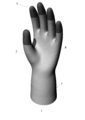
- FIG. 1 is a perspective view of a glove according to Embodiment 1 of the present invention.
- the glove 1 has a plurality of layer structures including a first layer 2 and a second layer 3.
- a second layer 3 is provided outside the first layer 2.
- the first layer 2 has an insulating property.
- the second layer 3 is provided outside the first layer 2 and at least at a site corresponding to the finger portion 6. In FIG. 1, the second layer 3 is provided on the palm 4 other than the wrist portion 7.
- the first layer 2 has an insulating property, and when the glove 1 is worn on the hand, the first layer 2 realizes an insulating property from the outside to the hand. For this reason, when a user works in a factory etc. using the glove 1, required insulation can be obtained.
- human bodies and members can be protected by static electricity, and human bodies can be protected by various energizations.
- the second layer 3 is provided outside the first layer 2.
- the second layer 3 is made of PEDOT / PSS (polyethylenedioxythiophene / polystyrenesulfonic acid), polyphenylene, polyacene, polydiacetylene, polyphenylene, polyanthracene, polyfuran, polyselenophene, polyaniline, polythienylene vinylene, polyphenanthrene. , Containing at least one of polyperinaphthalene.
- the second layer 3 Capacitance can be generated between the touch screen and the direct or indirect contact. Due to the generation of this capacitance, the second layer 3 can operate a touch screen that reacts when current is applied.
- the touch screen can react. This is because the touch screen generates a capacitance between the touch screen and the operated side, and reacts with the current by the capacitance.
- At least one of PEDOT / PSS, polyphenylene, polyacene, polydiacetylene, polyphenylene, polyanthracene, polyfuran, polyselenophene, polyaniline, polythienylene vinylene, polyphenanthrene, and polyperiphthalene produces this capacitance.
- the second layer 3 containing at least one of PEDOT / PSS, polyphenylene, polyacene, polydiacetylene, polyphenylene, polyanthracene, polyfuran, polyselenophene, polyaniline, polythienylene vinylene, polyphenanthrene, and polyperinaphthalene is formed from the PEDOT / PSS.
- the touch screen that operates can be operated.
- PEDOT / PSS polyphenylene, polyacene, polydiacetylene, polyphenylene, polyanthracene, polyfuran, polyselenophene, polyaniline, polythienylene vinylene, polyphenanthrene, and polyperiphthalene is used as necessary. It is written as “PEDOT / PSS etc.”.
- the first layer 2 has an insulating property and is inside the second layer 3. For this reason, even if the electrostatic capacity of the second layer 3 and the touch screen is generated, the energization of the hand worn by the first layer 2 can be shielded. That is, while the touch screen is operated using the glove 1, the hand is prevented from being energized by the capacitance, and the hand itself is not adversely affected by the energization.
- the glove 1 is provided with a second layer 3 containing PEDOT / PSS etc. outside the first layer 2 on the inner side of the first insulating layer 2, so that the touch reacts electrically with the maintenance of the insulating property. It is possible to achieve both screen operation. Since the inner side is insulative and the outer side is configured to generate capacitance, both of these can be realized. In particular, the glove 1 is optimal when it is necessary to operate the touch screen from time to time, while maintaining the general insulation is a priority.
- the glove 1 is a multi-layer structure of the insulating first layer 2 and the second layer 3 including PEDOT / PSS, etc., so that the operation of the touch screen that reacts electrically with the maintenance of the insulating property is performed. Can be realized.
- PEDOT / PSS etc. can realize the generation of capacitance with a small content.
- PEDOT / PSS etc. are light colors. Accordingly, the color of the second layer 3 is different from that of carbon powder, and the second layer 3 is not biased to a dark color such as black.
- the color of the second layer 3 can realize various variations. Due to the wide range of variations in color, the glove 1 can cope with everyday fashion and the color specified in factories.
- Gloves 1 can be applied to a wide range of uses, not just for specific purposes, due to wide variations in color.
- the glove 1 can also be applied for fashion use. Even when gloves are used in winter, it is easy to use as a fashion considering the balance with clothes. This is because color variations spread. Even when wearing gloves as a cold protection or fashion, it is required to achieve both electric resistance and touch panel operation, and the glove 1 can realize this without impairing the appearance as fashion.
- PEDOT / PSS polyphenylene, polyacene, polydiacetylene, polyphenylene, polyanthracene, polyfuran, polyselenophene, polyaniline, It may be grasped as explanation about any of polythienylene vinylene, polyphenanthrene, and polyperiphthalene.
- the second layer 3 is formed outside the first layer 2. Another layer may be provided on the outer layer of the second layer 3. In this case, it is necessary that the second layer 3 is a layer having a thickness, a material, and a structure that can generate a sufficient capacitance for the reaction of the touch screen between the second layer 3 and the touch screen. For example, a very thin layer is provided outside the second layer 3.
- the second layer 3 can generate a capacitance between the second layer 3 and the touch screen via the outer layer.
- the second layer 3 may be provided on the outermost layer.
- the second layer 3 can come into contact with a touch screen that reacts electrically (electronically). By this contact, the second layer 3 can generate a capacitance directly with the touch screen.
- the glove 1 can operate the touch screen due to the generation of these capacitances.
- the second layer 3 contains at least one of PEDOT / PSS, polyphenylene, polyacene, polydiacetylene, polyphenylene, polyanthracene, polyfuran, polyselenophene, polyaniline, polythienylene vinylene, polyphenanthrene, and polyperiphthalene. , Create a capacitance between the touch screen. This capacitance activates an electronically responsive touch screen. For this reason, the range in which the second layer 3 is formed is a range in which the touch screen can be operated.
- FIG. 2 is a front view of the glove according to Embodiment 1 of the present invention.
- the second layer 3 is formed on the first layer 2.
- the second layer 3 is formed on the distal end side of the first joint of the finger portion 6.
- the second layer 3 is provided on the distal end side of the first joint of the finger portion 6 corresponding to the fingertip. As shown in FIG. 2, the second layer 3 is formed on the distal end side from the first joint, so that the operation is not easily hindered.
- the formation range of the second layer 3 is small, there is an advantage that the cost required for PEDOT / PSS or the like can be reduced.
- the insulating property of the glove 1 whole can be improved because the 1st layer 2 of insulation is a main body in another range. High insulation improves safety in factory work.
- the second layer 3 is formed on the distal end side of the first joint of the finger 6, if the colors of the first layer 2 and the second layer 3 are different, the user can touch the touch screen at the fingertip. You will be able to easily understand what you can do.
- the second layer 3 is also preferably formed only on the ventral side of the finger part 6.
- the user who wears the glove 1 often operates by touching the ventral side (palm side) of the finger portion 6 to the touch screen. This is because it is easy to operate.
- the second layer 3 contains PEDOT / PSS or the like, thereby generating a capacitance between the second layer 3 and the electrodes provided in the touch screen. For this reason, the second layer 3 is formed in a portion that comes into contact with the touch screen, so that sufficient operation can be ensured.
- the second layer 3 is formed only on the ventral side of the finger 6, there is an advantage that the cost required for PEDOT / PSS or the like can be reduced. Moreover, shortening of the time etc. which are immersed in the raw material liquid at the time of forming the 2nd layer 3 is also obtained. Moreover, since the 2nd layer 3 is not formed in the back side of the finger part 6, the insulation capability of the back side of the finger part 6 increases more. The back side of the finger part 6 may touch an electrically conductive object during work or may cause electrostatic contact. Even in such a case, it is preferable that the second layer 3 is formed only on the ventral side of the finger 6.
- the second layer 3 is formed only on the finger portions 6 of the thumb and forefinger.
- a smartphone or a tablet terminal has a portion to be operated with a touch screen, and can often be operated only with a thumb and an index finger.
- the second layer 3 is formed only on the thumb and index finger. While the practicality in the operation of the touch screen is sufficient, the formation area of the second layer 3 can be reduced. By making it small, the cost required for PEDOT / PSS or the like can be reduced. Moreover, the process of forming the second layer 3 can be reduced.
- the second layer 3 may be formed only on the thumb, index finger, and middle finger.
- a smartphone or a tablet terminal has a portion and an operation method to be operated on a touch screen, and most operations can be performed with a thumb, an index finger, and a middle finger in many cases.
- the second layer 3 is formed only on the thumb, forefinger and middle finger. While the practicality in the operation of the touch screen is sufficient, the area of the second layer 3 can be reduced. By making it small, the cost required for PEDOT / PSS or the like can be reduced. Moreover, the process of forming the second layer 3 can be reduced.
- the second layer 3 is formed only on the palm 4 including the finger portion 6. Even if it is formed only on the palm 4 side, if it is formed on the finger part 6, it is sufficient for the operation of the touch screen. When the touch screen is large, the operation can be performed sufficiently if the second layer 3 is formed on the palm 4 side.
- the second layer 3 in various ranges, usability can be ensured while suppressing costs.
- the formation of the first joint above the first joint and the formation of the two to the four specific fingers may be combined. That is, the second layer 3 is formed only on the thumb and forefinger on the tip side from the first joint.
- the second layer 3 is composed of NR (natural rubber), NBR (acrylonitrile butadiene rubber), PU (polyurethane), CR (chloroprene rubber), CSM (chlorosulfonated polyethylene), PVC (vinyl chloride), EVA (ethylene vinyl acetate).
- SBR styrene butadiene rubber
- PEDOT / PSS polyphenylene, polyacene, polydiacetylene, polyphenylene, polyanthracene, polyfuran, polyselenophene, polyaniline, polythienylene vinylene, polyphenanthrene, polyperiphthalene. It is suitable to be formed of a material including one. By including PEDOT / PSS or the like in any of these materials, it is possible to expand the color variation while realizing the operation of the touch screen described above.
- the second layer 3 is formed reliably.
- the second layer 3 is formed by being immersed in the raw material liquid. Also in this respect, these materials are advantageous in that they can be easily immersed as a material liquid.
- the second layer 3 is formed of these materials. Of course, it is not intended to be limited to these.
- PEDOT / PSS may be contained at a content rate of 1.6 wt% or more with respect to the entire second layer. This is because, when the content is 1.6 wt% or more, the PEDOT / PSS can generate a sufficient capacitance for operation between the second layer 3 and the touch screen.
- the second layer 3 is formed by being immersed in a material liquid that forms the second layer.
- the outer shape of the glove 1 is configured by forming the first layer 2.
- the second layer 3 can be formed in a portion that has been immersed and dried.
- a material solution corresponding to the composition of the second layer is prepared, and when the first layer 2 is immersed in this material solution and dried, the portion is formed as the second layer 3. That is, the above-mentioned NR (natural rubber), NBR (acrylonitrile butadiene rubber), PU (polyurethane), CR (chloroprene rubber), CSM (chlorosulfonated polyethylene), PVC (vinyl chloride), EVA (ethylene vinyl acetate), SBR It is preferable that a material liquid containing PEDOT / PSS or the like is prepared in at least one of (styrene butadiene rubber). The 2nd layer 3 can be formed by being immersed in the raw material liquid which has this composition.
- the raw material liquid may be adjusted so that the content of PEDOT / PSS or the like is 1.6 wt% or more after drying.
- a raw material liquid having such a composition is prepared, and a necessary portion of the outer shape of the glove 1 formed by the first layer 2 is dipped. As described above, this is a range where the second layer 3 is to be formed. For example, only the finger part, only the ventral side of the finger part, above the first joint of the finger part, and only the thumb and index finger are immersed in the material liquid. By drying after this immersion, the second layer 3 can be formed in a desired range.
- the second layer 3 thus formed contains PEDOT / PSS or the like that sufficiently reacts with the touch screen, and a capacitance is generated between the second layer 3 and the touch screen. As a result, the glove 1 can operate the touch screen.
- the first layer 2 may be formed of a material having insulating properties. An insulating material solution may be prepared, and thereby the first layer may be formed.
- Embodiment 2 will be described.
- various additional devices and experimental results will be described.
- the second layer 3 may be formed on the palm 4 as shown in FIG. Even if it is not the whole palm 4, the 2nd layer 3 is formed in the ventral side of the finger
- the second layer 3 has a slip prevention function. Since the second layer 3 has the function of generating capacitance and the anti-slip function, it is possible to achieve both the operation of the touch screen and the improvement of the gripping force by the anti-slip.
- the second layer 3 may be formed in an area in the glove 1 that requires slip prevention. By doing so, the second layer 3 can realize both the slip prevention and the operation of the touch screen.
- first layer 2 (Inside the first layer) It is also preferable to further provide a stretchable fiber substrate inside the first layer 2. This is because a feeling of wearing is improved by providing a so-called work gloves-like fiber base on the inside. In this case, there is a fiber base on the inside, then the first layer 2 and the second layer 3 on the outside. With such a multilayer structure, it is possible to realize high wearability, electric resistance (insulation), and operation of the touch screen.
- the first layer 2 and the second layer 3 have different colors. This is because the user can grasp at a glance that the first layer 2 and the second layer 3 are provided because the colors are different.
- the second layer 3 is formed only on a part of the glove 1, the part on which the second layer 3 is formed can be grasped at a glance, and the user can grasp the part for operating the touch screen. it can. By this grasping, the touch screen can be operated while wearing the gloves 1 without any problem.
- the first layer 2 and the second layer 3 have different colors.
- FIGS. 3 to 5 are explanatory diagrams showing a mode of measuring the energization state between the glove and the touch screen according to the second embodiment of the present invention.
- an electronic panel corresponding to a touch screen and an electrode connected to the back surface of the electronic panel are prepared.
- the surface of the electronic panel (on the side opposite to the electrode) was checked by touching it with the hand of a person wearing or not wearing gloves. Through this confirmation, the necessary insulation resistance value of the second layer of the glove was measured.
- FIG. 3 shows a state in which the electronic panel is being touched with a hand that is not wearing gloves. At this time, a pseudo capacitor A is generated between the surface of the hand and the electrode of the electronic panel. The capacitance of the pseudo capacitor A indicates the capacitance generated between the surface of the hand and the electrode of the electronic panel.
- FIG. 4 shows a state in which the electronic panel is touched with a hand wearing normal gloves. At this time, a pseudo capacitor B is generated between the hand in the glove and the electrode of the electronic panel. The capacitance of the pseudo capacitor B indicates the capacitance generated between the hand in the glove and the electrode of the electronic panel.
- FIG. 5 shows a state in which the electronic panel is touched with a hand wearing a glove having the second layer of the present invention.
- a pseudo capacitor C is generated between the hand in the glove and the conductive second layer.
- a pseudo capacitor A (same as FIG. 3) is generated between the second layer and the electrode of the electronic panel so as to be connected to the pseudo capacitor C. In this way, a capacitance is generated between the second layer and the electronic panel, and the boundary of whether or not the electronic panel can be operated is determined.
- the glove of the present invention is divided into two places, that is, between the hand and the second layer and between the second layer and the electronic panel, due to the presence of the second layer, and the capacitance is generated. . If the total of these two capacitances is sufficient to operate the electronic panel, the touch screen can be operated with the gloves on, otherwise the touch screen cannot be operated.
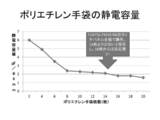
- FIG. 6 is a result of an experiment for confirming whether or not the touch screen reacts in a state where the polyethylene glove according to Embodiment 2 of the present invention is worn.
- FIG. 6 shows the number of polyethylene gloves worn on the hand on the horizontal axis.
- the vertical axis represents the capacitance between the hand and the touch screen.
- the capacitance on the vertical axis is the same as that of the pseudo capacitor C shown in FIG.
- FIG. 6 also reflects the result of searching for the number of touch screens that worsen by increasing the number of polyethylene gloves to be worn.
- “Fujitsu notebook PC FMVS76E” was used as a touch screen.
- the touch screen becomes difficult to react.
- the capacitance between the hand and the touch screen at this time is about 2 pF.
- the capacitance between the second layer and the touch screen was 2 pF / ⁇ 8 mm or more. ⁇ 8 mm indicates that the size of the fingertip portion in contact with the touch panel is a circle having an approximate diameter of 8 mm, and thus this size is regarded as the contact portion.
- the glove of the present invention can operate the touch screen while wearing the glove.
- FIG. 7 is a table showing experimental results for confirming the reaction between the glove and the touch screen according to the second embodiment of the present invention.
- FIG. 7 shows an experimental result in which a glove containing the second layer containing the PEDOT / PSS content is manufactured and the reaction state of the touch screen is verified.
- the glove and the touch screen react when the insulation resistance value of the second layer is 1 M ⁇ or less. That is, it was confirmed that the insulation resistance value of the second layer of the glove is 1 M ⁇ or less is a boundary at which the touch screen can be operated while wearing the glove.
- the content of PEDOT / PSS in the second layer is preferably 1.6 wt% or more. This is because, when the content ratio of PEDOT / PSS in the second layer is 1.6 wt% or more, the touch screen reacts while wearing gloves as shown in FIG. 7.
- the content rate of PEDOT / PSS in a dry state of a 2nd layer is 1.6 wt% or more.
- the second layer is often formed by immersing gloves in a liquid material, but not the content of PEDOT / PSS contained in this liquid material state, but after the second layer is formed and dried The content rate at is 1.6 wt% or more.
- the second layer contains PEDOT / PSS as an example, but other than PEDOT / PSS, polyphenylene, polyacene, polydiacetylene, polyphenylene, polyanthracene, polyfuran, polyselenophene, polyaniline, polythienylene.
- PEDOT / PSS polyphenylene, polyacene, polydiacetylene, polyphenylene, polyanthracene, polyfuran, polyselenophene, polyaniline, polythienylene.
- vinylene, polyphenanthrene, and polyperiphthalene are examples of the same.
- the second layer preferably has the following specifications.
- the capacitance between the second layer and the finger surface is 2 pF / ⁇ 8 mm or more.
- the insulation resistance value of the second layer is 1 M ⁇ or less.
- the content of PEDOT / PSS or the like in the second layer is 1.6 wt% or more in a state after being dried and formed as the second layer.
- the glove of the present invention can operate the touch screen while maintaining the necessary insulation while wearing the glove.
- the glove described in the first and second embodiments is an example for explaining the gist of the present invention, and includes modifications and alterations without departing from the gist of the present invention.
Landscapes
- Engineering & Computer Science (AREA)
- Textile Engineering (AREA)
- Chemical & Material Sciences (AREA)
- Health & Medical Sciences (AREA)
- Chemical Kinetics & Catalysis (AREA)
- Medicinal Chemistry (AREA)
- Polymers & Plastics (AREA)
- Organic Chemistry (AREA)
- Gloves (AREA)
- Compositions Of Macromolecular Compounds (AREA)
Abstract
Le problème décrit par la présente invention est de produite un gant avec lequel il est possible, une fois le gant mis, de faire fonctionner un écran tactile à réaction électronique tout en maintenant la sécurité et la maniabilité. La solution selon l'invention porte sur un gant qui est pourvu d'une première couche isolante et d'une seconde couche qui est la surface extérieure de la première couche et qui correspond à au moins la partie doigts. La première couche a des propriétés d'isolation d'une main vis-à-vis de l'extérieur, et la seconde couche contient au moins l'un parmi le PEDOT/PSS, le polyphénylène, le polyacène, le polydiacétylène, le polyphénylène, le polyanthracène, le polyfurane, le polysélénophène, la polyaniline, le polythiénylène vinylène, le polyphénanthrène et le poly-péraphtalène.
Applications Claiming Priority (2)
| Application Number | Priority Date | Filing Date | Title |
|---|---|---|---|
| JP2016252154A JP2018104843A (ja) | 2016-12-27 | 2016-12-27 | 手袋 |
| JP2016-252154 | 2016-12-27 |
Publications (1)
| Publication Number | Publication Date |
|---|---|
| WO2018123409A1 true WO2018123409A1 (fr) | 2018-07-05 |
Family
ID=62707302
Family Applications (1)
| Application Number | Title | Priority Date | Filing Date |
|---|---|---|---|
| PCT/JP2017/042810 Ceased WO2018123409A1 (fr) | 2016-12-27 | 2017-11-29 | Gant |
Country Status (2)
| Country | Link |
|---|---|
| JP (1) | JP2018104843A (fr) |
| WO (1) | WO2018123409A1 (fr) |
Citations (5)
| Publication number | Priority date | Publication date | Assignee | Title |
|---|---|---|---|---|
| JPS4895772U (fr) * | 1972-02-14 | 1973-11-14 | ||
| JPH0322014U (fr) * | 1989-07-10 | 1991-03-06 | ||
| JP2012529127A (ja) * | 2009-06-03 | 2012-11-15 | ジーエルティー テクノヴェーションズ、エルエルシー | 容量性タッチスクリーンと共に利用される材料 |
| JP2014099570A (ja) * | 2012-11-16 | 2014-05-29 | Nippon Mektron Ltd | 配線基板およびその製造方法、タッチパネルセンサシートならびにスクリーン印刷版 |
| JP2014230672A (ja) * | 2013-05-30 | 2014-12-11 | 株式会社レガン | ゴルフ用手袋 |
-
2016
- 2016-12-27 JP JP2016252154A patent/JP2018104843A/ja active Pending
-
2017
- 2017-11-29 WO PCT/JP2017/042810 patent/WO2018123409A1/fr not_active Ceased
Patent Citations (5)
| Publication number | Priority date | Publication date | Assignee | Title |
|---|---|---|---|---|
| JPS4895772U (fr) * | 1972-02-14 | 1973-11-14 | ||
| JPH0322014U (fr) * | 1989-07-10 | 1991-03-06 | ||
| JP2012529127A (ja) * | 2009-06-03 | 2012-11-15 | ジーエルティー テクノヴェーションズ、エルエルシー | 容量性タッチスクリーンと共に利用される材料 |
| JP2014099570A (ja) * | 2012-11-16 | 2014-05-29 | Nippon Mektron Ltd | 配線基板およびその製造方法、タッチパネルセンサシートならびにスクリーン印刷版 |
| JP2014230672A (ja) * | 2013-05-30 | 2014-12-11 | 株式会社レガン | ゴルフ用手袋 |
Also Published As
| Publication number | Publication date |
|---|---|
| JP2018104843A (ja) | 2018-07-05 |
Similar Documents
| Publication | Publication Date | Title |
|---|---|---|
| US20120324620A1 (en) | Device, System And Method For Multi-Layered Weatherproof Touchscreen Glove | |
| US20050231471A1 (en) | Hand covering features for the manipulation of small devices | |
| US10433984B2 (en) | Add-on capacitive touchscreen aid | |
| US8875315B2 (en) | Garment with exterior touch-sensitive features | |
| US8400256B2 (en) | Glove with a particularized electro-conductivity feature | |
| US9480291B2 (en) | Glove accessory | |
| US20160124508A1 (en) | Waterproof touchscreen glove | |
| US20130291280A1 (en) | Finger glove for electronics device | |
| CN204483154U (zh) | 一种手套 | |
| CN202680583U (zh) | 触摸屏手套 | |
| WO2012134154A2 (fr) | Gant, élément tactile, et substance conductrice en pulvérisation | |
| CN203483563U (zh) | 治疗腕部关节和肌肉劳损的电子腕套 | |
| WO2018123409A1 (fr) | Gant | |
| US20120098785A1 (en) | Garment with Touch-Sensitive Features | |
| JP2014230672A (ja) | ゴルフ用手袋 | |
| KR101181973B1 (ko) | 정전식 감응기구 조작이 가능한 장갑 | |
| US20150013044A1 (en) | Garment With Exterior Touch-Sensitive Features | |
| KR20120044676A (ko) | 정전용량식 터치스크린 조작용 장갑 | |
| KR101138035B1 (ko) | 정전 방식 터치 패널 입력용 장갑 | |
| JP2015032285A (ja) | タッチパネルに用いられるスタイラスペン | |
| WO2021087557A1 (fr) | Gant d'amélioration de la force manuelle | |
| JP2013019086A (ja) | 手袋 | |
| KR200474208Y1 (ko) | 스마트 터치 장갑 | |
| CN203152579U (zh) | 一种防水保暖的触屏手套 | |
| JP3177743U (ja) | 静電容量式タッチパネル操作用手袋 |
Legal Events
| Date | Code | Title | Description |
|---|---|---|---|
| 121 | Ep: the epo has been informed by wipo that ep was designated in this application |
Ref document number: 17887462 Country of ref document: EP Kind code of ref document: A1 |
|
| NENP | Non-entry into the national phase |
Ref country code: DE |
|
| 122 | Ep: pct application non-entry in european phase |
Ref document number: 17887462 Country of ref document: EP Kind code of ref document: A1 |