WO2018123787A1 - Method for manufacturing low-temperature oxidation catalyst - Google Patents
Method for manufacturing low-temperature oxidation catalyst Download PDFInfo
- Publication number
- WO2018123787A1 WO2018123787A1 PCT/JP2017/045857 JP2017045857W WO2018123787A1 WO 2018123787 A1 WO2018123787 A1 WO 2018123787A1 JP 2017045857 W JP2017045857 W JP 2017045857W WO 2018123787 A1 WO2018123787 A1 WO 2018123787A1
- Authority
- WO
- WIPO (PCT)
- Prior art keywords
- noble metal
- halogen
- carrier
- production method
- support
- Prior art date
- Legal status (The legal status is an assumption and is not a legal conclusion. Google has not performed a legal analysis and makes no representation as to the accuracy of the status listed.)
- Ceased
Links
Images
Classifications
-
- B—PERFORMING OPERATIONS; TRANSPORTING
- B01—PHYSICAL OR CHEMICAL PROCESSES OR APPARATUS IN GENERAL
- B01J—CHEMICAL OR PHYSICAL PROCESSES, e.g. CATALYSIS OR COLLOID CHEMISTRY; THEIR RELEVANT APPARATUS
- B01J23/00—Catalysts comprising metals or metal oxides or hydroxides, not provided for in group B01J21/00
- B01J23/38—Catalysts comprising metals or metal oxides or hydroxides, not provided for in group B01J21/00 of noble metals
- B01J23/54—Catalysts comprising metals or metal oxides or hydroxides, not provided for in group B01J21/00 of noble metals combined with metals, oxides or hydroxides provided for in groups B01J23/02 - B01J23/36
- B01J23/56—Platinum group metals
- B01J23/58—Platinum group metals with alkali- or alkaline earth metals
-
- B—PERFORMING OPERATIONS; TRANSPORTING
- B01—PHYSICAL OR CHEMICAL PROCESSES OR APPARATUS IN GENERAL
- B01J—CHEMICAL OR PHYSICAL PROCESSES, e.g. CATALYSIS OR COLLOID CHEMISTRY; THEIR RELEVANT APPARATUS
- B01J37/00—Processes, in general, for preparing catalysts; Processes, in general, for activation of catalysts
- B01J37/02—Impregnation, coating or precipitation
- B01J37/0201—Impregnation
- B01J37/0203—Impregnation the impregnation liquid containing organic compounds
-
- B—PERFORMING OPERATIONS; TRANSPORTING
- B01—PHYSICAL OR CHEMICAL PROCESSES OR APPARATUS IN GENERAL
- B01D—SEPARATION
- B01D53/00—Separation of gases or vapours; Recovering vapours of volatile solvents from gases; Chemical or biological purification of waste gases, e.g. engine exhaust gases, smoke, fumes, flue gases, aerosols
- B01D53/34—Chemical or biological purification of waste gases
- B01D53/74—General processes for purification of waste gases; Apparatus or devices specially adapted therefor
- B01D53/86—Catalytic processes
-
- B—PERFORMING OPERATIONS; TRANSPORTING
- B01—PHYSICAL OR CHEMICAL PROCESSES OR APPARATUS IN GENERAL
- B01D—SEPARATION
- B01D53/00—Separation of gases or vapours; Recovering vapours of volatile solvents from gases; Chemical or biological purification of waste gases, e.g. engine exhaust gases, smoke, fumes, flue gases, aerosols
- B01D53/34—Chemical or biological purification of waste gases
- B01D53/74—General processes for purification of waste gases; Apparatus or devices specially adapted therefor
- B01D53/86—Catalytic processes
- B01D53/8668—Removing organic compounds not provided for in B01D53/8603 - B01D53/8665
-
- B—PERFORMING OPERATIONS; TRANSPORTING
- B01—PHYSICAL OR CHEMICAL PROCESSES OR APPARATUS IN GENERAL
- B01J—CHEMICAL OR PHYSICAL PROCESSES, e.g. CATALYSIS OR COLLOID CHEMISTRY; THEIR RELEVANT APPARATUS
- B01J23/00—Catalysts comprising metals or metal oxides or hydroxides, not provided for in group B01J21/00
- B01J23/70—Catalysts comprising metals or metal oxides or hydroxides, not provided for in group B01J21/00 of the iron group metals or copper
- B01J23/89—Catalysts comprising metals or metal oxides or hydroxides, not provided for in group B01J21/00 of the iron group metals or copper combined with noble metals
- B01J23/8906—Iron and noble metals
-
- B—PERFORMING OPERATIONS; TRANSPORTING
- B01—PHYSICAL OR CHEMICAL PROCESSES OR APPARATUS IN GENERAL
- B01J—CHEMICAL OR PHYSICAL PROCESSES, e.g. CATALYSIS OR COLLOID CHEMISTRY; THEIR RELEVANT APPARATUS
- B01J27/00—Catalysts comprising the elements or compounds of halogens, sulfur, selenium, tellurium, phosphorus or nitrogen; Catalysts comprising carbon compounds
- B01J27/06—Halogens; Compounds thereof
- B01J27/128—Halogens; Compounds thereof with iron group metals or platinum group metals
- B01J27/13—Platinum group metals
-
- B—PERFORMING OPERATIONS; TRANSPORTING
- B01—PHYSICAL OR CHEMICAL PROCESSES OR APPARATUS IN GENERAL
- B01J—CHEMICAL OR PHYSICAL PROCESSES, e.g. CATALYSIS OR COLLOID CHEMISTRY; THEIR RELEVANT APPARATUS
- B01J27/00—Catalysts comprising the elements or compounds of halogens, sulfur, selenium, tellurium, phosphorus or nitrogen; Catalysts comprising carbon compounds
- B01J27/06—Halogens; Compounds thereof
- B01J27/138—Halogens; Compounds thereof with alkaline earth metals, magnesium, beryllium, zinc, cadmium or mercury
-
- B—PERFORMING OPERATIONS; TRANSPORTING
- B01—PHYSICAL OR CHEMICAL PROCESSES OR APPARATUS IN GENERAL
- B01J—CHEMICAL OR PHYSICAL PROCESSES, e.g. CATALYSIS OR COLLOID CHEMISTRY; THEIR RELEVANT APPARATUS
- B01J37/00—Processes, in general, for preparing catalysts; Processes, in general, for activation of catalysts
- B01J37/02—Impregnation, coating or precipitation
-
- B—PERFORMING OPERATIONS; TRANSPORTING
- B01—PHYSICAL OR CHEMICAL PROCESSES OR APPARATUS IN GENERAL
- B01J—CHEMICAL OR PHYSICAL PROCESSES, e.g. CATALYSIS OR COLLOID CHEMISTRY; THEIR RELEVANT APPARATUS
- B01J37/00—Processes, in general, for preparing catalysts; Processes, in general, for activation of catalysts
- B01J37/02—Impregnation, coating or precipitation
- B01J37/0215—Coating
-
- B—PERFORMING OPERATIONS; TRANSPORTING
- B01—PHYSICAL OR CHEMICAL PROCESSES OR APPARATUS IN GENERAL
- B01J—CHEMICAL OR PHYSICAL PROCESSES, e.g. CATALYSIS OR COLLOID CHEMISTRY; THEIR RELEVANT APPARATUS
- B01J37/00—Processes, in general, for preparing catalysts; Processes, in general, for activation of catalysts
- B01J37/02—Impregnation, coating or precipitation
- B01J37/0215—Coating
- B01J37/0219—Coating the coating containing organic compounds
-
- B—PERFORMING OPERATIONS; TRANSPORTING
- B01—PHYSICAL OR CHEMICAL PROCESSES OR APPARATUS IN GENERAL
- B01J—CHEMICAL OR PHYSICAL PROCESSES, e.g. CATALYSIS OR COLLOID CHEMISTRY; THEIR RELEVANT APPARATUS
- B01J37/00—Processes, in general, for preparing catalysts; Processes, in general, for activation of catalysts
- B01J37/02—Impregnation, coating or precipitation
- B01J37/0236—Drying, e.g. preparing a suspension, adding a soluble salt and drying
-
- B—PERFORMING OPERATIONS; TRANSPORTING
- B01—PHYSICAL OR CHEMICAL PROCESSES OR APPARATUS IN GENERAL
- B01J—CHEMICAL OR PHYSICAL PROCESSES, e.g. CATALYSIS OR COLLOID CHEMISTRY; THEIR RELEVANT APPARATUS
- B01J37/00—Processes, in general, for preparing catalysts; Processes, in general, for activation of catalysts
- B01J37/08—Heat treatment
-
- B—PERFORMING OPERATIONS; TRANSPORTING
- B01—PHYSICAL OR CHEMICAL PROCESSES OR APPARATUS IN GENERAL
- B01J—CHEMICAL OR PHYSICAL PROCESSES, e.g. CATALYSIS OR COLLOID CHEMISTRY; THEIR RELEVANT APPARATUS
- B01J37/00—Processes, in general, for preparing catalysts; Processes, in general, for activation of catalysts
- B01J37/16—Reducing
-
- B—PERFORMING OPERATIONS; TRANSPORTING
- B01—PHYSICAL OR CHEMICAL PROCESSES OR APPARATUS IN GENERAL
- B01J—CHEMICAL OR PHYSICAL PROCESSES, e.g. CATALYSIS OR COLLOID CHEMISTRY; THEIR RELEVANT APPARATUS
- B01J37/00—Processes, in general, for preparing catalysts; Processes, in general, for activation of catalysts
- B01J37/16—Reducing
- B01J37/18—Reducing with gases containing free hydrogen
-
- B—PERFORMING OPERATIONS; TRANSPORTING
- B01—PHYSICAL OR CHEMICAL PROCESSES OR APPARATUS IN GENERAL
- B01D—SEPARATION
- B01D2257/00—Components to be removed
- B01D2257/70—Organic compounds not provided for in groups B01D2257/00 - B01D2257/602
- B01D2257/702—Hydrocarbons
- B01D2257/7022—Aliphatic hydrocarbons
Definitions
- a second object of the present invention is to provide a method for producing a catalyst capable of efficiently oxidizing carbon monoxide emitted from automobile exhaust gas and many other sources at a low temperature of, for example, 100 ° C. or lower.
- step (3) the support obtained in step (2) is treated with a halide solution to further support the halide on the support. 4).
- step (3) a halide solution is further supported on the carrier by spray-coating the halide solution on the carrier obtained in step (2). 5).
- the noble metal is at least one element selected from the group consisting of platinum, gold, palladium, ruthenium, rhodium and iridium. 6).
- the halogen-free noble metal compound in step (1) is dinitrodiammine platinum. 7). 7.
- the carrier may preferably have a specific surface area of 100 to 3000 m 2 / g, more preferably 300 to 2000 m 2 / g, such as 500 to 1500 m 2 / g.
- a carrier having a specific surface area in the above range has high mechanical strength and exhibits good oxidation activity.
- the support preferably the oxide support, may contain a promoter component in order to improve the oxidation activity of the oxidation reaction.
- a promoter component transition metals, such as iron, ruthenium, cerium, cobalt, copper, nickel, manganese, can be included, for example.
- the platinum precursor (that is, platinum as a raw material before being supported on the carrier, typically a platinum compound) is preferably a halogen-free raw material.
- the reason is to suppress halogen gas emission generated from the precursor and the solution when heat treatment such as heating and baking is performed after being supported on the carrier.
- halogen-free platinum precursors include dinitrodiammine platinum [Pt (NH 3 ) 2 (NO 2 ) 2 ], tetraammine platinum hydroxide [Pt (NH 3 ) 4 ] (OH) 2 , and tetraammine platinum.
- rhodium when rhodium is used instead of platinum, rhodium nitrate, acetylacetone rhodium or the like can be used as a precursor thereof.
- palladium when palladium is used, palladium (II) nitrate [Pd (NO) is used as a precursor thereof. 3 ) 2 ], inorganic Pd compounds such as tetraamminepalladium (II) nitrate [Pd (NH 3 ) 4 ] (NO 3 ) 2 or Pd (NH 3 ) 2 (OH) 2 , Pd carboxylates
- iridium it is similarly selected from inorganic and organic compounds of iridium.
- oxidizing atmosphere examples include air, oxygen gas, oxygen gas-containing argon gas, oxygen gas-containing nitrogen gas, and the like. Firing in an oxidizing atmosphere can be performed, for example, under normal pressure at a temperature of 100 to 800 ° C., preferably 150 to 600 ° C., more preferably 200 ° C. to 500 ° C., and still more preferably 250 to 450 ° C.
- the firing time can be, for example, 1 to 20 hours, preferably 2 to 10 hours, more preferably 3 to 7 hours.
- the platinum compound on the support is usually oxidized to platinum oxide.
- this firing treatment can be a step of obtaining a noble metal oxide from a noble metal compound, or in some cases, a thermal decomposition step of the noble metal compound (in the latter case, a noble metal in a metal form is obtained). ).
- Examples of the alkali metal used in the present invention include Li, K, Na, and Rb, examples of the alkaline earth metal include Mg, Ca, and Ba, and examples of the transition metal include Fe, Ti, Co, and V. , Mn, Ni, Cu and the like. Moreover, Al etc. are mentioned as a group 13 metal.
- the halogen-carrying treatment of the present invention can also be performed with an aqueous hydrogen chloride solution without using the above-described metal halide.
- the treatment with hydrogen chloride solution hydrogen chloride solution
- the treatment with hydrogen chloride solution can exhibit extremely high oxidation reaction activity, but has an unstable performance. The reason for this is not clear, but the amount of chlorine supported on the catalyst tends to fluctuate because the hydrogen chloride tends to volatilize in the process of drying the water after treatment with the aqueous hydrogen chloride solution, and the performance as a catalyst fluctuates. It is presumed to be caused by the ease.
- hydrogen chloride is a strong acid, there is anxiety in terms of work safety, and it may be preferable to use a metal halide salt rather than an aqueous hydrogen chloride solution.
- Spray coating can be performed by spraying an aqueous halide solution from a sprayer while rotating a noble metal-supported carrier in a rotating container such as a cement mixer.
- the spraying conditions vary depending on the amount of treatment, but the spraying can be performed, for example, under the conditions of a mixer rotational speed of 1 to 5 rpm, for example 2 rpm, and a spray pressure of 0.1 to 0.5 Mpa, for example 0.3 Mpa.
- a halide for example 0.01 to 15%, calculated as a halogen element
- % By weight preferably 0.1-8% by weight, more preferably 0.2-5% by weight, still more preferably 0.3-3% by weight, for example 0.4-2% by weight or 0.5-1. 8% by weight of halide can be applied to the carrier.
- the catalyst is, for example, -30 to 100 ° C, preferably -20 to 50 ° C, more preferably for the oxidation of cold materials (preferably gaseous cryogenic materials).
- cold materials preferably gaseous cryogenic materials.
- a temperature of ⁇ 10 to 30 ° C. for example ⁇ 5 to 25 ° C., ⁇ 2 to 10 ° C., or 0 to 5 ° C. It can be used to oxidize formaldehyde gas.
- a halogen-free noble metal can be supported on the support. Thereafter, 0.02% by weight or more of the halogen calculated on the basis of the total weight of the noble metal and the carrier as a halogen element on the carrier carrying the noble metal is similarly converted to, for example, 0.1 to 5% by weight.
- a solution preferably an aqueous hydrogen chloride solution or an aqueous metal halide solution
- a solution preferably 0.5 to 2% by weight can be applied by spraying at room temperature, for example.
- the spray application device is not particularly limited, and for example, a spray for spraying agricultural chemicals or a spray for painting can be used.
Landscapes
- Chemical & Material Sciences (AREA)
- Engineering & Computer Science (AREA)
- Chemical Kinetics & Catalysis (AREA)
- Materials Engineering (AREA)
- Organic Chemistry (AREA)
- Environmental & Geological Engineering (AREA)
- Thermal Sciences (AREA)
- Physics & Mathematics (AREA)
- Health & Medical Sciences (AREA)
- Biomedical Technology (AREA)
- Analytical Chemistry (AREA)
- General Chemical & Material Sciences (AREA)
- Oil, Petroleum & Natural Gas (AREA)
- Catalysts (AREA)
- Exhaust Gas Treatment By Means Of Catalyst (AREA)
Abstract
Description
本発明は、低温、特に100℃以下で高い酸化活性を有する触媒を製造する方法に関する。 The present invention relates to a method for producing a catalyst having a high oxidation activity at a low temperature, particularly 100 ° C. or less.
高温を必要とせず、100℃以下の低温、特に室温付近、もしくはそれ以下の温度で高い活性を示す酸化触媒は多くの分野で必要とされている。 An oxidation catalyst that does not require high temperature and exhibits high activity at a low temperature of 100 ° C. or lower, particularly near or below room temperature, is required in many fields.
自動車分野では、エンジンのハイブリッド化にともない、運転中のエンジン休止状態の割合が従来エンジンに比べ高いため、排気ガスの温度が低下しやすく、排気ガス中の一酸化炭素や炭化水素などの濃度が高くなりやすい。そのため、その排気ガスをより低温で浄化できる触媒が求められている。 In the automotive field, as the engine is hybridized, the ratio of engine resting state during operation is higher than that of conventional engines, so the temperature of the exhaust gas tends to decrease, and the concentration of carbon monoxide, hydrocarbons, etc. in the exhaust gas It tends to be expensive. Therefore, there is a need for a catalyst that can purify the exhaust gas at a lower temperature.
建築分野では、建材から放出されるホルムアルデヒドなどの有害ガスを例えば安全性の高いギ酸や二酸化炭素に室温付近で無害化処理できる触媒が求められている。 In the construction field, there is a demand for a catalyst capable of detoxifying harmful gases such as formaldehyde released from building materials, for example, with highly safe formic acid or carbon dioxide near room temperature.
また、家庭用のガス湯沸かし器の不完全燃焼、燃料電池用ガス生成装置中で発生する一酸化炭素を低温で、10ppm以下程度に減少させて無害化できる触媒の必要性が高い。 Also, there is a high need for a catalyst that can be made harmless by reducing incomplete combustion of household gas water heaters, reducing carbon monoxide generated in gas generators for fuel cells to about 10 ppm or less at low temperatures.
更に、一般家庭も含めて青果物を貯蔵する方法として、冷蔵による貯蔵が知られている。これは貯蔵室内の湿度を高く保ちながら、温度を例えば約5℃に保つ方法である。しかしながら、青果物は収穫後も酸素を取込み炭酸ガスを放出する呼吸作用を行なうことにより生命を維持している。その呼吸作用に伴い、代謝産物として炭化水素であるエチレンガスを生成している。このエチレンガスは成熟ホルモンであり、青果物の追熟、老化を促進するため、青果物の品質低下を招き、ひいては青果物の貯蔵期間を短縮させてしまう。このようなエチレンガスによる劣化作用を抑制するためには、貯蔵室内のエチレンガス濃度を10ppm以下、好ましくは1ppm以下、更に好ましくは0.1ppm以下に管理するための触媒が強く求められている。 Furthermore, refrigerated storage is known as a method for storing fruits and vegetables including ordinary households. This is a method of keeping the temperature at, for example, about 5 ° C. while keeping the humidity in the storage chamber high. However, fruits and vegetables maintain their life by performing a breathing action that takes in oxygen and releases carbon dioxide after harvesting. Along with its respiration, ethylene gas, a hydrocarbon, is produced as a metabolite. This ethylene gas is a mature hormone and promotes the ripening and aging of fruits and vegetables, leading to a decline in the quality of the fruits and vegetables and, in turn, shortening the storage period of the fruits and vegetables. In order to suppress such a deterioration effect due to ethylene gas, there is a strong demand for a catalyst for controlling the ethylene gas concentration in the storage chamber to 10 ppm or less, preferably 1 ppm or less, more preferably 0.1 ppm or less.
上記の有害ガスを無害化する方法としては、空気中の酸素を利用して有害ガスを酸化する方法が知られている。上記のガスの酸化反応はそれぞれ以下の式で表される。 As a method for detoxifying the above harmful gas, a method of oxidizing the harmful gas using oxygen in the air is known. The oxidation reactions of the above gases are represented by the following formulas, respectively.
CnH2n+1.5nO2→nCO2+nH2O ・・・・・・(1)
CH2O+1/2O2→HCOOH ・・・・・・(2)
CH2O + O2 → CO2 + H2O ・・・・・・(3)
CO+1/2O2→ CO2 ・・・・・・(4)
C n H 2n +1.5 nO 2 → nCO 2 + nH 2 O (1)
CH 2 O + 1 / 2O 2 → HCOOH (2)
CH 2 O + O 2 → CO 2 + H 2 O (3)
CO + 1 / 2O 2 → CO 2 (4)
これらの酸化反応を、簡便な装置を用いて行うためには100℃程度以下、好ましくは室温付近の温度で酸化反応が進むことが好ましく、特に冷蔵庫中などのエチレン分解に使用する場合には、5℃以下の低温で高い活性を示す触媒が必要とされる。 In order to perform these oxidation reactions using a simple apparatus, it is preferable that the oxidation reaction proceeds at a temperature of about 100 ° C. or less, preferably near room temperature. Especially when used for ethylene decomposition in a refrigerator, There is a need for a catalyst that exhibits high activity at low temperatures below 5 ° C.
上記(4)式の反応を低温で行わせることが可能な高活性な酸化触媒としては、チタニアや酸化鉄等の酸化物担体上にナノサイズの金を分散させた、金担持媒媒が提案されている(特許文献1)。この触媒は、0℃以下の低温においても活性を示す希有な触媒であるが、炭酸根の蓄積などにより、耐久性が低い問題点が指摘されている。また、アルミナ担体に白金と鉄を担持した触媒において、一酸化炭素酸化活性が向上することが報告されているが、反応温度は200℃と高温である(特許文献2)。 As a highly active oxidation catalyst capable of performing the reaction of the above formula (4) at a low temperature, a gold-supporting medium in which nano-sized gold is dispersed on an oxide carrier such as titania or iron oxide is proposed. (Patent Document 1). This catalyst is a rare catalyst that shows activity even at a low temperature of 0 ° C. or lower, but it has been pointed out that it has low durability due to accumulation of carbonate groups. Moreover, although it has been reported that the carbon monoxide oxidation activity is improved in a catalyst in which platinum and iron are supported on an alumina carrier, the reaction temperature is as high as 200 ° C. (Patent Document 2).
一酸化炭素を低温で酸化するための触媒として、メソポーラスシリカなどのメソ多孔担体に白金を担持した触媒が、特許文献3に開示されている。またメソポーラスシリカなどの酸化物担体に白金を担持した触媒が、室温付近で高いエチレン酸化性能を示すことが非特許文献1に示されている。このようにシリカなどの無機酸化物担体に白金などを担持した触媒は、エチレン、一酸化炭素両方に高い活性を示すことが知られている。これらのガスの無害化の原理が酸化反応であることから、その触媒の有効性は、エチレンなどの炭化水素に限らず、ホルムアルデヒドなど他の揮発性有機ガス(VOC)の分解処理などにも、広い用途が期待されており、例えば特許文献4には、VOC特にホルムアルデヒドの酸化分解に有効な白金触媒が示されている。
Patent Document 3 discloses a catalyst in which platinum is supported on a mesoporous carrier such as mesoporous silica as a catalyst for oxidizing carbon monoxide at a low temperature. Non-Patent
上述したように、特許文献3、非特許文献1に示される無機酸化物担体上に白金などの貴金属を担持した触媒は、炭化水素ガスなどのVOC、一酸化炭素の両方に活性が高いという大きな特徴を有するが、その一方で解決すべき課題もまた多い。例えば、上記特許文献3、非特許文献1では、触媒である白金の原料として、塩化白金酸の塩酸水溶液を使用しているために、製造時に発生する塩素対策の必要性が挙げられる。
As described above, the catalyst in which a noble metal such as platinum is supported on the inorganic oxide support shown in Patent Document 3 and Non-Patent
塩化白金酸塩酸溶液には多量の塩化水素が含まれるため、塩化白金酸担持後の焼成、水素還元などの際に、それから発生するハロゲンが触媒製造工程で大きな問題となっている。即ち、高温処理によりハロゲンが多量に排出され、触媒製造装置を腐食させることにより、製造装置を劣化させ、またその腐食物が触媒に混入して触媒性能を低下させるなどして故障の原因となりやすい。また、ハロゲンガスが製造現場や工場周辺の環境汚染となるリスクも抱えており、ハロゲンを含有しない白金原料を用いて製造される触媒が強く望まれている。 Since a large amount of hydrogen chloride is contained in the chloroplatinic acid solution, halogens generated from it during firing after chloroplatinic acid support, hydrogen reduction, etc. are a major problem in the catalyst production process. That is, a large amount of halogen is discharged due to high temperature treatment, and the catalyst manufacturing apparatus is corroded, so that the manufacturing apparatus is deteriorated, and the corrosive substance is mixed into the catalyst to deteriorate the catalyst performance, and thus it is easy to cause failure. . In addition, there is a risk that the halogen gas becomes an environmental pollution around the production site and the factory, and a catalyst produced using a platinum raw material not containing halogen is strongly desired.
上記現象は、白金に限らず、金、パラジウムなど他の貴金属でも同様であり、低温酸化触媒を得るためには、それぞれの貴金属ハロゲン化物の塩酸溶液を使用することが一般的である。その理由は、貴金属のハロゲン塩や貴金属のハロゲン錯体が塩酸に溶解しやすいためである。そのため、貴金属を用いて触媒を製造する場合、触媒製造段階でハロゲンが多量に発生することが避けられず、装置腐食などが大きな問題となっている。 The above phenomenon is not limited to platinum, but also applies to other noble metals such as gold and palladium. In order to obtain a low-temperature oxidation catalyst, it is common to use a hydrochloric acid solution of each noble metal halide. This is because noble metal halogen salts and noble metal halogen complexes are easily dissolved in hydrochloric acid. For this reason, when a catalyst is produced using a noble metal, it is inevitable that a large amount of halogen is generated in the catalyst production stage, and apparatus corrosion is a serious problem.
ハロゲンを含有しない白金原料(前駆体)としては、ジニトロジアンミン白金がよく知られている。その原料中には塩化水素が含まれないため、原理的には上記製造装置の腐食などの問題は回避できる。しかしながら後述する実施例で示されるように、本発明の目的である低温酸化触媒としてジニトロジアンミン白金を原料として使用すると、触媒活性が著しく低下する。そのため、塩化白金酸に代わる方法により、効率よく低温物質を酸化分解する触媒は見出されていない。 As a platinum raw material (precursor) containing no halogen, dinitrodiammine platinum is well known. Since the raw material does not contain hydrogen chloride, in principle, problems such as corrosion of the manufacturing apparatus can be avoided. However, as shown in the examples described later, when dinitrodiammine platinum is used as a raw material as a low-temperature oxidation catalyst which is the object of the present invention, the catalytic activity is remarkably lowered. Therefore, no catalyst has been found that efficiently oxidatively decomposes low-temperature substances by a method that replaces chloroplatinic acid.
以上述べた如く、青果物などから発生するエチレンの酸化に対して、活性が高く、また製造時の有毒ガスの発生が少なく、低コストで製造できる触媒が求められているが、そのような触媒を提供することは未だできていない。また他の文献で示される一酸化炭素酸化触媒、ホルムアルデヒド用途についても同様な課題を抱えているのが実情である。なお、上記説明では低温物質として気体の場合のみを取り上げたが、本発明における被酸化物質は気体に限定されず、固体、液体、気体それぞれの状態が考えられる。例えば、エチルアルコールやベンゼンなどを低温で効率よく酸化できれば、それによって発生する熱をカイロやその他の用途に利用することができる。 As described above, there is a need for a catalyst that is highly active against the oxidation of ethylene generated from fruits and vegetables and that produces little toxic gas during production and can be produced at low cost. It hasn't been provided yet. In addition, the carbon monoxide oxidation catalyst and formaldehyde used in other documents have the same problems. In the above description, only the case of a gas as a low-temperature substance has been taken up. However, the substance to be oxidized in the present invention is not limited to a gas, and states of solid, liquid and gas can be considered. For example, if ethyl alcohol or benzene can be efficiently oxidized at a low temperature, the heat generated by the oxidation can be used for warmers and other uses.
本発明は、上記事情に鑑み、製造段階において製造装置の腐食の懸念が低く、また周囲環境へのハロゲン放出のリスクが低く、更に低温での高い酸化活性を有する触媒の製造方法を提供することを目的とする。 In view of the above circumstances, the present invention provides a method for producing a catalyst that has low concern about corrosion of production equipment in the production stage, has a low risk of halogen release to the surrounding environment, and has high oxidation activity at low temperatures. With the goal.
本発明の第一の目的は、揮発性有機ガス、例えば冷蔵貯蔵している青果物などから発生するエチレンガスを高効率で分解できる触媒材料の製造方法を提供することにある。 The first object of the present invention is to provide a method for producing a catalyst material capable of decomposing ethylene gas generated from volatile organic gas such as fruits and vegetables stored refrigerated with high efficiency.
本発明の第二の目的は、自動車排気ガスやその他多くの発生源から出る一酸化炭素を例えば100℃以下の低温で効率よく酸化できる触媒の製造方法を提供することにある。 A second object of the present invention is to provide a method for producing a catalyst capable of efficiently oxidizing carbon monoxide emitted from automobile exhaust gas and many other sources at a low temperature of, for example, 100 ° C. or lower.
本発明の他の目的は、ハロゲン非含有の白金前駆体を使用して、触媒製造工程における有害ハロゲンガス排出が少なく、低温物質のための高活性な酸化触媒を製造する方法を提供することにある。 Another object of the present invention is to provide a method for producing a highly active oxidation catalyst for low-temperature substances by using a halogen-free platinum precursor with less harmful halogen gas emission in the catalyst production process. is there.
本発明の更に他の目的は、貴金属原料として塩酸溶液を使用しないため、作業安全性が高い触媒製造を可能にする製造方法を提供することにある。 Still another object of the present invention is to provide a production method that enables production of a catalyst with high work safety because no hydrochloric acid solution is used as a noble metal raw material.
本発明の別の目的は、光触媒における光源などの付帯装置を不要とし、安価で高活性な低温酸化触媒を製造する方法を提供することにある。 Another object of the present invention is to provide a method for producing a low-cost and highly active low-temperature oxidation catalyst that does not require an auxiliary device such as a light source in the photocatalyst.
本発明の更に他の目的は、以下の記載から明らかとなろう。 Further objects of the present invention will become clear from the following description.
本発明者等は、上記の実状に鑑み、従来技術の欠点を解決すべく、エチレン分解性能改良を中心に鋭意研究を行った。その結果本発明の課題を解決するための考えとして以下のような知見、指針を得た。
(1)高いエチレン分解活性を得るための活性金属として貴金属、その中でも特に高活性な金属として白金を選び、触媒製造時のハロゲンガスの発生の少ない、塩化白金酸に代わる前駆体を探索した。その結果、ジニトロジアンミン白金の使用が製造工程においてハロゲンガス発生を低減する上で好ましいと予想した。
(2)しかしながら実際にシリカ担体上にジニトロジアンミン白金を用いて触媒を作製したところ、ハロゲンの発生は抑制できたものの、そのエチレン分解活性は、塩化白金酸を使用した場合に比べ極めて低いものであった。
(3)ジニトロジアンミン白金を原料とした触媒の活性が低い理由を考察した結果、その原料、及びその溶媒中にハロゲンが殆ど含まれていないことがその原因と推察された。そこでその裏付け実験として、ジニトロジアンミン白金を担持した後、塩酸を噴霧処理、加熱乾燥したところ、酸化活性が著しく向上することが見出された。
(4)このことからハロゲンが、酸化反応に対して促進作用を有することがわかったが、塩酸水溶液の処理後の触媒の性能は、その塩酸処理条件により変動し、製造安定性の点で改良が可能であることが判明した。
(5)塩酸処理による触媒性能の変動の原因は明確ではないが、白金担持触媒に塩酸を噴霧処理するとその一部は白金表面などに吸着されるが、塩化水素そのものは常温で気体であるため、溶媒(水)が乾燥すると大部分が揮発し、白金表面などに吸着できる塩化水素量が変動しやすいものと推定された。
(6)そこで、ジニトロジアンミン白金を原料としながら、高い活性を安定して得るための方法を検討したところ、塩酸の代わりに貴金属以外の金属のハロゲン化物を触媒に担持することにより活性が向上すると共に、その性能が安定することが見出された。
(7)即ち、ジニトロジアンミン白金溶液による白金担持後に、貴金属以外の金属のハロゲン化物の担持処理を行うと、著しく活性が向上することを発見した。
(8)ハロゲン化物の金属としては、Li、Na、Kなどのアルカリ金属、Ca、Mgなどのアルカリ土類金属、Fe、Coなどの遷移金属、およびAlなどの13族金属が好ましい。
(9)上記の考え方で得られた触媒は、エチレンの低温酸化分解反応に対して高い活性を示す。また、エチレン以外に、一酸化炭素やホルムアルデヒドの酸化に適用したところ、同様に高い触媒性能を示した。
(10)上記の触媒製造方法は、塩化白金酸のような塩酸溶液を使用する必要がないため、作業安全性の上で好ましい。また所定濃度のハロゲン化金属塩の水溶液を塗布することにより必要・最低限の量でのハロゲン溶液の処理が可能となり、従って必要以上のハロゲン排出を防止できる。またハロゲン化金属塩は安定であるために、担持後の乾燥などで有害なハロゲンを発生することがなく、安全性が高いという長所を有する。
(11)このようにして得られた触媒は、高コスト製造装置を不要とし、かつ製造安定性が高いため、製造コスト面で家庭用冷蔵庫などの用途にも適するものであり、本発明の目的を達成することができた。
In view of the above situation, the present inventors have conducted extensive research focusing on improving ethylene decomposition performance in order to solve the drawbacks of the prior art. As a result, the following knowledge and guidelines were obtained as ideas for solving the problems of the present invention.
(1) A noble metal was selected as an active metal for obtaining a high ethylene decomposition activity, and platinum was selected as a particularly highly active metal, and a precursor that replaces chloroplatinic acid with little generation of halogen gas during catalyst production was searched. As a result, it was expected that the use of dinitrodiammine platinum would be preferable in reducing halogen gas generation in the production process.
(2) However, when a catalyst was actually produced using dinitrodiammine platinum on a silica support, although the generation of halogen could be suppressed, its ethylene decomposition activity was extremely low compared to the case of using chloroplatinic acid. there were.
(3) As a result of considering the reason why the activity of the catalyst using dinitrodiammine platinum as a raw material is low, it is presumed that the halogen is hardly contained in the raw material and the solvent. Therefore, as a supporting experiment, it was found that after supporting dinitrodiammine platinum, hydrochloric acid was sprayed and dried by heating, and the oxidation activity was significantly improved.
(4) From this, it was found that halogen has an accelerating action on the oxidation reaction. However, the performance of the catalyst after treatment with hydrochloric acid aqueous solution varies depending on the hydrochloric acid treatment conditions, and is improved in terms of production stability. Turned out to be possible.
(5) Although the cause of fluctuations in catalyst performance due to hydrochloric acid treatment is not clear, when a platinum-supported catalyst is sprayed with hydrochloric acid, a part of it is adsorbed on the platinum surface, etc., but hydrogen chloride itself is a gas at room temperature. When the solvent (water) dries, most of it is volatilized, and it is estimated that the amount of hydrogen chloride that can be adsorbed on the platinum surface is likely to fluctuate.
(6) Therefore, when a method for stably obtaining high activity using dinitrodiammine platinum as a raw material was studied, the activity was improved by supporting a metal halide other than noble metal on the catalyst instead of hydrochloric acid. Together, it was found that its performance is stable.
(7) That is, it has been found that the activity is remarkably improved when a metal halide other than the noble metal is supported after the platinum is supported by the dinitrodiammine platinum solution.
(8) The halide metal is preferably an alkali metal such as Li, Na or K, an alkaline earth metal such as Ca or Mg, a transition metal such as Fe or Co, and a group 13 metal such as Al.
(9) The catalyst obtained by the above concept exhibits high activity for low temperature oxidative decomposition reaction of ethylene. In addition to ethylene, when applied to the oxidation of carbon monoxide and formaldehyde, it showed high catalytic performance as well.
(10) The above catalyst production method is preferable in terms of work safety because it does not require the use of a hydrochloric acid solution such as chloroplatinic acid. Further, by applying an aqueous solution of a metal halide having a predetermined concentration, it is possible to treat the halogen solution in a necessary and minimum amount, and therefore, it is possible to prevent unnecessary halogen discharge. In addition, since metal halide salts are stable, they do not generate harmful halogen during drying after loading, and have an advantage of high safety.
(11) The catalyst thus obtained does not require a high-cost production apparatus and has high production stability, and is therefore suitable for uses such as a household refrigerator in terms of production cost. Could be achieved.
すなわち本発明は、以下に関する:
1.以下:
(1)ハロゲン非含有の貴金属化合物を担体に担持させるステップ、
(2)ステップ(1)で得られた担体上の貴金属化合物を還元するステップ、
(3)ステップ(2)で得られた担体にハロゲン化物を担持させるステップ、および
(4)ステップ(3)で得られた担体を乾燥して、低温酸化触媒を得るステップ、
を含む、低温酸化触媒を製造する方法。
2.ステップ(1)において、担体にハロゲン非含有の貴金属化合物溶液を含浸し、乾燥することにより、ハロゲン非含有の貴金属化合物を担体に担持させる、上記1に記載の製造方法。
3.ステップ(3)において、ステップ(2)で得られた担体をハロゲン化物溶液で処理することにより、上記担体にさらにハロゲン化物を担持させる、上記1または2に記載の製造方法。
4.ステップ(3)において、ステップ(2)で得られた担体にハロゲン化物溶液をスプレー塗布することにより、上記担体にさらにハロゲン化物を担持させる、上記3に記載の製造方法。
5.貴金属が白金、金、パラジウム、ルテニウム、ロジウムおよびイリジウムからなる群から選択される少なくとも1種の元素である、上記1~4のいずれか1つに記載の製造方法。
6.ステップ(1)におけるハロゲン非含有の貴金属化合物がジニトロジアンミン白金である、上記1~4のいずれか1つに記載の製造方法。
7.ハロゲン化物のハロゲンが塩素である、上記1~6のいずれか1つに記載の製造方法。
8.ハロゲン化物溶液が塩化水素の水溶液である、上記3~7のいずれか1つに記載の製造方法。
9.ハロゲン化物溶液が、貴金属以外の金属の塩化物の溶液である、上記3~7のいずれか1つに記載の製造方法。
10.上記金属塩化物が、アルカリ金属塩化物、アルカリ土類金属塩化物、遷移金属塩化物およびホウ素を除く13族元素の塩化物からなる群から選択される1種以上の金属塩化物である、上記9に記載の製造方法。
11.上記金属塩化物の金属が、カルシウム、マグネシウム、鉄およびアルミニウムからなる群から選択される1種以上の元素である、上記10に記載の製造方法。
12.ステップ(1)と(2)の間に、以下のステップ:
(1-a)ハロゲン非含有貴金属化合物を担持した担体を加熱するステップ、
をさらに含む、上記1~11のいずれか1つに記載の製造方法。
13.ステップ(2)の還元が水素還元である、上記1~12に記載の製造方法。
14.担体として、シリカ含有量が担体全重量を基準として70重量%以上であるシリカ含有担体を使用することを特徴とする、上記1~13のいずれか1つに記載の製造方法。
15.上記担体の比表面積が3002/g~2000m2/gである、上記14に記載の製造方法。
16.上記担体のシリカがゾル-ゲル法により製造されたシリカである、上記14または15に記載の製造方法。
17.上記担体のシリカがシリカゲルまたはメソポーラスシリカである、上記14~16のいずれか1つに記載の製造方法。
18.貴金属の担持量が、担体と貴金属の合計重量を基準として、貴金属元素として計算して0.1~5重量%である、上記1~17のいずれか1つに記載の製造方法。
19.ハロゲン化物の担持量が、担体と貴金属の合計重量を基準として、ハロゲン元素量換算で0.02重量%以上である、上記1~18のいずれか1つに記載の製造方法。
20.ステップ(1)において、貴金属化合物を貴金属元素換算で0.05~10重量%の濃度で含む溶液に担体を含浸することにより、担体と貴金属の合計重量を基準として貴金属元素として計算して0.1~5重量%の貴金属化合物を担持する、上記2~19のいずれか1つに記載の製造方法。
21.ステップ(3)において、ステップ(2)で得られた担体に、ハロゲン元素換算で0.1~5重量%の濃度でハロゲン化物を含む溶液をスプレー塗布することにより、該担体と貴金属の合計重量を基準としてハロゲン元素として計算して0.02重量%以上のハロゲンを担持する、上記3~20のいずれか1つに記載の製造方法。
That is, the present invention relates to:
1. Less than:
(1) a step of supporting a halogen-free noble metal compound on a carrier;
(2) reducing the noble metal compound on the support obtained in step (1);
(3) a step of supporting a halide on the support obtained in step (2), and (4) a step of drying the support obtained in step (3) to obtain a low-temperature oxidation catalyst.
A method for producing a low-temperature oxidation catalyst, comprising:
2. 2. The production method according to 1 above, wherein in step (1), the support is impregnated with a halogen-free noble metal compound solution and dried, thereby supporting the halogen-free noble metal compound on the support.
3. 3. The production method according to 1 or 2 above, wherein in step (3), the support obtained in step (2) is treated with a halide solution to further support the halide on the support.
4). 4. The production method according to 3 above, wherein in step (3), a halide solution is further supported on the carrier by spray-coating the halide solution on the carrier obtained in step (2).
5). 5. The production method according to any one of 1 to 4, wherein the noble metal is at least one element selected from the group consisting of platinum, gold, palladium, ruthenium, rhodium and iridium.
6). 5. The production method according to any one of the above 1 to 4, wherein the halogen-free noble metal compound in step (1) is dinitrodiammine platinum.
7). 7. The production method according to any one of 1 to 6 above, wherein the halogen of the halide is chlorine.
8). 8. The production method according to any one of 3 to 7, wherein the halide solution is an aqueous solution of hydrogen chloride.
9. 8. The production method according to any one of 3 to 7, wherein the halide solution is a solution of a chloride of a metal other than a noble metal.
10. The metal chloride is one or more metal chlorides selected from the group consisting of alkali metal chlorides, alkaline earth metal chlorides, transition metal chlorides and chlorides of group 13 elements excluding boron, 9. The production method according to 9.
11. 11. The production method according to 10 above, wherein the metal chloride metal is one or more elements selected from the group consisting of calcium, magnesium, iron and aluminum.
12 Between steps (1) and (2), the following steps:
(1-a) heating a carrier carrying a halogen-free noble metal compound;
The production method according to any one of 1 to 11, further comprising:
13. 13. The production method according to 1 to 12, wherein the reduction in step (2) is hydrogen reduction.
14 14. The production method according to any one of the above 1 to 13, wherein a silica-containing carrier having a silica content of 70% by weight or more based on the total weight of the carrier is used as the carrier.
15. 15. The production method according to 14 above, wherein the carrier has a specific surface area of 300 2 / g to 2000 m 2 / g.
16. 16. The production method according to 14 or 15 above, wherein the silica of the carrier is silica produced by a sol-gel method.
17. 17. The production method according to any one of 14 to 16, wherein the carrier silica is silica gel or mesoporous silica.
18. 18. The production method according to any one of 1 to 17, wherein the amount of the noble metal supported is 0.1 to 5% by weight calculated as a noble metal element based on the total weight of the support and the noble metal.
19. 19. The production method according to any one of 1 to 18 above, wherein the supported amount of halide is 0.02% by weight or more in terms of the amount of halogen element, based on the total weight of the support and the noble metal.
20. In step (1), by impregnating the support with a solution containing the noble metal compound in a concentration of 0.05 to 10% by weight in terms of the noble metal element, the noble metal element is calculated as 0. 20. The production method according to any one of 2 to 19 above, which carries 1 to 5% by weight of a noble metal compound.
21. In step (3), the carrier obtained in step (2) is spray-coated with a solution containing a halide at a concentration of 0.1 to 5% by weight in terms of halogen element, so that the total weight of the carrier and the noble metal 21. The method according to any one of 3 to 20, wherein 0.02% by weight or more of halogen is calculated as a halogen element based on the above.
また、本発明は以下の態様も包含することもできる:
1’.以下:
(1)ハロゲン非含有の貴金属化合物を担体に担持させるステップ、
(2)ステップ(1)で得られた担体上の貴金属化合物を還元するステップ、
(3)ステップ(2)で得られた貴金属担持担体にハロゲン化物を担持させるステップ、および
(4)ステップ(3)で得られたハロゲン化物担持担体を乾燥して、低温酸化触媒を得るステップ、
を含む、低温酸化触媒を製造する方法。
The present invention can also include the following embodiments:
1 '. Less than:
(1) a step of supporting a halogen-free noble metal compound on a carrier;
(2) reducing the noble metal compound on the support obtained in step (1);
(3) a step of supporting a halide on the noble metal-supported support obtained in step (2), and (4) a step of drying the halide-supported support obtained in step (3) to obtain a low-temperature oxidation catalyst;
A method for producing a low-temperature oxidation catalyst, comprising:
上述したところからわかるように本発明の製造方法によれば、塩化白金酸のような貴金属のハロゲン化物を使用せずに、環境安全性に優れるハロゲン非含有ジニトロジアンミン白金を使用して、高活性の低温物質の酸化触媒を得ることができる。 As can be seen from the above, according to the production method of the present invention, a halogen-free dinitrodiammine platinum having excellent environmental safety is used without using a noble metal halide such as chloroplatinic acid, and a high activity. It is possible to obtain an oxidation catalyst for a low-temperature substance.
ハロゲン非含有のジニトロジアンミン白金を使用することにより、高価な耐ハロゲン腐食性の製造装置を使用せずに、安価な製造装置で触媒を製造できる。また排出するハロゲンガスの処理回収負担も少なく、低コストの製造を可能にする。 By using halogen-free dinitrodiammine platinum, a catalyst can be produced with an inexpensive production apparatus without using an expensive halogen corrosion-resistant production apparatus. In addition, the processing and recovery burden of the halogen gas to be discharged is small, and low-cost manufacturing is possible.
更には、ハロゲンを担持することにより低白金量でも高活性を得ることができるため、希少資源である貴金属使用量の低減にも貢献できる。 Furthermore, since high activity can be obtained even with a low amount of platinum by supporting halogen, it is possible to contribute to a reduction in the amount of noble metal used as a rare resource.
即ち本発明は、担体、例えば金属酸化物担体上に、少なくとも貴金属とハロゲンを担持した低温物質用の酸化触媒を製造する方法である。上記貴金属は、好ましくは白金、金、パラジウム、ルテニウム、ロジウムおよびイリジウムからなる群から選択されるが、より好ましくは、上記貴金属は白金、ルテニウムまたは金、特に白金である。また、前述したように低温物質としては、固体、液体、気体それぞれの状態を考えることができるが、以下では、説明を簡潔とするために、被酸化物質が気体であり、主として貴金属が白金、ハロゲンが塩素、酸化対象の低温物質がエチレンの場合を中心に実施態様を詳しく述べる。また、他の低温気体などの実施態様についても必要な範囲で述べる。これらの記載は、他の態様にも適用可能なものであり、当業者であれば、これらの記載を参照することによって他の実施態様についても適切に理解することが可能であろう。 That is, the present invention is a method for producing an oxidation catalyst for a low-temperature substance carrying at least a noble metal and a halogen on a carrier, for example, a metal oxide carrier. The noble metal is preferably selected from the group consisting of platinum, gold, palladium, ruthenium, rhodium and iridium, more preferably the noble metal is platinum, ruthenium or gold, especially platinum. In addition, as described above, as the low-temperature substance, solid, liquid, and gas states can be considered, but for the sake of simplicity, the oxidizable substance is a gas, and the precious metal is mainly platinum, The embodiment will be described in detail focusing on the case where the halogen is chlorine and the low-temperature substance to be oxidized is ethylene. Further, other embodiments such as a low-temperature gas will be described in a necessary range. These descriptions are applicable to other embodiments, and those skilled in the art can appropriately understand other embodiments by referring to these descriptions.
上記のように、本発明で製造される低温酸化触媒は、担体(好ましくは金属酸化物担体)、貴金属、ハロゲン(ハロゲン元素および/またはハロゲン化物)ならびに任意選択的に水素(H)または貴金属以外の金属を含み、好ましくは、上記酸化触媒は、担体としての金属酸化物骨格を有する多孔体と、貴金属、ハロゲン(ハロゲン元素および/またはハロゲン化物)ならびに任意選択的にHまたは貴金属以外の金属とから構成される。上記ハロゲン化物としては、例えば、塩化水素や貴金属以外の金属のハロゲン化物が挙げられる(以下、貴金属以外の金属のハロゲン化物を単に「金属ハロゲン化物」とも呼ぶ)。上記貴金属および上記ハロゲン(ならびに任意選択的にHまたは貴金属以外の金属)は、上記担体に担持されており、特に好ましくは、上記貴金属は担体の細孔内に粒子状、特に粒子径がナノオーダーの貴金属粒子の形態で存在する。 As described above, the low-temperature oxidation catalyst produced in the present invention includes a support (preferably a metal oxide support), a noble metal, a halogen (halogen element and / or halide) and optionally other than hydrogen (H) or a noble metal. Preferably, the oxidation catalyst comprises a porous body having a metal oxide skeleton as a support, a noble metal, a halogen (halogen element and / or halide), and optionally a metal other than H or a noble metal. Consists of Examples of the halide include halides of metals other than hydrogen chloride and noble metals (hereinafter, halides of metals other than noble metals are also simply referred to as “metal halides”). The noble metal and the halogen (and optionally a metal other than H or noble metal) are supported on the carrier, and particularly preferably, the noble metal is in the form of particles in the pores of the carrier, particularly the particle size is nano-order. Present in the form of noble metal particles.
貴金属を担持させる担体、好ましくは酸化物担体としては、例えば従来触媒担体として用いられている無機酸化物を使用することができる。具体例としては、アルミニウム、ジルコニウム、ケイ素、チタン、スズ、バリウム、亜鉛などの金属の酸化物あるいはこれらの金属の複合酸化物などが挙げられる。なかでも入手のしやすさ、コスト、酸化反応の酸化活性等を考慮すると、アルミナ(Al2O3)、ジルコニア(ZrO2)、シリカ(SiO2)またはチタニア(TiO2)が好適であり、シリカ含有担体、例えばシリカを主成分とする担体が本発明において特に好ましい。 As a carrier for supporting a noble metal, preferably an oxide carrier, for example, an inorganic oxide conventionally used as a catalyst carrier can be used. Specific examples include oxides of metals such as aluminum, zirconium, silicon, titanium, tin, barium, and zinc, or composite oxides of these metals. Among these, alumina (Al 2 O 3 ), zirconia (ZrO 2 ), silica (SiO 2 ), or titania (TiO 2 ) is preferable in consideration of availability, cost, oxidation activity of the oxidation reaction, and the like. A silica-containing carrier, for example, a carrier based on silica, is particularly preferred in the present invention.
酸化物担体の形状、大きさ等については、触媒金属を担持可能であれば特に制限されるものではなく、例えば、粉体、造粒物、成形物など各種形状のものを用いることができる。例えば、1~300μm、好ましくは3~100μm、特に好ましくは4~80μm、例えば5~70μmの平均粒径を有する担体を使用することができる。酸化物担体の形態についても緻密体、多孔質体など任意の形態であってよい。好ましくは、上記担体は多孔質の担体、例えばメソ孔を有するメソ多孔体である。 The shape, size, and the like of the oxide carrier are not particularly limited as long as the catalyst metal can be supported, and for example, various shapes such as powder, granulated material, and molded product can be used. For example, a carrier having an average particle diameter of 1 to 300 μm, preferably 3 to 100 μm, particularly preferably 4 to 80 μm, for example 5 to 70 μm can be used. The form of the oxide carrier may be any form such as a dense body and a porous body. Preferably, the carrier is a porous carrier, such as a mesoporous material having mesopores.
上記担体が多孔質体である場合、当該多孔質体の細孔直径は、好ましくは1nm~20nmであり、より好ましくは2.5nm~10nmである。細孔直径が1nm未満である場合は、細孔の大きさが吸着させる白金粒子の大きさよりも小さくなることが多くなるために、白金粒子が細孔内に吸着しにくくなる。また細孔直径が20nmを超える場合は、白金粒子が大きくなり、その比表面積が減少し、充分な触媒活性が発揮され難くなる懸念がある。 When the carrier is a porous body, the pore diameter of the porous body is preferably 1 nm to 20 nm, more preferably 2.5 nm to 10 nm. When the pore diameter is less than 1 nm, the size of the pores is often smaller than the size of the platinum particles to be adsorbed, so that the platinum particles are difficult to adsorb into the pores. On the other hand, when the pore diameter exceeds 20 nm, the platinum particles become large, the specific surface area thereof is reduced, and there is a concern that sufficient catalytic activity is hardly exhibited.
上記担体は、好ましくは、100~3000m2/gの比表面積、より好ましくは300~2000m2/g、例えば500~1500m2/gの比表面積を有することができる。上記のような範囲の比表面積を有する担体は、機械的強度が大きく、良好な酸化活性を示す。 The carrier may preferably have a specific surface area of 100 to 3000 m 2 / g, more preferably 300 to 2000 m 2 / g, such as 500 to 1500 m 2 / g. A carrier having a specific surface area in the above range has high mechanical strength and exhibits good oxidation activity.
また、上記担体は、例えば、0.1~1.5cm3/g、好ましくは0.5~1cm3/gの細孔容積を有することができる。 The carrier can have a pore volume of, for example, 0.1 to 1.5 cm 3 / g, preferably 0.5 to 1 cm 3 / g.
ここで、細孔直径は、JIS8831-2に準じてBJH法による微分細孔容積分布のモード径として算出することができる(液体窒素温度下での窒素ガスの吸着に基づく)。 Here, the pore diameter can be calculated as the mode diameter of the differential pore volume distribution by the BJH method according to JIS 8831-2 (based on the adsorption of nitrogen gas under liquid nitrogen temperature).
比表面積は、JIS8830に準じてBET(多点)法により測定することができる(液体窒素温度下での窒素ガスの吸着に基づく)。 The specific surface area can be measured by the BET (multi-point) method according to JIS8830 (based on adsorption of nitrogen gas under liquid nitrogen temperature).
測定には、市販の定容量式ガス吸着測定装置(例えばマイクロトラック・ベル社製 型式BELSORP-miniII)を用いることができる。前処理として試料を真空で200℃以上で2時間保持し、前処理後の試料について測定することで、細孔直径および比表面積を求めることができる。 For the measurement, a commercially available constant-capacity gas adsorption measuring device (for example, model BELSORP-miniII manufactured by Microtrack Bell) can be used. As a pretreatment, the sample is held at 200 ° C. or higher for 2 hours in a vacuum, and the pore diameter and specific surface area can be determined by measuring the sample after the pretreatment.
また、細孔容積は、窒素吸着測定結果からのαs解析により測定することができ、平均粒径は、乾式粒度分布測定法により、例えばBeckman Coulter LS13 320を用いることによって測定することができる。 Further, the pore volume can be measured by αs analysis from the nitrogen adsorption measurement result, and the average particle diameter can be measured by using a dry particle size distribution measurement method, for example, using Beckman Coulter LS13 320.
担体、好ましくは酸化物担体には、酸化反応の酸化活性を向上させるために、助触媒成分が含有されていてもよい。助触媒成分としては、例えば、鉄、ルテニウム、セリウム、コバルト、銅、ニッケル、マンガンなどの遷移金属を含むことができる。 The support, preferably the oxide support, may contain a promoter component in order to improve the oxidation activity of the oxidation reaction. As a promoter component, transition metals, such as iron, ruthenium, cerium, cobalt, copper, nickel, manganese, can be included, for example.
本発明の1つの実施態様において、本発明では、担体としてシリカを含有する担体(好ましくはシリカをベースとする担体)を使用することができる。シリカ含有担体としては、いわゆるSiO2や、Alなどの他の金属を含む酸化物、例えばゼオライトなども使用できる。しかしながら活性の点でSiO2を70%以上含むものが好ましく、例えば75%以上のSiO2を含む担体が特に好ましい。本発明の1つの好ましい実施態様において、上記担体は75~100%のSiO2を含み、例えば実質的にシリカのみ(すなわちシリカ担体)とすることもできる。 In one embodiment of the present invention, the present invention can use a carrier containing silica (preferably a carrier based on silica) as a carrier. As the silica-containing support, so-called SiO 2 and oxides containing other metals such as Al, such as zeolite, can also be used. However preferably contains a SiO 2 70% or more in terms of activity, for example, particularly preferred carriers include 75% or more SiO 2. In one preferred embodiment of the invention, the support comprises 75-100% SiO 2 and can be, for example, substantially silica only (ie silica support).
本発明における担体のシリカの製造方法としては、大別して湿式法、乾式法の2種類あり、それらの何れも使用可能であるが、本発明にとっては湿式法が特に好ましい。湿式法で得られるシリカとしては、一般にゾル-ゲル法シリカ、沈降法シリカ、乾燥シリカなどが挙げられ、それらの何れも使用可能であるが、その中でもゾル-ゲル法シリカが特に好ましい。 The method for producing the silica of the carrier in the present invention is roughly classified into two types, a wet method and a dry method, and any of them can be used, but the wet method is particularly preferable for the present invention. Examples of the silica obtained by the wet method generally include sol-gel method silica, precipitation method silica, and dry silica, and any of them can be used. Among them, sol-gel method silica is particularly preferable.
例えば、ゾル-ゲル法によるシリカとしては、メソポーラスシリカを使用することができる。本明細書において、メソポーラスシリカとは、シリカ(二酸化ケイ素)を材質として、均一かつ規則的な細孔(メソ孔:直径2nm~50nm程度)を備えた物質である。例えば、非特許文献1で示されるメソポーラスシリカ(例えば太陽化学(株)製商品名TMPS)を使用することができる。このシリカは、比表面積が大きく活性向上に好ましいために、特に好適に使用される。
For example, mesoporous silica can be used as the silica by the sol-gel method. In this specification, mesoporous silica is a substance having uniform and regular pores (mesopores: diameter of about 2 nm to 50 nm) made of silica (silicon dioxide). For example, mesoporous silica (for example, trade name TMPS manufactured by Taiyo Kagaku Co., Ltd.) shown in
またゾル-ゲル法による他のシリカとして、シリカゲルも好適に使用できる。本明細書において、シリカゲルとは、メタ珪酸ナトリウム(Na2SiO3)の水溶液を放置することによって生じる酸成分の加水分解で得られる珪酸ゲルを脱水し乾燥させたものを指す。そのようなシリカゲルとしては、比表面積が300~2000m2/g程度のB型シリカゲルが好ましい。その理由は、適度な比表面積のため機械的強度も大きく、また活性が高い点が挙げられる。 Silica gel can also be suitably used as another silica by the sol-gel method. In the present specification, silica gel refers to a product obtained by dehydrating and drying a silicate gel obtained by hydrolysis of an acid component generated by leaving an aqueous solution of sodium metasilicate (Na 2 SiO 3 ). Such silica gel is preferably B-type silica gel having a specific surface area of about 300 to 2000 m 2 / g. The reason is that the mechanical strength is high due to an appropriate specific surface area, and the activity is high.
上記のようなメソポーラスシリカおよびシリカゲルはいずれも上記の好ましい範囲内のSiO2含有量を有するものであり、本発明において好適に使用することができる。 Both the mesoporous silica and the silica gel as described above have a SiO 2 content within the above preferred range, and can be suitably used in the present invention.
本発明において使用できる担体は、触媒用担体に関する従来から公知の製造方法によって製造することができ、例えば特許文献3に記載されるような方法により製造することができる。あるいは、本発明では市販の担体(例えば、上記の太陽化学(株)製商品名TMPS)を使用することも可能である。 The carrier that can be used in the present invention can be produced by a conventionally known production method relating to a catalyst carrier, and can be produced, for example, by a method described in Patent Document 3. Or in this invention, it is also possible to use a commercially available support | carrier (For example, said Taiyo Chemical Co., Ltd. brand name TMPS).
上記担体に担持させる白金に関して、白金前駆体(すなわち、担体に担持させる前の原料としての白金、典型的には白金化合物)としては、ハロゲン非含有の原料であることが好ましい。その理由は前述したように、担体に担持した後、加熱、焼成などの熱処理を行う際に、前駆体や溶液から生じるハロゲンガス排出を抑制するためである。そのようなハロゲン非含有白金前駆体としては、例えばジニトロジアンミン白金[Pt(NH3)2(NO2)2]、テトラアンミン白金水酸化物[Pt(NH3)4](OH)2、テトラアンミン白金亜硝酸塩[Pt(NH3)4](NO2)2、テトラアンミン白金硝酸塩[Pt(NH3)4](NO3)2、テトラアンミン白金重炭酸塩[Pt(NH3)4](HCO3)2などのジアンミンおよびテトラアンミン白金化合物;2,4-ペンタンジオン酸白金(II)Pt(C5H7O2)2などのジケトン酸白金;硝酸で酸性化したヘキサヒドロキソ白金酸(IV)H2Pt(OH)6などの硝酸白金;亜硫酸白金やシュウ酸白金などのその他の白金塩;[Pt(CN)6]2-などのその他のNドナー配位子を含む白金塩が使用でき、特にジニトロジアンミン白金(DNDA-Pt)が好ましい。DNDA-Ptは一般に硝酸溶液として供給されている。 Regarding platinum supported on the carrier, the platinum precursor (that is, platinum as a raw material before being supported on the carrier, typically a platinum compound) is preferably a halogen-free raw material. As described above, the reason is to suppress halogen gas emission generated from the precursor and the solution when heat treatment such as heating and baking is performed after being supported on the carrier. Examples of such halogen-free platinum precursors include dinitrodiammine platinum [Pt (NH 3 ) 2 (NO 2 ) 2 ], tetraammine platinum hydroxide [Pt (NH 3 ) 4 ] (OH) 2 , and tetraammine platinum. Nitrite [Pt (NH 3 ) 4 ] (NO 2 ) 2 , tetraammine platinum nitrate [Pt (NH 3 ) 4 ] (NO 3 ) 2 , tetraammine platinum bicarbonate [Pt (NH 3 ) 4 ] (HCO 3 ) diammine and tetraammine platinum compounds such as 2; 2,4-pentanedione acid platinum (II) Pt (C 5 H 7 O 2) diketone acid platinum, such as 2; acidified with nitric acid was hexahydroxoplatinum acid (IV) H 2 other such platinum sulfite and oxalate platinum platinum salt;; Pt (OH) platinum nitrate such as 6 [Pt (CN) 6] 2- and other of Platinum salt may be used including donor ligands, in particular dinitrodiammineplatinum (DNDA-Pt) is preferred. DNDA-Pt is generally supplied as a nitric acid solution.
なお、白金の代わりに金を使用する場合には、その前駆体としてはチオール酸Au、酢酸Au Au(O2CCH3)3などのカルボン酸Au;イミダゾール・エチルヘキサン酸金などのアミノ有機金カルボン酸塩;酢酸・イソ酪酸水酸化金などの混合金カルボン酸塩;チオカルボン酸Auおよびジチオカルボン酸Auなどがある。
また白金の代わりにルテニウムを使用する場合には、その前駆体としてはアセチルアセトナート錯体、Ru(CO)5、Ru3(CO)12などのルテニウムカルボニル錯体、[Ru3O(OCOCH3)6(H2O)3] OCOCH3水和物などのルテニウム有機酸塩、K2[RuCl5NO)]、[Ru(OH)(NH3)4(NO)](NO3)2、 Ru(NO)(NO3)3などのルテニウムニトロシル錯体、ルテニウムホスフィン錯体などの化合物の中から適宜選択して使用される。
When gold is used instead of platinum, precursors thereof include thiolic acid Au, carboxylic acid Au such as Au Au (O 2 CCH 3 ) 3 ; amino organic gold such as imidazole and gold ethylhexanoate. Carboxylic acid salts; mixed gold carboxylates such as acetic acid / gold isobutyric acid hydroxide; thiocarboxylic acid Au and dithiocarboxylic acid Au.
When ruthenium is used instead of platinum, the precursors thereof include acetylacetonate complexes, ruthenium carbonyl complexes such as Ru (CO) 5 and Ru 3 (CO) 12 , [Ru 3 O (OCOCH 3 ) 6. (H 2 O) 3] ruthenium organic acid salt such as OCOCH 3 hydrate, K 2 [RuCl 5 NO) ], [Ru (OH) (NH 3) 4 (NO)] (NO 3) 2, Ru ( NO) (NO 3 ) 3 and other suitable compounds selected from compounds such as ruthenium nitrosyl complexes and ruthenium phosphine complexes.
更に白金の代わりにロジウムを使用する場合には、その前駆体としては硝酸ロジウム、アセチルアセトンロジウムなどを使用でき、またパラジウムを使用する場合には、その先駆体として硝酸パラジウム(II)[Pd(NO3)2]などの無機化合物、硝酸テトラアンミンパラジウム(II)[Pd(NH3)4](NO3)2またはPd(NH3)2(OH)2、Pdカルボン酸塩等の有機系Pd化合物を使用することができ、更にイリジウムを使用する場合には、同様にイリジウムの無機系、有機系化合物から選択して使用される。 Further, when rhodium is used instead of platinum, rhodium nitrate, acetylacetone rhodium or the like can be used as a precursor thereof. When palladium is used, palladium (II) nitrate [Pd (NO) is used as a precursor thereof. 3 ) 2 ], inorganic Pd compounds such as tetraamminepalladium (II) nitrate [Pd (NH 3 ) 4 ] (NO 3 ) 2 or Pd (NH 3 ) 2 (OH) 2 , Pd carboxylates In the case of using iridium, it is similarly selected from inorganic and organic compounds of iridium.
本発明においては、上記のような白金前駆体(典型的には、ハロゲン非含有の白金化合物)を使用して、白金を上記担体に担持させる。白金を酸化物担体に担持させる方法は特に制限はなく、含浸法、析出沈殿法等の公知の調製法を適宜適用できる。例えば、含浸法によって白金を酸化物担体に担持させる場合、まず、白金の担持量が所定の量になるように濃度および液量を調整した白金前駆体(例えばDNDA-Pt硝酸溶液またはDNDA-Pt水溶液の形態にある)を準備する。次に、この白金前駆体、酸化物担体、水等の溶媒、さらに必要に応じて界面活性剤や助触媒成分を容器に投入して、例えば室温で、10分~10時間、撹拌、混合する。例えば、撹拌は攪拌羽根の付いた攪拌装置、小型セメントミキサーなどにより行うことができる。次に、加熱等によって溶媒を除去してこの混合物を乾燥させる。例えば、70~130℃、好ましくは90~110℃の温度で、30分~5時間、好ましくは1~3時間乾燥することができる。このとき、酸化物担体上には白金化合物が担持されており、具体的には白金化合物、白金イオンや白金錯体が分散した状態となっている。次に、乾燥した混合物を酸化雰囲気で焼成し、次いで還元処理する。なお、プロセスを簡略化するために、上記の乾燥や、酸化雰囲気での焼成を行わずに、混合物を還元処理することも可能である。なお、貴金属を担体に担持させる際に、貴金属化合物を溶解させる溶媒としては水以外に、貴金属前駆体の性質に応じてアルコールなどの有機溶剤も使用できる。その際に水とエタノールなどの混合溶媒も適宜使用することができる。 In the present invention, platinum is supported on the support using the platinum precursor (typically a halogen-free platinum compound) as described above. The method for supporting platinum on an oxide carrier is not particularly limited, and a known preparation method such as an impregnation method or a precipitation method can be appropriately applied. For example, when platinum is supported on an oxide support by an impregnation method, first, a platinum precursor (for example, a DNDA-Pt nitric acid solution or a DNDA-Pt having a concentration and a liquid amount adjusted so that the supported amount of platinum becomes a predetermined amount). In the form of an aqueous solution. Next, the platinum precursor, oxide carrier, water and other solvents, and if necessary, a surfactant and a promoter component are put into a container, and stirred and mixed at room temperature for 10 minutes to 10 hours, for example. . For example, the stirring can be performed by a stirring device with a stirring blade, a small cement mixer, or the like. Next, the solvent is removed by heating or the like, and the mixture is dried. For example, it can be dried at a temperature of 70 to 130 ° C., preferably 90 to 110 ° C., for 30 minutes to 5 hours, preferably 1 to 3 hours. At this time, a platinum compound is supported on the oxide carrier, and specifically, a platinum compound, a platinum ion, or a platinum complex is dispersed. Next, the dried mixture is fired in an oxidizing atmosphere and then subjected to a reduction treatment. In order to simplify the process, it is possible to reduce the mixture without performing the above-described drying or baking in an oxidizing atmosphere. When the noble metal is supported on the carrier, as a solvent for dissolving the noble metal compound, in addition to water, an organic solvent such as alcohol can be used according to the properties of the noble metal precursor. In this case, a mixed solvent such as water and ethanol can be used as appropriate.
酸化雰囲気としては、例えば、空気、酸素ガス、酸素ガス含有アルゴンガス、酸素ガス含有窒素ガス等が挙げられる。酸化雰囲気での焼成は、例えば、常圧下で、100~800℃、好ましくは150~600℃、より好ましくは200℃~500℃、更に好ましくは250~450℃の温度で行うことができる。焼成時間は、例えば1~20時間、好ましくは2~10時間、より好ましくは例えば3~7時間であることができる。この焼成処理により、通常、担体上の白金化合物が白金酸化物に酸化される。ただし、例えば約530℃以上の高温で焼成を行った場合には、担体上の白金化合物は白金金属に変換される。すなわち、この焼成処理は、貴金属化合物から貴金属酸化物を得る工程であることができ、あるいは場合により貴金属化合物の熱分解工程であることができる(後者の場合には、金属形態の貴金属が得られる)。 Examples of the oxidizing atmosphere include air, oxygen gas, oxygen gas-containing argon gas, oxygen gas-containing nitrogen gas, and the like. Firing in an oxidizing atmosphere can be performed, for example, under normal pressure at a temperature of 100 to 800 ° C., preferably 150 to 600 ° C., more preferably 200 ° C. to 500 ° C., and still more preferably 250 to 450 ° C. The firing time can be, for example, 1 to 20 hours, preferably 2 to 10 hours, more preferably 3 to 7 hours. By this baking treatment, the platinum compound on the support is usually oxidized to platinum oxide. However, for example, when firing is performed at a high temperature of about 530 ° C. or higher, the platinum compound on the support is converted to platinum metal. That is, this firing treatment can be a step of obtaining a noble metal oxide from a noble metal compound, or in some cases, a thermal decomposition step of the noble metal compound (in the latter case, a noble metal in a metal form is obtained). ).
上記混合物または、上記混合物を、乾燥や焼成を行う場合にはそれらの後に、還元する。還元処理により、担体上の貴金属化合物を還元することができる。なお、還元前に焼成を行う場合には、上述のように担体上の貴金属化合物は通常、貴金属酸化物の形態にある。従って、上記還元処理により、担体上の貴金属酸化物を金属形態の貴金属に還元することができる。また、上述のように高温で焼成を行った場合にも、焼成後になおも残存し得る貴金属化合物を、還元処理により金属形態の貴金属に還元することができる。還元処理は、例えば、還元雰囲気中、常圧または加圧下で、100~400℃、好ましくは150~250℃の温度に、30分~5時間、好ましくは1~3時間、加熱して行うことができる。還元雰囲気としては、例えば、水素ガス、水素ガス含有アルゴンガス、水素ガス含有窒素ガス、窒素ガス等が挙げられる。例えば、還元処理は、0.05~15.0MPa、より好ましくは0.1~10.0MPaの水素ガス圧力下で行うこともできる。還元を窒素雰囲気で行うこともできるが、その場合、窒素ガス中の加熱により白金前駆体中のアンミン配位子などが分解除去され、白金は金属に還元される。 When the above mixture or the above mixture is dried or fired, it is reduced after that. By the reduction treatment, the noble metal compound on the support can be reduced. In the case of firing before reduction, the noble metal compound on the support is usually in the form of a noble metal oxide as described above. Therefore, the noble metal oxide on the support can be reduced to a noble metal in a metal form by the reduction treatment. In addition, even when firing at a high temperature as described above, the noble metal compound that can still remain after firing can be reduced to a noble metal in a metal form by reduction treatment. The reduction treatment is performed, for example, by heating to a temperature of 100 to 400 ° C., preferably 150 to 250 ° C. for 30 minutes to 5 hours, preferably 1 to 3 hours in a reducing atmosphere at normal pressure or under pressure. Can do. Examples of the reducing atmosphere include hydrogen gas, hydrogen gas-containing argon gas, hydrogen gas-containing nitrogen gas, and nitrogen gas. For example, the reduction treatment can be performed under a hydrogen gas pressure of 0.05 to 15.0 MPa, more preferably 0.1 to 10.0 MPa. The reduction can also be performed in a nitrogen atmosphere. In this case, the ammine ligand in the platinum precursor is decomposed and removed by heating in nitrogen gas, and platinum is reduced to a metal.
このように、上記のような白金前駆体(例えばDNDA-Pt水溶液)に、シリカ含有担体を浸漬後、必要に応じて乾燥および/または空気などの中での加熱(焼成)を行った後、さらに加熱、還元する(好ましくは気相中、より好ましくは水素気流中で)。この焼成とその後の還元工程において、ニトロ基などが脱離すると共に、白金金属が微粒子形成され、触媒活性が向上すると考えられる。好ましくは、上記の白金金属微粒子は、2.5nm未満、例えば0.5~2nmの平均粒径を有することができる。当該平均粒径は、透過電子顕微鏡観察により求めることができる。 Thus, after immersing the silica-containing support in the platinum precursor as described above (for example, a DNDA-Pt aqueous solution), after drying and / or heating (baking) in the air as necessary, Further heating and reduction (preferably in the gas phase, more preferably in a hydrogen stream). In this calcination and subsequent reduction step, it is considered that the nitro group and the like are eliminated, and platinum metal is formed into fine particles, thereby improving the catalytic activity. Preferably, the platinum metal fine particles may have an average particle size of less than 2.5 nm, for example 0.5 to 2 nm. The average particle diameter can be determined by observation with a transmission electron microscope.
白金の担持量については、反応形態、酸化物担体の比表面積、形状等に応じて適宜設定される。例えば、担体(白金が担持される前の担体)と白金の合計重量を基準にして、白金量は0.01~15重量%、好ましくは0.1~5重量%、より好ましくは0.2~3重量%の範囲に設定される。白金の担持量がかかる範囲内の場合、炭化水素や一酸化炭素の酸化反応において低温領域で特に優れた酸化活性を得ることができる。 The amount of platinum supported is appropriately set according to the reaction form, the specific surface area of the oxide carrier, the shape, and the like. For example, the amount of platinum is 0.01 to 15% by weight, preferably 0.1 to 5% by weight, more preferably 0.2% based on the total weight of the carrier (the carrier before platinum is supported) and platinum. It is set in the range of 3% by weight. When the supported amount of platinum is within such a range, particularly excellent oxidation activity can be obtained in the low temperature region in the oxidation reaction of hydrocarbons and carbon monoxide.
なお、白金担持量は、ICP法(高周波誘導結合プラズマ発光分光分析法)によって、決定することができる。 The amount of platinum supported can be determined by the ICP method (high frequency inductively coupled plasma emission spectroscopy).
上に述べた触媒の製造工程では、その白金原料として高濃度の塩酸溶液などハロゲンを使用する必要がない。従来の塩化白金酸を使用する場合には、その溶液を噴霧などにより担持した後、乾燥、焼成、更には水素還元などを行う必要があるが、その焼成・還元過程において多量の塩酸が揮発されるために、反応装置などの腐食を起こしやすい。それに対して、本発明では、ハロゲン非含有の白金原料(例えばジニトロジアンミン白金等の白金化合物)を担持させた後、ハロゲン(ハロゲン元素や貴金属以外の金属ハロゲン化物)を必要量だけ担持させればよいため、使用されるハロゲン量が少なく済む。また白金の焼成後にハロゲン(ハロゲン元素および/または金属ハロゲン化物)の担持を行うため、その加熱温度も低く、ハロゲンの急激な揮発を伴うことが少なく、安全性の高い製造が可能となる。 In the catalyst manufacturing process described above, it is not necessary to use a halogen such as a highly concentrated hydrochloric acid solution as the platinum raw material. When using conventional chloroplatinic acid, it is necessary to carry the solution by spraying, etc., followed by drying, calcination, and hydrogen reduction. A large amount of hydrochloric acid is volatilized during the calcination and reduction process. Therefore, it is easy to cause corrosion of the reactor. On the other hand, in the present invention, a halogen-free platinum raw material (for example, a platinum compound such as dinitrodiammine platinum) is supported, and then a halogen (metal halide other than a halogen element or a noble metal) is supported in a necessary amount. Because it is good, less halogen is used. In addition, since the halogen (halogen element and / or metal halide) is supported after the platinum is baked, the heating temperature is low, the halogen is not suddenly volatilized, and highly safe production is possible.
以上の方法により、担体、好ましくは酸化物担体上に白金が分散、担持される。続いてハロゲン(ハロゲン元素および/または金属ハロゲン化物)の担持処理がなされる。貴金属以外の金属のハロゲン化物の担持方法としては湿式法、乾式法いずれも可能であるが、貴金属以外の金属のハロゲン化物の溶液(例えば水溶液)を担持する湿式法が特に好ましい。金属ハロゲン化物としては、貴金属以外の金属のハロゲン化物であればその種類は問わないが、入手のしやすさ、価格、安全性などを考慮するとアルカリ金属、アルカリ土類金属、遷移金属および周期律表13族元素からなる群から選ばれた金属のハロゲン化物(例えば塩化物)が好ましい。 By the above method, platinum is dispersed and supported on a support, preferably an oxide support. Subsequently, halogen (halogen element and / or metal halide) is supported. As a method for supporting a halide of a metal other than a noble metal, either a wet method or a dry method is possible, but a wet method for supporting a solution (for example, an aqueous solution) of a halide of a metal other than a noble metal is particularly preferable. Any metal halide can be used as long as it is a halide of a metal other than a noble metal. However, in view of availability, price, safety, etc., alkali metal, alkaline earth metal, transition metal, and periodic rule are considered. Preferred are metal halides (eg, chlorides) selected from the group consisting of Group 13 elements.
本発明に使用されるアルカリ金属としてはLi、K、Na、Rbなどが挙げられ、アルカリ土類金属としてはMg、Ca、Baなどが挙げられ、遷移金属としては、Fe、Ti、Co、V、Mn、Ni、Cuなどが挙げられる。また、13族の金属としてはAlなどが挙げられる。 Examples of the alkali metal used in the present invention include Li, K, Na, and Rb, examples of the alkaline earth metal include Mg, Ca, and Ba, and examples of the transition metal include Fe, Ti, Co, and V. , Mn, Ni, Cu and the like. Moreover, Al etc. are mentioned as a group 13 metal.
また本発明の金属ハロゲン化物のハロゲンとしては、安全性から塩素、臭素、ヨウ素のいずれかが好ましく、特に塩素が好ましい。 Also, as the halogen of the metal halide of the present invention, any of chlorine, bromine and iodine is preferable from the viewpoint of safety, and chlorine is particularly preferable.
特に本発明の好ましい金属ハロゲン化物としては、塩化カルシウム、塩化マグネシウム、塩化鉄(塩化第一鉄、塩化第二鉄)、塩化アルミニウム、ポリ塩化アルミニウムが挙げられる。 Particularly preferred metal halides of the present invention include calcium chloride, magnesium chloride, iron chloride (ferrous chloride, ferric chloride), aluminum chloride, and polyaluminum chloride.
本発明における好ましいハロゲンの担持量は、好ましくは、担体と貴金属の合計重量に対してハロゲン単体として計算して0.01重量%以上であり、より好ましくは0.02重量%以上である。ハロゲン担持量の上限は特に限定されないが、好ましくは担体と貴金属の合計重量に対して15重量%以下、好ましくは8重量%以下、更に好ましくは3重量%以下である。例えば、ハロゲン担持量は、担体と貴金属の合計重量を基準としてハロゲン元素として計算して、0.01~15重量%、より好ましくは0.1~8重量%、さらに好ましくは0.2~5重量%、より一層好ましくは0.3~3重量%、例えば0.4~2重量%または0.5~1.8重量%であることができる。また、本発明の1つの実施態様において、白金とハロゲンの担持量のモル比(白金/ハロゲン)は0.01~1000であり、好ましくは0.05~500、より好ましくは0.1~300である。例えば、上記モル比は、好ましくは0.01~10、例えば0.05~5、0.08~2、0.1~1.5または0.1~1であることができる。ハロゲン量が上記範囲より低い場合には活性が低下し、上記範囲より超えると、金属ハロゲン化物の大きな結晶が析出するなどが原因で同様に活性が低下する懸念がある。 The preferred halogen loading in the present invention is preferably 0.01% by weight or more, more preferably 0.02% by weight or more, calculated as a halogen alone with respect to the total weight of the support and the noble metal. The upper limit of the amount of halogen supported is not particularly limited, but is preferably 15% by weight or less, preferably 8% by weight or less, more preferably 3% by weight or less based on the total weight of the support and the noble metal. For example, the halogen loading is 0.01 to 15% by weight, more preferably 0.1 to 8% by weight, still more preferably 0.2 to 5%, calculated as a halogen element based on the total weight of the support and the noble metal. % By weight, even more preferably 0.3 to 3% by weight, for example 0.4 to 2% by weight or 0.5 to 1.8% by weight. In one embodiment of the present invention, the molar ratio of platinum and halogen supported amount (platinum / halogen) is 0.01 to 1000, preferably 0.05 to 500, more preferably 0.1 to 300. It is. For example, the molar ratio can be preferably 0.01 to 10, such as 0.05 to 5, 0.08 to 2, 0.1 to 1.5, or 0.1 to 1. When the halogen content is lower than the above range, the activity is lowered, and when it exceeds the above range, there is a concern that the activity is similarly lowered due to precipitation of large crystals of metal halide.
前述したように、本触媒は担持されたハロゲンにより活性が向上する。触媒に担持された本発明のハロゲンの量(ハロゲン元素換算)は、水で抽出後、イオンクロマトグラフ法で定量測定される。その測定条件は、触媒0.5gを、20℃の純水50ml中に浸漬、5分間超音波処理することにより行われる。 As described above, the activity of this catalyst is improved by the supported halogen. The amount of the halogen of the present invention supported on the catalyst (in terms of halogen element) is quantitatively measured by ion chromatography after extraction with water. The measurement conditions are performed by immersing 0.5 g of the catalyst in 50 ml of pure water at 20 ° C. and sonicating for 5 minutes.
また、上記モル比は、白金の担持量とハロゲンの担持量から算出することが可能である。 Further, the molar ratio can be calculated from the supported amount of platinum and the supported amount of halogen.
本発明のハロゲン担持処理は、上述の金属ハロゲン化物を使用せずに、塩化水素水溶液によっても行うことができる。後で述べる実施例で示されるように、塩化水素溶液(塩酸)処理は、極めて高い酸化反応活性を示すことができるが、一方でその性能が不安定な面がある。その理由は明確ではないが、塩化水素水溶液処理後の水が乾燥する過程で、塩化水素が揮発しやすいために、触媒上に担持される塩素量が変動しやすく、触媒としての性能が変動しやすいことに起因していると推定される。また塩化水素は強酸であるため、作業安全性の点で不安があり、塩化水素水溶液よりも、金属ハロゲン塩を使用することが好ましい場合がある。 The halogen-carrying treatment of the present invention can also be performed with an aqueous hydrogen chloride solution without using the above-described metal halide. As shown in the examples described later, the treatment with hydrogen chloride solution (hydrochloric acid) can exhibit extremely high oxidation reaction activity, but has an unstable performance. The reason for this is not clear, but the amount of chlorine supported on the catalyst tends to fluctuate because the hydrogen chloride tends to volatilize in the process of drying the water after treatment with the aqueous hydrogen chloride solution, and the performance as a catalyst fluctuates. It is presumed to be caused by the ease. Moreover, since hydrogen chloride is a strong acid, there is anxiety in terms of work safety, and it may be preferable to use a metal halide salt rather than an aqueous hydrogen chloride solution.
例えば、塩化水素および/または金属ハロゲン化物の担持は、白金を担持した触媒を、当該塩化水素および/または金属ハロゲン化物の水溶液で処理することにより行うことができる。ハロゲンの担持量が、担持白金量と同等程度以上になるように上記処理を行うことが好ましい(モル比)。例えば、白金を担持し、還元処理などを行った担体に、ハロゲン化物水溶液(例えば塩酸水溶液、金属ハロゲン化物水溶液)を例えば室温でスプレー塗布し、その後加熱乾燥するか、もしくは上記担体を上記溶液に浸漬した後、溶液から取り出し加熱乾燥することができる。上記加熱乾燥により、水分が蒸発すると共に、上記担体にハロゲン化物が担持され、上記酸化触媒が得られる。 For example, loading of hydrogen chloride and / or metal halide can be performed by treating a catalyst supporting platinum with an aqueous solution of the hydrogen chloride and / or metal halide. It is preferable to perform the above treatment (molar ratio) so that the amount of halogen supported is equal to or greater than the amount of supported platinum. For example, an aqueous halide solution (for example, an aqueous hydrochloric acid solution or an aqueous metal halide solution) is spray-applied at a room temperature, for example, to a carrier on which platinum is supported and subjected to reduction treatment, and then heated and dried, or the carrier is added to the solution After soaking, it can be removed from the solution and dried by heating. By the heat drying, moisture is evaporated and a halide is supported on the carrier, and the oxidation catalyst is obtained.
スプレー塗布は、例えばセメントミキサーなどの回転容器中で、貴金属担持担体を回転させながら、噴霧器からハロゲン化物水溶液を噴霧して行うことができる。噴霧条件は処理量により変化するが、上記噴霧は、例えばミキサー回転数を1~5rpm、例えば2rpm、スプレー圧として0.1~0.5Mpa、例えば0.3Mpaの条件により行うことができる。例えば、本発明ではスプレー塗布により、担体と貴金属の合計重量を基準とし、ハロゲン元素として計算して0.01重量%以上、好ましくは0.02重量%以上のハロゲン化物、例えば0.01~15重量%、好ましくは0.1~8重量%、より好ましくは0.2~5重量%、さらに好ましくは0.3~3重量%、例えば0.4~2重量%または0.5~1.8重量%のハロゲン化物を上記担体に塗布することができる。 Spray coating can be performed by spraying an aqueous halide solution from a sprayer while rotating a noble metal-supported carrier in a rotating container such as a cement mixer. The spraying conditions vary depending on the amount of treatment, but the spraying can be performed, for example, under the conditions of a mixer rotational speed of 1 to 5 rpm, for example 2 rpm, and a spray pressure of 0.1 to 0.5 Mpa, for example 0.3 Mpa. For example, in the present invention, by spray coating, based on the total weight of the support and the noble metal, 0.01% by weight or more, preferably 0.02% by weight or more of a halide, for example 0.01 to 15%, calculated as a halogen element, is calculated. % By weight, preferably 0.1-8% by weight, more preferably 0.2-5% by weight, still more preferably 0.3-3% by weight, for example 0.4-2% by weight or 0.5-1. 8% by weight of halide can be applied to the carrier.
本発明では、特にスプレー塗布法を用いて上記担体にハロゲン化物を担持させることにより、貴金属の流出が起きやすい浸漬法に比べ、貴金属が担体に安定して付着しやすいことが見出された。特に、担体としてシリカベースの担体を使用した場合であっても、ハロゲン化物を担持させる際に、貴金属が担体から流出せずに、担体に安定して付着した状態を維持することができる。従って、スプレー塗布法が有利であり得る。 In the present invention, it was found that the noble metal easily adheres to the support more stably than the immersion method in which the outflow of the noble metal easily occurs, particularly by supporting the halide on the support using a spray coating method. In particular, even when a silica-based carrier is used as the carrier, the noble metal does not flow out of the carrier and can be stably attached to the carrier when the halide is supported. Therefore, spray application methods can be advantageous.
なお、上記加熱乾燥は、例えば、80~150℃、好ましくは90~130℃、例えば100~120℃の温度で、1~15時間、好ましくは3~12時間、例えば5~10時間乾燥することができる。 The heat drying is, for example, drying at a temperature of 80 to 150 ° C., preferably 90 to 130 ° C., for example 100 to 120 ° C., for 1 to 15 hours, preferably 3 to 12 hours, for example 5 to 10 hours. Can do.
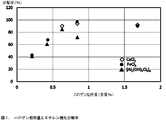
ハロゲン化物が担持されることにより、何故エチレン分解活性が向上するのか推察するに、塩化水素水溶液処理を行ってみた場合でも活性向上効果があることから、ハロゲンが有効に作用していることが推察される。但し、ハロゲンがどのように触媒上で担持され、酸化反応(例えばエチレン分解)をアシストしているのか、そのメカニズムについては不明な点も多く、推測の域を出ない。敢えて推測すると、ハロゲン、例えば塩素が白金粒子に化学吸着もしくは物理吸着して白金表面の酸性度を変化させ、酸化反応速度(例えばエチレン分解速度)を向上させていると思われる。特に、金属ハロゲン化物の場合には、ハロゲンが例えばカルシウム塩のような安定な塩として担持されることにより、触媒として必要なハロゲン量が維持され、酸化反応時に供給されているものと推測される。 Inferring why the decomposition activity of ethylene is improved by loading the halide, it is inferred that halogen is acting effectively because there is an activity improvement effect even when hydrogen chloride aqueous solution treatment is performed. Is done. However, there are many unclear points about the mechanism of how the halogen is supported on the catalyst and assisting the oxidation reaction (for example, ethylene decomposition). It is presumed that halogen, for example, chlorine, is chemisorbed or physically adsorbed on platinum particles to change the acidity of the platinum surface, thereby improving the oxidation reaction rate (for example, ethylene decomposition rate). In particular, in the case of a metal halide, it is assumed that the halogen is supported as a stable salt such as a calcium salt, so that the amount of halogen required as a catalyst is maintained and supplied during the oxidation reaction. .
上記の金属ハロゲン化物を担持処理した後、触媒を水洗し、乾燥した後の触媒活性は、ハロゲン化物担持処理前と同じ程度に低下する現象が、後述する比較例3で観察されている。このことから水で抽出された水溶性ハロゲンが活性向上に貢献していると理解される。 It has been observed in Comparative Example 3 which will be described later that the catalytic activity after the metal halide is loaded and then washed with water and dried is reduced to the same extent as before the halide loading treatment. From this, it is understood that the water-soluble halogen extracted with water contributes to the activity improvement.
前述のような方法により、上記酸化触媒を製造することができる。なお、上記触媒は、例えば粉末の形状で使用することができる。一方で、触媒からの粉末飛散を小さくし、エチレンガスが触媒を通過しやすくするためには、所定の形状に成型することも好ましい。その形状としては、例えば粒径が0.5mm~6mm程度の顆粒状の他、ペレット、円筒状などの形態とすることができる。 The oxidation catalyst can be produced by the method as described above. In addition, the said catalyst can be used with the shape of a powder, for example. On the other hand, in order to reduce the powder scattering from the catalyst and to make it easier for ethylene gas to pass through the catalyst, it is also preferable to mold it into a predetermined shape. The shape may be, for example, a granular shape having a particle size of about 0.5 mm to 6 mm, a pellet shape, a cylindrical shape, or the like.
本発明の触媒は担体、貴金属とハロゲン(ハロゲン元素および/またはハロゲン化物)以外に、例えばバインダーを含むことができる。バインダーとしては、通気性を維持するために無機の多孔性材料が好ましく、そのような無機材料としては酸化アルミニウム、酸化ケイ素などの酸化物、ベントナイトなどのクレイ類が好適に使用される。本発明の1つの実施態様において、本発明の触媒は実質的に、担体、貴金属およびハロゲン(ハロゲン元素および/またはハロゲン化物)、ならびに任意選択的にHまたは貴金属以外の金属のみからなる。 The catalyst of the present invention can contain, for example, a binder in addition to the support, the noble metal and the halogen (halogen element and / or halide). As the binder, an inorganic porous material is preferable in order to maintain air permeability. As such an inorganic material, oxides such as aluminum oxide and silicon oxide, and clays such as bentonite are preferably used. In one embodiment of the invention, the catalyst of the invention consists essentially of a support, a noble metal and a halogen (elemental halogen and / or halide), and optionally only a metal other than H or a noble metal.
本発明の触媒は、他の担体に担持して使用することも好ましい。そのような担体としては、不織布、紙、プラスチックシート、セラミックシートなどが例示され、また用途によっては金属製フィン、自動車排ガス触媒用の押出し成型品などなども使用可能である。それらの中でもフレキシブルな材料、その中でも不織布が特に好ましい。フレキシブルな担体を使用することにより、使用時の取り扱い性をよくし、また使用時の形態をロール状とすることにより単位体積当たりの処理能力を向上させるができる。不織布の材料としてはセルロース繊維、ポリエステル繊維、ポリアミド繊維など、水に不溶な材料であれば特に限定されない。これらの繊維を絡み合わせてシート状にした不織布に担持する方法としては、接着剤により粉末、もしくは顆粒などに成型した触媒材料を接着、もしくはバインダーなどと共にコーティングする方法など、通常使用される方法を適宜使用することができる。 The catalyst of the present invention is also preferably used by being supported on another carrier. Examples of such carriers include non-woven fabric, paper, plastic sheets, ceramic sheets, and the like, and metal fins, extruded products for automobile exhaust gas catalysts, and the like can be used depending on applications. Among them, a flexible material, and particularly a nonwoven fabric is particularly preferable. By using a flexible carrier, the handleability during use can be improved, and the processing capacity per unit volume can be improved by making the form during use a roll. The material for the nonwoven fabric is not particularly limited as long as it is a material insoluble in water, such as cellulose fiber, polyester fiber, and polyamide fiber. As a method for supporting these fibers in a sheet-like nonwoven fabric intertwined, a commonly used method such as a method of bonding a catalyst material molded into a powder or a granule with an adhesive or coating with a binder or the like is used. It can be used as appropriate.
以上のように白金担持後に、ハロゲン(ハロゲン元素および/またはハロゲン化物)を担持することにより得られた触媒は、炭化水素(例えばエチレン)や一酸化炭素、ホルムアルデヒドなどの酸化反応の酸化触媒として、低温領域において高い触媒活性を示す。ここで低温領域とは、例えば、100℃以下の温度範囲である。50℃以下、更には25℃以下、例えば10℃以下や5℃以下の温度領域においても酸化反応の触媒活性が高い。温度の下限は特に制限されるものではないが、例えば-30℃とすることができる。もちろん、このような低温領域だけでなくこれよりも高い温度領域においても酸化反応の触媒活性は高い。 As described above, the catalyst obtained by supporting halogen (halogen element and / or halide) after supporting platinum is used as an oxidation catalyst for oxidation reactions such as hydrocarbon (for example, ethylene), carbon monoxide, and formaldehyde. High catalytic activity in the low temperature region. Here, the low temperature region is, for example, a temperature range of 100 ° C. or lower. The catalytic activity of the oxidation reaction is high even in a temperature range of 50 ° C. or lower, further 25 ° C. or lower, such as 10 ° C. or lower or 5 ° C. or lower. The lower limit of the temperature is not particularly limited, but can be, for example, −30 ° C. Of course, the catalytic activity of the oxidation reaction is high not only in such a low temperature region but also in a higher temperature region.
そして、ここまで主に、貴金属が白金であり、ハロゲンが塩素であり、酸化対象物質がエチレンである場合の態様を詳細に記載したが、これらの記載は、他の態様にもあてはまるものであり、すなわち、貴金属が白金以外である場合や、ハロゲンが塩素以外である場合であっても、上記触媒は上記の記載に基づいて同様に製造することができ、また、上述の貴金属やハロゲンの担持量やそれ以外の各種パラメーターも上記他の態様に同様に適用することができる。 And so far, the embodiment in which the noble metal is platinum, the halogen is chlorine, and the oxidation target substance is ethylene has been described in detail, but these descriptions also apply to other embodiments. That is, even when the noble metal is other than platinum or when the halogen is other than chlorine, the catalyst can be produced in the same manner based on the above description. The amount and various other parameters can be similarly applied to the other embodiments described above.
さらに、酸化対象物質についても、エチレン以外の物質を使用することも可能である。 Furthermore, it is also possible to use substances other than ethylene as the oxidation target substance.
上記の方法で得られた触媒を用いて、気体の炭化水素(例えばエチレン)や一酸化炭素を酸化するには、炭化水素ガスや一酸化炭素ガスを酸素の共存下で触媒に接触させればよい。触媒と炭化水素(例えばエチレン)や一酸化炭素の接触は、例えば固定床もしくは流動床の流通式反応装置により行うことができる。また、家庭用冷蔵庫においてエチレンガスを酸化させる場合には、青果用冷蔵スペースの一部に本触媒を設置し、そこに冷蔵スペースの空気を循環させることにより、エチレンが酸化され、二酸化炭素と水蒸気が発生する。この二酸化炭素や水蒸気の発生が、野菜の新鮮さを維持する上でも効果があるといわれている。 In order to oxidize gaseous hydrocarbons (for example, ethylene) and carbon monoxide using the catalyst obtained by the above method, the hydrocarbon gas or carbon monoxide gas is brought into contact with the catalyst in the presence of oxygen. Good. The catalyst can be contacted with a hydrocarbon (for example, ethylene) or carbon monoxide by, for example, a fixed bed or a fluidized bed flow reactor. When ethylene gas is oxidized in a refrigerator for home use, the catalyst is installed in a part of the refrigerated space for fruits and vegetables, and the air in the refrigerated space is circulated there, whereby the ethylene is oxidized, and carbon dioxide and water vapor. Will occur. It is said that the generation of carbon dioxide and water vapor is effective in maintaining the freshness of vegetables.
さらに、本発明の触媒を用いて、燃料電池システムの燃料として用いられる改質された水素ガス(微量の一酸化炭素を含む)中の一酸化炭素を低温領域で効果的に酸化し、前記水素ガスから一酸化炭素を除去することもできる。一酸化炭素を含む水素ガスを酸素の共存下で上記触媒に接触させることにより低温領域で一酸化炭素を選択的に酸化することができ、燃料電池用一酸化炭素濃度低減装置として利用することができる。 Furthermore, by using the catalyst of the present invention, carbon monoxide in reformed hydrogen gas (including a small amount of carbon monoxide) used as a fuel for a fuel cell system is effectively oxidized in a low temperature region, and the hydrogen Carbon monoxide can also be removed from the gas. By bringing hydrogen gas containing carbon monoxide into contact with the catalyst in the presence of oxygen, carbon monoxide can be selectively oxidized in a low temperature region and can be used as a carbon monoxide concentration reducing device for fuel cells. it can.
また、暖房や湯沸かし器の不完全燃焼による一酸化炭素を検知する一酸化炭素センサーとして上記触媒を利用することもできる。さらに、上記触媒を用いて炭化水素や一酸化炭素を低温領域で酸化できるので、自動車等の内燃機関排ガス浄化装置として上記触媒を利用することができる。 Also, the above catalyst can be used as a carbon monoxide sensor for detecting carbon monoxide due to incomplete combustion of a heater or a water heater. Furthermore, since hydrocarbons and carbon monoxide can be oxidized in the low temperature region using the catalyst, the catalyst can be used as an exhaust gas purification device for internal combustion engines such as automobiles.
なお、酸化触媒により酸化される物質は、気体に限定はされず、固体、液体または気体のいずれの形態の物質でもよい。好ましくは、上記被酸化物質は、気体の形態にある。本発明の1つの好ましい実施態様において、上記被酸化物質は、炭化水素ガス(より好ましくはエチレンガス)、一酸化炭素ガスおよびホルムアルデヒドガスからなる群から選択される。被酸化物質としていずれの物質が選択された場合であっても、当業者であれば、適宜、当該物質に応じた公知の装置、方法および条件等を選択することにより、当該物質の酸化を適切に実施することが可能である。 The substance that is oxidized by the oxidation catalyst is not limited to a gas, and may be a solid, liquid, or gaseous substance. Preferably, the oxidizable substance is in the form of a gas. In one preferred embodiment of the present invention, the substance to be oxidized is selected from the group consisting of hydrocarbon gas (more preferably ethylene gas), carbon monoxide gas and formaldehyde gas. Regardless of which substance is selected as the substance to be oxidized, those skilled in the art can appropriately oxidize the substance by appropriately selecting a known apparatus, method and conditions according to the substance. Can be implemented.
本発明の1つの好ましい実施態様において、上記触媒は、低温の物質(好ましくは気体の低温物質)の酸化のために、例えば、-30~100℃、好ましくは-20~50℃、より好ましくは-10~30℃、例えば-5~25℃、-2~10℃または0~5℃の温度で、上記被酸化物質、好ましくは炭化水素ガス(より好ましくはエチレンガス)、一酸化炭素ガス、ホルムアルデヒドガスを酸化するために使用することができる。 In one preferred embodiment of the invention, the catalyst is, for example, -30 to 100 ° C, preferably -20 to 50 ° C, more preferably for the oxidation of cold materials (preferably gaseous cryogenic materials). At a temperature of −10 to 30 ° C., for example −5 to 25 ° C., −2 to 10 ° C., or 0 to 5 ° C. It can be used to oxidize formaldehyde gas.
従って、上記触媒は、エチレンガス、一酸化炭素またはホルムアルデヒドを100℃以下で酸化するための触媒である。また、本発明の1つの実施態様において、本発明は、担体にハロゲン非含有の貴金属化合物溶液を含浸し、乾燥、還元処理後にハロゲン溶液(典型的には塩化水素溶液または金属ハロゲン化物溶液)をスプレー塗布することを含む。ここで、担体は、該担体と貴金属の合計重量を基準として貴金属元素として計算して0.1~5重量%の貴金属化合物を同様に貴金属元素換算で0.1~10重量%(例えば0.2~10重量%)の濃度で含む溶液に含浸することができる。すなわち、担体を、貴金属元素として計算して0.1~10重量%の濃度で含む溶液に含侵することにより、担体重量と貴金属重量の合計重量を基準として、貴金属元素として計算して0.1~5重量%の貴金属化合物を担持することができる。当該溶液は、好ましくは水溶液または硝酸溶液であり、そして当該含浸は、撹拌、混合しながら、例えば室温で10分~3時間行うことが好ましい。例えば、撹拌はセメントミキサーなどにより行われる。また、上記乾燥は例えば、70~130℃、好ましくは90~110℃の温度で、30分~20時間、好ましくは1~10時間、例えば2~5時間または2~3時間行われる。このような含浸、乾燥により、ハロゲン非含有の貴金属を担体に担持させることができる。その後、このような貴金属を担持した担体に、貴金属と担体の合計重量を基準としてハロゲン元素として計算して0.02重量%以上のハロゲンを同様にハロゲン元素換算で例えば0.1~5重量%、好ましくは0.5~2重量%の濃度で含む溶液(好ましくは塩化水素水溶液または金属ハロゲン化物水溶液)を例えば室温でスプレー塗布することができる。スプレー塗布装置は特に限定されないが、例えば農薬散布用スプレーや塗装用スプレーなどを使用することができる。好ましくは、スプレー塗布後、80~150℃、好ましくは90~130℃、例えば100~120℃の温度で、1~15時間、好ましくは3~12時間、更に好ましくは5~10時間、乾燥が行われる。なお、好ましくは、貴金属化合物を担持した担体に金属ハロゲン化物溶液をスプレー塗布する前に、前述のような焼成処理を行うこともできる。 Therefore, the catalyst is a catalyst for oxidizing ethylene gas, carbon monoxide or formaldehyde at 100 ° C. or lower. Further, in one embodiment of the present invention, the present invention impregnates a support with a halogen-free noble metal compound solution, and after drying and reduction treatment, a halogen solution (typically a hydrogen chloride solution or a metal halide solution) is used. Including spraying. Here, the carrier is calculated as a noble metal element based on the total weight of the carrier and the noble metal, and 0.1 to 5 wt% of the noble metal compound is similarly converted to noble metal element in an amount of 0.1 to 10 wt% (for example, 0.1% by weight). 2-10% by weight) can be impregnated in the solution. That is, by impregnating the support with a solution containing 0.1 to 10% by weight calculated as a noble metal element, it is calculated as a noble metal element based on the total weight of the support weight and the noble metal weight. 1 to 5% by weight of a noble metal compound can be supported. The solution is preferably an aqueous solution or a nitric acid solution, and the impregnation is preferably carried out with stirring and mixing, for example, at room temperature for 10 minutes to 3 hours. For example, stirring is performed by a cement mixer or the like. The drying is performed at a temperature of 70 to 130 ° C., preferably 90 to 110 ° C., for 30 minutes to 20 hours, preferably 1 to 10 hours, for example 2 to 5 hours or 2 to 3 hours. By such impregnation and drying, a halogen-free noble metal can be supported on the support. Thereafter, 0.02% by weight or more of the halogen calculated on the basis of the total weight of the noble metal and the carrier as a halogen element on the carrier carrying the noble metal is similarly converted to, for example, 0.1 to 5% by weight. A solution (preferably an aqueous hydrogen chloride solution or an aqueous metal halide solution) containing preferably 0.5 to 2% by weight can be applied by spraying at room temperature, for example. The spray application device is not particularly limited, and for example, a spray for spraying agricultural chemicals or a spray for painting can be used. Preferably, after spray coating, drying is performed at a temperature of 80 to 150 ° C., preferably 90 to 130 ° C., for example 100 to 120 ° C., for 1 to 15 hours, preferably 3 to 12 hours, more preferably 5 to 10 hours. Done. Preferably, the baking treatment as described above can be performed before the metal halide solution is spray-coated on the carrier carrying the noble metal compound.
以下に実施例を示し、本発明をさらに詳しく説明するが、本発明は以下の例によって何ら限定されるものではない。 Hereinafter, the present invention will be described in more detail with reference to examples, but the present invention is not limited to the following examples.
(実施例1)
太陽化学(株)製メソポーラスシリカ担体(TMPS-4R、比表面積970m2/g)10gに白金原料としてのジニトロジアンミン白金水溶液(8.5重量%の白金濃度)をポアフィリング法により含浸し、100℃で2時間、乾燥したのちに400℃で5時間、焼成した。その時の白金担持量は、担体と白金の合計重量を基準として1重量%であった。その後、200℃で2時間水素還元し白金還元サンプルを得た。その後、塩酸(濃度=1.14重量%)15.2mlをスプレー塗布して(塗装用スプレーおよびセメントミキサーを使用。スプレー圧力:0.3MPa、ミキサー回転数:2rpm)、担体と白金の合計重量に対してハロゲン1.68重量%を担持した。110℃での乾燥を8時間、行い、実施例1の触媒を得た。この実施例1の触媒を使用して、試験例1の方法で、エチレン分解率を測定したところ、98%の酸化分解率を示した(表1)。なお、表1において「ハロゲン化物塗布量」はスプレー付着量から計算した仕込み量であり、「イオンクロマトグラフ法による塩素担持量」は後述するように、触媒サンプルからハロゲンを抽出してイオンクロマトグラフ装置により測定した値を示している。両者はいずれも、上記触媒におけるハロゲンの担持量に相当するものである。
Example 1
10 g of Mesoporous silica carrier (TMPS-4R, specific surface area 970 m 2 / g) manufactured by Taiyo Kagaku Co., Ltd. was impregnated with a dinitrodiammine platinum aqueous solution (8.5 wt% platinum concentration) as a platinum raw material by a pore filling method. After drying at 2 ° C. for 2 hours, it was calcined at 400 ° C. for 5 hours. The platinum loading at that time was 1% by weight based on the total weight of the carrier and platinum. Thereafter, hydrogen reduction was performed at 200 ° C. for 2 hours to obtain a platinum-reduced sample. Thereafter, 15.2 ml of hydrochloric acid (concentration = 1.14% by weight) was spray applied (using a spray for painting and a cement mixer. Spray pressure: 0.3 MPa, mixer rotation speed: 2 rpm), and the total weight of the carrier and platinum 1.68% by weight of halogen was supported on the basis. Drying at 110 ° C. was performed for 8 hours to obtain the catalyst of Example 1. When the ethylene decomposition rate was measured by the method of Test Example 1 using the catalyst of Example 1, it showed an oxidative decomposition rate of 98% (Table 1). In Table 1, “Halide coating amount” is the amount of charge calculated from the spray adhesion amount, and “Chlorine loading amount by ion chromatography” is extracted from a catalyst sample by ion chromatography as described later. The value measured by the apparatus is shown. Both correspond to the amount of halogen supported on the catalyst.
(実施例2)
実施例1と同様の方法により、白金原料としてジニトロジアンミン白金水溶液をポアフィリング法により含浸、焼成、水素還元を行った。その後、塩化第二鉄水溶液(濃度1.4重量%、1.52ml)をスプレー塗布して、塩化第二鉄をハロゲン元素換算で白金と担体の合計重量に対して0.21重量%担持した。110℃での乾燥を8時間行い、実施例2の触媒を得た。この実施例2の触媒を使用して、試験例1の方法で、エチレン分解率を測定したところ、43%の酸化分解率を示した(表1)。
(Example 2)
In the same manner as in Example 1, an aqueous dinitrodiammine platinum solution was impregnated as a platinum raw material by a pore filling method, fired, and hydrogen reduced. Thereafter, an aqueous ferric chloride solution (concentration: 1.4% by weight, 1.52 ml) was spray-coated to carry 0.21% by weight of ferric chloride with respect to the total weight of platinum and the carrier in terms of halogen element. . Drying at 110 ° C. was performed for 8 hours to obtain the catalyst of Example 2. When the ethylene decomposition rate was measured by the method of Test Example 1 using the catalyst of this Example 2, the oxidative decomposition rate was 43% (Table 1).
(実施例3~5)
塩化第二鉄の濃度を変える以外は、実施例1と同様の方法により触媒を作製し、塩化第二鉄の担持量がそれぞれハロゲン元素換算で0.43、0.84、1.68重量%となる触媒を得た。試験例1の方法により、エチレン分解率などを測定し、その結果を表1に示した。またハロゲン担持量を横軸に、縦軸にエチレン分解率をプロットした結果を図1に示した。
(Examples 3 to 5)
A catalyst was prepared in the same manner as in Example 1 except that the concentration of ferric chloride was changed, and the supported amounts of ferric chloride were 0.43, 0.84, and 1.68% by weight in terms of halogen elements, respectively. A catalyst was obtained. The ethylene decomposition rate and the like were measured by the method of Test Example 1, and the results are shown in Table 1. Further, FIG. 1 shows the result of plotting the halogen loading on the horizontal axis and the ethylene decomposition rate on the vertical axis.
(実施例6~8)
実施例2の塩化第二鉄の代わりに塩化カルシウムを使用した以外は、実施例2~5と同様の方法により、塩化カルシウムの担持量をハロゲン元素換算で0.63~1.68重量%まで変化させた触媒を作製し、試験例1の方法により、エチレン分解率などを測定し、その結果を表1に示した。またハロゲン担持量を横軸に、縦軸にエチレン分解率をプロットした結果を図1に示した。
(Examples 6 to 8)
Except that calcium chloride was used in place of ferric chloride in Example 2, the amount of calcium chloride supported was 0.63 to 1.68% by weight in terms of halogen element in the same manner as in Examples 2 to 5. The changed catalyst was prepared, and the ethylene decomposition rate and the like were measured by the method of Test Example 1, and the results are shown in Table 1. Further, FIG. 1 shows the result of plotting the halogen loading on the horizontal axis and the ethylene decomposition rate on the vertical axis.
(実施例9~12)
実施例2の塩化第二鉄の代わりにポリ塩化アルミニウムを使用した以外は、実施例2~5と同様の方法により、ポリ塩化アルミニウムの担持量をハロゲン元素換算で0.21~0.84重量%まで変化させた触媒を作製し、試験例1の方法により、エチレン分解率などを測定し、その結果を表1に示した。またハロゲン担持量を横軸に、縦軸にエチレン分解率をプロットした結果を図1に示した。
(Examples 9 to 12)
Except that polyaluminum chloride was used in place of ferric chloride in Example 2, the load of polyaluminum chloride was 0.21 to 0.84 weight in terms of halogen element in the same manner as in Examples 2 to 5. %, The ethylene decomposition rate was measured by the method of Test Example 1, and the results are shown in Table 1. Further, FIG. 1 shows the result of plotting the halogen loading on the horizontal axis and the ethylene decomposition rate on the vertical axis.
(試験例1)
実施例1~12で作製した触媒を用いて、以下の方法を行い、その結果を表1に示した。
(1)触媒上の塩素抽出; 触媒0.5gをビーカーに入れ、そこに純水50mlを加えた後、超音波洗浄装置により5分間超音波をかけて処理した。
(2)イオンクロマトグラフ法による塩素量測定;上記抽出水溶液を25倍に純水で希釈し、イオンクロマトグラフ装置で濃度測定を行った。装置は島津製作所(株)製イオンクロマトグラフ装置を使用し、カラムは島津製作所(株)製 IC-A3を使用した。
(3)エチレン分解評価条件;におい袋に触媒1gを充填し、エチレンと空気を混合し、100ppmのエチレン混合ガスの2600mlをにおい袋に注入して4℃で20時間放置後のエチレン濃度をガスクロマトグラフ法により測定し、下記の式からエチレン分解率を計算した。
(Test Example 1)
The following methods were performed using the catalysts prepared in Examples 1 to 12, and the results are shown in Table 1.
(1) Chlorine extraction on catalyst: 0.5 g of catalyst was placed in a beaker, 50 ml of pure water was added thereto, and then ultrasonic treatment was performed for 5 minutes with an ultrasonic cleaning device.
(2) Chlorine amount measurement by ion chromatography method: The extracted aqueous solution was diluted 25 times with pure water, and the concentration was measured with an ion chromatograph. The apparatus used was an ion chromatograph manufactured by Shimadzu Corporation, and the column used was IC-A3 manufactured by Shimadzu Corporation.
(3) Evaluation conditions for ethylene decomposition: 1 g of catalyst is packed in an odor bag, ethylene and air are mixed, 2600 ml of 100 ppm ethylene mixed gas is injected into the odor bag, and the ethylene concentration after being left at 4 ° C. for 20 hours by gas chromatography The ethylene decomposition rate was calculated from the following formula.
エチレン分解率(%)=[(初期エチレンガス濃度)-(20時間後のエチレンガスの濃度)]/(初期エチレンガス濃度)×100・・・・(5) Decomposition rate of ethylene (%) = [(initial ethylene gas concentration) − (ethylene gas concentration after 20 hours)] / (initial ethylene gas concentration) × 100 (5)
(比較例1)
太陽化学(株)製メソポーラスシリカ担体(TMPS-4R、表面積970m2/g) 10gにPtメタルとして0.1gを含む塩化白金酸水溶液1.15gをポアフィリング法により含浸し、100℃で2時間、乾燥したのちに400℃で5時間、焼成した。その後、200℃で2時間水素還元した。その後、塩酸や塩化カルシウム水溶液などのハロゲン担持処理を行わずに、試験例1の方法によりエチレン分解率を測定した結果を表1に示した。
(Comparative Example 1)
Mesoporous silica support (TMPS-4R, surface area 970 m 2 / g) manufactured by Taiyo Kagaku Co., Ltd. 10 g of impregnated 1.15 g of chloroplatinic acid aqueous solution containing 0.1 g of Pt metal as a Pt metal by pore filling method, and at 100 ° C. for 2 hours After drying, baking was performed at 400 ° C. for 5 hours. Thereafter, hydrogen reduction was performed at 200 ° C. for 2 hours. Thereafter, Table 1 shows the results of measuring the ethylene decomposition rate by the method of Test Example 1 without carrying out halogen supporting treatment such as hydrochloric acid or calcium chloride aqueous solution.
(比較例2)
ジニトロジアンミン白金を白金前駆体として使用して、塩化第二鉄担持処理を行わなかった以外は、実施例2の方法、条件により比較例2サンプル触媒を作製した。次いで試験例1の方法によりその評価を行い、その結果を表1に示した。
(Comparative Example 2)
A sample catalyst of Comparative Example 2 was prepared according to the method and conditions of Example 2 except that dinitrodiammine platinum was used as a platinum precursor and no ferric chloride support treatment was performed. Next, the evaluation was performed by the method of Test Example 1, and the results are shown in Table 1.
(比較例3)
実施例7と同様の方法で白金担持し、次いでハロゲン担持処理を行って作製したサンプルに、更に水洗処理を行って塩素を除去、乾燥した。この比較例3サンプルにつき、その評価を試験例1の方法により行った。その結果を表1に示した。
(Comparative Example 3)
A sample prepared by carrying platinum in the same manner as in Example 7 and then carrying out halogen carrying treatment was further washed with water to remove chlorine and dried. The evaluation of the sample of Comparative Example 3 was performed by the method of Test Example 1. The results are shown in Table 1.
(比較例4)
実施例1と同様の方法によりシリカ担体に白金を担持させ、次いで塩酸処理や塩化第二鉄溶液浸漬処理の代わりに、ハロゲンを含まない純水で処理を行った以外は、実施例1と同様の方法、条件により比較例4のサンプル触媒を作製し、その評価を試験例1の方法により行った。その結果を表1に示した。
(Comparative Example 4)
Similar to Example 1 except that platinum was supported on a silica support in the same manner as in Example 1 and then treated with pure water containing no halogen instead of hydrochloric acid treatment or ferric chloride solution immersion treatment. The sample catalyst of Comparative Example 4 was prepared according to the method and conditions described above, and the evaluation was performed by the method of Test Example 1. The results are shown in Table 1.
(実施例13)
実施例2と同じ方法により、一酸化炭素酸化用の触媒サンプルを作製した。実施例1のエチレンガスの代わりに、模擬反応ガス(一酸化炭素1.0%、窒素5.0%、酸素1.0%、水素バランスの混合ガス)を、マスフローメーターを用いて3000h-1で導入し、一酸化炭素酸化反応を行った。室温(25℃)で一酸化炭素選択酸化反応を行った際の、反応管出口での一酸化炭素濃度を、検出器としてTCD(熱伝導度型検出器)を搭載したガスクロマトグラフによって測定したところ、一酸化炭素が10ppm以下まで減少していることが確認された。
(Example 13)
A catalyst sample for carbon monoxide oxidation was produced in the same manner as in Example 2. Instead of the ethylene gas of Example 1, a simulated reaction gas (a mixed gas of carbon monoxide 1.0%, nitrogen 5.0%, oxygen 1.0%, hydrogen balance) was used for 3000 h-1 using a mass flow meter. The carbon monoxide oxidation reaction was carried out. The carbon monoxide concentration at the outlet of the reaction tube when carbon monoxide selective oxidation reaction was performed at room temperature (25 ° C) was measured by a gas chromatograph equipped with a TCD (thermal conductivity type detector) as a detector. It was confirmed that carbon monoxide was reduced to 10 ppm or less.
(比較例5)
比較例2と同じ条件で作製した触媒サンプルを用いて、実施例13と同じ方法、条件により測定したところ、一酸化炭素濃度は100ppmを越えるものであった。
(Comparative Example 5)
When a catalyst sample produced under the same conditions as in Comparative Example 2 was used and measured by the same method and conditions as in Example 13, the carbon monoxide concentration exceeded 100 ppm.
(実施例14)
実施例2と同じ方法により触媒サンプルを作製した。実施例1のエチレンガスの代わりに、ホルムアルデヒドと空気を混合し、400ppmのホルムアルデヒド混合ガス2600mlをにおい袋に注入し、室温(25℃)で3時間静置後のホルムアルデヒド濃度を検知管法により測定し、下記の式からホルムアルデヒド分解率を計算したところ、98%の酸化分解率を示した。
(Example 14)
A catalyst sample was prepared in the same manner as in Example 2. In place of the ethylene gas of Example 1, formaldehyde and air were mixed, and 2600 ml of 400 ppm formaldehyde mixed gas was injected into the odor bag, and the formaldehyde concentration after standing at room temperature (25 ° C.) for 3 hours was measured by the detector tube method. When the formaldehyde decomposition rate was calculated from the following formula, an oxidative decomposition rate of 98% was shown.
ホルムアルデヒド分解率(%)=[(初期ホルムアルデヒドガス濃度)-(3時間後のホルムアルデヒドの濃度)]/(初期ホルムアルデヒド濃度)×100・・・・(6) Decomposition rate of formaldehyde (%) = [(initial formaldehyde gas concentration) − (concentration of formaldehyde after 3 hours)] / (initial formaldehyde concentration) × 100 (6)
上記の結果から、以下のようなことが言える。
1)メソポーラスシリカ上にジニトロジアンミン白金(DNDA-Pt)を担持、焼成後に塩素担持処理をしない触媒のエチレン分解活性が35%と低い(比較例2)のに対して、塩酸担持処理を行った実施例1の触媒サンプルのエチレン分解率は98%と極めて高い。また、金属ハロゲン化物を担持することによっても、同様に活性が向上する。
2)塩素担持処理したサンプルについて水洗処理を行い、塩素を除去した触媒サンプル(比較例3)は、塩素処理を行わない比較例2と同様に分解活性が低い。これは、水溶性の塩素が、エチレン分解反応を促進していることを示している。
3)塩素担持処理の代わりに純水で処理した比較例4のサンプルは、塩素担持処理した実施例1に比べ、著しく活性が低いことから、塩素処理が水による効果ではなく、塩素イオンによる効果であることが示された。
4)図1から示されるように、ハロゲン処理液のハロゲン量がゼロ(水100%)では活性が低く、ハロゲン担持量が0.2重量%以上、0.4重量%以上、0.6重量%以上と増加するにつれ活性が大幅に上昇する。そして、ハロゲン担持量が1.6重量%を越えると活性が低下する傾向がある。塩化第二鉄などの結晶析出などを考慮すると、上限は5重量%以下が好ましいと判断された。
5)実施例13(一酸化炭素)、実施例14(ホルムアルデヒド)の結果から、本発明の方法により得られた触媒がエチレンのような炭化水素だけでなく、炭素酸化物、アルデヒドなど広い物質に対して効果があることが示された。
From the above results, the following can be said.
1) Dinitrodiammine platinum (DNDA-Pt) is supported on mesoporous silica, and the catalyst for which no chlorine is supported after calcination has a low ethylene decomposition activity of 35% (Comparative Example 2). The ethylene decomposition rate of the catalyst sample of Example 1 is as extremely high as 98%. Moreover, activity improves similarly also by carrying | supporting a metal halide.
2) The catalyst sample (Comparative Example 3) from which the chlorine-carrying-treated sample was washed with water and the chlorine was removed had low decomposition activity as in Comparative Example 2 in which no chlorine treatment was performed. This indicates that water-soluble chlorine promotes the ethylene decomposition reaction.
3) Since the sample of Comparative Example 4 treated with pure water instead of chlorine carrying treatment was significantly less active than Example 1 treated with chlorine carrying, chlorine treatment was not the effect of water but the effect of chlorine ions It was shown that.
4) As shown in FIG. 1, when the halogen content of the halogen treatment solution is zero (
5) From the results of Example 13 (carbon monoxide) and Example 14 (formaldehyde), the catalyst obtained by the method of the present invention can be applied not only to hydrocarbons such as ethylene but also to wide substances such as carbon oxides and aldehydes. It was shown to be effective.
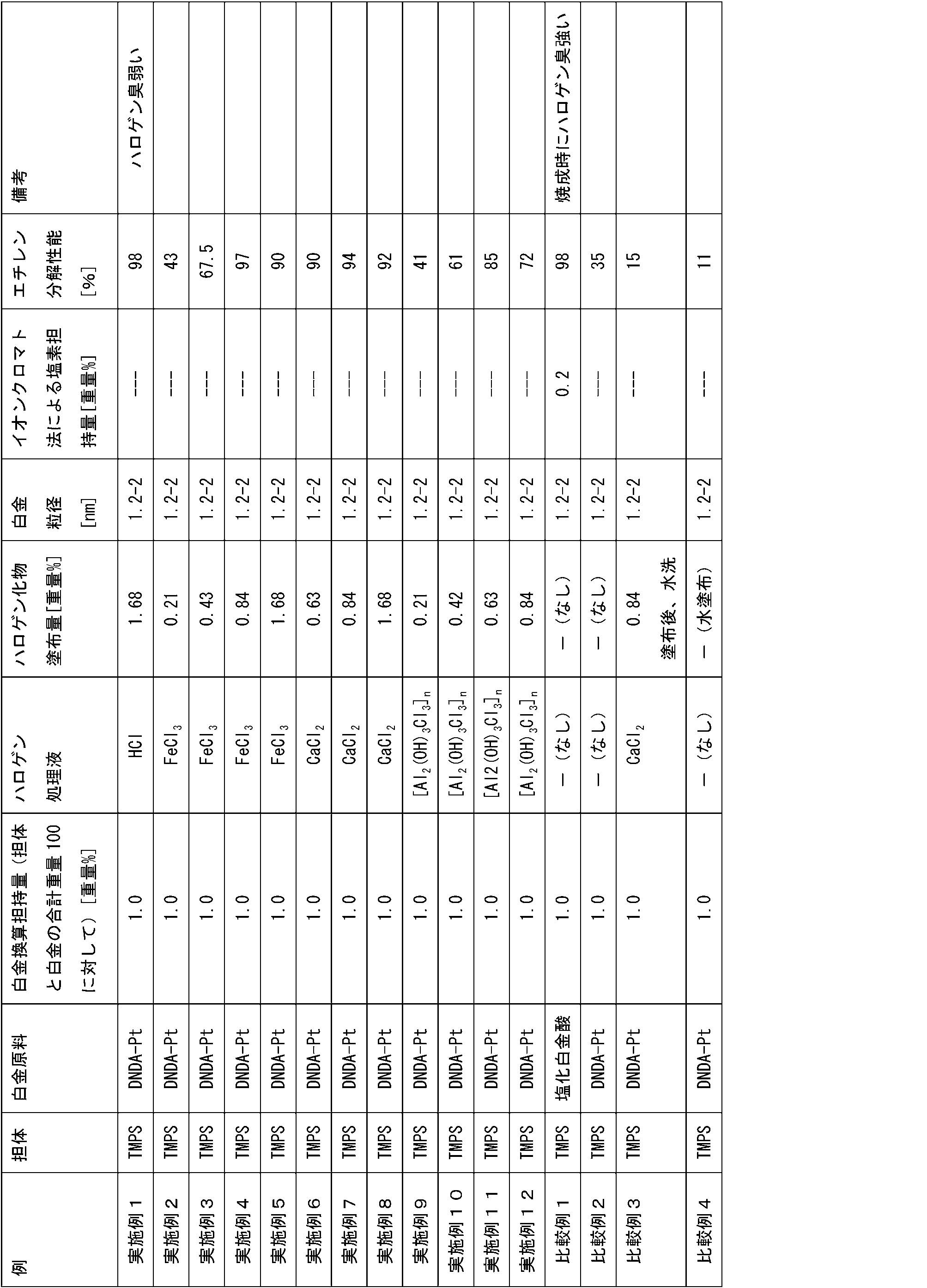
Claims (21)
(1)ハロゲン非含有の貴金属化合物を担体に担持させるステップ、
(2)ステップ(1)で得られた担体上の貴金属化合物を還元するステップ、
(3)ステップ(2)で得られた担体にハロゲン化物を担持させるステップ、および
(4)ステップ(3)で得られた担体を乾燥して、低温酸化触媒を得るステップ、
を含む、低温酸化触媒を製造する方法。 Less than:
(1) a step of supporting a halogen-free noble metal compound on a carrier;
(2) reducing the noble metal compound on the support obtained in step (1);
(3) a step of supporting a halide on the support obtained in step (2), and (4) a step of drying the support obtained in step (3) to obtain a low-temperature oxidation catalyst.
A method for producing a low-temperature oxidation catalyst, comprising:
(1-a)ハロゲン非含有貴金属化合物を担持した担体を加熱するステップ、
をさらに含む、請求項1に記載の製造方法。 Between steps (1) and (2), the following steps:
(1-a) heating a carrier carrying a halogen-free noble metal compound;
The manufacturing method according to claim 1, further comprising:
Priority Applications (4)
| Application Number | Priority Date | Filing Date | Title |
|---|---|---|---|
| EP17889498.6A EP3560590A4 (en) | 2016-12-26 | 2017-12-21 | Method for manufacturing low-temperature oxidation catalyst |
| US16/469,895 US20190314793A1 (en) | 2016-12-26 | 2017-12-21 | Method for manufacturing low-temperature oxidation catalyst |
| CN201780080184.9A CN110114141A (en) | 2016-12-26 | 2017-12-21 | The manufacturing method of low-temperature oxidation catalyst |
| KR1020197017708A KR20190091470A (en) | 2016-12-26 | 2017-12-21 | Process for producing low temperature oxidation catalyst |
Applications Claiming Priority (2)
| Application Number | Priority Date | Filing Date | Title |
|---|---|---|---|
| JP2016251891A JP6886290B2 (en) | 2016-12-26 | 2016-12-26 | Method for manufacturing low temperature oxidation catalyst |
| JP2016-251891 | 2016-12-26 |
Publications (1)
| Publication Number | Publication Date |
|---|---|
| WO2018123787A1 true WO2018123787A1 (en) | 2018-07-05 |
Family
ID=62710551
Family Applications (1)
| Application Number | Title | Priority Date | Filing Date |
|---|---|---|---|
| PCT/JP2017/045857 Ceased WO2018123787A1 (en) | 2016-12-26 | 2017-12-21 | Method for manufacturing low-temperature oxidation catalyst |
Country Status (6)
| Country | Link |
|---|---|
| US (1) | US20190314793A1 (en) |
| EP (1) | EP3560590A4 (en) |
| JP (1) | JP6886290B2 (en) |
| KR (1) | KR20190091470A (en) |
| CN (1) | CN110114141A (en) |
| WO (1) | WO2018123787A1 (en) |
Cited By (1)
| Publication number | Priority date | Publication date | Assignee | Title |
|---|---|---|---|---|
| WO2019027057A1 (en) * | 2017-08-04 | 2019-02-07 | 国立大学法人北海道大学 | Catalyst for oxidative decomposition and use of same |
Families Citing this family (1)
| Publication number | Priority date | Publication date | Assignee | Title |
|---|---|---|---|---|
| CN121551025B (en) * | 2026-01-22 | 2026-03-31 | 中北大学 | A sulfur-resistant and moisture-resistant CO oxidation ordered catalyst, its preparation method and application |
Citations (11)
| Publication number | Priority date | Publication date | Assignee | Title |
|---|---|---|---|---|
| US3041272A (en) * | 1959-12-15 | 1962-06-26 | Sinclair Refining Co | Process for activating a noble-metalalumina-aluminum halide catalyst |
| JPS5480292A (en) * | 1977-12-09 | 1979-06-26 | Matsushita Electric Ind Co Ltd | Carbon monoxide oxidation catalyst |
| JPS58207947A (en) * | 1982-05-27 | 1983-12-03 | Gosei Kagaku Kenkyusho:Kk | Catalyst for oxidizing carbon monoxide |
| JP2002320855A (en) * | 2001-04-25 | 2002-11-05 | Scientific Design Co Inc | Catalyst for ethylene oxide |
| JP2003164764A (en) | 2001-09-21 | 2003-06-10 | Katsuhiko Wakabayashi | Catalyst for oxidizing carbon monoxide, method for manufacturing the same and method for oxidizing carbon monoxide |
| JP4062053B2 (en) | 2002-10-29 | 2008-03-19 | 株式会社豊田中央研究所 | Formaldehyde decomposition catalyst and method for producing the same |
| JP2009061372A (en) | 2007-09-05 | 2009-03-26 | Taiyo Kagaku Co Ltd | Carbon monoxide selective oxidation catalyst and method for removing carbon monoxide in hydrogen using the catalyst |
| WO2011142481A1 (en) * | 2010-05-13 | 2011-11-17 | 国立大学法人山梨大学 | Fuel reforming device, method for selective methanisation of carbon monoxide, catalyst for selective methanisation of carbon monoxide, and manufacturing method for same |
| JP2012055826A (en) * | 2010-09-08 | 2012-03-22 | National Institute Of Advanced Industrial Science & Technology | Low-temperature oxidation catalyst, method for manufacturing the same, and oxidation method using the catalyst |
| JP2012081458A (en) * | 2010-09-14 | 2012-04-26 | Tokyo Metropolitan Univ | Catalyst composition for catalytic combustion reaction of ethylene and method for decomposing ethylene by using the same |
| JP2013198875A (en) * | 2012-03-26 | 2013-10-03 | Nippon Shokubai Co Ltd | Catalyst for production of ethylene oxide and production method of ethylene oxide using the same |
Family Cites Families (7)
| Publication number | Priority date | Publication date | Assignee | Title |
|---|---|---|---|---|
| US4165276A (en) * | 1977-09-14 | 1979-08-21 | Uop Inc. | Hydrocarbon conversion with a superactive multimetallic catalytic composite |
| FR2631858A1 (en) * | 1988-05-24 | 1989-12-01 | Solvay | CATALYTIC COMPOSITIONS, PROCESS FOR THEIR PRODUCTION AND METHOD FOR HYDROGENATION OF CHLOROFLUORALCENES USING THE SAME |
| CN1089638C (en) * | 1998-10-12 | 2002-08-28 | 大连化学工业股份有限公司 | Catalyst preparation method and its use in the preparation of vinyl acetate |
| JP2003144925A (en) * | 2001-11-07 | 2003-05-20 | Sud-Chemie Catalysts Inc | Method for manufacturing catalyst for shift reaction of carbon monoxide |
| WO2007145151A1 (en) * | 2006-06-13 | 2007-12-21 | Showa Denko K.K. | Process for production of supported catalyst for acetic acid production |
| DE102007020143A1 (en) * | 2007-04-26 | 2008-10-30 | Bayer Materialscience Ag | Method for increasing the long-term stability and activity of ruthenium catalysts |
| CN102247872A (en) * | 2010-05-21 | 2011-11-23 | 中国石油化工股份有限公司 | Loaded platinum catalyst and preparation method thereof |
-
2016
- 2016-12-26 JP JP2016251891A patent/JP6886290B2/en not_active Expired - Fee Related
-
2017
- 2017-12-21 US US16/469,895 patent/US20190314793A1/en not_active Abandoned
- 2017-12-21 CN CN201780080184.9A patent/CN110114141A/en active Pending
- 2017-12-21 KR KR1020197017708A patent/KR20190091470A/en not_active Ceased
- 2017-12-21 WO PCT/JP2017/045857 patent/WO2018123787A1/en not_active Ceased
- 2017-12-21 EP EP17889498.6A patent/EP3560590A4/en not_active Withdrawn
Patent Citations (11)
| Publication number | Priority date | Publication date | Assignee | Title |
|---|---|---|---|---|
| US3041272A (en) * | 1959-12-15 | 1962-06-26 | Sinclair Refining Co | Process for activating a noble-metalalumina-aluminum halide catalyst |
| JPS5480292A (en) * | 1977-12-09 | 1979-06-26 | Matsushita Electric Ind Co Ltd | Carbon monoxide oxidation catalyst |
| JPS58207947A (en) * | 1982-05-27 | 1983-12-03 | Gosei Kagaku Kenkyusho:Kk | Catalyst for oxidizing carbon monoxide |
| JP2002320855A (en) * | 2001-04-25 | 2002-11-05 | Scientific Design Co Inc | Catalyst for ethylene oxide |
| JP2003164764A (en) | 2001-09-21 | 2003-06-10 | Katsuhiko Wakabayashi | Catalyst for oxidizing carbon monoxide, method for manufacturing the same and method for oxidizing carbon monoxide |
| JP4062053B2 (en) | 2002-10-29 | 2008-03-19 | 株式会社豊田中央研究所 | Formaldehyde decomposition catalyst and method for producing the same |
| JP2009061372A (en) | 2007-09-05 | 2009-03-26 | Taiyo Kagaku Co Ltd | Carbon monoxide selective oxidation catalyst and method for removing carbon monoxide in hydrogen using the catalyst |
| WO2011142481A1 (en) * | 2010-05-13 | 2011-11-17 | 国立大学法人山梨大学 | Fuel reforming device, method for selective methanisation of carbon monoxide, catalyst for selective methanisation of carbon monoxide, and manufacturing method for same |
| JP2012055826A (en) * | 2010-09-08 | 2012-03-22 | National Institute Of Advanced Industrial Science & Technology | Low-temperature oxidation catalyst, method for manufacturing the same, and oxidation method using the catalyst |
| JP2012081458A (en) * | 2010-09-14 | 2012-04-26 | Tokyo Metropolitan Univ | Catalyst composition for catalytic combustion reaction of ethylene and method for decomposing ethylene by using the same |
| JP2013198875A (en) * | 2012-03-26 | 2013-10-03 | Nippon Shokubai Co Ltd | Catalyst for production of ethylene oxide and production method of ethylene oxide using the same |
Non-Patent Citations (3)
| Title |
|---|
| ANGEW. CHEM. INT. ED., vol. 52, 2013, pages 6253 - 6268 |
| FUKUOKA, ATSUSHI ET AL.: "Preferential oxidation of carbon monoxide catalyzed by platinum nanoparticles in mesoporous silica", JOURNAL OF THE AMERICAN CHEMICAL SOCIETY, vol. 129, no. 33, 31 July 2007 (2007-07-31), pages 10120 - 10125, XP055393283 * |
| See also references of EP3560590A4 * |
Cited By (1)
| Publication number | Priority date | Publication date | Assignee | Title |
|---|---|---|---|---|
| WO2019027057A1 (en) * | 2017-08-04 | 2019-02-07 | 国立大学法人北海道大学 | Catalyst for oxidative decomposition and use of same |
Also Published As
| Publication number | Publication date |
|---|---|
| JP6886290B2 (en) | 2021-06-16 |
| JP2018103103A (en) | 2018-07-05 |
| EP3560590A4 (en) | 2020-08-19 |
| KR20190091470A (en) | 2019-08-06 |
| CN110114141A (en) | 2019-08-09 |
| EP3560590A1 (en) | 2019-10-30 |
| US20190314793A1 (en) | 2019-10-17 |
Similar Documents
| Publication | Publication Date | Title |
|---|---|---|
| JP5030818B2 (en) | Exhaust gas purification catalyst and exhaust gas purification method | |
| JP2004512162A (en) | Catalyst for eliminating CO, VOC and halogenated organic emissions | |
| WO2018123786A1 (en) | Low-temperature oxidation catalyst | |
| JP2007203129A (en) | Fine particle catalyst production method, fine particle catalyst, and reformer | |
| JP5607131B2 (en) | Exhaust gas purification catalyst | |
| CN104676610A (en) | Method for removing toluene by catalytic oxidation | |
| JP6886290B2 (en) | Method for manufacturing low temperature oxidation catalyst | |
| JP5706476B2 (en) | Carbon monoxide oxidation catalyst and production method thereof | |
| JP4986149B2 (en) | Visible light responsive photocatalyst and photodegradation method of environmental pollutants | |
| JP2002001119A (en) | Method for producing exhaust gas purifying catalyst and exhaust gas purifying catalyst produced by the method | |
| CN105032409A (en) | Self-assembled nano ruthenium catalyst used for catalytic oxidation of VOCs, and preparation method and applications thereof | |
| JP5503155B2 (en) | Carbon monoxide removal filter | |
| JP6614897B2 (en) | Methane oxidation removal catalyst manufacturing method and methane oxidation removal method | |
| JP4865250B2 (en) | Method for producing exhaust gas treatment catalyst | |
| JP4901366B2 (en) | Catalyst for oxidation removal of methane in exhaust gas and method for oxidation removal of methane in exhaust gas | |
| JP3604740B2 (en) | Ozone decomposition catalyst and ozone decomposition method | |
| JP2002210369A (en) | Exhaust gas purification catalyst and method for producing the same | |
| JP5216001B2 (en) | Catalyst for treating exhaust gas containing organic acid and method for treating exhaust gas containing organic acid | |
| JP6225807B2 (en) | VOC decomposition removal catalyst, method for producing the same, and VOC decomposition removal method using the same | |
| JP5112966B2 (en) | Lean burn exhaust gas purification catalyst | |
| JP2006305406A (en) | NOx purification catalyst | |
| JP2017100120A (en) | Method for producing catalyst for methane oxidation removal, and catalyst for methane oxidation removal | |
| JP4233572B2 (en) | Honeycomb catalyst for exhaust gas purification | |
| TWI293036B (en) | Catalyst, method for producing the same and method for treating volatile organic compounds | |
| JPH06343827A (en) | Treatment of fluorocarbon-containing gas |
Legal Events
| Date | Code | Title | Description |
|---|---|---|---|
| 121 | Ep: the epo has been informed by wipo that ep was designated in this application |
Ref document number: 17889498 Country of ref document: EP Kind code of ref document: A1 |
|
| ENP | Entry into the national phase |
Ref document number: 20197017708 Country of ref document: KR Kind code of ref document: A |
|
| NENP | Non-entry into the national phase |
Ref country code: DE |
|
| WWE | Wipo information: entry into national phase |
Ref document number: 2017889498 Country of ref document: EP |