WO2018123985A1 - 樹脂組成物 - Google Patents
樹脂組成物 Download PDFInfo
- Publication number
- WO2018123985A1 WO2018123985A1 PCT/JP2017/046466 JP2017046466W WO2018123985A1 WO 2018123985 A1 WO2018123985 A1 WO 2018123985A1 JP 2017046466 W JP2017046466 W JP 2017046466W WO 2018123985 A1 WO2018123985 A1 WO 2018123985A1
- Authority
- WO
- WIPO (PCT)
- Prior art keywords
- group
- cellulose fiber
- less
- fiber composite
- resin composition
- Prior art date
- Legal status (The legal status is an assumption and is not a legal conclusion. Google has not performed a legal analysis and makes no representation as to the accuracy of the status listed.)
- Ceased
Links
- 0 C*(*)OCCC(C)=C(C)OCC(CC1)C1(C)N Chemical compound C*(*)OCCC(C)=C(C)OCC(CC1)C1(C)N 0.000 description 1
Classifications
-
- C—CHEMISTRY; METALLURGY
- C08—ORGANIC MACROMOLECULAR COMPOUNDS; THEIR PREPARATION OR CHEMICAL WORKING-UP; COMPOSITIONS BASED THEREON
- C08L—COMPOSITIONS OF MACROMOLECULAR COMPOUNDS
- C08L71/00—Compositions of polyethers obtained by reactions forming an ether link in the main chain; Compositions of derivatives of such polymers
- C08L71/02—Polyalkylene oxides
-
- C—CHEMISTRY; METALLURGY
- C08—ORGANIC MACROMOLECULAR COMPOUNDS; THEIR PREPARATION OR CHEMICAL WORKING-UP; COMPOSITIONS BASED THEREON
- C08L—COMPOSITIONS OF MACROMOLECULAR COMPOUNDS
- C08L1/00—Compositions of cellulose, modified cellulose or cellulose derivatives
- C08L1/08—Cellulose derivatives
- C08L1/10—Esters of organic acids, i.e. acylates
-
- D—TEXTILES; PAPER
- D06—TREATMENT OF TEXTILES OR THE LIKE; LAUNDERING; FLEXIBLE MATERIALS NOT OTHERWISE PROVIDED FOR
- D06M—TREATMENT, NOT PROVIDED FOR ELSEWHERE IN CLASS D06, OF FIBRES, THREADS, YARNS, FABRICS, FEATHERS OR FIBROUS GOODS MADE FROM SUCH MATERIALS
- D06M11/00—Treating fibres, threads, yarns, fabrics or fibrous goods made from such materials, with inorganic substances or complexes thereof; Such treatment combined with mechanical treatment, e.g. mercerising
- D06M11/07—Treating fibres, threads, yarns, fabrics or fibrous goods made from such materials, with inorganic substances or complexes thereof; Such treatment combined with mechanical treatment, e.g. mercerising with halogens; with halogen acids or salts thereof; with oxides or oxyacids of halogens or salts thereof
- D06M11/30—Treating fibres, threads, yarns, fabrics or fibrous goods made from such materials, with inorganic substances or complexes thereof; Such treatment combined with mechanical treatment, e.g. mercerising with halogens; with halogen acids or salts thereof; with oxides or oxyacids of halogens or salts thereof with oxides of halogens, oxyacids of halogens or their salts, e.g. with perchlorates
-
- C—CHEMISTRY; METALLURGY
- C08—ORGANIC MACROMOLECULAR COMPOUNDS; THEIR PREPARATION OR CHEMICAL WORKING-UP; COMPOSITIONS BASED THEREON
- C08B—POLYSACCHARIDES; DERIVATIVES THEREOF
- C08B15/00—Preparation of other cellulose derivatives or modified cellulose, e.g. complexes
- C08B15/02—Oxycellulose; Hydrocellulose; Cellulosehydrate, e.g. microcrystalline cellulose
- C08B15/04—Carboxycellulose, e.g. prepared by oxidation with nitrogen dioxide
-
- C—CHEMISTRY; METALLURGY
- C08—ORGANIC MACROMOLECULAR COMPOUNDS; THEIR PREPARATION OR CHEMICAL WORKING-UP; COMPOSITIONS BASED THEREON
- C08B—POLYSACCHARIDES; DERIVATIVES THEREOF
- C08B15/00—Preparation of other cellulose derivatives or modified cellulose, e.g. complexes
- C08B15/05—Derivatives containing elements other than carbon, hydrogen, oxygen, halogens or sulfur
- C08B15/06—Derivatives containing elements other than carbon, hydrogen, oxygen, halogens or sulfur containing nitrogen, e.g. carbamates
-
- C—CHEMISTRY; METALLURGY
- C08—ORGANIC MACROMOLECULAR COMPOUNDS; THEIR PREPARATION OR CHEMICAL WORKING-UP; COMPOSITIONS BASED THEREON
- C08J—WORKING-UP; GENERAL PROCESSES OF COMPOUNDING; AFTER-TREATMENT NOT COVERED BY SUBCLASSES C08B, C08C, C08F, C08G or C08H
- C08J3/00—Processes of treating or compounding macromolecular substances
- C08J3/20—Compounding polymers with additives, e.g. colouring
- C08J3/201—Pre-melted polymers
-
- C—CHEMISTRY; METALLURGY
- C08—ORGANIC MACROMOLECULAR COMPOUNDS; THEIR PREPARATION OR CHEMICAL WORKING-UP; COMPOSITIONS BASED THEREON
- C08L—COMPOSITIONS OF MACROMOLECULAR COMPOUNDS
- C08L1/00—Compositions of cellulose, modified cellulose or cellulose derivatives
- C08L1/02—Cellulose; Modified cellulose
-
- C—CHEMISTRY; METALLURGY
- C08—ORGANIC MACROMOLECULAR COMPOUNDS; THEIR PREPARATION OR CHEMICAL WORKING-UP; COMPOSITIONS BASED THEREON
- C08L—COMPOSITIONS OF MACROMOLECULAR COMPOUNDS
- C08L1/00—Compositions of cellulose, modified cellulose or cellulose derivatives
- C08L1/08—Cellulose derivatives
-
- C—CHEMISTRY; METALLURGY
- C08—ORGANIC MACROMOLECULAR COMPOUNDS; THEIR PREPARATION OR CHEMICAL WORKING-UP; COMPOSITIONS BASED THEREON
- C08L—COMPOSITIONS OF MACROMOLECULAR COMPOUNDS
- C08L101/00—Compositions of unspecified macromolecular compounds
-
- C—CHEMISTRY; METALLURGY
- C08—ORGANIC MACROMOLECULAR COMPOUNDS; THEIR PREPARATION OR CHEMICAL WORKING-UP; COMPOSITIONS BASED THEREON
- C08L—COMPOSITIONS OF MACROMOLECULAR COMPOUNDS
- C08L21/00—Compositions of unspecified rubbers
-
- C—CHEMISTRY; METALLURGY
- C08—ORGANIC MACROMOLECULAR COMPOUNDS; THEIR PREPARATION OR CHEMICAL WORKING-UP; COMPOSITIONS BASED THEREON
- C08L—COMPOSITIONS OF MACROMOLECULAR COMPOUNDS
- C08L27/00—Compositions of homopolymers or copolymers of compounds having one or more unsaturated aliphatic radicals, each having only one carbon-to-carbon double bond, and at least one being terminated by a halogen; Compositions of derivatives of such polymers
- C08L27/02—Compositions of homopolymers or copolymers of compounds having one or more unsaturated aliphatic radicals, each having only one carbon-to-carbon double bond, and at least one being terminated by a halogen; Compositions of derivatives of such polymers not modified by chemical after-treatment
- C08L27/04—Compositions of homopolymers or copolymers of compounds having one or more unsaturated aliphatic radicals, each having only one carbon-to-carbon double bond, and at least one being terminated by a halogen; Compositions of derivatives of such polymers not modified by chemical after-treatment containing chlorine atoms
- C08L27/06—Homopolymers or copolymers of vinyl chloride
-
- C—CHEMISTRY; METALLURGY
- C08—ORGANIC MACROMOLECULAR COMPOUNDS; THEIR PREPARATION OR CHEMICAL WORKING-UP; COMPOSITIONS BASED THEREON
- C08L—COMPOSITIONS OF MACROMOLECULAR COMPOUNDS
- C08L63/00—Compositions of epoxy resins; Compositions of derivatives of epoxy resins
-
- C—CHEMISTRY; METALLURGY
- C08—ORGANIC MACROMOLECULAR COMPOUNDS; THEIR PREPARATION OR CHEMICAL WORKING-UP; COMPOSITIONS BASED THEREON
- C08L—COMPOSITIONS OF MACROMOLECULAR COMPOUNDS
- C08L9/00—Compositions of homopolymers or copolymers of conjugated diene hydrocarbons
-
- D—TEXTILES; PAPER
- D06—TREATMENT OF TEXTILES OR THE LIKE; LAUNDERING; FLEXIBLE MATERIALS NOT OTHERWISE PROVIDED FOR
- D06M—TREATMENT, NOT PROVIDED FOR ELSEWHERE IN CLASS D06, OF FIBRES, THREADS, YARNS, FABRICS, FEATHERS OR FIBROUS GOODS MADE FROM SUCH MATERIALS
- D06M13/00—Treating fibres, threads, yarns, fabrics or fibrous goods made from such materials, with non-macromolecular organic compounds; Such treatment combined with mechanical treatment
- D06M13/10—Treating fibres, threads, yarns, fabrics or fibrous goods made from such materials, with non-macromolecular organic compounds; Such treatment combined with mechanical treatment with compounds containing oxygen
- D06M13/165—Ethers
- D06M13/17—Polyoxyalkyleneglycol ethers
-
- D—TEXTILES; PAPER
- D06—TREATMENT OF TEXTILES OR THE LIKE; LAUNDERING; FLEXIBLE MATERIALS NOT OTHERWISE PROVIDED FOR
- D06M—TREATMENT, NOT PROVIDED FOR ELSEWHERE IN CLASS D06, OF FIBRES, THREADS, YARNS, FABRICS, FEATHERS OR FIBROUS GOODS MADE FROM SUCH MATERIALS
- D06M13/00—Treating fibres, threads, yarns, fabrics or fibrous goods made from such materials, with non-macromolecular organic compounds; Such treatment combined with mechanical treatment
- D06M13/10—Treating fibres, threads, yarns, fabrics or fibrous goods made from such materials, with non-macromolecular organic compounds; Such treatment combined with mechanical treatment with compounds containing oxygen
- D06M13/184—Carboxylic acids; Anhydrides, halides or salts thereof
-
- D—TEXTILES; PAPER
- D06—TREATMENT OF TEXTILES OR THE LIKE; LAUNDERING; FLEXIBLE MATERIALS NOT OTHERWISE PROVIDED FOR
- D06M—TREATMENT, NOT PROVIDED FOR ELSEWHERE IN CLASS D06, OF FIBRES, THREADS, YARNS, FABRICS, FEATHERS OR FIBROUS GOODS MADE FROM SUCH MATERIALS
- D06M13/00—Treating fibres, threads, yarns, fabrics or fibrous goods made from such materials, with non-macromolecular organic compounds; Such treatment combined with mechanical treatment
- D06M13/322—Treating fibres, threads, yarns, fabrics or fibrous goods made from such materials, with non-macromolecular organic compounds; Such treatment combined with mechanical treatment with compounds containing nitrogen
- D06M13/325—Amines
-
- D—TEXTILES; PAPER
- D06—TREATMENT OF TEXTILES OR THE LIKE; LAUNDERING; FLEXIBLE MATERIALS NOT OTHERWISE PROVIDED FOR
- D06M—TREATMENT, NOT PROVIDED FOR ELSEWHERE IN CLASS D06, OF FIBRES, THREADS, YARNS, FABRICS, FEATHERS OR FIBROUS GOODS MADE FROM SUCH MATERIALS
- D06M13/00—Treating fibres, threads, yarns, fabrics or fibrous goods made from such materials, with non-macromolecular organic compounds; Such treatment combined with mechanical treatment
- D06M13/322—Treating fibres, threads, yarns, fabrics or fibrous goods made from such materials, with non-macromolecular organic compounds; Such treatment combined with mechanical treatment with compounds containing nitrogen
- D06M13/325—Amines
- D06M13/328—Amines the amino group being bound to an acyclic or cycloaliphatic carbon atom
-
- D—TEXTILES; PAPER
- D06—TREATMENT OF TEXTILES OR THE LIKE; LAUNDERING; FLEXIBLE MATERIALS NOT OTHERWISE PROVIDED FOR
- D06M—TREATMENT, NOT PROVIDED FOR ELSEWHERE IN CLASS D06, OF FIBRES, THREADS, YARNS, FABRICS, FEATHERS OR FIBROUS GOODS MADE FROM SUCH MATERIALS
- D06M15/00—Treating fibres, threads, yarns, fabrics, or fibrous goods made from such materials, with macromolecular compounds; Such treatment combined with mechanical treatment
- D06M15/19—Treating fibres, threads, yarns, fabrics, or fibrous goods made from such materials, with macromolecular compounds; Such treatment combined with mechanical treatment with synthetic macromolecular compounds
- D06M15/37—Macromolecular compounds obtained otherwise than by reactions only involving carbon-to-carbon unsaturated bonds
- D06M15/53—Polyethers
-
- C—CHEMISTRY; METALLURGY
- C08—ORGANIC MACROMOLECULAR COMPOUNDS; THEIR PREPARATION OR CHEMICAL WORKING-UP; COMPOSITIONS BASED THEREON
- C08L—COMPOSITIONS OF MACROMOLECULAR COMPOUNDS
- C08L2205/00—Polymer mixtures characterised by other features
- C08L2205/03—Polymer mixtures characterised by other features containing three or more polymers in a blend
-
- C—CHEMISTRY; METALLURGY
- C08—ORGANIC MACROMOLECULAR COMPOUNDS; THEIR PREPARATION OR CHEMICAL WORKING-UP; COMPOSITIONS BASED THEREON
- C08L—COMPOSITIONS OF MACROMOLECULAR COMPOUNDS
- C08L2205/00—Polymer mixtures characterised by other features
- C08L2205/06—Polymer mixtures characterised by other features having improved processability or containing aids for moulding methods
-
- C—CHEMISTRY; METALLURGY
- C08—ORGANIC MACROMOLECULAR COMPOUNDS; THEIR PREPARATION OR CHEMICAL WORKING-UP; COMPOSITIONS BASED THEREON
- C08L—COMPOSITIONS OF MACROMOLECULAR COMPOUNDS
- C08L2205/00—Polymer mixtures characterised by other features
- C08L2205/14—Polymer mixtures characterised by other features containing polymeric additives characterised by shape
- C08L2205/16—Fibres; Fibrils
-
- D—TEXTILES; PAPER
- D06—TREATMENT OF TEXTILES OR THE LIKE; LAUNDERING; FLEXIBLE MATERIALS NOT OTHERWISE PROVIDED FOR
- D06M—TREATMENT, NOT PROVIDED FOR ELSEWHERE IN CLASS D06, OF FIBRES, THREADS, YARNS, FABRICS, FEATHERS OR FIBROUS GOODS MADE FROM SUCH MATERIALS
- D06M11/00—Treating fibres, threads, yarns, fabrics or fibrous goods made from such materials, with inorganic substances or complexes thereof; Such treatment combined with mechanical treatment, e.g. mercerising
- D06M11/80—Treating fibres, threads, yarns, fabrics or fibrous goods made from such materials, with inorganic substances or complexes thereof; Such treatment combined with mechanical treatment, e.g. mercerising with boron or compounds thereof, e.g. borides
-
- D—TEXTILES; PAPER
- D06—TREATMENT OF TEXTILES OR THE LIKE; LAUNDERING; FLEXIBLE MATERIALS NOT OTHERWISE PROVIDED FOR
- D06M—TREATMENT, NOT PROVIDED FOR ELSEWHERE IN CLASS D06, OF FIBRES, THREADS, YARNS, FABRICS, FEATHERS OR FIBROUS GOODS MADE FROM SUCH MATERIALS
- D06M13/00—Treating fibres, threads, yarns, fabrics or fibrous goods made from such materials, with non-macromolecular organic compounds; Such treatment combined with mechanical treatment
- D06M13/02—Treating fibres, threads, yarns, fabrics or fibrous goods made from such materials, with non-macromolecular organic compounds; Such treatment combined with mechanical treatment with hydrocarbons
- D06M13/03—Treating fibres, threads, yarns, fabrics or fibrous goods made from such materials, with non-macromolecular organic compounds; Such treatment combined with mechanical treatment with hydrocarbons with unsaturated hydrocarbons, e.g. alkenes, or alkynes
-
- D—TEXTILES; PAPER
- D06—TREATMENT OF TEXTILES OR THE LIKE; LAUNDERING; FLEXIBLE MATERIALS NOT OTHERWISE PROVIDED FOR
- D06M—TREATMENT, NOT PROVIDED FOR ELSEWHERE IN CLASS D06, OF FIBRES, THREADS, YARNS, FABRICS, FEATHERS OR FIBROUS GOODS MADE FROM SUCH MATERIALS
- D06M2101/00—Chemical constitution of the fibres, threads, yarns, fabrics or fibrous goods made from such materials, to be treated
- D06M2101/02—Natural fibres, other than mineral fibres
- D06M2101/04—Vegetal fibres
- D06M2101/06—Vegetal fibres cellulosic
Definitions
- the present invention relates to a resin composition. More specifically, a resin composition that can be suitably used as daily miscellaneous goods, home appliance parts, automobile parts, etc., a molded body comprising the resin composition, a method for producing the resin composition, and a filler in the resin composition It relates to a cellulose fiber composite that can be blended as
- plastic materials derived from petroleum which is a finite resource, have been widely used, but in recent years, technologies with less environmental impact have come to the spotlight.
- a composite material using cellulose fibers has attracted attention.
- Patent Document 1 reports that a composite material having both high mechanical strength and transparency can be obtained by blending a fine cellulose fiber composite adsorbed with a surfactant into various resins. ing.
- Patent Document 2 discloses a composite obtained by blending a polyester resin with a fine cellulose fiber composite in which a hydrocarbon group is connected to the fiber surface via an amide bond and an average fiber diameter is 0.1 to 200 nm. It is disclosed that the material is excellent in transparency and mechanical strength and has a low environmental load.
- the present invention relates to the following [1] to [5].
- [1] A composite of a) resin and b) cellulose fiber having a carboxy group in the cellulose molecule, the aldehyde group content is 0.20 mmol / g or less, and selected from carboxy group and hydroxyl group
- a resin composition comprising a cellulose fiber composite in which a modifying group is bonded to one or more kinds.
- [2] A molded article comprising the resin composition according to [1].
- a composite of cellulose fibers having a carboxy group in the cellulose molecule, the aldehyde group content is 0.20 mmol / g or less, and a primary to tertiary hydrocarbon amine is ionized to the carboxy group A cellulose fiber composite formed by bonding and / or covalent bonding.
- the present invention relates to a resin composition having both heat resistance and rigidity, a molded article comprising the resin composition, a method for producing the resin composition, and a cellulose fiber composite that can be blended in the resin composition as a filler.
- the resin composition of the present invention has an excellent effect of having high heat resistance.
- the resin composition of the present invention contains a resin and a cellulose fiber composite, the cellulose fiber composite is surface-modified, and the aldehyde group content on the surface is 0.20 mmol / g or less. It has a special feature.
- cellulose fiber composites, cellulose fibers as raw materials, and the like may be referred to as “fine cellulose fiber composites” and “fine cellulose fibers” for the purpose of clarifying that they have been refined. is there.
- nanofibers called microfibrils are first formed, and a high-order solid structure is constructed by forming a multi-bundle.
- the cellulose fiber composite used in the present invention is obtained in principle and is used to weaken the strong hydrogen bonding between the surfaces, which causes strong aggregation between microfibrils in a naturally derived cellulose solid raw material.
- it is obtained by further modifying one or more selected from a carboxy group on the surface and a hydroxyl group (not oxidized) after being partially oxidized and converted to a carboxy group.
- the cellulose fiber composite thus obtained has improved hydrophobicity and good dispersibility in organic solvents and resins, and when blended with a resin, a resin composition having excellent physical properties such as rigidity is obtained. It is what However, it has been found that in cases where the resin composition requires high heat resistance, the cellulose fiber composite may not necessarily have sufficient heat resistance. Therefore, as a result of the present inventors diligently examining the improvement in heat resistance, in the oxidation treatment performed when preparing the cellulose fiber composite, the hydroxyl group of the cellulose molecule is substituted with a carboxy group via an aldehyde group, We focused on the formation of by-products that did not progress sufficiently and remained aldehyde groups.
- the cellulose fiber composite used in the present invention is a composite of cellulose fibers having a carboxy group in the cellulose molecule, and the aldehyde group content is 0.20 mmol / g or less, preferably 0.18 mmol / g or less. Preferably it is 0.15 mmol / g or less, More preferably, it is 0.1 mmol / g or less, More preferably, it is 0.05 mmol / g or less, More preferably, it is substantially 0 mmol / g.
- “substantially 0 mmol / g” inevitably refers to a case where a trace amount of aldehyde group is contained.
- Aldehyde group content means the total amount of aldehyde groups in the cellulose constituting the cellulose fiber composite, and is specifically measured by the method described in Examples below.
- the cellulose fiber constituting the cellulose fiber composite used in the present invention has a carboxy group content of preferably 0.1 mmol / g or more, more preferably 0.4 mmol / g or more, and still more preferably from the viewpoint of introducing a modifying group. Is 0.6 mmol / g or more, more preferably 0.8 mmol / g or more. Further, from the viewpoint of improving handleability, it is preferably 3 mmol / g or less, more preferably 2 mmol / g or less, still more preferably 1.8 mmol / g or less, still more preferably 1.5 mmol / g or less, still more preferably 1. 2 mmol / g or less.
- the “carboxy group content” means the total amount of carboxy groups in cellulose constituting the cellulose fiber, and is specifically measured by the method described in Examples described later.
- the aldehyde group content is preferably the same as the aldehyde group content of the obtained cellulose fiber composite, and therefore, when the composite is contained in a resin to form a resin composition From the viewpoint of improving heat resistance, it is preferably 0.20 mmol / g or less, more preferably 0.18 mmol / g or less, further preferably 0.15 mmol / g or less, further preferably 0.1 mmol / g or less, and further preferably 0.05 mmol / g or less, more preferably substantially 0 mmol / g.
- a known fiber may be used or separately prepared.
- a known treatment such as further oxidation treatment (hereinafter referred to as additional oxidation treatment) or reduction treatment, for a carboxy group-containing cellulose fiber that has been subjected to an oxidation treatment in which a natural cellulose fiber contains a carboxy group in advance.
- additional oxidation treatment further oxidation treatment
- reduction treatment for a carboxy group-containing cellulose fiber that has been subjected to an oxidation treatment in which a natural cellulose fiber contains a carboxy group in advance.
- either the reduction process or the additional oxidation process may be used, or both may be combined.
- the treatment conditions for the additional oxidation can be appropriately set as long as the aldehyde group is oxidized to a carboxy group, and is not particularly limited. For example, it is preferably performed after introducing a carboxy group into natural cellulose, and the treatment temperature and treatment time are determined by the oxidizing agent used. Although it does not specifically limit as an oxidizing agent, For example, chlorite can be used and sodium chlorite and potassium chlorite are mentioned as a chlorite, for example.
- the liquid pH during the treatment is preferably 3 or more and 10 or less, more preferably 4 or more and 7 or less, and still more preferably 4 or more and 5 or less, from the viewpoint of reactivity.
- the treatment temperature is preferably 0 ° C.
- the treatment time is preferably 1 hour or longer, and preferably 10 hours or longer from the viewpoint of reactivity.
- the treatment system for the additional oxidation treatment may contain other components in addition to the cellulose fiber and the oxidizing agent.
- Other components are not particularly limited as long as the effects of the present invention are not impaired.
- the reduction treatment conditions can be appropriately set as long as the aldehyde group is reduced to a hydroxyl group, and is not particularly limited.
- the reduction treatment step is preferably performed after introducing a carboxy group into natural cellulose, and the treatment temperature and treatment time are determined by the reducing agent used.
- a metal hydride and a dithionite are mentioned.
- the metal hydride include sodium borohydride and lithium borohydride.
- the dithionite include sodium dithionite and potassium dithionite. These may be used individually by 1 type and may use 2 or more types together.
- the solution pH during the treatment is preferably 7 or more and 12 or less, more preferably 9 or more and 11 or less, and still more preferably 10 from the viewpoint of reactivity.
- the treatment temperature is preferably 0 ° C. or higher, more preferably 10 ° C. or higher, preferably 60 ° C. or lower, more preferably 40 ° C. or lower, from the viewpoint of reactivity.
- the treatment time is preferably 1 hour or more, and preferably 3 hours or more from the viewpoint of reactivity.
- the treatment system for the reduction treatment may contain other components in addition to the cellulose fiber and the reducing agent. Other components are not particularly limited as long as the effects of the present invention are not impaired.
- a modifying group is bonded to at least one selected from a carboxy group and a hydroxyl group of the cellulose fiber.
- a composite of cellulose fibers having a carboxy group in the cellulose molecule, the aldehyde group content is 0.20 mmol / g or less, and at least one modified group selected from a carboxy group and a hydroxyl group The cellulose fiber composite formed by bonding can be used, for example, as an additive for the resin composition of the present invention, and the cellulose fiber composite that is an additive for the resin composition is included in the present invention.
- the bonding of the modifying group in the cellulose fiber composite is at least one selected from the group consisting of a carboxy group and a hydroxyl group on the surface of the cellulose fiber, preferably a carboxy group, and the modifying group has an ionic bond and / or It means a state of covalent bond.
- the modifying group has an ionic bond and / or It means a state of covalent bond.
- one or more selected from the group consisting of a carboxy group and a hydroxyl group present on the surface of the cellulose fiber is selected, and preferably a compound having a modifying group is ionically bonded and / or covalently bonded to the carboxy group. Is obtained.
- the binding mode to the carboxy group include ionic bond and covalent bond.
- Examples of the covalent bond here include an amide bond, an ester bond, and a urethane bond.
- an amide bond is preferable from the viewpoint of obtaining a resin composition having excellent heat resistance.
- bonding mode to a hydroxyl group a covalent bond is mentioned, Specifically, ester bond; Ether bonds, such as carboxymethylation and carboxyethylation; Urethane bond is mentioned. Therefore, as a cellulose fiber composite of the present invention, from the viewpoint of obtaining a resin composition having excellent heat resistance, a compound having a modifying group is ion-bonded and / or amide-bonded to a carboxy group already present on the surface of the cellulose fiber. It is preferable that it is obtained by.
- any compound having a modifying group described later may be used, and for example, the following can be used depending on the bonding mode.
- any of primary amine, secondary amine, tertiary amine, quaternary ammonium compound and phosphonium compound may be used.
- the anion component of the ammonium compound or phosphonium compound is preferably a halogen ion such as a chlorine ion or a bromine ion, a hydrogen sulfate ion, a perchlorate ion, a tetrafluoroborate ion, a hexagonal compound from the viewpoint of reactivity.
- a halogen ion such as a chlorine ion or a bromine ion, a hydrogen sulfate ion, a perchlorate ion, a tetrafluoroborate ion, a hexagonal compound from the viewpoint of reactivity.
- Fluorophosphate ions, trifluoromethanesulfonic acid ions, and hydroxy ions are exemplified, and hydroxy ions are more preferable.
- hydroxy ions are more preferable.
- the following can be used depending on the substituted functional group.
- a primary amine or a secondary amine in the case of an amide bond, either a primary amine or a secondary amine may be used.
- alcohol is good, and examples include butanol, octanol, and dodecanol.
- an isocyanate compound is preferable.
- an acid anhydride in the case of an ester bond, an acid anhydride is preferable, and examples include acetic anhydride, propionic anhydride, and succinic anhydride.
- an epoxy compound for example, alkylene oxide or alkyl glycidyl ether
- an alkyl halide and a derivative thereof for example, methyl chloride, ethyl chloride or monochloroacetic acid
- a hydrocarbon group, a copolymerization part, or the like can be used as the modifying group in the present invention. These may be combined (introduced) into the cellulose fiber singly or in combination of two or more.
- hydrocarbon group examples include a chain saturated hydrocarbon group, a chain unsaturated hydrocarbon group, a cyclic saturated hydrocarbon group, and an aromatic hydrocarbon group. From the viewpoint, a chain saturated hydrocarbon group, a cyclic saturated hydrocarbon group, and an aromatic hydrocarbon group are preferable.
- the chain saturated hydrocarbon group may be linear or branched.
- the number of carbon atoms of the chain saturated hydrocarbon group is preferably 1 or more, more preferably 2 or more, and even more preferably 3 or more, from the viewpoint of improving heat resistance when the composite is contained in a resin to form a resin composition. 6 or more is more preferable, and 8 or more is more preferable. From the same viewpoint, 30 or less is preferable, 24 or less is more preferable, 18 or less is further preferable, and 16 or less is more preferable.
- the carbon number of the hydrocarbon group means the total number of carbon atoms as the entire modifying group.
- chain saturated hydrocarbon group examples include, for example, methyl group, ethyl group, propyl group, isopropyl group, butyl group, sec-butyl group, tert-butyl group, isobutyl group, pentyl group, tert-pentyl group, Isopentyl group, hexyl group, isohexyl group, heptyl group, octyl group, 2-ethylhexyl group, nonyl group, decyl group, dodecyl group, tridecyl group, tetradecyl group, octadecyl group, docosyl group, octacosanyl group, etc.
- a propyl group an isopropyl group, a butyl group, a sec-butyl group, a tert-butyl group, an isobutyl group, a pentyl group, a tert- Pentyl group, isopentyl group, hexyl group, isohexyl group, heptyl group, octyl group 2-ethylhexyl group, nonyl group, decyl group, dodecyl group, tridecyl group, tetradecyl group, octadecyl group, docosyl group, octacosanyl group.
- These may be introduced alone or two or more of them may be introduced in an arbitrary ratio.
- the chain unsaturated hydrocarbon group may be linear or branched.
- the number of carbon atoms of the chain unsaturated hydrocarbon group is preferably 1 or more, more preferably 2 or more, and still more preferably 3 or more from the viewpoint of handleability. Moreover, from a viewpoint of availability, 30 or less are preferable, 18 or less are more preferable, 12 or less are more preferable, and 8 or less are more preferable.
- chain unsaturated hydrocarbon group examples include, for example, ethylene group, propylene group, butene group, isobutene group, isoprene group, pentene group, hexene group, heptene group, octene group, nonene group, decene group, dodecene group. , Tridecene group, tetradecene group, and octadecene group. From the viewpoint of compatibility with the resin, ethylene group, propylene group, butene group, isobutene group, isoprene group, pentene group, hexene group, heptene group, octene group are preferable. , Nonene group, decene group and dodecene group. These may be introduced alone or two or more of them may be introduced in an arbitrary ratio.
- the number of carbon atoms in the cyclic saturated hydrocarbon group is preferably 3 or more, more preferably 4 or more, and even more preferably 5 or more. Moreover, from a viewpoint of availability, 20 or less are preferable, 16 or less are more preferable, 12 or less are more preferable, and 8 or less are more preferable.
- cyclic saturated hydrocarbon group examples include, for example, a cyclopropane group, a cyclobutyl group, a cyclopentane group, a cyclohexyl group, a cycloheptyl group, a cyclooctyl group, a cyclononyl group, a cyclodecyl group, a cyclododecyl group, and a cyclotridecyl group.
- the aromatic hydrocarbon group is selected from the group consisting of an aryl group and an aralkyl group, for example.
- the aryl group and aralkyl group may be substituted or unsubstituted on the aromatic ring itself.
- the total number of carbon atoms of the aryl group may be 6 or more, and from the viewpoint of compatibility with the resin, it is preferably 24 or less, more preferably 20 or less, still more preferably 14 or less, still more preferably 12 or less, still more preferably 10 or less.
- the total carbon number of the aralkyl group is 7 or more, preferably 8 or more from the viewpoint of compatibility with the resin, and from the same viewpoint, preferably 24 or less, more preferably 20 or less, and still more preferably It is 14 or less, more preferably 13 or less, and further preferably 11 or less.
- aryl group examples include a phenyl group, a naphthyl group, an anthryl group, a phenanthryl group, a biphenyl group, a triphenyl group, a terphenyl group, and a group in which these groups are substituted with a substituent described later.
- One kind alone or two or more kinds may be introduced in an arbitrary ratio.
- a phenyl group, a biphenyl group, and a terphenyl group are preferable from the viewpoint of compatibility with the resin.
- aralkyl group for example, a benzyl group, a phenethyl group, a phenylpropyl group, a phenylpentyl group, a phenylhexyl group, a phenylheptyl group, a phenyloctyl group, and an aromatic group of these groups are substituted with a substituent described later.
- Group etc. are mentioned, These may be introduce
- a benzyl group, a phenethyl group, a phenylpropyl group, a phenylpentyl group, a phenylhexyl group, and a phenylheptyl group are preferable.
- the primary amine, secondary amine, tertiary amine, quaternary ammonium compound, phosphonium compound, acid anhydride and isocyanate compound having the hydrocarbon group are commercially available or prepared according to known methods. be able to.
- the primary to tertiary amine include, for example, ethylamine, diethylamine, triethylamine, propylamine, dipropylamine, butylamine, dibutylamine, hexylamine, dihexylamine, octylamine, dioctylamine, trioctylamine, Examples include dodecylamine, didodecylamine, stearylamine, distearylamine, monoethanolamine, diethanolamine, triethanolamine, aniline, and benzylamine.
- quaternary ammonium compound examples include tetramethylammonium hydroxide (TMAH), tetraethylammonium hydroxide (TEAH), tetraethylammonium chloride, tetrapropylammonium hydroxide (TPAH), tetrabutylammonium hydroxide (TBAH), tetra Examples include butylammonium chloride, lauryltrimethylammonium chloride, dilauryldimethylchloride, stearyltrimethylammonium chloride, distearyldimethylammonium chloride, cetyltrimethylammonium chloride, and alkylbenzyldimethylammonium chloride.
- TMAH tetramethylammonium hydroxide
- TEAH tetraethylammonium hydroxide
- TPAH tetrapropylammonium hydroxide
- TBAH tetrabutylammonium hydroxide
- propylamine, dipropylamine, butylamine, dibutylamine, hexylamine, dihexylamine, octylamine, dioctylamine, trioctylamine, dodecylamine, didodecyl are preferred.
- TEAH tetraethylammonium hydroxide
- TBAH tetrabutylammonium hydroxide
- TPAH tetrapropylammonium hydroxide
- aniline more preferably propylamine, dodecylamine, t
- the present invention provides a composite of cellulose fibers having a carboxy group in the cellulose molecule, the aldehyde group content is 0.20 mmol / g or less, and the primary to tertiary hydrocarbons in the carboxy group.
- Cellulose fiber composites in which system amines are bonded through ionic bonds and / or covalent bonds are included.
- Such a cellulose fiber composite of the present invention is preferably used as an additive for a resin composition.
- the average bond amount of hydrocarbon groups in the cellulose fiber composite is preferably 0.01 mmol / g or more from the viewpoint of improving the heat resistance when the composite is contained in a resin per cellulose fiber to form a resin composition. More preferably, it is 0.05 mmol / g or more, More preferably, it is 0.1 mmol / g or more, More preferably, it is 0.3 mmol / g or more, More preferably, it is 0.5 mmol / g or more.
- the viewpoint of reactivity it is preferably 3 mmol / g or less, more preferably 2.5 mmol / g or less, still more preferably 2 mmol / g or less, still more preferably 1.8 mmol / g or less, still more preferably 1.5 mmol / g. g or less.
- a hydrocarbon group selected from a chain saturated hydrocarbon group, a chain unsaturated hydrocarbon group, and a cyclic saturated hydrocarbon group and an aromatic hydrocarbon group are simultaneously introduced.
- the average bond amount is preferably within the above range.
- the introduction rate of the hydrocarbon group is preferably 10% or more, more preferably 30% or more, still more preferably 50% or more, from the viewpoint of obtaining a resin composition having excellent heat resistance for any of the modifying groups. It is preferably 60% or more, more preferably 70% or more, and from the viewpoint of reactivity, it is preferably 99% or less, more preferably 97% or less, still more preferably 95% or less, and still more preferably 90% or less.
- a hydrocarbon group selected from a chain saturated hydrocarbon group, a chain unsaturated hydrocarbon group, and a cyclic saturated hydrocarbon group and an aromatic hydrocarbon group are introduced simultaneously, In a range where the sum of the rates does not exceed 100% of the upper limit, it is preferably within the above range.
- an ethylene oxide / propylene oxide (EO / PO) copolymerized portion can be used as the copolymerized portion.
- the EO / PO copolymer part means a structure in which ethylene oxide (EO) and propylene oxide (PO) are polymerized randomly or in a block form.
- EO ethylene oxide
- EO ethylene oxide
- the PO content (mol%) in the EO / PO copolymerization part is preferably 1 mol% or more, more preferably 5 mol% or more, still more preferably 7 mol, from the viewpoint of obtaining a resin composition having excellent heat resistance. % Or more, more preferably 10 mol% or more. From the same viewpoint, it is preferably 100 mol% or less, more preferably 90 mol% or less, still more preferably 85 mol% or less, still more preferably 75 mol% or less, Preferably it is 60 mol% or less, More preferably, it is 50 mol% or less, More preferably, it is 40 mol% or less, More preferably, it is 30 mol% or less.
- the PO content of 100 mol% means that the EO / PO copolymer part is composed only of PO, and in the present invention, the PO polymer part may be introduced.
- the molecular weight of the EO / PO copolymer part is preferably 500 or more, more preferably 1,000 or more, still more preferably 1,500 or more, from the viewpoint of obtaining a resin composition having excellent heat resistance.
- it is 10,000 or less, More preferably, it is 7,000 or less, More preferably, it is 5,000 or less, More preferably, it is 4,000 or less, More preferably, it is 3,500 or less, More preferably, it is 2,500 or less.
- the total molecular weight of (EO) a (PO) b + (EO) c (PO) d + (EO) e (PO) f is And the molecular weight of the EO / PO copolymer part.
- the PO content (mol%) in the EO / PO copolymerization part and the molecular weight of the EO / PO copolymerization part can be calculated from the average number of moles added when the amine is produced.
- the EO / PO copolymer part and the amine are preferably bonded directly or via a linking group.
- the linking group is preferably a hydrocarbon group, and an alkylene group having 1 to 6 carbon atoms, more preferably 1 to 3 carbon atoms is used.
- an ethylene group and a propylene group are preferable.
- Examples of the amine having such an EO / PO copolymer part include the following formula (i):
- R 1 represents a hydrogen atom, a linear or branched alkyl group having 1 to 6 carbon atoms, —CH 2 CH (CH 3 ) NH 2 group, or a group represented by the following formula (ii):
- EO and PO are present in a random or block form, a is a positive number indicating the average added mole number of EO, and b is a positive number indicating the average added mole number of PO. The compound represented by these is mentioned.
- n is 0 or 1
- R 2 represents a phenyl group, a hydrogen atom, or a linear or branched alkyl group having 1 to 3 carbon atoms
- EO and PO are present in a random or block form.
- C and e represent the average number of moles added of EO and are independently a number from 0 to 50
- d and f represent the average number of moles added of PO and are independently a number from 1 to 50
- a represents the average added mole number of EO, and from the viewpoint of obtaining a resin composition excellent in heat resistance, it is preferably 11 or more, more preferably 15 or more, still more preferably 20 or more, and further preferably 25 or more. More preferably, it is 30 or more, and from the same viewpoint, it is preferably 100 or less, more preferably 70 or less, still more preferably 60 or less, still more preferably 50 or less, still more preferably 40 or less.
- b represents the average added mole number of PO, and from the viewpoint of obtaining a resin composition excellent in heat resistance, it is preferably 1 or more, more preferably 3 or more, still more preferably 5 or more, and the same viewpoint Therefore, it is preferably 50 or less, more preferably 40 or less, still more preferably 30 or less, still more preferably 25 or less, still more preferably 20 or less, still more preferably 15 or less, still more preferably 10 or less.
- the PO content (mol%) in the EO / PO copolymer part is calculated from the above a and b when the amine is represented by the formula (i).
- the formula (i) and the formula (ii) the formula: (b + d + f) ⁇ 100 / (a + b + c + d + e + f).
- a preferred range is as described above.
- R 1 in the formula (i) is a hydrogen atom, a linear or branched alkyl group having 1 to 6 carbon atoms, a —CH 2 CH (CH 3 ) NH 2 group, or a group represented by the formula (ii).
- a hydrogen atom is preferable from the viewpoint of obtaining a resin composition having excellent heat resistance.
- the linear or branched alkyl group having 1 to 6 carbon atoms is preferably a methyl group, an ethyl group, an iso or normal propyl group.
- R 1 in formula (i) is a group represented by formula (ii)
- the linear or branched alkyl group having 1 to 3 carbon atoms of R 2 in formula (ii) is preferably A methyl group and an ethyl group.
- n is preferably 1, and when R 2 is a hydrogen atom, n is preferably 0.
- c and e in formula (ii) are preferably independently 10 to 30, and d and f are preferably 5 to 25 independently.
- An amine having an EO / PO copolymer part represented by the formula (i) can be prepared according to a known method. For example, a desired amount of ethylene oxide or propylene oxide may be added to propylene glycol alkyl ether, and then the hydroxyl terminal may be aminated. If necessary, the terminal can be made into a hydrogen atom by cleaving the alkyl ether with an acid. For these production methods, reference can be made to JP-A-3-181448.
- amine having the EO / PO copolymerization part for example, a commercially available product can be suitably used. Specific examples thereof include Jeffamine M-2070, Jeffamine M-2005, Jeffamine M-2095, and Jeffamine M manufactured by HUNTSMAN.
- the average binding amount of the EO / PO copolymer part in the cellulose fiber composite is preferably 0.01 mmol / g or more, more preferably 0.05 mmol / g, from the viewpoint of obtaining a resin composition having excellent heat resistance per cellulose fiber. As mentioned above, More preferably, it is 0.1 mmol / g or more, More preferably, it is 0.3 mmol / g or more, More preferably, it is 0.5 mmol / g or more.
- it is preferably 3 mmol / g or less, more preferably 2.5 mmol / g or less, still more preferably 2 mmol / g or less, still more preferably 1.8 mmol / g or less, still more preferably 1.5 mmol / g. g or less.
- the modification rate of the EO / PO copolymer part in the cellulose fiber composite is preferably 10% or more, more preferably 20% or more, and still more preferably 30% or more, from the viewpoint of obtaining a resin composition having excellent heat resistance. More preferably, it is 40% or more, more preferably 50% or more, more preferably 60% or more, and further preferably 70% or more. From the viewpoint of obtaining a resin composition having excellent heat resistance, it is preferably 95% or less.
- the modifying group may have a substituent.
- a substituent for example, in the case of a hydrocarbon group, it is preferable that the total carbon number of the entire modifying group including the substituent is within the above range.
- the substituent include a methoxy group, an ethoxy group, a propoxy group, an isopropoxy group, a butoxy group, an isobutoxy group, a sec-butoxy group, a tert-butoxy group, a pentyloxy group, an isopentyloxy group, and a hexyloxy group.
- An alkoxy group having 1 to 6 carbon atoms methoxycarbonyl group, ethoxycarbonyl group, propoxycarbonyl group, isopropoxycarbonyl group, butoxycarbonyl group, isobutoxycarbonyl group, sec-butoxycarbonyl group, tert-butoxycarbonyl group, pentyloxycarbonyl Group, an alkoxy-carbonyl group having 1 to 6 carbon atoms of an alkoxy group such as an isopentyloxycarbonyl group; a halogen atom such as a fluorine atom, a chlorine atom, a bromine atom or an iodine atom; a carbon number of 1 such as an acetyl group or a propionyl group ⁇ 6 Sill group; an aralkyl group; an aralkyloxy group; an alkylamino group having 1 to 6 carbon atoms; the carbon number of the alkyl group have dialkylamino group having 1 to 6.
- the average binding amount of the modifying group can be adjusted by the amount of the compound having the modifying group, the kind of the compound having the modifying group, the reaction temperature, the reaction time, the solvent, and the like.
- the average bond amount (mmol / g) and the introduction rate (%) of the modifying group in the cellulose fiber composite are the amount and ratio of the modifying group introduced into the carboxy group or hydroxyl group on the surface of the cellulose fiber, It can be calculated by measuring the carboxy group content and the hydroxyl group content of the cellulose fiber according to a known method (for example, titration, IR measurement, etc.).
- ⁇ Average fiber diameter> As a cellulose fiber composite used by this invention, there is no limitation in particular in an average fiber diameter irrespective of the kind of substituent. For example, an embodiment (embodiment 1) in which the average fiber diameter is micro-order and an embodiment in which the average fiber diameter is nano-order (embodiment 2) are exemplified.
- the cellulose fiber composite of Aspect 1 is preferably 5 ⁇ m or more, more preferably 7 ⁇ m or more, and even more preferably 10 ⁇ m or more from the viewpoints of handleability, availability, and cost.
- the upper limit is not particularly set, but is preferably 100 ⁇ m or less, more preferably 70 ⁇ m or less, still more preferably 50 ⁇ m or less, still more preferably 40 ⁇ m or less, and even more preferably 30 ⁇ m or less from the viewpoint of handleability.
- the average fiber diameter of micro-order cellulose fibers can be measured according to the following method.
- a method of analyzing a part of the dispersion with “Kajaani Fiber Lab” manufactured by Metso Automation Co., Ltd. can be mentioned. By this method, a fiber diameter having an average fiber diameter of micro order can be measured. The detailed measurement method is as described in the examples.
- the cellulose fiber composite of aspect 2 is preferably 1 nm or more, more preferably 3 nm or more, still more preferably 10 nm or more, still more preferably 20 nm or more, from the viewpoints of heat resistance improvement, handleability, availability, and cost. From the viewpoints of handleability, dimensional stability, solvent dispersibility, and increase in viscosity, it is preferably 500 nm or less, more preferably 300 nm or less, still more preferably 200 nm or less, still more preferably 150 nm or less, and even more preferably 120 nm or less. .
- the average fiber diameter of nano-order cellulose fibers can be measured according to the following method.
- the dispersion obtained at the time of the miniaturization treatment was observed at a magnification of 300 to 1000 times using an optical microscope (manufactured by Keyence Corporation, “Digital Microscope VHX-1000”), and fiber 30
- an optical microscope manufactured by Keyence Corporation, “Digital Microscope VHX-1000”
- fiber 30 By measuring an average value of at least the number of fibers, a nano-order fiber diameter can be measured.
- a dispersion prepared by further adding a solvent to the dispersion is dropped on mica (mica) and dried, and an observation sample is used as an atomic force microscope (AFM, Measurement can be performed using Nanoscope III Tapping mode AFM, manufactured by Digital instrument, and a probe using Nano Probes Point Probe (NCH).
- AFM atomic force microscope
- the smallest unit of cellulose nanofibers prepared from higher plants is a 6 ⁇ 6 molecular chain packed in a nearly square shape, so the height analyzed by AFM images is regarded as the fiber width. Can do.
- the detailed measurement method is as described in the examples.
- the crystallinity of the cellulose fiber composite is preferably 10% or more, more preferably 15% or more, still more preferably 20% or more, and further preferably 40% or more, from the viewpoint of strength development. Moreover, from a viewpoint of raw material availability, Preferably it is 90% or less, More preferably, it is 85% or less, More preferably, it is 80% or less, More preferably, it is 75% or less.
- the crystallinity of cellulose is a cellulose I-type crystallinity calculated from a diffraction intensity value by an X-ray diffraction method, and is defined by the following calculation formula (A).
- the cellulose fiber composite used by this invention can introduce
- the cellulose fiber referred to here is a known method, for example, a method described in Japanese Patent Application Laid-Open No. 2011-140632, and further subjected to the above-described additional oxidation treatment or reduction treatment to thereby remove aldehyde from carboxy. It can be prepared as a group-containing cellulose fiber.
- Specific production methods include the following two modes depending on the mode of introduction of the modifying group into the cellulose fiber. That is, an embodiment (embodiment A) in which the modifying group is bonded to the cellulose fiber by ionic bonding and an embodiment (embodiment B) in which the modifying group is bonded to the cellulose fiber by covalent bonding are exemplified.
- the case of an amide bond as a covalent bond is shown below.
- Step (1) Oxidation of natural cellulose fibers in the presence of an N-oxyl compound to obtain carboxy group-containing cellulose fibers
- Step (2) Additional oxidation treatment of the carboxy group-containing cellulose fibers obtained in step (1)
- a reduction process is performed to obtain a carboxy group-containing cellulose fiber having a reduced aldehyde group
- a reduction process is performed to obtain a carboxy group-containing cellulose fiber having a reduced aldehyde group
- a reduction process is performed to obtain a carboxy group-containing cellulose fiber having a reduced aldehyde group
- the method for introducing the modifying group can be performed, for example, with reference to the method described in JP-A-2015-143336 for Aspect A and the method described in JP-A-2015-143337 for Aspect B.
- Step (1) is a step of obtaining a carboxy group-containing cellulose fiber by oxidizing natural cellulose fiber in the presence of an N-oxyl compound. Specifically, an oxidation treatment step (for example, 2,2,6,6 tetramethylpiperidine-1-oxyl described in JP-A-2015-143336 or JP-A-2015-143337 is applied to natural cellulose fiber. Carboxyl group-containing cellulose fibers having a carboxy group content of preferably 0.1 mmol / g or more can be obtained by performing an oxidation treatment using TEMPO) and a purification step (if necessary).
- TEMPO TEMPO
- the raw material natural cellulose fiber examples include wood pulp such as softwood pulp and hardwood pulp; cotton pulp such as cotton linter and cotton lint; non-wood pulp such as straw pulp and bagasse pulp; and bacterial cellulose. These 1 type can be used individually or in combination of 2 or more types.
- the natural cellulose fiber may be subjected to a treatment for increasing the surface area such as beating. Further, the cellulose I type crystallinity of the commercially available pulp is usually 80% or more.
- the solvent as the dispersion medium is water, alcohol having 1 to 6 carbon atoms, preferably 1 to 3 carbon atoms such as methanol, ethanol and propanol; ketone having 3 to 6 carbon atoms such as acetone, methyl ethyl ketone and methyl isobutyl ketone.
- water alcohol having 1 to 6 carbon atoms, ketone having 3 to 6 carbon atoms, carbon number 2
- polar solvents such as lower alkyl ethers of 5 to 5, N, N-dimethylformamide, N, N-dimethylacetamide, dimethyl sulfoxide, succinic acid methyltriglycol diester, and water is more preferable from the viewpoint of reducing environmental burden.
- the amount of the solvent used is not particularly limited as long as it is an effective amount capable of dispersing the carboxy group-containing cellulose fiber, but is preferably 1 to 500 times by mass, more preferably 2 to 200 times the carboxy group-containing cellulose fiber. It is more preferable to use mass times.
- a well-known disperser is preferably used as an apparatus used in the miniaturization process.
- a disaggregator, a beater, a low-pressure homogenizer, a high-pressure homogenizer, a grinder, a cutter mill, a ball mill, a jet mill, a short screw extruder, a twin screw extruder, an ultrasonic stirrer, a domestic juicer mixer, and the like can be used.
- the solid content concentration of the reactant fiber in the refinement treatment is preferably 50% by mass or less.
- Step (2) is a step in which the carboxy group-containing cellulose fiber obtained in step (1) is subjected to additional oxidation treatment or reduction treatment to obtain carboxy group-containing cellulose fiber with reduced aldehyde groups.
- additional oxidation treatment or the reduction treatment the above-mentioned section of the cellulose fiber composite can be referred to.
- the hydroxyl group at the C6 position of the cellulose structural unit is selectively oxidized to a carboxy group via an aldehyde group, and further, the aldehyde group is oxidized or reduced to be substituted with a carboxy group or a hydroxyl group. It is possible to obtain fine cellulose fibers made of fresh cellulose.
- the step (3A) is a step of obtaining a cellulose fiber composite by mixing a carboxy group-containing cellulose fiber having a reduced aldehyde group obtained through the above step and a compound having a modifying group. It is. Specifically, a carboxy group-containing cellulose fiber with a reduced aldehyde group and a compound having a modifying group may be mixed in a solvent, and can be produced, for example, according to the method described in JP-A-2015-143336. .
- Examples of the compound having a modifying group used in the step (3A) include those described above in the cellulose fiber composite.
- the amount of the compound used can be determined by the desired binding amount of the modifying group in the cellulose fiber composite, but from the viewpoint of reactivity, 1 mol of the carboxy group contained in the carboxy group-containing cellulose fiber with reduced aldehyde groups.
- the amine group is preferably 0.01 mol or more, more preferably 0.1 mol or more, still more preferably 0.5 mol or more, still more preferably 0.7 mol or more, still more preferably 1 mol or more, from the viewpoint of product purity.
- the amount is preferably 50 mol or less, more preferably 20 mol or less, and still more preferably 10 mol or less.
- segment and use for reaction When the compound is a monoamine, the above amine group and amine are the same.
- a solvent in which the compound to be used is dissolved is preferably selected.
- polar solvents diester of succinic acid and triethylene glycol monomethyl ether, ethanol, DMF, and water are preferable.
- the temperature at the time of mixing is preferably 0 ° C. or higher, more preferably 5 ° C. or higher, and further preferably 10 ° C. or higher, from the viewpoint of the reactivity of the compound. Moreover, from a viewpoint of coloring of a composite, Preferably it is 50 degrees C or less, More preferably, it is 40 degrees C or less, More preferably, it is 30 degrees C or less.
- the mixing time can be appropriately set according to the type of compound and solvent to be used, but from the viewpoint of the reactivity of the compound, it is preferably 0.01 hours or longer, more preferably 0.1 hours or longer, and still more preferably 1 From the viewpoint of productivity, it is preferably 48 hours or shorter, more preferably 24 hours or shorter.
- an appropriate post-treatment may be performed to remove unreacted compounds and the like.
- the post-treatment method for example, filtration, centrifugation, dialysis and the like can be used.
- Step (3B) In the first production mode, in the step (3B), the carboxy group-containing cellulose fiber having a reduced aldehyde group obtained through the above step and the compound having a modifying group are subjected to an amidation reaction to obtain a cellulose fiber composite. It is a process to obtain.
- the mixing method is not particularly limited as long as the raw materials are reacted. Specifically, the raw materials are mixed in the presence of a condensing agent to be contained in a carboxy group-containing cellulose fiber in which aldehyde groups are reduced.
- the carboxy group and the amino group of the compound having a modifying group are subjected to a condensation reaction to form an amide bond.
- Examples of the compound having a modifying group used in the step (3B) include those described above in the cellulose fiber composite.
- step (3B) a carboxy group-containing cellulose fiber with a reduced aldehyde group and a compound having a modifying group are amidated in the presence of a condensing agent.
- the amount of the compound having the modifying group used is preferably an amine group, preferably 0.1 mol or more, with respect to 1 mol of a carboxy group contained in a carboxy group-containing cellulose fiber having a reduced aldehyde group.
- the amount is preferably 0.5 mol or more, and from the viewpoint of product purity, it is preferably used in an amount of 50 mol or less, more preferably 20 mol or less, still more preferably 10 mol or less.
- condensing agent examples include, but are not limited to, condensing agents described in Synthetic Chemistry Series Peptide Synthesis (Maruzensha) P116, or Tetrahedron, 57,1551 (2001).
- condensing agents described in Synthetic Chemistry Series Peptide Synthesis (Maruzensha) P116, or Tetrahedron, 57,1551 (2001).
- DMT-MM 4- (4,6- And dimethoxy-1,3,5-triazin-2-yl) -4-methylmorpholinium chloride
- the solvent in the above-mentioned refinement step can be mentioned, and it is preferable to select a solvent in which the compound to be used is dissolved.
- the reaction time and reaction temperature in the amidation reaction can be appropriately selected according to the type of compound and solvent used, etc., but preferably 1 to 24 hours, more preferably 10 to 20 hours from the viewpoint of the reaction rate. It is.
- the reaction temperature is preferably 0 ° C. or higher, more preferably 5 ° C. or higher, and further preferably 10 ° C. or higher from the viewpoint of reactivity.
- it is 200 degrees C or less, More preferably, it is 80 degrees C or less, More preferably, it is 30 degrees C or less.
- an appropriate post-treatment may be performed in order to remove unreacted compounds and condensing agents.
- the post-treatment method for example, filtration, centrifugation, dialysis and the like can be used.
- each process described above is performed in the order of the process (1), the process (2), the process (3A) or the process (3B), and the refinement process. Except for this, the same method as in the first manufacturing mode can be used.
- cellulose fiber composite obtained by combining aspect A and aspect B that is, a cellulose fiber composite having a modified group linked through an ionic bond and a modified group linked through an amide bond. There may be. In this case, either step (3A) or step (3B) may be performed first.
- a cellulose fiber composite having an aldehyde group content of 0.20 mmol / g or less in which a modifying group is linked to cellulose fibers via an ionic bond and / or a covalent bond can be obtained.
- the obtained cellulose fiber composite can be used in the state of the dispersion after the above-mentioned post-treatment, or the dried cellulose powder after removing the solvent from the dispersion by a drying treatment or the like. It is also possible to obtain a fiber composite and use it.
- “powder” is a powder in which the cellulose fiber composite is aggregated, and does not mean cellulose particles.
- Examples of the powdered cellulose fiber composite include, for example, a dried product obtained by directly drying the dispersion of the cellulose fiber composite; a powder obtained by pulverizing the dried product by mechanical processing; and a dispersion of the cellulose fiber composite. And those obtained by pulverizing the dispersion of the cellulose fiber composite by a known freeze-drying method.
- the spray-drying method is a method in which a dispersion of the cellulose fiber composite is sprayed in the air and dried.
- thermoplastic resin a thermoplastic resin, a curable resin, a cellulose resin, and a rubber resin can be used.
- thermoplastic resins include saturated polyester resins such as polylactic acid resins, olefin resins such as polyethylene resins and polypropylene resins, vinyl chloride resins, styrene resins, (meth) acrylic resins, vinyl ether resins, polyvinyl alcohol resins, polyvinyl acetal resins, Examples thereof include polyvinyl acetate resin, polyamide resin, polycarbonate resin, polysulfone resin and the like. These thermoplastic resins may be used alone or as a mixed resin of two or more.
- saturated polyester resin, olefin resin, vinyl chloride resin, styrene resin, (meth) acrylic resin, and polyamide resin are preferable because a resin composition having excellent heat resistance can be obtained.
- (meth) acrylic resin means what contains methacrylic resin and acrylic resin.
- the (meth) acrylic resin preferably contains 50% by mass or more of methyl (meth) acrylate as a monomer unit, based on the total of monomer units of all the polymers constituting the resin, A methacrylic resin is more preferable.
- the methacrylic resin can be produced by copolymerizing methyl methacrylate and other monomers copolymerizable therewith.
- the polymerization method is not particularly limited, and examples thereof include a bulk polymerization method, a solution polymerization method, a suspension polymerization method, a cast polymerization method (for example, a cell cast polymerization method), and the cast polymerization method from the viewpoint of productivity. (For example, a cell cast polymerization method) is preferable.
- the methacrylic resin excellent in heat resistance is obtained by carrying out the polymerization reaction of the polymerizable mixture containing the monomer mixture and the radical polymerization initiator.
- the curable resin is preferably a photocurable resin and / or a thermosetting resin.
- a photo-curable resin undergoes a polymerization reaction by using a photopolymerization initiator that generates radicals and cations when irradiated with active energy rays such as ultraviolet rays and electron beams.
- photopolymerization initiator examples include acetophenones, benzophenones, ketals, anthraquinones, thioxanthones, azo compounds, peroxides, 2,3-dialkylcion compounds, disulfide compounds, thiuram compounds, fluoroamines. Compounds and the like.
- 1-hydroxy-cyclohexyl-phenyl-ketone 2-methyl-1 [4- (methylthio) phenyl] -2-morpholinopropan-1-one, benzylmethylketone, 1- (4-dodecyl) Phenyl) -2-hydroxy-2-methylpropan-1-one, 1- (4-isopropylphenyl) -2-hydroxy-2-hydroxy-2-methylpropan-1-one, benzophenone and the like.
- 1-hydroxy-cyclohexyl-phenyl-ketone is preferable from the viewpoint of antistatic properties, water resistance, transparency, and scratch resistance.
- a photopolymerization initiator for example, a monomer (monofunctional monomer or polyfunctional monomer), an oligomer having a reactive unsaturated group, a resin, or the like can be polymerized.
- Examples of the monofunctional monomer include (meth) acrylic monomers such as (meth) acrylic acid esters, vinyl monomers such as vinylpyrrolidone, isobornyl (meth) acrylate, adamantyl (meth) acrylate, and the like. And (meth) acrylate having a bridged cyclic hydrocarbon group.
- the polyfunctional monomer includes a polyfunctional monomer having about 2 to 8 polymerizable groups.
- Examples of the bifunctional monomer include ethylene glycol di (meth) acrylate, propylene glycol di (meth) And di (meth) acrylate having a bridged cyclic hydrocarbon group such as acrylate.
- Examples of the tri- to 8-functional monomer include glycerin tri (meth) acrylate.
- oligomers or resins having reactive unsaturated groups include (meth) acrylates and epoxy (meth) acrylates of bisphenol A-alkylene oxide adducts (bisphenol A type epoxy (meth) acrylate, novolak type epoxy (meth) acrylate, etc.) Polyester (meth) acrylate (for example, aliphatic polyester type (meth) acrylate, aromatic polyester type (meth) acrylate, etc.), urethane (meth) acrylate (polyester type urethane (meth) acrylate, polyether type urethane (meth)) Acrylate etc.), silicone (meth) acrylate and the like. These oligomers or resins may be used together with the monomers.
- the photo-curable resin is preferable from the viewpoint of obtaining a resin composition having few aggregates and excellent transparency.
- thermosetting resin examples include an epoxy resin; a phenol resin; a urea resin; a melamine resin; an unsaturated polyester resin; a diallyl phthalate resin; a polyurethane resin; a silicon resin;
- a thermosetting resin can be used individually by 1 type or in combination of 2 or more types. In these, since the resin composition excellent in heat resistance is obtained, an epoxy resin, a phenol resin, a urea resin, a melamine resin, an unsaturated polyester resin, and a polyurethane resin are preferable, and an epoxy resin is more preferable.
- a curing agent When using an epoxy resin for the resin component, it is preferable to use a curing agent. By blending the curing agent, the molding material obtained from the resin composition can be firmly molded, and the mechanical strength can be improved. In addition, what is necessary is just to set content of a hardening
- Cellulose resins include: organic acid esters such as cellulose mixed acylates such as cellulose acetate (cellulose acetate) and cellulose acetate propionate; inorganic acid esters such as cellulose nitrate and cellulose phosphate; organic acid inorganic acids such as cellulose nitrate acetate Mixed acid esters; cellulose ether esters such as acetylated hydroxypropyl cellulose.
- organic acid esters such as cellulose mixed acylates such as cellulose acetate (cellulose acetate) and cellulose acetate propionate
- inorganic acid esters such as cellulose nitrate and cellulose phosphate
- organic acid inorganic acids such as cellulose nitrate acetate Mixed acid esters
- cellulose ether esters such as acetylated hydroxypropyl cellulose.
- the cellulose acetate includes cellulose triacetate (acetyl substitution degree 2.6-3), cellulose diacetate (acetyl substitution degree 2 or more and
- cellulose resins organic acid esters of cellulose are preferable, and cellulose acetate (eg, cellulose triacetate, cellulose diacetate) is more preferable because a resin composition having excellent heat resistance can be obtained.
- Cellulosic resins may be used alone or in combination of two or more.
- a rubber-based resin can be used.
- a carbon black compounded product is widely used as a reinforcing material, but it is considered that the reinforcing effect is limited.
- the resin composition is excellent in dispersibility in the resulting rubber composition, so that the resin composition is excellent in mechanical strength and heat resistance. It will be possible to provide.
- the rubber resin is preferably a diene rubber or a non-diene rubber.
- diene rubber examples include natural rubber, polyisoprene rubber, polybutadiene rubber, styrene-butadiene copolymer rubber, butyl rubber, butadiene-acrylonitrile copolymer rubber, chloroprene rubber, and modified natural rubber.
- modified natural rubber examples include epoxidized natural rubber and hydrogenated natural rubber.
- non-diene rubbers include butyl rubber, ethylene-propylene rubber, ethylene-propylene-diene rubber, urethane rubber, silicone rubber, fluorine rubber, acrylic rubber, polysulfide rubber, and epichlorohydrin rubber. These can be used alone or in combination of two or more.
- natural rubber polyisoprene rubber, polybutadiene rubber, styrene-butadiene copolymer rubber, chloroprene rubber and modified natural rubber are selected.
- One or more types are preferable, and one or more types selected from natural rubber, styrene-butadiene copolymer rubber, chloroprene rubber and modified natural rubber are more preferable.
- the resin content in the resin composition, the cellulose fiber composite amount relative to the resin, and the cellulose fiber amount (converted amount) relative to the resin are as follows, although depending on the type of resin.
- the content of the resin in the resin composition of the present invention is preferably 50% by mass or more, more preferably 60% by mass or more, still more preferably 70% by mass or more, and further preferably 80% by mass from the viewpoint of producing a molded body. % Or more, more preferably 85% by mass or more. Moreover, from a viewpoint of containing a cellulose fiber composite etc., Preferably it is 99 mass% or less, More preferably, it is 98 mass% or less, More preferably, it is 95 mass% or less, More preferably, it is 90 mass% or less.
- the content of the cellulose fiber composite in the resin composition of the present invention is preferably 0.1% by mass or more, more preferably from the viewpoints of mechanical strength, dimensional stability, and heat resistance of the obtained resin composition. It is 0.5 mass% or more, More preferably, it is 1 mass% or more, More preferably, it is 2 mass% or more, More preferably, it is 3 mass% or more, More preferably, it is 5 mass% or more. Further, from the viewpoint of transparency of the obtained resin composition, it is preferably 50% by mass or less, more preferably 40% by mass or less, still more preferably 30% by mass or less, still more preferably 20% by mass or less, and further preferably 15% by mass. % Or less, more preferably 13% by mass or less.
- the amount of the cellulose fiber composite in the resin composition of the present invention is preferably 0.1 parts by mass with respect to 100 parts by mass of the resin, from the viewpoint of mechanical strength, dimensional stability, and heat resistance of the obtained resin composition. Above, more preferably 1 part by mass or more, more preferably 2 parts by mass or more, further preferably 3 parts by mass or more, more preferably 5 parts by mass or more, and from the viewpoint of the transparency of the resulting resin composition, The amount is preferably 100 parts by mass or less, more preferably 70 parts by mass or less, still more preferably 50 parts by mass or less, still more preferably 30 parts by mass or less, still more preferably 20 parts by mass or less, and further preferably 15 parts by mass or less.
- the amount of cellulose fibers is preferably 0.1 parts by mass or more, more preferably from the viewpoint of mechanical strength of the obtained resin composition with respect to 100 parts by mass of the resin. Is 1 part by mass or more, more preferably 2 parts by mass or more, more preferably 5 parts by mass or more. From the viewpoint of the transparency of the resulting resin composition, preferably 100 parts by mass or less, more preferably 70 parts by mass or less. More preferably, it is 50 parts by mass or less, more preferably 30 parts by mass or less, and still more preferably 20 parts by mass or less.
- the resin composition of the present invention can contain a plasticizer in addition to the above components.
- the plasticizer is not particularly limited, and examples thereof include conventional plasticizers such as phthalic acid esters, succinic acid esters, and adipic acid esters, fatty acid esters of aliphatic polyols such as glycerin, and the like.
- An ester compound which is an alcohol added in an amount of ⁇ 5 mol is preferable, and specific examples thereof include plasticizers described in JP-A-2008-174718 and JP-A-2008-115372.
- the content of the plasticizer is preferably 1 part by mass or more, more preferably 3 parts by mass or more, and still more preferably, with respect to 100 parts by mass of the resin, from the viewpoint of improving the heat resistance of the molded product when formed into a molded product. From the same viewpoint, it is preferably 30 parts by mass or less, more preferably 20 parts by mass or less, and still more preferably 15 parts by mass or less.
- the cellulose fiber composite of the present invention has a small amount of aggregates and is excellent in transparency by being dispersed in a plasticizer, the resin composition containing the above-described thermoplastic resin or curable resin and the cellulose fiber composite. It can use suitably for manufacture of.
- the resin composition of the present invention includes, as components other than those described above, crystal nucleating agents, fillers (inorganic fillers, organic fillers), hydrolysis inhibitors, flame retardants, antioxidants, hydrocarbon waxes, Anionic surfactants such as lubricants, ultraviolet absorbers, antistatic agents, antifogging agents, light stabilizers, pigments, antifungal agents, antibacterial agents, foaming agents, surfactants; polysaccharides such as starches and alginic acid; Natural proteins such as gelatin, glue and casein; inorganic compounds such as tannins, zeolites, ceramics and metal powders; fragrances; flow regulators; leveling agents; conductive agents; ultraviolet dispersants; It can contain in the range which is not impaired.
- polymer materials and other resin compositions can be added within a range that does not impair the effects of the present invention.
- a content ratio of an arbitrary additive it may be appropriately contained as long as the effects of the present invention are not impaired.
- the content is preferably about 10% by mass or less in the resin composition, and more preferably about 5% by mass or less. .
- the resin composition of the present invention contains a rubber-based resin, carbon black ordinarily used in the rubber industry as desired, as long as the purpose of the present invention is not impaired as a component other than the above.
- Reinforcing fillers such as silica, various chemicals, such as vulcanizing agents, vulcanization accelerators, anti-aging agents, anti-scorching agents, magnesium oxide, zinc white, stearic acid, process oil, vegetable oils, plasticizers, etc.
- Various other additives formulated for general rubber can be blended in conventional general amounts.
- the resin composition of the present invention contains the above-described resin and a cellulose fiber composite, and can be easily prepared by blending the resin and the cellulose fiber composite.
- a thermoplastic resin or a curable resin and a cellulose fiber composite and if necessary, a raw material containing various additives are stirred with a Henschel mixer, a rotating and rotating stirrer or the like, or a closed kneader, uniaxial or biaxial extrusion What is necessary is just to melt-knead using well-known kneaders, such as a machine and an open roll type kneader.
- the resin composition of the present invention contains a rubber-based resin
- it contains rubber and the modified cellulose fiber
- it can be prepared by mixing raw materials containing rubber and cellulose fiber composite, and optionally various additives, using an open kneader such as a roll, a closed kneader such as a Banbury mixer, etc. it can.
- the temperature at the time of melt mixing is usually 10 to 200 ° C., preferably 20 to 180 ° C.
- the resin composition thus obtained is substantially free of moisture and is preferably non-aqueous.
- the water content of the resin composition is preferably 2% by mass or less, more preferably 0.5% by mass or less, and still more preferably substantially 0% by mass.
- substantially 0% by mass refers to a case where a minute amount of moisture is unavoidably included.
- water content is specifically measured by the method as described in the below-mentioned Example.
- the resin composition of the present invention has good processability and excellent heat resistance, it can be suitably used for various applications such as household goods, home appliance parts, and automobile parts.
- packaging materials for daily necessities, cosmetics, home appliances, etc. as electronic materials constituting electronic parts, etc.
- food containers such as blister packs, trays, lunch box lids, etc.
- transport and protection of industrial parts As an industrial tray used for the vehicle, it can be suitably used for automobile parts such as dashboards, instrument panels, and floors.
- the resin molded body can be prepared by appropriately using a known molding method such as extrusion molding, injection molding, press molding, cast molding, or a solvent casting method for the resin composition of the present invention. For example, after injecting or applying to a package, a substrate or the like, it is dried and cured to obtain a molded product according to the application.
- a known molding method such as extrusion molding, injection molding, press molding, cast molding, or a solvent casting method for the resin composition of the present invention.
- the thickness is preferably 0.05 mm or more, more preferably 0.08 mm or more, and further preferably 0.1 mm or more. Moreover, 1.5 mm or less is preferable, 1.0 mm or less is more preferable, and 0.5 mm or less is still more preferable.
- the molded body of the resin composition of the present invention thus obtained is excellent in mechanical strength and heat resistance, and thus can be suitably used for various applications mentioned in the resin composition.
- the present invention further includes the following resin composition, a molded article containing the resin composition, a method for producing the resin composition, a cellulose fiber composite that is an additive for the resin composition, and a cellulose fiber composite. Is disclosed.
- a resin composition comprising a cellulose fiber composite in which a modifying group is bonded to one or more kinds.
- the aldehyde group content of the cellulose fiber composite is preferably 0.18 mmol / g or less, more preferably 0.15 mmol / g or less, still more preferably 0.1 mmol / g or less, and even more preferably 0.05 mmol. / G or less, more preferably substantially 0 mmol / g, the resin composition according to ⁇ 1>.
- ⁇ 4> The resin composition according to any one of ⁇ 1> to ⁇ 3>, wherein the cellulose fiber composite has an aldehyde group content of 0.1 mmol / g or less.
- ⁇ 5> The resin composition according to any one of ⁇ 1> to ⁇ 4>, wherein the cellulose fiber composite has an aldehyde group content of 0.05 mmol / g or less.
- ⁇ 6> The resin composition according to any one of ⁇ 1> to ⁇ 5>, wherein the aldehyde group content of the cellulose fiber composite is substantially 0 mmol / g.
- the carboxy group content of the cellulose fiber constituting the cellulose fiber composite is preferably 0.1 mmol / g or more, more preferably 0.4 mmol / g or more, still more preferably 0.6 mmol / g or more, further Preferably it is 0.8 mmol / g or more, preferably 3 mmol / g or less, more preferably 2 mmol / g or less, still more preferably 1.8 mmol / g or less, still more preferably 1.5 mmol / g or less, more preferably 1
- ⁇ 8> The resin composition according to any one of ⁇ 1> to ⁇ 7>, wherein the cellulose fiber constituting the cellulose fiber composite has a carboxy group content of 0.4 mmol / g or more.
- ⁇ 9> The resin composition according to any one of ⁇ 1> to ⁇ 8>, wherein the cellulose fiber constituting the cellulose fiber composite has a carboxyl group content of 0.6 mmol / g or more.
- ⁇ 10> The resin composition according to any one of ⁇ 1> to ⁇ 9>, wherein a content of a carboxy group of the cellulose fiber constituting the cellulose fiber composite is 3 mmol / g or less.
- the cellulose fiber constituting the cellulose fiber composite is preferably subjected to a supplemental oxidation treatment or a reduction treatment on a carboxy group-containing cellulose fiber that has been subjected to an oxidation treatment in which a natural cellulose fiber contains a carboxy group in advance. What was performed or carboxy group-containing cellulose fibers obtained by performing oxidation treatment was subjected to additional oxidation treatment or reduction treatment on fine cellulose fibers obtained by performing known refinement treatment.
- the resin composition according to any one of ⁇ 1> to ⁇ 10>, wherein ⁇ 12> The cellulose fiber constituting the cellulose fiber composite was subjected to a supplemental oxidation treatment or a reduction treatment on the carboxy group-containing cellulose fiber that had been subjected to an oxidation treatment in which a natural cellulose fiber previously contained a carboxy group.
- the treatment conditions of the additional oxidation treatment preferably use a chlorite such as sodium chlorite and potassium chlorite as the oxidant, and the liquid pH during treatment is preferably 3 or more and 10 or less, More preferably 4 or more and 7 or less, further preferably 4 or more and 5 or less, and the processing temperature is preferably 0 ° C. or more, more preferably 10 ° C. or more, preferably 60 ° C. or less, more preferably 40 ° C. or less.
- the resin composition according to any one of ⁇ 1> to ⁇ 12>, wherein the treatment time is preferably 1 hour or longer, more preferably 10 hours or longer.
- the treatment conditions of the reduction treatment are preferably metal hydrides such as sodium borohydride and lithium borohydride and / or dithionites such as sodium dithionite and potassium dithionite as the reducing agent.
- the liquid pH during the treatment is preferably 7 or more and 12 or less, more preferably 9 or more and 11 or less, and further preferably 10, and the treatment temperature is preferably 0 ° C. or more, more preferably 10 ° C. or more,
- the cellulose fiber is preferably obtained by ion-bonding and / or covalently bonding a compound having a modifying group to one or more selected from the group consisting of a carboxy group and a hydroxyl group present on the surface of the cellulose fiber. More preferably, the cellulose fiber composite is formed by binding a compound having a modifying group to a carboxy group of cellulose fiber via an ionic bond and / or a covalent bond. 2.
- the resin composition described in 1. ⁇ 17> The compound having the modifying group is preferably a primary amine, a secondary amine, a tertiary amine, a quaternary ammonium compound, a phosphonium compound, an alcohol such as butanol, octanol or dodecanol, an isocyanate compound, Acid anhydrides such as acetic anhydride, propionic anhydride, succinic anhydride, epoxy compounds (eg, alkylene oxide and alkyl glycidyl ether), alkyl halides and derivatives thereof (eg, methyl chloride, ethyl chloride, and monochloroacetic acid) ⁇ 1> to ⁇ 16>
- the resin composition according to any one of items.
- the compound having the modifying group includes one or more compounds selected from the group consisting of primary amines, secondary amines, tertiary amines, and quaternary ammonium compounds.
- >- ⁇ 17> The resin composition as described in any one of the above items.
- ⁇ 19> Any of the above ⁇ 1> to ⁇ 18>, wherein the compound having the modifying group includes one or more compounds selected from the group consisting of primary amines, secondary amines, and tertiary amines 2.
- the primary to tertiary amines are preferably ethylamine, diethylamine, triethylamine, propylamine, dipropylamine, butylamine, dibutylamine, hexylamine, dihexylamine, octylamine, dioctylamine, trioctylamine, dodecylamine.
- TMAH tetramethylammonium hydroxide
- TEAH tetraethylammonium Hydroxide
- TPAH tetraethylammonium chloride
- TPAH tetrapropylammonium hydroxide
- TBAH tetrabutylammonium chloride
- lauryltrimethylammonium chloride dilauryldimethylchloride
- stearyltrimethylammonium chloride distearyldimethylammonium chloride
- cetyltrimethylammonium chloride cetyltrimethylammonium chloride
- alkylbenzyldimethylammonium chloride alkylbenzyldimethylammonium chloride.
- the modifying group is preferably a hydrocarbon group, a copolymerized part, or the like, and these are preferably used alone or in combination of two or more, and bonded (introduced) to the cellulose fiber, ⁇ 1> ⁇ ⁇ 20> The resin composition according to any one of items.
- a chain saturated hydrocarbon group is preferably a methyl group, ethyl group, propyl group, isopropyl group, butyl group, sec-butyl group, tert-butyl group, isobutyl group, pentyl group, tert-pentyl group, isopentyl group Group, hexyl group, isohexyl group, heptyl group, octyl group, 2-ethylhexyl group, nonyl group, decyl group, dodecyl group, tridecyl group, tetradecyl group, octadecyl group, docosyl group, octacosanyl group, etc., chain unsaturated
- the hydrocarbon group is preferably ethylene group, propylene group, butene group, isobutene group, isoprene group, pentene group, hexene group, heptene group, o
- a cyclic saturated hydrocarbon group preferably a cyclopropane group Cyclobutyl group, cyclopentane group, cyclohexyl group, cycloheptyl group, cyclooctyl group, cyclononyl group, cyclodecyl group, cyclododecyl group, cyclotridecyl group, cyclotetradecyl group, cyclooctadecyl group, etc., aromatic hydrocarbon group
- the aryl group is preferably a phenyl group, a naphthyl group, an anthryl group, a phenanthryl group, a biphenyl group, a triphenyl group, and a terphenyl group
- the aralkyl group is preferably a benzyl group, a phenethyl group, or a phenylpropyl group.
- the average bonding amount of hydrocarbon groups in the cellulose fiber composite is preferably 0.01 mmol / g or more, more preferably 0.05 mmol / g or more, still more preferably 0.1 mmol / g or more, per cellulose fiber.
- the resin composition according to any one of ⁇ 1> to ⁇ 24>, wherein the resin composition is 1.8 mmol / g or less, more preferably 1.5 mmol / g or less.
- the hydrocarbon group introduction rate is preferably 10% or more, more preferably 30% or more, still more preferably 50% or more, still more preferably 60% or more, still more preferably 70% or more, and preferably 99%.
- the PO content (mol%) in the EO / PO copolymerization part is preferably 1 mol% or more, more preferably 5 mol% or more, still more preferably 7 mol% or more, and even more preferably 10 mol%.
- the resin composition is 100 mol% or less, more preferably 90 mol% or less, still more preferably 85 mol% or less, still more preferably 75 mol% or less, still more preferably 60 mol% or less, still more preferably 50 mol% or less.
- the resin composition according to any one of ⁇ 1> to ⁇ 27>, more preferably 40 mol% or less, and further preferably 30 mol% or less.
- the molecular weight of the EO / PO copolymerization part is preferably 500 or more, more preferably 1,000 or more, still more preferably 1,500 or more, preferably 10,000 or less, more preferably 7,000 or less.
- Resin composition. ⁇ 30> The EO / PO copolymer part and the amine are preferably bonded directly or via a linking group.
- the linking group is preferably a hydrocarbon group, preferably having 1 to 6 carbon atoms.
- the average binding amount of the EO / PO copolymer part in the cellulose fiber composite is preferably 0.01 mmol / g or more, more preferably 0.05 mmol / g or more, and still more preferably 0.1 mmol / g per cellulose fiber.
- the resin composition according to any one of ⁇ 1> to ⁇ 30>, more preferably 1.8 mmol / g or less, and further preferably 1.5 mmol / g or less.
- the modification ratio of the EO / PO copolymer part in the cellulose fiber composite is preferably 10% or more, more preferably 20% or more, still more preferably 30% or more, still more preferably 40% or more, and further preferably 50.
- the average fiber diameter is preferably 5 ⁇ m or more, more preferably 7 ⁇ m or more, further preferably 10 ⁇ m or more, preferably 100 ⁇ m or less, more preferably 70 ⁇ m or less, More preferably, the resin composition according to any one of ⁇ 1> to ⁇ 32>, which is 50 ⁇ m or less, more preferably 40 ⁇ m or less, and still more preferably 30 ⁇ m or less.
- the average fiber diameter is preferably 1 nm or more, more preferably 3 nm or more, still more preferably 10 nm or more, still more preferably 20 nm or more, preferably 500 nm or less. More preferably, the resin composition according to any one of ⁇ 1> to ⁇ 33>, which is 300 nm or less, more preferably 200 nm or less, still more preferably 150 nm or less, and still more preferably 120 nm or less.
- the degree of crystallinity of the cellulose fiber composite is preferably 10% or more, more preferably 15% or more, still more preferably 20% or more, still more preferably 40% or more, preferably 90% or less, more preferably
- the resin composition according to any one of ⁇ 1> to ⁇ 34> which is 85% or less, more preferably 80% or less, and further preferably 75% or less.
- ⁇ 36> The resin composition according to any one of ⁇ 1> to ⁇ 35>, wherein the crystallinity of the cellulose fiber composite is 20% or more.
- ⁇ 37> The resin composition according to any one of ⁇ 1> to ⁇ 36>, wherein the crystallinity of the cellulose fiber composite is 40% or more.
- ⁇ 38> The resin composition according to any one of ⁇ 1> to ⁇ 37>, wherein the crystallinity of the cellulose fiber composite is 80% or less.
- ⁇ 39> The resin composition according to any one of ⁇ 1> to ⁇ 38>, wherein the crystallinity of the cellulose fiber composite is 75% or less.
- the thermoplastic resin is preferably a saturated polyester resin such as a polylactic acid resin, an olefin resin such as a polyethylene resin or a polypropylene resin, a vinyl chloride resin, a styrene resin, a (meth) acrylic resin, a vinyl ether resin, or a polyvinyl alcohol resin.
- ⁇ 42> The resin composition according to any one of ⁇ 1> to ⁇ 41>, wherein the curable resin is preferably a photocurable resin and / or a thermosetting resin.
- the curable resin is preferably a photocurable resin and / or a thermosetting resin.
- ⁇ 43> The resin composition according to any one of ⁇ 1> to ⁇ 42>, wherein an epoxy resin is preferably used as the resin component, and a curing agent is preferably used.
- ⁇ 45> The resin composition according to any one of ⁇ 1> to ⁇ 44>, wherein the rubber resin is preferably a diene rubber and / or a non-diene rubber.
- Diene rubber is preferably natural rubber, polyisoprene rubber, polybutadiene rubber, styrene-butadiene copolymer rubber, butyl rubber, butadiene-acrylonitrile copolymer rubber, chloroprene rubber, epoxidized natural rubber, hydrogenated natural
- the non-diene rubber is preferably butyl rubber, ethylene-propylene rubber, ethylene-propylene-diene rubber, urethane rubber, silicone rubber, fluorine rubber, acrylic rubber, polysulfide rubber, or epichlorohydrin rubber.
- the resin composition according to any one of items. ⁇ 48> The content of the resin in the resin composition is preferably 50% by mass or more, more preferably 60% by mass or more, still more preferably 70% by mass or more, still more preferably 80% by mass or more, and further preferably 85% by mass. % Or more, preferably 99% by mass or less, more preferably 98% by mass or less, still more preferably 95% by mass or less, and further preferably 90% by mass or less, ⁇ 1> to ⁇ 47>
- the resin composition described in 1. ⁇ 49> The content of the cellulose fiber composite in the resin composition is preferably 0.1% by mass or more, more preferably 0.5% by mass or more, still more preferably 1% by mass or more, and further preferably 2% by mass.
- the resin composition according to any one of ⁇ 1> to ⁇ 48>, more preferably 15% by mass or less, and further preferably 13% by mass or less.
- the amount of the cellulose fiber composite in the resin composition is preferably 0.1 parts by mass or more, more preferably 1 part by mass or more, still more preferably 2 parts by mass or more, further preferably 100 parts by mass of the resin.
- the amount of cellulose fibers (converted amount) in the resin composition is preferably 0.1 parts by mass or more, more preferably 1 part by mass or more, still more preferably 2 parts by mass or more, relative to 100 parts by mass of the resin.
- ⁇ 52> The resin composition according to any one of ⁇ 1> to ⁇ 51>, further including a plasticizer.
- the plasticizer is preferably a polyvalent carboxylic acid ester such as a phthalic acid ester, a succinic acid ester or an adipic acid ester, or a fatty acid ester of an aliphatic polyol such as glycerin.
- the resin composition according to item. ⁇ 54> The content of the plasticizer is preferably 1 part by mass or more, more preferably 3 parts by mass or more, still more preferably 5 parts by mass or more, preferably 30 parts by mass or less, relative to 100 parts by mass of the resin.
- the resin composition is preferably a crystal nucleating agent, a filler (inorganic filler, organic filler), a hydrolysis inhibitor, a flame retardant, an antioxidant, a hydrocarbon wax or an anionic interface.
- Lubricants UV absorbers, antistatic agents, antifogging agents, light stabilizers, pigments, antifungal agents, antibacterial agents, foaming agents, surfactants as active agents; polysaccharides such as starches and alginic acids; gelatin, glue , Casein and other natural proteins; inorganic compounds such as tannins, zeolites, ceramics, and metal powders; fragrances; flow regulators; leveling agents; conductive agents; ultraviolet dispersants; deodorants; other polymer materials;
- the resin according to any one of ⁇ 1> to ⁇ 54>, wherein the content of the additive is preferably about 10% by mass or less, more preferably about 5% by mass or less in the resin composition. Composition.
- the resin composition contains a rubber-based resin, preferably, reinforcing fillers such as carbon black and silica, various chemicals such as vulcanizing agents, vulcanization accelerators, anti-aging agents, and scorching agents , Magnesium oxide, zinc white, stearic acid, process oil, vegetable oils and fats, plasticizers and other various additives compounded for general rubber are compounded in conventional general amounts, ⁇ 1 >- ⁇ 55>
- the resin composition according to any one of the above items.
- ⁇ 57> In any one of the above items ⁇ 1> to ⁇ 56>, wherein the water content is preferably 2% by mass or less, more preferably 0.5% by mass or less, and still more preferably substantially 0% by mass.
- the resin composition as described.
- ⁇ 58> Preferably, daily miscellaneous goods, household electrical appliance parts, automobile parts, etc. More preferably, as packaging materials for daily necessities, cosmetics, household electrical appliances, etc., as electronic materials constituting electronic parts, blister packs, trays, lunch boxes ⁇ 1> to ⁇ 57> described above, which can be used as food containers such as lids, automobile parts such as dashboards, instrument panels, floors, etc. as industrial trays used for transportation and protection of industrial parts.
- the resin composition according to item. ⁇ 59> A molded article comprising the resin composition according to any one of ⁇ 1> to ⁇ 58>.
- ⁇ 60> Preferably, daily goods, home appliance parts, automobile parts, etc.
- the molded product according to the above ⁇ 59> which can be used as a food container such as a lid of an automobile, an automobile tray such as a dashboard, an instrument panel, a floor, etc. as an industrial tray used for transportation and protection of industrial parts.
- a method for producing a resin composition comprising a step of melt-kneading a cellulose fiber composite having one or more modifying groups bonded thereto.
- the aldehyde group content of the cellulose fiber composite is preferably 0.18 mmol / g or less, more preferably 0.15 mmol / g or less, further preferably 0.1 mmol / g or less, and further preferably 0.05 mmol. / G or less, more preferably substantially 0 mmol / g, the cellulose fiber composite according to ⁇ 62>.
- the aldehyde group content of the cellulose fiber composite is preferably 0.18 mmol / g or less, more preferably 0.15 mmol / g or less, further preferably 0.1 mmol / g or less, and further preferably 0.05 mmol. / G or less, more preferably substantially 0 mmol / g, the cellulose fiber composite according to ⁇ 64>.
- ⁇ 66> The cellulose fiber composite according to ⁇ 62> or ⁇ 64>, wherein the cellulose fiber composite has an aldehyde group content of 0.15 mmol / g or less.
- ⁇ 67> The cellulose fiber composite according to ⁇ 62> or ⁇ 64>, wherein the cellulose fiber composite has an aldehyde group content of 0.1 mmol / g or less.
- ⁇ 68> The cellulose fiber composite according to ⁇ 62> or ⁇ 64>, wherein the cellulose fiber composite has an aldehyde group content of 0.05 mmol / g or less.
- ⁇ 69> The cellulose fiber composite according to ⁇ 62> or ⁇ 64>, wherein the aldehyde group content of the cellulose fiber composite is substantially 0 mmol / g.
- AFM atomic force microscope
- aldehyde group content of the cellulose fiber or the cellulose fiber composite is calculated by Formula 2.
- Aldehyde group content (mmol / g) (carboxy group content of oxidized cellulose fiber or cellulose fiber composite) ⁇ (carboxy group content of cellulose fiber or cellulose fiber composite)
- Preparation Example 1 of Fine Cellulose Fiber (Dispersion of carboxy group-containing fine cellulose fiber obtained by allowing N-oxyl compound to act on natural cellulose) Conifer bleached kraft pulp (Fletcher Challenge Canada, trade name “Machenzie”, CSF 650 ml) was used as natural cellulose fiber.
- Conifer bleached kraft pulp (Fletcher Challenge Canada, trade name “Machenzie”, CSF 650 ml) was used as natural cellulose fiber.
- TEMPO a commercially available product (ALDRICH, Free radical, 98% by mass) was used.
- sodium hypochlorite a commercially available product (manufactured by Wako Pure Chemical Industries, Ltd.) was used.
- a commercially available product (manufactured by Wako Pure Chemical Industries, Ltd.) was used as sodium bromide.
- Preparation Example 2 of Fine Cellulose Fiber (Carboxy Group-Containing Fine Cellulose Fiber Dispersion Solution with Reduced Aldehyde Group)
- a beaker is added with 1M sodium hydroxide aqueous solution to 3846.15 g (solid content concentration: 1.3% by mass) of the carboxy group-containing fine cellulose fiber dispersion obtained in Preparation Example 1 for fine cellulose fibers, and then hydrogenated. 2.63 g of sodium boron was charged and reacted at room temperature for 3 hours for aldehyde reduction treatment.
- Preparation Example 3 of Fine Cellulose Fiber (Carboxy Group-Containing Fine Cellulose Fiber Dispersion Obtained by Acid Type Treatment)
- Into a beaker add 4030.00 g of ion-exchanged water to 5300.00 g of the carboxy group-containing fine cellulose fiber dispersion obtained in Preparation Example 1 of fine cellulose fibers (solid content concentration: 1.3% by mass) to obtain a 0.7% by mass aqueous solution.
- the mixture was stirred with a mechanical stirrer at room temperature (25 ° C.) for 30 minutes.
- 558 g of 1M hydrochloric acid aqueous solution was charged and reacted at room temperature for 1 hour.
- Preparation Example 4 of Fine Cellulose Fiber (Carboxyl Group-Containing Fine Cellulose Fiber Dispersion Liquid with Oxidized Aldehyde Group)
- Preparation Example 5 of Fine Cellulose Fiber (Dispersion of carboxy group-containing fine cellulose fiber obtained by allowing N-oxyl compound to act on natural cellulose)
- Carboxy group-containing fine cellulose fiber dispersion (solid content) in the same manner as in Preparation Example 1 except that TEMPO 1.25 g, sodium bromide 12.5 g, and sodium hypochlorite 23.5 g were added per 100 g of pulp mass. A concentration of 1.2% by mass) was obtained.
- the average fiber diameter of the fine cellulose fibers was 3.5 nm, the carboxy group content was 1.18 mmol / g, and the aldehyde group content was 0.17 mmol / g.
- Table 1 summarizes the properties of the carboxy group-containing fine cellulose fibers obtained in each of the preparation examples.
- the aldehyde group content of the fine cellulose fiber composite prepared below was the same as the aldehyde group content of the carboxy group-containing fine cellulose fiber obtained in the preparation example as the raw material. Specific values for the aldehyde group content of the fine cellulose fiber composite are shown in Tables 3-6.
- the mixture was neutralized at 95 ° C., and 0.16 g of ditertiary butyl-p-cresol was added to and mixed with the resulting product, followed by filtration to obtain a polyether as an EO / PO copolymer. Obtained.
- the crude effluent from the vessel was distilled off at 70 ° C. and 3.5 mmHg for 30 minutes.
- propylamine is added in an amount corresponding to 1.0 mol of amine groups with respect to 1 mol of carboxy groups of fine cellulose fiber, and 4- (4,6-dimethoxy-1,3,5-triazine-2- Yl) -4-methylmorpholinium chloride (DMT-MM) in an amount corresponding to 3 mol with respect to 1 mol of the carboxy group of the fine cellulose fiber, and 2 mol of N-methylmorpholine (NMM) with respect to the carboxy group of the fine cellulose fiber.
- DMT-MM 4- (4,6-dimethoxy-1,3,5-triazine-2- Yl) -4-methylmorpholinium chloride
- NMM N-methylmorpholine
- the mixture was filtered, washed with ion-exchanged water, and the DMT-MM salt was removed, thereby obtaining a fine cellulose fiber composite in which propyl groups were connected to reduced fine cellulose fibers via amide bonds.
- NMM was charged in an amount corresponding to 2 mol with respect to the carboxy group of the fine cellulose fiber, dissolved in 1000 g of DMF, and the reaction solution was reacted at room temperature (25 ° C.) for 14 hours. After completion of the reaction, the mixture was filtered, washed with ion-exchanged water, and the DMT-MM salt was removed to obtain a fine cellulose fiber composite in which propyl groups were connected to fine cellulose fibers through amide bonds.
- Example 1-1 Comparative example 1-1 ⁇ Production of mixture of plasticizer and fine cellulose fiber composite>
- a plasticizer di-2-ethylhexyl phthalate (DOP), manufactured by Kao Corporation
- DOP di-2-ethylhexyl phthalate
- ⁇ Polyvinyl chloride resin composition 100 parts of polyvinyl chloride resin are kneaded for 10 minutes at 170 ° C. with a 50 ml sealed mixer in a mixture of the plasticizer and fine cellulose fibers obtained above or a mixture thereof with a mixture composition shown in Table 3 Thus, a polyvinyl chloride resin composition was obtained. The resulting resin composition was preheated in a 15 ⁇ 15 ⁇ 0.2 cm mold at 175 ° C. for 4 minutes and a half and then pressurized for 1 minute and a half (pressure: 5 kg / cm 2 ) to prepare a polyvinyl chloride sheet. The physical properties were evaluated.
- Example 2-1 A rubber composition was produced using the fine cellulose fiber composite obtained in Production Example 3 of the fine cellulose fiber composite.
- magnesium oxide vulcanizing agent, manufactured by Wako Pure Chemical Industries
- zinc oxide vulcanization accelerator, manufactured by Wako Pure Chemical Industries
- stearic acid Linac S-70, manufactured by Kao Corporation
- the components other than were kneaded for 6 minutes with a 50 ml closed mixer, and when the temperature reached 90 ° C., the container was opened to obtain a mixture.
- Magnesium oxide, zinc oxide and stearic acid were added to the mixture and kneaded for 3 minutes with a 50 ml closed mixer.
- the container When the temperature reached 90 ° C., the container was opened to obtain an unvulcanized rubber composition. .
- the resulting rubber composition was vulcanized in a 15 ⁇ 15 ⁇ 0.2 cm mold at 160 ° C. for 20 minutes to prepare a vulcanized rubber sheet.
- Examples 2-2 to 2-9 and comparative examples 2-1 to 2-8 A vulcanized rubber sheet was prepared in the same manner as in Example 2-1, except that the fine cellulose fiber composite produced in Production Example 3 of the fine cellulose fiber composite was changed to the fine cellulose fiber composite shown in Table 4 or 5. Prepared.
- the properties of the obtained polyvinyl chloride resin composition and the vulcanized rubber sheet of the rubber composition were evaluated according to the method of Test Example 1 below. The results are shown in Tables 3-5.
- the polyvinyl chloride resin composition a polyvinyl chloride composite sheet is prepared, and as the moldability at that time, “G” indicates that the sheet can be formed, and when the sheet cannot be formed. Was evaluated as “NG”.
- Test Example 1 (5% mass reduction temperature) Using a thermal analyzer (trade name “STA7200”, manufactured by Hitachi High-Tech Science Co., Ltd.), a sample of about 1 mg was placed on an aluminum pan, and the temperature was 10 ° C. per minute from 40 ° C. to 300 ° C. in a nitrogen atmosphere. The mass loss was measured by raising the. The temperature at which 5% mass decreases was calculated with the mass at 100 ° C. being 100%. The higher the 5% mass reduction temperature, the better the heat resistance.
- a thermal analyzer trade name “STA7200”, manufactured by Hitachi High-Tech Science Co., Ltd.
- the mixture was filtered, washed with ion-exchanged water, and solvent-replaced with DMF to obtain a fine cellulose fiber composite in which an EOPO copolymer was linked to the reduced fine cellulose fibers via ionic bonds.
- the mixture was filtered, washed with ion-exchanged water, and solvent-replaced with DMF to obtain a fine cellulose fiber composite in which an EOPO copolymer was linked to the reduced fine cellulose fibers via ionic bonds.
- Example 3-1 5 parts by mass of the fine cellulose fiber composite produced in Production Example 20, 100 parts by mass of epoxy resin (manufactured by Mitsubishi Chemical Co., Ltd., trade name: jER828), curing agent (2-ethyl-4-methylimidazole, Wako Pure Chemical Industries, Ltd.) 5 parts by mass) and 340 parts by mass of a solvent (DMF) were added, and the mixture was stirred for 2 minutes with an ultrasonic homogenizer (trade name: US-300E, manufactured by Nippon Seiki Seisakusho Co., Ltd.).
- an ultrasonic homogenizer trade name: US-300E, manufactured by Nippon Seiki Seisakusho Co., Ltd.
- Example 3-2 and Comparative Example 3-1 instead of the fine cellulose fiber composite produced in Production Example 20, the fine cellulose fiber composite produced in Production Example 21 (Example 3-2) or Production Example 22 (Comparative Example 3-1) was used. An epoxy resin composition was prepared in the same manner as in Example 3-1.
- Test Example 2 (1% mass reduction temperature) Using a thermal analyzer (trade name “STA7200”, manufactured by Hitachi High-Tech Science Co., Ltd.), a sample of about 1 mg was placed on an aluminum pan, and the temperature was 10 ° C. per minute from 40 ° C. to 300 ° C. in a nitrogen atmosphere. The mass loss was measured by raising the. The temperature at which 1% mass decreased was calculated with the mass at 100 ° C. being 100%. The higher the 1% mass reduction temperature, the better the heat resistance. The results are shown in Table 6.
- the resin compositions of the examples containing the composite having an aldehyde group content of 0.20 mmol / g or less, although modified with the same modifying group, are related to the type of resin. It turns out that it is excellent in heat resistance.
- the resin composition of the present invention can be suitably used for various industrial applications such as household goods, household appliance parts, automobile parts and the like.
Landscapes
- Chemical & Material Sciences (AREA)
- Chemical Kinetics & Catalysis (AREA)
- Health & Medical Sciences (AREA)
- Medicinal Chemistry (AREA)
- Polymers & Plastics (AREA)
- Organic Chemistry (AREA)
- Engineering & Computer Science (AREA)
- Textile Engineering (AREA)
- Life Sciences & Earth Sciences (AREA)
- Biochemistry (AREA)
- Materials Engineering (AREA)
- Compositions Of Macromolecular Compounds (AREA)
- Polysaccharides And Polysaccharide Derivatives (AREA)
- Treatments For Attaching Organic Compounds To Fibrous Goods (AREA)
Abstract
Description
〔1〕 a)樹脂、及び、b)セルロース分子内にカルボキシ基を有するセルロース繊維の複合体であって、アルデヒド基含有量が0.20mmol/g以下であり、かつ、カルボキシ基及び水酸基から選ばれる1種以上に修飾基が結合されてなるセルロース繊維複合体を含有してなる、樹脂組成物。
〔2〕 前記〔1〕記載の樹脂組成物を含む成形体。
〔3〕 a)樹脂と、b)セルロース分子内にカルボキシ基を有するセルロース繊維の複合体であって、アルデヒド基含有量が0.20mmol/g以下であり、かつ、カルボキシ基及び水酸基から選ばれる1種以上に修飾基が結合されてなるセルロース繊維複合体を溶融混練する工程を含む、樹脂組成物の製造方法。
〔4〕 セルロース分子内にカルボキシ基を有するセルロース繊維の複合体であって、アルデヒド基含有量が0.20mmol/g以下であり、かつ、カルボキシ基及び水酸基から選ばれる1種以上に修飾基が結合されてなる、樹脂組成物用添加剤であるセルロース繊維複合体。
〔5〕 セルロース分子内にカルボキシ基を有するセルロース繊維の複合体であって、アルデヒド基含有量が0.20mmol/g以下であり、かつ、カルボキシ基に1~3級の炭化水素系アミンがイオン結合及び/又は共有結合を介して結合されてなるセルロース繊維複合体。
本発明で用いられるセルロース繊維複合体は、セルロース分子内にカルボキシ基を有するセルロース繊維の複合体であって、アルデヒド基含有量が0.20mmol/g以下、好ましくは0.18mmol/g以下、より好ましくは0.15mmol/g以下、さらに好ましくは0.1mmol/g以下、さらに好ましくは0.05mmol/g以下、さらに好ましくは実質的に0mmol/gであることを特徴とする。ここで、実質的に0mmol/gとは不可避的に微量のアルデヒド基を含む場合を言う。なお、「アルデヒド基含有量」とは、セルロース繊維複合体を構成するセルロース中のアルデヒド基の総量を意味し、具体的には後述の実施例に記載の方法により測定される。
(カルボキシ基含有量)
本発明で用いられるセルロース繊維複合体を構成するセルロース繊維は、カルボキシ基含有量が、修飾基導入の観点から、好ましくは0.1mmol/g以上、より好ましくは0.4mmol/g以上、更に好ましくは0.6mmol/g以上、更に好ましくは0.8mmol/g以上である。また、取り扱い性を向上させる観点から、好ましくは3mmol/g以下、より好ましくは2mmol/g以下、更に好ましくは1.8mmol/g以下、更に好ましくは1.5mmol/g以下、更に好ましくは1.2mmol/g以下である。なお、「カルボキシ基含有量」とは、セルロース繊維を構成するセルロース中のカルボキシ基の総量を意味し、具体的には後述の実施例に記載の方法により測定される。
また、構成セルロース繊維としては、アルデヒド基含有量が、得られるセルロース繊維複合体のアルデヒド基含有量と同程度のものが好ましく、従って、複合体を樹脂に含有させて樹脂組成物とした時の耐熱性を向上させる観点から、好ましくは0.20mmol/g以下、より好ましくは0.18mmol/g以下、さらに好ましくは0.15mmol/g以下、さらに好ましくは0.1mmol/g以下、さらに好ましくは0.05mmol/g以下、さらに好ましくは実質的に0mmol/gである。
前記還元処理の処理系にはセルロース繊維、還元剤以外にその他成分を含んでいてもよい。その他成分としては、本発明の効果を損なわない限り、特に制限されるものではない。
また、本発明で用いられるセルロース繊維複合体は、前記セルロース繊維のカルボキシ基及び水酸基から選ばれる1種以上に修飾基が結合されていることも一つの特徴である。このような、セルロース分子内にカルボキシ基を有するセルロース繊維の複合体であって、アルデヒド基含有量が0.20mmol/g以下であり、かつ、カルボキシ基及び水酸基から選ばれる1種以上に修飾基が結合されてなるセルロース繊維複合体は、例えば、本発明の樹脂組成物用の添加剤として用いることができ、かかる樹脂組成物用添加剤であるセルロース繊維複合体は本発明に包含される。
修飾基を有する化合物としては、後述の修飾基を有するものであればよく、結合様式によって、例えば、以下のものを用いることができる。イオン結合の場合は、第1級アミン、第2級アミン、第3級アミン、第4級アンモニウム化合物、ホスホニウム化合物のいずれでもよい。これらの中では、分散性の観点から、好ましくは、第1級アミン、第2級アミン、第3級アミン、第4級アンモニウム化合物である。また、前記のアンモニウム化合物やホスホニウム化合物の陰イオン成分としては、反応性の観点から、好ましくは、塩素イオンや臭素イオンなどのハロゲンイオン、硫酸水素イオン、過塩素酸イオン、テトラフルオロボレートイオン、ヘキサフルオロフォスフェイトイオン、トリフルオロメタンスルホン酸イオン、ヒドロキシイオンが挙げられ、より好ましくは、ヒドロキシイオンが挙げられる。共有結合の場合は置換される官能基によって以下のものを用いることができる。カルボキシ基への修飾においては、アミド結合の場合は、第1級アミン、第2級アミンのいずれでもよい。エステル結合の場合は、アルコールがよく、例えば、ブタノール、オクタノール、ドデカノールが例示される。ウレタン結合の場合は、イソシアネート化合物がよい。水酸基への修飾においては、エステル結合の場合は、酸無水物がよく、例えば、無水酢酸、無水プロピオン酸、無水コハク酸が例示される。エーテル結合の場合は、エポキシ化合物(例えば、酸化アルキレンやアルキルグリシジルエーテル)、アルキルハライド及びその誘導体(例えば、メチルクロライド、エチルクロライドやモノクロロ酢酸)が例示される。
炭化水素基としては、例えば、鎖式飽和炭化水素基、鎖式不飽和炭化水素基、環式飽和炭化水素基、及び芳香族炭化水素基が挙げられ、副反応を抑制する観点及び安定性の観点から、鎖式飽和炭化水素基、環式飽和炭化水素基、及び芳香族炭化水素基であることが好ましい。
本発明において、共重合部としては、例えば、エチレンオキサイド/プロピレンオキサイド(EO/PO)共重合部等を用いることができる。ここで、EO/PO共重合部とは、エチレンオキサイド(EO)とプロピレンオキサイド(PO)がランダム又はブロック状に重合した構造を意味する。例えば、EO/PO共重合部を有するアミンが後述する式(i)で表される場合は、エチレンオキサイド(EO)とプロピレンオキサイド(PO)はランダム又はブロック状の連鎖構造となるが、該アミンが後述する式(ii)で表される構造を有するアミンである場合は、(EO)a(PO)b、(EO)c(PO)d、(EO)e(PO)fは、連鎖している必要はない。

で表される化合物が挙げられる。
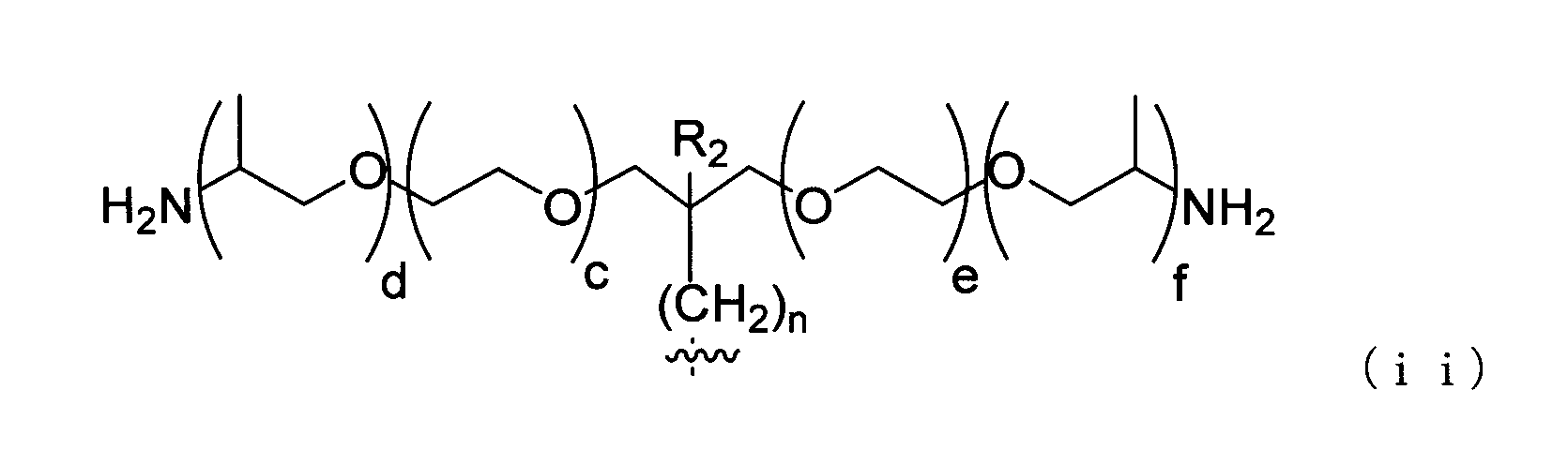
本発明で用いられるセルロース繊維複合体としては、置換基の種類に関係なく、平均繊維径に特に限定はない。例えば、平均繊維径がマイクロオーダーの態様(態様1)、平均繊維径がナノオーダーの態様(態様2)が例示される。
セルロース繊維複合体の結晶化度は、強度発現の観点から、好ましくは10%以上、より好ましくは15%以上、更に好ましくは20%以上、更に好ましくは40%以上である。また、原料入手性の観点から、好ましくは90%以下、より好ましくは85%以下、更に好ましくは80%以下、更に好ましくは75%以下である。なお、本明細書において、セルロースの結晶化度は、X線回折法による回折強度値から算出したセルロースI型結晶化度であり、下記計算式(A)により定義される。
セルロースI型結晶化度(%)=[(I22.6-I18.5)/I22.6]×100 (A)
〔式中、I22.6は、X線回折における格子面(002面)(回折角2θ=22.6°)の回折強度、I18.5は,アモルファス部(回折角2θ=18.5°)の回折強度を示す〕
なお、セルロースI型とは天然セルロースの結晶形のことであり、セルロースI型結晶化度とは、セルロース全体のうち結晶領域量の占める割合のことを意味する。
本発明で用いられるセルロース繊維複合体は、前記したセルロース繊維に修飾基を導入できるのであれば、特に限定なく公知の方法に従って製造することができる。なお、ここでいうセルロース繊維は、公知の方法、例えば、特開2011-140632号公報に記載の方法を参照にし、更に、前述の追酸化処理又は還元処理を行なうことで、アルデヒドを除去したカルボキシ基含有セルロース繊維として調製することができる。
〔態様A〕
工程(1):天然セルロース繊維をN-オキシル化合物存在下で酸化して、カルボキシ基含有セルロース繊維を得る工程
工程(2):工程(1)で得られたカルボキシ基含有セルロース繊維を追酸化処理又は還元処理を行なって、アルデヒド基が低減されたカルボキシ基含有セルロース繊維を得る工程
工程(3A):工程(2)で得られたアルデヒド基が低減されたカルボキシ基含有セルロース繊維と、修飾基を有する化合物とを混合する工程
〔態様B〕
工程(1):天然セルロース繊維をN-オキシル化合物存在下で酸化して、カルボキシ基含有セルロース繊維を得る工程
工程(2):工程(1)で得られたカルボキシ基含有セルロース繊維を追酸化処理又は還元処理を行なって、アルデヒド基が低減されたカルボキシ基含有セルロース繊維を得る工程
工程(3B):工程(2)で得られたアルデヒド基が低減されたカルボキシ基含有セルロース繊維と、修飾基を有する化合物とをアミド化反応させる工程
工程(1)は、天然セルロース繊維をN-オキシル化合物存在下で酸化して、カルボキシ基含有セルロース繊維を得る工程である。具体的には、天然セルロース繊維に対して、特開2015-143336号又は特開2015-143337号に記載の、酸化処理工程(例えば、2,2,6,6テトラメチルピペリジン-1-オキシル(TEMPO)を用いた酸化処理)及び精製工程(必要により)を行なうことで、カルボキシ基含有量が好ましくは0.1mmol/g以上のカルボキシ基含有セルロース繊維が得られる。
次に、第1の製造形態では、精製工程後に工程(1)で得られたカルボキシ基含有セルロース繊維を微細化する工程を行って、カルボキシ基含有の微細セルロース繊維を得る。微細化工程では、精製工程を経たカルボキシ基含有セルロース繊維を溶媒中に分散させ、微細化処理を行うことが好ましい。
工程(2)は、工程(1)で得られたカルボキシ基含有セルロース繊維を追酸化処理又は還元処理を行なって、アルデヒド基が低減されたカルボキシ基含有セルロース繊維を得る工程である。追酸化処理又は還元処理の方法は、前述のセルロース繊維複合体の項を参照することができる。
第1の製造形態において、工程(3A)は、前記工程を経て得られたアルデヒド基を低減したカルボキシ基含有セルロース繊維と、修飾基を有する化合物とを混合して、セルロース繊維複合体を得る工程である。具体的には、アルデヒド基を低減したカルボキシ基含有セルロース繊維と、修飾基を有する化合物とを溶媒中で混合すればよく、例えば、特開2015-143336号に記載の方法に従って製造することができる。
第1の製造形態において、工程(3B)は、前記工程を経て得られたアルデヒド基を低減したカルボキシ基含有セルロース繊維と、修飾基を有する化合物とをアミド化反応させて、セルロース繊維複合体を得る工程である。前記混合方法としては、原料が反応する程度のものであれば特に問題なく、具体的には、前記原料を縮合剤の存在下で混合し、アルデヒド基を低減したカルボキシ基含有セルロース繊維に含有されるカルボキシ基と、修飾基を有する化合物のアミノ基とを縮合反応させてアミド結合を形成する。
本発明における樹脂としては、熱可塑性樹脂、硬化性樹脂、セルロース系樹脂、ゴム系樹脂を用いることができる。
樹脂成形体は、本発明の樹脂組成物を押出成形、射出成形、プレス成形、注型成型又は溶媒キャスト法等の公知の成形方法を適宜用いることによって調製することができる。例えば、パッケージや基板などに注入あるいは塗布した後、乾燥し硬化させることで用途に応じた成形体を得ることができる。
<3> 前記セルロース繊維複合体のアルデヒド基含有量が、0.15mmol/g以下である、前記<1>又は<2>に記載の樹脂組成物。
<4> 前記セルロース繊維複合体のアルデヒド基含有量が、0.1mmol/g以下である、前記<1>~<3>いずれか1項に記載の樹脂組成物。
<5> 前記セルロース繊維複合体のアルデヒド基含有量が、0.05mmol/g以下である、前記<1>~<4>いずれか1項に記載の樹脂組成物。
<6> 前記セルロース繊維複合体のアルデヒド基含有量が、実質的に0mmol/gである、前記<1>~<5>いずれか1項に記載の樹脂組成物。
<7> 前記セルロース繊維複合体を構成するセルロース繊維のカルボキシ基含有量が、好ましくは0.1mmol/g以上、より好ましくは0.4mmol/g以上、更に好ましくは0.6mmol/g以上、更に好ましくは0.8mmol/g以上であり、好ましくは3mmol/g以下、より好ましくは2mmol/g以下、更に好ましくは1.8mmol/g以下、更に好ましくは1.5mmol/g以下、更に好ましくは1.2mmol/g以下である、前記<1>~<6>いずれか1項に記載の樹脂組成物。
<8> 前記セルロース繊維複合体を構成するセルロース繊維のカルボキシ基含有量が、0.4mmol/g以上である、前記<1>~<7>いずれか1項に記載の樹脂組成物。
<9> 前記セルロース繊維複合体を構成するセルロース繊維のカルボキシ基含有量が、0.6mmol/g以上である、前記<1>~<8>いずれか1項に記載の樹脂組成物。
<10> 前記セルロース繊維複合体を構成するセルロース繊維のカルボキシ基含有量が、3mmol/g以下である、前記<1>~<9>いずれか1項に記載の樹脂組成物。
<11> 前記セルロース繊維複合体を構成するセルロース繊維が、好ましくは、天然のセルロース繊維に予めカルボキシ基を含有させる酸化処理を行なったカルボキシ基含有セルロース繊維に対して、追酸化処理又は還元処理が行われたもの、又は、酸化処理を行なって得られたカルボキシ基含有セルロース繊維に対して、公知の微細化処理を行なって得られた微細セルロース繊維に対して、追酸化処理又は還元処理が行われたものである、前記<1>~<10>いずれか1項に記載の樹脂組成物。
<12> 前記セルロース繊維複合体を構成するセルロース繊維が、天然のセルロース繊維に予めカルボキシ基を含有させる酸化処理を行なったカルボキシ基含有セルロース繊維に対して、追酸化処理又は還元処理が行われたものである、前記<1>~<11>いずれか1項に記載の樹脂組成物。
<13> 前記追酸化処理の処理条件が、酸化剤として好ましくは亜塩素酸ナトリウム、亜塩素酸カリウム等の亜塩素酸塩を使用し、処理中の液pHが、好ましくは3以上10以下、より好ましくは4以上7以下、更に好ましくは4以上5以下であり、処理温度が、好ましくは0℃以上、より好ましくは10℃以上であり、好ましくは60℃以下、より好ましくは40℃以下であり、処理時間が、好ましくは1時間以上、より好ましくは10時間以上である、前記<1>~<12>いずれか1項に記載の樹脂組成物。
<14> 前記還元処理の処理条件が、還元剤として好ましくは、水素化ホウ素ナトリウム、水素化ホウ素リチウム等の金属水素化物及び/又は亜ジチオン酸ナトリウム、亜ジチオン酸カリウム等の亜ジチオン酸塩であり、処理中の液pHが、好ましくは7以上12以下、より好ましくは9以上11以下、更に好ましくは10であり、処理温度が、好ましくは0℃以上、より好ましくは10℃以上であり、好ましくは60℃以下、より好ましくは40℃以下であり、処理時間が、好ましくは1時間以上、より好ましくは3時間以上である、前記<1>~<13>いずれか1項に記載の樹脂組成物。
<15> 前記セルロース繊維が、好ましくは、そのセルロース繊維表面に存在するカルボキシ基及び水酸基からなる群から選ばれる1種以上に、修飾基を有する化合物をイオン結合及び/又は共有結合させることにより得られる、より好ましくは、セルロース繊維複合体が、セルロース繊維のカルボキシ基に、修飾基を有する化合物がイオン結合及び/又は共有結合を介して結合されてなる、前記<1>~<14>いずれか1項に記載の樹脂組成物。
<16> 前記セルロース繊維複合体が、セルロース繊維のカルボキシ基に、修飾基を有する化合物がイオン結合及び/又は共有結合を介して結合されてなる、前記<1>~<15>いずれか1項に記載の樹脂組成物。
<17> 前記修飾基を有する化合物が、好ましくは、第1級アミン、第2級アミン、第3級アミン、第4級アンモニウム化合物、ホスホニウム化合物、ブタノール、オクタノール、ドデカノール等のアルコール、イソシアネート化合物、無水酢酸、無水プロピオン酸、無水コハク酸等の酸無水物、エポキシ化合物(例えば、酸化アルキレンやアルキルグリシジルエーテル)、アルキルハライド及びその誘導体(例えば、メチルクロライド、エチルクロライドやモノクロロ酢酸)である、前記<1>~<16>いずれか1項に記載の樹脂組成物。
<18> 前記修飾基を有する化合物が、第1級アミン、第2級アミン、第3級アミン、及び第4級アンモニウム化合物からなる群より選択される1種以上の化合物を含む、前記<1>~<17>いずれか1項に記載の樹脂組成物。
<19> 前記修飾基を有する化合物が、第1級アミン、第2級アミン、及び第3級アミンからなる群より選択される1種以上の化合物を含む、前記<1>~<18>いずれか1項に記載の樹脂組成物。
<20> 前記第1~3級アミンが、好ましくはエチルアミン、ジエチルアミン、トリエチルアミン、プロピルアミン、ジプロピルアミン、ブチルアミン、ジブチルアミン、ヘキシルアミン、ジヘキシルアミン、オクチルアミン、ジオクチルアミン、トリオクチルアミン、ドデシルアミン、ジドデシルアミン、ステアリルアミン、ジステアリルアミン、モノエタノールアミン、ジエタノールアミン、トリエタノールアミン、アニリン、ベンジルアミンであり、前記第4級アンモニウム化合物が、好ましくはテトラメチルアンモニウムヒドロキシド(TMAH)、テトラエチルアンモニウムヒドロキシド(TEAH)、テトラエチルアンモニウムクロライド、テトラプロピルアンモニウムヒドロキシド(TPAH)、テトラブチルアンモニウムヒドロキシド(TBAH)、テトラブチルアンモニウムクロライド、ラウリルトリメチルアンモニウムクロライド、ジラウリルジメチルクロライド、ステアリルトリメチルアンモニウムクロライド、ジステアリルジメチルアンモニウムクロライド、セチルトリメチルアンモニウムクロライド、アルキルベンジルジメチルアンモニウムクロライドである、前記<1>~<19>いずれか1項に記載の樹脂組成物。
<21> 前記修飾基が、好ましくは炭化水素基、共重合部等であり、これらが好ましくは単独で又は2種以上が組み合わさって、セルロース繊維に結合(導入)される、前記<1>~<20>いずれか1項に記載の樹脂組成物。
<22> 炭化水素基が、好ましくは、鎖式飽和炭化水素基、鎖式不飽和炭化水素基、環式飽和炭化水素基、及び芳香族炭化水素基である、前記<1>~<21>いずれか1項に記載の樹脂組成物。
<23> 鎖式飽和炭化水素基が、好ましくはメチル基、エチル基、プロピル基、イソプロピル基、ブチル基、sec-ブチル基、tert-ブチル基、イソブチル基、ペンチル基、tert-ペンチル基、イソペンチル基、ヘキシル基、イソヘキシル基、ヘプチル基、オクチル基、2-エチルヘキシル基、ノニル基、デシル基、ドデシル基、トリデシル基、テトラデシル基、オクタデシル基、ドコシル基、オクタコサニル基等であり、鎖式不飽和炭化水素基が、好ましくはエチレン基、プロピレン基、ブテン基、イソブテン基、イソプレン基、ペンテン基、ヘキセン基、ヘプテン基、オクテン基、ノネン基、デセン基、ドデセン基、トリデセン基、テトラデセン基、オクタデセン基であり、環式飽和炭化水素基が、好ましくはシクロプロパン基、シクロブチル基、シクロペンタン基、シクロヘキシル基、シクロヘプチル基、シクロオクチル基、シクロノニル基、シクロデシル基、シクロドデシル基、シクロトリデシル基、シクロテトラデシル基、シクロオクタデシル基等であり、芳香族炭化水素基が、好ましくはアリール基及びアラルキル基である、前記<1>~<22>いずれか1項に記載の樹脂組成物。
<24> 前記アリール基が、好ましくはフェニル基、ナフチル基、アントリル基、フェナントリル基、ビフェニル基、トリフェニル基及びターフェニル基であり、アラルキル基が、好ましくはベンジル基、フェネチル基、フェニルプロピル基、フェニルペンチル基、フェニルヘキシル基、フェニルヘプチル基、及びフェニルオクチル基である、前記<1>~<23>いずれか1項に記載の樹脂組成物。
<25> セルロース繊維複合体における炭化水素基の平均結合量が、セルロース繊維あたり、好ましくは0.01mmol/g以上、より好ましくは0.05mmol/g以上、更に好ましくは0.1mmol/g以上、更に好ましくは0.3mmol/g以上、更に好ましくは0.5mmol/g以上であり、好ましくは3mmol/g以下、より好ましくは2.5mmol/g以下、更に好ましくは2mmol/g以下、更に好ましくは1.8mmol/g以下、更に好ましくは1.5mmol/g以下である、前記<1>~<24>いずれか1項に記載の樹脂組成物。
<26> 炭化水素基の導入率が、好ましくは10%以上、より好ましくは30%以上、更に好ましくは50%以上、更に好ましくは60%以上、更に好ましくは70%以上であり、好ましくは99%以下、より好ましくは97%以下、更に好ましくは95%以下、更に好ましくは90%以下である、前記<1>~<25>いずれか1項に記載の樹脂組成物。
<27> 前記共重合部が、好ましくはエチレンオキサイド/プロピレンオキサイド(EO/PO)共重合部等である、前記<1>~<26>いずれか1項に記載の樹脂組成物。
<28> EO/PO共重合部中のPOの含有率(モル%)が、好ましくは1モル%以上、より好ましくは5モル%以上、更に好ましくは7モル%以上、更に好ましくは10モル%以上であり、好ましくは100モル%以下、より好ましくは90モル%以下、更に好ましくは85モル%以下、更に好ましくは75モル%以下、更に好ましくは60モル%以下、更に好ましくは50モル%以下、更に好ましくは40モル%以下、更に好ましくは30モル%以下である、前記<1>~<27>いずれか1項に記載の樹脂組成物。
<29> EO/PO共重合部の分子量が、好ましくは500以上、より好ましくは1,000以上、更に好ましくは1,500以上であり、好ましくは10,000以下、より好ましくは7,000以下、更に好ましくは5,000以下、更に好ましくは4,000以下、更に好ましくは3,500以下、更に好ましくは2,500以下である、前記<1>~<28>いずれか1項に記載の樹脂組成物。
<30> EO/PO共重合部とアミンとは、直接に又は連結基を介して結合しているものが好ましく、連結基としては炭化水素基が好ましく、炭素数が好ましくは1~6、より好ましくは1~3のアルキレン基、さらに好ましくはエチレン基、プロピレン基である、前記<1>~<29>いずれか1項に記載の樹脂組成物。
<31> セルロース繊維複合体におけるEO/PO共重合部の平均結合量が、セルロース繊維あたり、好ましくは0.01mmol/g以上、より好ましくは0.05mmol/g以上、更に好ましくは0.1mmol/g以上、更に好ましくは0.3mmol/g以上、更に好ましくは0.5mmol/g以上であり、好ましくは3mmol/g以下、より好ましくは2.5mmol/g以下、更に好ましくは2mmol/g以下、更に好ましくは1.8mmol/g以下、更に好ましくは1.5mmol/g以下である、前記<1>~<30>いずれか1項に記載の樹脂組成物。
<32> セルロース繊維複合体におけるEO/PO共重合部の修飾率が、好ましくは10%以上、より好ましくは20%以上、更に好ましくは30%以上、更に好ましくは40%以上、更に好ましくは50%以上、更に好ましくは60%以上、更に好ましくは70%以上であり、好ましくは95%以下である、前記<1>~<31>いずれか1項に記載の樹脂組成物。
<33> セルロース繊維複合体がマイクロオーダーの態様の場合、その平均繊維径が好ましくは5μm以上、より好ましくは7μm以上、更に好ましくは10μm以上であり、好ましくは100μm以下、より好ましくは70μm以下、更に好ましくは50μm以下、更に好ましくは40μm以下、更に好ましくは30μm以下である、前記<1>~<32>いずれか1項に記載の樹脂組成物。
<34> セルロース繊維複合体がナノオーダーの態様の場合、その平均繊維径が好ましくは1nm以上、より好ましくは3nm以上、更に好ましくは10nm以上、更に好ましくは20nm以上であり、好ましくは500nm以下、より好ましくは300nm以下、更に好ましくは200nm以下、更に好ましくは150nm以下、より更に好ましくは120nm以下である、前記<1>~<33>いずれか1項に記載の樹脂組成物。
<35> セルロース繊維複合体の結晶化度が好ましくは10%以上、より好ましくは15%以上、更に好ましくは20%以上、更に好ましくは40%以上であり、好ましくは90%以下、より好ましくは85%以下、更に好ましくは80%以下、更に好ましくは75%以下である、前記<1>~<34>いずれか1項に記載の樹脂組成物。
<36> セルロース繊維複合体の結晶化度が20%以上である、前記<1>~<35>いずれか1項に記載の樹脂組成物。
<37> セルロース繊維複合体の結晶化度が40%以上である、前記<1>~<36>いずれか1項に記載の樹脂組成物。
<38> セルロース繊維複合体の結晶化度が80%以下である、前記<1>~<37>いずれか1項に記載の樹脂組成物。
<39> セルロース繊維複合体の結晶化度が75%以下である、前記<1>~<38>いずれか1項に記載の樹脂組成物。
<40> a)樹脂が、好ましくは熱可塑性樹脂及び/又は硬化性樹脂である、前記<1>~<39>いずれか1項に記載の樹脂組成物。
<41> 熱可塑性樹脂が、好ましくは、ポリ乳酸樹脂等の飽和ポリエステル樹脂、ポリエチレン樹脂、ポリプロピレン樹脂等のオレフィン樹脂、塩化ビニル樹脂、スチレン樹脂、(メタ)アクリル系樹脂、ビニルエーテル樹脂、ポリビニルアルコール樹脂、ポリビニルアセタール樹脂、ポリ酢酸ビニル樹脂、ポリアミド樹脂、ポリカーボネート樹脂、ポリスルホン樹脂等である、前記<1>~<40>いずれか1項に記載の樹脂組成物。
<42> 硬化性樹脂が、好ましくは光硬化性樹脂及び/又は熱硬化性樹脂である、前記<1>~<41>いずれか1項に記載の樹脂組成物。
<43> 前記樹脂成分にエポキシ樹脂を用いる場合、好ましくは硬化剤を使用する、前記<1>~<42>いずれか1項に記載の樹脂組成物。
<44> a)樹脂がゴム系樹脂である、前記<1>~<43>いずれか1項に記載の樹脂組成物。
<45> ゴム系樹脂が、好ましくはジエン系ゴム及び/又は非ジエン系ゴムである、前記<1>~<44>いずれか1項に記載の樹脂組成物。
<46> ジエン系ゴムが、好ましくは天然ゴム、ポリイソプレンゴム、ポリブタジエンゴム、スチレン-ブタジエン共重合体ゴム、ブチルゴム、ブタジエン-アクリロニトリル共重合体ゴム、クロロプレンゴム及び、エポキシ化天然ゴム、水素化天然ゴム等の変性天然ゴム等である、前記<1>~<45>いずれか1項に記載の樹脂組成物。
<47> 非ジエン系ゴムが、好ましくはブチルゴム、エチレン-プロピレンゴム、エチレン-プロピレン-ジエンゴム、ウレタンゴム、シリコーンゴム、フッ素ゴム、アクリルゴム、多硫化ゴム、エピクロルヒドリンゴムである、前記<1>~<46>いずれか1項に記載の樹脂組成物。
<48> 樹脂組成物中の樹脂の含有量が、好ましくは50質量%以上、より好ましくは60質量%以上、更に好ましくは70質量%以上、更に好ましくは80質量%以上、更に好ましくは85質量%以上であり、好ましくは99質量%以下、より好ましくは98質量%以下、更に好ましくは95質量%以下、更に好ましくは90質量%以下である、前記<1>~<47>いずれか1項に記載の樹脂組成物。
<49> 樹脂組成物中のセルロース繊維複合体の含有量が、好ましくは0.1質量%以上、より好ましくは0.5質量%以上、更に好ましくは1質量%以上、更に好ましくは2質量%以上、更に好ましくは3質量%以上、更に好ましくは5質量%以上であり、好ましくは50質量%以下、より好ましくは40質量%以下、更に好ましくは30質量%以下、更に好ましくは20質量%以下、更に好ましくは15質量%以下、更に好ましくは13質量%以下である、前記<1>~<48>いずれか1項に記載の樹脂組成物。
<50> 樹脂組成物中のセルロース繊維複合体量が、樹脂100質量部に対して、好ましくは0.1質量部以上、より好ましくは1質量部以上、更に好ましくは2質量部以上、更に好ましくは3質量部以上、更に好ましくは5質量部以上であり、好ましくは100質量部以下、より好ましくは70質量部以下、更に好ましくは50質量部以下、更に好ましくは30質量部以下、更に好ましくは20質量部以下、更に好ましくは15質量部以下である、前記<1>~<49>いずれか1項に記載の樹脂組成物。
<51> 樹脂組成物中のセルロース繊維量(換算量)が、樹脂100質量部に対して、好ましくは0.1質量部以上、より好ましくは1質量部以上、更に好ましくは2質量部以上、更に好ましくは5質量部以上であり、好ましくは100質量部以下、より好ましくは70質量部以下、更に好ましくは50質量部以下、更に好ましくは30質量部以下、更に好ましくは20質量部以下である、前記<1>~<50>いずれか1項に記載の樹脂組成物。
<52> さらに可塑剤を含有する、前記<1>~<51>いずれか1項に記載の樹脂組成物。
<53> 可塑剤が、好ましくはフタル酸エステルやコハク酸エステル、アジピン酸エステルといった多価カルボン酸エステル、グリセリン等脂肪族ポリオールの脂肪酸エステル等である、前記<1>~<52>いずれか1項に記載の樹脂組成物。
<54> 可塑剤の含有量が、樹脂100質量部に対して、好ましくは1質量部以上、より好ましくは3質量部以上、更に好ましくは5質量部以上であり、好ましくは30質量部以下、より好ましくは20質量部以下、更に好ましくは15質量部以下である、前記<1>~<53>いずれか1項に記載の樹脂組成物。
<55> 樹脂組成物が、好ましくは、さらに、結晶核剤、充填剤(無機充填剤、有機充填剤)、加水分解抑制剤、難燃剤、酸化防止剤、炭化水素系ワックス類やアニオン型界面活性剤である滑剤、紫外線吸収剤、帯電防止剤、防曇剤、光安定剤、顔料、防カビ剤、抗菌剤、発泡剤、界面活性剤;でんぷん類、アルギン酸等の多糖類;ゼラチン、ニカワ、カゼイン等の天然たんぱく質;タンニン、ゼオライト、セラミックス、金属粉末等の無機化合物;香料;流動調整剤;レベリング剤;導電剤;紫外線分散剤;消臭剤;他の高分子材料;他の樹脂組成物を含有し、かかる添加剤の含有割合が、樹脂組成物中10質量%程度以下が好ましく、5質量%程度以下がより好ましい、前記<1>~<54>いずれか1項に記載の樹脂組成物。
<56> 樹脂組成物がゴム系樹脂を含有する場合、好ましくは、さらにカーボンブラックやシリカ等の補強用充填剤、各種薬品、例えば加硫剤、加硫促進剤、老化防止剤、スコーチ防止剤、酸化マグネシウム、亜鉛華、ステアリン酸、プロセスオイル、植物油脂、可塑剤等のタイヤ用、その他一般ゴム用に配合されている各種添加剤が従来の一般的な量で配合される、前記<1>~<55>いずれか1項に記載の樹脂組成物。
<57> 水分含有量が、好ましくは2質量%以下、より好ましくは0.5質量%以下、更に好ましくは実質的に0質量%である、前記<1>~<56>いずれか1項に記載の樹脂組成物。
<58> 好ましくは、日用雑貨品、家電部品、自動車部品等、より好ましくは日用品、化粧品、家電製品などの包装材として、電子部品などを構成する電子材料として、ブリスターパックやトレイ、お弁当の蓋等の食品容器として、工業部品の輸送や保護に用いる工業用トレイとして、ダッシュボード、インストルメントパネル、フロア等の自動車部品等用いることができる、前記<1>~<57>いずれか1項に記載の樹脂組成物。
<59> 前記<1>~<58>いずれか1項に記載の樹脂組成物を含む成形体。
<60> 好ましくは、日用雑貨品、家電部品、自動車部品等、より好ましくは日用品、化粧品、家電製品などの包装材として、電子部品などを構成する電子材料として、ブリスターパックやトレイ、お弁当の蓋等の食品容器として、工業部品の輸送や保護に用いる工業用トレイとして、ダッシュボード、インストルメントパネル、フロア等の自動車部品等用いることができる、前記<59>に記載の成形体。
<61> a)樹脂と、b)セルロース分子内にカルボキシ基を有するセルロース繊維の複合体であって、アルデヒド基含有量が0.20mmol/g以下であり、かつ、カルボキシ基及び水酸基から選ばれる1種以上に修飾基が結合されてなるセルロース繊維複合体を溶融混練する工程を含む、樹脂組成物の製造方法。
<62> セルロース分子内にカルボキシ基を有するセルロース繊維の複合体であって、アルデヒド基含有量が0.20mmol/g以下であり、かつ、カルボキシ基及び水酸基から選ばれる1種以上に修飾基が結合されてなる、樹脂組成物用添加剤であるセルロース繊維複合体。
<63> 前記セルロース繊維複合体のアルデヒド基含有量が、好ましくは0.18mmol/g以下、より好ましくは0.15mmol/g以下、さらに好ましくは0.1mmol/g以下、さらに好ましくは0.05mmol/g以下、さらに好ましくは実質的に0mmol/gである、前記<62>に記載のセルロース繊維複合体。
<64> セルロース分子内にカルボキシ基を有するセルロース繊維の複合体であって、アルデヒド基含有量が0.20mmol/g以下であり、かつ、カルボキシ基に1~3級の炭化水素系アミンがイオン結合及び/又は共有結合を介して結合されてなるセルロース繊維複合体。
<65> 前記セルロース繊維複合体のアルデヒド基含有量が、好ましくは0.18mmol/g以下、より好ましくは0.15mmol/g以下、さらに好ましくは0.1mmol/g以下、さらに好ましくは0.05mmol/g以下、さらに好ましくは実質的に0mmol/gである、前記<64>に記載のセルロース繊維複合体。
<66> 前記セルロース繊維複合体のアルデヒド基含有量が、0.15mmol/g以下である、前記<62>又は<64>に記載のセルロース繊維複合体。
<67> 前記セルロース繊維複合体のアルデヒド基含有量が、0.1mmol/g以下である、前記<62>又は<64>に記載のセルロース繊維複合体。
<68> 前記セルロース繊維複合体のアルデヒド基含有量が、0.05mmol/g以下である、前記<62>又は<64>に記載のセルロース繊維複合体。
<69> 前記セルロース繊維複合体のアルデヒド基含有量が、実質的に0mmol/gである、前記<62>又は<64>に記載のセルロース繊維複合体。
セルロース繊維に水を加えて、その濃度が0.0001質量%の分散液を調製し、該分散液をマイカ(雲母)上に滴下して乾燥したものを観察試料として、原子間力顕微鏡(AFM、Nanoscope III Tapping mode AFM、Digital instrument社製、プローブはナノセンサーズ社製Point Probe (NCH)を使用)を用いて、該観察試料中のセルロース繊維の繊維高さを測定する。その際、該セルロース繊維が確認できる顕微鏡画像において、セルロース繊維を5本以上抽出し、それらの繊維高さから平均繊維径を算出する。
乾燥質量0.5gのセルロース繊維又はセルロース繊維複合体を100mLビーカーにとり、イオン交換水もしくはメタノール/水=2/1の混合溶媒を加えて全体で55mLとし、そこに0.01M塩化ナトリウム水溶液5mLを加えて分散液を調製し、セルロース繊維又はセルロース繊維複合体が十分に分散するまで該分散液を攪拌する。この分散液に0.1M塩酸を加えてpHを2.5~3に調整し、自動滴定装置(東亜ディーケーケー社製、商品名「AUT-50」)を用い、0.05M水酸化ナトリウム水溶液を待ち時間60秒の条件で該分散液に滴下し、1分ごとの電導度及びpHの値を測定し、pH11程度になるまで測定を続け、電導度曲線を得る。この電導度曲線から、水酸化ナトリウム滴定量を求め、式1により、セルロース繊維又はセルロース繊維複合体のカルボキシ基含有量を算出する。
カルボキシ基含有量(mmol/g)=水酸化ナトリウム滴定量×水酸化ナトリウム水溶液濃度(0.05M)/セルロース繊維の質量(0.5g)・・・式1
ビーカーに、セルロース繊維又はセルロース繊維複合体100.0g(固形分濃度1.0質量%)、酢酸緩衝液(pH4.8)、2-メチル-2-ブテン0.33g、亜塩素酸ナトリウム0.45gを加え室温で16時間撹拌する。反応終了後、イオン交換水にて洗浄を行い、アルデヒドを酸化処理したセルロース繊維又はセルロース繊維複合体を得る。反応液を凍結乾燥処理し、得られた乾燥品をセルロース繊維又はセルロース繊維複合体のカルボキシ基含有量を上記に記載の方法で測定し、酸化処理したセルロース繊維又はセルロース繊維複合体のカルボキシ基含有量を算出する。続いて、式2にてセルロース繊維又はセルロース繊維複合体のアルデヒド基含有量を算出する。
アルデヒド基含有量(mmol/g)=(酸化処理したセルロース繊維又はセルロース繊維複合体のカルボキシ基含有量)-(セルロース繊維又はセルロース繊維複合体のカルボキシ基含有量)・・・式2
ハロゲン水分計MOC-120H(島津製作所社製)を用いて行った。サンプル1gに対して150℃恒温で30秒ごとの測定を行い、質量減少が0.1%以下となった値を固形分濃度とし、下記式により水分濃度を求める。
水分濃度(%)=100-固形分濃度(%)
針葉樹の漂白クラフトパルプ(フレッチャー チャレンジ カナダ社製、商品名「Machenzie」、CSF650ml)を天然セルロース繊維として用いた。TEMPOとしては、市販品(ALDRICH社製、Free radical、98質量%)を用いた。次亜塩素酸ナトリウムとしては、市販品(和光純薬工業社製)を用いた。臭化ナトリウムとしては、市販品(和光純薬工業社製)を用いた。
ビーカーに微細セルロース繊維の調製例1で得られたカルボキシ基含有微細セルロース繊維分散液3846.15g(固形分濃度1.3質量%)に1M水酸化ナトリウム水溶液を加えpH10程度にした後、水素化ホウ素ナトリウムを2.63g仕込み、室温下3時間反応させアルデヒド還元処理を行った。反応終了後、1M塩酸水溶液を405g、イオン交換水を4286g加え0.7質量%の水溶液とし、室温下1時間反応させプロトン化を行い、反応終了後イオン交換水にて洗浄し塩酸及び塩を除去した。得られたアルデヒド基を還元処理したカルボキシ基含有微細セルロース繊維分散液(固形分濃度2.0質量%)の平均繊維径は3.3nm、カルボキシ基含有量は1.62mmol/g、アルデヒド基含有量は0.02mmol/gであった。
ビーカーに微細セルロース繊維の調製例1で得られたカルボキシ基含有微細セルロース繊維分散液5300.00g(固形分濃度1.3質量%)にイオン交換水4043gを加え0.7質量%の水溶液とし、メカニカルスターラーにて室温下(25℃)、30分攪拌した。続いて1M塩酸水溶液を558g仕込み室温下、1時間反応させた。反応終了後イオン交換水にて洗浄を行い、塩酸及び塩を除去しカルボキシ基含有微細セルロース繊維が膨潤した状態の酸型セルロース繊維分散液(固形分濃度1.8質量%)を得た。この微細セルロース繊維の平均繊維径は3.3nm、カルボキシ基含有量は1.62mmol/g、アルデヒド基含有量は0.27mmol/gであった。
ビーカーに微細セルロース繊維の調製例1で得られたカルボキシ基含有微細セルロース繊維分散液769.23g(固形分濃度1.3質量%)に、酢酸緩衝液(pH=4.8)を250g、亜塩素酸ナトリウムを4.50g、1-メチル-2-ブテンを3.30g仕込み、室温下16時間反応させアルデヒド酸化処理を行った。反応終了後イオン交換水にて洗浄を行い、1M塩酸水溶液を80.0g、イオン交換水を659g加え0.7質量%の水溶液とし、室温下1時間反応させプロトン化を行い、反応終了後イオン交換水にて洗浄し塩酸及び塩を除去した。得られたアルデヒド基を酸化処理したカルボキシ基含有微細セルロース繊維分散液(固形分濃度2.0質量%)の平均繊維径は3.3nm、カルボキシ基含有量は1.81mmol/g、アルデヒド基含有量は0.04mmol/gであった。
パルプ質量100gに対し、TEMPO1.25g、臭化ナトリウム12.5g、次亜塩素酸ナトリウム23.5gの添加量とした以外は調製例1と同様にしてカルボキシ基含有微細セルロース繊維分散液(固形分濃度1.2質量%)を得た。この微細セルロース繊維の平均繊維径は3.5nm、カルボキシ基含有量は1.18mmol/g、アルデヒド基含有量は0.17mmol/gであった。

プロピレングリコール第三級ブチルエーテル132g(1mol)を1Lのオートクレーブに仕込み、75℃に加熱し、フレーク状の水酸化カリウム1.2gを加え、溶解するまで攪拌した。次いで、表2に示す量のエチレンオキシド(EO)とプロピレンオキシド(PO)を110℃で0.34MPaにて反応させた後、Magnesol 30/40(ケイ酸マグネシウム、ダラスグループ社製)7.14gを投入して95℃で中和し、得られた生成物をジ第三級ブチル-p-クレゾール 0.16gを添加、混合した後、濾過して、EO/PO共重合体であるポリエーテルを得た。
1409〔EO分子量(44.03)×EO付加モル数(32)〕+522〔PO分子量(58.04)×PO付加モル数(9)〕+58.04〔出発原料中のPO部分分子量(プロピレングリコール)〕=1989
を四捨五入して2000と算出した。
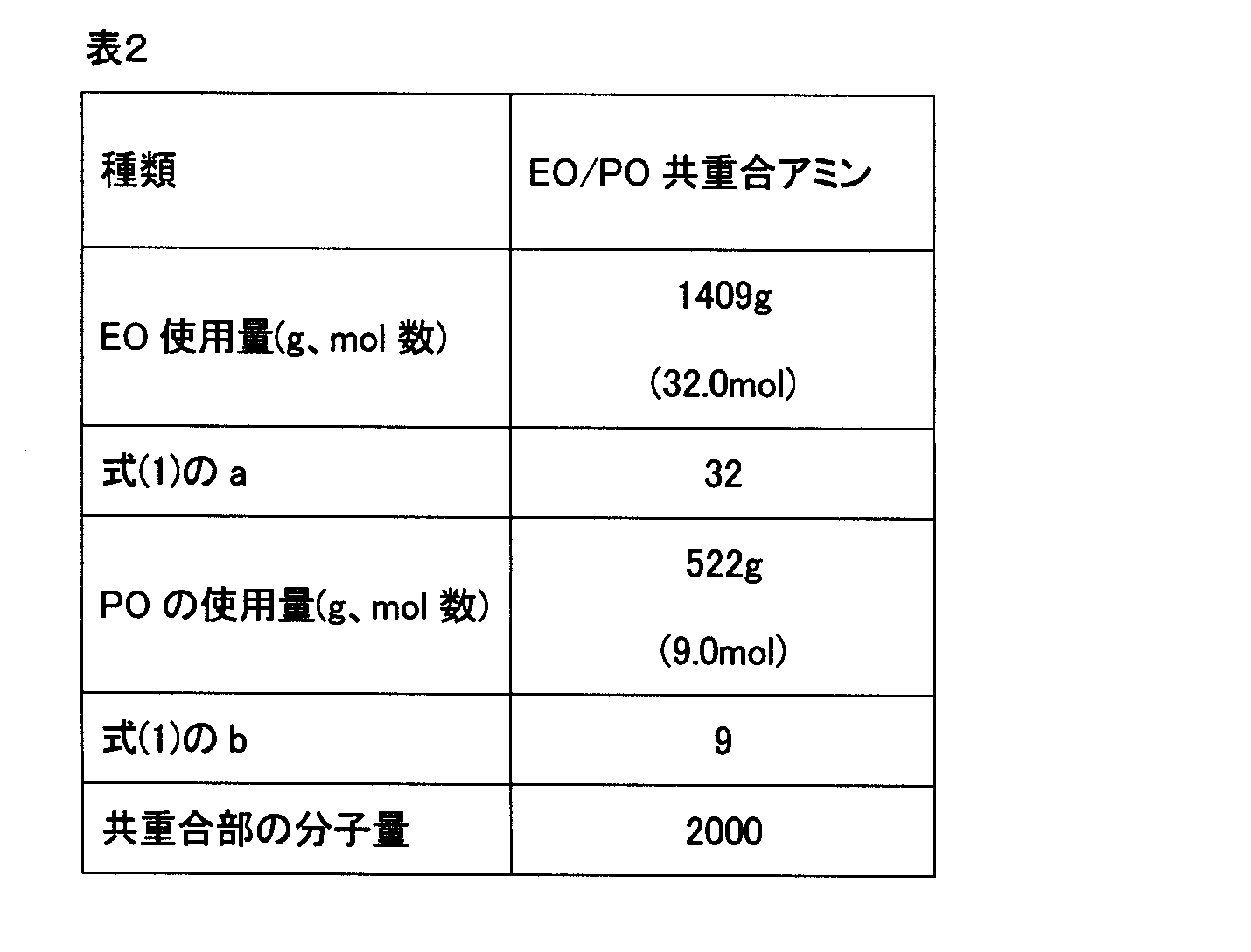
マグネティックスターラー、攪拌子を備えたビーカーに、微細セルロース繊維の調製例2で得られたカルボキシ基含有微細セルロース繊維分散液200g(固形分濃度2.0質量%)を仕込んだ。続いて、表2に示す種類のアミンを、微細セルロース繊維のカルボキシ基1molに対してアミン基0.3molに相当する量を仕込み、イオン交換水300g中に溶解させ、反応液を室温(25℃)で14時間反応させた。反応終了後ろ過し、イオン交換水にて洗浄することで、還元処理した微細セルロース繊維に、EOPO共重合体がイオン結合を介して連結した微細セルロース繊維複合体を得た。
マグネティックスターラー、攪拌子を備えたビーカーに、微細セルロース繊維の調製例3で得られたカルボキシ基含有微細セルロース繊維分散液300g(固形分濃度1.8質量%)を仕込んだ。続いて、表2に示す種類のアミンを、微細セルロース繊維のカルボキシ基1molに対してアミン基0.3molに相当する量を仕込み、イオン交換水300g中に溶解させ、反応液を室温(25℃)で14時間反応させた。反応終了後ろ過し、イオン交換水にて洗浄することで、微細セルロース繊維に、EOPO共重合体がイオン結合を介して連結した微細セルロース繊維複合体を得た。
マグネティックスターラー、攪拌子を備えたビーカーに、微細セルロース繊維の調製例2で得られたカルボキシ基含有微細セルロース繊維分散液300g(固形分濃度2.0質量%)を仕込んだ。続いて、プロピルアミンを、微細セルロース繊維のカルボキシ基1molに対してアミン基1.0molに相当する量を仕込み、イオン交換水100g中に溶解させ、反応液を室温(25℃)で14時間反応させた。反応終了後ろ過し、イオン交換水にて洗浄することで、還元処理した微細セルロース繊維に、プロピル基がイオン結合を介して連結した微細セルロース繊維複合体を得た。
マグネティックスターラー、攪拌子を備えたビーカーに、微細セルロース繊維の調製例3で得られたカルボキシ基含有微細セルロース繊維分散液300g(固形分濃度1.8質量%)を仕込んだ。続いて、プロピルアミンを、微細セルロース繊維のカルボキシ基1molに対してアミン基1.0molに相当する量を仕込み、イオン交換水300g中に溶解させ、反応液を室温(25℃)で14時間反応させた。反応終了後ろ過し、イオン交換水にて洗浄することで、微細セルロース繊維に、プロピル基がイオン結合を介して連結した微細セルロース繊維複合体を得た。
マグネティックスターラー、攪拌子を備えたビーカーに、微細セルロース繊維の調製例2で得られたカルボキシ基含有微細セルロース繊維分散液300g(固形分濃度2.0質量%)を仕込んだ。続いて、ヘキシルアミンを、微細セルロース繊維のカルボキシ基1molに対してアミン基1.0molに相当する量を仕込み、イオン交換水100g中に溶解させ、反応液を室温(25℃)で14時間反応させた。反応終了後ろ過し、イオン交換水にて洗浄することで、還元処理した微細セルロース繊維に、ヘキシル基がイオン結合を介して連結した微細セルロース繊維複合体を得た。
マグネティックスターラー、攪拌子を備えたビーカーに、微細セルロース繊維の調製例3で得られたカルボキシ基含有微細セルロース繊維分散液300g(固形分濃度1.8質量%)を仕込んだ。続いて、ヘキシルアミンを、微細セルロース繊維のカルボキシ基1molに対してアミン基1.0molに相当する量を仕込み、イオン交換水300g中に溶解させ、反応液を室温(25℃)で14時間反応させた。反応終了後ろ過し、イオン交換水にて洗浄することで、微細セルロース繊維に、ヘキシル基がイオン結合を介して連結した微細セルロース繊維複合体を得た。
マグネティックスターラー、攪拌子を備えたビーカーに、微細セルロース繊維の調製例2で得られたカルボキシ基含有微細セルロース繊維分散液300g(固形分濃度2.0質量%)を仕込んだ。続いて、テトラブチルアンモニウムヒドロキシド水溶液を、微細セルロース繊維のカルボキシ基1molに対してアミン基1.0molに相当する量を仕込み、イオン交換水100g中に溶解させ、反応液を室温(25℃)で14時間反応させた。反応終了後ろ過し、イオン交換水にて洗浄することで、還元処理した微細セルロース繊維に、テトラブチルアンモニウム基がイオン結合を介して連結した微細セルロース繊維複合体を得た。
マグネティックスターラー、攪拌子を備えたビーカーに、微細セルロース繊維の調製例3で得られたカルボキシ基含有微細セルロース繊維分散液300g(固形分濃度1.8質量%)を仕込んだ。続いて、テトラブチルアンモニウムヒドロキシド水溶液を、微細セルロース繊維のカルボキシ基1molに対してアミン基1.0molに相当する量を仕込み、イオン交換水300g中に溶解させ、反応液を室温(25℃)で14時間反応させた。反応終了後ろ過し、イオン交換水にて洗浄することで、微細セルロース繊維に、テトラブチルアンモニウム基がイオン結合を介して連結した微細セルロース繊維複合体を得た。
マグネティックスターラー、攪拌子を備えたビーカーに、微細セルロース繊維の調製例2で得られたカルボキシ基含有微細セルロース繊維分散液300g(固形分濃度2.0質量%)を仕込んだ。続いて、ジエタノールアミンを、微細セルロース繊維のカルボキシ基1molに対してアミン基1.0molに相当する量を仕込み、イオン交換水100g中に溶解させ、反応液を室温(25℃)で14時間反応させた。反応終了後ろ過し、イオン交換水にて洗浄することで、還元処理した微細セルロース繊維に、ジエタノール基がイオン結合を介して連結した微細セルロース繊維複合体を得た。
マグネティックスターラー、攪拌子を備えたビーカーに、微細セルロース繊維の調製例3で得られたカルボキシ基含有微細セルロース繊維分散液300g(固形分濃度1.8質量%)を仕込んだ。続いて、ジエタノールアミンを、微細セルロース繊維のカルボキシ基1molに対してアミン基1.0molに相当する量を仕込み、イオン交換水300g中に溶解させ、反応液を室温(25℃)で14時間反応させた。反応終了後ろ過し、イオン交換水にて洗浄することで、微細セルロース繊維に、ジエタノール基がイオン結合を介して連結した微細セルロース繊維複合体を得た。
マグネティックスターラー、攪拌子を備えたビーカーに、微細セルロース繊維の調製例2で得られたカルボキシ基含有微細セルロース繊維分散液300g(固形分濃度2.0質量%)を仕込んだ。続いて、EO/PO共重合アミン製造例で作成したEOPO共重合アミンを、微細セルロース繊維のカルボキシ基1molに対してアミン基1.0molに相当する量を仕込み、イオン交換水100g中に溶解させ、反応液を室温(25℃)で14時間反応させた。反応終了後ろ過し、イオン交換水にて洗浄することで、還元処理した微細セルロース繊維に、EOPO共重合体がイオン結合を介して連結した微細セルロース繊維複合体を得た。
マグネティックスターラー、攪拌子を備えたビーカーに、微細セルロース繊維の調製例3で得られたカルボキシ基含有微細セルロース繊維分散液300g(固形分濃度1.8質量%)を仕込んだ。続いて、EO/PO共重合アミン製造例で作成したEOPO共重合アミンを、微細セルロース繊維のカルボキシ基1molに対してアミン基1.0molに相当する量を仕込み、イオン交換水300g中に溶解させ、反応液を室温(25℃)で14時間反応させた。反応終了後ろ過し、イオン交換水にて洗浄することで、微細セルロース繊維に、EOPO共重合体がイオン結合を介して連結した微細セルロース繊維複合体を得た。
マグネティックスターラー、攪拌子を備えたビーカーに、微細セルロース繊維の調製例2で得られたカルボキシ基含有微細セルロース繊維分散液300g(固形分濃度2.0質量%)を仕込んだ。続いて、ジプロピルアミンを、微細セルロース繊維のカルボキシ基1molに対してアミン基1.0molに相当する量を仕込み、イオン交換水100g中に溶解させ、反応液を室温(25℃)で14時間反応させた。反応終了後ろ過し、イオン交換水にて洗浄することで、還元処理した微細セルロース繊維に、ジプロピル基がイオン結合を介して連結した微細セルロース繊維複合体を得た。
マグネティックスターラー、攪拌子を備えたビーカーに、微細セルロース繊維の調製例3で得られたカルボキシ基含有微細セルロース繊維分散液300g(固形分濃度1.8質量%)を仕込んだ。続いて、ジプロピルアミンを、微細セルロース繊維のカルボキシ基1molに対してアミン基1.0molに相当する量を仕込み、イオン交換水300g中に溶解させ、反応液を室温(25℃)で14時間反応させた。反応終了後ろ過し、イオン交換水にて洗浄することで、微細セルロース繊維に、ジプロピル基がイオン結合を介して連結した微細セルロース繊維複合体を得た。
マグネティックスターラー、攪拌子を備えたビーカーに、微細セルロース繊維の調製例2で得られたカルボキシ基含有微細セルロース繊維分散液300g(固形分濃度2.0質量%)を仕込んだ。続いて、アニリンを、微細セルロース繊維のカルボキシ基1molに対してアミン基1.0molに相当する量を仕込み、イオン交換水100g中に溶解させ、反応液を室温(25℃)で14時間反応させた。反応終了後ろ過し、イオン交換水にて洗浄することで、還元処理した微細セルロース繊維に、フェニル基がイオン結合を介して連結した微細セルロース繊維複合体を得た。
マグネティックスターラー、攪拌子を備えたビーカーに、微細セルロース繊維の調製例3で得られたカルボキシ基含有微細セルロース繊維分散液300g(固形分濃度1.8質量%)を仕込んだ。続いて、アニリンを、微細セルロース繊維のカルボキシ基1molに対してアミン基1.0molに相当する量を仕込み、イオン交換水300g中に溶解させ、反応液を室温(25℃)で14時間反応させた。反応終了後ろ過し、イオン交換水にて洗浄することで、微細セルロース繊維に、フェニル基がイオン結合を介して連結した微細セルロース繊維複合体を得た。
マグネティックスターラー、攪拌子を備えたビーカーに、微細セルロース繊維の調製例2で得られたカルボキシ基含有微細セルロース繊維分散液300g(固形分濃度2.0質量%)を仕込んだ。続いて、プロピルアミンを、微細セルロース繊維のカルボキシ基1molに対してアミン基1.0molに相当する量、縮合剤である4-(4,6-ジメトキシ-1,3,5-トリアジン-2-イル)-4-メチルモルホリニウムクロライド(DMT-MM)を微細セルロース繊維のカルボキシ基1molに対して3molに相当する量、N-メチルモルホリン(NMM)を微細セルロース繊維のカルボキシ基に対して2molに相当する量を仕込み、DMF1000g中に溶解させ、反応液を室温(25℃)で14時間反応させた。反応終了後ろ過し、イオン交換水にて洗浄、DMT-MM塩を除去することで、還元処理した微細セルロース繊維に、プロピル基がアミド結合を介して連結した微細セルロース繊維複合体を得た。
マグネティックスターラー、攪拌子を備えたビーカーに、微細セルロース繊維の調製例3で得られたカルボキシ基含有微細セルロース繊維分散液300g(固形分濃度1.8質量%)を仕込んだ。続いて、プロピルアミンを、微細セルロース繊維のカルボキシ基1molに対してアミン基1.0molに相当する量、縮合剤であるDMT-MMを微細セルロース繊維のカルボキシ基1molに対して3molに相当する量、NMMを微細セルロース繊維のカルボキシ基に対して2molに相当する量を仕込み、DMF1000g中に溶解させ、反応液を室温(25℃)で14時間反応させた。反応終了後ろ過し、イオン交換水にて洗浄、DMT-MM塩を除去することで、微細セルロース繊維に、プロピル基がアミド結合を介して連結した微細セルロース繊維複合体を得た。
マグネティックスターラー、攪拌子を備えたビーカーに、微細セルロース繊維の調製例4で得られたカルボキシ基含有微細セルロース繊維分散液300g(固形分濃度2.0質量%)を仕込んだ。続いて、プロピルアミンを、微細セルロース繊維のカルボキシ基1molに対してアミン基1.0molに相当する量を仕込み、イオン交換水100g中に溶解させ、反応液を室温(25℃)で14時間反応させた。反応終了後ろ過し、イオン交換水にて洗浄することで、酸化処理した微細セルロース繊維に、プロピル基がイオン結合を介して連結した微細セルロース繊維複合体を得た。
<可塑剤と微細セルロース繊維複合体の混合物の製造>
微細セルロース繊維複合体の製造例1及び2で製造した微細セルロース繊維複合体の分散液に、可塑剤(フタル酸ジ-2-エチルヘキシル(DOP)、花王社製)を表3に示す配合量となるよう添加して超音波ホモジナイザー(US-300E、日本精機製作所社製)にて2分間攪拌後、高圧ホモジナイザー(スギノマシン社製、スターバーストラボ HJP-2 5005)にて100MPaで2パス、150MPaで1パス微細処理させた。該均一混合物をガラスシャーレに注ぎ、2日間40℃で真空乾燥を行い、可塑剤と微細セルロース繊維複合体の混合物を製造した。
ポリ塩化ビニル樹脂100部に対して、上記で得られた可塑剤と微細セルロース繊維又はその複合体の混合物に表3に示す配合組成の成分を50ミリリットルの密閉型ミキサーで170℃で10分間混練し、ポリ塩化ビニル樹脂組成物を得た。得られた樹脂組成物を15×15×0.2cmの金型中で175℃で4分半予熱後に、1分半加圧(圧力:5kg/cm2)し、ポリ塩化ビニルシートを調製し、その物性を評価した。
<ゴム組成物>
微細セルロース繊維複合体の製造例3で得られた微細セルロース繊維複合体を用いてゴム組成物を製造した。表4に示す配合組成において、酸化マグネシウム(加硫剤、和光純薬工業社製)と酸化亜鉛(加硫促進剤、和光純薬工業社製)とステアリン酸(ルナックS-70、花王社製)を除く成分を50ミリリットルの密閉型ミキサーで6分間混練し、温度が90℃に達したときに容器を開放して混合物を得た。該混合物に酸化マグネシウムと酸化亜鉛とステアリン酸を加えて50ミリリットルの密閉型ミキサーで3分間混練し、温度が90℃に達したときに容器を開放して未加硫のゴム組成物を得た。得られたゴム組成物を15×15×0.2cmの金型中で160℃で20分間加硫処理をして加硫ゴムシートを調製した。
微細セルロース繊維複合体の製造例3で製造した微細セルロース繊維複合体を、表4又は5に示す微細セルロース繊維複合体に変更したこと以外は実施例2-1と同様にして加硫ゴムシートを調製した。
熱分析装置(日立ハイテクサイエンス社製、商品名「STA7200」)を用いて、およそ1mgのサンプルをアルミパンに乗せ、窒素雰囲気下、40℃から300℃まで、1分間に10℃の割合で温度を上昇させて質量減少を計測した。100℃における質量を100%として5%質量が減少する温度を算出した。5%質量減少温度が高いほど耐熱性に優れていることを示す。


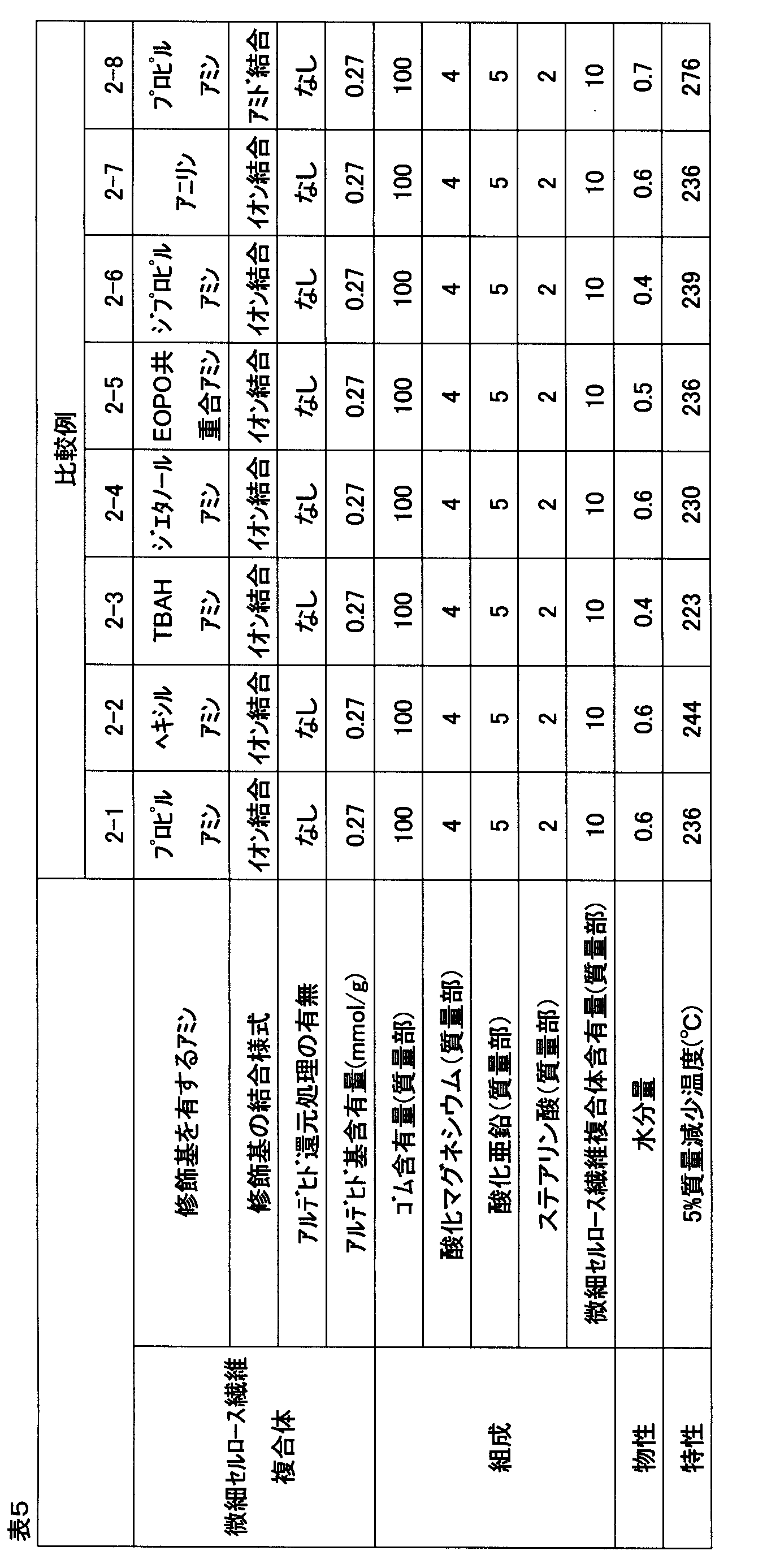
マグネティックスターラー、攪拌子を備えたビーカーに、微細セルロース繊維の調製例2で得られたカルボキシ基含有微細セルロース繊維分散液300g(固形分濃度2.0質量%)を仕込んだ。続いて、EO/PO共重合アミン製造例で作成したEOPO共重合アミンを、微細セルロース繊維のカルボキシ基1molに対してアミン基0.1molに相当する量を仕込み、イオン交換水100g中に溶解させ、反応液を室温(25℃)で14時間反応させた。反応終了後ろ過し、イオン交換水にて洗浄、DMFに溶媒置換することで、還元処理した微細セルロース繊維に、EOPO共重合体がイオン結合を介して連結した微細セルロース繊維複合体を得た。
マグネティックスターラー、攪拌子を備えたビーカーに、微細セルロース繊維の調製例5で得られたカルボキシ基含有微細セルロース繊維分散液300g(固形分濃度1.2質量%)を仕込んだ。続いて、EO/PO共重合アミン製造例で作成したEOPO共重合アミンを、微細セルロース繊維のカルボキシ基1molに対してアミン基0.1molに相当する量を仕込み、イオン交換水100g中に溶解させ、反応液を室温(25℃)で14時間反応させた。反応終了後ろ過し、イオン交換水にて洗浄、DMFに溶媒置換することで、還元処理した微細セルロース繊維に、EOPO共重合体がイオン結合を介して連結した微細セルロース繊維複合体を得た。
マグネティックスターラー、攪拌子を備えたビーカーに、微細セルロース繊維の調製例3で得られたカルボキシ基含有微細セルロース繊維分散液300g(固形分濃度1.8質量%)を仕込んだ。続いて、EO/PO共重合アミン製造例で作成したEOPO共重合アミンを、微細セルロース繊維のカルボキシ基1molに対してアミン基0.1molに相当する量を仕込み、イオン交換水100g中に溶解させ、反応液を室温(25℃)で14時間反応させた。反応終了後ろ過し、イオン交換水にて洗浄することで、微細セルロース繊維に、EOPO共重合体がイオン結合を介して連結した微細セルロース繊維複合体を得た。
実施例3-1
製造例20で製造した微細セルロース繊維複合体5質量部に、エポキシ樹脂(三菱ケミカル社製、商品名:jER828)100質量部、硬化剤(2-エチル-4-メチルイミダゾール、和光純薬工業社製)5質量部及び溶媒(DMF)340質量部を添加して、超音波ホモジナイザー(日本精機製作所社製、商品名:US-300E)にて2分間撹拌した。その後、高圧ホモジナイザー(吉田機械社製、商品名:ナノヴェイタL-ES)にて150MPaで3パス微細処理し、さらに撹拌器(シンキー社製、商品名:あわとり練太郎)を用いて7分間撹拌した。得られた溶液をバーコーターを用いて塗工し、80℃で60分乾燥し溶媒を除去した後、150℃で60分熱硬化させてエポキシ樹脂組成物を調製した。
製造例20で製造した微細セルロース繊維複合体に代えて、製造例21(実施例3-2)又は製造例22(比較例3-1)で製造した微細セルロース繊維複合体を使用したこと以外は実施例3-1と同様にしてエポキシ樹脂組成物を調製した。
熱分析装置(日立ハイテクサイエンス社製、商品名「STA7200」)を用いて、およそ1mgのサンプルをアルミパンに乗せ、窒素雰囲気下、40℃から300℃まで、1分間に10℃の割合で温度を上昇させて質量減少を計測した。100℃における質量を100%として1%質量が減少する温度を算出した。1%質量減少温度が高いほど耐熱性に優れていることを示す。結果を表6に示す。

Claims (15)
- a)樹脂、及び、b)セルロース分子内にカルボキシ基を有するセルロース繊維の複合体であって、アルデヒド基含有量が0.20mmol/g以下であり、かつ、カルボキシ基及び水酸基から選ばれる1種以上に修飾基が結合されてなるセルロース繊維複合体を含有してなる、樹脂組成物。
- a)樹脂が熱可塑性樹脂及び/又は硬化性樹脂である、請求項1記載の樹脂組成物。
- a)樹脂がゴム系樹脂である、請求項1記載の樹脂組成物。
- 前記セルロース繊維複合体のアルデヒド基含有量が、0.15mmol/g以下である、請求項1~3いずれか記載の樹脂組成物。
- 前記セルロース繊維複合体のアルデヒド基含有量が、0.1mmol/g以下である、請求項1~4いずれか記載の樹脂組成物。
- b)セルロース繊維複合体が、セルロース繊維のカルボキシ基に、修飾基を有する化合物がイオン結合及び/又は共有結合を介して結合されてなる、請求項1~5いずれか記載の樹脂組成物。
- 前記修飾基を有する化合物が、第1級アミン、第2級アミン、第3級アミン、及び第4級アンモニウム化合物からなる群より選択される1種以上の化合物を含む、請求項6記載の樹脂組成物。
- セルロース繊維複合体の結晶化度が20%以上である、請求項1~7いずれか記載の樹脂組成物。
- 請求項1~8いずれか記載の樹脂組成物を含む成形体。
- a)樹脂と、b)セルロース分子内にカルボキシ基を有するセルロース繊維の複合体であって、アルデヒド基含有量が0.20mmol/g以下であり、かつ、カルボキシ基及び水酸基から選ばれる1種以上に修飾基が結合されてなるセルロース繊維複合体を溶融混練する工程を含む、樹脂組成物の製造方法。
- セルロース分子内にカルボキシ基を有するセルロース繊維の複合体であって、アルデヒド基含有量が0.20mmol/g以下であり、かつ、カルボキシ基及び水酸基から選ばれる1種以上に修飾基が結合されてなる、樹脂組成物用添加剤であるセルロース繊維複合体。
- セルロース分子内にカルボキシ基を有するセルロース繊維の複合体であって、アルデヒド基含有量が0.20mmol/g以下であり、かつ、カルボキシ基に1~3級の炭化水素系アミンがイオン結合及び/又は共有結合を介して結合されてなるセルロース繊維複合体。
- 前記セルロース繊維複合体のアルデヒド基含有量が、0.15mmol/g以下である、請求項11又は12に記載のセルロース繊維複合体。
- 前記セルロース繊維複合体のアルデヒド基含有量が、0.1mmol/g以下である、請求項11~13いずれか記載のセルロース繊維複合体。
- 前記セルロース繊維複合体のアルデヒド基含有量が、0.05mmol/g以下である、請求項11~14いずれか記載のセルロース繊維複合体。
Priority Applications (4)
| Application Number | Priority Date | Filing Date | Title |
|---|---|---|---|
| EP17888376.5A EP3564321B1 (en) | 2016-12-27 | 2017-12-25 | Resin composition |
| US16/473,947 US20190322865A1 (en) | 2016-12-27 | 2017-12-25 | Resin composition |
| KR1020197022203A KR102248327B1 (ko) | 2016-12-27 | 2017-12-25 | 수지 조성물 |
| CN201780075683.9A CN110050039B (zh) | 2016-12-27 | 2017-12-25 | 树脂组合物 |
Applications Claiming Priority (2)
| Application Number | Priority Date | Filing Date | Title |
|---|---|---|---|
| JP2016-253930 | 2016-12-27 | ||
| JP2016253930 | 2016-12-27 |
Publications (1)
| Publication Number | Publication Date |
|---|---|
| WO2018123985A1 true WO2018123985A1 (ja) | 2018-07-05 |
Family
ID=62709596
Family Applications (1)
| Application Number | Title | Priority Date | Filing Date |
|---|---|---|---|
| PCT/JP2017/046466 Ceased WO2018123985A1 (ja) | 2016-12-27 | 2017-12-25 | 樹脂組成物 |
Country Status (7)
| Country | Link |
|---|---|
| US (1) | US20190322865A1 (ja) |
| EP (1) | EP3564321B1 (ja) |
| JP (1) | JP7223498B2 (ja) |
| KR (1) | KR102248327B1 (ja) |
| CN (1) | CN110050039B (ja) |
| TW (1) | TWI791478B (ja) |
| WO (1) | WO2018123985A1 (ja) |
Cited By (1)
| Publication number | Priority date | Publication date | Assignee | Title |
|---|---|---|---|---|
| WO2023276585A1 (ja) * | 2021-06-28 | 2023-01-05 | 凸版印刷株式会社 | 複合粒子の製造方法および複合粒子 |
Families Citing this family (7)
| Publication number | Priority date | Publication date | Assignee | Title |
|---|---|---|---|---|
| JP7187895B2 (ja) * | 2018-08-30 | 2022-12-13 | 王子ホールディングス株式会社 | 繊維状セルロース含有樹脂組成物、液状組成物、成形体及び成形体の製造方法 |
| JP7336783B2 (ja) * | 2019-03-29 | 2023-09-01 | 日本製紙株式会社 | カルボキシル基含有変性セルロース繊維、その乾燥固形物及びその製造方法 |
| JP2021017595A (ja) * | 2019-07-18 | 2021-02-15 | 花王株式会社 | アニオン変性セルロース |
| JP7550566B2 (ja) * | 2019-09-18 | 2024-09-13 | 花王株式会社 | 放熱用樹脂組成物 |
| JP7393268B2 (ja) * | 2020-03-25 | 2023-12-06 | 第一工業製薬株式会社 | 絶縁性ペースト |
| JP2021187885A (ja) * | 2020-05-26 | 2021-12-13 | 旭化成株式会社 | セルロース樹脂組成物及びその製造方法 |
| CN117467026A (zh) * | 2023-12-05 | 2024-01-30 | 青岛即昇科技有限公司 | 一种纤维素改性抗菌剂及其制备方法 |
Citations (12)
| Publication number | Priority date | Publication date | Assignee | Title |
|---|---|---|---|---|
| JPH03181448A (ja) | 1989-12-11 | 1991-08-07 | Texaco Dev Corp | ポリオキシアルキレングリコールアミンの製法 |
| JP2008115372A (ja) | 2006-10-11 | 2008-05-22 | Kao Corp | 生分解性樹脂組成物 |
| JP2008174718A (ja) | 2006-12-19 | 2008-07-31 | Kao Corp | 生分解性樹脂組成物 |
| JP2010059304A (ja) * | 2008-09-03 | 2010-03-18 | Teijin Ltd | エポキシ樹脂コンポジット |
| WO2011071156A1 (ja) * | 2009-12-11 | 2011-06-16 | 花王株式会社 | 複合材料 |
| JP2011140632A (ja) | 2009-12-11 | 2011-07-21 | Kao Corp | 複合材料 |
| JP2011140738A (ja) | 2009-12-11 | 2011-07-21 | Kao Corp | 微細セルロース繊維複合体、微細セルロース繊維分散液及び複合材料 |
| WO2012032931A1 (ja) * | 2010-09-06 | 2012-03-15 | 凸版印刷株式会社 | 透明基材およびその製造方法 |
| JP2013151661A (ja) | 2011-12-28 | 2013-08-08 | Kao Corp | ポリエステル樹脂組成物からなる成形体 |
| JP2013151636A (ja) | 2011-12-28 | 2013-08-08 | Kao Corp | ポリエステル樹脂組成物 |
| WO2015098543A1 (ja) * | 2013-12-26 | 2015-07-02 | 花王株式会社 | 微細セルロース繊維複合体 |
| JP2015143337A (ja) | 2013-12-26 | 2015-08-06 | 花王株式会社 | 微細セルロース繊維複合体 |
Family Cites Families (9)
| Publication number | Priority date | Publication date | Assignee | Title |
|---|---|---|---|---|
| WO2009069641A1 (ja) * | 2007-11-26 | 2009-06-04 | The University Of Tokyo | セルロースナノファイバーとその製造方法、セルロースナノファイバー分散液 |
| TW201026758A (en) * | 2008-11-13 | 2010-07-16 | Sumitomo Bakelite Co | Composite compositions and composites |
| JP5515312B2 (ja) * | 2009-02-12 | 2014-06-11 | 凸版印刷株式会社 | コーティング剤および成形体 |
| JP2010242063A (ja) * | 2009-03-17 | 2010-10-28 | Kuraray Co Ltd | セルロースナノファイバー複合ポリビニルアルコール系重合体組成物 |
| DE102010032112A1 (de) * | 2010-07-23 | 2012-01-26 | Schott Ag | Glaskeramik als Kochfläche für Induktionsbeheizung mit verbesserter farbiger Anzeigefähigkeit und Wärmeabschirmung, Verfahren zur Herstellung einer solchen Kochfläche und ihre Verwendung |
| JP5574938B2 (ja) * | 2010-12-14 | 2014-08-20 | グンゼ株式会社 | 親水性化セルロース繊維の製造方法 |
| JP2013044076A (ja) * | 2011-08-26 | 2013-03-04 | Olympus Corp | セルロースナノファイバーとその製造方法、複合樹脂組成物、成形体 |
| JP5733761B2 (ja) * | 2012-03-05 | 2015-06-10 | 第一工業製薬株式会社 | 樹脂組成物およびそれを含有する皮膜形成剤、並びに皮膜 |
| US9328459B2 (en) * | 2013-03-29 | 2016-05-03 | Weyerhaeuser Nr Company | Multi-stage catalytic carboxylation of mercerized cellulose fibers |
-
2017
- 2017-12-25 JP JP2017248340A patent/JP7223498B2/ja active Active
- 2017-12-25 US US16/473,947 patent/US20190322865A1/en not_active Abandoned
- 2017-12-25 KR KR1020197022203A patent/KR102248327B1/ko active Active
- 2017-12-25 EP EP17888376.5A patent/EP3564321B1/en active Active
- 2017-12-25 WO PCT/JP2017/046466 patent/WO2018123985A1/ja not_active Ceased
- 2017-12-25 CN CN201780075683.9A patent/CN110050039B/zh not_active Expired - Fee Related
- 2017-12-27 TW TW106145955A patent/TWI791478B/zh active
Patent Citations (13)
| Publication number | Priority date | Publication date | Assignee | Title |
|---|---|---|---|---|
| JPH03181448A (ja) | 1989-12-11 | 1991-08-07 | Texaco Dev Corp | ポリオキシアルキレングリコールアミンの製法 |
| JP2008115372A (ja) | 2006-10-11 | 2008-05-22 | Kao Corp | 生分解性樹脂組成物 |
| JP2008174718A (ja) | 2006-12-19 | 2008-07-31 | Kao Corp | 生分解性樹脂組成物 |
| JP2010059304A (ja) * | 2008-09-03 | 2010-03-18 | Teijin Ltd | エポキシ樹脂コンポジット |
| WO2011071156A1 (ja) * | 2009-12-11 | 2011-06-16 | 花王株式会社 | 複合材料 |
| JP2011140632A (ja) | 2009-12-11 | 2011-07-21 | Kao Corp | 複合材料 |
| JP2011140738A (ja) | 2009-12-11 | 2011-07-21 | Kao Corp | 微細セルロース繊維複合体、微細セルロース繊維分散液及び複合材料 |
| WO2012032931A1 (ja) * | 2010-09-06 | 2012-03-15 | 凸版印刷株式会社 | 透明基材およびその製造方法 |
| JP2013151661A (ja) | 2011-12-28 | 2013-08-08 | Kao Corp | ポリエステル樹脂組成物からなる成形体 |
| JP2013151636A (ja) | 2011-12-28 | 2013-08-08 | Kao Corp | ポリエステル樹脂組成物 |
| WO2015098543A1 (ja) * | 2013-12-26 | 2015-07-02 | 花王株式会社 | 微細セルロース繊維複合体 |
| JP2015143336A (ja) | 2013-12-26 | 2015-08-06 | 花王株式会社 | 微細セルロース繊維複合体 |
| JP2015143337A (ja) | 2013-12-26 | 2015-08-06 | 花王株式会社 | 微細セルロース繊維複合体 |
Non-Patent Citations (2)
| Title |
|---|
| See also references of EP3564321A4 |
| TETRAHEDRON, vol. 57, 2001, pages 1551 |
Cited By (2)
| Publication number | Priority date | Publication date | Assignee | Title |
|---|---|---|---|---|
| WO2023276585A1 (ja) * | 2021-06-28 | 2023-01-05 | 凸版印刷株式会社 | 複合粒子の製造方法および複合粒子 |
| JP2023005014A (ja) * | 2021-06-28 | 2023-01-18 | 凸版印刷株式会社 | 複合粒子の製造方法および複合粒子 |
Also Published As
| Publication number | Publication date |
|---|---|
| US20190322865A1 (en) | 2019-10-24 |
| CN110050039A (zh) | 2019-07-23 |
| KR20190095491A (ko) | 2019-08-14 |
| KR102248327B1 (ko) | 2021-05-04 |
| JP2018104703A (ja) | 2018-07-05 |
| JP7223498B2 (ja) | 2023-02-16 |
| TWI791478B (zh) | 2023-02-11 |
| EP3564321A1 (en) | 2019-11-06 |
| CN110050039B (zh) | 2022-04-29 |
| TW201840726A (zh) | 2018-11-16 |
| EP3564321A4 (en) | 2020-09-02 |
| EP3564321B1 (en) | 2026-03-04 |
Similar Documents
| Publication | Publication Date | Title |
|---|---|---|
| JP7777170B2 (ja) | 微細セルロース繊維複合体 | |
| JP7223498B2 (ja) | 樹脂組成物 | |
| JP5823599B2 (ja) | 微細セルロース繊維複合体 | |
| JP5823600B2 (ja) | 微細セルロース繊維複合体 | |
| JP6525758B2 (ja) | 三次元造形用の光硬化性組成物 | |
| US11959194B2 (en) | Method for producing shortened anionically modified cellulose fibers | |
| WO2020138291A1 (ja) | 改質セルロース繊維粉末 | |
| JP2022059588A (ja) | 改質セルロース繊維の製造方法 | |
| JP2022092607A (ja) | 改質セルロース繊維の製造方法 | |
| JP2022092606A (ja) | 改質セルロース繊維の製造方法 | |
| JP2022069427A (ja) | 改質セルロース繊維の製造方法 | |
| JP2019130920A (ja) | 三次元造形用の光硬化性組成物 |
Legal Events
| Date | Code | Title | Description |
|---|---|---|---|
| 121 | Ep: the epo has been informed by wipo that ep was designated in this application |
Ref document number: 17888376 Country of ref document: EP Kind code of ref document: A1 |
|
| NENP | Non-entry into the national phase |
Ref country code: DE |
|
| ENP | Entry into the national phase |
Ref document number: 20197022203 Country of ref document: KR Kind code of ref document: A |
|
| ENP | Entry into the national phase |
Ref document number: 2017888376 Country of ref document: EP Effective date: 20190729 |
|
| WWG | Wipo information: grant in national office |
Ref document number: 2017888376 Country of ref document: EP |