WO2018124318A1 - Souche de bacillus megaterium bc2-1 et procédé de traitement de déchets alimentaires faisant appel à celle-ci - Google Patents
Souche de bacillus megaterium bc2-1 et procédé de traitement de déchets alimentaires faisant appel à celle-ci Download PDFInfo
- Publication number
- WO2018124318A1 WO2018124318A1 PCT/KR2016/015307 KR2016015307W WO2018124318A1 WO 2018124318 A1 WO2018124318 A1 WO 2018124318A1 KR 2016015307 W KR2016015307 W KR 2016015307W WO 2018124318 A1 WO2018124318 A1 WO 2018124318A1
- Authority
- WO
- WIPO (PCT)
- Prior art keywords
- bacillus
- kccm
- cereus
- megaterium
- food waste
- Prior art date
- Legal status (The legal status is an assumption and is not a legal conclusion. Google has not performed a legal analysis and makes no representation as to the accuracy of the status listed.)
- Ceased
Links
Images

Classifications
-
- A—HUMAN NECESSITIES
- A23—FOODS OR FOODSTUFFS; TREATMENT THEREOF, NOT COVERED BY OTHER CLASSES
- A23K—FODDER
- A23K10/00—Animal feeding-stuffs
- A23K10/10—Animal feeding-stuffs obtained by microbiological or biochemical processes
- A23K10/12—Animal feeding-stuffs obtained by microbiological or biochemical processes by fermentation of natural products, e.g. of vegetable material, animal waste material or biomass
-
- B—PERFORMING OPERATIONS; TRANSPORTING
- B09—DISPOSAL OF SOLID WASTE; RECLAMATION OF CONTAMINATED SOIL
- B09B—DISPOSAL OF SOLID WASTE NOT OTHERWISE PROVIDED FOR
- B09B3/00—Destroying solid waste or transforming solid waste into something useful or harmless
- B09B3/60—Biochemical treatment, e.g. by using enzymes
-
- C—CHEMISTRY; METALLURGY
- C02—TREATMENT OF WATER, WASTE WATER, SEWAGE, OR SLUDGE
- C02F—TREATMENT OF WATER, WASTE WATER, SEWAGE, OR SLUDGE
- C02F3/00—Biological treatment of water, waste water, or sewage
- C02F3/34—Biological treatment of water, waste water, or sewage characterised by the microorganisms used
-
- C—CHEMISTRY; METALLURGY
- C05—FERTILISERS; MANUFACTURE THEREOF
- C05F—ORGANIC FERTILISERS NOT COVERED BY SUBCLASSES C05B, C05C, e.g. FERTILISERS FROM WASTE OR REFUSE
- C05F5/00—Fertilisers from distillery wastes, molasses, vinasses, sugar plant or similar wastes or residues, e.g. from waste originating from industrial processing of raw material of agricultural origin or derived products thereof
-
- C—CHEMISTRY; METALLURGY
- C12—BIOCHEMISTRY; BEER; SPIRITS; WINE; VINEGAR; MICROBIOLOGY; ENZYMOLOGY; MUTATION OR GENETIC ENGINEERING
- C12N—MICROORGANISMS OR ENZYMES; COMPOSITIONS THEREOF; PROPAGATING, PRESERVING, OR MAINTAINING MICROORGANISMS; MUTATION OR GENETIC ENGINEERING; CULTURE MEDIA
- C12N1/00—Microorganisms; Compositions thereof; Processes of propagating, maintaining or preserving microorganisms or compositions thereof; Processes of preparing or isolating a composition containing a microorganism; Culture media therefor
- C12N1/20—Bacteria; Culture media therefor
-
- C—CHEMISTRY; METALLURGY
- C12—BIOCHEMISTRY; BEER; SPIRITS; WINE; VINEGAR; MICROBIOLOGY; ENZYMOLOGY; MUTATION OR GENETIC ENGINEERING
- C12N—MICROORGANISMS OR ENZYMES; COMPOSITIONS THEREOF; PROPAGATING, PRESERVING, OR MAINTAINING MICROORGANISMS; MUTATION OR GENETIC ENGINEERING; CULTURE MEDIA
- C12N1/00—Microorganisms; Compositions thereof; Processes of propagating, maintaining or preserving microorganisms or compositions thereof; Processes of preparing or isolating a composition containing a microorganism; Culture media therefor
- C12N1/20—Bacteria; Culture media therefor
- C12N1/205—Bacterial isolates
-
- C—CHEMISTRY; METALLURGY
- C12—BIOCHEMISTRY; BEER; SPIRITS; WINE; VINEGAR; MICROBIOLOGY; ENZYMOLOGY; MUTATION OR GENETIC ENGINEERING
- C12R—INDEXING SCHEME ASSOCIATED WITH SUBCLASSES C12C - C12Q, RELATING TO MICROORGANISMS
- C12R2001/00—Microorganisms ; Processes using microorganisms
- C12R2001/01—Bacteria or Actinomycetales ; using bacteria or Actinomycetales
- C12R2001/07—Bacillus
- C12R2001/11—Bacillus megaterium
-
- Y—GENERAL TAGGING OF NEW TECHNOLOGICAL DEVELOPMENTS; GENERAL TAGGING OF CROSS-SECTIONAL TECHNOLOGIES SPANNING OVER SEVERAL SECTIONS OF THE IPC; TECHNICAL SUBJECTS COVERED BY FORMER USPC CROSS-REFERENCE ART COLLECTIONS [XRACs] AND DIGESTS
- Y02—TECHNOLOGIES OR APPLICATIONS FOR MITIGATION OR ADAPTATION AGAINST CLIMATE CHANGE
- Y02A—TECHNOLOGIES FOR ADAPTATION TO CLIMATE CHANGE
- Y02A40/00—Adaptation technologies in agriculture, forestry, livestock or agroalimentary production
- Y02A40/10—Adaptation technologies in agriculture, forestry, livestock or agroalimentary production in agriculture
- Y02A40/20—Fertilizers of biological origin, e.g. guano or fertilizers made from animal corpses
Definitions
- the present invention relates to Bacillus megaliumium BC2-1 having an ability to remove odors and heavy metals, and a method for treating food waste using the same.
- the odor components generated when the nutrient is decomposed in the aerobic state are ammonia, methylmecaptan, hydrogen sulfide, methyl sulfide, methyl disulfide, trimethylamine, acetaldehyde, styrene, propionic acid, butyric acid and gil acetic acid.
- Odors come in many forms. For example, methylmecaptan is a rotten onion smell, hydrogen sulfide is a colorless gas, irritating, suffocating and rotting onion, and ammonia is a colorless gas that is irritating and has a characteristic odor like urine. If you do so, you will get a disgusting hygiene and inhibit livestock growth.
- Odor discomfort continues to increase at present, and legal regulations have been enacted and enforced to raise the importance of odor management.
- Odors are reported as livestock wastewater treatment plants, food waste treatment plants, manure treatment plants, landfills, and feed manufacturing industries.
- the odor generated in such a facility is not generated only in some processes but is generated in the entire process, and there is a great difficulty in process management, facility improvement, and prevention facility installation to reduce odor occurrence.
- process management, facility improvement, and prevention facility installation to reduce odor occurrence.
- since such environmental basic facilities are mainly mixed with residential areas, it is necessary to develop highly efficient odor reduction technology to minimize the impact on the surroundings.
- the odor generated in the barn such as pigs, barn, cages, etc., hydrogen sulfide (H 2 S) is the main pollutant, but in addition, ammonia (NH 3 ), methyl mercaptan (CH 3 SH), trimethylamine ((CH 3 ) 3 N) and contains a substance such as a lower fatty acid to thereby increase the strength of odor.
- H 2 S hydrogen sulfide
- malodorous substances cause various malodorous compounds by their source, causing malodors.
- H 2 S hydrogen sulfide
- mercaptan smells like rotting vegetables.
- the amines have a peculiar smell like fish smell.
- Oxidation has been suggested to oxidize and decompose odorous substances and to remove odors fundamentally with a wide range of bactericidal effects on bacteria, fungi and viruses.
- the types of oxidants that have been widely used in chemical oxidation methods include chlorine dioxide (duozone), sodium hypochlorite (Lax), and chlorine dioxide, but these substances contain chlorine and may have harmful effects on humans and livestock. .
- Enzymatic digestion is a deodorant made by extracting plant extracts, which has the effect of decomposing odors.However, specific components and principles of action are not known precisely. When used for a certain time, the efficiency decreases due to the rapid decrease of the surface area of the adsorbent.
- the masking method solves the sensory odor problem by dissolving natural or artificial flavors in a volatile solvent such as methyl alcohol and then volatilizing it in the air, but it is not a fundamental solution to the odor.
- ozone has a sterilizing and deodorizing effect, but excessive generation of ozone may act as a new pollutant.
- a method of decomposing odor sources using photocatalysts such as TiO 2 with ozone generation has been proposed, but catalysts such as TiO 2 have limitations in increasing the specific surface area, as well as hydrogen sulfide (H 2 S) and methyl mercaptan (CH 3).
- VOCs Volatile organic compounds
- BTX organic acids, aldehydes, ketones, and aromatic compounds
- VOCs volatile organic compounds
- the chemical method of combustion produces secondary air pollution, and the adsorption method is uneconomical due to the use of expensive activated carbon. These methods cost a lot of money due to excessive chemical consumption instead of low construction costs.
- biological methods have disadvantages in that construction costs and operating conditions are difficult, but they are easy to maintain and manage and consume less operating costs.
- Biological odor removal methods include biofilters filled in reactors by immobilizing malodor-decomposing microorganisms on a carrier, and biofilters have emerged as an odor treatment method that is economical and does not cause secondary pollution.
- the operating costs for operating the biofilter system are the most economical. Operation costs are high in order of biofilter, chemical liquid cleaning, catalytic combustion, activated carbon adsorption, and direct combustion.
- Korean Patent Registration No. 10-1106030,10-1106032, 10-1106033, 10-1106034, 10-1106035, and 10-1106037 have registered a patent for "purification method for the recycling of livestock wastewater or food waste using Bacillus strain" It became.
- the present invention provides a Bacillus megaterium BC1-1 KCCM 10858P strain for reducing the odor generated from wastewater or food waste generated in livestock raising and heavy metals in the wastewater and wastes. The purpose.
- Bacillus megaterium BC2-1 Bacillus megaterium BC2-1 It is an object of the present invention to provide a microbial preparation for removing odor and heavy metals containing KCCM 10858P as an active ingredient, and a method for purifying livestock wastewater or food waste using the same.
- the present invention is capable of removing odors much faster and more efficiently than conventional strains, and Bacillus megaterium BC2-1 ( Bacillus megaterium) capable of removing heavy metals. BC2-1) KCCM 10858P strain is provided.
- the present invention provides a microbial agent for odor removal and heavy metal removal containing Bacillus megaterium BC2-1 KCCM 10858P strain as an active ingredient.
- Bacillus megaterium BC1-1-1 according to the present invention KCCM 10856P strain excellently reduced the odor generated from livestock wastewater or food waste.
- the microorganisms also reduced heavy metals from livestock wastewater or food waste. Therefore, the microbial agent according to the present invention can be used to purify odors and heavy metals of livestock wastewater or food waste.
- it can be widely used for the production of organic liquid fertilizer using livestock wastewater or livestock feed using food waste.
- Bacillus megalium BC2-1 KCCM 10858P according to the present invention was excellent in removing odor from livestock wastewater and food waste, and is a strain having excellent odor removal ability by removing odor at a very high speed. At the same time, the strains of the present invention also have the ability to remove heavy metals at very high levels for some of the heavy metals contained in livestock wastewater or food waste.
- 1 shows an experimental apparatus for removing odor of livestock wastewater.
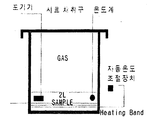
- Figure 2 shows an experimental device for removing odor of food waste.
- a first aspect of the invention provides Bacillus megaterium BC2-1 KCCM 10858P, which is useful for odor removal and heavy metal removal.
- a second aspect of the present invention provides a microbial agent for odor removal and heavy metal removal, containing an effective amount of the new strain Bacillus megaliumium BC2-1 KCCM 10858P.
- Bacillus megaliumium BC1-1 KCCM 10856P Bacillus megaterium BC1-1
- Bacillus megaterium BC1-2 KCCM 10857P Bacillus megaterium BC1-2
- Bacillus cereus BC3 KCCM 10859P Bacillus cereus BC3
- Bacillus rickeniformis BC4 KCCM 10860P
- Bacillus cereus BC5 Bacillus cereus BC5
- Bacillus spa Erie kusu BC6 KCCM 10862P Bacillus sphaericus BC6)
- Bacillus claw when BC7 KCCM 10863P Bacillus clausii BC7)
- Bacillus Lai Kenny Po Ms BC8 KCCM 10864P Bacillus licheniformis BC8
- Bacillus permus BC9 KCCM 10865P Bacillus firmus BC9
- a third aspect of the present invention provides a method of removing the bad bacteria and food waste or heavy metals in livestock wastewater by culturing the new strain Bacillus megalium BC2-1 KCCM 10858P with malodorous food waste or livestock wastewater. More specifically, the present invention provides Bacillus megaterium BC1-1 KCCM 10856P ( Bacillus megaterium) BC1-1), Bacillus megaterium BC1-2 KCCM 10857P ( Bacillus megaterium BC1-2), Bacillus cereus BC3 KCCM 10859P (Bacillus cereus BC3), Bacillus rickeniformis BC4 KCCM 10860P ( Bacillus licheniformis BC4 ), Bacillus cereus BC5 KCCM 10861P (Bacillus cereus BC5), Bacillus spa Erie kusu BC6 KCCM 10862P (Bacillus sphaericus BC6), Bacillus claw when BC7 KCCM 10863P (Bacillus claus
- a fourth aspect of the present invention provides a method for producing organic liquid fertilizer using livestock wastewater using a composition containing an effective amount of new strain Bacillus megalium BC1-1 KCCM 10856P. More preferably, the present invention provides Bacillus megaterium BC1-1 KCCM 10856P ( Bacillus megaterium) BC1-1), Bacillus megaterium BC1-2 KCCM 10857P ( Bacillus megaterium BC1-2), Bacillus cereus BC3 KCCM 10859P (Bacillus cereus BC3), Bacillus rickeniformis BC4 KCCM 10860P ( Bacillus licheniformis BC4 ), Bacillus cereus BC5 KCCM 10861P (Bacillus cereus BC5), Bacillus spa Erie kusu BC6 KCCM 10862P (Bacillus sphaericus BC6), Bacillus claw when BC7 KCCM 10863P (Bacillus clausii BC7), Bacillus Lai
- a fifth aspect of the present invention provides a method for producing livestock feed using food waste using a composition containing an effective amount of the new strain Bacillus megalium BC2-1 KCCM 10858P. More preferably, the present invention provides Bacillus megaterium BC1-1 KCCM 10856P ( Bacillus megaterium) BC1-1), Bacillus megaterium BC1-2 KCCM 10857P ( Bacillus megaterium BC1-2), Bacillus cereus BC3 KCCM 10859P (Bacillus cereus BC3), Bacillus rickeniformis BC4 KCCM 10860P ( Bacillus licheniformis BC4 ), Bacillus cereus BC5 KCCM 10861P (Bacillus cereus BC5), Bacillus spa Erie kusu BC6 KCCM 10862P (Bacillus sphaericus BC6), Bacillus claw when BC7 KCCM 10863P (Bacillus clausii BC7), Bacillus Lai Kenn
- Example 1 Bacillus Mega emitter Solarium BC2-1 (Bacillus megaterium BC2-1) KCCM Isolation and Identification of 10858P Strains
- Bacillus megaterium BC2-1 Bacillus megaterium used in the present invention BC2-1
- KCCM 10858P was obtained from mushrooms and mycelium masses that live on fallen leaves in Samgi-myeon forest, Iksan, Jeollabuk-do.
- the mushrooms and mycelium collected were put in a 500ml beaker, immersed in a culture solution prepared by adding 300ml of water and about 5g of earth sugar and incubated at 28 -30 ° C. After spraying a portion of the culture solution to the ceremonial toilet to see the odor disappears in one day, it was found that the Bacillus bacteria of the present invention has a good odor removal ability.
- the culture solution was continuously cultured using molasses, and subsequently used for food waste, it was also confirmed that the odor removal ability is excellent, and entered the pure separation of useful microorganisms.
- Bacillus megaterium BC2-1 KCCM 10858P species including Bacillus megaterium BC2-1 KCCM 10858P species, Bacillus megaterium BC1-1 KCCM 10856P, Bacillus megaterium BC1-2 KCCM 10857P ( Bacillus megaterium BC1-2), Bacillus cereus BC3 KCCM 10859P (Bacillus cereus BC3) , Bacillus Lai Kenny Po Ms BC4 KCCM 10860P (Bacillus licheniformis BC4) , Bacillus cereus BC5 KCCM 10861P (Bacillus cereus BC5) , Bacillus spa Erie kusu BC6 KCCM 10862P (Bacillus sphaericus BC6), Bacillus claw when BC7 KCCM 10863P (Bacillus clausii BC7) , Bacillus Lai Kenny Po Ms BC8 KCCM 10864P (Bacillus licheniformis BC8)
- Example 2 Bacillus Megalium BC2-1 KCCM 10858P and Bacillus Megalium BC2-1 KCCM Different from 10858P Bacillus Odor Removal Effect of Livestock Wastewater by Mixed Microbial Composition of Bacteria
- the microbial reaction vessel condition of livestock wastewater was set up to maintain the temperature at 37.5 °C by using aeration and heating band and thermostat to install aeration device for active microorganism as follows. (See FIG. 1 ).
- the concentration of odor generated in the livestock wastewater before microbial input was measured and analyzed for the change in concentration of each odor after microbial input.
- 2 liters of wastewater were injected into each of 11 microbial reaction vessels to reduce the odor of livestock wastewater, and one vessel of 5 ml of Bacillus megalium BC2-1 KCCM 10858P culture medium and another vessel of Bacillus mega Bacillus megaterium BC1-1, Bacillus megaterium BC1-2, Bacillus megaterium BC1-2, Bacillus megaterium BC1-2, Bacillus megaterium BC2-1, Bacillus megaterium BC2-1, Bacillus Cereus BC3 KCCM 10859P ( Bacillus cereus BC3), Bacillus rickeniformis BC4 KCCM 10860P ( Bacillus licheniformis BC4), Bacillus cereus BC5 KCCM 10861P ( Bacillus cereus BC5), Bacillus sphericus BC6 KCCM 10862P
- Ammonia is quantified by measuring the absorbance of indophenols produced by adding phenol-nitroprusside sodium solution and sodium hypochlorite solution to the analytical sample solution and reacting with ammonium ion.
- Sodium hypochlorite solution (3-10% effective chlorine) 60 / CmL (where C is the effective chlorine concentration (in%) of sodium hypochlorite (NaOCl) quantified at the time of preparation)] 10 g sodium hydroxide and sodium hydrogen phosphate 12 Dissolve 35.8 g of hydrate in distilled water to make the total amount 1 L. This solution is prepared each time it is used.
- the absorber bottle is made of hard glass that can hold 20 mL of absorbent liquid and is equipped with a filter port. In the middle, take a sample solution that can hold 20 mL of absorbent liquid and connect the two in series.
- the suction pump draws more than 10 L / min of air with an absorbent bottle installed.
- the absorbent solutions from the two absorbent bottles are combined and transferred to a 50 mL volumetric flask, and the solution washed with the collection solution is transferred to the volumetric flask and the total amount is 50 mL. Transfer 10 mL of this solution into the test tube and use it as the sample solution for analysis.
- the sample gas was concentrated at -170 ° C. in a sample preconcentration trap (SPT) at low temperature, heated again, desorbed, and injected into a gas chromatograph, and a PFPD (Pulse Flame Photometri Dectector) was used as a detector.
- SPT sample preconcentration trap
- PFPD Pulse Flame Photometri Dectector
- Trimethylamine was analyzed by diluting the sample solution for analysis absorbed in aqueous sulfuric acid solution (359 + 1) with a syringe, and injecting it through a silicone stopper into a decomposition bottle containing potassium hydroxide solution.
- the trimethylamine generated by bubbling about 2-3 L of nitrogen was cooled with a liquid acid, concentrated in a condenser tube, heated and desorbed to about 70 ° C., and trimethylamine was introduced into a column and analyzed by FID.
- Analysis of aldehydes is carried out through a sample collection tube filled with octadecyl silylated silica gel coated with 2,4-dinitrophenyl hydrazine, to collect aldehydes and to evaporate acetonitrile from the sample collection tube.
- the mixture was dissolved in ethyl acetate, and a portion thereof was introduced into HPLC (Young Lin) for quantification.
- Bacillus Megalium BC2-1 KCCM 10858P removed high ammonia, hydrogen sulfide and acetaldehyde from livestock wastewater. but, Methyl mercaptan , Dimethyl disulfide Concentrations before injection, control samples and mixed microbial input samples after 4 days of injection were detected at nearly the same concentration. But Dimethyl sulfide Small increase compared to the control sample.
- Microbial reaction vessel conditions of food waste was viscous to maintain a constant temperature to 37.5 °C using a heating band (heating band) and a thermostat (see Figure 2 ).
- the concentration of odor generated by raw food waste was measured before microbial input, and the concentration change of each odor after microbial input was analyzed.
- two liters of 11 microbial reaction vessels were injected into each of the microbial reaction vessels.
- KCCM10856 Bacillus megaterium BC1-1
- Bacillus megaterium BC1-2 Bacillus megaterium BC1-2
- Bacillus megaliumium BC2-1 KCCM 10858P
- Bacillus megaterium BC2-1 Bacillus megaterium BC2-1
- Bacillus cereus BC3 KCCM 10859P Bacillus cereus BC3
- Bacillus rickeniformis BC4 KCCM 10860P ( Bacillus licheniformis BC4)
- Bacillus cereus BC5 KCCM 10861P Bacillus cereus BC5)
- Bacillus sphaericus BC6 KCCM 10862P Bacillus sphaericus BC6
- Ba7 KCCM 10863P Bacillus clausii BC7)
- Bacillus rickeniformis BC8 KCCM 10864P Bacillus licheniformis BC8
- Bacillus permus BC9 KCCM 10865P Bacillus firmus BC9
- Bacillus Megalium BC2-1 In order to measure the effect of reducing heavy metals in livestock wastewater and food waste by KCCM10858P, 11 liters of food waste were injected into each of 11 microbial reaction vessels, and then one container of Bacillus megalium BC2- 5 ml of 1 KCCM10858P culture solution and the other one container were used as a control by putting 5 ml of food waste without adding microorganisms. The same was done for livestock wastewater. The concentration of heavy metals in food waste and livestock wastewater was measured during microbial culture and after 4 days of culture. Heavy metal was measured by the following method.
- Ternary solution Mix HNO 3 , H 2 SO 4 and HClO 4 in the ratio of 10: 1: 4 to prepare the required amount.
- the filtrate is diluted in a predetermined amount, and then K, Ca, Mg, Na, Fe, Mn, Cu, Zn, Cr, Cd, Pb, Ni, and the like are collected in AA (Atomic Absorption Flame Emission Spectrometer) or ICP (Inductively Coupled Plasma). Make a calibration curve with the standard solution of each component and measure it.
- AA Atomic Absorption Flame Emission Spectrometer
- ICP Inductively Coupled Plasma
- Bacillus megaterium BC2-1 according to the present invention was effective in removing heavy metals.
Landscapes
- Life Sciences & Earth Sciences (AREA)
- Engineering & Computer Science (AREA)
- Chemical & Material Sciences (AREA)
- Health & Medical Sciences (AREA)
- Biotechnology (AREA)
- Organic Chemistry (AREA)
- Microbiology (AREA)
- Zoology (AREA)
- Biochemistry (AREA)
- Environmental & Geological Engineering (AREA)
- Genetics & Genomics (AREA)
- Wood Science & Technology (AREA)
- Bioinformatics & Cheminformatics (AREA)
- Biomedical Technology (AREA)
- Polymers & Plastics (AREA)
- General Engineering & Computer Science (AREA)
- Medicinal Chemistry (AREA)
- General Health & Medical Sciences (AREA)
- Virology (AREA)
- Tropical Medicine & Parasitology (AREA)
- General Chemical & Material Sciences (AREA)
- Chemical Kinetics & Catalysis (AREA)
- Biodiversity & Conservation Biology (AREA)
- Food Science & Technology (AREA)
- Animal Husbandry (AREA)
- Physiology (AREA)
- Molecular Biology (AREA)
- Sustainable Development (AREA)
- Water Supply & Treatment (AREA)
- Hydrology & Water Resources (AREA)
- Botany (AREA)
- Micro-Organisms Or Cultivation Processes Thereof (AREA)
- Purification Treatments By Anaerobic Or Anaerobic And Aerobic Bacteria Or Animals (AREA)
Abstract
La présente invention concerne Bacillus megaterium BC2-1 KCCM 10858P, qui est une nouvelle souche servant à éliminer les odeurs et les métaux lourds. L'invention concerne également une préparation de micro-organismes contenant ladite souche comme agent efficace pour l'élimination des odeurs et des métaux lourds. L'invention se rapporte en outre à des procédés de production d'un engrais liquide ou d'aliments pour bétail par élimination des odeurs ou des métaux lourds des déchets alimentaires ou des eaux usées du bétail. Bacillus megaterium BC2-1 KCCM 10858P présente un excellent effet d'élimination des odeurs en éliminant très rapidement les odeurs des eaux usées du bétail et des déchets alimentaires et s'avère être une souche présentant une excellente capacité d'élimination des odeurs. De plus, cette souche a la capacité de très bien éliminer certains métaux lourds contenus dans les eaux usées du bétail et les déchets alimentaires.
Priority Applications (2)
| Application Number | Priority Date | Filing Date | Title |
|---|---|---|---|
| PCT/KR2016/015307 WO2018124318A1 (fr) | 2016-12-27 | 2016-12-27 | Souche de bacillus megaterium bc2-1 et procédé de traitement de déchets alimentaires faisant appel à celle-ci |
| KR1020197021698A KR20190104353A (ko) | 2016-12-27 | 2016-12-27 | 바실러스 메가터리움 bc2-1 균주 및 이를 이용한 음식물쓰레기 처리 방법 |
Applications Claiming Priority (1)
| Application Number | Priority Date | Filing Date | Title |
|---|---|---|---|
| PCT/KR2016/015307 WO2018124318A1 (fr) | 2016-12-27 | 2016-12-27 | Souche de bacillus megaterium bc2-1 et procédé de traitement de déchets alimentaires faisant appel à celle-ci |
Publications (1)
| Publication Number | Publication Date |
|---|---|
| WO2018124318A1 true WO2018124318A1 (fr) | 2018-07-05 |
Family
ID=62709520
Family Applications (1)
| Application Number | Title | Priority Date | Filing Date |
|---|---|---|---|
| PCT/KR2016/015307 Ceased WO2018124318A1 (fr) | 2016-12-27 | 2016-12-27 | Souche de bacillus megaterium bc2-1 et procédé de traitement de déchets alimentaires faisant appel à celle-ci |
Country Status (2)
| Country | Link |
|---|---|
| KR (1) | KR20190104353A (fr) |
| WO (1) | WO2018124318A1 (fr) |
Cited By (3)
| Publication number | Priority date | Publication date | Assignee | Title |
|---|---|---|---|---|
| CN114480181A (zh) * | 2022-01-04 | 2022-05-13 | 山东蔚蓝生物科技有限公司 | 一株用于污泥堆肥除臭的巨大芽孢杆菌及其应用 |
| CN119060884A (zh) * | 2024-08-23 | 2024-12-03 | 广州希奕餐厨降解设备有限公司 | 一种用于餐饮垃圾生物处理复配菌剂 |
| CN120290394A (zh) * | 2025-04-15 | 2025-07-11 | 天津大学 | 一种可降解甲苯的固定化菌剂及其制备方法和应用 |
Families Citing this family (2)
| Publication number | Priority date | Publication date | Assignee | Title |
|---|---|---|---|---|
| KR102196585B1 (ko) * | 2019-11-27 | 2020-12-30 | 단국대학교 천안캠퍼스 산학협력단 | 효소 분비능 및 황화수소 저감 효능을 갖는 바실러스 메가테리움 s188 균주 및 이의 용도 |
| KR102551904B1 (ko) * | 2022-12-26 | 2023-07-06 | (주)에코비즈넷 | 바실러스 리체니포미스 bs 및 이를 포함하는 악취 감소용 조성물 |
Citations (5)
| Publication number | Priority date | Publication date | Assignee | Title |
|---|---|---|---|---|
| KR20090114905A (ko) * | 2008-04-30 | 2009-11-04 | 주식회사 이지바이오시스템 | 신규한 바실러스 리케니포르미스 균주 및 이를 포함하는돼지 분뇨의 악취 저감 및 액비화를 위한 미생물 제제 |
| KR100948935B1 (ko) * | 2007-01-25 | 2010-03-23 | 바이오세인트(주) | 복합 악취처리방법 및 그를 위한 장치 |
| KR101106037B1 (ko) * | 2007-05-04 | 2012-01-17 | 주식회사 평강특장자동차 | 악취제거 및 중금속 제거 바실러스 라이케니포미스 b c4 k c c m 10860p 및 이를 이용한 축산폐수 또는 음식물쓰레기의 자원화를 위한 정화방법 |
| KR20140108765A (ko) * | 2013-02-27 | 2014-09-15 | 목포대학교산학협력단 | 악취 제거 또는 저감용 조성물 및 이를 이용한 악취를 제거하는 방법 |
| US20150337257A1 (en) * | 2012-12-21 | 2015-11-26 | Hyundai Motor Company | Composition for preventing odors containing ordorless microorganism |
-
2016
- 2016-12-27 WO PCT/KR2016/015307 patent/WO2018124318A1/fr not_active Ceased
- 2016-12-27 KR KR1020197021698A patent/KR20190104353A/ko not_active Ceased
Patent Citations (5)
| Publication number | Priority date | Publication date | Assignee | Title |
|---|---|---|---|---|
| KR100948935B1 (ko) * | 2007-01-25 | 2010-03-23 | 바이오세인트(주) | 복합 악취처리방법 및 그를 위한 장치 |
| KR101106037B1 (ko) * | 2007-05-04 | 2012-01-17 | 주식회사 평강특장자동차 | 악취제거 및 중금속 제거 바실러스 라이케니포미스 b c4 k c c m 10860p 및 이를 이용한 축산폐수 또는 음식물쓰레기의 자원화를 위한 정화방법 |
| KR20090114905A (ko) * | 2008-04-30 | 2009-11-04 | 주식회사 이지바이오시스템 | 신규한 바실러스 리케니포르미스 균주 및 이를 포함하는돼지 분뇨의 악취 저감 및 액비화를 위한 미생물 제제 |
| US20150337257A1 (en) * | 2012-12-21 | 2015-11-26 | Hyundai Motor Company | Composition for preventing odors containing ordorless microorganism |
| KR20140108765A (ko) * | 2013-02-27 | 2014-09-15 | 목포대학교산학협력단 | 악취 제거 또는 저감용 조성물 및 이를 이용한 악취를 제거하는 방법 |
Cited By (3)
| Publication number | Priority date | Publication date | Assignee | Title |
|---|---|---|---|---|
| CN114480181A (zh) * | 2022-01-04 | 2022-05-13 | 山东蔚蓝生物科技有限公司 | 一株用于污泥堆肥除臭的巨大芽孢杆菌及其应用 |
| CN119060884A (zh) * | 2024-08-23 | 2024-12-03 | 广州希奕餐厨降解设备有限公司 | 一种用于餐饮垃圾生物处理复配菌剂 |
| CN120290394A (zh) * | 2025-04-15 | 2025-07-11 | 天津大学 | 一种可降解甲苯的固定化菌剂及其制备方法和应用 |
Also Published As
| Publication number | Publication date |
|---|---|
| KR20190104353A (ko) | 2019-09-09 |
Similar Documents
| Publication | Publication Date | Title |
|---|---|---|
| KR101106037B1 (ko) | 악취제거 및 중금속 제거 바실러스 라이케니포미스 b c4 k c c m 10860p 및 이를 이용한 축산폐수 또는 음식물쓰레기의 자원화를 위한 정화방법 | |
| KR101106032B1 (ko) | 악취제거 및 중금속 제거 바실러스 세레우스 b c3 k c c m 10859p 및 이를 이용한 축산폐수 또는 음식물쓰레기의 자원화를 위한 정화방법 | |
| WO2018124318A1 (fr) | Souche de bacillus megaterium bc2-1 et procédé de traitement de déchets alimentaires faisant appel à celle-ci | |
| Smet et al. | Treatment of waste gases contaminated with odorous sulfur compounds | |
| Crebelli et al. | Genotoxicity of the disinfection by-products resulting from peracetic acid-or hypochlorite-disinfected sewage wastewater | |
| KR101106030B1 (ko) | 악취제거 및 중금속 제거 바실러스 메가터리움 bc1-1 kccm 10856p 및 이를 이용한 축산폐수 또는 음식물쓰레기의 자원화를 위한 정화방법 | |
| Omri et al. | Performance study of biofilter developed to treat H2S from wastewater odour | |
| KR101512796B1 (ko) | 악취 제거 또는 저감용 조성물 및 이를 이용한 악취를 제거하는 방법 | |
| Jang et al. | Biochemical changes and biological origin of key odor compound generations in pig slurry during indoor storage periods: a pyrosequencing approach | |
| CN104603259A (zh) | 具有除臭活性及鳗鱼养殖场的水质净化功能的Lactobacillus parafarraginis菌株及其用途 | |
| CN109260940A (zh) | 一种复合微生物除臭剂及其制备方法与应用 | |
| CN103463654A (zh) | 一种生产除臭微生物制剂的方法 | |
| Li et al. | Effects of microbial deodorizer on pig feces fermentation and the underlying deodorizing mechanism | |
| Choi et al. | Microbial additives in controlling odors from stored swine slurry | |
| KR101106033B1 (ko) | 악취제거 및 중금속 제거 바실러스 클라우시 b c7 k c c m 10863p 및 이를 이용한 축산폐수 또는 음식물쓰레기의 자원화를 위한 정화방법 | |
| KR100260979B1 (ko) | 원형의 섬모상 접촉여재에 미생물을 고정화한 고농도 유기성 악취의 처리장치 및 방법 | |
| KR101106034B1 (ko) | 악취제거 및 중금속 제거 바실러스 스파에리쿠스 b c6 k c c m 10862p 및 이를 이용한 축산폐수 또는 음식물쓰레기의 자원화를 위한 정화방법 | |
| KR101106035B1 (ko) | 악취제거 및 중금속 제거 바실러스 퍼무스 b c9 k c c m 10865p 및 이를 이용한 축산폐수 또는 음식물쓰레기의 자원화를 위한 정화방법 | |
| KR20090109246A (ko) | 악취저감 효과를 갖는 신규한 슈도모나스 스튜즈제리nist―1 균주 | |
| Kangas et al. | Ammonia, hydrogen sulphide and methyl mercaptides in Finnish municipal sewage plants and pumping stations | |
| KR102931262B1 (ko) | 신규한 아크로모박터속 균주, 및 이를 포함하는 악취 저감용 조성물 | |
| KR100561008B1 (ko) | 항균활성을 갖는 탈취제 | |
| KR100958064B1 (ko) | 폐수 정화용 미생물제제 및 이를 포함하는 폐수 정화 장치 | |
| CN102000497B (zh) | 一种噬硫菌生物酶除臭方法及其应用 | |
| CN113880356A (zh) | 一种去除水中诺氟沙星及其降解中间体的方法 |
Legal Events
| Date | Code | Title | Description |
|---|---|---|---|
| 121 | Ep: the epo has been informed by wipo that ep was designated in this application |
Ref document number: 16925088 Country of ref document: EP Kind code of ref document: A1 |
|
| NENP | Non-entry into the national phase |
Ref country code: DE |
|
| ENP | Entry into the national phase |
Ref document number: 20197021698 Country of ref document: KR Kind code of ref document: A |
|
| 122 | Ep: pct application non-entry in european phase |
Ref document number: 16925088 Country of ref document: EP Kind code of ref document: A1 |