WO2018146830A1 - Appareil de cuisson chauffant - Google Patents
Appareil de cuisson chauffant Download PDFInfo
- Publication number
- WO2018146830A1 WO2018146830A1 PCT/JP2017/021726 JP2017021726W WO2018146830A1 WO 2018146830 A1 WO2018146830 A1 WO 2018146830A1 JP 2017021726 W JP2017021726 W JP 2017021726W WO 2018146830 A1 WO2018146830 A1 WO 2018146830A1
- Authority
- WO
- WIPO (PCT)
- Prior art keywords
- steam
- container
- heater
- heating cooker
- heating
- Prior art date
- Legal status (The legal status is an assumption and is not a legal conclusion. Google has not performed a legal analysis and makes no representation as to the accuracy of the status listed.)
- Ceased
Links
Images









Classifications
-
- A—HUMAN NECESSITIES
- A47—FURNITURE; DOMESTIC ARTICLES OR APPLIANCES; COFFEE MILLS; SPICE MILLS; SUCTION CLEANERS IN GENERAL
- A47J—KITCHEN EQUIPMENT; COFFEE MILLS; SPICE MILLS; APPARATUS FOR MAKING BEVERAGES
- A47J27/00—Cooking-vessels
Definitions
- the present invention relates to a cooking device, and more particularly to a cooking device that performs cooking using superheated steam.
- a heating cooker there is a rice cooker that includes steam heating means that generates superheated steam exceeding 100 ° C., and that heats rice and water in a pan from the upper surface by superheated steam from the steam heating means (for example, a patent No. 4029892 (Patent Document 1)).
- the rice with good taste is provided by supplementing the heating of rice and water with superheated steam from the top during cooking.
- an object of the present invention is to provide a heating cooker that can perform uniform and uniform heating using superheated steam.
- the cooking device is: A container for containing cooked food and cooking liquid; A steam supply device that blows out superheated steam from a plurality of steam blowout holes that are in contact with at least one of the cooked food or the cooking liquid in the container.
- the cooked material is rice-containing grains, vegetables, meat, fish, etc.
- the cooking liquid is water or a mixture of water and seasonings.
- the superheated steam is blown out from the plurality of steam blowout holes that are in contact with at least one of the cooked food or the cooking liquid contained in the container. It is possible to realize a heating cooker capable of cooking without heat.
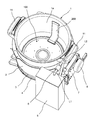
- FIG. 1 is the perspective view which looked at the rice cooker as an example of the heating cooker of 1st Embodiment of this invention from diagonally upward.
- FIG. 2 is a perspective view of the rice cooker as viewed obliquely from below.
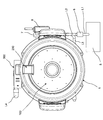
- FIG. 3 is a top view of the rice cooker.
- FIG. 4 is a bottom view of the rice cooker.
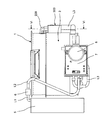
- FIG. 5 is a side view of the rice cooker as seen from the pump side.
- FIG. 6 is a cross-sectional view of the liquid reservoir and the steam duct connecting portion as seen from line VI-VI in FIG.
- FIG. 7 is a side view of the rice cooker as seen from the liquid storage container side.
- FIG. 8 is a sectional view taken along line VIII-VIII in FIG. FIG.
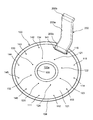
- FIG. 9 is a perspective view of the steam blowing unit and the steam duct of the rice cooker as viewed obliquely from above.
- FIG. 10 is a perspective view of the steam blowing unit and the steam duct as viewed obliquely from below.
- FIG. 11 is an exploded perspective view of the steam blowing unit.
- FIG. 12 is an exploded perspective view of the state where the lower member of the steam blowing unit is removed, as viewed obliquely from below.
- FIG. 13 is a perspective view of the state where the lower member of the steam blowing unit is removed as viewed obliquely from below.
- FIG. 14 is an exploded perspective view of the steam blowing unit as viewed obliquely from below.
- FIG. 15 is a view for explaining a steam path of the steam blowing unit.
- FIG. 16 is a control block diagram of the rice cooker.
- FIG. 17 is sectional drawing of the rice cooker as an example of the heating cooker of 2nd Embodiment of this invention
- FIG. 1 has shown the perspective view seen from diagonally upward of the rice cooker as an example of the heating cooker of 1st Embodiment of this invention.
- FIG. 1 and FIGS. 2 to 8 described later the main body case and the lid of the rice cooker are omitted.
- the rice cooker according to the first embodiment is disposed on the lower side of the inner pot 1, the cylindrical storage part 2 that stores the lower side of the inner pot 1, and the storage part 2,
- a first heat transfer part 3 made of aluminum die cast that contacts the bottom of the inner pot 1
- a second heat transfer part 4 made of aluminum die cast attached to the lower side of the first heat transfer part 3, and a storage part 2
- a water tank 5 detachably attached to the side of 2
- a pump 7 attached to the side of the storage unit 2 and in the vicinity of the water tank 5, and a pump motor 8 attached to the side of the pump 7. It is provided in the case.
- the inner pot 1 is an example of a container for storing rice (cooked food) and water (cooking liquid).
- Two grips 11 are attached to the outer peripheral edge of the opening 1a of the inner pot 1 and the opposing positions.
- the water tank 5 and the inflow port of the pump 7 are connected via a pipe L1, a connection port 6 and a pipe L2.
- a pipe L1 connected to the connection port 6 By removing the pipe L1 connected to the connection port 6, the water tank 5 and the pipe L1 can be removed from the rice cooker.
- FIG. 2 has shown the perspective view which looked at the said rice cooker from diagonally downward.
- the same components as those in FIG. 1 are denoted by the same reference numerals.
- the first heater 31 is embedded in the first heat transfer section 3 in an annular shape.
- a second heater 41 is embedded in the second heat transfer section 4 in an annular shape.
- 32 and 33 are connection terminals of the first heater 31, and 42 and 43 are connection terminals of the second heater 41.
- a through hole 3 a is provided at the center of the first heat transfer unit 3, and a through hole 4 a is provided at the center of the second heat transfer unit 4.
- a movable member 35 that is movable in the vertical direction is disposed in the through holes 3 a and 4 a of the first heat transfer unit 3 and the second heat transfer unit 4.
- the movable member 35 is biased upward by the coil spring 9, and the upper surface of the movable member 35 is in contact with the lower surface of the inner pot 1.
- An inner pot temperature sensor 36 for detecting the temperature of the bottom of the inner pot 1 is attached to the lower surface of the movable member 35.
- a steam generation space S (shown in FIG. 8) is formed between the first heat transfer section 3 and the second heat transfer section 4, and water from the pump 7 is supplied into the steam generation space S through the pipe L3. To do.
- the water supplied from the pump 7 is at least one of the first heater 31 and the second heater 41. It is heated and evaporated by the second heater 41, and the evaporated vapor is further heated to become superheated steam at 100 ° C. or higher. This superheated steam flows into the liquid reservoir 300 (shown in FIG. 3) via the pipe L4.
- the first heat transfer unit 3, the second heat transfer unit 4, and the second heater 41 constitute a steam generation unit.
- the first heat transfer unit 3 and the second heat transfer unit 4 constitute a steam generation container.
- FIG. 3 shows a top view of the rice cooker.
- the same components as those in FIGS. 1 and 2 are denoted by the same reference numerals.
- the steam outlet unit 100 in the inner pot 1 is connected to a liquid reservoir 300 through a steam duct 200.
- FIG. 4 shows a bottom view of the rice cooker.
- the same components as those in FIGS. 1 to 3 are denoted by the same reference numerals.
- FIG. 5 shows a side view of the rice cooker as viewed from the pump 7 side.
- the same components as those in FIGS. 1 and 2 are denoted by the same reference numerals.
- 220 of FIG. 5 is the steam duct connection part to which the upper end of the steam duct 200 (shown in FIG. 3) was connected.
- FIG. 6 shows a cross-sectional view of the liquid storage container 300 and the steam duct connecting portion 220 as seen from line VI-VI in FIG.
- backflow prevention valves 304 and 305 for restricting the flow from the steam duct 200 to the liquid storage container 300 are disposed.
- two electrodes 307 and 308 of the water level sensor 310 are attached to the lid 302.
- An air release valve 309 is attached to the lid 302.
- a connecting portion 301 a to which a pipe L 4 is connected is provided on the side wall of the container main body 301.
- the liquid reservoir 300 is detachably attached to the storage unit 2 (shown in FIG. 5) or the main body case.
- the first heat transfer section 3 is disposed below the cylindrical storage section 2 that stores the inner pot 1, and the second heat transfer section 4 is positioned below the first heat transfer section 3. Is arranged.
- FIG. 8 shows a sectional view taken along line VIII-VIII in FIG.
- the same components as those in FIGS. 1 to 7 are denoted by the same reference numerals.
- a steam generation space S is formed between the first heat transfer unit 3 and the second heat transfer unit 4.
- the first heater 31 of the first heat transfer unit 3 and the second heater 41 of the second heat transfer unit 4 are turned on, and steam generated between the first heat transfer unit 3 and the second heat transfer unit 4 is generated.
- the pump 7 shown in FIG. 1
- the water is heated and evaporated in the steam generation space S, and further heated superheated steam is generated.
- the first heat transfer unit 3, the second heat transfer unit 4, the second heater 41, and the steam blowing unit 100 constitute a steam supply device.
- the steam generation part constituted by the first heat transfer part 3, the second heat transfer part 4 and the second heater 41 superheated steam of about 300 ° C. is generated, and in the liquid reservoir 300 and the steam duct 200, superheated steam is generated.
- the temperature is about 200 ° C., and the temperature of the superheated steam blown out from the steam blowing holes 111, 112,... Is about 140 ° C. to 150 ° C.
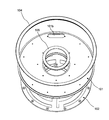
- FIG. 9 shows a perspective view of the steam blow-out unit 100 and the steam duct 200 as viewed obliquely from above.
- the steam blowing unit 100 includes a disk-shaped upper member 101 having a through hole 101 a at the center, a first elastic ring member 104 attached to the outer peripheral edge of the upper member 101, and an upper member 101. And a second elastic ring member 105 attached to the inner periphery of the through hole 101a.
- the upper member 101 has a plurality of steam blowing holes 111 to 116, 121 to 124, 131 to 134, 141 to 146.
- the plurality of steam blowing holes 111 to 116, 121 to 124, 131 to 134, 141 to 146 are in contact with rice (cooked food) and water (cooking liquid) in the inner pot 1 (shown in FIG. 8).
- the steam outlets 111 to 116, 121 to 124, 131 to 134, and 141 to 146 have a circular shape with a diameter of about 1/2 to 1/3 that of rice grains.
- the steam duct 200 includes a steam duct body 200a that bends along the inner wall of the inner pot 1 (shown in FIG. 8), a first connection portion 200b that is provided at the upper end of the steam duct body 200a, and a steam duct body. And a second connection portion 200c provided at the lower end of 200a.
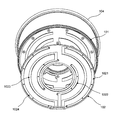
- the steam blowing unit 100 includes a disk-shaped upper member 101 having a through hole 101a at the center, a disk-shaped packing 102 made of a heat-resistant elastic material, and a disk-shaped packing member 102.
- a lower member 103 is provided.
- the upper member 101, the packing 102, and the disk-like lower member 103 are integrated by a first elastic ring member 104 and a second elastic ring member 105 in a state where they are overlapped.
- the upper member 101 is provided with a long hole-shaped connection hole 101b.
- the second connection part 200c at the lower end of the steam duct 200 shown in FIG. 9 is connected to the connection hole 101b.
- FIG. 13 shows a perspective view of the steam blower unit 100 with the lower member 103 removed as viewed obliquely from below
- FIG. 14 shows an exploded perspective view of the steam blower unit 100 as seen obliquely from below. .
- FIG. 15 the top view of the steam blowing unit 100 is shown.
- the steam path 120 has an inlet portion 120a that extends radially inward from the inlet 202, and a curved portion 120b that extends in a circumferential direction and an arc shape from the tip of the inlet portion 120a.
- steam blowing holes 121 to 124 are provided at positions of the upper member 101 facing the curved portion 120b.
- the steam path 130 includes an inlet portion 130a extending radially inward from the inlet 203, a curved portion 130b extending in a circumferential direction and a semicircular arc shape from the tip of the inlet portion 130a, and a radial direction from the tip of the curved portion 130b. It has a straight portion 130c extending inward and a curved portion 130d extending in the circumferential direction and in an arc from the tip of the straight portion 130c. In order from the vicinity of the straight portion 130c of the curved portion 130d of the steam path 130, steam blowing holes 131 to 134 are provided at positions of the upper member 101 facing the curved portion 130d.
- the steam path 140 extends from the inflow port 204 in a circumferential direction and in a semicircular arc shape.
- steam blowing holes 141 to 146 are provided at the position of the upper member 101 facing the steam path 140.
- the steam outlet holes 111, 121, 131, 141 closest to the respective inlets 201, 202, 203, 204 of the steam path 110, the steam path 1120, the steam path 130, and the steam path 140 are the respective inlet ports 201.
- 202, 203, 204 are different from each other, and are arranged apart from each other in the bottom surface of the inner pot 1. Thereby, the food in the inner pot 1 can be heated uniformly.
- the curved portion 120b of the steam path 120 and the curved portion 130d of the steam path 130 have shapes that are close to line symmetry with a straight line passing through the center of the upper member 101 as an axis.
- the steam supply apparatus (The 1st heat-transfer part 3, the 2nd heat-transfer part 4, the 2nd heater 41, the steam blowing unit 100) was accommodated in the inner pot 1 (container).
- a plurality of steam outlets 111 to 116, 121 to 124, 131 to 134, 141 to 146 in contact with rice (cooking) and water (cooking liquid)
- a plurality of steam outlets 111 to 116, 121-124, 131-134, 141-146 overheated steam gas of 100 ° C or higher efficiently heats the food while stirring the food, cooking liquid, or mixture of food and cooking liquid. Since it conveys, uniform and uniform cooking can be performed, and a good cooking finish can be realized.
- by cooking with high-temperature superheated steam it is possible to cook rice with elasticity and graininess.
- the plurality of steam blowing holes 111 to 116, 121 to 124, 131 to 134, and 141 to 146 of the steam blowing unit 100 are arranged at the bottom of the inner pot 1 so that the cooking housed in the inner pot 1 is cooked. Stirring and heating can be efficiently performed by supplying superheated steam from the lower side to the upper side of the product, the cooking liquid, or the mixture of the cooking product and the cooking liquid.
- a plurality of steam paths 110, 120, 130, 140 branched from the inflow ports 201-204 into which superheated steam from the steam generating section (3,4, 41) flows are formed into a plurality of steam outlet holes 111-116, 121.
- the superheated steam can be uniformly supplied into the container 1.
- the plurality of steam paths 110, 120, 130, and 140 have different distances from the inlets 201 to 204 to the first steam outlet holes 111, 121, 131, and 141, but the steam paths 110, 120, and 140 are different from each other.
- the pressures of superheated steam blown out from the first steam blowing holes 111, 121, 131, 141 of 130, 140 are substantially the same.
- the other steam blowing holes 112-116, 122-124, 132- provided downstream of the first steam blowing holes 111, 121, 131, 141 are provided.
- the pressure of superheated steam blown out from 134, 142 to 146 decreases toward the downstream side. Therefore, by disposing discretely the first steam outlet holes 111, 121, 131, 141 of each steam path 110, 120, 130, 140, the remaining other steam outlet holes 112-116, 122-124, 132 are arranged.
- the superheated steam can be supplied more uniformly into the inner pot 1 together with ⁇ 134, 142 ⁇ 146.
- the steam blowing unit 100 that is detachably attached in the inner pot 1
- the steam blowing unit 100 can be removed from the inner pot 1 and cleaning and other operations can be facilitated, and maintenance is improved.
- the heating time can be shortened by adding the heating capability of heating the inner pot 1 by the first heater 31 to the heating capability of the superheated steam blown out from the steam supply device (3, 4, 41, 100). .
- the first heater 31 also serves as a heating means for heating both the inner pot 1 and the steam generators (3, 4, 41), so that the heat of the first heater 31 is used for heating the inner pot 1 and generating steam. It can be used effectively. Moreover, installation space can be reduced and cost can be reduced.
- the cooking liquid in the inner pot 1 passes through the plurality of steam outlet holes 111 to 116, 121 to 124, 131 to 134, 141 to 146 of the steam outlet unit 100, and generates steam (3,4, 41). Is prevented from flowing back into the steam generation space S by the backflow prevention valves 304, 305, so that the cooking liquid flows into the steam generation section (3,4, 41) and foreign matter enters the steam generation section (3,4, 41). Will not be mixed.
- a plurality of steam outlet holes 111 to 116, 121 to 124, of the steam outlet unit 100 are provided in a liquid reservoir container 300 disposed between the steam outlet unit 100 and the steam generator (3,4, 41).
- the cooking liquid that has flowed back through 131 to 134 and 141 to 146 accumulates to prevent the cooking liquid from flowing into the steam generation section (3,4,41), and the steam generation section (3,4,41). It is possible to surely prevent foreign matter from entering.
- the rice cooker includes a control device 400 including a microcomputer and an input / output circuit as shown in FIG.
- the control device 400 is connected to the pump motor 8, the display operation unit 10, the first heater 31, the inner pot temperature sensor 36, the second heater 41, and the water level sensor 310.
- the control device 400 controls the pump motor 8, the first heater 31, the second heater 41, and the like based on detection signals from the inner pot temperature sensor 36 and the like.
- the control device 400 detects the steam supply device (the first heat transfer unit 3, the second heat transfer unit 4, the second heater 41). , The steam blowing unit 100) is kept in a stopped state, and the display operation unit 10 notifies the user to discard the liquid in the liquid reservoir 300.
- the steam blowing unit 100 integrated with the first elastic ring member 104 and the second elastic ring member 105 in a state where the upper member 101, the packing 102, and the disk-like lower member 103 are overlapped.
- the upper member 101 and the packing 102 may be detachably attached to the bottom of the inner pot 1 without the lower member 103.
- FIG. 17 has shown sectional drawing of the rice cooker as an example of the heating cooker of 2nd Embodiment of this invention.
- the rice cooker of this second embodiment has the same configuration as that of the rice cooker of the first embodiment except for the steam duct 240 and the steam duct connection portion 250, and the same reference numerals are assigned to the same components. ing.
- a disc-shaped steam blowing unit 100 is detachably attached to the bottom of the inner pot 1.
- One end of a steam duct 240 is connected to the steam blowing unit 100.
- the steam duct connection part 250 has an L shape that extends upward from the steam outlet part 303 side of the liquid reservoir 300 and bends toward the opening part 1a side of the inner pot 1. The lower end of the steam duct connection part 250 is connected to the steam outlet part 303 of the liquid reservoir 300.
- the heating cooker according to the second embodiment has the same effect as the heating cooker according to the first embodiment.
- the rice cooker as an example of the heating cooker according to the third embodiment of the present invention has the same configuration as that of the heating cooker according to the first embodiment except for the steam generator.
- the heating cooker according to the first embodiment includes the steam generation unit configured by the first heat transfer unit 3, the second heat transfer unit 4, and the second heater 41, whereas the third embodiment.
- the heating cooker includes a steam generation unit that is separate from the heat transfer unit disposed on the lower side of the inner pot 1, and a heater that heats the steam generation unit.
- the heating cooker according to the third embodiment has the same effect as the heating cooker according to the first embodiment.
- the rice cooker as an example of the heating cooker according to the fourth embodiment of the present invention has the same configuration as that of the heating cooker according to the first embodiment except for the steam outlet.
- the steam blowing unit 100 is provided as a steam blowing portion at the bottom of the inner pot 1, whereas the cooking device of the fourth embodiment is provided in the inner pot 1.
- a steam outlet having a plurality of steam outlets is provided on the side wall of the main body.
- a steam blowing part may equip both the bottom part and side wall in the inner pot 1 with a steam blowing part.
- the cooking device according to the fourth embodiment has the same effect as the cooking device according to the first embodiment.
- a rice cooker provided with a steam generating unit composed of a first heat transfer unit 3, a second heat transfer unit 4, and a second heater 41 is used.
- the steam generation part of a heating cooker is not restricted to this, The steam generation part which has the 1st heater and the 2nd heater which heat a steam generation container and its steam generation container may be sufficient.
- the present invention is not limited to the first to fourth embodiments, and various modifications can be made within the scope of the present invention.
- a suitable combination of the contents described in the first to fourth embodiments may be used as one embodiment of the present invention.
- the cooking device is: A container 1 for containing a cooked product and a cooking liquid; A steam supply device (3, 4, 41, 100).
- the cooked material is rice-containing grains, vegetables, meat, fish, etc.
- the cooking liquid is water or a mixture of water and seasonings.
- the steam supply device (3, 4, 41, 100) has a plurality of steam blowout holes 111 to 116, 121 to 124, which are in contact with at least one of the cooked food or cooking liquid stored in the container 1.
- the superheated steam gas of 100 ° C. or more blown out from the plurality of steam blowing holes 111 to 116, 121 to 124, 131 to 134, 141 to 146 is cooked.
- heat is efficiently transmitted while stirring the cooking liquid or the mixture of the cooking product and the cooking liquid, so that uniform and uniform heating cooking can be performed, and a good cooking finish can be realized.
- cooking by cooking rice or boiled food with high-temperature superheated steam at 100 ° C or higher makes it possible to easily cook at the same high temperature as a pressure cooker without using dangerous cooking utensils such as a pressure cooker. Become.
- the steam supply device (3,4, 41, 100) A steam generator (3,4, 41) for generating the superheated steam; A steam blowing section for blowing the superheated steam from the steam generating section (3, 4, 41) into the container 1 through the plurality of steam blowing holes 111 to 116, 121 to 124, 131 to 134, 141 to 146 100.
- the steam generating unit (3, 4, 41) that generates superheated steam and the steam blowing unit 100 that blows out superheated steam into the container 1 are arranged separately, whereby the steam blowing unit 100 is arranged. It can arrange
- the plurality of steam outlet holes 111 to 116, 121 to 124, 131 to 134, 141 to 146 of the steam outlet 100 are arranged at the bottom of the container 1.
- the plurality of steam blowing holes 111 to 116, 121 to 124, 131 to 134, 141 to 146 of the steam blowing unit 100 are accommodated in the container 1 by arranging them at the bottom of the container 1. Stirring and heating can be efficiently performed by supplying superheated steam from the lower side to the upper side of the cooked food, or the cooking liquid, or the mixture of the cooking and cooking liquid.
- the steam outlet 100 is Inflow ports 201 to 204 into which the superheated steam from the steam generating section (3,4, 41) flows, A plurality of steam paths 110, 120, 130, 140 branched from the inflow ports 201-204 and connected to any one of the plurality of steam outlet holes 111-116, 121-124, 131-134, 141-146; Have The plurality of steam paths 110, 120, 130, and 140 guide the superheated steam flowing in from the inlets 201 to 204 to the steam outlet holes 111 to 116, 121 to 124, 131 to 134, and 141 to 146, respectively. .
- the plurality of steam paths 110, 120, 130, and 140 branched from the inlets 201 to 204 into which superheated steam from the steam generating section (3,4, 41) flows are formed into the plurality of steam outlet holes.
- 111 to 116, 121 to 124, 131 to 134, 141 to 146 the superheated steam that has flowed from the inlets 201 to 204 through the plurality of steam paths 110, 120, 130, and 140 is formed into a steam outlet hole.
- 111 to 116, 121 to 124, 131 to 134, and 141 to 146 are respectively guided, so that superheated steam can be uniformly supplied into the container 1.
- the plurality of steam paths 110, 120, 130, and 140 have different distances from the inflow ports 201 to 204 to the first steam outlet holes 111, 121, 131, and 141, respectively.
- First steam outlet holes 111, 121, 131, 141 having substantially the same superheated steam pressure in each of the steam paths 110, 120, 130, 140 are discretely arranged, and the remaining steam outlet holes 112-116, The superheated steam can be more uniformly supplied into the container 1 together with 122 to 124, 132 to 134, 142 to 146.
- the steam blowing part 100 is detachably attached to the container 1.
- the steam blowing part 100 detachably attached in the container 1 it is possible to remove the steam blowing part 100 from the container 1 and to easily perform operations such as cleaning, thereby improving maintainability. To do.
- the steam blowing unit 100 can be disassembled into a plurality of parts.
- the steam blowing unit 100 that can be decomposed into a plurality of parts, the steam blowing unit 100 can be disassembled and cleaning and other operations can be easily performed, and maintenance is improved.
- the heating time can be shortened by adding the heating capability of heating the container 1 by the heater 31 to the heating capability of the superheated steam blown from the steam supply device (3, 4, 41, 100).
- a heater 31 for heating the container 1 and the steam generation part (3, 4, 41) was provided.
- the heater 31 also serves as a heating means for heating both the container 1 and the steam generation unit (3,4, 41), so that the heat of the heater 31 is effectively used for heating the container 1 and generating steam. Available.
- a first heater 31 for heating the container 1 is provided,
- the steam generation part (3,4,41) has a steam generation container (3,4) and a second heater 41 for heating the steam generation container (3,4),
- a control device 400 that controls the first heater 31 and the second heater 41 is provided.
- the control device 400 controls the first heater 31 that heats the container 1 and the second heater 41 that heats the steam generation container (3, 4), for example, a cooking device.
- the container 1 itself is controlled by controlling on / off of the first heater 31 and the second heater 41 according to the situation of the water supply process, the startup process, the cooking process, the steaming process, the heat retaining process, etc.
- the steam generation unit has a steam generation container and a first heater and a second heater for heating the steam generation container, A control device for controlling the first heater and the second heater is provided.
- the control device for example, in a rice cooker that is an example of a heating cooker, a water supply process, a startup process, By adjusting the temperature and amount of superheated steam generated in the steam generation container by controlling on / off of the first heater and the second heater according to the situation such as the cooking process, steaming process, heat insulation process, etc. Heat cooking is possible, and a better cooking finish can be realized.
- the cooking liquid in the container 1 passes through the plurality of steam outlet holes 111 to 116, 121 to 124, 131 to 134, 141 to 146 of the steam outlet 100, and the steam generator (3,4, 41). ) Are provided with backflow prevention valves 304 and 305 for preventing backflow.
- the cooking liquid in the container 1 passes through the plurality of steam outlet holes 111 to 116, 121 to 124, 131 to 134, 141 to 146 of the steam outlet 100, and the steam generator (3,4). , 41) is prevented by the backflow prevention valves 304, 305, so that the cooking liquid does not flow into the steam generation section (3,4, 41) and foreign matter does not enter the steam generation section.
- a liquid storage container 300 is provided between the steam outlet 100 and the steam generator (3, 4, 41).
Landscapes
- Engineering & Computer Science (AREA)
- Food Science & Technology (AREA)
- Cookers (AREA)
Abstract
L'invention concerne un appareil de cuisson chauffant comprenant : un réceptacle (1) qui reçoit un objet de cuisson et un liquide de cuisson ; et des dispositifs d'alimentation en vapeur (3, 4, 41, 100) qui soufflent de la vapeur surchauffée, qui entre en contact avec l'objet de cuisson et/ou le liquide de cuisson dans le réceptacle (1), à partir d'une pluralité de trous de soufflage de vapeur. Ainsi, l'invention concerne un appareil de cuisson chauffant qui peut réaliser une cuisson uniforme et régulière à l'aide de vapeur surchauffée.
Applications Claiming Priority (2)
| Application Number | Priority Date | Filing Date | Title |
|---|---|---|---|
| JP2017-022403 | 2017-02-09 | ||
| JP2017022403A JP2020054412A (ja) | 2017-02-09 | 2017-02-09 | 加熱調理器 |
Publications (1)
| Publication Number | Publication Date |
|---|---|
| WO2018146830A1 true WO2018146830A1 (fr) | 2018-08-16 |
Family
ID=63108089
Family Applications (1)
| Application Number | Title | Priority Date | Filing Date |
|---|---|---|---|
| PCT/JP2017/021726 Ceased WO2018146830A1 (fr) | 2017-02-09 | 2017-06-13 | Appareil de cuisson chauffant |
Country Status (2)
| Country | Link |
|---|---|
| JP (1) | JP2020054412A (fr) |
| WO (1) | WO2018146830A1 (fr) |
Cited By (1)
| Publication number | Priority date | Publication date | Assignee | Title |
|---|---|---|---|---|
| JP2024029238A (ja) * | 2020-07-29 | 2024-03-05 | 愛知電熱株式会社 | 過熱蒸気発生装置および加熱調理装置 |
Families Citing this family (1)
| Publication number | Priority date | Publication date | Assignee | Title |
|---|---|---|---|---|
| CN112715823B (zh) * | 2020-12-24 | 2023-08-01 | 深圳技术大学 | 一种大型炒菜机器人固定吹氧流线铲 |
Citations (3)
| Publication number | Priority date | Publication date | Assignee | Title |
|---|---|---|---|---|
| JP2012085902A (ja) * | 2010-10-21 | 2012-05-10 | Sharp Corp | 炊飯器 |
| JP2012115431A (ja) * | 2010-11-30 | 2012-06-21 | Sharp Corp | 炊飯器 |
| JP2013111353A (ja) * | 2011-11-30 | 2013-06-10 | Thermo Electron Co Ltd | 過熱蒸気調理器具 |
-
2017
- 2017-02-09 JP JP2017022403A patent/JP2020054412A/ja active Pending
- 2017-06-13 WO PCT/JP2017/021726 patent/WO2018146830A1/fr not_active Ceased
Patent Citations (3)
| Publication number | Priority date | Publication date | Assignee | Title |
|---|---|---|---|---|
| JP2012085902A (ja) * | 2010-10-21 | 2012-05-10 | Sharp Corp | 炊飯器 |
| JP2012115431A (ja) * | 2010-11-30 | 2012-06-21 | Sharp Corp | 炊飯器 |
| JP2013111353A (ja) * | 2011-11-30 | 2013-06-10 | Thermo Electron Co Ltd | 過熱蒸気調理器具 |
Cited By (2)
| Publication number | Priority date | Publication date | Assignee | Title |
|---|---|---|---|---|
| JP2024029238A (ja) * | 2020-07-29 | 2024-03-05 | 愛知電熱株式会社 | 過熱蒸気発生装置および加熱調理装置 |
| JP7632920B2 (ja) | 2020-07-29 | 2025-02-19 | 愛知電熱株式会社 | 過熱蒸気発生装置および加熱調理装置 |
Also Published As
| Publication number | Publication date |
|---|---|
| JP2020054412A (ja) | 2020-04-09 |
Similar Documents
| Publication | Publication Date | Title |
|---|---|---|
| CN105491924B (zh) | 烹饪机器 | |
| US10765249B2 (en) | Baby food maker | |
| KR102137984B1 (ko) | 용기 내에 수용된 음식을 스팀-가열 및/또는 스팀-조리하기 위한 모듈형 스티머 액세서리 | |
| JP6473245B2 (ja) | 容器に収容された食品を蒸気加熱および/または調理するための蒸気調理器付属装置 | |
| KR101922455B1 (ko) | 증기 가열식 다용도 조리기구 | |
| KR101904403B1 (ko) | 전기조리기 | |
| US20050247208A1 (en) | Double heating-type pots | |
| JP2009533117A (ja) | 減圧制御機構を備えた圧力調理機器 | |
| WO2018146830A1 (fr) | Appareil de cuisson chauffant | |
| JP6109633B2 (ja) | 調理器 | |
| KR101935162B1 (ko) | 주전자 겸용 스팀 제너레이터 | |
| KR102431917B1 (ko) | 가열식 휴대용 텀블러 | |
| KR101336885B1 (ko) | 분리형 이중조리용기 | |
| KR101725975B1 (ko) | 발열팩을 이용하는 야외용 조리기구 | |
| JP4289313B2 (ja) | 炊飯器 | |
| KR20150098144A (ko) | 찜기용 스팀 공급장치 | |
| JP2018201692A (ja) | 加熱調理器 | |
| CN212326130U (zh) | 一种加热均匀的蒸锅 | |
| US184148A (en) | Improvement in oil and gas stoves | |
| KR102426297B1 (ko) | 전기압력밥솥 | |
| JP6289393B2 (ja) | 炊飯器 | |
| JP7227493B2 (ja) | 炊飯器 | |
| CN214433645U (zh) | 烹饪器具 | |
| JP2018136052A (ja) | 蒸気発生装置 | |
| KR101857861B1 (ko) | 덮개타입 스팀공급장치 및 이를 구비한 스팀조리용기 |
Legal Events
| Date | Code | Title | Description |
|---|---|---|---|
| 121 | Ep: the epo has been informed by wipo that ep was designated in this application |
Ref document number: 17895722 Country of ref document: EP Kind code of ref document: A1 |
|
| NENP | Non-entry into the national phase |
Ref country code: DE |
|
| 122 | Ep: pct application non-entry in european phase |
Ref document number: 17895722 Country of ref document: EP Kind code of ref document: A1 |
|
| NENP | Non-entry into the national phase |
Ref country code: JP |