WO2018147295A1 - 感光性樹脂組成物、該感光性樹脂組成物を用いたソルダーレジストフィルム、フレキシブルプリント配線板及び画像表示装置 - Google Patents
感光性樹脂組成物、該感光性樹脂組成物を用いたソルダーレジストフィルム、フレキシブルプリント配線板及び画像表示装置 Download PDFInfo
- Publication number
- WO2018147295A1 WO2018147295A1 PCT/JP2018/004100 JP2018004100W WO2018147295A1 WO 2018147295 A1 WO2018147295 A1 WO 2018147295A1 JP 2018004100 W JP2018004100 W JP 2018004100W WO 2018147295 A1 WO2018147295 A1 WO 2018147295A1
- Authority
- WO
- WIPO (PCT)
- Prior art keywords
- group
- resin composition
- photosensitive resin
- pigment
- film
- Prior art date
- Legal status (The legal status is an assumption and is not a legal conclusion. Google has not performed a legal analysis and makes no representation as to the accuracy of the status listed.)
- Ceased
Links
Classifications
-
- G—PHYSICS
- G03—PHOTOGRAPHY; CINEMATOGRAPHY; ANALOGOUS TECHNIQUES USING WAVES OTHER THAN OPTICAL WAVES; ELECTROGRAPHY; HOLOGRAPHY
- G03F—PHOTOMECHANICAL PRODUCTION OF TEXTURED OR PATTERNED SURFACES, e.g. FOR PRINTING, FOR PROCESSING OF SEMICONDUCTOR DEVICES; MATERIALS THEREFOR; ORIGINALS THEREFOR; APPARATUS SPECIALLY ADAPTED THEREFOR
- G03F7/00—Photomechanical, e.g. photolithographic, production of textured or patterned surfaces, e.g. printing surfaces; Materials therefor, e.g. comprising photoresists; Apparatus specially adapted therefor
- G03F7/004—Photosensitive materials
- G03F7/027—Non-macromolecular photopolymerisable compounds having carbon-to-carbon double bonds, e.g. ethylenic compounds
- G03F7/028—Non-macromolecular photopolymerisable compounds having carbon-to-carbon double bonds, e.g. ethylenic compounds with photosensitivity-increasing substances, e.g. photoinitiators
-
- H—ELECTRICITY
- H05—ELECTRIC TECHNIQUES NOT OTHERWISE PROVIDED FOR
- H05K—PRINTED CIRCUITS; CASINGS OR CONSTRUCTIONAL DETAILS OF ELECTRIC APPARATUS; MANUFACTURE OF ASSEMBLAGES OF ELECTRICAL COMPONENTS
- H05K3/00—Apparatus or processes for manufacturing printed circuits
- H05K3/22—Secondary treatment of printed circuits
- H05K3/28—Applying non-metallic protective coatings
- H05K3/285—Permanent coating compositions
- H05K3/287—Photosensitive compositions
-
- G—PHYSICS
- G03—PHOTOGRAPHY; CINEMATOGRAPHY; ANALOGOUS TECHNIQUES USING WAVES OTHER THAN OPTICAL WAVES; ELECTROGRAPHY; HOLOGRAPHY
- G03F—PHOTOMECHANICAL PRODUCTION OF TEXTURED OR PATTERNED SURFACES, e.g. FOR PRINTING, FOR PROCESSING OF SEMICONDUCTOR DEVICES; MATERIALS THEREFOR; ORIGINALS THEREFOR; APPARATUS SPECIALLY ADAPTED THEREFOR
- G03F7/00—Photomechanical, e.g. photolithographic, production of textured or patterned surfaces, e.g. printing surfaces; Materials therefor, e.g. comprising photoresists; Apparatus specially adapted therefor
- G03F7/004—Photosensitive materials
-
- C—CHEMISTRY; METALLURGY
- C08—ORGANIC MACROMOLECULAR COMPOUNDS; THEIR PREPARATION OR CHEMICAL WORKING-UP; COMPOSITIONS BASED THEREON
- C08K—Use of inorganic or non-macromolecular organic substances as compounding ingredients
- C08K5/00—Use of organic ingredients
- C08K5/0008—Organic ingredients according to more than one of the "one dot" groups of C08K5/01 - C08K5/59
- C08K5/0025—Crosslinking or vulcanising agents; including accelerators
-
- C—CHEMISTRY; METALLURGY
- C08—ORGANIC MACROMOLECULAR COMPOUNDS; THEIR PREPARATION OR CHEMICAL WORKING-UP; COMPOSITIONS BASED THEREON
- C08K—Use of inorganic or non-macromolecular organic substances as compounding ingredients
- C08K5/00—Use of organic ingredients
- C08K5/0008—Organic ingredients according to more than one of the "one dot" groups of C08K5/01 - C08K5/59
- C08K5/0041—Optical brightening agents, organic pigments
-
- C—CHEMISTRY; METALLURGY
- C08—ORGANIC MACROMOLECULAR COMPOUNDS; THEIR PREPARATION OR CHEMICAL WORKING-UP; COMPOSITIONS BASED THEREON
- C08K—Use of inorganic or non-macromolecular organic substances as compounding ingredients
- C08K5/00—Use of organic ingredients
- C08K5/16—Nitrogen-containing compounds
- C08K5/29—Compounds containing one or more carbon-to-nitrogen double bonds
-
- C—CHEMISTRY; METALLURGY
- C08—ORGANIC MACROMOLECULAR COMPOUNDS; THEIR PREPARATION OR CHEMICAL WORKING-UP; COMPOSITIONS BASED THEREON
- C08K—Use of inorganic or non-macromolecular organic substances as compounding ingredients
- C08K5/00—Use of organic ingredients
- C08K5/49—Phosphorus-containing compounds
- C08K5/51—Phosphorus bound to oxygen
- C08K5/53—Phosphorus bound to oxygen bound to oxygen and to carbon only
- C08K5/5397—Phosphine oxides
-
- C—CHEMISTRY; METALLURGY
- C08—ORGANIC MACROMOLECULAR COMPOUNDS; THEIR PREPARATION OR CHEMICAL WORKING-UP; COMPOSITIONS BASED THEREON
- C08L—COMPOSITIONS OF MACROMOLECULAR COMPOUNDS
- C08L33/00—Compositions of homopolymers or copolymers of compounds having one or more unsaturated aliphatic radicals, each having only one carbon-to-carbon double bond, and only one being terminated by only one carboxyl radical, or of salts, anhydrides, esters, amides, imides or nitriles thereof; Compositions of derivatives of such polymers
- C08L33/04—Homopolymers or copolymers of esters
- C08L33/06—Homopolymers or copolymers of esters of esters containing only carbon, hydrogen and oxygen, which oxygen atoms are present only as part of the carboxyl radical
- C08L33/062—Copolymers with monomers not covered by C08L33/06
- C08L33/068—Copolymers with monomers not covered by C08L33/06 containing glycidyl groups
-
- G—PHYSICS
- G03—PHOTOGRAPHY; CINEMATOGRAPHY; ANALOGOUS TECHNIQUES USING WAVES OTHER THAN OPTICAL WAVES; ELECTROGRAPHY; HOLOGRAPHY
- G03F—PHOTOMECHANICAL PRODUCTION OF TEXTURED OR PATTERNED SURFACES, e.g. FOR PRINTING, FOR PROCESSING OF SEMICONDUCTOR DEVICES; MATERIALS THEREFOR; ORIGINALS THEREFOR; APPARATUS SPECIALLY ADAPTED THEREFOR
- G03F7/00—Photomechanical, e.g. photolithographic, production of textured or patterned surfaces, e.g. printing surfaces; Materials therefor, e.g. comprising photoresists; Apparatus specially adapted therefor
- G03F7/004—Photosensitive materials
- G03F7/027—Non-macromolecular photopolymerisable compounds having carbon-to-carbon double bonds, e.g. ethylenic compounds
-
- G—PHYSICS
- G03—PHOTOGRAPHY; CINEMATOGRAPHY; ANALOGOUS TECHNIQUES USING WAVES OTHER THAN OPTICAL WAVES; ELECTROGRAPHY; HOLOGRAPHY
- G03F—PHOTOMECHANICAL PRODUCTION OF TEXTURED OR PATTERNED SURFACES, e.g. FOR PRINTING, FOR PROCESSING OF SEMICONDUCTOR DEVICES; MATERIALS THEREFOR; ORIGINALS THEREFOR; APPARATUS SPECIALLY ADAPTED THEREFOR
- G03F7/00—Photomechanical, e.g. photolithographic, production of textured or patterned surfaces, e.g. printing surfaces; Materials therefor, e.g. comprising photoresists; Apparatus specially adapted therefor
- G03F7/004—Photosensitive materials
- G03F7/09—Photosensitive materials characterised by structural details, e.g. supports, auxiliary layers
- G03F7/105—Photosensitive materials characterised by structural details, e.g. supports, auxiliary layers having substances, e.g. indicators, for forming visible images
-
- G—PHYSICS
- G03—PHOTOGRAPHY; CINEMATOGRAPHY; ANALOGOUS TECHNIQUES USING WAVES OTHER THAN OPTICAL WAVES; ELECTROGRAPHY; HOLOGRAPHY
- G03F—PHOTOMECHANICAL PRODUCTION OF TEXTURED OR PATTERNED SURFACES, e.g. FOR PRINTING, FOR PROCESSING OF SEMICONDUCTOR DEVICES; MATERIALS THEREFOR; ORIGINALS THEREFOR; APPARATUS SPECIALLY ADAPTED THEREFOR
- G03F7/00—Photomechanical, e.g. photolithographic, production of textured or patterned surfaces, e.g. printing surfaces; Materials therefor, e.g. comprising photoresists; Apparatus specially adapted therefor
- G03F7/26—Processing photosensitive materials; Apparatus therefor
- G03F7/40—Treatment after imagewise removal, e.g. baking
-
- H—ELECTRICITY
- H05—ELECTRIC TECHNIQUES NOT OTHERWISE PROVIDED FOR
- H05K—PRINTED CIRCUITS; CASINGS OR CONSTRUCTIONAL DETAILS OF ELECTRIC APPARATUS; MANUFACTURE OF ASSEMBLAGES OF ELECTRICAL COMPONENTS
- H05K1/00—Printed circuits
- H05K1/02—Details
- H05K1/0274—Optical details, e.g. printed circuits comprising integral optical means
-
- H—ELECTRICITY
- H05—ELECTRIC TECHNIQUES NOT OTHERWISE PROVIDED FOR
- H05K—PRINTED CIRCUITS; CASINGS OR CONSTRUCTIONAL DETAILS OF ELECTRIC APPARATUS; MANUFACTURE OF ASSEMBLAGES OF ELECTRICAL COMPONENTS
- H05K3/00—Apparatus or processes for manufacturing printed circuits
- H05K3/22—Secondary treatment of printed circuits
- H05K3/28—Applying non-metallic protective coatings
-
- C—CHEMISTRY; METALLURGY
- C08—ORGANIC MACROMOLECULAR COMPOUNDS; THEIR PREPARATION OR CHEMICAL WORKING-UP; COMPOSITIONS BASED THEREON
- C08L—COMPOSITIONS OF MACROMOLECULAR COMPOUNDS
- C08L2203/00—Applications
- C08L2203/20—Applications use in electrical or conductive gadgets
-
- H—ELECTRICITY
- H05—ELECTRIC TECHNIQUES NOT OTHERWISE PROVIDED FOR
- H05K—PRINTED CIRCUITS; CASINGS OR CONSTRUCTIONAL DETAILS OF ELECTRIC APPARATUS; MANUFACTURE OF ASSEMBLAGES OF ELECTRICAL COMPONENTS
- H05K1/00—Printed circuits
- H05K1/02—Details
- H05K1/0213—Electrical arrangements not otherwise provided for
- H05K1/0216—Reduction of cross-talk, noise or electromagnetic interference
- H05K1/0218—Reduction of cross-talk, noise or electromagnetic interference by printed shielding conductors, ground planes or power plane
-
- H—ELECTRICITY
- H05—ELECTRIC TECHNIQUES NOT OTHERWISE PROVIDED FOR
- H05K—PRINTED CIRCUITS; CASINGS OR CONSTRUCTIONAL DETAILS OF ELECTRIC APPARATUS; MANUFACTURE OF ASSEMBLAGES OF ELECTRICAL COMPONENTS
- H05K1/00—Printed circuits
- H05K1/02—Details
- H05K1/03—Use of materials for the substrate
- H05K1/0393—Flexible materials
-
- H—ELECTRICITY
- H05—ELECTRIC TECHNIQUES NOT OTHERWISE PROVIDED FOR
- H05K—PRINTED CIRCUITS; CASINGS OR CONSTRUCTIONAL DETAILS OF ELECTRIC APPARATUS; MANUFACTURE OF ASSEMBLAGES OF ELECTRICAL COMPONENTS
- H05K2201/00—Indexing scheme relating to printed circuits covered by H05K1/00
- H05K2201/07—Electric details
- H05K2201/0707—Shielding
- H05K2201/0715—Shielding provided by an outer layer of PCB
-
- H—ELECTRICITY
- H05—ELECTRIC TECHNIQUES NOT OTHERWISE PROVIDED FOR
- H05K—PRINTED CIRCUITS; CASINGS OR CONSTRUCTIONAL DETAILS OF ELECTRIC APPARATUS; MANUFACTURE OF ASSEMBLAGES OF ELECTRICAL COMPONENTS
- H05K2201/00—Indexing scheme relating to printed circuits covered by H05K1/00
- H05K2201/07—Electric details
- H05K2201/0753—Insulation
- H05K2201/0761—Insulation resistance, e.g. of the surface of the PCB between the conductors
-
- H—ELECTRICITY
- H05—ELECTRIC TECHNIQUES NOT OTHERWISE PROVIDED FOR
- H05K—PRINTED CIRCUITS; CASINGS OR CONSTRUCTIONAL DETAILS OF ELECTRIC APPARATUS; MANUFACTURE OF ASSEMBLAGES OF ELECTRICAL COMPONENTS
- H05K3/00—Apparatus or processes for manufacturing printed circuits
- H05K3/30—Assembling printed circuits with electric components, e.g. with resistors
- H05K3/32—Assembling printed circuits with electric components, e.g. with resistors electrically connecting electric components or wires to printed circuits
- H05K3/34—Assembling printed circuits with electric components, e.g. with resistors electrically connecting electric components or wires to printed circuits by soldering
- H05K3/3452—Solder masks
Definitions
- the present invention relates to a photosensitive resin composition, and more specifically, a photosensitive resin composition used for a dry film resist used for a flexible printed wiring board, a solder resist film using the photosensitive resin composition, and a flexible printed wiring board.
- the present invention also relates to an image display device provided with the flexible printed wiring board.
- Flexible Printed Circuit Boards have features such as flexibility and flexibility, and various types of mobile phones, video cameras, laptop computers, etc. that are rapidly becoming smaller, lighter and thinner. In an electronic device, it is frequently used to incorporate a circuit in a complicated mechanism.
- FPC is composed of a copper clad laminate (CCL) with a circuit formed by an etching process and a cover coat material.
- Solder resist used as a cover coat material is usually colored black to absorb visible light in order to make it difficult to see the wiring pattern made of a conductive material on the wiring board and to prevent light from being diffusely reflected on the resist surface. ing.
- black inorganic pigments such as carbon black and black metal oxides have been used as colorants for blackening the solder resist.
- carbon black and black metal oxide have high electrical conductivity, the function of the solder resist as an insulator may be reduced.
- the black inorganic pigment exhibits an absorption wavelength from the ultraviolet region to the infrared region, but the exposure light for photocuring the photosensitive resin composition forming the solder resist is absorbed by the black inorganic pigment, and the surface layer of the solder resist layer
- the inner layer may not be sufficiently cured, and the exposure sensitivity and resolution (patterning property) are low.
- Patent Documents 1 to 3 contain a specific colorant.
- a photosensitive resin composition has been proposed.
- a problem to be solved by the present invention is a new photosensitive resin composition that has excellent wiring pattern concealability and improved resolution (patterning) of the wiring pattern, and the photosensitive resin. It is providing the soldering resist film, flexible printed wiring board, and image display apparatus using a composition.
- the present inventors have obtained a photosensitive resin composition containing a photosensitive prepolymer, a photopolymerization initiator, a thermosetting agent, and a pigment, By using a polycarbodiimide compound having specific physical properties as an agent and setting the transmittance at a specific wavelength (specifically, at least a part of wavelengths of 350 to 430 nm) of the photosensitive resin composition to a certain value or more
- a specific wavelength specifically, at least a part of wavelengths of 350 to 430 nm
- the present invention includes the following ⁇ 1> to ⁇ 12>.
- a photosensitive resin composition containing a photosensitive prepolymer having a carboxyl group and an ethylenically unsaturated group, a photopolymerization initiator, a thermosetting agent, and a pigment, wherein the thermosetting agent has a carbodiimide group of 80.
- a photosensitive resin composition having a maximum transmission spectrum transmittance of 7% or more at at least a part of wavelengths of 350 to 430 nm when a dry film thickness of 10 to 40 ⁇ m is formed.
- R 1 and R 2 are each independently a hydrogen atom, a linear or branched alkyl group having 1 to 6 carbon atoms, or a cycloalkyl group having 3 to 6 carbon atoms; 1 and R 2 may be the same as or different from each other, but they are not hydrogen atoms, X 1 and X 2 each represent —R 3 —NH—COOR 4 , and R 3 is at least 1 A divalent organic group having one aromatic group, R 4 is a residue obtained by removing a hydroxyl group from an organic group having one hydroxyl group, and X 1 and X 2 may be the same or different from each other; Y represents —R 5 —NHCOO—R 6 —OCOHN—R 5 —, each R 5 independently represents a divalent organic group having at least one aromatic group, and R 6 represents a divalent organic group.
- R 6 is not an ether bond
- n is an integer of 1 to 5. Represents a number.
- the pigment is C.I. I. Pigment violet 3, C.I. I.
- the pigment further contains at least one selected from the group consisting of a yellow pigment, a blue pigment, and a green pigment as a toning pigment.
- ⁇ 6> The photosensitive composition according to any one of ⁇ 1> to ⁇ 5>, wherein the pigment is contained in an amount of 1.0 to 7.0% by mass based on the total solid content of the composition.
- Resin composition. ⁇ 7> The photosensitive resin composition according to any one of ⁇ 1> to ⁇ 6>, wherein the number of carbodiimide groups in the polycarbodiimide compound is 2 to 6.
- ⁇ 8> In any one of the above items ⁇ 1> to ⁇ 7>, wherein the carbodiimide equivalent of the polycarbodiimide compound is 0.9 to 1.3 equivalents relative to the carboxyl group of the photosensitive prepolymer.
- the photosensitive resin composition as described. ⁇ 9> The photosensitive resin composition according to any one of ⁇ 1> to ⁇ 8>, which is used for a solder resist film.
- a solder resist film comprising the photosensitive resin composition according to any one of ⁇ 1> to ⁇ 9>.
- a flexible printed wiring board having an insulating layer, a wiring pattern made of a conductive material provided on the insulating layer, and a solder resist layer provided on the wiring pattern, A flexible printed wiring board, wherein the solder resist layer comprises the photosensitive resin composition according to any one of ⁇ 1> to ⁇ 9>.
- An image display device comprising the flexible printed wiring board according to ⁇ 11>.
- the concealability of the wiring pattern when laminated on the wiring pattern with a pigment can be ensured, and the wavelength of 350 to 430 nm when formed into a dry film thickness of 10 to 40 ⁇ m. Since the maximum transmittance of the transmission spectrum at least at some wavelengths is 7% or more, excellent resolution can be exhibited during photocuring. Further, when the film body is formed using the photosensitive resin composition of the present invention, when the lightness L * in the L * a * b * color system of the film body is 30 or less, the concealability of the wiring pattern is improved. It can be improved further.
- (meth) acrylic acid means acrylic acid or methacrylic acid, and the same applies to (meth) acrylate.
- mass is synonymous with “weight”.
- the FPC will be described as an example, but the photosensitive resin composition of the present embodiment can also be used for semiconductor package applications (semiconductor PKG applications).
- a substrate formed by printing using paste-like nano ink containing conductive fine particles such as silver particles and copper particles may be used as a substrate for FPC. it can.
- the CCL includes a substrate on which a circuit is formed by printing using the above-described paste-like nano ink containing conductive fine particles.
- the photosensitive resin composition of this embodiment contains a photosensitive prepolymer having a carboxyl group and an ethylenically unsaturated group, a photopolymerization initiator, a thermosetting agent, and a pigment.
- the thermosetting agent is a polycarbodiimide compound represented by the following formula (1) in which a carbodiimide group is protected by an amino group dissociating at a temperature of 80 ° C. or higher, and the polycarbodiimide compound has a weight average molecular weight of 300 to 3000, and the carbodiimide equivalent is 150 to 600.
- the photosensitive resin composition of the present embodiment is formed to a dry film thickness of 10 to 40 ⁇ m, the maximum value of the transmittance of the transmission spectrum at at least a part of wavelengths of 350 to 430 nm is 7% or more. .
- R 1 and R 2 are each independently a hydrogen atom, a linear or branched alkyl group having 1 to 6 carbon atoms, or a cycloalkyl group having 3 to 6 carbon atoms; 1 and R 2 may be the same as or different from each other, but they are not hydrogen atoms, X 1 and X 2 each represent —R 3 —NH—COOR 4 , and R 3 is at least 1 A divalent organic group having one aromatic group, R 4 is a residue obtained by removing a hydroxyl group from an organic group having one hydroxyl group, and X 1 and X 2 may be the same or different from each other; Y represents —R 5 —NHCOO—R 6 —OCOHN—R 5 —, each R 5 independently represents a divalent organic group having at least one aromatic group, and R 6 represents a divalent organic group. Where R 6 is not an ether bond, and n is an integer of 1 to 5. Represents a number.
- photosensitive prepolymer As the photosensitive prepolymer in the present embodiment, one having an ethylenically unsaturated end group derived from an acrylic monomer is preferably used.
- the acrylic monomer here is acrylic acid or methacrylic acid, or a derivative thereof such as an alkyl ester or a hydroxyalkyl ester.
- Examples of such a photosensitive prepolymer include polyester acrylate, epoxy acrylate, urethane acrylate, acrylated acrylate, polybutadiene acrylate, silicone acrylate, melamine acrylate, and the like.
- epoxy acrylate and urethane acrylate are preferable from the viewpoint of excellent balance of flexibility, heat resistance, and adhesiveness.
- the photosensitive prepolymer of the present embodiment is not particularly limited as long as it satisfies the above conditions, but one having both a carboxyl group and at least two ethylenically unsaturated groups in one molecule is used.
- an epoxy (meth) acrylate compound (EA) having a carboxyl group or a urethane (meth) acrylate compound (UA) having a carboxyl group is particularly preferable.
- Epoxy (meth) acrylate compound (EA) having carboxyl group Although it does not specifically limit as an epoxy (meth) acrylate compound which has a carboxyl group in this embodiment, It is obtained by making the reaction product of an epoxy compound and unsaturated group containing monocarboxylic acid react with an acid anhydride. Epoxy (meth) acrylate compounds are suitable.
- a bisphenol A type epoxy compound, a bisphenol F type epoxy compound, a bisphenol S type epoxy compound, a phenol novolak type epoxy compound, a biphenyl type epoxy compound, a cresol novolak type epoxy compound, or An epoxy compound such as an aliphatic epoxy compound may be mentioned. These may be used alone or in combinations of two or more. Among them, it is preferable to use a bisphenol F type epoxy compound from the viewpoint of flexibility, and it is preferable to use a biphenyl type epoxy compound from the viewpoint of insulation.
- unsaturated group-containing monocarboxylic acids examples include acrylic acid, dimers of acrylic acid, methacrylic acid, ⁇ -furfurylacrylic acid, ⁇ -styrylacrylic acid, cinnamic acid, crotonic acid, ⁇ -cyanocinnamic acid, etc. Is mentioned.
- a reaction product of a hydroxyl group-containing acrylate and a saturated or unsaturated dibasic acid anhydride and a reaction product of an unsaturated group-containing monoglycidyl ether and a saturated or unsaturated dibasic acid anhydride are also included.
- These unsaturated group-containing monocarboxylic acids can be used alone or in combination of two or more.
- Acid anhydrides include maleic anhydride, succinic anhydride, itaconic anhydride, phthalic anhydride, tetrahydrophthalic anhydride, hexahydrophthalic anhydride, methylhexahydrophthalic anhydride, endomethylenetetrahydrophthalic anhydride, methylendo Dibasic acid anhydrides such as methylenetetrahydrophthalic acid, chlorendic anhydride, and methyltetrahydrophthalic anhydride, aromatic polycarboxylic acid anhydrides such as trimellitic anhydride, pyromellitic anhydride, and benzophenonetetracarboxylic dianhydride 5- (2,5-dioxotetrahydrofuryl) -3-methyl-3-cyclohexene-1,2-dicarboxylic anhydride, endobicyclo- [2,2,1] -hept-5-ene-2, And polyvalent carboxylic acid anhydride derivatives such as 3-dica
- the molecular weight of the epoxy (meth) acrylate compound having a carboxyl group thus obtained is not particularly limited, but the weight average molecular weight is preferably 5000 to 15000, more preferably 8000 to 12000.
- the weight average molecular weight is a value in terms of polystyrene measured by gel permeation chromatography.
- the acid value (solid acid value) of the epoxy (meth) acrylate compound is preferably in the range of 30 to 150 mgKOH / g, and preferably 40 to 100 mgKOH from the viewpoint of the balance between developability and flexibility after curing.
- the range of / g is more preferable.
- the solid content acid value is a value measured according to JIS K0070.
- the epoxy (meth) acrylate compound having a carboxyl group may constitute a photosensitive prepolymer alone, but may be used in combination with a urethane (meth) acrylate compound having a carboxyl group described later. In that case, it is preferable to use the epoxy (meth) acrylate compound having a carboxyl group in a range of 100 parts by mass or less with respect to 100 parts by mass of the urethane (meth) acrylate compound having a carboxyl group.
- the urethane (meth) acrylate compound having a carboxyl group in the present embodiment is a compound including, as constituent units, a (meth) acrylate-derived unit having a hydroxyl group, a polyol-derived unit, and a polyisocyanate-derived unit. More specifically, both terminals are composed of (meth) acrylate-derived units having hydroxyl groups, and the terminals are composed of repeating units composed of polyol-derived units and polyisocyanate-derived units linked by urethane bonds. In this structure, a carboxyl group is present in the repeating unit.
- the urethane (meth) acrylate compound having a carboxyl group is represented by the following formula. -(OR 11 O-CONHR 12 NHCO) n- [Wherein n is an integer of 1 to 200, OR 11 O represents a dehydrogenated residue of polyol, and R 12 represents a deisocyanate residue of polyisocyanate. ]
- the urethane (meth) acrylate compound having a carboxyl group can be produced by reacting at least a (meth) acrylate having a hydroxyl group, a polyol, and a polyisocyanate.
- at least one of a polyol and a polyisocyanate is used.
- a polyol having a carboxyl group is used.
- the urethane (meth) acrylate compound in which a carboxyl group is present in R 11 or R 12 can be produced by using a compound having a carboxyl group as the polyol and / or polyisocyanate.
- n is preferably about 1 to 200, and more preferably 2 to 30. When n is in such a range, the flexibility of the cured film made of the photosensitive resin composition is more excellent.
- the repeating unit represents a plurality of types, but the regularity of the plurality of units is completely random, block, localized, etc. It can be selected accordingly.
- Examples of the (meth) acrylate having a hydroxyl group used in the present embodiment include ethanediol monoacrylate, propanediol monoacrylate, 1,3-propanediol monoacrylate, 1,4-butanediol monoacrylate, 1,6 -Hexanediol monoacrylate, 1,9-nonanediol monoacrylate, diethylene glycol monoacrylate, triethylene glycol monoacrylate, dipropylene glycol monoacrylate, 2,3-dihydroxypropyl acrylate, 3- (4-benzoyl-3 methacrylate) -Hydroxyphenoxy) -2-hydroxypropyl, 2,3-dihydroxypropyl 2-methylpropenoate, 2-hydroxyethyl (meth) acrylate, hydroxypropyl (Meth) acrylate, hydroxybutyl (meth) acrylate, caprolactone or alkylene oxide adduct of each of the above (meth) acrylates
- a polymer polyol and / or a dihydroxyl compound can be used.
- the polymer polyol units derived from polyether diols such as polyethylene glycol, polypropylene glycol, polytetramethylene glycol, polyester polyols obtained from esters of polyhydric alcohols and polybasic acids, hexamethylene carbonate, pentamethylene carbonate, etc.
- polylactone diols such as polycarbonate diol, polycaprolactone diol, and polybutyrolactone diol.
- a polymer polyol having a carboxyl group for example, a compound synthesized such that a tribasic or higher polybasic acid such as (anhydrous) trimellitic acid coexists in the synthesis of the polymer polyol so that the carboxyl group remains. Etc. can be used.
- the polymer polyol can be used alone or in combination of two or more thereof.
- a polymer polyol having a weight average molecular weight of 200 to 2000 because the flexibility of a cured film made of the photosensitive resin composition is more excellent.
- use of polycarbonate diol is preferable because the cured film made of the photosensitive resin composition has high heat resistance and excellent pressure cooker resistance.
- the constituent unit of the polymer polyol is not only from a single constituent unit but also from a plurality of constituent units because the flexibility of the cured film made of the photosensitive resin composition is further improved.
- polymer polyol composed of a plurality of structural units, a polyether diol containing units derived from ethylene glycol and propylene glycol as structural units, a polycarbonate containing units derived from hexamethylene carbonate and pentamethylene carbonate as structural units Examples include diols.
- the dihydroxyl compound a branched or linear compound having two alcoholic hydroxyl groups can be used, and it is particularly preferable to use a dihydroxy aliphatic carboxylic acid having a carboxyl group.
- a dihydroxyl compound include dimethylolpropionic acid and dimethylolbutanoic acid.
- the carboxyl group can be easily present in the urethane (meth) acrylate compound.
- the dihydroxyl compound can be used alone or in combination of two or more, and may be used together with a polymer polyol.
- polyisocyanate used in this embodiment examples include 2,4-toluene diisocyanate, 2,6-toluene diisocyanate, isophorone diisocyanate, hexamethylene diisocyanate, diphenylmethylene diisocyanate, (o, m or p) -xylene diisocyanate, Examples thereof include diisocyanates such as methylene bis (cyclohexyl isocyanate), trimethylhexamethylene diisocyanate, cyclohexane-1,3-dimethylene diisocyanate, cyclohexane-1,4-dimethylene diisocyanate, and 1,5-naphthalene diisocyanate. These polyisocyanates can be used alone or in combination of two or more. Moreover, the polyisocyanate which has a carboxyl group can also be used.
- the molecular weight of the urethane (meth) acrylate compound having a carboxyl group used in the present embodiment is not particularly limited, but the weight average molecular weight (Mw) is preferably 1000 to 30000, more preferably 8000 to 20000.
- Mw weight average molecular weight
- the weight average molecular weight of the urethane (meth) acrylate compound having a carboxyl group is 1000 or more, the elongation and strength of the cured film made of the photosensitive resin composition are good, and when it is 30000 or less, the flexibility is good. .
- the acid value of the urethane (meth) acrylate is preferably 30 to 80 mgKOH / g, more preferably 40 to 60 mgKOH / g.
- the acid value is 30 mgKOH / g or more, the alkali solubility of the photosensitive resin composition is good, and when it is 80 mgKOH / g or less, the flexibility of the cured film is good.
- the acid value of the urethane (meth) acrylate compound having a carboxyl group is preferably from 30 to 80 mgKOH / g.
- developability is improved, but flexibility tends to decrease. If the acid value is lowered, the flexibility is increased, but the developability is lowered and the development residue tends to occur.
- a photosensitive resin composition having excellent flexibility and good developability can be obtained by using a combination of urethane (meth) acrylate compounds having carboxyl groups having different acid values. It can be easily obtained.
- the urethane (meth) acrylate compound having a carboxyl group is (1) a method in which a (meth) acrylate having a hydroxyl group, a polyol, and a polyisocyanate are mixed and reacted, and (2) a reaction between the polyol and the polyisocyanate.
- a method in which a urethane isocyanate prepolymer containing one or more isocyanate groups per molecule is produced and then this urethane isocyanate prepolymer is reacted with a (meth) acrylate having a hydroxyl group, (3) having a hydroxyl group (meta )
- a urethane isocyanate prepolymer containing one or more isocyanate groups per molecule After reacting an acrylate with a polyisocyanate to produce a urethane isocyanate prepolymer containing one or more isocyanate groups per molecule, it can be produced by a method of reacting this prepolymer with a polyol. Kill.
- the photopolymerization initiator is not particularly limited, and any conventionally known photopolymerization initiator can be used. Specific examples include bis (2,4,6 trimethylbenzoyl) -phenylphosphine oxide, 2,4,6-trimethylbenzoyldiphenylphosphine oxide, 1,2-octanedione, 1- [4- (phenylthio) phenyl-, 2- (O-benzoyloxime)], ethanone, 1- [9-ethyl-6- (2-methylbenzoyl) -9H-carbazol-3-yl]-, 1- ( O-acetyloxime), 2-benzyl-2-dimethylamino-1- (4-morpholinophenyl) -butanone-1,2- (dimethylamino) -2-[(4-methylphenyl) methyl] -1- [4- (4-morpholinyl) phenyl] -1-butanone, benzoin, benzo
- the amount of the photopolymerization initiator used is preferably 2 parts by mass or more, more preferably 6 parts by mass or more, still more preferably 10 parts by mass or more, relative to 100 parts by mass of the photosensitive prepolymer. 20 parts by mass or less, more preferably 16 parts by mass or less, and still more preferably 14 parts by mass or less.
- the photocurable reaction of the photosensitive prepolymer easily proceeds, and when it is 20 parts by mass or less, The curing reaction can be performed without causing weakening of the cured film or impairing the adhesion.
- thermosetting agent used in the present embodiment is a polycarbodiimide compound containing a carbodiimide group that can react with the carboxyl group of the photosensitive prepolymer.
- the polycarbodiimide compound of this embodiment is characterized in that the carbodiimide group in the structure is protected by an amino group that dissociates at a temperature of 80 ° C. or higher. “Protected” means that the carbodiimide group and the amino group are covalently bonded, but are bonded to such an extent that they are dissociated by heat.
- the carbodiimide group (—N ⁇ C ⁇ N) is highly reactive with a carboxyl group, and the reaction starts at the moment of mixing with the photosensitive prepolymer having a carboxyl group, so that the storage stability of the composition is poor. It is not suitable for a dry resist film formed into a film at a temperature of less than 80 ° C., and polycarbodiimide has not been used in conventional photosensitive resin compositions. That is, since the polycarbodiimide cannot be allowed to exist in the photosensitive resin composition as it is, a carbodiimide compound in which the carbodiimide group is protected with an amino group is used in this embodiment.
- the film is formed by heating at a temperature of less than 80 ° C., and thermocompression treatment such as thermal lamination is performed at a temperature of less than 80 ° C., the amino group is not dissociated from the carbodiimide group. However, it is thought that it can be developed with high accuracy. Furthermore, since the photosensitive resin composition of the present embodiment has appropriate fluidity during the thermocompression treatment, the FPC pattern circuit can be suitably embedded. After this, development processing is performed to form an opening at a predetermined position. Thereafter, heating at a temperature of 80 ° C.
- the carbodiimide group reacts with the carboxyl group, and the photosensitive resin composition is completely cured (C stage). it can.
- the structure called acyl urea is formed by reaction of a carbodiimide group and a carboxyl group. By forming such a structure, unreacted carboxyl groups in the cured resin composition are reduced, and migration resistance characteristics can be obtained.
- the amino group is not particularly limited as long as it can be dissociated from the carbodiimide group at a temperature of 80 ° C. or higher, and any of primary to tertiary can be used. Among these, from the viewpoint of improving the stability after bonding with a carbodiimide group, a primary amino group and a secondary amino group having active hydrogen (that is, a primary amino group or a secondary amino group capable of releasing hydrogen by reaction) It is preferable to use it. By using an amino group having active hydrogen, the binding force with the carbodiimide group is increased.
- the polycarbodiimide compound of the present embodiment is a compound represented by the following formula (1).
- R 1 and R 2 are each independently a hydrogen atom, a linear or branched alkyl group having 1 to 6 carbon atoms, or a cycloalkyl group having 3 to 6 carbon atoms; 1 and R 2 may be the same as or different from each other, but they are not hydrogen atoms, X 1 and X 2 each represent —R 3 —NH—COOR 4 , and R 3 is at least 1 A divalent organic group having one aromatic group, R 4 is a residue obtained by removing a hydroxyl group from an organic group having one hydroxyl group, and X 1 and X 2 may be the same or different from each other; Y represents —R 5 —NHCOO—R 6 —OCOHN—R 5 —, each R 5 independently represents a divalent organic group having at least one aromatic group, and R 6 represents a divalent organic group. Where R 6 is not an ether bond, and n is an integer of 1 to 5. Represents a number.
- R 1 and R 2 are each independently a hydrogen atom, a linear or branched alkyl group having 1 to 6 carbon atoms or a cycloalkyl group having 3 to 6 carbon atoms.
- R 1 and R 2 linked to the same nitrogen atom may be the same or different from each other, but they are not both hydrogen atoms.
- Examples of the linear or branched alkyl group having 1 to 6 carbon atoms include methyl group, ethyl group, propyl group, isopropyl group, n-butyl group, sec-butyl group, isobutyl group, tert-butyl group, and pentyl.
- a cycloalkyl group having 3 to 6 carbon atoms includes, for example, a cyclopropyl group, a cyclobutyl group, a cyclopentyl group, a cyclohexyl group, and the like.
- R 1 and R 2 are each independently more preferably a linear or branched alkyl group having 1 to 6 carbon atoms or a cycloalkyl group having 3 to 6 carbon atoms, an ethyl group, More preferred are a methyl group, a propyl group, and an isopropyl group. Among them, it is particularly preferable that both R 1 and R 2 are propyl groups or isopropyl groups, and it is most preferable that both are isopropyl groups.
- the polycarbodiimide compound has a structure in which the carbodiimide group is protected with an amine.
- an amine for protecting the carbodiimide group, as described above, from the viewpoint of compatibility with other components, a secondary amine that is unlikely to cause a crosslinking reaction is preferable.
- secondary amines include dimethylamine, N-ethylmethylamine, N-methylpropylamine, N-methylbutylamine, N-methylpentylamine, N-hexylamine, N-methylcyclohexylamine, diethylamine, and N-ethyl.
- the amine used in the present embodiment those having a boiling point of 160 ° C. or less can be suitably used.
- the reaction with the carboxyl group at room temperature can be suppressed, and the carbodiimide group can be dissociated in the temperature range of 80 to 200 ° C.
- the amine used preferably has a boiling point of 50 to 140 ° C., more preferably 80 to 110 ° C.
- the amine can be dissociated by heat treatment at 100 to 160 ° C. Examples of the amine having a boiling point of 160 ° C.
- amines having a boiling point of 80 to 110 ° C. include N-ethylpropylamine, N-ethylbutylamine, N-methylbutylamine, and diisopropylamine.
- X 1 and X 2 are each —R 3 —NH—COOR 4 .
- R 3 is a divalent organic group having at least one aromatic group
- R 4 is a residue obtained by removing a hydroxyl group from an organic group having one hydroxyl group
- X 1 and X 2 are the same as each other Or different.
- Examples of the divalent organic group having at least one aromatic group for R 3 include a divalent residue obtained by removing two —OCN groups from an aromatic diisocyanate having at least one aromatic group.
- aromatic diisocyanates include 4,4′-diphenylmethane diisocyanate, 4,4′-diphenyl ether diisocyanate, p-phenylene diisocyanate, m-phenylene diisocyanate, 3,3′-dimethoxy-4,4′-biphenyl diisocyanate, o -Tolidine diisocyanate, naphthylene diisocyanate, 2,4-tolylene diisocyanate, 2,6-tolylene diisocyanate, 3,3'-dimethoxy-4,4'-diphenylmethane diisocyanate, 3,3'-dimethyl-4,4 ' -Diphenyl ether diisocyanate and the like.
- divalent valences obtained by removing two —OCN groups from 4,4′-diphenylmethane diisocyanate, 2,4-tolylene diisocyanate, or 2,6-tolylene diisocyanate. The residues are preferred.
- the residue obtained by removing a hydroxyl group from an organic group having one hydroxyl group of R 4 the reactivity of the hydroxyl group of the organic group having one hydroxyl group with an isocyanate group other than the hydroxyl group is not inhibited.
- the residue is not particularly limited as long as it is a residue obtained by removing a hydroxyl group from an organic group not having.
- Examples of the organic group having no reactivity with an isocyanate group other than a hydroxyl group include, for example, a hydroxyalkyl group such as a hydroxymethyl group, a hydroxyethyl group, a hydroxypropyl group, and a hydroxybutyl group, a hydroxy ester group, a hydroxy ether group, and a hydroxy alkylene group.
- An oxide group etc. are mentioned.
- Examples of the residue obtained by removing the hydroxyl group from the organic group having no reactivity with the isocyanate group other than the hydroxyl group include an alkyl group, an ester group, an ether group, and an alkylene oxide group.
- R 4 is preferably an alkyl group that is a residue obtained by removing a hydroxyl group from a hydroxyalkyl group, and more preferably a methyl group or an ethyl group.
- Y is —R 5 —NHCOO—R 6 —OCOHN—R 5 —.
- each R 5 is independently a divalent organic group having at least one aromatic group
- R 6 is a divalent organic group.
- R 6 is not an ether bond.
- divalent organic group having at least one aromatic group of R 5 a divalent organic group obtained by removing two —OCN groups from an aromatic diisocyanate having at least one aromatic group in the same manner as R 3 described above. Residues are exemplified, and specific examples and preferred examples thereof are also the same.
- Examples of the divalent organic group for R 6 include groups having an ester bond, a carbonate group, a conjugated diene structure, and the like.
- R 6 is an ether bond
- divalent organic group represented by R 6 include a divalent residue obtained by removing two hydroxyl groups from a diol compound.
- diol compound include low molecular diols or polyalkylene diols, polycarbonate diols, castor oil-based diols, and polyester diols.
- the low molecular diol or polyalkylene diol is a compound having two hydroxyl groups in one molecule.
- Examples of the polycarbonate diol include a reaction product of a diol and a carbonate ester.
- the carbonate ester in producing the polycarbonate diol include dialkyl carbonates such as dimethyl carbonate, diethyl carbonate, dipropyl carbonate, and dibutyl carbonate; Diaryl carbonates; alkylene carbonates such as ethylene carbonate, trimethylene carbonate, 1,2-propylene carbonate, 1,2-butylene carbonate, 1,3-butylene carbonate, 1,2-pentylene carbonate, and the like.
- the castor oil-based diol includes, for example, castor oil fatty acid ester-based diols.
- castor oil the above-described low molecular diol or diether polyol and castor oil are transesterified or esterified with castor oil fatty acid.
- examples include castor oil fatty acid ester obtained by the reaction.
- polyester diol examples include polycarboxylic acids [aliphatic saturated or unsaturated polycarboxylic acids (adipic acid, azelaic acid, dodecanoic acid, maleic acid, fumaric acid, itaconic acid, dimerized linoleic acid, etc.) and / or aromatics.
- polycarboxylic acids aliphatic saturated or unsaturated polycarboxylic acids (adipic acid, azelaic acid, dodecanoic acid, maleic acid, fumaric acid, itaconic acid, dimerized linoleic acid, etc.
- a catalyst organic metal compound, metal chelate compound, fatty acid metal acylated product, etc.
- Polymerized polyol eg, polycaprolactone diol
- carboxy at the end examples include polycarbonate polyols obtained by addition polymerization of alkylene oxide (ethylene oxide, propylene oxide, etc.) to a polyester having a xyl group and / or an OH group.
- divalent organic groups of R 6 are castor oil-based diol residues (residues obtained by removing two hydroxyl groups from a castor oil-based structure), low molecular diol residues, polyalkylenes from the viewpoint of improving migration resistance.
- n is an integer of 1 to 5.
- the number of carbodiimide groups of the polycarbodiimide compound is preferably 2 or more in terms of obtaining a crosslinked product, the above effect can be achieved when n is 1 or more.
- the number of carbodiimide groups is 2 to 6, and the number of carbodiimide groups is preferably 2 to 5 from the viewpoint of making it difficult to warp the photosensitive resin composition during curing.
- R 1 and R 2 are both isopropyl groups
- X 1 and X 2 each represent —R 3 —NH—COOR 4 and R 3 Is a divalent residue obtained by removing two —OCN groups from 4,4′-diphenylmethane diisocyanate, 2,4-tolylene diisocyanate or 2,6-tolylene diisocyanate
- R 4 is from a hydroxymethyl group or a hydroxyethyl group
- X 1 and X 2 may be the same or different from each other
- Y represents —R 5 —NHCOO—R 6 —OCOHN—R 5 —
- R 5 represents Independently, two from 4,4′-diphenylmethane diisocyanate, 2,4-tolylene diisocyanate or 2,6-tolylene diisocyanate
- R 6 is castor oil-based diol residue
- the polycarbodiimide compound has a weight average molecular weight of 300 to 3000.
- the weight average molecular weight of the polycarbodiimide compound is 300 or more, warpage hardly occurs when the photosensitive resin composition is cured, and when it is 3000 or less, the development time can be shortened.
- the weight average molecular weight of the polycarbodiimide compound is preferably in the range of 300 to 1200 from the viewpoint of migration resistance.
- the weight average molecular weight is a value measured by gel conversion using gel permeation chromatography.
- the equivalent number of carbodiimide groups of the polycarbodiimide compound is 150 to 600.
- cured material can be reduced as the equivalent number of a carbodiimide group is 150 or more.
- a desired crosslinking density is obtained as the equivalent number of carbodiimide groups is 600 or less, the migration resistance can be maintained.
- the number of equivalents of carbodiimide groups is preferably 400 or less, and more preferably 300 or less, in order to obtain better migration resistance.
- a carbodiimide monomer containing at least two isocyanate groups in one molecule and a polyol having a hydroxyl group at the molecular end are reacted to obtain polycarbodiimide.
- the polycarbodiimide is reacted with a hydroxyl group-containing monomer to seal the terminal isocyanate group of the polycarbodiimide, and the end-capped polycarbodiimide is reacted with an amine to protect the carbodiimide group with an amino group.
- Polycarbodiimide can be obtained by a known method, for example, by a method disclosed in Japanese Patent Application Laid-Open No. 2007-138080.
- the amount of the polycarbodiimide compound used is preferably such that the equivalent of the carbodiimide group of the polycarbodiimide compound is 0.9 to 1.3 equivalent to the carboxyl group of the photosensitive prepolymer.
- the equivalent of the carbodiimide group is 0.9 or more with respect to the equivalent of 1 of the carboxyl group, the migration resistance can be sufficiently improved and the storage stability of the dry film can be improved.
- the storage stability of a dry film can be maintained as the equivalent of a carbodiimide group is 1.3 or less with respect to the equivalent 1 of a carboxyl group.
- the equivalent of the carbodiimide group is more preferably 1.0 or more, and more preferably 1.2 or less.
- pigments of various colors such as a violet pigment, a black pigment, a yellow pigment, a blue pigment, a green pigment, a red pigment, and an orange pigment can be used.
- the structure includes organic pigments such as dioxazine, azomethine azo, phthalocyanine, quinacridone, benzimidazolone, indanthrene, perylene, azo, quinophthalone, anthraquinone, aniline, cyanine Is mentioned.
- the transmittance of the transmission spectrum at at least a part of wavelengths of 350 to 430 nm when the photosensitive resin composition is formed into a dry film thickness of 10 to 40 ⁇ m can be 7% or more, so that the concealability of the wiring pattern and the resolution of the wiring pattern can be made compatible, and the insulation can be further improved.
- a pigment may be used individually by 1 type and may be used in combination of 2 or more type.
- CI means a color index
- purple pigments examples include C.I. I. Pigment Violet 1, 1: 1, 2, 2: 2, 3, 3: 1, 3: 3, 5, 5: 1, 14, 15, 16, 19, 23, 25, 27, 29, 31, 32, 37, 39, 42, 44, 47, 49, 50 and the like. Of these, C.I. I. And CI Pigment Violet 3, 15, 19, 23, 29, and 37.
- Black pigments include perylene black, azomethine azo black, cyanine black, aniline black, and lactam black.
- group black can be mentioned.
- yellow pigments include C.I. I. Pigment Yellow 1, 1: 1, 2, 3, 4, 5, 6, 9, 10, 12, 13, 14, 16, 17, 24, 31, 32, 34, 35, 35: 1, 36, 36: 1, 37, 37: 1, 40, 41, 42, 43, 48, 53, 55, 61, 62, 62: 1, 63, 65, 73, 74, 75, 81, 83, 87, 93, 94, 95, 97, 100, 101, 104, 105, 108, 109, 110, 111, 116, 117, 119, 120, 126, 127, 127: 1, 128, 129, 133, 134, 136, 138, 139, 142, 147, 148, 150, 151, 153, 154, 155, 157, 158, 159, 160, 161, 162, 163, 164, 165, 166, 167, 168, 169, 170, 172, 17 174, 175, 176, 180, 181,
- blue pigment examples include C.I. I. Pigment Blue 1, 1: 2, 9, 14, 15, 15: 1, 15: 2, 15: 3, 15: 4, 15: 6, 16, 17, 19, 25, 27, 28, 29, 33, 35, 36, 56, 56: 1, 60, 61, 61: 1, 62, 63, 66, 67, 68, 71, 72, 73, 74, 75, 76, 78, 79 and the like. Of these, C.I. I. Pigment Blue 15, 15: 1, 15: 2, 15: 3, 15: 4, 15: 6, 16 can be mentioned.
- Green pigment examples include C.I. I. Pigment green 1, 2, 4, 7, 8, 10, 13, 14, 15, 17, 18, 19, 26, 36, 45, 48, 50, 51, 54, 55, and the like. Of these, C.I. I. And CI Pigment Green 7.
- red pigments include C.I. I. Pigment Red 1, 2, 3, 4, 5, 6, 7, 8, 9, 12, 14, 15, 16, 17, 21, 22, 23, 31, 32, 37, 38, 41, 47, 48, 48: 1, 48: 2, 48: 3, 48: 4, 49, 49: 1, 49: 2, 50: 1, 52: 1, 52: 2, 53, 53: 1, 53: 2, 53: 3, 57, 57: 1, 57: 2, 58: 4, 60, 63, 63: 1, 63: 2, 64, 64: 1, 68, 69, 81, 81: 1, 81: 2, 81: 3, 81: 4, 83, 88, 90: 1, 101, 101: 1, 104, 108, 108: 1, 109, 112, 113, 114, 122, 123, 144, 146, 147, 149, 151, 166, 168, 169, 170, 172, 173, 174, 175, 176, 177, 178, 17 , 181, 185, 187, 188, 190
- orange pigments include C.I. I. Pigment Orange 1, 2, 5, 13, 16, 17, 19, 20, 21, 22, 23, 24, 34, 36, 38, 39, 43, 46, 48, 49, 61, 62, 64, 65, 67, 68, 69, 70, 71, 72, 73, 74, 75, 77, 78, 79 and the like.
- a photosensitive resin composition exhibiting a desired color may be produced by appropriately combining the above-described pigments, but at least one pigment selected from the group consisting of purple pigments and black pigments is used. It is preferably contained as a main pigment.
- a main pigment means the pigment with the largest ratio with respect to the total mass of the pigment contained in the photosensitive resin composition.
- C.I. I. Pigment violet 3 C.I. I. Pigment violet 15, C.I. I. Pigment violet 19, C.I. I. Pigment violet 23, C.I. I. Pigment violet 29, C.I. I. Pigment violet 37, C.I. I. It is preferable to contain at least one selected from the group consisting of CI Pigment Violet 50, azomethine azo black and perylene black.
- the toning pigment at least one selected from the group consisting of a yellow pigment, a blue pigment and a green pigment It is preferable to contain a pigment.
- the toning pigment is preferably used in a solid content of 0.1 to less than 1.0, preferably 0.3 to 0.8, relative to the main pigment 1.
- the pigment used in the present embodiment preferably has a number average particle diameter of 0.001 to 0.1 ⁇ m, and further has a number average particle diameter of 0.01 to 0.08 ⁇ m from the viewpoint of dispersion stability. preferable.
- particle size refers to the diameter when the electron micrograph image of the particle is a circle of the same area, and the “number average particle size” refers to the above-mentioned particle size obtained for 100 particles.
- the pigment is preferably contained in the range of 1.0 to 7.0% by mass in terms of solid content with respect to the total solid content of the photosensitive resin composition.
- the content is 0.1% by mass or more based on the total solid content of the composition, it is possible to obtain a film body having excellent dispersion stability and having a desired transmittance.
- the content is 7.0% by mass or less, a film body can be formed without causing poor curing or a decrease in resolution.
- the pigment is preferably used as a dispersion.
- This dispersion can be prepared by adding and dispersing a composition obtained by previously mixing a pigment and a dispersant in an organic solvent (or vehicle).
- the vehicle refers to a portion of a medium in which a pigment is dispersed when the paint is in a liquid state, and is a liquid portion that binds to the pigment and hardens the coating film (binder), and a component that dissolves and dilutes the portion. (Organic solvent).
- the photosensitive resin composition of the present embodiment may contain a colorant other than the above-described pigment as long as the effects of the present embodiment are not impaired.
- Other colorants used in the present embodiment include, for example, carbon black, titanium black, carbon nanotube, acetylene black, strontium titanate, chromium oxide, cerium oxide, ultramarine blue, prussian blue, yellow lead, zinc yellow, lead Inorganic pigments such as red, iron oxide red, zinc white, lead white, lithopone, titanium dioxide; nitroso dyes, nitro dyes, azo dyes, stilbene azo dyes, ketoimine dyes, triphenylmethane dyes, xanthene dyes, acridine dyes, quinoline dyes , Methine / polymethine dye, thiazole dye, indamine dye, indophenol dye, azine dye, oxazine dye, thiazine dye, sulfur dye, aminoketone dye, oxy
- Photopolymerizable compound In this embodiment, you may contain a photopolymerizable compound in the photosensitive resin composition.
- An example of the photopolymerizable compound of this component in this embodiment is not particularly limited as long as it can be photocrosslinked, but a compound having an ethylenically unsaturated bond is preferably used.
- (meth) acrylate compound As a compound having an ethylenically unsaturated bond in the molecule, (meth) acrylate compound, bisphenol A di (meth) acrylate compound, epoxy acrylate compound, modified epoxy acrylate compound, fatty acid modified epoxy acrylate compound, amine modified bisphenol A type Epoxy acrylate compounds, hydrogenated bisphenol A-based di (meth) acrylate compounds, di (meth) acrylate compounds having a urethane bond in the molecule, (meth) acrylate compounds having a hydrophobic skeleton in the molecule, (poly) in the molecule Examples include polyalkylene glycol di (meth) acrylate compounds having both oxyethylene chains and (poly) oxypropylene chains, trimethylolpropane di (meth) acrylate compounds, and polyester acrylate compounds. That. These can be used alone or in combination of two or more.
- photopolymerizable compound preferably used in the present embodiment for example, “EBECRYL-3708”, “EBECRYL-1039” (both trade names, manufactured by Daicel Ornex Co., Ltd.), “ R-684 ",” HX-220 “,” HX-620 “(all trade names, manufactured by Nippon Kayaku Co., Ltd.) and the like are exemplified.
- the amount of the photopolymerizable compound used is preferably 10 parts by mass or more, more preferably 20 parts by mass or more, still more preferably 30 parts by mass or more, relative to 100 parts by mass of the photosensitive prepolymer.
- the amount is preferably 60 parts by mass or less, more preferably 50 parts by mass or less, and still more preferably 40 parts by mass or less.
- the content of the photopolymerizable compound is 10 parts by mass or more with respect to 100 parts by mass of the photosensitive prepolymer, it is possible to improve the resolution when manufacturing the FPC, and thus a fine circuit pattern can be drawn.
- the photosensitive resin composition of the present embodiment can contain other components as long as the desired effects of the present embodiment are not hindered.
- a flame retardant, a plasticizer, a filler, etc. can be contained, for example.
- the flame retardant include organic phosphinic acid flame retardants, metal oxides, phosphate esters, phosphazene compounds, melamine, thermal condensates thereof, salts of polyphosphoric acid, melamine and isocyanuric acid compounds, and the like.
- the plasticizer include p-toluenesulfonamide.
- the filler include silica, alumina, talc, calcium carbonate, barium sulfate and the like. These components may be used individually by 1 type, and may be used in combination of 2 or more type.
- the amount of these components used is preferably 5 to 60 parts by mass, more preferably 20 to 40 parts by mass with respect to 100 parts by mass of the photosensitive prepolymer.
- the manufacturing method of the photosensitive resin composition of this embodiment can be manufactured in accordance with a conventionally well-known method, and is not specifically limited. For example, it can be produced by sequentially mixing a photopolymerization initiator, a thermosetting agent, a pigment and other optional components into the photosensitive prepolymer.
- the mixing step can be performed using a mixer such as a bead mill or a roll mill.
- the photosensitive resin composition of this embodiment may be in a liquid form or in a film form (film body).
- the film-like photosensitive resin composition is, for example, by applying the photosensitive resin composition of the present embodiment on a film that has been subjected to a release treatment, and removing the solvent contained in the resin composition at a predetermined temperature. Can be formed.
- the coating method can be appropriately selected according to the desired thickness, such as a comma coater (registered trademark), a gravure coater, or a die coater.
- the value is 7% or more.
- the maximum value of the transmittance of the transmission spectrum at at least a part of the wavelengths of 350 to 430 nm is preferably 8% or more, more preferably 10% or more, from the viewpoint of stabilizing the resolution.
- the transmittance of at least a part of wavelengths of 350 to 430 nm is preferably as high as possible.
- the transmittance at a wavelength of 405 nm is preferably 6% or more.
- the transmittance at a wavelength of 405 nm which is one of the wavelengths at which the photopolymerization reaction starts, is 6% or more, the exposure sensitivity is good.
- the transmission spectrum in the present embodiment is obtained by, for example, producing a film body having an arbitrary film thickness in the range of 10 to 40 ⁇ m using the photosensitive resin composition, and using a spectrophotometer (for example, This can be confirmed by measuring the transmission spectrum using “U-4100 Spectro Photometer” (manufactured by Hitachi, Ltd.).
- the lightness L * in the L * a * b * color system is preferably 30 or less when a dry film thickness of 10 to 40 ⁇ m is formed.
- the concealability can be maintained.
- the lightness L * of the film having a dry film thickness of 10 to 40 ⁇ m is more preferably 25 or less, and even more preferably 22 or less, from the viewpoint of concealment.
- the photosensitive resin composition of the present embodiment is a laminate in which a film body of the photosensitive resin composition is formed with a cured film thickness of 10 to 40 ⁇ m on a glossy surface of a copper foil having a glossy surface and a rough surface.
- the lightness L * in the L * a * b * color system of the film body surface is preferably 30 or less.
- the lightness L * on the film body surface of the photosensitive resin composition of the laminate in which the film body of the photosensitive resin composition is formed on the copper foil is 30 or less, when actually used as a solder resist for a wiring board It is preferable because the wiring pattern made of a conductive material can be sufficiently concealed and the wiring pattern can be prevented from being visually recognized.
- the lightness L * of the film body surface of the laminate is more preferably 28 or less, and further preferably 25 or less, from the viewpoint of concealment.
- it is preferably in the range of ⁇ 5 to 5, and more preferably in the range of ⁇ 3 to 3.
- L * a * b * color system shall conform to the rules recommended by the International Lighting Commission in 1976 or the rules of JIS Z 8729.
- L * a * b * is a film or laminate formed from a photosensitive resin composition using a color difference meter (trade name “CR-400” manufactured by Konica Minolta, Inc .; color difference meter). Measurements may be made at a plurality of locations (for example, three or more points) per surface on the film body side, and the average value may be adopted.
- the photosensitive film of this embodiment is equipped with the support body and the photosensitive resin composition layer formed on this support body, and the photosensitive resin composition layer contains the said photosensitive resin composition.
- the photosensitive film may have a protective film layer on the surface opposite to the support of the photosensitive resin composition layer. According to the photosensitive film which concerns on this embodiment, it is excellent in flexibility, and after hardening the said photosensitive film, a soldering resist film can be formed easily.
- the photosensitive resin composition layer is obtained by mixing the photosensitive resin composition of the present embodiment with a solvent such as methanol, ethanol, acetone, methyl ethyl ketone, methyl cellosolve, ethyl cellosolve, toluene, N, N-dimethylformamide, propylene glycol monomethyl ether, or the like. It is preferable to form a solution having a solid content of about 30 to 70% by mass after being dissolved in these mixed solvents and then applying the solution on a support.
- a solvent such as methanol, ethanol, acetone, methyl ethyl ketone, methyl cellosolve, ethyl cellosolve, toluene, N, N-dimethylformamide, propylene glycol monomethyl ether, or the like. It is preferable to form a solution having a solid content of about 30 to 70% by mass after being dissolved in these mixed solvents and then applying the solution on a support.
- the support examples include polymer films having heat resistance and solvent resistance such as polyester such as polyethylene terephthalate, polypropylene, and polyethylene. It is preferable that the surface of the support to which the resin composition is applied is subjected to a release treatment.
- the thickness of a support body can be suitably selected from a use and the thickness of the said resin composition.
- the thickness of the photosensitive resin composition layer varies depending on the use, but is preferably 5 to 100 ⁇ m, more preferably 10 to 50 ⁇ m, after drying after removing the solvent by heating and / or hot air blowing.
- Examples of the protective film include polyethylene film, polypropylene film, and polyethylene terephthalate.
- the photosensitive film of this embodiment can be stored as it is and has storage stability of about 2 weeks or more at room temperature (23 ° C.).
- the photosensitive film of this embodiment can be used for forming a resist pattern.
- the resist pattern is formed by laminating a photosensitive film on a circuit-forming substrate and irradiating a predetermined portion of the photosensitive resin composition layer with actinic rays to form a cured portion in the photosensitive resin composition layer.
- a photosensitive film has a protective film, it has the process of removing a protective film from a photosensitive film.
- the circuit forming substrate is composed of an insulating layer and a conductor layer formed on the insulating layer by an etching method or a printing method (copper, copper alloy, silver, silver alloy, nickel, chromium, iron, stainless steel, etc.)
- the photosensitive resin composition layer of the photosensitive film is formed on the conductor layer side of the circuit forming substrate. Laminate to be laminated.
- Examples of the method of laminating the photosensitive film in the laminating step include a method of laminating by pressing the photosensitive resin composition layer on the circuit forming substrate while heating. When laminating in this way, it is preferable to laminate under reduced pressure from the standpoint of adhesion and followability.
- the photosensitive resin composition layer is preferably heated at a temperature of 30 ° C. or higher and lower than 80 ° C., the pressure of pressure bonding is preferably about 0.1 to 2.0 MPa, and the ambient pressure is 3 hPa. The following is preferable.
- the heating temperature is 80 ° C. or higher, the amino group of the polycarbodiimide compound in the photosensitive resin composition is dissociated from the carboxyl group, and thus the lamination process is performed at a temperature lower than the dissociation temperature.
- a predetermined portion of the photosensitive resin composition layer is irradiated with actinic rays to form a cured portion.
- the method for forming the cured portion include a method in which an actinic ray is irradiated in an image form through a negative or positive mask pattern called an artwork. Further, exposure by a direct drawing method having no mask pattern such as an LDI (Laser Direct Imaging) method or a DLP (Digital Light Processing) (registered trademark) exposure method is also possible.
- an actinic ray can be irradiated as it is.
- the photosensitive resin composition layer is irradiated with actinic rays after the support is removed.
- a known light source such as a carbon arc lamp, a mercury vapor arc lamp, an ultrahigh pressure mercury lamp, a high pressure mercury lamp, a xenon lamp, a semiconductor laser, or the like can be used.
- a light source that effectively emits visible light such as a photographic flood bulb or a solar lamp, can be used.
- the photosensitive resin composition layer other than the cured portion is formed by wet development, dry development, or the like. Removal and development are performed to form a resist pattern.
- development can be performed using a developing solution such as an alkaline aqueous solution by a known method such as spraying, rocking immersion, brushing, or scraping.
- a developing solution such as an alkaline aqueous solution by a known method such as spraying, rocking immersion, brushing, or scraping.
- the developer is preferably safe and stable and has good operability.
- a dilute solution of sodium carbonate (1 to 5% by mass aqueous solution) at 20 to 50 ° C. is used.
- a heat curing step is performed after the development step.
- the amino group of the polycarbodiimide compound in the photosensitive resin composition of the photosensitive resin composition layer is dissociated, and a cured film can be formed.
- the heating method may include heating with an oven.
- the heating condition is preferably 20 to 120 minutes at a temperature of 80 ° C. or higher. Since the amino group of the polycarbodiimide compound is dissociated at 80 ° C. or higher, the amino group can be dissociated from the carbodiimide group by heating at 80 ° C. or higher, and reacted with the carboxyl group of the photosensitive prepolymer to be cured. it can.
- limiting in particular as an upper limit of heating temperature For example, performing at 200 degrees C or less is preferable from a viewpoint of work efficiency.
- a flexible printed wiring board having an insulating layer, a wiring pattern provided on the insulating layer and made of a conductive material, and a solder resist layer provided on the wiring pattern is obtained.
- the structure of acyl urea is formed in the solder resist layer by the reaction between the carbodiimide group and the carboxyl group.
- the FPC may further include a shield layer containing a conductive material on the solder resist layer.
- the shield layer examples include those having a three-layer structure of insulating layer / metal layer / conductive adhesive layer, and a commercially available shield film can be used.
- a metal is mentioned as an electroconductive material which comprises a shield layer. Examples of the metal include gold, silver, copper, aluminum, nickel, and alloys thereof.
- the conductive adhesive layer is provided in contact with the solder resist layer.
- solder resist layer is formed of the photosensitive resin composition of the present embodiment, an FPC in which the wiring pattern is concealed and the resolution is excellent can be obtained.
- a flexible printed wiring board is prepared by providing a solder resist layer so that the interlayer distance between the wiring pattern and the shield layer is 10 ⁇ m with a film thickness after curing, and the flexible printed wiring board is heated at a temperature of 85 ° C.
- the resistance value is continuously measured while applying a voltage of 50 V in an atmosphere having a relative humidity of 85% RH, it is preferable that the resistance value of 1.0 ⁇ 10 7 ⁇ or more is continued for 500 hours or more.
- the electrical insulation characteristics of the flexible printed wiring board should have a resistance value of 1.0 ⁇ 10 7 ⁇ or more for 500 hours or more, and preferably the resistance value has a duration of 1000 hours or more.
- the solder resist has extremely excellent migration resistance in practical use.
- the image display apparatus of this embodiment is provided with the flexible printed wiring board (FPC) of this embodiment.
- the image display device of the present embodiment includes, for example, a liquid crystal display substrate having a liquid crystal display unit on a surface thereof in a liquid crystal panel display, a printed circuit board provided with a driving circuit for the liquid crystal display substrate, A flexible printed wiring board (FPC) for connection is provided, and the flexible printed wiring board of the present embodiment is used as the FPC.
- a liquid crystal display substrate encloses liquid crystal for forming a display region composed of a large number of pixel arrays between two insulating substrates based on glass, and one surface forms a liquid crystal display unit. ing.
- the printed board is a so-called control board on which a control IC for driving and controlling the touch sensor module is mounted.
- the flexible printed wiring board (FPC) of this embodiment has one end bonded to the liquid crystal display substrate and the other end bonded to the printed circuit board.
- the liquid crystal display substrate and the printed circuit board are electrically connected by the FPC of this embodiment.
- the PET film was peeled off, and a 1 wt% sodium carbonate aqueous solution at 30 ° C. was sprayed at a spray pressure of 0.18 MPa and developed for 60 seconds. After the development, ultraviolet rays of 1,000 mJ / cm 2 were irradiated with a high pressure mercury lamp. After irradiation, it was cured at 150 ° C. for 90 minutes with a hot air circulating dryer to obtain a test specimen.
- the vacuum lamination was performed at a hot plate temperature of 50 to 70 ° C., a pressing pressure of 0.5 to 1.0 MPa, a pressing time of 10 to 20 seconds, and a degree of vacuum of 3 hPa or less.
- 300 mJ / cm 2 ultraviolet rays were irradiated with an ultra-high pressure mercury lamp.
- the PET film was peeled off, and a 1 wt% sodium carbonate aqueous solution at 30 ° C. was sprayed at a spray pressure of 0.18 MPa and developed for 60 seconds.
- ultraviolet rays of 1,000 mJ / cm 2 were irradiated with a high pressure mercury lamp. After irradiation, it was cured at 150 ° C. for 90 minutes with a hot air circulating dryer.
- the ultraviolet light of 300 mJ / cm 2 was irradiated with an ultrahigh pressure mercury lamp through the photomask. After irradiation, the PET film was peeled off, and a dry film was sprayed with 30 ° C., 1 wt% sodium carbonate aqueous solution at a spray pressure of 0.18 MPa, and developed for 60 seconds. The resolution was evaluated according to the following criteria.
- the flexible printed wiring board provided with the solder resist layer formed using the photosensitive resin composition of the present invention can be suitably used as an electronic material part used in an electronic device that is required to be reduced in size and thickness.
Landscapes
- Chemical & Material Sciences (AREA)
- Physics & Mathematics (AREA)
- Engineering & Computer Science (AREA)
- General Physics & Mathematics (AREA)
- Chemical Kinetics & Catalysis (AREA)
- Medicinal Chemistry (AREA)
- Polymers & Plastics (AREA)
- Organic Chemistry (AREA)
- Health & Medical Sciences (AREA)
- Microelectronics & Electronic Packaging (AREA)
- Manufacturing & Machinery (AREA)
- Spectroscopy & Molecular Physics (AREA)
- Architecture (AREA)
- Structural Engineering (AREA)
- Materials For Photolithography (AREA)
- Non-Metallic Protective Coatings For Printed Circuits (AREA)
Abstract
Description
<1>カルボキシル基及びエチレン性不飽和基を有する感光性プレポリマー、光重合開始剤、熱硬化剤及び顔料を含有する感光性樹脂組成物であって、前記熱硬化剤が、カルボジイミド基が80℃以上の温度で解離するアミノ基により保護された、下記式(1)で表されるポリカルボジイミド化合物であって、該ポリカルボジイミド化合物の重量平均分子量が300~3000、且つカルボジイミド当量が150~600であり、乾燥膜厚10~40μmに製膜した時の、波長350~430nmの少なくとも一部の波長における透過スペクトルの透過率の最大値が7%以上である感光性樹脂組成物。

<2>乾燥膜厚10~40μmに製膜した時の、L*a*b*表色系における明度L*が30以下である、前記<1>に記載の感光性樹脂組成物。
<3>銅箔の光沢面に感光性樹脂組成物の膜体を硬化膜厚10~40μmで形成した積層体の、前記膜体表面のL*a*b*表色系における明度L*が30以下である、前記<1>又は<2>に記載の感光性樹脂組成物。
<4>前記顔料が、主顔料として、C.I.ピグメントバイオレット3、C.I.ピグメントバイオレット15、C.I.ピグメントバイオレット19、C.I.ピグメントバイオレット23、C.I.ピグメントバイオレット29、C.I.ピグメントバイオレット37、C.I.ピグメントバイオレット50、アゾメチンアゾ系ブラック及びペリレンブラックからなる群から選択される少なくとも1種を含有する、前記<1>~<3>のいずれか1つに記載の感光性樹脂組成物。
<5>前記顔料が、さらに、調色顔料として、黄色顔料、青色顔料及び緑色顔料からなる群から選択される少なくとも1種を含有する、前記<4>に記載の感光性樹脂組成物。
<6>前記顔料を、組成物の全固形分に対して、固形分にて1.0~7.0質量%含有する、前記<1>~<5>のいずれか1つに記載の感光性樹脂組成物。
<7>前記ポリカルボジイミド化合物のカルボジイミド基の数が2~6である、前記<1>~<6>のいずれか1つに記載の感光性樹脂組成物。
<8>前記ポリカルボジイミド化合物の前記カルボジイミド当量が、前記感光性プレポリマーの前記カルボキシル基に対して0.9~1.3当量である、前記<1>~<7>のいずれか1つに記載の感光性樹脂組成物。
<9>ソルダーレジストフィルムに用いられる、前記<1>~<8>のいずれか1つに記載の感光性樹脂組成物。
<11>絶縁層と、前記絶縁層の上に設けられた、導電性材料からなる配線パターンと、前記配線パターンの上に設けられたソルダーレジスト層とを有するフレキシブルプリント配線板であって、前記ソルダーレジスト層が、前記<1>~<9>のいずれか1つに記載の感光性樹脂組成物を含む、フレキシブルプリント配線板。
<12>前記<11>に記載のフレキシブルプリント配線板を備えた画像表示装置。
また、本発明の感光性樹脂組成物を用いて膜体を形成した際の、膜体のL*a*b*表色系における明度L*が30以下であると、配線パターンの隠蔽性をより向上することができる。
なお、以下の実施形態において、(メタ)アクリル酸とはアクリル酸又はメタクリル酸を意味し、(メタ)アクリレートについても同様である。
また、本明細書において、「質量」は「重量」と同義である。

本実施形態における感光性プレポリマーとしては、好ましくはアクリル系モノマーに由来するエチレン性不飽和末端基を有するものが用いられる。ここでいうアクリル系モノマーは、アクリル酸若しくはメタクリル酸、またはこれらのアルキルエステル、ヒドロキシアルキルエステル等の誘導体である。
本実施形態におけるカルボキシル基を有するエポキシ(メタ)アクリレート化合物としては、特に限定されるものではないが、エポキシ化合物と不飽和基含有モノカルボン酸との反応物を酸無水物と反応させて得られるエポキシ(メタ)アクリレート化合物が適している。
本実施形態におけるカルボキシル基を有するウレタン(メタ)アクリレート化合物は、ヒドロキシル基を有する(メタ)アクリレート由来の単位と、ポリオール由来の単位と、ポリイソシアネート由来の単位とを構成単位として含む化合物である。より詳しくは、両末端がヒドロキシル基を有する(メタ)アクリレート由来の単位からなり、該両末端の間はウレタン結合により連結されたポリオール由来の単位とポリイソシアネート由来の単位とからなる繰り返し単位により構成され、この繰り返し単位中にカルボキシル基が存在する構造となっている。
-(OR11O-CONHR12NHCO)n-
〔式中、nは1~200の整数であり、OR11Oはポリオールの脱水素残基、R12はポリイソシアネートの脱イソシアネート残基を表す。〕
これらのヒドロキシル基を有する(メタ)アクリレートは1種を単独でまたは2種以上を組み合わせて用いることができる。
光重合開始剤としては、特に制限はなく、従来知られているものはいずれも使用できる。具体的には、代表的なものとしては例えば、ビス(2,4,6トリメチルベンゾイル)-フェニルフォスフィンオキサイド、2,4,6-トリメチルベンゾイルジフェニルホスフィンオキサイド、1,2-オクタンジオン,1-[4-(フェニルチオ)フェニル-,2-(O-ベンゾイルオキシム)]、エタノン,1-[9-エチル-6-(2-メチルベンゾイル)-9H-カルバゾール-3-イル]-,1-(O-アセチルオキシム)、2-ベンジル-2-ジメチルアミノ-1-(4-モルフォリノフェニル)-ブタノン-1,2-(ジメチルアミノ)-2-[(4-メチルフェニル)メチル]-1-[4-(4-モルホリニル)フェニル]-1-ブタノン、ベンゾイン、ベンゾインメチルエーテル、ベンゾインエチルエーテル、ベンゾインイソプロピルエーテル、ベンゾインーnーブチルエーテル、ベンゾインイソブチルエーテル、アセトフェノン、ジメチルアミノアセトフェノン、2,2-ジメトキシ-2-フェニルアセトフェノン、2,2-ジエトキシ-2-フェニルアセトフェノン、2-ヒドロキシ-2-メチル-1-フェニルプロパン-1-オン、1-ヒドロキシシクロヘキシルフェニルケトン、2-メチル-1-〔4-(メチルチオ)フェニル〕-2-モルフォリノ-プロパン-1-オン、4-(2-ヒドロキエトキシ)フェニル-2-(ヒドロキシ-2-プロピル)ケトン、ベンゾフェノン、p-フェニルベンゾフェノン、4,4′-ジエチルアミノベンゾフェノン、ジクロルベンゾフェノン、2-メチルアントラキノン、2-エチルアントラキノン、2-ターシャリーブチルアントラキノン、2-アミノアントラキノン、2-メチルチオキサントン、2-エチルチオキサントン、2-クロルチオキサントン、2,4-ジメチルチオキサントン、2,4ジエチルチオキサントン、ベンジルジメチルケタール、アセトフェノンジメチルケタール、p-ジメチルアミノ安息香酸エチルエステル等が挙げられる。これらは1種を単独でまたは2種以上を組み合わせて用いることができる。
中でも、厚膜硬化性の観点から、ビス(2,4,6トリメチルベンゾイル)-フェニルフォスフィンオキサイド、2,4,6-トリメチルベンゾイルジフェニルホスフィンオキサイド、2-ベンジル-2-ジメチルアミノ-1-(4-モルフォリノフェニル)-ブタノン-1,2-(ジメチルアミノ)-2-[(4-メチルフェニル)メチル]-1-[4-(4-モルホリニル)フェニル]-1-ブタノン、チオキサントン類を用いることが好ましい。
本実施形態で用いる熱硬化剤は、感光性プレポリマーのカルボキシル基と反応し得るカルボジイミド基を含有するポリカルボジイミド化合物である。本実施形態のポリカルボジイミド化合物は、その構造中のカルボジイミド基が80℃以上の温度で解離するアミノ基により保護されていることを特徴とする。なお、「保護される」とは、カルボジイミド基とアミノ基が共有結合しているが、熱によって解離する程度の結合であることを意味する。
より詳しくは80℃未満の温度で加熱してフィルム化し、同じく80℃未満の温度で熱ラミネート処理などの熱圧着処理を行っているため、カルボジイミド基からアミノ基が解離しておらず、この時点でも精度良く現像することができると考えられる。さらに本実施形態の感光性樹脂組成物は、熱圧着処理の際に適度な流動性を持つことから、FPCのパターン回路の埋め込みを好適に行うことができる。この後に現像処理を行い、所定の位置に開口部を形成する。この後、アミノ基が解離する80℃以上の温度で加熱することで、アミノ基が解離し、カルボジイミド基がカルボキシル基と反応し、感光性樹脂組成物を完全に硬化させること(Cステージ)ができる。なお、カルボジイミド基とカルボキシル基との反応により、アシルウレアという構造が形成される。このような構造が形成されることにより、硬化後の樹脂組成物中の未反応のカルボキシル基が減少し、耐マイグレーション特性も有することができる。

直鎖又は分岐鎖の炭素数1~6のアルキル基としては、例えば、メチル基、エチル基、プロピル基、イソプロピル基、n-ブチル基、sec-ブチル基、イソブチル基、tert-ブチル基、ペンチル基、ヘキシル基等が挙げられ、炭素数3~6のシクロアルキル基としては、例えば、シクロプロピル基、シクロブチル基、シクロペンチル基、シクロヘキシル基等が挙げられる。
沸点が160℃以下のアミンとしては、例えば、ジエチルアミン、N-メチルヘキシルアミン、N-メチルシクロヘキシルアミン、ジ-n-ブチルアミン、N-プロピルブチルアミン、ジ-sec-ブチルアミン、ジイソブチルアミン、ジイソプロピルアミン、N-メチルペンチルアミン、N-メチルブチルアミン、N-エチルブチルアミン、N-メチルプロピルアミン、N-エチルプロピルアミン等が挙げられる。これらの中で沸点が50~140℃のアミンとしては、ジエチルアミン、N-メチルプロピルアミン、N-メチルブチルアミン、N-メチルペンチルアミン、ジ-sec-ブチルアミン、ジイソブチルアミン、N-エチルプロピルアミン、N-エチルブチルアミン、ジイソプロピルアミン、N-プロピルブチルアミンが挙げられる。これらの中で沸点が80~110℃のアミンとしては、N-エチルプロピルアミン、N-エチルブチルアミン、N-メチルブチルアミン、ジイソプロピルアミンが挙げられる。
中でも、工業的原料の汎用性の高さの観点から、4,4’-ジフェニルメタンジイソシアネート、2,4-トリレンジイソシアネート、または2,6-トリレンジイソシアネートから2つの-OCN基を除いた2価の残基が好ましい。
本実施形態においては、R4はヒドロキシアルキル基から水酸基を除いた残基であるアルキル基であることが好ましく、メチル基、エチル基がより好ましい。
言い換えれば、カルボジイミド基の数は2~6であり、感光性樹脂組成物の硬化時の反りを生じ難くするという観点から、カルボジイミド基の数は2~5であることが好ましい。
なお、本実施形態において、重量平均分子量は、ゲルパーミエーションクロマトグラフィーを用い、ポリスチレン換算により測定される値である。
本実施形態において、顔料としては、紫色顔料、黒色顔料、黄色顔料、青色顔料、緑色顔料、赤色顔料、オレンジ顔料等各種の色の顔料を使用することができる。また、その構造としては、ジオキサジン系、アゾメチンアゾ系、フタロシアニン系、キナクリドン系、ベンズイミダゾロン系、インダンスレン系、ペリレン系、アゾ系、キノフタロン系、アントラキノン系、アニリン系、シアニン系等の有機顔料が挙げられる。
感光性樹脂組成物中に有機顔料を含有することで、感光性樹脂組成物を乾燥膜厚10~40μmに製膜した時の、波長350~430nmの少なくとも一部の波長における透過スペクトルの透過率の最大値が7%以上とすることができ、よって配線パターンの隠蔽性と該配線パターンの解像性を両立させ、さらに絶縁性を向上させることができる。顔料は1種を単独で用いてもよく、2種以上を組み合わせて用いてもよい。
紫色顔料としては、例えば、C.I.ピグメントバイオレット1、1:1、2、2:2、3、3:1、3:3、5、5:1、14、15、16、19、23、25、27、29、31、32、37、39、42、44、47、49、50等を挙げることができる。この中でも、好ましくはC.I.ピグメントバイオレット3、15、19、23、29、37を挙げることができる。
黒色顔料としては、例えば、ペリレンブラック、アゾメチンアゾ系ブラック、シアニンブラック、アニリンブラック、ラクタムブラック等を挙げることができる。この中でも、好ましくは、ペリレンブラック、アゾメチンアゾ系ブラックを挙げることができる。
黄色顔料としては、例えば、C.I.ピグメントイエロー1、1:1、2、3、4、5、6、9、10、12、13、14、16、17、24、31、32、34、35、35:1、36、36:1、37、37:1、40、41、42、43、48、53、55、61、62、62:1、63、65、73、74、75、81、83、87、93、94、95、97、100、101、104、105、108、109、110、111、116、117、119、120、126、127、127:1、128、129、133、134、136、138、139、142、147、148、150、151、153、154、155、157、158、159、160、161、162、163、164、165、166、167、168、169、170、172、173、174、175、176、180、181、182、183、184、185、188、189、190、191、191:1、192、193、194、195、196、197、198、199、200、202、203、204、205、206、207、208等を挙げることができる。この中でも、好ましくはC.I.ピグメントイエロー139、185を挙げることができる。
青色顔料としては、例えば、C.I.ピグメントブルー1、1:2、9、14、15、15:1、15:2、15:3、15:4、15:6、16、17、19、25、27、28、29、33、35、36、56、56:1、60、61、61:1、62、63、66、67、68、71、72、73、74、75、76、78、79等を挙げることができる。この中でも、好ましくはC.I.ピグメントブルー15、15:1、15:2、15:3、15:4、15:6、16を挙げることができる。
緑色顔料としては、例えば、C.I.ピグメントグリーン1、2、4、7、8、10、13、14、15、17、18、19、26、36、45、48、50、51、54、55等を挙げることができる。この中でも、好ましくはC.I.ピグメントグリーン7を挙げることができる。
赤色顔料としては、例えば、C.I.ピグメントレッド1、2、3、4、5、6、7、8、9、12、14、15、16、17、21、22、23、31、32、37、38、41、47、48、48:1、48:2、48:3、48:4、49、49:1、49:2、50:1、52:1、52:2、53、53:1、53:2、53:3、57、57:1、57:2、58:4、60、63、63:1、63:2、64、64:1、68、69、81、81:1、81:2、81:3、81:4、83、88、90:1、101、101:1、104、108、108:1、109、112、113、114、122、123、144、146、147、149、151、166、168、169、170、172、173、174、175、176、177、178、179、181、184、185、187、188、190、193、194、200、202、206、207、208、209、210、214、216、220、221、224、230、231、232、233、235、236、237、238、239、242、243、245、247、249、250、251、253、254、255、256、257、258、259、260、262、263、264、265、266、267、268、269、270、271、272、273、274、275、276等を挙げることができる。この中でも、好ましくはC.I.ピグメントレッド122を挙げることができる。
オレンジ顔料としては、例えば、C.I.ピグメントオレンジ1、2、5、13、16、17、19、20、21、22、23、24、34、36、38、39、43、46、48、49、61、62、64、65、67、68、69、70、71、72、73、74、75、77、78、79等を挙げることができる。
本実施形態の感光性樹脂組成物には、本実施形態の効果を損なわない限りにおいて、上記した顔料以外の着色剤を含有してもよい。
本実施形態に用いるその他の着色剤としては、例えば、カーボンブラック、チタンブラック、カーボンナノチューブ、アセチレンブラック、チタン酸ストロンチウム、酸化クロム、酸化セリウム、ウルトラマリン青、プロシア青、黄鉛、亜鉛黄、鉛丹、酸化鉄赤、亜鉛華、鉛白、リトポン、二酸化チタン等の無機顔料;ニトロソ染料、ニトロ染料、アゾ染料、スチルベンアゾ染料、ケトイミン染料、トリフェニルメタン染料、キサンテン染料、アクリジン染料、キノリン染料、メチン/ポリメチン染料、チアゾール染料、インダミン染料、インドフェノール染料、アジン染料、オキサジン染料、チアジン染料、硫化染料、アミノケトン染料、オキシケトン染料、アントラキノン染料、インジゴイド染料、フタロシアニン染料等の染料を挙げることができる。
本実施形態において、感光性樹脂組成物中に光重合性化合物を含有してもよい。
本実施形態における本成分の光重合性化合物の例としては、光架橋が可能なものであれば特に制限はないが、エチレン性不飽和結合を有する化合物を用いることが好ましい。分子内にエチレン性不飽和結合を有する化合物としては、(メタ)アクリレート化合物、ビスフェノールA系ジ(メタ)アクリレート化合物、エポキシアクリレート化合物、変性エポキシアクリレート化合物、脂肪酸変性エポキシアクリレート化合物、アミン変性ビスフェノールA型エポキシアクリレート化合物、水添ビスフェノールA系ジ(メタ)アクリレート化合物、分子内にウレタン結合を有するジ(メタ)アクリレート化合物、分子内に疎水性骨格を有する(メタ)アクレート化合物、分子内に(ポリ)オキシエチレン鎖及び(ポリ)オキシプロピレン鎖の双方を有するポリアルキレングリコールジ(メタ)アクリレート化合物、トリメチロールプロパンジ(メタ)アクリレート化合物、ポリエステルアクリレート化合物等が挙げられる。これらは単独で、又は2種以上を組み合わせて用いることができる。
本実施形態の感光性樹脂組成物には、本実施形態の所望の効果を妨げない範囲においてその他の成分を含有することができる。その他の成分としては、例えば、難燃剤、可塑剤、充填剤等を含有することができる。
難燃剤としては、例えば、有機ホスフィン酸系難燃剤、金属酸化物、リン酸エステル、ホスファゼン化合物、メラミンとその熱縮合物とポリリン酸の塩、メラミンとイソシアヌル酸の化合物等が挙げられる。
可塑剤としては、例えば、p-トルエンスルホンアミド等が挙げられる。
充填剤としては、例えば、シリカ、アルミナ、タルク、炭酸カルシウム、硫酸バリウム等が挙げられる。
これらの成分は、1種を単独で用いてもよく、2種以上を組み合わせて用いてもよい。
本実施形態の感光性樹脂組成物の作製方法は、従来公知の方法に従って作製することができ、特に限定されない。例えば、感光性プレポリマーに、光重合開始剤、熱硬化剤、顔料及びその他の任意成分を順次混合することにより作製することができる。
混合工程は、ビーズミルやロールミル等のミキサーを用いて混合することができる。
本実施形態の感光性フィルムは、支持体と、該支持体上に形成された感光性樹脂組成物層とを備え、感光性樹脂組成物層は上記感光性樹脂組成物を含有している。感光性フィルムは、感光性樹脂組成物層の支持体とは反対側の面に保護フィルム層を有していてもよい。
本実施形態に係る感光性フィルムによれば、可撓性に優れるとともに当該感光性フィルムを硬化した後、ソルダーレジストフィルムを容易に形成することができる。
感光性樹脂組成物層は、本実施形態の感光性樹脂組成物を、メタノール、エタノール、アセトン、メチルエチルケトン、メチルセロソルブ、エチルセロソルブ、トルエン、N,N-ジメチルホルムアミド、プロピレングリコールモノメチルエーテル等の溶剤又はこれらの混合溶剤に溶解し、固形分30~70質量%程度の溶液とした後に、かかる溶液を支持体上に塗布して形成することが好ましい。
支持体の厚みは、用途、当該樹脂組成物の厚みより適宜選択することができる。
なお、感光性フィルムが保護フィルムを有する場合は、感光性フィルムから保護フィルムを除去する工程を有する。
積層工程において、感光性樹脂組成物層の加熱は、30℃以上80℃未満の温度で行うことが好ましく、圧着圧力は0.1~2.0MPa程度とすることが好ましく、周囲の気圧は3hPa以下とすることが好ましい。加熱温度が80℃以上になると、感光性樹脂組成物中のポリカルボジイミド化合物のアミノ基がカルボキシル基から解離するため、解離温度よりも低い温度で積層工程を行う。
上記の方法により、絶縁層と、絶縁層の上に設けられ、導電性材料からなる配線パターンと、配線パターンの上に設けられたソルダーレジスト層とを有するフレキシブルプリント配線板(FPC)が得られ、カルボジイミド基とカルボキシル基との反応により、アシルウレアという構造がソルダーレジスト層内に形成される。本実施形態においては、FPCはソルダーレジスト層の上にさらに、導電性材料を含むシールド層を備えてもよい。
シールド層を構成する導電性材料としては、金属が挙げられる。金属としては、例えば、金、銀、銅、アルミニウム、ニッケル、これらの合金等が挙げられる。
上記の耐環境試験を行った際に、フレキシブルプリント配線板の電気絶縁特性が、1.0×10⁷Ω以上の抵抗値を500時間以上、好ましくは抵抗値の持続時間が1000時間以上であれば、実用上極めて優れた耐マイグレーション特性を有するソルダーレジストであると言える。
また、本実施形態の画像表示装置は、本実施形態のフレキシブルプリント配線板(FPC)を備える。本実施形態の画像表示装置は、例えば、液晶パネルディスプレイにおいて表面に液晶表示部を有する液晶表示基板と、液晶表示基板の駆動回路が設けられたプリント基板と、液晶表示基板とプリント基板とを電気的に接続するためのフレキシブルプリント配線板(FPC)を備え、当該FPCとして本実施形態のフレキシブルプリント配線板を用いる。
(i)感光性樹脂組成物の作製
表1及び表2に示す配合割合にて各成分を配合し、ミキサーにて混合させて、実施例1~14、比較例1~2の感光性樹脂組成物を得た。
上記(i)で得た感光性樹脂組成物を、乾燥後の厚さが表に示すような厚みとなるように25μm厚のポリエチレンテレフタレート(PET)フィルム上に塗布し、80℃で5分間乾燥させた後、塗布面側にポリエチレンフィルムを貼り合わせてドライフィルムを得た。
(1)試験検体の作製
上記(ii)で作製したドライフィルムのポリエチレンフィルムを剥離し、25μm厚のポリエチレンテレフタレート(PET)フィルムへ真空ラミネートにより貼り合わせ試験検体を作製した。真空ラミネートは、熱板温度50~70℃、プレス圧力0.5~1.0MPa、プレス時間10~20秒、真空度3hPa以下にて実施した。
試験検体について、60φ積分球を装着した分光光度計「U-4100 Spectro Photometer」(株式会社日立製作所製)を用いて、波長350~430nmの範囲の透過率の最大値、波長405nmの透過率、及び明度L*を測定した。
(1)試験検体の作製
上記(ii)で作製したドライフィルムのポリエチレンフィルムを剥離し、35μm厚の圧延銅箔へ真空ラミネートにより貼り合わせた。真空ラミネートは、熱板温度50~70℃、プレス圧力0.5~1.0MPa、プレス時間10~20秒、真空度3hPa以下にて実施した。真空ラミネート後、超高圧水銀ランプにて300mJ/cm2の紫外線を照射した。照射後、PETフィルムを剥離し、30℃の1wt%炭酸ナトリウム水溶液を、スプレー圧0.18MPaで噴霧し、60秒間現像を行った。現像後、高圧水銀ランプにて1,000mJ/cm2の紫外線を照射した。照射後、熱風循環式乾燥機にて、150℃、90分硬化させ、試験検体を得た。
試験検体について、色彩色差計「CR-400」(コニカミノルタ株式会社製)を用いて、明度L*及び色度a*、b*を測定した。
(1)試験検体の作製
25μm厚のポリイミド製基材の片側に、厚さ12μm、ライン幅30μm、スペース幅30μmの銅のストレート回路パターンを設けたフレキシブル銅張積層板(株式会社有沢製作所製「PNS H1012RAH」)を準備した。上記(ii)で作製したドライフィルムのポリエチレンフィルムを剥離し、フレキシブル銅張積層板へ真空ラミネートにより貼り合わせた。真空ラミネートは、熱板温度50~70℃、プレス圧力0.5~1.0MPa、プレス時間10~20秒、真空度3hPa以下にて実施した。真空ラミネート後、超高圧水銀ランフ゜にて300mJ/cm2の紫外線を照射した。照射後、PETフィルムを剥離し、30℃の1wt%炭酸ナトリウム水溶液を、スプレー圧0.18MPaで噴霧し、60秒間現像を行った。現像後、高圧水銀ランプにて1,000mJ/cm2の紫外線を照射した。照射後、熱風循環式乾燥機にて、150℃、90分硬化させた。
作製した試験検体を目視及び光学顕微鏡(50倍)で観察し、ドライフィルム越しに銅回路パターンが確認出来るかで隠蔽性を評価した。
〔評価基準〕
◎:光学顕微鏡でも、銅回路パターンの確認が困難。
○:光学顕微鏡では銅回路パターンを確認出来るが、目視では確認が困難。
×:目視でも銅回路パターンの有無が確認出来る。
(1)試験検体の作製
上記(ii)で作製したドライフィルムのポリエチレンフィルムを剥離し、35μm厚の圧延銅箔へ真空ラミネートにより貼り合わせ試験検体を作製した。真空ラミネートは、熱板温度50~60℃、プレス圧力0.5~1.0MPa、プレス時間10~20秒、真空度3hPa以下にて実施した。
所定のパターン(L/S=30/300μm、40/300μm、50/300μm、60/300μm、70/300μm、80/300μm、90/300μm、100/300μm)が形成されたフォトマスクを介し、超高圧水銀ランプにて300mJ/cm2の紫外線を照射した。照射後、PETフィルムを剥離し、ドライフィルムに30℃、1wt%炭酸ナトリウム水溶液を、スプレー圧0.18MPaで噴霧し、60秒間現像を行った。解像性について、下記基準により評価した。
〔評価基準〕
解像性は、ラインの剥がれ、揺らぎの有無で判断した。
◎:L/S=30/300~100/300μmでラインの剥がれ、揺らぎ無し。
○:L/S=60/300~100/300μmでラインの剥がれ、揺らぎ無し。
△:L/S=80/300~100/300μmラインの剥がれ、揺らぎ無し。
×:L/S=100/300μmでもラインの剥がれ、揺らぎ発生。
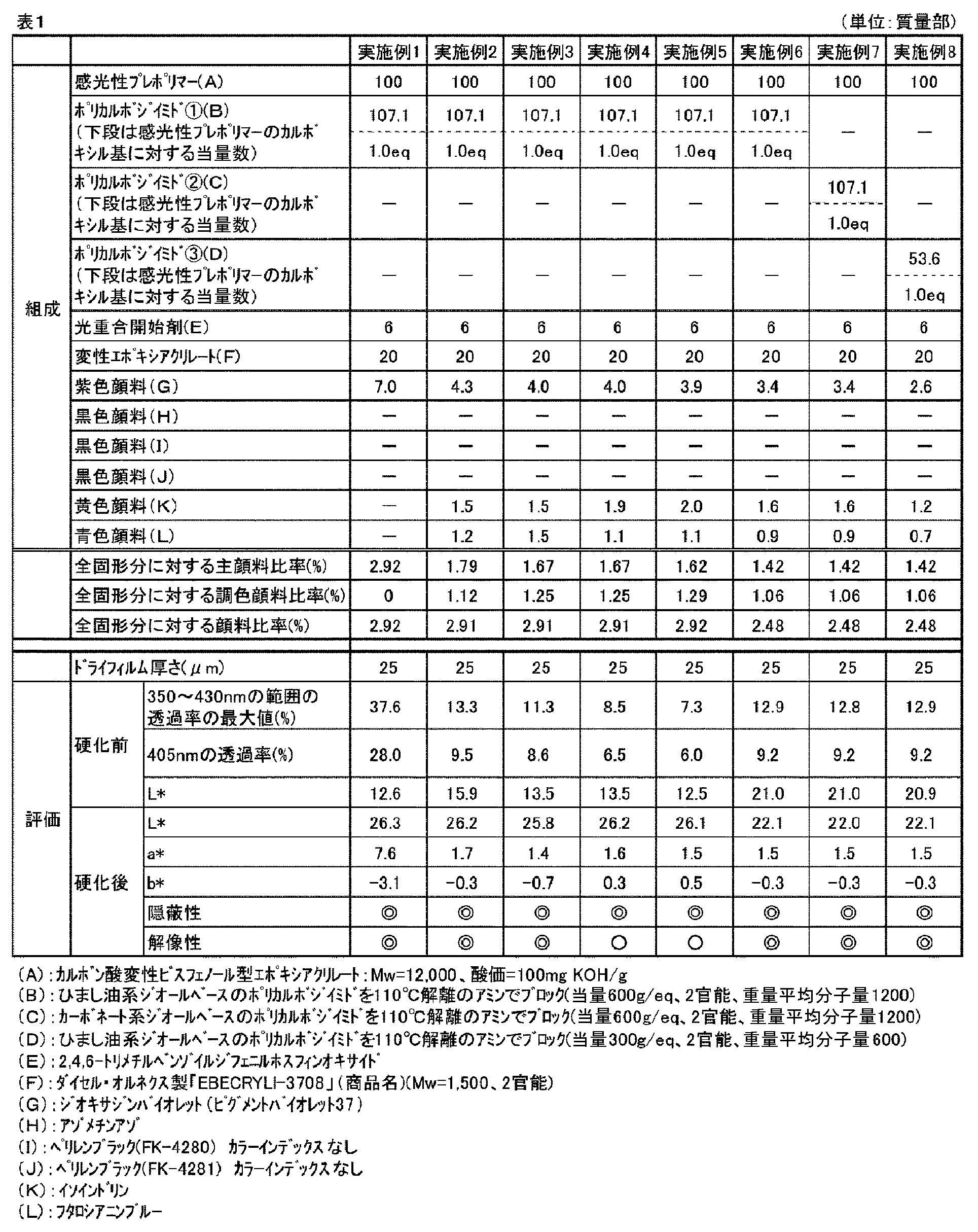
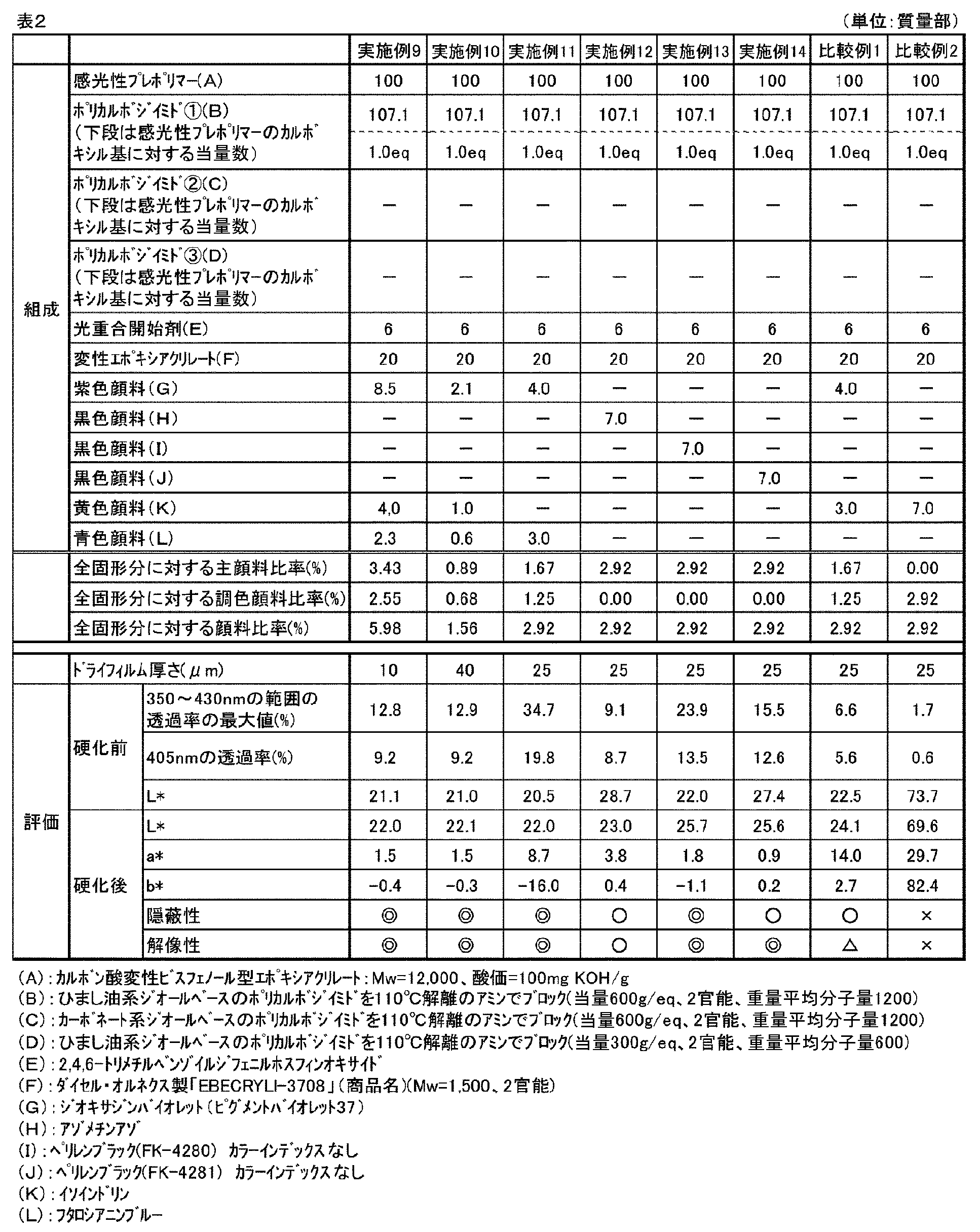
Claims (12)
- カルボキシル基及びエチレン性不飽和基を有する感光性プレポリマー、光重合開始剤、熱硬化剤及び顔料を含有する感光性樹脂組成物であって、
前記熱硬化剤が、カルボジイミド基が80℃以上の温度で解離するアミノ基により保護された、下記式(1)で表されるポリカルボジイミド化合物であって、該ポリカルボジイミド化合物の重量平均分子量が300~3000、且つカルボジイミド当量が150~600であり、
乾燥膜厚10~40μmに製膜した時の、波長350~430nmの少なくとも一部の波長における透過スペクトルの透過率の最大値が7%以上である感光性樹脂組成物。

- 乾燥膜厚10~40μmに製膜した時の、L*a*b*表色系における明度L*が30以下である、請求項1に記載の感光性樹脂組成物。
- 銅箔の光沢面に感光性樹脂組成物の膜体を硬化膜厚10~40μmで形成した積層体の、前記膜体表面のL*a*b*表色系における明度L*が30以下である、請求項1又は2に記載の感光性樹脂組成物。
- 前記顔料が、主顔料として、C.I.ピグメントバイオレット3、C.I.ピグメントバイオレット15、C.I.ピグメントバイオレット19、C.I.ピグメントバイオレット23、C.I.ピグメントバイオレット29、C.I.ピグメントバイオレット37、C.I.ピグメントバイオレット50、アゾメチンアゾ系ブラック及びペリレンブラックからなる群から選択される少なくとも1種を含有する、請求項1~3のいずれか1項に記載の感光性樹脂組成物。
- 前記顔料が、さらに、調色顔料として、黄色顔料、青色顔料及び緑色顔料からなる群から選択される少なくとも1種を含有する、請求項4に記載の感光性樹脂組成物。
- 前記顔料を、組成物の全固形分に対して、固形分にて1.0~7.0質量%含有する、請求項1~5のいずれか1項に記載の感光性樹脂組成物。
- 前記ポリカルボジイミド化合物のカルボジイミド基の数が2~6である、請求項1~6のいずれか1項に記載の感光性樹脂組成物。
- 前記ポリカルボジイミド化合物の前記カルボジイミド当量が、前記感光性プレポリマーの前記カルボキシル基に対して0.9~1.3当量である、請求項1~7のいずれか1項に記載の感光性樹脂組成物。
- ソルダーレジストフィルムに用いられる、請求項1~8のいずれか1項に記載の感光性樹脂組成物。
- 請求項1~9のいずれか1項に記載の感光性樹脂組成物を含むソルダーレジストフィルム。
- 絶縁層と、前記絶縁層の上に設けられた、導電性材料からなる配線パターンと、前記配線パターンの上に設けられたソルダーレジスト層とを有するフレキシブルプリント配線板であって、
前記ソルダーレジスト層が、請求項1~9のいずれか1項に記載の感光性樹脂組成物を含む、フレキシブルプリント配線板。 - 請求項11に記載のフレキシブルプリント配線板を備えた画像表示装置。
Priority Applications (5)
| Application Number | Priority Date | Filing Date | Title |
|---|---|---|---|
| EP18751077.1A EP3582006B1 (en) | 2017-02-07 | 2018-02-06 | Photosensitive resin composition, solder resist film using said photosensitive resin composition, flexible printed wiring board, and image display device |
| KR1020197023050A KR102319223B1 (ko) | 2017-02-07 | 2018-02-06 | 감광성 수지 조성물, 해당 감광성 수지 조성물을 사용한 솔더 레지스트 필름, 플렉시블 프린트 배선판 및 화상 표시 장치 |
| JP2018567448A JP6902056B2 (ja) | 2017-02-07 | 2018-02-06 | ドライフィルム、ソルダーレジストフィルム、フレキシブルプリント配線板及び画像表示装置 |
| CN201880010375.2A CN110268325B (zh) | 2017-02-07 | 2018-02-06 | 感光性树脂组合物及使用其的阻焊膜、柔性印刷布线板 |
| US16/483,990 US11609493B2 (en) | 2017-02-07 | 2018-02-06 | Photosensitive resin composition, solder resist film using said photosensitive resin composition, flexible printed circuit and image display device |
Applications Claiming Priority (4)
| Application Number | Priority Date | Filing Date | Title |
|---|---|---|---|
| JP2017020628 | 2017-02-07 | ||
| JP2017-020628 | 2017-02-07 | ||
| JP2017-216564 | 2017-11-09 | ||
| JP2017216564 | 2017-11-09 |
Publications (1)
| Publication Number | Publication Date |
|---|---|
| WO2018147295A1 true WO2018147295A1 (ja) | 2018-08-16 |
Family
ID=63107559
Family Applications (1)
| Application Number | Title | Priority Date | Filing Date |
|---|---|---|---|
| PCT/JP2018/004100 Ceased WO2018147295A1 (ja) | 2017-02-07 | 2018-02-06 | 感光性樹脂組成物、該感光性樹脂組成物を用いたソルダーレジストフィルム、フレキシブルプリント配線板及び画像表示装置 |
Country Status (7)
| Country | Link |
|---|---|
| US (1) | US11609493B2 (ja) |
| EP (1) | EP3582006B1 (ja) |
| JP (1) | JP6902056B2 (ja) |
| KR (1) | KR102319223B1 (ja) |
| CN (1) | CN110268325B (ja) |
| TW (1) | TWI751279B (ja) |
| WO (1) | WO2018147295A1 (ja) |
Cited By (1)
| Publication number | Priority date | Publication date | Assignee | Title |
|---|---|---|---|---|
| JP2025078696A (ja) * | 2021-07-30 | 2025-05-20 | 富士フイルム株式会社 | 感光性転写材料、遮光材、ledアレイ、及び、電子機器 |
Families Citing this family (5)
| Publication number | Priority date | Publication date | Assignee | Title |
|---|---|---|---|---|
| US11028216B2 (en) | 2016-11-18 | 2021-06-08 | Nisshinbo Chemical Inc. | Polycarbodiimide copolymer |
| JP7221951B2 (ja) * | 2018-05-30 | 2023-02-14 | 株式会社ブリヂストン | タイヤ用樹脂金属複合部材、及びその製造方法、並びにタイヤ |
| WO2021107104A1 (ja) * | 2019-11-29 | 2021-06-03 | 三菱ケミカル株式会社 | インクジェット印刷用紫外線硬化性水系インク、インクジェット印刷用紫外線硬化性水系組成物および印刷物 |
| JP7781557B2 (ja) * | 2021-07-30 | 2025-12-08 | 富士フイルム株式会社 | 感光性転写材料、遮光材、ledアレイ、及び、電子機器 |
| CN119065203A (zh) * | 2023-05-31 | 2024-12-03 | 华为技术有限公司 | 一种树脂组合物及其应用 |
Citations (10)
| Publication number | Priority date | Publication date | Assignee | Title |
|---|---|---|---|---|
| JPH1144954A (ja) * | 1997-07-25 | 1999-02-16 | Nippon Kayaku Co Ltd | 樹脂組成物、永久レジスト樹脂組成物及びこれらの硬化物 |
| JPH1180294A (ja) * | 1997-09-16 | 1999-03-26 | Nippon Kayaku Co Ltd | 樹脂組成物及びその硬化物 |
| JPH1195428A (ja) * | 1997-09-16 | 1999-04-09 | Nippon Kayaku Co Ltd | 樹脂組成物及びその硬化物 |
| JP2007138080A (ja) | 2005-11-21 | 2007-06-07 | Nisshinbo Ind Inc | 変性ポリカルボジイミド組成物及び変性ポリカルボジイミド |
| WO2012029468A1 (ja) * | 2010-08-30 | 2012-03-08 | 太陽ホールディングス株式会社 | 硬化性樹脂組成物、そのドライフィルム及び硬化物並びにそれらを用いたプリント配線板 |
| JP5352175B2 (ja) | 2008-03-26 | 2013-11-27 | 太陽ホールディングス株式会社 | 感光性樹脂組成物及びその硬化物、並びにその硬化物からなるソルダーレジスト層を有するプリント配線基板 |
| JP5380034B2 (ja) | 2008-10-09 | 2014-01-08 | 太陽ホールディングス株式会社 | 黒色ソルダーレジスト組成物及びその硬化物 |
| WO2016163285A1 (ja) * | 2015-04-06 | 2016-10-13 | 日清紡ケミカル株式会社 | 変性ポリカルボジイミド化合物、硬化剤及び熱硬化性樹脂組成物 |
| JP2017020628A (ja) | 2015-07-15 | 2017-01-26 | 日立Geニュークリア・エナジー株式会社 | 流体輸送配管 |
| JP2017216564A (ja) | 2016-05-31 | 2017-12-07 | 大日本印刷株式会社 | 分版装置、分版方法および印刷物 |
Family Cites Families (20)
| Publication number | Priority date | Publication date | Assignee | Title |
|---|---|---|---|---|
| JP4559209B2 (ja) | 2003-12-24 | 2010-10-06 | サカタインクス株式会社 | カルボジイミド系化合物、顔料分散組成物及びその用途 |
| JP4683182B2 (ja) | 2004-09-28 | 2011-05-11 | 山栄化学株式会社 | 感光性熱硬化性樹脂組成物、並びにレジスト被覆プリント配線板及びその製造法 |
| WO2008053985A1 (en) | 2006-11-02 | 2008-05-08 | Toyo Ink Manufacturing Co., Ltd. | Photosensitive resin composition, cured product thereof, and method for producing photosensitive resin |
| JP2009198966A (ja) | 2008-02-25 | 2009-09-03 | Hitachi Chem Co Ltd | 感光性樹脂組成物、これを用いた感光性フィルム、永久マスクレジスト及び永久マスクレジストの製造方法 |
| JP5539623B2 (ja) | 2008-03-27 | 2014-07-02 | 日清紡ホールディングス株式会社 | カルボジイミド化合物、カルボジイミド組成物及び水性塗料組成物 |
| JP2010113241A (ja) | 2008-11-07 | 2010-05-20 | Taiyo Ink Mfg Ltd | 光硬化性樹脂組成物、そのドライフィルム及び硬化物並びにそれらを用いたプリント配線板 |
| JP5349113B2 (ja) * | 2009-03-30 | 2013-11-20 | 太陽ホールディングス株式会社 | 感光性樹脂組成物、それを用いたドライフィルム及びプリント配線板 |
| JP5099851B2 (ja) | 2009-04-27 | 2012-12-19 | 太陽ホールディングス株式会社 | 光硬化性熱硬化性樹脂組成物、そのドライフィルム及び硬化物並びにそれらを用いたプリント配線板 |
| JP5620656B2 (ja) | 2009-08-19 | 2014-11-05 | 太陽ホールディングス株式会社 | 光硬化性樹脂組成物 |
| JP2011095705A (ja) * | 2009-09-30 | 2011-05-12 | Fujifilm Corp | 感光性組成物、感光性ソルダーレジスト組成物及び感光性ソルダーレジストフィルム、並びに、永久パターン、その形成方法及びプリント基板 |
| WO2011073616A2 (en) * | 2009-12-17 | 2011-06-23 | Syngenta Limited | Herbicidal compositions comprising, and methods of use of, herbicidally active pyrandiones |
| JP6061449B2 (ja) | 2011-03-31 | 2017-01-18 | 太陽インキ製造株式会社 | 光硬化性熱硬化性樹脂組成物、そのドライフィルム及び硬化物並びにそれらを用いたプリント配線板 |
| CN103582626B (zh) | 2011-06-10 | 2016-01-13 | 日本瑞翁株式会社 | 聚合性化合物、聚合性组合物、高分子以及光学各向异性体 |
| WO2013011873A1 (ja) * | 2011-07-20 | 2013-01-24 | 株式会社カネカ | 新規な導電層一体型fpc |
| JP6130693B2 (ja) | 2012-03-30 | 2017-05-17 | 太陽インキ製造株式会社 | 積層構造体、ドライフィルムおよび積層構造体の製造方法 |
| JP5981505B2 (ja) | 2013-09-30 | 2016-08-31 | 株式会社タムラ製作所 | 感光性樹脂組成物 |
| KR101676327B1 (ko) * | 2014-10-13 | 2016-11-15 | 조향현 | 유기태화 미네랄 및 핵산 복합체의 제조방법 |
| JP5994201B2 (ja) | 2015-02-10 | 2016-09-21 | 東洋インキScホールディングス株式会社 | 電磁波シールドフィルム付き回路基板、およびその製造方法 |
| CN109983403B (zh) * | 2016-11-18 | 2023-02-17 | 株式会社有泽制作所 | 感光性树脂组合物、使用该感光性树脂组合物的阻焊膜、柔性印刷布线板及图像显示装置 |
| WO2018146821A1 (ja) * | 2017-02-07 | 2018-08-16 | 株式会社有沢製作所 | 感光性樹脂組成物、該感光性樹脂組成物を用いたソルダーレジストフィルム、フレキシブルプリント配線板及び画像表示装置 |
-
2018
- 2018-02-06 EP EP18751077.1A patent/EP3582006B1/en active Active
- 2018-02-06 KR KR1020197023050A patent/KR102319223B1/ko active Active
- 2018-02-06 US US16/483,990 patent/US11609493B2/en active Active
- 2018-02-06 CN CN201880010375.2A patent/CN110268325B/zh active Active
- 2018-02-06 JP JP2018567448A patent/JP6902056B2/ja active Active
- 2018-02-06 WO PCT/JP2018/004100 patent/WO2018147295A1/ja not_active Ceased
- 2018-02-07 TW TW107104315A patent/TWI751279B/zh active
Patent Citations (11)
| Publication number | Priority date | Publication date | Assignee | Title |
|---|---|---|---|---|
| JPH1144954A (ja) * | 1997-07-25 | 1999-02-16 | Nippon Kayaku Co Ltd | 樹脂組成物、永久レジスト樹脂組成物及びこれらの硬化物 |
| JPH1180294A (ja) * | 1997-09-16 | 1999-03-26 | Nippon Kayaku Co Ltd | 樹脂組成物及びその硬化物 |
| JPH1195428A (ja) * | 1997-09-16 | 1999-04-09 | Nippon Kayaku Co Ltd | 樹脂組成物及びその硬化物 |
| JP2007138080A (ja) | 2005-11-21 | 2007-06-07 | Nisshinbo Ind Inc | 変性ポリカルボジイミド組成物及び変性ポリカルボジイミド |
| JP5352175B2 (ja) | 2008-03-26 | 2013-11-27 | 太陽ホールディングス株式会社 | 感光性樹脂組成物及びその硬化物、並びにその硬化物からなるソルダーレジスト層を有するプリント配線基板 |
| JP5586729B2 (ja) | 2008-03-26 | 2014-09-10 | 太陽ホールディングス株式会社 | 感光性樹脂組成物及びその硬化物、並びにその硬化物からなるソルダーレジスト層を有するプリント配線基板 |
| JP5380034B2 (ja) | 2008-10-09 | 2014-01-08 | 太陽ホールディングス株式会社 | 黒色ソルダーレジスト組成物及びその硬化物 |
| WO2012029468A1 (ja) * | 2010-08-30 | 2012-03-08 | 太陽ホールディングス株式会社 | 硬化性樹脂組成物、そのドライフィルム及び硬化物並びにそれらを用いたプリント配線板 |
| WO2016163285A1 (ja) * | 2015-04-06 | 2016-10-13 | 日清紡ケミカル株式会社 | 変性ポリカルボジイミド化合物、硬化剤及び熱硬化性樹脂組成物 |
| JP2017020628A (ja) | 2015-07-15 | 2017-01-26 | 日立Geニュークリア・エナジー株式会社 | 流体輸送配管 |
| JP2017216564A (ja) | 2016-05-31 | 2017-12-07 | 大日本印刷株式会社 | 分版装置、分版方法および印刷物 |
Non-Patent Citations (1)
| Title |
|---|
| See also references of EP3582006A4 |
Cited By (2)
| Publication number | Priority date | Publication date | Assignee | Title |
|---|---|---|---|---|
| JP2025078696A (ja) * | 2021-07-30 | 2025-05-20 | 富士フイルム株式会社 | 感光性転写材料、遮光材、ledアレイ、及び、電子機器 |
| US12607931B2 (en) | 2021-07-30 | 2026-04-21 | Fujifilm Corporation | Photosensitive transfer material, light shielding material, LED array, and electronic apparatus |
Also Published As
| Publication number | Publication date |
|---|---|
| US11609493B2 (en) | 2023-03-21 |
| JP6902056B2 (ja) | 2021-07-14 |
| CN110268325B (zh) | 2023-06-06 |
| KR102319223B1 (ko) | 2021-11-01 |
| EP3582006A1 (en) | 2019-12-18 |
| JPWO2018147295A1 (ja) | 2019-11-21 |
| KR20190111983A (ko) | 2019-10-02 |
| EP3582006A4 (en) | 2020-11-18 |
| EP3582006B1 (en) | 2022-08-03 |
| CN110268325A (zh) | 2019-09-20 |
| TW201842026A (zh) | 2018-12-01 |
| TWI751279B (zh) | 2022-01-01 |
| US20200019054A1 (en) | 2020-01-16 |
Similar Documents
| Publication | Publication Date | Title |
|---|---|---|
| JP6902056B2 (ja) | ドライフィルム、ソルダーレジストフィルム、フレキシブルプリント配線板及び画像表示装置 | |
| KR100515218B1 (ko) | 감광성 조성물, 그것의 경화물, 및 그것을 사용한프린트회로기판 | |
| JP2005331932A (ja) | 感光性樹脂組成物及びその硬化物並びにそれらを使用するプリント配線基板の製造方法 | |
| TWI727076B (zh) | 感光性樹脂組成物、使用該感光性樹脂組成物之阻焊劑膜、可撓性印刷電路板及影像顯示裝置 | |
| JP2004062057A (ja) | 感光性熱硬化性樹脂組成物及びその硬化物 | |
| JP4611554B2 (ja) | 感光性組成物およびその硬化物ならびにそれを用いたプリント配線基板 | |
| JP2024124479A (ja) | 感光性樹脂組成物、ドライフィルム、硬化物、およびプリント配線板 | |
| JP2023129708A (ja) | 黒色感光性樹脂組成物、その硬化物、およびリジッドフレキシブルプリント配線板 | |
| CN110268323B (zh) | 感光性树脂组合物、阻焊膜、柔性印刷布线板 | |
| JP6329334B1 (ja) | 感光性樹脂組成物、該感光性樹脂組成物を用いたソルダーレジストフィルム、フレキシブルプリント配線板及び画像表示装置 | |
| JP2012078463A (ja) | 感光性樹脂組成物、感光性ソルダーレジスト組成物及び感光性ソルダーレジストフィルム、並びに、永久パターン、その形成方法及びプリント基板 | |
| JP2012078462A (ja) | 感光性樹脂組成物、感光性ソルダーレジスト組成物及び感光性ソルダーレジストフィルム、並びに、永久パターン、その形成方法及びプリント基板 | |
| JP7821600B2 (ja) | 感光性樹脂組成物、硬化物、プリント配線板、およびプリント配線板の製造方法 | |
| JP7298079B2 (ja) | 硬化性樹脂組成物、ドライフィルム、硬化物及び電子部品 | |
| JP7289666B2 (ja) | 硬化性樹脂組成物、ドライフィルム、硬化物及び電子部品 | |
| CN120722653A (zh) | 感光性树脂组合物、干膜、固化物和电子部件 | |
| WO2025100183A1 (ja) | 感光性樹脂組成物、ドライフィルム、硬化物、および電子部品 | |
| JP2025151027A (ja) | ドライフィルム、硬化物およびプリント配線板 | |
| JP2025076642A (ja) | 感光性樹脂組成物、ドライフィルム、硬化物、およびプリント配線板 | |
| JP2024146873A (ja) | 感光性樹脂組成物、ドライフィルム、硬化物、およびプリント配線板 | |
| JP2025075641A (ja) | 感光性樹脂組成物、ドライフィルム、硬化物、およびプリント配線板 |
Legal Events
| Date | Code | Title | Description |
|---|---|---|---|
| 121 | Ep: the epo has been informed by wipo that ep was designated in this application |
Ref document number: 18751077 Country of ref document: EP Kind code of ref document: A1 |
|
| ENP | Entry into the national phase |
Ref document number: 2018567448 Country of ref document: JP Kind code of ref document: A |
|
| ENP | Entry into the national phase |
Ref document number: 20197023050 Country of ref document: KR Kind code of ref document: A |
|
| NENP | Non-entry into the national phase |
Ref country code: DE |
|
| ENP | Entry into the national phase |
Ref document number: 2018751077 Country of ref document: EP Effective date: 20190909 |