WO2018155367A1 - Composition de mortier, mortier et procédé de fabrication de mortier - Google Patents
Composition de mortier, mortier et procédé de fabrication de mortier Download PDFInfo
- Publication number
- WO2018155367A1 WO2018155367A1 PCT/JP2018/005681 JP2018005681W WO2018155367A1 WO 2018155367 A1 WO2018155367 A1 WO 2018155367A1 JP 2018005681 W JP2018005681 W JP 2018005681W WO 2018155367 A1 WO2018155367 A1 WO 2018155367A1
- Authority
- WO
- WIPO (PCT)
- Prior art keywords
- mass
- mortar
- molten steel
- less
- vinyl acetate
- Prior art date
- Legal status (The legal status is an assumption and is not a legal conclusion. Google has not performed a legal analysis and makes no representation as to the accuracy of the status listed.)
- Ceased
Links
Images

Classifications
-
- B—PERFORMING OPERATIONS; TRANSPORTING
- B22—CASTING; POWDER METALLURGY
- B22D—CASTING OF METALS; CASTING OF OTHER SUBSTANCES BY THE SAME PROCESSES OR DEVICES
- B22D11/00—Continuous casting of metals, i.e. casting in indefinite lengths
- B22D11/10—Supplying or treating molten metal
-
- B—PERFORMING OPERATIONS; TRANSPORTING
- B22—CASTING; POWDER METALLURGY
- B22D—CASTING OF METALS; CASTING OF OTHER SUBSTANCES BY THE SAME PROCESSES OR DEVICES
- B22D41/00—Casting melt-holding vessels, e.g. ladles, tundishes, cups or the like
- B22D41/50—Pouring-nozzles
- B22D41/52—Manufacturing or repairing thereof
- B22D41/54—Manufacturing or repairing thereof characterised by the materials used therefor
-
- C—CHEMISTRY; METALLURGY
- C04—CEMENTS; CONCRETE; ARTIFICIAL STONE; CERAMICS; REFRACTORIES
- C04B—LIME, MAGNESIA; SLAG; CEMENTS; COMPOSITIONS THEREOF, e.g. MORTARS, CONCRETE OR LIKE BUILDING MATERIALS; ARTIFICIAL STONE; CERAMICS; REFRACTORIES; TREATMENT OF NATURAL STONE
- C04B35/00—Shaped ceramic products characterised by their composition; Ceramics compositions; Processing powders of inorganic compounds preparatory to the manufacturing of ceramic products
- C04B35/622—Forming processes; Processing powders of inorganic compounds preparatory to the manufacturing of ceramic products
- C04B35/626—Preparing or treating the powders individually or as batches ; preparing or treating macroscopic reinforcing agents for ceramic products, e.g. fibres; mechanical aspects section B
- C04B35/63—Preparing or treating the powders individually or as batches ; preparing or treating macroscopic reinforcing agents for ceramic products, e.g. fibres; mechanical aspects section B using additives specially adapted for forming the products, e.g.. binder binders
- C04B35/632—Organic additives
- C04B35/634—Polymers
-
- C—CHEMISTRY; METALLURGY
- C04—CEMENTS; CONCRETE; ARTIFICIAL STONE; CERAMICS; REFRACTORIES
- C04B—LIME, MAGNESIA; SLAG; CEMENTS; COMPOSITIONS THEREOF, e.g. MORTARS, CONCRETE OR LIKE BUILDING MATERIALS; ARTIFICIAL STONE; CERAMICS; REFRACTORIES; TREATMENT OF NATURAL STONE
- C04B35/00—Shaped ceramic products characterised by their composition; Ceramics compositions; Processing powders of inorganic compounds preparatory to the manufacturing of ceramic products
- C04B35/66—Monolithic refractories or refractory mortars, including those whether or not containing clay
Definitions
- the present invention relates to a joint between nozzles of a nozzle structure for discharging molten steel that is joined by dividing a molten steel discharge path in the vertical direction (a joint in the lateral direction with respect to the vertical direction as the molten steel discharge direction), or the nozzle structure.
- the joint between the refractory sleeve and the external nozzle installed so as to straddle one or more joints in the vertical direction on the inner hole side (vertical direction substantially parallel to the vertical direction as the molten steel discharge direction) Mortar for filling a part or all of the directional joint), mortar and a method for producing the mortar.
- the nozzle structure as the molten steel discharge path from the molten steel inlet to the mold for discharging molten steel from the tundish shall be composed of refractory members divided in multiple in the molten steel discharge direction (vertical direction) There is. This is because the flow control in molten steel discharge is dynamically performed by a part of this nozzle structure, or the balance of durability is optimized for partial damage, etc. depending on the part of the molten steel discharge path, or partial replacement is performed. To make it possible.
- Patent Document 1 eliminates the need for work such as mold release treatment at the site, and consists of a fireproof powder, fiber, and a flexibility-imparting binder, and is effective in preventing seizure on the surface of a fireproof packing body that is flexible at room temperature.
- a fireproof packing material characterized in that expandable fireproof particles are adhered for the purpose of increasing the heat resistance. In this way, the joint material between the nozzles is generally adjusted for components and the like that do not firmly adhere to the nozzles.
- the present applicant has firstly provided a nozzle structure for discharging molten steel provided with one or a plurality of joint portions for dividing and joining the molten steel discharge path in the vertical direction.
- Nozzle structure in which an inner hole sleeve made of a refractory is installed on the inner hole surface of the structure so as to straddle at least one of the joint portions in the vertical direction hereinafter referred to as “nozzle structure having an inner hole sleeve”
- nozzle structure having an inner hole sleeve hereinafter referred to as “prior application”.
- the outer peripheral surface of the inner hole sleeve of the prior application and the nozzle body may not be sufficiently adhered.
- part of the nozzles are not expected to be replaced or reused, so that release is not necessary.
- the problem to be solved by the present invention is that in the nozzle structure in which the sleeve is further provided in the inner holes of the plurality of nozzles connected via the joint material, the outer peripheral surface of the inner hole sleeve, the inner hole surface of the nozzle body, It is intended to improve the sealing performance between nozzles (primary target) and between nozzles (secondary target) that do not require replacement or reuse of some nozzles, that is, releasability is not required .
- the gist of the present invention is the following 1 to 3 mortar blends, the following 4 to 5 mortar and 6 to 7 mortar production methods.
- a mortar compound used for joints of nozzle structures for discharging molten steel A composition for mortar containing 10% by mass to 20% by mass of unexpanded vermiculite, 1% by mass to 5% by mass of frit powder, and the remainder mainly composed of other refractory raw materials.
- the refractory raw material includes one or more components selected from the group consisting of Al 2 O 3 , SiO 2 , ZrO 2 , MgO, CaO, and Cr 2 O 3 . 3.
- the refractory raw materials are corundum, mullite, silimanite group, clay mineral, alumina-magnesia or chromia-magnesia spinel, periclase, calcia, calcium aluminate, zirconia, zircon, amorphous silica, cristobalite, tridymite, quartz 3.
- One or more selected from a thickener, a surfactant and a binder, and a dilution liquid are added to the total and the outer coating for a total of 100% by mass of the mortar formulation according to any one of claims 1 to 3.
- the mortar for the joint part of the nozzle structure for discharging molten steel comprising 30% by mass or less and 100% by mass of the mortar compound. 5). 100% by mass of the mortar formulation according to any one of 1 to 3 above, an ethylene vinyl acetate emulsion of 22% by mass to 45% by mass as an outer shell with respect to the mortar formulation, and the mortar formulation
- a mortar for a joint part of a nozzle structure for discharging molten steel which is a sheet-like or hollow frustoconical or cylindrical shaped body, which is made of a plasticizer of 1% by mass or more and 5% by mass or less as an outer shell. 6).
- a method for producing a mortar for joints of a nozzle structure for discharging molten steel according to any one of 5 to 7, Add 100% by mass to 20% by mass of unexpanded vermiculite, 1% by mass to 5% by mass of frit powder, and balance 100% by mass of other refractory raw materials with an ethylene vinyl acetate emulsion 22 mass% or more and 45 mass% or less, 1 mass% or more and 5 mass% or less are added and kneaded with a plasticizer, and the kneaded material is pressure-molded and the molded substrate is dried at 60 ° C. or more and 100 ° C. or less.
- a method for producing a mortar for joints of a nozzle structure for discharging molten steel 9. 9.
- the mortar containing the mortar composition of the present invention By using the mortar containing the mortar composition of the present invention, it is possible to obtain space filling properties and adhesiveness in a temperature range of 800 ° C. or higher, and to improve the sealing performance, that is, to draw outside air into the inner hole as a molten steel passage route. Leakage steel can be suppressed or prevented.
- the upper and lower ends of the joint space such as the primary object in which a plurality of nozzles are connected to the molten steel passage and sleeves are installed in the inner holes of the nozzles so as to straddle (cover) at least the joints.
- it is used in a place where it is exposed to molten steel in a small area such as a part but is not exposed to a flow velocity or complex vortex that is large enough to cause the mortar to flow away, Can be increased.
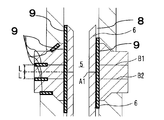
- the mortar of the present invention is filled in a part of the joint space between the outer peripheral surface of the inner hole sleeve and the nozzle inner hole surface in the nozzle structure shown in FIG. 2, and the left side cross section is shown in FIG.
- the joint space between the outer peripheral surface of the inner sleeve and the inner surface of the nozzle is filled with the mortar of the present invention, and the joint is a joint portion between the nozzles divided into a plurality of vertical directions.
- the mortar (hereinafter also simply referred to as “mortar”) containing the mortar compound of the present invention (hereinafter also simply referred to as “compound”) is either a mud mortar as an indefinite shape or a pre-formed body. It can also be used as a form.
- the space between these surfaces is filled by applying mud mortar on one or both of these surfaces. can do.
- the sheet is formed into a sheet or hollow frustoconical or cylindrical shape, and these molded products are pasted on the outer periphery of the inner hole sleeve, and the mortar It is possible to adopt a method such as placing an inner hole sleeve with a nozzle in the nozzle inner hole. Similarly, when installing at joints between nozzles (including when perpendicular to the molten steel passage direction or at an angle of zero degrees or more), apply either mud-like mortar as an irregular shape or sticking of a molded product. Can be taken.
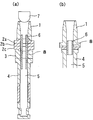
- FIG. 1 is an image diagram of an example of a nozzle structure as a primary object of the present invention, and (a) is an upper nozzle 1, an upper plate 2a, an intermediate plate 2b, and a lower plate 2c.
- (b) is an example composed of the upper nozzle 1 and the immersion nozzle 4.
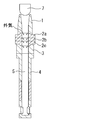
- FIG. 2 is a nozzle structure as a primary object of the present invention, in which joints B1 and B2 for joining the molten steel discharge path in the vertical direction and joints in the inner sleeve 6 divided in the vertical direction are divided. It is an image figure which shows the example in which part A1 does not correspond. As described above, in the nozzle structure shown in FIGS.
- a plurality of nozzles are joined in the direction of the molten steel passage path, and the molten steel discharge path is divided in the vertical direction and joined to the inner hole 5 thereof.
- the inner hole sleeve 6 is installed so as to straddle the joint as a part.
- a space 8 filled with the mortar of the present invention exists between the outer peripheral surface of the inner hole sleeve 6 and the nozzle inner hole surface.
- Such a space 8 or the like can be filled with the mortar of the present invention.
- the right cross section of FIG. 3 shows an example in which a part of the space 8 between the outer peripheral surface of the inner hole sleeve 6 and the nozzle inner hole surface is filled with the mortar 9 of the present invention in the nozzle structure shown in FIG.
- L 3 is a joint portion between nozzles in which the entire space 8 between the outer peripheral surface of the inner hole sleeve 6 and the nozzle inner hole surface is filled with the mortar 9 of the present invention and further divided into a plurality of vertical directions.
- the vertical distance (long) between the joint A1 of the inner hole sleeve 6 and the joints B1 and B2 of the nozzle structure is long. L) From experience, it is preferable that L is equal to or greater than the thickness of the inner hole sleeve 6.
- the composition of the present invention has space filling properties due to expansion. That is, the composition of the present invention has a temperature of about 800 ° C., which is a preheating temperature of a general nozzle bore, and is also a temperature during casting of a portion outside the surface in contact with the molten steel of the nozzle and during casting of the molten steel. It has the property of expanding in the temperature range of about 1500 to 1550 ° C., which is the temperature of In order to impart this expansibility, the blend of the present invention contains 10% to 20% by mass of unexpanded vermiculite.
- Unexpanded vermiculite is a mineral mainly composed of SiO 2 , MgO, Al 2 O 3 , and expands when moisture contained in the crystal layer instantaneously becomes water vapor and delamination occurs in the temperature range of 800 ° C or higher.
- its volume is several ten times.
- the mortar containing the composition spreads over the entire joint space, and an almost complete filling state can be obtained.
- the inner hole sleeve There is a high possibility that space will remain after installation.
- the ratio of the ratio of (typical mortar thickness + clearance necessary for setting the inner hole sleeve to the nozzle) / standard mortar thickness Swellability is required for mortar.
- the clearance is about 2 mm on one side and the mortar thickness is about 3 mm, this ratio is about 1.7 or more, that is, the mortar needs to expand about 70% or more to fill this space.
- the mortar is preferably provided with expansibility in order to make the mortar structure dense.
- the particle size of the unexpanded vermiculite is preferably about 0.25 mm to 1 mm. This is also a particle size configuration that is generally available and easy to obtain.
- the particle size of vermiculite is less than 0.25 mm, expansion as a mortar tends to be insufficient. If it exceeds 1 mm, the swelled part in the mortar structure tends to be in a non-uniform dispersion state, and the expansion in the mortar structure tends to be non-uniform. It is easy to cause the destruction.
- the mortar of the present invention contains 1% by mass to 5% by mass of frit powder in order to bond the mortar, the inner hole sleeve, and the nozzle body inner hole surface.
- frit powder By softening the frit powder, it is possible to further improve the adhesion, that is, to further suppress the drawing of outside air into the nozzle bore.
- the frit powder melts and vitrifies in a temperature range of about 800 ° C. or higher, and exhibits an adhesive function.
- the frit powder contains generally commercially available alkali metal oxides or alkaline earth metal oxides, and can contain components such as Al 2 O 3 , SiO 2 , ZrO 2 .
- a borosilicate soda / glass frit powder containing about 40 to 50% by mass of SiO 2 , about 20 to 30% by mass of B 2 O 3 and about 20 to 30% by mass of Na 2 O
- SiO 2 Frit powder of lead borosilicate glass composition containing about 20 to 25% by mass of B, about 5 to 10% by mass of B 2 O 3 and about 65 to 70% by mass of PbO, about 20 to 25% by mass of Al 2 O 3
- Frit powder of non-silicate oxide glass composition containing about 10 to 15% by weight of Na 2 O, about 10 to 15% by weight of K 2 O and about 35 to 40% by weight of PbO, about 65 to 70% of SiO 2
- the frit powder preferably has a particle size of 0.2 mm or less. This is also a particle size configuration that is generally available and easy to obtain.
- the thickness exceeds 0.2 mm, the main part of the frit is intensively melted low, the mortar structure becomes non-uniform, and the degree of adhesion is likely to vary and the gap is likely to increase.
- the content of the frit powder is less than 1% by mass, the adhesive strength is inferior, and if it exceeds 5% by mass, the liquid phase tends to increase and the heat resistance as mortar tends to decrease.
- the remainder other than vermiculite and frit powder mainly contains other refractory raw materials.
- the grain size of the remaining refractory raw material is used as joint material, so it should be less than the joint thickness of the individual place where mortar is used.
- general bricks and nozzles are used to optimize the coating workability, increase the filling ability in narrow gaps, increase the density, and make the physical properties of the structure such as the structure and expansion characteristics uniform. It is preferably 0.5 mm or less, which is also the particle size of the mortar for use.
- the remainder is included in any other proportion such as increasing the particle size of other refractory raw materials by 0.2 mm or less.
- the total amount can be 0.2 mm or less.
- this refractory raw material one having one or a plurality of chemical components selected from the group consisting of Al 2 O 3 , SiO 2 , ZrO 2 , MgO, CaO, and Cr 2 O 3 can be used.
- These mineral compositions include corundum, mullite, silimanite group, clayey minerals, alumina-magnesia or chromia-magnesia spinel, periclase, calcia, calcium aluminate, zirconia, zircon, amorphous silica, cristobalite, tridymite, quartz
- One or more selected from the group can be used.
- the clay mineral in order to impart plasticity, it is possible to use a part of or all of the material that has not undergone heat treatment, such as Kibushi clay, Sasame clay, and ball clay. Moreover, the chamotte etc. after heat processing can also be used as a refractory aggregate.
- the mortar of the present invention may contact the molten steel in a narrow area such as the upper and lower ends of the joint space, the mortar is not exposed to a molten steel flow velocity or a complicated vortex that is large enough to cause the mortar to flow away. Is preferably used. Therefore, there is no problem even if the liquid phase is generated and softened unless the mortar itself liquefies and flows away in the gap at the contact portion between the nozzles during heat during use. Further, in the case of the primary object (for example, FIG. 1), if the mortar of the present invention is present in the region covering the joint portion between the nozzles, the mortar is softened and reduced over a long period of operation. Even if a portion where the mortar does not exist is generated in the upper space between the inner hole sleeve and the nozzle inner hole surface by being compressed or moved in the direction, the sealing performance can be ensured.
- the remaining configuration may be selected so that the composition can maintain a viscosity that does not flow out through the gap at the contact portion between the nozzles during use.
- This balance is preferable because corundum, mullite, silimanite, zircon or alumina-magnesia spinels are difficult to soften even when used for a long time and are relatively low in cost.
- a mud mortar In order to use the above formulation as a mud mortar, one or more selected from thickeners, surfactants and binders commonly used in refractory mortars, and a dilution liquid, What is necessary is just to add a total of 30% by mass or less to the degree of optimizing the workability to be applied, that is, the outer coating with respect to 100% by mass of the aforementioned compound, and knead to make a mud.
- This mud-like mortar can be installed by applying to the surface of the target nozzle or inner hole sleeve that contacts the joint.
- the thickening agent examples include dextrin, water-soluble fiber, and other agents that provide only a thickening effect.
- Surfactants include, for example, dispersants containing a peptizer for clay to obtain water-reducing or liquid-reducing properties, and flocculants such as polyvalent metal ion systems to suppress drooling and fluidity of mud. It is done.
- the binder is, for example, an inorganic or organic resin, a silicate that forms a hardened body by gelation, or a so-called glue such as dextrin or cellulose, which gives a strength imparting or improving function after drying or high-temperature heating.
- Etc An organic solvent / solvent such as water, glycol, polyvinyl alcohol, or the like can be used as a liquid for dilution to a blend obtained by adding one or more of these.
- an ethylene vinyl acetate emulsion and a plasticizer can be used as a film forming agent that also has a shape retaining function.
- a base material obtained by pressure-molding the kneaded product by adding 22% to 45% by weight of an emulsion and adding 1% to 5% by weight, preferably 2% by weight or less of a plasticizer. Is dried at 60 ° C. or higher and 100 ° C. or lower to obtain the shaped mortar of the present invention which is a preform.
- the resin concentration of the ethylene vinyl acetate emulsion is preferably 40% by mass or more and 60% by mass or less in order to improve the film formability and moldability, that is, the molding work efficiency. If the resin concentration is less than 40% by mass, the plasticity may be insufficient, and if it exceeds 60% by mass, explosion may occur.
- the viscosity of the ethylene vinyl acetate emulsion is preferably 100 cps or more and 500 cps or less at 25 ° C. If the viscosity is less than 100 cps, the kneaded product may be insufficiently plastic, and may become difficult to mold due to joint breakage during molding.
- the pH of the ethylene vinyl acetate emulsion is preferably 4 or more and 8 or less. If the pH is lower than 4, care must be taken during operation because of strong acidity. If the pH is higher than 8, the kneaded product may change over time (curing phenomenon) due to reaction with the refractory raw material. Accordingly, the pH which is a stable region is preferably 4 or more and 8 or less.
- the addition amount of the ethylene vinyl acetate emulsion is 22% by mass or more and 45% by mass or less as an outer shell with respect to 100% by mass of the above-mentioned composition. If the amount is less than 22% by mass, a kneaded product cannot be obtained. If the amount is more than 45% by mass, the kneaded product is obtained, but the shape-retaining property is insufficient and the formability is lowered. Difficult to handle. If it is 22 mass% or more and 45 mass% or less, the favorable kneaded material with plasticity and shape retention property will be obtained.
- the ethylene vinyl acetate emulsion is a copolymer emulsion of ethylene and vinyl acetate obtained by mixing 10 to 30% by mass of ethylene monomer with vinyl acetate monomer and emulsion polymerization under high pressure. More specifically, for example, This is a copolymer emulsion in which an anionic or nonionic surfactant is used as an emulsifier, and 10 to 30% by mass of ethylene monomer is mixed with vinyl acetate monomer and emulsion polymerization is performed under high pressure.
- This ethylene-vinyl acetate emulsion can give flexibility to the molded body by producing a film with excellent heat stability when moisture is removed by drying, and it can also be used at low temperatures (below 800 ° C). It is possible to provide an inter-sealing property.
- the plasticizer is used for imparting flexibility, and it is preferable to use a plasticizer other than phthalic acid. This is because phthalic acid plasticizers have safety and environmental problems.
- phthalic acid plasticizers have safety and environmental problems.
- butyl texanol monoisobutyrate or texanol diisobutyrate (hereinafter, simply referred to as “texanol”) is preferable from the viewpoint of compatibility with ethylene vinyl acetate emulsion.
- texanol has a high ignition point of 390 ° C, does not conflict with the PRTR law and VOC regulations, and is not suspected of an environmental hormone substance. For this reason, the molded object as a fixed joint material in consideration of the environment can be provided.
- the addition amount of the plasticizer is 1% by mass or more and 5% by mass or less, preferably 2% by mass or less as an outer shell with respect to 100% by mass of the above-mentioned compound. If the amount is less than 1% by mass, plasticity cannot be obtained. If the amount exceeds 5% by mass, excess plasticizer remains in the joint material and changes with time. Will occur and the sealing will be poor.
- the addition amount of the plasticizer is preferably about 1 to 2% by mass as an outer shell.
- a mixer generally used for kneading refractory materials such as a blade-shaped spiral mixer, a planetary mixer, a cooking mixer, an Eirich mixer, or the like can be used.
- pressurization may be performed as long as the particles of the compound are not destroyed and the particle size and form of each raw material are not greatly destroyed.
- a uniaxial hydraulic molding machine or the like generally used for molding a refractory can be used.
- the molding pressure may be arbitrarily set according to the conditions for each operation, such as the shape of the product, the density according to the crimping structure and strength.
- the reason why the drying temperature after molding is set to 60 ° C. or more and 100 ° C. or less is to impart shape retention and flexibility of the molded body by film formation of the ethylene vinyl acetate emulsion after drying. If the temperature is less than 60 ° C., the film formation is insufficient, so that the shape retention is not sufficiently exhibited. As a result, deformation or partial damage may occur during handling. At 100 ° C. or higher, moisture completely evaporates, resulting in a strong film and the molded body is cured. However, the flexibility is inferior, and the installation workability is lowered and the accuracy after installation is lowered. Therefore, the drying temperature after molding is set to 60 ° C. or more and 100 ° C. or less.
- the drying can be performed by using a direct-heated hot air drying furnace using an electric heating drying furnace.
- Drying equipment can be batch (batch) or continuous from the operation method, directly or indirectly from the heating method, hot air drying from the heat source, hot air and wet body direct energization, infrared drying by electric heat or radiant tube, microwave They can be classified as dry and can be used. From the viewpoints of availability, ease of operation, etc., a batch-type electrothermal drying furnace (box type or tray tower type) is preferable.
- Mortar in the form of a mud for application is simple and simple in construction and construction, so it has so-called formability, shape retention, flexibility or flexibility, stability, that is, long-term change over time is small. Therefore, it is possible to more easily obtain the characteristics required for a joint structure such as a filling property and expansibility similar to that of a molded body.
- Examples A to C show examples in which various properties were confirmed for a pre-formed mortar that was more complicated than the form of a coating mud and easily affected by properties.
- Example D shows an example in which various characteristics of a mortar in the form of a muddy material for application were confirmed.
- Example E the experimental results of preheating and injecting molten metal by using the mortar of the present invention using the actual shape / structure nozzle and the inner hole sleeve are shown.
- Example A shows the result of investigating the influence of the amount of unexpanded vermiculite.
- the sample was obtained by the above-described production method with the composition of the formulation described in Table 1.
- Unexpanded vermiculite is 0.25 mm to 1.0 mm, frit powder is 0.2 mm or less, SiO 2 is about 40-50 mass%, B 2 O 3 is about 20-30 mass%, Na 2 O is about 20 Chemical composition of about 30% by mass, and other refractory materials, sintered alumina of 200 ⁇ m or less (Al 2 O 3 purity ⁇ 95% by mass) and clay (non-heated, Al 2 O 3 : 25% by mass to 30% by mass, SiO 2 : 50 mass% to 60 mass%) was used.
- ethylene vinyl acetate emulsion one having a resin concentration of 58% by mass, a viscosity of 200 cps, and a pH of 5 was used.
- texanol texanol monoisobutyrate which is 2,2,4-trimethyl-1,3-pentadiol monoisobutyrate was used. Evaluation is based on moldability of the kneaded product, flexibility at normal temperature, expansion filling property (expanded state and filling state and adhesiveness) at 800 ° C and 1650 ° C (both held for 1 hour), and availability as joint material The overall evaluation was conducted. Here, the temperature condition of 1650 ° C.
- the target is adjusted to the extent that it can be deformed to about ⁇ 80 mm, which is considered to be the smallest diameter of the inner hole sleeve of the installation target site (the shape before deformation is a plate shape).
- expansion / filling / adhesiveness at 800 ° C. expanded state, filled state and adhesiveness, hereinafter referred to as “expanded / filled adhesiveness”
- a standard mortar with a thickness of 4 mm was prepared, and an ordinary brick with a gap of 8 mm was set between them.
- a heat treatment was performed at 800 ° C., and the filling property and adhesiveness into the gap after the heat treatment were evaluated by visual confirmation.
- ⁇ excellent
- ⁇ good
- ⁇ impossible
- ⁇ and ⁇ were accepted.
- ⁇ has no gap and there is adhesion to the brick when removed from the brick. If there is almost no adhesion, but there is not a very small part, ⁇ means that there is almost no gap, or there is almost no adhesion to the brick when removed from the brick.
- the expansion, filling, and adhesive properties (expanded state, filled state, and adhesiveness) at 1650 ° C. were also the same method and evaluation method as in the above-mentioned 800 ° C.
- Example A The results of Example A are shown in Table 1.
- Comparative Example 1 is based on 100% by mass of a blend in which 85% by mass of sintered alumina and 5% by mass of vermiculite (fireproof material) are blended with 5% by mass of frit powder and 5% by mass of clay as auxiliary materials.
- An ethylene vinyl acetate emulsion (binder) 35% by mass and texanol (plasticizer) 2% by mass are added as outer shells, kneaded using a desktop mixer, and press-molded into a sheet of 4 mm thickness, about 80 A shaped joint material was prepared by drying at °C and evaporating the moisture, and the evaluation was carried out.
- Table 1 the moldability of the kneaded material is good and it is flexible at room temperature after drying. Since the amount of vermiculite added was small, both the 800 ° C. and 1650 ° C. were inferior in expansion filling property and judged as unqualified.
- Example 1 the main raw material (refractory raw material) composed of 80% by mass of sintered alumina and 10% by mass of vermiculite, and 100% by mass of a blend containing 5% by mass of frit powder and 5% by mass of clay as auxiliary materials,
- the addition amount of ethylene vinyl acetate emulsion (binder) was 30% by mass and 1% by mass of texanol (plasticizer) was added externally. It was.
- Table 1 the evaluation results were good both for expansion filling adhesion at 800 ° C. and expansion filling adhesion at 1650 ° C.
- Example 2 the main raw material (refractory raw material) composed of 75% by mass of sintered alumina and 15% by mass of vermiculite, and 100% by mass of a blend containing 5% by mass of frit powder and 5% by mass of clay as auxiliary materials, A shaped joint material was prepared and evaluated in the same manner as Comparative Example 1 by adding 35% by mass of an ethylene vinyl acetate emulsion (binder) and 2% by mass of texanol (plasticizer). As shown in Table 1, the evaluation results were good both for expansion filling adhesion at 800 ° C. and expansion filling adhesion at 1650 ° C. Among them, the expansion filling adhesiveness at 1650 ° C. was better than that of Example 1 because the amount of vermiculite was increased.
- Example 3 the main raw material (refractory raw material) composed of 70% by mass of sintered alumina and 20% by mass of vermiculite was added to 5% by mass of frit powder and 5% by mass of clay as an auxiliary raw material.
- a shaped joint material was prepared and evaluated in the same manner as Comparative Example 1 by adding 35% by mass of an ethylene vinyl acetate emulsion (binder) and 1% by mass of texanol (plasticizer). As shown in Table 1, the evaluation results were good both for expansion filling adhesion at 800 ° C. and expansion filling adhesion at 1650 ° C. In particular, the filling state at 1650 ° C. was better than that of Example 2 because the amount of vermiculite was further increased.
- Comparative Example 2 the main raw material (refractory raw material) composed of 65% by mass of sintered alumina and 25% by mass of vermiculite, and 100% by mass of a blend containing 5% by mass of frit powder and 5% by mass of clay as auxiliary materials, A shaped joint material was prepared and evaluated in the same manner as Comparative Example 1 by adding 40% by mass of an ethylene vinyl acetate emulsion (binder) and 1% by mass of texanol (plasticizer). As shown in Table 1, the expansion filling adhesiveness at 800 ° C. was good, but at 1650 ° C., the amount of vermiculite further increased, and the fire resistance of the shaped joint material itself decreased, resulting in excessive liquid phase. The expansion filling adhesion at 0 ° C. was inferior.
- Comparative Example 3 the main raw material (refractory raw material) consisting of 65% by mass of sintered alumina and 25% by mass of vermiculite, and 100% by mass of the compound containing 5% by mass of frit powder and 5% by mass of clay as auxiliary materials, A shaped joint material was prepared and evaluated in the same manner as Comparative Example 1 by adding 40% by mass of an ethylene vinyl acetate emulsion (binder) and 2% by mass of texanol (plasticizer). As shown in Table 1, the degree of flexibility at room temperature increased as the amount of texanol (plasticizer) increased from Comparative Example 2 as shown in Table 1 (flexibility value small ⁇ flexibility large). The expansion filling adhesiveness at 800 ° C. was good, but at 1650 ° C., the amount of vermiculite was further increased in the same manner as in Comparative Example 2, and the fire resistance of the shaped joint material itself decreased, resulting in excessive liquid phase. The filling state was inferior.
- Example B is the result of investigating the influence of the amount of frit powder. Table 2 shows the results.
- Comparative Example 4 is a compound containing 100% by mass of 84.5% by mass of sintered alumina and 10% by mass of vermiculite blended with 0.5% by mass of frit powder and 5% by mass of clay as auxiliary materials.
- 35% by mass of ethylene vinyl acetate emulsion (binder) and 2% by mass of texanol (plasticizer) are added as outer shells, kneaded using a desktop mixer, and pressed into a 4mm thick sheet.
- the moldability of the kneaded product is good and it is flexible at room temperature after drying.
- frit powder both the 800 ° C. and 1650 ° C. expansion expansion fillings were judged to be inadequate due to poor adhesion to bricks.
- Example 4 ethylene was used with respect to 100% by mass of blending 1% by mass of frit powder and 5% by mass of clay as auxiliary materials in a main material (refractory material) consisting of 84% by mass of sintered alumina and 10% by mass of vermiculite.
- a shaped joint material was prepared and evaluated in the same manner as in Comparative Example 4 by adding 30% by mass of the addition of vinyl acetate emulsion (binder) and 1% by mass of texanol (plasticizer). .
- the evaluation results were good both for expansion filling adhesion at 800 ° C. and expansion filling adhesion at 1650 ° C.
- Example 5 the main raw material (refractory raw material) composed of 80% by mass of sintered alumina and 15% by mass of vermiculite was added to 100% by mass of refractory raw material blend B in which 3% by mass of frit powder and 5% by mass of clay were blended as auxiliary materials. Then, a shaped joint material was prepared and evaluated in the same manner as in Comparative Example 4 by adding 35% by mass of ethylene vinyl acetate emulsion (binder) and 2% by mass of texanol (plasticizer). Went. As shown in Table 2, the evaluation results were good both for expansion filling adhesion at 800 ° C. and expansion filling adhesion at 1650 ° C.
- Example 6 the main raw material (refractory raw material) composed of 80% by mass of sintered alumina and 20% by mass of vermiculite was blended with 100% by mass of 100% by mass of 5% by mass of frit powder and 5% by mass of clay as auxiliary materials. Kneading was carried out in the same manner as in Comparative Example 4 with the addition amount of the vinyl acetate emulsion (binder) being 35% by mass and 1% by mass of texanol (plasticizer) being externally added. As shown in Table 2, the evaluation results were good both for expansion filling adhesion at 800 ° C. and expansion filling adhesion at 1650 ° C.
- Comparative Example 5 the main raw material (refractory raw material) consisting of 80% by mass of sintered alumina and 20% by mass of vermiculite, 6% by mass of frit powder and 5% by mass of clay as an auxiliary raw material, 100% by mass, A shaped joint material was prepared and evaluated in the same manner as Comparative Example 4 by adding 40% by mass of an ethylene vinyl acetate emulsion (binder) and 1% by mass of texanol (plasticizer). As shown in Table 2, the expansion filling adhesiveness at 800 ° C. was good as shown in Table 2, but at 1650 ° C., the amount of frit was further increased, and the fire resistance of the shaped joint material itself was reduced, resulting in excessive liquid phase at 1650 ° C. The inflated filling adhesion was inferior. There was also a tendency to shrink in some cases.
- Example C is the result of investigating the influence of refractory raw material species. Table 3 shows the results.
- Example 7 is based on 100% by mass of a blend prepared by mixing 84% by mass of spinel and 10% by mass of vermiculite with 1% by mass of frit powder and 5% by mass of clay as auxiliary materials. 30% by mass of an ethylene vinyl acetate emulsion (binder) and 1% by mass of texanol (plasticizer) are added as outer shells, kneaded using a desktop mixer, and press-molded into a sheet having a thickness of 4 mm. The shaped joint material was prepared by drying at °C and evaporating the moisture, and the evaluation was performed. As shown in Table 3, the molded product of the kneaded material is good and flexible at normal temperature after drying. The material is obtained. Both the expansion filling adhesion at 800 ° C. and the expansion filling adhesion at 1650 ° C. were good.
- Example 8 the main raw material (refractory raw material) composed of 70% by mass of electrofused spinel and 20% by mass of vermiculite, and 100% by mass of the compound containing 5% by mass of frit powder and 5% by mass of clay as auxiliary materials, A shaped joint material was prepared and evaluated in the same manner as in Example 7 by adding 35% by mass of ethylene vinyl acetate emulsion (binder) and 1% by mass of texanol (plasticizer). It was. The kneaded product has good moldability, and after drying, a shaped joint material having flexibility at room temperature is obtained. As shown in Table 3, the evaluation results were good both for expansion filling adhesion at 800 ° C. and expansion filling adhesion at 1650 ° C. In particular, the expansion filling adhesiveness at 1650 ° C. was better than that of Example 7 because the amount of vermiculite was increased.
- Example 9 ethylene vinegar was added to 100% by mass of a mixture of 70% by mass of mullite and 20% by mass of vermiculite as a secondary material with 5% by mass of frit powder and 5% by mass of clay as a secondary material.
- a shaped joint material was prepared and evaluated in the same manner as in Example 7 by adding 42% by mass of a bi-based emulsion (binder) and 2% by mass of texanol (plasticizer).
- the kneaded product has good moldability, and after drying, a shaped joint material having flexibility at room temperature is obtained.
- Table 3 the evaluation results were good both for expansion filling adhesion at 800 ° C. and expansion filling adhesion at 1650 ° C.
- the expansion filling adhesiveness at 1650 ° C. was better than that of Example 7 because the amount of vermiculite was increased.
- Example 10 a blend of 100% by mass of frit powder and 5% by mass of clay was added to a main material (refractory material) consisting of 70% by mass of underlysite and 20% by mass of vermiculite, a kind of silimanite group.
- a shaped joint material was produced and evaluated in the same manner as in Example 7 by adding 39% by mass of an ethylene vinyl acetate emulsion (binder) and 1% by mass of texanol (plasticizer) to the mass%. .
- the kneaded product has good moldability, and after drying, a shaped joint material having flexibility at room temperature is obtained.
- Table 3 the evaluation results were good both for expansion filling adhesion at 800 ° C. and expansion filling adhesion at 1650 ° C.
- the expansion filling adhesiveness at 1650 ° C. was better than that of Example 7 because the amount of vermiculite was increased.
- Example 11 ethylene vinegar was added to 100% by mass of a blend of 70% by mass of periclase and 20% by mass of vermiculite with 5% by mass of frit powder and 5% by mass of clay as auxiliary materials.
- a shaped joint material was prepared and evaluated in the same manner as in Example 7 by adding 35% by mass of a bi-based emulsion (binder) and 1% by mass of texanol (plasticizer).
- the kneaded product has good moldability, and after drying, a shaped joint material having flexibility at room temperature is obtained.
- Table 3 the evaluation results were good both for expansion filling adhesion at 800 ° C. and expansion filling adhesion at 1650 ° C.
- the expansion filling adhesiveness at 1650 ° C. was better than that of Example 7 because the amount of vermiculite was increased.
- Example 12 the main raw material (refractory raw material) composed of 70% by mass of zirconia (unstable) and 20% by mass of vermiculite was added to 5% by mass of frit powder and 5% by mass of clay as an auxiliary raw material. Then, a shaped joint material was prepared and evaluated in the same manner as in Example 7 by adding 22% by mass of an ethylene vinyl acetate emulsion (binder) and 1% by mass of texanol (plasticizer). The kneaded product has good moldability, and after drying, a shaped joint material having flexibility at room temperature is obtained. As shown in Table 3, the evaluation results were good both for expansion filling adhesion at 800 ° C. and expansion filling adhesion at 1650 ° C. In particular, the expansion filling adhesiveness at 1650 ° C. was better than that of Example 7 because the amount of vermiculite was increased.
- Example 13 the main raw material (refractory raw material) composed of 70% by weight of zircon and 20% by weight of vermiculite, and refractory raw material composition F 100% by weight containing 5% by weight of frit powder and 5% by weight of clay as auxiliary materials,
- a shaped joint material was prepared and evaluated in the same manner as in Comparative Example 1 by adding 25% by mass of an ethylene vinyl acetate emulsion (binder) and 1% by mass of texanol (plasticizer).
- the kneaded product has good moldability, and after drying, a shaped joint material having flexibility at room temperature is obtained.
- both the expansion filling at 800 ° C. and the filling state at 1650 ° C. were good as shown in Table 3.
- the state of filling at 1650 ° C. was better than Example 7 because the amount of vermiculite was further increased.
- Example 14 ethylene vinegar was added to 100% by mass of a blend of 70% by mass of quartz and 20% by mass of vermiculite as a secondary material with 5% by mass of frit powder and 5% by mass of clay as auxiliary materials.
- a fixed joint material was prepared and evaluated in the same manner as in Example 7 by adding 45% by mass of a bi-based emulsion (binder) and 2% by mass of texanol (plasticizer).
- the kneaded product has good moldability, and after drying, a shaped joint material having flexibility at room temperature is obtained.
- Table 3 the evaluation results were good both for expansion filling adhesion at 800 ° C. and expansion filling adhesion at 1650 ° C.
- the expansion filling adhesiveness at 1650 ° C. was better than that of Example 7 because the amount of vermiculite was increased.
- Example 15 is an example in which an ethylene vinyl acetate emulsion having a concentration of 40% by mass was used.
- a fixed joint material was prepared and evaluated in the same manner as in Example 7 by adding 35% by mass of the emulsion (binder) and 1% by mass of texanol (plasticizer). The moldability of the kneaded product was good although it was soft because the ethylene vinyl acetate emulsion concentration was 40% and the water content was 60%, and after drying, a shaped joint material having flexibility at room temperature was obtained.
- Table 3 the expansion filling adhesion at 800 ° C. and the expansion filling adhesion at 1650 ° C. were better than those of Example 7 because the amount of vermiculite was increased.
- Example 16 is an example in which an ethylene vinyl acetate emulsion having a concentration of 38% by mass was used. Ethylene vinyl acetate based on 100% by mass of a blend of 70% by mass of electrofused spinel and 20% by mass of vermiculite with 5% by mass of frit powder and 5% by mass of clay as auxiliary materials. A fixed joint material was prepared and evaluated in the same manner as in Example 7 by adding 35% by mass of the emulsion (binder) and 1% by mass of texanol (plasticizer).
- the moldability of the kneaded product was softer because the ethylene vinyl acetate emulsion concentration was 38% and the water content was 62%, but the ethylene vinyl acetate emulsion concentration (resin concentration) was as low as 38%, and the film forming function after drying was relatively low, and cracks occurred when trying to deform the compact. Since this mortar expands when heated, the presence of cracks is not a fatal phenomenon, but it is difficult to deform the mortar so as to conform to the shape of the inner bore sleeve, for example.
- Example 17 is an example in which an ethylene vinyl acetate emulsion having a concentration of 58% by mass was used.
- a fixed joint material was prepared and evaluated in the same manner as in Example 7 by adding 35% by mass of the emulsion (binder) and 6% by mass of texanol (plasticizer). The moldability of the kneaded product was soft as much plasticizer. Furthermore, after drying, it was difficult to work as a molded body simply by placing it because of its low shape retention, but it could be used as an intermediate construction method with mud-shaped irregular mortar.
- Example 18 is an example in which an ethylene vinyl acetate emulsion having a concentration of 65% by mass was used.
- a fixed joint material was prepared and evaluated in the same manner as in Example 7 by adding 35% by mass of the emulsion (binder) and 1% by mass of texanol (plasticizer). The moldability of the kneaded material was hard because the ethylene vinyl acetate emulsion concentration was 65% and the water content was 35%.
- Fixed shape joint material after drying has an ethylene vinyl acetate emulsion concentration (resin concentration) as high as 65%, and because of excessive film forming function after drying, its deformability is small, and it can be installed according to a specific shape after molding Although there is no problem, it was unsuitable for installation where a part of the shape was changed.
- resin concentration ethylene vinyl acetate emulsion concentration
- Example D is the result of investigating a mud (for coating) mortar as an example. Table 4 shows the results.
- Example 19 the main raw material (refractory raw material) composed of 70% by mass of electrofused spinel and 20% by mass of vermiculite, and 100% by mass of the compound containing 5% by mass of frit powder and 5% by mass of clay as auxiliary materials, 1% by mass of dextrin as a thickener (cum binding material), 0.1% by mass of sodium phosphate as a surfactant (dispersing agent), and aluminum phosphate as a surfactant (aggregating agent) 0.05% by weight, 25% by weight of water as a liquid for dilution are added on the outside to make mud (for coating) mortar, and spatula coating on the surface of the refractory brick (sheet thickness 4mm)
- the coating workability was confirmed.
- Table 4 the coating workability was good.
- the expansion filling adhesiveness at 800 ° C. after heating and the expansion filling adhesiveness at 1650 ° C. were also good.
- Example 20 the main raw material (refractory raw material) consisting of 70% by mass of electrofused spinel and 20% by mass of vermiculite, 100% by mass of 5% by mass of frit powder and 5% by mass of clay as auxiliary materials, 1% by mass of methylcellulose as a thickener, 0.1% by mass of sodium phosphate as a surfactant (dispersing agent), 0.05% by mass of aluminum phosphate as a surfactant (flocculating agent)
- a mud (for coating) mortar was prepared with a mixture of 15% by weight of water as a dilution liquid and 15% by weight of ethylene glycol. Thereafter, the coating workability was confirmed by applying a spatula (4 mm thick sheet) to the surface of the refractory brick. As a result, as shown in Table 4, the coating workability was good. Thereafter, the expansion filling adhesiveness at 800 ° C. after heating and the expansion filling at 1650 ° C. were also good.
- Example 21 the main raw material (refractory raw material) consisting of 70% by weight of electrofused spinel and 20% by weight of vermiculite, 100% by weight of a blend containing 5% by weight of frit powder and 5% by weight of clay as auxiliary materials, A mud (for coating) mortar was prepared with a mixed solution of 10% by mass of a phenol resin as a binder and 30% by mass of an ethylene glycol system as a dilution liquid. Thereafter, the coating workability was confirmed by applying a spatula (4 mm thick sheet) to the surface of the refractory brick. As a result, as shown in Table 4, the coating workability was good. After that, the expansion filling adhesiveness at 800 ° C. after heating and the expansion filling adhesiveness at 1650 ° C. were also good.
- Example E In Example E, in which the inner sleeve is installed in the nozzle inner hole in FIG. 1B, the regular mortar of the present invention is installed between the nozzle inner hole and the inner sleeve, heated to 800 ° C., and thereafter An experimental result of injecting molten metal into the inner hole sleeve and the inner hole of the nozzle is shown.
- the inner diameter of the nozzle was 86 mm
- the outer diameter of the sleeve was 70 mm
- the thickness of the regular mortar was 4 mm
- the height of the regular mortar was 50 mm
- the sample for the regular mortar was Example 1 described above.
- the preheated state was heated from the inner hole with a banner, maintained at the inner hole surface temperature at 800 ° C. for 0.5 hour, cooled, and cut in the longitudinal direction to observe the cross section.
- the molten metal was poured from above into the inner hole maintained at 800 ° C. after the preheating.
- molten metal use hot metal of approximately 1600 ° C, which has a lower viscosity than the molten steel so that the filling state of the mortar, that is, the presence or absence of gaps, appears more clearly. Filled with hot metal. The state after the experiment was cut in the longitudinal direction after cooling and the cross section was observed.
Landscapes
- Engineering & Computer Science (AREA)
- Chemical & Material Sciences (AREA)
- Manufacturing & Machinery (AREA)
- Ceramic Engineering (AREA)
- Materials Engineering (AREA)
- Structural Engineering (AREA)
- Organic Chemistry (AREA)
- Mechanical Engineering (AREA)
- Inorganic Chemistry (AREA)
- Ceramic Products (AREA)
- Casting Support Devices, Ladles, And Melt Control Thereby (AREA)
- Continuous Casting (AREA)
Abstract
La présente invention concerne un mortier de jointement pour augmenter la propriété d'étanchéité d'un jointement d'une structure de buse pour éjecter de l'acier fondu. Le mortier de partie joint est obtenu par : ajout, à 100 % en masse d'une composition de mortier comprenant pas moins de 10 % en masse et pas plus de 20 % en masse de vermiculite non expansée, pas moins de 1 % en masse et pas plus de 5 % en masse de poudre de frittage, et le reste comprenant une autre matière première réfractaire, de pas moins de 22 % en masse et pas plus de 45 % en masse d'une émulsion d'éthylène-acétate de vinyle par rapport à 100 %, et de pas moins de 1 % en masse et pas plus de 5 % en masse de plastifiant par rapport à 100 % ; malaxage du mélange ; moulage sous pression du produit malaxé ; et séchage d'un matériau de base moulé à pas moins de 60 °C et pas plus de 100° C.
Applications Claiming Priority (2)
| Application Number | Priority Date | Filing Date | Title |
|---|---|---|---|
| JP2017035087A JP6792485B2 (ja) | 2017-02-27 | 2017-02-27 | モルタル用配合物,モルタル及びモルタルの製造方法 |
| JP2017-035087 | 2017-02-27 |
Publications (1)
| Publication Number | Publication Date |
|---|---|
| WO2018155367A1 true WO2018155367A1 (fr) | 2018-08-30 |
Family
ID=63253730
Family Applications (1)
| Application Number | Title | Priority Date | Filing Date |
|---|---|---|---|
| PCT/JP2018/005681 Ceased WO2018155367A1 (fr) | 2017-02-27 | 2018-02-19 | Composition de mortier, mortier et procédé de fabrication de mortier |
Country Status (3)
| Country | Link |
|---|---|
| JP (1) | JP6792485B2 (fr) |
| TW (1) | TWI718362B (fr) |
| WO (1) | WO2018155367A1 (fr) |
Cited By (1)
| Publication number | Priority date | Publication date | Assignee | Title |
|---|---|---|---|---|
| US11629059B2 (en) * | 2019-08-29 | 2023-04-18 | Covia Holdings Llc | Ultra-white silica-based filler |
Families Citing this family (2)
| Publication number | Priority date | Publication date | Assignee | Title |
|---|---|---|---|---|
| JP7029299B2 (ja) * | 2018-01-22 | 2022-03-03 | 黒崎播磨株式会社 | 不定形耐火物 |
| JP7219577B2 (ja) * | 2018-10-05 | 2023-02-08 | 黒崎播磨株式会社 | 熱間設置用定形目地材 |
Citations (6)
| Publication number | Priority date | Publication date | Assignee | Title |
|---|---|---|---|---|
| JPS59161682A (ja) * | 1983-03-04 | 1984-09-12 | タイホ−工業株式会社 | 工業用炉の補修方法 |
| JPH03199150A (ja) * | 1989-12-27 | 1991-08-30 | Shikoku Kaken Kogyo Co Ltd | 鋼材に対する付着力の優れた耐火被覆組成物 |
| JP2000141000A (ja) * | 1998-11-06 | 2000-05-23 | Shinagawa Refract Co Ltd | 溶融シリカ質連続鋳造用浸漬ノズル及びその製造方法 |
| JP2001019565A (ja) * | 1999-06-30 | 2001-01-23 | Kurosaki Harima Corp | 耐吸湿性定形目地材 |
| JP2009227538A (ja) * | 2008-03-25 | 2009-10-08 | Kurosaki Harima Corp | 耐火物接合用定形目地材 |
| JP2016026948A (ja) * | 2014-06-30 | 2016-02-18 | 宇部興産株式会社 | 船舶甲板用防熱性床構造体の施工方法及びその構造体 |
Family Cites Families (1)
| Publication number | Priority date | Publication date | Assignee | Title |
|---|---|---|---|---|
| TWI331640B (en) * | 2003-05-26 | 2010-10-11 | Sekisui Chemical Co Ltd | Fire retardant resin sash |
-
2017
- 2017-02-27 JP JP2017035087A patent/JP6792485B2/ja not_active Expired - Fee Related
-
2018
- 2018-02-19 WO PCT/JP2018/005681 patent/WO2018155367A1/fr not_active Ceased
- 2018-02-26 TW TW107106283A patent/TWI718362B/zh not_active IP Right Cessation
Patent Citations (6)
| Publication number | Priority date | Publication date | Assignee | Title |
|---|---|---|---|---|
| JPS59161682A (ja) * | 1983-03-04 | 1984-09-12 | タイホ−工業株式会社 | 工業用炉の補修方法 |
| JPH03199150A (ja) * | 1989-12-27 | 1991-08-30 | Shikoku Kaken Kogyo Co Ltd | 鋼材に対する付着力の優れた耐火被覆組成物 |
| JP2000141000A (ja) * | 1998-11-06 | 2000-05-23 | Shinagawa Refract Co Ltd | 溶融シリカ質連続鋳造用浸漬ノズル及びその製造方法 |
| JP2001019565A (ja) * | 1999-06-30 | 2001-01-23 | Kurosaki Harima Corp | 耐吸湿性定形目地材 |
| JP2009227538A (ja) * | 2008-03-25 | 2009-10-08 | Kurosaki Harima Corp | 耐火物接合用定形目地材 |
| JP2016026948A (ja) * | 2014-06-30 | 2016-02-18 | 宇部興産株式会社 | 船舶甲板用防熱性床構造体の施工方法及びその構造体 |
Cited By (2)
| Publication number | Priority date | Publication date | Assignee | Title |
|---|---|---|---|---|
| US11629059B2 (en) * | 2019-08-29 | 2023-04-18 | Covia Holdings Llc | Ultra-white silica-based filler |
| US12595180B2 (en) | 2019-08-29 | 2026-04-07 | Covia Holdings Llc | Ultra-white silica-based filler |
Also Published As
| Publication number | Publication date |
|---|---|
| JP6792485B2 (ja) | 2020-11-25 |
| TWI718362B (zh) | 2021-02-11 |
| TW201835001A (zh) | 2018-10-01 |
| JP2018140406A (ja) | 2018-09-13 |
Similar Documents
| Publication | Publication Date | Title |
|---|---|---|
| CN100408495C (zh) | 玻璃熔炉用耐火材料系统 | |
| KR101552717B1 (ko) | 유리 용융로를 위한 내화성 조성물 | |
| US8505336B2 (en) | AZS refractory composition | |
| JP5078842B2 (ja) | 耐火物用組成物、耐火成形体及び耐火焼成体 | |
| WO2018155367A1 (fr) | Composition de mortier, mortier et procédé de fabrication de mortier | |
| CN109437939B (zh) | 一种耐火泥及其制备方法 | |
| US20210002771A1 (en) | A chemical method to decrease oxide scale generation in hot rolling | |
| CN104311076B (zh) | 一种抗渗透型中间包轻质涂料及其制备方法 | |
| US20200078856A1 (en) | Material for molding, functional agent, molded product, and product | |
| KR102051934B1 (ko) | 고내열성 세라믹 코팅 조성물 | |
| CN104725055A (zh) | 一种MgO-Al2O3质高温热态修补材料及其使用方法 | |
| CN105060798B (zh) | 自流平混凝土 | |
| CN101501231B (zh) | 无水泥的耐火混合物、无水泥耐火制品及其制备方法 | |
| US20090114365A1 (en) | Material used to combat thermal expansion related defects in high temperature casting processes | |
| JP6188214B2 (ja) | 湿式施工用補修剤及びその補修方法 | |
| JP5990583B2 (ja) | 溶融ガラス用の供給通路 | |
| KR101744455B1 (ko) | 무기섬유를 이용한 부정형 내화재 조성물 | |
| CN104774021A (zh) | 一种用于窑炉耐火砖的粘接泥及其制备工艺 | |
| JP5215698B2 (ja) | 耐火物接合用定形目地材 | |
| CN101370750B (zh) | 自流动耐火混合物 | |
| CN108585746A (zh) | 一种连续铸钢用长水口内孔保温涂料及其制备方法和施工方法 | |
| CN104496492B (zh) | 一种复合镁碳耐火坩埚及其制备方法 | |
| JP2015168596A (ja) | 不定形耐火物 | |
| JP6375274B2 (ja) | 粉体混合物及び炉壁用不定形耐火物の製造方法 | |
| JP2001030047A (ja) | 摺動面を有する浸漬ノズル |
Legal Events
| Date | Code | Title | Description |
|---|---|---|---|
| 121 | Ep: the epo has been informed by wipo that ep was designated in this application |
Ref document number: 18757915 Country of ref document: EP Kind code of ref document: A1 |
|
| NENP | Non-entry into the national phase |
Ref country code: DE |
|
| 122 | Ep: pct application non-entry in european phase |
Ref document number: 18757915 Country of ref document: EP Kind code of ref document: A1 |