WO2018159509A1 - Sac multicouche - Google Patents
Sac multicouche Download PDFInfo
- Publication number
- WO2018159509A1 WO2018159509A1 PCT/JP2018/006830 JP2018006830W WO2018159509A1 WO 2018159509 A1 WO2018159509 A1 WO 2018159509A1 JP 2018006830 W JP2018006830 W JP 2018006830W WO 2018159509 A1 WO2018159509 A1 WO 2018159509A1
- Authority
- WO
- WIPO (PCT)
- Prior art keywords
- film
- tear
- bag
- multiple bag
- welded
- Prior art date
- Legal status (The legal status is an assumption and is not a legal conclusion. Google has not performed a legal analysis and makes no representation as to the accuracy of the status listed.)
- Ceased
Links
Images





Classifications
-
- B—PERFORMING OPERATIONS; TRANSPORTING
- B65—CONVEYING; PACKING; STORING; HANDLING THIN OR FILAMENTARY MATERIAL
- B65D—CONTAINERS FOR STORAGE OR TRANSPORT OF ARTICLES OR MATERIALS, e.g. BAGS, BARRELS, BOTTLES, BOXES, CANS, CARTONS, CRATES, DRUMS, JARS, TANKS, HOPPERS, FORWARDING CONTAINERS; ACCESSORIES, CLOSURES, OR FITTINGS THEREFOR; PACKAGING ELEMENTS; PACKAGES
- B65D31/00—Bags or like containers made of paper and having structural provision for thickness of contents
- B65D31/02—Bags or like containers made of paper and having structural provision for thickness of contents with laminated walls
-
- B—PERFORMING OPERATIONS; TRANSPORTING
- B65—CONVEYING; PACKING; STORING; HANDLING THIN OR FILAMENTARY MATERIAL
- B65D—CONTAINERS FOR STORAGE OR TRANSPORT OF ARTICLES OR MATERIALS, e.g. BAGS, BARRELS, BOTTLES, BOXES, CANS, CARTONS, CRATES, DRUMS, JARS, TANKS, HOPPERS, FORWARDING CONTAINERS; ACCESSORIES, CLOSURES, OR FITTINGS THEREFOR; PACKAGING ELEMENTS; PACKAGES
- B65D33/00—Details of, or accessories for, sacks or bags
-
- B—PERFORMING OPERATIONS; TRANSPORTING
- B65—CONVEYING; PACKING; STORING; HANDLING THIN OR FILAMENTARY MATERIAL
- B65D—CONTAINERS FOR STORAGE OR TRANSPORT OF ARTICLES OR MATERIALS, e.g. BAGS, BARRELS, BOTTLES, BOXES, CANS, CARTONS, CRATES, DRUMS, JARS, TANKS, HOPPERS, FORWARDING CONTAINERS; ACCESSORIES, CLOSURES, OR FITTINGS THEREFOR; PACKAGING ELEMENTS; PACKAGES
- B65D75/00—Packages comprising articles or materials partially or wholly enclosed in strips, sheets, blanks, tubes or webs of flexible sheet material, e.g. in folded wrappers
- B65D75/40—Packages formed by enclosing successive articles, or increments of material, in webs, e.g. folded or tubular webs, or by subdividing tubes filled with liquid, semi-liquid, or plastic materials
- B65D75/44—Individual packages cut from webs or tubes
-
- B—PERFORMING OPERATIONS; TRANSPORTING
- B65—CONVEYING; PACKING; STORING; HANDLING THIN OR FILAMENTARY MATERIAL
- B65D—CONTAINERS FOR STORAGE OR TRANSPORT OF ARTICLES OR MATERIALS, e.g. BAGS, BARRELS, BOTTLES, BOXES, CANS, CARTONS, CRATES, DRUMS, JARS, TANKS, HOPPERS, FORWARDING CONTAINERS; ACCESSORIES, CLOSURES, OR FITTINGS THEREFOR; PACKAGING ELEMENTS; PACKAGES
- B65D75/00—Packages comprising articles or materials partially or wholly enclosed in strips, sheets, blanks, tubes or webs of flexible sheet material, e.g. in folded wrappers
- B65D75/52—Details
- B65D75/58—Opening or contents-removing devices added or incorporated during package manufacture
- B65D75/5827—Tear-lines provided in a wall portion
Definitions
- the present invention relates to a multiple bag composed of multiple films, and relates to a novel multiple bag in which cut pieces due to tearing are not scattered around.
- a packaging method called a so-called bag-in-box in which such contents are stored in a cardboard box or pallet in a state of being filled in a bag made of a synthetic resin film, is proposed and widely used. It has been put into practical use.
- the film for bags needs to have high mechanical strength, and a film in which a layer having heat-fusibility is laminated on a high-strength film such as nylon or polyester is used. .
- a film in which a layer having heat-fusibility is laminated on a high-strength film such as nylon or polyester is used.
- attempts have been made to laminate various films or increase the thickness.
- This multiple bag (also called double bag) consists of an outer film that appears on the outside and an inner film that contacts the contents, and can prevent damage to other films even if pinholes occur in one film. .
- a certain amount of slip can be generated between the inner film supporting the contents and the outer film supporting the multiple bag in contact with the cardboard box or the like. Is absorbed and an excessive bending stress is prevented from being applied, and the occurrence of pinholes in the film forming the bag or the rupture of the bag is prevented.
- the multiple bag When taking out the filled contents, the multiple bag is often torn from the back seal part and opened, but for example, when the back seal part is formed at the joint part as a pasting at the joint part There is a problem in that the easy-openability is not good, including the need to tear the four seals collected in the palm portion and the freedom to move the outer film and the inner film relative to each other.
- the management standards are strict, and it is required to strictly check whether there is a number of films after use.
- the packaging bag is divided into upper and lower parts by tearing or the like, if the number of the tear pieces and the multiple bag main body cannot be matched, there is a possibility that foreign matter may be mixed, which is a big problem. Therefore, there is a need for a packaging bag that is easy to open and difficult to separate.
- the present invention has been proposed in view of such a conventional situation, and provides a multiple bag that can be easily processed without separation of tear pieces generated by tearing from the multiple bag main body. With the goal.
- the multiple bag of the present invention is a multiple bag composed of multiple films composed of an outer film and an inner film, wherein both ends of the multiple film are overlapped and welded with a predetermined width.
- a seal part is formed, and a multi-bag in which contents are filled and sealed is formed by forming a horizontal seal part welded with a predetermined width near both end edges on the side orthogonal to the back seal part, In the vicinity of the back seal portion, it has a tear start portion for opening it substantially parallel to the lateral seal portion, and has a tear stop portion in the vicinity of the end portion corresponding to the formation position of the tear start portion.
- the tear stop portion is formed corresponding to the formation position of the tear start portion (for example, on the expected cutting line by tearing), the multiple film tearing started from the tear start portion is prevented. Stop at this tear stop. For this reason, the tear piece is not completely separated from the multiple bag body, and even after opening, the tear piece is handled integrally with the multiple bag body and does not scatter around or enter the bag in box. .
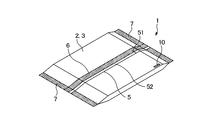
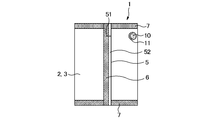
- FIG. 1 is a perspective view showing a multiple bag 1 according to the present embodiment
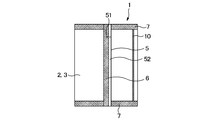
- FIG. 2 is a plan view showing the multiple bag 1 according to the present embodiment
- the multiple bag 1 shown in FIGS. 1 and 2 is constituted by a multiple fill 2 composed of an outer film 3 and an inner film 4.
- the outer film 3 and the inner film 4 when the bag is made as the multiple bag 1, the film that appears outside the multiple bag 1 (in contact with a cardboard box or the like not shown) is the inner film of the outer film 3 or the multiple bag 1.
- the film appearing at (in contact with the contents not shown) is referred to as the inner film 4.
- the multiple bag 1 of the present embodiment is a multiple-ply type multiple bag.
- the multiple film 2 is overlapped with both ends of the multiple film 2 so that the inner films 4 face each other.
- a back seal portion 6 welded with a width is formed.
- the palm portion 5 constituting the multiplex bag 1 is formed by bending the multiplex film 2 into a cylindrical shape and overlapping both ends of the multiplex film 2 so that the inner films 4 face each other.
- the multiple bag 1 is filled with a predetermined content when used, and the content is filled and sealed by forming the back seal portion 6 and the lateral seal portion 7.
- the back seal portion 6 is welded in a band shape with a predetermined width (approximately 2 to 20 mm; the same shall apply hereinafter) with respect to the palm portion 5 (heat sealing, heat fusion).
- the lateral seal portion 7 is formed by welding the vicinity of both end edges on the side orthogonal to the back seal portion 6 with a predetermined width (approximately 2 to 20 mm; the same shall apply hereinafter) in a band shape.
- Both the back seal portion 6 and the horizontal seal portion 7 are formed by sandwiching the inner films 4 of the multiple film 2 in a flat state and sandwiching them with a seal bar having a predetermined width (not shown) from the outside. At this time, in addition to the inner films 4 that are in contact with each other, all the films to be overlaid, including the outer film 3 (a total of four films, two outer films and two inner films) are welded and integrated. This also applies to the lateral seal portion 7.
- a tear start part. 51 is formed.
- the tear start portion 51 is formed to open substantially parallel to the lateral seal portion 7.
- the tear start portion 51 is formed so as to be substantially parallel to the lateral seal portion 7, the user can contact the lateral seal portion 7. On the other hand, it becomes easy to open it substantially parallel.
- the tear start portion 51 formed in the palm portion 5 weakens the initial tear strength and improves easy-openability.
- the tear start portion 51 can have an arbitrary shape such as a slit (cut), a V notch, an I notch, a perforation, or a microporous aggregate.
- the tear start portion 51 is formed so as to reach at least the back seal portion 6 from the outer edge 52 of the palm portion. Since the tear start portion 51 reaches the back seal portion 6, the tear can be smoothly drawn out at the time of opening, and the back seal portion 6 in which four films (two multiplex films 2) gather can be easily obtained. It becomes the multiple bag 1 excellent in easy-opening property that can be torn.
- the length of the tear start portion 51 is not particularly limited as long as it reaches the back seal portion 6 as described above, but it may be approximately 5 to 20 mm.
- the multiple bag 1 of the present embodiment is formed of a multiple film 2 that is easy to tear, and the material of the multiple film 2 that is easy to tear will be described below.
- the outer film 3 and the inner film 4 have a multilayer structure, and the outer film 3 and the inner film 4 are symmetrical with respect to the gap formed between the outer film 3 and the inner film 4.
- the outside / outer layer / intermediate layer / inner layer (the above is the layer of the outer film 3) / gap / inner layer / intermediate layer / outer layer (the above is the inside) Layer of film 4) / inside of multiple bag 1.
- the layer corresponding to an outer layer forms the back seal
- the outer layer that is directly contacted and welded when forming the back seal portion 6 and the lateral seal portion 7 is preferably heat-sealable in itself, and examples thereof include polyolefin resins.
- high density polyethylene high density polyethylene (HDPE), medium density polyethylene (MDPE), low density polyethylene (LDPE), linear (linear) low density polyethylene (LLDPE), linear very low density polyethylene (VLDPE)
- copolymers of vinyl compounds copolymerizable with ethylene such as ethylene-vinyl acetate copolymer (EVA), ionomers, ethylene-acrylic acid or ethylene-acrylic ester copolymers, ethylene methacrylic Polyethylene resins such as acid or methacrylic acid ester copolymer, ethylene-propylene copolymer
- EVA ethylene-vinyl acetate copolymer
- ionomers ethylene-acrylic acid or ethylene-acrylic ester copolymers
- low-density polyethylene which has excellent heat-sealing properties, etc.
- low-density polyethylene it has pinhole resistance, is tough and strong, and has mechanical strength, etc.
- LLDPE linear low density polyethylene
- LLDPE linear low density polyethylene
- ⁇ -olefins having 3 to 13 carbon atoms, preferably 4 to 8 carbon atoms, such as butene-1, octene-1, hexene-1, 4-methylpentene-1, heptene-1, etc. are preferably used. It is done.
- the density of the low density polyethylene (including linear low density polyethylene) is preferably 0.870 to 0.935 g / cm 3. Various characteristics such as heat sealability are maintained by using low density polyethylene in a range where the density is high.
- the density of the low density polyethylene is particularly preferably from 0.880 to 0.920 g / cm 3.
- the melt flow rate (MFR) at 190 ° C. is preferably 0.1 to 30.0 g / 10 min, and particularly preferably 0.5 to 4.0 g / 10 min.
- the inner layer and the intermediate layer constituting the outer film 3 and the inner film 4 are not only polyolefin resins such as the polyethylene resins and polypropylene resins described above, in order to impart pinhole resistance and mechanical properties to the multiple film 2, Polyamide resins (nylon), polyester resins (PET, PBT), ethylene-vinyl alcohol copolymers, and the like can be used.
- the outer film 3 and the inner film 4 have a three-layer structure, the outer film 3 is a layer made of linear low density polyethylene (linear low density polyethylene layer) / An easily tearable resin layer / a layer made of a polyolefin resin (polyolefin resin layer), and the inner film 4 are polyolefin resin layer / easy tear resin layer / linear low in order from the outside of the multiple bag 1 (the above-mentioned gap). A density polyethylene layer is preferred.
- the resin constituting the easy tear resin layer for example, a mixed resin containing a cyclic polyolefin resin may be used.
- a mixed resin containing a cyclic polyolefin resin may be used as the resin constituting the easy tear resin layer.
- the cyclic polyolefin resin is a general term for resins that are polymerized using a cyclic olefin as a polymerization unit, and is described, for example, in JP-A-1-240517, JP-A-3-14882, JP-A-3-122137, and the like.
- it is a copolymer of a cyclic olefin and an ⁇ -olefin (chain olefin) as well as a ring-opening metathesis polymer (cycloolefin polymer: COP) obtained by polymerizing a cyclic olefin by a metathesis ring-opening polymerization reaction.
- cyclic olefin copolymers cycloolefin copolymers: COC
- graft polymers obtained by modifying these with unsaturated carboxylic acids or derivatives thereof, hydrides thereof, and the like.
- any cyclic hydrocarbon having an ethylenically unsaturated bond and a bicyclo ring can be used, and norbornene monomers and the like are widely known.
- the cyclic olefin has, for example, a carboxyl group, an acid anhydride group such as a carboxylic acid anhydride, an epoxy group, an amino group, an amide group, an ester group, a hydroxyl group, a sulfo group, a phosphono group, a phosphino group, etc. May have a polar group.
- a polar group such as a hydroxyl group, a sulfo group, a phosphono group, or a phosphino group.
- ethylene an ⁇ -olefin having 3 to 20 carbon atoms can be used, and specifically, ethylene, propylene, 1- Examples include butene, 1-pentene, 3-methyl-1-butene, 1-hexene, 4-methyl-1-pentene, and ethylene is widely used.
- a polyethylene resin is used as a resin to be combined with the cyclic polyolefin resin (described later), it is preferable to use a cyclic olefin copolymer (COC) for reasons such as good dispersibility in polyethylene, and the ⁇ -olefin to be copolymerized
- a cyclic olefin copolymer COC
- the production of the ring-opening metathesis polymer is not particularly limited as long as it is a known ring-opening metathesis polymerization reaction, and can be produced by ring-opening polymerization of the above-mentioned cyclic olefin using a polymerization catalyst.
- the cyclic olefin copolymer is produced by, for example, randomly polymerizing an ⁇ -olefin and a cyclic olefin having a predetermined molar ratio using a single site catalyst such as a metallocene catalyst or a multisite catalyst.
- a hydrogenated product such as a ring-opened polymer of a cyclic olefin monomer can be obtained by hydrogenating the ring-opened polymer with a known hydrogenation catalyst.
- a cyclic polyolefin resin having a glass transition temperature (Tg) (for example, JIS K7121 etc.) of 60 ° C. or higher.
- Tg glass transition temperature
- cyclic polyolefin resin having a glass transition temperature in such a range excellent heat resistance can be maintained.
- the glass transition temperature (Tg) shall be 70 degreeC or more.
- the melt flow rate (MFR) of the cyclic polyolefin resin is preferably 3.0 to 30.0 g / 10 min.
- MFR melt flow rate
- a cyclic polyolefin resin in such a range that MFR is applied excellent heat resistance can be maintained.
- MFR of the cyclic polyolefin resin a value measured in accordance with ISO 1133 or ASTM D-1238 (for example, 280 ° C., 21.18 N) may be used.
- the MFR of the cyclic polyolefin resin is particularly preferably 5.0 to 20.0 g / 10 min.
- the intermediate layer is made of the above mixed resin
- the resin that can be used in combination with the cyclic polyolefin resin the above-described polyethylene resins and polyolefin resins such as polypropylene resins can be used.
- polyethylene resins are preferable, low density polyethylene (LDPE) is more preferable, and linear low density polyethylene (LLDPE) is particularly preferable.
- the content of the cyclic polyolefin resin in the mixed resin constituting the easily tearable resin layer is 3 to 99 mass with respect to the entire mixed resin (the total of the cyclic polyolefin resin and the resin used in combination with the cyclic polyolefin resin). % Is preferable. By setting the content of the cyclic polyolefin resin within such a range, the easy tearability is favorably implemented.
- the content of the cyclic polyolefin resin is more preferably 60 to 90% by mass, and particularly preferably 60 to 80% by mass with respect to the entire mixed resin.
- the layer containing cyclic polyolefin resin which is comprised with an above-described mixed resin is preferable to make it an intermediate
- the outer film 3 and the inner film 4 are used.
- the layer containing cyclic polyolefin resin which is comprised with an above-described mixed resin is preferable to make it an intermediate
- middle layer in the multilayer outer film 3 and the inner film 4 the outer film 3 and the inner film 4 are used.
- middle layer in the multilayer outer film 3 and the inner film 4 the outer film 3 and the inner film 4 are used.
- the film used for the multiple bag 1, it is preferable to obtain the film by, for example, an inflation film method.
- the inflation film is in the form of a tube (cylinder) in advance, and can be used as manufactured, and there is an advantage that the film does not need to be formed into a cylinder in the subsequent process and no seam is produced. In addition, it is possible to easily produce a relatively thick film as well as a thin film.
- a molten resin extruded in a tube shape from a extruder through a die is pulled up in the vertical direction, and the molten resin is expanded by air supplied in the process of being pulled up in the vertical direction. It is possible to obtain a roll in which a tubular film is wound in a flat shape by forming a flat film while cooling with air and winding it on a winding device.
- the outer film 3 and the inner film 4 that do not appear on the outer side and contact with each other are preferably blocking-bonded to each other.
- blocking to each other means that the films in contact with each other are not completely integrated by being bonded by another medium such as an adhesive or by heat-sealing. It means that the films are in a flexible state by pseudo-bonding. Blocking adhesion may occur over the entire surface of the film, or may occur partially on a part of the film. By carrying out blocking adhesion, the outer film 3 and the inner film 4 are integrated during bag making or the like, and the handleability is improved.
- the polyolefin tubular film formed by the above-described inflation film method is folded and pressed with a nip roll or the like, and the air between the stacked films is extruded and folded in one. It can manufacture simply by winding up as a flat 2 layer film.
- the multiple bag 1 described above has a feature that a user can easily open the tear seal portion 51 substantially in parallel with the tear seal portion 51. . Therefore, when the multiple bag 1 is torn and opened using the tear starting portion 51, the multiple film 2 is formed of a material that is easy to tear, and the tearing proceeds easily, so that the tear piece becomes the multiple bag. 1 will be separated.
- the multiplex bag 1 since it is composed of the multiplex film 2, a plurality of tear pieces such as a tear piece derived from the outer film 3 and a tear piece derived from the inner film 4 are generated and scattered around, There is a risk of entering the bag-in-box, and the processing is complicated.
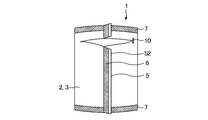
- a tear stopper 10 is provided corresponding to the tear start portion 51 formed in the palm portion 5, and the tear start portion 51. The tearing of the multiplex film 2 that starts is stopped here.
- the tearing of the multiple film 2 starting from the tear start portion 51 proceeds substantially parallel to the lateral seal portion 7. That is, tearing of the multiple film 2 proceeds substantially along the line xx in FIG. Therefore, if the tear stopper 10 is formed so as to block the x-rays, the tearing of the multiple film 2 stops here, and the tear pieces are not separated from the multiple bag 1.
- the tear stopper portion 10 is formed as a welded portion by heat sealing, similar to the back seal portion 6 and the lateral seal portion 7, and in the example shown in FIG. 2, the tear displacement is centered around the position of the xx line. Etc., and are formed to have a predetermined length on both sides.
- the outer film 3 and the inner film 4 of the multiple film 2 are integrated by welding, and the strength increases and functions to prevent further tearing.
- the tear stop portion 10 is formed at a position that intersects the xx line, and is formed as close as possible to the side parallel to the back seal portion 6 of the multiple bag 1 (in the vicinity of the end portion). If the formation position of the tear stopper 10 is separated from the side, the formation of the space for accommodating the contents of the multiple bag 1 may be affected by the formation of the tear stopper 10 which is a welded portion.
- the tear stopper 10 is formed with a predetermined length.
- the tear stopper 10 is not limited to this.
- the tear stopper 10 is parallel to the back seal 6 and is extended from the end to the end of the multiple bag 1. It is also possible to form a linear shape. Thereby, even when the tearing of the multiple film 2 deviates from the xx line, the tearing can be surely stopped.
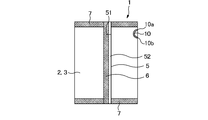
- the tear stop portion 10 may be formed in an arc shape so that the end portions 10 a and 10 b reach the side of the multiple bag 1. In this case, the content does not enter the portion surrounded by the arcuate tear stopper 10.
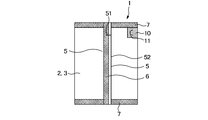
- FIG. 5 shows an example in which the tear stopper 10 is formed integrally with the lateral seal 7.
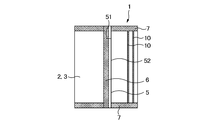
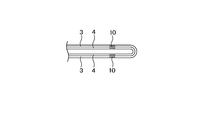
- FIG. 6 it is possible to provide the tear stoppers 10 at two locations.
- FIG. 7 is an example in which linear tear stoppers 10 are provided at two locations.
- FIG. 8 shows an example in which a circular tear stopper 10 is formed by welding and a semicircular cut 11 is formed in the center of the tear stopper 10.
- FIG. 9 shows an example in which the tear stopper 10 is formed integrally with the lateral seal portion 7 and a semicircular cut 11 is formed in the center of the tear stopper 10 in the same manner.
- the tear In the tearing of the multiple bag 1, if the tearing does not stop at the tearing stop portion 10, the tear reaches the notch 11 for stopping the tearing.
- the tearing force is dispersed and applied to two end portions on the downstream side of the notch 11 in the tearing direction, and does not work as a shearing force, so that the tearing stops. Thereby, the tearing stop can be realized with certainty.
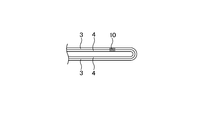
- a strong welded portion (tearing stop portion 10) in which four films are welded is formed, and the tearing of the multiple film 2 is more reliably stopped. Can do.
- the inner films 4 are not welded to each other, so that the formation of the tear stoppers 10 does not affect the shape of the content accommodation space of the multiple bag 1.
- the above-described multiple bag 1 is used as an inner bag of a bag-in-box, and a cardboard box, a metal can, or the like is placed in an outer box and the contents are filled therein.
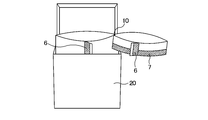
- FIG. 13 shows a usage pattern of the multiple bag 1 accommodated in the outer box 20, and the contents are taken out by opening the outer box 20 and opening the multiple bag 1.
- FIG. 14 is a view showing an opened state of the multiple bag 1.
- the top and bottom of the palm portion 5 are picked with the tear start portion 51 in between and pulled to both sides.
- the multiple bag 1 is torn from the tear start portion 51 as a starting point.
- FIG. 15 shows the state of the multiple bag 1 after tearing. The tearing of the multiple bag 1 is stopped at the tear stopper 10, and the tear piece remains connected to the main body of the multiple bag 1. Is done.
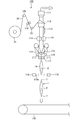
- the manufacturing method of the multiplex bag 1 will be described by taking as an example the case of manufacturing using the pillow packaging machine 100 as shown in FIG.
- the first step for forming the multiple laminated film 34 into a cylindrical shape the second step for forming the back seal portion (vertical seal portion) 6, and the lower horizontal seal portion 7, the fourth step of filling the article W to be packed, the fifth step of forming the upper lateral seal portion 7, and the sixth step of cutting the boundary line of the continuous bag are sequentially performed.
- it demonstrates in order of a process.
- First step of making the multi-layered film into a cylindrical shape The multi-layered film 34 fed out from the roll-shaped film 35 is guided to the former 112 through a plurality of feed-out rolls 120 and 121.
- a sensor 119 is disposed in the middle of the path from the roll film 35 to the former 112, detects registration marks printed at regular intervals in the length direction on the multilayer film 34, and is on the track of the packaging machine 100.
- a multi-layered film 34 having a fixed length can be sent out at fixed time intervals.
- the multi-laminate film 34 is curved in a cylindrical shape while passing through the former 112, and is in the form of a cylindrical body in which a palm portion is formed so that the inner surfaces of both end edges face each other.
- Second step of forming the vertical seal portion The vertical seal machine 113 heats the contact surface of the multi-laminate film 34 with the abutment surface in accordance with the timing at which the multi-laminate film 34 moves at a constant time interval. Welding is performed to form the back seal portion 6. At the same time, the tear stopper 10 can be formed by heat welding.
- the third step of forming the lower horizontal seal portion When the thermal welding by the vertical seal machine 113 is completed, the openable / closable ironing roll 115 is closed and the cylindrical body formed from the multi-layered film 34 is ironed. As a result, the horizontal sealing machines 116 and 117 are closed at predetermined positions of the flattened cylindrical body to form the lower horizontal sealing portion 7.
- the brace and cutter 118 is closed and the lower lateral seal portion 7 of the packaging bag 1a before separation and the upper lateral seal portion 7 continuous thereto are clamped, The boundary between the two is divided into two and the multiple bag 1 is dropped onto the conveyor 130.
- the previous embodiment is an example in which the present invention is applied to a so-called joint-pasted type multiple bag, but the present invention can also be applied to a so-called envelope-pasted type multiple bag.
Landscapes
- Engineering & Computer Science (AREA)
- Mechanical Engineering (AREA)
- Bag Frames (AREA)
- Packages (AREA)
Abstract
L'invention traite le problème de la réalisation d'un sac multicouche qui peut être éliminé facilement sans séparer un morceau déchiré, résultant d'une déchirure, du corps de sac multicouche. La solution selon l'invention concerne un sac multicouche formé d'un film multicouche comprenant un film extérieur et un film intérieur. Une section de scellé arrière au niveau de laquelle des extrémités du film multicouche sont posées l'une sur l'autre et sont soudées ensemble sur une largeur prédéterminée est formée. En outre, des sections de scellés latéraux au niveau desquelles des bords et leur voisinage sur les côtés perpendiculaires à la section de scellé arrière sont soudés sur une largeur prédéterminée sont formées, formant ainsi un sac multicouche qui est rempli d'un contenu et scellé. Une partie de début de déchirure qui permet d'ouvrir le sac dans la direction sensiblement parallèle aux sections de scellés latéraux est placée près de la section de scellé arrière. En outre, une partie d'arrêt de déchirure est réalisée près d'une extrémité du sac multicouche, dans une position correspondant à la position où est formée la partie de début de déchirure.
Priority Applications (2)
| Application Number | Priority Date | Filing Date | Title |
|---|---|---|---|
| CN201910642135.0A CN110329657B (zh) | 2017-03-02 | 2018-02-23 | 袋 |
| CN201880005533.5A CN110121465B (zh) | 2017-03-02 | 2018-02-23 | 多重袋 |
Applications Claiming Priority (2)
| Application Number | Priority Date | Filing Date | Title |
|---|---|---|---|
| JP2017-039915 | 2017-03-02 | ||
| JP2017039915A JP7209937B2 (ja) | 2017-03-02 | 2017-03-02 | 多重袋 |
Publications (1)
| Publication Number | Publication Date |
|---|---|
| WO2018159509A1 true WO2018159509A1 (fr) | 2018-09-07 |
Family
ID=63370805
Family Applications (1)
| Application Number | Title | Priority Date | Filing Date |
|---|---|---|---|
| PCT/JP2018/006830 Ceased WO2018159509A1 (fr) | 2017-03-02 | 2018-02-23 | Sac multicouche |
Country Status (3)
| Country | Link |
|---|---|
| JP (1) | JP7209937B2 (fr) |
| CN (2) | CN110121465B (fr) |
| WO (1) | WO2018159509A1 (fr) |
Cited By (2)
| Publication number | Priority date | Publication date | Assignee | Title |
|---|---|---|---|---|
| WO2020115612A1 (fr) * | 2018-12-03 | 2020-06-11 | Takigawa Corporation Japan | Sachet d'emballage résistant à la déchirure |
| JP2025080913A (ja) * | 2023-11-15 | 2025-05-27 | 株式会社まるたか | 引き裂きストップ機能付きインフレーション袋 |
Families Citing this family (3)
| Publication number | Priority date | Publication date | Assignee | Title |
|---|---|---|---|---|
| JP7821461B2 (ja) * | 2020-05-28 | 2026-02-27 | キョーラク株式会社 | 包装袋 |
| WO2022092164A1 (fr) * | 2020-10-30 | 2022-05-05 | キョーラク株式会社 | Sac d'emballage |
| JP7835971B2 (ja) * | 2020-10-30 | 2026-03-26 | キョーラク株式会社 | 包装袋 |
Citations (2)
| Publication number | Priority date | Publication date | Assignee | Title |
|---|---|---|---|---|
| JP2009096495A (ja) * | 2007-10-15 | 2009-05-07 | Kyodo Printing Co Ltd | 包装袋 |
| JP2016159932A (ja) * | 2015-02-27 | 2016-09-05 | キョーラク株式会社 | 多重袋 |
Family Cites Families (17)
| Publication number | Priority date | Publication date | Assignee | Title |
|---|---|---|---|---|
| JP4220052B2 (ja) * | 1999-01-14 | 2009-02-04 | 大日本印刷株式会社 | 半開口ガゼット包装袋 |
| JP4490045B2 (ja) * | 2002-05-15 | 2010-06-23 | キョーラク株式会社 | 多重袋 |
| JP4338175B2 (ja) * | 2003-02-27 | 2009-10-07 | 富士特殊紙業株式会社 | 易開封手段を施したピロー包装袋 |
| CN1795128A (zh) * | 2003-05-29 | 2006-06-28 | 加川敦子 | 方便食品用容器以及使用该容器的方便食品 |
| JP4776533B2 (ja) * | 2004-06-10 | 2011-09-21 | 株式会社細川洋行 | 包装袋及びその製造方法 |
| JP2006176166A (ja) | 2004-12-22 | 2006-07-06 | Nakano Shiga:Kk | 包装袋及び開封構造 |
| JP5033315B2 (ja) * | 2005-06-08 | 2012-09-26 | 株式会社川島製作所 | 製袋充填包装方法及び装置 |
| JP3120596U (ja) * | 2006-01-24 | 2006-04-13 | 株式会社旭紙工社 | 米袋 |
| JP2009255959A (ja) * | 2008-04-17 | 2009-11-05 | Kanae Co Ltd | 包装袋 |
| JP5659682B2 (ja) * | 2010-10-15 | 2015-01-28 | 凸版印刷株式会社 | 包装袋 |
| SG194844A1 (en) * | 2011-05-27 | 2013-12-30 | Otsuka Pharma Co Ltd | Packaging bag and method of manufacturing packaging bag |
| CN202743636U (zh) * | 2012-02-10 | 2013-02-20 | 马晓璐 | 一种简易食品袋 |
| US9669981B2 (en) * | 2012-02-13 | 2017-06-06 | Polytex Fibers Corporation | Easy open plastic bags |
| JP5917250B2 (ja) * | 2012-04-12 | 2016-05-11 | 大成ラミック株式会社 | 液状物充填包装体 |
| JP6188312B2 (ja) * | 2012-11-21 | 2017-08-30 | ポーラ化成工業株式会社 | 包装袋 |
| JP2015013653A (ja) * | 2013-07-03 | 2015-01-22 | 大日本印刷株式会社 | 袋体および包装体 |
| JP2015016878A (ja) * | 2013-07-09 | 2015-01-29 | 大日本印刷株式会社 | 袋体および包装体 |
-
2017
- 2017-03-02 JP JP2017039915A patent/JP7209937B2/ja active Active
-
2018
- 2018-02-23 WO PCT/JP2018/006830 patent/WO2018159509A1/fr not_active Ceased
- 2018-02-23 CN CN201880005533.5A patent/CN110121465B/zh active Active
- 2018-02-23 CN CN201910642135.0A patent/CN110329657B/zh active Active
Patent Citations (2)
| Publication number | Priority date | Publication date | Assignee | Title |
|---|---|---|---|---|
| JP2009096495A (ja) * | 2007-10-15 | 2009-05-07 | Kyodo Printing Co Ltd | 包装袋 |
| JP2016159932A (ja) * | 2015-02-27 | 2016-09-05 | キョーラク株式会社 | 多重袋 |
Cited By (4)
| Publication number | Priority date | Publication date | Assignee | Title |
|---|---|---|---|---|
| WO2020115612A1 (fr) * | 2018-12-03 | 2020-06-11 | Takigawa Corporation Japan | Sachet d'emballage résistant à la déchirure |
| US11603243B2 (en) | 2018-12-03 | 2023-03-14 | Takigawa Corporation Japan | Packaging pouch |
| JP2025080913A (ja) * | 2023-11-15 | 2025-05-27 | 株式会社まるたか | 引き裂きストップ機能付きインフレーション袋 |
| JP7803559B2 (ja) | 2023-11-15 | 2026-01-21 | 株式会社まるたか | 引き裂きストップ機能付きインフレーション袋 |
Also Published As
| Publication number | Publication date |
|---|---|
| CN110121465B (zh) | 2022-11-04 |
| JP2018144837A (ja) | 2018-09-20 |
| CN110121465A (zh) | 2019-08-13 |
| JP7209937B2 (ja) | 2023-01-23 |
| CN110329657A (zh) | 2019-10-15 |
| CN110329657B (zh) | 2022-07-22 |
Similar Documents
| Publication | Publication Date | Title |
|---|---|---|
| TWI755577B (zh) | 積層薄膜及食品包裝袋 | |
| JP7140105B2 (ja) | 積層フィルム及び食品包装袋 | |
| US8827557B2 (en) | Gusseted bag with easy-open lap seal | |
| WO2018159509A1 (fr) | Sac multicouche | |
| JP5459535B2 (ja) | 共押出多層フィルム及び該フィルムからなる包装材 | |
| US10099817B2 (en) | Flexible container and process for producing same | |
| JP6160798B2 (ja) | 積層フィルム及び包装材 | |
| JP7140104B2 (ja) | 積層フィルム及び食品包装袋 | |
| JP2009537349A (ja) | シール及び剥離可能なフィルム | |
| JP6536878B2 (ja) | 多重袋 | |
| KR20160147721A (ko) | 다층 실란트 필름 | |
| TWI586535B (zh) | 低吸附性積層用多層膜、使用其的複合膜及包裝材 | |
| AU2014393431A1 (en) | Flexible container | |
| TWI583549B (zh) | 積層體及使用其的包裝材 | |
| TW201946783A (zh) | 多層薄膜及包裝材料 | |
| JP2002036462A (ja) | 大型袋用積層フィルム | |
| JP6773995B2 (ja) | 多重袋 | |
| JP6971443B2 (ja) | 袋 | |
| JP7492132B2 (ja) | フィルムロール、内容物の充填方法 | |
| CN1852838B (zh) | 纸容器内纵向密封带及带有纵向密封带的纸容器 | |
| JP2003165571A (ja) | 包装方法及び共押出積層フィルム | |
| JP4596210B2 (ja) | 開封性包装用積層フィルム及び包装容器 | |
| JPH05330560A (ja) | バッグ・イン・ボックス及びそれに用いるバッグ | |
| JP4864235B2 (ja) | 熱融着フィルム及びそれからなる包装体 | |
| JP7572606B2 (ja) | 包装袋 |
Legal Events
| Date | Code | Title | Description |
|---|---|---|---|
| 121 | Ep: the epo has been informed by wipo that ep was designated in this application |
Ref document number: 18761663 Country of ref document: EP Kind code of ref document: A1 |
|
| NENP | Non-entry into the national phase |
Ref country code: DE |
|
| 122 | Ep: pct application non-entry in european phase |
Ref document number: 18761663 Country of ref document: EP Kind code of ref document: A1 |