WO2018163968A1 - Corps moulé de particules expansibles - Google Patents
Corps moulé de particules expansibles Download PDFInfo
- Publication number
- WO2018163968A1 WO2018163968A1 PCT/JP2018/007850 JP2018007850W WO2018163968A1 WO 2018163968 A1 WO2018163968 A1 WO 2018163968A1 JP 2018007850 W JP2018007850 W JP 2018007850W WO 2018163968 A1 WO2018163968 A1 WO 2018163968A1
- Authority
- WO
- WIPO (PCT)
- Prior art keywords
- molded body
- particle molded
- particles
- foamed
- foamed particle
- Prior art date
- Legal status (The legal status is an assumption and is not a legal conclusion. Google has not performed a legal analysis and makes no representation as to the accuracy of the status listed.)
- Ceased
Links
Images





Classifications
-
- C—CHEMISTRY; METALLURGY
- C08—ORGANIC MACROMOLECULAR COMPOUNDS; THEIR PREPARATION OR CHEMICAL WORKING-UP; COMPOSITIONS BASED THEREON
- C08J—WORKING-UP; GENERAL PROCESSES OF COMPOUNDING; AFTER-TREATMENT NOT COVERED BY SUBCLASSES C08B, C08C, C08F, C08G or C08H
- C08J9/00—Working-up of macromolecular substances to porous or cellular articles or materials; After-treatment thereof
- C08J9/22—After-treatment of expandable particles; Forming foamed products
- C08J9/228—Forming foamed products
-
- C—CHEMISTRY; METALLURGY
- C08—ORGANIC MACROMOLECULAR COMPOUNDS; THEIR PREPARATION OR CHEMICAL WORKING-UP; COMPOSITIONS BASED THEREON
- C08J—WORKING-UP; GENERAL PROCESSES OF COMPOUNDING; AFTER-TREATMENT NOT COVERED BY SUBCLASSES C08B, C08C, C08F, C08G or C08H
- C08J9/00—Working-up of macromolecular substances to porous or cellular articles or materials; After-treatment thereof
- C08J9/22—After-treatment of expandable particles; Forming foamed products
- C08J9/228—Forming foamed products
- C08J9/232—Forming foamed products by sintering expandable particles
-
- B—PERFORMING OPERATIONS; TRANSPORTING
- B29—WORKING OF PLASTICS; WORKING OF SUBSTANCES IN A PLASTIC STATE IN GENERAL
- B29C—SHAPING OR JOINING OF PLASTICS; SHAPING OF MATERIAL IN A PLASTIC STATE, NOT OTHERWISE PROVIDED FOR; AFTER-TREATMENT OF THE SHAPED PRODUCTS, e.g. REPAIRING
- B29C44/00—Shaping by internal pressure generated in the material, e.g. swelling or foaming ; Producing porous or cellular expanded plastics articles
-
- B—PERFORMING OPERATIONS; TRANSPORTING
- B29—WORKING OF PLASTICS; WORKING OF SUBSTANCES IN A PLASTIC STATE IN GENERAL
- B29C—SHAPING OR JOINING OF PLASTICS; SHAPING OF MATERIAL IN A PLASTIC STATE, NOT OTHERWISE PROVIDED FOR; AFTER-TREATMENT OF THE SHAPED PRODUCTS, e.g. REPAIRING
- B29C44/00—Shaping by internal pressure generated in the material, e.g. swelling or foaming ; Producing porous or cellular expanded plastics articles
- B29C44/02—Shaping by internal pressure generated in the material, e.g. swelling or foaming ; Producing porous or cellular expanded plastics articles for articles of definite length, i.e. discrete articles
-
- B—PERFORMING OPERATIONS; TRANSPORTING
- B29—WORKING OF PLASTICS; WORKING OF SUBSTANCES IN A PLASTIC STATE IN GENERAL
- B29C—SHAPING OR JOINING OF PLASTICS; SHAPING OF MATERIAL IN A PLASTIC STATE, NOT OTHERWISE PROVIDED FOR; AFTER-TREATMENT OF THE SHAPED PRODUCTS, e.g. REPAIRING
- B29C44/00—Shaping by internal pressure generated in the material, e.g. swelling or foaming ; Producing porous or cellular expanded plastics articles
- B29C44/34—Auxiliary operations
- B29C44/36—Feeding the material to be shaped
- B29C44/38—Feeding the material to be shaped into a closed space, i.e. to make articles of definite length
- B29C44/44—Feeding the material to be shaped into a closed space, i.e. to make articles of definite length in solid form
- B29C44/445—Feeding the material to be shaped into a closed space, i.e. to make articles of definite length in solid form in the form of expandable granules, particles or beads
-
- C—CHEMISTRY; METALLURGY
- C08—ORGANIC MACROMOLECULAR COMPOUNDS; THEIR PREPARATION OR CHEMICAL WORKING-UP; COMPOSITIONS BASED THEREON
- C08J—WORKING-UP; GENERAL PROCESSES OF COMPOUNDING; AFTER-TREATMENT NOT COVERED BY SUBCLASSES C08B, C08C, C08F, C08G or C08H
- C08J9/00—Working-up of macromolecular substances to porous or cellular articles or materials; After-treatment thereof
- C08J9/16—Making expandable particles
- C08J9/18—Making expandable particles by impregnating polymer particles with the blowing agent
-
- B—PERFORMING OPERATIONS; TRANSPORTING
- B29—WORKING OF PLASTICS; WORKING OF SUBSTANCES IN A PLASTIC STATE IN GENERAL
- B29K—INDEXING SCHEME ASSOCIATED WITH SUBCLASSES B29B, B29C OR B29D, RELATING TO MOULDING MATERIALS OR TO MATERIALS FOR MOULDS, REINFORCEMENTS, FILLERS OR PREFORMED PARTS, e.g. INSERTS
- B29K2075/00—Use of PU, i.e. polyureas or polyurethanes or derivatives thereof, as moulding material
-
- C—CHEMISTRY; METALLURGY
- C08—ORGANIC MACROMOLECULAR COMPOUNDS; THEIR PREPARATION OR CHEMICAL WORKING-UP; COMPOSITIONS BASED THEREON
- C08J—WORKING-UP; GENERAL PROCESSES OF COMPOUNDING; AFTER-TREATMENT NOT COVERED BY SUBCLASSES C08B, C08C, C08F, C08G or C08H
- C08J2203/00—Foams characterized by the expanding agent
- C08J2203/06—CO2, N2 or noble gases
-
- C—CHEMISTRY; METALLURGY
- C08—ORGANIC MACROMOLECULAR COMPOUNDS; THEIR PREPARATION OR CHEMICAL WORKING-UP; COMPOSITIONS BASED THEREON
- C08J—WORKING-UP; GENERAL PROCESSES OF COMPOUNDING; AFTER-TREATMENT NOT COVERED BY SUBCLASSES C08B, C08C, C08F, C08G or C08H
- C08J2203/00—Foams characterized by the expanding agent
- C08J2203/22—Expandable microspheres, e.g. Expancel®
-
- C—CHEMISTRY; METALLURGY
- C08—ORGANIC MACROMOLECULAR COMPOUNDS; THEIR PREPARATION OR CHEMICAL WORKING-UP; COMPOSITIONS BASED THEREON
- C08J—WORKING-UP; GENERAL PROCESSES OF COMPOUNDING; AFTER-TREATMENT NOT COVERED BY SUBCLASSES C08B, C08C, C08F, C08G or C08H
- C08J2205/00—Foams characterised by their properties
- C08J2205/04—Foams characterised by their properties characterised by the foam pores
- C08J2205/052—Closed cells, i.e. more than 50% of the pores are closed
-
- C—CHEMISTRY; METALLURGY
- C08—ORGANIC MACROMOLECULAR COMPOUNDS; THEIR PREPARATION OR CHEMICAL WORKING-UP; COMPOSITIONS BASED THEREON
- C08J—WORKING-UP; GENERAL PROCESSES OF COMPOUNDING; AFTER-TREATMENT NOT COVERED BY SUBCLASSES C08B, C08C, C08F, C08G or C08H
- C08J2300/00—Characterised by the use of unspecified polymers
- C08J2300/22—Thermoplastic resins
-
- C—CHEMISTRY; METALLURGY
- C08—ORGANIC MACROMOLECULAR COMPOUNDS; THEIR PREPARATION OR CHEMICAL WORKING-UP; COMPOSITIONS BASED THEREON
- C08J—WORKING-UP; GENERAL PROCESSES OF COMPOUNDING; AFTER-TREATMENT NOT COVERED BY SUBCLASSES C08B, C08C, C08F, C08G or C08H
- C08J2300/00—Characterised by the use of unspecified polymers
- C08J2300/26—Elastomers
-
- C—CHEMISTRY; METALLURGY
- C08—ORGANIC MACROMOLECULAR COMPOUNDS; THEIR PREPARATION OR CHEMICAL WORKING-UP; COMPOSITIONS BASED THEREON
- C08J—WORKING-UP; GENERAL PROCESSES OF COMPOUNDING; AFTER-TREATMENT NOT COVERED BY SUBCLASSES C08B, C08C, C08F, C08G or C08H
- C08J2375/00—Characterised by the use of polyureas or polyurethanes; Derivatives of such polymers
- C08J2375/04—Polyurethanes
Definitions
- thermoplastic elastomer a thermoplastic elastomer may be abbreviated as “TPE”.
- thermoplastic elastomer foamed particle molded body may be simply referred to as “foamed particle molded body”.
- Thermoplastic elastomers such as urethane-based thermoplastic elastomers (TPU) exhibit properties close to that of vulcanized rubber, and are excellent in flexibility and impact resilience. They are cushioning materials, vibration-proofing materials, sports equipment, and automotive parts. It is used for various purposes.
- the foamed molded body obtained by foaming this TPE can be reduced in weight while maintaining excellent properties such as flexibility and rebound resilience. Be expected.
- the foamed molded body of TPE can be manufactured by methods such as extrusion foaming, press foaming, and in-mold molding using foamed particles.
- a foamed molded body of TPE for example, a foamed particle molded body described in Patent Document 1 is known as a conventional technique.
- the conventional TPE expanded particle molded body has a problem that it takes a long time to recover the shape before compression after the molded body is compressed and the compression is finished.
- the problem to be solved by the present invention is to provide a TPE expanded particle molded article having good shape recoverability in a short time after compression.
- the present invention is as follows.
- [1] A foamed particle molded body obtained by in-mold molding of thermoplastic elastomer foamed particles, wherein the foamed particle molded body has voids between the foamed particles, and the density of the foamed particle molded body is 150 to 300 kg / m. 3 and the porosity is 10 to 70 vol%, PP bead molding.
- [2] Foamed particle molding according to the above [1], wherein the compression set after 30 minutes of completion of compression of the foamed particle molded body is 7% or less in compression set measurement at 23 ° C. based on JIS K6767: 1999. body.
- thermoplastic elastomer constituting the foamed particle molded body is a urethane-based thermoplastic elastomer having a type A durometer hardness of 95 or less. Molded body.
- FIG. 1 is a diagram showing an example of the shape of expanded particles that can increase the porosity of a TPE expanded particle molded body.
- FIG. 2 is a diagram showing an example of the shape of the expanded particles that can increase the porosity of the TPE expanded particle molded body.
- FIG. 3 is a diagram showing an example of the shape of the expanded particles that can increase the porosity of the TPE expanded particle molded body.
- FIG. 4 is a diagram showing an example of the shape of the expanded particles that can increase the porosity of the TPE expanded particle molded body.
- FIG. 5 is a diagram showing an example of the shape of the expanded particles that can increase the porosity of the TPE expanded particle molded body.
- FIG. 6 is a photomicrograph of expanded particles having a cross-shaped cross section used in the production of the expanded particle molded body of Example 1.
- FIG. 7 is a photomicrograph of expanded particles having a cross-shaped cross section used for the production of the expanded particle molded body of Example 2.
- FIG. 8 is a photomicrograph of expanded particles having a star shape in cross section used in the production of the expanded particle molded bodies of Examples 3 to 5.
- thermoplastic elastomer foamed particle molded body is a foamed particle molded body formed by molding thermoplastic elastomer foamed particles in a mold and has a space between the foamed particles. Has a density of 150 to 300 kg / m 3 and a porosity of 10 to 70% by volume.
- thermoplastic elastomer constituting the TPE expanded particle molded body of the present invention is not particularly limited.
- TPO olefin thermoplastic elastomer
- TPS styrene thermoplastic elastomer
- TPU urethane thermoplastic elastomer
- the olefin-based thermoplastic elastomer means a thermoplastic elastomer having a polyolefin such as polypropylene or polyethylene as a hard segment and a rubber component such as ethylene-propylene rubber (EPM) as a soft segment.
- TPO is generally roughly classified into a blend type of polyolefin and a rubber component, a dynamic crosslinking type, and a polymerization type.
- TPO has a structure in which ethylene-propylene rubber (EPM) is dispersed in polypropylene, a structure in which ethylene-propylene-diene rubber (EPDM) is dispersed in polypropylene, ethylene, And a random copolymer of olefin and ⁇ -olefin, a block copolymer of polyethylene block and ethylene / ⁇ -olefin copolymer block, and the like.
- EPM ethylene-propylene rubber
- EPDM ethylene-propylene-diene rubber
- Styrenic thermoplastic elastomer means a thermoplastic elastomer having polystyrene as a hard segment and a conjugated diene polymer, a completely hydrogenated product or a partially hydrogenated product of the polymer as a soft segment.
- TPS includes styrene-butadiene-styrene block copolymer (SBS), styrene-ethylene-butylene-styrene copolymer (SEBS), which is a complete hydrogenated product of SBS, and partial hydrogenated product of SBS.
- SBBS styrene-butadiene-butylene-styrene
- SIS styrene-isoprene-styrene block copolymer
- SEPS styrene-ethylene-propylene-styrene
- thermoplastic elastomer A urethane-based thermoplastic elastomer (TPU) is a heat having a structure in which a soft segment containing a long-chain polyol and a hard segment obtained by polymerizing a chain extender such as a short-chain glycol and a diisocyanate with a urethane bond are block copolymerized. It is a plastic elastomer.
- thermoplastic elastomer a urethane-based thermoplastic elastomer
- TPU thermoplastic elastomer
- the shape of the TPU raw material particles is easily maintained (difficult to spheroidize), and foamed particles having a desired shape are easily obtained.
- TPU foam particles are excellent in fusion property at the time of in-mold molding, they can be fused without excessive secondary foaming at the time of in-mold molding. In-mold molding can be performed while leaving voids between the expanded particles.
- the size of the gap between the foamed particles when filled in the mold can be controlled to be small. That is, when the TPE constituting the expanded particles is TPU, it becomes easy to control the porosity of the expanded expanded particles to a desired value.
- TPU generally includes ester-based TPU and ether-based TPU depending on the type of long-chain polyol, and affects the properties of the obtained TPU.
- the long-chain polyol that is a constituent element of the ester-based TPU include a compound obtained by a condensation reaction between a polyhydric alcohol and a dibasic acid, and a lactone-based ester polyol.
- specific examples of the polyhydric alcohol include ethylene glycol, propylene glycol, butanediol, butenediol, hexanediol, pentanediol, neopentyldiol, pentanediol and the like.
- dibasic acid examples include adipic acid, sebacic acid, azelaic acid, terephthalic acid, isophthalic acid, maleic acid and the like.
- long-chain polyol that is a constituent element of the ether-based TPU examples include polyethylene glycol, polypropylene ether glycol, polytetramethylene ether glycol, polyhexamethylene ether glycol, and the like.
- examples of the short chain glycol include ethylene glycol, propylene glycol, butanediol, butenediol, pentanediol, neopentyl glycol, hexanediol, cyclohexanediol, diethylene glycol, diethanolamine, and triethanolamine.
- examples of the diisocyanate include tolylene diisocyanate (TDI), diphenylmethane diisocyanate (MDI), hexamethylene diisocyanate, naphthalene diisocyanate, isophorone diisocyanate, xylene diisocyanate and the like.
- TPU components are not particularly limited.
- the constituent elements of the TPU are appropriately selected according to the physical properties required for the foamed particle molded body.
- a single TPU selected from a single component may be used, or a mixed species selected from two or more components such as a long-chain polyol, a short-chain glycol, and a diisocyanate.
- a TPU may be used.
- the TPU may be any of the ether-based TPU and the ester-based TPU described above, but from the viewpoint of excellent surface appearance and fusion property of the obtained thermoplastic polyurethane foam particle molded body, the TPU foam of the present invention.
- the TPU constituting the particle compact is preferably mainly composed of ether-based TPU, and more preferably composed only of ether-based TPU.
- the foamed particle molded body of the present invention may contain a thermoplastic resin depending on the purpose within the limit that does not impair the effects of the present invention.
- the thermoplastic resin include polyolefin resins and polystyrene resins.
- the content of these thermoplastic resins in the polymer component constituting the expanded particle molded body is preferably 30% by weight or less, more preferably 20% by weight or less, and further preferably 10% by weight or less.
- the polymer component consists only of TPE (the content of TPE in the polymer component is 100% by weight).
- the type A durometer hardness of the polymer component containing TPU is preferably 95 or less. If the hardness is 95 or less, it is possible to obtain a foamed particle molded article having excellent fusion properties without excessively increasing the steam pressure (molding pressure) during in-mold molding. Can be suppressed, and the porosity of the foamed particle molded body can be easily adjusted. From this viewpoint, the hardness is more preferably 92 or less, still more preferably 90 or less, and particularly preferably 88 or less.
- the lower limit is not particularly limited from the viewpoint of fusibility, but if the hardness is too low, depending on the molding conditions and the shape of the molded body, the molded body is released from the mold and then molded. Since so-called sink marks that the body significantly contracts and deforms easily occur, the hardness is more preferably 70 or more, still more preferably 80 or more, and particularly preferably 85 or more.
- type A durometer hardness means durometer hardness (HDA) measured using a type A durometer based on JIS K7215: 1986.
- the foamed particle molded body of the present invention has the following characteristics.
- the density of the foamed particle molded body of the present invention is 150 to 300 kg / m 3 . If the molded body density is less than 150 kg / m 3 , it may take a long time to recover the shape before compression after compressing the foamed particle molded body. On the other hand, if the density of the molded body is larger than 300 kg / m 3, it may take a long time to recover the shape before compression after the foamed particle molded body is compressed. From the above viewpoint, the density of the foamed particle molded body is preferably 170 to 280 kg / m 3 , more preferably 190 to 260 kg / m 3 .
- the foamed particle molded body of the present invention has voids, and the void ratio is 10 to 70% by volume.
- the porosity of the foamed particle molded body is less than 10% by volume, it may take a long time to recover the shape before compression after the foamed particle molded body is compressed.
- the porosity of the TPE expanded particle molded body is larger than 70% by volume, the fusion property between the expanded particles of the expanded particle molded body may be poor.
- the porosity of the foamed particle molded body is preferably 13 to 65% by volume, more preferably 15 to 60% by volume, and still more preferably 20 to 50% by volume.
- the porosity of the foamed particle molded body can be changed by changing the shape of the foamed particle and changing the bulk of the foamed particle when filling the mold (changing the apparent density to the bulk density of the foamed particle), It can be controlled by controlling the secondary foamability of the foamed particles during in-mold molding.
- the voids of the TPE expanded particle molded body communicate with each other.
- the foamed particle molded body can be suitably used as a breathable material, a water permeable material, a sound deadening material, a cushioning material, a lightweight material, and the like.
- FIG. 1 is a diagram illustrating an example of a columnar foamed particle having a cross-sectional shape formed of three or more protrusions extending outward from the axis A. The cross-sectional shape is determined from the axis A.
- FIG. 4 is a perspective view of columnar foam particles having a shape (hereinafter also referred to as a cross shape) consisting of four projecting portions 11a to 14a extending outward.
- FIG. 2 is also a diagram illustrating an example of a columnar foamed particle having a cross-sectional shape including three or more projecting portions extending outward from the axis A.
- FIG. 6 is a perspective view of columnar foam particles having a shape composed of six projecting portions 11b to 16b extending outward from B (hereinafter sometimes referred to as a star shape).
- the foamed particles having the shapes shown in FIGS. 1 and 2 can be obtained, for example, as follows. TPE and a predetermined additive are supplied to an extruder, and these are heated and kneaded to obtain a melt-kneaded product. Then, the melt-kneaded product is extruded into water from a small hole of a die having the same shape as the cross-sectional shape of the foamed particles attached to the tip of the extruder and cut to obtain raw material particles.
- the melt-kneaded product is extruded into a strand shape from a die hole having a die shape similar to the cross-sectional shape of a desired expanded particle attached to the tip of the extruder, and the strand is cooled and cut to obtain a raw material. Get particles. By foaming the obtained raw material particles, foamed particles having a shape as shown in FIGS. 1 and 2 can be obtained.
- the number of the protrusion parts of the expanded particle which can raise the porosity of an expanded particle molded object is 3 or more, it will not be limited to the expanded particle shown in FIG.1 and FIG.2.
- the number of protrusions 11c to 13c extending outward from the axis C in the cross-sectional shape may be three, or FIG.
- the number of protrusions 11d to 15d extending outward from the axis D in the cross-sectional shape may be five, or the columnar foam shown in FIG.
- the number of protrusions 11e to 18e extending outward from the axis E in the cross-sectional shape may be eight.
- the number of protrusions extending outward from the shaft in the cross-sectional shape of the columnar foam particles may be nine or more.
- the number of protrusions is preferably 3 to 8, more preferably 4 to 6.
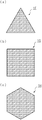
- the foamed particles capable of increasing the porosity of the foamed particle molded body may be columnar foamed particles having a polygonal cross-sectional shape.
- it may be a foamed particle having a triangular cross-sectional shape like a columnar foamed particle 1F shown in FIG. 4 (a), or a cross-sectional shape like a columnar foamed particle 1G shown in FIG. 4 (b).
- It may be a foamed particle having a quadrangular shape, or may be a foamed particle having a hexagonal cross section as in the columnar foamed particle 1H shown in FIG.
- the expanded particle whose cross-sectional shape is a polygon more than a heptagon may be sufficient.
- the foamed particles that can increase the porosity of the foamed particle molded body are foamed particles having a circular, elliptical, or polygonal cross-sectional shape having three or more protrusions extending outward from the shaft. May be.
- the cross-sectional shape is a columnar foamed particle that is a triangle having six projecting portions 11j to 16j extending outward from the axis J.
- the cross-sectional shape is a columnar foamed particle having a quadrangular shape having six projecting portions 11k to 16k extending outward from the axis K.
- the cross-sectional shape is a columnar foam having a circular shape having six projecting portions 11m to 16m extending outward from the axis M. It may be a particle.
- the cross-sectional shape is an elliptical shape having five or seven or more protruding portions extending outward from the axis, a quadrangular shape, a pentagonal shape, or a columnar shape having a number of corners of seven or more.
- the expanded particles may be used.
- the foamed particles have a shape composed of three or more protrusions whose cross-sectional shape extends outward from the shaft. It is preferable that the foamed columnar particles have a circular shape, an elliptical shape, or a polygonal shape having three or more protrusions whose cross-sectional shape extends outward from the shaft.
- the foamed particle molded body of the present invention has voids between the foamed particles, when the foamed particle molded body is compressed, first, the voids of the foamed particle molded body are crushed. Is prevented from being crushed. For this reason, it becomes difficult for the gas in the bubbles of the foamed particle molded body to escape. And since the thermoplastic elastomer is difficult to plastically deform in the normal temperature range, if the foamed particle molded body has voids, it is considered that the time until the foamed particle molded body is restored to the shape before compression is reduced. .
- the density and porosity of the foamed particle molded body are determined as follows. First, a foamed particle molded body that has been allowed to stand for 24 hours or more in an environment of a temperature of 23 ° C. and a relative humidity of 50% is cut into a rectangular parallelepiped sample (molded skin is removed) of an appropriate size. And the apparent volume of each sample is calculated
- Porosity (volume%) [(HI) ⁇ H] ⁇ 100 (1)
- the foamed particle molded body of the present invention preferably has a compression set of 7% or less, more preferably 6% or less, and still more preferably 4% or less.
- the lower limit of the compression set is not particularly limited, but is about 0.1%, for example.
- the compression set is the strain of the foamed particle molded body 30 minutes after the end of compression of the foamed particle molded body in the compression set measurement at 23 ° C. based on JIS K6767: 1999. If it is in the above range, it is excellent in recoverability of the shape after the foamed particle molded body is compressed, so that it is suitable for uses such as a seat cushion material, a sports pad material, and a shoe sole material.
- the tensile strength at break of the foamed particle molded body of the present invention is preferably 0.1 MPa or more. If the tensile strength at break of the foamed particle molded body is 0.1 MPa or more, it indicates that the fusibility between the foamed particles of the foamed particle molded body is good, and has excellent durability, a seat cushion material, It can be applied to uses such as sports pad materials, sole (sole) members, insole members and the like. From the above viewpoint, the tensile strength at break of the foamed particle molded body is more preferably 0.3 MPa or more, further preferably 0.4 MPa or more, and particularly preferably 0.5 MPa or more. The upper limit is not particularly limited, but is about 3.0 MPa. In addition, the tensile strength at the time of the fracture
- the rebound resilience of the foamed particle molded body of the present invention is preferably 50% or more. If the rebound resilience of the foamed particle molded body is less than 50%, it may be difficult to obtain a foamed particle molded body having excellent resilience that is used as a sole member or the like. From the above viewpoint, the rebound resilience of the foamed particle molded body is more preferably 50 to 85%, still more preferably 54 to 85%. The rebound resilience of the foamed particle molded body can be measured based on JIS K6255: 2013.
- the rebound resilience of the thermoplastic elastomer constituting the foamed particle molded body of the present invention is preferably 30 to 50%. Usually, in order to shorten the time until the molded body is restored after being compressed, it is necessary to increase the rebound resilience of the molded body. However, in the case of the foamed particle molded body of the present invention, even when the rebound resilience of the thermoplastic elastomer constituting the molded body is low, the time until the molded body is restored to the shape before compression after the compression is short.
- the rebound resilience of the thermoplastic elastomer constituting the molded body can be measured according to JIS K6255: 2013. The test sample can be produced as follows. First, the raw material particles are heat-pressed at 200 ° C.
- a sample having a length of 30 mm, a width of 30 mm, and a thickness of 12.5 mm is cut out from the center of the sheet.
- a Shob type impact resilience tester “RT-90” manufactured by Kobunshi Keiki Co., Ltd.
- RT-90 manufactured by Kobunshi Keiki Co., Ltd.
- the closed cell ratio of the foamed particle molded body of the present invention is preferably 60% or more.
- each bubble is independently formed, and thus the resilience to external force is more easily exhibited.
- the upper limit of the closed cell ratio of the foamed particle molded body is 100%.
- the closed cell ratio of the foamed particle molded body is more preferably 70 to 100%, and still more preferably 80 to 100%.
- the closed cell ratio of the foamed particle molded body is the ratio of the volume of closed cells to the volume of bubbles contained in the foamed particles constituting the foamed particle molded body (total volume of closed cells and open cells). In accordance with Procedure C described in ASTM-D2856-70, it can be obtained using an air comparison type hydrometer “930” (manufactured by Toshiba Beckman Co., Ltd.).
- the surface hardness of the foamed particle molded body of the present invention is preferably a type C durometer hardness of 15 to 50, more preferably 20 to 45. When the type C durometer hardness is in this range, a foamed particle molded article having characteristics excellent in cushioning properties and elastic recovery properties can be obtained.
- the type C durometer hardness means durometer hardness measured using a type C durometer measured based on JIS K7312: 1996.
- the tensile elongation of the foamed particle molded body of the present invention is preferably 50% or more.
- the stretch elongation of the foamed particle molded body of the present invention is 50%, the fusion between the foamed particles of the foamed particle molded body is good, and it is applied to applications such as seat cushion materials, sports pad materials, and shoe sole materials. it can.
- the tensile elongation of the foamed particle molded body is more preferably 60% or more, and still more preferably 70% or more.
- the upper limit of the tensile elongation of the TPU expanded particle molded body is approximately 500%, preferably 400%, and more preferably 300%.
- the tensile elongation of the foamed particle molded body can be measured based on JIS K6767: 1999.
- the ratio of the compressive stress at 50% strain to the compressive stress at 5% strain of the foamed particle molded body of the present invention is preferably 8.0 or more. Since the foamed particle molded body of the present invention has voids between the foamed particles, and the porosity is 10% by volume or more, compared with the foamed particle molded body having a porosity of less than 10% by volume with almost no voids. Thus, the compressive stress at the initial stage of compression, for example, at 5% strain is reduced, and the compressive stress at the later stage of compression, for example, at 50% strain, is approximately the same.
- thermoplastic elastomer expanded particle molded body expanded particle molded body
- expanded particle molding of this invention is demonstrated.
- the foamed particle molded body of the present invention is produced by producing thermoplastic elastomer foamed particles (TPE foamed particles) and molding the produced TPE foamed particles in a mold.
- thermoplastic elastomer expanded particles (Method for producing thermoplastic elastomer expanded particles (TPE expanded particles))
- the manufacturing method of the TPE expanded particle used for manufacture of the expanded particle molded object of this invention is not specifically limited, It is preferable that the following processes (1) and processes (2) are included.
- the melt flow rate (MFR) of the raw material particles at 190 ° C. and a load of 10 kg is preferably 0.1 to 40 g / 10 minutes.
- MFR of the raw material particles is 0.1 to 40 g / 10 minutes, it becomes easy to produce TPE expanded particles.
- the MFR of the raw material particles is more preferably 5 to 35 g / 10 minutes, still more preferably 10 to 30 g / 10 minutes.
- the melt flow rate in the present invention is a value measured under conditions of a temperature of 190 ° C. and a load of 10 kg based on JIS K7210-2: 2014.
- the moisture content of the measurement sample is 500 ppm or less.
- the raw material particles include generally used air conditioners, antistatic agents, conductivity-imparting agents, lubricants, antioxidants, ultraviolet absorbers, flame retardants, metal deactivators, and colorants.
- Various additives such as (pigments, dyes, etc.), crystal nucleating agents, fillers and the like can be appropriately blended as necessary.
- bubble regulator examples include inorganic bubble regulators such as talc, sodium chloride, calcium carbonate, silica, titanium oxide, gypsum, zeolite, borax, aluminum hydroxide, carbon, and phosphoric acid compounds, phenolic compounds, amines.
- Organic type air bubble regulators such as poly compounds and polytetrafluoroethylene (PTFE).
- PTFE polytetrafluoroethylene
- a preferred cell regulator is talc.
- the amount of the bubble regulator added is preferably 0.5 parts by weight or less, more preferably 0.2 parts by weight or less, still more preferably 0.1 parts by weight or less, particularly preferably 0. Less than 08 parts by weight.
- the production method of the raw material particles is not particularly limited, and can be obtained by a known method.
- a polymer component containing TPE and, if necessary, an additive such as a bubble adjusting agent are supplied to an extruder, kneaded to form a melt-kneaded product, and a strand shape from a small hole in a die attached to the tip of the extruder
- Raw material particles can be obtained by an underwater cut method in which a melt-kneaded product is extruded into water and cut to a predetermined weight immediately after extrusion.
- the shape of the small holes of the die is appropriately selected based on the shape of the target expanded particles.
- TPE may decompose in the extruder and its MFR may rise. Therefore, in order to adjust the MFR of raw material particles to the above range, supply to the extruder.
- the raw material TPE it is preferable to use a raw material TPE having an MFR of 30 g / 10 min or less at 190 ° C. and a load of 10 kg.
- the lower limit of the MFR is about 0.1 g / 10 minutes.
- Step (1) is an impregnation step of impregnating raw material particles with a foaming agent.
- the impregnation method of the foaming agent into the raw material particles is not particularly limited, but the raw material particles containing TPE are dispersed in a dispersion medium in a pressurizable sealed container such as an autoclave, and the foaming agent is dispersed in the raw material particles. Is preferably impregnated.
- the dispersion medium include aqueous media such as alcohol having 3 or less carbon atoms, water, and a mixture thereof, and water is usually used.
- a dispersant such as a poorly water-soluble inorganic substance such as aluminum oxide, tricalcium phosphate, magnesium pyrophosphate, zinc oxide, kaolin, mica, and talc, if necessary.
- a dispersion aid such as an anionic surfactant such as sodium dodecylbenzenesulfonate or sodium alkanesulfonate can be added to the dispersion medium.
- the dispersant is preferably added so that the weight ratio of the raw material particles to the dispersant (raw material particles / dispersant) is 20 to 2,000.
- the lower limit of the weight ratio between the raw material particles and the dispersant is more preferably 30, and the upper limit is more preferably 1000.
- the weight ratio of the dispersant to the dispersion aid (dispersant / dispersion aid) is preferably 1 to 500.
- the upper limit of the weight ratio of the dispersing agent to the dispersing aid is more preferably 100.
- a physical foaming agent a physical foaming agent and a chemical foaming agent can be used, and these can also be used together.
- physical foaming agents include organic physical foaming agents and inorganic physical foaming agents.
- organic physical blowing agents include aliphatic hydrocarbons such as propane, butane, hexane, pentane, and heptane; alicyclic hydrocarbons such as cyclobutane and cyclohexane; chlorofluoromethane, trifluoromethane, 1,1-difluoroethane, 1,1 1,2,2-tetrafluoroethane, halogenated hydrocarbons such as methyl chloride, ethyl chloride and methylene chloride; and dialkyl ethers such as dimethyl ether, diethyl ether and methyl ethyl ether.
- the inorganic physical foaming agent include carbon dioxide, nitrogen, argon, air, and water. These can be used alone or in combination
- the foaming agent carbon dioxide is preferably used. By using carbon dioxide, it becomes easy to produce TPE expanded particles.
- the blending ratio of carbon dioxide in the foaming agent is preferably 50 to 100% by weight.
- the lower limit of the mixing ratio of carbon dioxide in the foaming agent is more preferably 70% by weight, and still more preferably 90% by weight.
- the blending ratio of carbon dioxide in the foaming agent is most preferably 100% by weight.
- the amount of foaming agent used is appropriately set in consideration of the apparent density of the intended foamed particles, the type of TPE, and the like. Usually, the amount of foaming agent used is preferably 0.5 to 30 parts by weight per 100 parts by weight of the raw material particles.
- the step (1) is preferably performed under pressure.
- the pressure in the closed container (impregnation pressure) in the step (1) is 0.5 gage pressure from the viewpoint of sufficiently impregnating the raw material particles with the foaming agent and suppressing the foaming of the foamed particles to be obtained. It is preferable that the pressure be ⁇ 7.0 MPa.
- the unit of pressure as the gauge pressure is expressed as “MPa (G)”.
- the impregnation pressure is more preferably 1.0 MPa (G) or more, further preferably 2.0 MPa (G) or more, and particularly preferably 2.6 MPa (G ) That's it.
- the impregnation pressure is more preferably 5.0 MPa (G) or less, and still more preferably 4.5 MPa (G) or less, from the viewpoint of easy control of the foaming pressure described later.
- the impregnation of the physical foaming agent into the raw material particles is preferably performed under heating.
- the temperature of the contents in the sealed container (impregnation temperature) when impregnating the raw material particles with the foaming agent is preferably 20 ° C. or more, and (Tm ⁇ 45 ° C.) to (Tm ⁇ 45 ° C.) to the melting temperature Tm of the raw material particles. Tm-20 ° C) is more preferable.
- the melting temperature refers to “when the melting temperature is measured after performing a certain heat treatment” as the condition adjustment of the test piece based on JIS K7121: 1987 (heating rate and cooling rate in the condition adjustment of the test piece). Is a value obtained as a melting peak temperature of a melting peak of a DSC curve obtained by a heat flux differential scanning calorimetry method at a heating rate of 10 ° C./min. Note that, in order to reset the change in crystal state generated in the TPE due to the thermal history, the temperature is raised to 230 ° C. during the heat treatment for adjusting the state. When the DSC curve has a plurality of melting peaks, the melting peak temperature of the highest melting peak is adopted as the melting temperature.
- the heating time (impregnation time) at the impregnation temperature is appropriately set according to the pressure in the sealed container, the type of TPE, the weight of the raw material particles, and the like.
- the impregnation time is preferably 0.05 to 3 hours, more preferably 0.1 to 1 hour.
- the raw material particles are impregnated with the foaming agent, and the raw material particles containing the foaming agent are obtained.
- raw material particles containing a foaming agent As a method for producing raw material particles containing a foaming agent, a method of impregnating raw material particles with a foaming agent has been described as an example, but when producing raw material particles, the TPE raw material and the foaming agent were kneaded in an extruder. It is also possible to obtain raw material particles containing a foaming agent by extruding the melt-kneaded material and cutting it into a desired weight by the above method.
- Step (2) is a foaming step in which the raw material particles are foamed to obtain TPE foamed particles.
- the foaming method of the raw material particles is not particularly limited, but following the step (1), the raw material particles containing the foaming agent are released from the sealed container together with the dispersion medium in a pressure atmosphere lower than the internal pressure of the sealed container. It is preferable to obtain TPE foamed particles by foaming.
- the temperature of the contents in the sealed container when releasing the raw material particles may be referred to as a foaming temperature, and the pressure in the sealed container when discharging the raw material particles may be referred to as a foaming pressure.
- the foaming temperature is preferably (Tm-50 ° C) to (Tm-10 ° C) relative to the melting temperature Tm (° C) of the raw material particles, and the foaming pressure is 2.0 to 7.0 MPa (G).
- the foaming temperature is set to (Tm-50 ° C) to (Tm-10 ° C), and the foaming pressure is set to 2.0 to 7.0 MPa (G), thereby making it easy to produce TPE foamed particles.
- the foaming temperature is more preferably (Tm ⁇ 45 ° C.) to (Tm ⁇ 15 ° C.), and further preferably (Tm ⁇ 40 ° C.) to (Tm ⁇ 20 ° C.).
- the lower limit of the foaming pressure is more preferably 2.6 MPa (G).
- the upper limit of the foaming pressure is more preferably 5.0 MPa (G), still more preferably 4.5 MPa (G).
- the TPE expanded particles are likely to be excessively contracted after production (after expansion), particularly when the expansion ratio (low apparent density) is set.
- This shrinkage occurs when a gas having a high temperature existing in the bubbles of the expanded particles cools down or dissipates to the outside of the expanded particles, so that the interior of the bubbles is in a reduced pressure state.
- carbon dioxide has a high rate of dissipation to the outside of the expanded particles, the expanded particles tend to shrink.
- the foamed particles after foaming are preferably pressurized with air and then cured in a stable state under atmospheric pressure to recover the contracted foamed particles.
- the obtained expanded particles are put in a closed container and pressurized with compressed air of 0.05 to 0.6 MPa (G) at 0 to 60 ° C. for 1 to 24 hours. Thereafter, the sealed container is released, and the foamed particles are allowed to stand for 12 to 72 hours under an atmospheric pressure of 30 to 80 ° C.
- two-stage expansion may be performed as necessary.
- foam particles having a lower apparent density can be obtained by heating the foam particles whose pressure in the bubbles has been increased by pressurization using steam, heated air, or the like.
- the desired foamed particle shape can be obtained by foaming raw material particles having the same shape as the desired foamed particle shape.
- thermoplastic elastomers TPU is preferably used as a thermoplastic elastomer because the shape of raw material particles is easily maintained during foaming and TPE foam particles having a desired shape are easily obtained.
- the bulk density of the TPE foam particles for obtaining a foamed bead molded article of the present invention is preferably 50 ⁇ 200kg / m 3, more preferably 70 ⁇ 180kg / m 3.
- the ratio of the apparent density to the bulk density of the TPE expanded particles is preferably 2.0 or more, more preferably 2.2 or more. In the case of expanded particles using a general thermoplastic resin as a base resin, if the expanded particles have a spherical shape and a uniform particle diameter, the ratio is approximately 1.6. In the case of expanded particles based on TPE, the expanded particles are less likely to slip, so the ratio is about 1.8.
- the ratio is in the above range means that when the foamed particles are filled in the mold, the ratio of the voids between the foamed particles is increased, and the porosity of the foamed particle molded body can be easily controlled. Become.
- the upper limit of the ratio is preferably about 3.0, more preferably 2.8.
- the bulk density of the TPE expanded particles can be determined as follows. After filling the expanded particles into a container such as a graduated cylinder by free fall, the container is vibrated and the scale when the volume reaches a constant weight is read to determine the bulk volume of the expanded particles.
- the bulk density of the TPE foamed particles can be obtained by dividing the total weight of the foamed particles filled in the container by the bulk volume.
- the apparent density of the TPE expanded particles can be obtained as follows. An arbitrary amount of TPE expanded particles is collected and weighed. The apparent density of the TPE foamed particles can be determined by determining the apparent volume of the TPE foamed particles whose weight has been measured by the submersion method and dividing the weight of the TPE foamed particles by the apparent volume.
- the in-mold molding method for obtaining the foamed particle molded body of the present invention is not particularly limited, and a molded body having a desired form can be obtained by a known method. For example, the following methods are mentioned. First, TPE foam particles are filled in a mold that can be heated and cooled and that can be opened and closed and sealed. Then, saturated water vapor with a saturated vapor pressure of 0.05 to 0.48 MPa (G) (maximum value of saturated vapor pressure of water vapor supplied into the mold: molding pressure) is supplied into the mold and foamed in the mold. It is preferable to form the expanded particle molded body by fusing the expanded particles by heating the particles. The molding pressure is more preferably 0.08 to 0.42 MPa (G).
- the foamed particle molded body is cooled and removed from the mold.
- a batch type in-mold molding method see, for example, Japanese Patent Publication No. 4-46217 and Japanese Patent Publication No. 6-49795
- a TPE expanded particle molded body can be produced.
- a foamed particle molded body can be produced by a continuous molding method (see, for example, JP-A-9-104026, JP-A-9-104027, JP-A-10-180888, etc.).
- a method of filling the foamed particles in the mold a known method can be adopted. Further, within a range where the secondary foaming force of the foamed particles is not excessively improved, for example, a method of pressurizing the foamed particles with a pressurized gas and applying a predetermined internal pressure to the foamed particles, and then filling the mold into a mold ( Pressure filling method), a method in which the expanded particles are compressed into a pressurized mold in a compressed state with a pressurized gas, and then the pressure in the mold is released (compression filling method), and the expanded particles are filled in the mold.
- a method (cracking filling method) or the like that mechanically compresses the foamed particles by opening the die in advance to widen the molding space and closing the die after filling can also be employed.
- a heating method using saturated steam in the in-mold molding method a heating method such as one-side heating, reverse one-side heating, and main heating can be appropriately combined by a known method.
- one-side heating refers to heating a foamed particle by supplying a heating medium such as saturated steam from either the male or female mold into the mold, and then from the other female or male mold. This means that the heating medium is discharged.
- reverse one heating a case where the mold on the side to which the heating medium is supplied and the mold on the side from which the heating medium is discharged.
- the porosity is 10 to 70% by volume, preferably 13 to 65% by volume, more preferably 15 to 60% by volume, and still more preferably 20 to 50% by volume.
- a foamed particle molded body can be obtained.
- TPU foamed particles are excellent in fusion property at the time of in-mold molding, so that the foamed particles can be fused without excessive secondary foaming at the time of in-mold molding.
- In-mold molding can be performed while leaving voids between the expanded particles formed during filling.
- the size of the gap between the foamed particles when filled in the mold can be controlled to be small. That is, when the TPE constituting the expanded particles is TPU, it becomes easy to control the porosity of the expanded expanded particles to a desired value.
- TPE ether-based thermoplastic polyurethane (TPU) (manufactured by Covestro, grade name: DP9385A, melt flow rate (MFR) [190 ° C., load 10 kg]: 4 g / 10 min, type A durometer hardness (HDA): 86 , Melting temperature: 165 ° C., density: 1.12 g / cm 3 ) -Bubble regulator: Talc (manufactured by Hayashi Kasei Co., Ltd., grade name: KHP-125B, d50: 7 ⁇ m)
- TPU ether-based thermoplastic polyurethane
- MFR melt flow rate
- HDA type A durometer hardness
- Talc manufactured by Hayashi Kasei Co., Ltd., grade name: KHP-125B, d50: 7 ⁇ m
- TPE and the amount of cell regulator (talc) shown in Table 1 with respect to 100 parts by weight of TPE were supplied to a twin screw extruder having an inner diameter of 26 mm, and these were heated and kneaded to obtain a melt-kneaded product. .
- the melt-kneaded product is extruded into water from a small hole of a die attached to the tip of the extruder and cut into raw material particles having a cross-sectional shape, average particle weight [mg] and average L / D shown in Table 1. Obtained.
- the shape of the small holes of the die was changed depending on the cross-sectional shape of the target expanded particles.
- the outlet shape of the small hole of the die is a cross shape
- the outlet shape of the small hole of the die was circular.
- 100 raw material particles were randomly selected from the obtained raw material particles, the total weight thereof was measured, and the weight was divided by 100 to obtain the average weight of the raw material particles.
- 10 raw material particles are randomly selected from the obtained raw material particles, and the length (L) in each extrusion direction and the maximum diameter (D) in the cross section perpendicular to the extrusion direction are measured, respectively. L / D was obtained, and these values were arithmetically averaged to obtain L / D of the raw material particles.
- Step (2) Thereafter, stirring is stopped, back pressure is applied with nitrogen, and the pressure in the autoclave shown in Table 1 (foaming) is adjusted while adjusting the pressure inside the container to be constant at the pressure (foaming pressure) shown in Table 1.
- the raw material particles containing the foaming agent are discharged together with the dispersion medium under atmospheric pressure (0.1 MPa), thereby foaming the raw material particles to obtain expanded particles.
- the obtained expanded particles were dried for 24 hours under an atmospheric pressure of 40 ° C., then placed in a sealed container, and pressurized with compressed air of 0.3 MPa (G) at 30 ° C. for 12 hours. Thereafter, the pressure was released, and the mixture was left under atmospheric pressure of 40 ° C. for 24 hours.
- FIG. 6 is a photomicrograph of expanded particles having a cross-shaped cross section used for manufacturing the expanded particle molded body of Example 1
- FIG. 7 is used for manufacturing the expanded particle molded body of Example 2.
- 8 is a photomicrograph of expanded particles having a cross-shaped cross section
- FIG. 8 is a micrograph of expanded particles having a star-shaped cross section used in the manufacture of the expanded particle molded body of Examples 3-5. It is a photograph.
- Table 1 shows the apparent density, bulk density, and ratio of the apparent density to the bulk density of the obtained expanded particles.
- the expanded particles were conditioned for 240 hours in an atmosphere of 23 ° C. and 50% relative humidity under atmospheric pressure, and then the apparent density and bulk density of the expanded particles were measured.
- test piece was subjected to a tensile test at a test speed of 500 mm / min based on JIS K6767: 1999, and the tensile strength and tensile elongation at break of the foamed particle molded body were measured.
- This sample is fixed to the device with double-sided tape so that the skin surface is in contact with the tip of the pendulum, and a pendulum with a hammer diameter of 15 mm and an arm weight of 0.25 kg is swung down from a position with a lifting angle of 90 ⁇ 1 °. It was. Then, the pendulum was brought into contact with the molded skin surface of the sample from the thickness direction, and the rebound height h (mm) of the pendulum was measured. The rebound resilience was calculated by dividing the bounce height h (mm) by the pendulum drop height H (mm). When the thickness of the sample was 12.5 mm, the hammer was shaken down and bottomed out, so the thickness of the sample was 25 mm.
- the closed cell ratio of the foamed particle molded body was determined as follows. First, the molding skin was removed from the foamed particle molded body so that all surfaces were cut out surfaces, and five 25 mm ⁇ 25 mm ⁇ 25 mm cubic measurement samples were cut out. According to the procedure C described in ASTM-D2856-70, an air comparison type hydrometer “930” (manufactured by Toshiba Beckman Co., Ltd.) was used to measure “the expanded particles constituting the expanded particle molded body” in each measurement sample.
- the compression set 30 minutes after completion of the compression was as small as 3.2 to 3.6%, and the shape recovered almost in a short time after the molded body was deformed. I understand that.
- the compression set 30 minutes after completion of compression was as large as 8.0 to 10.0%, and the shape recovered much in a short time after the molded body was deformed. You can see that they are not. Accordingly, the density of the foamed particle molded body is set to 150 to 300 kg / m 3 and the porosity of the foamed particle molded body is set to 10 to 70% by volume, so that the shape recoverability in a short time after compression deformation is good. It was found that a foamed molded article can be obtained.
Landscapes
- Chemical & Material Sciences (AREA)
- Engineering & Computer Science (AREA)
- Materials Engineering (AREA)
- Health & Medical Sciences (AREA)
- Chemical Kinetics & Catalysis (AREA)
- Medicinal Chemistry (AREA)
- Polymers & Plastics (AREA)
- Organic Chemistry (AREA)
- Manufacture Of Porous Articles, And Recovery And Treatment Of Waste Products (AREA)
- Molding Of Porous Articles (AREA)
- Mattresses And Other Support Structures For Chairs And Beds (AREA)
Abstract
La présente invention concerne un corps moulé de particules expansibles qui est formé par moulage de particules expansibles d'un élastomère thermoplastique dans un moule, ledit corps moulé de particules expansibles ayant des vides, la masse volumique du corps moulé de particules expansibles étant de 150 à 300 kg/m3 et la porosité étant de 10 à 70 % en volume.
Priority Applications (4)
| Application Number | Priority Date | Filing Date | Title |
|---|---|---|---|
| KR1020197025475A KR102516853B1 (ko) | 2017-03-06 | 2018-03-01 | 발포 입자 성형체 |
| CN201880015486.2A CN110392712B (zh) | 2017-03-06 | 2018-03-01 | 发泡粒子成形体 |
| US16/491,456 US11111351B2 (en) | 2017-03-06 | 2018-03-01 | Foaming particle molded body |
| EP18763925.7A EP3594277B1 (fr) | 2017-03-06 | 2018-03-01 | Corps moulé de particules expansibles |
Applications Claiming Priority (2)
| Application Number | Priority Date | Filing Date | Title |
|---|---|---|---|
| JP2017-042080 | 2017-03-06 | ||
| JP2017042080A JP6397949B2 (ja) | 2017-03-06 | 2017-03-06 | 発泡粒子成形体 |
Publications (1)
| Publication Number | Publication Date |
|---|---|
| WO2018163968A1 true WO2018163968A1 (fr) | 2018-09-13 |
Family
ID=63448974
Family Applications (1)
| Application Number | Title | Priority Date | Filing Date |
|---|---|---|---|
| PCT/JP2018/007850 Ceased WO2018163968A1 (fr) | 2017-03-06 | 2018-03-01 | Corps moulé de particules expansibles |
Country Status (7)
| Country | Link |
|---|---|
| US (1) | US11111351B2 (fr) |
| EP (1) | EP3594277B1 (fr) |
| JP (1) | JP6397949B2 (fr) |
| KR (1) | KR102516853B1 (fr) |
| CN (1) | CN110392712B (fr) |
| TW (1) | TWI740010B (fr) |
| WO (1) | WO2018163968A1 (fr) |
Families Citing this family (3)
| Publication number | Priority date | Publication date | Assignee | Title |
|---|---|---|---|---|
| KR20240165406A (ko) * | 2022-03-17 | 2024-11-22 | 가부시키가이샤 제이에스피 | 열가소성 수지 발포 입자 성형체의 제조방법 |
| KR102887060B1 (ko) * | 2022-04-29 | 2025-11-17 | 한화첨단소재 주식회사 | 흡음성이 우수한 발포비드, 이를 이용한 발포 성형체 제조방법 및 이를 이용하여 제조된 발포 성형체 |
| DE112023004949T5 (de) * | 2022-11-30 | 2025-09-11 | Basf Se | Schallabsorbierende Struktur |
Citations (12)
| Publication number | Priority date | Publication date | Assignee | Title |
|---|---|---|---|---|
| JPS55147534A (en) * | 1980-03-08 | 1980-11-17 | Fuji Kagakushi Kogyo Co Ltd | Inking roller |
| JPH0446217B2 (fr) | 1985-12-26 | 1992-07-29 | Mitsubishi Yuka Baadeitsushe Kk | |
| JPH0649795B2 (ja) | 1985-11-29 | 1994-06-29 | 日本スチレンペ−パ−株式会社 | ポリプロピレン系樹脂予備発泡粒子成型体の製造方法 |
| JPH08113664A (ja) * | 1994-10-18 | 1996-05-07 | Sekisui Plastics Co Ltd | 熱可塑性ポリウレタン発泡成形体及びその製造方法 |
| JPH08156000A (ja) * | 1994-12-12 | 1996-06-18 | Jsp Corp | 空隙を有する発泡成型体の製造方法 |
| JPH09104026A (ja) | 1995-10-11 | 1997-04-22 | Jsp Corp | ポリオレフィン系樹脂発泡粒子の連続成形方法 |
| JPH09104027A (ja) | 1995-10-11 | 1997-04-22 | Jsp Corp | ポリオレフィン系樹脂発泡粒子の連続成形方法 |
| JPH10180888A (ja) | 1996-12-24 | 1998-07-07 | Jsp Corp | 発泡成形体の製造方法及び製造装置 |
| JPH10329220A (ja) * | 1997-04-01 | 1998-12-15 | Jsp Corp | 吸音用熱可塑性樹脂粒子成形体 |
| WO2007082838A1 (fr) | 2006-01-18 | 2007-07-26 | Basf Se | Mousse a base de polyurethane thermoplastique |
| JP2014062213A (ja) * | 2012-09-24 | 2014-04-10 | Sekisui Plastics Co Ltd | 熱可塑性ポリウレタン樹脂発泡粒子とその製造方法及び熱可塑性ポリウレタン樹脂発泡成形体 |
| WO2016052387A1 (fr) * | 2014-09-30 | 2016-04-07 | 積水化成品工業株式会社 | Particules de mousse élastomère amide, son procédé de production, corps moulé en mousse et procédé de production de corps moulé en mousse |
Family Cites Families (10)
| Publication number | Priority date | Publication date | Assignee | Title |
|---|---|---|---|---|
| TWI400286B (zh) | 2005-03-29 | 2013-07-01 | Jsp Corp | 聚丙烯系樹脂發泡粒子、聚丙烯系樹脂發泡粒子成形體的製造方法及聚丙烯系樹脂發泡粒子成形體 |
| JP4327140B2 (ja) | 2005-09-22 | 2009-09-09 | 株式会社オリンピア | 遊技機用リール |
| JP5664143B2 (ja) | 2010-11-09 | 2015-02-04 | 株式会社ジェイエスピー | 発泡性複合熱可塑性樹脂粒子、複合熱可塑性樹脂発泡粒子、及び複合熱可塑性樹脂発泡粒子成形体 |
| JP5727210B2 (ja) | 2010-12-15 | 2015-06-03 | 株式会社ジェイエスピー | ポリオレフィン系樹脂発泡粒子成形体の製造方法、及びポリオレフィン系樹脂発泡粒子成形体 |
| TWI667285B (zh) * | 2013-10-18 | 2019-08-01 | 德商巴斯夫歐洲公司 | 膨脹熱塑性彈性體之製造 |
| JP6356477B2 (ja) | 2014-05-01 | 2018-07-11 | 株式会社ジェイエスピー | 発泡粒子成形体 |
| CN104194030B (zh) * | 2014-08-08 | 2015-05-27 | 汕头市新力新材料科技有限公司 | 一种热塑性聚氨酯弹性体发泡珠粒及其制备方法 |
| CN112011073B (zh) | 2015-02-27 | 2022-09-09 | 东丽株式会社 | 树脂供给材料、预成型体、及纤维增强树脂的制造方法 |
| CN107614583B (zh) | 2015-06-01 | 2020-08-14 | 株式会社Jsp | 热塑性聚氨酯发泡粒子以及热塑性聚氨酯发泡粒子成形体 |
| US11795286B2 (en) | 2016-11-14 | 2023-10-24 | Jsp Corporation | Foam particle moulded article, sole cushion, and method for producing foam particles |
-
2017
- 2017-03-06 JP JP2017042080A patent/JP6397949B2/ja active Active
-
2018
- 2018-03-01 EP EP18763925.7A patent/EP3594277B1/fr active Active
- 2018-03-01 CN CN201880015486.2A patent/CN110392712B/zh active Active
- 2018-03-01 WO PCT/JP2018/007850 patent/WO2018163968A1/fr not_active Ceased
- 2018-03-01 KR KR1020197025475A patent/KR102516853B1/ko active Active
- 2018-03-01 US US16/491,456 patent/US11111351B2/en active Active
- 2018-03-05 TW TW107107157A patent/TWI740010B/zh active
Patent Citations (12)
| Publication number | Priority date | Publication date | Assignee | Title |
|---|---|---|---|---|
| JPS55147534A (en) * | 1980-03-08 | 1980-11-17 | Fuji Kagakushi Kogyo Co Ltd | Inking roller |
| JPH0649795B2 (ja) | 1985-11-29 | 1994-06-29 | 日本スチレンペ−パ−株式会社 | ポリプロピレン系樹脂予備発泡粒子成型体の製造方法 |
| JPH0446217B2 (fr) | 1985-12-26 | 1992-07-29 | Mitsubishi Yuka Baadeitsushe Kk | |
| JPH08113664A (ja) * | 1994-10-18 | 1996-05-07 | Sekisui Plastics Co Ltd | 熱可塑性ポリウレタン発泡成形体及びその製造方法 |
| JPH08156000A (ja) * | 1994-12-12 | 1996-06-18 | Jsp Corp | 空隙を有する発泡成型体の製造方法 |
| JPH09104026A (ja) | 1995-10-11 | 1997-04-22 | Jsp Corp | ポリオレフィン系樹脂発泡粒子の連続成形方法 |
| JPH09104027A (ja) | 1995-10-11 | 1997-04-22 | Jsp Corp | ポリオレフィン系樹脂発泡粒子の連続成形方法 |
| JPH10180888A (ja) | 1996-12-24 | 1998-07-07 | Jsp Corp | 発泡成形体の製造方法及び製造装置 |
| JPH10329220A (ja) * | 1997-04-01 | 1998-12-15 | Jsp Corp | 吸音用熱可塑性樹脂粒子成形体 |
| WO2007082838A1 (fr) | 2006-01-18 | 2007-07-26 | Basf Se | Mousse a base de polyurethane thermoplastique |
| JP2014062213A (ja) * | 2012-09-24 | 2014-04-10 | Sekisui Plastics Co Ltd | 熱可塑性ポリウレタン樹脂発泡粒子とその製造方法及び熱可塑性ポリウレタン樹脂発泡成形体 |
| WO2016052387A1 (fr) * | 2014-09-30 | 2016-04-07 | 積水化成品工業株式会社 | Particules de mousse élastomère amide, son procédé de production, corps moulé en mousse et procédé de production de corps moulé en mousse |
Non-Patent Citations (1)
| Title |
|---|
| See also references of EP3594277A4 |
Also Published As
| Publication number | Publication date |
|---|---|
| CN110392712A (zh) | 2019-10-29 |
| US11111351B2 (en) | 2021-09-07 |
| TW201838786A (zh) | 2018-11-01 |
| KR102516853B1 (ko) | 2023-03-31 |
| US20200032025A1 (en) | 2020-01-30 |
| EP3594277B1 (fr) | 2024-09-11 |
| CN110392712B (zh) | 2022-06-21 |
| JP2018145302A (ja) | 2018-09-20 |
| JP6397949B2 (ja) | 2018-09-26 |
| TWI740010B (zh) | 2021-09-21 |
| EP3594277A4 (fr) | 2020-11-11 |
| EP3594277A1 (fr) | 2020-01-15 |
| KR20190124229A (ko) | 2019-11-04 |
Similar Documents
| Publication | Publication Date | Title |
|---|---|---|
| JP6828979B2 (ja) | 熱可塑性ポリウレタン発泡粒子及び熱可塑性ポリウレタン発泡粒子成形体 | |
| CN113795362A (zh) | 热塑性弹性体发泡粒子以及其成形体 | |
| JP2022127578A (ja) | 発泡粒子及びその製造方法 | |
| TW201807034A (zh) | 熱塑性聚胺甲酸酯發泡粒子 | |
| JP6378730B2 (ja) | 発泡粒子成形体 | |
| JP6628374B1 (ja) | 積層体 | |
| JP6397949B2 (ja) | 発泡粒子成形体 | |
| JP2018075753A (ja) | 熱可塑性エラストマー発泡粒子成形体の製造方法 | |
| JP6912317B2 (ja) | ウレタン系熱可塑性エラストマー発泡粒子 | |
| WO2018088429A1 (fr) | Corps moulé de particules expansées, et élément de semelle | |
| WO2018047794A1 (fr) | Procédé de production de particules expansées de polyuréthane thermoplastique | |
| JP6782152B2 (ja) | 熱可塑性ポリウレタン発泡粒子及び熱可塑性ポリウレタン発泡粒子成形体 | |
| JP6371821B2 (ja) | 熱可塑性ポリウレタン発泡粒子及び熱可塑性ポリウレタン発泡粒子成形体 | |
| JP2018070735A (ja) | 発泡粒子及び発泡粒子成形体の製造方法 | |
| JP6869017B2 (ja) | ウレタン系熱可塑性エラストマー発泡粒子成形体 | |
| JP2018080226A (ja) | 発泡粒子成形体及び靴底用クッション |
Legal Events
| Date | Code | Title | Description |
|---|---|---|---|
| 121 | Ep: the epo has been informed by wipo that ep was designated in this application |
Ref document number: 18763925 Country of ref document: EP Kind code of ref document: A1 |
|
| ENP | Entry into the national phase |
Ref document number: 20197025475 Country of ref document: KR Kind code of ref document: A |
|
| NENP | Non-entry into the national phase |
Ref country code: DE |
|
| ENP | Entry into the national phase |
Ref document number: 2018763925 Country of ref document: EP Effective date: 20191007 |