WO2018174188A1 - 粘度指数向上剤及び潤滑油組成物 - Google Patents
粘度指数向上剤及び潤滑油組成物 Download PDFInfo
- Publication number
- WO2018174188A1 WO2018174188A1 PCT/JP2018/011496 JP2018011496W WO2018174188A1 WO 2018174188 A1 WO2018174188 A1 WO 2018174188A1 JP 2018011496 W JP2018011496 W JP 2018011496W WO 2018174188 A1 WO2018174188 A1 WO 2018174188A1
- Authority
- WO
- WIPO (PCT)
- Prior art keywords
- group
- monomer
- copolymer
- weight
- carbon atoms
- Prior art date
- Legal status (The legal status is an assumption and is not a legal conclusion. Google has not performed a legal analysis and makes no representation as to the accuracy of the status listed.)
- Ceased
Links
- 0 CN(C(CC1*)=O)C1=O Chemical compound CN(C(CC1*)=O)C1=O 0.000 description 1
Classifications
-
- C—CHEMISTRY; METALLURGY
- C10—PETROLEUM, GAS OR COKE INDUSTRIES; TECHNICAL GASES CONTAINING CARBON MONOXIDE; FUELS; LUBRICANTS; PEAT
- C10M—LUBRICATING COMPOSITIONS; USE OF CHEMICAL SUBSTANCES EITHER ALONE OR AS LUBRICATING INGREDIENTS IN A LUBRICATING COMPOSITION
- C10M145/00—Lubricating compositions characterised by the additive being a macromolecular compound containing oxygen
- C10M145/02—Macromolecular compounds obtained by reactions only involving carbon-to-carbon unsaturated bonds
- C10M145/10—Macromolecular compounds obtained by reactions only involving carbon-to-carbon unsaturated bonds containing monomers having an unsaturated radical bound to a carboxyl radical, e.g. acrylate
- C10M145/12—Macromolecular compounds obtained by reactions only involving carbon-to-carbon unsaturated bonds containing monomers having an unsaturated radical bound to a carboxyl radical, e.g. acrylate monocarboxylic
- C10M145/14—Acrylate; Methacrylate
-
- C—CHEMISTRY; METALLURGY
- C08—ORGANIC MACROMOLECULAR COMPOUNDS; THEIR PREPARATION OR CHEMICAL WORKING-UP; COMPOSITIONS BASED THEREON
- C08F—MACROMOLECULAR COMPOUNDS OBTAINED BY REACTIONS ONLY INVOLVING CARBON-TO-CARBON UNSATURATED BONDS
- C08F297/00—Macromolecular compounds obtained by successively polymerising different monomer systems using a catalyst of the ionic or coordination type without deactivating the intermediate polymer
- C08F297/02—Macromolecular compounds obtained by successively polymerising different monomer systems using a catalyst of the ionic or coordination type without deactivating the intermediate polymer using a catalyst of the anionic type
- C08F297/026—Macromolecular compounds obtained by successively polymerising different monomer systems using a catalyst of the ionic or coordination type without deactivating the intermediate polymer using a catalyst of the anionic type polymerising acrylic acid, methacrylic acid or derivatives thereof
-
- C—CHEMISTRY; METALLURGY
- C08—ORGANIC MACROMOLECULAR COMPOUNDS; THEIR PREPARATION OR CHEMICAL WORKING-UP; COMPOSITIONS BASED THEREON
- C08F—MACROMOLECULAR COMPOUNDS OBTAINED BY REACTIONS ONLY INVOLVING CARBON-TO-CARBON UNSATURATED BONDS
- C08F297/00—Macromolecular compounds obtained by successively polymerising different monomer systems using a catalyst of the ionic or coordination type without deactivating the intermediate polymer
- C08F297/02—Macromolecular compounds obtained by successively polymerising different monomer systems using a catalyst of the ionic or coordination type without deactivating the intermediate polymer using a catalyst of the anionic type
- C08F297/04—Macromolecular compounds obtained by successively polymerising different monomer systems using a catalyst of the ionic or coordination type without deactivating the intermediate polymer using a catalyst of the anionic type polymerising vinyl aromatic monomers and conjugated dienes
- C08F297/048—Macromolecular compounds obtained by successively polymerising different monomer systems using a catalyst of the ionic or coordination type without deactivating the intermediate polymer using a catalyst of the anionic type polymerising vinyl aromatic monomers and conjugated dienes polymerising vinyl aromatic monomers, conjugated dienes and polar monomers
-
- C—CHEMISTRY; METALLURGY
- C10—PETROLEUM, GAS OR COKE INDUSTRIES; TECHNICAL GASES CONTAINING CARBON MONOXIDE; FUELS; LUBRICANTS; PEAT
- C10M—LUBRICATING COMPOSITIONS; USE OF CHEMICAL SUBSTANCES EITHER ALONE OR AS LUBRICATING INGREDIENTS IN A LUBRICATING COMPOSITION
- C10M149/00—Lubricating compositions characterised by the additive being a macromolecular compound containing nitrogen
- C10M149/02—Macromolecular compounds obtained by reactions only involving carbon-to-carbon unsaturated bonds
- C10M149/04—Macromolecular compounds obtained by reactions only involving carbon-to-carbon unsaturated bonds containing monomers having an unsaturated radical bound to an amino group
-
- C—CHEMISTRY; METALLURGY
- C10—PETROLEUM, GAS OR COKE INDUSTRIES; TECHNICAL GASES CONTAINING CARBON MONOXIDE; FUELS; LUBRICANTS; PEAT
- C10M—LUBRICATING COMPOSITIONS; USE OF CHEMICAL SUBSTANCES EITHER ALONE OR AS LUBRICATING INGREDIENTS IN A LUBRICATING COMPOSITION
- C10M153/00—Lubricating compositions characterised by the additive being a macromolecular compound containing phosphorus
- C10M153/02—Macromolecular compounds obtained by reactions involving only carbon-to-carbon unsaturated bonds
-
- C—CHEMISTRY; METALLURGY
- C10—PETROLEUM, GAS OR COKE INDUSTRIES; TECHNICAL GASES CONTAINING CARBON MONOXIDE; FUELS; LUBRICANTS; PEAT
- C10M—LUBRICATING COMPOSITIONS; USE OF CHEMICAL SUBSTANCES EITHER ALONE OR AS LUBRICATING INGREDIENTS IN A LUBRICATING COMPOSITION
- C10M169/00—Lubricating compositions characterised by containing as components a mixture of at least two types of ingredient selected from base-materials, thickeners or additives, covered by the preceding groups, each of these compounds being essential
- C10M169/04—Mixtures of base-materials and additives
- C10M169/041—Mixtures of base-materials and additives the additives being macromolecular compounds only
-
- C—CHEMISTRY; METALLURGY
- C10—PETROLEUM, GAS OR COKE INDUSTRIES; TECHNICAL GASES CONTAINING CARBON MONOXIDE; FUELS; LUBRICANTS; PEAT
- C10M—LUBRICATING COMPOSITIONS; USE OF CHEMICAL SUBSTANCES EITHER ALONE OR AS LUBRICATING INGREDIENTS IN A LUBRICATING COMPOSITION
- C10M2203/00—Organic non-macromolecular hydrocarbon compounds and hydrocarbon fractions as ingredients in lubricant compositions
- C10M2203/003—Organic non-macromolecular hydrocarbon compounds and hydrocarbon fractions as ingredients in lubricant compositions used as base material
-
- C—CHEMISTRY; METALLURGY
- C10—PETROLEUM, GAS OR COKE INDUSTRIES; TECHNICAL GASES CONTAINING CARBON MONOXIDE; FUELS; LUBRICANTS; PEAT
- C10M—LUBRICATING COMPOSITIONS; USE OF CHEMICAL SUBSTANCES EITHER ALONE OR AS LUBRICATING INGREDIENTS IN A LUBRICATING COMPOSITION
- C10M2209/00—Organic macromolecular compounds containing oxygen as ingredients in lubricant compositions
- C10M2209/02—Macromolecular compounds obtained by reactions only involving carbon-to-carbon unsaturated bonds
- C10M2209/08—Macromolecular compounds obtained by reactions only involving carbon-to-carbon unsaturated bonds containing monomers having an unsaturated radical bound to a carboxyl radical, e.g. acrylate type
- C10M2209/084—Acrylate; Methacrylate
-
- C—CHEMISTRY; METALLURGY
- C10—PETROLEUM, GAS OR COKE INDUSTRIES; TECHNICAL GASES CONTAINING CARBON MONOXIDE; FUELS; LUBRICANTS; PEAT
- C10M—LUBRICATING COMPOSITIONS; USE OF CHEMICAL SUBSTANCES EITHER ALONE OR AS LUBRICATING INGREDIENTS IN A LUBRICATING COMPOSITION
- C10M2217/00—Organic macromolecular compounds containing nitrogen as ingredients in lubricant compositions
- C10M2217/02—Macromolecular compounds obtained from nitrogen containing monomers by reactions only involving carbon-to-carbon unsaturated bonds
- C10M2217/022—Macromolecular compounds obtained from nitrogen containing monomers by reactions only involving carbon-to-carbon unsaturated bonds containing monomers having an unsaturated radical bound to an amino group
- C10M2217/023—Macromolecular compounds obtained from nitrogen containing monomers by reactions only involving carbon-to-carbon unsaturated bonds containing monomers having an unsaturated radical bound to an amino group the amino group containing an ester bond
-
- C—CHEMISTRY; METALLURGY
- C10—PETROLEUM, GAS OR COKE INDUSTRIES; TECHNICAL GASES CONTAINING CARBON MONOXIDE; FUELS; LUBRICANTS; PEAT
- C10M—LUBRICATING COMPOSITIONS; USE OF CHEMICAL SUBSTANCES EITHER ALONE OR AS LUBRICATING INGREDIENTS IN A LUBRICATING COMPOSITION
- C10M2225/00—Organic macromolecular compounds containing phosphorus as ingredients in lubricant compositions
- C10M2225/02—Macromolecular compounds from phosphorus-containg monomers, obtained by reactions involving only carbon-to-carbon unsaturated bonds
-
- C—CHEMISTRY; METALLURGY
- C10—PETROLEUM, GAS OR COKE INDUSTRIES; TECHNICAL GASES CONTAINING CARBON MONOXIDE; FUELS; LUBRICANTS; PEAT
- C10N—INDEXING SCHEME ASSOCIATED WITH SUBCLASS C10M RELATING TO LUBRICATING COMPOSITIONS
- C10N2020/00—Specified physical or chemical properties or characteristics, i.e. function, of component of lubricating compositions
- C10N2020/01—Physico-chemical properties
- C10N2020/019—Shear stability
-
- C—CHEMISTRY; METALLURGY
- C10—PETROLEUM, GAS OR COKE INDUSTRIES; TECHNICAL GASES CONTAINING CARBON MONOXIDE; FUELS; LUBRICANTS; PEAT
- C10N—INDEXING SCHEME ASSOCIATED WITH SUBCLASS C10M RELATING TO LUBRICATING COMPOSITIONS
- C10N2020/00—Specified physical or chemical properties or characteristics, i.e. function, of component of lubricating compositions
- C10N2020/01—Physico-chemical properties
- C10N2020/02—Viscosity; Viscosity index
-
- C—CHEMISTRY; METALLURGY
- C10—PETROLEUM, GAS OR COKE INDUSTRIES; TECHNICAL GASES CONTAINING CARBON MONOXIDE; FUELS; LUBRICANTS; PEAT
- C10N—INDEXING SCHEME ASSOCIATED WITH SUBCLASS C10M RELATING TO LUBRICATING COMPOSITIONS
- C10N2020/00—Specified physical or chemical properties or characteristics, i.e. function, of component of lubricating compositions
- C10N2020/01—Physico-chemical properties
- C10N2020/04—Molecular weight; Molecular weight distribution
-
- C—CHEMISTRY; METALLURGY
- C10—PETROLEUM, GAS OR COKE INDUSTRIES; TECHNICAL GASES CONTAINING CARBON MONOXIDE; FUELS; LUBRICANTS; PEAT
- C10N—INDEXING SCHEME ASSOCIATED WITH SUBCLASS C10M RELATING TO LUBRICATING COMPOSITIONS
- C10N2020/00—Specified physical or chemical properties or characteristics, i.e. function, of component of lubricating compositions
- C10N2020/01—Physico-chemical properties
- C10N2020/069—Linear chain compounds
-
- C—CHEMISTRY; METALLURGY
- C10—PETROLEUM, GAS OR COKE INDUSTRIES; TECHNICAL GASES CONTAINING CARBON MONOXIDE; FUELS; LUBRICANTS; PEAT
- C10N—INDEXING SCHEME ASSOCIATED WITH SUBCLASS C10M RELATING TO LUBRICATING COMPOSITIONS
- C10N2020/00—Specified physical or chemical properties or characteristics, i.e. function, of component of lubricating compositions
- C10N2020/01—Physico-chemical properties
- C10N2020/071—Branched chain compounds
-
- C—CHEMISTRY; METALLURGY
- C10—PETROLEUM, GAS OR COKE INDUSTRIES; TECHNICAL GASES CONTAINING CARBON MONOXIDE; FUELS; LUBRICANTS; PEAT
- C10N—INDEXING SCHEME ASSOCIATED WITH SUBCLASS C10M RELATING TO LUBRICATING COMPOSITIONS
- C10N2030/00—Specified physical or chemical properties which is improved by the additive characterising the lubricating composition, e.g. multifunctional additives
- C10N2030/02—Pour-point; Viscosity index
-
- C—CHEMISTRY; METALLURGY
- C10—PETROLEUM, GAS OR COKE INDUSTRIES; TECHNICAL GASES CONTAINING CARBON MONOXIDE; FUELS; LUBRICANTS; PEAT
- C10N—INDEXING SCHEME ASSOCIATED WITH SUBCLASS C10M RELATING TO LUBRICATING COMPOSITIONS
- C10N2030/00—Specified physical or chemical properties which is improved by the additive characterising the lubricating composition, e.g. multifunctional additives
- C10N2030/68—Shear stability
Definitions
- the present invention relates to a viscosity index improver and a lubricating oil composition.
- Lubricants such as ATF, CVTF, and MTF used in automobile transmissions decrease in viscosity as the temperature increases, but in practice, the viscosity does not change as much as possible over a wide range from low temperature to high temperature, that is, the viscosity index is high. Is desirable.
- reducing the viscosity resistance by reducing the viscosity of a lubricating oil has been performed.
- the viscosity of the lubricating oil is lowered, the viscosity becomes too low at high temperatures, which may cause various problems such as oil leakage and seizure. Therefore, as a means for improving fuel economy, there is a method using a viscosity index improver.
- a method for improving the temperature dependency of the viscosity by adding a viscosity index improver to the lubricating oil is widely used.
- a viscosity index improver a methacrylic acid ester copolymer (Patent Document 1), an olefin copolymer (Patent Document 2), a macromonomer copolymer (Patent Documents 3 to 8) and the like are known. Yes.
- the above-described lubricating oil composition has a problem that the effect of improving the viscosity index is not yet sufficient, and the shear stability due to long-term use in practical use and the low-temperature characteristics at start-up are still insufficient.
- An object of the present invention is to provide a viscosity index improver and a lubricating oil composition that are excellent in the effect of improving the viscosity index, have a small decrease in viscosity due to shear during use, and do not generate precipitates due to shear during long-term use. is there.
- the present invention relates to a viscosity comprising a copolymer (A) containing a monomer (a) represented by the following general formula (1) having a number average molecular weight of 800 to 4,000 as an essential constituent monomer.
- Viscosity index improver having a solubility parameter of the copolymer (A) in the range of 9.00 to 9.40; API class Group I to IV base oils, GTL base oils and synthetics
- a lubricating oil composition containing at least one base oil selected from the group consisting of a base lubricating oil base oil and this viscosity index improver, wherein the content of the copolymer (A) in the lubricating oil composition is The lubricating oil composition is 0.1 to 20% by weight.
- R 1 is a hydrogen atom or a methyl group
- —X 1 — is a group represented by —O—, —O (AO) m — or —NH—
- AO is an alkyleneoxy group having 2 to 4 carbon atoms.
- M is an integer of 1 to 10, and AO when m is 2 or more may be the same or different, and (AO) m part may be a random bond or a block bond;
- R 2 is essential for butadiene One hydrogen atom from a hydrocarbon polymer having a butadiene ratio of 50% by weight or more based on the weight of R 2 or a polymer in which at least a part of the hydrocarbon polymer is hydrogenated based on the weight of R 2 Excluded residues;
- p represents a number of 0 or 1.
- the lubricating oil composition comprising the viscosity index improver and the viscosity index improver of the present invention has a high viscosity index, a small decrease in viscosity due to shear during use, and no generation of precipitate due to shear during long-term use. Therefore, it has excellent stability during long-term use. In addition, there is an effect that it is difficult to increase the viscosity at a low temperature.
- the viscosity index improver of the present invention comprises a copolymer (A) containing, as an essential constituent monomer, a monomer (a) having a number average molecular weight of 800 to 4,000 represented by the following general formula (1): ) And a viscosity index improver having a solubility parameter range of the copolymer (A) of 9.00 to 9.40.
- R 1 is a hydrogen atom or a methyl group
- —X 1 — is a group represented by —O—, —O (AO) m — or —NH—
- AO is an alkyleneoxy group having 2 to 4 carbon atoms.
- M is an integer of 1 to 10, and AO when m is 2 or more may be the same or different, and (AO) m part may be a random bond or a block bond;
- R 2 is essential for butadiene One hydrogen atom from a hydrocarbon polymer having a butadiene ratio of 50% by weight or more based on the weight of R 2 or a polymer in which at least a part of the hydrocarbon polymer is hydrogenated based on the weight of R 2 Excluded residues;
- p represents a number of 0 or 1.
- Patent Documents 3 to 8 disclose that a copolymer using a polyolefin-based monomer as a viscosity index improver is used.
- the molecular weight of the polyolefin-based monomer is large, it contains the polyolefin-based monomer necessary to maintain solubility when the polymer chain is sheared for a long time and the polymer chain is broken. There is a problem that precipitates are generated when shearing for a long time is applied because no part is generated.
- the solubility parameter of the copolymer (hereinafter abbreviated as SP value) is smaller than 9.00, the viscosity index improvement is poor, and when the copolymer SP value is larger than 9.40, the base oil Solubility is worsened. Alternatively, precipitates are generated by long-term shearing.
- the viscosity index improver of the present invention has good viscosity index improvement and shear stability, and can withstand long-term shearing.
- the SP value of the copolymer (A) in the present invention is preferably 9.00 to 9.40 (cal / cm 3 ) 1/2 , more preferably 9.05 to 9.35 (cal / cm 3). ) 1/2 , particularly preferably 9.10 to 9.30 (cal / cm 3 ) 1/2 .
- the SP value in the present invention is a value calculated by the method described in the Fedors method (Polymer Engineering and Science, February, 1974, Vol. 14, No. 2 P. 147 to 154).
- the monomer (a) constituting the copolymer (A) is represented by the general formula (1).
- R 1 in the general formula (1) is a hydrogen atom or a methyl group. Among these, a methyl group is preferable from the viewpoint of improving the viscosity index.
- —X 1 — is a group represented by —O—, —O (AO) m —, or NH—.
- AO is an alkyleneoxy group having 2 to 4 carbon atoms. Examples of the alkyleneoxy group having 2 to 4 carbon atoms include ethyleneoxy group, 1,2- or 1,3-propyleneoxy group, and 1,2-, 1,3- or 1,4-butyleneoxy group. .
- m is the number of moles of alkylene oxide added, and is an integer of 1 to 10, preferably an integer of 1 to 4, more preferably an integer of 1 to 2, from the viewpoint of the effect of improving the viscosity index.
- the AO when m is 2 or more may be the same or different, and the (AO) m portion may be a random bond or a block bond.
- a group represented by —O— and —O (AO) m — is preferable from the viewpoint of the effect of improving the viscosity index, and more preferably —O— and —O (CH 2 CH A group represented by 2 O) 1 —.
- p is a number of 0 or 1.
- R 2 in the general formula (1) contains butadiene as an essential constituent monomer, and a hydrocarbon polymer having a butadiene ratio of 50% by weight or more based on the weight of R 2 or at least a part of the hydrocarbon polymer is It is a residue obtained by removing one hydrogen atom from a hydrogenated polymer.
- the following (1) to (3) may be constituent monomers.
- Aliphatic unsaturated hydrocarbon [olefin having 2 to 36 carbon atoms (for example, ethylene, propylene, isobutylene, 1-butene, 2-butene, pentene, heptene, diisobutylene, octene, dodecene, octadecene, triacocene and hexatria) Cosene etc.) and C4-C36 dienes (eg, isoprene, 1,4-pentadiene, 1,5-hexadiene, 1,7-octadiene, etc.)]
- Alicyclic unsaturated hydrocarbon [for example, cyclohexene, (di) cyclopentadiene, pinene, limonene, indene, vinylcyclohexene, ethylidenebicycloheptene, etc.]
- Aromatic group-containing unsaturated hydrocarbons for example, styrene,
- the weight average molecular weight (hereinafter abbreviated as Mw) and number average molecular weight (hereinafter abbreviated as Mn) of the monomer (a) are measured by gel permeation chromatography (hereinafter abbreviated as GPC) under the following two conditions. be able to.
- Measurement condition 1 and measurement condition 2 are different in measurement temperature and reference material. In the production example, the measurement results of measurement condition 1 and measurement condition 2 are described.
- Sample solution 0.25 wt% tetrahydrofuran solution solution injection amount: 10.0 ⁇ l Detector: Refractive index detector reference material: Standard 1,2-polybutadiene 5 points (molecular weight: 1,200, 2,200, 3,200, 5,600, 12,000, 20,000) [manufactured by PSS] ⁇ Measurement condition 2 of Mw and Mn of monomer (a)> Apparatus: “HLC-8320GPC” [manufactured by Tosoh Corporation] Column: 2 “TSKgel GMHXL” [manufactured by Tosoh Corporation] “TSKgel Multipore H XL- M 1” Measurement temperature: 40 ° C.
- Sample solution 0.25 wt% tetrahydrofuran solution solution injection amount: 10.0 ⁇ l
- Detection device Refractive index detector
- Reference material Standard polystyrene (TS Reference material: Standard polystyrene (TSK standard POLYSTYRENE) 12 points (molecular weights: 589, 1,050, 2,630, 9,100, 19,500, 37,900, 96,400, 190,000, 355,000, 1,090,000, 21,110,000 , 4,480,000) [manufactured by Tosoh Corporation]
- the Mn of the monomer (a) is preferably 800 to 4,000, more preferably 1,000 to 3,500, and particularly preferably 1,200 to 3,000.
- Mn here refers to the value measured under GPC measurement condition 1 described above.
- the molecular weight of the copolymer segment per repeating unit of the monomer (a) calculated by the following formula (1) is 2,500 to 11,000. preferable.
- Molecular weight of copolymer segment per repeating unit M ⁇ A / a (1)
- M is the weight average molecular weight of the monomer (a)
- a is the total weight of the monomer (a) constituting the copolymer (A)
- A is all units constituting the copolymer (A).
- M when there are two or more types of monomers (a) constituting the copolymer (A) is an arithmetic average based on the weight ratio of the weight average molecular weight of each of the monomers (a).
- a when the monomer (a) which comprises a copolymer (A) has two or more types represents the total weight of all the monomers (a).
- Mw of monomer (a) here means a value measured under GPC measurement condition 1 described above.
- Monomer (a) is an esterification reaction of (co) polymer (Y) containing a hydroxyl group at one end with a hydroxyl group introduced at one end of a hydrocarbon polymer and (meth) acrylic acid, or ( It can be obtained by a transesterification reaction with a (meth) acrylic acid alkyl ester such as methyl (meth) acrylate.
- (meth) acryl means acrylic or methacrylic.
- the (co) polymer (Y) preferably has a specific SP value from the viewpoint of solubility in lubricating oil.
- the range of the SP value is preferably 7.0 to 9.0 (cal / cm 3 ) 1/2 , and more preferably 7.3 to 8.5 (cal / cm 3 ) 1/2 .
- the SP value of the (co) polymer (Y) can also be calculated by the above method.
- the SP value of the (co) polymer (Y) can be adjusted to a desired range by appropriately adjusting the SP value and the mole fraction of the monomer used.
- (co) polymer (Y) containing a hydroxyl group at one end include the following (Y1) to (Y3).
- Hydroboration product (Y2); hydroboration reaction product of (co) polymer of unsaturated hydrocarbon (x) having a double bond at one end for example, as described in US Pat. No. 4,316,973) Things).
- Maleic anhydride-ene-aminoalcohol adduct (Y3); a reaction product obtained by an ene reaction between a (co) polymer of unsaturated hydrocarbon (x) having a double bond at one end and maleic anhydride , Etc. obtained by imidation with amino alcohol.
- Hydroformyl-hydride (Y4) a product obtained by hydroformylating (co) polymer of unsaturated hydrocarbon (x) having a double bond at one end and then hydrogenation (for example, JP-A 63- No. 175096).
- alkylene oxide adducts (Y1), hydroborates (Y2), and maleic anhydride-ene-amino alcohol adducts (Y3) are preferred. More preferred is an alkylene oxide adduct (Y1).
- the ratio of butadiene among all monomers constituting R 2 in the general formula (1) is 50% by weight or more, preferably 75% by weight or more, more preferably 85% by weight, from the viewpoint of the effect of improving the viscosity index. As mentioned above, More preferably, it is 90 weight% or more.
- the adduct is preferably from 5/95 to 95/5, more preferably from 30/70 to 80/20, particularly preferably from 40/60 to 70/30, from the viewpoint of the effect of improving the viscosity index and low temperature viscosity.
- the molar ratio of 1,2-adduct / 1,4-adduct in the structure derived from butadiene constituting part or all of R 2 in the general formula (1) is 1 HNMR, 13 CNMR, Raman spectroscopy, etc. Can be measured.
- the proportion of the monomer (a) constituting the copolymer (A) is preferably 10 to 50% by weight based on the weight of the copolymer (A), from the viewpoint of the effect of improving the viscosity index and the shear stability. More preferably, it is 15 to 40% by weight, and most preferably 15 to 35% by weight.
- the proportion of the monomer (a) is less than 10%, the solubility and long-term use stability tend to be inferior, and when the proportion of the monomer (a) exceeds 50%, the viscosity index is improved. There is a tendency to be inferior.
- the copolymer (A) in the present invention comprises (meth) acrylic acid alkyl ester (b) (hereinafter also referred to as monomer (b)) having an alkyl group having 1 to 4 carbon atoms as a constituent monomer.
- a copolymer is preferable from the viewpoint of the effect of improving the viscosity index.
- Examples of the (meth) acrylic acid alkyl ester (b) having an alkyl group having 1 to 4 carbon atoms include methyl (meth) acrylate, ethyl (meth) acrylate, propyl (meth) acrylate and butyl (meth) acrylate. Etc.
- methyl (meth) acrylate preferred are methyl (meth) acrylate, ethyl (meth) acrylate and butyl (meth) acrylate, and particularly preferred are ethyl (meth) acrylate and butyl (meth) acrylate. is there.
- the copolymer (A) in the present invention is preferably a copolymer having a monomer (c) represented by the following general formula (2) as a constituent monomer from the viewpoint of the effect of improving the viscosity index.
- R 3 is a hydrogen atom or a methyl group
- —X 2 — is a group represented by —O— or —NH—
- R 4 O is an alkyleneoxy group having 2 to 4 carbon atoms
- R 5 is a group having 1 to 8 carbon atoms
- Q is an integer of 1 to 20, and when q is 2 or more, R 4 O may be the same or different, and the (R 4 O) q moiety may be a random bond or a block bond.
- R 3 in the general formula (2) is a hydrogen atom or a methyl group.
- a methyl group is preferable from the viewpoint of improving the viscosity index.
- —X 2 — is a group represented by —O— or —NH—. Of these, a group represented by —O— is preferable from the viewpoint of the effect of improving the viscosity index.
- R 4 in the general formula (2) is an alkylene group having 2 to 4 carbon atoms.
- alkylene group having 2 to 4 carbon atoms include ethylene group, isopropylene group, 1,2- or 1,3-propylene group, isobutylene group, and 1,2-, 1,3- or 1,4-butylene group. Is mentioned.
- Q in the general formula (2) is an integer of 1 to 20, preferably an integer of 1 to 5, more preferably an integer of 1 to 2, from the viewpoint of the effect of improving the viscosity index and low temperature viscosity.
- R 4 O may be the same or different, and the (R 4 O) q moiety may be a random bond or a block bond.
- R 5 in the general formula (2) is an alkyl group having 1 to 8 carbon atoms. Specifically, methyl group, ethyl group, n-propyl group, isopropyl group, n-butyl group, isobutyl group, t-butyl group, n-heptyl group, isoheptyl group, n-hexyl group, 2-ethylhexyl group, Examples include n-pentyl group and n-octyl group.
- the alkyl group having 1 to 8 carbon atoms is preferable from the viewpoint of the viscosity index, the alkyl group having 1 to 6 carbon atoms is more preferable, and the carbon number is particularly preferable.
- the monomer (c) examples include methoxyethyl (meth) acrylate, ethoxyethyl (meth) acrylate, propoxyethyl (meth) acrylate, butoxyethyl (meth) acrylate, pentyloxyethyl (meth) acrylate, hexyloxy Ethyl (meth) acrylate, heptyloxyethyl (meth) acrylate, octyloxyethyl (meth) acrylate, methoxypropyl (meth) acrylate, ethoxypropyl (meth) acrylate, propoxypropyl (meth) acrylate, butoxypropyl (meth) acrylate, Pentyloxypropyl (meth) acrylate, hexyloxypropyl (meth) acrylate, heptyloxypropyl (meth) acrylate, octyloxypropyl
- the copolymer (A) in the present invention further comprises a (meth) acrylic acid alkyl ester (d) (hereinafter also referred to as monomer (d)) having a linear alkyl group having 12 to 36 carbon atoms and / or the following:
- a copolymer having the monomer (e) represented by the general formula (3) as a constituent monomer is preferable from the viewpoint of solubility in a base oil.
- Examples of the (meth) acrylic acid alkyl ester (d) having a linear alkyl group having 12 to 36 carbon atoms include n-dodecyl (meth) acrylate, n-tridecyl (meth) acrylate, and n- (meth) acrylate.
- R 6 is a hydrogen atom or a methyl group; —X 3 — is a group represented by —O— or —NH—; R 7 O is an alkyleneoxy group having 2 to 4 carbon atoms; R 8 and R 9 are independent of each other; A straight chain alkyl group having 4 to 24 carbon atoms; r is an integer of 0 to 20, and when R is 2 or more, R 7 O may be the same or different, and (R 7 O) The r portion is random Bonding or block bonding may be used. ]
- R 6 in the general formula (3) is a hydrogen atom or a methyl group.
- a methyl group is preferable from the viewpoint of improving the viscosity index.
- —X 3 — is a group represented by —O— or —NH—.
- a group represented by —O— is preferable from the viewpoint of the effect of improving the viscosity index.
- R 7 in the general formula (3) is an alkylene group having 2 to 4 carbon atoms.
- alkylene group having 2 to 4 carbon atoms include ethylene group, isopropylene group, 1,2- or 1,3-propylene group, isobutylene group, and 1,2-, 1,3- or 1,4-butylene group. Is mentioned.
- r is an integer of 0 to 20, preferably an integer of 0 to 5, more preferably an integer of 0 to 2, from the viewpoint of the effect of improving the viscosity index.
- R 7 O may be the same or different, and the (R 7 O) r moiety may be a random bond or a block bond.
- R 8 and R 9 in the general formula (3) are each independently a linear alkyl group having 4 to 24 carbon atoms.
- n-butyl group, n-heptyl group, n-hexyl group, n-pentyl group, n-octyl group, n-nonyl group, n-decyl group, n-undecyl group, n-dodecyl group examples thereof include n-tetradecyl group, n-hexadecyl group, n-octadecyl group, n-eicosyl group and n-tetracosyl group.
- linear alkyl groups having 4 to 24 carbon atoms the linear alkyl group having 6 to 24 carbon atoms is preferable from the viewpoint of the viscosity index, and the linear alkyl group having 6 to 20 carbon atoms is more preferable. Particularly preferred are linear alkyl groups having 8 to 16 carbon atoms.
- (meth) acrylic acid alkyl esters having a branched alkyl group having 12 to 36 carbon atoms preferred are (meth) acrylic acid alkyl esters having a branched alkyl group having 12 to 36 carbon atoms, and more preferred from the viewpoint of solubility in base oil and low temperature viscosity.
- a (meth) acrylic acid alkyl ester having a branched alkyl group having 14 to 32 carbon atoms particularly preferred is a (meth) acrylic acid alkyl ester having a branched alkyl group having 16 to 28 carbon atoms.
- the branched alkyl group having 12 to 36 carbon atoms is an alkyl group composed of a portion containing R 8 and R 9 in the general formula (3).
- the monomer (e) examples include 2-octyldecyl (meth) acrylate, an ester of ethylene glycol mono-2-octylpentadecyl ether and (meth) acrylic acid, and 2-octyl (meth) acrylate.
- the copolymer (A) in the present invention includes, in addition to the monomers (a) to (e), a nitrogen atom-containing monomer (f), a hydroxyl group-containing monomer (g), and a phosphorus atom-containing monomer.
- a nitrogen atom-containing monomer (f) a nitrogen atom-containing monomer (f), a hydroxyl group-containing monomer (g), and a phosphorus atom-containing monomer.
- One or more monomers selected from the group consisting of (h) and an aromatic ring-containing vinyl monomer (i) may be used as a constituent monomer.
- the nitrogen atom-containing monomer (f) include the following monomers (f1) to (f4) excluding the monomer (a), the monomer (c) and the monomer (e). .
- Nitro group-containing monomer (f2) examples include 4-nitrostyrene.
- Nitrile group-containing monomer (f4) examples include (meth) acrylonitrile.
- (f1) and (f3) preferred are N- (N ′, N′-diphenylaminoethyl) (meth) acrylamide, N- (N ′, N ′. -Dimethylaminoethyl) (meth) acrylamide, N- (N ', N'-diethylaminoethyl) (meth) acrylamide, N- (N', N'-dimethylaminopropyl) (meth) acrylamide, N, N-dimethyl Aminoethyl (meth) acrylate and N, N-diethylaminoethyl (meth) acrylate.
- Hydroxyl-containing monomer (g): Hydroxyl group-containing aromatic monomer (p-hydroxystyrene, etc.), hydroxyalkyl (2 to 6 carbon atoms) (meth) acrylate [2-hydroxyethyl (meth) acrylate, and 2- or 3-hydroxypropyl (meth) acrylate Etc.], mono- or bis-hydroxyalkyl (1 to 4 carbon atoms) substituted (meth) acrylamide [N, N-bis (hydroxymethyl) (meth) acrylamide, N, N-bis (hydroxypropyl) (meth) acrylamide N, N-bis (2-hydroxybutyl) (meth) acrylamide, etc.], vinyl alcohol, alkenol having 3 to 12 carbon atoms [(meth) allyl alcohol, crotyl alcohol, isocrotyl alcohol, 1-octenol and 1 -Undecenol, etc.], an alkene monool having 4 to 12 carbon atoms, or Lucenedio
- Examples of the phosphorus atom-containing monomer (h) include the following monomers (h1) to (h2).
- “(Meth) acryloyloxy” means acryloyloxy or methacryloyloxy.
- Phosphono group-containing monomer (h2) (Meth) acryloyloxyalkyl (2 to 4 carbon atoms) phosphonic acid [(meth) acryloyloxyethylphosphonic acid etc.] and alkenyl (2 to 12 carbon atoms) phosphonic acid [vinyl phosphonic acid, allyl phosphonic acid and octenyl Phosphonic acid, etc.].
- (h1) is preferred, (meth) acryloyloxyalkyl (2 to 4 carbon atoms) phosphate is more preferred, and (meth) acryloyloxyethyl phosphate is particularly preferred. It is.
- styrene and ⁇ -methylstyrene are preferred.
- styrene and ⁇ -methylstyrene are preferred.
- the copolymer (A) may be a copolymer having a monomer (j) having two or more unsaturated groups as a constituent monomer in addition to the monomers (a) to (i). Good.
- Examples of the monomer (j) having two or more unsaturated groups include divinylbenzene, alkadiene having 4 to 12 carbon atoms (butadiene, isoprene, 1,4-pentadiene, 1,6-heptadiene and 1,7- Octadiene, etc.), (di) cyclopentadiene, vinylcyclohexene and ethylidenebicycloheptene, limonene, ethylene di (meth) acrylate, polyalkylene oxide glycol di (meth) acrylate, pentaerythritol triallyl ether, pentaerythritol tri (meth) acrylate, Pentaerythritol tetra (meth) acrylate, trimethylolpropane tri (meth) acrylate, an ester of an unsaturated carboxylic acid having a Mn of 500 or more and glycol described in International Publication WO01 / 009242 An
- the copolymer (A) may contain the following monomers (k) to (n) as constituent monomers in addition to the monomers (a) to (j).
- Vinyl esters, vinyl ethers, vinyl ketones (k): Vinyl esters of saturated fatty acids having 2 to 12 carbon atoms (such as vinyl acetate, vinyl propionate, vinyl butyrate and vinyl octoate), alkyl, aryl or alkoxyalkyl vinyl ethers having 1 to 12 carbon atoms (methyl vinyl ether, ethyl vinyl ether, propyl vinyl ether) Butyl vinyl ether, 2-ethylhexyl vinyl ether, phenyl vinyl ether, vinyl-2-methoxyethyl ether and vinyl-2-butoxyethyl ether) and alkyl or aryl vinyl ketones having 1 to 8 carbon atoms (methyl vinyl ketone, ethyl vinyl ketone and Phenyl vinyl ketone, etc.).
- vinyl esters of saturated fatty acids having 2 to 12 carbon atoms such as vinyl acetate, vinyl propionate, vinyl butyrate and vinyl octoate
- Epoxy group-containing monomer (l) examples thereof include glycidyl (meth) acrylate and glycidyl (meth) allyl ether.
- Halogen element-containing monomer (m) examples thereof include vinyl chloride, vinyl bromide, vinylidene chloride, (meth) allyl chloride and halogenated styrene (dichlorostyrene and the like).
- Mw and Mn of the copolymer (A) are measured under the following two conditions from GPC.
- Mw and Mn of the copolymer (A) as used herein mean those measured under the measurement condition 1.
- the Mw of the copolymer (A) is preferably 5,000 to 2,000,000, more preferably 5,000 to 300,000, from the viewpoint of the effect of improving the viscosity index and the shear stability of the lubricating oil composition. 000, more preferably 10,000 to 250,000, particularly preferably 15,000 to 220,000, and most preferably 30,000 to 200,000.
- Mw is less than 5,000, the effect of improving the viscosity temperature characteristic and the effect of improving the viscosity index are small.
- the amount of the viscosity index improver added increases, there is a risk that the cost may be disadvantageous.
- Mw exceeds 2,000,000 shear stability tends to deteriorate.
- the Mn of the copolymer (A) is preferably 2,500 or more, more preferably 5,000 or more, particularly preferably 7,500 or more, and most preferably 15,000 or more. Further, it is preferably 150,000 or less, more preferably 125,000 or less, particularly preferably 10,000 or less, and most preferably 75,000 or less.
- Mn is less than 2,500, the effect of improving the viscosity temperature characteristic and the effect of improving the viscosity index are small. Moreover, since the amount of the viscosity index improver added increases, there is a risk that the cost may be disadvantageous.
- Mn exceeds 100,000 shear stability tends to deteriorate.
- Detection device Refractive index detector Reference material: Standard polystyrene (TS Reference material: Standard polystyrene (TSK standard POLYSTYRENE) 12 points (molecular weights: 589, 1,050, 2,630, 9,100, 19,500, 37,900, 96,400, 190,000, 355,000, 1,090,000, 21,110,000 , 4,480,000) [manufactured by Tosoh Corporation] ⁇ Measurement condition 2 of Mw and Mn of copolymer (A)> Apparatus: “HLC-8320GPC” [manufactured by Tosoh Corporation] Column: 2 “TSKgel GMHXL” [manufactured by Tosoh Corporation] “TSKgel Multipore H XL- M 1” Measurement temperature: 40 ° C.
- Sample solution 0.25 wt% tetrahydrofuran solution solution injection amount: 10.0 ⁇ l Detector: Refractive index detector Reference material: Standard polymethyl methacrylate 12 points (Molecular weight: 589, 1,050, 2,630, 9,100, 19,500, 37,900, 96,400, 190,000, 355 , 1,000, 1,090,000, 21,110,000, 4,480,000)
- the proportion of the monomer (b) constituting the copolymer (A) is preferably 1 to 80% by weight based on the weight of the copolymer (A) from the viewpoint of the effect of improving the viscosity index, It is preferably 5 to 70% by weight, particularly preferably 10 to 65% by weight, and most preferably 15 to 60% by weight.
- the proportion of the monomer (c) constituting the copolymer (A) is preferably 0 to 60% by weight based on the weight of the copolymer (A) from the viewpoint of the effect of improving the viscosity index.
- the amount is preferably 1 to 50% by weight, particularly preferably 5 to 40% by weight.
- the proportion of the monomer (d) constituting the copolymer (A) is preferably 0 to 40% by weight based on the weight of the copolymer (A) from the viewpoint of the effect of improving the viscosity index,
- the amount is preferably 1 to 30% by weight, particularly preferably 3 to 20% by weight.
- the proportion of the monomer (e) constituting the copolymer (A) is preferably 0 to 40% by weight based on the weight of the copolymer (A) from the viewpoint of the effect of improving the viscosity index.
- the amount is preferably 1 to 30% by weight, particularly preferably 3 to 20% by weight.
- the copolymer (A) is composed of 10 to 50% by weight of the monomer (a) and 1 to 80% by weight of the monomer (b) based on the weight of the copolymer (A) as a constituent monomer. %,
- the monomer (c) is preferably 0 to 60% by weight, the monomer (d) is 0 to 40% by weight and the monomer (e) is preferably 0 to 40% by weight.
- the copolymer (A) can be obtained by a known production method, and specifically includes a method obtained by solution polymerization of the monomer in a solvent in the presence of a polymerization catalyst.
- a solvent include toluene, xylene, alkylbenzene having 9 to 10 carbon atoms, methyl ethyl ketone, mineral oil, synthetic oil, and a mixture thereof.
- the polymerization catalyst include azo catalysts (2,2′-azobis (2-methylbutyronitrile) and 2,2′-azobis (2,4-dimethylvaleronitrile)), peroxide catalysts (benzoyl peroxide).
- the copolymer (A) can be obtained by bulk polymerization, emulsion polymerization or suspension polymerization.
- the polymerization form of the copolymer (A) may be either a random addition polymer or an alternating copolymer, and may be either a graft copolymer or a block copolymer.
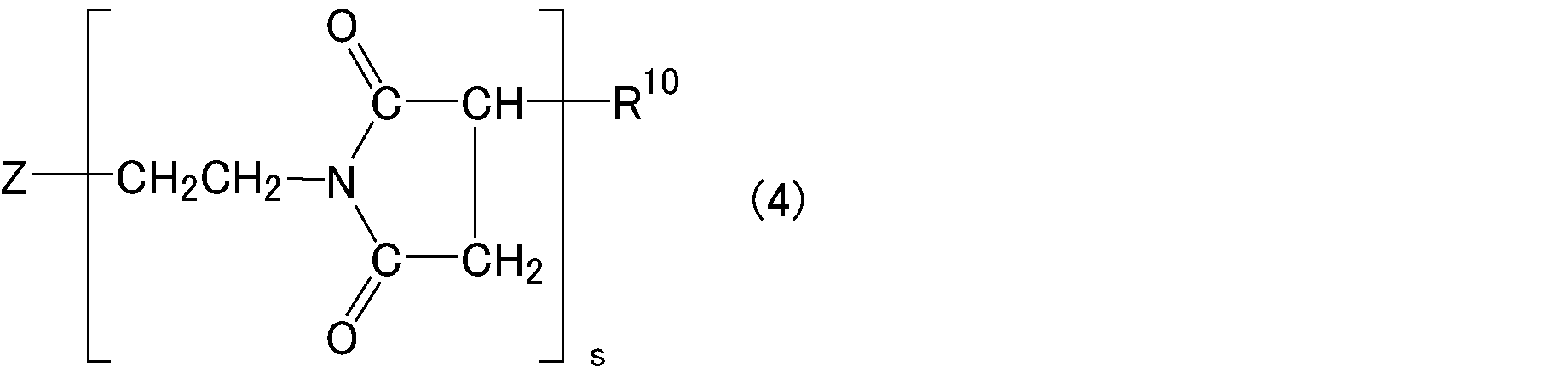
- the viscosity index improver of the present invention further contains a (co) polymer (B) represented by the following general formula (4) in addition to the copolymer (A).
- [Z is a hydrogen atom, a methyl group or a group represented by YX 4 —.
- Y is a hydrogen atom or a (meth) acryloyl group.
- —X 4 — is an alkylene group having 1 to 10 carbon atoms, a group represented by —O—, —O (AO) t — or —NH—
- AO is an alkyleneoxy group having 2 to 4 carbon atoms.
- t is an integer of 1 to 10, and when t is 2 or more, the AOs may be the same or different, and the (AO) t part may be a random bond or a block bond.
- R 10 is a polymer of one or more monomers selected from the group consisting of olefins having 2 to 18 carbon atoms, alkadienes having 4 to 10 carbon atoms and styrene derivatives having 8 to 17 carbon atoms, or polymers thereof are not suitable. When it has a saturated group, a residue obtained by removing one hydrogen atom from a polymer in which part or all of the unsaturated group is hydrogenated; s represents a number of 0 or 1. ]
- the weight ratio (A) / (B) of the copolymer (A) to the (co) polymer (B) is preferably 90/10 to 99.8 / 0.0 from the viewpoint of the effect of improving the viscosity index and productivity. 2, more preferably 91/9 to 99.5 / 0.5, particularly preferably 92/8 to 99/1.
- the lubricating oil composition of the present invention comprises the viscosity index improver of the present invention and a base oil.
- the base oil include one or more base oils selected from the group consisting of API class Group I to IV base oils, GTL base oils, and synthetic lubricating base oils (ester based synthetic base oils). Of these, Group III mineral oils and GTL base oils are preferred.
- the kinematic viscosity at 100 ° C. (measured according to JIS-K2283) of the base oil is preferably 1 to 15 mm 2 / s, more preferably 2 to 5 mm 2 / s from the viewpoint of viscosity index and low temperature fluidity. .
- the viscosity index (measured according to JIS-K2283) of the base oil is preferably 90 or more from the viewpoint of the viscosity index and low temperature fluidity of the lubricating oil composition.
- the cloud point (measured according to JIS-K2269) of the base oil is preferably ⁇ 5 ° C. or lower, more preferably ⁇ 15 ° C. or lower.
- the cloud point of the base oil is within this range, the low temperature viscosity of the lubricating oil composition tends to be good.
- the lubricating oil composition of the present invention preferably contains 0.1 to 20% by weight of the copolymer (A) contained in the viscosity index improver based on the total weight of the lubricating oil composition.
- the lubricating oil composition of the present invention may contain various additives.
- the following are mentioned as an additive.
- Detergent Basic, overbased or neutral metal salts [overbased or alkaline earth metal salts of sulfonates (such as petroleum sulfonates, alkylbenzene sulfonates and alkylnaphthalene sulfonates)], salicylates, phenates, naphthenates , Carbonates, phosphonates and mixtures thereof;
- Dispersant Succinimides (bis- or mono-polybutenyl succinimides), Mannich condensation products and borates, etc .; (3) Antioxidant: Hindered phenols and aromatic secondary amines, etc .;
- Oiliness improver Long chain fatty acids and their esters (such as oleic acid and oleic acid esters), long chain amines and their amides (such as oleylamine and oleylamide), etc .; (5) Pour point
- One of these additives may be added, or two or more additives may be added as necessary. Moreover, what mix
- the content of each of these additives is usually 0.1 to 15% by weight based on the total amount of the lubricating oil composition.
- the total content of each additive is usually 0.1 to 30% by weight, preferably 0.3 to 20% by weight, based on the total amount of the lubricating oil composition.
- the lubricating oil composition of the present invention includes gear oil (differential oil and industrial gear oil, etc.), MTF, transmission oil [ATF, DCTF, belt-CVTF, etc.], traction oil (toroidal-CVTF, etc.), shock absorber oil, It is suitably used for power steering oil, hydraulic oil (such as construction machine hydraulic oil and industrial hydraulic oil).
- ⁇ Production Example 1> A pressure-resistant reaction vessel equipped with a temperature control device and a stirring blade is charged with 500 parts by weight of degassed and dehydrated cyclohexane and 30 parts by weight of 1,3-butadiene, followed by 2 parts by weight of tetrahydrofuran and 1.6 parts by weight of n-butyllithium. Part was added and polymerization was carried out at a polymerization temperature of 70 ° C. After the polymerization rate (conversion rate) reached almost 100%, 4.0 parts by weight of ethylene oxide was added and reacted at 50 ° C. for 3 hours.
- a suspension prepared by previously mixing 5 parts by weight of palladium carbon and 20 parts by weight of tetrahydrofuran was poured therein, and then the reaction was performed at room temperature for 8 hours while supplying hydrogen into the liquid at a flow rate of 30 mL / min. I let you. Thereafter, palladium carbon was removed by filtration, and the resulting filtrate was heated to 70 ° C., and tetrahydrofuran was removed under reduced pressure of the same temperature of 10 to 20 Torr to obtain a hydroxyl group-containing polymer having one terminal hydroxyl group of hydrogenated polybutadiene (Y1-2). Got.
- the molecular weight of the obtained (Y1-2) was measured by GPC. Mw1,420 and Mn1,300 according to measurement condition 1. Mw 2,700, Mn 2,630 according to measurement condition 2.
- ⁇ Production Example 2> A pressure-resistant reaction vessel equipped with a temperature control device and a stirring blade is charged with 500 parts by weight of degassed and dehydrated cyclohexane, 30 parts by weight of 1,3-butadiene and 3.3 parts by weight of styrene, and then 3.8 parts by weight of tetrahydrofuran. Then, 0.75 parts by weight of n-butyllithium was added and polymerization was carried out at a polymerization temperature of 70 ° C. After the polymerization rate (conversion rate) reached almost 100%, 1.9 parts by weight of ethylene oxide was added and reacted at 50 ° C. for 3 hours.
- boron trifluoride diethyl ether complex manufactured by Wako Pure Chemical Industries, Ltd.
- the supernatant was collected with a separatory funnel, and after raising the temperature to 50 ° C., the solvent was removed at the same temperature under reduced pressure (20 Torr or less) over 2 hours, and the hydroborated product (Y ′ 2-1) was obtained.
- the molecular weight of the obtained (Y′2-1) was measured by GPC. Mw1,670 and Mn980 according to measurement condition 1. Mw 2,700, Mn 1,580 according to measurement condition 2.
- boron trifluoride diethyl ether complex manufactured by Wako Pure Chemical Industries, Ltd.
- the supernatant was collected with a separatory funnel, and after raising the temperature to 50 ° C., the solvent was removed at the same temperature under reduced pressure (20 Torr or less) over 2 hours, and the hydroborated product (Y ′ 2-2) was obtained.
- the molecular weight of the obtained (Y′2-2) was measured by GPC. Mw 4,100, Mn 2,300 according to measurement condition 1. Mw 5,500 and Mn 3,430 according to measurement condition 2.
- (Y1-1) and (Y′1-2) were prepared as the polymer obtained in the above production example and the other polymer containing a hydroxyl group at one end.
- copolymers (A-1), (A-3) to (A-9), (A-11) to (A-13), (A'-4), (A'-6) to The SP values of (A′-9), (A′-11), (A′-14) to (A′-17) were calculated by the above method, and Mw was measured by the above method.
- compositions of the monomers (b) to (i) listed in Tables 2 and 3 are as described below.
- Lubricating oil compositions (V-1) to (V-13) having good shear stability (long-term use stability) under a long-term load and comparative lubricating oil compositions (V′-2), ( For V′-3), (V′-5), (V′-10), (V′-15) and (V′-16), shear stability, 40 ° C. kinematic viscosity, 100 ° C. kinematic viscosity, viscosity The index and low temperature viscosity ( ⁇ 40 ° C.) were measured by the following methods. The results are shown in Table 4.
- kinematic viscosity of lubricating oil composition ⁇ Measuring method of kinematic viscosity of lubricating oil composition and calculating method of viscosity index>
- the kinematic viscosities at 40 ° C. and 100 ° C. were measured by the method of ASTM D 445 and calculated by the method of ASTM D 2270.
- the lubricating oil compositions (Examples 14 to 26) containing the viscosity index improver of the present invention are excellent in the balance between shear stability and viscosity index, and at the same time at low temperature. It can be seen that the viscosity is as low as 9,000 mPa ⁇ s or less.
- the shear stability is substantially equivalent, while the viscosity index is greatly improved.
- Example 18 and Comparative Examples 18 and 19 it can be seen that the viscosity index is almost the same, but the shear stability is greatly improved.
- the lubricating oil compositions containing the viscosity index improvers of Comparative Examples 1 to 23 have a poor balance between shear stability and viscosity index, and at least one of low temperature viscosity and shear stability under a long-term load. You can see that one is inferior.
- the lubricating oil composition containing the viscosity index improver of the present invention includes gear oil (differential oil and industrial gear oil, etc.), MTF, transmission oil [ATF, DCTF, belt-CVTF, etc.], traction oil (toroidal). -CVTF, etc.), shock absorber oil, power steering oil, hydraulic oil (such as construction machine hydraulic oil and industrial hydraulic oil).
Landscapes
- Chemical & Material Sciences (AREA)
- Chemical Kinetics & Catalysis (AREA)
- Organic Chemistry (AREA)
- General Chemical & Material Sciences (AREA)
- Oil, Petroleum & Natural Gas (AREA)
- Health & Medical Sciences (AREA)
- Medicinal Chemistry (AREA)
- Polymers & Plastics (AREA)
- Inorganic Chemistry (AREA)
- Lubricants (AREA)
- Addition Polymer Or Copolymer, Post-Treatments, Or Chemical Modifications (AREA)
- Macromonomer-Based Addition Polymer (AREA)
Abstract
Description
そこで省燃費性を改善する手段として、粘度指数向上剤を用いる方法がある。粘度指数が高いと低温での潤滑油の粘性抵抗が低くなり、省燃費性の向上につながる。そのため潤滑油に粘度指数向上剤を添加して粘度の温度依存性を改善する方法が広く行われている。そのような粘度指数向上剤としては、メタクリル酸エステル共重合体(特許文献1)、オレフィン共重合体(特許文献2)、及びマクロモノマー共重合体(特許文献3~8)等が知られている。
しかしながら、上記の潤滑油組成物は、粘度指数向上効果が未だ十分でなく、実用時に長期間の使用によるせん断安定性及び始動時の低温特性が未だ十分でないという問題があった。
すなわち本発明は、下記一般式(1)で表される数平均分子量が800~4,000である単量体(a)を必須構成単量体として含有する共重合体(A)を含む粘度指数向上剤であって、共重合体(A)の溶解性パラメーターの範囲が9.00~9.40である粘度指数向上剤;API分類のグループI~IVの基油、GTL基油及び合成系潤滑油基油からなる群から選ばれる1種以上の基油及びこの粘度指数向上剤を含有する潤滑油組成物であって、潤滑油組成物中の共重合体(A)の含有量が0.1~20重量%である潤滑油組成物である。
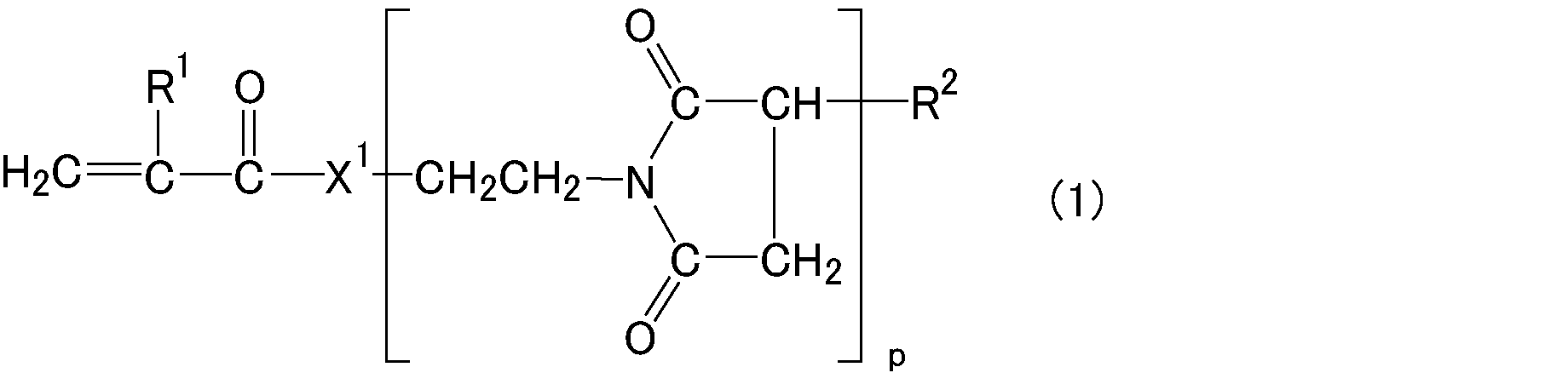
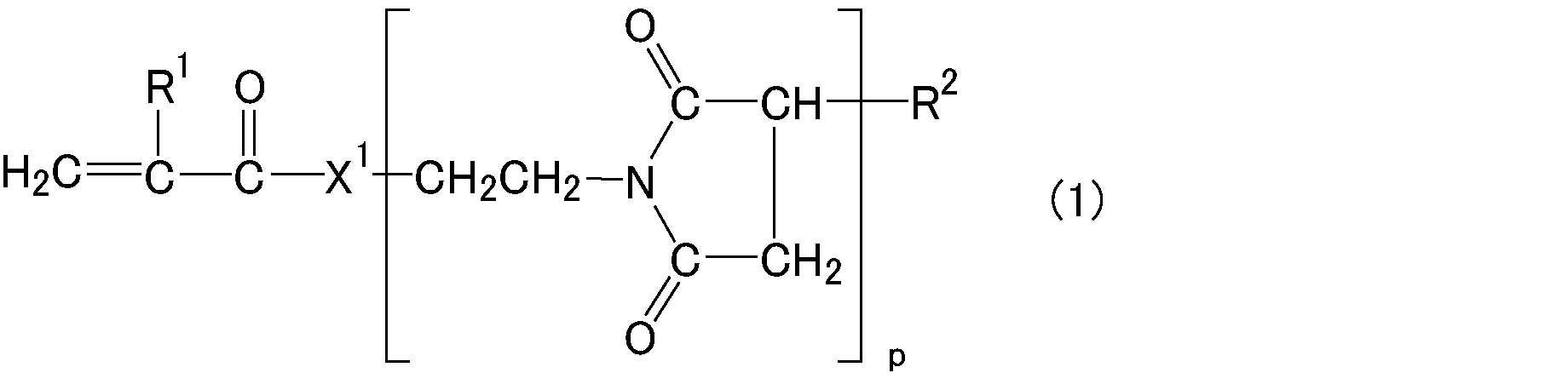
これに対し本発明の粘度指数向上剤は良好な粘度指数向上性とせん断安定性を持ち、長期間のせん断にも耐えることができるものである。
AOは炭素数2~4のアルキレンオキシ基である。
炭素数2~4のアルキレンオキシ基としては、エチレンオキシ基、1,2-又は1,3-プロピレンオキシ基、及び1,2-、1,3-又は1,4-ブチレンオキシ基が挙げられる。
mはアルキレンオキサイドの付加モル数であり、1~10の整数であり、粘度指数向上効果の観点から好ましくは1~4の整数、更に好ましくは1~2の整数である。
mが2以上の場合のAOは同一でも異なっていてもよく、(AO)m部分はランダム結合でもブロック結合でもよい。
-X1-のうち、粘度指数向上効果の観点から好ましいのは、-O-及び-O(AO)m-で表される基であり、更に好ましくは-O-及び-O(CH2CH2O)1-で表される基である。
R2の構成要素としてはブタジエン以外に、以下の(1)~(3)を構成単量体としてもよい。
(1)脂肪族不飽和炭化水素[炭素数2~36のオレフィン(例えばエチレン、プロピレン、イソブチレン、1-ブテン、2-ブテン、ペンテン、ヘプテン、ジイソブチレン、オクテン、ドデセン、オクタデセン、トリアコセン及びヘキサトリアコセン等)及び炭素数4~36のジエン(例えば、イソプレン、1,4-ペンタジエン、1,5-ヘキサジエン及び1,7-オクタジエン等)等]
(2)脂環式不飽和炭化水素[例えばシクロヘキセン、(ジ)シクロペンタジエン、ピネン、リモネン、インデン、ビニルシクロヘキセン及びエチリデンビシクロヘプテン等]
(3)芳香族基含有不飽和炭化水素(例えばスチレン、α-メチルスチレン、ビニルトルエン、2,4-ジメチルスチレン、エチルスチレン、イソプロピルスチレン、ブチルスチレン、フェニルスチレン、シクロヘキシルスチレン、ベンジルスチレン、クロチルベンゼン、ビニルナフタレン、ジビニルベンゼン、ジビニルトルエン、ジビニルキシレン及びトリビニルベンゼン等)等が挙げられる。
これらによって構成される炭化水素重合体は、ブロック重合体でもランダム重合体であってもよい。また炭化水素重合体が、二重結合を有する場合には、水素添加により、二重結合の一部又は全部を水素化したものであってもよい。
測定条件1と測定条件2は測定温度と基準物質などが異なる。製造例では、測定条件1と測定条件2の測定結果を記載した。
<単量体(a)のMwおよびMnの測定条件1>
装置 :「HLC-8320GPC」[東ソー(株)製]
カラム :「TSKgel GMHXL」[東ソー(株)製]2本
「TSKgel Multipore HXL-M 1本
測定温度 :35℃
試料溶液 :0.25重量%のテトラヒドロフラン溶液
溶液注入量:10.0μl
検出装置 :屈折率検出器
基準物質 :標準1,2-ポリブタジエン
5点(分子量:1,200、2,200、3,200、5,600、12,000、20,000)[PSS社製]
<単量体(a)のMwおよびMnの測定条件2>
装置 :「HLC-8320GPC」[東ソー(株)製]
カラム :「TSKgel GMHXL」[東ソー(株)製]2本
「TSKgel Multipore HXL-M 1本
測定温度 :40℃
試料溶液 :0.25重量%のテトラヒドロフラン溶液
溶液注入量:10.0μl
検出装置 :屈折率検出器
基準物質 :標準ポリスチレン(TS 基準物質 :標準ポリスチレン(TSKstandard POLYSTYRENE)
12点(分子量:589、1,050、2,630、9,100、19,500、37,900、96,400、190,000、355,000、1,090,000、2,110,000、4,480,000)[東ソー(株)製]
繰返し単位1個当たりの共重合体セグメントの分子量=M×A/a (1)
なお、共重合体(A)を構成する単量体(a)が2種類以上ある場合のMは、単量体(a)それぞれの重量平均分子量の重量比率による相加平均である。
また、共重合体(A)を構成する単量体(a)が2種類以上ある場合のaはすべての単量体(a)の合計重量を表す。
ここでいう単量体(a)のMwは、前述のGPC測定条件1で測定される値を意味する。
(共)重合体(Y)のSP値も前記の方法で算出することができる。(共)重合体(Y)のSP値は、使用する単量体のSP値、モル分率を適宜調整することにより所望の範囲にすることができる。
アルキレンオキサイド付加物(Y1);不飽和炭化水素(x)をイオン重合触媒(ナトリウム触媒等)存在下に重合して得られた(共)重合体に、アルキレンオキサイド(エチレンオキサイド及びプロピレンオキサイド等)を付加して得られたものなど。
ヒドロホウ素化物(Y2);片末端に二重結合を有する不飽和炭化水素(x)の(共)重合体のヒドロホウ素化反応物(例えば米国特許第4,316,973号明細書に記載のもの)など。
無水マレイン酸-エン-アミノアルコール付加物(Y3);片末端に二重結合を有する不飽和炭化水素(x)の(共)重合体と無水マレイン酸とのエン反応で得られた反応物を、アミノアルコールでイミド化して得られたものなど。
ヒドロホルミル-水素化物(Y4);片末端に二重結合を有する不飽和炭化水素(x)の(共)重合体をヒドロホルミル化し、次いで水素化反応して得られたもの(例えば特開昭63-175096号公報に記載のもの)など。
これらの片末端に水酸基を含有する(共)重合体(Y)のうち好ましいのは、アルキレンオキサイド付加物(Y1)、ヒドロホウ素化物(Y2)及び無水マレイン酸-エン-アミノアルコール付加物(Y3)であり、更に好ましいのは、アルキレンオキサイド付加物(Y1)である。
単量体(a)の割合が10%未満の場合は、溶解性と長期使用安定性に劣る傾向にあり、単量体(a)の割合が50%を超える場合は、粘度指数向上効果に劣る傾向がある。
(b)のうち好ましいのは、(メタ)アクリル酸メチル、(メタ)アクリル酸エチル及び(メタ)アクリル酸ブチルであり、特に好ましいのは(メタ)アクリル酸エチル及び(メタ)アクリル酸ブチルである。

qが2以上の場合のR4Oは同一でも異なっていてもよく、(R4O)q部分はランダム結合でもブロック結合でもよい。
炭素数1~8のアルキル基のうち、粘度指数の観点から好ましいのは、炭素数1~8のアルキル基であり、更に好ましいのは炭素数1~6のアルキル基、特に好ましいのは炭素数1~5のアルキル基、最も好ましいのは炭素数2又は4のアルキル基である。
単量体(c)のうち、粘度指数向上効果の観点から好ましいのは、エトキシエチル(メタ)アクリレート、ブトキシエチル(メタ)アクリレートである。
単量体(d)のうち好ましいのは、炭素数12~28の直鎖アルキル基を有する(メタ)アクリル酸アルキルエステルであり、更に好ましいのは炭素数12~24の直鎖アルキル基を有する(メタ)アクリル酸エステルであり、特に好ましいのは炭素数12~20の直鎖アルキル基を有する(メタ)アクリル酸エステルである。
単量体(d)は2種類以上を合わせて用いてもよい。

rが2以上の場合は、R7Oは同一でも異なっていてもよく、(R7O)r部分はランダム結合でもブロック結合でもよい。
炭素数4~24の直鎖アルキル基のうち、粘度指数の観点から好ましいのは、炭素数6~24の直鎖アルキル基であり、更に好ましいのは炭素数6~20の直鎖アルキル基、特に好ましいのは炭素数8~16の直鎖アルキル基である。
炭素数12~36の分岐アルキル基は、一般式(3)におけるR8、R9を含む部分で構成されるアルキル基である。
単量体(e)の具体例としては、(メタ)アクリル酸2-オクチルデシル、エチレングリコールモノ-2-オクチルペンタデシルエーテルと(メタ)アクリル酸とのエステル、(メタ)アクリル酸2-オクチルドデシル、(メタ)アクリル酸2-デシルテトラデシル、(メタ)アクリル酸2-ドデシルヘキサデシル、(メタ)アクリル酸2-テトラデシルオクタデシル、(メタ)アクリル酸2-ドデシルペンタデシル、(メタ)アクリル酸2-テトラデシルヘプタデシル、(メタ)アクリル酸2-ヘキサデシルヘプタデシル、(メタ)アクリル酸2-ヘプタデシルイコシル、(メタ)アクリル酸2-ヘキサデシルドコシル、(メタ)アクリル酸2-エイコシルドコシル、(メタ)アクリル酸2-テトラコシルヘキサコシル及びN-2-オクチルデシル(メタ)アクリルアミド等が挙げられる。
単量体(e)は2種類以上を合わせて用いてもよい。
(メタ)アクリルアミド、モノアルキル(メタ)アクリルアミド[窒素原子に炭素数1~4のアルキル基が1つ結合したもの;例えばN-メチル(メタ)アクリルアミド、N-エチル(メタ)アクリルアミド、N-イソプロピル(メタ)アクリルアミド及びN-n-又はイソブチル(メタ)アクリルアミド等]、N-(N’-モノアルキルアミノアルキル)(メタ)アクリルアミド[窒素原子に炭素数1~4のアルキル基が1つ結合したアミノアルキル基(炭素数2~6)を有するもの;例えばN-(N’-メチルアミノエチル)(メタ)アクリルアミド、N-(N’-エチルアミノエチル)(メタ)アクリルアミド、N-(N’-イソプロピルアミノ-n-ブチル)(メタ)アクリルアミド及びN-(N’-n-又はイソブチルアミノ-n-ブチル)(メタ)アクリルアミド等]、ジアルキル(メタ)アクリルアミド[窒素原子に炭素数1~4のアルキル基が2つ結合したもの;例えばN,N-ジメチル(メタ)アクリルアミド、N,N-ジエチル(メタ)アクリルアミド、N,N-ジイソプロピル(メタ)アクリルアミド及びN,N-ジ-n-ブチル(メタ)アクリルアミド等]、N-(N’,N’-ジアルキルアミノアルキル)(メタ)アクリルアミド[アミノアルキル基の窒素原子に炭素数1~4のアルキル基が2つ結合したアミノアルキル基(炭素数2~6)を有するもの;例えばN-(N’,N’-ジメチルアミノエチル)(メタ)アクリルアミド、N-(N’,N’-ジエチルアミノエチル)(メタ)アクリルアミド、N-(N’,N’-ジメチルアミノプロピル)(メタ)アクリルアミド及びN-(N’,N’-ジ-n-ブチルアミノブチル)(メタ)アクリルアミド等];N-ビニルカルボン酸アミド[N-ビニルホルムアミド、N-ビニルアセトアミド、N-ビニル-n-又はイソプロピオン酸アミド及びN-ビニルヒドロキシアセトアミド等]等が挙げられる。
4-ニトロスチレン等が挙げられる。
1級アミノ基含有単量体{炭素数3~6のアルケニルアミン[(メタ)アリルアミン及びクロチルアミン等]、アミノアルキル(炭素数2~6)(メタ)アクリレート[アミノエチル(メタ)アクリレート等]};2級アミノ基含有単量体{モノアルキルアミノアルキル(メタ)アクリレート[窒素原子に炭素数1~6のアルキル基が1つ結合したアミノアルキル基(炭素数2~6)を有するもの;例えばN-t-ブチルアミノエチル(メタ)アクリレート及びN-メチルアミノエチル(メタ)アクリレート等]、炭素数6~12のジアルケニルアミン[ジ(メタ)アリルアミン等]};3級アミノ基含有単量体{ジアルキルアミノアルキル(メタ)アクリレート[窒素原子に炭素数1~6のアルキル基が2つ結合したアミノアルキル基(炭素数2~6)を有するもの;例えばN,N-ジメチルアミノエチル(メタ)アクリレート及びN,N-ジエチルアミノエチル(メタ)アクリレート等]、窒素原子を有する脂環式(メタ)アクリレート[モルホリノエチル(メタ)アクリレート等]、芳香族系単量体[N-(N’,N’-ジフェニルアミノエチル)(メタ)アクリルアミド、N,N-ジメチルアミノスチレン、4-ビニルピリジン、2-ビニルピリジン、N-ビニルピロール、N-ビニルピロリドン及びN-ビニルチオピロリドン等]}、及びこれらの塩酸塩、硫酸塩、リン酸塩又は低級アルキル(炭素数1~8)モノカルボン酸(酢酸及びプロピオン酸等)塩等が挙げられる。
(メタ)アクリロニトリル等が挙げられる。
水酸基含有芳香族単量体(p-ヒドロキシスチレン等)、ヒドロキシアルキル(炭素数2~6)(メタ)アクリレート[2-ヒドロキシエチル(メタ)アクリレート、及び2-又は3-ヒドロキシプロピル(メタ)アクリレート等]、モノ-又はビス-ヒドロキシアルキル(炭素数1~4)置換(メタ)アクリルアミド[N,N-ビス(ヒドロキシメチル)(メタ)アクリルアミド、N,N-ビス(ヒドロキシプロピル)(メタ)アクリルアミド、N,N-ビス(2-ヒドロキシブチル)(メタ)アクリルアミド等]、ビニルアルコール、炭素数3~12のアルケノール[(メタ)アリルアルコール、クロチルアルコール、イソクロチルアルコール、1-オクテノール及び1-ウンデセノール等]、炭素数4~12のアルケンモノオール又はアルケンジオール[1-ブテン-3-オール、2-ブテン-1-オール及び2-ブテン-1,4-ジオール等]、ヒドロキシアルキル(炭素数1~6)アルケニル(炭素数3~10)エーテル(2-ヒドロキシエチルプロペニルエーテル等)、多価(3~8価)アルコール(グリセリン、ペンタエリスリトール、ソルビトール、ソルビタン、ジグリセリン、糖類及び蔗糖等)のアルケニル(炭素数3~10)エーテル又は(メタ)アクリレート[蔗糖(メタ)アリルエーテル等]等;
ポリオキシアルキレングリコール(アルキレン基の炭素数2~4、重合度2~50)、ポリオキシアルキレンポリオール[上記3~8価のアルコールのポリオキシアルキレンエーテル(アルキレン基の炭素数2~4、重合度2~100)]、ポリオキシアルキレングリコール又はポリオキシアルキレンポリオールのアルキル(炭素数1~4)エーテルのモノ(メタ)アクリレート[ポリエチレングリコール(Mn:100~300)モノ(メタ)アクリレート、ポリプロピレングリコール(Mn:130~500)モノ(メタ)アクリレート、メトキシポリエチレングリコール(Mn:110~310)(メタ)アクリレート、ラウリルアルコールエチレンオキサイド付加物(2~30モル)(メタ)アクリレート及びモノ(メタ)アクリル酸ポリオキシエチレン(Mn:150~230)ソルビタン等]等;が挙げられる。
(メタ)アクリロイロキシアルキル(炭素数2~4)リン酸エステル[(メタ)アクリロイロキシエチルホスフェート及び(メタ)アクリロイロキシイソプロピルホスフェート]及びリン酸アルケニルエステル[リン酸ビニル、リン酸アリル、リン酸プロペニル、リン酸イソプロペニル、リン酸ブテニル、リン酸ペンテニル、リン酸オクテニル、リン酸デセニル及びリン酸ドデセニル等]等が挙げられる。なお、「(メタ)アクリロイロキシ」は、アクリロイロキシ又はメタクリロイロキシを意味する。
(メタ)アクリロイロキシアルキル(炭素数2~4)ホスホン酸[(メタ)アクリロイロキシエチルホスホン酸等]及びアルケニル(炭素数2~12)ホスホン酸[ビニルホスホン酸、アリルホスホン酸及びオクテニルホスホン酸等]等が挙げられる。
スチレン、α-メチルスチレン、ビニルトルエン、2,4-ジメチルスチレン、4-エチルスチレン、4-イソプロピルスチレン、4-ブチルスチレン、4-フェニルスチレン、4-シクロヘキシルスチレン、4-ベンジルスチレン、4-クロチルベンゼン、インデン及び2-ビニルナフタレン等が挙げられる。
炭素数2~12の飽和脂肪酸のビニルエステル(酢酸ビニル、プロピオン酸ビニル、酪酸ビニル及びオクタン酸ビニル等)、炭素数1~12のアルキル、アリール又はアルコキシアルキルビニルエーテル(メチルビニルエーテル、エチルビニルエーテル、プロピルビニルエーテル、ブチルビニルエーテル、2-エチルヘキシルビニルエーテル、フェニルビニルエーテル、ビニル-2-メトキシエチルエーテル及びビニル-2-ブトキシエチルエーテル等)及び炭素数1~8のアルキル又はアリールビニルケトン(メチルビニルケトン、エチルビニルケトン及びフェニルビニルケトン等)等が挙げられる。
グリシジル(メタ)アクリレート及びグリシジル(メタ)アリルエーテル等が挙げられる。
塩化ビニル、臭化ビニル、塩化ビニリデン、塩化(メタ)アリル及びハロゲン化スチレン(ジクロロスチレン等)等が挙げられる。
不飽和ポリカルボン酸のアルキル、シクロアルキル又はアラルキルエステル[不飽和ジカルボン酸(マレイン酸、フマール酸及びイタコン酸等)の炭素数1~8のアルキルジエステル(ジメチルマレエート、ジメチルフマレート、ジエチルマレエート及びジオクチルマレエート)]等が挙げられる。
共重合体(A)のMwは、粘度指数向上効果及び潤滑油組成物のせん断安定性の観点から、好ましくは5,000~2,000,000であり、より好ましくは5,000~300,000であり、更に好ましくは10,000~250,000、特に好ましくは15,000~220,000、最も好ましくは30,000~200,000である。
Mwが5,000未満の場合には粘度温度特性の向上効果や粘度指数向上効果が小さい。また粘度指数向上剤の添加量が増えるため、コスト面でも不利になる恐れがある。Mwが2,000,000を超える場合にはせん断安定性が悪化する傾向がある。
Mnが2,500未満の場合には粘度温度特性の向上効果や粘度指数向上効果が小さい。また粘度指数向上剤の添加量が増えるため、コスト面でも不利になる恐れがある。Mnが100,000を超える場合にはせん断安定性が悪化する傾向がある。
装置 :「HLC-8320GPC」[東ソー(株)製]
カラム :「TSKgel GMHXL」[東ソー(株)製]2本
「TSKgel Multipore HXL-M 1本
測定温度 :40℃
試料溶液 :0.25重量%のテトラヒドロフラン溶液
溶液注入量:10.0μl
検出装置 :屈折率検出器
基準物質 :標準ポリスチレン(TS 基準物質 :標準ポリスチレン(TSKstandard POLYSTYRENE)
12点(分子量:589、1,050、2,630、9,100、19,500、37,900、96,400、190,000、355,000、1,090,000、2,110,000、4,480,000)[東ソー(株)製]
<共重合体(A)のMw、Mnの測定条件2>
装置 :「HLC-8320GPC」[東ソー(株)製]
カラム :「TSKgel GMHXL」[東ソー(株)製]2本
「TSKgel Multipore HXL-M 1本
測定温度 :40℃
試料溶液 :0.25重量%のテトラヒドロフラン溶液
溶液注入量:10.0μl
検出装置 :屈折率検出器
基準物質 :標準ポリメチルメタクリレート
12点(分子量:589、1,050、2,630、9,100、19,500、37,900、96,400、190,000、355,000、1,090,000、2,110,000、4,480,000)
共重合体(A)を構成する単量体(c)の割合は、粘度指数向上効果の観点から、共重合体(A)の重量に基づいて、好ましくは0~60重量%であり、更に好ましくは1~50重量%、特に好ましくは5~40重量%である。
共重合体(A)を構成する単量体(d)の割合は、粘度指数向上効果の観点から、共重合体(A)の重量に基づいて、好ましくは0~40重量%であり、更に好ましくは1~30重量%、特に好ましくは3~20重量%である。
共重合体(A)を構成する単量体(e)の割合は、粘度指数向上効果の観点から、共重合体(A)の重量に基づいて、好ましくは0~40重量%であり、更に好ましくは1~30重量%、特に好ましくは3~20重量%である。
溶剤としては、トルエン、キシレン、炭素数9~10のアルキルベンゼン、メチルエチルケトン、鉱物油、合成油等及びこれらの混合物が挙げられる。
重合触媒としては、アゾ系触媒(2,2’-アゾビス(2-メチルブチロニトリル)及び2,2’-アゾビス(2,4-ジメチルバレロニトリル)等)、過酸化物系触媒(ベンゾイルパーオキサイド、クミルパーオキサイド及びラウリルパーオキサイド等)及びレドックス系触媒(ベンゾイルパーオキサイドと3級アミンの混合物等)が挙げられる。更に分子量調整のために必要により、公知の連鎖移動剤(炭素数2~20のアルキルメルカプタン等)を使用することもできる。
重合温度は、好ましくは25~140℃であり、更に好ましくは50~120℃である。また、上記の溶液重合の他に、塊状重合、乳化重合又は懸濁重合により共重合体(A)を得ることができる。
共重合体(A)の重合形態としては、ランダム付加重合体又は交互共重合体のいずれでもよく、また、グラフト共重合体又はブロック共重合体のいずれでもよい。
(1)清浄剤:
塩基性、過塩基性又は中性の金属塩[スルフォネート(石油スルフォネート、アルキルベンゼンスルフォネート及びアルキルナフタレンスルフォネート等)の過塩基性又はアルカリ土類金属塩等]、サリシレート類、フェネート類、ナフテネート類、カーボネート類、フォスフォネート類及びこれらの混合物;
(2)分散剤:
コハク酸イミド類(ビス-又はモノ-ポリブテニルコハク酸イミド類)、マンニッヒ縮合物及びボレート類等;
(3)酸化防止剤:
ヒンダードフェノール類及び芳香族2級アミン類等;
(4)油性向上剤:
長鎖脂肪酸及びそれらのエステル(オレイン酸及びオレイン酸エステル等)、長鎖アミン及びそれらのアミド(オレイルアミン及びオレイルアミド等)等;
(5)流動点降下剤
ポリアルキルメタクリレート、エチレン-酢酸ビニル共重合体等;
(6)摩擦摩耗調整剤:
モリブデン系及び亜鉛系化合物(モリブデンジチオフォスフェート、モリブデンジチオカーバメート及びジンクジアルキルジチオフォスフェート等)等;
(7)極圧剤:
硫黄系化合物(モノ又はジスルフィド、スルフォキシド及び硫黄フォスファイド化合物)、フォスファイド化合物及び塩素系化合物(塩素化パラフィン等)等;
(8)消泡剤:
シリコン油、金属石けん、脂肪酸エステル及びフォスフェート化合物等;
(9)抗乳化剤:
4級アンモニウム塩(テトラアルキルアンモニウム塩等)、硫酸化油及びフォスフェート(ポリオキシエチレン含有非イオン性界面活性剤のフォスフェート等)、炭化水素系溶剤(トルエン、キシレン、エチルベンゼン)等;
(10)金属不活性剤
窒素原子含有化合物(ベンゾトリアゾール等)、窒素原子含有キレート化合物(N,N’-ジサリチデン-1,2-ジアミノプロパン等)、窒素・硫黄原子含有化合物(2-(n-ドデシルチオ)ベンズイミダゾール等)等;
(11)腐食防止剤:
窒素原子含有化合物(ベンゾトリアゾール及び1,3,4-チオジアゾリル-2,5-ビスジアルキルジチオカーバメート等)等。
これらの添加剤のそれぞれの含有量は潤滑油組成物全量を基準として通常0.1~15重量%である。また各添加剤を合計した含有量は潤滑油組成物全量を基準として通常0.1~30重量%、好ましくは0.3~20重量%である。
温度調節装置、撹拌翼を備えた耐圧反応容器に、脱気・脱水したシクロヘキサン500重量部、1,3-ブタジエン30重量部を仕込んだ後、テトラヒドロフラン2重量部、n-ブチルリチウム1.6重量部を加え、重合温度を70℃とし重合させた。
重合率(転化率)がほぼ100%となった後、エチレンオキサイド4.0重量部を添加して、50℃で3時間反応させた。反応を停止するために水100重量部と1N塩酸水溶液25重量部を加えて、80℃で1時間撹拌した。反応溶液の有機相を分液ロートにて回収し、70℃に昇温後、同温度10~20Torrの減圧下で溶媒を2時間かけて除去した。
得られた片末端水酸基含有のポリブタジエンを、温度調節装置、撹拌翼、水素導入管及び流出口を備えた反応容器に移し入れ、テトラヒドロフラン80重量部を加えて撹拌し、均一に溶解させた。そこにパラジウム炭素5重量部とテトラヒドロフラン20重量部をあらかじめ混合した懸濁液を注ぎ入れた後、水素導入管よりの30mL/分の流量で液中に水素を供給しながら、室温で8時間反応させた。その後ろ過でパラジウム炭素を取り除き、得られたろ液を70℃に昇温して、同温度10~20Torrの減圧下でテトラヒドロフランを除去して水素化ポリブタジエンの片末端水酸基含有重合体(Y1-2)を得た。
得られた(Y1-2)の分子量をGPCによって測定した。
測定条件1によるMw1,420、Mn1,300。測定条件2によるMw2,700、Mn2,630。
温度調節装置、撹拌翼を備えた耐圧反応容器に、脱気・脱水したシクロヘキサン500重量部、1,3-ブタジエン30重量部、スチレン3.3重量部を仕込んだ後、テトラヒドロフラン3.8重量部、n-ブチルリチウム0.75重量部を加え、重合温度を70℃とし重合させた。
重合率(転化率)がほぼ100%となった後、エチレンオキサイド1.9重量部を添加して、50℃で3時間反応させた。この後の操作は製造例1と同様に行い、片末端水酸基含有のブタジエン-スチレン共重合体の水素化物(Y1-3)を得た。
得られた(Y1-3)の分子量をGPCによって測定した。測定条件1によるMw3,600、Mn3,040。測定条件2によるMw5,600、Mn4,750。
温度調節装置、撹拌翼を備えた耐圧反応容器に、脱気・脱水したシクロヘキサン500重量部、1,3-ブタジエン30重量部を仕込んだ後、テトラヒドロフラン3.8重量部、n-ブチルリチウム0.41重量部を加え、重合温度を70℃とし重合させた。
重合率(転化率)がほぼ100%となった後、エチレンオキサイド1.0重量部を添加して、50℃で3時間反応させた。この後の操作は製造例1と同様に行い、水素化ポリブタジエンの片末端水酸基含有重合体(Y’1-1)を得た。
得られた(Y’1-1)の分子量をGPCによって測定した。測定条件1によるMw5,200、Mn4,730。測定条件2によるMw7,840、Mn6,840。
温度調節装置、撹拌翼、滴下ロートおよび窒素流入口及び流出口を備えた反応容器に、テトラヒドロフラン400重量部、水素化ホウ素ナトリウム4.1重量部及び2-メチル-2-ブテン10重量部を投入し、窒素気流下、室温で10分間撹拌した後、三フッ化ホウ素ジエチルエーテル錯体[和光純薬(株)製]18.5重量部を滴下し、滴下終了から1時間撹拌した。次いで末端不飽和基含有ポリブテン(商品名;「日油ポリブテン10N」、日油(株)製)100重量部とテトラヒドロフラン200重量部の混合溶液を滴下し、滴下終了から25℃で4時間ヒドロホウ素化を行った。次いで水50重量部を少しずつ加え、その後3N-NaOH水溶液50重量部、30重量%過酸化水素40重量部を投入して室温で2時間撹拌した。分液ロートにて上澄み液を回収し、50℃に昇温後、同温度で減圧下(20Torr以下)溶媒を2時間かけて除去し、片末端不飽和基含有ポリブテンのヒドロホウ素化物(Y’2-1)を得た。
得られた(Y’2-1)の分子量をGPCによって測定した。測定条件1によるMw1,670、Mn980。測定条件2によるMw2,700、Mn1,580。
温度調節装置、撹拌翼、滴下ロートおよび窒素流入口及び流出口を備えた反応容器に、テトラヒドロフラン400重量部、水素化ホウ素ナトリウム4.1重量部及び2-メチル-2-ブテン10重量部を投入し、窒素気流下、室温で10分間撹拌した後、三フッ化ホウ素ジエチルエーテル錯体[和光純薬(株)製]18.5重量部を滴下し、滴下終了から1時間撹拌した。次いで末端不飽和基含有ポリブテン(商品名;「Glissopal2300」、BASF社製)230重量部とテトラヒドロフラン250重量部の混合溶液を滴下し、滴下終了から25℃で4時間ヒドロホウ素化を行った。次いで水50重量部を少しずつ加え、その後3N-NaOH水溶液50重量部、30重量%過酸化水素40重量部を投入して室温で2時間撹拌した。分液ロートにて上澄み液を回収し、50℃に昇温後、同温度で減圧下(20Torr以下)溶媒を2時間かけて除去し、片末端不飽和基含有ポリブテンのヒドロホウ素化物(Y’2-2)を得た。
得られた(Y’2-2)の分子量をGPCによって測定した。測定条件1によるMw4,100、Mn2,300。測定条件2によるMw5,500、Mn3,430。
温度調節装置及び撹拌機を備えたSUS製耐圧反応容器に、片末端不飽和基含有ポリブテン(商品名;「日油ポリブテン200N」、日油(株)製)500重量部及び無水マレイン酸[和光純薬(株)製]18.5重量部を投入し、撹拌下220℃に昇温後、同温度で12時間エン反応を行った。180℃に冷却した後、同温度、減圧下(12Torr以下)で未反応の無水マレイン酸を3時間かけて除去した。次いで25℃まで冷却し、2-アミノエタノール28重量部を投入して、撹拌下130℃に昇温後、同温度で4時間イミド化反応を行った。120~130℃で減圧下(12Torr以下)未反応の2-アミノエタノールを2時間かけて除去し、片末端不飽和基含有ポリブテンの無水マレイン酸-エン-アミノアルコール付加物(Y’3-1)を得た。
得られた(Y’3-1)の分子量をGPCによって測定した。測定条件1によるMw6,800、Mn3,030。測定条件2によるMw11,150、Mn4,740。
(Y1-1):水素化ポリブタジエンの片末端水酸基含有重合体(商品名;HLBHP1500、Cray Valley社製)、Mw=1,800、Mn=1,670、1,2-付加体/1,4-付加体のモル比率=65/35
(Y1-2):製造例1で得た水素化ポリブタジエンの片末端水酸基含有重合体、Mw=1,420、Mn=1,300、1、2―付加体/1、4-付加体のモル比率=40/60
(Y1-3):製造例2で得た片末端水酸基含有のブタジエン-スチレン共重合体の水素化物、Mw=3,600、Mn=3,040、1、2-付加体/1、4-付加体のモル比率=60/40
(Y’1-1):製造例3で得た水素化ポリブタジエンの片末端水酸基含有重合体、Mw=5,200、Mn=4,730、1,2-付加体/1,4-付加体のモル比率=60/40
(Y’1-2):水素化ポリブタジエンの片末端水酸基含有重合体(商品名;KrasolHLBH-5000M、Cray Valley社製)、Mw=5,370、Mn=5,190、1,2-付加体/1,4-付加体のモル比率=65/35
(Y’2-1):製造例4で得た片末端不飽和基含有ポリブテンのヒドロホウ素化物、Mw=1,670、Mn=980
(Y’2-2):製造例5で得た片末端不飽和基含有ポリブテンのヒドロホウ素化物、Mw=4,100、Mn=2,300
(Y’3-1):製造例6で得た片末端不飽和基含有ポリブテンの無水マレイン酸-エン-アミノアルコール付加物、Mw=6,800、Mn=3,030
なお、(a’-3)としては市販品を準備した。
(a-1):(Y1-1)のメタクリル酸エステル化物、Mw=1,860、Mn=1,720
(a-2):(Y1-2)のメタクリル酸エステル化物、Mw=1,490、Mn=1,360
(a-3):(Y1-3)のメタクリル酸エステル化物、Mw=3,670、Mn=3,100
(a’-1):(Y’1-1)のメタクリル酸エステル化物、Mw=5,300、Mn=4,800
(a’-2):(Y’1-2)のメタクリル酸エステル化物、Mw=5,410、Mn=5,230
(a’-3):片末端水酸基含有の水素化ポリブタジエンのメタクリル酸エステル化物(商品名:L-1253、クラレ社製)、Mw=4,400、Mn=4,200、1,2-付加/1,4-付加モル比率=50/50
(a’-4):(Y’2-1)のメタクリル酸エステル化物、Mw=1,740、Mn=1,050
(a’-5):(Y’2-2)のメタクリル酸エステル化物、Mw=4,160、Mn=2,350
(a’-6):(Y’3-1)のメタクリル酸エステル化物、Mw=6,900、Mn=3,100
上記(a-1)~(a-3)及び(a’-1)~(a’-6)の分子量につき、表1にまとめて示した。

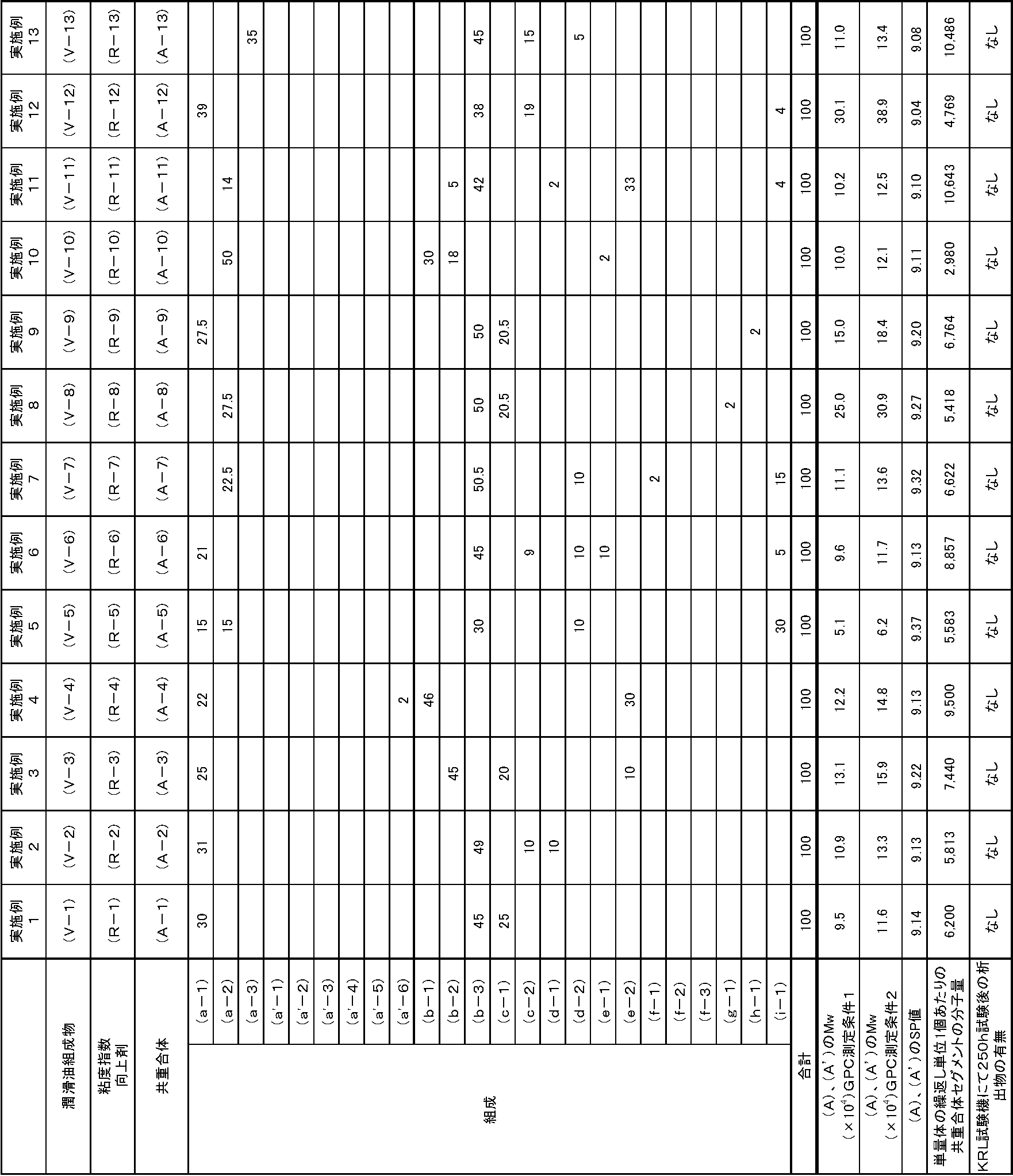
撹拌装置、加熱冷却装置、温度計、滴下ロート、窒素導入管及び減圧装置を備えた反応容器に、基油A(SP値:8.3(cal/cm3)1/2、100℃の動粘度:2.5mm2/s、粘度指数:96)100重量部を投入し、別のガラス製ビーカーに、表2、3記載の単量体、連鎖移動剤としてのドデシルメルカプタン、t-ブチルベンゾイルペルオキシド0.25重量部を投入し、20℃で撹拌、混合して単量体溶液を調製し、滴下ロートに投入した。反応容器の気相部の窒素置換を行った後、密閉下系内温度を100~110℃に保ちながら、3時間かけて単量体溶液を滴下し、滴下終了から3時間、110℃で熟成した後、120~130℃に昇温後、同温度で減圧下(0.027~0.040MPa)未反応の単量体を2時間かけて除去し、共重合体(A-1)、(A-3)~(A-9)、(A-11)~(A-13)、(A’-4)、(A’-6)~(A’-9)、(A’-11)、(A’-14)~(A’-17)を含有する粘度指数向上剤(R-1)、(R-3)~(R-9)、(R-11)~(R-13)、(R’-4)、(R’-6)~(R’-9)、(R’-11)、(R’-14)~(R’-17)を得た。
得られた共重合体(A-1)、(A-3)~(A-9)、(A-11)~(A-13)、(A’-4)、(A’-6)~(A’-9)、(A’-11)、(A’-14)~(A’-17)のSP値を上記の方法で計算し、Mwを上記の方法で測定した。
撹拌装置、加熱冷却装置、温度計、滴下ロート、窒素導入管及び減圧装置を備えた反応容器に、基油A(SP値:8.3(cal/cm3)1/2、100℃の動粘度:2.5mm2/s、粘度指数:96)100重量部を投入し、別のガラス製ビーカーに、表2、3記載の単量体、連鎖移動剤としてのドデシルメルカプタン、2,2’-アゾビス(2,4-ジメチルバレロニトリル)0.5重量部及び2,2’-アゾビス(2-メチルブチロニトリル)0.2重量部を投入し、20℃で撹拌、混合して単量体溶液を調製し、滴下ロートに投入した。反応容器の気相部の窒素置換を行った後、密閉下系内温度を70~85℃に保ちながら、2時間かけて単量体溶液を滴下し、滴下終了から2時間、85℃で熟成した後、120~130℃に昇温後、同温度で減圧下(0.027~0.040MPa)未反応の単量体を2時間かけて除去し、共重合体(A-2)、(A-10)、(A’-1)~(A’-3)、(A’-5)、(A’-10)、(A’-12)、(A’-13)を含有する粘度指数向上剤(R-2)、(R-10)、(R’-1)~(R’-3)、(R’-5)、(R’-10)、(R’-12)、(R’-13)を得た。
得られた共重合体(A-2)、(A-10)、(A’-1)~(A’-3)、(A’-5)、(A’-10)、(A’-12)、(A’-13)のSP値を上記の方法で計算し、Mwを上記の方法で測定した。
撹拌装置を備えたステンレス製容器に、SKルブリカンツ社製YUBASE-3(SP値:8.3(cal/cm3)1/2、100℃の動粘度:3.1mm2/s、粘度指数:106)を投入し、得られる潤滑油組成物の100℃動粘度が5.40±0.02(mm2/s)になるように、それぞれ粘度指数向上剤(R-1)~(R-13)、(R’-1)~(R’-17)を添加し、潤滑油組成物(V-1)~(V-13)、(V’-1)~(V’-17)を得た。
得られた潤滑油組成物(V-1)~(V-13)、(V’-1)~(V’-17)に対し、CEC L-45-99の方法により250時間のせん断試験を行った。せん断試験の後、それぞれの潤滑油組成物の外観を確認し、析出物の生成の有無を測定し結果を表2、3に記載した。この方法により長期負荷下でのせん断安定性(長期使用安定性)を評価した。
表2、3に記載の単量体(b)~(i)の組成は、以下に記載した通りである。
(b-1):メタクリル酸メチル
(b-2):メタクリル酸エチル
(b-3):メタクリル酸ブチル
(c-1):エトキシエチル(メタ)アクリレート
(c-2):ブトキシエチル(メタ)アクリレート
(d-1):メタクリル酸n-ドデシル
(d-2):メタクリル酸n-ヘキサデシルとメタクリル酸n-オクタデシルとの重量比7/3の混合物
(e-1):メタクリル酸2-n-デシルテトラデシル
(e-2):メタクリル酸2-n-ドデシルヘキサデシルとメタクリル酸2-n-テトラデシルオクタデシルとの重量比1/1混合物
(f-1):N,N-ジメチルアミノエチルメタクリレート
(f-2):N-(N’,N’-ジメチルアミノプロピル)メタクリルアミド
(f-3):N-ビニルピロリドン
(g-1):2-ヒドロキシエチルメタクリレート
(h-1):メタクリロイロキシエチルホスフェート
(i-1):スチレン

長期負荷下でのせん断安定性(長期使用安定性)が良好であった潤滑油組成物(V-1)~(V-13)と、比較の潤滑油組成物(V’-2)、(V’-3)、(V’-5)、(V’-10)、(V’-15)及び(V’-16)について、せん断安定性、40℃動粘度、100℃動粘度、粘度指数、低温粘度(-40℃)を以下の方法で測定した。結果を表4に示す。

ASTM D 445の方法で40℃と100℃の動粘度を測定し、ASTM D 2270の方法で計算した。
せん断安定性の計算はJASO M347-2007の方法で計算した。
ASTM D 2983の方法により、-40℃で測定した。
一方、比較例1~23の粘度指数向上剤を含有してなる潤滑油組成物は、せん断安定性と粘度指数のバランスが悪く、低温粘度、長期負荷下でのせん断安定性のうち、少なくとも1つが劣ることがわかる。
Claims (13)
- 下記一般式(1)で表される数平均分子量が800~4,000である単量体(a)を必須構成単量体として含有する共重合体(A)を含む粘度指数向上剤であって、共重合体(A)の溶解性パラメーターの範囲が9.00~9.40である粘度指数向上剤。

[R1は水素原子又はメチル基;-X1-は-O-、-O(AO)m-又は-NH-で表される基であって、AOは炭素数2~4のアルキレンオキシ基であり、mは1~10の整数であり、mが2以上の場合のAOは同一でも異なっていてもよく、(AO)m部分はランダム結合でもブロック結合でもよい;R2はブタジエンを必須構成単量体とし、R2の重量に基づいてブタジエンの比率が50重量%以上である炭化水素重合体又はその炭化水素重合体の少なくとも一部が水素化された重合体から水素原子を1つ除いた残基;pは0又は1の数を表す。] - 下記計算式(1)で算出される単量体(a)の繰返し単位1個当たりの共重合体セグメントの分子量が2,500~11,000である請求項1に記載の粘度指数向上剤。
繰返し単位1個当たりの共重合体セグメントの分子量=M×A/a (1)
但し、Mは単量体(a)の重量平均分子量、aは共重合体(A)を構成する単量体(a)の合計重量、Aは共重合体(A)を構成する全ての単量体の合計重量を表す。 - 一般式(1)中のR2の一部または全量を構成するブタジエン由来の構造において1,2-付加体/1,4-付加体のモル比率が5/95~95/5である請求項1または2に記載の粘度指数向上剤。
- 共重合体(A)の構成単位として共重合体(A)の重量に基づいて単量体(a)を10~50重量%含有する請求項1~3のいずれかに記載の粘度指数向上剤。
- 共重合体(A)の重量平均分子量が5,000~2,000,000である請求項1~4のいずれかに記載の粘度指数向上剤。
- 共重合体(A)が、さらに炭素数1~4のアルキル基を有する(メタ)アクリル酸アルキルエステル(b)を構成単量体とする共重合体である請求項1~5のいずれかに記載の粘度指数向上剤。
- 共重合体(A)が、さらに下記一般式(2)で表される単量体(c)を構成単量体とする共重合体である請求項1~6のいずれかに記載の粘度指数向上剤。

- 共重合体(A)が、さらに炭素数12~36の直鎖アルキル基を有する(メタ)アクリル酸アルキルエステル(d)及び/又は下記一般式(3)で表される単量体(e)を構成単量体とする共重合体である請求項1~7のいずれかに記載の粘度指数向上剤。

- 共重合体(A)が、構成単量体として共重合体(A)の重量に基づいて単量体(a)を10~50重量%、下記単量体(b)を1~80重量%、下記単量体(c)を0~60重量%、下記単量体(d)を0~40重量%及び下記単量体(e)を0~40重量%含有する共重合体である請求項1~5のいずれかに記載の粘度指数向上剤。
単量体(b):炭素数1~4のアルキル基を有する(メタ)アクリル酸アルキルエステル
単量体(c):下記一般式(2)で表される単量体

単量体(d):炭素数12~36の直鎖アルキル基を有する(メタ)アクリル酸アルキルエステル
単量体(e):下記一般式(3)で表される単量体

- 共重合体(A)が、構成単量体として更に窒素原子含有単量体(f)、水酸基含有単量体(g)、リン原子含有単量体(h)及び芳香環含有ビニル単量体(i)からなる群から選ばれる1種以上を含有してなる共重合体である請求項1~9のいずれかに記載の粘度指数向上剤。
- さらに、下記一般式(4)で表される(共)重合体(B)を含有し、共重合体(A)と(共)重合体(B)との重量比(A)/(B)が90/10~99.8/0.2である請求項1~10のいずれかに記載の粘度指数向上剤。
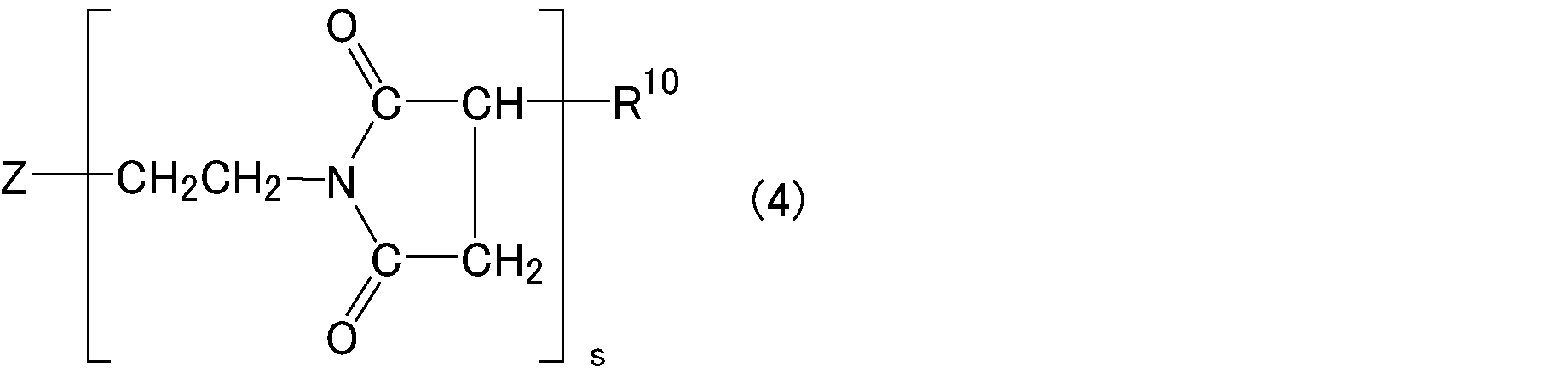
- API分類のグループI~IVの基油、GTL基油及び合成系潤滑油基油からなる群から選ばれる1種以上の基油及び請求項1~11のいずれかに記載の粘度指数向上剤を含有する潤滑油組成物であって、潤滑油組成物中の共重合体(A)の含有量が0.1~20重量%である潤滑油組成物。
- さらに分散剤、清浄剤、酸化防止剤、油性向上剤、流動点降下剤、摩擦摩耗調整剤、極圧剤、消泡剤、抗乳化剤、金属不活性剤及び腐食防止剤からなる群から選ばれる1種以上の添加剤を合計で0.1~30重量%含んでなる請求項12に記載の潤滑油組成物。
Priority Applications (6)
| Application Number | Priority Date | Filing Date | Title |
|---|---|---|---|
| KR1020247012911A KR20240055898A (ko) | 2017-03-23 | 2018-03-22 | 점도 지수 향상제 및 윤활유 조성물 |
| US16/493,389 US11008528B2 (en) | 2017-03-23 | 2018-03-22 | Viscosity index improver and lubricating oil composition |
| KR1020197022635A KR20190124707A (ko) | 2017-03-23 | 2018-03-22 | 점도 지수 향상제 및 윤활유 조성물 |
| CN201880019319.5A CN110462009B (zh) | 2017-03-23 | 2018-03-22 | 粘度指数改进剂和润滑油组合物 |
| EP18772347.3A EP3604487A4 (en) | 2017-03-23 | 2018-03-22 | VISCOSITY INDEX IMPROVEMENT AGENT, AND LUBRICATING OIL COMPOSITION |
| JP2019506987A JP7046916B2 (ja) | 2017-03-23 | 2018-03-22 | 粘度指数向上剤及び潤滑油組成物 |
Applications Claiming Priority (2)
| Application Number | Priority Date | Filing Date | Title |
|---|---|---|---|
| JP2017-057549 | 2017-03-23 | ||
| JP2017057549 | 2017-03-23 |
Publications (1)
| Publication Number | Publication Date |
|---|---|
| WO2018174188A1 true WO2018174188A1 (ja) | 2018-09-27 |
Family
ID=63586027
Family Applications (1)
| Application Number | Title | Priority Date | Filing Date |
|---|---|---|---|
| PCT/JP2018/011496 Ceased WO2018174188A1 (ja) | 2017-03-23 | 2018-03-22 | 粘度指数向上剤及び潤滑油組成物 |
Country Status (6)
| Country | Link |
|---|---|
| US (1) | US11008528B2 (ja) |
| EP (1) | EP3604487A4 (ja) |
| JP (1) | JP7046916B2 (ja) |
| KR (2) | KR20240055898A (ja) |
| CN (1) | CN110462009B (ja) |
| WO (1) | WO2018174188A1 (ja) |
Cited By (8)
| Publication number | Priority date | Publication date | Assignee | Title |
|---|---|---|---|---|
| JP2020105347A (ja) * | 2018-12-27 | 2020-07-09 | Emgルブリカンツ合同会社 | 潤滑油組成物 |
| EP3778839A1 (en) | 2019-08-13 | 2021-02-17 | Evonik Operations GmbH | Viscosity index improver with improved shear-resistance |
| EP3839019A1 (en) * | 2019-12-16 | 2021-06-23 | Infineum International Limited | High viscosity index comb polymer viscosity modifiers and methods of modifying lubricant viscosity using same |
| KR20210144769A (ko) * | 2019-03-20 | 2021-11-30 | 에보니크 오퍼레이션즈 게엠베하 | 연비, 분산력 및 침착 성능을 개선시키기 위한 폴리알킬(메트)아크릴레이트 |
| JP2022022992A (ja) * | 2020-06-22 | 2022-02-07 | 三洋化成工業株式会社 | 粘度指数向上剤及び潤滑油組成物 |
| EP4060009A1 (en) | 2021-03-19 | 2022-09-21 | Evonik Operations GmbH | Viscosity index improver and lubricant compositions thereof |
| WO2023167037A1 (ja) * | 2022-03-02 | 2023-09-07 | 三洋化成工業株式会社 | 粘度指数向上剤組成物及び潤滑油組成物 |
| WO2023238603A1 (ja) * | 2022-06-10 | 2023-12-14 | 三洋化成工業株式会社 | 粘度指数向上剤組成物及び潤滑油組成物 |
Families Citing this family (4)
| Publication number | Priority date | Publication date | Assignee | Title |
|---|---|---|---|---|
| WO2020262088A1 (ja) * | 2019-06-26 | 2020-12-30 | 三洋化成工業株式会社 | 粘度指数向上剤組成物及び潤滑油組成物 |
| CN113651932B (zh) * | 2020-08-26 | 2022-06-24 | 中国石油大学(北京) | 适用于水基钻井液抗高温和强吸附键合润滑剂的嵌段聚合物 |
| US12552889B2 (en) | 2021-06-21 | 2026-02-17 | Sanyo Chemical Industries, Ltd. | Viscosity index improver, refrigerator oil, and working fluid composition for refrigerators |
| FR3126711A1 (fr) * | 2021-09-03 | 2023-03-10 | Totalenergies Marketing Services | Composition lubrifiante présentant des propriétés d’épaississement à froid améliorées |
Citations (16)
| Publication number | Priority date | Publication date | Assignee | Title |
|---|---|---|---|---|
| US4316973A (en) | 1979-09-10 | 1982-02-23 | The University Of Akron | Novel telechelic polymers and processes for the preparation thereof |
| JPS63175096A (ja) | 1987-01-08 | 1988-07-19 | バスフ・アクチェンゲゼルシャフト | 燃料又は潤滑油組成物 |
| GB2270317A (en) | 1992-08-31 | 1994-03-09 | Shell Int Research | Butadiene polymers having terminal functional groups |
| JPH06306130A (ja) * | 1993-04-20 | 1994-11-01 | Roehm Gmbh | くし型ポリマー、これを製造するための高分子及びこれからなる油添加物 |
| WO2001009242A1 (fr) | 1999-07-30 | 2001-02-08 | Sanyo Chemical Industries, Ltd. | Composition de polyol polymere, son procede de production et procede de production de resine polyurethanne |
| JP2005200454A (ja) | 2004-01-13 | 2005-07-28 | Mitsui Chemicals Inc | α−オレフィン(共)重合体とその用途 |
| JP3999307B2 (ja) | 1997-05-07 | 2007-10-31 | 三洋化成工業株式会社 | 低温粘度特性がよい粘度指数向上剤 |
| JP2008546894A (ja) | 2005-07-01 | 2008-12-25 | エボニック ローマックス アディティヴス ゲゼルシャフト ミット ベシュレンクテル ハフツング | 油溶性櫛型ポリマー |
| WO2009007147A1 (de) | 2007-07-09 | 2009-01-15 | Evonik Rohmax Additives Gmbh | Verwendung von kammpolymeren zur verringerung des kraftstoffverbrauchs |
| WO2010051564A1 (en) | 2008-11-03 | 2010-05-06 | Igps Company Llc | System and method for tracking distribution of items |
| WO2010102903A1 (de) | 2009-03-10 | 2010-09-16 | Evonik Rohmax Additives Gmbh | Verwendung von kammpolymeren als antifatigue-additive |
| WO2014170169A1 (de) | 2013-04-18 | 2014-10-23 | Evonik Industries Ag | Getriebeölformulierung zur verringerung des kraftstoffverbrauchs |
| JP2014210844A (ja) * | 2013-04-17 | 2014-11-13 | コスモ石油ルブリカンツ株式会社 | 内燃機関用潤滑油組成物 |
| JP2015007225A (ja) * | 2013-05-27 | 2015-01-15 | 三洋化成工業株式会社 | 粘度指数向上剤及び潤滑油組成物 |
| WO2015129732A1 (ja) | 2014-02-25 | 2015-09-03 | 三洋化成工業株式会社 | 粘度指数向上剤及び潤滑油組成物 |
| JP2016169368A (ja) | 2015-03-12 | 2016-09-23 | 三洋化成工業株式会社 | 潤滑油組成物 |
Family Cites Families (13)
| Publication number | Priority date | Publication date | Assignee | Title |
|---|---|---|---|---|
| US3733537A (en) | 1970-08-17 | 1973-05-15 | Westinghouse Electric Corp | Apparatus for limiting instantaneous inverter current |
| JPH03143996A (ja) | 1989-10-30 | 1991-06-19 | Tonen Corp | 潤滑油組成物 |
| US5637783A (en) * | 1990-01-16 | 1997-06-10 | Mobil Oil Corporation | Dispersants and dispersant viscosity index improvers from selectively hydrogenated polymers |
| CA2090200C (en) | 1992-03-20 | 2005-04-26 | Chung Y. Lai | Ashless dispersant polymethacrylate polymers |
| JP2754343B2 (ja) | 1994-08-11 | 1998-05-20 | 三洋化成工業株式会社 | 新規な粘度指数向上剤 |
| DE4431302A1 (de) * | 1994-09-02 | 1996-03-07 | Roehm Gmbh | Kammpolymere |
| JP3831203B2 (ja) | 2001-04-06 | 2006-10-11 | 三洋化成工業株式会社 | 粘度指数向上剤および潤滑油組成物 |
| EP2186871A1 (en) | 2009-02-11 | 2010-05-19 | Shell Internationale Research Maatschappij B.V. | Lubricating composition |
| WO2012081180A1 (ja) | 2010-12-17 | 2012-06-21 | 三洋化成工業株式会社 | 粘度指数向上剤及び潤滑油組成物 |
| JP5826022B2 (ja) | 2011-12-27 | 2015-12-02 | 三洋化成工業株式会社 | 粘度指数向上剤及び潤滑油組成物 |
| JP2013147608A (ja) | 2012-01-23 | 2013-08-01 | Sanyo Chem Ind Ltd | 粘度指数向上剤及び潤滑油組成物 |
| JP5944247B2 (ja) | 2012-06-29 | 2016-07-05 | 三洋化成工業株式会社 | 粘度指数向上剤及び潤滑油組成物 |
| CN107406789B (zh) * | 2015-03-20 | 2020-12-11 | 三洋化成工业株式会社 | 粘度指数改进剂、润滑油组合物和润滑油组合物的制造方法 |
-
2018
- 2018-03-22 CN CN201880019319.5A patent/CN110462009B/zh active Active
- 2018-03-22 JP JP2019506987A patent/JP7046916B2/ja active Active
- 2018-03-22 WO PCT/JP2018/011496 patent/WO2018174188A1/ja not_active Ceased
- 2018-03-22 KR KR1020247012911A patent/KR20240055898A/ko active Pending
- 2018-03-22 KR KR1020197022635A patent/KR20190124707A/ko not_active Ceased
- 2018-03-22 EP EP18772347.3A patent/EP3604487A4/en not_active Withdrawn
- 2018-03-22 US US16/493,389 patent/US11008528B2/en active Active
Patent Citations (19)
| Publication number | Priority date | Publication date | Assignee | Title |
|---|---|---|---|---|
| US4316973A (en) | 1979-09-10 | 1982-02-23 | The University Of Akron | Novel telechelic polymers and processes for the preparation thereof |
| JPS63175096A (ja) | 1987-01-08 | 1988-07-19 | バスフ・アクチェンゲゼルシャフト | 燃料又は潤滑油組成物 |
| GB2270317A (en) | 1992-08-31 | 1994-03-09 | Shell Int Research | Butadiene polymers having terminal functional groups |
| JPH06306130A (ja) * | 1993-04-20 | 1994-11-01 | Roehm Gmbh | くし型ポリマー、これを製造するための高分子及びこれからなる油添加物 |
| JP3999307B2 (ja) | 1997-05-07 | 2007-10-31 | 三洋化成工業株式会社 | 低温粘度特性がよい粘度指数向上剤 |
| WO2001009242A1 (fr) | 1999-07-30 | 2001-02-08 | Sanyo Chemical Industries, Ltd. | Composition de polyol polymere, son procede de production et procede de production de resine polyurethanne |
| JP2005200454A (ja) | 2004-01-13 | 2005-07-28 | Mitsui Chemicals Inc | α−オレフィン(共)重合体とその用途 |
| US8067349B2 (en) | 2005-07-01 | 2011-11-29 | Evonik Rohmax Additives Gmbh | Oil soluble comb polymers |
| JP2008546894A (ja) | 2005-07-01 | 2008-12-25 | エボニック ローマックス アディティヴス ゲゼルシャフト ミット ベシュレンクテル ハフツング | 油溶性櫛型ポリマー |
| WO2009007147A1 (de) | 2007-07-09 | 2009-01-15 | Evonik Rohmax Additives Gmbh | Verwendung von kammpolymeren zur verringerung des kraftstoffverbrauchs |
| US20100190671A1 (en) | 2007-07-09 | 2010-07-29 | Evonik Rohmax Additives Gmbh | Use of comb polymers for reducing fuel consumption |
| WO2010051564A1 (en) | 2008-11-03 | 2010-05-06 | Igps Company Llc | System and method for tracking distribution of items |
| WO2010102903A1 (de) | 2009-03-10 | 2010-09-16 | Evonik Rohmax Additives Gmbh | Verwendung von kammpolymeren als antifatigue-additive |
| JP2014210844A (ja) * | 2013-04-17 | 2014-11-13 | コスモ石油ルブリカンツ株式会社 | 内燃機関用潤滑油組成物 |
| WO2014170169A1 (de) | 2013-04-18 | 2014-10-23 | Evonik Industries Ag | Getriebeölformulierung zur verringerung des kraftstoffverbrauchs |
| JP2015007225A (ja) * | 2013-05-27 | 2015-01-15 | 三洋化成工業株式会社 | 粘度指数向上剤及び潤滑油組成物 |
| WO2015129732A1 (ja) | 2014-02-25 | 2015-09-03 | 三洋化成工業株式会社 | 粘度指数向上剤及び潤滑油組成物 |
| US20170009177A1 (en) | 2014-02-25 | 2017-01-12 | Sanyo Chemical Industries, Ltd. | Viscosity index improver and lubricating oil composition |
| JP2016169368A (ja) | 2015-03-12 | 2016-09-23 | 三洋化成工業株式会社 | 潤滑油組成物 |
Non-Patent Citations (2)
| Title |
|---|
| POLYMER ENGINEERING AND SCIENCE, vol. 14, no. 2, February 1974 (1974-02-01), pages 147 - 154 |
| See also references of EP3604487A4 |
Cited By (17)
| Publication number | Priority date | Publication date | Assignee | Title |
|---|---|---|---|---|
| JP2020105347A (ja) * | 2018-12-27 | 2020-07-09 | Emgルブリカンツ合同会社 | 潤滑油組成物 |
| EP3942003B1 (en) * | 2019-03-20 | 2022-12-14 | Evonik Operations GmbH | Polyalkyl(meth)acrylates for improving fuel economy, dispersancy and deposits performance |
| JP7546591B2 (ja) | 2019-03-20 | 2024-09-06 | エボニック オペレーションズ ゲーエムベーハー | 燃料経済性、分散性及びデポジット性能を改善するためのポリアルキル(メタ)アクリレート |
| KR20210144769A (ko) * | 2019-03-20 | 2021-11-30 | 에보니크 오퍼레이션즈 게엠베하 | 연비, 분산력 및 침착 성능을 개선시키기 위한 폴리알킬(메트)아크릴레이트 |
| JP2022526501A (ja) * | 2019-03-20 | 2022-05-25 | エボニック オペレーションズ ゲーエムベーハー | 燃料経済性、分散性及びデポジット性能を改善するためのポリアルキル(メタ)アクリレート |
| KR102883633B1 (ko) | 2019-03-20 | 2025-11-11 | 에보니크 오퍼레이션즈 게엠베하 | 연비, 분산력 및 침착 성능을 개선시키기 위한 폴리알킬(메트)아크릴레이트 |
| EP3778839A1 (en) | 2019-08-13 | 2021-02-17 | Evonik Operations GmbH | Viscosity index improver with improved shear-resistance |
| JP2021102757A (ja) * | 2019-12-16 | 2021-07-15 | インフィニューム インターナショナル リミテッド | 高粘度指数櫛形ポリマー粘度調整剤及びそれを用いる潤滑剤粘度調整方法 |
| EP3839019A1 (en) * | 2019-12-16 | 2021-06-23 | Infineum International Limited | High viscosity index comb polymer viscosity modifiers and methods of modifying lubricant viscosity using same |
| JP7672816B2 (ja) | 2019-12-16 | 2025-05-08 | インフィニューム インターナショナル リミテッド | 高粘度指数櫛形ポリマー粘度調整剤及びそれを用いる潤滑剤粘度調整方法 |
| JP2022022992A (ja) * | 2020-06-22 | 2022-02-07 | 三洋化成工業株式会社 | 粘度指数向上剤及び潤滑油組成物 |
| JP7195717B2 (ja) | 2020-06-22 | 2022-12-26 | 三洋化成工業株式会社 | 粘度指数向上剤及び潤滑油組成物 |
| US11795413B2 (en) | 2021-03-19 | 2023-10-24 | Evonik Operations Gmbh | Viscosity index improver and lubricant compositions thereof |
| EP4060009A1 (en) | 2021-03-19 | 2022-09-21 | Evonik Operations GmbH | Viscosity index improver and lubricant compositions thereof |
| WO2023167037A1 (ja) * | 2022-03-02 | 2023-09-07 | 三洋化成工業株式会社 | 粘度指数向上剤組成物及び潤滑油組成物 |
| JPWO2023238603A1 (ja) * | 2022-06-10 | 2023-12-14 | ||
| WO2023238603A1 (ja) * | 2022-06-10 | 2023-12-14 | 三洋化成工業株式会社 | 粘度指数向上剤組成物及び潤滑油組成物 |
Also Published As
| Publication number | Publication date |
|---|---|
| US20200071632A1 (en) | 2020-03-05 |
| EP3604487A4 (en) | 2020-09-23 |
| EP3604487A1 (en) | 2020-02-05 |
| JPWO2018174188A1 (ja) | 2020-02-20 |
| KR20190124707A (ko) | 2019-11-05 |
| CN110462009A (zh) | 2019-11-15 |
| US11008528B2 (en) | 2021-05-18 |
| JP7046916B2 (ja) | 2022-04-04 |
| KR20240055898A (ko) | 2024-04-29 |
| CN110462009B (zh) | 2021-12-07 |
Similar Documents
| Publication | Publication Date | Title |
|---|---|---|
| JP7046916B2 (ja) | 粘度指数向上剤及び潤滑油組成物 | |
| JP6060311B2 (ja) | 粘度指数向上剤及び潤滑油組成物 | |
| JP5878199B2 (ja) | 粘度指数向上剤及び潤滑油組成物 | |
| JP2017031400A (ja) | 粘度指数向上剤組成物及び潤滑油組成物 | |
| JP5913455B2 (ja) | 粘度指数向上剤及び潤滑油組成物 | |
| JP5926761B2 (ja) | 粘度指数向上剤及び潤滑油組成物 | |
| JP5902230B2 (ja) | 粘度指数向上剤及び潤滑油組成物 | |
| JP6147720B2 (ja) | 粘度指数向上剤及び潤滑油組成物 | |
| JP6104610B2 (ja) | 粘度指数向上剤及び潤滑油組成物 | |
| JP6748593B2 (ja) | 粘度指数向上剤及び潤滑油組成物 | |
| JP2015183123A (ja) | 粘度指数向上剤及び潤滑油組成物 | |
| JP5913431B2 (ja) | 粘度指数向上剤及び潤滑油組成物 | |
| KR102828068B1 (ko) | 점도 지수 향상제 조성물 및 윤활유 조성물 | |
| JP2020076056A (ja) | 粘度指数向上剤及び潤滑油組成物 | |
| JP2023004932A (ja) | 潤滑油組成物 | |
| WO2022054956A1 (ja) | 粘度指数向上剤及び潤滑油組成物 | |
| JP2017171882A (ja) | 粘度指数向上剤及び潤滑油組成物 | |
| JP2021014578A (ja) | 粘度指数向上剤及び潤滑油組成物 | |
| JP7349032B2 (ja) | 粘度指数向上剤及び潤滑油組成物 | |
| JP7195717B2 (ja) | 粘度指数向上剤及び潤滑油組成物 | |
| JP2022076449A (ja) | 粘度指数向上剤及び潤滑油組成物 | |
| JP2015127403A (ja) | 粘度指数向上剤及び潤滑油組成物 | |
| KR20250022036A (ko) | 점도 지수 향상제 조성물 및 윤활유 조성물 | |
| WO2023167037A1 (ja) | 粘度指数向上剤組成物及び潤滑油組成物 | |
| JP2023004934A (ja) | 粘度指数向上剤及び潤滑油組成物 |
Legal Events
| Date | Code | Title | Description |
|---|---|---|---|
| 121 | Ep: the epo has been informed by wipo that ep was designated in this application |
Ref document number: 18772347 Country of ref document: EP Kind code of ref document: A1 |
|
| ENP | Entry into the national phase |
Ref document number: 2019506987 Country of ref document: JP Kind code of ref document: A |
|
| ENP | Entry into the national phase |
Ref document number: 20197022635 Country of ref document: KR Kind code of ref document: A |
|
| NENP | Non-entry into the national phase |
Ref country code: DE |
|
| ENP | Entry into the national phase |
Ref document number: 2018772347 Country of ref document: EP Effective date: 20191023 |