WO2018186331A1 - トリフルオロスルファニル芳香族化合物を含む混合物の変性方法および分析方法 - Google Patents
トリフルオロスルファニル芳香族化合物を含む混合物の変性方法および分析方法 Download PDFInfo
- Publication number
- WO2018186331A1 WO2018186331A1 PCT/JP2018/014070 JP2018014070W WO2018186331A1 WO 2018186331 A1 WO2018186331 A1 WO 2018186331A1 JP 2018014070 W JP2018014070 W JP 2018014070W WO 2018186331 A1 WO2018186331 A1 WO 2018186331A1
- Authority
- WO
- WIPO (PCT)
- Prior art keywords
- carbon atoms
- general formula
- alkyl group
- mixture
- aromatic compound
- Prior art date
- Legal status (The legal status is an assumption and is not a legal conclusion. Google has not performed a legal analysis and makes no representation as to the accuracy of the status listed.)
- Ceased
Links
Images


Classifications
-
- C—CHEMISTRY; METALLURGY
- C07—ORGANIC CHEMISTRY
- C07C—ACYCLIC OR CARBOCYCLIC COMPOUNDS
- C07C313/00—Sulfinic acids; Sulfenic acids; Halides, esters or anhydrides thereof; Amides of sulfinic or sulfenic acids, i.e. compounds having singly-bound oxygen atoms of sulfinic or sulfenic groups replaced by nitrogen atoms, not being part of nitro or nitroso groups
- C07C313/02—Sulfinic acids; Derivatives thereof
- C07C313/04—Sulfinic acids; Esters thereof
-
- C—CHEMISTRY; METALLURGY
- C07—ORGANIC CHEMISTRY
- C07C—ACYCLIC OR CARBOCYCLIC COMPOUNDS
- C07C313/00—Sulfinic acids; Sulfenic acids; Halides, esters or anhydrides thereof; Amides of sulfinic or sulfenic acids, i.e. compounds having singly-bound oxygen atoms of sulfinic or sulfenic groups replaced by nitrogen atoms, not being part of nitro or nitroso groups
- C07C313/02—Sulfinic acids; Derivatives thereof
- C07C313/06—Sulfinamides
-
- C—CHEMISTRY; METALLURGY
- C07—ORGANIC CHEMISTRY
- C07C—ACYCLIC OR CARBOCYCLIC COMPOUNDS
- C07C381/00—Compounds containing carbon and sulfur and having functional groups not covered by groups C07C301/00 - C07C337/00
-
- G—PHYSICS
- G01—MEASURING; TESTING
- G01N—INVESTIGATING OR ANALYSING MATERIALS BY DETERMINING THEIR CHEMICAL OR PHYSICAL PROPERTIES
- G01N24/00—Investigating or analyzing materials by the use of nuclear magnetic resonance, electron paramagnetic resonance or other spin effects
- G01N24/08—Investigating or analyzing materials by the use of nuclear magnetic resonance, electron paramagnetic resonance or other spin effects by using nuclear magnetic resonance
Definitions
- the present invention relates to a method for modifying and analyzing a mixture containing a trifluorosulfanyl aromatic compound.
- a trifluorosulfanyl aromatic compound such as 2,6-dimethyl-4-tert-butyl-trifluorosulfanylbenzene (Fluolead (registered trademark)) is a fluorinating agent that can easily introduce a fluorine atom into a target compound (patent) Literature 1 etc.). Since the compound has higher chemical stability, it is used in the state of the art such as the pharmaceutical field and display material field.
- a trifluorosulfanyl group (SF 3 group) is gradually converted to a fluorosulfinyl group (SOF group) by a decomposition reaction, and a fluorosulfinyl aromatic compound is generated as an impurity.
- a trifluorosulfanyl aromatic compound having an SF 3 group and a fluorosulfinyl aromatic compound having an SOF group have the same chemical structure except for the sulfur-containing groups, so that these components are identified or separated in the mixture. Difficult to do. Although 19 F-NMR can be used to analyze these components, a simpler analytical method is required because the analytical method is not economical. In view of such circumstances, the inventors have found that if one or both of the trifluorosulfanyl aromatic compound and the fluorosulfinyl aromatic compound in the mixture are converted into derivatives having low similarity to each other, analysis and separation are facilitated.
- an object of the present invention is to provide a method for modifying a mixture in which one or both compounds are converted into derivatives in a mixture containing a trifluorosulfanyl aromatic compound and a fluorosulfinyl aromatic compound.
- the present invention has been completed by discovering that one or both compounds in a mixture containing a trifluorosulfanyl aromatic compound and a fluorosulfinyl aromatic compound can be converted into a derivative, thereby identifying both of them. That is, the said subject is solved by the following this invention.
- R 1 is an alkyl group having 2 or 3 carbon atoms
- R 2 is a hydrogen atom or an alkyl group having 2 or 3 carbon atoms
- R 3 is an alkyl group having 2 or 3 carbon atoms
- the fluorosulfinyl aromatic compound is subjected to a reaction with a primary or secondary amine represented by general formula (3): Ar-SONR 1 R 2 (Ar, R 1 and R 2 are as defined above)
- the mixture further contains hydrogen fluoride, Prior to the amidation step, the mixture is subjected to a reaction with a tertiary amine represented by the general formula (C): R 3 3 N (R 3 is an alkyl group having 1 to 4 carbon atoms).
- C tertiary amine represented by the general formula (C): R 3 3 N (R 3 is an alkyl group having 1 to 4 carbon atoms).
- the analysis method according to [5] further comprising a step of forming a salt of hydrogen fluoride and a tertiary amine.
- R 1 is an alkyl group having 2 or 3 carbon atoms
- R 2 is a hydrogen atom or an alkyl group having 2 or 3 carbon atoms
- R 3 is an alkyl group having 2 or 3 carbon atoms
- X to Y includes X and Y which are their end values.
- an alkyl group and an alkoxy group refer to a linear, cyclic, or branched group.
- the mixture used in the method includes a general formula (1): a trifluorosulfanyl aromatic compound represented by Ar—SF 3 (hereinafter also referred to as “SF 3 body”), and a general formula (2): Ar A fluorosulfinyl aromatic compound represented by -SOF (hereinafter also referred to as "SOF form").
- Ar is a monovalent substituted or unsubstituted aryl group.
- the aryl group is an aromatic hydrocarbon group, and examples thereof include a phenyl group, a naphthyl group, an anthracenyl group, a biphenyl group, and a terphenyl group.
- the aryl groups in general formulas (1) and (2) are preferably the same.
- substituents examples include an alkyl group having 1 to 18 carbon atoms, an aryl group having 6 to 30 carbon atoms, an alkoxy group having 1 to 18 carbon atoms, an aryloxy group having 6 to 30 carbon atoms, a halogen atom, and a nitro group.
- Ar—SF 3 Since Ar—SF 3 generates hydrogen fluoride when it is decomposed into Ar—SOF, the mixture may contain hydrogen fluoride.
- the mixing ratio of these components is arbitrary, but Ar—SF 3 is preferably the main component.
- the concentration of Ar—SF 3 in the mixture obtained by decomposition of Ar—SF 3 during storage is generally 90% by weight or more, preferably 93% by weight or more.
- the amine used in this step is represented by the general formula (A): R 1 R 2 NH.
- R 1 is an alkyl group having 1 to 4 carbon atoms
- R 2 is a hydrogen atom or an alkyl group having 1 to 4 carbon atoms.
- the alkyl group is preferably an alkyl group having 2 or 3 carbon atoms for reasons such as handleability and ease of dissolution in a solvent.
- the amine is preferably a secondary amine.
- the amount of amine used is preferably excessive with respect to the SOF form.
- the concentration of Ar—SF 3 in the mixture is usually 90% by weight or more, so that all the mixture is composed of Ar—SF 3 .
- an amine of about 0.1 to 0.5 equivalents may be used.
- the reaction is preferably carried out in the presence of a solvent.
- the solvent is not limited as long as no side reaction occurs, but a halogenated hydrocarbon such as dichloromethane is preferable in consideration of solubility and the like.
- the reaction is preferably carried out at room temperature (15-30 ° C.).
- the reaction time can also be set as appropriate, for example, about 1 to 60 minutes.
- known catalysts and reaction accelerators necessary for amidation may be used in combination.
- the SOF body in the mixture is selectively converted to the SOA body. Since the SOA isomer is different from the SF 3 isomer in solubility in a solvent, the presence of the SOA isomer can be confirmed by using a specific solvent, and both can be separated or isolated. In addition, since the SOA form has a proton derived from an alkyl group, its presence can be confirmed by 1 H-NMR. If the SOA form can be confirmed, it can be confirmed that the SOF form was present in the mixture before the modification.
- the esterification can be carried out by reacting the SF 3 form with an alcohol represented by the general formula (B): ROH.
- R is an alkyl group having 1 to 4 carbon atoms, preferably a methyl group or an ethyl group.
- Alcohol reacts with the SOF form to form a sulfine ester form but does not react with the SOA form. Therefore, it is preferable to subject the mixture after the amidation step to the reaction with the alcohol to selectively esterify the SF 3 form.
- the amount of alcohol may be excessive with respect to the SF 3 body, and is preferably a solvent amount.
- reaction since alcohol becomes a solvent, an additional solvent is unnecessary, but for example, a halogenated hydrocarbon such as dichloromethane may be used as a solvent.
- a halogenated hydrocarbon such as dichloromethane
- the reaction is preferably carried out at room temperature (15-30 ° C.).
- the reaction time can also be set as appropriate, for example, about 1 to 60 minutes.
- the mixture may contain hydrogen fluoride. Since hydrogen fluoride is corrosive, if the mixture contains hydrogen fluoride, there will be limitations in the analysis and separation processes. Therefore, in this method, it is preferable to subject the mixture to a reaction with a tertiary amine represented by the general formula (C): R 3 3 N to selectively convert hydrogen fluoride into a salt.
- R 3 is an alkyl group having 1 to 4 carbon atoms, preferably an alkyl group having 2 or 3 carbon atoms.
- Tertiary amine reacts with hydrogen fluoride but does not react with SOF or SF 3 . In this step, using this principle, only hydrogen fluoride in the mixture is selectively converted into a salt.
- the salt formation step is preferably performed before the amidation step. Further, neutralization of hydrogen fluoride can be carried out using an inorganic salt such as KF, but the salt is insoluble in an organic solvent and the system becomes non-uniform. However, since a salt formed from a tertiary amine is soluble in an organic solvent, such a problem does not occur.
- R a is independently a hydrogen atom or an alkyl group having 1 to 4 carbon atoms, preferably a methyl group or an ethyl group.
- R b is independently a hydrogen atom or an alkyl group having 1 to 4 carbon atoms, preferably a hydrogen atom.
- R c is a hydrogen atom or an alkyl group having 1 to 4 carbon atoms, preferably a butyl group.
- R 1 to R 3 are as described above. Therefore, a more preferred scheme is as follows.
- the denaturing mixture prepared as described above can be analyzed by conventional analytical methods. That is, the modified mixture prepared through the amidation and esterification steps includes an ester form derived from the SF 3 form and an SOA form derived from the SOF form. Since both have different characteristics, they can be identified, quantified, or isolated using chromatography such as HPLC. At this time, if hydrogen fluoride is contained in the mixture, analysis may be difficult or impossible. Therefore, the modified mixture is preferably subjected to the salt forming step.
- the concentration of SF 3 body in the mixture can be determined by the following method. 1) Prepare a plurality of samples containing a standard substance and sulfin ester compounds having different concentrations, and analyze them by 1 H-NMR to prepare a calibration curve. As the standard substance, pentamethylbenzene or the like is preferable. 2) The modified mixture is analyzed by 1 H-NMR, and the concentration of the sulfinic ester is determined from the calibration curve. 3) The concentration of SF 3 in the unmodified mixture is determined from the concentration of sulfin ester.
- sulfinic ester by analyzing the modified mixture by HPLC and determining the area percentage of the SOA body, to determine the concentration of SF 3 body of the native mixture from this value.
- the eluent is preferably a mixed solvent of acetonitrile and water. Further, correction may be performed using a standard substance. If unmodified mixture is a mixture comprising a SOF body produced as an impurity during the storage of the SF 3 body, the concentration of SF 3 body of the native mixture corresponds to the purity of SF 3 body.
- Example 3 SOM as a standard product was synthesized. The synthesis was performed as follows. 1) In a glove box under a nitrogen atmosphere (dew point: ⁇ 40 ° C.), 20.56 g of Fluorad was weighed and placed in a fluororesin container equipped with a 1000 mL magnetic stirrer. 2) The container was taken out of the glove box, placed on a stirrer, and argon gas was passed through the container. After adding 100 mL of dichloromethane, 29.1 g (3.5 equivalents) of triethylamine was added, and the mixture was stirred at room temperature (19 ° C. to 24 ° C.).
- Example 2 A different lot of Fluorad (registered trademark) from that used in Example 2 was prepared, denatured in the same manner as in Example 2, and the denatured mixture was analyzed by HPLC to determine the surface percentage of the ester (SOM). Asked. This value was corrected with the purity of the standard SOM, and the concentration of the ester (SOM) in the modified mixture was determined. The value was 94.3% by weight. The concentration is the purity of Fluoread®.
- FIG. 2 shows a chart obtained by analyzing Fluoradad (registered trademark) of the same lot by 19 F-NMR.
- Fluoradad registered trademark
- KF was added to Fluoradad® to precipitate hydrogen fluoride as a salt.
- the purity of Fluorad (registered trademark) determined from the chart was 94.4%. From the above, it is clear that the purity determined by HPLC shows almost the same value as the purity determined by conventional 19 F-NMR.
Landscapes
- Chemical & Material Sciences (AREA)
- Organic Chemistry (AREA)
- Physics & Mathematics (AREA)
- High Energy & Nuclear Physics (AREA)
- Biochemistry (AREA)
- Analytical Chemistry (AREA)
- Life Sciences & Earth Sciences (AREA)
- General Health & Medical Sciences (AREA)
- General Physics & Mathematics (AREA)
- Immunology (AREA)
- Pathology (AREA)
- Health & Medical Sciences (AREA)
- Organic Low-Molecular-Weight Compounds And Preparation Thereof (AREA)
Abstract
トリフルオロスルファニル芳香族化合物およびフルオロスルフィニル芳香族化合物を含む混合物において、一方または双方の化合物を誘導体に変換する、混合物の変性方法を提供する。 一般式(1):Ar-SF3(Arは置換または非置換のアリール基)で表されるトリフルオロスルファニル芳香族化合物、および一般式(2):Ar-SOF(Arは置換または非置換のアリール基)で表されるフルオロスルフィニル芳香族化合物を含む混合物の変性方法であって、当該混合物を、一般式(A):R1R2NH(R1は炭素数1~4のアルキル基、R2は水素原子または炭素数1~4のアルキル基)で表される1級または2級アミンとの反応に供して、前記フルオロスルフィニル芳香族化合物を一般式(3):Ar-SONR1R2(Ar、R1およびR2は前述のとおり定義される)で表されるスルフィンアミド体に変換するアミド化工程を含む、変性方法。
Description
本発明はトリフルオロスルファニル芳香族化合物を含む混合物の変性方法および分析方法に関する。
2,6-ジメチル-4-t-ブチル-トリフルオロスルファニルベンゼン(Fluolead(登録商標))等のトリフルオロスルファニル芳香族化合物は、対象化合物に容易にフッ素原子を導入できるフッ素化剤である(特許文献1等)。当該化合物はさらに化学的安定性が高いことから医薬分野や表示材料分野等の最先端技術分野に用いられている。しかしながら当該化合物は長期にわたり湿気に晒されると分解反応によってトリフルオロスルファニル基(SF3基)が徐々にフルオロスルフィニル基(SOF基)に変換され、不純物としてフルオロスルフィニル芳香族化合物が生成する。
SF3基を有するトリフルオロスルファニル芳香族化合物とSOF基を有するフルオロスルフィニル芳香族化合物は、硫黄含有基は相違するが他の化学構造は同一であるため、前記混合物においてこれらの成分を同定または分離することが困難である。19F-NMRを用いればこれらの成分の分析は可能であるが当該分析方法は経済的でないためより簡便な分析方法が求められている。かかる事情を鑑み、発明者らは、前記混合物におけるトリフルオロスルファニル芳香族化合物とフルオロスルフィニル芳香族化合物の一方または双方を互いに類似性の低い誘導体に変換すれば、分析や分離が容易になることを着想した。以上を鑑み、本発明はトリフルオロスルファニル芳香族化合物およびフルオロスルフィニル芳香族化合物を含む混合物において、一方または双方の化合物を誘導体に変換する、混合物の変性方法を提供することを課題とする。
本発明はトリフルオロスルファニル芳香族化合物およびフルオロスルフィニル芳香族化合物を含む混合物中の一方または双方の化合物を誘導体に変換することにより、両者の同定が可能であることを見出し、本発明を完成した。すなわち、前記課題は以下の本発明によって解決される。
[1]一般式(1):Ar-SF3(Arは置換または非置換のアリール基)で表されるトリフルオロスルファニル芳香族化合物、および一般式(2):Ar-SOF(Arは置換または非置換のアリール基)で表されるフルオロスルフィニル芳香族化合物を含む混合物の変性方法であって、
当該混合物を、一般式(A):R1R2NH(R1は炭素数1~4のアルキル基、R2は水素原子または炭素数1~4のアルキル基)で表される1級または2級アミンとの反応に供して、前記フルオロスルフィニル芳香族化合物を一般式(3):Ar-SONR1R2(Ar、R1およびR2は前述のとおり定義される)で表されるスルフィンアミド体に変換するアミド化工程を含む、変性方法。
[2]前記アミド化工程後の混合物を一般式(B):ROH(Rは炭素数1~4のアルキル基)で表されるアルコールとの反応に供して、前記トリフルオロスルファニル芳香族化合物を一般式(4):Ar-SO2R(ArおよびRは前述のとおり定義される)で表されるスルフィンエステル体に変換するエステル化工程をさらに含む、[1]に記載の変性方法。
[3]前記混合物がフッ化水素をさらに含み、
前記アミド化工程の前に、当該混合物を一般式(C):R3 3N(R3は炭素数1~4のアルキル基)で表される3級アミンとの反応に供して、当該フッ化水素と3級アミンの塩を形成する工程をさらに含む、[1]または[2]に記載の変性方法。
[4]前記R1が炭素数2または3のアルキル基、
前記R2が水素原子あるいは炭素数2または3のアルキル基、
前記R3が炭素数2または3のアルキル基、
前記Rが炭素数1または2のアルキル基である、[1]~[3]のいずれかに記載の変性方法。
[5]一般式(1):Ar-SF3(Arは置換または非置換のアリール基)で表されるトリフルオロスルファニル芳香族化合物、および一般式(2):Ar-SOF(Arは置換または非置換のアリール基)で表されるフルオロスルフィニル芳香族化合物を含む混合物におけるトリフルオロスルファニル芳香族化合物の濃度を分析する方法であって、
当該混合物を一般式(A):R1R2NH(Arは置換または非置換のアリール基、R1は炭素数1~4のアルキル基、R2は水素原子または炭素数1~4のアルキル基)で表される1級または2級アミンとの反応に供して、前記フルオロスルフィニル芳香族化合物を一般式(3):Ar-SONR1R2(Ar、R1およびR2は前述のとおり定義される)で表されるスルフィンアミド体に変換するアミド化工程、
当該アミド化工程後の変性混合物を一般式(B):ROH(Rは炭素数1~4のアルキル基)で表されるアルコールとの反応に供して、前記トリフルオロスルファニル芳香族化合物を一般式(4):Ar-SO2R(ArおよびRは前述のとおり定義される)で表されるスルフィンエステル体に変換するエステル化工程、ならびに
当該エステル化工程後の変性混合物を液体クロマトグラフィーまたは1H-NMRによって分析して前記スルフィンエステル体の濃度を決定し、当該濃度をトリフルオロスルファニル芳香族化合物の前記濃度とする工程、を含む、分析方法。
[6]前記混合物がフッ化水素をさらに含み、
前記アミド化工程の前に、当該混合物を一般式(C):R3 3N(R3は炭素数1~4のアルキル基)で表される3級アミンとの反応に供して、当該フッ化水素と3級アミンの塩を形成する工程をさらに含む、[5]に記載の分析方法。
[7]前記R1が炭素数2または3のアルキル基、
前記R2が水素原子あるいは炭素数2または3のアルキル基、
前記R3が炭素数2または3のアルキル基、
前記Rが炭素数1または2のアルキル基である、[5]または[6]に記載の分析方法。
[1]一般式(1):Ar-SF3(Arは置換または非置換のアリール基)で表されるトリフルオロスルファニル芳香族化合物、および一般式(2):Ar-SOF(Arは置換または非置換のアリール基)で表されるフルオロスルフィニル芳香族化合物を含む混合物の変性方法であって、
当該混合物を、一般式(A):R1R2NH(R1は炭素数1~4のアルキル基、R2は水素原子または炭素数1~4のアルキル基)で表される1級または2級アミンとの反応に供して、前記フルオロスルフィニル芳香族化合物を一般式(3):Ar-SONR1R2(Ar、R1およびR2は前述のとおり定義される)で表されるスルフィンアミド体に変換するアミド化工程を含む、変性方法。
[2]前記アミド化工程後の混合物を一般式(B):ROH(Rは炭素数1~4のアルキル基)で表されるアルコールとの反応に供して、前記トリフルオロスルファニル芳香族化合物を一般式(4):Ar-SO2R(ArおよびRは前述のとおり定義される)で表されるスルフィンエステル体に変換するエステル化工程をさらに含む、[1]に記載の変性方法。
[3]前記混合物がフッ化水素をさらに含み、
前記アミド化工程の前に、当該混合物を一般式(C):R3 3N(R3は炭素数1~4のアルキル基)で表される3級アミンとの反応に供して、当該フッ化水素と3級アミンの塩を形成する工程をさらに含む、[1]または[2]に記載の変性方法。
[4]前記R1が炭素数2または3のアルキル基、
前記R2が水素原子あるいは炭素数2または3のアルキル基、
前記R3が炭素数2または3のアルキル基、
前記Rが炭素数1または2のアルキル基である、[1]~[3]のいずれかに記載の変性方法。
[5]一般式(1):Ar-SF3(Arは置換または非置換のアリール基)で表されるトリフルオロスルファニル芳香族化合物、および一般式(2):Ar-SOF(Arは置換または非置換のアリール基)で表されるフルオロスルフィニル芳香族化合物を含む混合物におけるトリフルオロスルファニル芳香族化合物の濃度を分析する方法であって、
当該混合物を一般式(A):R1R2NH(Arは置換または非置換のアリール基、R1は炭素数1~4のアルキル基、R2は水素原子または炭素数1~4のアルキル基)で表される1級または2級アミンとの反応に供して、前記フルオロスルフィニル芳香族化合物を一般式(3):Ar-SONR1R2(Ar、R1およびR2は前述のとおり定義される)で表されるスルフィンアミド体に変換するアミド化工程、
当該アミド化工程後の変性混合物を一般式(B):ROH(Rは炭素数1~4のアルキル基)で表されるアルコールとの反応に供して、前記トリフルオロスルファニル芳香族化合物を一般式(4):Ar-SO2R(ArおよびRは前述のとおり定義される)で表されるスルフィンエステル体に変換するエステル化工程、ならびに
当該エステル化工程後の変性混合物を液体クロマトグラフィーまたは1H-NMRによって分析して前記スルフィンエステル体の濃度を決定し、当該濃度をトリフルオロスルファニル芳香族化合物の前記濃度とする工程、を含む、分析方法。
[6]前記混合物がフッ化水素をさらに含み、
前記アミド化工程の前に、当該混合物を一般式(C):R3 3N(R3は炭素数1~4のアルキル基)で表される3級アミンとの反応に供して、当該フッ化水素と3級アミンの塩を形成する工程をさらに含む、[5]に記載の分析方法。
[7]前記R1が炭素数2または3のアルキル基、
前記R2が水素原子あるいは炭素数2または3のアルキル基、
前記R3が炭素数2または3のアルキル基、
前記Rが炭素数1または2のアルキル基である、[5]または[6]に記載の分析方法。
以下、本発明を詳細に説明する。本発明において「X~Y」はその端値であるXおよびYを含む。また、本発明においてアルキル基、アルコキシ基とは直鎖、環状、または分岐状の基をいう。
1.混合物の変性方法
本方法のスキームを以下に示す。
本方法のスキームを以下に示す。

(1)混合物
当該方法で用いる混合物は、一般式(1):Ar-SF3で表されるトリフルオロスルファニル芳香族化合物(以下「SF3体」ともいう)、および一般式(2):Ar-SOFで表されるフルオロスルフィニル芳香族化合物(以下「SOF体」ともいう)を含む。一般式(1)および(2)においてArは1価の置換または非置換のアリール基である。アリール基とは芳香族炭化水素基であり、例えばフェニル基、ナフチル基、アントラセニル基、ビフェニル基、ターフェニル基などが挙げられる。一般式(1)および(2)におけるアリール基は同一であることが好ましい。
当該方法で用いる混合物は、一般式(1):Ar-SF3で表されるトリフルオロスルファニル芳香族化合物(以下「SF3体」ともいう)、および一般式(2):Ar-SOFで表されるフルオロスルフィニル芳香族化合物(以下「SOF体」ともいう)を含む。一般式(1)および(2)においてArは1価の置換または非置換のアリール基である。アリール基とは芳香族炭化水素基であり、例えばフェニル基、ナフチル基、アントラセニル基、ビフェニル基、ターフェニル基などが挙げられる。一般式(1)および(2)におけるアリール基は同一であることが好ましい。
置換基としては炭素数が1~18のアルキル基、炭素数が6~30のアリール基、炭素数が1~18のアルコキシ基、炭素数が6~30のアリールオキシ基、ハロゲン原子、ニトロ基、シアノ基、炭素数が1~18のアルカンスルホニル基、炭素数が6~30のアレーンスルホニル基、炭素数が1~18のアシルオキシ基、炭素数が1~18のアルカンスルホニルオキシ基、炭素数が6~30のアレーンスルホニルオキシ基、炭素数が2~18のアルコキシカルボニル基、炭素数が7~30のアリールオキシカルボニル基が挙げられる。中でも、炭素数が1~18のアルキル基が好ましく、炭素数が1~4のアルキル基がより好ましい。
Ar-SF3はAr-SOFに分解される際にフッ化水素を生成するので、当該混合物はフッ化水素を含んでいてもよい。これらの成分の混合比率は任意であるが、Ar-SF3が主成分であることが好ましい。Ar-SF3が保存中に分解することによって得られる混合物におけるAr-SF3の濃度は概して90%重量以上であり、好ましくは93重量%以上である。
(2)アミド化
本工程では混合物を1級または2級アミンとの反応に供して、混合物中のSOF体を選択的にアミド化して一般式(3)で表されるスルフィンアミド体(以下「SOA体」ともいう)を形成する。1級アミンまたは2級アミンはSOF体と反応してスルフィンアミド体を生成するが、SF3体とは反応しない。本工程ではこの原理を用いてSOF体を選択的にスルフィンアミド化する。この原理は本発明者らによって見出された新たな知見である。
本工程では混合物を1級または2級アミンとの反応に供して、混合物中のSOF体を選択的にアミド化して一般式(3)で表されるスルフィンアミド体(以下「SOA体」ともいう)を形成する。1級アミンまたは2級アミンはSOF体と反応してスルフィンアミド体を生成するが、SF3体とは反応しない。本工程ではこの原理を用いてSOF体を選択的にスルフィンアミド化する。この原理は本発明者らによって見出された新たな知見である。
本工程で用いるアミンは一般式(A):R1R2NHで表される。R1は炭素数1~4のアルキル基、R2は水素原子または炭素数1~4のアルキル基である。アルキル基としては、取扱い性や溶媒に溶解しやすい等の理由から炭素数2または3のアルキル基が好ましい。また得られるスルフィンアミド体の安定性を考慮すると、アミンとしては2級アミンであることが好ましい。用いるアミンの量はSOF体に対して過剰であることが好ましい。例えばAr-SF3が保存中に分解することによって得られる混合物を用いる場合、当該混合物におけるAr-SF3の濃度は通常90重量%以上であるので当該混合物すべてがAr-SF3で構成されると仮定してAr-SF3のモル数を算出し、これに対し、0.1~0.5当量程度のアミンを用いればよい。
反応は溶媒存在下で実施することが好ましい。副反応を生じない限り溶媒は限定されないが、溶解性等を考慮するとジクロロメタン等のハロゲン化炭化水素が好ましい。反応は室温(15~30℃)で実施することが好ましい。反応時間も適宜設定でき、例えば1~60分程度としてよい。さらに、アミド化に必要な公知の触媒や反応促進剤を併用してもよい。
このようにして混合物中のSOF体を選択的にSOA体に変換する。SOA体はSF3体とは溶媒への溶解性等が異なるので、特定の溶媒を用いる等によりSOA体の存在を確認でき、さらには両者を分離または単離することも可能である。また、SOA体はアルキル基に起因するプロトンを有するので、1H-NMRによってその存在を確認することもできる。SOA体を確認できれば変性前の混合物中にSOF体が存在したことを確認できる。
(3)エステル化
本方法においてはさらにSF3体をスルフィンエステル体に変換することが好ましい。SF3体は水と反応しフッ化水素を発生しうる。このためSF3体を含む混合物を分析する際には水を回避する必要があり分析方法に制約が生じる。しかしSF3体をスルフィンエステル体にすると、水を回避する必要がなくなり水を溶離液として用いる液体クロマトグラフィー等による分析が可能となる。さらに、スルフィンエステル体はスルフィンエステル基にプロトンを有するので1H-NMRによる分析も可能になる。
本方法においてはさらにSF3体をスルフィンエステル体に変換することが好ましい。SF3体は水と反応しフッ化水素を発生しうる。このためSF3体を含む混合物を分析する際には水を回避する必要があり分析方法に制約が生じる。しかしSF3体をスルフィンエステル体にすると、水を回避する必要がなくなり水を溶離液として用いる液体クロマトグラフィー等による分析が可能となる。さらに、スルフィンエステル体はスルフィンエステル基にプロトンを有するので1H-NMRによる分析も可能になる。
エステル化は、SF3体と一般式(B):ROHで表されるアルコールを反応させることによって実施できる。Rは炭素数1~4のアルキル基であり、好ましくはメチル基またはエチル基である。アルコールはSOF体と反応してスルフィンエステル体を形成するがSOA体とは反応しない。よって、前記アミド化工程後の混合物を前記アルコールとの反応に供して、SF3体を選択的にエステル化することが好ましい。アルコールの量はSF3体に対して過剰であればよく、溶媒量とすることが好ましい。このように本反応ではアルコールが溶媒となるので追加の溶媒は不要であるが、例えばジクロロメタン等のハロゲン化炭化水素を溶媒として用いてもよい。反応は室温(15~30℃)で実施することが好ましい。反応時間も適宜設定でき、例えば1~60分程度としてよい。さらに、エステルド化に必要な公知の触媒や反応促進剤を併用してもよい。
(4)塩形成
前述のとおり混合物にはフッ化水素が含まれている場合がある。フッ化水素は腐食性であるので混合物にはフッ化水素が含まれていると分析や分離工程において制約が生じる。そこで、本方法においては混合物を一般式(C):R3 3Nで表される3級アミンとの反応に供して、フッ化水素を選択的に塩に変換することが好ましい。R3は炭素数1~4のアルキル基であり、好ましくは炭素数2または3のアルキル基である。3級アミンはフッ化水素とは反応するがSOF体やSF3体とは反応しない。本工程ではこの原理を利用して、混合物中のフッ化水素のみを選択的に塩とする。この原理は発明らによって見出された新たな知見である。したがって、塩形成工程はアミド化工程の前に実施することが好ましい。また、フッ化水素の中和はKF等の無機塩を用いても実施可能であるが、当該塩は有機溶媒に不溶であり系が不均一になる。しかし、3級アミンから形成される塩は有機溶媒に可溶であるのでこのような不具合が生じない。
前述のとおり混合物にはフッ化水素が含まれている場合がある。フッ化水素は腐食性であるので混合物にはフッ化水素が含まれていると分析や分離工程において制約が生じる。そこで、本方法においては混合物を一般式(C):R3 3Nで表される3級アミンとの反応に供して、フッ化水素を選択的に塩に変換することが好ましい。R3は炭素数1~4のアルキル基であり、好ましくは炭素数2または3のアルキル基である。3級アミンはフッ化水素とは反応するがSOF体やSF3体とは反応しない。本工程ではこの原理を利用して、混合物中のフッ化水素のみを選択的に塩とする。この原理は発明らによって見出された新たな知見である。したがって、塩形成工程はアミド化工程の前に実施することが好ましい。また、フッ化水素の中和はKF等の無機塩を用いても実施可能であるが、当該塩は有機溶媒に不溶であり系が不均一になる。しかし、3級アミンから形成される塩は有機溶媒に可溶であるのでこのような不具合が生じない。
(5)好ましい態様
以上から、本方法の好ましい態様として、混合物を塩形成工程に供し、次いでアミド化工程に供し、さらにエステル化工程に供することが挙げられる。このスキームを以下に示す。
以上から、本方法の好ましい態様として、混合物を塩形成工程に供し、次いでアミド化工程に供し、さらにエステル化工程に供することが挙げられる。このスキームを以下に示す。
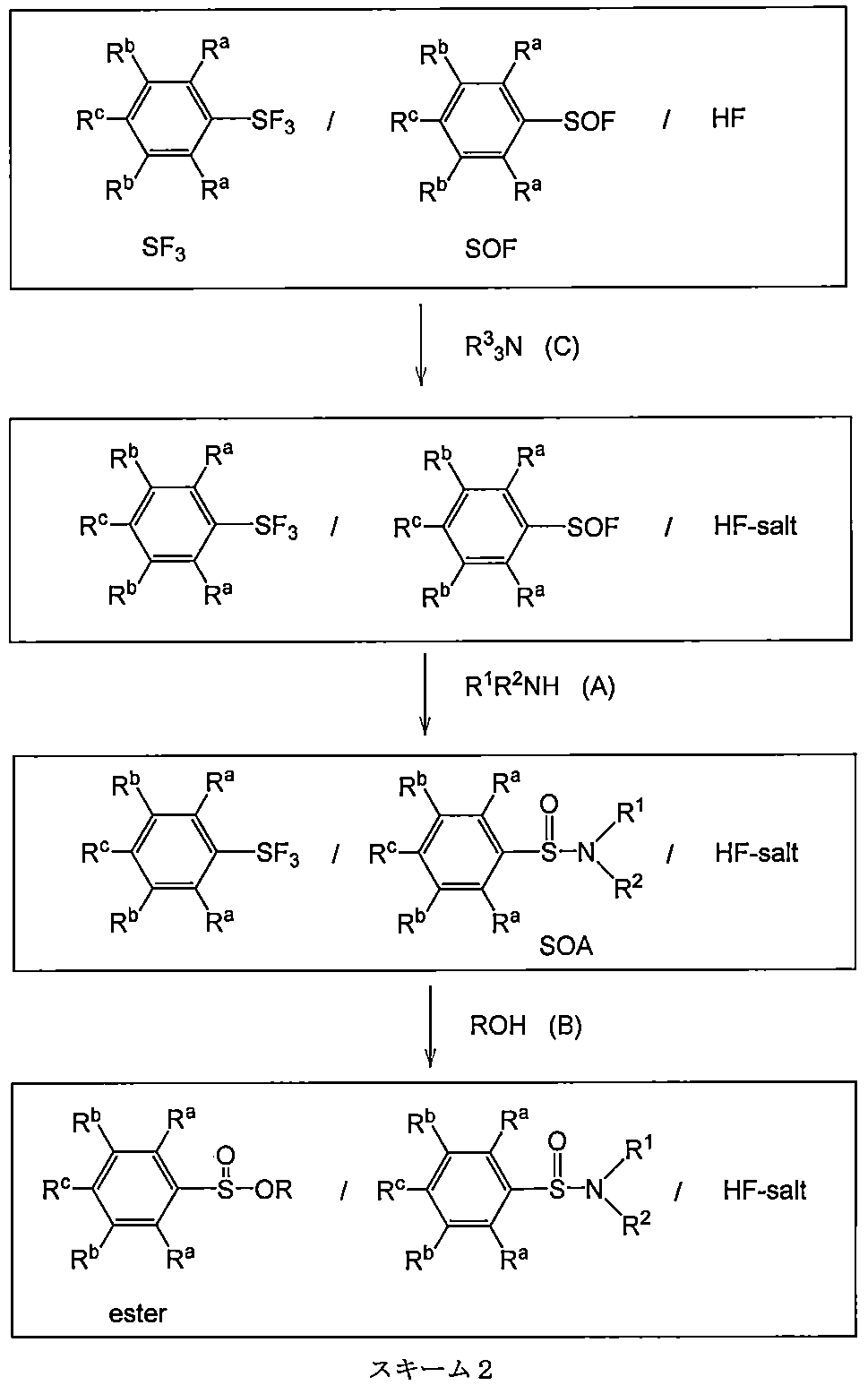
当該スキームにおいて、Raは独立に水素原子または炭素数1~4のアルキル基、好ましくはメチル基またはエチル基である。Rbは独立に水素原子または炭素数1~4のアルキル基であり、好ましくは水素原子である。Rcは水素原子または炭素数1~4のアルキル基、好ましくはブチル基である。R1~R3は前述のとおりである。よって、より好ましいスキームは以下のとおりである。

2.分析および単離方法
前記のとおり調製した変性混合物は通常の分析法によって分析可能である。すなわち、アミド化およびエステル化工程を経て調製された変性混合物は、SF3体由来のエステル体とSOF体由来のSOA体を含む。両者は特性が異なるためHPLC等のクロマトグラフィーを用いて同定、定量、または単離等が可能である。この際、混合物中にフッ化水素が含まれていると分析が困難あるいは不可能となりうるので、変性混合物は前記塩形成工程を経ていることが好ましい。
前記のとおり調製した変性混合物は通常の分析法によって分析可能である。すなわち、アミド化およびエステル化工程を経て調製された変性混合物は、SF3体由来のエステル体とSOF体由来のSOA体を含む。両者は特性が異なるためHPLC等のクロマトグラフィーを用いて同定、定量、または単離等が可能である。この際、混合物中にフッ化水素が含まれていると分析が困難あるいは不可能となりうるので、変性混合物は前記塩形成工程を経ていることが好ましい。
さらに、SF3体とSOF体は1H-NMRでは分析が不可能であるが、エステル体とSOA体はスルフィンエステル基およびスルフィンアミド基にプロトンを有するので1H-NMRによる同定および定量が可能である。一態様として、以下の方法によって混合物中のSF3体の濃度を求めることができる。
1)標準物質と濃度の異なるスルフィンエステル体とを含む複数の試料を準備して、これを1H-NMRで分析して検量線を作成する。標準物質としてはペンタメチルベンゼン等が好ましい。
2)変性混合物を1H-NMRで分析して、前記検量線からスルフィンエステル体の濃度を決定する。
3)スルフィンエステル体の濃度から未変性混合物中のSF3体の濃度を決定する。
1)標準物質と濃度の異なるスルフィンエステル体とを含む複数の試料を準備して、これを1H-NMRで分析して検量線を作成する。標準物質としてはペンタメチルベンゼン等が好ましい。
2)変性混合物を1H-NMRで分析して、前記検量線からスルフィンエステル体の濃度を決定する。
3)スルフィンエステル体の濃度から未変性混合物中のSF3体の濃度を決定する。
別の態様として、変性混合物をHPLCで分析してスルフィンエステル体およびSOA体の面百値を決定し、この値から未変性混合物中のSF3体の濃度を決定する。この場合、溶離液はアセトニトリルと水の混合溶媒が好ましい。さらに標準物質を用いて補正を行ってもよい。未変性混合物がSF3体の保存中に不純物として生成したSOF体を含む混合物である場合、未変性混合物中のSF3体の濃度はSF3体の純度に相当する。
[実施例1]
前述のスキーム3に示す変性を行った。
前述のスキーム3に示す変性を行った。
2,6-ジメチル-4-t-ブチル-トリフルオロスルファニルベンゼン(宇部興産株式会社製 Fluolead(登録商標))を準備した。当該製品は保存中の分解によって生じた微量なSOF体およびフッ化水素を含む混合物である。
1)窒素雰囲気下のグローブボックス内(露点:-40℃)にてFluoleadを500mg精量し、300mLのマグネチックスターラーを備えたフッ素樹脂製容器に入れた。グローブボックスから当該容器を取出し、スターラーに載置し、アルゴンガスを当該容器内に通気した。
2)5mLのジクロロメタンを容器に加え、0.41g(2当量)のトリエチルアミンを1分かけて滴下し、室温(19~24℃)で撹拌した。
3)30分経過後に、マイクロシリンジを用いて0.15g(0.2当量)のジエチルアミンを10秒かけて加え撹拌した。
4)さらに30分経過後にシリンジを用いて5mLのメタノールを1分かけて添加した。
5)さらに60分経過後に撹拌を停止して、反応液全量を100mLのメスフラスコに入れ、メタノールでメスアップした。
このようにして変性混合物を製造した。
1)窒素雰囲気下のグローブボックス内(露点:-40℃)にてFluoleadを500mg精量し、300mLのマグネチックスターラーを備えたフッ素樹脂製容器に入れた。グローブボックスから当該容器を取出し、スターラーに載置し、アルゴンガスを当該容器内に通気した。
2)5mLのジクロロメタンを容器に加え、0.41g(2当量)のトリエチルアミンを1分かけて滴下し、室温(19~24℃)で撹拌した。
3)30分経過後に、マイクロシリンジを用いて0.15g(0.2当量)のジエチルアミンを10秒かけて加え撹拌した。
4)さらに30分経過後にシリンジを用いて5mLのメタノールを1分かけて添加した。
5)さらに60分経過後に撹拌を停止して、反応液全量を100mLのメスフラスコに入れ、メタノールでメスアップした。
このようにして変性混合物を製造した。
[実施例2]
実施例1で得た変性混合物をHPLCで分析した。分析条件は以下のとおりである。
カラム :Xbridge C8 5μm、4.6×150mm
溶離液 :MeCN:H2O=7:3
流速 :1mL/min
検出波長 :254nm
注入量 :20μL
実施例1で得た変性混合物をHPLCで分析した。分析条件は以下のとおりである。
カラム :Xbridge C8 5μm、4.6×150mm
溶離液 :MeCN:H2O=7:3
流速 :1mL/min
検出波長 :254nm
注入量 :20μL
チャートを図1に示す。SF3体由来のエステル体(本例では「SOM」という)およびSOF体由来のSOA体を同定することができた。前記混合物を、水を含む溶離液を用いて分析することが可能であることが明らかとなった。
[実施例3]
標準品としてのSOMを合成した。合成は以下のように行った。
1)窒素雰囲気下のグローブボックス内(露点:-40℃)にてFluoleadを20.56g量り取り、1000mLのマグネチックスターラーを備えたフッ素樹脂製容器に入れた。
2)グローブボックスより当該容器を取出し、スターラーに載置し、アルゴンガスを当該容器内に通気した。ジクロロメタン100mLを加えた後、トリエチルアミン29.1g(3.5当量)を加え、室温(19℃~24℃)にて撹拌した。
3)30分経過後、メタノール100mLを40分かけて定量ポンプで添加した。
4)60分後、反応液の全量を飽和炭酸水素ナトリウム水溶液200mLに注ぎ、クエンチした。
5)上記溶液にジクロロメタン200mLを加えて、分液ロートにて抽出を行った。
6)エバポレーターで濃縮後、以下の条件にて分取精製装置(Isolera)でカラムクロマトを行った。
カラムカートリッジ:Biotage社 SNAP Ultra (球状シリカゲル) 100g
溶媒:n-ヘキサン/酢酸エチル=99/1(v/v)
7)カラム後のフラクションをロータリーエバポレーターで濃縮し、真空ポンプで乾燥して白色の結晶(7.94g、収率=40.2%)として標準品SOMを得た。
標準品としてのSOMを合成した。合成は以下のように行った。
1)窒素雰囲気下のグローブボックス内(露点:-40℃)にてFluoleadを20.56g量り取り、1000mLのマグネチックスターラーを備えたフッ素樹脂製容器に入れた。
2)グローブボックスより当該容器を取出し、スターラーに載置し、アルゴンガスを当該容器内に通気した。ジクロロメタン100mLを加えた後、トリエチルアミン29.1g(3.5当量)を加え、室温(19℃~24℃)にて撹拌した。
3)30分経過後、メタノール100mLを40分かけて定量ポンプで添加した。
4)60分後、反応液の全量を飽和炭酸水素ナトリウム水溶液200mLに注ぎ、クエンチした。
5)上記溶液にジクロロメタン200mLを加えて、分液ロートにて抽出を行った。
6)エバポレーターで濃縮後、以下の条件にて分取精製装置(Isolera)でカラムクロマトを行った。
カラムカートリッジ:Biotage社 SNAP Ultra (球状シリカゲル) 100g
溶媒:n-ヘキサン/酢酸エチル=99/1(v/v)
7)カラム後のフラクションをロータリーエバポレーターで濃縮し、真空ポンプで乾燥して白色の結晶(7.94g、収率=40.2%)として標準品SOMを得た。
当該合成のスキームを以下に示す。

標準品SOMを1H-NMRにて分析して純度を求めた。この際、ペンタメチルベンゼンを内部標準として用いた。その結果、標準品SOMの1H-NMRによる純度は99.56%であった。このペンタメチルベンゼンをHPLCで分析したところ面百値から純度は99.43%であったので、標準品SOMのHPLCによる純度を99.56%×0.9943=98.99%とした。
実施例2で用いたものとは別のロットのFluolead(登録商標)を準備して、実施例2と同様にして変性し、変性混合物をHPLCで分析しエステル体(SOM)の面百値を求めた。この値を前記標準品SOMの純度で補正し、変性混合物中のエステル体(SOM)の濃度を求めた。その値は94.3重量%であった。当該濃度はFluolead(登録商標)の純度である。
一方、同ロットのFluolead(登録商標)を19F-NMRで分析して得たチャートを図2に示す。当該分析においては、フッ化水素を塩として沈殿させるためにFluolead(登録商標)にKFを添加した。当該チャートから求めたFluolead(登録商標)の純度は94.4%であった。以上から、HPLCにより求めた純度は、従来の19F-NMRにより求めた純度とほぼ同じ値を示すことが明らかである。
Claims (7)
- 一般式(1):Ar-SF3(Arは置換または非置換のアリール基)で表されるトリフルオロスルファニル芳香族化合物、および一般式(2):Ar-SOF(Arは置換または非置換のアリール基)で表されるフルオロスルフィニル芳香族化合物を含む混合物の変性方法であって、
当該混合物を、一般式(A):R1R2NH(R1は炭素数1~4のアルキル基、R2は水素原子または炭素数1~4のアルキル基)で表される1級または2級アミンとの反応に供して、前記フルオロスルフィニル芳香族化合物を一般式(3):Ar-SONR1R2(Ar、R1およびR2は前述のとおり定義される)で表されるスルフィンアミド体に変換するアミド化工程を含む、
変性方法。 - 前記アミド化工程後の混合物を一般式(B):ROH(Rは炭素数1~4のアルキル基)で表されるアルコールとの反応に供して、前記トリフルオロスルファニル芳香族化合物を一般式(4):Ar-SO2R(ArおよびRは前述のとおり定義される)で表されるスルフィンエステル体に変換するエステル化工程をさらに含む、
請求項1に記載の変性方法。 - 前記混合物がフッ化水素をさらに含み、
前記アミド化工程の前に、当該混合物を一般式(C):R3 3N(R3は炭素数1~4のアルキル基)で表される3級アミンとの反応に供して、当該フッ化水素と3級アミンの塩を形成する工程をさらに含む、請求項1または2に記載の変性方法。 - 前記R1が炭素数2または3のアルキル基、
前記R2が水素原子あるいは炭素数2または3のアルキル基、
前記R3が炭素数2または3のアルキル基、
前記Rが炭素数1または2のアルキル基である、
請求項1~3のいずれかに記載の変性方法。 - 一般式(1):Ar-SF3(Arは置換または非置換のアリール基)で表されるトリフルオロスルファニル芳香族化合物、および一般式(2):Ar-SOF(Arは置換または非置換のアリール基)で表されるフルオロスルフィニル芳香族化合物を含む混合物におけるトリフルオロスルファニル芳香族化合物の濃度を分析する方法であって、
当該混合物を一般式(A):R1R2NH(Arは置換または非置換のアリール基、R1は炭素数1~4のアルキル基、R2は水素原子または炭素数1~4のアルキル基)で表される1級または2級アミンとの反応に供して、前記フルオロスルフィニル芳香族化合物を一般式(3):Ar-SONR1R2(Ar、R1およびR2は前述のとおり定義される)で表されるスルフィンアミド体に変換するアミド化工程、
当該アミド化工程後の変性混合物を一般式(B):ROH(Rは炭素数1~4のアルキル基)で表されるアルコールとの反応に供して、前記トリフルオロスルファニル芳香族化合物を一般式(4):Ar-SO2R(ArおよびRは前述のとおり定義される)で表されるスルフィンエステル体に変換するエステル化工程、ならびに
当該エステル化工程後の変性混合物を液体クロマトグラフィーまたは1H-NMRによって分析して前記スルフィンエステル体の濃度を決定し、当該濃度をトリフルオロスルファニル芳香族化合物の前記濃度とする工程、
を含む、分析方法。 - 前記混合物がフッ化水素をさらに含み、
前記アミド化工程の前に、当該混合物を一般式(C):R3 3N(R3は炭素数1~4のアルキル基)で表される3級アミンとの反応に供して、当該フッ化水素と3級アミンの塩を形成する工程をさらに含む、
請求項5に記載の分析方法。 - 前記R1が炭素数2または3のアルキル基、
前記R2が水素原子あるいは炭素数2または3のアルキル基、
前記R3が炭素数2または3のアルキル基、
前記Rが炭素数1または2のアルキル基である、
請求項5または6に記載の分析方法。
Applications Claiming Priority (2)
| Application Number | Priority Date | Filing Date | Title |
|---|---|---|---|
| JP2017073813A JP2020097528A (ja) | 2017-04-03 | 2017-04-03 | トリフルオロスルファニル芳香族化合物を含む混合物の変性方法および分析方法 |
| JP2017-073813 | 2017-04-03 |
Publications (1)
| Publication Number | Publication Date |
|---|---|
| WO2018186331A1 true WO2018186331A1 (ja) | 2018-10-11 |
Family
ID=63712270
Family Applications (1)
| Application Number | Title | Priority Date | Filing Date |
|---|---|---|---|
| PCT/JP2018/014070 Ceased WO2018186331A1 (ja) | 2017-04-03 | 2018-04-02 | トリフルオロスルファニル芳香族化合物を含む混合物の変性方法および分析方法 |
Country Status (2)
| Country | Link |
|---|---|
| JP (1) | JP2020097528A (ja) |
| WO (1) | WO2018186331A1 (ja) |
Cited By (2)
| Publication number | Priority date | Publication date | Assignee | Title |
|---|---|---|---|---|
| WO2021200640A1 (ja) * | 2020-03-31 | 2021-10-07 | 宇部興産株式会社 | フッ素化剤の活性評価方法及びエステル化合物の製造方法 |
| WO2022220231A1 (ja) * | 2021-04-13 | 2022-10-20 | Ube株式会社 | フッ素化物の単離方法 |
Citations (2)
| Publication number | Priority date | Publication date | Assignee | Title |
|---|---|---|---|---|
| JP2009544735A (ja) * | 2006-07-28 | 2009-12-17 | アイエム・アンド・ティー・リサーチ・インコーポレーテッド | 置換フェニル硫黄トリフルオリドおよびその他の同様なフッ素化剤 |
| JP2015509907A (ja) * | 2012-02-09 | 2015-04-02 | 宇部興産株式会社 | フッ素化物の単離方法 |
-
2017
- 2017-04-03 JP JP2017073813A patent/JP2020097528A/ja active Pending
-
2018
- 2018-04-02 WO PCT/JP2018/014070 patent/WO2018186331A1/ja not_active Ceased
Patent Citations (2)
| Publication number | Priority date | Publication date | Assignee | Title |
|---|---|---|---|---|
| JP2009544735A (ja) * | 2006-07-28 | 2009-12-17 | アイエム・アンド・ティー・リサーチ・インコーポレーテッド | 置換フェニル硫黄トリフルオリドおよびその他の同様なフッ素化剤 |
| JP2015509907A (ja) * | 2012-02-09 | 2015-04-02 | 宇部興産株式会社 | フッ素化物の単離方法 |
Non-Patent Citations (2)
| Title |
|---|
| UMEMOTO, TERUO ET AL.: "Discovery of 4- tert -Butyl-2,6-dimethylphenylsulfur Trifluoride as a Deoxofluorinating Agent with High Thermal Stability as Well as Unusual Resistance to Aqueous Hydrolysis, and Its Diverse Fluorination Capabilities Including Deoxofluoro-Arylsulfinylation with High Stereoselectivity", JOURNAL OF THE AMERICAN CHEMICAL SOCIETY, vol. 132, no. 51, 2010, pages 18199 - 18205, XP055083243 * |
| WEI XU ET AL.: "Arylsulfur trifluorides: Improved method of synthesis and use as in situ deoxofluorination reagents", JOURNAL OF FLUORINE CHEMISTRY, vol. 132, no. 7, July 2011 (2011-07-01), pages 482 - 488, XP055062891 * |
Cited By (6)
| Publication number | Priority date | Publication date | Assignee | Title |
|---|---|---|---|---|
| WO2021200640A1 (ja) * | 2020-03-31 | 2021-10-07 | 宇部興産株式会社 | フッ素化剤の活性評価方法及びエステル化合物の製造方法 |
| JPWO2021200640A1 (ja) * | 2020-03-31 | 2021-10-07 | ||
| CN115427386A (zh) * | 2020-03-31 | 2022-12-02 | Ube株式会社 | 氟化剂的活性评价方法和酯化合物的制造方法 |
| JP7692894B2 (ja) | 2020-03-31 | 2025-06-16 | 内蒙古永太化学有限公司 | フッ素化剤の活性評価方法及びエステル化合物の製造方法 |
| WO2022220231A1 (ja) * | 2021-04-13 | 2022-10-20 | Ube株式会社 | フッ素化物の単離方法 |
| JPWO2022220231A1 (ja) * | 2021-04-13 | 2022-10-20 |
Also Published As
| Publication number | Publication date |
|---|---|
| JP2020097528A (ja) | 2020-06-25 |
Similar Documents
| Publication | Publication Date | Title |
|---|---|---|
| Kitamura et al. | A reagent for safe and efficient diazo-transfer to primary amines: 2-azido-1, 3-dimethylimidazolinium hexafluorophosphate | |
| Yu et al. | Quantum-Chemical Predictions of p K a’s of Thiols in DMSO | |
| Kirihara et al. | Oxidation of disulfides with Selectfluor™: concise syntheses of thiosulfonates and sulfonyl fluorides | |
| Li et al. | Acyl fluorides as direct precursors to fluoride ketyl radicals: reductive deuteration using SmI 2 and D 2 O | |
| EP3180324B1 (en) | Hypervalent iodine cf2cf2x reagents and their use | |
| US10322996B2 (en) | Method for producing N-retinoylcysteic acid alkyl ester | |
| WO2018186331A1 (ja) | トリフルオロスルファニル芳香族化合物を含む混合物の変性方法および分析方法 | |
| Zhang et al. | Asymmetric aza-Henry reaction of chiral fluoroalkyl α, β-unsaturated N-tert-butanesulfinyl ketoimines: an efficient approach to enantiopure fluoroalkylated α, β-diamines and α, β-diamino acids | |
| EP0211578A2 (en) | N-fluoro-N-perfluoromethyl sulfonamides | |
| CN107540598B (zh) | 一种制备n-二氟甲硫基邻苯酰亚胺类化合物的方法 | |
| Babadzhanova et al. | The synthesis of salts and esters of perfluorinated dithio-and thiocarboxylic acids from carbon disulfide and carbonyl sulfide reacting with RFSiMe3/F− | |
| NO162380B (no) | Fremgangsmaate for fremstilling av di- og tri-n-propylacetonitril. | |
| EP1716087A1 (de) | Verfahren zur cc-bindungsknüpfung zwischen elektrophilen substraten und pi-nucleophilen in neutralen bis basischen wässrigen oder alkoholischen lösungsmitteln ohne den einsatz einer lewis- oder protonensäure | |
| Yagupolskii et al. | Perfluoroalkylation of heterocumulenes with trimethyl (perfluoroalkyl) silanes in the presence of fluoride ions: synthesis of perfluoroalkanesulfinyl amides from N-organylsulfinyl amines | |
| Kitamura | Azidoimidazolinium Salts: Safe and Efficient Diazo‐transfer Reagents and Unique Azido‐donors | |
| US20200361863A1 (en) | Method of synthesizing alpha-amino acid derivatives | |
| Hugenberg et al. | Oxidative desulfurization–fluorination of thioethers. Application for the synthesis of fluorinated nitrogen containing building blocks | |
| Hirschberg et al. | Selective elemental fluorination in ionic liquids | |
| CN112390764A (zh) | 一种帕瑞昔布钠杂质化合物 | |
| Dolenský et al. | Methyl 3, 3, 3-trifluoropyruvate hemiaminals: Stability and transaminations | |
| Parsons et al. | Sulfone-stabilized carbanions for the reversible covalent capture of a posttranslationally-generated cysteine oxoform found in protein tyrosine phosphatase 1B (PTP1B) | |
| Chai et al. | Formation of carbon dioxide attached fragment ions in the fragmentation of deprotonated tolfenpyrad and tebufenpyrad | |
| JP2003147008A (ja) | 低分子ラジカル供給方法、ラジカル運搬分子、重合体製造方法及び重合体 | |
| Fedorovskii et al. | C2-Alkylation in a three-component reaction of fluorocarbonyl compounds, pyrrole derivatives and malononitrile in competition with C2-oxyalkylation | |
| CN115427386B (zh) | 氟化剂的活性评价方法和酯化合物的制造方法 |
Legal Events
| Date | Code | Title | Description |
|---|---|---|---|
| 121 | Ep: the epo has been informed by wipo that ep was designated in this application |
Ref document number: 18780993 Country of ref document: EP Kind code of ref document: A1 |
|
| NENP | Non-entry into the national phase |
Ref country code: DE |
|
| 122 | Ep: pct application non-entry in european phase |
Ref document number: 18780993 Country of ref document: EP Kind code of ref document: A1 |
|
| NENP | Non-entry into the national phase |
Ref country code: JP |