WO2018207912A1 - 溝付き麺、溝付き麺の製造方法、及び、溝付き麺の調理方法 - Google Patents
溝付き麺、溝付き麺の製造方法、及び、溝付き麺の調理方法 Download PDFInfo
- Publication number
- WO2018207912A1 WO2018207912A1 PCT/JP2018/018319 JP2018018319W WO2018207912A1 WO 2018207912 A1 WO2018207912 A1 WO 2018207912A1 JP 2018018319 W JP2018018319 W JP 2018018319W WO 2018207912 A1 WO2018207912 A1 WO 2018207912A1
- Authority
- WO
- WIPO (PCT)
- Prior art keywords
- grooved
- noodles
- noodle
- flour
- boiled
- Prior art date
- Legal status (The legal status is an assumption and is not a legal conclusion. Google has not performed a legal analysis and makes no representation as to the accuracy of the status listed.)
- Ceased
Links
Classifications
-
- A—HUMAN NECESSITIES
- A23—FOODS OR FOODSTUFFS; TREATMENT THEREOF, NOT COVERED BY OTHER CLASSES
- A23L—FOODS, FOODSTUFFS OR NON-ALCOHOLIC BEVERAGES, NOT OTHERWISE PROVIDED FOR; PREPARATION OR TREATMENT THEREOF
- A23L7/00—Cereal-derived products; Malt products; Preparation or treatment thereof
- A23L7/10—Cereal-derived products
- A23L7/109—Types of pasta, e.g. macaroni or noodles
-
- A—HUMAN NECESSITIES
- A23—FOODS OR FOODSTUFFS; TREATMENT THEREOF, NOT COVERED BY OTHER CLASSES
- A23L—FOODS, FOODSTUFFS OR NON-ALCOHOLIC BEVERAGES, NOT OTHERWISE PROVIDED FOR; PREPARATION OR TREATMENT THEREOF
- A23L5/00—Preparation or treatment of foods or foodstuffs, in general; Food or foodstuffs obtained thereby; Materials therefor
- A23L5/30—Physical treatment, e.g. electrical or magnetic means, wave energy or irradiation
- A23L5/34—Physical treatment, e.g. electrical or magnetic means, wave energy or irradiation using microwaves
-
- A—HUMAN NECESSITIES
- A23—FOODS OR FOODSTUFFS; TREATMENT THEREOF, NOT COVERED BY OTHER CLASSES
- A23P—SHAPING OR WORKING OF FOODSTUFFS, NOT FULLY COVERED BY A SINGLE OTHER SUBCLASS
- A23P30/00—Shaping or working of foodstuffs characterised by the process or apparatus
- A23P30/20—Extruding
-
- A—HUMAN NECESSITIES
- A23—FOODS OR FOODSTUFFS; TREATMENT THEREOF, NOT COVERED BY OTHER CLASSES
- A23V—INDEXING SCHEME RELATING TO FOODS, FOODSTUFFS OR NON-ALCOHOLIC BEVERAGES AND LACTIC OR PROPIONIC ACID BACTERIA USED IN FOODSTUFFS OR FOOD PREPARATION
- A23V2002/00—Food compositions, function of food ingredients or processes for food or foodstuffs
Definitions
- the present invention relates to grooved noodles, a method for manufacturing grooved noodles, and a method for cooking grooved noodles.
- Patent Document 1 states that “a groove is added in the vertical direction of the noodle strings to add a function of boiling up to a good texture with a quick and slightly cored shape and a cross-sectional shape of the boiled up being substantially circular. Spaghetti. ”
- the present inventors examined the texture of boiled noodles obtained by cooking under various conditions for spaghetti in which the grooves described in Patent Document 1 were formed in the longitudinal direction of the noodle strings, depending on the cooking conditions. Discovered that there is a problem that boiled noodles may adhere to each other.
- the area ratio of the cross-sectional area of one or more grooves to the cross-sectional area of the main outer shape in the cross section in the direction perpendicular to the noodle string direction is 0.25 to 0.50, [1] or The grooved noodle according to [2].
- [4] A method for producing grooved noodles according to any one of [1] to [3], wherein the grooved noodles are produced from a dough using only flour containing wheat flour along the direction of the noodle strings. And forming a grooved raw noodle having a main shape with a substantially circular cross section of the noodle strings, and heating the grooved raw noodle, A method for producing grooved noodles, the method comprising a step of obtaining grooved noodles having a vitality of 18 to 35%. [5] The method for producing grooved noodles according to [4], further comprising a step of adjusting the moisture content of the grooved raw noodles before the heating step. [6] The method for producing grooved noodles according to [5], wherein the step of adjusting the water content includes a drying step.
- [7] A method for cooking grooved noodles, wherein the grooved noodles according to any one of [1] to [3] and water are contained in a container and boiled noodles are obtained by microwave heating. [8] The method for cooking grooved noodles according to [7], wherein the water temperature is 0 to 40 ° C.
- boiled noodles can be provided that are boiled noodles that are difficult to adhere to each other after being boiled and have an excellent texture (hereinafter also referred to as “having the effect of the present invention”).
- the manufacturing method of a grooved noodle and the cooking method of a grooved noodle can also be provided.
- a numerical range expressed using “to” means a range including numerical values described before and after “to” as a lower limit value and an upper limit value.
- a grooved noodle according to an embodiment of the present invention is a grooved noodle having a main outer shape in which one or a plurality of grooves are formed along the noodle string direction and the cross section of the noodle string is substantially circular, Grooved noodles with a gluten vitality of 18 to 35% using only flour containing wheat flour as raw material flour.
- the reason why the problems of the present invention are solved by the grooved noodles is not necessarily clear, but the present inventors speculate as follows.
- the scope of the present invention is not limited by the speculation mechanism described below. In other words, even when the effect of the present invention is obtained by a mechanism other than the following speculation mechanism, it is included in the scope of the present invention.
- grooved noodles hereinafter simply referred to as “grooved noodles” in which one or a plurality of grooves are formed along the noodle string direction and the noodle strings have a substantially circular cross section. .
- Grooved noodles was cooked under various conditions, and when it was cooked under special conditions, it was found that it may stick to each other after being boiled, and the reason for this has been studied earnestly.
- a method for cooking grooved noodles a method in which grooved noodles are poured into a sufficient amount of boiling water and boiled for a predetermined time (for example, about 10 minutes) is known.
- the inventors have found that when grooved noodles are cooked under conditions where water convection is unlikely to occur, such as using a small amount of water or a small amount of boiling water, they are boiled and may adhere to each other.
- the grooved noodle according to the embodiment of the present invention uses only flour containing wheat flour as a raw material flour, and has a gluten vitality (hereinafter also referred to as “GV”, the definition of GV will be described later) in a range of 18 to 35%. This is one of the characteristics. If the GV is 18% or more, boiled noodles having an excellent texture can be obtained. On the other hand, if the GV is 35% or less, the protein in the flour is sufficiently denatured and the hydrophobicity of the grooved noodle surface is increased, so that the grooved noodles are difficult to adhere to each other after being boiled. In addition, as GV, 20% or more is preferable, 22% or more is more preferable, 32% or less is preferable, and 29% or less is more preferable at the point from which the grooved noodle which has the effect of this invention more excellent is obtained.
- GV gluten vitality
- GV of grooved noodles is intended to be a value measured as follows using a sample obtained by pulverizing grooved noodles (hereinafter also referred to as “ground powder”).
- the decomposition treatment was performed continuously and automatically following the decomposition treatment using a Keltec distillation titration system (KJELTEC AUTO 1030 type) incorporated in the same Keltec Auto System.
- the liquid is distilled and titrated (0.1 N sulfuric acid is used for titration), and the soluble crude protein content of the pulverized powder is determined by the following formula.
- the liquid subjected to the above decomposition treatment is distilled and titrated (0 for titration). .1N sulfuric acid is used), and the total crude protein content of the pulverized powder is obtained by the following formula.
- GV is an index representing the properties of proteins contained in wheat flour, and is different from the protein content contained in wheat flour and / or raw material flour.
- GV is generally 50 to 60%
- GV of general noodles for example, spaghetti
- the grooved noodles use only flour containing wheat flour as raw material powder. Only flour means that the raw material powder is substantially composed of flour, and substantially means that materials other than flour are unintentionally mixed in the flour production process and / or distribution in the flour raw material. It is the meaning which accepts. Although it does not restrict
- Raw material flour contains wheat flour.
- wheat flour what is usually used as a raw material for noodles can be used without particular limitation, and examples thereof include thin flour, medium flour, strong flour, and durum flour. Although it does not restrict
- the raw material powder may include, for example, buckwheat flour, rice flour, corn flour, barley flour, rye flour, hatomugi flour, fly flour, and wax flour as cereal flours other than wheat flour.
- the shape of the grooved noodles is not particularly limited as long as one groove or a plurality of grooves are formed along the noodle string direction and the noodle strings have a substantially circular main cross section.
- the number of grooves is preferably 2 to 8 in that boiled noodles having an excellent texture can be obtained more easily (with a short boiling time).
- the main shape of the noodle strings means the shape of the cross section of the noodle strings when there is no groove.
- the cross-sectional area of the main outer shape (the cross-sectional area when there is no groove) in the cross-section in the direction orthogonal to the noodle string direction (the cross-section that makes it easy to grasp the groove) in that it has the effect of the present invention.
- the cross-sectional area of one or a plurality of grooves (a 1) area ratio (a 1 / a 0) is 0.25-0.50, .32-.42 Is more preferable.
- the A 1 means the sum of the cross-sectional area of the plurality of grooves.
- a 1 / A respectively, for the five noodle, observing the cross section of the three locations for each noodle strips each optical microscope, it represents the arithmetic mean of the obtained area ratio by image processing .
- the manufacturing method of the grooved noodle which manufactures the grooved noodle which concerns on embodiment of this invention is demonstrated.
- a raw material powder usually GV of 50 to 60%
- GV GV
- Grooving raw noodles is formed in accordance with a conventional method, and the grooved raw noodles are dried to produce the grooved noodles.
- the heat-treated raw material powder is one in which gluten is denatured and GV is adjusted by heating the raw material powder.
- a known method can be used as the heating method, and an apparatus such as an oven, an autoclave, and a heater can be used.
- the heating temperature and heating of the raw material powder so that the GV of the grooved noodles is within a desired range.
- the time can be adjusted appropriately.
- Examples of the method of forming grooved raw noodles using heat-treated raw material powder include a method of adding dough water to heat-treated raw material powder and kneading to form a dough, and extruding raw noodle strings from the dough It is done.
- As the kneaded water those that can be used for the production of ordinary noodles can be applied, and fresh water, acidic water, alkaline water, brine, and the like can be appropriately used.
- the amount of kneading water that can be used for the production of ordinary noodles can be applied, and is generally 20-30 parts by mass with respect to 100 parts by mass of the heat-treated raw material powder.
- the dough can be formed by adding kneaded water to the heat-treated raw material powder by a conventional method, or by manual kneading or kneading by a mixer.
- the method for forming the raw noodle strings from the dough may be in accordance with conventional methods, such as rolling the dough into raw noodle strips and then cutting them into raw noodle strings, or extruding the dough from a die into raw noodle strings Can be illustrated.
- the noodle strings produced as described above usually contain 22-30% moisture, and are preferably dried to have a moisture content of 14% or less in order to improve storage. .
- the drying can also be performed by a process usually performed in the production of noodle strings.
- the grooved noodle manufacturing method for manufacturing grooved noodles instead of heat-treated raw material powder, ordinary raw material powder is used, and further the dough is formed.
- the kneaded dough is pulverized and kneaded again to form the dough (other than the above, it is the same as the method for producing grooved noodles according to the first embodiment already described).
- gluten produced by kneading is physically broken by crushing the dough, and the GV can be adjusted to a desired range.
- the dough can be pulverized by an ordinary method, and the dough may be crushed after drying if necessary. By performing the pulverization to a particle diameter of about 0.5 mm or less, gluten can be reduced.
- the crushed material of the dough can be formed again by adding water appropriately and kneading again as necessary.
- the 3rd form of the manufacturing method of a grooved noodle which manufactures the grooved noodle which concerns on embodiment of this invention has the following processes. According to the method for producing grooved noodles having the following steps, grooved noodles can be more easily produced. ⁇ From a dough made only of flour containing wheat flour, one groove or a plurality of grooves are formed along the direction of the noodle strings, and the noodle strings have a substantially circular main cross section. Molding process to obtain noodles-Heating raw grooved noodles to obtain grooved noodles with a GV of 18-35%
- the forming step has a main shape in which one groove or a plurality of grooves are formed along the noodle string direction from the dough made only of flour containing wheat flour, and the cross section of the noodle string is substantially circular. This is a process for obtaining grooved raw noodles.
- the dough forming method and the grooved raw noodle forming method are as already described as the grooved noodle manufacturing method according to the first embodiment.
- the heating step is a step of heating the grooved noodles obtained in the forming step to obtain grooved noodles having a GV of 18 to 35%.
- a method for heating the grooved raw noodles is not particularly limited, and a known method can be used.
- the grooved raw noodles can be heated using an apparatus such as an oven, an autoclave, and a heater, for example.
- the heating temperature and time are not particularly limited, and can be appropriately adjusted according to the GV of the raw material powder so that the GV of the grooved noodles obtained has a desired value.
- the manufacturing method of the said grooved noodle may further have the process of adjusting the moisture content of a grooved raw noodle with the said heating process or before the said heating process.
- the method for adjusting the moisture content of the grooved raw noodles is not particularly limited, and a known method can be used. Typically, there is a method of leaving raw noodles in an atmosphere with adjusted humidity, etc. Can be mentioned.
- the step of adjusting the water content may further include a drying step.
- a method in which the grooved noodles and water are contained in a container and microwave heating is preferable in that boiled noodles can be obtained very easily. Since the grooved noodles have the characteristics already described, even if the noodles are heated by microwaves and have little water convection, the noodles are less likely to adhere to each other, and boiled noodles having excellent texture are obtained.
- the container is not particularly limited as long as it can contain grooved noodles and water, and a known container capable of heating the grooved noodles stored in the container by microwaves can be used.
- a known container capable of heating the grooved noodles stored in the container by microwaves can be used.
- the container for example, the container described in paragraphs 0026 to 0034 of JP2011-162200A can be used, and the above contents are incorporated in the present specification.
- Water may be added to such an extent that the grooved noodles are sufficiently immersed.
- the temperature of the water is not particularly limited, but is preferably 0 to 40 ° C, more preferably 25 to 40 ° C, in that boiled noodles can be obtained more easily.
- the method for microwave heating is not particularly limited, and examples thereof include a method using a microwave oven. When a microwave oven is used, grooved noodles and water are accommodated in a container, and the container is placed in the microwave oven and heated. Since the grooved noodles of the present invention have the above characteristics, cooking in a short time is possible. Further, since the GV is within a predetermined range, the noodles are difficult to adhere to each other after being boiled, and the boiled noodles having excellent texture can be obtained.
- Examples are shown below, but the present invention is not limited to the examples.
- Examples 1 to 6 and Comparative Examples 1 to 3 26 parts by mass of water was mixed with 100 parts by mass of durum semolina and kneaded to prepare a dough.
- three grooves are formed and the noodle strings have a substantially circular cross section, and A 1 / A 0 have the values described in Table 1, respectively.
- a die having through holes corresponding to the shape of the attached noodles was attached, and the kneaded dough was extruded under a reduced pressure of ⁇ 600 mmHg to form raw noodles.
- raw noodles were dried by a conventional method to produce a dry spaghetti having a length of 22 cm.
- the dried spaghetti was heated in a thermostatic bath.
- Example 7 26 parts by mass of water was mixed with 100 parts by mass of durum semolina and kneaded to prepare a dough. Next, the dough was rolled to a thickness of 1 cm, dried at room temperature, and pulverized until it passed through a sieve having an opening of 0.4 mm. 24 parts by mass of water was added to 100 parts by mass of the pulverized product, and kneaded again to produce a dough.
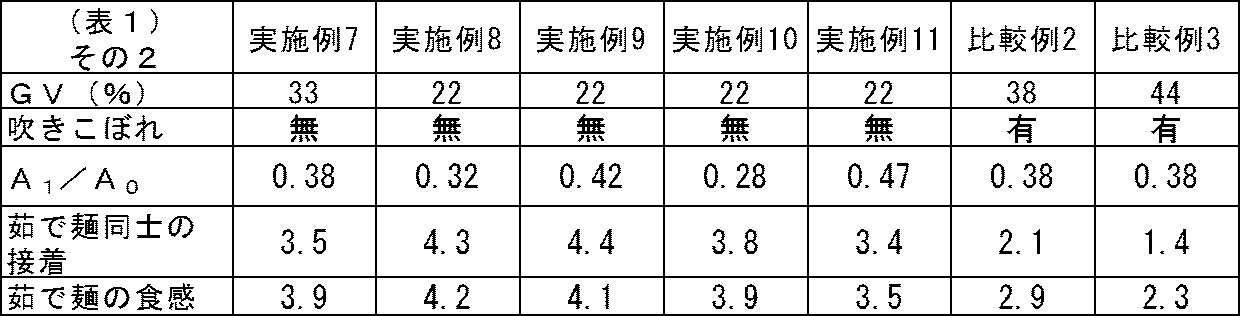
- a die having three through-holes corresponding to the shape of the grooved noodles having three main grooves and a main outer shape in which the cross-section of the noodle strings is substantially circular is attached to the pasta manufacturing machine, and the reduced pressure condition is -600 mmHg Then, the kneaded dough was extruded and dried at 45 ° C. for 20 hours to produce a dry spaghetti having a length of 22 cm. The GV of this dried spaghetti was 33%.
- Example 8 In the same manner as in Example 3, except that a die having a through hole corresponding to the shape of the grooved noodle so that A 1 / A 0 each had a value described in Table 1, Example 8 to Eleven dry spaghettis were obtained.
- Examples 12 to 17 and Comparative Examples 4 and 5 Dried spaghetti was produced in the same manner as in Examples 1 to 6 and Comparative Examples 1 and 2, except that the raw noodles were dried at 45 ° C. for 20 hours instead of drying by a conventional method. This was evaluated in the same manner as described above. The results are shown in Table 2.
- Reference Example Main profile in the above cross-sectional shape instead of a die having three holes formed and through-holes corresponding to the shape of a grooved noodle having a main profile with a substantially circular cross-section of the noodle strings
- a dry spaghetti having no grooves was produced in the same manner as in Comparative Example 3 except that a die having a circular through hole with a diameter similar to that of the above was used, and evaluated by the same method as above.
- the adhesion between the noodles was 3.1, and the texture of the boiled noodles was 3.5.
Landscapes
- Health & Medical Sciences (AREA)
- Nutrition Science (AREA)
- Life Sciences & Earth Sciences (AREA)
- Chemical & Material Sciences (AREA)
- Engineering & Computer Science (AREA)
- Food Science & Technology (AREA)
- Polymers & Plastics (AREA)
- Noodles (AREA)
Abstract
Description
[2] 溝の本数は2~8本のうちのいずれかである[1]に記載の溝付き麺。
[3] 麺線方向と直交する方向での断面における、主外形の断面積に対する、1本又は複数本の溝の断面積の面積比が0.25~0.50である、[1]又は[2]に記載の溝付き麺。
[4] [1]~[3]のいずれかに記載の溝付き麺を製造する、溝付き麺の製造方法であって、小麦粉を含む穀粉のみを原料とする生地から、麺線方向に沿って1本の溝又は複数本の溝が形成されると共に麺線の横断面がほぼ円形の主外形を有する、溝付き生麺を得る、成形工程と、溝付き生麺を加熱して、グルテンバイタリティが18~35%である溝付き麺を得る、加熱工程と、を有する溝付き麺の製造方法。
[5] 加熱工程の前に、溝付き生麺の水分含有量を調整する工程を更に有する、[4]に記載の溝付き麺の製造方法。
[6] 水分含有量を調整する工程が、乾燥工程を含む、[5]に記載の溝付き麺の製造方法。
[7] 容器に[1]~[3]のいずれかに記載の溝付き麺と水とを収容してマイクロ波加熱することにより茹で麺を得る、溝付き麺の調理方法。
[8] 水の温度が、0~40℃である、[7]に記載の溝付き麺の調理方法。
以下に記載する構成要件の説明は、本発明の代表的な実施形態に基づいてなされることがあるが、本発明はそのような実施形態に限定されるものではない。
なお、本明細書において、「~」を用いて表される数値範囲は、「~」の前後に記載される数値を下限値及び上限値として含む範囲を意味する。
上記溝付き麺により本発明の課題が解決される理由は必ずしも明らかではないが、本発明者らは、以下のとおり推測している。なお、以下で説明する推測機序により、本発明の範囲が制限されるものではない。言い換えれば、以下の推測機序以外の機序により本発明の効果が得られる場合であっても本発明の範囲に含まれる。
従来、溝付き麺の調理方法としては、十分な量の沸騰水中に溝付き麺を投入し、所定時間(例えば、10分程度)茹でる方法が知られている。
発明者らは、溝付き麺は、少量の水又は少量の沸騰水を用いる等の水の対流が起こりにくい条件で調理すると、茹で上がり後に互いに接着する場合があることを知見した。また、常温の水(0~40℃)に溝付き麺を投入し、その後加熱する方法、及び、溝付き麺と水とを容器に収容してマイクロ波加熱(例えば、電子レンジを用いる方法が挙げられる)する方法によれば、溝付き麺は、茹で上がり後に互いにより接着しやすいことを知見した。
また、常温の水に溝付き麺を投入し、その後加熱する方法、及び、溝付き麺と水とを容器に収容してマイクロ波加熱する方法によれば、水の対流が起こる前にでん粉が溶出しやすいと考えられ、溶出したでん粉が溝付き麺の表面により留まりやすく、結果として、溝付き麺は、茹で上がり後に互いにより接着しやすくなるものと推測される。
GVが18%以上であると、優れた食感を有する茹で麺が得られる。
一方、GVが35%以下であると、小麦粉中のタンパク質が十分に変性され、溝付き麺表面の疎水性が高まることにより、溝付き麺は、茹で上がり後に互いに接着しにくくなる。
なお、より優れた本発明の効果を有する溝付き麺が得られる点で、GVとしては、20%以上が好ましく、22%以上がより好ましく、32%以下が好ましく、29%以下がより好ましい。
(1)粉砕粉の可溶性粗蛋白質含量の測定:
(a)100mL容のビーカーに粉砕粉を2g精秤して入れる。
(b)上記のビーカーに0.05規定酢酸40mLを加えて、室温で60分間攪拌して懸濁液を調製する。
(c)上記(b)で得た懸濁液を遠沈管に移して、5000rpmで5分間遠心分離を行った後、濾紙を用いて濾過し、濾液を回収する。
(d)上記で用いたビーカーを0.05規定酢酸40mLで洗って洗液を遠沈管に移して、5000rpmで5分間遠心分離を行った後、濾紙を用いて濾過し、濾液を回収する。
(e)上記(c)及び(d)で回収した濾液を一緒にして100mLにメスアップする。
(f)ティケーター社(スウェーデン)のケルテックオートシステムのケルダールチューブに上記(e)で得られた液体の25mLをホールピペットで入れて、分解促進剤(日本ゼネラル株式会社製「ケルタブC」;硫酸カリウム:硫酸銅=9:1(重量比))1錠及び濃硫酸15mLを加える。
(g)上記したケルテックオートシステムに組み込まれているケルテック分解炉(DIGESTION SYSTEM 20 1015型)を用いて、ダイヤル4で1時間分解処理を行い、更にダイヤル9又は10で1時間分解処理を自動的に行った後、この分解処理に続いて連続的にかつ自動的に、同じケルテックオートシステムに組み込まれているケルテック蒸留滴定システム(KJELTEC AUTO 1030型)を用いて、その分解処理を行った液体を蒸留及び滴定して(滴定には0.1規定硫酸を使用)、下記の数式により、粉砕粉の可溶性粗蛋白質含量を求める。
可溶性粗蛋白質含量(%)=0.14×T×F×N×(100/S)×(1/25)
式中、
T=滴定に要した0.1規定硫酸の量(mL)
F=滴定に用いた0.1規定硫酸の力価(用時に測定するか又は力価の表示のある市販品を用いる)
N=窒素蛋白質換算係数(5.70)
S=粉砕粉の秤取量(g)
(a)上記(1)で用いたのと同じティケーター社のケルテックオートシステムのケルダールチューブに、粉砕粉を0.5g精秤して入れ、これに上記(1)の(f)で用いたのと同じ分解促進剤1錠及び濃硫酸5mLを加える。
(b)上記(1)で用いたのと同じケルテックオートシステムのケルテック分解炉を用いて、ダイヤル9又は10で1時間分解処理を行った後、この分解処理に続いて連続的にかつ自動的に、同じケルテックオートシステムに組み込まれている上記(1)で用いたのと同じケルテック蒸留滴定システムを用いて、上記で分解処理を行った液体を蒸留及び滴定して(滴定には0.1規定硫酸を使用)、下記の数式により、粉砕粉の全粗蛋白質含量を求める。
全粗蛋白質含量(%)=(0.14×T×F×N)/S
式中、
T=滴定に要した0.1規定硫酸の量(mL)
F=滴定に用いた0.1規定硫酸の力価(用時に測定)
N=窒素蛋白質換算係数(5.70)
S=粉砕粉の秤取量(g)
上記(1)で求めた粉砕粉の可溶性粗蛋白質含量及び上記(2)で求めた粉砕粉の全粗蛋白質含量から、下記の数式により、粉砕粉のGVを求める。
GV(%)=(可溶性粗蛋白質含量/全粗蛋白質含量)×100
粉砕粉に代えて、試料として小麦粉を用いた場合、一般的にGVは50~60%であり、一般的な麺(例えばスパゲティ)のGVは40~46%程度である。
原料粉中における穀粉の含有量としては特に制限されないが、一般に、原料粉の全質量に対して、99質量%以上が好ましい。
小麦粉は、1種を単独で用いても、2種以上を併用してもよい。2種以上の小麦粉を併用する場合には、合計含有量が上記範囲内であることが好ましい。
なかでも、より簡便に(短い茹で時間で)優れた食感を有する茹で麺が得られる点で、溝の本数は2~8本が好ましい。
なお、本明細書において、麺線の主外形とは、溝がないとした場合の麺線の横断面の形状を意味する。
なお、麺線方向に沿って複数本の溝が形成される場合、上記A1は、複数本の溝の断面積の合計を意味する。
本発明の実施形態に係る溝付き麺の製造方法の第一の形態としては、原料粉(通常は、GV50~60%である。)を加熱処理してGVを調整したもの(以下、「加熱処理原料粉」ともいう。)を用い、常法に従い溝付き生麺を成形し、上記溝付き生麺を乾燥させ、溝付き麺を製造する方法が挙げられる。
練水としては、通常の麺の製造に用い得るものが適用でき、清水、酸性水、アルカリ水、及び、かん水等を適宜利用できる。練水の量も通常の麺の製造に用い得る量が適用でき、一般的に加熱処理原料粉の100質量部に対して20~30質量部である。
上記溝付き麺の製造方法によれば、混捏によって生成したグルテンが、生地を粉砕することによって物理的に破壊され、GVを所望の範囲に調整することができる。なお、生地の粉砕は通常の方法で行うことができ、生地は必要に応じて乾燥してから粉砕してもよい。粉砕は粒子径0.5mm以下程度まで行うことで、グルテンを低下させることができる。生地の粉砕物は、再度、必要に応じて適度に加水し、混捏することで再度生地を形成することができる。
・小麦粉を含む穀粉のみを原料とする生地から、麺線方向に沿って1本の溝又は複数本の溝が形成されると共に麺線の横断面がほぼ円形の主外形を有する、溝付き生麺を得る、成形工程
・溝付き生麺を加熱して、GVが18~35%である溝付き麺を得る、加熱工程
溝付き生麺を加熱する方法としては特に制限されず、公知の方法を用いることができる。溝付き生麺は、例えば、オーブン、オートクレーブ、及び、ヒーター等の装置を用いて加熱することができる。加熱温度、及び、時間としては特に制限されず、原料粉のGVに応じて、得られる溝付き麺のGVが所望の値となるよう、適宜調整することができる。
上記溝付き麺は既に説明した特徴を有するので、マイクロ波によって加熱され、水の対流が少ない状態であっても、麺が互いに接着しにくく、優れた食感を有する茹で麺が得られる。
マイクロ波加熱の方法としては特に制限されず、例えば、電子レンジを用いる方法が挙げられる。電子レンジを用いる場合、容器に溝付き麺と水とを収容して、容器を電子レンジ内に配置して加熱すればよい。本発明の溝付き麺は上記特徴を有するため、短時間での調理が可能である。また、GVが所定の範囲内であるため、茹で上がり後に麺が互いに接着しにくく、優れた食感を有する茹で麺が得られる。
・実施例1~6、比較例1~3
デュラムセモリナ100質量部に対して水26質量部を混合し、混捏して生地とした。次に、パスタ製造機に、3本の溝が形成されると共に麺線の横断面がほぼ円形の主外形を有し、A1/A0がそれぞれ表1に記載した値となるような溝付き麺の形状に対応する貫通孔が形成されたダイスを取り付け、-600mmHgの減圧条件下、混捏した生地を押出し、生麺を成形した。次に、生麺を常法により乾燥して、長さ22cmの乾燥スパゲティを製造した。次に、上記乾燥スパゲティを恒温槽にて加熱した。なお、加熱時間(2~5時間)及び温度(75~100℃)は、GVが表1に記載された値となるよう、それぞれ調整した(例えば、実施例1では、100℃で3時間、実施例7では、78℃で3時間である。)。上記により、各実施例及び比較例の乾燥スパゲティを得た。
また、比較例3として乾燥後に加熱しなかったものを製造した。
デュラムセモリナ100質量部に対して水26質量部を混合し、混捏して生地とした。次に、生地を1cmの厚さに圧延し、室温で乾燥後、目開き0.4mmの篩を通過するまで粉砕した。この粉砕物100質量部に対して水24質量部を加え、再度混捏して生地を製造した。パスタ製造機に、3本の溝が形成されると共に麺線の横断面がほぼ円形の主外形を有する溝付き麺の形状に対応する貫通孔が形成されたダイスを取り付け、-600mmHgの減圧条件下、混捏した生地を押出成形した後、45℃で20時間乾燥して長さ22cmの乾燥スパゲティを製造した。この乾燥スパゲティのGVは33%であった。
各スパゲティを100gずつ取り分けて耐熱容器に収容し、300gの水(温度:25℃)を加えて、電子レンジで500Wにて6分間、加熱調理した。調理中の吹きこぼれの有無を観察した。加熱終了後、容器を電子レンジから取出し、茹で麺同士の接着の程度を、以下の評価基準で評価した。更に調理後のスパゲティを喫食して以下の評価基準で食感を評価した。その結果を10点の平均値として表1に示した。
5 茹で麺同士の接着が全く無い
4 茹で麺の5%未満で接着がある
3 茹で麺の5%以上10%未満で接着がある
2 茹で麺の10%以上20%未満で接着がある
1 茹で麺の20%以上で接着がある
5 加熱ムラが無く、上手に茹でられたスパゲティと同等の非常に良好な食感
4 加熱ムラがほとんど無く、通常のスパゲティと同等の良好な食感
3 加熱ムラがわずかにあるが、通常のスパゲティとほぼ同等の食感
2 加熱ムラが感じられ、通常のスパゲティに劣る食感
1 加熱ムラが多く感じられ、非常に劣る食感

常法による乾燥に代えて、生麺を45℃で20時間乾燥させたこと以外は実施例1~6及び比較例1~2と同様にして、乾燥スパゲティを製造した。これを上記と同様にして評価した。その結果を表2に示す。

3本の溝が形成されると共に麺線の横断面がほぼ円形の主外形を有する溝付き麺の形状に対応する貫通孔が形成されたダイスに代えて、上記断面形状における主外形の直径と同様の直径の円形の貫通孔を有するダイスを用いたこと以外は、比較例3と同様にして、溝を有しない乾燥スパゲティを製造し、上記と同様の方法により評価したところ、茹で麺同士の接着は3.1で、茹で麺の食感は3.5であった。
Claims (8)
- 麺線方向に沿って1本又は複数本の溝が形成されると共に麺線の横断面がほぼ円形の主外形を有する溝付き麺であって、小麦粉を含む穀粉のみを原料粉とし、グルテンバイタリティが18~35%である溝付き麺。
- 前記溝の本数は2~8本のうちいずれかである請求項1に記載の溝付き麺。
- 麺線方向と直交する方向での断面における、前記主外形の断面積に対する、前記1本又は複数本の溝の断面積の面積比が0.25~0.50である、請求項1又は2に記載の溝付き麺。
- 請求項1~3のいずれか一項に記載の溝付き麺を製造する、溝付き麺の製造方法であって、
小麦粉を含む穀粉のみを原料とする生地から、麺線方向に沿って1本の溝又は複数本の溝が形成されると共に麺線の横断面がほぼ円形の主外形を有する、溝付き生麺を得る、成形工程と、
前記溝付き生麺を加熱して、グルテンバイタリティが18~35%である溝付き麺を得る、加熱工程と、
を有する溝付き麺の製造方法。 - 前記加熱工程の前に、前記溝付き生麺の水分含有量を調整する工程を更に有する、請求項4に記載の溝付き麺の製造方法。
- 前記水分含有量を調整する工程が、乾燥工程を含む、請求項5に記載の溝付き麺の製造方法。
- 容器に請求項1~3のいずれか一項に記載の溝付き麺と水とを収容してマイクロ波加熱することにより茹で麺を得る、溝付き麺の調理方法。
- 前記水の温度が、0~40℃である、請求項7に記載の溝付き麺の調理方法。
Priority Applications (4)
| Application Number | Priority Date | Filing Date | Title |
|---|---|---|---|
| US16/612,277 US20200260764A1 (en) | 2017-05-12 | 2018-05-11 | Grooved noodle, grooved noodle production method, and grooved noodle cooking method |
| JP2019517716A JP7077312B2 (ja) | 2017-05-12 | 2018-05-11 | 溝付き麺、溝付き麺の製造方法、及び、溝付き麺の調理方法 |
| EP18798231.9A EP3622830A4 (en) | 2017-05-12 | 2018-05-11 | GROOVED NOODLES, PROCESS FOR PRODUCING GROOVED NOODLES AND PROCESS FOR COOKING GROOVED NOODLES |
| US18/174,542 US20230200415A1 (en) | 2017-05-12 | 2023-02-24 | Grooved noodle, grooved noodle production method, and grooved noodle cooking method |
Applications Claiming Priority (2)
| Application Number | Priority Date | Filing Date | Title |
|---|---|---|---|
| JP2017095807 | 2017-05-12 | ||
| JP2017-095807 | 2017-05-12 |
Related Child Applications (2)
| Application Number | Title | Priority Date | Filing Date |
|---|---|---|---|
| US16/612,277 A-371-Of-International US20200260764A1 (en) | 2017-05-12 | 2018-05-11 | Grooved noodle, grooved noodle production method, and grooved noodle cooking method |
| US18/174,542 Division US20230200415A1 (en) | 2017-05-12 | 2023-02-24 | Grooved noodle, grooved noodle production method, and grooved noodle cooking method |
Publications (1)
| Publication Number | Publication Date |
|---|---|
| WO2018207912A1 true WO2018207912A1 (ja) | 2018-11-15 |
Family
ID=64105315
Family Applications (1)
| Application Number | Title | Priority Date | Filing Date |
|---|---|---|---|
| PCT/JP2018/018319 Ceased WO2018207912A1 (ja) | 2017-05-12 | 2018-05-11 | 溝付き麺、溝付き麺の製造方法、及び、溝付き麺の調理方法 |
Country Status (4)
| Country | Link |
|---|---|
| US (2) | US20200260764A1 (ja) |
| EP (1) | EP3622830A4 (ja) |
| JP (1) | JP7077312B2 (ja) |
| WO (1) | WO2018207912A1 (ja) |
Cited By (3)
| Publication number | Priority date | Publication date | Assignee | Title |
|---|---|---|---|---|
| WO2020262521A1 (ja) * | 2019-06-28 | 2020-12-30 | 日清フーズ株式会社 | 結束パスタ |
| JP2022032681A (ja) * | 2020-08-13 | 2022-02-25 | 株式会社日清製粉ウェルナ | 乾麺類の調理方法 |
| JPWO2022172982A1 (ja) * | 2021-02-15 | 2022-08-18 |
Citations (7)
| Publication number | Priority date | Publication date | Assignee | Title |
|---|---|---|---|---|
| JPS606172A (ja) * | 1983-06-22 | 1985-01-12 | Nisshin Flour Milling Co Ltd | 溝付き押出成形麺 |
| JPS63248366A (ja) * | 1987-04-03 | 1988-10-14 | Nisshin Flour Milling Co Ltd | 即席麺類の製造法 |
| JPH05244886A (ja) * | 1992-01-24 | 1993-09-24 | Nisshin Flour Milling Co Ltd | 溝付き押出成形麺 |
| JPH09154514A (ja) * | 1995-12-08 | 1997-06-17 | Mamaa Makaroni Kk | 溝付き押出成形麺 |
| JP2001017104A (ja) | 1999-07-09 | 2001-01-23 | Showa Sangyo Co Ltd | 早茹でスパゲッティ |
| WO2008090802A1 (ja) * | 2007-01-25 | 2008-07-31 | Nisshin Foods Inc. | 溝付き麺類およびその製造方法 |
| JP2011162200A (ja) | 2010-02-04 | 2011-08-25 | Nisshin Foods Kk | 乾麺調理用容器、及び容器付き食品 |
Family Cites Families (6)
| Publication number | Priority date | Publication date | Assignee | Title |
|---|---|---|---|---|
| US3846563A (en) * | 1972-04-10 | 1974-11-05 | Lipton T Inc | Quick-cooking macaroni products and process |
| US4816281A (en) * | 1984-03-06 | 1989-03-28 | Nisshin Flour Milling Co., Ltd. | Extruded elongate pasta |
| ITMI20072438A1 (it) * | 2007-12-27 | 2009-06-28 | Fava S P A | Procedimento e impianto per la produzione di sfarinati precotti e gelatinizzati per prodotti alimentari |
| JP5726493B2 (ja) * | 2010-11-30 | 2015-06-03 | 日清フーズ株式会社 | 溝付き麺 |
| WO2014064948A1 (ja) * | 2012-10-26 | 2014-05-01 | 日清フーズ株式会社 | マカロニ |
| US20200163365A1 (en) * | 2017-09-29 | 2020-05-28 | Nisshin Foods Inc. | Method for manufacturing dried pasta |
-
2018
- 2018-05-11 EP EP18798231.9A patent/EP3622830A4/en active Pending
- 2018-05-11 JP JP2019517716A patent/JP7077312B2/ja active Active
- 2018-05-11 WO PCT/JP2018/018319 patent/WO2018207912A1/ja not_active Ceased
- 2018-05-11 US US16/612,277 patent/US20200260764A1/en not_active Abandoned
-
2023
- 2023-02-24 US US18/174,542 patent/US20230200415A1/en not_active Abandoned
Patent Citations (7)
| Publication number | Priority date | Publication date | Assignee | Title |
|---|---|---|---|---|
| JPS606172A (ja) * | 1983-06-22 | 1985-01-12 | Nisshin Flour Milling Co Ltd | 溝付き押出成形麺 |
| JPS63248366A (ja) * | 1987-04-03 | 1988-10-14 | Nisshin Flour Milling Co Ltd | 即席麺類の製造法 |
| JPH05244886A (ja) * | 1992-01-24 | 1993-09-24 | Nisshin Flour Milling Co Ltd | 溝付き押出成形麺 |
| JPH09154514A (ja) * | 1995-12-08 | 1997-06-17 | Mamaa Makaroni Kk | 溝付き押出成形麺 |
| JP2001017104A (ja) | 1999-07-09 | 2001-01-23 | Showa Sangyo Co Ltd | 早茹でスパゲッティ |
| WO2008090802A1 (ja) * | 2007-01-25 | 2008-07-31 | Nisshin Foods Inc. | 溝付き麺類およびその製造方法 |
| JP2011162200A (ja) | 2010-02-04 | 2011-08-25 | Nisshin Foods Kk | 乾麺調理用容器、及び容器付き食品 |
Non-Patent Citations (7)
| Title |
|---|
| AKTAN, B. ET AL.: "Effect of High-Temperature Drying of Pasta on Quality Parameters and on Solubility, Gel Electrophoresis, and Reversed-Phase High-Performance Liquid Chromatography of Protein Components", CEREAL CHEM., vol. 69, no. 3, 1 January 1992 (1992-01-01), pages 288 - 295, XP055586167 * |
| CUBADDA, R. E. ET AL.: "Influence of Gluten Proteins and Drying Temperature on the Cooking Quality of Durum Wheat Pasta", CEREAL CHEM., vol. 84, no. 1, 30 January 2007 (2007-01-30), pages 48 - 55, XP055563344 * |
| KAWADA, KANAKO ET AL.: "Effects of gluten structure on rupture properties and starch gelatinization properties in various commercialized pasta", PROCEEDINGS OF THE 56TH ANNUAL MEETING OF THE JAPAN SOCIETY FOR FOOD SCIENCE AND TECHNOLOGY; 31/08-10-09/20009, vol. 56th/115th, 2009, pages 115, XP009517846 * |
| LAMACCHIA, C. ET AL.: "Changes in pasta proteins induced by drying cycles and their relationship to cooking behavior", J. CEREAL SCI., vol. 46, 2007, pages 58 - 63, XP022117949 * |
| See also references of EP3622830A4 |
| STEFANIS, E. DE ET AL.: "Effects of High- temperature Drying on Technological Properties of Pasta", J. CEREAL SCI., vol. 12, 1990, pages 97 - 104, XP055563355 * |
| ZWEIFEL, C. ET AL.: "Influence of High-Temperature Drying on Structural and Textural Properties of Durum Wheat Pasta", CEREAL CHEM., vol. 80, no. 2, 2003, pages 159 - 167, XP055563286 * |
Cited By (8)
| Publication number | Priority date | Publication date | Assignee | Title |
|---|---|---|---|---|
| WO2020262521A1 (ja) * | 2019-06-28 | 2020-12-30 | 日清フーズ株式会社 | 結束パスタ |
| JPWO2020262521A1 (ja) * | 2019-06-28 | 2020-12-30 | ||
| CN113905957A (zh) * | 2019-06-28 | 2022-01-07 | 日清富滋株式会社 | 捆扎意大利面 |
| JP2022032681A (ja) * | 2020-08-13 | 2022-02-25 | 株式会社日清製粉ウェルナ | 乾麺類の調理方法 |
| JP7483550B2 (ja) | 2020-08-13 | 2024-05-15 | 株式会社日清製粉ウェルナ | 乾麺類の調理方法 |
| JPWO2022172982A1 (ja) * | 2021-02-15 | 2022-08-18 | ||
| WO2022172982A1 (ja) * | 2021-02-15 | 2022-08-18 | 株式会社日清製粉ウェルナ | 溝付き麺 |
| JP7796061B2 (ja) | 2021-02-15 | 2026-01-08 | 株式会社日清製粉ウェルナ | 溝付き麺 |
Also Published As
| Publication number | Publication date |
|---|---|
| JP7077312B2 (ja) | 2022-05-30 |
| US20200260764A1 (en) | 2020-08-20 |
| US20230200415A1 (en) | 2023-06-29 |
| EP3622830A1 (en) | 2020-03-18 |
| EP3622830A4 (en) | 2020-12-30 |
| JPWO2018207912A1 (ja) | 2020-03-12 |
Similar Documents
| Publication | Publication Date | Title |
|---|---|---|
| Panghal et al. | Effect of processing parameters and principal ingredients on quality of sugar snap cookies: a response surface approach | |
| Detchewa et al. | Preparation of gluten-free rice spaghetti with soy protein isolate using twin-screw extrusion | |
| Cornejo et al. | Influence of germination time of brown rice in relation to flour and gluten free bread quality | |
| Sudha et al. | Effect of blends of dehydrated green pea flour and amaranth seed flour on the rheological, microstructure and pasta making quality | |
| JP5570582B2 (ja) | 乾麺およびその製造方法 | |
| RU2518004C1 (ru) | Сухая лапша быстрого приготовления и способ ее производства | |
| US20230200415A1 (en) | Grooved noodle, grooved noodle production method, and grooved noodle cooking method | |
| Chhanwal et al. | Influence of electrical and hybrid heating on bread quality during baking | |
| CN113677210A (zh) | 粉碎热处理小麦粉的制造方法、粉碎热处理小麦粉以及烘焙食品用混合物及其制造方法 | |
| JP6838805B2 (ja) | 中華生麺の製造方法及び中華生麺 | |
| US20210139614A1 (en) | Assessing and improving wheat gluten quality with rheometric analysis | |
| JP5877971B2 (ja) | 焙焼小麦粉およびその製造方法 | |
| Fuad et al. | Influences of India’s local wheat varieties and additives on quality of pasta: wheat species and pasta | |
| JP6920103B2 (ja) | ふすまを含む麺類及びその製造方法 | |
| Ghanate et al. | Effect of physicochemical and rheological properties of flour from different local wheat varieties on the quality of varanphal: An Indian traditional product | |
| Obadina et al. | Effect of baking improvers on the quality of whole cassava biscuits | |
| Ross et al. | Guidelines for the laboratory manufacture of Asian wheat flour noodles | |
| Shibata et al. | Manufacturing condition effects on dynamic viscoelastic properties of high-amylose rice gel by high-speed shear treatment | |
| JP6357175B2 (ja) | 冷凍麺の製造方法 | |
| JP7353537B1 (ja) | 冷凍麺類及びその製造方法 | |
| Shermatovich et al. | METHODS OF FORMING PASTA AND REDUCING THE AMOUNT OF IN THE FINISHED PRODUCT WHILE IN CREASING THE EFFICTIENCY OF THE DRYING PROCESS BY FRYING IN OIL | |
| JP2023135846A (ja) | 生麺類及びその製造方法 | |
| JP6378823B2 (ja) | ドーナツ用ミックス | |
| JPWO2017099132A1 (ja) | 熱処理米粉の製造方法及び食品の製造方法 | |
| WO2025121232A1 (ja) | 改質難消化性澱粉の製造方法 |
Legal Events
| Date | Code | Title | Description |
|---|---|---|---|
| 121 | Ep: the epo has been informed by wipo that ep was designated in this application |
Ref document number: 18798231 Country of ref document: EP Kind code of ref document: A1 |
|
| ENP | Entry into the national phase |
Ref document number: 2019517716 Country of ref document: JP Kind code of ref document: A |
|
| NENP | Non-entry into the national phase |
Ref country code: DE |
|
| WWE | Wipo information: entry into national phase |
Ref document number: 2018798231 Country of ref document: EP |
|
| ENP | Entry into the national phase |
Ref document number: 2018798231 Country of ref document: EP Effective date: 20191212 |