WO2018228533A1 - Procédé et appareil de mappage de ressources - Google Patents
Procédé et appareil de mappage de ressources Download PDFInfo
- Publication number
- WO2018228533A1 WO2018228533A1 PCT/CN2018/091501 CN2018091501W WO2018228533A1 WO 2018228533 A1 WO2018228533 A1 WO 2018228533A1 CN 2018091501 W CN2018091501 W CN 2018091501W WO 2018228533 A1 WO2018228533 A1 WO 2018228533A1
- Authority
- WO
- WIPO (PCT)
- Prior art keywords
- bandwidth
- resource
- mapping
- information
- terminal device
- Prior art date
- Legal status (The legal status is an assumption and is not a legal conclusion. Google has not performed a legal analysis and makes no representation as to the accuracy of the status listed.)
- Ceased
Links
Images




Classifications
-
- H—ELECTRICITY
- H04—ELECTRIC COMMUNICATION TECHNIQUE
- H04W—WIRELESS COMMUNICATION NETWORKS
- H04W72/00—Local resource management
- H04W72/20—Control channels or signalling for resource management
- H04W72/23—Control channels or signalling for resource management in the downlink direction of a wireless link, i.e. towards a terminal
-
- H—ELECTRICITY
- H04—ELECTRIC COMMUNICATION TECHNIQUE
- H04B—TRANSMISSION
- H04B1/00—Details of transmission systems, not covered by a single one of groups H04B3/00 - H04B13/00; Details of transmission systems not characterised by the medium used for transmission
- H04B1/69—Spread spectrum techniques
- H04B1/713—Spread spectrum techniques using frequency hopping
- H04B1/7136—Arrangements for generation of hop frequencies, e.g. using a bank of frequency sources, using continuous tuning or using a transform
-
- H—ELECTRICITY
- H04—ELECTRIC COMMUNICATION TECHNIQUE
- H04W—WIRELESS COMMUNICATION NETWORKS
- H04W72/00—Local resource management
- H04W72/04—Wireless resource allocation
-
- H—ELECTRICITY
- H04—ELECTRIC COMMUNICATION TECHNIQUE
- H04W—WIRELESS COMMUNICATION NETWORKS
- H04W72/00—Local resource management
- H04W72/04—Wireless resource allocation
- H04W72/044—Wireless resource allocation based on the type of the allocated resource
- H04W72/0453—Resources in frequency domain, e.g. a carrier in FDMA
-
- H—ELECTRICITY
- H04—ELECTRIC COMMUNICATION TECHNIQUE
- H04W—WIRELESS COMMUNICATION NETWORKS
- H04W72/00—Local resource management
- H04W72/12—Wireless traffic scheduling
-
- H—ELECTRICITY
- H04—ELECTRIC COMMUNICATION TECHNIQUE
- H04W—WIRELESS COMMUNICATION NETWORKS
- H04W72/00—Local resource management
- H04W72/12—Wireless traffic scheduling
- H04W72/1263—Mapping of traffic onto schedule, e.g. scheduled allocation or multiplexing of flows
- H04W72/1268—Mapping of traffic onto schedule, e.g. scheduled allocation or multiplexing of flows of uplink data flows
Definitions
- the present application relates to the field of communications and, more particularly, to methods and apparatus for resource mapping in the field of communications.
- the transmission of the Physical Uplink Shared Channel (PUSCH) of the User Equipment (UE) uses Discrete Fourier Transform Extended OFDM (Discrete Fourier Transform-Spread) OFDM, DFT-S-OFDM) waveform.
- PUSCH Physical Uplink Shared Channel
- UE User Equipment
- the UE uses the power amplifier to improve the uplink coverage as much as possible, and the PUSCH transmission usually uses consecutive physical resource blocks.
- Physical Resource Block, PRB Physical Resource Block
- PRB Physical Resource Block
- the bandwidth length of the Bandwidth Part (BP) of the UE is equal to the bandwidth length of the system bandwidth.
- the network device configures the hopping bandwidth for the UE according to the system bandwidth, the UE performs the hopping bandwidth configured by the network device. When hopping, it does not jump out of the range of the working BP of the UE.
- the bandwidth length of the working BP of the UE may be less than the bandwidth length of the system bandwidth, when the UE performs frequency hopping according to the system bandwidth configured by the network device, it is possible to jump out of the working BP range of the UE.
- the application provides a method and device for resource mapping, which can support the problem that the UE jumps out of the working BP range.
- the first aspect provides a method for resource mapping, where the method includes: the network device generates resource configuration information, where the resource configuration information is used to indicate parameter information of the N frequency hopping bandwidth portions to the terminal device, where N ⁇ 2, The bandwidth length of any one of the N frequency hopping bandwidth portions is less than or equal to the bandwidth length of the active state bandwidth portion active-BP of the terminal device; the network device sends the resource configuration information to the terminal device.
- the method further includes: the network device receiving the uplink data sent by the terminal device on the uplink physical transmission resource.
- the terminal device follows the N frequency hopping bandwidth portions.
- the active state bandwidth part active-BP of the terminal device does not jump out.
- the terminal device can also be made to follow the hop.
- the parameter information of the frequency bandwidth part is frequency hopping, the active state bandwidth part active-BP of the terminal device does not jump out.
- the total bandwidth length of the N frequency hopping bandwidth portions is equal to the bandwidth length of the active-BP of the terminal device, and any of the N frequency hopping bandwidth portions The two hopping bandwidth portions do not overlap in the frequency domain.
- the N-hop frequency hopping bandwidth portion allocated by the network device for the terminal device can completely cover the bandwidth length of the active-BP of the terminal device, so that the terminal device can perform frequency hopping according to the N frequency hopping frequency hopping bandwidth portions.
- the problem that the total bandwidth of the N frequency hopping bandwidths is less than the total bandwidth of the N hopping bandwidths, and the bandwidth of a part of the active-BP of the terminal device jumps out of the working bandwidth according to the system bandwidth. .
- the method further includes:
- the network device sends uplink scheduling information to the terminal device, where the uplink scheduling information is used to indicate resource index information of the uplink VRB resource, where the resource index information includes a resource index value of the uplink VRB resource.
- the parameter information of each of the N frequency hopping bandwidth portions includes at least the following information:
- the bandwidth length information of the frequency hopping bandwidth part, the location information of the frequency hopping bandwidth part, and the frequency hopping rule information of the frequency hopping bandwidth part, the frequency hopping rule information of the frequency hopping bandwidth part includes at least the frequency hopping mode information and the frequency hopping PRB offset information. And frequency hopping subband information.
- the network device sends the resource configuration information to the terminal device, where the network device sends the resource configuration to the terminal device by using RRC signaling.
- Information or the network device sends parameter information of the M frequency hopping bandwidth parts to the terminal device through the system broadcast message or the multicast message, M ⁇ 2, so that the terminal device according to the parameter information of the M frequency hopping bandwidth parts and the The bandwidth length P of the active-BP of the terminal device determines parameter information of the corresponding N frequency hopping bandwidth portions, where M and N are positive integers, and M ⁇ N.
- a second aspect provides a method for resource mapping, where the method includes: receiving, by a terminal device, resource configuration information sent by a network device, where the resource configuration information is used to indicate parameter information of the N frequency hopping bandwidth portions to the terminal device, where ⁇ 2, the bandwidth length of the hopping bandwidth portion of the N hopping bandwidth portions is less than or equal to the bandwidth length of the active-band bandwidth portion active-BP of the terminal device; the terminal device according to the resource configuration information and the uplink scheduling Information, determining the uplink physical transmission resource allocated by the network device.
- the method further includes: the terminal device sending uplink data to the network device on the uplink physical transmission resource.
- the terminal device follows the N frequency hopping bandwidth portions.
- the active state bandwidth part active-BP of the terminal device does not jump out.
- the terminal device can also be made to follow the hop.
- the parameter information of the frequency bandwidth part is frequency hopping, the active state bandwidth part active-BP of the terminal device does not jump out.
- the total bandwidth length of the N frequency hopping bandwidth portions is equal to the bandwidth length of the active-BP, and any two of the N frequency hopping bandwidth portions The frequency bandwidth portions do not overlap in the frequency domain.
- the N-hop frequency hopping bandwidth portion allocated by the network device for the terminal device can completely cover the bandwidth length of the active-BP of the terminal device, so that the terminal device can perform frequency hopping according to the N frequency hopping frequency hopping bandwidth portions.
- the problem that the total bandwidth of the N frequency hopping bandwidths is less than the total bandwidth of the N hopping bandwidths, and the bandwidth of a part of the active-BP of the terminal device jumps out of the working bandwidth according to the system bandwidth. .
- the terminal device determines, according to the resource configuration information and the uplink scheduling information, the uplink physical transmission resource allocated by the network device, where the terminal device determines the first uplink VRB.
- the resource belongs to the first hopping bandwidth portion, and the first hopping bandwidth portion is the hopping bandwidth portion of the N hopping bandwidth portion, where the first uplink VRB resource is the network device that uses the uplink scheduling information for the a resource allocated by the terminal device;
- the terminal device maps the first uplink VRB resource according to the parameter information of the first hopping bandwidth portion, and determines a first uplink PRB resource, a second uplink PRB resource, and the first uplink PRB resource
- the second uplink PRB resource is a mapping resource corresponding to the first uplink VRB resource in the first frequency hopping bandwidth portion, and the first uplink PRB resource belongs to a first time unit in the first hopping bandwidth portion, where the first time The second uplink PRB resource belongs to the second time unit in the first hop bandwidth portion,
- the virtual transmission resources belonging to different terminal devices in the same hopping bandwidth portion are mapped according to the parameter information of the same hopping bandwidth portion, thereby solving the active-BP.
- a problem occurs when a terminal device with different bandwidth lengths divides according to the respective active-BP frequency hopping.
- the first uplink VRB resource belongs to the first hop bandwidth portion and the second hop bandwidth portion at least, and the second hop bandwidth portion is the N
- the hopping bandwidth portion of the hopping bandwidth portion adjacent to the first hopping bandwidth portion, the first uplink VRB resource is a continuous VRB resource.
- the uplink VRB resource is subjected to frequency hopping mapping, and each of the two adjacent hopping bandwidth portions is hopped by the bandwidth portion.
- the corresponding mapping resource in the middle is two consecutive PRB resources.
- the method further includes: receiving, by the terminal device, the uplink scheduling information that is sent by the network device, where the uplink scheduling information is used to indicate a resource index of the uplink VRB resource.
- the resource index information includes a resource index value of the uplink VRB resource.
- the parameter information of each of the N frequency hopping bandwidth portions includes at least the following information: bandwidth length information of the frequency hopping bandwidth portion, and hopping
- the location information of the frequency bandwidth portion and the frequency hopping rule information of the frequency hopping bandwidth portion, the frequency hopping rule information of the frequency hopping bandwidth portion includes at least frequency hopping mode information, frequency hopping PRB offset information, and frequency hopping subband information.
- the receiving, by the terminal device, the resource configuration information that is sent by the network device includes: receiving, by the RRC signaling, the network device, by using the RRC signaling, the network device to send the resource configuration information; or Receiving, by the system broadcast message or the multicast message, the parameter information of the M frequency hopping bandwidth parts sent by the network device, where M ⁇ 2; the terminal device according to the parameter information of the M frequency hopping bandwidth part and the active-BP
- the bandwidth length determines the parameter information of the corresponding N frequency hopping bandwidth parts, where M and N are positive integers, and M ⁇ N.
- a third aspect provides a method for resource mapping, where the method includes: the network device generates resource configuration information, where the resource configuration information is used to indicate parameter information of the N mapping bandwidth parts to the terminal device, where N ⁇ 2, the N The bandwidth length of any one of the mapped bandwidth portions is less than or equal to the bandwidth of the active state bandwidth portion active-BP of the terminal device, and the bandwidth portion maps the bandwidth portion; the network device sends the resource configuration information to the terminal device.
- the method further includes: the network device sending downlink data to the terminal device on a downlink physical transmission resource.
- the resource mapping method of the present application by making the bandwidth length of the mapped bandwidth portion of any one of the N mapping bandwidth portions less than or equal to the bandwidth length of the active-state bandwidth portion active-BP of the terminal device, causes the terminal device to follow the When the parameter information of any one of the N mapped bandwidth parts is distributed resource mapping, the active state bandwidth part active-BP of the terminal device is not exceeded.
- the terminal device can also be configured to follow the one mapping bandwidth portion.
- the parameter information is distributed resource mapping, it does not exceed the active state bandwidth part active-BP of the terminal device.
- a total bandwidth length of the N mapping bandwidth portions is equal to a bandwidth length of the active-BP, and any two mapping bandwidth portions of the N mapping bandwidth portions Do not overlap in the frequency domain.
- the N-mapped bandwidth portion allocated by the network device to the terminal device can completely cover the bandwidth length of the active-BP of the terminal device, so that the terminal device can perform distributed resource mapping according to the N mapped bandwidth portions, thereby avoiding N
- the total bandwidth of the bandwidth portion of the mapping bandwidth is smaller than the total bandwidth of the N mapping bandwidth portion, which causes a problem that a part of the bandwidth of the active-BP of the terminal device exceeds the working bandwidth when performing distributed resource mapping according to the system bandwidth.
- the total bandwidth length of any one of the N mapped bandwidth portions is greater than the bandwidth length of the active-BP.
- the mapping mode of the part of the N mapping bandwidth that exceeds the two mapping bandwidths of the user active-BP is configured as a centralized mapping, so that the terminal device does not exceed the active state bandwidth of the terminal device when the distributed resource mapping is performed. -BP.
- the method further includes:
- the network device sends downlink scheduling information to the terminal device, where the downlink scheduling information is used to indicate resource index information and mapping parameter information of the downlink VRB resource, where the resource index information includes a resource index value of the downlink VRB resource, and the mapping parameter And the configuration information of the mapping bandwidth part jointly indicates an interleaving matrix of the VRB resources in a mapping bandwidth part, and the mapped PRB resources can be obtained through the interlacing matrix.
- the parameter information of each mapping bandwidth portion of the N mapping bandwidth portions includes at least the following information: bandwidth length information of the mapping bandwidth portion And mapping the location information of the bandwidth part and the mapping mode of the mapping bandwidth part, where the mapping mode of the mapping bandwidth part comprises one of a centralized mapping or a distributed mapping.
- the network device sends the resource configuration information to the terminal device, where the network device sends the resource configuration to the terminal device by using RRC signaling.
- the network device sends the parameter information of the M mapped bandwidth parts to the terminal device through the system broadcast message or the multicast message, M ⁇ 2, so that the terminal device according to the parameter information of the M mapping bandwidth part and the terminal device
- the bandwidth length of the active-BP determines the parameter information of the corresponding N mapping bandwidth parts, where M and N are positive integers, and M ⁇ N.
- a fourth aspect provides a method for resource mapping, where the method includes: receiving, by a terminal device, resource configuration information sent by a network device, where the resource configuration information is used to indicate parameter information of the N mapping bandwidth parts to the terminal device, where N ⁇ 2, the bandwidth length of the mapping bandwidth portion of any one of the N mapping bandwidth portions is less than or equal to the bandwidth length mapping bandwidth portion mapping bandwidth portion of the active-state bandwidth portion active-BP of the terminal device; the terminal device according to the resource configuration information And downlink scheduling information, determining downlink physical transmission resources allocated by the network device.
- the method further includes: receiving, by the terminal device, downlink data sent by the network device on the downlink physical transmission resource.
- the resource mapping method of the present application by making the bandwidth length of the mapped bandwidth portion of any one of the N mapping bandwidth portions less than or equal to the bandwidth length of the active-state bandwidth portion active-BP of the terminal device, causes the terminal device to follow the When the parameter information of any one of the N mapped bandwidth parts is distributed resource mapping, the active state bandwidth part active-BP of the terminal device is not exceeded.
- the terminal device can also be configured to follow the one mapping bandwidth portion.
- the parameter information is distributed resource mapping, it does not exceed the active state bandwidth part active-BP of the terminal device.
- a total bandwidth length of the N mapping bandwidth portions is equal to a bandwidth length of the active-BP, and any two mapping bandwidth portions of the N mapping bandwidth portions Do not overlap in the frequency domain.
- the N-mapped bandwidth portion allocated by the network device to the terminal device can completely cover the bandwidth length of the active-BP of the terminal device, so that the terminal device can perform distributed resource mapping according to the N mapped bandwidth portions, thereby avoiding N
- the total bandwidth of the bandwidth portion of the mapping bandwidth is smaller than the total bandwidth of the N mapping bandwidth portion, which causes a problem that a part of the bandwidth of the active-BP of the terminal device exceeds the working bandwidth when performing distributed resource mapping according to the system bandwidth.
- the total bandwidth length of any one of the N mapped bandwidth portions is greater than the bandwidth length of the active-BP.
- the mapping mode of the part of the N mapping bandwidth that exceeds the two mapping bandwidths of the user active-BP is configured as a centralized mapping, so that the terminal device does not exceed the active state bandwidth of the terminal device when the distributed resource mapping is performed. -BP.
- the terminal device determines, according to the resource configuration information and the downlink scheduling information, the downlink physical transmission resource allocated by the network device, where the terminal device determines the first downlink.
- the VRB resource belongs to the first mapping bandwidth part, and the first mapping bandwidth part is the mapping bandwidth part of any one of the N mapping bandwidth parts, where the first downlink VRB resource is the network device, and the downlink scheduling information is the terminal equipment.
- the allocated resource maps the first downlink VRB resource according to the parameter information of the first mapping bandwidth part and the mapping parameter indicated by the downlink scheduling information, determines an interlace matrix, and determines the first downlink PRB resource, where
- the first downlink PRB resource is a mapping resource corresponding to the first downlink VRB resource in the first mapping bandwidth part, and the first downlink PRB resource belongs to the first mapping bandwidth part.
- the virtual transmission resources belonging to different terminal devices in the same mapping bandwidth portion are mapped according to the parameter information of the same mapping bandwidth portion, thereby solving the active-BP.
- the resource conflict occurs after the terminal devices with different bandwidth lengths perform distributed resource mapping according to their respective active-BPs.
- the first downlink VRB resource belongs to a plurality of adjacent mapping bandwidth portions of the N mapping bandwidth portions, and the first downlink VRB resource is A continuous VRB resource.
- the method further includes: receiving, by the terminal device, the downlink scheduling information that is sent by the network device, where the downlink scheduling information is used to indicate at least resources of the downlink VRB resource
- the index information and the mapping parameter information, the resource index information includes a resource index value of the downlink VRB resource
- the mapping parameter information and the configuration information of a mapping bandwidth portion jointly determine an interlace matrix of the VRB to the PRB belonging to the mapping bandwidth portion.
- the parameter information of each mapping bandwidth part of the N mapping bandwidth parts includes at least the following information: bandwidth length information of the mapping bandwidth part, and part of the mapping bandwidth part A mapping mode of location information and a mapped bandwidth portion, the mapping mode of the mapped bandwidth portion includes a centralized mapping and a distributed mapping.
- the receiving, by the terminal device, the resource configuration information that is sent by the network device includes: receiving, by the terminal device, the resource configuration information sent by the network device by using RRC signaling; Or the terminal device receives the parameter information of the M mapping bandwidth parts sent by the network device by using a system broadcast message or a multicast message, where M ⁇ 2; the terminal device according to the parameter information of the M mapping bandwidth part and the active-BP The bandwidth length determines the parameter information of the corresponding N mapping bandwidth parts, where M and N are positive integers, and M ⁇ N.
- an apparatus for resource mapping comprising means for performing the steps of the first aspect and the method of resource mapping in implementations of the first aspect.
- an apparatus for resource mapping comprising means for performing the steps of the method of resource mapping in the implementations of the second aspect and the second aspect.
- an apparatus for resource mapping comprising means for performing the steps of the method of resource mapping in the implementations of the third aspect and the third aspect described above.
- an apparatus for resource mapping comprising means for performing the steps of the method of resource mapping in the implementations of the fourth aspect and the fourth aspect described above.
- a ninth aspect a device for resource mapping, comprising a memory and a processor, the memory is configured to store a computer program, the processor is configured to call and run the computer program from the memory, so that the terminal device performs the first aspect and A method of resource mapping of any of its various implementations.
- a device for resource mapping comprising a memory and a processor, the memory is configured to store a computer program, the processor is configured to call and run the computer program from the memory, so that the network device performs the second aspect and A method of resource mapping of any of its various implementations.
- a device for resource mapping comprising a memory and a processor, the memory being for storing a computer program, the processor for calling and running the computer program from the memory, so that the terminal device performs the third aspect described above A method of resource mapping of any of its various implementations.
- a device for resource mapping comprising a memory and a processor, the memory for storing a computer program, the processor for calling and running the computer program from the memory, so that the network device performs the fourth aspect described above A method of resource mapping of any of its various implementations.
- a computer program product comprising: computer program code, when the computer program code is run by a processing unit, a communication unit or a processor of a network device, or a transceiver, causing the terminal device A method of performing resource mapping in any of the above first to fourth aspects and embodiments thereof.
- a fourteenth aspect a computer readable storage medium storing a program causing a terminal device to perform any of the above first to fourth aspects and embodiments thereof The method of resource mapping.
- a chip system comprising a memory and a processor for storing a computer program for calling and running the computer program from the memory such that the communication device on which the chip system is installed performs The method of resource mapping in any of the above aspects to the fourth aspect and the embodiment thereof.
- a computer readable storage medium storing a program causing a terminal device to perform a method of resource mapping of any of the above first aspects and various implementations thereof.
- FIG. 1 is a schematic architectural diagram of a communication system in accordance with the present application.
- FIG. 2 is a schematic interaction diagram of a method of resource mapping in accordance with the present application.
- FIG. 3 is a schematic diagram of an uplink frequency hopping map according to the present application.
- FIG. 4 is another schematic interaction diagram of a method of resource mapping in accordance with the present application.
- FIG. 5 is a schematic diagram of a downlink distributed resource mapping according to the present application.
- FIG. 6 is a schematic block diagram of an apparatus for resource mapping in accordance with the present application.
- FIG 7 is another schematic block diagram of an apparatus for resource mapping in accordance with the present application.
- FIG 8 is another schematic block diagram of an apparatus for resource mapping in accordance with the present application.
- FIG 9 is another schematic block diagram of an apparatus for resource mapping in accordance with the present application.
- FIG. 10 is a schematic structural diagram of an apparatus for resource mapping according to the present application.
- FIG 11 is another schematic structural diagram of an apparatus for resource mapping according to the present application.
- FIG. 12 is another schematic structural diagram of an apparatus for resource mapping according to the present application.
- FIG. 13 is another schematic structural diagram of an apparatus for resource mapping according to the present application.
- a component can be, but is not limited to being, a process running on a processor, a processor, an object, an executable, a thread of execution, a program, and/or a computer.
- an application running on a computing device and a computing device can be a component.
- One or more components can reside within a process and/or execution thread, and the components can be located on one computer and/or distributed between two or more computers.
- these components can execute from various computer readable media having various data structures stored thereon.
- a component may, for example, be based on signals having one or more data packets (eg, data from two components interacting with another component between the local system, the distributed system, and/or the network, such as the Internet interacting with other systems) Communicate through local and/or remote processes.
- data packets eg, data from two components interacting with another component between the local system, the distributed system, and/or the network, such as the Internet interacting with other systems
- GSM Global System of Mobile communication
- CDMA Code Division Multiple Access
- WCDMA Wideband Code Division Multiple Access
- GPRS General Packet Radio Service
- LTE Long Term Evolution
- LTE-A Advanced Long Term Evolution
- UMTS Universal Mobile Telecommunication System
- next-generation mobile communication system will not only support traditional communication, but also support, for example, Machine to Machine (M2M) communication or Vehicle to Vehicle (V2V) communication, wherein M2M communication can also be called Machine Type Communication (MTC).
- M2M Machine to Machine
- V2V Vehicle to Vehicle
- MTC Machine Type Communication
- the present application describes various embodiments in connection with a terminal device.
- the terminal device may also be referred to as a User Equipment (UE) user equipment, an access terminal, a subscriber unit, a subscriber station, a mobile station, a mobile station, a remote station, a remote terminal, a mobile device, a user terminal, a terminal, and a wireless communication device. , user agent or user device.
- UE User Equipment
- the terminal device may be a station (STAION, ST) in a Wireless Local Area Networks (WLAN), and may be a cellular phone, a cordless phone, a Session Initiation Protocol (SIP) phone, or a wireless local loop (Wireless Local) Loop, WLL) stations, Personal Digital Assistant (PDA) devices, handheld devices with wireless communication capabilities, computing devices or other processing devices connected to wireless modulation encoders, in-vehicle devices, wearable devices, and next-generation communications
- PDA Personal Digital Assistant
- handheld devices with wireless communication capabilities computing devices or other processing devices connected to wireless modulation encoders
- in-vehicle devices wearable devices
- next-generation communications for example, a terminal device in a fifth-generation (5G) network or a terminal device in a future evolved Public Land Mobile Network (PLMN) network.
- 5G fifth-generation
- PLMN Public Land Mobile Network
- the network device may be a device for communicating with the mobile device, and the network device may be an access point (APCESS POINT, AP) in the WLAN, a Base Transceiver Station (BTS) in GSM or CDMA, or may be in WCDMA.
- a base station (NodeB, NB) may also be an evolved base station (Evolutional Node B, eNB or eNodeB) in LTE, or a relay station or an access point, or an in-vehicle device, a wearable device, and a network device in a future 5G network or a future.
- Network devices and the like in an evolved PLMN network may be a device for communicating with the mobile device, and the network device may be an access point (APCESS POINT, AP) in the WLAN, a Base Transceiver Station (BTS) in GSM or CDMA, or may be in WCDMA.
- a base station (NodeB, NB) may also be an evolved base station (Evolutional Node B,
- the network device provides a service for the cell
- the terminal device communicates with the network device by using a transmission resource (for example, a frequency domain resource, or a spectrum resource) used by the cell
- a transmission resource for example, a frequency domain resource, or a spectrum resource
- the cell may be a network device.
- a base station corresponding to a cell
- the cell may belong to a macro base station, or may belong to a base station corresponding to a small cell, where the cell may include: a metro cell, a micro cell, and a pico cell. Pico cell, femto cell, etc.
- These small cells have the characteristics of small coverage and low transmission power, and are suitable for providing high-speed data transmission services.
- multiple carriers can work at the same frequency on the carrier in the LTE system.
- the concept of the carrier and the cell in the LTE system can be considered to be equivalent.
- CA carrier aggregation
- the concept of the carrier and the cell can be considered to be equivalent, for example, the UE accessing one carrier and accessing one cell are equivalent.
- the method and apparatus provided by the present application can be applied to a terminal device or a network device, which includes a hardware layer, an operating system layer running on the hardware layer, and an application layer running on the operating system layer.
- the hardware layer includes hardware such as a central processing unit (CPU), a memory management unit (MMU), and a memory (also referred to as main memory).
- the operating system may be any one or more computer operating systems that implement business processing through a process, such as a Linux operating system, a Unix operating system, an Android operating system, an iOS operating system, or a Windows operating system.
- the application layer includes applications such as browsers, contacts, word processing software, and instant messaging software.
- the specific structure of the execution subject of the resource mapping method is not particularly limited as long as the resource mapping according to the present application can be performed by running a program that records the code of the method of resource mapping of the present application.
- the method can be communicated.
- the execution body of the method for resource mapping of the present application may be a terminal device or a network device, or a functional module that can call a program and execute a program in the terminal device or the network device.
- the term "article of manufacture” as used in this application encompasses a computer program accessible from any computer-readable device, carrier, or media.
- the computer readable medium may include, but is not limited to, a magnetic storage device (eg, a hard disk, a floppy disk, or a magnetic tape, etc.), such as a compact disc (CD), a digital versatile disc (Digital Versatile Disc, DVD).
- a magnetic storage device eg, a hard disk, a floppy disk, or a magnetic tape, etc.
- CD compact disc
- DVD digital versatile disc
- smart cards and flash memory devices eg, Erasable Programmable Read-Only Memory (EPROM), cards, sticks or key drivers, etc.
- machine readable medium may include, but is not limited to, a wireless channel and various other capable of storing, containing and/or carrying instructions and/or data. medium.
- the communication system 100 includes a network device 102 that can include multiple antennas, such as antennas 104, 106, 108, 110, 112, and 114. Additionally, network device 102 may additionally include a transmitter chain and a receiver chain, as will be understood by those of ordinary skill in the art, which may include multiple components related to signal transmission and reception (eg, processor, modulator, multiplexer) , encoder, demultiplexer or antenna, etc.).
- a network device 102 can include multiple antennas, such as antennas 104, 106, 108, 110, 112, and 114.
- network device 102 may additionally include a transmitter chain and a receiver chain, as will be understood by those of ordinary skill in the art, which may include multiple components related to signal transmission and reception (eg, processor, modulator, multiplexer) , encoder, demultiplexer or antenna, etc.).
- Network device 102 can communicate with a plurality of terminal devices, such as terminal device 116 and terminal device 122. However, it will be appreciated that network device 102 can communicate with any number of terminal devices similar to terminal device 116 or 122.
- Terminal devices 116 and 122 can be, for example, cellular telephones, smart phones, portable computers, handheld communication devices, handheld computing devices, satellite radios, global positioning systems, PDAs, and/or any other for communicating over wireless communication system 100. Suitable for equipment.
- terminal device 116 is in communication with antennas 112 and 114, wherein antennas 112 and 114 transmit information to terminal device 116 over forward link 118 and receive information from terminal device 116 over reverse link 120.
- terminal device 122 is in communication with antennas 104 and 106, wherein antennas 104 and 106 transmit information to terminal device 122 over forward link 124 and receive information from terminal device 122 over reverse link 126.
- the forward link 118 can utilize a different frequency band than that used by the reverse link 120, and the forward link 124 can utilize the reverse link. 126 different frequency bands used.
- FDD Frequency Division Duplex
- the forward link 118 and the reverse link 120 can use a common frequency band, a forward link 124, and a reverse link.
- Link 126 can use a common frequency band.
- Each antenna (or set of antennas consisting of multiple antennas) and/or regions designed for communication is referred to as a sector of network device 102.
- the antenna group can be designed to communicate with terminal devices in sectors of the network device 102 coverage area.
- the transmit antenna of network device 102 may utilize beamforming to improve the signal to noise ratio of forward links 118 and 124.
- the network device 102 uses beamforming to transmit signals to the randomly dispersed terminal devices 116 and 122 in the relevant coverage area, the network device 102 uses a single antenna to transmit signals to all of its terminal devices. Mobile devices are subject to less interference.
- network device 102, terminal device 116, or terminal device 122 may be a wireless communication transmitting device and/or a wireless communication receiving device.
- the wireless communication transmitting device can encode the data for transmission.
- the wireless communication transmitting device may acquire (eg, generate, receive from other communication devices, or store in memory, etc.) a certain number of data bits to be transmitted over the channel to the wireless communication receiving device.
- Such data bits may be included in a transport block (or multiple transport blocks) of data that may be segmented to produce multiple code blocks.
- the communication system 100 can be a PLMN network or a D2D network or an M2M network or other network.
- FIG. 1 is only a simplified schematic diagram of an example, and other network devices may also be included in the network, which are not shown in FIG.
- the method for resource mapping in the present application includes a method for resource mapping in uplink transmission and a method for resource mapping in downlink transmission, which are described one by one below.
- FIG. 2 shows a schematic flow chart of a method of resource mapping in uplink transmission according to the present application.
- the terminal device in FIG. 2 may be the terminal device in the terminal devices 116, 122 in FIG. 1; the network device may be the network device 102 in FIG.
- the number of the network device and the terminal device may not be limited to the examples in this embodiment or other embodiments, and details are not described herein again.
- the method includes:
- the network device generates resource configuration information, where the resource configuration information is used to indicate parameter information of the N Hopping bandwidth part (HBP) to the terminal device, where N ⁇ 2, any one of the N HBPs
- the bandwidth length is less than or equal to the bandwidth length of the active-bandwidth portion active-BP of the terminal device;
- the network device sends the resource configuration information to the terminal device;
- the terminal device receives resource configuration information sent by the network device, where the resource configuration information is used to indicate parameter information of the N HBPs to the terminal device, where N ⁇ 2, and the bandwidth length of any one of the N HBPs is less than or equal to The bandwidth of the active state bandwidth part of the terminal device active-BP is HBP;
- the network device sends the resource configuration information to the terminal device, where the resource configuration information is used to indicate the parameter information of the N HBPs to the terminal device, where N ⁇ 2, that is, indicating to the terminal device, the active state bandwidth portion of the terminal device is active-
- the resource configuration information is used to indicate the parameter information of the N HBPs to the terminal device, where N ⁇ 2, that is, indicating to the terminal device, the active state bandwidth portion of the terminal device is active-
- the HBP included in the bandwidth length of the BP and the parameter information of each HBP, the bandwidth length of any one of the N HBPs is less than or equal to the bandwidth length of the active-bandwidth portion active-BP of the terminal device.
- the terminal device can also be configured according to the parameter information of the one HBP.
- the active-bandwidth part active-BP of the terminal device does not jump out.
- the terminal device receives the resource configuration information sent by the network device, and by using the resource configuration information, the terminal device may determine the number of HBPs included in the active-state bandwidth portion active-BP and the parameter information of each HBP.
- the N HBPs indicate to the terminal device that frequency hopping is performed according to the parameter information of the HBP in the corresponding HBP.
- the total length of the bandwidth of the N HBPs is equal to the bandwidth length of the active-BP of the terminal device, and any two HBPs of the N HBPs do not overlap in the frequency domain.
- the N frequency hopping HBPs allocated by the network device to the terminal device can completely cover the bandwidth length of the active-BP of the terminal device, so that the terminal device can perform frequency hopping according to the N frequency hopping HBPs to avoid
- the total length of the bandwidth of the HBP is less than the total length of the bandwidth of the N HBPs, which causes a problem that a part of the bandwidth of the active-BP of the terminal device jumps out of the working bandwidth when frequency hopping according to the system bandwidth.
- the resource mapping method of the present application by making the bandwidth length of any one of the N HBPs less than or equal to the bandwidth length of the active-state bandwidth portion active-BP of the terminal device, causes the terminal device to follow the N HBPs.
- the parameter information of any one of the HBPs is frequency hopping, the active state bandwidth part active-BP of the terminal device does not jump out.
- the network device sends the resource configuration information to the terminal device by using RRC signaling; or
- the network device sends the parameter information of the M HBPs to the terminal device by using the system broadcast message or the multicast message, M ⁇ 2, so that the terminal device according to the parameter information of the M HBPs and the bandwidth length of the active-BP of the terminal device And the start position or the end position of the active-BP, determining parameter information of the corresponding N HBPs, where M and N are positive integers, and M ⁇ N.
- the network device may separately send the corresponding resource configuration information to each terminal device in the system by using Radio Resource Control (RRC) signaling; or may also broadcast a message or a multicast message through the system.
- RRC Radio Resource Control
- the parameter information of the M HBPs is broadcasted in the system, and the parameter information of the M HBPs is sent to multiple terminal devices in the system.
- the terminal device in the system receives the parameter information of the M HBPs sent by the network device through the system broadcast message or the multicast message, the terminal device determines the parameter information of the M HBPs according to the bandwidth length of the active-BP.
- the parameter information of the N HBPs of the active-BP belonging to the terminal device wherein M and N are positive integers, and M ⁇ N.
- the parameter information of each HBP of the N HBPs includes at least the following information:
- the bandwidth length information of the HBP, the location information of the HBP, and the hopping rule information of the HBP, the hopping rule information of the HBP, the hopping rule information of the HBP includes at least one of frequency hopping mode information, frequency hopping PRB offset information, and frequency hopping subband information.
- the bandwidth length information of the HBP may be the number of physical resource blocks (PRBs) included in the HBP, and the location information of the HBP may be the number of the PRB resource corresponding to the HBP or the end of the PRB resource.
- the number of the hopping mode information of the HBP may be a frequency hopping or a transmission time hopping between the transmission time units;
- the frequency hopping PRB offset information in the HBP parameter information may be a PRB offset at the time of frequency hopping, used for The normal transmission of the other channels in the HBP is protected.
- the other channel may be a Physical Uplink Control Channel (PUCCH).
- the frequency hopping subband information in the parameter information of the HBP may be a subband included in an HBP of the terminal device. Number information.
- sub-band number information and the PRB offset information and the number of PRBs included in the HBP are used together to determine the PRB bias when the other types of frequency hopping (for example, the Type 2 hopping type) are mapped from the VRB resource to the PRB resource. Transfer calculation.
- the terminal device determines, according to the resource configuration information and the uplink scheduling information, an uplink physical transmission resource allocated by the network device.
- the terminal device determines, according to the resource configuration information and the uplink scheduling information, an uplink physical transmission resource allocated by the network device, where the uplink scheduling information is used to indicate to the terminal device.
- the virtual transmission resource assigned to it by the network device is used to indicate to the terminal device.
- the uplink scheduling information may be based on the system pre-configured, that is, the network device and the terminal device can obtain the uplink scheduling information; or the uplink scheduling information may be sent by the network device to the terminal device, where the uplink scheduling information is at least And configured to indicate to the terminal device, the uplink transmission resource and the mapping parameter information allocated by the network device, where the mapping parameter information is used to indicate to the terminal device that a certain frequency hopping type is needed when the frequency hopping is performed.
- the uplink scheduling information indicates, to the terminal device, resource index information of an uplink virtual resource block (VRB), where the resource index information may include a resource index value of the uplink VRB resource.
- VRB uplink virtual resource block
- the network device determines the virtual transmission resource allocated by the network device according to the uplink scheduling information, and further, the uplink scheduling information is used to indicate the mapping parameter information to the user equipment, where the mapping is performed.
- the parameter information is used to indicate to the terminal device that a certain frequency hopping type is required when hopping. Further, the terminal device determines, according to the resource configuration information and the mapping parameter information indicated by the uplink scheduling information, the uplink physical transmission resource allocated by the network device.
- step S240 the terminal device determines, by the terminal device, the first uplink VRB resource that belongs to the first HBP, where the first HBP is any one of the N HBPs, and the first uplink VRB resource is the network device.
- the uplink scheduling information is a resource allocated by the terminal device;
- the terminal device maps the first uplink VRB resource according to the parameter information of the first HBP, and determines the first uplink PRB resource and the second uplink PRB resource, that is, in the first time unit, the VRB resource is in the first HBP. After the mapping, the first uplink PRB resource is obtained, and in the second time unit, the VRB resource is mapped in the first HBP to obtain the second uplink PRB resource, where the first uplink PRB resource and the second uplink PRB resource are There is a certain number of PRB offsets in the frequency domain.
- the first uplink VRB resource may be a continuous VRB resource allocated by the network device for the terminal device, or may be a partial VRB resource of a continuous VRB resource allocated by the network device to the terminal device (ie, A part of the VRB resources in the consecutive VRB resources belong to HBP1, and another part of the VRB resources in the consecutive VRB resources belong to other HBPs except the HBP1 in the N HBPs. This application does not limit this.
- the following is a description of the technical solution of the first terminal device and the second terminal device in the system, wherein the working bandwidth of the first terminal device and the working of the second terminal device are described.
- the bandwidth is different, and there is an overlapping area between the working bandwidth of the first terminal device and the second terminal device.
- the working bandwidth of the first terminal device includes 25 PRB resources (ie, PRB resources 0-24), and the working bandwidth of the second terminal device includes 50 PRB resources ( That is, there is an overlap area between the working bandwidths of the first terminal device and the second terminal device, and the overlapping area includes the PRB resources of 0 to 24 (that is, the bandwidth length information of the HBP).
- the network device configures, by the resource configuration information, an HBP (HBP1, that is, an example of the first HBP), where the HBP includes the PRB resources 0 to 24, and the network device configures the second terminal device.
- HBP HBP1
- HBP2 of the two HBPs contain PRB resources No. 25-49.
- the network device allocates VRB resources for the first terminal device to the VRB resources of 9 to 13 (that is, an example of the first uplink VRB resource).
- the first terminal device first determines that the VRB resources of the 9th to 13th belong to the HBP1 according to the VRB resources allocated by the network device, and therefore, the first terminal device performs the mapping parameter information indicated by the parameter information of the HBP1 and the uplink scheduling information.
- the 9 to 13 VRB resources perform resource mapping (ie, frequency hopping).
- the parameter information of HBP1 and HBP2 is configured as the offset of the PRB is 0, that is, the PRB in the entire HBP is a frequency hopping area; or, the parameter information can also be configured as 14 orthogonal frequency division multiplexing symbols ( Intra-slot hopping in OFDM Symbol, OS); for example, the frequency hopping mode of HBP1 is frequency hopping in the transmission time unit, and the frequency hopping mode of HBP2 is also frequency hopping in the transmission time unit, and configured
- the number of the frequency hopping subbands is 2, and the uplink scheduling information of the first terminal device and the mapping parameter information in the uplink scheduling information of the second terminal device indicate that the frequency hopping needs to use the frequency hopping type (for example, the Type 1 hopping type). That is, frequency hopping is performed according to the HBP length of 1/2.
- the configuration of the parameter information about the HBP and the configuration of the mapping parameter information are merely exemplary, and the present application does not limit this.
- the first terminal device first maps the VRB resources of the 9th to the 13th to the 9th to 13th PRB resources corresponding to the first time unit in the HBP1 (that is, an example of the first uplink PRB resource), and then the 9th terminal device
- the No. 13 VRB resource is offset according to the 12 PRB resources, and then mapped to the 21st to 24th PRB resources and the 0th PRB resources (that is, an example of the second uplink PRB resources) corresponding to the second time unit in the HBP1. It can be seen that there is an offset of 12 PRBs (25/2 rounded down result) between the first PRB resource on the first time unit and the second PRB resource on the second time unit. So far, the first terminal device determines the uplink physical transmission resource allocated by the network device according to the resource configuration information and the uplink scheduling information.
- the first uplink VRB resource belongs to the first HBP and the second HBP at most, and the second HBP is an HBP adjacent to the first HBP among the N HBPs, where the first uplink is The VRB resource is a continuous VRB resource.
- the VRB resources allocated by the network device to the second terminal device are VRB resources No. 22-29.
- the second terminal device first determines, according to the VRB resource and the HBP configuration information allocated by the network device, that the VRB resources of the 22th to the 24th VRBs belong to the HBP1, and the 25th and 29th of the VRB resources 22-29 No. VRB belongs to HBP2. Therefore, the second terminal device performs resource mapping on the No. 22 to No. 24 VRB resources according to the parameter information of the HBP1 and the Type1 hopping type indicated by the uplink scheduling information (that is, the PRB offset of the HBP of 1/2), according to the HBP2.
- the parameter information and the Type 1 hopping type indicated by the uplink scheduling information ie, the PRB offset of the HBP of 1/2
- perform resource mapping ie, frequency hopping
- the frequency hopping mode of the HBP1 is a frequency hopping in the transmission time unit
- the hopping type indicated by the uplink scheduling information of the first terminal device is a Type 1 hopping type, that is, according to 12
- the frequency hopping mode of the HBP2 is hopping in the transmission time unit
- the hopping type indicated by the uplink scheduling information of the first terminal equipment is the Type 1 hopping type, that is, according to 12 PRB offsets. Frequency hopping.
- the second terminal device first maps the PRBs 22 to 24 of HBP1 to which the VRBs 22 to 24 belonging to HBP1 in the first time unit are mapped, and the VRBs 25 to 29 belonging to HBP2 to the PRBs 25 to 29 of HBP2.
- the first time unit may be n consecutive OFDM symbols in the time domain, n ⁇ 1; secondly, the PRBs 9 to 11 of HBP1 to which the VRBs 22 to 24 belonging to HBP1 in the second time unit are mapped belong to
- the VRBs 25-29 of HBP2 are mapped to PRBs 37-41 of HBP2, wherein the second time unit is n consecutive OFDM symbols in the time domain, n ⁇ 1.
- the second terminal device determines the uplink physical transmission resource allocated by the network device according to the resource configuration information and the uplink scheduling information.
- the foregoing first time unit and the second time unit may belong to the same transmission time unit; or, when the HBP configures the frequency hopping mode between the subframes
- the first time unit and the second time unit may also belong to different transmission time units. This application does not limit this.
- the method 200 may further include the step S250, the terminal device sending uplink data to the network device on the uplink physical transmission resource.
- the terminal device may perform the uplink physical transmission.
- the uplink data is sent to the network device on the resource.
- the method 200 may further include the step S260, the uplink data sent by the network device to the receiving terminal device on the uplink physical transmission resource.
- the case where the first terminal device shown in FIG. 3 includes one HBP and the second terminal device includes two HBPs is only an example, and does not constitute any limitation to the present application.
- the active-BP of some terminal devices in the same system may only contain one HBP, and the active-BP of some terminal devices may include at least two HBPs, or some terminals in the same system.
- the device's active-BP can contain at least two HBPs. This application does not limit this.
- the method for resource mapping of the present application maps the virtual transmission resources belonging to different terminal devices in the same HBP according to the same HBP parameter information, thereby solving the active-
- the problem of resource conflict occurs after the terminal devices with different bandwidth lengths of BP follow the respective active-BP frequency hopping.
- FIG. 4 shows a schematic flow chart of a method of resource mapping in downlink transmission according to the present application.
- the terminal device in FIG. 4 may be the terminal device in the terminal devices 116, 122 in FIG. 1; the network device may be the network device 102 in FIG.
- the number of the network device and the terminal device may not be limited to the examples in this embodiment or other embodiments, and details are not described herein again.
- the method includes:
- the network device generates resource configuration information, where the resource configuration information is used to indicate parameter information of N mapping bandwidth parts (MBPs) to the terminal device, where N ⁇ 2, any one of the N MBPs
- MBPs mapping bandwidth parts
- the network device sends the resource configuration information to the terminal device.
- the terminal device receives the resource configuration information sent by the network device, where the resource configuration information is used to indicate the parameter information of the N MBPs to the terminal device, where N ⁇ 2, and the bandwidth length of any one of the N MBPs is less than or equal to The bandwidth of the active-bandwidth portion active-BP of the terminal device;
- the network device sends the resource configuration information to the terminal device, where the resource configuration information is used to indicate the parameter information of the N MBPs to the terminal device, where N ⁇ 2, that is, indicating to the terminal device, the active state bandwidth portion of the terminal device is active-
- the terminal device can also be configured according to the parameter information of the MBP.
- the active-bandwidth part of the terminal device is not exceeded.
- the terminal device receives the resource configuration information sent by the network device, and by using the resource configuration information, the terminal device may determine the number of MBPs included in the active-state bandwidth portion active-BP and the parameter information of each MBP.
- the N MBPs indicate to the terminal device that the resource mapping is performed according to the parameter information of the MBP in the corresponding MBP.
- the MBP may be a continuous PRB resource in a frequency domain, which is not limited in this application.
- the total length of the bandwidth of the N frequency hopping bandwidth portions is equal to the bandwidth length of the active-BP of the terminal device, and any two of the hopping bandwidth portions of the N frequency hopping bandwidth portions do not overlap in the frequency domain.
- the N-type MBPs allocated by the network device to the terminal device can completely cover the bandwidth length of the active-BP of the terminal device, so that the terminal device can perform distributed resource mapping according to the N MBPs, thereby avoiding that the terminal device is active.
- the total length of the BP bandwidth is less than the total length of the bandwidth of the N MBPs, which causes a problem that a part of the bandwidth of the active-BP of the terminal device exceeds the working bandwidth when performing distributed resource mapping according to the system bandwidth.
- the total length of the bandwidth of the N MBPs or the bandwidth length of any one of the N MBPs may be greater than the bandwidth length of the active-BP of the terminal device, and the bandwidth is not covered by the N MBPs.
- the mapping mode of the active-BP part can be configured as a centralized mapping.
- the resource mapping method of the present application by making the bandwidth length of any one of the N MBPs less than or equal to the bandwidth length of the active-state bandwidth portion active-BP of the terminal device, causes the terminal device to follow the N MBPs.
- the active state bandwidth part active-BP of the terminal device is not exceeded.
- the network device sends the resource configuration information to the terminal device by using RRC signaling; or
- the network device sends the parameter information of the M MBPs to the terminal device by using the system broadcast message or the multicast message, M ⁇ 2, so that the terminal device according to the parameter information of the M MBPs and the bandwidth length of the active-BP of the terminal device Determining parameter information of the corresponding N MBPs, where M and N are positive integers, and M ⁇ N.
- the network device may separately send the corresponding resource configuration information to each terminal device in the system by using Radio Resource Control (RRC) signaling; or may also broadcast a message or a multicast message through the system.
- RRC Radio Resource Control
- the parameter information of the M MBPs is broadcasted in the system, and the parameter information of the M MBPs corresponds to multiple terminal devices in the system.
- the terminal device in the system receives the parameter information of the M MBPs sent by the network device through the system broadcast message or the multicast message, the terminal device determines the parameter information of the M MBPs according to the bandwidth length of the active-BP. Parameter information of N MBPs belonging to the terminal device, where M and N are both positive integers and M ⁇ N.
- the parameter information of each MBP of the N MBPs includes at least the following information:
- the MBP mapping mode includes centralized mapping and distributed mapping.
- the bandwidth length information of the MBP may be the number of physical resource blocks (PRBs) included in the MBP
- the location information of the MBP may be the number of the PRB resource corresponding to the MBP starting or the ending PRB resource.
- the numbering of the MBP mapping mode includes centralized mapping as well as distributed mapping.
- the method 300 may further include the step S340, the network device sending downlink data to the terminal device on the downlink physical transmission resource.
- the terminal device determines, according to the resource configuration information and the downlink scheduling information of the terminal device, a downlink physical transmission resource allocated by the network device;
- the terminal device After the terminal device receives the resource configuration information sent by the network device and the downlink scheduling information of the terminal device, the terminal device first needs to determine, according to the resource configuration information and the downlink scheduling information, the downlink physical transmission resource allocated by the network device, The downlink scheduling information is used to indicate to the terminal device the virtual transmission resource allocated by the network device, and the downlink scheduling information is further used to indicate the mapping parameter information to the terminal device, and the network device can calculate the MBP according to the mapping parameter information.
- the downlink scheduling information may be based on the system pre-configured, that is, the network device and the terminal device can obtain the downlink scheduling information; or the downlink scheduling information may be sent by the network device to the terminal device, where the downlink scheduling information is used by the network device.
- the downlink transmission resource allocated to the terminal device network device For example, the downlink scheduling information indicates resource index information of the VRB resource to the terminal device, and the resource index information may include a resource index value of the downlink VRB resource.
- the resource allocated by the network device to the terminal by using the downlink scheduling information is a downlink VRB resource, where the first MBP belongs to the first VRB resource, and the first MBP is the N MBP. Any one of the MBPs;
- the terminal device maps the first downlink VRB resource according to the parameter information of the first MBP, and determines a first downlink PRB resource, where the first downlink PRB resource is the first downlink VRB resource in the first MBP And corresponding mapping resources, where the first downlink PRB resource belongs to the first MBP.
- the following is a description of the technical solution of the first terminal device and the second terminal device in the system, wherein the working bandwidth of the first terminal device and the working of the second terminal device are described.
- the bandwidth is different, and there is an overlapping area between the working bandwidth of the first terminal device and the second terminal device.
- the working bandwidth of the first terminal device includes 25 PRB resources (ie, PRB resources 0-24), and the working bandwidth of the second terminal device includes 50 PRB resources ( That is, there is an overlap area between the working bandwidths of the first terminal device and the second terminal device, and the overlapping area includes the PRB resources of 0 to 24 (that is, the bandwidth length information of the MBP)
- An example of an example of location information with an MBP The network device configures, by the resource configuration information, an MBP (MBP1, that is, an example of the first MBP), where the MBP includes the PRB resources 0 to 24, and the network device configures the second terminal device.
- MBP2 of the two MBPs contain PRB resources No. 25-49.
- the network device allocates VRB resources for the first terminal device to the VRB resources 9 to 13 through the downlink scheduling information.
- the first terminal device first determines that the VRB resources of the 9th to 13th belong to the MBP1 according to the VRB resources and the MBP configuration information allocated by the network device, and therefore, the first terminal device displays the parameter information and the downlink scheduling information according to the MBP1 or
- the mapping parameter information of the implicit indication determines the interleaving matrix of the VRB to PRB mapping in MBP1.
- the network device can determine a resource mapping table of a VRB resource to a PRB resource according to the interlace matrix, and the resource mapping table is as shown in FIG. 5.
- the mapping mode of MBP1 is distributed.
- the first terminal first maps the VRB resources of the 9th to 13th into the MBP1 according to the resource mapping table, where the VRB resources of the 9th are mapped to the 8th PRB resources in the MBP1, and the VRB resources of the 10th are mapped to On the No. 14 PRB resource in MBP1, the No. 11 VRB resource is mapped to the No. 20 PRB resource in MBP1, the No. 12 VRB resource is mapped to the No. 3 PRB resource in MBP1, and the No. 13 VRB resource is mapped to No. 9 in MBP1. On the PRB resource. So far, the first terminal device determines, according to the resource configuration information and the downlink scheduling information, the downlink physical transmission resource allocated by the network device
- the first downlink VRB resource belongs to a plurality of adjacent MBPs in the N MBPs, and the first downlink VRB resource is a continuous VRB resource.
- the first downlink VRB resource belongs to two adjacent MBPs of the N MBPs, and the VRB resources allocated by the network device to the second terminal device are 22-29.
- No. VRB resource ie, an example of the first downlink VRB resource.
- the second terminal device first determines that the VRB resources of the No. 22-No. It belongs to the MBP2. Therefore, the network device performs resource mapping on the VRB resources of the 22th to the 24th, according to the parameter information of the MBP1 and the mapping parameters that are displayed or implicitly indicated by the downlink scheduling information, according to the parameter information and the downlink scheduling information of the MBP2. Display or implicitly indicate mapping parameter information, and perform resource mapping on the No. 25 to No. 29 VRB resources.
- mapping mode of MBP1 is distributed, and the mapping mode of MBP2 is distributed mapping.
- the second terminal device first maps the VRB resources of the 22th to 24th to the MBP1, wherein the VRB resource of the 22nd is mapped to the 17th PRB resource in the MBP1, and the VRB resource of the 23rd is mapped to the 23rd of the MBP1.
- the No. 24 VRB resource is mapped to the No. 24 PRB resource in MBP1
- the No. 25 to No. 29 VRB resource is mapped to MBP1.
- the second terminal device maps the VRB resources of the 25th to the 29th to the MBP2, wherein the VRB resource No. 25 is mapped to the No. 25 PRB resource in the MBP1, and the No. 26 VRB resource is mapped to the No. 31 PRB resource in the MBP2.
- the No. 27 VRB resource is mapped to the No. 37 PRB resource in MBP2
- the No. 28 VRB resource is mapped to the No. 43 PRB resource in MBP2
- the No. 29 VRB resource is mapped to the No. 26 PRB resource in MBP2.
- the second terminal device determines, according to the resource configuration information and the downlink scheduling information, the downlink physical transmission resource allocated by the network device.
- mapping mode of MBP1 may also be a centralized mapping.
- mapping mode of MBP1 is centralized mapping, the VRB resources of 9 to 13 are mapped to the PRB resources 9 to 13 in MBP1 according to the centralized mapping mode. .
- mapping mode of the MBP1 is a distributed mapping and the mapping mode of the MBP2 is a centralized mapping
- the 22-24 VRB resources belonging to the MBP1 are mapped according to the distributed mapping mode of the MBP1, and belong to the MBP2.
- the VRB resources 25 to 29 are mapped according to the centralized mapping mode of MBP2, and the VRB resources 25 to 29 are mapped to the PRB resources 25 to 29 in MBP2 according to the centralized mapping mode of MBP2.
- the method 300 may further include the step S360, the terminal device receiving downlink data sent by the network device on the downlink physical transmission resource.
- the downlink data sent by the network device may be received on the physical transmission resource.
- the case where the first terminal device shown in FIG. 5 includes one MBP and the second terminal device includes two MBPs is only an example, and does not constitute any limitation to the present application.
- the active-BP of some terminal devices in the same system may only contain one MBP, and the active-BP of some terminal devices may include at least two MBPs, or some terminals in the same system.
- the device's active-BP can contain at least two MBPs. This application does not limit this.
- the virtual transmission resources belonging to different terminal devices in the same MBP are mapped according to the same MBP parameter information, thereby solving the difference in the bandwidth length of the active-BP.
- the resource conflict occurs after the terminal device performs distributed resource mapping according to the respective active-BP.
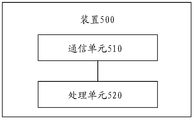
- FIG. 6 is a schematic block diagram of an apparatus 400 for resource mapping in accordance with the present application. As shown in FIG. 6, the apparatus includes a processing unit 410 and a communication unit 420.
- the processing unit 410 is configured to generate resource configuration information, where the resource configuration information is used to indicate parameter information of the N frequency hopping bandwidth parts to the terminal device, where N ⁇ 2, any one of the N frequency hopping bandwidth parts.
- the bandwidth length of the frequency bandwidth portion is less than or equal to the bandwidth length of the active-bandwidth portion active-BP of the terminal device;
- the communication unit 420 is configured to send the resource configuration information to the terminal device.
- the total length of the bandwidth of the N frequency hopping bandwidth portions is equal to the bandwidth length of the active-BP of the terminal device, and any two of the hopping bandwidth portions of the N frequency hopping bandwidth portions do not overlap in the frequency domain.
- the communication unit 420 is further configured to:
- the uplink scheduling information is used to indicate resource index information of the uplink VRB resource, where the resource index information includes a resource index value of the uplink VRB resource.
- the parameter information of each of the N frequency hopping bandwidth portions includes at least the following information:
- the bandwidth length information of the frequency hopping bandwidth part, the location information of the frequency hopping bandwidth part, and the frequency hopping rule information of the frequency hopping bandwidth part, the frequency hopping rule information of the frequency hopping bandwidth part includes at least the frequency hopping mode information and the frequency hopping PRB offset information. And frequency hopping subband information.
- the communication unit 420 is further configured to:
- the bandwidth length P determines parameter information of the corresponding N frequency hopping bandwidth parts, where M and N are positive integers, and M ⁇ N.
- the communication unit 420 is further configured to:
- the device 400 according to the resource mapping of the present application may correspond to the network device in the method of the present application, and each unit and module in the device 400 of the resource mapping and the other operations and/or functions described above are respectively implemented to implement the method 200.
- the corresponding process performed by the network device is not described here for brevity.
- the device for resource mapping of the present application by making the bandwidth length of any one of the N HBPs less than or equal to the bandwidth length of the active-state bandwidth portion active-BP of the terminal device, causes the terminal device to follow the N HBPs.
- the parameter information of any one of the HBPs is frequency hopping, the active state bandwidth part active-BP of the terminal device does not jump out.
- FIG. 7 is a schematic block diagram of an apparatus 500 for resource mapping in accordance with the present application. As shown in FIG. 7, the apparatus includes a communication unit 510 and a processing unit 520.
- the communication unit 510 is configured to receive resource configuration information sent by the network device, where the resource configuration information is used to indicate parameter information of the N frequency hopping bandwidth portions to the terminal device, where N ⁇ 2, in the N hopping bandwidth portions.
- the bandwidth length of any one of the hopping bandwidth portions is less than or equal to the bandwidth length of the active-bandwidth portion active-BP of the terminal device;
- the processing unit 520 is configured to determine, according to the resource configuration information and the uplink scheduling information, an uplink physical transmission resource allocated by the network device.
- the total length of the bandwidth of the N hopping bandwidth portions is equal to the bandwidth length of the active-BP, and any two of the hopping bandwidth portions of the N hopping bandwidth portions do not overlap in the frequency domain.
- processing unit 520 is specifically configured to:
- the uplink scheduling information is a resource allocated by the terminal device;
- the second time unit in the frequency bandwidth portion has an offset of an integer number of PRB resources in the frequency domain between the first uplink PRB resource and the second uplink PRB resource.
- the first uplink VRB resource belongs to the first hop bandwidth portion and the second hop bandwidth portion, and the second hop bandwidth portion is the first hop bandwidth in the N hop bandwidth portions.
- the first uplink VRB resource is a continuous VRB resource.
- the communication unit 510 is further configured to:
- the network device And receiving, by the network device, the uplink scheduling information, where the uplink scheduling information is used to indicate resource index information of the uplink VRB resource, where the resource index information includes a resource index value of the uplink VRB resource.
- the parameter information of each of the N frequency hopping bandwidth portions includes at least the following information:
- the bandwidth length information of the frequency hopping bandwidth part, the location information of the frequency hopping bandwidth part, and the frequency hopping rule information of the frequency hopping bandwidth part, the frequency hopping rule information of the frequency hopping bandwidth part includes at least the frequency hopping mode information and the frequency hopping PRB offset information. And frequency hopping subband information.
- the communication unit 510 is further configured to:
- the processing unit 520 is further configured to:
- the communication unit 510 is further configured to:
- the device 500 of the resource mapping according to the present application may correspond to the terminal device in the method of the present application, and each unit and module in the device 500 of the resource mapping and the other operations and/or functions described above respectively implement the method 200.
- the corresponding processes executed by the terminal device are not described here for brevity.
- the device for resource mapping of the present application by making the bandwidth length of any one of the N HBPs less than or equal to the bandwidth length of the active-state bandwidth portion active-BP of the terminal device, causes the terminal device to follow the N HBPs.
- the parameter information of any one of the HBPs is frequency hopping, the active state bandwidth part active-BP of the terminal device does not jump out.
- FIG. 8 is a schematic block diagram of an apparatus 600 for resource mapping in accordance with the present application. As shown in FIG. 8, the apparatus includes a processing unit 610 and a communication unit 620.
- the communication unit 620 is configured to send the resource configuration information to the terminal device.
- the total bandwidth length of the N mapping bandwidth portions is equal to the bandwidth length of the active-BP, and any two mapping bandwidth portions of the N mapping bandwidth portions do not overlap in the frequency domain.
- the communication unit 620 is further configured to:
- the downlink scheduling information is used to indicate resource index information of the downlink VRB resource, where the resource index information includes a resource index value of the downlink VRB resource.
- the parameter information of each of the N mapped bandwidth portions includes at least the following information:
- the bandwidth length information of the mapped bandwidth portion, the location information of the mapped bandwidth portion, and the mapping mode of the mapped bandwidth portion, the mapping mode of the mapped bandwidth portion includes a centralized mapping and a distributed mapping.
- the communication unit 620 is further configured to:
- the communication unit 620 is further configured to:
- Downlink data is sent to the terminal device on the downlink physical transmission resource.
- the device 600 of the resource mapping according to the present application may correspond to the network device in the method of the present application, and each unit and module in the device 600 of the resource mapping and the other operations and/or functions described above respectively implement the method 300.
- the corresponding process performed by the network device is not described here for brevity.
- the resource mapping method of the present application by making the bandwidth length of any one of the N MBPs less than or equal to the bandwidth length of the active-state bandwidth portion active-BP of the terminal device, causes the terminal device to follow the N MBPs.
- the active state bandwidth part active-BP of the terminal device is not exceeded.
- FIG. 9 is a schematic block diagram of an apparatus 700 for resource mapping in accordance with the present application. As shown in FIG. 9, the apparatus includes a communication unit 710, and a processing unit 720.
- the communication unit 720 is configured to receive resource configuration information that is sent by the network device, where the resource configuration information is used to indicate parameter information of the N mapped bandwidth portions to the terminal device, where N ⁇ 2, any of the N mapping bandwidth portions.
- the bandwidth length of a mapped bandwidth portion is less than or equal to the bandwidth portion of the active-state bandwidth portion active-BP of the terminal device, and the bandwidth portion maps the bandwidth portion;
- the processing unit 720 is configured to determine, according to the resource configuration information and the downlink scheduling information, a downlink physical transmission resource allocated by the network device.
- the total bandwidth length of the N mapping bandwidth portions is equal to the bandwidth length of the active-BP, and any two mapping bandwidth portions of the N mapping bandwidth portions do not overlap in the frequency domain.
- processing unit 720 is specifically configured to:
- the first downlink VRB resource belongs to the first mapping bandwidth part, where the first mapping bandwidth part is any one of the N mapping bandwidth parts, and the first downlink VRB resource is the downlink scheduling of the network device by the network device Information allocated to the terminal device;
- mapping the first downlink VRB resource according to the parameter information of the first mapping bandwidth part and determining the first downlink PRB resource, where the first downlink PRB resource is the first downlink VRB resource in the first mapping bandwidth And corresponding mapping resources in the part, where the first downlink PRB resource belongs to the first mapping bandwidth part.
- the first downlink VRB resource belongs to a plurality of adjacent mapping bandwidth portions of the N mapping bandwidth portions, and the first downlink VRB resource is a continuous VRB resource.
- the communication unit 720 is further configured to:
- the network device And receiving, by the network device, the downlink scheduling information, where the downlink scheduling information is used to indicate resource index information of the downlink VRB resource, where the resource index information includes a resource index value of the downlink VRB resource.
- the parameter information of each of the N mapped bandwidth portions includes at least the following information:
- the bandwidth length information of the mapped bandwidth portion, the location information of the mapped bandwidth portion, and the mapping mode of the mapped bandwidth portion, the mapping mode of the mapped bandwidth portion includes a centralized mapping and a distributed mapping.
- the communication unit 720 is further configured to:
- the processing unit 720 is further configured to:
- the communication unit 720 is further configured to:
- the apparatus 700 for resource mapping may correspond to a terminal device in the method of the present application, and each unit and module in the device 700 of the resource mapping and the other operations and/or functions described above are respectively implemented to implement the method 300.
- the corresponding processes executed by the terminal device are not described here for brevity.
- the resource mapping method of the present application by making the bandwidth length of any one of the N MBPs less than or equal to the bandwidth length of the active-state bandwidth portion active-BP of the terminal device, causes the terminal device to follow the N MBPs.
- the active state bandwidth part active-BP of the terminal device is not exceeded.
- FIG. 10 is a schematic structural diagram of a device 800 for resource mapping according to the present application. As shown in FIG. 10, the device 800 includes:
- the processor 830 The processor 830;
- the memory 820 is configured to store instructions
- the processor 830 is configured to execute instructions stored by the memory 820 to control the transceiver 810 to send signals or control the transceiver 810 to receive signals.
- the processor 830 is configured to generate resource configuration information, where the resource configuration information is used to indicate parameter information of the N frequency hopping bandwidth parts to the terminal device, where N ⁇ 2, any one of the N frequency hopping bandwidth parts.
- the bandwidth length of the frequency bandwidth portion is less than or equal to the bandwidth length of the active-bandwidth portion active-BP of the terminal device;
- the transceiver 810 is configured to send the resource configuration information to the terminal device.
- the total length of the bandwidth of the N frequency hopping bandwidth portions is equal to the bandwidth length of the active-BP of the terminal device, and any two of the hopping bandwidth portions of the N frequency hopping bandwidth portions do not overlap in the frequency domain.
- the transceiver 810 is further configured to:
- the uplink scheduling information is used to indicate resource index information of the uplink VRB resource, where the resource index information includes a resource index value of the uplink VRB resource.
- the parameter information of each of the N frequency hopping bandwidth portions includes at least the following information:
- the bandwidth length information of the frequency hopping bandwidth part, the location information of the frequency hopping bandwidth part, and the frequency hopping rule information of the frequency hopping bandwidth part, the frequency hopping rule information of the frequency hopping bandwidth part includes at least the frequency hopping mode information and the frequency hopping PRB offset information. And frequency hopping subband information.
- the transceiver 810 is further configured to:
- the bandwidth length P determines parameter information of the corresponding N frequency hopping bandwidth parts, where M and N are positive integers, and M ⁇ N.
- the transceiver 810 is further configured to:
- the device 800 of the resource mapping according to the present application may correspond to the network device in the method of the present application, and each unit and module in the resource mapped device 800 and the other operations and/or functions described above are respectively implemented to implement the method 200.
- the corresponding process performed by the network device is not described here for brevity.
- the resource mapping device of the present application by making the bandwidth length of any one of the N HBPs less than or equal to the bandwidth length of the active-state bandwidth portion active-BP of the terminal device, causes the terminal device to follow the N HBPs.
- the parameter information of any one of the HBPs is frequency hopping, the active state bandwidth part active-BP of the terminal device does not jump out.
- FIG. 11 is a schematic structural diagram of a device 900 for resource mapping according to the present application. As shown in FIG. 11, the device 900 includes:
- the processor 930 The processor 930;
- the memory 920 is configured to store instructions
- the processor 930 is configured to execute instructions stored in the memory 920 to control the transceiver 910 to send signals or control the transceiver 910 to receive signals.
- the transceiver 910 is configured to receive resource configuration information sent by the network device, where the resource configuration information is used to indicate parameter information of the N frequency hopping bandwidth portions to the terminal device, where N ⁇ 2, in the N frequency hopping bandwidth portions.
- the bandwidth length of any one of the hopping bandwidth portions is less than or equal to the bandwidth length of the active-bandwidth portion active-BP of the terminal device;
- the processor 930 is configured to determine, according to the resource configuration information and the uplink scheduling information, an uplink physical transmission resource allocated by the network device.
- the total length of the bandwidth of the N hopping bandwidth portions is equal to the bandwidth length of the active-BP, and any two of the hopping bandwidth portions of the N hopping bandwidth portions do not overlap in the frequency domain.
- processor 930 is specifically configured to:
- the uplink scheduling information is a resource allocated by the terminal device;
- the second time unit in the frequency bandwidth portion has an offset of an integer number of PRB resources in the frequency domain between the first uplink PRB resource and the second uplink PRB resource.
- the first uplink VRB resource belongs to the first hop bandwidth portion and the second hop bandwidth portion, and the second hop bandwidth portion is the first hop bandwidth in the N hop bandwidth portions.
- the first uplink VRB resource is a continuous VRB resource.
- the transceiver 910 is further configured to:
- the network device And receiving, by the network device, the uplink scheduling information, where the uplink scheduling information is used to indicate resource index information of the uplink VRB resource, where the resource index information includes a resource index value of the uplink VRB resource.
- the parameter information of each of the N frequency hopping bandwidth portions includes at least the following information:
- the bandwidth length information of the frequency hopping bandwidth part, the location information of the frequency hopping bandwidth part, and the frequency hopping rule information of the frequency hopping bandwidth part, the frequency hopping rule information of the frequency hopping bandwidth part includes at least the frequency hopping mode information and the frequency hopping PRB offset information. And frequency hopping subband information.
- the transceiver 910 is further configured to:
- the processor 930 is also configured to:
- the transceiver 910 is further configured to:
- the resource mapping device 900 may correspond to the terminal device in the method of the present application, and each unit and module in the resource mapping device 900 and the above other operations and/or functions respectively implement the method 300.
- the corresponding processes executed by the terminal device are not described here for brevity.
- the resource mapping device of the present application by making the bandwidth length of any one of the N HBPs less than or equal to the bandwidth length of the active-state bandwidth portion active-BP of the terminal device, causes the terminal device to follow the N HBPs.
- the parameter information of any one of the HBPs is frequency hopping, the active state bandwidth part active-BP of the terminal device does not jump out.
- FIG. 12 is a schematic structural diagram of a device 1000 for resource mapping according to the present application. As shown in FIG. 12, the device 1000 includes:
- the memory 1020 is configured to store instructions
- the processor 1030 is configured to execute instructions stored in the memory 1020 to control the transceiver 1010 to transmit signals or control the transceiver 1010 to receive signals.
- the processor 1030 is configured to generate resource configuration information, where the resource configuration information is used to indicate parameter information of the N mapped bandwidth portions to the terminal device, where N ⁇ 2, and any one of the N mapping bandwidth portions maps the bandwidth portion.
- the bandwidth length is less than or equal to the active state bandwidth portion of the terminal device, the bandwidth length of the active-BP mapping portion, and the bandwidth portion of the bandwidth portion;
- the transceiver 1010 is configured to send the resource configuration information to the terminal device.
- the total bandwidth length of the N mapping bandwidth portions is equal to the bandwidth length of the active-BP, and any two mapping bandwidth portions of the N mapping bandwidth portions do not overlap in the frequency domain.
- the transceiver 1010 is further configured to:
- the downlink scheduling information is used to indicate resource index information of the downlink VRB resource, where the resource index information includes a resource index value of the downlink VRB resource.
- the parameter information of each of the N mapped bandwidth portions includes at least the following information:
- the bandwidth length information of the mapped bandwidth portion, the location information of the mapped bandwidth portion, and the mapping mode of the mapped bandwidth portion, the mapping mode of the mapped bandwidth portion includes a centralized mapping and a distributed mapping.
- the transceiver 1010 is further configured to:
- the transceiver 1010 is further configured to:
- the device 1000 according to the resource mapping of the present application may correspond to the network device in the method of the present application, and each unit and module in the resource mapped device 1000 and the other operations and/or functions described above respectively implement the method 300.
- the corresponding process performed by the network device is not described here for brevity.
- the resource mapping device of the present application causes the terminal device to follow the N MBPs by making the bandwidth length of any one of the N MBPs less than or equal to the bandwidth length of the active-state bandwidth portion active-BP of the terminal device.
- the active state bandwidth part active-BP of the terminal device is not exceeded.
- FIG. 13 is a schematic structural diagram of a device 1100 for resource mapping according to the present application. As shown in FIG. 13, the device 1100 includes:
- the processor 1130 The processor 1130;
- the memory 1120 is configured to store an instruction
- the processor 1130 is configured to execute an instruction stored by the memory 1120 to control the transceiver 1110 to send a signal or control the transceiver 1110 to receive a signal.
- the transceiver 1110 is configured to receive resource configuration information sent by the network device, where the resource configuration information is used to indicate parameter information of the N mapped bandwidth portions to the terminal device, where N ⁇ 2, any of the N mapping bandwidth portions.
- the bandwidth length of a mapped bandwidth portion is less than or equal to the bandwidth portion of the active-state bandwidth portion active-BP of the terminal device, and the bandwidth portion maps the bandwidth portion;
- the processor 1130 is configured to determine, according to the resource configuration information and the downlink scheduling information, a downlink physical transmission resource allocated by the network device.
- the total bandwidth length of the N mapping bandwidth portions is equal to the bandwidth length of the active-BP, and any two mapping bandwidth portions of the N mapping bandwidth portions do not overlap in the frequency domain.
- processor 1130 is specifically configured to:
- the first downlink VRB resource belongs to the first mapping bandwidth part, where the first mapping bandwidth part is any one of the N mapping bandwidth parts, and the first downlink VRB resource is the downlink scheduling of the network device by the network device Information allocated to the terminal device;
- mapping the first downlink VRB resource according to the parameter information of the first mapping bandwidth part and determining the first downlink PRB resource, where the first downlink PRB resource is the first downlink VRB resource in the first mapping bandwidth And corresponding mapping resources in the part, where the first downlink PRB resource belongs to the first mapping bandwidth part.
- the first downlink VRB resource belongs to a plurality of adjacent mapping bandwidth portions of the N mapping bandwidth portions, and the first downlink VRB resource is a continuous VRB resource.
- the transceiver 1110 is further configured to:
- the network device And receiving, by the network device, the downlink scheduling information, where the downlink scheduling information is used to indicate resource index information of the downlink VRB resource, where the resource index information includes a resource index value of the downlink VRB resource.
- the parameter information of each of the N mapped bandwidth portions includes at least the following information:
- the bandwidth length information of the mapped bandwidth portion, the location information of the mapped bandwidth portion, and the mapping mode of the mapped bandwidth portion, the mapping mode of the mapped bandwidth portion includes a centralized mapping and a distributed mapping.
- the transceiver 1110 is further configured to:
- the processor 1130 is also configured to:
- the transceiver 1110 is further configured to:
- the device 1100 according to the resource mapping of the present application may correspond to the terminal device in the method of the present application, and each unit and module in the resource mapped device 1100 and the above other operations and/or functions respectively implement the method 300.
- the corresponding processes executed by the terminal device are not described here for brevity.
- the resource mapping device of the present application causes the terminal device to follow the N MBPs by making the bandwidth length of any one of the N MBPs less than or equal to the bandwidth length of the active-state bandwidth portion active-BP of the terminal device.
- the active state bandwidth part active-BP of the terminal device is not exceeded.
- the disclosed systems, devices, and methods may be implemented in other manners.
- the device embodiments described above are merely illustrative.
- the division of the unit is only a logical function division.
- there may be another division manner for example, multiple units or components may be combined or Can be integrated into another system, or some features can be ignored or not executed.
- the mutual coupling or direct coupling or communication connection shown or discussed may be an indirect coupling or communication connection through some interface, device or unit, and may be in an electrical, mechanical or other form.
- the units described as separate components may or may not be physically separated, and the components displayed as units may or may not be physical units, that is, may be located in one place, or may be distributed to multiple network units. Some or all of the units may be selected according to actual needs to achieve the purpose of the solution of the embodiment.
- each functional unit in each embodiment of the present application may be integrated into one processing unit, or each unit may exist physically separately, or two or more units may be integrated into one unit.
- the functions may be stored in a computer readable storage medium if implemented in the form of a software functional unit and sold or used as a standalone product.
- the technical solution of the present application which is essential or contributes to the prior art, or a part of the technical solution, may be embodied in the form of a software product, which is stored in a storage medium, including
- the instructions are used to cause a computer device (which may be a personal computer, server, or network device, etc.) to perform all or part of the steps of the methods described in various embodiments of the present application.
- the foregoing storage medium includes: a U disk, a mobile hard disk, a read-only memory (ROM), a random access memory (RAM), a magnetic disk, or an optical disk, and the like, which can store program codes. .
Landscapes
- Engineering & Computer Science (AREA)
- Computer Networks & Wireless Communication (AREA)
- Signal Processing (AREA)
- Mobile Radio Communication Systems (AREA)
Abstract
La présente invention concerne un procédé et un appareil de mappage de ressources. Le procédé comprend les étapes suivantes : un dispositif terminal reçoit des informations de configuration de ressource envoyées par un dispositif de réseau, les informations de configuration de ressource étant utilisées pour indiquer des informations de paramètre de N parties de bande passante de saut de fréquence au dispositif terminal, l'expression N ≥ 2 étant satisfaite, la longueur de bande passante de l'une quelconque des N parties de bande passante de saut de fréquence étant inférieure ou égale à la longueur de bande passante d'une partie de bande passante active (BP active) du dispositif terminal ; le dispositif terminal détermine, en fonction des informations de configuration de ressource et des informations de planification de liaison montante, une ressource de transmission physique de liaison montante attribuée par le dispositif de réseau. En permettant que la longueur de bande passante de l'une quelconque des N parties de bande passante de saut de fréquence soit inférieure ou égale à la longueur de bande passante de la BP active du dispositif terminal, le dispositif terminal, lors de l'exécution d'un saut de fréquence en fonction des informations de paramètre de l'une quelconque des N parties de bande passante de saut de fréquence, ne sauterait pas la BP active du dispositif terminal.
Applications Claiming Priority (2)
| Application Number | Priority Date | Filing Date | Title |
|---|---|---|---|
| CN201710459150.2A CN109152019A (zh) | 2017-06-16 | 2017-06-16 | 资源映射的方法和装置 |
| CN201710459150.2 | 2017-06-16 |
Publications (1)
| Publication Number | Publication Date |
|---|---|
| WO2018228533A1 true WO2018228533A1 (fr) | 2018-12-20 |
Family
ID=64660132
Family Applications (1)
| Application Number | Title | Priority Date | Filing Date |
|---|---|---|---|
| PCT/CN2018/091501 Ceased WO2018228533A1 (fr) | 2017-06-16 | 2018-06-15 | Procédé et appareil de mappage de ressources |
Country Status (2)
| Country | Link |
|---|---|
| CN (1) | CN109152019A (fr) |
| WO (1) | WO2018228533A1 (fr) |
Families Citing this family (8)
| Publication number | Priority date | Publication date | Assignee | Title |
|---|---|---|---|---|
| CN111417196B (zh) * | 2019-01-07 | 2023-05-09 | 中国移动通信有限公司研究院 | 基于预调度的传输配置方法、传输参数确定方法及设备 |
| CN111436085B (zh) * | 2019-01-11 | 2021-10-15 | 华为技术有限公司 | 通信方法及装置 |
| CN111865527B (zh) * | 2019-04-29 | 2021-10-01 | 华为技术有限公司 | 一种通信方法及装置 |
| US20230135832A1 (en) * | 2020-05-05 | 2023-05-04 | Qualcomm Incorporated | Vrb-to-prb allocation for disjoint bwp segments |
| CN115134199B (zh) * | 2021-03-29 | 2025-03-07 | 维沃移动通信有限公司 | Srs的发送方法、接收方法、配置方法及装置 |
| WO2022205236A1 (fr) * | 2021-03-31 | 2022-10-06 | 北京小米移动软件有限公司 | Procédés et appareils de détermination et d'indication d'intervalle de saut de fréquence |
| CN116437460A (zh) * | 2021-12-31 | 2023-07-14 | 中国移动通信有限公司研究院 | 传输资源配置方法、装置、设备及可读存储介质 |
| CN117480793A (zh) * | 2022-05-27 | 2024-01-30 | 北京小米移动软件有限公司 | 更新配置接收、发送方法和装置、通信装置及存储介质 |
Citations (4)
| Publication number | Priority date | Publication date | Assignee | Title |
|---|---|---|---|---|
| CN102668673A (zh) * | 2009-12-21 | 2012-09-12 | 高通股份有限公司 | 用于具有载波扩展的资源分配的方法和装置 |
| EP2637319A2 (fr) * | 2010-11-02 | 2013-09-11 | LG Electronics Inc. | Procédé et appareil de rétroaction efficace dans un système de communication sans fil prenant en charge de multiples antennes |
| WO2015016512A1 (fr) * | 2013-07-30 | 2015-02-05 | Lg Electronics Inc. | Procédé de réception de signal en liaison descendante, et appareil correspondant |
| CN104380625A (zh) * | 2012-03-22 | 2015-02-25 | Lg电子株式会社 | 用于发送或接收上行信号的方法 |
-
2017
- 2017-06-16 CN CN201710459150.2A patent/CN109152019A/zh active Pending
-
2018
- 2018-06-15 WO PCT/CN2018/091501 patent/WO2018228533A1/fr not_active Ceased
Patent Citations (4)
| Publication number | Priority date | Publication date | Assignee | Title |
|---|---|---|---|---|
| CN102668673A (zh) * | 2009-12-21 | 2012-09-12 | 高通股份有限公司 | 用于具有载波扩展的资源分配的方法和装置 |
| EP2637319A2 (fr) * | 2010-11-02 | 2013-09-11 | LG Electronics Inc. | Procédé et appareil de rétroaction efficace dans un système de communication sans fil prenant en charge de multiples antennes |
| CN104380625A (zh) * | 2012-03-22 | 2015-02-25 | Lg电子株式会社 | 用于发送或接收上行信号的方法 |
| WO2015016512A1 (fr) * | 2013-07-30 | 2015-02-05 | Lg Electronics Inc. | Procédé de réception de signal en liaison descendante, et appareil correspondant |
Non-Patent Citations (2)
| Title |
|---|
| "DL/UL Data Frequency Resource Allocation", R1-1710565; 3GPP TSG RAN WG1 NR AD-HOC#2, 17 June 2017 (2017-06-17), XP051305136 * |
| "Technical Specification Group Radio Access Network; ''Evolved Universal Terrestrial Radio Access (E-UTRA); Physical Layer Procedures (Release 15)", 3GPP TS 36.213 V15.1.0, 31 March 2018 (2018-03-31), XP051450810 * |
Also Published As
| Publication number | Publication date |
|---|---|
| CN109152019A (zh) | 2019-01-04 |
Similar Documents
| Publication | Publication Date | Title |
|---|---|---|
| US11206054B2 (en) | Communication method and device | |
| US11190323B2 (en) | Wireless communication method, terminal device and network device | |
| CN113286371B (zh) | 侧行通信的方法和终端设备 | |
| US11711808B2 (en) | Method, mobile station, and network apparatus for transmitting service | |
| US11700101B2 (en) | Information transmission method, terminal device, and network device | |
| CN109150387B (zh) | 发送参考信号的方法、接收参考信号的方法和通信装置 | |
| CN112470516B (zh) | 资源配置的方法和终端设备 | |
| WO2019096235A1 (fr) | Procédé de réception d'un signal de référence, et procédé d'émission d'un signal de référence | |
| WO2021057232A1 (fr) | Procédé et dispositif d'émission de signaux | |
| WO2018228533A1 (fr) | Procédé et appareil de mappage de ressources | |
| US11516777B2 (en) | Data transmission method and apparatus and communications device | |
| CN111756501B (zh) | 传输上行控制信息的方法及装置 | |
| CN116015576B (zh) | 参考信号的资源映射方法与装置、终端和网络设备 | |
| KR102466982B1 (ko) | 자원 할당 방법, 단말 장치와 네트워크 장치 | |
| WO2018082544A1 (fr) | Procédé et appareil de communication sans fil | |
| CN108365927B (zh) | 传输方法、网络设备和终端设备 | |
| WO2018137222A1 (fr) | Procédé et appareil d'envoi de signal de référence, et procédé et appareil de réception de signal de référence | |
| WO2019096232A1 (fr) | Appareil et procédé de communication | |
| CN106559203A (zh) | 传输控制信令的方法和装置 | |
| US20210144692A1 (en) | Method and apparatus for wireless communication | |
| US10904867B2 (en) | Uplink control signal transmission method and apparatus | |
| CN113596876B (zh) | 无线通信的方法、终端设备、网络设备、芯片和介质 | |
| JP2021119702A (ja) | 共有基準信号を復調するための方法、端末装置とネットワーク装置 | |
| CN108419293A (zh) | 传输下行控制信息的方法和装置 | |
| JP2019530259A (ja) | 信号伝送方法及び機器 |
Legal Events
| Date | Code | Title | Description |
|---|---|---|---|
| 121 | Ep: the epo has been informed by wipo that ep was designated in this application |
Ref document number: 18818766 Country of ref document: EP Kind code of ref document: A1 |
|
| NENP | Non-entry into the national phase |
Ref country code: DE |
|
| 122 | Ep: pct application non-entry in european phase |
Ref document number: 18818766 Country of ref document: EP Kind code of ref document: A1 |