WO2019010734A1 - Procédé et système de guidage de trafic d'application de service - Google Patents
Procédé et système de guidage de trafic d'application de service Download PDFInfo
- Publication number
- WO2019010734A1 WO2019010734A1 PCT/CN2017/095533 CN2017095533W WO2019010734A1 WO 2019010734 A1 WO2019010734 A1 WO 2019010734A1 CN 2017095533 W CN2017095533 W CN 2017095533W WO 2019010734 A1 WO2019010734 A1 WO 2019010734A1
- Authority
- WO
- WIPO (PCT)
- Prior art keywords
- traffic
- function
- module
- destination
- service module
- Prior art date
- Legal status (The legal status is an assumption and is not a legal conclusion. Google has not performed a legal analysis and makes no representation as to the accuracy of the status listed.)
- Ceased
Links
Images


Classifications
-
- H—ELECTRICITY
- H04—ELECTRIC COMMUNICATION TECHNIQUE
- H04L—TRANSMISSION OF DIGITAL INFORMATION, e.g. TELEGRAPHIC COMMUNICATION
- H04L67/00—Network arrangements or protocols for supporting network services or applications
- H04L67/50—Network services
- H04L67/56—Provisioning of proxy services
- H04L67/563—Data redirection of data network streams
-
- H—ELECTRICITY
- H04—ELECTRIC COMMUNICATION TECHNIQUE
- H04L—TRANSMISSION OF DIGITAL INFORMATION, e.g. TELEGRAPHIC COMMUNICATION
- H04L47/00—Traffic control in data switching networks
- H04L47/10—Flow control; Congestion control
- H04L47/12—Avoiding congestion; Recovering from congestion
- H04L47/122—Avoiding congestion; Recovering from congestion by diverting traffic away from congested entities
-
- G—PHYSICS
- G06—COMPUTING OR CALCULATING; COUNTING
- G06F—ELECTRIC DIGITAL DATA PROCESSING
- G06F9/00—Arrangements for program control, e.g. control units
- G06F9/06—Arrangements for program control, e.g. control units using stored programs, i.e. using an internal store of processing equipment to receive or retain programs
- G06F9/44—Arrangements for executing specific programs
- G06F9/445—Program loading or initiating
- G06F9/44521—Dynamic linking or loading; Link editing at or after load time, e.g. Java class loading
-
- H—ELECTRICITY
- H04—ELECTRIC COMMUNICATION TECHNIQUE
- H04L—TRANSMISSION OF DIGITAL INFORMATION, e.g. TELEGRAPHIC COMMUNICATION
- H04L47/00—Traffic control in data switching networks
- H04L47/10—Flow control; Congestion control
- H04L47/19—Flow control; Congestion control at layers above the network layer
- H04L47/193—Flow control; Congestion control at layers above the network layer at the transport layer, e.g. TCP related
-
- H—ELECTRICITY
- H04—ELECTRIC COMMUNICATION TECHNIQUE
- H04L—TRANSMISSION OF DIGITAL INFORMATION, e.g. TELEGRAPHIC COMMUNICATION
- H04L47/00—Traffic control in data switching networks
- H04L47/10—Flow control; Congestion control
- H04L47/20—Traffic policing
-
- H—ELECTRICITY
- H04—ELECTRIC COMMUNICATION TECHNIQUE
- H04L—TRANSMISSION OF DIGITAL INFORMATION, e.g. TELEGRAPHIC COMMUNICATION
- H04L63/00—Network architectures or network communication protocols for network security
- H04L63/08—Network architectures or network communication protocols for network security for authentication of entities
- H04L63/0884—Network architectures or network communication protocols for network security for authentication of entities by delegation of authentication, e.g. a proxy authenticates an entity to be authenticated on behalf of this entity vis-à-vis an authentication entity
-
- H—ELECTRICITY
- H04—ELECTRIC COMMUNICATION TECHNIQUE
- H04L—TRANSMISSION OF DIGITAL INFORMATION, e.g. TELEGRAPHIC COMMUNICATION
- H04L67/00—Network arrangements or protocols for supporting network services or applications
- H04L67/50—Network services
- H04L67/56—Provisioning of proxy services
-
- H—ELECTRICITY
- H04—ELECTRIC COMMUNICATION TECHNIQUE
- H04L—TRANSMISSION OF DIGITAL INFORMATION, e.g. TELEGRAPHIC COMMUNICATION
- H04L67/00—Network arrangements or protocols for supporting network services or applications
- H04L67/50—Network services
- H04L67/60—Scheduling or organising the servicing of application requests, e.g. requests for application data transmissions using the analysis and optimisation of the required network resources
- H04L67/63—Routing a service request depending on the request content or context
-
- H—ELECTRICITY
- H04—ELECTRIC COMMUNICATION TECHNIQUE
- H04W—WIRELESS COMMUNICATION NETWORKS
- H04W28/00—Network traffic management; Network resource management
- H04W28/02—Traffic management, e.g. flow control or congestion control
- H04W28/10—Flow control between communication endpoints
- H04W28/14—Flow control between communication endpoints using intermediate storage
-
- H—ELECTRICITY
- H04—ELECTRIC COMMUNICATION TECHNIQUE
- H04L—TRANSMISSION OF DIGITAL INFORMATION, e.g. TELEGRAPHIC COMMUNICATION
- H04L45/00—Routing or path finding of packets in data switching networks
- H04L45/74—Address processing for routing
-
- H—ELECTRICITY
- H04—ELECTRIC COMMUNICATION TECHNIQUE
- H04L—TRANSMISSION OF DIGITAL INFORMATION, e.g. TELEGRAPHIC COMMUNICATION
- H04L69/00—Network arrangements, protocols or services independent of the application payload and not provided for in the other groups of this subclass
- H04L69/16—Implementation or adaptation of Internet protocol [IP], of transmission control protocol [TCP] or of user datagram protocol [UDP]
- H04L69/161—Implementation details of TCP/IP or UDP/IP stack architecture; Specification of modified or new header fields
-
- H—ELECTRICITY
- H04—ELECTRIC COMMUNICATION TECHNIQUE
- H04W—WIRELESS COMMUNICATION NETWORKS
- H04W28/00—Network traffic management; Network resource management
- H04W28/02—Traffic management, e.g. flow control or congestion control
- H04W28/10—Flow control between communication endpoints
Definitions
- the present invention relates to the field of mobile Internet mobile data, and in particular, to a method and system for guiding service application traffic.
- the CP implements directed traffic by reporting domain names. Specifically, the operator performs traffic reduction on the communication of the subscription user to access certain addresses.
- the operator performs traffic reduction on the communication of the subscription user to access certain addresses.
- the CP is connected to multiple operators, it is necessary to match the interfaces of the respective operators and perform different traffic scheduling policies according to different subscriptions, so that there is a problem that the service access modes are not unified. It is difficult to connect the platform.
- the user's mobile phone does not have a unified access interface, and even there is a problem that the success rate of the acquisition is low.
- an embodiment of the present invention provides a method and system for guiding service application traffic.
- the technical solution is as follows:
- a method for guiding traffic of a service application includes:
- the mydlopen function includes loading a new dynamic library, and mounting the new dynamic
- the dlopen function and the connect function in the library are replaced with the mydlopen function and the myconnect function, respectively;
- the function of the myconnect function includes directing non-local traffic of the service application module to a proxy service module;
- the proxy service module receives the non-local traffic and boots.
- the function of the myconnect function includes receiving the traffic sent by the service application module, obtaining the destination IP address and the destination port of the traffic, and determining whether the destination IP address is a local IP address, and if yes, the traffic is Sending to the destination port, if not, sending the traffic to the port monitored by the proxy service module.
- the function of the myconnect function includes establishing the destination IP address, the destination port, and the connection port of the non-local traffic, and establishing a mapping relationship between the destination IP address, the destination port, and the connection port. And save as a mapping relationship record.
- the method for the proxy service module to boot the non-local traffic includes:
- the proxy service module sends the resource to the service application module.
- the obtaining traffic guiding rules include:
- the proxy server sends the corresponding traffic guidance rule to the proxy service module according to the user information, and the proxy service module receives the traffic guidance rule delivered by the proxy server.
- the returning source processing to the non-local traffic includes: obtaining a destination IP and a destination port of the non-local traffic from the mapping relationship record, and sending the non-local traffic to the destination IP address The source server corresponding to the destination port.
- the method for establishing the transmission channel of the proxy service module and the boot node and the source server includes:
- the proxy service module initiates a connection request to a boot node specified in the traffic guidance rule
- the packet containing the non-local traffic destination IP address and the destination port information is sent to the guiding node, and the guiding node selects according to the destination IP and destination port parsed from the packet.
- the source server establishes a connection with the source server. After the connection is successful, the proxy service module sends the non-local traffic to the boot node through the transmission channel, and reaches the source server to obtain the requested resource.
- the message further includes a check value, wherein the guiding node confirms whether the current connection is legal through the check value, and if it is legal, performs selection and connection of the source server.
- the method for the proxy service module to send the resource to the service application module includes: after receiving the resource, the proxy service module records the connection port of the service application module according to the mapping relationship, and The resource is sent to the connection port.
- the source server includes a content server and a cache server.
- the service application traffic is TCP traffic.
- a guidance system for service application traffic wherein the guidance system includes:
- the function setting module traverses the dlopen function and the connect function in all dynamic libraries initially loaded by the business application module, and the mount function Describe the dlopen function and the connect function, and replace them with a custom mydlopen function and a custom myconnect function respectively; wherein the function of the mydlopen function includes loading a new dynamic library, and mounting the new dynamic library The dlopen function and the connect function are replaced with the mydlopen function and the myconnect function, respectively; the function of the myconnect function includes directing non-local traffic of the service application module to the proxy service module ;
- the proxy service module receives the non-local traffic and boots.
- the function of the myconnect function includes receiving the traffic sent by the service application module, obtaining the destination IP address and the destination port of the traffic, and determining whether the destination IP address is a local IP address. The address, if yes, sends the traffic to the destination port, and if not, sends the traffic to a port that the proxy service module listens to.
- the function of the myconnect function includes establishing the destination IP address, the destination port, and the connection port of the non-local traffic, and establishing a mapping relationship between the destination IP address, the destination port, and the connection port. And save as a mapping relationship record.
- the booting system further includes a boot node and a source server, and the method for the proxy service module to boot the non-local traffic includes:
- the guiding system further includes a rights management server, and the agent service module acquiring the traffic guiding rule includes:
- the proxy server sends the corresponding traffic guidance rule to the proxy service module according to the user information, and the proxy service module receives the traffic guidance rule delivered by the proxy server.
- the proxy service module performs source return processing on the non-local traffic, and obtains a destination IP and a destination port of the non-local traffic from the mapping relationship record, and sends the non-local traffic to the The source server corresponding to the destination IP and destination port.
- the method for establishing the transmission channel of the proxy service module and the boot node and the source server includes:
- the proxy service module initiates a connection request to a boot node specified in the traffic guidance rule
- the packet containing the non-local traffic destination IP address and the destination port information is sent to the guiding node, and the guiding node selects according to the destination IP and destination port parsed from the packet.
- the source server establishes a connection with the source server. After the connection is successful, the proxy service module sends the non-local traffic to the boot node through the transmission channel, and reaches the source server to obtain the requested resource.
- the message further includes a check value, wherein the guiding node confirms whether the current connection is legal according to the check value, and if it is legal, performs selection and connection of the source server.
- the method for the proxy service module to send the resource to the service application module includes: after receiving the resource, the proxy service module records the connection port of the service application module according to the mapping relationship, and The resource is sent to the connection port.
- the source server includes a content server and a cache server.
- the service application traffic is TCP traffic.
- proxy service module and the function setting module are software development kits embedded in the business application module.
- the electronic device is a mobile communication device.
- the technical solution provided by the embodiment of the present invention has the beneficial effects of solving the traffic guidance problem through the local proxy and the function replacement manner, thereby greatly improving the smoothness of the traffic guidance in the directed traffic, so that the user can obtain a better experience. And, by verifying the user information, different traffic guiding rules are issued for different users to meet the service requirements.
- FIG. 1 is a flowchart of a method for guiding service application traffic according to an embodiment of the present invention
- step S3 is a specific flowchart of step S3 shown in FIG. 1 according to an embodiment of the present invention
- FIG. 3 is a schematic structural diagram of a guiding system 10 for service application traffic according to an embodiment of the present invention.
- Embodiments of the present invention describe a method and system for guiding traffic of a business application.
- a mobile app includes, but is not limited to, an Android running on, for example, Google Inc. (Android) operating system, Apple's IOS operating system, Microsoft's Windows Phone operating system, Nokia's Symbian operating system and other mobile apps on mobile platforms. It should be noted that the mobile platform is merely an example, and is not limited to the apps on these platforms. Mobile apps on other unlisted mobile platforms can also be applied to the scope of the present invention.
- FIG. 1 is a flowchart of a method for guiding service application traffic according to an embodiment of the present invention.
- step S1 the dlopen function and the connect function in all the dynamic libraries initially loaded by the business application module are traversed.
- step S2 the dlopen function and the connect function are mounted and replaced with a custom mydlopen function and a custom myconnect function, respectively.
- the dlopen function is a powerful library function
- the commonly used function of this function will open a new library and load it into memory.
- the connect function is also a commonly used function, mainly used to create connections.
- the mydlopen function is a custom function created by the user. It retains the dlopen function to load the new dynamic library function. At the same time, it adds the dlopen function and the connect function in the new dynamic library, and replaces them with the mydlopen function. And the myconnect function. In this way, when the business application module loads the new dynamic library through the mydlopen function, the dlopen function and the connect function in the new dynamic library are replaced by the mydlopen function and the myconnect function, and finally recursively through the method, the business application module The dlopen function and the connect function in all loaded dynamic libraries are replaced with the mydlopen function and the myconnect function.
- the myconnect function is also a user-created custom function whose function involves directing non-local traffic from the business application module to the proxy service module.
- the function of the myconnect function includes receiving the traffic sent by the service application module, obtaining the destination IP address and the destination port of the traffic, determining whether the destination IP address is a local IP address, and if yes, sending the traffic to the The destination port, if not, sends the traffic to a port that the proxy service module listens to.
- the function of the myconnect function further includes establishing the destination IP address, the destination port, and the connection port of the non-local traffic, and establishing a mapping relationship between the destination IP address, the destination port, and the connection port. And save as a mapping relationship record. This mapping relationship is mainly used for subsequent The source is used when the business application module is used, which will be described in detail below.
- the mobile app, the service application module is initialized by means of the boot service when the program is started, that is, traversing the dlopen function and the connect in all the dynamic libraries initially loaded by the business application module of the current mobile app. Function, and replace all dlopen and connect functions associated with the dynamic library with the custom mydlopen and myconnect functions, respectively.
- the required new dynamic library is loaded by the mydlopen function, and the dlopen function and the connect function in the new library are replaced with the mydlopen function and the myconnect function, respectively, while the new library is loaded.
- the new dynamic library will trigger the mydlopen function when loading other libraries, and use the mydlopen function to determine whether there is a dlopen function and a connect function in the newly loaded dynamic library. If the newly loaded dynamic library has a dlopen function and a connect function, Then replace the dlopen function and the connect function in the newly loaded dynamic library with the mydlopen function and the myconnect function, respectively.
- the connect function in the dynamic library loaded by the business application module is replaced by the myconnect function, and the local traffic is sent to the local through the myconnect function, and the non-local traffic is sent to the proxy service module, thereby avoiding The traffic leaked.
- step S3 the proxy service module receives the non-local traffic and performs booting.
- the service application module when the service application module is started, the user information is requested from the user, and after receiving the user information, the user information is sent to the remote authentication server, and the remote authentication server determines the subscription status of the user according to the user information.
- the corresponding traffic guidance rule is sent to the proxy service module, where the traffic guidance configuration includes whether to perform traffic guidance, specified boot node information, and a data encryption key, etc., after the proxy service module receives the delivered traffic guidance configuration. , save the traffic guidance configuration and traffic guidance based on the traffic guidance configuration.
- the traffic guidance rule in the cache is loaded while the proxy service module is enabled, and if the traffic cannot be loaded from the cache. Boot rules that use the default traffic steering rules to direct current traffic to respond quickly to user requests.
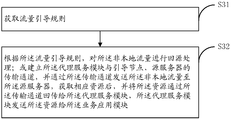
- the method by which the proxy service module boots the non-local traffic includes sub-steps S31-S32.
- step S3 shown in FIG. 1 in an embodiment of the present invention is shown.
- step S31 a traffic guidance rule is acquired.
- obtaining traffic guidance rules includes:
- the proxy server sends the corresponding traffic guidance rule to the proxy service module according to the user information
- the proxy service module receives the traffic guidance rule delivered by the proxy server and loads and uses the traffic guidance rule. That is, when the traffic guidance rule delivered by the rights authentication server has not reached the proxy service module, in order to respond quickly to the user request, the proxy service module first loads the traffic guidance rule in the local cache or processes the traffic according to the default traffic guidance rule. After the proxy service module receives the traffic guidance rule delivered by the proxy server, the non-local traffic received from the service application module will be processed according to the newly delivered traffic guidance rule.
- step S32 the non-local traffic is returned to the source according to the traffic guidance rule; or the transmission channel of the proxy service module and the boot node and the source server is established, and the non-transmission is sent through the transmission channel.
- the local traffic is sent to the source server, and after the corresponding resource is obtained, the resource is returned to the proxy service module by using the transport channel, and the proxy service module sends the resource to the service application module.
- the returning source processing to the non-local traffic includes: acquiring a destination IP and a destination port of the non-local traffic from the mapping relationship record, and sending the non-local traffic to the The source server corresponding to the destination IP and destination port.
- the method for establishing the transmission channel of the proxy service module and the boot node and the source server in step S32 includes: the proxy service module initiating a connection request to the boot node specified in the traffic guidance rule, After the connection succeeds, the packet containing the non-local traffic destination IP address and the destination port information is sent to the guiding node, and the guiding node selects according to the destination IP and destination port parsed from the packet.
- the source server establishes a connection with the source server. After the connection is successful, the transmission channel is established.
- the proxy service module sends the non-local traffic to the boot node through the transmission channel, and reaches the source server to obtain the requested resource.
- the packet further includes a check value, and when the receiving node receives the packet, the guiding node determines whether the current connection is legal according to the check value in the packet, and if it is legal, performs the Describe the source server selection and connection. If it is not legal, it is judged that the user information has expired or expired, then refuses to connect with the source server, and returns connection failure information to the proxy service module.
- the method for the proxy service module to send the resource to the service application module in step S32 includes: the proxy service module receives a resource through the transmission channel and then performs mapping A connection port of the service application module that issues the request is obtained in the relationship record, and the resource is sent to the connection port.
- the source server may be a content server, or a cache server in a CDN network.
- the service application traffic is TCP traffic.
- the invention provides a method for guiding service application traffic, which guides the traffic of the service application module through a function replacement manner and a local agent, improves the traffic transmission rate by establishing a transmission channel, and verifies the user information through the remote authentication server.
- a method for guiding service application traffic which guides the traffic of the service application module through a function replacement manner and a local agent, improves the traffic transmission rate by establishing a transmission channel, and verifies the user information through the remote authentication server.
- a guidance system for service application traffic provided by the present invention will be described in detail below.
- FIG. 3 it is a schematic structural diagram of a guiding system for service application traffic according to an embodiment of the present invention.
- the guiding system 10 for business application traffic specifically includes a business application module 101, a function setting module 102, a proxy service module 103, a source server 104, a boot node 105, and an authentication server 106 that are installed on the same electronic device.
- the proxy service module 103 and the function setting module 102 are software development kits embedded in the business application module 101
- the electronic devices are mobile communication devices, such as mobile phones and tablet computers.
- the function setting module 102 traverses the dlopen function and the connect function in all the dynamic libraries initially loaded by the business application module 101, mounts the dlopen function and the connect function, and replaces them with a custom mydlopen function and a custom one, respectively. Myconnect function.
- the dlopen function is a powerful library function
- the commonly used function of this function will open a new library and load it into memory.
- the connect function is also a commonly used function, mainly used to create connections.
- the mydlopen function is a custom function created by the user. It retains the dlopen function to load the new dynamic library function. At the same time, it adds the dlopen function and the connect function in the new dynamic library, and replaces them with the mydlopen function. And the myconnect function. In this way, when the business application module loads the new dynamic library through the mydlopen function, the dlopen function and the connect function in the new dynamic library. The number is replaced by the mydlopen function and the myconnect function, and finally recursively in this way, the dlopen function and the connect function in all dynamic libraries loaded by the business application module are replaced with the mydlopen function and the myconnect function.
- the myconnect function is also a user-created custom function whose function involves directing non-local traffic from the business application module to the proxy service module.
- the function of the myconnect function includes receiving the traffic sent by the service application module, obtaining the destination IP address and the destination port of the traffic, determining whether the destination IP address is a local IP address, and if yes, sending the traffic to the The destination port, if not, sends the traffic to a port that the proxy service module listens to.
- the function of the myconnect function further includes establishing the destination IP address, the destination port, and the connection port of the non-local traffic, and establishing a mapping relationship between the destination IP address, the destination port, and the connection port. And save as a mapping relationship record. This mapping relationship is mainly used when the subsequent source is returned to the service application module, which will be described in detail below.
- the mobile app, the service application module is initialized by means of the boot service when the program is started, that is, traversing the dlopen function and the connect in all the dynamic libraries initially loaded by the business application module of the current mobile app. Function, and replace all dlopen and connect functions associated with the dynamic library with the custom mydlopen and myconnect functions, respectively.
- the required new dynamic library is loaded by the mydlopen function, and the dlopen function and the connect function in the new library are replaced with the mydlopen function and the myconnect function, respectively, while the new library is loaded.
- the new dynamic library will trigger the mydlopen function when loading other libraries, and use the mydlopen function to determine whether there is a dlopen function and a connect function in the newly loaded dynamic library. If the newly loaded dynamic library has a dlopen function and a connect function, Then replace the dlopen function and the connect function in the newly loaded dynamic library with the mydlopen function and the myconnect function, respectively.
- the connect function in the dynamic library loaded by the business application module is replaced by the myconnect function, and the local traffic is sent to the local through the myconnect function, and the non-local traffic is sent to the proxy service module, thereby avoiding The traffic leaked.
- the proxy service module 103 receives the non-local traffic from the service application module 101 sent by the myconnect function connection and boots.
- the user information is requested from the user. After receiving the user information, the user information is sent to the remote authentication server 106, and the remote authentication server 106 determines the user according to the user information. Order status and issue corresponding traffic guidance rules to the proxy service module 103, wherein the traffic guidance configuration includes whether to perform traffic guidance, specified boot node information, and a data encryption key, etc., after the proxy service module 103 receives the delivered traffic guidance configuration, save the traffic guidance configuration and according to the Traffic guidance configuration for traffic guidance.
- the process of sending the traffic guidance rule by the remote authentication server 106 takes a certain time.
- the traffic guidance rule in the cache is loaded while the proxy service module 103 is enabled, and if the traffic cannot be loaded from the cache.
- the method for the proxy service module 103 to boot non-local traffic includes:
- obtaining the traffic guidance rule includes: loading the traffic guidance rule in the cache while enabling the proxy service module 103, and if the traffic guidance rule cannot be loaded from the cache, using the default traffic guidance rule; the rights server 106 is based on The user information is delivered to the proxy service module 103, and the proxy service module 103 receives the traffic guidance rules issued by the proxy server 106 and loads and uses the traffic guidance rules. That is, when the traffic guidance rule delivered by the rights server 106 has not reached the proxy service module 103, in order to respond quickly to the user request, the proxy service module 103 first loads the traffic guidance rule in the local cache or the traffic according to the default traffic guidance rule. The process is performed, and after the proxy service module 103 receives the traffic guidance rule delivered by the rights server 106, the received non-local traffic from the service application module 101 will be processed according to the newly delivered traffic guidance rule.
- the proxy service module 103 processes the non-local traffic according to the traffic guidance rule, and the processing manner includes: directly returning the source, or establishing the transmission of the proxy service module 103, the boot node 105, and the source server 104. Channels, and sending the non-local traffic to the source server 104 through the transmission channel, after acquiring the corresponding resources, transmitting the resources back to the proxy service module 103 through the transmission channel, and then sending the resources to the proxy service module 103.
- Business application module 101 is performed by the proxy service module 103.
- the non-local traffic is directly returned to the source, and the proxy service module 103 obtains the destination IP and the destination port of the non-local traffic from the mapping relationship record, and sends the non-local traffic to the destination.
- the source server 104 corresponding to the IP and destination port.
- the method for establishing the transmission channel of the proxy service module 103 and the boot node 105 and the source server 104 includes: the proxy service module 103 initiates a connection request to the boot node 104 specified in the traffic guidance rule, and after the connection is successful, Sending a packet containing the destination IP and destination port information of the non-local traffic to the guiding node 104, and the guiding node 104 according to the destination IP parsed from the packet And the destination port, select the source server 105 and establish a connection with the source server 105.
- the transmission channel is established, and the proxy service module 103 sends the non-local traffic to the boot node 104 through the transmission channel, and reaches the source server 105 to obtain the requested resource.
- the message includes a check value
- the guiding node 104 when receiving the message, the guiding node 104 is used to confirm whether the current connection is legal according to the check value in the message, and if it is legal, perform the check with the source server. Select and connect. If it is not legal, it is judged that the user information has expired or expired, then the connection with the source station server is refused, and the connection failure information is returned to the proxy service module 103.
- the proxy service module 103 sends the requested resource to the service application module 101.
- the proxy service module 103 obtains the connection port of the requesting service application module 101 from the mapping relationship record after receiving the resource through the transmission channel, and The resource is sent to the connection port, and the service module 101 receives the access resource through the connection port.
- the source server 105 can be a content server, or a cache server in a CDN network.
- the service application traffic is TCP traffic.
- the guiding system for the service application traffic provided by the present invention guides the traffic of the service application module through the function replacement mode and the local agent, improves the traffic transmission rate by establishing the transmission channel, and verifies the user information through the remote authentication server, according to
- the current user's subscription status and content delivery corresponding traffic guidance rules can not only greatly improve the smoothness of traffic guidance in directed traffic, but also enable users to obtain a better experience, and meet the service provider to provide different services for different users. Experience the business needs.
- the device embodiments described above are merely illustrative, wherein the units described as separate components may or may not be physically separate, and the components displayed as units may or may not be physical units, ie may be located A place, or it can be distributed to multiple network units. Some or all of the modules may be selected according to actual needs to achieve the purpose of the solution of the embodiment. Those of ordinary skill in the art can understand and implement without deliberate labor.
Landscapes
- Engineering & Computer Science (AREA)
- Computer Networks & Wireless Communication (AREA)
- Signal Processing (AREA)
- Software Systems (AREA)
- General Engineering & Computer Science (AREA)
- Theoretical Computer Science (AREA)
- Computer Hardware Design (AREA)
- Computer Security & Cryptography (AREA)
- Computing Systems (AREA)
- Physics & Mathematics (AREA)
- General Physics & Mathematics (AREA)
- Mobile Radio Communication Systems (AREA)
Abstract
La présente invention concerne un procédé et un système de guidage de trafic d'application de service, le procédé comprenant les étapes suivantes consistant : à traverser des fonctions de dlopen et à connecter des fonctions dans toutes les bibliothèques dynamiques initialement chargées par un module d'application de service ; à monter les fonctions de dlopen et les fonctions de connexion, et à les remplacer par des fonctions mydlopen auto-définies et des fonctions de myconnect auto-définies respectivement ; et un module de service mandataire recevant un trafic non local et à effectuer un guidage. La présente invention résout le problème de guidage de trafic au moyen d'un mandataire local et du procédé de remplacement de fonction, améliorant ainsi considérablement le caractère lisse du guidage de trafic dans le trafic directionnel, améliorant ainsi l'expérience de l'utilisateur.
Priority Applications (2)
| Application Number | Priority Date | Filing Date | Title |
|---|---|---|---|
| EP17917570.8A EP3547748B1 (fr) | 2017-07-12 | 2017-08-01 | Procédé et système de guidage de trafic d'application de service |
| US16/330,510 US11012359B2 (en) | 2017-07-12 | 2017-08-01 | Method and system for redirecting service application traffic |
Applications Claiming Priority (2)
| Application Number | Priority Date | Filing Date | Title |
|---|---|---|---|
| CN201710566131.X | 2017-07-12 | ||
| CN201710566131.XA CN107295573B (zh) | 2017-07-12 | 2017-07-12 | 一种业务应用流量的引导方法和系统 |
Publications (1)
| Publication Number | Publication Date |
|---|---|
| WO2019010734A1 true WO2019010734A1 (fr) | 2019-01-17 |
Family
ID=60101177
Family Applications (1)
| Application Number | Title | Priority Date | Filing Date |
|---|---|---|---|
| PCT/CN2017/095533 Ceased WO2019010734A1 (fr) | 2017-07-12 | 2017-08-01 | Procédé et système de guidage de trafic d'application de service |
Country Status (4)
| Country | Link |
|---|---|
| US (1) | US11012359B2 (fr) |
| EP (1) | EP3547748B1 (fr) |
| CN (1) | CN107295573B (fr) |
| WO (1) | WO2019010734A1 (fr) |
Cited By (2)
| Publication number | Priority date | Publication date | Assignee | Title |
|---|---|---|---|---|
| CN112261660A (zh) * | 2020-10-16 | 2021-01-22 | 深圳安软信创技术有限公司 | 安卓手机端应用代理接入安全控制方法 |
| EP4243374A4 (fr) * | 2020-12-04 | 2024-04-10 | Samsung Electronics Co., Ltd. | Procédé et appareil de réalisation d'une fonction de réseau d'accès radio |
Families Citing this family (8)
| Publication number | Priority date | Publication date | Assignee | Title |
|---|---|---|---|---|
| CN108595218B (zh) * | 2018-04-17 | 2021-08-27 | 网宿科技股份有限公司 | 一种加载系统动态库的方法和装置 |
| CN109150725B (zh) * | 2018-07-09 | 2021-07-16 | 网宿科技股份有限公司 | 流量疏导方法及服务器 |
| CN109039898B (zh) * | 2018-08-08 | 2021-12-07 | 网宿科技股份有限公司 | 一种引流信息的管理方法及装置 |
| CN109710671B (zh) * | 2018-12-14 | 2023-05-30 | 国云科技股份有限公司 | 实现数据库操作数据引流的方法及其数据库防火墙系统 |
| CN112714078A (zh) * | 2019-10-24 | 2021-04-27 | 中兴通讯股份有限公司 | 网络流量的识别方法、装置、存储介质及服务器 |
| CN111294399B (zh) * | 2020-02-04 | 2023-06-23 | 网宿科技股份有限公司 | 一种数据传输方法和装置 |
| CN114520995A (zh) * | 2022-01-11 | 2022-05-20 | 宝宝巴士股份有限公司 | 一种无侵入监听应用网络流量使用的实现方法 |
| CN115237506B (zh) * | 2022-09-21 | 2022-12-09 | 暨南大学 | Cps系统中可靠性驱动的分层任务卸载方法和装置 |
Citations (5)
| Publication number | Priority date | Publication date | Assignee | Title |
|---|---|---|---|---|
| CN103916405A (zh) * | 2014-04-25 | 2014-07-09 | 厦门享游网络科技有限公司 | 一种IOS上针对App的TCP/UDP流量引导的方法 |
| CN103944906A (zh) * | 2014-04-25 | 2014-07-23 | 厦门享游网络科技有限公司 | 一种iOS上针对APP的HTTP流量引导的方法 |
| CN104484259A (zh) * | 2014-11-25 | 2015-04-01 | 北京奇虎科技有限公司 | 应用程序的流量监控方法、装置和移动终端 |
| WO2016041322A1 (fr) * | 2014-09-16 | 2016-03-24 | 网宿科技股份有限公司 | Procédé de réexpédition de trafic intra-application sur terminal mobile intelligent |
| CN105898775A (zh) * | 2016-03-31 | 2016-08-24 | 网宿科技股份有限公司 | 一种实现移动app的定向UDP流量引导的方法和系统 |
Family Cites Families (13)
| Publication number | Priority date | Publication date | Assignee | Title |
|---|---|---|---|---|
| US7631084B2 (en) * | 2001-11-02 | 2009-12-08 | Juniper Networks, Inc. | Method and system for providing secure access to private networks with client redirection |
| US20060056379A1 (en) * | 2004-09-14 | 2006-03-16 | Motorola, Inc. | System and method for network-assisted connection in a wireless environment |
| US20060080682A1 (en) * | 2004-10-12 | 2006-04-13 | Picsel Research Ltd. | Run time dynamic linking |
| US8516455B2 (en) * | 2011-06-14 | 2013-08-20 | International Business Machines Corporation | Dynamic loading of kernel extensions |
| CN102647455B (zh) * | 2012-03-23 | 2015-08-05 | 华为技术有限公司 | 移动广告的处理方法、代理服务器及终端 |
| CN103516863A (zh) * | 2012-06-18 | 2014-01-15 | 华为终端有限公司 | 设备能力管理方法及移动终端 |
| US9047463B2 (en) * | 2012-06-29 | 2015-06-02 | Sri International | Method and system for protecting data flow at a mobile device |
| US9830176B2 (en) * | 2013-04-19 | 2017-11-28 | The Trustees Of Columbia University In The City Of New York | Methods, systems, and media for binary compatible graphics support in mobile operating systems |
| CN104023092B (zh) * | 2014-04-29 | 2017-09-26 | 中国联合网络通信集团有限公司 | 一种实现定向流量包的方法及系统 |
| CN105208605B (zh) * | 2014-06-20 | 2020-02-07 | 中兴通讯股份有限公司 | 链路信息的发送方法、装置和流量的控制方法、装置 |
| CN104468269B (zh) * | 2014-12-01 | 2018-02-13 | 郭丹 | 一种基于Android终端设备的定向流量监管方法 |
| US10193994B2 (en) * | 2015-06-18 | 2019-01-29 | Qualcomm Incorporated | Signaling cached segments for broadcast |
| WO2018040112A1 (fr) * | 2016-09-05 | 2018-03-08 | Huawei Technologies Co., Ltd. | Attribution d'unités de traitement graphiques destinée à des machines virtuelles |
-
2017
- 2017-07-12 CN CN201710566131.XA patent/CN107295573B/zh not_active Expired - Fee Related
- 2017-08-01 WO PCT/CN2017/095533 patent/WO2019010734A1/fr not_active Ceased
- 2017-08-01 EP EP17917570.8A patent/EP3547748B1/fr not_active Not-in-force
- 2017-08-01 US US16/330,510 patent/US11012359B2/en not_active Expired - Fee Related
Patent Citations (5)
| Publication number | Priority date | Publication date | Assignee | Title |
|---|---|---|---|---|
| CN103916405A (zh) * | 2014-04-25 | 2014-07-09 | 厦门享游网络科技有限公司 | 一种IOS上针对App的TCP/UDP流量引导的方法 |
| CN103944906A (zh) * | 2014-04-25 | 2014-07-23 | 厦门享游网络科技有限公司 | 一种iOS上针对APP的HTTP流量引导的方法 |
| WO2016041322A1 (fr) * | 2014-09-16 | 2016-03-24 | 网宿科技股份有限公司 | Procédé de réexpédition de trafic intra-application sur terminal mobile intelligent |
| CN104484259A (zh) * | 2014-11-25 | 2015-04-01 | 北京奇虎科技有限公司 | 应用程序的流量监控方法、装置和移动终端 |
| CN105898775A (zh) * | 2016-03-31 | 2016-08-24 | 网宿科技股份有限公司 | 一种实现移动app的定向UDP流量引导的方法和系统 |
Cited By (4)
| Publication number | Priority date | Publication date | Assignee | Title |
|---|---|---|---|---|
| CN112261660A (zh) * | 2020-10-16 | 2021-01-22 | 深圳安软信创技术有限公司 | 安卓手机端应用代理接入安全控制方法 |
| CN112261660B (zh) * | 2020-10-16 | 2024-06-04 | 深圳安软信创技术有限公司 | 安卓手机端应用代理接入安全控制方法 |
| EP4243374A4 (fr) * | 2020-12-04 | 2024-04-10 | Samsung Electronics Co., Ltd. | Procédé et appareil de réalisation d'une fonction de réseau d'accès radio |
| US12075450B2 (en) | 2020-12-04 | 2024-08-27 | Samsung Electronics Co., Ltd. | Method and apparatus for performing radio access network function |
Also Published As
| Publication number | Publication date |
|---|---|
| EP3547748B1 (fr) | 2021-12-01 |
| EP3547748A1 (fr) | 2019-10-02 |
| CN107295573A (zh) | 2017-10-24 |
| US20190199635A1 (en) | 2019-06-27 |
| CN107295573B (zh) | 2019-08-02 |
| EP3547748A4 (fr) | 2019-11-27 |
| US11012359B2 (en) | 2021-05-18 |
Similar Documents
| Publication | Publication Date | Title |
|---|---|---|
| WO2019010734A1 (fr) | Procédé et système de guidage de trafic d'application de service | |
| US8359638B2 (en) | Application of dynamic profiles to the allocation and configuration of network resources | |
| EP3467692B1 (fr) | Procédé et dispositif de gestion d'autorisation de message et support de stockage | |
| US8050242B2 (en) | Method and system for tailoring device provisioning based on device capability information communicated to network | |
| US12081668B2 (en) | Authentication method, content delivery network CDN, and content server | |
| CN105577777B (zh) | 一种消息处理方法、装置及系统 | |
| CN110300133B (zh) | 跨域数据传输方法、装置、设备及存储介质 | |
| US20160285781A1 (en) | Data processing method, apparatus, client, server and system | |
| CN102868729A (zh) | 基于云服务的实现软件服务的方法、客户端及云服务器 | |
| CN104158818A (zh) | 一种单点登录方法及系统 | |
| WO2017041562A1 (fr) | Procédé et dispositif d'identification d'une identité d'utilisateur d'un dispositif terminal | |
| CN102301678B (zh) | 在电信网络中为越顶服务提供身份相关的系统和方法 | |
| CN108173839A (zh) | 权限管理方法及系统 | |
| CN102387201A (zh) | 业务数据处理的方法、装置和系统 | |
| US8923309B2 (en) | Managing access gateways | |
| US9860736B1 (en) | Providing network resource access based on a purpose identifier | |
| CN118353694A (zh) | 应用h5的一键登录方法、系统、设备及存储介质 | |
| CN115802296A (zh) | 通信方法、装置及存储介质 | |
| CN116723029A (zh) | 一种访问控制方法、装置、设备、存储介质 | |
| CN107154912A (zh) | 一种终端服务的提供、获取方法、装置及终端 | |
| CN113746909A (zh) | 网络连接方法、装置、电子设备和计算机可读存储介质 | |
| CN114640999B (zh) | 网络访问方法及装置、系统、存储介质和电子设备 | |
| KR100620565B1 (ko) | 이동 단말기로 무선 인터넷에 가입하기 위한 방법 및 그장치 | |
| CN107454580B (zh) | 一种实现应用程序流量定向引导的方法和系统及移动终端 | |
| CN113691545B (zh) | 路由的控制方法、装置、电子设备及计算机可读介质 |
Legal Events
| Date | Code | Title | Description |
|---|---|---|---|
| 121 | Ep: the epo has been informed by wipo that ep was designated in this application |
Ref document number: 17917570 Country of ref document: EP Kind code of ref document: A1 |
|
| ENP | Entry into the national phase |
Ref document number: 2017917570 Country of ref document: EP Effective date: 20190626 |
|
| NENP | Non-entry into the national phase |
Ref country code: DE |