WO2019013355A9 - Tôle en acier électromagnétique à grains orientés - Google Patents
Tôle en acier électromagnétique à grains orientés Download PDFInfo
- Publication number
- WO2019013355A9 WO2019013355A9 PCT/JP2018/026624 JP2018026624W WO2019013355A9 WO 2019013355 A9 WO2019013355 A9 WO 2019013355A9 JP 2018026624 W JP2018026624 W JP 2018026624W WO 2019013355 A9 WO2019013355 A9 WO 2019013355A9
- Authority
- WO
- WIPO (PCT)
- Prior art keywords
- steel sheet
- film
- less
- amorphous oxide
- coating
- Prior art date
- Legal status (The legal status is an assumption and is not a legal conclusion. Google has not performed a legal analysis and makes no representation as to the accuracy of the status listed.)
- Ceased
Links
Images

Classifications
-
- C—CHEMISTRY; METALLURGY
- C23—COATING METALLIC MATERIAL; COATING MATERIAL WITH METALLIC MATERIAL; CHEMICAL SURFACE TREATMENT; DIFFUSION TREATMENT OF METALLIC MATERIAL; COATING BY VACUUM EVAPORATION, BY SPUTTERING, BY ION IMPLANTATION OR BY CHEMICAL VAPOUR DEPOSITION, IN GENERAL; INHIBITING CORROSION OF METALLIC MATERIAL OR INCRUSTATION IN GENERAL
- C23C—COATING METALLIC MATERIAL; COATING MATERIAL WITH METALLIC MATERIAL; SURFACE TREATMENT OF METALLIC MATERIAL BY DIFFUSION INTO THE SURFACE, BY CHEMICAL CONVERSION OR SUBSTITUTION; COATING BY VACUUM EVAPORATION, BY SPUTTERING, BY ION IMPLANTATION OR BY CHEMICAL VAPOUR DEPOSITION, IN GENERAL
- C23C8/00—Solid state diffusion of only non-metal elements into metallic material surfaces; Chemical surface treatment of metallic material by reaction of the surface with a reactive gas, leaving reaction products of surface material in the coating, e.g. conversion coatings, passivation of metals
- C23C8/06—Solid state diffusion of only non-metal elements into metallic material surfaces; Chemical surface treatment of metallic material by reaction of the surface with a reactive gas, leaving reaction products of surface material in the coating, e.g. conversion coatings, passivation of metals using gases
- C23C8/08—Solid state diffusion of only non-metal elements into metallic material surfaces; Chemical surface treatment of metallic material by reaction of the surface with a reactive gas, leaving reaction products of surface material in the coating, e.g. conversion coatings, passivation of metals using gases only one element being applied
- C23C8/10—Oxidising
- C23C8/12—Oxidising using elemental oxygen or ozone
- C23C8/14—Oxidising of ferrous surfaces
-
- H—ELECTRICITY
- H01—ELECTRIC ELEMENTS
- H01F—MAGNETS; INDUCTANCES; TRANSFORMERS; SELECTION OF MATERIALS FOR THEIR MAGNETIC PROPERTIES
- H01F1/00—Magnets or magnetic bodies characterised by the magnetic materials therefor; Selection of materials for their magnetic properties
- H01F1/01—Magnets or magnetic bodies characterised by the magnetic materials therefor; Selection of materials for their magnetic properties of inorganic materials
- H01F1/03—Magnets or magnetic bodies characterised by the magnetic materials therefor; Selection of materials for their magnetic properties of inorganic materials characterised by their coercivity
- H01F1/12—Magnets or magnetic bodies characterised by the magnetic materials therefor; Selection of materials for their magnetic properties of inorganic materials characterised by their coercivity of soft-magnetic materials
- H01F1/14—Magnets or magnetic bodies characterised by the magnetic materials therefor; Selection of materials for their magnetic properties of inorganic materials characterised by their coercivity of soft-magnetic materials metals or alloys
- H01F1/147—Alloys characterised by their composition
- H01F1/14766—Fe-Si based alloys
- H01F1/14775—Fe-Si based alloys in the form of sheets
-
- C—CHEMISTRY; METALLURGY
- C21—METALLURGY OF IRON
- C21D—MODIFYING THE PHYSICAL STRUCTURE OF FERROUS METALS; GENERAL DEVICES FOR HEAT TREATMENT OF FERROUS OR NON-FERROUS METALS OR ALLOYS; MAKING METAL MALLEABLE, e.g. BY DECARBURISATION OR TEMPERING
- C21D8/00—Modifying the physical properties of ferrous metals or ferrous alloys by deformation combined with, or followed by, heat treatment
- C21D8/12—Modifying the physical properties of ferrous metals or ferrous alloys by deformation combined with, or followed by, heat treatment during manufacturing of articles with special electromagnetic properties
-
- C—CHEMISTRY; METALLURGY
- C21—METALLURGY OF IRON
- C21D—MODIFYING THE PHYSICAL STRUCTURE OF FERROUS METALS; GENERAL DEVICES FOR HEAT TREATMENT OF FERROUS OR NON-FERROUS METALS OR ALLOYS; MAKING METAL MALLEABLE, e.g. BY DECARBURISATION OR TEMPERING
- C21D8/00—Modifying the physical properties of ferrous metals or ferrous alloys by deformation combined with, or followed by, heat treatment
- C21D8/12—Modifying the physical properties of ferrous metals or ferrous alloys by deformation combined with, or followed by, heat treatment during manufacturing of articles with special electromagnetic properties
- C21D8/1244—Modifying the physical properties of ferrous metals or ferrous alloys by deformation combined with, or followed by, heat treatment during manufacturing of articles with special electromagnetic properties characterised by the heat treatment
- C21D8/1255—Modifying the physical properties of ferrous metals or ferrous alloys by deformation combined with, or followed by, heat treatment during manufacturing of articles with special electromagnetic properties characterised by the heat treatment with diffusion of elements, e.g. decarburising, nitriding
-
- C—CHEMISTRY; METALLURGY
- C21—METALLURGY OF IRON
- C21D—MODIFYING THE PHYSICAL STRUCTURE OF FERROUS METALS; GENERAL DEVICES FOR HEAT TREATMENT OF FERROUS OR NON-FERROUS METALS OR ALLOYS; MAKING METAL MALLEABLE, e.g. BY DECARBURISATION OR TEMPERING
- C21D8/00—Modifying the physical properties of ferrous metals or ferrous alloys by deformation combined with, or followed by, heat treatment
- C21D8/12—Modifying the physical properties of ferrous metals or ferrous alloys by deformation combined with, or followed by, heat treatment during manufacturing of articles with special electromagnetic properties
- C21D8/1277—Modifying the physical properties of ferrous metals or ferrous alloys by deformation combined with, or followed by, heat treatment during manufacturing of articles with special electromagnetic properties involving a particular surface treatment
- C21D8/1283—Application of a separating or insulating coating
-
- C—CHEMISTRY; METALLURGY
- C21—METALLURGY OF IRON
- C21D—MODIFYING THE PHYSICAL STRUCTURE OF FERROUS METALS; GENERAL DEVICES FOR HEAT TREATMENT OF FERROUS OR NON-FERROUS METALS OR ALLOYS; MAKING METAL MALLEABLE, e.g. BY DECARBURISATION OR TEMPERING
- C21D9/00—Heat treatment, e.g. annealing, hardening, quenching or tempering, adapted for particular articles; Furnaces therefor
- C21D9/46—Heat treatment, e.g. annealing, hardening, quenching or tempering, adapted for particular articles; Furnaces therefor for sheet metals
-
- C—CHEMISTRY; METALLURGY
- C22—METALLURGY; FERROUS OR NON-FERROUS ALLOYS; TREATMENT OF ALLOYS OR NON-FERROUS METALS
- C22C—ALLOYS
- C22C38/00—Ferrous alloys, e.g. steel alloys
- C22C38/001—Ferrous alloys, e.g. steel alloys containing N
-
- C—CHEMISTRY; METALLURGY
- C22—METALLURGY; FERROUS OR NON-FERROUS ALLOYS; TREATMENT OF ALLOYS OR NON-FERROUS METALS
- C22C—ALLOYS
- C22C38/00—Ferrous alloys, e.g. steel alloys
- C22C38/002—Ferrous alloys, e.g. steel alloys containing In, Mg, or other elements not provided for in one single group C22C38/001 - C22C38/60
-
- C—CHEMISTRY; METALLURGY
- C22—METALLURGY; FERROUS OR NON-FERROUS ALLOYS; TREATMENT OF ALLOYS OR NON-FERROUS METALS
- C22C—ALLOYS
- C22C38/00—Ferrous alloys, e.g. steel alloys
- C22C38/008—Ferrous alloys, e.g. steel alloys containing tin
-
- C—CHEMISTRY; METALLURGY
- C22—METALLURGY; FERROUS OR NON-FERROUS ALLOYS; TREATMENT OF ALLOYS OR NON-FERROUS METALS
- C22C—ALLOYS
- C22C38/00—Ferrous alloys, e.g. steel alloys
- C22C38/02—Ferrous alloys, e.g. steel alloys containing silicon
-
- C—CHEMISTRY; METALLURGY
- C22—METALLURGY; FERROUS OR NON-FERROUS ALLOYS; TREATMENT OF ALLOYS OR NON-FERROUS METALS
- C22C—ALLOYS
- C22C38/00—Ferrous alloys, e.g. steel alloys
- C22C38/04—Ferrous alloys, e.g. steel alloys containing manganese
-
- C—CHEMISTRY; METALLURGY
- C22—METALLURGY; FERROUS OR NON-FERROUS ALLOYS; TREATMENT OF ALLOYS OR NON-FERROUS METALS
- C22C—ALLOYS
- C22C38/00—Ferrous alloys, e.g. steel alloys
- C22C38/06—Ferrous alloys, e.g. steel alloys containing aluminium
-
- C—CHEMISTRY; METALLURGY
- C22—METALLURGY; FERROUS OR NON-FERROUS ALLOYS; TREATMENT OF ALLOYS OR NON-FERROUS METALS
- C22C—ALLOYS
- C22C38/00—Ferrous alloys, e.g. steel alloys
- C22C38/08—Ferrous alloys, e.g. steel alloys containing nickel
-
- C—CHEMISTRY; METALLURGY
- C22—METALLURGY; FERROUS OR NON-FERROUS ALLOYS; TREATMENT OF ALLOYS OR NON-FERROUS METALS
- C22C—ALLOYS
- C22C38/00—Ferrous alloys, e.g. steel alloys
- C22C38/16—Ferrous alloys, e.g. steel alloys containing copper
-
- C—CHEMISTRY; METALLURGY
- C22—METALLURGY; FERROUS OR NON-FERROUS ALLOYS; TREATMENT OF ALLOYS OR NON-FERROUS METALS
- C22C—ALLOYS
- C22C38/00—Ferrous alloys, e.g. steel alloys
- C22C38/18—Ferrous alloys, e.g. steel alloys containing chromium
- C22C38/34—Ferrous alloys, e.g. steel alloys containing chromium with more than 1.5% by weight of silicon
-
- C—CHEMISTRY; METALLURGY
- C22—METALLURGY; FERROUS OR NON-FERROUS ALLOYS; TREATMENT OF ALLOYS OR NON-FERROUS METALS
- C22C—ALLOYS
- C22C38/00—Ferrous alloys, e.g. steel alloys
- C22C38/60—Ferrous alloys, e.g. steel alloys containing lead, selenium, tellurium, or antimony, or more than 0.04% by weight of sulfur
-
- C—CHEMISTRY; METALLURGY
- C23—COATING METALLIC MATERIAL; COATING MATERIAL WITH METALLIC MATERIAL; CHEMICAL SURFACE TREATMENT; DIFFUSION TREATMENT OF METALLIC MATERIAL; COATING BY VACUUM EVAPORATION, BY SPUTTERING, BY ION IMPLANTATION OR BY CHEMICAL VAPOUR DEPOSITION, IN GENERAL; INHIBITING CORROSION OF METALLIC MATERIAL OR INCRUSTATION IN GENERAL
- C23C—COATING METALLIC MATERIAL; COATING MATERIAL WITH METALLIC MATERIAL; SURFACE TREATMENT OF METALLIC MATERIAL BY DIFFUSION INTO THE SURFACE, BY CHEMICAL CONVERSION OR SUBSTITUTION; COATING BY VACUUM EVAPORATION, BY SPUTTERING, BY ION IMPLANTATION OR BY CHEMICAL VAPOUR DEPOSITION, IN GENERAL
- C23C22/00—Chemical surface treatment of metallic material by reaction of the surface with a reactive liquid, leaving reaction products of surface material in the coating, e.g. conversion coatings, passivation of metals
-
- C—CHEMISTRY; METALLURGY
- C23—COATING METALLIC MATERIAL; COATING MATERIAL WITH METALLIC MATERIAL; CHEMICAL SURFACE TREATMENT; DIFFUSION TREATMENT OF METALLIC MATERIAL; COATING BY VACUUM EVAPORATION, BY SPUTTERING, BY ION IMPLANTATION OR BY CHEMICAL VAPOUR DEPOSITION, IN GENERAL; INHIBITING CORROSION OF METALLIC MATERIAL OR INCRUSTATION IN GENERAL
- C23C—COATING METALLIC MATERIAL; COATING MATERIAL WITH METALLIC MATERIAL; SURFACE TREATMENT OF METALLIC MATERIAL BY DIFFUSION INTO THE SURFACE, BY CHEMICAL CONVERSION OR SUBSTITUTION; COATING BY VACUUM EVAPORATION, BY SPUTTERING, BY ION IMPLANTATION OR BY CHEMICAL VAPOUR DEPOSITION, IN GENERAL
- C23C22/00—Chemical surface treatment of metallic material by reaction of the surface with a reactive liquid, leaving reaction products of surface material in the coating, e.g. conversion coatings, passivation of metals
- C23C22/78—Pretreatment of the material to be coated
-
- C—CHEMISTRY; METALLURGY
- C23—COATING METALLIC MATERIAL; COATING MATERIAL WITH METALLIC MATERIAL; CHEMICAL SURFACE TREATMENT; DIFFUSION TREATMENT OF METALLIC MATERIAL; COATING BY VACUUM EVAPORATION, BY SPUTTERING, BY ION IMPLANTATION OR BY CHEMICAL VAPOUR DEPOSITION, IN GENERAL; INHIBITING CORROSION OF METALLIC MATERIAL OR INCRUSTATION IN GENERAL
- C23C—COATING METALLIC MATERIAL; COATING MATERIAL WITH METALLIC MATERIAL; SURFACE TREATMENT OF METALLIC MATERIAL BY DIFFUSION INTO THE SURFACE, BY CHEMICAL CONVERSION OR SUBSTITUTION; COATING BY VACUUM EVAPORATION, BY SPUTTERING, BY ION IMPLANTATION OR BY CHEMICAL VAPOUR DEPOSITION, IN GENERAL
- C23C8/00—Solid state diffusion of only non-metal elements into metallic material surfaces; Chemical surface treatment of metallic material by reaction of the surface with a reactive gas, leaving reaction products of surface material in the coating, e.g. conversion coatings, passivation of metals
- C23C8/02—Pretreatment of the material to be coated
-
- G—PHYSICS
- G01—MEASURING; TESTING
- G01N—INVESTIGATING OR ANALYSING MATERIALS BY DETERMINING THEIR CHEMICAL OR PHYSICAL PROPERTIES
- G01N21/00—Investigating or analysing materials by the use of optical means, i.e. using sub-millimetre waves, infrared, visible or ultraviolet light
- G01N21/17—Systems in which incident light is modified in accordance with the properties of the material investigated
- G01N21/55—Specular reflectivity
- G01N21/57—Measuring gloss
-
- H—ELECTRICITY
- H01—ELECTRIC ELEMENTS
- H01F—MAGNETS; INDUCTANCES; TRANSFORMERS; SELECTION OF MATERIALS FOR THEIR MAGNETIC PROPERTIES
- H01F1/00—Magnets or magnetic bodies characterised by the magnetic materials therefor; Selection of materials for their magnetic properties
- H01F1/01—Magnets or magnetic bodies characterised by the magnetic materials therefor; Selection of materials for their magnetic properties of inorganic materials
- H01F1/03—Magnets or magnetic bodies characterised by the magnetic materials therefor; Selection of materials for their magnetic properties of inorganic materials characterised by their coercivity
- H01F1/12—Magnets or magnetic bodies characterised by the magnetic materials therefor; Selection of materials for their magnetic properties of inorganic materials characterised by their coercivity of soft-magnetic materials
- H01F1/14—Magnets or magnetic bodies characterised by the magnetic materials therefor; Selection of materials for their magnetic properties of inorganic materials characterised by their coercivity of soft-magnetic materials metals or alloys
- H01F1/147—Alloys characterised by their composition
-
- H—ELECTRICITY
- H01—ELECTRIC ELEMENTS
- H01F—MAGNETS; INDUCTANCES; TRANSFORMERS; SELECTION OF MATERIALS FOR THEIR MAGNETIC PROPERTIES
- H01F1/00—Magnets or magnetic bodies characterised by the magnetic materials therefor; Selection of materials for their magnetic properties
- H01F1/01—Magnets or magnetic bodies characterised by the magnetic materials therefor; Selection of materials for their magnetic properties of inorganic materials
- H01F1/03—Magnets or magnetic bodies characterised by the magnetic materials therefor; Selection of materials for their magnetic properties of inorganic materials characterised by their coercivity
- H01F1/12—Magnets or magnetic bodies characterised by the magnetic materials therefor; Selection of materials for their magnetic properties of inorganic materials characterised by their coercivity of soft-magnetic materials
- H01F1/14—Magnets or magnetic bodies characterised by the magnetic materials therefor; Selection of materials for their magnetic properties of inorganic materials characterised by their coercivity of soft-magnetic materials metals or alloys
- H01F1/16—Magnets or magnetic bodies characterised by the magnetic materials therefor; Selection of materials for their magnetic properties of inorganic materials characterised by their coercivity of soft-magnetic materials metals or alloys in the form of sheets
-
- H—ELECTRICITY
- H01—ELECTRIC ELEMENTS
- H01F—MAGNETS; INDUCTANCES; TRANSFORMERS; SELECTION OF MATERIALS FOR THEIR MAGNETIC PROPERTIES
- H01F1/00—Magnets or magnetic bodies characterised by the magnetic materials therefor; Selection of materials for their magnetic properties
- H01F1/01—Magnets or magnetic bodies characterised by the magnetic materials therefor; Selection of materials for their magnetic properties of inorganic materials
- H01F1/03—Magnets or magnetic bodies characterised by the magnetic materials therefor; Selection of materials for their magnetic properties of inorganic materials characterised by their coercivity
- H01F1/12—Magnets or magnetic bodies characterised by the magnetic materials therefor; Selection of materials for their magnetic properties of inorganic materials characterised by their coercivity of soft-magnetic materials
- H01F1/14—Magnets or magnetic bodies characterised by the magnetic materials therefor; Selection of materials for their magnetic properties of inorganic materials characterised by their coercivity of soft-magnetic materials metals or alloys
- H01F1/16—Magnets or magnetic bodies characterised by the magnetic materials therefor; Selection of materials for their magnetic properties of inorganic materials characterised by their coercivity of soft-magnetic materials metals or alloys in the form of sheets
- H01F1/18—Magnets or magnetic bodies characterised by the magnetic materials therefor; Selection of materials for their magnetic properties of inorganic materials characterised by their coercivity of soft-magnetic materials metals or alloys in the form of sheets with insulating coating
-
- C—CHEMISTRY; METALLURGY
- C23—COATING METALLIC MATERIAL; COATING MATERIAL WITH METALLIC MATERIAL; CHEMICAL SURFACE TREATMENT; DIFFUSION TREATMENT OF METALLIC MATERIAL; COATING BY VACUUM EVAPORATION, BY SPUTTERING, BY ION IMPLANTATION OR BY CHEMICAL VAPOUR DEPOSITION, IN GENERAL; INHIBITING CORROSION OF METALLIC MATERIAL OR INCRUSTATION IN GENERAL
- C23C—COATING METALLIC MATERIAL; COATING MATERIAL WITH METALLIC MATERIAL; SURFACE TREATMENT OF METALLIC MATERIAL BY DIFFUSION INTO THE SURFACE, BY CHEMICAL CONVERSION OR SUBSTITUTION; COATING BY VACUUM EVAPORATION, BY SPUTTERING, BY ION IMPLANTATION OR BY CHEMICAL VAPOUR DEPOSITION, IN GENERAL
- C23C22/00—Chemical surface treatment of metallic material by reaction of the surface with a reactive liquid, leaving reaction products of surface material in the coating, e.g. conversion coatings, passivation of metals
- C23C22/05—Chemical surface treatment of metallic material by reaction of the surface with a reactive liquid, leaving reaction products of surface material in the coating, e.g. conversion coatings, passivation of metals using aqueous solutions
- C23C22/06—Chemical surface treatment of metallic material by reaction of the surface with a reactive liquid, leaving reaction products of surface material in the coating, e.g. conversion coatings, passivation of metals using aqueous solutions using aqueous acidic solutions with pH less than 6
- C23C22/24—Chemical surface treatment of metallic material by reaction of the surface with a reactive liquid, leaving reaction products of surface material in the coating, e.g. conversion coatings, passivation of metals using aqueous solutions using aqueous acidic solutions with pH less than 6 containing hexavalent chromium compounds
- C23C22/33—Chemical surface treatment of metallic material by reaction of the surface with a reactive liquid, leaving reaction products of surface material in the coating, e.g. conversion coatings, passivation of metals using aqueous solutions using aqueous acidic solutions with pH less than 6 containing hexavalent chromium compounds containing also phosphates
-
- C—CHEMISTRY; METALLURGY
- C23—COATING METALLIC MATERIAL; COATING MATERIAL WITH METALLIC MATERIAL; CHEMICAL SURFACE TREATMENT; DIFFUSION TREATMENT OF METALLIC MATERIAL; COATING BY VACUUM EVAPORATION, BY SPUTTERING, BY ION IMPLANTATION OR BY CHEMICAL VAPOUR DEPOSITION, IN GENERAL; INHIBITING CORROSION OF METALLIC MATERIAL OR INCRUSTATION IN GENERAL
- C23C—COATING METALLIC MATERIAL; COATING MATERIAL WITH METALLIC MATERIAL; SURFACE TREATMENT OF METALLIC MATERIAL BY DIFFUSION INTO THE SURFACE, BY CHEMICAL CONVERSION OR SUBSTITUTION; COATING BY VACUUM EVAPORATION, BY SPUTTERING, BY ION IMPLANTATION OR BY CHEMICAL VAPOUR DEPOSITION, IN GENERAL
- C23C22/00—Chemical surface treatment of metallic material by reaction of the surface with a reactive liquid, leaving reaction products of surface material in the coating, e.g. conversion coatings, passivation of metals
- C23C22/73—Chemical surface treatment of metallic material by reaction of the surface with a reactive liquid, leaving reaction products of surface material in the coating, e.g. conversion coatings, passivation of metals characterised by the process
- C23C22/74—Chemical surface treatment of metallic material by reaction of the surface with a reactive liquid, leaving reaction products of surface material in the coating, e.g. conversion coatings, passivation of metals characterised by the process for obtaining burned-in conversion coatings
-
- H—ELECTRICITY
- H01—ELECTRIC ELEMENTS
- H01F—MAGNETS; INDUCTANCES; TRANSFORMERS; SELECTION OF MATERIALS FOR THEIR MAGNETIC PROPERTIES
- H01F1/00—Magnets or magnetic bodies characterised by the magnetic materials therefor; Selection of materials for their magnetic properties
- H01F1/01—Magnets or magnetic bodies characterised by the magnetic materials therefor; Selection of materials for their magnetic properties of inorganic materials
- H01F1/03—Magnets or magnetic bodies characterised by the magnetic materials therefor; Selection of materials for their magnetic properties of inorganic materials characterised by their coercivity
- H01F1/12—Magnets or magnetic bodies characterised by the magnetic materials therefor; Selection of materials for their magnetic properties of inorganic materials characterised by their coercivity of soft-magnetic materials
- H01F1/14—Magnets or magnetic bodies characterised by the magnetic materials therefor; Selection of materials for their magnetic properties of inorganic materials characterised by their coercivity of soft-magnetic materials metals or alloys
- H01F1/147—Alloys characterised by their composition
- H01F1/14766—Fe-Si based alloys
- H01F1/14775—Fe-Si based alloys in the form of sheets
- H01F1/14783—Fe-Si based alloys in the form of sheets with insulating coating
Definitions
- the present invention relates to a grain-oriented electrical steel sheet used as an iron core material of a transformer, and more particularly to a grain-oriented electrical steel sheet with an amorphous oxide coating that is excellent in adhesiveness of a tension insulating coating.
- Oriented electrical steel sheets are mainly used for transformers.
- the transformer is continuously energized over a long period from installation to disposal, and continues to generate energy loss. For this reason, energy loss when magnetized by alternating current, that is, iron loss, is a main index for determining the performance of the transformer.
- a forsterite-based coating having excellent coating adhesion which is produced by a reaction between an oxide on the surface of a steel plate and an annealing separator in a final annealing step of an electromagnetic steel plate, is a coating that can impart tension to the steel plate.
- Patent Document 1 the method disclosed in Patent Document 1 in which a coating liquid mainly composed of colloidal silica and phosphate is baked on the surface of a steel sheet to form an insulating film has a great effect of imparting tension to the steel sheet. This is an effective method for reducing loss. Therefore, a general method for producing a grain-oriented electrical steel sheet is to leave a forsterite-based film generated in the finish annealing step and to apply an insulating coating mainly composed of phosphate on the forsterite-based film.
- Patent Documents 2 to 5 disclose techniques for smoothing the steel sheet surface by controlling the atmospheric dew point of decarburization annealing and using alumina as an annealing separator without forming a forsterite-based film by finish annealing. It is disclosed.
- Patent Document 6 discloses a method of forming a tension insulating film after forming an amorphous oxide film on the surface of a steel sheet.
- Patent Documents 7 to 11 disclose techniques for controlling the structure of an amorphous oxide film for the purpose of forming a tension insulating film having higher adhesion.
- Patent Document 7 discloses a method of ensuring film adhesion between a tension insulating film and a steel sheet.
- the surface of a unidirectional electrical steel sheet with a smoothened steel plate surface is subjected to a pretreatment for introducing micro unevenness, then an external oxide type oxide is formed, and the thickness of the external oxide film is penetrated.
- the film adhesion is ensured by forming a granular external oxide mainly composed of silica.
- Patent Document 8 discloses a method of ensuring film adhesion between a tension insulating film and a steel sheet.
- a temperature increase rate in a temperature range of 200 ° C. to 1150 ° C. is set to 10 ° C./second to 500 ° C./second.
- metal oxides such as iron, aluminum, titanium, manganese, and chromium
- Patent Document 9 discloses a method of ensuring film adhesion between a tension insulating film and a steel sheet.
- an external oxide type oxide film is formed on a unidirectional electrical steel sheet having a smooth steel plate surface, and in the subsequent tension insulating film forming step, the steel sheet on which the external oxide type oxide film is formed and the coating for forming the tensile insulating film.
- the ratio of the density reduction layer in the external oxide oxide film is 30% or less, and the film adhesion between the tension insulating coating and the steel sheet is ensured.
- Patent Document 10 discloses a method of ensuring film adhesion between a tension insulating film and a steel sheet.
- a heat treatment is performed at a temperature of 1000 ° C. or higher in order to form an external oxide type oxide film on a unidirectional electrical steel sheet having a smooth steel plate surface, and the temperature from the external oxide type oxide film formation temperature to 200 ° C.
- the cooling rate of the region is 100 ° C./second or less and setting the cavity in the external oxide oxide film to 30% or less in terms of the cross-sectional area ratio, the film adhesion between the tension insulating coating and the steel sheet is ensured. .
- Patent Document 11 discloses a method of ensuring film adhesion between a tension insulating film and a steel plate.
- the heat treatment temperature is set to 600 ° C. to 1150 ° C. and the atmospheric dew point is set to ⁇ 20 ° C. to 0 ° C.
- the cooling atmosphere dew point at that time is 5 ° C. or more and 60 ° C. or less, and containing 5% or more and 30% or less metal iron in the cross-sectional area ratio in the external oxide type oxide film, The film adhesion between the tension insulating film and the steel sheet is ensured.
- the present invention provides a tension insulating coating and a steel plate when a tension insulating coating is coated on the surface of a grain-oriented electrical steel sheet having no forsterite coating on the steel plate surface in order to significantly reduce iron loss. It is an object to improve the adhesion with. That is, an object of the present invention is to provide a grain-oriented electrical steel sheet that is excellent in adhesion to a tension insulating coating.
- the present inventors diligently studied a method for solving the above problems. As a result, after the formation of the film on the surface of the steel sheet having no forsterite film on the surface of the steel sheet, obtained by removing the forsterite film or intentionally preventing the formation of forsterite. It was found that the adhesiveness between the tensile insulating coating and the steel sheet was remarkably improved by forming an amorphous oxide film having a glossiness of 150% or more.
- the present invention has been made on the basis of the above findings, and the gist thereof is as follows.
- the grain-oriented electrical steel sheet according to an aspect of the present invention includes a steel sheet and an amorphous oxide film formed on the steel sheet, and has a surface gloss of 150% or more.
- the steel sheet has a chemical composition of mass%, C: 0.085% or less, Si: 0.80 to 7.00%, Mn: 1 0.000% or less, Al: 0.065% or less, S: 0.013% or less, Cu: 0 to 0.80%, N: 0 to 0.012%, P: 0 to 0.5%, Ni: It may contain 0 to 1.0%, Sn: 0 to 0.3%, Sb: 0 to 0.3%, and the balance may be composed of Fe and impurities.
- the steel sheet may contain Cu: 0.01 to 0.80% in terms of mass% as the chemical composition.
- the glossiness may be a glossiness measured by the method described in JIS Z-8741.
- a grain-oriented electrical steel sheet according to an embodiment of the present invention (hereinafter sometimes referred to as “magnetic steel sheet according to this embodiment”) is a grain-oriented electrical steel sheet having an amorphous oxide coating on the steel sheet surface.
- the glossiness is 150% or more.
- the grain-oriented electrical steel sheet according to the present embodiment has a steel sheet and an amorphous oxide film formed on the steel sheet, and has a surface glossiness of 150% or more. To do.
- the present inventors examined a method for securing the coating adhesion of a tension insulating coating when a steel sheet without a forsterite coating is coated with a tensile insulating coating for reducing iron loss.
- a method for securing the coating adhesion of a tension insulating coating when a steel sheet without a forsterite coating is coated with a tensile insulating coating for reducing iron loss As a result, after forming an amorphous oxide film covering the surface of the steel sheet on the surface of the steel sheet without the forsterite-based film (particularly, forming an amorphous oxide film so as to be in direct contact with the surface of the steel sheet) It was thought that it is important to make the morphology of the amorphous oxide coating uniform and to suppress the stress concentration at the interface between the tensile insulating coating and the steel plate as much as possible.
- a steel sheet without a forsterite-based film can be formed by removing the forsterite-based film after finish annealing or by intentionally preventing the formation of forsterite.
- the formation of forsterite can be intentionally prevented by adjusting the composition of the annealing separator.
- the amorphous oxide coating has a uniform morphology. It is considered that the adhesion between the tension insulating film formed on the steel sheet and the steel sheet can be improved.
- the thickness of the amorphous oxide is as thin as several nanometers, and it is extremely difficult to determine whether the morphology is uniform. Therefore, the present inventors examined a method for evaluating the uniformity of the morphology of the amorphous oxide film. As a result, it was found that the uniformity of the morphology of the amorphous oxide film can be evaluated by using the glossiness of the steel sheet surface having the amorphous oxide film. That is, it was found that the higher the glossiness of the steel sheet surface, the more uniform the morphology of the amorphous oxide film covering the steel sheet surface.
- the present inventors conducted the following experiment, and the relationship between the adhesion of the tensile insulating coating (coating adhesion) and the glossiness of the steel sheet surface of the grain-oriented electrical steel sheet having an amorphous oxide coating. investigated.
- a 0.23 mm thick decarburized annealed sheet containing 3.4% Si is coated with an annealing separator mainly composed of alumina, subjected to final annealing, and subjected to secondary recrystallization.
- a grain-oriented electrical steel sheet having no stellite-based coating was prepared. This grain-oriented electrical steel sheet was subjected to heat treatment for 10 seconds in a soaking time in an atmosphere of 25% nitrogen, 75% hydrogen, and a dew point of ⁇ 30 ° C. to 5 ° C., and the steel sheet surface was mainly composed of silica (SiO 2 ). A crystalline oxide film was formed.
- the glossiness of the surface of the grain-oriented electrical steel sheet having this amorphous oxide coating was measured by a method standardized in JIS Z-8741 (measured by a black glass standard plate (refractive index of 1.567) at an incident angle of 60 °). Was defined as 100, and the glossiness was defined by a method).
- a coating liquid mainly composed of phosphate, chromic acid, and colloidal silica is applied to the surface of the grain-oriented electrical steel sheet having an amorphous oxide film, and baked at 835 ° C. for 30 seconds in a nitrogen atmosphere. A tension insulating coating was formed.
- the coating adhesion of the tension insulating coating in the grain oriented electrical steel sheet with the tension insulating coating thus prepared was investigated.
- the coating strength of the tension insulating coating is determined by winding the sample collected from the steel plate around a cylinder with a diameter of 20 mm (180 ° bending) and then bending it back.
- the area ratio of the remaining portion (hereinafter referred to as “film remaining area ratio”) was evaluated. What is necessary is just to measure visually about a film residual area ratio.
- FIG. 1 shows the relationship between the gloss level and the remaining film area ratio. From FIG. 1, it is as follows when the conditions which can ensure the film adhesiveness of a tension
- the glossiness is 150% or more, the remaining film area ratio is 80% or more, and the coating adhesion of the tension insulating coating is good.
- the glossiness is 230% or more, the coating remaining area ratio is 90% or more, and the coating adhesion of the tension insulating coating is better.
- the steel sheet and the surface of the grain-oriented electrical steel sheet having an amorphous oxide film, which has an amorphous oxide film formed on the surface of the steel sheet are formed on the surface of the steel sheet.
- the glossiness is defined as 150% or more.
- the glossiness is preferably 230% or more.
- the term “amorphous” refers to a solid in which atoms and molecules do not form a regular spatial lattice and have a disordered arrangement. Specifically, when X-ray diffraction is performed, only a halo is detected and a specific peak is not detected.
- the amorphous oxide film is a film made of substantially amorphous oxide only. Whether or not the coating has an oxide can be confirmed using TEM or FT-IR.
- the glossiness can be measured by the following method.
- a commercially available gloss meter for example, a micro trigloss gloss meter (4446) manufactured by BYK-Gardner is used, and a standard method (black glass standard plate (refractive index of 1.567) at an incident angle of 60 °) is applied to JIS Z-8741. The measured value is taken as 100, and the glossiness is defined by a method).
- the tension insulating coating is formed on the amorphous oxide coating
- the wet insulation is performed by immersing the tension insulating coating of the product steel plate on which the tension insulating coating is formed in an etching solution of 20% sodium hydroxide at 80 ° C. for 20 minutes. After selectively removing by etching, the gloss level may be measured.
- the amorphous oxide film is preferably an external oxide type amorphous oxide film.
- the tension insulating coating may peel off from the amorphous oxide.
- the internal oxide type amorphous oxide film is an amorphous oxide film in which the amorphous oxide is inserted into the steel sheet at the interface between the steel sheet and the amorphous oxide.
- an amorphous oxide having an aspect ratio of 1.2 or more which is a ratio of the length of the indented portion in the depth direction and the length of the bottom of the indented portion, is an internally oxidized amorphous oxide. .
- the composition of the steel sheet (base material steel sheet) does not directly affect the glossiness of the steel sheet surface
- the composition of the steel sheet for forming an amorphous oxide film (chemical) of the electromagnetic steel sheet according to the present embodiment The composition is not particularly limited. However, when obtaining desirable characteristics as a grain-oriented electrical steel sheet after forming an amorphous oxide film and / or a tension insulating film on the surface, the following range is preferable.
- % related to the component composition means mass%.
- C 0.085% or less
- C is an element that significantly deteriorates iron loss characteristics by magnetic aging. If the C content exceeds 0.085%, C remains even after decarburization annealing, and iron loss characteristics deteriorate. Therefore, the C content is 0.085% or less. The smaller the C, the better for the iron loss characteristics, but since the detection limit is about 0.0001%, 0.0001% is the substantial lower limit of the C content. From the viewpoint of improving iron loss characteristics, the C content is preferably 0.010% or less, and more preferably 0.005% or less.
- Si 0.80-7.00%
- Si is an element that contributes to the improvement of magnetic properties. If the Si content is less than 0.80%, the steel undergoes phase transformation during secondary recrystallization annealing, and secondary recrystallization cannot be controlled, and good magnetic flux density and iron loss characteristics cannot be obtained. Therefore, the Si content is 0.80% or more. Preferably it is 2.50% or more, more preferably 3.00% or more.
- the Si content is 7.00% or less.
- the Si content is 4.00% or less, More preferably, it is 3.75% or less.
- Mn 1.00% or less If the Mn content exceeds 1.00%, the steel undergoes phase transformation during secondary recrystallization annealing, and good magnetic flux density and iron loss characteristics cannot be obtained. Therefore, the Mn content is 1.00% or less. Preferably it is 0.70% or less, More preferably, it is 0.50% or less.
- the Al content may be 0%.
- Mn is an austenite formation promoting element. If the Mn content is less than 0.01%, sufficient effects cannot be obtained, and the steel plate becomes brittle during hot rolling. Therefore, the Mn content may be 0.01% or more. Preferably it is 0.05% or more, More preferably, it is 0.10% or more.
- the Al content is 0.065% or less. Preferably it is 0.060% or less, More preferably, it is 0.055% or less.
- the Al content may be 0%.
- Al is an element that forms AlN that functions as an inhibitor and contributes to improvement of magnetic properties. Therefore, in the slab used for production, when the Al content is less than 0.010%, the amount of AlN produced is small and secondary recrystallization does not proceed sufficiently. Therefore, the Al content in the slab used for production is preferably 0.010% or more, and this Al may remain in the steel sheet.
- S 0.013% or less S is an element that forms fine sulfides and reduces iron loss characteristics. The smaller the S, the better. However, since the detection limit is about 0.0001%, the S content may be 0.0001% or more. More preferably, it is 0.003% or more, and further preferably 0.005% or more.
- the S content exceeds 0.013%, the iron loss characteristics are remarkably deteriorated. Therefore, the S content is 0.013% or less. Preferably it is 0.010% or less, More preferably, it is 0.005% or less.
- the electrical steel sheet according to the present embodiment is basically based on the balance other than the above elements being Fe and impurities.
- Cu is contained in the following range in order to improve magnetic properties. Also good. Since Cu is not necessarily contained, the lower limit is 0%.
- Cu 0 to 0.80% Cu is an element that combines with S to form a precipitate that functions as an inhibitor. If the Cu content is less than 0.01%, the effect of inclusion cannot be sufficiently obtained. Therefore, when obtaining the effect, the Cu content is preferably set to 0.01% or more. More preferably, it is 0.04% or more, More preferably, it is 0.08% or more.
- Cu content if it exceeds 0.80%, the dispersion of precipitates becomes non-uniform and the effect of reducing iron loss is saturated. Therefore, even when it contains, Cu content shall be 0.80% or less. Preferably it is 0.60% or less, More preferably, it is 0.50% or less.
- the component composition described above may contain one or more of N, P, Ni, Sn, and Sb in the following ranges as long as the characteristics of the electrical steel sheet according to the present embodiment are not impaired. Since these elements are not necessarily contained, the lower limit is 0%.
- N 0 to 0.012% N is an element that forms AlN that functions as an inhibitor. If the N content is less than 0.004%, the formation of AlN becomes insufficient. Therefore, when obtaining the above effects, the N content is preferably set to 0.004% or more. More preferably, it is 0.006% or more, More preferably, it is 0.007% or more.
- N is also an element that forms blisters (holes) in the steel sheet during cold rolling. If the N content exceeds 0.012%, there is a concern that blisters (holes) are generated in the steel sheet during cold rolling. Therefore, even when contained, the N content is set to 0.012% or less.
- the N content is preferably 0.010% or less, more preferably 0.009% or less.
- P 0 to 0.50%
- P is an element that increases the specific resistance of the steel sheet and contributes to the reduction of iron loss.
- the P content is preferably set to 0.02% or more.
- the P content is 0.50% or less.
- it is 0.35% or less.
- Ni 0 to 1.00%
- Ni is an element that increases the specific resistance of the steel sheet and contributes to the reduction of iron loss, controls the metal structure of the hot-rolled steel sheet, and contributes to the improvement of magnetic properties.
- the Ni content is preferably set to 0.02% or more.
- the Ni content exceeds 1.00%, secondary recrystallization proceeds in an unstable manner. Therefore, even when contained, Ni is made 1.00% or less.
- the Ni content is preferably 0.25% or less.
- Sn 0 to 0.30%
- Sb 0 to 0.30%
- Sn and Sb segregate at the grain boundaries, and during finish annealing, Al is oxidized by the moisture released by the annealing separator (this oxidation causes the inhibitor strength to differ at the coil position and the magnetic characteristics fluctuate).
- the content of any element is preferably 0.02% or more.
- the content of both Sn and Sb is set to 0.30% or less.
- any element is 0.25% or less.
- the electrical steel sheet according to the present embodiment contains the above elements, with the balance being Fe and impurities.
- Steel sheets having such a component composition are: C: 0.085% or less, Si: 0.80 to 7.00%, Mn: 0.01 to 1.00%, Al: 0.010 to 0.065% , S: 0.001 to 0.013%, Cu: 0 to 0.01 to 0.80%, N: 0 to 0.012%, P: 0 to 0.50%, Ni: 0 to 1.00 %, Sn: 0 to 0.30%, Sb: 0 to 0.30%, and the remainder can be obtained using a slab made of Fe and impurities.
- the molten steel adjusted to the required component composition is cast by a normal method (for example, continuous casting) to produce a slab for producing grain-oriented electrical steel sheets.
- the slab is subjected to normal hot rolling to obtain a hot rolled steel sheet, and the hot rolled steel sheet is wound to obtain a hot rolled coil.
- the hot-rolled coil is rewound and subjected to hot-rolled sheet annealing, and then subjected to one cold rolling or a plurality of cold rolling sandwiching the intermediate annealing, and the same thickness as the final product.
- a steel plate is used. Decarburization annealing is performed on the steel sheet after cold rolling.
- the decarburization annealing is preferably heated in a wet hydrogen atmosphere.
- the C content in the steel sheet can be reduced to a region where the magnetic properties of the product steel sheet do not deteriorate due to magnetic aging, and primary recrystallization can be performed.
- This primary recrystallization is a preparation for secondary recrystallization.
- the steel sheet After decarburization annealing, the steel sheet is annealed in an ammonia atmosphere to generate an AlN inhibitor in the steel sheet.
- the steel sheet is subjected to finish annealing at a temperature of 1100 ° C. or higher.
- the finish annealing may be performed in the form of a coil wound with a steel plate, but is performed after applying an annealing separator containing Al 2 O 3 as a main component to the steel plate surface for the purpose of preventing seizure of the steel plate.
- the scrubber is used to remove excess annealing separator from the steel sheet and to control the surface condition of the steel sheet.
- the scrubber preferably has a brush thread diameter of 0.2 mm to 0.6 mm. If the thread diameter of the brush is more than 0.6 mm, the steel sheet surface becomes rough (roughness increases), and the glossiness after the formation of the amorphous oxide film decreases, which is not preferable.
- the yarn diameter of the brush is less than 0.2 mm, it is not preferable because the excess annealing separator is not sufficiently removed and the glossiness after the formation of the amorphous oxide film is lowered.
- the surface roughness (arithmetic mean Ra of JISB0601) of the steel sheet after removing the annealing separator with a scrubber is preferably about 0.2 to 0.6 ⁇ m.
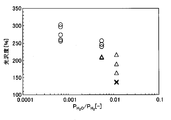
- the steel sheet is annealed in a mixed atmosphere of hydrogen and nitrogen with an adjusted oxygen partial pressure (P H2O / P H2 ) to form an amorphous oxide film on the steel sheet surface.
- P H2O / P H2 adjusted oxygen partial pressure
- the inventors changed the oxygen partial pressure (P H2O / P H2 ) of the annealing atmosphere when forming the amorphous oxide film on the steel sheet after the finish annealing to change the oxygen partial pressure of the annealing atmosphere (P H2O / P H2 ).
- the relationship between P H2O / P H2 ) and glossiness was investigated.
- FIG. 2 shows the relationship between the oxygen partial pressure and the glossiness in the annealing atmosphere for forming the obtained amorphous oxide film.
- the case where the film remaining area ratio is 90% or more is indicated by ⁇
- the case where the film remaining area ratio is 80% or more and less than 90% is indicated by ⁇
- the film remaining area is The case where the rate was less than 80% was indicated by x.
- the oxygen partial pressure (P H2O / P H2 ) in the annealing atmosphere for forming the amorphous oxide film having a glossiness of 150% or more is 0.010 or less, and the amorphous film has a glossiness of 230% or more.
- An oxygen partial pressure (P H2O / P H2 ) of an annealing atmosphere capable of forming a quality oxide film is 0.005 or less, and further an annealing capable of forming an amorphous oxide film having a surface glossiness of 250% or more. It can be seen that the oxygen partial pressure (P H2O / P H2 ) of the atmosphere is 0.001 or less.
- the oxygen partial pressure (P H2O / P H2 ) in the annealing atmosphere for forming the amorphous oxide film is preferably 0.010 or less, and 0.005 or less. More preferably, it is more preferably 0.001 or less.
- the annealing temperature is preferably 600 to 1150 ° C, more preferably 700 to 900 ° C.
- the annealing temperature is less than 600 ° C., the amorphous oxide film is not sufficiently formed. Further, if it exceeds 1150 ° C., the equipment load becomes high, which is not preferable.
- the cooling rate after annealing may not be limited, but the external oxide type amorphous oxide film having an amorphous oxide aspect ratio of less than 1.2
- the oxygen partial pressure (P H2O / P H2 ) during annealing cooling it is preferable to set the oxygen partial pressure (P H2O / P H2 ) during annealing cooling to 0.005 or less.
- a grain-oriented electrical steel sheet with an amorphous oxide film excellent in film adhesion of a tensile insulating film can be obtained.
- the conditions in the examples are one example of conditions used for confirming the feasibility and effects of the present invention, and the present invention is based on this one example of conditions. It is not limited.
- the present invention can adopt various conditions as long as the object of the present invention is achieved without departing from the gist of the present invention.
- Silicon steel slabs having the composition shown in Table 1-1 were each heated to 1100 ° C. and subjected to hot rolling to obtain a hot-rolled steel sheet having a thickness of 2.6 mm. These hot-rolled steel sheets were annealed at 1100 ° C., and then cold-rolled steel sheets having a final sheet thickness of 0.23 mm were subjected to a single cold-rolling or multiple cold-rolling sandwiching intermediate annealing. Thereafter, these cold-rolled steel sheets were subjected to decarburization annealing and nitriding annealing.
- a water slurry of an annealing separator mainly composed of alumina is applied to a cold rolled steel sheet subjected to decarburization annealing and nitridation annealing, and then subjected to a final annealing at 1200 ° C. for 20 hours to complete secondary recrystallization.
- a grain-oriented electrical steel sheet having no forsterite coating on the steel sheet surface and having a specular gloss was obtained.
- removal of the annealing separator and control of the surface state were performed with a scrubber under the conditions shown in Table 2.
- This grain-oriented electrical steel sheet is composed of 25% nitrogen and 75% hydrogen.
- atmosphere of oxygen partial pressure such as 1 to 17
- soaking was performed at the holding temperature shown in Table 2, and then composed of 25% nitrogen and 75% hydrogen.
- the heat processing which cools to room temperature was given.
- the annealing holding temperature was 600 ° C. or higher, a film was formed on the steel sheet surface.
- Whether or not the coating formed on the steel plate surface was an amorphous oxide coating was confirmed using X-ray diffraction and TEM. In addition, confirmation using FT-IR was also performed. Specifically, each steel No. in which the film was formed was formed. Production condition no. In this combination, the cross section of the steel plate was subjected to FIB (Focused Ion Beam) processing, and a 10 ⁇ m ⁇ 10 ⁇ m range was observed with a transmission electron microscope (TEM), and it was confirmed that the coating was made of SiO 2 . Further, when the surface was analyzed by Fourier transform infrared spectroscopy (FT-IR), a peak was present at a wave number of 1250 (cm ⁇ 1 ).
- FIB Frecused Ion Beam
- This peak since the peak derived from SiO 2, This also film was confirmed to match that have formed of SiO 2. Moreover, when X-ray diffraction was performed on the steel sheet having the coating film, only the halo was detected except for the peak of the ground iron, and the specific peak was not detected. That is, the formed film was an amorphous oxide film.
- a coating solution for forming a tensile insulating coating composed of aluminum phosphate, chromic acid and colloidal silica is applied to the grain-oriented electrical steel sheet on which the amorphous oxide coating is formed.
- tensile_strength insulating film was produced by baking at 850 degreeC for 30 second.
- a sample collected from the produced directional electrical steel sheet with a tensile insulating coating was wound around a cylinder having a diameter of 20 mm (180 ° bending), and the coating adhesiveness of the insulating coating was evaluated based on the remaining area ratio of the coating after being bent back.
- the film adhesion of the insulating coating the presence or absence of peeling of the tensile insulating coating was visually determined.
- the case where the film remaining area ratio was 90% or more without peeling from the steel sheet was GOOD, the case where the film remaining area ratio was 80% or more and less than 90% was OK, and the film remaining area ratio was less than 80% NG.
- the tension insulating coating on the product steel plate on which the tension insulating coating is formed is made of 20% sodium hydroxide at 80 ° C. It was selectively removed by wet etching immersed in an etching solution for 20 minutes.
- the glossiness of the surface of the grain-oriented electrical steel sheet from which the tensile insulating coating has been selectively removed was measured using a micro trigloss gloss meter (4446) manufactured by BYK-Gardner, and the standard method (incident angle 60) according to JIS Z-8741. It was measured by a method of defining the glossiness with a value obtained by measuring a black glass standard plate (refractive index of 1.567) at 100 as 100).
- Table 2 shows the evaluation of the film adhesion between the glossiness and the tension insulating film.
- the present invention it is possible to provide a grain-oriented electrical steel sheet with an amorphous oxide film that is excellent in adhesion between a tension insulating film formed on the steel sheet surface and the steel sheet. Therefore, the present invention has high applicability in the electrical steel sheet manufacturing industry and the electrical steel sheet utilization industry.
Landscapes
- Chemical & Material Sciences (AREA)
- Engineering & Computer Science (AREA)
- Mechanical Engineering (AREA)
- Materials Engineering (AREA)
- Metallurgy (AREA)
- Organic Chemistry (AREA)
- Physics & Mathematics (AREA)
- Electromagnetism (AREA)
- Thermal Sciences (AREA)
- Crystallography & Structural Chemistry (AREA)
- Chemical Kinetics & Catalysis (AREA)
- Dispersion Chemistry (AREA)
- Manufacturing & Machinery (AREA)
- Power Engineering (AREA)
- General Chemical & Material Sciences (AREA)
- Biochemistry (AREA)
- Life Sciences & Earth Sciences (AREA)
- Analytical Chemistry (AREA)
- Health & Medical Sciences (AREA)
- General Health & Medical Sciences (AREA)
- General Physics & Mathematics (AREA)
- Immunology (AREA)
- Pathology (AREA)
- Soft Magnetic Materials (AREA)
- Manufacturing Of Steel Electrode Plates (AREA)
- Chemical Treatment Of Metals (AREA)
Abstract
Priority Applications (8)
| Application Number | Priority Date | Filing Date | Title |
|---|---|---|---|
| US16/628,809 US11189407B2 (en) | 2017-07-13 | 2018-07-13 | Grain-oriented electrical steel sheet |
| JP2019529823A JP6881581B2 (ja) | 2017-07-13 | 2018-07-13 | 方向性電磁鋼板 |
| EP18832179.8A EP3653753B8 (fr) | 2017-07-13 | 2018-07-13 | Tôle en acier électrque à grains orientés |
| BR112020000266-6A BR112020000266A2 (pt) | 2017-07-13 | 2018-07-13 | folha de aço eletromagnética orientada |
| CN201880044653.6A CN110832113B (zh) | 2017-07-13 | 2018-07-13 | 方向性电磁钢板 |
| RU2020100035A RU2736043C1 (ru) | 2017-07-13 | 2018-07-13 | Электротехнический стальной лист с ориентированной зеренной структурой |
| PL18832179.8T PL3653753T3 (pl) | 2017-07-13 | 2018-07-13 | Blacha cienka ze stali elektrotechnicznej o ziarnach zorientowanych |
| KR1020207000407A KR102359168B1 (ko) | 2017-07-13 | 2018-07-13 | 방향성 전자 강판 |
Applications Claiming Priority (2)
| Application Number | Priority Date | Filing Date | Title |
|---|---|---|---|
| JP2017137408 | 2017-07-13 | ||
| JP2017-137408 | 2017-07-13 |
Publications (2)
| Publication Number | Publication Date |
|---|---|
| WO2019013355A1 WO2019013355A1 (fr) | 2019-01-17 |
| WO2019013355A9 true WO2019013355A9 (fr) | 2019-11-28 |
Family
ID=65001276
Family Applications (1)
| Application Number | Title | Priority Date | Filing Date |
|---|---|---|---|
| PCT/JP2018/026624 Ceased WO2019013355A1 (fr) | 2017-07-13 | 2018-07-13 | Tôle en acier électromagnétique à grains orientés |
Country Status (9)
| Country | Link |
|---|---|
| US (1) | US11189407B2 (fr) |
| EP (1) | EP3653753B8 (fr) |
| JP (1) | JP6881581B2 (fr) |
| KR (1) | KR102359168B1 (fr) |
| CN (1) | CN110832113B (fr) |
| BR (1) | BR112020000266A2 (fr) |
| PL (1) | PL3653753T3 (fr) |
| RU (1) | RU2736043C1 (fr) |
| WO (1) | WO2019013355A1 (fr) |
Families Citing this family (2)
| Publication number | Priority date | Publication date | Assignee | Title |
|---|---|---|---|---|
| RU2771036C1 (ru) * | 2019-01-16 | 2022-04-25 | Ниппон Стил Корпорейшн | Лист анизотропной электротехнической стали |
| CN113740144B (zh) * | 2020-05-27 | 2023-10-17 | 宝山钢铁股份有限公司 | 一种评价薄板电工钢可轧性的方法 |
Family Cites Families (32)
| Publication number | Priority date | Publication date | Assignee | Title |
|---|---|---|---|---|
| BE789262A (fr) | 1971-09-27 | 1973-01-15 | Nippon Steel Corp | Procede de formation d'un film isolant sur un feuillard d'acierau silicium oriente |
| JPS6324099A (ja) * | 1986-07-17 | 1988-02-01 | Kawasaki Steel Corp | 低鉄損一方向性けい素鋼板の製造方法 |
| DE3886146T2 (de) | 1987-09-10 | 1994-04-14 | Kawasaki Steel Co | Siliziumstahlbleche mit niedrigem Eisenverlust und Verfahren zur Herstellung derselben. |
| EP0565029B1 (fr) | 1992-04-07 | 1999-10-20 | Nippon Steel Corporation | TÔle d'acier au silicium à grains orientés présentant une faible perte dans le fer et procédé de fabrication |
| JP2698003B2 (ja) * | 1992-08-25 | 1998-01-19 | 新日本製鐵株式会社 | 一方向性珪素鋼板の絶縁皮膜形成方法 |
| JP2653638B2 (ja) | 1994-04-05 | 1997-09-17 | 新日本製鐵株式会社 | 鉄損の低い方向性電磁鋼板の製造方法 |
| JP2664337B2 (ja) * | 1994-04-15 | 1997-10-15 | 新日本製鐵株式会社 | 一方向性珪素鋼板の絶縁皮膜形成方法 |
| CN1054885C (zh) * | 1995-07-26 | 2000-07-26 | 新日本制铁株式会社 | 生产一种具有镜面和改进了铁损的晶粒取向电工钢板的方法 |
| JP3294515B2 (ja) * | 1996-10-04 | 2002-06-24 | 日本鋼管株式会社 | 電磁鋼板用絶縁皮膜の形成方法 |
| KR100293141B1 (ko) * | 1997-04-16 | 2001-06-15 | 아사무라 타카싯 | 피막특성과 자기특성이 우수한 일방향성 전자강판과 그 제조방법및그제조방법에사용되는탈탄소둔설비 |
| JP3392698B2 (ja) * | 1997-04-16 | 2003-03-31 | 新日本製鐵株式会社 | 極めて優れた磁気特性を有する方向性電磁鋼板の製造方法 |
| JP3337958B2 (ja) | 1997-10-06 | 2002-10-28 | 新日本製鐵株式会社 | 磁気特性が優れた鏡面一方向性電磁鋼板の製造方法 |
| JPH11118750A (ja) | 1997-10-14 | 1999-04-30 | Kurita Water Ind Ltd | 参照電極設置用装置 |
| JP4030716B2 (ja) * | 2000-11-01 | 2008-01-09 | シーケーディ株式会社 | 錠剤の外観検査装置およびptp包装機 |
| JP4288022B2 (ja) | 2001-06-08 | 2009-07-01 | 新日本製鐵株式会社 | 一方向性珪素鋼板とその製造方法 |
| JP3930696B2 (ja) | 2001-04-23 | 2007-06-13 | 新日本製鐵株式会社 | 張力付与性絶縁皮膜の皮膜密着性に優れる一方向性珪素鋼板とその製造方法 |
| JP4044739B2 (ja) | 2001-05-22 | 2008-02-06 | 新日本製鐵株式会社 | 張力付与性絶縁皮膜の皮膜密着性に優れる一方向性珪素鋼板とその製造方法 |
| JP4288054B2 (ja) | 2002-01-08 | 2009-07-01 | 新日本製鐵株式会社 | 方向性珪素鋼板の製造方法 |
| JP4044781B2 (ja) | 2002-04-08 | 2008-02-06 | 新日本製鐵株式会社 | 張力付与性絶縁皮膜密着性に優れる一方向性珪素鋼板とその製造方法 |
| JP4473489B2 (ja) | 2002-04-25 | 2010-06-02 | 新日本製鐵株式会社 | 一方向性珪素鋼板とその製造方法 |
| RU2386725C2 (ru) * | 2005-07-14 | 2010-04-20 | Ниппон Стил Корпорейшн | Текстурированный электротехнический стальной лист, имеющий изолирующую пленку, не содержащую хром, и агент изолирующей пленки |
| US7998284B2 (en) * | 2006-05-19 | 2011-08-16 | Nippon Steel Corporation | Grain-oriented electrical steel sheet having high tensile strength insulating film and method of treatment of such insulating film |
| CN101946024B (zh) * | 2008-03-13 | 2015-05-20 | 新日铁住金株式会社 | 具有热传导性优良的绝缘覆盖膜的电磁钢板及其制造方法 |
| JP5228563B2 (ja) * | 2008-03-25 | 2013-07-03 | Jfeスチール株式会社 | 方向性電磁鋼板の製造方法 |
| JP2010040666A (ja) | 2008-08-01 | 2010-02-18 | Toyota Motor Corp | 磁性材料のSiO2薄膜形成方法 |
| WO2010140509A1 (fr) * | 2009-06-03 | 2010-12-09 | 新日本製鐵株式会社 | Tôle d'acier magnétique isotrope et procédé pour sa production |
| KR101356053B1 (ko) * | 2011-12-28 | 2014-01-28 | 주식회사 포스코 | 방향성 전기강판 및 그 제조방법 |
| KR101480498B1 (ko) | 2012-12-28 | 2015-01-08 | 주식회사 포스코 | 방향성 전기강판 및 그 제조방법 |
| JP6225759B2 (ja) * | 2014-03-10 | 2017-11-08 | Jfeスチール株式会社 | 方向性電磁鋼板の製造方法 |
| KR101696627B1 (ko) * | 2014-11-26 | 2017-01-16 | 주식회사 포스코 | 방향성 전기강판용 소둔 분리제 조성물, 및 이를 이용한 방향성 전기강판의 제조방법 |
| WO2016085257A1 (fr) * | 2014-11-26 | 2016-06-02 | 주식회사 포스코 | Composition de séparateur de recuit pour tôles d'acier électrique à grains orientés, et procédé de fabrication de tôle d'acier électrique orientée l'utilisant |
| JP2017137408A (ja) | 2016-02-03 | 2017-08-10 | クラスターテクノロジー株式会社 | 白色リフレクター用硬化性エポキシ樹脂組成物及びその硬化物、光半導体素子搭載用基板、並びに光半導体装置 |
-
2018
- 2018-07-13 EP EP18832179.8A patent/EP3653753B8/fr active Active
- 2018-07-13 KR KR1020207000407A patent/KR102359168B1/ko active Active
- 2018-07-13 JP JP2019529823A patent/JP6881581B2/ja active Active
- 2018-07-13 WO PCT/JP2018/026624 patent/WO2019013355A1/fr not_active Ceased
- 2018-07-13 US US16/628,809 patent/US11189407B2/en active Active
- 2018-07-13 RU RU2020100035A patent/RU2736043C1/ru active
- 2018-07-13 BR BR112020000266-6A patent/BR112020000266A2/pt active IP Right Grant
- 2018-07-13 CN CN201880044653.6A patent/CN110832113B/zh active Active
- 2018-07-13 PL PL18832179.8T patent/PL3653753T3/pl unknown
Also Published As
| Publication number | Publication date |
|---|---|
| EP3653753B8 (fr) | 2024-09-25 |
| WO2019013355A1 (fr) | 2019-01-17 |
| CN110832113B (zh) | 2022-08-02 |
| BR112020000266A2 (pt) | 2020-07-14 |
| EP3653753A4 (fr) | 2021-04-07 |
| EP3653753A1 (fr) | 2020-05-20 |
| EP3653753B1 (fr) | 2024-09-04 |
| US20200203047A1 (en) | 2020-06-25 |
| PL3653753T3 (pl) | 2025-01-13 |
| JPWO2019013355A1 (ja) | 2020-05-28 |
| KR20200017458A (ko) | 2020-02-18 |
| JP6881581B2 (ja) | 2021-06-02 |
| CN110832113A (zh) | 2020-02-21 |
| US11189407B2 (en) | 2021-11-30 |
| RU2736043C1 (ru) | 2020-11-11 |
| KR102359168B1 (ko) | 2022-02-08 |
Similar Documents
| Publication | Publication Date | Title |
|---|---|---|
| KR102393831B1 (ko) | 방향성 전자 강판 | |
| WO2019013351A1 (fr) | Tôle d'acier électromagnétique à grains orientés et son procédé de production | |
| JP6881580B2 (ja) | 方向性電磁鋼板 | |
| JP7553869B2 (ja) | 方向性電磁鋼板 | |
| US11952646B2 (en) | Grain-oriented electrical steel sheet having excellent insulation coating adhesion without forsterite coating | |
| JP6881581B2 (ja) | 方向性電磁鋼板 | |
| JP6876280B2 (ja) | 方向性電磁鋼板 | |
| JP7151791B2 (ja) | 方向性電磁鋼板 | |
| JP2003183790A (ja) | 高磁場鉄損と被膜特性に優れる超高磁束密度一方向性電磁鋼板 |
Legal Events
| Date | Code | Title | Description |
|---|---|---|---|
| 121 | Ep: the epo has been informed by wipo that ep was designated in this application |
Ref document number: 18832179 Country of ref document: EP Kind code of ref document: A1 |
|
| ENP | Entry into the national phase |
Ref document number: 2019529823 Country of ref document: JP Kind code of ref document: A |
|
| ENP | Entry into the national phase |
Ref document number: 20207000407 Country of ref document: KR Kind code of ref document: A |
|
| NENP | Non-entry into the national phase |
Ref country code: DE |
|
| REG | Reference to national code |
Ref country code: BR Ref legal event code: B01A Ref document number: 112020000266 Country of ref document: BR |
|
| ENP | Entry into the national phase |
Ref document number: 2018832179 Country of ref document: EP Effective date: 20200213 |
|
| ENP | Entry into the national phase |
Ref document number: 112020000266 Country of ref document: BR Kind code of ref document: A2 Effective date: 20200106 |