WO2019013363A1 - Procédé et appareil permettant de réduire le bruit dans un domaine de fréquence dans un système de codage d'image - Google Patents
Procédé et appareil permettant de réduire le bruit dans un domaine de fréquence dans un système de codage d'image Download PDFInfo
- Publication number
- WO2019013363A1 WO2019013363A1 PCT/KR2017/007357 KR2017007357W WO2019013363A1 WO 2019013363 A1 WO2019013363 A1 WO 2019013363A1 KR 2017007357 W KR2017007357 W KR 2017007357W WO 2019013363 A1 WO2019013363 A1 WO 2019013363A1
- Authority
- WO
- WIPO (PCT)
- Prior art keywords
- block
- predicted
- prediction
- residual
- frequency domain
- Prior art date
- Legal status (The legal status is an assumption and is not a legal conclusion. Google has not performed a legal analysis and makes no representation as to the accuracy of the status listed.)
- Ceased
Links
Images




Classifications
-
- H—ELECTRICITY
- H04—ELECTRIC COMMUNICATION TECHNIQUE
- H04N—PICTORIAL COMMUNICATION, e.g. TELEVISION
- H04N19/00—Methods or arrangements for coding, decoding, compressing or decompressing digital video signals
- H04N19/10—Methods or arrangements for coding, decoding, compressing or decompressing digital video signals using adaptive coding
- H04N19/169—Methods or arrangements for coding, decoding, compressing or decompressing digital video signals using adaptive coding characterised by the coding unit, i.e. the structural portion or semantic portion of the video signal being the object or the subject of the adaptive coding
- H04N19/18—Methods or arrangements for coding, decoding, compressing or decompressing digital video signals using adaptive coding characterised by the coding unit, i.e. the structural portion or semantic portion of the video signal being the object or the subject of the adaptive coding the unit being a set of transform coefficients
-
- H—ELECTRICITY
- H04—ELECTRIC COMMUNICATION TECHNIQUE
- H04N—PICTORIAL COMMUNICATION, e.g. TELEVISION
- H04N19/00—Methods or arrangements for coding, decoding, compressing or decompressing digital video signals
- H04N19/10—Methods or arrangements for coding, decoding, compressing or decompressing digital video signals using adaptive coding
- H04N19/102—Methods or arrangements for coding, decoding, compressing or decompressing digital video signals using adaptive coding characterised by the element, parameter or selection affected or controlled by the adaptive coding
- H04N19/103—Selection of coding mode or of prediction mode
- H04N19/105—Selection of the reference unit for prediction within a chosen coding or prediction mode, e.g. adaptive choice of position and number of pixels used for prediction
-
- H—ELECTRICITY
- H04—ELECTRIC COMMUNICATION TECHNIQUE
- H04N—PICTORIAL COMMUNICATION, e.g. TELEVISION
- H04N19/00—Methods or arrangements for coding, decoding, compressing or decompressing digital video signals
- H04N19/10—Methods or arrangements for coding, decoding, compressing or decompressing digital video signals using adaptive coding
- H04N19/102—Methods or arrangements for coding, decoding, compressing or decompressing digital video signals using adaptive coding characterised by the element, parameter or selection affected or controlled by the adaptive coding
- H04N19/132—Sampling, masking or truncation of coding units, e.g. adaptive resampling, frame skipping, frame interpolation or high-frequency transform coefficient masking
-
- H—ELECTRICITY
- H04—ELECTRIC COMMUNICATION TECHNIQUE
- H04N—PICTORIAL COMMUNICATION, e.g. TELEVISION
- H04N19/00—Methods or arrangements for coding, decoding, compressing or decompressing digital video signals
- H04N19/10—Methods or arrangements for coding, decoding, compressing or decompressing digital video signals using adaptive coding
- H04N19/134—Methods or arrangements for coding, decoding, compressing or decompressing digital video signals using adaptive coding characterised by the element, parameter or criterion affecting or controlling the adaptive coding
- H04N19/157—Assigned coding mode, i.e. the coding mode being predefined or preselected to be further used for selection of another element or parameter
- H04N19/159—Prediction type, e.g. intra-frame, inter-frame or bidirectional frame prediction
-
- H—ELECTRICITY
- H04—ELECTRIC COMMUNICATION TECHNIQUE
- H04N—PICTORIAL COMMUNICATION, e.g. TELEVISION
- H04N19/00—Methods or arrangements for coding, decoding, compressing or decompressing digital video signals
- H04N19/10—Methods or arrangements for coding, decoding, compressing or decompressing digital video signals using adaptive coding
- H04N19/169—Methods or arrangements for coding, decoding, compressing or decompressing digital video signals using adaptive coding characterised by the coding unit, i.e. the structural portion or semantic portion of the video signal being the object or the subject of the adaptive coding
- H04N19/17—Methods or arrangements for coding, decoding, compressing or decompressing digital video signals using adaptive coding characterised by the coding unit, i.e. the structural portion or semantic portion of the video signal being the object or the subject of the adaptive coding the unit being an image region, e.g. an object
- H04N19/176—Methods or arrangements for coding, decoding, compressing or decompressing digital video signals using adaptive coding characterised by the coding unit, i.e. the structural portion or semantic portion of the video signal being the object or the subject of the adaptive coding the unit being an image region, e.g. an object the region being a block, e.g. a macroblock
-
- H—ELECTRICITY
- H04—ELECTRIC COMMUNICATION TECHNIQUE
- H04N—PICTORIAL COMMUNICATION, e.g. TELEVISION
- H04N19/00—Methods or arrangements for coding, decoding, compressing or decompressing digital video signals
- H04N19/46—Embedding additional information in the video signal during the compression process
-
- H—ELECTRICITY
- H04—ELECTRIC COMMUNICATION TECHNIQUE
- H04N—PICTORIAL COMMUNICATION, e.g. TELEVISION
- H04N19/00—Methods or arrangements for coding, decoding, compressing or decompressing digital video signals
- H04N19/60—Methods or arrangements for coding, decoding, compressing or decompressing digital video signals using transform coding
- H04N19/61—Methods or arrangements for coding, decoding, compressing or decompressing digital video signals using transform coding in combination with predictive coding
-
- H—ELECTRICITY
- H04—ELECTRIC COMMUNICATION TECHNIQUE
- H04N—PICTORIAL COMMUNICATION, e.g. TELEVISION
- H04N19/00—Methods or arrangements for coding, decoding, compressing or decompressing digital video signals
- H04N19/85—Methods or arrangements for coding, decoding, compressing or decompressing digital video signals using pre-processing or post-processing specially adapted for video compression
- H04N19/86—Methods or arrangements for coding, decoding, compressing or decompressing digital video signals using pre-processing or post-processing specially adapted for video compression involving reduction of coding artifacts, e.g. of blockiness
Definitions
- Another object of the present invention is to provide a method and apparatus for eliminating noise generated as a result of prediction.
- an image decoding method performed by a decoding apparatus.
- the method includes receiving image information including prediction information and residual information, deriving a prediction mode for a current block based on the prediction information, calculating a prediction mode for the current block based on the prediction mode, transforming the predicted block to derive a predicted block based on the frequency-domain predicted block, performing a frequency-domain-modified generating a predicted modified block by inversely transforming the predicted frequency domain modified block, deriving a residual block based on the residual information, And generating a restored block based on the predicted block and the residual block .
- the present invention it is possible to reduce noise generated as a result of intraprediction or inter prediction and improve prediction performance.
- FIG. 10 shows reference pictures and motion vectors for inter prediction of the current block.
- FIG. 18 schematically shows a video decoding method by a decoding apparatus according to the present invention.
- the filter unit 155 may apply a deblocking filter and / or a sample adaptive offset. Through deblocking filtering and / or sample adaptive offsets, artifacts in the block boundary in the reconstructed picture or distortion in the quantization process can be corrected.
- the sample adaptive offset can be applied on a sample-by-sample basis and can be applied after the process of deblocking filtering is complete.
- the filter unit 155 may apply an ALF (Adaptive Loop Filter) to the restored picture.
- the ALF may be applied to the reconstructed picture after the deblocking filter and / or sample adaptive offset is applied.
- the entropy decoding unit 210 may parse the bitstream and output information necessary for video restoration or picture restoration. For example, the entropy decoding unit 210 decodes information in a bitstream based on a coding method such as exponential Golomb coding, CAVLC, or CABAC, and calculates a value of a syntax element necessary for video restoration, a quantized value Lt; / RTI >
- a coding method such as exponential Golomb coding, CAVLC, or CABAC
- the residual value i.e., the quantized transform coefficient, which is entropy-decoded in the entropy decoding unit 210, 221).
- the difference between the predicted sample and the original sample is not transmitted.
- the memory 260 may store restored pictures (decoded pictures) or information necessary for decoding.
- the reconstructed picture may be a reconstructed picture whose filtering procedure has been completed by the filter unit 250.
- the memory 260 may store pictures used for inter prediction.
- the pictures used for inter prediction may be designated by a reference picture set or a reference picture list.
- the reconstructed picture can be used as a reference picture for another picture.
- the memory 260 may output the restored picture according to the output order.
- FIG. 3 is a view for schematically explaining a configuration of a video encoding apparatus according to the present invention.
- FIG. 5 schematically shows a configuration of a frequency domain noise canceller according to the present invention.
- the quantization parameters used in a change to the predictive block may be the same as the quantization parameter used to encode the residual block (residual signal) , Or may be different. If another quantization parameter is used, a difference value with a quantization parameter used when encoding the residual signal may be transmitted to indicate a quantization parameter used for transforming the prediction block.
- the correlation coefficient block determined through the above procedure can be additionally updated by the weight coefficient K ij shown in Equation (2).
- the weighting factor may be commonly determined as a specific value, and may be adaptively determined according to the frequency position. The weighting factor may be determined based on the characteristics of the blocks described above.
- the frequency correlation coefficient may be calculated in advance through on-line or off-line training before performing encoding / decoding, and the values may be stored in advance in the encoding device / encoding device and used.
- S820 is shown as being performed after S810 in FIG. 8, this is only an example, and S820 may be performed earlier than S810, or may be performed at the same time.
- the motion information may include L0 motion information for the L0 direction and / or L1 motion information for the L1 direction.
- the L0 motion information may include an L0 reference picture index and a motion vector L0 (Motion Vector L0, MVL0) indicating an L0 reference picture included in a reference picture list L0 (List 0, L0) for the current block
- the L1 motion information may include an L1 reference picture index and an MVL1 indicating an L1 reference picture contained in a reference picture list L0 (List 1, L1) for the current block.
- determination and signaling regarding whether to perform frequency domain noise cancellation can be performed through the following method.
- 15 illustrates a method for determining whether to perform frequency domain noise cancellation according to another embodiment of the present invention.
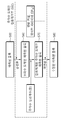
- FIG. 17 schematically shows a video encoding method by the encoding apparatus according to the present invention.
- the method disclosed in Fig. 17 can be performed by the encoding apparatus disclosed in Fig. Specifically, for example, S1700 in FIG. 17 may be performed by the predicting unit of the encoding apparatus, S1710 through S1730 may be performed by the frequency domain noise removing unit of the encoding apparatus, and S1740 may be performed by the entropy encoding unit of the encoding apparatus.
- the encoding apparatus derives a frequency-domain-modified predicted block based on the frequency-domain predicted block and frequency correlation coefficients (S1720).
- the encoding apparatus may derive a frequency-domain-modified predicted block by multiplying the transform coefficients by frequency correlation coefficients.
- the frequency domain modified predicted block includes modified transform coefficients.
- the modified transform coefficients may be derived based on the transform coefficients and the frequency correlation coefficients.
- the frequency correlation coefficients may be configured in the form of a correlation coefficient block and may be called an array of frequency correlation coefficients.
- the frequency correlation coefficients may be determined by an encoding apparatus and signaled to a decoding apparatus. Or the frequency correlation coefficients may be predetermined according to the characteristics of the corresponding block as described above.
- the encoding apparatus may derive a residual block including residual samples based on the difference between the original block and the modified prediction block.
- the encoding apparatus may apply the transform and quantization to the residual block to generate residual information.
- the residual information indicates quantized transform coefficients, and the quantized transform coefficients may be derived by quantizing transform coefficients derived by applying a transform to the residual block.
- the same transform kernel may be used for the transform applied to the predicted block and the transform applied to the residual block.
- the decoding apparatus derives a predicted block for the current block (S1800).
- the predicted block includes prediction samples for the current block.
- the decoding apparatus performs a transform on the predicted block to derive a frequency domain predicted block (S1810).
- the decoding apparatus first determines whether or not frequency domain noise cancellation (noise reduction) is applied to the current block, performs conversion on the predicted block when the frequency domain noise cancellation is applied, Blocks can also be derived. Whether or not the frequency domain noise cancellation is applied may be determined according to the method described above with reference to FIGS.
- the predicted block to be transformed corresponds to an L0 reference block derived based on the L0 motion vector or an L1 reference block derived based on the L1 motion vector .
Landscapes
- Engineering & Computer Science (AREA)
- Multimedia (AREA)
- Signal Processing (AREA)
- Compression Or Coding Systems Of Tv Signals (AREA)
Abstract
La présente invention concerne un procédé de codage d'image mis en oeuvre par un appareil de codage de comprenant les étapes consistant à : obtenir un bloc prédit pour un bloc courant ; obtenir un bloc prédit de domaine de fréquence par transformation du bloc prédit ; obtenir un bloc prédit modifié de domaine de fréquence sur la base du bloc prédit de domaine de fréquence et des coefficients de corrélation de fréquence ; générer un bloc prédit modifié par transformation inverse du bloc prédit modifié dans le domaine fréquence ; obtenir un bloc résiduel sur la base d'un bloc d'origine et du bloc prédit modifié pour le bloc courant; et coder et délivrer en sortie des informations sur un mode de prédiction et des informations résiduelles sur le bloc résiduel. Selon la présente invention, le bruit généré en résultat d'une prédiction intra ou d'une inter-prédiction peut être réduit, et la performance de prédiction peut être améliorée.
Priority Applications (2)
| Application Number | Priority Date | Filing Date | Title |
|---|---|---|---|
| PCT/KR2017/007357 WO2019013363A1 (fr) | 2017-07-10 | 2017-07-10 | Procédé et appareil permettant de réduire le bruit dans un domaine de fréquence dans un système de codage d'image |
| US16/629,715 US20200145649A1 (en) | 2017-07-10 | 2017-07-10 | Method and apparatus for reducing noise in frequency-domain in image coding system |
Applications Claiming Priority (1)
| Application Number | Priority Date | Filing Date | Title |
|---|---|---|---|
| PCT/KR2017/007357 WO2019013363A1 (fr) | 2017-07-10 | 2017-07-10 | Procédé et appareil permettant de réduire le bruit dans un domaine de fréquence dans un système de codage d'image |
Publications (1)
| Publication Number | Publication Date |
|---|---|
| WO2019013363A1 true WO2019013363A1 (fr) | 2019-01-17 |
Family
ID=65002138
Family Applications (1)
| Application Number | Title | Priority Date | Filing Date |
|---|---|---|---|
| PCT/KR2017/007357 Ceased WO2019013363A1 (fr) | 2017-07-10 | 2017-07-10 | Procédé et appareil permettant de réduire le bruit dans un domaine de fréquence dans un système de codage d'image |
Country Status (2)
| Country | Link |
|---|---|
| US (1) | US20200145649A1 (fr) |
| WO (1) | WO2019013363A1 (fr) |
Families Citing this family (6)
| Publication number | Priority date | Publication date | Assignee | Title |
|---|---|---|---|---|
| CN115037930B (zh) | 2018-01-05 | 2025-06-10 | Sk电信有限公司 | 对视频进行编码或解码的方法和非暂时性计算机可读介质 |
| KR102524628B1 (ko) * | 2018-01-05 | 2023-04-21 | 에스케이텔레콤 주식회사 | 영상을 부호화 또는 복호화하는 방법 및 장치 |
| CN122053825A (zh) * | 2018-12-25 | 2026-05-15 | Oppo广东移动通信有限公司 | 解码预测方法、装置及计算机存储介质 |
| US12177466B2 (en) * | 2019-11-27 | 2024-12-24 | Lg Electronics Inc. | Image decoding method and device therefor |
| EP4276744A4 (fr) | 2021-03-04 | 2024-07-17 | Samsung Electronics Co., Ltd. | Appareil de traitement d'image et son procédé de fonctionnement |
| US12363282B2 (en) * | 2023-02-07 | 2025-07-15 | Tencent America LLC | Warp mode for intra prediction |
Citations (5)
| Publication number | Priority date | Publication date | Assignee | Title |
|---|---|---|---|---|
| KR20090012957A (ko) * | 2007-07-31 | 2009-02-04 | 경희대학교 산학협력단 | 블록변환 영역에서 영상 이미지의 영상 특성에 따라 선택한보간 필터를 사용하여 영상 이미지의 크기를 변경하는방법 |
| KR20100113065A (ko) * | 2007-11-23 | 2010-10-20 | 톰슨 라이센싱 | 정수 변환에 기초한 부호화 및 복호화에 대한 반올림 노이즈 셰이핑 |
| KR20110112188A (ko) * | 2010-04-05 | 2011-10-12 | 삼성전자주식회사 | 적응적 예측 필터링을 이용한 비디오 부호화 방법 및 그 장치, 적응적 예측 필터링을 이용한 비디오 복호화 방법 및 그 장치 |
| KR20130046304A (ko) * | 2011-10-27 | 2013-05-07 | 서울대학교산학협력단 | 주파수 변환 영역에서의 비국부적 평균 필터링을 이용한 영상 잡음 제거 |
| KR20130098465A (ko) * | 2012-02-28 | 2013-09-05 | (주)필링크 | 영상 부호화 장치 및 이의 영상 부호화 방법, 그리고 영상 복호화 장치 및 이의 영상 복호화 방법 |
-
2017
- 2017-07-10 WO PCT/KR2017/007357 patent/WO2019013363A1/fr not_active Ceased
- 2017-07-10 US US16/629,715 patent/US20200145649A1/en not_active Abandoned
Patent Citations (5)
| Publication number | Priority date | Publication date | Assignee | Title |
|---|---|---|---|---|
| KR20090012957A (ko) * | 2007-07-31 | 2009-02-04 | 경희대학교 산학협력단 | 블록변환 영역에서 영상 이미지의 영상 특성에 따라 선택한보간 필터를 사용하여 영상 이미지의 크기를 변경하는방법 |
| KR20100113065A (ko) * | 2007-11-23 | 2010-10-20 | 톰슨 라이센싱 | 정수 변환에 기초한 부호화 및 복호화에 대한 반올림 노이즈 셰이핑 |
| KR20110112188A (ko) * | 2010-04-05 | 2011-10-12 | 삼성전자주식회사 | 적응적 예측 필터링을 이용한 비디오 부호화 방법 및 그 장치, 적응적 예측 필터링을 이용한 비디오 복호화 방법 및 그 장치 |
| KR20130046304A (ko) * | 2011-10-27 | 2013-05-07 | 서울대학교산학협력단 | 주파수 변환 영역에서의 비국부적 평균 필터링을 이용한 영상 잡음 제거 |
| KR20130098465A (ko) * | 2012-02-28 | 2013-09-05 | (주)필링크 | 영상 부호화 장치 및 이의 영상 부호화 방법, 그리고 영상 복호화 장치 및 이의 영상 복호화 방법 |
Also Published As
| Publication number | Publication date |
|---|---|
| US20200145649A1 (en) | 2020-05-07 |
Similar Documents
| Publication | Publication Date | Title |
|---|---|---|
| WO2017065357A1 (fr) | Procédé et appareil de filtrage pour améliorer la prédiction dans un système de codage d'image | |
| WO2019117639A1 (fr) | Procédé de codage d'image sur la base d'une transformée et son dispositif | |
| WO2019117640A1 (fr) | Procédé et dispositif de décodage d'image selon une inter-prédiction dans un système de codage d'image | |
| WO2019117634A1 (fr) | Procédé de codage d'image fondé sur une transformation secondaire et dispositif associé | |
| WO2018105757A1 (fr) | Procédé et dispositif de décodage d'image dans un système de codage d'images | |
| WO2014171713A1 (fr) | Procédé et appareil de codage/décodage vidéo utilisant une prédiction intra | |
| WO2018236051A1 (fr) | Procédé et dispositif de décodage d'image selon une prédiction intra dans un système de codage d'image | |
| WO2017209328A1 (fr) | Procédé et appareil de prédiction intra dans un système de codage d'images | |
| WO2017188566A1 (fr) | Procédé et appareil d'inter-prédiction dans un système de codage d'images | |
| WO2018008905A1 (fr) | Procédé et appareil de traitement de signal vidéo | |
| WO2011096770A2 (fr) | Appareil et procédé de codage/décodage d'image | |
| WO2013032073A1 (fr) | Procédé de génération de bloc de prédiction en mode amvp | |
| WO2017082443A1 (fr) | Procédé et appareil pour prédire de manière adaptative une image à l'aide d'une valeur de seuil dans un système de codage d'image | |
| WO2016159610A1 (fr) | Procédé et appareil de traitement de signal vidéo | |
| WO2019013434A1 (fr) | Dispositif et procédé de codage ou de décodage de vecteur de mouvement | |
| WO2021125700A1 (fr) | Appareil et procédé de codage d'image/vidéo basé sur une table pondérée par prédiction | |
| WO2022211375A1 (fr) | Procédé et dispositif de codage vidéo utilisant un filtre en boucle à base d'apprentissage profond pour interprédiction | |
| WO2019182329A1 (fr) | Appareil/procédé de décodage d'image, appareil/procédé de codage d'image, et train de bits de stockage de support d'enregistrement | |
| WO2016122253A1 (fr) | Procédé et appareil de traitement de signaux vidéo | |
| WO2020141831A2 (fr) | Procédé et appareil de codage d'image faisant appel à une prédiction de copie intra-bloc | |
| WO2019117659A1 (fr) | Procédé de codage d'images basé sur l'élaboration d'un vecteur de mouvement, et dispositif associé | |
| WO2016122251A1 (fr) | Procédé et appareil de traitement de signaux vidéo | |
| WO2023153891A1 (fr) | Procédé et dispositif de codage/décodage d'image et support d'enregistrement sur lequel est stocké un flux binaire | |
| WO2021125702A1 (fr) | Procédé et dispositif de codage d'image/vidéo basés sur une prédiction pondérée | |
| WO2018182185A1 (fr) | Procédé de traitement d'image pour traiter des informations de mouvement pour le traitement parallèle, procédé de décodage et d'encodage utilisant ledit procédé de traitement, et appareil associé |
Legal Events
| Date | Code | Title | Description |
|---|---|---|---|
| 121 | Ep: the epo has been informed by wipo that ep was designated in this application |
Ref document number: 17917634 Country of ref document: EP Kind code of ref document: A1 |
|
| NENP | Non-entry into the national phase |
Ref country code: DE |
|
| 122 | Ep: pct application non-entry in european phase |
Ref document number: 17917634 Country of ref document: EP Kind code of ref document: A1 |