WO2019016143A1 - Zusammensetzungen enthaltend polymeres carbodiimid, epoxid und polyester-basierte polymere, deren herstellung und verwendung - Google Patents
Zusammensetzungen enthaltend polymeres carbodiimid, epoxid und polyester-basierte polymere, deren herstellung und verwendung Download PDFInfo
- Publication number
- WO2019016143A1 WO2019016143A1 PCT/EP2018/069279 EP2018069279W WO2019016143A1 WO 2019016143 A1 WO2019016143 A1 WO 2019016143A1 EP 2018069279 W EP2018069279 W EP 2018069279W WO 2019016143 A1 WO2019016143 A1 WO 2019016143A1
- Authority
- WO
- WIPO (PCT)
- Prior art keywords
- alkyl
- epoxide
- composition according
- weight
- radical
- Prior art date
- Legal status (The legal status is an assumption and is not a legal conclusion. Google has not performed a legal analysis and makes no representation as to the accuracy of the status listed.)
- Ceased
Links
- 0 *c1cc(*)c(*)c(*)c1 Chemical compound *c1cc(*)c(*)c(*)c1 0.000 description 1
- YMORZCGNEHRWTO-UHFFFAOYSA-N C[N]1(C)(ON1)=C Chemical compound C[N]1(C)(ON1)=C YMORZCGNEHRWTO-UHFFFAOYSA-N 0.000 description 1
Classifications
-
- C—CHEMISTRY; METALLURGY
- C08—ORGANIC MACROMOLECULAR COMPOUNDS; THEIR PREPARATION OR CHEMICAL WORKING-UP; COMPOSITIONS BASED THEREON
- C08G—MACROMOLECULAR COMPOUNDS OBTAINED OTHERWISE THAN BY REACTIONS ONLY INVOLVING UNSATURATED CARBON-TO-CARBON BONDS
- C08G63/00—Macromolecular compounds obtained by reactions forming a carboxylic ester link in the main chain of the macromolecule
- C08G63/02—Polyesters derived from hydroxycarboxylic acids or from polycarboxylic acids and polyhydroxy compounds
- C08G63/06—Polyesters derived from hydroxycarboxylic acids or from polycarboxylic acids and polyhydroxy compounds derived from hydroxycarboxylic acids
- C08G63/08—Lactones or lactides
-
- C—CHEMISTRY; METALLURGY
- C08—ORGANIC MACROMOLECULAR COMPOUNDS; THEIR PREPARATION OR CHEMICAL WORKING-UP; COMPOSITIONS BASED THEREON
- C08G—MACROMOLECULAR COMPOUNDS OBTAINED OTHERWISE THAN BY REACTIONS ONLY INVOLVING UNSATURATED CARBON-TO-CARBON BONDS
- C08G18/00—Polymeric products of isocyanates or isothiocyanates
- C08G18/02—Polymeric products of isocyanates or isothiocyanates of isocyanates or isothiocyanates only
- C08G18/025—Polymeric products of isocyanates or isothiocyanates of isocyanates or isothiocyanates only the polymeric products containing carbodiimide groups
-
- C—CHEMISTRY; METALLURGY
- C08—ORGANIC MACROMOLECULAR COMPOUNDS; THEIR PREPARATION OR CHEMICAL WORKING-UP; COMPOSITIONS BASED THEREON
- C08F—MACROMOLECULAR COMPOUNDS OBTAINED BY REACTIONS ONLY INVOLVING CARBON-TO-CARBON UNSATURATED BONDS
- C08F212/00—Copolymers of compounds having one or more unsaturated aliphatic radicals, each having only one carbon-to-carbon double bond, and at least one being terminated by an aromatic carbocyclic ring
- C08F212/02—Monomers containing only one unsaturated aliphatic radical
- C08F212/04—Monomers containing only one unsaturated aliphatic radical containing one ring
- C08F212/06—Hydrocarbons
- C08F212/12—Monomers containing a branched unsaturated aliphatic radical or a ring substituted by an alkyl radical
-
- C—CHEMISTRY; METALLURGY
- C08—ORGANIC MACROMOLECULAR COMPOUNDS; THEIR PREPARATION OR CHEMICAL WORKING-UP; COMPOSITIONS BASED THEREON
- C08F—MACROMOLECULAR COMPOUNDS OBTAINED BY REACTIONS ONLY INVOLVING CARBON-TO-CARBON UNSATURATED BONDS
- C08F220/00—Copolymers of compounds having one or more unsaturated aliphatic radicals, each having only one carbon-to-carbon double bond, and only one being terminated by only one carboxyl radical or a salt, anhydride ester, amide, imide or nitrile thereof
- C08F220/02—Monocarboxylic acids having less than ten carbon atoms; Derivatives thereof
- C08F220/10—Esters
- C08F220/12—Esters of monohydric alcohols or phenols
- C08F220/16—Esters of monohydric alcohols or phenols of phenols or of alcohols containing two or more carbon atoms
- C08F220/18—Esters of monohydric alcohols or phenols of phenols or of alcohols containing two or more carbon atoms with acrylic or methacrylic acids
-
- C—CHEMISTRY; METALLURGY
- C08—ORGANIC MACROMOLECULAR COMPOUNDS; THEIR PREPARATION OR CHEMICAL WORKING-UP; COMPOSITIONS BASED THEREON
- C08F—MACROMOLECULAR COMPOUNDS OBTAINED BY REACTIONS ONLY INVOLVING CARBON-TO-CARBON UNSATURATED BONDS
- C08F220/00—Copolymers of compounds having one or more unsaturated aliphatic radicals, each having only one carbon-to-carbon double bond, and only one being terminated by only one carboxyl radical or a salt, anhydride ester, amide, imide or nitrile thereof
- C08F220/02—Monocarboxylic acids having less than ten carbon atoms; Derivatives thereof
- C08F220/10—Esters
- C08F220/26—Esters containing oxygen in addition to the carboxy oxygen
- C08F220/32—Esters containing oxygen in addition to the carboxy oxygen containing epoxy radicals
-
- C—CHEMISTRY; METALLURGY
- C08—ORGANIC MACROMOLECULAR COMPOUNDS; THEIR PREPARATION OR CHEMICAL WORKING-UP; COMPOSITIONS BASED THEREON
- C08G—MACROMOLECULAR COMPOUNDS OBTAINED OTHERWISE THAN BY REACTIONS ONLY INVOLVING UNSATURATED CARBON-TO-CARBON BONDS
- C08G59/00—Polycondensates containing more than one epoxy group per molecule; Macromolecules obtained by polymerising compounds containing more than one epoxy group per molecule using curing agents or catalysts which react with the epoxy groups
- C08G59/02—Polycondensates containing more than one epoxy group per molecule
- C08G59/04—Polycondensates containing more than one epoxy group per molecule of polyhydroxy compounds with epihalohydrins or precursors thereof
-
- C—CHEMISTRY; METALLURGY
- C08—ORGANIC MACROMOLECULAR COMPOUNDS; THEIR PREPARATION OR CHEMICAL WORKING-UP; COMPOSITIONS BASED THEREON
- C08G—MACROMOLECULAR COMPOUNDS OBTAINED OTHERWISE THAN BY REACTIONS ONLY INVOLVING UNSATURATED CARBON-TO-CARBON BONDS
- C08G59/00—Polycondensates containing more than one epoxy group per molecule; Macromolecules obtained by polymerising compounds containing more than one epoxy group per molecule using curing agents or catalysts which react with the epoxy groups
- C08G59/02—Polycondensates containing more than one epoxy group per molecule
- C08G59/04—Polycondensates containing more than one epoxy group per molecule of polyhydroxy compounds with epihalohydrins or precursors thereof
- C08G59/06—Polycondensates containing more than one epoxy group per molecule of polyhydroxy compounds with epihalohydrins or precursors thereof of polyhydric phenols
- C08G59/063—Polycondensates containing more than one epoxy group per molecule of polyhydroxy compounds with epihalohydrins or precursors thereof of polyhydric phenols with epihalohydrins
-
- C—CHEMISTRY; METALLURGY
- C08—ORGANIC MACROMOLECULAR COMPOUNDS; THEIR PREPARATION OR CHEMICAL WORKING-UP; COMPOSITIONS BASED THEREON
- C08G—MACROMOLECULAR COMPOUNDS OBTAINED OTHERWISE THAN BY REACTIONS ONLY INVOLVING UNSATURATED CARBON-TO-CARBON BONDS
- C08G59/00—Polycondensates containing more than one epoxy group per molecule; Macromolecules obtained by polymerising compounds containing more than one epoxy group per molecule using curing agents or catalysts which react with the epoxy groups
- C08G59/18—Macromolecules obtained by polymerising compounds containing more than one epoxy group per molecule using curing agents or catalysts which react with the epoxy groups ; e.g. general methods of curing
- C08G59/20—Macromolecules obtained by polymerising compounds containing more than one epoxy group per molecule using curing agents or catalysts which react with the epoxy groups ; e.g. general methods of curing characterised by the epoxy compounds used
- C08G59/22—Di-epoxy compounds
- C08G59/24—Di-epoxy compounds carbocyclic
- C08G59/245—Di-epoxy compounds carbocyclic aromatic
-
- C—CHEMISTRY; METALLURGY
- C08—ORGANIC MACROMOLECULAR COMPOUNDS; THEIR PREPARATION OR CHEMICAL WORKING-UP; COMPOSITIONS BASED THEREON
- C08G—MACROMOLECULAR COMPOUNDS OBTAINED OTHERWISE THAN BY REACTIONS ONLY INVOLVING UNSATURATED CARBON-TO-CARBON BONDS
- C08G59/00—Polycondensates containing more than one epoxy group per molecule; Macromolecules obtained by polymerising compounds containing more than one epoxy group per molecule using curing agents or catalysts which react with the epoxy groups
- C08G59/18—Macromolecules obtained by polymerising compounds containing more than one epoxy group per molecule using curing agents or catalysts which react with the epoxy groups ; e.g. general methods of curing
- C08G59/40—Macromolecules obtained by polymerising compounds containing more than one epoxy group per molecule using curing agents or catalysts which react with the epoxy groups ; e.g. general methods of curing characterised by the curing agents used
- C08G59/4007—Curing agents not provided for by the groups C08G59/42 - C08G59/66
- C08G59/4014—Nitrogen containing compounds
- C08G59/4042—Imines; Imides
-
- C—CHEMISTRY; METALLURGY
- C08—ORGANIC MACROMOLECULAR COMPOUNDS; THEIR PREPARATION OR CHEMICAL WORKING-UP; COMPOSITIONS BASED THEREON
- C08G—MACROMOLECULAR COMPOUNDS OBTAINED OTHERWISE THAN BY REACTIONS ONLY INVOLVING UNSATURATED CARBON-TO-CARBON BONDS
- C08G63/00—Macromolecular compounds obtained by reactions forming a carboxylic ester link in the main chain of the macromolecule
- C08G63/02—Polyesters derived from hydroxycarboxylic acids or from polycarboxylic acids and polyhydroxy compounds
- C08G63/12—Polyesters derived from hydroxycarboxylic acids or from polycarboxylic acids and polyhydroxy compounds derived from polycarboxylic acids and polyhydroxy compounds
- C08G63/16—Dicarboxylic acids and dihydroxy compounds
- C08G63/18—Dicarboxylic acids and dihydroxy compounds the acids or hydroxy compounds containing carbocyclic rings
- C08G63/181—Acids containing aromatic rings
- C08G63/183—Terephthalic acids
-
- C—CHEMISTRY; METALLURGY
- C08—ORGANIC MACROMOLECULAR COMPOUNDS; THEIR PREPARATION OR CHEMICAL WORKING-UP; COMPOSITIONS BASED THEREON
- C08G—MACROMOLECULAR COMPOUNDS OBTAINED OTHERWISE THAN BY REACTIONS ONLY INVOLVING UNSATURATED CARBON-TO-CARBON BONDS
- C08G73/00—Macromolecular compounds obtained by reactions forming a linkage containing nitrogen with or without oxygen or carbon in the main chain of the macromolecule, not provided for in groups C08G12/00 - C08G71/00
-
- C—CHEMISTRY; METALLURGY
- C08—ORGANIC MACROMOLECULAR COMPOUNDS; THEIR PREPARATION OR CHEMICAL WORKING-UP; COMPOSITIONS BASED THEREON
- C08K—Use of inorganic or non-macromolecular organic substances as compounding ingredients
- C08K5/00—Use of organic ingredients
- C08K5/04—Oxygen-containing compounds
- C08K5/15—Heterocyclic compounds having oxygen in the ring
- C08K5/151—Heterocyclic compounds having oxygen in the ring having one oxygen atom in the ring
- C08K5/1515—Three-membered rings
-
- C—CHEMISTRY; METALLURGY
- C08—ORGANIC MACROMOLECULAR COMPOUNDS; THEIR PREPARATION OR CHEMICAL WORKING-UP; COMPOSITIONS BASED THEREON
- C08K—Use of inorganic or non-macromolecular organic substances as compounding ingredients
- C08K5/00—Use of organic ingredients
- C08K5/16—Nitrogen-containing compounds
- C08K5/29—Compounds containing one or more carbon-to-nitrogen double bonds
-
- C—CHEMISTRY; METALLURGY
- C08—ORGANIC MACROMOLECULAR COMPOUNDS; THEIR PREPARATION OR CHEMICAL WORKING-UP; COMPOSITIONS BASED THEREON
- C08L—COMPOSITIONS OF MACROMOLECULAR COMPOUNDS
- C08L33/00—Compositions of homopolymers or copolymers of compounds having one or more unsaturated aliphatic radicals, each having only one carbon-to-carbon double bond, and only one being terminated by only one carboxyl radical, or of salts, anhydrides, esters, amides, imides or nitriles thereof; Compositions of derivatives of such polymers
- C08L33/04—Homopolymers or copolymers of esters
- C08L33/06—Homopolymers or copolymers of esters of esters containing only carbon, hydrogen and oxygen, which oxygen atoms are present only as part of the carboxyl radical
- C08L33/062—Copolymers with monomers not covered by C08L33/06
- C08L33/068—Copolymers with monomers not covered by C08L33/06 containing glycidyl groups
-
- C—CHEMISTRY; METALLURGY
- C08—ORGANIC MACROMOLECULAR COMPOUNDS; THEIR PREPARATION OR CHEMICAL WORKING-UP; COMPOSITIONS BASED THEREON
- C08L—COMPOSITIONS OF MACROMOLECULAR COMPOUNDS
- C08L63/00—Compositions of epoxy resins; Compositions of derivatives of epoxy resins
-
- C—CHEMISTRY; METALLURGY
- C08—ORGANIC MACROMOLECULAR COMPOUNDS; THEIR PREPARATION OR CHEMICAL WORKING-UP; COMPOSITIONS BASED THEREON
- C08L—COMPOSITIONS OF MACROMOLECULAR COMPOUNDS
- C08L67/00—Compositions of polyesters obtained by reactions forming a carboxylic ester link in the main chain; Compositions of derivatives of such polymers
- C08L67/02—Polyesters derived from dicarboxylic acids and dihydroxy compounds
-
- C—CHEMISTRY; METALLURGY
- C08—ORGANIC MACROMOLECULAR COMPOUNDS; THEIR PREPARATION OR CHEMICAL WORKING-UP; COMPOSITIONS BASED THEREON
- C08L—COMPOSITIONS OF MACROMOLECULAR COMPOUNDS
- C08L67/00—Compositions of polyesters obtained by reactions forming a carboxylic ester link in the main chain; Compositions of derivatives of such polymers
- C08L67/04—Polyesters derived from hydroxycarboxylic acids, e.g. lactones
-
- C—CHEMISTRY; METALLURGY
- C08—ORGANIC MACROMOLECULAR COMPOUNDS; THEIR PREPARATION OR CHEMICAL WORKING-UP; COMPOSITIONS BASED THEREON
- C08L—COMPOSITIONS OF MACROMOLECULAR COMPOUNDS
- C08L79/00—Compositions of macromolecular compounds obtained by reactions forming in the main chain of the macromolecule a linkage containing nitrogen with or without oxygen or carbon only, not provided for in groups C08L61/00 - C08L77/00
-
- C—CHEMISTRY; METALLURGY
- C08—ORGANIC MACROMOLECULAR COMPOUNDS; THEIR PREPARATION OR CHEMICAL WORKING-UP; COMPOSITIONS BASED THEREON
- C08G—MACROMOLECULAR COMPOUNDS OBTAINED OTHERWISE THAN BY REACTIONS ONLY INVOLVING UNSATURATED CARBON-TO-CARBON BONDS
- C08G2120/00—Compositions for reaction injection moulding processes
-
- C—CHEMISTRY; METALLURGY
- C08—ORGANIC MACROMOLECULAR COMPOUNDS; THEIR PREPARATION OR CHEMICAL WORKING-UP; COMPOSITIONS BASED THEREON
- C08L—COMPOSITIONS OF MACROMOLECULAR COMPOUNDS
- C08L2203/00—Applications
- C08L2203/16—Applications used for films
-
- C—CHEMISTRY; METALLURGY
- C08—ORGANIC MACROMOLECULAR COMPOUNDS; THEIR PREPARATION OR CHEMICAL WORKING-UP; COMPOSITIONS BASED THEREON
- C08L—COMPOSITIONS OF MACROMOLECULAR COMPOUNDS
- C08L2205/00—Polymer mixtures characterised by other features
- C08L2205/03—Polymer mixtures characterised by other features containing three or more polymers in a blend
Definitions
- compositions comprising polymeric carbodiimide, epoxy and Polvester based polymers, their preparation and use
- the present invention relates to compositions containing polymeric carbodiimide, epoxy and polyester-based polymers, in particular polybutylene terephthalate-based compositions and products thereof, their preparation and use for hydrolysis protection.
- Epoxides are cheaper to manufacture, but have the disadvantage that they do not reach the hydrolysis stabilizing effect of carbodiimides even in very high concentrations. They only act as acid scavengers and lead insufficiently to a long-term stabilization at higher temperatures. Especially in very demanding applications under conditions such as high humidity and temperature, these fail in their effect as a hydrolysis, since usually the ester-based plastics are processed at temperatures above 200 ° C.
- DE 10 349 168 A1 describes a hydrolysis protection agent of epoxidized fatty acid esters and glycerides, and a mixture of these with a monomeric carbodiimide.
- the stabilizers described herein act as acid scavengers in oils. However, these show under the conditions mentioned above in the processing of ester-based thermoplastics no or only an insufficient effect in the long-term stability against hydrolysis. Furthermore, the use of monomeric carbodiimides leads to an increased emission of toxic gases.
- the object of the present invention was therefore to provide new cost-effective compositions which are resistant to hydrolysis, can be produced inexpensively and show reduced emission.
- the object of the present invention was to provide in particular hydrolysis-stabilized polybutylene terephthalate compositions for products, which are also characterized by particular melt stability in their processing, especially in injection molding, the polybutylene terephthalate used neither as a copolymer nor as a block polymer and without additional components requiring the presence of halogen.
- melt stability describes the change in melt viscosity at elevated temperatures over time.
- melt viscosity decreases over time.
- chain-extending additives such as e.g.
- molecules containing two or more carbodiimide or epoxide groups may also increase melt viscosity. This is unfavorable because the fluidity of the melt decreases which, among other things, can lead to lower processing speeds.
- an increase in the melt viscosity can lead to specks in the product to be manufactured, to a solidification of the injection-molding compound in the nozzle to be used during injection molding, or to obstructions or closures in the gate system (hot runner).
- the present invention therefore relates to compositions containing (a) at least one polymeric aromatic carbodiimide of the formula (I)
- alkylene bridged arylene atoms in total 7 to 30 carbon
- - R 2 represents Ci-Ci 2 alkyl substituted arylenes, C 7 -C 8 alkyl-aryl-substituted arylene and optionally for CrCl 2 -alkyl-substituted on CrC 8 and arylene, preferably
- R 6 , R 7 and R 8 are each independently methyl or ethyl, each benzene ring having only one methyl group and n being an integer in the range of 1 to 10, and R 1 being a radical of the series.
- R 3 and R 4 are identical or different and are a CRCI 2 alkyl, C 6 -C 2 - cycloalkyl, C 7 -C 8 represent aralkyl or aryl radical and R 5 represents a radical from the series Ci-C 22 - alkyl, C 6 -C 2 cycloalkyl, C 6 -C 8 -aryl or C 7 -C 8 aralkyl, as well as an unsaturated alkyl radical having 2 - 22 carbon atoms or a
- thermoplastic polyester-based polymer At least one thermoplastic polyester-based polymer.
- the invention preferably relates to compositions containing (a) at least one halogen-free polymeric aromatic carbodiimide of the formula (I)
- alkylene bridged arylene atoms in total 7 to 30 carbon
- - R 2 represents Ci-Ci 2 alkyl substituted arylenes, C 7 -C 8 alkyl-aryl-substituted arylene and optionally for CrCl 2 -alkyl-substituted on CrC 8 and arylene, preferably
- R 6 , R 7 and R 8 are each independently methyl or ethyl, each benzene ring having only one methyl group and n is an integer in the range of 1 to 10, and
- R 1 is a radical of the series -NCO, -NCNR 3 -NHCONHR 3 , -NHCONR 3 R 4 or -NHCOOR 5 , wherein R 3 and R 4 are the same or different and each independently is a radical of the series dC ⁇ alkyl -, C 6 -C 2 cycloalkyl, C 7 -C 8 are aralkyl or aryl radical and R 5 represents a radical from the group Ci-C 22 alkyl, C 6 -C 2 cycloalkyl, C 6 - Ci is 8 -aryl or C 7 -C 18 -aralkyl-, as well as an unsaturated alkyl radical having 2-22 carbon atoms or an alkoxypolyoxyalkylene radical,
- arylene includes in particular phenylene, naphthylene, anthrylene and / or phenanthrylene radicals, preferably phenylene radicals.
- halogen-free polymeric aromatic carbodiimides of component (a) are preferably compounds of the formula (II)
- R 1 is selected from the group -NCO, -NHCONHR 3 , -NHCONR 3 R 4 or
- R 3 and R 4 are identical or different and are a CRCI 2 alkyl, C 6 -C 2 cycloalkyl, C 7 -C 8 represent -Aralkylrest- or aryl radical,
- R 5 is a dC 2 2-alkyl, C 6 -C 2 -cycloalkyl, C 6 -C 8 -aryl or C 7 -C 8 -aralkyl radical, and also an unsaturated alkyl radical having 2-22 carbon atoms, preferably 12-20 Carbon atoms, more preferably 16-18 carbon atoms, or an alkoxypolyoxyalkylene radical, and
- the carbodiimide content (NCN content, measured by titration with oxalic acid) of the halogen-free carbodiimides of the formula (II) to be used according to the invention as component (a) is preferably from 2 to 14% by weight, preferably from 4 to 13% by weight. , Particularly preferably at 6 - 12 wt .-%, based on 100 wt .-% of the respective as component (a) to be used carbodiimide.
- the halogen-free carbodiimides of the formula (II) to be used according to the invention as component (a) preferably have an average molecular weight (Mw) to be determined by GPC viscometry in the range from 1000 to 5000 g / mol, particularly preferably in the range from 1500 to 4000 g / mol, most preferably in the range of 2000 to 3000 g / mol.
- Mw average molecular weight
- Physical, mechanical and rheological properties are often determined by the polymolecularity (the ratio of weight average to number average). This ratio is also called polydispersity and is a measure of the width of a molecular weight distribution (MMV).
- the halogen-free carbodiimides to be used according to the invention as component (a) are preferably commercially available compounds, in particular polymeric carbodiimides which are sold under the name Stabaxol® by Lanxess GmbH. However, they can also be prepared by the processes described in EP 3 018 124 A1.
- the halogen-free component (b) has a total of at least two epoxide groups per molecule, wherein preferably at least one epoxide group is terminal.
- halogen-free epoxidized compounds are polyglycidyl or poly (beta-methylglycidyl) ethers, preferably obtainable by reacting a compound having at least two free alcoholic or phenolic hydroxyl groups and / or by reacting phenolic hydroxy groups with a substituted epichlorohydrin.
- Preferred polyglycidyl or poly (beta-methylglycidyl) ethers are derived from acyclic alcohols, in particular ethylene glycol, diethylene glycol and higher poly (oxyethylene) glycols, propane-1, 2-diol or poly (oxypropylene) glycols, Propane-1,3-diol, butane-1,4-diol, poly (oxytetramethylene) -glycols, pentane-1,5-diol, hexane-1,6-diol, hexane-2,4,6-triol, Glycerol, 1, 1, 1 trimethylolpropane, Bistrimethylolpropan, pentaerythritol, sorbitol and polyepichlorohydrins.
- acyclic alcohols in particular ethylene glycol, diethylene glycol and higher poly (oxyethylene) glycols, propane-1, 2-diol or poly (oxypropylene)
- polyglycidyl or poly (beta-methylglycidyl) ethers are derived from cycloaliphatic alcohols, in particular 1, 3 or 1,4-dihydroxycyclohexane, bis (4-hydroxycyclohexyl) methane, 2,2-bis ( 4-hydroxycyclohexyl) -propane or 1, 1-bis (hydroxy- methyl) -cyclohex-3-ene, or they have aromatic nuclei based on N, N-bis-8,2-hydroxyethyl) -aniline or p, p'-bis (2-hydroxyethyl-amino) -diphenylmethane.
- Preferred epoxidized compounds are also based on mononuclear phenols or polynuclear phenols.
- Preferred mononuclear phenols are resorcinol or hydroquinone.
- Preferred polynuclear phenols are bis (4-hydroxyphenyl) methane, 2,2-bis (4-hydroxyphenyl) propane, 2,2-bis (3,5-dibromo-4-hydroxyphenyl) -propane or 4, 4'-dihydroxydiphenylsulfone.
- Preferred condensation products of phenols with formaldehyde are phenolic novolacs.
- Preferred aromatic epoxide compounds have 2 terminal epoxide functions.
- halogen-free aromatic epoxy compound having 2 terminal epoxide functions is an oligomeric reaction product of bisphenol A with epichlorohydrin with an according to EN ISO 10927 to be determined average molecular weight in the range of 900 to 1200 g / mol and one after ISO 3001 epoxy index ranging from 450 to 600 grams per equivalent.
- component (b) a halogen-free oligomeric reaction product of the formula (III) from the reaction of bisphenol A with epichlorohydrin,
- a is an integer in the range of 0 to 10, preferably wherein a is an integer in the range of 1 to 8, more preferably wherein a is an integer in the range of 1 to 6, most preferably wherein a is an integer in the range of 2 to 3, where a is the average number.
- halogen-free epoxides to be used as component (b) are preferably prepared by a process according to US2002 / 0128428 A1 and then have an average molecular weight in the range from 900 to 1200 g / mol according to EN ISO 10927, which in the formula (III) corresponds to an a in the range of 2 to 3 with an epoxy index to be determined according to ISO 3001 in the range of 450 to 600 grams per equivalent.
- An epoxide compound to be used according to the invention as component (b) preferably has a softening point to be determined according to DIN 51920 in the range from 0 to 150.degree. C., more preferably in the range from 50.degree. C. to 120.degree. C., most preferably in the range from 60 ° C to 1 10 ° C and especially in the range of 75 ° C to 95 ° C.
- the Mettler softening point is the temperature at which the sample flows out of a cylindrical nipple with a 6.35 mm diameter orifice, breaking a 19 mm lower photocell. For this purpose, the sample is heated in air under constant conditions
- Epoxy compounds preferably to be used as component (b) have an average epoxide equivalent weight (EEW) to be determined by means of titration in accordance with DIN 16945, grams of resin containing one mole of epoxide-bonded oxygen in the range from 160 to 2000 g / eq, preferably Range of 250 to 1200 g / eq, more preferably in the range of 350 to 1000 g / eq and particularly preferably in the range of 450 to 800 g / eq.
- EW average epoxide equivalent weight
- component (b) a poly (bisphenol A-co-epichlorohydrin) [CAS No. 25068-38-6], preferably with a MALDI-TOF mass spectrometry by matrix-assisted laser desorption / ionization time of flight Mass spectrometry according to EN ISO 10927 to determine number average molecular weight (M n ) in the range of 600 to 1800 g / mol, for example, available as Epilox® from Leuna Harze GmbH, Leuna.
- M n number average molecular weight
- epoxide compounds having at least 2 epoxide functions are compounds from the series of epoxides, commercially available under the name Joncryl® from BASF AG, in particular Joncryl® 4368, which contain the following units in any desired combination
- R 9 , R 10 are each independently H or C 1 -C 8 -alkyl
- R 11 is C 1 -C 8 -alkyl
- x and y are each independently an integer in the range of 1 to 20
- z stands for an integer in the range of 2 to 20.
- the chain termination form end groups R * which independently of one another represent H or C 1 -C 8 -alkyl.
- a halogen-free epoxide of the formula (IV) to be used as component (b) preferably corresponds to
- R 9 , R 10 are each independently of one another H or C 1 -C 8 -alkyl
- R 11 is C 1 -C 8 -alkyl
- x and y, independently of one another are an integer in the range from I to 20
- z is a integer in the range of 2 to 20, wherein the end groups R * independently of one another are H or C 1 -C 8 -alkyl.
- epoxidized fatty acid esters of glycerol in particular epoxidized vegetable oils, are used as component (b). These are obtained by epoxidizing the reactive olefin groups of triglycerides of unsaturated fatty acids.
- epoxidized fatty acid esters of glycerol can be carried out starting from unsaturated fatty acid esters of glycerol, preferably vegetable oils and organic peroxycarboxylic acids (Prileschajew reaction). Methods of making epoxidized vegetable oils are described, for example, in Smith, March, March's Advanced Organic Chemistry, 5th Ed., Wiley-Interscience, New York, 2001. Preferred epoxidized fatty acid esters of glycerol are vegetable oils.
- Epoxidized fatty acid ester of glycerol which is particularly preferred for use as component (b) according to the invention is epoxidized soybean oil [CAS No. 8013-07-8].
- component (b) used is epoxy-functional comonomers based on glycidyl methacrylate-modified styrene-acrylate polymers obtainable by polymerization of styrene, glycidyl methacrylate and acrylic acid and / or methacrylic acid according to DE 10 316 615 A1.
- thermoplastic polyester-based polymers c) are on the one hand poly-CrC 8 -alkylene terephthalates, more preferably polyethylene terephthalate (PET), polytrimethylene terephthalate (PTT), and also copolyesters, thermoplastic polyester elastomers (TPE E), ethylene vinyl acetate (EVA) , Polylactic acid (PLA) and / or PLA derivatives, polybutylene succinates (PBS), polyhydroxyalkanoates (PHA), as well as various blends thereof. Preference is given to polylactides (PLA).
- the composition according to the invention contains a) from 0.2 to 2% by weight, preferably from 0.4 to 1.5% by weight, particularly preferably from 0.5 to 1.0% by weight; b) 0.05 to 4 wt .-%, preferably 0.1 to 2 wt .-%, particularly preferably 0.5 to 1, 5 wt .-%; c) 94 to 99.75 wt .-%, preferably 96.5 to 99.5 wt .-%, particularly preferably 97.5 to 99.0 wt .-%.
- PBT polybutylene terephthalate
- the PBT to be used as component (c) preferably has an intrinsic viscosity in the range from 30 to 150 cm 3 / g, more preferably in the range from 40 to 130 cm 3 / g, very particularly preferably in the range from 50 to 100 cm 3 / g each measured in phenol / o-dichlorobenzene (1: 1 parts by weight) at 25 ° C.
- the intrinsic viscosity IV also referred to as the Staudinger index or intrinsic viscosity, is proportional to the average molecular mass according to the Mark-Houwink equation and is the extrapolation of the viscosity number VN in the case of vanishing polymer concentrations.
- the VN [ml / g] is obtained from the measurement of the solution viscosity in the capillary viscometer, preferably Ubbelohde viscometer.
- the solution viscosity is a measure of the average molecular weight of a plastic.
- the determination is carried out on dissolved polymer, wherein different solvents, preferably formic acid, m-cresol, tetrachloroethane, phenol, 1, 2-dichlorobenzene, and concentrations are used.
- the viscosity number VN makes it possible to control the processing and service properties of plastics.
- Components (a), (b) and (c) are preferably used in such a manner that 0.1 to 5 parts by mass of component (a) and 0.1 to 10 parts by mass are added to 100 parts by mass of the PBT to be used as component (c) of component (b) are used.
- compositions according to the invention and products to be produced therefrom contain, in addition to components (a), (b) and (c), at least one component (d), an additive other than (a), (b) and (c).
- the component (d) is preferably used in amounts ranging from 0.1 to 30 parts by mass based on 100 parts by mass of the component (c), the PBT.
- Preferred additives of component (d) are lubricants and mold release agents, UV stabilizers, colorants, chain-extending additives, plasticizers, flow aids, heat stabilizers, antioxidants, gamma ray stabilizers, hydrolysis stabilizers, elastomer modifiers, antistatic agents, emulsifiers, nucleating agents, processing aids, anti-drip agents, flameproofing agents and II and reinforcing materials.
- the additives of component (d) can be used alone or in admixture or in the form of masterbatches.
- halogen-free additives are used for the reasons mentioned above.
- At least one of the series of long-chain fatty acids, the salts of long-chain fatty acids, the ester derivatives of long-chain fatty acids and montan waxes is selected as the lubricant and release agent.
- Preferred long-chain fatty acids are stearic acid or behenic acid.
- Preferred salts of the long-chain fatty acids are Ca or Zn stearate.
- Preferred ester derivatives of long-chain fatty acids are those based on pentaerythritol, in particular C 16 -C 18 fatty acid esters of pentaerythritol [CAS No. 68604-44-4] or [CAS No. 851 16-93-4].
- Montan waxes for the purposes of the present invention are mixtures of straight-chain, saturated carboxylic acids having chain lengths of 28 to 32 C atoms.
- Lubricants and / or mold release agents from the group of esters of saturated or unsaturated aliphatic carboxylic acids having 8 to 40 carbon atoms with aliphatic saturated alcohols having 2 to 40 carbon atoms and metal salts of saturated or unsaturated aliphatic carboxylic acids having 8 to 40 C are particularly preferred according to the invention Pentaerythritol tetrastearate, calcium stearate [CAS No. 1592-23-0] and / or ethylene glycol dimontanate, here in particular Licowax® E [CAS no.
- Substituted resorcinols, salicylates, benzotriazoles, triazine derivatives or benzophenones are preferably used as UV stabilizers.
- the colorants used are preferably organic pigments, preferably phthalocyanines, quinacridones, perylenes and dyes, preferably nigrosine or anthraquinones, furthermore inorganic pigments, in particular titanium dioxide (if not already used as filler), ultramarine blue, iron oxide, zinc sulfide or carbon black.
- Titanium dioxide pigments which may be prepared by the sulfate (SP) or chloride (CP) process and which have the anatase and / or rutile structure, preferably rutile structure, are suitable for the titanium dioxide which is preferably used as pigment according to the invention.
- the main body need not be stabilized, but a special stabilization is preferred: in the case of the CP base body by an Al doping of 0.3-3.0 Wt .-% (calculated as Al 2 0 3 ) and an excess of oxygen in the gas phase in the oxidation of titanium tetrachloride to titanium dioxide of at least 2%; in the SP base body by doping z. B. with Al, Sb, Nb or Zn.
- Titanium dioxide As a white pigment in paints and varnishes, plastics, etc., it is known that unwanted photocatalytic reactions produced by UV absorption lead to the decomposition of the pigmented material. Titanium dioxide pigments absorb light in the near ultraviolet range, creating electron-hole pairs that generate highly reactive radicals on the titanium dioxide surface. The radicals formed in organic media result in a binder degradation. According to the invention, to lower the photoactivity of the titanium dioxide, it is preferably after-treated inorganic, more preferably with oxides of Si and / or Al and / or Zr and / or by the use of Sn compounds.
- the surface of pigmentary titanium dioxide is preferably covered with amorphous precipitates of oxide hydrates of the compounds SiO 2 and / or Al 2 O 3 and / or zirconium oxide.
- the Al 2 O 3 sheath facilitates pigment dispersion in the polymer matrix, the Si0 2 sheath impedes the charge exchange on the pigment surface and thus prevents polymer degradation.
- the titanium dioxide is preferably provided with hydrophilic and / or hydrophobic organic coatings, in particular with siloxanes or polyalcohols.
- Titanium dioxide [CAS No. 13463-67-7] preferably used as the colorant of component (d) preferably has an average particle size d50 in the range from 90 to 2000 nm, particularly preferably in the range from 200 to 800 nm.
- the mean particle size d50 is the value determined from the particle size distribution at which 50% by weight of the particles have an equivalent spherical diameter smaller than this d50 value.
- the underlying standard is ISO 13317-3.
- the details of the particle size distribution or the average particle size in the case of titanium dioxide relate to so-called surface-based particle sizes, in each case before incorporation into the thermoplastic molding composition.
- the particle size determination is carried out according to the invention by laser diffractometry, see CM. Keck, Modern Pharmaceutical Technology 2009, Freie (2015) Berlin, Chapter 3.1. or QUANTACHROME PARTICULAR WORLD NO 6, June 2007, pages 1 to 16.
- titanium dioxide Commercially available titanium dioxide are, for example, Kronos® 2230, Kronos® 2233, Kronos® 2225 and Kronos® vlp7000 from Kronos, Dallas, USA.
- the titanium dioxide to be used as the pigment is used in amounts ranging from 0.1 to 60 parts by mass, more preferably in amounts ranging from 1 to 35 parts by mass, most preferably in amounts ranging from 2 to 20 parts by mass, each based on 100 parts by mass Component (c) used.
- Softeners to be preferably used as component (d) are dioctyl phthalate, dibenzyl phthalate, butyl benzyl phthalate, hydrocarbon oils or N- (n-butyl) benzenesulfonamide.
- Preferred flow agents used as component (d) are copolymers containing at least one ⁇ -olefin with at least one methacrylic acid ester or acrylic acid ester of an aliphatic alcohol. Particular preference is given to copolymerates of at least one ⁇ -olefin with at least one methacrylic acid ester or acrylic ester of an aliphatic alcohol. Very particular preference is given to copolymerates of an ⁇ -olefin and an acrylic ester of an aliphatic alcohol.
- copolymers in which the ⁇ -olefin is synthesized from ethene and / or propene and the methacrylic acid ester or acrylic acid ester contains linear or branched alkyl groups having 6 to 20 C atoms as the alcohol component.
- a copolymer of ethene and 2-ethylhexyl acrylate is particularly preferred.
- Copolymers which are suitable according to the invention as flow aids are notable, apart from the composition, also for their low molecular weight. Accordingly, preference is given above all to copolymers which have an MFI value measured at 190 ° C.
- the MFI Melt Flow Index
- ISO 1 133 or ASTM D 1238 The MFI or all information on the MFI in the context of the present invention relate or have become uniform ISO 1 133 measured at 190 ° C and a test weight of 2.16 kg.
- Elastomeric modifiers to be preferably used as component (d) include i.a. one or more graft polymers of D.1 5 to 95 wt .-%, preferably 30 to 90 wt .-%, of at least one vinyl monomer on
- D.2 95 to 5 wt .-%, preferably 70 to 10 wt .-% of one or more graft bases with glass transition temperatures ⁇ 10 ° C, preferably ⁇ 0 ° C, more preferably ⁇ -20 ° C.
- the percentages by weight in this case relate to 100% by weight of the elastomer modifier to be used as component (d).
- the graft base D.2 generally has an average particle size (d50 value) in the range from 0.05 to 10 ⁇ m, preferably in the range from 0.1 to 5 ⁇ m, particularly preferably in the range from 0.2 to 1 ⁇ m.
- Monomers D.1 are preferably mixtures of
- Preferred monomers D.1.1 are selected from at least one of the monomers styrene, oc-methylstyrene and methyl methacrylate
- preferred monomers D.1.2 are selected from at least one of the monomers acrylonitrile, maleic anhydride, glycidyl methacrylate and methyl methacrylate.
- Particularly preferred monomers are D.1.1 styrene and D.1.2 acrylonitrile.
- Suitable graft bases D.2 for the graft polymers to be used in the elastomer modifiers are, for example, diene rubbers, EPDM rubbers, ie those based on ethylene / propylene and optionally diene, furthermore acrylate, polyurethane, silicone, chloroprene and ethylene / vinyl acetate rubbers.
- EPDM stands for ethylene-propylene-diene rubber.
- Preferred grafting principles D.2 are diene rubbers, in particular based on butadiene, isoprene, etc., or mixtures of diene rubbers or copolymers of diene rubbers or mixtures thereof with other copolymerizable monomers, in particular according to D.1.1 and D.1.2, with the proviso that the glass transition temperature of component D.2 is ⁇ 10 ° C., preferably ⁇ 0 ° C., more preferably ⁇ -10 ° C.
- Particularly preferred graft bases D.2 are ABS polymers (emulsion, bulk and suspension ABS) where ABS stands for acrylonitrile-butadiene-styrene, as described, for example, in US Pat.
- the elastomer modifiers or graft polymers are prepared by free-radical polymerization, preferably by emulsion, suspension, solution or bulk polymerization, in particular by emulsion or bulk polymerization.
- Particularly suitable graft rubbers are also ABS polymers which are prepared by redox initiation with an initiator system of organic hydroperoxide and ascorbic acid according to US Pat. No. 4,937,285.
- graft polymers according to the invention are also understood as those products which are obtained by (co) polymerization of the grafting monomers in the presence of the grafting base and are obtained during the workup.
- suitable acrylate rubbers are based on graft bases D.2 which are preferably polymers of alkyl acrylates, optionally with up to 40% by weight, based on H.2 of other polymerizable, ethylenically unsaturated monomers.
- Preferred polymerizable acrylic acid esters include C 1-8 alkyl esters, preferably methyl, ethyl, butyl, n-octyl and 2-ethylhexyl esters; Haloalkyl esters, preferably halogen-C 1 -C 8 -alkyl esters, preferably chloroethyl acrylate, glycidyl esters and mixtures of these monomers.
- graft polymers with butyl acrylate as core and methyl methacrylates as shell in particular Paraloid® EXL2300, Dow Coming Corporation, Midland Michigan, USA, are particularly preferred.
- Suitable grafting bases according to D.2 are silicone rubbers with graft-active sites, as described in DE-A 3 704 657, DE-A 3 704 655, DE-A 3 631 540 and DE-A 3 631 539.
- Preferred graft polymers having a silicone moiety are those which comprise methyl methacrylate or styrene-acrylonitrile as shell and a silicone / acrylate graft as core.
- styrene-acrylonitrile shell may, for. Metablen ® SRK200.
- methyl methacrylate shell may, for. B.
- Metablen S2001 Metablen S2030 ® and / or Metablen SX-005 ® be used. Especially preferred Metablen ® S2001 is used.
- the products with the trade name Metablen® ® are available from Mitsubishi Rayon Co., Ltd., Tokyo, Japan.
- crosslinking monomers having more than one polymerizable double bond can be copolymerized.
- Preferred examples of crosslinking monomers are esters of unsaturated monocarboxylic acids having 3 to 8 C atoms and unsaturated monohydric alcohols having 3 to 12 C atoms, or saturated polyols having 2 to 4 OH groups and 2 to 20 C atoms, preferably ethylene glycol dimethacrylate, allyl methacrylate ; polyunsaturated heterocyclic compounds, preferably trivinyl and triallyl cyanurate; polyfunctional vinyl compounds, preferably di- and trivinylbenzenes; but also triallyl phosphate and diallyl phthalate.
- Preferred crosslinking monomers are allyl methacrylate, ethylene glycol dimethacrylate, diallyl phthalate and heterocyclic compounds having at least 3 ethylenically unsaturated groups.
- crosslinking monomers are the cyclic monomers triallyl cyanurate, triallyl isocyanurate, triacryloylhexahydro-s-triazine, triallylbenzenes.
- the amount of crosslinked monomers is preferably 0.02 to 5 wt .-%, in particular 0.05 to 2 wt .-%, based on 100 wt .-% of the graft D.2.
- Preferred "other" polymerizable, ethylenically unsaturated monomers which may optionally be used to prepare the graft base D.2 in addition to the acrylic acid esters are acrylonitrile, styrene, oc-methylstyrene, acrylamides, vinylCrC 6 -alkyl ethers, methyl methacrylate, glycidyl methacrylate, butadiene.
- Preferred acrylate rubbers as grafting base D.2 are emulsion polymers which have a gel content of at least 60% by weight.
- graft polymer-based elastomer modifiers which have glass transition temperatures ⁇ 10 ° C., preferably ⁇ 0 ° C., particularly preferably ⁇ -20 ° C., can likewise be used.
- Flame retardants to be preferably used as component (d) are halogen-free.
- the other phosphorus-containing flame retardants preferably used as component (d) include, for example, phosphorus-containing compounds from the group of inorganic metal phosphinates, in particular aluminum phosphinate and zinc phosphinate, the mono- and oligomeric phosphoric and phosphonic acid esters, in particular triphenyl phosphate (TPP), resorcinol bis (diphenyl phosphate ) (RDP), bisphenol A bis-diphenyl phosphate (BDP) including oligomers, polyphosphonates, in particular bisphenol A-diphenyl methyl phosphonate copolymers such.
- TPP triphenyl phosphate
- RDP resorcinol bis
- BDP bisphenol A bis-diphenyl phosphate
- ring-shaped phenoxyphosphazenes such as 2,2,4,4,6,6-hexahydro-2, 2,4,4,6,6-hexaphenoxytriazatriphosphorine [CAS No. 1 184-10-7] and / or those as they are z.
- Rabitle® FP1 10 From Fushimi Pharmaceutical Co. Ltd., Kagawa, Japan, under the name Rabitle® FP1 10 [CAS No. 1203646-63-2].
- nitrogen-containing flame retardants can be used individually or in admixture as flame retardants of component (d).
- guanidine salts in particular guanidine carbonate, guanidine cyanurate prim., Guanidine phosphate prim., Guanidine phosphate sec, guanidine sulfate prim., Guanidine sulfate sec, pentaerythritol borane, neopentylglycolboronic acid, urea phosphate and urea cyanurate.
- reaction products of Meiern, melam, melon with condensed phosphoric acids can be used.
- nitrogen-containing components are allantoin compounds, and their salts with phosphoric acid, boric acid or pyrophosphoric acid and glycolurils or their salts in question.
- Further preferred nitrogen-containing flame retardants are the reaction products of trichlorotriazine, piperazine and morpholine according to CAS No. 1078142-02-5, in particular MCA PPM triazine HF from the company MCA Technologies GmbH, Biel-Benken, Switzerland.
- flame retardants or flame retardant synergists not specifically mentioned here can also be used as component (d).
- component (d) include purely inorganic phosphorus compounds, in particular red phosphorus or Borphosphathydrat.
- Suitable flame retardant additives to be used as component (d) are carbon formers, particularly preferably poly (2,6-diphenyl-1,4-phenyl) ether, in particular poly (2,6-dimethyl-1,4-phenylene) ether [ CAS No. 25134-01 -4], phenol-formaldehyde resins, polycarbonates, polyimides, polysulfones, polyethersulfones or polyether ketones, as well as anti-dripping agents, in particular tetrafluoroethylene polymerates.
- carbon formers particularly preferably poly (2,6-diphenyl-1,4-phenyl) ether, in particular poly (2,6-dimethyl-1,4-phenylene) ether [ CAS No. 25134-01 -4]
- phenol-formaldehyde resins polycarbonates, polyimides, polysulfones, polyethersulfones or polyether ketones, as well as anti-dripping agents, in particular tetrafluor
- the Tetrafluorethylenpolymensate can be used in pure form or in combination with other resins, preferably styrene acrylonitrile (SAN), or acrylates, preferably methyl methacrylate or butyl acrylate.
- SAN styrene acrylonitrile
- a particularly preferably suitable example of tetrafluoroethylene-styrene-acrylonitrile resins is z.
- B. cycolac ® INP 449 [CAS No 1427364-85-9.] Of the company Sabic Corp., Riyadh, Saudi Arabia.
- a particularly preferably suitable example of tetrafluoroethylene-acrylate resins is z. Metablen A3800 [CAS No.
- component (d) preferably in amounts ranging from 0.01 to 5 parts by mass, more preferably in the range of 0.05 to 2 parts by mass, based in each case on 100 parts by mass of component (c).
- halogen-containing flame retardants can also be used as component (d) in one embodiment of the present invention.
- These include commercially available organic halogen compounds with or without synergists.
- Preferred halogenated, in particular brominated and chlorinated compounds are ethylene-1,2-bistetrabromophthalimide, decabromodiphenylethane, tetrabromobisphenol A epoxyoligomer, tetrabromobisphenol A oligocarbonate, tetrachlorobisphenol A oligocarbonate, polypentabromobenzyl acrylate, brominated polystyrene and brominated polyphenylene ethers.
- the flame retardants which can additionally be used as component (d) can be added to the polyalkylene terephthalate or polycycloalkylene terephthalate in pure form and via masterbatches or compactates.
- Thermostabilizers which are preferably used as component (d) are selected from the group of sulfur-containing stabilizers, in particular sulfides, dialkylthiocarbamates or thiodipropionic acids, and those selected from the group consisting of iron salts and copper salts, in particular copper (I) iodide, which are preferably in Combined with potassium iodide and / or sodium hypophosphite NaH 2 P0 2 are used, further sterically hindered amines, in particular Tetrametyhlpiperidin derivatives, aromatic secondary amines, in particular diphenylamines, hydroquinones, substituted resorcinols, salicylates, benzotriazoles and benzophenones, further hindered phenols and aliphatically or aromatically substituted phosphites and various substituted representatives of these groups.
- sulfur-containing stabilizers in particular sulfides, dialkylthiocarbamates or thiodipropi
- sterically hindered phenols preference is given to using those having at least one 3-tert-butyl-4-hydroxy-5-methylphenyl and / or at least one 3,5-di- (tert-butyl-4-hydroxyphenyl) building block , wherein 1, 6-hexanediol bis [3- (3,5-di-tert-butyl-4-hydroxyphenyl) propionate] [CAS No. 35074-77-2] (Irganox® 259 Fa. BASF SE , Ludwigshafen, Germany), pentaerythritol tetrakis [3- (3,5-di-tert-butyl-4-hydroxyphenyl) propionate] [CAS No.
- ADK Stab® AO 80 is particularly preferred.
- ADK Stab® AO 80 is a commercial product of Adeka-Palmerole SAS, Mulhouse, France.
- aliphatically or aromatically substituted phosphites is preferably bis (2,4-dicumylphenyl) -pentaerythritol-diphosphite [CAS No. 154862-43-8], z. From Dover Chemical Corp., Dover, USA, under the trade name Doverphos® S9228, and tetrakis (2,4-di-tert-butylphenyl) -1, 1-biphenyl-4,4'-diylbisphosphonite [CAS No. 38613-77-3] used, the z. B. as Hostanox® P-EPQ from Clariant International Ltd., Muttenz, Switzerland can be obtained.
- the composition in addition to the components (a), (b) and (c) as component (d), contains at least one filler or reinforcing agent, preferably a filler or reinforcing material in the form of fibers, in particular glass fibers.
- a filler or reinforcing material in the form of fibers, in particular glass fibers.
- Preference according to the invention is preferably used as component (d) cut long glass fibers having an initial length in the range of 1 to 50mm, more preferably in the range of 1 to 10mm, most preferably used in the range of 2 to 7mm.
- the initial length denotes the average length of the glass fibers as present before compounding of the composition (s) according to the invention to a molding composition according to the invention.
- the fibers to be used as component (d), preferably glass fibers, may have a smaller d97 or d50 value than the fibers originally used or due to the processing, in particular compounding, to the molding composition or to the product in the molding composition or in the product. glass fibers.
- the arithmetic mean of the fiber length or glass fiber length after processing is often only in the range of 150 ⁇ and 300 ⁇ .
- the determination of the fiber length and fiber length distribution or glass fiber length and glass fiber length distribution is carried out in the context of the present invention in the case of processed fibers or glass fibers according to ISO 22314, which initially provides an ashing of the samples at 625 ° C. Subsequently, the ash is placed on a covered with demineralized water slide in a suitable crystallizing and the ashes distributed without effect of mechanical forces in the ultrasonic bath. The next step involves drying in an oven at 130 ° C and then using optical micrographs to determine the fiber length. For this purpose, at least 100 glass fibers are measured from three images, so that a total of 300 glass fibers are used to determine the length.
- / c and ⁇ are special characteristics of the normal distribution; l c is the mean value and ⁇ is the standard deviation (see: M. Schossig, damage mechanisms in fiber-reinforced plastics, 1, 2011, Vieweg and Teubner Verlag, page 35, ISBN 978-3-8348-1483-8).
- glass fibers not bound into a plastic matrix are analyzed for their lengths according to the above methods without the treatment by ashing and separation from the ashes.
- the glass fibers [CAS No. 65997-17-3)] preferably to be used according to the invention as filler of component (d) preferably have a fiber diameter in the range from 7 to 18 ⁇ m, particularly preferably in the range from 9 to 15 ⁇ m, which can be obtained by at least one skilled in the art Available option is to determine, in particular to be determined by ⁇ -X-ray computed tomography in analogy to "Quantitative measurement of fiber lengths and distribution in fiber-reinforced plastic parts by means of ⁇ -X-ray computed tomography", J. KASTNER, et al DGZfP Annual Meeting 2007 - Lecture 47.
- the preferably used as component (d) glass fibers are preferably added as cut or ground glass fibers.
- the fillers and / or reinforcing materials, in particular glass fibers, to be used as component (d) are preferably provided with a suitable sizing system and a bonding agent or adhesion promoter system, particularly preferably silane-based.
- compositions in addition to components a), b) and c) contain no further components, in which case the sum of the proportions of (a), (b) and (c) 100 wt .% is.
- the present invention also provides a process for the preparation of the composition, according to which the components a) and b) and optionally at least one component (d) are mixed in PBT with the proviso that the PBT is present neither as a block nor as a copolymer.
- Extruders or kneaders, more preferably extruders, are preferred here. These are commercially available stirring and mixing units.
- the incorporation of components (a), (b) and optionally at least one component (d) into the PBT takes place at temperatures in the range from 150 to 300 ° C.
- the present invention further relates to a process for the preparation of hydrolysis-stable products by adding compositions comprising components (a), (b), optionally with at least one component (d), and (c) in at least one mixing aggregate, preferably a compounder Processed molding compounds and subjecting them to further processing, preferably an injection molding process or an extrusion for the production of products.
- Processes according to the invention for the production of products by extrusion or injection molding are particularly advantageous at melt temperatures in the range from 160 to 330 ° C., preferably in the range from 190 to 300 ° C. and optionally additionally at pressures of not more than 2500 bar, preferably at pressures of not more than 2000 bar preferably at pressures of not more than 1500 bar and very particularly preferably at pressures of not more than 750 bar.
- the PBT based compositions according to the invention are characterized by particular melt stability, the expert understands melt stability in the context of the present invention, that even after residence times> 5 min significantly above the melting point of the molding compound of> 260 ° C no structure according to ISO 1 133 (1997) to be determined melt viscosity.
- Extrusion is preferably distinguished by profile extrusion and sequential coextrusion.
- sequential coextrusion two different materials are ejected in succession in succession.
- a preform with sections of different material composition in the extrusion direction Certain article sections can be equipped with specific required properties by appropriate selection of materials, for example for articles with soft ends and hard middle part or integrated soft bellows areas (Thielen, Hartwig, Gust, "Blow molding of hollow plastic bodies", Carl Hanser Verlag, Kunststoff 2006 , Pages 127-129).
- the method of injection molding is characterized in that the raw material, preferably in granular form, is melted (plasticized) in a heated cylindrical cavity. and injected as a spray mass under pressure in a temperature-controlled cavity.
- the raw materials used are compositions according to the invention, which have preferably already been processed to a molding compound by compounding, and these in turn preferably into a granulate. After cooling (solidification) of injected into the tempered cavity molding compound, the injection molded part is removed from the mold.
- an endlessly shaped plastic strand in this case of a molding composition according to the invention, is used in the extruder during extrusion, the extruder being a machine for producing thermoplastic molded articles / products.
- Applicable are single-screw extruders and twin-screw extruders, as well as the respective subgroups
- Extrusion plants preferably consist of extruder, tool, downstream device, extrusion blow molding.
- Extrusion systems for producing profiles preferably consist of: extruder, profile tool, calibration, cooling section, caterpillar and roller removal, separating device and tilting channel.
- Extrusion lines for the production of films consist of: extruder, cooling section, stretch and roller take-off.
- Products obtainable according to the invention are preferably materials which are exposed to aqueous media, atmospheric moisture or sprayed water.
- compositions according to the invention for the preparation of hydrolysis-stable films z. B. for packaging or solar cells.
- the present invention furthermore relates to the use of the compositions according to the invention for the production of products by extrusion, preferably for packaging or solar cells.
- the scope of the invention covers all of the above-mentioned general or preferred radical definitions, indices, parameters and explanations with one another, ie also between the respective ranges and preferred ranges in any desired combination.
- the following examples serve to illustrate the invention without being limiting.
- additives such as nucleating agents, flow improvers, mold release agents or stabilizers.
- component (a) and (b) to be used were dispersed in component (c) at about 260 ° C. using a ZSK 25 laboratory twin-screw extruder from Werner & Pfleiderer prior to the measurement described below in PBT. From the granules obtained, the F3 standard specimens used for measuring the tensile strength were then produced on an injection molding machine of the type Arburg Allrounder 320 S 150-500.
- results of the hydrolysis protection tests show the required hydrolytic stability of the PBT-based compositions according to the invention or of the products to be produced therefrom, the compositions being characterized by high melt stability during processing.
Landscapes
- Chemical & Material Sciences (AREA)
- Health & Medical Sciences (AREA)
- Chemical Kinetics & Catalysis (AREA)
- Medicinal Chemistry (AREA)
- Polymers & Plastics (AREA)
- Organic Chemistry (AREA)
- Compositions Of Macromolecular Compounds (AREA)
- Polyesters Or Polycarbonates (AREA)
- Manufacture Of Macromolecular Shaped Articles (AREA)
- Injection Moulding Of Plastics Or The Like (AREA)
Abstract
Die vorliegende Erfindung betrifft Zusammensetzungen enthaltend halogenfreies polymeres Carbodiimid, halogenfreies Epoxid und polyester-basierte Polymere, insbesondere Polybutylenterephthalat basierte Zusammensetzungen und Erzeugnisse, deren Herstellung und Verwendung.
Description
Zusammensetzungen enthaltend polvmeres Carbodiimid, Epoxid und Polvester- basierte Polymere, deren Herstellung und Verwendung
Die vorliegende Erfindung betrifft Zusammensetzungen enthaltend polymeres Carbodiimid, Epoxid und Polyester-basierte Polymere, insbesondere Polybutylenterephthalat basierte Zusammensetzungen und daraus herzustellende Erzeugnisse, deren Herstellung und Verwendung zum Hydrolyseschutz.
Diverse Carbodiimide haben sich in vielen Anwendungen bewährt, z.B. als Hydrolyseschutzmittel für thermoplastische Kunststoffe, Ester-basierte Polyole, Polyurethane, Triglyceride und Schmierstofföle etc. Sie haben allerdings den Nachteil der Emission von gesundheitsbedenklichen Gasen und sind teuer und aufwändig in der Herstellung.
Epoxide sind preiswerter in der Herstellung, haben jedoch den Nachteil, dass diese auch in sehr hohen Konzentrationen nicht die hydrolysestabilisierende Wirkung der Carbodiimide erreichen. Sie wirken lediglich als Säurefänger und führen nur ungenügend zu einer Langzeitstabilisierung bei höheren Temperaturen. Besonders in sehr anspruchsvollen Anwendungen unter Bedingungen, wie hoher Luftfeuchtigkeit und Temperatur versagen diese in ihrer Wirkung als Hydrolyseschutzmittel, da in der Regel die esterbasierten Kunststoffe bei Temperaturen oberhalb von 200°C verarbeitet werden. In DE 10 349 168 A1 wird ein Hydrolyseschutzmittel aus epoxidierten Fettsäureestern und -glyceriden, sowie einer Mischung aus diesen mit einem monomeren Carbodiimid beschrieben. Die hier beschriebenen Stabilisatoren wirken als Säurefänger in Ölen. Diese zeigen jedoch unter den oben genannten Bedingungen bei der Bearbeitung von Ester-basierten thermoplastischen Kunstoffen keine oder nur eine ungenügende Wirkung in der Langzeitstabilität gegen Hydrolyse. Weiterhin führt der Einsatz von monomeren Carbodiimiden zu einer verstärkten Emission giftiger Gasen.
Aufgabe der vorliegenden Erfindung war es daher, neue kostengünstige Zusammensetzungen bereitzustellen, die hydrolysebeständig sind, kostengünstig herstellbar sind und eine reduzierte Emission zeigen. Als Maß für die Hydrolysestabilität dient im Rahmen der vorliegenden Erfindung die nach DIN EN ISO 527 durchzuführende Messung der Zugfestigkeit nach Lagerung bei 100°C und 100% relativer Luftfeuchtigkeit über einen Zeitraum von wenigstens 14 Tagen und die dabei prozentuale Veränderung des bei den Messungen in MPa ermittelten Wertes.
Allerdings beschreibt US 2014/0058015 A1 bereits hydrolysestabilisierte und flammwidrige Polybutylenterephthalat Zusammensetzungen und daraus durch Spritzguss herzustellende Artikel die ein Epoxid und ein Carbodiimid enthalten und sich zudem durch besondere
Hitzeschockbeständigkeit auszeichnen. Als Flammschutzmittel wird eine Brom-haltige Epoxidverbindung eingesetzt, die im Brandfall aufgrund der möglichen Freisetzung von Bromwasserstoff nicht unbedenklich ist und die zudem einen negativen Einfluss auf die Schmelzestabilität der Zusammensetzungen während der Verarbeitung hat. Ausgehend von diesem Stand der Technik bestand deshalb die Aufgabe der vorliegenden Erfindung darin, insbesondere hydrolysestabilisierte Polybutylenterephthalat Zusammensetzungen für Erzeugnisse bereit zu stellen, die sich zudem durch besondere Schmelzestabilität bei ihrer Verarbeitung, insbesondere im Spritzguss, auszeichnen wobei das Polybutylenterephtalat weder als Copolymer noch als Blockpolymer eingesetzt wird und ohne dass zusätzliche Komponenten die Anwesenheit von Halogen erfordern.
Die Schmelzestabilität beschreibt die Veränderung der Schmelzviskosität bei erhöhten Temperaturen über die Zeit. Bei einem nicht additivierten Polyalkylenterephthalat nimmt die Schmelzviskosität mit der Zeit ab. Durch reaktive, kettenverlängernde Additive, wie z.B. Moleküle die zwei oder mehr Carbodiimid- oder Epoxid-Gruppen enthalten, kann sich die Schmelzviskosität aber auch erhöhen. Dies ist unvorteilhaft, da das Fließvermögen der Schmelze abnimmt, was unter Anderem zu geringeren Verarbeitungsgeschwindigkeiten führen kann. Weiterhin kann eine Zunahme der Schmelzviskosität zu Stippen im zu fertigenden Erzeugnis, zu einer Verfestigung der Spritzgussmasse in der beim Spritzguss einzusetzenden Düse, oder zu Verstopfungen, bzw. Verschlüssen im Angusssytem (Heißkanal) führen. Als Formassen mit hoher Schmelzestabilität werden deshalb erfindungsgemäß solche bezeichnet, die auch nach Verweilzeiten > 5 min deutlich oberhalb des Schmelzpunktes der bei >260°C zu verarbeitenden Formmasse keine Abnahme der nach ISO 1 133 (1997) zu bestimmenden Fließrate zeigen. Überraschenderweise wurde nun gefunden, dass die vorgenannte Aufgabe dann erfüllt werden kann, wenn eine Kombination aus mindestens einem polymeren aromatischen Carbodiimid, mindestens einem Epoxid mit mindestens 2 Epoxidgruppen und mindestens einem Polyester-basierten Polymer, insbesondere einem Polyalkylenterephthalat oder Polylactid, eingesetzt wird. In Bezug auf Polybutylenterephthalat (PBT) wird zudem die zusätzliche Aufgabe der Schmelzestabilität durch den Einsatz von sowohl halogenfreiem Epoxid als auch halogenfreiem, polymeren aromatischen Carbodiimid gelöst, wobei das PBT weder als Copolymer noch als Blockpolymer eingesetzt wird.
Gegenstand der vorliegenden Erfindung sind daher Zusammensetzungen, enthaltend
(a) mindestens ein polymeres aromatisches Carbodiimid, der Formel (I)
R1-R2-(-N=C=N-R2-)m-R1 (I), worin m einer ganzen Zahl im Bereich von 2 bis 500, bevorzugt im Bereich von 3 bis 20, ganz besonders bevorzugt im Bereich von 4 bis 10 entspricht,
R2 für Ci-Ci2-Alkyl-substituierte Arylene, C7-Ci8-Alkylaryl-substituierte Arylene sowie gegebenenfalls für CrCi2-Alkyl-substituierte über CrC8- Alkylengruppen verbrückte Arylene, die in Summe 7 bis 30 Kohlenstoff atome aufweisen, sowie Arylen steht, vorzugsweise

R6, R7 und R8 jeweils unabhängig voneinander für Methyl- oder Ethyl stehen, wobei jeder Benzolring nur eine Methyl-Gruppe aufweist und n für eine ganze Zahl im Bereich von 1 bis 10 steht, und R1 für einen Rest der Reihe -NCO, -NCNR3-NHCONHR3, -NHCONR3R4 oder -
NHCOOR5 steht, wobei R3 und R4 gleich oder verschieden sind und einen CrCi2-Alkyl-, C6-Ci2- Cycloalkyl-, C7-Ci8-Aralkyl- oder Arylrest darstellen und R5 für einen Rest der Reihe Ci-C22- Alkyl-, C6-Ci2-Cycloalkyl-, C6-Ci8-Aryl oder C7-Ci8-Aralkyl-, sowie für einen ungesättigten Alkylrest mit 2 - 22 Kohlenstoffatomen oder für einen
Alkoxypolyoxyalkylenrest steht,
(b) mindestens ein Epoxid, vorzugsweise mit mindestens 2 Epoxidgruppen und
(c) mindestens ein thermoplastisches Polyester-basiertes Polymer.
Die Erfindung betriff vorzugsweise Zusammensetzungen, enthaltend
(a) mindestens ein halogenfreies polymeres aromatisches Carbodiimid, der Formel (I)
R1-R2-(-N=C=N-R2-)m-R1 (I), worin m für eine ganze Zahl von 2 bis 500 steht, bevorzugt 3 bis 20, ganz besonders bevorzugt 4 bis 10,
R2 für Ci-Ci2-Alkyl-substituierte Arylene, C7-Ci8-Alkylaryl-substituierte Arylene sowie gegebenenfalls für CrCi2-Alkyl-substituierte über CrC8- Alkylengruppen verbrückte Arylene, die in Summe 7 bis 30 Kohlenstoff atome aufweisen, sowie Arylen steht, vorzugsweise

R1 für einen Rest der Reihe -NCO, -NCNR3-NHCONHR3, -NHCONR3R4 oder -NHCOOR5 steht, wobei R3 und R4 gleich oder verschieden sind und jeweils unabhängig für einen Rest der Reihe d-C^-Alkyl-, C6-Ci2-Cycloalkyl-, C7-Ci8-Aralkyl- oder Arylrest stehen und R5 für einen Rest der Reihe Ci-C22-Alkyl-, C6-Ci2-Cycloalkyl-, C6-Ci8- Aryl oder C7-C18-Aralkyl-, sowie für einen ungesättigten Alkylrest mit 2 - 22 Kohlenstoffatomen oder für einen Alkoxypolyoxyalkylenrest steht,
(b) mindestens ein halogenfreies Epoxid, vorzugsweise ein halogenfreies Epoxid mit mindestens 2 Epoxidgruppen und
(c) Polybutylenterephthalat,
mit der Maßgabe, dass (c) das Polybutylenterephthalat (PBT) weder als Blockpolymer noch als Copolymer vorliegt.
Der Begriff Arylen umfasst dabei insbesondere Phenylen-, Naphthylen- Anthrylen- und/oder Phenanthrylen-Reste, vorzugsweise Phenylenreste.
Komponente (a)
Bei den halogenfreien polymeren aromatischen Carbodiimiden der Komponente (a) handelt es sich vorzugsweise um Verbindungen der Formel (II),

bei denen R1 ausgewählt ist aus der Gruppe -NCO, -NHCONHR3, -NHCONR3R4 oder
-NHCOOR5 , wobei R3 und R4 gleich oder verschieden sind und einen CrCi2-Alkyl-, C6-Ci2-Cycloalkyl-, C7-Ci8-Aralkylrest- oder Arylrest darstellen,
R5 einem d-C22-Alkyl-, C6-Ci2-Cycloalkyl-, C6-Ci8-Aryl- oder C7-Ci8-Aralkylrest, sowie einem ungesättigten Alkylrest mit 2 - 22 Kohlenstoffatomen, bevorzugt 12 - 20 Kohlenstoffatomen, besonders bevorzugt 16 - 18 Kohlenstoffatomen, oder einem Alkoxypolyoxyalkylenrest entspricht, und
R6, R7 und R8 jeweils unabhängig voneinander für Methyl oder Ethyl stehen, wobei jeder Benzolring nur eine Methyl-Gruppe aufweist und n = 1 bis 10 bedeutet.
Der Carbodiimid-Gehalt (NCN-Gehalt, gemessen durch Titration mit Oxalsäure) der erfindungsgemäß als Komponente (a) einzusetzenden halogenfreien Carbodiimide der Formel (II) liegt vorzugsweise bei 2 - 14 Gew.-%, bevorzugt bei 4 - 13 Gew.-%, besonders bevorzugt bei 6 - 12 Gew.-%, bezogen auf 100 Gew.-% des jeweiligen als Komponente (a) einzusetzenden Carbodiimids.
Die erfindungsgemäß als Komponente (a) einzusetzenden halogenfreien Carbodiimide der Formel (II) weisen darüber hinaus vorzugsweise eine mittels GPC-Viskometrie zu bestimmende mittlere Molmasse (Mw) im Bereich von 1000 bis 5000 g/mol, besonders bevorzugt im Bereich von 1500 bis 4000 g/mol, ganz besonders bevorzugt im Bereich von 2000 bis 3000 g/mol auf.
Physikalische, mechanische und Theologische Eigenschaften werden oft durch die Polymolekularität (das Verhältnis von Gewichtsmittel zu Zahlenmittel) bestimmt. Dieses Verhältnis wird auch Polydispersität genannt und ist ein Maß für die Breite einer Molmassenverteilung (MMV). Erfindungsgemäß bevorzugt weisen als Komponente (a) einzusetzende halogenfreie Carbodiimide der Formel (II) eine mittels Gelpermeations- Chromatografie (GPC) zu bestimmende Polydispersität D = Mw/Mn im Bereich von 1 ,2 bis 2,2 auf, besonders bevorzugt im Bereich von 1 ,4 bis 1 ,8. Bei den erfindungsgemäß als Komponente (a) einzusetzenden halogenfreien Carbodiimiden handelt es sich vorzugsweise um kommerziell verfügbare Verbindungen, insbesondere polymere Carbodiimide die unter dem Namen Stabaxol® von der Lanxess Deutschland GmbH vertrieben werden. Sie können aber auch nach den in der EP 3 018 124 A1 beschriebenen Verfahren hergestellt werden.
Komponente (b)
Bevorzugt weist die halogenfreie Komponente (b) insgesamt mindestens zwei Epoxid- Gruppen pro Molekül auf, wobei vorzugsweise wenigstens eine Epoxid-Gruppe endständig ist.
Die Herstellung der als Komponente (b) einzusetzenden halogenfreien epoxidierten Verbindungen ist dem Fachmann ebenfalls bekannt. Bevorzugte halogenfreie epoxidierte Verbindungen sind Polyglycidyl- oder Poly-(beta-methylglycidyl)-ether, vorzugsweise erhältlich durch Umsetzung einer Verbindung mit mindestens zwei freien alkoholischen oder phenolischen Hydroxygruppen und / oder durch Umsetzung von phenolischen Hydroxygruppen mit einem substituierten Epichlorhydrin.
Bevorzugte Polyglycidyl- oder Poly-(beta-methylglycidyl)-ether leiten sich ab von acyclischen Alkoholen, insbesondere Ethylenglykol, Diethylenglykol und höheren Poly- (oxyethylen)-glykolen, Propan-1 ,2-diol oder Poly-(oxypropylen)-glykolen, Propan-1 ,3-diol, Butan-1 ,4-diol, Poly-(oxytetramethylen)-glykolen, Pentan-1 ,5-diol, Hexan-1 ,6-diol, Hexan- 2,4,6-triol, Glycerin, 1 ,1 ,1 -Trimetylpropan, Bistrimethylolpropan, Pentaerythrit, Sorbit sowie von Polyepichlorhydrinen.
Alternativ bevorzugte Polyglycidyl- oder Poly-(beta-methylglycidyl)-ether leiten sich ab von cycloaliphatischen Alkoholen, insbesondere 1 ,3- oder 1 ,4-Dihydroxycyclohexan, Bis-(4- hydroxycyclohexyl)-methan, 2,2-Bis-(4-hydroxycyclohexyl)-propan oder 1 ,1 -Bis-(hydroxy-
methyl)-cyclohex-3-en, oder sie besitzen aromatische Kerne basierend auf N,N-Bis-8,2- hydroxyethyl)-anilin oder p,p'-Bis-(2-hydroxyethyl-amino)-diphenylmethan.
Bevorzugte epoxidierte Verbindungen basieren zudem auf einkernigen Phenolen oder auf mehrkernigen Phenolen. Bevorzugte einkernige Phenole sind Resorcin oder Hydrochinon. Bevorzugte mehrkernige Phenole sind Bis-(4hydroxyphenyl)-methan, 2,2-Bis-(4-hydroxy- phenyl)-propan, 2,2-Bis-(3,5-dibrom-4-hydroxyphenyl)-propan oder 4,4'-Dihydroxydi- phenylsulfon.
Bevorzugte Kondensationsprodukte von Phenolen mit Formaldehyd sind Phenol- Novolake. Bevorzugte aromatische Epoxid- Verbindungen weisen 2 endständige Epoxid-Funktionen auf.
Erfindungsgemäß bevorzugt als Komponente (b) einzusetzende halogenfreie aromatische Epoxid-Verbindung mit 2 endständigen Epoxid-Funktionen ist ein oligomeres Reaktionsprodukt aus Bisphenol A mit Epichlorhydrin mit einem gemäß EN ISO 10927 zu ermittelnden mittleren Molekulargewicht im Bereich von 900 bis 1200 g/mol und einem nach ISO 3001 zu ermittelnden Epoxy Index im Bereich von 450 bis 600 Gramm pro Äquivalent. Besonders bevorzugt wird als Komponente (b) ein halogenfreies oligomeres Reaktionsprodukt der Formel (III) aus der Umsetzung von Bisphenol A mit Epichlorhydrin eingesetzt,

Vorzugsweise werden die als Komponente (b) einzusetzenden halogenfreien Epoxide nach einem Verfahren gemäß US2002/0128428 A1 hergestellt und weisen dann gemäß EN ISO 10927 ein mittleres Molekulargewicht im Bereich von 900 bis 1200 g/mol auf, was
in der Formel (III) einem a im Bereich von 2 bis 3 entspricht mit einem nach ISO 3001 zu bestimmenden Epoxy Index im Bereich von 450 bis 600 Gramm pro Äquivalent.
Bevorzugt weist eine erfindungsgemäß als Komponente (b) einzusetzende Epoxid- Verbindung einen nach Mettler gemäß DIN 51920 zu bestimmenden Erweichungspunkt im Bereich von 0 bis 150°C auf, besonders bevorzugt im Bereich von 50°C bis 120°C, ganz besonders bevorzugt im Bereich von 60°C bis 1 10°C und insbesondere im Bereich von 75°C bis 95°C. Der Erweichungspunkt nach Mettler ist die Temperatur, bei der die Probe aus einem zylindrischen Nippel mit einer Ausflussöffnung von 6,35 mm Durchmesser ausfließt, wobei sie eine 19 mm tiefer liegende Lichtschranke unterbricht. Zu diesem Zweck wird die Probe an Luft unter konstanten Bedingungen aufgeheizt
Vorzugsweise als Komponente (b) einzusetzende Epoxid-Verbindungen weisen ein mittels Titration gemäß DIN 16945 zu bestimmendes mittleres Epoxidäquivalent-Gewicht (EEW), Gramm Harz die ein Mol epoxidisch gebundenen Sauerstoff enthalten, im Bereich von 160 bis 2000 g/eq auf, bevorzugt im Bereich von 250 bis 1200 g/eq, besonders bevorzugt im Bereich von 350 bis 1000 g/eq und insbesondere bevorzugt im Bereich von 450 bis 800 g/eq.
Insbesondere bevorzugt wird als Komponente (b) ein Poly(Bisphenol A-co-Epichlorhydrin) [CAS Nr. 25068-38-6] eingesetzt, vorzugsweise mit einem mittels MALDI-TOF-Massen- spektrometrie durch matrixunterstützte Laser-Desorptions/Ionisations-Flugzeit-Massen- spektrometrie gemäß EN ISO 10927 zu bestimmenden zahlenmittleren Molekulargewicht (Mn) im Bereich von 600 bis 1800 g/mol, beispielsweise zu beziehen als Epilox® von Leuna Harze GmbH, Leuna.
Weitere bevorzugte Epoxid-Verbindungen mit mindestens 2 Epoxid-Funktionen sind Verbindungen aus der Reihe der Epoxide, kommerziell verfügbar unter dem Namen Joncryl® der Fa. BASF AG, insbesondere Joncryl® 4368, die folgende Einheiten in beliebiger Kombination enthalten


In den dargestellten Einheiten stehen R9, R10 jeweils unabhängig voneinander für H oder Ci.Cs-Alkyl, R11 steht für CrC8-Alkyl, x sowie y stehen unabhängig voneinander für eine ganze Zahl im Bereich von 1 bis 20, und z steht für eine ganze Zahl im Bereich von 2 bis 20. Den Kettenabschluß bilden Endgruppen R* die unabhängig voneinander für H oder d-C8 -Alkyl stehen.
Bevorzugt entspricht ein als Komponente (b) einzusetzendes halogenfreies Epoxid der Formel (IV)

(IV) worin R9, R10 jeweils unabhängig voneinander für H oder Ci_C8— Alkyl stehen, R11 für d-C8 -Alkyl steht, x und y unabhängig voneinander für eine ganze Zahl im Bereich von I bis 20 stehen und z für eine ganze Zahl im Bereich von 2 bis 20 steht, wobei die Endgruppen R* unabhängig voneinander für H oder CrC8 -Alkyl stehen.
In einer bevorzugten oder alternativen Ausführungsform werden als Komponente (b) epoxidierte Fettsäureester des Glycerins, insbesondere epoxidierte Pflanzenöle, eingesetzt. Diese werden durch Epoxidierung der reaktionsfähigen Olefingruppen von Triglyceriden ungesättigter Fettsäuren erhalten. Die Herstellung epoxidierter Fettsäureester des Glycerins kann ausgehend von ungesättigten Fettsäureestern des Glycerins, bevorzugt von Pflanzenölen und organischen Peroxycarbonsäuren (Prileschajew-Reaktion) erfolgen. Verfahren zur Herstellung epoxidierter Pflanzenöle sind zum Beispiel in Smith, March, March's Advanced Organic Chemistry, 5. Auflage, Wiley-Interscience, New York, 2001 beschrieben. Bevorzugte epoxidierte Fettsäureester des Glycerins sind Pflanzenöle. Erfindungsgemäß besonders bevorzugt als Komponente (b) einzusetzender epoxidierter Fettsäureester des Glycerins ist epoxidiertes Sojaöl [CAS Nr. 8013-07-8].
In einer weiteren bevorzugten oder alternativen Ausführungsform werden als Komponente (b) epoxyfunktionelle Comonomere auf Basis von Glycidylmethacrylat modifizierten Styrol- Acrylat Polymeren eingesetzt, erhältlich durch Polymerisation von Styrol, Glycidylmethacrylat und Acrylsäure und/oder Methacrylsäure gemäß DE 10 316 615 A1.
Komponente (c)
Bei den thermoplastischen Polyester-basierten Polymeren c) handelt es sich einerseits um Poly-CrC8-alkylenterephthalate, besonders bevorzugt um Polyethylenterephthalat (PET), Polytrimethylenterephthalat (PTT), sowie Copolyester, thermoplastische Polyester- Elastomere (TPE E), Ethylenvinylacetat (EVA), Polymilchsäure (PLA) und/oder PLA- Derivate, Polybutylensuccinate (PBS), Polyhydroxyalkanoate (PHA), sowie verschiedene Blends daraus. Bevorzugt sind Polylactide (PLA).
In einer bevorzugten Ausführungsform der vorliegenden Erfindung enthält die erfindungsgemäße Zusammensetzung a) 0,2 bis 2 Gew.-%, bevorzugt 0,4 bis 1 ,5 Gew.-%, besonders bevorzugt 0,5 bis 1 ,0 Gew.-%; b) 0,05 bis 4 Gew.-%, bevorzugt 0,1 bis 2 Gew.-%, besonders bevorzugt 0,5 bis 1 ,5 Gew.-%; c) 94 bis 99,75 Gew.-%, bevorzugt 96,5 bis 99,5 Gew.-%, besonders bevorzugt 97,5 bis 99,0 Gew.-%.
Erfindungsgemäß insbesondere bevorzugt ist Polybutylenterephthalat (PBT) [CAS Nr. 24968-12-5], das erfindungsgemäß weder als Copolymer noch als Blockpolymer
eingesetzt wird und unter der Marke Pocan® bei der Lanxess Deutschland GmbH, Köln, erhältlich ist.
Vorzugsweise weist das als Komponente (c) einzusetzende PBT eine intrinsische Viskosität im Bereich von 30 bis 150 cm3/g auf, besonders bevorzugt im Bereich von 40 bis 130 cm3/g, ganz besonders bevorzugt im Bereich von 50 bis 100 cm3/g jeweils gemessen in Phenol/o-Dichlorbenzol (1 :1 Gew.-Teile) bei 25°C. Die intrinsische Viskosität iV, auch als Staudinger-Index oder Grenzviskosität bezeichnet, ist nach der Mark- Houwink-Gleichung proportional zur mittleren Molekülmasse und ist die Extrapolation der Viskositätszahl VN für den Fall verschwindender Polymerkonzentrationen. Sie kann aus Messreihen oder durch die Verwendung geeigneter Näherungsverfahren (z. B. Billmeyer) abgeschätzt werden. Die VN [ml/g] erhält man aus der Messung der Lösungsviskosität im Kapillar-Viskosimeter, vorzugsweise Ubbelohde-Viskosimeter. Die Lösungsviskosität ist ein Maß für das mittlere Molekulargewicht eines Kunststoffs. Die Bestimmung erfolgt an gelöstem Polymer, wobei unterschiedliche Lösungsmittel, vorzugsweise Ameisensäure, m-Kresol, Tetrachlorethan, Phenol, 1 ,2-Dichlorbenzol, und Konzentrationen zum Einsatz kommen. Durch die Viskositätszahl VN ist eine Kontrolle der Verarbeitungs- und Gebrauchseigenschaften von Kunststoffen möglich.
Vorzugsweise werden die Komponenten (a), (b) und (c) in der Weise eingesetzt, dass auf 100 Massenanteile des als Komponente (c) einzusetzenden PBT 0,1 bis 5 Massenanteile der Komponente (a) und 0,1 bis 10 Massenanteile der Komponente (b) eingesetzt werden.
Komponente (d)
In einer bevorzugten Ausführungsform enthalten erfindungsgemäße Zusammensetzungen und daraus herzustellende Erzeugnisse zusätzlich zu den Komponenten (a), (b) und (c) noch wenigstens eine Komponente (d), ein von (a), (b) und (c) verschiedenes Additiv. Die Komponente (d) wird vorzugsweise in Mengen im Bereich von 0,1 bis 30 Massenanteilen bezogen auf 100 Massenanteile der Komponente (c), dem PBT, eingesetzt.
Bevorzugte Additive der Komponente (d) sind Gleit- und Entformungsmittel, UV-Stabilisatoren, Farbmittel, kettenverlängernd wirkende Additive, Weichmacher, Fließhilfsmittel, Thermostabilisatoren, Antioxidantien, Gammastrahlenstabilisatoren, Hydrolysestabilisatoren, Elastomermodifikatoren, Antistatika, Emulgatoren, Nukleierungsmittel, Verarbeitungshilfsmittel, Antitropfmittel, Flammschutzmittel sowie Fü II- und Verstärkungsstoffe.
Die Additive der Komponente (d) können alleine, oder in Mischung bzw. in Form von Masterbatchen eingesetzt werden.
Vorzugsweise werden aus den oben genannten Gründen halogenfreie Additive eingesetzt. Als Gleit- und Entformungsmittel wird wenigstens eines aus der Reihe der langkettigen Fettsäuren, der Salze langkettiger Fettsäuren, der Esterderivate langkettiger Fettsäuren sowie Montanwachse ausgewählt.
Bevorzugte langkettige Fettsäuren sind Stearinsäure oder Behensäure. Bevorzugte Salze der langkettigen Fettsäuren sind Ca- oder Zn-Stearat. Bevorzugte Esterderivate langkettiger Fettsäuren sind solche auf Basis von Pentaerythritol, insbesondere C16-C18 Fettsäureester des Pentaerythritols [CAS Nr. 68604-44-4] oder [CAS Nr. 851 16-93-4].
Montanwachse im Sinne der vorliegenden Erfindung sind Mischungen aus geradkettigen, gesättigten Carbonsäuren mit Kettenlängen von 28 bis 32 C Atomen. Erfindungsgemäß besonders bevorzugt werden Gleit- und/oder Entformungsmittel aus der Gruppe der Ester gesättigter oder ungesättigter aliphatischer Carbonsäuren mit 8 bis 40 C-Atomen mit aliphatischen gesättigten Alkoholen mit 2 bis 40 C-Atomen sowie Metallsalze gesättigter oder ungesättigter aliphatischer Carbonsäuren mit 8 bis 40 C-Atomen eingesetzt, wobei Pentaerythritoltetrastearat, Calciumstearat [CAS Nr. 1592-23-0] und/oder Ethylenglycoldimontanat, hier insbesondere Licowax® E [CAS-Nr. 74388-22-0] der Fa. Clariant, Muttenz, Basel ganz besonders bevorzugt ist und Pentaerythritoltetrastearat [CAS-Nr. 1 15-83-3] z. B. erhältlich als Loxiol® P861 der Fa. Emery Oleochemicals GmbH, Düsseldorf, Deutschland insbesondere ganz besonders bevorzugt ist.
Als UV-Stabilisatoren werden bevorzugt substituierte Resorcine, Salicylate, Benzo- triazole, Triazin-Derivate oder Benzophenone eingesetzt. Als Farbmittel werden bevorzugt organische Pigmente, bevorzugt Phthalocyanine, Chinacridone, Perylene sowie Farbstoffe, bevorzugt Nigrosin oder Anthrachinone, weiterhin anorganische Pigmente, insbesondere Titandioxid (sofern nicht bereits als Füllstoff eingesetzt), Ultramarinblau, Eisenoxid, Zinksulfid oder Ruß eingesetzt werden.
Für das erfindungsgemäß als Pigment bevorzugt einzusetzende Titandioxid kommen Titandioxid-Pigmente in Frage, deren Grundkörper nach dem Sulfat (SP)- oder Chlorid (CP)-Verfahren hergestellt sein können und die Anatas und / oder Rutilstruktur, bevorzugt Rutilstruktur haben. Der Grundkörper muss nicht stabilisiert sein, jedoch ist eine spezielle Stabilisierung bevorzugt: beim CP-Grundkörper durch eine AI- Dotierung von 0,3-3,0
Gew.-% (gerechnet als Al203) und einem Sauerstoffüberschuss in der Gasphase bei der Oxidation des Titantetrachlorids zu Titandioxid von mindestens 2%; beim SP-Grundkörper durch eine Dotierung z. B. mit AI, Sb, Nb oder Zn. Besonders bevorzugt ist eine "leichte" Stabilisierung mit AI, bzw. bei höheren AI-Dotierungsmengen eine Kompensation mit Antimon. Bei der Verwendung von Titandioxid als Weißpigment in Farben und Lacken, Kunststoffen usw. ist bekannt, dass durch UV-Absorption erzeugte unerwünschte photokatalytische Reaktionen zur Zersetzung des pigmentierten Materials führen. Dabei absorbieren Titandioxid-Pigmente im nahen ultravioletten Bereich Licht, so dass Elektron- Loch-Paare entstehen, welche hochreaktive Radikale auf der Titandioxid-Oberfläche erzeugen. Die gebildeten Radikale haben in organischen Medien einen Bindemittelabbau zur Folge. Erfindungsgemäß bevorzugt wird zur Erniedrigung der Photoaktivität des Titandioxids dieses anorganisch nachbehandelt, besonders bevorzugt mit Oxiden von Si und/oder AI und/oder Zr und/oder durch den Einsatz von Sn-Verbindungen.
Bevorzugt ist die Oberfläche von pigmentärem Titandioxid mit amorphen Auffällungen von Oxidhydraten der Verbindungen Si02 und/oder Al203 und/oder Zirkonoxid bedeckt. Die Al203-Hülle erleichtert die Pigmentdispergierung in die Polymermartrix, die Si02-Hülle erschwert den Ladungsaustausch an der Pigmentoberfläche und verhindert dadurch den Polymerabbau.
Erfindungsgemäß wird das Titandioxid bevorzugt mit hydrophilen und/oder hydrophoben organischen Beschichtungen versehen, insbesondere mit Siloxanen oder Polyalkoholen.
Erfindungsgemäß bevorzugt als Farbmittel der Komponente (d) einzusetzendes Titandioxid [CAS Nr. 13463-67-7] weist bevorzugt eine mittlere Teilchengröße d50 im Bereich von 90 bis 2000nm, besonders bevorzugt im Bereich von 200 bis 800nm auf. Die mittlere Teilchengröße d50 ist der aus der Teilchengrößenverteilung ermittelte Wert, zu dem 50Gew.-% der Teilchen einen äquivalenten Kugeldurchmesser kleiner als diesen d50 Wert aufweisen. Die zugrunde liegende Norm ist ISO 13317-3.
Die Angaben der Teilchengrößenverteilung bzw. der mittleren Teilchengröße beim Titandioxid beziehen sich auf sogenannte oberflächenbasierte Teilchengrößen, jeweils vor Einarbeitung in die thermoplastische Formmasse. Die Teilchengrößenbestimmung erfolgt erfindungsgemäß durch Laserdiffraktometrie, siehe CM. Keck, Moderne Pharmazeutische Technologie 2009, Freie Universität Berlin, Kapitel 3.1. oder QUANTACHROME PARTIKELWELT NO 6, Juni 2007, Seiten 1 bis 16.
Kommerziell erhältliches Titandioxid sind beispielsweise Kronos® 2230, Kronos® 2233, Kronos® 2225 und Kronos® vlp7000 der Fa. Kronos, Dallas, USA.
Vorzugsweise wird das als Pigment einzusetzende Titandioxid in Mengen im Bereich von 0,1 bis 60 Massenanteilen, besonders bevorzugt in Mengen im Bereich von 1 bis 35 Massenanteilen, ganz besonders bevorzugt in Mengen im Bereich von 2 bis 20 Massenanteilen, jeweils bezogen auf 100 Massenanteile der Komponente (c) eingesetzt. Bevorzugt als Komponente (d) einzusetzende Weichmacher sind Phthalsäuredioctylester, Phthalsäuredibenzylester, Phthalsäurebutylbenzylester, Kohlenwasserstofföle oder N-(n-Butyl)benzolsulfonamid.
Bevorzugt als Komponente (d) einzusetzende Fließhilfsmittel sind Copolymerisate enthaltend wenigstens ein α-Olefin mit wenigstens einen Methacrylsäurester oder Acrylsäureester eines aliphatischen Alkohols. Besonders bevorzugt sind Copolymersate aus mindestens einem α-Olefin mit mindestens einem Methacrylsäurester oder Acrylsäureester eines aliphatischen Alkohols. Ganz besonders bevorzugt sind Copolymersate aus einem α-Olefin und einem Acrylsäureester eines aliphatischen Alkohols. Insbesondere bevorzugt sind dabei Copolymerisate bei denen das α-Olefin aus Ethen und/oder Propen aufgebaut ist und der Methacrylsäurester oder Acrylsäureester als Alkoholkomponente lineare oder verzweigte Alkylgruppen mit 6 bis 20 C-Atomen enthält. Insbesondere ganz besonders bevorzugt ist ein Copolymerisat aus Ethen und Acrylsäure- (2-ethyl)-hexylester. Erfindungsgemäß als Fließhilfsmittel geeignete Copolymerisate zeichnen sich neben der Zusammensetzung auch durch das niedrige Molekulargewicht aus. Dementsprechend sind vor allem Copolymerisate bevorzugt, die einen MFI-Wert gemessen bei 190°C und einer Belastung von 2,16kg von mindestens 100g / 10 min, bevorzugt von mindestens 150g / 10 min, besonders bevorzugt von mindestens 300g/10min aufweisen. Der MFI, Melt-Flow-Index, dient zur Charakterisierung des Flusses einer Schmelze eines Thermoplasten und unterliegt den Normen ISO 1 133 oder ASTM D 1238. Der MFI bzw. alle Angaben zum MFI im Rahmen der vorliegenden Erfindung beziehen sich bzw. wurden einheitlich nach ISO 1 133 bei 190°C und einem Prüfgewicht von 2,16 kg gemessen bzw. bestimmt.
Bevorzugt als Komponente (d) einzusetzende Elastomermodifikatoren umfassen u.a. ein oder mehrere Pfropfpolymerisate von D.1 5 bis 95 Gew.-%, vorzugsweise 30 bis 90 Gew.-%, wenigstens eines Vinylmonomeren auf
D.2 95 bis 5 Gew.-%, vorzugsweise 70 bis 10 Gew.-% einer oder mehrerer Pfropfgrundlagen mit Glasübergangstemperaturen < 10°C, vorzugsweise < 0°C,
besonders bevorzugt <-20°C. Die Gewichtsprozente beziehen sich in diesem Fall auf 100 Gew.-% des als Komponente (d) einzusetzenden Elastomermodifikators.
Die Pfropfgrundlage D.2 hat im allgemeinen eine mittlere Teilchengröße (d50-Wert) im Bereich von 0,05 bis 10μηι, vorzugsweise im Bereich von 0,1 bis 5μηι, besonders bevorzugt im Bereich von 0,2 bis 1 μηι.
Monomere D.1 sind vorzugsweise Gemische aus
D.1 .1 50 bis 99Gew.-% Vinylaromaten und/oder kernsubstituierten Vinylaromaten, insbesondere Styrol, oc-Methylstyrol, p-Methylstyrol, p-Chlorstyrol, und/oder Meth- acrylsäure-(CrC8)-Alkylester, insbesondere Methylmethacrylat, Ethylmethacrylat und D.1 .2 1 bis 50 Gew.-% Vinylcyanide, insbesondere ungesättigte Nitrile wie Acrylnitril und Methacrylnitril, und/oder (Meth)Acrylsäure-(CrC8)-alkylester, insbesondere Methylmethacrylat, Glycidylmethacrylat, n-Butylacrylat, t-Butylacrylat, und/oder Derivate, insbesondere Anhydride und Imide ungesättigter Carbonsäuren, insbesondere Maleinsäureanhydrid oder N-Phenyl-Maleinimid. Die Gewichtsprozente beziehen sich in diesem Fall auf 100 Gew.-% des als Komponente (d) einzusetzenden Elstomermodifikators.
Bevorzugte Monomere D.1 .1 sind ausgewählt aus mindestens einem der Monomere Styrol, oc-Methylstyrol und Methylmethacrylat, bevorzugte Monomere D.1 .2 sind ausgewählt aus mindestens einem der Monomere Acrylnitril, Maleinsäureanhydrid, Glycidylmethacrylat und Methylmethacrylat.
Besonders bevorzugte Monomere sind D.1 .1 Styrol und D.1 .2 Acrylnitril.
Für die in den Elastomermodifikatoren einzusetzenden Pfropfpolymerisate geeignete Pfropfgrundlagen D.2 sind beispielsweise Dienkautschuke, EPDM-Kautschuke, also solche auf Basis Ethylen/Propylen und gegebenenfalls Dien, ferner Acrylat-, Polyurethan-, Silikon-, Chloropren und Ethylen/Vinylacetat-Kautschuke. EPDM steht für Ethylen- Propylen-Dien-Kautschuk.
Bevorzugte Pfropfgrundlagen D.2 sind Dienkautschuke, insbesondere auf Basis Butadien, Isopren etc. oder Gemische von Dienkautschuken oder Copolymerisate von Dienkautschuken oder deren Gemischen mit weiteren copolymerisierbaren Monomeren, insbesondere gemäß D.1 .1 und D.1 .2, mit der Maßgabe, dass die Glasübergangstemperatur der Komponente D.2 bei <10°C, vorzugsweise bei <0°C, besonders bevorzugt bei <-10°C liegt.
Besonders bevorzugte Propfgrundlagen D.2 sind ABS-Polymerisate (Emulsions-, Masse- und Suspensions-ABS) wobei ABS für Acrylnitril-Butadien-Styrol steht, wie sie z. B. in der DE-A 2 035 390 oder in der DE-A 2 248 242 bzw. in Ullmann, Enzyklopädie der Technischen Chemie, Bd. 19 (1980), S. 277 - 290 beschrieben sind. Die Elastomermodifikatoren bzw. Pfropfpolymerisate werden durch radikalische Polymerisation, bevorzugt durch Emulsions-, Suspensions-, Lösungs- oder Massepolymerisation, insbesondere durch Emulsions- oder Massepolymerisation hergestellt.
Besonders geeignete Pfropfkautschuke sind auch ABS-Polymerisate, die durch Redox- Initiierung mit einem Initiatorsystem aus organischem Hydroperoxid und Ascorbinsäure gemäß US-A 4 937 285 hergestellt werden.
Da bei der Pfropfreaktion die Pfropfmonomeren bekanntlich nicht unbedingt vollständig auf die Pfropfgrundlage aufgepfropft werden, werden erfindungsgemäß unter Pfropfpolymerisaten auch solche Produkte verstanden, die durch (Co)Polymerisation der Pfropfmonomere in Gegenwart der Pfropfgrundlage gewonnen werden und bei der Aufarbeitung mit anfallen.
Ebenfalls geeignete Acrylatkautschuke basieren auf Pfropfgrundlagen D.2 die vorzugsweise Polymerisate aus Acrylsäurealkylestern, gegebenenfalls mit bis zu 40 Gew.-%, bezogen auf H.2 anderen polymerisierbaren, ethylenisch ungesättigten Monomeren. Zu den bevorzugten polymerisierbaren Acrylsäureestern gehören CrC8- Alkylester, vorzugsweise Methyl-, Ethyl-, Butyl-, n-Octyl- und 2-Ethylhexylester; Halogenalkylester, vorzugsweise Halogen-CrC8-alkyl-ester, vorzugsweise Chlorethylacrylat, Glycidylester sowie Mischungen dieser Monomeren. Dabei sind Propfpolymerisate mit Butylacrylat als Kern und Methylmethacrylaten als Schale, insbesondere Paraloid® EXL2300, Fa. Dow Corning Corporation, Midland Michigan, USA, besonders bevorzugt.
Weitere bevorzugt geeignete Pfropfgrundlagen gemäß D.2 sind Silikonkautschuke mit pfropfaktiven Stellen, wie sie in DE-A 3 704 657, DE-A 3 704 655 , DE-A 3 631 540 und DE-A 3 631 539 beschrieben werden. Bevorzugte Propfpolymerisate mit einem Silikonanteil sind solche, die Methylmethacrylat oder Styrol-Acrylnitril als Schale und ein Silikon/Acrylat-Propf als Kern aufweisen. Unter solchen mit Styrol-Acrylnitril als Schale kann z. B. Metablen® SRK200 eingesetzt werden. Unter solchen mit Methylmethacrylat als Schale können z. B. Metablen® S2001 , Metablen® S2030 und/oder Metablen® SX-005 eingesetzt werden. Besonders bevorzugt
wird Metablen® S2001 eingesetzt. Die Produkte mit dem Handelsnamen Metablen® sind erhältlich bei Mitsubishi Rayon Co., Ltd., Tokio, Japan.
Zur Vernetzung können Monomere mit mehr als einer polymerisierbaren Doppelbindung copolymerisiert werden. Bevorzugte Beispiele für vernetzende Monomere sind Ester ungesättigter Monocarbonsäuren mit 3 bis 8 C-Atomen und ungesättigter einwertiger Alkohole mit 3 bis 12 C-Atomen, oder gesättigter Polyole mit 2 bis 4 OH-Gruppen und 2 bis 20 C-Atomen, bevorzugt Ethylenglykoldimethacrylat, Allylmethacrylat; mehrfach ungesättigte heterocyclische Verbindungen, bevorzugt Trivinyl- und Triallylcyanurat; polyfunktionelle Vinylverbindungen, bevorzugt Di- und Trivinylbenzole; aber auch Triallylphosphat und Diallylphthalat.
Bevorzugte vernetzende Monomere sind Allylmethacrylat, Ethylenglykoldimethacrylat, Diallylphthalat und heterocyclische Verbindungen, die mindestens 3 ethylenisch ungesättigte Gruppen aufweisen.
Besonders bevorzugte vernetzende Monomere sind die cyclischen Monomere Triallylcyanurat, Triallylisocyanurat, Triacryloylhexahydro-s-triazin, Triallylbenzole. Die Menge der vernetzten Monomere beträgt vorzugsweise 0,02 bis 5 Gew.-%, insbesondere 0,05 bis 2 Gew.-%, bezogen auf 100 Gew.-% der Pfropfgrundlage D.2.
Bei cyclischen vernetzenden Monomeren mit mindestens 3 ethylenisch ungesättigten Gruppen ist es vorteilhaft, die Menge auf unter 1 Gew.-% bezogen auf 100 Gew.-% der Pfropfgrundlage D.2 zu beschränken.
Bevorzugte "andere" polymerisierbare, ethylenisch ungesättigte Monomere, die neben den Acrylsäureestern gegebenenfalls zur Herstellung der Pfropfgrundlage D.2 dienen können, sind Acrylnitril, Styrol, oc-Methylstyrol, Acrylamide, Vinyl-CrC6-alkylether, Methylmethacrylat, Glycidylmethacrylat, Butadien. Bevorzugte Acrylatkautschuke als Pfropfgrundlage D.2 sind Emulsionspolymerisate, die einen Gelgehalt von mindestens 60 Gew.-% aufweisen.
Neben Elastomermodifikatoren, die auf Propfpolymeren beruhen, können ebenfalls nicht auf Propfpolymeren basierende Elastomermodifikatoren eingesetzt werden, die Glasübergangstemperaturen < 10°C, vorzugsweise < 0°C, besonders bevorzugt < -20°C aufweisen. Bevorzugt gehören hierzu Elastomere mit einer Blockcopolymerstruktur sowie weiterhin thermoplastisch aufschmelzbare Elastomere, insbesondere EPM-, EPDM- und/oder SEBS-Kautschuke (EPM = Ethylen-Propylen-Copolymer, EPDM = Ethylen- Propylen-Dien-Kautschuk und SEBS = Styrol-Ethen-Buten-Styrol Copolymer).
Bevorzugt als Komponente (d) einzusetzende Flammschutzmittel sind halogenfrei.
Zu den als Komponente (d) bevorzugt einzusetzenden weiteren phosphorhaltigen Flammschutzmitteln gehören beispielsweise phosphorhaltige Verbindungen aus der Gruppe der anorganischen Metallphosphinate, insbesondere Aluminiumphosphinat und Zinkphosphinat, der mono- und oligomeren Phosphor- und Phosphonsäureester, insbesondere Triphenylphosphat (TPP), Resorcinol-bis-(diphenylphosphat) (RDP), Bisphenol-A-bis-diphenylphosphat (BDP) einschließlich Oligomere, Polyphosphonate, insbesondere Bisphenol A-diphenyl methylphosphonate copolymere wie z. B. Nofia™ HM1 100 [CAS Nr. 68664-06-2] der Fa. FRX Polymers, Chelmsford, USA), ferner Derivate der 9,10-Dihydro-9-oxa-10-phosphaphenanthren-10-oxide (DOPO-Derivate)], Phosphonatamine, Metallphosphonate, insbesondere Aluminiumphosphonat und Zinkphosphonat, Phosphinoxide und Phosphazene. Besonders bevorzugte Phosphazene sind dabei Phenoxyphosphazenoligomere. Die Phosphazene und deren Herstellung sind z. B. in EP-A 728 811 , DE-A 1961668 und WO-A 97/40092 beschrieben. Besonders bevorzugt werden erfindungsgemäß ringförmige Phenoxyphosphazene wie 2,2,4,4,6,6- Hexahydro-2, 2,4,4, 6,6-hexaphenoxytriazatriphosphorine [CAS Nr. 1 184-10-7] und/oder solche, wie sie z. B. von der Fa. Fushimi Pharmaceutical Co. Ltd, Kagawa, Japan unter der Bezeichnung Rabitle® FP1 10 [CAS Nr. 1203646-63-2] erhältlich sind, eingesetzt.
Ebenso können stickstoffhaltige Flammschutzmittel einzeln oder im Gemisch als Flammschutzmittel der Komponente (d) eingesetzt werden.
Bevorzugt sind Guanidinsalze, insbesondere Guanidincarbonat, Guanidincyanurat prim., Guanidinphosphat prim., Guanidinphosphat sec, Guanidinsulfat prim., Guanidinsulfat sec, Pentaerythritborsäureguanidin, Neopentylglycolborsäureguanidin, Harnstoffphosphat sowie Harnstoffcyanurat. Darüber hinaus können Umsetzungsprodukte von Meiern, Melam, Melon mit kondensierten Phosphorsäuren Verwendung finden. Geeignet sind ebenfalls Tris(hydroxyethyl)isocyanurat oder dessen Umsetzungsprodukte mit Carbonsäuren, Benzoguanamin und dessen Addukte bzw. Salze sowie dessen am Stickstoff substituierte Produkte sowie deren Salze und Addukte. Als weitere stickstoffhaltige Komponenten kommen Allantoin-Verbindungen, sowie deren Salze mit Phosphorsäure, Borsäure oder Pyrophosphorsäure sowie Glycolurile oder deren Salze in Frage. Weitere bevorzugte stickstoffhaltige Flammschutzmittel sind die Reaktionsprodukte aus Trichlortriazin, Piperazin und Morpholin gemäß CAS Nr. 1078142-02-5, insbesondere MCA PPM Triazin HF der Fa. MCA Technologies GmbH, Biel-Benken, Schweiz.
Auch andere hier nicht speziell erwähnte Flammschutzmittel oder Flammschutzmittelsynergisten können als Komponente (d) zum Einsatz kommen. Hierzu
zählen auch rein anorganische Phosphorverbindungen, insbesondere roter Phosphor oder Borphosphathydrat. Ferner können auch mineralische Flammschutzadditive oder Salze aliphatischer und aromatischer Sulfonsäuren, insbesondere Metallsalze der 1 - Perfluorbutansulfonsäure eingesetzt werden. Infrage kommen ferner Flammschutzmittelsynergisten aus der Gruppe der Sauerstoff-, Stickstoff- oder schwefelhaltigen Metallverbindungen worin Metall für Antimon, Zink, Molybdän, Calcium, Titan, Magnesium oder Bor steht, bevorzugt Antimontrioxid, Antimonpentoxid, Natriumantimonat, Zinkoxid, Zinkborat, Zinkstannat, Zinkhydroxystannat, Zinksulfid, Molybdänoxid, sofern nicht bereits als Farbmittel eingesetzt Titandioxid, Magnesiumcarbonat, Calciumcarbonat, Calciumoxid, Titannitrid, Bornitrid, Magnesiumnitrid, Zinknitrid, Calciumborat, Magnesiumborat oder deren Mischungen.
Weitere bevorzugt als Komponente (d) einzusetzende und geeignete Flammschutzadditive sind Kohlebildner, besonders bevorzugt Poly-(2,6-diphenyl-1 ,4-phenyl)ether, insbesondere Poly(2,6-dimethyl-1 ,4-phenylen)ether [CAS Nr. 25134-01 -4], Phenol- Formaldehydharze, Polycarbonate, Polyimide, Polysulfone, Polyethersulfone oder Polyetherketone, sowie Antitropfmittel, insbesondere Tetrafluorethylenpolymensate. Die Tetrafluorethylenpolymensate können in Reinform oder aber in Kombination mit anderen Harzen, bevorzugt Styrolacrylnitril (SAN), oder Acrylaten, vorzugsweise Methylmethacrylat bzw. Butylacrylat, eingesetzt werden. Ein insbesondere bevorzugt geeignetes Beispiel für Tetrafluorethylen-Styrolacrylnitril-Harze ist z. B. Cycolac® INP 449 [CAS Nr. 1427364-85-9] der Fa. Sabic Corp., Riad, Saudi Arabien; ein insbesondere bevorzugt geeignetes Beispiel für Tetrafluorethylen-Acrylat-Harze ist z. B. Metablen A3800 [CAS Nr. 639808-21 -2] der Fa. Mitsubishi Rayon Co., Ltd., Tokio, Japan. Antitropfmittel enthaltend Tetrafluorethylenpolymensate werden erfindungsgemäß als Komponente (d) bevorzugt in Mengen im Bereich von 0,01 bis 5 Massenanteilen, besonders bevorzugt im Bereich von 0,05 bis 2 Massenanteilen jeweils bezogen auf 100 Massenanteile der Komponente (c) eingesetzt.
Sofern es der Einsatz erfordert, können in einer Ausführungsform der vorliegenden Erfindung als Komponente (d) auch halogenhaltige Flammschutzmittel eingesetzt werden. Hierzu zählen handelsübliche organische Halogenverbindungen mit oder ohne Synergisten. Als halogenhaltige, insbesondere bromierte und chlorierte Verbindungen seien bevorzugt Ethylen-1 ,2-bistetrabromphthalimid, Decabromdiphenylethan, Tetrabrombisphenol-A-epoxyoligomer, Tetrabrombisphenol-A-oligocarbonat, Tetrachlorbisphenol-A-oligocarbonat, Polypentabrombenzylacrylat, bromiertes Polystyrol und bromierte Polyphenylenether genannt.
Die als Komponente (d) zusätzlich einzusetzenden Flammschutzmittel können in Reinform, sowie über Masterbatche oder Kompaktate dem Polyalkylentherephthalat oder Polycycloalkylenterephthalat zugesetzt werden.
Als Komponente (d) bevorzugt einzusetzende Thermostabilisatoren sind ausgewählt aus der Gruppe der schwefelhaltigen Stabilisatoren, insbesondere Sulfide, Dialkylthiocarbamaten oder Thiodipropionsäuren, außerdem solche ausgewählt aus der Gruppe der Eisensalze und der Kupfersalze, hier insbesondere Kupfer(l)iodid, die bzw. das bevorzugt in Kombination mit Kaliumiodid und/oder Natriumhypophosphit NaH2P02 eingesetzt werden bzw. wird, ferner sterisch gehinderte Amine, insbesondere Tetrametyhlpiperidin-Derivate, aromatische sekundäre Amine, insbesondere Diphenylamine, Hydrochinone, substituierte Resorcine, Salicylate, Benzotriazole und Benzophenone, ferner sterisch gehinderte Phenole und aliphatisch oder aromatisch substituierte Phosphite sowie verschieden substituierte Vertreter dieser Gruppen.
Unter den sterisch gehinderten Phenolen werden bevorzugt solche mit mindestens einem 3-Tert.-butyl-4-hydroxy-5-methylphenyl- und/oder mindestens einem 3,5-Di-(tert.-butyl-4- hydroxyphenyl)-Baustein eingesetzt, wobei 1 ,6-Hexandiol-bis[3-(3,5-di-tert.-butyl-4- hydroxyphenyl)-propionat] [CAS Nr. 35074-77-2] (Irganox® 259 der Fa. BASF SE, Ludwigshafen, Deutschland), Pentaerythril-tetrakis-[3-(3,5-di-tert.-butyl-4-hydroxyphenyl)- propionat] [CAS Nr. 6683-19-8] (Irganox® 1010 der Fa. BASF SE) und 3,9-Bis[2-[3-(3-tert- butyl-4-hydroxy-5-methylphenyl)propionyloxy]-1 ,1 -dimethylethyl]-2,4,8,10- tetraoxaspiro[5.5]undecane [CAS Nr. 90498-90-1 ] (ADK Stab® AO 80) besonders bevorzugt sind. ADK Stab® AO 80 ist ein Handelsprodukt der Fa. Adeka-Palmerole SAS, Mulhouse, Frankreich.
Unter den aliphatisch oder aromatisch substituierten Phosphiten wird bevorzugt Bis(2,4- dicumylphenyl)-pentaerythritol-diphosphit [CAS Nr. 154862-43-8], das z. B. von der Fa. Dover Chemical Corp., Dover, USA unter dem Handelsnamen Doverphos® S9228 angeboten wird und Tetrakis(2,4-di-tert-butylphenyl)-1 ,1 -biphenyl-4,4'-diylbisphosphonit [CAS Nr. 38613-77-3] eingesetzt, das z. B. als Hostanox® P-EPQ von der Fa. Clariant International Ltd., Muttenz, Schweiz bezogen werden kann. In einer weiteren Ausführungsform der vorliegenden Erfindung enthält die Zusammensetzung neben den Komponenten (a), (b) und (c) als Komponente (d) wenigstens einen Füll- oder Verstärkungsstoff, vorzugsweise einen Füll- oder Verstärkungsstoff in Form von Fasern, insbesondere Glasfasern. Gemäß „http://de.wikipedia.org/wiki/Faser-Kunststoff-Verbund" unterscheidet man geschnittene Fasern, auch als Kurzfasern bezeichnet, mit einer Länge im Bereich von 0,1
bis 1 mm, Langfasern mit einer Länge im Bereich von 1 bis 50mm und Endlosfasern mit einer Länge L > 50mm. Kurzfasern werden in der Spritzgusstechnik eingesetzt und können direkt mit einem Extruder verarbeitet werden. Langfasern können ebenfalls noch in Extrudern verarbeitet werden. Sie finden im großen Umfang Einsatz beim Faserspritzen. Langfasern werden häufig Duroplasten als Füllstoff zugemischt. Endlosfasern werden als Rovings oder Gewebe in faserverstärkten Kunststoffen eingesetzt. Erzeugnisse mit Endlosfasern erzielen die höchsten Steifigkeits- und Festigkeitswerte. Des Weiteren werden gemahlene Glasfasern angeboten, deren Länge nach der Vermahlung typischerweise im Bereich von 70 bis 200μηι liegt. Erfindungsgemäß bevorzugt werden als Komponente (d) geschnittene Langglasfasern mit einer Ausgangslänge im Bereich von 1 bis 50mm, besonders bevorzugt im Bereich von 1 bis 10mm, ganz besonders bevorzugt im Bereich von 2 bis 7mm eingesetzt. Die Ausgangslänge bezeichnet die durchschnittliche Länge der Glasfasern wie sie vor einer Compoundierung der erfindungsgemäßen Zusammensetzung(en) zu einer erfindungsgemäßen Formmasse vorliegen. Die als Komponente (d) einzusetzenden Fasern, vorzugsweise Glasfasern, können bedingt durch die Verarbeitung, insbesondere Compoundierung, zur Formmasse oder zum Erzeugnis in der Formmasse oder im Erzeugnis einen kleineren d97- bzw. d50-Wert aufweisen, als die ursprünglich eingesetzten Fasern bzw. Glasfasern. So liegt der arithmetische Mittelwert der Faserlänge bzw. Glasfaserlänge nach der Verarbeitung häufig nur noch im Bereich von 150 μηι und 300 μπι.
Die Ermittlung der Faserlänge und Faserlängenverteilung bzw. Glasfaserlänge und Glasfaserlängenverteilung erfolgt im Rahmen der vorliegenden Erfindung im Falle verarbeiteter Fasern bzw. Glasfasern gemäß ISO 22314, welche zunächst eine Veraschung der Proben bei 625°C vorsieht. Anschließend wird die Asche auf einen mit demineralisiertem Wasser bedeckten Objektträger in einer geeigneten Kristallisierschale gegeben und die Asche ohne Wirkung von mechanischen Kräften im Ultraschallbad verteilt. Der nächste Schritt sieht die Trocknung im Ofen bei 130 °C vor und anschließend erfolgt mit Hilfe von lichtmikroskopischen Aufnahmen die Ermittlung der Glasfaserlänge. Dazu werden von drei Aufnahmen mindestens 100 Glasfasern ausgemessen, so dass insgesamt 300 Glasfasern zur Ermittlung der Länge herangezogen werden. Die Glasfaserlänge kann dabei entweder als arithmetischer Mittelwert /„ nach Gleichung n
mit /, = Länge der iten Faser und n = Anzahl der gemessenen Fasern berechnet und in geeigneter Weise als Histogramm dargestellt oder bei einer angenommenen Normalverteilung der gemessenen Glasfaserlängen / mit Hilfe der Gauß-Funktion nach Gleichung
 bestimmt werden. Dabei sind /c und σ spezielle Kennwerte der Normalverteilung; lc ist der mittlere Wert und σ die Standardabweichung (siehe: M. Schoßig, Schädigungsmechanismen in faserverstärkten Kunststoffen, 1 , 2011 , Vieweg und Teubner Verlag, Seite 35, ISBN 978-3-8348-1483-8). Nicht in eine Kunststoff matrix eingebundene Glasfasern werden hinsichtlich ihrer Längen gemäß obiger Methoden jedoch ohne die Aufbereitung durch Veraschung und Abtrennung von der Asche analysiert.
Die erfindungsgemäß bevorzugt als Füllstoff der Komponente (d) einzusetzenden Glasfasern [CAS Nr. 65997-17-3)] haben bevorzugt einen Faserdurchmesser im Bereich von 7 bis 18μηι, besonders bevorzugt im Bereich von 9 bis 15μηι, der durch wenigstens eine dem Fachmann zur Verfügung stehende Möglichkeit zu ermitteln ist, insbesondere zu ermitteln durch μ-Röntgen-Computertomographie in Analogie zu „Quantitative Messung von Faserlängen und -Verteilung in faserverstärkten Kunststoffteilen mittels μ- Röntgen-Computertomographie", J. KASTNER, et al. DGZfP-Jahrestagung 2007 - Vortrag 47. Die als Komponente (d) vorzugsweise einzusetzenden Glasfasern werden bevorzugt als geschnittene oder gemahlene Glasfasern zugesetzt.
In einer Ausführungsform werden die als Komponente (d) einzusetzenden Füll- und/oder Verstärkungsstoffe, insbesondere Glasfasern, bevorzugt mit einem geeigneten Schlichtesystem und einem Haftvermittler bzw. Haftvermittlersystem, besonders bevorzugt auf Silanbasis, ausgerüstet.
In einer weiteren bevorzugten Ausführungsform der vorliegenden Erfindung sind in den Zusammensetzungen neben den Komponenten a), b) und c) keine weiteren Komponenten enthalten, wobei in diesem Fall die Summe der Anteile an (a), (b) und (c) 100 Gew.% beträgt.
Gegenstand der vorliegenden Erfindung ist zudem ein Verfahren zur Herstellung der Zusammensetzung, wonach die Komponenten a) und b) sowie gegebenenfalls wenigstens eine Komponente (d) in PBT eingemischt werden mit der Massgabe, dass das
PBT weder als Block- noch als Copolymer vorliegt. Bevorzugt sind hier Extruder oder Kneter, besonders bevorzugt Extruder. Dabei handelt es sich um handelsübliche Rühr- und Mischaggregate.
In einer bevorzugten Ausführungsform der vorliegenden Erfindung erfolgt die Ein- mischung der Komponenten (a), (b) sowie gegebenenfalls wenigstens einer Komponente (d) ins PBT bei Temperaturen im Bereich von 150 bis 300°C.
Die vorliegende Erfindung betrifft weiterhin ein Verfahren zur Herstellung von hydrolysestabilen Erzeugnissen, indem man Zusammensetzungen enthaltend die Komponenten (a), (b), gegebenenfalls mit wenigstens einer Komponente (d), und (c) in wenigstens einem Mischaggregat, vorzugsweise einem Compounder, zu Formmassen verarbeitet und diese einer Weiterverarbeitung, vorzugsweise einem Spritzgussverfahren oder einer Extrusion zur Herstellung von Erzeugnissen unterzieht.
Erfindungsgemäße Verfahren zur Herstellung von Erzeugnissen durch Extrusion oder Spritzguss werden bei Schmelzetemperaturen im Bereich von 160 bis 330°C, bevorzugt im Bereich von 190 bis 300°C sowie gegebenenfalls zusätzlich bei Drücken von maximal 2500 bar, bevorzugt bei Drücken von maximal 2000 bar, besonders bevorzugt bei Drücken von maximal 1500 bar und ganz besonders bevorzugt bei Drücken von maximal 750 bar, durchgeführt. Die erfindungsgemäßen PBT basierten Zusammensetzungen zeichnen sich dabei durch besondere Schmelzestabilität aus, wobei der Fachmann im Rahmen der vorliegenden Erfindung unter Schmelzestabilität versteht, dass auch nach Verweilzeiten > 5 min deutlich oberhalb des Schmelzpunktes der Formasse von >260°C kein Aufbau der nach ISO 1 133 (1997) zu bestimmenden Schmelzviskosität beobachtet wird. Bei der Extrusion unterscheidet man vorzugsweise in Profilextrusion und sequentielle Coextrusion. Bei der sequentiellen Coextrusion werden zwei unterschiedliche Materialien in alternierender Folge hintereinander ausgestoßen. Auf diese Weise entsteht ein Vorformling mit in Extrusionsrichtung abschnittsweise unterschiedlicher Materialzusammensetzung. Es können bestimmte Artikelabschnitte durch entsprechende Material- auswahl mit spezifisch erforderlichen Eigenschaften ausgestattet werden, beispielsweise für Artikel mit weichen Enden und hartem Mittelteil oder integrierten weichen Faltenbalg- Bereichen (Thielen, Hartwig, Gust, „Blasformen von Kunststoffhohlkörpern", Carl Hanser Verlag, München 2006, Seite 127-129).
Das Verfahren des Spritzgusses zeichnet sich dadurch aus, dass der Rohstoff, bevorzugt in Granulatform, in einem beheizten zylindrischen Hohlraum aufgeschmolzen (plastifiziert)
und als Spritzmasse unter Druck in einen temperierten Hohlraum gespritzt wird. Als Rohstoff werden erfindungsgemäße Zusammensetzungen eingesetzt, die vorzugsweise durch Compoundieren bereits zu einer Formmasse und diese wiederum vorzugsweise zu einem Granulat verarbeitet wurde. Nach dem Abkühlen (Erstarren) der in den temperierten Hohlraum eingespritzten Formmasse wird das Spritzgussteil entformt.
Im Gegensatz zum Spritzguss wird bei der Extrusion ein endlos geformter Kunststoffstrang, hier aus einer erfindungsgemäßen Formmasse, im Extruder eingesetzt, wobei der Extruder eine Maschine zur Herstellung thermoplastischer Formstücke/Erzeugnisse ist. Einsetzbar sind · Einschneckenextruder und Doppelschneckenextruder sowie die jeweiligen Untergruppen
• konventioneller Einschneckenextruder, förderwirksamer Einschneckenextruder,
• gegenläufiger Doppelschneckenextruder und gleichläufiger Doppelschneckenextruder. Extrusionsanlagen bestehen vorzugsweise aus Extruder, Werkzeug, Nachfolgeeinrichtung, Extrusionsblasformen. Extrusionsanlagen zum Herstellen von Profilen bestehen vorzugsweise aus: Extruder, Profil-Werkzeug, Kalibrierung, Kühlstrecke, Raupen- und Rollenabzug, Trennvorrichtung und Kipprinne. Extrusionsanlagen zum Herstellen Folien bestehen aus: Extruder, Kühlstrecke, Streckung und Rollenabzug. Erfindungsgemäß erhältliche Erzeugnisse sind vorzugsweise Materialien die wässrigen Medien, Luftfeuchtigkeit oder Spritzwasser ausgesetzt sind.
Erfindungsgemäß aus den hydrolysestabilisierten und insbesondere schmelzestabilen Zusammensetzungen herzustellende Erzeugnisse finden sich insbesondere in Kraftfahrzeugen, in der Elektronik-, Telekommunikations-, Informationstechnologie, oder in der Computerindustrie, sowie im Haushalt, Sport, in der Medizin oder in der Unterhaltungsindustrie. In einer bevorzugten Variante werden die erfindungsgemäßen Zusammensetzungen zur Herstellung von hydrolysestabilen Folien z. B. für Verpackungen oder Solarzellen.
Gegenstand der vorliegenden Erfindung ist zudem die Verwendung der erfindungs- gemäßen Zusammensetzungen zur Herstellung von Erzeugnissen durch Extrusion, vorzugsweise für Verpackungen oder Solarzellen.
Der Rahmen der Erfindung erfasst alle oben stehenden und im Folgenden aufgeführten allgemeinen oder in Vorzugsbereichen genannten Restedefinitionen, Indizes, Parameter und Erläuterungen untereinander, also auch zwischen den jeweiligen Bereichen und Vorzugsbereichen in beliebiger Kombination. Die nachfolgenden Beispiele dienen der Erläuterung der Erfindung, ohne dabei limitierend zu wirken.
Ausführungsbeispiele:
Eingesetzt wurden:
1 ) (a): ein polymeres Carbodiimid mit einem NCN-Gehalt von ca. 13 Gew.%, erhältlich bei der Lanxess Deutschland GmbH unter dem Namen Stabaxol® P100.
2) (b): ein Epoxid der Formel (III) mit n = im Bereich von 2 - 3 mit einem Epoxidäquivalent-Gewicht (DIN 16945) von 500 bis 700 g/eq und einem Erweichungspunkt (Mettler, DIN 51920) zwischen 75 und 90°C. [CAS Nr. 25068- 38-6].
3) (c): Polybutylenterephthalat (PBT) Pocan® B 1300 von der Lanxess Deutschland GmbH.
4) sonstige Additive wie Nukleierungsmittel, Fließverbesserer, Entformungsmittel oder Stabilisatoren.
Hvdrolyseschutz in Polybutylenterephthalat (PBT)
Zur Bewertung der Hydrolyseschutzwirkung in PBT wurden die einzusetzenden Komponenten (a) und (b) in Komponente (c) mittels eines Labordoppelschneckenextruders ZSK 25 der Firma Werner & Pfleiderer vor der unten beschriebenen Messung in PBT bei ca. 260°C eindispergiert. Aus den gewonnenen Granulaten wurden dann die für die Messung der Reißfestigkeit verwendeten F3-Normprüfkörper an einer Spritzgießmaschine des Typs Arburg Allrounder 320 S 150 - 500 hergestellt.
Für den Hydrolysetest wurden diese F3-Normprüfkörper in Wasserdampf bei einer Temperatur von 100°C gelagert und deren Reißfestigkeit in MPa gemessen.
Die Einsatzmengen der Zusammensetzungsbestandteile sind in der Tabelle 1 aufgelistet:
Tabelle 1 :
Bsp. 1
PBT
(a) 1
(b) 2
(c) 94,14
(d) 2,86
MVR bei 260°C/2,16kg; 5min 53cm3/10min
MVR bei 260°C/2,16kg; 20min 64cm3/10min
Relative Zugfestigkeit (%) nach 15 Tagen .
Lagerung bei 100°C, 100% Luftfeuchtigkeit
Alle Angaben zu den Einsatzmengen der Komponenten (a) bis (d) sind in Gewichtsprozent
Die Ergebnisse der Hydrolyseschutz-Tests zeigen die geforderte Hydrolysestabilität der erfindungsgemäßen PBT basierten Zusammensetzungen bzw. der daraus herzustellenden Erzeugnisse wobei die Zusammensetzungen sich während der Verarbeitung durch eine hohe Schmelzestabilität auszeichnen.
Claims
1 . Zusammensetzung enthaltend
(a) mindestens ein polymeres aromatisches Carbodiimid, der Formel (I) R1-R2-(-N=C=N-R2-)m-R1 (I), in dem m einer ganzen Zahl von 2 bis 500, bevorzugt 3 bis 20, ganz besonders bevorzugt 4 bis 10 entspricht,
R2 = Ci-Ci2-Alkyl- substituierte Arylene, C7-Ci8-Alkylaryl-substituierte Arylene sowie gegebenenfalls CrC12-Alkyl- substituierte über Alkylengruppen verbrückte Arylene, die in Summe 7 bis 30 Kohlenstoffatome aufweisen, sowie Arylen, und
R1 = -NCO, -NCNR3, -NHCONHR3, -NHCONR3R4 oder -NHCOOR5 ist, wobei R3 und R4 gleich oder verschieden sind und einen CrC12-Alkyl-, C6-C12- Cycloalkyl-, C7-C18-Aralkyl- oder Arylrest darstellen und R5 einem C C22- Alkyl-, C6-C12-Cycloalkyl-, C6-C18-Aryl oder C7-C18-Aralkylrest, sowie einem ungesättigten Alkylrest mit 2 - 22 Kohlenstoffatomen oder ein Alkoxypolyoxy- alkylenrest entspricht,
(b) mindestens ein Epoxid, vorzugsweise mit mindestens 2 Epoxidgruppen und
(c) mindestens ein thermoplastisches Polyester-basiertes Polymer ausgewählt aus der Gruppe Polyethylenterephthalat, Polybutylenterephthalat, Polytrimethylenterephthalat, thermoplastische Polyester-Elastomere, Ethylenvinylacetat, Polymilchsäure und/oder PLA-Derivate, Polybutylensuccinate, Polyhydroxyalkanoate, sowie verschiedene Blends, thermoplastische Polyurethane, Polyurethan-Elastomere, PU-Klebstoffe sowie PU-Gießharze.
2. Zusammensetzung nach Anspruch 1 , dadurch gekennzeichnet, dass es sich bei den polymeren aromatischen Carbodiimiden um Verbindungen der Formel (II) handelt,

bei denen R1 ausgewählt ist aus der Gruppe -NCO, -NHCONHR3, -NHCONR3R4 oder -NHCOOR5 , wobei R3 und R4 gleich oder verschieden sind und einen CrC12-Alkyl-, C6-C12- Cycloalkyl-, C7-C18-Aralkylrest- oder Arylrest darstellen,
K einem 01 -022- Alkyl-, C6-C12-Cycloalkyl-, C6-C18-Aryl oder C7-C18-Aralkylrest, sowie einem ungesättigten Alkylrest mit 2 - 22 Kohlenstoffatomen, bevorzugt 12 - 20, besonders bevorzugt 16 - 18 Kohlenstoffatomen, oder einem Alkoxy- polyoxyalkylenrest entspricht, und
R6, R7 und R8 jeweils unabhängig für Methyl- oder Ethyl steht, wobei jeder Benzolring nur eine Methyl-Gruppe aufweist und n = 1 bis 10 bedeutet.
3. Zusammensetzung nach Anspruch 1 oder 2, dadurch gekennzeichnet, dass es sich bei dem Epoxid um ein Epoxid mit mindestens 2 Epoxidgruppen handelt.
4. Zusammensetzung nach Anspruch 3, dadurch gekennzeichnet, dass es sich bei dem Epoxid um ein oligomeres Reaktionsprodukt aus Bisphenol A mit Epichlorhydrin mit einem gemäß EN ISO 10927 mittleren Molekulargewicht im Bereich von 900 bis 1200 g/mol und einem Epoxy Index (nach ISO 3001 ) im Bereich von 450 bis 600 Gramm pro Äquivalent handelt.
5. Zusammensetzung nach Anspruch 3, dadurch gekennzeichnet, dass es sich bei dem Epoxid um ein oligomeres Reaktionsprodukt aus Bisphenol A mit Epichlorhydrin der Formel (III),

(III) handelt,
mit a von 0 bis 10, vorzugsweise mit a von 1 bis 8, besonders bevorzugt mit a von 1 bis 6, ganz besonders bevorzugt im Bereich von 2 bis 3, wobei a der durchschnittlichen Anzahl - entspricht.
6. Zusammensetzung nach Anspruch 3, dadurch gekennzeichnet, dass es sich bei dem Epoxid um eine Verbindung enthaltend die Einheiten
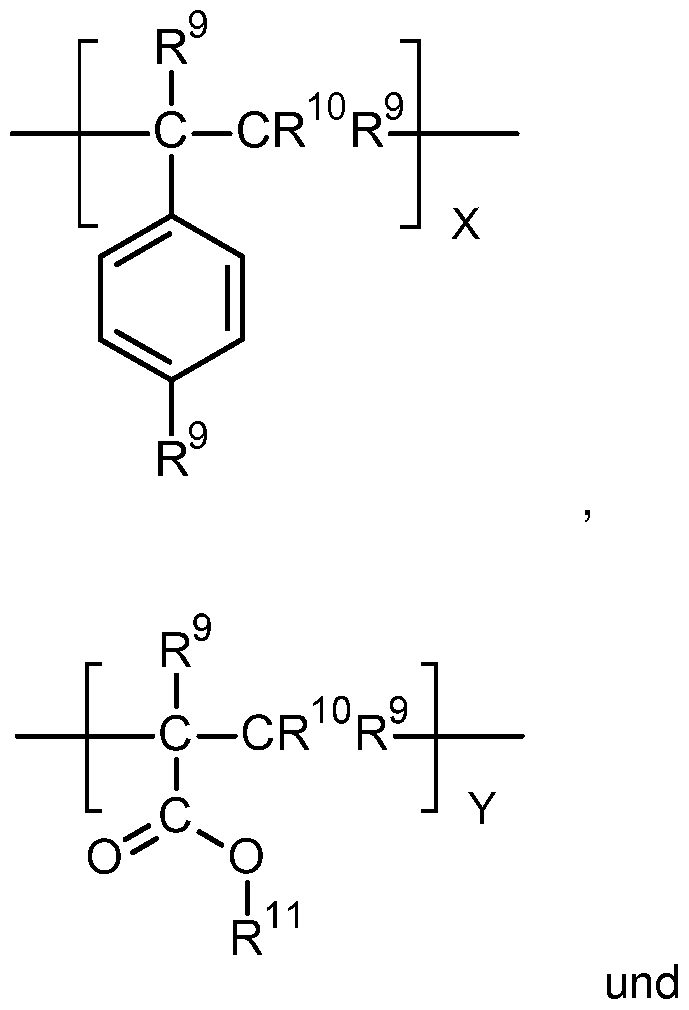

mit R9, R10 = unabhängig voneinander H, d.Cs-Alkyl, R11 = unabhängig voneinander C C8 -Alkyl, x, y = 1 - 20, z = 2 - 20 , wobei es sich bei Endgruppen R* um H, C C8 -Alkyl in beliebiger Reihenfolge handelt.
7. Zusammensetzung nach Anspruch 3, dadurch gekennzeichnet, dass es sich bei dem Epoxid um eine Verbindung der Formel (III)

(IV)
R9, R10 = H, Ci-C8 -Alkyl, R10 = Ci-C8 -Alkyl, x, y = 1 - 20 und z = 2 - 20, und R* = H, Ci-C8 -Alkyl handelt.
8. Zusammensetzung nach einem der Ansprüche 1 bis 7, dadurch gekennzeichnet, dass diese a), b) und c) in folgenden Anteilen enthält: a) 0,2 - 2 Gew. %, bevorzugt 0,4 - 1 ,5 Gew. % besonders bevorzugt 0,5 - 1 ,0 Gew.%; b) 0,05 - 4 Gew. %, bevorzugt 0,1 - 2 Gew. % besonders bevorzugt 0,5 - 1 ,5 Gew.%; c) 94 - 99,75 Gew. %, bevorzugt 96,5 - 99,5 Gew. % besonders bevorzugt 97,5 - 99,0 Gew. % .
9. Verfahren zur Herstellung einer Zusammensetzung nach einem der Ansprüche 1 bis 7, dadurch gekennzeichnet, dass die Komponenten a), b) in mindestens ein thermoplastisches Polyester-basiertes Polymer e) eingemischt werden.
10. Verfahren zur Herstellung einer Zusammensetzung nach Anspruch 9, dadurch gekennzeichnet, dass die Komponenten a), b) in mindestens ein thermoplastisches Polyester-basiertes Polymer c) bei Temperarturen von 160 - 330°C eingemischt werden.
1 1 . Erzeugnisse, vorzugsweise hydrolysestabile Erzeugnisse, erhältlich durch Einmischen der Zusammensetzungen nach einem der Ansprüche 1 bis 7, in wenigstens einem Mischaggregat, vorzugsweise einem Compounder, und der Weiterverarbeitung zu Formmassen in Spritzgussverfahren oder mittels Extrusion.
12. Verwendung der Zusammensetzung nach einem der Ansprüche 1 bis 7 zur Herstellung von Erzeugnissen durch Extrusion, vorzugsweise für Verpackungen oder Solarzellen.
Priority Applications (5)
| Application Number | Priority Date | Filing Date | Title |
|---|---|---|---|
| CN201880043156.4A CN110809601A (zh) | 2017-07-17 | 2018-07-16 | 含有聚合碳二亚胺、环氧化物和基于聚酯的聚合物的组合物及其生产和用途 |
| JP2020502144A JP2020528092A (ja) | 2017-07-17 | 2018-07-16 | ポリマー性カルボジイミド、エポキシド、及びポリエステルベースのポリマーを含む組成物、並びにそれらの製造及び使用 |
| US16/631,583 US20200165442A1 (en) | 2017-07-17 | 2018-07-16 | Compositions containing polymeric carbodiimide, epoxide and polyester-based polymers, and production and use thereof |
| KR1020207001149A KR20200030057A (ko) | 2017-07-17 | 2018-07-16 | 중합체 카르보디이미드, 에폭시드 및 폴리에스테르 기재의 중합체를 함유하는 조성물, 및 그의 제조 및 용도 |
| EP18737647.0A EP3655479A1 (de) | 2017-07-17 | 2018-07-16 | Zusammensetzungen enthaltend polymeres carbodiimid, epoxid und polyester-basierte polymere, deren herstellung und verwendung |
Applications Claiming Priority (2)
| Application Number | Priority Date | Filing Date | Title |
|---|---|---|---|
| EP17181680.4A EP3431538A1 (de) | 2017-07-17 | 2017-07-17 | Zusammensetzungen enthaltend polymeres carbodiimid, epoxid und polyester-basierte polymere, deren herstellung und verwendung |
| EP17181680.4 | 2017-07-17 |
Publications (1)
| Publication Number | Publication Date |
|---|---|
| WO2019016143A1 true WO2019016143A1 (de) | 2019-01-24 |
Family
ID=59383411
Family Applications (1)
| Application Number | Title | Priority Date | Filing Date |
|---|---|---|---|
| PCT/EP2018/069279 Ceased WO2019016143A1 (de) | 2017-07-17 | 2018-07-16 | Zusammensetzungen enthaltend polymeres carbodiimid, epoxid und polyester-basierte polymere, deren herstellung und verwendung |
Country Status (17)
| Country | Link |
|---|---|
| US (2) | US20190016853A1 (de) |
| EP (3) | EP3431538A1 (de) |
| JP (2) | JP6708703B2 (de) |
| KR (2) | KR20200030057A (de) |
| CN (2) | CN110809601A (de) |
| BR (1) | BR102018014532B1 (de) |
| CA (1) | CA3011457A1 (de) |
| DE (1) | DE202018006716U1 (de) |
| ES (1) | ES3031039T3 (de) |
| MX (1) | MX2018008776A (de) |
| PH (1) | PH12018000199B1 (de) |
| PL (1) | PL3431539T3 (de) |
| SG (1) | SG10201806051XA (de) |
| TW (1) | TWI780177B (de) |
| UA (1) | UA125434C2 (de) |
| WO (1) | WO2019016143A1 (de) |
| ZA (1) | ZA201804729B (de) |
Families Citing this family (3)
| Publication number | Priority date | Publication date | Assignee | Title |
|---|---|---|---|---|
| EP3431538A1 (de) * | 2017-07-17 | 2019-01-23 | LANXESS Deutschland GmbH | Zusammensetzungen enthaltend polymeres carbodiimid, epoxid und polyester-basierte polymere, deren herstellung und verwendung |
| CN116134042B (zh) | 2020-06-17 | 2025-04-29 | 朗盛公司 | 用于与热塑性塑料一起使用的组合的阻燃剂和稳定剂 |
| US20250313683A1 (en) | 2024-04-04 | 2025-10-09 | Galata Chemicals, Llc | Carbodiimide additives for improving performance of pvc compounds |
Citations (17)
| Publication number | Priority date | Publication date | Assignee | Title |
|---|---|---|---|---|
| DE1961668A1 (de) | 1968-12-06 | 1970-06-18 | Philips Nv | Wellenlaufzeitvorrichtung |
| DE2035390A1 (de) | 1969-07-17 | 1971-01-28 | Eastman Kodak Co , Rochester, N Y (VStA) | Formmasse zur Herstellung von Polyester formkorpern |
| DE2248242A1 (de) | 1971-10-01 | 1973-04-12 | Gen Electric | Verstaerkte interkristalline thermoplastische polyester-zusammensetzungen |
| DE3631540A1 (de) | 1986-09-17 | 1988-03-24 | Bayer Ag | Thermoplastische formmassen mit hoher alterungsbestaendigkeit und guter tieftemperaturzaehigkeit |
| DE3631539A1 (de) | 1986-09-17 | 1988-03-24 | Bayer Ag | Alterungsbestaendige thermoplastische formmassen mit guter zaehigkeit |
| DE3704655A1 (de) | 1987-02-14 | 1988-08-25 | Bayer Ag | Teilchenfoermige mehrphasenpolymerisate |
| DE3704657A1 (de) | 1987-02-14 | 1988-08-25 | Bayer Ag | Teilchenfoermige mehrphasenpolymerisate |
| US4937285A (en) | 1987-11-10 | 1990-06-26 | Bayer Aktiengesellschaft | Use of redox graft polymers to improve the petroleum-resistance of thermoplastic, aromatic polycarbonate and/or polyester carbonate moulding compositions |
| EP0728811A2 (de) | 1995-02-27 | 1996-08-28 | Mitsubishi Chemical Corporation | Hammhemmende thermoplastische Harzzusammensetzung |
| WO1997040092A1 (de) | 1996-04-18 | 1997-10-30 | Basf Aktiengesellschaft | Flammgeschützte thermoplastische formmassen |
| US20020128428A1 (en) | 2000-12-14 | 2002-09-12 | Joseph Gan | Epoxy resins and process for making the same |
| DE10316615A1 (de) | 2003-04-11 | 2004-10-28 | Polymer Latex Gmbh & Co. Kg | Restmonomerreduzierung in der Emulsionpolymerisation von Acrylaten und Styrolacrylaten |
| DE10349168A1 (de) | 2003-10-22 | 2005-06-16 | Schäfer, Volker, Dr. | Verwendung und Herstellung von neuen Hydrolyseschutzmitteln |
| EP1591486A1 (de) * | 2003-02-06 | 2005-11-02 | DAICEL CHEMICAL INDUSTRIES, Ltd. | Thermoplastisches polyesterharz enthaltende zusammensetzung und formkörper |
| EP1710277A1 (de) * | 2004-01-29 | 2006-10-11 | Daicel Chemical Industries, Ltd. | Polyesterelastomerzusammensetzung |
| US20140058015A1 (en) | 2011-04-26 | 2014-02-27 | Win Tech Polymer Ltd. | Insert molded article |
| EP3018124A1 (de) | 2014-11-04 | 2016-05-11 | Rhein Chemie Rheinau GmbH | Neue Carbodiimide, Verfahren zu deren Herstellung und deren Verwendung |
Family Cites Families (14)
| Publication number | Priority date | Publication date | Assignee | Title |
|---|---|---|---|---|
| JPS56161452A (en) * | 1980-05-16 | 1981-12-11 | Toray Ind Inc | Polyester resin composition |
| CA2271860A1 (en) * | 1997-09-25 | 1999-04-01 | Toray Industries, Inc. | Polyester composition and film made therefrom |
| TW585880B (en) * | 1999-08-05 | 2004-05-01 | Daicel Chem | Process for producing polyester block copolymer |
| JP2006104363A (ja) * | 2004-10-07 | 2006-04-20 | Wintech Polymer Ltd | ポリブチレンテレフタレート樹脂組成物 |
| JP2006265459A (ja) * | 2005-03-25 | 2006-10-05 | Tosoh Corp | 芳香族アミドブロック共重合体樹脂組成物 |
| CN101622310B (zh) * | 2007-02-23 | 2012-11-14 | 帝人株式会社 | 聚乳酸组合物 |
| WO2010012695A1 (de) * | 2008-08-01 | 2010-02-04 | Basf Se | Erhöhung der hydrolysebeständigkeit von biologisch abbaubaren polyestern |
| JP5694092B2 (ja) * | 2011-08-31 | 2015-04-01 | 富士フイルム株式会社 | ポリエステルフィルムとその製造方法、太陽電池用バックシートおよび太陽電池モジュール |
| EP2672539B1 (de) * | 2011-10-13 | 2016-09-28 | Mitsui Chemicals, Inc. | Piezoelektrisches polymermaterial und herstellungsverfahren dafür |
| EP2803660A1 (de) * | 2013-05-13 | 2014-11-19 | Rhein Chemie Rheinau GmbH | Neue Carbodiimide mit endständigen Harnstoff- und/oder Urethangruppen, Verfahren zu deren Herstellung und deren Verwendung |
| CN103556294B (zh) * | 2013-10-14 | 2016-05-11 | 江苏恒力化纤股份有限公司 | 一种抗蠕变抗水解聚酯及其制备方法 |
| DE102013223504A1 (de) * | 2013-11-18 | 2015-05-21 | Tesa Se | Flammbeständige, temperaturbeständige und hydrolysebeständige Träger sowie deren Verwendung in Haftklebebändern für Automobilanwendungen |
| JP2015203057A (ja) * | 2014-04-13 | 2015-11-16 | 三菱樹脂株式会社 | ポリエステル樹脂組成物 |
| EP3431538A1 (de) * | 2017-07-17 | 2019-01-23 | LANXESS Deutschland GmbH | Zusammensetzungen enthaltend polymeres carbodiimid, epoxid und polyester-basierte polymere, deren herstellung und verwendung |
-
2017
- 2017-07-17 EP EP17181680.4A patent/EP3431538A1/de not_active Withdrawn
-
2018
- 2018-06-15 EP EP18178041.2A patent/EP3431539B1/de active Active
- 2018-06-15 PL PL18178041.2T patent/PL3431539T3/pl unknown
- 2018-06-15 ES ES18178041T patent/ES3031039T3/es active Active
- 2018-07-05 US US16/027,695 patent/US20190016853A1/en not_active Abandoned
- 2018-07-13 CA CA3011457A patent/CA3011457A1/en active Pending
- 2018-07-13 JP JP2018133098A patent/JP6708703B2/ja active Active
- 2018-07-13 TW TW107124216A patent/TWI780177B/zh active
- 2018-07-16 JP JP2020502144A patent/JP2020528092A/ja active Pending
- 2018-07-16 KR KR1020207001149A patent/KR20200030057A/ko not_active Withdrawn
- 2018-07-16 SG SG10201806051XA patent/SG10201806051XA/en unknown
- 2018-07-16 ZA ZA2018/04729A patent/ZA201804729B/en unknown
- 2018-07-16 UA UAA201807880A patent/UA125434C2/uk unknown
- 2018-07-16 KR KR1020180082562A patent/KR102624356B1/ko active Active
- 2018-07-16 CN CN201880043156.4A patent/CN110809601A/zh active Pending
- 2018-07-16 EP EP18737647.0A patent/EP3655479A1/de not_active Withdrawn
- 2018-07-16 DE DE202018006716.4U patent/DE202018006716U1/de not_active Expired - Lifetime
- 2018-07-16 WO PCT/EP2018/069279 patent/WO2019016143A1/de not_active Ceased
- 2018-07-16 US US16/631,583 patent/US20200165442A1/en not_active Abandoned
- 2018-07-16 PH PH12018000199A patent/PH12018000199B1/en unknown
- 2018-07-17 CN CN201810787583.5A patent/CN109265994B/zh active Active
- 2018-07-17 MX MX2018008776A patent/MX2018008776A/es unknown
- 2018-07-17 BR BR102018014532-0A patent/BR102018014532B1/pt active IP Right Grant
Patent Citations (17)
| Publication number | Priority date | Publication date | Assignee | Title |
|---|---|---|---|---|
| DE1961668A1 (de) | 1968-12-06 | 1970-06-18 | Philips Nv | Wellenlaufzeitvorrichtung |
| DE2035390A1 (de) | 1969-07-17 | 1971-01-28 | Eastman Kodak Co , Rochester, N Y (VStA) | Formmasse zur Herstellung von Polyester formkorpern |
| DE2248242A1 (de) | 1971-10-01 | 1973-04-12 | Gen Electric | Verstaerkte interkristalline thermoplastische polyester-zusammensetzungen |
| DE3631540A1 (de) | 1986-09-17 | 1988-03-24 | Bayer Ag | Thermoplastische formmassen mit hoher alterungsbestaendigkeit und guter tieftemperaturzaehigkeit |
| DE3631539A1 (de) | 1986-09-17 | 1988-03-24 | Bayer Ag | Alterungsbestaendige thermoplastische formmassen mit guter zaehigkeit |
| DE3704655A1 (de) | 1987-02-14 | 1988-08-25 | Bayer Ag | Teilchenfoermige mehrphasenpolymerisate |
| DE3704657A1 (de) | 1987-02-14 | 1988-08-25 | Bayer Ag | Teilchenfoermige mehrphasenpolymerisate |
| US4937285A (en) | 1987-11-10 | 1990-06-26 | Bayer Aktiengesellschaft | Use of redox graft polymers to improve the petroleum-resistance of thermoplastic, aromatic polycarbonate and/or polyester carbonate moulding compositions |
| EP0728811A2 (de) | 1995-02-27 | 1996-08-28 | Mitsubishi Chemical Corporation | Hammhemmende thermoplastische Harzzusammensetzung |
| WO1997040092A1 (de) | 1996-04-18 | 1997-10-30 | Basf Aktiengesellschaft | Flammgeschützte thermoplastische formmassen |
| US20020128428A1 (en) | 2000-12-14 | 2002-09-12 | Joseph Gan | Epoxy resins and process for making the same |
| EP1591486A1 (de) * | 2003-02-06 | 2005-11-02 | DAICEL CHEMICAL INDUSTRIES, Ltd. | Thermoplastisches polyesterharz enthaltende zusammensetzung und formkörper |
| DE10316615A1 (de) | 2003-04-11 | 2004-10-28 | Polymer Latex Gmbh & Co. Kg | Restmonomerreduzierung in der Emulsionpolymerisation von Acrylaten und Styrolacrylaten |
| DE10349168A1 (de) | 2003-10-22 | 2005-06-16 | Schäfer, Volker, Dr. | Verwendung und Herstellung von neuen Hydrolyseschutzmitteln |
| EP1710277A1 (de) * | 2004-01-29 | 2006-10-11 | Daicel Chemical Industries, Ltd. | Polyesterelastomerzusammensetzung |
| US20140058015A1 (en) | 2011-04-26 | 2014-02-27 | Win Tech Polymer Ltd. | Insert molded article |
| EP3018124A1 (de) | 2014-11-04 | 2016-05-11 | Rhein Chemie Rheinau GmbH | Neue Carbodiimide, Verfahren zu deren Herstellung und deren Verwendung |
Non-Patent Citations (29)
| Title |
|---|
| C.M. KECK: "Moderne Pharmazeutische Technologie", 2009, FREIE UNIVERSITÄT BERLIN |
| CHEMICAL ABSTRACTS, Columbus, Ohio, US; abstract no. 1078142-02-5 |
| CHEMICAL ABSTRACTS, Columbus, Ohio, US; abstract no. 115-83-3 |
| CHEMICAL ABSTRACTS, Columbus, Ohio, US; abstract no. 1184-10-7 |
| CHEMICAL ABSTRACTS, Columbus, Ohio, US; abstract no. 1203646-63-2 |
| CHEMICAL ABSTRACTS, Columbus, Ohio, US; abstract no. 13463-67-7 |
| CHEMICAL ABSTRACTS, Columbus, Ohio, US; abstract no. 1427364-85-9 |
| CHEMICAL ABSTRACTS, Columbus, Ohio, US; abstract no. 154862-43-8 |
| CHEMICAL ABSTRACTS, Columbus, Ohio, US; abstract no. 1592-23-0 |
| CHEMICAL ABSTRACTS, Columbus, Ohio, US; abstract no. 24968-12-5 |
| CHEMICAL ABSTRACTS, Columbus, Ohio, US; abstract no. 25068-38-6 |
| CHEMICAL ABSTRACTS, Columbus, Ohio, US; abstract no. 25134-01-4 |
| CHEMICAL ABSTRACTS, Columbus, Ohio, US; abstract no. 35074-77-2 |
| CHEMICAL ABSTRACTS, Columbus, Ohio, US; abstract no. 38613-77-3 |
| CHEMICAL ABSTRACTS, Columbus, Ohio, US; abstract no. 639808-21-2 |
| CHEMICAL ABSTRACTS, Columbus, Ohio, US; abstract no. 65997-17-3 |
| CHEMICAL ABSTRACTS, Columbus, Ohio, US; abstract no. 6683-19-8 |
| CHEMICAL ABSTRACTS, Columbus, Ohio, US; abstract no. 68604-44-4 |
| CHEMICAL ABSTRACTS, Columbus, Ohio, US; abstract no. 68664-06-2 |
| CHEMICAL ABSTRACTS, Columbus, Ohio, US; abstract no. 74388-22-0 |
| CHEMICAL ABSTRACTS, Columbus, Ohio, US; abstract no. 8013-07-8 |
| CHEMICAL ABSTRACTS, Columbus, Ohio, US; abstract no. 85116-93-4 |
| CHEMICAL ABSTRACTS, Columbus, Ohio, US; abstract no. 90498-90-1 |
| J.KASTNER ET AL., DGZFP-JAHRESTAGUNG, 2007 |
| M. SCHOSSIG: "Schädigungsmechanismen in faserverstärkten Kunststoffen", vol. 1, 2011, VIEWEG UND TEUBNER VERLAG, pages: 35 |
| QUANTACHROME PARTIKELWELT, June 2007 (2007-06-01), pages 1 - 16 |
| SMITH; MARCH: "March's Advanced Organic Chemistry", 2001, WILEY-INTERSCIENCE |
| THIELEN; HARTWIG; GUST: "Blasformen von Kunststoffhohlkörpern", 2006, CARL HANSER VERLAG, pages: 127 - 129 |
| ULLMANN: "Enzyklopädie der Technischen Chemie", vol. 19, 1980, pages: 277 - 290 |
Also Published As
Similar Documents
| Publication | Publication Date | Title |
|---|---|---|
| EP3067387B2 (de) | Thermoplastische formmassen | |
| EP3020753B1 (de) | Flammgeschützte faser-matrix-halbzeuge | |
| EP2942368B1 (de) | Polyester zusammensetzungen | |
| EP3290470B1 (de) | Thermoplastische formmassen | |
| EP4214275A1 (de) | Verwendung von dieugenol, oligomeren und/oder polymeren von eugenol zur stabilisierung von organischen materialien, stabilisierte kunststoffzusammensetzung, stabilisatorzusammensetzung sowie verfahren zur stabilisierung von organischen materialien | |
| EP2878628B1 (de) | Polyester Zusammensetzungen | |
| EP2878629A1 (de) | Polyester Zusammensetzungen | |
| DE102021202102A1 (de) | Verwendung einer Stabilisatorzusammensetzung zur Stabilisierung von organischen Materialien, Stabilisatorzusammensetzung, Masterbatch, Zusammensetzung, Formmasse der Formteile, Verfahren zur oxidativen, thermischen aktinischen Stabilisierung eines thermoplastischen Kunststoffs sowie Verwendung einer Zusammensetzung | |
| WO2019016143A1 (de) | Zusammensetzungen enthaltend polymeres carbodiimid, epoxid und polyester-basierte polymere, deren herstellung und verwendung | |
| EP3507330B1 (de) | Thermoplastische formmassen | |
| DE112016003867T5 (de) | Innen- und Aussenelement für Kraftfahrzeug | |
| EP3067388A1 (de) | Thermoplastische formmassen | |
| WO2004007607A1 (de) | Mit polymeren phosphorigsäureestern stabilisierte thermoplaste | |
| EP4077520B1 (de) | Polycarbonat-zusammensetzungen enthaltend füllstoffe und epoxy-gruppen enthaltendes triacylglycerol | |
| DE102010053483A1 (de) | =N=C=N- enthaltende Verbindung zur Verhinderung des thermischen Abbaus in Schmelzen | |
| EP2365030B1 (de) | -N=C=N- enthaltende Verbindungen zur Verhinderung des thermischen Abbaus von Metall-dialkylphosphinat enthaltenden Polyalkylenterephthalaten in der Schmelze | |
| EP4177311A1 (de) | Verwendung von polyamid 6 | |
| EP2365028B1 (de) | -N=C=N- enthaltende Verbindungen zur Verhinderung des thermischen Abbaus von Metall-dialkylphosphinat enthaltenden Polyalkylenterephthalaten in der Schmelze | |
| EP4522686A1 (de) | Kriechstromfeste polyesterzusammensetzungen | |
| EP2878626B1 (de) | Verwendung von polyester-zusammensetzungen | |
| EP2878625A1 (de) | Polyester Zusammensetzungen |
Legal Events
| Date | Code | Title | Description |
|---|---|---|---|
| 121 | Ep: the epo has been informed by wipo that ep was designated in this application |
Ref document number: 18737647 Country of ref document: EP Kind code of ref document: A1 |
|
| ENP | Entry into the national phase |
Ref document number: 2020502144 Country of ref document: JP Kind code of ref document: A |
|
| NENP | Non-entry into the national phase |
Ref country code: DE |
|
| ENP | Entry into the national phase |
Ref document number: 2018737647 Country of ref document: EP Effective date: 20200217 |