WO2019017101A1 - Courroie de transmission et procédé de production associé - Google Patents
Courroie de transmission et procédé de production associé Download PDFInfo
- Publication number
- WO2019017101A1 WO2019017101A1 PCT/JP2018/021698 JP2018021698W WO2019017101A1 WO 2019017101 A1 WO2019017101 A1 WO 2019017101A1 JP 2018021698 W JP2018021698 W JP 2018021698W WO 2019017101 A1 WO2019017101 A1 WO 2019017101A1
- Authority
- WO
- WIPO (PCT)
- Prior art keywords
- transmission belt
- rubber
- crosslinked polyolefin
- crosslinked
- polyolefin particles
- Prior art date
- Legal status (The legal status is an assumption and is not a legal conclusion. Google has not performed a legal analysis and makes no representation as to the accuracy of the status listed.)
- Ceased
Links
Images

Classifications
-
- F—MECHANICAL ENGINEERING; LIGHTING; HEATING; WEAPONS; BLASTING
- F16—ENGINEERING ELEMENTS AND UNITS; GENERAL MEASURES FOR PRODUCING AND MAINTAINING EFFECTIVE FUNCTIONING OF MACHINES OR INSTALLATIONS; THERMAL INSULATION IN GENERAL
- F16G—BELTS, CABLES, OR ROPES, PREDOMINANTLY USED FOR DRIVING PURPOSES; CHAINS; FITTINGS PREDOMINANTLY USED THEREFOR
- F16G1/00—Driving-belts
- F16G1/06—Driving-belts made of rubber
- F16G1/08—Driving-belts made of rubber with reinforcement bonded by the rubber
- F16G1/10—Driving-belts made of rubber with reinforcement bonded by the rubber with textile reinforcement
-
- D—TEXTILES; PAPER
- D06—TREATMENT OF TEXTILES OR THE LIKE; LAUNDERING; FLEXIBLE MATERIALS NOT OTHERWISE PROVIDED FOR
- D06N—WALL, FLOOR, OR LIKE COVERING MATERIALS, e.g. LINOLEUM, OILCLOTH, ARTIFICIAL LEATHER, ROOFING FELT, CONSISTING OF A FIBROUS WEB COATED WITH A LAYER OF MACROMOLECULAR MATERIAL; FLEXIBLE SHEET MATERIAL NOT OTHERWISE PROVIDED FOR
- D06N3/00—Artificial leather, oilcloth or other material obtained by covering fibrous webs with macromolecular material, e.g. resins, rubber or derivatives thereof
- D06N3/0056—Artificial leather, oilcloth or other material obtained by covering fibrous webs with macromolecular material, e.g. resins, rubber or derivatives thereof characterised by the compounding ingredients of the macro-molecular coating
- D06N3/0068—Polymeric granules, particles or powder, e.g. core-shell particles, microcapsules
-
- C—CHEMISTRY; METALLURGY
- C08—ORGANIC MACROMOLECULAR COMPOUNDS; THEIR PREPARATION OR CHEMICAL WORKING-UP; COMPOSITIONS BASED THEREON
- C08J—WORKING-UP; GENERAL PROCESSES OF COMPOUNDING; AFTER-TREATMENT NOT COVERED BY SUBCLASSES C08B, C08C, C08F, C08G or C08H
- C08J7/00—Chemical treatment or coating of shaped articles made of macromolecular substances
-
- D—TEXTILES; PAPER
- D06—TREATMENT OF TEXTILES OR THE LIKE; LAUNDERING; FLEXIBLE MATERIALS NOT OTHERWISE PROVIDED FOR
- D06M—TREATMENT, NOT PROVIDED FOR ELSEWHERE IN CLASS D06, OF FIBRES, THREADS, YARNS, FABRICS, FEATHERS OR FIBROUS GOODS MADE FROM SUCH MATERIALS
- D06M15/00—Treating fibres, threads, yarns, fabrics, or fibrous goods made from such materials, with macromolecular compounds; Such treatment combined with mechanical treatment
- D06M15/19—Treating fibres, threads, yarns, fabrics, or fibrous goods made from such materials, with macromolecular compounds; Such treatment combined with mechanical treatment with synthetic macromolecular compounds
- D06M15/21—Macromolecular compounds obtained by reactions only involving carbon-to-carbon unsaturated bonds
- D06M15/227—Macromolecular compounds obtained by reactions only involving carbon-to-carbon unsaturated bonds of hydrocarbons, or reaction products thereof, e.g. afterhalogenated or sulfochlorinated
-
- D—TEXTILES; PAPER
- D06—TREATMENT OF TEXTILES OR THE LIKE; LAUNDERING; FLEXIBLE MATERIALS NOT OTHERWISE PROVIDED FOR
- D06M—TREATMENT, NOT PROVIDED FOR ELSEWHERE IN CLASS D06, OF FIBRES, THREADS, YARNS, FABRICS, FEATHERS OR FIBROUS GOODS MADE FROM SUCH MATERIALS
- D06M23/00—Treatment of fibres, threads, yarns, fabrics or fibrous goods made from such materials, characterised by the process
- D06M23/08—Processes in which the treating agent is applied in powder or granular form
-
- D—TEXTILES; PAPER
- D06—TREATMENT OF TEXTILES OR THE LIKE; LAUNDERING; FLEXIBLE MATERIALS NOT OTHERWISE PROVIDED FOR
- D06N—WALL, FLOOR, OR LIKE COVERING MATERIALS, e.g. LINOLEUM, OILCLOTH, ARTIFICIAL LEATHER, ROOFING FELT, CONSISTING OF A FIBROUS WEB COATED WITH A LAYER OF MACROMOLECULAR MATERIAL; FLEXIBLE SHEET MATERIAL NOT OTHERWISE PROVIDED FOR
- D06N3/00—Artificial leather, oilcloth or other material obtained by covering fibrous webs with macromolecular material, e.g. resins, rubber or derivatives thereof
- D06N3/04—Artificial leather, oilcloth or other material obtained by covering fibrous webs with macromolecular material, e.g. resins, rubber or derivatives thereof with macromolecular compounds obtained by reactions only involving carbon-to-carbon unsaturated bonds
- D06N3/10—Artificial leather, oilcloth or other material obtained by covering fibrous webs with macromolecular material, e.g. resins, rubber or derivatives thereof with macromolecular compounds obtained by reactions only involving carbon-to-carbon unsaturated bonds with styrene-butadiene copolymerisation products or other synthetic rubbers or elastomers except polyurethanes
-
- D—TEXTILES; PAPER
- D06—TREATMENT OF TEXTILES OR THE LIKE; LAUNDERING; FLEXIBLE MATERIALS NOT OTHERWISE PROVIDED FOR
- D06N—WALL, FLOOR, OR LIKE COVERING MATERIALS, e.g. LINOLEUM, OILCLOTH, ARTIFICIAL LEATHER, ROOFING FELT, CONSISTING OF A FIBROUS WEB COATED WITH A LAYER OF MACROMOLECULAR MATERIAL; FLEXIBLE SHEET MATERIAL NOT OTHERWISE PROVIDED FOR
- D06N2203/00—Macromolecular materials of the coating layers
- D06N2203/04—Macromolecular compounds obtained by reactions only involving carbon-to-carbon unsaturated bonds
- D06N2203/042—Polyolefin (co)polymers
-
- D—TEXTILES; PAPER
- D06—TREATMENT OF TEXTILES OR THE LIKE; LAUNDERING; FLEXIBLE MATERIALS NOT OTHERWISE PROVIDED FOR
- D06N—WALL, FLOOR, OR LIKE COVERING MATERIALS, e.g. LINOLEUM, OILCLOTH, ARTIFICIAL LEATHER, ROOFING FELT, CONSISTING OF A FIBROUS WEB COATED WITH A LAYER OF MACROMOLECULAR MATERIAL; FLEXIBLE SHEET MATERIAL NOT OTHERWISE PROVIDED FOR
- D06N2205/00—Condition, form or state of the materials
- D06N2205/10—Particulate form, e.g. powder, granule
-
- D—TEXTILES; PAPER
- D06—TREATMENT OF TEXTILES OR THE LIKE; LAUNDERING; FLEXIBLE MATERIALS NOT OTHERWISE PROVIDED FOR
- D06N—WALL, FLOOR, OR LIKE COVERING MATERIALS, e.g. LINOLEUM, OILCLOTH, ARTIFICIAL LEATHER, ROOFING FELT, CONSISTING OF A FIBROUS WEB COATED WITH A LAYER OF MACROMOLECULAR MATERIAL; FLEXIBLE SHEET MATERIAL NOT OTHERWISE PROVIDED FOR
- D06N2205/00—Condition, form or state of the materials
- D06N2205/20—Cured materials, e.g. vulcanised, cross-linked
-
- D—TEXTILES; PAPER
- D06—TREATMENT OF TEXTILES OR THE LIKE; LAUNDERING; FLEXIBLE MATERIALS NOT OTHERWISE PROVIDED FOR
- D06N—WALL, FLOOR, OR LIKE COVERING MATERIALS, e.g. LINOLEUM, OILCLOTH, ARTIFICIAL LEATHER, ROOFING FELT, CONSISTING OF A FIBROUS WEB COATED WITH A LAYER OF MACROMOLECULAR MATERIAL; FLEXIBLE SHEET MATERIAL NOT OTHERWISE PROVIDED FOR
- D06N2209/00—Properties of the materials
- D06N2209/10—Properties of the materials having mechanical properties
- D06N2209/105—Resistant to abrasion, scratch
-
- D—TEXTILES; PAPER
- D06—TREATMENT OF TEXTILES OR THE LIKE; LAUNDERING; FLEXIBLE MATERIALS NOT OTHERWISE PROVIDED FOR
- D06N—WALL, FLOOR, OR LIKE COVERING MATERIALS, e.g. LINOLEUM, OILCLOTH, ARTIFICIAL LEATHER, ROOFING FELT, CONSISTING OF A FIBROUS WEB COATED WITH A LAYER OF MACROMOLECULAR MATERIAL; FLEXIBLE SHEET MATERIAL NOT OTHERWISE PROVIDED FOR
- D06N2211/00—Specially adapted uses
- D06N2211/04—Belts
-
- F—MECHANICAL ENGINEERING; LIGHTING; HEATING; WEAPONS; BLASTING
- F16—ENGINEERING ELEMENTS AND UNITS; GENERAL MEASURES FOR PRODUCING AND MAINTAINING EFFECTIVE FUNCTIONING OF MACHINES OR INSTALLATIONS; THERMAL INSULATION IN GENERAL
- F16G—BELTS, CABLES, OR ROPES, PREDOMINANTLY USED FOR DRIVING PURPOSES; CHAINS; FITTINGS PREDOMINANTLY USED THEREFOR
- F16G1/00—Driving-belts
- F16G1/28—Driving-belts with a contact surface of special shape, e.g. toothed
Definitions
- the present invention relates to a transmission belt and a method of manufacturing the same.
- a reinforcing cloth is usually provided so as to cover the side of the belt body on which the tooth rubber portion is disposed.
- the reinforcing cloth is impregnated with a rubber paste to attach a rubber layer to the surface of the fiber or yarn, and low friction is applied to the rubber layer. It is disclosed to contain polytetrafluoroethylene particles as an agent.
- the present invention is a transmission belt provided with a reinforcing cloth so as to cover a pulley contact surface, and a covering layer is attached so as to cover the surface of the fiber or yarn constituting the reinforcing cloth and expose the outside.
- the coating layer contains crosslinked polyolefin particles constituted by crosslinking of polyolefin molecules.
- the present invention is a method for producing a transmission belt according to the present invention, wherein the crosslinked polyolefin particles are obtained by irradiating uncrosslinked polyolefin particles in which polyolefin molecules are not crosslinked with radiation.
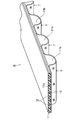
- FIG. 2 is a perspective view of a piece of the toothed belt of Embodiment 1;
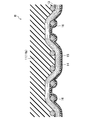
- FIG. 2 is an enlarged cross-sectional view of the main part of the toothed belt of Embodiment 1;
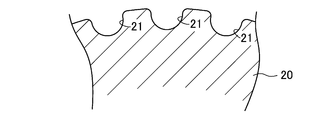
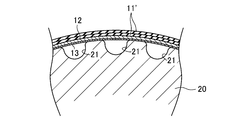
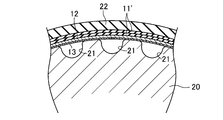
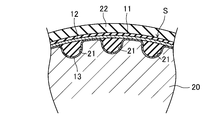
- FIG. 2 is a cross-sectional view of a portion of a belt mold; It is 1st explanatory view of the manufacturing method of the toothed belt of an embodiment. It is 2nd explanatory drawing of the manufacturing method of the toothed belt of an embodiment. It is 3rd explanatory drawing of the manufacturing method of the toothed belt of an embodiment.
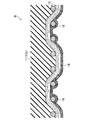
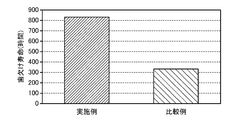
- FIG. 7 is an enlarged cross-sectional view of the main part of a toothed belt of a second embodiment. It is a figure showing the pulley layout of a belt run test machine. It is a graph which shows tooth chipping life of an example and a comparative example.
- FIG. 1 shows a toothed belt B according to a first embodiment.
- the toothed belt B according to the first embodiment is, for example, an endless belt used for automobiles, general industrial machines, and the like.
- the toothed belt B according to the first embodiment has, for example, a belt circumferential length of 100 mm to 2000 mm, a belt width of 3 mm to 100 mm, and a maximum belt thickness of 1.5 mm to 8.0 mm.
- a plurality of tooth portions T are disposed on the inner circumferential surface at a constant pitch.
- the pitch of the teeth T is, for example, 1.5 mm or more and 14 mm or less.
- the tooth portion T may be a round tooth having a semicircular shape in a side view, or may be a trapezoidal tooth having a trapezoidal shape, or may have another shape.
- the teeth T may be formed to extend in the belt width direction, or may be helical teeth formed to extend in a direction inclined with respect to the belt width direction.
- the toothed belt B includes a belt main body 11 of a rubber member, a cord 12 of a fiber member, and a reinforcing cloth 13.
- the belt main body 11 has a flat rubber portion 11a and a plurality of tooth rubber portions 11b disposed on the inner peripheral surface of the flat rubber portion 11a at a constant pitch.
- Each of the plurality of tooth rubber portions 11 b is integrally provided to the flat rubber portion 11 a.
- the belt main body 11 is formed of a rubber composition in which a rubber component is crosslinked by heating and pressing an uncrosslinked rubber composition in which a rubber compounding agent is blended in the rubber component.
- Examples of the rubber component of the rubber composition forming the belt body 11 include hydrogenated nitrile rubber (hereinafter referred to as "H-NBR”), chloroprene rubber (hereinafter referred to as “CR”), ethylene propylene diene terpolymer (hereinafter referred to as " And ethylene- ⁇ -olefin elastomers such as “EPDM”.
- H-NBR hydrogenated nitrile rubber
- CR chloroprene rubber
- EPDM ethylene propylene diene terpolymer
- a rubber compounding agent a general thing can be used, For example, a vulcanization acceleration adjuvant, an antiaging agent, a reinforcing material, a plasticizer, a co-crosslinking agent, a crosslinking agent etc. are mentioned.
- the core wire 12 is embedded in the inner circumferential side portion of the flat rubber portion 11 a in the belt main body 11 so as to form a spiral having a pitch in the belt width direction.
- the outer diameter of the core wire 12 is, for example, 0.2 mm or more and 2 mm or less.
- the core wire 12 is made of twisted yarn of glass fiber, aramid fiber, carbon fiber, metal fiber or the like.
- a twisted yarn which comprises a core wire, a single-twisted yarn, a multi-twisted yarn, a rung twisted yarn etc. are mentioned, for example.
- the core wire 12 may be configured such that S and Z strands are provided so as to form a double helix, and a single S or Z strand is provided in a spiral shape. It is also good.
- the core wire 12 was immersed in an epoxy resin solution or an isocyanate resin solution and then heated for adhesion to the belt main body 11, and was immersed in an aqueous solution of resorcin / formalin / latex (hereinafter referred to as "RFL aqueous solution"). It is preferable that one or two or more types of rubber paste adhesion processes among RFL adhesion processing to be heated later and adhesion processing to be dried after being immersed in rubber paste are performed.
- the reinforcing cloth 13 is provided so as to cover the inner peripheral surface of the belt main body 11 on which the plurality of tooth rubber portions 11b are disposed, and hence the pulley contact surface.
- the thickness of the reinforcing cloth 13 is, for example, 0.1 mm or more and 1 mm or less.
- the tooth portion T is configured by covering the tooth rubber portion 11 b of the belt main body 11 with the reinforcing cloth 13.
- the reinforcing cloth 13 is made of, for example, a cloth material of a fiber material such as nylon fibers such as nylon 6, 6, nylon 4, 6 or nylon 6, polyester fibers, aramid fibers, polyparaphenylene benzobisoxazole (PBO) fibers, etc. ing.
- a cloth material of a fiber material such as nylon fibers such as nylon 6, 6, nylon 4, 6 or nylon 6, polyester fibers, aramid fibers, polyparaphenylene benzobisoxazole (PBO) fibers, etc. ing.
- the cloth material constituting the reinforcing cloth 13 include woven fabrics such as plain weave, twill weave, satin weave, etc .; knit fabrics such as plain knit, rubber knit, pearl knit, etc .;
- the cloth material constituting the reinforcing cloth 13 preferably has extensibility in the belt length direction from the viewpoint of covering the tooth rubber portion 11 b to form the tooth portion T.
- the reinforcing cloth 13 is subjected to an RFL adhesion process in which it is immersed and impregnated in an RFL aqueous solution for adhesion with the belt main body 11 and a soaking rubber paste adhesion process in which it is immersed and impregnated in rubber paste and then dried.
- the RFL coating layer 14 is attached to the reinforcing cloth 13 so as to cover the surface of the fibers or yarns constituting the reinforcing cloth 13 and further reinforced thereon.
- the soaking rubber layer 15 adheres so as to cover the surface of the fibers or yarns constituting the cloth 13 and expose the surface.
- the RFL coating layer 14 is formed of a mixture of a resin component of a condensate of resorcin and formaldehyde and a rubber component derived from a rubber latex.
- the adhesion amount of the RFL coating layer 14 is, for example, 10 or more and 80 or less in a mass ratio where the fiber material forming the reinforcing cloth 13 is 100.
- the soaking rubber layer 15 is an uncrosslinked rubber composition in which a rubber compounding agent containing crosslinked polyolefin particles 16 (hereinafter simply referred to as "crosslinked polyolefin particles 16") formed by crosslinking polyolefin molecules is blended with a rubber component.
- the product is formed of a rubber composition in which a rubber component is crosslinked by heating and pressure. Therefore, the soaking rubber layer 15 is formed of a rubber composition containing a crosslinked rubber component and the crosslinked polyolefin particles 16, and the crosslinked polyolefin particles 16 are dispersed in the layer.
- the RFL film layer 14 may also contain the crosslinked polyolefin particles 16 dispersed in the layer.
- the reinforcing cloth 13 is subjected to a base bonding process in which the reinforcing cloth 13 is immersed in an epoxy resin solution or an isocyanate resin solution and then heated before the RFL bonding process, whereby the fibers constituting the reinforcing cloth 13 and the RFL film layer 14 In the meantime, therefore, an underlayer made of an epoxy resin or an isocyanate resin may be interposed on the underlayer of the RFL film layer 14. Also, after the soaking rubber adhesive bonding process, the surface on the side of the belt main body 11 is coated with a rubber adhesive and then dried, and the coating rubber adhesive bonding process is applied, whereby the coating rubber layer is formed between the reinforcing cloth 13 and the belt main body 11 May be interposed.
- the soaking is performed so as to cover the surface of the fibers or yarns constituting the reinforcing cloth 13 provided so as to cover the inner side surface which is the pulley contact surface. Since the rubber layer 15 adheres and the soaking rubber layer 15 contains the crosslinked polyolefin particles 16, the crosslinked polyolefin particles 16 exposed on the surface can have better abrasion resistance. And as a result, abrasion of the reinforcement cloth 13 is suppressed and the outstanding tooth chipping resistance can be obtained.
- Examples of the rubber component of the rubber composition forming the soaking rubber layer 15 include ethylene- ⁇ -olefin elastomers such as H-NBR, CR, and EPDM. As the rubber component, it is preferable to use one or two or more of them.
- the rubber component is preferably the same as the rubber component of the rubber composition forming the belt body 11.
- Examples of the polyolefin constituting the crosslinked polyolefin particles 16 include homopolymers such as polyethylene, polypropylene, poly-1-butene and poly-4-methyl-1-pentene; ethylene and propylene, 1-butene, 1-hexene, 1 And copolymers with ⁇ -olefins such as octene and 4-methyl-1-pentene. It is preferable to use 1 type, or 2 or more types of particle
- the crosslinked polyolefin particles 16 are preferably formed by crosslinking ultrahigh molecular weight polyolefins having an average molecular weight (weight average molecular weight, number average molecular weight) of 500,000 or more.
- the average molecular weight (weight-average molecular weight, number-average molecular weight) of the ultrahigh molecular weight polyolefin is preferably 1,000,000 or more and 6,000,000 or less, more preferably 180,000 or more and 350,000 or less, further preferably from the viewpoint of obtaining excellent tooth chipping resistance. Is 2 million or more and 3 million or less.
- the ultra high molecular weight polyolefin is preferably an ultra high molecular weight polyethylene.
- the average particle diameter of the crosslinked polyolefin particles 16 is preferably 10 ⁇ m to 200 ⁇ m, more preferably 100 ⁇ m to 170 ⁇ m, and still more preferably 100 ⁇ m to 150 ⁇ m from the viewpoint of obtaining excellent tooth chipping resistance.
- the average particle diameter can be determined by arithmetically averaging the particle diameters (maximum outer diameter) of 50 or more and 100 or less particles observed from the observation photograph of the crosslinked polyolefin particles 16 with a scanning electron microscope in consideration of the magnification.
- the shape of the crosslinked polyolefin particle 16 is preferably close to a spherical shape from the viewpoint of obtaining excellent tooth chipping resistance.
- the aspect ratio obtained by dividing the largest outer diameter of the crosslinked polyolefin particles 16 by the smallest outer diameter is preferably 2.0 or less, more preferably 1.5 or less, and still more preferably 1. from the viewpoint of obtaining excellent tooth chipping resistance. It is 3 or less.
- This aspect ratio is obtained by arithmetically averaging the maximum outer diameter of 50 or more and 100 or less measured from the observation photograph of the cross-linked polyolefin particle 16 with a scanning electron microscope in consideration of the magnification and dividing it by the minimum outer diameter. Desired.
- the shape of the crosslinked polyolefin particles 16 may be fibrous.
- the limiting viscosity [ ⁇ ] of the crosslinked polyolefin particles 16 is preferably 5 dl / g to 50 dl / g, more preferably 5 dl / g to 30 dl / g, from the viewpoint of obtaining excellent tooth chipping resistance.
- the limiting viscosity is that measured in decalin at 135 ° C.
- the melting point of the crosslinked polyolefin particles 16 is preferably 125 ° C. or more and 145 ° C. or less, more preferably 130 ° C. or more and 145 ° C. or less, from the viewpoint of obtaining excellent tooth chipping resistance.
- the melting point is determined by differential scanning calorimetry (DSC).
- the content of the crosslinked polyolefin particles 16 in the rubber composition forming the soaking rubber layer 15 is preferably 20 parts by mass or more and 120 parts by mass or less with respect to 100 parts by mass of the rubber component from the viewpoint of obtaining excellent tooth chipping resistance. More preferably, it is 50 parts by mass or more and 110 parts by mass or less.
- the crosslinked polyolefin particles 16 can be obtained by irradiating the non-crosslinked polyolefin particles in which the polyolefin molecules are not crosslinked with radiation.
- the uncrosslinked polyolefin particles are irradiated with radiation, cleavage and crosslinking of the molecular chains of the polyolefin occur, and as a result, the molecular chains are bonded at the crosslinking points.
- radiation include ⁇ rays, ⁇ rays, ⁇ rays, electron beams, ions and the like, and electron beams or ⁇ rays are preferably used.
- the irradiation dose of radiation is preferably 50 kGy or more and 700 kGy or less, more preferably 100 kGy or more and 500 kGy or less.
- the crosslinked polyolefin particles 16 may include those having a hollow portion inside.
- the crosslinked polyolefin particles 16 having hollow portions can be obtained by irradiating the uncrosslinked polyolefin particles with a sufficiently large amount of radiation.
- the rubber composition forming the soaking rubber layer 15 may contain uncrosslinked polyolefin particles in which polyolefin molecules are not crosslinked.
- the rubber compounding agent examples include a vulcanization acceleration auxiliary agent, an antiaging agent, a reinforcing material, a plasticizer, a co-crosslinking agent, a crosslinking agent and the like.
- the vulcanization acceleration auxiliary examples include metal oxides such as zinc oxide (zinc white) and magnesium oxide, metal carbonates, fatty acids and derivatives thereof. It is preferable to use 1 type, or 2 or more types in these, and it is more preferable to use a zinc oxide as a vulcanization acceleration adjuvant.
- the content of the vulcanization acceleration auxiliary is, for example, 3 parts by mass or more and 7 parts by mass or less with respect to 100 parts by mass of the rubber component.
- the antiaging agent for example, benzimidazole type, aromatic secondary amine type, amine-ketone type and the like can be mentioned. It is preferable to use 1 type, or 2 or more types among these as an antiaging agent, and it is more preferable to use together a benzimidazole type and an aromatic secondary amine type thing together.
- the content of the antiaging agent is, for example, 1.5 parts by mass or more and 3.5 parts by mass or less with respect to 100 parts by mass of the rubber component.
- the reinforcing material may, for example, be carbon black or silica.
- the carbon black include channel black; furnace black such as SAF, ISAF, HAF, MAF, FEF, SRF, GPF, ECF, etc .; thermal black such as FT, MT, acetylene black and the like. It is preferable to use one or two or more types of carbon black, and it is more preferable to use HAF.
- the reinforcing material is preferably carbon black and silica in combination. When carbon black is used as the reinforcing material, the content is, for example, 0 parts by mass or more and 100 parts by mass or less with respect to 100 parts by mass of the rubber component.
- the content is, for example, 10 parts by mass or more and 30 parts by mass or less with respect to 100 parts by mass of the rubber component.
- the content of silica is preferably larger than the content of carbon black.
- plasticizer examples include polyether esters, dialkyl sebacates such as dioctyl sebacate (DOS), dialkyl phthalates such as dibutyl phthalate (DBP) and dioctyl phthalate (DOP), dialkyl adipates such as dioctyl adipate (DOA), and the like. It can be mentioned.
- DOS dioctyl sebacate
- DBP dibutyl phthalate
- DOP dioctyl phthalate
- DOA dioctyl adipate
- the content of the plasticizer is, for example, 3 parts by mass or more and 10 parts by mass or less with respect to 100 parts by mass of the rubber component.
- co-crosslinking agent examples include trimethylolpropane trimethacrylate, m-phenylenedimaleimide, zinc dimethacrylate, triallyl isocyanurate and the like. It is preferable to use one or two or more of these as the co-crosslinking agent, and it is more preferable to use m-phenylene dimaleimide.
- the content of the co-crosslinking agent is, for example, 3 parts by mass or more and 7 parts by mass or less with respect to 100 parts by mass of the rubber component.
- Crosslinking agents include sulfur and organic peroxides.
- the crosslinking agent only sulfur may be used, or only organic peroxide may be used, and further, they may be used in combination.
- the use of an organic peroxide is preferable.
- the compounding amount of the organic peroxide is, for example, 1 part by mass or more and 5 parts by mass or less with respect to 100 parts by mass of the rubber component.
- the adhesion amount of the soaking rubber layer 15 is preferably 2 or more and 200 or less, more preferably 50 or more and 130 or less in terms of the mass ratio of the fiber material forming the reinforcing cloth 13 to 100 from the viewpoint of obtaining excellent tooth chipping resistance. It is.
- the thickness of the soaking rubber layer 15 is, for example, 50 ⁇ m or more and 500 ⁇ m or less.
- the method of manufacturing the toothed belt B according to the first embodiment includes a member preparation process, a forming process, a crosslinking process, and a finishing process.
- ⁇ Member preparation process> The rubber component for the belt main body 11 is masticated, and a rubber compounding agent is added thereto and kneaded, and the obtained non-crosslinked rubber composition is calendered or the like to prepare a non-crosslinked rubber sheet 11 '.
- the core wire 12 is subjected to an RFL adhesion process in which the core wire 12 is immersed in an RFL aqueous solution and then heated, and a rubber paste adhesion process in which the core wire 12 is immersed in rubber paste and then dried.
- the reinforcing cloth 13 is dipped in and impregnated with an RFL aqueous solution, and then subjected to RFL adhesion treatment to be heated, and soaking rubber paste adhesion treatment to be dipped and impregnated in rubber paste and then dried.
- the rubber paste used for the soaking rubber paste adhesion process is a non-crosslinked rubber composition obtained by masticating the rubber component for the soaking rubber layer 15, charging a rubber compounding agent containing the crosslinked polyolefin particles 16 therein, and kneading it. Can be prepared by dissolving it in an organic solvent.
- the crosslinked polyolefin particles 16 are obtained by irradiating the uncrosslinked polyolefin particles with radiation.
- an organic solvent used for rubber paste toluene, methyl ethyl ketone etc. are mentioned, for example.
- the solid content concentration of the rubber paste is, for example, 10% by mass or more and 50% by mass or less.
- FIG. 3 shows a belt forming die 20 used when manufacturing the toothed belt B according to the first embodiment.
- a plurality of tooth portion forming grooves 21 are arranged on the outer peripheral surface of the belt forming die 20 at intervals in the circumferential direction.
- the reinforcing cloth 13 is formed into a cylindrical shape, and as shown in FIG. 4A, the cylindrical reinforcing cloth 13 is placed on the outer peripheral surface of the belt forming die 20, and the core wire 12 is spirally wound thereon. . Then, the uncrosslinked rubber sheet 11 ′ is wound thereon, and the uncrosslinked slab S ′ is formed on the belt forming die 20.
- the uncrosslinked rubber sheet 11 ' is used so that the machine direction corresponds to the belt length direction.
- the non-crosslinked slab S 'on the belt forming mold 20 is covered with a rubber sleeve 22, which is placed in a vulcanizing can for sealing and at the same time high temperature and high pressure steam in the vulcanizing can. Fill and hold for a predetermined molding time.
- the non-crosslinked slab S ' is pressed to the side of the belt forming mold 20 and heated, so that the non-crosslinked rubber sheet 11' passes between the core wires 12 and presses the reinforcing cloth 13 while the belt forming mold is formed.
- the rubber component While flowing into each of the plurality of twenty tooth forming grooves 21, the rubber component is crosslinked to form a rubber composition.
- the cord 12 compositely integrates with the rubber composition.
- the reinforcing cloth 13 is also integrated with the rubber composition.
- the rubber component of the uncrosslinked rubber composition layer attached to the surface of the fibers or yarns constituting the reinforcing cloth 13 by the soaking rubber paste adhesion treatment is crosslinked to form the soaking rubber layer 15.
- ⁇ Finish process> Depressurize the inside of the vulcanizer to release the seal, take out the belt slab S molded between the belt mold 20 and the rubber sleeve 22, remove it, and cut it into rings of a predetermined width according to the first embodiment.
- the toothed belt B is obtained.
- the reinforcing cloth 13 covers the surface of the fibers or yarns constituting the reinforcing cloth 13 so that the surface is exposed to the outside. Is attached.
- the RFL coating layer 14 is formed of a mixture of a resin component of a condensate of resorcin and formaldehyde and a rubber component derived from a rubber latex, in which the crosslinked polyolefin particles 16 are dispersed. Therefore, the RFL coating layer 14 contains the crosslinked polyolefin particles 16 dispersed in the layer.
- the surface of the fibers or yarns constituting the reinforcing cloth 13 provided so as to cover the inner side surface which is the pulley contact surface is covered so as to be exposed outside. Since the coating layer 14 adheres and the RFL coating layer 14 contains the crosslinked polyolefin particles 16, the crosslinked polyolefin particles 16 exposed on the surface can obtain better abrasion resistance. And as a result, abrasion of the reinforcement cloth 13 is suppressed and the outstanding tooth chipping resistance can be obtained.
- the rubber latex-derived rubber component (L) contained in the RFL coating layer 14 include vinylpyridine-styrene-butadiene rubber (Vp-SBR), styrene-butadiene rubber (SBR), 2,3-dichlorobutadiene rubber ( 2,3-DCB), natural rubber (NR), H-NBR, CR and the like.
- Vp-SBR vinylpyridine-styrene-butadiene rubber
- SBR styrene-butadiene rubber
- 2,3-DCB 2,3-dichlorobutadiene rubber
- NR natural rubber
- H-NBR CR
- CR natural rubber
- the content of the crosslinked polyolefin particles 16 in the RFL coating layer 14 is preferably 10% by mass to 60% by mass, and more preferably 25% by mass to 55% by mass, from the viewpoint of obtaining excellent tooth chipping resistance.
- the adhesion amount of the RFL coating layer 14 is preferably 5 or more and 100 or less, more preferably 20 or more and 80 or less in terms of mass ratio of the fiber material forming the reinforcing cloth 13 to 100 from the viewpoint of obtaining excellent tooth chipping resistance. It is.
- the thickness of the RFL coating layer 14 is, for example, 50 ⁇ m or more and 500 ⁇ m or less.
- the RFL aqueous solution used in the RFL adhesion treatment of the reinforcing cloth 13 in the member preparation step mixes the rubber latex with the aqueous solution of the initial condensation product of resorcinol and formaldehyde It can be prepared by dispersing polyolefin particles 16.
- the crosslinked polyolefin particles 16 are obtained by irradiating the uncrosslinked polyolefin particles with radiation.
- the solid content concentration of the RFL aqueous solution is, for example, 5% by mass or more and 30% by mass or less.
- the reinforcing cloth 13 is subjected to a base bonding process in which the reinforcing cloth 13 is immersed in an epoxy resin solution or an isocyanate resin solution and then heated before the RFL bonding process, whereby the fibers constituting the reinforcing cloth 13 and the RFL film layer 14
- an underlayer made of an epoxy resin or an isocyanate resin may be interposed on the underlayer of the RFL film layer 14.
- the surface on the side of the belt main body 11 is coated with a rubber paste and then dried, and the coating rubber adhesive bonding process is applied, thereby interposing the coating rubber layer between the reinforcing cloth 13 and the belt main body 11 It may be set.
- the toothed belt B is shown in the first and second embodiments, the present invention is not particularly limited thereto, and may be a friction transmission belt such as a flat belt, a V-belt, or a V-ribbed belt.
- the belt main body 11 is formed of the rubber composition.
- the present invention is not particularly limited to this, and the belt main body 11 includes a urethane prepolymer and a curing agent, a plasticizer and the like.
- a cured polyurethane composition in which a urethane prepolymer composition containing the compounding agents described above is cured by heating and pressing, or a thermoplastic resin composition in which a compounding agent such as a plasticizer is compounded with a thermoplastic resin such as polyurethane It may be formed of
- toothed belt B in which the tooth portion T is disposed on the inner peripheral surface is shown in the above-described first and second embodiments, the present invention is not particularly limited thereto. It may be a double-sided toothed belt provided with teeth.
- toothed belt B of the endless belt is shown in the above Embodiments 1 and 2, the invention is not particularly limited thereto, and may be an open end belt.
- the cross-linked polyethylene particles were irradiated with an electron beam of 200 kGy on uncross-linked polyethylene particles (Hisex Million 240S, Mitsui Chemicals, Inc., average particle diameter: 120 ⁇ m, weight average molecular weight: 2,000,000) in which polyethylene molecules are not cross-linked. Polyethylene particles were obtained. The obtained crosslinked polyethylene particles had a hollow portion.
- H-NBR (ZSC2195H manufactured by Nippon Zeon Co., Ltd.), in which zinc methacrylate as a rubber component is finely dispersed and reinforced, is introduced into a chamber of a closed Banbury mixer and masticated, and then 100 parts by mass of the rubber component 90 parts by mass of the above-mentioned crosslinked polyethylene particles prepared in advance, 5 parts by mass of zinc oxide (2 kinds of zinc oxide, manufactured by Sakai Chemical Industry Co., Ltd.) as a vulcanization acceleration auxiliary agent, benzimidazole anti-aging agent 2 parts by mass, 0.5 parts by mass of aromatic secondary amine-based anti-aging agent (Nocrac CD, manufactured by Ouchi New Chemical Co., Ltd.), and 5 parts by mass of HAF carbon black as a reinforcing material (manufactured by Seast 3 by Tokai Carbon) , 20 parts by mass of reinforcing material silica (Ultrasil VN3 manufactured by Evonik Japan Co., Ltd.), polyether
- a soaking rubber paste bonding process in which a reinforcing cloth of twill woven fabric composed of warp yarns and wefts of nylon 6, 6 fibers is subjected to RFL adhesion treatment, and then dipped and impregnated in the above prepared rubber paste and then dried. Applied.
- the toothed belt of the same composition as the above-mentioned Embodiment 1 was produced using this reinforcement cloth, and it was considered as the example.
- the soaking rubber layer adheres so as to cover the surface of the fiber or yarn constituting the reinforcing cloth and expose the outside, and the soaking rubber layer contains the dispersed crosslinked polyethylene particles. there were.
- the belt circumferential length is 840 mm
- the belt width is 10 mm
- the tooth shape of the tooth portion is a round tooth (pitch: 8 mm) of S8M.
- the belt main body is formed of a rubber composition containing H-NBR reinforced by finely dispersing zinc methacrylate as a rubber component.
- the core wire 12 was constituted by a twisted yarn of glass fiber subjected to RFL adhesion treatment and rubber paste adhesion treatment.
- Comparative Example A toothed belt having the same configuration as that of the example was produced except that uncrosslinked polyethylene particles not irradiated with electron beam were used instead of the crosslinked polyethylene particles, and they were used as comparative examples.
- FIG. 6 shows a pulley layout of the belt travel tester 30.
- the belt traveling test apparatus 30 has a drive pulley 31 having 22 teeth corresponding to the tooth shape of S8M, and a driven pulley 32 having 22 teeth having the same configuration and provided on the right side.
- the driven pulley 32 is provided movably to the left and right so as to be able to load an axial load.
- the respective toothed belts B of the embodiment and the comparative example are wound around the driving pulley 31 and the driven pulley 32, and an axial constant load SW (set weight) of 1000 N is applied to the right on the driven pulley 32 to apply belt tension.
- SW set weight
- the drive pulley 31 was rotated at 5000 rpm to drive the belt.
- the belt travel is periodically stopped to check the loss of the teeth, that is, the presence or absence of the tooth missing, and the belt travel is ended when the tooth missing is detected, and the belt travel time until that time is the tooth missing life
- set weight set weight
- FIG. 8 shows the tooth chipping life of the example and the comparative example.
- the tooth chipping life is twice or more longer than in the comparative example in which the non-crosslinked polyethylene particles are contained in the soaking rubber layer.
- the cross-linked polyethylene particles of the example are significantly enhanced in wear resistance by cross-linking of polyethylene molecules, and as a result, the wear of the reinforcing cloth is suppressed and the chipping resistance is improved. It is considered to be.
- the present invention is useful in the technical field of transmission belts and methods of making the same.
Landscapes
- Engineering & Computer Science (AREA)
- Textile Engineering (AREA)
- General Engineering & Computer Science (AREA)
- Chemical & Material Sciences (AREA)
- Chemical Kinetics & Catalysis (AREA)
- Mechanical Engineering (AREA)
- Health & Medical Sciences (AREA)
- Medicinal Chemistry (AREA)
- Polymers & Plastics (AREA)
- Organic Chemistry (AREA)
- Compositions Of Macromolecular Compounds (AREA)
Abstract
La présente invention a trait à une courroie de transmission (B) dans laquelle un tissu de renforcement (13) est disposé de manière à recouvrir une surface de contact de poulie, une couche de recouvrement (15) est collée sur celle-ci de manière à être exposée à l'extérieur tout en recouvrant la surface des fibres et des fils constituant le tissu de renforcement (13), et la couche de recouvrement (15) contient des particules de polyoléfine réticulée (16) obtenues par réticulation de molécules de polyoléfine les unes avec les autres.
Priority Applications (3)
| Application Number | Priority Date | Filing Date | Title |
|---|---|---|---|
| JP2018530183A JP6383135B1 (ja) | 2017-07-19 | 2018-06-06 | 伝動ベルト及びその製造方法 |
| CN201880042334.1A CN110799770B (zh) | 2017-07-19 | 2018-06-06 | 传动带及其制造方法 |
| US16/723,521 US10975933B2 (en) | 2017-07-19 | 2019-12-20 | Transmission belt and method for producing same |
Applications Claiming Priority (2)
| Application Number | Priority Date | Filing Date | Title |
|---|---|---|---|
| JP2017-140065 | 2017-07-19 | ||
| JP2017140065 | 2017-07-19 |
Related Child Applications (1)
| Application Number | Title | Priority Date | Filing Date |
|---|---|---|---|
| US16/723,521 Continuation US10975933B2 (en) | 2017-07-19 | 2019-12-20 | Transmission belt and method for producing same |
Publications (1)
| Publication Number | Publication Date |
|---|---|
| WO2019017101A1 true WO2019017101A1 (fr) | 2019-01-24 |
Family
ID=65015164
Family Applications (1)
| Application Number | Title | Priority Date | Filing Date |
|---|---|---|---|
| PCT/JP2018/021698 Ceased WO2019017101A1 (fr) | 2017-07-19 | 2018-06-06 | Courroie de transmission et procédé de production associé |
Country Status (3)
| Country | Link |
|---|---|
| US (1) | US10975933B2 (fr) |
| CN (1) | CN110799770B (fr) |
| WO (1) | WO2019017101A1 (fr) |
Cited By (1)
| Publication number | Priority date | Publication date | Assignee | Title |
|---|---|---|---|---|
| WO2025253763A1 (fr) * | 2024-06-06 | 2025-12-11 | バンドー化学株式会社 | Courroie de transmission |
Families Citing this family (1)
| Publication number | Priority date | Publication date | Assignee | Title |
|---|---|---|---|---|
| CN114623201B (zh) * | 2022-01-29 | 2024-04-26 | 浙江丰茂科技股份有限公司 | 一种耐磨耐高温的新结构ptfe布同步带及其制备方法 |
Citations (2)
| Publication number | Priority date | Publication date | Assignee | Title |
|---|---|---|---|---|
| WO2010047121A1 (fr) * | 2008-10-23 | 2010-04-29 | バンドー化学株式会社 | Courroie de transmission de puissance |
| JP2014209026A (ja) * | 2013-03-29 | 2014-11-06 | 三ツ星ベルト株式会社 | 伝動用ベルト |
Family Cites Families (22)
| Publication number | Priority date | Publication date | Assignee | Title |
|---|---|---|---|---|
| GB1082916A (en) * | 1965-04-30 | 1967-09-13 | Stevens & Co Inc J P | Aziridinyl polyolefins and method of preparing the same |
| US4514179A (en) * | 1983-03-02 | 1985-04-30 | Uniroyal, Inc. | Power transmission belt with fabric cover |
| JPH07117123B2 (ja) * | 1993-05-11 | 1995-12-18 | バンドー化学株式会社 | Vリブドベルト |
| US6770004B1 (en) * | 1999-03-26 | 2004-08-03 | The Goodyear Tire & Rubber Company | Electrically conductive timing belt |
| GB2349113B (en) * | 1999-04-21 | 2003-07-02 | Gates Corp | Wear resistant belts and a process for their manufacture |
| JP2001304343A (ja) * | 2000-04-25 | 2001-10-31 | Mitsuboshi Belting Ltd | 歯付ベルト |
| JP2006017264A (ja) * | 2004-07-05 | 2006-01-19 | Bando Chem Ind Ltd | 高負荷用歯付ベルト及びその製造方法 |
| JP2006194322A (ja) * | 2005-01-12 | 2006-07-27 | Bando Chem Ind Ltd | 摩擦伝動ベルト |
| JP2007170587A (ja) | 2005-12-26 | 2007-07-05 | Mitsuboshi Belting Ltd | Vリブドベルト |
| JP2007270917A (ja) | 2006-03-30 | 2007-10-18 | Mitsuboshi Belting Ltd | 摩擦伝動ベルト |
| WO2008102459A1 (fr) * | 2007-02-23 | 2008-08-28 | Gates Unitta Asia Company | Courroie de transmission à friction |
| JP5914202B2 (ja) * | 2012-06-18 | 2016-05-11 | 三ツ星ベルト株式会社 | 伝動ベルト用カバー布および歯付ベルト |
| AU2013302594B2 (en) * | 2012-08-15 | 2016-04-28 | Gates Corporation | Power transmission belt |
| CN106895111B (zh) * | 2013-03-21 | 2019-06-11 | 阪东化学株式会社 | 摩擦传动带 |
| JP6275585B2 (ja) * | 2013-08-30 | 2018-02-07 | 三ツ星ベルト株式会社 | 歯付ベルト |
| MX395333B (es) * | 2015-05-11 | 2025-03-25 | Gates Corp | Banda de transmisión variable continua. |
| JP6348133B2 (ja) | 2016-01-22 | 2018-06-27 | バンドー化学株式会社 | 摩擦伝動ベルト及びその製造方法 |
| DE112017000461T5 (de) * | 2016-01-22 | 2018-10-04 | Bando Chemical Industries, Ltd. | Reibungstransmissionsriemen und Herstellungsverfahren |
| JP6348136B2 (ja) | 2016-03-23 | 2018-06-27 | バンドー化学株式会社 | 摩擦伝動ベルト及びその製造方法 |
| WO2017168913A1 (fr) * | 2016-03-28 | 2017-10-05 | バンドー化学株式会社 | Courroie de transmission à friction |
| KR101992858B1 (ko) * | 2016-03-28 | 2019-06-25 | 반도 카가쿠 가부시키가이샤 | 마찰 전동 벨트 |
| US10012291B2 (en) * | 2016-07-21 | 2018-07-03 | Contitech Antriebssysteme Gmbh | Low modulus belt utilizing tensile member and belt carcass |
-
2018
- 2018-06-06 WO PCT/JP2018/021698 patent/WO2019017101A1/fr not_active Ceased
- 2018-06-06 CN CN201880042334.1A patent/CN110799770B/zh active Active
-
2019
- 2019-12-20 US US16/723,521 patent/US10975933B2/en not_active Expired - Fee Related
Patent Citations (2)
| Publication number | Priority date | Publication date | Assignee | Title |
|---|---|---|---|---|
| WO2010047121A1 (fr) * | 2008-10-23 | 2010-04-29 | バンドー化学株式会社 | Courroie de transmission de puissance |
| JP2014209026A (ja) * | 2013-03-29 | 2014-11-06 | 三ツ星ベルト株式会社 | 伝動用ベルト |
Cited By (1)
| Publication number | Priority date | Publication date | Assignee | Title |
|---|---|---|---|---|
| WO2025253763A1 (fr) * | 2024-06-06 | 2025-12-11 | バンドー化学株式会社 | Courroie de transmission |
Also Published As
| Publication number | Publication date |
|---|---|
| CN110799770B (zh) | 2020-09-01 |
| US10975933B2 (en) | 2021-04-13 |
| US20200124136A1 (en) | 2020-04-23 |
| CN110799770A (zh) | 2020-02-14 |
Similar Documents
| Publication | Publication Date | Title |
|---|---|---|
| JP6221011B1 (ja) | 歯付ベルト | |
| KR101516934B1 (ko) | 마찰 전동 벨트 및 그 제조방법 | |
| JP6088985B2 (ja) | 摩擦伝動ベルト及びその製造方法、並びにベルト伝動装置 | |
| US9695906B2 (en) | Method for fabricating a belt with treated tension members with envelope layer and belt thus produced | |
| JP6795466B2 (ja) | 伝動ベルト及びその製造方法 | |
| JP6740174B2 (ja) | 伝動ベルト | |
| WO2017204207A1 (fr) | Courroie de transmission | |
| CN111133223A (zh) | 传动带 | |
| JP6609395B1 (ja) | 歯付ベルト | |
| US10975933B2 (en) | Transmission belt and method for producing same | |
| CN107532681A (zh) | 传动带 | |
| JPWO2019017100A1 (ja) | 伝動ベルト及びその製造方法 | |
| JP6383135B1 (ja) | 伝動ベルト及びその製造方法 | |
| JP6348136B2 (ja) | 摩擦伝動ベルト及びその製造方法 | |
| JP6157876B2 (ja) | 伝動ベルト | |
| JP2016205555A (ja) | 歯付ベルト | |
| WO2024009664A1 (fr) | Courroie crantée | |
| JP5669814B2 (ja) | 伝動ベルト | |
| JP2003221785A (ja) | ゴム補強用コードの接着剤、ゴム補強用コード、伝動ベルトおよび伝動ベルトの製造方法 | |
| JP2010255739A (ja) | 伝動ベルト | |
| JP2009248463A (ja) | 歯付ベルト及びその製造方法 | |
| TW202503186A (zh) | 齒形帶 | |
| JP2019007596A (ja) | 摩擦伝動ベルト及びその製造方法 | |
| TW202538183A (zh) | 齒形帶 | |
| JP2026057137A (ja) | 歯付ベルト、及び歯付ベルトの製造方法 |
Legal Events
| Date | Code | Title | Description |
|---|---|---|---|
| ENP | Entry into the national phase |
Ref document number: 2018530183 Country of ref document: JP Kind code of ref document: A |
|
| 121 | Ep: the epo has been informed by wipo that ep was designated in this application |
Ref document number: 18834318 Country of ref document: EP Kind code of ref document: A1 |
|
| NENP | Non-entry into the national phase |
Ref country code: DE |
|
| 122 | Ep: pct application non-entry in european phase |
Ref document number: 18834318 Country of ref document: EP Kind code of ref document: A1 |