WO2019021738A1 - Structure de fibre et matériau composite renforcé par des fibres - Google Patents
Structure de fibre et matériau composite renforcé par des fibres Download PDFInfo
- Publication number
- WO2019021738A1 WO2019021738A1 PCT/JP2018/024575 JP2018024575W WO2019021738A1 WO 2019021738 A1 WO2019021738 A1 WO 2019021738A1 JP 2018024575 W JP2018024575 W JP 2018024575W WO 2019021738 A1 WO2019021738 A1 WO 2019021738A1
- Authority
- WO
- WIPO (PCT)
- Prior art keywords
- formation
- fiber
- yarn
- forming
- corner
- Prior art date
- Legal status (The legal status is an assumption and is not a legal conclusion. Google has not performed a legal analysis and makes no representation as to the accuracy of the status listed.)
- Ceased
Links
Images



Classifications
-
- D—TEXTILES; PAPER
- D03—WEAVING
- D03D—WOVEN FABRICS; METHODS OF WEAVING; LOOMS
- D03D25/00—Woven fabrics not otherwise provided for
- D03D25/005—Three-dimensional woven fabrics
-
- C—CHEMISTRY; METALLURGY
- C08—ORGANIC MACROMOLECULAR COMPOUNDS; THEIR PREPARATION OR CHEMICAL WORKING-UP; COMPOSITIONS BASED THEREON
- C08J—WORKING-UP; GENERAL PROCESSES OF COMPOUNDING; AFTER-TREATMENT NOT COVERED BY SUBCLASSES C08B, C08C, C08F, C08G or C08H
- C08J5/00—Manufacture of articles or shaped materials containing macromolecular substances
- C08J5/04—Reinforcing macromolecular compounds with loose or coherent fibrous material
-
- D—TEXTILES; PAPER
- D03—WEAVING
- D03D—WOVEN FABRICS; METHODS OF WEAVING; LOOMS
- D03D11/00—Double or multi-ply fabrics not otherwise provided for
-
- B—PERFORMING OPERATIONS; TRANSPORTING
- B29—WORKING OF PLASTICS; WORKING OF SUBSTANCES IN A PLASTIC STATE IN GENERAL
- B29C—SHAPING OR JOINING OF PLASTICS; SHAPING OF MATERIAL IN A PLASTIC STATE, NOT OTHERWISE PROVIDED FOR; AFTER-TREATMENT OF THE SHAPED PRODUCTS, e.g. REPAIRING
- B29C70/00—Shaping composites, i.e. plastics material comprising reinforcements, fillers or preformed parts, e.g. inserts
- B29C70/04—Shaping composites, i.e. plastics material comprising reinforcements, fillers or preformed parts, e.g. inserts comprising reinforcements only, e.g. self-reinforcing plastics
- B29C70/06—Fibrous reinforcements only
- B29C70/10—Fibrous reinforcements only characterised by the structure of fibrous reinforcements, e.g. hollow fibres
- B29C70/16—Fibrous reinforcements only characterised by the structure of fibrous reinforcements, e.g. hollow fibres using fibres of substantial or continuous length
- B29C70/24—Fibrous reinforcements only characterised by the structure of fibrous reinforcements, e.g. hollow fibres using fibres of substantial or continuous length oriented in at least three directions forming a three-dimensional [3D] structure
-
- B—PERFORMING OPERATIONS; TRANSPORTING
- B29—WORKING OF PLASTICS; WORKING OF SUBSTANCES IN A PLASTIC STATE IN GENERAL
- B29K—INDEXING SCHEME ASSOCIATED WITH SUBCLASSES B29B, B29C OR B29D, RELATING TO MOULDING MATERIALS OR TO MATERIALS FOR MOULDS, REINFORCEMENTS, FILLERS OR PREFORMED PARTS, e.g. INSERTS
- B29K2105/00—Condition, form or state of moulded material or of the material to be shaped
- B29K2105/06—Condition, form or state of moulded material or of the material to be shaped containing reinforcements, fillers or inserts
- B29K2105/08—Condition, form or state of moulded material or of the material to be shaped containing reinforcements, fillers or inserts of continuous length, e.g. cords, rovings, mats, fabrics, strands or yarns
- B29K2105/0809—Fabrics
- B29K2105/0845—Woven fabrics
-
- B—PERFORMING OPERATIONS; TRANSPORTING
- B32—LAYERED PRODUCTS
- B32B—LAYERED PRODUCTS, i.e. PRODUCTS BUILT-UP OF STRATA OF FLAT OR NON-FLAT, e.g. CELLULAR OR HONEYCOMB, FORM
- B32B2260/00—Layered product comprising an impregnated, embedded, or bonded layer wherein the layer comprises an impregnation, embedding, or binder material
- B32B2260/04—Impregnation, embedding, or binder material
- B32B2260/046—Synthetic resin
-
- B—PERFORMING OPERATIONS; TRANSPORTING
- B32—LAYERED PRODUCTS
- B32B—LAYERED PRODUCTS, i.e. PRODUCTS BUILT-UP OF STRATA OF FLAT OR NON-FLAT, e.g. CELLULAR OR HONEYCOMB, FORM
- B32B5/00—Layered products characterised by the non- homogeneity or physical structure, i.e. comprising a fibrous, filamentary, particulate or foam layer; Layered products characterised by having a layer differing constitutionally or physically in different parts
- B32B5/22—Layered products characterised by the non- homogeneity or physical structure, i.e. comprising a fibrous, filamentary, particulate or foam layer; Layered products characterised by having a layer differing constitutionally or physically in different parts characterised by the presence of two or more layers which are next to each other and are fibrous, filamentary, formed of particles or foamed
- B32B5/24—Layered products characterised by the non- homogeneity or physical structure, i.e. comprising a fibrous, filamentary, particulate or foam layer; Layered products characterised by having a layer differing constitutionally or physically in different parts characterised by the presence of two or more layers which are next to each other and are fibrous, filamentary, formed of particles or foamed one layer being a fibrous or filamentary layer
- B32B5/26—Layered products characterised by the non- homogeneity or physical structure, i.e. comprising a fibrous, filamentary, particulate or foam layer; Layered products characterised by having a layer differing constitutionally or physically in different parts characterised by the presence of two or more layers which are next to each other and are fibrous, filamentary, formed of particles or foamed one layer being a fibrous or filamentary layer another layer next to it also being fibrous or filamentary
-
- D—TEXTILES; PAPER
- D03—WEAVING
- D03D—WOVEN FABRICS; METHODS OF WEAVING; LOOMS
- D03D1/00—Woven fabrics designed to make specified articles
-
- D—TEXTILES; PAPER
- D10—INDEXING SCHEME ASSOCIATED WITH SUBLASSES OF SECTION D, RELATING TO TEXTILES
- D10B—INDEXING SCHEME ASSOCIATED WITH SUBLASSES OF SECTION D, RELATING TO TEXTILES
- D10B2505/00—Industrial
- D10B2505/02—Reinforcing materials; Prepregs
-
- F—MECHANICAL ENGINEERING; LIGHTING; HEATING; WEAPONS; BLASTING
- F05—INDEXING SCHEMES RELATING TO ENGINES OR PUMPS IN VARIOUS SUBCLASSES OF CLASSES F01-F04
- F05D—INDEXING SCHEME FOR ASPECTS RELATING TO NON-POSITIVE-DISPLACEMENT MACHINES OR ENGINES, GAS-TURBINES OR JET-PROPULSION PLANTS
- F05D2300/00—Materials; Properties thereof
- F05D2300/60—Properties or characteristics given to material by treatment or manufacturing
- F05D2300/603—Composites; e.g. fibre-reinforced
Definitions
- the present invention relates to a fiber structure composed of a multilayer fabric, and a fiber reinforced composite material using the fiber structure as a reinforcing base.
- Fiber reinforced composites are widely used as lightweight structural materials.
- a fibrous structure is a reinforcing substrate for fiber reinforced composites.
- a fiber reinforced composite material in which the fiber structure is impregnated with a matrix resin is used as a structural material for aircraft, automobiles, buildings and the like.
- a multilayer fabric is used as a fiber structure.
- the multilayer fabric is formed, for example, by constraining a plurality of warp layers in which a plurality of warps are arranged and a plurality of weft layers in which a plurality of wefts are arranged in a stacking direction with a constraining yarn.
- the fiber structure in order to be able to use a fiber reinforced composite material in a wide range of uses, it is necessary to make the shape according to the use, for example, an L shape, a U shape, a V shape, etc.
- the fiber structure in order to produce an L-shaped fiber-reinforced composite, the fiber structure also needs to be L-shaped.
- the three-dimensional fiber structure disclosed in Patent Document 1 is formed in a shape bent in an L-shape such that two plate-like portions intersect at a corner portion.
- the three-dimensional fiber structure includes x-yarn layers, y-yarn layers and bias yarn layers arranged in parallel to one another, and thickness direction yarns and corner yarns which connect these yarn layers to one another.
- the x-yarn layer is composed of a first in-plane alignment yarn arranged in a direction along the corner.
- the y yarn layer is composed of a second in-plane alignment yarn arranged in a direction orthogonal to the first in-plane alignment yarn.
- the bias yarn layer is composed of bias yarns arranged to be inclined with respect to the first in-plane alignment yarn and the second in-plane alignment yarn.
- the thickness direction yarns extend in a direction orthogonal to the plurality of yarn layers at portions other than the corner portions, and connect the plurality of layers in the thickness direction of the three-dimensional fiber structure.
- a plurality of corner portion yarns are arranged in parallel with a plane that bisects an angle formed by two plate portions crossing each other.
- the two plate-like parts are connected to each other at the corner.
- the second in-plane alignment yarn and the bias yarn extend in a direction intersecting the corner.
- the second in-plane alignment yarn and the bias yarn are arranged across the two plate-like portions, so that the yarn is not divided at the corner portion, and the second in-plane alignment yarn and the bias yarn are The corner is reinforced.
- Patent Document 1 discloses a fiber structure in which corner portions are reinforced and which can be manufactured without using a special loom.
- the reinforcing fiber molding disclosed in Patent Document 2 is formed by laminating a plurality of rectangular base materials. Each base material has a cut portion formed by cutting one side of each of the four sides. Each base material includes a main body portion and an overlapping portion bent relative to the main body portion. By bending the base material using the notches, the overlapping portion is bent relative to the main body.
- a square box-like reinforced fiber molded object is formed by laminating a plurality of base materials so that main parts may overlap and overlapping parts may overlap.
- Each corner portion of the reinforcing fiber molding is reinforced by overlapping a plurality of overlapping portions.
- the reinforcing fiber molding of Patent Document 2 weaves a plurality of base materials, and after it is necessary to form the incisions in each base, it is necessary to overlap the main parts and the overlapping parts of those base materials, and the number of manufacturing steps is large. The manufacturing cost is high.
- An object of the present invention is to provide a fiber structure and a fiber reinforced composite material which can reinforce corner portions while suppressing the manufacturing cost.
- the fiber structure according to one aspect of the present disclosure includes a plurality of second formation portions stacked on each other, which form a first formation portion that forms a first structure portion and a second structure portion that intersects the first structure portion. And a plurality of third formations stacked one on another forming a third structure intersecting with the first structure and the second structure, and a boundary between the first structure and the second structure.
- a first corner portion which is a portion
- a second corner portion which is a boundary portion between the first structure portion and the third structure portion
- a boundary portion which is a boundary portion between the second structure portion and the third structure portion And 3 corner portions.
- Each of the first formation portion, the plurality of second formation portions, and the plurality of third formation portions includes a plurality of fiber layers stacked together, and a constraining yarn that constrains the plurality of fiber layers in the stacking direction.
- a multi-layer fabric having.
- the plurality of fiber layers are formed of a fiber layer formed of a plurality of first yarns parallel to one another, and a fiber formed of a second yarns parallel to one another extending in a direction orthogonal to the plurality of first yarns.
- the first yarn straddling the first structure portion and the second structure portion is bent at the first corner portion, and the second yarn straddles the first structure portion and the third structure portion. At least one of the first thread and the second thread that is bent at the second corner portion and straddles the second structure portion and the third structure portion is bent at the third corner portion.
- a fiber-reinforced composite material includes the above-described fiber structure and a matrix resin impregnated in the fiber structure.
- FIG. 3A The perspective view which shows the state which bend
- Fig. 5 is a side view of the fiber structure of Fig. 4; The perspective view which shows the state which bend
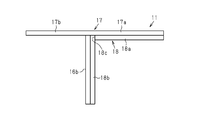
- FIG. 10 is a cross-sectional view of the fiber structure of FIG. 1 taken along line 10-10.
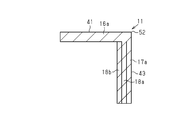
- FIG. 11 is a cross-sectional view taken along line 11-11 of the fiber structure of FIG.
- the fiber-reinforced composite material 10 is configured by compounding a fiber structure 11 composed of a multilayer fabric with a matrix resin 12.
- a matrix resin for example, an epoxy resin of a thermosetting resin is used.
- the fiber structure 11 includes a weft yarn 13 which is a first yarn, a warp yarn 14 which is a second yarn, a first restraint yarn 15a, and a second restraint yarn 15b. .
- the weft yarn 13 and the warp yarn 14 are both formed of reinforcing fibers and extend in directions orthogonal to each other.
- carbon fibers are used as the reinforcing fibers.
- the fiber structure 11 may have a three-dimensional shape in which three rectangular walls intersect (orthogonal) each other.
- the fiber structure 11 has a first structure portion 41 that constitutes a first wall of three walls.
- the first structure portion 41 has a rectangular outer surface.
- the fiber structure 11 has a second structure portion 42 which constitutes the second wall of the three walls and intersects (orthogonalizes) the first structure portion 41.
- the second structure 42 has a rectangular outer surface.
- the fiber structure 11 has a third structure 43 that constitutes the third of the three walls.
- the third structure 43 has a rectangular outer surface.
- the third structure portion 43 intersects (orthogonalizes) the first structure portion 41 and the second structure portion 42.
- the fiber structure 11 has a first corner 51 which is a boundary between the first structure 41 and the second structure 42, and a second corner which is a boundary between the first structure 41 and the third structure 43. And a third corner 53 which is a boundary between the second structure 42 and the third structure 43.
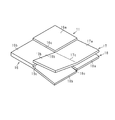
- the three-dimensional fiber structure 11 is formed by shaping the rectangular flat fiber structure 11.
- the fiber structure 11 before shaping is demonstrated.
- the fiber structure 11 before shaping is also referred to as a base material of the fiber structure 11.
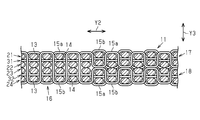
- the fiber structure 11 includes a plurality of weft layers in which a plurality of wefts 13 are arranged in parallel to one another.
- the fiber structure 11 includes a first weft layer 21, a second weft layer 22 disposed below the first weft layer 21, a third weft layer 23 disposed below the second weft layer 22, and a third weft layer 23. And a fourth weft layer 24 disposed below the third weft layer 23.
- the fiber structure 11 also includes a plurality of warp layers in which a plurality of warps 14 are arranged in parallel to one another.
- the fiber structure 11 is disposed below the first warp layer 31 and the first warp layer 31 interposed between the first weft layer 21 and the second weft layer 22, and the third weft layer 23 and the fourth weft layer And a second warp layer 32 interposed therebetween.
- the first to fourth weft layers 21 to 24 and the first to second warp layers 31 to 32 are all fiber layers.
- the first weft layer 21, the first warp layer 31, the second weft layer 22, the third weft layer 23, the second warp layer 32, and the fourth weft layer 24 are stacked in this order from top to bottom.
- the direction in which the main thread of the weft 13 extends is taken as a first direction Y1
- the direction in which the main thread of the warp 14 extends is taken as a second direction Y2.
- the direction in which the fiber layers are stacked is referred to as a stacking direction Y3.
- the fiber structure 11 before shaping is provided with a first constraining portion 16 in the region from the center to the first end in the second direction Y2.
- the first restraint portion 16 includes a first weft layer 21, a first warp layer 31, a second weft layer 22, a third weft layer 23, a second warp layer 32 and a fourth weft layer 24. It is constrained in the stacking direction Y3 by the 15a and the second constraining yarn 15b.
- the first constraining yarn 15 a and the second constraining yarn 15 b have a function of holding the shape of the fiber structure 11 and are one of warps.
- the first constraining yarn 15a and the second constraining yarn 15b are made of reinforcing fibers.
- the first constraining yarns 15a and the second constraining yarns 15b are arranged in parallel to the plurality of warps 14 and are disposed at different positions in the arrangement direction of the plurality of warps 14 (first direction Y1).
- the first restraining yarn 15 a and the second restraining yarn 15 b pass through the outer surface of the weft 13 of the first weft layer 21 at a position above the warp 14 (first warp layer 31) of the uppermost layer of the fiber structure 11. It is arranged to be folded back. Also, the first constraining yarn 15a and the second constraining yarn 15b are folded back through the outer surface of the weft 13 of the fourth weft layer 24 at a position below the lowermost warp 14 (second warp layer 32). Is located in
- the fiber structure 11 has a second restraint portion 17 at a position from the center to the first end in the stacking direction Y3 in the region from the center to the second end in the second direction Y2. And a third restraint 18 at a position from the center to the second end in the stacking direction Y3.
- the second restraint portion 17 is formed by restraining the first weft layer 21, the first warp layer 31, and the second weft layer 22 in the stacking direction Y3.
- the third restraint portion 18 is formed by restraining the third weft layer 23, the second warp layer 32, and the fourth weft layer 24 in the stacking direction Y3.
- the second constraining portion 17 and the third constraining portion 18 are formed by controlling the first constraining yarn 15a and the second constraining yarn 15b at the time of weaving by the weaving machine.
- the second restraint portion 17 is restrained in the stacking direction Y3 by the first restraint yarn 15a and the second restraint yarn 15b.
- the first restraint yarn 15a and the second restraint yarn 15b are arranged to be folded back through the outer surface of the weft yarn 13 of the first weft layer 21 which is the uppermost layer of the second restraint portion 17.
- the second restraint portion 17 is penetrated in the stacking direction Y 3, and is disposed so as to be folded back through the outer surface of the weft yarn 13 of the second weft layer 22 which is the lowermost layer of the second restraint portion 17.
- the third constraining portion 18 is constrained in the stacking direction Y3 by the first constraining yarn 15a and the second constraining yarn 15b.
- the first restraint yarn 15a and the second restraint yarn 15b are arranged to be folded back through the outer surface of the weft yarn 13 of the third weft layer 23, which is the uppermost layer of the third restraint unit 18.
- the third restraint portion 18 is disposed so as to pass through in the stacking direction Y3 and to be folded back through the outer surface of the weft yarn 13 of the fourth weft layer 24 which is the lowermost layer of the third restraint portion 18.
- the second constraining portion 17 is connected to the first constraining portion 16 in a region from the center to the first end in the first direction Y1.
- the second constraining portion 17 is separated from the first constraining portion 16 in a region from the center to the second end in the first direction Y1.
- the warp threads 14 of the first warp layer 31 extend in the second direction Y2 across the first constraining portion 16 and the second constraining portion 17.
- the first constraining portion 16 and the second constraining portion 17 extend in the second direction. It is connected to Y2.
- the third constraining portion 18 is connected to the first constraining portion 16 in the second direction Y2.
- the warp yarn 14 of the second warp layer 32 extends in the second direction Y2 across the first restraint portion 16 and the third restraint portion 18, and the first restraint portion 16 and the third restraint portion 18 extend in the second direction. It is connected to Y2.
- the third constraining portion 18 is divided at the center of the first direction Y1.
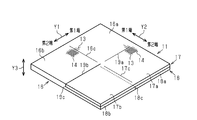
- first formation portion 16a that forms the first structure portion 41.
- the first formation portion 16a is rectangular when viewed in the stacking direction Y3.
- the first weft layer 21, the first warp layer 31, the second weft layer 22, the third weft layer 23, the second warp layer 32, and the fourth weft layer 24 It is restrained in the stacking direction Y3 by 15a and the second constraining yarn 15b. Therefore, the first formation portion 16a has six fiber layers.
- a portion from the center to the second end in the first direction Y1 is a second formation portion 16b that forms the second structure portion 42.
- the second formation portion 16 b is rectangular when viewed in the stacking direction Y3.
- the first weft layer 21, the first warp layer 31, the second weft layer 22, the third weft layer 23, the second warp layer 32, and the fourth weft layer 24 It is restrained in the stacking direction Y3 by 15a and the second constraining yarn 15b. Therefore, the second formation portion 16 b has six fiber layers.
- the fiber structure 11 includes a bent portion 16 c at the center of the first constraining portion 16 in the first direction Y1.
- the bent portion 16c is a boundary between the first forming portion 16a and the second forming portion 16b, and the first corner portion 51 is formed along the bent portion 16c. Therefore, in the bent portion 16c forming the first corner portion 51, the first formation portion 16a and the second formation portion 16b are connected.
- the bent portion 16c is also an edge portion of each of the first formation portion 16a and the second formation portion 16b.
- a portion from the center to the first end in the first direction Y1 is a third formation portion 17a forming the third structure portion 43.
- the third formation portion 17a is rectangular as viewed in the stacking direction Y3.
- the first weft layer 21, the first warp layer 31, and the second weft layer 22 are constrained in the stacking direction Y3 by the first constraining yarn 15a and the second constraining yarn 15b. Therefore, the third formation portion 17a has three fiber layers.
- a portion from the center to the second end in the first direction Y1 is a second formation portion 17b forming the second structure portion 42.
- the second formation portion 17 b is rectangular as viewed in the stacking direction Y3.
- the first weft layer 21, the first warp layer 31, and the second weft layer 22 are constrained in the stacking direction Y3 by the first constraining yarn 15a and the second constraining yarn 15b. Therefore, the second formation portion 17 b has three fiber layers.
- the fiber structure 11 includes a bent portion 17 c at the center of the second constraining portion 17 in the first direction Y1.
- the bent portion 17c is a boundary portion between the third formation portion 17a and the second formation portion 17b.
- the third corner portion 53 is formed along the bent portion 17c. Therefore, in the bent portion 17c forming the third corner portion 53, the third formation portion 17a and the second formation portion 17b are connected.
- the bent portion 17c is also an edge portion of each of the third formation portion 17a and the second formation portion 17b.
- a portion from the center to the first end in the first direction Y1 is a third formation portion 18a that forms the third structure portion 43.
- the third formation portion 18a is rectangular when viewed in the stacking direction Y3.
- the third weft layer 23, the second warp layer 32, and the fourth weft layer 24 are constrained in the stacking direction Y3 by the first constraining yarn 15a and the second constraining yarn 15b. Therefore, the third formation portion 18a has three fiber layers.
- a portion from the center to the second end in the first direction Y1 is a third formation portion 18b that forms the third structure portion 43.
- the third formation portion 18 b is rectangular as viewed in the stacking direction Y3.
- the third weft layer 23, the second warp layer 32, and the fourth weft layer 24 are restrained in the stacking direction Y3 by the first constraining yarn 15a and the second constraining yarn 15b. Therefore, the third formation portion 18b has three fiber layers.
- the fiber structure 11 includes a cut portion 18 c at the center of the third restraint portion 18 in the first direction Y1.
- the cut portion 18c is a boundary between the third formation portion 18a and the third formation portion 18b, and divides the both.
- the incised portion 18 c is formed by cutting the fiber structure 11 after weaving the fiber structure 11 including the first restraint portion 16, the second restraint portion 17, and the third restraint portion 18 with a loom.
- the fiber structure 11 includes a bent portion 19a which is a boundary between the first forming portion 16a and the third forming portion 17a in the second direction Y2.
- a second corner 52 is formed along the bent portion 19a. Therefore, in the bent portion 19a forming the second corner portion 52, the first formation portion 16a and the third formation portion 17a are connected.
- the bent portion 19a is also an edge portion of each of the first forming portion 16a and the third forming portion 17a.
- the fiber structure 11 is provided with the cut part 19b in the boundary of the 2nd formation part 16b in the 2nd direction Y2, and the 2nd formation part 17b.
- the cut portion 19 b is formed by cutting the fiber structure 11 after weaving the fiber structure 11 including the first restraint portion 16, the second restraint portion 17, and the third restraint portion 18 with a loom.
- the fiber structure 11 includes a bent portion 19c which is a boundary between the second forming portion 16b and the third forming portion 18b in the second direction Y2.
- the third corner portion 53 is formed along the bent portion 19c. Therefore, in the bent portion 19c forming the third corner portion 53, the second formation portion 16b and the third formation portion 18b are connected.
- the bent portion 19c is also an edge portion of each of the second formation portion 16b and the third formation portion 18b.
- the first formation portion 16a, the second formation portions 16b and 17b, and the third formation portions 17a, 18a and 18b have the same size.
- one second forming portion 16 b is connected by the weft 13 to the bending portion 16 c in the first forming portion 16 a, and one bending portion 19 c in the second forming portion 16 b
- the third forming portion 18 b is connected by the warp 14.
- the remaining two third forming portions 17a and 18a are connected by the warp 14 to the bending portion 19a of the first forming portion 16a, and the other second forming portion is connected to the bending portion 17c of one third forming portion 17a.
- 17b are connected by the weft 13.
- the warp 14 extends in the second direction Y2 across the first forming portion 16a of the first constraining portion 16 and the third forming portion 17a of the second constraining portion 17,
- the first formation portion 16a and the third formation portion 17a are connected in the second direction Y2.
- the warp 14 extends in the second direction Y2 across the first formation portion 16a and the third formation portion 18a of the third restraint portion 18.
- the first formation portion 16a and the third formation portion 18a It is connected to 2 directions Y2.
- the warp 14 extends in the second direction Y2 across the second formation portion 16b of the first restraint portion 16 and the third formation portion 18b of the third restraint portion 18, and the second formation portion 16b and the second formation portion 16b
- the third formation portion 18 b is connected to the second direction Y2.
- the weft thread 13 extends in the first direction Y1 across the first formation portion 16a and the second formation portion 16b of the first restraint portion 16, and the first formation portion 16a and the second formation portion 16b extend in the first direction. It is connected to Y1.
- the weft 13 extends in the first direction Y1 across the third forming portion 17a and the second forming portion 17b of the second restraint portion 17, and the third forming portion 17a and the second forming portion 17b
- One direction is connected to Y1.
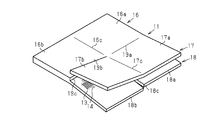
- the first constraining portion 16 is bent at a right angle at the bending portion 16c.
- the second forming portion 16b is shaped so as to be orthogonal to the first forming portion 16a, and the third forming portion 18b connected to the second forming portion 16b is also orthogonal to the second constraining portion 17. Shaped into a state.
- the third forming portion 18b is bent from the bending portion 19c, and is shaped such that the third forming portion 18b is orthogonal to the second forming portion 16b.
- the second restraint portion 17 is bent from the bent portion 19a, and is shaped such that the third formation portion 17a is orthogonal to the first formation portion 16a.
- the second formation portion 17b connected to the third formation portion 17a is also shaped in a state orthogonal to the first formation portion 16a.
- the second restraint portion 17 is bent from the bent portion 17c, and the second formation portion 17b is shaped so as to be orthogonal to the third formation portion 17a.
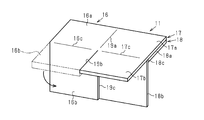
- the 1st structure part 41 is formed of the 1st formation part 16a, the 2nd formation part 16b and the 2nd formation part 17b of the 2nd restraint part 17 are laminated, and the 1st is formed.
- the two structural parts 42 are formed.
- the third formation portion 17a of the second restraint portion 17, the third formation portion 18a of the third restraint portion 18 and the third formation portion 18b are stacked to form the third structure portion 43. Be done. Next, the action of the fiber structure 11 will be described.
- the first structure portion 41 is formed by the first formation portion 16 a itself, and the first weft layer 21, the first warp layer 31, the second weft layer 22, The third weft layer 23, the second warp layer 32, and the fourth weft layer 24 are formed. Therefore, the first structure portion 41 has six fiber layers.
- the second structure portion 42 is formed by the second formation portion 16 b of the first restraint portion 16 and the second formation portion 17 b of the second restraint portion 17. Therefore, the second structure portion 42 includes the first weft layer 21, the first warp layer 31, the second weft layer 22, the third weft layer 23, the second warp layer 32, and the fourth weft layer of the second forming portion 16b. 24 and the first weft layer 21, the first warp layer 31, and the second weft layer 22 of the second forming portion 17 b. Thus, the second structure 42 has nine fiber layers.
- the third structure portion 43 is formed by the third formation portion 17 a of the second restraint portion 17 and the third formation portion 18 a and the third formation portion 18 b of the third restraint portion 18. . Therefore, the third structure portion 43 includes the first weft layer 21, the first warp layer 31, and the second weft layer 22 of the third forming portion 17a, and the third weft layer 23, the second warp of the third forming portion 18a. The layer 32 and the fourth weft layer 24 and the third weft layer 23, the second warp layer 32 and the fourth weft layer 24 of the third forming portion 18 b are formed. Thus, the third structural portion 43 has nine fiber layers.
- the fiber structure 11 includes a first corner portion 51 which is a boundary portion between the first structure portion 41 and the second structure portion 42.
- the first corner portion 51 is bent along the bent portion 16c.
- the weft yarn 13 extending along the first direction Y1 is bent. Therefore, the first structural portion 41 and the second structural portion 42 are connected by the weft 13 and have continuity.
- the fiber structure 11 includes a second corner 52 which is a boundary between the first structural portion 41 and the third structural portion 43.
- the second corner portion 52 is bent along the bent portion 19a.
- the warp 14 extending along the second direction Y2 is bent. Therefore, the 1st structure part 41 and the 3rd structure part 43 are connected by the warp yarn 14, and have continuity.
- the fiber structure 11 includes a third corner 53 that is a boundary between the second structure 42 and the third structure 43.
- the third corner portion 53 is bent along the bent portion 17c.
- the weft 13 and the warp 14 are bent. Therefore, the second structural portion 42 and the third structural portion 43 are connected by the weft 13 and the warp 14 and have continuity.
- the fiber structure 11 before shaping is formed of a multi-layered fabric, and includes the first restraint portion 16, the second restraint portion 17, and the third restraint portion 18.
- the fiber structure 11 can be woven by a weaving machine using the weft yarn 13, the warp yarn 14, the first constraining yarn 15a and the second constraining yarn 15b.
- the three-dimensional fiber structure 11 can be formed by shaping the fiber structures 11. Therefore, it is not necessary to manufacture a fiber structure, by overlapping a plurality of base materials, and the fiber structure 11 can be easily manufactured. Moreover, compared with the case where it weaves using a special loom, manufacturing cost can be held down.
- the continuity of the first corner portion 51 is secured by the weft 13, and the continuity of the second corner portion 52 is secured by the warp 14. Further, the third corner portion 53 is secured by the weft 13 and the warp 14. Therefore, the yarn is not divided at the first to third corner portions 51 to 53, and the first to third corner portions 51 to 53 can be reinforced.
- each of the second structure portion 42 and the third structure portion 43 has nine fiber layers. Therefore, the number of fiber layers of each of the second structure portion 42 and the third structure portion 43 is larger than the number of fiber layers of the first structure portion 41, and the second structure portion 42 and the third structure portion 43 can be reinforced. .
- the warp 14 extends across the second formation 16b of the first restraint 16 and the third formation 18b of the third restraint 18, and forms a second formation with the third formation 17a of the second restraint 17.
- a weft thread 13 extends across the portion 17b. Therefore, when the second structural portion 42 and the third structural portion 43 are formed, the weft 13 and the warp 14 straddle the third corner portion 53, and the third corner portion 53 can be reinforced with two types of yarn.
- the first to third restraint portions 16 to 18 are restrained in the stacking direction Y3 by the first constraining yarn 15a and the second constraining yarn 15b. Therefore, even if the fiber structure 11 has the notches 18 c and 19 b in order to shape the fiber structure 11, the fiber structure 11 does not separate, and the shaping can be easily performed.
- the plurality of fiber layers are constrained in the stacking direction Y3 by the first constraining yarn 15a and the second constraining yarn 15b.
- the fiber structure 11 can be woven by a loom. Therefore, for example, unlike the case of manufacturing the fiber structure 11 by laminating the fiber layers after manufacturing the fiber layers one by one, the fiber structure 11 in which a plurality of fiber layers are restrained can be easily manufactured.
- the above embodiment may be modified as follows.
- the number of fiber layers of the second formation portion 16b may be four. That is, the number of fiber layers of the second formation portion 16b may be smaller than that of the first formation portion 16a.
- the number of fiber layers of each of the third formation portion 17a and the second formation portion 17b of the second restraint portion 17 is two, and each of the third formation portion 18a and the third formation portion 18b of the third restraint portion 18 The number of fiber layers is 2.
- the first structure portion 41 is formed by the first formation portion 16a itself
- the second structure portion 42 is formed by the second formation portion 16b and the second formation portion 17b
- the third structure portion 43 is formed by the second restraint.
- the third forming portion 17 a of the portion 17 and the third forming portion 18 a and the third forming portion 18 b of the third constraining portion 18 are formed.
- the first structural portion 41, the second structural portion 42, and the third structural portion 43 each have six fiber layers, the first to third structural portions 41 to 43 have the same strength. You can
- the strength of the first to third structural portions 41 to 43 can be changed by appropriately changing the number of fiber layers.
- a yarn that spans the second structural portion 42 and the third structural portion 43 at the third corner portion 53 with the third constraining portion 18 as the third forming portion 18a only is a third forming portion 17a and the second forming portion 17b.
- only the weft yarn 13 may be used.
- the formation part which forms another structure part may be connected with four outer edge parts of the flat fiber structure 11.
- the fiber layer may be formed by plain weave, satin weave, or twill weave.
- the numbers of weft layers and warp layers to be laminated may be changed as appropriate.
- the kind of matrix resin can be selected arbitrarily.
- the first structural portion 41, the second structural portion 42, and the third structural portion 43 have a rectangular shape, but are not limited thereto.
- the first structure portion 41, the second structure portion 42, and the third structure portion 43 may have any shape such as a trapezoidal shape or a circular shape.
Landscapes
- Engineering & Computer Science (AREA)
- Textile Engineering (AREA)
- Chemical & Material Sciences (AREA)
- Manufacturing & Machinery (AREA)
- Materials Engineering (AREA)
- Health & Medical Sciences (AREA)
- Chemical Kinetics & Catalysis (AREA)
- Medicinal Chemistry (AREA)
- Polymers & Plastics (AREA)
- Organic Chemistry (AREA)
- Woven Fabrics (AREA)
- Reinforced Plastic Materials (AREA)
Abstract
L'invention concerne une structure de fibre comprenant : une première partie coin, qui est une partie interface destinée à une première partie structurale et à une deuxième partie structurale ; une deuxième partie coin, qui est une partie interface destinée à la première partie structurale et à une troisième partie structurale ; et une troisième partie coin qui est une partie interface destinée à la deuxième partie structurale et à la troisième partie structurale. Un premier fil qui chevauche la première partie structurale et la deuxième partie structurale est plié par la première partie coin. Un second fil qui chevauche la première partie structurale et la troisième partie structurale est plié par la deuxième partie coin. L'un parmi le premier fil et le second fil qui chevauche la deuxième partie structurale et la troisième partie structurale est incurvé par la troisième partie coin.
Priority Applications (3)
| Application Number | Priority Date | Filing Date | Title |
|---|---|---|---|
| US16/632,077 US20200216987A1 (en) | 2017-07-24 | 2018-06-28 | Fiber structure and fiber reinforced composite material |
| EP18837177.7A EP3660192A4 (fr) | 2017-07-24 | 2018-06-28 | Structure de fibre et matériau composite renforcé par des fibres |
| CA3070551A CA3070551A1 (fr) | 2017-07-24 | 2018-06-28 | Structure de fibre et materiau composite renforce par des fibres |
Applications Claiming Priority (2)
| Application Number | Priority Date | Filing Date | Title |
|---|---|---|---|
| JP2017-142969 | 2017-07-24 | ||
| JP2017142969A JP6766770B2 (ja) | 2017-07-24 | 2017-07-24 | 繊維構造体及び繊維強化複合材 |
Publications (1)
| Publication Number | Publication Date |
|---|---|
| WO2019021738A1 true WO2019021738A1 (fr) | 2019-01-31 |
Family
ID=65040077
Family Applications (1)
| Application Number | Title | Priority Date | Filing Date |
|---|---|---|---|
| PCT/JP2018/024575 Ceased WO2019021738A1 (fr) | 2017-07-24 | 2018-06-28 | Structure de fibre et matériau composite renforcé par des fibres |
Country Status (5)
| Country | Link |
|---|---|
| US (1) | US20200216987A1 (fr) |
| EP (1) | EP3660192A4 (fr) |
| JP (1) | JP6766770B2 (fr) |
| CA (1) | CA3070551A1 (fr) |
| WO (1) | WO2019021738A1 (fr) |
Cited By (3)
| Publication number | Priority date | Publication date | Assignee | Title |
|---|---|---|---|---|
| US11034620B2 (en) | 2016-12-20 | 2021-06-15 | Lotte Chemical Corporation | Composition for artificial marble |
| US11505674B2 (en) | 2017-11-08 | 2022-11-22 | Lotte Chemical Corporation | Thermoplastic resin composition and molded article produced from same |
| US12084569B2 (en) | 2018-11-30 | 2024-09-10 | Lotte Chemical Corporation | Thermoplastic resin composition and molded article formed therefrom |
Families Citing this family (1)
| Publication number | Priority date | Publication date | Assignee | Title |
|---|---|---|---|---|
| TR2021011917A1 (tr) * | 2021-07-28 | 2023-02-21 | Veritas Tekstil Konfeksiyon Pazarlama Sanayi Ve Ticaret Anonim Sirketi | 8 katli kumaş çözgü hareketi̇ |
Citations (5)
| Publication number | Priority date | Publication date | Assignee | Title |
|---|---|---|---|---|
| JPS6456514A (en) * | 1987-08-28 | 1989-03-03 | Asahi Fibreglass Co | Manufacture of fiber-reinforced resin body |
| JPH06184906A (ja) * | 1992-12-16 | 1994-07-05 | Shikishima Boseki Kk | 繊維構造体及びその製造方法 |
| JPH09137336A (ja) | 1995-11-13 | 1997-05-27 | Toyota Autom Loom Works Ltd | 三次元繊維構造体及びその製造方法 |
| JPH09506676A (ja) * | 1993-10-25 | 1997-06-30 | ノース・カロライナ・ステイト・ユニバーシティ | 立体布地と製造方法 |
| JP2011167936A (ja) | 2010-02-18 | 2011-09-01 | Mitsubishi Electric Corp | 強化繊維成形体及びその製造方法 |
Family Cites Families (2)
| Publication number | Priority date | Publication date | Assignee | Title |
|---|---|---|---|---|
| US7713893B2 (en) * | 2004-12-08 | 2010-05-11 | Albany Engineered Composites, Inc. | Three-dimensional woven integrally stiffened panel |
| US7413999B2 (en) * | 2005-11-03 | 2008-08-19 | Albany Engineered Composites, Inc. | Corner fitting using fiber transfer |
-
2017
- 2017-07-24 JP JP2017142969A patent/JP6766770B2/ja not_active Expired - Fee Related
-
2018
- 2018-06-28 CA CA3070551A patent/CA3070551A1/fr not_active Abandoned
- 2018-06-28 EP EP18837177.7A patent/EP3660192A4/fr not_active Withdrawn
- 2018-06-28 WO PCT/JP2018/024575 patent/WO2019021738A1/fr not_active Ceased
- 2018-06-28 US US16/632,077 patent/US20200216987A1/en not_active Abandoned
Patent Citations (5)
| Publication number | Priority date | Publication date | Assignee | Title |
|---|---|---|---|---|
| JPS6456514A (en) * | 1987-08-28 | 1989-03-03 | Asahi Fibreglass Co | Manufacture of fiber-reinforced resin body |
| JPH06184906A (ja) * | 1992-12-16 | 1994-07-05 | Shikishima Boseki Kk | 繊維構造体及びその製造方法 |
| JPH09506676A (ja) * | 1993-10-25 | 1997-06-30 | ノース・カロライナ・ステイト・ユニバーシティ | 立体布地と製造方法 |
| JPH09137336A (ja) | 1995-11-13 | 1997-05-27 | Toyota Autom Loom Works Ltd | 三次元繊維構造体及びその製造方法 |
| JP2011167936A (ja) | 2010-02-18 | 2011-09-01 | Mitsubishi Electric Corp | 強化繊維成形体及びその製造方法 |
Non-Patent Citations (1)
| Title |
|---|
| See also references of EP3660192A4 |
Cited By (3)
| Publication number | Priority date | Publication date | Assignee | Title |
|---|---|---|---|---|
| US11034620B2 (en) | 2016-12-20 | 2021-06-15 | Lotte Chemical Corporation | Composition for artificial marble |
| US11505674B2 (en) | 2017-11-08 | 2022-11-22 | Lotte Chemical Corporation | Thermoplastic resin composition and molded article produced from same |
| US12084569B2 (en) | 2018-11-30 | 2024-09-10 | Lotte Chemical Corporation | Thermoplastic resin composition and molded article formed therefrom |
Also Published As
| Publication number | Publication date |
|---|---|
| JP2019023367A (ja) | 2019-02-14 |
| JP6766770B2 (ja) | 2020-10-14 |
| EP3660192A4 (fr) | 2020-07-15 |
| US20200216987A1 (en) | 2020-07-09 |
| CA3070551A1 (fr) | 2019-01-31 |
| EP3660192A1 (fr) | 2020-06-03 |
Similar Documents
| Publication | Publication Date | Title |
|---|---|---|
| CA2709483C (fr) | Procede de tissage de substrats avec parois laterales integrees | |
| CN101939472B (zh) | 织造具有交叉壁的封闭结构的方法及其织造的预成型件 | |
| JP6537014B2 (ja) | 指針および時計 | |
| US9365957B2 (en) | Ultralight flat-weave fabric comprising two weft directions | |
| JP6766770B2 (ja) | 繊維構造体及び繊維強化複合材 | |
| US20170190138A1 (en) | Preform with Integrated Gap Fillers | |
| JP5900624B2 (ja) | 三次元繊維強化複合材 | |
| JP5874802B1 (ja) | 繊維構造体及び繊維強化複合材 | |
| JP6524880B2 (ja) | 多層織物 | |
| CN107923082B (zh) | 纤维结构体和纤维增强复合材料 | |
| JP2019094578A (ja) | 繊維構造体及び繊維強化複合材 | |
| WO2015079854A1 (fr) | Matériau composite renforcé de fibres | |
| JP2021025164A (ja) | 繊維構造体及び繊維強化複合材 | |
| JP2012096475A (ja) | 強化繊維基材、強化繊維複合材のプリフォームおよび強化繊維複合材 | |
| JP5644755B2 (ja) | 織物基材及び繊維強化複合材料 | |
| WO2020218040A1 (fr) | Matériau structural | |
| JP7287162B2 (ja) | 繊維構造体及び繊維強化複合材 | |
| JP6528651B2 (ja) | 繊維構造体 | |
| WO2014030633A1 (fr) | Composite renforcé par des fibres tridimensionnelles | |
| WO2012014613A1 (fr) | Substrat à fibres et matériau composite renforcé de fibres | |
| WO2018179877A1 (fr) | Structure fibreuse et matériau composite renforcé en fibres | |
| JP2017025216A (ja) | 繊維強化複合材料 | |
| WO2013035518A1 (fr) | Matériau de base de tissu tissé et matériau composite renforcé par des fibres | |
| JP2022119368A (ja) | 繊維構造体及び繊維強化複合材 |
Legal Events
| Date | Code | Title | Description |
|---|---|---|---|
| 121 | Ep: the epo has been informed by wipo that ep was designated in this application |
Ref document number: 18837177 Country of ref document: EP Kind code of ref document: A1 |
|
| ENP | Entry into the national phase |
Ref document number: 3070551 Country of ref document: CA |
|
| NENP | Non-entry into the national phase |
Ref country code: DE |
|
| ENP | Entry into the national phase |
Ref document number: 2018837177 Country of ref document: EP Effective date: 20200224 |