WO2019021774A1 - アルカリ水電解用隔膜、その製造方法、及び無機有機複合膜の製造方法 - Google Patents
アルカリ水電解用隔膜、その製造方法、及び無機有機複合膜の製造方法 Download PDFInfo
- Publication number
- WO2019021774A1 WO2019021774A1 PCT/JP2018/025398 JP2018025398W WO2019021774A1 WO 2019021774 A1 WO2019021774 A1 WO 2019021774A1 JP 2018025398 W JP2018025398 W JP 2018025398W WO 2019021774 A1 WO2019021774 A1 WO 2019021774A1
- Authority
- WO
- WIPO (PCT)
- Prior art keywords
- diaphragm
- water electrolysis
- alkaline water
- resin
- magnesium hydroxide
- Prior art date
- Legal status (The legal status is an assumption and is not a legal conclusion. Google has not performed a legal analysis and makes no representation as to the accuracy of the status listed.)
- Ceased
Links
Images
Classifications
-
- C—CHEMISTRY; METALLURGY
- C25—ELECTROLYTIC OR ELECTROPHORETIC PROCESSES; APPARATUS THEREFOR
- C25B—ELECTROLYTIC OR ELECTROPHORETIC PROCESSES FOR THE PRODUCTION OF COMPOUNDS OR NON-METALS; APPARATUS THEREFOR
- C25B13/00—Diaphragms; Spacing elements
- C25B13/04—Diaphragms; Spacing elements characterised by the material
- C25B13/05—Diaphragms; Spacing elements characterised by the material based on inorganic materials
-
- B—PERFORMING OPERATIONS; TRANSPORTING
- B32—LAYERED PRODUCTS
- B32B—LAYERED PRODUCTS, i.e. PRODUCTS BUILT-UP OF STRATA OF FLAT OR NON-FLAT, e.g. CELLULAR OR HONEYCOMB, FORM
- B32B5/00—Layered products characterised by the non- homogeneity or physical structure, i.e. comprising a fibrous, filamentary, particulate or foam layer; Layered products characterised by having a layer differing constitutionally or physically in different parts
- B32B5/18—Layered products characterised by the non- homogeneity or physical structure, i.e. comprising a fibrous, filamentary, particulate or foam layer; Layered products characterised by having a layer differing constitutionally or physically in different parts characterised by features of a layer of foamed material
-
- C—CHEMISTRY; METALLURGY
- C08—ORGANIC MACROMOLECULAR COMPOUNDS; THEIR PREPARATION OR CHEMICAL WORKING-UP; COMPOSITIONS BASED THEREON
- C08J—WORKING-UP; GENERAL PROCESSES OF COMPOUNDING; AFTER-TREATMENT NOT COVERED BY SUBCLASSES C08B, C08C, C08F, C08G or C08H
- C08J3/00—Processes of treating or compounding macromolecular substances
- C08J3/20—Compounding polymers with additives, e.g. colouring
- C08J3/205—Compounding polymers with additives, e.g. colouring in the presence of a continuous liquid phase
- C08J3/2053—Compounding polymers with additives, e.g. colouring in the presence of a continuous liquid phase the additives only being premixed with a liquid phase
-
- C—CHEMISTRY; METALLURGY
- C08—ORGANIC MACROMOLECULAR COMPOUNDS; THEIR PREPARATION OR CHEMICAL WORKING-UP; COMPOSITIONS BASED THEREON
- C08J—WORKING-UP; GENERAL PROCESSES OF COMPOUNDING; AFTER-TREATMENT NOT COVERED BY SUBCLASSES C08B, C08C, C08F, C08G or C08H
- C08J9/00—Working-up of macromolecular substances to porous or cellular articles or materials; After-treatment thereof
- C08J9/0066—Use of inorganic compounding ingredients
- C08J9/0071—Nanosized fillers, i.e. having at least one dimension below 100 nanometers
- C08J9/008—Nanoparticles
-
- C—CHEMISTRY; METALLURGY
- C08—ORGANIC MACROMOLECULAR COMPOUNDS; THEIR PREPARATION OR CHEMICAL WORKING-UP; COMPOSITIONS BASED THEREON
- C08J—WORKING-UP; GENERAL PROCESSES OF COMPOUNDING; AFTER-TREATMENT NOT COVERED BY SUBCLASSES C08B, C08C, C08F, C08G or C08H
- C08J9/00—Working-up of macromolecular substances to porous or cellular articles or materials; After-treatment thereof
- C08J9/28—Working-up of macromolecular substances to porous or cellular articles or materials; After-treatment thereof by elimination of a liquid phase from a macromolecular composition or article, e.g. drying of coagulum
-
- C—CHEMISTRY; METALLURGY
- C08—ORGANIC MACROMOLECULAR COMPOUNDS; THEIR PREPARATION OR CHEMICAL WORKING-UP; COMPOSITIONS BASED THEREON
- C08K—Use of inorganic or non-macromolecular organic substances as compounding ingredients
- C08K3/00—Use of inorganic substances as compounding ingredients
- C08K3/18—Oxygen-containing compounds, e.g. metal carbonyls
- C08K3/20—Oxides; Hydroxides
- C08K3/22—Oxides; Hydroxides of metals
-
- C—CHEMISTRY; METALLURGY
- C08—ORGANIC MACROMOLECULAR COMPOUNDS; THEIR PREPARATION OR CHEMICAL WORKING-UP; COMPOSITIONS BASED THEREON
- C08L—COMPOSITIONS OF MACROMOLECULAR COMPOUNDS
- C08L81/00—Compositions of macromolecular compounds obtained by reactions forming in the main chain of the macromolecule a linkage containing sulfur with or without nitrogen, oxygen or carbon only; Compositions of polysulfones; Compositions of derivatives of such polymers
- C08L81/06—Polysulfones; Polyethersulfones
-
- C—CHEMISTRY; METALLURGY
- C25—ELECTROLYTIC OR ELECTROPHORETIC PROCESSES; APPARATUS THEREFOR
- C25B—ELECTROLYTIC OR ELECTROPHORETIC PROCESSES FOR THE PRODUCTION OF COMPOUNDS OR NON-METALS; APPARATUS THEREFOR
- C25B13/00—Diaphragms; Spacing elements
- C25B13/02—Diaphragms; Spacing elements characterised by shape or form
-
- C—CHEMISTRY; METALLURGY
- C25—ELECTROLYTIC OR ELECTROPHORETIC PROCESSES; APPARATUS THEREFOR
- C25B—ELECTROLYTIC OR ELECTROPHORETIC PROCESSES FOR THE PRODUCTION OF COMPOUNDS OR NON-METALS; APPARATUS THEREFOR
- C25B13/00—Diaphragms; Spacing elements
- C25B13/04—Diaphragms; Spacing elements characterised by the material
- C25B13/05—Diaphragms; Spacing elements characterised by the material based on inorganic materials
- C25B13/07—Diaphragms; Spacing elements characterised by the material based on inorganic materials based on ceramics
-
- C—CHEMISTRY; METALLURGY
- C25—ELECTROLYTIC OR ELECTROPHORETIC PROCESSES; APPARATUS THEREFOR
- C25B—ELECTROLYTIC OR ELECTROPHORETIC PROCESSES FOR THE PRODUCTION OF COMPOUNDS OR NON-METALS; APPARATUS THEREFOR
- C25B13/00—Diaphragms; Spacing elements
- C25B13/04—Diaphragms; Spacing elements characterised by the material
- C25B13/08—Diaphragms; Spacing elements characterised by the material based on organic materials
-
- C—CHEMISTRY; METALLURGY
- C25—ELECTROLYTIC OR ELECTROPHORETIC PROCESSES; APPARATUS THEREFOR
- C25B—ELECTROLYTIC OR ELECTROPHORETIC PROCESSES FOR THE PRODUCTION OF COMPOUNDS OR NON-METALS; APPARATUS THEREFOR
- C25B9/00—Cells or assemblies of cells; Constructional parts of cells; Assemblies of constructional parts, e.g. electrode-diaphragm assemblies; Process-related cell features
- C25B9/17—Cells comprising dimensionally-stable non-movable electrodes; Assemblies of constructional parts thereof
- C25B9/19—Cells comprising dimensionally-stable non-movable electrodes; Assemblies of constructional parts thereof with diaphragms
-
- C—CHEMISTRY; METALLURGY
- C08—ORGANIC MACROMOLECULAR COMPOUNDS; THEIR PREPARATION OR CHEMICAL WORKING-UP; COMPOSITIONS BASED THEREON
- C08J—WORKING-UP; GENERAL PROCESSES OF COMPOUNDING; AFTER-TREATMENT NOT COVERED BY SUBCLASSES C08B, C08C, C08F, C08G or C08H
- C08J2201/00—Foams characterised by the foaming process
- C08J2201/04—Foams characterised by the foaming process characterised by the elimination of a liquid or solid component, e.g. precipitation, leaching out, evaporation
- C08J2201/054—Precipitating the polymer by adding a non-solvent or a different solvent
- C08J2201/0542—Precipitating the polymer by adding a non-solvent or a different solvent from an organic solvent-based polymer composition
- C08J2201/0544—Precipitating the polymer by adding a non-solvent or a different solvent from an organic solvent-based polymer composition the non-solvent being aqueous
-
- C—CHEMISTRY; METALLURGY
- C08—ORGANIC MACROMOLECULAR COMPOUNDS; THEIR PREPARATION OR CHEMICAL WORKING-UP; COMPOSITIONS BASED THEREON
- C08J—WORKING-UP; GENERAL PROCESSES OF COMPOUNDING; AFTER-TREATMENT NOT COVERED BY SUBCLASSES C08B, C08C, C08F, C08G or C08H
- C08J2381/00—Characterised by the use of macromolecular compounds obtained by reactions forming in the main chain of the macromolecule a linkage containing sulfur with or without nitrogen, oxygen, or carbon only; Polysulfones; Derivatives of such polymers
- C08J2381/06—Polysulfones; Polyethersulfones
-
- C—CHEMISTRY; METALLURGY
- C08—ORGANIC MACROMOLECULAR COMPOUNDS; THEIR PREPARATION OR CHEMICAL WORKING-UP; COMPOSITIONS BASED THEREON
- C08K—Use of inorganic or non-macromolecular organic substances as compounding ingredients
- C08K3/00—Use of inorganic substances as compounding ingredients
- C08K3/18—Oxygen-containing compounds, e.g. metal carbonyls
- C08K3/20—Oxides; Hydroxides
- C08K3/22—Oxides; Hydroxides of metals
- C08K2003/2217—Oxides; Hydroxides of metals of magnesium
- C08K2003/222—Magnesia, i.e. magnesium oxide
-
- C—CHEMISTRY; METALLURGY
- C08—ORGANIC MACROMOLECULAR COMPOUNDS; THEIR PREPARATION OR CHEMICAL WORKING-UP; COMPOSITIONS BASED THEREON
- C08K—Use of inorganic or non-macromolecular organic substances as compounding ingredients
- C08K2201/00—Specific properties of additives
- C08K2201/002—Physical properties
- C08K2201/005—Additives being defined by their particle size in general
-
- C—CHEMISTRY; METALLURGY
- C08—ORGANIC MACROMOLECULAR COMPOUNDS; THEIR PREPARATION OR CHEMICAL WORKING-UP; COMPOSITIONS BASED THEREON
- C08K—Use of inorganic or non-macromolecular organic substances as compounding ingredients
- C08K2201/00—Specific properties of additives
- C08K2201/011—Nanostructured additives
-
- C—CHEMISTRY; METALLURGY
- C08—ORGANIC MACROMOLECULAR COMPOUNDS; THEIR PREPARATION OR CHEMICAL WORKING-UP; COMPOSITIONS BASED THEREON
- C08K—Use of inorganic or non-macromolecular organic substances as compounding ingredients
- C08K2201/00—Specific properties of additives
- C08K2201/016—Additives defined by their aspect ratio
-
- C—CHEMISTRY; METALLURGY
- C25—ELECTROLYTIC OR ELECTROPHORETIC PROCESSES; APPARATUS THEREFOR
- C25B—ELECTROLYTIC OR ELECTROPHORETIC PROCESSES FOR THE PRODUCTION OF COMPOUNDS OR NON-METALS; APPARATUS THEREFOR
- C25B1/00—Electrolytic production of inorganic compounds or non-metals
- C25B1/01—Products
- C25B1/02—Hydrogen or oxygen
- C25B1/04—Hydrogen or oxygen by electrolysis of water
-
- Y—GENERAL TAGGING OF NEW TECHNOLOGICAL DEVELOPMENTS; GENERAL TAGGING OF CROSS-SECTIONAL TECHNOLOGIES SPANNING OVER SEVERAL SECTIONS OF THE IPC; TECHNICAL SUBJECTS COVERED BY FORMER USPC CROSS-REFERENCE ART COLLECTIONS [XRACs] AND DIGESTS
- Y02—TECHNOLOGIES OR APPLICATIONS FOR MITIGATION OR ADAPTATION AGAINST CLIMATE CHANGE
- Y02E—REDUCTION OF GREENHOUSE GAS [GHG] EMISSIONS, RELATED TO ENERGY GENERATION, TRANSMISSION OR DISTRIBUTION
- Y02E60/00—Enabling technologies; Technologies with a potential or indirect contribution to GHG emissions mitigation
- Y02E60/30—Hydrogen technology
- Y02E60/36—Hydrogen production from non-carbon containing sources, e.g. by water electrolysis
-
- Y—GENERAL TAGGING OF NEW TECHNOLOGICAL DEVELOPMENTS; GENERAL TAGGING OF CROSS-SECTIONAL TECHNOLOGIES SPANNING OVER SEVERAL SECTIONS OF THE IPC; TECHNICAL SUBJECTS COVERED BY FORMER USPC CROSS-REFERENCE ART COLLECTIONS [XRACs] AND DIGESTS
- Y02—TECHNOLOGIES OR APPLICATIONS FOR MITIGATION OR ADAPTATION AGAINST CLIMATE CHANGE
- Y02P—CLIMATE CHANGE MITIGATION TECHNOLOGIES IN THE PRODUCTION OR PROCESSING OF GOODS
- Y02P20/00—Technologies relating to chemical industry
- Y02P20/10—Process efficiency
- Y02P20/133—Renewable energy sources, e.g. sunlight
Definitions
- the present invention relates to a diaphragm for alkaline water electrolysis and a method of manufacturing the same. More particularly, the present invention relates to an inexpensive alkaline water electrolysis diaphragm which suppresses the elution of inorganic components, and a method for producing the same. The present invention also relates to a method of producing an inorganic-organic composite film.
- the introduction of renewable energy using natural energy such as solar light, wind power and geothermal has been promoted.
- renewable energy the amount of power generation varies depending on weather conditions, such as wind power generation and solar power generation, so the supply and demand balance of power can not be achieved, and surplus power is generated.
- a technology called Power to Gas for storing and utilizing such surplus power in the form of energy has attracted attention.
- the above technology is a technology for converting surplus power into a gaseous fuel such as hydrogen or methane by using water electrolysis, and storing and using it.
- Electrolysis of water is known as one of the industrial production methods of hydrogen, and in general, direct current current is added to water to which sodium hydroxide, potassium hydroxide or the like is added as an electrolyte to enhance conductivity. It is done by applying.
- an electrolytic cell having an anode chamber and a cathode chamber, which are separated by a diaphragm, is used.
- the electrolysis of water is carried out by the movement of electrons (or ions). Therefore, in order to conduct electrolysis efficiently, the diaphragm needs to have high ion permeability. In addition, a gas barrier property capable of blocking oxygen generated in the anode chamber and hydrogen generated in the cathode chamber is required.
- an alkaline aqueous solution having a high concentration of about 30% is used and the reaction is carried out at about 80 to 90 ° C. Therefore, the diaphragm is also required to have high temperature resistance and alkali resistance.
- Patent Document 1 includes an ion permeable membrane and a porous reinforcing body disposed on one side or both sides of the ion permeable membrane, and the ion permeable membrane is made of a polymer having an ion exchange group, and the porosity is A diaphragm for alkaline water electrolysis is proposed in which the reinforcing body contains a metal oxide.
- Patent Document 2 for alkaline water electrolysis, a sheet-like porous support and a microporous membrane containing an organic polymer resin are provided, and the microporous membrane is laminated on one side or both sides of the porous support.
- a diaphragm has been proposed.
- patent document 3 it has an average pore diameter and a porosity in a specific range, and includes a microporous film containing a polyphenylene copolymer and a supporting substrate as components so that the high temperature and high concentration acidic or alkaline environment
- a membrane for alkaline water electrolysis has been proposed which is highly resistant to hydrolysis under the same and has both high gas barrier properties and ion permeability.
- metal oxides such as zirconium oxide and titanium oxide or metal water such as zirconium oxide or titanium oxide are formed on the surface of the diaphragm in order to improve ion permeability and prevent adhesion of generated gas to the membrane.
- An oxide is included to hydrophilize the diaphragm.
- This invention is made in view of the said present condition, and it aims at providing inexpensively the diaphragm for alkaline water electrolysis by which elution of the inorganic component in an alkaline solution was suppressed.
- Another object of the present invention is to provide a method for producing a diaphragm for alkaline water electrolysis which is inexpensive and in which the inorganic component hardly dissolves.
- the inventors of the present invention have variously studied materials for diaphragms for alkaline water electrolysis, and by forming the diaphragm using magnesium hydroxide and an organic polymer resin, it is excellent in ion permeability and dense and has high gas barrier properties. It has been found that a diaphragm for alkaline water electrolysis, in which the inorganic component is not easily eluted even when in contact with an alkaline solution, can be realized at low cost.
- magnesium hydroxide when magnesium hydroxide is used in the production of a diaphragm for alkaline water electrolysis, an inorganic component (magnesium) is eluted from the diaphragm during electrolysis of water (also referred to as “electrolysis"), and it reacts with carbonate ions dissolved in water. As a result, water-insoluble magnesium carbonate is formed, which adheres to the electrode or the diaphragm to disturb the movement of electrons or ions, and there is a concern that the electrolytic efficiency is significantly reduced.
- electrolysis electrolysis
- magnesium hydroxide has not been used as a material of diaphragm for alkaline water electrolysis up to now, the inventor has made the diaphragm containing magnesium hydroxide and an organic polymer resin an inorganic component even when used in an alkaline solution. It was found that the elution of (magnesium) was small and it could be used as a diaphragm for alkaline water electrolysis.
- magnesium hydroxide is cheaper than zirconium oxide and titanium oxide conventionally used, and has a smaller specific gravity. Therefore, by using magnesium hydroxide, the cheaper and lighter diaphragm for alkaline water electrolysis is used. I found that I could get
- the present invention is a diaphragm for alkaline water electrolysis comprising magnesium hydroxide and an organic polymer resin.
- the organic polymer resin is preferably at least one selected from the group consisting of polysulfone, polyethersulfone and polyphenylsulfone.
- the average particle size of the magnesium hydroxide is preferably 0.05 to 2.0 ⁇ m.
- the diaphragm for alkaline water electrolysis preferably has a porosity of 20 to 80% by volume.
- the alkaline water electrolysis diaphragm preferably contains 20 to 40 parts by mass of the organic polymer resin with respect to 100 parts by mass of magnesium hydroxide.
- the alkaline water electrolysis diaphragm preferably further comprises a porous support.
- the porous support preferably contains at least one resin selected from the group consisting of polypropylene, polyethylene, and polyphenylene sulfide.
- the porous support is preferably a non-woven fabric, a woven fabric or a mesh.
- the present invention is also a method for producing a diaphragm for alkaline water electrolysis comprising magnesium hydroxide and an organic polymer resin, wherein the production method comprises the steps of preparing a dispersion comprising magnesium hydroxide and a solvent,
- a process for producing a diaphragm for alkaline water electrolysis comprising: a step of mixing a dispersion and an organic polymer resin to prepare a resin mixture, and a step of forming a film using the resin mixture. .
- the step of forming the film is a step of forming a coating of the resin mixture, a step of coagulating the coating by bringing the coating into contact with a non-solvent, and drying the solidified coating. It is preferable to include the step of obtaining a porous membrane.
- the present invention is also a method of using a film containing magnesium hydroxide and an organic polymer resin as a diaphragm of an alkaline water electrolysis apparatus.
- the present invention is also the use of a film containing magnesium hydroxide and an organic polymer resin as a diaphragm of an alkaline water electrolysis apparatus.
- the present invention is also a method for producing an inorganic-organic composite film containing metal hydroxide particles and a hydrophobic resin, wherein the above production method comprises metal hydroxide particles, a hydrophobic resin, and a resin containing a solvent.
- solidify, the said solvent is N- methyl 2- pyrrolidone, N, N- dimethylacetamide, N, N-
- the resin composition is preferably prepared by mixing and dispersing metal hydroxide particles, a hydrophobic resin, and a solvent.
- the hydrophobic resin is preferably at least one selected from the group consisting of polysulfone, polyethersulfone and polyphenylsulfone.
- the metal hydroxide particles are preferably at least one particle selected from the group consisting of magnesium hydroxide, zirconium hydroxide and titanium hydroxide.
- the above resin composition preferably contains 15 to 50% by mass of metal hydroxide particles, 3 to 22% by mass of a hydrophobic resin, and 45 to 75% by mass of a solvent in 100% by mass of the resin composition.
- the average particle size of the magnesium hydroxide is preferably 0.1 to 1.5 ⁇ m. It is preferable that the shape of the said magnesium hydroxide is plate shape.
- the aspect ratio of the magnesium hydroxide is preferably 2.0 to 8.0.
- the magnesium hydroxide preferably has a crystallite diameter of 35 nm or more in the direction perpendicular to the (110) plane measured by X-ray diffraction.
- the magnesium hydroxide preferably has a crystallite diameter in the direction perpendicular to the (001) plane of 15 nm or more, which is measured by X-ray diffraction.
- the diaphragm for alkaline water electrolysis according to the present invention is inexpensive and excellent in ion permeability as well as dense and gas barrier property, and elution of the inorganic component in the alkaline solution is extremely suppressed, and electricity of alkaline water is obtained. It can be suitably used for decomposition.
- the method for producing a diaphragm for alkaline water electrolysis of the present invention is a suitable production method when producing such a diaphragm for alkaline water electrolysis.
- Diaphragm for alkaline water electrolysis of the present invention is characterized by containing magnesium hydroxide and an organic polymer resin, and the inorganic component is hardly eluted in an alkaline solution.
- magnesium hydroxide By containing magnesium hydroxide, the alkali resistance of the membrane can be improved. Further, since magnesium hydroxide is inexpensive, the diaphragm for alkaline water electrolysis can be manufactured inexpensively.
- magnesium hydroxide and an organic polymer resin suppresses the elution of the inorganic component from the alkaline water electrolysis diaphragm in addition to the fact that magnesium hydroxide is hardly soluble in an alkaline solution, magnesium hydroxide It is inferred that the contact between the alkaline solution and the magnesium hydroxide is extremely highly suppressed and the elution of the magnesium hydroxide is suppressed by coating the organic polymer resin.
- the diaphragm for alkaline water electrolysis of the present invention contains magnesium hydroxide.
- the electrolytic solution can be filled in the void portion of magnesium hydroxide and the organic polymer resin to exhibit ion permeability.
- the alkaline water electrolysis diaphragm can be made hydrophilic, and oxygen gas and hydrogen gas generated in the electrolysis of water can be prevented from adhering to the diaphragm and hindering the electrolysis. .
- the magnesium hydroxide used in the present invention is not particularly limited, and may be a natural product or a synthetic product.
- the surface may be untreated or may be surface-treated with a silane coupling agent, stearic acid, oleic acid, phosphoric acid ester or the like.
- the shape of the above magnesium hydroxide is not particularly limited, and may be any shape such as indeterminate form; granular form; granular form; plate form such as flake form, hexagonal plate form, etc .; It is preferably granular, plate-like or fibrous in that it is easy to prepare a coating liquid by dispersing it in the solution, and from the viewpoint of adhesion to resin and ion permeability, it is more preferred to be granular or plate-like It is more preferable that it is in the form of flakes, and particularly preferably in the form of flakes.
- the magnesium hydroxide preferably has an aspect ratio of 2.0 to 8.0.
- the membrane can be further improved in ion permeability and excellent in uniformity.
- the aspect ratio is more preferably 2.5 to 7.0, and still more preferably 3.0 to 6.0.
- the aspect ratio means the ratio (a / b) of the longest diameter a to the shortest diameter b, and magnesium hydroxide particles are observed by SEM, and in any 10 particles of the obtained image.
- the ratio (a / b) of the longest diameter a to the shortest diameter b of each particle can be measured using analysis software or the like, and a simple average value of those ratios can be determined as the aspect ratio of the particle.
- the longest diameter a for example, when the particle shape is plate-like such as thin plate shape or hexagonal plate shape, the major diameter of the plate surface of the particle is adopted, and when it is fibrous, the fiber length is adopted.
- the shortest diameter b for example, when the particle shape is a plate shape such as a thin plate shape or a hexagonal plate shape, the thickness of the particle is adopted, and when it is fibrous, the thickness of the fiber is adopted.
- the thickness of the particles and the thickness of the fibers it is preferable to adopt the thickness and the thickness at the middle point of the longest diameter a. More specifically, the aspect ratio can be determined by the method described in the examples to be described later.
- the average particle size of the magnesium hydroxide is preferably 0.05 to 2.0 ⁇ m. It can be set as the diaphragm excellent by ion permeability and gas-barrier property as the average particle diameter of the said magnesium hydroxide is the above-mentioned range.
- the average particle diameter of the magnesium hydroxide is more preferably 0.1 ⁇ m or more, still more preferably 0.2 ⁇ m or more, and further preferably 1.5 ⁇ m or less, and 1.0 ⁇ m or less. It is more preferable that the thickness be 0.5 ⁇ m or less.
- the average particle size of the magnesium hydroxide is more preferably 0.1 to 1.5 ⁇ m, still more preferably 0.2 to 1.0 ⁇ m, and particularly preferably 0.2 to 0.5 ⁇ m.
- the said average particle diameter is a volume average particle diameter (D50) calculated
- the average particle diameter is measured by using a laser diffraction / scattering particle size distribution measuring apparatus ("Model No. LA-920" manufactured by Horiba, Ltd.), and the median diameter (D50) in the volume-based particle size distribution As the average particle size.
- the particles are mixed with ethanol, irradiated with ultrasonic waves, and dispersed to obtain a measurement sample. More specifically, the average particle diameter can be determined by the method described in the examples described later.
- the magnesium hydroxide preferably has a crystallite diameter of 35 nm or more in the direction perpendicular to the (110) plane measured by X-ray diffraction.
- the crystallite diameter in the direction perpendicular to the (110) plane is preferably 40 nm or more, more preferably 50 nm or more, still more preferably 60 nm or more, and particularly preferably 65 nm or more.
- the upper limit of the crystallite diameter in the direction perpendicular to the (110) plane is not particularly limited, but is usually, for example, 400 nm or less, preferably 350 nm or less, and more preferably 300 nm or less.
- the magnesium hydroxide preferably has a crystallite diameter in the direction perpendicular to the (001) plane of 15 nm or more, which is measured by X-ray diffraction.
- the crystallite diameter in the direction perpendicular to the (001) plane is more preferably 18 nm or more, still more preferably 21 nm or more, and particularly preferably 24 nm or more.
- the upper limit of the crystallite diameter in the direction perpendicular to the (001) plane is not particularly limited, but is usually, for example, 300 nm or less, preferably 250 nm or less, and more preferably 200 nm or less.
- the crystallite diameter is obtained by measuring the X-ray diffraction pattern of magnesium hydroxide particles by powder X-ray diffraction method, and from the spread (half-width) of the diffraction line attributed to the lattice plane of interest, crystals using the Scherrer equation
- the diameter can be calculated and determined. More specifically, it can be measured according to the method described in the examples below.
- the method for obtaining magnesium hydroxide in the specific crystallite size range mentioned above is, for example, as follows.
- An aqueous solution of a magnesium salt (magnesium chloride, magnesium nitrate, etc.) or an aqueous dispersion of magnesium oxide obtained by a conventionally known method is used as a raw material, and alkaline physical properties (lithium hydroxide, sodium hydroxide, calcium hydroxide, ammonia water
- Magnesium hydroxide is prepared by performing a hydration reaction by the addition of At this time, by adding an organic acid such as formic acid, acetic acid or propionic acid, a polybasic acid such as nitric acid or sulfuric acid, or a mixture thereof, the solubility of the formed magnesium hydroxide is adjusted or the temperature of the hydrothermal reaction is By appropriately adjusting (for example, 150 ° C.
- magnesium hydroxide In the present invention, general commercial products can also be used as magnesium hydroxide.
- Commercial products of magnesium hydroxide which can be used in the present invention include, for example, 200-06H manufactured by Kyowa Chemical Industry Co., Ltd., UP 650-1 manufactured by Ube Material Co., Ltd., MAGSTAR # 20 manufactured by Tateho Chemical Industry Co., Ltd., Kamijima Chemical Co. Product # 200 etc. may be mentioned.
- the content of magnesium hydroxide is preferably 30 to 90% by mass in 100% by mass of the alkaline water electrolysis diaphragm.
- the content of the above-mentioned magnesium hydroxide is preferably 32 to 85% by mass, more preferably 35 to 80% by mass, in 100% by mass of the diaphragm for alkaline water electrolysis.
- the content of the above magnesium hydroxide is preferably 60 to 90% by mass in 100% by mass of the diaphragm for alkaline water electrolysis, More preferably, it is 65 to 85% by mass, still more preferably 70 to 80% by mass.
- the content of magnesium hydroxide is preferably 30 to 45% by mass, more preferably 32% by mass in 100% by mass of the membrane for alkaline water electrolysis. The content is about 43% by mass, more preferably 35 to 40% by mass.
- the diaphragm for alkaline water electrolysis of the present invention further contains an organic polymer resin.
- the organic polymer resin holds magnesium hydroxide particles.
- magnesium hydroxide itself is excellent in stability in an alkaline solution
- the surface of the particles of magnesium hydroxide is coated with the organic polymer resin by containing the organic polymer resin, and the alkali solution and magnesium hydroxide Since the contact is extremely suppressed, elution of the inorganic component from the diaphragm in the alkaline solution can be further suppressed.
- the organic polymer resin is not particularly limited as long as it is a resin capable of retaining and preferably sufficiently covering magnesium hydroxide particle surfaces and capable of exhibiting the effects of the present invention.
- examples thereof include polyvinylidene fluoride and poly A fluorine-based resin such as tetrafluoroethylene; an olefin-based resin such as polypropylene; or an aromatic hydrocarbon-based resin such as polyethylene terephthalate and polystyrene. These may be used alone or in combination of two or more.
- aromatic hydrocarbon resins are preferable in that they can be used as a diaphragm for alkaline water electrolysis further excellent in heat resistance and alkali resistance.
- examples of the aromatic hydrocarbon-based resin include polyethylene terephthalate, polybutylene terephthalate, polybutylene naphthalate, polystyrene, polysulfone, polyether sulfone, polyphenylene sulfide, polyphenyl sulfone, polyarylate, and polyether.
- An imide, a polyimide, a polyamide imide etc. are mentioned.
- at least one selected from the group consisting of polysulfone, polyethersulfone, and polyphenylsulfone is preferable in that it can impart further excellent alkali resistance, and in view of production, polysulfone is more preferable. preferable.
- the resistance value of the obtained alkaline water electrolysis membrane is further lowered, and the alkali resistance is further enhanced. It becomes excellent by the dimension and mass at the time of using for a long time in an alkaline solution, the stability of resistance value, and the generation
- the content of the organic polymer resin is preferably 5 to 40% by mass in 100% by mass of the diaphragm for alkaline water electrolysis.
- the content of the organic polymer resin is preferably 7 to 35% by mass, and more preferably 10 to 30% by mass, in 100% by mass of the diaphragm for alkaline water electrolysis.
- the content of the organic polymer resin is preferably 10 to 40% by mass in 100% by mass of the diaphragm for alkaline water electrolysis when the diaphragm for alkaline water electrolysis of the present invention does not contain the porous support described later. More preferably, it is 15 to 35% by mass, and still more preferably 20 to 30% by mass.
- the content of the organic polymer resin is preferably 5 to 20% by mass, and more preferably 100% by mass of the membrane for alkaline water electrolysis. The content is 7 to 18% by mass, more preferably 10 to 15% by mass.
- the diaphragm for alkaline water electrolysis of the present invention preferably contains 20 to 40 parts by mass, more preferably 22 to 38 parts by mass of the organic polymer resin with respect to 100 parts by mass of the magnesium hydroxide. It is further preferable to include parts by mass.
- the content ratio of magnesium hydroxide and the organic polymer resin is in the above-mentioned range, the elution of the inorganic component from the alkaline water electrolysis diaphragm in the alkaline solution is further suppressed. Moreover, it can become a diaphragm for alkaline water electrolysis excellent also in ion permeability, gas barrier property, heat resistance, and alkali resistance.
- the diaphragm for alkaline water electrolysis of the present invention is composed of the above-mentioned membrane containing magnesium hydroxide and an organic polymer resin, but the membrane and the porous support may be further included.
- the porous support is a member that is porous, has ion permeability, and can be a support for the alkaline water electrolysis diaphragm.
- the porous support is preferably a sheet-like member.
- the material of the porous support examples include resins such as polyethylene, polypropylene, polysulfone, polyethersulfone, polyphenylsulfone, polyphenylene sulfide, polyketone, polyimide, polyetherimide, and fluorine resin. These may be used alone or in combination of two or more. Among them, at least one resin selected from the group consisting of polypropylene, polyethylene and polyphenylene sulfide is preferable in that it can exhibit excellent heat resistance and alkali resistance, and from the group consisting of polypropylene and polyphenylene sulfide More preferably, it comprises at least one resin selected.
- resins such as polyethylene, polypropylene, polysulfone, polyethersulfone, polyphenylsulfone, polyphenylene sulfide, polyketone, polyimide, polyetherimide, and fluorine resin. These may be used alone or in combination of two or more. Among them, at least one resin selected
- porous support examples include non-woven fabric, woven fabric, mesh, porous membrane, or a mixed fabric of non-woven fabric and woven fabric, and preferably non-woven fabric, woven fabric or mesh. More preferably, a nonwoven fabric and a mesh are mentioned, More preferably, a nonwoven fabric is mentioned.
- a non-woven fabric, a woven fabric or a mesh which contains at least one resin selected from the group consisting of polypropylene, polyethylene and polyphenylene sulfide, among others. Furthermore, as the porous support, a non-woven fabric or mesh containing polyphenylene sulfide is preferable.
- the thickness of the porous support is not particularly limited as long as the membrane for alkaline water electrolysis of the present invention can exhibit the effects of the present invention, but preferably 30 to 300 ⁇ m, for example. More preferably, it is 50 to 250 ⁇ m, further preferably 100 to 200 ⁇ m.
- the above-mentioned film containing magnesium hydroxide and an organic polymer resin may be formed on one side of the porous support or may be formed on both sides.
- the membrane for alkaline water electrolysis of the present invention may be a complex in which the above-mentioned membrane containing magnesium hydroxide and an organic polymer resin and the above porous support are integrated.
- the porosity of the diaphragm for alkaline water electrolysis of the present invention is preferably 20 to 80% by volume, more preferably 25 to 75% by volume, and still more preferably 30 to 70% by volume.
- the size of the pores of the diaphragm for alkaline water electrolysis of the present invention is preferably 0.01 to 1 ⁇ m, more preferably 0.05 to 0.9 ⁇ m, and 0.1 to 0.8 ⁇ m. Is more preferred. When the size of the pores is in the above-mentioned range, the ion permeability is further excellent.
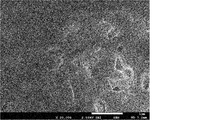
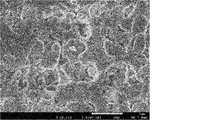
- the size of the pores can be obtained by measurement from the surface observation image (magnification: 25,000) of the diaphragm for alkaline water electrolysis by FE-SEM measurement.
- the analysis software (Image-Pro Premier, made by Nippon Roper, Inc.) is used to pass through the center of gravity of each selected void for any 10 gaps in the FE-SEM image of the alkaline water electrolysis diaphragm.
- the diameter of the hole is measured as the size of the hole, and the average value is calculated and determined.
- the change rate of the pores before and after the alkali durability test is preferably 50% or less, and more preferably 30% or less.
- the size of the pores before the alkali durability test means the size of the pores of the membrane after taking out the membrane for alkaline water electrolysis in a 30% aqueous solution of potassium hydroxide at 90 ° C. for 20 hours and taking it out.
- the size of the pores after the endurance test refers to the size of the pores of the diaphragm after being further dipped in a 30% aqueous potassium hydroxide solution at 90 ° C. for one week and taken out.
- the size of the void can be determined by the method described above. More specifically, the size of the pores of the diaphragm for alkaline water electrolysis and the rate of change of the pores can be determined by the method described in the examples.
- the thickness of the diaphragm for alkaline water electrolysis of the present invention is not particularly limited and may be appropriately selected according to the size and handling property of the equipment to be used, but from the viewpoint of the gas barrier property of the membrane, ion permeability and strength
- the thickness is preferably 50 to 1000 ⁇ m, more preferably 100 to 500 ⁇ m, and still more preferably 200 to 400 ⁇ m.
- the thickness of the diaphragm for alkaline water electrolysis of the present invention is preferably 50 to 1000 ⁇ m, more preferably 100 to 500 ⁇ m, and still more preferably 200 to 400 ⁇ m.
- the elution amount of magnesium in the diaphragm for alkaline water electrolysis of the present invention is preferably 0.5 ppm or less, more preferably 0.3 ppm or less, and still more preferably 0.2 ppm or less.
- the magnesium elution amount is taken out by immersing the diaphragm for alkaline water electrolysis in a 30% aqueous potassium hydroxide solution A at 90 ° C. for 20 hours, and then immersed in another 30% aqueous potassium hydroxide solution B at 90 ° C.
- the amount of magnesium in the aqueous potassium hydroxide solutions A and B can be determined using an inductively coupled plasma mass spectrometer. More specifically, the magnesium elution amount can be determined by the method described in the examples.
- Method of producing diaphragm for alkaline water electrolysis A method of producing the diaphragm for alkaline water electrolysis of the present invention will be described.
- the method for producing the diaphragm for alkaline water electrolysis of the present invention is not particularly limited, and a known method can be applied, but elution of the inorganic component in the alkaline solution is suppressed, and further ion permeability, gas barrier
- the non-solvent induced phase separation method is preferred in that the membrane for alkaline water electrolysis having excellent properties can be efficiently produced.
- the alkaline water electrolysis diaphragm of the present invention it is preferable to include the following steps (1) to (3) as a method for producing the alkaline water electrolysis diaphragm of the present invention.
- a method of producing such a diaphragm for alkaline water electrolysis, ie, producing a diaphragm for alkaline water electrolysis containing magnesium hydroxide and an organic polymer resin The method is a method of preparing a dispersion containing magnesium hydroxide and a solvent, mixing the dispersion and an organic polymer resin to prepare a resin mixture, and the resin mixture
- a process for producing a diaphragm for alkaline water electrolysis comprising the step of forming a membrane using Below, each process is demonstrated.
- magnesium hydroxide when magnesium hydroxide is mixed with an organic polymer resin, magnesium hydroxide may be mixed as it is in a solid state, The dispersion (slurry) dispersed in may be prepared and then mixed, but it is preferable to prepare the dispersion (slurry) dispersed in a solvent and then mixed.
- the solvent for dispersing magnesium hydroxide is not particularly limited as long as it has a property capable of dissolving the organic polymer resin to be mixed later, and examples thereof include N-methyl-2-pyrrolidone, N, N-dimethyl Examples include acetamide, N, N-dimethylformamide, dimethyl sulfoxide and the like. These solvents may be used alone or in combination of two or more. Among them, N-methyl-2-pyrrolidone is preferable in that the dispersibility of magnesium hydroxide is good.
- the content of magnesium hydroxide in the dispersion is preferably 20 to 70% by mass, more preferably 30 to 60% by mass, and still more preferably 40 to 50% by mass.
- the method for dispersing magnesium hydroxide in a solvent is not particularly limited, and a known mixing and dispersing method such as a method using a mixer, a ball mill, a jet mill, a disper, a sand mill, a roll mill, a pot mill, a paint shaker, etc. may be applied.
- a known mixing and dispersing method such as a method using a mixer, a ball mill, a jet mill, a disper, a sand mill, a roll mill, a pot mill, a paint shaker, etc. may be applied.
- a known mixing and dispersing method such as a method using a mixer, a ball mill, a jet mill, a disper, a sand mill, a roll mill, a pot mill, a paint shaker, etc.
- Step of mixing the dispersion and the organic polymer resin to prepare a resin mixed solution As a method of mixing the organic polymer resin with the dispersion prepared in the step (1), the dispersion and the organic high polymer The method is not particularly limited as long as the method can sufficiently mix the molecular resin, and the organic polymer resin may be mixed with the above dispersion as it is, or a resin solution in which the organic polymer resin is previously dissolved in a solvent is used. It may be prepared and the above-mentioned resin solution and the above-mentioned dispersion may be mixed. Among them, a method of preparing the resin solution and mixing the resin solution and the dispersion is preferable in that the magnesium hydroxide and the organic polymer resin can be dispersed and mixed more uniformly.
- the solvent used when preparing the above resin solution is not particularly limited as long as it has the property of dissolving the above organic polymer resin, and examples thereof include N-methyl-2-pyrrolidone, N, N-dimethylacetamide And N, N-dimethylformamide, dimethyl sulfoxide and the like.
- the same solvent as the solvent used for the preparation of the dispersion is preferable in that the magnesium hydroxide and the organic polymer resin can be dispersed and mixed more uniformly.
- the content of the organic polymer resin in the resin solution is preferably 10 to 50% by mass, more preferably 15 to 40% by mass, and still more preferably 20 to 30% by mass.
- Examples of the method of mixing include the same means as the means of mixing and dispersing described in the step (1).
- the dispersion and the organic polymer resin are preferably 20 to 40 parts by mass, more preferably 22 to 38 parts by mass, and still more preferably 25 to 35 parts by mass of the organic polymer resin with respect to 100 parts by mass of magnesium hydroxide. It is preferable to mix so that it may become a mass part.
- the total content of the solvent in the dispersion liquid of magnesium hydroxide and the solvent in the organic polymer resin solution is the dispersion liquid of magnesium hydroxide And 45 to 75% by mass with respect to 100% by mass in total of the organic polymer resin solution. More preferably, it is 50 to 70% by mass, and still more preferably 55 to 65% by mass. In order to adjust the porosity of the alkaline water electrolysis diaphragm to a preferable range, it is preferable to use the solvent at such a ratio.
- Step of Forming a Film Using the Resin Mixture The film is formed using the resin mixture obtained in step (2).
- the following steps (3-a) to (3) can be easily performed in that the diaphragm for alkaline water electrolysis can be easily produced in which the elution of the inorganic component in the alkaline solution is further suppressed. It is preferred to include 3-c).
- the step of forming the film of the step (3) is a step of forming a coating of the resin mixture, a step of coagulating the coating by bringing the coating into contact with a non-solvent, and
- the step of obtaining the porous film by drying the solidified coating film it is also one of the preferable embodiments in the method for producing a diaphragm for alkaline water electrolysis of the present invention.
- the method for applying the resin mixed solution on a substrate is not particularly limited, and a known application method such as die coating, spin coating, gravure coating, curtain coating, spray, an applicator, a coater, or the like is used. be able to.
- the substrate is not particularly limited as long as it can form the coating film by applying the above-mentioned resin mixed solution, and, for example, polyethylene terephthalate, polyethylene naphthalate, polypropylene, polyethylene, polyvinyl chloride And films or sheets made of resins such as polyvinyl acetal, poly (methyl methacrylate) and polycarbonate, and glass plates.
- polytetraethylene terephthalate is preferable in that the raw material cost can be reduced.
- the above resin mixture is applied onto the above-mentioned base material
- the porous support may be placed on the coating solution, and the coating solution may be impregnated into the porous support.
- the application amount of the resin mixture is not particularly limited, and the thickness of the diaphragm may be appropriately set so as to exhibit the above-described effect.
- the non-solvent is not particularly limited as long as it does not substantially dissolve the organic polymer resin, and examples thereof include ion-exchanged water; lower alcohols such as methanol, ethanol and propyl alcohol; A mixed solvent may, for example, be mentioned. Among them, ion-exchanged water is preferred from the viewpoint of economy and drainage treatment.
- the non-solvent may contain a small amount of solvent similar to the solvent contained in the coating.
- the amount of the non-solvent used is preferably 50 to 10000% by mass with respect to 100% by mass of the coating film, that is, 100% by mass of the solid content of the resin mixture used for forming the coating. More preferably, it is 100 to 5000% by mass, and still more preferably 200 to 1000% by mass. In order to adjust the porosity of the obtained porous film to a preferable range, it is preferable to use a nonsolvent in such a ratio.
- a step of obtaining a porous film by drying the solidified coating film The coating film solidified in the above step is dried to remove the non-solvent, whereby a porous film can be obtained.
- the drying temperature of the above-mentioned coating film is preferably 60 to 80.degree.
- the drying time is preferably 2 to 120 minutes, more preferably 5 to 60 minutes, and still more preferably 10 to 30 minutes.
- the diaphragm for alkaline water electrolysis of the present invention can be easily produced by the above-described steps (1) to (3).
- the diaphragm for alkaline water electrolysis of the present invention is one in which the inorganic component is difficult to elute in an alkaline solution, and is excellent in alkali resistance. It also has ion permeability and gas barrier properties. Therefore, the diaphragm for alkaline water electrolysis of the present invention can be suitably used as a diaphragm for electrolysis of water using an alkaline aqueous solution as an electrolytic solution. Below, the electrolysis apparatus and electrolysis method using the diaphragm for alkaline water electrolysis of this invention are demonstrated.
- the diaphragm for alkaline water electrolysis of the present invention is used as a member of an alkaline water electrolysis apparatus.
- an alkaline water electrolysis system what contains an anode, a cathode, and the above-mentioned diaphragm for alkaline water electrolysis arranged between an anode and a cathode is mentioned, for example.
- the alkaline water electrolysis apparatus has an anode chamber in which an anode is present and a cathode chamber in which a cathode is present, which are separated by the alkaline water electrolysis diaphragm.
- the anode and the cathode include known electrodes including a conductive substrate containing nickel or a nickel alloy or the like.
- the method of electrolysis of water performed using the alkaline water electrolysis apparatus provided with the diaphragm for alkaline water electrolysis of the present invention is not particularly limited, and can be carried out by a known method.
- it can carry out by filling an electrolyte solution in the alkaline water electrolysis apparatus provided with the diaphragm for alkaline water electrolysis of this invention mentioned above, and applying an electric current in electrolyte solution.
- said electrolyte solution the alkaline aqueous solution which melt
- the concentration of the electrolyte in the electrolytic solution is not particularly limited, but is preferably 20 to 40% by mass in that the electrolytic efficiency can be further improved.
- the temperature in the case of performing electrolysis is preferably 50 to 120 ° C., and more preferably 80 to 90 ° C. in that the ion conductivity of the electrolytic solution can be further improved and the electrolytic efficiency can be further improved.
- the application conditions of the current can be performed under known conditions and methods.
- the diaphragm for alkaline water electrolysis of this invention can be used conveniently as a diaphragm of an alkaline water electrolysis apparatus.
- a method of using such a film containing magnesium hydroxide and an organic polymer resin as a diaphragm of an alkaline water electrolysis apparatus Is also one of the present invention.
- the present invention also relates to a method for producing an inorganic-organic composite film containing metal hydroxide particles and a hydrophobic resin, wherein the above production method comprises metal hydroxide particles, hydrophobic Forming a coating film of a resin composition containing a water-soluble resin and a solvent, and bringing the coating film into contact with water to solidify, wherein the solvent is N-methyl-2-pyrrolidone, N, N
- the solvent is N-methyl-2-pyrrolidone, N, N
- an inorganic-organic composite film of the present invention it is possible to obtain an inorganic-organic composite film in a state in which metal hydroxide particles are not aggregated and uniformly dispersed in the film, and the performance of the film is sufficiently exhibited. It can be done.
- an inorganic-organic composite film in which metal hydroxide particles are uniformly dispersed in the film can be obtained because the solvent makes the metal hydroxide particles and the hydrophobic resin compatible with each other, It is speculated to be by suppressing aggregation.
- the method for producing an inorganic-organic composite film of the present invention is a step of forming a coating film of a resin composition containing metal hydroxide particles, a hydrophobic resin, and a solvent (hereinafter, also described as “step (1)”). And the step of bringing the above-mentioned coating film into contact with water and coagulating (hereinafter, also described as “step (2)”).
- the method of producing an inorganic-organic composite film of the present invention has a step of first forming a coating of a resin composition containing metal hydroxide particles, a hydrophobic resin, and a solvent.
- a method of forming the said coating film the method of forming a coating film using the said resin composition obtained by preparing the resin composition containing a metal hydroxide particle, hydrophobic resin, and a solvent is mentioned.
- Metal hydroxide particles examples include hydroxides such as magnesium, zirconium, titanium, zinc, aluminum and tantalum. Among them, magnesium hydroxide, zirconium hydroxide and titanium hydroxide are preferable, and magnesium hydroxide is more preferable, in that the dispersibility of the metal hydroxide particles is further excellent. As said magnesium hydroxide, the thing similar to the magnesium hydroxide used for the above-mentioned "diaphragm for alkaline water electrolysis" is preferable.
- the metal hydroxide particles may be used alone or in combination of two or more.
- the metal hydroxide particles may be natural or synthetic.
- the surface may be untreated or may be surface-treated with a silane coupling agent, stearic acid, oleic acid, phosphoric acid ester or the like.
- the shape of the metal hydroxide particles is not particularly limited as long as it is particulate, and may be any shape such as amorphous, spherical, flaky, hexagonal plate, etc., but it is easily dispersed in a solvent, and resin From the viewpoint of easy preparation of the composition, it is preferably spherical or flaky.
- the average particle diameter of the metal hydroxide particles is preferably 0.01 to 5.0 ⁇ m, more preferably 0.05 to 2.0 ⁇ m, in that the dispersibility of the metal hydroxide particles is further improved. Is more preferably 0.1 to 1.0 ⁇ m.
- the average particle size of the metal hydroxide particles can be determined by the same method as the average particle size of magnesium hydroxide in the above-mentioned “diaphragm for alkaline water electrolysis”.
- hydrophobic resin As said hydrophobic resin, fluorine resin, an olefin resin, aromatic hydrocarbon resin etc. are mentioned, for example.
- fluorine-based resin include ethylene-tetrafluoroethylene copolymer, polyvinylidene fluoride, polyvinyl fluoride, vinylidene fluoride-hexafluoropropylene copolymer, tetrafluoroethylene-hexafluoropropylene copolymer, and polytetra Examples thereof include fluoroethylene, tetrafluoroethylene-perfluoroalkyl vinyl ether copolymer, polychlorotrifluoroethylene, tetrafluoroethylene-hexafluoropropylene-vinylidene fluoride copolymer and the like.
- olefin resin examples include low density polyethylene, high density polyethylene, polypropylene, polybutene, and polymethylpentene.
- aromatic hydrocarbon resin examples include polyethylene terephthalate, polybutylene terephthalate, polybutylene naphthalate, polystyrene, polysulfone, polyether sulfone, polyphenylene sulfide, polyphenyl sulfone, polyarylate, polyetherimide, polyimide, polyamideimide Etc.
- aromatic hydrocarbon resins are preferable as the hydrophobic resin in that the dispersibility of the metal hydroxide particles is more excellent, and it is selected from the group consisting of polysulfone, polyethersulfone and polyphenylsulfone. At least one of the above is more preferred.
- the said hydrophobic resin may be used individually by 1 type, and may be used combining 2 or more types.
- solvent In the production method of the present invention, at least one selected from the group consisting of N-methyl-2-pyrrolidone, N, N-dimethylacetamide, N, N-dimethylformamide, and dimethylsulfoxide is used as the solvent. .
- N-methyl-2-pyrrolidone N, N-dimethylacetamide, N, N-dimethylformamide, and dimethylsulfoxide is used as the solvent.
- the solvent may contain other solvents other than the above-mentioned solvents, but the solvent has the above-mentioned resin composition in that a film having a further excellent dispersibility of the metal hydroxide can be produced.
- At least one solvent selected from the group consisting of N-methyl-2-pyrrolidone, N, N-dimethylacetamide, N, N-dimethylformamide, and dimethylsulfoxide with respect to 100% by mass in total of the solvent components in the Preferably it contains 80 mass% or more, More preferably, it is 90 mass% or more, More preferably, it contains 95 mass% or more.
- the resin composition is preferably prepared by mixing and dispersing the metal hydroxide particles, the hydrophobic resin, and the solvent described above.
- mixing and dispersing as described above, it is possible to more suitably obtain an inorganic-organic composite film in a state in which the metal hydroxide particles are not aggregated and uniformly dispersed in the film.
- the method of mixing and dispersing is not particularly limited, and known mixing and dispersing means such as mixer, ball mill, jet mill, disper, sand mill, roll mill, pot mill, paint shaker and the like may be applied.
- the mixing of the components described above is not particularly limited, and the metal hydroxide particles, the hydrophobic resin, and the solvent may be simultaneously mixed, or a solution in which the metal hydroxide particles are dispersed in the solvent (slurry) ) May be prepared beforehand, and the above-mentioned slurry may be mixed with the above-mentioned hydrophobic resin, or a solution in which the above-mentioned hydrophobic resin is dissolved in the above-mentioned solvent may be prepared, and the above-mentioned slurry and the solution in which the above-mentioned hydrophobic resin is dissolved are mixed. You may
- the resin composition preferably contains 15 to 50% by mass of the metal hydroxide particles, 3 to 22% by mass of the hydrophobic resin, and 45 to 75% by mass of a solvent in 100% by mass of the resin composition.
- the above resin composition preferably contains 20 to 45% by mass of metal hydroxide particles, 5 to 18% by mass of a hydrophobic resin, and 47 to 70% by mass of a solvent in 100% by mass of the resin composition, and more preferably It contains 25 to 40% by mass of metal hydroxide particles, 7 to 15% by mass of a hydrophobic resin, and 50 to 65% by mass of a solvent.
- the method for forming a coating film of the above resin composition is not particularly limited, and a known method may be adopted.
- a coating film may be formed by applying the above resin composition on a substrate, or The method of forming a coating film by immersing a base material in a resin composition is mentioned.
- a coating method the method similar to the coating method as described in the above-mentioned "the manufacturing method of the diaphragm for alkaline water electrolysis” is mentioned.
- As said base material the thing similar to the base material used in the above-mentioned “manufacturing method of the diaphragm for alkaline water electrolysis” is mentioned.
- the method for producing the inorganic-organic composite film of the present invention includes the step of bringing the coating film formed in step (1) into contact with water to coagulate it (hereinafter also referred to as "step (2)").
- step (2) the coating film formed in step (1) into contact with water
- water diffuses into the above-mentioned coating film, and the hydrophobic resin which is not soluble in water coagulates.
- the solvent in the coating that can be dissolved in water elutes from the coating.
- the phase separation occurs depending on the solubility in water, whereby the hydrophobic resin is solidified to form a membrane having pores.
- the method (coagulation bath) of immersing the said coating film in water, etc. are mentioned.
- water include distilled water and ion-exchanged water, with ion-exchanged water being preferred.
- the amount of water used is preferably 50 to 10000% by mass, based on 100% by mass of the coating film, that is, 100% by mass of the solid content of the resin composition used to form the coating, and preferably 100 to 5000 It is more preferable that it is mass%, and more preferably 200 to 1000 mass%.
- the drying temperature and heating time of the above-mentioned coating film are not particularly limited and may be appropriately designed according to the application, purpose, size and the like of the inorganic-organic composite film. The same drying temperature and drying time as the drying temperature and heating time of the coating film in the production method "can be mentioned.
- the inorganic-organic composite film can be manufactured by the steps (1) and (2) described above.
- the inorganic-organic composite film thus obtained is such that secondary aggregation of metal hydroxide particles is suppressed, the dispersibility in the film is very excellent, and the performance of the film can be sufficiently exhibited.
- the inorganic-organic composite film may further have a support. That is, the inorganic-organic composite film may be one including a film containing metal hydroxide particles and a hydrophobic resin and a support (inorganic-organic composite).
- the inorganic-organic complex may be a complex in which a film containing metal hydroxide particles and a hydrophobic resin and a support are integrated.
- As said support body the thing similar to the porous support body in the above-mentioned "diaphragm for alkaline water electrolysis" can be mentioned.
- the inorganic-organic composite film having the above-mentioned support can be produced by the same method as the method for producing a diaphragm for alkaline water electrolysis in the case of including the above-mentioned porous support. That is, in the case of producing an inorganic-organic composite film having a support, the resin composition used for forming a coating film is coated on the support, or the resin composition is coated on a substrate, and the coating solution is used. The support may be placed on top to impregnate the support with the coating solution.
- the content of the metal hydroxide particles in the inorganic-organic composite film is preferably 30 to 90% by mass, more preferably 32 to 85% by mass, and still more preferably 35 to 80% by mass.
- the content of the metal hydroxide particles is preferably 60 to 90% by mass, more preferably 65 to 85% by mass, and still more preferably 70 to 80% by mass. is there.
- the content of the metal hydroxide particles is preferably 30 to 45% by mass, more preferably 32 to 43% by mass, and still more preferably 35 to 40% by mass. .
- the content of the hydrophobic resin in the inorganic-organic composite film is preferably 5 to 40% by mass, more preferably 7 to 35% by mass, and still more preferably 10 to 30% by mass.
- the content of the hydrophobic resin is preferably 10 to 40% by mass, more preferably 15 to 35% by mass, and still more preferably 20 to 30% by mass.
- the content of the hydrophobic resin is preferably 5 to 20% by mass, more preferably 7 to 18% by mass, and still more preferably 10 to 15% by mass.
- the thickness of the inorganic-organic composite film is not particularly limited and may be appropriately designed depending on the purpose and application, but is usually 10 to 1000 ⁇ m, preferably 20 to 500 ⁇ m, and more preferably 30 to 300 ⁇ m.
- the porosity of the inorganic-organic composite film is preferably 10 to 90% by volume, more preferably 20 to 70% by volume, and still more preferably 30 to 70% by volume.
- the porosity can be determined by the same measurement method as the porosity in the above-mentioned “diaphragm for alkaline water electrolysis”.
- the size of the pores of the inorganic-organic composite film is preferably 0.01 to 1 ⁇ m, more preferably 0.05 to 0.9 ⁇ m, and still more preferably 0.1 to 0.8 ⁇ m. preferable. When the size of the pores is in the above-mentioned range, the ion permeability is further excellent.
- the size of the holes can be determined by the same measurement method as the size of the holes in the above-mentioned “diaphragm for alkaline water electrolysis”.
- the application of the inorganic-organic composite film is not particularly limited.
- a separator for a battery such as an alkaline fuel cell separator, a separator for a primary battery, and a separator for a secondary battery Can be used in applications such as sodium chloride electrolysis separators.
- the method for producing the inorganic-organic composite film of the present invention is a battery separator such as an alkaline water electrolysis diaphragm, an alkaline fuel cell separator, a primary battery separator, or a secondary battery separator, or a sodium chloride separator. Also as a manufacturing method, it can apply suitably.
- measurement conditions such as various physical properties are as follows.
- Alkali Durability Test (1-1) Evaluation Before Durability Test A membrane for alkaline water electrolysis was cut into 3 cm square and used as a test piece. The test piece was placed in a fluorine resin container (manufactured by PFA), and immersed in 30 g of a 30% KOH aqueous solution at 90 ° C. for 20 hours. After immersion, the test pieces were taken out and subjected to film resistance measurement, mass measurement, and dimension measurement. The membrane resistance was measured by a battery high tester 3555 (manufactured by Hioki Electric Co., Ltd.). The value of the membrane resistance exhibited measured values and (Omega), and taking into account values ([Omega] cm 2) the measurement sample area (9cm 2).
- Pore Measurement The size of the pore was determined from the surface observation image (magnification x 25000) of FE-SEM measurement of the diaphragm for alkaline water electrolysis after the alkali durability test. More specifically, with regard to the FE-SEM image of the alkaline water electrolysis diaphragm after the alkali durability test, using analysis software (Image-Pro Premier) at any 10 points of the void, a diameter which passes through the center of gravity of the selected void was determined as the size of the void.
- the average particle size of particles such as magnesium hydroxide particles was measured as follows. That is, the particle size distribution was measured using a laser diffraction / scattering type particle size distribution measuring apparatus ("Model No. LA-920" manufactured by Horiba, Ltd.), and the median diameter (D50) in the volume based particle size distribution was taken as the average particle size. The particles were mixed with ethanol, irradiated with ultrasonic waves, and dispersed to obtain a measurement sample.
- Powder X-ray diffraction measurement of magnesium hydroxide particles and calculation of crystallite diameter For magnesium hydroxide particles (powder), using an X-ray diffractometer (trade name: SmartLab, manufactured by Rigaku Corporation), the following conditions The measurements were taken at (Measurement condition) X-ray tube Cu X-ray output 45kV, 200mA Scan speed 5 ° / min Scanning range 5 to 90 ° From the peak of each crystal plane of magnesium hydroxide thus obtained, the crystallite diameter in the direction perpendicular to each crystal plane was calculated by the following method of calculating the crystallite diameter. (Calculation of crystallite diameter) The crystallite diameter was calculated by the Scherrer equation (the following equation).
- ⁇ is the wavelength of the X-ray tube used.
- ⁇ is the value of ⁇ at the diffraction angle 2 ⁇ .
- Example 1 (1. Preparation of magnesium hydroxide dispersion) Magnesium hydroxide (Kyowa Chemical Industry Co., Ltd., product number 200-06H, average particle diameter 0.54 ⁇ m, aspect ratio 3.52, crystal diameter 70.7 nm in the direction perpendicular to the (110) plane) and N-methyl-2 -A magnesium hydroxide dispersion was prepared by mixing pyrrolidone (manufactured by Wako Pure Chemical Industries, Ltd.) at a mass ratio of 1: 1, and performing dispersion treatment at room temperature for 6 hours in a pot mill containing zirconia media balls. .
- pyrrolidone manufactured by Wako Pure Chemical Industries, Ltd.
- Polysulfone resin solution by heat dissolving polysulfone resin (manufactured by BASF, product number Ultrazone S3010) in N-methyl-2-pyrrolidone (manufactured by Wako Pure Chemical Industries, Ltd.) at a concentration of 30% by mass at 80 to 100 ° C. was prepared.
- the coating solution was applied on a polyethylene terephthalate (PET) film by an applicator such that the weight of the coating solution after drying was 12.0 mg / cm 2 to form a coating film.
- the coating was then coagulated by a water bath for 10 minutes at room temperature and the coating was peeled off from the PET in water. After the water bath, the obtained membrane was dried at 80 ° C. for 30 minutes in a drier to obtain a 300 ⁇ m-thick diaphragm for alkaline water electrolysis containing magnesium hydroxide and a polysulfone resin.
- Example 2 A diaphragm for alkaline water electrolysis was obtained in the same manner as in Example 1 except that (4. Formation of coating film) in Example 1 was performed as follows. (4 '. Formation of coating film) The coating solution is applied on a PET film with an applicator so that the weight of the coating solution after drying is 12.0 mg / cm 2, and a polypropylene (PP) non-woven fabric (manufactured by Nippon Bayline Co., product number OA16728F) is applied thereon. The coating solution was completely impregnated into the non-woven fabric by bringing the film into contact with a thickness of 160 ⁇ m and a basis weight of 60 g / m 2 ).
- PP polypropylene
- the non-woven fabric impregnated with the coating solution was subjected to a water bath at room temperature for 10 minutes to coagulate the coating solution to form a film, and the film was peeled off from the PET film in water.
- the obtained membrane is dried at 80 ° C. for 30 minutes with a drier, and a diaphragm of 300 ⁇ m in total thickness consisting of a composite of a non-woven fabric and a membrane containing magnesium hydroxide and polysulfone resin Obtained.
- Example 3 A diaphragm for alkaline water electrolysis was obtained in the same manner as in Example 1 except that polyethersulfone (PESU) (manufactured by BASF, Ultrazone E3010) was used instead of the polysulfone resin.
- PESU polyethersulfone
- Example 4 A diaphragm for alkaline water electrolysis was obtained in the same manner as in Example 2 except that polyethersulfone (PESU) (manufactured by BASF, Ultrazone E3010) was used instead of the polysulfone resin.
- PESU polyethersulfone
- Example 5 A diaphragm for alkaline water electrolysis was obtained in the same manner as in Example 1 except that polyphenylsulfone (PPSU) (manufactured by BASF, Ultrazone P3010) was used instead of the polysulfone resin.
- PPSU polyphenylsulfone
- Example 6 A diaphragm for alkaline water electrolysis was obtained in the same manner as in Example 2 except that polyphenylsulfone (PPSU) (manufactured by BASF, Ultrazone P3010) was used instead of the polysulfone resin.
- PPSU polyphenylsulfone
- Example 7 The same as in Example 2 except that magnesium hydroxide particles (average particle diameter 0.2 ⁇ m, aspect ratio 6.21, crystal diameter 40.1 nm in the direction perpendicular to the (110) plane) were used as magnesium hydroxide A diaphragm for alkaline water electrolysis was obtained by the following method.
- Example 6 is the same as Example 4 except that magnesium hydroxide particles (average particle diameter 0.2 ⁇ m, aspect ratio 6.21, crystal diameter 40.1 nm in the direction perpendicular to the (110) plane) were used as magnesium hydroxide A diaphragm for alkaline water electrolysis was obtained by the following method.
- Example 9 Example 6 is the same as Example 6, except that magnesium hydroxide particles (average particle size 0.2 ⁇ m, aspect ratio 6.21, crystal diameter 40.1 nm in the direction perpendicular to the (110) plane) were used as magnesium hydroxide A diaphragm for alkaline water electrolysis was obtained by the following method.
- Example 10 Magnesium hydroxide particles (average particle diameter 0.2 ⁇ m, aspect ratio 6.21, crystal diameter 40.1 nm in the direction perpendicular to the (110) plane) are used as magnesium hydroxide, and polyphenylene is used as a porous support A diaphragm for alkaline water electrolysis was obtained in the same manner as in Example 2 except that a sulfide (PPS) non-woven fabric (weight per unit area 110 g / m 2 , thickness 214 ⁇ m) was used.
- PPS sulfide
- Example 11 Magnesium hydroxide particles (average particle diameter 0.2 ⁇ m, aspect ratio 6.21, crystal diameter 40.1 nm in the direction perpendicular to the (110) plane) are used as magnesium hydroxide, and polyphenylene sulfide is used as a porous support A diaphragm for alkaline water electrolysis was obtained in the same manner as in Example 4 except that (PPS) non-woven fabric (weight per unit area 110 g / m 2 , thickness 214 ⁇ m) was used.
- PPS weight per unit area 110 g / m 2 , thickness 214 ⁇ m
- Example 12 As magnesium hydroxide, magnesium hydroxide (average particle size 0.2 ⁇ m, aspect ratio 6.21, crystal diameter 40.1 nm in the direction perpendicular to the (110) plane) is used, and polyphenylene sulfide (porous PPS) A diaphragm for alkaline water electrolysis was obtained in the same manner as in Example 6 except that a non-woven fabric (weight per unit area 110 g / m 2 , thickness 214 ⁇ m) was used.
- a non-woven fabric weight per unit area 110 g / m 2 , thickness 214 ⁇ m
- Example 13 Magnesium hydroxide particles (average particle diameter 0.2 ⁇ m, aspect ratio 6.21, crystal diameter 40.1 nm in the direction perpendicular to the (110) plane) are used as magnesium hydroxide, and polyphenylene sulfide is used as a porous support A diaphragm for alkaline water electrolysis was obtained in the same manner as in Example 2 except that a mesh (150 mesh, 100 ⁇ m in thickness) of (PPS) was used.
- a mesh 150 mesh, 100 ⁇ m in thickness
- Example 14 Magnesium hydroxide particles (average particle diameter 0.74 ⁇ m, aspect ratio 4.75, crystal diameter 52.3 nm in the direction perpendicular to the (110) plane) are used as magnesium hydroxide, and polyphenylene sulfide is used as a porous support A diaphragm for alkaline water electrolysis was obtained in the same manner as in Example 2 except that (PPS) non-woven fabric (weight per unit area 110 g / m 2 , thickness 214 ⁇ m) was used.
- PPS weight per unit area 110 g / m 2 , thickness 214 ⁇ m
- Example 15 As magnesium hydroxide, magnesium hydroxide particles (average particle diameter 0.2 ⁇ m, aspect ratio 6.21, crystal diameter in a direction perpendicular to the (110) plane is 40.1 nm) are used, and polyphenylene is used as a porous support A diaphragm for alkaline water electrolysis was obtained in the same manner as in Example 2 except that a sulfide (PPS) non-woven fabric (weight per unit area 110 g / m 2 , thickness 214 ⁇ m) was used.
- PPS sulfide
- Comparative Example 1 A diaphragm for alkaline water electrolysis was obtained in the same manner as in Example 1 except that zirconia (manufactured by Daiichi Kigenso Kagaku Kogyo, product number UEP) was used instead of magnesium hydroxide. The amount of zirconium was quantified as the elution amount of the inorganic component of the obtained diaphragm.
- zirconia manufactured by Daiichi Kigenso Kagaku Kogyo, product number UEP
- the amount of zirconium was quantified as the elution amount of the inorganic component of the obtained diaphragm.
- Example 2 A diaphragm for alkaline water electrolysis was obtained by the same method as in Example 2 except that zirconia (manufactured by Dai-ichi Rare Element Chemical Co., Ltd., product number UEP) was used instead of magnesium hydroxide. The amount of zirconium was quantified as the elution amount of the inorganic component of the obtained diaphragm.
- zirconia manufactured by Dai-ichi Rare Element Chemical Co., Ltd., product number UEP
- the amount of zirconium was quantified as the elution amount of the inorganic component of the obtained diaphragm.
- Comparative Example 3 A diaphragm for alkaline water electrolysis was obtained in the same manner as in Comparative Example 2 except that polyphenylene sulfide (PPS) non-woven fabric (weight per unit area 110 g / m 2 , thickness 214 ⁇ m) was used as a porous support.
- PPS polyphenylene sulfide
- Comparative Example 4 A diaphragm for alkaline water electrolysis was obtained in the same manner as in Comparative Example 2 except that a polyphenylene sulfide mesh (150 mesh, thickness 100 ⁇ m) was used as the porous support.
- the porosity of the membrane for alkaline water electrolysis obtained above was measured.
- an alkali durability test was conducted to evaluate the dimensional change, mass change, and membrane resistance of the diaphragm before and after the durability test.
- the elution amount of the inorganic component after the alkali durability test and the size of the pores were evaluated.
- the results are shown in Table 1. 1 and 2 show images obtained by observing the surface of the diaphragm for alkaline water electrolysis obtained in Example 1 before and after the alkali endurance test with a field emission scanning electron microscope (FE-SEM). Show a picture.
- FE-SEM field emission scanning electron microscope
- the diaphragm for alkaline water electrolysis containing magnesium hydroxide and the organic polymer resin sufficiently suppresses the elution of the inorganic component even in the alkaline solution.
- the membrane for alkaline water electrolysis containing magnesium hydroxide and organic polymer resin shows no dimensional change and mass change before and after the alkali endurance test using a high concentration alkaline solution at 90 ° C., and the membrane resistance value also changes. It was recognized that the ion permeability, the alkali resistance, and the heat resistance were excellent, since no value was observed and the value was sufficiently low.
- the diaphragm for alkaline water electrolysis containing magnesium hydroxide and the organic polymer resin is excellent in at least the same ion permeability, alkali resistance and heat resistance as the conventional diaphragm for alkaline water electrolysis containing zirconium oxide.
- the diaphragm for alkaline water electrolysis containing magnesium hydroxide and the organic polymer resin has smaller pores than the conventional diaphragm for alkaline water electrolysis containing zirconium oxide, it can be expected to be excellent in gas barrier properties.
Landscapes
- Chemical & Material Sciences (AREA)
- Engineering & Computer Science (AREA)
- Organic Chemistry (AREA)
- Chemical Kinetics & Catalysis (AREA)
- Materials Engineering (AREA)
- Metallurgy (AREA)
- Electrochemistry (AREA)
- Health & Medical Sciences (AREA)
- Medicinal Chemistry (AREA)
- Polymers & Plastics (AREA)
- Inorganic Chemistry (AREA)
- Nanotechnology (AREA)
- Ceramic Engineering (AREA)
- Electrolytic Production Of Non-Metals, Compounds, Apparatuses Therefor (AREA)
- Compositions Of Macromolecular Compounds (AREA)
Abstract
Description
例えば、特許文献1では、イオン透過膜と、上記イオン透過膜の片側または両側に配置された多孔性補強体とを備え、上記イオン透過膜がイオン交換基を有するポリマーから構成され、上記多孔性補強体が金属酸化物を含む、アルカリ水電解用隔膜が提案されている。また例えば、特許文献2では、シート状の多孔性支持体と有機高分子樹脂を含む微多孔膜とを備え、多孔性支持体の片面又は両面に前記微多孔膜が積層されたアルカリ水電解用隔膜が提案されている。また例えば、特許文献3では、特定範囲の平均孔径と空隙率を有し、ポリフェニレン共重合体を含む微多孔膜と支持基材を構成要素として含むことにより、高温かつ高濃度の酸性又はアルカリ性環境下での耐加水分解性が高く、高いガス遮断性とイオン透過性を両立したアルカリ水電解用隔膜が提案されている。
上記アルカリ水電解用隔膜は、気孔率が20~80体積%であることが好ましい。
上記多孔性支持体は、ポリプロピレン、ポリエチレン、及びポリフェニレンサルファイドからなる群より選択される少なくとも1種の樹脂を含むことが好ましい。
上記多孔性支持体は、不織布、織布、又はメッシュであることが好ましい。
上記水酸化マグネシウムの形状は、板状であることが好ましい。
上記水酸化マグネシウムのアスペクト比は、2.0~8.0であることが好ましい。
上記水酸化マグネシウムは、X線回折により測定される(110)面に垂直な方向の結晶子径が35nm以上であることが好ましい。
上記水酸化マグネシウムは、X線回折により測定される(001)面に垂直な方向の結晶子径が15nm以上であることが好ましい。
なお、以下において記載する本発明の個々の好ましい形態を2つ以上組み合わせたものもまた、本発明の好ましい形態である。
本発明のアルカリ水電解用隔膜は、水酸化マグネシウム、及び、有機高分子樹脂を含むことを特徴とし、アルカリ溶液中で無機成分が溶出しにくいものである。水酸化マグネシウムを含むことにより、隔膜の耐アルカリ性を向上させることができる。また、水酸化マグネシウムは安価であるので、アルカリ水電解用隔膜を安価で製造することができる。
水酸化マグネシウムと有機高分子樹脂を含むことにより、アルカリ水電解用隔膜から無機成分の溶出が抑制されるのは、水酸化マグネシウムがアルカリ溶液に溶けにくい性質を有することに加えて、水酸化マグネシウムが有機高分子樹脂に被覆されることで、アルカリ溶液と水酸化マグネシウムとの接触が極めて高く抑制され、水酸化マグネシウムの溶出が抑制されると推測される。
(水酸化マグネシウム)
本発明のアルカリ水電解用隔膜は、水酸化マグネシウムを含む。本発明のアルカリ水電解用隔膜は、水酸化マグネシウムと有機高分子樹脂との空隙部分に電解液が満たされてイオン透過性を発揮することができる。また、水酸化マグネシウムを含むことにより、アルカリ水電解用隔膜が親水化し、水の電気分解において発生する酸素ガスや水素ガスが隔膜に付着して電気分解の妨げになることを抑制することができる。
本明細書中、アスペクト比とは、最長径aと最短径bとの比(a/b)を意味し、水酸化マグネシウムの粒子をSEMで観察し、得られた画像の任意の10粒子において、解析ソフト等を使用して、各粒子の最長径aと最短径bとの比(a/b)を測定し、それらの比の単純平均値をその粒子のアスペクト比として求めることができる。
通常、最長径aの中点を通って最長径と直交する径のうちの最も短い径を最短径bとすることが好ましい。
上記最長径aとしては、例えば、粒子の形状が薄片状や六角板状等の板状の場合、粒子の板面の長径を採用し、繊維状である場合は、繊維の長さを採用する。
上記最短径bとしては、例えば、粒子の形状が薄片状や六角板状等の板状の場合は、粒子の厚みを採用し、繊維状である場合は、繊維の太さを採用する。粒子の厚み及び繊維の太さとしては、最長径aの中点における厚み、太さをそれぞれ採用することが好ましい。
上記アスペクト比は、より具体的には、後述する実施例に記載の方法により求めることができる。
上記水酸化マグネシウムの平均粒子径は、より好ましくは0.1~1.5μm、更に好ましくは0.2~1.0μm、特に好ましくは0.2~0.5μmである。
なお、上記平均粒子径は、レーザー回折法による粒度分布測定から求められる体積平均粒子径(D50)である。具体的には、平均粒子径はレーザー回折/散乱式粒度分布測定装置(堀場製作所社製「型番LA-920」)を用いて粒度分布を測定し、体積基準の粒度分布におけるメジアン径(D50)を平均粒子径とする。なお、粒子をエタノールに混合し超音波照射して分散させたものを測定試料とする。上記平均粒子径は、より具体的には、後述する実施例に記載の方法により求めることができる。
上記(110)面に垂直な方向の結晶子径は、40nm以上であることが好ましく、50nm以上であることがより好ましく、60nm以上であることが更に好ましく、65nm以上であることが特に好ましい。
上記(110)面に垂直な方向の結晶子径は、その上限値は特に限定されないが、通常は例えば400nm以下であり、好ましくは350nm以下、更に好ましくは300nm以下である。
上記(001)面に垂直な方向の結晶子径は、18nm以上であることがより好ましく、21nm以上であることが更に好ましく、24nm以上であることが特に好ましい。
上記(001)面に垂直な方向の結晶子径は、その上限値は特に限定されないが、通常は例えば300nm以下であり、好ましくは250nm以下、更に好ましくは200nm以下である。
マグネシウム塩(塩化マグネシウム、硝酸マグネシウム等)の水溶液、又は、従来公知の方法で得られた酸化マグネシウムの水分散液を原料とし、アルカリ性物性(水酸化リチウム、水酸化ナトリウム、水酸化カルシウム、アンモニア水等)の添加により、水和反応を行うことで水酸化マグネシウムを調製する。この際に、蟻酸、酢酸、プロピオン酸等の有機酸、硝酸、硫酸等の多塩基酸、又は、これらの混合物の添加により、生成した水酸化マグネシウムの溶解度を調整したり、水熱反応の温度(例えば150℃から270℃)や時間(例えば30分~10時間)を適宜調整したりすることにより、結晶子径の異なる粒子を調製できる。酸の添加量が多い方が結晶成長は進み、結晶子径が大きくなる。また、水熱反応の温度は高い方が、時間は長い方が、結晶成長が進み、結晶子径は大きくなる。
上記水酸化マグネシウムの含有量は、本発明のアルカリ水電解用隔膜が後述する多孔性支持体を含まない場合は、アルカリ水電解用隔膜100質量%中60~90質量%であることが好ましく、より好ましくは65~85質量%、更に好ましくは70~80質量%である。
本発明のアルカリ水電解用隔膜が後述する多孔性支持体を含む場合は、上記水酸化マグネシウムの含有量は、好ましくはアルカリ水電解用隔膜100質量%中30~45質量%、より好ましくは32~43質量%、更に好ましくは35~40質量%である。
本発明のアルカリ水電解用隔膜は、更に有機高分子樹脂を含む。有機高分子樹脂は水酸化マグネシウム粒子を保持する。さらに、水酸化マグネシウム自体がアルカリ溶液中での安定性に優れるものの、有機高分子樹脂を含むことにより、水酸化マグネシウムの粒子の表面が有機高分子樹脂で被覆され、アルカリ溶液と水酸化マグネシウムの接触が極めて抑制されるので、アルカリ溶液中で当該隔膜から無機成分が溶出するのを一層抑制することができる。
ポリスルホン、ポリエーテルスルホン、及びポリフェニルスルホンからなる群より選択される少なくとも1種を用いることで、得られるアルカリ水電解用隔膜の抵抗値が更に低くなり、また、耐アルカリ性が更に高くなることで、アルカリ溶液中で長時間使用した場合の寸法や質量、抵抗値の安定性や空孔の発生抑制効果により優れたものとなる。
上記有機高分子樹脂の含有量は、本発明のアルカリ水電解用隔膜が後述する多孔性支持体を含まない場合は、アルカリ水電解用隔膜100質量%中10~40質量%であることが好ましく、より好ましくは15~35質量%、更に好ましくは20~30質量%である。
本発明のアルカリ水電解用隔膜が後述する多孔性支持体を含む場合は、上記有機高分子樹脂の含有量は、好ましくはアルカリ水電解用隔膜100質量%中5~20質量%、より好ましくは7~18質量%、更に好ましくは10~15質量%である。
本発明のアルカリ水電解用隔膜は、上述した水酸化マグネシウムと有機高分子樹脂を含む膜からなるものであるが、当該膜と更に多孔性支持体を含んでいてもよい。上記多孔性支持体は、多孔質であり、イオン透過性を有し、アルカリ水電解用隔膜の支持体となり得る部材である。上記多孔性支持体は、シート状の部材であることが好ましい。
更に、多孔性支持体としては、ポリフェニレンサルファイドを含む、不織布又はメッシュが好ましい。
また、本発明のアルカリ水電解用隔膜は、上述した水酸化マグネシウム、及び有機高分子樹脂を含む膜と、上記多孔性支持体とが一体化した複合体であってもよい。多孔性支持体との複合体とすることにより、アルカリ水電解用隔膜の強度と靱性を単膜の場合よりも向上させることができる。
上記気孔率は、アルカリ水電解用隔膜を終夜で電解液に浸漬させ、吸液前後の隔膜の質量によって求めることができる。具体的には、下記の式によって求めることができる。
気孔率(体積%)=(浸漬後の隔膜の質量-浸漬前の隔膜の質量)/電解液の密度/隔膜の体積×100
上記空孔の大きさは、アルカリ水電解用隔膜のFE-SEM測定による表面観察画像(倍率×25000)から測定して求めることができる。具体的には、アルカリ水電解用隔膜のFE-SEM画像における任意の空隙10点について、解析ソフト(Image-Pro Premier、日本ローパー社製)を使用して、選択した各空隙の重心を通るような直径を空孔の大きさとして測定し、平均値を算出して求める。
上記空孔の変化率は、下記の式で求めることができる。
空孔の変化率(%)=[(アルカリ耐久試験後の空孔の大きさ)-(アルカリ耐久試験前の空孔の大きさ)]/(アルカリ耐久試験前の空孔の大きさ)×100
なお、アルカリ耐久試験前の空孔の大きさとは、アルカリ水電解用隔膜を30%水酸化カリウム水溶液に90℃で20時間浸漬して取り出した後の隔膜の空孔の大きさをいい、アルカリ耐久試験後の空孔の大きさとは、更に30%水酸化カリウム水溶液に90℃で1週間浸漬して取り出した後の隔膜の空孔の大きさをいう。
空孔の大きさは、上述した方法で求めることができる。
上記アルカリ水電解用隔膜の空孔の大きさ、及び、空孔の変化率は、より具体的には、実施例に記載の方法で求めることができる。
また、上述した多孔性支持体を含む場合、本発明のアルカリ水電解用隔膜の厚みは、好ましくは50~1000μm、より好ましくは100~500μm、更に好ましくは200~400μmである。
上記マグネシウム溶出量は、アルカリ水電解用隔膜を30%水酸化カリウム水溶液Aに90℃で20時間浸漬して取り出した後、次いで、別の30%水酸化カリウム水溶液Bに90℃で1週間浸漬して取り出し、20時間浸漬後の水酸化カリウム水溶液A中のマグネシウム量A1と、1週間浸漬後の水酸化カリウム水溶液B中のマグネシウム量B1との差(B1-A1)を算出した値である。水酸化カリウム水溶液A及びB中のマグネシウム量は、誘導結合プラズマ質量分析計を用いて求めることができる。
上記マグネシウム溶出量は、より具体的には、実施例に記載の方法で求めることができる。
本発明のアルカリ水電解用隔膜を製造する方法について説明する。
本発明のアルカリ水電解用隔膜を製造する方法としては、特に限定されず、公知の方法を適用することができるが、アルカリ溶液中での無機成分の溶出が抑制され、更にイオン透過性、ガスバリア性に優れたアルカリ水電解用隔膜を効率良く製造できる点で、非溶媒誘起相分離法が好ましい。
(1)水酸化マグネシウム及び溶媒を含む分散液を調製する工程、
(2)上記分散液と有機高分子樹脂を混合して樹脂混合液を調製する工程、及び、
(3)上記樹脂混合液を用いて膜を形成する工程
このようなアルカリ水電解用隔膜を製造する方法、すなわち、水酸化マグネシウム、及び、有機高分子樹脂を含むアルカリ水電解用隔膜を製造する方法であって、上記製造方法は、水酸化マグネシウム及び溶媒を含む分散液を調製する工程、上記分散液と有機高分子樹脂を混合して樹脂混合液を調製する工程、及び、上記樹脂混合液を用いて膜を形成する工程を含むことを特徴とするアルカリ水電解用隔膜の製造方法もまた、本発明の1つである。
以下に、各工程について説明する。
本発明の製造方法では、水酸化マグネシウムを有機高分子樹脂と混合する場合、水酸化マグネシウムを固形のまま混合してもよく、溶媒に分散させた分散液(スラリー)を調製してから、混合してもよいが、溶媒に分散させた分散液(スラリー)を調製してから、混合することが好ましい。水酸化マグネシウムの分散液(スラリー)を調製してから有機高分子樹脂と混合することで、水酸化マグネシウムと有機高分子樹脂とをより均一に混合することができ、これにより、水酸化マグネシウムが有機高分子樹脂によって充分に被覆され、無機成分の溶出がより充分に抑制されたアルカリ水電解用隔膜を得ることができる。
工程(1)で調製された分散液に有機高分子樹脂を混合する方法としては、上記分散液と有機高分子樹脂を充分に混合することができる方法であれば特に限定されず、上記分散液に有機高分子樹脂をそのまま混合してもよいし、予め有機高分子樹脂を溶媒に溶解させた樹脂溶液を調製して、上記樹脂溶液と上記分散液とを混合してもよい。なかでも、上記水酸化マグネシウムと上記有機高分子樹脂をより均一に分散・混合できる点で、上記樹脂溶液を調製して、上記樹脂溶液と上記分散液とを混合する方法が好ましい。
上記混合する方法としては、工程(1)で記載した混合分散の手段と同様の手段が挙げられる。
工程(2)で得られた樹脂混合液を用いて膜を形成する。
上記膜を形成する方法としては、アルカリ溶液中での無機成分の溶出がより一層抑制されたアルカリ水電解用隔膜を容易に製造することができる点で、下記の工程(3-a)~(3-c)を含むことが好ましい。
(3-a)上記樹脂混合液の塗膜を形成する工程、
(3-b)上記塗膜を非溶媒と接触させることにより上記塗膜を凝固させる工程、及び、
(3-c)上記凝固した塗膜を乾燥させることにより多孔膜を得る工程
上記樹脂混合液の塗膜を形成する方法としては、例えば、上記で得られた樹脂混合液を基材上に塗布する方法や、上記樹脂混合液中に基材を浸漬させ、上記樹脂混合液が含浸した基材を得る方法等が挙げられる。なかでも、簡便に塗膜を形成できる点で、上記樹脂混合液を基材上に塗布する方法が好ましい。
また、上述した多孔性支持体を含むアルカリ水電解用隔膜を製造する場合は、上記基材として上記多孔性支持体を使用してもよい。
上記塗膜を非溶媒と接触させることにより、上記塗膜中に非溶媒が拡散し、非溶媒に溶解しない有機高分子樹脂が凝固する。一方、非溶媒に溶解しうる塗膜中の溶媒は、塗膜から溶出する。このように相分離が生じることにより、有機高分子樹脂(及び水酸化マグネシウム)が凝固し、孔を有する膜が形成される。
上記塗膜と非溶媒とを接触させる方法としては、上記塗膜を上記非溶媒中に浸漬させる方法(凝固浴)等が挙げられる。
前記工程で凝固した塗膜を乾燥させて、非溶媒を除去することにより、多孔膜を得ることができる。
上記塗膜の乾燥温度としては、60~80℃が好ましい。
乾燥時間としては、2~120分が好ましく、5~60分がより好ましく、10~30分が更に好ましい。
本発明のアルカリ水電解用隔膜は、アルカリ溶液中で無機成分が溶出しにくいものであり、耐アルカリ性に優れるものである。また、イオン透過性、ガスバリア性を有する。そのため、本発明のアルカリ水電解用隔膜は、アルカリ性水溶液を電解液とした水の電気分解用の隔膜として好適に使用することができる。
以下に、本発明のアルカリ水電解用隔膜を使用した電解装置と電解方法について説明する。
本発明のアルカリ水電解用隔膜は、アルカリ水電解装置の部材として用いられる。上記アルカリ水電解装置としては、例えば、陽極、陰極、及び、陽極と陰極の間に配置された上記アルカリ水電解用隔膜を含むものが挙げられる。より具体的には、上記アルカリ水電解装置は、上記アルカリ水電解用隔膜によって隔てられた、陽極が存在する陽極室と、陰極が存在する陰極室とを有する。
陽極、及び陰極としては、ニッケル又はニッケル合金等を含む導電性基体を含む、公知の電極が挙げられる。
本発明のアルカリ水電解用隔膜を備えたアルカリ水電解装置を用いて行う水の電気分解の方法は、特に限定されず、公知の方法で行うことができる。例えば、上述した本発明のアルカリ水電解用隔膜を備えたアルカリ水電解装置に、電解液を充填し、電解液中で電流を印加することにより行うことができる。
上記電解液としては、水酸化カリウム又は水酸化ナトリウム等の電解質を溶解したアルカリ性水溶液が用いられる。上記電解液における電解質の濃度は、特に限定されないが、電解効率がより一層向上し得る点で、20~40質量%であることが好ましい。
また、電気分解を行う場合の温度としては、電解液のイオン電導性がより向上し、電解効率がより一層向上し得る点で、50~120℃が好ましく、80~90℃がより好ましい。電流の印加条件は、公知の条件・方法で行うことができる。
また、本発明は、金属水酸化物粒子、及び、疎水性樹脂を含む無機有機複合膜を製造する方法であって、上記製造方法は、金属水酸化物粒子、疎水性樹脂、及び溶媒を含む樹脂組成物の塗膜を形成する工程、及び、上記塗膜を水に接触させて凝固させる工程を含み、上記溶媒は、N-メチル-2-ピロリドン、N,N-ジメチルアセトアミド、N,N-ジメチルホルムアミド、及びジメチルスルホキシドからなる群より選択される少なくとも1種であることを特徴とする無機有機複合膜の製造方法でもある。
本発明の無機有機複合膜の製造方法によれば、金属水酸化物粒子が凝集せず、膜中に均一に分散した状態の無機有機複合膜を得ることができ、膜の性能を十分に発揮させることができる。
本発明の製造方法により、金属水酸化物粒子が膜中に均一に分散した状態の無機有機複合膜を得ることができるのは、溶媒が金属水酸化物粒子と疎水性樹脂を相溶化させ、凝集を抑制することによると推測される。
本発明の無機有機複合膜の製造方法は、まず、金属水酸化物粒子、疎水性樹脂、及び溶媒を含む樹脂組成物の塗膜を形成する工程を有する。
上記塗膜を形成する方法としては、金属水酸化物粒子、疎水性樹脂、及び溶媒を含む樹脂組成物を調製し、得られた上記樹脂組成物を使用して塗膜を形成する方法が挙げられる。
上記金属水酸化物粒子としては、例えば、マグネシウム、ジルコニウム、チタン、亜鉛、アルミニウム、タンタル等の水酸化物が挙げられる。なかでも、金属水酸化物粒子の分散性がより一層優れる点で、水酸化マグネシウム、水酸化ジルコニウム、水酸化チタンが好ましく、水酸化マグネシウムがより好ましい。上記水酸化マグネシウムとしては、上述の「アルカリ水電解用隔膜」に使用される水酸化マグネシウムと同様のものが好ましい。上記金属水酸化物粒子は、1種単独で使用してもよいし、2種以上を組み合わせて使用してもよい。
上記金属水酸化物粒子の平均粒子径は、上述した「アルカリ水電解用隔膜」における水酸化マグネシウムの平均粒子径と同様の方法により測定して求めることができる。
上記疎水性樹脂としては、例えば、フッ素系樹脂、オレフィン系樹脂、芳香族炭化水素系樹脂等が挙げられる。
上記フッ素系樹脂としては、例えば、エチレン-テトラフルオロエチレン共重合体、ポリフッ化ビニリデン、ポリフッ化ビニル、フッ化ビニリデン-ヘキサフルオロプロピレン共重合体、テトラフルオロエチレン-ヘキサフルオロプロピレン共重合体、ポリテトラフルオロエチレン、テトラフルオロエチレン-パーフルオロアルキルビニルエーテル共重合体、ポリクロロトリフルオロエチレン、テトラフルオロエチレン-ヘキサフルオロプロピレン-フッ化ビニリデン共重合体等が挙げられる。
本発明の製造方法においては、上記溶媒として、N-メチル-2-ピロリドン、N,N-ジメチルアセトアミド、N,N-ジメチルホルムアミド、及びジメチルスルホキシドからなる群より選択される少なくとも1種を使用する。これらの溶媒を使用することで、上記金属水酸化物と上記疎水性樹脂とを均一に混合分散した樹脂組成物を調製することができ、上記樹脂組成物を使用して、上記金属水酸化物が膜中に均一に分散した無機有機複合膜を製造することができる。なかでも、上記金属水酸化物の分散性がより一層優れる点で、N-メチル-2-ピロリドン好ましい。
上記混合分散の方法としては、特に限定されず、ミキサー、ボールミル、ジェットミル、ディスパー、サンドミル、ロールミル、ポットミル、ペイントシェーカー等の公知の混合分散の手段を適用するとよい。
上記樹脂組成物は、樹脂組成物100質量%中、より好ましくは金属水酸化物粒子20~45質量%、疎水性樹脂5~18質量%、及び溶媒47~70質量%を含み、更に好ましくは金属水酸化物粒子25~40質量%、疎水性樹脂7~15質量%、及び溶媒50~65質量%を含む。
上記基材としては、上述の「アルカリ水電解用隔膜の製造方法」において使用される基材と同様のものが挙げられる。
本発明の無機有機複合膜の製造方法は、次いで、工程(1)で形成された塗膜を水に接触させて凝固させる工程(以下、「工程(2)」とも記載する。)を含む。
上記塗膜を水に接触させることにより、上記塗膜中に水が拡散し、水に溶解しない疎水性樹脂が凝固する。一方、水に溶解することができる塗膜中の溶媒は、塗膜から溶出する。このように水に対する溶解性に応じて相分離が生じることにより、疎水性樹脂が凝固し、孔を有する膜が形成される。上記塗膜と水とを接触させる方法としては、上記塗膜を水中に浸漬する方法(凝固浴)等が挙げられる。水としては、蒸留水、イオン交換水が挙げられるが、イオン交換水が好ましい。
上記塗膜の乾燥温度及び加熱時間としては、特に限定されず、無機有機複合膜の用途・目的・大きさ等に応じて適宜設計すればよいが、例えば、上述の「アルカリ水電解用隔膜の製造方法」における塗膜の乾燥温度及び加熱時間と同じ乾燥温度、乾燥時間が挙げられる。
上記支持体としては、上述の「アルカリ水電解用隔膜」における多孔性支持体と同様のものを挙げることができる。
上記支持体を有する無機有機複合膜は、上述の多孔性支持体を含む場合のアルカリ水電解用隔膜の製造方法と同様の方法により製造することができる。すなわち、支持体を有する無機有機複合膜を製造する場合、上記支持体上に塗膜の形成に用いられる樹脂組成物を塗布したり、基材上に上記樹脂組成物を塗布し、その塗液上に上記支持体を置いて塗液を上記支持体に含浸させてもよい。
上記無機有機複合膜が支持体を有しない場合、上記金属水酸化物粒子の含有量は、好ましくは60~90質量%、より好ましくは65~85質量%、更に好ましくは70~80質量%である。
上記無機有機複合膜が支持体を有する場合、上記金属水酸化物粒子の含有量は、好ましくは30~45質量%、より好ましくは32~43質量%、更に好ましくは35~40質量%である。
上記無機有機複合膜が支持体を有しない場合、上記疎水性樹脂の含有量は、好ましくは10~40質量%、より好ましくは15~35質量%、更に好ましくは20~30質量%である。
上記無機有機複合膜が支持体を有する場合、上記疎水性樹脂の含有量は、好ましくは5~20質量%、より好ましくは7~18質量%、更に好ましくは10~15質量%である。
上記気孔率は、上述の「アルカリ水電解用隔膜」における気孔率と同様の測定方法により求めることができる。
上記空孔の大きさは、上述の「アルカリ水電解用隔膜」における空孔の大きさと同様の測定方法により求めることができる。
(1)アルカリ耐久試験
(1-1)耐久試験前評価
アルカリ水電解用隔膜を3cm角に切り出し、これを試験片とした。この試験片を、フッ素樹脂容器(PFA製)に入れ、30gの30%KOH水溶液に、90℃にて20時間浸漬させた。浸漬後、試験片を取り出し、膜抵抗測定、質量測定、及び寸法測定を行った。膜抵抗は、バッテリハイテスタ3555(日置電機社製)により測定した。
膜抵抗の値は、実測値(Ω)と、測定試料面積(9cm2)を考慮した値(Ωcm2)とを示した。
上記(1)と同様に、試験片(3cm角)をフッ素樹脂容器に入れ、30gの30%KOH水溶液に、90℃の恒温乾燥機内にて1週間浸漬させた。浸漬後、上記(1-1)と同様に膜抵抗測定、質量測定、及び寸法測定を行った。
膜抵抗の値は、実測値(Ω)と、測定試料面積(9cm2)を考慮した値(Ωcm2)とを示した。
アルカリ耐久試験後のアルカリ水電解用隔膜からの無機成分(マグネシウム、ジルコニウム)の溶出の有無を確認するため、アルカリ耐久試験にて試験片を浸漬した後のKOH水溶液中のマグネシウム(又はジルコニウム)の量について、誘導結合プラズマ質量分析計(ICP-MS、Agilent社製7700S)を用いて、Sレンズ条件にて、定量を行った。サンプルとして、上記(1-1)及び(1-2)の耐久試験において試験片を浸漬した後のKOH水溶液を、純水で1000倍希釈したものを用いた。耐久試験後のマグネシウム(又はジルコニウム)量から、耐久試験前のマグネシウム(又はジルコニウム)量を減じた値をマグネシウム(又はジルコニウム)溶出量とした。
アルカリ耐久試験後のアルカリ水電解用隔膜のFE-SEM測定の表面観察画像(倍率×25000)から、空孔の大きさを測定して求めた。より具体的にはアルカリ耐久試験後のアルカリ水電解用隔膜のFE-SEM像について、任意の空隙10点において解析ソフト(Image-Pro Premier)を使用し、選択した空隙の重心を通るような直径を空孔の大きさとし測定して求めた。
アルカリ水電解用隔膜を3cm角で3枚切り出し、サンプルとした。このサンプルを終夜、電解液(30%KOH水溶液)に浸漬させ、浸漬前後のサンプルの質量を測定し、下記の式に基づいて各サンプルの気孔率を求め、その平均値を隔膜の気孔率の値とした。
気孔率(体積%)=(浸漬後の隔膜の質量-浸漬前の隔膜の質量)/電解液の密度/隔膜の体積×100
アルカリ耐久試験前後のアルカリ水電解用隔膜の表面を、FE-SEMにより観察した。
装置:日本電子社製、型番「JSM-7600F」
倍率:25000倍
水酸化マグネシウム粒子等の粒子をFE-SEM(日本電子社製、型番「JSM-7600F」)により2万倍率で観察し、得られた画像の任意の10粒子において解析ソフト(Image-Pro Premier)を使用し、各粒子の最長径aと最短径bとの比(a/b)を測定し、それらの比の単純平均値をその粒子のアスペクト比とした。
粒子の最短径bとしては、最長径の中点を通って最長径と直交する径のうちの最も短い径を最短径とした。例えば、粒子が薄片状の粒子の場合、薄片面内における最長径を最長径とし、最長径の中点における厚みを最短径とした。
水酸化マグネシウム粒子等の粒子の平均粒子径は以下のようにして測定した。すなわち、レーザー回折/散乱式粒度分布測定装置(堀場製作所社製「型番LA-920」)を用いて粒度分布を測定し、体積基準の粒度分布におけるメジアン径(D50)を平均粒子径とした。なお、粒子をエタノールに混合し超音波照射して分散させたものを測定試料とした。
水酸化マグネシウム粒子(粉体)に対し、X線回折装置(商品名:SmartLab、リガク社製)を用い、以下の条件で測定を行った。
(測定条件)
X線管球 Cu
X線出力 45kV、200mA
スキャンスピード 5°/min
走査範囲 5~90°
得られた水酸化マグネシウムの各結晶面のピークから、以下の結晶子径の算出方法により、各結晶面に垂直な方向の結晶子径を算出した。
(結晶子径の算出)
結晶子径は、Scherrerの式(下記式)により算出した。
(結晶子径)=Kλ/(βcosθ)
KはScherrer定数であり、0.94とした。
λは、使用したX線管球の波長である。
βは、β=b-Bより求められる値であり、bは完全でよく結晶成長した結晶における半
値幅であり、Bは実際の測定により得られた半値幅である。
θは、回折角2θにおけるθの値である。
(1.水酸化マグネシウム分散液の調製)
水酸化マグネシウム(協和化学工業社製、品番200-06H、平均粒子径0.54μm、アスペクト比3.52、(110)面に垂直な方向の結晶子径70.7nm)とN-メチル-2-ピロリドン(和光純薬工業社製)を質量比1:1となるよう混合し、ジルコニアメディアボールを入れたポットミルにて、室温で6時間分散処理を行うことにより水酸化マグネシウム分散液を調製した。
ポリスルホン樹脂(BASF社製、品番ウルトラゾーンS3010)を30質量%の濃度で80~100℃にてN-メチル-2-ピロリドン(和光純薬工業社製)に熱溶解させることによりポリスルホン樹脂溶解液を調製した。
上記で得られた水酸化マグネシウム分散液とポリスルホン樹脂溶解液とを、水酸化マグネシウム100質量部に対してポリスルホン樹脂(PSU)が33質量部になるように計量し、自転公転ミキサー(シンキー社製、品番あわとり練太郎ARE-500)にて室温で1000rpmで約10分間混合した。得られた混合液を、SUSの200メッシュで濾過することで塗液を得た。
ポリエチレンテレフタレート(PET)フィルム上に、アプリケーターにて塗液を、乾燥後の塗液の秤量値が12.0mg/cm2となるように塗布して塗膜を形成した。その後、室温にて10分間水浴させることで塗膜を凝固させ、水中でPETから塗膜を剥離した。水浴後、得られた膜を乾燥機にて80℃、30分間乾燥し、水酸化マグネシウム及びポリスルホン樹脂を含む、厚み300μmのアルカリ水電解用隔膜を得た。
実施例1において(4.塗膜の形成)を下記のように行ったこと以外は、実施例1と同様の方法でアルカリ水電解用隔膜を得た。
(4’.塗膜の形成)
PETフィルム上に、アプリケーターにて塗液を、乾燥後の塗液の秤量値が12.0mg/cm2となるように塗布し、その上にポリプロピレン(PP)不織布(日本バイリーン社製、品番OA16728F、厚み160μm、目付60g/m2)を接触させることで、不織布に塗液を完全に含浸させた。その後、塗液を含浸させた不織布を、室温にて10分間水浴させ、塗液を凝固させて膜を形成し、水中でPETフィルムから不織布ごと膜を剥離した。水浴後、得られた膜を、乾燥機にて80℃で、30分間乾燥し、不織布と水酸化マグネシウム及びポリスルホン樹脂を含む膜との複合体からなる、総厚み300μmのアルカリ水電解用隔膜を得た。
ポリスルホン樹脂の代わりに、ポリエーテルスルホン(PESU)(BASF社製、ウルトラゾーンE3010)を使用した以外は、実施例1と同様の方法でアルカリ水電解用隔膜を得た。
ポリスルホン樹脂の代わりに、ポリエーテルスルホン(PESU)(BASF社製、ウルトラゾーンE3010)を使用した以外は、実施例2と同様の方法でアルカリ水電解用隔膜を得た。
ポリスルホン樹脂の代わりに、ポリフェニルスルホン(PPSU)(BASF社製、ウルトラゾーンP3010)を使用した以外は実施例1と同様の方法でアルカリ水電解用隔膜を得た。
ポリスルホン樹脂の代わりに、ポリフェニルスルホン(PPSU)(BASF社製、ウルトラゾーンP3010)を使用した以外は実施例2と同様の方法でアルカリ水電解用隔膜を得た。
水酸化マグネシウムとして、水酸化マグネシウム粒子(平均粒子径0.2μm、アスペクト比6.21、(110)面に垂直な方向の結晶子径40.1nm)を使用した以外は、実施例2と同様の方法でアルカリ水電解用隔膜を得た。
水酸化マグネシウムとして、水酸化マグネシウム粒子(平均粒子径0.2μm、アスペクト比6.21、(110)面に垂直な方向の結晶子径40.1nm)を使用した以外は、実施例4と同様の方法でアルカリ水電解用隔膜を得た。
水酸化マグネシウムとして、水酸化マグネシウム粒子(平均粒子径0.2μm、アスペクト比6.21、(110)面に垂直な方向の結晶子径40.1nm)を使用した以外は、実施例6と同様の方法でアルカリ水電解用隔膜を得た。
水酸化マグネシウムとして、水酸化マグネシウム粒子(平均粒子径0.2μm、アスペクト比6.21、(110)面に垂直な方向の結晶子径40.1nm)を使用し、多孔性支持体として、ポリフェニレンサルファイド(PPS)不織布(目付110g/m2、厚み214μm)を使用した以外は、実施例2と同様の方法でアルカリ水電解用隔膜を得た。
水酸化マグネシウムとして、水酸化マグネシウム粒子(平均粒子径0.2μm、アスペクト比6.21、(110)面に垂直な方向の結晶子径40.1nm)を使用し、多孔性支持体としてポリフェニレンサルファイド(PPS)不織布(目付110g/m2、厚み214μm)を使用した以外は、実施例4と同様の方法でアルカリ水電解用隔膜を得た。
水酸化マグネシウムとして、水酸化マグネシウム(平均粒子径0.2μm、アスペクト比6.21、(110)面に垂直な方向の結晶子径40.1nm)を使用し、多孔性支持体としてポリフェニレンサルファイド(PPS)不織布(目付110g/m2、厚み214μm)を使用した以外は、実施例6と同様の方法でアルカリ水電解用隔膜を得た。
水酸化マグネシウムとして、水酸化マグネシウム粒子(平均粒子径0.2μm、アスペクト比6.21、(110)面に垂直な方向の結晶子径40.1nm)を使用し、多孔性支持体としてポリフェニレンサルファイド(PPS)のメッシュ(150メッシュ、厚み100μm)を使用した以外は、実施例2と同様の方法でアルカリ水電解用隔膜を得た。
水酸化マグネシウムとして、水酸化マグネシウム粒子(平均粒子径0.74μm、アスペクト比4.75、(110)面に垂直な方向の結晶子径52.3nm)を使用し、多孔性支持体としてポリフェニレンサルファイド(PPS)不織布(目付110g/m2、厚み214μm)を使用した以外は、実施例2と同様の方法でアルカリ水電解用隔膜を得た。
水酸化マグネシウムとして、水酸化マグネシウム粒子(平均粒子径0.2μm、アスペクト比6.21、(110)面に垂直な方向の結晶子径が40.1nm)を使用し、多孔性支持体としてポリフェニレンサルファイド(PPS)不織布(目付110g/m2、厚み214μm)を使用した以外は、実施例2と同様の方法でアルカリ水電解用隔膜を得た。
水酸化マグネシウムの代わりに、ジルコニア(第一稀元素化学工業社製、品番UEP)を使用した以外は実施例1と同様の方法でアルカリ水電解用隔膜を得た。得られた隔膜の無機成分の溶出量として、ジルコニウム量を定量した。
水酸化マグネシウムの代わりに、ジルコニア(第一稀元素化学工業社製、品番UEP)を使用した以外は実施例2と同様の方法でアルカリ水電解用隔膜を得た。得られた隔膜の無機成分の溶出量として、ジルコニウム量を定量した。
多孔性支持体としてポリフェニレンサルファイド(PPS)不織布(目付110g/m2、厚み214μm)を使用した以外は、比較例2と同様の方法でアルカリ水電解用隔膜を得た。
多孔性支持体としてポリフェニレンサルファイドのメッシュ(150メッシュ、厚み100μm)を使用した以外は、比較例2と同様の方法でアルカリ水電解用隔膜を得た。
また、図1及び2に、実施例1で得られたアルカリ水電解用隔膜の、アルカリ耐久試験前後の表面を、電界放出形走査電子顕微鏡(FE-SEM)で観察して得られた画像の写真を示す。

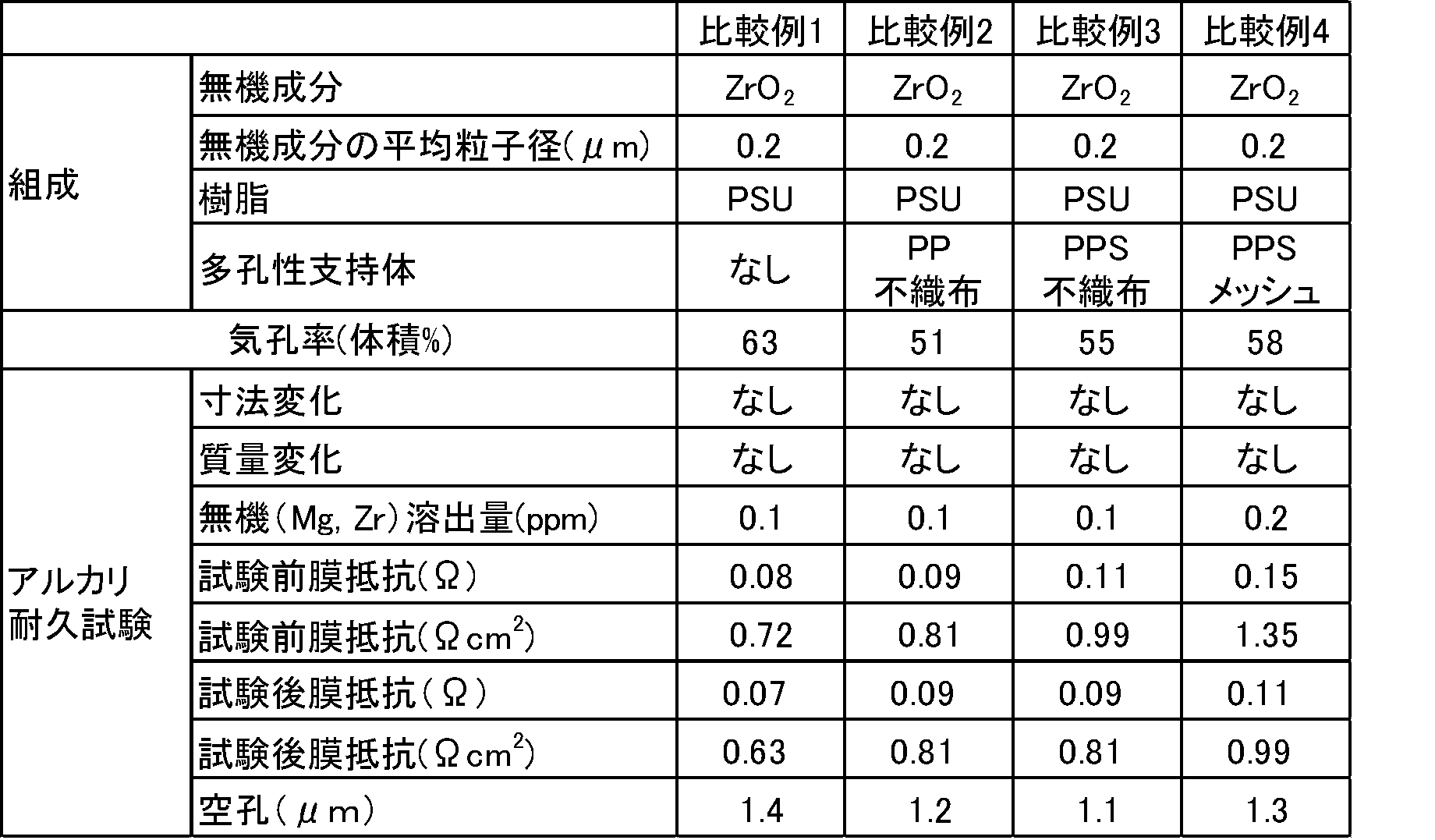
また、水酸化マグネシウムと有機高分子樹脂を含むアルカリ水電解用隔膜は、90℃の高濃度アルカリ溶液を用いたアルカリ耐久試験前後において、寸法変化、質量変化が見られず、膜抵抗値も変化が見られず、充分低い値のままであったことから、イオン透過性、耐アルカリ性、耐熱性に優れることが認められた。
また、水酸化マグネシウムと有機高分子樹脂を含むアルカリ水電解用隔膜は、従来の酸化ジルコニウムを含むアルカリ水電解用隔膜と比べて、空孔が小さいことから、ガスバリア性に優れることが期待できる。
Claims (16)
- 水酸化マグネシウム、及び、有機高分子樹脂を含むことを特徴とするアルカリ水電解用隔膜。
- 前記有機高分子樹脂は、ポリスルホン、ポリエーテルスルホン、及びポリフェニルスルホンからなる群より選択される少なくとも1種であることを特徴とする請求項1に記載のアルカリ水電解用隔膜。
- 前記水酸化マグネシウムの平均粒子径が0.05~2.0μmであることを特徴とする請求項1又は2に記載のアルカリ水電解用隔膜。
- 気孔率が20~80体積%であることを特徴とする請求項1~3のいずれかに記載のアルカリ水電解用隔膜。
- 前記アルカリ水電解用隔膜は、水酸化マグネシウム100質量部に対して有機高分子樹脂を20~40質量部含むことを特徴とする請求項1~4のいずれかに記載のアルカリ水電解用隔膜。
- 更に多孔性支持体を含むことを特徴とする請求項1~5のいずれかに記載のアルカリ水電解用隔膜。
- 前記多孔性支持体は、ポリプロピレン、ポリエチレン、及びポリフェニレンサルファイドからなる群より選択される少なくとも1種の樹脂を含むことを特徴とする請求項6に記載のアルカリ水電解用隔膜。
- 前記多孔性支持体は、不織布、織布、又はメッシュであることを特徴とする請求項6又は7に記載のアルカリ水電解用隔膜。
- 水酸化マグネシウム、及び、有機高分子樹脂を含むアルカリ水電解用隔膜を製造する方法であって、該製造方法は、
水酸化マグネシウム及び溶媒を含む分散液を調製する工程、
該分散液と有機高分子樹脂を混合して樹脂混合液を調製する工程、及び、
該樹脂混合液を用いて膜を形成する工程を含む
ことを特徴とするアルカリ水電解用隔膜の製造方法。 - 前記膜を形成する工程は、
樹脂混合液の塗膜を形成する工程、
該塗膜を非溶媒と接触させることにより該塗膜を凝固させる工程、及び、
該凝固した塗膜を乾燥させることにより多孔膜を得る工程を含む
ことを特徴とする請求項9に記載のアルカリ水電解用隔膜の製造方法。 - 水酸化マグネシウム、及び、有機高分子樹脂を含む膜をアルカリ水電解装置の隔膜として使用する方法。
- 金属水酸化物粒子、及び、疎水性樹脂を含む無機有機複合膜を製造する方法であって、
該製造方法は、金属水酸化物粒子、疎水性樹脂、及び溶媒を含む樹脂組成物の塗膜を形成する工程、及び、該塗膜を水に接触させて凝固させる工程を含み、
該溶媒は、N-メチル-2-ピロリドン、N,N-ジメチルアセトアミド、N,N-ジメチルホルムアミド、及びジメチルスルホキシドからなる群より選択される少なくとも1種である
ことを特徴とする無機有機複合膜の製造方法。 - 前記樹脂組成物は、金属水酸化物粒子、疎水性樹脂、及び溶媒を混合分散することにより調製されることを特徴とする請求項12に記載の無機有機複合膜の製造方法。
- 前記疎水性樹脂は、ポリスルホン、ポリエーテルスルホン、及びポリフェニルスルホンからなる群より選択される少なくとも1種であることを特徴とする請求項12又は13に記載の無機有機複合膜の製造方法。
- 前記金属水酸化物粒子は、水酸化マグネシウム、水酸化ジルコニウム、及び水酸化チタンからなる群より選択される少なくとも1種の粒子であることを特徴とする請求項12~14のいずれかに記載の無機有機複合膜の製造方法。
- 前記樹脂組成物は、樹脂組成物100質量%中、金属水酸化物粒子15~50質量%、疎水性樹脂3~22質量%、及び溶媒45~75質量%を含むことを特徴とする請求項12~15のいずれかに記載の無機有機複合膜の製造方法。
Priority Applications (6)
| Application Number | Priority Date | Filing Date | Title |
|---|---|---|---|
| CN201880049405.0A CN110945161A (zh) | 2017-07-26 | 2018-07-04 | 碱水电解用隔膜、其制造方法以及无机有机复合膜的制造方法 |
| CN202511527020.9A CN121272480A (zh) | 2017-07-26 | 2018-07-04 | 碱水电解用隔膜、其制造方法以及无机有机复合膜的制造方法 |
| US16/633,512 US11613820B2 (en) | 2017-07-26 | 2018-07-04 | Diaphragm for alkaline water electrolysis, method for producing same, and method for producing inorganic-organic composite membrane |
| AU2018305973A AU2018305973B2 (en) | 2017-07-26 | 2018-07-04 | Diaphragm for alkaline water electrolysis, method for producing same, and method for producing inorganic-organic composite membrane |
| EP18838961.3A EP3660188B1 (en) | 2017-07-26 | 2018-07-04 | Diaphragm for alkaline water electrolysis, method for producing same, and method for producing inorganic-organic composite membrane |
| JP2019532473A JP6752974B2 (ja) | 2017-07-26 | 2018-07-04 | アルカリ水電解用隔膜、その製造方法、及び無機有機複合膜の製造方法 |
Applications Claiming Priority (4)
| Application Number | Priority Date | Filing Date | Title |
|---|---|---|---|
| JP2017-144676 | 2017-07-26 | ||
| JP2017144676 | 2017-07-26 | ||
| JP2018005048 | 2018-01-16 | ||
| JP2018-005048 | 2018-01-16 |
Publications (1)
| Publication Number | Publication Date |
|---|---|
| WO2019021774A1 true WO2019021774A1 (ja) | 2019-01-31 |
Family
ID=65040067
Family Applications (1)
| Application Number | Title | Priority Date | Filing Date |
|---|---|---|---|
| PCT/JP2018/025398 Ceased WO2019021774A1 (ja) | 2017-07-26 | 2018-07-04 | アルカリ水電解用隔膜、その製造方法、及び無機有機複合膜の製造方法 |
Country Status (6)
| Country | Link |
|---|---|
| US (1) | US11613820B2 (ja) |
| EP (1) | EP3660188B1 (ja) |
| JP (1) | JP6752974B2 (ja) |
| CN (2) | CN110945161A (ja) |
| AU (1) | AU2018305973B2 (ja) |
| WO (1) | WO2019021774A1 (ja) |
Cited By (7)
| Publication number | Priority date | Publication date | Assignee | Title |
|---|---|---|---|---|
| JP2020105557A (ja) * | 2018-12-26 | 2020-07-09 | 株式会社日本触媒 | アルカリ水電解用隔膜 |
| JP2020155294A (ja) * | 2019-03-20 | 2020-09-24 | 株式会社エンビジョンAescエナジーデバイス | 電極、電極の製造方法及び電池 |
| CN114207189A (zh) * | 2019-07-05 | 2022-03-18 | 爱克发-格法特公司 | 用于碱性水电解的分隔器 |
| JP2022176792A (ja) * | 2021-05-17 | 2022-11-30 | 株式会社日本触媒 | アルカリ水電解用隔膜、及びその製造方法 |
| EP3919654A4 (en) * | 2019-01-30 | 2022-12-28 | Nippon Shokubai Co., Ltd. | ALKALINE WATER ELECTROLYSIS MEMBRANE WITH ELECTRODE, PROCESS FOR THEIR MANUFACTURE AND WATER ELECTROLYSIS DEVICE |
| WO2023048006A1 (ja) | 2021-09-24 | 2023-03-30 | 株式会社日本触媒 | アルカリ水電解用隔膜の製造方法、及びアルカリ水電解用隔膜 |
| JP2023531792A (ja) * | 2020-07-03 | 2023-07-25 | アグフア-ゲヴエルト,ナームローゼ・フエンノートシヤツプ | アルカリ水電解用セパレータ |
Families Citing this family (24)
| Publication number | Priority date | Publication date | Assignee | Title |
|---|---|---|---|---|
| US20230332310A1 (en) | 2020-07-03 | 2023-10-19 | Agfa-Gevaert Nv | A Separator for Water Electrolysis |
| EP3974559B1 (en) | 2020-09-24 | 2024-11-06 | Agfa-Gevaert Nv | A manufacturing method for a reinforced separator |
| WO2022245080A1 (ko) * | 2021-05-17 | 2022-11-24 | 고려대학교 산학협력단 | 알칼라인 수전해용 박막 복합체 분리막의 제조 방법 |
| CN117616150A (zh) | 2021-07-08 | 2024-02-27 | 爱克发-格法特公司 | 用于碱性水电解的隔离件 |
| WO2023280760A1 (en) | 2021-07-08 | 2023-01-12 | Agfa-Gevaert Nv | A separator for alkaline water electrolysis |
| EP4367290A1 (en) | 2021-07-08 | 2024-05-15 | Agfa-Gevaert Nv | A separator for alkaline water electrolysis |
| CN118489017A (zh) | 2021-12-21 | 2024-08-13 | 爱克发-格法特公司 | 用于电解池的隔离件 |
| CN114432906A (zh) * | 2022-02-13 | 2022-05-06 | 北京化工大学 | 一种耐高温碱性水电解槽复合隔膜及其制备方法 |
| CN114432905A (zh) * | 2022-02-13 | 2022-05-06 | 北京化工大学 | 一种非石棉碱性电解水复合隔膜及其制备方法 |
| WO2023208776A1 (en) | 2022-04-25 | 2023-11-02 | Agfa-Gevaert Nv | A separator for alkaline water electrolysis |
| CN119301307A (zh) | 2022-05-30 | 2025-01-10 | 爱克发-格法特公司 | 用于水电解的隔离件 |
| CN115029732B (zh) * | 2022-06-06 | 2024-04-19 | 清华大学 | 碱性水电解用隔膜及其制备方法与应用 |
| CN115125581B (zh) * | 2022-06-24 | 2023-09-22 | 中国科学院上海高等研究院 | 一种电化学反应池隔膜及其应用 |
| EP4365334A1 (en) | 2022-11-03 | 2024-05-08 | Agfa-Gevaert Nv | A separator for alkaline water electrolysis |
| EP4365335A1 (en) | 2022-11-03 | 2024-05-08 | Agfa-Gevaert Nv | A separator for alkaline water electrolysis |
| CN115819818A (zh) * | 2022-12-23 | 2023-03-21 | 乐凯胶片股份有限公司 | 碱性水电解制氢用复合隔膜及其制备方法 |
| CN117512693B (zh) * | 2023-12-16 | 2024-08-06 | 山东蓝拓氢能科技有限公司 | 一种表面超亲水且具有整体交联结构的碱性水电解制氢用复合隔膜及其制备方法 |
| CN121336005A (zh) | 2023-12-21 | 2026-01-13 | 爱克发-格法特公司 | 用于碱性水电解的隔板 |
| WO2025132855A1 (en) | 2023-12-21 | 2025-06-26 | Agfa-Gevaert Nv | A separator for alkaline water electrolysis |
| CN117947462B (zh) * | 2023-12-29 | 2025-02-14 | 江苏拓邦环保科技有限公司 | 一种碱性水电解复合隔膜及其制备方法 |
| CN117721498B (zh) * | 2024-02-07 | 2024-05-07 | 宁波中科氢易膜科技有限公司 | 一种有机-无机杂化离子复合膜的制备方法 |
| EP4671415A1 (en) | 2024-06-28 | 2025-12-31 | Agfa-Gevaert Nv | WATER ELECTROLYSIS SEPARATOR |
| KR20260015615A (ko) * | 2024-07-25 | 2026-02-03 | 주식회사 엘지화학 | 분리막, 이를 포함하는 전기분해 셀 및 전기분해 장치 |
| CN118996523A (zh) * | 2024-10-24 | 2024-11-22 | 爱德曼氢能源装备有限公司 | 用于碱性水电解制氢的耐久性复合隔膜及成膜工艺和应用 |
Citations (5)
| Publication number | Priority date | Publication date | Assignee | Title |
|---|---|---|---|---|
| JP2013204146A (ja) | 2012-03-29 | 2013-10-07 | Asahi Kasei Corp | アルカリ水電解用隔膜及びその製造方法 |
| JP2013220608A (ja) * | 2012-04-17 | 2013-10-28 | Nippon Soda Co Ltd | 撥水膜 |
| JP2013249510A (ja) | 2012-05-31 | 2013-12-12 | Nitto Denko Corp | アルカリ水電解用隔膜 |
| WO2016148302A1 (ja) * | 2015-03-18 | 2016-09-22 | 旭化成株式会社 | アルカリ水電解用隔膜、アルカリ水電解装置、水素の製造方法及びアルカリ水電解用隔膜の製造方法 |
| JP2017066184A (ja) | 2015-09-28 | 2017-04-06 | 旭化成株式会社 | ポリフェニレン共重合体を含む微多孔膜、及びその製造方法 |
Family Cites Families (13)
| Publication number | Priority date | Publication date | Assignee | Title |
|---|---|---|---|---|
| DE2354711B2 (de) | 1972-12-12 | 1975-08-14 | Asahi Kasei Kogyo K.K., Osaka (Japan) | Kunstharzdiaphragma und Verfahren zu dessen Herstellung |
| JPS5716186A (en) | 1980-07-03 | 1982-01-27 | Kureha Chem Ind Co Ltd | Diaphragm for electrolyzing salt water |
| US4699857A (en) * | 1986-10-15 | 1987-10-13 | W. R. Grace & Co. | Battery separator |
| US6447943B1 (en) | 2000-01-18 | 2002-09-10 | Ramot University Authority For Applied Research & Industrial Development Ltd. | Fuel cell with proton conducting membrane with a pore size less than 30 nm |
| AU2001227022A1 (en) | 2000-01-18 | 2001-07-31 | Ramot University Authority For Applied Research And Industrial Development Ltd. | Fuel cell with proton conducting membrane |
| JP4857560B2 (ja) | 2002-09-30 | 2012-01-18 | 旭硝子株式会社 | 固体高分子型燃料電池用電解質膜の製造方法 |
| BRPI0615757B1 (pt) * | 2005-09-09 | 2020-09-15 | Industrie De Nora S.P.A. | Separador poroso sem asbesto e método para produzí-lo |
| EP2549566B1 (en) * | 2007-06-19 | 2015-12-16 | Teijin Limited | Separator for nonaqueous secondary battery, method for producing the same, and nonaqueous secondary battery |
| CN101656306B (zh) * | 2008-08-22 | 2012-07-04 | 比亚迪股份有限公司 | 一种复合隔膜及其制备方法和包括该复合隔膜的电池 |
| US8784620B2 (en) * | 2010-05-13 | 2014-07-22 | Axiall Ohio, Inc. | Method of operating a diaphragm electrolytic cell |
| JP6292906B2 (ja) * | 2013-02-01 | 2018-03-14 | 株式会社日本触媒 | アニオン伝導性材料及び電池 |
| JP2015170441A (ja) * | 2014-03-06 | 2015-09-28 | 三菱製紙株式会社 | 電池用セパレータ |
| JP6905308B2 (ja) * | 2015-06-16 | 2021-07-21 | 川崎重工業株式会社 | アルカリ水電解用隔膜及びその製造方法 |
-
2018
- 2018-07-04 CN CN201880049405.0A patent/CN110945161A/zh active Pending
- 2018-07-04 US US16/633,512 patent/US11613820B2/en active Active
- 2018-07-04 CN CN202511527020.9A patent/CN121272480A/zh active Pending
- 2018-07-04 EP EP18838961.3A patent/EP3660188B1/en active Active
- 2018-07-04 AU AU2018305973A patent/AU2018305973B2/en active Active
- 2018-07-04 JP JP2019532473A patent/JP6752974B2/ja active Active
- 2018-07-04 WO PCT/JP2018/025398 patent/WO2019021774A1/ja not_active Ceased
Patent Citations (5)
| Publication number | Priority date | Publication date | Assignee | Title |
|---|---|---|---|---|
| JP2013204146A (ja) | 2012-03-29 | 2013-10-07 | Asahi Kasei Corp | アルカリ水電解用隔膜及びその製造方法 |
| JP2013220608A (ja) * | 2012-04-17 | 2013-10-28 | Nippon Soda Co Ltd | 撥水膜 |
| JP2013249510A (ja) | 2012-05-31 | 2013-12-12 | Nitto Denko Corp | アルカリ水電解用隔膜 |
| WO2016148302A1 (ja) * | 2015-03-18 | 2016-09-22 | 旭化成株式会社 | アルカリ水電解用隔膜、アルカリ水電解装置、水素の製造方法及びアルカリ水電解用隔膜の製造方法 |
| JP2017066184A (ja) | 2015-09-28 | 2017-04-06 | 旭化成株式会社 | ポリフェニレン共重合体を含む微多孔膜、及びその製造方法 |
Non-Patent Citations (1)
| Title |
|---|
| See also references of EP3660188A4 |
Cited By (14)
| Publication number | Priority date | Publication date | Assignee | Title |
|---|---|---|---|---|
| JP2020105557A (ja) * | 2018-12-26 | 2020-07-09 | 株式会社日本触媒 | アルカリ水電解用隔膜 |
| JP7260298B2 (ja) | 2018-12-26 | 2023-04-18 | 株式会社日本触媒 | アルカリ水電解用隔膜 |
| EP3919654A4 (en) * | 2019-01-30 | 2022-12-28 | Nippon Shokubai Co., Ltd. | ALKALINE WATER ELECTROLYSIS MEMBRANE WITH ELECTRODE, PROCESS FOR THEIR MANUFACTURE AND WATER ELECTROLYSIS DEVICE |
| CN113614942A (zh) * | 2019-03-20 | 2021-11-05 | 远景Aesc日本有限公司 | 电极、电极的制造方法和电池 |
| WO2020189298A1 (ja) * | 2019-03-20 | 2020-09-24 | 株式会社エンビジョンAescエナジーデバイス | 電極、電極の製造方法及び電池 |
| JP2020155294A (ja) * | 2019-03-20 | 2020-09-24 | 株式会社エンビジョンAescエナジーデバイス | 電極、電極の製造方法及び電池 |
| JP7320172B2 (ja) | 2019-03-20 | 2023-08-03 | 株式会社Aescジャパン | 電極、電極の製造方法及び電池 |
| CN114207189A (zh) * | 2019-07-05 | 2022-03-18 | 爱克发-格法特公司 | 用于碱性水电解的分隔器 |
| JP2023531792A (ja) * | 2020-07-03 | 2023-07-25 | アグフア-ゲヴエルト,ナームローゼ・フエンノートシヤツプ | アルカリ水電解用セパレータ |
| JP2022176792A (ja) * | 2021-05-17 | 2022-11-30 | 株式会社日本触媒 | アルカリ水電解用隔膜、及びその製造方法 |
| JP7641817B2 (ja) | 2021-05-17 | 2025-03-07 | 株式会社日本触媒 | アルカリ水電解用隔膜、及びその製造方法 |
| WO2023048006A1 (ja) | 2021-09-24 | 2023-03-30 | 株式会社日本触媒 | アルカリ水電解用隔膜の製造方法、及びアルカリ水電解用隔膜 |
| JPWO2023048006A1 (ja) * | 2021-09-24 | 2023-03-30 | ||
| JP7784435B2 (ja) | 2021-09-24 | 2025-12-11 | 株式会社日本触媒 | アルカリ水電解用隔膜の製造方法、及びアルカリ水電解用隔膜 |
Also Published As
| Publication number | Publication date |
|---|---|
| EP3660188A4 (en) | 2021-07-21 |
| JPWO2019021774A1 (ja) | 2020-05-28 |
| US11613820B2 (en) | 2023-03-28 |
| CN121272480A (zh) | 2026-01-06 |
| US20210130967A1 (en) | 2021-05-06 |
| AU2018305973B2 (en) | 2023-07-13 |
| JP6752974B2 (ja) | 2020-09-09 |
| EP3660188B1 (en) | 2023-03-15 |
| CN110945161A (zh) | 2020-03-31 |
| EP3660188A1 (en) | 2020-06-03 |
| AU2018305973A1 (en) | 2020-02-13 |
Similar Documents
| Publication | Publication Date | Title |
|---|---|---|
| JP6752974B2 (ja) | アルカリ水電解用隔膜、その製造方法、及び無機有機複合膜の製造方法 | |
| JP7114726B2 (ja) | アルカリ水電解用隔膜 | |
| WO2020158719A1 (ja) | 電極付きアルカリ水電解用隔膜、その製造方法、及び水電解装置 | |
| JP7284001B2 (ja) | アルカリ水電解用隔膜ならびに該隔膜の製造方法 | |
| JP7166118B2 (ja) | アルカリ水電解用隔膜 | |
| JP7232110B2 (ja) | アルカリ水電解用隔膜ならびに該隔膜の製造方法 | |
| JP7365748B2 (ja) | アルカリ水電解用隔膜の製造方法 | |
| JP7641817B2 (ja) | アルカリ水電解用隔膜、及びその製造方法 | |
| WO2024048235A1 (ja) | アルカリ水電解用隔膜、アルカリ水電解セル、及び、アルカリ水電解方法 | |
| JP7587969B2 (ja) | アルカリ水電解用隔膜 | |
| JP7284015B2 (ja) | アルカリ水電解用隔膜ならびに該隔膜の製造方法 | |
| JP7129903B2 (ja) | アルカリ水電解用隔膜 | |
| JP7273650B2 (ja) | アルカリ水電解用隔膜ならびに該隔膜の製造方法 | |
| JP6985159B2 (ja) | 無機有機複合膜の製造方法 | |
| CN116770362A (zh) | 一种复合隔膜及其制备方法和电化学能源器件 | |
| JP7260298B2 (ja) | アルカリ水電解用隔膜 | |
| JP7702239B2 (ja) | アルカリ水電解用隔膜、及び、その製造方法 | |
| US20240173678A1 (en) | High Performance Double Layer Ion Selective Membrane With Nanoporous Boron Nitride And Polyetherimide | |
| JP7011934B2 (ja) | 電気化学素子用セパレータ | |
| JP2023129128A (ja) | 非水電解液二次電池用セパレータ、非水電解液二次電池用部材、非水電解液二次電池 | |
| JP2019114502A (ja) | 電気化学素子用セパレータ |
Legal Events
| Date | Code | Title | Description |
|---|---|---|---|
| 121 | Ep: the epo has been informed by wipo that ep was designated in this application |
Ref document number: 18838961 Country of ref document: EP Kind code of ref document: A1 |
|
| ENP | Entry into the national phase |
Ref document number: 2019532473 Country of ref document: JP Kind code of ref document: A |
|
| NENP | Non-entry into the national phase |
Ref country code: DE |
|
| ENP | Entry into the national phase |
Ref document number: 2018305973 Country of ref document: AU Date of ref document: 20180704 Kind code of ref document: A |
|
| ENP | Entry into the national phase |
Ref document number: 2018838961 Country of ref document: EP Effective date: 20200226 |