WO2019021800A1 - Composition d'émulsion type huile-dans-eau, procédé pour la produire, et son utilisation - Google Patents
Composition d'émulsion type huile-dans-eau, procédé pour la produire, et son utilisation Download PDFInfo
- Publication number
- WO2019021800A1 WO2019021800A1 PCT/JP2018/025908 JP2018025908W WO2019021800A1 WO 2019021800 A1 WO2019021800 A1 WO 2019021800A1 JP 2018025908 W JP2018025908 W JP 2018025908W WO 2019021800 A1 WO2019021800 A1 WO 2019021800A1
- Authority
- WO
- WIPO (PCT)
- Prior art keywords
- oil
- water
- component
- emulsion composition
- water emulsion
- Prior art date
- Legal status (The legal status is an assumption and is not a legal conclusion. Google has not performed a legal analysis and makes no representation as to the accuracy of the status listed.)
- Ceased
Links
Images
Classifications
-
- C—CHEMISTRY; METALLURGY
- C08—ORGANIC MACROMOLECULAR COMPOUNDS; THEIR PREPARATION OR CHEMICAL WORKING-UP; COMPOSITIONS BASED THEREON
- C08L—COMPOSITIONS OF MACROMOLECULAR COMPOUNDS
- C08L83/00—Compositions of macromolecular compounds obtained by reactions forming in the main chain of the macromolecule a linkage containing silicon with or without sulfur, nitrogen, oxygen or carbon only; Compositions of derivatives of such polymers
- C08L83/04—Polysiloxanes
-
- A—HUMAN NECESSITIES
- A61—MEDICAL OR VETERINARY SCIENCE; HYGIENE
- A61K—PREPARATIONS FOR MEDICAL, DENTAL OR TOILETRY PURPOSES
- A61K8/00—Cosmetics or similar toiletry preparations
- A61K8/02—Cosmetics or similar toiletry preparations characterised by special physical form
- A61K8/04—Dispersions; Emulsions
- A61K8/06—Emulsions
-
- A—HUMAN NECESSITIES
- A61—MEDICAL OR VETERINARY SCIENCE; HYGIENE
- A61K—PREPARATIONS FOR MEDICAL, DENTAL OR TOILETRY PURPOSES
- A61K8/00—Cosmetics or similar toiletry preparations
- A61K8/02—Cosmetics or similar toiletry preparations characterised by special physical form
- A61K8/04—Dispersions; Emulsions
- A61K8/06—Emulsions
- A61K8/062—Oil-in-water emulsions
-
- A—HUMAN NECESSITIES
- A61—MEDICAL OR VETERINARY SCIENCE; HYGIENE
- A61K—PREPARATIONS FOR MEDICAL, DENTAL OR TOILETRY PURPOSES
- A61K8/00—Cosmetics or similar toiletry preparations
- A61K8/18—Cosmetics or similar toiletry preparations characterised by the composition
- A61K8/30—Cosmetics or similar toiletry preparations characterised by the composition containing organic compounds
- A61K8/33—Cosmetics or similar toiletry preparations characterised by the composition containing organic compounds containing oxygen
- A61K8/39—Derivatives containing from 2 to 10 oxyalkylene groups
-
- A—HUMAN NECESSITIES
- A61—MEDICAL OR VETERINARY SCIENCE; HYGIENE
- A61K—PREPARATIONS FOR MEDICAL, DENTAL OR TOILETRY PURPOSES
- A61K8/00—Cosmetics or similar toiletry preparations
- A61K8/18—Cosmetics or similar toiletry preparations characterised by the composition
- A61K8/72—Cosmetics or similar toiletry preparations characterised by the composition containing organic macromolecular compounds
- A61K8/84—Cosmetics or similar toiletry preparations characterised by the composition containing organic macromolecular compounds obtained by reactions otherwise than those involving only carbon-carbon unsaturated bonds
- A61K8/86—Polyethers
-
- A—HUMAN NECESSITIES
- A61—MEDICAL OR VETERINARY SCIENCE; HYGIENE
- A61K—PREPARATIONS FOR MEDICAL, DENTAL OR TOILETRY PURPOSES
- A61K8/00—Cosmetics or similar toiletry preparations
- A61K8/18—Cosmetics or similar toiletry preparations characterised by the composition
- A61K8/72—Cosmetics or similar toiletry preparations characterised by the composition containing organic macromolecular compounds
- A61K8/84—Cosmetics or similar toiletry preparations characterised by the composition containing organic macromolecular compounds obtained by reactions otherwise than those involving only carbon-carbon unsaturated bonds
- A61K8/89—Polysiloxanes
- A61K8/891—Polysiloxanes saturated, e.g. dimethicone, phenyl trimethicone, C24-C28 methicone or stearyl dimethicone
-
- A—HUMAN NECESSITIES
- A61—MEDICAL OR VETERINARY SCIENCE; HYGIENE
- A61Q—SPECIFIC USE OF COSMETICS OR SIMILAR TOILETRY PREPARATIONS
- A61Q19/00—Preparations for care of the skin
-
- A—HUMAN NECESSITIES
- A61—MEDICAL OR VETERINARY SCIENCE; HYGIENE
- A61Q—SPECIFIC USE OF COSMETICS OR SIMILAR TOILETRY PREPARATIONS
- A61Q5/00—Preparations for care of the hair
- A61Q5/02—Preparations for cleaning the hair
-
- B—PERFORMING OPERATIONS; TRANSPORTING
- B01—PHYSICAL OR CHEMICAL PROCESSES OR APPARATUS IN GENERAL
- B01F—MIXING, e.g. DISSOLVING, EMULSIFYING OR DISPERSING
- B01F23/00—Mixing according to the phases to be mixed, e.g. dispersing or emulsifying
- B01F23/40—Mixing liquids with liquids; Emulsifying
- B01F23/41—Emulsifying
-
- B—PERFORMING OPERATIONS; TRANSPORTING
- B01—PHYSICAL OR CHEMICAL PROCESSES OR APPARATUS IN GENERAL
- B01F—MIXING, e.g. DISSOLVING, EMULSIFYING OR DISPERSING
- B01F27/00—Mixers with rotary stirring devices in fixed receptacles; Kneaders
- B01F27/05—Stirrers
- B01F27/11—Stirrers characterised by the configuration of the stirrers
- B01F27/114—Helically shaped stirrers, i.e. stirrers comprising a helically shaped band or helically shaped band sections
- B01F27/1145—Helically shaped stirrers, i.e. stirrers comprising a helically shaped band or helically shaped band sections ribbon shaped with an open space between the helical ribbon flight and the rotating axis
-
- B—PERFORMING OPERATIONS; TRANSPORTING
- B01—PHYSICAL OR CHEMICAL PROCESSES OR APPARATUS IN GENERAL
- B01F—MIXING, e.g. DISSOLVING, EMULSIFYING OR DISPERSING
- B01F27/00—Mixers with rotary stirring devices in fixed receptacles; Kneaders
- B01F27/80—Mixers with rotary stirring devices in fixed receptacles; Kneaders with stirrers rotating about a substantially vertical axis
- B01F27/808—Mixers with rotary stirring devices in fixed receptacles; Kneaders with stirrers rotating about a substantially vertical axis with stirrers driven from the bottom of the receptacle
-
- B—PERFORMING OPERATIONS; TRANSPORTING
- B01—PHYSICAL OR CHEMICAL PROCESSES OR APPARATUS IN GENERAL
- B01F—MIXING, e.g. DISSOLVING, EMULSIFYING OR DISPERSING
- B01F27/00—Mixers with rotary stirring devices in fixed receptacles; Kneaders
- B01F27/80—Mixers with rotary stirring devices in fixed receptacles; Kneaders with stirrers rotating about a substantially vertical axis
- B01F27/84—Mixers with rotary stirring devices in fixed receptacles; Kneaders with stirrers rotating about a substantially vertical axis with two or more stirrers rotating at different speeds or in opposite directions about the same axis
-
- B—PERFORMING OPERATIONS; TRANSPORTING
- B01—PHYSICAL OR CHEMICAL PROCESSES OR APPARATUS IN GENERAL
- B01F—MIXING, e.g. DISSOLVING, EMULSIFYING OR DISPERSING
- B01F27/00—Mixers with rotary stirring devices in fixed receptacles; Kneaders
- B01F27/80—Mixers with rotary stirring devices in fixed receptacles; Kneaders with stirrers rotating about a substantially vertical axis
- B01F27/90—Mixers with rotary stirring devices in fixed receptacles; Kneaders with stirrers rotating about a substantially vertical axis with paddles or arms
-
- B—PERFORMING OPERATIONS; TRANSPORTING
- B01—PHYSICAL OR CHEMICAL PROCESSES OR APPARATUS IN GENERAL
- B01J—CHEMICAL OR PHYSICAL PROCESSES, e.g. CATALYSIS OR COLLOID CHEMISTRY; THEIR RELEVANT APPARATUS
- B01J13/00—Colloid chemistry, e.g. the production of colloidal materials or their solutions, not otherwise provided for; Making microcapsules or microballoons
-
- C—CHEMISTRY; METALLURGY
- C08—ORGANIC MACROMOLECULAR COMPOUNDS; THEIR PREPARATION OR CHEMICAL WORKING-UP; COMPOSITIONS BASED THEREON
- C08J—WORKING-UP; GENERAL PROCESSES OF COMPOUNDING; AFTER-TREATMENT NOT COVERED BY SUBCLASSES C08B, C08C, C08F, C08G or C08H
- C08J3/00—Processes of treating or compounding macromolecular substances
- C08J3/02—Making solutions, dispersions, lattices or gels by other methods than by solution, emulsion or suspension polymerisation techniques
- C08J3/03—Making solutions, dispersions, lattices or gels by other methods than by solution, emulsion or suspension polymerisation techniques in aqueous media
-
- C—CHEMISTRY; METALLURGY
- C09—DYES; PAINTS; POLISHES; NATURAL RESINS; ADHESIVES; COMPOSITIONS NOT OTHERWISE PROVIDED FOR; APPLICATIONS OF MATERIALS NOT OTHERWISE PROVIDED FOR
- C09D—COATING COMPOSITIONS, e.g. PAINTS, VARNISHES OR LACQUERS; FILLING PASTES; CHEMICAL PAINT OR INK REMOVERS; INKS; CORRECTING FLUIDS; WOODSTAINS; PASTES OR SOLIDS FOR COLOURING OR PRINTING; USE OF MATERIALS THEREFOR
- C09D183/00—Coating compositions based on macromolecular compounds obtained by reactions forming in the main chain of the macromolecule a linkage containing silicon, with or without sulfur, nitrogen, oxygen, or carbon only; Coating compositions based on derivatives of such polymers
- C09D183/04—Polysiloxanes
-
- C—CHEMISTRY; METALLURGY
- C09—DYES; PAINTS; POLISHES; NATURAL RESINS; ADHESIVES; COMPOSITIONS NOT OTHERWISE PROVIDED FOR; APPLICATIONS OF MATERIALS NOT OTHERWISE PROVIDED FOR
- C09D—COATING COMPOSITIONS, e.g. PAINTS, VARNISHES OR LACQUERS; FILLING PASTES; CHEMICAL PAINT OR INK REMOVERS; INKS; CORRECTING FLUIDS; WOODSTAINS; PASTES OR SOLIDS FOR COLOURING OR PRINTING; USE OF MATERIALS THEREFOR
- C09D5/00—Coating compositions, e.g. paints, varnishes or lacquers, characterised by their physical nature or the effects produced; Filling pastes
- C09D5/02—Emulsion paints including aerosols
-
- C—CHEMISTRY; METALLURGY
- C09—DYES; PAINTS; POLISHES; NATURAL RESINS; ADHESIVES; COMPOSITIONS NOT OTHERWISE PROVIDED FOR; APPLICATIONS OF MATERIALS NOT OTHERWISE PROVIDED FOR
- C09D—COATING COMPOSITIONS, e.g. PAINTS, VARNISHES OR LACQUERS; FILLING PASTES; CHEMICAL PAINT OR INK REMOVERS; INKS; CORRECTING FLUIDS; WOODSTAINS; PASTES OR SOLIDS FOR COLOURING OR PRINTING; USE OF MATERIALS THEREFOR
- C09D5/00—Coating compositions, e.g. paints, varnishes or lacquers, characterised by their physical nature or the effects produced; Filling pastes
- C09D5/02—Emulsion paints including aerosols
- C09D5/022—Emulsions, e.g. oil in water
-
- C—CHEMISTRY; METALLURGY
- C09—DYES; PAINTS; POLISHES; NATURAL RESINS; ADHESIVES; COMPOSITIONS NOT OTHERWISE PROVIDED FOR; APPLICATIONS OF MATERIALS NOT OTHERWISE PROVIDED FOR
- C09D—COATING COMPOSITIONS, e.g. PAINTS, VARNISHES OR LACQUERS; FILLING PASTES; CHEMICAL PAINT OR INK REMOVERS; INKS; CORRECTING FLUIDS; WOODSTAINS; PASTES OR SOLIDS FOR COLOURING OR PRINTING; USE OF MATERIALS THEREFOR
- C09D7/00—Features of coating compositions, not provided for in group C09D5/00; Processes for incorporating ingredients in coating compositions
-
- D—TEXTILES; PAPER
- D06—TREATMENT OF TEXTILES OR THE LIKE; LAUNDERING; FLEXIBLE MATERIALS NOT OTHERWISE PROVIDED FOR
- D06M—TREATMENT, NOT PROVIDED FOR ELSEWHERE IN CLASS D06, OF FIBRES, THREADS, YARNS, FABRICS, FEATHERS OR FIBROUS GOODS MADE FROM SUCH MATERIALS
- D06M15/00—Treating fibres, threads, yarns, fabrics, or fibrous goods made from such materials, with macromolecular compounds; Such treatment combined with mechanical treatment
- D06M15/19—Treating fibres, threads, yarns, fabrics, or fibrous goods made from such materials, with macromolecular compounds; Such treatment combined with mechanical treatment with synthetic macromolecular compounds
- D06M15/37—Macromolecular compounds obtained otherwise than by reactions only involving carbon-to-carbon unsaturated bonds
- D06M15/643—Macromolecular compounds obtained otherwise than by reactions only involving carbon-to-carbon unsaturated bonds containing silicon in the main chain
-
- A—HUMAN NECESSITIES
- A61—MEDICAL OR VETERINARY SCIENCE; HYGIENE
- A61K—PREPARATIONS FOR MEDICAL, DENTAL OR TOILETRY PURPOSES
- A61K2800/00—Properties of cosmetic compositions or active ingredients thereof or formulation aids used therein and process related aspects
- A61K2800/20—Chemical, physico-chemical or functional or structural properties of the composition as a whole
- A61K2800/21—Emulsions characterized by droplet sizes below 1 micron
-
- B—PERFORMING OPERATIONS; TRANSPORTING
- B01—PHYSICAL OR CHEMICAL PROCESSES OR APPARATUS IN GENERAL
- B01F—MIXING, e.g. DISSOLVING, EMULSIFYING OR DISPERSING
- B01F27/00—Mixers with rotary stirring devices in fixed receptacles; Kneaders
- B01F27/80—Mixers with rotary stirring devices in fixed receptacles; Kneaders with stirrers rotating about a substantially vertical axis
- B01F27/92—Mixers with rotary stirring devices in fixed receptacles; Kneaders with stirrers rotating about a substantially vertical axis with helices or screws
-
- C—CHEMISTRY; METALLURGY
- C08—ORGANIC MACROMOLECULAR COMPOUNDS; THEIR PREPARATION OR CHEMICAL WORKING-UP; COMPOSITIONS BASED THEREON
- C08G—MACROMOLECULAR COMPOUNDS OBTAINED OTHERWISE THAN BY REACTIONS ONLY INVOLVING UNSATURATED CARBON-TO-CARBON BONDS
- C08G77/00—Macromolecular compounds obtained by reactions forming a linkage containing silicon with or without sulfur, nitrogen, oxygen or carbon in the main chain of the macromolecule
- C08G77/04—Polysiloxanes
-
- C—CHEMISTRY; METALLURGY
- C08—ORGANIC MACROMOLECULAR COMPOUNDS; THEIR PREPARATION OR CHEMICAL WORKING-UP; COMPOSITIONS BASED THEREON
- C08G—MACROMOLECULAR COMPOUNDS OBTAINED OTHERWISE THAN BY REACTIONS ONLY INVOLVING UNSATURATED CARBON-TO-CARBON BONDS
- C08G77/00—Macromolecular compounds obtained by reactions forming a linkage containing silicon with or without sulfur, nitrogen, oxygen or carbon in the main chain of the macromolecule
- C08G77/04—Polysiloxanes
- C08G77/14—Polysiloxanes containing silicon bound to oxygen-containing groups
- C08G77/16—Polysiloxanes containing silicon bound to oxygen-containing groups to hydroxy groups
-
- C—CHEMISTRY; METALLURGY
- C08—ORGANIC MACROMOLECULAR COMPOUNDS; THEIR PREPARATION OR CHEMICAL WORKING-UP; COMPOSITIONS BASED THEREON
- C08J—WORKING-UP; GENERAL PROCESSES OF COMPOUNDING; AFTER-TREATMENT NOT COVERED BY SUBCLASSES C08B, C08C, C08F, C08G or C08H
- C08J2383/00—Characterised by the use of macromolecular compounds obtained by reactions forming in the main chain of the macromolecule a linkage containing silicon with or without sulfur, nitrogen, oxygen, or carbon only; Derivatives of such polymers
- C08J2383/04—Polysiloxanes
-
- C—CHEMISTRY; METALLURGY
- C08—ORGANIC MACROMOLECULAR COMPOUNDS; THEIR PREPARATION OR CHEMICAL WORKING-UP; COMPOSITIONS BASED THEREON
- C08J—WORKING-UP; GENERAL PROCESSES OF COMPOUNDING; AFTER-TREATMENT NOT COVERED BY SUBCLASSES C08B, C08C, C08F, C08G or C08H
- C08J3/00—Processes of treating or compounding macromolecular substances
- C08J3/02—Making solutions, dispersions, lattices or gels by other methods than by solution, emulsion or suspension polymerisation techniques
- C08J3/03—Making solutions, dispersions, lattices or gels by other methods than by solution, emulsion or suspension polymerisation techniques in aqueous media
- C08J3/05—Making solutions, dispersions, lattices or gels by other methods than by solution, emulsion or suspension polymerisation techniques in aqueous media from solid polymers
-
- C—CHEMISTRY; METALLURGY
- C08—ORGANIC MACROMOLECULAR COMPOUNDS; THEIR PREPARATION OR CHEMICAL WORKING-UP; COMPOSITIONS BASED THEREON
- C08J—WORKING-UP; GENERAL PROCESSES OF COMPOUNDING; AFTER-TREATMENT NOT COVERED BY SUBCLASSES C08B, C08C, C08F, C08G or C08H
- C08J3/00—Processes of treating or compounding macromolecular substances
- C08J3/02—Making solutions, dispersions, lattices or gels by other methods than by solution, emulsion or suspension polymerisation techniques
- C08J3/03—Making solutions, dispersions, lattices or gels by other methods than by solution, emulsion or suspension polymerisation techniques in aqueous media
- C08J3/07—Making solutions, dispersions, lattices or gels by other methods than by solution, emulsion or suspension polymerisation techniques in aqueous media from polymer solutions
Definitions
- the present invention relates to an oil-in-water emulsion composition formed by directly emulsifying an organopolysiloxane having a high degree of polymerization, which is difficult to realize by the conventional method, substantially containing coarse particles and having a small average particle size. Further, the present invention provides a method for producing the above-mentioned oil-in-water emulsion composition using a vertical batch mixer, and a cosmetic raw material containing the composition, a cosmetic, a film forming agent, a coating agent, and a fiber treatment agent For applications such as
- Emulsions of organopolysiloxanes are widely used in industry as lubricants, mold release agents, fiber treating agents, glass fiber treating agents, cosmetic bases, polishing agents, paint additives and the like.
- an emulsion having a small average particle size, a narrow distribution of particle sizes, and no coarse particles is generally less likely to cause phase separation of the emulsion accompanied by particle coalescence, and the handling workability and storage stability It tends to be excellent in
- the emulsion obtained by the direct emulsification method can utilize the characteristics expected of the organopolysiloxane to be emulsified as it is, and does not substantially contain a low molecular weight siloxane oligomer since it does not go through a polymerization reaction or the like. It may be suitably selected in the point which can design emulsion particle
- organopolysiloxanes with high degree of polymerization have film forming properties, hair and fibers It is excellent in adhesion to processing etc. and processing efficiency, and by using it as a coating agent or paint additive, it is excellent in the effect of improving the flatness and smoothness of the film, etc., but there is a problem that direct emulsification is difficult.
- Emulsification methods have been proposed (eg, Patent Documents 1 and 2).
- Patent Document 1 and Patent Document 2 can realize only an oil-in-water emulsion composition of silicone gum having an average particle size of less than 9 ⁇ m.
- an oil-in-water emulsion composition having an average particle size of 9.9 ⁇ m in Example of Patent Document 1 and 23.4 ⁇ m or 27.9 ⁇ m in Example 1 of Patent Document 2 is disclosed, and There is a problem that the stability of emulsion particles is inferior because many coarse particles having a particle diameter much larger than the particle diameter are included.
- Patent Document 2 proposes that an emulsion having a small particle size be realized by dispersing and emulsifying a silicone resin having a high degree of polymerization in a xylene solvent, but in the method, the emulsion is used. Since the apparent viscosity of the oil phase constituting the particles is significantly reduced and in some cases the solvent used for dilution can not be removed, the technical effect originally expected can not be realized by the emulsion addition of organopolysiloxane with a high degree of polymerization. In addition to cases, it may not be applicable to uses such as cosmetic raw materials.
- Patent Document 3 emulsification is carried out by emulsion polymerization of a reactive organopolysiloxane, which comprises emulsion particles having a high degree of organopolysiloxane and having an average particle diameter of less than 1.0 ⁇ m.
- a polymerization type oil-in-water emulsion composition has been proposed.
- As a large amount remains in the system there is a problem that applicable applications and designable compositions are limited.
- organopolysiloxane having a small particle size and a high degree of polymerization which does not contain coarse particles, and which is obtained by the direct emulsification method, and therefore does not cause problems of by-products such as volatile siloxane oligomers.
- Emulsion compositions and their preferred methods of preparation have not yet been realized.
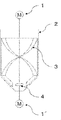
- FIG. 2 is a longitudinal sectional view of a vertical batch mixer that can be used in the present invention.
- the present invention has been made to solve the above problems, and comprises an oil-in-water emulsion composition formed by directly emulsifying an organopolysiloxane having a high degree of polymerization, containing substantially no coarse particles, and having a small average particle size. Intended to be provided.
- Another object of the present invention is to provide a use of the oil-in-water emulsion composition and an industrially suitable production method.
- one of the objects of the present invention is a direct emulsion type oil-in-water emulsion composition containing an organopolysiloxane having a high degree of polymerization, a surfactant and water, and having an average particle size of 0.1 to 7.
- the content of emulsion particles having a particle diameter of at least 10 times the average particle diameter in the particle size distribution of the emulsion in the range of 5 ⁇ m is less than 5.0% by volume and 25 ° C. of the oil phase constituting the emulsion particles It is achieved by those having an apparent viscosity at 1,000,000 mPa ⁇ s or more or a plasticity.
- the above-mentioned subject is the cosmetic raw material containing the said oil-in-water type emulsion composition, cosmetics, a film-forming agent, a coating agent, applications, such as a fiber processing agent, and an organo-suitable using a vertical batch mixer suitably.
- This is achieved by the method for producing the oil-in-water emulsion composition, characterized in that the polysiloxane is mechanically emulsified in water.
- the present invention [1] (A) 100 parts by mass of organopolysiloxane having a total viscosity at 25 ° C. of not less than 1,000,000 mPa ⁇ s or plasticity, (B) 0.1 to 30 parts by mass of at least one surfactant and (C) 100 to 2000 parts by mass of water, wherein the component (A) is emulsified in water by the component (B) ,
- the average particle size of the emulsion particles measured by the laser diffraction / scattering method is in the range of 0.1 to 7.5 ⁇ m,
- the content of emulsion particles having a particle size of at least 10 times the average particle size in the particle size distribution of the emulsion is less than 5.0% by volume
- An oil-in-water emulsion composition characterized by having an apparent viscosity at 25 ° C.
- Component (A) is (A1) Organopolysiloxane having 1,000,000 mPa ⁇ s or more at 25 ° C. or plasticity, or (A2) Organopolysiloxane mixture having total viscosity at 25 ° C. of 1,000,000 mPa ⁇ s or more or plasticity
- component (A) of 2,500,000 mPa ⁇ s or more or a plasticity Composition.
- Component (B) consists of (B1) nonionic surfactant and (B2) ionic surfactant, and the mass ratio of component (B1) to component (B2) is 100: 0 to 50:50.
- a cosmetic material comprising the oil-in-water emulsion composition according to any one of [1] to [5].
- a cosmetic comprising the oil-in-water emulsion composition according to any one of [1] to [5].
- a paint or coating composition comprising the oil-in-water emulsion composition according to any one of [1] to [5].
- a fiber treatment agent comprising the oil-in-water emulsion composition according to any one of [1] to [5].
- the above-mentioned vertical batch mixer has a plurality of rotating shafts disposed on the same axial core, and a ribbon-shaped stirring blade disposed on at least one rotating shaft and a rotating shaft different from the above-mentioned rotating shaft
- the method for producing an oil-in-water emulsion composition according to [11] which is a concentric multi-axial vertical batch mixer comprising a non-ribbon stirring blade arranged in [4].
- the method for producing an oil-in-water emulsion composition according to [11] or [12] which is characterized by being a direct emulsification method using a vertical batch mixer and not involving an emulsion polymerization reaction. " It is.
- an oil-in-water emulsion composition which is formed by directly emulsifying an organopolysiloxane having a high degree of polymerization, is substantially free of coarse particles, and has a small average particle size. Furthermore, according to the present invention, it is possible to provide uses of cosmetic raw materials, cosmetics, film forming agents, coating agents, fiber treatment agents and the like containing the oil-in-water emulsion composition. Furthermore, another object of the present invention is to provide an industrially suitable production method for the above-mentioned oil-in-water emulsion composition.
- Oil-in-water emulsion composition First, the oil-in-water emulsion composition according to the present invention will be described.
- Component (A) is an oil phase component constituting the emulsion particles of the present emulsion, and is an organopolysiloxane having a total viscosity at 25 ° C. of 1,000,000 mPa ⁇ s or more or a plasticity or a mixture thereof.
- the component (A) has a viscosity of 1,000,000 mPa ⁇ s or more at 25 ° C., or a plasticity (25 g, a spherical sample of 4.2 g measured according to the method defined in JIS K 6249) Is a value obtained by applying a load of 1 kgf for 3 minutes, which is simply referred to as “plasticity” in the present invention, preferably the plasticity is in the range of 50 to 200, more preferably 80 to 180 It is a gum-like organopolysiloxane in the range.
- the above gum-like organopolysiloxane which can measure the said plasticity may be called "silicone gum.”
- silicone gum Although it is generally difficult to measure viscosity using a rotational viscometer etc., organopolysiloxanes having a degree of plasticity have a high viscosity of 5,000,000 mPa ⁇ s or more if the viscosity is temporarily measured at 25 ° C. Tend to show.
- the organopolysiloxane which is the component (A) or the mixture thereof is not particularly limited other than its total viscosity, and an organopolysiloxane mixture containing a silicone resin (including silicone resin fine particles) or a silicone elastomer (including silicone elastomer fine particles) It may be
- the organopolysiloxane used in the present invention can contain additives such as silica fine particles, thickeners, and the like, if necessary, to the extent that the object of the present invention is not impaired.
- High viscosity silicone compounds including antifoam compounds).
- the antifoaming durability depends on the viscosity of the antifoaming agent, and the higher the viscosity or the higher the viscosity, the higher the durability. They are considered to be attributable to the fact that the size of the defoamer particles is hardly changed in the foaming system.
- the antifoaming agent in order to express the antifoaming property, it is necessary to miniaturize and disperse these high viscosity and high viscosity antifoaming agents to an optimum particle size. Was difficult.
- the oil-in-water emulsion composition of the present invention can form a stable and fine emulsion using a high viscosity antifoam compound, and it can be expected to improve and maintain antifoaming performance.
- the component (A) can not contain an additive such as silica particles exceeding the upper limit of the average particle size of the emulsion particles of the present invention, silicone resin particles or silicone elastomer particles.
- the organopolysiloxane which is the component (A) or a mixture thereof is not particularly limited, and has a divalent organic group (including a silalkylene group, a silphenylene group, or a polyoxyalkylene group) between siloxane units. It may be a polysiloxane structure-containing organic group connected by a divalent organic group, a tris (trialkylsiloxy) siloxy group-containing organic group, a carbosiloxane dendrimer structure-containing organic group, and the like.
- the organopolysiloxane which is the component (A) or a mixture thereof is characterized in that a part of hydrogen atoms bonded to a hydroxyl group, an alkoxy group, a monovalent hydrocarbon group and optionally a monovalent hydrocarbon group is an amino group, an epoxy group, a carboxyl group It may have a functional group selected from a group, an organic modifying group substituted with a halogen atom and the like, and is preferred.
- the organopolysiloxane which is the component (A) or a mixture thereof is preferably a compound represented by the following general formula.
- R is a group selected from a hydroxyl group, an alkoxy group having 1 to 3 carbon atoms, and a substituted or unsubstituted monovalent hydrocarbon group
- the hydroxyl group is an alkoxy group such as a methoxy group, an ethoxy group or a propoxy group.
- component (A) may have a branch that a is in the said range, it is the organopolysiloxane which makes the linear structure which essentially consists of a diorgano siloxy unit (D unit) mainly And its molecular structure may be linear, partially branched branched, or network-like.
- D unit diorgano siloxy unit
- linear organopolysiloxanes are preferably used.
- the siloxane polymerization degree is preferably about 3,000 to 20,000.
- organopolysiloxanes include, for example, dimethylpolysiloxanes terminated with trimethylsiloxy groups at both ends, dimethylpolysiloxanes capped with silanols at both ends, dimethylpolysiloxane copolymers capped with dimethylsiloxanes at both ends, dimethyldimethyl siloxanes at both ends.
- the methyl groups in these organopolysiloxanes are partly alkyl groups having 6 to 20 carbon atoms, aminoalkyl groups having 3 to 15 carbon atoms, perfluoroalkyl groups having 3 to 15 carbon atoms, and 3 to 15 carbon atoms.
- a structure substituted by a siloxy group-containing organic group, a carbosiloxane dendrimer structure-containing organic group linked to a silicon atom and a divalent organic group, or the like may be used, and in particular, in oil-in-water emulsions used for hair care applications And 3-aminopropyl group, N- (2-aminoethyl) 3-aminopropyl group, etc. from the viewpoint of adhesion to hair, etc. Or it may be an organopolysiloxane having an amino group.
- the oil-in-water emulsion according to the present invention passes through a direct emulsification method, and preferably does not involve an emulsion polymerization reaction.
- low molecular weight siloxane oligomers are not by-produced in the oil phase of component (A) and emulsion particles obtained by emulsifying the same, and composition design is possible substantially free of such siloxane oligomers.
- the siloxane polymerization degree in the oil phase constituting the emulsion composition is 3 to 6 by removing a low molecular weight siloxane oligomer from component (A) beforehand by means of stripping or the like and then emulsifying it.
- Oil-in-water emulsion composition in which the sum of the content of the siloxane oligomer is less than 1.0% by mass, and the sum of the content of the siloxane oligomer is less than 0.75% by mass, 0.50% by mass It can be less than, or less than 0.10% by mass.
- an emulsion polymerization reaction is used to obtain an oil-in-water emulsion of an organopolysiloxane having a high degree of polymerization equivalent to that of component (A)
- the emulsion polymerization reaction is an equilibrium reaction, so 1.0 mass% in the oil phase
- due to the structure in which the emulsion particles are dispersed in water there is a problem that it is difficult to remove them, but in the present invention, as described above, such problems are fundamentally solved.
- Such component (A) is a component that constitutes the oil phase of the emulsion particles, and may be a single organopolysiloxane or a mixture of organopolysiloxanes etc. It is necessary for the apparent viscosity at 25 ° C. of the following to have 1,000,000 mPa ⁇ s or more or plasticity. This means that the overall viscosity of component (A) does not change directly before and after emulsification, and component (A) directly constitutes the oil phase of the emulsion particles.
- the apparent viscosity of the oil phase of the emulsion particles at 25 ° C. can be easily measured or plasticized by breaking the oil-in-water emulsion according to the present invention by a known method and extracting the oil phase. It can be confirmed.
- component (A) is (A1) an organopolysiloxane having a viscosity at 25 ° C. of 1,000,000 mPa ⁇ s or more or a plasticity, or (A2) an organopoly having an overall viscosity at 25 ° C. of 1,000,000 mPa ⁇ s or more or plasticity It is selected from siloxane mixtures. Furthermore, it is preferable that the total viscosity at 25 ° C.
- component (A) an organopolysiloxane having an apparent viscosity at 25 ° C. of less than 1,000,000 mPa ⁇ s or a mixture thereof, and a polymerization reaction catalyst
- the emulsion is introduced into an emulsifying machine, preferably a vertical batch mixer described below, and the polymerization reaction is allowed to proceed by stirring at room temperature or under heating conditions, and the component (A) of the degree of polymerization is synthesized.
- the synthesis reaction of the component (A) is carried out in an emulsifier, preferably in a vertical batch mixer described later, and the total viscosity is 1,000,000 mPa ⁇ s.
- the emulsification may be carried out.
- the component (A ′) may be an organopolysiloxane mixture containing a silicone resin or a silicone elastomer as long as the above-mentioned conditions of the apparent viscosity are satisfied.
- component (A ') which is a raw material of component (A)
- Component (A ') which is a precursor for synthesizing component (A), may be a mixture containing one or more organopolysiloxanes.
- the kind in particular of the polymerization reaction for obtaining a component (A) is not restrict
- a suitable emulsifying machine in the present invention is a vertical batch mixer, but by carrying out these synthesis reactions in the emulsifying machine, the synthesis reaction process of the component (A) and the emulsification process thereof can be carried out easily with the same apparatus. There is an advantage that can be done.
- the organopolysiloxane having a molecular weight of less than 1,000,000 mPa ⁇ s at 25 ° C. (A ′) or a mixture thereof is polymerized with hydroxyl group (silanol group) in the molecule.
- a reactive group for example, the apparent viscosity at 25.degree. C. is less than 1,000,000 mPa.s, preferably, the apparent viscosity at 25.degree. C. is in the range of 5,000 to 10,0000 mPa.s.
- component (A) obtained by polymerizing the component (A ') is intramolecularly, particularly at the molecular chain terminal And have an emulsion polymerizable reactive group such as hydroxyl group (silanol group), and the viscosity thereof is in the range of 1,000,000 mPa ⁇ s to 5,000,000 mPa ⁇ s at 25 ° C. May be
- the method of polymerizing the component (A ') can be used without limitation as a polymerization reaction of an organopolysiloxane having both terminal silanol groups etc.
- an ionic surfactant is used as a polymerization catalyst It may be a polymerization reaction.
- both terminal silanol group-blocked organopolysiloxane having a viscosity of less than 1,000,000 mPa ⁇ s at 25 ° C.
- an organopolysiloxane having a viscosity higher than that of the organopolysiloxane which is a precursor of the component (A) or a mixture thereof Component (A) can be obtained as a mixture.
- Component (B) is at least one surfactant used to emulsify component (A) above in water.
- Component (B) is an emulsion particle of the present invention in which at least a part of component (B) is present at the interface between component (A) which is the oil phase and component (C) which is the water phase. It forms an oil-in-water emulsion in which component (A) is dispersed in the aqueous phase.
- the type of such surfactant is not particularly limited, and nonionic surfactants; ionic surfactants selected from anionic surfactants, amphoteric surfactants and cationic surfactants; Any polar surfactant can be used.
- nonionic surfactants selected from anionic surfactants, amphoteric surfactants and cationic surfactants; Any polar surfactant can be used.
- ionic surfactants selected from anionic surfactants, amphoteric surfactants and cationic surfactants
- Any polar surfactant can be used.
- an ionic interface Activators are not required.
- component (B) consists of (B1) nonionic surfactant and (B2) ionic surfactant, and the mass ratio of component (B1) to component (B2) is in the range of 100: 0 to 50:50.
- the mass ratio may be 100: 0, that is, it may be emulsified only with the component (B1).
- these surfactants and semipolar surfactants may be used in combination.
- a part of these surfactants may remain in the aqueous phase as a cleaning component such as a cosmetic material.
- the oil-in-water emulsion composition according to the present invention contains component (A) which is a high molecular weight polysiloxane formed by polymerizing the above-mentioned component (A ') in an emulsifying apparatus, the composition is ionic as a polymerization catalyst. Surfactants may be used.
- nonionic surfactant examples include polyoxyalkylene ethers, polyoxyalkylene alkyl ethers, polyoxyalkylene fatty acid esters (for example, polyethylene glycol (or ethylene oxide) and higher fatty acids (for example, linear or 12 to 18 carbon atoms) Branched fatty acids), polyoxyalkylene fatty acid diesters, polyoxyalkylene resin acid esters, polyoxyalkylene (cured) castor oils, polyoxyalkylene alkylphenols, polyoxyalkylene alkyl phenyl ethers, Polyoxyalkylene phenyl phenyl ethers, polyoxyalkylene alkyl esters, polyoxyalkylene alkyl esters, sorbitan fatty acid ester, polyoxyalkylene sol Tan alkyl esters (for example, those composed of sorbitan, polyethylene glycol and higher fatty acids (for example, linear or branched fatty acids having 12 to 18 carbon atoms), polyoxyalkylene sol Tan alkyl est
- polyglyceryl-modified silicone and glyceryl-modified silicone those to which an alkyl branch, a linear silicone branch and the like are applied simultaneously with the hydrophilic group can be suitably used.
- HLB of nonionic surfactant can be arbitrarily selected according to emulsification conditions.
- Anionic surfactant As anionic surfactants, saturated or unsaturated fatty acid salts (eg, sodium laurate, sodium stearate, sodium oleate, sodium linolenate, etc.), alkyl sulfates, alkyl benzene sulfonic acids (eg, hexyl benzene sulfonic acid, toktilyl) Benzenesulfonic acid, dodecylbenzenesulfonic acid, etc.
- saturated or unsaturated fatty acid salts eg, sodium laurate, sodium stearate, sodium oleate, sodium linolenate, etc.
- alkyl sulfates eg, hexyl benzene sulfonic acid, toktilyl
- Benzenesulfonic acid eg, dodecylbenzenesulfonic acid, etc.
- polyoxyalkylene alkyl ether sulfate polyoxyalkylene alkenyl ether sulfate, polyoxyethylene alkyl sulfate, sulfosuccinic acid alkyl ester, polyoxyalkylene sulfosuccinic acid Ester salt, polyoxyalkylene alkyl phenyl ether sulfate, alkane sulfonate, octyltrimethylammonium hydroxide, dodecyltrimethylarate Monium hydroxide, alkyl sulfonate, polyoxyethylene alkylphenyl ether sulfate, polyoxyalkylene alkyl ether acetate, alkyl phosphate, polyoxyalkylene alkyl ether phosphate, acyl glutamate, ⁇ -acyl sulfonate, alkyl Sulfonate, alkyl allyl sulfonate, ⁇ -olefin
- (B2-2) Cationic Surfactant As cationic surfactants, alkyl trimethyl ammonium chloride, stearyl trimethyl ammonium chloride, lauryl trimethyl ammonium chloride, cetyl trimethyl ammonium chloride, tallow alkyl trimethyl ammonium chloride, behenyl trimethyl ammonium chloride, stearyl trimethyl ammonium bromide, behenyl trimethyl ammonium bromide, Distearyldiammonium chloride, dicoyldimethylammonium chloride, dioctyldimethylammonium chloride, dicoyldimethylammonium chloride, dioctyldimethylammonium chloride, di (POE) oleylmethylammonium chloride (2EO), benzalkonium chloride, alkyl benzalkonium chloride , Alkyldimethylbenzalkonium chloride, benzethonium chloride Stearyldimethylbenzyl ammonium
- Amphoteric surfactant such as imidazoline type, amidobetaine type, alkylbetaine type, alkylamidobetaine type, alkylsulfobetaine type, amidosulfobetaine type, hydroxysulfobetaine type, carbobetaine type, phosphobetaine type, aminocarboxylic acid type, amide
- An amino acid type amphoteric surfactant is exemplified. Specifically, such as sodium 2-undecyl-N, N, N- (hydroxyethyl carboxymethyl) -2-imidazoline, 2-cocoyl-2-imidazolinium hydroxide-1-carboxyethyloxy disodium salt, etc.
- Imidazoline-type amphoteric surfactants alkylbetaine-type amphoteric surfactants such as lauryl dimethylaminoacetic acid betaine and myristyl betaine; coconut oil fatty acid amidopropyl dimethylaminoacetic acid betaine, palm kernel oil fatty acid amidopropyl dimethylaminoacetic acid betaine, beef tallow fatty acid amidopropyl Dimethylaminoacetic acid betaine, hardened beef tallow fatty acid amide propyl dimethylaminoacetic acid betaine, lauric acid amidopropyl dimethylaminoacetic acid betaine, myristate amidopropyl dimethylaminoacetic acid betaine, palmitic acid amide
- Amidobetaine type amphoteric surfactants such as ropyl dimethylaminoacetic acid betaine, stearic acid amidopropyl dimethylaminoacetic acid betaine, oleic acid amidopropyl dimethyla
- (B3) Semipolar Surfactant examples include alkylamine oxide surfactants, alkylamine oxides, alkylamidoamine oxides, alkylhydroxyamine oxides and the like, and alkyldimethylamine oxides having 10 to 18 carbon atoms, having 8 to 18 carbon atoms Alkoxyethyl dihydroxy ethylamine oxide etc. are used preferably.
- the amount of these surfactants used is not particularly limited, but the total amount of component (B) is 0.1 to 30 parts by mass with respect to 100 parts by mass of organopolysiloxane which is component (A) or a mixture thereof And preferably in the range of 0.2 to 25 parts by mass, and 0.5 to 20 parts by mass, and may be in the range of 0.5 to 15 parts by mass.
- Component (B) may be added separately at the time of emulsification, and the above amount means the total amount of component (B) in the oil-in-water emulsion composition. In the present invention, as described above, even when the amount of surfactant used is relatively small, an oil-in-water emulsion composition containing almost no coarse particles can be obtained.
- Component (C) is water, forms the aqueous phase of the oil-in-water emulsion composition according to the present invention, and is a dispersion medium for the emulsion particles of component (A) emulsified with component (B). It may contain an optional component of sex. Water is preferably clean and does not contain components that inhibit the emulsion and storage stability of the oil-in-water emulsion composition, and examples include ion-exchanged water, distilled water, well water, and tap water.
- the amount of water used is in the range of 10 to 2000 parts by mass, and may be in the range of 10 to 1000 parts by mass, with respect to 100 parts by mass of the organopolysiloxane which is component (A) or a mixture thereof. It may be in the range of 10 to 300 parts by mass.
- water may be added as the phase inversion water of the component (A) and dilution water after formation of the emulsion, and the above (B) surfactant
- the component (A) may be added sequentially as an aqueous solution of Water may be introduced at once as phase inversion water for phase inversion of the component (A) into an oil-in-water emulsion, or may be introduced stepwise little by little. Further, after an oil-in-water emulsion having the component (A) as an oil phase is formed, it may be introduced at once as dilution water, or dilution water may be gradually introduced little by little.
- the phase inversion water injection or dilution water injection is performed stepwise, the average particle size of the emulsion particles obtained by emulsification may be able to be designed more finely.
- the oil-in-water emulsion composition according to the present invention may further contain a desired additive as long as the object of the present invention is not violated.
- a desired additive such as stabilizers, antioxidants (antioxidants), thickeners, pH adjusters, chelating agents, water-soluble alcohols, antibacterial preservatives, antibacterial agents, etc.
- these additives can be blended. .
- the temporal stability or storage stability of the oil-in-water emulsion composition may be improved.
- an unpleasant odor derived from a surfactant or the like may be able to be masked by further blending a perfume.
- antioxidant examples include tocopherol, butylhydroxyanisole, dibutylhydroxytoluene, phytic acid and the like; and as the chelating agent, for example, alanine, sodium salt of edetate, sodium polyphosphate, sodium metaphosphate, phosphoric acid and the like.
- thickener examples include carboxyvinyl polymer, hydroxyethylcellulose, hydroxypropyl methylcellulose, methylcellulose, alginic acid, polyvinyl alcohol, polyvinyl pyrrolidone, sodium hyaluronate and the like.
- chelating agents examples include sodium edetate, citric acid and salts thereof.
- water-soluble alcohols examples include ethanol, isopropanol (IPA), butylene glycol, propylene glycol and glycerin.
- pH adjusters include lactic acid, citric acid, glycolic acid, succinic acid, tartaric acid, dl-malic acid, potassium carbonate, sodium hydrogencarbonate, ammonium hydrogencarbonate, hydrochloric acid, phosphoric acid, acetic acid, sulfuric acid, boric acid, boric acid Sand, sodium hydroxide, potassium hydroxide, sodium carbonate, sodium hydrogencarbonate, aqueous ammonia and the like can be mentioned.
- Antifungal antiseptics include, for example, p-hydroxybenzoic acid alkyl ester, benzoic acid, sodium benzoate, sorbic acid, potassium sorbate, phenoxyethanol and the like, and as an antimicrobial agent, benzoic acid, salicylic acid, carbonic acid, sorbic acid, alkyl p-hydroxybenzoate And esters, parachlorometacresol, hexachlorophene, benzalkonium chloride, chlorhexidine chloride, trichlorocarbanilide, triclosan, photosensitizer and the like.
- bacteriostatic agents include glyceryl monoalkyl ethers such as 1-heptyl glyceryl ether, 1- (2-ethylhexyl) glyceryl ether, 1-octyl glyceryl ether, 1-decyl glyceryl ether and 1-dodecyl glyceryl ether.
- glyceryl monoalkyl ethers such as 1-heptyl glyceryl ether, 1- (2-ethylhexyl) glyceryl ether, 1-octyl glyceryl ether, 1-decyl glyceryl ether and 1-dodecyl glyceryl ether.
- the oil-in-water emulsion composition according to the present invention has an oil phase formed by directly emulsifying the organopolysiloxane having high viscosity to plasticity, which is the above component (A), and the average particle size of the emulsion particles. It is characterized in that it has a small diameter and hardly contains coarse particles.
- the oil-in-water emulsion composition of the present invention is an average particle size calculated as a volume average particle size of emulsion particles measured by a laser diffraction / scattering method (hereinafter simply referred to as "average particle size") Is in the range of 0.1 to 7.5 ⁇ m, and the content of emulsion particles having a particle diameter of at least 10 times the average particle diameter in the particle size distribution of the emulsion is less than 5.0% by volume.
- the average particle size of the emulsion particles is more preferably in the range of 0.1 to 5.5 ⁇ m, and the content of the emulsion particles having a particle size of 10 times or more of the average particle size is 5.0% by volume Less than.
- the average particle diameter distribution of the oil-in-water emulsion composition according to the present invention The distribution of the particle size is broad relative to the particle size peak, or another peak is present on the large particle size side, and a relatively large amount of relatively coarse emulsion particles is not contained, and generally around the average particle size. It means having a sharp particle size distribution.
- the average particle diameter of the emulsion particles is in the range of 0.1 to 3.5 ⁇ m, and the content of the emulsion particles having a particle diameter of 10 times or more of the average particle diameter is 5.
- the average particle size of the emulsion particles can be appropriately designed, but when using the production method using a vertical batch mixer described later, after adding phase inversion water or dilution water, desired average particle size and particle size distribution Can be suitably realized by means such as continuing the stirring time until reaching.
- the oil phase is not a polymer, it is possible to remove the siloxane oligomer in advance from the emulsion particles, and the expected property of the oil agent alone for the component (A) used for emulsification
- the emulsion particles with the oil phase maintained can be designed with a fine average particle size.
- the oil-in-water emulsion composition according to the present invention is preferably obtained by mechanically emulsifying the above-mentioned component (A) in (C) water using a component (B) by means of a vertical batch mixer.
- the emulsification method may be either a phase inversion method or an oil phase dispersion method in an aqueous surfactant solution, and is not particularly limited.
- the vertical batch mixer is a paddle-type stirring device, and even with an extremely high viscosity organopolysiloxane or a mixture thereof as component (A) according to the present invention, involves phase inversion or phase inversion.
- the emulsion particles can be finely and highly finely divided by shear force in the dilution stage of the aqueous phase.
- Such a concentric multi-axial vertical batch mixer is a container and an extremely viscous organopolysiloxane or a mixture thereof such as the component (A) as compared with the non-concentric multi-axial vertical batch mixer.
- adhesion to the stirring blade can be effectively prevented and efficient and homogeneous emulsification and dispersion can be performed.
- a production apparatus suitable in the present invention is a vertical batch mixer provided with both a ribbon-shaped stirring blade and a non-ribbon-shaped stirring blade, while continuously and uniformly applying a strong shear force to the component (A).
- a vertical batch mixer may be provided with an auxiliary stirring blade, a disper for dispersion, and a scraper for scraping the component (A) from the wall.
- a baffle may be provided to enhance the stirring efficiency.
- a manufacturing apparatus particularly suitable in the present invention has a plurality of rotary shafts disposed on the same axial core, and a ribbon-shaped stirring blade disposed on at least one rotary shaft, and a rotary shaft different from the above-mentioned rotary shaft.
- It is a concentric multi-axial vertical batch mixer characterized by having a non-ribbon-shaped stirring blade arranged, and a silicone gum having a viscosity of more than 10,000,000 mPa ⁇ s as mentioned above
- NANOVisK etc. which are marketed from Sumitomo Heavy Industries Process can be suitably used.
- Step 1 Add at least a portion of Component (B) to Component (A) and mix them
- Step 2 Add at least a portion of Component (C) to the mixture of Step 1 and apply mechanical force
- step 3 Phase inversion into an oil-in-water emulsion form
- component (C) is further added to the emulsion form composition of step 2 and the aqueous phase is diluted while stirring using mechanical force It is preferable to include a process.
- the remaining component (B) and other optional components may be added in step 2 and step 3, and in step 2 and step 3, the emulsion by the mechanical force for controlling the emulsion particles is used.
- the particles may be refined or homogenized to suppress the generation of coarse particles. Furthermore, in step 2 and step 3, phase inversion water or dilution water may be introduced all at once, and the emulsion particles may be refined by stepwise addition of these waters. Since the shear force generated by the vertical batch mixer changes according to the viscosity of the emulsified phase to the diluted phase, the phase inversion water or dilution water is gradually added to the emulsion even with the same equipment and stirring speed. In some cases, the particles can be further refined or homogenized.
- the stirring speed and the stirring time in each of the above steps can be appropriately selected according to the type of the component (A) and the component (B) to be used, the size of the desired emulsion particles, the production scale and the like.
- stirring and sampling for the purpose of adjusting the emulsion particle diameter can be performed in the above-mentioned step 2 or step 3 to optimize production conditions, and it is preferable.
- an organopolysiloxane having an apparent viscosity at 25 ° C. of less than 1,000,000 mPa ⁇ s which is a precursor of component (A) (A ′)
- the mixture and the polymerization reaction catalyst may be introduced into a vertical batch mixer, and the polymerization reaction may be advanced by stirring at room temperature or under heating conditions to include the step of synthesizing the component (A). That is, in the present invention, the synthesis step of the component (A) and the above-mentioned emulsification step can all be carried out in a vertical batch mixer.
- oil-in-water emulsion composition The application of the oil-in-water emulsion composition according to the present invention is not particularly limited, but lubricants, mold release agents, fiber treatment agents, glass fiber treatment agents, cosmetic bases, polish agents, paint additives Etc. are widely available.
- the oil-in-water emulsion composition according to the present invention may be combined with other silicone emulsions having a low to moderate degree of polymerization and silicone elastomer powder to provide a scratch-masking agent (Scratch Recovery Agent) Also available as).
- the oil-in-water emulsion composition according to the present invention can be suitably used as a cosmetic raw material, cosmetic, a film forming agent, a coating agent, a fiber treating agent and the like containing the composition, and in particular, a cosmetic raw material Etc., it has the advantage of being able to improve the feel and form a homogeneous film consisting of the oil phase on hair (keratin) and skin, and has a low molecular weight that may cause environmental impact Since the composition which does not contain the siloxane oligomer of (1) can be designed, the degree of freedom of the cosmetic formulation is high, and it can be blended in a wide range of cosmetic formulations.
- the component (A) according to the present invention is a silicone gum or the like widely used as a cosmetic raw material, it is easy to design a cosmetic formulation that reflects the adhesion and texture improvement derived from the oil phase, By replacing a hair cosmetic, a skin cosmetic and the like using a silicone gum emulsion containing coarse emulsion particles, which are conventionally known cosmetic raw materials, improvement in the feel, feeling in use, function and the like can be expected.
- skin cosmetics such as skin cleanser products, skin care products, makeup products, antiperspirant products, UV protection products and the like.
- Hair care products, hair care products, hair care products, hair coloring products, hair care products, hair rinse products, hair conditioner products, hair treatment products and the like hair cosmetics
- the medicine of the present invention is exemplified by, but not limited to, a hair growth agent, a hair growth agent, an analgesic, a bactericidal agent, an anti-inflammatory agent, a refreshing agent and a skin anti-aging agent.
- the cosmetic composition capable of incorporating the oil-in-water emulsion composition of the present invention is a cosmetic composition incorporating a conventionally known silicone gum, which comprises an oil-in-water emulsion such as shampoo, hair rinse, hair conditioner, or hair treatment. It is a hair cosmetic containing the composition, and the use of the oil-in-water emulsion composition of the present invention is expected to improve the adhesion of silicone gum to hair and to form a uniform film. Moreover, it goes without saying that each component widely used for hair cosmetics can be used in combination.
- the composition can be designed by replacing the silicone gum in a composition containing organopolysiloxane with a high degree of polymerization. It is. At that time, if necessary, designing a formulation or manufacturing method can be easily performed by those skilled in the art.
- Viscosity refers to the viscosity (kinematic viscosity) measured using a rotary viscometer at 25 ° C, and the plasticity is the value defined above.
- the rotational speed of the rotor represents the rotational speed of the non-ribbon wing in FIG.
- the content of the siloxane oligomer is less than 1% by mass.
- oil-in-water type organopolysiloxane emulsion compositions prepared in Examples and the like were evaluated by the following methods, and are shown in Table 1 together with other information.
- Comparative Example 1 Two kinds of nonionic surfactant polyoxyethylene lauryl ether (EO added mole number) per 100.0 parts of trimethyl-terminated dimethylpolysiloxane having a viscosity of 5,000,000 mPa ⁇ s or more (plasticity 120) : 4 mol): 4.16 parts, 72 mass% aqueous solution of polyoxyethylene lauryl ether (23 mol of EO added): 8.10 parts, a small amount of water is added and mixed with a dental mixer, The mixture was attempted to be emulsified with a colloid mill, which is a pass-through type emulsification device, but it could not be processed.
- EO added mole number polyoxyethylene lauryl ether per 100.0 parts of trimethyl-terminated dimethylpolysiloxane having a viscosity of 5,000,000 mPa ⁇ s or more (plasticity 120) : 4 mol): 4.16 parts, 72 mass% aqueous solution of polyoxyethylene la
- Example 1 In a 5 L vertical batch mixer (NANOVisK, manufactured by Sumitomo Heavy Industries Process Equipment Co., Ltd.), 100.0 parts of trimethyl-terminated dimethylpolysiloxane having a viscosity of 5,000,000 mPa ⁇ s or more (plasticity 120) Two nonionic surfactants polyoxyethylene lauryl ether (addition mole of EO: 4 moles): 4.16 parts, 72 mass% aqueous solution of polyoxyethylene lauryl ether (number of moles of EO added: 23 moles): 8 10 parts were added and mixed.
- NNOVisK manufactured by Sumitomo Heavy Industries Process Equipment Co., Ltd.
- Example 2 In a 5 L vertical batch mixer (NANOVisK, manufactured by Sumitomo Heavy Industries Process Equipment Co., Ltd.), 100.0 parts of trimethyl-terminated dimethylpolysiloxane having a viscosity of 5,000,000 mPa ⁇ s or more (plasticity 120) Two nonionic surfactants polyoxyethylene lauryl ether (addition mole of EO: 4 moles): 4.16 parts, 72 mass% aqueous solution of polyoxyethylene lauryl ether (number of moles of EO added: 23 moles): 8 10 parts were added and mixed.
- NNOVisK manufactured by Sumitomo Heavy Industries Process Equipment Co., Ltd.
- Example 3 In a 5 L vertical batch mixer (NANOVisK, manufactured by Sumitomo Heavy Industries Process Equipment Co., Ltd.), 100.0 parts of trimethyl-terminated dimethylpolysiloxane having a viscosity of 5,000,000 mPa ⁇ s or more (plasticity 120) Two nonionic surfactants polyoxyethylene lauryl ether (addition mole of EO: 4 moles): 4.16 parts, 72 mass% aqueous solution of polyoxyethylene lauryl ether (number of moles of EO added: 23 moles): 8 10 parts were added and mixed.
- NNOVisK manufactured by Sumitomo Heavy Industries Process Equipment Co., Ltd.
- the average particle size of the obtained emulsion was 3.2 micrometers, and no emulsion particles having a particle size of 10 times or more of the average particle size were detected.
- Example 4 In a 5 L vertical batch mixer (NANOVisK, manufactured by Sumitomo Heavy Industries Process Equipment Co., Ltd.), 100.0 parts of trimethyl-terminated dimethylpolysiloxane having a viscosity of 5,000,000 mPa ⁇ s or more (plasticity 152) Two nonionic surfactants polyoxyethylene lauryl ether (addition mole of EO: 4 moles): 4.16 parts, 72 mass% aqueous solution of polyoxyethylene lauryl ether (number of moles of EO added: 23 moles): 8 10 parts were added and mixed.
- NNOVisK manufactured by Sumitomo Heavy Industries Process Equipment Co., Ltd.
- the average particle size of the obtained emulsion is 1.1 micrometers when measured with a laser diffraction type particle size distribution meter Mastersizer 3000 (Malvern Co., Ltd.), and the emulsion particles having a particle size of 10 times or more of the average particle size are It was not detected.
- Prescription example 1 Shampoo ⁇ Manufacturing method> Mix 1.1-6 uniformly (heat if necessary) Add 2.7, 8 and 9 sequentially and mix. 3. (After heating to room temperature if heated), a mixture of 10, 11 and 12 and 14 are added and mixed. Four. Add and mix 14 so that the pH is 5.5 to 6.5.
- Prescription example 2 Low viscosity facial toner ⁇ Manufacturing method> 1. Mix the ingredients of phase A uniformly. 2. Mix the ingredients of phase B uniformly. 3. Add Phase B while slowly mixing Phase A.
Landscapes
- Chemical & Material Sciences (AREA)
- Life Sciences & Earth Sciences (AREA)
- Health & Medical Sciences (AREA)
- Chemical Kinetics & Catalysis (AREA)
- Organic Chemistry (AREA)
- General Health & Medical Sciences (AREA)
- Animal Behavior & Ethology (AREA)
- Public Health (AREA)
- Veterinary Medicine (AREA)
- Dispersion Chemistry (AREA)
- Engineering & Computer Science (AREA)
- Birds (AREA)
- Epidemiology (AREA)
- Materials Engineering (AREA)
- Wood Science & Technology (AREA)
- Polymers & Plastics (AREA)
- Medicinal Chemistry (AREA)
- Oil, Petroleum & Natural Gas (AREA)
- Textile Engineering (AREA)
- Dermatology (AREA)
- Emergency Medicine (AREA)
- Compositions Of Macromolecular Compounds (AREA)
- Cosmetics (AREA)
- Measuring Volume Flow (AREA)
Abstract
Le problème décrit par la présente invention est de préparer une composition d'émulsion type huile-dans-eau qui peut être produite en émulsifiant directement un organopolysiloxane ayant un degré élevé de polymérisation, qui ne contient sensiblement aucune particule grossière, et présente un faible diamètre de particule moyen. La présente invention concerne également : un procédé de production de la composition d'émulsion type huile-dans-eau en utilisant un mélangeur discontinu vertical ; et une utilisation d'une matière première cosmétique ou similaire qui contient la composition d'émulsion type huile-dans-eau. La solution selon l'invention porte sur une composition d'émulsion type huile-dans-eau qui est une émulsion contenant (A) un organopolysiloxane ayant une viscosité totale de 1 000 000 mPa•s ou plus ou ayant de la plasticité ou un mélange de ces derniers, (B) un tensioactif et (C) de l'eau, le constituant (A) étant émulsifié dans l'eau par l'action du constituant (B), le diamètre moyen de particule des particules d'émulsion tombant à l'intérieur de la plage de 0,1 à 7,5 µm, et la teneur des particules de l'émulsion ayant chacune un diamètre de particule 10 fois ou plus supérieur au diamètre moyen de particule étant inférieure à 5,0 % en vol ; et une utilisation de la composition d'émulsion type huile-dans-eau.
Priority Applications (4)
| Application Number | Priority Date | Filing Date | Title |
|---|---|---|---|
| US16/633,446 US12037467B2 (en) | 2017-07-24 | 2018-07-09 | Oil-in-water-type emulsion composition, method for producing same, and use of same |
| JP2019532485A JP7081894B2 (ja) | 2017-07-24 | 2018-07-09 | 水中油型エマルジョン組成物、その製造方法およびその用途 |
| EP18839378.9A EP3660098B1 (fr) | 2017-07-24 | 2018-07-09 | Composition d'émulsion type huile-dans-eau, procédé pour la produire, et son utilisation |
| CN201880055402.8A CN111032786A (zh) | 2017-07-24 | 2018-07-09 | 水包油型乳液组合物、其制造方法及其用途 |
Applications Claiming Priority (2)
| Application Number | Priority Date | Filing Date | Title |
|---|---|---|---|
| JP2017-142400 | 2017-07-24 | ||
| JP2017142400 | 2017-07-24 |
Publications (1)
| Publication Number | Publication Date |
|---|---|
| WO2019021800A1 true WO2019021800A1 (fr) | 2019-01-31 |
Family
ID=65039726
Family Applications (1)
| Application Number | Title | Priority Date | Filing Date |
|---|---|---|---|
| PCT/JP2018/025908 Ceased WO2019021800A1 (fr) | 2017-07-24 | 2018-07-09 | Composition d'émulsion type huile-dans-eau, procédé pour la produire, et son utilisation |
Country Status (5)
| Country | Link |
|---|---|
| US (1) | US12037467B2 (fr) |
| EP (1) | EP3660098B1 (fr) |
| JP (1) | JP7081894B2 (fr) |
| CN (1) | CN111032786A (fr) |
| WO (1) | WO2019021800A1 (fr) |
Families Citing this family (2)
| Publication number | Priority date | Publication date | Assignee | Title |
|---|---|---|---|---|
| CN113402636B (zh) * | 2021-06-28 | 2022-05-17 | 海南天然橡胶产业集团金橡有限公司 | 一种天然低蛋白浓缩胶乳的制备方法 |
| CN117143581B (zh) * | 2022-05-24 | 2025-07-25 | 中国石油化工股份有限公司 | 一种驱油剂及驱油方法 |
Citations (10)
| Publication number | Priority date | Publication date | Assignee | Title |
|---|---|---|---|---|
| JPH09124797A (ja) | 1995-11-01 | 1997-05-13 | Toray Dow Corning Silicone Co Ltd | オルガノポリシロキサン生ゴムの連続的乳化方法 |
| JP2001239141A (ja) | 2000-02-28 | 2001-09-04 | Sumitomo Heavy Ind Ltd | 高粘度・非ニュートン流体用竪型攪拌装置 |
| JP2006263728A (ja) | 2006-05-26 | 2006-10-05 | Shi Mechanical & Equipment Inc | 高粘度・非ニュートン流体用竪型攪拌装置 |
| JP2006528714A (ja) | 2003-07-23 | 2006-12-21 | ダウ・コーニング・コーポレイション | 水中シリコーン油型エマルジョンを製造するための機械的な反転プロセス |
| JP2012046507A (ja) | 2010-07-30 | 2012-03-08 | Dow Corning Toray Co Ltd | 共変性オルガノポリシロキサンを含む毛髪化粧料 |
| JP2012046508A (ja) | 2010-07-30 | 2012-03-08 | Dow Corning Toray Co Ltd | 糖アルコール変性シリコーンを含む毛髪化粧料 |
| JP2012526893A (ja) | 2009-05-13 | 2012-11-01 | ダウ コーニング コーポレーション | シロキサンの重合および乳化のための連続法 |
| JP2013095835A (ja) | 2011-10-31 | 2013-05-20 | Dow Corning Toray Co Ltd | 長鎖アミド変性シリコーン・アミノ変性シリコーン共重合体及びその用途 |
| JP2013095834A (ja) | 2011-10-31 | 2013-05-20 | Dow Corning Toray Co Ltd | 長鎖炭化水素変性シリコーン・アミノ変性シリコーン共重合体及びその用途 |
| JP2013095695A (ja) | 2011-10-31 | 2013-05-20 | Dow Corning Toray Co Ltd | 長鎖アミド変性シリコーン・アミノ変性シリコーン共重合体を含む化粧料 |
Family Cites Families (8)
| Publication number | Priority date | Publication date | Assignee | Title |
|---|---|---|---|---|
| US4788001A (en) * | 1985-04-02 | 1988-11-29 | Dow Corning Corporation | Oil-in-water emulsion |
| FR2734273B1 (fr) * | 1995-05-19 | 1997-07-04 | Rhone Poulenc Chimie | Dispersion aqueuse a base de silicones et de latex de (co)polymere(s) organique(s) pour la preparation d'elastomere silicone a translucidite reglable |
| CN1222174A (zh) * | 1996-06-12 | 1999-07-07 | 罗狄亚化学公司 | 用于制备具有可调半透明性的硅氧烷弹性体的基于硅氧烷和有机(共)聚合物胶乳的水分散体 |
| US5726270A (en) * | 1996-12-26 | 1998-03-10 | General Electric Company | Process for the synthesis of mono-modal aqueous dispersions of polysiloxanes |
| GB9826394D0 (en) * | 1998-12-02 | 1999-01-27 | Dow Corning Sa | Method of making silicone-in-water emulsions |
| EP1702974A4 (fr) * | 2003-12-05 | 2009-12-09 | Ge Toshiba Silicones Co Ltd | Composition cosmetique capillaire |
| MX389954B (es) * | 2014-07-23 | 2025-03-20 | Dow Corning | Emulsiones de silicona. |
| WO2017002905A1 (fr) * | 2015-07-01 | 2017-01-05 | 住友重機械プロセス機器株式会社 | Dispositif d'agitation |
-
2018
- 2018-07-09 JP JP2019532485A patent/JP7081894B2/ja active Active
- 2018-07-09 US US16/633,446 patent/US12037467B2/en active Active
- 2018-07-09 WO PCT/JP2018/025908 patent/WO2019021800A1/fr not_active Ceased
- 2018-07-09 EP EP18839378.9A patent/EP3660098B1/fr active Active
- 2018-07-09 CN CN201880055402.8A patent/CN111032786A/zh active Pending
Patent Citations (10)
| Publication number | Priority date | Publication date | Assignee | Title |
|---|---|---|---|---|
| JPH09124797A (ja) | 1995-11-01 | 1997-05-13 | Toray Dow Corning Silicone Co Ltd | オルガノポリシロキサン生ゴムの連続的乳化方法 |
| JP2001239141A (ja) | 2000-02-28 | 2001-09-04 | Sumitomo Heavy Ind Ltd | 高粘度・非ニュートン流体用竪型攪拌装置 |
| JP2006528714A (ja) | 2003-07-23 | 2006-12-21 | ダウ・コーニング・コーポレイション | 水中シリコーン油型エマルジョンを製造するための機械的な反転プロセス |
| JP2006263728A (ja) | 2006-05-26 | 2006-10-05 | Shi Mechanical & Equipment Inc | 高粘度・非ニュートン流体用竪型攪拌装置 |
| JP2012526893A (ja) | 2009-05-13 | 2012-11-01 | ダウ コーニング コーポレーション | シロキサンの重合および乳化のための連続法 |
| JP2012046507A (ja) | 2010-07-30 | 2012-03-08 | Dow Corning Toray Co Ltd | 共変性オルガノポリシロキサンを含む毛髪化粧料 |
| JP2012046508A (ja) | 2010-07-30 | 2012-03-08 | Dow Corning Toray Co Ltd | 糖アルコール変性シリコーンを含む毛髪化粧料 |
| JP2013095835A (ja) | 2011-10-31 | 2013-05-20 | Dow Corning Toray Co Ltd | 長鎖アミド変性シリコーン・アミノ変性シリコーン共重合体及びその用途 |
| JP2013095834A (ja) | 2011-10-31 | 2013-05-20 | Dow Corning Toray Co Ltd | 長鎖炭化水素変性シリコーン・アミノ変性シリコーン共重合体及びその用途 |
| JP2013095695A (ja) | 2011-10-31 | 2013-05-20 | Dow Corning Toray Co Ltd | 長鎖アミド変性シリコーン・アミノ変性シリコーン共重合体を含む化粧料 |
Non-Patent Citations (1)
| Title |
|---|
| See also references of EP3660098A4 |
Also Published As
| Publication number | Publication date |
|---|---|
| JPWO2019021800A1 (ja) | 2020-08-06 |
| EP3660098A4 (fr) | 2021-04-21 |
| EP3660098B1 (fr) | 2024-10-02 |
| US20200308350A1 (en) | 2020-10-01 |
| US12037467B2 (en) | 2024-07-16 |
| JP7081894B2 (ja) | 2022-06-07 |
| EP3660098A1 (fr) | 2020-06-03 |
| CN111032786A (zh) | 2020-04-17 |
Similar Documents
| Publication | Publication Date | Title |
|---|---|---|
| US10245451B2 (en) | Aminofunctional organosiloxanes | |
| CN102575103B (zh) | 硅酮乳液、以及其生产方法 | |
| KR20100126511A (ko) | 수중유 오가노폴리실록산 에멀젼 조성물, 상기 조성물을 포함하는 화장료 원료, 및 상기 조성물을 사용한 두발 화장료의 제조방법 | |
| JPWO2013153833A1 (ja) | オルガノポリシロキサンエマルション組成物の製造方法 | |
| JP5830368B2 (ja) | オルガノポリシロキサン−ポリオキシアルキレンブロック共重合体の製造方法 | |
| JP5697150B2 (ja) | シリコーンエマルジョン | |
| JP4141003B2 (ja) | 高分子量ポリオルガノシロキサンエマルジョンおよびそれを含有する化粧料 | |
| CN1260358A (zh) | 制备水包硅氧烷乳化液的方法 | |
| US20060111452A1 (en) | Process for making silicone emulsions | |
| JP2013124363A (ja) | オルガノポリシロキサンの製造における酸の使用 | |
| KR101289301B1 (ko) | 유액의 제조방법 | |
| JP7081894B2 (ja) | 水中油型エマルジョン組成物、その製造方法およびその用途 | |
| JP6187683B2 (ja) | オルガノポリシロキサンエマルション組成物の製造方法 | |
| JP2021191736A (ja) | 多価の酸を含むシリコーンエマルジョン組成物、その製造方法および該組成物の安定化方法 | |
| JP6841654B2 (ja) | 水中油型シリコーンエマルジョン組成物 | |
| JP6387929B2 (ja) | オルガノポリシロキサンエマルション組成物の製造方法 | |
| JP7073319B2 (ja) | 色調の変化を抑えられる、アミノ変性シリコーン含有水中油型エマルジョン組成物、その製造方法、設計方法、および、該組成物を配合した化粧料 | |
| TWI839367B (zh) | 乳液組成物 | |
| JP3804731B2 (ja) | シリコーン乳化組成物 | |
| JP6459885B2 (ja) | オルガノポリシロキサンエマルション組成物の製造方法及びエマルション組成物 | |
| JP7419056B2 (ja) | 水中油型エマルジョン組成物の変色を抑制する方法、該組成物の製造方法、および該組成物 | |
| JP4786185B2 (ja) | 水中油型ポリオルガノシロキサンエマルジョン | |
| JP7746153B2 (ja) | 水中油型ジオルガノポリシロキサンエマルジョン組成物および該組成物の製造方法 | |
| JP6387930B2 (ja) | オルガノポリシロキサンエマルション組成物の製造方法 | |
| WO2016125348A1 (fr) | Procédé de production d'une composition d'émulsion d'organopolysiloxane |
Legal Events
| Date | Code | Title | Description |
|---|---|---|---|
| 121 | Ep: the epo has been informed by wipo that ep was designated in this application |
Ref document number: 18839378 Country of ref document: EP Kind code of ref document: A1 |
|
| ENP | Entry into the national phase |
Ref document number: 2019532485 Country of ref document: JP Kind code of ref document: A |
|
| NENP | Non-entry into the national phase |
Ref country code: DE |
|
| ENP | Entry into the national phase |
Ref document number: 2018839378 Country of ref document: EP Effective date: 20200224 |