WO2019021978A1 - 液晶性ポリエステル繊維及びその製造方法 - Google Patents
液晶性ポリエステル繊維及びその製造方法 Download PDFInfo
- Publication number
- WO2019021978A1 WO2019021978A1 PCT/JP2018/027401 JP2018027401W WO2019021978A1 WO 2019021978 A1 WO2019021978 A1 WO 2019021978A1 JP 2018027401 W JP2018027401 W JP 2018027401W WO 2019021978 A1 WO2019021978 A1 WO 2019021978A1
- Authority
- WO
- WIPO (PCT)
- Prior art keywords
- fiber
- liquid crystalline
- crystalline polyester
- fusion
- polyester fiber
- Prior art date
- Legal status (The legal status is an assumption and is not a legal conclusion. Google has not performed a legal analysis and makes no representation as to the accuracy of the status listed.)
- Ceased
Links
Classifications
-
- D—TEXTILES; PAPER
- D01—NATURAL OR MAN-MADE THREADS OR FIBRES; SPINNING
- D01F—CHEMICAL FEATURES IN THE MANUFACTURE OF ARTIFICIAL FILAMENTS, THREADS, FIBRES, BRISTLES OR RIBBONS; APPARATUS SPECIALLY ADAPTED FOR THE MANUFACTURE OF CARBON FILAMENTS
- D01F6/00—Monocomponent artificial filaments or the like of synthetic polymers; Manufacture thereof
- D01F6/58—Monocomponent artificial filaments or the like of synthetic polymers; Manufacture thereof from homopolycondensation products
- D01F6/62—Monocomponent artificial filaments or the like of synthetic polymers; Manufacture thereof from homopolycondensation products from polyesters
-
- B—PERFORMING OPERATIONS; TRANSPORTING
- B08—CLEANING
- B08B—CLEANING IN GENERAL; PREVENTION OF FOULING IN GENERAL
- B08B3/00—Cleaning by methods involving the use or presence of liquid or steam
- B08B3/04—Cleaning involving contact with liquid
- B08B3/10—Cleaning involving contact with liquid with additional treatment of the liquid or of the object being cleaned, e.g. by heat, by electricity or by vibration
- B08B3/12—Cleaning involving contact with liquid with additional treatment of the liquid or of the object being cleaned, e.g. by heat, by electricity or by vibration by sonic or ultrasonic vibrations
-
- D—TEXTILES; PAPER
- D01—NATURAL OR MAN-MADE THREADS OR FIBRES; SPINNING
- D01F—CHEMICAL FEATURES IN THE MANUFACTURE OF ARTIFICIAL FILAMENTS, THREADS, FIBRES, BRISTLES OR RIBBONS; APPARATUS SPECIALLY ADAPTED FOR THE MANUFACTURE OF CARBON FILAMENTS
- D01F11/00—Chemical after-treatment of artificial filaments or the like during manufacture
- D01F11/04—Chemical after-treatment of artificial filaments or the like during manufacture of synthetic polymers
- D01F11/08—Chemical after-treatment of artificial filaments or the like during manufacture of synthetic polymers of macromolecular compounds obtained otherwise than by reactions only involving carbon-to-carbon unsaturated bonds
-
- D—TEXTILES; PAPER
- D01—NATURAL OR MAN-MADE THREADS OR FIBRES; SPINNING
- D01F—CHEMICAL FEATURES IN THE MANUFACTURE OF ARTIFICIAL FILAMENTS, THREADS, FIBRES, BRISTLES OR RIBBONS; APPARATUS SPECIALLY ADAPTED FOR THE MANUFACTURE OF CARBON FILAMENTS
- D01F6/00—Monocomponent artificial filaments or the like of synthetic polymers; Manufacture thereof
- D01F6/58—Monocomponent artificial filaments or the like of synthetic polymers; Manufacture thereof from homopolycondensation products
- D01F6/62—Monocomponent artificial filaments or the like of synthetic polymers; Manufacture thereof from homopolycondensation products from polyesters
- D01F6/625—Monocomponent artificial filaments or the like of synthetic polymers; Manufacture thereof from homopolycondensation products from polyesters derived from hydroxy-carboxylic acids, e.g. lactones
-
- D—TEXTILES; PAPER
- D01—NATURAL OR MAN-MADE THREADS OR FIBRES; SPINNING
- D01F—CHEMICAL FEATURES IN THE MANUFACTURE OF ARTIFICIAL FILAMENTS, THREADS, FIBRES, BRISTLES OR RIBBONS; APPARATUS SPECIALLY ADAPTED FOR THE MANUFACTURE OF CARBON FILAMENTS
- D01F6/00—Monocomponent artificial filaments or the like of synthetic polymers; Manufacture thereof
- D01F6/78—Monocomponent artificial filaments or the like of synthetic polymers; Manufacture thereof from copolycondensation products
- D01F6/84—Monocomponent artificial filaments or the like of synthetic polymers; Manufacture thereof from copolycondensation products from copolyesters
-
- D—TEXTILES; PAPER
- D06—TREATMENT OF TEXTILES OR THE LIKE; LAUNDERING; FLEXIBLE MATERIALS NOT OTHERWISE PROVIDED FOR
- D06M—TREATMENT, NOT PROVIDED FOR ELSEWHERE IN CLASS D06, OF FIBRES, THREADS, YARNS, FABRICS, FEATHERS OR FIBROUS GOODS MADE FROM SUCH MATERIALS
- D06M10/00—Physical treatment of fibres, threads, yarns, fabrics or fibrous goods made from such materials, e.g. by ultrasonic waves, corona discharge, irradiation, electric currents or magnetic fields; Physical treatment combined with treatment with chemical compounds or elements
- D06M10/04—Physical treatment combined with treatment with chemical compounds or elements
- D06M10/06—Inorganic compounds or elements
-
- D—TEXTILES; PAPER
- D06—TREATMENT OF TEXTILES OR THE LIKE; LAUNDERING; FLEXIBLE MATERIALS NOT OTHERWISE PROVIDED FOR
- D06M—TREATMENT, NOT PROVIDED FOR ELSEWHERE IN CLASS D06, OF FIBRES, THREADS, YARNS, FABRICS, FEATHERS OR FIBROUS GOODS MADE FROM SUCH MATERIALS
- D06M11/00—Treating fibres, threads, yarns, fabrics or fibrous goods made from such materials, with inorganic substances or complexes thereof; Such treatment combined with mechanical treatment, e.g. mercerising
-
- D—TEXTILES; PAPER
- D06—TREATMENT OF TEXTILES OR THE LIKE; LAUNDERING; FLEXIBLE MATERIALS NOT OTHERWISE PROVIDED FOR
- D06M—TREATMENT, NOT PROVIDED FOR ELSEWHERE IN CLASS D06, OF FIBRES, THREADS, YARNS, FABRICS, FEATHERS OR FIBROUS GOODS MADE FROM SUCH MATERIALS
- D06M11/00—Treating fibres, threads, yarns, fabrics or fibrous goods made from such materials, with inorganic substances or complexes thereof; Such treatment combined with mechanical treatment, e.g. mercerising
- D06M11/07—Treating fibres, threads, yarns, fabrics or fibrous goods made from such materials, with inorganic substances or complexes thereof; Such treatment combined with mechanical treatment, e.g. mercerising with halogens; with halogen acids or salts thereof; with oxides or oxyacids of halogens or salts thereof
- D06M11/11—Treating fibres, threads, yarns, fabrics or fibrous goods made from such materials, with inorganic substances or complexes thereof; Such treatment combined with mechanical treatment, e.g. mercerising with halogens; with halogen acids or salts thereof; with oxides or oxyacids of halogens or salts thereof with halogen acids or salts thereof
-
- D—TEXTILES; PAPER
- D06—TREATMENT OF TEXTILES OR THE LIKE; LAUNDERING; FLEXIBLE MATERIALS NOT OTHERWISE PROVIDED FOR
- D06M—TREATMENT, NOT PROVIDED FOR ELSEWHERE IN CLASS D06, OF FIBRES, THREADS, YARNS, FABRICS, FEATHERS OR FIBROUS GOODS MADE FROM SUCH MATERIALS
- D06M11/00—Treating fibres, threads, yarns, fabrics or fibrous goods made from such materials, with inorganic substances or complexes thereof; Such treatment combined with mechanical treatment, e.g. mercerising
- D06M11/07—Treating fibres, threads, yarns, fabrics or fibrous goods made from such materials, with inorganic substances or complexes thereof; Such treatment combined with mechanical treatment, e.g. mercerising with halogens; with halogen acids or salts thereof; with oxides or oxyacids of halogens or salts thereof
- D06M11/11—Treating fibres, threads, yarns, fabrics or fibrous goods made from such materials, with inorganic substances or complexes thereof; Such treatment combined with mechanical treatment, e.g. mercerising with halogens; with halogen acids or salts thereof; with oxides or oxyacids of halogens or salts thereof with halogen acids or salts thereof
- D06M11/13—Ammonium halides or halides of elements of Groups 1 or 11 of the Periodic Table
-
- D—TEXTILES; PAPER
- D06—TREATMENT OF TEXTILES OR THE LIKE; LAUNDERING; FLEXIBLE MATERIALS NOT OTHERWISE PROVIDED FOR
- D06M—TREATMENT, NOT PROVIDED FOR ELSEWHERE IN CLASS D06, OF FIBRES, THREADS, YARNS, FABRICS, FEATHERS OR FIBROUS GOODS MADE FROM SUCH MATERIALS
- D06M2101/00—Chemical constitution of the fibres, threads, yarns, fabrics or fibrous goods made from such materials, to be treated
- D06M2101/16—Synthetic fibres, other than mineral fibres
- D06M2101/30—Synthetic polymers consisting of macromolecular compounds obtained otherwise than by reactions only involving carbon-to-carbon unsaturated bonds
- D06M2101/32—Polyesters
Definitions
- the present invention relates to a liquid crystalline polyester fiber and a method for producing the same.
- the liquid crystalline polyester can form highly oriented fibers and express high physical properties only by melt spinning, and can further improve strength and elastic modulus by heat treatment near the softening temperature.
- fusion tends to occur between single yarns during heat treatment, and when fusion is present, part of the stress in the fiber axis direction is converted to stress in the direction perpendicular to the fiber axis, so Although it exhibits high strength, it is very fragile in the direction perpendicular to the fiber axis due to weak cohesion of molecules.
- defects peculiar to aromatic polyester fibers are amplified, and there is a problem that mechanical physical properties of the fibers are lowered.
- Patent Document 2 As a method of preventing fusion between single yarns during heat treatment, a method of attaching inorganic particles before heat treatment (see, for example, Patent Document 1) or in an organic liquid phase heat medium such as silicone oil A method of heat treatment (see, for example, Patent Document 2) has been proposed.
- the method of heat treatment in an organic liquid phase heat medium such as silicone oil described in Patent Document 2 does not cause a problem of a decrease in fiber strength caused by inorganic particles, but heat attached to the fiber surface It was difficult to remove the medium.
- an organic solvent since it is necessary to use an organic solvent when cleaning and removing the heat medium, there is also a problem that it is not preferable from the viewpoint of worker safety and environmental load.
- the liquid crystalline polyester fiber of the present invention has an ash content of 0.3 wt% or less, a fusion degree (f) of 3 or less, and a tensile strength of 18 cN / dtex or more It is characterized by
- the method for producing a liquid crystalline polyester fiber of the present invention is characterized by at least including a step of attaching a water-soluble salt to a spinning raw yarn of a liquid crystalline polyester fiber and subjecting it to heat treatment.
- a water-soluble salt is attached to a spinning raw yarn of a liquid crystalline polyester fiber and heat-treated to obtain a high strength liquid crystalline polyester fiber while preventing fusion between single fibers.
- the liquid crystalline polyester fiber of the present invention has high strength.
- the "high strength" in the present invention indicates that the tensile strength is 18 cN / dtex or more.
- the tensile strength of the fiber of the present invention is preferably 20 cN / dtex or more, more preferably 23 cN / dtex or more.
- tensile strength is calculated by the measuring method as described in the Example mentioned later.
- the liquid crystalline polyester fiber of the present invention has a degree of fusion (f) of 3 or less. More preferably, it is 2 or less, more preferably 1.5 or less. If the degree of fusion is greater than 3, the resulting fibers will have many defects and fibrils, which will cause deterioration of product quality and deterioration of processability in higher order processing steps, and fiber strength due to defects and fibrils Decreases.
- the degree of fusion (f) is calculated by the measurement method described in the examples to be described later.
- the liquid crystalline polyester fiber of the present invention has an ash content of 0.3 wt% or less.
- the ash content is more than 0.3 wt%, the large amount of anti-sticking agent attached to the fiber surface makes the fiber easy to be damaged, the fiber strength is lowered, and the process passability is also deteriorated.
- the ash content is 0.3 wt% or less, and the amount of the anti-fusion agent remaining on the fiber surface is small, so the disadvantage caused by the remaining anti-fusion agent (single It is possible to suppress the occurrence of the disadvantage that the fiber strength is lowered and the process passability is lowered due to defects such as thread breakage and fibrils.
- a water-soluble salt is used as the anti-fusion agent. It is suitable.
- the fiber of the present invention can be subjected to heat treatment after deposition of the water-soluble salt, and the ash content of the fiber can be reduced by washing out the water-soluble salt.
- the ash content is preferably 0.2 wt% or less, more preferably 0.1 wt% or less.
- an ash content is calculated by the measuring method described in the Example mentioned later.
- the water-soluble salt used in the present invention is not particularly limited as long as it is a solid that dissolves in a polar solvent such as water and does not melt at the heat treatment temperature.
- a polar solvent such as water
- an alkali metal halide such as lithium chloride, sodium chloride, potassium chloride, lithium bromide, sodium bromide, potassium bromide, lithium iodide, sodium iodide, potassium iodide and the like.
- an alkali metal halide such as lithium chloride, sodium chloride, potassium chloride, lithium bromide, sodium bromide, potassium bromide, lithium iodide, sodium iodide, potassium iodide and the like.
- sodium iodide, potassium iodide, sodium chloride and potassium chloride since they are easy to remove by washing after heat treatment because of their high solubility in water and are relatively inexpensive.
- These water-soluble salts may be used alone or in combination of two or more.
- the liquid crystalline polyester fiber of the present invention can be obtained by melt spinning a liquid crystalline polyester.
- the liquid crystalline polyester includes, for example, repeating structural units derived from an aromatic diol, an aromatic dicarboxylic acid, an aromatic hydroxycarboxylic acid and the like, and an aromatic diol, an aromatic dicarboxylic acid, and the like as long as the effects of the present invention are not impaired.
- the structural unit derived from the aromatic hydroxycarboxylic acid is not particularly limited for its chemical constitution.
- liquid crystalline polyester may contain the structural unit derived from aromatic diamine, aromatic hydroxyamine, or aromatic aminocarboxylic acid. For example, examples shown in Table 1 can be given as preferable structural units.
- m is an integer of 0 to 2
- Y in the formula is each independently a hydrogen atom or a halogen atom (for example, a fluorine atom, or the like) within the range of 1 to the maximum substitutable number.
- an alkyl group eg, an alkyl group having 1 to 4 carbon atoms such as methyl group, ethyl group, isopropyl group
- More preferable structural units include the structural units described in Examples (1) to (18) shown in Table 2, Table 3 and Table 4 below.
- the structural unit in a formula is a structural unit which can show several structures, you may use it as a structural unit which comprises a polymer combining 2 or more types of such structural units.
- n is an integer of 1 or 2
- Y 1 and Y 2 is each independently a hydrogen atom, a halogen atom (eg, fluorine atom, chlorine atom, bromine atom, iodine atom etc.), an alkyl group (eg, methyl group, ethyl group, isopropyl group, t-butyl group etc.) Alkyl group having 1 to 4 carbon atoms, alkoxy group (eg, methoxy, ethoxy, isopropoxy, n-butoxy group, etc.), aryl group (eg, phenyl group, naphthyl group, etc.), aralkyl group (benzyl) Group (phenylmethyl group), phenethyl group (phenylethyl group etc.), aryloxy group (eg phenoxy group etc.), aralkyl
- examples of Z include a substituent represented by the following formula.
- the liquid crystalline polyester may preferably be a combination having a naphthalene skeleton as a constituent unit.
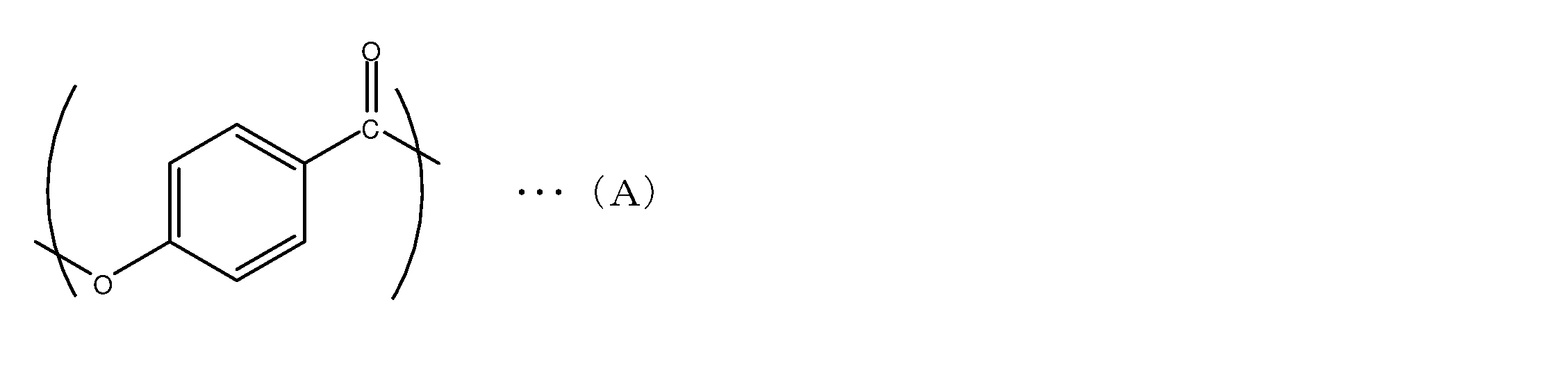
- a structural unit (A) following formula (A) is mentioned
- a structural unit (B) following formula (B) is mentioned.
- the ratio of the structural unit (A) to the structural unit (B) is preferably 9/1 to 1/1, more preferably 7/1 to 1/1, still more preferably 5/1. It is in the range of 1 to 1/1.
- the total of the structural unit of (A) and the structural unit of (B) may be, for example, 65 mol% or more, more preferably 70 mol% or more, and still more preferably 80 mol based on all the structural units. % Or more.
- a liquid crystalline polyester having 4 to 45% by mole of the constituent unit of (B) is preferable.
- the melting point of the liquid crystalline polyester suitably used in the present invention is preferably in the range of 250 to 360 ° C., more preferably 260 to 320 ° C.
- fusing point here is the main absorption peak temperature observed and measured with a differential scanning calorimeter (DSC; Mettler "TA3000") based on a JIS K7121 test method. Specifically, after taking 10 to 20 mg of a sample in the above DSC apparatus and sealing it in an aluminum pan, flow 100 cc / min of nitrogen as a carrier gas and measure the endothermic peak when the temperature is raised at 20 ° C./min. .
- thermoplastic polymers such as polyethylene terephthalate, modified polyethylene terephthalate, polyolefin, polycarbonate, polyamide, polyphenylene sulfide, polyether ether ketone, and fluorine resin are added to the above liquid crystalline polyester in the range not to impair the effects of the present invention. May be
- inorganic substances such as titanium oxide, kaolin, silica and barium oxide, carbon black, colorants such as dyes and pigments, and various additives such as antioxidants, ultraviolet light absorbers and light stabilizers may be included.
- a fiber obtained by melt spinning can be used as the liquid crystalline polyester fiber of the present invention.
- Melt spinning can be carried out by known or conventional methods. For example, after melting a fiber-forming resin for obtaining fibers in an extruder, it can be obtained by discharging from a nozzle at a predetermined spinning temperature.
- the single fiber fineness of the liquid crystalline polyester fiber of the present invention is not particularly limited, but is preferably 0.5 dtex to 50 dtex, more preferably 1 dex to 15 dtex, and still more preferably 1.5 dtex to 10 dtex. .
- the total fineness of the multifilaments of the fibers is not particularly limited, but is preferably 10 dtex or more and 50000 dtex or less, more preferably 15 dtex or more and 30000 dtex or less, and still more preferably 25 dtex or more and 10000 dtex or less.
- the multifilaments may be aligned and used as a tow.
- the tow thickness is preferably 0.1 mm or more and 10 mm or less, more preferably 0.2 mm or more and 5 mm or less, and still more preferably 0.3 mm or more and 3 mm or less.
- the liquid crystalline polyester fiber of the present invention can prevent contact between single fibers by adhering a water-soluble salt to a spinning raw yarn before heat treatment, and can prevent fusion between fibers during heat treatment .
- a method of adhering the water-soluble salt in addition to a method of directly adhering the water-soluble salt to the spinning raw yarn, there is a method of adhering to a fiber as an aqueous solution to precipitate solids, a fiber with a water-soluble binder, an adhesive agent, etc. And the like.
- the adhesion amount of the water-soluble salt is preferably 0.1 wt% or more, more preferably 0.3 wt% or more, still more preferably 0.5 wt% or more, based on the total weight of the spinning raw yarn, and preferably It is 5 wt% or less, more preferably 4 wt% or less, and still more preferably 3 wt% or less. If the adhesion is too small, the fusion preventing effect is small, and if the adhesion is too large, the water-soluble salt covers the fiber surface and heat is not easily transmitted to the inside of the fiber during heat treatment, which is not preferable.
- a known method can be used for the method of the heat treatment, and examples thereof include means such as atmosphere heating and contact heating.
- atmosphere any of air and inert gas (for example, nitrogen and argon) may be used.
- the heat treatment method any method can be adopted regardless of batch method or roll-to-roll method as long as the effects of the present invention are not impaired.
- the heat treatment temperature when the melting point of the liquid crystalline polyester fiber is Tm, the heat treatment is performed at a temperature of Tm-80 ° C. to Tm. Since the melting point of the fiber rises with the heat treatment, it is preferable to carry out the heat treatment in a temperature pattern in which the heat treatment temperature gradually rises.
- the method of removing the water-soluble salt after the heat treatment of the above-mentioned fiber for example, a method of immersing the fiber in a polar solvent such as water, irradiating the fiber with an ultrasonic wave in a polar solvent such as water A method of causing the fibers to vibrate in a polar solvent such as water, and the like.
- the solvent for removing the water-soluble salt is particularly preferably water from the viewpoint of the chemical effect on the fiber, the safety of the worker, and the environmental impact.
- the fiber of the present invention is excellent in the impregnation property of the matrix resin since there is no fusion between single fibers, and the residual amount of the anti-fusion agent is small, so the post-processability and the physical properties after processing are excellent. Therefore, it can be suitably used for various composite materials.
- the composite material of the present invention for example, a composite material in which the fiber of the present invention is formed into a fabric or sheet and impregnated with a matrix resin, or the fiber of the present invention is laminated in a fabric or sheet and impregnated with a matrix resin.
- Composite materials for example, a composite material in which the fiber of the present invention is formed into a fabric or sheet and impregnated with a matrix resin, or the fiber of the present invention is laminated in a fabric or sheet and impregnated with a matrix resin.
- the tensile strength (cN / dtex) is based on JIS L1013 using Shimadzu Corp. autograph AGS-100B, and the yarn length is 200 mm, initial load is 0.09 cN / dtex, and tensile speed is 100 mm / min. The sample was measured six times per sample, and the average value was calculated.
- the degree of fusion (f) was obtained by dispersing a sample obtained by cutting a heat-treated fiber bundle into a length of 20 mm using ultrasonic waves for 20 minutes in water using Brensonic 220 manufactured by Yamato Scientific Co., Ltd.
- the total number (n) of yarns was determined, and was calculated by the following equation (2) from the relationship with the number of single yarns (N) before heat treatment. In addition, this value is an average value of the value measured ten times about the sample extract
- collected at random after heat processing. [Equation 2] f N / n (2)
- the ash content was calculated from the ratio of the weight after ashing to the weight before ashing by ashing 2 g of fibers at 625 ° C. for 3 hours according to JIS K7052 (baking method).
- Processability was evaluated from the number of single thread breaks and fibrils after the sample passed through the roller guide. That is, after passing the sample on a hard chrome textured bearing roller guide with a diameter of 40 mm at a traveling speed of 100 m / min, a tension of 40 g after passing, and a contact angle of 90 °, 10 cm x 10 pieces per sample (total 1 m Minutes) were collected, and the number of single thread breaks and fibrils was counted visually using a loupe and a light microscope.
- the single filament breakage refers to a place where the end of the single fiber has been visually confirmed except for the end of the collected sample.
- fibril refers to a place where the surface is fluffed by friction, and fibrous exfoliation is observed independently from other parts.
- the number of single yarn breaks and fibrils was 1 or less per 1 m, and those with 2 or more and 10 or less were made 2 or more and 10 or less, respectively.
- Example 1 A liquid crystalline polyester fiber multifilament (manufactured by Kuraray Co., Ltd., trade name: Vectran NT) having a total fineness of 1670 dtex and a number of filaments of 300 was used as a spinning yarn.
- Vectran NT Vectran NT
- the above fiber was immersed in a 2 wt% aqueous solution of potassium iodide (manufactured by Wako Pure Chemical Industries, Ltd., trade name: reagent special grade potassium iodide), and dried at 100 ° C. for 10 minutes. At this time, the adhesion amount of the water-soluble salt was 2 wt% with respect to the total weight of the spun yarn.
- the mixture was gradually heated from room temperature to 300 ° C. in a nitrogen atmosphere, and treated for 16 hours.
- the ash content of this fiber is 0.06 wt%
- the fusion degree (f) is 1.07
- the tensile strength is 24.5 cN / dtex
- the amount of the anti-fusion agent remaining is small, and the fiber The result was that there was no fusion between them. Moreover, it turns out that it is excellent in fiber strength.
- the ash content is 0.3 wt% or less and the amount of the anti-fusion agent remaining on the fiber surface is small, as shown in Table 5, the number of broken single yarns and fibrils is small and the process passability is excellent. I understand that.
- Example 2 A liquid crystalline polyester fiber multifilament (manufactured by Kuraray Co., Ltd., trade name: Vectran NT) having a total fineness of 1670 dtex and a number of filaments of 300 was used as a spinning yarn.
- Vectran NT Vectran NT
- the above fiber was immersed in a 2 wt% aqueous solution of sodium chloride (manufactured by Wako Pure Chemical Industries, Ltd., trade name: reagent special grade sodium chloride), and dried at 100 ° C. for 10 minutes. At this time, the adhesion amount of the water-soluble salt was 2 wt% with respect to the total weight of the spinning raw yarn.
- the mixture was gradually heated from room temperature to 300 ° C. in a nitrogen atmosphere, and treated for 16 hours.
- the sodium chloride attached to the fibers is removed by using ultrasonic cleaning (manufactured by As One Corp., trade name: ultrasonic cleaner ASU-20D) for 3 minutes in water at 50 ° C., and the product oil agent is removed The product was applied to obtain a fiber product.
- ultrasonic cleaning manufactured by As One Corp., trade name: ultrasonic cleaner ASU-20D
- the ash content of this fiber is 0.07 wt%
- the fusion degree (f) is 1.09
- the tensile strength is 23.9 cN / dtex
- the amount of the anti-fusion agent remaining is small, and the fiber The result was that there was no fusion between them. Moreover, it turns out that it is excellent in fiber strength.
- the ash content is 0.3 wt% or less and the amount of the anti-fusion agent remaining on the fiber surface is small, as shown in Table 5, the number of broken single yarns and fibrils is small and the process passability is excellent. I understand that.
- Example 3 A liquid crystalline polyester fiber multifilament (manufactured by Kuraray Co., Ltd., trade name: Vectran NT) having a total fineness of 1670 dtex and a number of filaments of 300 was used as a spinning yarn.
- the above fiber was immersed in a 2 wt% aqueous solution of potassium chloride (manufactured by Wako Pure Chemical Industries, Ltd., trade name: reagent special grade potassium chloride), and dried at 100 ° C. for 10 minutes. At this time, the adhesion amount of the water-soluble salt was 2 wt% with respect to the total weight of the spinning raw yarn.
- the mixture was gradually heated from room temperature to 300 ° C. in a nitrogen atmosphere, and treated for 16 hours. After that, using ultrasonic cleaning (made by As One Co., Ltd., trade name: ultrasonic cleaner ASU-20D) for 3 minutes in water at 50 ° C., potassium chloride attached to the fibers is removed, and the product oil agent is removed. The product was applied to obtain a fiber product.
- the ash content of this fiber is 0.09 wt%
- the degree of fusion (f) is 1.11
- the tensile strength is 23.3 cN / dtex
- the amount of residual anti-fusion agent is small, and the fiber The result was that there was no fusion between them. Moreover, it turns out that it is excellent in fiber strength.
- the ash content is 0.3 wt% or less and the amount of the anti-fusion agent remaining on the fiber surface is small, as shown in Table 5, the number of broken single yarns and fibrils is small and the process passability is excellent. I understand that.
- Example 4 A liquid crystalline polyester fiber multifilament (manufactured by Kuraray Co., Ltd., trade name: Vectran NT) having a total fineness of 1670 dtex and a number of filaments of 300 was used as a spinning yarn.
- the fiber was immersed in a 2 wt% aqueous solution of sodium iodide (manufactured by Wako Pure Chemical Industries, Ltd., trade name: reagent special grade sodium iodide), and dried at 100 ° C. for 10 minutes. At this time, the adhesion amount of the water-soluble salt was 2 wt% with respect to the total weight of the spinning raw yarn.
- the mixture was gradually heated from room temperature to 300 ° C. in a nitrogen atmosphere, and treated for 16 hours. After that, remove sodium iodide attached to the fiber by using ultrasonic cleaning (manufactured by As One Co., Ltd., trade name: ultrasonic cleaner ASU-20D) for 3 minutes in water at 50 ° C. to remove product oil To give a fiber product.
- ultrasonic cleaning manufactured by As One Co., Ltd., trade name: ultrasonic cleaner ASU-20D
- the ash content of this fiber is 0.07 wt%
- the fusion degree (f) is 1.09
- the tensile strength is 23.2 cN / dtex
- the amount of residual anti-fusion agent is small
- the ash content is 0.3 wt% or less and the amount of the anti-fusion agent remaining on the fiber surface is small, as shown in Table 5, the number of broken single yarns and fibrils is small and the process passability is excellent. I understand that.
- Example 5 A liquid crystalline polyester fiber multifilament (manufactured by Kuraray Co., Ltd., trade name: Vectran NT) having a total fineness of 1670 dtex and a number of filaments of 300 was used as a spinning yarn.
- the above fiber was immersed in a 0.05 wt% aqueous solution of potassium iodide (manufactured by Wako Pure Chemical Industries, Ltd., trade name: reagent special grade potassium iodide), and dried at 100 ° C. for 10 minutes. At this time, the adhesion amount of the water-soluble salt was 0.05 wt% with respect to the total weight of the spun yarn.
- the mixture was gradually heated from room temperature to 300 ° C. in a nitrogen atmosphere, and treated for 16 hours.
- the ash content of this fiber is 0.04 wt%
- the fusion degree (f) is 2.91
- the tensile strength is 23.1 cN / dtex
- the amount of the anti-fusion agent remaining is small, and the fiber The result is a small fusion between them.
- Example 6 A liquid crystalline polyester fiber multifilament (manufactured by Kuraray Co., Ltd., trade name: Vectran NT) having a total fineness of 1670 dtex and a number of filaments of 300 was used as a spinning yarn.
- the above fiber was immersed in a 0.25 wt% aqueous solution of potassium iodide (manufactured by Wako Pure Chemical Industries, Ltd., trade name: reagent special grade potassium iodide), and dried at 100 ° C. for 10 minutes. At this time, the adhesion amount of the water-soluble salt was 0.25 wt% with respect to the total weight of the spun yarn.
- the mixture was gradually heated from room temperature to 300 ° C. in a nitrogen atmosphere, and treated for 16 hours. Thereafter, a product oil was applied to obtain a fiber product.
- the ash content of this fiber is 0.25 wt%
- the degree of fusion (f) is 1.80
- the tensile strength is 24.0 cN / dtex
- the amount of residual anti-fusion agent is small, and the fiber The result was that there was no fusion between them. Moreover, it turns out that it is excellent in fiber strength.
- the ash content is 0.3 wt% or less and the amount of the anti-fusion agent remaining on the fiber surface is small, as shown in Table 5, the number of broken single yarns and fibrils is small and the process passability is good. I understand.
- Comparative Example 1 A liquid crystalline polyester fiber multifilament (manufactured by Kuraray Co., Ltd., trade name: Vectran NT) having a total fineness of 1670 dtex and a number of filaments of 300 was used as a spinning yarn.
- Vectran NT Vectran NT
- the above fiber was heated gradually in the range of room temperature to 300 ° C. in a nitrogen atmosphere and treated for 16 hours. Thereafter, a product oil was applied to obtain a fiber product.
- the ash content of this fiber is 0.04 wt%
- the tensile strength is 23.2 cN / dtex
- the anti-fusion agent is not added, the process passability is excellent
- the degree of fusion (f) was 5.88, resulting in large fusion between fibers. It is considered that this is because, in Comparative Example 1, the fusion preventing agent was not applied, so that the single fibers were fused to each other, and a fiber without fusion was not obtained.
- Comparative Example 2 A liquid crystalline polyester fiber multifilament (manufactured by Kuraray Co., Ltd., trade name: Vectran NT) having a total fineness of 1670 dtex and a number of filaments of 300 was used as a spinning yarn.
- Vectran NT Vectran NT
- the degree of fusion (f) of this fiber is 1.13 and there is no fusion between the fibers, but the ash content of the fiber is 0.35 wt%, and the inorganic particles remain even after washing Since the amount is large, fiber defects due to the inorganic particles are generated, and it is understood that the fiber strength is lowered (tensile strength is lowered to 21.1 cN / dtex) as compared with Examples 1 to 6.
- Comparative Example 3 A liquid crystalline polyester fiber multifilament (manufactured by Kuraray Co., Ltd., trade name: Vectran NT) having a total fineness of 1670 dtex and a number of filaments of 300 was used as a spinning yarn.
- Vectran NT Vectran NT
- the degree of fusion (f) of this fiber is 1.18 and there is no fusion between fibers, but the ash content of the fiber is 1.24 wt%, and the barium sulfate remains even after washing Since the amount is large, fiber defects due to the inorganic particles are generated, and it is understood that the fiber strength is lowered (tensile strength is lowered to 22.8 cN / dtex) as compared with Examples 1 to 6.
- the fiber of the present invention can be suitably used as a fiber to be used for a composite member such as a laminate, or a fiber to be plated such as an organic material electric wire.
Landscapes
- Engineering & Computer Science (AREA)
- Textile Engineering (AREA)
- Chemical & Material Sciences (AREA)
- Chemical Kinetics & Catalysis (AREA)
- General Chemical & Material Sciences (AREA)
- Inorganic Chemistry (AREA)
- Chemical Or Physical Treatment Of Fibers (AREA)
- Compositions Of Macromolecular Compounds (AREA)
- Artificial Filaments (AREA)
- Treatments For Attaching Organic Compounds To Fibrous Goods (AREA)
Abstract
液晶性ポリエステル繊維は、灰分が0.3wt%以下であり、かつ融着度(f)が3以下であり、引張強度が18cN/dtex以上であり、融着防止剤の残存がなく、マルチフィラメント間の融着がない、高強度の液晶性ポリステル繊維である。
Description
本発明は、液晶性ポリエステル繊維及びその製造方法に関する。
液晶性ポリエステルは、溶融紡糸のみで高配向の繊維を形成して高物性を発現することができ、更に軟化温度付近で熱処理することにより、強度、弾性率をより一層向上させることができる。しかし、熱処理時において単糸間で融着が発生し易く、融着が存在すると繊維軸方向の応力の一部が繊維軸に垂直な方向の応力に変換されるため、繊維軸方向に対しては高強度を示すものの、繊維軸に垂直な方向に対しては分子の凝集力が弱いこともあって非常に脆くなる。その結果、芳香族ポリエステル繊維特有の欠陥が増幅されることとなり、繊維の力学物性が低下するという問題がある。
これに対して、熱処理中の単糸間の融着を防止する方法として、熱処理前に無機粒子を付着させる方法(例えば、特許文献1参照)やシリコーンオイル等の有機性液相熱媒体中で熱処理する方法(例えば、特許文献2参照)が提案されている。
しかしながら、特許文献1に記載の方法では、融着を防止する目的で付与した無機粒子を、熱処理後に繊維に損傷を与えることなく洗浄除去することは困難であった。その結果、繊維表面に多量の無機粒子が残存するため、該繊維が熱処理後の工程を通過する際に、無機粒子が付着した繊維同士が擦れる、または、製造工程におけるローラー、ガイド類と繊維とが擦れることで、繊維表面に傷が入り、単糸切れやフィブリル化といった欠陥や、繊維の力学物性の低下が起きるという問題があった。
一方で、特許文献2に記載されているシリコーンオイル等の有機性液相熱媒体中で熱処理する方法では、無機粒子に起因する繊維強度に低下という問題は発生しないが、繊維表面に付着した熱媒体を除去することは困難であった。また、熱媒体を洗浄除去する場合は、有機溶媒を用いる必要があるため、作業者の安全性や環境負荷の観点から好ましくないという問題もあった。
そこで、本発明者等は上記課題を鋭意研究した結果、ヨウ化カリウムや塩化ナトリウムのような水溶性塩を融着防止剤として付着させた紡糸原糸を熱処理し、その後、洗浄除去することで、繊維間の融着がなく、融着防止剤の残存量が少ない、高強度の液晶性ポリエステル繊維が得られることを見出し、本発明を完成させるに至った。
上記目的を達成するために、本発明の液晶性ポリエステル繊維は、灰分が0.3wt%以下であり、かつ融着度(f)が3以下であり、引張強度が18cN/dtex以上であることを特徴とする。
また、本発明の液晶性ポリエステル繊維の製造方法は、液晶性ポリエステル繊維の紡糸原糸に、水溶性塩を付着させて熱処理する工程を少なくとも含むことを特徴とする。
本発明によれば、繊維表面における融着防止剤の残存量が少なく、繊維間の融着のない高強度の液晶性ポリエステル繊維を提供することができる。
本発明は、液晶性ポリエステル繊維の紡糸原糸に、水溶性塩を付着させて熱処理することで、単繊維間の融着を防止しながら、高強度の液晶性ポリエステル繊維を得る。
以下、本発明の詳細を説明する。
本発明の液晶性ポリエステル繊維は高強度であることが重要である。本発明における「高強度」とは、引張強度が18cN/dtex以上であることを指す。さらに、本発明の繊維の引張強度として、好ましくは20cN/dtex以上、さらに好ましくは23cN/dtex以上である。なお、引張強度は、後述する実施例に記載の測定方法により算出されるものである。
また、本発明の液晶性ポリエステル繊維は融着度(f)が、3以下であることが重要である。より好ましくは2以下、さらに好ましくは1.5以下である。融着度が3より大きいと、得られた繊維において欠陥やフィブリルが多くなり、製品品位の低下、高次加工工程での加工性悪化の原因になるとともに、欠陥やフィブリルに起因して繊維強度が低下する。なお、この融着度(f)は、後述する実施例に記載の測定方法により算出されるものである。
さらに、本発明の液晶性ポリエステル繊維は灰分が0.3wt%以下であることが重要である。灰分が0.3wt%より大きくなると、繊維表面に付着した多量の融着防止剤によって、繊維に傷が付きやすくなり、繊維強度が低下するとともに、工程通過性も悪くなる。
即ち、本発明の液晶性ポリエステル繊維においては、灰分が0.3wt%以下であり、繊維表面における融着防止剤の残存量が少ないため、残存している融着防止剤に起因する不都合(単糸切れ等の欠陥やフィブリルに起因して繊維強度が低下するとともに工程通過性が低下するという不都合)の発生を抑制することが可能になる。
また、多量の融着防止剤が繊維表面に残存することによって、工程通過時に単糸切れやフィブリル化といった欠陥が発生しやすくなるため、本発明では融着防止剤として水溶性塩を用いることが好適である。本発明の繊維に対して、水溶性塩を付着させた後に熱処理をし、水溶性塩を洗浄除去することで、繊維の灰分を低減させることができる。この灰分は、好ましくは0.2wt%以下であり、さらに好ましくは0.1wt%以下である。なお、灰分は後述する実施例に記載する測定方法により算出されるものである。
本発明で用いる水溶性塩としては、水などの極性溶媒に溶解し、熱処理温度で融解しない固体であれば特に限定されない。例えば、塩化リチウム、塩化ナトリウム、塩化カリウム、臭化リチウム、臭化ナトリウム、臭化カリウム、ヨウ化リチウム、ヨウ化ナトリウム、ヨウ化カリウム、炭酸リチウム、炭酸ナトリウム、炭酸カリウム、硫酸リチウム、硫酸ナトリウム、硫酸カリウムなどのアルカリ金属塩を用いることができる。これらの中でも、塩化リチウム、塩化ナトリウム、塩化カリウム、臭化リチウム、臭化ナトリウム、臭化カリウム、ヨウ化リチウム、ヨウ化ナトリウム、ヨウ化カリウムなどのハロゲン化アルカリ金属塩を用いることがより好ましい。さらに、水への溶解度が高いことから熱処理後における洗浄除去が容易であり、また、比較的安価であることから、ヨウ化ナトリウム、ヨウ化カリウム、塩化ナトリウム、塩化カリウムを用いることが特に好ましい。なお、これらの水溶性塩は、単独で、あるいは2種以上を組み合わせて用いてもよい。
本発明の液晶性ポリエステル繊維は、液晶性ポリエステルを溶融紡糸することにより得ることができる。液晶性ポリエステルとしては、例えば、芳香族ジオール、芳香族ジカルボン酸、芳香族ヒドロキシカルボン酸等に由来する反復構成単位からなり、本発明の効果を損なわない限り、芳香族ジオール、芳香族ジカルボン酸、芳香族ヒドロキシカルボン酸に由来する構成単位は、その化学的構成については特に限定されるものではない。また、本発明の効果を阻害しない範囲で、液晶性ポリエステルは、芳香族ジアミン、芳香族ヒドロキシアミンまたは芳香族アミノカルボン酸に由来する構成単位を含んでいてもよい。例えば、好ましい構成単位としては、表1に示す例が挙げられる。

表1の構成単位において、mは0~2の整数であり、式中のYは、1~置換可能な最大数の範囲において、それぞれ独立して、水素原子、ハロゲン原子(例えば、フッ素原子、塩素原子、臭素原子、ヨウ素原子など)、アルキル基(例えば、メチル基、エチル基、イソプロピル基、t-ブチル基などの炭素数1から4のアルキル基など)、アルコキシ基(例えば、メトキシ基、エトキシ基、イソプロポキシ基、n-ブトキシ基など)、アリール基(例えば、フェニル基、ナフチル基など)、アラルキル基(ベンジル基(フェニルメチル基)、フェネチル基(フェニルエチル基)など)、アリールオキシ基(例えば、フェノキシ基など)、アラルキルオキシ基(例えば、ベンジルオキシ基など)などが挙げられる。
より好ましい構成単位としては、下記表2、表3及び表4に示す例(1)~(18)に記載される構成単位が挙げられる。なお、式中の構成単位が、複数の構造を示し得る構成単位である場合、そのような構成単位を二種以上組み合わせて、ポリマーを構成する構成単位として使用してもよい。
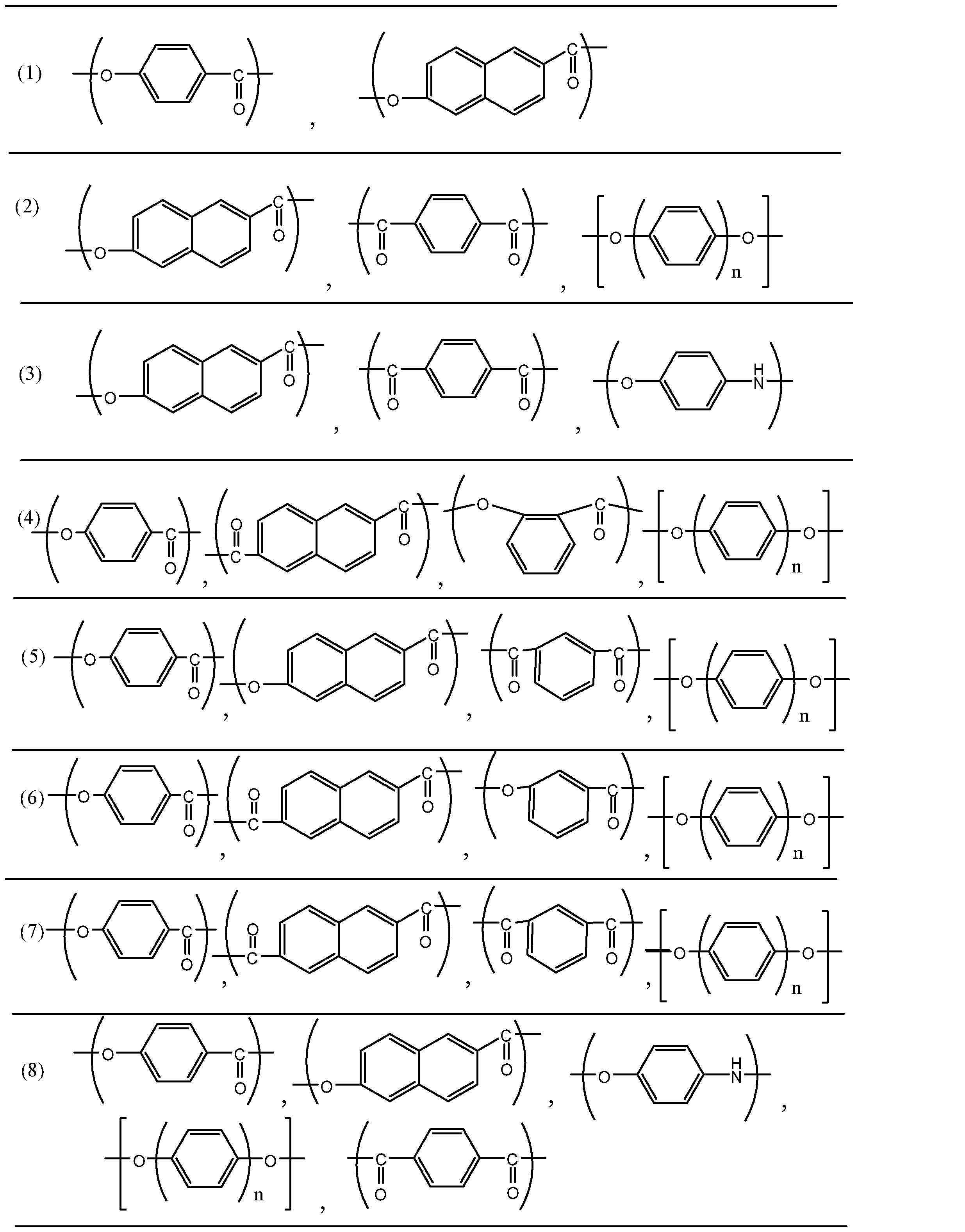
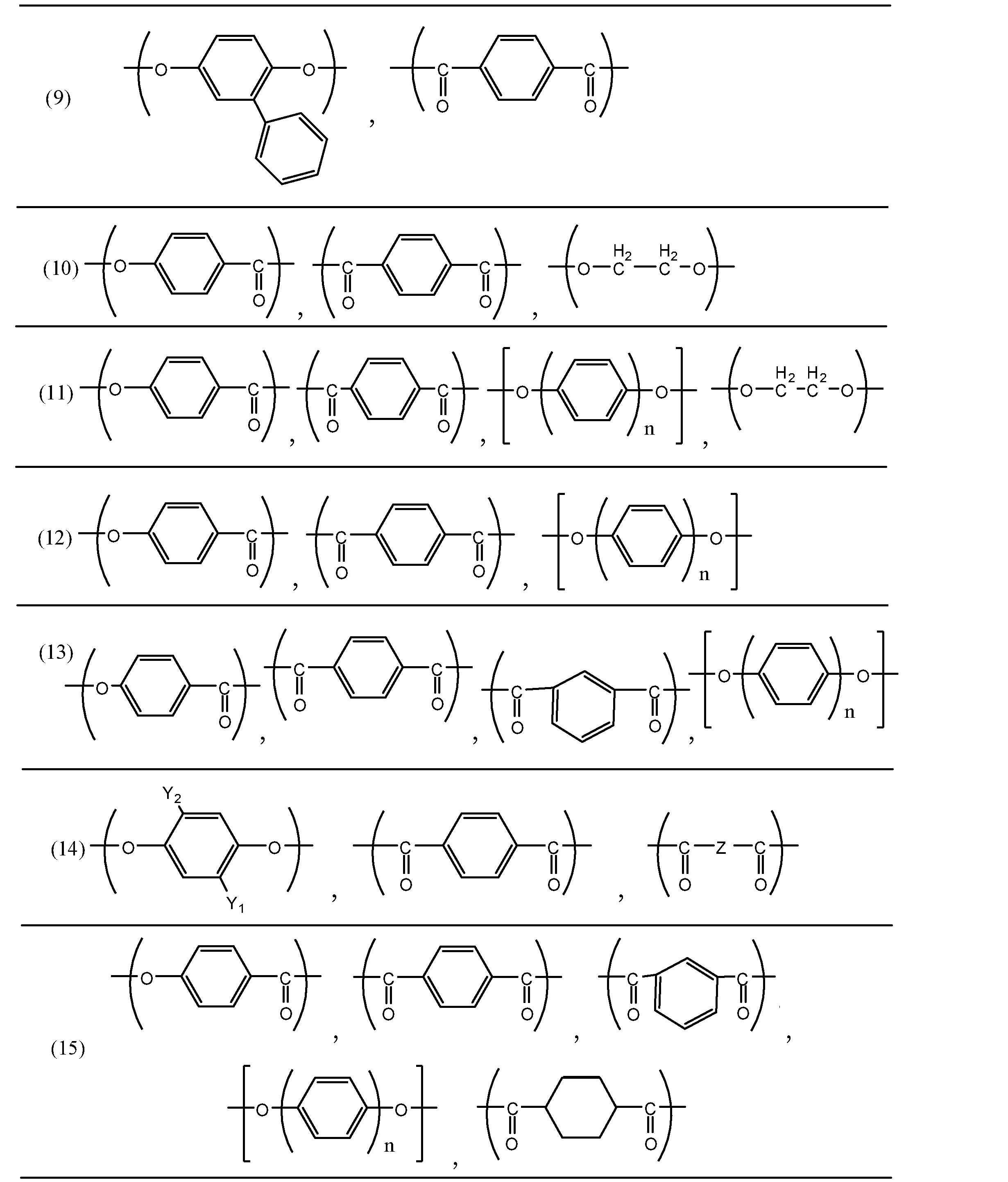
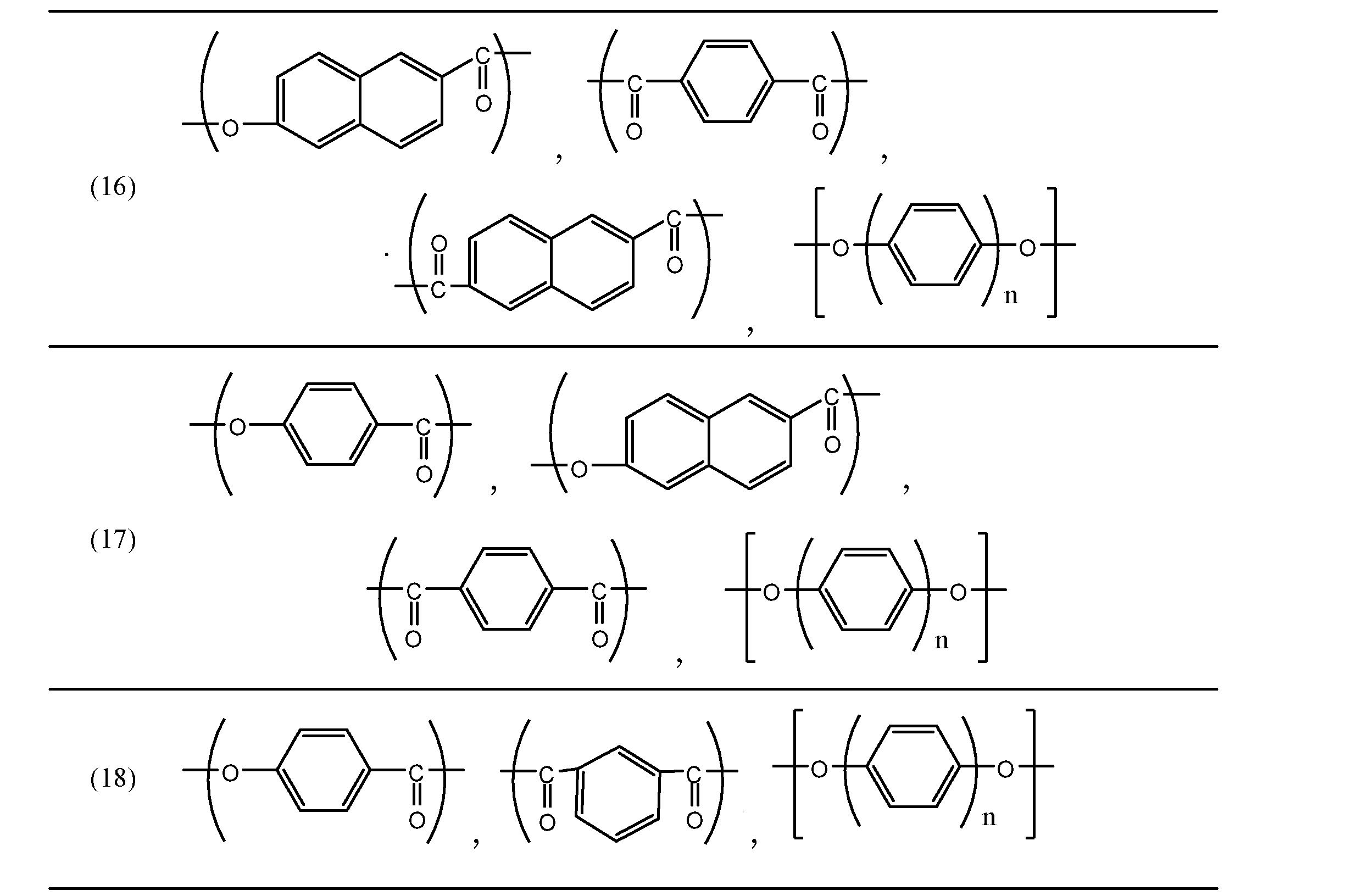
表2、表3及び表4の構成単位において、nは1または2の整数で、それぞれの構成単位n=1、n=2は、単独でまたは組み合わせて存在してもよく、Y1及びY2は、それぞれ独立して、水素原子、ハロゲン原子(例えば、フッ素原子、塩素原子、臭素原子、ヨウ素原子など)、アルキル基(例えば、メチル基、エチル基、イソプロピル基、t-ブチル基などの炭素数1から4のアルキル基など)、アルコキシ基(例えば、メトキシ基、エトキシ基、イソプロポキシ基、n-ブトキシ基など)、アリール基(例えば、フェニル基、ナフチル基など)、アラルキル基(ベンジル基(フェニルメチル基)、フェネチル基(フェニルエチル基)など)、アリールオキシ基(例えば、フェノキシ基など)、アラルキルオキシ基(例えば、ベンジルオキシ基など)などであってもよい。これらのうち、水素原子、塩素原子、臭素原子、またはメチル基が好ましい。
また、Zとしては、下記式で表される置換基が挙げられる。
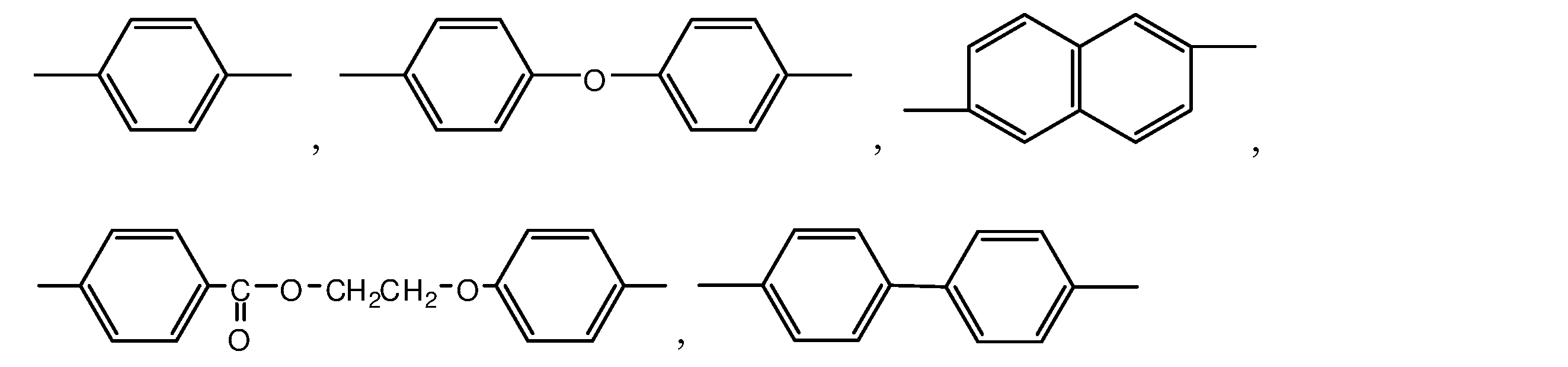
液晶性ポリエステルは、好ましくは、ナフタレン骨格を構成単位として有する組み合わせであってもよい。なお、ヒドロキシ安息香酸由来の構成単位(A)と、ヒドロキシナフトエ酸由来の構成単位(B)の両方を含むことが、特に好ましい。例えば、構成単位(A)としては下記式(A)が挙げられ、構成単位(B)としては下記式(B)が挙げられる。溶融成形性を向上する観点から、構成単位(A)と構成単位(B)の比率は、好ましくは9/1~1/1、より好ましくは7/1~1/1、さらに好ましくは5/1~1/1の範囲である。

また、(A)の構成単位と(B)の構成単位の合計は、例えば、全構成単位に対して65モル%以上であってもよく、より好ましくは70モル%以上、さらに好ましくは80モル%以上である。ポリマー中、特に(B)の構成単位が4~45モル%である液晶性ポリエステルが好ましい。
本発明で好適に用いられる液晶性ポリエステルの融点は、250~360℃の範囲であることが好ましく、より好ましくは260~320℃である。なお、ここでいう融点とは、JIS K7121試験法に準拠し、示差走差熱量計(DSC;メトラー社製「TA3000」)で測定し、観察される主吸収ピーク温度である。具体的には、前記DSC装置に、サンプルを10~20mgをとりアルミ製パンへ封入した後、キャリヤーガスとして窒素を100cc/分流し、20℃/分で昇温したときの吸熱ピークを測定する。ポリマーの種類によって、DSC測定において1st runで明確なピークが現れない場合は、50℃/分の昇温速度で予想される流れ温度よりも50℃高い温度まで昇温し、その温度で3分間完全に溶融した後、80℃/分の降温速度で50℃まで降温し、しかる後に20℃/分の昇温速度で吸熱ピークを測定するとよい。
なお、上記液晶性ポリエステルには、本発明の効果を損なわない範囲で、ポリエチレンテレフタレート、変性ポリエチレンテレフタレート、ポリオレフィン、ポリカーボネート、ポリアミド、ポリフェニレンサルファイド、ポリエーテルエーテルケトン、フッ素樹脂等の熱可塑性ポリマーを添加してもよい。また、酸化チタン、カオリン、シリカ、酸化バリウム等の無機物、カーボンブラック、染料や顔料等の着色剤、酸化防止剤、紫外線吸収剤、光安定剤等の各種添加剤を含んでいてもよい。
本発明の液晶性ポリエステル繊維は、溶融紡糸により得られる繊維を用いることができる。溶融紡糸は公知または慣用の方法により行うことができる。例えば、押出機において繊維を得るための繊維形成樹脂を溶融させた後、所定の紡糸温度でノズルから吐出して得ることができる。
本発明の液晶性ポリエステル繊維の単繊維繊度は、特に限定されるものではないが、好ましくは0.5dtex以上50dtex以下、より好ましくは1dex以上15dtex以下、さらに好ましくは1.5dtex以上10dtex以下である。また、上記繊維のマルチフィラメントでの総繊度は、特に限定されるものではないが、好ましくは10dtex以上50000dtex以下、より好ましくは15dtex以上30000dtex以下、さらに好ましくは25dtex以上10000dtex以下である。さらに、上記マルチフィラメントを引き揃えてトウとして使用してもよい。トウ厚みは好ましくは0.1mm以上10mm以下、より好ましくは0.2mm以上5mm以下、さらに好ましくは0.3mm以上3mm以下である。
本発明の液晶性ポリエステル繊維は、熱処理前に水溶性塩を紡糸原糸に付着させることで、単繊維間が接触することを抑制し、熱処理中で繊維間の融着を防止することができる。水溶性塩を付着させる方法としては、直接、紡糸原糸に水溶性塩を接着させる方法の他に、水溶液として繊維に付着させて固体を析出させる方法、水溶性のバインダー、接着剤等とともに繊維に付着させる方法等が挙げられる。水溶性塩の付着量は、紡糸原糸全体の重量に対して、好ましくは0.1wt%以上、より好ましくは0.3wt%以上、さらに好ましくは0.5wt%以上であり、また、好ましくは5wt%以下、より好ましくは4wt%以下、さらに好ましくは3wt%以下である。付着が少なすぎると融着防止効果が小さく、付着が多すぎると水溶性塩が繊維表面を覆ってしまい、熱処理の際に繊維内部に熱が伝わりにくくなるため好ましくない。
該熱処理の方法は公知の方法を用いることができ、例えば、雰囲気加熱、接触加熱などの手段が挙げられる。雰囲気としては空気、不活性ガス(例えば窒素、アルゴン)のいずれを用いてもよい。なお、該熱処理の方式は、本発明の効果を損なわない限り、バッチ方式、ロール・トゥ・ロール方式を問わず、いずれの方式も採用することができる。また、熱処理温度に関しては、液晶性ポリエステル繊維の融点をTmとするとき、Tm-80℃~Tmの温度で行われる。該繊維の融点は熱処理につれ上昇するので、熱処理温度は順次上昇していく温度パターンで熱処理することが好ましい。
上記繊維の熱処理後に水溶性塩を除去する方法としては、特に限定はなく、例えば、該繊維を水などの極性溶媒中に浸漬させる方法、水などの極性溶媒中で該繊維に超音波を照射させる方法、水などの極性溶媒中で該繊維を振動させる方法等が挙げられる。なお、水溶性塩を除去するための溶媒は、繊維への化学的影響や作業者の安全性、環境負荷の観点から、水であることが特に好ましい。
本発明の繊維は、単繊維間で融着がないため、マトリックス樹脂の含浸性に優れ、また、融着防止剤の残存量が少ないことから、後加工性、加工後の物性に優れる。従って、各種複合材料に好適に用いることができる。
本発明の複合材料としては、例えば、本発明の繊維を織物やシート状にしてマトリックス樹脂を含浸させた複合材料、あるいは本発明の繊維を織物やシート状にして積層させてマトリックス樹脂を含浸させた複合材料などが挙げられる。
引張強度(cN/dtex)は、JIS L1013に準拠し、(株)島津製作所製オートグラフAGS-100Bを用い、糸長200mm、初荷重0.09cN/dtex、引張速度100mm/分の条件にて、1試料当り6回測定し、その平均値を算出した。
融着防止剤付着率(wt%)は、融着防止剤付着処理による重量の増分を表したものであり、該処理を行った後の試料と行う前の試料をそれぞれ100℃で10分間乾燥させたのち、同じ長さ当たりの重量を測定し、下記式(1)で算出した。なお、試料の長さは、重量が0.5gを上回る範囲で設定した。またかかる値は、無作為に採取した融着防止剤付着処理前後の試料について各10回測定した値の平均値である。
[数1]
融着防止剤付着率(wt%)=100×{(処理後の試料の重量)-(処理前の資料の重量)}/(処理後の試料の重量) (1)
[数1]
融着防止剤付着率(wt%)=100×{(処理後の試料の重量)-(処理前の資料の重量)}/(処理後の試料の重量) (1)
融着度(f)は、熱処理繊維束を20mmの長さに切断した試料を、ヤマト科学社製ブレンソニック220を用い、水中で20分間、超音波を用いて分散させ、水中に分散した単糸の合計数(n)を求め、熱処理前の単糸数(N)との関係から、下記式(2)により算出した。なお、かかる値は、熱処理後、無作為に採取した試料について10回測定した値の平均値である。
[数2]
f=N/n (2)
[数2]
f=N/n (2)
灰分は、JIS K7052(焼成法)に準拠し、繊維2gを625℃で3時間灰化させ、灰化前の重量に対する灰化後の重量の割合から算出した。
工程通過性は、試料がローラーガイドを通過した後の単糸切れ及びフィブリルの個数から評価した。すなわち、直径40mmの硬質クロム梨地加工されたベアリングローラーガイド上を、走行速度100m/分、通過後張力40g、接触角90°で試料を通過させた後、1試料当たり10cm×10本(合計1m分)を採取し、単糸切れ及びフィブリルの個数をルーペ及び光学顕微鏡を用いて目測で計数した。
ここで、単糸切れとは、採取試料末端を除いて、単繊維の末端が目視で確認できた箇所を指す。また、フィブリルとは、表面が摩擦により毛羽立ち、その他の部分から独立して繊維質の剥離が見られる箇所を指す。
そして、単糸切れ及びフィブリルの個数が1mあたり1個以下のものを工程通過性A、2個以上10個以下のものを工程通過性B、11個以上のものを工程通過性Cとした。
[実施例1]
紡糸原糸として、総繊度1670dtex、フィラメント本数300本の液晶性ポリエステル繊維マルチフィラメント((株)クラレ製、商品名:ベクトランNT)を用いた。
紡糸原糸として、総繊度1670dtex、フィラメント本数300本の液晶性ポリエステル繊維マルチフィラメント((株)クラレ製、商品名:ベクトランNT)を用いた。
上記繊維をヨウ化カリウム(和光純薬工業(株)製、商品名:試薬特級ヨウ化カリウム)2wt%水溶液に浸漬させて、100℃で10分間、乾燥させた。この際、水溶性塩の付着量は紡糸原糸全体の重量に対して2wt%であった。これを窒素雰囲気下で、室温~300℃の範囲で徐々に昇温し、16時間処理した。その後、50℃の水中で3分間、超音波洗浄(アズワン(株)製、商品名:超音波洗浄機ASU-20D)を使用することにより、繊維に付着したヨウ化カリウムを除去し、製品油剤を付与させて繊維製品を得た。
表5に示すように、この繊維の灰分は0.06wt%、融着度(f)は1.07、引張強度は24.5cN/dtexであり、融着防止剤の残存量が少なく、繊維間の融着がない結果となった。また、繊維強度に優れていることが分かる。
また、灰分が0.3wt%以下であり、繊維表面における融着防止剤の残存量が少ないため、表5に示すように、単糸切れ及びフィブリルの個数が少なく、工程通過性に優れていることが分かる。
[実施例2]
紡糸原糸として、総繊度1670dtex、フィラメント本数300本の液晶性ポリエステル繊維マルチフィラメント((株)クラレ製、商品名:ベクトランNT)を用いた。
紡糸原糸として、総繊度1670dtex、フィラメント本数300本の液晶性ポリエステル繊維マルチフィラメント((株)クラレ製、商品名:ベクトランNT)を用いた。
上記繊維を塩化ナトリウム(和光純薬工業(株)製、商品名:試薬特級塩化ナトリウム)2wt%水溶液に浸漬させて、100℃で10分間乾燥させた。このとき、水溶性塩の付着量は紡糸原糸全体の重量に対して2wt%であった。これを窒素雰囲気下で、室温~300℃の範囲で徐々に昇温し、16時間処理した。その後、50℃の水中で3分間、超音波洗浄(アズワン(株)製、商品名:超音波洗浄機ASU-20D)を使用することにより、繊維に付着した塩化ナトリウムを除去し、製品油剤を付与させて繊維製品を得た。
表5に示すように、この繊維の灰分は0.07wt%、融着度(f)は1.09、引張強度は23.9cN/dtexであり、融着防止剤の残存量が少なく、繊維間の融着がない結果となった。また、繊維強度に優れていることが分かる。
また、灰分が0.3wt%以下であり、繊維表面における融着防止剤の残存量が少ないため、表5に示すように、単糸切れ及びフィブリルの個数が少なく、工程通過性に優れていることが分かる。
[実施例3]
紡糸原糸として、総繊度1670dtex、フィラメント本数300本の液晶性ポリエステル繊維マルチフィラメント((株)クラレ製、商品名:ベクトランNT)を用いた。
紡糸原糸として、総繊度1670dtex、フィラメント本数300本の液晶性ポリエステル繊維マルチフィラメント((株)クラレ製、商品名:ベクトランNT)を用いた。
上記繊維を塩化カリウム(和光純薬工業(株)製、商品名:試薬特級塩化カリウム)2wt%水溶液に浸漬させて、100℃で10分間乾燥させた。このとき、水溶性塩の付着量は紡糸原糸全体の重量に対して2wt%であった。これを窒素雰囲気下で、室温~300℃の範囲で徐々に昇温し、16時間処理した。その後、50℃の水中で3分間、超音波洗浄(アズワン(株)製、商品名:超音波洗浄機ASU-20D)を使用することにより、繊維に付着した塩化カリウムを除去し、製品油剤を付与させて繊維製品を得た。
表5に示すように、この繊維の灰分は0.09wt%、融着度(f)は1.11、引張強度は23.3cN/dtexであり、融着防止剤の残存量が少なく、繊維間の融着がない結果となった。また、繊維強度に優れていることが分かる。
また、灰分が0.3wt%以下であり、繊維表面における融着防止剤の残存量が少ないため、表5に示すように、単糸切れ及びフィブリルの個数が少なく、工程通過性に優れていることが分かる。
[実施例4]
紡糸原糸として、総繊度1670dtex、フィラメント本数300本の液晶性ポリエステル繊維マルチフィラメント((株)クラレ製、商品名:ベクトランNT)を用いた。
紡糸原糸として、総繊度1670dtex、フィラメント本数300本の液晶性ポリエステル繊維マルチフィラメント((株)クラレ製、商品名:ベクトランNT)を用いた。
上記繊維をヨウ化ナトリウム(和光純薬工業(株)製、商品名:試薬特級ヨウ化ナトリウム)2wt%水溶液に浸漬させて、100℃で10分間乾燥させた。このとき、水溶性塩の付着量は紡糸原糸全体の重量に対して2wt%であった。これを窒素雰囲気下で、室温~300℃の範囲で徐々に昇温し、16時間処理した。その後、50℃の水中で3分間、超音波洗浄(アズワン(株)製、商品名:超音波洗浄機ASU-20D)を使用することにより、繊維に付着したヨウ化ナトリウムを除去し、製品油剤を付与させて繊維製品を得た。
表5に示すように、この繊維の灰分は0.07wt%、融着度(f)は1.09、引張強度は23.2cN/dtexであり、融着防止剤の残存量が少なく、繊維間の融着がない結果となった。また、繊維強度に優れていることが分かる。
また、灰分が0.3wt%以下であり、繊維表面における融着防止剤の残存量が少ないため、表5に示すように、単糸切れ及びフィブリルの個数が少なく、工程通過性に優れていることが分かる。
[実施例5]
紡糸原糸として、総繊度1670dtex、フィラメント本数300本の液晶性ポリエステル繊維マルチフィラメント((株)クラレ製、商品名:ベクトランNT)を用いた。
紡糸原糸として、総繊度1670dtex、フィラメント本数300本の液晶性ポリエステル繊維マルチフィラメント((株)クラレ製、商品名:ベクトランNT)を用いた。
上記繊維をヨウ化カリウム(和光純薬工業(株)製、商品名:試薬特級ヨウ化カリウム)0.05wt%水溶液に浸漬させて、100℃で10分間乾燥させた。このとき、水溶性塩の付着量は紡糸原糸全体の重量に対して0.05wt%であった。これを窒素雰囲気下で、室温~300℃の範囲で徐々に昇温し、16時間処理した。その後、50℃の水中で3分間、超音波洗浄(アズワン(株)製、商品名:超音波洗浄機ASU-20D)を使用することにより、繊維に付着したヨウ化カリウムを除去し、製品油剤を付与させて繊維製品を得た。
表5に示すように、この繊維の灰分は0.04wt%、融着度(f)は2.91、引張強度は23.1cN/dtexであり、融着防止剤の残存量が少なく、繊維間の融着が小さい結果となった。また、繊維強度に優れていることが分かる。
なお、上述の実施例1~4に比し、融着防止剤の付着量が十分ではないため、実施例1~4に比し、繊維間の融着が、若干、大きい結果となった。
[実施例6]
紡糸原糸として、総繊度1670dtex、フィラメント本数300本の液晶性ポリエステル繊維マルチフィラメント((株)クラレ製、商品名:ベクトランNT)を用いた。
紡糸原糸として、総繊度1670dtex、フィラメント本数300本の液晶性ポリエステル繊維マルチフィラメント((株)クラレ製、商品名:ベクトランNT)を用いた。
上記繊維をヨウ化カリウム(和光純薬工業(株)製、商品名:試薬特級ヨウ化カリウム)0.25wt%水溶液に浸漬させて、100℃で10分間乾燥させた。このとき、水溶性塩の付着量は紡糸原糸全体の重量に対して0.25wt%であった。これを窒素雰囲気下で、室温~300℃の範囲で徐々に昇温し、16時間処理した。その後、製品油剤を付与させて繊維製品を得た。
表5に示すように、この繊維の灰分は0.25wt%、融着度(f)は1.80、引張強度は24.0cN/dtexであり、融着防止剤の残存量が少なく、繊維間の融着がない結果となった。また、繊維強度に優れていることが分かる。
また、灰分が0.3wt%以下であり、繊維表面における融着防止剤の残存量が少ないため、表5に示すように、単糸切れ及びフィブリルの個数が少なく、工程通過性がよいことが分かる。
[比較例1]
紡糸原糸として、総繊度1670dtex、フィラメント本数300本の液晶性ポリエステル繊維マルチフィラメント((株)クラレ製、商品名:ベクトランNT)を用いた。
紡糸原糸として、総繊度1670dtex、フィラメント本数300本の液晶性ポリエステル繊維マルチフィラメント((株)クラレ製、商品名:ベクトランNT)を用いた。
上記繊維を窒素雰囲気下で、室温~300℃の範囲で徐々に昇温し、16時間処理した。その後、製品油剤を付与させて繊維製品を得た。
表5に示すように、この繊維の灰分は0.04wt%、引張強度は23.2cN/dtexであり、また、融着防止剤が付与されていないため、工程通過性に優れていたが、融着度(f)は5.88であり、繊維間の融着が大きい結果となった。これは、比較例1においては、融着防止剤を付与しなかったため、単繊維同士が融着し、融着のない繊維が得られなかったためであると考えられる。
[比較例2]
紡糸原糸として、総繊度1670dtex、フィラメント本数300本の液晶性ポリエステル繊維マルチフィラメント((株)クラレ製、商品名:ベクトランNT)を用いた。
紡糸原糸として、総繊度1670dtex、フィラメント本数300本の液晶性ポリエステル繊維マルチフィラメント((株)クラレ製、商品名:ベクトランNT)を用いた。
上記繊維に無機粒子の一種である合成マイカ(コープケミカル(株)製、商品名:ソマシフME-100)を0.5wt%付着させて、100℃で10分間乾燥させた。これを窒素雰囲気下で、室温~300℃の範囲で徐々に昇温し、16時間処理した。その後、50℃の水中で3分間、超音波洗浄(アズワン(株)製、商品名:超音波洗浄機ASU-20D)を使用し、製品油剤を付与させて繊維製品を得た。
表5に示すように、この繊維の融着度(f)は1.13であり、繊維間の融着はないものの、繊維の灰分は0.35wt%であり、洗浄後も無機粒子の残存量が多いため、無機粒子による繊維欠陥が発生し、実施例1~6に比し、繊維強度が低下(引張強度が21.1cN/dtexに低下)していることが分かる。
更に、無機粒子の残存量が多いため、表5に示すように、単糸切れ及びフィブリルの個数が多く、工程通過性に劣ることが分かる。
[比較例3]
紡糸原糸として、総繊度1670dtex、フィラメント本数300本の液晶性ポリエステル繊維マルチフィラメント((株)クラレ製、商品名:ベクトランNT)を用いた。
紡糸原糸として、総繊度1670dtex、フィラメント本数300本の液晶性ポリエステル繊維マルチフィラメント((株)クラレ製、商品名:ベクトランNT)を用いた。
上記繊維に硫酸バリウム(堺化学工業(株)製、商品名:バリクリアBF-20FW)を2wt%付着させて、100℃で10分間乾燥させた。これを窒素雰囲気下で、室温~300℃の範囲で徐々に昇温し、16時間処理した。その後、50℃の水中で3分間、超音波洗浄(アズワン(株)製、商品名:超音波洗浄機ASU-20D)を使用し、製品油剤を付与させて繊維製品を得た。
表5に示すように、この繊維の融着度(f)は1.18であり、繊維間の融着はないものの、繊維の灰分は1.24wt%であり、洗浄後も硫酸バリウムの残存量が多いため、無機粒子による繊維欠陥が発生し、実施例1~6に比し、繊維強度が低下(引張強度が22.8cN/dtexに低下)していることが分かる。
更に、硫酸バリウムの残存量が多いため、表5に示すように、単糸切れ及びフィブリルの個数が多く、工程通過性に劣ることが分かる。

本発明の繊維は、積層板等の複合体部材に用いるための繊維や、有機材料電線等のメッキ加工が施される繊維として好適に利用できる。
Claims (6)
- 灰分が0.3wt%以下であり、かつ融着度(f)が3以下であり、引張強度が18cN/dtex以上の液晶性ポリエステル繊維。
- 液晶性ポリエステル繊維の紡糸原糸に、水溶性塩を付着させて熱処理する工程を少なくとも含むことを特徴とする液晶性ポリエステル繊維の製造方法。
- 前記熱処理工程の後、前記水溶性塩を洗浄する工程を含むことを特徴とする請求項2に記載の液晶性ポリエステル繊維の製造方法。
- 前記紡糸原糸全体の重量に対して、前記水溶性塩を0.1wt%以上5wt%以下付着させることを特徴とする請求項2または請求項3に記載の液晶性ポリエステル繊維の製造方法。
- 前記水溶性塩がアルカリ金属塩であることを特徴とする請求項2~請求項4のいずれか1項に記載の液晶性ポリエステル繊維の製造方法。
- 請求項1に記載の液晶性ポリエステル繊維を含む複合材料。
Priority Applications (3)
| Application Number | Priority Date | Filing Date | Title |
|---|---|---|---|
| EP18838083.6A EP3626868A4 (en) | 2017-07-24 | 2018-07-20 | LIQUID CRYSTALLINE POLYESTER FIBER AND METHOD FOR THE PRODUCTION THEREOF |
| JP2019532577A JP6937371B2 (ja) | 2017-07-24 | 2018-07-20 | 液晶性ポリエステル繊維及びその製造方法 |
| US16/623,057 US11686017B2 (en) | 2017-07-24 | 2018-07-20 | Liquid crystalline polyester fiber and method for producing the same |
Applications Claiming Priority (2)
| Application Number | Priority Date | Filing Date | Title |
|---|---|---|---|
| JP2017142376 | 2017-07-24 | ||
| JP2017-142376 | 2017-07-24 |
Publications (1)
| Publication Number | Publication Date |
|---|---|
| WO2019021978A1 true WO2019021978A1 (ja) | 2019-01-31 |
Family
ID=65040877
Family Applications (1)
| Application Number | Title | Priority Date | Filing Date |
|---|---|---|---|
| PCT/JP2018/027401 Ceased WO2019021978A1 (ja) | 2017-07-24 | 2018-07-20 | 液晶性ポリエステル繊維及びその製造方法 |
Country Status (4)
| Country | Link |
|---|---|
| US (1) | US11686017B2 (ja) |
| EP (1) | EP3626868A4 (ja) |
| JP (1) | JP6937371B2 (ja) |
| WO (1) | WO2019021978A1 (ja) |
Families Citing this family (1)
| Publication number | Priority date | Publication date | Assignee | Title |
|---|---|---|---|---|
| TWI867056B (zh) * | 2019-09-27 | 2024-12-21 | 美商科可納公司 | 製造改進的功能性紡織纖維的方法 |
Citations (5)
| Publication number | Priority date | Publication date | Assignee | Title |
|---|---|---|---|---|
| JPS61231217A (ja) | 1985-04-02 | 1986-10-15 | Sumitomo Chem Co Ltd | 芳香族ポリエステル繊維の製造法 |
| JPS61231218A (ja) * | 1985-04-02 | 1986-10-15 | Sumitomo Chem Co Ltd | 芳香族ポリエステル繊維の製造方法 |
| JPS61289178A (ja) * | 1985-06-12 | 1986-12-19 | イー・アイ・デユポン・ドウ・ヌムール・アンド・カンパニー | 改良された熱的強化方法 |
| JPS6245726A (ja) | 1985-08-23 | 1987-02-27 | Sumitomo Chem Co Ltd | 芳香族ポリエステル繊維の熱処理方法 |
| JPS6245743A (ja) * | 1985-08-23 | 1987-02-27 | 住友化学工業株式会社 | 芳香族ポリエステル繊維の製造法 |
Family Cites Families (8)
| Publication number | Priority date | Publication date | Assignee | Title |
|---|---|---|---|---|
| JPS58502227A (ja) * | 1982-01-19 | 1983-12-22 | イ−・アイ・デユポン・デ・ニモアス・アンド・カンパニ− | 糸の熱強化方法の促進 |
| DE3684168D1 (de) | 1985-04-02 | 1992-04-16 | Sumitomo Chemical Co | Verfahren zum herstellen von aromatischen polyesterfasern. |
| JPH0832975B2 (ja) * | 1986-10-08 | 1996-03-29 | 住友化学工業株式会社 | 芳香族ポリエステル繊維の製造法 |
| JP2009115227A (ja) * | 2007-11-07 | 2009-05-28 | Ntn Corp | チェーンテンショナ |
| WO2012132851A1 (ja) * | 2011-03-29 | 2012-10-04 | 東レ株式会社 | 液晶ポリエステル繊維およびその製造方法 |
| CN102443873B (zh) * | 2011-08-18 | 2013-10-23 | 四川省纺织科学研究院 | 一种芳香族共聚酯液晶纤维及其制备方法 |
| US20150004409A1 (en) * | 2011-12-27 | 2015-01-01 | Toray Industries, Inc. | Liquid-crystalline polyester multifilament |
| JP2016089308A (ja) | 2014-11-07 | 2016-05-23 | 東レ株式会社 | 液晶ポリエステル繊維の製造方法 |
-
2018
- 2018-07-20 WO PCT/JP2018/027401 patent/WO2019021978A1/ja not_active Ceased
- 2018-07-20 JP JP2019532577A patent/JP6937371B2/ja active Active
- 2018-07-20 EP EP18838083.6A patent/EP3626868A4/en not_active Withdrawn
- 2018-07-20 US US16/623,057 patent/US11686017B2/en active Active
Patent Citations (5)
| Publication number | Priority date | Publication date | Assignee | Title |
|---|---|---|---|---|
| JPS61231217A (ja) | 1985-04-02 | 1986-10-15 | Sumitomo Chem Co Ltd | 芳香族ポリエステル繊維の製造法 |
| JPS61231218A (ja) * | 1985-04-02 | 1986-10-15 | Sumitomo Chem Co Ltd | 芳香族ポリエステル繊維の製造方法 |
| JPS61289178A (ja) * | 1985-06-12 | 1986-12-19 | イー・アイ・デユポン・ドウ・ヌムール・アンド・カンパニー | 改良された熱的強化方法 |
| JPS6245726A (ja) | 1985-08-23 | 1987-02-27 | Sumitomo Chem Co Ltd | 芳香族ポリエステル繊維の熱処理方法 |
| JPS6245743A (ja) * | 1985-08-23 | 1987-02-27 | 住友化学工業株式会社 | 芳香族ポリエステル繊維の製造法 |
Non-Patent Citations (1)
| Title |
|---|
| See also references of EP3626868A4 |
Also Published As
| Publication number | Publication date |
|---|---|
| EP3626868A4 (en) | 2020-06-10 |
| EP3626868A1 (en) | 2020-03-25 |
| JPWO2019021978A1 (ja) | 2020-04-02 |
| US11686017B2 (en) | 2023-06-27 |
| US20200165748A1 (en) | 2020-05-28 |
| JP6937371B2 (ja) | 2021-09-22 |
Similar Documents
| Publication | Publication Date | Title |
|---|---|---|
| US10584429B2 (en) | Method of producing liquid crystal polyester fibers | |
| KR101412284B1 (ko) | 액정 폴리에스테르 섬유 및 그의 제조 방법 | |
| JP6183210B2 (ja) | 液晶ポリエステルマルチフィラメント | |
| JP5470930B2 (ja) | 液晶ポリエステル繊維の製造方法 | |
| JP5286827B2 (ja) | 液晶ポリエステル繊維 | |
| KR20160110481A (ko) | 액정 폴리에스테르 섬유 및 그의 제조 방법 | |
| JP5428271B2 (ja) | 液晶ポリエステル繊維の製造方法 | |
| JP7472787B2 (ja) | 液晶ポリエステルマルチフィラメントおよびそれからなる高次加工製品 | |
| JP6040549B2 (ja) | 液晶ポリエステル繊維およびその製造方法 | |
| JP4983689B2 (ja) | 液晶ポリエステル繊維の製造方法 | |
| JP6937371B2 (ja) | 液晶性ポリエステル繊維及びその製造方法 | |
| JP2014167174A (ja) | 液晶ポリエステル繊維およびその製造方法 | |
| JP7239410B2 (ja) | 液晶ポリエステル繊維の製造方法 | |
| JP5298597B2 (ja) | 液晶ポリエステル繊維の製造方法 | |
| JP2018040077A (ja) | 液晶ポリエステルマルチフィラメント | |
| JP5915227B2 (ja) | 液晶ポリエステル繊維およびその製造方法 | |
| JP2016089308A (ja) | 液晶ポリエステル繊維の製造方法 | |
| JP2018003219A (ja) | 液晶ポリエステル繊維の製造方法 | |
| JP2010230987A (ja) | 複写機用クリーニングウェブ | |
| JP2010274239A (ja) | フィルター用スクリム、およびそれを用いたフィルター | |
| CN101010458A (zh) | 加工性和粘合性优异的全芳香族聚酰胺纤维 | |
| JP2016089285A (ja) | 液晶ポリエステル繊維の製造方法 |
Legal Events
| Date | Code | Title | Description |
|---|---|---|---|
| 121 | Ep: the epo has been informed by wipo that ep was designated in this application |
Ref document number: 18838083 Country of ref document: EP Kind code of ref document: A1 |
|
| ENP | Entry into the national phase |
Ref document number: 2019532577 Country of ref document: JP Kind code of ref document: A |
|
| ENP | Entry into the national phase |
Ref document number: 2018838083 Country of ref document: EP Effective date: 20191219 |
|
| NENP | Non-entry into the national phase |
Ref country code: DE |