WO2019021996A1 - 樹脂組成物、その製造方法及びそれを用いた多層構造体 - Google Patents
樹脂組成物、その製造方法及びそれを用いた多層構造体 Download PDFInfo
- Publication number
- WO2019021996A1 WO2019021996A1 PCT/JP2018/027466 JP2018027466W WO2019021996A1 WO 2019021996 A1 WO2019021996 A1 WO 2019021996A1 JP 2018027466 W JP2018027466 W JP 2018027466W WO 2019021996 A1 WO2019021996 A1 WO 2019021996A1
- Authority
- WO
- WIPO (PCT)
- Prior art keywords
- acid
- polyolefin
- layer
- modified polyolefin
- resin composition
- Prior art date
- Legal status (The legal status is an assumption and is not a legal conclusion. Google has not performed a legal analysis and makes no representation as to the accuracy of the status listed.)
- Ceased
Links
Images

Classifications
-
- B—PERFORMING OPERATIONS; TRANSPORTING
- B60—VEHICLES IN GENERAL
- B60K—ARRANGEMENT OR MOUNTING OF PROPULSION UNITS OR OF TRANSMISSIONS IN VEHICLES; ARRANGEMENT OR MOUNTING OF PLURAL DIVERSE PRIME-MOVERS IN VEHICLES; AUXILIARY DRIVES FOR VEHICLES; INSTRUMENTATION OR DASHBOARDS FOR VEHICLES; ARRANGEMENTS IN CONNECTION WITH COOLING, AIR INTAKE, GAS EXHAUST OR FUEL SUPPLY OF PROPULSION UNITS IN VEHICLES
- B60K15/00—Arrangement in connection with fuel supply of combustion engines or other fuel consuming energy converters, e.g. fuel cells; Mounting or construction of fuel tanks
- B60K15/03—Fuel tanks
-
- C—CHEMISTRY; METALLURGY
- C08—ORGANIC MACROMOLECULAR COMPOUNDS; THEIR PREPARATION OR CHEMICAL WORKING-UP; COMPOSITIONS BASED THEREON
- C08L—COMPOSITIONS OF MACROMOLECULAR COMPOUNDS
- C08L51/00—Compositions of graft polymers in which the grafted component is obtained by reactions only involving carbon-to-carbon unsaturated bonds; Compositions of derivatives of such polymers
- C08L51/06—Compositions of graft polymers in which the grafted component is obtained by reactions only involving carbon-to-carbon unsaturated bonds; Compositions of derivatives of such polymers grafted on to homopolymers or copolymers of aliphatic hydrocarbons containing only one carbon-to-carbon double bond
-
- B—PERFORMING OPERATIONS; TRANSPORTING
- B32—LAYERED PRODUCTS
- B32B—LAYERED PRODUCTS, i.e. PRODUCTS BUILT-UP OF STRATA OF FLAT OR NON-FLAT, e.g. CELLULAR OR HONEYCOMB, FORM
- B32B1/00—Layered products having a non-planar shape
-
- B—PERFORMING OPERATIONS; TRANSPORTING
- B32—LAYERED PRODUCTS
- B32B—LAYERED PRODUCTS, i.e. PRODUCTS BUILT-UP OF STRATA OF FLAT OR NON-FLAT, e.g. CELLULAR OR HONEYCOMB, FORM
- B32B27/00—Layered products comprising a layer of synthetic resin
- B32B27/06—Layered products comprising a layer of synthetic resin as the main or only constituent of a layer, which is next to another layer of the same or of a different material
- B32B27/08—Layered products comprising a layer of synthetic resin as the main or only constituent of a layer, which is next to another layer of the same or of a different material of synthetic resin
-
- B—PERFORMING OPERATIONS; TRANSPORTING
- B32—LAYERED PRODUCTS
- B32B—LAYERED PRODUCTS, i.e. PRODUCTS BUILT-UP OF STRATA OF FLAT OR NON-FLAT, e.g. CELLULAR OR HONEYCOMB, FORM
- B32B27/00—Layered products comprising a layer of synthetic resin
- B32B27/18—Layered products comprising a layer of synthetic resin characterised by the use of special additives
-
- B—PERFORMING OPERATIONS; TRANSPORTING
- B32—LAYERED PRODUCTS
- B32B—LAYERED PRODUCTS, i.e. PRODUCTS BUILT-UP OF STRATA OF FLAT OR NON-FLAT, e.g. CELLULAR OR HONEYCOMB, FORM
- B32B27/00—Layered products comprising a layer of synthetic resin
- B32B27/18—Layered products comprising a layer of synthetic resin characterised by the use of special additives
- B32B27/20—Layered products comprising a layer of synthetic resin characterised by the use of special additives using fillers, pigments, thixotroping agents
-
- B—PERFORMING OPERATIONS; TRANSPORTING
- B32—LAYERED PRODUCTS
- B32B—LAYERED PRODUCTS, i.e. PRODUCTS BUILT-UP OF STRATA OF FLAT OR NON-FLAT, e.g. CELLULAR OR HONEYCOMB, FORM
- B32B27/00—Layered products comprising a layer of synthetic resin
- B32B27/18—Layered products comprising a layer of synthetic resin characterised by the use of special additives
- B32B27/22—Layered products comprising a layer of synthetic resin characterised by the use of special additives using plasticisers
-
- B—PERFORMING OPERATIONS; TRANSPORTING
- B32—LAYERED PRODUCTS
- B32B—LAYERED PRODUCTS, i.e. PRODUCTS BUILT-UP OF STRATA OF FLAT OR NON-FLAT, e.g. CELLULAR OR HONEYCOMB, FORM
- B32B27/00—Layered products comprising a layer of synthetic resin
- B32B27/30—Layered products comprising a layer of synthetic resin comprising vinyl (co)polymers; comprising acrylic (co)polymers
- B32B27/306—Layered products comprising a layer of synthetic resin comprising vinyl (co)polymers; comprising acrylic (co)polymers comprising vinyl acetate or vinyl alcohol (co)polymers
-
- B—PERFORMING OPERATIONS; TRANSPORTING
- B32—LAYERED PRODUCTS
- B32B—LAYERED PRODUCTS, i.e. PRODUCTS BUILT-UP OF STRATA OF FLAT OR NON-FLAT, e.g. CELLULAR OR HONEYCOMB, FORM
- B32B27/00—Layered products comprising a layer of synthetic resin
- B32B27/32—Layered products comprising a layer of synthetic resin comprising polyolefins
-
- B—PERFORMING OPERATIONS; TRANSPORTING
- B32—LAYERED PRODUCTS
- B32B—LAYERED PRODUCTS, i.e. PRODUCTS BUILT-UP OF STRATA OF FLAT OR NON-FLAT, e.g. CELLULAR OR HONEYCOMB, FORM
- B32B7/00—Layered products characterised by the relation between layers; Layered products characterised by the relative orientation of features between layers, or by the relative values of a measurable parameter between layers, i.e. products comprising layers having different physical, chemical or physicochemical properties; Layered products characterised by the interconnection of layers
- B32B7/04—Interconnection of layers
- B32B7/12—Interconnection of layers using interposed adhesives or interposed materials with bonding properties
-
- C—CHEMISTRY; METALLURGY
- C08—ORGANIC MACROMOLECULAR COMPOUNDS; THEIR PREPARATION OR CHEMICAL WORKING-UP; COMPOSITIONS BASED THEREON
- C08L—COMPOSITIONS OF MACROMOLECULAR COMPOUNDS
- C08L23/00—Compositions of homopolymers or copolymers of unsaturated aliphatic hydrocarbons having only one carbon-to-carbon double bond; Compositions of derivatives of such polymers
- C08L23/02—Compositions of homopolymers or copolymers of unsaturated aliphatic hydrocarbons having only one carbon-to-carbon double bond; Compositions of derivatives of such polymers not modified by chemical after-treatment
- C08L23/04—Homopolymers or copolymers of ethene
- C08L23/06—Polyethylene
-
- C—CHEMISTRY; METALLURGY
- C08—ORGANIC MACROMOLECULAR COMPOUNDS; THEIR PREPARATION OR CHEMICAL WORKING-UP; COMPOSITIONS BASED THEREON
- C08L—COMPOSITIONS OF MACROMOLECULAR COMPOUNDS
- C08L23/00—Compositions of homopolymers or copolymers of unsaturated aliphatic hydrocarbons having only one carbon-to-carbon double bond; Compositions of derivatives of such polymers
- C08L23/02—Compositions of homopolymers or copolymers of unsaturated aliphatic hydrocarbons having only one carbon-to-carbon double bond; Compositions of derivatives of such polymers not modified by chemical after-treatment
- C08L23/10—Homopolymers or copolymers of propene
- C08L23/12—Polypropene
-
- B—PERFORMING OPERATIONS; TRANSPORTING
- B32—LAYERED PRODUCTS
- B32B—LAYERED PRODUCTS, i.e. PRODUCTS BUILT-UP OF STRATA OF FLAT OR NON-FLAT, e.g. CELLULAR OR HONEYCOMB, FORM
- B32B2250/00—Layers arrangement
- B32B2250/03—3 layers
-
- B—PERFORMING OPERATIONS; TRANSPORTING
- B32—LAYERED PRODUCTS
- B32B—LAYERED PRODUCTS, i.e. PRODUCTS BUILT-UP OF STRATA OF FLAT OR NON-FLAT, e.g. CELLULAR OR HONEYCOMB, FORM
- B32B2250/00—Layers arrangement
- B32B2250/24—All layers being polymeric
- B32B2250/246—All polymers belonging to those covered by groups B32B27/32 and B32B27/30
-
- B—PERFORMING OPERATIONS; TRANSPORTING
- B32—LAYERED PRODUCTS
- B32B—LAYERED PRODUCTS, i.e. PRODUCTS BUILT-UP OF STRATA OF FLAT OR NON-FLAT, e.g. CELLULAR OR HONEYCOMB, FORM
- B32B2262/00—Composition or structural features of fibres which form a fibrous or filamentary layer or are present as additives
- B32B2262/10—Inorganic fibres
- B32B2262/101—Glass fibres
-
- B—PERFORMING OPERATIONS; TRANSPORTING
- B32—LAYERED PRODUCTS
- B32B—LAYERED PRODUCTS, i.e. PRODUCTS BUILT-UP OF STRATA OF FLAT OR NON-FLAT, e.g. CELLULAR OR HONEYCOMB, FORM
- B32B2264/00—Composition or properties of particles which form a particulate layer or are present as additives
- B32B2264/10—Inorganic particles
- B32B2264/102—Oxide or hydroxide
-
- B—PERFORMING OPERATIONS; TRANSPORTING
- B32—LAYERED PRODUCTS
- B32B—LAYERED PRODUCTS, i.e. PRODUCTS BUILT-UP OF STRATA OF FLAT OR NON-FLAT, e.g. CELLULAR OR HONEYCOMB, FORM
- B32B2270/00—Resin or rubber layer containing a blend of at least two different polymers
-
- B—PERFORMING OPERATIONS; TRANSPORTING
- B32—LAYERED PRODUCTS
- B32B—LAYERED PRODUCTS, i.e. PRODUCTS BUILT-UP OF STRATA OF FLAT OR NON-FLAT, e.g. CELLULAR OR HONEYCOMB, FORM
- B32B2272/00—Resin or rubber layer comprising scrap, waste or recycling material
-
- B—PERFORMING OPERATIONS; TRANSPORTING
- B32—LAYERED PRODUCTS
- B32B—LAYERED PRODUCTS, i.e. PRODUCTS BUILT-UP OF STRATA OF FLAT OR NON-FLAT, e.g. CELLULAR OR HONEYCOMB, FORM
- B32B2307/00—Properties of the layers or laminate
- B32B2307/30—Properties of the layers or laminate having particular thermal properties
-
- B—PERFORMING OPERATIONS; TRANSPORTING
- B32—LAYERED PRODUCTS
- B32B—LAYERED PRODUCTS, i.e. PRODUCTS BUILT-UP OF STRATA OF FLAT OR NON-FLAT, e.g. CELLULAR OR HONEYCOMB, FORM
- B32B2307/00—Properties of the layers or laminate
- B32B2307/30—Properties of the layers or laminate having particular thermal properties
- B32B2307/308—Heat stability
-
- B—PERFORMING OPERATIONS; TRANSPORTING
- B32—LAYERED PRODUCTS
- B32B—LAYERED PRODUCTS, i.e. PRODUCTS BUILT-UP OF STRATA OF FLAT OR NON-FLAT, e.g. CELLULAR OR HONEYCOMB, FORM
- B32B2307/00—Properties of the layers or laminate
- B32B2307/50—Properties of the layers or laminate having particular mechanical properties
- B32B2307/558—Impact strength, toughness
-
- B—PERFORMING OPERATIONS; TRANSPORTING
- B32—LAYERED PRODUCTS
- B32B—LAYERED PRODUCTS, i.e. PRODUCTS BUILT-UP OF STRATA OF FLAT OR NON-FLAT, e.g. CELLULAR OR HONEYCOMB, FORM
- B32B2307/00—Properties of the layers or laminate
- B32B2307/70—Other properties
- B32B2307/724—Permeability to gases, adsorption
- B32B2307/7242—Non-permeable
- B32B2307/7244—Oxygen barrier
-
- B—PERFORMING OPERATIONS; TRANSPORTING
- B32—LAYERED PRODUCTS
- B32B—LAYERED PRODUCTS, i.e. PRODUCTS BUILT-UP OF STRATA OF FLAT OR NON-FLAT, e.g. CELLULAR OR HONEYCOMB, FORM
- B32B2307/00—Properties of the layers or laminate
- B32B2307/70—Other properties
- B32B2307/732—Dimensional properties
-
- B—PERFORMING OPERATIONS; TRANSPORTING
- B32—LAYERED PRODUCTS
- B32B—LAYERED PRODUCTS, i.e. PRODUCTS BUILT-UP OF STRATA OF FLAT OR NON-FLAT, e.g. CELLULAR OR HONEYCOMB, FORM
- B32B2439/00—Containers; Receptacles
-
- B—PERFORMING OPERATIONS; TRANSPORTING
- B32—LAYERED PRODUCTS
- B32B—LAYERED PRODUCTS, i.e. PRODUCTS BUILT-UP OF STRATA OF FLAT OR NON-FLAT, e.g. CELLULAR OR HONEYCOMB, FORM
- B32B2605/00—Vehicles
-
- B—PERFORMING OPERATIONS; TRANSPORTING
- B32—LAYERED PRODUCTS
- B32B—LAYERED PRODUCTS, i.e. PRODUCTS BUILT-UP OF STRATA OF FLAT OR NON-FLAT, e.g. CELLULAR OR HONEYCOMB, FORM
- B32B2605/00—Vehicles
- B32B2605/08—Cars
-
- B—PERFORMING OPERATIONS; TRANSPORTING
- B32—LAYERED PRODUCTS
- B32B—LAYERED PRODUCTS, i.e. PRODUCTS BUILT-UP OF STRATA OF FLAT OR NON-FLAT, e.g. CELLULAR OR HONEYCOMB, FORM
- B32B2605/00—Vehicles
- B32B2605/12—Ships
-
- B—PERFORMING OPERATIONS; TRANSPORTING
- B32—LAYERED PRODUCTS
- B32B—LAYERED PRODUCTS, i.e. PRODUCTS BUILT-UP OF STRATA OF FLAT OR NON-FLAT, e.g. CELLULAR OR HONEYCOMB, FORM
- B32B2605/00—Vehicles
- B32B2605/18—Aircraft
-
- B—PERFORMING OPERATIONS; TRANSPORTING
- B60—VEHICLES IN GENERAL
- B60K—ARRANGEMENT OR MOUNTING OF PROPULSION UNITS OR OF TRANSMISSIONS IN VEHICLES; ARRANGEMENT OR MOUNTING OF PLURAL DIVERSE PRIME-MOVERS IN VEHICLES; AUXILIARY DRIVES FOR VEHICLES; INSTRUMENTATION OR DASHBOARDS FOR VEHICLES; ARRANGEMENTS IN CONNECTION WITH COOLING, AIR INTAKE, GAS EXHAUST OR FUEL SUPPLY OF PROPULSION UNITS IN VEHICLES
- B60K15/00—Arrangement in connection with fuel supply of combustion engines or other fuel consuming energy converters, e.g. fuel cells; Mounting or construction of fuel tanks
- B60K15/03—Fuel tanks
- B60K15/03177—Fuel tanks made of non-metallic material, e.g. plastics, or of a combination of non-metallic and metallic material
-
- C—CHEMISTRY; METALLURGY
- C08—ORGANIC MACROMOLECULAR COMPOUNDS; THEIR PREPARATION OR CHEMICAL WORKING-UP; COMPOSITIONS BASED THEREON
- C08L—COMPOSITIONS OF MACROMOLECULAR COMPOUNDS
- C08L2205/00—Polymer mixtures characterised by other features
- C08L2205/02—Polymer mixtures characterised by other features containing two or more polymers of the same C08L -group
- C08L2205/025—Polymer mixtures characterised by other features containing two or more polymers of the same C08L -group containing two or more polymers of the same hierarchy C08L, and differing only in parameters such as density, comonomer content, molecular weight, structure
-
- C—CHEMISTRY; METALLURGY
- C08—ORGANIC MACROMOLECULAR COMPOUNDS; THEIR PREPARATION OR CHEMICAL WORKING-UP; COMPOSITIONS BASED THEREON
- C08L—COMPOSITIONS OF MACROMOLECULAR COMPOUNDS
- C08L2207/00—Properties characterising the ingredient of the composition
- C08L2207/20—Recycled plastic
-
- C—CHEMISTRY; METALLURGY
- C08—ORGANIC MACROMOLECULAR COMPOUNDS; THEIR PREPARATION OR CHEMICAL WORKING-UP; COMPOSITIONS BASED THEREON
- C08L—COMPOSITIONS OF MACROMOLECULAR COMPOUNDS
- C08L51/00—Compositions of graft polymers in which the grafted component is obtained by reactions only involving carbon-to-carbon unsaturated bonds; Compositions of derivatives of such polymers
- C08L51/003—Compositions of graft polymers in which the grafted component is obtained by reactions only involving carbon-to-carbon unsaturated bonds; Compositions of derivatives of such polymers grafted on to macromolecular compounds obtained by reactions only involving unsaturated carbon-to-carbon bonds
Definitions
- the present invention relates to a resin composition containing a polyolefin and an ethylene-vinyl alcohol copolymer, and a method for producing the same.
- the invention also relates to a multilayer structure using the resin composition. Further, the present invention relates to a recovery aid used for production of the resin composition and the like.
- a multilayer structure including a polyolefin layer and an ethylene-vinyl alcohol copolymer (hereinafter, ethylene-vinyl alcohol copolymer may be abbreviated as EVOH) having excellent barrier properties takes advantage of the barrier properties. It is used in various applications such as food packaging containers and fuel containers. Such multilayer structures are used as various molded articles such as films, sheets, cups, trays and bottles. At this time, there is a case where an end portion, a defective product and the like generated when obtaining the various molded products are recovered and melt-molded to be reused as at least one layer of a multilayer structure including a polyolefin layer and an EVOH layer. Such recovery technology is useful in terms of waste reduction and economy, and is widely adopted.
- Patent Document 1 contains polyolefin (A), saponified ethylene-vinyl acetate copolymer (B), acid-modified olefin-carboxylic acid vinyl ester copolymer (C), and the above-mentioned acid-modified olefin-carboxylic acid vinylate
- the olefin content of the ester copolymer (C) is 50 to 95 mol%
- a mixed resin is described in which the difference with the olefin content of (C) is in the range of 20 to 70 mol%.
- Patent Document 1 describes that the mixed resin provides a molded article in which the amount of screw adhesion of degraded products is small even in continuous continuous melt molding for a long time, and the occurrence of fish eyes, streaks, and streaks is reduced. ing.
- the example of Patent Document 1 has a multilayer structure including a polypropylene layer having a melt index of 1.4 g / 10 min (230 ° C., 2160 g load), an adhesive resin layer and a saponified ethylene-vinyl acetate copolymer layer.
- Maleic anhydride having an acid modification amount of 0.03 to 0.33 mmol / g and a melt index of 12.4 to 18.2 g / 10 min (190 ° C., 2160 g load) relative to the recovered product obtained by grinding
- a mixed resin obtained by adding an acid-modified ethylene-vinyl acetate copolymer and a pigment is described.
- the mixed resin is continuously melt-molded for a long time, a degraded product may adhere to the screw or the die to cause a problem, and the impact resistance of the obtained molded product may be insufficient.
- Patent Document 2 has a high density polyethylene (a) layer on the inner and outer layers of an ethylene-vinyl alcohol copolymer (c) layer via an adhesive resin (b) layer, and the inside of the (c) layer.
- the fuel container is described in which the thickness ratio (I / O) is less than 50/50, where I is the total thickness of the layers and I is the total thickness of the layers outside the (c) layer.
- a multilayer fuel container of three types and five layers high density polyethylene / maleic anhydride modified polyethylene / ethylene-vinyl alcohol copolymer / maleic anhydride modified polyethylene / high density polyethylene
- a multilayer fuel container having a resin composition layer containing such pellets may have insufficient impact resistance when continuously molded for a long time.
- the present invention has been made to solve the above-mentioned problems, and contains a polyolefin and an ethylene-vinyl alcohol copolymer, and is a degraded product that adheres to a screw or die even when melt molding is performed continuously for a long time. It is an object of the present invention to provide a resin composition capable of obtaining a molded article having a small amount and excellent in impact resistance and appearance. Another object of the present invention is to provide a method for producing the resin composition, a multilayer structure using the resin composition, and a recovery aid suitably used for producing the resin composition.
- the above-mentioned problems are 0.1 to 20 parts by mass of ethylene-vinyl alcohol copolymer (B) and 0.1 to 20 parts by mass of acid-modified polyolefin (C) with respect to 100 parts by mass of polyolefin (A) 0.1 to 10 parts by mass of polyolefin (D), MFR (190 ° C.
- polyolefin (A) under 2.16 kg load) of polyolefin (A) is 0.01 to 10 g / 10 min
- acid of acid-modified polyolefin (C) Of the acid-modified polyolefin (D) is more than 10 mg KOH / g and not more than 120 mg KOH / g
- MFR 190 ° C., 2.16 kg
- the resin composition (E) is provided, wherein the ratio (D / A) of MFR (at 190 ° C. under 2.16 kg load) of acid-modified polyolefin (D) to under load) is 50 or more It is solved by doing.
- a multilayer structure comprising a resin composition (E) layer, a polyolefin (A) layer, an ethylene-vinyl alcohol copolymer (B) layer and an acid-modified polyolefin (C) layer is also a preferred embodiment of the present invention.
- a fuel container having a resin composition (E) layer is also a preferred embodiment of the present invention.
- the fuel container further includes a polyolefin (A) layer, an ethylene-vinyl alcohol copolymer (B) layer, and an acid-modified polyolefin (C) layer, and the inner and outer layers of the (B) layer are intervened by the (C) layer. It is preferable to have the (A) layer or the resin composition (E) layer.
- the thickness ratio when the total of the thickness of each layer inside the ethylene-vinyl alcohol copolymer (B) layer is I and the total of the thickness of each layer outside the (B) layer is O (I It is more preferable that thickness ratio (X / Y) when / O) is smaller than 50/50, thickness of the layer (B) is X, and total thickness is Y satisfies the following equation (1). 0.005 ⁇ (X / Y) ⁇ 0.13 (1)
- the above problems include polyolefin (A) and acid-modified polyolefin (D), and the mass ratio (D / A) of acid-modified polyolefin (D) to polyolefin (A) is 0.1 to 10, polyolefin (A) ) With an MFR (at 190 ° C. under a load of 2.16 kg) of 0.01 to 10 g / 10 min, and an acid value of the acid-modified polyolefin (D) of more than 10 mg KOH / g and not more than 120 mg KOH / g, and a polyolefin A recovery aid having a ratio (D / A) of MFR (at 190 ° C. under 2.16 kg load) of acid-modified polyolefin (D) to MFR (at 190 ° C. under 2.16 kg load) of (A) is 50 or more Is also solved by providing.
- the resin composition (E) of the present invention has a small amount of degraded matter adhering to the screw or die even when melt molding is performed continuously for a long time.
- a molded article excellent in impact resistance and appearance can be obtained.
- the resin composition (E) can be stably produced for a long time.
- the resin composition (E) can be stably produced for a long period of time also by using the recovery aid of the present invention.
- the multilayer structure obtained by using a resin composition (E) is excellent in impact resistance, generation
- Example 1 and Comparative Example 3 it is the figure which plotted the amount of adhesion of eyes and the number of repetition of melt-kneading.
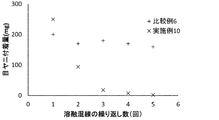
- Example 10 and Comparative Example 6 it is the figure which plotted the amount of adhesion of eyes and the number of repetition of melt-kneading.
- the resin composition (E) of the present invention comprises 0.1 to 20 parts by mass of ethylene-vinyl alcohol copolymer (B) and 0.1 parts of acid-modified polyolefin (C) per 100 parts by mass of polyolefin (A).
- MFR (190 ° C., 2.16 kg load) of the polyolefin (A) is 0.01 to 10 g / 10 min, containing ⁇ 20 parts by mass, 0.1 to 10 parts by mass of the acid-modified polyolefin (D)
- the acid value of the modified polyolefin (C) is 0.1 to 9 mg KOH / g
- the acid value of the acid modified polyolefin (D) is more than 10 mg KOH / g and 120 mg KOH / g or less
- the ratio (D / A) of MFR (at 190 ° C. under 2.16 kg load) of acid-modified polyolefin (D) to (at 190 ° C. under 2.16 kg load) is 50 or more Ru.
- the MFR (melt flow rate, 190 ° C., 2.16 kg load) of the polyolefin (A) contained in the resin composition (E) needs to be 0.01 to 10 g / 10 min.
- the MFR of the polyolefin (A) is less than 0.01 g / 10 min, the difference in melt viscosity between the EVOH (B) and the polyolefin (A) becomes too large, resulting in dispersion of the EVOH (B) in the resin composition (E). In some cases, the resulting molded articles may have insufficient impact resistance.
- the MFR of the polyolefin (A) exceeds 10 g / 10 min, the impact resistance of the resulting molded article may be insufficient.
- the MFR of the polyolefin (A) is preferably 0.8 g / 10 min or less, more preferably 0.4 g / 10 min or less, and 0.1 g / 10 min or less More preferable.
- the MFR of the resin is measured in accordance with JIS K 7210.
- the MFR of a resin having a melting point of about 190 ° C. or more than 190 ° C. is measured at a plurality of temperatures above the melting point under a load of 2160 g.
- the polyolefin (A) one type may be used alone, or two or more types may be mixed and used.
- polystyrene resins such as polypropylene and propylene copolymers
- polyethylene resins such as polyethylene and ethylene copolymers
- polypropylene resins such as polyethylene and ethylene copolymers
- polypropylene resins are preferable.
- polypropylene resin is preferable as the polyolefin (A)
- polypropylene is more preferable.
- a polyethylene-based resin is preferable as the polyolefin (A)
- polyethylene is more preferable
- high density polyethylene is more preferable.
- EVOH (B) contained in the resin composition (E) can be obtained by saponifying an ethylene-vinyl ester copolymer. Although vinyl acetate is mentioned as a typical thing as a vinyl ester, Other fatty acid vinyl esters (vinyl propionate, vinyl pivalate, etc.) can also be used.
- the ethylene content of EVOH (B) is preferably 20 to 60 mol%. If the ethylene content is less than 20 mol%, the thermal stability of EVOH (B) in the resin composition (E) may be degraded. As for ethylene content, 23 mol% or more is more preferable. In addition, when the ethylene content exceeds 60 mol%, the barrier property may be lowered.
- the degree of saponification of the vinyl ester unit of EVOH (B) is preferably 80% or more, more preferably 98% or more, and still more preferably 99% or more from the viewpoint of barrier properties.
- the ethylene content and the degree of saponification of EVOH (B) can be determined by nuclear magnetic resonance (NMR) method.
- polymerizable monomers other than ethylene and vinyl ester may be copolymerized in a range not inhibiting the effect of the present invention, generally in the range of 5 mol% or less.
- polymerizable monomers include ⁇ -olefins such as propylene, 1-butene, 1-hexene and 4-methyl-1-pentene; (meth) acrylic acid esters; alkyl vinyl ethers; N- (2-) (Dimethylaminoethyl) methacrylamide or its quaternary compound, N-vinylimidazole or its quaternary compound, N-vinylpyrrolidone, N, N-butoxymethyl acrylamide, vinyltrimethoxysilane, vinylmethyldimethoxysilane, vinyldimethylmethoxysilane, etc. Can be mentioned.
- the MFR (melt flow rate) (measured at 210 ° C. under a load of 2160 g) of EVOH (B) used in the present invention is preferably 0.1 to 100 g / 10 min.
- the MFR of EVOH (B) exceeds 100 g / 10 min, the difference in melt viscosity between EVOH (B) and acid-modified polyolefin (C) becomes too large, and EVOH (B) in the resin composition (E) And the thermal stability may be reduced.
- the MFR of EVOH (B) is more preferably 50 g / 10 min or less, and further preferably 30 g / 10 min or less.
- the MFR of EVOH (B) is less than 0.1 g / 10 min, the viscosity difference with the acid-modified polyolefin (D) becomes too large, and the dispersibility of EVOH (B) in the resin composition (E) And the impact resistance may be insufficient.
- the MFR is more preferably 0.5 g / 10 min or more.
- the content of EVOH (B) in the resin composition (E) is 0.1 to 20 parts by mass with respect to 100 parts by mass of the polyolefin (A).
- the content is preferably 15 parts by mass or less.
- the content of EVOH (B) is less than 0.1 parts by mass, problems with deposits on screws and dies and problems with impact resistance caused by EVOH (B) are unlikely to occur, so the present invention The merit of adopting is small.
- the content is preferably 1 part by mass or more.
- the acid-modified polyolefin (C) contained in the resin composition (E) is a graft-modified polyolefin obtained by graft-modifying a polyolefin with an acid, or an olefin-based copolymer obtained by copolymerizing an olefin and an acid It can be mentioned. One of these may be used alone, or two or more of these may be used in combination. Among them, graft modified polyolefin is preferable as the acid modified polyolefin (C).
- the acid-modified polyolefin (C) is preferably one obtained by acid-modifying the same type of polyolefin as the polyolefin (A).
- the acid-modified polyolefin (C) is preferably an acid-modified polypropylene
- the acid-modified polyolefin (C) is an acid It is preferable that it is a modified polyethylene.
- Examples of the graft-modified polyolefin used as the acid-modified polyolefin (C) include those obtained by graft-modifying the polyolefin described above as the polyolefin (A) with an acid.
- unsaturated carboxylic acid or its derivative can be used, and examples thereof include acrylic acid, methacrylic acid, fumaric acid, itaconic acid, maleic acid; maleic anhydride, itaconic anhydride and the like .
- maleic anhydride graft modified polyolefin is most preferable.
- Examples of the olefin copolymer used as the acid-modified polyolefin (C) include those obtained by adding an acid as a copolymerization component to the polyolefin described above as the polyolefin (A).
- Examples of the acid used at this time include those described above as the acid to be grafted to the polyolefin.
- the acid value of the acid-modified polyolefin (C) is 0.1 to 9 mg KOH / g.
- the acid-modified polyolefin (C) having such an acid value is excellent in adhesion to the polyolefin (A) and the EVOH (B), and hence adhesion of the multilayer structure having the polyolefin (A) layer and the EVOH (B) layer Used as a layer.
- the resin composition (E) is produced using such a recovered product of the multilayer structure, it is contained in the resin composition (E).
- the dispersibility of EVOH (B) in the resin composition (E) is improved, and the impact resistance of the resulting molded article is improved. improves.
- the acid value of the acid-modified polyolefin (C) is less than 0.1 mg KOH / g, the dispersibility of EVOH (B) in the resin composition (E) decreases, and the impact resistance of the resulting molded article decreases.
- the adhesion of the acid-modified polyolefin (C) to the polyolefin (A) and EVOH (B) is also reduced.
- the acid value of the acid-modified polyolefin (C) is preferably 0.5 mg KOH / g or more.
- the acid value of the acid-modified polyolefin (C) is preferably 7 mg KOH / g or less, more preferably 5 mg KOH / g or less, and still more preferably 3 mg KOH / g or less.
- the MFR (melt flow rate, 190 ° C., 2.16 kg load) of the acid-modified polyolefin (C) is preferably 0.1 to 100 g / 10 min.
- the MFR of the acid-modified polyolefin (C) is in such a range
- the balance in viscosity between the acid-modified polyolefin (C) and the polyolefin (A) and the acid-modified polyolefin (D) is improved.
- the dispersibility of EVOH (B) is further improved, and the impact resistance when formed into a molded article is further improved.
- the content of the acid-modified polyolefin (C) in the resin composition (E) is 0.1 to 20 parts by mass with respect to 100 parts by mass of the polyolefin (A).
- the content of the acid-modified polyolefin (C) is less than 0.1 parts by mass, the dispersibility of EVOH (B) in the resin composition (E) is reduced, and the impact resistance of the resulting molded article is descend.
- 0.5 mass part or more is suitable, and, as for the said content, 2 mass parts or more are more suitable.
- content of acid-modified polyolefin (C) exceeds 20 mass parts, there exists a possibility that the impact resistance of the molded article obtained may fall.
- the acid-modified polyolefin (D) contained in the resin composition (E) is a graft-modified polyolefin obtained by graft-modifying a polyolefin with an acid, or an olefin copolymer obtained by copolymerizing an olefin and an acid. It can be mentioned. One of these may be used alone, or two or more of these may be used in combination. Among them, graft modified polyolefin is preferable as the acid modified polyolefin (D).
- the acid-modified polyolefin (D) is obtained by acid-modifying the same type of polyolefin as the polyolefin (A).
- the acid-modified polyolefin (D) is preferably an acid-modified polypropylene
- the acid-modified polyolefin (D) is an acid It is preferable that it is a modified polyethylene.
- the total content of ⁇ -olefin units in the acid-modified polyolefin (D) is preferably more than 95% by mole.
- Examples of the graft-modified polyolefin used as the acid-modified polyolefin (D) include those obtained by graft-modifying the polyolefin described above as the polyolefin (A) with an acid.
- an acid used at this time the thing mentioned above as an acid used for manufacture of acid-modified polyolefin (C) is mentioned.
- maleic anhydride graft modified polyolefin is most preferably used.
- Examples of the olefin copolymer used as the acid-modified polyolefin (D) include those obtained by adding an acid as a copolymerization component to the polyolefin described above as the polyolefin (A).
- an acid used at this time the thing mentioned above as an acid used for manufacture of acid-modified polyolefin (C) is mentioned.
- the acid value of the acid-modified polyolefin (D) is more than 10 mg KOH / g and 120 mg KOH / g or less.
- the acid value of the acid-modified polyolefin (D) is preferably 12 mg KOH / g or more, more preferably 18 mg KOH / g or more, further preferably 25 mg KOH / g or more, and particularly preferably 35 mg KOH / g or more, 40 mg KOH / g or more is most preferred.
- the acid value of the acid-modified polyolefin (D) is preferably 100 mg KOH / g or less, and more preferably 70 mg KOH / g or less.
- the content of the acid-modified polyolefin (D) in the resin composition (E) is 0.1 to 10 parts by mass with respect to 100 parts by mass of the polyolefin (A).
- the content of the acid-modified polyolefin (D) is less than 0.1 parts by mass, the effect of reducing the amount of degraded material adhering to the screw or die and the effect of improving the impact resistance of the obtained molded article can not be obtained.
- 0.5 mass part or more is suitable for content of acid-modified polyolefin (D), and 1 mass part or more is more suitable.
- the content of the acid-modified polyolefin (D) exceeds 10 parts by mass, the thermal stability of the resin composition (E) decreases due to the excessive reaction between the acid-modified polyolefin (D) and the EVOH (B). There is a risk of
- the content of the acid-modified polyolefin (D) is preferably 8 parts by mass or less.
- MFR melt flow rate, 190 ° C., 2.16 kg load
- MFR of the acid-modified polyolefin (D) is 5 g / 10 min or more.
- the MFR of the acid-modified polyolefin (D) is more preferably 10 g / 10 min or more, further preferably 15 g / 10 min or more, and particularly preferably 20 g / 10 min or more.
- the MFR of the acid-modified polyolefin (D) is usually 1000 g / 10 min or less.
- Ratio (D / A) of MFR (190 ° C., 2.16 kg load) of acid-modified polyolefin (D) to MFR (190 ° C., 2.16 kg load) of polyolefin (A) in resin composition (E) Needs to be 50 or more.
- the ratio (D / A) is preferably 100 or more, more preferably 150 or more, still more preferably 200 or more, particularly preferably 400 or more, and most preferably 500 or more.
- the ratio (D / A) is preferably 20000 or less, more preferably 10000 or less, still more preferably 5000 or less, and particularly preferably 2000 or less.
- the difference between the acid value of the acid-modified polyolefin (C) and the acid value of the acid-modified polyolefin (D) in the resin composition (E) is preferably 10 mg KOH / g or more.
- the difference in the acid value is less than 10 mg KOH / g, when melt-kneading the resin composition (E), the amount of deposits on the screw or die may increase, or the impact resistance of the resulting molded article may It may decrease.
- the difference between the acid value of the acid-modified polyolefin (C) and the acid value of the acid-modified polyolefin (D) is more preferably 15 mg KOH / g or more, and more preferably 20 mg KOH / g or more, 25 mg KOH / g It is particularly preferable that it is g or more, and most preferably 30 mg KOH / g or more.
- an additive other than polyolefin (A), EVOH (B), acid-modified polyolefin (C) and acid-modified polyolefin (D) is included within the range not inhibiting the effects of the present invention. You can also.
- additives include antioxidants, ultraviolet light absorbers, plasticizers, lubricants, fillers and antistatic agents. The following may be mentioned as specific examples of the additive.
- the content of the other additive in the resin composition (E) is usually 50% by mass or less, preferably 20% by mass or less, and more preferably 10% by mass or less.
- Antioxidants 2,5-di-t-butylhydroquinone, 2,6-di-t-butyl-p-cresol, 4,4'-thiobis (6-t-butylphenol), 2,2'-methylenebis ( 4-methyl-6-t-butylphenol), octadecyl-3- (3 ', 5'-di-t-butyl-4'-hydroxyphenyl) propionate, 4,4'-thiobis (6-t-butylphenol), etc. .
- UV absorber ethylene-2-cyano-3,3'-diphenyl acrylate, 2- (2'-hydroxy-5'-methylphenyl) benzotriazole, 2- (2'-hydroxy-3'-t-butyl- 5'-methylphenyl) 5-chlorobenzotriazole, 2-hydroxy-4-methoxybenzophenone, 2,2'-dihydroxy-4-methoxybenzophenone, 2-hydroxy-4-octoxybenzophenone and the like.
- Plasticizer dimethyl phthalate, diethyl phthalate, dioctyl phthalate, wax, liquid paraffin, phosphate ester and the like.
- Lubricants stearic acid amide, oleic acid amide, erucic acid amide, behenic acid amide, ethylenebisstearic acid amide, methylol stearic acid amide, N-oleylpalmitamide, N-stearyl erucamide, liquid paraffin, natural paraffin, synthetic paraffin , Polyolefin wax, stearyl alcohol, lauryl alcohol, stearic acid, lauric acid, myristic acid, behenic acid, montanic acid, stearyl stearate, stearyl laurate, calcium stearate, magnesium stearate, magnesium stearate, zinc stearate, lead stearate and the like.
- Fillers glass fiber, asbestos, ballastite, calcium silicate etc.
- Antistatic agent Glycerin mono fatty acid ester, fatty acid diethanolamide, alkyl diethanolamine, alkyl sulfonate, alkyl benzene sulfonate, alkyl trimethyl ammonium salt, alkyl benzyl dimethyl ammonium salt, alkyl betaine, alkyl imidazolium betaine and the like.
- a recovered product of a multilayer structure containing a polyolefin (A) layer, an EVOH (B) layer and an acid-modified polyolefin (C) layer, and an acid-modified polyolefin (D) The method of melt-kneading with an auxiliary agent is suitable.
- the recovered product of the multilayer structure is a recovered product such as scraps such as burrs generated when producing a molded product made of the multilayer structure, and rejected products at the time of molding.
- blended when melt-kneading such a collection thing is called a collection
- recovery adjuvant containing acid-modified polyolefin (D) is used here.
- the content of the acid-modified polyolefin (D) in the recovery aid is preferably 5 to 100% by mass.
- the content of the acid-modified polyolefin (D) is more preferably 10% by mass or more, further preferably 20% by mass or more, and particularly preferably 50% by mass or more.
- the polyolefin (A) and the acid-modified polyolefin (D) are contained, and the mass ratio (D / A) of the acid-modified polyolefin (D) to the polyolefin (A) is 0.1 to 10; MFR (at 190 ° C.
- the acid value of the acid-modified polyolefin (D) is more than 10 mg KOH / g and 120 mg KOH / g or less
- Preferred is a recovery aid having a ratio (D / A) of MFR (190 ° C., 2.16 kg load) of acid-modified polyolefin (D) to MFR of A) (190 ° C., 2.16 kg load) is 50 or more .
- the recovery aid may be widely used for recovery of a multi-layered structure including a polyolefin (A) layer, an EVOH (B) layer, and an acid-modified polyolefin (C) layer, and recovery of molded articles including polyolefin and EVOH. it can.
- resin composition (E) is used as polyolefin (A) and acid denaturation polyolefin (D) used for the above-mentioned recovery auxiliary agent.
- the mass ratio (D / A) of the acid-modified polyolefin (D) to the polyolefin (A) is 0.1 to 10.
- the above-mentioned recovery aid is a polyolefin (A) layer, an EVOH (B) layer and an acid-modified polyolefin (C) layer
- the mass ratio (D / A) is preferably 0.2 or more, more preferably 0.5 or more, and still more preferably 1 or more.
- the ratio (D / A) of the MFR (190 ° C. under 2.16 kg load) of the acid-modified polyolefin (D) to the MFR (190 ° C. under 2.16 kg load) of the polyolefin (A) in the recovery aid is 50 It is necessary to be above. Thereby, when melt-kneading the recovery assistant with the recovered product of the multilayer structure including the polyolefin (A) layer, the EVOH (B) layer and the acid-modified polyolefin (C) layer, While the amount is further reduced, the impact resistance of the resulting molded article is further improved.
- the ratio (D / A) is preferably 100 or more, more preferably 150 or more, still more preferably 200 or more, particularly preferably 400 or more, and most preferably 500 or more.
- the ratio (D / A) is preferably 20000 or less, more preferably 10000 or less, still more preferably 5000 or less, and particularly preferably 3000 or less.
- the polyolefin (A) contained in the recovery aid and the polyolefin (A) contained in the multilayer structure to be recovered are preferably the same type of polyolefin.
- the polyolefin (A) contained in the multilayer structure to be recovered is polypropylene
- the polyolefin (A) contained in the recovery assistant is also polypropylene
- the multilayer structure to be recovered is
- recovery adjuvant is also polyethylene.
- recovery adjuvant 70 mass% or more is more preferable, and 80 mass% or more is more preferable.
- the said recovery adjuvant may contain other additives other than polyolefin (A) and acid-modified polyolefin (D) in the range which does not inhibit the effect of this invention.
- an additive those described above as other additives contained in the resin composition (E) can be mentioned.
- the amount of waste can be suppressed by using a recovered product of the multilayer structure as at least a part of the raw material, so environmental protection In view of the above, the effect of cost reduction can also be obtained.
- the amount of the recovered matter in the resin composition (E) is preferably 50% by mass or more.
- the recovered material used as the raw material of the resin composition (E) contains the resin composition (E) layer in addition to the polyolefin (A) layer, the EVOH (B) layer and the acid-modified polyolefin (C) layer. It is also preferable that it is a multilayer structure. That is, a molded article comprising a multilayer structure containing a resin composition (E) layer is produced, and the recovered product of the molded article is used again as a raw material of the resin composition (E) layer in the same multilayer structure. Is preferred.
- resin composition (E) contains other components other than polyolefin (A), EVOH (B), acid-modified polyolefin (C) and acid-modified polyolefin (D), the method of including those components is particularly limited It can be contained by the same operation as the components (A), (B), (C) and (D) described above.
- any layer of the multilayer structure May contain other components.
- other components may be contained in the recovery assistant containing the acid-modified polyolefin (D).
- a multilayer structure comprising a resin composition (E) layer, a polyolefin (A) layer, an EVOH (B) layer, and an acid-modified polyolefin (C) layer is a preferred embodiment of the present invention.
- the following may be exemplified as the layer configuration of the multilayer structure.
- the EVOH (B) layer and the acid-modified polyolefin (C) layer are in contact from the viewpoint of improving the adhesion between the layers.
- the ratio (B / A) of the total thickness of the EVOH (B) layer to the total thickness of the polyolefin (A) layer in the multilayer structure is preferably 0.5 / 100 to 20/100. If the thickness ratio (B / A) is less than 0.5 / 100, the barrier properties may be insufficient. On the other hand, when the thickness ratio (B / A) exceeds 20/100, the impact resistance may be lowered or the cost may be increased.
- the ratio (C / A) of the total thickness of the acid-modified polyolefin (C) layer to the total thickness of the polyolefin (A) layer in the multilayer structure is preferably 0.5 / 100 to 20/100. If the thickness ratio (C / A) is less than 0.5 / 100, the interlayer adhesion may be insufficient. On the other hand, when the thickness ratio (C / A) exceeds 20/100, viscosity matching of the resin used for producing the multilayer structure is deteriorated, and when producing the multilayer structure, the layer thickness is not sufficient. It may be uniform.
- the ratio (E / A) of the total thickness of the resin composition (E) layer to the total thickness of the polyolefin (A) layer in the multilayer structure is preferably 5/100 to 60/100. If the thickness ratio (E / A) is less than 5/100, the cost may be increased. On the other hand, when the thickness ratio (E / A) exceeds 80/100, the impact resistance may be reduced.
- the entire thickness of the multilayer structure can be appropriately set according to the application.
- the total thickness is preferably 100 to 8000 ⁇ m.
- the overall thickness is 100 ⁇ m or more, a multilayer structure with high rigidity can be obtained. It is more preferable that the total thickness is 500 ⁇ m or more.
- the total thickness is 8000 ⁇ m or less, a flexible multilayer structure can be obtained. It is more preferable that the total thickness is 7000 ⁇ m or less.
- the method for producing the multilayer structure is not particularly limited.
- molding methods practiced in the field of general polyolefins such as extrusion molding, blow molding, injection molding, thermoforming and the like can be mentioned.
- coextrusion molding and coinjection molding are preferable, and coextrusion molding is more preferable.
- a fuel container having a resin composition (E) layer is a preferred embodiment of the resin composition (E).
- a fuel container further having a polyolefin (A) layer, an EVOH (B) layer, and an acid-modified polyolefin (C) layer is a preferred embodiment of the multilayer structure.
- the fuel container has the (A) layer or the (E) layer via the (C) layer on the inner and outer layers of the (B) layer.
- the fuel container has the (A) layer or the (E) layer via the (C) layer on both sides of the (B) layer of the intermediate layer.
- the thickness ratio (I / O) when the sum of the thicknesses of the layers inside the EVOH (B) layer is I and the sum of the thicknesses of the layers outside the layer (B) is O is Preferably it is less than 50/50.
- the EVOH (B) layer is disposed at an inward position with respect to the entire thickness.
- the thickness of each layer in the fuel container of the present invention refers to the average thickness of the body of the container.
- the gasoline barrier property and the impact resistance are improved as compared to the case of arranging the EVOH (B) layer at the center with respect to the entire layer thickness. More preferably, (I / O) ⁇ 45/55, still more preferably (I / O) ⁇ 40/60, and particularly preferably (I / O) ⁇ 35/65, (I It is optimal that / O) ⁇ 30/70.
- the innermost layer is preferably (A) layer, (C) layer or (E) layer.
- a preferred method for forming the fuel container is co-extrusion blow molding, in which the cylindrical molten parison must be cut and bonded with a mold, and in this case the innermost layers are bonded together in a mutually contacting manner Will close the cylindrical opening.
- the innermost layer being the (A) layer, the (C) layer or the (E) layer
- the adhesive strength of this closed portion (referred to as a pinch-off portion) is improved.
- (I / O) O1 / 99 is preferable
- (I / O) ⁇ 2/98 is more preferable
- (I / O) ⁇ 5/95 is particularly preferable
- (I / O) ⁇ 10 / 90 is the best.
- the thickness ratio (X / Y) when the thickness of the layer (B) is X and the total thickness is Y satisfies the following equation (1). 0.005 ⁇ (X / Y) ⁇ 0.13 (1)
- (X / Y) is less than 0.005, the gasoline barrier properties may be reduced.
- the value of (X / Y) is preferably 0.01 or more, more preferably 0.02 or more.
- (X / Y) is 0.13 or more, there is a possibility that the impact resistance may be lowered, and the cost may be increased by using a large amount of EVOH (B).
- the value of (X / Y) is preferably 0.10 or less, more preferably 0.07 or less.
- the layer configuration of the fuel container of the present invention is preferable as the layer configuration of the fuel container of the present invention.
- the left is the inside and the right is the outside.
- the resin composition (E) of the present invention has a small amount of degraded matter adhering to the screw or die even when melt molding is performed continuously for a long time.
- a molded article comprising a multilayer structure excellent in impact resistance and appearance can be obtained.
- the molded article is suitably used for food packaging containers, fuel containers and the like.
- MFR The MFR of the resin was measured in accordance with JIS K 7210.
- IZOD impact strength measurement was performed according to JIS K 7110.
- the resin composition pellets By subjecting the resin composition pellets to injection molding using an injection molding machine (Sun refining, FS-80S), the obtained molded product (length 80 mm, width 10 mm, thickness 4 mm) is notched. Test pieces were obtained.
- the IZOD impact strength (kJ / m 2 ) at 23 ° C. and ⁇ 40 ° C. of the obtained test piece was measured using a digital impact tester (manufactured by Toyo Seiki Seisakusho Co., Ltd.).
- A1 polypropylene having a density of 0.900 g / cm 3 , MFR (measured at 190 ° C. under 2.16 kg load) of 1 g / 10 min.
- A2 density of 0.945 g / cm 3 , MFR (190 ° C., 2.16 kg load) Measured below)
- High density polyethylene which is 0.03 g / 10 min
- C1 Mitsui Chemicals, Inc.
- Maleic anhydride graft modified polypropylene "ADMER (registered trademark) QF 500" [density 0.900 g / cm 3 , MFR (measured at 190 ° C. under a load of 2.16 kg) 1.1 g / 10 min, Acid value 1.1 mg KOH / g]
- C2 Maleic anhydride graft modified polyethylene "ADMER (registered trademark) GT6” manufactured by Mitsui Chemicals, Inc. [density 0.92 g / cm 3 , MFR (measured at 190 ° C. under a load of 2.16 kg) 1.1 g / 10 min, Acid value 1.5 mg KOH / g]
- [Acid-modified polyolefin (D)] D1 to D8 Pellets after melt-kneading polypropylene (PP, density 0.91 g / cm 3 ), maleic anhydride (MAn) and 2,5-dimethyl-2,5-bis (t-butylperoxy) hexane (initiator)
- Maleic anhydride graft modified polypropylene (D1 to D8) obtained by The acid value and MFR (measured at 190 ° C. under a load of 2.16 kg) of maleic anhydride graft modified polypropylene (D1 to D8) are shown in Table 1.
- Example 1 Manufacture of recovery aid
- A1 polypropylene
- D1 maleic anhydride graft modified polypropylene
- 2D 25 W twin-screw extruder
- the relationship between the number of repetitions of melt-kneading and the amount of adhesion of the eyelids was evaluated.
- the melt-kneading was repeated 1 to 4 times to produce a resin composition (E) pellet and re-melt-kneaded the obtained resin composition (E) pellet, and then the adhesion amount was measured.
- Production of the resin composition (E) pellet, re-melt-kneading, and weighing of the amount of attached particles were performed in the same manner as described above.
- the amount of sticking of the eyebrows was plotted against the number of repetition of melt-kneading.
- the adhesion amount of the eyebrows when the above-described melt-kneading was repeated five times was also plotted.
- Example 9 Production and evaluation of a resin composition (E) pellet in the same manner as in Example 1 except that a recovery aid consisting only of an acid-modified polyolefin (D) was used (the number of repetition of melting and kneading and the adhesion amount I did the evaluation of the relationship). The results are shown in Table 3.
- Example 17 Production and evaluation of a resin composition (E) pellet in the same manner as in Example 10 except that a recovery aid consisting only of an acid-modified polyolefin (D) was used (the number of repetition of melting and kneading and the adhesion amount I did the evaluation of the relationship). The results are shown in Table 4.
- Comparative example 6 Production and evaluation of resin composition pellets were performed in the same manner as in Example 10 except that only high density polyethylene (A2) was used instead of the recovery aid. The results are shown in Table 4 and FIG.
- MFR of polyolefin (A) comprising an acid-modified polyolefin (C) having an acid value of 0.1 to 9 mg KOH / g and an acid-modified polyolefin (D) having an acid value of more than 10 mg KOH / g and 120 mg KOH / g or less
- the resin composition (E, Examples 1 to 17) of the present invention having an MFR ratio (D / A) of acid-modified polyolefin (D) to 50 or more is 50 or more, and the amount of adhesion to eyes and the amount of screw adhesion are small. While being excellent in the dispersibility of (B), the impact resistance strength of the molded article obtained was also high.
- a resin composition containing an acid-modified polyolefin (C) and an acid-modified polyolefin having an acid value of less than 10 mg KOH / g and having an MFR ratio (D / A) of less than 50 (Comparative Examples 1, 2 and 5)
- a resin composition containing acid-modified polyolefin (C) and an acid-modified polyolefin having an acid value of less than 10 mg KOH / g (comparative example 4), a resin composition containing only acid-modified polyolefin (C) as the acid-modified polyolefin (comparative example) All of the above-mentioned performances were inadequate 3 and 6).
- Example 18 [Manufacturing of recovered material] A multilayer film of three types and five layers (A1: 208 ⁇ m / C 1: 16 ⁇ m / B 1: 32 ⁇ m / C1: using polypropylene (A1), EVOH (B1) and maleic anhydride graft modified polypropylene (C1) under the following conditions 16 ⁇ m / A1: 208 ⁇ m) were produced.
- the obtained multilayer film was crushed by a grinder with a diameter of 8 mm ⁇ mesh to obtain a recovered product.
- a multilayer film of 4 types and 6 layers (A1: 208 ⁇ m / mixed resin [Resin composition (E), using the obtained mixed resin, polypropylene (A1), EVOH (B1) and maleic anhydride graft modified polypropylene (C1) ]: 320 ⁇ m / C1: 16 ⁇ m / B1: 32 ⁇ m / C1: 16 ⁇ m / A1: 208 ⁇ m) were prepared.
- polypropylene (A1), EVOH (B), and maleic anhydride graft modified polypropylene (C1) are molded under the same conditions as those for producing the above-mentioned recovered product, and mixed resin [resin composition (E) layer] was molded under the following conditions.
- Extruder 32 mm ⁇ extruder GT-32-A (made by Plastics Research Institute)
- Extrusion temperature: Feeding part / Compressing part / Weighing part / Die 170/210/220/220 ° C Die: 300 mm wide coat hanger die (Plastic engineering research institute company make)
- Example 19 Using high density polyethylene (A2) instead of polypropylene (A1), using maleic anhydride graft modified polyethylene (C2) instead of maleic anhydride graft modified polypropylene (C1), and maleic anhydride graft modified polypropylene A multilayer film was produced and evaluated in the same manner as in Example 18 except that maleic anhydride graft modified polyethylene (D9) was used instead of (D1). The results are shown in Table 5.
- Comparative example 7 A multilayer film was produced and evaluated in the same manner as in Example 18 except that only polypropylene (A1) was used instead of the recovery aid. The results are shown in Table 5.
- Comparative Example 8 A multilayer film was produced and evaluated in the same manner as in Example 19 except that only high density polyethylene (A2) was used instead of the recovery aid. The results are shown in Table 5.
- Example 20 A2 as polyolefin (A), B1 as EVOH (B), maleic anhydride graft modified polyethylene (C2) as acid-modified polyethylene (C), resin composition (E) pellet of Example 10 as a recovered product 4) using an extrusion blow molding machine “TB-ST-6P” manufactured by Suzuki Works, with a layer configuration of 210 ° C.
- Comparative Examples 9 and 10 A fuel container was molded in the same manner as in Example 20 except that the resin composition of Comparative Example 4 or 5 was used instead of the resin composition (E) of Example 10, and the 50% fracture height was evaluated. The evaluation results are shown in Table 6.
Landscapes
- Chemical & Material Sciences (AREA)
- Engineering & Computer Science (AREA)
- Health & Medical Sciences (AREA)
- Organic Chemistry (AREA)
- Polymers & Plastics (AREA)
- Medicinal Chemistry (AREA)
- Chemical Kinetics & Catalysis (AREA)
- Mechanical Engineering (AREA)
- Life Sciences & Earth Sciences (AREA)
- Transportation (AREA)
- Combustion & Propulsion (AREA)
- Sustainable Development (AREA)
- Sustainable Energy (AREA)
- Laminated Bodies (AREA)
- Compositions Of Macromolecular Compounds (AREA)
- Containers Having Bodies Formed In One Piece (AREA)
Priority Applications (4)
| Application Number | Priority Date | Filing Date | Title |
|---|---|---|---|
| CN201880003446.6A CN109642058B (zh) | 2017-07-24 | 2018-07-23 | 树脂组合物、其制造方法和使用其的多层结构体 |
| US16/631,202 US11149143B2 (en) | 2017-07-24 | 2018-07-23 | Resin composition, method for producing same and multi-layered structure using same |
| EP18837808.7A EP3660089B1 (de) | 2017-07-24 | 2018-07-23 | Harzzusammensetzung, herstellungsverfahren dafür und mehrschichtige struktur damit |
| JP2018562684A JP6488063B1 (ja) | 2017-07-24 | 2018-07-23 | 樹脂組成物、その製造方法及びそれを用いた多層構造体 |
Applications Claiming Priority (2)
| Application Number | Priority Date | Filing Date | Title |
|---|---|---|---|
| JP2017-143129 | 2017-07-24 | ||
| JP2017143129 | 2017-07-24 |
Publications (1)
| Publication Number | Publication Date |
|---|---|
| WO2019021996A1 true WO2019021996A1 (ja) | 2019-01-31 |
Family
ID=63041811
Family Applications (1)
| Application Number | Title | Priority Date | Filing Date |
|---|---|---|---|
| PCT/JP2018/027466 Ceased WO2019021996A1 (ja) | 2017-07-24 | 2018-07-23 | 樹脂組成物、その製造方法及びそれを用いた多層構造体 |
Country Status (5)
| Country | Link |
|---|---|
| US (1) | US11149143B2 (de) |
| EP (2) | EP3660089B1 (de) |
| JP (1) | JP6488063B1 (de) |
| CN (1) | CN109642058B (de) |
| WO (1) | WO2019021996A1 (de) |
Cited By (3)
| Publication number | Priority date | Publication date | Assignee | Title |
|---|---|---|---|---|
| WO2021117864A1 (ja) * | 2019-12-12 | 2021-06-17 | 株式会社クラレ | 回収性に優れる樹脂組成物及びそれを用いた多層構造体 |
| JP2021155689A (ja) * | 2020-03-25 | 2021-10-07 | 三菱ケミカル株式会社 | 樹脂組成物および樹脂組成物の製造方法、ならびに樹脂組成物を用いた成形体および多層構造体および包装体 |
| JP2022144520A (ja) * | 2021-03-19 | 2022-10-03 | 花王株式会社 | フィルム |
Families Citing this family (6)
| Publication number | Priority date | Publication date | Assignee | Title |
|---|---|---|---|---|
| US11279117B2 (en) * | 2016-06-30 | 2022-03-22 | Kuraray Co., Ltd. | Fuel container |
| CN114390974B (zh) * | 2019-09-24 | 2025-03-18 | 株式会社可乐丽 | 多层结构体、成形体和成形体的制造方法 |
| CN116600994A (zh) * | 2020-10-15 | 2023-08-15 | 株式会社可乐丽 | 多层结构体和使用其的包装材料 |
| WO2022158589A1 (ja) * | 2021-01-25 | 2022-07-28 | 三菱ケミカル株式会社 | エチレン-ビニルアルコール系共重合体組成物 |
| CN118871293A (zh) * | 2022-03-14 | 2024-10-29 | 三菱化学株式会社 | 多层结构体 |
| EP4357412A1 (de) * | 2022-10-18 | 2024-04-24 | Basell Poliolefine Italia S.r.l. | Verfahren zur senkung des schmelzflusses einer wiederverwendeten polymerzusammensetzung |
Citations (6)
| Publication number | Priority date | Publication date | Assignee | Title |
|---|---|---|---|---|
| JPS61141744A (ja) * | 1984-12-12 | 1986-06-28 | Kuraray Co Ltd | 樹脂組成物 |
| JPH0929904A (ja) | 1995-05-12 | 1997-02-04 | Kuraray Co Ltd | 燃料容器 |
| JP2006151365A (ja) * | 2004-10-26 | 2006-06-15 | Tokai Rubber Ind Ltd | 樹脂製燃料タンク用接合部品およびその製法 |
| JP2011252101A (ja) * | 2010-06-03 | 2011-12-15 | Kuraray Co Ltd | 艶消しフィルム、これを用いた内装材及び艶消しフィルムの製造方法 |
| WO2012060371A1 (ja) | 2010-11-02 | 2012-05-10 | 株式会社クラレ | 混合樹脂及び多層構造体 |
| WO2015041258A1 (ja) * | 2013-09-20 | 2015-03-26 | 株式会社クラレ | 熱成形容器及びその製造方法 |
Family Cites Families (4)
| Publication number | Priority date | Publication date | Assignee | Title |
|---|---|---|---|---|
| CA2175609C (en) | 1995-05-12 | 2004-06-22 | Hata, Nobuhiko | Fuel tank |
| JPWO2005105437A1 (ja) * | 2004-04-28 | 2008-03-13 | 株式会社クラレ | 多層構造体及びその製造方法 |
| JP5045807B2 (ja) * | 2010-11-18 | 2012-10-10 | 東洋製罐株式会社 | 多層プラスチック容器 |
| US9243093B2 (en) | 2010-11-26 | 2016-01-26 | Sanyo Chemical Industries, Ltd. | Modifier for polyolefin resin |
-
2018
- 2018-07-23 EP EP18837808.7A patent/EP3660089B1/de active Active
- 2018-07-23 WO PCT/JP2018/027466 patent/WO2019021996A1/ja not_active Ceased
- 2018-07-23 US US16/631,202 patent/US11149143B2/en active Active
- 2018-07-23 CN CN201880003446.6A patent/CN109642058B/zh active Active
- 2018-07-23 EP EP18184953.0A patent/EP3434468B1/de active Active
- 2018-07-23 JP JP2018562684A patent/JP6488063B1/ja active Active
Patent Citations (6)
| Publication number | Priority date | Publication date | Assignee | Title |
|---|---|---|---|---|
| JPS61141744A (ja) * | 1984-12-12 | 1986-06-28 | Kuraray Co Ltd | 樹脂組成物 |
| JPH0929904A (ja) | 1995-05-12 | 1997-02-04 | Kuraray Co Ltd | 燃料容器 |
| JP2006151365A (ja) * | 2004-10-26 | 2006-06-15 | Tokai Rubber Ind Ltd | 樹脂製燃料タンク用接合部品およびその製法 |
| JP2011252101A (ja) * | 2010-06-03 | 2011-12-15 | Kuraray Co Ltd | 艶消しフィルム、これを用いた内装材及び艶消しフィルムの製造方法 |
| WO2012060371A1 (ja) | 2010-11-02 | 2012-05-10 | 株式会社クラレ | 混合樹脂及び多層構造体 |
| WO2015041258A1 (ja) * | 2013-09-20 | 2015-03-26 | 株式会社クラレ | 熱成形容器及びその製造方法 |
Non-Patent Citations (1)
| Title |
|---|
| See also references of EP3660089A4 |
Cited By (5)
| Publication number | Priority date | Publication date | Assignee | Title |
|---|---|---|---|---|
| WO2021117864A1 (ja) * | 2019-12-12 | 2021-06-17 | 株式会社クラレ | 回収性に優れる樹脂組成物及びそれを用いた多層構造体 |
| JP7536788B2 (ja) | 2019-12-12 | 2024-08-20 | 株式会社クラレ | 回収性に優れる樹脂組成物及びそれを用いた多層構造体 |
| JP2021155689A (ja) * | 2020-03-25 | 2021-10-07 | 三菱ケミカル株式会社 | 樹脂組成物および樹脂組成物の製造方法、ならびに樹脂組成物を用いた成形体および多層構造体および包装体 |
| JP7413914B2 (ja) | 2020-03-25 | 2024-01-16 | 三菱ケミカル株式会社 | 樹脂組成物および樹脂組成物の製造方法、ならびに樹脂組成物を用いた成形体および多層構造体および包装体 |
| JP2022144520A (ja) * | 2021-03-19 | 2022-10-03 | 花王株式会社 | フィルム |
Also Published As
| Publication number | Publication date |
|---|---|
| CN109642058A (zh) | 2019-04-16 |
| EP3434468B1 (de) | 2019-07-17 |
| CN109642058B (zh) | 2020-06-12 |
| EP3660089A1 (de) | 2020-06-03 |
| EP3660089B1 (de) | 2024-03-27 |
| US20200216658A1 (en) | 2020-07-09 |
| JP6488063B1 (ja) | 2019-03-20 |
| JPWO2019021996A1 (ja) | 2019-07-25 |
| US11149143B2 (en) | 2021-10-19 |
| EP3434468A1 (de) | 2019-01-30 |
| EP3660089A4 (de) | 2021-05-19 |
Similar Documents
| Publication | Publication Date | Title |
|---|---|---|
| WO2019021996A1 (ja) | 樹脂組成物、その製造方法及びそれを用いた多層構造体 | |
| CN103282424B (zh) | 混合树脂及多层结构体 | |
| CN102821953B (zh) | 多层结构体及其制造方法 | |
| JP7339140B2 (ja) | 回収性に優れる樹脂組成物及びそれを用いた多層構造体 | |
| JP3574500B2 (ja) | 樹脂組成物および多層構造体 | |
| CN118647666A (zh) | 树脂组合物及其成型品、多层结构体、以及乙烯-乙烯醇系共聚物回收助剂 | |
| JP6870404B2 (ja) | 樹脂組成物及びこれよりなる積層体 | |
| JP3600686B2 (ja) | 樹脂組成物およびその製造法、用途 | |
| CN102844185B (zh) | 多层结构体的制造方法 | |
| JP2011140616A (ja) | 樹脂組成物及びそれを用いた多層構造体 | |
| CN109415133B (zh) | 燃料容器 | |
| JP2023154456A (ja) | 樹脂組成物及びその製造方法並びにかかる製造方法で用いられる多層構造体及び回収助剤 | |
| JP7536788B2 (ja) | 回収性に優れる樹脂組成物及びそれを用いた多層構造体 | |
| JP2604483B2 (ja) | 樹脂組成物および多層構造体 | |
| JP7356296B2 (ja) | 樹脂組成物及びそれを用いた多層構造体 | |
| JP2787024B2 (ja) | 成形物の製法 | |
| JP4059571B2 (ja) | 樹脂組成物及びその成形方法、その多層構造体 | |
| JP2604484C (de) | ||
| JPH10195262A (ja) | 樹脂組成物 | |
| JP2604483C (de) |
Legal Events
| Date | Code | Title | Description |
|---|---|---|---|
| ENP | Entry into the national phase |
Ref document number: 2018562684 Country of ref document: JP Kind code of ref document: A |
|
| 121 | Ep: the epo has been informed by wipo that ep was designated in this application |
Ref document number: 18837808 Country of ref document: EP Kind code of ref document: A1 |
|
| NENP | Non-entry into the national phase |
Ref country code: DE |
|
| ENP | Entry into the national phase |
Ref document number: 2018837808 Country of ref document: EP Effective date: 20200224 |