WO2019026152A1 - Système de traitement, dispositif de traitement, procédé de traitement, programme et support d'enregistrement d'informations - Google Patents
Système de traitement, dispositif de traitement, procédé de traitement, programme et support d'enregistrement d'informations Download PDFInfo
- Publication number
- WO2019026152A1 WO2019026152A1 PCT/JP2017/027764 JP2017027764W WO2019026152A1 WO 2019026152 A1 WO2019026152 A1 WO 2019026152A1 JP 2017027764 W JP2017027764 W JP 2017027764W WO 2019026152 A1 WO2019026152 A1 WO 2019026152A1
- Authority
- WO
- WIPO (PCT)
- Prior art keywords
- information
- users
- cluster
- characteristic information
- environment
- Prior art date
- Legal status (The legal status is an assumption and is not a legal conclusion. Google has not performed a legal analysis and makes no representation as to the accuracy of the status listed.)
- Ceased
Links
Images


Classifications
-
- G—PHYSICS
- G06—COMPUTING OR CALCULATING; COUNTING
- G06F—ELECTRIC DIGITAL DATA PROCESSING
- G06F16/00—Information retrieval; Database structures therefor; File system structures therefor
- G06F16/20—Information retrieval; Database structures therefor; File system structures therefor of structured data, e.g. relational data
- G06F16/28—Databases characterised by their database models, e.g. relational or object models
- G06F16/284—Relational databases
- G06F16/285—Clustering or classification
-
- G—PHYSICS
- G06—COMPUTING OR CALCULATING; COUNTING
- G06F—ELECTRIC DIGITAL DATA PROCESSING
- G06F16/00—Information retrieval; Database structures therefor; File system structures therefor
- G06F16/90—Details of database functions independent of the retrieved data types
- G06F16/906—Clustering; Classification
-
- G—PHYSICS
- G06—COMPUTING OR CALCULATING; COUNTING
- G06Q—INFORMATION AND COMMUNICATION TECHNOLOGY [ICT] SPECIALLY ADAPTED FOR ADMINISTRATIVE, COMMERCIAL, FINANCIAL, MANAGERIAL OR SUPERVISORY PURPOSES; SYSTEMS OR METHODS SPECIALLY ADAPTED FOR ADMINISTRATIVE, COMMERCIAL, FINANCIAL, MANAGERIAL OR SUPERVISORY PURPOSES, NOT OTHERWISE PROVIDED FOR
- G06Q30/00—Commerce
- G06Q30/02—Marketing; Price estimation or determination; Fundraising
- G06Q30/0201—Market modelling; Market analysis; Collecting market data
Definitions
- the present invention divides the user into clusters by using the first property information representing the property of the user in the first environment and the second property information representing the property of the user in the second environment in isolation. Related to technology.
- characteristic information representing characteristics of the user is collected in an environment given to the user, the user is classified into a plurality of segments by various clustering techniques, and a strategy for providing a service for each segment is considered. Is widely practiced.
- the initial division unit divides n classification objects into K clusters
- the updating department For each of the K clusters, calculate the centroid of the classified object classified into the cluster, For each of the n classification objects, the classification object is associated with the nearest one of the K centroids to the classification object, By reclassifying classified objects associated with the same centroid as one cluster into K clusters, Update the split into clusters,
- the repeat control unit causes the updating unit to repeat updating until there is no change in division into clusters, A technique is disclosed that outputs the output part when there is no change in the division into clusters.
- the television viewing history server cooperates with the television apparatus used by the user via the Internet to collect the user's viewing history.
- the electronic market server collects the purchase history when the user purchases a product to be sold in the electronic market.
- the viewing history represents the characteristics of the user in the environment for watching television broadcasting
- the purchase history represents the characteristics of the user in the environment for purchasing a product in the electronic market.
- Patent Document 2 discloses an information processing system for combining customer feature data included in a plurality of databases, in which a technique for combining items having similar customer features is disclosed.
- the first provider who provides the first service according to the first environment does not acquire the second characteristic information itself
- the second provider who provides the second service according to the second environment has the first characteristic.
- the present invention is intended to solve the above-described problems, and isolates the first characteristic information representing the characteristic of the user in the first environment and the second characteristic information representing the characteristic of the user in the second environment.
- An object of the present invention is to provide a processing system, a processing device, a processing method, a program, and an information recording medium suitable for dividing the user into clusters, as it is.
- a processing system includes a first processing device and a second processing device, (a) the first processing unit Acquiring first property information respectively representing properties of a plurality of users in the first environment; The plurality of users are divided into a first cluster group according to the acquired first characteristic information, Transmitting, to the second processing device, representative information representatively representing the characteristics of the user belonging to each cluster included in the first cluster group by the centroid vector based on the first characteristic information of each cluster; (b) the second processing unit Acquiring second property information respectively representing properties of the plurality of users in a second environment; The plurality of users are divided into a second cluster group based on the transmitted representative information and the acquired second characteristic information.
- the user is classified into a cluster group by using the first property information representing the property of the user in the first environment and the second property information representing the property of the user in the second environment in isolation.
- FIG. 1 is an explanatory view showing a schematic configuration of a processing system according to an embodiment of the present invention. This will be described below with reference to this figure.
- the processing system 101 includes a first processing device 111 and a second processing device 121.
- the first processor 111 and the second processor 121 are configured by independent computers and electronic circuits.
- the first processing apparatus 111 is managed by an operator who provides a service related to the first environment
- the second processing apparatus 121 is managed by an operator who provides a service related to the second environment. Therefore, the information that can be exchanged between the two is generally limited.
- the first processing device 111 is realized by executing the first program on the first computer
- the second processing device is realized by executing the second program on the second computer.
- the programs to be executed may be computer readable such as compact disk, flexible disk, hard disk, magneto-optical disk, digital video disk, magnetic tape, ROM (Read Only Memory), EEPROM (Electrically Erasable Programmable ROM), flash memory, semiconductor memory, etc. Can be recorded on a non-transitory information recording medium. This information recording medium can also be distributed and sold independently of each computer.
- a program recorded in a non-transitory information recording medium such as a flash memory is read out to a RAM (Random Access Memory) which is a temporary storage device, and then read out.
- a CPU central processing unit executes instructions included in the program.
- the CPU directly reads and executes the instructions included in the program stored in the ROM.
- each program can be transmitted from the distribution server or management server managed by the operator to each computer via a transitive transmission medium such as a computer communication network independently of the computer on which the program is executed. It can be distributed and sold.
- the first processing unit 111 and the second processing unit 121 can also be configured by a dedicated electronic circuit (ASIC; Application Specific Integrated Circuit).
- ASIC Application Specific Integrated Circuit
- a program such as an electronic circuit design script is compiled and a technology such as a field programmable gate array (FPGA) that dynamically configures the electronic circuit based on the design script is applied.
- FPGA field programmable gate array
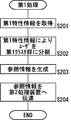
- FIG. 2 is a flowchart showing the flow of control of the first process executed by the first processing apparatus of the present invention.
- FIG. 3 is a flowchart showing the flow of control of the second process executed by the second processor of the present invention.
- the first acquisition unit 112 When the first processing is started in the first processing device 111, the first acquisition unit 112 generates first characteristic information u 1 , u 2 representing the characteristics of the users 1, 2, ..., N in the first environment. , ..., u N are acquired (step S201).
- the second acquisition unit 122 when the second processing is started in the second processing device 121, the second acquisition unit 122 generates second characteristic information v 1 , which indicates the respective characteristics of the users 1, 2, ..., N in the second environment. v 2, ..., v N to get (step S301).
- the first characteristic information u 1 , u 2 ,..., U N and the second characteristic information v 1 , v 2 ,..., V N are vectors representing the characteristics of the users 1, 2,. In the field of clustering technology, it may be called a feature vector.
- the first characteristic information u 1, u 2, ..., a first environment u N is obtained
- the second characteristic information v 1, v 2, ..., v and a second environment N is acquired
- the dimension of the vector u i and the dimension of the vector v j are generally different
- the types of characteristic quantities represented by the k th element of the vector u i and the characteristics represented by the k th element of the vector v j are generally different.
- the user's characteristic quantities include, for example, the user's gender, age, age group, occupation, residence area, annual income, family structure, etc., as well as some fixed information and an environment in which the characteristic quantities are collected.
- Are the behavior and behavior of the user in the service for example, the number of times the service was accessed, frequency, time zone, time, number of times the content or product provided by the service was obtained, It is possible to use various numerical information of historical information, such as chargeable or purchase price in case of charge and the kind of acquisition target.
- This feature vector is feature information that represents the characteristics of the user.
- the user is identified by an integer 1, 2,..., N not less than 1 and not more than N.
- a terminal identification information such as a user name such as a mail address registered by the user in the service under the environment, or a serial number of a terminal used when using each service, a browser
- a session ID stored as a cookie, a terminal identification ID for advertisement used in a smartphone or tablet for example, IDFA (IDentification For Advertisers), AdID (Advertising IDentifer), or the like
- IDFA IDentification For Advertisers
- AdID Advertising IDentifer
- the conversion processing may be performed by a conversion device such as a hub server independent of the first processing device 111 and the second processing device 121.
- the first division unit 113 of the first processing device 111 performs clustering of the acquired first characteristic information u 1 , u 2 ,..., U N to obtain the users 1, 2,.
- clustering Various known techniques can be used for clustering. For example, division optimization clustering techniques such as k-means and x-means, hierarchical clustering techniques such as centroid method, Ward method, and group average method can be used. Also, Euclidean distance or Manhattan distance can be used as the distance function d (_, _) of the characteristic information, or scaling may be performed using the Maharashinos distance.
- division optimization clustering techniques such as k-means and x-means
- hierarchical clustering techniques such as centroid method, Ward method, and group average method
- Euclidean distance or Manhattan distance can be used as the distance function d (_, _) of the characteristic information, or scaling may be performed using the Maharashinos distance.
- the generation unit 114 of the first processing device 111 obtains a reference obtained by dividing the users 1, 2, ..., N into the first cluster group P [1], P [2], ..., P [S]. Information is generated (step S203).
- This reference information is referred to as information similar to teacher information or guideline information in clustering at the time of division in the second processing device 121.
- Reference information the user 1, 2, ..., albeit at the information representing the characteristics of the N, the first characteristic information u 1 in the second processing unit 121, u 2, ..., so that u N can not be determined
- the content is limited. Therefore, even if the reference information is transmitted, the first characteristic information u 1 , u 2 ,..., U N does not necessarily leak.
- any one of affiliation information and representative information can be adopted as reference information.
- belonging information is information indicating which cluster of the first cluster group the user 1, 2, ..., N belongs to by the first characteristic information u 1 , u 2 , ..., u N It is.
- a set of user numbers P [1], P [2], ..., a set of P [S] ⁇ P [1], P [2], ..., P [S] ⁇ Any information that can be derived can be used.
- the belonging information is a collection of N S-dimensional unit vectors.
- the cosine of the angle formed by the characteristic information u i of the user i and the vector c (P [j]) of the centroid of the cluster P [j] to which the user i belongs can be adopted.
- the distance D d (c (P [j]), u i ) from the vector c (P [j]) of the centroid of cluster P [j] to the characteristic information u i is calculated.
- the similarity may be adopted as the similarity.
- representative information refers to information obtained from the first characteristic information u 1 , u 2 ,..., U N in order to make it impossible to specify individual user characteristics to the information of the cluster to which each user belongs.
- representative information a centroid of a cluster to which the user belongs can be used.
- the centroid vector of the cluster P [j] is associated with the user i and this is equal to the number N of all users. Make it and use it as representative information. Since the centroid vector of a cluster corresponds to the average of the characteristic information of users belonging to the cluster and is calculated in the process of clustering, it can not identify individual users while expressing the characteristics of the user. It can be used as such information.
- the representative information can include the above-described degree of similarity. By using the similarity, it is possible to change how much representative information is to be considered in clustering in the second processing apparatus 121.
- the similarity s i with respect to c (P [j]) of 1 or u 1 is placed in the j-th element of the vector w i with respect to the cluster P [j] to which the user i belongs , 0 is placed in the other elements.
- a vector w i c (P [j ]).
- the vectors w 1 , w 2 ,..., W N and the similarities s 1 , s 2 ,..., S N can be used together as representative information.
- the obtained reference information is transmitted from the transmission unit 115 of the first processing apparatus 111 to the second processing apparatus 121 (step S204), and the first process ends.
- the receiving unit 123 of the second processing device 121 receives the reference information transmitted from the first processing device 111 (step S302).
- step S301 The order of execution of acquisition of the second characteristic information (step S301) and acceptance of the reference information (step S302) is variable. Also, both may be executed in parallel.
- the second divided portion 124 of the second processing unit 121 performs the reference information transmitted, the second characteristic information acquired v 1, v 2, ..., v and N, clustering respect, the user .., N are divided into second cluster groups Q [1], Q [2],..., Q [T] (step S303). Then, the second processing device 121 outputs the second cluster group Q [1], Q [2], ..., Q [T] as a result of dividing the user in the second environment in consideration of the first environment. Then (step S304), the process ends.
- the total number T of clusters included in the second cluster group may be constrained to be equal to the total number S of clusters included in the first cluster group, or segmentation may be performed more finely than the first cluster group In the case where the object is to be set, it is possible to set S ⁇ T as a constraint, or it is also possible that there is no dependency between the two.
- the second characteristic information v 1, v 2, ..., not v N only vector w 1, w 2 included in the reference information, ..., and w N, included in the reference information similarity s 1, s 2, ..., is that it utilizes the s N different.
- the first, second characteristic information v 1, v 2, ..., v N and the vector w 1, w 2, ..., and w N, the coupled vector obtained by connecting the respective (integrated vector) v 1 ++ w 1 , v 2 ++ w 2 , ..., v N ++ w N Is a feature vector that is a target of clustering.
- the connected vector a ++ b of the vector a and the vector b is a vector in which the elements of the vector a are arranged, and the elements of the vector b are subsequently arranged.
- “++” is used as a concatenation operator of vectors.
- the dimension of the concatenated vector v i ++ w i is the sum of the dimension of the vector v i and the dimension of the vector w i .
- the j th element is non-zero (1 or similarity s i ) and the other elements are zero Is a vector of
- the vector w i is a vector c (P [j]) of a centroid, or a vector s i c (P [j]) obtained by further multiplying this by a similarity.
- vectors of reference information of users belonging to the same cluster completely match or point in the same direction.
- clustering is performed using the second property information while reflecting the result of division based on the first property information by performing clustering using a vector in which the reference information and the second property information are connected. Therefore, it is possible to improve the division accuracy when dividing into segments according to the characteristics of the user without acquiring the first characteristic information.
- This aspect is the case where representative information is used as reference information, and the elements of the feature vector of the first characteristic information and the feature vector of the second characteristic information are the same for the users collected under different environments
- the present invention can be applied to the case where the characteristic quantity is stored, and the value of the characteristic quantity is increased or decreased according to the user's behavior or behavior.
- a different element in the feature vector is assigned to each of the possible options, non-zero is in the element of the corresponding option, and zero is stored in the element of the non-corresponding option (for example, With the “male for sex” element as 1, the “female for female” element as 0, and the “sex and others” element as 0, there is no problem in adding the value of the vector.
- the elements of the feature amount that can be added by the first characteristic information and the second characteristic information are stored in different places in the vector, only the elements of the feature amount are the reference information It is also possible to extract from the vector and the second property information, add them, and connect to the other remaining elements.
- the similarity s i may be multiplied as a coefficient and then added to obtain a linear sum.
- the similarity s i indicates how much the centroid c (P [j]) reflects the characteristics of the user i. Therefore, the accuracy can be improved by using the linear sum using the similarity s i .
- the second characteristic information v 1 , v 2 ,..., V N is clustered as an initial division in the second division unit 124.
- the vector c (P [j]) of the centroid in the first environment is an average of the first characteristic information u k of the users k belonging to the cluster. That is, the centroid is an average of the characteristic information itself referred to in the division into clusters.
- the average vector e (P [j]) in the second environment is acquired by the second processing device 121 for the user k belonging to each cluster divided based on the first characteristic information in the first processing device 111.
- the second characteristic information v k is averaged. That is, the average vector is an average of characteristic information (second characteristic information) other than the characteristic information (first characteristic information) referred to in the division into clusters.
- the division result in the first division unit 113 is ⁇ P [1], P [2], ..., P [S] ⁇ by using the affiliation information.
- a division according to the second characteristic information v 1 , v 2 , ..., v N ⁇ Q [1], Q [2], ..., Q [T] ⁇ Will be obtained.
- the above-mentioned technology is applicable also when clustering while keeping the characteristic information collected in three or more environments isolated.
- clustering is performed using the first characteristic information to obtain first reference information based on the first division
- clustering is performed using the first reference information and the second characteristic information to obtain second reference information based on the second division
- ... In the (R-1) th environment, clustering is performed using the (R-2) reference information and the (R-1) characteristic information, and the (R-)-th based on the (R-1) -th division is performed.
- clustering may be performed using the (R-1) reference information and the R characteristic information to obtain the R division.
- clustering is performed using the first characteristic information to obtain first reference information based on the first division
- clustering is performed using the second characteristic information to obtain second reference information based on the second division, ...
- clustering is performed using the (R-1) th characteristic information to obtain (R-1) th reference information based on the (R-1) th division.
- clustering may be performed using the first reference information, the second reference information,..., The (R-1) reference information and the R characteristic information to obtain the R division.
- the processing system includes the first processing device and the second processing device, (a) the first processing unit Acquiring first property information respectively representing properties of a plurality of users in the first environment; The plurality of users are divided into a first cluster group according to the acquired first characteristic information, Transmitting, to the second processing device, representative information representatively representing the characteristics of the user belonging to each cluster included in the first cluster group by the centroid vector based on the first characteristic information of each cluster; (b) the second processing unit Acquiring second property information respectively representing properties of the plurality of users in a second environment; The plurality of users are divided into a second cluster group based on the transmitted representative information and the acquired second characteristic information.
- the second processing unit is The plurality of users may be divided into a second cluster group by an integrated vector in which the acquired second characteristic information and a vector related to the transmitted representative information are connected for each user. .
- the second processing unit is The plurality of users are divided into a second cluster group by obtaining, for each user, a linear sum of elements associated with the acquired second characteristic information and a vector related to the transmitted representative information. Can be configured.
- the representative information includes a similarity between a centroid based on the first property information of a cluster to which the user belongs and a first property information obtained for the user
- the second processing apparatus may be configured to change the coefficient of the linear sum in accordance with the degree of similarity related to the transmitted representative information.
- the processing apparatus is The characteristics of the user belonging to each cluster included in the first cluster group divided into the first cluster group by the first characteristic information respectively representing the characteristics of the plurality of users in the first environment are the first characteristics of the respective clusters
- a reception unit that receives representative information from another processing device, representatively represented by a vector of centroids based on the information;
- An acquisition unit configured to acquire second characteristic information respectively representing characteristics of the plurality of users in a second environment;
- a division unit configured to divide the plurality of users into a second cluster group based on the received representative information and the acquired second characteristic information.
- the first processing device and the second processing device execute the processing method.
- the first processing unit Acquiring first property information respectively representing properties of a plurality of users in the first environment;
- the plurality of users are divided into a first cluster group according to the acquired first characteristic information, Transmitting, to the second processing device, representative information representatively representing the characteristics of the user belonging to each cluster included in the first cluster group by the centroid vector based on the first characteristic information of each cluster;
- the second processing unit Acquiring second property information respectively representing properties of the plurality of users in a second environment;
- the plurality of users are divided into a second cluster group based on the transmitted representative information and the acquired second characteristic information.
- the program according to the present embodiment is a computer,
- the characteristics of the user belonging to each cluster included in the first cluster group divided into the first cluster group by the first characteristic information respectively representing the characteristics of the plurality of users in the first environment are the first characteristics of the respective clusters
- a reception unit that receives representative information from another processing device, representatively represented by a vector of centroids based on the information;
- An acquisition unit configured to acquire second characteristic information respectively representing characteristics of the plurality of users in a second environment;
- the plurality of users are functioned as a division unit that divides the plurality of users into a second cluster group by the received representative information and the acquired second characteristic information.
- the above program is recorded on the non-temporary computer readable information recording medium according to the present embodiment.
- the user is classified into a cluster group by using the first property information representing the property of the user in the first environment and the second property information representing the property of the user in the second environment in isolation.
Landscapes
- Engineering & Computer Science (AREA)
- Databases & Information Systems (AREA)
- Theoretical Computer Science (AREA)
- Business, Economics & Management (AREA)
- Data Mining & Analysis (AREA)
- Physics & Mathematics (AREA)
- General Physics & Mathematics (AREA)
- Finance (AREA)
- Strategic Management (AREA)
- Development Economics (AREA)
- Accounting & Taxation (AREA)
- General Engineering & Computer Science (AREA)
- Entrepreneurship & Innovation (AREA)
- Game Theory and Decision Science (AREA)
- General Business, Economics & Management (AREA)
- Marketing (AREA)
- Economics (AREA)
- Information Retrieval, Db Structures And Fs Structures Therefor (AREA)
Abstract
L'invention concerne un système de traitement 101, dans lequel un premier dispositif de traitement 111 : acquiert des premières informations de caractéristiques indiquant chacune les caractéristiques d'une pluralité d'utilisateurs dans un premier environnement ; divise la pluralité d'utilisateurs en un premier groupe de grappes par les premières informations de caractéristiques acquises ; et transfère, à un second dispositif de traitement 121, des informations représentatives qui indiquent de manière représentative les caractéristiques d'utilisateurs qui appartiennent à chaque grappe incluse dans le premier groupe de grappes par un vecteur centroïde sur la base des premières informations de caractéristiques des grappes. Le second dispositif de traitement 121 acquiert des secondes informations de caractéristiques indiquant les caractéristiques d'une pluralité d'utilisateurs dans un second environnement, et divise la pluralité d'utilisateurs en un second groupe de grappes par les informations représentatives transférées et les secondes informations de caractéristiques acquises. Dans la présente invention, indépendamment du fait que le second dispositif de traitement 121 n'a pas besoin d'utiliser les premières informations de caractéristiques et que le premier dispositif de traitement 111 n'a pas besoin d'utiliser les secondes informations de caractéristiques, il est possible d'augmenter la précision de division d'une pluralité d'utilisateurs en groupes de grappes.
Priority Applications (4)
| Application Number | Priority Date | Filing Date | Title |
|---|---|---|---|
| US16/317,072 US11755624B2 (en) | 2017-07-31 | 2017-07-31 | Processing system, processing device, processing method, program, and information storage medium |
| JP2018504306A JP6499373B1 (ja) | 2017-07-31 | 2017-07-31 | 処理システム、処理装置、処理方法、プログラム、ならびに、情報記録媒体 |
| PCT/JP2017/027764 WO2019026152A1 (fr) | 2017-07-31 | 2017-07-31 | Système de traitement, dispositif de traitement, procédé de traitement, programme et support d'enregistrement d'informations |
| EP17912355.9A EP3467669A4 (fr) | 2017-07-31 | 2017-07-31 | Système de traitement, dispositif de traitement, procédé de traitement, programme et support d'enregistrement d'informations |
Applications Claiming Priority (1)
| Application Number | Priority Date | Filing Date | Title |
|---|---|---|---|
| PCT/JP2017/027764 WO2019026152A1 (fr) | 2017-07-31 | 2017-07-31 | Système de traitement, dispositif de traitement, procédé de traitement, programme et support d'enregistrement d'informations |
Publications (1)
| Publication Number | Publication Date |
|---|---|
| WO2019026152A1 true WO2019026152A1 (fr) | 2019-02-07 |
Family
ID=65232416
Family Applications (1)
| Application Number | Title | Priority Date | Filing Date |
|---|---|---|---|
| PCT/JP2017/027764 Ceased WO2019026152A1 (fr) | 2017-07-31 | 2017-07-31 | Système de traitement, dispositif de traitement, procédé de traitement, programme et support d'enregistrement d'informations |
Country Status (4)
| Country | Link |
|---|---|
| US (1) | US11755624B2 (fr) |
| EP (1) | EP3467669A4 (fr) |
| JP (1) | JP6499373B1 (fr) |
| WO (1) | WO2019026152A1 (fr) |
Families Citing this family (1)
| Publication number | Priority date | Publication date | Assignee | Title |
|---|---|---|---|---|
| US20210248462A1 (en) * | 2020-02-07 | 2021-08-12 | Nec Laboratories America, Inc. | Interpreting convolutional sequence model by learning local and resolution-controllable prototypes |
Citations (5)
| Publication number | Priority date | Publication date | Assignee | Title |
|---|---|---|---|---|
| JPS5649756B2 (fr) | 1979-05-28 | 1981-11-25 | ||
| JP2001023047A (ja) * | 1999-07-12 | 2001-01-26 | Daikoku:Kk | 統合型顧客管理システム |
| JP2006092504A (ja) | 2004-09-25 | 2006-04-06 | Just Syst Corp | 分類装置、分類方法、ならびに、プログラム |
| JP2016038780A (ja) * | 2014-08-08 | 2016-03-22 | 株式会社博報堂Dyホールディングス | 情報処理システム、及び、プログラム。 |
| JP2016177485A (ja) * | 2015-03-19 | 2016-10-06 | 日本電信電話株式会社 | データ解析装置、方法、及びプログラム |
Family Cites Families (13)
| Publication number | Priority date | Publication date | Assignee | Title |
|---|---|---|---|---|
| WO2011001584A1 (fr) * | 2009-06-29 | 2011-01-06 | 日本電気株式会社 | Dispositif de classement d'informations, procédé de classement d'informations et programme de classement d'informations |
| US8595058B2 (en) * | 2009-10-15 | 2013-11-26 | Visa U.S.A. | Systems and methods to match identifiers |
| US20130339085A1 (en) * | 2012-06-13 | 2013-12-19 | Kenshoo Ltd. | Identifying a non-obvious target audience for an advertising campaign |
| US9589280B2 (en) * | 2013-07-17 | 2017-03-07 | PlaceIQ, Inc. | Matching anonymized user identifiers across differently anonymized data sets |
| EP2973039B1 (fr) * | 2013-03-15 | 2020-09-16 | Factual Inc. | Appareils, systèmes et procédés de regroupement d'enregistrements de données |
| JP5797686B2 (ja) * | 2013-04-26 | 2015-10-21 | シャープ株式会社 | 情報処理装置、および情報提供方法 |
| MY175611A (en) * | 2014-08-08 | 2020-07-01 | Hakuhodo Dy Holdings Inc | Information-processing system |
| WO2017017740A1 (fr) * | 2015-07-24 | 2017-02-02 | 株式会社日立製作所 | Procédé et appareil de distribution d'informations |
| WO2017062684A1 (fr) * | 2015-10-06 | 2017-04-13 | Numerica Corporation | Systèmes et procédés de génération dynamique de programmes de surveillance sur la base de données d'événements de demande d'historique |
| US10565627B2 (en) * | 2015-12-30 | 2020-02-18 | Google Llc | Systems and methods for automatically generating remarketing lists |
| US20170206551A1 (en) * | 2016-01-15 | 2017-07-20 | Adobe Systems Incorporated | Personalized Recommendation Computation in Real Time using Incremental Matrix Factorization and User Factor Clustering |
| GB2562423B (en) * | 2016-02-25 | 2020-04-29 | Sas Inst Inc | Cybersecurity system |
| CN109643408A (zh) * | 2016-08-11 | 2019-04-16 | 皇家飞利浦有限公司 | 激励程序中的智能对等者分组 |
-
2017
- 2017-07-31 EP EP17912355.9A patent/EP3467669A4/fr not_active Ceased
- 2017-07-31 JP JP2018504306A patent/JP6499373B1/ja active Active
- 2017-07-31 US US16/317,072 patent/US11755624B2/en active Active
- 2017-07-31 WO PCT/JP2017/027764 patent/WO2019026152A1/fr not_active Ceased
Patent Citations (5)
| Publication number | Priority date | Publication date | Assignee | Title |
|---|---|---|---|---|
| JPS5649756B2 (fr) | 1979-05-28 | 1981-11-25 | ||
| JP2001023047A (ja) * | 1999-07-12 | 2001-01-26 | Daikoku:Kk | 統合型顧客管理システム |
| JP2006092504A (ja) | 2004-09-25 | 2006-04-06 | Just Syst Corp | 分類装置、分類方法、ならびに、プログラム |
| JP2016038780A (ja) * | 2014-08-08 | 2016-03-22 | 株式会社博報堂Dyホールディングス | 情報処理システム、及び、プログラム。 |
| JP2016177485A (ja) * | 2015-03-19 | 2016-10-06 | 日本電信電話株式会社 | データ解析装置、方法、及びプログラム |
Also Published As
| Publication number | Publication date |
|---|---|
| JPWO2019026152A1 (ja) | 2019-11-07 |
| EP3467669A4 (fr) | 2020-01-22 |
| US20210374160A1 (en) | 2021-12-02 |
| JP6499373B1 (ja) | 2019-04-10 |
| EP3467669A1 (fr) | 2019-04-10 |
| US11755624B2 (en) | 2023-09-12 |
Similar Documents
| Publication | Publication Date | Title |
|---|---|---|
| CN109902849B (zh) | 用户行为预测方法及装置、行为预测模型训练方法及装置 | |
| JP5693630B2 (ja) | 広告抽出装置、広告抽出方法及び広告抽出プログラム | |
| US20190043095A1 (en) | Generating structured classification data of a website | |
| US20140358694A1 (en) | Social media pricing engine | |
| US20210158391A1 (en) | Methods, systems and apparatus to estimate census-level audience size and total impression durations across demographics | |
| KR102599842B1 (ko) | 통신 시스템에서 광고 성과를 분석하기 위한 방법 및 장치 | |
| CN111159563A (zh) | 用户兴趣点信息的确定方法、装置、设备及存储介质 | |
| CN112561636A (zh) | 一种推荐方法、装置、终端设备及介质 | |
| US20220058664A1 (en) | Methods and apparatus for audience measurement analysis | |
| US20200111122A1 (en) | Benchmarking in online advertising | |
| JP6499372B1 (ja) | 処理システム、処理装置、処理方法、プログラム、ならびに、情報記録媒体 | |
| US20160342699A1 (en) | Systems, methods, and devices for profiling audience populations of websites | |
| US20160189204A1 (en) | Systems and methods for building keyword searchable audience based on performance ranking | |
| JP6499373B1 (ja) | 処理システム、処理装置、処理方法、プログラム、ならびに、情報記録媒体 | |
| US20130339085A1 (en) | Identifying a non-obvious target audience for an advertising campaign | |
| CN115345635A (zh) | 推荐内容的处理方法、装置、计算机设备和存储介质 | |
| Hirukawa et al. | Functional-coefficient cointegration models in the presence of deterministic trends | |
| CN112785197B (zh) | 信息推荐方法、装置、计算设备、介质和程序产品 | |
| US12093968B2 (en) | Methods, systems and apparatus to estimate census-level total impression durations and audience size across demographics | |
| CN115204943A (zh) | 一种广告召回方法、装置、设备以及存储介质 | |
| Choe et al. | Customer perceptions toward dynamic pricing for wireless data service | |
| CN114896509A (zh) | 一种业务对象的匹配方法及装置 | |
| CN110674412A (zh) | 资源的推荐信息推送方法及装置、电子设备 | |
| US20190197581A1 (en) | Computer-implemented methods, systems comprising computer-readable media, and electronic devices for curating digital content according to financial transaction records | |
| US20260127633A1 (en) | Systems and methods for optimizing advertisements in a tiered software framework |
Legal Events
| Date | Code | Title | Description |
|---|---|---|---|
| ENP | Entry into the national phase |
Ref document number: 2018504306 Country of ref document: JP Kind code of ref document: A |
|
| ENP | Entry into the national phase |
Ref document number: 2017912355 Country of ref document: EP Effective date: 20181213 |
|
| NENP | Non-entry into the national phase |
Ref country code: DE |