WO2019031208A1 - Matériau d'électrode pour batterie lithium-ion, matériau d'électrode pour condensateur lithium-ion, électrode, batterie, condensateur, dispositif électrique, procédé de production de matériau d'électrode pour batterie lithium-ion, et procédé de production de matériau d'électrode pour condensateur lithium-ion - Google Patents
Matériau d'électrode pour batterie lithium-ion, matériau d'électrode pour condensateur lithium-ion, électrode, batterie, condensateur, dispositif électrique, procédé de production de matériau d'électrode pour batterie lithium-ion, et procédé de production de matériau d'électrode pour condensateur lithium-ion Download PDFInfo
- Publication number
- WO2019031208A1 WO2019031208A1 PCT/JP2018/027432 JP2018027432W WO2019031208A1 WO 2019031208 A1 WO2019031208 A1 WO 2019031208A1 JP 2018027432 W JP2018027432 W JP 2018027432W WO 2019031208 A1 WO2019031208 A1 WO 2019031208A1
- Authority
- WO
- WIPO (PCT)
- Prior art keywords
- lithium ion
- electrode
- component
- sulfur
- electrode material
- Prior art date
- Legal status (The legal status is an assumption and is not a legal conclusion. Google has not performed a legal analysis and makes no representation as to the accuracy of the status listed.)
- Ceased
Links
Images
Classifications
-
- H—ELECTRICITY
- H01—ELECTRIC ELEMENTS
- H01M—PROCESSES OR MEANS, e.g. BATTERIES, FOR THE DIRECT CONVERSION OF CHEMICAL ENERGY INTO ELECTRICAL ENERGY
- H01M4/00—Electrodes
- H01M4/02—Electrodes composed of, or comprising, active material
- H01M4/36—Selection of substances as active materials, active masses, active liquids
- H01M4/362—Composites
- H01M4/366—Composites as layered products
-
- H—ELECTRICITY
- H01—ELECTRIC ELEMENTS
- H01M—PROCESSES OR MEANS, e.g. BATTERIES, FOR THE DIRECT CONVERSION OF CHEMICAL ENERGY INTO ELECTRICAL ENERGY
- H01M10/00—Secondary cells; Manufacture thereof
- H01M10/05—Accumulators with non-aqueous electrolyte
- H01M10/052—Li-accumulators
- H01M10/0525—Rocking-chair batteries, i.e. batteries with lithium insertion or intercalation in both electrodes; Lithium-ion batteries
-
- H—ELECTRICITY
- H01—ELECTRIC ELEMENTS
- H01G—CAPACITORS; CAPACITORS, RECTIFIERS, DETECTORS, SWITCHING DEVICES, LIGHT-SENSITIVE OR TEMPERATURE-SENSITIVE DEVICES OF THE ELECTROLYTIC TYPE
- H01G11/00—Hybrid capacitors, i.e. capacitors having different positive and negative electrodes; Electric double-layer [EDL] capacitors; Processes for the manufacture thereof or of parts thereof
- H01G11/04—Hybrid capacitors
- H01G11/06—Hybrid capacitors with one of the electrodes allowing ions to be reversibly doped thereinto, e.g. lithium ion capacitors [LIC]
-
- H—ELECTRICITY
- H01—ELECTRIC ELEMENTS
- H01G—CAPACITORS; CAPACITORS, RECTIFIERS, DETECTORS, SWITCHING DEVICES, LIGHT-SENSITIVE OR TEMPERATURE-SENSITIVE DEVICES OF THE ELECTROLYTIC TYPE
- H01G11/00—Hybrid capacitors, i.e. capacitors having different positive and negative electrodes; Electric double-layer [EDL] capacitors; Processes for the manufacture thereof or of parts thereof
- H01G11/22—Electrodes
- H01G11/30—Electrodes characterised by their material
- H01G11/32—Carbon-based
-
- H—ELECTRICITY
- H01—ELECTRIC ELEMENTS
- H01G—CAPACITORS; CAPACITORS, RECTIFIERS, DETECTORS, SWITCHING DEVICES, LIGHT-SENSITIVE OR TEMPERATURE-SENSITIVE DEVICES OF THE ELECTROLYTIC TYPE
- H01G11/00—Hybrid capacitors, i.e. capacitors having different positive and negative electrodes; Electric double-layer [EDL] capacitors; Processes for the manufacture thereof or of parts thereof
- H01G11/22—Electrodes
- H01G11/30—Electrodes characterised by their material
- H01G11/50—Electrodes characterised by their material specially adapted for lithium-ion capacitors, e.g. for lithium-doping or for intercalation
-
- H—ELECTRICITY
- H01—ELECTRIC ELEMENTS
- H01G—CAPACITORS; CAPACITORS, RECTIFIERS, DETECTORS, SWITCHING DEVICES, LIGHT-SENSITIVE OR TEMPERATURE-SENSITIVE DEVICES OF THE ELECTROLYTIC TYPE
- H01G11/00—Hybrid capacitors, i.e. capacitors having different positive and negative electrodes; Electric double-layer [EDL] capacitors; Processes for the manufacture thereof or of parts thereof
- H01G11/54—Electrolytes
-
- H—ELECTRICITY
- H01—ELECTRIC ELEMENTS
- H01G—CAPACITORS; CAPACITORS, RECTIFIERS, DETECTORS, SWITCHING DEVICES, LIGHT-SENSITIVE OR TEMPERATURE-SENSITIVE DEVICES OF THE ELECTROLYTIC TYPE
- H01G11/00—Hybrid capacitors, i.e. capacitors having different positive and negative electrodes; Electric double-layer [EDL] capacitors; Processes for the manufacture thereof or of parts thereof
- H01G11/84—Processes for the manufacture of hybrid or EDL capacitors, or components thereof
- H01G11/86—Processes for the manufacture of hybrid or EDL capacitors, or components thereof specially adapted for electrodes
-
- H—ELECTRICITY
- H01—ELECTRIC ELEMENTS
- H01M—PROCESSES OR MEANS, e.g. BATTERIES, FOR THE DIRECT CONVERSION OF CHEMICAL ENERGY INTO ELECTRICAL ENERGY
- H01M10/00—Secondary cells; Manufacture thereof
- H01M10/05—Accumulators with non-aqueous electrolyte
- H01M10/052—Li-accumulators
-
- H—ELECTRICITY
- H01—ELECTRIC ELEMENTS
- H01M—PROCESSES OR MEANS, e.g. BATTERIES, FOR THE DIRECT CONVERSION OF CHEMICAL ENERGY INTO ELECTRICAL ENERGY
- H01M4/00—Electrodes
- H01M4/02—Electrodes composed of, or comprising, active material
- H01M4/13—Electrodes for accumulators with non-aqueous electrolyte, e.g. for lithium-accumulators; Processes of manufacture thereof
-
- H—ELECTRICITY
- H01—ELECTRIC ELEMENTS
- H01M—PROCESSES OR MEANS, e.g. BATTERIES, FOR THE DIRECT CONVERSION OF CHEMICAL ENERGY INTO ELECTRICAL ENERGY
- H01M4/00—Electrodes
- H01M4/02—Electrodes composed of, or comprising, active material
- H01M4/13—Electrodes for accumulators with non-aqueous electrolyte, e.g. for lithium-accumulators; Processes of manufacture thereof
- H01M4/137—Electrodes based on electro-active polymers
-
- H—ELECTRICITY
- H01—ELECTRIC ELEMENTS
- H01M—PROCESSES OR MEANS, e.g. BATTERIES, FOR THE DIRECT CONVERSION OF CHEMICAL ENERGY INTO ELECTRICAL ENERGY
- H01M4/00—Electrodes
- H01M4/02—Electrodes composed of, or comprising, active material
- H01M4/13—Electrodes for accumulators with non-aqueous electrolyte, e.g. for lithium-accumulators; Processes of manufacture thereof
- H01M4/139—Processes of manufacture
-
- H—ELECTRICITY
- H01—ELECTRIC ELEMENTS
- H01M—PROCESSES OR MEANS, e.g. BATTERIES, FOR THE DIRECT CONVERSION OF CHEMICAL ENERGY INTO ELECTRICAL ENERGY
- H01M4/00—Electrodes
- H01M4/02—Electrodes composed of, or comprising, active material
- H01M4/13—Electrodes for accumulators with non-aqueous electrolyte, e.g. for lithium-accumulators; Processes of manufacture thereof
- H01M4/139—Processes of manufacture
- H01M4/1399—Processes of manufacture of electrodes based on electro-active polymers
-
- H—ELECTRICITY
- H01—ELECTRIC ELEMENTS
- H01M—PROCESSES OR MEANS, e.g. BATTERIES, FOR THE DIRECT CONVERSION OF CHEMICAL ENERGY INTO ELECTRICAL ENERGY
- H01M4/00—Electrodes
- H01M4/02—Electrodes composed of, or comprising, active material
- H01M4/36—Selection of substances as active materials, active masses, active liquids
- H01M4/38—Selection of substances as active materials, active masses, active liquids of elements or alloys
-
- H—ELECTRICITY
- H01—ELECTRIC ELEMENTS
- H01M—PROCESSES OR MEANS, e.g. BATTERIES, FOR THE DIRECT CONVERSION OF CHEMICAL ENERGY INTO ELECTRICAL ENERGY
- H01M4/00—Electrodes
- H01M4/02—Electrodes composed of, or comprising, active material
- H01M4/36—Selection of substances as active materials, active masses, active liquids
- H01M4/38—Selection of substances as active materials, active masses, active liquids of elements or alloys
- H01M4/381—Alkaline or alkaline earth metals elements
- H01M4/382—Lithium
-
- H—ELECTRICITY
- H01—ELECTRIC ELEMENTS
- H01M—PROCESSES OR MEANS, e.g. BATTERIES, FOR THE DIRECT CONVERSION OF CHEMICAL ENERGY INTO ELECTRICAL ENERGY
- H01M4/00—Electrodes
- H01M4/02—Electrodes composed of, or comprising, active material
- H01M4/36—Selection of substances as active materials, active masses, active liquids
- H01M4/60—Selection of substances as active materials, active masses, active liquids of organic compounds
-
- H—ELECTRICITY
- H01—ELECTRIC ELEMENTS
- H01M—PROCESSES OR MEANS, e.g. BATTERIES, FOR THE DIRECT CONVERSION OF CHEMICAL ENERGY INTO ELECTRICAL ENERGY
- H01M4/00—Electrodes
- H01M4/02—Electrodes composed of, or comprising, active material
- H01M4/36—Selection of substances as active materials, active masses, active liquids
- H01M4/60—Selection of substances as active materials, active masses, active liquids of organic compounds
- H01M4/602—Polymers
-
- H—ELECTRICITY
- H01—ELECTRIC ELEMENTS
- H01M—PROCESSES OR MEANS, e.g. BATTERIES, FOR THE DIRECT CONVERSION OF CHEMICAL ENERGY INTO ELECTRICAL ENERGY
- H01M4/00—Electrodes
- H01M4/02—Electrodes composed of, or comprising, active material
- H01M4/36—Selection of substances as active materials, active masses, active liquids
- H01M4/60—Selection of substances as active materials, active masses, active liquids of organic compounds
- H01M4/602—Polymers
- H01M4/604—Polymers containing aliphatic main chain polymers
-
- H—ELECTRICITY
- H01—ELECTRIC ELEMENTS
- H01M—PROCESSES OR MEANS, e.g. BATTERIES, FOR THE DIRECT CONVERSION OF CHEMICAL ENERGY INTO ELECTRICAL ENERGY
- H01M4/00—Electrodes
- H01M4/02—Electrodes composed of, or comprising, active material
- H01M4/36—Selection of substances as active materials, active masses, active liquids
- H01M4/60—Selection of substances as active materials, active masses, active liquids of organic compounds
- H01M4/602—Polymers
- H01M4/606—Polymers containing aromatic main chain polymers
- H01M4/608—Polymers containing aromatic main chain polymers containing heterocyclic rings
-
- H—ELECTRICITY
- H01—ELECTRIC ELEMENTS
- H01M—PROCESSES OR MEANS, e.g. BATTERIES, FOR THE DIRECT CONVERSION OF CHEMICAL ENERGY INTO ELECTRICAL ENERGY
- H01M4/00—Electrodes
- H01M4/02—Electrodes composed of, or comprising, active material
- H01M4/62—Selection of inactive substances as ingredients for active masses, e.g. binders, fillers
-
- H—ELECTRICITY
- H01—ELECTRIC ELEMENTS
- H01M—PROCESSES OR MEANS, e.g. BATTERIES, FOR THE DIRECT CONVERSION OF CHEMICAL ENERGY INTO ELECTRICAL ENERGY
- H01M4/00—Electrodes
- H01M4/02—Electrodes composed of, or comprising, active material
- H01M4/62—Selection of inactive substances as ingredients for active masses, e.g. binders, fillers
- H01M4/621—Binders
-
- H—ELECTRICITY
- H01—ELECTRIC ELEMENTS
- H01M—PROCESSES OR MEANS, e.g. BATTERIES, FOR THE DIRECT CONVERSION OF CHEMICAL ENERGY INTO ELECTRICAL ENERGY
- H01M4/00—Electrodes
- H01M4/02—Electrodes composed of, or comprising, active material
- H01M4/62—Selection of inactive substances as ingredients for active masses, e.g. binders, fillers
- H01M4/621—Binders
- H01M4/622—Binders being polymers
-
- H—ELECTRICITY
- H01—ELECTRIC ELEMENTS
- H01M—PROCESSES OR MEANS, e.g. BATTERIES, FOR THE DIRECT CONVERSION OF CHEMICAL ENERGY INTO ELECTRICAL ENERGY
- H01M4/00—Electrodes
- H01M4/02—Electrodes composed of, or comprising, active material
- H01M4/62—Selection of inactive substances as ingredients for active masses, e.g. binders, fillers
- H01M4/624—Electric conductive fillers
-
- H—ELECTRICITY
- H01—ELECTRIC ELEMENTS
- H01M—PROCESSES OR MEANS, e.g. BATTERIES, FOR THE DIRECT CONVERSION OF CHEMICAL ENERGY INTO ELECTRICAL ENERGY
- H01M4/00—Electrodes
- H01M4/02—Electrodes composed of, or comprising, active material
- H01M2004/021—Physical characteristics, e.g. porosity, surface area
-
- H—ELECTRICITY
- H01—ELECTRIC ELEMENTS
- H01M—PROCESSES OR MEANS, e.g. BATTERIES, FOR THE DIRECT CONVERSION OF CHEMICAL ENERGY INTO ELECTRICAL ENERGY
- H01M2220/00—Batteries for particular applications
- H01M2220/20—Batteries in motive systems, e.g. vehicle, ship, plane
-
- H—ELECTRICITY
- H01—ELECTRIC ELEMENTS
- H01M—PROCESSES OR MEANS, e.g. BATTERIES, FOR THE DIRECT CONVERSION OF CHEMICAL ENERGY INTO ELECTRICAL ENERGY
- H01M2220/00—Batteries for particular applications
- H01M2220/30—Batteries in portable systems, e.g. mobile phone, laptop
-
- H—ELECTRICITY
- H01—ELECTRIC ELEMENTS
- H01M—PROCESSES OR MEANS, e.g. BATTERIES, FOR THE DIRECT CONVERSION OF CHEMICAL ENERGY INTO ELECTRICAL ENERGY
- H01M2300/00—Electrolytes
- H01M2300/0017—Non-aqueous electrolytes
- H01M2300/0025—Organic electrolyte
-
- Y—GENERAL TAGGING OF NEW TECHNOLOGICAL DEVELOPMENTS; GENERAL TAGGING OF CROSS-SECTIONAL TECHNOLOGIES SPANNING OVER SEVERAL SECTIONS OF THE IPC; TECHNICAL SUBJECTS COVERED BY FORMER USPC CROSS-REFERENCE ART COLLECTIONS [XRACs] AND DIGESTS
- Y02—TECHNOLOGIES OR APPLICATIONS FOR MITIGATION OR ADAPTATION AGAINST CLIMATE CHANGE
- Y02E—REDUCTION OF GREENHOUSE GAS [GHG] EMISSIONS, RELATED TO ENERGY GENERATION, TRANSMISSION OR DISTRIBUTION
- Y02E60/00—Enabling technologies; Technologies with a potential or indirect contribution to GHG emissions mitigation
- Y02E60/10—Energy storage using batteries
-
- Y—GENERAL TAGGING OF NEW TECHNOLOGICAL DEVELOPMENTS; GENERAL TAGGING OF CROSS-SECTIONAL TECHNOLOGIES SPANNING OVER SEVERAL SECTIONS OF THE IPC; TECHNICAL SUBJECTS COVERED BY FORMER USPC CROSS-REFERENCE ART COLLECTIONS [XRACs] AND DIGESTS
- Y02—TECHNOLOGIES OR APPLICATIONS FOR MITIGATION OR ADAPTATION AGAINST CLIMATE CHANGE
- Y02E—REDUCTION OF GREENHOUSE GAS [GHG] EMISSIONS, RELATED TO ENERGY GENERATION, TRANSMISSION OR DISTRIBUTION
- Y02E60/00—Enabling technologies; Technologies with a potential or indirect contribution to GHG emissions mitigation
- Y02E60/13—Energy storage using capacitors
-
- Y—GENERAL TAGGING OF NEW TECHNOLOGICAL DEVELOPMENTS; GENERAL TAGGING OF CROSS-SECTIONAL TECHNOLOGIES SPANNING OVER SEVERAL SECTIONS OF THE IPC; TECHNICAL SUBJECTS COVERED BY FORMER USPC CROSS-REFERENCE ART COLLECTIONS [XRACs] AND DIGESTS
- Y02—TECHNOLOGIES OR APPLICATIONS FOR MITIGATION OR ADAPTATION AGAINST CLIMATE CHANGE
- Y02T—CLIMATE CHANGE MITIGATION TECHNOLOGIES RELATED TO TRANSPORTATION
- Y02T10/00—Road transport of goods or passengers
- Y02T10/60—Other road transportation technologies with climate change mitigation effect
- Y02T10/70—Energy storage systems for electromobility, e.g. batteries
Definitions
- the present invention relates to an electrode material for a lithium ion battery, an electrode material for a lithium ion capacitor, an electrode, a battery, a capacitor, an electric device, a method for producing an electrode material for a lithium ion battery, and a method for producing an electrode material for a lithium ion capacitor.
- alkaline secondary batteries such as nickel-cadmium (Ni-Cd) batteries and nickel-hydrogen (Ni-MH) batteries have mainly been used as secondary batteries, but the above-mentioned miniaturization and high energy density From the demand, the use of lithium ion batteries tends to increase.
- lithium ion capacitors are expected to be used in high power applications because of their high energy density.
- a lithium ion battery is generally composed of a positive electrode, a negative electrode, an electrolytic solution or an electrolyte, a separator and the like.
- the electrode positive electrode or negative electrode
- the electrode is produced, for example, by applying and drying a slurry comprising an electrode material (mainly, an active material), a binder, and a conductive additive.
- Lithium cobaltate (LiCoO 2 ), ternary material (Li (Ni, Co, Mn) O 2 ), etc. are used as a positive electrode material (mainly referred to as a positive electrode active material) of a commercially available lithium ion battery .
- a positive electrode material mainly referred to as a positive electrode active material
- These practical discharge capacities are about 150 to 160 mAh / g. Since cobalt and nickel are rare metals, there is a demand for positive electrode materials to replace these rare metals.
- graphite (graphite), hard carbon, lithium titanate (Li 4 Ti 5 O 12 ) or the like is used as a negative electrode material (mainly referred to as a negative electrode active material). Although the practical discharge capacity of these is about 150 to 350 mAh / g, further higher capacity is required.
- sulfur is known as an attractive electrode material because it has a large number of reactive electrons per unit weight, a theoretical capacity of 1672 mAh / g, and a low material cost. Further, sulfur has a charge / discharge plateau near 2 V (vs. Li / Li + ), and can be used as a positive electrode or a negative electrode.
- Patent Documents 1 to 7 and Non-Patent Documents 1 to 5 organic compounds containing sulfur have been proposed as electrode materials.
- sulfurized polyacrylonitrile sulfur-modified polyacrylonitrile
- stable life characteristics 500 to 700 mAh / g and stable life characteristics.
- PVDF polyvinylidene fluoride
- NMP N-methyl pyrrolidone
- PVDF easily swells in a high temperature electrolyte
- swelling of PVDF is one factor that reduces the electron conductivity of the electrode material layer and deteriorates the output characteristics and cycle life characteristics of the electrode. Therefore, it is desirable not to use an organic solvent such as NMP and to use a binder that does not easily swell in the electrolytic solution.
- water-based binders such as carboxymethyl cellulose (CMC), acrylic resins, and alginic acid attract attention as binders which hardly expand even in a high temperature electrolyte solution.
- CMC carboxymethyl cellulose
- acrylic resins acrylic resins
- alginic acid attract attention as binders which hardly expand even in a high temperature electrolyte solution.
- water can be selected as the solvent of the slurry prepared in the manufacturing process of the electrode. Therefore, it is promising in terms of manufacturing cost and environment.
- sulfur since sulfur is not dissolved in water, the use of water as a solvent for the slurry can prevent the capacity loss due to the elution of sulfur into the solvent for the slurry.
- the present invention has been made in view of the above-mentioned prior art, and its main object is to compensate for the drawbacks of the hydrophobic active material without deteriorating the electrode characteristics, and to make the hydrophobic active material hydrophilic. It is an object of the present invention to provide an electrode material for a lithium ion battery or lithium ion capacitor which can exhibit excellent dispersibility.
- the present inventors have made it possible to modify the surface of a component made of a material capable of electrochemically absorbing and desorbing lithium ions.
- a component made of a material capable of electrochemically absorbing and desorbing lithium ions By forming a composite powder on which treated cellulose is supported or coated, excellent dispersibility can be obtained even when using water and a water-based binder in a slurry production process, and an electrode having excellent output characteristics can be obtained. It came to complete the present invention here.
- a first aspect of the present invention is an electrode material for a lithium ion battery or a lithium ion capacitor, wherein the electrode material includes a composite powder in which a component B is supported or coated on the surface of the component A, and the component A is lithium
- the component B is made of a material capable of electrochemically absorbing and desorbing ions, and the component B is sulfur-modified cellulose, and the amount of the component B is 0.01 with respect to 100% by mass in total of the component A and the component B.
- the present invention relates to an electrode material for a lithium ion battery or a lithium ion capacitor, which is% by mass or more.
- the sulfur-modified cellulose is preferably a sulfur-modified cellulose nanofiber.
- the maximum fiber diameter of the sulfur-modified cellulose nanofiber is preferably 1 ⁇ m or less.
- the electrode material for the lithium ion battery or lithium ion capacitor, the electrode material further contains a conductive material, and the conductive material with respect to a total amount of 100% by mass of the component A, the component B and the conductive material. Is preferably 0.1% by mass or more and 30% by mass or less.
- the material capable of electrochemically absorbing and desorbing lithium ions is preferably a sulfur or sulfur-based organic material.
- the material capable of electrochemically absorbing and desorbing lithium ions is preferably sulfur-modified polyacrylonitrile.
- the second of the present invention relates to an electrode for a lithium ion battery or a lithium ion capacitor, which comprises the electrode material.
- it may be an electrode for a lithium ion battery or a lithium ion capacitor, which comprises the electrode material and a current collector.
- the electrode for a lithium ion battery or a lithium ion capacitor, it is preferable that the electrode contains a binder and the binder is a water based binder.
- a third aspect of the present invention is a lithium ion battery or a lithium ion capacitor comprising a positive electrode, a negative electrode, and an electrolyte interposed between the positive electrode and the negative electrode, wherein any one of the positive electrode and the negative electrode is
- the present invention relates to a lithium ion battery or a lithium ion capacitor which is the electrode.
- the fourth of the present invention relates to an electric device having the lithium ion battery or lithium ion capacitor.
- 5th of this invention is a manufacturing method of the electrode material for said lithium ion batteries or lithium ion capacitors, Comprising: The material which can electrochemically occlude and discharge
- the present invention relates to a method for producing an electrode material for a lithium ion battery or a lithium ion capacitor, comprising the step of heating to a temperature of 200 ° C. or more and 800 ° C. or less in a state in which
- the material capable of electrochemically absorbing and desorbing lithium ions is preferably sulfur-modified polyacrylonitrile.
- an electrode material for a lithium ion battery or lithium ion capacitor it is preferable to further have a step of heating to 250 ° C. or more in a reduced pressure or inert gas atmosphere after the heating step.
- the material capable of electrochemically absorbing and desorbing lithium ions, the cellulose material, and sulfur in contact with each other is 200 ° C. or higher
- the step of heating to 800 ° C. or lower, or after the step of heating to 250 ° C. or higher in a reduced pressure or inert gas atmosphere it is preferable to blend a conductive material.
- the cellulose material is preferably cellulose nanofibers having a maximum fiber diameter of 1 ⁇ m or less.
- a lithium ion battery or lithium ion that can compensate for the drawbacks of a hydrophobic active material, impart hydrophilicity to the hydrophobic active material, and exhibit excellent dispersibility without reducing electrode characteristics
- An electrode material for a capacitor can be provided.
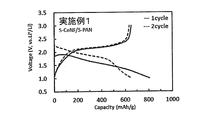
- FIG. 2 is a diagram showing a charge / discharge curve of a battery produced according to Example 1.
- the electrode material for a lithium ion battery or lithium ion capacitor of the present disclosure includes a composite powder in which the B component is supported or coated on the surface of the A component, and the A component electrochemically absorbs and releases lithium ions.
- the B component is a sulfur-modified cellulose, and the B component is 0.01% by mass or more with respect to 100% by mass of the total amount of the A component and the B component.
- the composite powder obtained is hydrophilic since the surface of the component A is supported or coated with the hydrophilic component B described later in detail.
- a binder water-based binder
- a slurry having excellent uniformity can be easily obtained, and the manufacturing time of the electrode can be shortened.
- the productivity of the electrode is significantly improved as compared with the conventional electrode material, and the capacity or output of the battery or capacitor is increased. In addition, it is possible to expand the use application.
- the composite powder of the present disclosure is the one in which the B component is supported or coated on the surface of the A component.
- the B component may be supported or coated around (surface) with the A component as a core.
- Support or coating means that the surface of component A is partially or completely covered by component B.
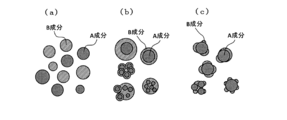
- composite is a concept different from mixing, and while mixed powder is a mere assembly of A component and B component, composite powder contains A component and B component in one particle constituting the powder. Both are included.
- grains of the mere mixed powder is shown in FIG. 1 (a), and the cross-sectional conceptual diagram of the particle
- FIG. 1 (b) is a conceptual view when the surface of the component A is completely covered with the component B
- B component When a simple mixed powder of A component and B component is to be dispersed in water, B component is excellent in hydrophilicity even if it is a single component, so A component and B component are easily separated when only B component is dispersed alone.
- the composite powder of the present disclosure exhibits excellent dispersibility in water because the component B is supported or coated on the surface of the component A, and both the component A and the component B can be dispersed.
- the median diameter (D50) of the composite powder in which the component B is supported or coated on the surface of the component A is preferably 0.1 ⁇ m to 30 ⁇ m, more preferably 0.5 ⁇ m to 15 ⁇ m, and still more preferably 0.55 ⁇ m to 14.5 ⁇ m Is more preferred.
- the median diameter (D50) of the composite powder in the above range it is possible to obtain an electrode material from which an electrode having excellent output characteristics and cycle life characteristics can be obtained.
- a specific surface area does not become high too much, and a binder required for electrode formation does not increase. As a result, the output characteristics and energy density of the electrode are excellent.
- adjustment of an electrical capacity is easy in design of the electrical capacity per unit area of an electrode by being 30 micrometers or less.
- the median diameter (D50) means a particle diameter at which accumulation of frequency becomes 50% by volume conversion based on volume using laser diffraction / scattering particle diameter distribution measurement method, and so on. .
- the measurement apparatus "LA-960" manufactured by HORIBA can be used.
- the content of the component B is 0.01 mass% or more, preferably 0.1 mass% or more, when the total amount of both components is 100 mass%. 0.5 mass% or more is more preferable.
- the B component is 0.01% by mass or more, the effect of imparting hydrophilicity to the A component is excellent, and the dispersibility is sufficient when producing a slurry using an aqueous binder.
- it is only for the purpose of providing hydrophilicity to the component A it is not necessary to provide the component B exceeding 10% by mass, and it may be 10% by mass or less.
- the component A is made of a material capable of electrochemically absorbing and desorbing lithium ions.
- the component A is not particularly limited as long as it is an electrode material capable of electrochemically absorbing and desorbing lithium ions.
- electrochemically absorbing lithium ions it reversibly forms an alloy (including a solid solution, an intermetallic compound, etc.) with lithium, reversibly chemically bonds with lithium, and reversibly contains lithium And so on.
- releasing lithium ions electrochemically means that lithium ions to be stored are separated.
- the component A is, for example, Li, Na, C, Mg, Al, Si, P, S, K, Ca, Sc, Ti, V, Cr, Mn, Fe, Co, Ni, Cu, Zn, Ga, Ge, It contains at least one or more elements selected from the group consisting of Y, Zr, Nb, Mo, Pd, Ag, Cd, In, Sn, Sb, W, Pb, and Bi.
- sulfur-based organic materials such as sulfur (S), sulfides of the above elements, and sulfur-modified compounds of organic compounds are preferable from the viewpoint of showing a charge-discharge plateau region similar to the component B (sulfur-modified cellulose).
- sulfur-based organic materials such as sulfides of the above elements or sulfur-modified compounds of organic compounds include metal sulfides, sulfur composite carbon, sulfur-modified natural rubber, sulfur-modified pitch, sulfur-modified anthracene, sulfur-modified polyacryl, sulfur Modified phenol, Sulfur modified polyolefin, Sulfur modified polyvinyl alcohol, Sulfur modified nylon, Sulfur modified vinyl acetate copolymer, Sulfur modified terephthalic acid, Sulfur modified diaminobenzoic acid, Sulfur modified methacrylate resin, Sulfur modified polycarbonate, Sulfur modified polystyrene, Sulfur modified N-vinyl formaldehyde copolymer, sulfur-modified polyacrylonitrile and the like can be mentioned.
- a component may consist of 1 type individual, and may consist of 2 or more types.
- sulfur-modified polyacrylonitrile is preferable because it can stably show reversible electric capacity of 500 to 700 mAh / g.
- the component A is in the form of particles, and the median diameter (D50) is preferably 0.1 ⁇ m to 30 ⁇ m, more preferably 0.5 ⁇ m to 15 ⁇ m, and still more preferably 0.55 ⁇ m to 14.5 ⁇ m.
- the median diameter (D50) is in the above range, the surface smoothness of the obtained electrode is not deteriorated, and the B component is easily supported or coated on the surface of the A component.
- the B component is sulfur-modified cellulose.
- Sulfur-modified cellulose means a material in which cellulose is dehydrogenated to be sulfurized, and is composed of a carbon skeleton derived from cellulose and sulfur bonded to the carbon skeleton. Sulfur-modified cellulose changes its appearance from white of the precursor (cellulose) to black, exhibits excellent hydrophilicity, and is insoluble in water.
- cellulose has the property of dispersing or swelling in water and absorbing water, and at 180 ° C. or more, the weight is reduced and the carbonization reaction starts.
- sulfur-modified cellulose is hydrophilic but insoluble in water, it does not swell with water, and even at 400 ° C., the weight loss is 30% by mass or less, exhibiting excellent heat resistance.
- Sulfur-modified cellulose may vary depending on production conditions such as the amount of raw materials charged and the heat treatment temperature, but it may be 10 to 60% by mass of sulfur and 20 to 60% by mass of sulfur in elemental analysis. .
- the electrode material for a lithium ion battery or lithium ion capacitor of the present disclosure includes a composite powder in which the B component is supported or coated on the surface of the A component, and may contain an optional component such as a conductive material.
- the electrode material for a lithium ion battery or lithium ion capacitor preferably contains a conductive material. This is because a further increase in output of the electrode material can be expected.
- the component B is contained so as to be supported or coated on the surface of the component A, such as containing a conductive material, it is preferable because both the hydrophilicity and the conductivity can be imparted to the surface of the component A.
- the electrode material containing an electrically-conductive material disperse
- solvent such as water
- the dispersibility in a solvent such as water can be improved by using a surfactant, an alcohol and the like in combination.
- the surfactant, alcohol and the like used in combination do not adversely affect the electrode material because they are decomposed or vaporized by heat treatment.
- the conductive material refers to a material having electronic conductivity.
- C carbon
- Al aluminum
- Ti titanium
- V vanadium
- Cr chromium
- Fe iron
- Co cobalt
- Ni nickel
- Cu copper
- Ta tantalum
- Au gold
- carbon is preferable from the viewpoint of conductivity, material cost, and small irreversible capacity.
- Examples of carbon include graphite, carbon black, carbon fiber, carbon nanotube, carbon nanohorn, graphene, hard carbon, soft carbon, glassy carbon, and vapor grown carbon fiber (VGCF (registered trademark)).
- Carbon black is particularly preferable. Carbon blacks have different properties depending on the production method, but furnace black (FB), channel black, acetylene black (AB), thermal black, lamp black, and ketjen black (KB (registered trademark)) can be used without problems.
- FB furnace black
- AB acetylene black
- KB ketjen black
- the conductive material may be used alone or in combination of two or more.
- the content of the conductive material is 0.1% by mass or more based on 100% by mass of the composite powder (in other words, the component A and the component B) in which the component B is supported or coated on the surface of the component A 30 mass% or less is preferable.
- the content is 0.1% by mass or more, the effect of imparting conductivity is sufficient.
- the content is 30% by mass or less, the capacity of the active material can be reduced, which is preferable.
- the conductive material is contained as an electrode material, it is preferable to perform desulfurization treatment in the production of a composite powder in which the component B is supported or coated on the surface of the component A and then compounded.
- the component B (sulfur-modified cellulose) can be obtained by a heat treatment process using a cellulose material (precursor) and sulfur as raw materials and contacting the cellulose material with sulfur.
- the cellulose material and the sulfur may be in physical contact, for example, a solid powder obtained by mixing the cellulose material and the sulfur, the cellulose material and the sulfur are dispersed in a solvent and dried. And the like.
- sulfur when sulfur is brought into contact with cellulose and heat-treated, sulfur diffuses in solid phase to cellulose, so that the B component (sulfur-modified cellulose) can be obtained with good yield.
- the heat treatment may be performed at a temperature at which cellulose is sulfur-modified, and preferably 200 ° C. or more and 800 ° C. or less.
- a sulfur-modified cellulose comprising a carbon skeleton derived from a cellulose material and sulfur bonded to the carbon skeleton can be synthesized.
- the temperature is 200 ° C. or more
- the cellulose material is sufficiently sulfur-modified, and the conductivity of the resulting sulfur-modified cellulose is higher than that of the one below 200 ° C. Further, by setting the temperature to 800 ° C.
- sulfur is less likely to be desorbed from the sulfur-modified cellulose, and the sulfur content is less likely to be reduced, so that it is possible to prevent the reduction in electric capacity of the electrode material as carbide.
- From the viewpoint of high yield and electrical capacity of sulfur-modified cellulose 220 ° C. or more and 600 ° C. or less are more preferable.
- From the viewpoint of excellent conductivity of the sulfur-modified cellulose 250 ° C. or more and 500 ° C. or less are more preferable.
- the atmosphere at the time of heat treatment is not particularly limited, but oxidation with oxygen may occur in the atmosphere, so it is preferable to use a non-oxygen atmosphere such as an inert gas atmosphere or a reducing atmosphere.
- a reduced pressure atmosphere a helium atmosphere, a neon atmosphere, an argon atmosphere, a nitrogen atmosphere, a hydrogen atmosphere, and a sulfur gas atmosphere can be mentioned.
- the heat treatment time may be any time as long as sulfur-modified cellulose is produced, and may be 1 hour or more and 50 hours or less, or 1 hour or more and 40 hours or less. By being in this range, cellulose is sufficiently sulfur-denatured, which is preferable because the electric capacity of the obtained composite powder is excellent. Moreover, since the heating time is not too long, the reaction of sulfur modification proceeds sufficiently, and wasteful heating energy is not consumed, which is economically preferable.
- the weight of sulfur used as the raw material may be equal to or more than the weight of the cellulose material.
- the weight of sulfur is preferably, for example, 1 to 10 times the weight of the cellulose material, and more preferably 2 to 6 times the weight.
- the sulfur modification sufficiently occurs to provide an electrode material excellent in electric capacity.
- the amount is 10 times or less, the sulfur of the raw material is unlikely to remain in the obtained electrode material, and it takes less time to carry out the desulfurization treatment in the subsequent step. Since sulfur is hydrophobic, the remaining electrode material may not exhibit sufficient hydrophilicity. In addition, if the electrode material does not show sufficient hydrophilicity, desulfurization can be performed.
- the cellulose material which is a precursor of the component B may be a carbohydrate represented by the molecular formula (C 6 H 10 O 5 ) n or a derivative thereof.
- the molecular formula (C 6 H 10 O 5) derivatives of carbohydrates represented by n, the introduction of functional groups, oxidation, reduction, etc. replacement atom, represented by the molecular formula (C 6 H 10 O 5) n It means a compound which has been modified to such an extent that the structure and properties of carbohydrates are not significantly changed.
- CeNF is cellulose which is a constituent substance such as wood; cellulose fiber in which cellulose or the like obtained from animals, algae, or bacteria is finely or physically finely ground to a maximum fiber diameter of 1 ⁇ m or less. More specifically, the cellulose fiber has a length of 0.2 ⁇ m or more, an aspect ratio (cellulose fiber length / cellulose fiber diameter (fiber diameter)) of 10 or more and 100,000 or less, and an average degree of polymerization of 100 to 100,000.
- the length of the cellulose fiber is 0.5 ⁇ m or more
- the aspect ratio (the length of the cellulose fiber / the diameter of the cellulose fiber (fiber diameter)) is 10 to 250
- the average degree of polymerization is 100 to More preferably, it is 10000 cellulose fibers.
- the average degree of polymerization refers to a value calculated by the viscosity method described in TAPPI T230 standard method.
- CeNF it is preferable that it is a cellulose fiber which has anionic group from a viewpoint which can be disintegrated efficiently to the predetermined
- the anionic group is not particularly limited, and examples thereof include a carboxylic acid group, a phosphoric acid group, a sulfonic acid group, a sulfuric acid group, or a group forming a salt with these groups, and any one of these groups is included. And may have two or more.
- the type of the salt is not particularly limited, but alkali metal salts such as sodium salt, potassium salt and lithium salt; alkaline earth metal salts such as magnesium salt, calcium salt and barium salt; onium such as ammonium salt and phosphonium salt Salts; amine salts such as primary amines, secondary amines, tertiary amines, etc. may be mentioned.
- the anionic group includes an acid type such as carboxylic acid group, phosphoric acid group, sulfonic acid group and sulfuric acid group, and a salt type such as carboxylic acid group, phosphoric acid group, sulfonic acid group and sulfuric acid base
- a preferred embodiment is that it contains a salt type anionic group, a cellulose fiber having only a salt type anionic group may be used, and a salt type anionic group and an acid type anion You may use the cellulose fiber in which the sex group is mixed.
- cellulose nanofibers (CeNF) are used as a precursor of the B component (sulfur-modified cellulose)
- the obtained sulfur-modified cellulose becomes sulfur-modified cellulose nanofibers (S-CeNF).
- the component B is fibrous sulfur-modified cellulose nanofibers (S-CeNF)
- a three-dimensional network structure having conductivity can be formed on the surface of the component A, and a sufficient current collection effect as an electrode active material It is preferable because
- S-CeNF exhibits excellent hydrophilicity without dissolving or swelling in water.
- a reversible electric capacity of 300 to 400 mAh / g can be stably shown.
- S-CeNF As the B component on the surface of the A component, it is possible to expect not only to impart hydrophilicity but also to increase the capacity of the electrode. Furthermore, since S-CeNF is fibrous, it is possible to form a three-dimensional network structure on the surface of the component A. If a three-dimensional network structure of S-CeNF is formed, the A component can be in contact with the electrolytic solution, and an output characteristic sufficient as an electrode material can be obtained.
- S-CeNF preferably has a maximum fiber diameter of 1 ⁇ m or less. More specifically, the fiber length is preferably 0.2 ⁇ m or more, and the aspect ratio (S-CeNF length / S-CeNF diameter) is preferably 10 or more and 100000 or less. Further, from the viewpoint of excellent output characteristics of the battery or capacitor, it is more preferable that the maximum fiber diameter is 1 nm or more and 500 nm or less, the fiber length is 0.5 ⁇ m or more, and the aspect ratio is 8 or more and 50000 or less.
- the fiber length is 2 ⁇ m to 200 nm, the fiber length is 0.8 ⁇ m or more, and the aspect ratio is 25 to 10000. It is possible to obtain a composite powder in which sulfur modified cellulose nanofibers having a three-dimensional network structure are supported or coated on the surface of component A, and the electrode characteristics originally expected for component A, specifically, output characteristics and cycle life characteristics It is possible to impart hydrophilicity to the component A and to exhibit excellent dispersibility without lowering the viscosity.
- the maximum fiber diameter at least 10 fibers are randomly selected from fiber images obtained using an electron beam microscope or the like, and the maximum value of the length in the minor axis direction of each fiber is determined. It is obtained by averaging the maximum values.
- the average fiber diameter at least ten or more fibers are randomly selected from fiber images obtained using an electron beam microscope or the like, and the average value of the lengths in the minor axis direction of each fiber is determined. can get.
- the aspect ratio is determined by the fiber length / fiber diameter (average fiber diameter), and the fiber length and fiber diameter are obtained as follows.
- the fiber length is a value measured by a fiber length measurement machine (FS-200 type) manufactured by KAJAANI AUTOMATION. Also, the fiber length can be measured by an equivalent device.
- the method for obtaining the composite powder in which the component B is supported or coated on the surface of the component A is not particularly limited, but methods such as mechanical milling, spray drying, fluidized bed granulation, and firing and grinding may be mentioned.
- a composite in which the surface of the component A is supported or coated with the component B can be formed by spray-drying a liquid in which the component A and the component B are dispersed in water or an organic solvent.
- the component A is a hydrophobic material
- a surfactant, alcohol or the like may be added to water. It is preferred to utilize the added solvent. The surfactant, alcohol and the like do not adversely affect the electrode material because they are decomposed or vaporized by heat treatment.
- hot air is sent from the lower part of the granulation chamber containing the component A, and the solvent in which the component B is dispersed is sprayed onto the component A while the component A is wound up into the air and allowed to flow. It is possible to form a complex in which the B component is supported or coated on the surface of the A component.
- hot air is sent from the lower part of the granulation chamber containing the precursor of the component A, and the precursor of the component A is wound up into the air and allowed to flow,
- the solvent in which the precursor is dispersed is sprayed onto the A component precursor to prepare a composite powder in which the B component precursor is supported or coated on the surface of the A component precursor, and then this composite powder is brought into contact with sulfur.
- heat treatment at 200 ° C. or higher in the molten state, a complex in which the B component is supported or coated on the surface of the A component can be formed.
- the dispersion is heat-treated at 200 ° C. or higher, and then pulverized to obtain the component B on the surface of the component A.
- the solvent used by the baking grinding method utilizes the solvent which added surfactant, alcohol, etc. to water. The surfactant, alcohol and the like do not adversely affect the electrode material because they are decomposed or vaporized by heat treatment.
- the component A when the component A is prepared first and then manufactured, particularly when it is a sulfur or sulfur-based organic material as the component A Component A is obtained by sulfiding the above element by heat treatment and sulfur-modifying an organic compound.
- this organic compound polyacrylonitrile (PAN) is preferable from the viewpoint of large electric capacity and excellent life characteristics.
- the composite powder in which the B component is supported or coated on the surface of the A component can be obtained by the step of heating to 200 ° C. or more and 800 ° C. or less.
- the component A is a sulfur-modified polyacrylonitrile obtained by sulfur-modifying polyacrylonitrile (PAN)
- PAN sulfur-modified polyacrylonitrile
- the following method may be mentioned as a method for obtaining a composite powder in which the component B is supported or coated on the surface of the component A .
- PAN is a sulfur-modified polyacrylonitrile (S-PAN; A component) by a process of heating to 200 ° C. or more and 800 ° C. or less with PAN, cellulose material, and sulfur as raw materials and in the state of contacting PAN and cellulose with sulfur.
- the cellulose material becomes sulfur-modified cellulose (corresponding to the B component), and at the same time, a composite powder in which the B component is supported or coated on the surface of the A component can be obtained.
- the weight of sulfur used as the raw material may be equal to or more than the weight of each of PAN and the cellulose material.
- the amount of sulfur is preferably 1 to 10 times the weight of each of PAN and the cellulose material, and more preferably 2 to 6 times the weight.
- the weight of sulfur as a raw material is one or more times the weight of each of PAN and a cellulose material, sulfur modification occurs sufficiently, and an electrode material excellent in electric capacity is obtained.
- the amount is 10 times or less, the sulfur of the raw material is less likely to remain in the obtained electrode material, and it takes less time to carry out the desulfurization treatment in the subsequent step. If elemental sulfur remains in the electrode material, the initial electric capacity increases, but the cycle life characteristics may deteriorate. In such a case, it is preferable to carry out desulfurization treatment.
- the desulfurization treatment is a treatment for removing elemental sulfur contained in the produced composite powder, and is not limited as long as residual sulfur can be removed by heat treatment or reduced pressure treatment.
- a heating step at 250 ° C. or higher in a reduced pressure or inert gas atmosphere may be mentioned.
- the residual sulfur can be satisfactorily removed by performing this heating for about 1 to 20 hours.
- the upper limit of the heating temperature is not particularly limited, but may be 800 ° C. or less from the viewpoint of a large electric capacity of the electrode material.
- residual sulfur may be dissolved in carbon disulfide, but since carbon disulfide is highly toxic, the above-mentioned desulfurization treatment by heat treatment is preferable.
- the lithium ion battery electrode of the present disclosure comprises the electrode material for a lithium ion battery of the present disclosure.
- the electrode for a lithium ion capacitor of the present disclosure comprises the electrode material for a lithium ion capacitor of the present disclosure.
- the lithium ion battery electrode or the lithium ion capacitor electrode may be composed of an electrode material and a current collector, and the electrode material of the present disclosure may be integrated with the current collector.
- the electrode for lithium ion batteries or the electrode for lithium ion capacitors may contain arbitrary components, such as a binder and a conductive support agent, other than the electrode material of this indication.
- a composite powder in which the B component is supported or coated on the surface of the A component in the electrode material of the present disclosure is mainly used as an active material.
- the active material refers to a substance capable of electrochemically absorbing and desorbing lithium ions.
- the electrode for example, the electrode material for lithium ion battery of the present disclosure or the electrode material for lithium ion capacitor, binder and conductive auxiliary agent, N-methyl-pyrrolidone (NMP), water, alcohol, xylene , And an appropriate solvent such as toluene are added and sufficiently kneaded, the electrode slurry obtained is coated on the surface of the current collector, dried, and pressure-controlled, to form an active material-containing layer on the current collector surface.
- NMP N-methyl-pyrrolidone
- water alcohol
- xylene xylene
- an appropriate solvent such as toluene
- the current collector is not particularly limited as long as it is a material that has electron conductivity and can conduct electricity to the held negative electrode material.
- conductive materials such as C, Ti, Cr, Fe, Mo, Ru, Rh, Ta, W, Os, Ir, Pt, Au, Cu, Ni, Al, etc. containing two or more of these conductive materials Alloys (eg, stainless steel) or the like may be used.
- C, Al, Cu, Ni, stainless steel and the like are preferable as the current collector from the viewpoints of high electron conductivity, stability in the electrolyte, oxidation resistance and reduction resistance, C, Al and stainless steel Is more preferred.
- the shape of the current collector is not particularly limited.
- a foil-like substrate, a three-dimensional substrate or the like can be used.
- Three-dimensional substrates include foam metal, mesh, woven fabric, non-woven fabric, expanded and the like.
- a primer layer on the surface of the current collector in advance.
- the primer layer may be any one as long as it has good adhesion to the electrode material layer and the current collector and has conductivity.
- a primer layer can be formed by applying a binder, which is a mixture of a carbon-based conductive additive and a binder for a primer, on a current collector.
- the thickness of the primer layer is, for example, 0.1 ⁇ m to 20 ⁇ m.
- the binder for primers can use the well-known binder used for an electrode.
- the binder contained as an optional component in the electrode for lithium ion battery or lithium ion capacitor is not limited as long as it is conventionally used as a binder for electrodes for lithium ion battery or lithium ion capacitor.
- carboxymethyl cellulose salt (CMC) acrylic resin, alginate, polyvinylidene fluoride (PVDF), polyimide (PI), polytetrafluoroethylene (PTFE), polyamide, polyamide imide, styrene butadiene rubber (SBR), polyurethane, Styrene-Ethylene-Butylene-Styrene Copolymer (SEBS), Styrene-Butadiene-Styrene Copolymer (SBS), Styrene-Isoprene-Styrene Copolymer (SIS), Styrene-Ethylene-Propylene-Styrene Copolymer (SEPS) And polyvinyl alcohol (PVA), polyvinyl alcohol (PVA
- CMC acrylic resin
- alginate PVA, SBR, etc.
- binders are water-based binders which can use water as a solvent or dispersion medium.
- the use of a water-based binder is preferable because it suppresses sulfur elution into the slurry solvent and improves the high temperature durability of the electrode.
- the hydrophobic material repels with water and becomes a dispersed powder (for example, lumps, aggregates etc.)
- a dispersed powder for example, lumps, aggregates etc.
- the composite powder of the present disclosure has the component B having excellent hydrophilicity supported or coated on the surface of the component A. Therefore, even when an aqueous binder is employed, there is no problem of difficulty in dispersion.
- the binder content is 0.1% by mass or more and 30% by mass with respect to a total of 100% by mass of the composite powder (in other words, the A and B components) in which the B component is supported or coated on the surface of the A component. % Or less is preferable, and 0.5% by mass or more and 15% by mass or less is more preferable. If the value is out of the above range, it is difficult to obtain stable life characteristics and output characteristics. That is, when the amount of the binder is small, the binding ability with the current collector is not sufficient, so it is difficult to obtain stable life characteristics. On the contrary, when the amount is too large, the electrode resistance becomes high and the output characteristics deteriorate.
- the conductive aid is a substance that helps the conductivity between active materials, and is a material that is filled or crosslinked between active materials that are separated from each other to achieve conduction between active materials or between the active material and a current collector.
- a conductive support agent contained as an optional component in a lithium ion battery electrode or a capacitor electrode those conventionally used as a conductive support agent for a lithium ion battery electrode or a capacitor electrode can be used.
- Examples include carbon materials such as acetylene black (AB), ketjen black (KB), graphite, carbon fiber, carbon nanotube, graphene, amorphous carbon, and vapor grown carbon fiber (VGCF).
- the conductive aids may be used alone or in combination of two or more.
- those capable of forming a conductive three-dimensional network structure are preferable.
- materials capable of forming a conductive three-dimensional network structure include flake-like conductive materials such as flake aluminum powder and flake stainless steel powder; carbon fibers; carbon tubes; amorphous carbon and the like.
- the content of the conductive aid is 0% by mass or more based on 100% by mass of the composite powder (in other words, the component A and the component B) in which the component B is supported or coated on the surface of the component A 20 mass% or less is preferable, and 1 mass% or more and 10 mass% or less is more preferable.
- the conductive aid is contained as needed.
- a lithium ion battery can be formed using the lithium ion battery electrode of the present disclosure.
- the lithium ion battery includes a positive electrode, a negative electrode, and an electrolyte interposed between the positive electrode and the negative electrode.
- the electrode of the present disclosure can be used as any one of the positive electrode and the negative electrode of a lithium ion battery. That is, although the electrode of the present disclosure can be used as either a positive electrode or a negative electrode of a lithium ion battery, it is excluded that the positive electrode and the negative electrode simultaneously use the same electrode among the electrodes of the present disclosure.
- a lithium ion battery When using the said electrode as a positive electrode of a lithium ion battery, a lithium ion battery can be produced by combining with the electrode more negative than the charging / discharging electric potential of the said electrode.
- a lithium ion battery when using the said electrode as a negative electrode of a lithium ion battery, a lithium ion battery can be produced by combining with the electrode more noble than the charging / discharging electric potential of the said electrode.
- the lithium ion capacitor can be set as a lithium ion capacitor using the electrode for lithium ion capacitors of this indication.
- the lithium ion capacitor also includes a positive electrode, a negative electrode, and an electrolyte interposed between the positive electrode and the negative electrode.
- the electrode of the present disclosure is used as an electrode of a lithium ion capacitor, the electrode can be used as either a positive electrode or a negative electrode, and the positive electrode and the negative electrode may use the same electrode at the same time.
- a lithium ion doped negative electrode as an electrode to be a negative electrode in advance before assembling a lithium ion capacitor.
- the lithium ion doping method is not particularly limited as long as the electrode can be doped with lithium, but, for example, non-patent literature (Sakamoto Taichi et al., "Collection of measurement and analysis data of lithium secondary battery members” Technical Information Association publication, 30 (1) Electrochemical doping, (2) Bonding doping of lithium metal foil, (3) mechanical lithium doping using high-speed planetary mill, etc. as described in can give.
- examples of the counter electrode include Li, Na, C, Mg, Al, Si, P, K, Ca, Sc, Ti, V, Cr, Mn, Fe, Co, Ni At least one element selected from the group consisting of Cu, Zn, Ga, Ge, Y, Zr, Nb, Mo, Pd, Ag, Cd, In, Sn, Sb, W, Pb, and Bi; Electrodes containing materials such as alloys containing elements; oxides, sulfides and halides of these elements; sulfur-based organic materials such as sulfur-modified compounds of organic compounds; and the like (in other words, negative electrode materials). These negative electrode materials may be used alone or in combination of two or more.
- a counter electrode positive electrode
- LiCoO 2 , L iNiO 2 , LiMnO 2 , LiNi 0.33 Mn 0.33 Co 0.33 O 2 LiNi 0.5 Mn 0.3 Co 0.2 O 2 , LiNi 0.6 Mn 0.2 Co 0.2 O 2 , LiNi 0.8 Mn 0.1 Co 0.1 O 2 , LiMn 2 O 4 , LiNi 0.5 Mn 1.5 O 4
- LiFePO 4 LiFe 0.5 Mn 0.5 PO 4 , LiMnPO 4 , LiCoPO 4 4, LiNiPO 4, Li 3 V 2 (PO 4) 3, LiV 2 O 5, LiVO 2, LiNb 2 O 5, LiNbO 2, LiFeO 2, LiMgO 2, LiCaO 2, LiTiO 2, LiCrO 2, LiRuO 2, LiCuO 2, LiZnO 2, LiMoO 2, LiTaO 2 or LiWO 2
- An electrolytic solution is obtained by dissolving a supporting salt in a solvent.
- the solvent of the electrolytic solution is not particularly limited, but cyclic carbonates such as ethylene carbonate (EC), propylene carbonate (PC) and butylene carbonate; ethers such as tetrahydrofuran; hydrocarbons such as hexane; and ⁇ -butyl A lactone system such as lactone can be used.
- cyclic carbonate-based electrolytes such as EC or PC are preferable from the viewpoint of discharge rate characteristics.
- the discharge rate is an index based on a constant current discharge of a cell having a capacity of a nominal capacity value to set a current value that completely discharges in 1 hour as a “1C rate”, for example, 5 hours.
- the current value for complete discharge is described as "0.2 C rate”, and the current value for complete discharge in 10 hours is described as “0.1 C rate”.
- the charge rate is an index based on a constant current charge of a cell having a capacity of a nominal capacity value to set a current value to be fully charged in one hour as a “1 C rate”, for example, 1
- the current value for full charge in minutes is "60C rate”
- the current value for full charge in 6 minutes is "10C rate”
- the current value for full charge in 5 hours is "0.2C rate”
- full in 10 hours full in 10 hours
- the current value to be charged is described as "0.1 C rate”.
- EC Since EC is usually solid at normal temperature, EC alone does not function as an electrolyte. However, the mixed solvent obtained by mixing with PC, dimethyl carbonate (DMC), diethyl carbonate (DEC), ethyl methyl carbonate (EMC) or the like functions as an electrolytic solution usable even at normal temperature.
- DMC dimethyl carbonate
- DEC diethyl carbonate
- EMC ethyl methyl carbonate
- EC ethylene carbonate
- DEC diethylene carbonate
- EC-DMC dimethyl carbonate
- EC-PC ethylene carbonate
- EC-DEC or EC-PC is suitably used.
- the salt generally used to a lithium ion battery or a lithium ion capacitor can be used.
- lithium hexafluorophosphate (LiPF 6 ) is preferably used.
- LiPF 6 lithium hexafluorophosphate
- the concentration of the electrolytic solution is not particularly limited, but is preferably 0.1 to 3 mol / L, and more preferably 0.8 to 2 mol / L.
- the structure of the lithium ion battery or lithium ion capacitor is not particularly limited, but an existing form or structure such as a laminated type or a wound type can be adopted. That is, the electrode group in which the positive electrode and the negative electrode face each other with the separator interposed therebetween is wound or sealed in a state in which the electrode group is immersed in the electrolytic solution, to form a secondary battery or a capacitor.
- An electricity storage device (in particular, a lithium ion battery or a lithium ion capacitor) using an electrode material for a lithium ion battery or a lithium ion capacitor according to the present disclosure has a high capacity and a high output.
- an electrode of the present disclosure there are an electrode for lithium ion battery and an electrode for lithium ion capacitor.
- a lithium ion battery is manufactured and tested.
- the lithium ion capacitor can be manufactured in the same manner as the lithium ion battery except that the operation of the counter electrode is mainly different.
- the battery can be manufactured in the same manner as the battery described later except that the conventional lithium ion capacitor positive electrode is used as the positive electrode and the electrode of the present disclosure is used as the negative electrode.
- the electrode of the present disclosure is used as an electrode for a lithium ion capacitor, for example, an electrode manufactured by applying a slurry consisting of activated carbon, a binder and a conductive additive to an aluminum foil and heat treating it as a counter electrode Can.
- the activated carbon of such a lithium ion capacitor is formed of an infinite number of fine pores, preferably a carbon material having a large specific surface area.
- a carbon material such as petroleum coke and an alkali metal compound such as potassium hydroxide are heated at 600 to 1500 ° C. in a non-oxygen atmosphere to allow alkali metal to penetrate between graphite crystal layers. It is obtained by activating the reaction.
- the median diameter (D50) of the activated carbon particles is preferably 0.5 to 30 ⁇ m.
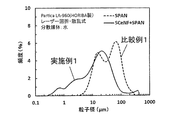
- volume based particle size distribution With respect to the obtained powder, volume based particle size distribution was measured by laser diffraction / scattering equation using water as a dispersion medium. As a measuring apparatus, “LA-960” manufactured by HORIBA was used. It measured using the laser beam of wavelength 650nm and 405 nm. The results are shown in FIG.
- the obtained slurry was applied on a 20 ⁇ m thick aluminum foil as a current collector, and dried under reduced pressure at 160 ° C. for 12 hours to obtain a test electrode.
- the powder of the sulfur modified compound was used as an active material.
- the obtained test electrode was used as a positive electrode, and the coating amount of the slurry was adjusted so that the positive electrode capacity per unit area of one side of the positive electrode was 1 mAh / cm 2 .
- EC ethylene carbonate
- DEC diethyl CR2032 coin cell equipped with carbonate
- Test electrode obtained as positive electrode; microporous polypropylene membrane (thickness 20 ⁇ m) as separator; SiO whose electrochemical irreversible capacity is canceled as negative electrode; 1 M LiPF 6 as electrolyte (ethylene carbonate (EC): diethyl carbonate (DEC)
- EC ethylene carbonate
- DEC diethyl carbonate
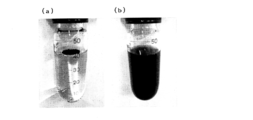
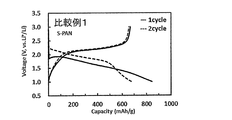
- Example 1 A battery was produced in the same manner as in Comparative Example 1 except that the composite powder obtained by the following method was used as the powder of the sulfur-modified compound. The evaluation of the dispersibility of the composite powder obtained in the steps up to the production of the battery in water, the charge / discharge test of the battery, and the test of leaving at high temperature were performed on the electrode. The results are shown in Table 1, FIG. 2, FIG. 3 and FIG.
- the resulting mixture was heated at 350 ° C. for 5 hours. After heating, the mixture is crushed by a stirring grinder, classified by a sieve of 325 mesh (45 ⁇ m mesh), and a composite powder (S-CeNF + S-PAN) in which sulfur modified cellulose is supported or coated on the surface of sulfur modified polyacrylonitrile powder. Got).
- the median diameter (D50) of the obtained powder was 14.2 ⁇ m. This value is obtained based on the data shown in FIG.
- Example 1 shows superior water dispersibility to Comparative Example 1.
- the powder of Comparative Example 1 has a peak with a narrow width at a large particle size value compared to the powder of Example 1, and the powder of Example 1 has a broad peak at a small particle size value. It can be seen that the powder of 1 is well dispersed in water.
- the electrode of Comparative Example 1 has a decrease in discharge capacity of about 4.9% from 674 mAh / g in one cycle to 641 mAh / g in 100 cycles, while Example 1 The electrode of Example 1 had a decrease in discharge capacity of about 4.9% from one cycle of 652 mAh / g to 100 cycles of 620 mAh / g, and exhibited the same reversible capacity and cycle life characteristics as the electrode of Comparative Example 1.
- the electrode of Reference Example 1 is about 19% reduction in discharge capacity from 1 cycle of 353 mAh / g to 100 cycles of 287 mAh / g, and although it has excellent cycle life characteristics to a certain extent, Example 1 and Comparative Example 1 It has been shown that especially the electrical capacity is low compared to the capacity above 600 mAh / g. In the batteries using the electrodes of Example 1 and Comparative Example 1, no significant change by visual observation was observed, and no battery swelling due to gas generation was confirmed.
Landscapes
- Chemical & Material Sciences (AREA)
- Engineering & Computer Science (AREA)
- Chemical Kinetics & Catalysis (AREA)
- Electrochemistry (AREA)
- General Chemical & Material Sciences (AREA)
- Power Engineering (AREA)
- Materials Engineering (AREA)
- Microelectronics & Electronic Packaging (AREA)
- Manufacturing & Machinery (AREA)
- Composite Materials (AREA)
- Electric Double-Layer Capacitors Or The Like (AREA)
- Battery Electrode And Active Subsutance (AREA)
Abstract
La présente invention concerne un matériau d'électrode qui est destiné à une batterie lithium-ion ou à un condensateur lithium-ion, et qui compense les inconvénients d'un matériau actif hydrophobe, confère des propriétés hydrophiles à un matériau actif hydrophobe, et peut présenter une excellente dispersibilité, sans entraîner de détérioration des propriétés de l'électrode. L'invention concerne plus précisément un matériau d'électrode destiné à une batterie lithium-ion ou à un condensateur lithium-ion, le matériau d'électrode comprenant une poudre composite dans laquelle un composant B est supporté par la surface d'un composant A ou la recouvre, le composant A comprenant un matériau pouvant stocker et décharger de manière électrochimique des ions lithium, le composant B étant de la cellulose modifiée par du soufre, et la quantité du composant B étant supérieure ou égale à 0,01 % en masse lorsque 100 % en masse représente la quantité totale du composant A et du composant B.
Priority Applications (4)
| Application Number | Priority Date | Filing Date | Title |
|---|---|---|---|
| KR1020207003690A KR20200038936A (ko) | 2017-08-08 | 2018-07-23 | 리튬이온 전지용 전극 재료, 리튬이온 커패시터용 전극 재료, 전극, 전지, 커패시터, 전기 기기, 리튬이온 전지용 전극 재료의 제조 방법, 및 리튬이온 커패시터용 전극 재료의 제조 방법 |
| CN201880052042.6A CN111052467B (zh) | 2017-08-08 | 2018-07-23 | 锂离子电池或电容器用电极材料、电极、电池、电容器、电子设备、该电极材料的制造方法 |
| EP18844262.8A EP3667783B1 (fr) | 2017-08-08 | 2018-07-23 | Matériau d'électrode pour batterie lithium-ion, matériau d'électrode pour condensateur lithium-ion, électrode, batterie, condensateur, dispositif électrique, procédé de production de matériau d'électrode pour batterie lithium-ion, et procédé de production de matériau d'électrode pour condensateur lithium-ion |
| US16/637,083 US11289693B2 (en) | 2017-08-08 | 2018-07-23 | Sulfur modified cellulose containing lithium-ion battery electrode material, lithium-ion capacitor electrode material, electrode, battery, capacitor, electric device, production method for lithium-ion battery electrode material, and production method for lithium-ion capacitor electrode material |
Applications Claiming Priority (2)
| Application Number | Priority Date | Filing Date | Title |
|---|---|---|---|
| JP2017152821A JP6981621B2 (ja) | 2017-08-08 | 2017-08-08 | リチウムイオン電池用電極材料、リチウムイオンキャパシタ用電極材料、電極、電池、キャパシタ、電気機器、リチウムイオン電池用電極材料の製造方法、およびリチウムイオンキャパシタ用電極材料の製造方法 |
| JP2017-152821 | 2017-08-08 |
Publications (1)
| Publication Number | Publication Date |
|---|---|
| WO2019031208A1 true WO2019031208A1 (fr) | 2019-02-14 |
Family
ID=65272112
Family Applications (1)
| Application Number | Title | Priority Date | Filing Date |
|---|---|---|---|
| PCT/JP2018/027432 Ceased WO2019031208A1 (fr) | 2017-08-08 | 2018-07-23 | Matériau d'électrode pour batterie lithium-ion, matériau d'électrode pour condensateur lithium-ion, électrode, batterie, condensateur, dispositif électrique, procédé de production de matériau d'électrode pour batterie lithium-ion, et procédé de production de matériau d'électrode pour condensateur lithium-ion |
Country Status (7)
| Country | Link |
|---|---|
| US (1) | US11289693B2 (fr) |
| EP (1) | EP3667783B1 (fr) |
| JP (1) | JP6981621B2 (fr) |
| KR (1) | KR20200038936A (fr) |
| CN (1) | CN111052467B (fr) |
| TW (1) | TW201911638A (fr) |
| WO (1) | WO2019031208A1 (fr) |
Cited By (3)
| Publication number | Priority date | Publication date | Assignee | Title |
|---|---|---|---|---|
| CN110380005A (zh) * | 2019-06-12 | 2019-10-25 | 欧格尼材料科技江苏有限公司 | 一种有机富锂正极材料、制备方法及其应用 |
| CN111342046A (zh) * | 2020-04-03 | 2020-06-26 | 内蒙古三信新材料科技有限公司 | 一种高容量的锂离子电池负极材料 |
| CN115702509A (zh) * | 2020-06-12 | 2023-02-14 | 株式会社Adeka | 电极和锂离子二次电池 |
Families Citing this family (13)
| Publication number | Priority date | Publication date | Assignee | Title |
|---|---|---|---|---|
| JP7449527B2 (ja) * | 2018-10-01 | 2024-03-14 | 第一工業製薬株式会社 | 蓄電デバイスの電極材料、電極、蓄電デバイス、電気機器、及び蓄電デバイスの電極材料の製造方法 |
| US20220293948A1 (en) * | 2018-10-30 | 2022-09-15 | Attaccato Limited Liability Company | A nonaqueous electrolyte secondary battery and a method for manufacturing the nonaqueous electrolyte secondary battery |
| JP6941637B2 (ja) * | 2019-04-22 | 2021-09-29 | 第一工業製薬株式会社 | 電極用結着剤組成物、電極用塗料組成物、蓄電デバイス用電極、および蓄電デバイス |
| JP7400580B2 (ja) * | 2020-03-25 | 2023-12-19 | Tdk株式会社 | 正極活物質層、それを用いた正極および二次電池 |
| KR20210130100A (ko) * | 2020-04-20 | 2021-10-29 | 스미토모 고무 코교 카부시키카이샤 | 유기 황 재료, 전극 및 리튬 이온 이차 전지, 및 제조 방법 |
| CN111640939B (zh) * | 2020-05-22 | 2021-12-17 | 华中科技大学 | 一种基于固相反应机制的硫正极材料及其制备方法 |
| CN114597554A (zh) * | 2020-12-04 | 2022-06-07 | 通用汽车环球科技运作有限责任公司 | 电容器辅助锂-硫电池组 |
| KR102655552B1 (ko) * | 2021-08-19 | 2024-04-05 | 세종대학교산학협력단 | 황-탄소 복합체 제조방법 및 이 복합체를 포함하는 나트륨-황 전지 |
| CN114014379B (zh) * | 2021-10-22 | 2022-08-26 | 广东佳纳能源科技有限公司 | 三元前驱体材料及连续制备方法、三元材料、二次电池 |
| JP2025020057A (ja) * | 2021-11-11 | 2025-02-10 | 株式会社Adeka | 組成物、電極、電池及び電極活物質材料 |
| CN114447306A (zh) * | 2022-02-10 | 2022-05-06 | 湖北亿纬动力有限公司 | 一种复合正极材料及其制备方法和电化学储能装置 |
| US20260045505A1 (en) * | 2022-08-31 | 2026-02-12 | Panasonic Intellectual Property Management Co., Ltd. | Electrochemical device |
| CN115863647A (zh) * | 2022-12-22 | 2023-03-28 | 中国科学院过程工程研究所 | 一种微米级硫化聚丙烯腈二次颗粒的制备及其正极片 |
Citations (10)
| Publication number | Priority date | Publication date | Assignee | Title |
|---|---|---|---|---|
| JP2005267853A (ja) * | 2004-03-16 | 2005-09-29 | Sanyo Electric Co Ltd | 非水電解質電池用正極及びこの正極を用いた電池 |
| WO2010044437A1 (fr) | 2008-10-17 | 2010-04-22 | 独立行政法人産業技術総合研究所 | Polyacrylonitrile modifié par du soufre, son procédé de fabrication et son application |
| JP2010153296A (ja) | 2008-12-26 | 2010-07-08 | National Institute Of Advanced Industrial Science & Technology | 硫黄変性ポリアクリロニトリルシート、その製造方法及びその用途 |
| JP2012099342A (ja) | 2010-11-02 | 2012-05-24 | Toyota Industries Corp | 硫黄系正極活物質の製造方法、硫黄系正極活物質、および、リチウムイオン二次電池用正極 |
| JP2012150933A (ja) | 2011-01-18 | 2012-08-09 | Toyota Industries Corp | 硫黄系正極活物質とその製造方法及びリチウムイオン二次電池用正極。 |
| WO2013076958A1 (fr) * | 2011-11-24 | 2013-05-30 | 株式会社豊田自動織機 | Matériau d'électrode positive pour des batteries rechargeables à électrolyte non aqueux, batterie rechargeable à électrolyte non aqueux et procédé de production d'un matériau d'électrode positive pour des batteries rechargeables à électrolyte non aqueux |
| JP2014096327A (ja) | 2012-11-12 | 2014-05-22 | Toyota Industries Corp | 硫黄系活物質とその製造方法及びリチウムイオン二次電池用電極 |
| JP2014096326A (ja) | 2012-11-12 | 2014-05-22 | Toyota Industries Corp | 二次電池用負極活物質、並びにこれを用いた負極及び二次電池 |
| WO2014133067A1 (fr) * | 2013-02-27 | 2014-09-04 | 日本ゼオン株式会社 | Particules composites pour électrode d'élément électrochimique, procédé de fabrication de particules composites pour électrode d'élément électrochimique, électrode d'élément électrochimique et élément électrochimique |
| JP2014179179A (ja) | 2013-03-13 | 2014-09-25 | National Institute Of Advanced Industrial & Technology | 硫黄変性ニトリル基含有共重合体樹脂及びその用途 |
Family Cites Families (7)
| Publication number | Priority date | Publication date | Assignee | Title |
|---|---|---|---|---|
| JP5142162B2 (ja) * | 2011-01-18 | 2013-02-13 | 株式会社豊田自動織機 | リチウムイオン二次電池用正極活物質の製造方法及びリチウムイオン二次電池用正極 |
| CN102891274B (zh) * | 2012-10-22 | 2017-05-03 | 中国电子科技集团公司第十八研究所 | 纤维素膜在锂硫二次电池中的应用 |
| CN105190953A (zh) * | 2013-03-05 | 2015-12-23 | 赛昂能源有限公司 | 包含原纤维材料如原纤维纤维素材料的电化学电池 |
| KR101992614B1 (ko) * | 2014-09-26 | 2019-06-25 | 다이헤이요 세멘토 가부시키가이샤 | 이차전지용 양극활물질 및 그 제조방법 |
| KR20170127422A (ko) * | 2015-03-09 | 2017-11-21 | 다이헤이요 세멘토 가부시키가이샤 | 이차전지용 양극 활물질 및 그 제조방법 |
| JP6521545B2 (ja) * | 2015-09-14 | 2019-05-29 | エルジー・ケム・リミテッド | リチウム硫黄電池用正極、その製造方法及びそれを含むリチウム硫黄電池 |
| CN105428616A (zh) * | 2015-11-09 | 2016-03-23 | 北京理工大学 | 一种含有阻挡层的锂硫电池 |
-
2017
- 2017-08-08 JP JP2017152821A patent/JP6981621B2/ja active Active
-
2018
- 2018-07-20 TW TW107125140A patent/TW201911638A/zh unknown
- 2018-07-23 CN CN201880052042.6A patent/CN111052467B/zh active Active
- 2018-07-23 WO PCT/JP2018/027432 patent/WO2019031208A1/fr not_active Ceased
- 2018-07-23 EP EP18844262.8A patent/EP3667783B1/fr active Active
- 2018-07-23 KR KR1020207003690A patent/KR20200038936A/ko not_active Withdrawn
- 2018-07-23 US US16/637,083 patent/US11289693B2/en active Active
Patent Citations (10)
| Publication number | Priority date | Publication date | Assignee | Title |
|---|---|---|---|---|
| JP2005267853A (ja) * | 2004-03-16 | 2005-09-29 | Sanyo Electric Co Ltd | 非水電解質電池用正極及びこの正極を用いた電池 |
| WO2010044437A1 (fr) | 2008-10-17 | 2010-04-22 | 独立行政法人産業技術総合研究所 | Polyacrylonitrile modifié par du soufre, son procédé de fabrication et son application |
| JP2010153296A (ja) | 2008-12-26 | 2010-07-08 | National Institute Of Advanced Industrial Science & Technology | 硫黄変性ポリアクリロニトリルシート、その製造方法及びその用途 |
| JP2012099342A (ja) | 2010-11-02 | 2012-05-24 | Toyota Industries Corp | 硫黄系正極活物質の製造方法、硫黄系正極活物質、および、リチウムイオン二次電池用正極 |
| JP2012150933A (ja) | 2011-01-18 | 2012-08-09 | Toyota Industries Corp | 硫黄系正極活物質とその製造方法及びリチウムイオン二次電池用正極。 |
| WO2013076958A1 (fr) * | 2011-11-24 | 2013-05-30 | 株式会社豊田自動織機 | Matériau d'électrode positive pour des batteries rechargeables à électrolyte non aqueux, batterie rechargeable à électrolyte non aqueux et procédé de production d'un matériau d'électrode positive pour des batteries rechargeables à électrolyte non aqueux |
| JP2014096327A (ja) | 2012-11-12 | 2014-05-22 | Toyota Industries Corp | 硫黄系活物質とその製造方法及びリチウムイオン二次電池用電極 |
| JP2014096326A (ja) | 2012-11-12 | 2014-05-22 | Toyota Industries Corp | 二次電池用負極活物質、並びにこれを用いた負極及び二次電池 |
| WO2014133067A1 (fr) * | 2013-02-27 | 2014-09-04 | 日本ゼオン株式会社 | Particules composites pour électrode d'élément électrochimique, procédé de fabrication de particules composites pour électrode d'élément électrochimique, électrode d'élément électrochimique et élément électrochimique |
| JP2014179179A (ja) | 2013-03-13 | 2014-09-25 | National Institute Of Advanced Industrial & Technology | 硫黄変性ニトリル基含有共重合体樹脂及びその用途 |
Non-Patent Citations (7)
| Title |
|---|
| DAICHI SAKAMOTO ET AL.: "Measurement and Analysis Data for Lithium Secondary Battery Materials", vol. 30, TECHNICAL INFORMATION INSTITUTE CO., LTD., pages: 200 - 205 |
| See also references of EP3667783A4 |
| TAKUHIRO MIYUKI ET AL., ABSTRACTS OF THE 53RD BATTERY SYMPOSIUM, 3C28, 2012, pages 203 |
| TAKUHIRO MIYUKI ET AL.: "Development of Lithium-Ion Battery Active Material and Electrode Material Technology", 2014, SCIENCE TECHNOLOGY CO., LTD., pages: 194 - 222 |
| TOSHIKATSU KOJIMA ET AL., ABSTRACTS OF THE 53RD BATTERY SYMPOSIUM, 3C27, 2012, pages 202 |
| TOSHIKATSU KOJIMA ET AL., ABSTRACTS OF THE 54TH BATTERY SYMPOSIUM, 1A08, 2013, pages 7 |
| TOSHIKATSU KOJIMA ET AL., ABSTRACTS OF THE 54TH BATTERY SYMPOSIUM, 3E08, 2013, pages 344 |
Cited By (5)
| Publication number | Priority date | Publication date | Assignee | Title |
|---|---|---|---|---|
| CN110380005A (zh) * | 2019-06-12 | 2019-10-25 | 欧格尼材料科技江苏有限公司 | 一种有机富锂正极材料、制备方法及其应用 |
| CN110380005B (zh) * | 2019-06-12 | 2022-04-22 | 欧格尼材料科技江苏有限公司 | 一种有机富锂正极材料、制备方法及其应用 |
| CN111342046A (zh) * | 2020-04-03 | 2020-06-26 | 内蒙古三信新材料科技有限公司 | 一种高容量的锂离子电池负极材料 |
| CN115702509A (zh) * | 2020-06-12 | 2023-02-14 | 株式会社Adeka | 电极和锂离子二次电池 |
| CN115702509B (zh) * | 2020-06-12 | 2025-03-28 | 株式会社Adeka | 电极和锂离子二次电池 |
Also Published As
| Publication number | Publication date |
|---|---|
| EP3667783B1 (fr) | 2022-11-16 |
| JP6981621B2 (ja) | 2021-12-15 |
| JP2019032983A (ja) | 2019-02-28 |
| EP3667783A1 (fr) | 2020-06-17 |
| US20200251720A1 (en) | 2020-08-06 |
| US11289693B2 (en) | 2022-03-29 |
| CN111052467B (zh) | 2023-06-30 |
| KR20200038936A (ko) | 2020-04-14 |
| CN111052467A (zh) | 2020-04-21 |
| EP3667783A4 (fr) | 2021-05-05 |
| TW201911638A (zh) | 2019-03-16 |
Similar Documents
| Publication | Publication Date | Title |
|---|---|---|
| JP6981621B2 (ja) | リチウムイオン電池用電極材料、リチウムイオンキャパシタ用電極材料、電極、電池、キャパシタ、電気機器、リチウムイオン電池用電極材料の製造方法、およびリチウムイオンキャパシタ用電極材料の製造方法 | |
| US9553308B2 (en) | Negative electrode material for sodium secondary battery and method for producing same, negative electrode for sodium secondary batter, and sodium secondary battery | |
| JP5686332B2 (ja) | リチウムイオン二次電池正極用バインダー、このバインダーを含むリチウムイオン二次電池用正極、この正極を用いたリチウムイオン二次電池及び電気機器 | |
| CN1328805C (zh) | 用于二次锂电池的负极活性材料和用途 | |
| JP5812482B2 (ja) | ナトリウム二次電池、ナトリウム二次電池用負極の製造方法および電気機器 | |
| JP7449527B2 (ja) | 蓄電デバイスの電極材料、電極、蓄電デバイス、電気機器、及び蓄電デバイスの電極材料の製造方法 | |
| JP2013171798A (ja) | ナトリウム二次電池用負極材料及びその製造方法、並びにナトリウム二次電池用負極、ナトリウム二次電池及びこれを用いた電気機器 | |
| JP2017097952A (ja) | 負極活物質、混合負極活物質材料、非水電解質二次電池用負極、リチウムイオン二次電池、負極活物質の製造方法、及びリチウムイオン二次電池の製造方法 | |
| JP2013197069A (ja) | リチウム二次電池用負極材料及びその製造方法、リチウム二次電池用負極及びその製造方法、リチウム二次電池及びこれを用いた電気機器 | |
| WO2019054350A1 (fr) | Mélange d'électrodes pour batterie secondaire à électrolyte non aqueux | |
| JP5660539B2 (ja) | リチウムイオン二次電池用電極、リチウムイオン二次電池、および電気機器 | |
| JP2013196978A (ja) | ナトリウム二次電池用正極材料及びその製造方法、並びにナトリウム二次電池用正極、ナトリウム二次電池及びこれを用いた電気機器 | |
| JP2017188319A (ja) | 負極活物質、混合負極活物質材料、及び負極活物質の製造方法 | |
| EP3322009B1 (fr) | Liant pour électrodes positives de batterie rechargeable lithium-ion | |
| JP5999683B2 (ja) | 高温特性に優れたリチウムイオン二次電池用正極、この正極を具備するリチウムイオン二次電池及びこの二次電池を用いた電気機器 | |
| WO2020071298A1 (fr) | Matériau d'électrode pour dispositif de stockage électrique, électrode, dispositif de stockage électrique, équipement électrique, et procédé de fabrication de matériau d'électrode pour dispositif de stockage électrique | |
| JP2016173938A (ja) | 非水電解液蓄電素子 |
Legal Events
| Date | Code | Title | Description |
|---|---|---|---|
| 121 | Ep: the epo has been informed by wipo that ep was designated in this application |
Ref document number: 18844262 Country of ref document: EP Kind code of ref document: A1 |
|
| NENP | Non-entry into the national phase |
Ref country code: DE |
|
| ENP | Entry into the national phase |
Ref document number: 2018844262 Country of ref document: EP Effective date: 20200309 |