WO2019031616A1 - Procédé de production d'une purée ou d'une pâte alimentaire, procédé de production de dessert glacé mettant en oeuvre cette purée ou cette pâte alimentaire, procédé de production d'une boisson emballée dans un contenant hermétiquement clos et système de production associé à ces procédés - Google Patents
Procédé de production d'une purée ou d'une pâte alimentaire, procédé de production de dessert glacé mettant en oeuvre cette purée ou cette pâte alimentaire, procédé de production d'une boisson emballée dans un contenant hermétiquement clos et système de production associé à ces procédés Download PDFInfo
- Publication number
- WO2019031616A1 WO2019031616A1 PCT/JP2018/030160 JP2018030160W WO2019031616A1 WO 2019031616 A1 WO2019031616 A1 WO 2019031616A1 JP 2018030160 W JP2018030160 W JP 2018030160W WO 2019031616 A1 WO2019031616 A1 WO 2019031616A1
- Authority
- WO
- WIPO (PCT)
- Prior art keywords
- information
- paste
- puree
- beverage
- food
- Prior art date
- Legal status (The legal status is an assumption and is not a legal conclusion. Google has not performed a legal analysis and makes no representation as to the accuracy of the status listed.)
- Ceased
Links
Images











Classifications
-
- G—PHYSICS
- G06—COMPUTING OR CALCULATING; COUNTING
- G06Q—INFORMATION AND COMMUNICATION TECHNOLOGY [ICT] SPECIALLY ADAPTED FOR ADMINISTRATIVE, COMMERCIAL, FINANCIAL, MANAGERIAL OR SUPERVISORY PURPOSES; SYSTEMS OR METHODS SPECIALLY ADAPTED FOR ADMINISTRATIVE, COMMERCIAL, FINANCIAL, MANAGERIAL OR SUPERVISORY PURPOSES, NOT OTHERWISE PROVIDED FOR
- G06Q50/00—Information and communication technology [ICT] specially adapted for implementation of business processes of specific business sectors, e.g. utilities or tourism
- G06Q50/10—Services
- G06Q50/12—Hotels or restaurants
-
- A—HUMAN NECESSITIES
- A23—FOODS OR FOODSTUFFS; TREATMENT THEREOF, NOT COVERED BY OTHER CLASSES
- A23G—COCOA; COCOA PRODUCTS, e.g. CHOCOLATE; SUBSTITUTES FOR COCOA OR COCOA PRODUCTS; CONFECTIONERY; CHEWING GUM; ICE-CREAM; PREPARATION THEREOF
- A23G9/00—Frozen sweets, e.g. ice confectionery, ice-cream; Mixtures therefor
- A23G9/04—Production of frozen sweets, e.g. ice-cream
-
- A—HUMAN NECESSITIES
- A23—FOODS OR FOODSTUFFS; TREATMENT THEREOF, NOT COVERED BY OTHER CLASSES
- A23G—COCOA; COCOA PRODUCTS, e.g. CHOCOLATE; SUBSTITUTES FOR COCOA OR COCOA PRODUCTS; CONFECTIONERY; CHEWING GUM; ICE-CREAM; PREPARATION THEREOF
- A23G9/00—Frozen sweets, e.g. ice confectionery, ice-cream; Mixtures therefor
- A23G9/04—Production of frozen sweets, e.g. ice-cream
- A23G9/045—Production of frozen sweets, e.g. ice-cream of slush-ice, e.g. semi-frozen beverage
-
- A—HUMAN NECESSITIES
- A23—FOODS OR FOODSTUFFS; TREATMENT THEREOF, NOT COVERED BY OTHER CLASSES
- A23G—COCOA; COCOA PRODUCTS, e.g. CHOCOLATE; SUBSTITUTES FOR COCOA OR COCOA PRODUCTS; CONFECTIONERY; CHEWING GUM; ICE-CREAM; PREPARATION THEREOF
- A23G9/00—Frozen sweets, e.g. ice confectionery, ice-cream; Mixtures therefor
- A23G9/04—Production of frozen sweets, e.g. ice-cream
- A23G9/08—Batch production
- A23G9/083—Batch production using moulds
-
- A—HUMAN NECESSITIES
- A23—FOODS OR FOODSTUFFS; TREATMENT THEREOF, NOT COVERED BY OTHER CLASSES
- A23G—COCOA; COCOA PRODUCTS, e.g. CHOCOLATE; SUBSTITUTES FOR COCOA OR COCOA PRODUCTS; CONFECTIONERY; CHEWING GUM; ICE-CREAM; PREPARATION THEREOF
- A23G9/00—Frozen sweets, e.g. ice confectionery, ice-cream; Mixtures therefor
- A23G9/32—Frozen sweets, e.g. ice confectionery, ice-cream; Mixtures therefor characterised by the composition containing organic or inorganic compounds
-
- A—HUMAN NECESSITIES
- A23—FOODS OR FOODSTUFFS; TREATMENT THEREOF, NOT COVERED BY OTHER CLASSES
- A23G—COCOA; COCOA PRODUCTS, e.g. CHOCOLATE; SUBSTITUTES FOR COCOA OR COCOA PRODUCTS; CONFECTIONERY; CHEWING GUM; ICE-CREAM; PREPARATION THEREOF
- A23G9/00—Frozen sweets, e.g. ice confectionery, ice-cream; Mixtures therefor
- A23G9/32—Frozen sweets, e.g. ice confectionery, ice-cream; Mixtures therefor characterised by the composition containing organic or inorganic compounds
- A23G9/34—Frozen sweets, e.g. ice confectionery, ice-cream; Mixtures therefor characterised by the composition containing organic or inorganic compounds characterised by carbohydrates used, e.g. polysaccharides
-
- A—HUMAN NECESSITIES
- A23—FOODS OR FOODSTUFFS; TREATMENT THEREOF, NOT COVERED BY OTHER CLASSES
- A23G—COCOA; COCOA PRODUCTS, e.g. CHOCOLATE; SUBSTITUTES FOR COCOA OR COCOA PRODUCTS; CONFECTIONERY; CHEWING GUM; ICE-CREAM; PREPARATION THEREOF
- A23G9/00—Frozen sweets, e.g. ice confectionery, ice-cream; Mixtures therefor
- A23G9/32—Frozen sweets, e.g. ice confectionery, ice-cream; Mixtures therefor characterised by the composition containing organic or inorganic compounds
- A23G9/36—Frozen sweets, e.g. ice confectionery, ice-cream; Mixtures therefor characterised by the composition containing organic or inorganic compounds containing microorganisms or enzymes; containing paramedical or dietetical agents, e.g. vitamins
- A23G9/366—Frozen sweets, e.g. ice confectionery, ice-cream; Mixtures therefor characterised by the composition containing organic or inorganic compounds containing microorganisms or enzymes; containing paramedical or dietetical agents, e.g. vitamins containing vitamins, antibiotics
-
- A—HUMAN NECESSITIES
- A23—FOODS OR FOODSTUFFS; TREATMENT THEREOF, NOT COVERED BY OTHER CLASSES
- A23G—COCOA; COCOA PRODUCTS, e.g. CHOCOLATE; SUBSTITUTES FOR COCOA OR COCOA PRODUCTS; CONFECTIONERY; CHEWING GUM; ICE-CREAM; PREPARATION THEREOF
- A23G9/00—Frozen sweets, e.g. ice confectionery, ice-cream; Mixtures therefor
- A23G9/32—Frozen sweets, e.g. ice confectionery, ice-cream; Mixtures therefor characterised by the composition containing organic or inorganic compounds
- A23G9/42—Frozen sweets, e.g. ice confectionery, ice-cream; Mixtures therefor characterised by the composition containing organic or inorganic compounds containing plants or parts thereof, e.g. fruits, seeds, extracts
-
- A—HUMAN NECESSITIES
- A23—FOODS OR FOODSTUFFS; TREATMENT THEREOF, NOT COVERED BY OTHER CLASSES
- A23G—COCOA; COCOA PRODUCTS, e.g. CHOCOLATE; SUBSTITUTES FOR COCOA OR COCOA PRODUCTS; CONFECTIONERY; CHEWING GUM; ICE-CREAM; PREPARATION THEREOF
- A23G9/00—Frozen sweets, e.g. ice confectionery, ice-cream; Mixtures therefor
- A23G9/44—Frozen sweets, e.g. ice confectionery, ice-cream; Mixtures therefor characterised by shape, structure or physical form
- A23G9/50—Products with edible or inedible supports, e.g. cornets
-
- A—HUMAN NECESSITIES
- A23—FOODS OR FOODSTUFFS; TREATMENT THEREOF, NOT COVERED BY OTHER CLASSES
- A23G—COCOA; COCOA PRODUCTS, e.g. CHOCOLATE; SUBSTITUTES FOR COCOA OR COCOA PRODUCTS; CONFECTIONERY; CHEWING GUM; ICE-CREAM; PREPARATION THEREOF
- A23G9/00—Frozen sweets, e.g. ice confectionery, ice-cream; Mixtures therefor
- A23G9/44—Frozen sweets, e.g. ice confectionery, ice-cream; Mixtures therefor characterised by shape, structure or physical form
- A23G9/50—Products with edible or inedible supports, e.g. cornets
- A23G9/503—Products with edible or inedible supports, e.g. cornets products with an inedible support, e.g. a stick
-
- A—HUMAN NECESSITIES
- A23—FOODS OR FOODSTUFFS; TREATMENT THEREOF, NOT COVERED BY OTHER CLASSES
- A23L—FOODS, FOODSTUFFS OR NON-ALCOHOLIC BEVERAGES, NOT OTHERWISE PROVIDED FOR; PREPARATION OR TREATMENT THEREOF
- A23L11/00—Pulses, i.e. fruits of leguminous plants, for production of food; Products from legumes; Preparation or treatment thereof
- A23L11/05—Mashed or comminuted pulses or legumes; Products made therefrom
-
- A—HUMAN NECESSITIES
- A23—FOODS OR FOODSTUFFS; TREATMENT THEREOF, NOT COVERED BY OTHER CLASSES
- A23L—FOODS, FOODSTUFFS OR NON-ALCOHOLIC BEVERAGES, NOT OTHERWISE PROVIDED FOR; PREPARATION OR TREATMENT THEREOF
- A23L19/00—Products from fruits or vegetables; Preparation or treatment thereof
- A23L19/09—Mashed or comminuted products, e.g. pulp, purée, sauce, or products made therefrom, e.g. snacks
-
- A—HUMAN NECESSITIES
- A23—FOODS OR FOODSTUFFS; TREATMENT THEREOF, NOT COVERED BY OTHER CLASSES
- A23L—FOODS, FOODSTUFFS OR NON-ALCOHOLIC BEVERAGES, NOT OTHERWISE PROVIDED FOR; PREPARATION OR TREATMENT THEREOF
- A23L21/00—Marmalades, jams, jellies or the like; Products from apiculture; Preparation or treatment thereof
- A23L21/10—Marmalades; Jams; Jellies; Other similar fruit or vegetable compositions; Simulated fruit products
- A23L21/15—Marmalades; Jams; Jellies; Other similar fruit or vegetable compositions; Simulated fruit products derived from fruit or vegetable juices
-
- A—HUMAN NECESSITIES
- A23—FOODS OR FOODSTUFFS; TREATMENT THEREOF, NOT COVERED BY OTHER CLASSES
- A23L—FOODS, FOODSTUFFS OR NON-ALCOHOLIC BEVERAGES, NOT OTHERWISE PROVIDED FOR; PREPARATION OR TREATMENT THEREOF
- A23L25/00—Food consisting mainly of nutmeat or seeds; Preparation or treatment thereof
- A23L25/30—Mashed or comminuted products, e.g. pulp, pastes, meal, powders; Products made therefrom, e.g. blocks, flakes, snacks; Liquid or semi-liquid products
-
- A—HUMAN NECESSITIES
- A23—FOODS OR FOODSTUFFS; TREATMENT THEREOF, NOT COVERED BY OTHER CLASSES
- A23L—FOODS, FOODSTUFFS OR NON-ALCOHOLIC BEVERAGES, NOT OTHERWISE PROVIDED FOR; PREPARATION OR TREATMENT THEREOF
- A23L33/00—Modifying nutritive qualities of foods; Dietetic products; Preparation or treatment thereof
- A23L33/10—Modifying nutritive qualities of foods; Dietetic products; Preparation or treatment thereof using additives
- A23L33/105—Plant extracts, their artificial duplicates or their derivatives
-
- B—PERFORMING OPERATIONS; TRANSPORTING
- B65—CONVEYING; PACKING; STORING; HANDLING THIN OR FILAMENTARY MATERIAL
- B65D—CONTAINERS FOR STORAGE OR TRANSPORT OF ARTICLES OR MATERIALS, e.g. BAGS, BARRELS, BOTTLES, BOXES, CANS, CARTONS, CRATES, DRUMS, JARS, TANKS, HOPPERS, FORWARDING CONTAINERS; ACCESSORIES, CLOSURES, OR FITTINGS THEREFOR; PACKAGING ELEMENTS; PACKAGES
- B65D75/00—Packages comprising articles or materials partially or wholly enclosed in strips, sheets, blanks, tubes or webs of flexible sheet material, e.g. in folded wrappers
- B65D75/008—Standing pouches, i.e. "Standbeutel"
-
- G—PHYSICS
- G06—COMPUTING OR CALCULATING; COUNTING
- G06Q—INFORMATION AND COMMUNICATION TECHNOLOGY [ICT] SPECIALLY ADAPTED FOR ADMINISTRATIVE, COMMERCIAL, FINANCIAL, MANAGERIAL OR SUPERVISORY PURPOSES; SYSTEMS OR METHODS SPECIALLY ADAPTED FOR ADMINISTRATIVE, COMMERCIAL, FINANCIAL, MANAGERIAL OR SUPERVISORY PURPOSES, NOT OTHERWISE PROVIDED FOR
- G06Q30/00—Commerce
- G06Q30/02—Marketing; Price estimation or determination; Fundraising
- G06Q30/0201—Market modelling; Market analysis; Collecting market data
-
- G—PHYSICS
- G06—COMPUTING OR CALCULATING; COUNTING
- G06Q—INFORMATION AND COMMUNICATION TECHNOLOGY [ICT] SPECIALLY ADAPTED FOR ADMINISTRATIVE, COMMERCIAL, FINANCIAL, MANAGERIAL OR SUPERVISORY PURPOSES; SYSTEMS OR METHODS SPECIALLY ADAPTED FOR ADMINISTRATIVE, COMMERCIAL, FINANCIAL, MANAGERIAL OR SUPERVISORY PURPOSES, NOT OTHERWISE PROVIDED FOR
- G06Q50/00—Information and communication technology [ICT] specially adapted for implementation of business processes of specific business sectors, e.g. utilities or tourism
- G06Q50/04—Manufacturing
-
- A—HUMAN NECESSITIES
- A23—FOODS OR FOODSTUFFS; TREATMENT THEREOF, NOT COVERED BY OTHER CLASSES
- A23V—INDEXING SCHEME RELATING TO FOODS, FOODSTUFFS OR NON-ALCOHOLIC BEVERAGES AND LACTIC OR PROPIONIC ACID BACTERIA USED IN FOODSTUFFS OR FOOD PREPARATION
- A23V2002/00—Food compositions, function of food ingredients or processes for food or foodstuffs
-
- B—PERFORMING OPERATIONS; TRANSPORTING
- B65—CONVEYING; PACKING; STORING; HANDLING THIN OR FILAMENTARY MATERIAL
- B65D—CONTAINERS FOR STORAGE OR TRANSPORT OF ARTICLES OR MATERIALS, e.g. BAGS, BARRELS, BOTTLES, BOXES, CANS, CARTONS, CRATES, DRUMS, JARS, TANKS, HOPPERS, FORWARDING CONTAINERS; ACCESSORIES, CLOSURES, OR FITTINGS THEREFOR; PACKAGING ELEMENTS; PACKAGES
- B65D2203/00—Decoration means, markings, information elements, contents indicators
- B65D2203/02—Labels
-
- B—PERFORMING OPERATIONS; TRANSPORTING
- B65—CONVEYING; PACKING; STORING; HANDLING THIN OR FILAMENTARY MATERIAL
- B65D—CONTAINERS FOR STORAGE OR TRANSPORT OF ARTICLES OR MATERIALS, e.g. BAGS, BARRELS, BOTTLES, BOXES, CANS, CARTONS, CRATES, DRUMS, JARS, TANKS, HOPPERS, FORWARDING CONTAINERS; ACCESSORIES, CLOSURES, OR FITTINGS THEREFOR; PACKAGING ELEMENTS; PACKAGES
- B65D75/00—Packages comprising articles or materials partially or wholly enclosed in strips, sheets, blanks, tubes or webs of flexible sheet material, e.g. in folded wrappers
- B65D75/52—Details
- B65D75/58—Opening or contents-removing devices added or incorporated during package manufacture
- B65D75/5861—Spouts
- B65D75/5872—Non-integral spouts
- B65D75/5883—Non-integral spouts connected to the package at the sealed junction of two package walls
-
- Y—GENERAL TAGGING OF NEW TECHNOLOGICAL DEVELOPMENTS; GENERAL TAGGING OF CROSS-SECTIONAL TECHNOLOGIES SPANNING OVER SEVERAL SECTIONS OF THE IPC; TECHNICAL SUBJECTS COVERED BY FORMER USPC CROSS-REFERENCE ART COLLECTIONS [XRACs] AND DIGESTS
- Y02—TECHNOLOGIES OR APPLICATIONS FOR MITIGATION OR ADAPTATION AGAINST CLIMATE CHANGE
- Y02A—TECHNOLOGIES FOR ADAPTATION TO CLIMATE CHANGE
- Y02A40/00—Adaptation technologies in agriculture, forestry, livestock or agroalimentary production
- Y02A40/90—Adaptation technologies in agriculture, forestry, livestock or agroalimentary production in food processing or handling, e.g. food conservation
-
- Y—GENERAL TAGGING OF NEW TECHNOLOGICAL DEVELOPMENTS; GENERAL TAGGING OF CROSS-SECTIONAL TECHNOLOGIES SPANNING OVER SEVERAL SECTIONS OF THE IPC; TECHNICAL SUBJECTS COVERED BY FORMER USPC CROSS-REFERENCE ART COLLECTIONS [XRACs] AND DIGESTS
- Y02—TECHNOLOGIES OR APPLICATIONS FOR MITIGATION OR ADAPTATION AGAINST CLIMATE CHANGE
- Y02P—CLIMATE CHANGE MITIGATION TECHNOLOGIES IN THE PRODUCTION OR PROCESSING OF GOODS
- Y02P90/00—Enabling technologies with a potential contribution to greenhouse gas [GHG] emissions mitigation
- Y02P90/30—Computing systems specially adapted for manufacturing
-
- Y—GENERAL TAGGING OF NEW TECHNOLOGICAL DEVELOPMENTS; GENERAL TAGGING OF CROSS-SECTIONAL TECHNOLOGIES SPANNING OVER SEVERAL SECTIONS OF THE IPC; TECHNICAL SUBJECTS COVERED BY FORMER USPC CROSS-REFERENCE ART COLLECTIONS [XRACs] AND DIGESTS
- Y02—TECHNOLOGIES OR APPLICATIONS FOR MITIGATION OR ADAPTATION AGAINST CLIMATE CHANGE
- Y02W—CLIMATE CHANGE MITIGATION TECHNOLOGIES RELATED TO WASTEWATER TREATMENT OR WASTE MANAGEMENT
- Y02W90/00—Enabling technologies or technologies with a potential or indirect contribution to greenhouse gas [GHG] emissions mitigation
- Y02W90/10—Bio-packaging, e.g. packing containers made from renewable resources or bio-plastics
Definitions
- the embodiment of the present invention relates to a method for producing a puree or paste of a food, a method for producing an ice confection using the puree or paste of the food, a method for producing a beverage with a closed container, and a production system thereof.
- Patent Document 1 discloses a method for producing ice confectionery, in which the material mix is heat-killed after being prepared by adding fruit juice to a material mix to be a material of ice confections, and then put into a freezing process after heat sterilization.
- the first heat sterilization is performed in the processing step of the fruit juice, and the second heat sterilization is performed before the freezing step. If heat sterilization is performed several times, the number of manufacturing steps will increase, which will increase time and cost, and the flavor of the raw material fruit may be lost.
- Patent Document 2 discloses a method of producing an ice cream which is ground with a stone mill or the like so as not to lose its aroma or taste when producing a vegetable puree.
- the vegetable puree manufacturing process they are ground and then heat sterilized before storage.
- pasteurizer performs heat sterilization again.
- millstone is used to produce puree so as not to impair the flavor, there is a risk that the flavor and color of vegetables may be lost by passing through two heat sterilization steps.
- Patent Document 3 in the process of producing a puree of fruit or vegetable, after cutting the fruit or vegetable into a suitable size, it is maintained in a superheated steam atmosphere heated to 280 ° C. to 350 ° C. for about 30 seconds to 240 seconds.
- the strainer mill is a case in which a strainer is placed in a case that rotates and revolves, and put the fruits and vegetables after sterilization into the strainer in the case, and let the case pass through the strainer by rotating and rotating it, Fruits or vegetables can be processed into pastes or purees. Sterilization using superheated steam can improve the color development of fruits and vegetables.
- paste-like or puree-like fruits and vegetables may be maintained for about 30 seconds to 240 seconds in a superheated steam atmosphere heated to 280 ° C. to 350 ° C. to perform secondary sterilization.
- Patent Document 4 discloses a fresh shot sales system for food and drink which prepares various juices, smoothies, flaps and the like according to the needs of such customers.
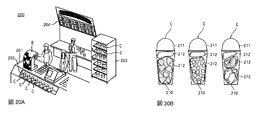
- This sales system 200 as shown in FIG. 20, is loaded with a plurality of dedicated cups C in which a plurality of cartridges 202 in which predetermined materials are pre-packed are packed, and a dedicated cup C, and the dedicated cups C are automatically loaded. Select a desired product from among a plurality of dedicated cups C displayed on the shelf 203 or a displayed menu board 204.
- the salesperson takes out the specified exclusive cup C according to the customer's order, and the salesperson loads the mixing machine B with the specified exclusive cup C to manufacture the customer's desired product at the counter 201 in front of the customer And a system for delivering the desired product in exchange for a predetermined fee.
- Patent Document 5 exemplifies frozen confectionery as an example of food, and "food" which means a material or composition used as a material in preparing food includes grains, flour, starchy fruits and vegetables.
- Examples include wheat, rice, corn, oats, potatoes, sorghum, millet, rye, rye, rye and rye flour, and other powders such as semolina flour, atta flour, buckwheat flour, tapioca Foods containing flour, brown rice flour, glutinous flour, noodle flour, pasta flour, chestnut flour, nut flour, chickpea flour, bean flour, peanut flour, spelled flour and potato starch flour, and further processed Contains a mix of flour for baked confectionery including corn starch, instant mashed potatoes, bread dough, cake mix, pancake mix etc and can be processed according to the invention Additional foods include bulgur, quinoa, wheat flour, parsnip, plantains, potatoes, pumpkins, acorn pumpkins, butternut pumpkins, summer pumpkins, green pea
- Shaved ice is one of the modes of frozen desserts.
- the scraped ice shown in the above-mentioned Patent Document 6 is capable of uniformly dispersing fruit throughout the scraped ice, since the ice mass originally having a taste is cut with an scraper.
- a product according to a customer's order is manufactured in front of a customer out of many kinds of products only by preparing a plurality of exclusive cups beforehand.
- the customer's request for example, a request to change the sweetener to a specific component and to change the amount thereof is all
- in order to be able to store these juices, smoothies, flaps, etc. for a certain period of time for example, when enclosed in a sealed container such as an aluminum pouch etc, it is necessary to apply heat immediately since heat sterilization is required. There is a problem that it can not do.
- the thing suitable as a stabilizer of frozen desserts is not described, and it can be used as a stabilizer of frozen desserts as it is It is not a thing.
- the definition of the stabilizer of ice confectionery is not limited at all here, but it plays a role of "linkage" for making the ice confection easy to set, and also the texture of the ice confectionery (for example, a feeling of torosity, glutinous feeling It also contributes to the feeling of moistness, sense of smoothness, feeling of crumb, etc. and the difficulty in melting frozen desserts (such as the property of being difficult to drip at normal temperature and the property of retaining its shape).
- the present invention has been conducted various experiments to solve the problems in the conventional method of producing frozen confection using puree or paste of food.
- other sterilization processes can be omitted by improving the puree or paste production process, for example, by appropriately setting the superheating condition by superheated steam before being milled, and without impairing the flavor and color of the food.
- the first object of the embodiment of the present invention is to obtain a puree or paste which is difficult to separate without impairing the taste and color of the food, and it is possible to omit other sterilization steps. It is an object of the present invention to provide a puree or paste producing method and a producing system.
- a second object of the embodiment of the present invention is to use the puree or paste of the above-mentioned food, and it is possible to obtain an ice confection which is good in texture without impairing the taste or color of the food and is also difficult to drip. Moreover, it is providing the manufacturing method and manufacturing system of frozen dessert which can simplify a manufacturing process.
- the third object of the embodiment of the present invention is to respond appropriately to the detailed needs of the customer including the cooled state or the frozen state of the enclosed container-containing beverage using puree or paste of the above-mentioned food, and
- An object of the present invention is to provide an enclosed container-containing beverage, a method for producing the same, and a system for producing the same, which appropriately respond to the needs of many customers.
- the method for producing a puree or paste of food according to the first aspect of the present invention is characterized by comprising the following steps (1) to (3).
- the method for producing frozen dessert according to the second aspect of the present invention is selected from among beverages comprising puree or paste of the foodstuff produced according to the method for producing puree or paste according to the first aspect or beverage including flavor material
- the method is characterized by using at least one kind of beverage and comprising the following steps (4) to (6). (4) adding a stabilizer to the selected beverage to prepare a second aqueous solution, (5) injecting the second aqueous solution into a mold having a predetermined shape; (6) A step of circulating a refrigerant around the mold to freeze and freeze the second aqueous solution injected into the mold.
- the method for producing a sealed container-containing beverage according to the customer's order of the third aspect of the present invention is a beverage comprising puree or paste of a foodstuff produced by the method of producing puree or paste of foodstuff of the first aspect
- the method is characterized by using at least one kind of beverage selected from among beverages containing flavor materials and comprising the following steps (1b) to (4b).
- the method for producing the puree or paste of the food material of the first aspect of the present invention it is possible to obtain a puree or paste which is difficult to separate without impairing the flavor or color of the food material, and other sterilization steps It is possible to provide a puree or paste production method that can omit the In the step of heating and sterilizing for a predetermined time in a low oxygen state in a superheated steam atmosphere at a predetermined temperature, the food is prevented from being oxidized because of the low oxygen state, and it is difficult to burn because the incineration phenomenon does not occur.
- the amount of heat of air is larger than the amount of heat of heated air, and there is no pollution and high safety.
- the step of processing the food into a puree or paste it is possible to process according to the type of food or the finish of the puree or paste.
- the rotation-revolution mixer the interaction of the two centrifugal forces of rotation and revolution in a container with a strainer causes convection in the food to remove contained air bubbles and pass through the strainer and be filtered. Therefore, it can be separated from the hard part while containing the fiber.
- the millstone type grinder it grinds with a millstone, so it is difficult to damage the taste and smell of the food and it is also possible to process hard food.
- Rotary blade mixers are suitable, for example, for leafy vegetables.
- the method for producing ice confectionery of the second aspect of the present invention it is possible to obtain ice confections that are difficult to drip without spoiling the flavor and color of the food using puree or paste of the above-mentioned food, and It is possible to provide a method for producing frozen confection that can simplify the production process. For example, the steps of preparing the first and second aqueous solutions can be simplified. When the step of including air in the frozen confection is provided, the overrun of the frozen confection can be adjusted to 60% to 300%.
- cooling is performed for a predetermined time by the refrigerator maintained at a predetermined temperature so that the beverage, puree or paste of the food becomes a state corresponding to the customer's order
- the customer's detailed needs including the cooling state or the freezing state of the container-containing beverage are appropriately addressed by cooling for a predetermined time by a refrigerator maintained at a predetermined temperature according to the order of the process customer. It is possible to provide an enclosed container-containing beverage, a method for producing the same, and a system for producing the same, which can meet the needs of many customers.
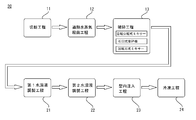
- FIG. 5 is a process diagram of Embodiment 1.
- FIG. FIG. 1 is a conceptual view of a rotation and revolution mixer used in a first embodiment.
- 5 is a process diagram of Embodiment 2.
- FIG. FIG. 5 is a conceptual view of a refrigerator used in a second embodiment.
- FIG. 18 is a process diagram of Embodiment 5; It is an example of the container which imitated the shape of the foodstuff of Embodiment 5.
- FIG. It is process drawing which shows the manufacturing process of the packaged beverage of Embodiment 7.
- It is a block diagram which shows the outline of the packed drink manufacturing system of Embodiment 7.
- FIG. It is a perspective view of an example of the obtained packed drink.
- It is a conceptual diagram of a refrigerator.
- FIG. 21 is a perspective view of another example packaged beverage according to embodiment 8;
- FIG. 18 is a process diagram of Embodiment 9;
- FIG. 21 is a system configuration diagram of a tenth embodiment. It is an example of the cube-like or lock-like frozen confectionery of Embodiment 10. It is an example of a rechargeable cordless hand-held icing device of the tenth embodiment. It is a mode when cutting cube-like or lock-like frozen confection using the icemaker of FIG. It is an example of scraped ice confectionery. It is a block diagram of the manufacturing system of the shaved ice confection of Embodiment 11.
- FIG. 20A is a perspective view showing a conventional fresh shot sales system
- FIG. 20B is a side view showing a display state of a dedicated cup.
- Embodiment 1 With reference to FIG.1 and FIG.2, the manufacturing method and manufacturing system of the puree thru
- FIG. 1 is a process diagram of the first embodiment.
- the puree to paste production process 10 of the foodstuff of Embodiment 1 comprises a cutting process 11, a superheated steam sterilization process 12 and a crushing process 13 in order.
- the type of foodstuff to be processed is not particularly limited, and examples thereof include fruits, vegetables, beans, seeds and grains, and grains.
- fruits include berries such as strawberries, citrus fruits, etc.
- vegetables include tomatoes, carrots, leafy vegetables, etc.
- beans include green soybeans, soybeans, seeds and nuts such as nuts, and nuts.
- it is possible to process a wide variety of foodstuffs such as pistachios, hazelnuts, etc., and cereals such as rice and wheat.
- the food is cut using a food slicer.
- a food slicer for example, D-max F-V2 / V3 / V4 / V6 / V8 series
- the food is given extra stress Since the food can be cut into a predetermined size without losing the taste and color of the food, the freshness can be maintained.
- the cutting process 11 can be omitted depending on the food. For example, it is not necessary to cut rice, wheat or the like, and the necessity of cutting is determined depending on whether or not the size is equal to or greater than a predetermined size for each food. In addition, it is also possible to cut
- the foodstuff is heat-sterilized for a predetermined time in a low oxygen state (state lower than the oxygen concentration of the atmosphere) in a superheated steam atmosphere of a predetermined temperature using a superheated steam sterilization apparatus.
- a low oxygen state state lower than the oxygen concentration of the atmosphere
- the oxygen-free (0%) as well as 0.1-0.2% or so oxidizes the food even if it is heated Can be prevented, thereby reducing the loss of flavor and color of the food.
- the heat quantity of the superheated steam is larger than the heat quantity of the heating air, and it is non-pollution and highly safe.
- the foodstuff is softly processed before the crushing step.
- the superheated steam sterilization step 12 doubles as blanching.
- the conventional blanching method used to boil or bake, but when it is boiled, it loses its color, and when it burns it burns.
- blanching By combining blanching with the superheated steam sterilizer, it is possible to suppress the loss of flavor and color of the food, and it is easy for water-soluble nutrients to remain.
- the temperature and heating time of the superheated steam in the superheated steam sterilization step 12 are appropriately set according to the type and state of the food and the finished state of the puree or paste.
- the temperature of the superheated steam is, for example, in the range of about 100 ° C. to 400 ° C., preferably about 100 ° C. to 280 ° C.
- the critical point is 280 ° C., where 170 ° C. to 280 ° C. is the reversal point temperature and it is a region where the drying rate is faster than air.
- the heating time is appropriately set in the range of about 1 minute to 60 minutes according to the type and state of the food material and the finish state of the puree or paste, but can preferably be about 4 minutes to 50 minutes .
- the superheated steam sterilizer is structured such that the sprayed superheated steam is exhausted to the outside, but as another specification, the sprayed superheated steam may be circulated.
- the food is pureed or paste-like using either a rotation-revolution mixer, a stone mill-type grinder, or a rotary blade mixer.
- a rotation-revolution mixer a stone mill-type grinder
- a rotary blade mixer a means such as a rotation / revolution type mixer, a stone mill type grinder or a rotary blade type mixer can be used properly as a crushing means, and By appropriately adjusting the setting, it is possible to realize a desired puree or paste finish regardless of the type of food.
- the portion capable of adjusting the setting in each crushing means is, for example, the rotation speed and time of rotation and revolution, the shape of the strainer, the size of the hole of the strainer, etc.
- the rotational speed or time of the mill In the case, for example, the rotational speed or time of the mill, the fineness of crushing, etc.
- the rotary blade type mixer for example, the rotational speed or time of the rotary blade, the type of rotary blade, etc.
- FIG. 2 is a conceptual view of a rotation and revolution mixer 15 used in the first embodiment.
- the rotation / revolution mixer 15 is provided with one or more, for example, two substantially bottomed cylindrical rotating members 16 that rotate and rotate.
- the rotating member 16 rotates in the rotating direction 17 and at the same time, revolves in the revolving direction 18.
- the angle ⁇ between the axis of the rotating member 16 and the central axis of the revolution rotation can take any value from 0 to 90 degrees, for example, about 30 to 60 degrees, for example, set to 45 degrees There is. That is, the opening of the rotation member 16 is inclined 45 degrees toward the revolution rotation axis.
- FIG. 1 is a conceptual view of a rotation and revolution mixer 15 used in the first embodiment.
- the rotation / revolution mixer 15 is provided with one or more, for example, two substantially bottomed cylindrical rotating members 16 that rotate and rotate.
- the rotating member 16 rotates in the rotating direction 17 and at the same time, revolves in the revolving direction 18.
- the rotating member 16 revolves in the revolving direction 18, that is, in the clockwise direction, and the rotating member 16 itself rotates in the rotating direction 17, that is, in the counterclockwise direction.
- the relationship of the rotational direction may be reversed, and the revolving direction 18 may be counterclockwise and the rotating direction 17 may be clockwise.
- both the rotation direction 17 and the revolution direction 18 may be clockwise rotation, or both the rotation direction 17 and the revolution direction 18 may be counterclockwise rotation.
- a substantially bottomed cylindrical rotating container is fitted inside the rotating member 16 from the opening side of the rotating member 16 so as to rotate integrally with the rotating member 16.
- a retainer provided with a plurality of holes in a concave shape toward the opening of the rotating member is fixed to the opening of the rotating container by a fixing member such as a lid member, and the rotating container and the retainer rotate integrally with the rotating member 16
- the food to be processed is put into the concave portion of the retainer, and the food is crushed by being filtered through the plurality of holes of the retainer by the centrifugal force acting on the rotary container by the rotation and revolution of the rotary member 16.
- the crushed food accumulates in the rotating container.
- the retainer has a plurality of holes of about 0.3 mm to 2.0 mm, and a plurality of types having different shapes and diameters of holes are prepared. For example, there are also differences such as those having an uneven shape or not on the surface of the retainer.
- the rotating member 16 is set to perform one process rotation per one rotation, but this setting may be appropriately adjusted.
- the rotational speed can be appropriately set in the range of about 0 to 1,500 revolutions per minute. For example, when the rotational speed is set to 1000 rotations per minute, the rotary member 16 rotates 1000 times a minute and revolves 1000 times.
- the rotation time can be, for example, about 20 seconds to 120 seconds.
- the type of retainer and the rotation speed and rotation time of the rotation member 16 are not limited to these because they are appropriately set according to the type and state of the food and the finished state of the puree or paste. Crushing using a rotation-revolution mixer is suitable, for example, for fruits, in particular berry or citrus fruits.
- the crushing process using a millstone grinder will be described.
- the grinding mill is, for example, a motorized grinding mill, and as a specific example, there may be mentioned Super Mas Colloider manufactured by Masuko Sangyo Co., Ltd.
- This is a millstone type ultra-fine grain grinder composed of two upper and lower non-porous stones whose distance can be freely adjusted.
- the millstone type grinder it grinds with a millstone, so it is difficult to damage the taste and smell of the food and it is also possible to process hard food.
- the rotation speed and rotation time of the millstone, the distance between the grinding wheels, and the fineness of crushing are appropriately set according to the type and state of the food and the finished state of the puree or paste.
- Crushing processing using a stone mill is suitable, for example, for grains such as beans and rice, and seeds such as nuts (for example, pistachios and hazelnuts among nuts). Also, for processing of strawberries, for example, it is possible to perform puree-like processing with a sense of fiber by using a rotation and revolution mixer, but it is possible to perform smooth paste-like processing by using a stone mill-type attritor .
- a crushing process using a rotary blade type mixer will be described.
- the rotary blade type mixer crushes foodstuffs by rotation of a rotary blade, and a specific example is Vitamix manufactured by Vita-Mix.
- the rotation speed and rotation time of the rotary blade, the type of rotary blade, and the like are appropriately set according to the type and state of the food and the state of completion of the puree or paste. Crushing using a rotary blade mixer is particularly suitable for leafy vegetables.
- the puree or paste of foodstuffs are obtained by the cutting process 11, the superheated steam sterilization process 12, and the crushing process 13 is demonstrated.
- the puree or paste of the food is introduced as it is in the subsequent step as in the second embodiment described later.
- the puree or paste of the food is shipped as it is, or when it is stored, the puree or paste of the food is filled into a storage pack in a fixed amount by a filling machine and then frozen by a freezer.
- the freezing temperature may be as long as the foodstuff is kept frozen, but it is desirable that the freezing temperature is, for example, -30.degree.
- the puree or paste of the foodstuff is shipped frozen or stored.
- the puree or paste of the food is subjected to a metal sensor test to confirm whether or not metal particles are mixed in during processing.
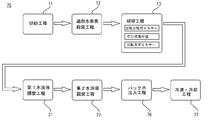
- FIG. 3 is a process diagram of the second embodiment. Further, in FIG. 3, the same steps as in FIG. 1 are given the same reference numerals, and the detailed description thereof may be omitted.
- a cutting process 11, a superheated steam sterilization process 12, a crushing process 13, a first aqueous solution preparation process 21, a second aqueous solution preparation process 22, an in-mold injection process 23 and a freezing process 24 sequentially It consists of
- the method of manufacturing the puree or paste of the food is the same as that of the first embodiment, so the cutting process 11, the superheated steam sterilization process 12 and the crushing are The description of step 13 is omitted.
- first aqueous solution preparation step 21 water, a stabilizer and a sweetener are placed in a pasteurizer and heat sterilized, for example, at a temperature of 80 ° C. to 85 ° C. for 5 minutes or more to prepare a first aqueous solution.
- juice may be further added to the pasteurizer, or if there is a material to be added to the frozen dessert, for example, a material for adjusting the flavor of the frozen dessert, Put in the pasteurizer. It is better to use lukewarm water at around 15 ° C to 70 ° C instead of water.
- the stabilizer may be dissolved in water or lukewarm water in advance before being added to the pasteurizer.
- the stabilizer is not particularly limited, but, for example, any one of bonito flour, bran flour, lotus root flour, rice flour, brown rice flour, bracken flour, potato flour, agar or gelatin is used, or Use a combination of two or more.
- the selection, amount, blending ratio and average particle size of the stabilizer can impart a unique texture to the frozen dessert. For example, there is a unique feeling of torrefaction when the flour is added, there is a mochi feeling when adding the lotus root flour, and a feeling of grief when adding the rice flour.
- the stabilizer is a fine powder, for example, when the average particle diameter of the stabilizer is reduced to a nanometer size, the effects of each stabilizer appear more strongly.
- the size of the fine powder is not limited to the nanometer size, and even if it is, for example, a micrometer size, the “linking” effect as a stabilizer can be obtained.
- brown rice flour itself has more plant fiber and nutrients than ordinary rice flour, but so-called "connection effect” is produced only by commercially available brown rice flour which is simply crushed. No, it becomes a frozen confection with a gritty texture.
- connection effect is produced only by commercially available brown rice flour which is simply crushed. No, it becomes a frozen confection with a gritty texture.
- brown rice flour for example, to a nanometer size
- a “tethering” effect is produced, which has a unique sense of stickiness and feels more sticky than rice flour and gives a frozen dessert with a longer mouth melting feel.
- the present meal when used as a stabilizer, it is possible to produce an ice confection that has a unique firmness and is difficult to drip.
- 100% of the present starch can be used as a stabilizer.
- the present meal is a main ingredient (50% or more is preferable, but it may be contained more than other ingredients), and it is a unique food even if it is a mixture of lotus root flour and / or rice flour. It is possible to produce a frozen confection that has a feeling and is difficult to drip.
- This drop suppression effect is further enhanced by using the puree or paste of the food described in the first embodiment. And by selecting a stabilizer appropriately, it is possible to make improvement of a food texture, and a drip suppression effect make compatible.
- a powdery (including fine particulate) stabilizer When a powdery (including fine particulate) stabilizer is used as the stabilizer, it is easy to handle, can simplify the manufacturing process, and can easily control the water content.
- a predetermined amount of powdery stabilizer and a predetermined amount of sweetener are added to water or lukewarm water measured to a predetermined amount, and stirred and dissolved well. Powdered stabilizers and sweeteners are readily soluble in warm water at high temperatures, while stirring is necessary when the water temperature is low, as the stabilizers and sweeteners are less soluble.
- the particle size of the powder also affects the solubility, and the finer the powder, the easier it is to dissolve in water or lukewarm water.
- sweetening agents it is desirable to use Japanese San Bon, Agave syrup, brown sugar, maple syrup or molasses-containing sugar, which has a lower GI value than refined sugar and contains a mineral component.
- Does not contain refined sugar components such as granulated sugar, white sugar, glacial sugar, powdered sugar and trinescent sugar and glucose, which are known to have adverse health effects as sweeteners and are also known to have high GI values Therefore, it is possible not only to avoid rapid postprandial blood sugar elevation but also to contain a synthetic sweetener, thus resulting in a chew-like food having a sweetness suitable for health.
- agave syrup is preferable.
- Japanese-san-bass is preferable, for example.
- a powdery sweetener it is easy to handle, the manufacturing process can be simplified, and the water content can be easily adjusted.
- Agave syrup can also be powdered.
- the puree or paste of the food material processed in the crushing step 13 is added to the first aqueous solution prepared in the first aqueous solution preparation step 21 to prepare a second aqueous solution. Since the puree or paste of the food contains fibers, and the first aqueous solution may have crumbly, after adding the puree or paste of the food to the first aqueous solution, the mixture is well stirred and the first Make sure the ingredients puree or paste is mixed well with the aqueous solution.
- the puree or paste of the food is already heated and disinfected in the superheated steam sterilization step 12 and the heat sterilization is not required again, so that the flavor and color of the food are not impaired, and ice candy which is difficult to drip is obtained. be able to.
- the first aqueous solution adjusting step 21 and the second aqueous solution adjusting step 22 have been described separately here, these two steps may be integrated so that each food material is sequentially mixed simultaneously or in an appropriate order and timing. You may Moreover, although using pasterizer was illustrated, it is not limited to this, For example, the sterilizer by the Fukei Sangyo Co., Ltd. demonstrated in Embodiment 5 can also be used.
- the second aqueous solution is injected into a mold having a predetermined shape.
- the shape of the mold is not particularly limited, but if it is a substantially cylindrical shape or a substantially rectangular solid shape, it can be a shape that is easy to eat when it is used as an ice bar. Furthermore, when it is in a cylindrical shape, the temperature is uniformly transmitted when frozen, so that the texture can be improved. Further, even under normal temperature, temperature is uniformly transmitted, so drip is less likely to occur. In addition, when the size of the ice bar is about 30 cc, the size is reasonable, and thus it is possible to provide an ice bar that is easier to eat, but it goes without saying that the present invention is not limited thereto. Moreover, after injecting a 2nd aqueous solution in the type
- FIG. 4 is a conceptual view of a refrigerator used in the second embodiment.
- the refrigerator 30 used here is a small-sized one used in a store, and has a rectangular container 31 and a heat exchanger 32.
- a cooling medium (refrigerant) 33 is placed inside the rectangular container 31.
- a conduit 34 made of copper wound in a coil shape is provided, and liquefied nitrogen 35 is also introduced, and the refrigerant flowing in the conduit 34 made of copper is liquefied nitrogen 35 It is supposed to be cooled by
- the outlet end 36 of the rectangular container 31 is connected to one end of a copper conduit 34 by a conduit 37, and the other end of the copper conduit 34 is a conduit 38, a circulation pump 39 and a conduit 40. , And is connected to the inlet end 41 of the rectangular container 31.
- FIG. 4 the second aqueous solution 46 injected into the ice mold 45 and the handle bar 47 injected into the second aqueous solution 46 are shown. Further, the upper side of the rectangular container 31 can be opened or sealed as appropriate. Furthermore, for example, alcohol (ethyl alcohol) is used as a cooling medium here.
- alcohol ethyl alcohol
- the refrigerant 33 in the rectangular container 31 enters the copper conduit 34 in the heat exchanger 32 through the conduit 37 from the outlet end 36, the refrigerant 33 is cooled to -30 ° C. or less by the liquefied nitrogen 35.
- the circulation pump 39, the conduit 40 and the inlet end 41 of the square shaped container 31 to circulate into the square shaped container 31.
- the temperature of the refrigerant 33 in the rectangular container 31 is maintained to be ⁇ 27.5 ° C. or less.
- the second aqueous solution 46 injected into the ice mold 45 is rapidly cooled and can be completely frozen in about 5 minutes.
- the frozen dessert of Embodiment 2 with a packaging bag is manufactured by packaging the taken-out frozen dessert by the automatic packing apparatus which omitted illustration.
- the method of producing ice confectionery of Embodiment 2 it is possible to obtain ice confections which are difficult to drip and which do not impair the flavor and color of the food using puree or paste of the food, and further, complicated manufacturing steps are included. Since it does not have, it can provide the manufacturing method of frozen dessert which can simplify a manufacturing process. Moreover, according to the method for producing frozen confectionery of Embodiment 2, it is possible to perform the production of the organic food conforming to the JAS standard by appropriately selecting the food and the raw material. Furthermore, instead of the ice mold 45, a mold capable of producing many small cube-shaped frozen confections at one time can be used, or a large-capacity commercial bulk-sized mold can be used.
- the manufacturing method of the frozen confection according to the third embodiment is different from the second embodiment in that it is a method of producing frozen confection having unique texture while utilizing Japanese style materials, but the process chart of FIG. It is common with the production method of ice confections.
- the first aqueous solution preparation step 21 is different from that of the second embodiment.
- the type of stabilizer is specified to obtain a unique texture.
- the present starch is the main component, and potato starch, sweet potato starch, corn starch and wheat starch are not included.
- "Homogi flour” means that which is made only from the roots of mulberry (100%), and even if it is the one with the name of this flour, it is other than those produced from mulberry roots The ones to which other starches are mixed are not included in this.
- the main flour in the present invention is the main component” means that it is most preferable if it contains at least 50% by mass of the present flour, but it is contained in a larger amount than other components.
- this ice confection it can be eaten as delicious ice confection as it is, and when the temperature rises in the mouth, the texture depending on the candy-like food before it is substantially frozen is added, and a unique firmness is given. Ru. Furthermore, even if this frozen confection is left at normal temperature, it can be eaten as a chew-like food without losing its shape and dripping.
- the stabilizer is made only with this meal, it can be eaten as delicious frozen confectionery as it is, accompanied by some crispness, and when the temperature rises in the mouth, it depends on the meal like food before freezing substantially. A feeling is added, and a unique sense of stiffness is imparted. Furthermore, even if this frozen confection is left at normal temperature, it can be eaten as a chew-like food without losing its shape and dripping.
- the lotus root flour when eaten frozen confectionery, when the temperature rises in the mouth, the lotus root flour has a unique torturous feel as it is. It is possible to feel the texture to which the feeling of mochi mochi and / or the feeling of being moistened by rice flour are imparted. Even if the frozen confection is left at normal temperature, it can be eaten as a chew-like food without losing its shape and dripping.
- Yoshino Honjo registered trademark
- the Yoshino main meal is the main flour, and here, the one made by Kurokawa Honke was adopted.
- rice flour commercially available fine rice flour obtained by crushing raw rice as it was was used.
- Sweeteners include at least those that are unrefined, but do not include refined sugar, glucose and synthetic sweeteners.
- Wa Sanbon is preferred from the point of taste.
- Wasanbon belongs to a sugar-containing sugar, has a lower GI value than refined sugar, and contains mineral components.
- Example 1 In the first aqueous solution preparation step 21 of Embodiment 3, 6 parts by mass of the present invention flour and 6 parts by mass of lotus root powder are added as a stabilizer to 100 parts by mass of water and explain. Add 100 parts by weight of water to a proper amount of water, 6 parts by weight of main root flour as a stabilizer and 6 parts by weight of lotus root flour in a container, stir well and mix, disperse the main root flour and lotus root flour in water, The Japanese Sanbon completely dissolved in water. The vessel is then heated to over 80 ° C. with medium heat stirring. The mixture in the container starts to harden at a temperature of about 70 ° C., and its transparency increases.
- the stirring strength was increased at once, and the first aqueous solution was prepared so that the mixture in the container became a uniform gel-like body.
- the maximum heating temperature is preferably 90 ° C. or less in order to prevent boiling.
- the first aqueous solution is mixed with the puree or paste of the food to obtain the second aqueous solution, but in the third embodiment, the first aqueous solution is a gel, so it is necessary to mix well There is.
- the puree or paste of the food is already heated and disinfected in the superheated steam sterilization step 12 and the heat sterilization is not required again, so that the flavor and color of the food are not impaired, and ice candy which is difficult to drip is obtained. be able to.
- the second aqueous solution is a gel-like body
- the second aqueous solution is injected into the squeeze bag to make an ice mold (for example, a volume made of metal and having a cylindrical internal shape) It is injected into 30 cc.
- the frozen confectionery of Example 1 had not only a mochi feeling but also a thick feeling, crispness, and was easy to eat. Moreover, even if this frozen confection was left under normal temperature, it could be eaten as a strawberry-like food without losing its shape and dripping.
- Example 2 is the same as Example 1 except that 6 parts by mass of main meal flour, 3 parts by mass of lotus root flour, 3 parts by mass of rice flour and 3 parts by mass of rice flour are added as appropriate starchy gelling materials to 100 parts by mass of water.
- the frozen confectionery of Example 2 had a feeling of soggy and a feeling of torturous, and had a certain degree of crunch. Moreover, even if this frozen confection was left under normal temperature, it could be eaten as a strawberry-like food without losing its shape and dripping.
- Example 3 an ice confectionery was prepared in the same manner as in Example 1, except that an appropriate amount of 11 parts by mass of the present invention flour and Japanese sum three basins were added to 100 parts by mass of water.
- the frozen confectionery of Example 3 had a crispy feeling, but upon melting, a firmer feeling was further felt. Moreover, even if this frozen confection was left under normal temperature, it could be eaten as a strawberry-like food without losing its shape and dripping.
- the main flour is 50% or more, the addition ratio of the lotus root flour and the rice flour can be arbitrarily adjusted. For example, ⁇ When the flour is 100%, ⁇ In the case of 50% main meal powder, 50% lotus root powder ⁇ When 50% main meal powder, 25% lotus root powder, 25% rice flour ⁇ Various combinations are possible such as 50% main meal powder and 50% rice flour.
- the shape of the ice bar is a cylindrical shape, the temperature is uniformly transmitted to the ice bar when frozen, which tends to produce a unique firmness-like texture. In addition, since the temperature is uniformly transmitted to the ice bar even under normal temperature, liquid drip is less likely to occur. In addition, when the size of the ice bar is about 30 cc, the size is reasonable so that an ice bar that is easier to eat can be provided.
- the shape of the frozen confection can be made into a substantially rectangular parallelepiped shape such as Japanese confectionery yam or uirou. In this case, it is possible to eat the frozen confectionery with the way of eating Japanese confectionery such as yokan or uiro.
- the ice confectionery can be made into a bite-like, substantially rectangular parallelepiped shape, a substantially cylindrical shape, or a substantially spherical shape, and in this case also, the easy-to-eat ice confectionery can be provided.
- green bamboo is oxidized and whitened when stored at normal temperature after collection, but in the present invention, since green bamboo is frozen and stored with ice, green bamboo can be maintained bright green. In such an ice bar, the fact that the green bamboo of the ice bar is not white is a proof that the ice bar has never been at a normal temperature.
- this embodiment demonstrated as what uses this rice flour as a main component as a stabilizer, it is not limited to this, For example, what has a fine powder brown rice flour as a main component as a stabilizer Also, stabilizers containing rice flour as a main component can be produced.
- the method for producing the frozen confection according to the fourth embodiment differs from the second or third embodiment in that a powdery material is further added in the first aqueous solution preparation step 21 or the second aqueous solution preparation step 22 of FIG. 3.
- the powdery material to be added is not particularly limited.
- alcohol ethyl alcohol
- vitamin agent ethyl alcohol
- dietary fiber ethyl fiber
- flavor ethyl alcohol
- seasoning any one or a combination of two or more thereof It can be done.
- By adding the powdery material it is possible to add various flavors to the frozen confection and to prevent the drip of the frozen confection.
- liquid alcohol ethyl alcohol
- Whiskey, vodka, sake, plum wine, etc. may be mentioned as examples of finely powdered alcohol (ethyl alcohol), but it goes without saying that it is not limited thereto.
- FIG. 5 is a process diagram of the third embodiment.
- the manufacturing process 20 of the frozen confectionery of Embodiment 5 consists of a cutting process 11, a superheated steam sterilization process 12, a crushing process 13, a second aqueous solution preparation process 22A and a stirring and freezing process 24 in order.
- the puree or paste production method of the food is the same as that of the first embodiment, so the description of the cutting process 11, superheated steam sterilization process 12 and crushing process 13 which are the manufacturing method is omitted.
- FIG. 3 the same steps as those in FIGS. 1 and 2 are denoted by the same reference numerals, and the detailed description thereof is omitted.
- the first aqueous solution adjusting step is omitted.
- puree or paste of a food material in place of or in addition to this, a beverage containing a flavor material may be used), a stabilizer, a sweetener, and, if necessary, Add the flavor-adding ingredients (eg, flavor-adding powders with various flavors, spices, seasoning, alcohol, etc.) together into a heating and mixing device to dissolve the stabilizer well.
- the heating temperature of the heating and mixing apparatus can be, for example, about 85 to 99.degree. C. and, for example, about 98.degree. C. to 99.degree. C. (less than 100.degree. C.).
- the second aqueous solution adjusting step 22A a sterilizer manufactured by Fukei Sangyo Co., Ltd. was used. This sterilizer is equipped with three functions of raw material preparation dissolution, sterilization and cooling in one machine. When the heating temperature is set high, the stabilizer is easily dissolved. Sterilization can also be performed by this heating and mixing device. The timing at which the foodstuffs are introduced into the heating and mixing apparatus can be appropriately adjusted according to the state of the foodstuff, for example, the time to introduce puree or paste of the foodstuff already sterilized in the superheated steam sterilization step 12 into the heating and mixing apparatus is delayed. It can also be done.
- the second aqueous solution adjusting step 22A can be replaced with the first aqueous solution adjusting step 21 and the second aqueous solution preparing step 22 as in the second embodiment.
- the frozen puree or the beverage containing the paste or flavor material is frozen, it is thawed and then introduced into the heating and mixing apparatus.
- a depack thawing and freshness holding device manufactured by Sun Tetsu Giken Co., Ltd., thawing while keeping the freshness of the food by thawing while giving electric energy by high voltage electrostatic induction produced by the depack to the food It becomes possible.
- the stirring and freezing step 24A a gelato machine manufactured by Fukei Sangyo Co., Ltd. was used.
- the second aqueous solution 46 is entrained with air while being stirred to contain fine bubbles of air in the frozen confection and air is contained in the frozen confection.
- fine bubbles of air are contained in the frozen confection, it is possible to obtain a frozen confection that is not too firm and easy to bite and has a light texture and a good texture.
- the particle size of fine air bubbles the smaller the particle size at the same volume of air content, the smoother the mouthfeel, and the slower the cooling speed to increase the stirring speed to increase the stirring strength. It is possible to reduce the particle size and to increase the amount of air entrained.
- the stirring speed of the stirring and freezing apparatus is automatically or manually according to the type and condition of the food or stabilizer, the environmental conditions (air temperature, humidity etc.), and the finish condition (texture, taste etc.), etc. It is possible to adjust, and in the case of automatic control, it is also possible to perform remote control (for example, remote control by a command from a server).
- the overrun of a general ice cream is 60% to 100%. If the overrun of the frozen confection of the present embodiment is 60% or more, the frozen confection of good texture can be obtained without being too hard. The larger the overrun, the softer the texture, and when it exceeds 300%, it becomes too soft and the texture becomes inferior. Therefore, the numerical range of the overrun is preferably 60% or more and 300% or less, for example, 150 to 250% or so, or preferably 200% or so.
- the numerical range of the overrun is 150% or more and 250% or less
- the unique fluffy texture added to frozen desserts is, for example, a texture as good as that between shaveto and ice cream, and a texture as good as that between soft cream and gelato, for example.
- the degree of overrun can also be adjusted.
- the upper limit of the overrun is not particularly specified, but is, for example, about 300%.
- ice bat a container of about 2 liters to 10 liters.
- the frozen confection of the present embodiment can be provided in at least one form selected from soft cream, ice candy, cup ice, in-ice, shaved ice, and the like.
- the ice confectionery just taken out of the freezer for gelato or soft cream has, for example, an overrun of 60% or more, so it is in the form of soft cream (although the state can be adjusted depending on the degree of overrun It is in the form of soft cream, gelato, sherbet, etc.
- it has a good texture of about between shaveto and ice cream, and also has a good texture of, for example, between soft cream and gelato
- the ice confection can be provided in a soft cream-like manner by providing it in a corn cup or container.
- Ice candy like ice candy can be provided by pouring frozen dessert taken out of a freezer for gelato or soft cream into an ice mold and cooling with a freezer using, for example, alcohol as a refrigerant. If necessary, a hand-held bar may be inserted.
- Frozen confections removed from the gelato or soft cream freezer can be stored in containers of appropriate size and stored frozen in the freezer. If a large-capacity container (for example, about 2 L to 10 L, for example, 2 liters, 4 liters, etc.) is used, it can be provided as commercial ice confectionery. In a store, it can be provided as a cup ice-like frozen confection by separating a large-volume container into a small-sized container with an ice drier or the like. Further, if a cup made of paper or resin for one person is used as a container for containing frozen dessert taken out of a freezer for gelato or soft cream, the entire container can be provided as cup-shaped ice.
- a large-capacity container for example, about 2 L to 10 L, for example, 2 liters, 4 liters, etc.
- Ice confections that contain air can easily be skimmed with a spoon or scoop, so it can be provided as a cup of ice confection.
- the container which imitated the shape of the foodstuff can also be used.
- the cup be made of a material with low environmental impact.
- a cup of paper can be used.
- biodegradable alternative plastics such as limestone
- bioplastics such as cassava
- the shape is not particularly limited, and examples include strawberries, oranges, peaches, grapes, melons, coconuts, almonds, and the like.
- Ice confections removed from a gelato or soft cream freezer, or frozen frozen confections, or ice confections that are solidified by being cooled in an ice mold using, for example, a refrigerator using alcohol as a refrigerant By sandwiching in the middle of the shape, it can be provided as an ice-like frozen confection.
- the shape of the frozen confectionery is not limited to a cylindrical shape, and may be prismatic, and the shape in the middle can also be made to correspond to the shape of the frozen confection. For example, it may be a cuboid ice confection.
- the frozen confectionery since it is only necessary to cover the frozen confectionery, it is also possible to use, for example, a cuboid-shaped in-between for a cylindrical frozen confectionery.
- an appropriate amount may be held in the middle, or frozen frozen stored ice confection may be held separately by, for example, an ice disher or the like.
- the size in the middle can be the size of a piece of ice.
- the shape in the middle can be an arbitrary shape such as a circular shape, an elliptical shape, a polygonal shape, a bowl shape, a planar shape, or the like. It may or may not have a hand held bar.
- the frozen confectionery removed from the gelato or soft cream freezer is soft, it is put in a suitable container, for example, cooled by a refrigerator using alcohol as a refrigerant to obtain solidified frozen confectionery.
- the size of the container can be a size that can be used with a commercial ice maker, or can be about the size of an ice lolly, for example, an elongated rod (cylindrical or prismatic) or a small size (one bit) It can also be in the form of a lock or cube.
- the method and system for producing frozen dessert according to the sixth embodiment is an application example utilizing the advantages of the method for producing frozen dessert according to the first through fifth embodiments.
- a normal commercial power source can be used as a power source.
- there are no complicated processes the processes are simplified, and the manufacturing system can be miniaturized. For this purpose it is possible to construct the manufacturing system as a container-like unit.
- a store or an office it is possible to configure a container-like unit, and since each unit is container-like, it can be stacked and can be easily installed in a small space.
- these manufacturing systems are movable, they can be, for example, mobile factories, and can also be, for example, vehicle-mounted factories.
- ice confectionery manufacturing system of the present embodiment it becomes possible to manufacture ice confectionery near the sales store or in the sales store.
- ice confections of various flavors according to the customer's order can be made in a short time, for example as in the seventh and tenth embodiments described later.
- the time from receiving the customer's order to providing the customer with the ice cream of the order's flavor depends on the capacity of the refrigerator etc. However, for example, it can be provided in about 10 minutes, and it can be manufactured Depending on the installation, the time can be further reduced.
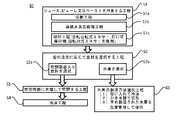
- FIG. 7 is process drawing which shows the manufacturing process of the packed drink of Embodiment 7
- FIG. 8 is a block diagram which shows the outline of the packed drink manufacturing system of Embodiment 7, FIG. 9 was obtained.
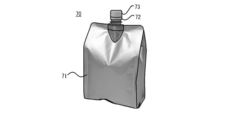
- FIG. 10 is a perspective view of an example of a packaged beverage
- FIG. 10 is a conceptual view of a refrigerator.
- the packaged beverage manufacturing process 50 includes a process 51 of preparing a beverage, puree or paste, a process 52 of selecting a food according to the order of a customer, and a closed container.
- a filling and sealing step 53 and a freezing step 54 for cooling by a refrigerator are included.
- the step 51 of preparing a beverage, puree or paste comprises a cutting step 51a of cutting a food, an overheated steam sterilization step 51b of heat-sterilizing in a superheated steam atmosphere, and a crushing step 51c of the first embodiment shown in FIG.
- a cutting step 51a of cutting a food an overheated steam sterilization step 51b of heat-sterilizing in a superheated steam atmosphere
- the beverage, puree or paste of the food is subjected to a metal sensor test to confirm whether or not metal fragments are mixed in during processing. Metal sensor testing can also be performed after filling and sealing a closed container.
- the manufacturing method of a drink, puree, or paste is not limited to the above-mentioned thing.
- beverages containing flavor materials include juices, carbonated beverages, sports drinks, coffee, black tea, teas (such as matcha tea, roasted tea, green tea, oolong tea), dairy products (such as milk and yogurt), chocolates, alcohols (wine, sake) , Western liquor etc.).
- step 52 of selecting the food according to the customer's order the packaged beverage manufacturing system of FIG. 8 described later selects the food of the beverage, puree or paste according to the customer's order, and The temperature and time to be cooled in the later step of freezing by the refrigerator 54 are determined according to the order of. Further, in the step 52 of selecting the food according to the customer's order, the type and / or amount of sweetener, the type and / or amount of topping food, etc. are selected according to the customer's order.
- the method includes a step 53 of filling and sealing the sealed container in order and a freezing step 54 of cooling by the refrigerator.
- the food is selected according to the customer's order from the beverage, puree or paste prepared in the step 51 of preparing the beverage, puree or paste in the step 52
- the beverage, puree or paste of the above-described type is filled by a known filling machine into a closed container such as a predetermined aluminum pouch which will be described later by a fixed amount.
- the type and / or amount of sweetener selected according to the customer's order and the type and / or amount of the selected type and / or amount selected according to the customer's order It is also possible to add topping foodstuffs and additive foodstuffs of the type and / or amount selected according to the customer's order. It is also possible to make it possible to select the amount of beverage, puree or paste to be filled in the closed container.
- the sealed container filled with puree or paste is cooled by a refrigerator as described later.
- the freezing or cooling time is, for example, a refrigerator maintained at -30.degree. C. for 1 minute to be optimal as a cold beverage, and 3 minutes for cooling to be a sherbet, and also for 5-10 minutes. When cooled, it can be in a frozen state in a tick.
- the beverage, puree or paste of the foodstuff according to the customer's request can be sealed at the shop front, and the packaged beverage in a cooled state according to the customer's request can be provided.
- the method of selecting the frozen confectionery shown in FIG. the method for producing frozen desserts is selected from a plurality of them by the filled beverage manufacturing system 60, and further, the type and / or amount of sweeteners are selected according to the customer's order, and the customer order is selected.
- the type and / or amount of the added food containing the stabilizer is selected, and the type and / or amount of the topping food is selected according to the order.
- Embodiment 2 to Embodiment 6 or the production method of Embodiment 9 to be described later can be adopted.
- the following four manufacturing methods are adopted for the explanation will be described.
- a method of producing frozen confection by freezing and pouring a beverage, puree or paste of a food material corresponding to the customer's order into a mold (2) A method of manufacturing scraped ice confections by selecting a predetermined number of cubes or lock-shaped ice confections from a plurality of types of cube-shaped or lock-shaped ice confectionery blocks manufactured in advance, (3) A method of producing ice confectionery, wherein ice confections corresponding to the customer's order among plural types of ice confections manufactured in advance are provided in a state corresponding to the customer's order by temperature control according to the customer's order , (4) According to the customer's order, the manufacturing method etc. which are provided in at least 1 form selected from soft-cream-like, an ice candy-like, cup ice-like, middle ice-like, or shaving ice-like are included.
- the packaged beverage manufacturing system 60 includes an information input unit 63 having a first information input unit 61 and a second information input unit 62, a customer preference analysis unit 64, and a third information output unit 65.
- an information input unit 63 having a first information input unit 61 and a second information input unit 62
- a customer preference analysis unit 64 for example, one provided with communication means such as a PC, a tablet terminal, a smartphone, an input / output means, a display means, etc. is used.
- the means for producing beverage, puree or paste 66 produces beverages, purees or pastes of various types of foodstuffs in step 51 of preparing the beverage, puree or paste shown in FIG. 7 as described above.
- Information on the beverage, puree or paste (including information such as the type and origin of the food, processing state and the like) produced by the beverage, puree or paste production means 66 is input to the first information input means 61.
- the first information input means 61 is not particularly limited, for example, communication means for receiving information from the beverage, puree or paste production means 66, storage medium for information from the beverage, puree or paste production means 66 It can be a means for inputting via, a means for reading a barcode or a two-dimensional barcode, a means for inputting via a keyboard, a touch panel or the like.
- the terminal 67 is a means used by the customer to input the second information, and for example, a PC, a tablet terminal, a smartphone, a mobile phone or the like is used.
- a PC for example, it is possible to use a PC or a tablet terminal provided in a store that provides packaged beverages, or to use a customer's own PC, a tablet terminal, a smartphone, a mobile phone, etc.
- this communication means is not particularly limited, for example, wireless communication can be used, and specific examples thereof include 2G, 3G, 4G, 5G, Wi-Fi (registered trademark), WiMAX (registered trademark), wireless LAN, beacon, Bluetooth (registered trademark), ZigBee (registered trademark), and the like can be used.
- wireless communication can be used, and specific examples thereof include 2G, 3G, 4G, 5G, Wi-Fi (registered trademark), WiMAX (registered trademark), wireless LAN, beacon, Bluetooth (registered trademark), ZigBee (registered trademark), and the like can be used.
- Internet communication using a fixed line can also be used.
- the second information is interactively input from the terminal 67 to the second information input means 62.
- the second information input means 62 may operate on a browser, for example, or the terminal 67 It may operate as an downloaded app.
- the second information is (A) Types and / or amounts of sweeteners, topping foodstuffs, additive foodstuffs, etc. (B) taste preference, (C) taste preference (d) degree of sweetness, (E) the degree of acidity, (F) Spice preference, (G) favorite food, (H) poor food, (I) menu of meals, (J) Figure, (K) Constitution, (L) Physical condition, (M) Illness, (N) food restrictions, (O) allergic food, or (P) contains information about any one or more of the information identifying the individuals.
- the second information input means 62 can input a plurality of modes in order to input the information related to the above information (A) to (p).
- the plurality of modes are not particularly limited, but, for example, the following modes (a) to (c) can be prepared, and in each mode, interactive input of information becomes possible.
- (A) Mode to select from recommendations (A) Mode to directly select sweetener, topping food, additive food, etc.
- Mode to enter taste preference (D) Mode to enter taste of food (E) Preference Mode for entering foods and foods that are not good (f) Mode for entering food balance (v) Mode for entering physical condition and constitution (v) Mode for entering food allergy (v) Mode for entering food restrictions ) Mode to enter questions about vitamins and minerals (a) Mode to enter questions about phytochemicals (ii) Mode to enter questions about medicinal herbs (s) Mode to enter questions about Ayurveda (s) mode (s) Individually registered information Mode to choose from
- the second information input means 62 only one of these modes can be set in advance. Moreover, it is also possible to set in advance a plurality of combinations out of these. Furthermore, one or more of these may be made selectable by the customer, in which case the customer is first asked for selection of which input mode to adopt.
- the terminal 67 can use the customer's own smartphone, tablet terminal, PC, mobile phone, etc., the customer operates the terminal 67 at any time when there is time to input the second information. An input operation to the means 62 can be performed. For this reason, the second information input unit 62 operates, for example, as one operating on a browser or as an application downloaded to the terminal 67, thereby enabling the customer to remotely input the second information. .
- the terminal 67 can also be a terminal provided in a store, such as a tablet terminal or a PC.
- the second information input means 62 may input information for attaching at least one of an arrangement, a pattern, a message, an illustration, a photograph or an image as the second information from the terminal 67 with the topping food as the second information. it can.
- a favorite colorful image may be represented to a customer's order, or a promotional image may be represented.
- the customer can input information by answering the question interactively.
- a multi-selection question it is possible to perform input by touch on a touch panel on a smartphone or tablet terminal, click on a mouse on a PC, or numeric keys on a mobile phone. Also, it may be a question asking for character input instead of the multiple choice formula.
- the second input means 62 first asks the customer to select which input mode to be adopted. In this case, only one mode can be selected or a plurality of modes can be selected. When a plurality of modes are selected, the contents of the questions are automatically adjusted according to the combination of the selected modes, so that the questions in each of the selected modes can be matched. For example, when selecting a plurality of modes, the first priority mode is selected, then the second priority mode is selected, and then the third priority mode and the subsequent modes are sequentially selected. By taking account of the above, it is possible to match the order of the questions among the plurality of modes in accordance with the priority and adjust the weight for the answer to each question. As a result, it is possible to reflect the priority of various selections in the preference analysis means 64 of the customer.
- the mode for inputting (K) meal restriction is selected as the first priority mode
- the mode for inputting (F) taste preference is selected as the second priority mode
- categories such as low GI value, low calorie, etc. and ask customers for their choice.
- the contents of more specific meal restrictions are presented. For example, if it is a low GI value, it is set by selection or numerical input how much GI value is acceptable.
- categories of sweetness, sourness, saltiness, umami, astringency etc. are presented as taste tastes to request the customer's selection.
- the input is obtained at multiple levels of the degree, or the degree is used as a numerical value. In this way, it is possible to satisfy the conditions of the food restriction and to set the taste of preference.
- the preference analysis unit 64 of the customer Based on the first information input from the first information input unit 61 and the second information input from the second information input unit 62, the preference analysis unit 64 of the customer analyzes the taste of the customer's taste and the like. Necessary foodstuffs or ingredients are analyzed, information of a predetermined amount of beverage, puree or paste selected from among beverages, purees or pastes corresponding to the first information, and information of selected topping foodstuffs and additive foodstuffs Third information including information is output from the third information output means 65.
- a plurality of types of beverages, purees or pastes can be selected according to the customer's order, and for example, mixed beverages, purees or pastes can be provided by a mixer.
- mixed beverages, purees or pastes can be provided by a mixer.
- tastes of multiple types of beverages, purees or pastes can be freely determined, various taste combinations can be realized.
- the combination of strawberry taste and coconut taste, the combination of tomato taste and mandarin taste, etc. is free.
- the amount of strawberry flavored beverage, puree or paste is 50% and the amount of coconut flavored beverage, puree or paste is 5
- the amount of strawberry flavored beverage, puree or paste may be 70% and the amount of coconut flavored beverage, puree or paste may be 30%, depending on the customer's order. You can adjust the taste. That is, by devising the combination and amount of taste, seasoning becomes possible, so that various tastes different from one single beverage, puree or paste can be realized.
- the taste analysis means 64 of the customer it is also possible to adjust the type and amount of sweetener, the type and amount of topping food (for example, flesh and the like), the concentration of beverages, the type and amount of additive food, and the like.
- an additive food material for example, as a stabilizer when freezing a beverage, puree or paste, any one of Hon-koji flour, mulberry flour, lotus root flour, rice flour, brown rice flour, straw powder, potato flour, agar or gelatin, or A combination of two or more of these can also be used.
- the additive food for example, alcohol (ethyl alcohol, sake, sake, wine, sweet sake etc.), vitamin agent, dietary fiber, flavor, spice, seasoning or any combination of two or more thereof
- a powdery material for example, there is a unique sense of torrel when frozen when added with sweet potato flour, there is squeaky feeling when frozen when added with lotus root flour, and there is a griefful feeling when frozen when adding rice flour, a fine powder
- the addition of nanometer size brown rice flour has a unique sense of glutinous taste
- the addition of mulberry flour has a slight sense of firmness when frozen
- the presence of bracken flour has a crispy feeling
- the potato flour has potato texture.
- the kind of potato is not limited at all, for example, taro-imo powder, potato powder, etc. are mentioned. When these are combined, various different textures can be obtained when frozen. Thus, by appropriately selecting or combining the stabilizers, it is possible to obtain a unique texture when frozen and to produce a beverage, puree or paste in which the liquid component is not easily separated when it is thawed. It becomes.
- the cooling temperature and the cooling time by the refrigerator are determined according to the customer's order.
- the cooling temperature and the cooling time by the refrigerator are, for example, optimum for a cold beverage by performing cooling for 1 minute with a refrigerator kept at -30 ° C, and it becomes a sherbet shape when performing cooling for 3 minutes in the same manner. Cooling for up to 10 minutes allows the product to be in a frozen state.
- the cooling temperature and the cooling time by the refrigerator it is possible to provide a packaged beverage in a cooled or frozen state according to the customer's request.
- the taste analysis means 64 of the customer for example, according to the information inputted in the interactive mode in the mode such as (a) to (c) inputted by the second information input means 62, for example, It is possible to adopt various analysis methods such as input methods, methods to consider customer's allergies and food restriction, methods to analyze phytochemicals, methods to analyze medicines, methods to analyze Ayurvedic, etc. It is possible to allow customers to choose from among a large number of analysis methods.
- the second information input from the second information input means 62 it is also possible to include information for selecting one of the packaged beverage and the frozen dessert.
- the customer preference analysis means 64 relates to a packaged beverage according to the customer's choice or a recipe for the frozen dessert according to the customer's preference in order to provide the packaged beverage or the frozen dessert to the customer according to the customer's choice.
- the information is analyzed, and the third information output means 65 outputs information on the production of the packaged beverage or frozen dessert to the packaged beverage or frozen dessert manufacturing means 68 and provides the terminal 67 with the customer. Output various information on packaged beverages or frozen desserts.
- the preference analysis means 64 of the customer selects the above-mentioned (1) to (1) Among the manufacturing methods including 4) and the like, the manufacturing method corresponding to the customer's order is determined.
- the method of (1) is a method of producing frozen confection by freezing a beverage, puree or paste of a food material corresponding to the customer's order.
- the customer is selected from the first information input from the first information input means 61 and the second information input from the second information input means 62.
- the taste content of the taste and the necessary ingredients or ingredients are analyzed, and one or more predetermined types and amounts of beverages, purees or pastes selected from the beverages, purees or pastes corresponding to the first information are selected
- topping ingredients and additive ingredients are selected.
- a stabilizer such as, for example, the present invention flour is included.
- additives for example, in addition to stabilizers, alcohol (ethyl alcohol, sake, wine, sake, sweet sake, etc.), vitamin agent, dietary fiber, flavor, spice or seasoning, or any combination of these two or more Although it is not particularly limited, it is desirable to use a powdery material.
- Information on the selected beverage, puree or paste, topping food, additive food, and method for producing frozen desserts is output from the third information output unit 65 as third information.
- the frozen dessert according to the customer's order is received at the store providing the frozen dessert according to the frozen dessert recipe or manufacturing method included in the third information.
- Manufacture Since it is possible to produce ice confections in a short time by using the below-mentioned refrigerator, after receiving an order from a customer at the store, the ice confection is manufactured and the ice confectionery just made to the customer's request on the spot Can be provided.
- the method of (2) is a method of producing scraped ice confections by selecting a predetermined number of cubes or lock-shaped ice confections from a plurality of types of cube-shaped or lock-shaped ice confectionery blocks manufactured in advance It is.
- the method of making the shape of the frozen confectionery into a cube or lock is not limited. For example, a method of finely cutting a large blocky block of frozen ice, a method of freezing with a cube or lock, a rod-shaped iced candy And so on.
- the first information includes information such as the type of food of cube-shaped or rock-shaped frozen confectionery, the type and amount of added food containing stabilizers, the type and amount of sweetener, manufacturing method, shape, size, etc. There is.
- the preference analysis unit 64 of the customer Based on the first information input from the first information input unit 61 and the second information input from the second information input unit 62, the preference analysis unit 64 of the customer analyzes the taste of the customer's taste and the like. Necessary foodstuffs or ingredients are analyzed, and one or more predetermined types and numbers of cube-shaped or rock-shaped frozen confections selected from cube-shaped or rock-shaped frozen confections corresponding to the first information are selected, The topping food and the additive food (for the ingredients of the additive food, the same as in the case of (1) above) are selected.
- Information on the selected cube-shaped or lock-shaped ice confection, topping food, additive food, and method of producing ice confection is output from the third information output means 65 as third information.
- a store offering frozen desserts receives customer's orders and then scraped ice desserts according to the customer's orders Manufacture. After receiving an order from a customer at the storefront, for example, by cutting a cube-shaped or lock-shaped ice confection prepared in advance using a rechargeable cordless hand-held icing device, in front of the customer at the store, It is possible to provide freshly cut ice confections as desired.
- the method (3) provides ice confectionery according to the customer's order from among a plurality of types of ice confectionery manufactured in advance, in such a way that the temperature management according to the customer's order corresponds to the customer's order It is a manufacturing method of ice confectionery.
- a plurality of types of ice confectionery prepared in advance are prepared and stored so as to be a plurality of different temperature conditions.
- the first information includes the type of pre-manufactured frozen confectionery food, the type and amount of the added food (the same as in the case of (1) above with respect to the added food material), the type of sweetener and
- the information on the storage state of the frozen dessert (information on the storage temperature and the like) is included.
- the preference analysis unit 64 of the customer Based on the first information input from the first information input unit 61 and the second information input from the second information input unit 62, the preference analysis unit 64 of the customer analyzes the taste of the customer's taste and the like. Necessary ingredients or ingredients are analyzed, and the type of frozen dessert is selected in consideration of the type of frozen dessert contained in the first information and the information on the storage state of the frozen dessert.
- the information of the selected frozen confection is output from the third information output means 65 as the third information, together with the information such as the state of storage of the frozen confection and the method of manufacturing the frozen confection.
- the means for producing packaged beverages or frozen desserts 68 a plurality of types of frozen desserts prepared in advance, including information on the storage status of frozen desserts included in the third information, in a type according to the customer's order, And, it is possible to provide frozen confectionery in a state of preservation according to the customer's order. Since ice confections can be prepared in advance, even in mobile stores etc., ice confections according to the customer's request are provided in a short time after receiving the customer's order and the ice confection is provided in the storage state according to the customer's request. be able to.
- the kind of stabilizer added as an added foodstuff of ice confectionery is made into this glaze, for example, it can implement
- the method of (4) is a manufacturing method which provides at least one form selected from soft cream, ice candy, cup ice, mid ice, or scrap ice according to the customer's order. is there.
- the taste and taste of the customer can be determined from the first information input from the first information input means 61 and the second information input from the second information input means 62.
- the order contents such as the aspect of the frozen confectionery and the necessary foodstuffs or ingredients are analyzed, and the beverage, puree or paste of one or more predetermined types and quantities selected from the beverage, puree or paste corresponding to the first information Is selected, and the type of topping food or stabilizer and the additive food are selected.
- the additive food may be, for example, alcohol (such as liquor, wine, sake, sweet sake, etc.), vitamin, dietary fiber, flavor, spice or seasoning, or a combination of two or more of them. Further, although not particularly limited, it is desirable to use a powdery material.
- Information such as the selected beverage, puree or paste, topping foodstuff, stabilizer, additive foodstuff, method of producing frozen dessert, aspect of frozen dessert etc. is outputted from the third information output means 65 as third information.
- the frozen dessert according to the customer's order is received at the store providing the frozen dessert according to the frozen dessert recipe or manufacturing method included in the third information. It can also be manufactured.
- the third information includes information on the selected beverage, puree or paste, for example, components, names, types, effects, descriptions, medical and / or pharmaceutical ingredients for the beverage, puree or paste, topping ingredients, added ingredients, etc. -Contains any one or more of nutritional and therapeutic knowledge, reputation, word-of-mouth information, or information on the Internet. This third information is transmitted to the terminal 67 and can be displayed on the terminal 67.
- the third information is also transmitted to the means 68 for producing a packaged beverage or frozen dessert, and in the means 68 for producing a packaged beverage or frozen dessert it is selected.
- the beverage puree or paste, topping food, added food, etc.
- the predetermined topping food, added food, etc. are selected After mixing with a mixer as appropriate, it is filled in a closed container such as an aluminum pouch and sealed.
- a perspective view of the closed container 71 after filling, that is, the packaged beverage 70 is shown in FIG.
- a packing device for filling and sealing a beverage, puree or paste in a sealed container 71 such as an aluminum pouch is well known and will not be described in detail.
- the material of the closed container 71 is not limited to aluminum, and may be, for example, a resin film, a vapor deposited film, a composite material film, or a plastic bottle. For example, when using a plastic bottle, subcooling is possible.
- a substantially hollow cylindrical drinking spout 72 is provided at the upper end of the closed container 71.
- An external thread is formed on the outer periphery of the outlet 72, and a cap 73 is screwed on the outer periphery of the outlet 72 from above.
- the mouth 72 is sealed by the cap 73.
- the heating steam sterilization step 51b since the food is heat-sterilized for a predetermined time in a low oxygen state (state lower than the oxygen concentration in the atmosphere) in a superheated steam atmosphere at a predetermined temperature using a superheated steam sterilization device Keeping the oxygen concentration low by the action, for example, making it anoxic (0%) as well as keeping it at about 0.1 to 0.2% prevents the food from being oxidized even if it is heated Can be used to reduce the loss of flavor and color of the food.
- the manufacturing method of (1) described above is the same as in the second to fourth embodiments, and thus the description thereof is omitted here.
- the manufacturing method (2) described above is the same as in Embodiments 10 and 11 to be described later, and thus the description thereof is omitted here.
- FIG. 10 is a conceptual view of a refrigerator used in a store.
- the refrigerator 30A used here has substantially the same configuration as the refrigerator 30 shown in FIG. 4, and the same reference numerals are given to the same components as those shown in FIG. Detailed explanation is omitted
- the temperature of the refrigerant 33 is maintained at ⁇ 30 ° C. or less, for example, ⁇ 30 ° C.
- the closed container 70 filled with a beverage, puree or paste (hereinafter referred to as “pack The beverage, puree or paste filled in the closed container 70 is rapidly cooled, for example, one minute, by directly immersing the inserted beverage 70 ") in the cooling medium 33 contained inside the square shaped container 31.
- the beverage becomes a drink-like cold beverage by about 3 minutes, for example, it becomes a sherbet in about 3 minutes, and can be frozen in a ticking state in about 5 minutes to 10, for example.
- the closed containers 70 are individually cooled by direct immersion in the cooling medium 33, the small rod can be easily and efficiently manufactured as compared with the case of cooling using an ice mold. For this reason, after receiving the customer's order, filling the container 70 with the beverage, puree or paste according to the customer's order and sealing it, the packaged beverage is directly cooled by the refrigerator directly to meet the customer's request. It becomes possible to provide in accordance with the cooling state.
- FIG. 11 is a process diagram of the eighth embodiment.
- a stabilizer is included as an additive food.
- the manufacturing process 75 of the packaged beverage according to the eighth embodiment includes, in order, a cutting process 11, a superheated steam sterilization process 12 for heat sterilization in a superheated steam atmosphere, a crushing process 13, a first aqueous solution preparation process 21 and a second aqueous solution preparation process 22 , In-pack injection step 76 and freezing / cooling step 77.
- the method for producing a beverage, puree or paste of a foodstuff is the same as in the case of the seventh embodiment, so the cutting process is a method for producing a beverage, puree or paste for a foodstuff 11.
- the first aqueous solution preparation step 21 water, a stabilizer and a sweetener are placed in a pasteurizer and heat sterilized, for example, at a temperature of 80 ° C. to 85 ° C. for 5 minutes or more to prepare a first aqueous solution.
- an appropriate beverage may be added to the pasteurizer instead of water or in addition to water, or topping foodstuff or additive foodstuff to be added to the beverage, puree or paste (for example, beverage, Ingredients for adjusting the flavor of puree or paste, such as alcohol (ethyl alcohol, sake, sake, wine, sweet sake, etc.), vitamin agent, dietary fiber, flavor, spice or seasoning, or any one of them 2
- puree or paste for example, beverage, Ingredients for adjusting the flavor of puree or paste, such as alcohol (ethyl alcohol, sake, sake, wine, sweet sake, etc.), vitamin agent, dietary fiber, flavor, spice or seasoning, or any one of them 2
- the stabilizer is not particularly limited, but, for example, any one of bonito flour, bran flour, lotus root flour, rice flour, brown rice flour, bracken flour, potato flour, agar or gelatin is used, or Use a combination of two or more.
- the amount, the blending ratio and the average particle size of the powder, etc. a unique texture can be provided when frozen. For example, there is a unique sense of firmness when frozen with the addition of the soy flour, there is a sticky feeling when frozen with the addition of the lotus root powder, and a sticky feeling when frozen with the addition of the rice flour.
- the size of the fine powder is not limited to the nanometer size, and even if it is, for example, a micrometer size, the “linking” effect as a stabilizer can be obtained. By combining these, it is possible to obtain a different texture.
- 100% of the present invention flour can be used as a stabilizer, and the present invention flour can be used as a main component, and lotus root powder and / or rice flour can be mixed.
- the unique texture when frozen is further enhanced by using the beverage, puree or paste of the food described in the sixth embodiment. And by selecting a stabilizer appropriately, it is possible to make compatible the improvement of the food texture at the time of freezing, and the control effect of the liquid separation at the time of thawing.
- a predetermined amount of powdery stabilizer and a predetermined amount of sweetener are added to water or lukewarm water measured to a predetermined amount, and stirred and dissolved well. Powdered stabilizers and sweeteners are readily soluble in warm water at high temperatures, while stirring is necessary when the water temperature is low, as the stabilizers and sweeteners are less soluble. The particle size of the powder also affects the solubility, and the finer the powder, the easier it is to dissolve in water or lukewarm water.
- sweetening agents it is desirable to use Japanese San Bon, Agave syrup, brown sugar, maple syrup or molasses-containing sugar, which has a lower GI value than refined sugar and contains a mineral component.
- Does not contain refined sugar components such as granulated sugar, white sugar, glacial sugar, powdered sugar and trinescent sugar and glucose, which are known to have adverse health effects as sweeteners and are also known to have high GI values Therefore, it is possible not only to avoid rapid postprandial blood sugar elevation but also to contain a synthetic sweetener, thus resulting in a chew-like food having a sweetness suitable for health.
- agave syrup is preferable.
- Japanese-san-bass is preferable, for example.
- a powdery sweetener it is easy to handle, the manufacturing process can be simplified, and the water content can be easily adjusted.
- Agave syrup can also be powdered.
- a beverage, puree or paste of the food material processed in the crushing step 13 is added to the first aqueous solution prepared in the first aqueous solution preparation step 21 to prepare a second aqueous solution. Since the beverage, puree or paste of the food contains fibers, and the first aqueous solution may have a crumb, it is well stirred after adding the beverage, puree or paste of the food to the first aqueous solution. Then, the beverage, puree or paste of the food is mixed well with the first aqueous solution.
- the beverage, puree or paste of the food has already been heat disinfected in the step 51b of heat sterilization in a superheated steam atmosphere, and the heat sterilization is not required again, so the taste and color of the food are not impaired.
- the first aqueous solution adjusting step 21 and the second aqueous solution adjusting step 22 have been described separately here, these two steps may be integrated so that each food material is sequentially mixed simultaneously or in an appropriate order and timing. You may Moreover, although using pasterizer was illustrated, it is not limited to this, For example, the sterilizer by the Fukei Sangyo Co., Ltd. demonstrated in Embodiment 5 can also be used.
- the second aqueous solution prepared in this manner is injected into a closed container such as an aluminum pouch in the same manner as in the sixth embodiment, and is frozen or cooled by a refrigerator to provide a cooled state according to the customer's order.
- the packaged beverage 70 can be manufactured. According to the method for producing a packaged beverage of the sixth embodiment or the seventh embodiment, it is possible to perform the production of the organic food conforming to the JAS standard by appropriately selecting the food and the raw material. When frozen, it is possible to obtain a beverage which is resistant to dripping even if it melts.
- FIG. 12 shows another embodiment of the packaged beverage.
- FIG. 12 is a perspective view of a packaged beverage according to another example of the eighth embodiment.
- the packaged container 70A of another embodiment shown in FIG. 12, that is, the closed container 71A containing the beverage etc. is sealed as shown in FIG. 7 in that the label 78 is attached.
- the configuration is different from that of the container 71.
- FIG. 12 shows an example in which the label 78 is attached to a part of one side of the closed container 71A containing a beverage or the like, the label 78 is a both surface of the closed container 71A containing a beverage or the like. It may be stuck on the whole circumference of sealed container 71A in which a drink etc. were put.
- the size and dimensions of the label 78 are arbitrary.
- the label 78 On the surface of the label 78, not only the indication of the producer of the packaged beverage 70A, but also information on the components of the beverage, puree or paste, the topping foodstuff and the additive foodstuff can be displayed, for example. Since the adhesive or the adhesive is attached to the back surface side of the label 78, the label 78 can be easily attached to the surface of the closed container 71A containing a beverage or the like.
- the outlet 72 is provided in the closed container 71 of the packaged beverage 70, it is possible for the customer to directly mouth the outlet 72 and drink it, but it is also assumed that it is desirable to drink using a straw Be done. Therefore, a straw can be stored between the back side of the label 78 and the surface of the closed container 71A.
- the adhesive or the adhesive to be attached to the back side of the label be considered so that the customer can easily peel off the label 78 by hand. This also contributes to the separate collection for recycling of used packs.
- the function of being able to store the straw can be added, and an effect of improving the design can also be achieved.
- FIG. 13 is a process diagram of the ninth embodiment.
- air bubbles were included and frozen to create frozen desserts containing air.
- the puree or paste prepared in the embodiment 1 which has been frozen once is explained assuming that it is used after thawing, but when the puree or paste production process is integrated Since the puree or paste can be used as it is, the thawing process can be omitted.
- the method for producing frozen confectionery according to the ninth embodiment is (1) thawing process, (2) Heat sterilization process (3) Stir cooling process (4) Filling process (5) It consists of a preservation process. Each step will be described below in order.
- the puree or paste manufacturing plant when the puree or paste manufacturing plant is adjacent, the puree or paste obtained is already sterilized, so there is no need to re-sterilize it. It is only necessary to mix all puree and paste, but in this case as well, stirring and heating may be performed using the above sterilizer together with the present flour and the like. In any case, it is possible to produce a delicious frozen confection when the puree or paste is in a fresh state or a near fresh state.
- the container which imitates the shape of a small cup or fruit
- one made of biodegradable alternative plastic or bioplastic is used from the viewpoint of reduction of environmental load.
- the area of the surface of the frozen dessert is large, so at least one of the arrangement, pattern, message, illustration, photograph or image according to the customer's order for the frozen dessert with topping food It may be attached, for example, it may represent a colorful image of its choice according to the customer's order, or it may represent a promotional image.
- it when expressing various images, it is possible to express a vivid image of the finish like printing by attaching the food powder to the ice confection by a printer.
- the frozen dessert infused and filled in the appropriate container in the above-mentioned "(4) filling process” can be interpolated for a long time by being placed in a freezer maintained at a predetermined temperature.
- frozen confectionery contained in a commercial bulk size can be scooped directly with a spoon or scoop at the time of sale, and can be supplied to a customer by placing it in a corn container or a predetermined container.
- the system 100 according to the first embodiment will be described with reference to FIG.
- a system 110 for providing cut ice at a store will be described as an example.
- the system 110 includes a first information input unit 111, a second information input unit 112, a frozen dessert selection unit 113, a flavor-added material selection unit 114, and a third information output unit 115.
- a system including communication means such as a PC, a tablet terminal, a smartphone, etc., input / output means, display means, etc. is used.
- the frozen confectionery is not particularly limited, but any one or a combination of two or more of the present invention flour, mulberry flour, lotus root, rice flour, rice bran flour, potato flour, potato flour, agar or gelatin is used as a stabilizer.
- the method of making the shape of the frozen confectionery into a cube or lock is not limited. For example, a method of finely cutting a large blocky block of frozen ice, a method of freezing with a cube or lock, a rod-shaped iced candy And so on.
- Information of a plurality of types of ice confectioners manufactured by the cube-shaped or lock-shaped ice confectionery manufacturing means 120 and prepared to manufacture the shaved ice confections is input to the first information input means 111.
- the first information input means 111 is not particularly limited, for example, communication means for receiving information from cube-like or lock-like frozen confectionery producing means 120, and information from cube-like or lock-like frozen confectionery producing means 120 is stored.
- a means for inputting through a medium, a means for reading a bar code or a two-dimensional bar code, a means for inputting through a keyboard, a touch panel or the like can be used.
- the terminal 121 is a means used by the customer to input the second information, and for example, a PC, a tablet terminal, a smartphone, a mobile phone or the like is used.
- this terminal 121 for example, it is possible to use a PC or a tablet terminal provided in a store that provides ground ice confectionery, or to use a customer's own PC, a tablet terminal, a smartphone, a mobile phone, etc. It is desirable to have a function capable of communicating with the information input means 12.
- this communication means is not particularly limited, for example, wireless communication can be used, and specific examples thereof include 2G, 3G, 4G, 5G, Wi-Fi (registered trademark), WiMAX (registered trademark), wireless LAN, beacon, Bluetooth (registered trademark), ZigBee (registered trademark), and the like can be used.
- wireless communication can be used, and specific examples thereof include 2G, 3G, 4G, 5G, Wi-Fi (registered trademark), WiMAX (registered trademark), wireless LAN, beacon, Bluetooth (registered trademark), ZigBee (registered trademark), and the like can be used.
- Internet communication using a fixed line can also be used.
- the second information is interactively input from the terminal 121 to the second information input unit 112.
- the second information input unit 12 may operate on a browser, for example. It may operate as an downloaded app. Details of the second information input means 112 will be described later.
- the first information input from the first information input means 111 and the second information input from the second information input means 112 allow the customer to
- the taste preference and / or necessary food or ingredient is analyzed, and a predetermined number of cubes or locks are selected from cube-shaped or lock-shaped frozen confections to which each of the tastes is added, which is input as the first information
- the third information output means 115 outputs third information including information on the frozen ice confection and / or information on the selected flavor-added material.
- Such analysis methods include, for example, a method of inputting tastes of the customer's taste, a method of considering the customer's allergies and food restriction, a method of analyzing phytochemicals, a method of analyzing medicines, and an analysis of Ayurvedic. It is possible to adopt various analysis methods, such as the method to do, and it is also possible to make it possible for a customer to choose from among a large number of analysis methods.
- the third information further, as information on the selected frozen confectionery or flavor-added material, names, types, effects, descriptions, medical / pharmaceutic / nutritional sciences of components of the frozen confectionery, flavor material or flavor-added material. Include any one or more of the following: therapeutic knowledge, reputation, word-of-mouth information, or information on the Internet.
- This third information is transmitted to the terminal 121 and can be displayed on the terminal 121.
- the third information is also transmitted to the frozen dessert cutting means 122, and the selected cube-shaped or locked frozen-shaped frozen desserts are input to the ice-freezer according to the information on the selected frozen dessert or flavor-added material. Being done and being cut. Furthermore, the selected flavor addition material is added to the cut frozen ice confectionery.
- the ice scraper commercial or home electric or manual electric ice can be adopted, and in particular, it is desirable to use a handy type electric ice scraper.
- the method for producing the shaved ice confection according to the tenth embodiment comprises the following four steps (1) to (4).
- Second information is input from the terminal 21, taste preference and / or necessary food or component is analyzed using the first information and the second information, and is input as the first information
- a step in which a cube-shaped or rock-shaped iced confection selected based on the third information output in the step (3) is cut by an ice breaker.
- the manufacturing method of ice confectionery is not limited to these. It is also possible to implement by combining these methods as appropriate.
- the starchy gelling agent such as the present starch and the like is dissolved in water when dissolved
- the present invention is not limited thereto, for example, rice milk, coconut water, coconut milk instead of water. It is also possible to dissolve starchy gelling materials such as this meal with the like.
- the example which has this cake flour as a main component from a viewpoint of food texture as a starchy gelatinization material which is a stabilizer was demonstrated, when changing texture, as a starchy gelatinization material which is a stabilizer,
- the main flour may not be the main component.
- sweetener such as Wasanbon, agave syrup, coconut sugar, etc.
- Other sweeteners such as refined sweeteners and synthetic sweeteners may also be used.
- FIG. 15 shows a photo of an example of cube-shaped or rock-shaped frozen confectionery.
- the method of making the shape of the frozen confectionery into a cube or lock is not limited. For example, a method of finely cutting a large blocky block of frozen ice, a method of freezing with a cube or lock, a rod-shaped iced candy And so on.
- the block of ice confection is cut into an elongated square pole by pressing the large block of block ice confection on a grid-like, for example, stainless steel blade.
- a cube-shaped or rock-shaped frozen confection is produced by cutting with the other blade provided in a direction substantially orthogonal to the grid-like blade in the longitudinal direction of the elongated rectangular column.
- a plurality of cube-like or lock-like frozen confections can be produced with one mold by using, for example, lattice-like divided molds.
- a method of dividing a rod-shaped frozen confection into plural pieces for example, a plurality of cube-like or rock-like frozen confections are manufactured by dividing a prismatic frozen confection containing incisions into a plurality of divisions along the incisions. can do. Further, even without cutting, it is possible to easily divide the rod-shaped frozen confectionery into a plurality of pieces by using, for example, a knife, a fork, or a spoon, or by bare hands. In this case, the rod-shaped ice confectionery may have a hand-held rod or may not have a hand-held rod, but it may be cube-shaped or lock-shaped ice confectionery. Do not need a hand rod.
- the first information input means 111 In the step of preparing a plurality of cube-like or lock-like frozen confections, information of the manufactured cube-like or lock-like frozen confections is inputted from the first information input means 111 as first information.
- the first information includes information such as the type of flavor material of cube-like or rock-like frozen confectionery, the type of stabilizer, the manufacturing method, the shape, and the size.
- the first information input means 111 is not particularly limited, for example, communication means for receiving information from cube-like or lock-like frozen ice making means 120, information from cube-like or lock-like frozen ice manufacturing means 120 A means for inputting via a storage medium, a means for reading a bar code or a two-dimensional bar code, a means for inputting via a keyboard, a touch panel or the like can be used.
- the second information is interactively input from the terminal 121 to the second information input unit 112.
- the second information input unit 112 may operate on a browser, for example. It may operate as an downloaded app.
- the second information is (A) type of flavor material, (B) taste preference, (C) taste preference (d) degree of sweetness, (E) the degree of acidity, (F) Spice preference, (G) favorite food, (H) poor food, (I) menu of meals, (J) Figure, (K) Constitution, (L) Physical condition, (M) Illness, (N) food restrictions, (O) allergic food, or (P) contains information about any one or more of the information identifying the individuals.
- the second information input unit 112 can input a plurality of modes in order to input information related to the information (a) to (p).
- the plurality of modes are not particularly limited, but, for example, the following modes (a) to (c) can be prepared, and in each mode, interactive input of information becomes possible. ing.
- A Mode to select from recommendations
- B Mode to directly select flavor material
- Flavour material Mode to enter taste preference
- D Mode to enter taste of texture
- E Preferred food, Mode to enter poor food
- f Mode to enter about food balance
- f Mode to enter about physical condition or constitution
- v Mode to enter about food allergy
- f Mode to enter about food restriction
- Vitamin or Enter questions about minerals enter questions about phytochemicals (S) enter questions about medicinal herbs (S) enter questions about Ayurveda (S) enter from questions registered with personal registration mode
- the second information input means 112 only one of these modes can be set in advance. Moreover, it is also possible to set in advance a plurality of combinations out of these. Furthermore, one or more of these may be made selectable by the customer, in which case the customer is first asked for selection of which input mode to adopt.
- the terminal 121 may be the customer's own smartphone, tablet terminal, PC, mobile phone, etc. Therefore, the customer operates the terminal 121 at any time when there is enough time to input the second information. An input operation to the means 12 can be performed. For this reason, the second information input unit 112 operates, for example, on a browser or as an application downloaded to the terminal 121, thereby enabling the customer to remotely input the second information. .
- the terminal 121 can also be a terminal provided in a store, such as a tablet terminal or a PC.
- the customer can input information by answering the question interactively.
- a multi-selection question it is possible to perform input by touch on a touch panel on a smartphone or tablet terminal, click on a mouse on a PC, or numeric keys on a mobile phone. Also, it may be a question asking for character input instead of the multiple choice formula.
- the second input means first asks the customer to select which input mode to adopt. In this case, only one mode can be selected or a plurality of modes can be selected. When a plurality of modes are selected, the contents of the questions are automatically adjusted according to the combination of the selected modes, so that the questions in each of the selected modes can be matched. For example, when selecting a plurality of modes, the first priority mode is selected, then the second priority mode is selected, and then the third priority mode and the subsequent modes are sequentially selected. By taking account of the above, it is possible to match the order of the questions among the plurality of modes in accordance with the priority and adjust the weight for the answer to each question. Thereby, it can be made to reflect also on the priority of selection of various frozen desserts in the frozen dessert selection means 13 and the flavor-added material selection means 14.
- the mode for inputting (co) meal restriction is selected as the first priority mode and the mode for inputting (f) taste preferences is selected as the second priority mode
- the first question As a question about meal restriction, low GI values, low calories, etc. are presented as food restriction categories, and customers' choices are asked.
- the second question the contents of more specific food restrictions are presented. For example, if it is a low GI value, it is set by selection or numerical input how much GI value is acceptable.
- the third question this time, the sweetness, the sourness, the saltiness, the umaminess, the astringency etc. are presented as categories of taste preference input, and the customer's selection is sought. Further, with respect to the selected category, the input is obtained at multiple levels of the degree, or the degree is used as a numerical value. In this way, it is possible to satisfy the conditions of the food restriction and to set the taste of preference.
- the (a) to (e) modes are easy to input, so they are suitable for input from the terminal 21 provided in the store, and also easily when ordering from a customer's own smartphone etc. It is suitable for the need to order.
- the question is not only one question, but the second question depending on the answer contents of the first question, and the third question corresponding to the answer contents of the second question, etc. By entering at, you can be able to complete your order.
- the fourth question is a concrete according to the third question. It is possible to ask the customer for a choice by presenting the types of flavor-adding ingredients. Although it may be a question of only one question, in some cases, it may be easier for the customer to select the question in an interactive manner by dividing it into the first to fourth questions as described above. Then, according to the information input in this manner, in the frozen confectionery selection means 13 and the flavor added material selection means 14, the information of the selected frozen confectionery and the flavor added material is used as the third information, the third information output means 15. Output from
- the second information input means 112 prepares in advance a plurality of combinations of flavor materials and flavor addition materials recommended by the store. From the combination of predetermined flavor material and flavor addition material, it is possible to order a favorite frozen confection by interactive questions. For example, in the first question, the recommended category is displayed. As this category, for example, seasonal fruits, popular staples, chocolate flavors, Japanese-style ice confections, and the like can be displayed to request customer selection. In the second question, it is possible to present a category of recommended ice confection according to the answer to the first question and ask for the customer's choice.
- the frozen confectionery and the flavor-added material are selected in the frozen dessert selection means 113 and the flavor-added material selection means 114.
- the second information input means 112 grasps the information on taste of the taste of the customer by the question on taste taste, and the ice confectionery selection means 113 and the flavor-added material selection means 114 In the above, frozen confectionery and flavor-added materials are selected from this information so as to taste the taste of the customer.
- one or more pieces of information from the five tastes which are tastes that generally feel delicious, ie, sweetness, acidity, saltiness, umami and bitterness, are input as the second information.
- various tastes can be provided by combining a plurality of frozen confections.
- the combination of tastes can be enriched with, for example, a combination of chocolate and green tea, a combination of strawberry and coconut, etc.
- seasoning by combining various tastes, such as a melon-like flavor with a combination of honey and cucumber, and a flavours-like flavor with a combination of tomato and agave syrup.
- Eating taste can be quantitatively analyzed by analyzing the taste of the flavor material used for ice confectionery and the taste of the flavor addition material added to ice confectionery using a taste sensor. And, in the ice confectionery selection means 113 and the flavor addition material selection means 114, the ice confectionery and the flavor addition material are quantitatively analyzed in combination so as to match the second information representing the preference of the customer. The type and amount of flavor additive material can be selected.
- iced confectionery mainly composed of bonito flour has a unique sense of tortuosity, and it melts slowly, not quickly in the mouth. For this reason, there is a sense of torture as texture, and it is felt as a taste that has richness because the taste lasts long.
- the ice confectionery selection means 113 and the flavor-added material selection means 114 analyze body as taste by considering the time from putting the ice confection in the mouth to melting, ie, the aftertaste of the ice confectionery You can also.
- the second information input means 112 grasps the information on the taste of the taste of the customer by the question on the taste of the taste, and in the frozen dessert selection means 113 and the flavor-added material selection means 14, From this information, the frozen confectionery and the flavor-added material are selected so as to make the customer's favorite texture.
- the texture of ice confection can be adjusted by adjusting the type of stabilizer, the recipe and the like.
- the present rice flour has a unique firmness feeling
- lotus root powder has a sticky feeling
- rice flour has a sticky feeling.
- dissolving the stabilizer with water and dissolving it with rice milk it is possible to impart a gnugny feeling.
- the texture can be adjusted for each frozen dessert, and it is possible to prepare frozen desserts having multiple textures. This also makes it possible to respond to the input of the preference of the texture. Then, the frozen dessert is selected in the frozen dessert selection means 113 in consideration of the information on the preference of the food texture input from the customer.
- the flavor-adding material does not usually affect the texture. However, when using, for example, chocolate chips, granular nuts, orange puree, fruit flesh and the like as the flavor-adding material, the texture is also affected. It is also possible to add texture questions.
- the second information input means 112 grasps information on the customer's favorite food and weak food by asking questions about the favorite food and weak food.
- the frozen confectionery selection means 113 and the flavor added material selection means 114 the frozen dessert and the flavor added material are selected in consideration of the customer's favorite food and the weak food from the information. That is, it is possible to grasp information of specific food that the customer wants to adopt and specific food that the customer does not want to adopt.
- the second information input means 112 grasps the information on the customer's meal balance by the question on the meal balance, and the frozen dessert selection means 113 and the flavor-added material selection means 114 In this, the frozen confectionery and the flavor-added material required by the customer are selected from this information. For example, in the mode of (f), question items regarding the menu of meals on the day, etc. are prepared, and in consideration of the menu on the day, the frozen sweets can be provided to supplement the nutrients that are lacking from the viewpoint of nutrition balance. In the selection means 113 and the flavor addition material selection means 114, the frozen dessert and the flavor addition material are selected. For example, when there is a shortage of vegetables, frozen sweets with vegetable puree are selected.
- the frozen confectionery selection means 113 and the flavor-added material selection means 14 perform, for example, analysis from the viewpoint of nutrition management.
- nutrients necessary for maintaining life which are taken from food
- proteins and lipids are called major nutrients
- those to which vitamins and minerals are added are called major nutrients.
- the food is divided into six nutritive food groups, and analysis is carried out so as to select foods in a balanced manner from this food group.
- meat, fish, eggs, soy, and soy products of Group 1 are rich in protein and produce muscle and blood.
- the second group of milk, dairy products, seaweeds and small fish are rich in calcium and make bones and teeth.
- Light vegetables and fruits in the fourth group are rich in vitamins, minerals and dietary fiber, and regulate the body's functions to boost immunity.
- the fifth group of cereals, potatoes and sugars are rich in carbohydrates, and in the body they quickly turn into energy and regulate the body's functions.
- the sixth group of fats and fats, fat-rich foods are high in fat and become a source of fatty energy.
- green and yellow vegetables, light-colored vegetables and fruits are prepared as the food which tends to run short in this nutritive food. The analysis is performed from the viewpoint of nutrition management, and the frozen dessert and the flavor-added material are selected so as to compensate for the nutritional food lacking for the customer.
- the second information input means 112 inputs customer information on physical condition and constitution as a question item, and in the frozen dessert selection means 113 and the flavor-added material selection means 114, According to the information, ice confectionery and flavor-adding material suitable for the customer are selected. For example, when there is awareness of cold, ice confectionery or flavor-added material containing ginger etc. is selected. Also, for example, when there is an anemia symptom, a food material containing a large amount of iron, for example, a frozen confection containing prune or a flavor-added material is selected.
- the second information input means 112 inputs information on the food allergy of the customer by a question on food allergy, and in the frozen dessert selection means 113 and the flavor-added material selection means 114, From this information, frozen desserts and flavor-added materials are selected, avoiding foodstuffs that have problems with food allergies to customers.
- the information input in the mode for inputting food allergy is set as the highest priority item, and in the frozen dessert selection means 113 and the flavor-added material selection means 114, food materials which have problems with customer's allergies surely are selected. Try to avoid.
- the second information input means 112 inputs information on the customer's meal restriction by a question on the meal restriction, and in the frozen dessert selection means 113 and the flavor-added material selection means 114, From this information, frozen desserts and flavor-added materials are selected in consideration of the customer's meal restrictions. For example, in the case where the GI value needs to be limited, ice confection using sugars lower than a predetermined GI value is selected. Also, for example, in the case where it is necessary to limit the calories, the frozen dessert whose calorie is lower than a predetermined value is selected.
- the information input in the mode for inputting (f) meal restriction is set as the top priority item together with the information input in the mode (v) above, and the frozen dessert selection means 113 and the flavor-added material selection means 114 The ice confectionery and the flavor-added material are selected so as to ensure that the conditions entered in (iv) are satisfied.
- the second information input means 12 grasps the information regarding vitamin or mineral as required by the question regarding vitamin or mineral, and the frozen dessert selection means 113 and the flavor addition In the material selection means 114, the frozen confectionery and the flavor-added material are selected in consideration of the ability to supply vitamins or minerals that the customer needs from this information.
- questions in the second information input means 112 those corresponding to the efficacy of vitamin or mineral are adopted.
- vitamin B2 is selected for stiff shoulders
- vitamin E for dairy products calcium for pregnant women
- the second information input means 112 grasps the information about the phytochemicals as the customer needs by a question about phytochemicals, and the frozen dessert selection means 113 and the flavor-added material selection means At 114, the ice confectionery and the flavor-added material are selected in consideration of supplying the phytochemicals required by the customer from this information.
- Phytochemicals are natural compounds present in plants. Vegetable foods contain nutrients such as vitamins and minerals, and dietary fibers. Phytochemical refers to ingredients other than nutrients such as vitamins and minerals such as color, smell and bitter taste. The five major nutrients in food are carbohydrates, proteins, lipids, vitamins and minerals, and in recent years, dietary fiber has attracted attention as a sixth nutrient, but phytochemicals are now considered as a seventh nutrient. It is said that
- Non-Patent Document 1 for example, for the prevention of cancer and arteriosclerosis, tomatoes containing lycopene or paprika containing capsanthin or pepper, for adjustment of cholesterol, green tea or sputum containing catechin, prevention of vision loss due to aging It is said that it is better to take foods such as berries such as blueberries containing anthocyanins.
- the second information input means 112 grasps the information regarding the medicine bowl corresponding to the customer by the question regarding the medicine whistle At 114, from this information, the frozen confectionery and the flavor-added material required by the customer are selected from the viewpoint of the medicine.
- the treatment method to cure the disease by eating and drinking is said to be called medicine and food source in Oriental medicine, and it is said that it has been attempted to realize it by means of a combination of medicine and medicine, that is, a combination of cooking and traditional Chinese medicine.
- the medicinal glaze helps to make the constitution less susceptible to disease.
- Non-Patent Document 2 in the case of medicinal herbs, a nutritional method for maintaining health is adopted based on the idea of oriental medicine's five tastes, five sexes, and five seasons, and the five tastes are acid, bitter, sweet, spicy, spicy.
- the acid is the sour taste, the air, the bitterness, the bitterness, the heat and the liquid, the sweetness, the sweetness, the fiery, the blood, and the water It is a hot taste, with regard to air-blood, and a can with a salty taste, is said to be related to excretion.
- five sex is classified food as heat, warm, flat, cool, cold, for example, tomato harvested in summer is classified as cold, has an effect of cooling the body, and five seasons are seasons So, in addition to the four seasons, it is considered that five seasons including the rainy season are considered.
- the customer information is input by the question regarding the medicine bowl, and the ice confectionery selection means 113 and the flavor-added material selection means 114 select the ice confectionery and customers who need from the viewpoint of this medicine A flavor additive material is selected.
- the second information input means 112 grasps the information about Ayurvedic corresponding to the customer by the question about Ayurvedic and selects the ice confectionery selection means 113 and the flavor-added material selection means At 114, from this information, the ice confectionery and the flavor-added material required by the customer are selected from the viewpoint of Ayurveda.
- Ayurveda is a traditional medicine in the Indian continent such as India and Sri Lanka. It is a preventive medicine that helps to understand the physical and physical condition of oneself, maintain a well-being in good physical and mental health, and prevent illness. It is done. According to Non-Patent Document 3, food affects the mind-body balance (eg Vata (wind energy), pitta (heat energy), kapa (water energy) balance in the same way as Ayurvedic drugs.
- Vata wind energy
- pitta heat energy
- kapa water energy
- Lhasa is sweet, acid, salt.
- Viruja is classified into 3 kinds of heat, cold and not both
- Guna is cold ⁇ heat ⁇ oil ⁇ dry ⁇ heavy ⁇ light ⁇ blunt ⁇ sharp 8 types, or 20 types including 8 types of these, plus slip, rough, solid, liquid, soft, hard, static, fine, coarse, sticky, and clear
- viperca is digested by 6
- the kind of Lhasa has changed, and it has three types: sweet, acid and spicy It is said to be kind.
- the second information input means 112 grasps the information regarding the physical and mental state of the customer by the question regarding Ayurvedic, and the ice confectionery selection means 113 and the flavor-added material selection means 114 select this information. Analyzes select the frozen confectionery and flavored add-on material that the customer needs from an Ayurvedic perspective.
- the third information on the frozen dessert and the added flavor material selected in the frozen dessert selection means 113 and the flavor-added material selection means 114 is provided to the frozen dessert cutting means 122.
- the means for providing the third information to the frozen dessert cutting means 122 may be communication means by wired communication or wireless communication or the like, or provision of data via a storage medium. It can also be presented by a paper medium such as an order slip, can be presented by a bar code or a two-dimensional bar coat, or can be presented data by a display means.
- the third information output unit 115 can also provide the terminal 121 with the third information.
- the terminal 121 is a terminal of a user, such as a smartphone, a tablet terminal, a mobile phone, etc.
- the terminal 121 is a terminal provided in a store, for example, when the terminal 121 is a tablet terminal
- provision of the third information from the third information output unit 15 to the terminal 121 can be performed by wireless communication. It is desirable to be performed, and when the terminal is, for example, a PC, provision of the third information from the third information output unit 115 to the terminal 121 is preferably performed by wired communication or wireless communication. .
- the third information can be displayed on the terminal 121, whereby the third information is provided to the customer.
- the third information from the third information output unit 115 to the terminal 121 further includes, as information on the selected frozen confectionery or flavor-added material, the name, type, etc. of the component of the frozen confectionery, flavor material or flavor-added material, It may include any one or more of the following: indication, description, medical / pharmaceutical / nutritional / therapeutic findings, reputation, word-of-mouth information, or information on the Internet. These pieces of third information are displayed on the terminal 21 so as to correspond to modes (a) to (c) in the second information input means 112.
- the third information may be transmitted from the third information output unit 115 to the terminal 121, and the order may be confirmed after the customer confirms the third information.
- the customer can confirm the variety of information included in the third information and be convinced, and can settle the order, so that the customer can be more satisfied.
- the second information input means 112 can also input another second information.
- each frozen dessert ingredient, flavor material or flavor addition material may be displayed on the terminal 121 as third information. desirable.
- the efficacy in particular, the health promotion effect of the flavor material or the flavor addition material contained in each frozen confection can be displayed on the terminal 121.
- on-net information on the ingredients, flavor materials or flavor addition materials of each frozen dessert may be provided. This makes it possible for the customer to fully grasp the selection of the frozen confectionery suited to his / her preference and the advantages of the frozen confection and to enhance the enjoyment of eating the shaved ice confection.
- the customer For the (f) or (f) mode, it is desirable to include at least the food or nutrient to be replenished by the customer, and information about its efficacy as the third information.
- the mode of (f) it is desirable to include nutritional analysis results in the third information.
- the mode (ii) it is desirable to include in the third information the information on the physical condition improvement effect and the constitution improvement effect of the flavor material or the flavor addition material, and further, the reputation, word-of-mouth information, or information on the net Can also be provided.
- the customer can know that the food allergy-free food is not included or that the condition of the food restriction is satisfied, and can eat the cut ice confection at ease.
- the customer can know that the selected frozen dessert can be expected to have a health promoting effect, a physical condition and constitution improving effect, and can enhance the satisfaction by eating the shaved frozen dessert.
- the third information at least the diagnostic result from the point of view of the drug or Ayurvedic and information on the food or ingredient to be supplemented.
- information about how the selected frozen dessert ingredient, flavor material, or flavor-adding material helps to improve the customer's physical condition, physical condition, mind-body balance.
- the customer can increase the satisfaction by eating cut ice confection by knowing that the improvement effect of physical condition, physical condition, mind-body balance can be expected by the foodstuffs and ingredients contained in the cut ice confection.
- FIG. 16 shows an example of a rechargeable cordless hand-held ice-breaker
- FIG. 17 shows a state when ice confections are cut using the ice-freezer of FIG. 16
- FIG. 18 shows an example of scraped ice confections .
- the frozen dessert cutting means 122 cuts the selected cube-shaped or lock-shaped frozen desserts by a selected number of ice creamers.
- a compact ice-freezer for cutting cube-shaped or rock-shaped frozen confections, it is possible to use a compact ice-freezer as the ice-freezer.
- a compact ice chip for example, a manual or motorized ice chip marketed for home or business use can be used, or a manual or motorized handy type ice chip can be used. In particular, scraped ice can be easily produced by using a handy-type electric icebreaker.
- scraped ice confection can be served directly to the bowl.
- this vessel for example, a vessel having a bottomed cylindrical shape or a bottomed prismatic column can be used.
- the scraped ice confection prepared in the container in the middle is excellent in design and can be eaten with a spoon, but it is also possible to enjoy a different texture by eating with the middle.
- the flavor material selected by the third information is added to the ground ice confection.
- the powdery material as the flavor addition material is not particularly limited, and includes, for example, alcohol (ethyl alcohol), vitamin agent, dietary fiber, flavor, spice, seasoning and the like.
- the flavor-adding material may be, for example, granular bodies such as chocolate chips, granular nuts, orange puree, and fruit pulp.
- a flavor addition material can also be added in the manufacturing process of frozen dessert, and can also be added by topping after cutting off frozen dessert. In the case of topping the flavor-added material after cutting the frozen dessert, the flavor-added material can be freely combined by preparing a wide variety of flavor materials.
- Embodiment 11 With reference to FIG. 19, the manufacturing method of the shaved ice confection of Embodiment 2 is demonstrated.
- Embodiment 2 is a method of manufacturing scraped ice confectionery at home or the like, and in FIG. 19, the same parts as in Embodiment 1 are given the same reference numerals, and the description thereof is omitted.
- the customer inputs the second information on the frozen dessert and / or the flavor-added material suitable for the customer from the terminal 121 by the second information input unit 112.
- the second information includes information on the delivery destination as personal information of the customer.
- the terminal 121 is a customer's smartphone, a tablet terminal, a PC, a mobile phone or the like, and the customer uses the terminal 121 to remotely order a cube-shaped or lock-shaped frozen confection and / or a flavor-added material.
- the second information input unit 12 may operate on a browser, for example, or may operate as an application downloaded to the terminal 121.
- the third information output unit 115 sends a cube to the frozen dessert delivery unit 32.
- Third information is presented on the frozen or frozen iced and / or flavored material. Further, the third information includes delivery destination information included in the information specifying the individual input from the terminal 121 to the second information input unit 112.
- the means for providing the third information to the frozen dessert shipping means 132 may be communication means by wired communication or wireless communication or the like, or provision of data via a storage medium. It can also be presented by a paper medium such as an order slip, can be presented by a bar code or a two-dimensional bar coat, or can be presented data by a display means.
- the frozen confectionery shipping means 132 may be used with an ice breaker, such as a rechargeable cordless hand-held ice cuber along with selected cube or lock ice confections and / or flavor additions. Deliver to the specified shipping address.
- an ice breaker such as a rechargeable cordless hand-held ice cuber along with selected cube or lock ice confections and / or flavor additions. Deliver to the specified shipping address.
- the third information on cube-shaped or rock-shaped frozen confections and / or flavor-added material is presented from the third information output unit 115 to the frozen dessert delivery unit 132 at a timing after the order is confirmed. Is desirable.
- the order may be confirmed when the second information is input by the second information input unit 112 first, but the present invention is not even specific thereto.
- the third information may be transmitted from the third information output unit 115 to the terminal 121, and the order may be confirmed after the customer confirms the third information.
- the customer can confirm the variety of information included in the third information and be convinced, and can settle the order, so that the customer can be more satisfied.
- the second information input means 12 can also input another second information.
- the customer After the customer receives the cube-shaped or lock-shaped frozen confectionery and / or flavor added material that has been shipped, the customer uses the handy-type ice card that was sent at the time of the initial order and scrapes it at the delivery destination home etc. Can produce ice confectionery. Since the cube-shaped or lock-shaped frozen confectionery that has been shipped can be stored in a home freezer, the customer can use a handy-type ice packer by using the cube-shaped or lock-like frozen confectionery stored in a home freezer, We can easily produce original scraped ice confection suitable for customers at any time.
- the number of cube-shaped or lock-shaped frozen confections to be ordered can be set arbitrarily. For example, it can be freely selected, such as 6 pieces or 12 pieces. In addition, it is also possible to order and deliver simultaneously cube-shaped or rock-shaped frozen confections of different taste and texture.
- the customer orders the frozen confection it is also possible to order the container during the process.
- an example of using a handy-type ice dispenser that has been distributed in advance to produce scraped ice confectionery at home or the like has been described, but the present invention is not limited thereto, for example, for home use
- the machined ice confections can also be made using a manual or electric icebreaker.
- the thickness etc. of shaving ice confectionery can be adjusted by adjusting the length of a blade, or replacing
- the eleventh embodiment has been described on the premise that the customer designates a home etc. as the delivery destination, but the present invention is not limited thereto.
- a customer can designate a specific store and reserve frozen desserts.
- the customer can make a reservation in advance using the specific second information at the store in order to ensure that the customer can provide the frozen dessert as desired at the specific store. .
- Embodiment 10 or Embodiment 11 is described as eating cut ice confectionery as it is, the present invention is not limited thereto.
- the cut frozen confection can be re-frozen in a low temperature refrigerator.
- a texture with a firm texture like crispy senbei (2)
- a texture that becomes soft when put in the mouth (3)
- a mouth-feeling texture with a unique firmness, which disappears in about 3 seconds You can enjoy three kinds of food texture.
Landscapes
- Engineering & Computer Science (AREA)
- Life Sciences & Earth Sciences (AREA)
- Chemical & Material Sciences (AREA)
- Polymers & Plastics (AREA)
- Food Science & Technology (AREA)
- Business, Economics & Management (AREA)
- Health & Medical Sciences (AREA)
- Tourism & Hospitality (AREA)
- Nutrition Science (AREA)
- Strategic Management (AREA)
- Inorganic Chemistry (AREA)
- Botany (AREA)
- Marketing (AREA)
- Theoretical Computer Science (AREA)
- General Business, Economics & Management (AREA)
- Physics & Mathematics (AREA)
- Economics (AREA)
- General Physics & Mathematics (AREA)
- Manufacturing & Machinery (AREA)
- General Health & Medical Sciences (AREA)
- Human Resources & Organizations (AREA)
- Primary Health Care (AREA)
- Development Economics (AREA)
- Accounting & Taxation (AREA)
- Finance (AREA)
- Mechanical Engineering (AREA)
- Entrepreneurship & Innovation (AREA)
- Agronomy & Crop Science (AREA)
- Mycology (AREA)
- Microbiology (AREA)
- Molecular Biology (AREA)
- Game Theory and Decision Science (AREA)
- Data Mining & Analysis (AREA)
- Confectionery (AREA)
- Management, Administration, Business Operations System, And Electronic Commerce (AREA)
- Preparation Of Fruits And Vegetables (AREA)
- Cereal-Derived Products (AREA)
- Non-Alcoholic Beverages (AREA)
- General Preparation And Processing Of Foods (AREA)
- Jellies, Jams, And Syrups (AREA)
Abstract
L'invention concerne un procédé de production d'une purée ou d'une pâte qui se sépare ou coule peu, laquelle en outre ne présente pas de perte de goût ou de couleur du produit alimentaire, ou d'un dessert glacé, ainsi qu'un système de production associé. Dans un mode de réalisation de la présente invention, le procédé comporte les étapes suivantes. (1) Une étape de découpe de fruits ou de légumes en morceaux de taille prédéfinie. (2) Une étape de thermostérilisation qui consiste à stériliser pendant une durée déterminée et dans une atmosphère de vapeur surchauffée à une température prédéfinie et faible en oxygène. (3) Une étape de transformation des fruits ou des légumes en purée ou en pâte, en fonction des types de fruits ou de légumes et de la préparation de purée ou de pâte, au moyen d'un mélangeur de type rotatif et tournant, d'un moulin à meules ou d'un mélangeur à lames rotatives. Lorsque l'on transforme le mélange obtenu de purée ou de pâte en dessert glacé, par ajout d'un stabilisant tel que poudre de kudzu, on obtient un dessert glacé qui, même lorsqu'il fond, ne coule pas et qui présente une sensation en bouche particulière.
Priority Applications (2)
| Application Number | Priority Date | Filing Date | Title |
|---|---|---|---|
| US16/638,448 US20200359649A1 (en) | 2017-08-11 | 2018-08-10 | Method for producing puree or paste of ingredient, method for producing ice confection using puree or paste of ingredient, method for producing drink in airtight container, and system for producing these |
| JP2019535734A JPWO2019031616A1 (ja) | 2017-08-11 | 2018-08-10 | 食材のピューレないしペーストの製造方法、この食材のピューレないしペーストを用いた氷菓の製造方法、密閉容器入り飲料の製造方法、及び、それらの製造システム |
Applications Claiming Priority (4)
| Application Number | Priority Date | Filing Date | Title |
|---|---|---|---|
| JP2017-156264 | 2017-08-11 | ||
| JP2017156264 | 2017-08-11 | ||
| JP2017-236860 | 2017-12-11 | ||
| JP2017236860 | 2017-12-11 |
Publications (1)
| Publication Number | Publication Date |
|---|---|
| WO2019031616A1 true WO2019031616A1 (fr) | 2019-02-14 |
Family
ID=65271349
Family Applications (1)
| Application Number | Title | Priority Date | Filing Date |
|---|---|---|---|
| PCT/JP2018/030160 Ceased WO2019031616A1 (fr) | 2017-08-11 | 2018-08-10 | Procédé de production d'une purée ou d'une pâte alimentaire, procédé de production de dessert glacé mettant en oeuvre cette purée ou cette pâte alimentaire, procédé de production d'une boisson emballée dans un contenant hermétiquement clos et système de production associé à ces procédés |
Country Status (4)
| Country | Link |
|---|---|
| US (1) | US20200359649A1 (fr) |
| JP (2) | JPWO2019031616A1 (fr) |
| TW (1) | TW201919482A (fr) |
| WO (1) | WO2019031616A1 (fr) |
Cited By (2)
| Publication number | Priority date | Publication date | Assignee | Title |
|---|---|---|---|---|
| JP2022042549A (ja) * | 2020-09-03 | 2022-03-15 | 株式会社船橋屋 | 氷菓の製法 |
| JP7809237B1 (ja) * | 2025-04-17 | 2026-01-30 | 森永製菓株式会社 | 冷菓及びその製造方法 |
Families Citing this family (2)
| Publication number | Priority date | Publication date | Assignee | Title |
|---|---|---|---|---|
| US20220256876A1 (en) * | 2019-07-31 | 2022-08-18 | Societe Des Produits Nestle S.A. | Plant-based milk alternative with new taste experience |
| EP4128131A1 (fr) * | 2020-04-01 | 2023-02-08 | GEA Food Solutions Germany GmbH | Procédé et dispositif d'affichage pour présenter des paramètres d'une machine pour aliments, et machine pour aliments |
Citations (3)
| Publication number | Priority date | Publication date | Assignee | Title |
|---|---|---|---|---|
| JP2001161280A (ja) * | 1999-12-15 | 2001-06-19 | Fuji Oil Co Ltd | 冷菓の製造方法 |
| JP2002230132A (ja) * | 2000-12-01 | 2002-08-16 | Sega Corp | 商品注文システム |
| JP2009178168A (ja) * | 2009-05-18 | 2009-08-13 | Pai Corporation:Kk | 破砕加工食品 |
-
2018
- 2018-08-10 WO PCT/JP2018/030160 patent/WO2019031616A1/fr not_active Ceased
- 2018-08-10 TW TW107128092A patent/TW201919482A/zh unknown
- 2018-08-10 JP JP2019535734A patent/JPWO2019031616A1/ja active Pending
- 2018-08-10 US US16/638,448 patent/US20200359649A1/en not_active Abandoned
-
2020
- 2020-12-30 JP JP2020219943A patent/JP2021094025A/ja active Pending
Patent Citations (3)
| Publication number | Priority date | Publication date | Assignee | Title |
|---|---|---|---|---|
| JP2001161280A (ja) * | 1999-12-15 | 2001-06-19 | Fuji Oil Co Ltd | 冷菓の製造方法 |
| JP2002230132A (ja) * | 2000-12-01 | 2002-08-16 | Sega Corp | 商品注文システム |
| JP2009178168A (ja) * | 2009-05-18 | 2009-08-13 | Pai Corporation:Kk | 破砕加工食品 |
Non-Patent Citations (1)
| Title |
|---|
| 12 July 2013 (2013-07-12), Retrieved from the Internet <URL:https://www. nhk. or. jp/kamado/recipe/91. html> * |
Cited By (3)
| Publication number | Priority date | Publication date | Assignee | Title |
|---|---|---|---|---|
| JP2022042549A (ja) * | 2020-09-03 | 2022-03-15 | 株式会社船橋屋 | 氷菓の製法 |
| JP7235332B2 (ja) | 2020-09-03 | 2023-03-08 | 株式会社船橋屋 | かき氷の製法 |
| JP7809237B1 (ja) * | 2025-04-17 | 2026-01-30 | 森永製菓株式会社 | 冷菓及びその製造方法 |
Also Published As
| Publication number | Publication date |
|---|---|
| JP2021094025A (ja) | 2021-06-24 |
| TW201919482A (zh) | 2019-06-01 |
| US20200359649A1 (en) | 2020-11-19 |
| JPWO2019031616A1 (ja) | 2020-06-11 |
Similar Documents
| Publication | Publication Date | Title |
|---|---|---|
| CN102422973B (zh) | 一种含有鳄梨的棒冰及其制备方法 | |
| JP2021094025A (ja) | 食材のピューレないしペーストの製造方法、この食材のピューレないしペーストを用いた氷菓の製造方法、密閉容器入り飲料の製造方法、及び、それらの製造システム | |
| US20060115573A1 (en) | Non-settling fruit beverages and methods of making non-settling fruit beverages | |
| WO2004112491A2 (fr) | Confiserie dietetique | |
| CN101791036B (zh) | 含有女贞子和莲雾的冷冻饮品及其制备方法 | |
| CN101589758B (zh) | 含有葛根的冷冻饮品及其制备方法 | |
| US20200128849A1 (en) | Mochi-like food product including kudzu starch as main ingredient, ice confection, and production method for ice confection | |
| JP5065357B2 (ja) | 氷菓子および氷菓子原料 | |
| US8173190B2 (en) | Non-settling fruit beverages and methods of making non-settling fruit beverages | |
| Hong et al. | Production of papaya flavored ice-cream with puree, and spray-dried papaya powder. | |
| CN105815702A (zh) | 一种组合式清补凉的制备方法 | |
| CN110150448A (zh) | 一种香榧、无花果牛轧糖的制作方法 | |
| CN102362631B (zh) | 一种含有鳄梨的冰淇淋及其制备方法 | |
| EP2132993B1 (fr) | Aliment à mâcher à base d'au moins un fruit ou légume et son procédé de fabrication | |
| CN102389019B (zh) | 一种含有鳄梨的雪糕及其制备方法 | |
| JPH01231852A (ja) | フルーツシェークとそれの作り方 | |
| US20060105088A1 (en) | Gelled food product and method of making the same | |
| Migoya | Frozen desserts | |
| JP3068477U (ja) | カップ入り葛菓子 | |
| JP2011125321A (ja) | 氷菓子および氷菓子原料 | |
| Whetzel | The Everything Ice Cream, Gelato, and Frozen Desserts Cookbook: Includes Fresh Peach Ice Cream, Ginger Pear Sorbet, Hazelnut Nutella Swirl Gelato, Kiwi Granita, Lavender Honey Ice Cream... and hundreds more! | |
| Rogers | Vice Cream: Over 70 Sinfully Delicious Dairy-Free Delights [A Cookbook] | |
| Costigan | More Great Good Dairy-free Desserts Naturally: Sin-sational Sumptuous Treats | |
| US20050163908A1 (en) | Beverage and method of making a beverage | |
| WO2014162616A1 (fr) | Confection de glace et matériaux de départ pour confection de glace |
Legal Events
| Date | Code | Title | Description |
|---|---|---|---|
| 121 | Ep: the epo has been informed by wipo that ep was designated in this application |
Ref document number: 18845248 Country of ref document: EP Kind code of ref document: A1 |
|
| ENP | Entry into the national phase |
Ref document number: 2019535734 Country of ref document: JP Kind code of ref document: A |
|
| NENP | Non-entry into the national phase |
Ref country code: DE |
|
| 122 | Ep: pct application non-entry in european phase |
Ref document number: 18845248 Country of ref document: EP Kind code of ref document: A1 |