WO2019039470A1 - 調味料の製造方法 - Google Patents
調味料の製造方法 Download PDFInfo
- Publication number
- WO2019039470A1 WO2019039470A1 PCT/JP2018/030826 JP2018030826W WO2019039470A1 WO 2019039470 A1 WO2019039470 A1 WO 2019039470A1 JP 2018030826 W JP2018030826 W JP 2018030826W WO 2019039470 A1 WO2019039470 A1 WO 2019039470A1
- Authority
- WO
- WIPO (PCT)
- Prior art keywords
- heating
- seasoning
- seconds
- temperature
- taste
- Prior art date
- Legal status (The legal status is an assumption and is not a legal conclusion. Google has not performed a legal analysis and makes no representation as to the accuracy of the status listed.)
- Ceased
Links
Classifications
-
- A—HUMAN NECESSITIES
- A23—FOODS OR FOODSTUFFS; TREATMENT THEREOF, NOT COVERED BY OTHER CLASSES
- A23B—PRESERVATION OF FOODS, FOODSTUFFS OR NON-ALCOHOLIC BEVERAGES; CHEMICAL RIPENING OF FRUIT OR VEGETABLES
- A23B2/00—Preservation of foods or foodstuffs, in general
- A23B2/40—Preservation of foods or foodstuffs, in general by heating loose unpacked materials
-
- A—HUMAN NECESSITIES
- A23—FOODS OR FOODSTUFFS; TREATMENT THEREOF, NOT COVERED BY OTHER CLASSES
- A23B—PRESERVATION OF FOODS, FOODSTUFFS OR NON-ALCOHOLIC BEVERAGES; CHEMICAL RIPENING OF FRUIT OR VEGETABLES
- A23B2/00—Preservation of foods or foodstuffs, in general
- A23B2/40—Preservation of foods or foodstuffs, in general by heating loose unpacked materials
- A23B2/42—Preservation of foods or foodstuffs, in general by heating loose unpacked materials while they are progressively transported through the apparatus
- A23B2/46—Preservation of foods or foodstuffs, in general by heating loose unpacked materials while they are progressively transported through the apparatus with transport through tubes
-
- A—HUMAN NECESSITIES
- A23—FOODS OR FOODSTUFFS; TREATMENT THEREOF, NOT COVERED BY OTHER CLASSES
- A23B—PRESERVATION OF FOODS, FOODSTUFFS OR NON-ALCOHOLIC BEVERAGES; CHEMICAL RIPENING OF FRUIT OR VEGETABLES
- A23B2/00—Preservation of foods or foodstuffs, in general
- A23B2/80—Freezing; Subsequent thawing; Cooling
-
- A—HUMAN NECESSITIES
- A23—FOODS OR FOODSTUFFS; TREATMENT THEREOF, NOT COVERED BY OTHER CLASSES
- A23B—PRESERVATION OF FOODS, FOODSTUFFS OR NON-ALCOHOLIC BEVERAGES; CHEMICAL RIPENING OF FRUIT OR VEGETABLES
- A23B2/00—Preservation of foods or foodstuffs, in general
- A23B2/80—Freezing; Subsequent thawing; Cooling
- A23B2/803—Materials being transported through or in the apparatus, with or without shaping, e.g. in the form of powders, granules or flakes
-
- A—HUMAN NECESSITIES
- A23—FOODS OR FOODSTUFFS; TREATMENT THEREOF, NOT COVERED BY OTHER CLASSES
- A23L—FOODS, FOODSTUFFS OR NON-ALCOHOLIC BEVERAGES, NOT OTHERWISE PROVIDED FOR; PREPARATION OR TREATMENT THEREOF
- A23L27/00—Spices; Flavouring agents or condiments; Artificial sweetening agents; Table salts; Dietetic salt substitutes; Preparation or treatment thereof
-
- A—HUMAN NECESSITIES
- A23—FOODS OR FOODSTUFFS; TREATMENT THEREOF, NOT COVERED BY OTHER CLASSES
- A23L—FOODS, FOODSTUFFS OR NON-ALCOHOLIC BEVERAGES, NOT OTHERWISE PROVIDED FOR; PREPARATION OR TREATMENT THEREOF
- A23L27/00—Spices; Flavouring agents or condiments; Artificial sweetening agents; Table salts; Dietetic salt substitutes; Preparation or treatment thereof
- A23L27/20—Synthetic spices, flavouring agents or condiments
- A23L27/21—Synthetic spices, flavouring agents or condiments containing amino acids
- A23L27/215—Synthetic spices, flavouring agents or condiments containing amino acids heated in the presence of reducing sugars, e.g. Maillard's non-enzymatic browning
-
- A—HUMAN NECESSITIES
- A23—FOODS OR FOODSTUFFS; TREATMENT THEREOF, NOT COVERED BY OTHER CLASSES
- A23L—FOODS, FOODSTUFFS OR NON-ALCOHOLIC BEVERAGES, NOT OTHERWISE PROVIDED FOR; PREPARATION OR TREATMENT THEREOF
- A23L5/00—Preparation or treatment of foods or foodstuffs, in general; Food or foodstuffs obtained thereby; Materials therefor
- A23L5/10—General methods of cooking foods, e.g. by roasting or frying
- A23L5/13—General methods of cooking foods, e.g. by roasting or frying using water or steam
-
- A—HUMAN NECESSITIES
- A23—FOODS OR FOODSTUFFS; TREATMENT THEREOF, NOT COVERED BY OTHER CLASSES
- A23L—FOODS, FOODSTUFFS OR NON-ALCOHOLIC BEVERAGES, NOT OTHERWISE PROVIDED FOR; PREPARATION OR TREATMENT THEREOF
- A23L27/00—Spices; Flavouring agents or condiments; Artificial sweetening agents; Table salts; Dietetic salt substitutes; Preparation or treatment thereof
- A23L27/20—Synthetic spices, flavouring agents or condiments
- A23L27/21—Synthetic spices, flavouring agents or condiments containing amino acids
- A23L27/22—Synthetic spices, flavouring agents or condiments containing amino acids containing glutamic acids
-
- A—HUMAN NECESSITIES
- A23—FOODS OR FOODSTUFFS; TREATMENT THEREOF, NOT COVERED BY OTHER CLASSES
- A23L—FOODS, FOODSTUFFS OR NON-ALCOHOLIC BEVERAGES, NOT OTHERWISE PROVIDED FOR; PREPARATION OR TREATMENT THEREOF
- A23L27/00—Spices; Flavouring agents or condiments; Artificial sweetening agents; Table salts; Dietetic salt substitutes; Preparation or treatment thereof
- A23L27/20—Synthetic spices, flavouring agents or condiments
- A23L27/24—Synthetic spices, flavouring agents or condiments prepared by fermentation
-
- A—HUMAN NECESSITIES
- A23—FOODS OR FOODSTUFFS; TREATMENT THEREOF, NOT COVERED BY OTHER CLASSES
- A23L—FOODS, FOODSTUFFS OR NON-ALCOHOLIC BEVERAGES, NOT OTHERWISE PROVIDED FOR; PREPARATION OR TREATMENT THEREOF
- A23L27/00—Spices; Flavouring agents or condiments; Artificial sweetening agents; Table salts; Dietetic salt substitutes; Preparation or treatment thereof
- A23L27/50—Soya sauce
-
- A—HUMAN NECESSITIES
- A23—FOODS OR FOODSTUFFS; TREATMENT THEREOF, NOT COVERED BY OTHER CLASSES
- A23L—FOODS, FOODSTUFFS OR NON-ALCOHOLIC BEVERAGES, NOT OTHERWISE PROVIDED FOR; PREPARATION OR TREATMENT THEREOF
- A23L31/00—Edible extracts or preparations of fungi; Preparation or treatment thereof
- A23L31/10—Yeasts or derivatives thereof
- A23L31/15—Extracts
-
- A—HUMAN NECESSITIES
- A23—FOODS OR FOODSTUFFS; TREATMENT THEREOF, NOT COVERED BY OTHER CLASSES
- A23V—INDEXING SCHEME RELATING TO FOODS, FOODSTUFFS OR NON-ALCOHOLIC BEVERAGES AND LACTIC OR PROPIONIC ACID BACTERIA USED IN FOODSTUFFS OR FOOD PREPARATION
- A23V2002/00—Food compositions, function of food ingredients or processes for food or foodstuffs
Definitions
- the present invention is based on a seasoning raw material having a high extract content and is excellent in microbial control while minimizing destruction and recovery of flavor components such as tasteful nucleic acid and glutamate sodium, and heating for a short time
- the present invention relates to a method for producing a seasoning whose flavor can be freely controlled by
- Such seasonings are characterized by having taste and aroma rich in palatability, and contain many ingredients.
- amino acids such as glutamic acid and aspartic acid, glycine, and alanine having excellent umami and taste
- nucleic acids such as guanylic acid and inionic acid known as bonito and shiitake umami
- organic acids such as succinic acid known as umami of shellfish or
- peptides such as glutathione and ⁇ -glutamyl-L-cysteinyl-glycine which enhance the taste, oils and fats, gelatins, sugars such as glucose, lactose and sucrose, roast aroma of caramel and stir-fry
- Sugars or saccharides and amino acids also contain furfural, pyrazine, higher alcohols, higher aldehydes, esters, etc. which are induced through simultaneous progress of Maillard reaction and Strecker de
- Patent Document 3 As an excellent seasoning manufacturing method which controls an undesirable flavor, various manufacturing methods such as addition of collagen peptide and setting under specific sterilization conditions (Patent Document 3) have been reported.
- a seasoning by heating for example, as a seasoning exhibiting beef flavor, an aqueous solution or aqueous suspension containing 5'-nucleotide-containing yeast extract, glutathione-containing yeast extract, monosaccharides, dextrin and salt is used as 70-150
- a Maillard reaction type seasoning produced by heating preferably at 90 to 120 ° C. for about 10 minutes to 2 hours (see, for example, Patent Document 1).
- Yeast extract (dry weight) is obtained by heat treating a mixture containing yeast extract and reducing sugar at 90 to 150 ° C., preferably 100 to 120 ° C., and 1 minute to 4 hours, preferably 30 minutes to 1 hour, as a new method for producing beef flavors.
- a yeast extract heat-reactant containing 20 ppm or more of furfuryl alcohol and 10 ppm or more of furaneol is found (see, for example, Patent Document 6).
- the Maillard reaction is particularly well known as non-enzymatic browning reaction. Although many of the substances produced by this reaction route are colorless, not only brown substances but also substances from yellow to red, blue, etc. are produced.
- the Maillard reaction is influenced by heating temperature, heating holding time, water content (water activity), lipid content, and the like. Since the temperature, pH and pressure at which the reaction rate in each substance formation is maximum also differ, especially in foods containing many amino compounds and carbonyl compounds such as seasonings, these conditions play an important role in flavor and color tone formation. Have (Non-Patent Document 1).
- Non-patent Document 2 Several examples have been reported in which the substances produced by temperature change while the initial substance of the reaction is the same in food (Non-patent Document 2). For example, sucrose and glutamic acid produce caramel-like flavor at 100 ° C, while grill-like flavor formation is observed at 150 ° C.
- microbial contamination control is also important in preventing quality deterioration.
- liquid seasonings containing solids such as cut vegetables, grated vegetables, and sesame seeds are fixed in the processing liquid flow path using indirect heating means having a stirring mechanism, high temperature of 90 to 130 ° C., 1 to 300 seconds
- a method for producing a fermented seasoning has also been found that heat sterilization treatment for a short time is easy for hygiene control on the surface of microorganisms in the production process, and sterilization treatment is possible under mild conditions (Patent Document 4) ).
- a method has been provided in which the flavor is removed using vacuum flash cooling after sterilization by direct steam heating (Patent Document 5).
- the object of the present invention is to increase productivity of various seasoning raw material liquids with high extract solids content by continuous heat treatment for a short time while preventing recovery loss due to scorching and quality deterioration due to microbial contamination, and at the same time destroying the contributing component of taste It is an object of the present invention to provide a production method capable of giving a more versatile flavor, while being able to impart a flavor excellent in manufacturing cost and controllability while suppressing the above.
- the present inventors mildly impart an objective flavor within 60 seconds while using a direct steam heating cooker to continuously carry out heat treatment at 130 ° C. or higher. Furthermore, the present invention has been accomplished by finding a method for producing a seasoning that can minimize the destruction of the taste-contributing component.
- the present invention (1) A method for producing a seasoning comprising heating a seasoning material with water vapor, wherein the heating method is heating by a direct heating method of an infusion method, and after heating, is cooled by a reduced pressure cooling method. Production method. (2) The method for producing a seasoning according to the above (1), wherein the heating temperature is 120 to 170 ° C., the heating time is 0.1 to 60 seconds, and the heating and reduced pressure cooling system is 100 ° C. or less (3) The method for producing a seasoning according to the above (1) or (2), wherein the temperature is raised to the heating temperature under an atmosphere in which saturated vapor of 0.2 to 0.8 MPa is filled in the heating can.
- glutamic acid which is a taste-contributing substance as a seasoning, guanylic acid and inosinic acid which are tasteful nucleic acids, and kokumi are enhanced by a combination of a direct heating method of an infusion method and reduced pressure cooling. It is possible to impart flavor by heating excellent in controllability while suppressing coloration while suppressing the decomposition of glutathione which is a peptide. Furthermore, since the heating and holding time is within 60 seconds and in a short time, continuous processing reduces the switching operation of the cleaning and the heater, leading to labor saving, and at the same time reducing the amount of steam necessary for temperature rise. It is possible and cost-effective. Furthermore, since it is applicable also to the concentrated extract which may obstruct
- the seasoning raw material used in the method of the present invention may be any food material or any of those derived from food materials.
- the taste-contributing components described in the present invention are amino acids excellent in umami and taste such as glutamic acid, aspartic acid, glycine and alanine, and nucleic acids such as guanylic acid and inosinic acid known as umami of bonito and shiitake mushrooms.
- Organic acids such as succinic acid known as umami of shellfish, or salts thereof, and peptides such as glutathione and ⁇ -glutamyl-L-cysteinyl-glycine which enhance taste, but in particular glutamic acid and its sodium Examples include salts, guanylate, inosine, and glutathione.
- the heating method according to the present invention includes a direct steam heating cooker in which heating steam and seasoning raw material are brought into direct contact with each other to raise the temperature, a retention pipe for maintaining the target heating temperature, and vacuum decompression cooling capable of rapidly cooling.
- a series of heating and cooling equipment equipped with at least 3 points of the system cooling can.
- the apparatus may be equipped with a heater for preheating before feeding into the cooker.
- a cooling device may be further provided after reduced pressure cooling as a multi-step cooling method, and a homogenizer device may be provided to homogenize the seasoning stock solution after heating.
- the types of direct steam heating cookers according to the present invention include Steam Infusion type and Steam Injection type, but in the present invention, Steam Infusion type is used.
- This system or apparatus will be referred to as infusion unless otherwise noted.
- the direct steam heating cooker of the infusion type releases the seasoning material into the inside of a heating chamber (in the direct steam heating cooker) filled with pressurized steam. At this time, the seasoning raw material is heated to a predetermined temperature by coming into contact with the steam and the steam flows into the seasoning raw material.
- the flavoring by heating of the present invention is presumed to be of the Maillard reaction type. Therefore, the heat treatment in the present invention is performed under the condition that the temperature is instantaneously raised to 120 to 170 ° C., more preferably 130 to 160 ° C. within 1 second.
- the heating and holding time can be arbitrarily selected in 0.1 to 60 seconds.
- the heating temperature is maintained by a holding pipe of a predetermined length after passing through the direct steam heating cooker.
- the heating and holding time is adjusted by the length of the stagnant tube and the convection velocity.
- said heating temperature of this invention says the temperature of the seasoning raw material immediately after direct steam heating type cooker passage.
- the saturated steam pressure for heating in the direct steam heating cooker is particularly preferably 0.2 to 0.7 MPa, more preferably 0.3 to 0.60 MPa.
- the condiment stock solution is blown into a cooling can under a vacuum reduced pressure atmosphere to rapidly cool preferably to 100 ° C. or less, more preferably 90 ° C. or less. It is necessary to stop the reaction by heating instantly.
- the solid content in the liquid is adjusted to 5 to 70%, and is directly supplied to the steam heating cooker.
- filler etc. such as a cyclodextrin, starch, salt, etc., for manufacture of a seasoning, for example.
- excipients may be mixed after the heating reaction.
- the seasoning may be used as a paste, as it is or after concentration, or may be powdered by drying, for example, a spray dryer, drum dryer, reduced-pressure drying, lyophilizer or the like.
- the heat-resistant bacterium Geobacillus stearothermophilus (hereinafter, abbreviated as G. stearothermophilus), which is also an indicator bacterium for food sterilization tests, has a bactericidal effect.
- the seasoning obtained by the present invention can be applied to a wide range of fields, and can be used for soups, seasonings, sprinkles, instant foods and snack foods, canned foods, retort foods, and a wide range of other foods.
- cans that are heat-sold and sold in a neutral range such as pH 6-8 the risk of deterioration or gas generation due to heat-resistant bacteria is significantly reduced, so the seasoning obtained in the present invention is added
- These cooked foods can be sterilized under mild conditions, avoiding excessive heat sterilization which would destroy the texture affecting the taste and texture.
- the measurement of the glutamic acid content in the above-mentioned seasoning raw material can be carried out, for example, using a biosensor BF-5 (manufactured by Oji Scientific Co., Ltd.) equipped with enzyme electrodes for glutamic acid and glutamine, respectively, or a fully automatic amino acid analyzer (manufactured by Hitachi) It can be measured by a conventional method for measuring glutamic acid using In the former case, those diluted with ultrapure water so that the glutamic acid or glutamine content in the yeast extract was 5 nmol / L or less, respectively, were used as samples.
- the contents of guanylic acid and inosinic acid can be obtained by measuring together with nucleic acids such as cytidylic acid, adenylate, and uridylic acid using HPLC (manufactured by Hitachi High-Technologies Corporation).
- HPLC manufactured by Hitachi High-Technologies Corporation
- a sample diluted appropriately with ultrapure water so that the nucleic acid content in the seasoning is 0.02% or less is used as a sample, and the column is MCL GEL CDR10 (4.6 mm ⁇ 250 mm) (manufactured by Mitsubishi Chemical Corporation),
- MCL GEL CDR10 4 mm ⁇ 250 mm
- 2 M acetic acid-ammonium acetate pH 3.3
- Detection was performed at UV 260 nm.
- Reagent standards with predetermined concentrations were subjected to HPLC together with test samples, and the content was determined by comparing the peak areas obtained.
- turbidity and coloring The sample used for this measurement was previously centrifuged at 10,000 rpm for 3 minutes to remove insoluble matter such as sediment and tested. The color was measured by measuring the absorbance at a wavelength of 520 nm, and the intensity at this time was evaluated as the intensity of red coloration. Similarly, the absorbance at 430 nm was also measured, and the intensity was evaluated as the intensity of coloration to yellow. The turbidity was evaluated by measuring the absorbance at a wavelength of 600 nm.
- the organic acids to be measured are a total of ten types of ⁇ -ketoglutaric acid, citric acid, malonic acid, malic acid, succinic acid, fumaric acid, lactic acid, formic acid, acetic acid and pyroglutamic acid.
- the sample to be measured was diluted with ultrapure water so that the organic acid content was about 200 ppm, and measured by HPLC analysis using pH buffered post-column conductivity detection method.
- the column used Shim-pack SCR-102H x 2.
- G. coli which is a standard indicator bacteria for sterilization tests.
- a commercially available strain MMID 1607170 manufactured by Mitsui Norin Co., Ltd. was selected from stearothermophilus.
- the seasoning raw material sample was appropriately charged immediately before heating so that the spores of the present strain become 10 4 after dilution.
- 1 mL of the solution collected is transferred to a sterile Falcon tube and heat treated in a water bath at 100 ° C. for 5 minutes. After killing only viable bacteria, dilute 1 mL 10-fold with 9 mL of sterile water.
- Example 1 Production of high nucleic acid type glutamate seasoning
- a strain of Candida utilis (FERM BP-1656) was seed-cultured in advance in a Erlenmeyer flask containing YPD medium, and this was inoculated in a 5 L fermenter by 0.5 to 1.5%.
- the culture conditions were as follows: liquid volume in tank 2 L, pH 4.5, culture temperature 30 ° C., aeration 1 vvm, agitation 600 rpm.
- the culture solution was recovered while cooling with ice and collected by centrifugation to obtain wet yeast cells. This was resuspended in water and centrifuged to obtain about 160 g of cells as dry weight.
- the yeast cells were suspended in water to a total volume of 1.6 L, and then heated in a water bath, heated to 70 ° C., and then kept at 70 ° C. while stirring for 10 minutes to extract an extract. Thereafter, sulfuric acid was added to adjust to pH 5.0. Next, 5'-phosphodiesterase (product name: Sumizyme NP, Shin Nippon Chemical Co., Ltd.) was added, and nuclease treatment was performed by incubating at 70 ° C. for 6 hours.
- 5'-phosphodiesterase product name: Sumizyme NP, Shin Nippon Chemical Co., Ltd.
- the yeast extract after nuclease treatment was adjusted to 50 ° C., then 5'-adenylate deaminase (product name: deamizyme G, manufactured by Amano Enzyme Inc.) was added, and the deaminase treatment was performed by incubating at 50 ° C. for 3 hours . After the deaminase treatment, the following heat treatment was performed.
- the nucleic acid content (5 'IMP + 5'-GMP) in the sample was 20% by weight per solid content, and sodium glutamate was 5% by weight per solid content.
- Example 1 seasoning stock solution obtained in (1) was gently warmed to 58 to 60 ° C. and dissolved.
- the sample under heating was charged and treated at 20 L / hr or 30 L / hr, and the sample was immediately cooled and then stored frozen to obtain the composition of Example 1.
- the standard goods used for sensory evaluation were performed by the steam injection system. The heating temperature was 120 ° C., the residence time was 10 seconds, and the cooling after heating was cooled by the indirect cooling method (examples 2 to 5 also have the same heating conditions as the standard product).
- Example 2 (1) Production of High Glutamic Acid-Based Seasoning
- Glutamic acid-rich yeast extract is obtained by seed culture of Candida utilis (Accession No. FERM P-21546) in an Erlenmeyer flask containing YPD medium in advance
- the fermentor was inoculated with 0.5 to 1.5%.
- the culture conditions were as follows: liquid volume in tank 2 L, pH 4.5, culture temperature 30 ° C., aeration 1 vvm, agitation 600 rpm.
- the culture solution was recovered while cooling with ice and collected by centrifugation to obtain wet yeast cells. This was resuspended in water and centrifuged to obtain about 160 g of cells as dry weight.
- the yeast cells were suspended in water to a total volume of 1.6 L, and then heated in a water bath, heated to 70 ° C., and then kept at 70 ° C. while stirring for 10 minutes to extract an extract. Immediately after this, it was cooled in running water and centrifuged to remove insoluble solids to obtain an extract. After the solution temperature was adjusted to 50 ° C., 4.4 g of glutaminase Daiwa C100S (manufactured by Yamato Kasei Co., Ltd.) was dissolved in a small amount of water and then added, and reacted while stirring at 40 to 60 ° C. for 5 hours. The extract was heated at 90-95 ° C.
- the obtained product was subjected to the following heat treatment.
- the nucleic acid content (5 'IMP + 5'-GMP) in the sample was 0.3% by weight per solid content, and sodium glutamate was 31% by weight per solid content.
- Example 3 (1) Production of High Glutamic Acid-Based Nucleic Acid Condiment A culture solution of Candida utilis (Accession No. FERM P-21546) strain was used for trial production of a yeast extract. The test strain was seed-cultured in advance in a Erlenmeyer flask containing YPD medium, and this was inoculated in a 5 L fermenter by 0.5 to 1.5%. The culture conditions were as follows: liquid volume in tank 2 L, pH 4.5, culture temperature 30 ° C., aeration 1 vvm, agitation 600 rpm. The culture solution was recovered while cooling with ice and collected by centrifugation to obtain wet yeast cells.
- the yeast extract after nuclease treatment was adjusted to 50 ° C., then 5'-adenylate deaminase (product name: deamizyme G, manufactured by Amano Enzyme Inc.) was added, and the deaminase treatment was performed by incubating at 50 ° C. for 3 hours . After the deaminase treatment, the following heat treatment was performed.
- the nucleic acid content (5 ′ IMP + 5′-GMP) in the sample was 3% by weight per solid content, and sodium glutamate was 25% by weight per solid content.
- Example 4 The effect of heat treatment was examined using a yeast extract containing high glutathione-based seasoning reduced type glutathione 15% ("Hythion extract YH15" manufactured by Kojin Life Science Co., Ltd.). After suspending the said yeast extract in water so that it may become a 30% suspension, the following heat processing were performed.
- the nucleic acid content (5 'IMP + 5'-GMP) in the sample is 0.1% by weight per solid content, sodium glutamate is 7% by weight per solid content, and reduced glutathione is 15% by weight per solid content It contained.
- Example 5 Sample Preparation of Glutamic Acid Sodium Salt It was adjusted to have the same content and pH as the high glutamic acid-based seasoning used in Production Example 2 with monosodium glutamate monohydrate (manufactured by Daikosha). The target concentration of sodium glutamate anhydrate is 12% and the reagent is added 1.1 times of the original considering one water molecule. The pH was adjusted to 5.5 with 6N, 9N, 12N diluted hydrochloric acid. The weighed reagent was dissolved in ion exchange water and made up to 5 liters.
- Example 6 Preparation Method of Raw Fried Soy Sauce Using a commercially available raw fried soy sauce, the heat treatment method of the present invention was carried out under the following conditions.
- Example 6 was obtained.
- the standard goods used for sensory evaluation were acquired by the system hold
- Example 1> High nucleic acid type glutamate seasoning
- coloring proceeds by about 1.1 times at 150 ° C. for 4 seconds, there is no clear difference in the test sections where the heating holding time is different. There was no difference.
- the taste quality was all evaluated in the positive ("dark") direction, and although it did not grow at 150 ° C. for 10 seconds, it was possible to improve the flavor, smell and umami according to the heat retention time. At this time, the flavor is evaluated as "good” and is considered to be an increase in Maillard type flavor. The taste was good even at 150 ° C. for 30 seconds, and the overall palatability was not lost.
- Guanylic acid and inic acid contributing to the taste of the seasoning are 90% or more at 150 ° C for 30 seconds, and 80% or more of sodium glutamate is left, and batch heating is said to break 30% or more at 120 ° C Therefore, it was suggested that the flavor could be improved while minimizing the destruction of the taste-contributing component. Since the heating and holding time is determined by the length of the retention tube attached between the heating cooker mixing with the steam and the vacuum cooling can, its time control was easy. On the other hand, heat-resistant bacteria G. As a result of confirming the bactericidal activity of stearothermophilus, it was confirmed that less than 1 / 1,000 of the death was observed at 150 ° C. for 4 seconds, so it is speculated that it may be possible to provide a seasoning with reduced microorganisms causing food deterioration.
- the heating and holding time is determined by the length of the retention tube attached between the heating cooker mixing with the steam and the vacuum cooling can, its time control was easy.
- heat-resistant bacteria G As
- Example 2 High glutamic acid seasoning
- Example 1 it was suggested that the heating in the infusion enhances the flavor and suppresses the destruction of the taste-contributing component, so it is different from the generally known production method whether this production method is superior or not.
- Example 2 compared with the Example in a seasoning.
- the seasoning raw material was put into a glass bottle with reference to Patent Document 1 and Non-patent Document 2, and heating was carried out at 105 ° C. for 40 minutes or 120 ° C. for 60 minutes in an autoclave.
- Example 3 The comparison evaluation result of the sample obtained in Example 3 is shown. The results are shown in Tables 7-9. As shown in Table 8 at 140 ° C. for 4 seconds, both turbidity and coloring increased about twice. On the other hand, in the heating by the infusion including 150 ° C. as in Example 2, no difference due to the difference in heating holding time was observed. However, in the existing production method, turbidity increased by 10 times compared to that before heating, while coloration increased by about 2 times or more. It can be said that the change to the temperature is generally slower than that of the existing method in line with Example 2.
- thermostable bacteria G With respect to the bactericidal activity of stearothermophilus, the death of less than 1 / 1,000 was confirmed at 140 ° C. for 4 seconds, and no colony was formed by the plate culture method.
- Example 4 The comparison evaluation result of the sample obtained in Example 4 is shown. The results are as shown in Tables 10-12. From Table 8 at 140 ° C. for 4 seconds, the turbidity increased by 1.3 times, but the color was rather lowered, and at 105 ° C. for 40 minutes and 120 ° C. for 60 minutes, the turbidity was slightly less than 2 times, The color was reduced to 20% of the original color in red and to 70% in yellow. On the other hand, with regard to the taste quality, the aroma generally shows a positive correlation with the heat retention time, but the flavor is basically stronger than that of the standard, and peaks having maximum values at 140 ° C. for 15 seconds and 150 ° C. for 30 seconds exist.
- the flavor and the body taste show an inverse correlation, and in the above two peak conditions, the strength is slightly lower than that of the standard product and the mouthfeel is mild.
- the heating conditions were at 140 ° C. for 30 seconds.
- the heating by the infusion including 150 ° C.
- no difference in turbidity or coloring due to the difference in heating holding time was observed.
- heating at 120 ° C. for 60 minutes lost the umami taste and had an unpleasant odor and flavor similar to the onion odor and the garlic odor.
- Infusion showed that glutathione tended to decrease slightly after heating at 140 ° C. for 15 seconds, but it remained 94% at 150 ° C. for 60 seconds as compared to before heating. However, the temperature was sharply reduced to less than 30% at 105 ° C. for 40 minutes by batch heating and to 2% at 120 ° C. for 60 minutes.
- thermostable bacteria G With regard to the bactericidal activity of stearothermophilus, it was reduced by an initial cubic of 10, an order of magnitude at 140 ° C. for 4 seconds, and complete death was confirmed at 140 ° C. for 15 seconds.
- Example 5 The evaluation results of the liquid obtained after heating in Example 5 are shown in Tables 13-15.
- Tables 13-15 when the pH and the concentration of the undiluted solution are the same as those of the seasoning sample, what kind of effect the pure taste-contributing component alone has on heat treatment is the taste-contributing component in the seasoning Tests were conducted to examine how the effects of heat differ from the effects of heat, in other words, the taste-contributing components behave differently depending on the seasoning.
- Table 14 it was found that heating at 150 ° C. for 60 seconds hardly decomposed. 97% remained even at 105 ° C. for 40 minutes, and 88% remained even at 120 ° C. for 60 minutes.
- Example 6 The comparison evaluation result of the sample obtained in Example 6 is shown.
- the present example was carried out for the purpose of examining whether the method for producing a seasoning according to the present invention is applicable to seasonings other than yeast extract.
- the results are as shown in Tables 15-17. Coloration increases according to heating intensity from 80 ° C 30 minutes of general production to 130 ° C, 140 ° C and 150 ° C compared to before heating. The maximum is 3.7 times at 520 nm and 1.9 times at 430 nm.
- glutamic acid which is a taste component of umami taste
- glutamic acid is lower than the sample before heating at 80 ° C for 30 minutes, but it is 150 ° C due to decomposition of part of free protein at 130 to 150 ° C due to heating by infusion.
- the trend was to increase to 102%.
- the flame that is characteristic of the burning soy sauce obtained a sample of approximately the same titer at 150 ° C. for 30 seconds.
- the same titer as before burning was maintained.
- different heating patterns resulted in different flavor patterns, and at 140 ° C for 4 seconds, it changed to a light and delicious flavor of bonito soup like a light and delicious flavor.
- the heating method according to the present invention can be used as a new seasoning which can not be reproduced by plate type heat exchangers or batch type heating. It is possible to avoid an enzyme reaction or the like having an optimum temperature in a passing temperature zone, because the temperature can be raised to a target temperature for a moment without excessive heating.
- Table 16 Color change before and after heating in raw fried soy sauce
- Table 17 Content of taste-contributing ingredients before and after heating in raw fried soy sauce
- Table 18 Burning incense by heating raw fried soy sauce
- the decay rate of the taste-contributing component in the generally distributed seasoning also shows a transition depending on its component composition, but most of the seasoning comes from animals and plants obtained from the natural world It is processed by mixing, fermentation, ripening, heating, vibration and so on.
- the temperature can be increased instantaneously even at 150 ° C., and the heating condition and heating temperature can be controlled extremely accurately and responsively, taking advantage of the advantage of being able to control the response quickly. In this way, it is possible to minimize the destruction of the taste-contributing component and, at the same time, to impart a flavor excellent in controllability.
- the throughput can be freely changed by adjusting the flow rate, and processing can be continuously performed in a short time. Furthermore, the fact that a large tank is unnecessary means that resources such as chemicals for washing, washing water, electricity and manpower can be saved, so it is an excellent manufacturing method that can be used in fields such as high-mix low-volume production.
- the present invention suppresses the influence on the taste even though it is processed at high temperature, so seasonings usable for foods with a long shelf life which will be further tightened and demand will expand in the future It is expected that this production method will be used in a wide range of foods because heat-resistant bacteria which are difficult to sterilize food can be killed and inactivated in the heating process.
Landscapes
- Life Sciences & Earth Sciences (AREA)
- Engineering & Computer Science (AREA)
- Food Science & Technology (AREA)
- Polymers & Plastics (AREA)
- Chemical & Material Sciences (AREA)
- Nutrition Science (AREA)
- Health & Medical Sciences (AREA)
- Zoology (AREA)
- Wood Science & Technology (AREA)
- Proteomics, Peptides & Aminoacids (AREA)
- Biotechnology (AREA)
- Seasonings (AREA)
- Coloring Foods And Improving Nutritive Qualities (AREA)
- Soy Sauces And Products Related Thereto (AREA)
Abstract
Description
さらに、合成保存料および日持向上剤などの添加は、消費者の「自然」あるいは「天然」嗜好を反映して、近年敬遠される傾向にある。そのため、変敗の原因となる耐熱性菌を含めた製造工程上の工夫などが必要とされている。
(1)調味料原料を水蒸気により加熱処理する調味料の製造方法であって、加熱方法は、インフュージョン方式の直接加熱法により加熱され、加熱後、減圧冷却方式により冷却される、調味料の製造方法。
(2)加熱温度は120~170℃、加熱時間は0.1~60秒であり、加熱後減圧冷却方式により100℃以下とする、上記(1)に記載の調味料の製造方法
(3)0.2~0.8MPaの飽和蒸気が加熱缶内に充満している雰囲気下にて加熱温度まで達温せしめるところの、上記(1)又は(2)に記載の調味料の製造方法。
(4)加熱直前の調味料原料の液温との温度差が30℃以上、加熱開始から達温完了まで所要時間0.5秒以内となる加熱条件である、上記(1)~(3)に記載の製造方法。
(5)調味料原料は5~70重量%の固形分となるよう調整し、加熱処理する上記(1)~(4)記載の製造方法。
上記調味料原料におけるグルタミン酸含量の測定は、例えば、グルタミン酸用とグルタミン用の酵素電極を各々装備したバイオセンサーBF‐5(王子計測製)を用いて、或いは全自動アミノ酸分析計(日立社製)を用いて常法のグルタミン酸定量法により測定することができる。前者では酵母エキス中のグルタミン酸或いはグルタミン含量がそれぞれ 5nmol/L以下となるよう超純水で希釈したものをサンプルとして供試した。
また、前記調味料原料におけるグルタチオン含有量は、HPLC(株式会社日立ハイテクノロジーズ社製)を用い、グルタチオンとその派生物をも含めて測定することが可能である。例えばグルタチオン含量が0.2g/L以下となるよう超純水で適宜希釈したものを測定サンプルとし、カラムはODSカラム(内径:4.6mm、長さ:150mm、粒径:5μm)、溶離液はメタノールとヘプタンスルホン酸を適宜添加した0.05Mリン酸バッファーを使用した。検出はUV210nmで行った。サンプルを注入して得られたピークの面積からグルタチオン含量を求めた。
グアニル酸、イノシン酸の含有量は、HPLC(株式会社日立ハイテクノロジーズ社製)を用い、シチジル酸、アデニル酸、ウリジル酸などの核酸類と共に測定することで得られる。例えば調味料中の核酸含量が各々0.02%以下となるよう超純水で適宜希釈したものをサンプルとし、カラムはMCL GEL CDR10 (4.6mm×250mm)(三菱化学社製)を用い、移動相には2M酢酸-酢酸アンモニウム(pH3.3)を使用した。検出はUV260nmで行った。あらかじめ濃度を定めた試薬標準品をそれぞれ試験サンプルと共にHPLCに供試し、得られるピーク面積を比較することで含有量を求めた。
本測定に使用するサンプルはあらかじめ10,000rpmで3分間遠心分離を行い、澱などの不溶物を除去して供試した。着色は波長520nmでの吸光度を測定し、この時の強度は赤色の呈色の強さとして評価した。同様に430nmでの吸光度も測定し強度は黄色への呈色の強さとして評価した。濁度は波長600nmでの吸光度を測定し、評価した。
測定対象となる有機酸とは、α―ケトグルタル酸、クエン酸、マロン酸、リンゴ酸、コハク酸、フマル酸、乳酸、ギ酸、酢酸、ピログルタミン酸の計10種類である。測定したいサンプルを凡そその有機酸含量が200ppm前後となるよう超純水で希釈し、pH緩衝化ポストカラム電気伝導度検出法によるHPLC分析により測定した。カラムはShim-pack SCR-102H ×2を用いた。
本実施例では滅菌試験の標準的な指標菌であるG.stearothermophilusから市販菌株である MMID 1607170(三井農林社製)を選択した。実施例1~5の試験に際して、本菌の芽胞が希釈後10の4乗個となるよう、調味料原料サンプルを加温する直前に適宜投入した。加熱試験後回収した液から1mLを滅菌済みファルコンチューブに移して100℃5分間湯浴で加熱処理する。生菌のみ殺したのち、1mLを滅菌水9mLで10倍希釈する。並行して作成しておいた滅菌済み標準寒天培地が50℃以下であることを確認後、希釈サンプル1mLを滅菌済みシャーレに移し、そのプレートに培地9mLを注ぎ、素早く混釈する。培地の固化を確認し、55℃のインキュベータにて72時間培養後、コロニーをカウントして死滅率を評価した。
官能評価1は、訓練されたパネラー4名により、香り、風味、旨味、コク、塩味の各試験区を比較官能し、その強弱を‐1.0~+1.0点の20段階で評価した。なお、プラスは標準品より「濃い」ことを示し、マイナスは「薄い」ことを示す。評価結果を、表3(高核酸系グルタミン酸調味料)、表6(高グルタミン酸系調味料)、表9(高グルタミン酸系核酸調味料)、表12(高グルタチオン系調味料)に示す。標準品はテストに供試した調味料原料の粉末市販品を用いた。
<評価項目>
香り:サンプルを嗅いだときの匂い
風味:口に含んだ時の匂い、のみ込んだ時に戻ってきた匂いと味
旨味:ダシのような味
コク:味の持続性、広がり、厚み
塩味:口に含んだ時の塩味
<評価基準>
評価段階 評価基準
(+/-)0.0: 標準品と同等
(+/-)0.1~0.2: 標準品と微差であり、同等と言える範囲
(+/-)0.3~0.5: 許容範囲内
(+/-)0.6~0.7: 差を感じるが許容範囲内
(+/-)0.8~0.9: 大きな差を感じる
(+/-)1.0: かなり大きな差を感じる
官能評価2は、段落0034と同様に訓練されたパネラー17名により、全体のかおり1項目を標準品と比較し、0~1点(0.1点刻み)で評価した。1回の評価は標準品(従来加熱方法)と評価サンプル(本発明実施品)を比較評価した。パネラーには対象サンプル名がわからないよう実施した。評価結果を、表13(生揚げ醤油の火入れ)に示す。標準品はテストに供試した調味料原液を用いた。
(1)高核酸系グルタミン酸調味料の製造
実施例1
キャンディダ・ウチリス(Candida utilis)(FERM BP-1656)の菌株を予めYPD培地を含む 三角フラスコで種母培養し、これを5L容発酵槽に0.5~1.5%植菌した。培養条件は、槽内液量2L、pH4.5、培養温度30℃、通気1 vvm、撹拌 600rpmで行った。培養液を氷冷しながら回収し、遠心分離により集菌し、湿潤酵母菌体を得た。これを水に再懸濁して、遠心分離し、乾燥重量として約160gの菌体を得た。この酵母菌体を水に懸濁して、全量を1.6 Lとし、次いで湯浴中で加熱し、70℃に逹温後、10分間撹拌しながら70℃に保持してエキスを抽出した。その後、硫酸を添加してpH5.0に調整した。次いで、5’-ホスホジエステラーゼ(製品名:スミチームNP、新日本化学工業社製)を添加し、70℃で6時間インキュベートすることによりヌクレアーゼ処理を行った。ヌクレアーゼ処理後の酵母エキスについて、50℃に調整した後に5’-アデニル酸デアミナーゼ(製品名:デアミザイムG、天野エンザイム社製)を添加し、50℃で3時間インキュベートすることによりデアミナーゼ処理を行った。デアミナーゼ処理後、下記の加熱処理を行った。
なお当該試料中の核酸含量(5’IMP+5’-GMP)は、固形分あたり20重量%、グルタミン酸ナトリウムは、固形分あたり5重量%含有していた。
Steam Infusion 小型UHT装置(PowerPoint international社製)(以下インフュージョン)はプレ加熱温度120℃、本加熱温度140℃、減圧冷却管120℃若しくは0.12MPaに加温し、一次冷却管が110℃に達温してから15分間温度を維持して加熱ラインを滅菌した。終了後、プレ加熱温度80℃とし、本加熱150℃、加熱保持時間はそれぞれ10秒/20秒/30秒と条件設定し、フラッシュ冷却温度は80℃となるよう真空圧力を調整した。並行してウォーターバスを用いて(1)において取得した製造例1調味料原液5Lを温和に58~60℃へ加温溶解した。インフュージョンの各所運転温度が安定したら、加温中のサンプルを投入し、20L/hr若しくは30L/hrで処理し、サンプルは速やかに冷却後冷凍保管し、実施例1の組成物とした。なお、官能評価に用いた標準品は、スチームインジェクション方式で行った。加熱温度120℃、滞留時間10秒、加熱後の冷却は、間接冷却方式で冷却した(実施例2~5も標準品は、同様の加熱条件)。
(1) 高グルタミン酸系調味料の製造
グルタミン酸高含有酵母エキスは、キャンディダ・ウチリス(Candida utilis)(受託番号 FERM P-21546)を予めYPD培地を含む 三角フラスコで種母培養し、これを5L容発酵槽に0.5~1.5%植菌した。培養条件は、槽内液量2L、pH4.5、培養温度30℃、通気1 vvm、撹拌 600rpmで行った。培養液を氷冷しながら回収し、遠心分離により集菌し、湿潤酵母菌体を得た。これを水に再懸濁して、遠心分離し、乾燥重量として約160gの菌体を得た。この酵母菌体を水に懸濁して、全量を1.6 Lとし、次いで湯浴中で加熱し、70℃に逹温後、10分間撹拌しながら70℃に保持してエキスを抽出した。この後直ちに流水中で冷却し、遠心分離により不溶性固形分を除去しエキスを得た。液温を50℃とした後、グルタミナーゼ ダイワC100S(大和化成製)の4.4gを少量の水に溶解後添加し、40~60℃で5時間、撹拌しながら反応させた。このエキスを90~95℃で30分間加熱し、冷却した後、遠心分離によりエキス中の不溶性固形分を再度除去した。得られたものを下記の加熱処理をした。なお当該試料中の核酸含量(5’IMP+5’-GMP)は、固形分あたり0.3重量%、グルタミン酸ナトリウムは、固形分あたり31重量%含有していた。
本加熱温度と加熱保持時間は、140℃4秒、140℃15秒、140℃30秒、150℃30秒として実施した以外は段落0037と同様。得られたサンプルを実施例2の組成物とした。
(1) 高グルタミン酸系核酸調味料の製造
酵母エキスの試作には、キャンディダ・ウチリス(受託番号 FERM P-21546)株の培養液を用いた。供試菌株を予めYPD培地を含む 三角フラスコで種母培養し、これを5L容発酵槽に0.5~1.5%植菌した。培養条件は、槽内液量2L、pH4.5、培養温度30℃、通気1 vvm、撹拌 600rpmで行った。培養液を氷冷しながら回収し、遠心分離により集菌し、湿潤酵母菌体を得た。こ段落0037れを水に再懸濁して、遠心分離し、乾燥重量として約21gの菌体を得た。
ここに得られた酵母に水を加え、全量を200mlとし、次いで,湯浴中で加熱し、90℃に逹温してから、90℃で2分間加熱した。この後直ちに流水中で冷却し、その後、硫酸を添加してpH5.0に調整した。次いで、5’-ホスホジエステラーゼ(製品名:スミチームNP、新日本化学工業社製)を添加し、70℃で6時間インキュベートすることによりヌクレアーゼ処理を行った。ヌクレアーゼ処理後の酵母エキスについて、50℃に調整した後に5’-アデニル酸デアミナーゼ(製品名:デアミザイムG、天野エンザイム社製)を添加し、50℃で3時間インキュベートすることによりデアミナーゼ処理を行った。デアミナーゼ処理後、下記の加熱処理を行った。なお当該試料中の核酸含量(5’IMP+5’-GMP)は、固形分あたり3重量%、グルタミン酸ナトリウムは、固形分あたり25重量%含有していた。
本加熱温度と加熱保持時間は、140℃4秒、140℃15秒、140℃30秒、150℃30秒として実施した以外は段落0037と同様。得られたサンプルを実施例3の組成物とした。
(1) 高グルタチオン系調味料
還元型グルタチオン15%含有酵母エキス(「ハイチオンエキスYH15」興人ライフサイエンス社製)を用いて加熱処理の影響をみた。当該酵母エキスを30%懸濁液となるように水に懸濁した後に、下記の加熱処理を行った。なお当該試料中の核酸含量(5’IMP+5’-GMP)は、固形分あたり0.1重量%、グルタミン酸ナトリウムは、固形分あたり7重量%、還元型グルタチオンは、固形分あたり15重量%含有していた。
本加熱温度と加熱保持時間は、140℃4秒、140℃15秒、140℃30秒、150℃30秒、150℃60秒として実施した以外は段落0037と同様。得られたサンプルを実施例4の組成物とした。
(1)グルタミン酸ナトリウム塩のサンプル調整
グルタミン酸ナトリウム・1水和物(大像社製)を製造例2で用いた高グルタミン酸系調味料と同一の含量かつpHとなるよう調整した。目標グルタミン酸ナトリウム無水和物含量を12%として試薬は水分子1個を考慮し、もとの1.1倍添加。6N、9N、12Nの希塩酸でpH5.5とした。量りとった試薬をイオン交換水に溶かして5Lへメスアップした。
本加熱温度と加熱保持時間は、140℃4秒、140℃15秒、140℃30秒、150℃30秒として実施した以外は段落0037と同様。得られたサンプルを実施例5の組成物とした。
(1)生揚げ醤油の調整方法
市販の生揚げ醤油を使用し、下記条件で本発明の加熱処理方法を実施した。
インフュージョンはプレ加熱温度120℃、本加熱温度140℃、減圧冷却管120℃若しくは0.12MPaに加温し、一次冷却管が110℃に達温してから15分間温度を維持して加熱ラインを滅菌した。終了後、プレ加熱温度80℃とし、本加熱温度と加熱保持時間はそれぞれ130℃4秒、140℃4秒、140℃30秒、150℃30秒、と条件設定し、フラッシュ冷却温度は75℃となるよう真空圧力を調整した。インフュージョンの各所運転温度が安定したら、5℃で冷却中のサンプルを投入し、20L/hr若しくは30L/hrで処理し、サンプルは速やかに冷却保管し、実施例6の組成物とした。なお、官能評価に用いた標準品は、80℃ウォーターバスで達温後30分保持する方式で取得した。
(高核酸系グルタミン酸調味料)
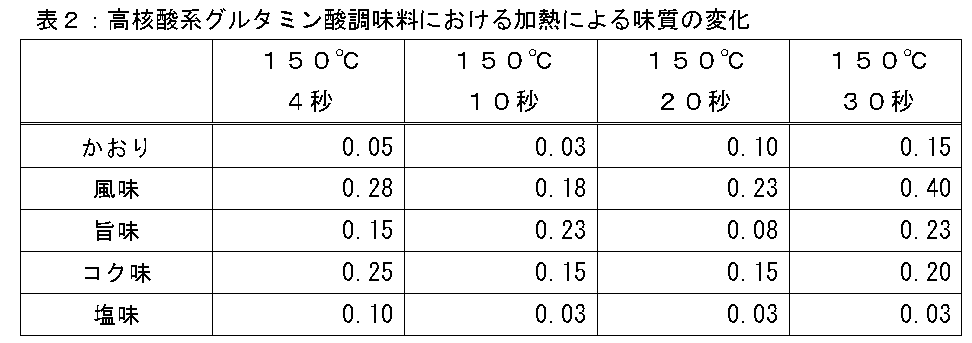
実施例1により得られた調味料において表1に示す通り150℃4秒では1.1倍ほど着色は進むものの加熱保持時間の異なる試験区間に明確な差はなく、濁りに至っては加熱前後で差はなかった。
味質においては全てプラス(「濃い」)方向に評価されており、150℃10秒では一旦伸び悩むものの、風味、香り、旨味とも加熱保持時間に応じて向上させることができた。この時風味は「芳ばしい」の評価がなされており、メイラード型の風味の増加だと考えられる。150℃30秒に至っても良好な風味であり、総合的な嗜好性は失われていなかった。当該調味料の呈味性に寄与するグアニル酸とイノシン酸は150℃30秒でも90%以上、またグルタミン酸ナトリウムも80%以上残存しており、バッチ加熱では120℃でも3割以上壊れるといわれていることから考えて呈味性寄与成分の破壊を最少減に抑えながら風味の改善を図れることが示唆された。加熱保持時間は蒸気と混合する加熱クッカーから減圧冷却缶の間に取り付けられた滞留管の長さで決まるため、その時間制御は容易であった。他方、耐熱性菌G.stearothermophilusの殺菌性を確認した結果150℃4秒では1,000分の1以下の死滅を確認できたことから、食品変敗の原因となる微生物を抑えた調味料を提供できる可能性が推察された。


(高グルタミン酸系の調味料)
実施例2により得られた調味料の比較結果を示す。実施例1においてはインフュージョンでの加熱により風味の向上と呈味性寄与成分破壊の抑制が示唆されたため、一般的に知られた製造法と比較して本製造法が優れているのか別の調味料での実施例と合わせ比較した。公知の方法としては特許文献1と非特許文献2を参考に調味料原料をガラス瓶に入れ、オートクレーブにてそれぞれ105℃40分或いは、120℃60分の加熱を行った。結果は表5、表7に示す。140℃4秒では表5に示す通り、濁りと着色共に約2倍増加していた。しかし、150℃含め、インフュージョンによる加熱では加熱保持時間の違いによる差異は認められなかった。一方で、既存の製法では加熱前と比較して濁りで10倍、着色で約5倍以上の増加がみられた。加熱前後での味質は、表5で示す通り、嗜好性を失うことなく香りの増加を見出したものの、旨味とコク味は標準品よりも「薄く」なる傾向がみられた。しかし105℃40分と120℃60分の加熱ではうま味が失われ、ピリピリとした刺激と酸味、有機溶媒に類似した不快な風味が付与されており、当該調味料は加熱による風味の劣化が激しいものと推察された。インフュージョンでは140℃15秒加熱で風味の向上が認められること、同時に呈味性に寄与するグルタミン酸の分解が150℃30秒加熱においてもほとんど見られないことから、本製造法が既存より優れていることが裏付けられた。耐熱性菌G.stearothermophilusの殺菌性を確認した結果140℃4秒では1,000分の1以下の死滅を確認し、プレート法ではコロニーが生えてこなかったことから、微生物フリーの調味料を提供できる可能性が裏付けられた。
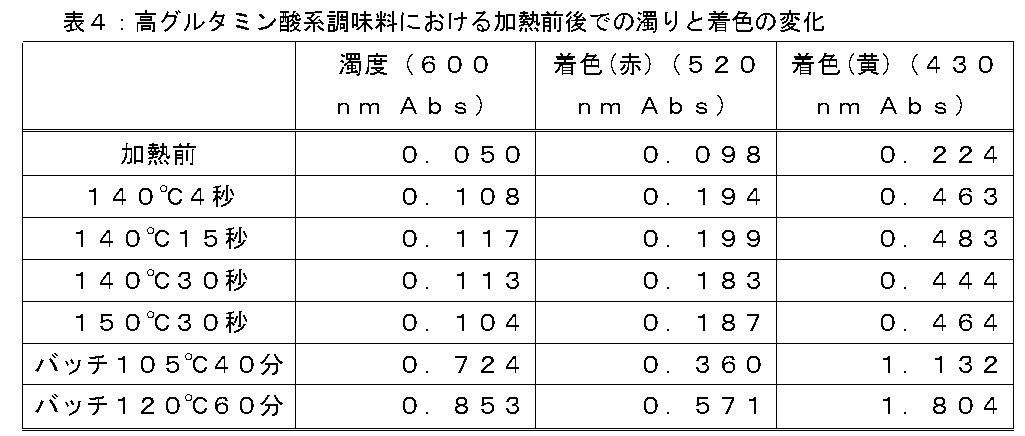
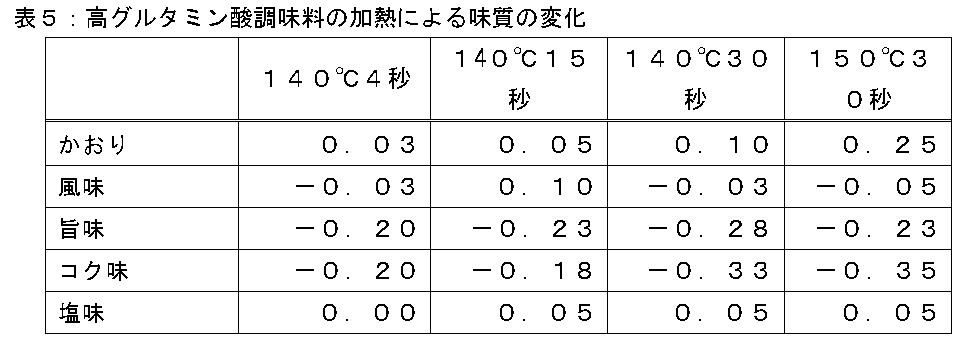
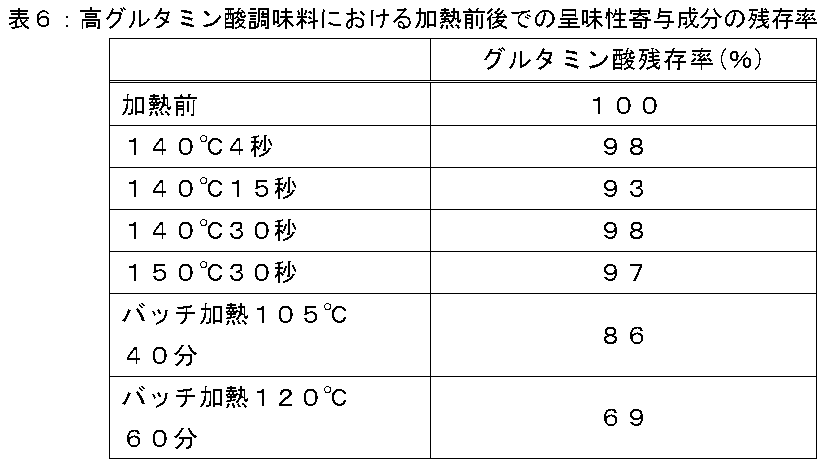
実施例3で得たサンプルの比較評価結果を示す。結果は表7~9に示す。140℃4秒では表8に示す通り、濁りと着色共に約2倍増加していた。一方、実施例2同様、150℃含め、インフュージョンによる加熱では加熱保持時間の違いによる差異は認められなかった。しかし、既存の製法では加熱前と比較して濁りが10倍に増加した一方、着色で約2倍以上の増加がみられたものの。実施例2と並べれば既存法より全体的に温度への変化は緩やかであると言えた。殺菌前後での味質は、表6で示す通り、嗜好性を失うことなく香りの増加を見出したものの、旨味とコク味は標準品よりも「薄く」なる傾向がみられた。しかし105℃40分と120℃60分の加熱ではうま味が失われ、有機溶媒に類似した不快な風味とシイタケ様の香気を呈していた。インフュージョンでは140℃30秒加熱で風味の向上が認められ、同時に呈味性に寄与するグルタミン酸の分解が150℃30秒加熱においても見られず、グアニル酸とイノシン酸も99%残存していた。なお、耐熱性菌G.stearothermophilusの殺菌性については140℃4秒で1,000分の1以下の死滅を確認し、平板培養法ではコロニーが生えてこなかった。
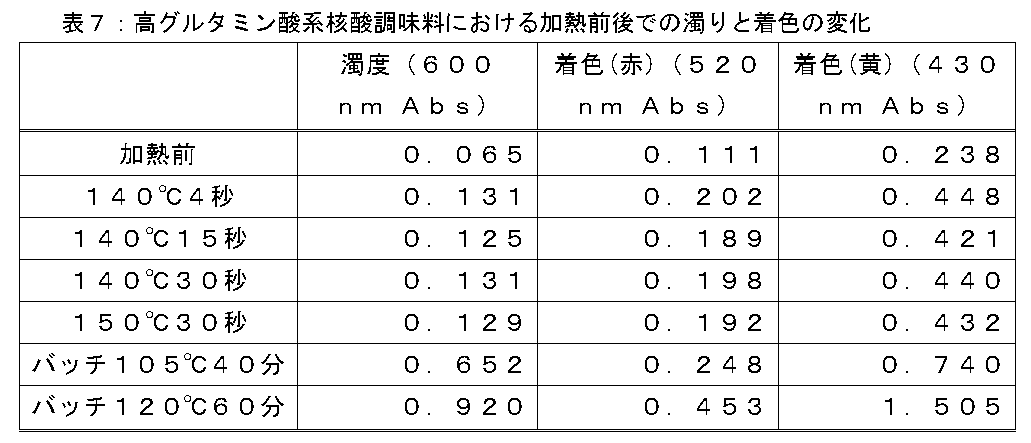


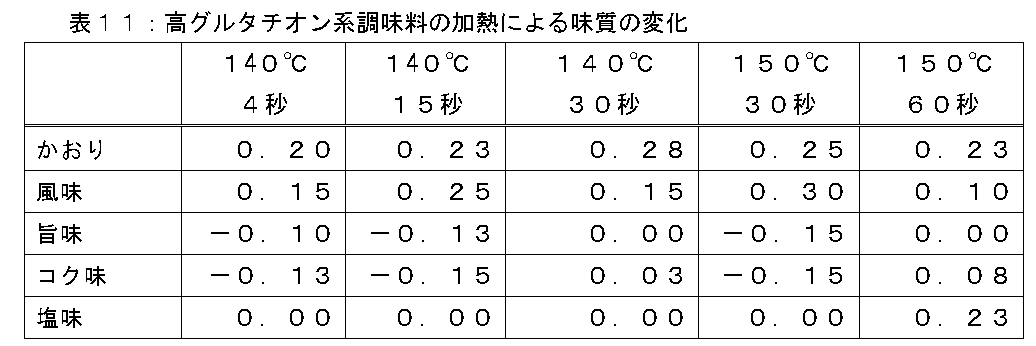
実施例4で得たサンプルの比較評価結果を示す。結果は表10~12に示す通り。140℃4秒では表8から、濁りは1.3倍増加していた一方、着色はむしろ下がっており、105℃40分と120℃60分の加熱では濁度は2倍弱以上あるが、着色は赤色で元の2割、黄色で7割にまで減少していた。他方、味質については香りが概ね加熱保持時間と正相関をみせるが、風味は基本的に標準品より強く、140℃15秒と150℃30秒に極大値をとるピークが存在する。これに対して風味とコク味は逆相関を示しており、上記2つのピーク条件では標準品よりもわずかに強度が下がって穏やかな口当たりとなっている。スコアが全てプラスとなる条件が存在し、その加熱条件は140℃30秒のときであった。実施例2同様、150℃含め、インフュージョンによる加熱では加熱保持時間の違いによる濁りや着色の差異は認められなかった。しかし120℃60分の加熱ではうま味が失われ、ネギ臭とニンニク臭に類似した不快な香りと風味を有していた。105℃40分加熱では、有機溶媒に類似した不快な硫黄臭の混じる匂いを呈していた。インフュージョンでは140℃15秒加熱以降でグルタチオンが、わずかに減少の進む傾向が示唆されたものの、150℃60秒でも加熱前と比較して94%残存していた。しかし、バッチ加熱による105℃40分間では30%弱まで、120℃60分間では2%まで激減していた。なお、耐熱性菌G.stearothermophilusの殺菌性については初発10の3乗個、140℃4秒で1桁の減少となり、140℃15秒で完全死滅を確認した。


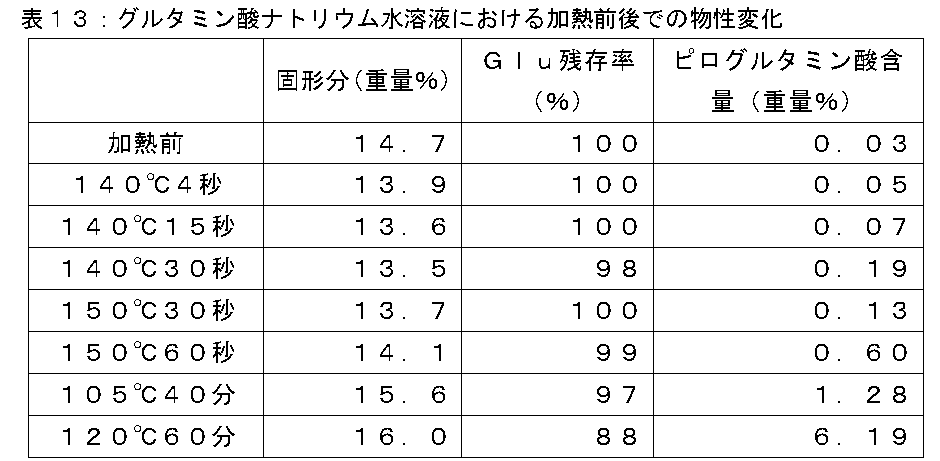
実施例5により加熱後得られた液に関する評価結果を表13~15で示す。本実施例は、pHと原液濃度を調味料サンプルと同一に揃えた場合、純粋な呈味寄与成分単体では加熱処理によりどのような影響があるのか、それが調味料中の呈味寄与成分の熱による影響とどのように異なるのか、言い換えると調味料ごとに呈味寄与成分は異なる振る舞いをするのか検証する目的でテストを実施した。
純品での結果、表14で示す通り、150℃60秒間の加熱を行ってもほとんど分解しないということが分かった。105℃40分間でも97%残存しており、120℃60分間でも88%残存していた。グルタミン酸は低pHや高pHでは加熱により分子内で縮合してラクタム環を生成し、ピログルタミン酸へ転換することが知られている。しかし、表14と15からピログルタミン酸以外の非有機酸物質生成が示唆された。さらに表16において150℃30秒で各調味料を比較すると、加熱強度に対する減衰率が異なっており、一般的に流通している調味料内の呈味性寄与成分の減衰率もその成分組成に依存した推移を示すと考えられる。本テストで用いた調味料原料組成の大きな違いの一つとして、全アミノ酸含量が挙げられるものの、天然物質故に複雑かつ複数の反応が同時進行するがために原因の確定は困難である。しかし、本特許を用いた調味料の製造方法では、呈味性寄与成分の破壊を最小限に抑えながらも、それぞれの調味料に応じた制御性に優れる風味付与が可能となる。また、耐熱性菌を死滅させながらも加熱保持時間を落とすことで、調味料原料のフレッシュな風味・香気を生かし、加熱による風味付与を抑える制御も可能である。

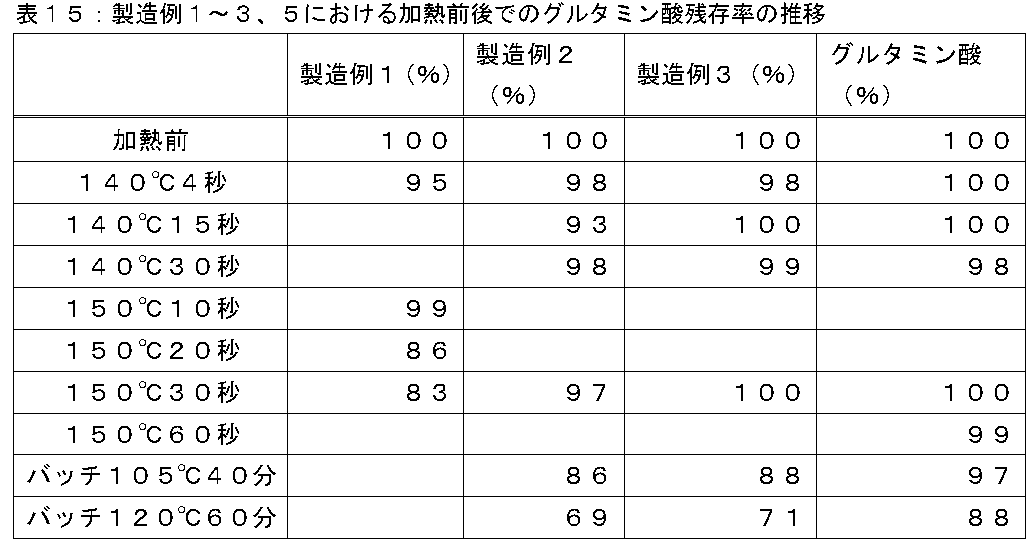
実施例6で得たサンプルの比較評価結果を示す。本実施例は酵母エキス以外の調味料においても本特許による調味料製造法が適用可能か調べることを目的として実施した。結果は表15~17に示す通り。加熱前と比較し、一般的製法の80℃30分からインフュージョン130℃、140℃、150℃のまで、加熱強度に応じて着色は増加。520nmでは最大3.7倍、430nmでは1.9倍となった。一方で、旨味の呈味成分であるグルタミン酸は、80℃30分では加熱前サンプルより減少している半面、インフュージョンによる加熱130~150℃では遊離たんぱく質の一部が分解することにより、150℃では102%まで増加する傾向にあった。火入れ醤油の特徴である火香は150℃30秒で概ね同力価のサンプルが得られた。また、140℃30秒では火入れ前と同等の力価を保持できた。しかし、それ以下の加熱強度では異なる香りのパターンが生じており、140℃4秒では鰹節だし様の軽くて旨味にとんだ華やかな香気に変化した。さらに130℃4秒では140℃4秒の風味のまま、その香気の力価だけで全てのサンプルを上回る評価を示した。なお、本サンプルからは耐熱性菌G.stearothermophilusが検出されず、殺菌性については一般生菌が初発10の2乗、130℃4秒で完全死滅を確認した。本特許による加熱方式は、プレート式熱交換器やバッチ式加熱では再現できない新たな調味料として利用できることがわかった。それは、目的の温度まで一瞬かつ過加熱の無い昇温ができることにより、通過温度帯でそれぞれ至適温度をもつ酵素反応などを回避できる。加熱による香味付与はメイラード反応群だけでなく、ストレッカー分解反応によっても生じ、且つそれぞれの基質の分解と縮合の至適温度は異なることが知られている。供試する液体が複雑な混合物である場合、温度を上げれば比例してメイラード臭が増すという単純なものではないことも本実施例のより示すことができた。すなわち、温度が異なれば、香りのプロファイルも異なる。140℃4秒品と130℃品は、温度が異なれば、異なる風味の調味料を製造できることを示した。130℃試験区は既存の醤油には存在しない、新しい風味をもつ醤油をも製造できることを示した。
表16:生揚げ醤油における加熱前後での着色の変化

表17:生揚げ醤油における加熱前後での呈味性寄与成分の含量

表18:生揚げ醤油の加熱による火香着香

Claims (5)
- 調味料原料を水蒸気により加熱処理する調味料の製造方法であって、加熱方法は、インフュージョン方式の直接加熱法により加熱され、加熱後、減圧冷却方式により冷却される、調味料の製造方法。
- 加熱温度は120~170℃、加熱時間は0.1~60秒であり、加熱後減圧冷却方式により100℃以下とする、上記請求項1に記載の調味料の製造方法
- 0.2~0.8MPaの飽和蒸気が加熱缶内に充満している雰囲気下にて加熱温度まで達温せしめるところの、上記請求項1又は2に記載の調味料の製造方法。
- 加熱直前の調味料原料の液温との温度差が30℃以上、加熱開始から達温完了まで所要時間0.5秒以内となる加熱条件である、請求項1~請求項3に記載の製造方法。
- 調味料原料は5~70重量%の固形分となるよう調整し、加熱処理する請求項1~4に記載の製造方法。
Priority Applications (4)
| Application Number | Priority Date | Filing Date | Title |
|---|---|---|---|
| US16/641,149 US20200281235A1 (en) | 2017-08-23 | 2018-08-21 | Method for manufacturing seasoning |
| CN201880068607.XA CN111278297A (zh) | 2017-08-23 | 2018-08-21 | 调味料的制造方法 |
| JP2019537637A JP7261162B2 (ja) | 2017-08-23 | 2018-08-21 | 調味料の製造方法 |
| EP18847831.7A EP3673750A4 (en) | 2017-08-23 | 2018-08-21 | SEASONING MANUFACTURING PROCESS |
Applications Claiming Priority (4)
| Application Number | Priority Date | Filing Date | Title |
|---|---|---|---|
| JP2017159893 | 2017-08-23 | ||
| JP2017-159893 | 2017-08-23 | ||
| JP2018067875 | 2018-03-30 | ||
| JP2018-067875 | 2018-03-30 |
Publications (1)
| Publication Number | Publication Date |
|---|---|
| WO2019039470A1 true WO2019039470A1 (ja) | 2019-02-28 |
Family
ID=65439831
Family Applications (1)
| Application Number | Title | Priority Date | Filing Date |
|---|---|---|---|
| PCT/JP2018/030826 Ceased WO2019039470A1 (ja) | 2017-08-23 | 2018-08-21 | 調味料の製造方法 |
Country Status (5)
| Country | Link |
|---|---|
| US (1) | US20200281235A1 (ja) |
| EP (1) | EP3673750A4 (ja) |
| JP (1) | JP7261162B2 (ja) |
| CN (1) | CN111278297A (ja) |
| WO (1) | WO2019039470A1 (ja) |
Families Citing this family (4)
| Publication number | Priority date | Publication date | Assignee | Title |
|---|---|---|---|---|
| CN113598357A (zh) * | 2021-08-06 | 2021-11-05 | 安琪酵母股份有限公司 | 一种无动物源风味酵母抽提物产品及其制法和应用 |
| CN114480475B (zh) * | 2021-12-29 | 2023-05-30 | 中国科学院海洋研究所 | 一种鲜味物质丰富的重组条斑紫菜藻株及构建方法与应用 |
| CN114955033B (zh) * | 2022-06-29 | 2024-04-05 | 青岛花帝食品配料有限公司 | 一种微生物发酵复合调味料的包装装置 |
| KR102850803B1 (ko) * | 2024-11-26 | 2025-08-28 | 주식회사 잇츠굿 | 기능성 조미료 및 이의 제조방법 |
Citations (13)
| Publication number | Priority date | Publication date | Assignee | Title |
|---|---|---|---|---|
| JPS61181356A (ja) * | 1985-02-06 | 1986-08-14 | Sapporo Breweries Ltd | 酵母エキスの製造法 |
| JPH01231864A (ja) * | 1989-01-10 | 1989-09-18 | Nikken Food Kk | 無菌性風味調味料の製造法 |
| JP2000166500A (ja) | 1998-12-03 | 2000-06-20 | Kikkoman Corp | 調味料の製造法 |
| JP2004166607A (ja) * | 2002-11-20 | 2004-06-17 | Morinaga Milk Ind Co Ltd | 野菜プリンの製造方法及び野菜プリン |
| US20040170731A1 (en) * | 2003-02-28 | 2004-09-02 | Girish Subramaniam | Reduction of oil and off-flavors in citrus juice by direct steam heating and flash cooling |
| WO2005051106A1 (ja) * | 2003-11-28 | 2005-06-09 | Kyowa Hakko Food Specialties Co., Ltd. | 豚骨エキスの製造方法 |
| JP2007259744A (ja) | 2006-03-28 | 2007-10-11 | Kohjin Co Ltd | 調味料の製造方法 |
| JP2008237085A (ja) | 2007-03-27 | 2008-10-09 | Morinaga Milk Ind Co Ltd | 臭気成分が低減した殺菌済み乳蛋白質加水分解物の製造方法 |
| JP2009207432A (ja) | 2008-03-05 | 2009-09-17 | Kohjin Co Ltd | 調味料の製造方法 |
| JP2011004673A (ja) * | 2009-06-26 | 2011-01-13 | Kohjin Co Ltd | 飲食品のミルク感を増強する調味料 |
| WO2013140901A1 (ja) | 2012-03-21 | 2013-09-26 | アサヒグループホールディングス株式会社 | 酵母エキス加熱反応調味料 |
| JP2015008682A (ja) | 2013-06-28 | 2015-01-19 | 株式会社Mizkan Holdings | 液体調味料及びその製造方法並びに液体調味料の風味改善方法 |
| WO2016012025A1 (en) * | 2014-07-25 | 2016-01-28 | Spx Flow Technology Danmark A/S | Infusion plant |
Family Cites Families (12)
| Publication number | Priority date | Publication date | Assignee | Title |
|---|---|---|---|---|
| US3879561A (en) * | 1972-05-30 | 1975-04-22 | Staley Mfg Co A E | Vacuum dried condiments |
| JPH0632603B2 (ja) * | 1983-12-26 | 1994-05-02 | 中外製薬株式会社 | 菌体付着異臭味成分の除去法 |
| EP0247245A1 (en) * | 1986-05-23 | 1987-12-02 | The Procter & Gamble Company | Juice sterilization process |
| JPH0947262A (ja) * | 1995-08-07 | 1997-02-18 | Lion Corp | 食肉用液体ソース組成物 |
| IT1299276B1 (it) * | 1998-05-19 | 2000-02-29 | Parmalat Spa | Procedimento per la sterilizzazione uht di prodotti a base di latte, con mantenimento di elevate proprieta' organolettiche, e impianto |
| JP4754154B2 (ja) * | 2002-11-12 | 2011-08-24 | アサヒ飲料株式会社 | 酵母含有飲料における酵母由来臭の脱臭方法及び脱臭装置 |
| JP4696816B2 (ja) * | 2005-09-26 | 2011-06-08 | 不二製油株式会社 | 大豆食品の製造法 |
| CN101616605B (zh) * | 2007-01-30 | 2013-07-24 | 麒麟协和食品株式会社 | 风味改良剂 |
| JP2012044962A (ja) * | 2010-08-30 | 2012-03-08 | Iwai Kikai Kogyo Co Ltd | 液体食品の滅菌装置 |
| JP6041368B2 (ja) * | 2014-09-12 | 2016-12-07 | キッコーマン株式会社 | 醤油様調味料の製造方法及び醤油様調味料 |
| JP5836466B1 (ja) * | 2014-10-31 | 2015-12-24 | キッコーマン株式会社 | 醤油様調味液およびその製造方法 |
| US11122827B2 (en) * | 2016-05-31 | 2021-09-21 | Kikkoman Corporation | Nucleic acid-containing fermented seasoning and method of producing the same |
-
2018
- 2018-08-21 CN CN201880068607.XA patent/CN111278297A/zh active Pending
- 2018-08-21 EP EP18847831.7A patent/EP3673750A4/en not_active Withdrawn
- 2018-08-21 WO PCT/JP2018/030826 patent/WO2019039470A1/ja not_active Ceased
- 2018-08-21 JP JP2019537637A patent/JP7261162B2/ja active Active
- 2018-08-21 US US16/641,149 patent/US20200281235A1/en not_active Abandoned
Patent Citations (14)
| Publication number | Priority date | Publication date | Assignee | Title |
|---|---|---|---|---|
| JPS61181356A (ja) * | 1985-02-06 | 1986-08-14 | Sapporo Breweries Ltd | 酵母エキスの製造法 |
| JPH01231864A (ja) * | 1989-01-10 | 1989-09-18 | Nikken Food Kk | 無菌性風味調味料の製造法 |
| JP2000166500A (ja) | 1998-12-03 | 2000-06-20 | Kikkoman Corp | 調味料の製造法 |
| JP2004166607A (ja) * | 2002-11-20 | 2004-06-17 | Morinaga Milk Ind Co Ltd | 野菜プリンの製造方法及び野菜プリン |
| US20040170731A1 (en) * | 2003-02-28 | 2004-09-02 | Girish Subramaniam | Reduction of oil and off-flavors in citrus juice by direct steam heating and flash cooling |
| WO2005051106A1 (ja) * | 2003-11-28 | 2005-06-09 | Kyowa Hakko Food Specialties Co., Ltd. | 豚骨エキスの製造方法 |
| JP2007259744A (ja) | 2006-03-28 | 2007-10-11 | Kohjin Co Ltd | 調味料の製造方法 |
| JP2008237085A (ja) | 2007-03-27 | 2008-10-09 | Morinaga Milk Ind Co Ltd | 臭気成分が低減した殺菌済み乳蛋白質加水分解物の製造方法 |
| JP2009207432A (ja) | 2008-03-05 | 2009-09-17 | Kohjin Co Ltd | 調味料の製造方法 |
| JP2011004673A (ja) * | 2009-06-26 | 2011-01-13 | Kohjin Co Ltd | 飲食品のミルク感を増強する調味料 |
| WO2013140901A1 (ja) | 2012-03-21 | 2013-09-26 | アサヒグループホールディングス株式会社 | 酵母エキス加熱反応調味料 |
| JP2015008682A (ja) | 2013-06-28 | 2015-01-19 | 株式会社Mizkan Holdings | 液体調味料及びその製造方法並びに液体調味料の風味改善方法 |
| WO2016012025A1 (en) * | 2014-07-25 | 2016-01-28 | Spx Flow Technology Danmark A/S | Infusion plant |
| WO2016012026A1 (en) * | 2014-07-25 | 2016-01-28 | Spx Flow Technology Danmark A/S | Infusion plant |
Non-Patent Citations (4)
| Title |
|---|
| HIROMICHI KATO ET AL.: "Chemistry of Non-Enzymatic Browning Phenomenon, Chemistry of Discoloration in Foods", 1995, KOHRIN SHOIN |
| KAGITANI, KAZUO ET AL.: "Development of Vegetable Juice with New Taste (YASAI SHIBORI)", JAPAN JOURNAL OF FOOD ENGINEERING, vol. 12, no. 2, 2011, pages 77 - 80, XP055678506, ISSN: 1884-5924, DOI: 10.11301/jsfe.12.77 * |
| NAKAJUMA, YASUYUKI: "Sterilization technology and equipment for soft drinks", JAPAN FOOD SCIENCE, vol. 50, no. 3, 2011, pages 34 - 39, XP009519507, ISSN: 0368-1122 * |
| See also references of EP3673750A4 |
Also Published As
| Publication number | Publication date |
|---|---|
| CN111278297A (zh) | 2020-06-12 |
| JPWO2019039470A1 (ja) | 2020-09-17 |
| EP3673750A4 (en) | 2021-01-20 |
| JP7261162B2 (ja) | 2023-04-19 |
| EP3673750A1 (en) | 2020-07-01 |
| US20200281235A1 (en) | 2020-09-10 |
Similar Documents
| Publication | Publication Date | Title |
|---|---|---|
| Gardner et al. | Acidulants in food processing | |
| JP7261162B2 (ja) | 調味料の製造方法 | |
| JPWO2001056408A1 (ja) | 保存性に優れた食品の製造法および食品保存剤 | |
| JP6140328B2 (ja) | 不快臭の消臭方法、並びに、食感の改善方法 | |
| JP2012095596A (ja) | 醤油様調味料 | |
| JP7554646B2 (ja) | エノキタケ属キノコ含有加工品、及びエノキタケ属キノコ含有加工品の製造方法 | |
| US20200221743A1 (en) | Nucleic acid-containing fermented seasoning and method of producing the same | |
| US20140328991A1 (en) | Taste-Improving Agent | |
| US6759068B2 (en) | Onion and garlic biohydrolysates and their use as natural flavorings | |
| US20140287097A1 (en) | Tomato derived composition containing enhanced levels of 5'inosine monophosphate | |
| CN111671072B (zh) | 一种去除蚝汁腥味的方法、蚝汁及调味品组合物 | |
| KR20130062175A (ko) | 저 알코올 요리용 맛술 조성물 및 그의 대량 제조 방법 | |
| CN104996963B (zh) | 一种复合增味基的制备方法及所得的产品 | |
| JP2019004770A (ja) | 加熱調理用醤油調味料 | |
| JP2006149384A (ja) | 加工食品の製造方法 | |
| JP5025362B2 (ja) | 風味改良剤 | |
| KR20180104427A (ko) | 젓갈을 이용한 액상용 천연조미료 및 이의 제조방법 | |
| JP2008011711A (ja) | トマト酢の製造方法、及びトマト酢 | |
| JP7776412B2 (ja) | 火入れ醤油 | |
| JP2017093371A (ja) | 新規スモーク感付与剤及びその製造方法 | |
| KR20250005403A (ko) | 누룩 이용 식품의 제조 방법 및 누룩 이용 식품 | |
| CN110799043A (zh) | 含有配料的乳化液状调味料 | |
| JP7329330B2 (ja) | 風味付与調味料 | |
| JP6834115B2 (ja) | 醤類組成物の製造方法及びそれにより製造された醤類組成物 | |
| JP6983007B2 (ja) | イソアミルアルコール高含有調味料組成物およびその製造方法 |
Legal Events
| Date | Code | Title | Description |
|---|---|---|---|
| 121 | Ep: the epo has been informed by wipo that ep was designated in this application |
Ref document number: 18847831 Country of ref document: EP Kind code of ref document: A1 |
|
| NENP | Non-entry into the national phase |
Ref country code: DE |
|
| ENP | Entry into the national phase |
Ref document number: 2019537637 Country of ref document: JP Kind code of ref document: A |
|
| ENP | Entry into the national phase |
Ref document number: 2018847831 Country of ref document: EP Effective date: 20200323 |
|
| WWW | Wipo information: withdrawn in national office |
Ref document number: 2018847831 Country of ref document: EP |