WO2019043776A1 - Dispositif de commande de véhicule - Google Patents
Dispositif de commande de véhicule Download PDFInfo
- Publication number
- WO2019043776A1 WO2019043776A1 PCT/JP2017/030884 JP2017030884W WO2019043776A1 WO 2019043776 A1 WO2019043776 A1 WO 2019043776A1 JP 2017030884 W JP2017030884 W JP 2017030884W WO 2019043776 A1 WO2019043776 A1 WO 2019043776A1
- Authority
- WO
- WIPO (PCT)
- Prior art keywords
- information
- user
- route
- vehicle
- transition
- Prior art date
- Legal status (The legal status is an assumption and is not a legal conclusion. Google has not performed a legal analysis and makes no representation as to the accuracy of the status listed.)
- Ceased
Links
Images



Classifications
-
- G—PHYSICS
- G05—CONTROLLING; REGULATING
- G05D—SYSTEMS FOR CONTROLLING OR REGULATING NON-ELECTRIC VARIABLES
- G05D1/00—Control of position, course, altitude or attitude of land, water, air or space vehicles, e.g. using automatic pilots
- G05D1/0055—Control of position, course, altitude or attitude of land, water, air or space vehicles, e.g. using automatic pilots with safety arrangements
- G05D1/0061—Control of position, course, altitude or attitude of land, water, air or space vehicles, e.g. using automatic pilots with safety arrangements for transition from automatic pilot to manual pilot and vice versa
-
- B—PERFORMING OPERATIONS; TRANSPORTING
- B60—VEHICLES IN GENERAL
- B60W—CONJOINT CONTROL OF VEHICLE SUB-UNITS OF DIFFERENT TYPE OR DIFFERENT FUNCTION; CONTROL SYSTEMS SPECIALLY ADAPTED FOR HYBRID VEHICLES; ROAD VEHICLE DRIVE CONTROL SYSTEMS FOR PURPOSES NOT RELATED TO THE CONTROL OF A PARTICULAR SUB-UNIT
- B60W50/00—Details of control systems for road vehicle drive control not related to the control of a particular sub-unit, e.g. process diagnostic or vehicle driver interfaces
- B60W50/0097—Predicting future conditions
-
- B—PERFORMING OPERATIONS; TRANSPORTING
- B60—VEHICLES IN GENERAL
- B60W—CONJOINT CONTROL OF VEHICLE SUB-UNITS OF DIFFERENT TYPE OR DIFFERENT FUNCTION; CONTROL SYSTEMS SPECIALLY ADAPTED FOR HYBRID VEHICLES; ROAD VEHICLE DRIVE CONTROL SYSTEMS FOR PURPOSES NOT RELATED TO THE CONTROL OF A PARTICULAR SUB-UNIT
- B60W50/00—Details of control systems for road vehicle drive control not related to the control of a particular sub-unit, e.g. process diagnostic or vehicle driver interfaces
- B60W50/08—Interaction between the driver and the control system
- B60W50/14—Means for informing the driver, warning the driver or prompting a driver intervention
-
- B—PERFORMING OPERATIONS; TRANSPORTING
- B60—VEHICLES IN GENERAL
- B60W—CONJOINT CONTROL OF VEHICLE SUB-UNITS OF DIFFERENT TYPE OR DIFFERENT FUNCTION; CONTROL SYSTEMS SPECIALLY ADAPTED FOR HYBRID VEHICLES; ROAD VEHICLE DRIVE CONTROL SYSTEMS FOR PURPOSES NOT RELATED TO THE CONTROL OF A PARTICULAR SUB-UNIT
- B60W60/00—Drive control systems specially adapted for autonomous road vehicles
- B60W60/001—Planning or execution of driving tasks
- B60W60/0021—Planning or execution of driving tasks specially adapted for travel time
-
- B—PERFORMING OPERATIONS; TRANSPORTING
- B60—VEHICLES IN GENERAL
- B60W—CONJOINT CONTROL OF VEHICLE SUB-UNITS OF DIFFERENT TYPE OR DIFFERENT FUNCTION; CONTROL SYSTEMS SPECIALLY ADAPTED FOR HYBRID VEHICLES; ROAD VEHICLE DRIVE CONTROL SYSTEMS FOR PURPOSES NOT RELATED TO THE CONTROL OF A PARTICULAR SUB-UNIT
- B60W60/00—Drive control systems specially adapted for autonomous road vehicles
- B60W60/001—Planning or execution of driving tasks
- B60W60/0023—Planning or execution of driving tasks in response to energy consumption
-
- B—PERFORMING OPERATIONS; TRANSPORTING
- B60—VEHICLES IN GENERAL
- B60W—CONJOINT CONTROL OF VEHICLE SUB-UNITS OF DIFFERENT TYPE OR DIFFERENT FUNCTION; CONTROL SYSTEMS SPECIALLY ADAPTED FOR HYBRID VEHICLES; ROAD VEHICLE DRIVE CONTROL SYSTEMS FOR PURPOSES NOT RELATED TO THE CONTROL OF A PARTICULAR SUB-UNIT
- B60W60/00—Drive control systems specially adapted for autonomous road vehicles
- B60W60/005—Handover processes
- B60W60/0053—Handover processes from vehicle to occupant
-
- G—PHYSICS
- G01—MEASURING; TESTING
- G01C—MEASURING DISTANCES, LEVELS OR BEARINGS; SURVEYING; NAVIGATION; GYROSCOPIC INSTRUMENTS; PHOTOGRAMMETRY OR VIDEOGRAMMETRY
- G01C21/00—Navigation; Navigational instruments not provided for in groups G01C1/00 - G01C19/00
- G01C21/26—Navigation; Navigational instruments not provided for in groups G01C1/00 - G01C19/00 specially adapted for navigation in a road network
- G01C21/34—Route searching; Route guidance
-
- G—PHYSICS
- G08—SIGNALLING
- G08G—TRAFFIC CONTROL SYSTEMS
- G08G1/00—Traffic control systems for road vehicles
- G08G1/09—Arrangements for giving variable traffic instructions
-
- G—PHYSICS
- G08—SIGNALLING
- G08G—TRAFFIC CONTROL SYSTEMS
- G08G1/00—Traffic control systems for road vehicles
- G08G1/09—Arrangements for giving variable traffic instructions
- G08G1/0962—Arrangements for giving variable traffic instructions having an indicator mounted inside the vehicle, e.g. giving voice messages
- G08G1/0968—Systems involving transmission of navigation instructions to the vehicle
-
- B—PERFORMING OPERATIONS; TRANSPORTING
- B60—VEHICLES IN GENERAL
- B60W—CONJOINT CONTROL OF VEHICLE SUB-UNITS OF DIFFERENT TYPE OR DIFFERENT FUNCTION; CONTROL SYSTEMS SPECIALLY ADAPTED FOR HYBRID VEHICLES; ROAD VEHICLE DRIVE CONTROL SYSTEMS FOR PURPOSES NOT RELATED TO THE CONTROL OF A PARTICULAR SUB-UNIT
- B60W50/00—Details of control systems for road vehicle drive control not related to the control of a particular sub-unit, e.g. process diagnostic or vehicle driver interfaces
- B60W50/08—Interaction between the driver and the control system
- B60W50/14—Means for informing the driver, warning the driver or prompting a driver intervention
- B60W2050/146—Display means
-
- B—PERFORMING OPERATIONS; TRANSPORTING
- B60—VEHICLES IN GENERAL
- B60W—CONJOINT CONTROL OF VEHICLE SUB-UNITS OF DIFFERENT TYPE OR DIFFERENT FUNCTION; CONTROL SYSTEMS SPECIALLY ADAPTED FOR HYBRID VEHICLES; ROAD VEHICLE DRIVE CONTROL SYSTEMS FOR PURPOSES NOT RELATED TO THE CONTROL OF A PARTICULAR SUB-UNIT
- B60W2540/00—Input parameters relating to occupants
- B60W2540/043—Identity of occupants
-
- B—PERFORMING OPERATIONS; TRANSPORTING
- B60—VEHICLES IN GENERAL
- B60W—CONJOINT CONTROL OF VEHICLE SUB-UNITS OF DIFFERENT TYPE OR DIFFERENT FUNCTION; CONTROL SYSTEMS SPECIALLY ADAPTED FOR HYBRID VEHICLES; ROAD VEHICLE DRIVE CONTROL SYSTEMS FOR PURPOSES NOT RELATED TO THE CONTROL OF A PARTICULAR SUB-UNIT
- B60W2540/00—Input parameters relating to occupants
- B60W2540/22—Psychological state; Stress level or workload
-
- B—PERFORMING OPERATIONS; TRANSPORTING
- B60—VEHICLES IN GENERAL
- B60W—CONJOINT CONTROL OF VEHICLE SUB-UNITS OF DIFFERENT TYPE OR DIFFERENT FUNCTION; CONTROL SYSTEMS SPECIALLY ADAPTED FOR HYBRID VEHICLES; ROAD VEHICLE DRIVE CONTROL SYSTEMS FOR PURPOSES NOT RELATED TO THE CONTROL OF A PARTICULAR SUB-UNIT
- B60W2540/00—Input parameters relating to occupants
- B60W2540/221—Physiology, e.g. weight, heartbeat, health or special needs
Definitions
- the present invention relates to a vehicle control device that automatically travels a route selected from a plurality of route candidates to a destination.
- the first step of identifying moving path candidates of the vehicle and the operation of the user when shifting from automatic driving to manual driving A second step of acquiring at least one of information and biological information of the user, and a third step of selecting a movement route of the vehicle based on the information acquired in the second step; Equipped with
- the transition from the automatic operation to the manual operation can be appropriately performed.
- FIG. 7 is a diagram for explaining calculation of the migration easiness in the first embodiment.
- FIG. 7 is a diagram for explaining calculation of the ease of migration in the first embodiment different from FIG. 3 is a flowchart according to an embodiment of the present invention.
- the figure explaining transfer easiness calculation using living body information The figure explaining another example of transfer ease calculation using living body information.
- the figure explaining the behavior concerning the embodiment of the present invention. The figure which demonstrates transfer ease calculation using time until it switches to manual operation.
- FIG. 8 is a diagram for explaining calculation of the migration easiness in the second embodiment.
- the block diagram of the control apparatus which extracts and uses the data near a user. A figure explaining that it judges that automatic operation was able to stop safely.
- Embodiment 1 As a first embodiment, an example of a route selection method in an autonomous vehicle is shown.
- the present embodiment relates particularly to a vehicle control device that selects a route according to the desires and preferences of the user of the autonomous mobile body.
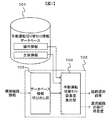
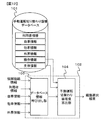
- FIG. 1 is a control block diagram according to an embodiment of the present invention.
- the manual driving switching information database 101 can be obtained from position information of the vehicle obtained when a switching event from automatic driving to manual driving occurs in the past, obtained by C2X communication, etc., and user operation information or biological information All the information that has been stored is stored.
- the operation information is the user's operation (for example, steering angle, accelerator opening degree, brake depression amount, stick controller inclination amount, speed or traveling direction setting by a button, etc.) that affects either the traveling direction or movement speed of the vehicle.
- Transition notification with the control command value during automatic operation before switching to those manual operation and the time until the transition from automatic operation to manual operation is completed (time t0 when the system side determined the operation transition)
- time t1 At least one of time t1 is included
- the operation amount information that affects either the traveling direction or the traveling speed
- the values of the traveling direction and the traveling speed itself may be stored and used.
- the biological information indicates, for example, information on the state or fluctuation of pulse, heart rate, blood pressure, brain wave, cerebral blood flow, sweating, expression (eyelid, eyelid, pupil, corner of mouth, nasal cavity).
- the route selection device 102 is mounted on a controller on the vehicle side, calculates the ease of switching to manual driving of each route from among a plurality of candidate routes, selects the route with the highest ease of switching, and calculates the control amount. Output to the device.
- the database information calling unit 103 included in the route selection device 102 acquires information on the candidate route.
- the route candidate information includes information that can specify the positions of a plurality of route candidates that can reach the destination. Based on this, from the manual driving switching information database 101, data at the time of the manual driving transition of the own vehicle and the other vehicle in the respective candidate routes are recalled.
- the data to be called includes at least one of user operation information and biometric information.
- the manual operation switching ease calculation unit 104 calculates the ease of switching to the manual operation based on the past user operation information or biological information called, selects a route with a high degree of ease, and selects the result. Send to the travel control unit. At this time, the transition easiness of the selected route may also be output.
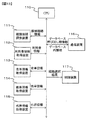
- FIG. 2 is a block diagram of the control device.
- the CPU 110 calculates the ease of switching to the manual operation for each route, and determines the optimal route.
- the route candidate search device 111 searches a plurality of routes which can reach from the current vehicle position to the destination based on map information, vehicle position information, destination information and the like not shown.
- the communication device 116 calls at least one of the operation information or the biometric information of the past other vehicle on the candidate route from the manual driving switching information database 101 of FIG. 1.
- the control device 117 outputs the path selection result determined by the CPU 110 based on the called operation information or the biological information to the control device including the lower planning system.
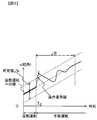
- FIG. 3 shows steering angles before and after switching from automatic driving to manual driving in certain past data.
- the steering angle is described as an example, the same applies to an accelerator opening degree, a brake depression amount, and the like.
- the user moves the steering wheel predominantly and manual control starts.
- the time to t2 indicates that the steering angle is increasing, and the automatic driving is performing the operation of turning the steering wheel. This is extrapolated after the time when the manual operation is started, and compared with the operation amount of the manual operation. If a difference of not less than the predetermined value ⁇ x occurs in the both within the predetermined time ⁇ t, it is determined that the transition to the manual operation is a switch with a low degree of ease.
- this determination is performed on all past data on the route, and for each route, the ratio of how many of the switches judged to have low switchability among the total switch count is calculated .
- the path with the lowest ratio is selected as the path with the highest ease of migration.
- an operation amount deviated by a predetermined value ⁇ x or more on both sides with respect to the extrapolated automatic driving operation amount is input within ⁇ t. It may be determined that the ease of migration is low. As a result, the operation amount of the automatic operation immediately before switching to the manual operation is abnormal, and the user can not grasp the operation amount except for the deviation of the operation amount which is corrected by the user, and the operation amount is It is possible to determine that switching is difficult to shift only when hunting has occurred. Alternatively, calculation may be performed using the difference from the value of the steering angle of automatic operation immediately before switching to manual operation without extrapolation (the same applies to the second and subsequent embodiments).
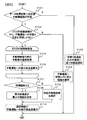
- the candidate route is divided into intersections (nodes), the number of times of data acquisition is confirmed for each divided section (link), and it is confirmed that there are no nodes whose number of data is less than or equal to a predetermined value in the entire route.
- a path is selected based on a request other than the switching ease.
- the requirements other than the switching easiness include, for example, the traveling distance, the required time to the destination, and the fuel consumption.
- route selection can be performed based on the easiness after manual operation only when there is a route with a large number of traveling vehicles and sufficient data, and route selection accuracy can be improved.
- S102 it is checked whether there is a route that can be switched to the manual operation among the routes for which it is determined that the number of times of data acquisition is equal to or more than a predetermined value. If there is no route from the current position to the destination where there is no vehicle switched to manual operation, the process proceeds to S105, selects the route, and ends. If any route includes the history of switching to the manual operation, the process proceeds to S104. S104 and S106 are calculated for each candidate route. In S104, operation information at the time of transition to manual control of past vehicles and other vehicles of each route is acquired. At S106, the transition easiness of each route is calculated by the above-described calculation method.
- the ease of migration may be calculated for each link.
- the value of the lowest value among the links included in the candidate route or the value of the weighted average obtained by giving the weight of each distance to the ease of migration of each link is taken as the ease of migration of the candidate route.
- step S104 it is confirmed that there are a plurality of candidate paths in S102. If there are a plurality of paths, the process advances to step S108 to select a path with the highest calculated ease of migration. If there is only one route, there is no room for route selection, so the processing proceeds to S109, and a candidate route is selected as a route to travel.
- the process may be terminated as it is, or the user may be notified of the ease of transition of the selected route to the manual operation at S110, and the flow may be terminated.
- the display content may indicate the degree of difficulty (the rate at which it is difficult to shift to manual operation), or it may be further divided into stages of 100 or less and displayed as a level of difficulty.
- the biological information history at the time of shift to manual control of each route is acquired in S104.
- the transition easiness is determined to be lower .
- the magnitudes of the differences are compared, and the path with the smallest difference is selected in S108 (FIG. 6).
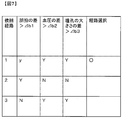
- a route may be selected in which the number of pieces of biometric information for which the difference has occurred is equal to or greater than a predetermined value (FIG. 7).
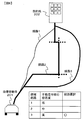
- Route 1 to Route 3 There are three route candidates, Route 1 to Route 3, for the autonomous mobile body 201 to reach the destination 202. At this time, the route 1 has the shortest distance but the narrow width. Route 2 is the widest road, but there are many intersections and turns. As a result of referring to the manual driving switching information database, the manual traveling transition easiness is the highest in the route 3, so the route 3 is selected in this system.
- route selection based on the manual operation shift ease is based on the user's desire or the result of estimating the user's preference, enabling, disabling, or other requests such as travel time or fuel consumption It may be used to perform route selection in combination with
- the user may select the route.
- a place where it is determined that the manual operation shift is relatively difficult can not be avoided, it may be used to alert the user when the place approaches.
- the route selection in S103 may be performed.
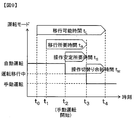
- the database information calling unit 103 (see FIG. 1), as operation information, requires that the system urges the user to shift to the manual operation. Or time t1 when the system prompts the user to shift to the manual operation or the time when it is determined that the migration is completely completed (for example, the time when the user's manual operation is stabilized) Information on at least one of time tR until t3, time t2 between times t2 and t3 when the user starts the manual operation, and time tM between t3 and t4 is acquired.
- the manual operation switching easiness calculation unit 104 determines the route with the highest switching easiness by averaging and comparing any of the values tL, tR, tS, and tM for each route in the same manner as Equation 2 described later. . Note that it is determined that the switching easiness is higher as tL and tM are longer, and it is determined that the switching easiness is particularly low when tM is a negative value. It is determined that the shorter the tR and tS, the higher the ease of switching.
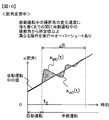
- FIG. 10 shows steering angles before and after switching from the automatic driving to the manual driving in certain past data as in FIG.
- time t2 the user moves the steering wheel predominantly and manual control starts.
- the time to t2 indicates that the steering angle is increasing, and the automatic driving is performing the operation of turning the steering wheel.
- This is extrapolated after the time when the manual operation is started, and compared with the operation amount of the manual operation.
- the difference between the operation amount of the automatic operation extrapolated within the predetermined time ⁇ t and the operation amount of the manual operation (hatched portion in the drawing) is calculated by the following equation.
- XMD (t) is a manual driving operation amount at time t
- XAD (t) is an extrapolated amount of automatic driving operation at time t. This is further averaged with respect to available past data (preferably, it is preferable to use only data within the latest predetermined period) as follows.
- N is the total number of transition data to manual operation included in the available data. This value is compared for each route, and the larger the value, the less easy it is to shift this route to the manual operation. This makes it possible to compare in more detail the degree to which the operation after transition becomes unstable in each path.
- the integration interval may not be the predetermined time ⁇ t, and may be up to time t3 when the operation of the manual operation is stable (hereinafter, regarding the time, refer to FIG. 9).
- the difference between the operation amount at the time of automatic operation and the extrapolated value of the operation amount may be equal to or smaller than a predetermined value ⁇ x1, or the fluctuation frequency of manual operation after the start of manual operation is equal to or lower than a predetermined value. You may do it.
- the following equation is used instead of equation 1.
- the following equation may be used. However, this is limited to the case where the time t3 when the manual operation is stabilized is before the time t4 when it is determined that the system should complete the transition to the manual operation.
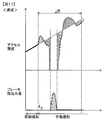
- the difference value is calculated as shown in FIG. Integrate, calculate the average.
- weight more than 1 may be added to the amount of operations and the user's brake within predetermined time after transfering to manual operation may be added. In that case, when the last operation of the automatic driving is the brake, the same applies to the user's accelerator operation.
- Equation 5 may be used by converting it into the same form as Equation 3 and Equation 4.
- the manual driving switching information database 101 is the information of the vehicle when an event of switching from the automatic driving to the manual driving occurs (the vehicle type (information of at least one of vehicle size (wheel displacement, wheel base, vehicle length, vehicle width) May be), total travel distance, travel distance or time since the last inspection, information on whether it is a business vehicle or a private vehicle), other vehicle information (relative speed with surrounding vehicles traveling in the same direction and / or distance between vehicles, vehicle It includes density, average speed), external world information (weather, road surface condition), user information (information on age, sex, driving calendar, and destination of the person operated when switching to manual driving).
- the vehicle type information of at least one of vehicle size (wheel displacement, wheel base, vehicle length, vehicle width) May be), total travel distance, travel distance or time since the last inspection, information on whether it is a business vehicle or a private vehicle
- other vehicle information relative speed with surrounding vehicles traveling in the same direction and / or distance between vehicles, vehicle It includes density, average speed), external world information (weather, road surface condition), user information (information on
- the route selection device 102 is mounted on a controller on the vehicle side, calculates the ease of switching to manual driving of each route from among a plurality of candidate routes, selects the route with the highest ease of switching, and calculates the control amount. Output to the device.
- the database information calling unit 103 included in the route selection device 102 acquires, in addition to the information on the route candidate, the user information that can be acquired, the host vehicle information, the other vehicle information, and the route information external world information. Based on this, from the manual driving switching information database 101, data at the time of the manual driving transition of the own vehicle and the other vehicle in the environment similar to the current traveling condition of the own vehicle in each of the candidate routes are called.
- the data to be called includes at least one of user operation information and biometric information.
- FIG. 13 shows the configuration of the control device.
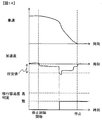
- the ease of transition to manual operation is at least one of the fact that automatic operation can be safely stopped, and that return to the route can be smoothly performed after manual operation is started. ,decide.
- FIG. 14 shows an example of a method of judging that the automatic driving can be safely stopped. If the acceleration takes a positive or negative large value above a predetermined value between the time when control for stopping is started and the vehicle stops, it is assumed that safe stopping can not be performed, and the transition to manual operation is It is determined that it was difficult to do it. In addition to longitudinal acceleration, lateral acceleration or variation in inter-vehicle distance with other surrounding vehicles may be used for determination. Alternatively, biological information of the user may be acquired, and information indicating tension of the user may be obtained as a basis for determination.
- the timing when the manual operation is started is preferably, for example, the timing when the gear is put in the drive or the timing when the winker is raised. This prevents the user from erroneously determining that it is difficult to return to the route if the user does not try to run immediately after shifting to the manual operation for some reason.
- a vehicle control apparatus for switching between automatic driving and manual driving of a vehicle, a first step of designating a moving path candidate of the vehicle, information on an operation of a user when shifting from the automatic driving to the manual driving, and the use
- an operation that affects either the traveling direction or the moving speed of the vehicle, and the switching from the automatic driving to the manual driving Use at least one of the time until the completion of
- the manual driving of each of the movement path candidates is performed using information on at least one of the user's operation when shifting from the automatic driving to the manual driving and the biological information of the user. After calculating the ease of transition to the destination, the travel route of the vehicle is selected.
- the information on the vehicle, the information on surrounding vehicles, the information on the environment of the outside world, and at least one of the biological information of the user are acquired, and the past information corresponding to the acquired information is referred to After calculating the ease of transition to the manual driving, the moving route of the vehicle is selected.
- the selected degree of ease of transition is displayed to the user.
- validation and invalidation of the movement route selected based on the degree of ease of migration is selected based on a result of estimation of the input and preference of the user.
- the travel route is selected by combining the transition easiness and the travel time of the vehicle or the priority of fuel consumption.
- the user is warned before entering a place where the degree of ease of transition is low.
- the operation is stopped.
- the fluctuation of the user's operation amount or the biological information at the time of transition from the automatic driving to the manual driving in the past is smaller, or when the user deviates from the moving route once, the operation is stopped.
- the fluctuation amount of the biological information, and the required time for returning to the movement route is smaller when returning to the movement route, it is determined that the route has a higher degree of ease of transition
- Based on the user's operation information or biological information when shifting from the automatic driving to the manual driving it is possible to select a route in which the burden of shifting to the manual driving is small.
- the user can use the automatic driving system with ease without being nervous about the transition to the manual operation.
Landscapes
- Engineering & Computer Science (AREA)
- Automation & Control Theory (AREA)
- Mechanical Engineering (AREA)
- Human Computer Interaction (AREA)
- Transportation (AREA)
- Radar, Positioning & Navigation (AREA)
- Remote Sensing (AREA)
- General Physics & Mathematics (AREA)
- Physics & Mathematics (AREA)
- Aviation & Aerospace Engineering (AREA)
- Traffic Control Systems (AREA)
- Navigation (AREA)
- Control Of Driving Devices And Active Controlling Of Vehicle (AREA)
Abstract
La présente invention réalise de manière appropriée la commutation d'une conduite automatisée à une conduite manuelle. L'invention concerne un dispositif de commande de véhicule étant un dispositif de commande de véhicule pour commuter un véhicule entre une conduite automatisée et une conduite manuelle, réalisant : une première étape pour lister des candidats de trajet de déplacement pour le véhicule ; une seconde étape consistant à acquérir des informations concernant une opération qui doit être effectuée par un utilisateur lorsque le véhicule est commuté de la conduite automatisée à la conduite manuelle, ou des informations biométriques concernant l'utilisateur, ou les deux ; et une troisième étape consistant à sélectionner un trajet de déplacement pour le véhicule sur la base des informations acquises dans la seconde étape.
Priority Applications (3)
| Application Number | Priority Date | Filing Date | Title |
|---|---|---|---|
| US16/640,571 US20200189617A1 (en) | 2017-08-29 | 2017-08-29 | Vehicle Control Device |
| JP2019538780A JP6909857B2 (ja) | 2017-08-29 | 2017-08-29 | 車両制御装置 |
| PCT/JP2017/030884 WO2019043776A1 (fr) | 2017-08-29 | 2017-08-29 | Dispositif de commande de véhicule |
Applications Claiming Priority (1)
| Application Number | Priority Date | Filing Date | Title |
|---|---|---|---|
| PCT/JP2017/030884 WO2019043776A1 (fr) | 2017-08-29 | 2017-08-29 | Dispositif de commande de véhicule |
Publications (1)
| Publication Number | Publication Date |
|---|---|
| WO2019043776A1 true WO2019043776A1 (fr) | 2019-03-07 |
Family
ID=65525086
Family Applications (1)
| Application Number | Title | Priority Date | Filing Date |
|---|---|---|---|
| PCT/JP2017/030884 Ceased WO2019043776A1 (fr) | 2017-08-29 | 2017-08-29 | Dispositif de commande de véhicule |
Country Status (3)
| Country | Link |
|---|---|
| US (1) | US20200189617A1 (fr) |
| JP (1) | JP6909857B2 (fr) |
| WO (1) | WO2019043776A1 (fr) |
Cited By (2)
| Publication number | Priority date | Publication date | Assignee | Title |
|---|---|---|---|---|
| CN113479216A (zh) * | 2020-03-16 | 2021-10-08 | 本田技研工业株式会社 | 控制装置、系统、计算机可读存储介质以及控制方法 |
| WO2022001708A1 (fr) * | 2020-06-28 | 2022-01-06 | 华为技术有限公司 | Procédé et appareil de commande de véhicule, véhicule et support de stockage |
Families Citing this family (6)
| Publication number | Priority date | Publication date | Assignee | Title |
|---|---|---|---|---|
| EP3611471B1 (fr) * | 2018-08-14 | 2021-03-10 | Bayerische Motoren Werke Aktiengesellschaft | Procédés et dispositifs conçus pour acheminer un entraînement autonome |
| JP7135960B2 (ja) * | 2019-03-22 | 2022-09-13 | 株式会社デンソー | 運転引継装置 |
| JP7211490B2 (ja) * | 2019-03-27 | 2023-01-24 | 日産自動車株式会社 | 車両走行ルート制御システム、車両走行ルート制御装置及び車両走行ルート制御方法 |
| JP7421382B2 (ja) * | 2020-03-16 | 2024-01-24 | 本田技研工業株式会社 | 制御装置、システム、プログラム、及び制御方法 |
| DE102020209044A1 (de) * | 2020-07-20 | 2022-01-20 | Robert Bosch Gesellschaft mit beschränkter Haftung | Verfahren zum Betreiben eines Fahrzeugs und Fahrzeug |
| JP7677283B2 (ja) * | 2022-08-25 | 2025-05-15 | トヨタ自動車株式会社 | 移動体制御システム、移動体制御方法、及び移動体制御プログラム |
Citations (4)
| Publication number | Priority date | Publication date | Assignee | Title |
|---|---|---|---|---|
| JP2016064773A (ja) * | 2014-09-25 | 2016-04-28 | 株式会社デンソー | 車載システム、車両制御装置、および車両制御装置用のプログラム |
| WO2016207938A1 (fr) * | 2015-06-22 | 2016-12-29 | 三菱電機株式会社 | Dispositif de conduite automatique et procédé de conduite automatique |
| JP2017030390A (ja) * | 2015-07-29 | 2017-02-09 | 修一 田山 | 車輌の自動運転システム |
| JP2017097518A (ja) * | 2015-11-20 | 2017-06-01 | オムロン株式会社 | 自動運転支援装置、自動運転支援システム、自動運転支援方法および自動運転支援プログラム |
-
2017
- 2017-08-29 JP JP2019538780A patent/JP6909857B2/ja active Active
- 2017-08-29 WO PCT/JP2017/030884 patent/WO2019043776A1/fr not_active Ceased
- 2017-08-29 US US16/640,571 patent/US20200189617A1/en not_active Abandoned
Patent Citations (4)
| Publication number | Priority date | Publication date | Assignee | Title |
|---|---|---|---|---|
| JP2016064773A (ja) * | 2014-09-25 | 2016-04-28 | 株式会社デンソー | 車載システム、車両制御装置、および車両制御装置用のプログラム |
| WO2016207938A1 (fr) * | 2015-06-22 | 2016-12-29 | 三菱電機株式会社 | Dispositif de conduite automatique et procédé de conduite automatique |
| JP2017030390A (ja) * | 2015-07-29 | 2017-02-09 | 修一 田山 | 車輌の自動運転システム |
| JP2017097518A (ja) * | 2015-11-20 | 2017-06-01 | オムロン株式会社 | 自動運転支援装置、自動運転支援システム、自動運転支援方法および自動運転支援プログラム |
Cited By (3)
| Publication number | Priority date | Publication date | Assignee | Title |
|---|---|---|---|---|
| CN113479216A (zh) * | 2020-03-16 | 2021-10-08 | 本田技研工业株式会社 | 控制装置、系统、计算机可读存储介质以及控制方法 |
| CN113479216B (zh) * | 2020-03-16 | 2024-03-29 | 本田技研工业株式会社 | 控制装置、系统、计算机可读存储介质以及控制方法 |
| WO2022001708A1 (fr) * | 2020-06-28 | 2022-01-06 | 华为技术有限公司 | Procédé et appareil de commande de véhicule, véhicule et support de stockage |
Also Published As
| Publication number | Publication date |
|---|---|
| JP6909857B2 (ja) | 2021-07-28 |
| JPWO2019043776A1 (ja) | 2020-07-02 |
| US20200189617A1 (en) | 2020-06-18 |
Similar Documents
| Publication | Publication Date | Title |
|---|---|---|
| JP6909857B2 (ja) | 車両制御装置 | |
| US11091172B2 (en) | Information processing system, information processing method, and readable medium | |
| US11191468B2 (en) | Vehicular notification apparatus | |
| JP6052530B1 (ja) | 情報処理システム、情報処理方法、およびプログラム | |
| CN113066298B (zh) | 车辆行驶控制方法、装置、车辆、服务器、存储介质 | |
| JP6598019B2 (ja) | 運転支援方法およびそれを利用した運転支援装置、運転制御装置、車両、運転支援プログラム | |
| US20180194280A1 (en) | Information processing system, information processing method, and readable medium | |
| CN105843207B (zh) | 车辆状态预测系统 | |
| US20080105482A1 (en) | Dialogue System | |
| US20140236386A1 (en) | Driving assistance apparatus | |
| US20200096355A1 (en) | Driving Control Method and Driving Control Device | |
| JP2003522940A (ja) | ナビゲーションシステムにおけるルートプランニング方法 | |
| JP5691967B2 (ja) | 眠気予測装置 | |
| JP2025512319A (ja) | 車両制御を引き継ぐことの推奨を車両運転者に対して出力する車両及び方法 | |
| JP2020204998A (ja) | 運転連携装置、運転連携方法、及び運転連携プログラム | |
| CN114379579A (zh) | 促进用户和车辆控制系统之间的控制转移 | |
| JP4882587B2 (ja) | 車両用情報提供装置 | |
| JP7162664B2 (ja) | 運転者選定装置および運転者選定方法 | |
| US11209283B2 (en) | Information processing apparatus, information processing system, storage unit storing information processing program, and information processing meihod | |
| JP7134339B2 (ja) | 運転制御装置及び運転制御方法 | |
| JP6413869B2 (ja) | 車両環境情報提供システム | |
| WO2024174831A1 (fr) | Procédé de commande, dispositif et véhicule | |
| JP2021138311A (ja) | 運転支援装置、運転支援システムおよび運転支援方法 | |
| CN112706776A (zh) | 道路标定数据的确定方法、装置、电子设备及存储介质 | |
| JP7467520B2 (ja) | 車両制御装置 |
Legal Events
| Date | Code | Title | Description |
|---|---|---|---|
| 121 | Ep: the epo has been informed by wipo that ep was designated in this application |
Ref document number: 17923404 Country of ref document: EP Kind code of ref document: A1 |
|
| ENP | Entry into the national phase |
Ref document number: 2019538780 Country of ref document: JP Kind code of ref document: A |
|
| NENP | Non-entry into the national phase |
Ref country code: DE |
|
| 122 | Ep: pct application non-entry in european phase |
Ref document number: 17923404 Country of ref document: EP Kind code of ref document: A1 |