WO2019043838A1 - Dispositif de communication, procédé de communication et programme de traitement de communication - Google Patents
Dispositif de communication, procédé de communication et programme de traitement de communication Download PDFInfo
- Publication number
- WO2019043838A1 WO2019043838A1 PCT/JP2017/031197 JP2017031197W WO2019043838A1 WO 2019043838 A1 WO2019043838 A1 WO 2019043838A1 JP 2017031197 W JP2017031197 W JP 2017031197W WO 2019043838 A1 WO2019043838 A1 WO 2019043838A1
- Authority
- WO
- WIPO (PCT)
- Prior art keywords
- communication
- link
- wireless communication
- data
- distance wireless
- Prior art date
- Legal status (The legal status is an assumption and is not a legal conclusion. Google has not performed a legal analysis and makes no representation as to the accuracy of the status listed.)
- Ceased
Links
Images



Classifications
-
- H—ELECTRICITY
- H04—ELECTRIC COMMUNICATION TECHNIQUE
- H04W—WIRELESS COMMUNICATION NETWORKS
- H04W4/00—Services specially adapted for wireless communication networks; Facilities therefor
- H04W4/80—Services using short range communication, e.g. near-field communication [NFC], radio-frequency identification [RFID] or low energy communication
-
- H—ELECTRICITY
- H04—ELECTRIC COMMUNICATION TECHNIQUE
- H04W—WIRELESS COMMUNICATION NETWORKS
- H04W8/00—Network data management
- H04W8/005—Discovery of network devices, e.g. terminals
-
- H—ELECTRICITY
- H04—ELECTRIC COMMUNICATION TECHNIQUE
- H04W—WIRELESS COMMUNICATION NETWORKS
- H04W28/00—Network traffic management; Network resource management
- H04W28/02—Traffic management, e.g. flow control or congestion control
- H04W28/0215—Traffic management, e.g. flow control or congestion control based on user or device properties, e.g. MTC-capable devices
- H04W28/0221—Traffic management, e.g. flow control or congestion control based on user or device properties, e.g. MTC-capable devices power availability or consumption
-
- H—ELECTRICITY
- H04—ELECTRIC COMMUNICATION TECHNIQUE
- H04W—WIRELESS COMMUNICATION NETWORKS
- H04W84/00—Network topologies
- H04W84/18—Self-organising networks, e.g. ad-hoc networks or sensor networks
- H04W84/20—Leader-follower arrangements
-
- H—ELECTRICITY
- H04—ELECTRIC COMMUNICATION TECHNIQUE
- H04W—WIRELESS COMMUNICATION NETWORKS
- H04W88/00—Devices specially adapted for wireless communication networks, e.g. terminals, base stations or access point devices
- H04W88/02—Terminal devices
- H04W88/06—Terminal devices adapted for operation in multiple networks or having at least two operational modes, e.g. multi-mode terminals
-
- Y—GENERAL TAGGING OF NEW TECHNOLOGICAL DEVELOPMENTS; GENERAL TAGGING OF CROSS-SECTIONAL TECHNOLOGIES SPANNING OVER SEVERAL SECTIONS OF THE IPC; TECHNICAL SUBJECTS COVERED BY FORMER USPC CROSS-REFERENCE ART COLLECTIONS [XRACs] AND DIGESTS
- Y02—TECHNOLOGIES OR APPLICATIONS FOR MITIGATION OR ADAPTATION AGAINST CLIMATE CHANGE
- Y02D—CLIMATE CHANGE MITIGATION TECHNOLOGIES IN INFORMATION AND COMMUNICATION TECHNOLOGIES [ICT], I.E. INFORMATION AND COMMUNICATION TECHNOLOGIES AIMING AT THE REDUCTION OF THEIR OWN ENERGY USE
- Y02D30/00—Reducing energy consumption in communication networks
- Y02D30/70—Reducing energy consumption in communication networks in wireless communication networks
Definitions
- the present invention relates to the technical field of a communication system in which one communication device can perform near field communication with each of a plurality of communication devices.
- wireless LAN standards such as Bluetooth (registered trademark) (hereinafter referred to as "BT") and Wi-Fi (registered trademark) are known as short-distance wireless communication standards.
- BT Bluetooth
- Wi-Fi registered trademark
- short-distance wireless communication standards For example, in the short distance wireless communication method based on BT, the communication device is divided into a master device and a slave device. Then, in the short-distance wireless communication method based on BT, after a link is established (multipoint connection) by pairing between one master device and each of a plurality of slave devices, the master device is established a link It is possible to perform near field communication simultaneously with a plurality of slave devices.
- pairing means a procedure for establishing a link between the master device and the slave device (in other words, a procedure for associating the master device and the slave device).
- the establishment of the link is maintained even if the power of the master device or the slave device is turned off unless the pairing is released, for example, and the communication range between the master device and the slave device ( If within the communicable zone), near field communication can be performed immediately.
- authentication information of a wireless LAN or BT is transmitted using an infrared communication method or a non-contact proximity communication method based on NFC (Near field radio communication), and wireless information is transmitted using the authentication information.
- a technology (handover technology) is disclosed that enables the user to automatically use the communication function related to the wireless LAN or BT without performing authentication processing or setting processing by performing authentication setting on the LAN or BT. .
- the near-field wireless communication function of another communication device not performing near-field wireless communication with the two communication devices in the arbitrary time zone may be turned off by the user's operation. It is possible. However, such an operation is not efficient, and this becomes more remarkable as the number of other communication devices with which a link is established with a specific communication device increases.
- the present invention has been made in view of the above points and the like, and maintains the establishment of a link between a specific communication device and each of a plurality of communication devices (communication counterparts) while maintaining an arbitrary time zone. It is an object of the present invention to provide a communication device, a communication method, and a communication processing program capable of efficiently restricting transmission and reception of data by the short distance wireless communication with another communication device not performing the short distance wireless communication. Do.
- the link required for the first near-field wireless communication is established with the communication partner existing within the first communicable range
- the link The first communication unit performing the first short distance wireless communication with the established communication counterpart, and the second communication counterpart existing within a second communication coverage narrower than the first communication coverage.
- a second communication unit for performing near field communication, and a detection unit for detecting that any one of the plurality of communication partners for which the link is established has entered the second communicable range;
- the detection unit detects that the communication partner has entered the second communicable range the establishment of the link with each of the plurality of communication partners for which the link is established is maintained.
- the vehicle has entered the second communicable range Characterized in that it comprises a communication control unit for limiting the transmission and reception of data by the first short-range wireless communication between the communication partner other than the communication partner.
- the present invention while maintaining the establishment of a link between a specific communication device and each of a plurality of communication partners, between the other communication partners not performing the first short distance wireless communication in an arbitrary time zone. Transmission and reception of data by the first short distance wireless communication can be efficiently limited.
- the invention according to claim 2 is the communication apparatus according to claim 1, wherein the communication partner whose transmission and reception of data by the first short distance wireless communication is restricted by the detection unit is within the second communicable range.
- the communication control unit maintains the establishment of the link between each of the plurality of communication partners with which the link has been established, and within the second communicable range.
- the restriction on the transmission and reception of the data with the communication party whose entry has been further detected is released, and the first nearness to the communication party other than the communication party whose restriction on the transmission and reception of the data is released It is characterized in that transmission and reception of data by distance wireless communication is limited.
- the present invention in a specific communication device, it is possible to switch quickly and efficiently a communication partner that does not restrict transmission and reception of data by the first short distance wireless communication.
- the invention according to claim 3 is the communication apparatus according to claim 1 or 2, wherein the communication control unit is configured to receive the first near-field from a communication partner in which transmission and reception of data by the first near-field wireless communication is limited. It is characterized in that it does not respond to a predetermined command by distance wireless communication.
- data indicating a predetermined command is received by the first near-field wireless communication from a communication partner whose transmission and reception of data by the first near-field wireless communication is limited. Also, by not responding to the command, transmission and reception of data by the first short distance wireless communication with the communication partner can be efficiently restricted.
- the invention according to claim 4 is the communication apparatus according to any one of claims 1 to 3, wherein the communication apparatus comprises a battery for supplying electric power to each part of the communication apparatus, and the link is established.
- the communication control unit determines that the link is established with each of the plurality of communication partners.
- the power consumption mode of the battery is switched from the normal mode to the power saving mode while maintaining the establishment of the link, and then, the detection unit performs communication of any one of the plurality of communication partners for which the link is established.
- the communication control unit switches the power consumption mode of the battery from the power saving mode to the normal mode, It entered the serial second within the communicable range, characterized in that characterized in that to limit the transmission and reception of data by the first short-range wireless communication between the communication partner other than the detected communication partner.
- data by the first short distance wireless communication with another communication partner not performing the first short distance wireless communication in an arbitrary time zone while suppressing the power consumption of the battery Transmission and reception can be efficiently limited.
- the invention according to claim 5 is that, in the communication apparatus according to claim 4, the state in which the first short distance wireless communication is not performed with any of the plurality of communication partners for which the link is established continues for a predetermined time.
- the communication control unit switches the power consumption mode of the battery from the normal mode to the power saving mode while maintaining the establishment of the link with each of the plurality of communication partners for which the link is established.
- the present invention is characterized in that the restriction with respect to all the communication partners whose transmission and reception of data by the first short distance wireless communication is restricted is canceled.
- the invention according to claim 6 is the communication apparatus according to any one of claims 1 to 5, wherein the detection unit detects that the communication partner has entered the second communicable range.
- the communication control unit acquires the remaining amount of power of the battery of the other party of communication whose inside of the second communicable range is detected, and the obtained remaining amount of power is less than the threshold, the communication It is characterized by notifying that the remaining electric energy of the other party's battery is small.
- a communication partner whose remaining power of the battery is less than a threshold as a communication partner whose transmission and reception of data by the first short distance wireless communication is not restricted.
- the invention according to claim 7 is a communication method executed by a computer, which establishes a link necessary for the first short distance wireless communication with a communication partner existing in the first communication range, Performing the first near-field wireless communication with the communication partner with which the link is established, and second with the communication partner existing within a second communication coverage narrower than the first communication coverage.
- a step of performing near field communication a step of detecting that any one of a plurality of communication partners for which the link is established has entered the second communicable range, and the communication partner
- the link is established within the second communicable range while maintaining the establishment of the link with each of the plurality of communication partners with which the link has been established. It is detected that it entered
- a step of limiting the transmission and reception of data by the first short-range wireless communication between the communication partner other than communicating party characterized in that it comprises a.
- the invention according to claim 8 is that, after establishing a link necessary for the first short distance wireless communication with a communication partner existing within the first communicable range, the communication partner with which the link is established is established.
- Second near-field wireless communication between the first communication unit performing the first near-field wireless communication and the other communication partner within a second communicable range narrower than the first communicable range A computer comprising: a communication unit; a detection unit for detecting that any one of the plurality of communication partners with which the link is established has entered the second communicable range; and the detection unit , When it is detected that the communication partner has entered the second communicable range, the establishment of the link between each of the plurality of communication partners for which the link is established is maintained, 2 It has been detected that it has entered the communication range Characterized in that to function as a communication control unit for limiting the transmission and reception of data by the first short-range wireless communication between the communication partner other than Shin partner.
- the present invention while maintaining establishment of a link between a specific communication device and each of a plurality of communication partners, the first short distance of another communication partner who does not perform near field communication in an arbitrary time zone Transmission and reception of data by wireless communication can be efficiently restricted.
- FIG. 2 is a diagram showing an example of a schematic configuration of a communication system S.
- FIG. 2 is a diagram showing an example of a schematic configuration of a communication device C. It is a figure which shows an example of the functional block of the control part.
- (A) is a figure which shows an example of the communicating party list
- (B) is a figure which shows an example of the communicating party list
- FIG. 6 is a sequence diagram showing an example of a basic operation of the communication system S.
- FIG. 7 is a flowchart showing an example of a power supply restriction process in the control unit 7 of the communication device C. It is a figure showing an example of the outline composition of settlement system SS. It is a conceptual diagram which shows an example of the mode in a store. It is a sequence diagram which shows an example of operation
- FIG. 1 is a diagram showing an example of a schematic configuration of the communication system S.
- the communication device CMn and the communication device CSm are collectively referred to as a communication device C.
- the number of communication devices C is not particularly limited.
- the communication partner of the communication device CMn is the communication device CSm
- the communication partner of the communication device CSm is the communication device CMn.
- the communication device C adopts a plurality of types of short distance wireless communication methods having different communicable ranges (in other words, communicable distances).
- the communication device C may use a near-field wireless communication (hereinafter referred to as “first near-field wireless communication”) method based on BT and a near-field wireless communication (hereinafter referred to as “second near-field wireless communication (non-contact Proximity communication))) is adopted.
- the first short distance wireless communication method is a wireless communication technology using a 2.4 GHz band, and the communicable distance (maximum) thereof is set between 10 m and 100 m (for example, set to about 10 m).
- the second short distance wireless communication method is a wireless communication (non-contact proximity communication) technology (a type of Radio Frequency Identification (RFID) technology) using 13.56 MHz band, and the communicable distance (maximum) is several It is about cm. Therefore, the communicable range based on NFC (hereinafter, referred to as “second communicable range”) is narrower than the communicable range based on BT (hereinafter, referred to as “first communicable range”).
- NFC non-contact proximity communication
- RFID Radio Frequency Identification
- the communication device CMn corresponds to a master device in the first short distance wireless communication system.
- the communication device CSm corresponds to a slave device in the first short distance wireless communication system.
- the communication device CMn determines the frequency hopping pattern according to the processing content, and the communication device CSm is controlled by the communication device CMn (that is, the master device has the initiative of the first short-distance wireless communication).
- each communication device CMn establishes a link by pairing with each communication device CSm (multipoint connection), and with the communication devices CSm existing within the first communicable range, Perform the first short distance wireless communication.
- the communication device CM1 establishes the link (that is, the link necessary for the first near-field wireless communication) with each of the communication devices CS1 to CS4. Then, for example, when the communication devices CS1, CS2, and CS3 among the communication devices CS1 to CS4 exist in the first communicable range of the communication device CM1, the communication device CM1 communicates with the communication devices CS1, CS2, and CS3.
- the first short distance wireless communication can be performed simultaneously with each of the
- the communication device CMn performs second short distance wireless communication (contactless proximity communication) with the communication device CSm existing in the second communicable range.
- second short distance wireless communication contactless proximity communication
- the communication device CM1 detects that the communication device CS1 has entered the second communicable range (that is, the second communicable range of the communication device CM1) among the communication devices CS1 to CS4 in which the link is established.
- a communication device other than the communication device CS1 which has been detected to be within the second communicable range Transmission and reception of data between the CS 2 and the CS 4 by the first short distance wireless communication is restricted.
- communication restriction setting is performed in which the communication devices CS2 to CS4 are set as communication restriction parties.
- the communication device CS1 detects that the communication device CM1 has entered the second communication range (that is, the second communication range of the communication device CS1), and the communication devices CM1 to CM4 for which the link is established By the first near-field wireless communication with the communication devices CM2 to CM4 other than the communication device CM1 detected to be within the second communicable range while maintaining the establishment of the link between each of them Restrict transmission and reception of data.
- communication restriction setting in which the communication apparatuses CM2 to CM4 are set as communication restriction parties is executed. Thereby, it is possible to perform the first short distance wireless communication only between two specific communication devices CM1 and CS1 in an arbitrary time zone.
- the regular data is not transmitted to the communication restricted party by the first short distance wireless communication.
- the regular data is data necessary for processing in the communication device C (in other words, regular data is data for causing the processing to proceed normally).
- An example of the regular data in this case includes command data (data indicating a predetermined command) for the communication partner.
- the command data may include data to be processed (for example, data before or after processing).
- the communication device CM1 transmits command data by the first short distance wireless communication only to the communication device CS1 present in the first communicable range.
- the communication apparatus CM1 sends command data to the communication restriction parties through the first short distance wireless communication. Do not send
- error message data is an example of data that is not regular data, and transmission and reception by the first short distance wireless communication may not be limited.
- the regular data transmitted from the communication restricted party by the first short distance wireless communication is not received.
- “Do not receive regular data” means, for example, that an application (software) installed on the communication device C does not receive (or discards) regular data.
- An example of the regular data in this case is command data from the communication restriction party.
- the communication device CS1 receives command data from the communication devices CM2 to CM4, which are communication restriction parties, through the first short distance wireless communication (received by the short distance wireless communication function based on BT).
- the communication device CS1 performs processing according to the command only when the command data is received from the communication device CM1 that is not the communication restricted party by the first short distance wireless communication, and response data to the command (for example, Response data indicating the processing result is returned.
- response data to the command for example, Response data indicating the processing result is returned.
- the communication device CS1 can efficiently limit transmission and reception of data by the first short distance wireless communication with the communication devices CM2 to CM4 which are communication restriction parties.
- the communication device CS2 in which transmission and reception of data by the first short distance wireless communication is limited has entered the second communication range (that is, the second communication range of the communication device CM1). And the communication device CS2 is further detected to be within the second communication range while maintaining the establishment of the link with each of the communication devices CS1 to CS4 for which the link has been established. And the communication devices CS1 and CS3 to CS4 other than the communication device CS2 for which the restriction on the transmission and reception of data between the communication device CS2 and the communication device CS2 has been canceled (e.g.
- the communication device CM1 can quickly and efficiently switch the other party that does not restrict transmission and reception of data by the first short distance wireless communication.
- the communication device CS2 detects that the communication device CM1 has entered the second communication range (that is, the second communication range of the communication device CS2), and the communication devices CM1 to CM4 for which the link is established By the first near-field wireless communication with the communication devices CM2 to CM4 other than the communication device CM1 detected to be within the second communicable range while maintaining the establishment of the link between each of them Restrict transmission and reception of data.
- the communication device CS2 detects that the communication device CM1 has entered the second communicable range, communication restriction setting (for example, communication devices CM1 to CM3 are set as communication restriction parties) has already been performed. In this case, the communication device CS2 further detects that it has entered the second communication range while maintaining the establishment of the link with each of the communication devices CM1 to CM4 for which the link has been established. With the communication devices CM2 to CM4 other than the communication device CM1 which has released the restriction of transmission / reception of data with the CM1 (for example, cancels the communication restriction setting of the communication device CM1) and the restriction of transmission / reception of data Transmission / reception of data by the first short distance wireless communication between
- FIG. 2 is a diagram showing an example of a schematic configuration of the communication device C.
- the communication device C includes a first near-field wireless communication unit 1, a second near-field wireless communication unit 2, a mobile wireless communication unit 3, an operation / display unit 4, a storage unit 5, a battery 6, And the control part 7 etc. which control these each part are comprised.
- the communication device C may include an audio processing unit and a speaker.
- the first short distance wireless communication unit 1 is an example of the first communication unit in the present invention, and is an example of the second short distance wireless communication unit 2 and the first communication unit in the present invention.
- the first near-field wireless communication unit 1 is connected to an antenna (not shown) for the first near-field wireless communication, and in the first near-field wireless communication unit 1, the first near-field wireless communication unit 1 A unique device address is stored in advance for each short distance wireless communication unit 1.
- the first short distance wireless communication unit 1 has a short distance wireless communication function based on BT, and is linked by pairing with the first short distance wireless communication unit 1 of the communication partner present in the first communicable range. After that, the first short distance wireless communication is performed with the first short distance wireless communication unit 1 of the communication partner with which the link is established.
- authentication information (such as a public key) of each other is exchanged between the first short-distance wireless communication units 1 of both the communication device CMn and the communication device CSm, mutual authentication is performed, and the mutual authentication is performed. If successful, a shared key (link key or long term key) is generated. Then, the generated shared key is stored (bonded) in the first near-field wireless communication unit 1 of both the communication device CMn and the communication device CSm. At this time, the device address of the first near-field wireless communication unit 1 of the communication partner is stored in association with the common key in both first near-field wireless communication units 1.
- the shared key thus stored is used to encrypt or decrypt data of the packet (data in the payload portion of the packet) transmitted in the first near-field wireless communication after pairing.
- a common profile (which defines the protocol of the first near-field wireless communication) is stored in the first near-field wireless communication unit 1 of both the communication device CMn and the communication device CSm to be paired. Examples of such profiles include Generic Access Profile (GAP), File Transfer Profile (FTP), and Generic Attribute Profile (GATT).
- GAP Generic Access Profile
- FTP File Transfer Profile
- GATT Generic Attribute Profile
- the second short distance wireless communication unit 2 is connected to an antenna (not shown) for the second short distance wireless communication.
- the second near-field wireless communication unit 2 has a near-field wireless communication function based on NFC, and is a second near-field wireless communication unit 2 of a communication partner present in a second communicable range narrower than the first communicable range.
- the second short distance wireless communication (noncontact close proximity communication).
- the second short distance wireless communication unit 2 may be set to a P2P (Peer-to-Peer) mode.
- the second short distance wireless communication unit 2 of the communication device CMn and the second short distance wireless communication unit 2 of the communication device CSm are Mutually detect and establish non-contact proximity communication, and exchange identification information of each other.
- the exchange of identification information can be realized, for example, by writing identification information in a tag defined in NDEF (NFC Data Exchange Format). Then, for example, identification information acquired by the second short distance wireless communication unit 2 of the communication device CMn (that is, identification information of the communication device CSm) is output to the control unit 7 of the communication device CMn.
- the identification information (that is, the identification information of the communication device CMn) acquired by the second short distance wireless communication unit 2 of the communication device CSm is output to the control unit 7 of the communication device CSm.
- the identification information of the communication device C the device address of the first short distance wireless communication unit 1 mounted on the communication device C can be mentioned.
- the identification information of the communication device C may be other information as long as the information such as the MAC address of the communication device C can uniquely identify the communication device C. In this case, such information is It is linked to the device address of the first short distance wireless communication unit 1.
- the mobile wireless communication unit 3 is connected to an antenna (not shown) for mobile wireless communication.
- the mobile wireless communication unit 3 has a wireless communication function using a mobile communication network.
- Mobile communication networks include, for example, telephone circuit switched networks and data communication packet switched networks for connecting to the Internet.
- the mobile wireless communication unit 3 performs wireless communication with the nearest base station via an antenna (not shown), and communicates with a predetermined server via the base station and the mobile communication network. I do.
- the operation / display unit 4 includes an input function for receiving an operation instruction by a finger or a pen of a user of the communication device C, and a touch panel having a screen for displaying information.
- the operation / display unit 4 receives an operation instruction from the user, and outputs an operation instruction signal according to the operation instruction to the control unit 7.
- the storage unit 5 includes, for example, a non-volatile memory, and stores an OS (Operating System), an application, and the like.
- the application is an application instance installed in an executable state by developing an application program (including the communication processing program of the present invention) or the like in a memory.
- the application program may be downloaded to the communication device C from a predetermined server, or recorded (readably recorded by a computer) on a recording medium such as a CD or DVD, and read from the recording medium and stored. It may be stored in the unit 6.
- the battery 6 is a power supply of the communication device C, and can charge the power for operating the communication device C from the outside.
- the battery 6 supplies power to each unit of the communication device C under the control of the control unit 7.
- the power consumption state of the battery 6 is monitored by the control unit 7.
- the control unit 7 monitors the power consumption state by measuring the current current consumption rate based on the output current value of the battery 6.
- the control unit 7 monitors the amount of remaining power of the battery 6 (for example, the battery remaining rate).
- the battery 6 can switch the power consumption mode from the normal mode to the power saving mode under the control of the control unit 7.
- the brightness of the screen in the operation / display unit 4 is set to be darker than in the normal mode, and the time until the sleep state is set to be shorter than in the normal mode.
- the power supply from the battery 6 to the units other than the control unit 7 may be turned off.
- the control unit 7 includes a central processing unit (CPU), a read only memory (ROM), a random access memory (RAM), and the like.
- the control unit 7 (processor in the control unit 7) functions as the processing unit 71, the near-field communication detection unit 72, the communication control unit 73, and the like according to an application executed on the OS. Further, the control unit 7 performs on / off control of the power supply of the battery 6 (that is, on / off control of the power).
- FIG. 3 is a diagram showing an example of functional blocks of the control unit 7.
- the proximity communication detection unit 72 is an example of a detection unit in the present invention
- the communication control unit 73 is an example of a communication control unit in the present invention.
- the second short distance wireless communication unit 2 may be a detection unit in the present invention.
- the processing unit 71 is received by the first near-field wireless communication unit 1, the second near-field wireless communication unit 2, or the mobile wireless communication unit 3 in accordance with the operation instruction signal from the operation / display unit 4. A predetermined process is executed according to data (for example, command data or response data).
- the data received by the first near-field wireless communication unit 1, the second near-field wireless communication unit 2, or the mobile wireless communication unit 3 is output to the processing unit 71 via the communication control unit 73. Further, the data processed by the processing unit 71 is output to the first near-field wireless communication unit 1, the second near-field wireless communication unit 2, or the mobile wireless communication unit 3 via the communication control unit 73.
- the close-proximity communication detection unit 72 acquires the identification information from the second short-distance wireless communication unit 2 so that the communication partner corresponding to the identification information (that is, any of the plurality of communication partners for which the link is established). Or detects that one communication partner has entered the second communication range.
- the identification information acquired by the proximity communication detection unit 72 is passed to the communication control unit 73.
- the communication control unit 73 controls transmission and reception of data by each of the first near-field wireless communication unit 1, the second near-field wireless communication unit 2, and the mobile wireless communication unit 3.
- Communication control unit 73 executes pairing, cancels pairing (deletion of a shared key generated by pairing) according to an operation instruction signal from operation / display unit 4, short-distance wireless communication based on BT It is possible to perform control such as on / off of the function and on / off of the near field communication function based on NFC.
- the communication control unit 73 determines between the communication partner and each of the plurality of communication partners for which the link has been established. While maintaining the establishment of the link concerned (that is, maintaining the establishment of the link by not canceling the pairing), the other party of communication (that The transmission and reception of data by the first short distance wireless communication with a communication partner other than the communication partner corresponding to the identification information) is restricted. For example, the communication control unit 73 sets the communication restricted party using the communication party list for registering the information of the communication party for which the link is established and the identification information acquired through the second short distance wireless communication unit 2 Set communication restrictions. Such a communication party list is stored, for example, in the RAM of the control unit 7.
- FIG. 4A is a diagram showing an example of the communication partner list possessed by the control unit 7 of the communication device CM1
- FIG. 4B is a diagram showing an example of the communication partner list possessed by the control unit 7 of the communication device CS1.
- the communication party list shown in FIG. 4A includes identification information (identification information of the communication party) of each of the communication devices CS1 to CS4 for which the link has been established with the communication device CM1, and communication restriction presence / absence values. Are associated and registered. The identification information registered in the communication party list is acquired at the time of pairing.
- the communication control unit 73 of the communication device CM1 uses the identification information other than the identification information (that is, the acquired identification information) of the communication device CS1 detected to be within the second communicable range. Communication restriction setting is performed by setting the associated communication restriction value to “1”.
- the identification information of each of the communication devices CM1 to CM4 for which the link is established with the communication device CS1, and the communication restriction presence / absence value are associated. It is registered.
- the communication control unit 73 sets the communication restriction
- the proximity communication detection unit 72 further detects that the communication restricted party for which the communication restriction is set is within the second communicable range
- the link is established.
- the communication restriction party whose presence in the second communication range is further detected while maintaining the establishment of the link between each of the plurality of communication parties (including the communication restriction party).
- the first short distance wireless communication with a communication partner other than the communication partner whose restriction of transmission / reception of data is released that is, the restriction of communication restriction setting for the communication restriction partner is canceled
- the restriction of transmission / reception of the data is cancelled.
- the communication control unit 73 updates the communication restriction setting using the communication partner list.
- FIG. 5 is a diagram showing an example of the update of the communication partner list possessed by the control unit 7 of the communication device CM1.
- the communication restriction setting is updated in the communication party list shown in FIG. 5A. That is, in this example, the communication control unit 73 of the communication device CM1 sets the communication restriction presence / absence value “1” associated with the identification information of the communication device CS2 in which it is further detected that it has entered the second communicable range.
- Update the communication restriction setting by changing it to "0" (that is, releasing the restriction) and setting the communication restriction presence / absence value associated with the identification information other than the identification information of the communication device CS2 to "1". It is carried out. Note that this update includes one in which the communication restriction presence / absence value is maintained at "1", as in the communication devices CS3 and CS4.
- the communication control unit 73 identifies a communication partner whose communication restriction is not set from the communication partner list (that is, identification information of the communication partner (for example, Identifying the device address of the first near field communication unit 1 mounted on the other party of communication), and outputting the data and the identified identification information to the first near field communication unit 1.
- the first short distance wireless communication unit 1 packetizes the data output from the communication control unit 73, sets the identification information output from the communication control unit 73 as the destination of the header portion of the packet, and the header
- the identification information of the communication apparatus C which is the transmission source is set as the transmission source of the unit, and the link is established and transmitted to the communication partner in the first communicable range.
- the data in the payload portion of the packet transmitted by the first short-distance wireless communication unit 1 is encrypted by the shared key associated with the identification information output from the communication control unit 73 and transmitted.
- the communication control unit 73 determines whether the transmission source of the data is the communication restricted party based on the communication other party list. Determine if In other words, it is determined whether the communication counterpart corresponding to the identification information set as the transmission source of the header portion of the packet is set for communication restriction. For example, in the communication partner list, when the communication restriction presence / absence value is associated with “1” to the identification information set as the transmission source of the header section of the packet, it is assumed that the communication partner is set to communication restriction. It is judged. In this case, the communication control unit 73 does not pass the received packet data to the processing unit 71, and performs error processing (for example, discarding the data). On the other hand, when the communication control unit 73 determines that the communication partner is not set for communication restriction, the communication control unit 73 passes the data of the received packet to the processing unit 71 for processing.
- the communication control unit 73 measures, by using a timer, the duration of the state in which the first short-distance wireless communication is not performed with any of the plurality of communication partners for which the link is established, and the first short-distance wireless communication is performed.
- the power consumption mode of the battery 6 is switched from the normal mode to the power saving mode while maintaining the establishment of the link with each of the plurality of communication partners with which the link is established. May be configured (power supply restriction).
- the communication control unit 73 may reset the communication restriction setting.
- the communication control unit 73 causes the proximity communication detection unit 72 to select one of the plurality of communication partners for which the link has been established. Communication is detected when the power consumption mode of the battery 6 is switched from the power saving mode to the normal mode and it is detected that the power consumption mode of the battery 6 is within the second communication range. The transmission and reception of data by the first short distance wireless communication with a communication partner other than the partner is restricted.
- FIG. 6 is a sequence diagram showing an example of the basic operation of the communication system S.
- the communication devices CM1 and CM2 respectively establish a link by pairing with each of the communication devices CS1 to CS4.
- illustration of the communication devices CM3 and CM4 is omitted, the communication devices CM3 and CM4 establish links by pairing with the communication devices CS1 to CS4, respectively.
- the second short distance wireless communication unit 2 of the communication device CM1 and the communication device CS1 mutually detects each other to establish non-contact proximity communication, and exchanges identification information of each other.
- the near-field communication detection unit 72 of the communication device CM1 acquires the identification information of the communication device CS1, and detects that the communication device CS1 has entered the second communicable range (step S1).
- the communication control unit 73 of the communication device CM1 maintains the establishment of the link with each of the communication devices CS1 to CS4, and identifies the identification information of the communication device CS1 detected in step S1 and the communication partner list.
- the communication apparatuses CS2 to CS4 are set as the communication restriction party (communication restriction setting) using them (step S2). Such communication restriction setting is maintained even when the communication device CM1 and the communication device CS1 go out of the second communicable range of each other.
- the near-field communication detection unit 72 of the communication device CS1 acquires the identification information of the communication device CM1, and detects that the communication device CM1 has entered the second communicable range (step S11). Then, the communication control unit 73 of the communication device CS1 maintains the establishment of the link with each of the communication devices CM1 to CM4, and at the same time, identifies the identification information of the communication device CM1 detected in step S11 and the communication partner list.
- the communication apparatuses CM2 to CM4 are set as communication restriction parties using them (step S12).
- the processing unit 71 of the communication device CM1 executes a predetermined process (not shown) according to the operation instruction signal etc., and transmits data (for example, command data) according to the process by the first short distance wireless communication
- the communication control unit 73 of the communication device CM1 specifies the communication device CS1 from the communication party list as the communication party whose communication restriction is not set (step S3).
- the identification information of the communication device CS1 thus identified and the data corresponding to the above processing are output to the first near-field wireless communication unit 1.
- the first near-field wireless communication unit 1 of the communication device CM1 transmits the data output from the communication control unit 73 to the communication device CS1 by the first near-field wireless communication.
- the data transmitted from the communication device CM1 by the first short distance wireless communication is received by the first short distance wireless communication unit 1 of the communication device CS1, and is output to the communication control unit 73 of the communication device CS1.
- the communication control unit 73 of the communication device CS1 determines whether the transmission source of the received data is the communication restriction party based on the communication party list (step S13). In the example of FIG. 6, since the transmission source of the received data is the communication device CM1, it is determined that the transmission source of the received data is not the communication restriction party (step S13: NO), the received data is It is delivered to the processing unit 71 of the communication device CS1.
- step S14 the processing unit 71 of the communication device CS1 executes a predetermined process according to the received data, and controls data (for example, response data) corresponding to the process by the communication device CS1. Pass to section 73.
- the communication control unit 73 of the communication device CS1 outputs the data and the identification information of the communication device CM1 determined not to be the communication restriction destination to the first near-field wireless communication unit 1.
- the first short distance wireless communication unit 1 of the communication device CS1 transmits the data output from the communication control unit 73 to the communication device CM1 by the first short distance wireless communication.
- the communication control unit 73 of the communication device CM2 In the communication party list, all communication devices CS1 to CS4 in which the link is established are specified as communication parties for which communication restriction is not set (step S5).
- the identification information of each of the communication devices CS1 to CS4 thus identified and the data corresponding to the above processing are output to the first near-field wireless communication unit 1.
- the first near-field wireless communication unit 1 of the communication device CM2 transmits the data output from the communication control unit 73 to each of the communication devices CS1 to CS4 by the first near-field wireless communication.
- the data transmitted from the communication device CM2 by the first short distance wireless communication is received by the first short distance wireless communication unit 1 of each of the communication devices CS1 to CS4, and the communication control unit of each of the communication devices CS1 to CS4 It is output to 73.
- the communication control unit 73 of each of the communication devices CS1 to CS4 determines whether the transmission source of the received data is the communication restricted party based on the communication party list (steps S13, S23, S33, and S43). . Since the communication control unit 73 of the communication device CS1 sets the communication device CM2 as the communication restriction party in step S12, the communication control unit 73 determines that the transmission source of the received data is the communication restriction party (step S13: YES). Move to error processing.
- the communication control unit 73 of each of the communication devices CS2 to CS4 since the communication control unit 73 of each of the communication devices CS2 to CS4 does not set the communication device CM2 as a communication restriction party, it determines that the transmission source of the received data is not the communication restriction party (step S23) S33, S43: NO). Then, the communication control unit 73 of each of the communication devices CS2 to CS4 executes a predetermined process according to the received data, and the data corresponding to the process is stored in the communication control unit of each of the communication devices CS2 to CS4. Pass to 73.
- the communication control unit 73 of each of the communication devices CS2 to CS4 outputs the data and the identification information of the communication device CM2 determined not to be the communication restricted party to the first short-distance wireless communication unit 1. Then, the first near-field wireless communication unit 1 of each of the communication devices CS2 to CS4 transmits the data output from the communication control unit 73 to the communication device CM2 by the first near-field wireless communication.
- the second short distance wireless communication unit 2 of the communication device CM1 and the second short distance wireless communication of the communication device CS2 mutually detects each other, establishes noncontact proximity communication, and exchanges identification information of each other.
- the close-proximity communication detection unit 72 of the communication device CM1 acquires the identification information of the communication device CS2, and detects that the communication device CS2 has entered the second communicable range. That is, it is further detected that the communication apparatus CS2 for which the communication restriction is set in step S2 has entered the second communicable range.
- the communication control unit 73 of the communication device CM1 maintains the establishment of the link with each of the communication devices CS1 to CS4, and further detects that the communication device CS2 has entered the second communicable range.
- the communication restriction setting for the communication apparatus CS2 is canceled using the identification information of the communication party list and the communication party list, and the communication restriction setting is updated to set the communication apparatuses CS1, CS3 and CS4 as communication restriction parties.
- the near-field communication detection unit 72 of the communication device CS2 acquires the identification information of the communication device CM1 and detects that the communication device CM1 has entered the second communicable range.
- the communication control unit 73 of the communication device CS2 uses the identification information of the communication device CM1 and the communication partner list while maintaining the establishment of the link with each of the communication devices CM1 to CM4.
- Set CM4 as the communication restriction party. The process when the processing unit 71 of the communication device CM1 executes a predetermined process according to the operation instruction signal or the like after that is the same as that of the communication device CS1 as described above.
- Communication in any time zone such as a time zone especially required to prevent false recognition or confusion of time, or a time zone required to prevent the outflow of information exchanged between two specific communication devices C.
- the first near-field wireless communication with the other communication partner that does not perform the first near-field wireless communication in any time zone while maintaining the establishment of the link between the device C and each of the plurality of communication partners Transmission and reception of data by communication can be efficiently limited.
- the communication devices CS2 to CS4 set as communication restriction parties by the communication device CM1 can perform the first short distance wireless communication with the communication devices CM2 to CM4, respectively. Further, since the communication restriction setting can be performed to perform the first short-distance wireless communication with any one of the communication devices CM2 to CM4, the convenience of the entire communication system S can be improved. it can.
- FIG. 7 is a flowchart showing an example of the power supply restriction process in the control unit 7 of the communication device C.
- the communication control unit 73 of the communication device C monitors the execution of the first short distance wireless communication, and detects that the first short distance wireless communication is not performed with any of the plurality of communication partners for which the link is established. Then, the process shown in FIG. 7 is started.
- the communication control unit 73 starts incrementing the count value of the timer (that is, measuring the duration of the state in which the first short-distance wireless communication is not performed) (step S51) .
- the communication control unit 73 determines whether or not the first short-distance wireless communication has started with any of the plurality of communication partners for which the link has been established (step S52). If the communication control unit 73 determines that the first short distance wireless communication has started with any of the plurality of communication partners for which the link has been established (step S52: YES), the timer count value is reset (that is, 0). (Step S53), and the process shown in FIG. 7 is ended. On the other hand, when the communication control unit 73 determines that the first short distance wireless communication is not started with any of the plurality of communication partners for which the link is established (step S52: NO), the process proceeds to step S54.
- step S54 the communication control unit 73 determines whether the count value (measurement time) of the timer has reached a predetermined time (a time set in advance).
- a predetermined time a time set in advance.
- step S55 the communication control unit 73 determines whether communication restriction setting has been made for any of the plurality of communication partners for which the link has been established. If the communication control unit 73 determines that the communication restriction setting is made for any of the plurality of communication partners for which the link has been established (step S55: YES), the communication restriction setting is reset (the communication restriction exists or not). The value is reset to "0" (step S56), and the process proceeds to step S57. On the other hand, when the communication control unit 73 determines that the communication restriction setting is not made for any of the plurality of communication partners for which the link is established (step S55: NO), the process proceeds to step S57.
- step S57 the communication control unit 73 performs the power supply restriction while maintaining the establishment of the link with each of the plurality of communication partners for which the link has been established, and ends the process shown in FIG. .
- the power consumption mode of the battery 6 is switched from the normal mode to the power saving mode.
- the power supply from the battery 6 to other than the control unit 7 may be turned off, and even in this case, the second short-distance wireless communication unit 2 may be activated by the power due to electromagnetic induction. it can.
- the communication control unit 73 controls the power consumption mode of the battery 6. Is switched from the power saving mode to the normal mode, and communication restriction setting is performed as described above using the detected identification information of the communication partner and the communication partner list.
- the first nearer to the communication partner who does not perform the first short distance wireless communication in an arbitrary time zone Transmission and reception of data by distance wireless communication can be efficiently limited.
- FIG. 8 is a diagram showing an example of a schematic configuration of the settlement system SS.
- a smartphone or a tablet is applied to the payment processing terminal Tn.
- a dedicated reader / writer or the like is applied to the card information processing terminal Rm.
- the payment processing terminal Tn has the same configuration and function as the communication device CMn described above. Further, the application installed in the payment processing terminal Tn includes an application for executing payment processing. Thereby, the processing unit 71 of the payment processing terminal Tn executes payment processing for a given payment amount (billing amount) for the customer who has visited the store.
- the payment amount is calculated by the settlement processing terminal Tn, for example, based on the price input to the settlement processing terminal Tn according to the order of the customer. Further, the settlement process is performed by a settlement method designated by the customer.
- the types of payment methods include credit payment and electronic money payment.
- Electronic money payment includes electronic money payment by server type prepaid type electronic money and electronic money payment by stored value type prepaid type electronic money.
- the card information processing terminal Rm has the same configuration and function as the communication device CSm described above, and further includes a card insertion unit and a contact communication interface unit (not shown).
- a payment card CA for mounting an IC chip is inserted.
- Examples of the payment card CA include a credit card and an electronic money card possessed by a visiting customer.
- the settlement card CA is inserted into the card insertion unit, the settlement card CA and the IC chip are electrically connected through the terminals.
- the contact communication interface unit can perform contact communication with the IC chip of the payment card CA inserted in the card insertion unit.
- the application installed on the card information processing terminal Rm includes an application for executing card information processing.
- the processing unit 71 of the card information processing terminal Rm reads out the card information recorded in the nonvolatile memory of the IC chip of the payment card CA, and executes card information processing for processing the read out card information.
- the card information includes a credit card number, the name of a person to whom the credit card is to be issued, and the expiration date of the credit card.
- the settlement card CA is a server type prepaid electronic money compatible electronic money card
- the card information includes an electronic money card number and the like.
- the settlement card CA is a stored value type prepaid electronic money compatible electronic money card
- the card information includes the balance of the electronic value corresponding to the monetary value.
- the settlement management server SE is configured of, for example, at least one of a credit settlement management server and an electronic money settlement management server.
- the settlement management server SE is connected to, for example, the Internet, and is used as necessary in settlement processing by the settlement processing terminal Tn.
- the credit settlement management server is used for credit settlement.
- the electronic money payment management server is used for electronic money payment by server type prepaid type electronic money.
- the credit settlement management server includes the credit card number, the name of the credit card issuer, the expiration date of the credit card, the credit limit (credit limit), the usable amount, and the account information of the issuer, etc. It is stored in association with each other.
- the credit limit is, for example, the upper limit allowable for the accumulation of shopping and cashing using a credit card.
- the available amount is the total amount of credit cards currently available (e.g., the credit limit minus the current month's usage).
- the account information of the person to be issued includes the account number of the withdrawal account to which the payment for the credit settlement is debited, the financial institution ID identifying the financial institution that manages the account, and the like.
- the electronic money payment management server the balance of the electronic value corresponding to the server type prepaid type electronic money, the electronic money card number and the like are stored in association with each electronic money issue target.
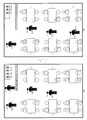
- FIG. 9 is a conceptual diagram showing an example of the inside of a store.
- a pair of one payment processing terminal Tn and one card information processing terminal Rm is used.
- the payment processing terminals T1 to T4 are carried by the clerks P1 to P4, and the card information processing terminals R1 to R4 are collected on a table, for example, at a predetermined place in the store. Is placed.
- the clerk P1 selects, for example, the card information processing terminal R1 among the card information processing terminals R1 to R4.
- the store clerk P1 arrives at the table a used by the customer as shown in FIG. 9B, the clerk P1 operates the operation / display unit 4 of the payment processing terminal T1 to present the payment amount displayed on the screen to the customer. Do. Then, the store clerk P1 confirms the settlement method to the customer, and receives the customer's settlement card CA.
- the settlement processing terminal T1 establishes a link by pairing with each of the card information processing terminals R1 to R4, and the card information processing terminal R1 communicates with each of the settlement processing terminals T1 to T4. It is assumed that the link is established by pairing.
- FIG. 10 is a sequence diagram showing an example of the operation of the settlement system SS when the settlement method is credit settlement.
- the second near-field wireless communication unit 2 of the processing terminal T1 and the second near-field wireless communication unit 2 of the card information processing terminal R1 mutually detect each other, establish non-contact proximity communication, and exchange mutual identification information.
- the near-field communication detection unit 72 of the payment processing terminal T1 acquires the identification information of the card information processing terminal R1, and detects that the card information processing terminal R1 is in the second communicable range (step S101). .
- the communication control unit 73 of the payment processing terminal T1 maintains identification of the link with each of the card information processing terminals R1 to R4, and identifies the identification information of the card information processing terminal R1 detected in step S101,
- the card information processing terminals R2 to R4 are set as communication restriction parties using the communication party list (step S102). Such communication restriction setting is maintained even when the payment processing terminal T1 and the card information processing terminal R1 are out of the second communicable range of each other.
- the close-proximity communication detection unit 72 of the card information processing terminal R1 acquires the identification information of the payment processing terminal T1, and detects that the payment processing terminal T1 is in the second communicable range (step S111).
- the communication control unit 73 of the card information processing terminal R1 maintains the establishment of the link with each of the payment processing terminals T1 to T4, while identifying information of the payment processing terminal T1 detected in step S111, and The payment processing terminals T2 to T4 are set as communication restriction parties using the communication party list (step S112).
- the store clerk P1 can also bring the payment processing terminal T1 close to the card information processing terminal R1 placed on the table, for example, before bringing out the card information processing terminal R1.
- the payment processing terminal T1 detects that the card information processing terminal R1 has entered the second communicable range
- the amount of remaining power of the battery 6 of the card information processing terminal R1 is, for example, the second If the acquired remaining power amount obtained by the short distance wireless communication is less than the threshold value, it may be informed that the remaining power amount of the battery 6 of the card information processing terminal R1 is small.
- the clerk P1 can use the card information processing terminal Rm whose remaining power amount other than the card information processing terminal R1 is equal to or more than the threshold value for settlement.
- the clerk P1 inserts the payment card CA (a credit card in the example of FIG. 10) received from the customer into the card insertion portion of the card information processing terminal R1, and the personal identification number from the operation / display unit 4 of the card information processing terminal R1.
- the card information processing terminal R1 authenticates the settlement card CA in accordance with the input password, and when the authentication is successful, contact communication is established between the card information processing terminal R1 and the IC chip of the settlement card CA. .
- the processing unit 71 of the settlement processing terminal T1 receives the operation instruction signal. In response, the settlement process is started.
- the processing unit 71 of the settlement processing terminal T1 When the settlement process is started, the processing unit 71 of the settlement processing terminal T1 generates command data indicating a read command according to the operation instruction signal, and passes the generated command data to the communication control unit 73. Then, the communication control unit 73 of the payment processing terminal T1 identifies the card information processing terminal R1 as the communication partner whose communication restriction is not set from the communication partner list (step S103). The identification information of the card information processing terminal R1 thus identified and the command data indicating the read command are output to the first short distance wireless communication unit 1. Then, the first short distance wireless communication unit 1 of the payment processing terminal T1 transmits command data indicating the read command output from the communication control unit 73 to the card information processing terminal R1 by the first short distance wireless communication.
- the command data transmitted from the payment processing terminal T1 by the first short distance wireless communication is received by the first short distance wireless communication unit 1 of the card information processing terminal R1, and sent to the communication control unit 73 of the card information processing terminal R1. It is output.
- the communication control unit 73 of the card information processing terminal R1 determines whether the transmission source of the received command data is the communication restricted party based on the communication party list (step S113). In the example of FIG. 10, since the transmission source of the received command data is the payment processing terminal T1, it is determined that the transmission source of the received command data is not the communication restriction party (step S113: NO).
- the command data is passed to the processing unit 71 of the card information processing terminal R1.
- step S114 the processing unit 71 of the card information processing terminal R1 executes the card information processing in response to the read command indicated by the received command data, whereby the settlement card CA is processed via the contact communication interface unit.
- Command data indicating a read command.
- the IC chip of the payment card CA reads the card information from the non-volatile memory according to the read command indicated by the received command data, and transmits response data including the read card information to the card information processing terminal R1.
- the card information includes the credit card number, the name of the person to be issued the credit card, the expiration date of the credit card, and the like.
- the processing unit 71 of the card information processing terminal R1 passes the response data received from the payment card CA via the contact communication interface unit to the communication control unit 73 of the card information processing terminal R1.
- the communication control unit 73 of the card information processing terminal R1 outputs, to the first short-distance wireless communication unit 1, the response data and the identification information of the payment processing terminal T1 determined not to be the communication restricted party.
- the first short distance wireless communication unit 1 of the card information processing terminal R1 transmits the response data output from the communication control unit 73 to the payment processing terminal T1 by the first short distance wireless communication.
- the response data transmitted from the card information processing terminal R1 by the first short distance wireless communication is received by the first short distance wireless communication unit 1 of the payment processing terminal T1, and the processing unit 71 receives the response data via the communication control unit 73. It is output.
- the processing unit 71 of the payment processing terminal T1 generates data indicating a credit inquiry (also referred to as authorization) request, and passes the data indicating the generated credit inquiry request to the communication control unit 73.
- the data indicating the credit inquiry request includes card information included in response data received from the card information processing terminal R1, payment amount information indicating the payment amount, and the like.
- the communication control unit 73 of the payment processing terminal T1 accesses the payment management server SE via the mobile wireless communication unit 3 and manages the data indicating the credit inquiry request via the mobile wireless communication unit 3 for payment management.
- Send to server SE credit payment management server).
- the settlement management server SE makes a credit inquiry as to whether or not credit settlement is possible, in accordance with data indicating a credit inquiry request from the settlement processing terminal T1. Then, for example, when the expiration date of the credit card has not passed and the payment amount indicated by the payment amount information does not exceed the usable amount, the payment management server SE makes data indicating credit approval success the payment processing terminal T1. Send to Thus, when the data indicating the credit approval success is received from the settlement management server SE by the settlement processing terminal T1, the settlement processing ends normally. On the other hand, for example, if the expiration date of the credit card has passed, or if the payment amount indicated by the payment amount information exceeds the available amount, data indicating credit approval failure is transmitted to the payment processing terminal T1. Thereby, the settlement process abnormally ends, and an error message is notified from the settlement processing terminal T1.
- the clerk P1 When the settlement process is completed, the clerk P1 returns the card information processing terminal R1 to the original predetermined place. Thereafter, for example, when the store clerk P2 brings out the card information processing terminal R1, the card information processing terminal R1 maintains the establishment of the link by bringing its own payment processing terminal T2 and the card information processing terminal R1 close to each other. Cancel the communication restriction setting for the payment processing terminal T2 that has been detected to be within the second communicable range, and update the communication restriction setting to set the settlement processing terminals T1, T3 and T4 as the communication restriction party (The subsequent processing is the same as in the case of the store clerk P1).
- the settlement processing terminal T1 may reset all the communication restriction settings (that is, cancel the restriction on the transmission and reception of data with all the communication restriction parties) at the timing when the settlement process ends. Furthermore, at this time, the payment processing terminal T1 may transmit command data indicating a reset instruction of communication restriction setting to the card information processing terminal R1 by the first short distance wireless communication. In this case, the card information processing terminal R1 resets all the communication restriction settings in response to the reset command indicated by the received command data, and the response processing terminal indicating the reset completion is processed by the first short-distance wireless communication processing terminal Send to T1.
- FIG. 11 is a sequence diagram showing an example of the operation of the settlement system SS in the case where the settlement method is electronic money settlement by server type prepaid type electronic money.
- steps S121 to S122 shown in FIG. 11 are the same as the processes of steps S101 to S102 shown in FIG.
- steps S131 to S132 shown in FIG. 11 is the same as the processing of steps S111 to S112 shown in FIG.
- the clerk P1 inserts the payment card CA (in the example of FIG. 11, the electronic money card) received from the customer into the card insertion portion of the card information processing terminal R1, and identifies the password from the operation / display unit 4 of the card information processing terminal R1. Have the customer enter the number.
- the card information processing terminal R1 authenticates the settlement card CA in accordance with the input password, and when the authentication is successful, contact communication is established between the card information processing terminal R1 and the IC chip of the settlement card CA. .
- the processing unit 71 of the settlement processing terminal T1 receives the operation instruction signal. In response, the settlement process is started.
- the processing unit 71 of the settlement processing terminal T1 When the settlement process is started, the processing unit 71 of the settlement processing terminal T1 generates data indicating the start of electronic money settlement, and passes the generated data indicating the start of electronic money settlement to the communication control unit 73. Then, the communication control unit 73 of the payment processing terminal T1 accesses the payment management server SE via the mobile wireless communication unit 3, and pays the data indicating the start of the electronic money payment via the mobile wireless communication unit 3. It transmits to the management server SE (electronic money payment management server).
- the management server SE electronic money payment management server
- the settlement management server SE transmits data indicating a settlement information request to the settlement processing terminal T1 according to the data indicating the start of electronic money settlement from the settlement processing terminal T1.
- the data indicating the settlement information request transmitted from the settlement management server SE is received by the mobile wireless communication unit 3 of the settlement processing terminal T1, and is output to the processing unit 71 via the communication control unit 73.
- the processing unit 71 of the payment processing terminal T1 generates command data indicating a read command according to the data indicating the payment information request, and passes the generated command data to the communication control unit 73.
- the communication control unit 73 of the payment processing terminal T1 identifies the card information processing terminal R1 as the communication partner whose communication restriction is not set from the communication partner list (step S123).
- the identification information of the card information processing terminal R1 thus identified and the command data indicating the read command are output to the first short distance wireless communication unit 1. Then, the first short distance wireless communication unit 1 of the payment processing terminal T1 transmits command data indicating the read command output from the communication control unit 73 to the card information processing terminal R1 by the first short distance wireless communication.
- the command data transmitted from the payment processing terminal T1 by the first short distance wireless communication is received by the first short distance wireless communication unit 1 of the card information processing terminal R1, and sent to the communication control unit 73 of the card information processing terminal R1. It is output.
- the communication control unit 73 of the card information processing terminal R1 determines whether the transmission source of the received command data is the communication restricted party based on the communication party list (step S133). In the example of FIG. 11, since the transmission source of the received data is the payment processing terminal T1, it is determined that the transmission source of the received command data is not the communication restriction party (step S133: NO), the received Command data is passed to the processing unit 71 of the card information processing terminal R1.
- step S134 the processing unit 71 of the card information processing terminal R1 executes the card information processing in response to the read command indicated by the received command data, whereby the settlement card CA is processed via the contact communication interface unit.
- Command data indicating a read command.
- the IC chip of the payment card CA reads the card information from the non-volatile memory according to the read command indicated by the received command data, and transmits response data including the read card information to the card information processing terminal R1.
- the card information includes an electronic money card number and the like.
- the processing unit 71 of the card information processing terminal R1 passes the response data received from the payment card CA via the contact communication interface unit to the communication control unit 73 of the card information processing terminal R1.
- the communication control unit 73 of the card information processing terminal R1 outputs, to the first short-distance wireless communication unit 1, the response data and the identification information of the payment processing terminal T1 determined not to be the communication restricted party.
- the first short distance wireless communication unit 1 of the card information processing terminal R1 transmits the response data output from the communication control unit 73 to the payment processing terminal T1 by the first short distance wireless communication.
- the response data transmitted from the card information processing terminal R1 by the first short distance wireless communication is received by the first short distance wireless communication unit 1 of the payment processing terminal T1, and the processing unit 71 receives the response data via the communication control unit 73. It is output. Then, the processing unit 71 of the payment processing terminal T1 generates data indicating a payment information response, and passes the generated data indicating the payment information response to the communication control unit 73.
- the data indicating the payment information response includes the card information included in the response data received from the card information processing terminal R1, the payment amount information indicating the payment amount, and the like. Then, the communication control unit 73 of the payment processing terminal T1 transmits data indicating the payment information response via the mobile wireless communication unit 3 to the payment management server SE via the mobile wireless communication unit 3.
- the settlement management server SE balances the electronic value of the person (owner) of the electronic money issue target (the owner) from the electronic money card number indicated by the card information included therein. To make a balance inquiry as to whether electronic money settlement is possible. Then, if the balance of the electronic value is equal to or more than the payment amount indicated by the payment amount information, the settlement management server SE reduces the balance of the electronic value by the payment amount, and data indicating a successful reduction of the electronic value It transmits to the payment processing terminal T1. Thus, when data indicating the successful reduction of the electronic value is received by the settlement processing terminal T1 from the settlement management server SE, the settlement processing ends normally.
- FIG. 11 describes the operation of the settlement system SS when the settlement method is electronic money settlement by server type prepaid type electronic money, electronic money by prepaid type electronic money of settlement value stored type
- the process is basically the same as the process of steps S121 to S123 and S131 to S134 shown in FIG.
- the payment management server SE is not used, and the payment card CA receives the balance of the electronic value according to an instruction from the card information processing terminal R1. Will be reduced by the payment amount.
- the transmission and reception of data between the payment card CA and the card information processing terminal R1 may be performed by non-contact proximity communication.
- the settlement processing terminal T1 and the card information processing terminal R1 execute an arbitrary time zone when the settlement processing terminal T1 and the card information processing terminal R1 are used for settlement.
- the first near-field wireless communication with another communication partner who does not perform the first near-field wireless communication in the given time zone while maintaining establishment of a link between each of the plurality of communication partners, respectively Transmission and reception of data by communication can be efficiently limited.
- the payment processing terminal T1 and the card information processing terminal R1 can execute quick processing, and in particular, it is possible to prevent the false recognition or confusion of the user who uses the payment processing terminal T1 and the card information processing terminal R1.
- the settlement system SS while the card information processing terminal R1 maintaining the establishment of the link with the settlement processing terminals T1 to T4 is used by the store clerk, the information processing terminal R1 to the card information processing terminals R1 to R4 is used. Under the situation where the payment processing terminal T1 maintaining the establishment of the link is carried by the store clerk P1, the card information processing terminal R1 and the payment processing terminal T1 can be obtained simply by bringing the payment processing terminal T1 and the card information processing terminal R1 close to each other. The transmission and reception of data by the first short distance wireless communication can be secured only between the
- the communication system S is applicable not only to the payment system SS but also to, for example, a security system in which a guard needs to use a pair of two communication devices C in a facility or a building.
- the short distance wireless communication method based on BT is adopted as the first short distance wireless communication method
- a wireless LAN standard such as Wi-Fi (registered trademark)
- a near field communication scheme based on ZIGBEE may be adopted.
- the near field communication system based on NFC is adopted as the second near field communication system has been described, but it is based on IrDA (Infrared Data Association) technology or TransferJet (registered trademark)
- IrDA Infrared Data Association
- TransferJet registered trademark
- the present invention is a communication system in which there is no distinction between a master device and a slave device, that is, two communication devices
- the present invention is also applicable to a communication system in which both can take the initiative in the first short distance wireless communication.
- the communication system S includes the plurality of communication devices CMm and the plurality of communication devices CSm as an example. However, one communication device CMn and the plurality of communication devices CSm are provided. Also for the communication system in which the communication device CMn establishes a link with each of the plurality of communication devices CSm and performs the first short distance wireless communication with the communication device CSm existing in the first communicable range. The invention is applicable. In this case, since each communication device CSm originally performs the first short distance wireless communication with only one communication device CMn, there is no need to perform the above-described communication restriction setting (that is, in this case, the communication device CMn Only do the above mentioned communication restriction settings).
- a plurality of communication devices CMn and one communication device CSm are provided, the plurality of communication devices CMn establish a link with one communication device CSm, and the communication devices CSm exist within the first communicable range.
- the present invention is also applicable to a communication system that performs the first short distance wireless communication among the above. In this case, since each communication device CMn originally performs the first short distance wireless communication with only one communication device CSm, there is no need to perform the above-described communication restriction setting (that is, in this case, the communication device CSm Only do the above mentioned communication restriction settings).
Landscapes
- Engineering & Computer Science (AREA)
- Computer Networks & Wireless Communication (AREA)
- Signal Processing (AREA)
- Databases & Information Systems (AREA)
- Mobile Radio Communication Systems (AREA)
- Communication Control (AREA)
Abstract
L'invention concerne un dispositif de communication C qui comprend : une première unité de communication qui, après l'établissement d'une liaison nécessaire pour une communication en champ proche avec une contrepartie de communication existant dans une première plage disponible de communication, réalise la première communication en champ proche avec la contrepartie de communication avec laquelle une liaison a été établie ; et une seconde unité de communication qui réalise une seconde communication en champ proche avec une contrepartie de communication existant dans une seconde plage disponible de communication qui est plus étroite que la première plage disponible de communication. Et lorsqu'il est détecté que l'une quelconque parmi une pluralité de contreparties de communication avec lesquelles des liaisons sont établies a pénétré dans la seconde plage disponible de communication, le dispositif de communication C limite la transmission et la réception de données par l'intermédiaire de la première communication en champ proche avec des contreparties de communication autres que la contrepartie de communication détectée pour avoir pénétré dans la seconde plage disponible de communication, tout en maintenant l'établissement de chaque liaison avec chacune de la pluralité de contreparties de communication établies par liaison.
Priority Applications (6)
| Application Number | Priority Date | Filing Date | Title |
|---|---|---|---|
| JP2019538824A JP6721796B2 (ja) | 2017-08-30 | 2017-08-30 | 通信装置、通信方法、及び通信処理プログラム |
| US16/643,340 US10986483B2 (en) | 2017-08-30 | 2017-08-30 | Communication apparatus, communication method, and communication processing program |
| CN201780094394.3A CN111066345B (zh) | 2017-08-30 | 2017-08-30 | 通信装置、通信方法、及计算机可读取的记录介质 |
| ES17923490T ES2959281T3 (es) | 2017-08-30 | 2017-08-30 | Limitación de comunicación de campo cercano a un rango predeterminado |
| EP17923490.1A EP3678415B1 (fr) | 2017-08-30 | 2017-08-30 | Limitation d'une communication courte distance à une distance prédéterminée |
| PCT/JP2017/031197 WO2019043838A1 (fr) | 2017-08-30 | 2017-08-30 | Dispositif de communication, procédé de communication et programme de traitement de communication |
Applications Claiming Priority (1)
| Application Number | Priority Date | Filing Date | Title |
|---|---|---|---|
| PCT/JP2017/031197 WO2019043838A1 (fr) | 2017-08-30 | 2017-08-30 | Dispositif de communication, procédé de communication et programme de traitement de communication |
Publications (1)
| Publication Number | Publication Date |
|---|---|
| WO2019043838A1 true WO2019043838A1 (fr) | 2019-03-07 |
Family
ID=65525315
Family Applications (1)
| Application Number | Title | Priority Date | Filing Date |
|---|---|---|---|
| PCT/JP2017/031197 Ceased WO2019043838A1 (fr) | 2017-08-30 | 2017-08-30 | Dispositif de communication, procédé de communication et programme de traitement de communication |
Country Status (6)
| Country | Link |
|---|---|
| US (1) | US10986483B2 (fr) |
| EP (1) | EP3678415B1 (fr) |
| JP (1) | JP6721796B2 (fr) |
| CN (1) | CN111066345B (fr) |
| ES (1) | ES2959281T3 (fr) |
| WO (1) | WO2019043838A1 (fr) |
Families Citing this family (1)
| Publication number | Priority date | Publication date | Assignee | Title |
|---|---|---|---|---|
| US10834692B2 (en) * | 2018-10-04 | 2020-11-10 | Cypress Semiconductor Corporation | Devices, systems and methods for synchronizing event windows in wireless network |
Citations (4)
| Publication number | Priority date | Publication date | Assignee | Title |
|---|---|---|---|---|
| WO2010041366A1 (fr) * | 2008-10-06 | 2010-04-15 | 日本電気株式会社 | Dispositif de radiocommunication, système de radiocommunication, procédé de commande de dispositif de radiocommunication et support d’enregistrement |
| JP2010213334A (ja) | 2010-05-06 | 2010-09-24 | Sony Corp | 通信装置、通信方法、及び通信システム |
| WO2016009738A1 (fr) * | 2014-07-15 | 2016-01-21 | ソニー株式会社 | Dispositif de traitement, dispositif et système de traitement d'informations, procédé de traitement et procédé de traitement d'informations |
| JP2016019181A (ja) * | 2014-07-09 | 2016-02-01 | 日本電信電話株式会社 | 無線通信システム、無線基地局装置、無線端末装置及びデータ配信装置 |
Family Cites Families (15)
| Publication number | Priority date | Publication date | Assignee | Title |
|---|---|---|---|---|
| JP3932281B2 (ja) * | 2001-04-19 | 2007-06-20 | 秀樹 室屋 | 無線リンクを用いた機器相互接続装置及び方法、機器相互接続用利用シーンテーブル作成方法並びに記録媒体 |
| JP2006246379A (ja) * | 2005-03-07 | 2006-09-14 | Sharp Corp | 無線通信システム |
| US7653463B2 (en) * | 2007-02-27 | 2010-01-26 | Audiovox Corporation | Multi-range remote transmitter for a vehicle |
| US7660657B2 (en) * | 2007-06-29 | 2010-02-09 | Caterpillar Inc. | Anti-hunt system and method for parallel path variable transmission |
| JP4613969B2 (ja) * | 2008-03-03 | 2011-01-19 | ソニー株式会社 | 通信装置、及び通信方法 |
| CA2818908C (fr) * | 2010-11-24 | 2017-06-20 | Research In Motion Limited | Gestion de transmissions de donnees sans fil a courte portee |
| JP5727812B2 (ja) * | 2011-02-10 | 2015-06-03 | パナソニック株式会社 | 無線通信端末、無線通信装置及び無線通信方法 |
| US9349234B2 (en) * | 2012-03-14 | 2016-05-24 | Autoconnect Holdings Llc | Vehicle to vehicle social and business communications |
| JP5885715B2 (ja) * | 2013-08-30 | 2016-03-15 | 京セラドキュメントソリューションズ株式会社 | 印刷システム、情報処理装置 |
| US10083319B2 (en) * | 2014-02-24 | 2018-09-25 | Hewlett-Packard Development Company, L.P. | Privacy zone |
| JP6415175B2 (ja) * | 2014-08-18 | 2018-10-31 | キヤノン株式会社 | 通信装置、通信装置の制御方法、プログラム |
| JP2016167793A (ja) * | 2015-03-03 | 2016-09-15 | 株式会社リコー | 通信装置、システム、およびプログラム |
| CN111034269B (zh) * | 2017-08-30 | 2022-03-15 | 乐天集团股份有限公司 | 通信装置、通信系统、通信方法、计算机可读取记录介质 |
| US10305611B1 (en) * | 2018-03-28 | 2019-05-28 | Qualcomm Incorporated | Proximity detection using a hybrid transceiver |
| US10677350B2 (en) * | 2018-10-23 | 2020-06-09 | Allison Transmission, Inc. | Method of controlling transmission range in response to a loss of communication with an engine and system thereof |
-
2017
- 2017-08-30 JP JP2019538824A patent/JP6721796B2/ja active Active
- 2017-08-30 US US16/643,340 patent/US10986483B2/en active Active
- 2017-08-30 EP EP17923490.1A patent/EP3678415B1/fr active Active
- 2017-08-30 ES ES17923490T patent/ES2959281T3/es active Active
- 2017-08-30 WO PCT/JP2017/031197 patent/WO2019043838A1/fr not_active Ceased
- 2017-08-30 CN CN201780094394.3A patent/CN111066345B/zh active Active
Patent Citations (4)
| Publication number | Priority date | Publication date | Assignee | Title |
|---|---|---|---|---|
| WO2010041366A1 (fr) * | 2008-10-06 | 2010-04-15 | 日本電気株式会社 | Dispositif de radiocommunication, système de radiocommunication, procédé de commande de dispositif de radiocommunication et support d’enregistrement |
| JP2010213334A (ja) | 2010-05-06 | 2010-09-24 | Sony Corp | 通信装置、通信方法、及び通信システム |
| JP2016019181A (ja) * | 2014-07-09 | 2016-02-01 | 日本電信電話株式会社 | 無線通信システム、無線基地局装置、無線端末装置及びデータ配信装置 |
| WO2016009738A1 (fr) * | 2014-07-15 | 2016-01-21 | ソニー株式会社 | Dispositif de traitement, dispositif et système de traitement d'informations, procédé de traitement et procédé de traitement d'informations |
Also Published As
| Publication number | Publication date |
|---|---|
| US20210067934A1 (en) | 2021-03-04 |
| EP3678415A4 (fr) | 2021-04-07 |
| EP3678415B1 (fr) | 2023-08-16 |
| JP6721796B2 (ja) | 2020-07-15 |
| EP3678415A1 (fr) | 2020-07-08 |
| CN111066345B (zh) | 2022-03-15 |
| CN111066345A (zh) | 2020-04-24 |
| JPWO2019043838A1 (ja) | 2019-11-21 |
| ES2959281T3 (es) | 2024-02-22 |
| US10986483B2 (en) | 2021-04-20 |
Similar Documents
| Publication | Publication Date | Title |
|---|---|---|
| US12299669B2 (en) | Batteryless device with wirelessly powered token provisioning | |
| JP3871113B2 (ja) | 通信端末装置、通信確立方法、および該方法に係るプログラム | |
| US20140304094A1 (en) | Methods for Adjusting Near Field Communications Circuitry during Mobile Payment Transactions | |
| CN108702609B (zh) | 中程读取器交互 | |
| EP3058792B1 (fr) | Procédé de conversion de message de protocole sans fil dispositif correspondant | |
| US12120594B2 (en) | Proximity device network | |
| KR20170130490A (ko) | 장치 컨텐츠 공급 시스템 | |
| JP6721796B2 (ja) | 通信装置、通信方法、及び通信処理プログラム | |
| JP6667056B2 (ja) | 通信装置、通信システム、通信方法、及び通信処理プログラム | |
| JP2020529089A (ja) | 支払処理 | |
| JP6166748B2 (ja) | 取引決済システム、取引決済方法、および取引決済プログラム | |
| JP2016096452A (ja) | 移動端末及び無線通信システム | |
| KR101844212B1 (ko) | 직렬통신과 투웨이 무선 접속 기능을 구비한 중계장치를 이용한 로열티 서비스 시스템 | |
| KR20150055220A (ko) | 안심 인증번호 서비스 제공 방법 |
Legal Events
| Date | Code | Title | Description |
|---|---|---|---|
| ENP | Entry into the national phase |
Ref document number: 2019538824 Country of ref document: JP Kind code of ref document: A |
|
| 121 | Ep: the epo has been informed by wipo that ep was designated in this application |
Ref document number: 17923490 Country of ref document: EP Kind code of ref document: A1 |
|
| NENP | Non-entry into the national phase |
Ref country code: DE |
|
| ENP | Entry into the national phase |
Ref document number: 2017923490 Country of ref document: EP Effective date: 20200330 |