WO2019045052A1 - 糖化ヘモグロビンオキシダーゼ改変体及び測定方法 - Google Patents
糖化ヘモグロビンオキシダーゼ改変体及び測定方法 Download PDFInfo
- Publication number
- WO2019045052A1 WO2019045052A1 PCT/JP2018/032389 JP2018032389W WO2019045052A1 WO 2019045052 A1 WO2019045052 A1 WO 2019045052A1 JP 2018032389 W JP2018032389 W JP 2018032389W WO 2019045052 A1 WO2019045052 A1 WO 2019045052A1
- Authority
- WO
- WIPO (PCT)
- Prior art keywords
- amino acid
- seq
- glycated hemoglobin
- acid sequence
- oxidase
- Prior art date
- Legal status (The legal status is an assumption and is not a legal conclusion. Google has not performed a legal analysis and makes no representation as to the accuracy of the status listed.)
- Ceased
Links
Images





Classifications
-
- C—CHEMISTRY; METALLURGY
- C12—BIOCHEMISTRY; BEER; SPIRITS; WINE; VINEGAR; MICROBIOLOGY; ENZYMOLOGY; MUTATION OR GENETIC ENGINEERING
- C12N—MICROORGANISMS OR ENZYMES; COMPOSITIONS THEREOF; PROPAGATING, PRESERVING, OR MAINTAINING MICROORGANISMS; MUTATION OR GENETIC ENGINEERING; CULTURE MEDIA
- C12N9/00—Enzymes; Proenzymes; Compositions thereof; Processes for preparing, activating, inhibiting, separating or purifying enzymes
- C12N9/0004—Oxidoreductases (1.)
- C12N9/0071—Oxidoreductases (1.) acting on paired donors with incorporation of molecular oxygen (1.14)
- C12N9/0083—Miscellaneous (1.14.99)
-
- G—PHYSICS
- G01—MEASURING; TESTING
- G01N—INVESTIGATING OR ANALYSING MATERIALS BY DETERMINING THEIR CHEMICAL OR PHYSICAL PROPERTIES
- G01N33/00—Investigating or analysing materials by specific methods not covered by groups G01N1/00 - G01N31/00
- G01N33/48—Biological material, e.g. blood, urine; Haemocytometers
- G01N33/50—Chemical analysis of biological material, e.g. blood, urine; Testing involving biospecific ligand binding methods; Immunological testing
- G01N33/72—Chemical analysis of biological material, e.g. blood, urine; Testing involving biospecific ligand binding methods; Immunological testing involving blood pigments, e.g. haemoglobin, bilirubin or other porphyrins; involving occult blood
- G01N33/721—Haemoglobin
- G01N33/723—Glycosylated haemoglobin
-
- C—CHEMISTRY; METALLURGY
- C12—BIOCHEMISTRY; BEER; SPIRITS; WINE; VINEGAR; MICROBIOLOGY; ENZYMOLOGY; MUTATION OR GENETIC ENGINEERING
- C12N—MICROORGANISMS OR ENZYMES; COMPOSITIONS THEREOF; PROPAGATING, PRESERVING, OR MAINTAINING MICROORGANISMS; MUTATION OR GENETIC ENGINEERING; CULTURE MEDIA
- C12N9/00—Enzymes; Proenzymes; Compositions thereof; Processes for preparing, activating, inhibiting, separating or purifying enzymes
- C12N9/0004—Oxidoreductases (1.)
- C12N9/0012—Oxidoreductases (1.) acting on nitrogen containing compounds as donors (1.4, 1.5, 1.6, 1.7)
- C12N9/0026—Oxidoreductases (1.) acting on nitrogen containing compounds as donors (1.4, 1.5, 1.6, 1.7) acting on CH-NH groups of donors (1.5)
- C12N9/0032—Oxidoreductases (1.) acting on nitrogen containing compounds as donors (1.4, 1.5, 1.6, 1.7) acting on CH-NH groups of donors (1.5) with oxygen as acceptor (1.5.3)
-
- C—CHEMISTRY; METALLURGY
- C12—BIOCHEMISTRY; BEER; SPIRITS; WINE; VINEGAR; MICROBIOLOGY; ENZYMOLOGY; MUTATION OR GENETIC ENGINEERING
- C12P—FERMENTATION OR ENZYME-USING PROCESSES TO SYNTHESISE A DESIRED CHEMICAL COMPOUND OR COMPOSITION OR TO SEPARATE OPTICAL ISOMERS FROM A RACEMIC MIXTURE
- C12P3/00—Preparation of elements or inorganic compounds except carbon dioxide
-
- C—CHEMISTRY; METALLURGY
- C12—BIOCHEMISTRY; BEER; SPIRITS; WINE; VINEGAR; MICROBIOLOGY; ENZYMOLOGY; MUTATION OR GENETIC ENGINEERING
- C12Q—MEASURING OR TESTING PROCESSES INVOLVING ENZYMES, NUCLEIC ACIDS OR MICROORGANISMS; COMPOSITIONS OR TEST PAPERS THEREFOR; PROCESSES OF PREPARING SUCH COMPOSITIONS; CONDITION-RESPONSIVE CONTROL IN MICROBIOLOGICAL OR ENZYMOLOGICAL PROCESSES
- C12Q1/00—Measuring or testing processes involving enzymes, nucleic acids or microorganisms; Compositions therefor; Processes of preparing such compositions
- C12Q1/26—Measuring or testing processes involving enzymes, nucleic acids or microorganisms; Compositions therefor; Processes of preparing such compositions involving oxidoreductase
-
- C—CHEMISTRY; METALLURGY
- C12—BIOCHEMISTRY; BEER; SPIRITS; WINE; VINEGAR; MICROBIOLOGY; ENZYMOLOGY; MUTATION OR GENETIC ENGINEERING
- C12Y—ENZYMES
- C12Y114/00—Oxidoreductases acting on paired donors, with incorporation or reduction of molecular oxygen (1.14)
- C12Y114/99—Miscellaneous (1.14.99)
- C12Y114/99003—Heme oxygenase (1.14.99.3)
-
- C—CHEMISTRY; METALLURGY
- C07—ORGANIC CHEMISTRY
- C07K—PEPTIDES
- C07K14/00—Peptides having more than 20 amino acids; Gastrins; Somatostatins; Melanotropins; Derivatives thereof
- C07K14/795—Porphyrin- or corrin-ring-containing peptides
- C07K14/805—Haemoglobins; Myoglobins
-
- C—CHEMISTRY; METALLURGY
- C12—BIOCHEMISTRY; BEER; SPIRITS; WINE; VINEGAR; MICROBIOLOGY; ENZYMOLOGY; MUTATION OR GENETIC ENGINEERING
- C12Y—ENZYMES
- C12Y105/00—Oxidoreductases acting on the CH-NH group of donors (1.5)
- C12Y105/03—Oxidoreductases acting on the CH-NH group of donors (1.5) with oxygen as acceptor (1.5.3)
-
- G—PHYSICS
- G01—MEASURING; TESTING
- G01N—INVESTIGATING OR ANALYSING MATERIALS BY DETERMINING THEIR CHEMICAL OR PHYSICAL PROPERTIES
- G01N2333/00—Assays involving biological materials from specific organisms or of a specific nature
- G01N2333/90—Enzymes; Proenzymes
- G01N2333/902—Oxidoreductases (1.)
- G01N2333/906—Oxidoreductases (1.) acting on nitrogen containing compounds as donors (1.4, 1.5, 1.7)
- G01N2333/9065—Oxidoreductases (1.) acting on nitrogen containing compounds as donors (1.4, 1.5, 1.7) acting on CH-NH groups of donors (1.5)
- G01N2333/90672—Oxidoreductases (1.) acting on nitrogen containing compounds as donors (1.4, 1.5, 1.7) acting on CH-NH groups of donors (1.5) with oxygen as acceptor (1.5.3) in general
Definitions
- the present invention relates to glycated hemoglobin oxidase having activity against a plurality of glycated hemoglobins, and a method of measuring glycated hemoglobin using the same.
- a glycated protein is produced by non-enzymatic covalent bond formation between the aldehyde group of an aldose (monosaccharide and its derivative potentially having an aldehyde group) such as glucose and the amino group of the protein, and Amadori transfer It is.
- HbA1c hemoglobin A1c
- ⁇ -chain a protein in which glucose is bound to the ⁇ -amino group of Val (valine) at the N-terminus (amino terminus) of hemoglobin “ ⁇ -chain”. Since the concentration of HbA1c in the blood reflects the average blood glucose level in the past for a fixed period, the value of HbA1c is an important indicator in the diagnosis and management of diabetes symptoms.
- enzymatic methods using amadoriase are known as methods for measuring HbA1c rapidly and simply.
- Amadoriase catalyzes a reaction that oxidizes iminodiacetic acid or a derivative thereof (also referred to as "Amadori compound”) in the presence of oxygen to form glyoxylic acid or ⁇ -ketoaldehyde, amino acid or peptide, and hydrogen peroxide.
- Amadoriase is known as an enzyme useful for measuring HbA1c by an enzymatic method.
- As a substrate that is oxidized by amadoriase for example, ⁇ -fructosyl valyl histidine (hereinafter referred to as ⁇ FVH) is known.
- Amadoriases have been found so far from bacteria, yeasts and fungi, for example, Coniochaeta, Eupenicillium, Pyrenochaeta, Arthrinium, Curvularia. , Neocosmospora (Neocosmospora), Cryptococcus (Cryptococcus), Phaeosphaeria, Aspergillus (Aspergillus), Emericella, Urocladium, Penicillium, Fusarium ), Achaetomiella (Achaetomiella), Acaetotomium (Achaethomium), Sierrala (Thielavia), Caetomium (Chaetomium), Gerasinospora, Microascus (Microascus), Leptosphaeria (Optobolas) Ophiobolus, Pleospora, Conioketidium (Co Amadoriases from the genus niochhaetidium, Pichia
- HbA1c As a method of measuring HbA1c quickly and simply using various amadoriases as described above, HbA1c is decomposed with a protease for excision of protease or peptidase (hereinafter referred to as protease etc.), and from the ⁇ -chain amino terminal end of HbA1c There is known a method of releasing a specific measuring substance and quantifying the released measuring substance using an amadoriase as described above (see, for example, Patent Documents 1 to 7).
- ⁇ F6P ⁇ -fructosyl hexapeptide
- ⁇ F6P ⁇ -fructosyl valyl histidyl leucyl threonyl prolyl glutamate
- amadoriase that directly oxidizes the ⁇ chain of HbA1c to generate hydrogen peroxide without requiring pretreatment with a protease, and a method for measuring HbA1c using it have been reported (Patent Documents 20, 21, 22) ).
- Such amadoriases can be referred to as A1c oxidases (A1cOX).
- the present inventors have reported a method for measuring HbA1c using an amadoriase that directly oxidizes the ⁇ chain of HbA1c to generate hydrogen peroxide, ie, A1cOX, without requiring pretreatment with a protease (Patent Documents 20 and 21).
- HbC1c hemoglobin C
- HbS1c hemoglobin S
- ⁇ -fructosyl octapeptides (herein referred to as HbA1c type ⁇ F8P)
- HbA1c type ⁇ F8P ⁇ -fru-VHLTPVEK
- HbC1c type ⁇ F8P ⁇ -fru-VHLTPKEK
- HbA1c type ⁇ F8P means ⁇ -fructosylvalylhistylleusylthreonylprolylglutaylglutamyllysine, which is a glycation substrate corresponding to the N-terminal eight amino acids of HbA1c.
- the 6th position is glutamic acid (E6).
- position 6 is valine (E6V mutation).
- HbC1c ⁇ F8P position 6 is a lysine (E6K mutation). That is, HbS1c ⁇ F8P and HbC1c ⁇ F8P are mutated at the sixth position, and the mutations correspond to HbS1c and HbC1c, respectively.
- Hemoglobin S is a heritable variant of hemoglobin A found in part of the population, and is the sixth from the N-terminus of the hemoglobin A beta chain (ie, when the N-terminal valine is at position 1) Glutamic acid is valine (E6V mutation).
- Hemoglobin C is a heritable variant of hemoglobin A found in part of the population, and is the sixth from the N-terminus of the hemoglobin A beta chain (ie, valine at the N-terminus is at position 1) Glutamate at position 6) is a lysine (E6K mutation).
- the measured value is a true value in view of the low relative activity of the ⁇ F8P substrate corresponding to these genotypes of hemoglobin for a subject having a genotype of HbS or HbC. There is a possibility of divergence.
- the present inventor has found a new problem that it is necessary to provide glycated hemoglobin oxidase that can cope with not only HbA1c but also genotypes such as HbS1c and HbC1c. That is, the problem to be solved by the present invention is to provide glycated hemoglobin oxidase which acts not only on HbA1c but also on HbS1c and / or HbC1c, and a measuring method using the same.
- the present invention includes the following.
- a method for measuring HbS1c or HbC1c in a sample comprising the step of causing glycated hemoglobin oxidase to act on a sample that may contain HbS1c or HbC1c.
- the method according to embodiment 2, wherein the reduced compound to be measured is hydrogen peroxide.
- the glycated hemoglobin oxidase has the properties of (a) and / or (b), (a) The ratio of the activity to HbS1c ⁇ F8P to the activity to HbA1c ⁇ F8P, ie the relative activity [HbS1c / HbA1c] is at least 0.45, (b) The ratio of the activity to HbC1c ⁇ F8P to the activity to HbA1c ⁇ F8P, ie, the relative activity [HbC1c / HbA1c] is at least 0.15.
- glycated hemoglobin oxidase is a glycosylated hemoglobin oxidase modified product selected from the group consisting of (i) to (viii) below:
- the amino acid sequence of glycated hemoglobin oxidase is aligned with the amino acid sequence described in SEQ ID NO: 1, the amino acid at the position corresponding to position 113 in the amino acid sequence shown in SEQ ID NO: 1 is glutamic acid, aspartic acid, alanine, serine
- the amino acid sequence of glycated hemoglobin oxidase is aligned with the amino acid sequence described in SEQ ID NO:
- the full-length amino acid sequence of the glycated hemoglobin oxidase is 70% or more identical in sequence identity to the amino acid sequence of SEQ ID NO: 1 or SEQ ID NO: 45
- the amino acid at the position corresponding to position 60 of SEQ ID NO: 1 is glycine
- the amino acid at the position corresponding to position 239 of SEQ ID NO: 1 is tryptophan, phenylalanine or tyrosine
- SEQ ID NO: 1 The amino acid at the position corresponding to position 282 of the amino acid is glutamic acid
- the amino acid at the position corresponding to position 376 of SEQ ID NO: 1 is glycine
- the amino acid at the position corresponding to position 418 of SEQ ID NO: 1 is arginine
- the amino acid sequence of the position corresponding to positions 15 to 20 of 1 is Gly-Xaa-Gly
- glycated hemoglobin oxidase modified product which is an amino acid.
- a glycated hemoglobin oxidase for measuring HbS1c or HbC1c in a sample is arginine, and the amino acid sequence at the position corresponding to positions 15 to 20 of SEQ ID NO. 1 is Gly-Xaa-Gly-Xaa-Xaa-Gly (where Xaa is any one
- Xaa is any one
- the glycated hemoglobin oxidase modified product which is an amino acid.
- the optimum pH range of glycated hemoglobin oxidase is 6-8, the working pH range is 5-9, the optimum temperature range is 25-40 ° C., and the molecular weight on SDS-PAGE is about 45-55 KDa
- the glycated hemoglobin oxidase according to any one of the embodiments 7 to 11, wherein the glycated hemoglobin oxidase is selected from the group consisting of the following (i) to (viii): (i) When the amino acid sequence of glycated hemoglobin oxidase is aligned with the amino acid sequence described in SEQ ID NO: 1, the amino acid at the position corresponding to position 113 in the amino acid sequence shown in SEQ ID NO: 1 is glutamic acid, aspartic acid, alanine, serine A glycated hemoglobin oxidase variant modified to an amino acid selected from the group consisting of threonine, asparagine, glutamine, cysteine, glycine, proline, valine, isoleucine, leucine, methionine, phenylalanine, tyrosine and tryptophan, (ii) When the amino acid sequence of glycated hemoglobin oxida
- the full-length amino acid sequence of the glycated hemoglobin oxidase is 70% or more identical in sequence identity to the amino acid sequence of SEQ ID NO: 1 or SEQ ID NO: 45
- the amino acid at the position corresponding to position 60 of SEQ ID NO: 1 is glycine
- the amino acid at the position corresponding to position 239 of SEQ ID NO: 1 is tryptophan, phenylalanine or tyrosine
- SEQ ID NO: 1 The amino acid at the position corresponding to position 282 of the amino acid is glutamic acid
- the amino acid at the position corresponding to position 376 of SEQ ID NO: 1 is glycine
- the amino acid at the position corresponding to position 418 of SEQ ID NO: 1 is arginine
- the amino acid sequence of the position corresponding to positions 15 to 20 of 1 is Gly-Xaa-Gly
- a glycation according to any of embodiments 7-12 which is based on an amadoriase of the genus Pheaosphaeria, Aspergillus, Emericella, Ulocladium, or Penicillium. Hemoglobin oxidase.
- Amadoriase is Coniochaeta sp. (Coniochaeta sp.), Eupenicillium terrenum (Eupenicillium terrenum), Pyrenocha sp. (Pyrenochaeta sp.), Arsulinium sp.
- a reagent composition for measuring HbS1c or HbC1c which comprises the glycated hemoglobin oxidase according to any one of Embodiments 7 to 14.
- a vector comprising the gene of embodiment 16.
- a host cell comprising the vector of embodiment 17.
- a method for producing glycated hemoglobin oxidase comprising the following steps: (I) culturing the host cell described in Embodiment 18 under conditions that can express glycated hemoglobin oxidase, and (ii) isolating glycated hemoglobin oxidase from the culture or culture solution.
- a method for producing glycated hemoglobin oxidase by modifying amadoriase or A1c oxidase comprising the following steps: (i) obtaining an amadoriase gene or an A1c oxidase gene, (ii) Amadoriase gene or A1c oxidase gene is incorporated into the vector, the host cell is transformed, amadoriase or A1c oxidase is expressed, and the expression product is isolated, (iii) relative activity of the expression product [HbS1c / HbA1c] and And / or the relative activity [HbC1c / HbA1c] is measured, (iv) when the amino acid sequence of amadoriase or A1c oxidase is aligned with the amino acid sequence of SEQ ID NO: 1, position 113 in the amino acid sequence shown in SEQ ID NO: 1 The amino acid corresponding to position 109, position 106 or position 102 is glut
- the present specification includes the disclosure content of Japanese Patent Application No. 2017-167890 based on which the priority of the present application is based.
- a glycated hemoglobin oxidase which recognizes not only HbA1c but also glycated hemoglobin of heritable type such as HbS1c or HbC1c.
- This can be a glycated hemoglobin measurement reagent that can cope with various genotypes.
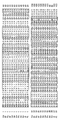
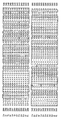
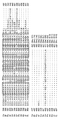
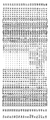
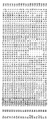
- Figure 1-2 is a continuation of Figure 1-1.
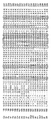
- Figure 1-3 is a continuation of Figure 1-2.
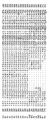
- Figure 1-4 is a continuation of Figure 1-3.
- Fig. 1-5 is a continuation of Fig. 1-4. It is a figure which illustrates the identity and similar amino acids in the amino acid sequences of various known amadoriases. In addition to the amadoriase shown in FIG. 1, Ao2, Af2, At, Fo, Ao1, Af1, Pi, Dh were aligned.
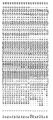
- Figure 2-2 is a continuation of Figure 2-1.
- Figure 2-3 is a continuation of Figure 2-2.
- Figure 2-4 is a continuation of Figure 2-3.
- Figure 2-5 is a continuation of Figure 2-4.
- Figure 2-6 is a continuation of Figure 2-5.
- Figure 2-7 is a continuation of Figure 2-6.
- Figure 2-8 is a continuation of Figure 2-7.
- Figure 2-9 is a continuation of Figure 2-8.
- Figure 2-10 is a continuation of Figure 2-9.
- Hemoglobin includes, in addition to hemoglobin A (HbA) which is normal hemoglobin, abnormal hemoglobin such as hemoglobin S (HbS) and hemoglobin C (HbC).
- HbA hemoglobin A
- HbS hemoglobin S
- HbC hemoglobin C
- glycated hemoglobin refers to nonenzymatically glycated hemoglobin.
- glycated hemoglobin this term is intended to encompass not only glycated HbA, but also glycated abnormal hemoglobin, such as glycated HbS and glycated HbC.
- Glycated hemoglobin is present in blood or the like in the living body.
- glycated hemoglobin in which valine at the amino terminal of the ⁇ chain of HbA is glycated is particularly referred to as hemoglobin A1c (HbA1c).
- HbA1c hemoglobin A1c
- glycated HbS or HbC may have various glycated HbS or glycated HbC depending on the type of sugar linked to the ⁇ chain.
- glycated HbS refers to glycated valine at the amino terminal of the ⁇ chain of HbS (also referred to as HbS1c) unless otherwise specified.
- glycated HbC refers to glycated valine at the amino end of the ⁇ chain of HbC (also referred to as HbC1c) unless otherwise specified.
- the glycated peptide in the present invention refers to a non-enzymatic glycated peptide derived from a glycated protein, which is directly glycated in non-enzymatic form, or the product of degradation of glycated protein by protease etc.
- a glycated form of the (poly) peptide constituting the glycated protein is included.
- the glycated peptide may also be referred to as fructosyl peptide.
- examples of the amino group on the side of the peptide to be glycated include the ⁇ -amino group at the amino terminus, the ⁇ -amino group of the lysine residue side chain inside the peptide, and the like. More specifically, it is ⁇ -glycated peptide ( ⁇ -fructosyl peptide) in which the ⁇ -amino group is glycated.
- the glycated hemoglobin oxidase of the present invention acts directly on HbA1c, more specifically on the ⁇ chain of HbA1c.
- the direct action here means that the amadoriase acts on the fructosyl group at the N-terminus of the ⁇ -chain of glycated hemoglobin in the presence of oxygen to generate 2-keto-D glucose and hydrogen peroxide, and the ⁇ -chain of hemoglobin.
- the glycated hemoglobin oxidase of the present invention acts on HbA1c type ⁇ F8P.
- the glycated hemoglobin oxidase of the present invention acts not only on HbA1c ⁇ F8P but also on HbS1c ⁇ F8P and / or HbC1c ⁇ F8P. Since it is known that the amadoriase acting on HbA1c type ⁇ F8P acts on HbA1c (Patent Document 21), the glycated hemoglobin oxidase of the present invention acts not only on HbA1c but also on glycated HbS and / or glycated HbC It is considered rationally. That is, in one embodiment, the glycated hemoglobin oxidase of the present invention acts not only on HbA1c but also on glycated HbS and / or glycated HbC.
- the glycosylated hemoglobin oxidase variant of the present invention has an improved relative activity to HbS1c ⁇ F8P as compared to the A1c oxidase before modification.
- the relative activity to HbS1c ⁇ F8P is the ratio of the activity to HbS1c ⁇ F8P and the activity to HbA1c ⁇ F8P (normal ⁇ F8P) when the amount of enzyme and reaction conditions are constant, ie, (activity to HbS1c ⁇ F8P / HbA1c activity against ⁇ F8P).
- Activity against HbS1c ⁇ F8P / HbA1c Activity against ⁇ F8P may be referred to as relative activity [HbS1c / HbA1c] in the present specification for convenience.
- the glycosylated hemoglobin oxidase variant of the present invention has an improved relative activity to HbC1c-type ⁇ F8P as compared to the A1c oxidase before modification.
- the relative activity against HbC1c ⁇ F8P is the ratio of the activity against HbC1c ⁇ F8P to the activity against HbA1c ⁇ F8P when the amount of enzyme and reaction conditions are fixed, ie, (activity against HbC1c ⁇ F8P / activity against HbA1c ⁇ F8P) Say.
- Activity against HbC1c ⁇ F8P / HbA1c The activity against HfA1c may be referred to as relative activity [HbC1c / HbA1c] in the present specification for convenience.
- the glycated hemoglobin oxidase variant of the present invention has an increased relative activity [HbS1c / HbA1c] and / or relative activity [HbC1c / HbA1c] as compared to the A1c oxidase before modification.
- the relative activity is defined in relation to the model substrate ⁇ F8P, but this is for convenience only, and it is reasonable if the properties relative to the various activities against glycated hemoglobin are similarly reflected. Be considered.
- the glycated hemoglobin oxidase variant of the present invention has a relative activity after modification [HbS1c / HbA1c] of at least 1.1-fold, at least 1.2-fold, as compared to the relative activity of the amadoriase before modification [HbS1c / HbA1c]. 1.3 times or more, 1.4 times or more, 1.5 times or more, 2.0 times or more, 2.5 times or more, for example, 2.6 times or more.
- the glycated hemoglobin oxidase variant of the present invention has a relative activity after modification [HbC1c / HbA1c] of at least 1.1-fold, at least 1.2-fold as compared to the relative activity of the amadoriase before modification [HbC1c / HbA1c]. , 1.3 times or more, 1.4 times or more, 1.5 times or more, 2.0 times or more, 2.5 times or more, 3.0 times or more, 4.0 times or more, 5.0 times or more, 6.0 times or more, 7.0 times or more, 8.0 times or more, for example, 8.3 times or more It may be done.
- the glycated hemoglobin oxidase of the present invention has a relative activity [HbS1c / HbA1c] of 0.4 or more, 0.41 or more, 0.42 or more, 0.42 or more, 0.43 or more, 0.44 or more, 0.45 or more, 0.5 or more, 0.55 or more, 0.6 or more, 0.65 It may be 0.7 or more, 0.75 or more, 0.8 or more, 0.85 or more, 0.9 or more, for example, 0.95 or more.
- the glycated hemoglobin oxidase of the present invention has a relative activity [HbC1c / HbA1c] of 0.10 or more, 0.11 or more, 0.12 or more, 0.13 or more, 0.14 or more, 0.15 or more, 0.16 or more, 0.16 or more, 0.17 or more, 0.18 or more, 0.19 or more, 0.19. It may be 0.2 or more, 0.25 or more, 0.3 or more, 0.35 or more, 0.4 or more, 0.5 or more, 0.6 or more, 0.7 or more, 0.8 or more, for example, 0.9 or more.
- the glycated hemoglobin oxidase variant of the present invention not only acts on HbA1c, but also has increased relative activity [HbS1c / HbA1c] and / or relative activity [HbC1c / HbA1c], so it is a sample containing glycated HbS or glycated HbC. Can be used to measure the problem of the difference between the measured value and the true value.
- the glycated hemoglobin oxidase of the present invention can accurately measure glycated hemoglobin in a sample, and does not result in the difference between the measured value and the true value.
- not causing a difference between the measured value and the true value means, for example, that the measured value is 90 (arbitrary unit) when glycated hemoglobin actually contained in the sample is 100 (arbitrary unit). To indicate a value less than or greater than 110.
- Amadoriases are also called ketoamine oxidase, fructosyl amino acid oxidase, fructosyl peptide oxidase, and fructosyl amine oxidase.
- Amadoriase is an enzyme that catalyzes a reaction that oxidizes iminodiacetic acid or its derivative (Amadori compound) in the presence of oxygen to produce glyoxylic acid or ⁇ -ketoaldehyde, amino acid or peptide, and hydrogen peroxide.
- Amadoriases are widely distributed in nature and can be obtained by searching for microorganisms or enzymes of animal or plant origin. Microorganisms can be obtained, for example, from filamentous fungi, yeast, or bacteria.
- amadoriases include, but are not limited to, Koniokaeta spp, Eupenicillium spp, Pyrenocata spp., Arsrinium spp., Cabularia spp., Neocosmospora spp., Cryptococcus spp., Phenosphaeria spp., Aspergillus spp. Genus Acheetommium, Sierravia, Caettomium, Geracinospora, Gerasinospora, Microascus, Leptospheria, Ophioboras, Preospora, Conioketidium, Pichia, Corynebacterium, Agrobacterium, or Arthrobacter Can be obtained from
- amadoriase gene In order to obtain a gene encoding amadoriase (hereinafter, also simply referred to as "amadoriase gene"), a commonly used gene cloning method is used. For example, chromosomal DNA or mRNA can be extracted from microbial cells capable of producing amadoriase and various cells according to a conventional method, for example, the method described in Current Protocols in Molecular Biology (WILEY Interscience, 1989). Furthermore, cDNA can be synthesized using mRNA as a template. The chromosomal DNA or cDNA thus obtained can be used to produce a library of chromosomal DNA or cDNA.
- a suitable probe DNA is synthesized based on the amino acid sequence of the above amadoriase and a method of selecting an amadoriase gene from a library of chromosomal DNA or cDNA using this, or an appropriate primer DNA based on the above amino acid sequence.
- the DNA fragment containing the gene fragment of interest encoding amadoriase is amplified by an appropriate polymerase chain reaction (Polymerase Chain Reaction, PCR method) such as 5 'RACE method or 3' RACE method, and these DNA fragments are prepared. Can be ligated to obtain a DNA containing the full length of the desired amadoriase gene.
- amadoriase gene the amadoriase gene derived from the genus Koniokaeta (Japanese Patent Laid-Open No. 2003-235585) can be mentioned.
- an amadoriase gene derived from Phaeosphaeria an amadoriase gene derived from Neocosmospora, an amadoriase gene derived from Aspergillus, an amadoriase gene derived from Cryptococcus, an amadoriase gene derived from Curvularia, and an amadoriase gene derived from Eupenicillium can be mentioned.
- the amadoriase gene may be linked to a vector.
- the vector include any vector such as plasmid, bacteriophage, cosmid and the like, and examples include pBluescript II SK + (manufactured by Stratagene).
- the amadoriase gene from Coniochaeta sp. NISL 9330 and a plasmid containing the same are disclosed in WO 2007/125779.
- the amadoriase gene from Eupenicillium terrenum strain ATCC 18547 and a plasmid containing the same are disclosed in WO 2007/125779.
- the amadoriase gene from Aspergillus nidulans FGSC A26 strain and a plasmid containing the same are disclosed in WO 2012/018094.
- the amadoriase gene from Cryptococcus neoformans and a plasmid containing the same are disclosed in WO 2012/018094.
- the amadoriase gene from Neocosmospora vasinfecta and a plasmid containing the same are disclosed in WO 2012/018094.
- the plasmid can be obtained according to a conventional method.
- GenElute Plasmid Miniprep Kit manufactured by Sigma-Alcrich
- a plasmid containing an amadoriase gene can be extracted and purified.
- the resulting amadoriase gene can be manipulated to produce an A1cOX gene or to obtain a purified enzyme.
- the mutation treatment of the amadoriase gene can be performed by any known method depending on the intended mutation form. That is, a method of contacting / acting an amadoriase gene or a recombinant DNA into which the gene is incorporated with a drug serving as a mutagen; UV irradiation method; genetic engineering method; or a method using protein engineering methods widely It can be used.
- mutagenic agents used for the above-mentioned mutation treatment include hydroxylamine, N-methyl-N'-nitro-N-nitrosoguanidine, nitrous acid, sulfurous acid, hydrazine, formic acid, or 5-bromouracil. be able to.
- the conditions of the contact and action can be set according to the type of drug used and the like, and are not particularly limited as long as the desired mutation can be actually induced in the amadoriase gene.
- the desired mutation can be induced by contact / action at a reaction temperature of 20 to 80 ° C. for 10 minutes or more, preferably 10 to 180 minutes.
- ultraviolet irradiation it can be carried out according to the conventional method as described above (conventional chemistry, 024-30, June 1989).
- a method known as Site-Specific Mutagenesis can be used.
- the Kramer method Nucleic Acids Res., 12, 9441 (1984): Methods Enzymol., 154, 350 (1987): Gene, 37, 73 (1985)
- the Eckstein method Nucleic Acids Res., 13, 8749 ( 1985): Nucleic Acids Res., 13, 8765 (1985): Nucleic Acids Res, 14, 9679 (1986)
- Kunkel method Proc. Natl. Acid. Sci. USA, 82, 488 (1985): Methods Enzymol. , 154, 367 (1987)
- a general PCR method can be used (see Technique, 1, 11 (1989)).
- a desired modified amadoriase gene or glycated hemoglobin oxidase gene can be directly synthesized by an organic synthesis method or an enzyme synthesis method.
- amadoriase gene can be confirmed, for example, by Multicapillary DNA analysis system Applied Biosystems 3130xl Genetic Analyzer (manufactured by Life Technologies).
- the amadoriase gene can be routinely incorporated into vectors such as bacteriophage, cosmid, or plasmids used for transformation of prokaryotic or eukaryotic cells. Using this, a host corresponding to each vector can be transformed or transduced by a conventional method.
- Hosts of E. coli include, but are not limited to, various E. coli strains such as K-12 strain, JM 109 strain (Takara Bio), DH5 ⁇ strain (Takara Bio), and the like.
- A1cOX A1c oxidase
- A1cOX A1c oxidase
- the A1 cOX gene can be generated from the above amadoriase gene based on the teaching of Patent Documents 20-22. These equivalents may also be used in the present invention.
- Patent Documents 20 and 21 disclose A1cOX based on Amadoriase (SEQ ID NO: 1) derived from Coniochaeta sp. NISL 9330.
- Patent Document 21 discloses A1cOX having a high specific activity to ⁇ F8P. The entire contents of which are incorporated herein by reference.
- the following table shows mutations that A1cOX may have and their positions.
- the left amino acid (one letter code) of the position shown is the wild type amino acid and the right is the amino acid after substitution.
- each candidate is shown separated by a punctuation mark.
- Patent Document 22 discloses a variant based on Emericella nidulans derived amadoriase (FPOX). The entire content of which is incorporated herein by reference.
- the following table shows the mutations that FPOX variants can have and their positions.
- the position shown in the left column is the position corresponding to SEQ ID NO: 1 in the present specification
- the position in the right column is the position in the amadoriase.
- the left amino acid at the position shown is the wild type amino acid and the right is the amino acid after substitution.
- each candidate is shown separated by a punctuation mark.
- A1 cOX may have the mutations described above. Those skilled in the art can produce the A1cOX gene with reference to the descriptions in Patent Documents 20 to 22 and the above description.
- A1 cOX is substituted at the position corresponding to position 62 of SEQ ID NO: 1 with an amino acid other than arginine, for example, substitution with the amino acids shown in the above table, and further, lysine, histidine, phenylalanine, tryptophan , Tyrosine and the like.
- A1 cOX is substituted by one or more, for example, two or more, for example, three amino acid substitutions at a position selected from the group consisting of a position corresponding to position 63 of SEQ ID NO: 1, a position corresponding to position 355 and a position corresponding to position 419. It can have.
- the substituted amino acids may be as described in the above table.
- A1 cOX is a position corresponding to position 63 of SEQ ID NO: 1, a position corresponding to position 64, a position corresponding to position 72, a position corresponding to position 109, a position corresponding to position 116, a position corresponding to position 76 , A position corresponding to position 67, a position corresponding to position 96, and a position corresponding to position 355, one or more, for example two or more, for example three or more, for example four or more, for example five or more For example, it may have 6 or more, for example 7 or more, for example 8 or more, for example 9 amino acid substitutions.
- the substituted amino acids may be as described in the above table.
- A1 cOX is further one or more at a position selected from the group consisting of a position corresponding to position 68, a position corresponding to position 356, a position corresponding to position 64, and a position corresponding to position 99 of SEQ ID NO: 1
- it may have 2 or more, for example 3 or more, for example 4 amino acid substitutions.
- the substituted amino acids may be as described in the above table.
- A1cOX variants can be produced to produce glycated hemoglobin oxidase having an increased relative activity to glycated HbS or glycated HbC.
- the glycated hemoglobin oxidase of the present invention may have a mutation at a position corresponding to positions 113, 109, 106 and / or 102 of SEQ ID NO: 1. The corresponding positions are described below.
- A1 cOX based on Coniochaeta sp.
- the amino acid corresponding to the position corresponding to (a) position 113, (a ') position 109, (b) position 106 and / or (c) position 102 of SEQ ID NO: 1 Amino acids other than lysine, histidine, arginine), such as aspartic acid, glutamic acid, serine, threonine, asparagine, glutamine, cysteine, glycine, glycine, proline, alanine, valine, isoleucine, leucine, methionine, phenylalanine, tyrosine, tryptophan, for example glutamic acid, asparagine
- the acid, alanine, leucine, valine, glutamine, asparagine such as glutamic acid, aspartic acid, alanine can be substituted.
- the replacement amino acid is excluded from back mutation to an amino acid (natural amino acid) in the natural amadoriase sequence.
- the substituted amino acid at the position corresponding to position 102, 106, 109 or 113 of SEQ ID NO: 1 may be identical to the amino acid at that position (natural amino acid) in the native amadoriase sequence. This looks like a back mutation. However, when the naturally occurring amino acid is substituted for another amino acid in producing the A1c oxidase from the naturally occurring amadoriase, it is understood that it is a preferable configuration or a required configuration for the A1 c oxidase.
- the present invention encompasses this as an amino acid substitution that can solve the problem of the present invention even if the substitution appears to be a reverse mutation to a naturally occurring amino acid.
- the glycated hemoglobin oxidase of the present invention has a specific activity of 20 mU / mg or more, 30 mU / mg or more, 40 mU / mg or more, 50 mU / mg or more, 60 mU / mg or more, 70 mU / mg or more with respect to 10 ⁇ M HbS1c ⁇ F8P 80 mU / mg or more, 90 mU / mg or more, 100 mU / mg or more, 110 mU / mg or more, 120 mU / mg or more, 130 mU / mg or more, 140 mU / mg or more, 150 mU / mg or more, 160 mU / mg or more, 170 mU / mg or more
- the above may be, for example, 180 mU / mg or more.
- the glycated hemoglobin oxidase of the present invention has a specific activity of 20 mU / mg or more, 30 mU / mg or more, 40 mU / mg or more, 50 mU / mg or more, 60 mU / mg or more, 70 mU / mg or more for 10 ⁇ M HbC1c ⁇ F8P 80 mU / mg or more, 90 mU / mg or more, 100 mU / mg or more, 110 mU / mg or more, 120 mU / mg or more, 130 mU / mg or more, 140 mU / mg or more, 150 mU / mg or more, 160 mU / mg or more, 170 mU / mg or more
- the above may be, for example, 180 mU / mg or more.
- the glycated hemoglobin oxidase of the present invention has a specific activity of 20 mU / mg or more, 30 mU / mg or more, 40 mU / mg or more, 50 mU / mg or more, 60 mU / mg or more, 70 mU / mg or more for 10 ⁇ M HbA1c ⁇ F8P 80 mU / mg or more, 90 mU / mg or more, 100 mU / mg or more, 110 mU / mg or more, 120 mU / mg or more, 130 mU / mg or more, 140 mU / mg or more, 150 mU / mg or more, 160 mU / mg or more, 170 mU / mg or more
- the above may be, for example, 180 mU / mg or more.
- the amino acid sequences are compared using a known algorithm such as Lippmann-Person method, and the largest conserved amino acid residue is present in the amino acid sequence of each amadoriase. It can be done by giving identity.
- a known algorithm such as Lippmann-Person method
- the amino acid sequences of amadoriases are aligned in this manner, it is possible to determine the positions in the respective amadoriase sequences of the homologous amino acid residues regardless of the insertions and deletions present in the amino acid sequences.
- the corresponding positions (homologous positions) are considered to be present at the same position in the three-dimensional structure, and it can be inferred that they have similar effects on the specific function of the amadoriase of interest.
- the “position corresponding to position 113 of the amino acid sequence of SEQ ID NO: 1” refers to the position 113 of SEQ ID NO: 1 when the amino acid sequence of the amadoriase of interest is compared with the amino acid sequence of SEQ ID NO: 1 The corresponding position is said. This can be identified from FIG. 1 or FIG. 2 in which the amino acid sequences are aligned by the method described above. The same applies to the position corresponding to position 109 of SEQ ID NO: 1, the position corresponding to position 106, and the position corresponding to position 102.
- the homology, identity or similarity of amino acid sequences can be determined by programs such as GENENETYX (made by GENETYX) for maximum matching or search homology, or DNASIS Pro (made by Hitachi Solutions) for maximum matching or multiple alignment, or multiples of CLUSTAL W It can be calculated by a program such as alignment.
- GENENETYX made by GENETYX
- DNASIS Pro made by Hitachi Solutions
- amino acid sequence identity when two or more amadoriases are aligned, positions of amino acids which are identical in the two or more amadoriases can be determined. Based on such information, the same region in the amino acid sequence can be determined.
- % identity refers to the total number of amino acids in the alignable region as a denominator when alignment of two or more amino acid sequences is performed using an algorithm such as Blosum 62, It refers to the percentage of the number of positions occupied by the same amino acid as a molecule. Therefore, in general, when there is a region in which two or more amino acid sequences show no identity at all, for example, in the case where an additional sequence with no identity at the C terminus is found in one amino acid sequence, the region without such identity. Is not used to calculate percent identity because it is not possible to align.
- the positions of amino acids that are similar in two or more amadoriases can be determined.
- CLUSTALW can be used to align multiple amino acid sequences, in this case using Blosum 62 as an algorithm and calling amino acids that are judged to be similar when multiple amino acid sequences are aligned as similar amino acids There is.
- the amino acid substitution may be by substitution between such similar amino acids.
- Such an alignment makes it possible to determine, for a plurality of amino acid sequences, regions in which the amino acid sequences are identical and positions occupied by similar amino acids. Based on such information, homologous regions (conserved regions) in the amino acid sequence can be determined.
- homologous region refers to a region in which the amino acids at corresponding positions of a reference amadoriase and the reference amadoriase are identical or consist of similar amino acids when two or more amadoriases are aligned. It refers to a region consisting of 3 or more, 4 or more, 5 or more, 6 or more, 7 or more, 8 or more, 9 or more or 10 or more amino acids. For example, in FIG. 1, an amadoriase was aligned in which the sequence identity of the full-length amino acid sequence is 74% or more based on the amadoriase of SEQ ID NO: 1.
- positions 10 to 32 consist of identical or similar amino acids based on Coniochaeta sp.-derived amadoriase shown in SEQ ID NO: 1, and thus correspond to a homologous region.
- Positions 423 and 431 may correspond to homologous regions.
- the homologous region of amadoriase is a region consisting of these positions.
- positions corresponding to these positions in SEQ ID NO: 1 may also correspond to the homology regions.
- the homology region of amadoriase is 11 to 32, 36 to 41, 50 to 52, 54 to 58, 84 based on Coniochaeta sp. Derived amadoriase represented by SEQ ID NO: 1 -86, 88-90, 145-150, 157-168, 202-205, 207-212, 215-225, 236-248, 258-261, 266-268, 270 It is a region consisting of the amino acid sequences of -273, 275-287, 347-354, 357-363, 370-383, 385-387 and 405-410.
- the homology region of the amadoriase is 10th to 31st, 35th to 40th, 49th to 51st, 53 to 57 of SEQ ID NO: 45 based on Americlyase derived from Emericella nidulans shown in SEQ ID NO: 45 Positions 83-85, 87-89, 144-149, 156-167, 202-205, 207-212, 215-225, 236-248, 258-261, 266-268 The region consists of the amino acid sequences of positions 270-273, 275-287, 347-354, 357-363, 370-383, 385-387 and 405-410. The same applies to SEQ ID NO: 11, which is the source of SEQ ID NO: 45.
- the homology region of the amadoriase is 11-18, 20-32, 50-52, 54-58, 266-268 relative to the amadoriase derived from Coniochaeta sp. It is a region consisting of the amino acid sequences at positions 270-273, 277-286 and 370-383.
- the homology region of the amadoriase is 10th to 17th, 19th to 31st, 49th to 51st, 53 to 57 of SEQ ID NO: 45 based on Americlyase derived from Emericella nidulans shown by SEQ ID NO: 45 It is a region consisting of the amino acid sequences at positions 266-268, 270-273, 277-286, and 370-383. The same applies to SEQ ID NO: 11, which was the source of SEQ ID NO: 45.
- amadoriase Certain amino acid residues of amadoriase are known to interact with the sugar moiety (eg, fructosyl group) of a substrate. And such amino acid residues are highly conserved in various amadoriases.
- the amino acid at the position corresponding to position 239 of SEQ ID NO: 1 is tryptophan, phenylalanine or tyrosine
- the amino acid at the position corresponding to position 282 of SEQ ID NO: 1 is glutamic acid
- the amino acid at the position corresponding to position 376 is glycine
- the amino acid at the position corresponding to position 418 of SEQ ID NO: 1 is arginine.
- These amino acid residues are known to recognize the sugar moiety (fructosyl group) of the substrate (J. Biol. Chem., 283, 27007-27016 (2008); Proteins, 84, 744-758 (2016) )).
- Amadoriases are known to bind to coenzymes through specific amino acid sequence motifs.
- the motif sequence that binds to coenzyme FAD is Gly-Xaa-Gly-Xaa-Xaa-Gly (where Xaa represents any amino acid) (Eur. J. Biochem., 242, 499-505 (1996)), which is highly conserved in various FAD-linked amadoriases.
- the same motif sequence is found in the amino acid sequence at the position corresponding to positions 15 to 20 of SEQ ID NO: 1.
- the amadoriase is such that the amino acid sequence at the position corresponding to positions 15 to 20 of SEQ ID NO: 1 is Gly-Xaa-Gly-Xaa-Xaa-Gly (wherein Xaa represents any amino acid) .
- the amino acid at the position corresponding to position 60 of SEQ ID NO: 1 be glycine in order for the amadoriase to use not only glycated amino acids but also glycated peptides (WO 2012/018094) ).
- the amino acid at the position corresponding to position 60 of SEQ ID NO: 1 in amadoriase is not serine, glutamic acid, histidine or glutamine.
- the glycosylated hemoglobin oxidase variant of the present invention has 50% or more, 55% or more, 60% or more, 61% or more, 62% or more, 62% or more when aligned with the amadoriase having the amino acid sequence shown in SEQ ID NO: 1 , 63% or more, 64% or more, 65% or more, 66% or more, 67% or more, 68% or more, 69% or more, 70% or more, 71% or more, 72% or more, 73% or more, 74% or more, 75 %, 76% or more, 77% or more, 78% or more, 79% or more, 80% or more, 81% or more, 82% or more, 83% or more, 84% or more, 85% or more, 86% or more, 87% or more , 88% or more, 89% or more, 90% or more, 91% or more, 92% or more, 93% or more, 94% or more, 95% or more, 96% or more, 97% or more, 98% or more, 90% or
- amino acid sequence in the homologous region of the glycosylated hemoglobin oxidase variant of the present invention is 65%, 66%, 67%, 68%, 69%, 70%, 71% with the amino acid sequence of the homologous region in SEQ ID NO: 1 , 72%, 73%, 74%, 75%, 76%, 77%, 78%, 80%, 81%, 82%, 82%, 83%, 84%, 85%, 86%, 87%, 88 %, 89%, 90%, 91%, 92%, 93%, 94%, 95%, 96%, 97%, 98%, eg, 99% or more of the sequence identity.
- the glycated hemoglobin oxidase variant of the present invention has one or more amino acids modified or mutated at positions other than the positions corresponding to positions 113, 109, 106 and 102 of SEQ ID NO: 1 Or the relative activity [HbS1c / HbA1c] and / or the relative activity [HbC1c / HbA1c] is increased as compared to the A1cOX having the amino acid sequence deleted or substituted, added, and / or inserted, and before modification ing.
- one or several amino acids are 1 to 15, 1 to 10, 1 to 7, 1 to 5, 1 to 4, for example 1 to 3, for example 1 or 2 amino acids. Say.
- the glycated hemoglobin oxidase of the present invention is (i) amino acids at positions corresponding to positions 113, 109, 106 and / or 102 in the amino acid sequence shown in SEQ ID NO: 1 when aligned with the amino acid sequence of SEQ ID NO: 1 are glutamic acid, alanine, aspartic acid, Modified into an amino acid selected from the group consisting of serine, threonine, asparagine, glutamine, cysteine, glycine, proline, valine, isoleucine, leucine, methionine, phenylalanine, tyrosine, and tryptophan, (ii) in (i), one or several amino acids at positions other than the positions corresponding to positions 113, 109, 106 and 102 in the amino acid sequence shown in SEQ ID NO: 1 are substituted, deleted or added Consisting of the amino acid sequence (iii) In the above (i) or (ii), the full-length amino acids at positions
- the full-length amino acid sequence of the glycated hemoglobin oxidase is 70% or more, 71% or more, 72% or more with the amino acid sequence of SEQ ID NO: 1 or SEQ ID NO: 11 or SEQ ID NO: 45 73% or more, 74% or more, 75% or more, 76% or more, 77% or more, 78% or more, 80% or more, 81% or more, 82% or more, 83% or more, 84% or more, 85% or more More than or 90% or more
- the column is Gly-Xaa-Gly-Xaa-Xaa-Gly (where Xaa represents any amino acid).
- This glycated hemoglobin oxidase is (a) the ratio of the activity to HbS1c ⁇ F8P to the activity to HbA1c ⁇ F8P is increased as compared to the A1c oxidase before modification, ie, the relative activity [HbS1c / HbA1c] is increased, and / or (b) The ratio of the activity to HbC1c ⁇ F8P to the activity to HbA1c ⁇ F8P is increased as compared to the A1c oxidase before modification, ie, the relative activity [HbC1c / HbA1c] is increased, and And / or (c) The ratio of the activity to HbS1c ⁇ F8P to the activity to HbA1c ⁇ F8P, ie, the relative activity [HbS1c / HbA1c] is at least 0.45, at least 0.5, at least 0.6, at least 0.7, at least 0.8
- the glycated hemoglobin oxidase of the present invention is (i) When the amino acid sequence of glycated hemoglobin oxidase is aligned with the amino acid sequence described in SEQ ID NO: 1, it corresponds to positions 113, 109, 106 and / or 102 in the amino acid sequence shown in SEQ ID NO: 1 From the group consisting of glutamic acid, aspartic acid, alanine, serine, threonine, asparagine, glutamine, cysteine, glycine, proline, valine, isoleucine, leucine, methionine, phenylalanine, tyrosine, and tryptophan from the amino acid at position 1 Modified to a selected amino acid, and (a) the ratio of the activity to HbS1c ⁇ F8P to the activity to HbA1c ⁇ F8P, ie, the relative activity [HbS1c / HbA1c] is at least
- the present inventors found that glycated hemoglobin oxidase having an amino acid substitution for an amino acid that is not a positively charged amino acid at a position corresponding to 102, 106, 109, or 113 of SEQ ID NO: It was found that relative activity [HbS1c / HbA1c] and / or relative activity [HbC1c / HbA1c] was increased as compared to the enzyme.
- amino acids for amino acids that are not positively charged at positions corresponding to positions 102, 106, 109, or 113 in the amino acid sequence shown in SEQ ID NO: 1 It is understood that other A1cOx having substitution also increases relative activity [HbS1c / HbA1c] and / or relative activity [HbC1c / HbA1c] and acts on glycated hemoglobin of various genotypes and can be used for the measurement. .
- the present invention comprises the steps of culturing a strain capable of producing glycated hemoglobin oxidase under conditions that can express the glycated hemoglobin oxidase, and isolating the glycated hemoglobin oxidase from the culture or culture solution.
- the present invention provides a method for producing glycated hemoglobin oxidase.
- host cells transformed with a vector into which a gene encoding glycated hemoglobin oxidase of the present invention has been incorporated can be used.
- the conditions under which glycated hemoglobin oxidase can be expressed mean that the glycated hemoglobin oxidase gene is transcribed and translated to produce a polypeptide encoded by the gene.
- sodium chloride or dihydrogen phosphate is added to one or more nitrogen sources such as yeast extract, tryptone, peptone, meat extract, corn steep liquor or soybean or wheat bran exudates.
- nitrogen sources such as yeast extract, tryptone, peptone, meat extract, corn steep liquor or soybean or wheat bran exudates.
- inorganic salts such as potassium, dipotassium hydrogen phosphate, magnesium sulfate, magnesium chloride, ferric chloride, ferric sulfate or manganese sulfate, and if necessary, add carbohydrate raw materials, vitamins, etc. as needed Is used.
- the target enzyme can be obtained by adding to the culture medium a substrate on which the glycated hemoglobin oxidase can act or a similar compound thereof, such as glycated amino acids, glycated peptides, glycated protein degradation products, or glycated proteins such as glycated hemoglobin or glycated albumin.
- the amount of production can be improved.
- the initial pH of the culture medium is suitably adjusted to pH 7-9.
- the culture is carried out by agitating submerged culture, shaking at a culture temperature of 20 to 42 ° C., preferably at about 25 to 37 ° C. for 4 to 24 hours, more preferably at about 25 to 37 ° C. for 8 to 16 hours. It is preferable to carry out by culture, static culture and the like.
- the cells After completion of the culture, in order to collect glycated hemoglobin oxidase from the culture, it can be obtained using a conventional enzyme collection means.
- the cells are subjected to ultrasonic destruction treatment, grinding treatment, etc. according to a conventional method, or this enzyme is extracted using a lytic enzyme such as lysozyme, or shaken or left in the presence of toluene etc.
- the enzyme can be excreted out of the fungus.
- this solution is filtered, centrifuged or the like to remove the solid portion, and if necessary nucleic acid is removed by streptomycin sulfate, protamine sulfate, manganese sulfate or the like, to which ammonium sulfate, alcohol, acetone or the like is added. Fractionate, collect precipitate and obtain crude enzyme.
- a purified enzyme preparation further than a crude enzyme for example, gel filtration using Sephadex, Superdex or Ultrogel etc., ion exchange carrier, hydrophobic carrier, adsorption elution using hydroxyapatite, polyacrylamide gel etc.
- electrophoresis a sedimentation method such as sucrose density gradient centrifugation, an affinity chromatography method, a molecular sieve membrane or a hollow fiber membrane, etc.
- a purified glycated hemoglobin oxidase enzyme preparation can be obtained.
- the glycated hemoglobin oxidase of the present invention preferably recognizes HbA1c as a substrate and recognizes glycated HbS and / or glycated HbC, As a function, it oxidizes the ⁇ chain of glycated hemoglobin to form hydrogen peroxide, Has an optimum pH range between pH 6 and 8, Have a working pH range in the range of pH 5 to 9, The working temperature is 25-40 ° C, The molecular weight on SDS-PAGE may be about 45-55 kDa, such as about 48-50 kDa.
- the glycated hemoglobin oxidase of the present invention may have a residual activity of 50% or more, 60% or more, 70% or more, for example 80% or more after heat treatment at 30 to 40 ° C., for example, 35 ° C. for 30 minutes.
- the glycated hemoglobin oxidase variant of the present invention excludes amadoriases which do not show any activity against glycated hemoglobin.
- the present invention provides a reagent composition, measurement reagent or kit for measuring glycated hemoglobin, which comprises glycated hemoglobin oxidase.
- the present invention provides a reagent composition, measurement reagent or kit for measuring HbS1c or HbC1c, which comprises glycated hemoglobin oxidase.
- the composition, reagent or kit may contain a reagent for measuring a reduced compound, a reagent for measuring hydrogen peroxide, a buffer, a surfactant, salts, a preservative, and the like.
- solubilizers, stabilizers, reactivity improvers, glycated hemoglobin modifiers, reducing agents, bovine serum albumin, saccharides (glycerin, lactose, sucrose, etc.) may be added.
- the composition, reagent or kit may, if necessary, be added with other known stabilizers, contaminating agents, and the like.
- Techniques used in various conventional reagents and kits for measuring glycated peptides by an enzymatic method using a protease or the like that acts on glycated hemoglobin may be appropriately modified and used in the composition, reagent or kit of the present invention it can.
- the composition, measurement reagent or kit of the present invention may or may not contain a protease.
- the surfactant may, for example, be a nonionic surfactant or an ionic surfactant such as a cationic surfactant, an anionic surfactant or an amphoteric surfactant.
- nonionic surfactant examples include polyoxyethylene alkyl ether, fatty acid sorbitan ester, alkyl polyglucoside, fatty acid diethanolamide, alkyl monoglyceryl ether and the like.
- alkyl trimethyl ammonium salt dialkyl dimethyl ammonium salt, alkyl benzyl dimethyl ammonium salt, pyridinium salt such as alkyl pyridinium salt, phosphonium salt such as alkyl phosphonium salt, imidazolium salt such as alkyl imidazolium Salts, isoquinonium salts such as alkyl isoquinonium salts and the like.
- the reagent for measuring hydrogen peroxide may include peroxidase and / or a chromogenic substrate.
- a chromogenic substrate in addition to 4-aminoantipyrine, for example, ADOS (N-ethyl-N- (2-hydroxy-3-sulfopropyl) -m-anisidine), ALOS (N-ethyl-N- (2-) Hydroxy-3-sulfopropyl) aniline), TOOS (N-ethyl-N- (2-hydroxy-3-sulfopropyl) -m-toluidine sodium), DA-67 (10- (carboxymethylaminocarbonyl) -3, Examples include 7-bis (dimethylamino) -phenothiazine), DA-64 (N- (carboxymethylaminocarbonyl) -4, 4′-bis (dimethylamino) -diphenylamine) and the like.
- the present invention provides a method of measuring glycated hemoglobin.
- Glycated hemoglobin measurement can be a qualitative or quantitative method.
- the determination method may include the steps of contacting a sample containing glycated hemoglobin with the glycated hemoglobin oxidase of the present invention, and measuring the reaction product or the consumable.
- the glycated hemoglobin may be native or denatured.
- the term "contacting" as used in the quantitative method includes all aspects in which the enzyme and the sample are physically brought together so that glycated hemoglobin oxidase can catalyze the oxidation reaction of glycated hemoglobin. Not only mixing of glycated hemoglobin and glycated hemoglobin, but also an embodiment in which a solution sample containing glycated hemoglobin is added or dropped to an enzyme carried on a solid phase carrier.
- the present invention provides a method of measuring HbS1c or HbC1c. This method comprises the steps of causing glycated hemoglobin oxidase to act on a sample that may contain HbS1c or HbC1c. In one embodiment, the amount of reduced compound produced by the action of glycated hemoglobin oxidase is measured. In one embodiment, the reduced compound to be measured is hydrogen peroxide.
- sample can be any biological sample that may contain glycated hemoglobin, such as a sample derived from blood, body fluid, lymph fluid and the like.
- the sample may be appropriately processed.
- denatured glycated hemoglobin may be used.
- modification treatment include surfactant treatment, heat treatment, acid / alkali modification treatment, and a combination thereof.
- the absorbance of the luminescent substrate detected decreases proportionally as the amount of glycated hemoglobin added decreases, the glycated hemoglobin concentration range
- a calibration curve can be prepared in advance by performing regression analysis such as least squares method from measured values such as absorbance of a control containing glycated hemoglobin whose concentration is known.
- the glycated hemoglobin concentration in the sample can be quantified by plotting measured values of the sample whose glycated hemoglobin concentration is unknown with respect to the prepared calibration curve.
- the time for which glycated hemoglobin oxidase is allowed to act on a sample containing glycated hemoglobin is, for example, 5 seconds or more, 10 seconds or more, 20 seconds or more, 30 seconds or more, 1 minute or more, less than 60 minutes, less than 30 minutes, less than 10 minutes, for example 5 It may be less than a minute, for example, 0.5 to 60 minutes, 1 to 30 minutes, 1 to 20 minutes, for example, 1 to 10 minutes, for example, 1 to 5 minutes.
- the action temperature depends on the optimum temperature of the enzyme used, it is, for example, 20 to 45 ° C., and the temperature used for a normal enzyme reaction can be appropriately selected.
- the amount of enzyme of glycated hemoglobin oxidase to be used depends on the amount of substrate contained in the sample solution, for example, the final concentration is 0.1 to 50 U / mL, for example 0.2 to 10 U / mL. It can be added.
- the pH at which it is allowed to act can be adjusted using a buffer in consideration of the pH at which the amadoriase can act, for example, the optimum pH.
- the reaction pH is, for example, 3 to 11, 5 to 9, eg 6 to 8.
- the measurement of hydrogen peroxide can be carried out simultaneously with the step of producing hydrogen peroxide and can proceed simultaneously with the action of the amadoriase.
- Consumables may be measured instead of products, and the consumables to be measured include dissolved oxygen, and the amount of dissolved oxygen in the reaction solution can be measured using a dissolved oxygen meter or the like.
- HbA1c type alpha F 8 P HbS 1 c type alpha F 8 P, or Hb C 1c type alpha F 8 P
- a measuring method is not restricted to this.
- substrates may be synthetic substrates (manufactured by Peptide Laboratories).
- the enzyme titer is defined as 1 U, which is the amount of enzyme that generates 1 ⁇ mol of hydrogen peroxide in 1 minute when HbA1c type ⁇ F8P is measured as a substrate.
- glycated peptides such as ⁇ FV and ⁇ FVH can be, for example, those synthesized and purified based on the method of Sakagami et al. (Japanese Patent Laid-Open No. 2001-95598).
- ⁇ F6P is obtained by treating HbA1c with endoproteinase Glu-C (Clin. Chem., 43, 1994-1951 (1997)). It is also possible to use ⁇ F6P (manufactured by Peptide Laboratories) provided as a synthetic substrate.
- Reagent 1 5 U / ml peroxidase (Toyobo Co., Ltd.), 0.1 M phosphate buffer solution containing 0.49 mM 4-aminoantipyrine (Wako Pure Chemical Industries, Ltd.) pH 6.5
- Reagent 2 Dissolve 500 mg of TOOS solution in 15 mM TOOS (N-ethyl-N- (2-hydroxy-3-sulfopropyl) -m-toluidine sodium, Dojin Chemical Laboratory) solution in deionized water, and add to 100 ml. Settle.
- Reagent 3 300 ⁇ MH b A 1 c type, Hb C 1 c type, or H b S 1 c type ⁇ F 8 P (manufactured by Peptide Laboratories) solution (final concentration 10 ⁇ M)
- B Activity measurement method Mix 2.7 ml of reagent 1, 100 ⁇ l of reagent 2 and 100 ⁇ l of enzyme solution, and preheat at 37 ° C. for 5 minutes. Then, 100 ⁇ l of reagent 3 is added and mixed well, and the change with time of absorbance at 555 nm is observed at 37 ° C.
- the control solution measures the change ( ⁇ A0) per minute of absorbance at 555 nm in the same manner as described above except that 100 ⁇ l of ion exchanged water is added instead of 100 ⁇ l of reagent 3.
- the micromole number of hydrogen peroxide generated per minute at 37 ° C. is defined as the activity unit (U) in the enzyme solution, and is calculated according to the following equation.
- the present inventors have found a new problem that glycated hemoglobin oxidase capable of coping with HbA1c as well as HbS1c and HbC1c is necessary, and by introducing specific amino acid substitution into A1cOX to produce glycated hemoglobin oxidase I solved this problem.
- the mutations of the present invention can be combined as appropriate. Further, further modifications can be made based on the findings of the present invention.
- the present invention provides a method of producing glycated hemoglobin oxidase by modifying amadoriase or A1c oxidase, which comprises the following steps: (i) obtaining an amadoriase gene or an A1c oxidase gene, (ii) Amadoriase gene or A1c oxidase gene is incorporated into the vector, the host cell is transformed, amadoriase or A1c oxidase is expressed, and the expression product is isolated, (iii) relative activity of the expression product [HbS1c / HbA1c] and And / or the relative activity [HbC1c / HbA1c] is measured, (iv) when the amino acid sequence of amadoriase or A1c oxidase is aligned with the amino acid sequence of SEQ ID NO: 1, position 113 in the amino acid sequence shown in SEQ ID NO: 1 The amino acid corresponding to position 109, position
- the evaluation substrate in the steps (iii) and (vi) may be ⁇ F8P for convenience, but other fructosyl substrates having a chain length of 6 amino acids or more, HbA1c, HbS1c, HbC1c may be used.
- the culture was collected by centrifugation at 10,000 ⁇ g for 1 minute to obtain cells.
- the recombinant plasmid pKK223-3-CFP-T7-H38-GY is extracted and purified from this cell using GenElute Plasmid Miniprep Kit (Sigma-Aldrich), and 2.5 ⁇ g of the recombinant plasmid pKK223 is used.
- GenElute Plasmid Miniprep Kit Sigma-Aldrich
- the resulting DNA was treated with a restriction enzyme DpnI (manufactured by NEW ENGLAND BioLabs) to cleave the remaining template DNA, and then E. coli JM109 was transformed and developed in LB-amp agar medium. The grown colonies were inoculated in LB-amp medium, shake cultured, and plasmid DNA was isolated by a conventional method.
- the nucleotide sequence of the amadoriase-encoding DNA in the plasmid was determined using Multicapillary DNA analysis system Applied Biosystems 3130x1 Genetic Analyzer (manufactured by Life Technologies) to confirm that the mutation was introduced.
- a recombinant plasmid (pKK223-3-CFP-T7-H39-1M) encoding a modified amadoriase into which the objective mutation was introduced was obtained.
- the obtained DNA was treated with a restriction enzyme DpnI (manufactured by NEW ENGLAND BioLabs) to cleave the remaining template DNA.
- DpnI restriction enzyme
- Add 2 ⁇ l of Dpn I-treated reaction solution, 5 ⁇ l of Ligation high Ver. 2 (Toyobo Co., Ltd.) and 5 Units of T4 Polynucleotide Kinase (Toyobo Co., Ltd.) to a total volume of 15 ⁇ l with sterile water and perform ligation reaction at 16 ° C for 1 hour
- the resulting circular DNA was used to transform E. coli JM109 and developed on LB-amp agar medium.
- the grown colonies were inoculated in LB-amp medium, shake cultured, and plasmid DNA was isolated by a conventional method.
- the nucleotide sequence of the amadoriase-encoding DNA in the plasmid was determined using Multicapillary DNA analysis system Applied Biosystems 3130x1 Genetic Analyzer (manufactured by Life Technologies) to confirm that the mutation was introduced.
- a recombinant plasmid (pKK223-3-CFP-T7-H39-3M) encoding a modified amadoriase into which the objective mutation was introduced was obtained.
- the resulting DNA was treated with a restriction enzyme DpnI (manufactured by NEW ENGLAND BioLabs) to cleave the remaining template DNA, and then E. coli JM109 was transformed and developed in LB-amp agar medium. The grown colonies were inoculated in LB-amp medium, shake cultured, and plasmid DNA was isolated by a conventional method.
- the nucleotide sequence of the amadoriase-encoding DNA in the plasmid was determined using Multicapillary DNA analysis system Applied Biosystems 3130x1 Genetic Analyzer (manufactured by Life Technologies) to confirm that the mutation was introduced.
- a recombinant plasmid (pKK223-3-CFP-T7-H40-3M) encoding a modified amadoriase into which the objective mutation was introduced was obtained.
- each crude enzyme solution containing the prepared mutant amadoriase is applied to make the amadoriase an anion exchange resin Combined with Thereafter, 20 column volumes are sent with 10 mM potassium phosphate buffer (pH 7.5) to elute contaminating proteins, and then the NaCl concentration in 10 mM potassium phosphate buffer (pH 7.5) is 0 mM to 250 mM.
- the protein bound to the resin was eluted with a linear increase in pH and fractions showing amadoriase activity were collected.
- the resulting fractions exhibiting amadoriase activity were concentrated by Amicon Ultra Ultracel-30K (manufactured by Millipore), and purified by HiLoad 26/60 Superdex 200.
- 10 mM potassium phosphate buffer (pH 7.0) containing 150 mM NaCl was used for equilibration and elution of the resin.
- the purity of each eluted fraction was evaluated by SDS-PAGE, and the fraction not containing contaminating proteins was collected and used as a purified preparation of amadoriase. It was confirmed that the substrate specificities of H40 and H40-3M were the same.
- the K102A and K102E mutations improved the relative activity of the amadoriase to the HbS1c type substrate.
- the relative activity [HbS1c / HbA1c] increased about 1.97 times for the K102A mutant and about 1.74 times for the K102E mutant.
- Tests were performed on three substrates for additional variants.
- the activity of each of the various purified enzyme preparations obtained was measured using HbA1c, HbS1c, and HbC1c ⁇ F8P as a substrate.
- the results are shown in the following table.
- the relative activity to HbS1c type ⁇ F8P and HbC1c type ⁇ F8P is shown, where the activity of each enzyme to HbA1c type ⁇ F8P is 100%.
- the K106A, K106D, K113A, K113EK113S, K113T, K113N, K113Q, K113D and K113H mutations improved the relative activity of the amadoriases to HbS1c and HbC1c substrates.
- the modification increased the relative activity [HbS1c / HbA1c] by about 2.1 times to about 3.3 times, and the relative activity [HbC1c / HbA1c] increased by about 2.8 times to about 9.4 times.
- the specific activity of each mutant to each substrate was confirmed to be at least 20 mU / mg.
- amino acids other than the positively charged amino acids such as D, E, S, T, N, Q, C, G, P
- D, E, S, T, N, Q, C, G, P can be used at positions K113, K106 and K102.
- the relative activity will be improved also by mutating to A, V, I, L, M, F, Y, W.
- mutating the K113 position to C, G, P, V, I, L, M, F, Y or W is also expected to improve the relative activity.
- mutating position K106 to E, S, T, N, Q, C, G, P, V, I, L, M, F, Y or W is expected to improve the relative activity as well.
- mutating to D, S, T, N, Q, C, G, P, V, I, L, M, F, Y or W is expected to improve the relative activity as well.
- SEQ ID NO: 45 is a glycated hexapeptide oxidase derived from Emericella nidulans (FPOX-42, herein referred to as En 42 FX) disclosed in WO 2015/005258. (SEQ ID NO: 46) and is encoded by the gene of SEQ ID NO: 46.
- the following mutations were introduced using pET22b-En42FX obtained by subcloning the En42FX gene into a pET22b plasmid vector (for the preparation method, see WO 2016/063984) as a template, and using the following primers.
- Plasmid preparation was carried out by the same method as (1. Preparation of recombinant plasmid encoding Amadoriase derived from Coniochaeta) and (2. Site-specific modification of recombinant plasmid encoding Amadoriase derived from Coniochaeta). PCR at the time of mutation introduction was carried out using pET22b-En42FX as a template and the following primers, according to the method described in (2. Site-specific modification of a recombinant plasmid encoding an amadoriase derived from Coniochaeta genus). PCR reaction conditions, sequence confirmation of introduced mutation, etc. were carried out under the same conditions as (2.
- the plasmid confirmed to have introduced the target mutation was transduced into E. coli BL21 (DE3) strain to obtain each modified En42FX producing strain.
- Each modified En42FX producing strain was cultured at 50 ° C. for 16 hours in 50 ml of LB-amp medium supplemented with 0.1 mM IPTG. Thereafter, each bacterial cell was washed with 10 mM phosphate buffer, pH 7.0, sonicated, and centrifuged at 15,000 rpm for 10 minutes to prepare 4.0 ml of each crude enzyme solution. Each crude enzyme solution was concentrated to approximately 1.0 ml using Amicon Ultra Ultracel-30K (manufactured by Millipore) and used for activity measurement.
- the R105A, R105S, R105L, R105N, R105N, R105Q, R105D, R105E, R108A, R108S, R108Q, R108D, R108E, S112D, S112E mutations against En42FX are amadoriases against the HbS1c and HbC1c type substrates of amadoriase.
- the relative activity was improved.
- the modification increased the relative activity [HbS1c / HbA1c] by about 1.4 times to about 3.7 times, and the relative activity [HbC1c / HbA1c] increased by about 1.1 times to about 10.8 times.
- R105 and R108 can be amino acids other than positively charged amino acids (K, H, R), such as D, E, S, T, N, Q, C, G, P, A, V, It is expected that the relative activity [HbS1c / HbA1c] and the relative activity [HbC1c / HbA1c] will be improved similarly by mutating to I, L, M, F, Y, W. It is expected that the relative activity [HbS1c / HbA1c] and the relative activity [HbC1c / HbA1c] will be improved by mutating S112 to negatively charged amino acids (D, E).
- K, H, R positively charged amino acids
- the A1c oxidase introduced with a mutation that improves the relative activity to HbS1c type and / or HbC1c type ⁇ F8P found in the present invention is considered to have improved relative activity to glycated HbS and / or glycated HbC as well as HbA1c Be This can be used to measure a group of subjects having various genotypes of glycated hemoglobin, and is expected to have industrial utility value.
- SEQ ID NO: 1 Amadoriase (CFP-T7) from the genus Coniochaeta SEQ ID NO: 2 CFP-T7 gene SEQ ID NO: 3 Amadoriase from Eupenicillium terrenum SEQ ID NO: 4 Ketoamine oxidase from Pyrenocha sp. SEQ ID NO: 5 Ketoamine oxidase from Arthrinium sp.
- SEQ ID NO: 6 Ketoamine oxidase from Curvularia clavata SEQ ID NO: 7 Ketoamine Oxidase from Neocosmospora vasinfecta SEQ ID NO: 8 Fructosyl Amino Acid Oxidase from Cryptococcus neoformans SEQ ID NO: 9 Fructosyl Peptide Oxidase from Phaeosphaeria nodorum SEQ ID NO: 10 Fructosyl Amino Acid Oxidase from Aspergillus nidulans SEQ ID NO: 11 Fructosyl from Emericella nidulans Peptide oxidase SEQ ID NO: 12 Fructosyl amino acid oxidase from Ulocladium sp.
Landscapes
- Chemical & Material Sciences (AREA)
- Life Sciences & Earth Sciences (AREA)
- Health & Medical Sciences (AREA)
- Organic Chemistry (AREA)
- Engineering & Computer Science (AREA)
- Zoology (AREA)
- Wood Science & Technology (AREA)
- Bioinformatics & Cheminformatics (AREA)
- Genetics & Genomics (AREA)
- Biochemistry (AREA)
- General Health & Medical Sciences (AREA)
- General Engineering & Computer Science (AREA)
- Microbiology (AREA)
- Molecular Biology (AREA)
- Biotechnology (AREA)
- Biomedical Technology (AREA)
- Medicinal Chemistry (AREA)
- Immunology (AREA)
- Hematology (AREA)
- Proteomics, Peptides & Aminoacids (AREA)
- Physics & Mathematics (AREA)
- Analytical Chemistry (AREA)
- Urology & Nephrology (AREA)
- Biophysics (AREA)
- General Physics & Mathematics (AREA)
- Food Science & Technology (AREA)
- Cell Biology (AREA)
- Pathology (AREA)
- Chemical Kinetics & Catalysis (AREA)
- General Chemical & Material Sciences (AREA)
- Measuring Or Testing Involving Enzymes Or Micro-Organisms (AREA)
- Micro-Organisms Or Cultivation Processes Thereof (AREA)
- Enzymes And Modification Thereof (AREA)
Abstract
Description
このHbA1cを迅速かつ簡便に測定する方法として、従来、アマドリアーゼを用いる数種類の酵素的方法が知られている。
すなわちモデル基質として、下記3種のα-フルクトシルオクタペプチド(αF8P)を用意した:
α-fru-V-H-L-T-P-E-E-K(本明細書においてHbA1c型αF8Pという)
α-fru-V-H-L-T-P-V-E-K(本明細書においてHbS1c型αF8Pという)
α-fru-V-H-L-T-P-K-E-K(本明細書においてHbC1c型αF8Pという)
[1] HbS1cまたはHbC1cを含み得る試料に糖化ヘモグロビンオキシダーゼを作用させる工程を含む、試料中のHbS1cまたはHbC1cを測定する方法。
[2] 糖化ヘモグロビンオキシダーゼの作用により生じる還元型化合物の量を測定する、実施形態1に記載の方法。
[3] 測定される還元型化合物が過酸化水素である、実施形態2に記載の方法。
[4] 糖化ヘモグロビンオキシダーゼが(a)及び/又は(b)の性質を有する、実施形態1~3のいずれかに記載の方法、
(a) HbS1c型αF8Pに対する活性とHbA1c型αF8Pに対する活性との比、すなわち相対活性[HbS1c/HbA1c]が0.45以上である、
(b) HbC1c型αF8Pに対する活性とHbA1c型αF8Pに対する活性との比、すなわち相対活性[HbC1c/HbA1c]が0.15以上である。
[5] 糖化ヘモグロビンオキシダーゼの至適pH範囲が6~8、作用pH範囲が5~9、至適温度範囲が25~40℃であり、SDS-PAGE上での分子量が約45~55KDaである、実施形態1~4のいずれかに記載の方法。
[6] 糖化ヘモグロビンオキシダーゼが、以下の(i)~(viii)からなる群より選択される糖化ヘモグロビンオキシダーゼ改変体である、実施形態1~5のいずれかに記載の方法、
(i) 糖化ヘモグロビンオキシダーゼのアミノ酸配列を、配列番号1に記載のアミノ酸配列とアライメントしたときに、配列番号1に示すアミノ酸配列における113位に対応する位置のアミノ酸がグルタミン酸、アスパラギン酸、アラニン、セリン、トレオニン、アスパラギン、グルタミン、システイン、グリシン、プロリン、バリン、イソロイシン、ロイシン、メチオニン、フェニルアラニン、チロシン、及びトリプトファンからなる群より選択されるアミノ酸に改変されている糖化ヘモグロビンオキシダーゼ改変体、
(ii) 糖化ヘモグロビンオキシダーゼのアミノ酸配列を、配列番号1に記載のアミノ酸配列とアライメントしたときに、配列番号1に示すアミノ酸配列における109位に対応する位置のアミノ酸がグルタミン酸、アラニン、アスパラギン酸、セリン、トレオニン、アスパラギン、グルタミン、システイン、グリシン、プロリン、バリン、イソロイシン、ロイシン、メチオニン、フェニルアラニン、チロシン、及びトリプトファンからなる群より選択されるアミノ酸に改変されている糖化ヘモグロビンオキシダーゼ改変体、
(iii) 糖化ヘモグロビンオキシダーゼのアミノ酸配列を、配列番号1に記載のアミノ酸配列とアライメントしたときに、配列番号1に示すアミノ酸配列における106位に対応する位置のアミノ酸がグルタミン酸、アラニン、アスパラギン酸、セリン、トレオニン、アスパラギン、グルタミン、システイン、グリシン、プロリン、バリン、イソロイシン、ロイシン、メチオニン、フェニルアラニン、チロシン、及びトリプトファンからなる群より選択されるアミノ酸に改変されている糖化ヘモグロビンオキシダーゼ改変体、
(iv) 糖化ヘモグロビンオキシダーゼのアミノ酸配列を、配列番号1に記載のアミノ酸配列とアライメントしたときに、配列番号1に示すアミノ酸配列における102位に対応する位置のアミノ酸がアラニン、アスパラギン酸、グルタミン酸、セリン、トレオニン、アスパラギン、グルタミン、システイン、グリシン、プロリン、バリン、イソロイシン、ロイシン、メチオニン、フェニルアラニン、チロシン、及びトリプトファンからなる群より選択されるアミノ酸に改変されている糖化ヘモグロビンオキシダーゼ改変体、
(v) 前記(i)、(ii)、(iii)、又は(iv)において、配列番号1に示すアミノ酸配列における113位、109位、106位、及び102位に対応する位置以外の位置における1又は数個のアミノ酸が置換、欠失又は付加されたアミノ酸配列からなる糖化ヘモグロビンオキシダーゼ改変体、
(vi) 前記(i)、(ii)、(iii)、又は(iv)において、当該糖化ヘモグロビンオキシダーゼの全長アミノ酸配列が配列番号1又は配列番号45のアミノ酸配列と70%以上の配列同一性を有し、当該糖化ヘモグロビンオキシダーゼにおける、配列番号1の60位に対応する位置のアミノ酸がグリシンであり、配列番号1の239位に対応する位置のアミノ酸がトリプトファン、フェニルアラニン又はチロシンであり、配列番号1の282位に対応する位置のアミノ酸がグルタミン酸であり、配列番号1の376位に対応する位置のアミノ酸がグリシンであり、配列番号1の418位に対応する位置のアミノ酸がアルギニンであり、配列番号1の15~20位に対応する位置のアミノ酸配列がGly-Xaa-Gly-Xaa-Xaa-Gly(ここでXaaは任意のアミノ酸を示す)である、糖化ヘモグロビンオキシダーゼ改変体、
(vii) 前記(i)、(ii)、(iii)、又は(iv)において、当該糖化ヘモグロビンオキシダーゼの全長アミノ酸配列が配列番号1又は配列番号45のアミノ酸配列と70%以上の配列同一性を有し、配列番号1又は配列番号45の相同性領域におけるアミノ酸配列と当該糖化ヘモグロビンオキシダーゼの対応する位置の相同性領域におけるアミノ酸配列とが90%以上の配列同一性を有する糖化ヘモグロビンオキシダーゼ改変体、或いは
(viii) 前記(i)、(ii)、(iii)、又は(iv)において、当該糖化ヘモグロビンオキシダーゼの全長アミノ酸配列が配列番号1又は配列番号45のアミノ酸配列と50%以上の配列同一性を有し、配列番号1又は配列番号45の相同性領域におけるアミノ酸配列と当該糖化ヘモグロビンオキシダーゼの対応する位置の相同性領域におけるアミノ酸配列とが70%以上の配列同一性を有し、当該糖化ヘモグロビンオキシダーゼにおける、配列番号1の60位に対応する位置のアミノ酸がグリシンであり、配列番号1の239位に対応する位置のアミノ酸がトリプトファン、フェニルアラニン又はチロシンであり、配列番号1の282位に対応する位置のアミノ酸がグルタミン酸であり、配列番号1の376位に対応する位置のアミノ酸がグリシンであり、配列番号1の418位に対応する位置のアミノ酸がアルギニンであり、配列番号1の15~20位に対応する位置のアミノ酸配列がGly-Xaa-Gly-Xaa-Xaa-Gly(ここでXaaは任意のアミノ酸を示す)である、糖化ヘモグロビンオキシダーゼ改変体。
[7] 試料中のHbS1cまたはHbC1cを測定するための糖化ヘモグロビンオキシダーゼ。
[8] HbS1cまたはHbC1cに糖化ヘモグロビンオキシダーゼを作用させて生じる還元型化合物の量を測定するためのものである、実施形態7に記載の糖化ヘモグロビンオキシダーゼ。
[9] 生じる還元型化合物が過酸化水素である、実施形態8に記載の糖化ヘモグロビンオキシダーゼ。
[10] 糖化ヘモグロビンオキシダーゼが(a)及び/又は(b)の性質を有する、実施形態7~9のいずれかに記載の糖化ヘモグロビンオキシダーゼ、
(a) HbS1c型αF8Pに対する活性とHbA1c型αF8Pに対する活性との比、すなわち相対活性[HbS1c/HbA1c]が0.45以上である、
(b) HbC1c型αF8Pに対する活性とHbA1c型αF8Pに対する活性との比、すなわち相対活性[HbC1c/HbA1c]が0.15以上である。
[11] 糖化ヘモグロビンオキシダーゼの至適pH範囲が6~8、作用pH範囲が5~9、至適温度範囲が25~40℃であり、SDS-PAGE上での分子量が約45~55KDaである、実施形態7~10のいずれかに記載の糖化ヘモグロビンオキシダーゼ。
[12] 糖化ヘモグロビンオキシダーゼが、以下の(i)~(viii)からなる群より選択されるものである、実施形態7~11のいずれかに記載の糖化ヘモグロビンオキシダーゼ、
(i) 糖化ヘモグロビンオキシダーゼのアミノ酸配列を、配列番号1に記載のアミノ酸配列とアライメントしたときに、配列番号1に示すアミノ酸配列における113位に対応する位置のアミノ酸がグルタミン酸、アスパラギン酸、アラニン、セリン、トレオニン、アスパラギン、グルタミン、システイン、グリシン、プロリン、バリン、イソロイシン、ロイシン、メチオニン、フェニルアラニン、チロシン、及びトリプトファンからなる群より選択されるアミノ酸に改変されている糖化ヘモグロビンオキシダーゼ改変体、
(ii) 糖化ヘモグロビンオキシダーゼのアミノ酸配列を、配列番号1に記載のアミノ酸配列とアライメントしたときに、配列番号1に示すアミノ酸配列における109位に対応する位置のアミノ酸がグルタミン酸、アラニン、アスパラギン酸、セリン、トレオニン、アスパラギン、グルタミン、システイン、グリシン、プロリン、バリン、イソロイシン、ロイシン、メチオニン、フェニルアラニン、チロシン、及びトリプトファンからなる群より選択されるアミノ酸に改変されている糖化ヘモグロビンオキシダーゼ改変体、
(iii) 糖化ヘモグロビンオキシダーゼのアミノ酸配列を、配列番号1に記載のアミノ酸配列とアライメントしたときに、配列番号1に示すアミノ酸配列における106位に対応する位置のアミノ酸がグルタミン酸、アラニン、アスパラギン酸、セリン、トレオニン、アスパラギン、グルタミン、システイン、グリシン、プロリン、バリン、イソロイシン、ロイシン、メチオニン、フェニルアラニン、チロシン、及びトリプトファンからなる群より選択されるアミノ酸に改変されている糖化ヘモグロビンオキシダーゼ改変体、
(iv) 糖化ヘモグロビンオキシダーゼのアミノ酸配列を、配列番号1に記載のアミノ酸配列とアライメントしたときに、配列番号1に示すアミノ酸配列における102位に対応する位置のアミノ酸がアラニン、アスパラギン酸、グルタミン酸、セリン、トレオニン、アスパラギン、グルタミン、システイン、グリシン、プロリン、バリン、イソロイシン、ロイシン、メチオニン、フェニルアラニン、チロシン、及びトリプトファンからなる群より選択されるアミノ酸に改変されている糖化ヘモグロビンオキシダーゼ改変体、
(v) 前記(i)、(ii)、(iii)、又は(iv)において、配列番号1に示すアミノ酸配列における113位、109位、106位、及び102位に対応する位置以外の位置における1又は数個のアミノ酸が置換、欠失又は付加されたアミノ酸配列からなる糖化ヘモグロビンオキシダーゼ改変体、
(vi) 前記(i)、(ii)、(iii)、又は(iv)において、当該糖化ヘモグロビンオキシダーゼの全長アミノ酸配列が配列番号1又は配列番号45のアミノ酸配列と70%以上の配列同一性を有し、当該糖化ヘモグロビンオキシダーゼにおける、配列番号1の60位に対応する位置のアミノ酸がグリシンであり、配列番号1の239位に対応する位置のアミノ酸がトリプトファン、フェニルアラニン又はチロシンであり、配列番号1の282位に対応する位置のアミノ酸がグルタミン酸であり、配列番号1の376位に対応する位置のアミノ酸がグリシンであり、配列番号1の418位に対応する位置のアミノ酸がアルギニンであり、配列番号1の15~20位に対応する位置のアミノ酸配列がGly-Xaa-Gly-Xaa-Xaa-Gly(ここでXaaは任意のアミノ酸を示す)である、糖化ヘモグロビンオキシダーゼ改変体、
(vii) 前記(i)、(ii)、(iii)、又は(iv)において、当該糖化ヘモグロビンオキシダーゼの全長アミノ酸配列が配列番号1又は配列番号45のアミノ酸配列と70%以上の配列同一性を有し、配列番号1又は配列番号45の相同性領域におけるアミノ酸配列と当該糖化ヘモグロビンオキシダーゼの対応する位置の相同性領域におけるアミノ酸配列とが90%以上の配列同一性を有する糖化ヘモグロビンオキシダーゼ改変体、或いは
(viii) 前記(i)、(ii)、(iii)、又は(iv)において、当該糖化ヘモグロビンオキシダーゼの全長アミノ酸配列が配列番号1又は配列番号45のアミノ酸配列と50%以上の配列同一性を有し、配列番号1又は配列番号45の相同性領域におけるアミノ酸配列と当該糖化ヘモグロビンオキシダーゼの対応する位置の相同性領域におけるアミノ酸配列とが70%以上の配列同一性を有し、当該糖化ヘモグロビンオキシダーゼにおける、配列番号1の60位に対応する位置のアミノ酸がグリシンであり、配列番号1の239位に対応する位置のアミノ酸がトリプトファン、フェニルアラニン又はチロシンであり、配列番号1の282位に対応する位置のアミノ酸がグルタミン酸であり、配列番号1の376位に対応する位置のアミノ酸がグリシンであり、配列番号1の418位に対応する位置のアミノ酸がアルギニンであり、配列番号1の15~20位に対応する位置のアミノ酸配列がGly-Xaa-Gly-Xaa-Xaa-Gly(ここでXaaは任意のアミノ酸を示す)である、糖化ヘモグロビンオキシダーゼ改変体。
[13] コニオカエタ(Coniochaeta)属、ユーペニシリウム(Eupenicillium)属、ピレノケータ(Pyrenochaeta)属、アルスリニウム(Arthrinium)属、カーブラリア(Curvularia)属、ネオコスモスポラ(Neocosmospora)属、クリプトコッカス(Cryptococcus)属、フェオスフェリア(Phaeosphaeria)属、アスペルギルス(Aspergillus)属、エメリセラ(Emericella)属、ウロクラディウム(Ulocladium)属、またはペニシリウム(Penicillium)属のアマドリアーゼに基づくものである、実施形態7~12のいずれかに記載の糖化ヘモグロビンオキシダーゼ。
[14] アマドリアーゼがコニオカエタ エスピー(Coniochaeta sp.)、ユーペニシリウム テレナム(Eupenicillium terrenum)、ピレノケータ エスピー(Pyrenochaeta sp.)、アルスリニウム エスピー(Arthrinium sp.)、カーブラリア クラベータ(Curvularia clavata)、ネオコスモスポラ バシンフェクタ(Neocosmospora vasinfecta)、クリプトコッカス ネオフォルマンス(Cryptococcus neoformans)、フェオスフェリア ノドラム(Phaeosphaeria nodorum)、アスペルギルス ニードランス(Aspergillus nidulans)、エメリセラ ニードランス(Emericella nidulans)属、ウロクラディウム エスピー(Ulocladium sp.)、またはペニシリウム ヤンシネラム(Penicillium janthinelum)もしくはペニシリウム クリソゲナム(Penicillium chrysogenum)由来である、実施形態13に記載の糖化ヘモグロビンオキシダーゼ。
[15] 実施形態7~14のいずれかに記載の糖化ヘモグロビンオキシダーゼを含む、HbS1cまたはHbC1c測定用試薬組成物。
[16] 実施形態7~14のいずれかに記載の糖化ヘモグロビンオキシダーゼをコードする、遺伝子。
[17] 実施形態16に記載の遺伝子を含む、ベクター。
[18] 実施形態17に記載のベクターを含む、宿主細胞。
[19] 以下の工程を含む、糖化ヘモグロビンオキシダーゼの製造方法、
(i)実施形態18に記載の宿主細胞を、糖化ヘモグロビンオキシダーゼを発現しうる条件下で培養する工程、及び
(ii)培養物又は培養液から糖化ヘモグロビンオキシダーゼを単離する工程。
[20] 以下の工程を含む、アマドリアーゼ又はA1cオキシダーゼを改変して糖化ヘモグロビンオキシダーゼを作製する方法、
(i) アマドリアーゼ遺伝子又はA1cオキシダーゼ遺伝子を取得する、
(ii) アマドリアーゼ遺伝子又はA1cオキシダーゼ遺伝子をベクターに組み入れ、宿主細胞を形質転換し、アマドリアーゼ又はA1cオキシダーゼを発現させ、発現産物を単離する、(iii) 発現産物の相対活性[HbS1c/HbA1c]及び/又は相対活性[HbC1c/HbA1c]を測定する、(iv) アマドリアーゼ又はA1cオキシダーゼのアミノ酸配列を、配列番号1に記載のアミノ酸配列とアライメントしたときに、配列番号1に示すアミノ酸配列における113位、109位、106位又は102位に対応する位置のアミノ酸がグルタミン酸、アスパラギン酸、アラニン、セリン、トレオニン、アスパラギン、グルタミン、システイン、グリシン、プロリン、バリン、イソロイシン、ロイシン、メチオニン、フェニルアラニン、チロシン、及びトリプトファンからなる群より選択されるアミノ酸に改変されるよう、前記アマドリアーゼ遺伝子又はA1cオキシダーゼ遺伝子を改変する、
(v) 改変後の遺伝子をベクターに組み入れ、宿主細胞を形質転換し、改変体を発現させ、発現産物を単離する、
(vi) 改変体の発現産物の相対活性[HbS1c/HbA1c]及び/又は相対活性[HbC1c/HbA1c]を測定し、工程(iii)の値と比較する、
(vii) 改変前のアマドリアーゼ若しくはA1cオキシダーゼの相対活性[HbS1c/HbA1c]と比較して、改変後の改変体の相対活性[HbS1c/HbA1c]が1.1倍以上増大している、かつ/又は改変前のアマドリアーゼ若しくはA1cオキシダーゼの相対活性[HbC1c/HbA1c]と比較して、改変後の改変体の相対活性[HbC1c/HbA1c]が1.1倍以上増大している場合、当該改変体を糖化ヘモグロビンオキシダーゼとする、並びに
(viii) 必要に応じて、工程(vii)の糖化ヘモグロビンオキシダーゼについて、工程(iv)~(vi)を繰り返す。
ヘモグロビンとしては、正常ヘモグロビンであるヘモグロビンA(HbA)の他に、異常ヘモグロビン、例えばヘモグロビンS(HbS)やヘモグロビンC(HbC)が挙げられる。本明細書において糖化ヘモグロビンとは、非酵素的に糖化されたヘモグロビンをいう。本明細書において糖化ヘモグロビンという場合、この用語は、糖化されたHbAのみならず、糖化された異常ヘモグロビン、例えば糖化されたHbS及び糖化されたHbCも包含するものとする。糖化ヘモグロビンは生体内では血液等に存在する。糖化ヘモグロビンの中でもHbAのβ鎖アミノ末端のバリンが糖化された糖化ヘモグロビンを特にヘモグロビンA1c(HbA1c)と言う。ここで、糖化されたHbSまたはHbCには、β鎖に結合した糖の種類に応じて種々の糖化HbSまたは糖化HbCがあり得る。しかしながら本明細書では、便宜上、糖化HbSという場合、特に断らない限り、これはHbSのβ鎖アミノ末端のバリンが糖化されたものをいうものとする(HbS1cということもできる)。また本明細書では、便宜上、糖化HbCという場合、特に断らない限り、これはHbCのβ鎖アミノ末端のバリンが糖化されたものをいうものとする(HbC1cということもできる)。
本発明における糖化ペプチドとは、糖化タンパク質由来の非酵素的に糖化されたペプチドを指し、ペプチドが直接非酵素的に糖化されたものや、プロテアーゼ等により糖化タンパク質が分解された結果生じたものや糖化タンパク質を構成する(ポリ)ペプチドが糖化されたものが含まれる。糖化ペプチドをフルクトシルペプチドと表記することもある。糖化タンパク質において、糖化を受けるペプチド側のアミノ基としては、アミノ末端のα-アミノ基、ペプチド内部のリジン残基側鎖のε-アミノ基などが挙げられるが、本発明における糖化ペプチドとは、より具体的には、α-アミノ基が糖化されたα-糖化ペプチド(α-フルクトシルペプチド)である。
本発明の糖化ヘモグロビンオキシダーゼは、HbA1c、より具体的にはHbA1cのβ鎖に直接作用する。ここで直接作用する、とは、アマドリアーゼが酸素の存在下で糖化ヘモグロビンのβ鎖のN末端のフルクトシル基に作用し、2-ケト-Dグルコースおよび過酸化水素、ヘモグロビンのβ鎖が生じることをいう。また本発明の糖化ヘモグロビンオキシダーゼは、HbA1c型αF8Pに作用する。さらに、重要なこととして、本発明の糖化ヘモグロビンオキシダーゼは、HbA1c型αF8Pのみならず、HbS1c型αF8P及び/又はHbC1c型αF8Pにも作用する。HbA1c型αF8Pに作用するアマドリアーゼがHbA1cにも作用することが知られていることから(特許文献21)、本発明の糖化ヘモグロビンオキシダーゼはHbA1cのみならず、糖化HbS及び/又は糖化HbCにも作用すると合理的に考えられる。すなわちある実施形態において、本発明の糖化ヘモグロビンオキシダーゼは、HbA1cのみならず、糖化HbS及び/又は糖化HbCにも作用する。
ある実施形態において、本発明の糖化ヘモグロビンオキシダーゼ改変体は、改変前のA1cオキシダーゼと比較してHbS1c型αF8Pに対する相対活性が向上している。HbS1c型αF8Pに対する相対活性とは、酵素量や反応条件を一定とした場合のHbS1c型αF8Pに対する活性とHbA1c型αF8P(正常型αF8P)に対する活性との比、すなわち(HbS1c型αF8Pに対する活性/HbA1c型αF8Pに対する活性)をいう。HbS1c型αF8Pに対する活性/HbA1c型αF8Pに対する活性を便宜上、本明細書において相対活性[HbS1c/HbA1c]と表記することがある。
アマドリアーゼは、ケトアミンオキシダーゼ、フルクトシルアミノ酸オキシダーゼ、フルクトシルペプチドオキシダーゼ、フルクトシルアミンオキシダーゼとも呼ばれる。アマドリアーゼは、酸素の存在下で、イミノ2酢酸若しくはその誘導体(アマドリ化合物)を酸化して、グリオキシル酸若しくはα-ケトアルデヒド、アミノ酸若しくはペプチド、および過酸化水素を生成する反応を触媒する酵素のことをいう。アマドリアーゼは、自然界に広く分布しており、微生物や、動物若しくは植物起源の酵素を探索することにより、得ることができる。微生物においては、例えば、糸状菌、酵母、若しくは細菌等から得ることができる。
アマドリアーゼをコードする遺伝子(以下、単に「アマドリアーゼ遺伝子」ともいう)を得るには、通常一般的に用いられている遺伝子のクローニング方法が用いられる。例えば、アマドリアーゼ生産能を有する微生物菌体や種々の細胞から常法、例えば、Current Protocols in Molecular Biology(WILEY Interscience,1989)記載の方法により、染色体DNAまたはmRNAを抽出することができる。さらにmRNAを鋳型としてcDNAを合成することができる。このようにして得られた染色体DNAまたはcDNAを用いて、染色体DNAまたはcDNAのライブラリーを作製することができる。
アマドリアーゼ遺伝子の変異処理は、企図する変異形態に応じた、公知の任意の方法で行うことができる。すなわち、アマドリアーゼ遺伝子あるいは当該遺伝子の組み込まれた組換え体DNAと変異原となる薬剤とを接触・作用させる方法;紫外線照射法;遺伝子工学的手法;または蛋白質工学的手法を駆使する方法等を広く用いることができる。
アマドリアーゼ遺伝子は、常法により、バクテリオファージ、コスミド、または原核細胞若しくは真核細胞の形質転換に用いられるプラスミド等のベクターに組み込むことができる。これを用いて、各々のベクターに対応する宿主を、常法により形質転換又は形質導入しうる。大腸菌の宿主としては、各種大腸菌株、例えばK-12株、JM109株(タカラバイオ社)、DH5α株(タカラバイオ社)等が挙げられるがこれに限らない。
アマドリアーゼの中でもHbA1cに直接作用するものをA1cオキシダーゼ(A1cOX)と呼ぶことがある。A1cOX遺伝子は特許文献20~22の教示に基づき、上記のアマドリアーゼ遺伝子から作製しうる。これらの均等物も本発明に利用しうる。
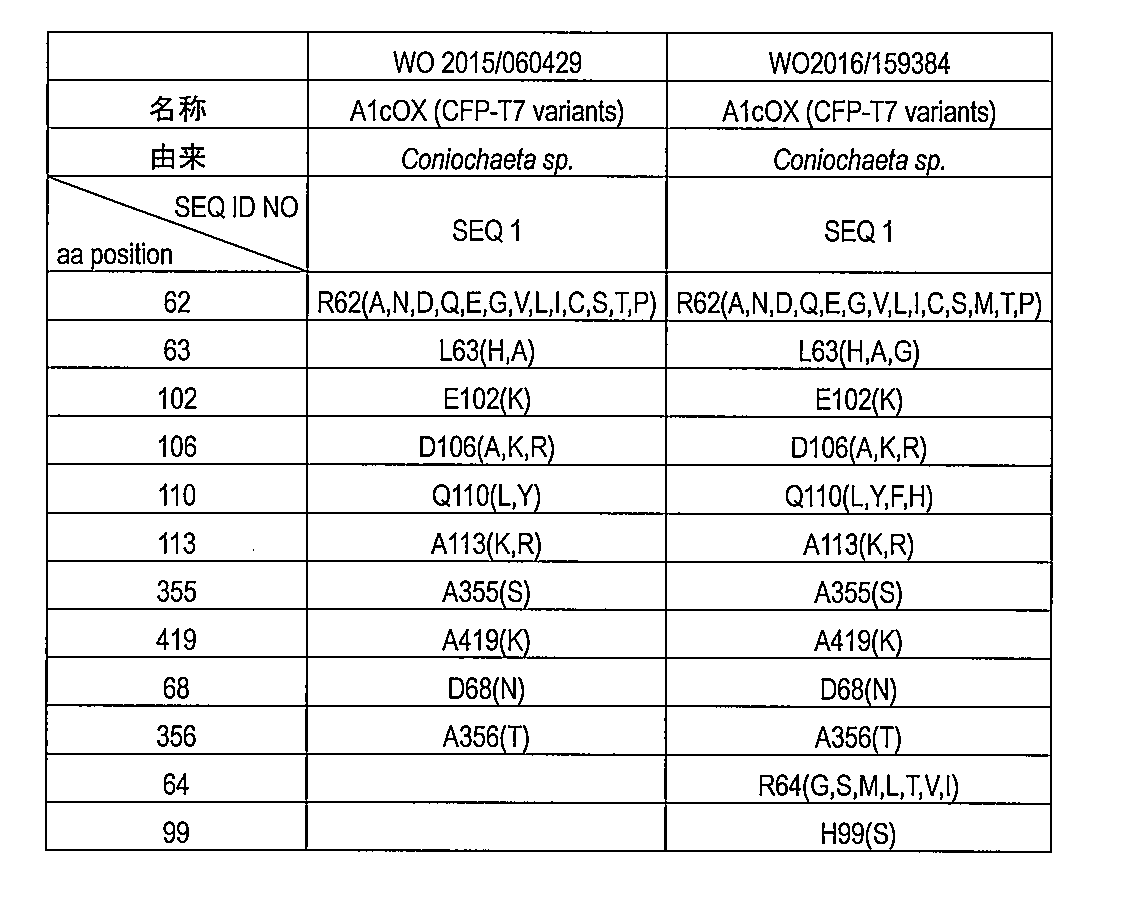
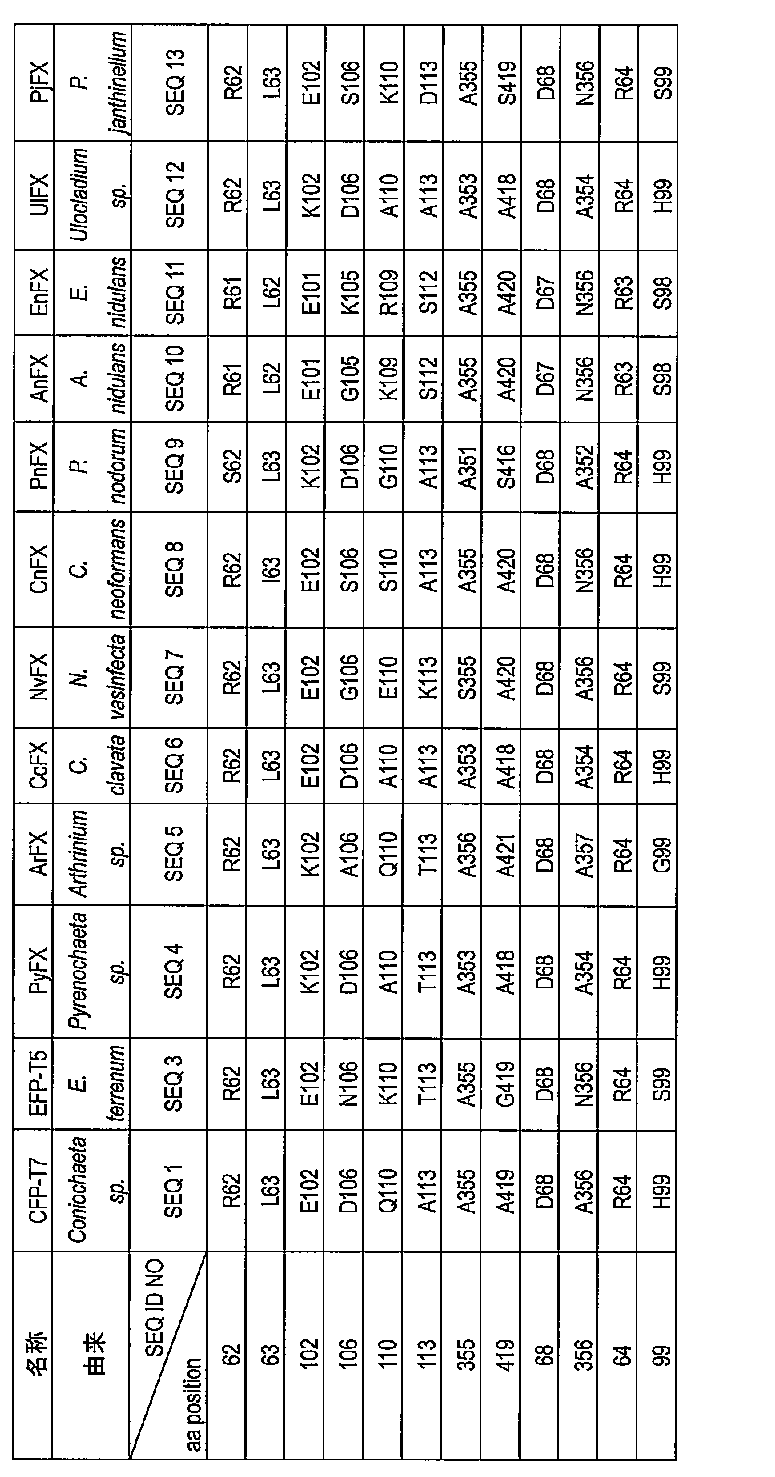

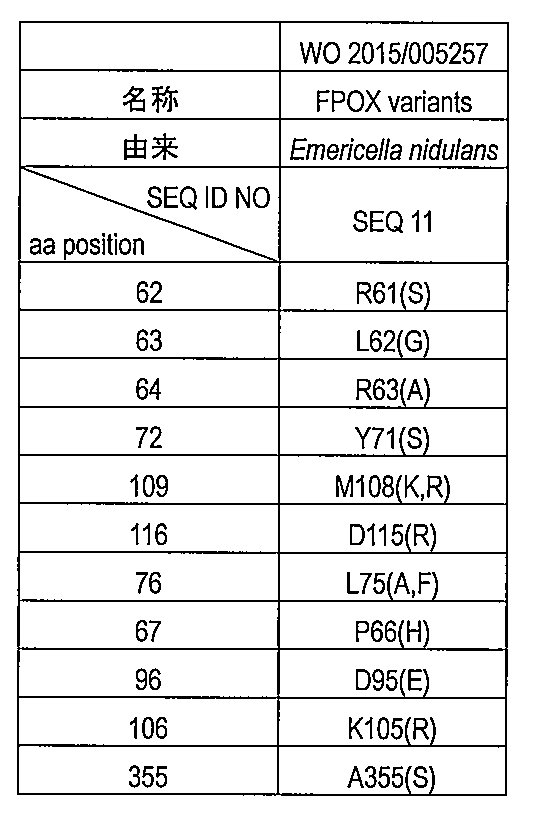
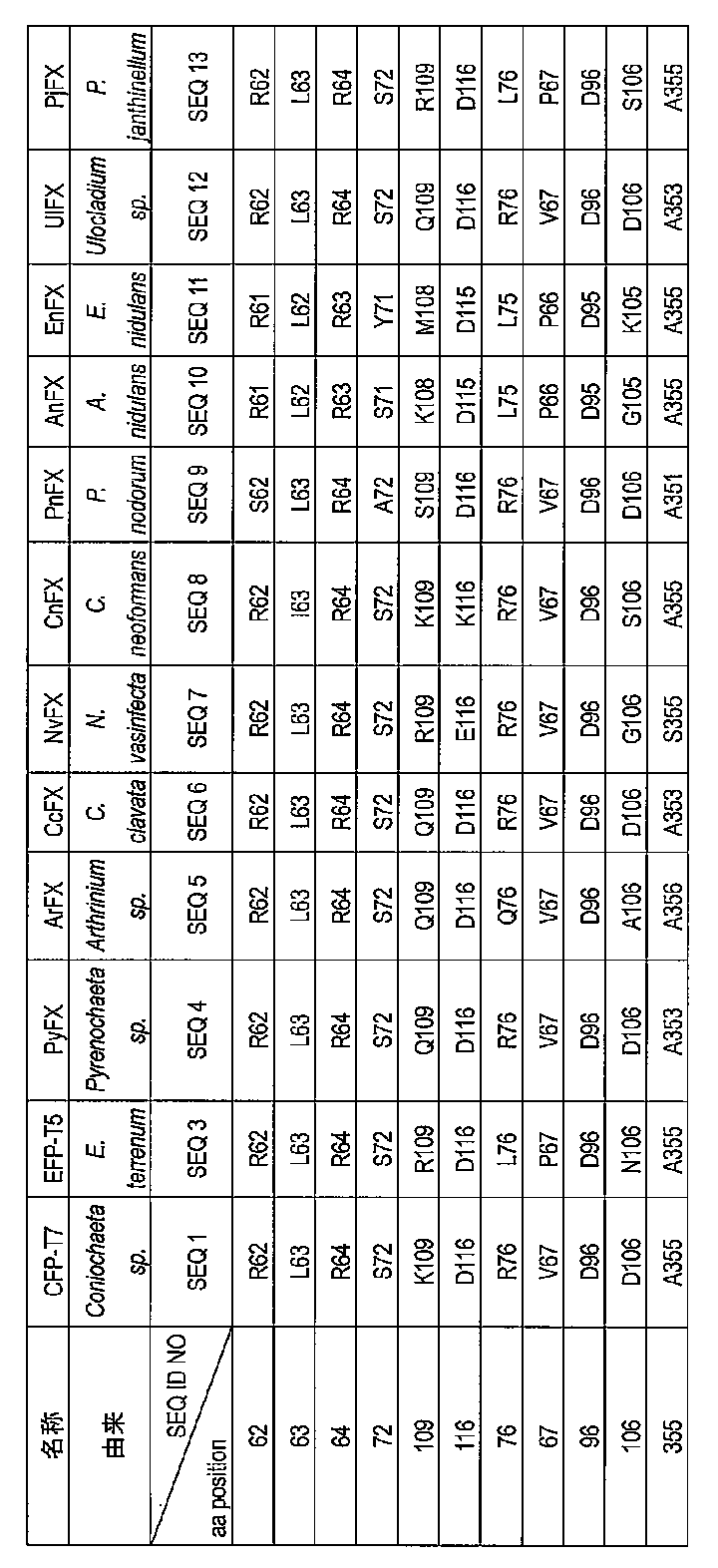
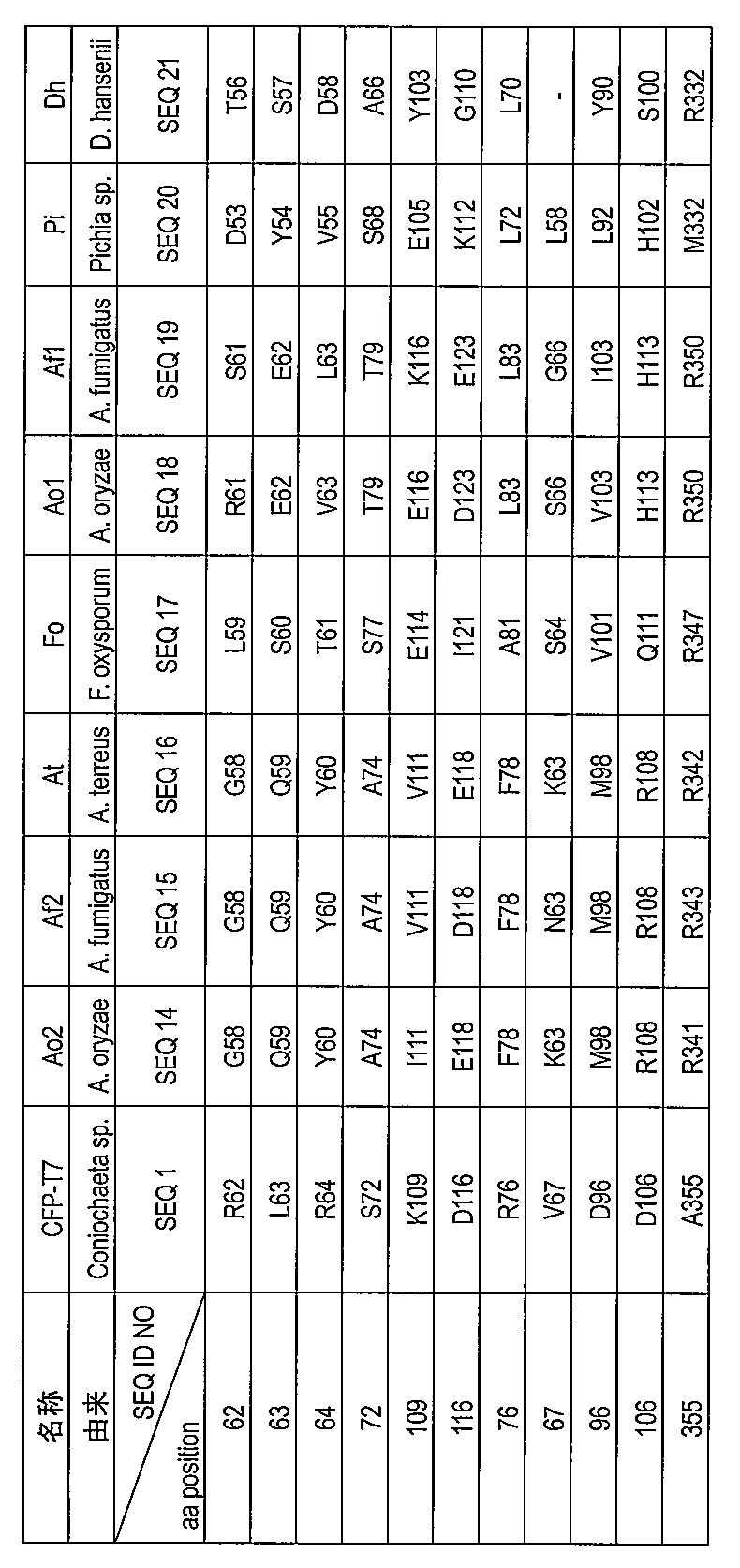
A1cOX遺伝子に本発明の変異を導入することによりA1cOX改変体を作製し、糖化HbSや糖化HbCに対する相対活性の増大した糖化ヘモグロビンオキシダーゼを製造しうる。
本発明の糖化ヘモグロビンオキシダーゼは、配列番号1の113位、109位、106位及び/又は102位に対応する位置に、変異を有しうる。対応する位置については下記に説明する。ある実施形態では、Coniochaeta sp. NISL 9330由来アマドリアーゼ(配列番号1)に基づくA1cOX又はEmericella nidulans由来アマドリアーゼ(配列番号11)に基づくアマドリアーゼ(例えば配列番号45)に、以下の位置において1又は複数のアミノ酸置換を導入しうる:
(a)配列番号1の113位に対応する位置
(a’)配列番号1の109位に対応する位置
(b)配列番号1の106位に対応する位置
(c)配列番号1の102位に対応する位置
本明細書において、ある基準となるアミノ酸配列中の特定の位置が別の類似するアミノ酸配列中の特定の位置と対応する場合、これを対応する位置という。また対応する位置のアミノ酸を対応するアミノ酸という。本明細書では便宜上、配列番号1に示すConiochaeta属由来のアマドリアーゼのアミノ酸配列を基準として説明する。この場合、アミノ酸配列における「対応する位置」とは、配列番号1に示すConiochaeta属由来のアマドリアーゼのアミノ酸配列の特定の位置に対応する他の生物種由来のアマドリアーゼのアミノ酸配列における位置をいう。
本明細書において、「配列番号1のアミノ酸配列の113位に対応する位置」とは、対象のアマドリアーゼのアミノ酸配列を、配列番号1のアミノ酸配列と比較した場合に、配列番号1の113位に対応する位置をいう。これは、上記の方法でアミノ酸配列を整列させた図1又は図2より特定することができる。配列番号1の109位に対応する位置、106位に対応する位置、及び102位に対応する位置についても同様である。


アミノ酸配列の相同性、同一性又は類似性は、GENETYX(GENETYX社製)のマキシマムマッチングやサーチホモロジー等のプログラム、またはDNASIS Pro(日立ソリューションズ社製)のマキシマムマッチングやマルチプルアライメント、またはCLUSTAL Wのマルチプルアライメント等のプログラムにより計算することができる。アミノ酸配列同一性を計算するために、2以上のアマドリアーゼをアライメントしたときに、該2以上のアマドリアーゼにおいて同一であるアミノ酸の位置を調べることができる。こうした情報を基に、アミノ酸配列中の同一領域を決定できる。ここで2以上のアミノ酸配列について、同一性%とは、Blosum62等のアルゴリズムを利用して2以上のアミノ酸配列のアラインメントを行った際に、アラインメント可能であった領域の総アミノ酸数を分母とし、そのうち同一のアミノ酸によって占められる位置の数を分子としたときのパーセンテージをいう。故に、通常、2以上のアミノ酸配列に同一性が全く見られない領域がある場合、例えばC末端に同一性が全く見られない付加配列が一方のアミノ酸配列にある場合、当該同一性のない領域はアラインメント不可能であるため、同一性%の算出には利用されない。
本明細書において「相同性領域」とは、2以上のアマドリアーゼをアライメントしたときに、ある基準となるアマドリアーゼと比較対象のアマドリアーゼの対応する位置におけるアミノ酸が同一であるか又は類似アミノ酸からなる領域であって、連続する3以上、4以上、5以上、6以上、7以上、8以上、9以上又は10以上のアミノ酸からなる領域をいう。例えば、図1では全長アミノ酸配列の配列同一性が、配列番号1のアマドリアーゼを基準として74%以上であるアマドリアーゼをアライメントした。このうち、配列番号1で示されるConiochaeta sp.由来アマドリアーゼを基準として第10位~32位は同一又は類似アミノ酸からなり、よって相同性領域に該当する。同様に、配列番号1で示されるConiochaeta sp. 由来アマドリアーゼを基準として、10位~32位、36~41位、49~52位、54~58位、63~65位、73~75位、84~86位、88~90位、120~122位、145~150位、156~162位、164~170位、180~182位、202~205位、207~211位、214~224位、227~230位、236~241位、243~248位、258~261位、266~268位、270~273位、275~287位、295~297位、306~308位、310~316位、324~329位、332~334位、341~344位、346~355位、357~363位、370~383位、385~387位、389~394位、405~410位及び423~431位は相同性領域に該当しうる。ある実施形態においてアマドリアーゼの相同性領域はこれらの位置からなる領域である。別のアマドリアーゼを基準とした場合、配列番号1のこれらの位置にそれぞれ対応する位置も相同性領域に該当しうる。例えば、同様に、配列番号45で示されるEmericella nidulans由来アマドリアーゼを基準として、配列番号45の9位~31位、35~40位、48~51位、53~57位、62~64位、72~74位、83~85位、87~89位、119~121位、144~149位、155~161位、163~169位、179~181位、202~205位、207~211位、214~224位、227~230位、236~241位、243~248位、258~261位、266~268位、270~273位、275~287位、295~297位、306~308位、310~316位、324~329位、332~334位、341~344位、346~355位、357~363位、370~383位、385~387位、389~394位、405~410位及び424~432位は相同性領域に該当しうる。ある実施形態においてアマドリアーゼの相同性領域はこれらの位置からなる領域である。配列番号45の元となった配列番号11についても同様である。
アマドリアーゼの特定のアミノ酸残基は基質の糖部分(例えばフルクトシル基)と相互作用することが知られている。そしてそのようなアミノ酸残基は、各種アマドリアーゼにおいて保存性が高い。ある実施形態において、アマドリアーゼは、配列番号1の239位に対応する位置のアミノ酸がトリプトファン、フェニルアラニン又はチロシンであり、配列番号1の282位に対応する位置のアミノ酸がグルタミン酸であり、配列番号1の376位に対応する位置のアミノ酸がグリシンであり、配列番号1の418位に対応する位置のアミノ酸がアルギニンである。これらのアミノ酸残基は、基質の糖部分(フルクトシル基)を認識することが知られている(J. Biol. Chem., 283, 27007-27016 (2008); Proteins, 84, 744-758 (2016))。
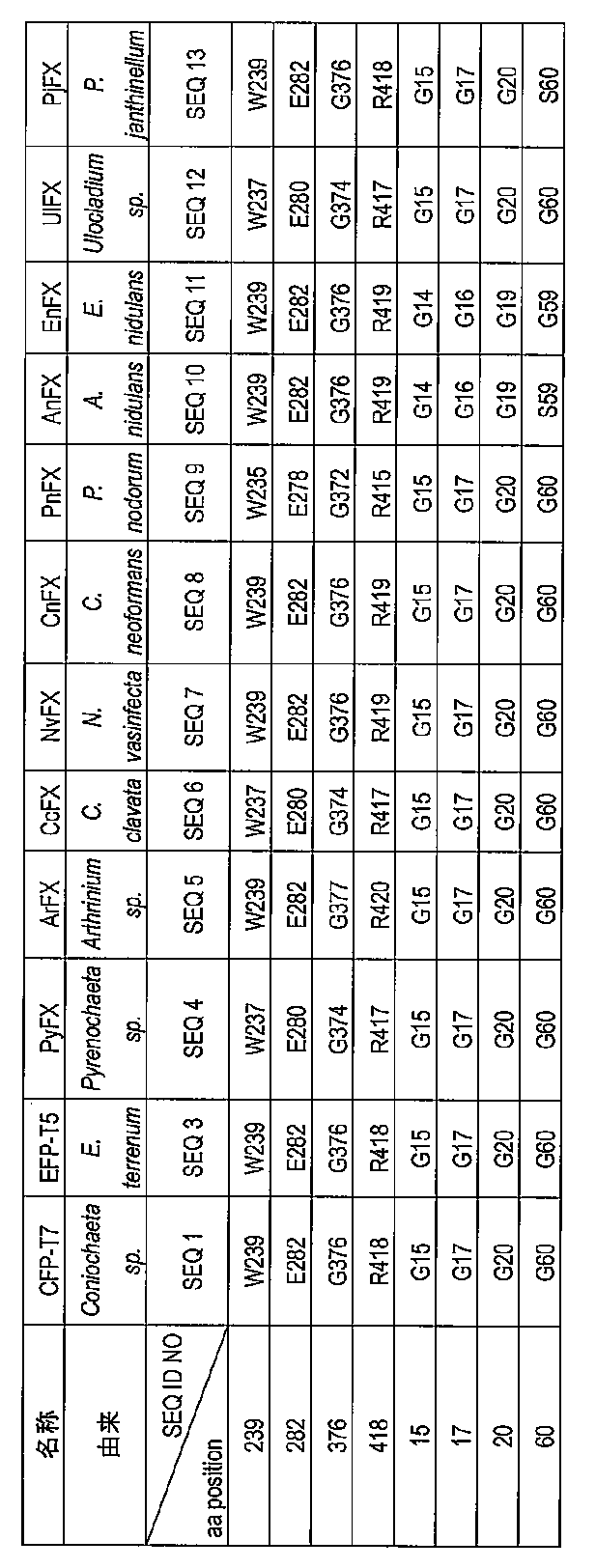

(i) 配列番号1記載のアミノ酸配列とアライメントしたときに、配列番号1に示すアミノ酸配列における113位、109位、106位及び/又は102に対応する位置のアミノ酸がグルタミン酸、アラニン、アスパラギン酸、セリン、トレオニン、アスパラギン、グルタミン、システイン、グリシン、プロリン、バリン、イソロイシン、ロイシン、メチオニン、フェニルアラニン、チロシン、及びトリプトファンからなる群より選択されるアミノ酸に改変されている、
(ii) 前記(i)において、配列番号1に示すアミノ酸配列における113位、109位、106位、及び102位に対応する位置以外の位置における1又は数個のアミノ酸が置換、欠失又は付加されているたアミノ酸配列からなる、
(iii) 前記(i)若しくは(ii)において、当該糖化ヘモグロビンオキシダーゼの全長アミノ酸配列が配列番号1、配列番号22、配列番号24、配列番号11又は配列番号45のアミノ酸配列と70%以上、71%以上、72%以上、73%以上、74%以上、75%以上、76%以上、77%以上、78%以上、79%以上、80%以上、81%以上、82%以上、83%以上、84%以上、85%以上、86%以上、87%以上、88%以上、89%以上、または90%以上、例えば95%以上の配列同一性を有する、
(iv) 前記(i)、又は(ii)において、当該糖化ヘモグロビンオキシダーゼの全長アミノ酸配列が配列番号1又は配列番号11若しくは配列番号45のアミノ酸配列と70%以上、71%以上、72%以上、73%以上、74%以上、75%以上、76%以上、77%以上、78%以上、79%以上、80%以上、81%以上、82%以上、83%以上、84%以上、85%以上、または90%以上、例えば95%以上の配列同一性を有し、当該糖化ヘモグロビンオキシダーゼにおける、配列番号1の60位に対応する位置のアミノ酸がグリシンであり、配列番号1の239位に対応する位置のアミノ酸がトリプトファン、フェニルアラニン又はチロシンであり、配列番号1の282位に対応する位置のアミノ酸がグルタミン酸であり、配列番号1の376位に対応する位置のアミノ酸がグリシンであり、配列番号1の418位に対応する位置のアミノ酸がアルギニンであり、配列番号1の15~20位に対応する位置のアミノ酸配列がGly-Xaa-Gly-Xaa-Xaa-Gly(ここでXaaは任意のアミノ酸を示す)である、
(v) 前記(i)、(ii)若しくは(iii)において、当該糖化ヘモグロビンオキシダーゼの全長アミノ酸配列が配列番号1、配列番号22、配列番号24、配列番号11又は配列番号45のアミノ酸配列と70%以上、71%以上、72%以上、73%以上、74%以上、75%以上、80%以上、85%以上、または90%以上の配列同一性を有し、配列番号1または配列番号22若しくは24の第10位~32位、36~41位、49~52位、54~58位、73~75位、84~86位、88~90位、120~122位、145~150位、156~162位、164~170位、180~182位、202~205位、207~211位、214~224位、227~230位、236~241位、243~248位、258~261位、266~268位、270~273位、275~287位、295~297位、306~308位、310~316位、324~329位、332~334位、341~344位、346~355位、357~363位、370~383位、385~387位、389~394位、405~410位及び423~431位のアミノ酸配列からなる相同性領域におけるアミノ酸配列と当該糖化ヘモグロビンオキシダーゼの対応する位置の相同性領域におけるアミノ酸配列とが80%以上、85%以上、90%、95%以上、98%以上、例えば99%以上の配列同一性を有する、
(vi) 前記(i)又は(ii)において、当該糖化ヘモグロビンオキシダーゼの全長アミノ酸配列が配列番号1又は配列番号11若しくは配列番号45のアミノ酸配列と50%以上、55%以上、60%以上、61%以上、62%以上、63%以上、64%以上、65%以上、66%以上、67%以上、68%以上、69%以上、70%以上、71%以上、72%以上、73%以上、74%以上、75%以上、76%以上、77%以上、78%以上、79%以上、80%以上、85%以上、例えば90%以上の配列同一性を有し、配列番号1の第10位~32位、36~41位、49~52位、54~58位、63~65位、73~75位、84~86位、88~90位、120~122位、145~150位、156~162位、164~170位、180~182位、202~205位、207~211位、214~224位、227~230位、236~241位、243~248位、258~261位、266~268位、270~273位、275~287位、295~297位、306~308位、310~316位、324~329位、332~334位、341~344位、346~355位、357~363位、370~383位、385~387位、389~394位、405~410位及び423~431位のアミノ酸配列からなる相同性領域におけるアミノ酸配列と当該糖化ヘモグロビンオキシダーゼの対応する位置の相同性領域におけるアミノ酸配列とが65%以上、66%以上、67%以上、68%以上、69%以上、70%以上、71%以上、72%以上、73%以上、74%以上、75%以上、76%以上、77%以上、78%以上、79%以上、80%以上、81%以上、82上、83%以上、84%以上、85%以上、86%以上、87%以上、88%以上、89%以上、90%以上の配列同一性を有し、当該糖化ヘモグロビンオキシダーゼにおける、配列番号1の60位に対応する位置のアミノ酸がグリシンであり、配列番号1の239位に対応する位置のアミノ酸がトリプトファン、フェニルアラニン又はチロシンであり、配列番号1の282位に対応する位置のアミノ酸がグルタミン酸であり、配列番号1の376位に対応する位置のアミノ酸がグリシンであり、配列番号1の418位に対応する位置のアミノ酸がアルギニンであり、配列番号1の15~20位に対応する位置のアミノ酸配列がGly-Xaa-Gly-Xaa-Xaa-Gly(ここでXaaは任意のアミノ酸を示す)である。この糖化ヘモグロビンオキシダーゼは、
(a) 改変前のA1cオキシダーゼと比較して、HbS1c型αF8Pに対する活性とHbA1c型αF8Pに対する活性との比が増大している、すなわち相対活性[HbS1c/HbA1c]が増大している、かつ/又は
(b) 改変前のA1cオキシダーゼと比較して、HbC1c型αF8Pに対する活性とHbA1c型αF8Pに対する活性との比が増大している、すなわち相対活性[HbC1c/HbA1c]が増大している、か、並びに/或いは、
(c) HbS1c型αF8Pに対する活性とHbA1c型αF8Pに対する活性との比、すなわち相対活性[HbS1c/HbA1c]が0.45以上、0.5以上、0.6以上、0.7以上、0.8以上、例えば0.9以上である、かつ/又は
(d) HbC1c型αF8Pに対する活性とHbA1c型αF8Pに対する活性との比、すなわち相対活性[HbC1c/HbA1c]が0.15以上、0.2以上、0.3以上、0.4以上、0.5以上、0.6以上、0.7以上、0.8以上、例えば0.9以上である。
(i)糖化ヘモグロビンオキシダーゼのアミノ酸配列を、配列番号1に記載のアミノ酸配列とアライメントしたときに、配列番号1に示すアミノ酸配列における113位、109位、106位、及び/又は102位に対応する位置のアミノ酸の1、2または3つが、グルタミン酸、アスパラギン酸、アラニン、セリン、トレオニン、アスパラギン、グルタミン、システイン、グリシン、プロリン、バリン、イソロイシン、ロイシン、メチオニン、フェニルアラニン、チロシン、及びトリプトファンからなる群より選択されるアミノ酸に改変されており、かつ、
(a) HbS1c型αF8Pに対する活性とHbA1c型αF8Pに対する活性との比、すなわち相対活性[HbS1c/HbA1c]が0.45以上である、及び/又は
(b) HbC1c型αF8Pに対する活性とHbA1c型αF8Pに対する活性との比、すなわち相対活性[HbC1c/HbA1c]が0.15以上、例えば0.2以上である。
ある実施形態において、本発明は、糖化ヘモグロビンオキシダーゼ産生能を有する菌株を当該糖化ヘモグロビンオキシダーゼを発現しうる条件下で培養する工程、及び培養物又は培養液から糖化ヘモグロビンオキシダーゼを単離する工程を含む、糖化ヘモグロビンオキシダーゼの製造方法を提供する。この方法には、本発明の糖化ヘモグロビンオキシダーゼをコードする遺伝子を組み込んだベクターで形質転換された宿主細胞を用いることができる。ここで糖化ヘモグロビンオキシダーゼを発現しうる条件とは、糖化ヘモグロビンオキシダーゼ遺伝子が転写、翻訳され、当該遺伝子によりコードされるポリペプチドが産生されることをいう。
基質としてHbA1cを認識し、かつ、糖化HbS及び/又は糖化HbCを認識し、
作用として糖化ヘモグロビンのβ鎖を酸化して過酸化水素を生成し、
至適pH範囲をpH6~8の範囲に有し、
作用pH範囲をpH5~9の範囲に有し、
作用温度が25~40℃であり、
SDS-PAGE上での分子量が約45~55KDa、例えば約48~50KDaであるものであり得る。
ある実施形態において本発明は、糖化ヘモグロビンオキシダーゼを含む、糖化ヘモグロビン測定用試薬組成物、測定試薬又はキットを提供する。ある実施形態において本発明は、糖化ヘモグロビンオキシダーゼを含む、HbS1c又はHbC1c測定用試薬組成物、測定試薬又はキットを提供する。該組成物、試薬又はキットは、還元型化合物の測定用試薬、過酸化水素の測定用試薬、緩衝剤、界面活性剤、塩類、防腐剤などを含み得る。また、溶解補助剤、安定化剤、反応性向上剤、糖化ヘモグロビン変性剤、還元剤、牛血清アルブミン、糖類(グリセリン、乳糖、シュークロース等)等を添加してもよい。該組成物、試薬又はキットは、必要に応じ、その他の公知の安定化剤や夾雑物質の消去系などを追加しうる。糖化ヘモグロビンに作用するプロテアーゼ等を使用し糖化ペプチドを酵素法により測定する従来の各種の試薬やキットに用いられている技術を、適宜改変して本発明の組成物、試薬又はキットに用いることができる。本発明の組成物、測定試薬又はキットはプロテアーゼを含んでもよく、含まなくともよい。
ある実施形態において、本発明は糖化ヘモグロビンの測定方法を提供する。糖化ヘモグロビン測定は、定性的又は定量的な方法であり得る。定量法は、糖化ヘモグロビンを含む試料と本発明の糖化ヘモグロビンオキシダーゼとを接触させる工程、及び反応生成物又は消費物を測定する工程を含み得る。糖化ヘモグロビンは未変性でもよく、または変性したものでもよい。該定量法についていう接触とは、糖化ヘモグロビンオキシダーゼが糖化ヘモグロビンの酸化反応を触媒しうるように、該酵素と試料とを物理的に一緒にするあらゆる態様を包含し、例えば溶液中で遊離の酵素と糖化ヘモグロビンを混合する場合のみならず、固相担体に担持された酵素に糖化ヘモグロビンを含む溶液試料を添加又は滴下するような態様も包含する。
以下に、モデル基質としてHbA1c型αF8P、HbS1c型αF8P、又はHbC1c型αF8Pを用いた、アマドリアーゼ活性の測定方法を例示するが、測定方法はこれに限らない。これらの基質は合成基質でありうる(ペプチド研究所製)。本明細書において、特に断らない限り、酵素力価は、HbA1c型αF8Pを基質として測定した時の、1分間に1μmolの過酸化水素を生成する酵素量を1Uと定義する。
(試薬1):5U/ml パーオキシダーゼ(東洋紡製)、0.49mM 4-アミノアンチピリン(和光純薬工業社製)を含む0.1M リン酸緩衝液 pH6.5
(試薬2):15mM TOOS(N-エチル-N-(2-ヒドロキシ-3-スルホプロピル)-m-トルイジンナトリウム、同仁化学研究所製)溶液
500mgのTOOSをイオン交換水に溶解し、100mlに定容する。
(試薬3):300μMHbA1c型、HbC1c型、又はHbS1c型αF8P(ペプチド研究所製)溶液(終濃度10μM)
B:活性測定法
2.7mlの試薬1、100μlの試薬2、および100μlの酵素液を混和し、37℃で5分間予備加温する。その後、試薬3を100μl加えて良く混ぜた後、分光光度計(U-3900、日立ハイテクサイエンス社製)により、555nmにおける吸光度の経時変化を37℃で観測し、555nmにおける吸光度の1分間あたりの変化量(ΔAs)を測定する。なお、対照液は、100μlの試薬3の代わりに100μlのイオン交換水を加える以外は前記と同様にして、555nmにおける吸光度の1分間あたりの変化量(ΔA0)を測定する。37℃で1分間当たりに生成される過酸化水素のマイクロモル数を酵素液中の活性単位(U)とし、下記の式に従って算出する。
活性(U/ml)={(ΔAs-ΔA0)×3.0×df}÷(39.2×0.5×0.1)
ΔAs:反応液の1分間あたりの吸光度変化
ΔA0:対照液の1分間あたりの吸光度変化
39.2:反応により生成されるキノイミン色素のミリモル吸光係数(mM-1・cm-1)
0.5:1 molの過酸化水素による生成されるキノイミン色素のmol数
df:希釈係数。
本発明者は、HbA1cのみならずHbS1cやHbC1cにも対応可能な糖化ヘモグロビンオキシダーゼが必要である、という新規の課題を見出し、A1cOXに特定のアミノ酸置換を導入して糖化ヘモグロビンオキシダーゼを作製することによりこの課題を解決した。本発明の変異は適宜組み合わせることができる。また本発明の知見に基づいてさらなる改変体を作製することもできる。したがってある実施形態において本発明は、以下の工程を含む、アマドリアーゼ又はA1cオキシダーゼを改変して糖化ヘモグロビンオキシダーゼを作製する方法を提供する:
(i) アマドリアーゼ遺伝子又はA1cオキシダーゼ遺伝子を取得する、
(ii) アマドリアーゼ遺伝子又はA1cオキシダーゼ遺伝子をベクターに組み入れ、宿主細胞を形質転換し、アマドリアーゼ又はA1cオキシダーゼを発現させ、発現産物を単離する、(iii) 発現産物の相対活性[HbS1c/HbA1c]及び/又は相対活性[HbC1c/HbA1c]を測定する、(iv) アマドリアーゼ又はA1cオキシダーゼのアミノ酸配列を、配列番号1に記載のアミノ酸配列とアライメントしたときに、配列番号1に示すアミノ酸配列における113位、109位、106位又は102位に対応する位置のアミノ酸がグルタミン酸、アスパラギン酸、アラニン、セリン、トレオニン、アスパラギン、グルタミン、システイン、グリシン、プロリン、バリン、イソロイシン、ロイシン、メチオニン、フェニルアラニン、チロシン、及びトリプトファンからなる群より選択されるアミノ酸に改変されるよう、前記アマドリアーゼ遺伝子又はA1cオキシダーゼ遺伝子を改変する、
(v) 改変後の遺伝子をベクターに組み入れ、宿主細胞を形質転換し、改変体を発現させ、発現産物を単離する、
(vi) 改変体の発現産物の相対活性[HbS1c/HbA1c]及び/又は相対活性[HbC1c/HbA1c]を測定し、工程(iii)の値と比較する、
(vii) 改変前のアマドリアーゼ若しくはA1cオキシダーゼの相対活性[HbS1c/HbA1c]と比較して、改変後の改変体の相対活性[HbS1c/HbA1c]が1.1倍以上増大しているか、又は改変前のアマドリアーゼ若しくはA1cオキシダーゼの相対活性[HbC1c/HbA1c]と比較して、改変後の改変体の相対活性[HbC1c/HbA1c]が1.1倍以上増大している場合、当該改変体を糖化ヘモグロビンオキシダーゼとする、並びに
(viii) 必要に応じて、工程(vii)の改変体について、工程(iv)~(vi)を繰り返す。上記工程(iii)や(vi)の評価基質は、便宜上αF8Pとすることができるが、6アミノ酸以上の鎖長を有する他のフルクトシル基質やHbA1c、HbS1c、HbC1cを用いてもよい。
以下、実施例により、本発明をさらに具体的に説明する。ただし、本発明の技術的範囲は、それらの例により何ら限定されるものではない。
Coniochaeta属由来アマドリアーゼ遺伝子(配列番号23)の組換え体プラスミドを有する大腸菌JM109(pKK223-3-CFP-T7-H38-GY)株(国際公開第2016/159384号参照)を、3mlのLB-amp培地[1%(w/v)バクトトリプトン、0.5%(w/v)ペプトン、0.5%(w/v)NaCl、50μg/ml アンピシリン]に接種して、37℃で16時間振とう培養し、培養物を得た。
得られた組換え体プラスミドpKK223-3-CFP-T7-H38-GYを鋳型として、配列番号25、26の合成オリゴヌクレオチド、KOD-Plus-Neo(東洋紡績社製)を用い、以下の条件でPCRを行った。
上記のようにして得られたアマドリアーゼを生産する形質転換大腸菌(JM109)を、終濃度0.1mMとなるようにIPTGを添加したLB-amp培地100mlに植菌し、25℃で16時間培養した。得られた培養菌体を10mM リン酸カリウム緩衝液(pH7.5)で洗浄した後、同緩衝液に菌体を懸濁して超音波破砕処理を行い、20,000×gで10分間遠心分離し、粗酵素液40mlを調製した。
精製CFP-T7-H40-3M標品を用いて10μM のHbA1c型、HbS1c型及びHbC1c型のαF8Pを基質とした時の活性を測定した。その結果CFP-T7-H40-3Mの、HbA1c型αF8Pに対する活性を100%とした場合、HbS1c型αF8Pに対する活性は39%であり、HbC1c型αF8Pに対する活性は11%であった。
上記のCFP-T7-H40-3M(A1cOX)に基づき、鋳型としてpKK223-3-CFP-T7-H40-3Mさらに以下のプライマーを使用し、下記の変異を導入した。プラスミド調製、導入変異の配列確認、精製酵素の調製等は上記と同様の方法により行った。変異導入時のPCRの班応益組成および反応条件は、下記プライマーを用いる点以外は、組み換体プラスミドpKK223-3-CFP-T7-H39-1Mを調製する時と同一の条件で実施した。
配列番号31、32 導入変異:K102A
配列番号31、33 導入変異:K102E
配列番号34、35 導入変異:K106A
配列番号34、36 導入変異:K106D
配列番号37、38 導入変異:K113A
配列番号37、39 導入変異:K113E
配列番号37、40 導入変異:K113S
配列番号37、41 導入変異:K113T
配列番号37、42 導入変異:K113N
配列番号37、43 導入変異:K113Q
配列番号37、44 導入変異:K113D
得られた各種の精製酵素標品を用いてHbA1c型及びHbS1c型のαF8Pを基質とした時の活性を測定した。結果を下記の表に示す。各酵素の、HbA1c型αF8Pに対する活性を100%としたときの、HbS1c型αF8Pに対する相対活性を示す。


配列番号45は、国際公開第WO2015/005258号に開示されているEmericella nidulans由来糖化ヘキサペプチドオキシダーゼ(FPOX-42、本明細書中ではEn42FXと表記する)のアミノ酸配列であり、配列番号46の遺伝子にコードされている。En42FX遺伝子をpET22bプラスミドベクターにサブクローニングしたpET22b-En42FX(調製方法は国際公開第WO2016/063984号参照)を鋳型にして、以下のプライマーを使用し、下記の変異を導入した。プラスミド調製は(1.Coniochaeta属由来アマドリアーゼをコードする組換え体プラスミドの調製)および(2.Coniochaeta属由来アマドリアーゼをコードする組換え体プラスミドの部位特異的改変操作)と同様の方法により行った。変異導入時のPCRは(2.Coniochaeta属由来アマドリアーゼをコードする組換え体プラスミドの部位特異的改変操作)に記載の方法に沿って、pET22b-En42FXを鋳型として、下記プライマーを用いて実施した。PCR反応条件、導入変異の配列確認等は、(2.Coniochaeta属由来アマドリアーゼをコードする組換え体プラスミドの部位特異的改変操作)と同一の条件で実施した。
配列番号47、48 導入変異:R105A
配列番号47、49 導入変異:R105S
配列番号47、50 導入変異:R105L
配列番号47、52 導入変異:R105N
配列番号47、53 導入変異:R105Q
配列番号47、54 導入変異:R105D
配列番号47、55 導入変異:R105E
配列番号56、57 導入変異:R108A
配列番号56、58 導入変異:R108S
配列番号56、59 導入変異:R108L
配列番号56、61 導入変異:R108Q
配列番号56、62 導入変異:R108D
配列番号56、63 導入変異:R108E
配列番号64、65 導入変異:S112D
配列番号64、66 導入変異:S112E
各改変型En42FX生産株を、0.1mMのIPTGを添加したLB-amp培地50mlにおいて、25℃で16時間培養した。その後、各菌体をpH7.0の10mMリン酸緩衝液で洗浄、超音波破砕、15,000rpmで10分間遠心分離し、各粗酵素液4.0mlを調製した。各粗酵素液はAmicon Ultra Ultracel-30K(ミリポア社製)を用いて、およそ1.0mlに濃縮して活性測定に使用した。
得られた各種の精製酵素標品を用いてHbA1c型及びHbS1c型のαF8Pを基質とした時の活性を測定した。結果を下記の表に示す。各酵素の、HbA1c型αF8Pに対する活性を100%としたときの、HbS1c型αF8P及びHbS1c型αF8Pに対する相対活性を示す。
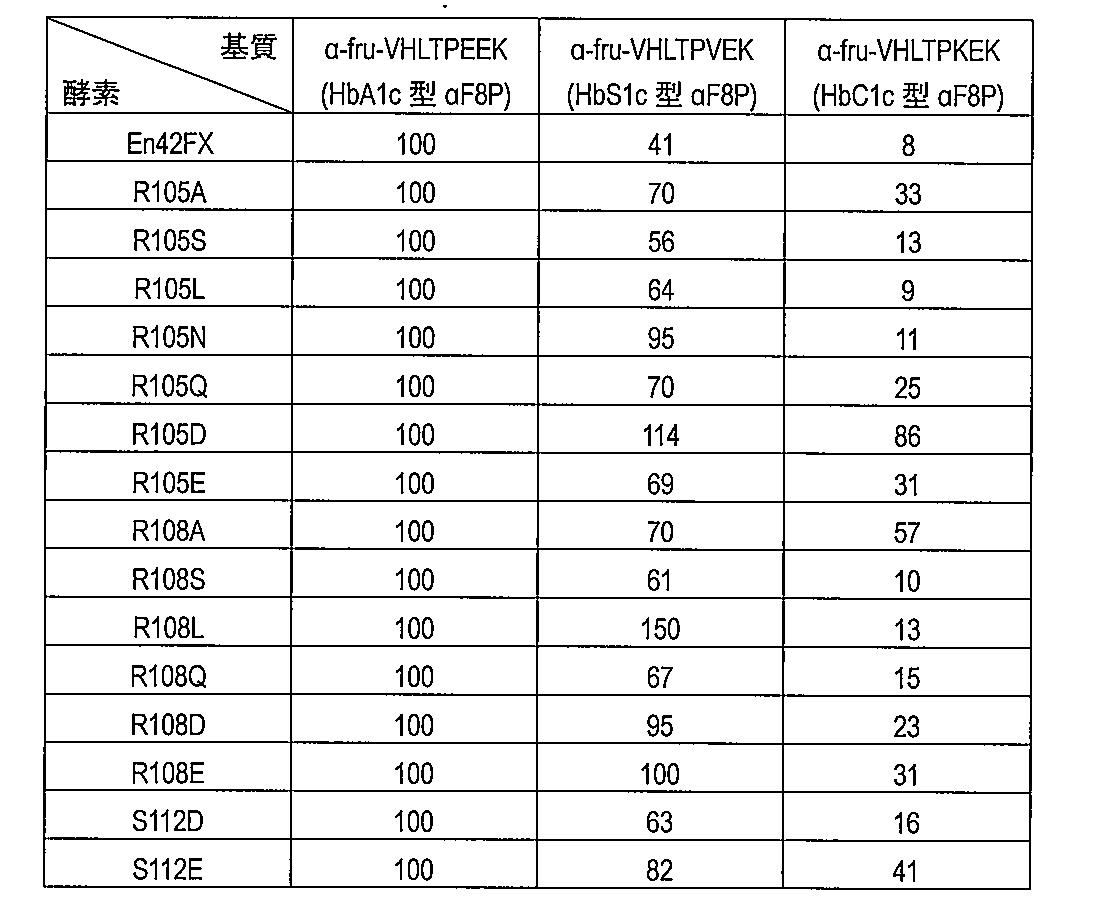
配列番号1 Coniochaeta属由来のアマドリアーゼ(CFP-T7)
配列番号2 CFP-T7遺伝子配列
配列番号3 Eupenicillium terrenum由来のアマドリアーゼ
配列番号4 Pyrenochaeta sp.由来のケトアミンオキシダーゼ
配列番号5 Arthrinium sp.由来のケトアミンオキシダーゼ
配列番号6 Curvularia clavata由来のケトアミンオキシダーゼ
配列番号7 Neocosmospora vasinfecta由来のケトアミンオキシダーゼ
配列番号8 Cryptococcus neoformans由来のフルクトシルアミノ酸オキシダーゼ
配列番号9 Phaeosphaeria nodorum由来のフルクトシルペプチドオキシダーゼ
配列番号10 Aspergillus nidulans由来のフルクトシルアミノ酸オキシダーゼ
配列番号11 Emericella nidulans由来のフルクトシルペプチドオキシダーゼ
配列番号12 Ulocladium sp.由来のフルクトシルアミノ酸オキシダーゼ
配列番号13 Penicillium janthinellum由来のフルクトシルアミノ酸オキシダーゼ
配列番号14 Ao2 (Aspergillus oryzae由来アマドリアーゼ、別称FaoAo2)
配列番号15 Af2 (Aspergillus fumigatus由来アマドリアーゼ、別称AmadoriaseII)
配列番号16 At (Aspergillus terreus由来アマドリアーゼ、別称FAOD-A)
配列番号17 Fo (Fusarium oxysporum由来アマドリアーゼ)
配列番号18 Ao1 (Aspergillus oryzae由来アマドリアーゼ、別称FaoAo 1)
配列番号19 Af1 (Aspergillus fumigatus由来アマドリアーゼ、別称AmadoriaseI)
配列番号20 Pi (Pichia sp.由来アマドリアーゼ)
配列番号21 Dh (Debaryomyces hansenii由来アマドリアーゼ)
配列番号22 CFP-T7-H38-GY アミノ酸配列
配列番号23 CFP-T7-H38-GY遺伝子配列
配列番号24 CFP-T7-H40-3M アミノ酸配列
配列番号25~44 プライマー
配列番号45 En42FXアミノ酸配列
配列番号46 En42FX遺伝子配列
配列番号47~66 プライマー
Claims (20)
- HbS1cまたはHbC1cを含み得る試料に糖化ヘモグロビンオキシダーゼを作用させる工程を含む、試料中のHbS1cまたはHbC1cを測定する方法。
- 糖化ヘモグロビンオキシダーゼの作用により生じる還元型化合物の量を測定する、請求項1に記載の方法。
- 測定される還元型化合物が過酸化水素である、請求項2に記載の方法。
- 糖化ヘモグロビンオキシダーゼが(a)及び/又は(b)の性質を有する、請求項1~3のいずれか1項に記載の方法、
(a) HbS1c型αF8Pに対する活性とHbA1c型αF8Pに対する活性との比、すなわち相対活性[HbS1c/HbA1c]が0.45以上である、
(b) HbC1c型αF8Pに対する活性とHbA1c型αF8Pに対する活性との比、すなわち相対活性[HbC1c/HbA1c]が0.15以上である。 - 糖化ヘモグロビンオキシダーゼの至適pH範囲が6~8、作用pH範囲が5~9、至適温度範囲が25~40℃であり、SDS-PAGE上での分子量が約45~55KDaである、請求項1~4のいずれか1項に記載の方法。
- 糖化ヘモグロビンオキシダーゼが、以下の(i)~(viii)からなる群より選択される糖化ヘモグロビンオキシダーゼ改変体である、請求項1~5のいずれか1項に記載の方法、
(i) 糖化ヘモグロビンオキシダーゼのアミノ酸配列を、配列番号1に記載のアミノ酸配列とアライメントしたときに、配列番号1に示すアミノ酸配列における113位に対応する位置のアミノ酸がグルタミン酸、アスパラギン酸、アラニン、セリン、トレオニン、アスパラギン、グルタミン、システイン、グリシン、プロリン、バリン、イソロイシン、ロイシン、メチオニン、フェニルアラニン、チロシン、及びトリプトファンからなる群より選択されるアミノ酸に改変されている糖化ヘモグロビンオキシダーゼ改変体、
(ii) 糖化ヘモグロビンオキシダーゼのアミノ酸配列を、配列番号1に記載のアミノ酸配列とアライメントしたときに、配列番号1に示すアミノ酸配列における109位に対応する位置のアミノ酸がグルタミン酸、アラニン、アスパラギン酸、セリン、トレオニン、アスパラギン、グルタミン、システイン、グリシン、プロリン、バリン、イソロイシン、ロイシン、メチオニン、フェニルアラニン、チロシン、及びトリプトファンからなる群より選択されるアミノ酸に改変されている糖化ヘモグロビンオキシダーゼ改変体、
(iii) 糖化ヘモグロビンオキシダーゼのアミノ酸配列を、配列番号1に記載のアミノ酸配列とアライメントしたときに、配列番号1に示すアミノ酸配列における106位に対応する位置のアミノ酸がグルタミン酸、アラニン、アスパラギン酸、セリン、トレオニン、アスパラギン、グルタミン、システイン、グリシン、プロリン、バリン、イソロイシン、ロイシン、メチオニン、フェニルアラニン、チロシン、及びトリプトファンからなる群より選択されるアミノ酸に改変されている糖化ヘモグロビンオキシダーゼ改変体、
(iv) 糖化ヘモグロビンオキシダーゼのアミノ酸配列を、配列番号1に記載のアミノ酸配列とアライメントしたときに、配列番号1に示すアミノ酸配列における102位に対応する位置のアミノ酸がアラニン、アスパラギン酸、グルタミン酸、セリン、トレオニン、アスパラギン、グルタミン、システイン、グリシン、プロリン、バリン、イソロイシン、ロイシン、メチオニン、フェニルアラニン、チロシン、及びトリプトファンからなる群より選択されるアミノ酸に改変されている糖化ヘモグロビンオキシダーゼ改変体、
(v) 前記(i)、(ii)、(iii)、又は(iv)において、配列番号1に示すアミノ酸配列における113位、109位、106位、及び102位に対応する位置以外の位置における1又は数個のアミノ酸が置換、欠失又は付加されたアミノ酸配列からなる糖化ヘモグロビンオキシダーゼ改変体、
(vi) 前記(i)、(ii)、(iii)、又は(iv)において、当該糖化ヘモグロビンオキシダーゼの全長アミノ酸配列が配列番号1又は配列番号45のアミノ酸配列と70%以上の配列同一性を有し、当該糖化ヘモグロビンオキシダーゼにおける、配列番号1の60位に対応する位置のアミノ酸がグリシンであり、配列番号1の239位に対応する位置のアミノ酸がトリプトファン、フェニルアラニン又はチロシンであり、配列番号1の282位に対応する位置のアミノ酸がグルタミン酸であり、配列番号1の376位に対応する位置のアミノ酸がグリシンであり、配列番号1の418位に対応する位置のアミノ酸がアルギニンであり、配列番号1の15~20位に対応する位置のアミノ酸配列がGly-Xaa-Gly-Xaa-Xaa-Gly(ここでXaaは任意のアミノ酸を示す)である、糖化ヘモグロビンオキシダーゼ改変体、
(vii) 前記(i)、(ii)、(iii)、又は(iv)において、当該糖化ヘモグロビンオキシダーゼの全長アミノ酸配列が配列番号1又は配列番号45のアミノ酸配列と70%以上の配列同一性を有し、配列番号1又は配列番号45の相同性領域におけるアミノ酸配列と当該糖化ヘモグロビンオキシダーゼの対応する位置の相同性領域におけるアミノ酸配列とが90%以上の配列同一性を有する糖化ヘモグロビンオキシダーゼ改変体、或いは
(viii) 前記(i)、(ii)、(iii)、又は(iv)において、当該糖化ヘモグロビンオキシダーゼの全長アミノ酸配列が配列番号1又は配列番号45のアミノ酸配列と50%以上の配列同一性を有し、配列番号1又は配列番号45の相同性領域におけるアミノ酸配列と当該糖化ヘモグロビンオキシダーゼの対応する位置の相同性領域におけるアミノ酸配列とが70%以上の配列同一性を有し、当該糖化ヘモグロビンオキシダーゼにおける、配列番号1の60位に対応する位置のアミノ酸がグリシンであり、配列番号1の239位に対応する位置のアミノ酸がトリプトファン、フェニルアラニン又はチロシンであり、配列番号1の282位に対応する位置のアミノ酸がグルタミン酸であり、配列番号1の376位に対応する位置のアミノ酸がグリシンであり、配列番号1の418位に対応する位置のアミノ酸がアルギニンであり、配列番号1の15~20位に対応する位置のアミノ酸配列がGly-Xaa-Gly-Xaa-Xaa-Gly(ここでXaaは任意のアミノ酸を示す)である、糖化ヘモグロビンオキシダーゼ改変体。 - 試料中のHbS1cまたはHbC1cを測定するための糖化ヘモグロビンオキシダーゼ。
- HbS1cまたはHbC1cに糖化ヘモグロビンオキシダーゼを作用させて生じる還元型化合物の量を測定するためのものである、請求項7に記載の糖化ヘモグロビンオキシダーゼ。
- 生じる還元型化合物が過酸化水素である、請求項8に記載の糖化ヘモグロビンオキシダーゼ。
- 糖化ヘモグロビンオキシダーゼが(a)及び/又は(b)の性質を有する、請求項7~9のいずれか1項に記載の糖化ヘモグロビンオキシダーゼ、
(a) HbS1c型αF8Pに対する活性とHbA1c型αF8Pに対する活性との比、すなわち相対活性[HbS1c/HbA1c]が0.45以上である、
(b) HbC1c型αF8Pに対する活性とHbA1c型αF8Pに対する活性との比、すなわち相対活性[HbC1c/HbA1c]が0.15以上である。 - 糖化ヘモグロビンオキシダーゼの至適pH範囲が6~8、作用pH範囲が5~9、至適温度範囲が25~40℃であり、SDS-PAGE上での分子量が約45~55KDaである、請求項7~10のいずれか1項に記載の糖化ヘモグロビンオキシダーゼ。
- 糖化ヘモグロビンオキシダーゼが、以下の(i)~(viii)からなる群より選択されるものである、請求項7~11のいずれか1項に記載の糖化ヘモグロビンオキシダーゼ、
(i) 糖化ヘモグロビンオキシダーゼのアミノ酸配列を、配列番号1に記載のアミノ酸配列とアライメントしたときに、配列番号1に示すアミノ酸配列における113位に対応する位置のアミノ酸がグルタミン酸、アスパラギン酸、アラニン、セリン、トレオニン、アスパラギン、グルタミン、システイン、グリシン、プロリン、バリン、イソロイシン、ロイシン、メチオニン、フェニルアラニン、チロシン、及びトリプトファンからなる群より選択されるアミノ酸に改変されている糖化ヘモグロビンオキシダーゼ改変体、
(ii) 糖化ヘモグロビンオキシダーゼのアミノ酸配列を、配列番号1に記載のアミノ酸配列とアライメントしたときに、配列番号1に示すアミノ酸配列における109位に対応する位置のアミノ酸がグルタミン酸、アラニン、アスパラギン酸、セリン、トレオニン、アスパラギン、グルタミン、システイン、グリシン、プロリン、バリン、イソロイシン、ロイシン、メチオニン、フェニルアラニン、チロシン、及びトリプトファンからなる群より選択されるアミノ酸に改変されている糖化ヘモグロビンオキシダーゼ改変体、
(iii) 糖化ヘモグロビンオキシダーゼのアミノ酸配列を、配列番号1に記載のアミノ酸配列とアライメントしたときに、配列番号1に示すアミノ酸配列における106位に対応する位置のアミノ酸がグルタミン酸、アラニン、アスパラギン酸、セリン、トレオニン、アスパラギン、グルタミン、システイン、グリシン、プロリン、バリン、イソロイシン、ロイシン、メチオニン、フェニルアラニン、チロシン、及びトリプトファンからなる群より選択されるアミノ酸に改変されている糖化ヘモグロビンオキシダーゼ改変体、
(iv) 糖化ヘモグロビンオキシダーゼのアミノ酸配列を、配列番号1に記載のアミノ酸配列とアライメントしたときに、配列番号1に示すアミノ酸配列における102位に対応する位置のアミノ酸がアラニン、アスパラギン酸、グルタミン酸、セリン、トレオニン、アスパラギン、グルタミン、システイン、グリシン、プロリン、バリン、イソロイシン、ロイシン、メチオニン、フェニルアラニン、チロシン、及びトリプトファンからなる群より選択されるアミノ酸に改変されている糖化ヘモグロビンオキシダーゼ改変体、
(v) 前記(i)、(ii)、(iii)、又は(iv)において、配列番号1に示すアミノ酸配列における113位、109位、106位、及び102位に対応する位置以外の位置における1又は数個のアミノ酸が置換、欠失又は付加されたアミノ酸配列からなる糖化ヘモグロビンオキシダーゼ改変体、
(vi) 前記(i)、(ii)、(iii)、又は(iv)において、当該糖化ヘモグロビンオキシダーゼの全長アミノ酸配列が配列番号1又は配列番号45のアミノ酸配列と70%以上の配列同一性を有し、当該糖化ヘモグロビンオキシダーゼにおける、配列番号1の60位に対応する位置のアミノ酸がグリシンであり、配列番号1の239位に対応する位置のアミノ酸がトリプトファン、フェニルアラニン又はチロシンであり、配列番号1の282位に対応する位置のアミノ酸がグルタミン酸であり、配列番号1の376位に対応する位置のアミノ酸がグリシンであり、配列番号1の418位に対応する位置のアミノ酸がアルギニンであり、配列番号1の15~20位に対応する位置のアミノ酸配列がGly-Xaa-Gly-Xaa-Xaa-Gly(ここでXaaは任意のアミノ酸を示す)である、糖化ヘモグロビンオキシダーゼ改変体、
(vii) 前記(i)、(ii)、(iii)、又は(iv)において、当該糖化ヘモグロビンオキシダーゼの全長アミノ酸配列が配列番号1又は配列番号45のアミノ酸配列と70%以上の配列同一性を有し、配列番号1又は配列番号45の相同性領域におけるアミノ酸配列と当該糖化ヘモグロビンオキシダーゼの対応する位置の相同性領域におけるアミノ酸配列とが90%以上の配列同一性を有する糖化ヘモグロビンオキシダーゼ改変体、或いは
(viii) 前記(i)、(ii)、(iii)、又は(iv)において、当該糖化ヘモグロビンオキシダーゼの全長アミノ酸配列が配列番号1又は配列番号45のアミノ酸配列と50%以上の配列同一性を有し、配列番号1又は配列番号45の相同性領域におけるアミノ酸配列と当該糖化ヘモグロビンオキシダーゼの対応する位置の相同性領域におけるアミノ酸配列とが70%以上の配列同一性を有し、当該糖化ヘモグロビンオキシダーゼにおける、配列番号1の60位に対応する位置のアミノ酸がグリシンであり、配列番号1の239位に対応する位置のアミノ酸がトリプトファン、フェニルアラニン又はチロシンであり、配列番号1の282位に対応する位置のアミノ酸がグルタミン酸であり、配列番号1の376位に対応する位置のアミノ酸がグリシンであり、配列番号1の418位に対応する位置のアミノ酸がアルギニンであり、配列番号1の15~20位に対応する位置のアミノ酸配列がGly-Xaa-Gly-Xaa-Xaa-Gly(ここでXaaは任意のアミノ酸を示す)である、糖化ヘモグロビンオキシダーゼ改変体。 - コニオカエタ(Coniochaeta)属、ユーペニシリウム(Eupenicillium)属、ピレノケータ(Pyrenochaeta)属、アルスリニウム(Arthrinium)属、カーブラリア(Curvularia)属、ネオコスモスポラ(Neocosmospora)属、クリプトコッカス(Cryptococcus)属、フェオスフェリア(Phaeosphaeria)属、アスペルギルス(Aspergillus)属、エメリセラ(Emericella)属、ウロクラディウム(Ulocladium)属、またはペニシリウム(Penicillium)属のアマドリアーゼに基づくものである、請求項7~12のいずれか1項に記載の糖化ヘモグロビンオキシダーゼ。
- アマドリアーゼがコニオカエタ エスピー(Coniochaeta sp.)、ユーペニシリウム テレナム(Eupenicillium terrenum)、ピレノケータ エスピー(Pyrenochaeta sp.)、アルスリニウム エスピー(Arthrinium sp.)、カーブラリア クラベータ(Curvularia clavata)、ネオコスモスポラ バシンフェクタ(Neocosmospora vasinfecta)、クリプトコッカス ネオフォルマンス(Cryptococcus neoformans)、フェオスフェリア ノドラム(Phaeosphaeria nodorum)、アスペルギルス ニードランス(Aspergillus nidulans)、エメリセラ ニードランス(Emericella nidulans)属、ウロクラディウム エスピー(Ulocladium sp.)、またはペニシリウム ヤンシネラム(Penicillium janthinelum)もしくはペニシリウム クリソゲナム(Penicillium chrysogenum)由来である、請求項13に記載の糖化ヘモグロビンオキシダーゼ。
- 請求項7~14のいずれか1項に記載の糖化ヘモグロビンオキシダーゼを含む、HbS1cまたはHbC1c測定用試薬組成物。
- 請求項7~14のいずれか1項に記載の糖化ヘモグロビンオキシダーゼをコードする、遺伝子。
- 請求項16に記載の遺伝子を含む、ベクター。
- 請求項17に記載のベクターを含む、宿主細胞。
- 以下の工程を含む、糖化ヘモグロビンオキシダーゼの製造方法、
(i)請求項18に記載の宿主細胞を、糖化ヘモグロビンオキシダーゼを発現しうる条件下で培養する工程、及び
(ii)培養物又は培養液から糖化ヘモグロビンオキシダーゼを単離する工程。 - 以下の工程を含む、アマドリアーゼ又はA1cオキシダーゼを改変して糖化ヘモグロビンオキシダーゼを作製する方法、
(i) アマドリアーゼ遺伝子又はA1cオキシダーゼ遺伝子を取得する、
(ii) アマドリアーゼ遺伝子又はA1cオキシダーゼ遺伝子をベクターに組み入れ、宿主細胞を形質転換し、アマドリアーゼ又はA1cオキシダーゼを発現させ、発現産物を単離する、(iii) 発現産物の相対活性[HbS1c/HbA1c]及び/又は相対活性[HbC1c/HbA1c]を測定する、(iv) アマドリアーゼ又はA1cオキシダーゼのアミノ酸配列を、配列番号1に記載のアミノ酸配列とアライメントしたときに、配列番号1に示すアミノ酸配列における113位、109位、106位又は102位に対応する位置のアミノ酸がグルタミン酸、アスパラギン酸、アラニン、セリン、トレオニン、アスパラギン、グルタミン、システイン、グリシン、プロリン、バリン、イソロイシン、ロイシン、メチオニン、フェニルアラニン、チロシン、及びトリプトファンからなる群より選択されるアミノ酸に改変されるよう、前記アマドリアーゼ遺伝子又はA1cオキシダーゼ遺伝子を改変する、
(v) 改変後の遺伝子をベクターに組み入れ、宿主細胞を形質転換し、改変体を発現させ、発現産物を単離する、
(vi) 改変体の発現産物の相対活性[HbS1c/HbA1c]及び/又は相対活性[HbC1c/HbA1c]を測定し、工程(iii)の値と比較する、
(vii) 改変前のアマドリアーゼ若しくはA1cオキシダーゼの相対活性[HbS1c/HbA1c]と比較して、改変後の改変体の相対活性[HbS1c/HbA1c]が1.1倍以上増大している、かつ/又は改変前のアマドリアーゼ若しくはA1cオキシダーゼの相対活性[HbC1c/HbA1c]と比較して、改変後の改変体の相対活性[HbC1c/HbA1c]が1.1倍以上増大している場合、当該改変体を糖化ヘモグロビンオキシダーゼとする、並びに
(viii) 必要に応じて、工程(vii)の糖化ヘモグロビンオキシダーゼについて、工程(iv)~(vi)を繰り返す。
Priority Applications (3)
| Application Number | Priority Date | Filing Date | Title |
|---|---|---|---|
| JP2019539668A JP7157063B2 (ja) | 2017-08-31 | 2018-08-31 | 糖化ヘモグロビンオキシダーゼ改変体及び測定方法 |
| US16/643,358 US12258589B2 (en) | 2017-08-31 | 2018-08-31 | Glycated hemoglobin oxidase variant and method for measurement |
| EP18850676.0A EP3677681A4 (en) | 2017-08-31 | 2018-08-31 | GLYCATED HEMOGLOBIN OXIDASE VARIANT AND MEASURING METHOD |
Applications Claiming Priority (2)
| Application Number | Priority Date | Filing Date | Title |
|---|---|---|---|
| JP2017-167890 | 2017-08-31 | ||
| JP2017167890 | 2017-08-31 |
Publications (1)
| Publication Number | Publication Date |
|---|---|
| WO2019045052A1 true WO2019045052A1 (ja) | 2019-03-07 |
Family
ID=65525805
Family Applications (1)
| Application Number | Title | Priority Date | Filing Date |
|---|---|---|---|
| PCT/JP2018/032389 Ceased WO2019045052A1 (ja) | 2017-08-31 | 2018-08-31 | 糖化ヘモグロビンオキシダーゼ改変体及び測定方法 |
Country Status (4)
| Country | Link |
|---|---|
| US (1) | US12258589B2 (ja) |
| EP (1) | EP3677681A4 (ja) |
| JP (1) | JP7157063B2 (ja) |
| WO (1) | WO2019045052A1 (ja) |
Cited By (2)
| Publication number | Priority date | Publication date | Assignee | Title |
|---|---|---|---|---|
| JPWO2021192465A1 (ja) * | 2020-03-26 | 2021-09-30 | ||
| WO2025018360A1 (ja) | 2023-07-19 | 2025-01-23 | 株式会社Provigate | フルクトシルアミノ酸オキシダーゼ、遺伝子、発現ベクター、糖化タンパク質センサ、糖化タンパク質の測定方法、及びフルクトシルアミノ酸オキシダーゼの製造方法 |
Citations (27)
| Publication number | Priority date | Publication date | Assignee | Title |
|---|---|---|---|---|
| JPH01127895A (ja) | 1987-11-04 | 1989-05-19 | Akutoronikusu Kk | 閉ループ管型熱伝達装置 |
| JPH0533997B2 (ja) | 1985-06-04 | 1993-05-20 | Noda Sangyo Kagaku Kenkyusho | |
| WO1997013872A1 (en) | 1995-10-12 | 1997-04-17 | Kyoto Daiichi Kagaku Co., Ltd. | Method and assaying amodori compounds |
| JP2001095598A (ja) | 1999-10-01 | 2001-04-10 | Kikkoman Corp | 糖化蛋白質の測定方法 |
| JP2003235585A (ja) | 2001-09-04 | 2003-08-26 | Kikkoman Corp | 新規なフルクトシルペプチドオキシダーゼ |
| WO2004038034A1 (ja) | 2002-10-23 | 2004-05-06 | Daiichi Pure Chemicals Co., Ltd. | 新規なフルクトシルペプチドオキシダーゼとその利用 |
| JP2004275063A (ja) | 2003-03-14 | 2004-10-07 | Ichibiki Kk | 新規なフルクトシルアミンオキシダーゼをコードする遺伝子及びそれを用いての該フルクトシルアミンオキシダーゼの製造方法 |
| JP2004275013A (ja) | 2003-03-12 | 2004-10-07 | Asahi Kasei Pharma Kk | 新規な酵素 |
| WO2004104203A1 (ja) | 2003-05-21 | 2004-12-02 | Asahi Kasei Pharma Corporation | ヘモグロビンA1c測定法およびそれに用いる酵素とその製造法 |
| WO2005049857A1 (ja) | 2003-11-19 | 2005-06-02 | Daiichi Pure Chemicals Co., Ltd. | 糖化蛋白質の測定方法 |
| WO2007125779A1 (ja) | 2006-04-25 | 2007-11-08 | Kikkoman Corporation | 熱安定性に優れた真核型アマドリアーゼ、その遺伝子及び組換え体dna、並びに熱安定性に優れた真核型アマドリアーゼの製造法 |
| WO2008108385A1 (ja) | 2007-03-05 | 2008-09-12 | Kikkoman Corporation | 糖化ヘキサペプチドの測定方法 |
| JP2010035469A (ja) | 2008-08-04 | 2010-02-18 | Toyobo Co Ltd | フルクトシルバリルヒスチジン測定用酵素、およびその利用法 |
| JP2010057474A (ja) | 2008-08-04 | 2010-03-18 | Toyobo Co Ltd | フルクトシルアミノ酸オキシダーゼ、およびその利用法 |
| WO2010041715A1 (ja) | 2008-10-09 | 2010-04-15 | 協和メデックス株式会社 | 新規フルクトシルペプチドオキシダーゼ |
| WO2010041419A1 (ja) | 2008-10-10 | 2010-04-15 | 東洋紡績株式会社 | 新規なフルクトシルバリルヒスチジンオキシダーゼ活性を有するタンパク質及びその改変体、並びにその利用 |
| WO2011015325A1 (en) | 2009-08-03 | 2011-02-10 | Roche Diagnostics Gmbh | Fructosyl peptidyl oxidase and sensor for assaying a glycated protein |
| JP2011229526A (ja) | 2010-04-09 | 2011-11-17 | Toyobo Co Ltd | ヘモグロビンA1cの測定方法 |
| WO2012018094A1 (ja) | 2010-08-06 | 2012-02-09 | キッコーマン株式会社 | 基質特異性が改変されたアマドリアーゼ |
| WO2013162035A1 (ja) | 2012-04-27 | 2013-10-31 | キッコーマン株式会社 | フルクトシルヘキサペプチドに作用する改変型アマドリアーゼ |
| WO2015005257A1 (ja) | 2013-07-09 | 2015-01-15 | 協和メデックス株式会社 | 糖化ヘモグロビンの測定方法 |
| WO2015005258A1 (ja) | 2013-07-09 | 2015-01-15 | 協和メデックス株式会社 | 糖化ヘキサペプチドオキシダーゼとその利用 |
| WO2015060429A1 (ja) | 2013-10-25 | 2015-04-30 | キッコーマン株式会社 | ヘモグロビンA1cの測定方法および測定キット |
| WO2015060431A1 (ja) * | 2013-10-25 | 2015-04-30 | キッコーマン株式会社 | 糖化ペプチドに作用するアマドリアーゼを用いたHbA1c測定法 |
| WO2016063984A1 (ja) | 2014-10-24 | 2016-04-28 | キッコーマン株式会社 | デヒドロゲナーゼ活性の向上したアマドリアーゼ |
| WO2016159384A1 (ja) | 2015-04-03 | 2016-10-06 | キッコーマン株式会社 | 比活性が向上したアマドリアーゼ |
| JP2017167890A (ja) | 2016-03-17 | 2017-09-21 | 株式会社リコー | 情報処理装置、システム、情報処理方法およびプログラム |
Family Cites Families (4)
| Publication number | Priority date | Publication date | Assignee | Title |
|---|---|---|---|---|
| GB9116315D0 (en) | 1991-07-29 | 1991-09-11 | Genzyme Ltd | Assay |
| AU661207B2 (en) * | 1992-11-17 | 1995-07-13 | Boehringer Mannheim Gmbh | Simultaneous determination of HbA1c and haemoglobin variants with a glycation analogus to HbA1c |
| WO1997020039A1 (en) | 1995-11-30 | 1997-06-05 | Kyoto Daiichi Kagaku Co., Ltd. | Fructosyl amino acid oxidase, process for producing the same, and method of assaying amadori compounds using the enzyme |
| US8715942B2 (en) * | 2007-11-20 | 2014-05-06 | Siemens Healthcare Diagnostics Inc. | Methods for the detection of glycated hemoglobin |
-
2018
- 2018-08-31 EP EP18850676.0A patent/EP3677681A4/en active Pending
- 2018-08-31 JP JP2019539668A patent/JP7157063B2/ja active Active
- 2018-08-31 WO PCT/JP2018/032389 patent/WO2019045052A1/ja not_active Ceased
- 2018-08-31 US US16/643,358 patent/US12258589B2/en active Active
Patent Citations (27)
| Publication number | Priority date | Publication date | Assignee | Title |
|---|---|---|---|---|
| JPH0533997B2 (ja) | 1985-06-04 | 1993-05-20 | Noda Sangyo Kagaku Kenkyusho | |
| JPH01127895A (ja) | 1987-11-04 | 1989-05-19 | Akutoronikusu Kk | 閉ループ管型熱伝達装置 |
| WO1997013872A1 (en) | 1995-10-12 | 1997-04-17 | Kyoto Daiichi Kagaku Co., Ltd. | Method and assaying amodori compounds |
| JP2001095598A (ja) | 1999-10-01 | 2001-04-10 | Kikkoman Corp | 糖化蛋白質の測定方法 |
| JP2003235585A (ja) | 2001-09-04 | 2003-08-26 | Kikkoman Corp | 新規なフルクトシルペプチドオキシダーゼ |
| WO2004038034A1 (ja) | 2002-10-23 | 2004-05-06 | Daiichi Pure Chemicals Co., Ltd. | 新規なフルクトシルペプチドオキシダーゼとその利用 |
| JP2004275013A (ja) | 2003-03-12 | 2004-10-07 | Asahi Kasei Pharma Kk | 新規な酵素 |
| JP2004275063A (ja) | 2003-03-14 | 2004-10-07 | Ichibiki Kk | 新規なフルクトシルアミンオキシダーゼをコードする遺伝子及びそれを用いての該フルクトシルアミンオキシダーゼの製造方法 |
| WO2004104203A1 (ja) | 2003-05-21 | 2004-12-02 | Asahi Kasei Pharma Corporation | ヘモグロビンA1c測定法およびそれに用いる酵素とその製造法 |
| WO2005049857A1 (ja) | 2003-11-19 | 2005-06-02 | Daiichi Pure Chemicals Co., Ltd. | 糖化蛋白質の測定方法 |
| WO2007125779A1 (ja) | 2006-04-25 | 2007-11-08 | Kikkoman Corporation | 熱安定性に優れた真核型アマドリアーゼ、その遺伝子及び組換え体dna、並びに熱安定性に優れた真核型アマドリアーゼの製造法 |
| WO2008108385A1 (ja) | 2007-03-05 | 2008-09-12 | Kikkoman Corporation | 糖化ヘキサペプチドの測定方法 |
| JP2010035469A (ja) | 2008-08-04 | 2010-02-18 | Toyobo Co Ltd | フルクトシルバリルヒスチジン測定用酵素、およびその利用法 |
| JP2010057474A (ja) | 2008-08-04 | 2010-03-18 | Toyobo Co Ltd | フルクトシルアミノ酸オキシダーゼ、およびその利用法 |
| WO2010041715A1 (ja) | 2008-10-09 | 2010-04-15 | 協和メデックス株式会社 | 新規フルクトシルペプチドオキシダーゼ |
| WO2010041419A1 (ja) | 2008-10-10 | 2010-04-15 | 東洋紡績株式会社 | 新規なフルクトシルバリルヒスチジンオキシダーゼ活性を有するタンパク質及びその改変体、並びにその利用 |
| WO2011015325A1 (en) | 2009-08-03 | 2011-02-10 | Roche Diagnostics Gmbh | Fructosyl peptidyl oxidase and sensor for assaying a glycated protein |
| JP2011229526A (ja) | 2010-04-09 | 2011-11-17 | Toyobo Co Ltd | ヘモグロビンA1cの測定方法 |
| WO2012018094A1 (ja) | 2010-08-06 | 2012-02-09 | キッコーマン株式会社 | 基質特異性が改変されたアマドリアーゼ |
| WO2013162035A1 (ja) | 2012-04-27 | 2013-10-31 | キッコーマン株式会社 | フルクトシルヘキサペプチドに作用する改変型アマドリアーゼ |
| WO2015005257A1 (ja) | 2013-07-09 | 2015-01-15 | 協和メデックス株式会社 | 糖化ヘモグロビンの測定方法 |
| WO2015005258A1 (ja) | 2013-07-09 | 2015-01-15 | 協和メデックス株式会社 | 糖化ヘキサペプチドオキシダーゼとその利用 |
| WO2015060429A1 (ja) | 2013-10-25 | 2015-04-30 | キッコーマン株式会社 | ヘモグロビンA1cの測定方法および測定キット |
| WO2015060431A1 (ja) * | 2013-10-25 | 2015-04-30 | キッコーマン株式会社 | 糖化ペプチドに作用するアマドリアーゼを用いたHbA1c測定法 |
| WO2016063984A1 (ja) | 2014-10-24 | 2016-04-28 | キッコーマン株式会社 | デヒドロゲナーゼ活性の向上したアマドリアーゼ |
| WO2016159384A1 (ja) | 2015-04-03 | 2016-10-06 | キッコーマン株式会社 | 比活性が向上したアマドリアーゼ |
| JP2017167890A (ja) | 2016-03-17 | 2017-09-21 | 株式会社リコー | 情報処理装置、システム、情報処理方法およびプログラム |
Non-Patent Citations (21)
| Title |
|---|
| APPL. MICROBIOL. BIOTECHNOL., vol. 74, 2007, pages 813 - 9 |
| BIOCHEM. BIOPHYS. RES. COMMUN., vol. 311, 2003, pages 104 - 11 |
| BIOSCI. BIOTECHNOL. BIOCHEM., vol. 66, 2002, pages 2323 - 29 |
| BIOTECHNOL. BIOENG., vol. 106, 2010, pages 358 - 66 |
| BIOTECHNOL. LETTERS, vol. 27, 2005, pages 27 - 32 |
| CLIN. CHEM., vol. 43, 1997, pages 1994 - 1951 |
| EUR. J. BIOCHEM., vol. 242, 1996, pages 499 - 505 |
| GENDAI KAGAKU, June 1989 (1989-06-01), pages 24 - 30 |
| GENE, vol. 37, 1985, pages 73 |
| J. BIOL. CHEM., vol. 283, 2008, pages 27007 - 27016 |
| J. BIOSCI. BIOENG., vol. 102, 2006, pages 241 - 3 |
| JEPPSSON JO ET AL.: "Approved IFCC reference method for the measurement of HbAlc in human blood", CLIN. CHEM. LAB. MED., vol. 40, 2002, pages 78 - 89, XP002378412, DOI: 10.1515/CCLM.2002.016 |
| MAR. BIOTECHNOL., vol. 6, 2004, pages 625 - 32 |
| METHODS ENZYMOL., vol. 154, 1987, pages 367 |
| NUCLEIC ACIDS RES, vol. 14, 1986, pages 9679 |
| NUCLEIC ACIDS RES., vol. 12, 1984, pages 9441 |
| NUCLEIC ACIDS RES., vol. 13, 1985, pages 8765 |
| PROC. NATL. ACID. SCI. U.S.A., vol. 82, 1985, pages 488 |
| PROTEINS, vol. 84, 2016, pages 744 - 758 |
| See also references of EP3677681A4 |
| TECHNIQUE, vol. 1, 1989, pages 11 |
Cited By (4)
| Publication number | Priority date | Publication date | Assignee | Title |
|---|---|---|---|---|
| JPWO2021192465A1 (ja) * | 2020-03-26 | 2021-09-30 | ||
| WO2021192465A1 (ja) * | 2020-03-26 | 2021-09-30 | 日立化成ダイアグノスティックス・システムズ株式会社 | 異常ヘモグロビン含有試料中の糖化ヘモグロビンの測定方法 |
| JP7645237B2 (ja) | 2020-03-26 | 2025-03-13 | キヤノンメディカルダイアグノスティックス株式会社 | 異常ヘモグロビン含有試料中の糖化ヘモグロビンの測定方法 |
| WO2025018360A1 (ja) | 2023-07-19 | 2025-01-23 | 株式会社Provigate | フルクトシルアミノ酸オキシダーゼ、遺伝子、発現ベクター、糖化タンパク質センサ、糖化タンパク質の測定方法、及びフルクトシルアミノ酸オキシダーゼの製造方法 |
Also Published As
| Publication number | Publication date |
|---|---|
| EP3677681A1 (en) | 2020-07-08 |
| US20200283741A1 (en) | 2020-09-10 |
| JPWO2019045052A1 (ja) | 2020-12-17 |
| EP3677681A4 (en) | 2021-07-14 |
| JP7157063B2 (ja) | 2022-10-19 |
| US12258589B2 (en) | 2025-03-25 |
Similar Documents
| Publication | Publication Date | Title |
|---|---|---|
| JP6726243B2 (ja) | フルクトシルヘキサペプチドに作用する改変型アマドリアーゼ | |
| JP6538101B2 (ja) | 基質特異性が改変されたアマドリアーゼ | |
| JP6868662B2 (ja) | ヘモグロビンA1cの測定方法および測定キット | |
| JP2020141690A (ja) | 糖化ペプチドに作用するアマドリアーゼを用いたHbA1c測定法 | |
| US10934530B2 (en) | Amadoriase having improved specific activity | |
| JP6068916B2 (ja) | 糖化ヘモグロビン測定用試薬組成物および糖化ヘモグロビン測定方法 | |
| JP7157063B2 (ja) | 糖化ヘモグロビンオキシダーゼ改変体及び測定方法 | |
| US9708586B2 (en) | Amadoriase having altered substrate specificity |
Legal Events
| Date | Code | Title | Description |
|---|---|---|---|
| 121 | Ep: the epo has been informed by wipo that ep was designated in this application |
Ref document number: 18850676 Country of ref document: EP Kind code of ref document: A1 |
|
| ENP | Entry into the national phase |
Ref document number: 2019539668 Country of ref document: JP Kind code of ref document: A |
|
| NENP | Non-entry into the national phase |
Ref country code: DE |
|
| ENP | Entry into the national phase |
Ref document number: 2018850676 Country of ref document: EP Effective date: 20200331 |
|
| WWG | Wipo information: grant in national office |
Ref document number: 16643358 Country of ref document: US |