WO2019054282A1 - 感活性光線性又は感放射線性樹脂組成物、レジスト膜、パターン形成方法、電子デバイスの製造方法 - Google Patents
感活性光線性又は感放射線性樹脂組成物、レジスト膜、パターン形成方法、電子デバイスの製造方法 Download PDFInfo
- Publication number
- WO2019054282A1 WO2019054282A1 PCT/JP2018/033120 JP2018033120W WO2019054282A1 WO 2019054282 A1 WO2019054282 A1 WO 2019054282A1 JP 2018033120 W JP2018033120 W JP 2018033120W WO 2019054282 A1 WO2019054282 A1 WO 2019054282A1
- Authority
- WO
- WIPO (PCT)
- Prior art keywords
- group
- acid
- sensitive
- radiation
- acid generator
- Prior art date
- Legal status (The legal status is an assumption and is not a legal conclusion. Google has not performed a legal analysis and makes no representation as to the accuracy of the status listed.)
- Ceased
Links
Classifications
-
- G—PHYSICS
- G03—PHOTOGRAPHY; CINEMATOGRAPHY; ANALOGOUS TECHNIQUES USING WAVES OTHER THAN OPTICAL WAVES; ELECTROGRAPHY; HOLOGRAPHY
- G03F—PHOTOMECHANICAL PRODUCTION OF TEXTURED OR PATTERNED SURFACES, e.g. FOR PRINTING, FOR PROCESSING OF SEMICONDUCTOR DEVICES; MATERIALS THEREFOR; ORIGINALS THEREFOR; APPARATUS SPECIALLY ADAPTED THEREFOR
- G03F7/00—Photomechanical, e.g. photolithographic, production of textured or patterned surfaces, e.g. printing surfaces; Materials therefor, e.g. comprising photoresists; Apparatus specially adapted therefor
- G03F7/004—Photosensitive materials
-
- G—PHYSICS
- G03—PHOTOGRAPHY; CINEMATOGRAPHY; ANALOGOUS TECHNIQUES USING WAVES OTHER THAN OPTICAL WAVES; ELECTROGRAPHY; HOLOGRAPHY
- G03F—PHOTOMECHANICAL PRODUCTION OF TEXTURED OR PATTERNED SURFACES, e.g. FOR PRINTING, FOR PROCESSING OF SEMICONDUCTOR DEVICES; MATERIALS THEREFOR; ORIGINALS THEREFOR; APPARATUS SPECIALLY ADAPTED THEREFOR
- G03F7/00—Photomechanical, e.g. photolithographic, production of textured or patterned surfaces, e.g. printing surfaces; Materials therefor, e.g. comprising photoresists; Apparatus specially adapted therefor
- G03F7/004—Photosensitive materials
- G03F7/039—Macromolecular compounds which are photodegradable, e.g. positive electron resists
-
- G—PHYSICS
- G03—PHOTOGRAPHY; CINEMATOGRAPHY; ANALOGOUS TECHNIQUES USING WAVES OTHER THAN OPTICAL WAVES; ELECTROGRAPHY; HOLOGRAPHY
- G03F—PHOTOMECHANICAL PRODUCTION OF TEXTURED OR PATTERNED SURFACES, e.g. FOR PRINTING, FOR PROCESSING OF SEMICONDUCTOR DEVICES; MATERIALS THEREFOR; ORIGINALS THEREFOR; APPARATUS SPECIALLY ADAPTED THEREFOR
- G03F7/00—Photomechanical, e.g. photolithographic, production of textured or patterned surfaces, e.g. printing surfaces; Materials therefor, e.g. comprising photoresists; Apparatus specially adapted therefor
- G03F7/20—Exposure; Apparatus therefor
Definitions
- the present invention relates to an actinic ray-sensitive or radiation-sensitive resin composition, a resist film, a pattern forming method, and a method of manufacturing an electronic device.
- a photoresist composition (hereinafter referred to as “photosensitive resin or radiation sensitive resin” Fine processing by lithography using a composition (also referred to as a “composition”) is performed.
- photosensitive resin or radiation sensitive resin Fine processing by lithography using a composition (also referred to as a “composition”).
- the exposure wavelength also tends to be shortened from g-line to i-line, and further to KrF excimer laser light.
- lithography using electron beams, X-rays, or EUV (Extreme Ultra Violet) is also in progress in addition to excimer laser light.
- Patent Document 1 discloses a resist composition applicable to EUV exposure and the like.
- EUV wavelength 13.5 nm
- ArF excimer laser light wavelength 193 nm
- the influence of “photon shot noise” in which the number of photons disperses stochastically is large, which is a main cause of the deterioration in LWR (Line Width Roughness).
- LWR Line Width Roughness
- the acid generator containing a cation having a low LUMO level is considered to efficiently absorb secondary electrons generated from a resin or the like to generate an acid upon exposure using high energy rays such as EUV and electron beam, As a result, it is presumed that LWR can be improved without reducing sensitivity.
- the present inventors also found that the lower the LUMO level, the worse the storage stability of the acid generator. That is, it has been found that the actinic ray-sensitive or radiation-sensitive resin composition containing the above-mentioned acid generator is difficult to store for a long period of time due to the decomposition of the acid generator.
- this invention makes it a subject to provide the actinic-ray-sensitive or radiation-sensitive resin composition which is excellent in storage stability, is high sensitivity, and the pattern formed is excellent in LWR.
- Another object of the present invention is to provide a resist film, a pattern forming method, and an electronic device manufacturing method using the actinic ray-sensitive or radiation-sensitive resin composition.
- the actinic ray-sensitive or radiation-sensitive resin composition contains, as an acid generator, an acid generator containing a cation having a predetermined LUMO level ( An acid generator A), an acid generator (acid generator B) having an imide compound having a pKa in a predetermined range as a generated acid, a carboxylic acid group-containing compound having a pKa in a predetermined range or a sulfonic acid having a pKa in the predetermined range It discovered that the said subject was solvable by containing 1 or more types chosen from the acid generator (acid generator C) which makes group containing compound a generation
- [1] It comprises an acid generator which generates an acid upon irradiation with an actinic ray or radiation, a resin whose polarity is increased by the action of the acid, and a solvent
- the above acid generator is An acid generator A containing a cation having a lowest unoccupied orbital level of at least ⁇ 7.0 eV and less than ⁇ 5.0 eV,
- An acid generator B having an imide compound having a pKa of -3.0 to 5.0 as a generating acid, and an acid having a carboxylic acid or sulfonic acid group containing compound having a pKa of -3.0 to 3.5 as a generating acid
- An actinic ray-sensitive or radiation-sensitive resin composition comprising one or more selected from the group consisting of a generator C.
- an actinic ray-sensitive or radiation-sensitive resin composition which is excellent in storage stability, high in sensitivity, and in which a pattern to be formed is excellent in LWR. Further, according to the present invention, it is possible to provide a resist film, a pattern forming method, and a method of manufacturing an electronic device using the actinic ray-sensitive or radiation-sensitive resin composition.
- actinic ray or radiation refers to, for example, the emission line spectrum of a mercury lamp, far ultraviolet radiation represented by an excimer laser, extreme ultraviolet (EUV) radiation, X-rays, and electron beams (EB: Means Electron Beam) etc.
- light herein is meant actinic radiation or radiation.
- the "exposure” in the present specification means not only exposure by a bright line spectrum of a mercury lamp, far ultraviolet rays represented by an excimer laser, extreme ultraviolet rays (EUV), X rays, etc., but also electron beams and Also includes drawing by particle beam such as ion beam.
- EUV extreme ultraviolet rays
- to is used in the meaning including the numerical values described before and after it as the lower limit value and the upper limit value.
- (meth) acrylate represents acrylate and methacrylate
- (meth) acrylic acid represents acrylic acid and methacrylic acid
- the notation not describing substitution and non-substitution also includes a group having a substituent as well as a group having no substituent.
- the "alkyl group” includes not only an alkyl group having no substituent (unsubstituted alkyl group) but also an alkyl group having a substituent (substituted alkyl group).
- organic group in the present specification means a group containing at least one carbon atom.
- the type of substituent, the position of the substituent, and the number of substituents when “it may have a substituent” is not particularly limited.
- the number of substituents may, for example, be one, two, three or more.
- Examples of the substituent include monovalent nonmetal atomic groups other than hydrogen atoms, and can be selected, for example, from the following substituent group T.
- substituent T halogen atoms such as fluorine atom, chlorine atom, bromine atom and iodine atom; alkoxy groups such as methoxy group, ethoxy group and tert-butoxy group; aryloxy groups such as phenoxy group and p-tolyloxy group; Alkoxycarbonyl groups such as methoxycarbonyl group, butoxycarbonyl group and phenoxycarbonyl group; acyloxy groups such as acetoxy group, propionyloxy group and benzoyloxy group; acetyl group, benzoyl group, isobutyryl group, acryloyl group, methacryloyl group and methoxalyl group Alkyl groups such as methylsulfanyl group and tert-butylsulfanyl group; arylsulfanyl groups such as phenylsulfanyl group and p-tolylsulfanyl
- Actinic Ray-Sensitive or Radiation-Sensitive Resin Composition As a feature of the actinic ray-sensitive or radiation-sensitive resin composition of the present invention (hereinafter, also referred to as “the composition of the present invention”), as an acid generator which generates an acid upon irradiation with actinic rays or radiation The point containing the following acid generator A and the following acid generator B or the following acid generator C is mentioned.
- Acid generator A Acid generator containing a cation having a lowest unoccupied molecular orbital level (LUMO level) of -7.0 eV or more and less than 5.0 eV
- Acid generator B pKa (acid dissociation constant) is -3.0 to- Acid generator using imide compound of 5.0 as generation acid
- Acid generator C Acid using carboxylic acid or sulfonic acid group containing compound having pKa (acid dissociation constant) of -3.0 to 3.5 as generation acid Generator
- the present inventors examined the storage stability of an actinic ray-sensitive or radiation-sensitive resin composition, and as a reason for the decomposition of the acid generator having a cation of a low LUMO level, the composition It was clarified that the nucleophilic attack by the so-called acid diffusion control agent (mainly basic compound) contained therein is one of the causes.
- the acid diffusion control agent is a component which traps an acid generated from an acid generator or the like at the time of exposure, and acts as a quencher which suppresses the reaction of the acid decomposable resin in the unexposed area by the extra generated acid.
- the action mechanism by which the composition of the present invention exerts the above effect is not limited to the above, but is presumed as follows.
- an acid generator B having an onium salt structure represented by X + Y - will be described as an example.
- the larger the pKa of the acid generated B (the acid generated from the acid generator upon irradiation with an actinic ray or radiation and represented by YH), the stronger the nucleophilicity. That, Y is an anion portion constituting the acid generator B - nucleophilic becomes stronger, the cation of the acid generator in A as a result becomes susceptible to nucleophilic attack.
- the present inventors when the LUMO level of the cation in the acid generator (corresponding to the acid generator A) is less than -5.0 eV, the acid generator (acid generator) using an imide compound as the generating acid If it corresponds to B) and the pKa of the generated acid is 5.0 or less, it is clear that the actinic ray-sensitive or radiation-sensitive resin composition obtained is excellent in storage stability while having high sensitivity There is.
- the obtained actinic ray sensitivity or It is revealed that the radiation sensitive resin composition is excellent in storage stability while being highly sensitive.
- the lower limit value of pKa of the imide compound, the carboxylic acid group-containing compound and the sulfonic acid group-containing compound is about -3.0.
- the lower limit value of the LUMO level of the cation in the acid generator A is usually about -7.0 eV.
- the composition of the present invention is a so-called resist composition, and may be a positive resist composition or a negative resist composition. Further, it may be a resist composition for alkali development or a resist composition for organic solvent development. Among them, a positive resist composition is preferable, and a resist composition for alkali development is preferable.
- the composition of the present invention is typically a chemically amplified resist composition.
- the composition of the present invention contains the following acid generator A and the following acid generator B or the following acid generator C as a compound (acid generator) which generates an acid upon irradiation with an actinic ray or radiation.
- Acid generator A Acid generator containing a cation having a lowest unoccupied molecular orbital level (LUMO level) of -7.0 eV or more and less than 5.0 eV
- Acid generator B Imide having a pKa of -3.0 to 5.0
- Acid generator C Acid generator using compound containing carboxylic acid group or sulfonic acid group having pKa of -3.0 to 3.5 as generating acid
- the acid generated from the acid generator A (hereinafter also referred to as “generated acid A1”) mainly has an acid-degradable group It contributes to the deprotection of the resin.
- the acid generated from the acid generator B (hereinafter also referred to as “generated acid B1”) and the acid generated from the acid generator C (hereinafter also referred to as “generated acid C1”) mainly neutralize the generated acid A1.
- the generated acid B1 and the generated acid C1 act as a quencher that suppresses the reaction of the acid-degradable resin in the unexposed area by the generated acid A1 or the like. Therefore, the pKa of the generated acid B1 and the generated acid C1 is larger than the pKa of the generated acid A1 (in other words, the generated acid B1 and the generated acid C1 are It is preferable that it is a relatively weak acid than the generated acid A1.
- the acid generator A, the acid generator B, and the acid generator C will be respectively described below.
- the acid generator A may be in the form of a low molecular weight compound, or may be in the form of being incorporated into a part of a polymer. Also, the form of the low molecular weight compound and the form incorporated into a part of the polymer may be used in combination.
- the acid generator A is in the form of a low molecular weight compound, its molecular weight is preferably 3,000 or less, more preferably 2,000 or less, and still more preferably 1,000 or less.
- the acid generator A When the acid generator A is incorporated into a part of the polymer, it may be incorporated into a part of the resin (X) described later, or may be incorporated into a resin different from the above resin (X) Good.
- the acid generator A is preferably in the form of a low molecular weight compound.
- the acid generator A is not particularly limited as long as it is an acid generator containing a cation having a lowest unoccupied molecular orbital level (LUMO level) of -7.0 eV or more and less than 5.0 eV, and an actinic ray or radiation (preferably And compounds which generate an organic acid upon irradiation with EUV and electron beams are preferable.
- the organic acid for example, at least one of sulfonic acid, bis (alkylsulfonyl) imide and tris (alkylsulfonyl) methide is preferable.
- the acid generator A will be described separately for the cation part and the anion part.
- the cation portion of the acid generator A is not particularly limited as long as the LUMO level is -7.0 eV or more and less than 5.0 eV, and is, for example, a cation represented by the following general formula (ZI), An LUMO level of -7.0 eV or more and less than 5.0 eV can be mentioned.
- the LUMO level of the acid generator A is a value measured under the following conditions using a quantum chemistry calculation program Gaussian 09 (manufactured by Gaussian Inc., USA).
- R a , R b and R c each independently represent a substituent.
- o and p each independently represent an integer of 0 to 5;
- q represents an integer of 1 to 5;
- plural Ras may be the same as or different from each other, and at least two Ras may be bonded to each other to form a ring.
- plural R b s may be the same as or different from each other, and at least two R b s may be bonded to each other to form a ring.
- R c s may be the same as or different from each other, and at least two R c s may be bonded to each other to form a ring.
- R a and R b , R b and R c , and R a and R c may be bonded to each other to form a ring.
- a halogen atom preferably a fluorine atom or preferably a fluorine atom or a point of being able to lower the LUMO level and a point of being more excellent in absorption efficiency to EUV and electron beam It is an iodine atom, more preferably a fluorine atom), an alkyl group (preferably having 1 to 10 carbon atoms, more preferably 1 to 6 carbon atoms), substituted by a halogen atom such as a fluorine atom Alkyl group (preferably having a carbon number of 1 to 10, more preferably having a carbon number of 1 to 6.
- a perfluoroalkyl group is preferable), an alkylsulfonyl group (preferably having a carbon number of 1). To 10, more preferably from 1 to 6 carbon atoms), cycloalkylsulfonyl group (preferably from 1 to 10 carbon atoms, more preferably from carbon atoms ⁇ 6.), And alkoxy groups (preferably having 1 to 10 carbon atoms, or more preferably.) Or the like has 1 to 6 carbon atoms.
- a halogen atom preferably a fluorine atom or an iodine atom, more preferably a fluorine atom
- a halogen atom such as a fluorine atom
- An alkyl group substituted by an atom preferably having a carbon number of 1 to 10, more preferably having a carbon number of 1 to 6, and preferably a perfluoroalkyl group
- a fluorine atom or the like is preferable.
- An alkyl group substituted with a halogen atom preferably having a carbon number of 1 to 10, more preferably having a carbon number of 1 to 6, and a perfluoroalkyl group is preferable
- a halogen atom preferably having a carbon number of 1 to 10, more preferably having a carbon number of 1 to 6, and a perfluoroalkyl group is preferable
- the general formula (ZI) is preferably a triphenylsulfonium cation containing at least one substituent, in that it can lower the LUMO level. That is, in the general formula (ZI), the q represents an integer of 1 to 5, and the o and the p each independently represent an integer of 0 to 5. Further, in the general formula (ZI), at least one of the substituents is preferably a substituent containing a fluorine atom in that it can lower the LUMO level and is more excellent in absorption efficiency to EUV and electron beam. .
- At least one of the substituents represented by R c is preferably a substituent containing a fluorine atom (ie, when q is 1 in the general formula (ZI) And a substituent represented by R c represents a substituent containing a fluorine atom, and when q is 2 or more, at least one of the substituents represented by R c is intended to represent a substituent containing at least one fluorine atom. is there).
- the substituent containing a fluorine atom is a fluorine atom or an alkyl group substituted with a fluorine atom (preferably having a carbon number of 1 to 10, more preferably a carbon number of 1 to 6.) and a perfluoroalkyl group. Is preferred)).
- the above q is preferably 1 to 3 in that the LUMO level can be further lowered.
- Each of o and p is independently preferably 0 to 3 and more preferably 1 to 3 in that the LUMO level can be lowered.
- plural Ras may be the same as or different from each other, and at least two Ras may be bonded to each other to form a ring.
- plural R b s may be the same as or different from each other, and at least two R b s may be bonded to each other to form a ring.
- plural R c 's may be the same as or different from each other, and at least two R c' s may be bonded to each other to form a ring.
- the cation represented by the above general formula (ZI) is more preferable in that the LUMO level can be lowered and the absorption efficiency with respect to EUV and electron beam is excellent. .
- R a has the same meaning as R a in the general formula (ZII), and preferred embodiments are also the same.
- R b1 , R b2 , R c1 and R c2 are each independently a substituent containing a fluorine atom.
- the substituent containing a fluorine atom is as described above.
- o represents an integer of 1 to 3.
- the acid generator A preferably contains a non-nucleophilic anion (an anion having a very low ability to cause a nucleophilic reaction).
- a non-nucleophilic anion for example, sulfonic acid anion (aliphatic sulfonic acid anion, aromatic sulfonic acid anion, camphor sulfonic acid anion, etc.), carboxylic acid anion (aliphatic carboxylic acid anion, aromatic carboxylic acid anion, And aralkylcarboxylic acid anions, etc., sulfonylimide anions, bis (alkylsulfonyl) imide anions, and tris (alkylsulfonyl) methide anions.
- the aliphatic moiety in the aliphatic sulfonate anion and the aliphatic carboxylate anion may be an alkyl group or a cycloalkyl group, and may be a linear or branched alkyl group having 1 to 30 carbon atoms, or Preferred is a cycloalkyl group having 3 to 30 carbon atoms.
- the aryl group in the aromatic sulfonate anion and the aromatic carboxylate anion is preferably an aryl group having a carbon number of 6 to 14, and examples thereof include a phenyl group, a tolyl group and a naphthyl group.
- the alkyl group, cycloalkyl group and aryl group mentioned above may have a substituent.
- the substituent is not particularly limited, and specific examples thereof include a halogen atom such as a nitro group and a fluorine atom, a carboxy group, a hydroxyl group, an amino group, a cyano group, an alkoxy group (preferably having a carbon number of 1 to 15)
- it has 1 to 10 carbon atoms, a cycloalkyl group (preferably 3 to 15 carbon atoms), an aryl group (preferably 6 to 14 carbon atoms), an alkoxycarbonyl group (preferably 2 to 7 carbon atoms), an acyl group (preferably Preferably, the carbon number is 2 to 12), an alkoxycarbonyloxy group (preferably having a carbon number of 2 to 7), an alkylthio group (preferably having a carbon number of 1 to 15), an alkylsulfonyl group (preferably having a carbon number of 1 to 15)
- the aralkyl group in the aralkylcarboxylic acid anion is preferably an aralkyl group having a carbon number of 7 to 14, and examples thereof include a benzyl group, a phenethyl group, a naphthylmethyl group, a naphthylethyl group and a naphthylbutyl group.
- a saccharin anion As a sulfonyl imide anion, a saccharin anion is mentioned, for example.
- the alkyl group in the bis (alkylsulfonyl) imide anion and the tris (alkylsulfonyl) methide anion is preferably an alkyl group having 1 to 5 carbon atoms.
- substituent of these alkyl groups include halogen atoms, alkyl groups substituted with halogen atoms, alkoxy groups, alkylthio groups, alkyloxysulfonyl groups, aryloxysulfonyl groups, and cycloalkylaryloxysulfonyl groups, and fluorine
- the alkyl group substituted by the atom or the fluorine atom is preferable.
- the alkyl groups in the bis (alkylsulfonyl) imide anion may be bonded to each other to form a ring structure. This increases the acid strength.
- non-nucleophilic anions include, for example, fluorinated phosphorus (eg, PF 6 ⁇ ), boron fluoride (eg, BF 4 ⁇ ), and fluorinated antimony (eg, SbF 6 ⁇ ).
- the pKa of the generated acid is preferably 2.0 or less for improving sensitivity.
- the lower limit of the pKa of the generated acid is not particularly limited, and is, for example, about -20.
- the pKa of the generated acid can be measured by the method described later.
- the anion represented by the following general formula (SA1) is also preferable.
- Ar represents an aryl group, and may further have a substituent other than a sulfonate anion and a-(D-B) group.
- substituent which may further have include a fluorine atom and a hydroxyl group.
- N represents an integer of 0 or more. As n, 1 to 4 is preferable, 2 to 3 is more preferable, and 3 is more preferable.
- D represents a single bond or a divalent linking group.
- the divalent linking group include an ether group, a thioether group, a carbonyl group, a sulfoxide group, a sulfonic acid group, a sulfonic acid ester group, an ester group, and a group composed of a combination of two or more of these.
- B represents a hydrocarbon group.
- a hydrocarbon group an aliphatic hydrocarbon group and an aromatic hydrocarbon group are mentioned. Among them, aliphatic hydrocarbon groups are preferable, and cyclic aliphatic hydrocarbon groups are more preferable.
- the DB group a group in which D is a single bond and B is an aliphatic hydrocarbon is preferable. B is preferably isopropyl or cyclohexyl.
- the anion represented by the following general formula (AN1) is also preferable.
- Each of Xf independently represents a fluorine atom or an alkyl group substituted with at least one fluorine atom.
- R 1 and R 2 each independently represent a hydrogen atom, a fluorine atom, or an alkyl group, and when there are a plurality of R 1 and R 2 , they may be the same or different.
- L represents a divalent linking group, and when two or more L is present, L may be the same or different.
- A represents a cyclic organic group.
- x represents an integer of 1 to 20
- y represents an integer of 0 to 10
- z represents an integer of 0 to 10.
- the carbon number of the alkyl group in the alkyl group substituted with a fluorine atom of Xf is preferably 1 to 10, and more preferably 1 to 4.
- a perfluoro alkyl group is preferable.
- Xf a fluorine atom or a perfluoroalkyl group having 1 to 4 carbon atoms is preferable.
- Xf include fluorine atom, CF 3 , C 2 F 5 , C 3 F 7 , C 4 F 9 , CH 2 CF 3 , CH 2 CH 2 CF 3 , CH 2 C 2 F 5 , and CH 2 CH 2 C 2 F 5 , CH 2 C 3 F 7 , CH 2 CH 2 C 3 F 7 , CH 2 C 4 F 9 , CH 2 CH 2 C 4 F 9 and the like, and among them, a fluorine atom or CF 3 is preferred. In particular, it is preferable that both Xf be a fluorine atom.
- the alkyl group of R 1 and R 2 may have a substituent (preferably a fluorine atom), and the number of carbon atoms in the substituent is preferably 1 to 4.
- the substituent is preferably a C 1-4 perfluoroalkyl group.
- Specific examples of the alkyl group having a substituent of R 1 and R 2 include CF 3 , C 2 F 5 , C 3 F 7 , C 4 F 9 , C 5 F 11 , C 6 F 13 and C 7 F 15 , C 8 F 17, CH 2 CF 3, CH 2 CH 2 CF 3, CH 2 C 2 F 5, CH 2 CH 2 C 2 F 5, CH 2 C 3 F 7, CH 2 CH 2 C 3 F 7, CH 2 C 4 F 9 and CH 2 CH 2 C 4 F 9 etc. may be mentioned, with preference given to CF 3 .
- R 1 and R 2 a fluorine atom or CF 3 is preferable.
- x is preferably 1 to 10, more preferably 1 to 5.
- y is preferably 0 to 4, more preferably 0.
- z is preferably 0 to 5, and more preferably 0 to 3.
- the divalent linking group for L is not particularly limited, and -COO-, -OCO-, -CO-, -O-, -S-, -SO-, -SO 2- , an alkylene group, a cycloalkylene group, Examples thereof include an alkenylene group and a linking group in which a plurality of these are linked, and a linking group having 12 or less carbon atoms in total is preferable. Among them, -COO-, -OCO-, -CO- or -O- is preferable, and -COO- or -OCO- is more preferable.
- the cyclic organic group for A is not particularly limited as long as it has a cyclic structure, and includes an alicyclic group, an aromatic ring group, and a heterocyclic group (not only those having aromaticity but also aromaticity. And the like).
- the alicyclic group may be monocyclic or polycyclic, and is preferably a monocyclic cycloalkyl group such as a cyclopentyl group, a cyclohexyl group or a cyclooctyl group, and in addition, a norbornyl group, a tricyclodecanyl group, a tetracyclo group
- Polycyclic cycloalkyl groups such as decanyl group, tetracyclododecanyl group and adamantyl group are preferred.
- an alicyclic group having a bulky structure having 7 or more carbon atoms such as a norbornyl group, a tricyclodecanyl group, a tetracyclodecanyl group, a tetracyclododecanyl group, and an adamantyl group is a film in the post-exposure heating step
- Medium diffusion can be suppressed, which is preferable from the viewpoint of improving the MEEF (Mask Error Enhancement Factor).
- the aromatic ring group include a benzene ring, a naphthalene ring, a phenanthrene ring, and an anthracene ring.
- heterocyclic group those derived from a furan ring, a thiophene ring, a benzofuran ring, a benzothiophene ring, a dibenzofuran ring, a dibenzothiophene ring, a pyridine ring and the like can be mentioned.
- those derived from a furan ring, a thiophene ring or a pyridine ring are preferable.
- the cyclic organic group also includes a lactone structure, and specific examples include lactone structures represented by the following general formulas (LC1-1) to (LC1-17).
- the substituent (Rb 2 ) an alkyl group having 1 to 8 carbon atoms, a cycloalkyl group having 4 to 7 carbon atoms, or 1 to 8 carbon atoms And an alkoxy group of 8 to 8 carbon atoms, an alkoxycarbonyl group of 2 to 8 carbon atoms, a carboxy group, a halogen atom, a hydroxyl group, a cyano group, an acid decomposable group, etc., and an alkyl group of 1 to 4 carbon atoms, a cyano group or an acid Degradable groups are preferred.
- n 2 represents an integer of 0 to 4; When n 2 is 2 or more, plural substituents (Rb 2 ) may be the same or different. Moreover, two or more substituents
- the cyclic organic group may have a substituent.
- the substituent is an alkyl group (which may be linear, branched or cyclic and preferably has 1 to 12 carbon atoms), and a cycloalkyl group (monocyclic or polycyclic). When it is polycyclic, it may be a spiro ring.
- the carbon number is preferably 3 to 20.
- aryl group preferably having 6 to 14 carbon atoms
- hydroxyl group alkoxy group, ester group
- Examples thereof include an amide group, a urethane group, a ureido group, a thioether group, a sulfonamide group, and a sulfonic acid ester group.
- the carbon constituting the cyclic organic group may be carbonyl carbon.
- the volume of 130 ⁇ 3 or more is obtained by the irradiation of the EUV or the electron beam.
- a compound which generates an (sulphonic acid is more preferably) acid volume 190 ⁇ 3 or more in size, volume 270 ⁇ 3 or more the size of the acid (more preferably sulfonic acid) more preferably compounds generating (more preferably sulfonic acid) acid volume 400 ⁇ 3 or more dimensions compounds capable of generating an especially preferred.
- the volume is preferably 2000 ⁇ 3 or less, more preferably 1500 ⁇ 3 or less.
- the value of the volume is obtained using "WinMOPAC" manufactured by Fujitsu Limited.
- MM Molecular Mechanics
- the “accessible volume” of each acid can be calculated by determining the most stable conformation, and then performing molecular orbital calculation using the parameterized model (PM) 3 method for these most stable conformations.
- the acid generated by the acid generator A (acid in which a proton is bonded to the anion part) and the volume thereof are shown below, but the present invention is not limited thereto.
- the volume shown in the following illustration is a calculated value (unit: ⁇ 3 ). Also, 1 ⁇ is 1 ⁇ 10 ⁇ 10 m.
- the acid generator A may be used alone or in combination of two or more.
- the content of the acid generator A (if there is a plurality of such compounds, the sum thereof) is preferably 0.1 to 50% by mass, and more preferably 5 to 40% % Is more preferable, and 5 to 30% by mass is more preferable.
- the acid generator B is an acid generator in which an imide compound having a pKa of ⁇ 3.0 to 5.0 is used as a generated acid.
- the acid dissociation constant pKa represents the acid dissociation constant pKa in an aqueous solution, for example, Chemical Handbook (II) (revised 4th edition, 1993, edited by The Chemical Society of Japan, Maruzen Co., Ltd.) The lower the value, the greater the acid strength.
- the acid dissociation constant pKa in an aqueous solution can be measured by measuring the acid dissociation constant at 25 ° C.
- the generated acid of the acid generator B is an imide compound.
- an imide compound intends a compound having a linking group represented by any of (1X-1) to (1X-3) shown below.
- (1X-1) to (1X-3) * represents a bonding position.
- the pKa of the acid generated of the acid generator B is preferably -2.0 to 4.8.
- the acid generator B is preferably a low molecule, and the molecular weight thereof is preferably 3,000 or less, more preferably 2,000 or less, and still more preferably 1,000 or less.
- an onium salt structure is preferable, and a compound represented by the following general formula (ZIII) or a compound represented by the following general formula (ZIV) is preferable.
- L 11 represents a bonding group represented by any one of (2X-1) to (2X-3) shown below.
- * represents a bonding position.
- R d and R e each independently represent a hydrocarbon group which may have a substituent. R d and R e may be combined with each other to form a ring.
- M B + represents a cation.
- the hydrocarbon group represented by R d and R e may be either an aliphatic hydrocarbon group or an aromatic hydrocarbon group.
- the aliphatic hydrocarbon group is not particularly limited, and an alkyl group (which may be linear, branched or cyclic) is preferable.
- the carbon number of the aliphatic hydrocarbon group is not particularly limited, and is, for example, preferably 1 to 15, more preferably 1 to 10, and still more preferably 1 to 6.
- the aromatic hydrocarbon group is not particularly limited, and its carbon number is, for example, 1 to 20, and a phenyl group is preferable.
- R d and R e may be combined with each other to form a ring.
- a hydrocarbon ring having no aromaticity or aromaticity, a heterocyclic ring not having aromaticity or aromaticity, or multiple rings formed by combining two or more of these rings Ring fused rings are included.
- the ring includes a 3- to 10-membered ring, preferably a 4- to 8-membered ring, and more preferably a 5- or 6-membered ring.
- the hydrocarbon group represented by R d and R e, as well as, the ring formed by R d and R e are bonded to each other may have a substituent.
- the substituent includes, for example, a halogen atom (preferably, a fluorine atom).
- L 11 is represented by (2X ⁇ 2)
- the carbon atom which is a connecting position with L 11 in the hydrocarbon group represented by R d and R e is And preferably have no halogen atom as a substituent.
- M B + represents a cation.
- the M B + is not particularly limited, and for example, a cation represented by the following general formula (WI) or a cation represented by the general formula (WII) is preferable.
- Each of R 201 , R 202 and R 203 independently represents an organic group.
- the carbon number of the organic group as R 201 , R 202 and R 203 is generally 1 to 30, preferably 1 to 20.
- two of R 201 to R 203 may be combined to form a ring structure, and the ring may contain an oxygen atom, a sulfur atom, an ester bond, an amide bond, or a carbonyl group.
- Examples of the group formed by bonding of two of R 201 to R 203 include an alkylene group (eg, butylene group, pentylene group) and —CH 2 —CH 2 —O—CH 2 —CH 2 —.
- a cation represented by General Formula (WI) described later or a cation represented by General Formula (WI-2) described later is preferable.
- the cation represented by the general formula (WI-1) is an arylsulfonium cation in which at least one of R 201 to R 203 in the general formula (WI) is an aryl group.
- the arylsulfonium cation all of R 201 to R 203 may be an aryl group, or a part of R 201 to R 203 may be an aryl group, and the remainder may be an alkyl group or a cycloalkyl group.
- arylsulfonium cations include triarylsulfonium cations, diarylalkylsulfonium cations, aryldialkylsulfonium cations, diarylcycloalkylsulfonium cations, and aryldicycloalkylsulfonium cations.
- the aryl group contained in the arylsulfonium cation is preferably a phenyl group or a naphthyl group, more preferably a phenyl group.
- the aryl group may be an aryl group having a heterocyclic structure having an oxygen atom, a nitrogen atom, or a sulfur atom or the like.
- the heterocyclic structure pyrrole residue, furan residue, thiophene residue, indole residue, benzofuran residue, benzothiophene residue and the like can be mentioned.
- the arylsulfonium cation has two or more aryl groups, the two or more aryl groups may be the same or different.
- the alkyl group or cycloalkyl group which the arylsulfonium cation optionally has is a linear alkyl group having 1 to 15 carbon atoms, a branched alkyl group having 3 to 15 carbon atoms, or 3 to 15 carbon atoms.
- Preferred examples of the cycloalkyl group include methyl group, ethyl group, propyl group, n-butyl group, sec-butyl group, t-butyl group, cyclopropyl group, cyclobutyl group and cyclohexyl group.
- the aryl group, alkyl group and cycloalkyl group represented by R 201 to R 203 are each independently an alkyl group (for example, 1 to 15 carbon atoms), a cycloalkyl group (for example, 3 to 15 carbon atoms), an aryl group It may have (for example, 6 to 14 carbon atoms), an alkoxy group (for example, 1 to 15 carbon atoms), a halogen atom, a hydroxyl group or a phenylthio group as a substituent.
- the cation represented by General Formula (WI-2) is a cation in which each of R 201 to R 203 in General Formula (WI) independently represents an organic group having no aromatic ring.
- the aromatic ring also includes an aromatic ring containing a hetero atom.
- the organic group having no aromatic ring as R 201 to R 203 generally has 1 to 30 carbon atoms, and preferably 1 to 20 carbon atoms.
- Each of R201 to R203 independently is preferably an alkyl group, a cycloalkyl group, an allyl group or a vinyl group, and a linear or branched 2-oxoalkyl group, a 2-oxocycloalkyl group or an alkoxy group.
- a carbonylmethyl group is more preferable, and a linear or branched 2-oxoalkyl group is more preferable.
- alkyl group and cycloalkyl group represented by R201 to R203 a linear alkyl group having 1 to 10 carbon atoms or a branched alkyl group having 3 to 10 carbon atoms (eg, methyl group, ethyl group, A propyl group, a butyl group and a pentyl group) or a cycloalkyl group having a carbon number of 3 to 10 (eg, a cyclopentyl group, a cyclohexyl group and a norbornyl group) is preferable.
- R 201 to R 203 may be further substituted by a halogen atom, an alkoxy group (for example, 1 to 5 carbon atoms), a hydroxyl group, a cyano group or a nitro group.
- each of R 204 and R 205 independently represents an aryl group, an alkyl group or a cycloalkyl group.
- the aryl group represented by R 204 and R 205 is preferably a phenyl group or a naphthyl group, and more preferably a phenyl group.
- the aryl group represented by R 204 and R 205 may be an aryl group having a heterocyclic structure having an oxygen atom, a nitrogen atom, a sulfur atom or the like.
- Examples of the skeleton of the aryl group having a heterocyclic structure include pyrrole, furan, thiophene, indole, benzofuran, and benzothiophene.
- the alkyl group and cycloalkyl group represented by R 204 and R 205 include a linear alkyl group having 1 to 10 carbon atoms or a branched alkyl group having 3 to 10 carbon atoms (eg, methyl group, ethyl group, A propyl group, a butyl group and a pentyl group) or a cycloalkyl group having a carbon number of 3 to 10 (eg, a cyclopentyl group, a cyclohexyl group and a norbornyl group) is preferable.
- the aryl group, alkyl group and cycloalkyl group represented by R 204 and R 205 may each independently have a substituent.
- substituents which the aryl group, alkyl group and cycloalkyl group represented by R 204 and R 205 may have include, for example, an alkyl group (for example, 1 to 15 carbon atoms) and a cycloalkyl group (for example, And C 3-15), aryl groups (eg, 6-15 carbon atoms), alkoxy groups (eg, 1-15 carbon atoms), halogen atoms, hydroxyl groups, and phenylthio groups.
- R 21 represents an alkyl group or an alkyl group substituted with at least one fluorine atom.
- L 11 has the same meaning as L 11 in formula (ZIII) described above.
- Xf represents a fluorine atom or an alkyl group substituted with at least one fluorine atom.
- L 12 represents a divalent linking group.
- W represents an organic group containing a cyclic structure. s represents an integer of 1 to 3. t represents an integer of 0 to 10.
- the alkyl group represented by R 21 may have a substituent, and preferably has 1 to 4 carbon atoms.
- the alkyl group substituted by at least one fluorine atom represented by R 21 is preferably a C 1-4 perfluoroalkyl group.
- Xf represents a fluorine atom or an alkyl group substituted with at least one fluorine atom.
- the carbon number of this alkyl group is preferably 1 to 10, and more preferably 1 to 4.
- a perfluoroalkyl group is preferable, and CF 3 is more preferable.
- Xf is preferably a fluorine atom or a perfluoroalkyl group having 1 to 4 carbon atoms, and more preferably a fluorine atom or CF 3 .
- both Xf be a fluorine atom.
- L 12 represents a divalent linking group. When a plurality of L 12 is present, L 12 may be the same or different.
- a divalent linking group for example, -COO-, -OCO-, -CONH-, -NHCO-, -CO-, -O-, -S-, -SO-, -SO 2- , an alkylene group ( Preferable examples include C1-6) and cycloalkylene groups (preferably C3-15) in which a carbon atom may be substituted with a hetero atom.
- W represents an organic group containing a cyclic structure.
- a cyclic organic group is preferable.
- an alicyclic group an alicyclic group, an aryl group, and a heterocyclic group are mentioned, for example.
- the alicyclic group may be monocyclic or polycyclic.
- monocyclic alicyclic group monocyclic cycloalkyl groups, such as a cyclopentyl group, a cyclohexyl group, and a cyclooctyl group, are mentioned, for example.
- polycyclic alicyclic groups include polycyclic cycloalkyl groups such as norbornyl group, tricyclodecanyl group, tetracyclodecanyl group, tetracyclododecanyl group, and adamantyl group.
- polycyclic cycloalkyl groups such as norbornyl group, tricyclodecanyl group, tetracyclodecanyl group, tetracyclododecanyl group, and adamantyl group.
- an alicyclic group having a bulky structure having 7 or more carbon atoms such as a norbornyl group, a tricyclodecanyl group, a tetracyclodecanyl group, a tetracyclododecanyl group, and an adamantyl group is preferable.
- the aryl group may be monocyclic or polycyclic. Examples of this aryl group include phenyl group, naphthyl group, phenanthryl group and anthryl group.
- the heterocyclic group may be monocyclic or polycyclic. The polycyclic type can suppress the diffusion of the acid more.
- the heterocyclic group may have aromaticity or may not have aromaticity. Examples of the heterocyclic ring having aromaticity include a furan ring, a thiophene ring, a benzofuran ring, a benzothiophene ring, a dibenzofuran ring, a dibenzothiophene ring, and a pyridine ring.
- the hetero ring having no aromaticity includes, for example, tetrahydropyran ring, lactone ring, sultone ring, and decahydroisoquinoline ring.
- the cyclic organic group may have a substituent.
- this substituent for example, an alkyl group (which may be linear or branched and having 1 to 12 carbon atoms is preferable), a cycloalkyl group (monocyclic, polycyclic, and spirocyclic) Any of them, preferably having 3 to 20 carbon atoms, aryl (preferably having 6 to 14 carbons), hydroxyl, alkoxy, ester, amide, urethane, ureido, thioether, sulfonamide And sulfonate ester groups.
- the carbon constituting the cyclic organic group may be carbonyl carbon.
- s represents an integer of 1 to 3.
- t represents an integer of 0 to 10, preferably an integer of 1 to 5.
- the acid generator B may be used alone or in combination of two or more.
- the acid generator C is an acid generator having a carboxylic acid or sulfonic acid group-containing compound having a pKa of -3.0 to 3.5 as a generating acid.
- the definition of the acid dissociation constant pKa is as described above.
- the pKa of the acid generated of the acid generator C is preferably 2.0 to 3.5 in that LWR is more excellent.
- the acid generator C is preferably a low molecule, and the molecular weight thereof is preferably 3,000 or less, more preferably 2,000 or less, and still more preferably 1,000 or less.
- an onium salt structure is preferable, and a compound represented by the following general formula (ZV) or a compound represented by the following general formula (ZVI) is preferable.
- R f represents a hydrocarbon group having at least one electron withdrawing group as a substituent.
- R g represents a hydrocarbon group which may have a substituent.
- M C + represents a cation.
- the hydrocarbon group represented by R f may be either an aliphatic hydrocarbon group or an aromatic hydrocarbon group.
- the aliphatic hydrocarbon group is not particularly limited, and an alkyl group (which may be linear, branched or cyclic) is preferable.
- the carbon number of the aliphatic hydrocarbon group is not particularly limited, and is, for example, 1 to 15, preferably 1 to 10, and more preferably 1 to 6.
- the aromatic hydrocarbon group is not particularly limited, and its carbon number is, for example, 1 to 20, and a phenyl group is preferable.
- the hydrocarbon group represented by R f has at least one electron-withdrawing group as a substituent from the viewpoint of adjusting pKa to a predetermined range.
- the electron withdrawing group is not particularly limited, and for example, it is substituted by a halogen atom (preferably a fluorine atom, an iodine atom or a chlorine atom, more preferably a fluorine atom), a halogen atom such as a fluorine atom Alkyl group (preferably having a carbon number of 1 to 10, more preferably having a carbon number of 1 to 6, and preferably a perfluoroalkyl group), a cyano group, a nitro group, and a carbonyl group Etc.
- a halogen atom preferably a fluorine atom, an iodine atom or a chlorine atom, more preferably a fluorine atom
- a halogen atom such as a fluorine atom Alkyl group (preferably having
- halogen atoms preferably fluorine atoms or chlorine atoms, more preferably fluorine atoms
- alkyl groups substituted by halogen atoms such as fluorine atoms (preferably Is 1 to 10 carbon atoms, more preferably 1 to 6 carbon atoms, and is preferably a perfluoroalkyl group.
- the hydrocarbon group represented by R f may have a substituent other than the electron withdrawing group. Examples of the substituent include a hydroxyl group, an alkoxy group, and an amino group.
- the hydrocarbon group represented by R g may be either an aliphatic hydrocarbon group or an aromatic hydrocarbon group.
- the aliphatic hydrocarbon group is not particularly limited, and an alkyl group (which may be linear, branched or cyclic) is preferable.
- the carbon number of the aliphatic hydrocarbon group is not particularly limited, and is, for example, 1 to 15, and preferably 1 to 10.
- the carbon number of the aliphatic hydrocarbon group may be substituted by carbonyl carbon.
- the aromatic hydrocarbon group is not particularly limited, and its carbon number is, for example, 1 to 20, and a phenyl group is preferable.
- the hydrocarbon group represented by R g may have a substituent.
- the substituent is not particularly limited, and examples thereof include the groups exemplified in the above-mentioned substituent group T.
- M C + represents a cation.
- M C + has the same meaning as M B + described above, and preferred embodiments are also the same.
- a compound represented by the following general formula (ZV-1) is more preferable as the acid generator C in that the LWR of the formed pattern is more excellent.
- R h represents a substituent.
- r represents an integer of 1 to 5; When r is 2 or more, plural R h 's may be the same as or different from each other, and at least two R h' s may be bonded to each other to form a ring. However, at least one of R h is an electron withdrawing group.
- R h As a substituent represented by R h , it is synonymous with the substituent which R f mentioned above may have, and its preferable aspect is also the same. Also, at least one of R h is an electron withdrawing group. r represents an integer of 1 to 5, preferably 1 to 3. In addition, when r is 2 or more, several R h may mutually be same or different. M C + is as described above.
- the acid generator C may be used alone or in combination of two or more.
- composition of the present invention the content of the acid generator selected from the acid generator B and the acid generator C (in the case of the presence of plural types thereof) is 0.5 with respect to the total solid content of the composition. -20% by mass is preferable, 1.0-15% by mass is more preferable, and 2.0-10% by mass is more preferable.
- the composition of the present invention contains a resin (hereinafter also referred to as “resin (X)”) whose polarity is increased by the action of an acid.
- the resin (X) is a resin whose polarity is increased by the action of an acid. Therefore, in the pattern formation method of the present invention described later, typically, when an alkaline developer is employed as the developer, a positive pattern is suitably formed, and an organic developer is employed as the developer. Preferably, a negative pattern is formed.
- the resin (X) preferably has a repeating unit having a structure in which a polar group is protected by a leaving group which is released by the action of an acid (hereinafter, also referred to as “acid-degradable repeating unit”). That is, the resin (X) preferably has a repeating unit having a group which is decomposed by the action of an acid to generate a polar group (hereinafter also referred to as "acid-degradable group”).
- the resin having this repeating unit is increased in polarity by the action of an acid to increase the solubility in an alkali developer and decrease the solubility in an organic solvent.
- an alkali-soluble group is preferable, for example, a carboxy group, a phenolic hydroxyl group, a fluorine Alcohol group, sulfonic acid group, sulfonamide group, sulfonylimide group, (alkylsulfonyl) (alkylcarbonyl) methylene group, (alkylsulfonyl) (alkylcarbonyl) imide group, bis (alkylcarbonyl) methylene group, bis (alkylcarbonyl) group ) Acid groups such as imido group, bis (alkylsulfonyl) methylene group, bis (alkylsulfonyl) imide group, tris (alkylcarbonyl) methylene group, and tris (alkylsulfonyl)
- a polar group a carboxy group, a phenolic hydroxyl group, a fluorinated alcohol group (preferably a hexafluoroisopropanol group), or a sulfonic acid group is preferable.
- Examples of the leaving group leaving by the action of an acid include groups represented by formulas (Y1) to (Y4).
- Formula (Y1) -C (Rx 1 ) (Rx 2 ) (Rx 3 )
- Formula (Y3) - C (R 36) (R 37) (OR 38)
- Rx 1 to Rx 3 each independently represent an alkyl group (linear or branched) or a cycloalkyl group (monocyclic or polycyclic). When all of Rx 1 to Rx 3 are alkyl groups, at least two of Rx 1 to Rx 3 are preferably methyl groups. Among them, Rx 1 to Rx 3 each independently preferably represent a linear or branched alkyl group, and Rx 1 to Rx 3 each independently represent a linear alkyl group. Is more preferred. Two of Rx 1 to Rx 3 may be combined to form a single ring or multiple rings.
- an alkyl group having a carbon number of 1 to 4 such as methyl group, ethyl group, n-propyl group, isopropyl group, n-butyl group, isobutyl group and t-butyl group is preferred.
- the cycloalkyl group of Rx 1 to Rx 3 include a monocyclic cycloalkyl group such as a cyclopentyl group and a cyclohexyl group, a norbornyl group, a tetracyclodecanyl group, a tetracyclododecanyl group, an adamantyl group and the like.
- the cycloalkyl group formed by combining two of Rx 1 to Rx 3 is a monocyclic cycloalkyl group such as a cyclopentyl group and a cyclohexyl group, and a norbornyl group, a tetracyclodecanyl group, a tetracyclododeca group and the like.
- Polycyclic cycloalkyl groups such as nyl group and adamantyl group are preferable, and monocyclic cycloalkyl groups having 5 to 6 carbon atoms are more preferable.
- the cycloalkyl group formed by combining two of Rx 1 to Rx 3 is such that, for example, one of the methylene groups constituting the ring is a hetero atom such as an oxygen atom or a group having a hetero atom such as a carbonyl group It may be replaced.
- the group represented by the formula (Y1) or the formula (Y2) is, for example, an embodiment in which Rx 1 is a methyl group or an ethyl group, and Rx 2 and Rx 3 are bonded to form the above-mentioned cycloalkyl group. Is preferred.
- R 36 and R 37 each independently represent a hydrogen atom or a monovalent organic group.
- R 38 represents a monovalent organic group.
- R 37 and R 38 may bond to each other to form a ring.
- Examples of the monovalent organic group include an alkyl group, a cycloalkyl group, an aryl group, an aralkyl group, and an alkenyl group.
- R 36 is also preferably a hydrogen atom.
- L 1 and L 2 each independently represent a hydrogen atom, an alkyl group, a cycloalkyl group, an aryl group, or a group obtained by combining these (for example, a group obtained by combining an alkyl group and an aryl group) .
- M represents a single bond or a divalent linking group.
- Q is an alkyl group which may contain a hetero atom, a cycloalkyl group which may contain a hetero atom, an aryl group which may contain a hetero atom, an amino group, an ammonium group, a mercapto group, a cyano group, an aldehyde Or a group obtained by combining these (for example, a group obtained by combining an alkyl group and a cycloalkyl group).
- one of the methylene groups may be replaced by a hetero atom such as an oxygen atom or a group having a hetero atom such as a carbonyl group.
- one of L 1 and L 2 is a hydrogen atom, and the other is an alkyl group, a cycloalkyl group, an aryl group, or a group obtained by combining an alkylene group and an aryl group. At least two of Q, M and L 1 may combine to form a ring (preferably a 5- or 6-membered ring).
- L 2 is preferably a secondary or tertiary alkyl group, and more preferably a tertiary alkyl group.
- the secondary alkyl group includes isopropyl, cyclohexyl and norbornyl groups, and the tertiary alkyl group includes tert-butyl and adamantane groups.
- Tg glass transition temperature
- activation energy are high, fogging can be suppressed in addition to ensuring film strength.
- Ar represents an aromatic ring group.
- Rn represents an alkyl group, a cycloalkyl group or an aryl group.
- Rn and Ar may bond to each other to form a non-aromatic ring.
- Ar is preferably an aryl group.
- the content of the acid-degradable repeating unit (the total of the acid-degradable repeating units, if there are a plurality of acid-degradable repeating units) is, for example, 10% by mass or more based on all repeating units of the resin (X) 20 mass% or more is preferable, and 30 mass% or more is more preferable.
- the upper limit thereof is, for example, 90% by mass or less, preferably 70% by mass or less, more preferably 60% by mass or less, still more preferably 50% by mass or less, and particularly preferably 40% by mass or less.
- the content of the acid-degradable repeating unit (the total of the acid-degradable repeating units, if there are a plurality of acid-degradable repeating units) is, for example, 10 to 90% by mass with respect to all repeating units of the resin (X). % By mass is preferable, 20 to 60% by mass is more preferable, and 30 to 60% by mass is more preferable.
- resin (X) contains the repeating unit X1 mentioned later, the repeating unit X2 mentioned later, and / or the repeating unit X3 mentioned later as an acid-degradable repeating unit.
- the resin (X) is not particularly limited, but as an acid-degradable repeating unit, a repeating unit having a structure (acid-degradable group) protected by a leaving group from which a phenolic hydroxyl group is decomposed and released by the action of acid. It is preferable to include (hereinafter also referred to as “repeating unit X1”).
- the phenolic hydroxyl group is a group formed by substituting a hydrogen atom of an aromatic hydrocarbon group with a hydroxyl group.
- the aromatic ring of the aromatic hydrocarbon group is a monocyclic or polycyclic aromatic ring, and examples thereof include a benzene ring and a naphthalene ring.
- Examples of the leaving group which is decomposed and eliminated by the action of an acid include the groups represented by the above-mentioned formulas (Y1) to (Y4).
- repeating unit X1 one having a structure in which a hydrogen atom in a phenolic hydroxyl group is protected by a group represented by formulas (Y1) to (Y4) is preferable.
- the repeating unit represented by the following general formula (AII) is preferable as the repeating unit X1.
- Each of R 61 , R 62 and R 63 independently represents a hydrogen atom, an alkyl group, a cycloalkyl group, a halogen atom, a cyano group or an alkoxycarbonyl group.
- R 62 may combine with Ar 6 to form a ring, and in this case, R 62 represents a single bond or an alkylene group.
- X 6 represents a single bond, -COO-, or -CONR 64- .
- R 64 represents a hydrogen atom or an alkyl group.
- L 6 represents a single bond or an alkylene group.
- Ar 6 represents an (n + 1) -valent aromatic hydrocarbon group, and when it forms a ring by bonding to R 62, it represents an (n + 2) -valent aromatic hydrocarbon group.
- Y 2 each independently represents a hydrogen atom or a group capable of leaving under the action of an acid when n ⁇ 2. However, at least one of Y 2 represents a group capable of leaving by the action of an acid.
- the group leaving by the action of an acid as Y 2 is preferably a group represented by formulas (Y1) to (Y4).
- n represents an integer of 1 to 4;
- the alkyl group represented by R 61 , R 62 and R 63 in the general formula (AII) is a methyl group, an ethyl group, a propyl group, an isopropyl group or an n-butyl group which may have a substituent, Alkyl groups having 20 or less carbon atoms such as sec-butyl, hexyl, 2-ethylhexyl, octyl and dodecyl are preferable, alkyl groups having 8 or less carbon atoms are more preferable, and alkyl groups having 3 or less carbon atoms are preferable. More preferable.
- the cycloalkyl group represented by R 61 , R 62 and R 63 in the general formula (AII) may be monocyclic or polycyclic.
- a monocyclic or monocyclic cycloalkyl group having 3 to 8 carbon atoms such as a cyclopropyl group, a cyclopentyl group, and a cyclohexyl group which may have a substituent is preferable.
- Examples of the halogen atom represented by R 61 , R 62 and R 63 in the general formula (AII) include a fluorine atom, a chlorine atom, a bromine atom and an iodine atom, and a fluorine atom is preferable.
- the alkyl group contained in the alkoxycarbonyl group represented by R 61 , R 62 and R 63 in the general formula (AII) is preferably the same as the alkyl group in the above R 61 , R 62 and R 63 .
- Each of the above groups may have a substituent, and examples of the substituent include an alkyl group (1 to 4 carbon atoms), a halogen atom, a hydroxyl group, an alkoxy group (1 to 4 carbon atoms), a carboxy group, Examples thereof include an alkoxycarbonyl group (having 2 to 6 carbon atoms) and the like, and those having 8 or less carbon atoms are preferable.
- Ar 6 represents an (n + 1) -valent aromatic hydrocarbon group.
- the bivalent aromatic hydrocarbon group in the case where n is 1 may have a substituent, and for example, an arylene having 6 to 18 carbon atoms, such as a phenylene group, a tolylene group, a naphthylene group, and an anthracenylene group
- Groups or aromatic hydrocarbon groups containing a heterocycle such as, for example, thiophene, furan, pyrrole, benzothiophene, benzofuran, benzopyrrole, triazine, imidazole, benzimidazole, triazole, thiadiazole, and thiazole are preferred.
- n + 1) -valent aromatic hydrocarbon group in the case where n is an integer of 2 or more include any of (n-1) any of the above-mentioned specific examples of the divalent aromatic hydrocarbon group.
- a group formed by removing a hydrogen atom is preferably mentioned.
- the (n + 1) -valent aromatic hydrocarbon group may further have a substituent.
- Examples of the substituent which the alkyl group, cycloalkyl group, alkoxycarbonyl group and (n + 1) -valent aromatic hydrocarbon group described above may have include, for example, those mentioned for R 61 , R 62 and R 63 in the general formula (AII) Alkyl groups; alkoxy groups such as methoxy, ethoxy, hydroxyethoxy, propoxy, hydroxypropoxy and butoxy; aryls such as phenyl; and the like.
- R 64 represents a hydrogen atom or an alkyl group
- the alkyl group for R 64 in, which may have a substituent, a methyl group, an ethyl group, a propyl group
- Alkyl groups having 20 or less carbon atoms such as isopropyl, n-butyl, sec-butyl, hexyl, 2-ethylhexyl, octyl and dodecyl, are preferable, and alkyl groups having 8 or less carbons are more preferable .
- X 6 a single bond, —COO— or —CONH— is preferable, and a single bond or —COO— is more preferable.
- the alkylene group as L 6 is preferably an alkylene group having a carbon number of 1 to 8 which may have a substituent, such as methylene group, ethylene group, propylene group, butylene group, hexylene group, and octylene group.
- a substituent such as methylene group, ethylene group, propylene group, butylene group, hexylene group, and octylene group.
- Ar ⁇ BR> U an aromatic hydrocarbon group having 6 to 18 carbon atoms which may have a substituent is preferable, and a benzene ring group, a naphthalene ring group or a biphenylene ring group is more preferable.
- the repeating unit represented by formula (AII) is preferably a repeating unit derived from hydroxystyrene. That is, Ar 6 is preferably a benzene ring group.
- repeating unit X1 corresponded to repeating unit X1
- this invention is not restrict
- Resin (X) may contain repeating unit X1 individually by 1 type, and may contain 2 or more types together.
- the content of the repeating unit X1 (the total number of the repeating units X1 if present) is, for example, 10% by mass or more and 20% by mass or more based on all repeating units of the resin (X) Is preferable, and 30% by mass or more is more preferable.
- the upper limit thereof is, for example, 90% by mass or less, preferably 70% by mass or less, more preferably 60% by mass or less, still more preferably 50% by mass or less, and particularly preferably 40% by mass or less.
- the content of the repeating unit X1 (the total number of repeating units X1 if present) is, for example, 10 to 90% by mass, preferably 20 to 70% by mass, based on all repeating units of the resin (X). 20 to 60% by mass is more preferable, and 30 to 60% by mass is even more preferable.
- the resin (X) may contain, as an acid-degradable repeating unit, a repeating unit X2 having a structure (acid-degradable group) in which the —COOH group is protected by a leaving group.
- a repeating unit represented by the following general formula (AI) is preferable.
- Xa 1 represents a hydrogen atom, a halogen atom, or a monovalent organic group.
- T represents a single bond or a divalent linking group.
- Rx 1 to Rx 3 independently represents an alkyl group or a cycloalkyl group. Any two of Rx 1 to Rx 3 may be combined to form a ring structure or may not be formed.
- Examples of the divalent linking group for T include an alkylene group, an arylene group, -COO-Rt-, and -O-Rt-.
- Rt represents an alkylene group, a cycloalkylene group or an arylene group.
- T is preferably a single bond or -COO-Rt-.
- Rt is preferably a chain alkylene group having 1 to 5 carbon atoms, and more preferably -CH 2 -,-(CH 2 ) 2- or-(CH 2 ) 3- . More preferably, T is a single bond.
- Xa 1 is preferably a hydrogen atom or an alkyl group.
- the alkyl group of Xa 1 may have a substituent, and examples of the substituent include a hydroxyl group and a halogen atom (preferably a fluorine atom).
- the alkyl group of Xa 1 preferably has 1 to 4 carbon atoms, and examples thereof include a methyl group, an ethyl group, a propyl group, a hydroxymethyl group and a trifluoromethyl group.
- the alkyl group of Xa 1 is preferably a methyl group.
- the alkyl group of Rx 1 , Rx 2 and Rx 3 may be linear or branched and may be methyl group, ethyl group, n-propyl group, isopropyl group, n-butyl group, An isobutyl group or t-butyl group is preferable.
- the carbon number of the alkyl group is preferably 1 to 10, more preferably 1 to 5, and still more preferably 1 to 3.
- a part of carbon-carbon bonds may be a double bond.
- the cycloalkyl group of Rx 1 , Rx 2 and Rx 3 is a monocyclic cycloalkyl group such as cyclopentyl group and cyclohexyl group, or norbornyl group, tetracyclodecanyl group, tetracyclododecanyl group, adamantyl group, etc. And polycyclic cycloalkyl groups are preferred.
- the ring structure formed by combining two of Rx 1 , Rx 2 and Rx 3 includes a monocyclic cycloalkane ring such as a cyclopentyl ring, a cyclohexyl ring, a cycloheptyl ring, and a cyclooctane ring, or a norbornane ring, a tetracyclo ring Polycyclic cycloalkyl rings such as decane ring, tetracyclododecane ring and adamantane ring are preferred. Among them, a cyclopentyl ring, a cyclohexyl ring or an adamantane ring is more preferable. As a ring structure formed by combining two of Rx 1 , Rx 2 and Rx 3 , a structure shown below is also preferable.
- the resin (X) have, as the repeating unit X2, the repeating units described in paragraphs ⁇ 0336> to ⁇ 0369> of US Patent Application Publication 2016/0070167 A1.
- Resin (X) may have repeating unit X2 individually by 1 type, and may use it in combination of 2 or more types.
- the content of the repeating unit X2 (the total number of repeating units X2 is present) is, for example, 5% by mass with respect to all the repeating units in the resin (X) It is above and 10 mass% or more is preferred.
- the upper limit thereof is, for example, 90% by mass or less, preferably 60% by mass or less, more preferably 50% by mass or less, and still more preferably 40% by mass or less.
- the content of the repeating unit X2 (the total number of repeating units X2 if present) is, for example, 5 to 90% by mass, 5 to 60% by mass, based on all repeating units in the resin (X).
- 10 to 40% by mass is more preferable.
- the resin (X) may contain, as an acid-degradable repeating unit, an acid-degradable repeating unit represented by the following general formula (A) (hereinafter also referred to as “repeating unit X3”).
- repeating unit X3 does not contain repeating unit X1 and repeating unit X2 which were mentioned above.
- L 1 represents a divalent linking group which may have a fluorine atom or an iodine atom
- R 1 may have a hydrogen atom, a fluorine atom, an iodine atom, or a fluorine atom or an iodine atom
- R 2 represents an alkyl group
- R 2 represents a leaving group which is released by the action of an acid and which may have a fluorine atom or an iodine atom.
- at least one of L 1 , R 1 and R 2 has a fluorine atom or an iodine atom.
- L 1 represents a divalent linking group which may have a fluorine atom or an iodine atom.
- a divalent linking group which may have a fluorine atom or an iodine atom, it has -CO-, -O-, -S-, -SO-, -SO 2- , a fluorine atom or an iodine atom
- a hydrocarbon group which may be substituted (for example, an alkylene group, a cycloalkylene group, an alkenylene group, an arylene group and the like), and a linking group in which a plurality of these are linked, and the like.
- L 1 —CO— or an —arylene group—an alkylene group having a fluorine atom or an iodine atom— is preferable.
- a phenylene group is preferable.
- the alkylene group may be linear or branched.
- the carbon number of the alkylene group is not particularly limited, but is preferably 1 to 10, and more preferably 1 to 3.
- the total number of fluorine atoms and iodine atoms contained in the fluorine atom or the alkylene group having an iodine atom is not particularly limited, and is preferably 2 or more, more preferably 2 to 10, and still more preferably 3 to 6.
- R 1 represents a hydrogen atom, a fluorine atom, an iodine atom, or an alkyl group which a fluorine atom or an iodine atom may have.
- the alkyl group may be linear or branched.
- the carbon number of the alkyl group is not particularly limited, and is preferably 1 to 10, and more preferably 1 to 3.
- the total number of fluorine atoms and iodine atoms contained in the fluorine atom or the alkyl group having an iodine atom is not particularly limited, and is preferably 1 or more, more preferably 1 to 5, and still more preferably 1 to 3.
- R 2 is a leaving group which is released by the action of an acid and may have a fluorine atom or an iodine atom.
- groups represented by formulas (Z1) to (Z4) can be mentioned.
- Formula (Z1): -C (Rx 11 ) (Rx 12 ) (Rx 13 ) Equation (Z2): - C ( O) OC (Rx 11) (Rx 12) (Rx 13) Equation (Z3): - C (R 136) (R 137) (OR 138)
- each of Rx 11 to Rx 13 independently represents an alkyl group (linear or branched) which may have a fluorine atom or an iodine atom, or a fluorine atom or It represents a cycloalkyl group (monocyclic or polycyclic) which may have an iodine atom.
- Rx 11 to Rx 13 are alkyl groups (linear or branched)
- at least two of Rx 11 to Rx 13 are preferably methyl groups.
- Rx 11 to Rx 13 are the same as Rx 1 to Rx 3 in (Y1) and (Y2) described above except that they may have a fluorine atom or an iodine atom, and an alkyl group and a cycloalkyl group The same as the definition and preferred range of
- R 136 to R 137 each independently represent a hydrogen atom or a monovalent organic group which may have a fluorine atom or an iodine atom.
- R 138 represents a monovalent organic group which may have a fluorine atom or an iodine atom.
- R 137 and R 138 may bond to each other to form a ring.
- An aryl group which may have a fluorine atom or an iodine atom, an aralkyl group which may have a fluorine atom or an iodine atom, and a combination thereof (for example, a combination of an alkyl group and a cycloalkyl group) Group) can be mentioned.
- the alkyl group, the cycloalkyl group, the aryl group and the aralkyl group may contain a hetero atom such as an oxygen atom. That is, in the above alkyl group, cycloalkyl group, aryl group and aralkyl group, for example, one of methylene groups is replaced by a hetero atom such as an oxygen atom or a group having a hetero atom such as a carbonyl group Good.
- L 11 and L 12 each independently represent a hydrogen atom; an alkyl group which may have a hetero atom selected from the group consisting of a fluorine atom, an iodine atom and an oxygen atom; a fluorine atom, an iodine atom and A cycloalkyl group which may have a hetero atom selected from the group consisting of oxygen atoms; an aryl group which may have a hetero atom selected from the group consisting of a fluorine atom, an iodine atom and an oxygen atom; And a group obtained by combining these (for example, a group obtained by combining an alkyl group and a cycloalkyl group which may have a hetero atom selected from the group consisting of a fluorine atom, an iodine atom and an oxygen atom).
- M 1 represents a single bond or a divalent linking group.
- Q 1 is an alkyl group which may have a hetero atom selected from the group consisting of a fluorine atom, an iodine atom and an oxygen atom; and a hetero atom selected from the group consisting of a fluorine atom, an iodine atom and an oxygen atom
- it represents a group obtained by combining an alkyl group and a cycloalkyl group which may have a hetero atom selected from the group consisting of a fluorine atom, an iodine atom and an oxygen atom.
- Ar 1 represents an aromatic ring group which may have a fluorine atom or an iodine atom.
- Rn 1 is an alkyl group which may have a fluorine atom or an iodine atom, a cycloalkyl group which may have a fluorine atom or an iodine atom, or an aryl which may have a fluorine atom or an iodine atom Represents a group.
- Rn 1 and Ar 1 may bond to each other to form a non-aromatic ring.
- the content of the repeating unit X3 (the total number of the repeating units X3 is present) is, for example, 5% by mass with respect to all the repeating units in the resin (X) It is above and 10 mass% or more is preferred.
- the upper limit thereof is, for example, 90% by mass or less, preferably 60% by mass or less, more preferably 50% by mass or less, and still more preferably 40% by mass or less.
- the content of the repeating unit X3 (the total number of repeating units X3 if present) is, for example, 5 to 90% by mass, 5 to 60% by mass, based on all repeating units in the resin (X).
- 10 to 40% by mass is more preferable.
- resin (X) contains the repeating unit X4 which has phenolic hydroxyl group other than the acid-degradable repeating unit (The repeating unit X1, the repeating unit X2, or the repeating unit X3) mentioned above. In addition, repeating unit X4 does not have an acid decomposable group.
- the resin (X) is more excellent in dissolution rate at the time of alkali development by containing the repeating unit X4.
- a repeating unit X4 a hydroxystyrene repeating unit or an acrylate repeating unit is mentioned. Among them, as the repeating unit X4, a repeating unit represented by the following general formula (I) is preferable.
- R 41 , R 42 and R 43 each independently represent a hydrogen atom, an alkyl group, a cycloalkyl group, a halogen atom, a cyano group or an alkoxycarbonyl group.
- R 42 may combine with Ar 4 to form a ring, and in this case, R 42 represents a single bond or an alkylene group.
- X 4 represents a single bond, -COO-, or -CONR 64-
- R 64 represents a hydrogen atom or an alkyl group.
- L 4 represents a single bond or a divalent linking group.
- Ar 4 represents an (n + 1) -valent aromatic hydrocarbon group, and when it bonds to R 42 to form a ring, it represents an (n + 2) -valent aromatic hydrocarbon group.
- n represents an integer of 1 to 5;
- X 4 is -COO- or -CONR 64- .
- alkyl group represented by R 41 , R 42 and R 43 in the general formula (I) a methyl group, an ethyl group, a propyl group, an isopropyl group, an n-butyl group which may have a substituent , Alkyl groups having 20 or less carbon atoms such as sec-butyl, hexyl, 2-ethylhexyl, octyl and dodecyl groups are preferable, alkyl groups having 8 or less carbon atoms are more preferable, and alkyl groups having 3 or less carbon atoms Is more preferred.
- the cycloalkyl group represented by R 41 , R 42 and R 43 in the general formula (I) may be monocyclic or polycyclic.
- a monocyclic or monocyclic cycloalkyl group having 3 to 8 carbon atoms such as a cyclopropyl group, a cyclopentyl group, and a cyclohexyl group which may have a substituent is preferable.
- a fluorine atom, a chlorine atom, a bromine atom, an iodine atom etc. are mentioned as a halogen atom represented by R ⁇ 41> , R ⁇ 42> and R 43 in General formula (I), A fluorine atom is preferable.
- the alkyl group contained in the alkoxycarbonyl group represented by R 41 , R 42 and R 43 in the general formula (I) is preferably the same as the alkyl group in the above R 41 , R 42 and R 43 .
- Preferred examples of the substituent in each of the above-mentioned groups include, for example, an alkyl group, a cycloalkyl group, an aryl group, an amino group, an amide group, an ureido group, a urethane group, a hydroxyl group, a carboxy group, a halogen atom, an alkoxy group, a thioether group and an acyl.
- Groups, acyloxy groups, alkoxycarbonyl groups, cyano groups, nitro groups and the like, and the number of carbon atoms of the substituent is preferably 8 or less.
- Ar 4 represents an (n + 1) -valent aromatic hydrocarbon group.
- the bivalent aromatic hydrocarbon group in the case where n is 1 may have a substituent, and for example, an arylene having 6 to 18 carbon atoms, such as a phenylene group, a tolylene group, a naphthylene group, and an anthracenylene group
- Groups or aromatic hydrocarbon groups containing a heterocycle such as, for example, thiophene, furan, pyrrole, benzothiophene, benzofuran, benzopyrrole, triazine, imidazole, benzimidazole, triazole, thiadiazole, and thiazole are preferred.
- n + 1) -valent aromatic hydrocarbon group in the case where n is an integer of 2 or more include any of (n-1) any of the above-mentioned specific examples of the divalent aromatic hydrocarbon group.
- a group formed by removing a hydrogen atom is preferably mentioned.
- the (n + 1) -valent aromatic hydrocarbon group may further have a substituent.
- Examples of the substituent that the above-mentioned alkyl group, cycloalkyl group, alkoxycarbonyl group and (n + 1) -valent aromatic hydrocarbon group may have include, for example, R 41 , R 42 and R 43 in General Formula (I) The alkyl group mentioned; Alkoxy group such as methoxy group, ethoxy group, hydroxyethoxy group, propoxy group, hydroxypropoxy group and butoxy group; Aryl group such as phenyl group; and the like.
- R 64 represents a hydrogen atom or an alkyl group
- the alkyl group for R 64 in, which may have a substituent, a methyl group, an ethyl group, a propyl group
- Alkyl groups having 20 or less carbon atoms such as isopropyl, n-butyl, sec-butyl, hexyl, 2-ethylhexyl, octyl and dodecyl, are preferable, and alkyl groups having 8 or less carbons are more preferable .
- X 4 a single bond, —COO— or —CONH— is preferable, and a single bond or —COO— is more preferable.
- the divalent linking group as L 4 is preferably an alkylene group, and as the alkylene group, a methylene group, an ethylene group, a propylene group, a butylene group, a hexylene group, which may have a substituent, And alkylene groups having 1 to 8 carbon atoms such as an octylene group are preferable.
- Ar 4 an aromatic hydrocarbon group having 6 to 18 carbon atoms which may have a substituent is preferable, and a benzene ring group, a naphthalene ring group or a biphenylene ring group is more preferable.
- the repeating unit represented by the general formula (I) is preferably a repeating unit derived from hydroxystyrene. That is, Ar 4 is preferably a benzene ring group.
- repeating unit X4 is not limited to this.
- a represents 1 or 2.
- Resin (X) may have repeating unit X4 individually by 1 type, and may use it in combination of 2 or more types.
- repeating unit X4 When resin (X) contains repeating unit X4, content of repeating unit X4 is 5 mass% or more with respect to all the repeating units in resin (X), for example, 10 mass% or more is preferable.
- the upper limit thereof is, for example, 90% by mass or less, preferably 60% by mass or less, more preferably 50% by mass or less, and still more preferably 40% by mass or less.
- the content of the repeating unit X4 (the total number of the repeating units X4 if present) is, for example, preferably 5 to 90% by mass, and more preferably 5 to 60% by mass with respect to all the repeating units in the resin (X). 10 to 40% by mass is more preferable, and 10 to 30% by mass or less is particularly preferable.
- the resin (X) preferably contains a repeating unit having a lactone structure in its side chain (hereinafter also referred to as “repeating unit X5”).
- the repeating unit X5 does not include the above-described repeating unit X1, repeating unit X2, repeating unit X3, and repeating unit X4.
- the lactone structure is preferably a 5- to 7-membered ring lactone structure.
- the resin (X) contains a lactone structure represented by any one of the following general formulas (LC1-1) to (LC1-21).
- Preferred structures include general formula (LC1-1), general formula (LC1-4), general formula (LC1-5), general formula (LC1-8), general formula (LC1-16), or general formula (LC1) And lactone structures represented by -21).
- the lactone structure moiety may or may not have a substituent (Rb 2 ).
- Preferred examples of the substituent (Rb 2 ) include an alkyl group having 1 to 8 carbon atoms, a cycloalkyl group having 4 to 7 carbon atoms, an alkoxy group having 1 to 8 carbon atoms, an alkoxycarbonyl group having 2 to 8 carbon atoms, and a carboxy group , Halogen atoms, hydroxyl groups, cyano groups and the like.
- n 2 represents an integer of 0 to 4; When n 2 is 2 or more, plural substituents (Rb 2 ) may be the same or different. Moreover, two or more substituents (Rb 2 ) may be combined to form a ring.
- a repeating unit having a lactone structure As a repeating unit having a lactone structure, a repeating unit represented by the following general formula (III) is preferable.
- A represents an ester bond (a group represented by -COO-) or an amide bond (a group represented by -CONH-).
- n is the number of repetition of the structure represented by -R 0 -Z- and represents an integer of 0 to 5, preferably 0 or 1, and more preferably 0. When n is 0, -R 0 -Z- is absent, resulting in a single bond.
- R 0 represents an alkylene group, a cycloalkylene group, or a combination thereof. If R 0 is plural, R 0 each independently represents a alkylene group, a cycloalkylene group, or a combination thereof.
- Z represents a single bond, an ether bond, an ester bond, an amide bond, a urethane bond or a urea bond.
- each Z independently represents a single bond, an ether bond, an ester bond, an amide bond, a urethane bond or a urea bond.
- R 8 represents a monovalent organic group having a lactone structure.
- R 7 represents a hydrogen atom, a halogen atom or a monovalent organic group (preferably a methyl group).
- the alkylene group or cycloalkylene group of R 0 may have a substituent.
- Z an ether bond or an ester bond is preferable, and an ester bond is more preferable.
- the content of the repeating unit X5 contained in the resin (X) is, for example, 5% by mass or more with respect to all the repeating units in the resin (X) % By mass is preferred. 60 mass% or less is preferable, as for the upper limit, 40 mass% or less is more preferable, and 30 mass% or less is still more preferable, for example.
- the content of the repeating unit X5 (the total number of repeating units X5, if any) is preferably, for example, 5 to 60% by mass with respect to all the repeating units in the resin (X).
- the resin (X) preferably contains another repeating unit having an acid group (hereinafter, also referred to as “repeating unit X6”).
- the repeating unit X6 does not include the repeating unit X1, the repeating unit X2, the repeating unit X3, the repeating unit X4, and the repeating unit X5.
- an acid group contained in the repeating unit X6 there are a carboxylic acid group, a fluorinated alcohol group, a sulfonic acid group, a sulfonamide group, a sulfonylimide group, (alkylsulfonyl) (alkylcarbonyl) methylene group, (alkylsulfonyl) (alkylcarbonyl) Imido group, bis (alkyl carbonyl) methylene group, bis (alkyl carbonyl) imide group, bis (alkyl sulfonyl) methylene group, bis (alkyl sulfonyl) imide group, tris (alkyl carbonyl) methylene group, and tris (alkyl sulfonyl) methylene And the like.
- the acid group is preferably a fluorinated alcohol group (preferably hexafluoroisopropanol), a sulfoneimide group, or a bis (alkylcarbonyl) methylene group, and more preferably a fluorinated alcohol group (preferably hexafluoroisopropanol).
- the skeleton of the repeating unit X6 is not particularly limited, but is preferably a (meth) acrylate repeating unit or a styrene repeating unit.
- Rx represents a hydrogen atom, CH 3 , CF 3 or CH 2 OH.
- repeating unit X6 When resin (X) contains repeating unit X6, content of repeating unit X6 is 5 mass% or more with respect to all the repeating units in resin (X), for example, 10 mass% or more is preferable.
- the upper limit thereof is, for example, 90% by mass or less, preferably 60% by mass or less, more preferably 50% by mass or less, and still more preferably 40% by mass or less.
- the content of the repeating unit X6 (the total number of repeating units X6, if any) is, for example, 5 to 90% by mass, for example, 20 to 80% by mass, based on all the repeating units in the resin (X). Is preferable, and 20 to 60% by mass is more preferable.
- the resin (X) may contain further repeating units other than the above-mentioned repeating units.
- the resin (X) preferably has a high glass transition temperature (Tg) from the viewpoint of being able to suppress excessive diffusion of a generated acid or degradation of a resist pattern at the time of development.
- Tg is preferably greater than 90 ° C., more preferably greater than 100 ° C., still more preferably greater than 110 ° C., and particularly preferably greater than 125 ° C.
- dissolution rate to a developing solution is favorable, 400 degrees C or less is preferable, and 350 degrees C or less is more preferable.
- the glass transition temperature (Tg) of the resin (X) is calculated by the following method.
- the Tg of the homopolymer consisting only of each repeating unit contained in the resin (X) is calculated by the Bicerano method.
- the calculated Tg is referred to as "Tg of repeating unit”.
- the mass ratio (%) of each repeating unit to all repeating units in the resin (X) is calculated.
- products of the Tg of each repeating unit and the mass ratio of the repeating unit are respectively calculated, and they are summed to obtain the Tg (° C.) of the resin (X).
- the Bicerano method is described in Prediction of polymer properties, Marcel Dekker Inc, New York (1993) and the like.
- calculation of Tg by Bicerano method can be performed using MDL Polymer (MDL Information Systems, Inc.) for approximating physical properties of polymer.
- Tg of resin (X) In order to make Tg of resin (X) larger than 90 degreeC, it is preferable to reduce the mobility of the principal chain of resin (X).
- Examples of the method for reducing the mobility of the main chain of the resin (X) include the following methods (a) to (e).
- (A) Introduction of bulky substituent to main chain (b) Introduction of plural substituents to main chain (c) Introduction of substituent to induce interaction between resin (X) in the vicinity of main chain (( d) Main chain formation in cyclic structure (e) Linking of cyclic structure to main chain
- resin (X) has a repeating unit which Tg of a homopolymer shows 130 degreeC or more.
- Tg of a homopolymer shows 130 degreeC or more
- Tg of the homopolymer calculated by Bicerano method should just be 130 degreeC or more.
- the homopolymer corresponds to a repeating unit having a Tg of 130 ° C. or more.
- R A represents a group having a polycyclic structure.
- Rx represents a hydrogen atom, a methyl group or an ethyl group.
- the group having a polycyclic structure is a group having a plurality of ring structures, and the plurality of ring structures may or may not be fused.
- the following repeating units are mentioned as a specific example of a repeating unit represented by general formula (A).
- R represents a hydrogen atom, a methyl group or an ethyl group.
- Ra represents a hydrogen atom, alkyl group, cycloalkyl group, aryl group, aralkyl group, alkenyl group, hydroxyl group, alkoxy group, acyloxy group, cyano group, nitro group, amino group, halogen atom, ester group (-OCOR ''' Or —COOR ′ ′ ′: R ′ ′ ′ represents an alkyl group having 1 to 20 carbon atoms or a fluorinated alkyl group) or a carboxy group.
- Each of the alkyl group, the cycloalkyl group, the aryl group, the aralkyl group, and the alkenyl group may have a substituent.
- the hydrogen atom bonded to the carbon atom in the group represented by Ra may be substituted by a fluorine atom or an iodine atom.
- R ′ and R ′ ′ each independently represent an alkyl group, a cycloalkyl group, an aryl group, an aralkyl group, an alkenyl group, a hydroxyl group, an alkoxy group, an acyloxy group, a cyano group, a nitro group, an amino group, a halogen atom,
- An ester group (—OCOR ′ ′ ′ or —COOR ′ ′ ′:
- R ′ ′ ′ represents an alkyl group having 1 to 20 carbon atoms or a fluorinated alkyl group) or a carboxy group.
- Each of the alkyl group, the cycloalkyl group, the aryl group, the aralkyl group, and the alkenyl group may have a substituent. Further, a hydrogen atom bonded to a carbon atom in the group represented by R ′ and R ′ ′ may be substituted with a fluorine atom or an iodine atom.
- L represents a single bond or a divalent linking group. Examples of the divalent linking group include, for example, -COO-, -CO-, -O-, -S-, -SO-, -SO 2- , an alkylene group, a cycloalkylene group, an alkenylene group, and a plurality of these groups. And the like.
- m and n each independently represent an integer of 0 or more. The upper limit of m and n is not particularly limited, and is often 2 or less, and more often 1 or less.
- R b1 to R b4 each independently represent a hydrogen atom or an organic group, and at least two or more of R b1 to R b4 represent an organic group.
- the type of the other organic group is not particularly limited.
- at least two or more of the organic groups have three or more constituent atoms excluding hydrogen atoms. It is a substituent.
- each R independently represents a hydrogen atom or an organic group.
- the organic group include organic groups such as an alkyl group, a cycloalkyl group, an aryl group, an aralkyl group and an alkenyl group which may have a substituent.
- R ′ each independently represents an alkyl group, a cycloalkyl group, an aryl group, an aralkyl group, an alkenyl group, a hydroxyl group, an alkoxy group, an acyloxy group, a cyano group, a nitro group, an amino group, a halogen atom, or an ester group (—OCOR ′ 'Or -COOR'':R''represents an alkyl group having 1 to 20 carbon atoms or a fluorinated alkyl group) or a carboxy group.
- Each of the alkyl group, the cycloalkyl group, the aryl group, the aralkyl group, and the alkenyl group may have a substituent.
- the hydrogen atom bonded to the carbon atom in the group represented by R ′ may be substituted with a fluorine atom or an iodine atom.
- m represents an integer of 0 or more.
- the upper limit of m is not particularly limited, and is often 2 or less, and more often 1 or less.
- R c1 to R c4 each independently represent a hydrogen atom or an organic group, and at least one of R c1 to R c4 is hydrogen bonding within 3 atoms of the main chain carbon. It is a group having a hydrogen atom. Among them, in order to induce an interaction between the main chains of the resin (X), it is preferable to have a hydrogen bondable hydrogen atom within 2 atoms (more near the main chain).
- R represents an organic group.
- R is an alkyl having 1 to 20 carbon atoms, which may have a substituent) Group or fluorinated alkyl group) and the like.
- R ' represents a hydrogen atom or an organic group.
- organic groups such as an alkyl group, a cycloalkyl group, an aryl group, an aralkyl group, and an alkenyl group, are mentioned.
- the hydrogen atom in the organic group may be substituted by a fluorine atom or an iodine atom.
- Cyclic represents a group forming a main chain in a cyclic structure.
- the number of constituent atoms of the ring is not particularly limited.
- repeating unit represented by formula (D) include the following repeating units.
- each R independently represents a hydrogen atom, alkyl group, cycloalkyl group, aryl group, aralkyl group, alkenyl group, hydroxyl group, alkoxy group, acyloxy group, cyano group, nitro group, amino group, halogen atom,
- An ester group (—OCOR ′ ′ or —COOR ′ ′: R ′ ′ is an alkyl group having 1 to 20 carbon atoms or a fluorinated alkyl group) or a carboxy group.
- Each of the alkyl group, the cycloalkyl group, the aryl group, the aralkyl group, and the alkenyl group may have a substituent.
- each R ′ independently represents an alkyl group, a cycloalkyl group, an aryl group, an aralkyl group, an alkenyl group, a hydroxyl group, an alkoxy group, an acyloxy group, a cyano group, a nitro group, an amino group, a halogen atom, an ester group (—OCOR ′ ′ or —COOR ′ ′: R ′ ′ represents an alkyl group having 1 to 20 carbon atoms or a fluorinated alkyl group) or a carboxy group.
- Each of the alkyl group, the cycloalkyl group, the aryl group, the aralkyl group, and the alkenyl group may have a substituent.
- the hydrogen atom bonded to the carbon atom in the group represented by R ′ may be substituted with a fluorine atom or an iodine atom.
- m represents an integer of 0 or more. The upper limit of m is not particularly limited, and is often 2 or less, and more often 1 or less.
- Re each independently represents a hydrogen atom or an organic group.
- an organic group an alkyl group, a cycloalkyl group, an aryl group, an aralkyl group, an alkenyl group etc. which may have a substituent are mentioned.
- Cyclic is a cyclic group containing a carbon atom of the main chain. The number of atoms contained in the cyclic group is not particularly limited.
- each R independently represents a hydrogen atom, alkyl group, cycloalkyl group, aryl group, aralkyl group, alkenyl group, hydroxyl group, alkoxy group, acyloxy group, cyano group, nitro group, amino group, halogen atom,
- An ester group (—OCOR ′ ′ or —COOR ′ ′: R ′ ′ is an alkyl group having 1 to 20 carbon atoms or a fluorinated alkyl group) or a carboxy group.
- Each of the alkyl group, the cycloalkyl group, the aryl group, the aralkyl group, and the alkenyl group may have a substituent.
- a hydrogen atom bonded to a carbon atom in a group represented by R may be substituted with a fluorine atom or an iodine atom.
- R ′ each independently represents a hydrogen atom, alkyl group, cycloalkyl group, aryl group, aralkyl group, alkenyl group, hydroxyl group, alkoxy group, acyloxy group, cyano group, nitro group, amino group, halogen atom, ester group ( -OCOR “or -COOR”: R "represents an alkyl group having 1 to 20 carbon atoms or a fluorinated alkyl group) or a carboxy group.
- Each of the alkyl group, the cycloalkyl group, the aryl group, the aralkyl group, and the alkenyl group may have a substituent.
- the hydrogen atom bonded to the carbon atom in the group represented by R ′ may be substituted with a fluorine atom or an iodine atom.
- m represents an integer of 0 or more. The upper limit of m is not particularly limited, and is often 2 or less, and more often 1 or less.
- two Rs are combined with each other to form a ring. May be
- the resin (X) can be synthesized according to a conventional method (for example, radical polymerization).
- the weight average molecular weight of the resin (X) is preferably 2,500 to 30,000, more preferably 3,500 to 25,000, still more preferably 4,000 to 10,000, and 4,000 to 8,000. Particularly preferred.
- the dispersion degree (Mw / Mn) is usually 1.0 to 3.0, preferably 1.0 to 2.5, more preferably 1.0 to 2.0, and still more preferably 1.0 to 1.8. preferable.
- the weight average molecular weight of resin (X) intends the polystyrene conversion value measured by GPC (Gel Permeation Chromatography) measurement.
- Resin (X) may be used individually by 1 type, and may use 2 or more types together.
- the content of the resin (X) is generally 30% by mass or more in many cases, preferably 40% by mass or more, and more preferably 50% by mass or more based on the total solid content. 60 mass% or more is further preferable.
- the upper limit is not particularly limited, and 95% by mass or less is preferable.
- resin (X) contains a halogen atom at the point which is more excellent in sensitivity and more excellent in LWR.
- the above-mentioned repeating units X1 to X6 may contain a halogen atom, and in addition to these repeating units, the resin (X) may further contain a repeating unit containing a halogen atom.
- a halogen atom a fluorine atom or an iodine atom is preferable.
- the composition of the present invention comprises a solvent.
- the solvent preferably contains at least one of the following component (M1) and the following component (M2), and more preferably contains the following component (M1).
- the solvent preferably consists essentially of the component (M1) or a mixed solvent containing at least the component (M1) and the component (M2).
- Component (M1) Propylene glycol monoalkyl ether carboxylate
- Component (M2) Solvent selected from the following components (M2-1) or solvent selected from the following components (M2-2)
- the coating property of the composition is improved, and a pattern with a small number of development defects can be obtained.
- the above solvent has a good balance of the solubility, the boiling point and the viscosity of the above-mentioned resin (X), so the unevenness of the film thickness of the resist film and the generation of precipitates in spin coating etc. It is thought that it is because it can be suppressed.
- component (M1) at least one selected from the group consisting of propylene glycol monomethyl ether acetate (PGMEA), propylene glycol monomethyl ether propionate, and propylene glycol monoethyl ether acetate is preferable, and propylene glycol monomethyl ether acetate is preferable. (PGMEA) is more preferred.
- the component (M2-1) the following are preferable.
- the propylene glycol monoalkyl ether propylene glycol monomethyl ether (PGME) or propylene glycol monoethyl ether is preferable.
- PGME propylene glycol monomethyl ether
- lactic acid ester ethyl lactate, butyl lactate or propyl lactate is preferable.
- acetic acid ester methyl acetate, ethyl acetate, butyl acetate, isobutyl acetate, propyl acetate, isoamyl acetate, methyl formate, ethyl formate, butyl formate, propyl formate or 3-methoxybutyl acetate is preferable.
- the chain ketones include 1-octanone, 2-octanone, 1-nonanone, 2-nonanone, acetone, 2-heptanone, 4-heptanone, 1-hexanone, 2-hexanone, diisobutyl ketone, phenylacetone, methyl ethyl ketone, methyl isobutyl Ketones, acetylacetone, acetonylacetone, ionone, diacetonyl alcohol, acetyl carbinol, acetophenone, methyl naphthyl ketone or methyl amyl ketone are preferred.
- cyclic ketone methyl cyclohexanone, isophorone or cyclohexanone is preferable.
- lactone ⁇ -butyrolactone is preferred.
- Propylene carbonate is preferred as the alkylene carbonate.
- propylene glycol monomethyl ether PGME
- ethyl lactate ethyl 3-ethoxypropionate
- methyl amyl ketone cyclohexanone
- butyl acetate pentyl acetate, pentyl acetate, ⁇ -butyrolactone or propylene carbonate is more preferable.
- propylene glycol monomethyl ether fp: 47 ° C.
- ethyl lactate fp: 53 ° C.
- ethyl 3-ethoxypropionate fp: 49 ° C.
- methyl amyl ketone as the component (M2-2)
- Fp: 42 ° C propylene glycol monomethyl ether
- ethyl lactate fp: 53 ° C.
- ethyl 3-ethoxypropionate fp: 49 ° C.
- methyl amyl ketone as the component (M2-2)
- cyclohexanone fp: 44 ° C
- pentyl acetate fp: 45 ° C
- methyl 2-hydroxyisobutyrate fp: 45 ° C
- ⁇ -butyrolactone fp: 101 ° C
- propylene carbonate Fp: 132 ° C.
- propylene glycol monoethyl ether, ethyl lactate, pentyl acetate or cyclohexanone is preferable, and propylene glycol monoethyl ether or ethyl lactate is more preferable.
- flash point means a value described in a reagent catalog of Tokyo Chemical Industry Co., Ltd. or Sigma-Aldrich.
- the mixing ratio (mass ratio: M1 / M2) of the component (M1) to the component (M2) is preferably 100/0 to 15/85, more preferably 100/0 to 40/60, because the number of development defects is further reduced. Is more preferably 100/0 to 60/40.
- the solvent may further contain other solvents in addition to the component (M1) and the component (M2).
- the content of solvents other than the components (M1) and (M2) is preferably 5 to 30% by mass with respect to the total mass of the solvent.
- solvents include, for example, ester solvents having 7 or more carbon atoms (7 to 14 are preferable, 7 to 12 are more preferable, and 7 to 10 are more preferable) and 2 or less hetero atoms.
- the solvent corresponding to the component (M2) mentioned above is not contained in the ester solvent having 7 or more carbon atoms and 2 or less hetero atoms.
- ester solvents having 7 or more carbon atoms and 2 or less hetero atoms amyl acetate, 2-methylbutyl acetate, 1-methylbutyl acetate, hexyl acetate, pentyl propionate, hexyl propionate, butyl propionate, iso Isobutyl butyrate, heptyl propionate, butyl butanoate and the like are preferred, and isoamyl acetate is preferred.
- the composition of the present invention comprises an acid generator other than the acid generator A, a hydrophobic resin, an acid diffusion controller other than the acid generator B and the acid generator C, a surfactant, and a dissolution inhibiting compound (decomposed by the action of acid Is a compound that decreases the solubility in organic developers, and preferably has a molecular weight of 3,000 or less), and promotes the solubility in dyes, plasticizers, photosensitizers, light absorbers, and / or developers. It may further contain a compound (for example, a phenol compound having a molecular weight of 1000 or less, or an alicyclic or aliphatic compound containing a carboxy group).
- a compound for example, a phenol compound having a molecular weight of 1000 or less, or an alicyclic or aliphatic compound containing a carboxy group.
- the solid content concentration in the composition of the present invention is preferably 0.5 to 5.0% by mass, and more preferably 0.5 to 2.0% by mass, in terms of more excellent coatability.
- the solid content concentration is a mass percentage of the mass of the other resist components excluding the solvent, with respect to the total mass of the composition.
- the film thickness of a resist film (an actinic ray-sensitive or radiation-sensitive film) comprising the composition of the present invention is generally 200 nm or less, preferably 100 nm or less, from the viewpoint of improving resolution.
- the film thickness of the resist film to be formed is preferably 80 nm or less.
- the range of film thickness is more preferably 15 to 60 nm. Such a film thickness can be obtained by setting the solid content concentration in the composition to an appropriate range to give an appropriate viscosity and improving the coating property or the film forming property.
- the composition of the present invention is used by dissolving the above-mentioned components in a predetermined organic solvent, preferably the above-mentioned mixed solvent, filtering it, and then applying it on a predetermined support (substrate).
- a predetermined organic solvent preferably the above-mentioned mixed solvent
- the filter is preferably made of polytetrafluoroethylene, polyethylene or nylon.
- filter filtration as disclosed in, for example, Japanese Patent Application Publication No. 2002-62667 (Japanese Patent Application Laid-Open No. 2002-62667), cyclic filtration may be performed, and plural types of filters are connected in series. Alternatively, filtration may be performed by connecting in parallel.
- the composition may also be filtered multiple times. Furthermore, the composition may be subjected to a degassing treatment and the like before and after the filter filtration.
- the composition of the present invention relates to an actinic ray-sensitive or radiation-sensitive resin composition which changes its property in response to irradiation with an actinic ray or radiation. More specifically, the composition of the present invention can be used in a semiconductor production process such as IC, a circuit board production such as liquid crystal or thermal head, a mold structure for imprinting, other photofabrication process, or a lithographic printing plate Or an actinic ray-sensitive or radiation-sensitive resin composition used for producing an acid-curable composition.
- the pattern formed in the present invention can be used in an etching process, an ion implantation process, a bump electrode formation process, a rewiring formation process, MEMS (Micro Electro Mechanical Systems), and the like.
- the present invention also relates to a method of forming a pattern using the actinic ray-sensitive or radiation-sensitive resin composition.
- the pattern formation method of the present invention will be described.
- the resist film of the present invention will also be described.
- the pattern formation method of the present invention is (I) forming a resist film (an actinic ray-sensitive or radiation-sensitive film) on the support by the actinic ray-sensitive or radiation-sensitive resin composition described above (resist film-forming step) (Ii) exposing the resist film (irradiating with an actinic ray or radiation) (exposure step), and (Iii) developing the exposed resist film using a developer (developing step), Have.
- the pattern formation method of the present invention is not particularly limited as long as it includes the steps (i) to (iii), and may further include the following steps.
- the exposure method in the exposure step may be immersion exposure.
- the pattern formation method of the present invention preferably includes (iv) a preheating (PB: PreBake) step before (ii) the exposure step.
- the pattern forming method of the present invention preferably includes (v) a post exposure baking (PEB) step after (ii) the exposure step and (iii) before the development step.
- PEB post exposure baking
- the pattern formation method of the present invention may include (ii) multiple exposure steps.
- the pattern formation method of the present invention may include (iv) a preheating step a plurality of times.
- the pattern formation method of the present invention may include (v) a post-exposure heating step a plurality of times.
- the above-described (i) film formation step, (ii) exposure step, and (iii) development step can be carried out by generally known methods.
- a resist underlayer film for example, SOG (Spin On Glass), SOC (Spin On Carbon), and an antireflective film
- SOG Spin On Glass
- SOC Spin On Carbon
- an antireflective film may be formed between the resist film and the support.
- a material which comprises a resist underlayer film well-known organic type or inorganic type material can be used suitably.
- a protective film (top coat) may be formed on the upper layer of the resist film.
- a well-known material can be used suitably as a protective film.
- the composition for protective film formation disclosed by US Patent Application Publication No. 2013/0244438 and International Patent Application Publication No. 2016 / 157988A can be suitably used.
- the thickness of the protective film is preferably 10 to 200 nm, more preferably 20 to 100 nm, and still more preferably 40 to 80 nm.
- the support is not particularly limited, and a substrate generally used in other photofabrication lithography processes or the like is used in addition to the process of manufacturing semiconductors such as ICs or the process of manufacturing circuit substrates such as liquid crystals or thermal heads. it can.
- Specific examples of the support include inorganic substrates such as silicon, SiO 2 , and SiN.
- the heating temperature is preferably 80 to 150 ° C., more preferably 80 to 140 ° C., and still more preferably 80 to 130 ° C. in any of the (iv) pre-heating step and (v) post-exposure heating step.
- the heating time is preferably 30 to 1000 seconds, more preferably 60 to 800 seconds, and still more preferably 60 to 600 seconds in any of (iv) the preheating step and (v) the post-exposure heating step.
- the heating can be performed by means provided in the exposure device and the developing device, and may be performed using a hot plate or the like.
- the light source wavelength used in the exposure step there is no limitation on the light source wavelength used in the exposure step, and examples thereof include infrared light, visible light, ultraviolet light, far ultraviolet light, extreme ultraviolet light (EUV), X-rays, and electron beams.
- far ultraviolet light is preferable, and its wavelength is preferably 250 nm or less, more preferably 220 nm or less, and still more preferably 1 to 200 nm.
- KrF excimer laser (248 nm), ArF excimer laser (193 nm), F 2 excimer laser (157 nm), X-ray, EUV (13 nm), or an electron beam or the like
- KrF excimer laser, ArF excimer laser, EUV or electron beam is preferred.
- the developing solution used in the developing step may be either an alkaline developing solution or a developing solution containing an organic solvent (hereinafter also referred to as an organic developing solution), preferably an alkaline developing solution.
- the alkali component contained in the alkali developer a quaternary ammonium salt represented by tetramethyl ammonium hydroxide is usually used.
- an alkaline aqueous solution containing an alkaline component such as an inorganic alkali, primary to tertiary amines, alcohol amines, and cyclic amines can also be used.
- the alkali developer may contain an appropriate amount of an alcohol and / or a surfactant.
- the alkali concentration of the alkali developer is usually 0.1 to 20% by mass.
- the pH of the alkaline developer is usually 10-15.
- the time for developing using an alkaline developer is usually 10 to 300 seconds.
- the alkali concentration, pH, and development time of the alkali developer can be appropriately adjusted according to the pattern to be formed.
- the organic developer is a developer containing at least one organic solvent selected from the group consisting of ketone solvents, ester solvents, alcohol solvents, amide solvents, ether solvents, and hydrocarbon solvents. Is preferred.
- ketone solvents include 1-octanone, 2-octanone, 1-nonanone, 2-nonanone, acetone, 2-heptanone (methyl amyl ketone), 4-heptanone, 1-hexanone, 2-hexanone, diisobutyl ketone, Examples include cyclohexanone, methylcyclohexanone, phenylacetone, methyl ethyl ketone, methyl isobutyl ketone, acetylacetone, acetonylacetone, ionone, diacetonyl alcohol, acetylcarbinol, acetophenone, methylnaphthyl ketone, isophorone, propylene carbonate and the like.
- ester solvents for example, methyl acetate, butyl acetate, ethyl acetate, isopropyl acetate, pentyl acetate, isopentyl acetate, amyl acetate, propylene glycol monomethyl ether acetate, ethylene glycol monoethyl ether acetate, diethylene glycol monobutyl ether acetate, diethylene glycol monoethyl Ether acetate, ethyl 3-ethoxy propionate, 3-methoxybutyl acetate, 3-methyl-3-methoxybutyl acetate, methyl formate, ethyl formate, butyl formate, propyl formate, ethyl lactate, butyl lactate, butyl lactate, butane And butyl acid, methyl 2-hydroxyisobutyrate, isoamyl acetate, isobutyl isobutyrate, and butyl propionate.
- the solvents disclosed in paragraphs ⁇ 0715> to ⁇ 0718> of US Patent Application Publication No. 2016/0070167 A1 can be used.
- a plurality of the above solvents may be mixed, or may be mixed with a solvent other than the above or water.
- the water content of the developer as a whole is preferably less than 50% by weight, more preferably less than 20% by weight, still more preferably less than 10% by weight, and particularly preferably substantially free of water.
- the content of the organic solvent to the organic developer is preferably 50 to 100% by mass, more preferably 80 to 100% by mass, still more preferably 90 to 100% by mass, with respect to the total amount of the developer. % Is particularly preferred.
- the organic developer may contain an appropriate amount of a known surfactant, as necessary.
- the content of the surfactant is usually 0.001 to 5% by mass, preferably 0.005 to 2% by mass, and more preferably 0.01 to 0.5% by mass, with respect to the total amount of the developer.
- a developing method for example, a method of immersing the substrate in a bath filled with a developer for a certain time (dip method), a method of raising the developer on the substrate surface by surface tension and standing still for a certain time (paddle method) The method of spraying the developer on the surface (spray method) or the method of continuing to discharge the developer while scanning the developer discharge nozzle at a constant speed on the substrate rotating at a constant speed (dynamic dispense method), etc. are mentioned.
- alkali developing step The step of developing using an aqueous alkali solution (alkali developing step) and the step of developing using a developer containing an organic solvent (organic solvent developing step) may be combined.
- organic solvent developing step since pattern formation can be performed without dissolving only the region of intermediate exposure intensity, a finer pattern can be formed.
- the rinse liquid used for the rinse process after the image development process using an alkaline developing solution can use a pure water, for example.
- the pure water may contain an appropriate amount of surfactant.
- a process of removing the developer or rinse solution adhering on the pattern with a supercritical fluid may be added.
- heat treatment may be performed to remove moisture remaining in the pattern after the rinse treatment or treatment with a supercritical fluid.
- the rinse solution used for the rinse process after the development process using the developing solution containing an organic solvent does not have a restriction
- the solution containing a common organic solvent can be used.
- a rinse solution containing at least one organic solvent selected from the group consisting of hydrocarbon solvents, ketone solvents, ester solvents, alcohol solvents, amide solvents, and ether solvents is used. Is preferred. Specific examples of the hydrocarbon-based solvent, the ketone-based solvent, the ester-based solvent, the alcohol-based solvent, the amide-based solvent, and the ether-based solvent include the same as those described in the developer containing an organic solvent.
- a rinse solution containing a monohydric alcohol is more preferable.
- Examples of the monohydric alcohol used in the rinse step include linear, branched or cyclic monohydric alcohol. Specifically, 1-butanol, 2-butanol, 3-methyl-1-butanol, tert-butyl alcohol, 1-pentanol, 2-pentanol, 1-hexanol, 4-methyl-2-pentanol, 1 Heptanol, 1-octanol, 2-hexanol, cyclopentanol, 2-heptanol, 2-octanol, 3-hexanol, 3-heptanol, 3-octanol, 4-octanol, and methyl isobutyl carbinol.
- Examples of the monohydric alcohol having 5 or more carbon atoms include 1-hexanol, 2-hexanol, 4-methyl-2-pentanol, 1-pentanol, 3-methyl-1-butanol, and methyl isobutyl carbinol. .
- a plurality of each component may be mixed, or may be mixed with an organic solvent other than the above. 10 mass% or less is preferable, 5 mass% or less is more preferable, and 3 mass% or less is still more preferable. By setting the water content to 10% by mass or less, good development characteristics can be obtained.
- the rinse solution may contain an appropriate amount of surfactant.
- the substrate subjected to development using an organic developer is washed using a rinse solution containing an organic solvent.
- the method of the cleaning treatment is not particularly limited. For example, a method of continuously discharging the rinse liquid onto the substrate rotating at a constant speed (rotation coating method), and immersing the substrate in a bath filled with the rinse liquid for a predetermined time Examples include a method (dip method) and a method of spraying a rinse liquid on the substrate surface (spray method). Above all, it is preferable to carry out cleaning treatment by spin coating, and after cleaning, rotate the substrate at a rotational speed of 2,000 to 4,000 rpm to remove the rinse solution from the substrate.
- the heating step Post Bake
- the heating temperature is usually 40 to 160 ° C., preferably 70 to 95 ° C.
- the heating time is usually 10 seconds to 3 minutes, preferably 30 to 90 seconds.
- the actinic ray-sensitive or radiation-sensitive resin composition of the present invention, and various materials used in the pattern forming method of the present invention for example, resist solvent, developer, rinse solution, composition for forming an antireflective film, or It is preferable that the composition for top coat formation etc. does not contain impurities, such as a metal component, an isomer, and a residual monomer.
- the content of these impurities contained in the above various materials is preferably 1 mass ppm or less, more preferably 100 mass ppt or less, still more preferably 10 mass ppt or less, and substantially not including (detection of measuring device Or less) is particularly preferred.
- the pore size of the filter is preferably 10 nm or less, more preferably 5 nm or less, and still more preferably 3 nm or less.
- a filter made of polytetrafluoroethylene, polyethylene or nylon is preferable.
- the filter may be one previously washed with an organic solvent.
- plural types of filters may be connected in series or in parallel. When multiple types of filters are used, filters with different pore sizes and / or different materials may be used in combination.
- the various materials may be filtered a plurality of times, and the step of filtering a plurality of times may be a circulation filtration step.
- the filter it is preferable to use a filter in which the eluate is reduced as disclosed in Japanese Patent Application Publication No. 2016-201426 (Japanese Patent Laid-Open No. 2016-201426).
- removal of impurities by adsorbent may be performed, and filter filtration and adsorbent may be used in combination.
- known adsorbents can be used.
- inorganic adsorbents such as silica gel or zeolite, or organic adsorbents such as activated carbon can be used.
- the metal adsorbent examples include those disclosed in Japanese Patent Application Publication No. 2016-206500 (Japanese Patent Application Laid-Open No. 2016-206500).
- filter filtration is performed on the materials constituting the various materials, in which the material having a small metal content is selected as the materials constituting the various materials.
- the inside of the apparatus may be lined with Teflon (registered trademark) or the like, and distillation may be carried out under conditions that minimize contamination as much as possible.
- the preferable conditions in the filter filtration performed with respect to the raw material which comprises various materials are the same as the conditions mentioned above.
- a method of improving the surface roughness of the pattern may be applied to the pattern formed by the pattern forming method of the present invention.
- a method of improving the surface roughness of the pattern for example, a method of processing the pattern by plasma of a gas containing hydrogen disclosed in US Patent Application Publication No. 2015/0104957 can be mentioned.
- Japanese Patent Application Publication No. 2004-235468 Japanese Patent Laid-Open No. 2004-2354608
- US Patent Application Publication No. 2010/0020297 Proc. of SPIE Vol.
- a known method may be applied as described in 8328 83280 N-1 “EUV Resist Curing Technique for LWR Reduction and Etch Selectivity Enhancement”.
- the pattern formed by the above method is disclosed, for example, in Japanese Patent Application Publication No. 1991-270227 (Japanese Patent Application Laid-Open No. 3-270227) and US Patent Application Publication No. 2013/0209941. It can be used as core of spacer process.
- the present invention also relates to a method of manufacturing an electronic device, including the pattern forming method described above.
- the electronic device manufactured by the method of manufacturing an electronic device of the present invention is suitably installed in an electric / electronic device (for example, a home appliance, an office automation (OA) related device, a media related device, an optical device, a communication device, etc.) Be done.
- an electric / electronic device for example, a home appliance, an office automation (OA) related device, a media related device, an optical device, a communication device, etc.
- [Acid generator A] The structures of the acid generators A (A-1 to A-10) shown in Table 5 are shown in Table 2 below.
- Table 2 LUMO (eV) of the cation part of the acid generator A (A-1 to A-10) and the acid (generated acid) generated from the acid generator A (A-1 to A-10) The pKa of) is shown.
- the LUMO (eV) of the cation part of the acid generator A (A-1 to A-10) and the pKa value of the generated acid were determined by the measurement method described later.
- Acid generator B The structures of acid generators B (B-1 to B-5) shown in Table 5 are shown in Table 3 below. Further, Table 3 shows the pKa of the acid (generated acid) generated from the acid generator B (B-1 to B-5). The pKa of the generated acid was determined by the measurement method described later.
- Acid generator C The structure of the acid generator C (C-1 to C-6) shown in Table 5 is shown in Table 4 below. Table 4 also shows the pKa of the acid (generated acid) generated from the acid generator C (C-1 to C-6). The pKa of the generated acid was determined by the measurement method described later.
- ⁇ Preparation of actinic ray-sensitive or radiation-sensitive resin composition Dissolve each component shown in Table 5 below in the solvent shown in Table 5, prepare a solution with a solid concentration of 1.2% by mass for each, and filter this with a polyethylene filter having a pore size of 0.03 ⁇ m.
- actinic ray-sensitive or radiation-sensitive resin compositions (hereinafter, also referred to as “resist compositions”) (E-1) to (E-44) were prepared.
- the solid content means all components other than the solvent.
- the obtained resist composition was used in the examples and comparative examples.
- the content (% by mass) of each component described in the following “resin” column, “acid generator A” column, and “acid generator B or acid generator C” column is each component relative to the total solid content. Represents the percentage of
- pKa measurement of acid generated from acid generator A, acid generator B, and acid generator C was determined by the following software. Advanced Chemistry Development (ACD / Labs) pKa Database V8.0
- PAG residual rate at each temperature was similarly measured for each of the resist compositions (E-1) to (E-44) after storage at 45 ° C., 60 ° C., and 75 ° C. for 14 days.
- the PAG residual rate can be determined from the following equation based on the peak area value obtained by HPLC.
- PAG residual rate (%) (residual amount of acid generator A in resist composition after storage for a predetermined period) / (initial content of acid generator A in resist composition) ⁇ 100
- A The remaining ratio of the acid generator A is 80% or more.
- B The remaining rate of the acid generator A is 40% or more and less than 80%.
- C The remaining ratio of the acid generator A is less than 40%.
- Example 4 when an acid generator containing a cation represented by General Formula (ZII) is used as the acid generator A (Example 4, Example 10, Practice) It is clear that examples 14 to 16 apply), the sensitivity is more excellent, or LWR is more excellent. Further, from the results of Example 4, Examples 17 to 19 and Examples 22 to 39, it is clear that when the resin contains a repeating unit containing a halogen atom, the sensitivity is more excellent and the LWR is more excellent.
- ZII General Formula
Landscapes
- Physics & Mathematics (AREA)
- General Physics & Mathematics (AREA)
- Spectroscopy & Molecular Physics (AREA)
- Materials For Photolithography (AREA)
- Exposure And Positioning Against Photoresist Photosensitive Materials (AREA)
Abstract
保存安定性に優れ、高感度であり、且つ、形成されるパターンがLWRに優れる感活性光線性又は感放射線性樹脂組成物、レジスト膜、パターン形成方法、及び電子デバイスの製造方法を提供する。感活性光線性又は感放射線性樹脂組成物は、活性光線又は放射線の照射により酸を発生する酸発生剤と、酸の作用により極性が増大する樹脂と、溶剤と、を含み、上記酸発生剤が、最低空軌道準位が-7.0eV以上-5.0eV未満のカチオンを含む酸発生剤Aと、pKaが-3.0~5.0のイミド化合物を発生酸とする酸発生剤B、及びpKaが-3.0~3.5のカルボン酸基又はスルホン酸基含有化合物を発生酸とする酸発生剤Cからなる群より選ばれる1種以上と、を含む。
Description
本発明は、感活性光線性又は感放射線性樹脂組成物、レジスト膜、パターン形成方法、及び電子デバイスの製造方法に関する。
従来、IC(Integrated Circuit、集積回路)及びLSI(Large Scale Integrated circuit、大規模集積回路)等の半導体デバイスの製造プロセスにおいては、フォトレジスト組成物(以下、「感活性光線性又は感放射線性樹脂組成物」ともいう。)を用いたリソグラフィーによる微細加工が行われている。近年、集積回路の高集積化に伴い、サブミクロン領域又はクオーターミクロン領域の超微細パターン形成が要求されるようになってきている。それに伴い、露光波長もg線からi線に、更にKrFエキシマレーザー光に、というように短波長化の傾向が見られる。更には、現在では、エキシマレーザー光以外にも、電子線、X線、又はEUV(Extreme Ultra Violet、極紫外線)を用いたリソグラフィーも開発が進んでいる。
感活性光線性又は感放射線性樹脂組成物として、例えば、特許文献1には、EUV露光等に適用可能なレジスト組成物が開示されている。
ところで、EUV(波長13.5nm)は、例えばArFエキシマレーザー光(波長193nm)と比較すると短波長であるため、レジスト膜の露光において、同じ感度としたときに入射フォトン数が少ない特徴がある。これにより、EUVによるリソグラフィーでは、確率的にフォトンの数がばらつく「フォトンショットノイズ」の影響が大きく、LWR(Line Width Roughness )悪化の主要因となっている。また、電子線によるリソグラフィーにおいても同様である。
フォトンショットノイズを減らすには、露光量を大きくして(言い換えると、低感度化して)入射フォトン数を増やすことが有効であるが、これは昨今の高感度化要求とトレードオフとなる。そこで、本発明者らは、感度を低下させずにフォトンショットノイズを減らす方法として、最低空軌道(LUMO:Lowest Unoccupied Molecular Orbital)準位の低いカチオンを含む酸発生剤(言い換えると電子受容性の高いカチオンを含む酸発生剤)を用いる方法を検討した。上記LUMO準位の低いカチオンを含む酸発生剤は、EUV及び電子線等の高エネルギー線を利用する露光時に、樹脂等から発生する二次電子を効率良く吸収して酸を発生すると考えられ、この結果として、感度を低下させずにLWRを向上できると推測される。しかし、一方で、本発明者らは、酸発生剤はLUMO準位が低いほど保存安定性が悪いことも知見した。つまり、上記酸発生剤を含む感活性光線性又は感放射線性樹脂組成物は、酸発生剤の分解によって、長期期間の保管が困難であることを知見した。
フォトンショットノイズを減らすには、露光量を大きくして(言い換えると、低感度化して)入射フォトン数を増やすことが有効であるが、これは昨今の高感度化要求とトレードオフとなる。そこで、本発明者らは、感度を低下させずにフォトンショットノイズを減らす方法として、最低空軌道(LUMO:Lowest Unoccupied Molecular Orbital)準位の低いカチオンを含む酸発生剤(言い換えると電子受容性の高いカチオンを含む酸発生剤)を用いる方法を検討した。上記LUMO準位の低いカチオンを含む酸発生剤は、EUV及び電子線等の高エネルギー線を利用する露光時に、樹脂等から発生する二次電子を効率良く吸収して酸を発生すると考えられ、この結果として、感度を低下させずにLWRを向上できると推測される。しかし、一方で、本発明者らは、酸発生剤はLUMO準位が低いほど保存安定性が悪いことも知見した。つまり、上記酸発生剤を含む感活性光線性又は感放射線性樹脂組成物は、酸発生剤の分解によって、長期期間の保管が困難であることを知見した。
そこで、本発明は、保存安定性に優れ、高感度であり、且つ、形成されるパターンがLWRに優れる感活性光線性又は感放射線性樹脂組成物を提供することを課題とする。
また、本発明は、上記感活性光線性又は感放射線性樹脂組成物を用いたレジスト膜、パターン形成方法、及び電子デバイスの製造方法を提供することも課題とする。
また、本発明は、上記感活性光線性又は感放射線性樹脂組成物を用いたレジスト膜、パターン形成方法、及び電子デバイスの製造方法を提供することも課題とする。
本発明者らは、上記課題を達成すべく鋭意検討した結果、感活性光線性又は感放射線性樹脂組成物が、酸発生剤として、LUMO準位が所定値であるカチオンを含む酸発生剤(酸発生剤A)と、所定範囲のpKaを有するイミド化合物を発生酸とする酸発生剤(酸発生剤B)及び所定範囲のpKaを有するカルボン酸基含有化合物又は所定範囲のpKaを有するスルホン酸基含有化合物を発生酸とする酸発生剤(酸発生剤C)から選ばれる1種以上と、を含むことで上記課題を解決できることを見出し、本発明を完成させた。
すなわち、以下の構成により上記目的を達成できることを見出した。
すなわち、以下の構成により上記目的を達成できることを見出した。
〔1〕 活性光線又は放射線の照射により酸を発生する酸発生剤と、酸の作用により極性が増大する樹脂と、溶剤と、を含み、
上記酸発生剤が、
最低空軌道準位が-7.0eV以上-5.0eV未満のカチオンを含む酸発生剤Aと、
pKaが-3.0~5.0のイミド化合物を発生酸とする酸発生剤B、及びpKaが-3.0~3.5のカルボン酸基又はスルホン酸基含有化合物を発生酸とする酸発生剤Cからなる群より選ばれる1種以上と、を含む、感活性光線性又は感放射線性樹脂組成物。
〔2〕 上記酸発生剤Aが、後述する一般式(ZI)で表されるカチオンを含む、〔1〕に記載の感活性光線性又は感放射線性樹脂組成物。
〔3〕 上記Rcのうち少なくとも1つが、フッ素原子を含む置換基である、〔2〕に記載の感活性光線性又は感放射線性樹脂組成物。
〔4〕 上記一般式(ZI)で表されるカチオンが、後述する一般式(ZII)で表されるカチオンである、〔2〕又は〔3〕に記載の感活性光線性又は感放射線性樹脂組成物。
〔5〕 上記酸発生剤Bの発生酸及び上記酸発生剤Cの発生酸のpKaが、上記酸発生剤Aから発生する発生酸のpKaよりも大きい、〔1〕~〔4〕のいずれかに記載の感活性光線性又は感放射線性樹脂組成物。
〔6〕 上記酸発生剤B及び上記酸発生剤Cが、オニウム塩である、〔1〕~〔5〕のいずれかに記載の感活性光線性又は感放射線性樹脂組成物。
〔7〕 上記樹脂が、ハロゲン原子を含む、〔1〕~〔6〕のいずれかに記載の感活性光線性又は感放射線性樹脂組成物。
〔8〕 上記ハロゲン原子が、フッ素原子又はヨウ素原子である、〔7〕に記載の感活性光線性又は感放射線性樹脂組成物。
〔9〕 〔1〕~〔8〕のいずれかに記載の感活性光線性又は感放射線性樹脂組成物により形成されたレジスト膜。
〔10〕 〔1〕~〔8〕のいずれかに記載の感活性光線性又は感放射線性樹脂組成物を用いてレジスト膜を形成するレジスト膜形成工程と、
上記レジスト膜を露光する露光工程と、
露光された上記レジスト膜を、現像液を用いて現像する現像工程と、を含むパターン形成方法。
〔11〕 〔10〕に記載のパターン形成方法を含む、電子デバイスの製造方法。
上記酸発生剤が、
最低空軌道準位が-7.0eV以上-5.0eV未満のカチオンを含む酸発生剤Aと、
pKaが-3.0~5.0のイミド化合物を発生酸とする酸発生剤B、及びpKaが-3.0~3.5のカルボン酸基又はスルホン酸基含有化合物を発生酸とする酸発生剤Cからなる群より選ばれる1種以上と、を含む、感活性光線性又は感放射線性樹脂組成物。
〔2〕 上記酸発生剤Aが、後述する一般式(ZI)で表されるカチオンを含む、〔1〕に記載の感活性光線性又は感放射線性樹脂組成物。
〔3〕 上記Rcのうち少なくとも1つが、フッ素原子を含む置換基である、〔2〕に記載の感活性光線性又は感放射線性樹脂組成物。
〔4〕 上記一般式(ZI)で表されるカチオンが、後述する一般式(ZII)で表されるカチオンである、〔2〕又は〔3〕に記載の感活性光線性又は感放射線性樹脂組成物。
〔5〕 上記酸発生剤Bの発生酸及び上記酸発生剤Cの発生酸のpKaが、上記酸発生剤Aから発生する発生酸のpKaよりも大きい、〔1〕~〔4〕のいずれかに記載の感活性光線性又は感放射線性樹脂組成物。
〔6〕 上記酸発生剤B及び上記酸発生剤Cが、オニウム塩である、〔1〕~〔5〕のいずれかに記載の感活性光線性又は感放射線性樹脂組成物。
〔7〕 上記樹脂が、ハロゲン原子を含む、〔1〕~〔6〕のいずれかに記載の感活性光線性又は感放射線性樹脂組成物。
〔8〕 上記ハロゲン原子が、フッ素原子又はヨウ素原子である、〔7〕に記載の感活性光線性又は感放射線性樹脂組成物。
〔9〕 〔1〕~〔8〕のいずれかに記載の感活性光線性又は感放射線性樹脂組成物により形成されたレジスト膜。
〔10〕 〔1〕~〔8〕のいずれかに記載の感活性光線性又は感放射線性樹脂組成物を用いてレジスト膜を形成するレジスト膜形成工程と、
上記レジスト膜を露光する露光工程と、
露光された上記レジスト膜を、現像液を用いて現像する現像工程と、を含むパターン形成方法。
〔11〕 〔10〕に記載のパターン形成方法を含む、電子デバイスの製造方法。
本発明によれば、保存安定性に優れ、高感度であり、且つ、形成されるパターンがLWRに優れる感活性光線性又は感放射線性樹脂組成物を提供できる。
また、本発明によれば、上記感活性光線性又は感放射線性樹脂組成物を用いたレジスト膜、パターン形成方法、及び電子デバイスの製造方法を提供できる。
また、本発明によれば、上記感活性光線性又は感放射線性樹脂組成物を用いたレジスト膜、パターン形成方法、及び電子デバイスの製造方法を提供できる。
以下、本発明について詳細に説明する。
以下に記載する構成要件の説明は、本発明の代表的な実施態様に基づいてなされることがあるが、本発明はそのような実施態様に制限されない。
本明細書中における「活性光線」又は「放射線」とは、例えば、水銀灯の輝線スペクトル、エキシマレーザーに代表される遠紫外線、極紫外線(EUV:Extreme Ultraviolet)、X線、及び電子線(EB:Electron Beam)等を意味する。本明細書中における「光」とは、活性光線又は放射線を意味する。
本明細書中における「露光」とは、特に断らない限り、水銀灯の輝線スペクトル、エキシマレーザーに代表される遠紫外線、極紫外線(EUV)、及びX線等による露光のみならず、電子線、及びイオンビーム等の粒子線による描画も含む。
本明細書において、「~」とはその前後に記載される数値を下限値及び上限値として含む意味で使用される。
以下に記載する構成要件の説明は、本発明の代表的な実施態様に基づいてなされることがあるが、本発明はそのような実施態様に制限されない。
本明細書中における「活性光線」又は「放射線」とは、例えば、水銀灯の輝線スペクトル、エキシマレーザーに代表される遠紫外線、極紫外線(EUV:Extreme Ultraviolet)、X線、及び電子線(EB:Electron Beam)等を意味する。本明細書中における「光」とは、活性光線又は放射線を意味する。
本明細書中における「露光」とは、特に断らない限り、水銀灯の輝線スペクトル、エキシマレーザーに代表される遠紫外線、極紫外線(EUV)、及びX線等による露光のみならず、電子線、及びイオンビーム等の粒子線による描画も含む。
本明細書において、「~」とはその前後に記載される数値を下限値及び上限値として含む意味で使用される。
本明細書において、(メタ)アクリレートは、アクリレート及びメタクリレートを表し、(メタ)アクリル酸は、アクリル酸及びメタクリル酸を表す。
本明細書中における基(原子団)の表記について、置換及び無置換を記していない表記は、置換基を有さない基と共に置換基を有する基をも包含する。例えば、「アルキル基」とは、置換基を有さないアルキル基(無置換アルキル基)のみならず、置換基を有するアルキル基(置換アルキル基)をも包含する。また、本明細書中における「有機基」とは、少なくとも1個の炭素原子を含む基をいう。
また、本明細書において、「置換基を有していてもよい」というときの置換基の種類、置換基の位置、及び置換基の数は特に制限されない。置換基の数は例えば、1つ、2つ、3つ、又はそれ以上であってもよい。置換基の例としては水素原子を除く1価の非金属原子団が挙げられ、例えば、以下の置換基群Tから選択できる。
(置換基T)
置換基Tとしては、フッ素原子、塩素原子、臭素原子及びヨウ素原子等のハロゲン原子;メトキシ基、エトキシ基及びtert-ブトキシ基等のアルコキシ基;フェノキシ基及びp-トリルオキシ基等のアリールオキシ基;メトキシカルボニル基、ブトキシカルボニル基及びフェノキシカルボニル基等のアルコキシカルボニル基;アセトキシ基、プロピオニルオキシ基及びベンゾイルオキシ基等のアシルオキシ基;アセチル基、ベンゾイル基、イソブチリル基、アクリロイル基、メタクリロイル基及びメトキサリル基等のアシル基;メチルスルファニル基及びtert-ブチルスルファニル基等のアルキルスルファニル基;フェニルスルファニル基及びp-トリルスルファニル基等のアリールスルファニル基;アルキル基;シクロアルキル基;アリール基;ヘテロアリール基;水酸基;カルボキシ基;ホルミル基;スルホ基;シアノ基;アルキルアミノカルボニル基;アリールアミノカルボニル基;スルホンアミド基;シリル基;アミノ基;モノアルキルアミノ基;ジアルキルアミノ基;アリールアミノ基;並びにこれらの組み合わせが挙げられる。
(置換基T)
置換基Tとしては、フッ素原子、塩素原子、臭素原子及びヨウ素原子等のハロゲン原子;メトキシ基、エトキシ基及びtert-ブトキシ基等のアルコキシ基;フェノキシ基及びp-トリルオキシ基等のアリールオキシ基;メトキシカルボニル基、ブトキシカルボニル基及びフェノキシカルボニル基等のアルコキシカルボニル基;アセトキシ基、プロピオニルオキシ基及びベンゾイルオキシ基等のアシルオキシ基;アセチル基、ベンゾイル基、イソブチリル基、アクリロイル基、メタクリロイル基及びメトキサリル基等のアシル基;メチルスルファニル基及びtert-ブチルスルファニル基等のアルキルスルファニル基;フェニルスルファニル基及びp-トリルスルファニル基等のアリールスルファニル基;アルキル基;シクロアルキル基;アリール基;ヘテロアリール基;水酸基;カルボキシ基;ホルミル基;スルホ基;シアノ基;アルキルアミノカルボニル基;アリールアミノカルボニル基;スルホンアミド基;シリル基;アミノ基;モノアルキルアミノ基;ジアルキルアミノ基;アリールアミノ基;並びにこれらの組み合わせが挙げられる。
〔感活性光線性又は感放射線性樹脂組成物〕
本発明の感活性光線性又は感放射線性樹脂組成物(以下、「本発明の組成物」ともいう。)の特徴点としては、活性光線又は放射線の照射により酸を発生する酸発生剤として、下記酸発生剤Aと、下記酸発生剤B又は下記酸発生剤Cと、を含む点が挙げられる。
酸発生剤A:最低空軌道準位(LUMO準位)が-7.0eV以上-5.0eV未満のカチオンを含む酸発生剤
酸発生剤B:pKa(酸解離定数)が-3.0~5.0のイミド化合物を発生酸とする酸発生剤
酸発生剤C:pKa(酸解離定数)が-3.0~3.5のカルボン酸基又はスルホン酸基含有化合物を発生酸とする酸発生剤
本発明者らは、感活性光線性又は感放射線性樹脂組成物の保存安定性について検討を行ったところ、低LUMO準位のカチオンを有する酸発生剤の分解が生じる理由として、組成物中に含まれるいわゆる酸拡散制御剤(主に塩基性化合物)による求核攻撃が原因の一つであることを明らかとした。酸拡散制御剤とは、露光時に酸発生剤等から発生する酸をトラップし、余分な発生酸による、未露光部における酸分解性樹脂の反応を抑制するクエンチャーとして作用する成分である。
本発明者らの検討の結果、感活性光線性又は感放射線性樹脂組成物が、酸発生剤Aと、クエンチャーとして、酸発生剤B及び酸発生剤Cのいずれか一方とを含む場合、高感度でありながら、保存安定性にも優れることを明らかとした。また、上記組成物により形成されるパターンは、LWRも優れる。
本発明の感活性光線性又は感放射線性樹脂組成物(以下、「本発明の組成物」ともいう。)の特徴点としては、活性光線又は放射線の照射により酸を発生する酸発生剤として、下記酸発生剤Aと、下記酸発生剤B又は下記酸発生剤Cと、を含む点が挙げられる。
酸発生剤A:最低空軌道準位(LUMO準位)が-7.0eV以上-5.0eV未満のカチオンを含む酸発生剤
酸発生剤B:pKa(酸解離定数)が-3.0~5.0のイミド化合物を発生酸とする酸発生剤
酸発生剤C:pKa(酸解離定数)が-3.0~3.5のカルボン酸基又はスルホン酸基含有化合物を発生酸とする酸発生剤
本発明者らは、感活性光線性又は感放射線性樹脂組成物の保存安定性について検討を行ったところ、低LUMO準位のカチオンを有する酸発生剤の分解が生じる理由として、組成物中に含まれるいわゆる酸拡散制御剤(主に塩基性化合物)による求核攻撃が原因の一つであることを明らかとした。酸拡散制御剤とは、露光時に酸発生剤等から発生する酸をトラップし、余分な発生酸による、未露光部における酸分解性樹脂の反応を抑制するクエンチャーとして作用する成分である。
本発明者らの検討の結果、感活性光線性又は感放射線性樹脂組成物が、酸発生剤Aと、クエンチャーとして、酸発生剤B及び酸発生剤Cのいずれか一方とを含む場合、高感度でありながら、保存安定性にも優れることを明らかとした。また、上記組成物により形成されるパターンは、LWRも優れる。
本発明の組成物が上記効果を発現する作用機序はこの限りではないが、下記のように推測される。例えば、X+Y-により表されるオニウム塩構造の酸発生剤Bを一例として説明する。酸発生剤Bは、その発生酸(活性光線又は放射線の照射により酸発生剤から生成される酸をいい、YHで表される。)のpKaが大きいほど求核性が強くなる。つまり、酸発生剤Bを構成するアニオン部であるY-の求核性がより強くなり、この結果として酸発生剤A中のカチオンが求核攻撃を受けやすくなる。今般、本発明者らは、酸発生剤(酸発生剤Aに該当)中のカチオンのLUMO準位が-5.0eV未満であるとき、イミド化合物を発生酸とする酸発生剤(酸発生剤Bに該当)であれば上記発生酸のpKaが5.0以下の場合、得られる感活性光線性又は感放射線性樹脂組成物は高感度でありながら、保存安定性にも優れることを明らかとしている。また、カルボン酸基又はスルホン酸基含有化合物を発生酸とする酸発生剤(酸発生剤Cに該当)であれば上記発生酸のpKaが3.5以下の場合、得られる感活性光線性又は感放射線性樹脂組成物は高感度でありながら、保存安定性にも優れることを明らかとしている。なお、上記発生酸のクエンチャーとしての機能を担保する観点から、イミド化合物、カルボン酸基含有化合物、及びスルホン酸基含有化合物のpKaの下限値は、-3.0程度である。また、酸発生剤A中のカチオンのLUMO準位の下限値は、通常、-7.0eV程度である。
更に、上記感活性光線性又は感放射線性樹脂組成物は高感度であるため、得られるパターンはLWRにも優れる。
更に、上記感活性光線性又は感放射線性樹脂組成物は高感度であるため、得られるパターンはLWRにも優れる。
以下、本発明の組成物に含まれる成分について詳述する。なお、本発明の組成物は、いわゆるレジスト組成物であり、ポジ型のレジスト組成物であっても、ネガ型のレジスト組成物であってもよい。また、アルカリ現像用のレジスト組成物であっても、有機溶剤現像用のレジスト組成物であってもよい。なかでも、ポジ型のレジスト組成物であり、アルカリ現像用のレジスト組成物であることが好ましい。
本発明の組成物は、典型的には、化学増幅型のレジスト組成物である。
本発明の組成物は、典型的には、化学増幅型のレジスト組成物である。
<酸発生剤>
本発明の組成物は、活性光線又は放射線の照射により酸を発生する化合物(酸発生剤)として、下記酸発生剤Aと、下記酸発生剤B又は下記酸発生剤Cとを含む。
酸発生剤A:最低空軌道準位(LUMO準位)が-7.0eV以上-5.0eV未満のカチオンを含む酸発生剤
酸発生剤B:pKaが-3.0~5.0のイミド化合物を発生酸とする酸発生剤
酸発生剤C:pKaが-3.0~3.5のカルボン酸基又はスルホン酸基含有化合物を発生酸とする酸発生剤
本発明の組成物は、活性光線又は放射線の照射により酸を発生する化合物(酸発生剤)として、下記酸発生剤Aと、下記酸発生剤B又は下記酸発生剤Cとを含む。
酸発生剤A:最低空軌道準位(LUMO準位)が-7.0eV以上-5.0eV未満のカチオンを含む酸発生剤
酸発生剤B:pKaが-3.0~5.0のイミド化合物を発生酸とする酸発生剤
酸発生剤C:pKaが-3.0~3.5のカルボン酸基又はスルホン酸基含有化合物を発生酸とする酸発生剤
レジスト膜(感活性光線性又は感放射線性樹脂組成物の塗膜)中において、酸発生剤Aから発生する酸(以下「発生酸A1」ともいう。)は、主として、酸分解性基を有する樹脂の脱保護に寄与する。
酸発生剤Bから発生する酸(以下「発生酸B1」ともいう。)及び酸発生剤Cから発生する酸(以下「発生酸C1」ともいう。)は、主として、上記発生酸A1の中和剤として機能する。つまり、上記発生酸B1及び上記発生酸C1は、上記発生酸A1等による未露光部における酸分解性樹脂の反応を抑制するクエンチャーとして作用する。したがって、クエンチャーとしての機能に優れる点で、上記発生酸B1及び上記発生酸C1のpKaは、上記発生酸A1のpKaよりも大きい(言い換えると、上記発生酸B1及び上記発生酸C1は、上記発生酸A1よりも相対的に弱酸である)ことが好ましい。
以下に、酸発生剤A、酸発生剤B、及び酸発生剤Cについてそれぞれ説明する。
以下に、酸発生剤A、酸発生剤B、及び酸発生剤Cについてそれぞれ説明する。
(酸発生剤A)
以下に、まず、酸発生剤Aについて説明する。
酸発生剤Aは、低分子化合物の形態であってもよく、重合体の一部に組み込まれた形態であってもよい。また、低分子化合物の形態と重合体の一部に組み込まれた形態を併用してもよい。
酸発生剤Aが、低分子化合物の形態である場合、その分子量は、3000以下が好ましく、2000以下がより好ましく、1000以下が更に好ましい。
酸発生剤Aは、重合体の一部に組み込まれた形態である場合、後述する樹脂(X)の一部に組み込まれてもよく、上記樹脂(X)とは異なる樹脂に組み込まれてもよい。
なかでも、酸発生剤Aは、低分子化合物の形態であることが好ましい。
酸発生剤Aとしては、最低空軌道準位(LUMO準位)が-7.0eV以上-5.0eV未満のカチオンを含む酸発生剤であれば特に制限されず、活性光線又は放射線(好ましくは、EUV及び電子線)の照射により、有機酸を発生する化合物が好ましい。
上記有機酸としては、例えば、スルホン酸、ビス(アルキルスルホニル)イミド、及びトリス(アルキルスルホニル)メチドの少なくともいずれかが好ましい。
以下に、酸発生剤Aについて、カチオン部及びアニオン部に分けて説明する。
以下に、まず、酸発生剤Aについて説明する。
酸発生剤Aは、低分子化合物の形態であってもよく、重合体の一部に組み込まれた形態であってもよい。また、低分子化合物の形態と重合体の一部に組み込まれた形態を併用してもよい。
酸発生剤Aが、低分子化合物の形態である場合、その分子量は、3000以下が好ましく、2000以下がより好ましく、1000以下が更に好ましい。
酸発生剤Aは、重合体の一部に組み込まれた形態である場合、後述する樹脂(X)の一部に組み込まれてもよく、上記樹脂(X)とは異なる樹脂に組み込まれてもよい。
なかでも、酸発生剤Aは、低分子化合物の形態であることが好ましい。
酸発生剤Aとしては、最低空軌道準位(LUMO準位)が-7.0eV以上-5.0eV未満のカチオンを含む酸発生剤であれば特に制限されず、活性光線又は放射線(好ましくは、EUV及び電子線)の照射により、有機酸を発生する化合物が好ましい。
上記有機酸としては、例えば、スルホン酸、ビス(アルキルスルホニル)イミド、及びトリス(アルキルスルホニル)メチドの少なくともいずれかが好ましい。
以下に、酸発生剤Aについて、カチオン部及びアニオン部に分けて説明する。
≪カチオン部≫
酸発生剤Aのカチオン部としては、LUMO準位が-7.0eV以上-5.0eV未満であれば特に制限されず、例えば、下記一般式(ZI)で表されるカチオンであって、且つLUMO準位が-7.0eV以上-5.0eV未満のものが挙げられる。
なお、本明細書中、酸発生剤AのLUMO準位は、量子化学計算プログラムGaussian09(米ガウシアン社製)を使用し、下記の条件で測定される値である。
・密度汎関数法
・汎関数:B3LYP
・基底関数:TZVP
酸発生剤Aのカチオン部としては、LUMO準位が-7.0eV以上-5.0eV未満であれば特に制限されず、例えば、下記一般式(ZI)で表されるカチオンであって、且つLUMO準位が-7.0eV以上-5.0eV未満のものが挙げられる。
なお、本明細書中、酸発生剤AのLUMO準位は、量子化学計算プログラムGaussian09(米ガウシアン社製)を使用し、下記の条件で測定される値である。
・密度汎関数法
・汎関数:B3LYP
・基底関数:TZVP
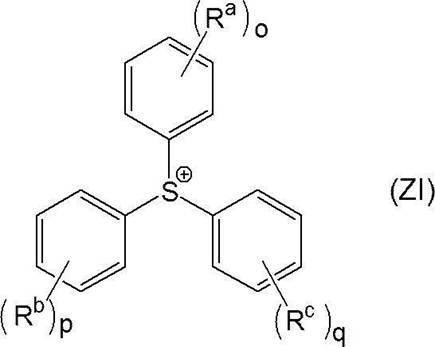
一般式(ZI)中、Ra、Rb、及びRcは、各々独立に、置換基を表す。o及びpは、各々独立に0~5の整数を表す。qは、1~5の整数を表す。oが2以上の場合には、複数のRaは互いに同一でも異なっていてもよく、また、少なくとも2つのRaは互いに結合して環を形成してもよい。pが2以上の場合には、複数のRbは互いに同一でも異なっていてもよく、また、少なくとも2つのRbは互いに結合して環を形成してもよい。qが2以上の場合には、複数のRcは互いに同一でも異なっていてもよく、また、少なくとも2つのRcは互いに結合して環を形成してもよい。また、RaとRb、RbとRc、及びRaとRcは、各々互いに結合して環を形成していてもよい。
Ra、Rb、及びRcで表される置換基としては、LUMO準位をより低くできる点、並びに、EUV及び電子線に対する吸収効率により優れる点で、ハロゲン原子(好ましくはフッ素原子、又はヨウ素原子であり、より好ましくはフッ素原子である。)、アルキル基(好ましくは炭素数1~10であり、より好ましくは炭素数が1~6である。)、フッ素原子等のハロゲン原子で置換されたアルキル基(好ましくは炭素数1~10であり、より好ましくは炭素数が1~6である。また、パーフルオロアルキル基であることが好ましい。)、アルキルスルホニル基(好ましくは炭素数1~10であり、より好ましくは炭素数が1~6である。)、シクロアルキルスルホニル基(好ましくは炭素数1~10であり、より好ましくは炭素数が1~6である。)、及びアルコキシ基(好ましくは炭素数1~10であり、より好ましくは炭素数が1~6である。)等が挙げられる。
上記置換基としては、なかでもEUV及び電子線に対する吸収効率により優れる点で、ハロゲン原子(好ましくはフッ素原子、又はヨウ素原子であり、より好ましくはフッ素原子である。)、又はフッ素原子等のハロゲン原子で置換されたアルキル基(好ましくは炭素数1~10であり、より好ましくは炭素数が1~6である。また、パーフルオロアルキル基であることが好ましい。)が好ましく、フッ素原子等のハロゲン原子で置換されたアルキル基(好ましくは炭素数1~10であり、より好ましくは炭素数が1~6である。また、パーフルオロアルキル基であることが好ましい。)がより好ましい。
上記置換基としては、なかでもEUV及び電子線に対する吸収効率により優れる点で、ハロゲン原子(好ましくはフッ素原子、又はヨウ素原子であり、より好ましくはフッ素原子である。)、又はフッ素原子等のハロゲン原子で置換されたアルキル基(好ましくは炭素数1~10であり、より好ましくは炭素数が1~6である。また、パーフルオロアルキル基であることが好ましい。)が好ましく、フッ素原子等のハロゲン原子で置換されたアルキル基(好ましくは炭素数1~10であり、より好ましくは炭素数が1~6である。また、パーフルオロアルキル基であることが好ましい。)がより好ましい。
一般式(ZI)は、LUMO準位をより低くできる点で、置換基を少なくとも一つ含むトリフェニルスルホニウムカチオンであることが好ましい。つまり、一般式(ZI)中、上記qは、1~5の整数を表し、上記o及び上記pは、各々独立に、0~5の整数を表す。
また、一般式(ZI)中、置換基の少なくとも一つは、LUMO準位をより低くできる点、及びEUV及び電子線に対する吸収効率により優れる点で、フッ素原子を含む置換基であることが好ましい。つまり、一般式(ZI)中、Rcで表される置換基のうち少なくとも1つが、フッ素原子を含む置換基であることが好ましい(つまり、一般式(ZI)中、qが1である場合、Rcで表される置換基はフッ素原子を含む置換基を表し、qが2以上である場合、Rcで表される置換基は、少なくとも1つがフッ素原子を含む置換基を表す意図である)。フッ素原子を含む置換基としては、フッ素原子、又はフッ素原子で置換されたアルキル基(好ましくは炭素数1~10であり、より好ましくは炭素数が1~6である。また、パーフルオロアルキル基であることが好ましい。)が好ましい。
上記qは、LUMO準位をより低くできる点で、1~3が好ましい。
上記o、及び上記pは、LUMO準位をより低くできる点で、各々独立に、0~3が好ましく、1~3がより好ましい。
また、一般式(ZI)中、置換基の少なくとも一つは、LUMO準位をより低くできる点、及びEUV及び電子線に対する吸収効率により優れる点で、フッ素原子を含む置換基であることが好ましい。つまり、一般式(ZI)中、Rcで表される置換基のうち少なくとも1つが、フッ素原子を含む置換基であることが好ましい(つまり、一般式(ZI)中、qが1である場合、Rcで表される置換基はフッ素原子を含む置換基を表し、qが2以上である場合、Rcで表される置換基は、少なくとも1つがフッ素原子を含む置換基を表す意図である)。フッ素原子を含む置換基としては、フッ素原子、又はフッ素原子で置換されたアルキル基(好ましくは炭素数1~10であり、より好ましくは炭素数が1~6である。また、パーフルオロアルキル基であることが好ましい。)が好ましい。
上記qは、LUMO準位をより低くできる点で、1~3が好ましい。
上記o、及び上記pは、LUMO準位をより低くできる点で、各々独立に、0~3が好ましく、1~3がより好ましい。
なお、oが2以上場合には、複数のRaは互いに同一でも異なっていてもよく、また、少なくとも2つのRaは互いに結合して環を形成してもよい。
また、pが2以上の場合には、複数のRbは互いに同一でも異なっていてもよく、また、少なくとも2つのRbは互いに結合して環を形成してもよい。
また、qが2以上の場合には、複数のRcは互いに同一でも異なっていてもよく、また、少なくとも2つのRcは互いに結合して環を形成してもよい。
また、pが2以上の場合には、複数のRbは互いに同一でも異なっていてもよく、また、少なくとも2つのRbは互いに結合して環を形成してもよい。
また、qが2以上の場合には、複数のRcは互いに同一でも異なっていてもよく、また、少なくとも2つのRcは互いに結合して環を形成してもよい。
上記一般式(ZI)で表されるカチオンとしては、LUMO準位をより低くできる点、及びEUV及び電子線に対する吸収効率により優れる点で、下記一般式(ZII)で表されるカチオンがより好ましい。

上記一般式(ZII)中、Raは、上記一般式(ZII)中のRaと同義であり、好適態様も同じである。
上記一般式(ZII)中、Rb1、Rb2、Rc1及びRc2は、各々独立に、フッ素原子を含む置換基である。フッ素原子を含む置換基としては、上述のとおりである。
上記一般式(ZII)中、oは1~3の整数を表す。
上記一般式(ZII)中、Rb1、Rb2、Rc1及びRc2は、各々独立に、フッ素原子を含む置換基である。フッ素原子を含む置換基としては、上述のとおりである。
上記一般式(ZII)中、oは1~3の整数を表す。
以下、上記一般式(ZI)で表されるカチオンの具体例を例示するが、本発明はこれに制限されない。なお、本明細書中、「Me」は、メチル基を表す。


≪アニオン部≫
酸発生剤Aは、非求核性アニオン(求核反応を起こす能力が著しく低いアニオン)を含むことが好ましい。
非求核性アニオンとしては、例えば、スルホン酸アニオン(脂肪族スルホン酸アニオン、芳香族スルホン酸アニオン、及びカンファースルホン酸アニオン等)、カルボン酸アニオン(脂肪族カルボン酸アニオン、芳香族カルボン酸アニオン、及びアラルキルカルボン酸アニオン等)、スルホニルイミドアニオン、ビス(アルキルスルホニル)イミドアニオン、及びトリス(アルキルスルホニル)メチドアニオン等が挙げられる。
酸発生剤Aは、非求核性アニオン(求核反応を起こす能力が著しく低いアニオン)を含むことが好ましい。
非求核性アニオンとしては、例えば、スルホン酸アニオン(脂肪族スルホン酸アニオン、芳香族スルホン酸アニオン、及びカンファースルホン酸アニオン等)、カルボン酸アニオン(脂肪族カルボン酸アニオン、芳香族カルボン酸アニオン、及びアラルキルカルボン酸アニオン等)、スルホニルイミドアニオン、ビス(アルキルスルホニル)イミドアニオン、及びトリス(アルキルスルホニル)メチドアニオン等が挙げられる。
脂肪族スルホン酸アニオン及び脂肪族カルボン酸アニオンにおける脂肪族部位は、アルキル基であってもシクロアルキル基であってもよく、炭素数1~30の直鎖状又は分岐鎖状のアルキル基、又は炭素数3~30のシクロアルキル基が好ましい。
芳香族スルホン酸アニオン及び芳香族カルボン酸アニオンにおけるアリール基としては、炭素数6~14のアリール基が好ましく、例えば、フェニル基、トリル基、及びナフチル基が挙げられる。
上記で挙げたアルキル基、シクロアルキル基、及びアリール基は、置換基を有していてもよい。置換基としては特に制限されず、具体的には、ニトロ基、フッ素原子等のハロゲン原子、カルボキシ基、水酸基、アミノ基、シアノ基、アルコキシ基(好ましくは炭素数1~15)、アルキル基(好ましくは炭素数1~10)、シクロアルキル基(好ましくは炭素数3~15)、アリール基(好ましくは炭素数6~14)、アルコキシカルボニル基(好ましくは炭素数2~7)、アシル基(好ましくは炭素数2~12)、アルコキシカルボニルオキシ基(好ましくは炭素数2~7)、アルキルチオ基(好ましくは炭素数1~15)、アルキルスルホニル基(好ましくは炭素数1~15)、アルキルイミノスルホニル基(好ましくは炭素数1~15)、及びアリールオキシスルホニル基(好ましくは炭素数6~20)等が挙げられる。
アラルキルカルボン酸アニオンにおけるアラルキル基としては、炭素数7~14のアラルキル基が好ましく、例えば、ベンジル基、フェネチル基、ナフチルメチル基、ナフチルエチル基、及びナフチルブチル基が挙げられる。
スルホニルイミドアニオンとしては、例えば、サッカリンアニオンが挙げられる。
ビス(アルキルスルホニル)イミドアニオン、及びトリス(アルキルスルホニル)メチドアニオンにおけるアルキル基としては、炭素数1~5のアルキル基が好ましい。これらのアルキル基の置換基としては、ハロゲン原子、ハロゲン原子で置換されたアルキル基、アルコキシ基、アルキルチオ基、アルキルオキシスルホニル基、アリールオキシスルホニル基、及びシクロアルキルアリールオキシスルホニル基が挙げられ、フッ素原子又はフッ素原子で置換されたアルキル基が好ましい。
また、ビス(アルキルスルホニル)イミドアニオンにおけるアルキル基は、互いに結合して環構造を形成してもよい。これにより、酸強度が増加する。
また、ビス(アルキルスルホニル)イミドアニオンにおけるアルキル基は、互いに結合して環構造を形成してもよい。これにより、酸強度が増加する。
その他の非求核性アニオンとしては、例えば、フッ素化燐(例えば、PF6
-)、フッ素化ホウ素(例えば、BF4
-)、及びフッ素化アンチモン(例えば、SbF6
-)が挙げられる。
酸強度の観点からは、発生酸のpKaが2.0以下であることが、感度向上のために好ましい。なお、発生酸のpKaの下限値は特に制限されず、例えば、-20程度である。発生酸のpKaは、後述する方法により測定することができる。
また、非求核性アニオンとしては、以下の一般式(SA1)で表されるアニオンも好ましい。

一般式(SA1)中、
Arは、アリール基を表し、スルホン酸アニオン及び-(D-B)基以外の置換基を更に有していてもよい。更に有してもよい置換基としては、フッ素原子及び水酸基等が挙げられる。
Arは、アリール基を表し、スルホン酸アニオン及び-(D-B)基以外の置換基を更に有していてもよい。更に有してもよい置換基としては、フッ素原子及び水酸基等が挙げられる。
nは、0以上の整数を表す。nとしては、1~4が好ましく、2~3がより好ましく、3が更に好ましい。
Dは、単結合又は2価の連結基を表す。2価の連結基としては、エーテル基、チオエーテル基、カルボニル基、スルホキシド基、スルホン酸基、スルホン酸エステル基、エステル基、及び、これらの2種以上の組み合わせからなる基等が挙げられる。
Bは、炭化水素基を表す。炭化水素基としては、脂肪族炭化水素基及び芳香族炭化水素基が挙げられる。なかでも、脂肪族炭化水素基が好ましく、環状脂肪族炭化水素基がより好ましい。
D-B基としては、Dは単結合であり、かつ、Bは脂肪族炭化水素である基が好ましい。Bは、イソプロピル基又はシクロヘキシル基が好ましい。
D-B基としては、Dは単結合であり、かつ、Bは脂肪族炭化水素である基が好ましい。Bは、イソプロピル基又はシクロヘキシル基が好ましい。
また、非求核性アニオンとしては、以下の一般式(AN1)で表されるアニオンも好ましい。

式中、
Xfは、各々独立に、フッ素原子、又は少なくとも1つのフッ素原子で置換されたアルキル基を表す。
R1及びR2は、各々独立に、水素原子、フッ素原子、又はアルキル基を表し、複数存在する場合のR1及びR2は、それぞれ同一でも異なっていてもよい。
Lは、二価の連結基を表し、複数存在する場合のLは同一でも異なっていてもよい。
Aは、環状の有機基を表す。
xは1~20の整数を表し、yは0~10の整数を表し、zは0~10の整数を表す。
Xfは、各々独立に、フッ素原子、又は少なくとも1つのフッ素原子で置換されたアルキル基を表す。
R1及びR2は、各々独立に、水素原子、フッ素原子、又はアルキル基を表し、複数存在する場合のR1及びR2は、それぞれ同一でも異なっていてもよい。
Lは、二価の連結基を表し、複数存在する場合のLは同一でも異なっていてもよい。
Aは、環状の有機基を表す。
xは1~20の整数を表し、yは0~10の整数を表し、zは0~10の整数を表す。
一般式(AN1)について、更に詳細に説明する。
Xfのフッ素原子で置換されたアルキル基におけるアルキル基の炭素数は、1~10が好ましく、1~4がより好ましい。また、Xfのフッ素原子で置換されたアルキル基としては、パーフルオロアルキル基が好ましい。
Xfとしては、フッ素原子又は炭素数1~4のパーフルオロアルキル基が好ましい。Xfの具体例としては、フッ素原子、CF3、C2F5、C3F7、C4F9、CH2CF3、CH2CH2CF3、CH2C2F5、CH2CH2C2F5、CH2C3F7、CH2CH2C3F7、CH2C4F9、及びCH2CH2C4F9等が挙げられ、中でも、フッ素原子、又はCF3が好ましい。特に、双方のXfがフッ素原子であることが好ましい。
Xfのフッ素原子で置換されたアルキル基におけるアルキル基の炭素数は、1~10が好ましく、1~4がより好ましい。また、Xfのフッ素原子で置換されたアルキル基としては、パーフルオロアルキル基が好ましい。
Xfとしては、フッ素原子又は炭素数1~4のパーフルオロアルキル基が好ましい。Xfの具体例としては、フッ素原子、CF3、C2F5、C3F7、C4F9、CH2CF3、CH2CH2CF3、CH2C2F5、CH2CH2C2F5、CH2C3F7、CH2CH2C3F7、CH2C4F9、及びCH2CH2C4F9等が挙げられ、中でも、フッ素原子、又はCF3が好ましい。特に、双方のXfがフッ素原子であることが好ましい。
R1及びR2のアルキル基は、置換基(好ましくはフッ素原子)を有していてもよく、置換基中の炭素数は1~4が好ましい。置換基としては、炭素数1~4のパーフルオロアルキル基が好ましい。R1及びR2の置換基を有するアルキル基の具体例としては、CF3、C2F5、C3F7、C4F9、C5F11、C6F13、C7F15、C8F17、CH2CF3、CH2CH2CF3、CH2C2F5、CH2CH2C2F5、CH2C3F7、CH2CH2C3F7、CH2C4F9、及びCH2CH2C4F9等が挙げられ、中でも、CF3が好ましい。
R1及びR2としては、フッ素原子又はCF3が好ましい。
R1及びR2としては、フッ素原子又はCF3が好ましい。
xは1~10が好ましく、1~5がより好ましい。
yは0~4が好ましく、0がより好ましい。
zは0~5が好ましく、0~3がより好ましい。
Lの2価の連結基としては特に制限されず、-COO-、-OCO-、-CO-、-O-、-S―、-SO-、-SO2-、アルキレン基、シクロアルキレン基、アルケニレン基、及びこれらの複数が連結した連結基等が挙げられ、総炭素数12以下の連結基が好ましい。中でも、-COO-、-OCO-、-CO-、又は-O-が好ましく、-COO-、又は-OCO-がより好ましい。
yは0~4が好ましく、0がより好ましい。
zは0~5が好ましく、0~3がより好ましい。
Lの2価の連結基としては特に制限されず、-COO-、-OCO-、-CO-、-O-、-S―、-SO-、-SO2-、アルキレン基、シクロアルキレン基、アルケニレン基、及びこれらの複数が連結した連結基等が挙げられ、総炭素数12以下の連結基が好ましい。中でも、-COO-、-OCO-、-CO-、又は-O-が好ましく、-COO-、又は-OCO-がより好ましい。
Aの環状の有機基としては、環状構造を有するものであれば特に制限されず、脂環基、芳香環基、及び複素環基(芳香族性を有するものだけでなく、芳香族性を有さないものも含む)等が挙げられる。
脂環基としては、単環でも多環でもよく、シクロペンチル基、シクロヘキシル基、及びシクロオクチル基等の単環のシクロアルキル基が好ましく、その他にも、ノルボルニル基、トリシクロデカニル基、テトラシクロデカニル基、テトラシクロドデカニル基、及びアダマンチル基等の多環のシクロアルキル基が好ましい。中でも、ノルボルニル基、トリシクロデカニル基、テトラシクロデカニル基、テトラシクロドデカニル基、及びアダマンチル基等の炭素数7以上のかさ高い構造を有する脂環基が、露光後加熱工程での膜中拡散性を抑制でき、MEEF(Mask Error Enhancement Factor)向上の観点から好ましい。
芳香環基としては、ベンゼン環、ナフタレン環、フェナンスレン環、及びアントラセン環等が挙げられる。
複素環基としては、フラン環、チオフェン環、ベンゾフラン環、ベンゾチオフェン環、ジベンゾフラン環、ジベンゾチオフェン環、及びピリジン環等由来のものが挙げられる。中でも、フラン環、チオフェン環、又はピリジン環由来のものが好ましい。
脂環基としては、単環でも多環でもよく、シクロペンチル基、シクロヘキシル基、及びシクロオクチル基等の単環のシクロアルキル基が好ましく、その他にも、ノルボルニル基、トリシクロデカニル基、テトラシクロデカニル基、テトラシクロドデカニル基、及びアダマンチル基等の多環のシクロアルキル基が好ましい。中でも、ノルボルニル基、トリシクロデカニル基、テトラシクロデカニル基、テトラシクロドデカニル基、及びアダマンチル基等の炭素数7以上のかさ高い構造を有する脂環基が、露光後加熱工程での膜中拡散性を抑制でき、MEEF(Mask Error Enhancement Factor)向上の観点から好ましい。
芳香環基としては、ベンゼン環、ナフタレン環、フェナンスレン環、及びアントラセン環等が挙げられる。
複素環基としては、フラン環、チオフェン環、ベンゾフラン環、ベンゾチオフェン環、ジベンゾフラン環、ジベンゾチオフェン環、及びピリジン環等由来のものが挙げられる。中でも、フラン環、チオフェン環、又はピリジン環由来のものが好ましい。
また、環状の有機基としては、ラクトン構造も挙げられ、具体例としては、下記一般式(LC1-1)~(LC1-17)で表されるラクトン構造が挙げられる。
なお、下記一般式(LC1-1)~(LC1-17)中、置換基(Rb2)としては、炭素数1~8のアルキル基、炭素数4~7のシクロアルキル基、炭素数1~8のアルコキシ基、炭素数2~8のアルコキシカルボニル基、カルボキシ基、ハロゲン原子、水酸基、シアノ基、及び酸分解性基等が挙げられ、炭素数1~4のアルキル基、シアノ基、又は酸分解性基が好ましい。n2は、0~4の整数を表す。n2が2以上の時、複数存在する置換基(Rb2)は、同一でも異なっていてもよい。また、複数存在する置換基(Rb2)同士が結合して環を形成してもよい。
なお、下記一般式(LC1-1)~(LC1-17)中、置換基(Rb2)としては、炭素数1~8のアルキル基、炭素数4~7のシクロアルキル基、炭素数1~8のアルコキシ基、炭素数2~8のアルコキシカルボニル基、カルボキシ基、ハロゲン原子、水酸基、シアノ基、及び酸分解性基等が挙げられ、炭素数1~4のアルキル基、シアノ基、又は酸分解性基が好ましい。n2は、0~4の整数を表す。n2が2以上の時、複数存在する置換基(Rb2)は、同一でも異なっていてもよい。また、複数存在する置換基(Rb2)同士が結合して環を形成してもよい。

上記環状の有機基は、置換基を有していてもよい。上記置換基としては、アルキル基(直鎖状、分岐鎖状、及び環状のいずれであってもよく、炭素数1~12が好ましい。)、シクロアルキル基(単環、及び多環のいずれであってもよく、多環である場合スピロ環であってもよい。炭素数は3~20が好ましい。)、アリール基(炭素数6~14が好ましい。)、水酸基、アルコキシ基、エステル基、アミド基、ウレタン基、ウレイド基、チオエーテル基、スルホンアミド基、及びスルホン酸エステル基等が挙げられる。なお、環状の有機基を構成する炭素(環形成に寄与する炭素)はカルボニル炭素であってもよい。
また、酸発生剤Aとしては、露光で発生した酸の非露光部への拡散を抑制して解像性をより良好にする点においては、EUV又は電子線の照射により、体積130Å3以上の大きさの酸(より好ましくはスルホン酸)を発生する化合物が好ましい。酸発生剤としては、なかでも、体積190Å3以上の大きさの酸(より好ましくはスルホン酸)を発生する化合物がより好ましく、体積270Å3以上の大きさの酸(より好ましくはスルホン酸)を発生する化合物が更に好ましく、体積400Å3以上の大きさの酸(より好ましくはスルホン酸)を発生する化合物が特に好ましい。ただし、感度又は塗布溶剤溶解性の観点においては、上記体積は2000Å3以下が好ましく、1500Å3以下がより好ましい。なお、上記体積の値は、富士通株式会社製の「WinMOPAC」を用いて求められる。
体積の値の計算にあたっては、まず、各例に係る酸の化学構造を入力し、次に、この構造を初期構造としてMM(Molecular Mechanics)3法を用いた分子力場計算により、各酸の最安定立体配座を決定し、その後、これら最安定立体配座についてPM(Parameterized Model)3法を用いた分子軌道計算を行うことにより、各酸の「accessible volume」を計算できる。
体積の値の計算にあたっては、まず、各例に係る酸の化学構造を入力し、次に、この構造を初期構造としてMM(Molecular Mechanics)3法を用いた分子力場計算により、各酸の最安定立体配座を決定し、その後、これら最安定立体配座についてPM(Parameterized Model)3法を用いた分子軌道計算を行うことにより、各酸の「accessible volume」を計算できる。
以下に、酸発生剤Aにより発生する酸(アニオン部にプロトンが結合した酸)とその体積の具体例を示すが、本発明はこれに制限されない。なお、下記例示中に示される体積は計算値(単位Å3)である。また、1Åは1×10⁻¹⁰mである。


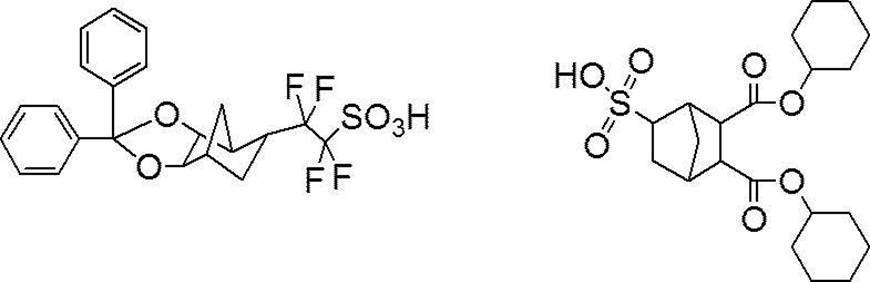
酸発生剤Aは、1種単独で使用してもよいし・BR>A2種以上を併用してもよい。
本発明の組成物中、酸発生剤Aの含有量(複数種存在する場合はその合計)は、組成物の全固形分に対して、0.1~50質量%が好ましく、5~40質量%がより好ましく、5~30質量%が更に好ましい。
本発明の組成物中、酸発生剤Aの含有量(複数種存在する場合はその合計)は、組成物の全固形分に対して、0.1~50質量%が好ましく、5~40質量%がより好ましく、5~30質量%が更に好ましい。
(酸発生剤B)
次に、酸発生剤Bについて説明する。
酸発生剤Bは、pKaが-3.0~5.0のイミド化合物を発生酸とする酸発生剤である。
なお、本明細書において、酸解離定数pKaとは、水溶液中での酸解離定数pKaのことを表し、例えば、化学便覧(II)(改訂4版、1993年、日本化学会編、丸善株式会社)に記載のものであり、この値が低いほど酸強度が大きいことを示している。水溶液中での酸解離定数pKaは、具体的には、無限希釈水溶液を用い、25℃での酸解離定数を測定することにより実測でき、また、下記ソフトウェアを用いて、ハメットの置換基定数及び公知文献値のデータベースに基づいた値を、計算により求めることもできる。本明細書中に記載したpKaの値は、全て、このソフトウェアを用いて計算により求めた値を示している。
ソフトウェア:Advanced Chemistry Development (ACD/Labs) pKa Database V8.0
次に、酸発生剤Bについて説明する。
酸発生剤Bは、pKaが-3.0~5.0のイミド化合物を発生酸とする酸発生剤である。
なお、本明細書において、酸解離定数pKaとは、水溶液中での酸解離定数pKaのことを表し、例えば、化学便覧(II)(改訂4版、1993年、日本化学会編、丸善株式会社)に記載のものであり、この値が低いほど酸強度が大きいことを示している。水溶液中での酸解離定数pKaは、具体的には、無限希釈水溶液を用い、25℃での酸解離定数を測定することにより実測でき、また、下記ソフトウェアを用いて、ハメットの置換基定数及び公知文献値のデータベースに基づいた値を、計算により求めることもできる。本明細書中に記載したpKaの値は、全て、このソフトウェアを用いて計算により求めた値を示している。
ソフトウェア:Advanced Chemistry Development (ACD/Labs) pKa Database V8.0
酸発生剤Bの発生酸はイミド化合物である。本明細書中、イミド化合物とは、下記に示す(1X-1)~(1X-3)のいずれかで表される結合基を有する化合物を意図する。なお、(1X-1)~(1X-3)中、*は結合位置を表す。
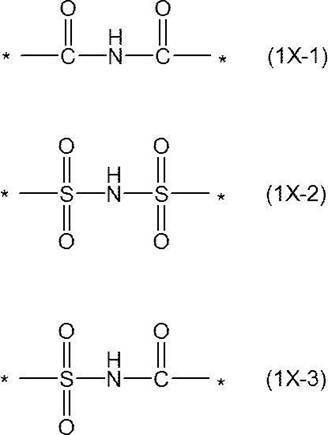
酸発生剤Bの発生酸のpKaは、-2.0~4.8が好ましい。
酸発生剤Bは低分子であることが好ましく、その分子量は、3000以下が好ましく、2000以下がより好ましく、1000以下が更に好ましい。
酸発生剤Bとしては、オニウム塩構造であることが好ましく、下記一般式(ZIII)で表される化合物、又は下記一般式(ZIV)で表される化合物が好ましい。

一般式(ZIII)中、L11は、下記に示す(2X-1)~(2X-3)のいずれかで表される結合基を表す。なお、(2X-1)~(2X-3)中、*は結合位置を表す。Rd及びReは、各々独立して、置換基を有していてもよい炭化水素基を表す。なお、Rd及びReは、互いに結合して環を形成してもよい。MB
+は、カチオンを表す。
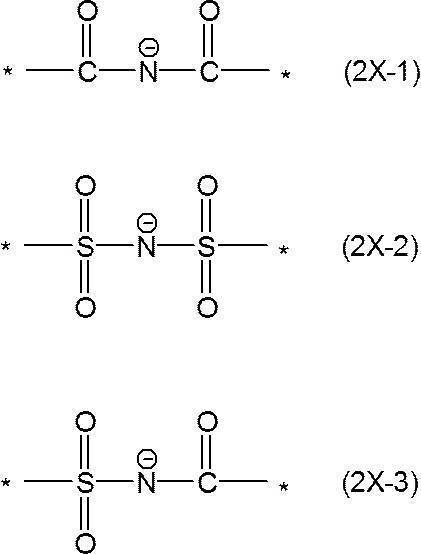
Rd及びReで表される炭化水素基としては、脂肪族炭化水素基及び芳香族炭化水素基のいずれであってもよい。
脂肪族炭化水素基としては特に制限されず、アルキル基(直鎖状、分岐鎖状、及び環状のいずれであってもよい。)が好ましい。脂肪族炭化水素基の炭素数は特に制限されず、例えば、1~15が好ましく、1~10がより好ましく、1~6が更に好ましい。
芳香族炭化水素基としては特に制限されず、その炭素数は、例えば、1~20であり、フェニル基が好ましい。
脂肪族炭化水素基としては特に制限されず、アルキル基(直鎖状、分岐鎖状、及び環状のいずれであってもよい。)が好ましい。脂肪族炭化水素基の炭素数は特に制限されず、例えば、1~15が好ましく、1~10がより好ましく、1~6が更に好ましい。
芳香族炭化水素基としては特に制限されず、その炭素数は、例えば、1~20であり、フェニル基が好ましい。
Rd及びReは、互いに結合して環を形成してもよい。上記環としては、芳香族性若しくは芳香族性を有していない炭化水素環、芳香族性若しくは芳香族性を有していない複素環、又は、これらの環が2つ以上組み合わされてなる多環縮合環が挙げられる。上記環としては、3~10員環が挙げられ、4~8員環であることが好ましく、5又は6員環であることがより好ましい。
Rd及びReで表される炭化水素基、並びに、Rd及びReが互いに結合することにより形成される環は、置換基を有していてもよい。置換基としては、例えば、ハロゲン原子(好ましくは、フッ素原子)が挙げられる。但し、pKaを所定範囲とする観点から、L11が(2X-2)で表される場合、Rd及びReで表される炭化水素基中のL11との連結位置である炭素原子は、置換基としてハロゲン原子を有さないことが好ましい。
MB
+は、カチオンを表す。
MB +としては特に制限されず、例えば、下記一般式(WI)で表されるカチオン、又は一般式(WII)で表されるカチオンが好ましい。
MB +としては特に制限されず、例えば、下記一般式(WI)で表されるカチオン、又は一般式(WII)で表されるカチオンが好ましい。

上記一般式(WI)において、
R201、R202及びR203は、各々独立に、有機基を表す。
R201、R202及びR203としての有機基の炭素数は、一般的に1~30であり、好ましくは1~20である。
また、R201~R203のうち2つが結合して環構造を形成してもよく、環内に酸素原子、硫黄原子、エステル結合、アミド結合、又はカルボニル基を含んでいてもよい。R201~R203の内の2つが結合して形成する基としては、アルキレン基(例えば、ブチレン基、ペンチレン基)及び-CH2-CH2-O-CH2-CH2-が挙げられる。
R201、R202及びR203は、各々独立に、有機基を表す。
R201、R202及びR203としての有機基の炭素数は、一般的に1~30であり、好ましくは1~20である。
また、R201~R203のうち2つが結合して環構造を形成してもよく、環内に酸素原子、硫黄原子、エステル結合、アミド結合、又はカルボニル基を含んでいてもよい。R201~R203の内の2つが結合して形成する基としては、アルキレン基(例えば、ブチレン基、ペンチレン基)及び-CH2-CH2-O-CH2-CH2-が挙げられる。
一般式(WI)で表されるカチオンとしては、後述する一般式(WI-1)で表されるカチオン、又は後述する一般式(WI-2)で表されるカチオンが好ましい。
まず、一般式(WI-1)で表されるカチオンについて説明する。
一般式(WI-1)で表されるカチオンは、上記一般式(WI)のR201~R203の少なくとも1つがアリール基であるアリールスルホニウムカチオンである。
アリールスルホニウムカチオンは、R201~R203の全てがアリール基でもよいし、R201~R203の一部がアリール基であり、残りがアルキル基又はシクロアルキル基であってもよい。
アリールスルホニウムカチオンとしては、例えば、トリアリールスルホニウムカチオン、ジアリールアルキルスルホニウムカチオン、アリールジアルキルスルホニウムカチオン、ジアリールシクロアルキルスルホニウムカチオン、及びアリールジシクロアルキルスルホニウムカチオンが挙げられる。
一般式(WI-1)で表されるカチオンは、上記一般式(WI)のR201~R203の少なくとも1つがアリール基であるアリールスルホニウムカチオンである。
アリールスルホニウムカチオンは、R201~R203の全てがアリール基でもよいし、R201~R203の一部がアリール基であり、残りがアルキル基又はシクロアルキル基であってもよい。
アリールスルホニウムカチオンとしては、例えば、トリアリールスルホニウムカチオン、ジアリールアルキルスルホニウムカチオン、アリールジアルキルスルホニウムカチオン、ジアリールシクロアルキルスルホニウムカチオン、及びアリールジシクロアルキルスルホニウムカチオンが挙げられる。
アリールスルホニウムカチオンに含まれるアリール基としては、フェニル基、又はナフチル基が好ましく、フェニル基がより好ましい。アリール基は、酸素原子、窒素原子、又は硫黄原子等を有する複素環構造を有するアリール基であってもよい。複素環構造としては、ピロール残基、フラン残基、チオフェン残基、インドール残基、ベンゾフラン残基、及びベンゾチオフェン残基等が挙げられる。なお、アリールスルホニウムカチオンが2つ以上のアリール基を有する場合、2つ以上あるアリール基は同一であっても異なっていてもよい。
アリールスルホニウムカチオンが必要に応じて有しているアルキル基又はシクロアルキル基は、炭素数1~15の直鎖状アルキル基、炭素数3~15の分岐鎖状アルキル基、又は炭素数3~15のシクロアルキル基が好ましく、例えば、メチル基、エチル基、プロピル基、n-ブチル基、sec-ブチル基、t-ブチル基、シクロプロピル基、シクロブチル基、及びシクロヘキシル基等が挙げられる。
アリールスルホニウムカチオンが必要に応じて有しているアルキル基又はシクロアルキル基は、炭素数1~15の直鎖状アルキル基、炭素数3~15の分岐鎖状アルキル基、又は炭素数3~15のシクロアルキル基が好ましく、例えば、メチル基、エチル基、プロピル基、n-ブチル基、sec-ブチル基、t-ブチル基、シクロプロピル基、シクロブチル基、及びシクロヘキシル基等が挙げられる。
R201~R203で表されるアリール基、アルキル基、及びシクロアルキル基は、各々独立に、アルキル基(例えば炭素数1~15)、シクロアルキル基(例えば炭素数3~15)、アリール基(例えば炭素数6~14)、アルコキシ基(例えば炭素数1~15)、ハロゲン原子、水酸基、又はフェニルチオ基を置換基として有してもよい。
次に、一般式(WI-2)で表されるカチオンについて説明する。
一般式(WI-2)で表されるカチオンは、一般式(WI)におけるR201~R203が、各々独立に、芳香環を有さない有機基を表すカチオンである。ここで芳香環とは、ヘテロ原子を含む芳香族環も包含する。
R201~R203としての芳香環を有さない有機基は、一般的に炭素数1~30であり、炭素数1~20が好ましい。
R201~R203は、各々独立に、アルキル基、シクロアルキル基、アリル基、又はビニル基が好ましく、直鎖状又は分岐鎖状の2-オキソアルキル基、2-オキソシクロアルキル基、又はアルコキシカルボニルメチル基がより好ましく、直鎖状又は分岐鎖状の2-オキソアルキル基が更に好ましい。
一般式(WI-2)で表されるカチオンは、一般式(WI)におけるR201~R203が、各々独立に、芳香環を有さない有機基を表すカチオンである。ここで芳香環とは、ヘテロ原子を含む芳香族環も包含する。
R201~R203としての芳香環を有さない有機基は、一般的に炭素数1~30であり、炭素数1~20が好ましい。
R201~R203は、各々独立に、アルキル基、シクロアルキル基、アリル基、又はビニル基が好ましく、直鎖状又は分岐鎖状の2-オキソアルキル基、2-オキソシクロアルキル基、又はアルコキシカルボニルメチル基がより好ましく、直鎖状又は分岐鎖状の2-オキソアルキル基が更に好ましい。
R201~R203で表されるアルキル基及びシクロアルキル基としては、炭素数1~10の直鎖状アルキル基若しくは炭素数3~10の分岐鎖状アルキル基(例えば、メチル基、エチル基、プロピル基、ブチル基、及びペンチル基)、又は炭素数3~10のシクロアルキル基(例えばシクロペンチル基、シクロヘキシル基、及びノルボルニル基)が好ましい。
R201~R203は、ハロゲン原子、アルコキシ基(例えば炭素数1~5)、水酸基、シアノ基、又はニトロ基によって更に置換されていてもよい。
R201~R203は、ハロゲン原子、アルコキシ基(例えば炭素数1~5)、水酸基、シアノ基、又はニトロ基によって更に置換されていてもよい。
次に、一般式(WII)で表されるカチオンについて説明する。
一般式(WII)中、R204、及びR205は、各々独立に、アリール基、アルキル基、又はシクロアルキル基を表す。
R204及びR205で表されるアリール基としては、フェニル基、又はナフチル基が好ましく、フェニル基がより好ましい。R204及びR205で表されるアリール基は、酸素原子、窒素原子、又は硫黄原子等を有する複素環構造を有するアリール基であってもよい。複素環構造を有するアリール基の骨格としては、例えば、ピロール、フラン、チオフェン、インドール、ベンゾフラン、及びベンゾチオフェン等が挙げられる。
R204及びR205で表されるアルキル基及びシクロアルキル基としては、炭素数1~10の直鎖状アルキル基若しくは炭素数3~10の分岐鎖状アルキル基(例えば、メチル基、エチル基、プロピル基、ブチル基、及びペンチル基)、又は、炭素数3~10のシクロアルキル基(例えばシクロペンチル基、シクロヘキシル基、及びノルボルニル基)が好ましい。
一般式(WII)中、R204、及びR205は、各々独立に、アリール基、アルキル基、又はシクロアルキル基を表す。
R204及びR205で表されるアリール基としては、フェニル基、又はナフチル基が好ましく、フェニル基がより好ましい。R204及びR205で表されるアリール基は、酸素原子、窒素原子、又は硫黄原子等を有する複素環構造を有するアリール基であってもよい。複素環構造を有するアリール基の骨格としては、例えば、ピロール、フラン、チオフェン、インドール、ベンゾフラン、及びベンゾチオフェン等が挙げられる。
R204及びR205で表されるアルキル基及びシクロアルキル基としては、炭素数1~10の直鎖状アルキル基若しくは炭素数3~10の分岐鎖状アルキル基(例えば、メチル基、エチル基、プロピル基、ブチル基、及びペンチル基)、又は、炭素数3~10のシクロアルキル基(例えばシクロペンチル基、シクロヘキシル基、及びノルボルニル基)が好ましい。
R204、及びR205で表されるアリール基、アルキル基、及びシクロアルキル基は、各々独立に、置換基を有していてもよい。R204、及びR205で表されるアリール基、アルキル基、及びシクロアルキル基が有していてもよい置換基としては、例えば、アルキル基(例えば炭素数1~15)、シクロアルキル基(例えば炭素数3~15)、アリール基(例えば炭素数6~15)、アルコキシ基(例えば炭素数1~15)、ハロゲン原子、水酸基、及びフェニルチオ基等が挙げられる。

一般式(ZIV)中、R21は、アルキル基、又は少なくとも一つのフッ素原子で置換されたアルキル基を表す。L11は、上述した一般式(ZIII)中のL11と同義である。Xfは、フッ素原子、又は少なくとも1つのフッ素原子で置換されたアルキル基を表す。L12は、2価の連結基を表す。Wは、環状構造を含む有機基を表す。sは、1~3の整数を表す。tは、0~10の整数を表す。
R21で表されるアルキル基は、置換基を有していてもよく、炭素数1~4が好ましい。R21で表される少なくとも一つのフッ素原子で置換されたアルキル基としては、炭素数1~4のパーフルオロアルキル基が好ましい。
Xfは、フッ素原子、又は少なくとも1つのフッ素原子で置換されたアルキル基を表す。このアルキル基の炭素数は、1~10が好ましく、1~4がより好ましい。また、少なくとも1つのフッ素原子で置換されたアルキル基としては、パーフルオロアルキル基が好ましく、CF3がより好ましい。
Xfは、フッ素原子又は炭素数1~4のパーフルオロアルキル基であることが好ましく、フッ素原子又はCF3であることがより好ましい。特に、双方のXfがフッ素原子であることが更に好ましい。
Xfは、フッ素原子又は炭素数1~4のパーフルオロアルキル基であることが好ましく、フッ素原子又はCF3であることがより好ましい。特に、双方のXfがフッ素原子であることが更に好ましい。
L12は、2価の連結基を表す。L12が複数存在する場合、L12は、それぞれ同一でも異なっていてもよい。
2価の連結基としては、例えば、-COO-、-OCO-、-CONH-、-NHCO-、-CO-、-O-、-S-、-SO-、-SO2-、アルキレン基(好ましくは炭素数1~6)、及び、炭素原子がヘテロ原子で置換されていてもよいシクロアルキレン基(好ましくは炭素数3~15)が挙げられる。
2価の連結基としては、例えば、-COO-、-OCO-、-CONH-、-NHCO-、-CO-、-O-、-S-、-SO-、-SO2-、アルキレン基(好ましくは炭素数1~6)、及び、炭素原子がヘテロ原子で置換されていてもよいシクロアルキレン基(好ましくは炭素数3~15)が挙げられる。
Wは、環状構造を含む有機基を表す。これらの中でも、環状の有機基であることが好ましい。
環状の有機基としては、例えば、脂環基、アリール基、及び複素環基が挙げられる。
脂環基は、単環式であってもよく、多環式であってもよい。単環式の脂環基としては、例えば、シクロペンチル基、シクロヘキシル基、及びシクロオクチル基等の単環のシクロアルキル基が挙げられる。多環式の脂環基としては、例えば、ノルボルニル基、トリシクロデカニル基、テトラシクロデカニル基、テトラシクロドデカニル基、及びアダマンチル基等の多環のシクロアルキル基が挙げられる。中でも、ノルボルニル基、トリシクロデカニル基、テトラシクロデカニル基、テトラシクロドデカニル基、及びアダマンチル基等の炭素数7以上の嵩高い構造を有する脂環基が好ましい。
環状の有機基としては、例えば、脂環基、アリール基、及び複素環基が挙げられる。
脂環基は、単環式であってもよく、多環式であってもよい。単環式の脂環基としては、例えば、シクロペンチル基、シクロヘキシル基、及びシクロオクチル基等の単環のシクロアルキル基が挙げられる。多環式の脂環基としては、例えば、ノルボルニル基、トリシクロデカニル基、テトラシクロデカニル基、テトラシクロドデカニル基、及びアダマンチル基等の多環のシクロアルキル基が挙げられる。中でも、ノルボルニル基、トリシクロデカニル基、テトラシクロデカニル基、テトラシクロドデカニル基、及びアダマンチル基等の炭素数7以上の嵩高い構造を有する脂環基が好ましい。
アリール基は、単環式であってもよく、多環式であってもよい。このアリール基としては、例えば、フェニル基、ナフチル基、フェナントリル基及びアントリル基が挙げられる。
複素環基は、単環式であってもよく、多環式であってもよい。多環式の方がより酸の拡散を抑制可能である。また、複素環基は、芳香族性を有していてもよいし、芳香族性を有していなくてもよい。芳香族性を有している複素環としては、例えば、フラン環、チオフェン環、ベンゾフラン環、ベンゾチオフェン環、ジベンゾフラン環、ジベンゾチオフェン環、及びピリジン環が挙げられる。芳香族性を有していない複素環としては、例えば、テトラヒドロピラン環、ラクトン環、スルトン環、及びデカヒドロイソキノリン環が挙げられる。
複素環基は、単環式であってもよく、多環式であってもよい。多環式の方がより酸の拡散を抑制可能である。また、複素環基は、芳香族性を有していてもよいし、芳香族性を有していなくてもよい。芳香族性を有している複素環としては、例えば、フラン環、チオフェン環、ベンゾフラン環、ベンゾチオフェン環、ジベンゾフラン環、ジベンゾチオフェン環、及びピリジン環が挙げられる。芳香族性を有していない複素環としては、例えば、テトラヒドロピラン環、ラクトン環、スルトン環、及びデカヒドロイソキノリン環が挙げられる。
上記環状の有機基は、置換基を有していてもよい。この置換基としては、例えば、アルキル基(直鎖状及び分岐鎖状のいずれであってもよく、炭素数1~12が好ましい)、シクロアルキル基(単環、多環、及び、スピロ環のいずれであってもよく、炭素数3~20が好ましい)、アリール基(炭素数6~14が好ましい)、水酸基、アルコキシ基、エステル基、アミド基、ウレタン基、ウレイド基、チオエーテル基、スルホンアミド基、及びスルホン酸エステル基が挙げられる。なお、環状の有機基を構成する炭素(環形成に寄与する炭素)はカルボニル炭素であってもよい。
sは、1~3の整数を表す。
tは、0~10の整数を表し、1~5の整数が好ましい。
tは、0~10の整数を表し、1~5の整数が好ましい。
酸発生剤Bは、1種単独で使用してもよいし、2種以上を併用してもよい。
以下、酸発生剤Bの具体例を例示するが、本発明はこれに制限されない。
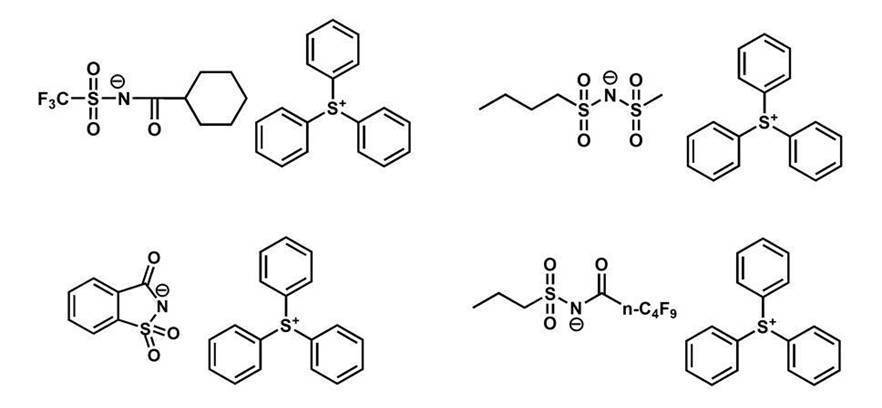

(酸発生剤C)
次に、酸発生剤Cについて説明する。
酸発生剤Cは、pKaが-3.0~3.5のカルボン酸基又はスルホン酸基含有化合物を発生酸とする酸発生剤である。
なお、酸解離定数pKaの定義については、上述のとおりである。
次に、酸発生剤Cについて説明する。
酸発生剤Cは、pKaが-3.0~3.5のカルボン酸基又はスルホン酸基含有化合物を発生酸とする酸発生剤である。
なお、酸解離定数pKaの定義については、上述のとおりである。
酸発生剤Cの発生酸のpKaは、LWRがより優れる点で、2.0~3.5が好ましい。
酸発生剤Cは低分子であることが好ましく、その分子量は、3000以下が好ましく、2000以下がより好ましく、1000以下が更に好ましい。
酸発生剤Cとしては、オニウム塩構造であることが好ましく、下記一般式(ZV)で表される化合物、又は下記一般式(ZVI)で表される化合物が好ましい。

一般式(ZV)中、Rfは、置換基として電子求引性基を少なくとも1つ有する、炭化水素基を表す。
一般式(ZVI)中、Rgは、置換基を有していてもよい炭化水素基を表す。
一般式(ZV)及び一般式(ZVI)中、MC +は、カチオンを表す。
一般式(ZVI)中、Rgは、置換基を有していてもよい炭化水素基を表す。
一般式(ZV)及び一般式(ZVI)中、MC +は、カチオンを表す。
Rfで表される炭化水素基としては、脂肪族炭化水素基及び芳香族炭化水素基のいずれであってもよい。
脂肪族炭化水素基としては特に制限されず、アルキル基(直鎖状、分岐鎖状、及び環状のいずれであってもよい。)が好ましい。脂肪族炭化水素基の炭素数は特に制限されず、例えば、1~15であり、1~10が好ましく、1~6が更に好ましい。
芳香族炭化水素基としては特に制限されず、その炭素数は、例えば、1~20であり、フェニル基が好ましい。
脂肪族炭化水素基としては特に制限されず、アルキル基(直鎖状、分岐鎖状、及び環状のいずれであってもよい。)が好ましい。脂肪族炭化水素基の炭素数は特に制限されず、例えば、1~15であり、1~10が好ましく、1~6が更に好ましい。
芳香族炭化水素基としては特に制限されず、その炭素数は、例えば、1~20であり、フェニル基が好ましい。
Rfで表される炭化水素基は、pKaを所定の範囲に調整する観点から、置換基として電子求引性基を少なくとも1つ有する。上記電子求引性基としては特に制限されず、例えば、ハロゲン原子(好ましくはフッ素原子、ヨウ素原子、又は塩素原子であり、より好ましくはフッ素原子である。)、フッ素原子等のハロゲン原子で置換されたアルキル基(好ましくは炭素数1~10であり、より好ましくは炭素数が1~6である。また、パーフルオロアルキル基であることが好ましい。)、シアノ基、ニトロ基、及びカルボニル基等が挙げられる。上記電子求引性基としては、なかでも、ハロゲン原子(好ましくはフッ素原子又は塩素原子であり、より好ましくはフッ素原子である。)、又はフッ素原子等のハロゲン原子で置換されたアルキル基(好ましくは炭素数1~10であり、より好ましくは炭素数が1~6である。また、パーフルオロアルキル基であることが好ましい。)が好ましい。
なお、Rfで表される炭化水素基は、上記電子求引性基以外の置換基を有していてもよい。上記置換基としては、水酸基、アルコキシ基、及びアミノ基等が挙げられる。
なお、Rfで表される炭化水素基は、上記電子求引性基以外の置換基を有していてもよい。上記置換基としては、水酸基、アルコキシ基、及びアミノ基等が挙げられる。
Rgで表される炭化水素基としては、脂肪族炭化水素基及び芳香族炭化水素基のいずれであってもよい。
脂肪族炭化水素基としては特に制限されず、アルキル基(直鎖状、分岐鎖状、及び環状のいずれであってもよい。)が好ましい。脂肪族炭化水素基の炭素数は特に制限されず、例えば、1~15であり、1~10が好ましい。なお、脂肪族炭化水素基の炭素数はカルボニル炭素で置換されていてもよい。
芳香族炭化水素基としては特に制限されず、その炭素数は、例えば、1~20であり、フェニル基が好ましい。
脂肪族炭化水素基としては特に制限されず、アルキル基(直鎖状、分岐鎖状、及び環状のいずれであってもよい。)が好ましい。脂肪族炭化水素基の炭素数は特に制限されず、例えば、1~15であり、1~10が好ましい。なお、脂肪族炭化水素基の炭素数はカルボニル炭素で置換されていてもよい。
芳香族炭化水素基としては特に制限されず、その炭素数は、例えば、1~20であり、フェニル基が好ましい。
Rgで表される炭化水素基は置換基を有していてもよい。置換基としては特に制限されず、例えば、上述した置換基群Tに例示される基等が挙げられる。
MC
+は、カチオンを表す。
MC +としては、上述したMB +と同義であり、好適態様も同じである。
MC +としては、上述したMB +と同義であり、好適態様も同じである。
酸発生剤Cとしては、形成されるパターンのLWRがより優れる点で、なかでも、下記一般式(ZV-1)で表される化合物がより好ましい。

一般式(ZV-1)中、Rhは置換基を表す。rは、1~5の整数を表す。rが2以上の場合には、複数のRhは互いに同一でも異なっていてもよく、また、少なくとも2つのRhは互いに結合して環を形成してもよい。但し、Rhのうち少なくとも1つは、電子求引性基である。
Rhで表される置換基としては、上述したRfが有していてもよい置換基と同義であり、好適態様も同じである。また、Rhのうち少なくとも1つは、電子求引性基である。
rは、1~5の整数を表し、1~3が好ましい。
なお、rが2以上場合には、複数のRhは互いに同一でも異なっていてもよい。
なお、MC +は、上述した通りである。
rは、1~5の整数を表し、1~3が好ましい。
なお、rが2以上場合には、複数のRhは互いに同一でも異なっていてもよい。
なお、MC +は、上述した通りである。
酸発生剤Cは、1種単独で使用してもよいし、2種以上を併用してもよい。
以下、酸発生剤Cの具体例を例示するが、本発明はこれに制限されない。


(酸発生剤B及び酸発生剤Cの含有量)
本発明の組成物中、酸発生剤B及び酸発生剤Cから選ばれる酸発生剤の含有量(複数種存在する場合はその合計)は、組成物の全固形分に対して、0.5~20質量%が好ましく、1.0~15質量%がより好ましく、2.0~10質量%が更に好ましい。
本発明の組成物中、酸発生剤B及び酸発生剤Cから選ばれる酸発生剤の含有量(複数種存在する場合はその合計)は、組成物の全固形分に対して、0.5~20質量%が好ましく、1.0~15質量%がより好ましく、2.0~10質量%が更に好ましい。
<樹脂>
本発明の組成物は、酸の作用により極性が増大する樹脂(以下、「樹脂(X)」ともいう。)を含む。
なお、樹脂(X)は、上述のとおり、酸の作用により極性が増大する樹脂である。したがって、後述する本発明のパターン形成方法において、典型的には、現像液としてアルカリ現像液を採用した場合には、ポジ型パターンが好適に形成され、現像液として有機系現像液を採用した場合には、ネガ型パターンが好適に形成される。
本発明の組成物は、酸の作用により極性が増大する樹脂(以下、「樹脂(X)」ともいう。)を含む。
なお、樹脂(X)は、上述のとおり、酸の作用により極性が増大する樹脂である。したがって、後述する本発明のパターン形成方法において、典型的には、現像液としてアルカリ現像液を採用した場合には、ポジ型パターンが好適に形成され、現像液として有機系現像液を採用した場合には、ネガ型パターンが好適に形成される。
以下、樹脂(X)が有する繰り返し単位の好適態様について詳述する。
(酸分解性基を有する繰り返し単位)
上記樹脂(X)は、酸の作用により脱離する脱離基で極性基が保護された構造を有する繰り返し単位(以下、「酸分解性繰り返し単位」ともいう。)を有することが好ましい。つまり、樹脂(X)は、酸の作用により分解して極性基を生じる基(以下「酸分解性基」ともいう。)を有する繰り返し単位を有することが好ましい。この繰り返し単位を有する樹脂は、酸の作用により極性が増大してアルカリ現像液に対する溶解度が増大し、有機溶剤に対する溶解度が減少する。
酸の作用により脱離する脱離基で極性基が保護された構造(酸分解性基)を有する繰り返し単位における極性基としては、アルカリ可溶性基が好ましく、例えば、カルボキシ基、フェノール性水酸基、フッ素化アルコール基、スルホン酸基、スルホンアミド基、スルホニルイミド基、(アルキルスルホニル)(アルキルカルボニル)メチレン基、(アルキルスルホニル)(アルキルカルボニル)イミド基、ビス(アルキルカルボニル)メチレン基、ビス(アルキルカルボニル)イミド基、ビス(アルキルスルホニル)メチレン基、ビス(アルキルスルホニル)イミド基、トリス(アルキルカルボニル)メチレン基、及び、トリス(アルキルスルホニル)メチレン基等の酸性基、並びに、アルコール性水酸基等が挙げられる。
なかでも、極性基としては、カルボキシ基、フェノール性水酸基、フッ素化アルコール基(好ましくはヘキサフルオロイソプロパノール基)、又は、スルホン酸基が好ましい。
上記樹脂(X)は、酸の作用により脱離する脱離基で極性基が保護された構造を有する繰り返し単位(以下、「酸分解性繰り返し単位」ともいう。)を有することが好ましい。つまり、樹脂(X)は、酸の作用により分解して極性基を生じる基(以下「酸分解性基」ともいう。)を有する繰り返し単位を有することが好ましい。この繰り返し単位を有する樹脂は、酸の作用により極性が増大してアルカリ現像液に対する溶解度が増大し、有機溶剤に対する溶解度が減少する。
酸の作用により脱離する脱離基で極性基が保護された構造(酸分解性基)を有する繰り返し単位における極性基としては、アルカリ可溶性基が好ましく、例えば、カルボキシ基、フェノール性水酸基、フッ素化アルコール基、スルホン酸基、スルホンアミド基、スルホニルイミド基、(アルキルスルホニル)(アルキルカルボニル)メチレン基、(アルキルスルホニル)(アルキルカルボニル)イミド基、ビス(アルキルカルボニル)メチレン基、ビス(アルキルカルボニル)イミド基、ビス(アルキルスルホニル)メチレン基、ビス(アルキルスルホニル)イミド基、トリス(アルキルカルボニル)メチレン基、及び、トリス(アルキルスルホニル)メチレン基等の酸性基、並びに、アルコール性水酸基等が挙げられる。
なかでも、極性基としては、カルボキシ基、フェノール性水酸基、フッ素化アルコール基(好ましくはヘキサフルオロイソプロパノール基)、又は、スルホン酸基が好ましい。
酸の作用により脱離する脱離基としては、例えば、式(Y1)~(Y4)で表される基が挙げられる。
式(Y1):-C(Rx1)(Rx2)(Rx3)
式(Y2):-C(=O)OC(Rx1)(Rx2)(Rx3)
式(Y3):-C(R36)(R37)(OR38)
式(Y4):-C(Rn)(H)(Ar)
式(Y1):-C(Rx1)(Rx2)(Rx3)
式(Y2):-C(=O)OC(Rx1)(Rx2)(Rx3)
式(Y3):-C(R36)(R37)(OR38)
式(Y4):-C(Rn)(H)(Ar)
式(Y1)及び式(Y2)中、Rx1~Rx3は、それぞれ独立に、アルキル基(直鎖状若しくは分岐鎖状)又はシクロアルキル基(単環若しくは多環)を表す。なお、Rx1~Rx3の全てがアルキル基である場合、Rx1~Rx3のうち少なくとも2つはメチル基であることが好ましい。
なかでも、Rx1~Rx3は、それぞれ独立に、直鎖状又は分岐鎖状のアルキル基を表すことが好ましく、Rx1~Rx3は、それぞれ独立に、直鎖状のアルキル基を表すことがより好ましい。
Rx1~Rx3の2つが結合して、単環又は多環を形成してもよい。
Rx1~Rx3のアルキル基としては、メチル基、エチル基、n-プロピル基、イソプロピル基、n-ブチル基、イソブチル基、及び、t-ブチル基等の炭素数1~4のアルキル基が好ましい。
Rx1~Rx3のシクロアルキル基としては、シクロペンチル基、及び、シクロヘキシル基等の単環のシクロアルキル基、並びに、ノルボルニル基、テトラシクロデカニル基、テトラシクロドデカニル基、及び、アダマンチル基等の多環のシクロアルキル基が好ましい。
Rx1~Rx3の2つが結合して形成されるシクロアルキル基としては、シクロペンチル基、及び、シクロヘキシル基等の単環のシクロアルキル基、並びに、ノルボルニル基、テトラシクロデカニル基、テトラシクロドデカニル基、及び、アダマンチル基等の多環のシクロアルキル基が好ましく、炭素数5~6の単環のシクロアルキル基がより好ましい。
Rx1~Rx3の2つが結合して形成されるシクロアルキル基は、例えば、環を構成するメチレン基の1つが、酸素原子等のヘテロ原子、又は、カルボニル基等のヘテロ原子を有する基で置き換わっていてもよい。
式(Y1)又は式(Y2)で表される基は、例えば、Rx1がメチル基又はエチル基であり、Rx2とRx3とが結合して上述のシクロアルキル基を形成している態様が好ましい。
なかでも、Rx1~Rx3は、それぞれ独立に、直鎖状又は分岐鎖状のアルキル基を表すことが好ましく、Rx1~Rx3は、それぞれ独立に、直鎖状のアルキル基を表すことがより好ましい。
Rx1~Rx3の2つが結合して、単環又は多環を形成してもよい。
Rx1~Rx3のアルキル基としては、メチル基、エチル基、n-プロピル基、イソプロピル基、n-ブチル基、イソブチル基、及び、t-ブチル基等の炭素数1~4のアルキル基が好ましい。
Rx1~Rx3のシクロアルキル基としては、シクロペンチル基、及び、シクロヘキシル基等の単環のシクロアルキル基、並びに、ノルボルニル基、テトラシクロデカニル基、テトラシクロドデカニル基、及び、アダマンチル基等の多環のシクロアルキル基が好ましい。
Rx1~Rx3の2つが結合して形成されるシクロアルキル基としては、シクロペンチル基、及び、シクロヘキシル基等の単環のシクロアルキル基、並びに、ノルボルニル基、テトラシクロデカニル基、テトラシクロドデカニル基、及び、アダマンチル基等の多環のシクロアルキル基が好ましく、炭素数5~6の単環のシクロアルキル基がより好ましい。
Rx1~Rx3の2つが結合して形成されるシクロアルキル基は、例えば、環を構成するメチレン基の1つが、酸素原子等のヘテロ原子、又は、カルボニル基等のヘテロ原子を有する基で置き換わっていてもよい。
式(Y1)又は式(Y2)で表される基は、例えば、Rx1がメチル基又はエチル基であり、Rx2とRx3とが結合して上述のシクロアルキル基を形成している態様が好ましい。
式(Y3)中、R36及びR37は、それぞれ独立に、水素原子又は1価の有機基を表す。R38は、1価の有機基を表す。R37とR38とは、互いに結合して環を形成してもよい。1価の有機基としては、アルキル基、シクロアルキル基、アリール基、アラルキル基、及び、アルケニル基等が挙げられる。R36は水素原子であることも好ましい。
式(Y3)としては、下記式(Y3-1)で表される基が好ましい。
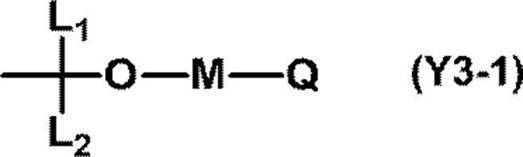
ここで、L1及びL2は、それぞれ独立に、水素原子、アルキル基、シクロアルキル基、アリール基、又は、これらを組み合わせた基(例えば、アルキル基とアリール基とを組み合わせた基)を表す。
Mは、単結合又は2価の連結基を表す。
Qは、ヘテロ原子を含んでいてもよいアルキル基、ヘテロ原子を含んでいてもよいシクロアルキル基、ヘテロ原子を含んでいてもよいアリール基、アミノ基、アンモニウム基、メルカプト基、シアノ基、アルデヒド基、又は、これらを組み合わせた基(例えば、アルキル基とシクロアルキル基とを組み合わせた基)を表す。
アルキル基及びシクロアルキル基は、例えば、メチレン基の1つが、酸素原子等のヘテロ原子、又は、カルボニル基等のヘテロ原子を有する基で置き換わっていてもよい。
なお、L1及びL2のうち一方は水素原子であり、他方はアルキル基、シクロアルキル基、アリール基、又は、アルキレン基とアリール基とを組み合わせた基であることが好ましい。
Q、M、及び、L1の少なくとも2つが結合して環(好ましくは、5員環又は6員環)を形成してもよい。
レジストパターンの微細化の点では、L2が2級又は3級アルキル基であることが好ましく、3級アルキル基であることがより好ましい。2級アルキル基としては、イソプロピル基、シクロヘキシル基及びノルボルニル基が挙げられ、3級アルキル基としては、tert-ブチル基及びアダマンタン基が挙げられる。これらの態様では、Tg(ガラス転移温度)及び活性化エネルギーが高くなるため、膜強度の担保に加え、かぶりの抑制ができる。
Mは、単結合又は2価の連結基を表す。
Qは、ヘテロ原子を含んでいてもよいアルキル基、ヘテロ原子を含んでいてもよいシクロアルキル基、ヘテロ原子を含んでいてもよいアリール基、アミノ基、アンモニウム基、メルカプト基、シアノ基、アルデヒド基、又は、これらを組み合わせた基(例えば、アルキル基とシクロアルキル基とを組み合わせた基)を表す。
アルキル基及びシクロアルキル基は、例えば、メチレン基の1つが、酸素原子等のヘテロ原子、又は、カルボニル基等のヘテロ原子を有する基で置き換わっていてもよい。
なお、L1及びL2のうち一方は水素原子であり、他方はアルキル基、シクロアルキル基、アリール基、又は、アルキレン基とアリール基とを組み合わせた基であることが好ましい。
Q、M、及び、L1の少なくとも2つが結合して環(好ましくは、5員環又は6員環)を形成してもよい。
レジストパターンの微細化の点では、L2が2級又は3級アルキル基であることが好ましく、3級アルキル基であることがより好ましい。2級アルキル基としては、イソプロピル基、シクロヘキシル基及びノルボルニル基が挙げられ、3級アルキル基としては、tert-ブチル基及びアダマンタン基が挙げられる。これらの態様では、Tg(ガラス転移温度)及び活性化エネルギーが高くなるため、膜強度の担保に加え、かぶりの抑制ができる。
式(Y4)中、Arは、芳香環基を表す。Rnは、アルキル基、シクロアルキル基又はアリール基を表す。RnとArとは互いに結合して非芳香族環を形成してもよい。Arは、アリール基が好ましい。
樹脂(X)において、酸分解性繰り返し単位の含有量(酸分解性繰り返し単位が複数存在する場合はその合計)は、樹脂(X)の全繰り返し単位に対して例えば10質量%以上であり、20質量%以上が好ましく、30質量%以上がより好ましい。また、その上限値は、例えば90質量%以下であり、70質量%以下が好ましく、60質量%以下がより好ましく、50質量%以下が更に好ましく、40質量%以下が特に好ましい。酸分解性繰り返し単位の含有量(酸分解性繰り返し単位が複数存在する場合はその合計)は、樹脂(X)の全繰り返し単位に対して、例えば、10~90質量%であり、20~70質量%が好ましく、20~60質量%がより好ましく、30~60質量%が更に好ましい。
以下において、酸分解性繰り返し単位の好適態様について詳述する。
樹脂(X)は、酸分解性繰り返し単位として、後述する繰り返し単位X1、後述する繰り返し単位X2、及び/又は後述する繰り返し単位X3を含むことが好ましい。
樹脂(X)は、酸分解性繰り返し単位として、後述する繰り返し単位X1、後述する繰り返し単位X2、及び/又は後述する繰り返し単位X3を含むことが好ましい。
≪フェノール性水酸基が酸の作用により分解して脱離する脱離基で保護された構造(酸分解性基)を有する繰り返し単位)
樹脂(X)としては特に制限されないが、酸分解性繰り返し単位として、フェノール性水酸基が酸の作用により分解して脱離する脱離基で保護された構造(酸分解性基)を有する繰り返し単位(以下、「繰り返し単位X1」ともいう。)を含むことが好ましい。なお、本明細書において、フェノール性水酸基とは、芳香族炭化水素基の水素原子をヒドロキシル基で置換してなる基である。芳香族炭化水素基の芳香環は単環又は多環の芳香環であり、ベンゼン環及びナフタレン環等が挙げられる。
樹脂(X)としては特に制限されないが、酸分解性繰り返し単位として、フェノール性水酸基が酸の作用により分解して脱離する脱離基で保護された構造(酸分解性基)を有する繰り返し単位(以下、「繰り返し単位X1」ともいう。)を含むことが好ましい。なお、本明細書において、フェノール性水酸基とは、芳香族炭化水素基の水素原子をヒドロキシル基で置換してなる基である。芳香族炭化水素基の芳香環は単環又は多環の芳香環であり、ベンゼン環及びナフタレン環等が挙げられる。
酸の作用により分解して脱離する脱離基としては、例えば、上述した式(Y1)~(Y4)で表される基が挙げられる。
繰り返し単位X1としては、フェノール性水酸基における水素原子が式(Y1)~(Y4)で表される基によって保護された構造を有するものが好ましい。
繰り返し単位X1としては、下記一般式(AII)で表される繰り返し単位が好ましい。
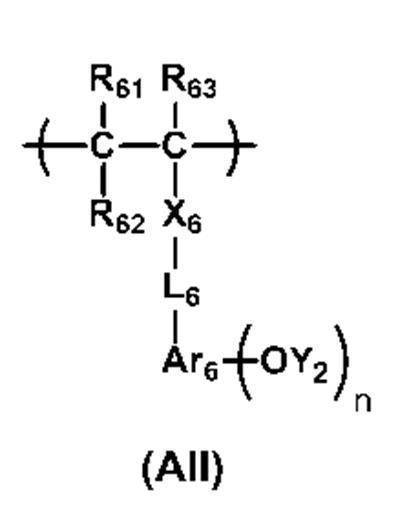
一般式(AII)中、
R61、R62及びR63は、各々独立に、水素原子、アルキル基、シクロアルキル基、ハロゲン原子、シアノ基、又はアルコキシカルボニル基を表す。但し、R62はAr6と結合して環を形成していてもよく、その場合のR62は単結合又はアルキレン基を表す。
X6は、単結合、-COO-、又は-CONR64-を表す。R64は、水素原子又はアルキル基を表す。
L6は、単結合又はアルキレン基を表す。
Ar6は、(n+1)価の芳香族炭化水素基を表し、R62と結合して環を形成する場合には(n+2)価の芳香族炭化水素基を表す。
Y2は、n≧2の場合には各々独立に、水素原子又は酸の作用により脱離する基を表す。但し、Y2の少なくとも1つは、酸の作用により脱離する基を表す。Y2としての酸の作用により脱離する基は、式(Y1)~(Y4)で表される基であることが好ましい。
nは、1~4の整数を表す。
R61、R62及びR63は、各々独立に、水素原子、アルキル基、シクロアルキル基、ハロゲン原子、シアノ基、又はアルコキシカルボニル基を表す。但し、R62はAr6と結合して環を形成していてもよく、その場合のR62は単結合又はアルキレン基を表す。
X6は、単結合、-COO-、又は-CONR64-を表す。R64は、水素原子又はアルキル基を表す。
L6は、単結合又はアルキレン基を表す。
Ar6は、(n+1)価の芳香族炭化水素基を表し、R62と結合して環を形成する場合には(n+2)価の芳香族炭化水素基を表す。
Y2は、n≧2の場合には各々独立に、水素原子又は酸の作用により脱離する基を表す。但し、Y2の少なくとも1つは、酸の作用により脱離する基を表す。Y2としての酸の作用により脱離する基は、式(Y1)~(Y4)で表される基であることが好ましい。
nは、1~4の整数を表す。
一般式(AII)におけるR61、R62及びR63で表されるアルキル基としては、置換基を有していてもよい、メチル基、エチル基、プロピル基、イソプロピル基、n-ブチル基、sec-ブチル基、ヘキシル基、2-エチルヘキシル基、オクチル基、及びドデシル基等の炭素数20以下のアルキル基が好ましく、炭素数8以下のアルキル基がより好ましく、炭素数3以下のアルキル基が更に好ましい。
一般式(AII)におけるR61、R62及びR63で表されるシクロアルキル基としては、単環でも、多環でもよい。置換基を有していてもよい、シクロプロピル基、シクロペンチル基、及びシクロヘキシル基等の炭素数3~8個で単環のシクロアルキル基が好ましい。
一般式(AII)におけるR61、R62及びR63で表されるハロゲン原子としては、フッ素原子、塩素原子、臭素原子及びヨウ素原子等が挙げられ、フッ素原子が好ましい。
一般式(AII)におけるR61、R62及びR63で表されるアルコキシカルボニル基に含まれるアルキル基としては、上記R61、R62及びR63におけるアルキル基と同様のものが好ましい。
一般式(AII)におけるR61、R62及びR63で表されるハロゲン原子としては、フッ素原子、塩素原子、臭素原子及びヨウ素原子等が挙げられ、フッ素原子が好ましい。
一般式(AII)におけるR61、R62及びR63で表されるアルコキシカルボニル基に含まれるアルキル基としては、上記R61、R62及びR63におけるアルキル基と同様のものが好ましい。
上記各基は置換基を有していてもよく、置換基としては、例えば、アルキル基(炭素数1~4)、ハロゲン原子、水酸基、アルコキシ基(炭素数1~4)、カルボキシ基、及びアルコキシカルボニル基(炭素数2~6)等が挙げられ、炭素数8以下のものが好ましい。
Ar6は、(n+1)価の芳香族炭化水素基を表す。nが1である場合における2価の芳香族炭化水素基は、置換基を有していてもよく、例えば、フェニレン基、トリレン基、ナフチレン基、及びアントラセニレン基等の炭素数6~18のアリーレン基、又は、例えば、チオフェン、フラン、ピロール、ベンゾチオフェン、ベンゾフラン、ベンゾピロール、トリアジン、イミダゾール、ベンゾイミダゾール、トリアゾール、チアジアゾール、及びチアゾール等のヘテロ環を含む芳香族炭化水素基が好ましい。
nが2以上の整数である場合における(n+1)価の芳香族炭化水素基の具体例としては、2価の芳香族炭化水素基の上記した具体例から、(n-1)個の任意の水素原子を除してなる基が好適に挙げられる。
(n+1)価の芳香族炭化水素基は、更に置換基を有していてもよい。
(n+1)価の芳香族炭化水素基は、更に置換基を有していてもよい。
上述したアルキル基、シクロアルキル基、アルコキシカルボニル基及び(n+1)価の芳香族炭化水素基が有し得る置換基としては、例えば、一般式(AII)におけるR61、R62及びR63で挙げたアルキル基;メトキシ基、エトキシ基、ヒドロキシエトキシ基、プロポキシ基、ヒドロキシプロポキシ基、及びブトキシ基等のアルコキシ基;フェニル基等のアリール基;等が挙げられる。
X6により表される-CONR64-(R64は、水素原子又はアルキル基を表す)におけるR64のアルキル基としては、置換基を有していてもよい、メチル基、エチル基、プロピル基、イソプロピル基、n-ブチル基、sec-ブチル基、ヘキシル基、2-エチルヘキシル基、オクチル基、及びドデシル基等の炭素数20以下のアルキル基が好ましく、炭素数8以下のアルキル基がより好ましい。
X6としては、単結合、-COO-、又は-CONH-が好ましく、単結合、又は-COO-がより好ましい。
X6により表される-CONR64-(R64は、水素原子又はアルキル基を表す)におけるR64のアルキル基としては、置換基を有していてもよい、メチル基、エチル基、プロピル基、イソプロピル基、n-ブチル基、sec-ブチル基、ヘキシル基、2-エチルヘキシル基、オクチル基、及びドデシル基等の炭素数20以下のアルキル基が好ましく、炭素数8以下のアルキル基がより好ましい。
X6としては、単結合、-COO-、又は-CONH-が好ましく、単結合、又は-COO-がより好ましい。
L6としてのアルキレン基としては、置換基を有していてもよい、メチレン基、エチレン基、プロピレン基、ブチレン基、ヘキシレン基、及びオクチレン基等の炭素数1~8のアルキレン基が好ましい。
Ar・BR>Uとしては、置換基を有していてもよい炭素数6~18の芳香族炭化水素基が好ましく、ベンゼン環基、ナフタレン環基、又はビフェニレン環基がより好ましい。なかでも、一般式(AII)で表される繰り返し単位は、ヒドロキシスチレンに由来する繰り返し単位であることが好ましい。即ち、Ar6は、ベンゼン環基であることが好ましい。
Ar・BR>Uとしては、置換基を有していてもよい炭素数6~18の芳香族炭化水素基が好ましく、ベンゼン環基、ナフタレン環基、又はビフェニレン環基がより好ましい。なかでも、一般式(AII)で表される繰り返し単位は、ヒドロキシスチレンに由来する繰り返し単位であることが好ましい。即ち、Ar6は、ベンゼン環基であることが好ましい。
以下に繰り返し単位X1に相当する繰り返し単位の具体例を挙げるが、本発明は、これらの具体例に制限されない。

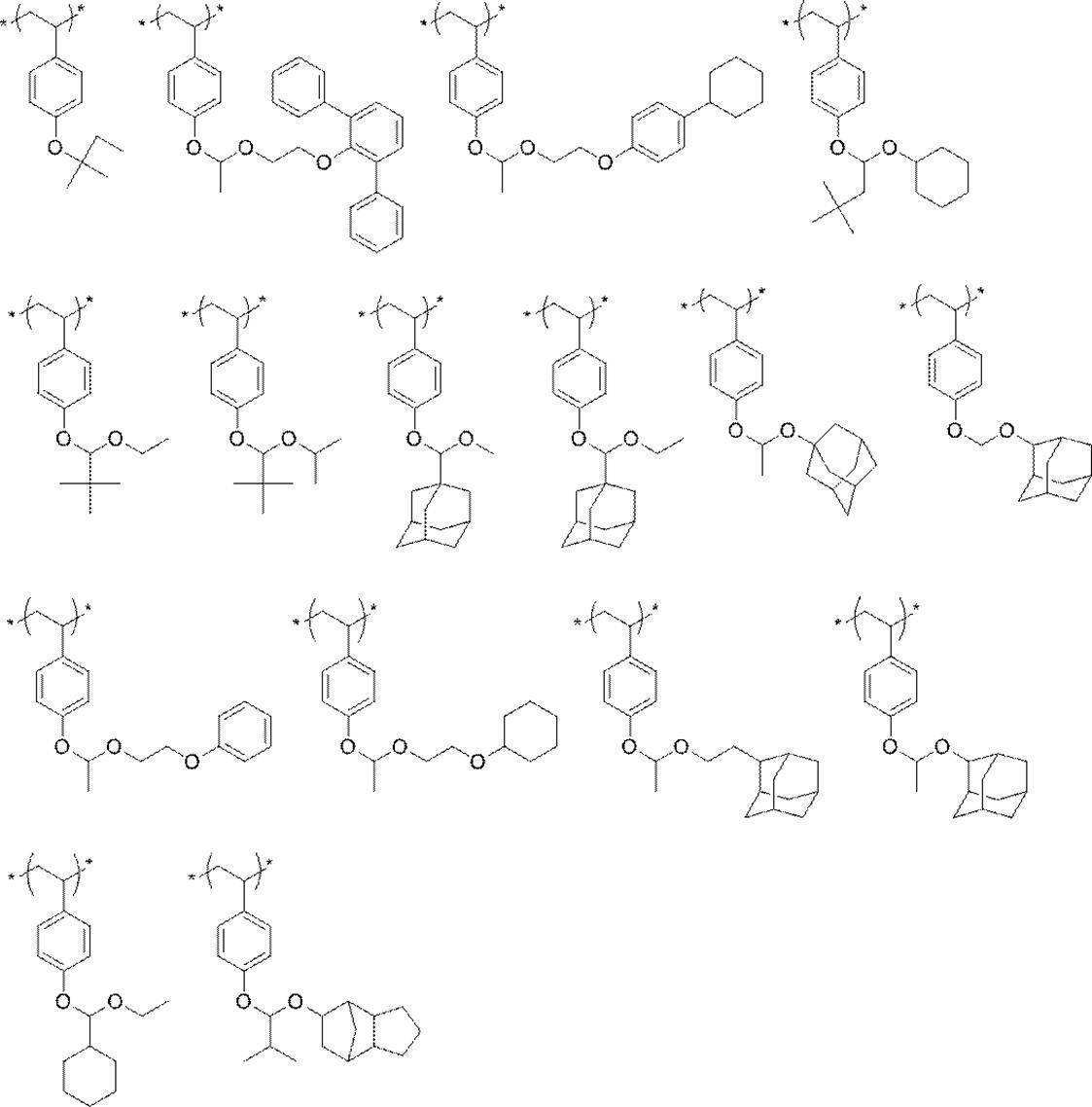
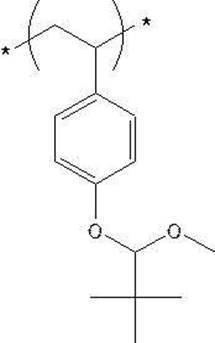
樹脂(X)は、繰り返し単位X1を、1種単独で含んでもよく、2種以上を併用して含んでもよい。
樹脂(X)において、繰り返し単位X1の含有量(繰り返し単位X1が複数存在する場合はその合計)は、樹脂(X)の全繰り返し単位に対して例えば10質量%以上であり、20質量%以上が好ましく、30質量%以上がより好ましい。また、その上限値は、例えば90質量%以下であり、70質量%以下が好ましく、60質量%以下がより好ましく、50質量%以下が更に好ましく、40質量%以下が特に好ましい。繰り返し単位X1の含有量(繰り返し単位X1が複数存在する場合はその合計)は、樹脂(X)の全繰り返し単位に対して、例えば、10~90質量%であり、20~70質量%が好ましく、20~60質量%がより好ましく、30~60質量%が更に好ましい。
≪-COOH基が脱離基で保護された構造(酸分解性基)を有する繰り返し単位≫
樹脂(X)は、酸分解性繰り返し単位として、-COOH基が脱離基で保護された構造(酸分解性基)を有する繰り返し単位X2を含んでいてもよい。
繰り返し単位X2としては、下記一般式(AI)で表される繰り返し単位が好ましい。
樹脂(X)は、酸分解性繰り返し単位として、-COOH基が脱離基で保護された構造(酸分解性基)を有する繰り返し単位X2を含んでいてもよい。
繰り返し単位X2としては、下記一般式(AI)で表される繰り返し単位が好ましい。

一般式(AI)において、
Xa1は、水素原子、ハロゲン原子、又は1価の有機基を表す。
Tは、単結合又は2価の連結基を表す。
Rx1~Rx3は、各々独立に、アルキル基又はシクロアルキル基を表す。
Rx1~Rx3のいずれか2つが結合して環構造を形成してもよく、形成しなくてもよい。
Xa1は、水素原子、ハロゲン原子、又は1価の有機基を表す。
Tは、単結合又は2価の連結基を表す。
Rx1~Rx3は、各々独立に、アルキル基又はシクロアルキル基を表す。
Rx1~Rx3のいずれか2つが結合して環構造を形成してもよく、形成しなくてもよい。
Tの2価の連結基としては、アルキレン基、アリーレン基、-COO-Rt-、及び-O-Rt-等が挙げられる。式中、Rtは、アルキレン基、シクロアルキレン基又はアリーレン基を表す。
Tは、単結合又は-COO-Rt-が好ましい。Rtは、炭素数1~5の鎖状アルキレン基が好ましく、-CH2-、-(CH2)2-、又は-(CH2)3-がより好ましい。Tは、単結合であることがより好ましい。
Tは、単結合又は-COO-Rt-が好ましい。Rtは、炭素数1~5の鎖状アルキレン基が好ましく、-CH2-、-(CH2)2-、又は-(CH2)3-がより好ましい。Tは、単結合であることがより好ましい。
Xa1は、水素原子又はアルキル基であることが好ましい。
Xa1のアルキル基は、置換基を有していてもよく、置換基としては、例えば、水酸基、及びハロゲン原子(好ましくは、フッ素原子)が挙げられる。
Xa1のアルキル基は、炭素数1~4が好ましく、メチル基、エチル基、プロピル基、ヒドロキシメチル基及びトリフルオロメチル基等が挙げられる。Xa1のアルキル基は、メチル基であることが好ましい。
Xa1のアルキル基は、置換基を有していてもよく、置換基としては、例えば、水酸基、及びハロゲン原子(好ましくは、フッ素原子)が挙げられる。
Xa1のアルキル基は、炭素数1~4が好ましく、メチル基、エチル基、プロピル基、ヒドロキシメチル基及びトリフルオロメチル基等が挙げられる。Xa1のアルキル基は、メチル基であることが好ましい。
Rx1、Rx2及びRx3のアルキル基としては、直鎖状であっても、分岐鎖状であってもよく、メチル基、エチル基、n-プロピル基、イソプロピル基、n-ブチル基、イソブチル基、又はt-ブチル基等が好ましい。アルキル基の炭素数としては、1~10が好ましく、1~5がより好ましく、1~3が更に好ましい。Rx1、Rx2及びRx3のアルキル基は、炭素間結合の一部が二重結合であってもよい。
Rx1、Rx2及びRx3のシクロアルキル基としては、シクロペンチル基、及びシクロヘキシル基等の単環のシクロアルキル基、又はノルボルニル基、テトラシクロデカニル基、テトラシクロドデカニル基、及びアダマンチル基等の多環のシクロアルキル基が好ましい。
Rx1、Rx2及びRx3のシクロアルキル基としては、シクロペンチル基、及びシクロヘキシル基等の単環のシクロアルキル基、又はノルボルニル基、テトラシクロデカニル基、テトラシクロドデカニル基、及びアダマンチル基等の多環のシクロアルキル基が好ましい。
Rx1、Rx2及びRx3の2つが結合して形成する環構造としては、シクロペンチル環、シクロヘキシル環、シクロヘプチル環、及びシクロオクタン環等の単環のシクロアルカン環、又はノルボルナン環、テトラシクロデカン環、テトラシクロドデカン環、及びアダマンタン環等の多環のシクロアルキル環が好ましい。なかでも、シクロペンチル環、シクロヘキシル環、又はアダマンタン環がより好ましい。Rx1、Rx2及びRx3の2つが結合して形成する環構造としては、下記に示す構造も好ましい。

以下に一般式(AI)で表される繰り返し単位に相当するモノマーの具体例を挙げるが、本発明は、これらの具体例に制限されない。下記の具体例は、一般式(AI)におけるXa1がメチル基である場合に相当するが、Xa1は、水素原子、ハロゲン原子、又は1価の有機基に任意に置換することができる。

樹脂(X)は、繰り返し単位X2として、米国特許出願公開2016/0070167A1号明細書の段落<0336>~<0369>に記載の繰り返し単位を有することも好ましい。
樹脂(X)は、繰り返し単位X2を1種単独で有していてもよく、2種以上を併用して有していてもよい。
樹脂(X)が繰り返し単位X2を含む場合、繰り返し単位X2の含有量(繰り返し単位X2が複数存在する場合はその合計)は、樹脂(X)中の全繰り返し単位に対して、例えば5質量%以上であり、10質量%以上が好ましい。その上限値は、例えば90質量%以下であり、60質量%以下が好ましく、50質量%以下がより好ましく、40質量%以下が更に好ましい。繰り返し単位X2の含有量(繰り返し単位X2が複数存在する場合はその合計)は、樹脂(X)中の全繰り返し単位に対して、例えば、5~90質量%であり、5~60質量%が好ましく、10~40質量%がより好ましい。
≪下記一般式(A)で表される酸分解性繰り返し単位≫
樹脂(X)としては、酸分解性繰り返し単位として、下記一般式(A)で表される酸分解性繰り返し単位(以下、「繰り返し単位X3」ともいう。)を含んでいてもよい。なお、繰り返し単位X3は、上述した繰り返し単位X1、及び繰り返し単位X2を含まない。
樹脂(X)としては、酸分解性繰り返し単位として、下記一般式(A)で表される酸分解性繰り返し単位(以下、「繰り返し単位X3」ともいう。)を含んでいてもよい。なお、繰り返し単位X3は、上述した繰り返し単位X1、及び繰り返し単位X2を含まない。

L1は、フッ素原子又はヨウ素原子を有していてもよい2価の連結基を表し、R1は水素原子、フッ素原子、ヨウ素原子、又は、フッ素原子若しくはヨウ素原子を有していてもよいアルキル基を表し、R2は酸の作用によって脱離し、フッ素原子又はヨウ素原子を有していてもよい脱離基を表す。ただし、L1、R1、及び、R2のうち少なくとも1つは、フッ素原子又はヨウ素原子を有する。
L1は、フッ素原子又はヨウ素原子を有していてもよい2価の連結基を表す。フッ素原子又はヨウ素原子を有していてもよい2価の連結基としては、-CO-、-O-、-S―、-SO-、―SO2-、フッ素原子又はヨウ素原子を有していてもよい炭化水素基(例えば、アルキレン基、シクロアルキレン基、アルケニレン基、アリーレン基等)、及び、これらの複数が連結した連結基等が挙げられる。なかでも、L1としては、-CO-、又は、-アリーレン基-フッ素原子若しくはヨウ素原子を有するアルキレン基-が好ましい。
アリーレン基としては、フェニレン基が好ましい。
アルキレン基は、直鎖状であっても、分岐鎖状であってもよい。アルキレン基の炭素数は特に制限されないが、1~10が好ましく、1~3がより好ましい。
フッ素原子又はヨウ素原子を有するアルキレン基に含まれるフッ素原子及びヨウ素原子の合計数は特に制限されず、2以上が好ましく、2~10がより好ましく、3~6が更に好ましい。
L1は、フッ素原子又はヨウ素原子を有していてもよい2価の連結基を表す。フッ素原子又はヨウ素原子を有していてもよい2価の連結基としては、-CO-、-O-、-S―、-SO-、―SO2-、フッ素原子又はヨウ素原子を有していてもよい炭化水素基(例えば、アルキレン基、シクロアルキレン基、アルケニレン基、アリーレン基等)、及び、これらの複数が連結した連結基等が挙げられる。なかでも、L1としては、-CO-、又は、-アリーレン基-フッ素原子若しくはヨウ素原子を有するアルキレン基-が好ましい。
アリーレン基としては、フェニレン基が好ましい。
アルキレン基は、直鎖状であっても、分岐鎖状であってもよい。アルキレン基の炭素数は特に制限されないが、1~10が好ましく、1~3がより好ましい。
フッ素原子又はヨウ素原子を有するアルキレン基に含まれるフッ素原子及びヨウ素原子の合計数は特に制限されず、2以上が好ましく、2~10がより好ましく、3~6が更に好ましい。
R1は、水素原子、フッ素原子、ヨウ素原子、又は、フッ素原子若しくはヨウ素原子が有していてもよいアルキル基を表す。
アルキル基は、直鎖状であっても、分岐鎖状であってもよい。アルキル基の炭素数は特に制限されず、1~10が好ましく、1~3がより好ましい。
フッ素原子又はヨウ素原子を有するアルキル基に含まれるフッ素原子及びヨウ素原子の合計数は特に制限されず、1以上が好ましく、1~5がより好ましく、1~3が更に好ましい。
アルキル基は、直鎖状であっても、分岐鎖状であってもよい。アルキル基の炭素数は特に制限されず、1~10が好ましく、1~3がより好ましい。
フッ素原子又はヨウ素原子を有するアルキル基に含まれるフッ素原子及びヨウ素原子の合計数は特に制限されず、1以上が好ましく、1~5がより好ましく、1~3が更に好ましい。
R2は、酸の作用によって脱離し、フッ素原子又はヨウ素原子を有していてもよい脱離基を表す。
なかでも、脱離基としては、式(Z1)~(Z4)で表される基が挙げられる。
式(Z1):-C(Rx11)(Rx12)(Rx13)
式(Z2):-C(=O)OC(Rx11)(Rx12)(Rx13)
式(Z3):-C(R136)(R137)(OR138)
式(Z4):-C(Rn1)(H)(Ar1)
なかでも、脱離基としては、式(Z1)~(Z4)で表される基が挙げられる。
式(Z1):-C(Rx11)(Rx12)(Rx13)
式(Z2):-C(=O)OC(Rx11)(Rx12)(Rx13)
式(Z3):-C(R136)(R137)(OR138)
式(Z4):-C(Rn1)(H)(Ar1)
式(Z1)、(Z2)中、Rx11~Rx13は、それぞれ独立に、フッ素原子若しくはヨウ素原子を有していてもよいアルキル基(直鎖状又は分岐鎖状)、又は、フッ素原子若しくはヨウ素原子を有していてもよいシクロアルキル基(単環又は多環)を表す。なお、Rx11~Rx13の全てがアルキル基(直鎖状又は分岐鎖状)である場合、Rx11~Rx13のうち少なくとも2つはメチル基であることが好ましい。
Rx11~Rx13は、フッ素原子又はヨウ素原子を有していてもよい点以外は、上述した(Y1)及び(Y2)中のRx1~Rx3と同じであり、アルキル基及びシクロアルキル基の定義及び好適範囲と同じである。
Rx11~Rx13は、フッ素原子又はヨウ素原子を有していてもよい点以外は、上述した(Y1)及び(Y2)中のRx1~Rx3と同じであり、アルキル基及びシクロアルキル基の定義及び好適範囲と同じである。
式(Z3)中、R136~R137は、それぞれ独立に、水素原子、又は、フッ素原子若しくはヨウ素原子を有していてもよい1価の有機基を表す。R138は、フッ素原子若しくはヨウ素原子を有していてもよい1価の有機基を表す。R137とR138とは、互いに結合して環を形成してもよい。フッ素原子又はヨウ素原子を有していてもよい1価の有機基としては、フッ素原子又はヨウ素原子を有していてもよいアルキル基、フッ素原子又はヨウ素原子を有していてもよいシクロアルキル基、フッ素原子又はヨウ素原子を有していてもよいアリール基、フッ素原子又はヨウ素原子を有していてもよいアラルキル基、及び、これらを組み合わせた基(例えば、アルキル基とシクロアルキル基とを組み合わせた基)が挙げられる。
なお、上記アルキル基、シクロアルキル基、アリール基、及び、アラルキル基には、フッ素原子及びヨウ素原子以外に、酸素原子等のヘテロ原子が含まれていてもよい。つまり、上記アルキル基、シクロアルキル基、アリール基、及び、アラルキル基は、例えば、メチレン基の1つが、酸素原子等のヘテロ原子、又は、カルボニル基等のヘテロ原子を有する基で置き換わっていてもよい。
なお、上記アルキル基、シクロアルキル基、アリール基、及び、アラルキル基には、フッ素原子及びヨウ素原子以外に、酸素原子等のヘテロ原子が含まれていてもよい。つまり、上記アルキル基、シクロアルキル基、アリール基、及び、アラルキル基は、例えば、メチレン基の1つが、酸素原子等のヘテロ原子、又は、カルボニル基等のヘテロ原子を有する基で置き換わっていてもよい。
式(Z3)としては、下記式(Z3-1)で表される基が好ましい。

ここで、L11及びL12は、それぞれ独立に、水素原子;フッ素原子、ヨウ素原子及び酸素原子からなる群から選択されるヘテロ原子を有していてもよいアルキル基;フッ素原子、ヨウ素原子及び酸素原子からなる群から選択されるヘテロ原子を有していてもよいシクロアルキル基;フッ素原子、ヨウ素原子及び酸素原子からなる群から選択されるヘテロ原子を有していてもよいアリール基;又は、これらを組み合わせた基(例えば、フッ素原子、ヨウ素原子及び酸素原子からなる群から選択されるヘテロ原子を有していてもよい、アルキル基とシクロアルキル基とを組み合わせた基)を表す。
M1は、単結合又は2価の連結基を表す。
Q1は、フッ素原子、ヨウ素原子及び酸素原子からなる群から選択されるヘテロ原子を有していてもよいアルキル基;フッ素原子、ヨウ素原子及び酸素原子からなる群から選択されるヘテロ原子を有していてもよいシクロアルキル基;フッ素原子、ヨウ素原子及び酸素原子からなる群から選択されるアリール基;アミノ基;アンモニウム基;メルカプト基;シアノ基;アルデヒド基;又は、これらを組み合わせた基(例えば、フッ素原子、ヨウ素原子及び酸素原子からなる群から選択されるヘテロ原子を有していてもよい、アルキル基とシクロアルキル基とを組み合わせた基)を表す。
M1は、単結合又は2価の連結基を表す。
Q1は、フッ素原子、ヨウ素原子及び酸素原子からなる群から選択されるヘテロ原子を有していてもよいアルキル基;フッ素原子、ヨウ素原子及び酸素原子からなる群から選択されるヘテロ原子を有していてもよいシクロアルキル基;フッ素原子、ヨウ素原子及び酸素原子からなる群から選択されるアリール基;アミノ基;アンモニウム基;メルカプト基;シアノ基;アルデヒド基;又は、これらを組み合わせた基(例えば、フッ素原子、ヨウ素原子及び酸素原子からなる群から選択されるヘテロ原子を有していてもよい、アルキル基とシクロアルキル基とを組み合わせた基)を表す。
式(Y4)中、Ar1は、フッ素原子又はヨウ素原子を有していてもよい芳香環基を表す。Rn1は、フッ素原子若しくはヨウ素原子を有していてもよいアルキル基、フッ素原子若しくはヨウ素原子を有していてもよいシクロアルキル基、又は、フッ素原子若しくはヨウ素原子を有していてもよいアリール基を表す。Rn1とAr1とは互いに結合して非芳香族環を形成してもよい。
一般式(A)で表される繰り返し単位としては、例えば以下のものが挙げられる。
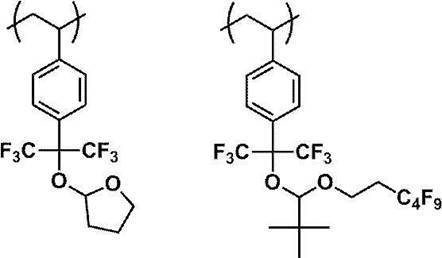
樹脂(X)が繰り返し単位X3を含む場合、繰り返し単位X3の含有量(繰り返し単位X3が複数存在する場合はその合計)は、樹脂(X)中の全繰り返し単位に対して、例えば5質量%以上であり、10質量%以上が好ましい。その上限値は、例えば90質量%以下であり、60質量%以下が好ましく、50質量%以下がより好ましく、40質量%以下が更に好ましい。繰り返し単位X3の含有量(繰り返し単位X3が複数存在する場合はその合計)は、樹脂(X)中の全繰り返し単位に対して、例えば、5~90質量%であり、5~60質量%が好ましく、10~40質量%がより好ましい。
(フェノール性水酸基を有する繰り返し単位)
樹脂(X)は、上述した酸分解性繰り返し単位(繰り返し単位X1、繰り返し単位X2、又は繰り返し単位X3)以外に、フェノール性水酸基を有する繰り返し単位X4を含むことが好ましい。なお、繰り返し単位X4は、酸分解性基を有さない。樹脂(X)は、繰り返し単位X4を含むことにより、アルカリ現像時の溶解速度により優れる。
繰り返し単位X4としては、ヒドロキシスチレン繰り返し単位、又は、アクリレート系繰り返し単位が挙げられる。繰り返し単位X4としては、なかでも、下記一般式(I)で表される繰り返し単位が好ましい。
樹脂(X)は、上述した酸分解性繰り返し単位(繰り返し単位X1、繰り返し単位X2、又は繰り返し単位X3)以外に、フェノール性水酸基を有する繰り返し単位X4を含むことが好ましい。なお、繰り返し単位X4は、酸分解性基を有さない。樹脂(X)は、繰り返し単位X4を含むことにより、アルカリ現像時の溶解速度により優れる。
繰り返し単位X4としては、ヒドロキシスチレン繰り返し単位、又は、アクリレート系繰り返し単位が挙げられる。繰り返し単位X4としては、なかでも、下記一般式(I)で表される繰り返し単位が好ましい。

式中、
R41、R42及びR43は、各々独立に、水素原子、アルキル基、シクロアルキル基、ハロゲン原子、シアノ基又はアルコキシカルボニル基を表す。但し、R42はAr4と結合して環を形成していてもよく、その場合のR42は単結合又はアルキレン基を表す。
X4は、単結合、-COO-、又は-CONR64-を表し、R64は、水素原子又はアルキル基を表す。
L4は、単結合又は2価の連結基を表す。
Ar4は、(n+1)価の芳香族炭化水素基を表し、R42と結合して環を形成する場合には(n+2)価の芳香族炭化水素基を表す。
nは、1~5の整数を表す。
一般式(I)で表される繰り返し単位を高極性化する目的では、nが2以上の整数、又はX4が-COO-、又は-CONR64-であることも好ましい。
R41、R42及びR43は、各々独立に、水素原子、アルキル基、シクロアルキル基、ハロゲン原子、シアノ基又はアルコキシカルボニル基を表す。但し、R42はAr4と結合して環を形成していてもよく、その場合のR42は単結合又はアルキレン基を表す。
X4は、単結合、-COO-、又は-CONR64-を表し、R64は、水素原子又はアルキル基を表す。
L4は、単結合又は2価の連結基を表す。
Ar4は、(n+1)価の芳香族炭化水素基を表し、R42と結合して環を形成する場合には(n+2)価の芳香族炭化水素基を表す。
nは、1~5の整数を表す。
一般式(I)で表される繰り返し単位を高極性化する目的では、nが2以上の整数、又はX4が-COO-、又は-CONR64-であることも好ましい。
一般式(I)におけるR41、R42、及びR43で表されるアルキル基としては、置換基を有していてもよい、メチル基、エチル基、プロピル基、イソプロピル基、n-ブチル基、sec-ブチル基、ヘキシル基、2-エチルヘキシル基、オクチル基、及びドデシル基等の炭素数20以下のアルキル基が好ましく、炭素数8以下のアルキル基がより好ましく、炭素数3以下のアルキル基が更に好ましい。
一般式(I)におけるR41、R42、及びR43で表されるシクロアルキル基としては、単環でも、多環でもよい。置換基を有していてもよい、シクロプロピル基、シクロペンチル基、及びシクロヘキシル基等の炭素数3~8個で単環のシクロアルキル基が好ましい。
一般式(I)におけるR41、R42、及びR43で表されるハロゲン原子としては、フッ素原子、塩素原子、臭素原子及びヨウ素原子等が挙げられ、フッ素原子が好ましい。
一般式(I)におけるR41、R42、及びR43で表されるアルコキシカルボニル基に含まれるアルキル基としては、上記R41、R42、及びR43におけるアルキル基と同様のものが好ましい。
一般式(I)におけるR41、R42、及びR43で表されるハロゲン原子としては、フッ素原子、塩素原子、臭素原子及びヨウ素原子等が挙げられ、フッ素原子が好ましい。
一般式(I)におけるR41、R42、及びR43で表されるアルコキシカルボニル基に含まれるアルキル基としては、上記R41、R42、及びR43におけるアルキル基と同様のものが好ましい。
上記各基における好ましい置換基としては、例えば、アルキル基、シクロアルキル基、アリール基、アミノ基、アミド基、ウレイド基、ウレタン基、ヒドロキシル基、カルボキシ基、ハロゲン原子、アルコキシ基、チオエーテル基、アシル基、アシロキシ基、アルコキシカルボニル基、シアノ基、及びニトロ基等が挙げられ、置換基の炭素数は8以下が好ましい。
Ar4は、(n+1)価の芳香族炭化水素基を表す。nが1である場合における2価の芳香族炭化水素基は、置換基を有していてもよく、例えば、フェニレン基、トリレン基、ナフチレン基、及びアントラセニレン基等の炭素数6~18のアリーレン基、又は、例えば、チオフェン、フラン、ピロール、ベンゾチオフェン、ベンゾフラン、ベンゾピロール、トリアジン、イミダゾール、ベンゾイミダゾール、トリアゾール、チアジアゾール、及びチアゾール等のヘテロ環を含む芳香族炭化水素基が好ましい。
nが2以上の整数である場合における(n+1)価の芳香族炭化水素基の具体例としては、2価の芳香族炭化水素基の上記した具体例から、(n-1)個の任意の水素原子を除してなる基が好適に挙げられる。
(n+1)価の芳香族炭化水素基は、更に置換基を有していてもよい。
(n+1)価の芳香族炭化水素基は、更に置換基を有していてもよい。
上述したアルキル基、シクロアルキル基、アルコキシカルボニル基及び(n+1)価の芳香族炭化水素基が有し得る置換基としては、例えば、一般式(I)におけるR41、R42、及びR43で挙げたアルキル基;メトキシ基、エトキシ基、ヒドロキシエトキシ基、プロポキシ基、ヒドロキシプロポキシ基、及びブトキシ基等のアルコキシ基;フェニル基等のアリール基;等が挙げられる。
X4により表される-CONR64-(R64は、水素原子又はアルキル基を表す)におけるR64のアルキル基としては、置換基を有していてもよい、メチル基、エチル基、プロピル基、イソプロピル基、n-ブチル基、sec-ブチル基、ヘキシル基、2-エチルヘキシル基、オクチル基、及びドデシル基等の炭素数20以下のアルキル基が好ましく、炭素数8以下のアルキル基がより好ましい。
X4としては、単結合、-COO-、又は-CONH-が好ましく、単結合、又は-COO-がより好ましい。
X4により表される-CONR64-(R64は、水素原子又はアルキル基を表す)におけるR64のアルキル基としては、置換基を有していてもよい、メチル基、エチル基、プロピル基、イソプロピル基、n-ブチル基、sec-ブチル基、ヘキシル基、2-エチルヘキシル基、オクチル基、及びドデシル基等の炭素数20以下のアルキル基が好ましく、炭素数8以下のアルキル基がより好ましい。
X4としては、単結合、-COO-、又は-CONH-が好ましく、単結合、又は-COO-がより好ましい。
L4としての2価の連結基としては、アルキレン基であることが好ましく、アルキレン基としては、置換基を有していてもよい、メチレン基、エチレン基、プロピレン基、ブチレン基、ヘキシレン基、及びオクチレン基等の炭素数1~8のアルキレン基が好ましい。
Ar4としては、置換基を有していてもよい炭素数6~18の芳香族炭化水素基が好ましく、ベンゼン環基、ナフタレン環基、又はビフェニレン環基がより好ましい。なかでも、一般式(I)で表される繰り返し単位は、ヒドロキシスチレンに由来する繰り返し単位であることが好ましい。即ち、Ar4は、ベンゼン環基であることが好ましい。
Ar4としては、置換基を有していてもよい炭素数6~18の芳香族炭化水素基が好ましく、ベンゼン環基、ナフタレン環基、又はビフェニレン環基がより好ましい。なかでも、一般式(I)で表される繰り返し単位は、ヒドロキシスチレンに由来する繰り返し単位であることが好ましい。即ち、Ar4は、ベンゼン環基であることが好ましい。
以下、繰り返し単位X4の具体例を示すが、本発明は、これに制限されない。式中、aは1又は2を表す。

樹脂(X)は、繰り返し単位X4を1種単独で有していてもよく、2種以上を併用して有していてもよい。
樹脂(X)が繰り返し単位X4を含む場合、繰り返し単位X4の含有量は、樹脂(X)中の全繰り返し単位に対して、例えば5質量%以上であり、10質量%以上が好ましい。その上限値は、例えば90質量%以下であり、60質量%以下が好ましく、50質量%以下がより好ましく、40質量%以下が更に好ましい。繰り返し単位X4の含有量(繰り返し単位X4が複数存在する場合はその合計)は、樹脂(X)中の全繰り返し単位に対して、例えば、5~90質量%が好ましく、5~60質量%がより好ましく、10~40質量%が更に好ましく、10~30質量%以下が特に好ましい。
(側鎖にラクトン構造を有する繰り返し単位)
また、樹脂(X)は、側鎖にラクトン構造を有する繰り返し単位(以下「繰り返し単位X5」ともいう。)を含んでいることが好ましい。なお、繰り返し単位X5は、上述した繰り返し単位X1、繰り返し単位X2、繰り返し単位X3、及び繰り返し単位X4を含まない。
また、樹脂(X)は、側鎖にラクトン構造を有する繰り返し単位(以下「繰り返し単位X5」ともいう。)を含んでいることが好ましい。なお、繰り返し単位X5は、上述した繰り返し単位X1、繰り返し単位X2、繰り返し単位X3、及び繰り返し単位X4を含まない。
ラクトン構造としては、5~7員環ラクトン構造が好ましい。なかでも、ビシクロ構造若しくはスピロ構造を形成する形で5~7員環ラクトン構造に他の環構造が縮環しているものがより好ましい。
樹脂(X)は、下記一般式(LC1-1)~(LC1-21)のいずれかで表されるラクトン構造を含むことが更に好ましい。好ましい構造としては、一般式(LC1-1)、一般式(LC1-4)、一般式(LC1-5)、一般式(LC1-8)、一般式(LC1-16)、若しくは一般式(LC1-21)で表されるラクトン構造が挙げられる。
樹脂(X)は、下記一般式(LC1-1)~(LC1-21)のいずれかで表されるラクトン構造を含むことが更に好ましい。好ましい構造としては、一般式(LC1-1)、一般式(LC1-4)、一般式(LC1-5)、一般式(LC1-8)、一般式(LC1-16)、若しくは一般式(LC1-21)で表されるラクトン構造が挙げられる。

ラクトン構造部分は、置換基(Rb2)を有していても、有していなくてもよい。好ましい置換基(Rb2)としては、炭素数1~8のアルキル基、炭素数4~7のシクロアルキル基、炭素数1~8のアルコキシ基、炭素数2~8のアルコキシカルボニル基、カルボキシ基、ハロゲン原子、水酸基、及びシアノ基等が挙げられる。n2は、0~4の整数を表す。n2が2以上の時、複数存在する置換基(Rb2)は、同一でも異なっていてもよい。また、複数存在する置換基(Rb2)同士が結合して環を形成してもよい。
ラクトン構造を有する繰り返し単位としては、下記一般式(III)で表される繰り返し単位が好ましい。

上記一般式(III)中、
Aは、エステル結合(-COO-で表される基)又はアミド結合(-CONH-で表される基)を表す。
nは、-R0-Z-で表される構造の繰り返し数であり、0~5の整数を表し、0又は1であることが好ましく、0であることがより好ましい。nが0である場合、-R0-Z-は存在せず、単結合となる。
R0は、アルキレン基、シクロアルキレン基、又はその組み合わせを表す。R0が複数個ある場合、R0は、各々独立に、アルキレン基、シクロアルキレン基、又はその組み合わせを表す。
Zは、単結合、エーテル結合、エステル結合、アミド結合、ウレタン結合又はウレア結合を表す。Zが複数個ある場合には、Zは、各々独立に、単結合、エーテル結合、エステル結合、アミド結合、ウレタン結合又はウレア結合を表す。
R8は、ラクトン構造を有する1価の有機基を表す。
R7は、水素原子、ハロゲン原子又は1価の有機基(好ましくはメチル基)を表す。
Aは、エステル結合(-COO-で表される基)又はアミド結合(-CONH-で表される基)を表す。
nは、-R0-Z-で表される構造の繰り返し数であり、0~5の整数を表し、0又は1であることが好ましく、0であることがより好ましい。nが0である場合、-R0-Z-は存在せず、単結合となる。
R0は、アルキレン基、シクロアルキレン基、又はその組み合わせを表す。R0が複数個ある場合、R0は、各々独立に、アルキレン基、シクロアルキレン基、又はその組み合わせを表す。
Zは、単結合、エーテル結合、エステル結合、アミド結合、ウレタン結合又はウレア結合を表す。Zが複数個ある場合には、Zは、各々独立に、単結合、エーテル結合、エステル結合、アミド結合、ウレタン結合又はウレア結合を表す。
R8は、ラクトン構造を有する1価の有機基を表す。
R7は、水素原子、ハロゲン原子又は1価の有機基(好ましくはメチル基)を表す。
R0のアルキレン基又はシクロアルキレン基は置換基を有してもよい。
Zとしては、エーテル結合、又はエステル結合が好ましく、エステル結合がより好ましい。
Zとしては、エーテル結合、又はエステル結合が好ましく、エステル結合がより好ましい。
以下に一般式(III)で表される繰り返し単位に相当するモノマーの具体例を挙げるが、本発明は、これらの具体例に制限されない。下記の具体例は、一般式(III)におけるR7がメチル基である場合に相当するが、R7は、水素原子、ハロゲン原子、又は1価の有機基に任意に置換できる。

樹脂(X)に含まれる繰り返し単位X5の含有量(繰り返し単位X5が複数存在する場合はその合計)は、樹脂(X)中の全繰り返し単位に対して、例えば5質量%以上であり、10質量%以上が好ましい。その上限値は、例えば60質量%以下が好ましく、40質量%以下がより好ましく、30質量%以下が更に好ましい。繰り返し単位X5の含有量(繰り返し単位X5が複数存在する場合はその合計)は、樹脂(X)中の全繰り返し単位に対して、例えば5~60質量%が好ましい。
(酸基を有する他の繰り返し単位)
樹脂(X)は、酸基を有する他の繰り返し単位(以下、「繰り返し単位X6」ともいう。)を含むことが好ましい。なお、繰り返し単位X6は、繰り返し単位X1、繰り返し単位X2、繰り返し単位X3、繰り返し単位X4、及び繰り返し単位X5を含まない。
繰り返し単位X6が含む酸基としては、カルボン酸基、フッ素化アルコール基、スルホン酸基、スルホンアミド基、スルホニルイミド基、(アルキルスルホニル)(アルキルカルボニル)メチレン基、(アルキルスルホニル)(アルキルカルボニル)イミド基、ビス(アルキルカルボニル)メチレン基、ビス(アルキルカルボニル)イミド基、ビス(アルキルスルホニル)メチレン基、ビス(アルキルスルホニル)イミド基、トリス(アルキルカルボニル)メチレン基、及びトリス(アルキルスルホニル)メチレン基等が挙げられる。
酸基としては、フッ素化アルコール基(ヘキサフルオロイソプロパノールが好ましい。)、スルホンイミド基、又はビス(アルキルカルボニル)メチレン基が好ましく、フッ素化アルコール基(ヘキサフルオロイソプロパノールが好ましい。)がより好ましい。
樹脂(X)は、酸基を有する他の繰り返し単位(以下、「繰り返し単位X6」ともいう。)を含むことが好ましい。なお、繰り返し単位X6は、繰り返し単位X1、繰り返し単位X2、繰り返し単位X3、繰り返し単位X4、及び繰り返し単位X5を含まない。
繰り返し単位X6が含む酸基としては、カルボン酸基、フッ素化アルコール基、スルホン酸基、スルホンアミド基、スルホニルイミド基、(アルキルスルホニル)(アルキルカルボニル)メチレン基、(アルキルスルホニル)(アルキルカルボニル)イミド基、ビス(アルキルカルボニル)メチレン基、ビス(アルキルカルボニル)イミド基、ビス(アルキルスルホニル)メチレン基、ビス(アルキルスルホニル)イミド基、トリス(アルキルカルボニル)メチレン基、及びトリス(アルキルスルホニル)メチレン基等が挙げられる。
酸基としては、フッ素化アルコール基(ヘキサフルオロイソプロパノールが好ましい。)、スルホンイミド基、又はビス(アルキルカルボニル)メチレン基が好ましく、フッ素化アルコール基(ヘキサフルオロイソプロパノールが好ましい。)がより好ましい。
繰り返し単位X6の骨格は特に制限されないが、(メタ)アクリレート系の繰り返し単位、又はスチレン系の繰り返し単位であることが好ましい。
以下に、繰り返し単位X6の具体例を挙げるが、本発明は、これらの具体例に制限されない。式中、Rxは水素原子、CH3、CF3、又は、CH2OHを表す。


樹脂(X)が繰り返し単位X6を含む場合、繰り返し単位X6の含有量は、樹脂(X)中の全繰り返し単位に対して、例えば5質量%以上であり、10質量%以上が好ましい。その上限値は、例えば90質量%以下であり、60質量%以下が好ましく、50質量%以下がより好ましく、40質量%以下が更に好ましい。繰り返し単位X6の含有量(繰り返し単位X6が複数存在する場合はその合計)は、樹脂(X)中の全繰り返し単位に対して、例えば、例えば5~90質量%であり、20~80質量%が好ましく、20~60質量%がより好ましい。
(その他の繰り返し単位)
更に、樹脂(X)は、上述した繰り返し単位以外の更に他の繰り返し単位を含んでいてもよい。
更に、樹脂(X)は、上述した繰り返し単位以外の更に他の繰り返し単位を含んでいてもよい。
樹脂(X)は、発生酸の過剰な拡散又は現像時のレジストパターン崩壊を抑制できる観点から、ガラス転移温度(Tg)が高い方が好ましい。Tgは、90℃より大きいことが好ましく、100℃より大きいことがより好ましく、110℃より大きいことが更に好ましく、125℃より大きいことが特に好ましい。なお、現像液への溶解速度が良好である点で、Tgは400℃以下が好ましく、350℃以下がより好ましい。
なお、本明細書において、樹脂(X)のガラス転移温度(Tg)は、以下の方法で算出する。まず、樹脂(X)中に含まれる各繰り返し単位のみからなるホモポリマーのTgを、Bicerano法によりそれぞれ算出する。以後、算出されたTgを、「繰り返し単位のTg」という。次に、樹脂(X)中の全繰り返し単位に対する、各繰り返し単位の質量割合(%)を算出する。次に、各繰り返し単位のTgとその繰り返し単位の質量割合との積をそれぞれ算出して、それらを総和して、樹脂(X)のTg(℃)とする。
Bicerano法はPrediction of polymer properties, Marcel Dekker Inc, New York(1993)等に記載されている。またBicerano法によるTgの算出は、ポリマーの物性概算ソフトウェアMDL Polymer(MDL Information Systems, Inc.)を用いて行うことができる。
なお、本明細書において、樹脂(X)のガラス転移温度(Tg)は、以下の方法で算出する。まず、樹脂(X)中に含まれる各繰り返し単位のみからなるホモポリマーのTgを、Bicerano法によりそれぞれ算出する。以後、算出されたTgを、「繰り返し単位のTg」という。次に、樹脂(X)中の全繰り返し単位に対する、各繰り返し単位の質量割合(%)を算出する。次に、各繰り返し単位のTgとその繰り返し単位の質量割合との積をそれぞれ算出して、それらを総和して、樹脂(X)のTg(℃)とする。
Bicerano法はPrediction of polymer properties, Marcel Dekker Inc, New York(1993)等に記載されている。またBicerano法によるTgの算出は、ポリマーの物性概算ソフトウェアMDL Polymer(MDL Information Systems, Inc.)を用いて行うことができる。
樹脂(X)のTgを90℃より大きくするには、樹脂(X)の主鎖の運動性を低下させることが好ましい。樹脂(X)の主鎖の運動性を低下させる方法は、以下の(a)~(e)の方法が挙げられる。
(a)主鎖への嵩高い置換基の導入
(b)主鎖への複数の置換基の導入
(c)主鎖近傍への樹脂(X)間の相互作用を誘発する置換基の導入
(d)環状構造での主鎖形成
(e)主鎖への環状構造の連結
なお、樹脂(X)は、ホモポリマーのTgが130℃以上を示す繰り返し単位を有することが好ましい。
なお、ホモポリマーのTgが130℃以上を示す繰り返し単位の種類は特に制限されず、Bicerano法により算出されるホモポリマーのTgが130℃以上である繰り返し単位であればよい。なお、後述する一般式(A)~一般式(E)で表される繰り返し単位中の官能基の種類によっては、ホモポリマーのTgが130℃以上を示す繰り返し単位に該当する。
(a)主鎖への嵩高い置換基の導入
(b)主鎖への複数の置換基の導入
(c)主鎖近傍への樹脂(X)間の相互作用を誘発する置換基の導入
(d)環状構造での主鎖形成
(e)主鎖への環状構造の連結
なお、樹脂(X)は、ホモポリマーのTgが130℃以上を示す繰り返し単位を有することが好ましい。
なお、ホモポリマーのTgが130℃以上を示す繰り返し単位の種類は特に制限されず、Bicerano法により算出されるホモポリマーのTgが130℃以上である繰り返し単位であればよい。なお、後述する一般式(A)~一般式(E)で表される繰り返し単位中の官能基の種類によっては、ホモポリマーのTgが130℃以上を示す繰り返し単位に該当する。
上記(a)の具体的な達成手段の一例としては、樹脂(X)に下記一般式(A)で表される繰り返し単位を導入する方法が挙げられる。

一般式(A)中、RAは、多環構造を有する基を表す。Rxは、水素原子、メチル基、又は、エチル基を表す。多環構造を有する基とは、複数の環構造を有する基であり、複数の環構造は縮合していても、縮合していなくてもよい。
一般式(A)で表される繰り返し単位の具体例としては、下記繰り返し単位が挙げられる。
一般式(A)で表される繰り返し単位の具体例としては、下記繰り返し単位が挙げられる。


上記式中、Rは、水素原子、メチル基又はエチル基を表す。
Raは、水素原子、アルキル基、シクロアルキル基、アリール基、アラルキル基、アルケニル基、水酸基、アルコキシ基、アシロキシ基、シアノ基、ニトロ基、アミノ基、ハロゲン原子、エステル基(-OCOR’’’又は-COOR’’’:R’’’は炭素数1~20のアルキル基又はフッ素化アルキル基)、又は、カルボキシ基を表す。なお、上記アルキル基、上記シクロアルキル基、上記アリール基、上記アラルキル基、及び、上記アルケニル基は、それぞれ、置換機を有してもよい。また、Raで表される基中の炭素原子に結合している水素原子は、フッ素原子又はヨウ素原子で置換されていてもよい。
また、R’及びR’’は、それぞれ独立に、アルキル基、シクロアルキル基、アリール基、アラルキル基、アルケニル基、水酸基、アルコキシ基、アシロキシ基、シアノ基、ニトロ基、アミノ基、ハロゲン原子、エステル基(-OCOR’’’又は-COOR’’’:R’’’は炭素数1~20のアルキル基又はフッ素化アルキル基)、又は、カルボキシ基を表す。なお、上記アルキル基、上記シクロアルキル基、上記アリール基、上記アラルキル基、及び、上記アルケニル基は、それぞれ、置換機を有してもよい。また、R’及びR’’で表される基中の炭素原子に結合している水素原子は、フッ素原子又はヨウ素原子で置換されていてもよい。
Lは、単結合又は2価の連結基を表す。2価の連結基としては、例えば、-COO-、-CO-、-O-、-S―、-SO-、-SO2-、アルキレン基、シクロアルキレン基、アルケニレン基、及び、これらの複数が連結した連結基等が挙げられる。
m及びnは、それぞれ独立に、0以上の整数を表す。m及びnの上限は特に制限されず、2以下の場合が多く、1以下の場合がより多い。
Raは、水素原子、アルキル基、シクロアルキル基、アリール基、アラルキル基、アルケニル基、水酸基、アルコキシ基、アシロキシ基、シアノ基、ニトロ基、アミノ基、ハロゲン原子、エステル基(-OCOR’’’又は-COOR’’’:R’’’は炭素数1~20のアルキル基又はフッ素化アルキル基)、又は、カルボキシ基を表す。なお、上記アルキル基、上記シクロアルキル基、上記アリール基、上記アラルキル基、及び、上記アルケニル基は、それぞれ、置換機を有してもよい。また、Raで表される基中の炭素原子に結合している水素原子は、フッ素原子又はヨウ素原子で置換されていてもよい。
また、R’及びR’’は、それぞれ独立に、アルキル基、シクロアルキル基、アリール基、アラルキル基、アルケニル基、水酸基、アルコキシ基、アシロキシ基、シアノ基、ニトロ基、アミノ基、ハロゲン原子、エステル基(-OCOR’’’又は-COOR’’’:R’’’は炭素数1~20のアルキル基又はフッ素化アルキル基)、又は、カルボキシ基を表す。なお、上記アルキル基、上記シクロアルキル基、上記アリール基、上記アラルキル基、及び、上記アルケニル基は、それぞれ、置換機を有してもよい。また、R’及びR’’で表される基中の炭素原子に結合している水素原子は、フッ素原子又はヨウ素原子で置換されていてもよい。
Lは、単結合又は2価の連結基を表す。2価の連結基としては、例えば、-COO-、-CO-、-O-、-S―、-SO-、-SO2-、アルキレン基、シクロアルキレン基、アルケニレン基、及び、これらの複数が連結した連結基等が挙げられる。
m及びnは、それぞれ独立に、0以上の整数を表す。m及びnの上限は特に制限されず、2以下の場合が多く、1以下の場合がより多い。
上記(b)の具体的な達成手段の一例としては、樹脂(X)に一般式(B)で表される繰り返し単位を導入する方法が挙げられる。

一般式(B)中、Rb1~Rb4は、それぞれ独立に、水素原子又は有機基を表し、Rb1~Rb4のうち少なくとも2つ以上が有機基を表す。
また、有機基の少なくとも1つが、繰り返し単位中の主鎖に直接環構造が連結している基である場合、他の有機基の種類は特に制限されない。
また、有機基のいずれも繰り返し単位中の主鎖に直接環構造が連結している基ではない場合、有機基の少なくとも2つ以上は、水素原子を除く構成原子の数が3つ以上である置換基である。
また、有機基の少なくとも1つが、繰り返し単位中の主鎖に直接環構造が連結している基である場合、他の有機基の種類は特に制限されない。
また、有機基のいずれも繰り返し単位中の主鎖に直接環構造が連結している基ではない場合、有機基の少なくとも2つ以上は、水素原子を除く構成原子の数が3つ以上である置換基である。
一般式(B)で表される繰り返し単位の具体例としては、下記繰り返し単位が挙げられる。
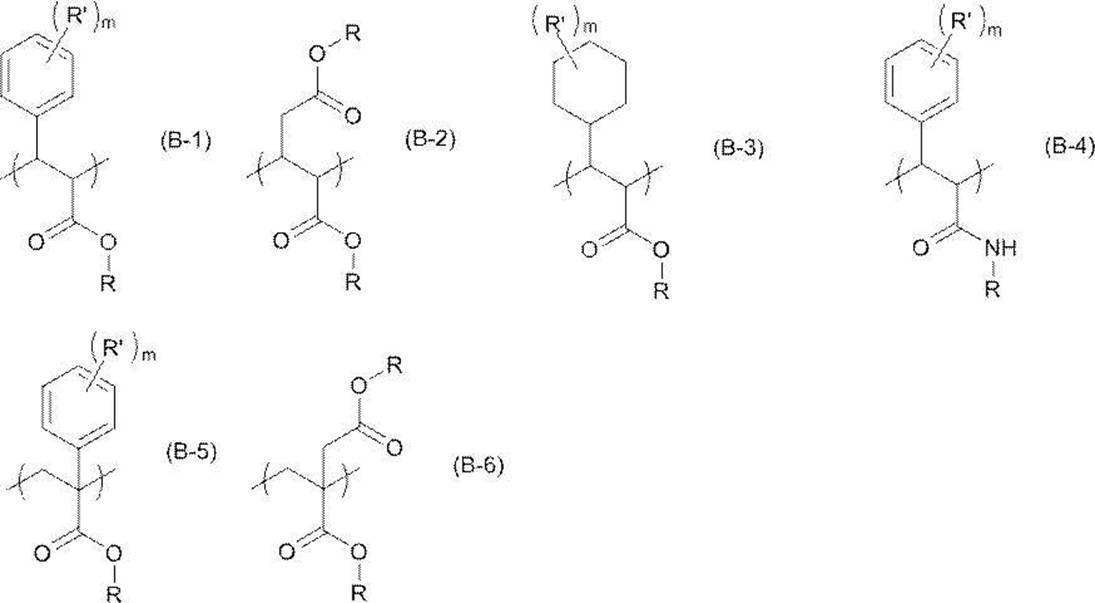
上記式中、Rは、それぞれ独立に、水素原子又は有機基を表す。有機基としては、置換機を有してもよい、アルキル基、シクロアルキル基、アリール基、アラルキル基、及び、アルケニル基、等の有機基が挙げられる。
R’は、それぞれ独立に、アルキル基、シクロアルキル基、アリール基、アラルキル基、アルケニル基、水酸基、アルコキシ基、アシロキシ基、シアノ基、ニトロ基、アミノ基、ハロゲン原子、エステル基(-OCOR’’又は-COOR’’:R’’は炭素数1~20のアルキル基又はフッ素化アルキル基)、又は、カルボキシ基を表す。なお、上記アルキル基、上記シクロアルキル基、上記アリール基、上記アラルキル基、及び、上記アルケニル基は、それぞれ、置換機を有してもよい。また、R’で表される基中の炭素原子に結合している水素原子は、フッ素原子又はヨウ素原子で置換されていてもよい。
mは0以上の整数を表す。mの上限は特に制限されず、2以下の場合が多く、1以下の場合がより多い。
R’は、それぞれ独立に、アルキル基、シクロアルキル基、アリール基、アラルキル基、アルケニル基、水酸基、アルコキシ基、アシロキシ基、シアノ基、ニトロ基、アミノ基、ハロゲン原子、エステル基(-OCOR’’又は-COOR’’:R’’は炭素数1~20のアルキル基又はフッ素化アルキル基)、又は、カルボキシ基を表す。なお、上記アルキル基、上記シクロアルキル基、上記アリール基、上記アラルキル基、及び、上記アルケニル基は、それぞれ、置換機を有してもよい。また、R’で表される基中の炭素原子に結合している水素原子は、フッ素原子又はヨウ素原子で置換されていてもよい。
mは0以上の整数を表す。mの上限は特に制限されず、2以下の場合が多く、1以下の場合がより多い。
上記(c)の具体的な達成手段の一例としては、樹脂(X)に一般式(C)で表される繰り返し単位を導入する方法が挙げられる。

一般式(C)中、Rc1~Rc4は、それぞれ独立に、水素原子又は有機基を表し、Rc1~Rc4のうち少なくとも1つが、主鎖炭素から原子数3以内に水素結合性の水素原子を有する基である。なかでも、樹脂(X)の主鎖間の相互作用を誘発するうえで、原子数2以内(より主鎖近傍側)に水素結合性の水素原子を有することが好ましい。
一般式(C)で表される繰り返し単位の具体例としては、下記繰り返し単位が挙げられる。

上記式中、Rは有機基を表す。有機基
としては、置換機を有してもよい、アルキル基、シクロアルキル基、アリール基、アラルキル基、アルケニル基、及び、エステル基(-OCOR又は-COOR:Rは炭素数1~20のアルキル基又はフッ素化アルキル基)等が挙げられる。
R’は、水素原子又は有機基を表す。有機基としては、アルキル基、シクロアルキル基、アリール基、アラルキル基、及び、アルケニル基等の有機基が挙げられる。なお、有機基中の水素原子は、フッ素原子又はヨウ素原子で置換されていてもよい。
としては、置換機を有してもよい、アルキル基、シクロアルキル基、アリール基、アラルキル基、アルケニル基、及び、エステル基(-OCOR又は-COOR:Rは炭素数1~20のアルキル基又はフッ素化アルキル基)等が挙げられる。
R’は、水素原子又は有機基を表す。有機基としては、アルキル基、シクロアルキル基、アリール基、アラルキル基、及び、アルケニル基等の有機基が挙げられる。なお、有機基中の水素原子は、フッ素原子又はヨウ素原子で置換されていてもよい。
上記(d)の具体的な達成手段の一例としては、樹脂(X)に一般式(D)で表される繰り返し単位を導入する方法が挙げられる。

一般式(D)中、「Cyclic」は、環状構造で主鎖を形成している基を表す。環の構成原子数は特に制限されない。
一般式(D)で表される繰り返し単位の具体例としては、下記繰り返し単位が挙げられる。

上記式中、Rは、それぞれ独立に、水素原子、アルキル基、シクロアルキル基、アリール基、アラルキル基、アルケニル基、水酸基、アルコキシ基、アシロキシ基、シアノ基、ニトロ基、アミノ基、ハロゲン原子、エステル基(-OCOR’’又は-COOR’’:R’’は炭素数1~20のアルキル基又はフッ素化アルキル基)、又は、カルボキシ基を表す。なお、上記アルキル基、上記シクロアルキル基、上記アリール基、上記アラルキル基、及び、上記アルケニル基は、それぞれ、置換機を有してもよい。また、Rで表される基中の炭素原子に結合している水素原子は、フッ素原子又はヨウ素原子で置換されていてもよい。
上記式中、R’は、それぞれ独立に、アルキル基、シクロアルキル基、アリール基、アラルキル基、アルケニル基、水酸基、アルコキシ基、アシロキシ基、シアノ基、ニトロ基、アミノ基、ハロゲン原子、エステル基(-OCOR’’又は-COOR’’:R’’は炭素数1~20のアルキル基又はフッ素化アルキル基)、又は、カルボキシ基を表す。なお、上記アルキル基、上記シクロアルキル基、上記アリール基、上記アラルキル基、及び、上記アルケニル基は、それぞれ、置換機を有してもよい。また、R’で表される基中の炭素原子に結合している水素原子は、フッ素原子又はヨウ素原子で置換されていてもよい。
mは0以上の整数を表す。mの上限は特に制限されず、2以下の場合が多く、1以下の場合がより多い。
上記式中、R’は、それぞれ独立に、アルキル基、シクロアルキル基、アリール基、アラルキル基、アルケニル基、水酸基、アルコキシ基、アシロキシ基、シアノ基、ニトロ基、アミノ基、ハロゲン原子、エステル基(-OCOR’’又は-COOR’’:R’’は炭素数1~20のアルキル基又はフッ素化アルキル基)、又は、カルボキシ基を表す。なお、上記アルキル基、上記シクロアルキル基、上記アリール基、上記アラルキル基、及び、上記アルケニル基は、それぞれ、置換機を有してもよい。また、R’で表される基中の炭素原子に結合している水素原子は、フッ素原子又はヨウ素原子で置換されていてもよい。
mは0以上の整数を表す。mの上限は特に制限されず、2以下の場合が多く、1以下の場合がより多い。
上記(e)の具体的な達成手段の一例としては、樹脂(X)に一般式(E)で表される繰り返し単位を導入する方法が挙げられる。

一般式(E)中、Reは、それぞれ独立に、水素原子又は有機基を表す。有機基としては、置換機を有してもよい、アルキル基、シクロアルキル基、アリール基、アラルキル基、及び、アルケニル基等が挙げられる。
「Cyclic」は、主鎖の炭素原子を含む環状基である。環状基に含まれる原子数は特に制限されない。
「Cyclic」は、主鎖の炭素原子を含む環状基である。環状基に含まれる原子数は特に制限されない。
一般式(E)で表される繰り返し単位の具体例としては、下記繰り返し単位が挙げられる。

上記式中、Rは、それぞれ独立に、水素原子、アルキル基、シクロアルキル基、アリール基、アラルキル基、アルケニル基、水酸基、アルコキシ基、アシロキシ基、シアノ基、ニトロ基、アミノ基、ハロゲン原子、エステル基(-OCOR’’又は-COOR’’:R’’は炭素数1~20のアルキル基又はフッ素化アルキル基)、又は、カルボキシ基を表す。なお、上記アルキル基、上記シクロアルキル基、上記アリール基、上記アラルキル基、及び、上記アルケニル基は、それぞれ、置換機を有してもよい。また、Rで表される基中の炭素原子に結合している水素原子は、フッ素原子又はヨウ素原子で置換されていてもよい。
R’は、それぞれ独立に、水素原子、アルキル基、シクロアルキル基、アリール基、アラルキル基、アルケニル基、水酸基、アルコキシ基、アシロキシ基、シアノ基、ニトロ基、アミノ基、ハロゲン原子、エステル基(-OCOR’’又は-COOR’’:R’’は炭素数1~20のアルキル基又はフッ素化アルキル基)、又は、カルボキシ基を表す。なお、上記アルキル基、上記シクロアルキル基、上記アリール基、上記アラルキル基、及び、上記アルケニル基は、それぞれ、置換機を有してもよい。また、R’で表される基中の炭素原子に結合している水素原子は、フッ素原子又はヨウ素原子で置換されていてもよい。
mは0以上の整数を表す。mの上限は特に制限されず、2以下の場合が多く、1以下の場合がより多い。
また、一般式(E-2)、一般式(E-4)、一般式(E-6)、及び、一般式(E-8)中、2つRは互いに結合して環を形成していてもよい。
R’は、それぞれ独立に、水素原子、アルキル基、シクロアルキル基、アリール基、アラルキル基、アルケニル基、水酸基、アルコキシ基、アシロキシ基、シアノ基、ニトロ基、アミノ基、ハロゲン原子、エステル基(-OCOR’’又は-COOR’’:R’’は炭素数1~20のアルキル基又はフッ素化アルキル基)、又は、カルボキシ基を表す。なお、上記アルキル基、上記シクロアルキル基、上記アリール基、上記アラルキル基、及び、上記アルケニル基は、それぞれ、置換機を有してもよい。また、R’で表される基中の炭素原子に結合している水素原子は、フッ素原子又はヨウ素原子で置換されていてもよい。
mは0以上の整数を表す。mの上限は特に制限されず、2以下の場合が多く、1以下の場合がより多い。
また、一般式(E-2)、一般式(E-4)、一般式(E-6)、及び、一般式(E-8)中、2つRは互いに結合して環を形成していてもよい。
樹脂(X)は、常法(例えばラジカル重合)に従って合成できる。
樹脂(X)の重量平均分子量は、2,500~30,000が好ましく、3,500~25,000がより好ましく、4,000~10,000が更に好ましく、4,000~8,000が特に好ましい。分散度(Mw/Mn)は、通常1.0~3.0であり、1.0~2.5が好ましく、1.0~2.0がより好ましく、1.0~1.8が更に好ましい。なお、樹脂(X)の重量平均分子量は、GPC(Gel Permeation Chromatography)測定により測定されたポリスチレン換算値を意図する。
樹脂(X)は、1種単独で使用してもよいし、2種以上を併用してもよい。
本発明の組成物中、樹脂(X)の含有量は、全固形分中に対して、一般的に30質量%以上の場合が多く、40質量%以上が好ましく、50質量%以上がより好ましく、60質量%以上が更に好ましい。上限は特に制限されず、95質量%以下が好ましい。
なお、樹脂(X)は、感度がより優れ、且つ、LWRがより優れる点で、ハロゲン原子を含むことが好ましい。つまり、上記樹脂(X)は、上述した繰り返し単位X1~X6がハロゲン原子を含んでいてもよいし、これらの繰り返し単位以外に、更に、ハロゲン原子を含む繰り返し単位を含んでいてもよい。ハロゲン原子としては、フッ素原子、又はヨウ素原子が好ましい。
本発明の組成物中、樹脂(X)の含有量は、全固形分中に対して、一般的に30質量%以上の場合が多く、40質量%以上が好ましく、50質量%以上がより好ましく、60質量%以上が更に好ましい。上限は特に制限されず、95質量%以下が好ましい。
なお、樹脂(X)は、感度がより優れ、且つ、LWRがより優れる点で、ハロゲン原子を含むことが好ましい。つまり、上記樹脂(X)は、上述した繰り返し単位X1~X6がハロゲン原子を含んでいてもよいし、これらの繰り返し単位以外に、更に、ハロゲン原子を含む繰り返し単位を含んでいてもよい。ハロゲン原子としては、フッ素原子、又はヨウ素原子が好ましい。
<溶剤>
本発明の組成物は、溶剤を含む。
溶剤としては、下記成分(M1)及び下記成分(M2)のいずれか一方を少なくとも含むことが好ましく、なかでも、下記成分(M1)を含むことがより好ましい。
溶剤が下記成分(M1)を含む場合、溶剤は、実質的に成分(M1)のみからなるか、又は、成分(M1)及び成分(M2)を少なくとも含む混合溶剤であることが好ましい。
本発明の組成物は、溶剤を含む。
溶剤としては、下記成分(M1)及び下記成分(M2)のいずれか一方を少なくとも含むことが好ましく、なかでも、下記成分(M1)を含むことがより好ましい。
溶剤が下記成分(M1)を含む場合、溶剤は、実質的に成分(M1)のみからなるか、又は、成分(M1)及び成分(M2)を少なくとも含む混合溶剤であることが好ましい。
以下に、成分(M1)及び成分(M2)を示す。
成分(M1):プロピレングリコールモノアルキルエーテルカルボキシレート
成分(M2):下記成分(M2-1)から選ばれる溶剤か、又は、下記成分(M2-2)から選ばれる溶剤
成分(M2-1):プロピレングリコールモノアルキルエーテル、乳酸エステル、酢酸エステル、酪酸ブチル、アルコキシプロピオン酸エステル、鎖状ケトン、環状ケトン、ラクトン、又はアルキレンカーボネート
成分(M2-2):引火点(以下、fpともいう)が37℃以上である溶剤
成分(M1):プロピレングリコールモノアルキルエーテルカルボキシレート
成分(M2):下記成分(M2-1)から選ばれる溶剤か、又は、下記成分(M2-2)から選ばれる溶剤
成分(M2-1):プロピレングリコールモノアルキルエーテル、乳酸エステル、酢酸エステル、酪酸ブチル、アルコキシプロピオン酸エステル、鎖状ケトン、環状ケトン、ラクトン、又はアルキレンカーボネート
成分(M2-2):引火点(以下、fpともいう)が37℃以上である溶剤
上記溶剤と上述した樹脂(X)とを組み合わせて用いると、組成物の塗布性が向上し、且つ、現像欠陥数の少ないパターンが得られる。その理由は必ずしも明らかではないが、上記溶剤は、上述した樹脂(X)の溶解性、沸点及び粘度のバランスが良いため、レジスト膜の膜厚のムラ及びスピンコート中の析出物の発生等を抑制できることに起因していると考えられる。
上記成分(M1)としては、プロピレングリコールモノメチルエーテルアセテート(PGMEA)、プロピレングリコールモノメチルエーテルプロピオネート、及びプロピレングリコールモノエチルエーテルアセテートからなる群より選択される少なくとも1種が好ましく、プロピレングリコールモノメチルエーテルアセテート(PGMEA)がより好ましい。
上記成分(M2-1)としては、以下のものが好ましい。
プロピレングリコールモノアルキルエーテルとしては、プロピレングリコールモノメチルエーテル(PGME)、又はプロピレングリコールモノエチルエーテルが好ましい。
乳酸エステルとしては、乳酸エチル、乳酸ブチル、又は乳酸プロピルが好ましい。
酢酸エステルとしては、酢酸メチル、酢酸エチル、酢酸ブチル、酢酸イソブチル、酢酸プロピル、酢酸イソアミル、蟻酸メチル、蟻酸エチル、蟻酸ブチル、蟻酸プロピル、又は酢酸3-メトキシブチルが好ましい。
アルコキシプロピオン酸エステルとしては、3-メトキシプロピオン酸メチル(MMP)、又は3-エトキシプロピオン酸エチル(EEP)が好ましい。
鎖状ケトンとしては、1-オクタノン、2-オクタノン、1-ノナノン、2-ノナノン、アセトン、2-ヘプタノン、4-ヘプタノン、1-ヘキサノン、2-ヘキサノン、ジイソブチルケトン、フェニルアセトン、メチルエチルケトン、メチルイソブチルケトン、アセチルアセトン、アセトニルアセトン、イオノン、ジアセトニルアルコール、アセチルカービノール、アセトフェノン、メチルナフチルケトン、又はメチルアミルケトンが好ましい。
環状ケトンとしては、メチルシクロヘキサノン、イソホロン、又はシクロヘキサノンが好ましい。
ラクトンとしては、γ-ブチロラクトンが好ましい。
アルキレンカーボネートとしては、プロピレンカーボネートが好ましい。
プロピレングリコールモノアルキルエーテルとしては、プロピレングリコールモノメチルエーテル(PGME)、又はプロピレングリコールモノエチルエーテルが好ましい。
乳酸エステルとしては、乳酸エチル、乳酸ブチル、又は乳酸プロピルが好ましい。
酢酸エステルとしては、酢酸メチル、酢酸エチル、酢酸ブチル、酢酸イソブチル、酢酸プロピル、酢酸イソアミル、蟻酸メチル、蟻酸エチル、蟻酸ブチル、蟻酸プロピル、又は酢酸3-メトキシブチルが好ましい。
アルコキシプロピオン酸エステルとしては、3-メトキシプロピオン酸メチル(MMP)、又は3-エトキシプロピオン酸エチル(EEP)が好ましい。
鎖状ケトンとしては、1-オクタノン、2-オクタノン、1-ノナノン、2-ノナノン、アセトン、2-ヘプタノン、4-ヘプタノン、1-ヘキサノン、2-ヘキサノン、ジイソブチルケトン、フェニルアセトン、メチルエチルケトン、メチルイソブチルケトン、アセチルアセトン、アセトニルアセトン、イオノン、ジアセトニルアルコール、アセチルカービノール、アセトフェノン、メチルナフチルケトン、又はメチルアミルケトンが好ましい。
環状ケトンとしては、メチルシクロヘキサノン、イソホロン、又はシクロヘキサノンが好ましい。
ラクトンとしては、γ-ブチロラクトンが好ましい。
アルキレンカーボネートとしては、プロピレンカーボネートが好ましい。
上記成分(M2-1)としては、プロピレングリコールモノメチルエーテル(PGME)、乳酸エチル、3-エトキシプロピオン酸エチル、メチルアミルケトン、シクロヘキサノン、酢酸ブチル、酢酸ペンチル、γ-ブチロラクトン、又はプロピレンカーボネートがより好ましい。
上記成分(M2-2)としては、具体的に、プロピレングリコールモノメチルエーテル(fp:47℃)、乳酸エチル(fp:53℃)、3-エトキシプロピオン酸エチル(fp:49℃)、メチルアミルケトン(fp:42℃)、シクロヘキサノン(fp:44℃)、酢酸ペンチル(fp:45℃)、2-ヒドロキシイソ酪酸メチル(fp:45℃)、γ-ブチロラクトン(fp:101℃)、又はプロピレンカーボネート(fp:132℃)が挙げられる。これらのうち、プロピレングリコールモノエチルエーテル、乳酸エチル、酢酸ペンチル、又はシクロヘキサノンが好ましく、プロピレングリコールモノエチルエーテル、又は乳酸エチルがより好ましい。
なお、ここで「引火点」とは、東京化成工業株式会社又はシグマアルドリッチ社の試薬カタログに記載されている値を意味している。
なお、ここで「引火点」とは、東京化成工業株式会社又はシグマアルドリッチ社の試薬カタログに記載されている値を意味している。
成分(M1)と成分(M2)との混合比(質量比:M1/M2)は、現像欠陥数がより減少する点で、100/0~15/85が好ましく、100/0~40/60がより好ましく、100/0~60/40が更に好ましい。
また、溶剤は、上記成分(M1)及び成分(M2)以外に更に他の溶剤を含んでいてもよい。この場合、成分(M1)及び(M2)以外の他の溶剤の含有量は、溶剤全質量に対して、5~30質量%であることが好ましい。
他の溶剤としては、例えば、炭素数が7以上(7~14が好ましく、7~12がより好ましく、7~10が更に好ましい)、且つ、ヘテロ原子数が2以下のエステル系溶剤が挙げられる。なおここでいう、炭素数が7以上、且つ、ヘテロ原子数が2以下のエステル系溶剤には、上述した成分(M2)に該当する溶剤は含まれない。
炭素数が7以上、且つ、ヘテロ原子数が2以下のエステル系溶剤としては、酢酸アミル、酢酸2-メチルブチル、酢酸1-メチルブチル、酢酸ヘキシル、プロピオン酸ペンチル、プロピオン酸ヘキシル、プロピオン酸ブチル、イソ酪酸イソブチル、プロピオン酸ヘプチル、又はブタン酸ブチル等が好ましく、酢酸イソアミルが好ましい。
<その他の添加剤>
本発明の組成物は、酸発生剤A以外の酸発生剤、疎水性樹脂、酸発生剤B及び酸発生剤C以外の酸拡散制御剤、界面活性剤、溶解阻止化合物(酸の作用により分解して有機系現像液中での溶解度が減少する化合物であり、分子量3000以下が好ましい。)、染料、可塑剤、光増感剤、光吸収剤、及び/又は現像液に対する溶解性を促進させる化合物(例えば、分子量1000以下のフェノール化合物、又はカルボキシ基を含んだ脂環族若しくは脂肪族化合物)を更に含んでいてもよい。
本発明の組成物は、酸発生剤A以外の酸発生剤、疎水性樹脂、酸発生剤B及び酸発生剤C以外の酸拡散制御剤、界面活性剤、溶解阻止化合物(酸の作用により分解して有機系現像液中での溶解度が減少する化合物であり、分子量3000以下が好ましい。)、染料、可塑剤、光増感剤、光吸収剤、及び/又は現像液に対する溶解性を促進させる化合物(例えば、分子量1000以下のフェノール化合物、又はカルボキシ基を含んだ脂環族若しくは脂肪族化合物)を更に含んでいてもよい。
<調製方法>
本発明の組成物中、固形分濃度は、塗布性がより優れる点で、0.5~5.0質量%が好ましく、0.5~2.0質量%がより好ましい。固形分濃度とは、組成物の総質量に対する、溶剤を除く他のレジスト成分の質量の質量百分率である。
本発明の組成物中、固形分濃度は、塗布性がより優れる点で、0.5~5.0質量%が好ましく、0.5~2.0質量%がより好ましい。固形分濃度とは、組成物の総質量に対する、溶剤を除く他のレジスト成分の質量の質量百分率である。
なお、本発明の組成物からなるレジスト膜(感活性光線性又は感放射線性膜)の膜厚は、解像力向上の観点から、一般的には200nm以下であり、100nm以下が好ましい。例えば線幅20nm以下の1:1ラインアンドスペースパターンを解像させるためには、形成されるレジスト膜の膜厚は80nm以下であることが好ましい。膜厚が80nm以下であれば、後述する現像工程を適用した際に、パターン倒れがより起こりにくくなり、より優れた解像性能が得られる。
膜厚の範囲としては、15~60nmがより好ましい。組成物中の固形分濃度を適切な範囲に設定して適度な粘度をもたせ、塗布性又は製膜性を向上させることにより、このような膜厚とすることができる。
膜厚の範囲としては、15~60nmがより好ましい。組成物中の固形分濃度を適切な範囲に設定して適度な粘度をもたせ、塗布性又は製膜性を向上させることにより、このような膜厚とすることができる。
本発明の組成物は、上記の成分を所定の有機溶剤、好ましくは上記混合溶剤に溶解し、これをフィルター濾過した後、所定の支持体(基板)上に塗布して用いる。フィルター濾過に用いるフィルターのポアサイズは0.1μm以下が好ましく、0.05μm以下がより好ましく、0.03μm以下が更に好ましい。このフィルターは、ポリテトラフロロエチレン製、ポリエチレン製、又はナイロン製のものが好ましい。フィルター濾過においては、例えば日本国特許出願公開第2002-62667号明細書(特開2002-62667号公報)に開示されるように、循環的な濾過を行ってもよく、複数種類のフィルターを直列又は並列に接続して濾過を行ってもよい。また、組成物を複数回濾過してもよい。更に、フィルター濾過の前後で、組成物に対して脱気処理等を行ってもよい。
<用途>
本発明の組成物は、活性光線又は放射線の照射により反応して性質が変化する感活性光線性又は感放射線性樹脂組成物に関する。更に詳しくは、本発明の組成物は、IC等の半導体製造工程、液晶若しくはサーマルヘッド等の回路基板の製造、インプリント用モールド構造体の作製、その他のフォトファブリケーション工程、又は平版印刷版、若しくは酸硬化性組成物の製造に使用される感活性光線性又は感放射線性樹脂組成物に関する。本発明において形成されるパターンは、エッチング工程、イオンインプランテーション工程、バンプ電極形成工程、再配線形成工程、及びMEMS(Micro Electro Mechanical Systems)等において使用できる。
本発明の組成物は、活性光線又は放射線の照射により反応して性質が変化する感活性光線性又は感放射線性樹脂組成物に関する。更に詳しくは、本発明の組成物は、IC等の半導体製造工程、液晶若しくはサーマルヘッド等の回路基板の製造、インプリント用モールド構造体の作製、その他のフォトファブリケーション工程、又は平版印刷版、若しくは酸硬化性組成物の製造に使用される感活性光線性又は感放射線性樹脂組成物に関する。本発明において形成されるパターンは、エッチング工程、イオンインプランテーション工程、バンプ電極形成工程、再配線形成工程、及びMEMS(Micro Electro Mechanical Systems)等において使用できる。
〔パターン形成方法〕
本発明は上記感活性光線性又は感放射線性樹脂組成物を用いたパターン形成方法にも関する。以下、本発明のパターン形成方法について説明する。また、パターン形成方法の説明と併せて、本発明のレジスト膜についても説明する。
本発明は上記感活性光線性又は感放射線性樹脂組成物を用いたパターン形成方法にも関する。以下、本発明のパターン形成方法について説明する。また、パターン形成方法の説明と併せて、本発明のレジスト膜についても説明する。
本発明のパターン形成方法は、
(i)上述した感活性光線性又は感放射線性樹脂組成物によってレジスト膜(感活性光線性又は感放射線性膜)を支持体上に形成する工程(レジスト膜形成工程)、
(ii)上記レジスト膜を露光する(活性光線又は放射線を照射する)工程(露光工程)、及び、
(iii)上記露光されたレジスト膜を、現像液を用いて現像する工程(現像工程)、
を有する。
(i)上述した感活性光線性又は感放射線性樹脂組成物によってレジスト膜(感活性光線性又は感放射線性膜)を支持体上に形成する工程(レジスト膜形成工程)、
(ii)上記レジスト膜を露光する(活性光線又は放射線を照射する)工程(露光工程)、及び、
(iii)上記露光されたレジスト膜を、現像液を用いて現像する工程(現像工程)、
を有する。
本発明のパターン形成方法は、上記(i)~(iii)の工程を含んでいれば特に制限されず、更に下記の工程を有していてもよい。
本発明のパターン形成方法は、(ii)露光工程における露光方法が、液浸露光であってもよい。
本発明のパターン形成方法は、(ii)露光工程の前に、(iv)前加熱(PB:PreBake)工程を含むことが好ましい。
本発明のパターン形成方法は、(ii)露光工程の後、かつ、(iii)現像工程の前に、(v)露光後加熱(PEB:Post Exposure Bake)工程を含むことが好ましい。
本発明のパターン形成方法は、(ii)露光工程を、複数回含んでいてもよい。
本発明のパターン形成方法は、(iv)前加熱工程を、複数回含んでいてもよい。
本発明のパターン形成方法は、(v)露光後加熱工程を、複数回含んでいてもよい。
本発明のパターン形成方法は、(ii)露光工程における露光方法が、液浸露光であってもよい。
本発明のパターン形成方法は、(ii)露光工程の前に、(iv)前加熱(PB:PreBake)工程を含むことが好ましい。
本発明のパターン形成方法は、(ii)露光工程の後、かつ、(iii)現像工程の前に、(v)露光後加熱(PEB:Post Exposure Bake)工程を含むことが好ましい。
本発明のパターン形成方法は、(ii)露光工程を、複数回含んでいてもよい。
本発明のパターン形成方法は、(iv)前加熱工程を、複数回含んでいてもよい。
本発明のパターン形成方法は、(v)露光後加熱工程を、複数回含んでいてもよい。
本発明のパターン形成方法において、上述した(i)成膜工程、(ii)露光工程、及び(iii)現像工程は、一般的に知られている方法により行うことができる。
また、必要に応じて、レジスト膜と支持体との間にレジスト下層膜(例えば、SOG(Spin On Glass)、SOC(Spin On Carbon)、及び、反射防止膜)を形成してもよい。レジスト下層膜を構成する材料としては、公知の有機系又は無機系の材料を適宜使用できる。
レジスト膜の上層に、保護膜(トップコート)を形成してもよい。保護膜としては、公知の材料を適宜使用できる。例えば、米国特許出願公開第2007/0178407号明細書、米国特許出願公開第2008/0085466号明細書、米国特許出願公開第2007/0275326号明細書、米国特許出願公開第2016/0299432号明細書、米国特許出願公開第2013/0244438号明細書、国際特許出願公開第2016/157988A号明細書に開示された保護膜形成用組成物を好適に使用できる。
保護膜の膜厚は、10~200nmが好ましく、20~100nmがより好ましく、40~80nmが更に好ましい。
また、必要に応じて、レジスト膜と支持体との間にレジスト下層膜(例えば、SOG(Spin On Glass)、SOC(Spin On Carbon)、及び、反射防止膜)を形成してもよい。レジスト下層膜を構成する材料としては、公知の有機系又は無機系の材料を適宜使用できる。
レジスト膜の上層に、保護膜(トップコート)を形成してもよい。保護膜としては、公知の材料を適宜使用できる。例えば、米国特許出願公開第2007/0178407号明細書、米国特許出願公開第2008/0085466号明細書、米国特許出願公開第2007/0275326号明細書、米国特許出願公開第2016/0299432号明細書、米国特許出願公開第2013/0244438号明細書、国際特許出願公開第2016/157988A号明細書に開示された保護膜形成用組成物を好適に使用できる。
保護膜の膜厚は、10~200nmが好ましく、20~100nmがより好ましく、40~80nmが更に好ましい。
支持体は、特に制限されず、IC等の半導体の製造工程、又は液晶若しくはサーマルヘッド等の回路基板の製造工程のほか、その他のフォトファブリケーションのリソグラフィー工程等で一般的に用いられる基板を使用できる。支持体の具体例としては、シリコン、SiO2、及びSiN等の無機基板等が挙げられる。
加熱温度は、(iv)前加熱工程及び(v)露光後加熱工程のいずれにおいても、80~150℃が好ましく、80~140℃がより好ましく、80~130℃が更に好ましい。
加熱時間は、(iv)前加熱工程及び(v)露光後加熱工程のいずれにおいても、30~1000秒が好ましく、60~800秒がより好ましく、60~600秒が更に好ましい。
加熱は、露光装置及び現像装置に備わっている手段で実施でき、ホットプレート等を用いて行ってもよい。
加熱時間は、(iv)前加熱工程及び(v)露光後加熱工程のいずれにおいても、30~1000秒が好ましく、60~800秒がより好ましく、60~600秒が更に好ましい。
加熱は、露光装置及び現像装置に備わっている手段で実施でき、ホットプレート等を用いて行ってもよい。
露光工程に用いられる光源波長に制限はなく、例えば、赤外光、可視光、紫外光、遠紫外光、極紫外光(EUV)、X線、及び電子線等が挙げられる。これらの中でも遠紫外光が好ましく、その波長は250nm以下が好ましく、220nm以下がより好ましく、1~200nmが更に好ましい。具体的には、KrFエキシマレーザー(248nm)、ArFエキシマレーザー(193nm)、F2エキシマレーザー(157nm)、X線、EUV(13nm)、又は電子線等であり、KrFエキシマレーザー、ArFエキシマレーザー、EUV又は電子線が好ましい。
(iii)現像工程において用いられる現像液は、アルカリ現像液であっても、有機溶剤を含む現像液(以下、有機系現像液ともいう)であってもよいが、アルカリ現像液が好ましい。
アルカリ現像液に含まれるアルカリ成分としては、通常、テトラメチルアンモニウムヒドロキシドに代表される4級アンモニウム塩が用いられる。
これ以外にも、無機アルカリ、1~3級アミン、アルコールアミン、及び環状アミン等のアルカリ成分を含むアルカリ水溶液も使用可能である。
更に、上記アルカリ現像液は、アルコール類、及び/又は界面活性剤を適当量含んでいてもよい。アルカリ現像液のアルカリ濃度は、通常0.1~20質量%である。アルカリ現像液のpHは、通常10~15である。
アルカリ現像液を用いて現像を行う時間は、通常10~300秒である。
アルカリ現像液のアルカリ濃度、pH、及び現像時間は、形成するパターンに応じて、適宜調整できる。
これ以外にも、無機アルカリ、1~3級アミン、アルコールアミン、及び環状アミン等のアルカリ成分を含むアルカリ水溶液も使用可能である。
更に、上記アルカリ現像液は、アルコール類、及び/又は界面活性剤を適当量含んでいてもよい。アルカリ現像液のアルカリ濃度は、通常0.1~20質量%である。アルカリ現像液のpHは、通常10~15である。
アルカリ現像液を用いて現像を行う時間は、通常10~300秒である。
アルカリ現像液のアルカリ濃度、pH、及び現像時間は、形成するパターンに応じて、適宜調整できる。
有機系現像液は、ケトン系溶剤、エステル系溶剤、アルコール系溶剤、アミド系溶剤、エーテル系溶剤、及び炭化水素系溶剤からなる群より選択される少なくとも1種の有機溶剤を含む現像液であるのが好ましい。
ケトン系溶剤としては、例えば、1-オクタノン、2-オクタノン、1-ノナノン、2-ノナノン、アセトン、2-ヘプタノン(メチルアミルケトン)、4-ヘプタノン、1-ヘキサノン、2-ヘキサノン、ジイソブチルケトン、シクロヘキサノン、メチルシクロヘキサノン、フェニルアセトン、メチルエチルケトン、メチルイソブチルケトン、アセチルアセトン、アセトニルアセトン、イオノン、ジアセトニルアルコール、アセチルカービノール、アセトフェノン、メチルナフチルケトン、イソホロン、及びプロピレンカーボネート等が挙げられる。
エステル系溶剤としては、例えば、酢酸メチル、酢酸ブチル、酢酸エチル、酢酸イソプロピル、酢酸ペンチル、酢酸イソペンチル、酢酸アミル、プロピレングリコールモノメチルエーテルアセテート、エチレングリコールモノエチルエーテルアセテート、ジエチレングリコールモノブチルエーテルアセテート、ジエチレングリコールモノエチルエーテルアセテート、エチル-3-エトキシプロピオネート、3-メトキシブチルアセテート、3-メチル-3-メトキシブチルアセテート、蟻酸メチル、蟻酸エチル、蟻酸ブチル、蟻酸プロピル、乳酸エチル、乳酸ブチル、乳酸プロピル、ブタン酸ブチル、2-ヒドロキシイソ酪酸メチル、酢酸イソアミル、イソ酪酸イソブチル、及びプロピオン酸ブチル等が挙げられる。
アルコール系溶剤、アミド系溶剤、エーテル系溶剤、及び炭化水素系溶剤としては、米国特許出願公開2016/0070167A1号明細書の段落<0715>~<0718>に開示された溶剤を使用できる。
上記の溶剤は、複数混合してもよいし、上記以外の溶剤又は水と混合してもよい。現像液全体としての含水率は、50質量%未満が好ましく、20質量%未満がより好ましく、10質量%未満が更に好ましく、実質的に水分を含まないことが特に好ましい。
有機系現像液に対する有機溶剤の含有量は、現像液の全量に対して、50~100質量%が好ましく、80~100質量%がより好ましく、90~100質量%が更に好ましく、95~100質量%が特に好ましい。
有機系現像液に対する有機溶剤の含有量は、現像液の全量に対して、50~100質量%が好ましく、80~100質量%がより好ましく、90~100質量%が更に好ましく、95~100質量%が特に好ましい。
有機系現像液は、必要に応じて公知の界面活性剤を適当量含んでいてもよい。
界面活性剤の含有量は現像液の全量に対して、通常0.001~5質量%であり、0.005~2質量%が好ましく、0.01~0.5質量%がより好ましい。
現像方法としては、例えば、現像液が満たされた槽中に基板を一定時間浸漬する方法(ディップ法)、基板表面に現像液を表面張力によって盛り上げて一定時間静止する方法(パドル法)、基板表面に現像液を噴霧する方法(スプレー法)、又は一定速度で回転している基板上に一定速度で現像液吐出ノズルをスキャンしながら現像液を吐出しつづける方法(ダイナミックディスペンス法)等が挙げられる。
アルカリ水溶液を用いて現像を行う工程(アルカリ現像工程)、及び有機溶剤を含む現像液を用いて現像する工程(有機溶剤現像工程)を組み合わせてもよい。これにより、中間的な露光強度の領域のみを溶解させずにパターン形成が行えるので、より微細なパターンを形成できる。
(iii)現像工程の後に、リンス液を用いて洗浄する工程(リンス工程)を含むことが好ましい。
アルカリ現像液を用いた現像工程の後のリンス工程に用いるリンス液は、例えば純水を使用できる。純水は、界面活性剤を適当量含んでいてもよい。この場合、現像工程又はリンス工程の後に、パターン上に付着している現像液又はリンス液を超臨界流体により除去する処理を追加してもよい。更に、リンス処理又は超臨界流体による処理の後、パターン中に残存する水分を除去するために加熱処理を行ってもよい。
有機溶剤を含む現像液を用いた現像工程の後のリンス工程に用いるリンス液は、パターンを溶解しないものであれば特に制限はなく、一般的な有機溶剤を含む溶液を使用できる。リンス液としては、炭化水素系溶剤、ケトン系溶剤、エステル系溶剤、アルコール系溶剤、アミド系溶剤、及びエーテル系溶剤からなる群より選択される少なくとも1種の有機溶剤を含むリンス液を用いることが好ましい。
炭化水素系溶剤、ケトン系溶剤、エステル系溶剤、アルコール系溶剤、アミド系溶剤、及びエーテル系溶剤の具体例としては、有機溶剤を含む現像液において説明したものと同様のものが挙げられる。
この場合のリンス工程に用いるリンス液としては、1価アルコールを含むリンス液がより好ましい。
炭化水素系溶剤、ケトン系溶剤、エステル系溶剤、アルコール系溶剤、アミド系溶剤、及びエーテル系溶剤の具体例としては、有機溶剤を含む現像液において説明したものと同様のものが挙げられる。
この場合のリンス工程に用いるリンス液としては、1価アルコールを含むリンス液がより好ましい。
リンス工程で用いられる1価アルコールとしては、直鎖状、分岐鎖状、又は環状の1価アルコールが挙げられる。具体的には、1-ブタノール、2-ブタノール、3-メチル-1-ブタノール、tert―ブチルアルコール、1-ペンタノール、2-ペンタノール、1-ヘキサノール、4-メチル-2-ペンタノール、1-ヘプタノール、1-オクタノール、2-ヘキサノール、シクロペンタノール、2-ヘプタノール、2-オクタノール、3-ヘキサノール、3-ヘプタノール、3-オクタノール、4-オクタノール、及びメチルイソブチルカルビノールが挙げられる。炭素数5以上の1価アルコールとしては、1-ヘキサノール、2-ヘキサノール、4-メチル-2-ペンタノール、1-ペンタノール、3-メチル-1-ブタノール、及びメチルイソブチルカルビノール等が挙げられる。
各成分は、複数混合してもよいし、上記以外の有機溶剤と混合して使用してもよい。
リンス液中の含水率は、10質量%以下が好ましく、5質量%以下がより好ましく、3質量%以下が更に好ましい。含水率を10質量%以下とすることで、良好な現像特性が得られる。
リンス液中の含水率は、10質量%以下が好ましく、5質量%以下がより好ましく、3質量%以下が更に好ましい。含水率を10質量%以下とすることで、良好な現像特性が得られる。
リンス液は、界面活性剤を適当量含んでいてもよい。
リンス工程においては、有機系現像液を用いる現像を行った基板を、有機溶剤を含むリンス液を用いて洗浄処理する。洗浄処理の方法は特に制限されず、例えば、一定速度で回転している基板上にリンス液を吐出しつづける方法(回転塗布法)、リンス液が満たされた槽中に基板を一定時間浸漬する方法(ディップ法)、及び基板表面にリンス液を噴霧する方法(スプレー法)等が挙げられる。中でも、回転塗布法で洗浄処理を行い、洗浄後に基板を2,000~4,000rpmの回転数で回転させ、リンス液を基板上から除去することが好ましい。また、リンス工程の後に加熱工程(Post Bake)を含むことも好ましい。この加熱工程によりパターン間及びパターン内部に残留した現像液及びリンス液が除去される。リンス工程の後の加熱工程において、加熱温度は通常40~160℃であり、70~95℃が好ましく、加熱時間は通常10秒~3分であり、30~90秒が好ましい。
リンス工程においては、有機系現像液を用いる現像を行った基板を、有機溶剤を含むリンス液を用いて洗浄処理する。洗浄処理の方法は特に制限されず、例えば、一定速度で回転している基板上にリンス液を吐出しつづける方法(回転塗布法)、リンス液が満たされた槽中に基板を一定時間浸漬する方法(ディップ法)、及び基板表面にリンス液を噴霧する方法(スプレー法)等が挙げられる。中でも、回転塗布法で洗浄処理を行い、洗浄後に基板を2,000~4,000rpmの回転数で回転させ、リンス液を基板上から除去することが好ましい。また、リンス工程の後に加熱工程(Post Bake)を含むことも好ましい。この加熱工程によりパターン間及びパターン内部に残留した現像液及びリンス液が除去される。リンス工程の後の加熱工程において、加熱温度は通常40~160℃であり、70~95℃が好ましく、加熱時間は通常10秒~3分であり、30~90秒が好ましい。
本発明の感活性光線性又は感放射線性樹脂組成物、及び、本発明のパターン形成方法において使用される各種材料(例えば、レジスト溶剤、現像液、リンス液、反射防止膜形成用組成物、又はトップコート形成用組成物等)は、金属成分、異性体、及び残存モノマー等の不純物を含まないことが好ましい。上記の各種材料に含まれるこれらの不純物の含有量としては、1質量ppm以下が好ましく、100質量ppt以下がより好ましく、10質量ppt以下が更に好ましく、実質的に含まないこと(測定装置の検出限界以下であること)が特に好ましい。
上記各種材料から金属等の不純物を除去する方法としては、例えば、フィルターを用いた濾過が挙げられる。フィルター孔径としては、ポアサイズ10nm以下が好ましく、5nm以下がより好ましく、3nm以下が更に好ましい。フィルターの材質としては、ポリテトラフロロエチレン製、ポリエチレン製、又はナイロン製のフィルターが好ましい。フィルターは、有機溶剤であらかじめ洗浄したものを用いてもよい。フィルター濾過工程では、複数種類のフィルターを直列又は並列に接続して用いてもよい。複数種類のフィルターを使用する場合は、孔径及び/又は材質が異なるフィルターを組み合わせて使用してもよい。また、各種材料を複数回濾過してもよく、複数回濾過する工程が循環濾過工程であってもよい。フィルターとしては、日本国特許出願公開第2016-201426号明細書(特開2016-201426号公報)に開示されるような溶出物が低減されたものが好ましい。
フィルター濾過のほか、吸着材による不純物の除去を行ってもよく、フィルター濾過と吸着材を組み合わせて使用してもよい。吸着材としては、公知の吸着材を使用でき、例えば、シリカゲル若しくはゼオライト等の無機系吸着材、又は活性炭等の有機系吸着材を使用できる。金属吸着材としては、例えば、日本国特許出願公開第2016-206500号明細書(特開2016-206500号公報)に開示されるものが挙げられる。
また、上記各種材料に含まれる金属等の不純物を低減する方法としては、各種材料を構成する原料として金属含有量が少ない原料を選択する、各種材料を構成する原料に対してフィルター濾過を行う、又は装置内をテフロン(登録商標)でライニングする等してコンタミネーションを可能な限り抑制した条件下で蒸留を行う等の方法が挙げられる。各種材料を構成する原料に対して行うフィルター濾過における好ましい条件は、上記した条件と同様である。
フィルター濾過のほか、吸着材による不純物の除去を行ってもよく、フィルター濾過と吸着材を組み合わせて使用してもよい。吸着材としては、公知の吸着材を使用でき、例えば、シリカゲル若しくはゼオライト等の無機系吸着材、又は活性炭等の有機系吸着材を使用できる。金属吸着材としては、例えば、日本国特許出願公開第2016-206500号明細書(特開2016-206500号公報)に開示されるものが挙げられる。
また、上記各種材料に含まれる金属等の不純物を低減する方法としては、各種材料を構成する原料として金属含有量が少ない原料を選択する、各種材料を構成する原料に対してフィルター濾過を行う、又は装置内をテフロン(登録商標)でライニングする等してコンタミネーションを可能な限り抑制した条件下で蒸留を行う等の方法が挙げられる。各種材料を構成する原料に対して行うフィルター濾過における好ましい条件は、上記した条件と同様である。
上記の各種材料は、不純物の混入を防止するために、米国特許出願公開第2015/0227049号明細書、日本国特許出願公開第2015-123351号明細書(特開2015-123351号公報)等に記載された容器に保存されることが好ましい。
本発明のパターン形成方法により形成されるパターンに、パターンの表面荒れを改善する方法を適用してもよい。パターンの表面荒れを改善する方法としては、例えば、米国特許出願公開第2015/0104957号明細書に開示された、水素を含むガスのプラズマによってパターンを処理する方法が挙げられる。その他にも、日本国特許出願公開第2004-235468号明細書(特開2004-235468号公報)、米国特許出願公開第2010/0020297号明細書、Proc. of SPIE Vol.8328 83280N-1“EUV Resist Curing Technique for LWR Reduction and Etch Selectivity Enhancement”に記載されるような公知の方法を適用してもよい。
また、上記の方法によって形成されたパターンは、例えば日本国特許出願公開第1991-270227号明細書(特開平3-270227号公報)及び米国特許出願公開第2013/0209941号明細書に開示されたスペーサープロセスの芯材(Core)として使用できる。
また、上記の方法によって形成されたパターンは、例えば日本国特許出願公開第1991-270227号明細書(特開平3-270227号公報)及び米国特許出願公開第2013/0209941号明細書に開示されたスペーサープロセスの芯材(Core)として使用できる。
〔電子デバイスの製造方法〕
また、本発明は、上記したパターン形成方法を含む、電子デバイスの製造方法にも関する。本発明の電子デバイスの製造方法により製造された電子デバイスは、電気電子機器(例えば、家電、OA(Office Automation)関連機器、メディア関連機器、光学用機器、及び通信機器等)に、好適に搭載される。
また、本発明は、上記したパターン形成方法を含む、電子デバイスの製造方法にも関する。本発明の電子デバイスの製造方法により製造された電子デバイスは、電気電子機器(例えば、家電、OA(Office Automation)関連機器、メディア関連機器、光学用機器、及び通信機器等)に、好適に搭載される。
以下に実施例に基づいて本発明を更に詳細に説明する。以下の実施例に示す材料、使用量、割合、処理内容、及び処理手順等は、本発明の趣旨を逸脱しない限り適宜変更できる。したがって、本発明の範囲は以下に示す実施例により限定的に解釈されない。
まず、第5表に示す感活性光線性又は感放射線性樹脂組成物に含まれる各種成分について述べる。
〔樹脂〕
以下に、第5表に示される樹脂P-1~P-24中の各繰り返し単位を示す。また、下記第1表に、各樹脂の組成比(質量%)、重量平均分子量(Mw)、分散度(Mw/Mn)を示す。なお、樹脂P-1~P-24の重量平均分子量(Mw)及び分散度(Mw/Mn)はGPC(キャリア:テトラヒドロフラン(THF))により測定した(ポリスチレン換算値である)。また、樹脂P-1~P-24の組成比は、13C-NMR(nuclear magnetic resonance)により測定した。
以下に、第5表に示される樹脂P-1~P-24中の各繰り返し単位を示す。また、下記第1表に、各樹脂の組成比(質量%)、重量平均分子量(Mw)、分散度(Mw/Mn)を示す。なお、樹脂P-1~P-24の重量平均分子量(Mw)及び分散度(Mw/Mn)はGPC(キャリア:テトラヒドロフラン(THF))により測定した(ポリスチレン換算値である)。また、樹脂P-1~P-24の組成比は、13C-NMR(nuclear magnetic resonance)により測定した。

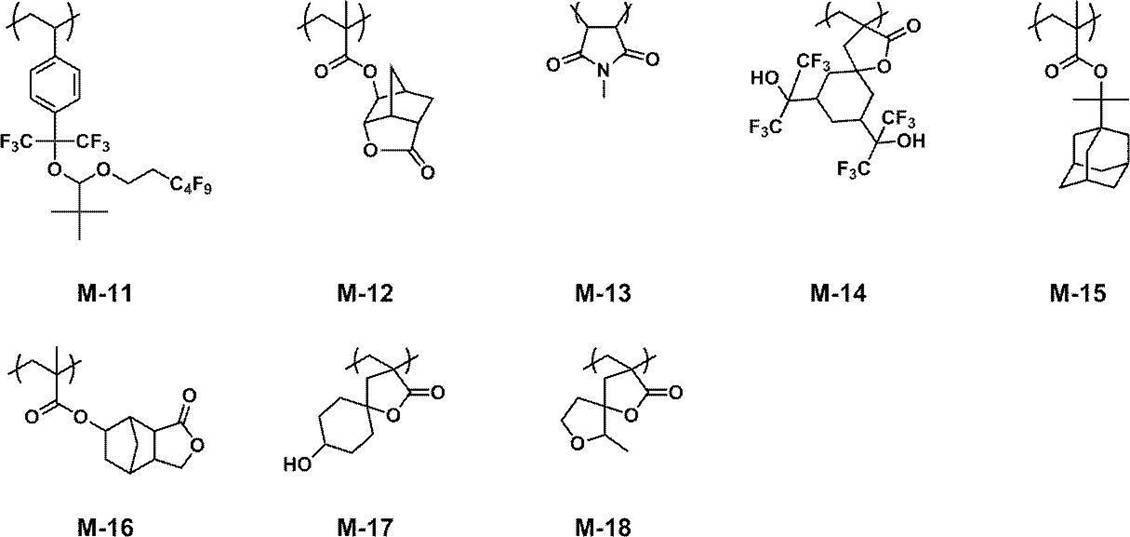

〔酸発生剤A〕
下記第2表に、第5表に示される酸発生剤A(A-1~A-10)の構造を示す。また、第2表に、酸発生剤A(A-1~A-10)のカチオン部のLUMO(eV)、及び酸発生剤A(A-1~A-10)から発生する酸(発生酸)のpKaを示す。
なお、酸発生剤A(A-1~A-10)のカチオン部のLUMO(eV)、及び発生酸のpKaの各値は、後述する測定方法により求めた。
下記第2表に、第5表に示される酸発生剤A(A-1~A-10)の構造を示す。また、第2表に、酸発生剤A(A-1~A-10)のカチオン部のLUMO(eV)、及び酸発生剤A(A-1~A-10)から発生する酸(発生酸)のpKaを示す。
なお、酸発生剤A(A-1~A-10)のカチオン部のLUMO(eV)、及び発生酸のpKaの各値は、後述する測定方法により求めた。


〔酸発生剤B〕
下記第3表に、第5表に示される酸発生剤B(B-1~B-5)の構造を示す。また、第3表に、酸発生剤B(B-1~B-5)から発生する酸(発生酸)のpKaを示す。
なお、発生酸のpKaは、後述する測定方法により求めた。
下記第3表に、第5表に示される酸発生剤B(B-1~B-5)の構造を示す。また、第3表に、酸発生剤B(B-1~B-5)から発生する酸(発生酸)のpKaを示す。
なお、発生酸のpKaは、後述する測定方法により求めた。
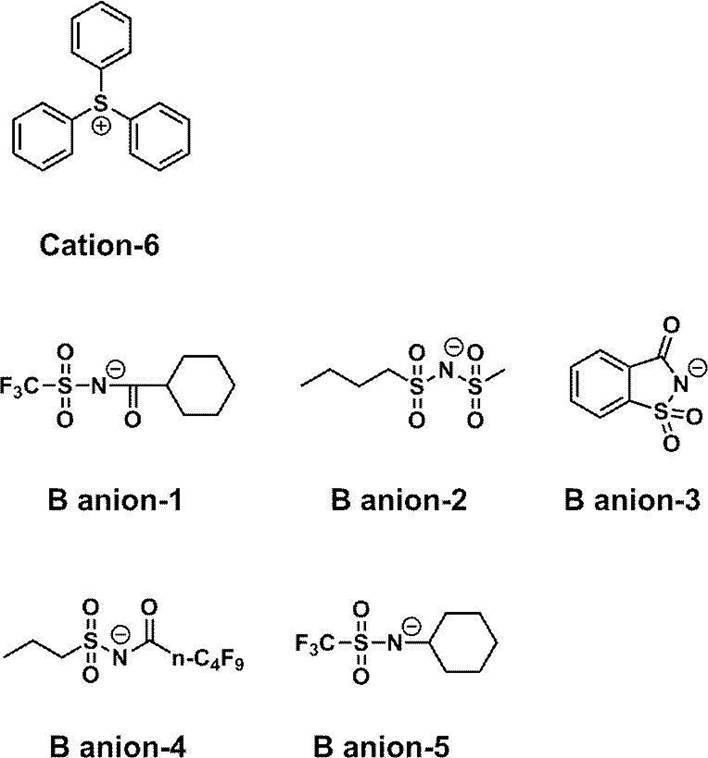

〔酸発生剤C〕
下記第4表に、第5表に示される酸発生剤C(C-1~C-6)の構造を示す。また、第4表に、酸発生剤C(C-1~C-6)から発生する酸(発生酸)のpKaを示す。
なお、発生酸のpKaは、後述する測定方法により求めた。
下記第4表に、第5表に示される酸発生剤C(C-1~C-6)の構造を示す。また、第4表に、酸発生剤C(C-1~C-6)から発生する酸(発生酸)のpKaを示す。
なお、発生酸のpKaは、後述する測定方法により求めた。
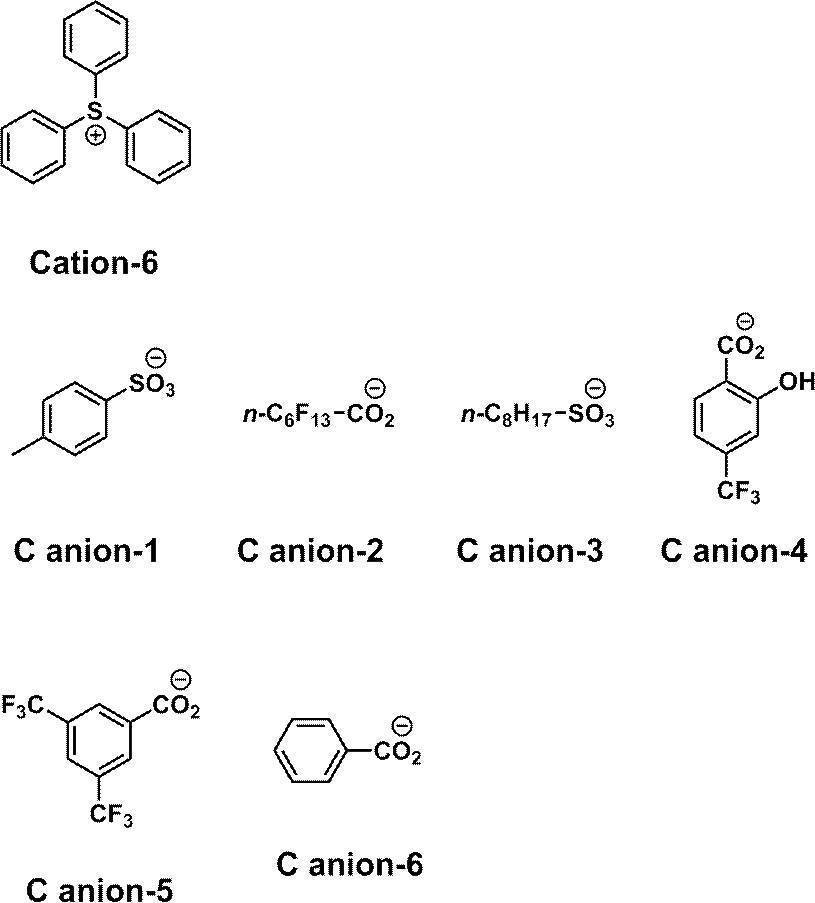

〔溶剤〕
PGMEA:プロピレングリコールモノメチルエーテルアセテート
PGME:プロピレングリコールモノメチルエーテル
PGMEA:プロピレングリコールモノメチルエーテルアセテート
PGME:プロピレングリコールモノメチルエーテル
<感活性光線性又は感放射線性樹脂組成物の調製>
下記第5表に示す各成分を第5表に示す溶剤に溶解させ、それぞれについて固形分濃度1.2質量%の溶液を調製し、これを0.03μmのポアサイズを有するポリエチレンフィルターでろ過することにより、感活性光線性又は感放射線性樹脂組成物(以下、「レジスト組成物」ともいう。)(E-1)~(E-44)を調液した。なお、レジスト組成物において、固形分とは、溶剤以外の全ての成分を意味する。得られたレジスト組成物を、実施例及び比較例で使用した。
なお、以下の「樹脂」欄、「酸発生剤A」欄、及び「酸発生剤B又は酸発生剤C」欄に記載の各成分の含有量(質量%)は、全固形分に対する各成分の割合を表す。
下記第5表に示す各成分を第5表に示す溶剤に溶解させ、それぞれについて固形分濃度1.2質量%の溶液を調製し、これを0.03μmのポアサイズを有するポリエチレンフィルターでろ過することにより、感活性光線性又は感放射線性樹脂組成物(以下、「レジスト組成物」ともいう。)(E-1)~(E-44)を調液した。なお、レジスト組成物において、固形分とは、溶剤以外の全ての成分を意味する。得られたレジスト組成物を、実施例及び比較例で使用した。
なお、以下の「樹脂」欄、「酸発生剤A」欄、及び「酸発生剤B又は酸発生剤C」欄に記載の各成分の含有量(質量%)は、全固形分に対する各成分の割合を表す。
〔各種測定及び評価〕
<酸発生剤Aの最低空軌道(LUMO)の測定>
酸発生剤Aの最低空軌道(LUMO)は、量子化学計算プログラムGaussian09(米ガウシアン社製)を使用し、下記の条件で測定した。
・密度汎関数法
・汎関数:B3LYP
・基底関数:TZVP
<酸発生剤Aの最低空軌道(LUMO)の測定>
酸発生剤Aの最低空軌道(LUMO)は、量子化学計算プログラムGaussian09(米ガウシアン社製)を使用し、下記の条件で測定した。
・密度汎関数法
・汎関数:B3LYP
・基底関数:TZVP
<酸発生剤A、酸発生剤B、及び酸発生剤Cの発生酸のpKa測定>
酸発生剤A、酸発生剤B、及び酸発生
剤Cの発生酸のpKaは、下記ソフトウェアにより求めた。
Advanced Chemistry Development (ACD/Labs) pKa Database V8.0
酸発生剤A、酸発生剤B、及び酸発生
剤Cの発生酸のpKaは、下記ソフトウェアにより求めた。
Advanced Chemistry Development (ACD/Labs) pKa Database V8.0
<4℃にて9カ月間保管後の酸発生剤Aの残存率>
(加熱経時試験)
調液直後のレジスト組成物(E-1)~(E-44)について、HPLC(high performance liquid chromatography)を用いて、45℃、60℃、及び75℃での酸発生剤Aの初期含有量を各々測定した。
次に、45℃、60℃、及び75℃にて7日間保管後のレジスト組成物(E-1)~(E-44)について、HPLCを用いて、各温度での酸発生剤Aの残存率(以下、「PAG残存率」ともいう。)を各々測定した。また、45℃、60℃、及び75℃にて14日間保管後のレジスト組成物(E-1)~(E-44)についても、同様に、各温度でのPAG残存率を各々測定した。
なお、PAG残存率は、HPLCにより得られたピーク面積値に基づいて、下記式から求められる。
PAG残存率(%)=(所定期間保管後のレジスト組成物中における酸発生剤Aの残存量)/(レジスト組成物中における酸発生剤Aの初期含有量)×100
(加熱経時試験)
調液直後のレジスト組成物(E-1)~(E-44)について、HPLC(high performance liquid chromatography)を用いて、45℃、60℃、及び75℃での酸発生剤Aの初期含有量を各々測定した。
次に、45℃、60℃、及び75℃にて7日間保管後のレジスト組成物(E-1)~(E-44)について、HPLCを用いて、各温度での酸発生剤Aの残存率(以下、「PAG残存率」ともいう。)を各々測定した。また、45℃、60℃、及び75℃にて14日間保管後のレジスト組成物(E-1)~(E-44)についても、同様に、各温度でのPAG残存率を各々測定した。
なお、PAG残存率は、HPLCにより得られたピーク面積値に基づいて、下記式から求められる。
PAG残存率(%)=(所定期間保管後のレジスト組成物中における酸発生剤Aの残存量)/(レジスト組成物中における酸発生剤Aの初期含有量)×100
(アレニウスプロットの作成)
上記加熱経時試験により得られた各PAG残存率を用いてアレニウスプロットを作成し、4℃にて9カ月間保管後の酸発生剤Aの残存率を求め、下記の評価基準により評価した。結果を第5表に示す。
上記加熱経時試験により得られた各PAG残存率を用いてアレニウスプロットを作成し、4℃にて9カ月間保管後の酸発生剤Aの残存率を求め、下記の評価基準により評価した。結果を第5表に示す。
(評価基準)
「A」:酸発生剤Aの残存率が80%以上である。
「B」:酸発生剤Aの残存率が40%以上、80%未満である。
「C」:酸発生剤Aの残存率が40%未満である。
「A」:酸発生剤Aの残存率が80%以上である。
「B」:酸発生剤Aの残存率が40%以上、80%未満である。
「C」:酸発生剤Aの残存率が40%未満である。
〔パターン形成及び評価〕
(レジストパターンの形成)
≪レジスト膜の形成≫
シリコンウエハ上にAL412(Brewer Science社製)を塗布し、200℃で60秒間ベークを行い、膜厚20nmのレジスト下層膜を形成した。その上に調液直後のレジスト組成物(E-1)~(E-44)を塗布し、100℃で60秒間ベーク(PB:Prebake)を行い、膜厚30nmのレジスト膜を形成した。
(レジストパターンの形成)
≪レジスト膜の形成≫
シリコンウエハ上にAL412(Brewer Science社製)を塗布し、200℃で60秒間ベークを行い、膜厚20nmのレジスト下層膜を形成した。その上に調液直後のレジスト組成物(E-1)~(E-44)を塗布し、100℃で60秒間ベーク(PB:Prebake)を行い、膜厚30nmのレジスト膜を形成した。
≪露光工程(EUV露光)≫
このレジスト膜をEUV露光機(ASML社製;NXE3350、NA0.33、Dipole 90°、アウターシグマ0.87、インナーシグマ0.35)を用い、ピッチが44nm且つ線幅が22nmの反射型マスクを介して露光した。その後、85℃にて60秒間加熱(PEB:Post Exposure Bake)した。次いで、2.38%TMAH(水酸化テトラメチルアンモニウム)水溶液にて30秒間現像し、水にて20秒間リンスした。続いて、2000rpmの回転数で40秒間ウエハを回転させることにより、ピッチが44nm、且つ線幅が22nmのラインアンドスペースのパターンを形成した。
このレジスト膜をEUV露光機(ASML社製;NXE3350、NA0.33、Dipole 90°、アウターシグマ0.87、インナーシグマ0.35)を用い、ピッチが44nm且つ線幅が22nmの反射型マスクを介して露光した。その後、85℃にて60秒間加熱(PEB:Post Exposure Bake)した。次いで、2.38%TMAH(水酸化テトラメチルアンモニウム)水溶液にて30秒間現像し、水にて20秒間リンスした。続いて、2000rpmの回転数で40秒間ウエハを回転させることにより、ピッチが44nm、且つ線幅が22nmのラインアンドスペースのパターンを形成した。
(1)感度評価
露光量を変化させながら、ラインアンドスペースパターンのライン幅を測定し、ライン幅が22nmとなる際の露光量(最適露光量)を求め、これを感度(mJ/cm2)とした。値が小さいほど、レジスト組成物が高感度であることを示す。結果を第5表に示す。
露光量を変化させながら、ラインアンドスペースパターンのライン幅を測定し、ライン幅が22nmとなる際の露光量(最適露光量)を求め、これを感度(mJ/cm2)とした。値が小さいほど、レジスト組成物が高感度であることを示す。結果を第5表に示す。
(2)LWR(Line Width Roughness)評価
上記感度評価における最適露光量にて解像したラインアンドスペースのレジストパターンの観測において、測長走査型電子顕微鏡(SEM:Scanning Electron Microscope(日立ハイテクノロジーズ社製 CG-4100))にてパターン上部から観察する際、パターンの中心からエッジまでの距離を任意のポイントで観測し、その測定ばらつきを3σで評価した。値が小さいほど良好な性能であることを示す。結果を第5表に示す。
上記感度評価における最適露光量にて解像したラインアンドスペースのレジストパターンの観測において、測長走査型電子顕微鏡(SEM:Scanning Electron Microscope(日立ハイテクノロジーズ社製 CG-4100))にてパターン上部から観察する際、パターンの中心からエッジまでの距離を任意のポイントで観測し、その測定ばらつきを3σで評価した。値が小さいほど良好な性能であることを示す。結果を第5表に示す。

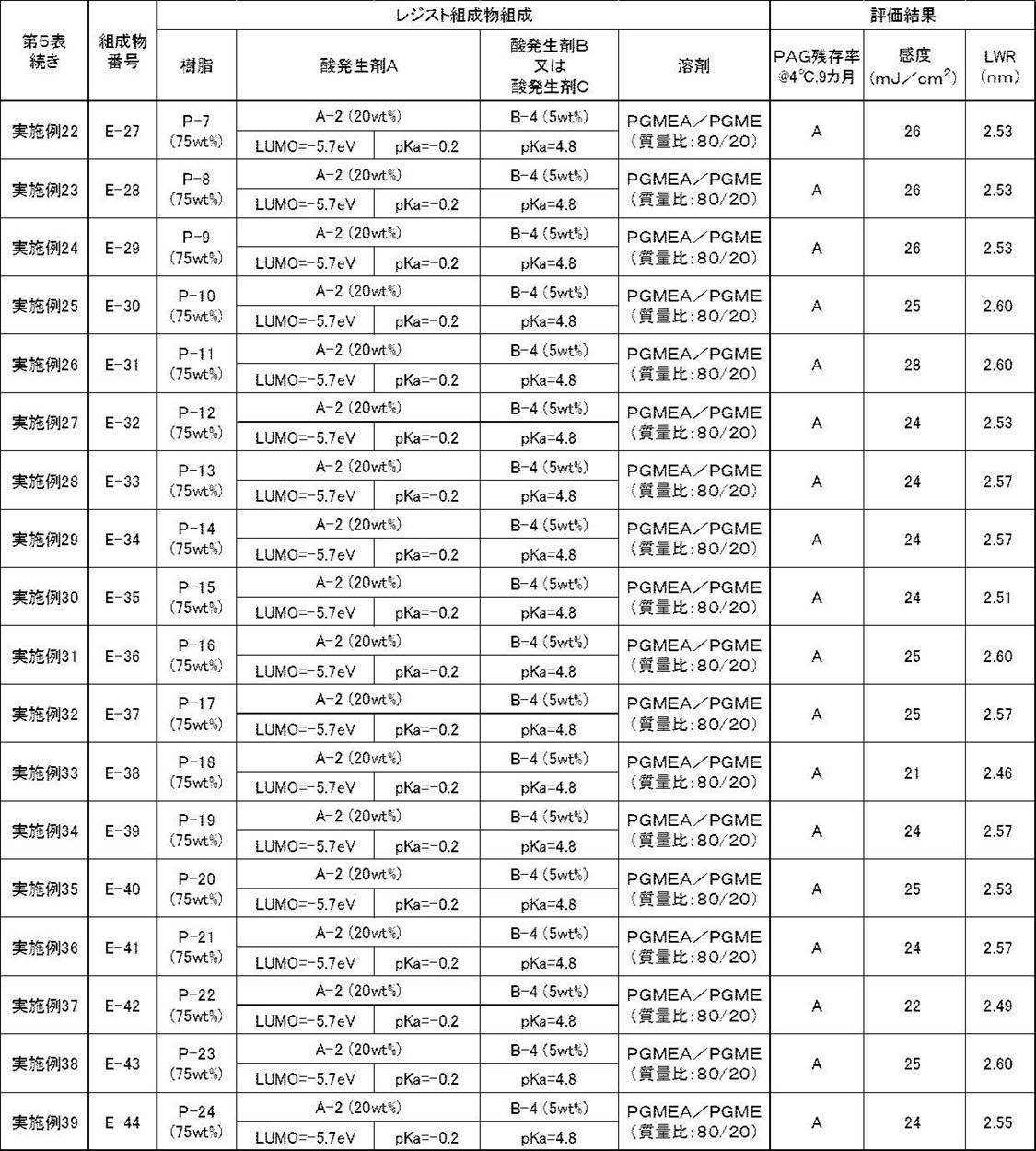
第5表から、実施例の感活性光線性又は感放射線性樹脂組成物は、保存安定性に優れ、高感度であり、且つ、形成されるパターンがLWRに優れることが明らかである。
また、実施例4、実施例8、及び実施例9の結果から、クエンチャーとして、pKaが2.0~3.5のカルボキシ基含有化合物を発生酸とする酸発生剤(酸発生剤C:実施例8、9が該当)を使用した場合、LWRがより優れることが明らかである。また、実施例4、実施例8、及び実施例9の結果から、クエンチャーとして、一般式(ZV-1)で表される化合物を発生酸とする酸発生剤(酸発生剤C:実施例8、9が該当)を使用した場合、LWRがより優れることが明らかである。
また、実施例4、実施例10~16の結果から、酸発生剤Aとして、一般式(ZII)で表されるカチオンを含む酸発生剤を使用した場合(実施例4、実施例10、実施例14~16が該当)、感度がより優れる、又は、LWRがより優れることが明らかである。
また、実施例4、実施例17~19及び実施例22~39の結果から、樹脂がハロゲン原子を含む繰り返し単位を含む場合、感度がより優れ、且つ、LWRがより優れることが明らかである。
また、実施例4、実施例8、及び実施例9の結果から、クエンチャーとして、pKaが2.0~3.5のカルボキシ基含有化合物を発生酸とする酸発生剤(酸発生剤C:実施例8、9が該当)を使用した場合、LWRがより優れることが明らかである。また、実施例4、実施例8、及び実施例9の結果から、クエンチャーとして、一般式(ZV-1)で表される化合物を発生酸とする酸発生剤(酸発生剤C:実施例8、9が該当)を使用した場合、LWRがより優れることが明らかである。
また、実施例4、実施例10~16の結果から、酸発生剤Aとして、一般式(ZII)で表されるカチオンを含む酸発生剤を使用した場合(実施例4、実施例10、実施例14~16が該当)、感度がより優れる、又は、LWRがより優れることが明らかである。
また、実施例4、実施例17~19及び実施例22~39の結果から、樹脂がハロゲン原子を含む繰り返し単位を含む場合、感度がより優れ、且つ、LWRがより優れることが明らかである。
Claims (11)
- 活性光線又は放射線の照射により酸を発生する酸発生剤と、酸の作用により極性が増大する樹脂と、溶剤と、を含み、
前記酸発生剤が、
最低空軌道準位が-7.0eV以上-5.0eV未満のカチオンを含む酸発生剤Aと、
pKaが-3.0~5.0のイミド化合物を発生酸とする酸発生剤B、及びpKaが-3.0~3.5のカルボン酸基又はスルホン酸基含有化合物を発生酸とする酸発生剤Cからなる群より選ばれる1種以上と、を含む、感活性光線性又は感放射線性樹脂組成物。 - 前記酸発生剤Aが、下記一般式(ZI)で表されるカチオンを含む、請求項1に記載の感活性光線性又は感放射線性樹脂組成物。
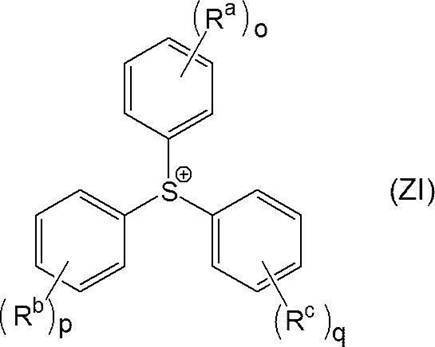
一般式(ZI)中、Ra、Rb、及びRcは、各々独立に、置換基を表す。o及びpは、各々独立に0~5の整数を表す。qは、1~5の整数を表す。oが2以上の場合には、複数のRaは互いに同一でも異なっていてもよく、また、少なくとも2つのRaは互いに結合して環を形成してもよい。pが2以上の場合には、複数のRbは互いに同一でも異なっていてもよく、また、少なくとも2つのRbは互いに結合して環を形成してもよい。qが2以上の場合には、複数のRcは互いに同一でも異なっていてもよく、また、少なくとも2つのRcは互いに結合して環を形成してもよい。また、RaとRb、RbとRc、及びRaとRcは、各々互いに結合して環を形成していてもよい。 - 前記Rcのうち少なくとも1つが、フッ素原子を含む置換基である、請求項2に記載の感活性光線性又は感放射線性樹脂組成物。
- 前記一般式(ZI)で表されるカチオンが、下記一般式(ZII)で表されるカチオンである、請求項2又は3に記載の感活性光線性又は感放射線性樹脂組成物。

一般式(ZII)中、Raは、置換基を表す。Rb1、Rb2、Rc1及びRc2は、各々独立に、フッ素原子を含む置換基を表す。oは1~3の整数を表す。 - 前記酸発生剤Bの発生酸及び前記酸発生剤Cの発生酸のpKaが、前記酸発生剤Aから発生する発生酸のpKaよりも大きい、請求項1~4のいずれか1項に記載の感活性光線性又は感放射線性樹脂組成物。
- 前記酸発生剤B及び前記酸発生剤Cが、オニウム塩である、請求項1~5のいずれか1項に記載の感活性光線性又は感放射線性樹脂組成物。
- 前記樹脂が、ハロゲン原子を含む、請求項1~6のいずれか1項に記載の感活性光線性又は感放射線性樹脂組成物。
- 前記ハロゲン原子が、フッ素原子又はヨウ素原子である、請求項7に記載の感活性光線性又は感放射線性樹脂組成物。
- 請求項1~8のいずれか1項に記載の感活性光線性又は感放射線性樹脂組成物により形成されたレジスト膜。
- 請求項1~8のいずれか1項に記載の感活性光線性又は感放射線性樹脂組成物を用いてレジスト膜を形成するレジスト膜形成工程と、
前記レジスト膜を露光する露光工程と、
露光された前記レジスト膜を、現像液を用いて現像する現像工程と、を含むパターン形成方法。 - 請求項10に記載のパターン形成方法を含む、電子デバイスの製造方法。
Priority Applications (1)
| Application Number | Priority Date | Filing Date | Title |
|---|---|---|---|
| JP2019542021A JP7029462B2 (ja) | 2017-09-15 | 2018-09-07 | 感活性光線性又は感放射線性樹脂組成物、レジスト膜、パターン形成方法、電子デバイスの製造方法 |
Applications Claiming Priority (4)
| Application Number | Priority Date | Filing Date | Title |
|---|---|---|---|
| JP2017-178173 | 2017-09-15 | ||
| JP2017178173 | 2017-09-15 | ||
| JP2018-158471 | 2018-08-27 | ||
| JP2018158471 | 2018-08-27 |
Publications (1)
| Publication Number | Publication Date |
|---|---|
| WO2019054282A1 true WO2019054282A1 (ja) | 2019-03-21 |
Family
ID=65722703
Family Applications (1)
| Application Number | Title | Priority Date | Filing Date |
|---|---|---|---|
| PCT/JP2018/033120 Ceased WO2019054282A1 (ja) | 2017-09-15 | 2018-09-07 | 感活性光線性又は感放射線性樹脂組成物、レジスト膜、パターン形成方法、電子デバイスの製造方法 |
Country Status (3)
| Country | Link |
|---|---|
| JP (1) | JP7029462B2 (ja) |
| TW (1) | TWI811239B (ja) |
| WO (1) | WO2019054282A1 (ja) |
Cited By (18)
| Publication number | Priority date | Publication date | Assignee | Title |
|---|---|---|---|---|
| JP2020091376A (ja) * | 2018-12-04 | 2020-06-11 | 東京応化工業株式会社 | レジスト組成物、レジストパターン形成方法、及び化合物 |
| US20210165324A1 (en) * | 2019-12-03 | 2021-06-03 | Tokyo Ohka Kogyo Co., Ltd. | Resist composition and method of forming resist pattern |
| KR20220044421A (ko) * | 2020-10-01 | 2022-04-08 | 신에쓰 가가꾸 고교 가부시끼가이샤 | 포지티브형 레지스트 재료 및 패턴 형성 방법 |
| CN115244464A (zh) * | 2020-03-30 | 2022-10-25 | 富士胶片株式会社 | 感光化射线性或感放射线性树脂组合物、图案形成方法、抗蚀剂膜及电子器件的制造方法 |
| WO2023085414A1 (ja) | 2021-11-15 | 2023-05-19 | 日産化学株式会社 | 多環芳香族炭化水素系光硬化性樹脂組成物 |
| WO2023204287A1 (ja) | 2022-04-22 | 2023-10-26 | 日産化学株式会社 | レジスト下層膜形成用組成物 |
| WO2023222740A1 (en) * | 2022-05-20 | 2023-11-23 | Merck Patent Gmbh | Substrate coating resist composition and method for manufacturing resist pattern |
| JP2024024636A (ja) * | 2022-03-29 | 2024-02-22 | 東京応化工業株式会社 | レジスト組成物及びレジストパターン形成方法 |
| WO2024128190A1 (ja) | 2022-12-15 | 2024-06-20 | 日産化学株式会社 | レジスト下層膜形成用組成物 |
| WO2024128157A1 (ja) | 2022-12-15 | 2024-06-20 | 日産化学株式会社 | レジスト下層膜形成用組成物 |
| WO2024162459A1 (ja) | 2023-02-03 | 2024-08-08 | 日産化学株式会社 | 環境負荷を低減するためのレジスト下層膜形成用組成物 |
| WO2024166869A1 (ja) | 2023-02-09 | 2024-08-15 | 日産化学株式会社 | レジスト下層膜形成組成物 |
| WO2024204780A1 (ja) | 2023-03-30 | 2024-10-03 | 日産化学株式会社 | レジスト下層膜形成用組成物 |
| WO2024204163A1 (ja) | 2023-03-31 | 2024-10-03 | 日産化学株式会社 | レジスト下層膜形成用組成物 |
| WO2024204764A1 (ja) | 2023-03-31 | 2024-10-03 | 日産化学株式会社 | レジスト下層膜形成用組成物 |
| WO2024203800A1 (ja) | 2023-03-24 | 2024-10-03 | 日産化学株式会社 | 光学回折体製造用レジスト下層膜形成用組成物 |
| WO2024232380A1 (ja) | 2023-05-09 | 2024-11-14 | 日産化学株式会社 | レジスト下層膜形成用組成物 |
| EP4657158A1 (en) | 2023-02-27 | 2025-12-03 | Nissan Chemical Corporation | Resist underlayer film formation composition |
Citations (4)
| Publication number | Priority date | Publication date | Assignee | Title |
|---|---|---|---|---|
| JP2014235248A (ja) * | 2013-05-31 | 2014-12-15 | 東京応化工業株式会社 | レジスト組成物、化合物、高分子化合物及びレジストパターン形成方法 |
| JP2015197482A (ja) * | 2014-03-31 | 2015-11-09 | 富士フイルム株式会社 | 感活性光線性又は感放射線性樹脂組成物の製造方法、感活性光線性又は感放射線性樹脂組成物、感活性光線性又は感放射線性膜、感活性光線性又は感放射線性膜を備えたマスクブランクス、フォトマスク、パターン形成方法、電子デバイスの製造方法、及び、電子デバイス |
| JP2017003917A (ja) * | 2015-06-15 | 2017-01-05 | 東京応化工業株式会社 | レジスト組成物及びレジストパターン形成方法 |
| JP2017015777A (ja) * | 2015-06-26 | 2017-01-19 | 東京応化工業株式会社 | ポジ型レジスト組成物、レジストパターン形成方法、光反応性クエンチャー及び高分子化合物 |
Family Cites Families (1)
| Publication number | Priority date | Publication date | Assignee | Title |
|---|---|---|---|---|
| JP5754444B2 (ja) * | 2010-11-26 | 2015-07-29 | Jsr株式会社 | 感放射線性組成物 |
-
2018
- 2018-09-07 WO PCT/JP2018/033120 patent/WO2019054282A1/ja not_active Ceased
- 2018-09-07 JP JP2019542021A patent/JP7029462B2/ja active Active
- 2018-09-13 TW TW107132162A patent/TWI811239B/zh active
Patent Citations (4)
| Publication number | Priority date | Publication date | Assignee | Title |
|---|---|---|---|---|
| JP2014235248A (ja) * | 2013-05-31 | 2014-12-15 | 東京応化工業株式会社 | レジスト組成物、化合物、高分子化合物及びレジストパターン形成方法 |
| JP2015197482A (ja) * | 2014-03-31 | 2015-11-09 | 富士フイルム株式会社 | 感活性光線性又は感放射線性樹脂組成物の製造方法、感活性光線性又は感放射線性樹脂組成物、感活性光線性又は感放射線性膜、感活性光線性又は感放射線性膜を備えたマスクブランクス、フォトマスク、パターン形成方法、電子デバイスの製造方法、及び、電子デバイス |
| JP2017003917A (ja) * | 2015-06-15 | 2017-01-05 | 東京応化工業株式会社 | レジスト組成物及びレジストパターン形成方法 |
| JP2017015777A (ja) * | 2015-06-26 | 2017-01-19 | 東京応化工業株式会社 | ポジ型レジスト組成物、レジストパターン形成方法、光反応性クエンチャー及び高分子化合物 |
Cited By (29)
| Publication number | Priority date | Publication date | Assignee | Title |
|---|---|---|---|---|
| US11460770B2 (en) | 2018-12-04 | 2022-10-04 | Tokyo Ohka Kogyo Co., Ltd. | Resist composition, method of forming resist pattern, and compound |
| JP7186592B2 (ja) | 2018-12-04 | 2022-12-09 | 東京応化工業株式会社 | レジスト組成物、レジストパターン形成方法、及び化合物 |
| JP2020091376A (ja) * | 2018-12-04 | 2020-06-11 | 東京応化工業株式会社 | レジスト組成物、レジストパターン形成方法、及び化合物 |
| US20210165324A1 (en) * | 2019-12-03 | 2021-06-03 | Tokyo Ohka Kogyo Co., Ltd. | Resist composition and method of forming resist pattern |
| CN115244464A (zh) * | 2020-03-30 | 2022-10-25 | 富士胶片株式会社 | 感光化射线性或感放射线性树脂组合物、图案形成方法、抗蚀剂膜及电子器件的制造方法 |
| JP7544007B2 (ja) | 2020-10-01 | 2024-09-03 | 信越化学工業株式会社 | ポジ型レジスト材料及びパターン形成方法 |
| KR20220044421A (ko) * | 2020-10-01 | 2022-04-08 | 신에쓰 가가꾸 고교 가부시끼가이샤 | 포지티브형 레지스트 재료 및 패턴 형성 방법 |
| JP2022059571A (ja) * | 2020-10-01 | 2022-04-13 | 信越化学工業株式会社 | ポジ型レジスト材料及びパターン形成方法 |
| KR102789376B1 (ko) | 2020-10-01 | 2025-03-31 | 신에쓰 가가꾸 고교 가부시끼가이샤 | 포지티브형 레지스트 재료 및 패턴 형성 방법 |
| US12204245B2 (en) | 2020-10-01 | 2025-01-21 | Shin-Etsu Chemical Co., Ltd. | Positive resist composition and patterning process |
| WO2023085414A1 (ja) | 2021-11-15 | 2023-05-19 | 日産化学株式会社 | 多環芳香族炭化水素系光硬化性樹脂組成物 |
| JP2024024636A (ja) * | 2022-03-29 | 2024-02-22 | 東京応化工業株式会社 | レジスト組成物及びレジストパターン形成方法 |
| WO2023204287A1 (ja) | 2022-04-22 | 2023-10-26 | 日産化学株式会社 | レジスト下層膜形成用組成物 |
| WO2023222740A1 (en) * | 2022-05-20 | 2023-11-23 | Merck Patent Gmbh | Substrate coating resist composition and method for manufacturing resist pattern |
| EP4636487A1 (en) | 2022-12-15 | 2025-10-22 | Nissan Chemical Corporation | Composition for forming resist underlayer film |
| WO2024128157A1 (ja) | 2022-12-15 | 2024-06-20 | 日産化学株式会社 | レジスト下層膜形成用組成物 |
| EP4636486A1 (en) | 2022-12-15 | 2025-10-22 | Nissan Chemical Corporation | Composition for forming resist underlayer film |
| WO2024128190A1 (ja) | 2022-12-15 | 2024-06-20 | 日産化学株式会社 | レジスト下層膜形成用組成物 |
| WO2024162459A1 (ja) | 2023-02-03 | 2024-08-08 | 日産化学株式会社 | 環境負荷を低減するためのレジスト下層膜形成用組成物 |
| EP4641300A1 (en) | 2023-02-03 | 2025-10-29 | Nissan Chemical Corporation | Composition for forming resist underlayer film to reduce environmental impact |
| WO2024166869A1 (ja) | 2023-02-09 | 2024-08-15 | 日産化学株式会社 | レジスト下層膜形成組成物 |
| EP4664199A1 (en) | 2023-02-09 | 2025-12-17 | Nissan Chemical Corporation | Resist underlayer film forming composition |
| EP4657158A1 (en) | 2023-02-27 | 2025-12-03 | Nissan Chemical Corporation | Resist underlayer film formation composition |
| WO2024203800A1 (ja) | 2023-03-24 | 2024-10-03 | 日産化学株式会社 | 光学回折体製造用レジスト下層膜形成用組成物 |
| WO2024204780A1 (ja) | 2023-03-30 | 2024-10-03 | 日産化学株式会社 | レジスト下層膜形成用組成物 |
| WO2024204764A1 (ja) | 2023-03-31 | 2024-10-03 | 日産化学株式会社 | レジスト下層膜形成用組成物 |
| WO2024204163A1 (ja) | 2023-03-31 | 2024-10-03 | 日産化学株式会社 | レジスト下層膜形成用組成物 |
| EP4692942A1 (en) | 2023-03-31 | 2026-02-11 | Nissan Chemical Corporation | Composition for forming resist underlayer film |
| WO2024232380A1 (ja) | 2023-05-09 | 2024-11-14 | 日産化学株式会社 | レジスト下層膜形成用組成物 |
Also Published As
| Publication number | Publication date |
|---|---|
| JP7029462B2 (ja) | 2022-03-03 |
| TW201914991A (zh) | 2019-04-16 |
| JPWO2019054282A1 (ja) | 2020-03-26 |
| TWI811239B (zh) | 2023-08-11 |
Similar Documents
| Publication | Publication Date | Title |
|---|---|---|
| JP7029462B2 (ja) | 感活性光線性又は感放射線性樹脂組成物、レジスト膜、パターン形成方法、電子デバイスの製造方法 | |
| TWI813634B (zh) | 感光化射線性或感放射線性樹脂組成物、抗蝕劑膜、圖案形成方法、電子元件的製造方法 | |
| JP6992166B2 (ja) | 感活性光線性又は感放射線性樹脂組成物、レジスト膜、パターン形成方法、電子デバイスの製造方法 | |
| JP6931707B2 (ja) | 感活性光線性又は感放射線性樹脂組成物、レジスト膜の製造方法、パターン形成方法、及び電子デバイスの製造方法 | |
| WO2019026549A1 (ja) | 感活性光線性または感放射線性樹脂組成物、レジスト膜、パターン形成方法、電子デバイスの製造方法 | |
| WO2019044231A1 (ja) | 感活性光線性又は感放射線性樹脂組成物、レジスト膜、パターン形成方法、電子デバイスの製造方法 | |
| JPWO2018212079A1 (ja) | 感活性光線性又は感放射線性樹脂組成物、レジスト膜、パターン形成方法、及び電子デバイスの製造方法 | |
| WO2019044259A1 (ja) | 感活性光線性又は感放射線性樹脂組成物、レジスト膜、パターン形成方法、電子デバイスの製造方法 | |
| JP7124094B2 (ja) | 感活性光線性又は感放射線性樹脂組成物、レジスト膜、パターン形成方法、電子デバイスの製造方法 | |
| WO2019123895A1 (ja) | 感活性光線性又は感放射線性樹脂組成物、レジスト膜、パターン形成方法、電子デバイスの製造方法、化合物 | |
| WO2019044270A1 (ja) | 感活性光線性又は感放射線性樹脂組成物、レジスト膜、パターン形成方法、固体撮像素子の製造方法 | |
| WO2019130866A1 (ja) | 感活性光線性又は感放射線性樹脂組成物、レジスト膜、パターン形成方法、電子デバイスの製造方法、化合物 | |
| JP7223765B2 (ja) | 感活性光線性又は感放射線性樹脂組成物、レジスト膜、パターン形成方法、及び電子デバイスの製造方法 | |
| TWI805669B (zh) | 抗蝕劑組成物、抗蝕劑膜、圖案形成方法及電子元件的製造方法 | |
| JP7220229B2 (ja) | 感活性光線性又は感放射線性樹脂組成物、レジスト膜、パターン形成方法、電子デバイスの製造方法 | |
| JP7191981B2 (ja) | 感活性光線性又は感放射線性樹脂組成物、レジスト膜、パターン形成方法、及び電子デバイスの製造方法 | |
| WO2021131655A1 (ja) | 感活性光線性又は感放射線性樹脂組成物、感活性光線性又は感放射線性膜、パターン形成方法、及び電子デバイスの製造方法 | |
| WO2020129683A1 (ja) | 感活性光線性又は感放射線性樹脂組成物、レジスト膜、パターン形成方法、及び電子デバイスの製造方法 | |
| TW202010763A (zh) | 感光化射線性或感放射線性樹脂組成物、圖案形成方法、抗蝕劑膜及電子元件的製造方法 | |
| JP2022125078A (ja) | 感活性光線性又は感放射線性樹脂組成物、レジスト膜、パターン形成方法、電子デバイスの製造方法 | |
| JP7084995B2 (ja) | 感活性光線性又は感放射線性樹脂組成物、レジスト膜、パターン形成方法、電子デバイスの製造方法、樹脂 | |
| WO2020105523A1 (ja) | 感活性光線性又は感放射線性樹脂組成物、レジスト膜、パターン形成方法、電子デバイスの製造方法 | |
| JP7336018B2 (ja) | パターン形成方法、電子デバイスの製造方法、及び感活性光線性又は感放射線性樹脂組成物 | |
| TWI779159B (zh) | 感光化射線性或感放射線性樹脂組成物、感光化射線性或感放射線性膜、圖案形成方法、以及電子元件的製造方法 | |
| WO2021065549A1 (ja) | 感活性光線性又は感放射線性樹脂組成物、感活性光線性又は感放射線性膜、パターン形成方法、及び、電子デバイスの製造方法 |
Legal Events
| Date | Code | Title | Description |
|---|---|---|---|
| 121 | Ep: the epo has been informed by wipo that ep was designated in this application |
Ref document number: 18855626 Country of ref document: EP Kind code of ref document: A1 |
|
| ENP | Entry into the national phase |
Ref document number: 2019542021 Country of ref document: JP Kind code of ref document: A |
|
| NENP | Non-entry into the national phase |
Ref country code: DE |
|
| 122 | Ep: pct application non-entry in european phase |
Ref document number: 18855626 Country of ref document: EP Kind code of ref document: A1 |