WO2019059090A1 - Système de mesure de nombre de véhicules - Google Patents
Système de mesure de nombre de véhicules Download PDFInfo
- Publication number
- WO2019059090A1 WO2019059090A1 PCT/JP2018/033994 JP2018033994W WO2019059090A1 WO 2019059090 A1 WO2019059090 A1 WO 2019059090A1 JP 2018033994 W JP2018033994 W JP 2018033994W WO 2019059090 A1 WO2019059090 A1 WO 2019059090A1
- Authority
- WO
- WIPO (PCT)
- Prior art keywords
- vehicle
- measurement system
- vehicles
- feature amount
- image
- Prior art date
- Legal status (The legal status is an assumption and is not a legal conclusion. Google has not performed a legal analysis and makes no representation as to the accuracy of the status listed.)
- Ceased
Links
Images


Classifications
-
- G—PHYSICS
- G06—COMPUTING OR CALCULATING; COUNTING
- G06T—IMAGE DATA PROCESSING OR GENERATION, IN GENERAL
- G06T7/00—Image analysis
-
- G—PHYSICS
- G08—SIGNALLING
- G08G—TRAFFIC CONTROL SYSTEMS
- G08G1/00—Traffic control systems for road vehicles
- G08G1/01—Detecting movement of traffic to be counted or controlled
-
- G—PHYSICS
- G08—SIGNALLING
- G08G—TRAFFIC CONTROL SYSTEMS
- G08G1/00—Traffic control systems for road vehicles
- G08G1/01—Detecting movement of traffic to be counted or controlled
- G08G1/04—Detecting movement of traffic to be counted or controlled using optical or ultrasonic detectors
Definitions
- the present invention relates to a technology for processing an image of a monitoring camera installed on a road and measuring the number of vehicles passing through a target section of the road.
- Patent Document 1 discloses a technology for assisting the driving of a vehicle at a junction such as an IC of a highway.
- Patent Document 2 discloses a technique for monitoring the speed of each vehicle traveling on a freeway.
- Patent Document 3 discloses a technique for centrally monitoring and managing the conditions of each vehicle traveling on an expressway.
- JP 2004-102655 A JP 2003-346383 A Unexamined-Japanese-Patent No. 2003-337992
- surveillance cameras are installed at regular intervals for road surveillance applications.
- the measurement of the number of passing vehicles and the speed of the vehicle using the image of the monitoring camera has an advantage that the cost of the device is low as compared with the method using other physical sensors.
- the measurement of the number of passing vehicles by the video analysis of the monitoring camera has a problem that the accuracy is reduced due to the overlapping of the vehicles on the video.
- Cameras installed in surveillance applications are mostly adjusted in angle of view so that local traffic conditions can be easily grasped, and they are not always suitable for measuring the number of vehicles. For example, when monitoring a plurality of lanes with one camera, a vehicle traveling on the near side may hide a vehicle on the far side. In this case, a vehicle traveling on the back side can not be counted from the image of the monitoring camera.
- the present invention has been made in view of the conventional circumstances as described above, and is a technique capable of improving the measurement accuracy of the number of passing vehicles using images of a monitoring camera installed along a road.
- the purpose is to propose.
- the system for measuring the number of vehicles is configured as follows. That is, in a vehicle number measurement system for measuring the number of vehicles traveling on a road, a plurality of photographing means installed at different positions along a predetermined section of the road, and a vehicle are detected from images photographed by the photographing means An image analysis unit for acquiring the speed and the feature of the vehicle, and tracking the vehicle traveling in the predetermined section based on the speed and the feature of each vehicle in a plurality of images captured at different positions; And vehicle number calculating means for calculating the number of vehicles that have passed through the section.
- the number-of-vehicles calculation means calculates an estimated range of the position of the vehicle based on the speed of the vehicle in the image taken at any position and the elapsed time from the time when the image was taken. It may be configured to
- the vehicle number calculation means has a management table for managing vehicle information including an estimation range of the feature quantity and position of the vehicle being tracked, and the feature quantity of the vehicle detected by the image analysis means and The position may be compared with the vehicle information in the management table to track the vehicle traveling in the predetermined section.
- the present invention it is possible to improve the measurement accuracy of the number of passing vehicles using the image of the monitoring camera installed along the road.
- FIG. 1 It is a figure showing an example of composition of the number measurement system of vehicles concerning one embodiment of the present invention. It is a figure which shows the example of arrangement
- FIG. 1 is a block diagram showing an example of the configuration of a vehicle number measurement system according to an embodiment of the present invention.
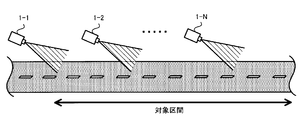
- N monitoring cameras 1-1 to 1-N N is an arbitrary number of 2 or more
- N associated with the monitoring cameras 1-1 to 1-N are provided.
- the video analysis units 2-1 to 2-N and the vehicle number estimation unit 3 are provided.
- the surveillance cameras 1-1 to 1-N are set at intervals along a predetermined target section (section to be monitored) set for a road, as shown in the arrangement example in FIG. It is assumed that The spacing between adjacent surveillance cameras may be arbitrary, but shall be known.
- Each of the image analysis units 2-1 to 2-N analyzes an image captured by the corresponding surveillance camera, and detects a vehicle and extracts information of the vehicle.
- the number-of-vehicles estimation unit 3 estimates the number of vehicles passing through the target section based on the information of the vehicles detected by the video analysis units 2-1 to 2-N.
- the target section is a section used to measure the number of passing vehicles, and a section in which there is no branching or merging is set mainly.
- a section from an entrance to an exit of a tunnel in a highway or the like is set, and in this case, the number of passing vehicles is measured using a plurality of monitoring cameras installed at intervals in the tunnel.
- one frame of the output video from the corresponding surveillance camera (video captured by the surveillance camera) is captured (step S101).
- object area an area in which an object is present (hereinafter referred to as “object area”) is extracted from the captured frame (image) by a technique such as background subtraction (step S102).
- a background model image is generated based on images of a plurality of past frames, and an object region is extracted from the difference between the captured frame and the background model image.
- the object tracking in the image is performed using the information of the object area extracted in step S102 and the object area extracted from the past image captured by the same surveillance camera (step S103). For example, by associating and managing the position of an object region in a frame between frames, it becomes possible to track an object moving in a video.
- feature quantities are extracted from the object being tracked, and are managed in association with the object (step S104).
- the feature amount of the object for example, the width and height of the object, the edge amount, the luminance of the object, the color and the like can be considered. If it is known that the feature amount can not be obtained accurately due to any cause, information to that effect may be recorded. Also, the feature amount of the object may be calculated by averaging the results obtained in each frame by weighted time.
- a vehicle is detected based on the feature amount of the object being tracked (step S105).
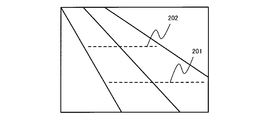
- lines 201 and 202 are defined at different positions along the road in the image area, and when an object of a certain size or more collides with both lines 201 and 202, Detect as a vehicle.
- the distance between the lines 201 and 202 is determined based on, for example, the angle of the surveillance camera, the minimum size of an object assumed to be a vehicle, and the like. By performing such processing, false detection of a vehicle due to noise components can be reduced. Needless to say, the vehicle may be detected by another method.
- step S106 the speed of the vehicle detected in step S105 is calculated.
- the speed of the vehicle can be calculated, for example, based on the distance of the section between the lines 201 and 202 and the time required for the vehicle to pass through this section.
- the information (position, speed, feature value, etc.) of the vehicles acquired by the video analysis units 2-1 to 2-N as described above is provided to the number-of-vehicles estimation unit 3, and the vehicles that have passed through the target section It is used to estimate the number of
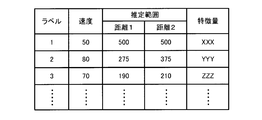
- the number-of-vehicles estimation unit 3 manages information of all the vehicles detected in the target section, using a management table as illustrated in FIG.
- label is a unique identifier attached to a vehicle in the target section.
- the "speed” is the speed of the vehicle calculated by the video analysis unit, and is updated each time the vehicle is detected by the video analysis unit.
- the “estimated range” indicates the position of the vehicle in the target section, and is composed of "distance 1" and “distance 2" (where distance 1 1 distance 2), and the vehicle number estimation unit 3 has vehicles in that range Treat as what you do.
- feature amount is a feature amount of the vehicle obtained by the image analysis unit. As the “feature amount”, numerical values for identifying the type of the vehicle such as the vehicle height, the vehicle width, and the color of the vehicle are used.
- the "estimated range" is updated by the following method. While the corresponding vehicle is being detected by any of the video analysis units, updating is performed with a true value (actual vehicle position) calculated based on the position information of the corresponding monitoring camera and the position in the frame. In this case, the same value is set to "distance 1" and "distance 2". On the other hand, while the corresponding vehicle can not be detected by any video analysis unit, it is calculated using, for example, the following formula based on the “speed” and the elapsed time from the time the video used for the calculation was taken.
- both “distance 1” and “distance 2” of “estimated range” are “500”, it means that a vehicle is detected at a position of 500 m from the start point of the target section.
- “distance 1” and “distance 2” of “estimated range” are “275” and “325”, a position within the range of 275 m to 325 m from the start point of the target section (that is, 300 m from the start point) It means that the vehicle is presumed to exist at a position within the range of 50 m centered on the point.
- the number-of-vehicles estimation unit 3 removes the vehicle information of the vehicle from the management table of FIG. By counting up, measure the number of vehicles. Vehicle information removed from the management table may be left in a log or the like.
- determination of whether the vehicle slipped out of the object area is not limited to the said system, for example, even if it determines by whether the median of "the distance 1" and "the distance 2" became more than predetermined value Good.
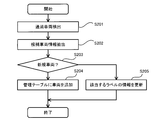
- step S201 the number-of-vehicles estimation unit 3 tracks the plurality of surveillance cameras 1-1 to 1-N while associating the vehicles with each other.
- step S201 the number-of-vehicles estimation unit 3 The following processing is performed by acquiring vehicle information (position, speed, feature amount, etc.) from.
- step S202 vehicle information whose detected position is included in the "estimated range" is extracted as vehicle information of candidate vehicles from the management table (step S202).
- step S203 it is determined whether the detected vehicle is a new vehicle by comparing the detected feature amount of the vehicle with the extracted feature amounts of each candidate vehicle (step S203). Specifically, for example, the similarity to the feature amount of the vehicle detected for each candidate vehicle is calculated, and when there is no candidate vehicle whose similarity is equal to or higher than the threshold, it is determined as a new vehicle, and the similarity is the threshold If there is a candidate vehicle with the above, it is determined that it is not a new vehicle.
- step S203 If it is determined in step S203 that the vehicle is a new vehicle, a new label is attached to the detected vehicle, and vehicle information is added to the management table (step S204). On the other hand, when it is determined in step S203 that the vehicle is not a new vehicle, the detected vehicle is assumed to be the same vehicle as one vehicle selected from the candidate vehicles narrowed down based on the similarity of the feature amount.
- the vehicle information of the selected candidate vehicle is updated (step S205).
- the vehicle selected from the candidate vehicles may be a vehicle having a feature quantity closest to the detected feature quantity of the vehicle, or the relationship (e.g., estimation) between the position of the detected vehicle and the position (estimated range) of the candidate vehicle It may be a vehicle determined from the proximity to the center of the range. Also, the vehicle may be selected in consideration of both the feature amount and the position of the vehicle.
- a plurality of monitoring cameras 1-1 to 1-N (an example of the photographing unit according to the present invention) installed at different positions along a predetermined section of the road;
- Image analysis units 2-1 to 2-N (an example of an image analysis unit according to the present invention, which detects a vehicle from images taken by the surveillance cameras 1-1 to 1-N and acquires the speed and feature amount of the vehicle And the number of vehicles estimating the number of vehicles passing through the predetermined section by tracking the vehicles traveling in the predetermined section based on the speed and the feature of each vehicle in a plurality of images taken at different positions)
- 3 one example of the vehicle number calculation means according to the present invention).
- the vehicle number measurement system of this example integrates the results of analysis of the images of a plurality of monitoring cameras arranged at different positions along the target section of the road, and the vehicle traveling in the target section is Count the number of vehicles while tracking. That is, not the imaging range of the monitoring camera alone but the number of vehicles passing through the target section covered by the plurality of monitoring cameras is measured.
- the vehicle is counted. Therefore, with a surveillance camera, it is possible to photograph a vehicle that could not be imaged overlapping with another vehicle with another surveillance camera, and it is possible to reduce the inconvenience of counting due to the overlapping of vehicles. It becomes possible to measure the number accurately.
- the vehicle number estimation unit 3 determines the vehicle speed based on the image captured at any position and the elapsed time from the time the image is captured. The estimated range of the position of the vehicle is calculated. For this reason, even if there is a period during which the monitoring camera can not capture the vehicle, tracking of the vehicle can be continued. Therefore, double counting of the same vehicle can be prevented, and the measurement accuracy of the number of vehicles can be enhanced.
- the vehicle number estimation unit 3 has a management table for managing vehicle information including an estimation range of the feature amount and position of the vehicle being tracked, and the video analysis unit 2
- the feature amount and the position of the vehicle detected by -1 to 2-N are compared with the vehicle information in the management table to track the vehicle traveling in the predetermined section. For this reason, the tracking of the vehicle based on the image
- the vehicle for which the number of vehicles is to be measured is not limited to a car, but may include a two-wheeled vehicle.
- two-wheeled vehicles can be tracked individually by using attributes specific to the two-wheeled vehicle such as vehicle width, overall silhouette, number of tires, etc., as characteristic quantities of the vehicle.
- the number of passing vehicles and the number of passing motorcycles may be separately measured.
- the configuration of the system or apparatus according to the present invention is not necessarily limited to those described above, and various configurations may be used.
- the video analysis unit is provided for each surveillance camera, but one video analysis unit may be configured to process video by a plurality of surveillance cameras.
- the present invention can also be provided as, for example, a method or method for executing the process according to the present invention, a program for realizing such a method or method, or a storage medium for storing the program.
- the present invention can be used for a vehicle number measurement system that measures the number of vehicles traveling on a road.
- 1-1 to 1-N Surveillance camera, 2-1 to 2-N: Video analysis unit, 3: Vehicle number estimation unit
Landscapes
- Physics & Mathematics (AREA)
- General Physics & Mathematics (AREA)
- Engineering & Computer Science (AREA)
- Computer Vision & Pattern Recognition (AREA)
- Theoretical Computer Science (AREA)
- Traffic Control Systems (AREA)
- Image Analysis (AREA)
Abstract
La présente invention concerne l'amélioration de la précision avec laquelle le nombre de véhicules passant est mesuré à l'aide d'images provenant de caméras de surveillance installées le long d'une route. Un système de mesure de nombre de véhicules qui mesure le nombre de véhicules sur une route comprend : une pluralité de caméras de surveillance 1-1 à 1-N installées dans différents emplacements le long d'un tronçon prédéterminé de la route ; des unités d'analyse d'image 2-1 à 2-N qui détectent un véhicule à partir d'images capturées par les caméras de surveillance 1-1 à 1-N, et acquièrent la vitesse et une quantité de caractéristiques du véhicule ; et une unité d'estimation de nombre de véhicules 3 qui, sur la base de la vitesse et de la quantité de caractéristiques de chaque véhicule dans la pluralité d'images capturées à différents emplacements, suit les véhicules se déplaçant à l'intérieur du tronçon prédéterminé et calcule le nombre de véhicules passant à travers le tronçon prédéterminé.
Priority Applications (1)
| Application Number | Priority Date | Filing Date | Title |
|---|---|---|---|
| JP2019543602A JP6792722B2 (ja) | 2017-09-21 | 2018-09-13 | 車両台数計測システム |
Applications Claiming Priority (2)
| Application Number | Priority Date | Filing Date | Title |
|---|---|---|---|
| JP2017-181741 | 2017-09-21 | ||
| JP2017181741 | 2017-09-21 |
Publications (1)
| Publication Number | Publication Date |
|---|---|
| WO2019059090A1 true WO2019059090A1 (fr) | 2019-03-28 |
Family
ID=65809835
Family Applications (1)
| Application Number | Title | Priority Date | Filing Date |
|---|---|---|---|
| PCT/JP2018/033994 Ceased WO2019059090A1 (fr) | 2017-09-21 | 2018-09-13 | Système de mesure de nombre de véhicules |
Country Status (2)
| Country | Link |
|---|---|
| JP (1) | JP6792722B2 (fr) |
| WO (1) | WO2019059090A1 (fr) |
Cited By (5)
| Publication number | Priority date | Publication date | Assignee | Title |
|---|---|---|---|---|
| KR102263715B1 (ko) * | 2020-11-30 | 2021-06-10 | 라이트비전 주식회사 | 다중 센서 핸드오버 기술을 이용한 주차 서비스 시스템 |
| WO2022114807A1 (fr) * | 2020-11-30 | 2022-06-02 | 라이트비전 주식회사 | Système de transfert à capteurs multiples capable de suivre un objet mobile, et procédé de fourniture de service de stationnement associé |
| KR20220076089A (ko) * | 2020-11-30 | 2022-06-08 | 라이트비전 주식회사 | 이동체 추적이 가능한 핸드오버 시스템 및 이를 동작시키는 방법 |
| US20220250649A1 (en) * | 2021-02-11 | 2022-08-11 | Westinghouse Air Brake Technologies Corporation | Vehicle location determining system and method |
| WO2026004644A1 (fr) * | 2024-06-26 | 2026-01-02 | 株式会社国際電気 | Procédé de comptage de volume de trafic et système de comptage de volume de trafic |
Citations (3)
| Publication number | Priority date | Publication date | Assignee | Title |
|---|---|---|---|---|
| JPH10154292A (ja) * | 1996-05-15 | 1998-06-09 | Hitachi Ltd | 交通流監視装置 |
| JPH1196494A (ja) * | 1997-09-22 | 1999-04-09 | Hitachi Ltd | 交通流監視方法および装置 |
| JP2001229488A (ja) * | 2000-02-15 | 2001-08-24 | Hitachi Ltd | 車両追跡方法および交通状況追跡装置 |
-
2018
- 2018-09-13 WO PCT/JP2018/033994 patent/WO2019059090A1/fr not_active Ceased
- 2018-09-13 JP JP2019543602A patent/JP6792722B2/ja active Active
Patent Citations (3)
| Publication number | Priority date | Publication date | Assignee | Title |
|---|---|---|---|---|
| JPH10154292A (ja) * | 1996-05-15 | 1998-06-09 | Hitachi Ltd | 交通流監視装置 |
| JPH1196494A (ja) * | 1997-09-22 | 1999-04-09 | Hitachi Ltd | 交通流監視方法および装置 |
| JP2001229488A (ja) * | 2000-02-15 | 2001-08-24 | Hitachi Ltd | 車両追跡方法および交通状況追跡装置 |
Cited By (13)
| Publication number | Priority date | Publication date | Assignee | Title |
|---|---|---|---|---|
| EP4235621A4 (fr) * | 2020-11-30 | 2024-12-11 | Lightvision Corp. | Système de transfert à capteurs multiples capable de suivre un objet mobile, et procédé de fourniture de service de stationnement associé |
| WO2022114807A1 (fr) * | 2020-11-30 | 2022-06-02 | 라이트비전 주식회사 | Système de transfert à capteurs multiples capable de suivre un objet mobile, et procédé de fourniture de service de stationnement associé |
| KR20220076089A (ko) * | 2020-11-30 | 2022-06-08 | 라이트비전 주식회사 | 이동체 추적이 가능한 핸드오버 시스템 및 이를 동작시키는 방법 |
| CN116635918A (zh) * | 2020-11-30 | 2023-08-22 | 光线视觉株式会社 | 可追踪移动物体的多传感器切换系统及其停车服务提供方法 |
| KR102581513B1 (ko) * | 2020-11-30 | 2023-09-25 | 라이트비전 주식회사 | 이동체 추적이 가능한 핸드오버 시스템 및 이를 동작시키는 방법 |
| KR20230136097A (ko) * | 2020-11-30 | 2023-09-26 | 라이트비전 주식회사 | 이동체 추적이 가능한 핸드오버 시스템 및 이를 동작시키는 방법 |
| JP2023551701A (ja) * | 2020-11-30 | 2023-12-12 | ライトビジョン コーポレーション | 移動体追跡が可能な多重センサハンドオーバーシステム及びそれにおいて駐車サービスを提供する方法 |
| KR102263715B1 (ko) * | 2020-11-30 | 2021-06-10 | 라이트비전 주식회사 | 다중 센서 핸드오버 기술을 이용한 주차 서비스 시스템 |
| JP7617672B2 (ja) | 2020-11-30 | 2025-01-20 | ライトビジョン インク. | 移動体追跡が可能な多重センサハンドオーバーシステム及びそれにおいて駐車サービスを提供する方法 |
| KR102884988B1 (ko) | 2020-11-30 | 2025-11-17 | 라이트비전 주식회사 | 이동체 추적이 가능한 핸드오버 시스템 및 이를 동작시키는 방법 |
| US20220250649A1 (en) * | 2021-02-11 | 2022-08-11 | Westinghouse Air Brake Technologies Corporation | Vehicle location determining system and method |
| US11794778B2 (en) * | 2021-02-11 | 2023-10-24 | Westinghouse Air Brake Technologies Corporation | Vehicle location determining system and method |
| WO2026004644A1 (fr) * | 2024-06-26 | 2026-01-02 | 株式会社国際電気 | Procédé de comptage de volume de trafic et système de comptage de volume de trafic |
Also Published As
| Publication number | Publication date |
|---|---|
| JP6792722B2 (ja) | 2020-11-25 |
| JPWO2019059090A1 (ja) | 2020-07-30 |
Similar Documents
| Publication | Publication Date | Title |
|---|---|---|
| WO2019059090A1 (fr) | Système de mesure de nombre de véhicules | |
| JP7081438B2 (ja) | オブジェクト速度推定方法と装置及び画像処理機器 | |
| CN107238834B (zh) | 用于自动车辆的使用雷达/视觉融合的目标跟踪系统 | |
| TWI452540B (zh) | 影像式之交通參數偵測系統與方法及電腦程式產品 | |
| Sina et al. | Vehicle counting and speed measurement using headlight detection | |
| US11120292B2 (en) | Distance estimation device, distance estimation method, and distance estimation computer program | |
| CN105716567B (zh) | 通过单眼图像获取设备侦测物体与机动车辆距离的方法 | |
| US20080166023A1 (en) | Video speed detection system | |
| Sen et al. | Accurate speed and density measurement for road traffic in India | |
| JP7225993B2 (ja) | 同一車両判定装置、同一車両判定方法およびプログラム | |
| JP2013225295A5 (fr) | ||
| WO2016114134A1 (fr) | Dispositif d'estimation de condition de mouvement, procédé d'estimation de condition de mouvement et support d'enregistrement de programme | |
| CN109145805B (zh) | 车载环境下的移动目标检测方法及系统 | |
| CN107146409B (zh) | 路网中设备检测时间异常的识别和真实时差估算方法 | |
| KR102308892B1 (ko) | 영상 기반 교통량 측정 시스템 및 그 방법 | |
| US20220375227A1 (en) | Counting system, counting method, and program | |
| CN113715832A (zh) | 疲劳驾驶的检测方法、装置、系统和计算机设备 | |
| CN110599771B (zh) | 交通信息确定方法以及交通污染排放预测方法 | |
| Pletzer et al. | Robust traffic state estimation on smart cameras | |
| Ćosić et al. | Time to collision estimation for vehicles coming from behind using in-vehicle camera | |
| CN115909223A (zh) | 一种wim系统信息与监控视频数据匹配的方法和系统 | |
| JP2016085105A (ja) | 移動体の速度推定装置、方法、及びプログラム | |
| JP2020017240A (ja) | 監視支援装置、監視支援プログラム、および記憶媒体 | |
| JP6883345B2 (ja) | 客数計測方法及び客数計測装置 | |
| JP3916379B2 (ja) | 移動物体の検出計測装置及び方法 |
Legal Events
| Date | Code | Title | Description |
|---|---|---|---|
| 121 | Ep: the epo has been informed by wipo that ep was designated in this application |
Ref document number: 18858800 Country of ref document: EP Kind code of ref document: A1 |
|
| ENP | Entry into the national phase |
Ref document number: 2019543602 Country of ref document: JP Kind code of ref document: A |
|
| NENP | Non-entry into the national phase |
Ref country code: DE |
|
| 122 | Ep: pct application non-entry in european phase |
Ref document number: 18858800 Country of ref document: EP Kind code of ref document: A1 |