WO2019062673A1 - Procédé et système de mise en œuvre de gestion reposant sur des informations sur la base de sémantisation d'entrée et de sortie - Google Patents
Procédé et système de mise en œuvre de gestion reposant sur des informations sur la base de sémantisation d'entrée et de sortie Download PDFInfo
- Publication number
- WO2019062673A1 WO2019062673A1 PCT/CN2018/107048 CN2018107048W WO2019062673A1 WO 2019062673 A1 WO2019062673 A1 WO 2019062673A1 CN 2018107048 W CN2018107048 W CN 2018107048W WO 2019062673 A1 WO2019062673 A1 WO 2019062673A1
- Authority
- WO
- WIPO (PCT)
- Prior art keywords
- activity
- data
- task
- interface
- input
- Prior art date
- Legal status (The legal status is an assumption and is not a legal conclusion. Google has not performed a legal analysis and makes no representation as to the accuracy of the status listed.)
- Ceased
Links
Images




Classifications
-
- G—PHYSICS
- G06—COMPUTING OR CALCULATING; COUNTING
- G06F—ELECTRIC DIGITAL DATA PROCESSING
- G06F8/00—Arrangements for software engineering
- G06F8/30—Creation or generation of source code
- G06F8/38—Creation or generation of source code for implementing user interfaces
Definitions
- the invention relates to a method and a system for managing informationization, belonging to the technical field of internet and computer software, in particular to a method and system for generalized management based on input and output semantics.
- management information software system In the development of information technology, management information software system is a typical category. Management information software systems are usually developed using rapid development tools, such as the early Delphi, Power Builder, and now use Eclipse, .NET and other tools. None of these tools can implement a complete business process directly through configuration. Based on the current status of these development tools, management information software must be commissioned by third-party independent software developers, thus making the developed software difficult to be compatible with each other. In addition, because a management information system is implemented, after the business abstraction and database design, the front-end user interface development and back-end business logic development and the addition, deletion, and modification of data must be completed in the form of code, so each is developed.
- the management information software that comes out has its own business limitations, and it brings the divergence of the product version, so that such software systems can usually only be restricted to use within a single enterprise, and cannot be connected to each other to form a compatible one.
- the socialization platform technically limits the birth of the management information cloud platform.
- the developed system needs long-term support from the third party, and as the business of the enterprise changes, the demand for the system is gradually changing. This leads to higher and higher maintenance and upgrade costs of the system. The cost reason, or because the software developer can not continue to operate the logout in the middle, resulting in a shorter system life cycle, the enterprise needs to re-customize the system.
- workflow software is applied in the field.
- One of the more commonly used workflow softwares is JBPM (Java Business Process Model), so that programmers can implement various business requirements by programming first into atomic functions. Then combine the workflow software to build the process according to the business needs, and assemble these atomic function modules on the process node.
- the plug-in can be used to generate an xml file for interface rendering, thereby improving the flexibility and reuse of the software architecture and speeding up software development efficiency.
- this type of software still has the following problems:
- Workflow software usually does not solve the permission problem, and the support for the user role is not mature, which usually requires the programmer to deeply intervene in the code to solve the problem.
- the present invention provides a method and system for management informationization based on input and output semantics to solve the above technical problems in the prior art.
- An aspect of the content of the present invention includes:
- a system for implementing management informationization based on input and output semantics including a client and a server (120), further includes:
- a data management system disposed on the server side, storing metadata units, each metadata unit including data items, each data item having at least a data item name, a type of the data item, and interface rendering information of the data item,
- the type of the metadata unit is divided into an object and an activity, the metadata unit of the object does not include an input type and an output type data item, and the active metadata unit includes an input type data item and an output type data item and a record. a data item having a relationship with its pre/post activity, the input data item and the output data item having an input structure of semantic expression,
- An initial activity for creating a target activity is also initialized in the data management system
- An interface rendering engine for performing data communication with the task processing engine and performing interface rendering according to the received data
- the task processing engine is arranged on the server for data communication with the data management system and the interface rendering engine, parses and reads the metadata unit and the client interface input values, and drives the required data items of the task to be completed and/or The state transition of the drive task and the advancement of the task, which is an instance of the activity.
- the input structure of each semantic expression of the input data item or the output type data item is composed of a plurality of parameters, including an operation type parameter, a data type parameter, an attribute type parameter, and/or a connection type parameter,
- the operation type parameter options include at least new, reference, and calculation.
- the task input value instantiated by the data type parameter is filled in by the user input.
- the task input value instantiated by the data type parameter refers to the already stored data.
- the task input value instantiated by the data type parameter is the value input by the user or the return value after performing the algorithm operation by referring to the data already stored in the system;
- the data type parameter is an operation object of the operation type parameter, and is selected from a metadata unit stored in the system;
- the attribute type parameter has at least options of multiple values, formats, registrations, and return values.
- the data type parameters in the semantic expression are multiple.
- the data type parameter of the semantic expression is displayed in the selected format when the interface is rendered.
- the registration means generating a new metadata unit by the semantic expression and its sub-semantic expression.
- the return value indicates that the semantically expressed data is returned to the outside through the activity, and if the activity has a post activity, the data to be automatically selected as the input data of the post activity is intelligently matched;
- connection type parameter includes a connection attribute, a connection input, and a connection output, the connection attribute, the connection input, and the connection output respectively assigning a return value of the semantic expression to a data item specified by the input value thereof.
- the interface rendering engine simultaneously generates a data-aware system in the rendering interface element, the data-aware system maintaining data synchronization of the interface element and the task, the steps comprising:
- Forward synchronization used by the data-aware system to listen to input values of interface elements, and synchronize the input values to task data items in real time;
- Reverse synchronization used by the data-aware system to respond to user interface operations, notifying the server to find corresponding data, and notifying the interface rendering engine to render the acquired data to the interface after acquiring the corresponding data.
- the data-aware system When the system listens to the operation type parameter of the corresponding semantic expression of the interface element as a reference, the data-aware system notifies the server to find the return value of the reference, and backfills the return value into the interface element, wherein when the reference is returned When the values are distinct metadata units, the data-aware system notifies the interface rendering engine to additionally render new interface elements based on the metadata unit of the return value.
- the relationship with the pre/post activity includes a sequence relationship, including:
- the dependency rule is used to define a sequence relationship between the pre-activity and the post-activity by completing and starting the relationship between the two states, at least: the pre-activity is completed, the post-activity is started, and the pre-activity and the post-activity are simultaneously started; The pre-activity starts and the post-activity is completed; the pre-activity and post-activity are completed at the same time;
- condition rule for setting a condition for performing a post-activity on the basis of the dependency rule
- Timing rules which are used to trigger the activity to be executed repeatedly according to the set time
- a feedback rule that sets the conditions for a set of activity reentrants.
- the metadata unit type further includes a process metadata unit, the process metadata unit is derived from the activity metadata unit, and the extension includes a process plan data item for recording a total process plan duration, the process metadata unit and the All pre/post activities corresponding to the process are related, and the pre/post activities also have planned duration data items for recording the planned time of a single activity;
- the horizontal axis of the graph is measured by the working day, and the vertical axis of the graph sequentially arranges each pre/post activity, and each activity is graphically represented by a polygon, and the connection between the polygons
- the line indicates the sequence relationship between the activities.
- the line is a dotted line, indicating that the pre-activity of the connection has a conditional rule.
- the solid box of the polygon indicates that the activity has a mandatory data item, and the polygon is a virtual box indicating that the activity is not mandatory. data item.
- the relationship with the pre/post activity further includes a branching relationship, the pre-activity comprising a plurality of post-active activities.
- the activity metadata unit further includes at least an account, a template, and/or a state machine data item.
- the value of the account is an account name, and the data set generated by the activity belongs to the account name;
- the template points to other activities that inherit all of the data item content that is directed to other activities;
- the state machine is a set of limited activity states, and each activity state in the set has a predefined migration
- the semantic expression has a multi-level sub-semantic expression.
- the data management system further stores type data units, each type data unit including a classification relationship of a type name and a type name.
- the user is at least divided into a task execution user and a task acceptance user.
- the generating interface is a voice interactive interface and/or a graphical interactive interface.
- Another aspect of the invention provides:
- a method for management informationization based on input and output semantics comprising the following steps:
- the initialized activity metadata unit includes an initial activity for creating a target activity
- Executing an activity looking up the executed activity metadata unit on the server, instantiating the activity generation task, performing semantic expression of the input item and/or the output item, and the task processing engine sends the task data to the interface when the interface rendering is required Rendering engine
- the interface rendering engine according to the data rendering interface receiving the task, and rendering the completion of the interface element while realizing the data synchronization of the interface element data and the task;
- the task processing engine checks whether the required data items in the interface data submitted by the user are completed, drives the required data entry completion and/or the active state migration of the drive task, according to the activity of the task.
- the pre/post activity interaction drives the execution of its post task, and ends the task if the activity to which the task belongs does not have a post activity.
- the input structure of each semantic expression of the input data item or the output type data item is composed of a plurality of parameters, including an operation type parameter, a data type parameter, an attribute type parameter, and/or a connection type parameter,
- the operation type parameter options include at least new, reference, and calculation.
- the task input value instantiated by the data type parameter is filled in by the user input.
- the task input value instantiated by the data type parameter refers to the already stored data.
- the task input value instantiated by the data type parameter is the value input by the user or the return value after performing the algorithm operation by referring to the data already stored in the system;
- the data type parameter is an operation object of the operation type parameter, and is selected from a metadata unit stored in the system;
- the attribute type parameter has at least options of multiple values, formats, registrations, and return values.
- the task input value of the semantically expressed data type parameter is instantiated into multiple pieces.
- the task input value instantiated by the semantically expressed data type parameter is displayed in the selected format when the interface is rendered.
- the registration means generating a new metadata unit by the semantic expression and its sub-semantic expression.
- the return value indicates that the semantically expressed data is returned to the outside through the activity, and if the activity has a post activity, the data to be automatically selected as the input data of the post activity is intelligently matched;
- connection type parameter includes a connection attribute, a connection input, and a connection output, the connection attribute, the connection input, and the connection output respectively assigning a return value of the semantic expression to a data item specified by the input value thereof.
- the interface rendering engine simultaneously generates a data-aware system in the rendering interface element, the data-aware system maintaining data synchronization of the interface element and the task, the steps comprising:
- Forward synchronization used by the data-aware system to listen to input values of interface elements, and synchronize the input values to task data items in real time;
- Reverse synchronization used by the data-aware system to respond to user interface operations, notifying the server to find corresponding data, and notifying the interface rendering engine to render the acquired data to the interface after acquiring the corresponding data.
- the data-aware system When the system listens to the operation type parameter of the corresponding semantic expression of the interface element as a reference, the data-aware system notifies the server to find the return value of the reference, and backfills the return value into the interface element, wherein when the reference is returned When the values are distinct metadata units, the data-aware system notifies the interface rendering engine to additionally render new interface elements based on the metadata unit of the return value.
- the metadata unit type further includes a process metadata unit, the process metadata unit is derived from the activity metadata unit, and the extension includes a process plan data item for recording a total process plan duration, the process metadata unit and the All pre/post activities corresponding to the process are related, and the pre/post activities also have planned duration data items for recording the planned time of a single activity;
- the horizontal axis of the graph is measured by the working day, and the vertical axis of the graph sequentially arranges each pre/post activity, and each activity is graphically represented by a polygon, and the connection between the polygons
- the line indicates the sequence relationship between the activities.
- the line is a dotted line, indicating that the pre-activity of the connection has a conditional rule.
- the solid box of the polygon indicates that the activity has a mandatory data item, and the polygon is a virtual box indicating that the activity is not mandatory. data item.
- the task processing engine checks and drives the required data item of the task to be completed, if the input value of the required task data item is missing or the input value is incomplete, the task processing engine notifies the interface rendering engine that the missing value input interface is missing. Send to the specified user and ask them to fill in the missing data until all required data is completed.
- the user performs a user or task acceptance user for the task.
- the relationship between the active metadata unit and its pre/post activity includes the sequence relationship and the branch relationship.
- Yet another aspect of the invention provides:
- a computer program in particular a computer program stored on a carrier for performing the method and/or for providing the system.
- the semantics of input and output can be utilized to implement and create activities in the system that can implement various process business logics, including branching and looping, etc., to implement types, function operations, and variable declarations and weights.
- the implementation of multiplexing of advanced algorithms enabling scalable systems to match the flexibility, openness, and completeness of modern programming languages without any programming effort.
- the system can realize the automatic generation of the interface through the function modules of the system and the mutual communication between the metadata unit information according to the present invention, and maintain the synchronization of the interface input value and the system data during the interface input process, thereby ensuring the present
- the invention is characterized by convenient, fast and efficient system.
- the present invention provides a system that is easy to use, flexible, and easy to customize, and has low maintenance cost and low upgrade cost, and solves a highly flexible management information platform and high technology.
- the contradiction between costs enables enterprises to quickly have the ability to manage information.
- the system and method of the invention not only can form a unified management information platform between various departments within the enterprise, but also can be used to form a socialized information management platform outside the enterprise, which greatly reduces the cost of enterprise management informationization.
- FIG. 1 is a schematic structural diagram of a general management information system according to the present invention.
- FIG. 3 is a schematic structural diagram of a general management information system with a data sensing system according to the present invention.
- FIG. 4 is an interface of the system shown in FIG. 3 through an additional synchronization rendering interface
- FIG. 5 is a schematic flow chart of an embodiment of the method according to the present invention.
- FIG. 6 is a screenshot of a semantic expression input interface for creating a new activity by an initial activity according to Embodiment 1 of the present invention
- FIG. 7 is a screenshot of a semantic expression interface of an "activity description" input interface created by an initial activity according to the present invention.
- FIG. 8 is a screenshot of an interface rendered by the interface rendering engine according to the task data of FIG. 7;
- FIG. 9 is a screenshot of a semantic expression input interface for explaining a registration feature to generate a new metadata unit and a type data unit and a semantic expression hierarchy according to Embodiment 3 of the present invention.
- 10a-10f are schematic diagrams of creating an interface with multiple active processes according to Embodiment 4 of the present invention.
- FIG. 11 is a screenshot of the process according to Embodiment 5 of the present invention and an interface of each activity thereof represented by a Gantt chart.
- the metadata unit of the "activity” or “process” of the present invention can be understood as a class in a programming language, and thus an instance "task” as an "activity” or “process” is equivalent to a computer programming language. Instantiation of a class. This explanation should not be construed as limiting the invention.
- FIG. 1 is a schematic structural diagram of an embodiment of a system according to the present invention.
- the system includes a client 110 and a server 120.
- the client 110 includes at least an interface rendering engine 111.
- the server 120 includes at least task processing.
- the data management system 122 stores a metadata unit 123, a base data type 124, and a derived data type 125 derived from the base data type 124.
- the metadata unit includes a data item, and may also include a metadata unit structure therein to establish a deep metadata structure.
- a deep structure it will be specifically described in Embodiment 1 below.
- the metadata unit can be divided into an object type metadata unit, a process type metadata unit, and an active type metadata unit.
- Object-type metadata units do not contain input and output data items. They can be simple objects such as "date”, "address”, or business objects with data structures such as “items", “orders”, and “ Contract” and so on.
- the active metadata unit has input data items and output data items. Such data items can be semantically expressed according to a specific data structure, as shown in FIG. 2, by inputting data items or outputting data.
- the user-defined semantic representation of the item so that the activity can form a data association with the metadata unit data or the interface input data, for example, through the inter-relational data item in the active metadata unit with its pre/post activity, the order of implementation, Logical relationships such as branching and looping flow, thereby realizing the logical relationship of various services.
- the interrelationship of the pre/post activities described will be described in detail below.
- the data structure of the process metadata unit is derived from the activity metadata unit, and the data structure is extended with a process plan duration data item, and the value of the data item can be default, filled in by the user, or calculated according to the planned duration of the activity related to the process.
- the metadata unit for the activity contained in the process can also have its own planned duration data item.
- an initial activity metadata unit is also initialized in the data management system 122.
- the initial activity metadata unit is used to create a new activity metadata unit.
- the initial activity metadata unit can create activities such as "view activity”, “delete activity”, and “modify activity”, in the following
- activities such as "view activity”, “delete activity”, and "modify activity”, in the following
- the method of initial activity establishment target activity will be specifically described in Embodiment 1. Users can continuously expand new activities and new processes in the system that meet the practical needs.
- the active metadata unit may also include informational data items such as "identification”, "name”.
- Informational data items that are active in one embodiment may include “identification,” "name,” “account,” “template,” and “state machine.”
- the value of the "account” is a user account name, and the related task data generated by the activity belongs to the user account, and the user account not only has the exclusive authorization for modifying and deleting the task data, but also can authorize other users. This task has these rights.
- the "template” points to other active metadata units, similar to the "inheritance” concept in programming, the active metadata unit will inherit all data items of the active metadata unit pointed to by the "template”.
- the “state machine” is a collection of finite states of a set of activities, and a predefined migration relationship between the various active states. For example, the "state machine” defines three states “created”, “completed” and “assigned”, then the predefined migration relationship from “created” to "assigned” is “assigned” from “created” The pre-defined migration relationship to "Completed” and from “Assigned” to “Completed” is “Complete” and so on. This predefined migration relationship makes it easy to show the user the current state of the task.
- the interaction of the pre/post correlations includes not only the sequence relationship but also the branch relationship.
- a connection relationship includes at least a dependency rule, a condition rule, a timing rule, and a feedback rule.
- the dependency rule defines that the pre-activity and the sub-activity have sequential execution relationships. For example, “Complete-Start” defines the completion of the pre-activity, then the post-activity is started, and so on, with “start-start” and “start”. Complete” and "Complete-Complete”.
- conditional rules between the pre- and post-activity activities that is to say, even if the dependency rules are met, the sub-post activities, such as pre-activity, will be executed when certain conditions are met.
- the post-activity is “conference record”
- the dependency rule is “complete-execute”
- the condition rule is “user A who participates in the meeting invitation”
- the “meeting record” will only be in the “meeting”
- the invitation will be executed when the "completed” and "participating in the meeting invites include user A" is satisfied.
- Some conditional rules can be used to define certain post activities as optional activities. Timing rules define the interval at which an activity is executed, allowing it to be repeated at regular intervals.
- the feedback rule defines the conditions under which the executed activity is repeated again. The logical relationship of the loop flow is realized by these two rules.
- the task processing engine 121 drives the advancement of the process (active chain) based on this pre/post activity interaction of the activity until the process ends.
- a task is an instance of a metadata unit of an activity/process that is generated by the task processing engine when the activity/process is executed.
- the generated task is stored in the system, and after receiving the task data sent by the task processing engine 121, the interface rendering engine 111 generates a corresponding interface, and the specified user needs to fill in the required data items, wherein the task processing engine 121 checks and The required data for the driver task is filled in.
- the activity/task state transition in the state machine of the task can be driven. However, some tasks do not have required data items. In this case, the user can fill in the data items of the task or skip this task.
- An activity is a metadata unit with an input data item and an output data item.
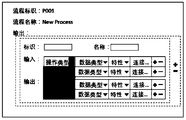
- an input interface for generating a new activity by the interface rendering engine 111 wherein the identifier 210 is a code identifier of a newly created activity, is used in the program code.
- the process name 211 is the display name of the new process.
- the input type data item and the output type data item have semantic expressions of the same structure, and the semantic expression structure includes an operation type parameter 230, a data type parameter 231, an attribute type parameter 232, and a connection type parameter 233.
- the operation type parameter 230 includes types of "new”, “reference”, and “calculation”.
- the operation type parameter 230 is "new”, the value of the semantically expressed data item needs to be input by the user.
- the operation type parameter 230 is "reference”, the value of the data item is already stored in the referenced system.
- the operation type parameter 230 is "calculation”, then the value of the data item is the return value obtained by the user's input value or by referring to the value of the stored data item in the system and calculated by the existing algorithm in the system.
- the data type parameter 231 in FIG. 2 may be a metadata unit type already stored in the system, or a new metadata unit type may be customized, or may be selected as a basic data type or a predefined predefined data type in the system.
- Other data types such as the "year" data type, can be derived from the base data type "integer”.
- Both the input data item and the output data item can have multiple semantic expressions, and the post-semantic expression can be a sub-semantic expression of the pre-semantic expression. This will be specifically described in Embodiment 3.
- the property type parameter 232 describes the characteristics of the data item, including but not limited to "multi-value", “format”, “registration”, and “return value”.
- the characteristic type parameter 232 is "multi-value" it indicates that the data type parameter 231 corresponds to a plurality of values.
- "Format” defines the display format when the data item is rendered in the interface. If the "registered" data type parameter 231 is an object type metadata unit, and the semantic expression having the "registered" attribute type parameter 232 has a sub-semantic expression to form a hierarchical structure, then this "registration" corresponds to the type in the programming language. The concept of "inheritance”.
- the object type metadata unit is a new type of inheritance type after "registration”
- the child semantic expression is an extended structure of a new type after registration.
- the sub-semantic representation of the extended structure in "registration” can also use object-type metadata units, so that the new data type generated corresponds to the type "combination" concept in the programming language.
- the property type parameter 232 may have a "return value" attribute, and the data item may be externally visible through the activity/flow, and the value of the data item is automatically used as an input of the subordinate activity task instance.
- the task processing engine 121 can parse the interface data generated by the interface rendering engine 111, and understand the operation type parameter 230 and the data type parameter 231 of the input and output data items in the data, and perform various data exchanges according to the specified characteristic type parameter 232.
- connection type parameter 233 can determine an assignment object of the semantic expression.
- the connection type parameter 233 includes three attribute values, namely "connection attribute”, “connection input”, and “connection output”. "Connection Properties”, “Connection Input”, and “Connection Output” are “assignment” of the semantically expressed data to a specified informational data item, input type data item, or output type data item. The specific meaning of the "assignment” is determined according to the assigned data item or metadata unit, and is specifically described in Embodiment 1.
- FIG. 3 is a block diagram showing the structure of the system shown in FIG. 1 with the data sensing system 113 on the client 110.
- the data awareness system 113 is generated by the interface rendering engine 111 while rendering the interface for synchronizing interface input values and task data.
- This synchronization includes forward synchronization and reverse synchronization.
- the forward synchronization means that the data sensing system 113 synchronously stores the data input by the user at the interface into the corresponding task data through the task processing engine 121.
- the reverse synchronization means that the data sensing system 113 searches for the corresponding metadata unit in the data management system 122 by the task processing engine 121 in response to the user operation, and synchronously renders the data into the interface for display.
- the data processing system 122 when the data-aware system 113 listens to the operation type parameter 230 of the input value of the interface element as a "reference", the data processing system 122 will look for this by the task processing engine 121.
- the data perception system 113 notifies the interface rendering engine 111 to additionally render the interface of the distinct meta-data unit in the original interface.
- the data-aware system 113 listens for this operation and looks up the "operation type” data in the data management system 122 and returns it to the interface rendering engine 111.
- the interface rendering engine 111 renders additional interface elements "new", “reference” and "calculation” as shown in FIG.
- the client 110 may further include a message management system 120 for message communication of the client user, such as mail or instant messaging.
- the message management system 120 is not an indispensable functional module of the system of the present invention.
- the data management system 122 of the server 120 may further include a type data unit.
- the type data unit is a class concept like a metadata unit.
- the type data unit records the type name of the metadata unit and the type name of the data item, such as the object name, the activity name, or the process name. It also records the inclusion relationship of these metadata units, such as the activity "may include the activity under the conference”. Event invitations, "meeting minutes", “change of meeting dates” and other activities.
- system of the present invention can develop an application server to integrate the data management system 122, the task processing engine 121, and the interface rendering engine 111 to form a complete management information cloud platform.
- Implement functions such as payment and user management on the cloud platform to enable social organizations and individuals to develop and use their own business processes on the cloud platform.
- the human-computer interaction technology of the rendering engine can also use a voice interactive interface instead of a graphical interactive interface (GUI).
- GUI graphical interactive interface
- Figure 5 shows a schematic flow diagram of the method of the present invention.
- the system 501 is initialized to establish a metadata unit in the data management system.
- the types of the metadata unit data items include an input type and an output type, and the input type and the output type data item may be multiple pieces, and both have semantic expressions.
- the semantic expression may be composed of four parameters that constitute a data structure that the computer can understand for functional expression.
- the activity metadata unit has not only input type and output type data items but also data items recorded with a relationship with its pre/post activity, thereby forming an active chain.
- the use of a process metadata unit in one embodiment includes such an activity chain.
- the process metadata unit can help users to more intuitively monitor and manage the process business with multiple activities.
- the data management system is further initialized with an initial activity for creating a target activity, the initial activity is a predefined activity, and the activity 502 is created by first performing the initial activity, and the generated initial activity input interface requires the user to input an information type.
- Executing activity 503 looking up the executed activity metadata unit at the server 120, instantiating the activity generation task, performing semantic expression of the input item and/or the output item, and the task processing engine 121 will perform the task data when the interface rendering is required. Sent to the interface rendering engine 111.
- the task interface rendering 504 is executed, and the interface rendering engine 111 renders the interface according to the received task data rendered by the required interface.
- the interface element is rendered, the display value of the interface element is synchronized with the value of the task data, and the interface input value and the task data are formed.
- the task data having the interface input data is sent to the task processing engine 121 for processing.
- the interface input is checked and the subordinate task 505 is driven.
- the task processing engine 121 checks whether the required data items in the interface data submitted by the user are completed, drives the completion of the required data items, and/or the active state transition of the driving task.
- the post-deployment task is driven according to the pre/post activity correlation of the activity to which the task belongs, and the task is terminated if there is no post activity for the activity to which the task belongs.
- Java is used as a development server program
- HTML/JavaScript is used as a development client program
- Tomcat is used as an application server 122 in the server
- MySQL is used as a data management system 121
- a Linux operating system is used as a server host, a Chrome browser.
- the system in this embodiment includes at least an interface rendering engine 111, a task processing engine 121, and a data management system 122.
- the data management system stores a metadata unit 123 and a type data unit.
- the type data unit is set for the convenience of calling and retrieving metadata units.
- the database management system 122 is installed in the server host program.
- a type (TYPE) table is created in the data management system 122, and the following data is inserted in the table:
- Types such as data type parameter 231, attribute type parameter 232, operation type parameter 230, and active input and output item type are defined in Table 1.
- the type node (ID) of the data type is A
- the type node of the text type is B
- the type node of the active type is E.
- Both the text type and the activity type's type parent node (PARENT_ID) are A, so both the text type and the activity type are subtypes of the data type.
- the text type continues to derive name types and description types.
- the activity type derives the process type. Feature types continue to derive types such as multivalued and registered.
- the operation type continues to derive three types of new, reference, and calculation. It should be understood that the system of the present invention may also have no type list.
- Metadata units are mapped for the text type, name type, description type, activity type, process type, and activity input and output item types described above, which are reflected in Table 1 that they have a unique corresponding META node (META_ID).
- a META table is created in the data management system 121, and the following META node data is stored in the table:
- the row of META node (ID) 4 defines the "active" META node, while the META nodes (ID) 5, 6, 7, and 12 are the children of META node 4, while the META nodes 8, 9 19, 20, 10, and 11 form a child node of the META node 7.
- PARENT_ID parent node
- the node and all its child nodes constitute a metadata unit, thereby constituting a deep hierarchical structure of the metadata unit data item, and A child node is the data item of the metadata unit.
- the value of the attribute (FEATURE) in the table points to the type node (ID) in Table 1.
- each semantic expression can have multiple attribute types, and each process can contain multiple activities, so input metadata units, output metadata units, and attribute type metadata units
- Both the process metadata unit and the process metadata unit can have multi-valued properties, so their attributes (FEATURE) in Table 2 have the attribute type "multi-value" (H).
- the type node (TYPE_ID) in Table 2 uniquely corresponds to the type node (ID) in Table 1. Through this correspondence, the type of the metadata unit itself or the type of the data item in the metadata unit is defined.
- the "input" metadata unit does not need to specify a type because of structural decomposition, and other metadata units specify a specific type.
- the process directory is created in the file system of the server host program, and a "P001.json" file is created in the process directory, and the following initial process metadata unit is inserted into the file:
- the interface rendering engine 111 is deployed on the client 110, which can understand the meaning of "P001.json" according to Tables 1 and 2.
- Three metadata units are defined in this document to express the initial activities, namely meta_5, name meta_6, and output meta_12.
- the second output represents the Refer system memory and is assigned to the first output (output1) by concatenating meta_11, which represents the data of the first output. Since the second output does not involve interface elements, it is not rendered.
- the interface rendering engine 111 reads and renders the P001.json file through the task_template template information of the task, and generates an interface as shown in FIG. 2, and the interface of FIG. 2 is used to create a new process for the user.
- the interface shown in FIG. 6 is obtained, wherein the input value of the identifier 220 is “P002”, the input value of the name 221 is “Another New Process”, and the input 222 has no input value.
- the output 223 sets the output of two semantic representations: the operation type parameter 230 of the first line output is "new”, the data type parameter 231 is "flow”, and the other parameters have no input value.
- the function of the first line of output is to create a new process metadata unit and not define the characteristics and connection values of this new activity.
- the operation type parameter 230 outputted in the second line is "reference"
- the input value of the data type parameter 231 is "system storage”
- the input value of the connection type parameter 233 is "connection output 1".
- the function of the second line of output is to save the data output from the first line.
- the interface rendering engine 111 creates a temporary file Task1.json in the file system through the host program 110, and saves the task instance and the data modification occurring on the interface in a temporary file, the temporary file Task1.json
- the content is as follows:
- the user submits the Task1.json file to the server application server through the interface rendering engine 111, and the application server then triggers the task processing engine 121 to analyze the Task1.json file: the template used to find the task instantiation through the task_template is P001.json, and passes P001.json. Understand the first data of the task_value array in Task1.json corresponds to the process data type defined by the first output of meta_12 in P001.json, and save the process data of the first item according to the second output definition of meta_12. Then the task processing engine 121 regenerates a data file P002.json, and the P002.json contains the first item data of the task_value array in Task1.json.
- Embodiment 1 completes the execution of the initial process according to the present invention to establish a new process, and saves the new process as a metadata unit for later call.
- the step reaches the step of FIG. 2 as described in the embodiment 1, and the user can perform interface input as shown in FIG. 7 in the interface of the new process, wherein the input value of the identifier 220 is “P003”, and the name is 221 input value.
- the input 222 sets the first line semantic expression: the operation type parameter 230 input in the first line is "reference”, the data type parameter 231 is "flow”, and the other parameters have no input value or output by default.
- 223 also sets a line of semantic expression: the operation type parameter 230 outputted in the first line is set to "new", the data type parameter 231 is set to the type "description” derived from the basic data type, and other parameters have no input value or default value.
- the execution and implementation process is the same as that of Embodiment 1, and finally the interface as shown in FIG. 8 is obtained.
- the result of the input semantics of the first line is output in the box of “Input”, and the derivative type “Description” is displayed in the “Output” box.
- the rendered interface element can be used to enter a piece of text as a description of the process, thereby implementing the "Describe Process" function embodied by the process name.
- the operation type parameter 230 of the first line output is set to "new", the data type parameter 231 is set to the "object” type and a new name “risk” is set for the output item, and the attribute type parameter 232 is set to "Registration”;
- the operation type parameter 230 outputted in the second line is set to "new”, the data type parameter 231 is set to the "text” type and a new name “risk description” is set for the output item, and the output item is indented one Unit, indicating that the output item is a child of the previous output item, other parameters do not select or use the default value;
- the operation type parameter 230 of the third line output item is set to "new”, and the data type parameter 231 is set to "date” Type and set a new name "recognition time” for the output item, and the output item is also indented by one unit, indicating that the output item is a child of the first line of the output item;
- the operation type parameter 230 of the fourth line of output is set to "reference",
- the interface rendering engine 111 creates a temporary file Task3.json in the file system through the host program 110, and saves the data modifications occurring on the interface in the temporary file:
- the user submits the Task3.json file to the server application server through the interface rendering engine 111, and the application server triggers the task processing engine 121.
- the task processing engine 121 starts to analyze the Task3.json file: the template used to find the task instantiation through task_template is P001.json, and the first data of the task_value array in Task1.json is understood by P001.json to be the meta_12 in P001.json.
- the process data type defined in the first item is stored in the process data of the first output item according to the connection type parameter 333 defined by the second item of meta_12.
- the task processing engine 125 then regenerates a data file P004.json, which contains the first item of the task_value array in Task3.json.
- the task processing engine 121 when the task processing engine 121 analyzes the Task3.json file, it will also find that the task_value in Task1.json is not only the process data type, but also the second output item in the task_value has the registration feature. Therefore, the task processing engine 121 registers a new data type "risk” for the second item and a new metadata unit "risk”, which contains two sub-data items "risk description” and "identification time” . That is, the type (TYPE) table will add a record:
- META table will add three records:
- a new process “New Risk” can be established by referring to the embodiment 1: setting two in the new process.
- the line semantic expression output item, the operation type parameter 230 of the first line output item is set to "new", the data type parameter 231 is set to "risk” other unchanged; the operation type parameter 230 of the second line output item is set to "reference”
- the data type parameter 331 is set to "system storage” connection type parameter 233 to select the connection of the first line of output item data.
- Embodiment 4 The implementation method of creating a new multi-relational activity flow is specifically described below in conjunction with Embodiment 4.
- an approval process for an internal employee to apply for a fixed asset is implemented through five activities.
- FIG. 10a is a schematic diagram of creating a creation flow interface with five activities, and the five activity input interfaces are respectively shown in FIGS. 10b-10f.
- the first activity 214 is used to identify the process so that the process is invoked, and it does not directly relate to the other four activities. It will be appreciated that this approach may be replaced by other means in other embodiments.
- the other four activities correspond to all four activities included in the process “fixed asset approval”: “fixed asset application”, “department approval”, “general manager approval” and “asset rationing”.
- the upper activity 225 of the second activity 216 to the fifth activity 219 input values are all "A001", and "A001" is the identification 220 of the second activity, so the superior activity of the second activity points to itself as the starting activity of the process, and
- the third activity 217, the fourth activity 218, and the fifth activity 219 are all post-activity of the second activity 214.
- the dependency rules 224 of the third activity 217 to the fifth activity 219 are respectively input values: "A001: FS", “A002: FS", “A003: FS” as shown in FIGS. 10c-10f, wherein the third activity 217 is input.
- "A001: FS” in the interface indicates that the third activity 217 forms a dependency rule with the second activity 216 whose identifier 220 is "A001": the third activity 217 is started after the second activity 216 is completed, and the subsequent execution mode is generated by the subsequent activity dependency rule. And so on.
- the output part of the second activity 216 four output items are defined by the "new" operation type: "asset type”, “application quantity”, “application reason” and “amount”, and the data types are “reference” and “number” respectively.
- “Text” and “Currency” indicate the asset type, quantity, reason and total amount to be reported by the applicant for applying for fixed assets.
- an input item whose data type is "pre-output” is defined by the "reference” operation type, indicating that the second activity 216 can be in the post activity. See the application type, quantity, reason and total amount of fixed assets reported by the applicant.
- an output item is defined by the "new" operation type: "whether approved”, and the data type is "boolean”, indicating that the department approver and the general manager pass the "approval" Tick to output your own approval comments.
- the input value is "amount>5000", indicating that the fourth activity 218 requires “general manager approval” only when the amount of fixed assets applied by the applicant exceeds 5,000 yuan, otherwise the third activity 217 After the end, go directly to the fifth activity 219.
- an output item "asset code” whose data type is "text” is defined by the "new" operation type, and the attribute selects "multi-value”, indicating that the fixed asset manager is in the department approver and/or After the approval of the general manager, the corresponding fixed assets are purchased and put into the asset code label, and these asset codes are reported to the tasks corresponding to the fifth activity 219, and finally the equipment is handed over to the applicant.
- the interface rendering engine 111 creates a temporary file in the file system through the host program as in the first embodiment, and saves the task instance and the data modification occurring on the interface in the temporary file.
- the user submits the temporary file to the server application server through the interface rendering engine 111, and the application server triggers the task processing engine 121 to finally generate a new process file P005.json:
- Embodiment 4 in conjunction with Embodiment 5, it is specifically explained how a process including a plurality of interrelated activities highlights the most important time elements in production management through graphical display.
- the five activities of "fixed asset approval”, “fixed asset application”, “department approval”, “general manager approval” and “asset rationing” are created, and the process is set through the interface as shown in FIG.
- the active planning period 227 and the Gantt chart 240 are generated at the same time.
- the left half of the interface shows the process plan table 213, and the first activity 214 is used as the identifier of the process, so it is not calculated in the related activities included in the process, in the table. Show all other activities included in the process.
- the activity name 221 for each activity is also displayed in the table, with its predecessor activity 224, and the planned duration 227 is added to enter the process plan data for all activities.
- the right half of the interface can graphically display the process plan with the duration elements and the intrinsic relationship between the activities.
- the Gantt chart 240 is used for the graphical display.
- the Gantt chart 240 takes time as the horizontal axis and displays the work week 243 and the work day 244.
- the work week is divided into five work days a week, and all the activities included in one process are divided by the activity as the vertical axis.
- the activity in the flow plan table 213 and the rectangle representing the activity on the Gantt chart 240 are the row-corresponding relationship, wherein the time on the time scale and the planned duration of the corresponding activity are reflected by the width of the rectangle. Consistent.
- the horizontal left offset of the rectangle is closely aligned according to the pre-relationship between the activities.
- a rectangle and a rectangle are connected by arrows to indicate a sequence relationship and a branch relationship between activities.
- pre-activity with conditional rules and its post-activity are connected by dashed arrows, such as second arrow 246 and third arrow 247.
- a pre-activity without a conditional rule and its post-activity are connected by solid arrows, such as a first arrow 245 and a fourth arrow 248.
- all rectangles are represented by an implementation box, indicating that the activity cannot be skipped when executed, that is, the metadata unit of the activity has a required data item.
- the executed activity may be skipped, ie, the active metadata unit does not have a required data item, a skippable activity, which is represented in the Gantt chart 240 by a dashed rectangle.
- the Gantt chart 240 is displayed above the layer when the user clicks the button 241. If the user clicks on the button 242, the interface in FIGS. 10b-10f is displayed in the spatial extent of the Gantt chart 240 according to the activity line selected by the user.
- the embodiments of the present invention can provide a method, system, or computer program product.
- the present invention can thus take the form of an entirely hardware embodiment, an entirely software embodiment, or a combination of software and hardware.
- the application can take the form of a computer program product embodied on one or more computer-usable storage media (including but not limited to disk storage, CD-ROM, optical storage, etc.) including computer usable program code.
- the computer program instructions can also be stored in a computer readable memory that can direct a computer or other programmable numerical processing device to operate in a particular manner, such that the instructions stored in the computational readable memory produce an article of manufacture comprising the instruction device.
- the apparatus implements the functions specified in a block diagram or a plurality of block diagrams of one or more flows and/or block diagrams of the flowchart.
- These computer program instructions can also be loaded onto a computer or other programmable numerical processing device such that a series of operational steps are performed on the computer and other programmable devices to produce computer-implemented processing for execution on a computer or other programmable device.
- the instructions provide steps for implementing the functions specified in a block or blocks of a flow or a flow and/or a block diagram of a flowchart.
Landscapes
- Engineering & Computer Science (AREA)
- Software Systems (AREA)
- General Engineering & Computer Science (AREA)
- Theoretical Computer Science (AREA)
- Human Computer Interaction (AREA)
- Physics & Mathematics (AREA)
- General Physics & Mathematics (AREA)
- Information Retrieval, Db Structures And Fs Structures Therefor (AREA)
- Stored Programmes (AREA)
Abstract
La présente invention concerne un procédé et un système de mise en œuvre de gestion reposant sur des informations sur la base d'une sémantisation d'entrée et de sortie. Le système et le procédé selon la présente invention peuvent utiliser la sémantisation d'entrée et de sortie pour mettre en œuvre et établir des relations entre des processus et des logiques d'activité, notamment la ramification, le séquençage, la mise en circulation de flux, etc., afin de permettre le fonctionnement de types et de fonctions, la déclaration de variables, la surcharge et la réutilisation d'algorithmes de haut niveau. De cette manière, le système étendu peut correspondre à la flexibilité, à l'ouverture et à la perspective globale des langages de programmation modernes, et le processus de mise en œuvre ne nécessite aucun travail de programmation. De plus, le système peut mettre en œuvre, en fonction d'informations d'unité de métadonnées, une génération d'interface automatique au moyen de modules fonctionnels dans le système ainsi que l'intercommunication de ces derniers. Pendant un processus d'entrée d'interface, une synchronisation entre des valeurs d'entrée dans l'interface et des données de système est maintenue, garantissant ainsi la commodité et l'efficacité élevée du système de la présente invention.
Applications Claiming Priority (2)
| Application Number | Priority Date | Filing Date | Title |
|---|---|---|---|
| CN201710879544.3A CN108536718A (zh) | 2017-09-26 | 2017-09-26 | 一种基于输入输出语义化实现的管理信息化的方法和系统 |
| CN201710879544.3 | 2017-09-26 |
Publications (1)
| Publication Number | Publication Date |
|---|---|
| WO2019062673A1 true WO2019062673A1 (fr) | 2019-04-04 |
Family
ID=63488722
Family Applications (1)
| Application Number | Title | Priority Date | Filing Date |
|---|---|---|---|
| PCT/CN2018/107048 Ceased WO2019062673A1 (fr) | 2017-09-26 | 2018-09-21 | Procédé et système de mise en œuvre de gestion reposant sur des informations sur la base de sémantisation d'entrée et de sortie |
Country Status (2)
| Country | Link |
|---|---|
| CN (1) | CN108536718A (fr) |
| WO (1) | WO2019062673A1 (fr) |
Families Citing this family (6)
| Publication number | Priority date | Publication date | Assignee | Title |
|---|---|---|---|---|
| CN108536718A (zh) * | 2017-09-26 | 2018-09-14 | 邓晖 | 一种基于输入输出语义化实现的管理信息化的方法和系统 |
| CN109445792B (zh) * | 2018-11-05 | 2021-12-21 | 用友网络科技股份有限公司 | 界面构建方法、装置及计算机可读存储介质 |
| CN109741026A (zh) * | 2018-12-27 | 2019-05-10 | 北京字节跳动网络技术有限公司 | 基于活动对的流程引擎处理方法及装置 |
| CN111193658B (zh) * | 2019-12-30 | 2021-09-24 | 华人运通(江苏)技术有限公司 | 基于即时通讯消息的任务管理方法、装置、设备及介质 |
| US11735180B2 (en) * | 2020-09-24 | 2023-08-22 | International Business Machines Corporation | Synchronizing a voice reply of a voice assistant with activities of a user |
| CN114371894B (zh) * | 2021-12-08 | 2023-11-17 | 贵州开放大学(贵州职业技术学院) | 一种管理元数据的方法 |
Citations (4)
| Publication number | Priority date | Publication date | Assignee | Title |
|---|---|---|---|---|
| CN1826610A (zh) * | 2003-05-07 | 2006-08-30 | Sap股份有限公司 | 包括带协作过程引擎的特设型工作流结构化处理的面向终端用户的工作流方法 |
| CN102081721A (zh) * | 2009-11-30 | 2011-06-01 | 株式会社Ntt都科摩 | 数据控制设备和数据控制方法 |
| CN102222000A (zh) * | 2011-06-28 | 2011-10-19 | 用友软件股份有限公司 | 数据交互装置和数据交互方法 |
| CN108536718A (zh) * | 2017-09-26 | 2018-09-14 | 邓晖 | 一种基于输入输出语义化实现的管理信息化的方法和系统 |
Family Cites Families (4)
| Publication number | Priority date | Publication date | Assignee | Title |
|---|---|---|---|---|
| US20030018513A1 (en) * | 2001-04-13 | 2003-01-23 | Hoffman George Harry | System, method and computer program product for benchmarking in a supply chain management framework |
| CN101071480A (zh) * | 2007-06-15 | 2007-11-14 | 南京联创科技股份有限公司 | 复杂业务系统中基于工作流的通用构件化流程调度方法 |
| CN101776999A (zh) * | 2010-01-28 | 2010-07-14 | 苏州工业园区进一科技有限公司 | 软件系统开发实施平台 |
| CN107153944A (zh) * | 2017-02-22 | 2017-09-12 | 上海爱韦讯信息技术有限公司 | 基于流程驱动研发任务的方法及系统 |
-
2017
- 2017-09-26 CN CN201710879544.3A patent/CN108536718A/zh active Pending
-
2018
- 2018-09-21 WO PCT/CN2018/107048 patent/WO2019062673A1/fr not_active Ceased
Patent Citations (4)
| Publication number | Priority date | Publication date | Assignee | Title |
|---|---|---|---|---|
| CN1826610A (zh) * | 2003-05-07 | 2006-08-30 | Sap股份有限公司 | 包括带协作过程引擎的特设型工作流结构化处理的面向终端用户的工作流方法 |
| CN102081721A (zh) * | 2009-11-30 | 2011-06-01 | 株式会社Ntt都科摩 | 数据控制设备和数据控制方法 |
| CN102222000A (zh) * | 2011-06-28 | 2011-10-19 | 用友软件股份有限公司 | 数据交互装置和数据交互方法 |
| CN108536718A (zh) * | 2017-09-26 | 2018-09-14 | 邓晖 | 一种基于输入输出语义化实现的管理信息化的方法和系统 |
Also Published As
| Publication number | Publication date |
|---|---|
| CN108536718A (zh) | 2018-09-14 |
Similar Documents
| Publication | Publication Date | Title |
|---|---|---|
| Lapouchnian et al. | Requirements-driven design and configuration management of business processes | |
| US8631387B2 (en) | System and method for the structuring and interpretation of organic computer programs | |
| Brambilla et al. | Process modeling in web applications | |
| WO2019062673A1 (fr) | Procédé et système de mise en œuvre de gestion reposant sur des informations sur la base de sémantisation d'entrée et de sortie | |
| US9135586B2 (en) | System for dynamic parallel looping of repetitive tasks during execution of process-flows in process runtime | |
| CN105094818B (zh) | 基于soa的自然资源综合应用构建方法及系统 | |
| US20240311087A1 (en) | Deeply Integrated Development Environment | |
| US20120060141A1 (en) | Integrated environment for software design and implementation | |
| US10949758B2 (en) | Data management externalization for workflow definition and execution | |
| CN106600226B (zh) | 用于优化流程管理系统的方法及装置 | |
| US20130247051A1 (en) | Implementation of a process based on a user-defined sub-task sequence | |
| Reschenhofer et al. | Lessons learned in aligning data and model evolution in collaborative information systems | |
| Haarmann et al. | Refining case models using cardinality constraints | |
| Künzle et al. | Striving for object-aware process support: How existing approaches fit together | |
| US20140136257A1 (en) | In-memory analysis scenario builder | |
| Torres et al. | Developing BP-driven web applications through the use of MDE techniques | |
| Vaculín et al. | Data-centric web services based on business artifacts | |
| Kim et al. | R-BPMN for abstract modeling of business process patterns | |
| Matera et al. | Model‐driven design of collaborative Web applications | |
| zur Muehlen et al. | Workflow Process Definition Language–Development and Directions of a Meta-Language for Workflow Processes | |
| Yongsiriwit | Modeling and mining business process variants in cloud environments | |
| Merah et al. | Design of ATL rules for transforming UML 2 communication diagrams into buchi automata | |
| CN115328459A (zh) | 业务逻辑的生成方法、装置、电子设备及存储介质 | |
| Bauer et al. | Using UML in the context of agent-oriented software engineering: State of the art | |
| Singh | Object Oriented Modeling and Design with UML |
Legal Events
| Date | Code | Title | Description |
|---|---|---|---|
| NENP | Non-entry into the national phase |
Ref country code: DE |
|
| 32PN | Ep: public notification in the ep bulletin as address of the adressee cannot be established |
Free format text: NOTING OF LOSS OF RIGHTS PURSUANT TO RULE 112(1) EPC (EPO FORM 1205N DATED 24/06/2020) |
|
| 122 | Ep: pct application non-entry in european phase |
Ref document number: 18863517 Country of ref document: EP Kind code of ref document: A1 |