WO2019065592A1 - 植物の生産方法、及び、植物加工品の製造方法 - Google Patents
植物の生産方法、及び、植物加工品の製造方法 Download PDFInfo
- Publication number
- WO2019065592A1 WO2019065592A1 PCT/JP2018/035353 JP2018035353W WO2019065592A1 WO 2019065592 A1 WO2019065592 A1 WO 2019065592A1 JP 2018035353 W JP2018035353 W JP 2018035353W WO 2019065592 A1 WO2019065592 A1 WO 2019065592A1
- Authority
- WO
- WIPO (PCT)
- Prior art keywords
- plant
- culture solution
- content
- mass
- ions
- Prior art date
- Legal status (The legal status is an assumption and is not a legal conclusion. Google has not performed a legal analysis and makes no representation as to the accuracy of the status listed.)
- Ceased
Links
Classifications
-
- A—HUMAN NECESSITIES
- A01—AGRICULTURE; FORESTRY; ANIMAL HUSBANDRY; HUNTING; TRAPPING; FISHING
- A01G—HORTICULTURE; CULTIVATION OF VEGETABLES, FLOWERS, RICE, FRUIT, VINES, HOPS OR SEAWEED; FORESTRY; WATERING
- A01G22/00—Cultivation of specific crops or plants not otherwise provided for
- A01G22/25—Root crops, e.g. potatoes, yams, beet or wasabi
-
- A—HUMAN NECESSITIES
- A01—AGRICULTURE; FORESTRY; ANIMAL HUSBANDRY; HUNTING; TRAPPING; FISHING
- A01G—HORTICULTURE; CULTIVATION OF VEGETABLES, FLOWERS, RICE, FRUIT, VINES, HOPS OR SEAWEED; FORESTRY; WATERING
- A01G22/00—Cultivation of specific crops or plants not otherwise provided for
-
- A—HUMAN NECESSITIES
- A01—AGRICULTURE; FORESTRY; ANIMAL HUSBANDRY; HUNTING; TRAPPING; FISHING
- A01G—HORTICULTURE; CULTIVATION OF VEGETABLES, FLOWERS, RICE, FRUIT, VINES, HOPS OR SEAWEED; FORESTRY; WATERING
- A01G31/00—Soilless cultivation, e.g. hydroponics
-
- A—HUMAN NECESSITIES
- A01—AGRICULTURE; FORESTRY; ANIMAL HUSBANDRY; HUNTING; TRAPPING; FISHING
- A01G—HORTICULTURE; CULTIVATION OF VEGETABLES, FLOWERS, RICE, FRUIT, VINES, HOPS OR SEAWEED; FORESTRY; WATERING
- A01G7/00—Botany in general
- A01G7/06—Treatment of growing trees or plants, e.g. for preventing decay of wood, for tingeing flowers or wood, for prolonging the life of plants
-
- C—CHEMISTRY; METALLURGY
- C05—FERTILISERS; MANUFACTURE THEREOF
- C05G—MIXTURES OF FERTILISERS COVERED INDIVIDUALLY BY DIFFERENT SUBCLASSES OF CLASS C05; MIXTURES OF ONE OR MORE FERTILISERS WITH MATERIALS NOT HAVING A SPECIFIC FERTILISING ACTIVITY, e.g. PESTICIDES, SOIL-CONDITIONERS, WETTING AGENTS; FERTILISERS CHARACTERISED BY THEIR FORM
- C05G5/00—Fertilisers characterised by their form
- C05G5/20—Liquid fertilisers
- C05G5/23—Solutions
Definitions
- the present invention relates to a method of producing a plant, and a method of producing a processed plant product.
- Patent Document 1 discloses “a root removal step for removing the root of a grown polyphenol compound-containing plant selected from the group consisting of a potato other than sweet potato, a cypress and a plant belonging to the family Asteraceae, and a plant from which the root is removed.
- the present inventors examined the method for producing a polyphenol compound-containing plant described in Patent Document 1, and clarified that there is room for further improvement in the content of the caffeoylquinic acid compound in the resulting plant. did.
- this invention makes it a subject to provide the production method of a plant for obtaining a plant with a high content rate of a caffeoyl quinic acid compound.
- Another object of the present invention is to provide a method for producing a processed plant product.
- the culture solution contains metal ions of at least one metal selected from the group consisting of B, Mn, Zn, Cu, and Mo.
- the culture solution contains one type of metal ion
- the metal ion content is 1.0 mass ppm or less with respect to the total mass of the culture solution, and the culture solution contains two or more types.
- the culture solution contains Mn ions, and the content of Mn ions is more than 50 mass ppb and not more than 1.0 mass ppm based on the total mass of the culture solution.
- the culture solution contains at least one ion selected from the group consisting of K + , Mg 2+ , Ca 2+ , SO 4 2 ⁇ , and Cl ⁇ , and the culture solution contains one or more of the above ions.
- the content of the above ion relative to the total mass of the culture fluid is 1.0 mass ppm or more, and when the culture fluid contains two or more of the above ions, each of the above ions relative to the total mass of the culture fluid
- the culture solution contains one of the above-mentioned ions
- the content ratio of the ions is 1.0 to 300 mass ppm with respect to the total mass of the culture solution, and the culture solution contains two or more kinds.
- the culture solution comprises metal ions of at least one metal selected from the group consisting of B, Mn, Zn, Cu, and Mo, K + , Mg 2+ , Ca 2+ , SO 4 2 ⁇ , and And at least one ion selected from the group consisting of Cl ⁇ , a method of producing a plant according to any of [1] to [6].
- a root portion of a plant obtained by the production method according to any one of [1] to [7] is removed to obtain a stem portion, and the stem portion is dried without supplying water.
- a method of producing a processed plant product which obtains a processed plant product.
- the present invention it is possible to provide a plant production method for obtaining a plant having a high content of caffeoylquinic acid compound. Further, according to the present invention, a method of producing a processed plant product can also be provided.
- the content rate of the caffeoyl quinic acid compound means the mass of the caffeoyl quinic acid compound contained in the plant of unit mass (dry matter weight).
- a numerical range represented using “to” means a range including numerical values described before and after “to” as the lower limit value and the upper limit value.
- the method for producing a plant according to the present invention comprises growing at least one plant selected from the group consisting of potatoes other than sweet potato, plants of the family Convolvulaceae, and plants of the family Asteraceae (hereinafter also referred to as "step 1"). And (b) hydroponic cultivation of the grown plants using a culture solution substantially free of nitrate ions and phosphate ions (hereinafter, also referred to as "step 2"). .
- a plant produced by a method for producing a plant having such a constitution has a high content of caffeoylquinic acid compound (hereinafter also referred to as "CQA").
- CQA is known to be contained in coffees, young barley leaves, sweet potatoes and the like, and its physiological function is expected to be applied to functional foods and the like.
- CQA in plants in particular, tricaffeoylquinic acid (TCQA), which is particularly high in physiological activity
- TCQA tricaffeoylquinic acid
- TCQA tricaffeoylquinic acid
- Step 1 is a step of growing at least one type of plant selected from the group consisting of potatoes other than sweet potato, plants of the family Convolvulaceae, and plants of the family Asteraceae.
- the potatoes other than sweet potato are not particularly limited, and include potato, cassava, taro, taro, and yam.
- the convolvulaceous plant is not particularly limited, and examples thereof include sweet potato, convolvulus, asagao, yorugao, hydrangea, lukousou, nenakashizura, eveluls, and cornflower.
- the asteraceous plants are not particularly limited, but are not limited to: Jerusalem artichoke, yarrow, burdock, wormwood, aster, baccalis, daisies, calendula, ezogic, safflower, cornflower, nemophila, sungly, margaret, chicory, chicory, mulchichole, arachnidica, , Dandelion, Dahlia, Murasaki Barengiku, Himejoon, Fujibakama, Tsurubuki, Gerbera, Hahakogusa, Lotus japonicus, Sunflower, Yomena, Lettuce, Senbon Yari, Camerile, Cinuilia, Yacon, Akininokirin Suga, Nagareshi, Urushina, Zinachi .
- a plant selected from the group consisting of a convolvulus plant and a plant belonging to the family Asteraceae is preferable, a convolvulus plant is more preferable, and a sweet potato is more preferable, from the viewpoint that the superior effect of the present invention can be obtained.
- sweet potato include, but are not limited to, benizuma, beniharka, benicoma, crimson red, Naruto goldfish, white clover, white clover, clover, clover, crimson, crimson, crimson, and clove.
- other varieties derived from Taka 14 can also be used.
- various types of sweet potato which have not yet been registered for breed can also be used.
- plants can be grown at the time of plant growth from the viewpoint that plants can grow larger and as a result, the yield of CQA (the mass of CQA contained per unit plant of plants can be increased and the unit is mg / plant) can be increased.
- CQA the mass of CQA contained per unit plant of plants can be increased and the unit is mg / plant
- sweet potato when using sweet potato as a plant, CQA is contained in a large amount in its leaves, and therefore, it is known that the size per leaf is larger and the number of leaves per plant is larger. It is more preferable to grow under the conditions of In the present specification, “growth” means a state in which a plant is sufficiently large, specifically, the following state.
- sweet potato it means a state in which the above-ground part of the sweet potato is expanded by four leaves (section 4) or more, or a state in which the above-ground part is expanded to 20 cm or more.
- a wormwood and a chrysanthemum it means that the above-ground part grew to 10 cm or more.
- 4 to 5 or more true leaves are released.
- burdock it means that three or four true leaf leaves.
- taro it means that three or more true leaves are released.
- potato it means that the above-ground part has grown to 10 cm or more.
- yacon it means that the above-ground part has grown to 10 cm or more.
- ensai it means that the above-ground part has grown to 10 cm or more.
- the conditions for growing plants in step 1 are not particularly limited, and can be appropriately adjusted for each plant.
- a condition to be adjusted for example, temperature, humidity, light (in sunlight or artificial light), CO 2 (to the CO 2 in air may be used as it is, CO 2 contained in addition atmosphere therefrom The rate may be increased), water (sprinkler to soil or hydroponic culture), and nutrients as needed (nitrogen, phosphoric acid, potassium etc. can be used, and further, commercial fertilizers Can also be used) and the like.
- These conditions may be appropriately combined and adjusted for plant growth.
- a fluorescent lamp, LED (light emitting diode), etc. can be used, for example.
- LED lighting is also widely used from a viewpoint of reduction of a light-and-heat cost, and light source extension of life.
- the light source in this case is not particularly required to be white light, and there are many examples of using a combination of R (Red) light and B (Blue) light depending on the purpose.
- G (Green) light or near infrared light can also be used.
- the conditions for growing a plant in step 1 vary depending on the type of plant, but as the daytime, 6 to 24 hours are preferable, and 8 to 16 hours are more preferable.
- the ambient temperature is preferably 10 to 40 ° C., and more preferably 15 to 35 ° C.
- the humidity is not particularly limited, and 30 to 100% is preferable at the temperature at which plants are grown.
- the content of CO 2 in the atmosphere is preferably 400 to 2,000 ppm by mass, and more preferably 1,000 to 1,500 ppm by mass.
- the photosynthetic photon flux density is preferably 50 to 500 ⁇ mol / m 2 / sec, and more preferably 80 to 450 ⁇ mol / m 2 / sec.
- said each conditions can be suitably selected by the kind of plant.
- step 1 is not particularly limited, and may be a period until the plant reaches the “grown” state described above. Typically, it often takes about 7 to 60 days. For example, when sweet potato seedlings are grown, 10 to 40 days are preferable as step 1.
- CQA has a high content in the stems, particularly in the leaves. Therefore, in step 1, it is preferable to obtain sufficient amount of leaves by growing a plant.
- the yield of leaves after removing roots and stems from grown plants, the remaining leaves are subjected to drying treatment, and the average value of the yield of the obtained dried leaves per plant (g / piece) It can be expressed as That is, it can be expressed as a total (g / piece) of dry matter weight of leaves obtainable from one plant.
- the yield of leaves also varies depending on the type of plant, cultivation conditions, cultivation period, etc. For example, in the case of water culture of sweet potato, 1 g / piece or more is preferable, 2 g / piece or more is more preferable, 3 g / piece. More than this is more preferable.
- Step 2 is a step of cultivating grown plants using a culture solution substantially free of nitrate ion and phosphate ion. That is, this is a step of continuously cultivating the plants grown in step 1.
- hydroponic culture means a culture method of supplying a culture solution containing nutrients necessary for plant growth to plants without using soil, solid medium cultivation using a solid medium, and solid medium Not including hydroponic and spray farming. Among them, hydroponic is preferable from the viewpoint of easier control of nutrients given to plants.
- the culture solution used in step 2 is substantially free of nitrate ions and phosphate ions.
- the term "substantially free of nitrate ion and phosphate ion” means that both of the nitrate ion and phosphate ion content with respect to the total mass of the culture solution when measured using an ion chromatograph, It means that it is less than 10 mass ppm, less than 5.0 mass ppm is preferable, and less than 1.0 mass ppm is more preferable.
- the culture solution (so-called liquid fertilizer) used in hydroponic culture contains about 100 to 1000 mass ppm of nitrate ion and about 30 to 200 mass ppm of phosphate ion Often That is, the culture solution used in this step has a nitrate ion and phosphate ion content of about 1/10 to 1/1000 as compared with the general liquid fertilizer.
- CQA production particularly, TCQA production
- water is often used as a solvent for the culture solution.
- the content of water in the culture solution is not particularly limited, but is preferably 90% by mass or more, more preferably 95% by mass or more, and still more preferably 99% by mass or more based on the total mass of the culture solution.
- tap water means tap water (For example, the content rate of Mn ion is 50 mass ppb or less in the total mass of tap water) which satisfy general tap water quality standards.
- the culture solution is a metal ion of at least one metal selected from the group consisting of B, Mn, Zn, Cu, and Mo (hereinafter referred to as "first ion") in that the superior effect of the present invention can be obtained. Is preferably contained. In addition, it is more preferable that the culture solution contains each ion of B, Mn, Zn, Cu, and Mo as a 1st ion at the point from which the further outstanding effect of this invention is acquired.
- the content of the first ion in the culture solution is not particularly limited, but when one kind of the first ion is contained in the culture solution, the content of the first ion is based on the total mass of the culture solution. 10 mass ppm or less is preferable, and 1.0 mass ppm or less is more preferable. When two or more types of first ions are contained in the culture solution, the content of each of the first ions is preferably 10 mass ppm or less, and 1.0 mass ppm or less with respect to the total mass of the culture solution. More preferable.
- the state in which the culture solution contains the first ion means that the culture solution contains 20 mass ppb or more of the first ion with respect to the total mass of the culture solution, 50 The mass ppb or more is preferable, and the mass exceeding 50 mass ppb is more preferable.
- the culture solution contains at least one (or two or more) of the first ions, and the (or each) content thereof is 1.0 mass ppm or less, CQA (especially TCQA) in the resulting plant The content is higher.
- the culture solution preferably contains at least Mn ion among the first ions, and in this case, the content of Mn ion is more than 50 mass ppb to 1.0 mass of the total mass of the culture solution. It is preferably at the ppm or less. When the content of Mn ions in the culture solution is in the above range, more excellent effects of the present invention can be obtained.
- the culture solution is at least one ion selected from the group consisting of K + , Mg 2+ , Ca 2+ , SO 4 2 ⁇ , and Cl ⁇ in that the superior effect of the present invention can be obtained It is preferable to contain the following "2nd ion”.) It is more preferable to contain 2 or more types of 2nd ion.
- the culture solution contains K + , Mg 2+ , Ca 2+ , SO 4 2 ⁇ , and Cl ⁇ as a second ion, in order to obtain further excellent effects of the present invention. Is more preferred.
- the content of the second ion in the culture solution is not particularly limited, but when the second culture contains one kind of second ion, the content of the second ion is preferably 0.1 mass ppm or more. 1.0 mass ppm or more is more preferable, 5.0 mass ppm or more is more preferable, 500 mass ppm or less is preferable, 300 mass ppm or less is more preferable, 200 mass ppm or less is more preferable, 150 mass ppm or less is particularly preferable preferable. When two or more types of second ions are contained in the culture solution, at least one content is preferably in the above range, and the content of each second ion is in the above range. Is more preferred.
- the state in which the culture solution contains a second ion means that the content is equal to or higher than the lower limit of determination when measured by the method described in the examples (for example, in the case of Mg 2+ , 0. 1 mass ppm or more).
- the culture solution preferably contains K + , Mg 2+ , Ca 2+ , SO 4 2 ⁇ , and Cl ⁇ in that the more excellent effect of the present invention can be obtained, and the whole culture solution is preferably the whole.
- K + is preferably 5.0 mass ppm or more
- Mg 2+ is preferably 5.0 mass ppm or more
- Ca 2+ is preferably 15 mass ppm or more
- SO 4 2- is 10
- the mass ppm or more is preferable
- the Cl ⁇ is preferably 5.0 mass ppm or more.
- the culture solution preferably contains one or more types of first ions and one or more types of second ions, and more preferably contains all of the first ions and one or more types of second ions, and the first ion More preferably, it contains all of the ions and all of the second ions. In addition, it is as having already demonstrated as content in the culture solution of each 1st ion in this case, and each 2nd ion.
- the method for preparing the culture solution is not particularly limited. It can be produced by purifying pure water, distilled water, tap water, etc. and then adding a component to be an ion source so that, for example, the content of the first ion and the second ion falls within the above range. .
- the culture solution may be prepared using the ions contained in the tap water as a component of the culture solution, or once the ion is removed, the same component is added again.
- the desired culture broth may be prepared.
- the hydroponic cultivation of step 2 can be carried out by a known method.
- the step 1 is carried out by soil culture, the grown plants may be transplanted to a device for hydroponic culture, and the above-mentioned predetermined culture solution may be supplied.
- the process 1 is implemented by hydroponic cultivation.
- the other conditions (CO 2 content in air, sunshine, day length, temperature, humidity, and the like) in step 2 are not particularly limited, and may be the same as those described in step 1.
- less than 17 hours is preferable, and 15 hours or less is more preferable.
- plants having a high content of CQA can be produced more efficiently.
- the period of step 2 is not particularly limited, but generally 5 days or more is preferable, 7 days or more is more preferable, and 10 days or more is more preferable, in that more CQA is produced in the plant. In addition, it is not particularly limited in that CQA can be recovered more efficiently, but generally 30 days or less is preferable, and 25 days or less is more preferable.
- CQA means a caffeoylquinic acid compound
- the caffeoylquinic acid compound monocaffeoylquinic acid (3-O-caffeoylquinic acid, 4-O-caffeoylquinic acid, 5 -O-caffeoylquinic acid and 1-O-caffeoylquinic acid), Dicaffeoylquinic acid (3,4-O-dicaffeoylquinic acid, 3,5-O-dicaffeoylquinic acid, 4,5-O-dicaffeoylquinic acid, 1,3-O-dicaffeoylquinic acid, 1,4-O-dicaffeoylquinic acid, and 1,5-O-dicaffeoylquinic acid) (3,4,5-O-tricaffeoylquinic acid, 1,4,5-O-tricaffeoylquinic acid, 1,4,5-O-tricaffeoylquinic acid, 1,
- a plant having a high content of CQA can be obtained, but it is particularly useful in that a plant having a high content of tricaffeoylquinic acid (TCQA) can be obtained.
- TCQA is known to have particularly strong physiological activity among CQAs, but plants containing TCQA are limited, and their content in plants is very low.
- a plant having a high content of TCQA can be obtained, which is useful.
- the plants obtained by the above method for producing plants have a high content of CQA per unit mass, and a high yield of CQA per unit weight.
- CQAs especially TCQAs
- the recovered CQA can be added to, for example, food and the like to produce a food having a physiological function. It does not restrict
- a method of extracting CQA from plants for example, the plant or the dried product of the plant is used as it is or after being ground, water, an organic solvent or a mixture thereof is added and the extract is stirred, etc.
- the extract may be concentrated, dried or purified depending on the purpose.
- the higher the CQA content of the plant the greater the amount of CQA obtained in a single extraction operation, and the less the cost required to recover a unit amount of CQA.
- the CQA content of a plant is about 0.01% by mass and the case where the CQA content of a plant is about 0.1% by mass
- the amount of CQA obtained at one time in the same production facility is It is theoretically about 10 times. If it is the same production equipment, one operation cost is almost equal.
- higher CQA content in plants allows CQA to be recovered at lower cost.
- the plant obtained by the above-mentioned plant production method particularly its leaves, has a high content of CQA (especially TCQA), it is also used as a functional food as it is or mixed with other materials, etc. it can.
- the plant obtained by the method for producing a plant may be dried and used. In general, the components in the plant are concentrated by drying, which is preferable.
- CQA may be extracted and used from dried plants.
- the extraction method of CQA is not particularly limited, and known methods can be used.
- the content of CQA in plants is often about 0.1 to 2.0% by mass with respect to dry matter weight.
- 4.0 mass% or more is preferable with respect to the total mass (dry matter weight) of a plant, as for the CQA content of the plant obtained by the said production method of a plant, 6.0 mass% or more is more preferable, and 8. 0 mass% or more is still more preferable.
- the content is preferably 0.1% by mass or more, more preferably 0.3% by mass or more, and 0.6% by mass or more based on the total mass (dry matter weight) of the plant. More preferable.
- the content is preferably 2.0% by mass or more, more preferably 4.0% by mass or more, based on the total mass (dry matter weight) of the plant. And 6.0 mass% or more is more preferable.
- the plants obtained by the above production method have a high content of CQA.
- the content rate for example, in the case of sweet potato, DCQA is preferably 1.2 times or more, more preferably 1.5 times or more, and further preferably 2.0 times or more, as compared to sweet potatoes produced by a usual method. preferable. 5.0 times or more of TCQA is preferable, 10 times or more is more preferable, and 30 times or more is still more preferable.
- the CQA is preferably 1.5 times or more, more preferably 2.0 times or more, and still more preferably 2.5 times or more.
- Method of producing processed plant products In the method of producing a processed plant product, the root portion of the plant obtained by the production method described above is removed to obtain a stem and stem portion, and the stem and stem portion is dried in a state where water is not supplied. It is a manufacturing method of a plant processed product which obtains a processed product.
- a "processed plant product” means the thing manufactured by the said manufacturing method.
- a leaf-stem part means what combined the leaf part and stem part of a plant, and in the plant grown by soil culture cultivation, it is synonymous with an above-ground part.
- a root part is cut
- the cutting position may be appropriately adjusted according to the type of plant.
- the tilt angle is not particularly limited.
- generation of a new root from the stem portion after removal of the root does not hinder obtaining the effect of the present invention.
- the method for producing a processed plant product described above has a drying step of drying the stem and stem portion in a state in which water is not supplied.
- limit especially as a method to dry a leaf-stem part in the state which does not supply water,
- do not supply water means not supplying water necessary for the growth of plants, and specifically means not supplying a culture solution.
- the temperature during drying and the humidity are not particularly limited, but the temperature during drying is preferably 20 to 35 ° C., and 25 to 25 at the point that a processed vegetable product having superior effects of the present invention can be obtained. 30 ° C. is more preferred.
- the relative humidity is preferably 30 to 95%, more preferably 50 to 90%. When the temperature and humidity are in the above ranges, a processed plant product having a higher CQA content can be obtained.
- the number of days of the drying step is preferably 3 to 16 days, more preferably 3 to 15 days, still more preferably 4 to 12 days, and particularly preferably 5 to 10 days.
- the temperature at the time of drying is 20 ° C. or more, the progress of CQA production reaction in plants becomes faster, and a better processed plant product having the effect of the present invention can be obtained.
- the temperature during drying is 35 ° C. or lower, the activity of CQA-degrading enzyme in plants is lower, and as a result, the purified CQA is more difficult to be degraded, and a processed plant product having a higher CQA content rate can get.
- the stems may be irradiated with light.
- the light source for irradiating light to the stem portion is not particularly limited, and examples thereof include sunlight, a fluorescent lamp, a xenon lamp, a mercury lamp, a halogen lamp, and an LED.
- the light irradiation time per day is preferably 5 to 24 hours, more preferably 8 to 16 hours, and still more preferably 10 to 14 hours.
- Step 1 As a first step, sweet potato seedlings were grown under the following cultivation conditions. That is, 10 liters of pure water, 8 ml of liquid A (hyponica liquid fertilizer made by Kyowa Chemical Co., Ltd.) in solution A and 8 ml of solution B in a hydroponic culture apparatus (manufactured by Home Hypnonica 601 Kyowa Co., Ltd.), and 6 sweet potato seedlings I planted it. The average mass of the seedlings at this time was 2.0 g / plant (fresh weight).
- liquid A hyperonica liquid fertilizer made by Kyowa Chemical Co., Ltd.
- Cultivation was carried out under conditions of 30 ° C. and 50% humidity, with the content of CO 2 in the atmosphere being the same as that under normal atmosphere. That is, no additional CO 2 was supplied.
- the light source for illumination uses an LED (DPT ′ ′ RB120Q3340 type manufactured by Showa Denko), and is lighted using a timer as a photosynthetic photon flux density 300 ⁇ mol / m 2 / sec (R light / B light ratio is 2/1) Cultivation was carried out for 14 days with a cycle of 12 hours and extinguishment 12 hours.
- the average mass of the plants (sweet potato) at the end of the first step was 28.0 g / plant (fresh weight). It described in 1 as "hydroponic, 30 degreeC, 50%, LED300micromol.”
- the DCQA content of sweet potato leaves at the end of the first step is 2.73% by mass of dry matter weight, TCQA is not included, and the total CQA content is 3.60% by mass of dry matter weight, per sweet potato
- the average yield of leaves was as low as 1.26 g / leave (dry matter weight). The results are shown in Comparative Example 1 of Table 1.
- Step 2 Next, regarding the sweet potato after completion of the first step, the whole amount of liquid fertilizer in the hydroponic culture vessel was discarded, and instead, 10 L of pure water was added, and cultivation was continued for further 14 days under the same temperature and humidity and light conditions.
- the average mass of sweet potato at the end of the second step was 31.8 g / bottle (fresh weight).
- the average yield of leaves per collected sweet potato was 1.35 g / leave (dry matter weight).
- the DCQA content of sweet potato leaves is 3.87% by mass of dry matter weight
- the TCQA content is 0.25% by mass of dry matter weight
- the total CQA content is 6.03% by mass of dry matter weight in comparison with Comparative Example 1. Greatly improved.
- the results are shown in Example 1 of Table 1.
- said cultivation method was described in Table 1 as "30 degreeC, 50%, LED300micromol.”
- Step 1 sweet potato seedlings were grown under the same cultivation conditions as in the first step of Test Example 1. Note that Test Example 2 is different from Test Example 1 in the date and time when the test was performed. After the completion of the first step, the DCQA content in sweet potato leaves is 2.47% by mass of dry matter weight, the TCQA content is 0.01% by mass of dry matter weight, and the total CQA content is 3.15% by mass of dry matter weight The yield of leaves was as low as 1.60 g / leave (dry matter weight). The results are shown in Comparative Example 2 of Table 1.
- Step 2 Next, regarding the sweet potato after completion of the first step, the whole amount of liquid fertilizer in the hydroponic culture vessel was discarded, and instead, the culture solution described in the culture solution column of Table 1 was placed, and the second step of Test Example 1 Cultivation was further continued for 14 days under the same temperature, humidity, and light conditions as in the above (for 13 days for Example 4).
- the measurement results of the TCQA content and the like in the sweet potato leaves after completion of the second step are shown in Examples 2 to 7 in Table 1.
- Each culture solution is pure water using tap water as raw water and ion exchange resin, and the above pure water contains Na 2 B 4 O 5 (OH) 4 .8 H 2 O, MnCl 2 .4 H 2 O, ZnSO 4 ⁇ 7 H 2 O, CuSO 4 ⁇ 5 H 2 O, Na 2 MoO 4 ⁇ 2 H 2 O, KCl, or CaCl 2 appropriately dissolved, and the contents of each ion in the culture solution are shown in Table 2 It was made to be as stated. In addition, the content rate of each ion in a culture solution was measured by the method mentioned later. In addition, about the tap water used as raw water, and each component contained in the culture solution after preparation, it showed in Table 2.
- Test Example 3 Comparative Example 3, Examples 8 to 11
- sweet potato seedlings were grown under the same cultivation conditions as in Test Example 1. Note that Test Example 3 is different from the above-described Test Examples in the date and time when the test was performed.
- the DCQA content in the sweet potato leaves is 2.50% by mass of dry matter weight
- the TCQA content is 0.01% by mass of dry matter weight
- the total CQA content is 3.36% by mass of dry matter weight
- the yield of leaves was as low as 1.66 g / plant (dry matter weight). The results are shown in Comparative Example 3 of Table 1.
- Step 2 Next, regarding the sweet potato after completion of the first step, the whole amount of liquid fertilizer in the hydroponic culture vessel was discarded, and instead, the culture solution described in the culture solution column of Table 1 was placed, and the second step of Test Example 1 Cultivation was further continued for 14 days under the same temperature, humidity and light conditions as in (The example 9 was continued for 15 days).
- the TCQA content and the like of sweet potato leaves after completion of the second step are shown in Example 8 and Example 10 in Table 1.
- the temperature of the stem of the sweet potato after the second step was cut by scissors with a portion not immersed in the culture solution of the stem of the sweet potato (the stem is a stem and is synonymous with "top”). And, it was placed on a thermostat adjusted to humidity and dried for a period described in Table 1 to produce a processed plant product.
- the TCQA content and the like of the manufactured plant products are shown in Example 9 and Example 11 in Table 1.
- processed plant products produced by the production methods of Example 9 and Example 11 were produced by the production method of Examples 8 and 10, in which the culture solution used in the second step is identical.
- the content of DCQA, TCQA and total CQA was higher compared to sweet potato leaves.
- the sweet potato leaves produced by the production method of Example 10 and the processed plant product produced by the production method of Example 11 were produced by the production method of Example 8 in which the culture solution used in the second step was different.
- the content of DCQA, TCQA, and total CQA was higher, and the yield of leaves was higher, as compared with sweet potato leaves and the plant products produced by the production method of Example 9.
- Test Example 4 Comparative Examples 4 to 6, Examples 12 to 15
- sweet potato seedlings were grown under the same cultivation conditions as in Test Example 1.
- Test Example 4 is different from the above-described test examples in the date and time when the test was performed.
- the DCQA content in the sweet potato leaves is 2.82% by mass on dry matter weight
- the TCQA content is 0.02% by mass on dry matter weight
- the total CQA content is 3.62% by mass on dry matter weight
- the yield of leaves was as low as 1.12 g / leave (dry matter weight).
- Comparative Example 4 of Table 1 Moreover, what made the cultivation days in a 1st process 26 days similarly was shown in the comparative example 5.
- Step 2 Next, regarding the sweet potato after completion of the first step, the whole amount of liquid fertilizer in the hydroponic culture vessel was discarded, and instead, the culture solution described in the culture solution column of Table 1 was placed, and the second step of Test Example 1 Cultivation was further continued for 13 days or 14 days under the same temperature and humidity and light conditions as above.
- the TCQA content of sweet potato leaves after completion of the second step is shown in Example 12 and Example 14 in Table 1.
- processed plant products produced by the production methods of Example 13 and Example 15 were sweet potato produced by the production method of Examples 12 and 14 in which the culture solution used in the second step is the same.
- the content of DCQA, TCQA, and total CQA was higher than that of leaves.
- the sweet potato leaves produced by the production method of Comparative Example 5 have higher DCQA and total CQA contents compared to Comparative Example 4 by increasing the number of cultivation days in the first step, and the yield of leaves also increases.
- the content of DCQA, TCQA, and total CQA is lower than sweet potato leaves produced by the production method of Example 12 and Example 14 with almost the same cultivation days including the second step.
- the processed plant product manufactured by the manufacturing method of Comparative Example 6 has DCQA, TCQA, and total CQA compared with the processed plant products manufactured by the manufacturing methods of Example 13 and Example 15 having the second step. The content of each was low.
- Test Example 5 Examples 16 to 23
- sweet potato seedlings were grown under the same cultivation conditions as in Test Example 1.
- Test Example 5 is different from the above-described test examples in the date and time when the test was performed.
- Step 2 Next, for the sweet potato after completion of the first step, discard all the liquid fertilizer in the hydroponic culture vessel, and instead, put the culture solution described in the culture solution column of Table 1 and the same temperature and humidity as the first step Cultivation was further continued for 13 days under light conditions.
- Test Example 6 Examples 24 to 30
- sweet potato seedlings were grown under the same cultivation conditions as in Test Example 1.
- Test Example 6 is different from the above Test Example in the date and time when the test was performed.
- Step 2 Next, for the sweet potato after completion of the first step, discard all the liquid fertilizer in the hydroponic culture vessel, and instead, put the culture solution described in the culture solution column of Table 1 and the same temperature and humidity as the first step Cultivation was further continued for 15 days under light conditions.
- Example 31 (Step 1) As a first step, sweet potato seedlings were grown under the following cultivation conditions. That is, 10 liters of pure water, 8 ml of liquid A (hyponica liquid fertilizer made by Kyowa Chemical Co., Ltd.) in solution A and 8 ml of solution B were placed in a hydroponic culture apparatus (manufactured by HOME HYPONICA 601 Kyowa Co., Ltd.), and sweet potato seedlings were planted. .
- liquid A hyperonica liquid fertilizer made by Kyowa Chemical Co., Ltd.
- a fluorescent lamp (fluorescent lamp for plant cultivation by Toshiba: Biolux FL40SBR) was used as a light source for illumination, and cultivation was carried out for 14 days with a cycle of 12 hours on and 12 hours off with photosynthetic photon flux density 300 ⁇ mol / m 2 / sec.
- the temperature was 30.degree. C.
- the humidity was 70%
- the temperature was 25.degree. C.
- the humidity was 90%, for 12 hours at the time of lighting.
- Cultivation was conducted under the same conditions as in Test Example 1 except for the above.
- Table 1 it described as "hydroponic, daytime: 30 degreeC, 70%, night: 25 degreeC, 90%, fluorescent lamp 300 micromol".
- Test Example 7 is different from the above-described Test Examples in terms of date and time of implementation.
- Step 2 Next, about the sweet potato after the completion of the above first step, discard the whole amount of liquid fertilizer in the hydroponic cultivator, add 10 L of pure water instead, and cultivate further under the same temperature, humidity and light conditions as the above first step. It continued for 15 days.
- the results such as the TCQA content (% by mass with respect to dry weight) of the obtained sweet potato leaves are shown in Example 31 of Table 1.
- the above cultivation method is described in Table 1 as “day: 30 ° C., 70% night: 25 ° C., 90% fluorescent lamp 300 ⁇ mol”.
- Example 32 (Step 1) As a first step, sweet potato seedlings were grown under the following cultivation conditions. That is, 10 liters of pure water, 8 ml of liquid A (hyponica liquid fertilizer made by Kyowa Chemical Co., Ltd.) in solution A and 8 ml of solution B were placed in a hydroponic culture apparatus (manufactured by HOME HYPONICA 601 Kyowa Co., Ltd.), and sweet potato seedlings were planted. .
- liquid A hyperonica liquid fertilizer made by Kyowa Chemical Co., Ltd.
- a fluorescent lamp (fluorescent lamp for plant cultivation by Toshiba: Biolux FL40SBR) was used as a light source for illumination, and cultivation was carried out for 14 days with a cycle of 12 hours of lighting and 12 hours of extinction as photosynthetic photon flux density 450 ⁇ mol / m 2 / sec.
- the temperature during cultivation was 35 ° C.
- the humidity was 70%
- CO 2 gas was supplied to make the CO 2 content in the atmosphere 1500 ppm (volume basis).
- Cultivation was conducted under the same conditions as in Test Example 1 except for the above. Table 1, "hydroponics, 35 ° C., 50%, fluorescent lamps 450 ⁇ mol, CO 2: 1500ppm" was described as.
- Step 2 Regard the sweet potato after the completion of the above first step, the whole amount of liquid fertilizer in the hydroponic culture vessel is discarded, and instead, 10 L of the culture solution described in Table 1 is added, and the same temperature, humidity and light conditions as above are further added. Cultivation was continued for 15 days.
- the results such as the TCQA content (% by mass with respect to dry weight) of the obtained sweet potato leaves are shown in Example 32 of Table 1.
- Table 1 above cultivation method "35 ° C., 50%, fluorescent lamps 450 ⁇ mol, CO 2: 1500ppm" was described as.
- Example 33 Manufacturing of processed plant products
- the leaves and stems of sweet potato after completion of the second step of Example 32 are cut with scissors and placed on a thermostat controlled to the temperature and humidity described in Table 1; The plants were dried to produce a processed plant product for the period described.
- the TCQA content and the like of the manufactured plant products are shown in Example 33 in Table 1.
- Step 1 sweet potato was cultivated under the following cultivation conditions. That is, sweet potato seedlings are planted in a pot containing golden granular culture soil (manufactured by Iris Oyama Co., Ltd.), and fluorescent lamps (fluorescent lamps for Toshiba plant cultivation: as light sources for lighting under conditions of temperature 30 ° C. and humidity 45%). It was grown in the same manner as in Test Example 1 except that Biolux FL40SBR was used and the photosynthetic light quantum flux density was 70 mol / m 2 / sec.
- the TCQA content of sweet potato leaves is 0.11% by mass of dry matter weight, the total CQA content is 2.47% by mass of dry matter weight, and the yield of leaves is 0.24 g / tree (dry matter weight) It was low.
- the results are shown in Comparative Example 7 of Table 1.
- Test Example 8 is different from the above-described Test Examples in terms of date and time of implementation.
- Step 2 From the sweet potato after completion of the first step, a portion in a predetermined growth state is periodically collected (so that "continuation” is described in the column of the first step in Table 1), described in Table 1.
- the culture broth was placed in a hydroponic culture vessel (Home Hyponica 601 manufactured by Kyowa Co., Ltd.). This is grown under the same conditions as the second step of Test Example 1 under the conditions of temperature 30 ° C. and humidity 50%, using LED as a light source for illumination and photosynthetic photon flux density 300 mol / m 2 / sec. did.
- the TCQA content and the like of sweet potato leaves after completion of the second step are shown in Example 34 and Example 35 in Table 1.
- Step 1 Koganesengan (a sweet potato general cultivar, simply referred to as "Coganene sengan” in Table 1) was cultivated under the following cultivation conditions. That is, 10 l of pure water, 8 ml of solution A and 8 ml of solution B in liquid manure (Hyoponica liquid fertilizer Kyowa Chemical Co., Ltd.) are put into a hydroponic culture device (manufactured by Home Hyponica 601 Kyowa Co., Ltd.). The Next, under the conditions of a temperature of 30 ° C.
- a fluorescent lamp (a fluorescent lamp for plant cultivation by Toshiba: Biolux FL 40 SBR) is used as a light source for illumination, and a photosynthetic photon flux density 140 ⁇ mol / m 2 / sec Cultivation was conducted under the same conditions as in Test Example 1 except for the above.
- the DCQA content in Koganenegan leaves is 2.22% by mass on dry matter weight
- the TCQA content is 0.02% by mass on dry matter weight
- the total CQA content is 2.86% by mass on dry matter weight
- the yield of leaves was as low as 2.11 g / plant (dry matter weight).
- Comparative Example 8 of Table 1 The results are shown in Comparative Example 8 of Table 1.
- said cultivation method was described in Table 1 as "hydroponic, 30 degreeC, 60%, 140 micromol of fluorescent lamps.”
- Step 2 Regard Koganesengan after completion of the above first step, discard all the liquid fertilizer in the hydroponic culture vessel, add 10 L of pure water instead, and continue cultivation for 14 days under the same temperature and humidity conditions as above. did.
- the results, such as the TCQA content in the obtained Koganenegan leaf, are shown in Example 36 in Table 1.
- said cultivation method was described in Table 1 as "30 degreeC, 60%, 140 micromol of fluorescent lamps.”
- the stems of the stem and stem of Koganesengan after completion of the second step are cut with scissors, and the stems are placed on a thermostat controlled to the temperature and humidity described in Table 1, and the period described in Table 1 It dried and manufactured the plant processing goods.
- the TCQA content and the like of the manufactured plant products are shown in Example 37 of Table 1.
- Step 1 It was grown in a natural environment without adjusting the temperature, humidity, light intensity, etc. in a general outdoor field, and the chrysanthemum which had been in a predetermined growth state was procured.
- the above DCQA content in the chrysanthemum is 0.43% by mass of dry matter weight, TCQA is not included, the total CQA content is as low as 0.61% by mass of dry matter weight, and the yield of leaves is 0.54 g / tree.
- the results are shown in Comparative Example 9 of Table 1.
- the said cultivation method was described in Table 1 as "a soil cultivation, an outdoor field.”
- Step 2 Next, the above-mentioned chrysanthemum was planted in a hydroponic culture vessel (Home Hyponica 601 manufactured by Kyowa Co., Ltd.) containing 10 L of the culture solution described in Table 1. Next, under the conditions of a temperature of 23 ° C. and a humidity of 70%, a fluorescent lamp (fluorescent lamp for plant cultivation made by Toshiba: violx FL 40 SBR) is used under the conditions of temperature 23 ° C. and humidity 70%, photosynthetic photon flux density 100 ⁇ mol / m 2 The cultivation was carried out for 6 days under the same conditions as in Test Example 1 except for setting / sec. The results such as the TCQA content (% by mass with respect to dry weight) of the obtained chrysanthemum leaves and the like are shown in Example 38 and Example 39 in Table 1.
- Ions other than the above were measured by ion chromatography.
- the measurement conditions of ion chromatography are as follows.
- content of each component in a culture solution was calculated
- CQA contained in plants and plant products was determined by obtaining an extract for measurement from plants and plant products by the following method, and measuring the above extract by HPLC (high performance liquid chromatography).
- Table 1 is divided into Table 1 (part 1) -1 to Table 1 (part 1) -3, and Table 1 (part 2) -1 to Table 1 (part 2) -3, and each of them is implemented.
- the cultivation conditions and results according to the example are described over the corresponding rows of each of the above divided tables.
- Example 1 of Test Example 1 the results are described over Tables 1 (1) -1 to 1 (1) -3. That is, in Example 1, sweet potato is used as a plant, and the cultivation conditions in the first step are "hydroponic, 30 ° C, 50%, LED 300 ⁇ mol", and the culture solution used in the second step is pure for 14 days.
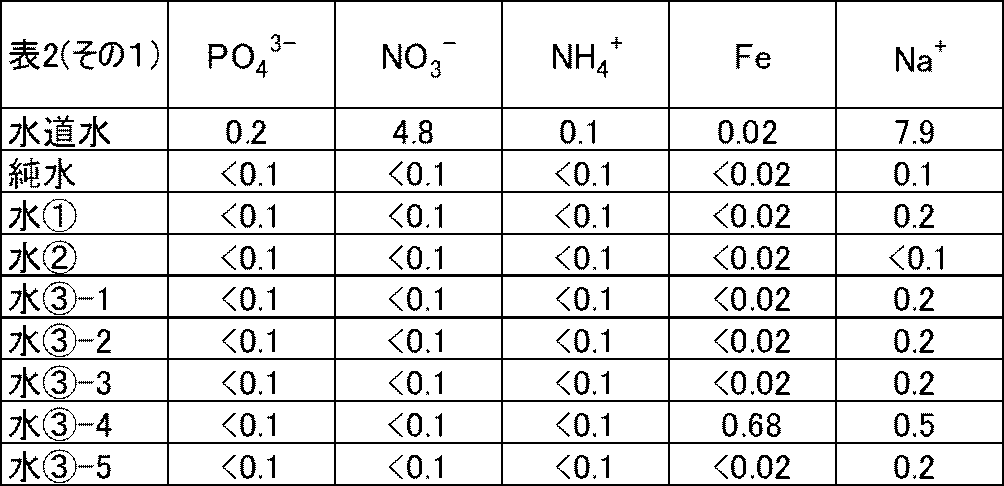
- Table 2 describes tap water and components of each culture solution.
- the components of each culture (and tap water) are listed over each row of Table 2 (Part 1) to Table 2 (Part 3). That is, in the case of pure water, the phosphate ion, the nitrate ion, the NH 4 + , and the Fe ion are all less than the lower limit of quantification, and the content of Na + is 0.1 mass ppm; As ions, B ions, Mn ions, Zn ions, Cu ions, and Mo ions are all below the lower limit of quantification, and as the second ion, Cl ⁇ is below the lower limit of quantification, and SO 4 2- is 0 It represents that 1 mass ppm, K + was 0.1 mass ppm, Mg 2+ was less than the lower limit of determination, and Ca 2+ was 0.1 mass ppm.
- each numerical value in Table 2 represents mass ppm of each component with respect to the total mass of the culture solution.
- Test Examples 11 and 12 Comparative Example 10, Examples 40 to 47
- the measuring method of TCQA etc. is as having already demonstrated.
- the test examples 11 and 12 differ in the date and time of implementation with said each test example.
- Step 1 In the cultivation method described as the first step according to Example 1, the cultivation temperature is changed from 30 ° C. to 25 ° C., and the cultivation period is changed from 14 days to 15 days in the same manner as the first step of Test Example 1.
- the sweet potato seedlings were grown under the conditions of After completion of the first step, the DCQA content in the sweet potato leaves is 2.10% by mass of dry matter weight, the TCQA content is 0.01% by mass of dry matter weight, and the total CQA content is 2.82% by mass in dry matter weight The yield of leaves was as low as 1.46 g / plant (dry matter weight). The results are shown in Comparative Example 10 of Table 3.
- Step 2 Next, for the sweet potato after completion of the first step, discard all the liquid fertilizer in the hydroponic culture vessel, and instead, put the culture solution described in the culture solution column of Table 1 and the same temperature and humidity as the first step Cultivation was further continued for 14 days under light conditions.
- the measurement results such as the TCQA content in the sweet potato leaves after completion of the second step are shown in Examples 40 to 43 in Table 1.
- Each culture solution was prepared by the method described above, and each component was made to be as described in Table 4.
- the measuring method of the content rate of each ion in a culture solution is as having already demonstrated.
- the tap water used as the raw water is as described in Table 2.
- the culture solution contains two or more types of first ions, and the content of each of the first ions is 1.0 mass ppm or less with respect to the total mass of the culture solution.
- the sweet potato produced by the production method of Example 41 contains more DCQA, more TCQA, and more total CQA in leaves compared to the sweet potato produced by the production method of Example 42, and The yield of leaves was also higher.
- the culture solution contains two or more second ions (here, Cl ⁇ , SO 4 2 ⁇ , K + and Ca 2+ ), and of these, Cl ⁇ and K +.
- the sweet potato produced by the production method of Example 41 in which the content of each of Ca 2+ is 1.0 to 300 ppm by mass with respect to the total mass of the culture solution is produced by the production method of Example 43
- the temperature of the stem of the sweet potato after the second step was cut by scissors with a portion not immersed in the culture solution of the stem of sweet potato (the stem is a stem and is synonymous with "top”). And, it was placed on a thermostat adjusted to humidity and dried for a period described in Table 3 to produce a processed plant product.
- the TCQA content and the like of the manufactured plant products are shown in Examples 44 to 47 in Table 3.
- processed plant products produced according to the production methods of Examples 44 to 47 were the same as the culture broth used in the second step, except for the sweet potato produced according to the production method of Examples 40 to 43.
- the content of DCQA, TCQA, and total CQA was higher than that of leaves, respectively.
- a processed plant product produced according to the manufacturing method of Example 47 in which the culture solution in the second step contains the first ion is compared with the processed plant product of Example 44 in DCQA, TCQA, and total CQA. The content rates were higher respectively.
- the culture solution in the second step contains two or more second ions (here, Cl ⁇ , SO 4 2 ⁇ , K + , and Ca 2+ ), among which Cl ⁇ , K + , and And the processed plants manufactured by the manufacturing method of Example 45 in which the content of each of Ca 2+ is 1.0 to 300 mass ppm with respect to the total mass of the culture solution is compared with the processed plants of Example 47 The content of DCQA and total CQA was higher than that of each.
- two or more second ions here, Cl ⁇ , SO 4 2 ⁇ , K + , and Ca 2+
- the culture solution in the second step contains the first ion, the content of each is 1.0 mass ppm or less, and the culture solution contains two or more second ions (here, Cl ⁇ , SO 4 2 ⁇ , K + and Ca 2+ ), and the content of each of Cl ⁇ , K + and Ca 2+ is 1.0 to 300 mass ppm with respect to the total mass of the culture solution.
- the processed plant product manufactured by the manufacturing method of Example 45 had higher DCQA, TCQA, and total CQA contents, respectively, as compared to the processed plant product manufactured by the manufacturing method of Example 46.
- Table 3 is divided into Table 3-1 to Table 3-3, and the cultivation conditions and the results according to each example are described over the corresponding rows of the respective divided tables. More specifically, in the case of Example 40 of Test Example 11, sweet potato is used as a plant, and the cultivation conditions of the first step are "hydroponic, 25 ° C, 50%, LED 300 ⁇ mol", and the number of days is 15 days
- the culture solution used in the second step is pure water, the cultivation conditions are “25 ° C., 50%, LED 300 ⁇ mol”, the number of days is 14 days, and the drying step is not carried out, and as a result is contained in the leaves DCQA was 3.65% by mass with respect to dry matter weight of leaf, TCQA was 0.14% by mass, and total CQA was 5.46% by mass, and the yield of leaf was 2.21 g by dry matter weight per one plant. It represents the thing. The same applies to the other examples and comparative examples.
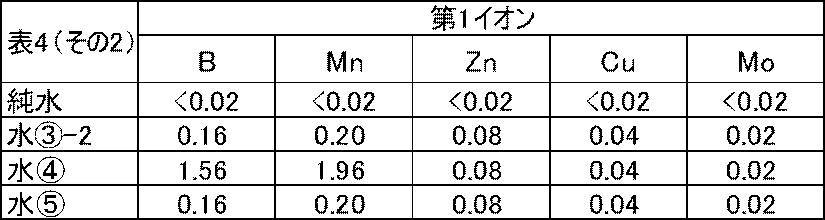
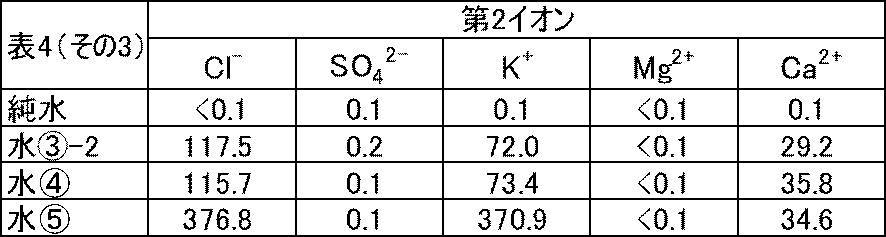
- Table 4 describes the components of each culture solution.
- the components of each culture are listed across each row of Table 4 (Part 1) to Table 4 (Part 3). That is, in the case of pure water, the phosphate ion, the nitrate ion, the NH 4 + , and the Fe ion are all less than the lower limit of quantification, and the content of Na + is 0.1 mass ppm; As ions, B ions, Mn ions, Zn ions, Cu ions, and Mo ions are all below the lower limit of quantification, and as the second ion, Cl ⁇ is below the lower limit of quantification, and SO 4 2- is 0 It represents that 1 mass ppm, K + was 0.1 mass ppm, Mg 2+ was less than the lower limit of determination, and Ca 2+ was 0.1 mass ppm.
- each numerical value in Table 4 represents mass ppm of each component with respect to the total mass of the culture solution.
Landscapes
- Life Sciences & Earth Sciences (AREA)
- Environmental Sciences (AREA)
- Botany (AREA)
- Biodiversity & Conservation Biology (AREA)
- Ecology (AREA)
- Forests & Forestry (AREA)
- Wood Science & Technology (AREA)
- Engineering & Computer Science (AREA)
- Pest Control & Pesticides (AREA)
- Chemical & Material Sciences (AREA)
- Organic Chemistry (AREA)
- Cultivation Of Plants (AREA)
- Hydroponics (AREA)
Abstract
Description
[2] 培養液が、B、Mn、Zn、Cu、及び、Moからなる群から選択される少なくとも1種の金属の金属イオンを含有する、[1]に記載の植物の生産方法。
[3] 培養液が、1種の金属イオンを含有する場合、金属イオンの含有率が、培養液の全質量に対して、1.0質量ppm以下であり、培養液が、2種以上の金属イオンを含有する場合、金属イオンのそれぞれの含有率が、培養液の全質量に対して、1.0質量ppm以下である、[2]に記載の植物の生産方法。
[4] 培養液が、Mnイオンを含有し、Mnイオンの含有率が、培養液の全質量に対して、50質量ppbを超え、1.0質量ppm以下である、[1]~[3]のいずれかに記載の植物の生産方法。
[5] 培養液が、K+、Mg2+、Ca2+、SO4 2-、及び、Cl-からなる群から選択される少なくとも1種のイオンを含有し、培養液が、上記イオンを1種含有する場合、培養液の全質量に対する上記イオンの含有率が1.0質量ppm以上であり、培養液が、上記イオンを2種以上含有する場合、培養液の全質量に対する上記イオンのそれぞれの含有率が、1.0質量ppm以上である、[1]~[4]のいずれかに記載の植物の生産方法。
[6] 培養液が、1種の上記イオンを含有する場合、上記イオンの含有率が培養液の全質量に対して、1.0~300質量ppmであり、培養液が、2種以上の上記イオンを含有する場合、上記イオンのそれぞれの含有率が、培養液の全質量に対して、1.0~300質量ppmである、[5]に記載の植物の生産方法。
[7] 培養液が、B、Mn、Zn、Cu、及び、Moからなる群から選択される少なくとも1種の金属の金属イオンと、K+、Mg2+、Ca2+、SO4 2-、及び、Cl-からなる群から選択される少なくとも1種のイオンと、を含有する、[1]~[6]のいずれかに記載の植物の生産方法。
[8] [1]~[7]のいずれかに記載の生産方法により得られた植物の根部を除去して葉茎部を得て、葉茎部を、水分を供給しない状態で乾燥させて、植物加工品を得る、植物加工品の製造方法。
[9] 乾燥の際の温度が20~35℃であり、相対湿度が30~95%である、[8]に記載の植物加工品の製造方法。
以下に記載する構成要件の説明は、本発明の代表的な実施形態に基づいてなされることがあるが、本発明はそのような実施形態に限定されるものではない。
なお、本明細書において、「~」を用いて表される数値範囲は、「~」の前後に記載される数値を下限値及び上限値として含む範囲を意味する。
上記植物の生産方法は、サツマイモ以外のイモ類、ヒルガオ科植物、及び、キク科植物からなる群から選択される少なくとも1種の植物を生長させる工程(以下、「工程1」ともいう。)と、生長させた植物を、硝酸イオン及びリン酸イオンを実質的に含有しない培養液を用いて養液栽培する工程(以下、「工程2」ともいう。)と、を有する植物の生産方法である。
このような構成を有する植物の生産方法により生産される植物は、カフェオイルキナ酸化合物(以下、「CQA」ともいう。)の含有率が高い。
工程1は、サツマイモ以外のイモ類、ヒルガオ科植物、及び、キク科植物からなる群から選択される少なくとも1種の植物を生長させる工程である。
ヒルガオ科植物としては、特に制限されないが、サツマイモ、ヒルガオ、アサガオ、ヨルガオ、ヨウサイ、ルコウソウ、ネナシカズラ、エボルブルス、及び、エンサイ等が挙げられる。
キク科植物として、特に制限されないが、キクイモ、ノコギリソウ、ゴボウ、ヨモギ、アスター、バッカリス、ヒナギク、キンセンカ、エゾギク、ベニバナ、ヤグルマギク、ネモフィラ、シュンギク、マーガレット、イソギク、チコリ、ムルチコーレ、チョウセンアザミ、アレチノギク、キバナコスモス、タンポポ、ダリア、ムラサキバレンギク、ヒメジョオン、フジバカマ、ツワブキ、ガーベラ、ハハコグサ、ミヤコワスレ、ヒマワリ、ヨメナ、レタス、センボンヤリ、カミツレ、シネラリア、フキ、ヤーコン、アキノキリンソウ、ノゲシ、ウルシニア、ヒャクニチソウ、及び、アーティチョーク等が挙げられる。
サツマイモとしては、例えば、ベニアズマ、ベニハルカ、ベニコマチ、紅赤、鳴門金時、シロユタカ、シロサツマ、コガネセンガン、ムラサキマサリ、アヤムラサキ、スイオウ、シモンイモ、及び、タマアカネ等が挙げられるが特に制限されない。また、高系14号に由来するその他の品種も使用できる。また、未だ品種登録されていない種々の系統のサツマイモも使用できる。
養液栽培としては、固形培地耕栽培、噴霧耕栽培、又は、水耕栽培が挙げられる。
植物を生長させる方法としては、植物の種類に応じて、例えば、ジャガイモ:「農家が教えるジャガイモ・サツマイモつくり」、別冊 現代農業、農文協、2013年10月号、pp92-96;サツマイモ:同誌、pp152-175;アーティチョーク:野菜の上手な育て方大辞典(2014)、監修 北条雅章、成美堂出版、pp8-9;シュンギク:同誌、pp34-35;レタス:同誌、pp80-81;ゴボウ:同誌、pp168-169;サトイモ:同誌、pp170-171;ヤーコン:同誌、pp186-187;エンサイ:同誌、pp212-213等が挙げられるが、上記に制限されない。
なお、本明細書において「生長」とは、植物が十分に大きくなった状態、具体的には、以下の状態を意味する。例えば、サツマイモの場合には、サツマイモの地上部が4葉(4節)以上展開した状態、又は地上部が20cm以上に伸長した状態を意味する。よもぎ及び春菊の場合には、地上部が10cm以上に生育した状態を意味する。アーティチョーク及びレタスの場合には、本葉が4枚~5枚以上出た状態を意味する。ゴボウの場合には、本葉が3枚~4枚以上出た状態を意味する。サトイモの場合には、本葉が3枚以上出た状態を意味する。ジャガイモの場合には、地上部が10cm以上に生育した状態を意味する。ヤーコンの場合には、地上部が10cm以上に生育した状態を意味する。エンサイの場合には、地上部が10cm以上に生育した状態を意味する。
工程2は、生長させた植物を、硝酸イオン及びリン酸イオンを実質的に含有しない培養液を用いて養液栽培する工程である。すなわち、工程1で生育させた植物を引き続き栽培する工程である。
本明細書において、養液栽培とは、土壌を用いず、植物の生育に必要な養分を含む培養液を植物に供給する栽培方法を意味し、固形培地を用いる固形培地耕、並びに、固形培地を用いない水耕及び噴霧耕を含む。なかでも植物に与える養分をより制御しやすい観点から、水耕が好ましい。工程2における養液栽培は、培養液として硝酸イオン及びリン酸イオンを実質的に含有しない培養液を用いたものであれば、その方法は特に制限されず、公知の方法が使用できる。以下では、そのうち水耕による場合を例に説明するが、本発明の実施形態に係る工程2としては以下に制限されない。
工程2において植物の生長に必要な硝酸イオン、及び、リン酸イオンの供給を制限することによって、植物中で、CQAの産生(そのうち、特にTCQAの産生)が促進されたものと推測される。
なお、培養液の溶媒としては通常、水が用いられることが多い。この場合、培養液中の水の含有率としては特に制限されないが、培養液の全質量に対して90質量%以上が好ましく、95質量%以上がより好ましく、99質量%以上が更に好ましい。
なお、本明細書において、培養液がある第1イオンを含有する状態とは、培養液が、その第1イオンを培養液の全質量に対して、20質量ppb以上含有することを表し、50質量ppb以上が好ましく、50質量ppbを超えるのがより好ましい。
培養液が少なくとも1種(又は2種以上)の第1イオンを含有し、その(又はそれぞれの)含有率が1.0質量ppm以下であると、得られる植物中におけるCQA(特にTCQA)の含有量がより多くなる。
なお、更に優れた本発明の効果が得られる点で、培養液は、第2イオンとして、K+、Mg2+、Ca2+、SO4 2-、及び、Cl-のそれぞれのイオンを含有することが更に好ましい。
培養液中における少なくとも1種の第2イオンの含有率が、1.0~300質量ppmであると、より優れた本発明の効果が得られ、培養液中における全ての第2イオンの含有率が1.0~300質量ppmであると、更に優れた本発明の効果が得られる。
なお、本明細書において、培養液がある第2イオンを含有する状態とは、実施例に記載した方法で測定したとき、その含有率が定量下限値以上(例えば、Mg2+であれば0.1質量ppm以上)であることを表す。
水道水を用いて培養液を調製する場合、水道水中に含まれるイオンを培養液の成分として利用して培養液を調製してもよいし、イオンをいったん取り除いてから、再度同様の成分を加えて所望の培養液を調製してもよい。
本明細書においてCQAとは、カフェオイルキナ酸化合物を意味し、カフェオイルキナ酸化合物としては、モノカフェオイルキナ酸(3-O-カフェオイルキナ酸、4-O-カフェオイルキナ酸、5-O-カフェオイルキナ酸、及び、1-O-カフェオイルキナ酸)、ジカフェオイルキナ酸(3,4-O-ジカフェオイルキナ酸、3,5-O-ジカフェオイルキナ酸、4,5-O-ジカフェオイルキナ酸、1,3-O-ジカフェオイルキナ酸、1,4-O-ジカフェオイルキナ酸、及び、1,5-O-ジカフェオイルキナ酸)、トリカフェオイルキナ酸(3,4,5-O-トリカフェオイルキナ酸、1,4,5-O-トリカフェオイルキナ酸、1,3,5-O-トリカフェオイルキナ酸、及び、1,3,4-O-トリカフェオイルキナ酸)、並びに、テトラカフェオイルキナ酸(1,3,4,5-O-テトラカフェオイルキナ酸)が挙げられる。
この場合、植物のCQAの含有率が高いほど、1回の抽出操作で得られるCQAの量が多くなり、単位量のCQAの回収に必要なコストがより少なくなる。例えば、植物のCQA含有率が0.01質量%程度である場合と、植物のCQA含有率が0.1質量%程度である場合とでは、同じ生産設備で1回に得られるCQAの量は理論的に約10倍となる。同じ生産設備であれば1回の稼働経費はほぼ同等である。従って、植物におけるCQA含有量が多いと、より低いコストで、CQAを回収できる。
また、上記植物の生産方法により得られた植物は、乾燥させて利用してもよい。一般に乾燥させることにより植物中の成分が濃縮されるため好ましい。更に、乾燥させた植物から、CQAを抽出して使用してもよい。CQAの抽出方法として特に制限されず、公知の方法が使用できる。
上記植物加工品の製造方法は、上記で説明した生産方法により得られた植物の根部を除去して葉茎部を得て、上記葉茎部を、水分を供給しない状態で乾燥させて、植物加工品を得る、植物加工品の製造方法である。なお、本明細書において、「植物加工品」とは、上記製造方法により製造された物を意味する。
葉茎部を得る方法としては、例えば、刃物等で根部を切断する、及び、根部を手で折り取る等が挙げられる。刃物等で切断する場合、切断位置は、植物の種類により適宜調整すればよい。
切断位置を茎の途中とする場合、鋭利な剪定ばさみ、剪定ナイフ、鎌、バリカン、及び、チェーンソー等の刃物を用いて、茎に対して直交又は茎に対して傾斜角度を持って切断する形態が挙げられる。傾斜角度を持って茎を切断する場合、その傾斜角度は、特に制限されない。
なお、上記植物加工品の製造工程において、根部除去後に、葉茎部から、新たに根が発生することは、本発明の効果を得るための妨げになるものではない。
上記植物加工品の製造方法は、水分を供給しない状態で葉茎部を乾燥させる乾燥工程を有する。水分を供給しない状態で葉茎部を乾燥させる方法としては特に制限されないが、例えば、養液栽培等の装置から取り出し、温度及び湿度が管理された空間で乾燥する方法が挙げられる。本明細書において「水分を供給しない」とは、植物の生長に必要な水分を供給しないことを意味し、具体的には、培養液を供給しないことを意味する。
また、乾燥工程の日数としては、3~16日が好ましく、3~15日がより好ましく、4~12日が更に好ましく、5~10日が特に好ましい。
なお、乾燥方法としては特に制限されないが、例えば、水蒸気を含有する空間に葉茎部を放置する方法等が挙げられる。
1日当たりの光照射時間は、5~24時間が好ましく、8~16時間がより好ましく、10時間~14時間が更に好ましい。
第2工程を有する植物の生産方法によれば本発明の効果が得られることを確認するために、以下の条件で試験を実施した。
(第1工程)
第1工程として、サツマイモの苗を以下の栽培条件のもと生長させた。すなわち、水耕栽培器(ホームハイポニカ601 共和株式会社製)に、純水10L、液体肥料(ハイポニカ液肥 協和化学株式会社製)のA液8ml、同B液8mlを入れ、サツマイモの苗6株を植え付けた。この際の苗の平均質量は2.0g/本(新鮮重)であった。栽培は、30℃、及び、湿度50%の条件下、雰囲気中のCO2の含有率は通常の大気下と同様の条件で実施した。すなわち、CO2を追加供給しなかった。照明用の光源はLED(昭和電工製 DPT″RB120Q33 40型)を使用し、光合成光量子束密度300μmol/m2/sec(R光/B光の比は2/1)として、タイマーを用いて点灯12時間、消灯12時間のサイクルで14日間栽培した。第1工程終了時点での植物(サツマイモ)の平均質量は28.0g/本(新鮮重)であった。なお、この栽培方法について、表1には、「水耕,30℃,50%,LED300μmol」と記載した。
次に、上記第1工程終了後のサツマイモについて、水耕栽培器内の液体肥料を全量廃棄し、代わりに純水10Lを入れ、同じ温湿度、光条件にて更に栽培を14日間継続した。
第2工程終了時のサツマイモの平均質量は31.8g/本(新鮮重)だった。回収したサツマイモ1本あたりの、葉の平均収量は1.35g/本(乾物重)だった。サツマイモの葉のDCQA含有率は乾物重の3.87質量%、TCQA含有率は乾物重の0.25質量%、総CQA含有率は乾物重の6.03質量%と比較例1と比較して大きく向上した。結果は表1の実施例1に示した。なお、上記の栽培方法を表1には、「30℃,50%,LED300μmol」と記載した。
第2工程で使用する培養液の成分の違いが、本発明の効果に与える影響を確認するために、以下の条件で試験を実施した。
(第1工程)
第1工程として、試験例1の第1工程と同様の栽培条件でサツマイモ苗を生長させた。なお、試験例2は、試験例1とは実施した日時が異なる。第1工程終了後のサツマイモの葉中のDCQA含有率は乾物重の2.47質量%、TCQA含有率は乾物重の0.01質量%、総CQA含有率は乾物重の3.15質量%、葉の収量は1.60g/本(乾物重)と低かった。結果は表1の比較例2に示した。
次に、上記第1工程終了後のサツマイモについて、水耕栽培器内の液体肥料を全量廃棄し、代わりに、表1の培養液欄に記載した培養液を入れ、試験例1の第2工程と同じ温湿度、光条件にて更に栽培を14日間継続した(実施例4については13日間継続した)。第2工程終了後のサツマイモの葉中のTCQA含有率等の測定結果を表1の実施例2~7に示した。
なお、各培養液は、水道水を原水として用い、イオン交換樹脂を用いて純水を製造し、上記純水に、Na2B4O5(OH)4・8H2O、MnCl2・4H2O、ZnSO4・7H2O、CuSO4・5H2O、Na2MoO4・2H2O、KCl、又は、CaCl2を適宜溶解させ培養液中の各イオンの含有率が、表2に記載したとおりになるようにした。なお、培養液中の各イオンの含有率は、後述する方法により測定した。
なお、原水として用いた水道水、及び、調製後の培養液中に含まれる各成分について、表2に示した。
また、培養液が第2イオンを含有する実施例4の生産方法により生産されたサツマイモは、実施例2の生産方法により生産されたサツマイモと比較して、葉により多くのDCQA、及び、より多くの総CQAが含まれ、また、葉の収量もより多かった。
また、培養液が第1イオン及び第2イオンを含有する実施例5~7の生産方法により生産されたサツマイモは、実施例2の生産方法により生産されたサツマイモと比較して、葉により多くのDCQA、より多くのTCQA、及び、より多くの総CQAが含まれ、また、葉の収量がより多かった。
第2工程で使用する培養液の成分の違いの影響を確認するため、更に植物加工品の製造を実施するため、かつ、乾燥工程の条件が植物加工品のCQA含有率に与える影響を確認するために、以下の条件で試験を実施した。
(第1工程)
第1工程として、試験例1と同様の栽培条件でサツマイモ苗を生長させた。なお、試験例3は、上記各試験例とは実施した日時が異なる。第1工程終了後のサツマイモの葉中のDCQA含有率は乾物重の2.50質量%、TCQA含有率は乾物重の0.01質量%、総CQA含有率は乾物重の3.36質量%、葉の収量は1.66g/本(乾物重)と低かった。結果は表1の比較例3に示した。
次に、上記第1工程終了後のサツマイモについて、水耕栽培器内の液体肥料を全量廃棄し、代わりに、表1の培養液欄に記載した培養液を入れ、試験例1の第2工程と同じ温湿度、光条件にて更に栽培を14日間継続した(実施例9については、15日間継続した。)。第2工程終了後のサツマイモ葉のTCQA含有率等を、表1の実施例8及び実施例10に示した。
第2工程終了後のサツマイモの茎の培養液に浸っていない部分(葉茎部であり、「地上部」と同義である)をハサミで切断して、葉茎部を表1に記載した温度、及び、湿度に調整した恒温器に載置して、表1に記載した期間乾燥させて植物加工品を製造した。製造した植物加工品のTCQA含有率等を表1の実施例9及び実施例11に示した。
また実施例10の生産方法により生産されたサツマイモ葉、及び実施例11の製造方法により製造した植物加工品は、第2工程において使用した培養液が異なる、実施例8の生産方法により生産されたサツマイモの葉、及び実施例9の製造方法により製造した植物加工品、と比較して、DCQA、TCQA、及び、総CQAの含有率がより高く、また、葉の収量がより多かった。
第2工程の有無の影響を確認するため、植物加工品の製造を実施するため、及び、乾燥工程の条件が植物加工品のCQA含有率に与える影響を確認するために、以下の条件で試験を実施した。
(第1工程)
第1工程として、試験例1と同様の栽培条件でサツマイモ苗を生長させた。なお、試験例4は、上記各試験例とは実施した日時が異なる。第1工程終了後のサツマイモ葉中のDCQA含有率は乾物重の2.82質量%、TCQA含有率は乾物重の0.02質量%、総CQA含有率は乾物重の3.62質量%、葉の収量は1.12g/本(乾物重)と低かった。結果は表1の比較例4に示した。また、同様にして、第1工程における栽培日数を26日としたものを比較例5に示した。比較例4と同様にして得られたサツマイモをもとに第2工程を実施せずに植物加工品を製造したものを比較例6に示した。
次に、上記第1工程終了後のサツマイモについて、水耕栽培器内の液体肥料を全量廃棄し、代わりに、表1の培養液欄に記載した培養液を入れ、試験例1の第2工程と同じ温湿度、光条件にて更に栽培を13日又は14日間継続した。第2工程終了後のサツマイモ葉のTCQA含有率等を、表1の実施例12及び実施例14に示した。
第2工程終了後のサツマイモの茎の培養液に浸っていない部分(葉茎部、「地上部」と同義である)をハサミで切断して、葉茎部を表1に記載した温度、及び、湿度に調整した恒温器に載置して、表1に記載した期間乾燥させて植物加工品を製造した。製造した植物加工品のTCQA含有率等を表1の実施例13及び実施例15に示した。
また比較例5の生産法により生産されたサツマイモ葉は、第1工程の栽培日数を増やしたことで比較例4に比べてDCQA、総CQAの含有率がより高くなり、葉の収量も増加しているが、第2工程を含めた栽培日数がほぼ同等の実施例12及び実施例14の生産法により生産されたサツマイモ葉に比べてDCQA、TCQA、及び、総CQAの含有率はいずれも低く、特にTCQA含有率には大きな差があった。
また比較例6の製造方法により製造された植物加工品は、第2工程を有する実施例13及び実施例15の製造方法により製造された植物加工品に比べて、DCQA、TCQA、及び、総CQAの含有率は何れも低かった。
植物加工品の製造における、乾燥工程の条件が植物加工品のCQA含有率に与える影響を確認するために、以下の条件で試験を実施した。
(第1工程)
第1工程として、試験例1と同様の栽培条件でサツマイモ苗を生長させた。なお、試験例5は、上記各試験例とは実施した日時が異なる。
次に、上記第1工程終了後のサツマイモについて、水耕栽培器内の液体肥料を全量廃棄し、代わりに、表1の培養液欄に記載した培養液を入れ、第1工程と同じ温湿度、光条件にて更に栽培を13日間継続した。
第2工程終了後のサツマイモの葉茎部をハサミで切断して、葉茎部を表1に記載した温度、及び、湿度に調整した恒温器に載置して、表1に記載した期間乾燥させて植物加工品を製造した。製造した植物加工品のTCQA含有率等を表1の実施例16~23に示した。
植物加工品の製造における、乾燥工程の条件が植物加工品のCQA含有率に与える影響を確認するために、以下の条件で試験を実施した。
(第1工程)
第1工程として、試験例1と同様の栽培条件でサツマイモ苗を生長させた。なお、試験例6は、上記試験例とは実施した日時が異なる。
次に、上記第1工程終了後のサツマイモについて、水耕栽培器内の液体肥料を全量廃棄し、代わりに、表1の培養液欄に記載した培養液を入れ、第1工程と同じ温湿度、光条件にて更に栽培を15日間継続した。
第2工程終了後のサツマイモの葉茎部をハサミで切断して、葉茎部を表1に記載した温度、及び、湿度に調整した恒温器に載置して、表1に記載した期間乾燥させて植物加工品を製造した。製造した植物加工品のTCQA含有率等を表1の実施例24~30に示した。
第1工程及び第2工程における温湿度条件が植物のCQA含有率に与える影響を確認するために、以下の条件で試験を実施した。
<実施例31>
(第1工程)
第1工程として、サツマイモの苗を以下の栽培条件のもと生長させた。すなわち、水耕栽培器(ホームハイポニカ601 共和株式会社製)に、純水10L、液体肥料(ハイポニカ液肥 協和化学株式会社製)のA液8ml、同B液8mlを入れ、サツマイモの苗を植え付けた。照明用の光源として蛍光灯(東芝製植物栽培用蛍光灯:ビオルクスFL40SBR)を使用し、光合成光量子束密度300μmol/m2/secとして、点灯12時間、消灯12時間のサイクルで14日間栽培した。
なお、照明点灯時の12時間は温度30℃、湿度70%、照明消灯時の12時間は温度25℃、湿度90%条件とした。上記以外は、上記試験例1と同様の条件で栽培した。
表1には、「水耕,昼:30℃,70%,夜:25℃,90%,蛍光灯300μmol」と記載した。
なお、試験例7は、上記各試験例とは実施した日時が異なる。
次に、上記第1工程終了後のサツマイモについて、水耕栽培器内の液体肥料を全量廃棄し、代わりに純水10Lを入れ、上記第1工程と同じ温湿度、光条件にて更に栽培を15日間継続した。得られたサツマイモの葉のTCQA含有率(乾物重に対する質量%)等の結果は表1の実施例31に示した。なお、上記の栽培方法を表1には、「昼:30℃,70% 夜:25℃,90% 蛍光灯300μmol」と記載した。
(第1工程)
第1工程として、サツマイモの苗を以下の栽培条件のもと生長させた。すなわち、水耕栽培器(ホームハイポニカ601 共和株式会社製)に、純水10L、液体肥料(ハイポニカ液肥 協和化学株式会社製)のA液8ml、同B液8mlを入れ、サツマイモの苗を植え付けた。照明用の光源として蛍光灯(東芝製植物栽培用蛍光灯:ビオルクスFL40SBR)を使用し、光合成光量子束密度450μmol/m2/secとして、点灯12時間、消灯12時間のサイクルで14日間栽培した。なお、栽培中の温度は35℃、湿度は70%とし、CO2ガスを供給して雰囲気中のCO2含有率を1500ppm(体積基準)とした。上記以外は、上記試験例1と同様の条件で栽培した。表1には、「水耕,35℃,50%,蛍光灯450μmol,CO2:1500ppm」と記載した。
次に、上記第1工程終了後のサツマイモについて、水耕栽培器内の液体肥料を全量廃棄し、代わりに表1に記載した培養液10Lを入れ、上記と同じ温湿度、光条件にて更に栽培を15日間継続した。得られたサツマイモの葉のTCQA含有率(乾物重に対する質量%)等の結果は表1の実施例32に示した。なお、上記の栽培方法を表1には、「35℃,50%,蛍光灯450μmol,CO2:1500ppm」と記載した。
(植物加工品の製造)
実施例32の第2工程終了後のサツマイモの葉茎部をハサミで切断して、葉茎部を表1に記載した温度、及び、湿度に調整した恒温器に載置して、表1に記載した期間乾燥させて植物加工品を製造した。製造した植物加工品のTCQA含有率等を表1の実施例33に示した。
第1工程における栽培方法が植物のCQA含有率に与える影響を確認するために、以下の条件で試験を実施した。
(第1工程)
第1工程として、以下の栽培条件のもと、サツマイモを栽培した。すなわち、ゴールデン粒状培養土(アイリスオーヤマ社製)を入れたポットにサツマイモ苗を植え付けて、温度30℃、湿度45%の条件下、照明用の光源として蛍光灯(東芝製植物栽培用蛍光灯:ビオルクスFL40SBR)を使用し、光合成光量子束密度70mol/m2/secとした以外は試験例1と同様にして栽培した。第1工程終了後のサツマイモの葉のTCQA含有率は乾物重の0.11質量%、総CQA含有率は乾物重の2.47質量%、葉の収量は0.24g/本(乾物重)と低かった。結果は表1の比較例7に示した。なお、試験例8は、上記各試験例とは実施した日時が異なる。
第1工程終了後のサツマイモから、所定の生長状態にある部分を定期的に採取し(そのため、表1の第1工程の日数の欄には「継続」と記載した。)、表1に記載した培養液を入れた水耕栽培器(ホームハイポニカ601 共和株式会社製)に植えつけた。これを、温度30℃、湿度50%の条件のもと、照明用の光源としてLEDを使用し、光合成光量子束密度300mol/m2/secとして試験例1の第2工程と同様の条件で栽培した。
第2工程終了後のサツマイモの葉のTCQA含有率等を、表1の実施例34及び実施例35に示した。
以下の条件で試験を実施した。
(第1工程)
第1工程として、以下の栽培条件のもと、コガネセンガン(サツマイモ一般品種、表1中では、単に「コガネセンガン」と記載した。)を栽培した。すなわち、コガネセンガンの苗を、水耕栽培器(ホームハイポニカ601 共和株式会社製)に、純水10L、液体肥料(ハイポニカ液肥 協和化学株式会社製)のA液8ml、同B液8mlを入れ、植え付けた。次に、温度30℃、湿度60%の条件のもと、照明用の光源として蛍光灯(東芝製植物栽培用蛍光灯:ビオルクスFL40SBR)を使用し、光合成光量子束密度140μmol/m2/secとした以外は試験例1と同様の条件で栽培した。第1工程終了後のコガネセンガンの葉中のDCQA含有率は乾物重の2.22質量%、TCQA含有率は乾物重の0.02質量%、総CQA含有率は乾物重の2.86質量%、葉の収量は2.11g/本(乾物重)と低かった。結果は表1の比較例8に示した。
なお、上記の栽培方法を表1には、「水耕,30℃,60%,蛍光灯140μmol」と記載した。
次に、上記第1工程終了後のコガネセンガンについて、水耕栽培器内の液体肥料を全量廃棄し、代わりに純水10Lを入れ、上記と同じ温湿度、光条件にて更に栽培を14日間継続した。得られたコガネセンガンの葉中のTCQA含有率等の結果は表1の実施例36に示した。なお、上記の栽培方法を表1には、「30℃,60%,蛍光灯140μmol」と記載した。
上記第2工程終了後のコガネセンガンの葉茎部をハサミで切断して、葉茎部を表1に記載した温度、及び、湿度に調整した恒温器に載置して、表1に記載した期間乾燥させて植物加工品を製造した。製造した植物加工品のTCQA含有率等を表1の実施例37に示した。
以下の条件で試験を実施した。
(第1工程)
屋外の一般圃場で、温湿度、光量等の調整は行わずに自然環境下で栽培され、所定の生長状態にあった春菊を調達した。上記春菊中のDCQA含有率は乾物重の0.43質量%、TCQAは含まれておらず、総CQA含有率は乾物重の0.61質量%、葉の収量は0.54g/本と低かった。結果は表1の比較例9に示した。なお、上記栽培方法を表1には、「土耕,屋外圃場」と記載した。
次に、上記春菊を、表1に記載した培養液10Lを入れた水耕栽培器(ホームハイポニカ601 共和株式会社製)に植え付けた。次に、上記春菊を温度23℃、湿度70%の条件のもと、照明用の光源として蛍光灯(東芝製植物栽培用蛍光灯:ビオルクスFL40SBR)を使用し、光合成光量子束密度100μmol/m2/secとした以外は試験例1と同様の条件で6日間栽培した。得られた春菊の葉のTCQA含有率(乾物重に対する質量%)等の結果は表1の実施例38及び実施例39に示した。
本実施例において、各成分の測定は以下の方法により実施した。
<培養液中のイオンの含有量>
培養液(及び水道水)に含まれるイオンの含有量は、第1イオン及びFeイオンについてはICP(Inductively Coupled Plasma)発光分光分析法によって測定した。ICP発光分光分析の測定条件は以下のとおりである。
スプレーチャンバ:ガスサイクロン
プラズマガス流量:15 L/min
補助ガス流量:0.2 L/min
ネブライザガス流量:1 L/min
繰り返し回数:3回
サンプル遅延時間:30S
カラム:shodex YS-50
遊離液:4mM HNO3
流速:0.8 mL/min
カラム温度:40℃
植物及び植物加工品中に含まれるCQAは、以下の方法で植物及び植物加工品から測定用の抽出液を得て、上記抽出液をHPLC(high performance liquid chromatography)測定して求めた。
得られた植物又は植物加工品の葉及び葉柄をハサミで切断して、葉及び葉柄部を更にハサミで裁断し、真空乾燥器中、80℃条件で8時間乾燥処理して、葉の乾燥物(乾燥葉)を得た。その後、真空乾燥して得られた乾燥葉を手でもみほぐして粉砕し乾燥葉の粉末を得た。次に乾燥葉の粉末50mgを精秤し、EtOH/水=80/20vol比の混合溶媒2.5mlを加えて、80℃で1時間、加熱抽出して粗抽出液を得た。得られた粗抽出液にEtOH/水=80/20vol比の混合溶媒7.5mlを加え、フィルター濾過して抽出液を得た。
上記抽出液を検体とし、下記の条件でHPLC測定した。検量線からCQA(DCQA、TCQA、及び、総CQA)の含有率を算出した。
カラム:東ソー製TSK gel ODS 100V
流速:0.3 mL/min、
展開溶媒:A液:0.1% H3PO4 H2O、B液:0.1% H3PO4 MeCNを使用し、B液濃度10% (0 min)から40% (15 min)のグラジエント溶出とした。
カラム温度:40℃、
検出:UV(ultraviolet)検出器 (330 nm)

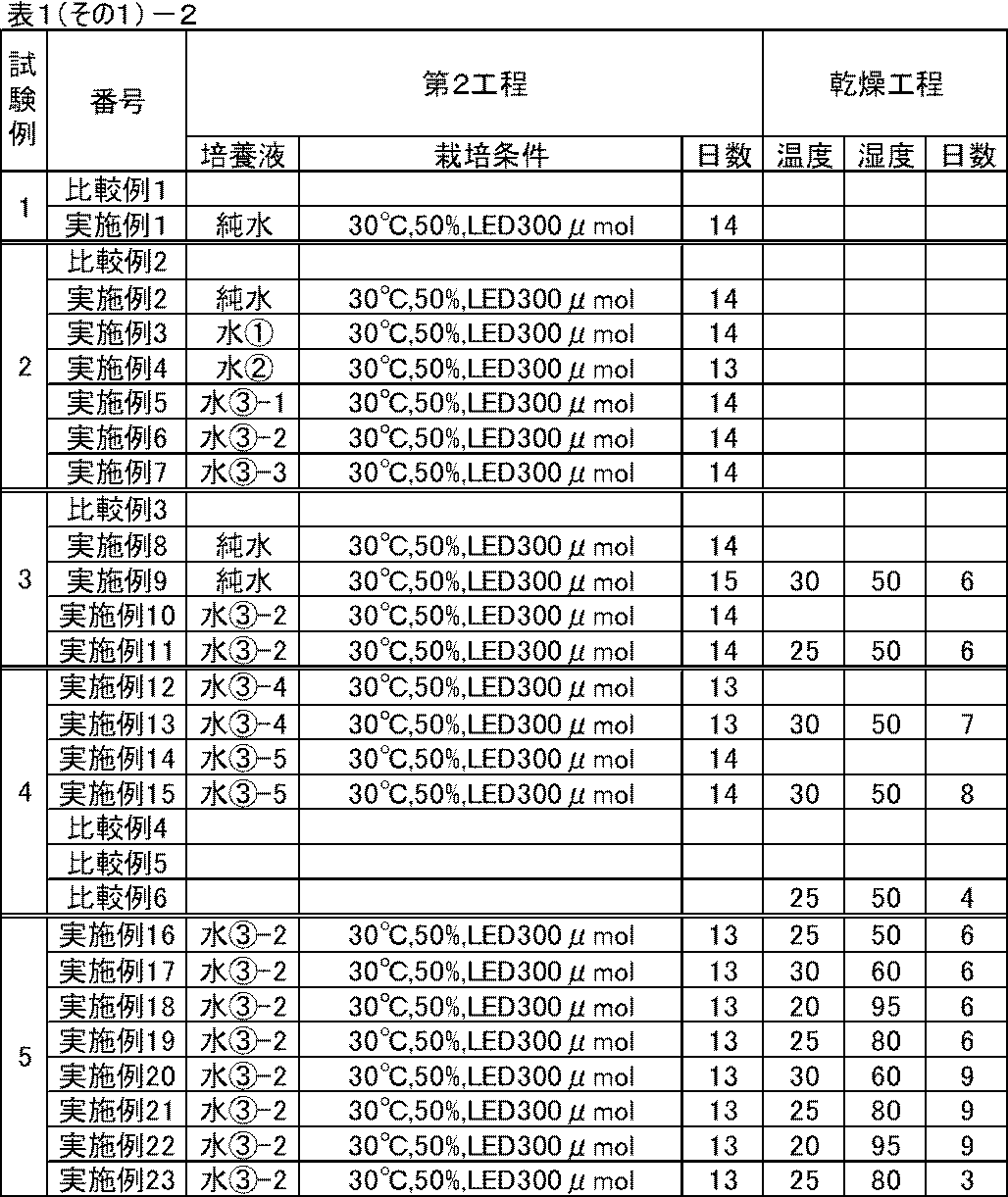
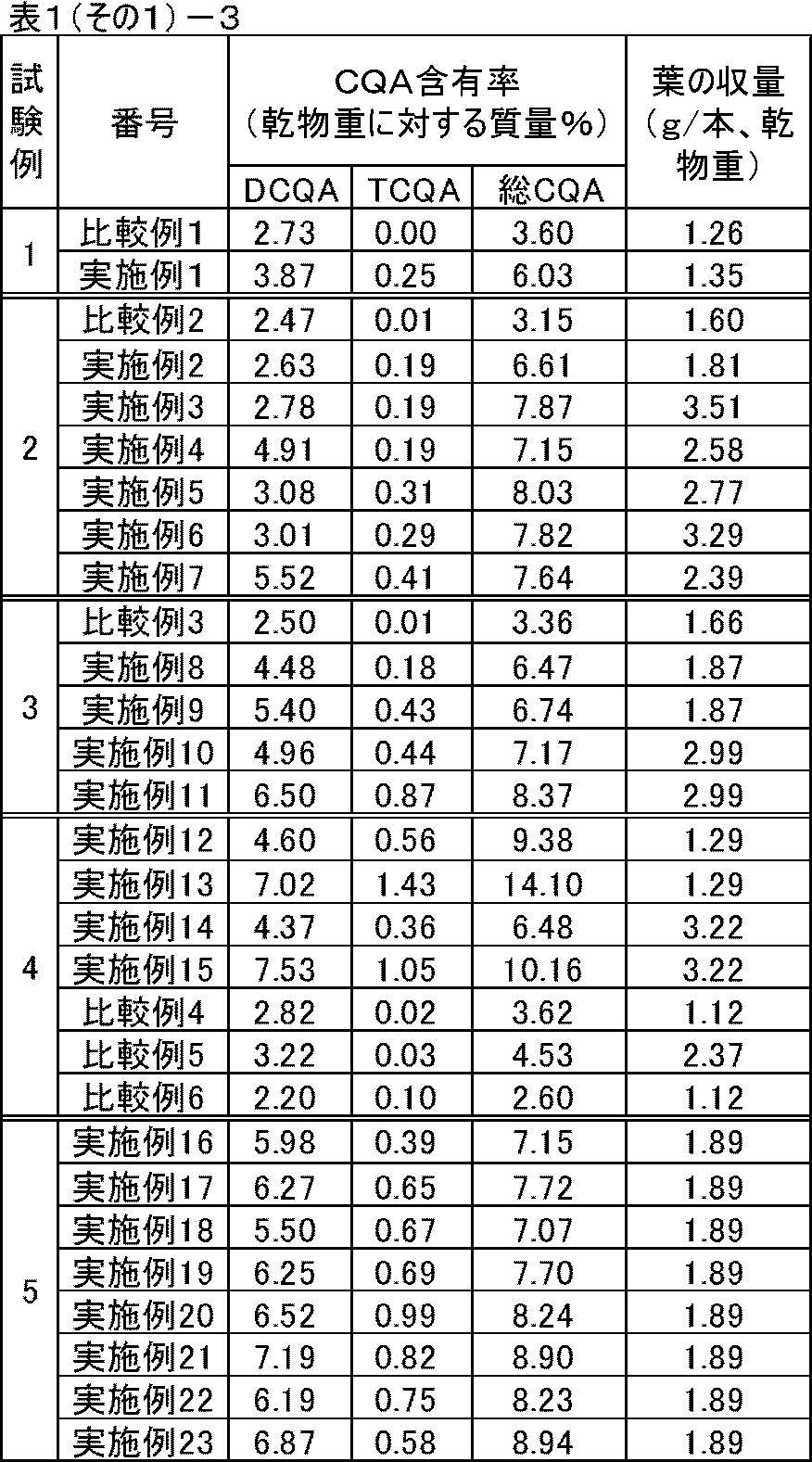
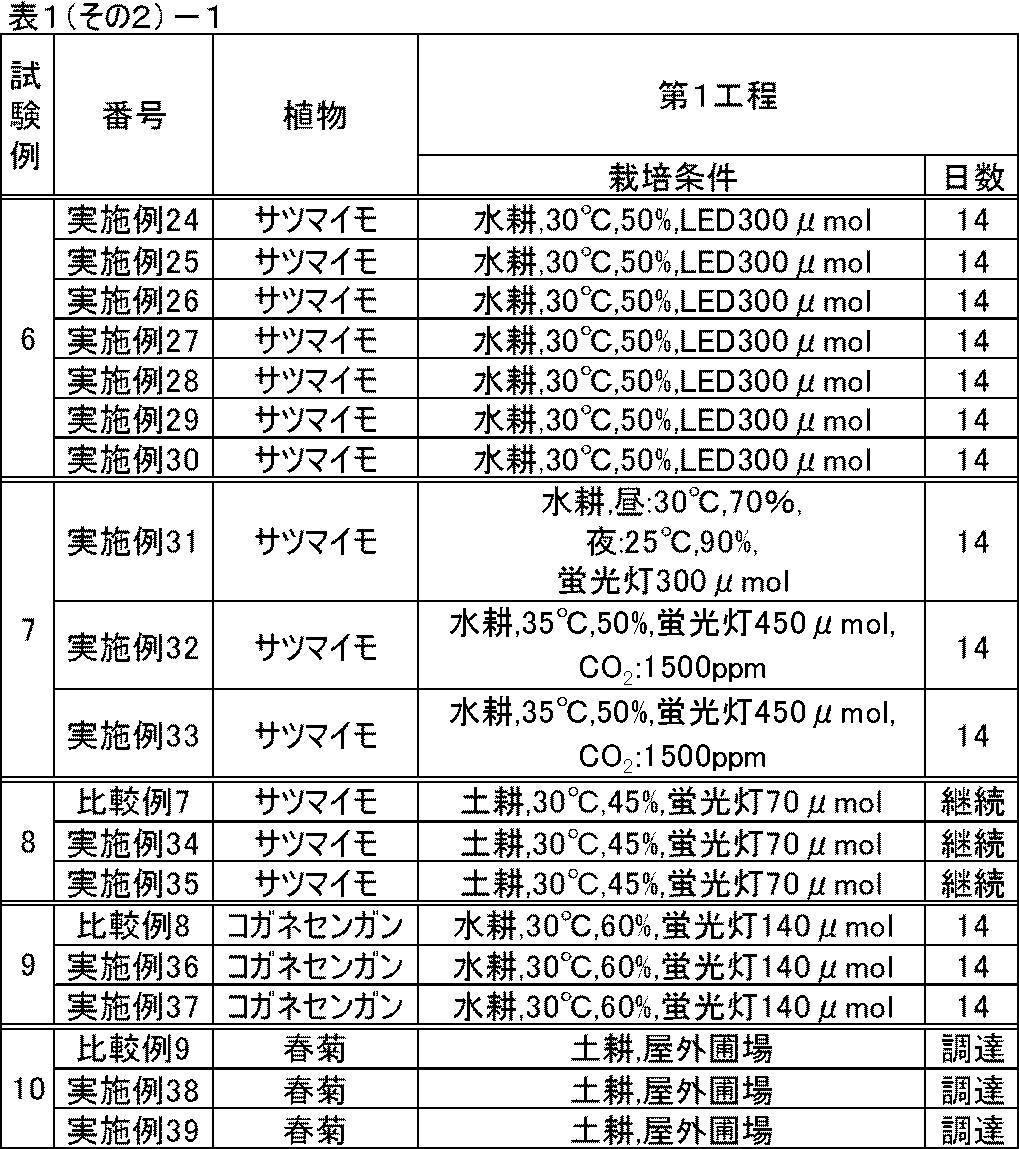


例えば、試験例1の実施例1であれば、結果は表1(その1)-1~表1(その1)-3にわたって記載されている。すなわち、実施例1では植物としてサツマイモを用い、第1工程の栽培条件が、「水耕,30℃,50%,LED300μmol」であり、日数が14日間、第2工程で使用した培養液は純水で、栽培条件は、「30℃,50%,LED300μmol」であり、日数が14日間であり、乾燥工程は実施せず、結果として葉に含まれるDCQAは葉の乾物重に対して3.87質量%、TCQAは0.25質量%、総CQAは6.03質量%であり、葉の収量が植物1本につき乾物重で1.35gだったことを表わしている。その他の実施例及び比較例についても上記と同様である。
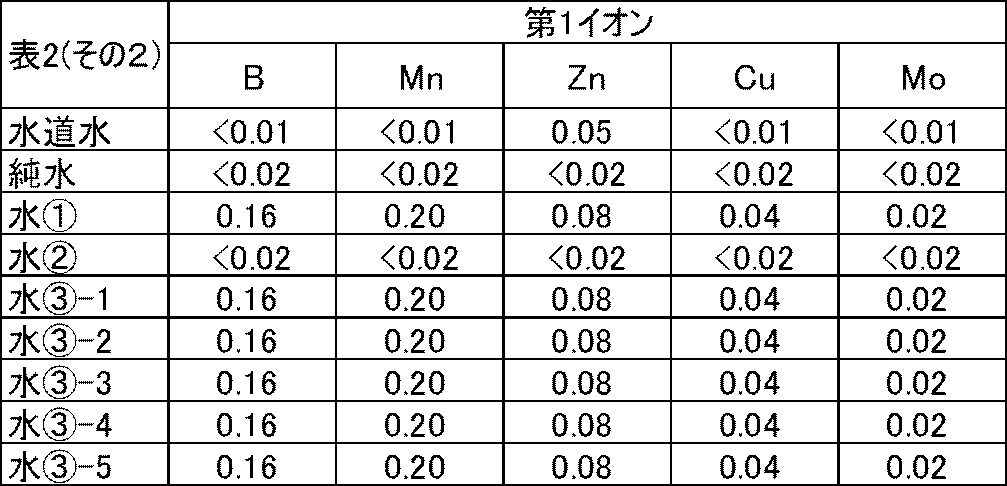
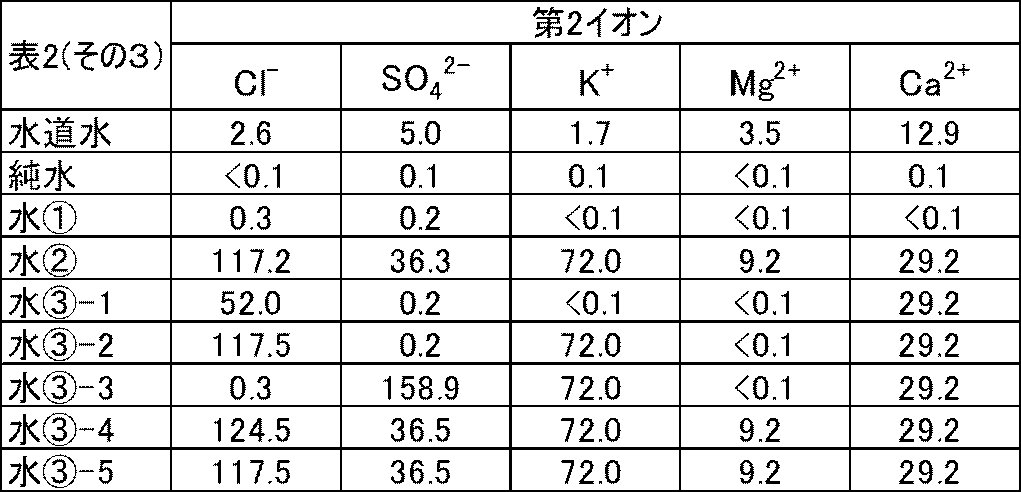
第2工程で使用する培養液の成分の違いが本発明の効果に与える影響を確認するために、以下の条件で試験を実施した。なお、TCQA等の測定方法は既に説明したとおりである。また、試験例11及び12は、上記各試験例とは実施した日時が異なる。
実施例1に係る第1工程として説明した栽培方法における、栽培温度を30℃から25℃に変更し、栽培期間を14日から15日に変更したこと以外は試験例1の第1工程と同様の栽培条件でサツマイモ苗を生長させた。第1工程終了後のサツマイモの葉中のDCQA含有率は乾物重の2.10質量%、TCQA含有率は乾物重の0.01質量%、総CQA含有率は乾物重の2.82質量%、葉の収量は1.46g/本(乾物重)と低かった。結果は表3の比較例10に示した。
次に、上記第1工程終了後のサツマイモについて、水耕栽培器内の液体肥料を全量廃棄し、代わりに、表1の培養液欄に記載した培養液を入れ、第1工程と同じ温湿度、光条件にて更に栽培を14日間継続した。第2工程終了後のサツマイモの葉中のTCQA含有率等の測定結果を表1の実施例40~43に示した。
なお、各培養液は、既に説明した方法により調整したもので、各成分が、表4に記載したとおりになるようにした。なお、培養液中の各イオンの含有率の測定方法は既に説明したとおりである。また、原水として用いた水道水は表2に記載したとおりである。
また、試験例11の結果から、培養液が2種以上の第2イオン(ここでは、Cl-、SO4 2-、K+、及び、Ca2+)を含有し、このうちCl-、K+、及び、Ca2+のそれぞれの含有率が、培養液の全質量に対して1.0~300質量ppmである実施例41の生産方法により生産されたサツマイモは、実施例43の生産方法により生産されたサツマイモと比較して、葉により多くのDCQA、より多くのTCQA、及び、より多くの総CQA含まれ、また、葉の収量もより多かった。
第2工程終了後のサツマイモの茎の培養液に浸っていない部分(葉茎部であり、「地上部」と同義である)をハサミで切断して、葉茎部を表3に記載した温度、及び、湿度に調整した恒温器に載置して、表3に記載した期間乾燥させて植物加工品を製造した。製造した植物加工品のTCQA含有率等を表3の実施例44~47に示した。
また、第2工程における培養液が第1イオンを含有する実施例47の製造方法により製造した植物加工品は、実施例44の植物加工品と比較して、DCQA、TCQA、及び、総CQAの含有率がそれぞれより高かった。
また、第2工程における培養液が、2種以上の第2イオン(ここでは、Cl-、SO4 2-、K+、及び、Ca2+)を含有し、このうちCl-、K+、及び、Ca2+のそれぞれの含有率が、培養液の全質量に対して1.0~300質量ppmである実施例45の製造方法により製造した植物加工品は、実施例47の植物加工品と比較してDCQA、及び、総CQAの含有率がそれぞれより高かった。
また、第2工程における培養液が第1イオンを含有し、それぞれの含有率が1.0質量ppm以下であり、かつ、培養液が2種以上の第2イオン(ここでは、Cl-、SO4 2-、K+、及び、Ca2+)を含有し、このうちCl-、K+、及び、Ca2+のそれぞれの含有率が、培養液の全質量に対して1.0~300質量ppmである、実施例45の製造方法により製造した植物加工品は実施例46の製造方法により製造した植物加工品と比較して、DCQA、TCQA、及び、総CQAの含有率がそれぞれより高かった。


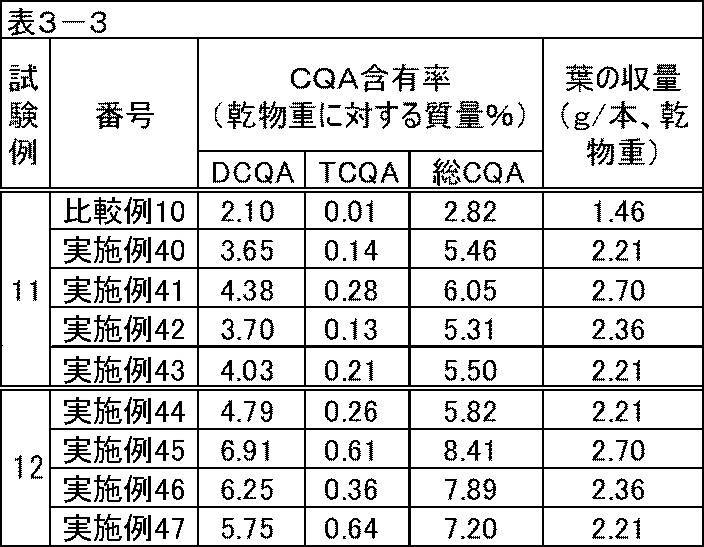
より具体的には、試験例11の実施例40であれば、植物としてサツマイモを用い、第1工程の栽培条件が、「水耕,25℃,50%,LED300μmol」であり、日数が15日間、第2工程で使用した培養液は純水で、栽培条件は、「25℃,50%,LED300μmol」であり、日数が14日間であり、乾燥工程は実施せず、結果として葉に含まれるDCQAは葉の乾物重に対して3.65質量%、TCQAは0.14質量%、総CQAは5.46質量%であり、葉の収量が植物1本につき乾物重で2.21gだったことを表わしている。その他の実施例及び比較例についても上記と同様である。

Claims (9)
- サツマイモ以外のイモ類、ヒルガオ科植物、及び、キク科植物からなる群から選択される少なくとも1種の植物を生長させる工程と、
生長させた前記植物を、硝酸イオン及びリン酸イオンを実質的に含有しない培養液を用いて養液栽培する工程と、を有する植物の生産方法。 - 前記培養液が、B、Mn、Zn、Cu、及び、Moからなる群から選択される少なくとも1種の金属の金属イオンを含有する、請求項1に記載の植物の生産方法。
- 前記培養液が、1種の前記金属イオンを含有する場合、前記金属イオンの含有率が、前記培養液の全質量に対して、1.0質量ppm以下であり、
前記培養液が、2種以上の前記金属イオンを含有する場合、前記金属イオンのそれぞれの含有率が、前記培養液の全質量に対して、1.0質量ppm以下である、請求項2に記載の植物の生産方法。 - 前記培養液が、Mnイオンを含有し、Mnイオンの含有率が、前記培養液の全質量に対して、50質量ppbを超え、1.0質量ppm以下である、請求項1~3のいずれか一項に記載の植物の生産方法。
- 前記培養液が、K+、Mg2+、Ca2+、SO4 2-、及び、Cl-からなる群から選択される少なくとも1種のイオンを含有し、
前記培養液が、1種の前記イオンを含有する場合、前記培養液の全質量に対する前記イオンの含有率が1.0質量ppm以上であり、
前記培養液が、前記イオンを2種以上含有する場合、前記培養液の全質量に対する前記イオンのそれぞれの含有率が、1.0質量ppm以上である、請求項1~4のいずれか一項に記載の植物の生産方法。 - 前記培養液が、1種の前記イオンを含有する場合、前記イオンの含有率が前記培養液の全質量に対して、1.0~300質量ppmであり、
前記培養液が、2種以上の前記イオンを含有する場合、前記イオンのそれぞれの含有率が、前記培養液の全質量に対して、1.0~300質量ppmである、請求項5に記載の植物の生産方法。 - 前記培養液が、
B、Mn、Zn、Cu、及び、Moからなる群から選択される少なくとも1種の金属の金属イオンと、
K+、Mg2+、Ca2+、SO4 2-、及び、Cl-からなる群から選択される少なくとも1種のイオンと、を含有する、請求項1~6のいずれか一項に記載の植物の生産方法。 - 請求項1~7のいずれか一項に記載の生産方法により得られた植物の根部を除去して葉茎部を得て、前記葉茎部を、水分を供給しない状態で乾燥させて、植物加工品を得る、植物加工品の製造方法。
- 前記乾燥の際の温度が20~35℃であり、相対湿度が30~95%である、請求項8に記載の植物加工品の製造方法。
Priority Applications (5)
| Application Number | Priority Date | Filing Date | Title |
|---|---|---|---|
| EP18863327.5A EP3689134B1 (en) | 2017-09-29 | 2018-09-25 | Method for producing plants |
| KR1020207006083A KR20200037336A (ko) | 2017-09-29 | 2018-09-25 | 식물의 생산 방법, 및 식물 가공품의 제조 방법 |
| JP2019545112A JP7086091B2 (ja) | 2017-09-29 | 2018-09-25 | 植物の生産方法、及び、植物加工品の製造方法 |
| CN201880060032.7A CN111093362B (zh) | 2017-09-29 | 2018-09-25 | 植物的生产方法及植物加工品的制造方法 |
| US16/826,284 US20200221652A1 (en) | 2017-09-29 | 2020-03-22 | Method for producing plant and method for producing processed plant product |
Applications Claiming Priority (4)
| Application Number | Priority Date | Filing Date | Title |
|---|---|---|---|
| JP2017-189867 | 2017-09-29 | ||
| JP2017189867 | 2017-09-29 | ||
| JP2017234031 | 2017-12-06 | ||
| JP2017-234031 | 2017-12-06 |
Related Child Applications (1)
| Application Number | Title | Priority Date | Filing Date |
|---|---|---|---|
| US16/826,284 Continuation US20200221652A1 (en) | 2017-09-29 | 2020-03-22 | Method for producing plant and method for producing processed plant product |
Publications (1)
| Publication Number | Publication Date |
|---|---|
| WO2019065592A1 true WO2019065592A1 (ja) | 2019-04-04 |
Family
ID=65901895
Family Applications (1)
| Application Number | Title | Priority Date | Filing Date |
|---|---|---|---|
| PCT/JP2018/035353 Ceased WO2019065592A1 (ja) | 2017-09-29 | 2018-09-25 | 植物の生産方法、及び、植物加工品の製造方法 |
Country Status (6)
| Country | Link |
|---|---|
| US (1) | US20200221652A1 (ja) |
| EP (1) | EP3689134B1 (ja) |
| JP (1) | JP7086091B2 (ja) |
| KR (1) | KR20200037336A (ja) |
| CN (1) | CN111093362B (ja) |
| WO (1) | WO2019065592A1 (ja) |
Cited By (2)
| Publication number | Priority date | Publication date | Assignee | Title |
|---|---|---|---|---|
| CN112753513A (zh) * | 2021-02-05 | 2021-05-07 | 湖北恩施中国南方马铃薯研究中心 | 一种富硒叶菜型甘薯的水培快繁方法 |
| WO2023078553A1 (en) * | 2021-11-04 | 2023-05-11 | Symrise Ag | Preparation of dried plant material having an increased content of phyllodulcin |
Families Citing this family (1)
| Publication number | Priority date | Publication date | Assignee | Title |
|---|---|---|---|---|
| CN111919694B (zh) * | 2020-08-21 | 2022-03-08 | 内蒙古大学 | 一种水培溶液及其高品质黄芪的培育方法 |
Citations (4)
| Publication number | Priority date | Publication date | Assignee | Title |
|---|---|---|---|---|
| JP2016106621A (ja) | 2014-11-28 | 2016-06-20 | 富士フイルム株式会社 | ポリフェノール化合物含有植物体の生産方法、ポリフェノール化合物含有植物体中のポリフェノール化合物量を増加させる方法、トリカフェオイルキナ酸含有植物体中のトリカフェオイルキナ酸量を増加させる方法、及びトリカフェオイルキナ酸含有植物体 |
| JP2017070923A (ja) * | 2015-10-09 | 2017-04-13 | パナソニックIpマネジメント株式会社 | 除湿装置 |
| JP2017086076A (ja) * | 2014-04-11 | 2017-05-25 | パナソニックIpマネジメント株式会社 | 葉野菜 |
| US20170172084A1 (en) * | 2014-03-28 | 2017-06-22 | JFM Managment, Inc. | Systems and methods for hydroponic growth |
Family Cites Families (6)
| Publication number | Priority date | Publication date | Assignee | Title |
|---|---|---|---|---|
| US5216836A (en) * | 1988-02-16 | 1993-06-08 | Tuskegee University | Movable root contact/pressure plate assembly for hydroponic system |
| CN1052654A (zh) * | 1991-01-08 | 1991-07-03 | 王秀云 | 一种氨基酸肥及其制法 |
| AU2006326848A1 (en) * | 2005-12-23 | 2007-06-28 | Paul Johnson | Tray for hydroponics growing of plants and hydroponics tank having the tray |
| CN103012004A (zh) * | 2013-01-24 | 2013-04-03 | 湖南壹叶都市农业发展有限公司 | 一种叶类蔬菜营养液配方 |
| TWI693366B (zh) * | 2014-12-22 | 2020-05-11 | 日商松下知識產權經營股份有限公司 | 除濕裝置 |
| CN105272545A (zh) * | 2015-10-09 | 2016-01-27 | 宁夏共享生物化工有限公司 | 一种吊兰水培营养液的制备方法 |
-
2018
- 2018-09-25 WO PCT/JP2018/035353 patent/WO2019065592A1/ja not_active Ceased
- 2018-09-25 CN CN201880060032.7A patent/CN111093362B/zh active Active
- 2018-09-25 EP EP18863327.5A patent/EP3689134B1/en active Active
- 2018-09-25 JP JP2019545112A patent/JP7086091B2/ja active Active
- 2018-09-25 KR KR1020207006083A patent/KR20200037336A/ko not_active Ceased
-
2020
- 2020-03-22 US US16/826,284 patent/US20200221652A1/en not_active Abandoned
Patent Citations (4)
| Publication number | Priority date | Publication date | Assignee | Title |
|---|---|---|---|---|
| US20170172084A1 (en) * | 2014-03-28 | 2017-06-22 | JFM Managment, Inc. | Systems and methods for hydroponic growth |
| JP2017086076A (ja) * | 2014-04-11 | 2017-05-25 | パナソニックIpマネジメント株式会社 | 葉野菜 |
| JP2016106621A (ja) | 2014-11-28 | 2016-06-20 | 富士フイルム株式会社 | ポリフェノール化合物含有植物体の生産方法、ポリフェノール化合物含有植物体中のポリフェノール化合物量を増加させる方法、トリカフェオイルキナ酸含有植物体中のトリカフェオイルキナ酸量を増加させる方法、及びトリカフェオイルキナ酸含有植物体 |
| JP2017070923A (ja) * | 2015-10-09 | 2017-04-13 | パナソニックIpマネジメント株式会社 | 除湿装置 |
Non-Patent Citations (3)
| Title |
|---|
| "Modern Agriculture", October 2013, RURAL CULTURE ASSOCIATION JAPAN, article "Growing potatoes and sweet potatoes taught by farmers", pages: 92 - 96 |
| MASAAKI HOJO: "Artichokes: A great way to grow vegetables", 2014, SEIBIDO SHUPPAN CO., LTD., pages: 8 - 9 |
| See also references of EP3689134A4 |
Cited By (3)
| Publication number | Priority date | Publication date | Assignee | Title |
|---|---|---|---|---|
| CN112753513A (zh) * | 2021-02-05 | 2021-05-07 | 湖北恩施中国南方马铃薯研究中心 | 一种富硒叶菜型甘薯的水培快繁方法 |
| CN112753513B (zh) * | 2021-02-05 | 2022-12-23 | 湖北恩施中国南方马铃薯研究中心 | 一种富硒叶菜型甘薯的水培快繁方法 |
| WO2023078553A1 (en) * | 2021-11-04 | 2023-05-11 | Symrise Ag | Preparation of dried plant material having an increased content of phyllodulcin |
Also Published As
| Publication number | Publication date |
|---|---|
| JP7086091B2 (ja) | 2022-06-17 |
| EP3689134B1 (en) | 2022-06-15 |
| CN111093362A (zh) | 2020-05-01 |
| EP3689134A1 (en) | 2020-08-05 |
| CN111093362B (zh) | 2022-07-22 |
| KR20200037336A (ko) | 2020-04-08 |
| JPWO2019065592A1 (ja) | 2020-10-15 |
| EP3689134A4 (en) | 2020-09-09 |
| US20200221652A1 (en) | 2020-07-16 |
Similar Documents
| Publication | Publication Date | Title |
|---|---|---|
| Bezerra et al. | Physiology of cashew plants grown under adverse conditions | |
| Satti et al. | Salinity tolerance in tomato: Implications of potassium, calcium, and phosphorus | |
| JP6920093B2 (ja) | 植物活力剤 | |
| MENDOZA-CASTILLO et al. | Intensive production systems of fig (Ficus carica L.) under greenhouse conditions | |
| Chang et al. | Growth and yield response of three aeroponically grown potato cultivars (Solanum tuberosum L.) to different electrical conductivities of nutrient solution | |
| JPWO2019139031A1 (ja) | 栽培植物の養液栽培方法及び養液栽培用培養液 | |
| JP7086091B2 (ja) | 植物の生産方法、及び、植物加工品の製造方法 | |
| Conesa et al. | The influence of nitrate/ammonium ratio on yield quality and nitrate, oxalate and vitamin C content of baby leaf spinach and bladder campion plants grown in a floating system | |
| Santa-Cruz et al. | Response of plant yield and leaf ion contents to salinity in grafted tomato plants | |
| Satti et al. | Fruit quality and partitioning of mineral elements in processing tomato in response to saline nutrients | |
| Neto et al. | Silicon potential as attenuator of salinity effects on growth and post-harvest quality of lettuce | |
| JP7112365B2 (ja) | アブラナ科野菜の生産方法、並びに、飲食品の製造方法及び飲食品 | |
| KR101159485B1 (ko) | 폐해수를 이용한 함초의 재배방법 및 이에 의해 재배된 함초 | |
| KR101036423B1 (ko) | 해수를 이용한 함초의 재배방법 및 이에 의해 재배된 함초 | |
| Gilani et al. | Interaction of Light Quality and EC of Nutrition Solution on Seedling Quality, Growth, and Physiology of Cucumber Seedlings | |
| JP7725751B1 (ja) | 液体肥料、濃縮液体肥料および組成物 | |
| JP5906085B2 (ja) | 水耕栽培における植物体の有用成分含有量向上方法 | |
| JP2005320266A (ja) | 植物の生長を促進する方法、植物生長促進剤及び農業資材 | |
| US20250000127A1 (en) | Preparation of dried plant material having an increased content of phyllodulcin | |
| Suzuki et al. | Effect of the supplemental lighting on the growth of young plants in second nursery in tomato | |
| KR101155721B1 (ko) | 폐해수를 이용한 아이스플랜트의 재배방법 및 이에 의해 재배된 아이스플랜트 | |
| JP7140466B2 (ja) | 食用大麦根乾燥物及び製造方法 | |
| WO2026063186A1 (ja) | 高濃度の二酸化炭素環境下におけるマメ科植物の養液栽培方法 | |
| JPS6317814A (ja) | 植物成長促進方法及びその為に用いる成長促進剤 | |
| Böhme et al. | Greenhouse cultivation of bitter gourd (Momordica charantia L.) in mineral and organic substrate |
Legal Events
| Date | Code | Title | Description |
|---|---|---|---|
| 121 | Ep: the epo has been informed by wipo that ep was designated in this application |
Ref document number: 18863327 Country of ref document: EP Kind code of ref document: A1 |
|
| ENP | Entry into the national phase |
Ref document number: 20207006083 Country of ref document: KR Kind code of ref document: A |
|
| ENP | Entry into the national phase |
Ref document number: 2019545112 Country of ref document: JP Kind code of ref document: A |
|
| NENP | Non-entry into the national phase |
Ref country code: DE |
|
| ENP | Entry into the national phase |
Ref document number: 2018863327 Country of ref document: EP Effective date: 20200429 |