WO2019065932A1 - 乾燥パスタの製造方法 - Google Patents
乾燥パスタの製造方法 Download PDFInfo
- Publication number
- WO2019065932A1 WO2019065932A1 PCT/JP2018/036169 JP2018036169W WO2019065932A1 WO 2019065932 A1 WO2019065932 A1 WO 2019065932A1 JP 2018036169 W JP2018036169 W JP 2018036169W WO 2019065932 A1 WO2019065932 A1 WO 2019065932A1
- Authority
- WO
- WIPO (PCT)
- Prior art keywords
- pasta
- dried
- cooked
- extrusion
- flour
- Prior art date
- Legal status (The legal status is an assumption and is not a legal conclusion. Google has not performed a legal analysis and makes no representation as to the accuracy of the status listed.)
- Ceased
Links
Classifications
-
- A—HUMAN NECESSITIES
- A23—FOODS OR FOODSTUFFS; TREATMENT THEREOF, NOT COVERED BY OTHER CLASSES
- A23B—PRESERVATION OF FOODS, FOODSTUFFS OR NON-ALCOHOLIC BEVERAGES; CHEMICAL RIPENING OF FRUIT OR VEGETABLES
- A23B2/00—Preservation of foods or foodstuffs, in general
- A23B2/80—Freezing; Subsequent thawing; Cooling
-
- A—HUMAN NECESSITIES
- A23—FOODS OR FOODSTUFFS; TREATMENT THEREOF, NOT COVERED BY OTHER CLASSES
- A23B—PRESERVATION OF FOODS, FOODSTUFFS OR NON-ALCOHOLIC BEVERAGES; CHEMICAL RIPENING OF FRUIT OR VEGETABLES
- A23B2/00—Preservation of foods or foodstuffs, in general
- A23B2/90—Preservation of foods or foodstuffs, in general by drying or kilning; Subsequent reconstitution
-
- A—HUMAN NECESSITIES
- A23—FOODS OR FOODSTUFFS; TREATMENT THEREOF, NOT COVERED BY OTHER CLASSES
- A23L—FOODS, FOODSTUFFS OR NON-ALCOHOLIC BEVERAGES, NOT OTHERWISE PROVIDED FOR; PREPARATION OR TREATMENT THEREOF
- A23L7/00—Cereal-derived products; Malt products; Preparation or treatment thereof
- A23L7/10—Cereal-derived products
- A23L7/109—Types of pasta, e.g. macaroni or noodles
-
- A—HUMAN NECESSITIES
- A23—FOODS OR FOODSTUFFS; TREATMENT THEREOF, NOT COVERED BY OTHER CLASSES
- A23L—FOODS, FOODSTUFFS OR NON-ALCOHOLIC BEVERAGES, NOT OTHERWISE PROVIDED FOR; PREPARATION OR TREATMENT THEREOF
- A23L7/00—Cereal-derived products; Malt products; Preparation or treatment thereof
- A23L7/10—Cereal-derived products
- A23L7/109—Types of pasta, e.g. macaroni or noodles
- A23L7/113—Parboiled or instant pasta
-
- A—HUMAN NECESSITIES
- A23—FOODS OR FOODSTUFFS; TREATMENT THEREOF, NOT COVERED BY OTHER CLASSES
- A23V—INDEXING SCHEME RELATING TO FOODS, FOODSTUFFS OR NON-ALCOHOLIC BEVERAGES AND LACTIC OR PROPIONIC ACID BACTERIA USED IN FOODSTUFFS OR FOOD PREPARATION
- A23V2002/00—Food compositions, function of food ingredients or processes for food or foodstuffs
-
- A—HUMAN NECESSITIES
- A23—FOODS OR FOODSTUFFS; TREATMENT THEREOF, NOT COVERED BY OTHER CLASSES
- A23V—INDEXING SCHEME RELATING TO FOODS, FOODSTUFFS OR NON-ALCOHOLIC BEVERAGES AND LACTIC OR PROPIONIC ACID BACTERIA USED IN FOODSTUFFS OR FOOD PREPARATION
- A23V2300/00—Processes
- A23V2300/10—Drying, dehydrating
Definitions
- the present invention relates to dry pasta useful for cryopreservation after cooking.
- Pasta represented by spaghetti and macaroni
- the pasta is typically produced by extruding a dough prepared using a wheat flour-based raw material powder into a predetermined shape under normal pressure or reduced pressure.
- the extruded pasta is referred to as a fresh pasta
- the dried pasta is referred to as a dried pasta. Dry pasta is superior in shelf life to fresh pasta, and many of the generally distributed pasta are dry pasta.
- Patent Document 1 discloses that an oligosaccharide having 4 to 7 saccharides that accounts for 50% or more of the sugar composition is added to the pasta salad which is a cooked pasta product. The method of inclusion is described. However, the method described in Patent Document 1 is applied to foodstuffs other than pasta such as mayonnaise-like food contained in pasta salad, and can not suppress deterioration in texture of cooked pasta itself over time.
- Patent Document 2 is a method of obtaining pasta excellent in texture similar to the case of carrying out the step, even if the step of storing and ripening the fresh pasta immediately after extrusion molding overnight in a cold and dark place is omitted.
- the extruded raw pasta is irradiated with microwaves under conditions that the product temperature is 75 ° C. or less and then dried.
- the microwave rapidly heats and expands the water in the pasta, the quality of the pasta may be degraded by the method described in Patent Document 2.
- JP 2002-10745 A Unexamined-Japanese-Patent No. 2017-23037
- An object is to provide a method for producing pasta.
- the present invention comprises: extruding a dough prepared from a raw material powder containing flour having a protein content of 8 to 18% by mass at a degree of vacuum of 0 to -65 kPa and a pressure of 60 to 160 kgf / cm 2 to obtain pasta;
- the method for producing a dried pasta comprising the steps of: drying the pasta; and GV adjusting the gluten vitality of the pasta to 10 to 30% after the extruding step.
- the present invention is a cryopreserved cooking comprising the steps of: cooking the dried pasta obtained by the method for producing dried pasta according to the present invention described above to obtain a cooked pasta; and refrigerated or frozen the cooked pasta It is a method of producing finished pasta.
- the method for producing a dried pasta according to the present invention comprises an extrusion step of extruding a dough prepared from raw material powder to obtain a pasta, and a drying step of drying the pasta.
- the "raw material powder” referred to in the present invention is, among dough raw materials used for preparation of dough, powdery flours under normal temperature and pressure, and typically are flour and starch.
- the raw material powder used in the present invention contains flour having a protein content of 8 to 18% by mass, preferably 11 to 16% by mass (hereinafter also referred to as “specified flour”).
- specific wheat flour as the raw material flour is one of the elements necessary for adjusting the gluten vitality of the pasta after the extrusion step described later to a predetermined range, and is necessary for the expression of the predetermined effects of the present invention. It is one of the elements.
- the type of the specific wheat flour is not particularly limited, and wheat flour generally used as a raw material for noodles can be used without particular limitation, provided that the protein content is in the specific range, for example, flour, semi-strong flour, strong flour And ordinary wheat flour; durum flour (durum flour, durum semolina) and the like, and one of these may be used alone or in combination of two or more.
- the adjustment of the protein content of wheat flour can be carried out, for example, by using a plurality of kinds of wheat flour in combination and appropriately adjusting the blending ratio thereof.
- the content of the specific wheat flour is preferably 70% by mass or more, more preferably 80% by mass or more, more preferably 90% by mass or more, based on the total mass of the raw material powder. Preferably it is 95 mass% or more, Most preferably, it is 100 mass%.
- the raw material powder used in the present invention may contain flour and starch other than the specific wheat flour, for example, wheat flour other than the specific wheat flour, buckwheat flour, rice flour, corn flour, barley flour, rye flour, wheat flour, hye Flour and flour such as flour; tapioca starch, potato starch, wheat starch, starch such as corn starch and waxy corn starch (raw starch), and acetylation, hydroxypropylation, etherification, crosslinking, oxidation of these starches
- the processed starch which gave one or more of chemical treatments, such as gelatinization, or physical processing is mentioned, These 1 type can be used individually or in combination of 2 or more types.
- the dough used in the present invention is typically prepared by adding raw water to raw material flour and mixing.
- raw material powder and the batter water in addition to the raw material powder and the batter water, other components such as sugars, thickeners, proteins, emulsifiers, oils and fats, brines, seasonings and the like may be used.
- distilled water those which can usually be used for the production of noodles can be used without particular limitation, and examples thereof include fresh water, acidic water, alkaline water, and brine.
- the addition amount of the water may be an addition amount generally employed in the production of pasta, and is generally 20 to 40 parts by mass with respect to 100 parts by mass of the raw material powder.
- the dough prepared from the raw material powder containing the specific wheat flour is extruded at a predetermined pressure to obtain a pasta.
- the extrusion of the dough can be carried out in a conventional manner using a molding machine (pasta maker) usually used for the production of pasta of this type.
- the molding machine typically comprises a cylinder, a screw movably disposed in the cylinder along the axial direction of the cylinder, and a die (extrusion die) disposed at one axial end of the cylinder. Equipped with In the forming machine having such a configuration, when the dough is supplied into the cylinder while the screw is rotated about its axis in the cylinder, the dough is high in pressure between the inner wall of the cylinder and the screw.
- pasta While being compressed, as the screw rotates, it advances in the cylinder toward the die and is continuously pushed out from the hole of the die.
- What is extruded from the hole of this die is pasta (raw pasta).
- the shape of the pasta is not particularly limited, and may be, for example, a noodle string such as spaghetti or fettuccine; a tube such as macaroni or penne; a sheet such as lasagna or the like.
- the shape of the pasta can be adjusted by appropriately selecting an extrusion die such as a die in a molding machine.
- the dough is extruded at a degree of reduced pressure of 0 to -65 kPa and a pressure (extrusion pressure) of 60 to 160 kgf / cm 2 .
- the extrusion conditions of such dough are one of the elements necessary for achieving the predetermined effects of the present invention.
- the conditions for extruding such dough are particularly characterized in that the degree of pressure reduction in the forming machine (cylinder of the forming machine) at the time of extruding the dough is 0 to -65 kPa.
- the air in the dough to be extruded is removed, and in order to make the resulting pasta a dense structure, the degree of vacuum is set high, ie, high vacuum in the cylinder of the molding machine Specifically, for example, a degree of reduced pressure of about ⁇ 80 kPa to ⁇ 101.3 kPa (corresponding to a vacuum) is recommended.
- the degree of reduced pressure in the extrusion process according to the present invention is 0 to -65 kPa, and the dough is extruded at a reduced pressure of normal pressure to low vacuum.
- the pasta obtained in the extrusion process according to the present invention has lower density (weaker tightness) than ordinary pasta extruded at a higher degree of vacuum, and air can be contained as air bubbles inside.
- Such low-density pasta is as good as eaten immediately after cooking, even if it is in a state where it can be eaten by reheating it in a microwave or the like after being refrigerated or frozen after cooking. It can be a dry pasta with a texture.
- the degree of pressure reduction in the extrusion step is preferably 0 to -50 kPa (0 to -50 kPa), more preferably 0 to -30 kPa (0 to -30 kPa).
- the degree of pressure reduction can be adjusted by adjusting the amount of gas in the molding machine using a degassing means such as a pump. Further, the degree of pressure reduction and the extrusion pressure can be measured by a pressure gauge attached to the molding machine.
- the pasta is dried after the extrusion step (drying step).
- the moisture content of the pasta after the drying step that is, the dried pasta to be produced according to the present invention is preferably 13% by mass or less from the viewpoint of enabling long-term storage of the dried pasta at room temperature.
- the water content as referred to herein is a value measured by an absolute drying method.
- the drying method usually adopted in manufacture of this kind of dry pasta can be adopted suitably.
- GV gluten vitality
- GV is an index showing the nature of protein contained in wheat flour, and is different from the content of protein contained in wheat flour and / or raw material flour.
- a pasta obtained through an extrusion process more specifically, a GV of a dried pasta obtained by drying the pasta, as a raw material powder before the production of the pasta It is not GV of wheat flour.
- the GV of wheat flour is generally about 50 to 60%
- the GV of dried pasta (such as spaghetti) which is commercially available is generally about 40 to 46%. is there. The measuring method of GV is mentioned later.
- the method for producing the dried pasta according to the present invention is, as described above, 1) preparing a dough using raw material flour containing flour having a protein content of 8 to 18% by mass, and 2) reducing the pressure of the dough to 0 to -65 kPa, pressure Extruded at 60 to 160 kgf / cm 2 to obtain a pasta, 3) characterized by adjusting the GV of the pasta to 10 to 30%, and depending on the combination of these features, stored refrigerated or frozen after cooking Even when the food is reheated in a microwave oven or the like to make it possible to eat, a dried pasta is obtained in which a texture similar to that of eating immediately after cooking can be obtained.
- the GV of the pasta after extrusion is preferably 14% or more, more preferably 16% or more, and preferably 27% or less, more preferably 25% or less.
- a method of reducing the property (for example, viscosity) of protein contained in wheat flour is preferably used. It is possible to adopt a method that can lower the GV of pasta.
- a GV lowering method for example, A) a method of immersing pasta in water or aqueous liquid whose pH is adjusted in the range of 1 to 6 or 9 to 14, B) in water vapor at a high temperature of 105 to 160 ° C.
- a method of exposing the pasta, C) A method of leaving the pasta in a conditioned space (for example, in a constant temperature bath) and drying it can be exemplified.
- the various conditions such as the treatment time in each of the above A) to C) may be appropriately determined based on the measurement values by appropriately measuring the GV using a part of the pasta to be treated as a sample during the treatment.
- the above C) is particularly preferable as the GV adjustment step according to the present invention because the color and flavor of the pasta do not change significantly.
- the ambient temperature of the space in which the pasta to be treated is placed is preferably 80 to 130 ° C., more preferably 100 to 115 ° C.
- the relative humidity of such space is preferably 50 to 80% RH, more preferably 60 to 70% RH.
- the treatment time, ie, the time for which the pasta is allowed to stand, is preferably 100 to 480 minutes, more preferably 150 to 360 minutes.
- the GV adjustment process according to the present invention is performed after the extrusion process.
- the method for producing dried pasta according to the present invention includes “a mode in which the extrusion process, the GV adjustment process, and the drying process are sequentially performed” (mode I) and a “mode in which the GV adjustment process doubles as the drying process” (mode II). Be done.
- mode I a mode in which the extrusion process, the GV adjustment process, and the drying process are sequentially performed
- mode II “mode in which the GV adjustment process doubles as the drying process”
- dry pasta is obtained by implementing an extrusion process and a GV adjustment process one by one.
- the form I is preferable because the pasta after the GV adjustment is in a wet state, and when the C) is adopted, the pasta is dried in the C).
- Form II is preferred as this is done.
- the cold-preserved cooking includes the steps of: cooking the dried pasta obtained by the method for producing dried pasta according to the present invention described above to obtain a cooked pasta; and refrigerated or frozen the cooked pasta A method of making finished pasta is included.
- the method for heating and drying the dried pasta is not particularly limited, and a method for heating and cooking in the presence of water, such as cooking with boiled or steaming, can be employed as appropriate.
- the method of refrigeration and freezing of the cooked pasta is not particularly limited either, and either quick freezing or slow freezing can be employed. If the cooked pasta is frozen, the cooked pasta may be frozen together with the sauces.
- the pasta may be frozen with sauces, or after the cooked pasta is entwined with the sauces, it may be served in a vessel and frozen .
- Sources may be any food having fluidity at normal temperature and pressure, and sources, sauces, drips, etc. are included. Specifically, for example, buckwheat soup, fried soba sauce, bean paste, soy sauce, curry sauce, cream sauce, oil sauce, salt sauce, soy sauce sauce, soy sauce sauce, miso sauce, meat sauce, napolitan sauce, tomato sauce, carbonara sauce, brown sauce, white sauce And the like, but not limited thereto.
- this cryopreserved cooked pasta is a cooked pasta of the dried pasta according to the present invention described above as the cooked pasta to be subjected to refrigeration or freezing processing, the cooked pasta of the dried pasta of the present invention is used. Even when reheated in a range etc., it exhibits a comparable texture as compared to the case of eating immediately after cooking.
- the GV of the above-described pasta is measured by the following method using a ground powder prepared by crushing the pasta to be measured as a sample.
- the following GV measurement method is performed in the order of (1) measurement of soluble crude protein content of ground powder, (2) measurement of total crude protein content of ground powder, and (3) calculation of GV.
- any of the well-known Kjeldahl method and a convergence method can be employ
- any of the well-known Kjeldahl method and a convergence method can be employ
- the Kjeldahl method is described below.
- T amount of 0.1 N sulfuric acid required for titration (mL)
- B amount of 0.1 N sulfuric acid required for titration of blank (mL)
- F titer of 0.1 N sulfuric acid used for titration (measured at the time of use or using a commercial product with indication of titer)
- N nitrogen protein conversion factor (5.70)
- S Weighing amount of sample (ground powder) (g)
- Examples 1 to 6 and Comparative Examples 1 to 2 28 parts by mass of water was mixed with 100 parts by mass of durum semolina (protein content: 13% by mass) and mixed to obtain a dough. Next, this dough was extruded into a noodle string at an extrusion pressure and a degree of vacuum shown in Tables 1 to 3 below using a molding machine (pasta maker) to produce raw spaghetti having a water content of 33% by mass (extrusion process ). Next, the raw spaghetti is allowed to stand for a predetermined time in the bath of a thermostatic bath in which the atmosphere temperature in the bath is 90 ° C. and the relative humidity is 75% RH (GV adjustment process also serving as a drying process), A dry spaghetti with a moisture content of 12.5% was produced.
- a thermostatic bath in which the atmosphere temperature in the bath is 90 ° C. and the relative humidity is 75% RH (GV adjustment process also serving as a drying process)
- Examples 7 to 12 and Comparative Examples 3 to 4 A dry spaghetti with a moisture content of 12.5% is produced in the same manner as in Example 3 except that the GV of dried spaghetti is appropriately changed by adjusting the drying conditions (atmosphere temperature and / or treatment time) in the GV adjustment step. did.
- the cooked spaghetti is put in a polyethylene bag and stored for 2 days in a refrigerator at an internal temperature of 4 ° C., and the refrigerated cooked spaghetti after storage is microwaved Heat for 45 seconds with an output of 500 W to obtain a cooked spaghetti of the reference example, and have this panel be eaten by 10 expert panelists, and the hardness, elasticity, and tenacity evaluation points at that time were each obtained. It was 2 points.
- the evaluation point in the case of being inferior to the reference example is 1 point, and further, for the texture judged to be between 5 points and 2 points as an evaluation point, the relatively higher one is 4 points or the lower one 3 points.
- the GV of the dried pasta is adjusted to a range of 10 to 30%.
- the texture after heating was excellent.
- a dry pasta is provided which provides a smooth texture.
Landscapes
- Life Sciences & Earth Sciences (AREA)
- Engineering & Computer Science (AREA)
- Chemical & Material Sciences (AREA)
- Food Science & Technology (AREA)
- Polymers & Plastics (AREA)
- Health & Medical Sciences (AREA)
- Nutrition Science (AREA)
- Wood Science & Technology (AREA)
- Zoology (AREA)
- Noodles (AREA)
Abstract
本発明は、加熱調理後に冷蔵又は冷凍保存したものを電子レンジ等で再加熱して喫食可能な状態とした場合でも、加熱調理直後に喫食した場合と比べて遜色のない食感が得られる乾燥パスタの製造方法を提供することを課題とする。本発明の乾燥パスタの製造方法は、蛋白質含量8~18質量%の小麦粉を含む原料粉から調製された生地を、減圧度0~-65kPa、圧力60~160kgf/cm2で押出し成形してパスタを得る押出工程と、該パスタを乾燥する乾燥工程とを有し、また、前記押出工程後に前記パスタのグルテンバイタリティを10~30%に調整するGV調整工程を有する。前記GV調整工程が前記乾燥工程を兼ねる形態があり得る。
Description
本発明は、調理後に低温保存するのに有用な乾燥パスタに関する。
スパゲティやマカロニに代表されるパスタは、その他の麺類に比べ、しまった構造を有し、滑らかな舌触りと硬めの食感を味わうことができる非常に人気がある食品である。パスタは、典型的には、小麦粉を主体とする原料粉を用いて調製された生地を、常圧又は減圧した状態で所定形状に押出し成形して製造される。この押出し成形されたパスタは生パスタ、該生パスタを乾燥させたものは乾燥パスタと言われる。乾燥パスタは、生パスタに比べて保存性に優れており、一般に流通しているパスタの多くは乾燥パスタである。
麺線状の乾燥パスタを茹で調理する場合、前記の独特の食感を最大限に生かすためには、麺線の中心部分にわずかに芯(硬さ)が残るような茹で調理、いわゆるアルデンテの調理を行う必要があり、単純な茹で調理には無い調理のコツが要求される上に、パスタは緻密な構造を有するため水分の浸透が遅く、茹で上げるのに長時間を要する。そのため、調理の手間がかからないいわゆる時短調理が好まれる近年は、予め調理され、電子レンジ等で再加熱するだけの簡便な操作で喫食することができる、調理済みパスタ製品が嗜好される傾向がある。
調理済みパスタ製品においては、それに含まれる調理済みパスタの内外で経時的に水分の移動が起こり、該パスタが全体的にのびた状態になって独特の食感が失われてしまうという問題があった。このような調理済みパスタの経時的な食感低下の問題に対し、特許文献1には、4~7糖類が糖組成の50%以上をしめるオリゴ糖を、調理済みパスタ製品であるパスタサラダに含有させる方法が記載されている。しかしながら特許文献1記載の方法は、パスタサラダに含まれるマヨネーズ様食品などのパスタ以外の食材に適用されるものであり、調理済みパスタ自体の経時的な食感低下を抑制し得るものではない。
特許文献2には、押出し成形直後の生パスタを一晩程度冷暗所等で保管して熟成させる工程を省略しても、該工程を実施した場合と同様の食感に優れたパスタが得られる方法として、押出成形した生パスタに品温が75℃以下となる条件でマイクロ波を照射した後、乾燥する方法が記載されている。しかしながらマイクロ波はパスタ中の水分を急速に加熱膨張させるため、特許文献2記載の方法ではパスタの品質が低下するおそれがある。
本発明は、加熱調理後に冷蔵又は冷凍保存したものを電子レンジ等で再加熱して喫食可能な状態とした場合でも、加熱調理直後に喫食した場合と比べて遜色のない食感が得られる乾燥パスタの製造方法を提供することを課題とする。
本発明は、蛋白質含量8~18質量%の小麦粉を含む原料粉から調製された生地を、減圧度0~-65kPa、圧力60~160kgf/cm2で押出し成形してパスタを得る押出工程と、該パスタを乾燥する乾燥工程とを有する、乾燥パスタの製造方法であって、前記押出工程後に前記パスタのグルテンバイタリティを10~30%に調整するGV調整工程を有する乾燥パスタの製造方法である。
また本発明は、前記の本発明の乾燥パスタの製造方法によって得られた乾燥パスタを加熱調理して調理済みパスタを得、該調理済みパスタを冷蔵又は冷凍する工程を有する、低温保存された調理済みパスタの製造方法である。
本発明の乾燥パスタの製造方法は、原料粉から調製された生地を押出し成形してパスタを得る押出工程と、該パスタを乾燥する乾燥工程とを有する。本発明でいう「原料粉」は、生地の調製に用いられる生地原料のうち、常温常圧下で粉状の穀粉類であり、典型的には、穀粉及び澱粉である。
本発明で用いる原料粉は、蛋白質含量8~18質量%、好ましくは11~16質量%の小麦粉(以下、「特定小麦粉」ともいう)を含む。斯かる特定小麦粉を原料粉に用いることは、後述する押出工程後のパスタのグルテンバイタリティを所定範囲に調整するのに必要な要素の1つであり、本発明の所定の効果の発現に必要な要素の1つである。前記特定小麦粉の種類は特に制限されず、蛋白質含量が前記特定範囲にあることを前提として、麺原料として通常用いられる小麦粉を特に制限なく用いることができ、例えば、中力粉、準強力粉、強力粉等の普通小麦粉;デュラム粉(デュラム小麦粉、デュラムセモリナ)等が挙げられ、これらの1種を単独で又は2種以上を組み合わせて用いることができる。小麦粉の蛋白質含量の調整は、例えば、複数種の小麦粉を併用し且つそれらの配合割合を適宜調整することによって実施可能である。
本発明で用いる原料粉において、前記特定小麦粉の含有量は、該原料粉の全質量に対して、好ましくは70質量%以上、さらに好ましくは80質量%以上、より好ましくは90質量%以上、とりわけ好ましくは95質量%以上、最も好ましくは100質量%である。
本発明で用いる原料粉は、前記特定小麦粉以外の穀粉及び澱粉を含有してもよく、例えば、前記特定小麦粉以外の小麦粉、そば粉、米粉、コーンフラワー、大麦粉、ライ麦粉、はとむぎ粉、ひえ粉、及び、あわ粉等の穀粉;タピオカ澱粉、馬鈴薯澱粉、小麦澱粉、コーンスターチ、ワキシーコーンスターチ等の澱粉(未加工澱粉)、及びこれら澱粉にアセチル化、ヒドロキシプロピル化、エーテル化、架橋、酸化、α化等の化工又は物理処理の1つ以上を施した加工澱粉が挙げられ、これらの1種を単独で又は2種以上を組み合わせて用いることができる。
本発明で用いる生地は、典型的には、原料粉に練水を添加して混捏することによって調製される。生地を調製する際には、原料粉及び練水に加えてさらに、糖類、増粘剤、蛋白質、乳化剤、油脂、かん水、調味料等の他の成分を用いてもよい。練水としては、麺の製造に通常用い得るものを特に制限なく用いることができ、例えば、清水、酸性水、アルカリ水、及び、かん水等が挙げられる。練水の添加量は、パスタの製造で通常採用される添加量でよく、一般的に原料粉100質量部に対して20~40質量部である。
本発明に係る押出工程では、前記特定小麦粉を含む原料粉から調製された生地を、所定の圧力で押出し成形してパスタを得る。生地の押出し成形は、この種のパスタの製造に通常使用される成形機(パスタ製造機)を用いて常法に従って行うことができる。成形機は、典型的には、シリンダと、該シリンダ内を該シリンダの軸方向に沿って移動可能に配されたスクリューと、該シリンダの軸方向の一端に配されたダイス(押出し型)とを備える。斯かる構成の成形機において、シリンダ内でスクリューをその軸周りに回転させた状態下に、該シリンダ内に生地を供給すると、該生地は、該シリンダの内壁と該スクリューとの間で高圧の圧縮を受けつつ、該スクリューの回転に伴い該シリンダ内をダイスに向かって前進し、該ダイスの孔から連続的に押し出される。このダイスの孔から押し出されたものがパスタ(生パスタ)である。パスタの形状は特に限定されず、例えば、スパゲティ、フェットチーネ等の麺線状;マカロニ、ペンネ等の管状;ラザニア等のシート状等とすることができる。パスタの形状は、成形機におけるダイス等の押出し型を適宜選択することで調整することができる。
本発明に係る押出工程では、減圧度0~-65kPa、圧力(押出圧)60~160kgf/cm2で生地を押出し成形する。斯かる生地の押出し条件は、本発明の所定の効果の発現に必要な要素の1つである。斯かる生地の押出し条件は、特に、生地を押し出す際の成形機(成型機のシリンダ)内の減圧度が0~-65kPaである点で特に特徴付けられる。パスタの工業的な製造方法では、通常、押出し成形される生地中の空気を除き、得られるパスタを緻密な構造とするために、減圧度を高く設定する、即ち成形機のシリンダ内を高真空とすることが好ましいとされており、具体的には例えば、減圧度が-80kPa~-101.3kPa(真空に相当する)程度が推奨されている。これに対し、本発明に係る押出工程の減圧度は0~-65kPaであり、常圧ないし低真空の減圧度で生地を押し出す。本発明に係る押出工程で得られるパスタは、より高い減圧度で押出し成形された通常のパスタに比して緻密性が低く(しまりが弱く)、内部に空気が気泡として含有され得る。このような緻密性の低いパスタは、加熱調理後に冷蔵又は冷凍保存したものを電子レンジ等で再加熱して喫食可能な状態とした場合でも、加熱調理直後に喫食した場合と比べて遜色のない食感が得られる乾燥パスタとなり得る。押出工程における減圧度は、好ましくは0~-50kPa(0~-50kPa)、さらに好ましくは0~-30kPa(0~-30kPa)である。減圧度は、成形機内の気体の量を、ポンプ等の脱気手段を用いて調整することで調整可能である。また、減圧度及び押出し圧は、成形機に取り付けられている圧力計によって計測することができる。
本発明の乾燥パスタの製造方法では、押出工程後にパスタを乾燥する(乾燥工程)。乾燥工程後のパスタ、即ち本発明の製造目的物たる乾燥パスタの水分含量は、乾燥パスタの室温での長期保存を可能にする観点から、好ましくは13質量%以下である。ここでいう水分含量は、絶乾法によって測定される値である。パスタの乾燥方法としては、この種の乾燥パスタの製造において通常採用される乾燥方法を適宜採用できる。
本発明の乾燥パスタの製造方法の主たる特徴の1つとして、押出工程後にパスタのグルテンバイタリティ(以下、「GV」ともいう)を10~30%に調整するGV調整工程を有する点が挙げられる。GVは、小麦粉に含まれる蛋白質の性質を表す指標であり、小麦粉及び/又は原料粉に含まれる蛋白質の含有量とは異なる。本発明で着目しているのは、押出工程を経て得られたパスタ、より具体的には該パスタを乾燥して得られた乾燥パスタのGVであって、該パスタの製造前の原料粉としての小麦粉のGVではない。一般に、パスタのGVの数値が低くなると、食感が硬くなる傾向があり、該数値が高くなると、食感が柔らかくなる傾向がある。ちなみに、小麦粉(前記特定小麦粉)のGVは、一般的には50~60%程度であり、また、市販されている乾燥パスタ(例えばスパゲティ)のGVは、一般的には40~46%程度である。GVの測定方法については後述する。
本発明の乾燥パスタの製造方法は、前述した通り、1)蛋白質含量8~18質量%の小麦粉を含む原料粉を用いて生地を調製し、2)該生地を減圧度0~-65kPa、圧力60~160kgf/cm2で押出し成形してパスタを得、3)該パスタのGVを10~30%に調整する点で特徴付けられ、これらの特徴の組み合わせによって、加熱調理後に冷蔵又は冷凍保存したものを電子レンジ等で再加熱して喫食可能な状態とした場合でも、加熱調理直後に喫食した場合と比べて遜色のない食感が得られる乾燥パスタが得られる。本発明者の知見によれば、これらの特徴の中でも特に重要なのが、押出し成形後のパスタのGV調整である。押出し成形後のパスタのGVは、好ましくは14%以上、さらに好ましくは16%以上、そして、好ましくは27%以下、さらに好ましくは25%以下である。
パスタのGVを10~30%に調整する方法としては、小麦粉に含まれる蛋白質の性質(例えば粘性)を低下させる方法が好ましく用いられ、一般的な小麦粉を原料粉に含んで製造された通常のパスタのGVを低下させ得る方法を採用することができる。そのようなGV低下方法としては、例えば、A)pHが1~6又は9~14の範囲に調製された水又は水性液にパスタを浸漬する方法、B)105~160℃の高温の水蒸気にパスタを暴露する方法、C)調湿された空間(例えば恒温槽内)にパスタを静置して乾燥する方法が例示できる。前記A)~C)それぞれにおける処理時間などの諸条件は、その処理中に適時、処理対象のパスタの一部を試料としてGVを測定し、その測定値に基づいて適宜決定すればよい。前記A)~C)の中でも特に前記C)は、パスタの色合いや風味が大きく変化しないため、本発明に係るGV調整工程として好ましい。
本発明に係るGV調整工程として前記C)を採用する場合、処理対象のパスタが置かれる空間の雰囲気温度は、好ましくは80~130℃、さらに好ましくは100~115℃である。また、斯かる空間の相対湿度は、好ましくは50~80%RH、さらに好ましくは60~70%RHである。また、処理時間即ちパスタを静置する時間は、好ましくは100~480分、さらに好ましくは150~360分である。
本発明に係るGV調整工程は、押出工程後にされる。本発明の乾燥パスタの製造方法には、「押出工程、GV調整工程、乾燥工程を順次実施する形態」(形態I)と「GV調整工程が乾燥工程を兼ねる形態」(形態II)とが包含される。前記形態IIでは、押出工程、GV調整工程を順次実施することで、乾燥パスタが得られる。GV調整工程として前記A)又はB)を採用する場合は、GV調整後のパスタが湿潤状態にあるため、前記形態Iが好ましく、前記C)を採用する場合は、前記C)においてパスタの乾燥がなされるため、前記形態IIが好ましい。
本発明には、前述した本発明の乾燥パスタの製造方法によって得られた乾燥パスタを加熱調理して調理済みパスタを得、該調理済みパスタを冷蔵又は冷凍する工程を有する、低温保存された調理済みパスタの製造方法が包含される。乾燥パスタの加熱調理の方法は特に制限されず、茹で調理、蒸し調理など、水分存在下での加熱調理方法を適宜採用できる。また、調理済みパスタの冷蔵、冷凍の方法も特に制限されず、急速冷凍、緩慢冷凍の何れも採用できる。調理済みパスタを冷凍する場合には、調理済みパスタをソース類と共に冷凍してもよい。例えば、調理済みパスタをトレイ等の容器に取り分けた後、該パスタにソース類をかけて冷凍してもよいし、調理済みパスタをソース類に絡めた後、容器に盛り付けて冷凍してもよい。ソース類としては、常温常圧で流動性を有する食品であればよく、ソース、つゆ、たれなどが包含される。具体的には例えば、そばつゆ、焼きそば用ソース、あん、ウスターソース、カレーソース、クリームソース、オイルソース、塩だれ、醤油だれ、味噌だれ、ミートソース、ナポリタンソース、トマトソース、カルボナーラソース、ブラウンソース、ホワイトソース等が挙げられるが、これらに限定されない。
本発明によれば、長期保存が可能で、電子レンジ等の加熱調理器で再加熱するだけの簡単な作業で喫食可能な状態となり、しかもパスタの食感に優れる、低温保存された調理済みパスタが提供される。この低温保存された調理済みパスタは、冷蔵又は冷凍処理に供される調理済みパスタとして、前述した本発明の乾燥パスタの製造方法によって得られた乾燥パスタの加熱調理物を用いているため、電子レンジ等で再加熱しても、加熱調理直後に喫食した場合と比べて遜色のない食感を呈する。
前述したパスタのGVは、測定対象のパスタを粉砕して調製した粉砕粉を試料として、下記方法により測定される。下記のGVの測定方法は、(1)粉砕粉の可溶性粗蛋白質含量の測定、(2)粉砕粉の全粗蛋白質含量の測定、(3)GVの算出、の順で行われる。尚、前記(1)及び(2)それぞれにおける粗蛋白質含量の測定法は、公知のケルダール法やコンバッション法の何れも採用することができる。下記ではケルダール法を記載している。
<グルテンバイタリティ(GV)の測定方法>
(1)粉砕粉の可溶性粗蛋白質含量の測定:
(a)100mL容のビーカーに試料(粉砕粉)を2g精秤して入れる。
(b)前記ビーカーに0.05規定酢酸40mLを加えて、室温で60分間攪拌して懸濁液を調製する。
(c)前記(b)で得た懸濁液を遠沈管に移して、5000rpmで5分間遠心分離を行った後、濾紙を用いて濾過し、濾液を回収する。
(d)前記ビーカーを0.05規定酢酸40mLで洗い、その洗液を遠沈管に移して、5000rpmで5分間遠心分離を行った後、濾紙を用いて濾過し、濾液を回収する。
(e)前記(c)及び(d)で回収した濾液を一緒にして100mLにメスアップする。
(f)ティケーター社(スウェーデン)のケルテックオートシステムのケルダールチューブに前記(e)で得られた液体の25mLをホールピペットで入れて、分解促進剤(日本ゼネラル株式会社製「ケルタブC」;硫酸カリウム:硫酸銅=9:1(重量比)1錠及び濃硫酸15mLを加える。
(g)前記ケルテックオートシステムに組み込まれているケルテック分解炉(DIGESTION SYSTEM 20 1015型) を用いて、ダイヤル4で1時間分解処理を行い、さらにダイヤル9又は10で1時間分解処理を自動的に行った後、この分解処理に続いて連続的に且つ自動的に、同じケルテックオートシステムに組み込まれているケルテック蒸留滴定システム(KJELTEC AUTO 1030型)を用いて、その分解処理を行った液体を蒸留及び滴定して(滴定には0.1規定硫酸を使用)、下記数式(1)により、試料(粉砕粉)の可溶性粗蛋白質含量を求める。
(1)粉砕粉の可溶性粗蛋白質含量の測定:
(a)100mL容のビーカーに試料(粉砕粉)を2g精秤して入れる。
(b)前記ビーカーに0.05規定酢酸40mLを加えて、室温で60分間攪拌して懸濁液を調製する。
(c)前記(b)で得た懸濁液を遠沈管に移して、5000rpmで5分間遠心分離を行った後、濾紙を用いて濾過し、濾液を回収する。
(d)前記ビーカーを0.05規定酢酸40mLで洗い、その洗液を遠沈管に移して、5000rpmで5分間遠心分離を行った後、濾紙を用いて濾過し、濾液を回収する。
(e)前記(c)及び(d)で回収した濾液を一緒にして100mLにメスアップする。
(f)ティケーター社(スウェーデン)のケルテックオートシステムのケルダールチューブに前記(e)で得られた液体の25mLをホールピペットで入れて、分解促進剤(日本ゼネラル株式会社製「ケルタブC」;硫酸カリウム:硫酸銅=9:1(重量比)1錠及び濃硫酸15mLを加える。
(g)前記ケルテックオートシステムに組み込まれているケルテック分解炉(DIGESTION SYSTEM 20 1015型) を用いて、ダイヤル4で1時間分解処理を行い、さらにダイヤル9又は10で1時間分解処理を自動的に行った後、この分解処理に続いて連続的に且つ自動的に、同じケルテックオートシステムに組み込まれているケルテック蒸留滴定システム(KJELTEC AUTO 1030型)を用いて、その分解処理を行った液体を蒸留及び滴定して(滴定には0.1規定硫酸を使用)、下記数式(1)により、試料(粉砕粉)の可溶性粗蛋白質含量を求める。
〔数1〕
可溶性粗蛋白質含量(%)
=0.14×(T-B)×F×N×(100/S)×(1/25) …(1)
前記数式(1)中、
T=滴定に要した0.1規定硫酸の量(mL)
B=ブランクの滴定に要した0.1規定硫酸の量(mL)
F=滴定に用いた0.1規定硫酸の力価(用時に測定するか又は力価の表示のある市販品を用いる)
N=窒素蛋白質換算係数(5.70)
S=試料(粉砕粉)の秤取量(g)
可溶性粗蛋白質含量(%)
=0.14×(T-B)×F×N×(100/S)×(1/25) …(1)
前記数式(1)中、
T=滴定に要した0.1規定硫酸の量(mL)
B=ブランクの滴定に要した0.1規定硫酸の量(mL)
F=滴定に用いた0.1規定硫酸の力価(用時に測定するか又は力価の表示のある市販品を用いる)
N=窒素蛋白質換算係数(5.70)
S=試料(粉砕粉)の秤取量(g)
(2)粉砕粉の全粗蛋白質含量の測定:
(a)前記(1)で用いたのと同じティケーター社のケルテックオートシステムのケルダールチューブに、試料(粉砕粉)を0.5g精秤して入れ、これに前記(1)の(f)で用いたのと同じ分解促進剤1錠及び濃硫酸5mLを加える。
(b)前記(1)で用いたのと同じケルテックオートシステムのケルテック分解炉を用いて、ダイヤル9又は10で1時間分解処理を行った後、この分解処理に続いて連続的に且つ自動的に、同じケルテックオートシステムに組み込まれている前記(1)で用いたのと同じケルテック蒸留滴定システムを用いて、前記で分解処理を行った液体を蒸留及び滴定して(滴定には0.1規定硫酸を使用)、下記数式(2)により、試料(粉砕粉)の全粗蛋白質含量を求める。
(a)前記(1)で用いたのと同じティケーター社のケルテックオートシステムのケルダールチューブに、試料(粉砕粉)を0.5g精秤して入れ、これに前記(1)の(f)で用いたのと同じ分解促進剤1錠及び濃硫酸5mLを加える。
(b)前記(1)で用いたのと同じケルテックオートシステムのケルテック分解炉を用いて、ダイヤル9又は10で1時間分解処理を行った後、この分解処理に続いて連続的に且つ自動的に、同じケルテックオートシステムに組み込まれている前記(1)で用いたのと同じケルテック蒸留滴定システムを用いて、前記で分解処理を行った液体を蒸留及び滴定して(滴定には0.1規定硫酸を使用)、下記数式(2)により、試料(粉砕粉)の全粗蛋白質含量を求める。
〔数2〕
全粗蛋白質含量(%)=(0.14×T×F×N)/S …(2)
前記数式(2)中、
T=滴定に要した0.1規定硫酸の量(mL)
F=滴定に用いた0.1規定硫酸の力価(用時に測定)
N=窒素蛋白質換算係数(5.70)
S=試料(粉砕粉)の秤取量(g)
全粗蛋白質含量(%)=(0.14×T×F×N)/S …(2)
前記数式(2)中、
T=滴定に要した0.1規定硫酸の量(mL)
F=滴定に用いた0.1規定硫酸の力価(用時に測定)
N=窒素蛋白質換算係数(5.70)
S=試料(粉砕粉)の秤取量(g)
(3)GVの算出:
前記(1)で求めた試料(粉砕粉)の可溶性粗蛋白質含量及び前記(2)で求めた試料(粉砕粉)の全粗蛋白質含量から、下記数式(3)により、試料(粉砕粉)のGVを求める。
前記(1)で求めた試料(粉砕粉)の可溶性粗蛋白質含量及び前記(2)で求めた試料(粉砕粉)の全粗蛋白質含量から、下記数式(3)により、試料(粉砕粉)のGVを求める。
〔数3〕
GV(%)=(可溶性粗蛋白質含量/全粗蛋白質含量)×100 …(3)
GV(%)=(可溶性粗蛋白質含量/全粗蛋白質含量)×100 …(3)
以下、実施例により本発明をさらに詳細に説明するが、本発明は以下の実施例に限定されるものではない。
〔実施例1~6及び比較例1~2〕
デュラムセモリナ(蛋白質含量13質量%)100質量部に対して水28質量部を混合し、混捏して生地とした。次に、この生地を、成形機(パスタ製造機)を用いて下記表1~3に示す押出圧及び減圧度で麺線状に押出し、水分含量33質量%の生スパゲティを製造した(押出工程)。次に、この生スパゲティを、槽内の雰囲気温度が90℃、相対湿度が75%RHに設定された恒温槽の該槽内に所定時間静置し(乾燥工程を兼ねたGV調整工程)、水分含量12.5%の乾燥スパゲティを製造した。
デュラムセモリナ(蛋白質含量13質量%)100質量部に対して水28質量部を混合し、混捏して生地とした。次に、この生地を、成形機(パスタ製造機)を用いて下記表1~3に示す押出圧及び減圧度で麺線状に押出し、水分含量33質量%の生スパゲティを製造した(押出工程)。次に、この生スパゲティを、槽内の雰囲気温度が90℃、相対湿度が75%RHに設定された恒温槽の該槽内に所定時間静置し(乾燥工程を兼ねたGV調整工程)、水分含量12.5%の乾燥スパゲティを製造した。
〔実施例7~12及び比較例3~4〕
GV調整工程における乾燥条件(雰囲気温度及び/又は処理時間)を調整することによって、乾燥スパゲティのGVを適宜変更した以外は実施例3と同様にして、水分含量12.5%の乾燥スパゲティを製造した。
GV調整工程における乾燥条件(雰囲気温度及び/又は処理時間)を調整することによって、乾燥スパゲティのGVを適宜変更した以外は実施例3と同様にして、水分含量12.5%の乾燥スパゲティを製造した。
〔試験例〕
各実施例及び比較例の乾燥スパゲティを大量の湯で茹で上げ(歩留り220質量%)、水冷後に水を切って調理済みスパゲティを製造した。各調理済みスパゲティを100gずつ取り分けて耐熱容器に収容し、乾燥しないようにポリエチレン製袋に入れて庫内温度4℃の冷蔵庫で2日間保管した。保管後の冷蔵調理済みスパゲティを、電子レンジを用いて出力500Wで45秒間加熱し、喫食可能な調理済みスパゲティを得た。この調理済みスパゲティを10名の専門パネラーに喫食してもらい、その際の食感(硬さ、弾力、粘り)を、下記評価基準に従って5点が最高得点となる5段階で評価してもらった。その結果を、10名の評価点の平均値として、下記表1~2に示す。
各実施例及び比較例の乾燥スパゲティを大量の湯で茹で上げ(歩留り220質量%)、水冷後に水を切って調理済みスパゲティを製造した。各調理済みスパゲティを100gずつ取り分けて耐熱容器に収容し、乾燥しないようにポリエチレン製袋に入れて庫内温度4℃の冷蔵庫で2日間保管した。保管後の冷蔵調理済みスパゲティを、電子レンジを用いて出力500Wで45秒間加熱し、喫食可能な調理済みスパゲティを得た。この調理済みスパゲティを10名の専門パネラーに喫食してもらい、その際の食感(硬さ、弾力、粘り)を、下記評価基準に従って5点が最高得点となる5段階で評価してもらった。その結果を、10名の評価点の平均値として、下記表1~2に示す。
(食感の評価基準)
市販の乾燥スパゲティ(ディチェコ社製、商品名「スパゲッティ」)を、各実施例及び比較例の乾燥スパゲティと同様に茹で上げ、その茹で上げ直後の調理済みスパゲティを10名の専門パネラーに喫食してもらい、その際の硬さ、弾力、粘りを、それぞれ最高得点の5点とした。
また、前記市販の乾燥スパゲティを茹で上げた直後に、その調理済みスパゲティをポリエチレン製袋に入れて庫内温度4℃の冷蔵庫で2日間保管し、その保管後の冷蔵調理済みスパゲティを、電子レンジを用いて出力500Wで45秒間加熱して、参考例の調理済みスパゲティを得、この参考例を10名の専門パネラーに喫食してもらい、その際の硬さ、弾力、粘りの評価点をそれぞれ2点とした。
また、参考例より劣る場合の評価点を1点とし、さらに、評価点にして5点と2点との間にあると判断される食感について、相対的に高い方を4点、低い方を3点とした。
市販の乾燥スパゲティ(ディチェコ社製、商品名「スパゲッティ」)を、各実施例及び比較例の乾燥スパゲティと同様に茹で上げ、その茹で上げ直後の調理済みスパゲティを10名の専門パネラーに喫食してもらい、その際の硬さ、弾力、粘りを、それぞれ最高得点の5点とした。
また、前記市販の乾燥スパゲティを茹で上げた直後に、その調理済みスパゲティをポリエチレン製袋に入れて庫内温度4℃の冷蔵庫で2日間保管し、その保管後の冷蔵調理済みスパゲティを、電子レンジを用いて出力500Wで45秒間加熱して、参考例の調理済みスパゲティを得、この参考例を10名の専門パネラーに喫食してもらい、その際の硬さ、弾力、粘りの評価点をそれぞれ2点とした。
また、参考例より劣る場合の評価点を1点とし、さらに、評価点にして5点と2点との間にあると判断される食感について、相対的に高い方を4点、低い方を3点とした。
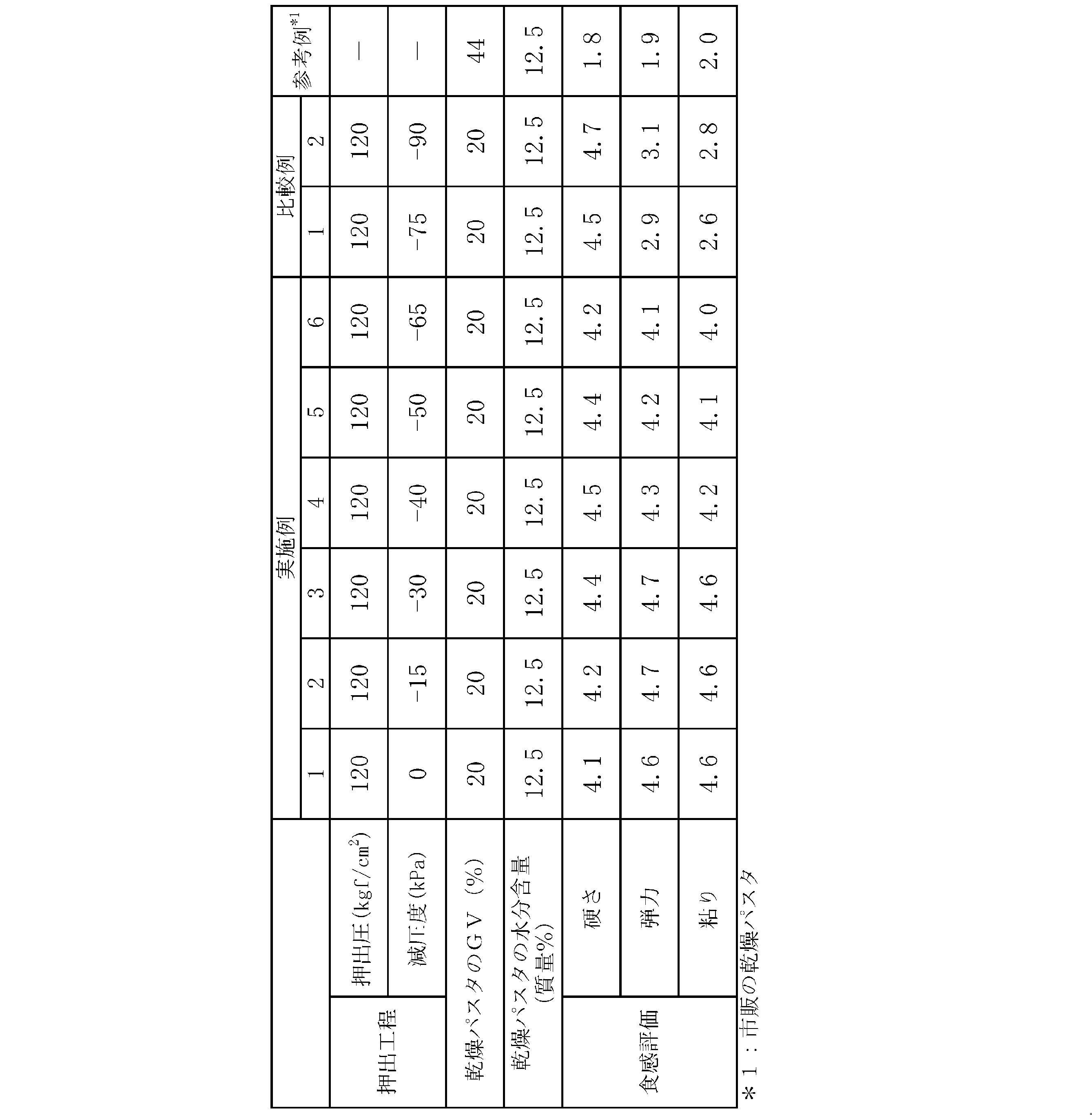
表1に示す通り、各実施例は、押出工程における減圧度が0~-65kPaの範囲にあるため、該減圧度が斯かる範囲に無い各比較例に比して、電子レンジでの再加熱後の食感に優れていた。

表2に示す通り、各実施例は、乾燥パスタのGVが10~30%の範囲に調整されているため、該GVが斯かる範囲に無い各比較例に比して、電子レンジでの再加熱後の食感に優れていた。
本発明の乾燥パスタの製造方法によれば、加熱調理後に冷蔵又は冷凍保存したものを電子レンジ等で再加熱して喫食可能な状態とした場合でも、加熱調理直後に喫食した場合と比べて遜色のない食感が得られる乾燥パスタが提供される。
Claims (5)
- 蛋白質含量8~18質量%の小麦粉を含む原料粉から調製された生地を、減圧度0~-65kPa、圧力60~160kgf/cm2で押出し成形してパスタを得る押出工程と、該パスタを乾燥する乾燥工程とを有する、乾燥パスタの製造方法であって、
前記押出工程後に前記パスタのグルテンバイタリティを10~30%に調整するGV調整工程を有する乾燥パスタの製造方法。 - 前記GV調整工程が前記乾燥工程を兼ねる請求項1に記載の乾燥パスタの製造方法。
- 前記押出工程の減圧度が0~-50kPaである請求項1又は2に記載の乾燥パスタの製造方法。
- 前記乾燥工程後の前記パスタの水分含量が13質量%以下である請求項1~3の何れか1項に記載の乾燥パスタの製造方法。
- 請求項1~4の何れか1項に記載の製造方法によって得られた乾燥パスタを加熱調理して調理済みパスタを得、該調理済みパスタを冷蔵又は冷凍する工程を有する、低温保存された調理済みパスタの製造方法。
Priority Applications (3)
| Application Number | Priority Date | Filing Date | Title |
|---|---|---|---|
| JP2019545658A JP7232187B2 (ja) | 2017-09-29 | 2018-09-28 | 乾燥パスタの製造方法 |
| US16/619,667 US20200163365A1 (en) | 2017-09-29 | 2018-09-28 | Method for manufacturing dried pasta |
| EP18861090.1A EP3692808B1 (en) | 2017-09-29 | 2018-09-28 | Method for manufacturing dried pasta |
Applications Claiming Priority (2)
| Application Number | Priority Date | Filing Date | Title |
|---|---|---|---|
| JP2017-192039 | 2017-09-29 | ||
| JP2017192039 | 2017-09-29 |
Publications (1)
| Publication Number | Publication Date |
|---|---|
| WO2019065932A1 true WO2019065932A1 (ja) | 2019-04-04 |
Family
ID=65902862
Family Applications (1)
| Application Number | Title | Priority Date | Filing Date |
|---|---|---|---|
| PCT/JP2018/036169 Ceased WO2019065932A1 (ja) | 2017-09-29 | 2018-09-28 | 乾燥パスタの製造方法 |
Country Status (4)
| Country | Link |
|---|---|
| US (1) | US20200163365A1 (ja) |
| EP (1) | EP3692808B1 (ja) |
| JP (1) | JP7232187B2 (ja) |
| WO (1) | WO2019065932A1 (ja) |
Cited By (3)
| Publication number | Priority date | Publication date | Assignee | Title |
|---|---|---|---|---|
| JP2021061754A (ja) * | 2019-10-10 | 2021-04-22 | 株式会社ニップン | 乾麺類及びレトルト麺類並びにこれらの製造方法 |
| JP2023124740A (ja) * | 2022-02-25 | 2023-09-06 | 昭和産業株式会社 | 麺類又はベーカリー製品用改質剤 |
| JP2024046486A (ja) * | 2022-09-22 | 2024-04-03 | 株式会社日清製粉ウェルナ | 調理済み冷蔵パスタ |
Families Citing this family (3)
| Publication number | Priority date | Publication date | Assignee | Title |
|---|---|---|---|---|
| EP3622830A4 (en) * | 2017-05-12 | 2020-12-30 | Nisshin Foods Inc. | GROOVED NOODLES, PROCESS FOR PRODUCING GROOVED NOODLES AND PROCESS FOR COOKING GROOVED NOODLES |
| CN109221935B (zh) * | 2018-11-08 | 2022-03-01 | 河南工业大学 | 一种高膳食纤维面条制作设备 |
| IT201900009801A1 (it) * | 2019-06-21 | 2020-12-21 | Wealth & Res Trading Ltd | Apparato e metodo per produrre pasta secca alimentare |
Citations (7)
| Publication number | Priority date | Publication date | Assignee | Title |
|---|---|---|---|---|
| JP2002010745A (ja) | 2000-06-29 | 2002-01-15 | Q P Corp | パスタサラダ |
| JP2004357571A (ja) * | 2003-06-04 | 2004-12-24 | Showa Sangyo Co Ltd | 低カロリー麺類の製造方法 |
| JP2005253460A (ja) * | 2004-02-12 | 2005-09-22 | Ezaki Glico Co Ltd | 包装茹で麺の製造方法 |
| JP2011217657A (ja) * | 2010-04-08 | 2011-11-04 | Nisshin Foods Kk | 乾麺類の製造方法 |
| JP2012050410A (ja) * | 2010-09-03 | 2012-03-15 | Sanyo Shokuhin Kk | 即席乾燥麺およびその製造方法 |
| JP2016208865A (ja) * | 2015-04-30 | 2016-12-15 | アサヒグループ食品株式会社 | 凍結乾燥パスタ及びその製造方法 |
| JP2017023037A (ja) | 2015-07-21 | 2017-02-02 | 日本製粉株式会社 | パスタ類の製造方法 |
Family Cites Families (8)
| Publication number | Priority date | Publication date | Assignee | Title |
|---|---|---|---|---|
| FR2282813A1 (fr) * | 1974-08-29 | 1976-03-26 | Baumann Gerard | Pates alimentaires precuites et leur procede de fabrication industrielle |
| US4469711A (en) * | 1981-10-01 | 1984-09-04 | Rutgers Research & Educational Foundation | Process for making quick-cooking pasta |
| MX7609E (es) * | 1983-10-31 | 1990-03-16 | Myojo Foods | Procedimiento para preparar pastas para sopa de coccion rapida |
| US4540592A (en) * | 1983-12-27 | 1985-09-10 | Kraft, Inc. | Multiple screw pasta manufacturing process |
| CH687842A5 (fr) * | 1994-04-28 | 1997-03-14 | Nestle Sa | Procédé de fabrication de pâtes alimentaires. |
| TR201808383T4 (tr) * | 2011-03-15 | 2018-07-23 | Nisshin Foods Inc | Kurutulmuş makarna imal etme metodu. |
| CA2921002A1 (en) * | 2013-09-25 | 2015-04-02 | Nisshin Foods Inc. | Method for manufacturing cooked fresh pasta with sauce |
| US20150150288A1 (en) * | 2013-12-02 | 2015-06-04 | General Mills, Inc. | Pasta processing for low protein flour and decreased drying |
-
2018
- 2018-09-28 US US16/619,667 patent/US20200163365A1/en not_active Abandoned
- 2018-09-28 EP EP18861090.1A patent/EP3692808B1/en active Active
- 2018-09-28 JP JP2019545658A patent/JP7232187B2/ja active Active
- 2018-09-28 WO PCT/JP2018/036169 patent/WO2019065932A1/ja not_active Ceased
Patent Citations (7)
| Publication number | Priority date | Publication date | Assignee | Title |
|---|---|---|---|---|
| JP2002010745A (ja) | 2000-06-29 | 2002-01-15 | Q P Corp | パスタサラダ |
| JP2004357571A (ja) * | 2003-06-04 | 2004-12-24 | Showa Sangyo Co Ltd | 低カロリー麺類の製造方法 |
| JP2005253460A (ja) * | 2004-02-12 | 2005-09-22 | Ezaki Glico Co Ltd | 包装茹で麺の製造方法 |
| JP2011217657A (ja) * | 2010-04-08 | 2011-11-04 | Nisshin Foods Kk | 乾麺類の製造方法 |
| JP2012050410A (ja) * | 2010-09-03 | 2012-03-15 | Sanyo Shokuhin Kk | 即席乾燥麺およびその製造方法 |
| JP2016208865A (ja) * | 2015-04-30 | 2016-12-15 | アサヒグループ食品株式会社 | 凍結乾燥パスタ及びその製造方法 |
| JP2017023037A (ja) | 2015-07-21 | 2017-02-02 | 日本製粉株式会社 | パスタ類の製造方法 |
Non-Patent Citations (4)
| Title |
|---|
| AKTAN, B. ET AL.: "Effect of High-Temperature Drying of Pasta on Quality Parameters and on Solubility, Gel Electrophoresis, and Revered-Phase High-Performance Liquid Chromatography of Protein Components", CEREAL CHEM., vol. 69, no. 3, 1992, pages 288 - 295, XP055586167 * |
| LAMACCHIA, C. ET AL.: "Changes in pasta proteins induced by drying cycles and their relationship to cooking behaviour", J. CEREAL SCI., vol. 46, no. 61, 2007, pages 58 - 63, XP022117949, DOI: doi:10.1016/j.jcs.2006.12.004 * |
| See also references of EP3692808A4 |
| ZWEIFEL, C. ET AL.: "Influence of High-Temperature Drying on Structural and Textural Properties of Durum Wheat Pasta", CEREAL CHEM., vol. 80, no. 2, 2003, pages 159 - 167, XP055563286, DOI: doi:10.1094/CCHEM.2003.80.2.159 * |
Cited By (3)
| Publication number | Priority date | Publication date | Assignee | Title |
|---|---|---|---|---|
| JP2021061754A (ja) * | 2019-10-10 | 2021-04-22 | 株式会社ニップン | 乾麺類及びレトルト麺類並びにこれらの製造方法 |
| JP2023124740A (ja) * | 2022-02-25 | 2023-09-06 | 昭和産業株式会社 | 麺類又はベーカリー製品用改質剤 |
| JP2024046486A (ja) * | 2022-09-22 | 2024-04-03 | 株式会社日清製粉ウェルナ | 調理済み冷蔵パスタ |
Also Published As
| Publication number | Publication date |
|---|---|
| EP3692808A1 (en) | 2020-08-12 |
| US20200163365A1 (en) | 2020-05-28 |
| EP3692808A4 (en) | 2021-07-07 |
| JPWO2019065932A1 (ja) | 2020-09-24 |
| JP7232187B2 (ja) | 2023-03-02 |
| EP3692808B1 (en) | 2023-04-12 |
Similar Documents
| Publication | Publication Date | Title |
|---|---|---|
| JP7232187B2 (ja) | 乾燥パスタの製造方法 | |
| JP6293750B2 (ja) | 冷凍調理済み麺類の製造方法 | |
| JP6530504B2 (ja) | ノンフライ即席復元容器入り乾燥麺の製造方法 | |
| JP6959057B2 (ja) | 管状生マカロニの製造方法及びグラタン類の製造方法 | |
| JP6796599B2 (ja) | ビーフン様米粉麺類の製造方法 | |
| JP6783965B1 (ja) | 調理済み麺類の製造方法 | |
| JP6571559B2 (ja) | 麺類の製造方法 | |
| JP6753840B2 (ja) | 調理済み米粉麺類 | |
| JP6595735B1 (ja) | 多層麺の製造方法 | |
| CN104994746B (zh) | 冷冻焗烤食品的制造方法 | |
| JP6767386B2 (ja) | 熱処理米粉の製造方法及び麺類の製造方法 | |
| JP7303955B1 (ja) | 麺類の製造方法 | |
| JP6757741B2 (ja) | 米粉麺類の製造方法及び麺類用ミックス粉 | |
| JP6674341B2 (ja) | 麺類の製造方法 | |
| JP7692706B2 (ja) | 調理済み中華麺類の製造方法 | |
| JP7847971B2 (ja) | 再加熱調理用麺類製品の製造方法 | |
| WO2025205524A1 (ja) | 麺類 | |
| JP2025017803A (ja) | 即食パスタ食品及びその製造方法 | |
| JP2024140689A (ja) | 中華麺食品 | |
| WO2016153032A1 (ja) | 生米粉麺類 | |
| JP2025137095A (ja) | 調理済み麺類及びそれを含む総菜類の製造方法 | |
| WO2017030082A1 (ja) | 冷凍調理済み調味麺類の製造方法 | |
| JP2022146238A (ja) | 乾麺の製造方法 | |
| JP2025034196A (ja) | 冷凍ショートパスタの製造方法 | |
| JP2024140701A (ja) | 麺食品 |
Legal Events
| Date | Code | Title | Description |
|---|---|---|---|
| 121 | Ep: the epo has been informed by wipo that ep was designated in this application |
Ref document number: 18861090 Country of ref document: EP Kind code of ref document: A1 |
|
| ENP | Entry into the national phase |
Ref document number: 2019545658 Country of ref document: JP Kind code of ref document: A |
|
| NENP | Non-entry into the national phase |
Ref country code: DE |
|
| ENP | Entry into the national phase |
Ref document number: 2018861090 Country of ref document: EP Effective date: 20200429 |