WO2019069342A1 - Dispositif de terminal, programme et procédé - Google Patents
Dispositif de terminal, programme et procédé Download PDFInfo
- Publication number
- WO2019069342A1 WO2019069342A1 PCT/JP2017/035769 JP2017035769W WO2019069342A1 WO 2019069342 A1 WO2019069342 A1 WO 2019069342A1 JP 2017035769 W JP2017035769 W JP 2017035769W WO 2019069342 A1 WO2019069342 A1 WO 2019069342A1
- Authority
- WO
- WIPO (PCT)
- Prior art keywords
- objects
- terminal device
- display
- processor
- user
- Prior art date
- Legal status (The legal status is an assumption and is not a legal conclusion. Google has not performed a legal analysis and makes no representation as to the accuracy of the status listed.)
- Ceased
Links
Images







Classifications
-
- A—HUMAN NECESSITIES
- A63—SPORTS; GAMES; AMUSEMENTS
- A63F—CARD, BOARD, OR ROULETTE GAMES; INDOOR GAMES USING SMALL MOVING PLAYING BODIES; VIDEO GAMES; GAMES NOT OTHERWISE PROVIDED FOR
- A63F13/00—Video games, i.e. games using an electronically generated display having two or more dimensions
- A63F13/20—Input arrangements for video game devices
- A63F13/21—Input arrangements for video game devices characterised by their sensors, purposes or types
- A63F13/214—Input arrangements for video game devices characterised by their sensors, purposes or types for locating contacts on a surface, e.g. floor mats or touch pads
- A63F13/2145—Input arrangements for video game devices characterised by their sensors, purposes or types for locating contacts on a surface, e.g. floor mats or touch pads the surface being also a display device, e.g. touch screens
-
- A—HUMAN NECESSITIES
- A63—SPORTS; GAMES; AMUSEMENTS
- A63F—CARD, BOARD, OR ROULETTE GAMES; INDOOR GAMES USING SMALL MOVING PLAYING BODIES; VIDEO GAMES; GAMES NOT OTHERWISE PROVIDED FOR
- A63F13/00—Video games, i.e. games using an electronically generated display having two or more dimensions
- A63F13/80—Special adaptations for executing a specific game genre or game mode
-
- A—HUMAN NECESSITIES
- A63—SPORTS; GAMES; AMUSEMENTS
- A63F—CARD, BOARD, OR ROULETTE GAMES; INDOOR GAMES USING SMALL MOVING PLAYING BODIES; VIDEO GAMES; GAMES NOT OTHERWISE PROVIDED FOR
- A63F13/00—Video games, i.e. games using an electronically generated display having two or more dimensions
- A63F13/80—Special adaptations for executing a specific game genre or game mode
- A63F13/822—Strategy games; Role-playing games
-
- G—PHYSICS
- G06—COMPUTING OR CALCULATING; COUNTING
- G06F—ELECTRIC DIGITAL DATA PROCESSING
- G06F3/00—Input arrangements for transferring data to be processed into a form capable of being handled by the computer; Output arrangements for transferring data from processing unit to output unit, e.g. interface arrangements
- G06F3/01—Input arrangements or combined input and output arrangements for interaction between user and computer
- G06F3/048—Interaction techniques based on graphical user interfaces [GUI]
- G06F3/0484—Interaction techniques based on graphical user interfaces [GUI] for the control of specific functions or operations, e.g. selecting or manipulating an object, an image or a displayed text element, setting a parameter value or selecting a range
- G06F3/04842—Selection of displayed objects or displayed text elements
-
- G—PHYSICS
- G06—COMPUTING OR CALCULATING; COUNTING
- G06F—ELECTRIC DIGITAL DATA PROCESSING
- G06F3/00—Input arrangements for transferring data to be processed into a form capable of being handled by the computer; Output arrangements for transferring data from processing unit to output unit, e.g. interface arrangements
- G06F3/01—Input arrangements or combined input and output arrangements for interaction between user and computer
- G06F3/048—Interaction techniques based on graphical user interfaces [GUI]
- G06F3/0484—Interaction techniques based on graphical user interfaces [GUI] for the control of specific functions or operations, e.g. selecting or manipulating an object, an image or a displayed text element, setting a parameter value or selecting a range
- G06F3/04845—Interaction techniques based on graphical user interfaces [GUI] for the control of specific functions or operations, e.g. selecting or manipulating an object, an image or a displayed text element, setting a parameter value or selecting a range for image manipulation, e.g. dragging, rotation, expansion or change of colour
-
- G—PHYSICS
- G06—COMPUTING OR CALCULATING; COUNTING
- G06F—ELECTRIC DIGITAL DATA PROCESSING
- G06F3/00—Input arrangements for transferring data to be processed into a form capable of being handled by the computer; Output arrangements for transferring data from processing unit to output unit, e.g. interface arrangements
- G06F3/01—Input arrangements or combined input and output arrangements for interaction between user and computer
- G06F3/048—Interaction techniques based on graphical user interfaces [GUI]
- G06F3/0487—Interaction techniques based on graphical user interfaces [GUI] using specific features provided by the input device, e.g. functions controlled by the rotation of a mouse with dual sensing arrangements, or of the nature of the input device, e.g. tap gestures based on pressure sensed by a digitiser
- G06F3/0488—Interaction techniques based on graphical user interfaces [GUI] using specific features provided by the input device, e.g. functions controlled by the rotation of a mouse with dual sensing arrangements, or of the nature of the input device, e.g. tap gestures based on pressure sensed by a digitiser using a touch-screen or digitiser, e.g. input of commands through traced gestures
-
- G—PHYSICS
- G06—COMPUTING OR CALCULATING; COUNTING
- G06F—ELECTRIC DIGITAL DATA PROCESSING
- G06F3/00—Input arrangements for transferring data to be processed into a form capable of being handled by the computer; Output arrangements for transferring data from processing unit to output unit, e.g. interface arrangements
- G06F3/01—Input arrangements or combined input and output arrangements for interaction between user and computer
- G06F3/048—Interaction techniques based on graphical user interfaces [GUI]
- G06F3/0487—Interaction techniques based on graphical user interfaces [GUI] using specific features provided by the input device, e.g. functions controlled by the rotation of a mouse with dual sensing arrangements, or of the nature of the input device, e.g. tap gestures based on pressure sensed by a digitiser
- G06F3/0488—Interaction techniques based on graphical user interfaces [GUI] using specific features provided by the input device, e.g. functions controlled by the rotation of a mouse with dual sensing arrangements, or of the nature of the input device, e.g. tap gestures based on pressure sensed by a digitiser using a touch-screen or digitiser, e.g. input of commands through traced gestures
- G06F3/04883—Interaction techniques based on graphical user interfaces [GUI] using specific features provided by the input device, e.g. functions controlled by the rotation of a mouse with dual sensing arrangements, or of the nature of the input device, e.g. tap gestures based on pressure sensed by a digitiser using a touch-screen or digitiser, e.g. input of commands through traced gestures for inputting data by handwriting, e.g. gesture or text
Definitions
- the present disclosure relates to a terminal device, program, and method capable of executing an application that is executed by moving an object placed on a board displayed on a display.
- Patent Document 1 describes an electronic game device that erases puzzle pieces that satisfy the conditions when the arrangement of the puzzle pieces satisfies a predetermined condition by moving the puzzle pieces by the user.
- the present disclosure provides a terminal device, program or method capable of executing an application that is more convenient for the user according to various embodiments in the present disclosure.
- a display configured to display a plurality of first objects and a board on which the first objects are arranged, a predetermined instruction command, and the first object
- a memory configured to store object attribute information, and a first object selected from the plurality of first objects, and the first object selected at an arbitrary position on the board
- An input interface configured to receive an instruction input by a user for moving, and a first object having the predetermined relationship by moving the selected first object based on the instruction input
- a processor configured to processing for displaying a position corresponding to the position of the first object continues to the terminal device that includes a "is provided.
- a display configured to display a plurality of first objects and a board on which the first objects are arranged, an object including an instruction command and the first object
- a memory configured to store attribute information, and selecting a first object of the plurality of first objects, and moving the selected first object to an arbitrary position on the board
- the attribute information has a predetermined relationship by moving a computer including an input interface configured to receive an instruction input by a user for the selected object based on the instruction input.
- a display configured to display a plurality of first objects and a board on which the first objects are arranged, an object including an instruction command and the first object
- a memory configured to store attribute information, and selecting a first object of the plurality of first objects, and moving the selected first object to an arbitrary position on the board
- a terminal device including an input interface configured to receive an instruction input by a user, wherein the instruction is performed by the processor executing the instruction instruction, the instruction selecting the first object being the instruction
- the instruction selecting the first object being the instruction
- FIG. 1a conceptually illustrates a game application implemented in a system according to various embodiments of the present disclosure.
- FIG. 1 b is a conceptual illustration of a game application implemented in a system according to various embodiments of the present disclosure.
- FIG. 2 is a conceptual diagram schematically showing the configuration of the system 1 according to the first embodiment of the present disclosure.
- FIG. 3 is a block diagram illustrating an example of a configuration of the terminal device 100 according to the first embodiment of the present disclosure.
- FIG. 4 is a block diagram showing an example of the configuration of the server apparatus 200 according to the first embodiment of the present disclosure.
- FIG. 5 is a diagram showing a process flow executed by the terminal device 100 according to the first embodiment of the present disclosure.
- FIG. 1a conceptually illustrates a game application implemented in a system according to various embodiments of the present disclosure.
- FIG. 1 b is a conceptual illustration of a game application implemented in a system according to various embodiments of the present disclosure.
- FIG. 2 is a conceptual diagram schematic
- FIG. 6 is a diagram showing a process flow executed by the terminal device 100 according to the first embodiment of the present disclosure.
- FIG. 7 is a diagram illustrating an example of a screen displayed on the display 111 of the terminal device 100 according to the first embodiment of the present disclosure.
- FIG. 8a is a diagram conceptually showing the movement of the basic object 13 in the application according to the first embodiment of the present disclosure.
- FIG. 8 b is a diagram conceptually showing the movement of the basic object 13 in the application according to the first embodiment of the present disclosure.
- FIG. 9a is a diagram conceptually showing the arrangement of objects in an application according to the first embodiment of the present disclosure.
- FIG. 9 b is a diagram conceptually showing the arrangement of objects in an application according to the first embodiment of the present disclosure.
- FIG. 9 b is a diagram conceptually showing the arrangement of objects in an application according to the first embodiment of the present disclosure.
- FIG. 10a is a diagram conceptually showing the arrangement of objects in an application according to the first embodiment of the present disclosure.
- FIG. 10 b is a diagram conceptually showing the arrangement of objects in an application according to the first embodiment of the present disclosure.
- FIG. 11a is a diagram conceptually showing the arrangement of objects in an application according to the first embodiment of the present disclosure.
- FIG. 11 b is a diagram conceptually illustrating the arrangement of objects in an application according to the first embodiment of the present disclosure.
- FIG. 11 c is a diagram conceptually showing the arrangement of objects in an application according to the first embodiment of the present disclosure.
- FIG. 12 is a diagram conceptually showing the display of the combined object 17 in the application according to the first embodiment of the present disclosure.
- FIG. 13 is a diagram illustrating an example of a screen displayed on the display 111 of the terminal device 100 according to the second embodiment of the present disclosure.
- FIG. 14 is a diagram conceptually showing the arrangement of objects in an application according to the third embodiment of the present disclosure.
- FIG. 15 is a diagram conceptually showing the arrangement of objects in an application according to the fourth embodiment of the present disclosure.
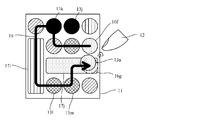
- FIG. 1a conceptually illustrates a game application implemented in a system according to various embodiments of the present disclosure. Specifically, FIG. 1a describes an example of a screen displayed by executing a game application according to various embodiments of the present disclosure on the terminal device 100. According to FIG. 1a, the user selects a desired basic object 13a from among the plurality of basic objects 13 (first objects) arranged on the board 11 displayed on the display 111 of the terminal device 100. It is possible to move.
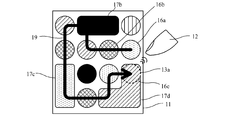
- FIG. 1 b is a conceptual illustration of a game application implemented in a system according to various embodiments of the present disclosure. Specifically, in FIG. 1b, the basic object 13a selected by the user among the basic objects 13 arranged on the board 11 is moved from the position 16a to the position 16c along the trajectory 19 by the drag operation by the user The board 11 at the time of making it do is shown. According to FIG. 1b, following the movement of the basic object 13a along the trajectory 19, the other basic objects are sequentially moved and displayed on the board 11.
- the combined object (the position of the sequentially arranged basic objects is The second objects 17b, 17c and 17d) are sequentially displayed. Then, when the drag operation by the user is finished and the movement of the selected basic object 13a is finished, the combined object (17b, 17c and 17d) is erased from the board 11, and the effect corresponding to the eliminated combined object is the user or A predetermined effect is given to a game character operable by the user.
- the predetermined effect is imparted by continuously arranging a plurality of other basic objects while moving the basic object 13a.
- the combined objects (17b, 17c and 17d) are displayed instead of the continuous basic objects.
- the board surface 11 is formed in a square shape, but the board surface 11 may have any shape, for example, a circular shape.
- the board 11 is displayed on the display 111 so as to be visible to the user, the board 11 only needs to define the movable range of the basic object 13, and it is not necessary to display the board 11 so as to be visible.
- the basic object 13 is formed in a circular shape, but the basic object 13 may have any shape, for example, a rectangular shape, or a plurality of shapes may be combined. May be Further, in the example of FIGS.
- the basic object 13 and the combined object 17 are regularly arranged on the board 11, but may be arranged randomly. Further, in the example of FIGS. 1a and 1b, the combined object 17 is displayed by being replaced with the basic object 13 which is disposed in a plural number in a row, but may be displayed in a superimposed manner. Also, in the example of FIGS. 1a and 1b, although the instruction is input by tapping and dragging the touch panel using the user's finger 12, the instruction can be input using a stylus or the like that can be detected by the touch panel or a hard key You may do so.
- FIG. 2 is a conceptual view schematically showing a configuration of the system 1 according to the first embodiment of the present disclosure.
- system 1 includes a terminal device 100 and a server device 200 communicably connected to terminal device 100 via network 300.
- the server apparatus 200 and the terminal apparatus 100 communicate with each other as needed, and transmit and receive various information, programs, and the like necessary for the progress of the application.
- terminal device 100 Although only one terminal device 100 is described in the example of FIG. 2, naturally, a plurality of terminal devices may be connected to the server device 200. Also, although the server device 200 is described as a single device, it is also possible to distribute each component and processing of the server device 200 to a plurality of server devices. In addition, the terminal device 100 and the server device 200 may be able to execute functions other than the functions related to the execution of the game application according to the present embodiment.
- FIG. 3 is a block diagram showing an example of the configuration of the terminal device 100 according to the first embodiment of the present disclosure.
- the terminal device 100 does not have to include all of the components shown in FIG. 3, and can have a configuration in which a part is omitted, and can add other components.
- the terminal device 100 may be, for example, a portable terminal device capable of wireless communication represented by a smartphone. However, other than this, it is also possible to communicate with the server apparatus 200 such as a portable game machine, feature phone, portable information terminal, PDA, laptop personal computer, desktop personal computer, etc., and a terminal capable of executing the game application according to the present embodiment. Any device may be used.
- the terminal device 100 includes a display 111, a processor 112, and the like. It includes an input interface 116 including a memory 113, a timer 114, a communication interface 115, a touch panel 117 and a hard key 118. Then, these components are electrically connected to each other through control lines and data lines.
- the display 111 functions as a display unit that reads out the image information stored in the memory 113 and performs various displays according to an instruction of the processor 112. Specifically, the display 111 virtually associates the plurality of basic objects 13, the board 11 on which the basic objects 13 are arranged, the combined object 17, the time bar 14, the score 15, etc. in relation to the game application according to the present embodiment. Display.
- the display 111 is configured of, for example, a liquid crystal display.
- the processor 112 is configured by a CPU (microcomputer: microcomputer), and functions as a control unit that controls the other connected components based on various programs stored in the memory 113.
- the processor 112 processes instruction commands stored in the memory 113, that is, a program for executing a game application according to the present embodiment or a program for executing an OS. Specifically, the processor 112 controls the movement of the basic object 13 disposed on the board 11 according to the user's instruction input input through the input interface 116, and the control related to the display and deletion of the combined object 17. To execute various processes related to the game application according to the present embodiment.
- the processor 112 may be configured by a single CPU, but may be configured by a plurality of CPUs. Also, other types of processors such as a GPU specialized for image processing may be combined as appropriate.
- the memory 113 includes a RAM, a ROM, or a non-volatile memory (in some cases, an HDD), and functions as a storage unit.
- the ROM stores, as a program, an instruction for executing an application or an OS according to the present embodiment.
- the RAM is a memory used to write and read data while a program stored in the ROM is being processed by the processor 112.
- the non-volatile memory is a memory in which writing and reading of data are executed by the execution of the program, and the data written to the non-volatile memory is saved even after the execution of the program is completed.
- the memory 113 stores each attribute information in association with each basic object 13 and each combined object 17 as an example.
- attribute information examples include color attributes of objects such as “blue”, “red”, and “yellow”, shape attributes of objects such as “circles”, “triangles”, “squares”, and “stars”, At least one of the characteristic attributes of the object such as “flame”, “water”, and “forest” can be mentioned.
- user information of the game application received from the server device 200 user name, user identification information, name of user-operable game character, level of the game character, attack power
- result information obtained as a result of execution of the game application are updated and stored as needed.
- positional information of the basic object 13 and the combined object 17 arranged on the board 11 is updated as needed and stored.
- the timer 114 functions as a clock unit.
- the timer 114 is used to calculate the time elapsed since the basic object 13 can be moved.
- the time information used for the calculation is stored in the memory 113 as needed under the control of the processor 112.
- the communication interface 115 includes a wireless communication processing circuit and an antenna connected to the wireless communication processing device, and functions as a communication unit.
- the communication interface 115 transmits / receives a program necessary for execution of the game application according to the present embodiment, user information, information as a result of execution of the game application, and the like from the server device 200 connected via the network 300.
- the wireless communication processing circuit performs processing such as modulation and demodulation of information to be transmitted and received.
- the communication interface 115 is processed based on a broadband wireless communication method represented by W-CDMA (Wideband-Code Division Multiple Access) method, but a wireless LAN or Bluetooth (such as IEEE 802.11). It is also possible to process based on a scheme regarding narrow band wireless communication such as registered trademark).
- W-CDMA Wideband-Code Division Multiple Access
- Bluetooth such as IEEE 802.11. It is also possible to process based on a scheme regarding narrow band wireless communication such as registered trademark).
- the communication interface 115 may use wired communication instead of or in addition to wireless communication.
- a communication processing circuit for wired communication may be provided instead of or in addition to the wireless communication processing circuit.
- the input interface 116 includes the touch panel 117 and / or the hard key 118, and receives various instruction inputs from the user.
- the touch panel 117 is disposed so as to cover the display 111, and outputs information of positional coordinates touched by an object (a user's finger, a stylus or the like) corresponding to the image data displayed by the display 111.
- a touch panel method known methods such as a resistive film method, an electrostatic capacitance coupling method, and an ultrasonic surface acoustic wave method can be used.
- the input interface 116 is used to detect a selection operation (for example, a tap operation) of the basic object 13 and its movement operation (for example, a drag operation).
- FIG. 4 is a block diagram showing an example of the configuration of the server device 200 according to the first embodiment of the present disclosure.
- the server apparatus 200 does not have to include all of the components shown in FIG. 4, and can have a configuration in which a part is omitted, and can add other components.
- the server apparatus 200 includes a RAM, a ROM, a non-volatile memory, a memory 211 including an HDD and the like, a processor 212 including a CPU and the like, an I / O port 213, and a communication interface 214 including a communication processing circuit. including. Then, these components are electrically connected to each other through control lines and data lines.
- the memory 211 includes a RAM, a ROM, a non-volatile memory, and an HDD, and functions as a storage unit. Then, the memory 211 stores, as a program, an instruction for executing an application or an OS according to the present embodiment. Such programs are loaded and executed by processor 212. Also, the memory (particularly RAM) is temporarily used to execute writing and reading of data while the program is executed by the processor 212. In the present embodiment, as an example, the memory 211 stores user information (user name, user identification information, name of a game character operable by the user, name of the game character, attack power, defense, etc.) used to execute the game application. Power and the like) and result information which is the result of execution of the game application are stored in association with each other.
- user information user name, user identification information, name of a game character operable by the user, name of the game character, attack power, defense, etc.
- the processor 212 is composed of a CPU (microcomputer: microcomputer), and executes an instruction command stored in the memory 211, that is, various programs, and functions as a control unit for controlling other connected components. For example, when the processor 212 receives the user identification information from the terminal device 100, the processor 212 performs authentication processing with reference to the user information, and transmits the user information necessary for executing the game application to the terminal device 100.
- the processor 212 may be configured by a single CPU, but may be configured by a plurality of CPUs.
- the communication interface 214 transmits and receives a program for executing a game application, various information, and the like according to the present embodiment, as an example, via the terminal device 100 and the network 300, or via another server device and the network 300. To perform processing such as modulation and demodulation.
- the communication interface 214 communicates with each terminal device or another server device in accordance with a known wireless communication method or a known wired communication method. In the present embodiment, as one example, the communication interface 214 executes processing for transmitting user information in accordance with the processor 212.
- the I / O port 213 functions as an information input / output unit for inputting / outputting information to / from various external devices such as a printer.
- the I / O port 213 it is possible to adopt a known connection method such as a serial port, a parallel port, USB, etc. as desired.
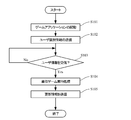
- FIG. 5 is a diagram showing a process flow executed in the terminal device 100 according to the first embodiment of the present disclosure. Specifically, the process flow described in FIG. 5 is a process flow started when the game application according to the present embodiment is activated by the terminal device 100. The process flow is performed by the processor 112 reading and executing an instruction command (program) stored in the memory 113.
- an instruction command program
- the processor 112 when the touch operation of the start icon of the game application according to the present embodiment displayed on the display 111 on the touch panel 117 is detected, the processor 112 performs the start process of the game application (S101). Then, the processor 112 controls the communication interface 115 to transmit the user identification information stored in the memory 113 as the user holding the terminal device 100, ie, the user of the game application, to the server device 200 (S102).
- the server device 200 When the server device 200 receives the user identification information, it authenticates whether the user is a valid user. When the user is a valid user, the server device 200 transmits, to the terminal device 100, user information necessary for executing the game application.
- the processor 112 of the terminal device 100 stands by until user information is received from the server device 200 (S103), and when received, performs execution processing of a unit game included in the game application (S104). The details of the unit game execution process will be described later.
- the processor 112 transmits, to the server apparatus 200, the user information updated and stored in the memory and the result information indicating the execution result of the game application. Control the communication interface 115 (S105). Then, the execution of the game application being executed is ended.
- the unit game means one group of games, and is expressed by, for example, a quest, a scenario, a chapter, a dungeon, a mission, and the like.
- the game application according to the present embodiment is composed of a plurality of unit games. Then, in each memory of the terminal device 100 and / or the server device 200, a program for executing the unit game and various information (clear information of unit game, enemy character information, consumption stamina, etc.) are respectively user identification information. Are stored in association with Then, the unit game is executed by reading and executing these programs and various information.
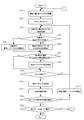
- FIG. 6 is a diagram showing a processing flow executed in the terminal device 100 according to the first embodiment of the present disclosure. Specifically, the process flow described in FIG. 6 is a process flow started when the user instructs execution of a desired unit game while the game application according to the present embodiment is being executed. . The process flow is performed by the processor 112 reading and executing an instruction command (program) stored in the memory 113.
- an instruction command program
- the processor 112 controls the display to arrange and display a plurality of basic objects 13 on the board 11 that constitutes the unit game (S201). Then, when it becomes possible to select the basic object 13 by the user and move the selected basic object 13a, the timer 114 is used to start clocking (S202).
- an instruction input for selecting one basic object 13a of the plurality of basic objects 13 by the user, and any option on the board 11 while tapping the selected basic object 13a
- the processor 112 executes a movement process of the selected basic object 13a (S203).
- the processor 112 determines whether or not the combined object 17 is arranged at the position of the movement destination (S204). Then, as a result of the judgment, when the combined object 17 is not arranged, the moving process of the other basic object originally arranged at the position of the movement destination is performed (S205). The process in the case where the combined object 17 is arranged in S204 will be described later.
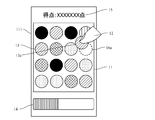
- FIG. 7 is a diagram illustrating an example of a screen displayed on the display 111 of the terminal device 100 according to the first embodiment of the present disclosure. Specifically, FIG. 7 shows an example of a screen when one basic object 13a is selected from the plurality of basic objects 13 arranged on the board 11 by the processing according to S203 of FIG. 6 and the movement is started. Indicates According to FIG. 7, in addition to the board 11 and the basic object 13, a score 15 currently acquired and a time bar 14 indicating a remaining time for which a unit game in progress can be executed are displayed on the display 111.
- the basic object 13a is selected. Then, when the finger 12 is dragged in an arbitrary direction as it is without releasing the tap by the finger 12, the basic object 13a selected following the movement is started to move from the position 16a originally arranged. Then, when the selected basic object 13a is superimposed on the display position of another basic object, the other basic object is moved so as to be shifted to the originally arranged position 16a of the basic object 13a.
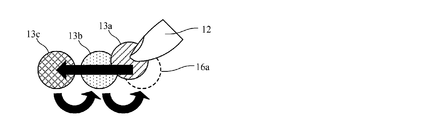
- FIG. 8a is a diagram conceptually showing the movement of the basic object 13 in the application according to the first embodiment of the present disclosure. Specifically, FIG. 8 a is an enlarged view of a part of the board 11. FIG. 8a follows the movement of the selected basic object 13a in the left direction by the processing according to S203 to S205 in FIG. 6, and the other basic objects 13b and 13c slide to new positions and are arranged It shows how it is done. According to FIG. 8a, when the basic object 13a is selected by the finger 12 and dragged in the left direction, the movement is started from the originally arranged position 16a.
- the superimposed basic object 13b is slid to the position 16a where the basic object 13a was originally disposed. Further, when the selected basic object 13a moves in the left direction and is displayed superimposed on the display area of the basic object 13c, the basic object 13c on which the superimposed basic object 13c is slid is originally arranged Slide to the right position.
- FIG. 8A the case of moving the selected basic object 13a in the left direction has been described, but the same applies to the case of moving it in the right direction.
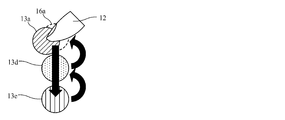
- FIG. 8 b is a diagram conceptually showing the movement of the basic object 13 in the application according to the first embodiment of the present disclosure. Specifically, FIG. 8 b is an enlarged view of a part of the board 11. FIG. 8b follows the movement of the selected basic object 13a downward by the processing according to S203 to S205 of FIG. 6, and the other basic objects 13d and 13e slide to new positions and are arranged It shows how it is done. Referring to FIG. 8b, when the basic object 13a is selected and dragged downward by the finger 12, the movement is started from the originally arranged position 16a.
- the superimposed basic object 13d is slid to the position 16a where the basic object 13a was originally disposed. Furthermore, when the selected basic object 13a moves downward and is displayed superimposed on the display area of the basic object 13e, the basic object 13e on which the superimposed basic object 13e is slid is originally disposed Slide to the right position.
- FIG. 8B the case of moving the selected basic object 13a downward is described, but the same applies to the case of moving upward.
- the processor 112 performs the moving process of the basic object 13a shown in FIG. 7, FIG. 8a and FIG. 8b and the moving process of other basic objects. Then, it is determined whether or not to be placed (S207). When a plurality of continuous objects are not arranged, each basic object is moved and arranged as it is, and the process proceeds to S209. On the other hand, when a plurality of continuous objects are to be arranged, the processor 112 performs processing for displaying the combined object at the arrangement position of the basic objects arranged continuously (S208).
- step S207 the processor 112 determines whether the same attribute information is included.
- the present invention is not limited to this, and it may be determined whether or not each piece of attribute information associated with a plurality of basic objects arranged consecutively is in a predetermined relationship. For example, if it is determined in advance that a predetermined relationship is established by a combination of the "blue" attribute and the “red” attribute, the "yellow” attribute and the “green” attribute, and the "black” attribute and the “white” attribute, It may be determined.
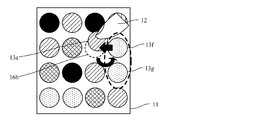
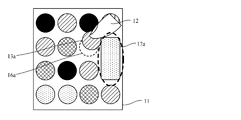
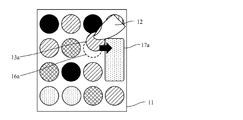
- FIGS. 9a and 9b are diagrams conceptually showing the arrangement of objects in an application according to the first embodiment of the present disclosure. Specifically, FIGS. 9a and 9b show how the combined object 17 is displayed when the combined object display process is performed by the processing according to S205 to S208 of FIG.
- the basic object 13f which has been arranged at the position 16b is arranged to slide in the right direction. Then, since the basic object 13 f and the basic object 13 g both have the same attribute information (for example, the “red” attribute), a plurality of basic objects having the same attribute information are arranged in succession.
- a combined object 17 a having a shape different from that of the sequentially arranged basic objects 13 f and 13 g is displayed on the board 11.
- the combined object 17a is displayed at the display position of the basic objects 13f and 13g arranged consecutively.
- the combined object 17a is displayed in place of the basic objects 13f and 13g.
- the display mode of the combined object 17a is not limited to the example shown in FIG. 9b, and may be displayed superimposed on each basic object so that the continuous basic objects 13f and 13g can be visually recognized.
- the display position of the combined object 17a may also correspond to the display positions of the basic objects 13f and 13g. That is, the combined object 17a does not have to be displayed so as to cover the entire basic object, but may be displayed only in a part of the area.
- the processor 112 corresponds to whether or not the drag operation by the user has ended, ie, the display position of the selected basic object 13a. It is determined whether the finger 12 is released from the position on the touch panel (S209). If it is determined that the drag operation has not ended, the movement of the selected basic object 13a continues, so the processing of S203 to S209 is repeated again.
- the processor 112 decomposes the move destination combined object into individual basic objects, and processes each basic object to move to a predetermined position (S206).
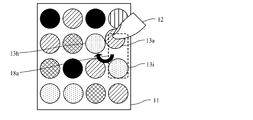
- FIGS. 10a and 10b are diagrams conceptually showing the arrangement of objects in an application according to the first embodiment of the present disclosure. Specifically, FIGS. 10a and 10b show that the combined object 17 is disassembled by the process according to S206 of FIG. 6, and each basic object moves to a predetermined position.
- the combined object 17a is already displayed at the movement destination.
- FIG. 10b when the selected basic object 13a moves in the display area of the combined object 17a, the combined object 17a being displayed is decomposed into basic objects 13h and 13i.
- the basic object 13a is arranged by sliding to the position 16a at which the basic object 13a originally selected was displayed.
- the basic object 13a and the basic object 13i which have moved are displayed at the position corresponding to the display position of the combined object 17a. That is, as shown in FIGS. 10a and 10b, the user can easily determine whether a plurality of basic objects having the same attribute are continuously arranged by changing the display mode of the combined object.
- the processing according to S203 to S209 is repeatedly performed, and when it is determined that the drag operation is ended in S209, the processor 112 ends the movement of the selected basic object 13a, and the displayed connection is displayed.
- a process of erasing the object 17 from the board 11 is executed (S210).
- the processor 112 calculates the score to be given to the user according to the deleted combined object 17, and updates the user's score information stored in the memory 113 based on the calculated score (S211) ).
- the end of the movement of the basic object 13a is determined based on the end of the drag operation, that is, whether or not the finger 12 is released, but it is arranged on the board 11 whether the operated finger has come out of the board 11 or not. It is also possible to replace with conditions such as whether or not the operation inhibited object has come into contact, and whether or not the operation time limit has been reached during the operation, or a combination as appropriate.
- the processor 112 determines whether or not a predetermined time has elapsed since the start of time counting by the timer 114 in S202 (S212). Then, if the predetermined time has not elapsed, it is possible to select and move the basic object 13 on the board 11 again, so the process of rearranging the basic object 13 on the board 11 is performed (S214).
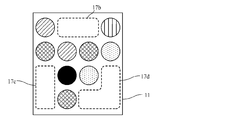
- FIGS. 11a to 11c are diagrams conceptually showing the arrangement of objects in an application according to the first embodiment of the present disclosure. Specifically, in FIGS. 11a to 11c, the end of the drag operation is detected and the combined object 17 is erased from the board 11 by the processing according to S209 to S214 in FIG. 6, and the basic object 13 is rearranged. Indicates
- the processor 112 rearranges any basic object 13 at the positions 16d to 16j after the combined object 17 is deleted.
- the basic objects 13 displayed in advance are sequentially slid and displayed at each of the erased positions 16d to 16j, and thereafter, any basic object is rearranged at a position at which no basic object 13 is disposed. You may
- the processor 112 is executing the unit game being executed It is determined whether the end of has been selected by the user. If the end is not selected, the processor 112 starts the process again from S201. On the other hand, when the end is selected, the processor 112 ends the unit game execution process, and shifts to S105 of FIG.
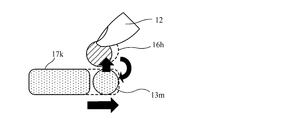
- FIG. 12 is a diagram conceptually showing the display of the combined object 17 in the application according to the first embodiment of the present disclosure. Specifically, FIG. 12 shows how the display area of the combined object 17k already displayed is enlarged and displayed in the right direction in the process of moving the selected basic object 13a.
- the basic object 13a moves upward in the course of its movement, the basic object 13m is displayed superimposed on the position 16h originally displayed. As a result, the basic object 13m slides downward.
- the combined object 17 k already displayed and the basic object 13 m having the same attribute information are continuously arranged. In such a case, the combined object 17k is enlarged and displayed at a position corresponding to the arrangement position of the basic object 13m.
- the movement of the basic object 13 and the display of the combined object 17 are performed while the drag operation continues, as is particularly clear from FIG. It is erased from the board 11. Then, according to the deleted combined object, a predetermined effect is given to the user or a game character operable by the user. At this time, since the object to be deleted is displayed with a shape or the like different from that of the normal basic object 13, the user can easily determine the object to be deleted. Also, by displaying in this way, drawing of a plurality of objects displayed on the board 11 will be integrated into one at a time, which can contribute to the reduction of memory load and improvement of processing speed. It becomes.
- Second Embodiment In the first embodiment, as the effect given to the user or the game character operable by the user, the case where the “score” is given according to the deleted combined object 17 has been described.
- damage to an enemy character in a battle game is given as an effect given to the user or a game character operable by the user.
- the present embodiment is the same as the configuration, processing, and procedure in the first embodiment, except for the points specifically described below. Therefore, detailed description of those matters is omitted.
- FIG. 13 is a diagram illustrating an example of a screen displayed on the display 111 of the terminal device 100 according to the second embodiment of the present disclosure. Specifically, FIG. 13 shows that the connected object is erased from the board 11 and the game character 20 operable by the user damages the enemy character 21 with an aggressivity corresponding to the erased merged object. .
- parameter values of an attack power and a defense power are stored in advance in association with each game character and enemy character.
- damage to the enemy character 21 is given based on the attribute information of the deleted combined object, the attack power of the game character 20, and the defense power of the enemy character 21. calculate.
- an effect of giving 150 damage to the enemy character 21 is given, whereby 150 damage can be subtracted from the hit point parameter of the enemy character 21.
- damage to the enemy character is given as an example of the effect, but it is also possible to give a temporary improvement in offensive power, an improvement in defensive power, etc. as an example of the effect.
- the basic objects 13 are arranged in a 4 ⁇ 4 grid shape on the board 11 .
- the basic object 13 is disposed at an arbitrary position on the board 11 instead of in a lattice shape.
- the present embodiment is the same as the configurations, processes, and procedures in the first and second embodiments, except for the points specifically described below. Therefore, detailed description of those matters is omitted.
- FIG. 14 is a diagram conceptually showing the arrangement of objects in an application according to the third embodiment of the present disclosure. Specifically, FIG. 14 shows how the selected basic object 13a moves on the board 11 on which the basic objects 13 are arranged at arbitrary positions. According to FIG. 14, the selected basic object 13 a is moved along the trajectory 19 from the position 16 d to the position 16 e by the drag operation of the finger 12. Other basic objects are sequentially moved in accordance with the movement of the selected basic object 13a. Then, when a plurality of basic objects 13 having the same attribute are continuously arranged (or arranged adjacent to each other) by the movement, the combined objects 17e to 17h are displayed at their display positions. At this time, the shapes and sizes of the combined objects 17e to 17h can be determined in accordance with the number of basic objects arranged in succession and their positional relationship.
- the combined object 17 is displayed when two or more basic objects having the same attribute are arranged in succession.
- the combined object is displayed only when three or more basic objects are sequentially arranged.
- the present embodiment is the same as the configuration, processing, and procedure in the first embodiment, except for the points specifically described below. Therefore, detailed description of those matters is omitted.
- FIG. 15 is a diagram conceptually showing the arrangement of objects in an application according to the fourth embodiment of the present disclosure. Specifically, FIG. 15 shows how the basic object 13a selected by the finger 12 moves on the board 11 on which a plurality of basic objects 13 are displayed. According to FIG. 15, the selected basic object 13 a is moved along the trajectory 19 from the position 16 f to the position 16 g by the drag operation of the finger 12. Other basic objects are sequentially moved in accordance with the movement of the selected basic object 13a. Then, when three or more basic objects 13 having the same attribute are continuously arranged by the movement, the combined objects 17i and 17j are displayed at their display positions. At this time, focusing on the basic objects 13j and 13k and the basic objects 13l and 13m, for example, two basic objects having the same attribute are continuously arranged, but three or more are not continuously arranged. The objects 17 are not displayed at their display positions.
- the processes and procedures described herein can be realized not only by those explicitly described in the embodiments, but also by software, hardware, or a combination thereof. Specifically, the processes and procedures described in this specification are realized by implementing logic corresponding to the process on a medium such as an integrated circuit, volatile memory, non-volatile memory, magnetic disk, optical storage, etc. Be done. In addition, the processes and procedures described in the present specification can be implemented as computer programs of the processes and procedures and can be executed by various computers including a terminal device and a server device.
Landscapes
- Engineering & Computer Science (AREA)
- Multimedia (AREA)
- General Engineering & Computer Science (AREA)
- Theoretical Computer Science (AREA)
- Human Computer Interaction (AREA)
- Physics & Mathematics (AREA)
- General Physics & Mathematics (AREA)
- User Interface Of Digital Computer (AREA)
Abstract
La présente invention concerne un dispositif de terminal, un programme ou un procédé capable d'exécuter une application avec une plus grande commodité pour un utilisateur au moyen de divers modes de réalisation. A cet effet, l'invention concerne un dispositif de terminal qui comprend : un dispositif d'affichage configuré pour afficher une pluralité de premiers objets et une face de tableau sur laquelle les premiers objets sont agencés ; une mémoire configurée pour stocker une commande d'instruction prescrite et des informations d'attribut d'objets comprenant les premiers objets ; une interface d'entrée configurée pour sélectionner un premier objet parmi la pluralité de premiers objets et recevoir d'un utilisateur une entrée d'instruction pour déplacer le premier objet sélectionné vers une position choisie sur la face de tableau ; et un processeur configuré pour effectuer, si une pluralité des premiers objets ayant des informations d'attribut ayant une relation prescrite sont agencés consécutivement suite au mouvement du premier objet sélectionné sur la base de l'entrée d'instruction, un processus pour afficher des seconds objets différents des premiers objets consécutifs dans des positions qui correspondent aux positions dans lesquelles les premiers objets sont agencés consécutivement.
Priority Applications (3)
| Application Number | Priority Date | Filing Date | Title |
|---|---|---|---|
| PCT/JP2017/035769 WO2019069342A1 (fr) | 2017-10-02 | 2017-10-02 | Dispositif de terminal, programme et procédé |
| JP2017552114A JP6726208B2 (ja) | 2017-10-02 | 2017-10-02 | 端末装置、プログラム及び方法 |
| US15/883,245 US10786730B2 (en) | 2017-10-02 | 2018-01-30 | Terminal device for game application using various objects with object attribute information |
Applications Claiming Priority (1)
| Application Number | Priority Date | Filing Date | Title |
|---|---|---|---|
| PCT/JP2017/035769 WO2019069342A1 (fr) | 2017-10-02 | 2017-10-02 | Dispositif de terminal, programme et procédé |
Related Child Applications (1)
| Application Number | Title | Priority Date | Filing Date |
|---|---|---|---|
| US15/883,245 Continuation US10786730B2 (en) | 2017-10-02 | 2018-01-30 | Terminal device for game application using various objects with object attribute information |
Publications (1)
| Publication Number | Publication Date |
|---|---|
| WO2019069342A1 true WO2019069342A1 (fr) | 2019-04-11 |
Family
ID=65896376
Family Applications (1)
| Application Number | Title | Priority Date | Filing Date |
|---|---|---|---|
| PCT/JP2017/035769 Ceased WO2019069342A1 (fr) | 2017-10-02 | 2017-10-02 | Dispositif de terminal, programme et procédé |
Country Status (3)
| Country | Link |
|---|---|
| US (1) | US10786730B2 (fr) |
| JP (1) | JP6726208B2 (fr) |
| WO (1) | WO2019069342A1 (fr) |
Cited By (2)
| Publication number | Priority date | Publication date | Assignee | Title |
|---|---|---|---|---|
| WO2021220554A1 (fr) * | 2020-05-01 | 2021-11-04 | 株式会社ポケモン | Système de jeu, procédé de jeu, programme de jeu et serveur de jeu |
| WO2025239183A1 (fr) * | 2024-05-15 | 2025-11-20 | 株式会社コナミアミューズメント | Système de jeu, procédé de commande de fonctionnement de système de jeu et programme |
Families Citing this family (3)
| Publication number | Priority date | Publication date | Assignee | Title |
|---|---|---|---|---|
| JP6970712B2 (ja) * | 2019-06-14 | 2021-11-24 | 任天堂株式会社 | 情報処理プログラム、情報処理装置、情報処理システム、及び情報処理方法 |
| JP6731536B1 (ja) * | 2019-10-31 | 2020-07-29 | グリー株式会社 | ゲーム装置、制御方法、及び制御プログラム |
| CN112107854B (zh) * | 2020-09-01 | 2021-03-16 | 苏州紫焰网络科技有限公司 | 一种游戏任务引导完成方法、系统及设备 |
Citations (5)
| Publication number | Priority date | Publication date | Assignee | Title |
|---|---|---|---|---|
| JP2008246076A (ja) * | 2007-03-30 | 2008-10-16 | Sega Corp | ゲーム装置およびゲームプログラム |
| JP5755785B1 (ja) * | 2014-07-25 | 2015-07-29 | ガンホー・オンライン・エンターテイメント株式会社 | 端末装置 |
| JP2015167707A (ja) * | 2014-03-07 | 2015-09-28 | 株式会社コナミデジタルエンタテインメント | 情報処理装置、プログラム |
| US20160089603A1 (en) * | 2014-09-30 | 2016-03-31 | King.Com Limited | Controlling a display of a computer device |
| US20160139773A1 (en) * | 2014-11-17 | 2016-05-19 | Supercell Oy | Electronic device for facilitating user interactions |
Family Cites Families (26)
| Publication number | Priority date | Publication date | Assignee | Title |
|---|---|---|---|---|
| WO2006068844A2 (fr) * | 2004-12-20 | 2006-06-29 | Wms Gaming Inc. | Jeu de hasard comportant une caracteristique de modification de l'arriere-plan |
| JP4773159B2 (ja) * | 2005-08-19 | 2011-09-14 | 任天堂株式会社 | ゲームプログラム、ゲーム装置およびゲーム制御方法 |
| US8317581B2 (en) * | 2008-05-01 | 2012-11-27 | Canned Bananas Llc | Puzzle game |
| US9120010B2 (en) * | 2009-12-03 | 2015-09-01 | Megatouch, Llc | Touchscreen game allowing simultaneous movement of multiple rows and/or columns |
| JP5498817B2 (ja) * | 2010-02-26 | 2014-05-21 | 任天堂株式会社 | ゲームプログラムおよびゲーム装置 |
| US9138641B2 (en) * | 2011-03-31 | 2015-09-22 | Tetris Holding, Llc | Systems and methods for manipulation of objects |
| US20130331162A1 (en) * | 2012-06-12 | 2013-12-12 | Alexander Higgins Krivicich | Match three gaming system and method |
| US20140171166A1 (en) * | 2012-12-17 | 2014-06-19 | Naftali Merari | Controlling a movement of a plurality of graphical objects in a tile-matching puzzle |
| US9079097B2 (en) * | 2013-02-19 | 2015-07-14 | King.Com Ltd. | Video game with replaceable tiles having selectable physics |
| WO2014130395A1 (fr) * | 2013-02-19 | 2014-08-28 | David Walls | Systèmes et procédés pour un jeu de correspondance de jeton |
| JP2014184058A (ja) * | 2013-03-25 | 2014-10-02 | Square Enix Co Ltd | ビデオゲーム処理装置、及びビデオゲーム処理プログラム |
| US20140342791A1 (en) * | 2013-03-29 | 2014-11-20 | Rekkener Llc | Interactive electronic game of pattern matching |
| US20140302935A1 (en) * | 2013-04-04 | 2014-10-09 | DeNA Co. Ltd. | Turn timer system applied to a puzzle battle game |
| JP5457590B1 (ja) * | 2013-06-14 | 2014-04-02 | 株式会社 ディー・エヌ・エー | ゲーム提供システム、ゲーム提供プログラム及びゲーム提供方法 |
| JP5559920B1 (ja) * | 2013-09-30 | 2014-07-23 | 株式会社 ディー・エヌ・エー | サーバ装置、電子ゲーム装置及び電子ゲームプログラム |
| JP5646094B1 (ja) * | 2014-02-24 | 2014-12-24 | グリー株式会社 | ゲーム処理プログラム、ゲーム処理コンピュータ及びゲーム処理方法 |
| US9757646B2 (en) * | 2014-05-06 | 2017-09-12 | King.Com Ltd. | Selecting objects on a user interface based on angle of trajectory of user input |
| JP5724026B1 (ja) * | 2014-08-29 | 2015-05-27 | グリー株式会社 | ゲームプログラム、コンピュータの制御方法、およびコンピュータ |
| US9713772B2 (en) * | 2014-09-30 | 2017-07-25 | King.Com Limited | Controlling a display of a computer device |
| KR20160064375A (ko) * | 2014-11-27 | 2016-06-08 | 라인플러스 주식회사 | 퍼즐 게임 시스템 및 퍼즐 게임 방법 |
| JP6605217B2 (ja) * | 2015-03-26 | 2019-11-13 | 株式会社バンダイナムコエンターテインメント | プログラム、端末及びサーバ |
| JP2016007530A (ja) | 2015-04-09 | 2016-01-18 | 株式会社 ディー・エヌ・エー | 電子ゲーム装置及び電子ゲームプログラム |
| KR101829969B1 (ko) * | 2016-01-26 | 2018-02-20 | 엔에이치엔엔터테인먼트 주식회사 | 퍼즐 매칭 게임 진행 방법 및 이를 이용하여 퍼즐 매칭 게임을 진행시키는 게임 시스템 |
| US10195534B2 (en) * | 2016-04-15 | 2019-02-05 | Perfect Square Studios LLC | Game mechanics for transformation of an array including a plurality of rows and/or columns |
| US10124263B2 (en) * | 2016-11-30 | 2018-11-13 | King.Com Ltd. | Turn based game with backtracking |
| US20180188940A1 (en) * | 2017-01-02 | 2018-07-05 | Motorious Entertainment Oy | Control input method and device for executing the same |
-
2017
- 2017-10-02 WO PCT/JP2017/035769 patent/WO2019069342A1/fr not_active Ceased
- 2017-10-02 JP JP2017552114A patent/JP6726208B2/ja active Active
-
2018
- 2018-01-30 US US15/883,245 patent/US10786730B2/en active Active
Patent Citations (5)
| Publication number | Priority date | Publication date | Assignee | Title |
|---|---|---|---|---|
| JP2008246076A (ja) * | 2007-03-30 | 2008-10-16 | Sega Corp | ゲーム装置およびゲームプログラム |
| JP2015167707A (ja) * | 2014-03-07 | 2015-09-28 | 株式会社コナミデジタルエンタテインメント | 情報処理装置、プログラム |
| JP5755785B1 (ja) * | 2014-07-25 | 2015-07-29 | ガンホー・オンライン・エンターテイメント株式会社 | 端末装置 |
| US20160089603A1 (en) * | 2014-09-30 | 2016-03-31 | King.Com Limited | Controlling a display of a computer device |
| US20160139773A1 (en) * | 2014-11-17 | 2016-05-19 | Supercell Oy | Electronic device for facilitating user interactions |
Non-Patent Citations (1)
| Title |
|---|
| MANEKINECO T: "How to Get Started Making Games", PACK-IN GAME ''PURATACCHI, 22 June 2014 (2014-06-22), XP054979398, Retrieved from the Internet <URL:https://www.youtube.com/watch?v=VMZYNxuhuL0> [retrieved on 20171218] * |
Cited By (7)
| Publication number | Priority date | Publication date | Assignee | Title |
|---|---|---|---|---|
| WO2021220554A1 (fr) * | 2020-05-01 | 2021-11-04 | 株式会社ポケモン | Système de jeu, procédé de jeu, programme de jeu et serveur de jeu |
| JPWO2021220554A1 (fr) * | 2020-05-01 | 2021-11-04 | ||
| JP2021176535A (ja) * | 2020-05-01 | 2021-11-11 | 株式会社ポケモン | ゲームシステム、ゲーム方法、ゲームプログラム、及びゲームサーバ |
| JP7021840B2 (ja) | 2020-05-01 | 2022-02-17 | 株式会社ポケモン | ゲームシステム、ゲーム方法、ゲームプログラム、及びゲームサーバ |
| JP7129139B2 (ja) | 2020-05-01 | 2022-09-01 | 株式会社ポケモン | ゲームシステム、ゲーム方法、ゲームプログラム、及びゲームサーバ |
| JP2025013491A (ja) * | 2020-05-01 | 2025-01-24 | 株式会社ポケモン | プログラム、システム、方法、及びサーバ |
| WO2025239183A1 (fr) * | 2024-05-15 | 2025-11-20 | 株式会社コナミアミューズメント | Système de jeu, procédé de commande de fonctionnement de système de jeu et programme |
Also Published As
| Publication number | Publication date |
|---|---|
| JPWO2019069342A1 (ja) | 2019-11-14 |
| US20190099664A1 (en) | 2019-04-04 |
| US10786730B2 (en) | 2020-09-29 |
| JP6726208B2 (ja) | 2020-07-22 |
Similar Documents
| Publication | Publication Date | Title |
|---|---|---|
| WO2019069342A1 (fr) | Dispositif de terminal, programme et procédé | |
| US9744460B2 (en) | Device and method for determining attack power based on operating objects disposed on a board | |
| JP6598863B2 (ja) | サーバ装置、プログラム及び方法 | |
| EP1716897A2 (fr) | Support de stockage stockant un programme de jeu et appareil de jeu correspondant | |
| US11291914B2 (en) | Processing device, program, and method | |
| WO2015064362A1 (fr) | Support d'enregistrement qui stocke un programme de jeu et dispositif de jeu | |
| US20190381398A1 (en) | Video game processing apparatus and video game processing program product | |
| WO2020250297A1 (fr) | Dispositif, programme et procédé de traitement | |
| JP2006304855A (ja) | ゲームプログラムおよびゲーム装置 | |
| JP2010172620A (ja) | ゲーム制御プログラム、ゲーム装置、及びゲーム制御方法 | |
| JP2017000575A (ja) | コンピュータプログラム | |
| JP2015208674A (ja) | ゲーム装置およびゲームプログラム | |
| JP4971908B2 (ja) | 情報処理プログラムおよび情報処理装置 | |
| JP6877555B1 (ja) | サーバ装置、プログラム、方法及び端末装置 | |
| JP6956717B2 (ja) | サーバー装置、プログラム、及び方法 | |
| JP6832320B2 (ja) | 拡張現実の技術を用いたコンテンツを提供するためのシステム、方法、及びプログラム | |
| WO2020261337A1 (fr) | Dispositif terminal, programme et procédé | |
| JP5774182B1 (ja) | ゲームプログラム、ゲーム制御方法、およびコンピュータ | |
| US11596864B2 (en) | Method, apparatus and computer program for identifying intention of user in game | |
| JP6860957B2 (ja) | サーバ装置、プログラム及び方法 | |
| JP6860958B1 (ja) | 端末装置、プログラム、方法及びサーバ装置 | |
| JP7502646B2 (ja) | 端末装置、制御プログラム、情報処理装置及びサーバ装置用プログラム | |
| JP2020000832A (ja) | 電子ゲーム装置及び電子ゲームプログラム | |
| JP6558096B2 (ja) | 端末装置及びプログラム | |
| KR101426909B1 (ko) | 작전 계획도 연관의 게임 제공 방법 및 이를 저장한 기록 매체 |
Legal Events
| Date | Code | Title | Description |
|---|---|---|---|
| ENP | Entry into the national phase |
Ref document number: 2017552114 Country of ref document: JP Kind code of ref document: A |
|
| 121 | Ep: the epo has been informed by wipo that ep was designated in this application |
Ref document number: 17928046 Country of ref document: EP Kind code of ref document: A1 |
|
| NENP | Non-entry into the national phase |
Ref country code: DE |
|
| 122 | Ep: pct application non-entry in european phase |
Ref document number: 17928046 Country of ref document: EP Kind code of ref document: A1 |