WO2019073692A1 - 表面修飾用組成物、並びに、被修飾物及びその製造方法 - Google Patents
表面修飾用組成物、並びに、被修飾物及びその製造方法 Download PDFInfo
- Publication number
- WO2019073692A1 WO2019073692A1 PCT/JP2018/030685 JP2018030685W WO2019073692A1 WO 2019073692 A1 WO2019073692 A1 WO 2019073692A1 JP 2018030685 W JP2018030685 W JP 2018030685W WO 2019073692 A1 WO2019073692 A1 WO 2019073692A1
- Authority
- WO
- WIPO (PCT)
- Prior art keywords
- composition
- monomer
- surface modification
- copolymer
- group
- Prior art date
- Legal status (The legal status is an assumption and is not a legal conclusion. Google has not performed a legal analysis and makes no representation as to the accuracy of the status listed.)
- Ceased
Links
Images


Classifications
-
- C—CHEMISTRY; METALLURGY
- C08—ORGANIC MACROMOLECULAR COMPOUNDS; THEIR PREPARATION OR CHEMICAL WORKING-UP; COMPOSITIONS BASED THEREON
- C08J—WORKING-UP; GENERAL PROCESSES OF COMPOUNDING; AFTER-TREATMENT NOT COVERED BY SUBCLASSES C08B, C08C, C08F, C08G or C08H
- C08J7/00—Chemical treatment or coating of shaped articles made of macromolecular substances
- C08J7/12—Chemical modification
-
- D—TEXTILES; PAPER
- D06—TREATMENT OF TEXTILES OR THE LIKE; LAUNDERING; FLEXIBLE MATERIALS NOT OTHERWISE PROVIDED FOR
- D06M—TREATMENT, NOT PROVIDED FOR ELSEWHERE IN CLASS D06, OF FIBRES, THREADS, YARNS, FABRICS, FEATHERS OR FIBROUS GOODS MADE FROM SUCH MATERIALS
- D06M15/00—Treating fibres, threads, yarns, fabrics, or fibrous goods made from such materials, with macromolecular compounds; Such treatment combined with mechanical treatment
- D06M15/19—Treating fibres, threads, yarns, fabrics, or fibrous goods made from such materials, with macromolecular compounds; Such treatment combined with mechanical treatment with synthetic macromolecular compounds
- D06M15/21—Macromolecular compounds obtained by reactions only involving carbon-to-carbon unsaturated bonds
- D06M15/263—Macromolecular compounds obtained by reactions only involving carbon-to-carbon unsaturated bonds of unsaturated carboxylic acids; Salts or esters thereof
-
- B—PERFORMING OPERATIONS; TRANSPORTING
- B05—SPRAYING OR ATOMISING IN GENERAL; APPLYING FLUENT MATERIALS TO SURFACES, IN GENERAL
- B05D—PROCESSES FOR APPLYING FLUENT MATERIALS TO SURFACES, IN GENERAL
- B05D7/00—Processes, other than flocking, specially adapted for applying liquids or other fluent materials to particular surfaces or for applying particular liquids or other fluent materials
- B05D7/02—Processes, other than flocking, specially adapted for applying liquids or other fluent materials to particular surfaces or for applying particular liquids or other fluent materials to macromolecular substances, e.g. rubber
-
- B—PERFORMING OPERATIONS; TRANSPORTING
- B05—SPRAYING OR ATOMISING IN GENERAL; APPLYING FLUENT MATERIALS TO SURFACES, IN GENERAL
- B05D—PROCESSES FOR APPLYING FLUENT MATERIALS TO SURFACES, IN GENERAL
- B05D7/00—Processes, other than flocking, specially adapted for applying liquids or other fluent materials to particular surfaces or for applying particular liquids or other fluent materials
- B05D7/24—Processes, other than flocking, specially adapted for applying liquids or other fluent materials to particular surfaces or for applying particular liquids or other fluent materials for applying particular liquids or other fluent materials
-
- C—CHEMISTRY; METALLURGY
- C08—ORGANIC MACROMOLECULAR COMPOUNDS; THEIR PREPARATION OR CHEMICAL WORKING-UP; COMPOSITIONS BASED THEREON
- C08F—MACROMOLECULAR COMPOUNDS OBTAINED BY REACTIONS ONLY INVOLVING CARBON-TO-CARBON UNSATURATED BONDS
- C08F265/00—Macromolecular compounds obtained by polymerising monomers on to polymers of unsaturated monocarboxylic acids or derivatives thereof as defined in group C08F20/00
- C08F265/04—Macromolecular compounds obtained by polymerising monomers on to polymers of unsaturated monocarboxylic acids or derivatives thereof as defined in group C08F20/00 on to polymers of esters
- C08F265/06—Polymerisation of acrylate or methacrylate esters on to polymers thereof
-
- C—CHEMISTRY; METALLURGY
- C08—ORGANIC MACROMOLECULAR COMPOUNDS; THEIR PREPARATION OR CHEMICAL WORKING-UP; COMPOSITIONS BASED THEREON
- C08F—MACROMOLECULAR COMPOUNDS OBTAINED BY REACTIONS ONLY INVOLVING CARBON-TO-CARBON UNSATURATED BONDS
- C08F293/00—Macromolecular compounds obtained by polymerisation on to a macromolecule having groups capable of inducing the formation of new polymer chains bound exclusively at one or both ends of the starting macromolecule
- C08F293/005—Macromolecular compounds obtained by polymerisation on to a macromolecule having groups capable of inducing the formation of new polymer chains bound exclusively at one or both ends of the starting macromolecule using free radical "living" or "controlled" polymerisation, e.g. using a complexing agent
-
- C—CHEMISTRY; METALLURGY
- C08—ORGANIC MACROMOLECULAR COMPOUNDS; THEIR PREPARATION OR CHEMICAL WORKING-UP; COMPOSITIONS BASED THEREON
- C08J—WORKING-UP; GENERAL PROCESSES OF COMPOUNDING; AFTER-TREATMENT NOT COVERED BY SUBCLASSES C08B, C08C, C08F, C08G or C08H
- C08J7/00—Chemical treatment or coating of shaped articles made of macromolecular substances
- C08J7/04—Coating
- C08J7/0427—Coating with only one layer of a composition containing a polymer binder
-
- C—CHEMISTRY; METALLURGY
- C09—DYES; PAINTS; POLISHES; NATURAL RESINS; ADHESIVES; COMPOSITIONS NOT OTHERWISE PROVIDED FOR; APPLICATIONS OF MATERIALS NOT OTHERWISE PROVIDED FOR
- C09D—COATING COMPOSITIONS, e.g. PAINTS, VARNISHES OR LACQUERS; FILLING PASTES; CHEMICAL PAINT OR INK REMOVERS; INKS; CORRECTING FLUIDS; WOODSTAINS; PASTES OR SOLIDS FOR COLOURING OR PRINTING; USE OF MATERIALS THEREFOR
- C09D11/00—Inks
- C09D11/02—Printing inks
-
- C—CHEMISTRY; METALLURGY
- C09—DYES; PAINTS; POLISHES; NATURAL RESINS; ADHESIVES; COMPOSITIONS NOT OTHERWISE PROVIDED FOR; APPLICATIONS OF MATERIALS NOT OTHERWISE PROVIDED FOR
- C09D—COATING COMPOSITIONS, e.g. PAINTS, VARNISHES OR LACQUERS; FILLING PASTES; CHEMICAL PAINT OR INK REMOVERS; INKS; CORRECTING FLUIDS; WOODSTAINS; PASTES OR SOLIDS FOR COLOURING OR PRINTING; USE OF MATERIALS THEREFOR
- C09D153/00—Coating compositions based on block copolymers containing at least one sequence of a polymer obtained by reactions only involving carbon-to-carbon unsaturated bonds; Coating compositions based on derivatives of such polymers
-
- C—CHEMISTRY; METALLURGY
- C09—DYES; PAINTS; POLISHES; NATURAL RESINS; ADHESIVES; COMPOSITIONS NOT OTHERWISE PROVIDED FOR; APPLICATIONS OF MATERIALS NOT OTHERWISE PROVIDED FOR
- C09D—COATING COMPOSITIONS, e.g. PAINTS, VARNISHES OR LACQUERS; FILLING PASTES; CHEMICAL PAINT OR INK REMOVERS; INKS; CORRECTING FLUIDS; WOODSTAINS; PASTES OR SOLIDS FOR COLOURING OR PRINTING; USE OF MATERIALS THEREFOR
- C09D201/00—Coating compositions based on unspecified macromolecular compounds
- C09D201/02—Coating compositions based on unspecified macromolecular compounds characterised by the presence of specified groups, e.g. terminal or pendant functional groups
-
- C—CHEMISTRY; METALLURGY
- C09—DYES; PAINTS; POLISHES; NATURAL RESINS; ADHESIVES; COMPOSITIONS NOT OTHERWISE PROVIDED FOR; APPLICATIONS OF MATERIALS NOT OTHERWISE PROVIDED FOR
- C09D—COATING COMPOSITIONS, e.g. PAINTS, VARNISHES OR LACQUERS; FILLING PASTES; CHEMICAL PAINT OR INK REMOVERS; INKS; CORRECTING FLUIDS; WOODSTAINS; PASTES OR SOLIDS FOR COLOURING OR PRINTING; USE OF MATERIALS THEREFOR
- C09D7/00—Features of coating compositions, not provided for in group C09D5/00; Processes for incorporating ingredients in coating compositions
- C09D7/20—Diluents or solvents
-
- D—TEXTILES; PAPER
- D06—TREATMENT OF TEXTILES OR THE LIKE; LAUNDERING; FLEXIBLE MATERIALS NOT OTHERWISE PROVIDED FOR
- D06M—TREATMENT, NOT PROVIDED FOR ELSEWHERE IN CLASS D06, OF FIBRES, THREADS, YARNS, FABRICS, FEATHERS OR FIBROUS GOODS MADE FROM SUCH MATERIALS
- D06M15/00—Treating fibres, threads, yarns, fabrics, or fibrous goods made from such materials, with macromolecular compounds; Such treatment combined with mechanical treatment
- D06M15/19—Treating fibres, threads, yarns, fabrics, or fibrous goods made from such materials, with macromolecular compounds; Such treatment combined with mechanical treatment with synthetic macromolecular compounds
- D06M15/21—Macromolecular compounds obtained by reactions only involving carbon-to-carbon unsaturated bonds
- D06M15/263—Macromolecular compounds obtained by reactions only involving carbon-to-carbon unsaturated bonds of unsaturated carboxylic acids; Salts or esters thereof
- D06M15/267—Macromolecular compounds obtained by reactions only involving carbon-to-carbon unsaturated bonds of unsaturated carboxylic acids; Salts or esters thereof of unsaturated carboxylic esters having amino or quaternary ammonium groups
-
- D—TEXTILES; PAPER
- D06—TREATMENT OF TEXTILES OR THE LIKE; LAUNDERING; FLEXIBLE MATERIALS NOT OTHERWISE PROVIDED FOR
- D06M—TREATMENT, NOT PROVIDED FOR ELSEWHERE IN CLASS D06, OF FIBRES, THREADS, YARNS, FABRICS, FEATHERS OR FIBROUS GOODS MADE FROM SUCH MATERIALS
- D06M23/00—Treatment of fibres, threads, yarns, fabrics or fibrous goods made from such materials, characterised by the process
- D06M23/10—Processes in which the treating agent is dissolved or dispersed in organic solvents; Processes for the recovery of organic solvents thereof
-
- D—TEXTILES; PAPER
- D06—TREATMENT OF TEXTILES OR THE LIKE; LAUNDERING; FLEXIBLE MATERIALS NOT OTHERWISE PROVIDED FOR
- D06P—DYEING OR PRINTING TEXTILES; DYEING LEATHER, FURS OR SOLID MACROMOLECULAR SUBSTANCES IN ANY FORM
- D06P5/00—Other features in dyeing or printing textiles, or dyeing leather, furs, or solid macromolecular substances in any form
- D06P5/002—Locally enhancing dye affinity of a textile material by chemical means
-
- B—PERFORMING OPERATIONS; TRANSPORTING
- B05—SPRAYING OR ATOMISING IN GENERAL; APPLYING FLUENT MATERIALS TO SURFACES, IN GENERAL
- B05D—PROCESSES FOR APPLYING FLUENT MATERIALS TO SURFACES, IN GENERAL
- B05D1/00—Processes for applying liquids or other fluent materials
- B05D1/18—Processes for applying liquids or other fluent materials performed by dipping
-
- B—PERFORMING OPERATIONS; TRANSPORTING
- B05—SPRAYING OR ATOMISING IN GENERAL; APPLYING FLUENT MATERIALS TO SURFACES, IN GENERAL
- B05D—PROCESSES FOR APPLYING FLUENT MATERIALS TO SURFACES, IN GENERAL
- B05D2201/00—Polymeric substrate or laminate
-
- B—PERFORMING OPERATIONS; TRANSPORTING
- B05—SPRAYING OR ATOMISING IN GENERAL; APPLYING FLUENT MATERIALS TO SURFACES, IN GENERAL
- B05D—PROCESSES FOR APPLYING FLUENT MATERIALS TO SURFACES, IN GENERAL
- B05D3/00—Pretreatment of surfaces to which liquids or other fluent materials are to be applied; After-treatment of applied coatings, e.g. intermediate treating of an applied coating preparatory to subsequent applications of liquids or other fluent materials
- B05D3/02—Pretreatment of surfaces to which liquids or other fluent materials are to be applied; After-treatment of applied coatings, e.g. intermediate treating of an applied coating preparatory to subsequent applications of liquids or other fluent materials by baking
- B05D3/0254—After-treatment
-
- C—CHEMISTRY; METALLURGY
- C08—ORGANIC MACROMOLECULAR COMPOUNDS; THEIR PREPARATION OR CHEMICAL WORKING-UP; COMPOSITIONS BASED THEREON
- C08F—MACROMOLECULAR COMPOUNDS OBTAINED BY REACTIONS ONLY INVOLVING CARBON-TO-CARBON UNSATURATED BONDS
- C08F2438/00—Living radical polymerisation
- C08F2438/02—Stable Free Radical Polymerisation [SFRP]; Nitroxide Mediated Polymerisation [NMP] for, e.g. using 2,2,6,6-tetramethylpiperidine-1-oxyl [TEMPO]
-
- C—CHEMISTRY; METALLURGY
- C08—ORGANIC MACROMOLECULAR COMPOUNDS; THEIR PREPARATION OR CHEMICAL WORKING-UP; COMPOSITIONS BASED THEREON
- C08F—MACROMOLECULAR COMPOUNDS OBTAINED BY REACTIONS ONLY INVOLVING CARBON-TO-CARBON UNSATURATED BONDS
- C08F293/00—Macromolecular compounds obtained by polymerisation on to a macromolecule having groups capable of inducing the formation of new polymer chains bound exclusively at one or both ends of the starting macromolecule
-
- C—CHEMISTRY; METALLURGY
- C08—ORGANIC MACROMOLECULAR COMPOUNDS; THEIR PREPARATION OR CHEMICAL WORKING-UP; COMPOSITIONS BASED THEREON
- C08J—WORKING-UP; GENERAL PROCESSES OF COMPOUNDING; AFTER-TREATMENT NOT COVERED BY SUBCLASSES C08B, C08C, C08F, C08G or C08H
- C08J2323/00—Characterised by the use of homopolymers or copolymers of unsaturated aliphatic hydrocarbons having only one carbon-to-carbon double bond; Derivatives of such polymers
- C08J2323/02—Characterised by the use of homopolymers or copolymers of unsaturated aliphatic hydrocarbons having only one carbon-to-carbon double bond; Derivatives of such polymers not modified by chemical after treatment
- C08J2323/04—Homopolymers or copolymers of ethene
- C08J2323/06—Polyethene
-
- C—CHEMISTRY; METALLURGY
- C08—ORGANIC MACROMOLECULAR COMPOUNDS; THEIR PREPARATION OR CHEMICAL WORKING-UP; COMPOSITIONS BASED THEREON
- C08J—WORKING-UP; GENERAL PROCESSES OF COMPOUNDING; AFTER-TREATMENT NOT COVERED BY SUBCLASSES C08B, C08C, C08F, C08G or C08H
- C08J2433/00—Characterised by the use of homopolymers or copolymers of compounds having one or more unsaturated aliphatic radicals, each having only one carbon-to-carbon double bond, and only one being terminated by only one carboxyl radical, or of salts, anhydrides, esters, amides, imides, or nitriles thereof; Derivatives of such polymers
- C08J2433/04—Characterised by the use of homopolymers or copolymers of compounds having one or more unsaturated aliphatic radicals, each having only one carbon-to-carbon double bond, and only one being terminated by only one carboxyl radical, or of salts, anhydrides, esters, amides, imides, or nitriles thereof; Derivatives of such polymers esters
- C08J2433/06—Characterised by the use of homopolymers or copolymers of compounds having one or more unsaturated aliphatic radicals, each having only one carbon-to-carbon double bond, and only one being terminated by only one carboxyl radical, or of salts, anhydrides, esters, amides, imides, or nitriles thereof; Derivatives of such polymers esters of esters containing only carbon, hydrogen, and oxygen, the oxygen atom being present only as part of the carboxyl radical
- C08J2433/10—Homopolymers or copolymers of methacrylic acid esters
-
- C—CHEMISTRY; METALLURGY
- C08—ORGANIC MACROMOLECULAR COMPOUNDS; THEIR PREPARATION OR CHEMICAL WORKING-UP; COMPOSITIONS BASED THEREON
- C08J—WORKING-UP; GENERAL PROCESSES OF COMPOUNDING; AFTER-TREATMENT NOT COVERED BY SUBCLASSES C08B, C08C, C08F, C08G or C08H
- C08J2433/00—Characterised by the use of homopolymers or copolymers of compounds having one or more unsaturated aliphatic radicals, each having only one carbon-to-carbon double bond, and only one being terminated by only one carboxyl radical, or of salts, anhydrides, esters, amides, imides, or nitriles thereof; Derivatives of such polymers
- C08J2433/24—Homopolymers or copolymers of amides or imides
- C08J2433/26—Homopolymers or copolymers of acrylamide or methacrylamide
-
- C—CHEMISTRY; METALLURGY
- C08—ORGANIC MACROMOLECULAR COMPOUNDS; THEIR PREPARATION OR CHEMICAL WORKING-UP; COMPOSITIONS BASED THEREON
- C08J—WORKING-UP; GENERAL PROCESSES OF COMPOUNDING; AFTER-TREATMENT NOT COVERED BY SUBCLASSES C08B, C08C, C08F, C08G or C08H
- C08J2453/00—Characterised by the use of block copolymers containing at least one sequence of a polymer obtained by reactions only involving carbon-to-carbon unsaturated bonds; Derivatives of such polymers
-
- D—TEXTILES; PAPER
- D06—TREATMENT OF TEXTILES OR THE LIKE; LAUNDERING; FLEXIBLE MATERIALS NOT OTHERWISE PROVIDED FOR
- D06M—TREATMENT, NOT PROVIDED FOR ELSEWHERE IN CLASS D06, OF FIBRES, THREADS, YARNS, FABRICS, FEATHERS OR FIBROUS GOODS MADE FROM SUCH MATERIALS
- D06M15/00—Treating fibres, threads, yarns, fabrics, or fibrous goods made from such materials, with macromolecular compounds; Such treatment combined with mechanical treatment
- D06M15/19—Treating fibres, threads, yarns, fabrics, or fibrous goods made from such materials, with macromolecular compounds; Such treatment combined with mechanical treatment with synthetic macromolecular compounds
- D06M15/21—Macromolecular compounds obtained by reactions only involving carbon-to-carbon unsaturated bonds
- D06M15/263—Macromolecular compounds obtained by reactions only involving carbon-to-carbon unsaturated bonds of unsaturated carboxylic acids; Salts or esters thereof
- D06M15/273—Macromolecular compounds obtained by reactions only involving carbon-to-carbon unsaturated bonds of unsaturated carboxylic acids; Salts or esters thereof of unsaturated carboxylic esters having epoxy groups
-
- D—TEXTILES; PAPER
- D06—TREATMENT OF TEXTILES OR THE LIKE; LAUNDERING; FLEXIBLE MATERIALS NOT OTHERWISE PROVIDED FOR
- D06M—TREATMENT, NOT PROVIDED FOR ELSEWHERE IN CLASS D06, OF FIBRES, THREADS, YARNS, FABRICS, FEATHERS OR FIBROUS GOODS MADE FROM SUCH MATERIALS
- D06M2101/00—Chemical constitution of the fibres, threads, yarns, fabrics or fibrous goods made from such materials, to be treated
- D06M2101/16—Synthetic fibres, other than mineral fibres
- D06M2101/18—Synthetic fibres consisting of macromolecular compounds obtained by reactions only involving carbon-to-carbon unsaturated bonds
- D06M2101/20—Polyalkenes, polymers or copolymers of compounds with alkenyl groups bonded to aromatic groups
-
- D—TEXTILES; PAPER
- D06—TREATMENT OF TEXTILES OR THE LIKE; LAUNDERING; FLEXIBLE MATERIALS NOT OTHERWISE PROVIDED FOR
- D06P—DYEING OR PRINTING TEXTILES; DYEING LEATHER, FURS OR SOLID MACROMOLECULAR SUBSTANCES IN ANY FORM
- D06P3/00—Special processes of dyeing or printing textiles, or dyeing leather, furs, or solid macromolecular substances in any form, classified according to the material treated
- D06P3/79—Polyolefins
Definitions
- the present invention relates to a composition for surface modification, a modified product, and a method for producing the same.
- Polyethylene is relatively inexpensive among plastics, easy to process, and excellent in waterproofness, insulation, oil resistance, and chemical resistance. Therefore, they are widely distributed as films, containers, and various other members, as household items and industrial items.
- relatively soft low density polyethylene is used for a member requiring flexibility such as a film
- high rigidity polyethylene having relatively high rigidity is used for a member requiring stiffness.
- polyethylenes those called ultrahigh molecular weight polyethylene are classified as super engineering plastics and have excellent mechanical properties.
- the surface of the polyolefin is rendered hydrophilic by a hydrophilization treatment.
- a technique of treating with a compound having two or more hydrolyzable silicon groups in one molecule after introducing a functional group see, for example, Patent Document 1.
- Patent Document 2 There is also known a method of modifying the surface of polyethylene using a specific polymer (see, for example, Patent Document 2).
- Patent Document 1 is a method of totally or partially spraying and treating a combustion flame containing a corona discharge treatment or a thermally decomposable surface modifier, Neither method can be used conveniently.
- Patent Document 2 the degree of surface modification of polyethylene by the method disclosed in Patent Document 2 is different for low density polyethylene, high density polyethylene, and ultrahigh molecular weight polyethylene.
- surface modification of high density polyethylene and ultra-high molecular weight polyethylene has been found to have more problems compared to low density polyethylene.
- the present invention has been made in view of the above problems, and it is a surface modification that can more effectively modify the surface of a molded article made of high density polyethylene or ultra-high molecular weight polyethylene, in which sufficient modification is more difficult. It is an object of the present invention to provide a composition for use as well as a method for producing a material to be modified using the composition for surface modification and a material to be modified.
- a surface modifying composition for modifying the surface of a molded article comprising high density polyethylene or ultrahigh molecular weight polyethylene, A copolymer having a structural unit consisting of a first monomer having an aliphatic group having 10 or more carbon atoms and a structural unit consisting of a second monomer having any of an amino group, an epoxy group, or an ether group , A solvent having a boiling point of 100 ° C. or higher and at least one selected from the group consisting of halogen solvents, alkane solvents, cycloalkane solvents, dicycloalkane solvents, aromatic solvents, and nitro solvents; including, Composition for surface modification.
- the first monomer constituting the copolymer contains one or more selected from the group consisting of behenyl acrylate, behenyl methacrylate, stearyl acrylate, stearyl methacrylate, hexadecyl acrylate, hexadecyl methacrylate, lauryl acrylate, and lauryl methacrylate.
- behenyl acrylate behenyl methacrylate
- stearyl acrylate stearyl methacrylate
- hexadecyl acrylate hexadecyl methacrylate
- lauryl acrylate lauryl methacrylate
- the second monomer constituting the copolymer is 2- (dimethylamino) ethyl acrylate, 2- (dimethylamino) ethyl methacrylate, 2- (diethylamino) ethyl acrylate, 2- (diethylamino) ethyl methacrylate, 2- (Tert-butylamino) ethyl acrylate, 2- (tert-butylamino) ethyl methacrylate, N, N-dimethyl acrylamide, N, N-diethyl acrylamide, and N, N-dimethylaminopropyl acrylamide 1 Including the above, The composition for surface modifications as described in said [1] or [2].
- the copolymer is a block copolymer,
- the weight average molecular weight of the block of the first monomer is 2000 or more
- the above copolymer does not separate from the above-mentioned molded product even if it is left in water at 80 ° C.
- T 1 is a temperature (Tm ⁇ 60) lower than the melting point Tm of the polyethylene constituting the molded body by 60 ° C.
- T 2 is a temperature (Tm-80) or lower 80 ° C. lower than the melting point Tm of the polyethylene.
- a surface-modifying composition capable of more effectively modifying the surface of a molded article made of high-density polyethylene or ultra-high-molecular-weight polyethylene for which sufficient modification has been difficult, and the surface modification
- the manufacturing method of a to-be-modified thing using a composition for a to-be-modified can be provided.
- FIG. 1 The photograph which shows the result of having dyed the woven fabric with the ink in the dyeing test 1.
- the present embodiment the present invention
- the present invention is not limited to this, and various modifications can be made without departing from the scope of the invention. It is.
- composition for surface modification is a composition for surface modification for modifying the surface of a molded body (hereinafter, also simply referred to as “molded body”) made of high density polyethylene or ultrahigh molecular weight polyethylene. And a copolymer having a constituent unit comprising a first monomer having an aliphatic group having 10 or more carbon atoms, and a constituent unit comprising a second monomer having any of an amino group, an epoxy group, or an ether group. And at least one solvent selected from the group consisting of halogen solvents, alkane solvents, cycloalkane solvents, dicycloalkane solvents, aromatic solvents, and nitro solvents having a boiling point of 100 ° C. or higher And.
- the density of “high density polyethylene” is 0.945 to 1.011 g / cm 3 .
- the high density polyethylene is not particularly limited. For example, homopolymers of ethylene, or ethylene and propylene, 1-butene, 1-pentene, 1-hexene, 1-octene, 4-methyl-1-pentene, etc. And copolymers with other ⁇ -olefins of The MFR (melt flow rate; 2160 g load of ASTM D 1238, temperature 190 ° C.) of high density polyethylene is preferably 0.1 to 50 g / 10 min, more preferably 0.2 to 35 g / 10 min.
- the “ultrahigh molecular weight polyethylene” refers to an intrinsic viscosity (IV) measured in a 135 ° C. decalin solution, preferably 5 dl / g or more, more preferably 10 dl / g or more, and more preferably Refers to one that is at least 15 dl / g.
- the upper limit of the intrinsic viscosity of the ultrahigh molecular weight polyethylene is not particularly limited, but is preferably 100 dl / g or less, more preferably 90 dl / g or less, and still more preferably 80 dl / g or less.
- the “formed body made of high density polyethylene or ultrahigh molecular weight polyethylene” may include a plasticizer and the like.
- the content of high density polyethylene and / or ultrahigh molecular weight polyethylene in the molded body is preferably 90 to 100% by mass, more preferably 95 to 100% by mass.
- the shape of the formed body is not particularly limited, and examples thereof include a plate, a rod, a cylinder, a sphere, a rectangular solid, other blocks, a sheet, a film, a fiber, and a porous film.
- the “composition for surface modification” is used to attach the above-mentioned copolymer to the surface of a molded article made of high density polyethylene or ultrahigh molecular weight polyethylene and to modify the surface of the molded article. It is.
- “Modification” refers to a state in which a portion mainly comprising a structural unit consisting of the first monomer of the above-mentioned copolymer (hereinafter also referred to as "long-chain alkane chain portion”) is adhered to the surface of a molded article It is.
- This adhesion is caused by the intermolecular interaction of the crystal region of the molecular chain of high density polyethylene or ultrahigh molecular weight polyethylene constituting the surface of the molded body and the crystal region constituted by the long chain alkane chain portion.
- the molecular chains are incorporated such that the long chain alkane chain site is incorporated into the crystal region of the molecular chains of high density polyethylene or ultrahigh molecular weight polyethylene constituting the surface of the molded body
- the crystallization supramolecular interaction and the co-crystal interaction are obtained in the crystallization super-molecule interaction and the co-crystal interaction, both of which occur, rather than the occurrence of only one or the other. It is presumed that there is adhesion in a state in which more molecular interactions are generated, and adhesion in a state in which more co-crystal interactions are generated. In particular, the adhesion strength is different between the crystallized supramolecular interaction in which the crystalline regions interact with each other and the co-crystal interaction due to the entanglement of molecular chains, and the adhesion by the co-crystal interaction is stronger It is thought that they form a proper bond.
- the surface-modifying composition of the present embodiment is a surface used in a method for producing a modified product heated to a temperature (Tm-60) lower than the melting point Tm of polyethylene forming the molded article by 60 ° C. It can be said that it is novel as a composition for modification. However, the mechanism by which the effect of this embodiment is exhibited is not limited to the above.
- the surface of the molded body can be modified according to the nature of the second monomer. More specifically, hydrophilization of the surface of the molded body, improvement of adhesive strength when bonded with an adhesive, improvement of dyeability when dyed, and the like can be mentioned.
- the copolymer used in this embodiment is composed of a structural unit consisting of a first monomer having an aliphatic group having 10 or more carbon atoms, and a second monomer having any of an amino group, an epoxy group, or an ether group. And a constituent unit.
- the copolymer may be a random copolymer or a block copolymer, but is preferably a block copolymer from the viewpoint of exerting the effects of the present embodiment.
- the carbon number of the aliphatic group contained in the first monomer is 10 or more, preferably 14 or more, more preferably 16 or more, still more preferably 18 or more, and particularly preferably 20 or more.
- the upper limit of the carbon number of the aliphatic group is not particularly limited, but is preferably 30 or less. When the carbon number of the aliphatic group is in the above range, the solubility in a solvent tends to be further improved.
- aliphatic groups examples include linear aliphatic groups, branched aliphatic groups, and emotional aliphatic groups. Among these, linear aliphatic groups are preferable from the viewpoint of the adsorption strength to the surface of the molded article.
- the first monomer is not particularly limited, but is preferably, for example, a vinyl monomer.
- a vinyl monomer By using a vinyl monomer, a block copolymer can be relatively easily produced by various living polymerizations.
- Such a first monomer include, but are not limited to, for example, behenyl acrylate, behenyl methacrylate, stearyl acrylate, stearyl methacrylate, hexadecyl acrylate, hexadecyl methacrylate, myristyl acrylate, myristyl methacrylate, lauryl acrylate, lauryl Methacrylate can be mentioned.
- one or more selected from the group consisting of behenyl acrylate, behenyl methacrylate, stearyl acrylate, stearyl methacrylate, hexadecyl acrylate, hexadecyl methacrylate, lauryl acrylate, and lauryl methacrylate are preferable.
- the first monomer may be used alone or in combination of two or more.
- the content (copolymerization ratio) of the first monomer constituting the copolymer is preferably 5 to 95% by mass, more preferably 10 to 90% by mass, with respect to 100% by mass of the copolymer. .
- the content of the first monomer is in the above range, the adsorption strength to the surface of the molded article tends to be further improved.
- the weight average molecular weight of the block of the first monomer constituting the copolymer is preferably 2000 or more, more preferably 3000 or more.
- the upper limit of the weight-average molecular weight of the first monomer constituting the copolymer is not particularly limited, but is 100,000 or less.
- the weight average molecular weight of the first monomer constituting the copolymer is 2000 or more, that is, by increasing the length of the long chain alkane chain moiety that can contribute to entanglement, the proportion of the bond derived from the co-crystal interaction increases. There is a tendency.
- the copolymer can be more strongly bonded to the surface of a molded article made of high density polyethylene or ultrahigh molecular weight polyethylene, which has been difficult to modify sufficiently.
- the method of measuring the weight average molecular weight of the first monomer is not particularly limited as long as it is a conventionally known method. For example, after the polymerization of the block of the first monomer is completed, the block of the second monomer is polymerized. Before starting, the method of measuring by GPC is mentioned.
- the second monomer is not particularly limited as long as it has any of an amino group, an epoxy group, or an ether group, but is preferably a vinyl monomer having any of an amino group, an epoxy group, or an ether group .
- a vinyl monomer By using a vinyl monomer, a block copolymer can be relatively easily produced by various living polymerizations.
- the functional group possessed by the second monomer is not particularly limited as long as it is an amino group, an epoxy group or an ether group, and two or more of these functional groups may be combined and possessed.
- Such second monomer include, but are not limited to, for example, 2- (dimethylamino) ethyl acrylate, 2- (dimethylamino) ethyl methacrylate, 2- (diethylamino) ethyl acrylate, 2- (diethylamino) ) Ethyl methacrylate, 2- (tert-butylamino) ethyl acrylate, 2- (tert-butylamino) ethyl methacrylate, N, N-dimethyl acrylamide, N, N-diethyl acrylamide, and N, N-dimethylaminopropyl acrylamide etc.
- Monomers having an amino group Monomers having an epoxy group such as glycidyl acrylate and glycidyl methacrylate; and ether groups such as polyethylene glycol monoacrylate and polyethylene glycol monomethacrylate
- the second monomer may be used alone or in combination of two or more.
- the content (copolymerization ratio) of the second monomer constituting the copolymer is preferably 5 to 95% by mass, more preferably 10 to 90% by mass, with respect to 100% by mass of the copolymer. .
- the content of the second monomer is in the above range, the modification effect of the surface of the molded article after modification tends to be further improved.
- the content (concentration) of the copolymer in the composition for surface modification is preferably 2.0% by mass or less, more preferably 1.0% by mass or less, with respect to 100% by mass of the composition for surface modification More preferably, it is 0.5 mass% or less.
- the content of the copolymer is 2.0% by mass or less, the copolymer can be stacked in a plurality of layers at the same position to further suppress peeling from the stacking portion.
- the lower limit of the content (concentration) of the copolymer in the composition for surface modification is not particularly limited, but is 0.01% by mass or more.
- the solvent used in the present embodiment has a boiling point of 100 ° C. or higher, and is a halogen solvent, ether solvent, ketone solvent, aromatic solvent, alkane solvent, cycloalkane solvent, dicycloalkane solvent, nitro It is at least one selected from the group consisting of a system solvent.
- the solvent used in the present embodiment may be a mixed solvent in which a plurality of solvents are mixed.
- the boiling point of the solvent is 100 ° C. or more, preferably 120 ° C. or more, more preferably 130 ° C. or more, and still more preferably 140 ° C. or more.
- the boiling point of the solvent is in the above range, the method for producing a modification to be described later can be appropriately carried out, and the adsorption strength on the surface of the molded body is further improved.
- the boiling point means one measured at atmospheric pressure.
- the solvent used in this embodiment is preferably at least one selected from the group consisting of halogen solvents, alkane solvents, cycloalkane solvents, dicycloalkane solvents, aromatic solvents, and nitro solvents. Among these, aromatic solvents are preferable.
- the halogen-based solvent is not particularly limited, and examples thereof include chlorotoluene (162 ° C.), monochlorobenzene (131 ° C.), dichlorobenzene (180 ° C.), perchloroethylene (121 ° C.) and tetrachloroethane (146 ° C.).
- Be The ether solvent is not particularly limited, and examples thereof include dibutyl ether (142 ° C.).
- the ketone solvent is not particularly limited, and examples thereof include diisopropyl ketone (125 ° C.).
- the aromatic solvent is not particularly limited, and examples thereof include ethylbenzene (136 ° C.) and tetralin (207 ° C.).
- the alkane solvent is not particularly limited, and examples thereof include octane (126 ° C.).
- the cycloalkane solvent is not particularly limited, and examples thereof include cycloheptan (118 ° C.) and cyclooctane (149 ° C.).
- the dicycloalkane solvent is not particularly limited, and examples thereof include decalin (186 ° C.).
- the nitro-based solvent is not particularly limited, and examples thereof include nitrobenzene (210 ° C.).
- the method for producing a product to be modified is a second monomer having a structural unit comprising a first monomer having an aliphatic group having 10 or more carbon atoms, and any of an amino group, an epoxy group, or an ether group.
- the composition for surface modification containing a copolymer having a structural unit comprising: and a solvent is heated to a temperature T 1 and brought into contact with the surface of a molded article made of high density polyethylene or ultrahigh molecular weight polyethylene. And a cooling step of cooling the temperature of the surface modification composition from T 1 to T 2 .
- the method for bringing the composition for surface modification into contact with the surface of the molded article in the contacting step is not particularly limited.
- a method of attaching droplets of the composition for surface modification to the surface of the molded article, composition for surface modification The method of apply
- the surface modifying composition may be contacted with the molded bodies in a state of being heated to a temperature T 1, it is warmed surface modifying composition prior to contact with the shaped body, in contact with the molded body
- the surface modification composition may be heated after the reaction.
- Temperatures T 1 is at 60 ° C. lower temperature (Tm-60) or the melting point Tm of the polyethylene constituting the molded body, is preferably (Tm-40) above, more preferably (Tm-30) or is there.
- the upper limit of the temperatures T 1 is not particularly limited, Tm or less.
- the same thing as the above can be used.
- the solvent as long as a higher boiling point than the temperature T 1, it can be used without particular limitations.
- the boiling point is 100 ° C. or higher, and halogen solvents, alkane solvents, cycloalkane solvents, dicycloalkane solvents, aromatic solvents, and nitro solvents And at least one selected from the group consisting of
- the lower limit of the contact time in the state of being heated to temperature T 1 is not particularly limited, but is preferably 0.1 seconds or more, more preferably 0.5 seconds or more, and still more preferably 10 seconds or more. Especially preferably, it is 30 seconds or more.
- the upper limit of the contact time is also not particularly limited, but is preferably 60 minutes or less, more preferably 10 minutes, from the viewpoint of production efficiency.
- the cooling step is a step of cooling the temperature of the composition for surface modification in contact with the surface of the molded body from T 1 to T 2 .
- the cooling method is not particularly limited, and examples thereof include a method of naturally cooling by allowing the surface modification composition to stand and a method of positively cooling (quenching) by reducing the outside air temperature.
- the cooling rate in the cooling step is preferably -0.02 to -50 ° C / sec, more preferably -0.05 to -30 ° C / sec, still more preferably -0.05 to -10 ° C / sec. It is sec.
- the cooling rate is in the above range, the adsorptive strength to the surface of the molded article tends to be further improved.
- Temperature T 2 is less than 80 ° C. below the melting point Tm of the polyethylene constituting the molded body (Tm-80), preferably not more than (Tm-90), more preferably below (Tm-100) is there.
- the lower limit of the temperature T 2 is not particularly limited, Tm-140 ° C. or more. By temperature T 2 is within the above range, the adsorption strength against the surface of the molded body is further improved.
- the to-be-modified thing of this embodiment has a molded object which consists of high density polyethylene or ultra high molecular weight polyethylene, and a copolymer bound on the molded object, and the copolymer has 10 or more carbon atoms. And a constituent unit comprising a second monomer having any of an amino group, an epoxy group, or an ether group, and comprising 80.degree. C. water And the copolymer does not separate from the molded product even if it is left in ethanol at 70 ° C. for 1 hour.
- the to-be-modified thing of this embodiment is obtained by the said manufacturing method, and the thing similar to the above is mentioned as a copolymer bound to a to-be-modified thing.
- the modified product of the present embodiment has a specific non-elimination property, and the copolymer does not separate from the molded product even when left in water at 80 ° C. for 1 hour.
- the copolymer is not detached from the molded product even if it is left in ethanol at 70 ° C. for 1 hour.
- a molding comprising high density polyethylene or ultra high molecular weight polyethylene
- the copolymer is easily detached from the body. From this, it is inferred that the non-elimination property (strength of adhesive strength) exhibited by the material to be modified in the present embodiment is due to an increase in co-crystal interaction.
- the method for producing a colored product of the present embodiment has a coloring step in which an ink containing a dye or a pigment is attached to the modified surface of the product obtained by the method for producing a product to be modified.
- the ink containing a dye or a pigment is not particularly limited, and conventionally known ones can be appropriately used.
- the colored product obtained in this manner is more improved in color developability as compared to the case where the same coloring step is performed on a molded product which has not been modified by the copolymer.
- Example 1 [Composition A for Surface Modification] 5.0 g of behenyl acrylate, 5.0 g of butyl acetate, and 0.38 g (initiator) of BlocBuilder (registered trademark) MA (manufactured by ARKEMA) were charged into a stirring polymerization apparatus, and the inside of the apparatus was replaced with a nitrogen atmosphere. Then, it superposed
- BlocBuilder registered trademark
- MA manufactured by ARKEMA
- the reaction solution was dropped into methanol to precipitate a block copolymer of behenyl acrylate and 2- (tert-butylamino) ethyl methacrylate, and the precipitate was filtered to obtain a copolymer.
- 0.35 g of the obtained copolymer and 349.65 g of xylene were mixed to obtain a composition A for surface modification (0.1% by mass).
- the polymerization average molecular weight of the block consisting of behenyl acrylate in the copolymer was 10000.
- composition B for Surface Modification 0.35 g of the copolymer obtained in the process of preparing the composition for surface modification A and 349.65 g of decalin were mixed to obtain a composition for surface modification B (0.1% by mass).
- composition for Surface Modification C 0.35 g of the copolymer obtained in the process of preparing the composition for surface modification A and 349.65 g of isopropyl alcohol were mixed to obtain a composition for surface modification C (0.1% by mass).
- Adhesion test 1 In the surface modification test 1 described above, the modified surfaces of two plates obtained using the surface modification composition A heated to 100 ° C. are made of an adhesive (product name: Aron Alpha 201, manufactured by Toagosei Co., Ltd.) The test pieces were attached to each other to obtain a total of 5 test pieces. Thereafter, the T-peel strength was measured in accordance with JIS K 6854-3, and the average value of the maximum loads of five sets of test pieces was calculated.
- an adhesive product name: Aron Alpha 201, manufactured by Toagosei Co., Ltd.
- each of ten plates obtained using the surface modifying compositions A to C heated to 20 ° C. and 100 ° C., and ten plates not subjected to surface treatment (Comparative Example 1-1)
- five sets of each test specimen were prepared, and the tensile shear strength was measured in accordance with JIS K6850. The average value of the maximum load of 5 sets of test pieces was calculated.
- Example 1-3 Furthermore, a high maximum load is obtained also in Example 1-3 using the composition B for surface modification in which the solvent is changed to decalin, while the composition C for surface modification in which the solvent is changed to isopropyl alcohol is used In Comparative Example 1-2, no improvement in strength was observed.
- Example 2 [Surface Modification Test 2] Ten plates (thickness 0.5 mm) made of high density polyethylene (Novatec HD HJ 560 manufactured by Japan Polyethylene Corporation, density 0.964 g / cm 3 , melting point 135 ° C.) were prepared. The plate was immersed in the composition A for surface modification heated to 100 ° C. for 10 seconds, 1 minute, 5 minutes, 10 minutes and 30 minutes, taken out immediately, and cooled to 25 ° C. at a rate of 25 ° C./sec. After cooling, the modified plate was taken out and allowed to dry naturally.
- high density polyethylene Novatec HD HJ 560 manufactured by Japan Polyethylene Corporation, density 0.964 g / cm 3 , melting point 135 ° C.
- Adhesion test 2 In the above surface modification test 2, the modified surfaces of the two obtained plates are attached to each other using an adhesive (product name: Aron Alpha, manufactured by Toagosei Co., Ltd.), and a total of 5 sets of test pieces are used for each immersion time. Obtained. Thereafter, the T-peel strength was measured in accordance with JIS K 6854-3, and the average value of the maximum loads of five sets of test pieces was calculated.
- an adhesive product name: Aron Alpha, manufactured by Toagosei Co., Ltd.
- Example 3 [Surface Modification Test 3] Five plates (0.5 mm in thickness) made of high density polyethylene (Novatec HD HJ 560 manufactured by Japan Polyethylene Corp., density 0.964 g / cm 3 , melting point 135 ° C.) were prepared. The plate was immersed in each of the surface modifying compositions A heated to 100 ° C. for 10 minutes, taken out immediately, and cooled to 25 ° C. at a rate of 25 ° C./sec. After cooling, the modified plate was taken out and allowed to dry naturally. In addition, five plates not subjected to the surface treatment were also prepared as Comparative Example 3-1.
- Adhesion test 3 Using the adhesive (product name: Aron Alpha, manufactured by Toagosei Co., Ltd.) of the modified surface of the plate obtained in the above-mentioned surface modification test 3 and a vinyl chloride plate (manufactured by Meiwa Gravure, product code 2574 1636, thickness 1 mm) The test pieces were attached to each other to obtain a total of 5 test pieces. Thereafter, the shear peel strength was measured in accordance with JIS K 6850, and the average value of the maximum loads of the five sets of test pieces was calculated. The same adhesion test was performed using an epoxy-based adhesive (product name: Bondquick 5, manufactured by Konishi Co., Ltd.) as the adhesive instead of Aron Alpha. Similarly, test pieces were similarly obtained for five plates (Comparative Example 3-1) which were not subjected to the surface treatment, and the average value of the maximum load was calculated in the same manner as described above.
- Bondquick 5 manufactured by Konishi Co., Ltd.
- Example 4 [Composition A 'for surface modification] A composition for surface modification A ′ (0.5 mass%) was obtained in the same manner as the method for preparing the composition for surface modification A except that the concentration of the copolymer was set to 0.5 mass%.
- composition for surface modification A '' A composition for surface modification A ′ ′ (0.01 mass%) was obtained in the same manner as the method for preparing the composition for surface modification A except that the concentration of the copolymer was 0.01 mass%.
- composition for surface modification D 5.0 g of behenyl acrylate, 5.0 g of butyl acetate, and 0.38 g (initiator) of BlocBuilder (registered trademark) MA (manufactured by ARKEMA) were charged into a stirring polymerization apparatus, and the inside of the apparatus was replaced with a nitrogen atmosphere. Then, it superposed
- composition E for Surface Modification 5.0 g of behenyl acrylate, 5.0 g of butyl acetate, and 0.38 g (initiator) of BlocBuilder (registered trademark) MA (manufactured by ARKEMA) were charged into a stirring polymerization apparatus, and the inside of the apparatus was replaced with a nitrogen atmosphere. Then, it superposed
- the reaction solution was dropped into methanol to precipitate a block copolymer of behenyl acrylate and n-butyl acrylate, and the precipitate was filtered to obtain a copolymer.
- the obtained copolymer 0.35g and xylene 349.65g were mixed, and the composition E for surface modification (0.1 mass%) was obtained.
- the polymerization average molecular weight of the block consisting of behenyl acrylate in the copolymer was 10000.
- Adhesion test 4 Using the adhesive (product name: Aron Alpha, Toagosei Co., Ltd.) with the modified surface of the plate obtained in the above surface modification test 4 and a vinyl chloride plate (product made by Meiwa Gravure, product code 2574 1636, thickness 1 mm) The test pieces were attached to each other to obtain a total of 5 test pieces. Thereafter, the 180 ° peel strength was measured in accordance with JIS K 6854-3, and the average value of the maximum loads of the five test pieces was calculated.
- Example 5 A woven fabric made of ultra-high molecular weight polyethylene fiber (product name: Isanas, DD1191 (thin product), DD1312 (thick product), Toyobo Co., Ltd.) was prepared. The woven fabric was immersed in each of the surface modifying compositions A heated to 130 ° C. for 10 minutes, taken out immediately, and cooled to 25 ° C. at a rate of 25 ° C./sec. After cooling, the modified textile was removed and allowed to air dry.
- product name: Isanas, DD1191 (thin product), DD1312 (thick product), Toyobo Co., Ltd. was prepared. The woven fabric was immersed in each of the surface modifying compositions A heated to 130 ° C. for 10 minutes, taken out immediately, and cooled to 25 ° C. at a rate of 25 ° C./sec. After cooling, the modified textile was removed and allowed to air dry.
- the woven fabric surface-modified with the surface-modifying composition of the present invention was shown to be easily colored as a result of the surface modification.
- the following fibers product Name: Composition A for surface modification of woven fabric consisting of Isanas DD1191 (thin goods), made by Toyobo Co., and woven fabric consisting of fibers (product name: Isanas, DD1312 (thick goods), made by Toyobo Co., Ltd.)
- a woven fabric was obtained which was subjected to corona treatment, atmospheric pressure plasma treatment 1 and atmospheric pressure plasma treatment 2 under the following conditions, instead of treatment using.
- Staining test 6-1 A staining solution was prepared by dissolving 5 g of an indicator for fiber identification Kayastain Q (manufactured by Color Dyeing Co., Ltd.) capable of dyeing in different colors for each type of fiber in 500 g of water at 70 ° C.
- Each woven fabric obtained in the surface modification test 6 was sufficiently wetted with water at 70 ° C., immersed in the prepared staining solution, boiled for 5 minutes, and stained. Finally, the fabric was further rinsed thoroughly with water and allowed to dry at ambient temperature. The results are shown in FIG.
- AATCC cross-woven cloth Style. 10A is composed of diacetate / cotton / nylon 66 / polyester / acrylic / wool at each place where the color is separated from the left in FIG. 3, and the SDC cross-woven ribbon DW has a color from the left in FIG. At each place where it is separated, it consists of diacetate / cotton / nylon 66 / polyester / acrylic / wheat wool, and it is AATCC cross woven fabric Style.
- the result of staining with the surface modifying composition was similar to how nylon and wool were dyed.
- the composition for surface modification was used.
- the composition for surface modification did not detach from the fiber surface even when boiling was performed in the dyeing process.
- the woven fabric was dipped and washed in a detergent solution in which 2 g of a kitchen detergent (Kao Co., Ltd. Cukyut clear eradication green tea scent) was dissolved in about 1 L of water at about 50 ° C. Finally, the fabric was further rinsed thoroughly with water and allowed to dry at ambient temperature. The results are shown in FIG.
- AATCC cross-woven cloth Style. 10A is composed of diacetate / cotton / nylon 66 / polyester / acrylic / wool at each point where the color is separated from the left in FIG. 5, and the SDC cross-woven ribbon DW has a color from the left in FIG. At each place where it is separated, it consists of diacetate / cotton / nylon 66 / polyester / acrylic / wheat wool, and it is AATCC cross woven fabric Style.
- the results of dyeing with the surface modifying composition were, in order from the one with the highest dyeing density, to nylon 66, wool, silk, diacetate, rayon, polyester, acrylic.
- the surface modification composition did not detach from the fiber surface even if heating at 90 ° C. was performed in the dyeing process.
- Example 7 [Peeling test 7-1] The test pieces used in Comparative Example 1-1, Reference Examples 1-1 to 1-3, and Examples 1-1 to 1-3 were left in water at 80 ° C. for 1 hour. After leaving to stand, the polyethylene plates were separated by hand, and the test pieces of Comparative Example 1-1 and Reference Examples 1-1 to 1-3 were easily peeled off at the adhesive surface. On the other hand, the test pieces of Examples 1-1 to 1-3 did not peel and maintained strength.
- the present invention has industrial applicability as a surface modifying composition used to modify the surface of a molded article made of high density polyethylene or ultrahigh molecular weight polyethylene.
Landscapes
- Chemical & Material Sciences (AREA)
- Engineering & Computer Science (AREA)
- Organic Chemistry (AREA)
- Chemical Kinetics & Catalysis (AREA)
- Wood Science & Technology (AREA)
- Life Sciences & Earth Sciences (AREA)
- Health & Medical Sciences (AREA)
- Medicinal Chemistry (AREA)
- Polymers & Plastics (AREA)
- Materials Engineering (AREA)
- Textile Engineering (AREA)
- General Chemical & Material Sciences (AREA)
- Dispersion Chemistry (AREA)
- Treatments Of Macromolecular Shaped Articles (AREA)
- Compositions Of Macromolecular Compounds (AREA)
- Coating Of Shaped Articles Made Of Macromolecular Substances (AREA)
- Application Of Or Painting With Fluid Materials (AREA)
- Graft Or Block Polymers (AREA)
- Paints Or Removers (AREA)
- Inks, Pencil-Leads, Or Crayons (AREA)
Abstract
高密度ポリエチレン又は超高分子量ポリエチレンからなる成形体の表面を修飾するための表面修飾用組成物であって、炭素数10以上の脂肪族基を有する第1のモノマーからなる構成単位と、アミノ基、エポキシ基、又はエーテル基のいずれかを有する第2のモノマーからなる構成単位と、を有する共重合体と、沸点が100℃以上であり、ハロゲン系溶剤、アルカン系溶剤、シクロアルカン系溶剤、ジシクロアルカン系溶剤、芳香族系溶剤、及びニトロ系溶剤からなる群より選ばれる少なくとも1種である溶剤と、を含む、表面修飾用組成物。
Description
本発明は、表面修飾用組成物、並びに、被修飾物及びその製造方法に関する。
ポリエチレンは、プラスチックのなかでも比較的安価で、かつ加工がしやすく、防水性、絶縁性、耐油性、耐薬品性に優れる。そのため、フィルム、容器、その他さまざまな部材として、家庭用品としても工業用品としても広く流通している。例えば、比較的柔軟な低密度ポリエチレンは、フィルムのような柔軟性の要求される部材に用いられ、比較的剛性が高い高密度ポリエチレンは剛性が要求される部材に用いられる。また、ポリエチレンの中でも、超高分子量ポリエチレンといわれるものはスーパーエンジニアリングプラスチックに分類され、優れた機械特性を有する。
このようにポリエチレンは広く用いられているものの、その樹脂の性質上、表面の接着性が悪く、他部材との接着や、表面塗装、表面印刷などには不向きという欠点を有する。仮に、ポリエチレンの表面改質が可能となり上記欠点が解消されれば、既に広く用いられているポリエチレンのより一層の利用が促進され多くの製品開発に寄与することが予測される。
このようなポリエチレンの表面改質技術としては、例えば、安価で効率がよい、ポリオレフィンの塗装性および印刷性を改良する方法を提供することを目的として、ポリオレフィンの表面に、親水化処理により親水性官能基を導入した後に、一分子中に二個以上の加水分解性ケイ素基を有する化合物で処理する技術が知られている(例えば、特許文献1参照)。また、特定の高分子を用いてポリエチレンの表面を修飾する方法も知られている(例えば、特許文献2参照)。
しかしながら、特許文献1の親水化処理は、具体的には、コロナ放電処理または熱分解性の表面改質剤を含む燃焼火炎を、全面的又は部分的に吹き付けて火炎処理する方法であって、いずれの方法も簡便に利用できるものではない。
また、本発明者らが検討を進めたところ、特許文献2に開示される方法によるポリエチレンの表面修飾の程度は、低密度ポリエチレン、高密度ポリエチレン、超高分子量ポリエチレンで異なってくることが分かってきた。特に、高密度ポリエチレン、超高分子量ポリエチレンの表面修飾については、低密度ポリエチレンと比較して、より一層の課題があることが分かってきた。
本発明は上記問題点に鑑みてなされたものであり、十分な修飾がより困難である高密度ポリエチレン又は超高分子量ポリエチレンからなる成形体の表面を、より効果的に修飾することができる表面修飾用組成物、並びに、当該表面修飾用組成物を用いた被修飾物の製造方法及び被修飾物を提供することを目的とする。
すなわち、本発明は以下のとおりである。
〔1〕
高密度ポリエチレン又は超高分子量ポリエチレンからなる成形体の表面を修飾するための表面修飾用組成物であって、
炭素数10以上の脂肪族基を有する第1のモノマーからなる構成単位と、アミノ基、エポキシ基、又はエーテル基のいずれかを有する第2のモノマーからなる構成単位と、を有する共重合体と、
沸点が100℃以上であり、ハロゲン系溶剤、アルカン系溶剤、シクロアルカン系溶剤、ジシクロアルカン系溶剤、芳香族系溶剤、及びニトロ系溶剤からなる群より選ばれる少なくとも1種である溶剤と、を含む、
表面修飾用組成物。
〔2〕
前記共重合体を構成する前記第1のモノマーが、ベヘニルアクリレート、ベヘニルメタクリレート、ステアリルアクリレート、ステアリルメタクリレート、ヘキサデシルアクリレート、ヘキサデシルメタクリレート、ラウリルアクリレート、及びラウリルメタクリレートからなる群より選ばれる1以上を含む、
前項〔1〕に記載の表面修飾用組成物。
〔3〕
前記共重合体を構成する前記第2のモノマーが、2-(ジメチルアミノ)エチルアクリレート、2-(ジメチルアミノ)エチルメタクリレート、2-(ジエチルアミノ)エチルアクリレート、2-(ジエチルアミノ)エチルメタクリレート、2-(tert-ブチルアミノ)エチルアクリレート、2-(tert-ブチルアミノ)エチルメタクリレート、N,N-ジメチルアクリルアミド、N,N-ジエチルアクリルアミド、及びN,N-ジメチルアミノプロピルアクリルアミドからなる群より選ばれる1以上を含む、
前項〔1〕又は〔2〕に記載の表面修飾用組成物。
〔4〕
前記共重合体が、ブロック共重合体であり、
前記第1のモノマーのブロックの重量平均分子量が、2000以上である、
前項〔1〕~〔3〕のいずれか1項に記載の表面修飾用組成物。
〔5〕
高密度ポリエチレン又は超高分子量ポリエチレンからなる成形体と、該成形体上に結着した共重合体と、を有し、
該共重合体が、炭素数10以上の脂肪族基を有する第1のモノマーからなる構成単位と、アミノ基、エポキシ基、又はエーテル基のいずれかを有する第2のモノマーからなる構成単位と、を有するものであり、
80℃の水中及び70℃のエタノール中で、1時間の条件下で放置しても、前記成形体から前記共重合体が脱離しないものである、
被修飾物。
〔6〕
炭素数10以上の脂肪族基を有する第1のモノマーからなる構成単位と、アミノ基、エポキシ基、又はエーテル基のいずれかを有する第2のモノマーからなる構成単位と、を有する共重合体と、溶剤と、を含む表面修飾用組成物を温度T1に加温して、高密度ポリエチレン又は超高分子量ポリエチレンからなる成形体の表面に接触させる接触工程と、
前記表面修飾用組成物の温度を前記T1からT2へ冷却する冷却工程と、を有し、
前記T1が、前記成形体を構成するポリエチレンの融点Tmよりも60℃低い温度(Tm-60)以上であり、
前記T2が、前記ポリエチレンの融点Tmよりも80℃低い温度(Tm-80)以下である、
被修飾物の製造方法。
〔7〕
前項〔6〕に記載の被修飾物の製造方法により得られた被修飾物の修飾面に対して、染料又は顔料を含有するインクを付着させる着色工程を有する、
着色物の製造方法。
〔1〕
高密度ポリエチレン又は超高分子量ポリエチレンからなる成形体の表面を修飾するための表面修飾用組成物であって、
炭素数10以上の脂肪族基を有する第1のモノマーからなる構成単位と、アミノ基、エポキシ基、又はエーテル基のいずれかを有する第2のモノマーからなる構成単位と、を有する共重合体と、
沸点が100℃以上であり、ハロゲン系溶剤、アルカン系溶剤、シクロアルカン系溶剤、ジシクロアルカン系溶剤、芳香族系溶剤、及びニトロ系溶剤からなる群より選ばれる少なくとも1種である溶剤と、を含む、
表面修飾用組成物。
〔2〕
前記共重合体を構成する前記第1のモノマーが、ベヘニルアクリレート、ベヘニルメタクリレート、ステアリルアクリレート、ステアリルメタクリレート、ヘキサデシルアクリレート、ヘキサデシルメタクリレート、ラウリルアクリレート、及びラウリルメタクリレートからなる群より選ばれる1以上を含む、
前項〔1〕に記載の表面修飾用組成物。
〔3〕
前記共重合体を構成する前記第2のモノマーが、2-(ジメチルアミノ)エチルアクリレート、2-(ジメチルアミノ)エチルメタクリレート、2-(ジエチルアミノ)エチルアクリレート、2-(ジエチルアミノ)エチルメタクリレート、2-(tert-ブチルアミノ)エチルアクリレート、2-(tert-ブチルアミノ)エチルメタクリレート、N,N-ジメチルアクリルアミド、N,N-ジエチルアクリルアミド、及びN,N-ジメチルアミノプロピルアクリルアミドからなる群より選ばれる1以上を含む、
前項〔1〕又は〔2〕に記載の表面修飾用組成物。
〔4〕
前記共重合体が、ブロック共重合体であり、
前記第1のモノマーのブロックの重量平均分子量が、2000以上である、
前項〔1〕~〔3〕のいずれか1項に記載の表面修飾用組成物。
〔5〕
高密度ポリエチレン又は超高分子量ポリエチレンからなる成形体と、該成形体上に結着した共重合体と、を有し、
該共重合体が、炭素数10以上の脂肪族基を有する第1のモノマーからなる構成単位と、アミノ基、エポキシ基、又はエーテル基のいずれかを有する第2のモノマーからなる構成単位と、を有するものであり、
80℃の水中及び70℃のエタノール中で、1時間の条件下で放置しても、前記成形体から前記共重合体が脱離しないものである、
被修飾物。
〔6〕
炭素数10以上の脂肪族基を有する第1のモノマーからなる構成単位と、アミノ基、エポキシ基、又はエーテル基のいずれかを有する第2のモノマーからなる構成単位と、を有する共重合体と、溶剤と、を含む表面修飾用組成物を温度T1に加温して、高密度ポリエチレン又は超高分子量ポリエチレンからなる成形体の表面に接触させる接触工程と、
前記表面修飾用組成物の温度を前記T1からT2へ冷却する冷却工程と、を有し、
前記T1が、前記成形体を構成するポリエチレンの融点Tmよりも60℃低い温度(Tm-60)以上であり、
前記T2が、前記ポリエチレンの融点Tmよりも80℃低い温度(Tm-80)以下である、
被修飾物の製造方法。
〔7〕
前項〔6〕に記載の被修飾物の製造方法により得られた被修飾物の修飾面に対して、染料又は顔料を含有するインクを付着させる着色工程を有する、
着色物の製造方法。
本発明によれば、十分な修飾が困難であった高密度ポリエチレン又は超高分子量ポリエチレンからなる成形体の表面を、より効果的に修飾することができる表面修飾用組成物、並びに、当該表面修飾用組成物を用いた被修飾物の製造方法及び被修飾物を提供することができる。
以下、本発明の実施の形態(以下、「本実施形態」という。)について詳細に説明するが、本発明はこれに限定されるものではなく、その要旨を逸脱しない範囲で様々な変形が可能である。
〔表面修飾用組成物〕
本実施形態の表面修飾用組成物は、高密度ポリエチレン又は超高分子量ポリエチレンからなる成形体(以下、単に「成形体」ともいう。)の表面を修飾するための表面修飾用組成物であって、炭素数10以上の脂肪族基を有する第1のモノマーからなる構成単位と、アミノ基、エポキシ基、又はエーテル基のいずれかを有する第2のモノマーからなる構成単位と、を有する共重合体と、沸点が100℃以上であり、ハロゲン系溶剤、アルカン系溶剤、シクロアルカン系溶剤、ジシクロアルカン系溶剤、芳香族系溶剤、及びニトロ系溶剤からなる群より選ばれる少なくとも1種である溶剤と、を含む。
本実施形態の表面修飾用組成物は、高密度ポリエチレン又は超高分子量ポリエチレンからなる成形体(以下、単に「成形体」ともいう。)の表面を修飾するための表面修飾用組成物であって、炭素数10以上の脂肪族基を有する第1のモノマーからなる構成単位と、アミノ基、エポキシ基、又はエーテル基のいずれかを有する第2のモノマーからなる構成単位と、を有する共重合体と、沸点が100℃以上であり、ハロゲン系溶剤、アルカン系溶剤、シクロアルカン系溶剤、ジシクロアルカン系溶剤、芳香族系溶剤、及びニトロ系溶剤からなる群より選ばれる少なくとも1種である溶剤と、を含む。
本実施形態において、「高密度ポリエチレン」の密度は、0.945~1.011g/cm3である。高密度ポリエチレンとしては、特に制限されないが、例えば、エチレンの単独重合体、又は、エチレンと、プロピレン、1-ブテン、1-ペンテン、1-ヘキセン、1-オクテン、4-メチル-1-ペンテン等の他のα-オレフィンとの共重合体が挙げられる。高密度ポリエチレンのMFR(メルトフローレート;ASTM D 1238 荷重2160g、温度190℃)は、好ましくは0.1~50g/10分であり、より好ましくは0.2~35g/10分である。
本実施形態において、「超高分子量ポリエチレン」とは、135℃のデカリン溶液において測定した固有粘度(IV)が、好ましくは5dl/g以上であり、より好ましくは10dl/g以上であり、さらに好ましくは15dl/g以上であるものをいう。超高分子量ポリエチレンの固有粘度の上限は、特に制限されないが、好ましくは100dl/g以下、より好ましくは90dl/g以下、さらに好ましくは80dl/g以下である。
本実施形態において、「高密度ポリエチレン又は超高分子量ポリエチレンからなる成形体」とは、可塑剤等を含むものであってもよい。成形体中の高密度ポリエチレン及び/又は超高分子量ポリエチレンの含有量は、好ましくは90~100質量%であり、より好ましくは95~100質量%である。また、成形体の形状は、特に制限されないが、例えば、板状、棒状、筒状、球状、直方体状、その他ブロック状、シート状、フィルム状、繊維状、又は多孔膜が挙げられる。
本実施形態において、「表面修飾用組成物」とは、高密度ポリエチレン又は超高分子量ポリエチレンからなる成形体の表面に上記共重合体を付着させ、当該成形体の表面を修飾するために用いるものである。「修飾」とは、上記共重合体の第1のモノマーからなる構成単位を主に有する部分(以下、「長鎖アルカン鎖部位」ともいう。)が成形体の表面に接着した状態をいうものである。
この接着は、成形体の表面を構成する高密度ポリエチレン又は超高分子量ポリエチレンの分子鎖の結晶領域と、長鎖アルカン鎖部位が構成する結晶領域とが分子間相互作用により結合することによるものと(以下、「結晶化超分子相互作用」ともいう)、成形体の表面を構成する高密度ポリエチレン又は超高分子量ポリエチレンの分子鎖の結晶領域に長鎖アルカン鎖部位が取り込まれるように分子鎖同士が絡まりあって、謂わば共結晶を形成するように結合することによるもの(以下、「共結晶相互作用」ともいう)とが考えられるが、接着の形態はこれに制限されない。
結晶化超分子相互作用と共結晶相互作用は、どちらか片方の相互作用だけしか発生しないというよりは、結晶化超分子相互作用と共結晶相互作用の両方が生じて得る中で、結晶化超分子相互作用がより多く発生している状態の接着や、共結晶相互作用がより多く発生している状態の接着があるものと推察される。特に、結晶領域同士が接した状態で相互作用する結晶化超分子相互作用と分子鎖の絡まりあいによる共結晶相互作用とでは、その接着強度が異なり、共結晶相互作用による接着の方がより強固な結合を形成するものと考えられる。
分子鎖の絡まりあいが必要とされる共結晶相互作用が発揮されるためには、概念的にではあるが、分子鎖が絡まりあえる程度に解れるステージと、解れた分子鎖が絡まるステージと、絡まった分子鎖同士が共結晶を形成するステージが必要であり、その相互作用の発揮に至るためには相応のハードルがあるものと推察される。本実施形態の表面修飾用組成物及びこれを用いた被修飾物の製造方法によれば、十分な修飾が困難であった高密度ポリエチレン又は超高分子量ポリエチレンからなる成形体の表面をより効果的に修飾することができ、その結合は極めて強固であるが、それはこの共結晶相互作用によるところが大きいと考えられる。この意味においては、本実施形態の表面修飾用組成物は、成形体を構成するポリエチレンの融点Tmよりも60℃低い温度(Tm-60)以上に加温する修飾物の製造方法に用いられる表面修飾用組成物として、新規なものともいえる。但し、本実施形態の効果の発揮によるメカニズムは上記に限定されるものではない。
なお、高密度ポリエチレン又は超高分子量ポリエチレンからなる成形体とその他の部材とを有する物品について、高密度ポリエチレン又は超高分子量ポリエチレンからなる成形体の表面を修飾する場合にも、「高密度ポリエチレン又は超高分子量ポリエチレンからなる成形体の表面を修飾する」に該当する。
本実施形態の表面修飾用組成物を用いることにより、第2のモノマーの性質に応じて成形体表面を改質することができる。より具体的には、成形体表面の親水化や、接着剤で接着した時の接着強度の向上、染色した場合の染色性の向上などが挙げられる。
〔共重合体〕
本実施形態で用いる共重合体は、炭素数10以上の脂肪族基を有する第1のモノマーからなる構成単位と、アミノ基、エポキシ基、又はエーテル基のいずれかを有する第2のモノマーからなる構成単位と、を有する。共重合体は、ランダム共重合体であっても、ブロック共重合体であってもよいが、本実施形態の効果の発揮の観点から、ブロック共重合体であることが好ましい。
本実施形態で用いる共重合体は、炭素数10以上の脂肪族基を有する第1のモノマーからなる構成単位と、アミノ基、エポキシ基、又はエーテル基のいずれかを有する第2のモノマーからなる構成単位と、を有する。共重合体は、ランダム共重合体であっても、ブロック共重合体であってもよいが、本実施形態の効果の発揮の観点から、ブロック共重合体であることが好ましい。
第1のモノマーが有する脂肪族基の炭素数は、10以上であり、好ましくは14以上であり、より好ましくは16以上であり、さらに好ましくは18以上であり、特に好ましくは20以上である。脂肪族基の炭素数が上記範囲内であることにより、成形体表面に対する吸着強度がより向上する傾向にある。また、脂肪族基の炭素数の上限は、特に制限されないが、好ましくは30以下である。脂肪族基の炭素数が上記範囲内であることにより、溶剤への溶解性がより向上する傾向にある。
なお、脂肪族基としては、直鎖状脂肪族基、分岐状脂肪族基、及び感情脂肪族基が挙げられる。このなかでも、成形体表面に対する吸着強度の観点から、直鎖状脂肪族基が好ましい。
第1のモノマーとしては、特に制限されないが、例えば、ビニルモノマーであることが好ましい。ビニルモノマーを用いることにより、各種リビング重合により比較的容易にブロック共重合体を生成することができる。
このような第1のモノマーの具体例としては、特に制限されないが、例えば、ベヘニルアクリレート、ベヘニルメタクリレート、ステアリルアクリレート、ステアリルメタクリレート、ヘキサデシルアクリレート、ヘキサデシルメタクリレート、ミリスチルアクリレート、ミリスチルメタクリレート、ラウリルアクリレート、ラウリルメタクリレートが挙げ有られる。このなかでも、ベヘニルアクリレート、ベヘニルメタクリレート、ステアリルアクリレート、ステアリルメタクリレート、ヘキサデシルアクリレート、ヘキサデシルメタクリレート、ラウリルアクリレート、及びラウリルメタクリレートからなる群より選ばれる1種以上が好ましい。このような第1のモノマーを用いることにより、成形体表面に対する吸着強度がより向上する傾向にある。なお、第1のモノマーは、1種単独で用いても、2種以上を併用してもよい。
共重合体を構成する第1のモノマーの含有量(共重合割合)は、共重合体100質量%に対して、好ましくは5~95質量%であり、より好ましくは10~90質量%である。第1のモノマーの含有量が上記範囲内であることにより、成形体表面に対する吸着強度がより向上する傾向にある。
共重合体を構成する第1のモノマーのブロックの重量平均分子量は、好ましくは2000以上であり、より好ましくは3000以上である。共重合体を構成する第1のモノマーの重量平均分子量の上限は、特に制限されないが、100000以下である。共重合体を構成する第1のモノマーの重量平均分子量が2000以上、すなわち絡まりあいに寄与し得る長鎖アルカン鎖部位がより長くなることにより、共結晶相互作用に由来する結合の割合が増加する傾向にある。これにより、十分な修飾が困難であった高密度ポリエチレン又は超高分子量ポリエチレンからなる成形体の表面に対して共重合体がより強く結合することができる。なお、第1のモノマーの重量平均分子量の測定方法は、従来公知の方法であれば特に制限されないが、例えば、第1のモノマーのブロックを重合し終えた後、第2のモノマーのブロックを重合開始する前に、GPCにより測定する方法が挙げられる。
第2のモノマーは、アミノ基、エポキシ基、又はエーテル基のいずれかを有するものであれば特に制限されないが、アミノ基、エポキシ基、又はエーテル基のいずれかを有するビニルモノマーであることが好ましい。ビニルモノマーを用いることにより、各種リビング重合により比較的容易にブロック共重合体を生成することができる。また、第2のモノマーの有する官能基は、アミノ基、エポキシ基、又はエーテル基のいずれかであれば特に制限されず、これら官能基を2以上組み合わせて有していてもよい。
このような第2のモノマーの具体例としては、特に制限されないが、例えば、2-(ジメチルアミノ)エチルアクリレート、2-(ジメチルアミノ)エチルメタクリレート、2-(ジエチルアミノ)エチルアクリレート、2-(ジエチルアミノ)エチルメタクリレート、2-(tert-ブチルアミノ)エチルアクリレート、2-(tert-ブチルアミノ)エチルメタクリレート、N,N-ジメチルアクリルアミド、N,N-ジエチルアクリルアミド、及びN,N-ジメチルアミノプロピルアクリルアミド等のアミノ基を有するモノマー;グリシジルアクリレート、グリシジルメタクリレート等のエポキシ基を有するモノマー;ポリエチレングリコールモノアクリレート、ポリエチレングリコールモノメタクリレート等のエーテル基を有し、水酸基末端を有するモノマー;アルコキシポリエチレングリコールモノアクリレート、アルコキシポリエチレングリコールモノメタクリレート等のエーテル基を有し、アルコキシ基末端を有するモノマーが挙げられる。なお、第2のモノマーは、1種単独で用いても、2種以上を併用してもよい。
共重合体を構成する第2のモノマーの含有量(共重合割合)は、共重合体100質量%に対して、好ましくは5~95質量%であり、より好ましくは10~90質量%である。第2のモノマーの含有量が上記範囲内であることにより、修飾後の成形体表面の改質効果がより向上する傾向にある。
表面修飾用組成物中の共重合体の含有量(濃度)は、表面修飾用組成物100質量%に対して、好ましくは2.0質量%以下であり、より好ましくは1.0質量%以下であり、さらに好ましくは0.5質量%以下である。共重合体の含有量が2.0質量%以下であることにより、共重合体が同じ個所に複数層スタッキングして、そのスタッキング部分から、剥離が生じることをより抑制することができる。表面修飾用組成物中の共重合体の含有量(濃度)の下限は、特に制限されないが、0.01質量%以上である。
〔溶剤〕
本実施形態で用いる溶剤は、沸点が100℃以上であり、ハロゲン系溶剤、エーテル系溶剤、ケトン系溶剤、芳香族系溶剤、アルカン系溶剤、シクロアルカン系溶剤、ジシクロアルカン系溶剤、及びニトロ系溶剤からなる群より選ばれる少なくとも1種である。本実施形態で用いる溶剤としては、複数種の溶剤を混合した混合溶剤であってもよい。
本実施形態で用いる溶剤は、沸点が100℃以上であり、ハロゲン系溶剤、エーテル系溶剤、ケトン系溶剤、芳香族系溶剤、アルカン系溶剤、シクロアルカン系溶剤、ジシクロアルカン系溶剤、及びニトロ系溶剤からなる群より選ばれる少なくとも1種である。本実施形態で用いる溶剤としては、複数種の溶剤を混合した混合溶剤であってもよい。
溶剤の沸点は、100℃以上であり、好ましくは120℃以上であり、より好ましくは130℃以上であり、さらに好ましくは140℃以上である。溶剤の沸点が上記範囲内であることにより、後述する被修飾物の製造方法を適切に実施することができ、成形体表面に対する吸着強度がより向上する。なお、本実施形態において沸点とは、大気圧下で測定されたものを意味する。
本実施形態で用いる溶剤は、ハロゲン系溶剤、アルカン系溶剤、シクロアルカン系溶剤、ジシクロアルカン系溶剤、芳香族系溶剤、及びニトロ系溶剤からなる群より選ばれる少なくとも1種であることが好ましく、このなかでも、芳香族系溶剤が好ましい。このような溶剤を用いることにより、後述する被修飾物の製造方法を適切に実施することができ、成形体表面に対する吸着強度がより向上する傾向にある。
ハロゲン系溶剤としては、特に制限されないが、例えば、クロロトルエン(162℃)、モノクロロベンゼン(131℃)、ジクロロベンゼン(180℃)、パークロロエチレン(121℃)、テトラクロロエタン(146℃)が挙げられる。また、エーテル系溶剤としては、特に制限されないが、例えば、ジブチルエーテル(142℃)が挙げられる。さらに、ケトン系溶剤としては、特に制限されないが、例えば、ジイソプロピルケトン(125℃)が挙げられる。また、芳香族系溶剤としては、特に制限されないが、例えば、エチルベンゼン(136℃)、テトラリン(207℃)が挙げられる。さらに、アルカン系溶剤としては、特に制限されないが、例えば、オクタン(126℃)が挙げられる。また、シクロアルカン系溶剤としては、特に制限されないが、例えば、シクロへプタン(118℃)、シクロオクタン(149℃)、が挙げられる。さらに、ジシクロアルカン系溶剤としては、特に制限されないが、例えば、デカリン(186℃)が挙げられる。また、ニトロ系溶剤としては、特に制限されないが、例えば、ニトロベンゼン(210℃)が挙げられる。
〔被修飾物の製造方法〕
本実施形態の被修飾物の製造方法は、炭素数10以上の脂肪族基を有する第1のモノマーからなる構成単位と、アミノ基、エポキシ基、又はエーテル基のいずれかを有する第2のモノマーからなる構成単位と、を有する共重合体と、溶剤と、を含む表面修飾用組成物を温度T1に加温して、高密度ポリエチレン又は超高分子量ポリエチレンからなる成形体の表面に接触させる接触工程と、表面修飾用組成物の温度をT1からT2へ冷却する冷却工程と、を有する。このような工程を有することにより、共結晶相互作用により結合する箇所がより増加し、十分な修飾がより困難であるとされていた高密度ポリエチレン又は超高分子量ポリエチレンからなる成形体の表面を、より効果的に修飾することができる。
本実施形態の被修飾物の製造方法は、炭素数10以上の脂肪族基を有する第1のモノマーからなる構成単位と、アミノ基、エポキシ基、又はエーテル基のいずれかを有する第2のモノマーからなる構成単位と、を有する共重合体と、溶剤と、を含む表面修飾用組成物を温度T1に加温して、高密度ポリエチレン又は超高分子量ポリエチレンからなる成形体の表面に接触させる接触工程と、表面修飾用組成物の温度をT1からT2へ冷却する冷却工程と、を有する。このような工程を有することにより、共結晶相互作用により結合する箇所がより増加し、十分な修飾がより困難であるとされていた高密度ポリエチレン又は超高分子量ポリエチレンからなる成形体の表面を、より効果的に修飾することができる。
〔接触工程〕
接触工程において、表面修飾用組成物を成形体の表面に接触させる方法としては、特に制限されないが、例えば、表面修飾用組成物の液滴を成形体の表面に付着する方法、表面修飾用組成物を成形体の表面に塗布する方法、成形体を表面修飾用組成物中に浸漬させる方法が挙げられる。
接触工程において、表面修飾用組成物を成形体の表面に接触させる方法としては、特に制限されないが、例えば、表面修飾用組成物の液滴を成形体の表面に付着する方法、表面修飾用組成物を成形体の表面に塗布する方法、成形体を表面修飾用組成物中に浸漬させる方法が挙げられる。
また、表面修飾用組成物は、温度T1に加温された状態で成形体と接触すればよく、成形体と接触させる前に表面修飾用組成物を加温しても、成形体と接触させた後で表面修飾用組成物を加温してもよい。
温度T1は、成形体を構成するポリエチレンの融点Tmよりも60℃低い温度(Tm-60)以上であり、好ましくは(Tm-40)以上であり、より好ましくは(Tm-30)以上である。また、温度T1の上限は、特に制限されないが、Tm以下が好ましい。温度T1が上記範囲内であることにより、共結晶相互作用により結合する箇所がより増加し、成形体表面に対する吸着強度がより向上する。これは、上記温度条件により分子鎖が絡まりあえる程度に解れるステージがより有効に進行するためと推察されるが、メカニズムはこれに限られない。なお、ここで「ポリエチレンの融点Tm」とは、成形体の当該部分が高密度ポリエチレンからなる場合にはその融点を意味し、超高分子量ポリエチレンからなる場合にはその融点を意味する。
なお、共重合体としては、上記と同様のものを用いることができる。また、溶剤としては、温度T1よりも沸点が高いものであれば、特に制限されず用いることができる。なお、溶剤の好ましい態様としては、上記と同様、沸点が100℃以上であり、ハロゲン系溶剤、アルカン系溶剤、シクロアルカン系溶剤、ジシクロアルカン系溶剤、芳香族系溶剤、及びニトロ系溶剤からなる群より選ばれる少なくとも1種が挙げられる。
温度T1に加温された状態における接触時間の下限は、特に制限されないが、好ましくは0.1秒以上であり、より好ましくは0.5秒以上であり、さらに好ましくは10秒以上であり、特に好ましくは30秒以上である。また、接触時間の上限についても特に制限されないが、製造効率の観点から、好ましくは60分以下であり、より好ましくは10分とすることができる。
〔冷却工程〕
冷却工程は、成形体表面に接触した表面修飾用組成物の温度をT1からT2へ冷却する工程である。冷却方法としては、特に制限されないが、例えば、表面修飾用組成物を静置することで自然冷却する方法、外気温を低下させることにより積極冷却(急冷)する方法が挙げられる。
冷却工程は、成形体表面に接触した表面修飾用組成物の温度をT1からT2へ冷却する工程である。冷却方法としては、特に制限されないが、例えば、表面修飾用組成物を静置することで自然冷却する方法、外気温を低下させることにより積極冷却(急冷)する方法が挙げられる。
冷却工程における冷却速度は、好ましくは-0.02~-50℃/secであり、より好ましくは-0.05~-30℃/secであり、さらに好ましくは-0.05~-10℃/secである。冷却速度が上記範囲内であることにより、成形体表面に対する吸着強度がより向上する傾向にある。
温度T2は、成形体を構成するポリエチレンの融点Tmよりも80℃低い温度(Tm-80)以下であり、好ましくは(Tm-90)以下であり、より好ましくは(Tm-100)以下である。また、温度T2の下限は、特に制限されないが、Tm-140℃以上が好ましい。温度T2が上記範囲内であることにより、成形体表面に対する吸着強度がより向上する。
〔被修飾物〕
本実施形態の被修飾物は、高密度ポリエチレン又は超高分子量ポリエチレンからなる成形体と、該成形体上に結着した共重合体と、を有し、該共重合体が、炭素数10以上の脂肪族基を有する第1のモノマーからなる構成単位と、アミノ基、エポキシ基、又はエーテル基のいずれかを有する第2のモノマーからなる構成単位と、を有するものであり、80℃の水中及び70℃のエタノール中で、1時間の条件下で放置しても、成形体から、共重合体が脱離しないものである。
本実施形態の被修飾物は、高密度ポリエチレン又は超高分子量ポリエチレンからなる成形体と、該成形体上に結着した共重合体と、を有し、該共重合体が、炭素数10以上の脂肪族基を有する第1のモノマーからなる構成単位と、アミノ基、エポキシ基、又はエーテル基のいずれかを有する第2のモノマーからなる構成単位と、を有するものであり、80℃の水中及び70℃のエタノール中で、1時間の条件下で放置しても、成形体から、共重合体が脱離しないものである。
本実施形態の被修飾物は、上記製造方法により得られるものであり、被修飾物に結着する共重合体としては、上記と同様のものが挙げられる。
本実施形態の被修飾物は、特定の非脱離特性を有するものであり、80℃の水中で1時間の条件下で放置しても、成形体から共重合体が脱離せず、また、70℃のエタノール中で1時間の条件下で放置しても、成形体から共重合体が脱離しないものである。所定温度の加温をせずに接触工程を実施した場合では、80℃の水中及び70℃のエタノール中で、1時間の条件下で放置した場合、高密度ポリエチレン又は超高分子量ポリエチレンからなる成形体から、共重合体が容易に脱離する。このことから、本実施形態の被修飾物の発揮する非脱離特性(接着強度の強さ)は、共結晶相互作用の増加によるものと推察される。
〔着色物の製造方法〕
本実施形態の着色物の製造方法は、上記被修飾物の製造方法により得られた被修飾物の修飾面に対して、染料又は顔料を含有するインクを付着させる着色工程を有する。
本実施形態の着色物の製造方法は、上記被修飾物の製造方法により得られた被修飾物の修飾面に対して、染料又は顔料を含有するインクを付着させる着色工程を有する。
染料又は顔料を含有するインクとしては、特に限定されず従来公知のものを適宜用いることができる。このようにして得られた着色物は、共重合体により修飾されていない成形体に対して同様の着色工程を行った場合と比較して、より発色性が向上したものとなる。
以下、本発明を実施例及び比較例を用いてより具体的に説明する。本発明は、以下の実施例によって何ら限定されるものではない。
〔実施例1〕
〔表面修飾用組成物A〕
ベヘニルアクリレート5.0gと、酢酸ブチル5.0gと、BlocBuilder(R) MA(ARKEMA社製)0.38g(開始剤)とを撹拌重合装置に投入し、装置内を窒素雰囲気で置換した。その後、オイルバス(110℃)で加熱しながら24時間重合した。次に、2-(tert-ブチルアミノ)エチルメタクリレート5.0gと、酢酸ブチル5.0gとを、撹拌重合装置にさらに投入し、オイルバス(110℃)で加熱しながら、24時間重合した。重合後、反応液をメタノール中に滴下し、ベヘニルアクリレートと2-(tert-ブチルアミノ)エチルメタクリレートのブロック共重合体を沈殿させて、沈殿物をろ過することにより共重合体を得た。得られた共重合体0.35gと、キシレン349.65gとを混合し、表面修飾用組成物A(0.1質量%)を得た。なお、共重合体中のベヘニルアクリレートからなるブロックの重合平均分子量は10000であった。
〔表面修飾用組成物A〕
ベヘニルアクリレート5.0gと、酢酸ブチル5.0gと、BlocBuilder(R) MA(ARKEMA社製)0.38g(開始剤)とを撹拌重合装置に投入し、装置内を窒素雰囲気で置換した。その後、オイルバス(110℃)で加熱しながら24時間重合した。次に、2-(tert-ブチルアミノ)エチルメタクリレート5.0gと、酢酸ブチル5.0gとを、撹拌重合装置にさらに投入し、オイルバス(110℃)で加熱しながら、24時間重合した。重合後、反応液をメタノール中に滴下し、ベヘニルアクリレートと2-(tert-ブチルアミノ)エチルメタクリレートのブロック共重合体を沈殿させて、沈殿物をろ過することにより共重合体を得た。得られた共重合体0.35gと、キシレン349.65gとを混合し、表面修飾用組成物A(0.1質量%)を得た。なお、共重合体中のベヘニルアクリレートからなるブロックの重合平均分子量は10000であった。
〔表面修飾用組成物B〕
表面修飾用組成物Aの調製過程で得られた共重合体0.35gと、デカリン349.65gとを混合し、表面修飾用組成物B(0.1質量%)を得た。
表面修飾用組成物Aの調製過程で得られた共重合体0.35gと、デカリン349.65gとを混合し、表面修飾用組成物B(0.1質量%)を得た。
〔表面修飾用組成物C〕
表面修飾用組成物Aの調製過程で得られた共重合体0.35gと、イソプロピルアルコール349.65gとを混合し、表面修飾用組成物C(0.1質量%)を得た。
表面修飾用組成物Aの調製過程で得られた共重合体0.35gと、イソプロピルアルコール349.65gとを混合し、表面修飾用組成物C(0.1質量%)を得た。
〔表面修飾試験1〕
高密度ポリエチレン(日本ポリエチレン社製 ノバテックHD HJ560、密度0.964g/cm3、融点135℃)からなる板(厚さ0.5mm)を10枚用意した。板を100℃に加温した表面修飾用組成物A~Cにそれぞれ10分間浸漬後直ちに取り出し、25℃/secの速度で、25℃まで冷却した。冷却後、修飾が完了した板を取り出して自然乾燥させた。
高密度ポリエチレン(日本ポリエチレン社製 ノバテックHD HJ560、密度0.964g/cm3、融点135℃)からなる板(厚さ0.5mm)を10枚用意した。板を100℃に加温した表面修飾用組成物A~Cにそれぞれ10分間浸漬後直ちに取り出し、25℃/secの速度で、25℃まで冷却した。冷却後、修飾が完了した板を取り出して自然乾燥させた。
なお、同様の表面修飾処理を、20℃、40℃、60℃、及び80℃に加温した表面修飾用組成物A~Cを用いて行い、異なる加温温度で処理した板をそれぞれ10枚ずつ得た。また、表面処理を行わなかった板を比較例1として10枚用意した。
〔接着試験1〕
上記表面修飾試験1において、100℃に加温した表面修飾用組成物Aを用いて得られた2枚の板の修飾面同士を接着剤(製品名:アロンアルファ 201、東亞合成社製)を用いて貼りあわせて、計5組の試験片を得た。その後、JIS K6854-3に準拠して、T型剥離強度を測定し、5組の試験片の最大荷重の平均値を算出した。なお、同様にして、20℃、40℃、60℃、及び80℃に加温した表面修飾用組成物Aを用いて得られた各10枚の板、及び表面処理を行わなかった10枚の板(比較例1-1)についても、同様に、これらを用いてそれぞれ計5組の試験片を得て、上記と同様に最大荷重の平均値を算出した。
上記表面修飾試験1において、100℃に加温した表面修飾用組成物Aを用いて得られた2枚の板の修飾面同士を接着剤(製品名:アロンアルファ 201、東亞合成社製)を用いて貼りあわせて、計5組の試験片を得た。その後、JIS K6854-3に準拠して、T型剥離強度を測定し、5組の試験片の最大荷重の平均値を算出した。なお、同様にして、20℃、40℃、60℃、及び80℃に加温した表面修飾用組成物Aを用いて得られた各10枚の板、及び表面処理を行わなかった10枚の板(比較例1-1)についても、同様に、これらを用いてそれぞれ計5組の試験片を得て、上記と同様に最大荷重の平均値を算出した。
また、20℃及び100℃に加温した表面修飾用組成物A~Cを用いて得られた各10枚の板、及び表面処理を行わなかった10枚の板(比較例1-1)については、上記と同様にして試験片をさらに各5組用意し、JIS K6850に準拠して、引張せん断強度を測定した。5組の試験片の最大荷重の平均値を算出した。

上記のとおり、温度条件により最大荷重が大きく異なることが分かった。特に、80℃及び100℃に加温した表面修飾用組成物Aを用いた実施例1-1及び1-2においては、参考例1-1~1-3の結果からは予測しえないほど顕著に最大荷重が上昇することがわかる。また、100℃に加温した表面修飾用組成物Aを用いた場合には、驚くべきことに、アロンアルファの接着面で剥離せず、高密度ポリエチレンの板自体が破断する現象が認められた。さらに、溶媒をデカリンに変更した表面修飾用組成物Bを用いた実施例1-3においても高い最大荷重が得られ、一方で、溶媒をイソプロピルアルコールに変更した表面修飾用組成物Cを用いた比較例1-2については、強度の向上は認められなかった。
〔実施例2〕
〔表面修飾試験2〕
高密度ポリエチレン(日本ポリエチレン社製 ノバテックHD HJ560、密度0.964g/cm3、融点135℃)からなる板(厚さ0.5mm)を10枚用意した。板を100℃に加温した表面修飾用組成物Aにそれぞれ10秒、1分、5分、10分、30分間浸漬後直ちに取り出し、25℃/secの速度で、25℃まで冷却した。冷却後、修飾が完了した板を取り出して自然乾燥させた。
〔表面修飾試験2〕
高密度ポリエチレン(日本ポリエチレン社製 ノバテックHD HJ560、密度0.964g/cm3、融点135℃)からなる板(厚さ0.5mm)を10枚用意した。板を100℃に加温した表面修飾用組成物Aにそれぞれ10秒、1分、5分、10分、30分間浸漬後直ちに取り出し、25℃/secの速度で、25℃まで冷却した。冷却後、修飾が完了した板を取り出して自然乾燥させた。
〔接着試験2〕
上記表面修飾試験2において、得られた2枚の板の修飾面同士を接着剤(製品名:アロンアルファ、東亞合成社製)を用いて貼りあわせて、浸漬時間ごとに計5組の試験片を得た。その後、JIS K6854-3に準拠して、T型剥離強度を測定し、5組の試験片の最大荷重の平均値を算出した。
上記表面修飾試験2において、得られた2枚の板の修飾面同士を接着剤(製品名:アロンアルファ、東亞合成社製)を用いて貼りあわせて、浸漬時間ごとに計5組の試験片を得た。その後、JIS K6854-3に準拠して、T型剥離強度を測定し、5組の試験片の最大荷重の平均値を算出した。

上記のとおり、温度条件が充足されれば10秒という非常に短い時間であっても大きな最大荷重が得られることが分かる。このような短い時間で作用を発揮することは、本発明の優れた点の一つであり、実際に種々の用途に実用化する際に大きな利点となる。
ところで、参考例1-4では温度が低い場合には10分という長い時間をかけたとしても得られる最大荷重は実施例2-1には及ばない。このことからすると、温度によって表面修飾用組成物の接着メカニズムが異なることが示唆され、実施例2-1~2-5においては結晶化超分子相互作用よりも共結晶相互作用が支配的に表れていると解される。また、共結晶相互作用が発揮されるためには、分子鎖が絡まりあえる程度に解れるステージが必要とされると考えられるところ、実施例2-1~2-5において浸漬時間がより長くなるにつれ最大荷重が増加することは、共結晶相互作用の発揮メカニズムと矛盾しない。
〔実施例3〕
〔表面修飾試験3〕
高密度ポリエチレン(日本ポリエチレン社製 ノバテックHD HJ560、密度0.964g/cm3、融点135℃)からなる板(厚さ0.5mm)を5枚用意した。板を100℃に加温した表面修飾用組成物Aにそれぞれ10分間浸漬後直ちに取り出し、25℃/secの速度で、25℃まで冷却した。冷却後、修飾が完了した板を取り出して自然乾燥させた。なお、表面処理を行わなかった板も比較例3-1として5枚用意した。
〔表面修飾試験3〕
高密度ポリエチレン(日本ポリエチレン社製 ノバテックHD HJ560、密度0.964g/cm3、融点135℃)からなる板(厚さ0.5mm)を5枚用意した。板を100℃に加温した表面修飾用組成物Aにそれぞれ10分間浸漬後直ちに取り出し、25℃/secの速度で、25℃まで冷却した。冷却後、修飾が完了した板を取り出して自然乾燥させた。なお、表面処理を行わなかった板も比較例3-1として5枚用意した。
〔接着試験3〕
上記表面修飾試験3において得られた板の修飾面と、塩化ビニル板(明和グラビア社製、商品コード2574 1636、厚さ1mm)とを接着剤(製品名:アロンアルファ、東亞合成社製)を用いて貼りあわせて、計5組の試験片を得た。その後、JIS K6850に準拠して、せん断剥離強度を測定し、5組の試験片の最大荷重の平均値を算出した。また、接着剤として、アロンアルファに代えて、エポキシ系接着剤(製品名:ボンドクイック5、コニシ株式会社製)を用いて同様の接着性試験を行った。なお、同様にして、表面処理を行わなかった5枚の板(比較例3-1)についても、同様に試験片を得て、上記と同様に最大荷重の平均値を算出した。
上記表面修飾試験3において得られた板の修飾面と、塩化ビニル板(明和グラビア社製、商品コード2574 1636、厚さ1mm)とを接着剤(製品名:アロンアルファ、東亞合成社製)を用いて貼りあわせて、計5組の試験片を得た。その後、JIS K6850に準拠して、せん断剥離強度を測定し、5組の試験片の最大荷重の平均値を算出した。また、接着剤として、アロンアルファに代えて、エポキシ系接着剤(製品名:ボンドクイック5、コニシ株式会社製)を用いて同様の接着性試験を行った。なお、同様にして、表面処理を行わなかった5枚の板(比較例3-1)についても、同様に試験片を得て、上記と同様に最大荷重の平均値を算出した。

上記接着試験において、表面修飾用組成物Aで修飾した高密度ポリエチレン板と塩化ビニル板とをアロンアルファで貼りあわせた場合には、塩化ビニル板が100mm以上伸び、最終的には高密度ポリエチレン板から破断した。また、エポキシ系接着剤を用いた場合には、硬化したエポキシ樹脂が高密度ポリエチレン板より剥がれて終点を迎えた。
〔実施例4〕
〔表面修飾用組成物A’〕
共重合体の濃度を0.5質量%としたこと以外は、表面修飾用組成物Aの調整方法と同様として、表面修飾用組成物A’(0.5質量%)を得た。
〔表面修飾用組成物A’〕
共重合体の濃度を0.5質量%としたこと以外は、表面修飾用組成物Aの調整方法と同様として、表面修飾用組成物A’(0.5質量%)を得た。
〔表面修飾用組成物A’’〕
共重合体の濃度を0.01質量%としたこと以外は、表面修飾用組成物Aの調整方法と同様として、表面修飾用組成物A’’(0.01質量%)を得た。
共重合体の濃度を0.01質量%としたこと以外は、表面修飾用組成物Aの調整方法と同様として、表面修飾用組成物A’’(0.01質量%)を得た。
〔表面修飾用組成物D〕
ベヘニルアクリレート5.0gと、酢酸ブチル5.0gと、BlocBuilder(R) MA(ARKEMA社製)0.38g(開始剤)とを撹拌重合装置に投入し、装置内を窒素雰囲気で置換した。その後、オイルバス(110℃)で加熱しながら24時間重合した。重合後、反応液をメタノール中に滴下し、ベヘニルアクリレートの単独重合体を沈殿させて、沈殿物をろ過することにより単独重合体を得た。得られた単独重合体0.35gと、キシレン349.65gとを混合し、表面修飾用組成物D(0.1質量%)を得た。なお、単独重合体の重合平均分子量は10000であった。
ベヘニルアクリレート5.0gと、酢酸ブチル5.0gと、BlocBuilder(R) MA(ARKEMA社製)0.38g(開始剤)とを撹拌重合装置に投入し、装置内を窒素雰囲気で置換した。その後、オイルバス(110℃)で加熱しながら24時間重合した。重合後、反応液をメタノール中に滴下し、ベヘニルアクリレートの単独重合体を沈殿させて、沈殿物をろ過することにより単独重合体を得た。得られた単独重合体0.35gと、キシレン349.65gとを混合し、表面修飾用組成物D(0.1質量%)を得た。なお、単独重合体の重合平均分子量は10000であった。
〔表面修飾用組成物E〕
ベヘニルアクリレート5.0gと、酢酸ブチル5.0gと、BlocBuilder(R) MA(ARKEMA社製)0.38g(開始剤)とを撹拌重合装置に投入し、装置内を窒素雰囲気で置換した。その後、オイルバス(110℃)で加熱しながら24時間重合した。次に、n-ブチルアクリレート5.0gと、酢酸ブチル5.0gとを、撹拌重合装置にさらに投入し、オイルバス(110℃)で加熱しながら、24時間重合した。重合後、反応液をメタノール中に滴下し、ベヘニルアクリレートとn-ブチルアクリレートのブロック共重合体を沈殿させて、沈殿物をろ過することにより共重合体を得た。得られた共重合体0.35gと、キシレン349.65gとを混合し、表面修飾用組成物E(0.1質量%)を得た。なお、共重合体中のベヘニルアクリレートからなるブロックの重合平均分子量は10000であった。
ベヘニルアクリレート5.0gと、酢酸ブチル5.0gと、BlocBuilder(R) MA(ARKEMA社製)0.38g(開始剤)とを撹拌重合装置に投入し、装置内を窒素雰囲気で置換した。その後、オイルバス(110℃)で加熱しながら24時間重合した。次に、n-ブチルアクリレート5.0gと、酢酸ブチル5.0gとを、撹拌重合装置にさらに投入し、オイルバス(110℃)で加熱しながら、24時間重合した。重合後、反応液をメタノール中に滴下し、ベヘニルアクリレートとn-ブチルアクリレートのブロック共重合体を沈殿させて、沈殿物をろ過することにより共重合体を得た。得られた共重合体0.35gと、キシレン349.65gとを混合し、表面修飾用組成物E(0.1質量%)を得た。なお、共重合体中のベヘニルアクリレートからなるブロックの重合平均分子量は10000であった。
〔表面修飾試験4〕
高密度ポリエチレン(日本ポリエチレン社製 ノバテックHD HJ560、密度0.964g/cm3、融点135℃)からなる板(厚さ0.5mm)を10枚用意した。板を80℃に加温した表面修飾用組成物A、A’、A’’、D、及びEにそれぞれ10分間浸漬後直ちに取り出し、25℃/secの速度で、25℃まで冷却した。冷却後、修飾が完了した板を取り出して自然乾燥させた。
高密度ポリエチレン(日本ポリエチレン社製 ノバテックHD HJ560、密度0.964g/cm3、融点135℃)からなる板(厚さ0.5mm)を10枚用意した。板を80℃に加温した表面修飾用組成物A、A’、A’’、D、及びEにそれぞれ10分間浸漬後直ちに取り出し、25℃/secの速度で、25℃まで冷却した。冷却後、修飾が完了した板を取り出して自然乾燥させた。
〔接着試験4〕
上記表面修飾試験4において得られた板の修飾面と、塩化ビニル板(明和グラビア社製、商品コード2574 1636、厚さ1mm)とを接着剤(製品名:アロンアルファ、東亞合成社製)を用いて貼りあわせて、計5組の試験片を得た。その後、JIS K6854-3に準拠して、180°剥離強度を測定し、5組の試験片の最大荷重の平均値を算出した。
上記表面修飾試験4において得られた板の修飾面と、塩化ビニル板(明和グラビア社製、商品コード2574 1636、厚さ1mm)とを接着剤(製品名:アロンアルファ、東亞合成社製)を用いて貼りあわせて、計5組の試験片を得た。その後、JIS K6854-3に準拠して、180°剥離強度を測定し、5組の試験片の最大荷重の平均値を算出した。
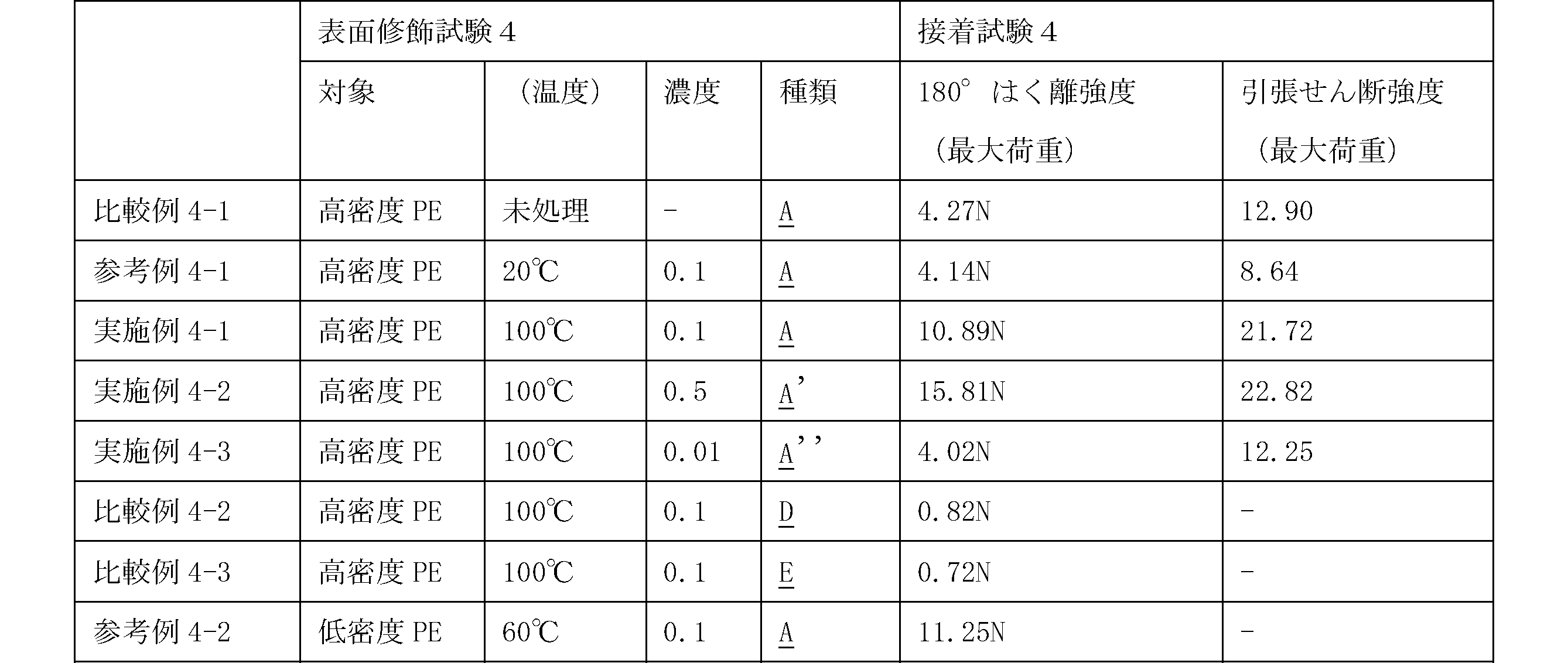
上記接着試験において、ベヘニルアクリレートの単独重合体及びベヘニルアクリレートとn-ブチルアクリレートのブロック共重合体を用いた場合には、寧ろ強度が低下する傾向にあることがわかる。これは、所望の官能基を有さないポリマーがポリエチレン表面をコーティングすることでかえって強度低下に寄与するためと推察される。また、低密度ポリエチレンを用いた参考例4-2によれば、低密度ポリエチレンを用いた場合には、低温でも十分な剥離強度が得られており、高密度ポリエチレンのような接着の困難性という課題が存在しないことがわかる。
〔実施例5〕
〔表面修飾試験5〕
超高分子量ポリエチレンからなる繊維(製品名:イザナス、DD1191(薄手品)、DD1312(厚手品)、東洋紡社製)からなる織布を用意した。織布を130℃に加温した表面修飾用組成物Aにそれぞれ10分間浸漬後直ちに取り出し、25℃/secの速度で、25℃まで冷却した。冷却後、修飾が完了した織布を取り出して自然乾燥させた。
〔表面修飾試験5〕
超高分子量ポリエチレンからなる繊維(製品名:イザナス、DD1191(薄手品)、DD1312(厚手品)、東洋紡社製)からなる織布を用意した。織布を130℃に加温した表面修飾用組成物Aにそれぞれ10分間浸漬後直ちに取り出し、25℃/secの速度で、25℃まで冷却した。冷却後、修飾が完了した織布を取り出して自然乾燥させた。
〔染色試験5〕
表面修飾試験5で得られた織布を、インク(製品名:ポスターカラー マリンブルー、アサヒペン社製)で着色し、24時間乾燥させた後、水又は石鹸水でインクを洗浄した。その結果を、図1に示す。
表面修飾試験5で得られた織布を、インク(製品名:ポスターカラー マリンブルー、アサヒペン社製)で着色し、24時間乾燥させた後、水又は石鹸水でインクを洗浄した。その結果を、図1に示す。
図1からわかるとおり、本発明の表面修飾用組成物を用いて表面修飾をした織布については、表面改質の結果着色されやすいことが示された。
〔実施例6〕
〔表面修飾試験6〕
超高分子量ポリエチレンからなる繊維(製品名:イザナス DD1191(薄手品)、東洋紡社製)からなる織布と、超高分子量ポリエチレンからなる繊維(製品名:イザナス、DD1312(厚手品)、東洋紡社製)からなる織布とを用意した。織布を100℃に加温した表面修飾用組成物Aにそれぞれ10分間浸漬後直ちに取り出し、25℃/secの速度で、25℃まで冷却した。冷却後、修飾が完了した織布を取り出して自然乾燥させた。
〔表面修飾試験6〕
超高分子量ポリエチレンからなる繊維(製品名:イザナス DD1191(薄手品)、東洋紡社製)からなる織布と、超高分子量ポリエチレンからなる繊維(製品名:イザナス、DD1312(厚手品)、東洋紡社製)からなる織布とを用意した。織布を100℃に加温した表面修飾用組成物Aにそれぞれ10分間浸漬後直ちに取り出し、25℃/secの速度で、25℃まで冷却した。冷却後、修飾が完了した織布を取り出して自然乾燥させた。
また、表面修飾用組成物Aにより表面処理をした場合と、一般的な表面処理として知られているコロナ処理及び大気圧プラズマ処理により表面処理をした場合とを対比するため、以下の繊維(製品名:イザナス DD1191(薄手品)、東洋紡社製)からなる織布と、繊維(製品名:イザナス、DD1312(厚手品)、東洋紡社製)からなる織布に対して、表面修飾用組成物Aを用いた処理に代えて、以下の条件でコロナ処理、大気圧プラズマ処理1及び大気圧プラズマ処理2を行った織布を得た。
(コロナ処理)
装置 :テーブル式実験機(春日電機株式会社製)
条件 :120Wmin/m2(180W 3.5m/min)、空気下
(大気圧プラズマ処理1)
装置 :プラズマ表面改質装置(製品名:MyPL Auto-100DLC、株式会社ウェル製)
条件 :He 50L/min、O2 50cc/min、10mm/sec、150W
電極高さ:2.3mm
往復数 :1往復
(大気圧プラズマ処理2)
装置 :プラズマ表面改質装置(製品名:MyPL Auto-100DLC、株式会社ウェル製)
条件 :He 50L/min 、O2 50cc/min、10mm/sec、150W
電極高さ:4.0mm
往復数 :3往復
(コロナ処理)
装置 :テーブル式実験機(春日電機株式会社製)
条件 :120Wmin/m2(180W 3.5m/min)、空気下
(大気圧プラズマ処理1)
装置 :プラズマ表面改質装置(製品名:MyPL Auto-100DLC、株式会社ウェル製)
条件 :He 50L/min、O2 50cc/min、10mm/sec、150W
電極高さ:2.3mm
往復数 :1往復
(大気圧プラズマ処理2)
装置 :プラズマ表面改質装置(製品名:MyPL Auto-100DLC、株式会社ウェル製)
条件 :He 50L/min 、O2 50cc/min、10mm/sec、150W
電極高さ:4.0mm
往復数 :3往復
〔染色試験6-1〕
繊維の種類ごとに異なった色で染色をすることが可能な繊維鑑別用インディケーターカヤステインQ(色染社社製)5gを70℃の水500gに溶解させて染色液を調製した。表面修飾試験6で得られた各織布を70℃の水で十分湿潤させた後、調製した染色液に浸漬し5分間煮沸し、染色した。最後に、織布をさらに水で十分に濯ぎ、常温で乾燥させた。その結果を図2に示す。
繊維の種類ごとに異なった色で染色をすることが可能な繊維鑑別用インディケーターカヤステインQ(色染社社製)5gを70℃の水500gに溶解させて染色液を調製した。表面修飾試験6で得られた各織布を70℃の水で十分湿潤させた後、調製した染色液に浸漬し5分間煮沸し、染色した。最後に、織布をさらに水で十分に濯ぎ、常温で乾燥させた。その結果を図2に示す。
また、コントロールとして、テスト織布(製品名:AATCC交織布Style.10A、SDC交織布リボンDW、及びATCC交織布Style.1、いずれも染色社社製)を用意し、上記と同様の手順で染色した。その結果を図3に示す。なお、AATCC交織布Style.10Aは、図3の左から色が分かれている箇所ごとに、ジアセテート/綿/ナイロン66/ポリエステル/アクリル/羊毛からなるものであり、SDC交織布リボンDWは、図3の左から色が分かれている箇所ごとに、ジアセテート/綿/ナイロン66/ポリエステル/アクリル/羊毛からなるものであり、AATCC交織布Style.1は、図3の左から色が分かれている箇所ごとに、ジアセテート/綿/ナイロン66/絹/レーヨン/羊毛からなるものである。これらテスト織布は、繊維種の違いにより繊維鑑別用インディケーターカヤステインQにより染色した場合の色が異なるものとなる。
図2及び3に示すように、表面修飾用組成物で染色した結果は、ナイロンや羊毛の染まり方に近いものであった。これは、表面修飾用組成物が超高分子量ポリエチレン繊維を修飾したことを示すとともに、表面修飾用組成物が超高分子量ポリエチレン繊維に決着した共重合体の第2のモノマーが有するアミノ基が、反応することでナイロンや羊毛と同程度の発色を示したものと推察される。また、コロナ処理や大気圧プラズマ処理と比較すると、表面修飾用組成物を用いた場合に染色されやすいことは一目瞭然である。さらに、染色過程で、煮沸を行っても、表面修飾用組成物が繊維表面から離脱することがないことも分かった。
〔染色試験6-2〕
表面処理後の染色特性を評価するためにコールダイホット(レッド)(桂屋ファイングッズ社製)2gを90℃の水50gに溶解させ、最終溶液量が1Lとなるように希釈し、助剤として食酢(株式会社ミツカン 穀物酢)13mLを加えて染色液を調製した。表面修飾試験6で得られた各織布を調製した染色液(90℃)に浸漬し20分間、ゆっくりかき混ぜながら染色した。ソーピングとして、約50℃の水約1Lに台所用中性洗剤(花王株式会社 キュキュット クリア除菌 緑茶の香り)2gを溶かした洗剤液に織布を浸漬し洗浄した。最後に、織布をさらに水で十分に濯ぎ、常温で乾燥させた。その結果を図4に示す。
表面処理後の染色特性を評価するためにコールダイホット(レッド)(桂屋ファイングッズ社製)2gを90℃の水50gに溶解させ、最終溶液量が1Lとなるように希釈し、助剤として食酢(株式会社ミツカン 穀物酢)13mLを加えて染色液を調製した。表面修飾試験6で得られた各織布を調製した染色液(90℃)に浸漬し20分間、ゆっくりかき混ぜながら染色した。ソーピングとして、約50℃の水約1Lに台所用中性洗剤(花王株式会社 キュキュット クリア除菌 緑茶の香り)2gを溶かした洗剤液に織布を浸漬し洗浄した。最後に、織布をさらに水で十分に濯ぎ、常温で乾燥させた。その結果を図4に示す。
また、コントロールとして、テスト織布(製品名:AATCC交織布Style.10A、SDC交織布リボンDW、及びATCC交織布Style.1、いずれも染色社社製)を用意し、上記と同様の手順で染色した。その結果を図5に示す。なお、AATCC交織布Style.10Aは、図5の左から色が分かれている箇所ごとに、ジアセテート/綿/ナイロン66/ポリエステル/アクリル/羊毛からなるものであり、SDC交織布リボンDWは、図5の左から色が分かれている箇所ごとに、ジアセテート/綿/ナイロン66/ポリエステル/アクリル/羊毛からなるものであり、AATCC交織布Style.1は、図5の左から色が分かれている箇所ごとに、ジアセテート/綿/ナイロン66/絹/レーヨン/羊毛からなるものである。これらテスト織布は、繊維種の違いによりコールダイホット(レッド)による染色の程度が異なるものとなる。
図4及び5に示すように、表面修飾用組成物で染色した結果は、染色濃度の濃いほうから、ナイロン66、羊毛、絹、ジアセテート、レーヨン、ポリエステル、アクリルの順となった。また、コロナ処理や大気圧プラズマ処理と比較すると、表面修飾用組成物を用いた場合に染色されやすいことは一目瞭然である。さらに、染色過程で、90℃の加熱を行っても、表面修飾用組成物が繊維表面から離脱することがないことも分かった。
〔実施例7〕
〔剥離試験7-1〕
比較例1-1、参考例1-1~1-3、実施例1-1~1-3において用いた各試験片を、80℃の水中で1時間放置した。放置後、手でポリエチレン板同士を剥離しようとしたところ、比較例1-1、参考例1-1~1-3の試験片は、接着面で容易に剥離した。一方で、実施例1-1~1-3の試験片は、剥離せず、強度を保っていた。
〔剥離試験7-1〕
比較例1-1、参考例1-1~1-3、実施例1-1~1-3において用いた各試験片を、80℃の水中で1時間放置した。放置後、手でポリエチレン板同士を剥離しようとしたところ、比較例1-1、参考例1-1~1-3の試験片は、接着面で容易に剥離した。一方で、実施例1-1~1-3の試験片は、剥離せず、強度を保っていた。
〔剥離試験7-2〕
比較例1-1、参考例1-1~1-3、実施例1-1~1-3において用いた各試験片を、70℃のエタノール中で1時間放置した。放置後、手でポリエチレン板同士を剥離しようとしたところ、比較例1-1、参考例1-1~1-3の試験片は、接着面で容易に剥離した。一方で、実施例1-1~1-3の試験片は、剥離せず、強度を保っていた。
比較例1-1、参考例1-1~1-3、実施例1-1~1-3において用いた各試験片を、70℃のエタノール中で1時間放置した。放置後、手でポリエチレン板同士を剥離しようとしたところ、比較例1-1、参考例1-1~1-3の試験片は、接着面で容易に剥離した。一方で、実施例1-1~1-3の試験片は、剥離せず、強度を保っていた。
本発明は、高密度ポリエチレン又は超高分子量ポリエチレンからなる成形体の表面を修飾するために用いる表面修飾用組成物として、産業上の利用可能性を有する。
Claims (7)
- 高密度ポリエチレン又は超高分子量ポリエチレンからなる成形体の表面を修飾するための表面修飾用組成物であって、
炭素数10以上の脂肪族基を有する第1のモノマーからなる構成単位と、アミノ基、エポキシ基、又はエーテル基のいずれかを有する第2のモノマーからなる構成単位と、を有する共重合体と、
沸点が100℃以上であり、ハロゲン系溶剤、アルカン系溶剤、シクロアルカン系溶剤、ジシクロアルカン系溶剤、芳香族系溶剤、及びニトロ系溶剤からなる群より選ばれる少なくとも1種である溶剤と、を含む、
表面修飾用組成物。 - 前記共重合体を構成する前記第1のモノマーが、ベヘニルアクリレート、ベヘニルメタクリレート、ステアリルアクリレート、ステアリルメタクリレート、ヘキサデシルアクリレート、ヘキサデシルメタクリレート、ラウリルアクリレート、及びラウリルメタクリレートからなる群より選ばれる1以上を含む、
請求項1に記載の表面修飾用組成物。 - 前記共重合体を構成する前記第2のモノマーが、2-(ジメチルアミノ)エチルアクリレート、2-(ジメチルアミノ)エチルメタクリレート、2-(ジエチルアミノ)エチルアクリレート、2-(ジエチルアミノ)エチルメタクリレート、2-(tert-ブチルアミノ)エチルアクリレート、2-(tert-ブチルアミノ)エチルメタクリレート、N,N-ジメチルアクリルアミド、N,N-ジエチルアクリルアミド、及びN,N-ジメチルアミノプロピルアクリルアミドからなる群より選ばれる1以上を含む、
請求項1又は2に記載の表面修飾用組成物。 - 前記共重合体が、ブロック共重合体であり、
前記第1のモノマーのブロックの重量平均分子量が、2000以上である、
請求項1~3のいずれか1項に記載の表面修飾用組成物。 - 高密度ポリエチレン又は超高分子量ポリエチレンからなる成形体と、該成形体上に結着した共重合体と、を有し、
該共重合体が、炭素数10以上の脂肪族基を有する第1のモノマーからなる構成単位と、アミノ基、エポキシ基、又はエーテル基のいずれかを有する第2のモノマーからなる構成単位と、を有するものであり、
80℃の水中及び70℃のエタノール中で、1時間の条件下で放置しても、前記成形体から前記共重合体が脱離しないものである、
被修飾物。 - 炭素数10以上の脂肪族基を有する第1のモノマーからなる構成単位と、アミノ基、エポキシ基、又はエーテル基のいずれかを有する第2のモノマーからなる構成単位と、を有する共重合体と、溶剤と、を含む表面修飾用組成物を温度T1に加温して、高密度ポリエチレン又は超高分子量ポリエチレンからなる成形体の表面に接触させる接触工程と、
前記表面修飾用組成物の温度を前記T1からT2へ冷却する冷却工程と、を有し、
前記T1が、前記成形体を構成するポリエチレンの融点Tmよりも60℃低い温度(Tm-60)以上であり、
前記T2が、前記ポリエチレンの融点Tmよりも80℃低い温度(Tm-80)以下である、
被修飾物の製造方法。 - 請求項6に記載の被修飾物の製造方法により得られた被修飾物の修飾面に対して、染料又は顔料を含有するインクを付着させる着色工程を有する、
着色物の製造方法。
Priority Applications (5)
| Application Number | Priority Date | Filing Date | Title |
|---|---|---|---|
| RU2020113662A RU2785134C2 (ru) | 2017-10-11 | 2018-08-20 | Модифицирующая поверхность композиция, модифицированное изделие и способ изготовления модифицированного изделия |
| US16/754,359 US20200239654A1 (en) | 2017-10-11 | 2018-08-20 | Surface modifying composition, modified product, and method of producing modified product |
| CN201880065723.6A CN111201278B (zh) | 2017-10-11 | 2018-08-20 | 表面修饰用组合物、被修饰物及其制造方法 |
| EP18866894.1A EP3696228A4 (en) | 2017-10-11 | 2018-08-20 | SURFACE MODIFICATION COMPOSITION, MODIFIED OBJECT AND MANUFACTURING METHOD FOR IT |
| US17/959,884 US12583987B2 (en) | 2017-10-11 | 2022-10-04 | Surface modifying composition, modified product, and method of producing modified product |
Applications Claiming Priority (2)
| Application Number | Priority Date | Filing Date | Title |
|---|---|---|---|
| JP2017197695A JP6458112B1 (ja) | 2017-10-11 | 2017-10-11 | 表面修飾用組成物、並びに、被修飾物及びその製造方法 |
| JP2017-197695 | 2017-10-11 |
Related Child Applications (2)
| Application Number | Title | Priority Date | Filing Date |
|---|---|---|---|
| US16/754,359 A-371-Of-International US20200239654A1 (en) | 2017-10-11 | 2018-08-20 | Surface modifying composition, modified product, and method of producing modified product |
| US17/959,884 Division US12583987B2 (en) | 2017-10-11 | 2022-10-04 | Surface modifying composition, modified product, and method of producing modified product |
Publications (1)
| Publication Number | Publication Date |
|---|---|
| WO2019073692A1 true WO2019073692A1 (ja) | 2019-04-18 |
Family
ID=65037164
Family Applications (1)
| Application Number | Title | Priority Date | Filing Date |
|---|---|---|---|
| PCT/JP2018/030685 Ceased WO2019073692A1 (ja) | 2017-10-11 | 2018-08-20 | 表面修飾用組成物、並びに、被修飾物及びその製造方法 |
Country Status (5)
| Country | Link |
|---|---|
| US (2) | US20200239654A1 (ja) |
| EP (1) | EP3696228A4 (ja) |
| JP (1) | JP6458112B1 (ja) |
| CN (1) | CN111201278B (ja) |
| WO (1) | WO2019073692A1 (ja) |
Cited By (3)
| Publication number | Priority date | Publication date | Assignee | Title |
|---|---|---|---|---|
| JP2020196848A (ja) * | 2019-06-05 | 2020-12-10 | 学校法人福岡大学 | 成形体形成用液体組成物、並びに、成形体及びその製造方法 |
| WO2021014836A1 (ja) * | 2019-07-22 | 2021-01-28 | 学校法人福岡大学 | フッ素樹脂改質剤、改質フッ素樹脂成形体及びその製造方法 |
| WO2021251327A1 (ja) * | 2020-06-10 | 2021-12-16 | 学校法人福岡大学 | 側鎖結晶性ブロック共重合体を含む成形体、及びその製造方法 |
Families Citing this family (3)
| Publication number | Priority date | Publication date | Assignee | Title |
|---|---|---|---|---|
| JP7665973B2 (ja) * | 2020-12-15 | 2025-04-22 | 日油株式会社 | エラストマー用の親水化剤 |
| JP2023110489A (ja) * | 2022-01-28 | 2023-08-09 | 学校法人福岡大学 | 改質シリコーン基材およびその製造方法、ならびに接合体 |
| KR102418787B1 (ko) * | 2022-04-06 | 2022-07-11 | 한국화학연구원 | 에스테르 작용기를 포함하는 고분자와 이와 다른 종류의 고분자가 혼합된 고분자 혼합물로부터 에스테르 작용기를 포함하는 고분자의 선별 방법 |
Citations (11)
| Publication number | Priority date | Publication date | Assignee | Title |
|---|---|---|---|---|
| JPS4820844U (ja) * | 1971-07-17 | 1973-03-09 | ||
| JP2002173514A (ja) * | 2000-09-29 | 2002-06-21 | Nippon Paper Industries Co Ltd | 変性ポリオレフィン樹脂と変性ポリオレフィン樹脂組成物及びその用途 |
| JP2008231637A (ja) * | 2007-03-23 | 2008-10-02 | Kao Corp | ドライクリーニング用仕上げ剤 |
| JP2009219361A (ja) * | 2008-03-13 | 2009-10-01 | Toray Monofilament Co Ltd | 刈払い用コード |
| JP2014234397A (ja) | 2013-05-30 | 2014-12-15 | 株式会社カネカ | ポリオレフィンの塗装性および印刷性の改良方法 |
| JP2015061900A (ja) * | 2013-08-19 | 2015-04-02 | 学校法人福岡大学 | 組成物、リチウム2次電池用セパレータ、リチウム2次電池用固体電解質、及びポリエチレン製品 |
| JP2015105313A (ja) * | 2013-11-29 | 2015-06-08 | 花王株式会社 | 親水化処理剤 |
| JP2015229725A (ja) | 2014-06-05 | 2015-12-21 | 学校法人福岡大学 | 表面修飾材料、表面修飾用組成物、及び復元方法 |
| WO2017030154A1 (ja) * | 2015-08-18 | 2017-02-23 | 富士フイルム株式会社 | 固体電解質組成物、全固体二次電池用電極シートおよび全固体二次電池ならびに全固体二次電池用電極シートおよび全固体二次電池の製造方法 |
| JP2017133027A (ja) * | 2016-09-13 | 2017-08-03 | Jxtgエネルギー株式会社 | ポリイミド、ポリイミドの製造方法、ポリイミド溶液及びポリイミドフィルム |
| JP2017192875A (ja) * | 2016-04-18 | 2017-10-26 | 学校法人福岡大学 | タンパク質吸着材 |
Family Cites Families (7)
| Publication number | Priority date | Publication date | Assignee | Title |
|---|---|---|---|---|
| JPS4820844B1 (ja) * | 1970-11-14 | 1973-06-25 | ||
| DE10048258B4 (de) | 2000-09-29 | 2004-08-19 | Byk-Chemie Gmbh | Verlaufmittel für Oberflächenbeschichtungen |
| WO2005000925A1 (ja) * | 2003-06-26 | 2005-01-06 | Mitsubishi Rayon Co., Ltd. | 変性ポリオレフィン樹脂および組成物 |
| JP2007262325A (ja) * | 2006-03-29 | 2007-10-11 | Mitsui Chemicals Inc | オレフィン系ブロックポリマーを含んでなるポリマーブレンド |
| MX384869B (es) | 2010-10-15 | 2025-03-04 | Swimc Llc | Composición de recubrimiento a base de poliéster para sustratos de metal. |
| WO2012098686A1 (ja) * | 2011-01-21 | 2012-07-26 | 株式会社岐阜セラツク製造所 | 分散剤,分散体および分散体の粘度の調整方法 |
| EP3371233A1 (en) * | 2015-11-04 | 2018-09-12 | Avery Dennison Corporation | Stimuli responsive adhesives |
-
2017
- 2017-10-11 JP JP2017197695A patent/JP6458112B1/ja active Active
-
2018
- 2018-08-20 EP EP18866894.1A patent/EP3696228A4/en active Pending
- 2018-08-20 WO PCT/JP2018/030685 patent/WO2019073692A1/ja not_active Ceased
- 2018-08-20 US US16/754,359 patent/US20200239654A1/en not_active Abandoned
- 2018-08-20 CN CN201880065723.6A patent/CN111201278B/zh active Active
-
2022
- 2022-10-04 US US17/959,884 patent/US12583987B2/en active Active
Patent Citations (11)
| Publication number | Priority date | Publication date | Assignee | Title |
|---|---|---|---|---|
| JPS4820844U (ja) * | 1971-07-17 | 1973-03-09 | ||
| JP2002173514A (ja) * | 2000-09-29 | 2002-06-21 | Nippon Paper Industries Co Ltd | 変性ポリオレフィン樹脂と変性ポリオレフィン樹脂組成物及びその用途 |
| JP2008231637A (ja) * | 2007-03-23 | 2008-10-02 | Kao Corp | ドライクリーニング用仕上げ剤 |
| JP2009219361A (ja) * | 2008-03-13 | 2009-10-01 | Toray Monofilament Co Ltd | 刈払い用コード |
| JP2014234397A (ja) | 2013-05-30 | 2014-12-15 | 株式会社カネカ | ポリオレフィンの塗装性および印刷性の改良方法 |
| JP2015061900A (ja) * | 2013-08-19 | 2015-04-02 | 学校法人福岡大学 | 組成物、リチウム2次電池用セパレータ、リチウム2次電池用固体電解質、及びポリエチレン製品 |
| JP2015105313A (ja) * | 2013-11-29 | 2015-06-08 | 花王株式会社 | 親水化処理剤 |
| JP2015229725A (ja) | 2014-06-05 | 2015-12-21 | 学校法人福岡大学 | 表面修飾材料、表面修飾用組成物、及び復元方法 |
| WO2017030154A1 (ja) * | 2015-08-18 | 2017-02-23 | 富士フイルム株式会社 | 固体電解質組成物、全固体二次電池用電極シートおよび全固体二次電池ならびに全固体二次電池用電極シートおよび全固体二次電池の製造方法 |
| JP2017192875A (ja) * | 2016-04-18 | 2017-10-26 | 学校法人福岡大学 | タンパク質吸着材 |
| JP2017133027A (ja) * | 2016-09-13 | 2017-08-03 | Jxtgエネルギー株式会社 | ポリイミド、ポリイミドの製造方法、ポリイミド溶液及びポリイミドフィルム |
Non-Patent Citations (1)
| Title |
|---|
| See also references of EP3696228A4 |
Cited By (7)
| Publication number | Priority date | Publication date | Assignee | Title |
|---|---|---|---|---|
| JP2020196848A (ja) * | 2019-06-05 | 2020-12-10 | 学校法人福岡大学 | 成形体形成用液体組成物、並びに、成形体及びその製造方法 |
| WO2021014836A1 (ja) * | 2019-07-22 | 2021-01-28 | 学校法人福岡大学 | フッ素樹脂改質剤、改質フッ素樹脂成形体及びその製造方法 |
| JP2021017593A (ja) * | 2019-07-22 | 2021-02-15 | 学校法人福岡大学 | フッ素樹脂改質剤、改質フッ素樹脂成形体及びその製造方法 |
| JP7555565B2 (ja) | 2019-07-22 | 2024-09-25 | 学校法人福岡大学 | フッ素樹脂改質剤、改質フッ素樹脂成形体及びその製造方法 |
| WO2021251327A1 (ja) * | 2020-06-10 | 2021-12-16 | 学校法人福岡大学 | 側鎖結晶性ブロック共重合体を含む成形体、及びその製造方法 |
| JP2021195403A (ja) * | 2020-06-10 | 2021-12-27 | 学校法人福岡大学 | 側鎖結晶性ブロック共重合体を含む成形体、及びその製造方法 |
| JP7625239B2 (ja) | 2020-06-10 | 2025-02-03 | 学校法人福岡大学 | 側鎖結晶性ブロック共重合体を含む成形体、及びその製造方法 |
Also Published As
| Publication number | Publication date |
|---|---|
| RU2020113662A (ru) | 2021-11-12 |
| US20200239654A1 (en) | 2020-07-30 |
| CN111201278B (zh) | 2023-06-09 |
| CN111201278A (zh) | 2020-05-26 |
| RU2020113662A3 (ja) | 2021-11-12 |
| JP6458112B1 (ja) | 2019-01-23 |
| EP3696228A1 (en) | 2020-08-19 |
| US12583987B2 (en) | 2026-03-24 |
| JP2019070091A (ja) | 2019-05-09 |
| US20230041238A1 (en) | 2023-02-09 |
| EP3696228A4 (en) | 2021-06-23 |
Similar Documents
| Publication | Publication Date | Title |
|---|---|---|
| WO2019073692A1 (ja) | 表面修飾用組成物、並びに、被修飾物及びその製造方法 | |
| JP2541567B2 (ja) | 補強用繊維材料 | |
| KR101288676B1 (ko) | 섬유 처리용 수분산체 | |
| US20130022876A1 (en) | Surface modified polymeric materials, modified functionalized polymers, functional polymers, and methods | |
| CN107810217B (zh) | 粘合促进剂和用于在极性织物上使用以粘结非极性基材的方法 | |
| JP2012149170A (ja) | 炭素繊維強化ポリオレフィン系樹脂複合材料およびその製造方法 | |
| CN101410449A (zh) | 含有烯烃类嵌段聚合物的树脂组合物及其用途 | |
| JP6799171B2 (ja) | 積層体 | |
| CN107075213B (zh) | 含有改性聚丙烯树脂的自乳化型乳液 | |
| JP4660866B2 (ja) | 易接着性ポリアミドフィルム | |
| JP6862387B2 (ja) | 組成物、コーティング剤及びポリオレフィン成形体 | |
| CN105793334A (zh) | 预浸料、纤维强化复合材料及含有颗粒的树脂组合物 | |
| CN103938454A (zh) | 一种新型芳纶纳米涂覆材料及其制备方法 | |
| RU2785134C2 (ru) | Модифицирующая поверхность композиция, модифицированное изделие и способ изготовления модифицированного изделия | |
| JPS59232135A (ja) | ポリオレフイン組成物 | |
| RU2690348C1 (ru) | Отверждаемая водная композиция | |
| JP6712025B1 (ja) | 成形体形成用液体組成物、並びに、成形体及びその製造方法 | |
| TWI865571B (zh) | 黏著劑組成物 | |
| JP2015144991A (ja) | 油吸着用部材、可染性ポリオレフィン組成物 | |
| JPH1112369A (ja) | 多孔質フィルム、その製造方法及び通気性接着部材 | |
| Ishimoto et al. | Chemical surface modification of ultra-high-molecular-weight polyethylene fiber with side-chain crystalline block copolymers and the dyeing characteristics | |
| JP2857115B2 (ja) | 可染性ポリプロピレン繊維の製造方法 | |
| JP7625239B2 (ja) | 側鎖結晶性ブロック共重合体を含む成形体、及びその製造方法 | |
| JP2857081B2 (ja) | 可染性ポリプロピレン繊維の製造方法 | |
| BR112019019404A2 (pt) | artigo em formato tridimensional |
Legal Events
| Date | Code | Title | Description |
|---|---|---|---|
| 121 | Ep: the epo has been informed by wipo that ep was designated in this application |
Ref document number: 18866894 Country of ref document: EP Kind code of ref document: A1 |
|
| NENP | Non-entry into the national phase |
Ref country code: DE |
|
| ENP | Entry into the national phase |
Ref document number: 2018866894 Country of ref document: EP Effective date: 20200511 |