WO2019077885A1 - ゴム組成物用表面改質剤及びこれを含有するゴム組成物 - Google Patents
ゴム組成物用表面改質剤及びこれを含有するゴム組成物 Download PDFInfo
- Publication number
- WO2019077885A1 WO2019077885A1 PCT/JP2018/031731 JP2018031731W WO2019077885A1 WO 2019077885 A1 WO2019077885 A1 WO 2019077885A1 JP 2018031731 W JP2018031731 W JP 2018031731W WO 2019077885 A1 WO2019077885 A1 WO 2019077885A1
- Authority
- WO
- WIPO (PCT)
- Prior art keywords
- weight
- parts
- rubber composition
- rubber
- component
- Prior art date
- Legal status (The legal status is an assumption and is not a legal conclusion. Google has not performed a legal analysis and makes no representation as to the accuracy of the status listed.)
- Ceased
Links
Classifications
-
- C—CHEMISTRY; METALLURGY
- C08—ORGANIC MACROMOLECULAR COMPOUNDS; THEIR PREPARATION OR CHEMICAL WORKING-UP; COMPOSITIONS BASED THEREON
- C08L—COMPOSITIONS OF MACROMOLECULAR COMPOUNDS
- C08L7/00—Compositions of natural rubber
-
- B—PERFORMING OPERATIONS; TRANSPORTING
- B60—VEHICLES IN GENERAL
- B60C—VEHICLE TYRES; TYRE INFLATION; TYRE CHANGING; CONNECTING VALVES TO INFLATABLE ELASTIC BODIES IN GENERAL; DEVICES OR ARRANGEMENTS RELATED TO TYRES
- B60C1/00—Tyres characterised by the chemical composition or the physical arrangement or mixture of the composition
- B60C1/0016—Compositions of the tread
-
- B—PERFORMING OPERATIONS; TRANSPORTING
- B60—VEHICLES IN GENERAL
- B60C—VEHICLE TYRES; TYRE INFLATION; TYRE CHANGING; CONNECTING VALVES TO INFLATABLE ELASTIC BODIES IN GENERAL; DEVICES OR ARRANGEMENTS RELATED TO TYRES
- B60C1/00—Tyres characterised by the chemical composition or the physical arrangement or mixture of the composition
- B60C1/0025—Compositions of the sidewalls
-
- C—CHEMISTRY; METALLURGY
- C08—ORGANIC MACROMOLECULAR COMPOUNDS; THEIR PREPARATION OR CHEMICAL WORKING-UP; COMPOSITIONS BASED THEREON
- C08J—WORKING-UP; GENERAL PROCESSES OF COMPOUNDING; AFTER-TREATMENT NOT COVERED BY SUBCLASSES C08B, C08C, C08F, C08G or C08H
- C08J3/00—Processes of treating or compounding macromolecular substances
- C08J3/02—Making solutions, dispersions, lattices or gels by other methods than by solution, emulsion or suspension polymerisation techniques
- C08J3/09—Making solutions, dispersions, lattices or gels by other methods than by solution, emulsion or suspension polymerisation techniques in organic liquids
- C08J3/091—Making solutions, dispersions, lattices or gels by other methods than by solution, emulsion or suspension polymerisation techniques in organic liquids characterised by the chemical constitution of the organic liquid
- C08J3/095—Oxygen containing compounds
-
- C—CHEMISTRY; METALLURGY
- C08—ORGANIC MACROMOLECULAR COMPOUNDS; THEIR PREPARATION OR CHEMICAL WORKING-UP; COMPOSITIONS BASED THEREON
- C08K—Use of inorganic or non-macromolecular organic substances as compounding ingredients
- C08K5/00—Use of organic ingredients
- C08K5/04—Oxygen-containing compounds
- C08K5/05—Alcohols; Metal alcoholates
-
- C—CHEMISTRY; METALLURGY
- C08—ORGANIC MACROMOLECULAR COMPOUNDS; THEIR PREPARATION OR CHEMICAL WORKING-UP; COMPOSITIONS BASED THEREON
- C08L—COMPOSITIONS OF MACROMOLECULAR COMPOUNDS
- C08L21/00—Compositions of unspecified rubbers
-
- C—CHEMISTRY; METALLURGY
- C08—ORGANIC MACROMOLECULAR COMPOUNDS; THEIR PREPARATION OR CHEMICAL WORKING-UP; COMPOSITIONS BASED THEREON
- C08L—COMPOSITIONS OF MACROMOLECULAR COMPOUNDS
- C08L23/00—Compositions of homopolymers or copolymers of unsaturated aliphatic hydrocarbons having only one carbon-to-carbon double bond; Compositions of derivatives of such polymers
- C08L23/02—Compositions of homopolymers or copolymers of unsaturated aliphatic hydrocarbons having only one carbon-to-carbon double bond; Compositions of derivatives of such polymers not modified by chemical after-treatment
- C08L23/18—Homopolymers or copolymers of hydrocarbons having four or more carbon atoms
- C08L23/20—Homopolymers or copolymers of hydrocarbons having four or more carbon atoms having four to nine carbon atoms
- C08L23/22—Copolymers of isobutene; Butyl rubber; Homopolymers or copolymers of other iso-olefins
-
- C—CHEMISTRY; METALLURGY
- C08—ORGANIC MACROMOLECULAR COMPOUNDS; THEIR PREPARATION OR CHEMICAL WORKING-UP; COMPOSITIONS BASED THEREON
- C08L—COMPOSITIONS OF MACROMOLECULAR COMPOUNDS
- C08L55/00—Compositions of homopolymers or copolymers, obtained by polymerisation reactions only involving carbon-to-carbon unsaturated bonds, not provided for in groups C08L23/00 - C08L53/00
- C08L55/02—ABS [Acrylonitrile-Butadiene-Styrene] polymers
-
- C—CHEMISTRY; METALLURGY
- C08—ORGANIC MACROMOLECULAR COMPOUNDS; THEIR PREPARATION OR CHEMICAL WORKING-UP; COMPOSITIONS BASED THEREON
- C08L—COMPOSITIONS OF MACROMOLECULAR COMPOUNDS
- C08L7/00—Compositions of natural rubber
- C08L7/02—Latex
-
- C—CHEMISTRY; METALLURGY
- C08—ORGANIC MACROMOLECULAR COMPOUNDS; THEIR PREPARATION OR CHEMICAL WORKING-UP; COMPOSITIONS BASED THEREON
- C08L—COMPOSITIONS OF MACROMOLECULAR COMPOUNDS
- C08L9/00—Compositions of homopolymers or copolymers of conjugated diene hydrocarbons
-
- C—CHEMISTRY; METALLURGY
- C08—ORGANIC MACROMOLECULAR COMPOUNDS; THEIR PREPARATION OR CHEMICAL WORKING-UP; COMPOSITIONS BASED THEREON
- C08L—COMPOSITIONS OF MACROMOLECULAR COMPOUNDS
- C08L91/00—Compositions of oils, fats or waxes; Compositions of derivatives thereof
- C08L91/06—Waxes
-
- C—CHEMISTRY; METALLURGY
- C08—ORGANIC MACROMOLECULAR COMPOUNDS; THEIR PREPARATION OR CHEMICAL WORKING-UP; COMPOSITIONS BASED THEREON
- C08L—COMPOSITIONS OF MACROMOLECULAR COMPOUNDS
- C08L99/00—Compositions of natural macromolecular compounds or of derivatives thereof not provided for in groups C08L89/00 - C08L97/00
Definitions
- the present invention relates to a surface modifier for a rubber composition and a rubber composition containing the same.
- a hydrocarbon-based anti-aging wax is blended to prevent ozone deterioration.
- the compounded wax precipitates on the rubber surface (also referred to as bloom or blooming) to form a thin film (also referred to as a bloom film), and the thin film blocks contact between the rubber and ozone, thereby preventing the deterioration of the rubber.
- excessively bloomed wax significantly impairs the appearance of the rubber composition surface. Deterioration of this appearance includes the whitening discoloration caused by the wax itself and the browning discoloration caused by the deterioration of the anti-aging agent which blooms simultaneously with the wax. From this, it is desirable to suppress excessive bloom of wax.
- Patent Document 4 a higher alcohol having a DSC peak temperature of 60.degree. C. to 105.degree. C. in combination with the wax for anti-aging of rubber to obtain a wax composition without deteriorating the ozone resistance of the rubber composition. It is proposed to reduce the amount of bloom and improve the appearance of the rubber composition (Patent Document 4).
- the present invention has been made in view of the above circumstances, and provides a surface modifier for a rubber composition which can improve the appearance without impairing the ozone resistance of the rubber composition. It is an object.
- the present inventors focused attention on the carbon number distribution of higher alcohols, and as a result of repeated studies, the alcohol component having a relatively small carbon number in the higher alcohols reduces the ozone resistance. They found that alcohol components with relatively large carbon numbers deteriorate the appearance, and specified the carbon number of alcohol components that can improve the appearance while minimizing the influence on ozone resistance. It has also been found that higher alcohols obtained by hydrolyzing rice wax, which is a type of vegetable wax, have the required properties and are particularly excellent from the economical point of view.
- a surface modifier for a rubber composition comprising a hydrocarbon-based anti-aging wax (B) and an appearance modifier (C), wherein 100 parts by weight of the surface modifier for the rubber composition
- the content of the monovalent primary alcohol which is linear and accounts for more than 1.5 parts by weight and less than 35 parts by weight, and the component having 30 to 38 carbon atoms in 100 parts by weight of the primary alcohol
- Rubber composition having a content of more than 35 parts by weight, a content of a component having 12 to 26 carbon atoms is less than 25 parts by weight, and a content of a component having 42 to 68 carbon atoms is less than 25 parts by weight
- Surface modifiers comprising a hydrocarbon-based anti-aging wax (B) and an appearance modifier (C), wherein 100 parts by weight of the surface modifier for the rubber composition
- the content of the monovalent primary alcohol which is linear and accounts for more than 1.5 parts by weight and less than 35 parts by weight, and the component having 30 to 38 carbon atoms in 100 parts by weight of the primary alcohol
- Rubber composition having
- the content of the rubber anti-aging wax (B) of the surface modifier for the rubber composition is 0.1 to 10 parts by weight with respect to 100 parts by weight of the rubber component (A),
- the rubber composition according to item (6), wherein the content of the primary alcohol of the surface modifier for a rubber composition is 0.03 to 1 part by weight.
- the item (6), wherein the content of the appearance modifier (C) of the surface modifier for the rubber composition is 0.03 to 5 parts by weight with respect to 100 parts by weight of the rubber component (A).
- the rubber composition as described in (7) (9) A pneumatic tire produced using the rubber composition according to any one of items (6) to (8).
- the surface modifier for rubber compositions which can improve an external appearance is provided, without impairing the ozone resistance of a rubber composition. Further, according to the present invention, there is provided a rubber composition containing the above surface modifier which has the required ozone resistance and is excellent in appearance.
- the surface modifier for a rubber composition comprises a hydrocarbon-based wax for anti-aging for rubber (B) (hereinafter, also simply referred to as "wax”) and an appearance improver (C). It is a surface modifier for a rubber composition, and the content of the linear primary alcohol which is occupied in 100 parts by weight of the surface modifier for the rubber composition exceeds 1.5 parts by weight.
- the content of the component having 30 to 38 carbon atoms in 100 parts by weight of the primary alcohol is less than 35 parts by weight, and the content of the component having 12 to 26 carbon atoms is 25% by weight. It is characterized in that the content of components having carbon numbers of 42 to 68 is less than 25 parts by weight.
- linear primary monovalent primary alcohol refers to a compound represented by the following structural formula.
- n is an integer of 1 or more
- the content ratio of primary alcohol in 100 parts by weight of the surface modifier is 1.5 weight Preferably, it is more than 2 parts by weight and less than 35 parts by weight, and more preferably more than 2 parts by weight and less than 25 parts by weight. If the content ratio of the primary alcohol is less than 1.5 parts by weight, the effect of the primary alcohol contained in the surface modifier on the rubber composition is difficult to obtain, and the influence of the other components is relatively large. By doing so, unwanted effects may appear.
- the content of the component having 30 to 38 carbon atoms in 100 parts by weight of the primary alcohol preferably exceeds 35 parts by weight, and more than 40 parts by weight Preferably, more than 60 parts by weight is more preferred, and more than 70 parts by weight is even more preferred. If the content of the component having a carbon number of 30 to 38 is 35 parts by weight or less, a sufficient appearance improvement effect may not be obtained for the rubber composition.
- the content of the component having 12 to 26 carbon atoms is preferably less than 25 parts by weight, more preferably less than 20 parts by weight, and less than 15 parts by weight It is further preferred that If the content of the component having a carbon number of 12 to 26 is 25 parts by weight or more, the alcohol component bloomed together with the wax may disturb the bloom film and the ozone resistance of the rubber composition may be lowered.
- the content of the component having 42 to 68 carbon atoms is preferably less than 25 parts by weight, more preferably less than 15 parts by weight, and less than 5 parts by weight It is further preferred that When the content of the component having a carbon number of 42 to 68 is 25 parts by weight or more, whitening discoloration of the rubber surface may be caused, and the appearance of the rubber composition may be impaired.
- the melting start temperature of the primary alcohol is preferably 65 ° C. or more and less than 82 ° C., and more preferably 70 ° C. or more and less than 82 ° C.
- the melting end temperature is preferably 82 ° C. or more and less than 96 ° C., and more preferably 84 ° C. or more and less than 94 ° C.
- a physical property of the said surface modifier that whose hydroxyl value is 2 or more is preferable.
- the origin is not particularly limited as the appearance improving agent included in the surface modifying agent according to the present embodiment.
- synthetic higher alcohol synthesized by any method is divided by molecular distillation or the like, animal or plant wax or montan
- the wax may be partially or wholly hydrolyzed and / or transesterified by any method, or the wax ester and / or partially or wholly higher fatty acid may be reduced by any method.
- the appearance-improving agent obtained by these methods is usually an alkane, an alkene, an alkyne, a carboxylic acid, a ketone, an aldehyde, which is not linear and / or non-linear, as a component other than a linear primary alcohol which is linear.
- the higher fatty acids obtained by hydrolyzing animal and vegetable waxes act as vulcanization aids in the rubber composition, so there is little need to remove them.
- any component may be removed using any method.
- a higher fatty acid ester is obtained by utilizing the difference in solubility of higher alcohol and ester in a low polar solvent.
- a method of removing H.sup.2 + and concentrating a higher alcohol see Japanese Patent Application Laid-Open No. 6-212187).
- the appearance modifier contained in the surface modifier according to the present embodiment contains a high melting point linear alkane (also referred to as a normal alkane)
- a high melting point linear alkane also referred to as a normal alkane
- the content of the linear alkane having 50 to 68 carbon atoms is less than 2 parts by weight with respect to 100 parts by weight of the primary alcohol.
- the surface modifier of the present invention it is preferably considered to contain a hydrolyzate of animal and plant wax and / or montan wax.
- Animal waxes include, but are not limited to, for example, beeswax, lanolin, spermaceti wax and the like.
- plant waxes include, but are not limited to, carnauba wax, candelilla wax, wood wax, sunflower wax, rice wax and the like.
- the surface modifier contains the higher alcohol contained in the hydrolyzate of rice wax, the primary alcohol having the carbon number distribution and the component composition described above can be obtained more efficiently, so that the economy can be improved. It is particularly preferable from the viewpoint of sex.
- any generally known method can be used as a method of hydrolyzing animal and plant wax.
- the hydrocarbon-based anti-aging wax (B) contained in the surface modifier according to this embodiment is not particularly limited as a composition, and is generally used paraffin wax, Fischer-Tropsch wax, microcrystalline wax or those And select the type and combination of waxes depending on the temperature range in which the rubber composition is used. These waxes may be blended with polyethylene or the like for the purpose of preventing blooming and / or blocking.
- the rubber composition which concerns on one Embodiment of this invention contains a rubber component (A) and the said surface modifier as an essential component.
- a rubber component (A) used for the rubber composition which concerns on this embodiment A diene based synthetic rubber, an isoprene type rubber, these mixtures, etc. are mentioned.
- the diene synthetic rubber include styrene-butadiene rubber (SBR), butadiene rubber (BR), acrylonitrile-butadiene rubber (NBR), chloroprene rubber (CR) and the like.
- isoprene rubber include isoprene rubber (IR), natural rubber (NR), modified natural rubber and the like.
- the rubber component may be used alone or in combination of two or more.
- the content of the component having a carbon number of 12 to 26 of the primary alcohol of the surface modifier is 0.1 weight to 100 weight parts of the rubber component (A). It is preferable that it is less than part. Thereby, the appearance improvement effect can be efficiently obtained without impairing the ozone resistance of the rubber composition.
- the surface modifier when the surface modifier contains components other than the above-mentioned primary alcohol, it is linear in advance by using any method such as gas chromatograph. It is necessary to measure the concentration (content ratio) of the primary alcohol of Otherwise, when the surface modifier is compounded into the rubber composition, the amount of the primary alcohol blended to the rubber component (A) is too small to obtain a sufficient appearance improvement effect, Since the amount of the primary alcohol added to A) is too large, the ozone resistance may be reduced, or the influence of other components than the primary alcohol may not be negligible.
- the content of the rubber anti-aging wax (B) of the surface modifier is 0.1 to 10 parts by weight with respect to 100 parts by weight of the rubber component (A). Is preferably 0.5 to 5 parts by weight.
- the content of the primary alcohol of the surface modifier is 0.03 to 1 part by weight with respect to 100 parts by weight of the rubber component (A). Preferably, it is 0.1 to 1 part by weight.
- the content of the primary alcohol is in the above range, the appearance improving effect in the rubber composition can be more efficiently obtained.
- the compounding amount of the appearance modifier (C) of the surface modifier is 0.03 to 5 parts by weight with respect to 100 parts by weight of the rubber component (A). And preferably 0.1 to 1.5 parts by weight. If the blending amount of the appearance improving agent (C) is less than 0.03 parts by weight, the appearance improving effect in the rubber composition may be insufficient. When the blending amount of the appearance improving agent (C) exceeds 5 parts by weight, the blending resistance as an additive to the rubber component (A) is too large, so that the ozone resistance is lowered and the cost is also disadvantageous. There is.
- an optional auxiliary modifier (D) can be added to the rubber composition according to the present embodiment for the purpose of compensating or enhancing the action of the surface modifier.
- Such co-modifier (D) is not particularly limited, and examples thereof include animal and vegetable waxes, and more specifically, rice wax.
- the compounding quantity with respect to 100 weight part of rubber components (A) can be suitably adjusted according to the use of a rubber composition, the temperature range in which a rubber composition is used, etc. .
- the total of the blending amount of the appearance modifier (C) and the auxiliary modifier (D) is 0.03 to 5 parts by weight with respect to 100 parts by weight of the rubber component (A)
- the reduction in ozone resistance of the rubber composition can be suppressed, and the appearance improvement effect can be obtained more efficiently.
- the rubber composition according to the present embodiment may be a filler, a vulcanizing agent, a vulcanization accelerator, a vulcanization assistant, an antiaging agent, as long as the object of the present invention is not impaired.
- Additives such as processing aids and softeners can be appropriately blended.
- Examples of the filler used in the present embodiment include calcium carbonate, barium sulfate, talc, clay, titanium oxide, carbon black, white carbon, silica and the like.
- Organic vulcanizing compounds such as sulfur, tetramethylthiuram disulfide (TMTD), tetraethylthiuram disulfide (TETD), dipentamethylenethiuram tetrasulfide (DPTT), and the like as a vulcanizing agent and a vulcanization accelerator used in this embodiment.
- organic peroxides such as dicumyl peroxide.
- Ketone-amine reaction products such as 6-ethoxy-2,2,4-trimethyl-1,2-dihydroquinoline and the like can be mentioned.
- the vulcanizing method and the vulcanizing conditions of the rubber composition according to the present embodiment may be carried out according to commonly used methods and conditions, for example, press vulcanization and steam addition under conditions of 140 ° C. to 190 ° C. and 10 to 90 minutes. It may be vulcanized by a method such as vulcanization or warm water vulcanization.
- a pneumatic tire according to an embodiment of the present invention is produced by the usual method using the above rubber composition. That is, the rubber composition is extruded at the unvulcanized stage according to the shape of the sidewall, tread, etc. of the tire, molded by a usual method on a tire molding machine, and bonded together with other tire members.
- a vulcanized tire can be formed.
- the unvulcanized tire can be heated and pressurized in a vulcanizer to produce a tire.
- NR / BR Mixed rubber prepared by blending natural rubber and butadiene rubber shown in Table 1 as rubber component (A) in a ratio of 1: 1 by weight, or styrene butadiene rubber (SBR), various additives, and surface A rubber composition was prepared by blending materials having the compositions shown in Tables 2 to 4 as modifiers.
- the respective materials of the surface modifiers shown in Tables 2 to 6 are as follows.
- Hi-Mic-1080 microcrystalline wax, manufactured by Nippon Seiwa Co., Ltd.
- SS-II rice wax (monoester of higher alcohol and higher fatty acid), manufactured by Boso Oils and Fats Co., Ltd.
- the hydrolysis process was performed in the laboratory.
- ECOSOLE-0001 Sunflower wax (monoester of higher alcohol and higher fatty acid), manufactured by Nippon Seiwa Co., Ltd. The hydrolysis process was performed in the laboratory. Unilin 700, Unilin 425: Synthetic higher alcohol, manufactured by Baker Petrolite of the United States. After molecular distillation in the laboratory, alkane was removed by column treatment to obtain a higher alcohol component. Acculinol 700, Acculinol 550, Acculinol 425, Acculinol 350: synthetic higher alcohol, manufactured by IGI [co-modifier (D)] SS-II: Rice wax (monoester of higher alcohol and higher fatty acid), manufactured by Boso Oils and Fats Co., Ltd.
- the content of the linear monovalent primary alcohol in 100 parts by weight of the surface modifier in each of the Examples and Comparative Examples was measured using 6890N GC or 7890B GC manufactured by Agilent.
- the component (content according to the number of carbons) of higher alcohol contained in each surface modifier sample was measured using 6890N GC or 7890B GC manufactured by Agilent, and converted to 100 parts by weight of primary alcohol.
- the amount of the primary alcohol added to 100 parts by weight of the rubber component (A) of the surface modifier sample is the amount of the surface modifier added and the weight ratio of the primary alcohol contained in the surface modifier Calculated from
- (Evaluation index) S The value is 2.0 or more smaller than that of Conventional Examples 1, 3 or 4.
- a + The difference of the value compared to Conventional Examples 1, 3 or 4 is -1.5 or more and less than -2.0.
- C the value is larger by 1.0 or more as compared with Conventional Examples 1, 3 or 4
- (Evaluation index) S The value is smaller by 3.0 or more in comparison with Conventional Examples 1, 3 or 4.
- a + The difference in value compared with Conventional Examples 1, 3 or 4 is -2.0 or more to less than -3.0.
- C The value is larger by 1.0 or more compared to Conventional Examples 1, 3 or 4.
- the browning discoloration was also evaluated by visual observation. The evaluation indicators are as follows. (Evaluation index) good: No browning discoloration is observed. fair: It is brownish. bad: apparent browning discoloration is seen.
- the performance difference is likely to be noticeable as compared with the method using the critical strain as a criterion of the evaluation.
- (Evaluation index) good The crack size is equal to or less than the control sample, and the number of cracks is less than twice bad: the crack size is large compared to the control sample, and / or the number of cracks is 2 More than double
- Comparative Example 5 the content of the component by carbon number in 100 parts by weight of primary alcohol contained in the surface modifier is within the preferable range, and the result of the whitening discoloration test was not particularly problematic, but the rubber In the composition, the content of the component having 12 to 26 carbon atoms of the primary alcohol per 100 parts by weight of the rubber component (A) exceeds 0.1 parts by weight, and the result of the ozone resistance test is very bad.
- Comparative Examples 6 to 11 are all examples using commercially available synthetic higher alcohols, and the ozone resistance was lowered in all the examples.
- the content of the component having 30 to 38 carbon atoms in 100 parts by weight of primary alcohol is less than the preferable range, and the content of the component having 42 to 68 carbon atoms is more than the preferable range.
- the appearance improvement effect was obtained. It is understood that this is because the content of C 50 or more normal alkane having the appearance improving effect is relatively large.
- Comparative Example 7 the content of the component having a carbon number of 42 to 68 exceeds the preferable range, and the addition amount of the primary alcohol with respect to 100 parts by weight of the rubber component (A) is 0.5 parts by weight.
- Comparative Examples 6 to 9 although the content of the component having 12 to 26 carbon atoms is in a preferable range, the result of the ozone resistance test is bad because the content of the normal alkane having 50 or more carbon atoms is It is thought that there are many In Comparative Examples 10 and 11, since the content of the component having 30 to 38 carbon atoms in 100 parts by weight of the primary alcohol is within the preferred range, 100 parts by weight of the rubber component (A) as in Comparative Example 10 It is understood that when the amount of the primary alcohol added is 0.1 parts by weight, a certain appearance improvement effect on the rubber composition is obtained.
- Example 1 the results of the whitening discoloration test were good under the temperature conditions of both 40 ° C. and 30 ° C., and additionally, the ozone resistance was also excellent. Moreover, also in the example which added the auxiliary
- Comparative Example 13 Although the result of the whitening discoloration test was not particularly problematic, the appearance was brownish in the visual evaluation of browning discoloration in the outdoor exposure test. This is because the content of the component having 30 to 38 carbon atoms in 100 parts by weight of the primary alcohol is less than the preferable range, and the content of the component having 42 to 68 carbon atoms exceeds the preferable range. it is conceivable that. In addition, ozone resistance is lowered, and the evaluation results of whitening discoloration in the whitening discoloration test and the outdoor exposure test at 40 ° C. are good because the content of normal alkane having 50 or more carbon atoms is large. It is understood.
Landscapes
- Chemical & Material Sciences (AREA)
- Polymers & Plastics (AREA)
- Health & Medical Sciences (AREA)
- Chemical Kinetics & Catalysis (AREA)
- Medicinal Chemistry (AREA)
- Organic Chemistry (AREA)
- Mechanical Engineering (AREA)
- Engineering & Computer Science (AREA)
- Oil, Petroleum & Natural Gas (AREA)
- General Chemical & Material Sciences (AREA)
- Dispersion Chemistry (AREA)
- Compositions Of Macromolecular Compounds (AREA)
- Tires In General (AREA)
Abstract
本発明は、ゴム組成物の耐オゾン性を損なうことなく、外観性を向上することのできるゴム組成物用表面改質剤を提供する。本発明のゴム組成物用表面改質剤は、炭化水素系のゴム老化防止用ワックス(B)と、外観改良剤(C)を含有するゴム組成物用表面改質剤であって、前記ゴム組成物用表面改質剤100重量部に占める直鎖である一価の第一級アルコールの含有量が1.5重量部を超え、35重量部未満であり、前記第一級アルコール100重量部に占める炭素数が30から38の成分の含有量が35重量部を超え、炭素数が12から26の成分の含有量が25重量部未満であり、炭素数が42から68の成分の含有量が25重量部未満である。
Description
本発明は、ゴム組成物用表面改質剤及びこれを含有するゴム組成物に関する。
天然ゴム及び/又はジエン系合成ゴムを用いたゴム組成物では、オゾン劣化防止のために、炭化水素系のゴム老化防止用ワックスが配合されている。配合されたワックスはゴム表面に析出(ブルームもしくはブルーミングともいう)して薄膜(ブルーム被膜ともいう)を形成し、この薄膜がゴムとオゾンとの接触を遮断することでゴムの劣化防止が図られる。一方、過剰にブルームしたワックスは、ゴム組成物表面の外観を著しく損なう。この外観の悪化には、ワックスそのものによって引き起こされる白化変色と、ワックスと同時にブルームする老化防止剤の劣化によって引き起こされる茶化変色がある。このことから、ワックスの過剰なブルームは抑えることが望ましい。
従来、マイクロクリスタリンワックス、フィッシャートロプシュワックス、低分子ポリエチレンなどの炭化水素系の高融点ワックス、あるいは、動植物に由来する天然ワックス(動植物蝋ともいう)を配合することで、ゴム表面へのワックスの過剰なブルームや、ゴム組成物の外観の悪化を抑えることが提案されている(例えば、特許文献1~3参照)。
しかしながら、炭化水素系の高融点ワックスを配合しても、ゴム組成物の耐オゾン性を低下させたり、ワックスのブルーム抑制効果が不十分であったりする場合があり、ゴム組成物の外観の改善効果は満足できるものとは言えなかった。また、動植物蝋を配合すると、一定のブルーム抑制効果は得られるものの、ゴム表面のワックス結晶が微細化し、かえってゴム組成物の外観を悪化させる場合があることが懸念されていた。
そこで、本願の出願人は、これまでに、DSCピーク温度が60℃~105℃の高級アルコールをゴム老化防止用ワックスと併用することにより、ゴム組成物の耐オゾン性を損なうことなく、ワックスのブルーム量を低減させ、ゴム組成物の外観を改善させることを提案している(特許文献4)。
しかしながら、その後の研究において、DSCピーク温度が60℃~105℃の高級アルコールであっても、ゴム組成物の耐オゾン性を少なからず低下させる場合があることや、外観が改善されない場合があることがわかってきており、依然として、さらなる改良の余地があった。また、現在市販されている高級アルコールは高価であるため、経済性の観点からも改善の余地があった。
本発明は、以上のとおりの事情に鑑みてなされたものであり、ゴム組成物の耐オゾン性を損なうことなく、外観性を向上することのできるゴム組成物用表面改質剤を提供することを目的としている。
上記の目的を達成するために、本発明者等は、高級アルコールの炭素数分布に着目し、鋭意研究を重ねた結果、高級アルコール中の比較的炭素数の小さなアルコール成分が耐オゾン性を低下させ、比較的炭素数の大きなアルコール成分が外観を悪化させることを見出し、耐オゾン性への影響を最小限に抑えつつ、外観を改良することのできるアルコール成分の炭素数を特定した。また、植物蝋の一種であるライスワックスを加水分解して得られる高級アルコールが、所要の特性を有し、経済性の観点でも特に優れていることを見出した。
これらの新規な知見に基づき、本発明者等は、さらに研究を重ね、本発明を完成させるに至ったものである。
すなわち、本発明は、以下の態様を包含する。
(1)炭化水素系のゴム老化防止用ワックス(B)と、外観改良剤(C)を含有するゴム組成物用表面改質剤であって、前記ゴム組成物用表面改質剤100重量部に占める直鎖である一価の第一級アルコールの含有量が1.5重量部を超え、35重量部未満であり、前記第一級アルコール100重量部に占める炭素数が30から38の成分の含有量が35重量部を超え、炭素数が12から26の成分の含有量が25重量部未満であり、炭素数が42から68の成分の含有量が25重量部未満であるゴム組成物用表面改質剤。
(2)前記ゴム組成物用表面改質剤100重量部に占める前記第一級アルコールの含有量が2重量部を超え、25重量部未満である項目(1)に記載のゴム組成物用表面改質剤。
(3)前記第一級アルコール100重量部に占める炭素数が30から38の成分の含有量が70重量部を超え、炭素数が12から26の成分の含有量が15重量部未満であり、炭素数が42から68の成分の含有量が5重量部未満である項目(1)又は(2)に記載のゴム組成物用表面改質剤。
(4)植物蝋の加水分解物を含有する項目(1)から(3)のいずれか一項に記載のゴム組成物用表面改質剤。
(5)前記植物蝋がライスワックスである項目4に記載のゴム組成物用表面改質剤。
(6)ゴム成分(A)と、項目(1)から(5)のいずれか一項に記載のゴム組成物用表面改質剤を含有するゴム組成物であって、前記ゴム成分(A)100重量部に対して、前記ゴム組成物用表面改質剤の前記第一級アルコールの炭素数が12から26の成分の含有量が0.1重量部以下であるゴム組成物。
(7)前記ゴム成分(A)100重量部に対して、前記ゴム組成物用表面改質剤の前記ゴム老化防止用ワックス(B)の含有量が0.1~10重量部であり、前記ゴム組成物用表面改質剤の前記第一級アルコールの含有量が0.03~1重量部である項目(6)に記載のゴム組成物。
(8)前記ゴム成分(A)100重量部に対して、前記ゴム組成物用表面改質剤の前記外観改良剤(C)の含有量が0.03~5重量部である項目(6)又は(7)に記載のゴム組成物。
(9)項目(6)から(8)のいずれか一項に記載のゴム組成物を用いて作製した空気入りタイヤ。
本発明によれば、ゴム組成物の耐オゾン性を損なうことなく、外観性を向上することのできるゴム組成物用表面改質剤が提供される。
また、本発明によれば、所要の耐オゾン性を有し、かつ外観性に優れた、上記表面改質剤を含有するゴム組成物が提供される。
また、本発明によれば、所要の耐オゾン性を有し、かつ外観性に優れた、上記表面改質剤を含有するゴム組成物が提供される。
以下、本発明の実施形態について説明する。
<ゴム組成物用表面改質剤>
本発明の一実施形態に係るゴム組成物用表面改質剤は、炭化水素系のゴム老化防止用ワックス(B)(以下、単に「ワックス」ともいう。)と、外観改良剤(C)を含有するゴム組成物用表面改質剤であって、前記ゴム組成物用表面改質剤100重量部に占める直鎖である一価の第一級アルコールの含有量が1.5重量部を超え、35重量部未満であり、前記第一級アルコール100重量部に占める炭素数が30から38の成分の含有量が35重量部を超え、炭素数が12から26の成分の含有量が25重量部未満であり、炭素数が42から68の成分の含有量が25重量部未満であることを特徴としている。
本発明の一実施形態に係るゴム組成物用表面改質剤は、炭化水素系のゴム老化防止用ワックス(B)(以下、単に「ワックス」ともいう。)と、外観改良剤(C)を含有するゴム組成物用表面改質剤であって、前記ゴム組成物用表面改質剤100重量部に占める直鎖である一価の第一級アルコールの含有量が1.5重量部を超え、35重量部未満であり、前記第一級アルコール100重量部に占める炭素数が30から38の成分の含有量が35重量部を超え、炭素数が12から26の成分の含有量が25重量部未満であり、炭素数が42から68の成分の含有量が25重量部未満であることを特徴としている。
本明細書において、「直鎖である一価の第一級アルコール」(以下、単に「第一級アルコール」ともいう。)とは、以下の構造式で表される化合物をいう。

本実施形態に係るゴム組成物用表面改質剤(以下、単に「表面改質剤」ともいう。)では、表面改質剤100重量部に占める第一級アルコールの含有割合が1.5重量部を超え、35重量部未満であることが好ましく、2重量部を超え、25重量部未満であることがより好ましい。第一級アルコールの含有割合が1.5重量部未満であると、ゴム組成物に対する表面改質剤に含まれる第一級アルコールの効果が得られにくく、他の成分の影響が相対的に大きくなることにより望まない効果が表れる可能性がある。
本実施形態に係る表面改質剤では、上記第一級アルコール100重量部に占める炭素数が30から38の成分の含有量が35重量部を超えることが好ましく、40重量部を超えることがより好ましく、60重量部を超えることが更に好ましく、70重量部を超えることが更により好ましい。炭素数が30から38の成分の含有量が35重量部以下であると、ゴム組成物に対して十分な外観改良効果が得られない可能性がある。
また、本実施形態に係る表面改質剤では、炭素数が12から26の成分の含有量が25重量部未満であることが好ましく、20重量部未満であることがより好ましく、15重量部未満であることが更に好ましい。炭素数が12から26の成分の含有量が25重量部以上であると、ワックスと一緒にブルームしたアルコール成分がブルーム被膜を乱し、ゴム組成物の耐オゾン性が低下する可能性がある。
また、本実施形態に係る表面改質剤では、炭素数が42から68の成分の含有量が25重量部未満であることが好ましく、15重量部未満であることがより好ましく、5重量部未満であることが更に好ましい。炭素数が42から68の成分の含有量が25重量部以上であると、ゴム表面の白化変色を招き、ゴム組成物の外観を損なう可能性がある。
本実施形態に係る表面改質剤に含有される、上記のような炭素数分布と成分組成を有する第一級アルコールの物性として、示差走査熱量測定における融解ピーク温度が75℃以上90℃未満であるものが好ましく、80℃以上88℃未満であるものがより好ましい。また、上記第一級アルコールの融解開始温度としては65℃以上82℃未満であるものが好ましく、70℃以上82℃未満であるものがより好ましい。融解終了温度としては82℃以上96℃未満であるものが好ましく、84℃以上94℃未満であるものがより好ましい。
また、上記表面改質剤の物性として、ヒドロキシル価が2以上であるものが好ましい。
本実施形態に係る表面改質剤に含まれる外観改良剤としては由来は特に限定されず、例えば、任意の方法で合成された合成高級アルコールを分子蒸留等で成分分割したもの、動植物蝋やモンタンワックスの一部又は全部を任意の方法で加水分解及び/又はエステル交換したもの、ワックスエステル及び/又は高級脂肪酸の一部又は全部を任意の方法で還元したもの等が挙げられる。これらの方法で得られた外観改良剤は、通常、直鎖である一価の第一級アルコール以外の成分として、アルカン、アルケン、アルキン、カルボン酸、ケトン、アルデヒド、直鎖でない及び/又は不飽和結合を含む第一級アルコール、第二級アルコール、第三級アルコール、二価以上の多価アルコール、樹脂、ワックスエステル等を含むが、積極的に除去する必要は無い。特に、動植物蝋を加水分解して得られる高級脂肪酸は、ゴム組成物において加硫助剤として機能するため、除去する必要性に乏しい。もちろん、任意の方法を用いて任意の成分を取り除いても構わない。具体例を挙げると、動植物蝋の加水分解物であれば、含まれる脂肪酸を低級アルコールとのエステルとした後に、高級アルコールとエステルの低極性溶媒に対する溶解性の違いを利用して、高級脂肪酸エステルを除去し、高級アルコールを濃縮する方法が知られている(特開平6-212187号公報参照)。
一方、本実施形態に係る表面改質剤に含まれる外観改良剤において、高融点の直鎖状アルカン(ノルマルアルカンともいう)が含有されていると、ゴム組成物の耐オゾン性を低下させる場合があることから、上記第一級アルコール100重量部に対して、炭素数が50から68の直鎖状アルカンの含有量が2重量部未満であることが好ましく考慮される。
また、本発明の表面改質剤のより具体的な実施形態として、動植物蝋及び/又はモンタンワックスの加水分解物を含有することが好ましく考慮される。動物蝋としては、例えば、蜜蝋、ラノリン、鯨蝋等が挙げられるが、これらに限定されない。植物蝋としては、例えば、カルナバワックス、キャンデリラワックス、木蝋、ヒマワリワックス、ライスワックス等が挙げられるが、これらに限定されない。中でも、表面改質剤がライスワックスの加水分解物に含まれる高級アルコールを含有することにより、上述した炭素数分布と成分組成を有する第一級アルコールをより効率的に得ることができるため、経済性の観点からも特に好ましい。なお、動植物蝋を加水分解する手法としては、一般に公知の任意の方法を用いることができる。
本実施形態に係る表面改質剤に含まれる炭化水素系のゴム老化防止用ワックス(B)は、組成として特に限定されず、一般的に用いられるパラフィンワックス、フィッシャートロプシュワックス、マイクロクリスタリンワックス又はそれらの混合物であり、ゴム組成物が使用される温度範囲によってワックスの種類及び組合せを選択する。これらのワックスにはブルーミング及び/又はブロッキングの防止を目的にポリエチレン等が配合されていてもよい。
<ゴム組成物>
本発明の一実施形態に係るゴム組成物は、ゴム成分(A)と、上記表面改質剤を必須成分として含有する。
本発明の一実施形態に係るゴム組成物は、ゴム成分(A)と、上記表面改質剤を必須成分として含有する。
本実施形態に係るゴム組成物に使用されるゴム成分(A)としては、特に限定されず、ジエン系合成ゴム、イソプレン系ゴム、及びこれらの混合物等が挙げられる。ジエン系合成ゴムとしては、スチレン-ブタジエンゴム(SBR)、ブタジエンゴム(BR)、アクリロニトリル-ブタジエンゴム(NBR)、クロロプレンゴム(CR)等が挙げられる。イソプレン系ゴムとしては、イソプレンゴム(IR)、天然ゴム(NR)、改質天然ゴム等が挙げられる。ゴム成分は、1種単独で用いてもよく、2種以上を併用してもよい。
本実施形態に係るゴム組成物において、上記表面改質剤の第一級アルコールの炭素数が12から26の成分の含有量は、ゴム成分(A)100重量部に対して、0.1重量部以下であることが好ましい。これにより、ゴム組成物の耐オゾン性を損なうことなく、外観改良効果を効率的に得ることができる。
すなわち、本実施形態に係るゴム組成物において、表面改質剤が上述した第一級アルコール以外の他の成分を含む場合は、ガスクロマトグラフ等の任意の方法を用いて、あらかじめ直鎖である一価の第一級アルコールの濃度(含有割合)を測定しておく必要がある。さもなければ、表面改質剤をゴム組成物に配合した際に、ゴム成分(A)に対する第一級アルコールの配合量が少なすぎるために外観改良効果を十分に得られないか、ゴム成分(A)に対する第一級アルコールの配合量が多すぎるために耐オゾン性が低下するか、第一級アルコール以外の他の成分の影響が無視できなくなる可能性がある。
本実施形態に係るゴム組成物において、上記表面改質剤のゴム老化防止用ワックス(B)の含有量は、ゴム成分(A)100重量部に対して、0.1~10重量部であることが好ましく、0.5~5重量部であることがより好ましい。
また、本実施形態に係るゴム組成物において、上記表面改質剤の第一級アルコールの含有量は、ゴム成分(A)100重量部に対して、0.03~1重量部であることが好ましく、0.1~1重量部であることがより好ましい。第一級アルコールの含有量が上記の範囲内であると、ゴム組成物における外観改良効果をより効率的に得ることができる。
また、本実施形態に係るゴム組成物において、上記表面改質剤の外観改良剤(C)の配合量は、ゴム成分(A)100重量部に対して、0.03~5重量部であることが好ましく、0.1~1.5重量部であることがより好ましい。外観改良剤(C)の配合量が0.03重量部未満であると、ゴム組成物における外観改良効果が不十分である場合がある。外観改良剤(C)の配合量が5重量部を超えると、ゴム成分(A)に対する添加剤としての配合量が多すぎるために耐オゾン性が低下し、またコスト面においても不利となる場合がある。
本実施形態に係るゴム組成物には、上記必須成分に加えて、表面改質剤の作用を補う又は高める目的で、任意の補助改質剤(D)を配合することができる。このような補助改質剤(D)としては特に限定されないが、例えば、動植物蝋が挙げられ、より具体的には、ライスワックスが挙げられる。補助改質剤(D)を用いる場合、ゴム成分(A)100重量部に対する配合量は、ゴム組成物の用途、ゴム組成物が使用される温度範囲等に応じて、適宜調整することができる。例えば、ゴム成分(A)100重量部に対して、外観改良剤(C)と補助改質剤(D)の配合量の合計が、0.03~5重量部となるように調整することにより、ゴム組成物の耐オゾン性の低下を抑制し、かつ外観改良効果をより効率的に得ることができる。
また、本実施形態に係るゴム組成物には、上記必須成分に加え、本発明の目的を損なわない範囲で、充填剤、加硫剤、加硫促進剤、加硫助剤、老化防止剤、加工助剤、軟化剤等の添加剤を適宜配合することができる。
本実施形態で用いられる充填剤としては、炭酸カルシウム、硫酸バリウム、タルク、クレー、酸化チタン、カーボンブラック、ホワイトカーボン、シリカ等が挙げられる。
本実施形態で用いられる加硫剤及び加硫促進剤としては、硫黄、テトラメチルチウラムジスルフィド(TMTD)、テトラエチルチウラムジスルフィド(TETD)、ジペンタメチレンチウラムテトラスルフィド(DPTT)などの有機含硫黄化合物、ジクミルペルオキシド等の有機過酸化物等が挙げられる。
本実施形態で用いられる老化防止剤としては、N-イソプロピル-N’-フェニル-p-フェニレンジアミン、N-オクチル-N’-フェニル-p-フェニレンジアミン、N,N’-ジアリル-p-フェニレンジアミン、N-(1,3-ジメチルブチル)-N’-フェニル-p-フェニレンジアミン、N,N’-ビス(1,4-ジメチルペンチル)-p-フェニレンジアミン等のp-フェニレンジアミン系、6-エトキシ-2,2,4-トリメチル-1,2-ジヒドロキノリン等のケトン・アミン反応生成物等が挙げられる。
本実施形態に係るゴム組成物の加硫方法及び加硫条件は、通常行われる方法及び条件によればよく、例えば、140℃~190℃、10~90分の条件でプレス加硫、蒸気加硫、温水加硫等の方法で加硫すればよい。
本発明の一実施形態に係る空気入りタイヤは、上記ゴム組成物を用いて、通常の方法によって作製される。すなわち、上記ゴム組成物を未加硫の段階でタイヤのサイドウォール、トレッド等の形状に合わせて押し出し加工し、タイヤ成形機上で通常の方法で成形し、他のタイヤ部材とともに貼り合わせ、未加硫タイヤを形成することができる。この未加硫タイヤを加硫機中で加熱加圧してタイヤを製造することができる。
以下、実施例により本発明をさらに詳しく説明するが、本発明はこれらの実施例に何ら限定されるものではない。
ゴム成分(A)として表1に示す天然ゴムとブタジエンゴムを重量部で1:1の割合で配合した混合ゴム(NR/BR)、またはスチレンブタジエンゴム(SBR)と、各種添加剤と、表面改質剤として表2~表4に示す組成を有する材料を配合して、ゴム組成物を調製した。
表2~表6に示す表面改質剤の各材料は以下のとおりである。
[ゴム老化防止用ワックス(B)]
・OZOACE-0355(炭化水素系ゴム老化防止剤)、日本精蝋(株)社製
・OZOACE―0015A(炭化水素系ゴム老化防止剤)、日本精蝋(株)社製
[外観改良剤(C)]
・Hi-Mic-1080:マイクロクリスタリンワックス、日本精蝋(株)社製
・SS-II:ライスワックス(高級アルコールと高級脂肪酸のモノエステル)、ボーソー油脂(株)社製。実験室で加水分解処理を行った。
・ECOSOLE-0001:ヒマワリワックス(高級アルコールと高級脂肪酸のモノエステル)、日本精蝋(株)社製。実験室で加水分解処理を行った。
・ユニリン700、ユニリン425:合成高級アルコール、米国ベーカーペトロライト社製。実験室で分子蒸留を行った後、カラム処理によりアルカンを取り除き、高級アルコール成分を得た。
・Acculinol700、Acculinol550、Acculinol425、Acculinol350:合成高級アルコール、IGI社製
[補助改質剤(D)]
・SS-II:ライスワックス(高級アルコールと高級脂肪酸のモノエステル)、ボーソー油脂(株)社製
なお、各実施例、比較例の表面改質剤100重量部に占める直鎖状の一価の第一級アルコールの含有量は、Agilent社製6890N GC又は7890B GCを用いて測定した。また、各表面改質剤試料に含まれる高級アルコールの成分(炭素数別の含有量)は、Agilent社製6890N GC又は7890B GCを用いて測定し、第一級アルコールを100重量部として換算した。また、表面改質剤試料の、ゴム成分(A)100重量部に対する第一級アルコールの添加量は、表面改質剤の添加量と、表面改質剤に含まれる第一級アルコールの重量割合から計算した。
得られた各従来例、実施例、比較例のゴム組成物を用いて、以下の試験により特性評価を行った。結果を表2~表9に示す。
表2~5、7及び8に示す従来例1~3、実施例1~8、比較例1~11のゴム組成物では、ゴム成分(A)として混合ゴム(NR/BR)を用いた。
表6及び9に示す従来例4、実施例9~10、比較例12~15のゴム組成物では、ゴム成分(A)としてスチレンブタジエンゴム(SBR)を用いた。
表2~5、7及び8に示す従来例1~3、実施例1~8、比較例1~11のゴム組成物では、ゴム成分(A)として混合ゴム(NR/BR)を用いた。
表6及び9に示す従来例4、実施例9~10、比較例12~15のゴム組成物では、ゴム成分(A)としてスチレンブタジエンゴム(SBR)を用いた。
<ゴム外観性評価:白化変色試験(屋内)>
ゴム組成物を加硫処理した加硫ゴムシート(145×145×2mm)を40℃又は30℃の恒温乾燥バス中に吊るし、45日間放置した後に取り出し、ゴムシートの表面を測色計(ミノルタ製CM2002)で測定した。白化変色の評価にはL*(SCE)を用いた。L*(SCE)の値が小さいほど、ゴム表面が黒く、外観は良好である。各実施例、比較例のゴム組成物の組成に応じて、従来例1、従来例3または従来例4の結果を基準とし、以下の指標を用いて評価した。
(評価指標)
S:従来例1、3、または4と比較して値が2.0以上小さい
A+:従来例1、3、または4と比較した値の差が-1.5以上から-2.0未満の範囲である
A:従来例1、3、または4と比較した値の差が-0.75以上から-1.5未満の範囲である
B:従来例1、3、または4と比較した値の差が-0.75未満から+1.0未満の範囲である
C:従来例1、3、または4と比較して値が1.0以上大きい
<ゴム外観性評価:屋外曝露試験>
上記と同様の方法で作製した加硫ゴムシートを屋外の日の当たる場所に保管し、三か月後にゴムシートの表面を測色計で測定した。白化変色の評価には上記と同様の指標を用いた。茶化変色の評価にはa*(SCE)とb*(SCE)の和を用いた。値が大きいほど、ゴム表面が茶色く、外観が不良であるため、値は小さい方が望ましい。各実施例、比較例のゴム組成物の組成に応じて、従来例1、従来例3または従来例4の結果を基準とし、以下の指標を用いて評価した。
(評価指標)
S:従来例1、3、または4と比較して値が3.0以上小さい
A+:従来例1、3、または4と比較した値の差が-2.0以上から-3.0未満の範囲である
A:従来例1、3、または4と比較した値の差が-1.0以上から-2.0未満の範囲である
B:従来例1、3、または4と比較した値の差が-1.0以上から1.0未満の範囲である
C:従来例1、3、または4と比較して値が1.0以上大きい
また目測でも茶化変色の評価を行った。評価指標は以下の通りである。
(評価指標)
good:茶化変色は見られない。
fair:茶色みがかっている。
bad:明らかな茶化変色がみられる。
<耐オゾン性試験:JIS K 6301>
加硫後のゴムシートをダンベル1号の形状に打ち抜き、スガ試験機(株)製のオゾンウェザーメーターOSM-1Vにてオゾン雰囲気下(オゾン濃度100pphm、温度40℃)にゴム片を50%(NR/BR)または60%(SBR)伸長させた状態で22時間曝露し、亀裂の状態を調べた。ゴムシート表面の亀裂が小さく、また数が少ないほど耐オゾン性は良好である。対照試料の結果を基準とし、以下の指標を用いて評価した。本手法による評価では、臨界歪みを評価の基準とする手法と比較して性能差が顕著に現れやすい。
(評価指標)
good:対照試料と比較して亀裂の大きさが同等以下であり、亀裂の数が2倍未満である
bad:対照試料と比較して亀裂の大きさが大きい、及び/又は亀裂の数が2倍以上である
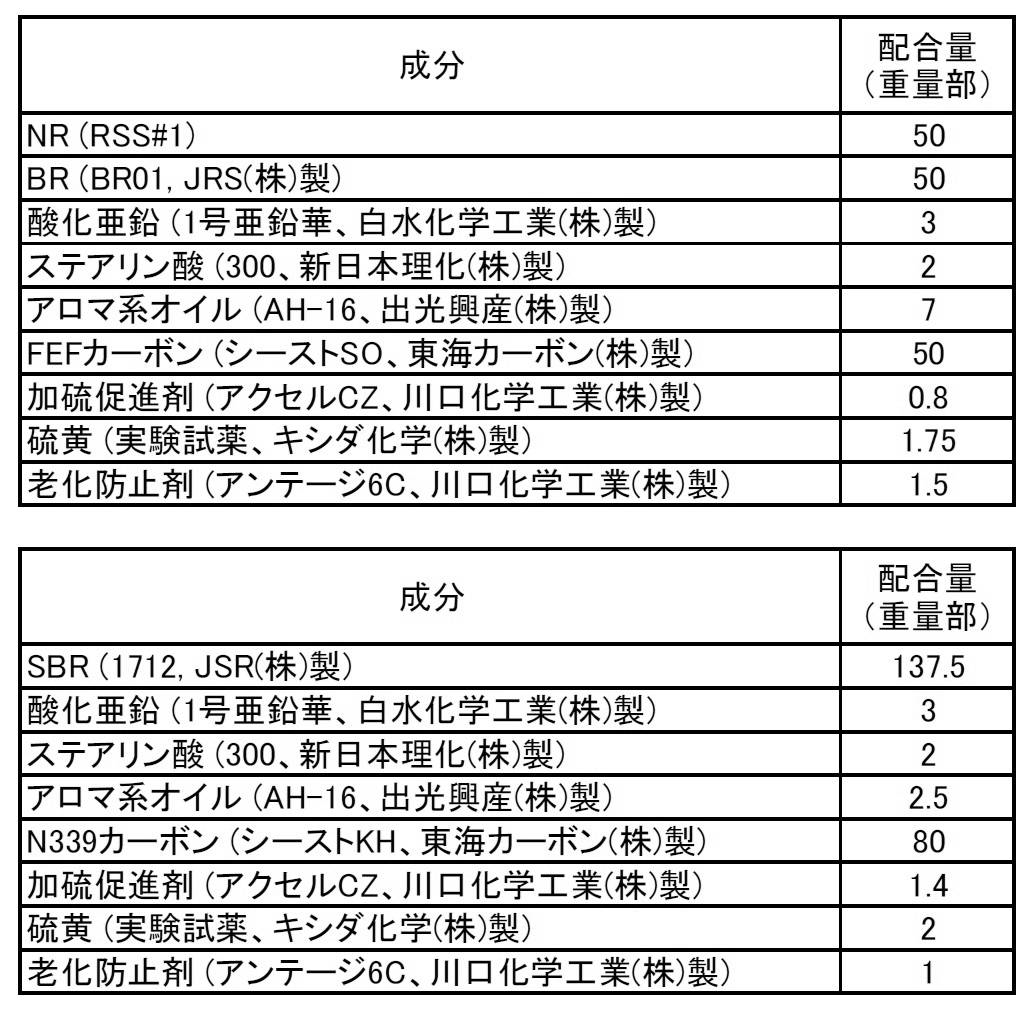
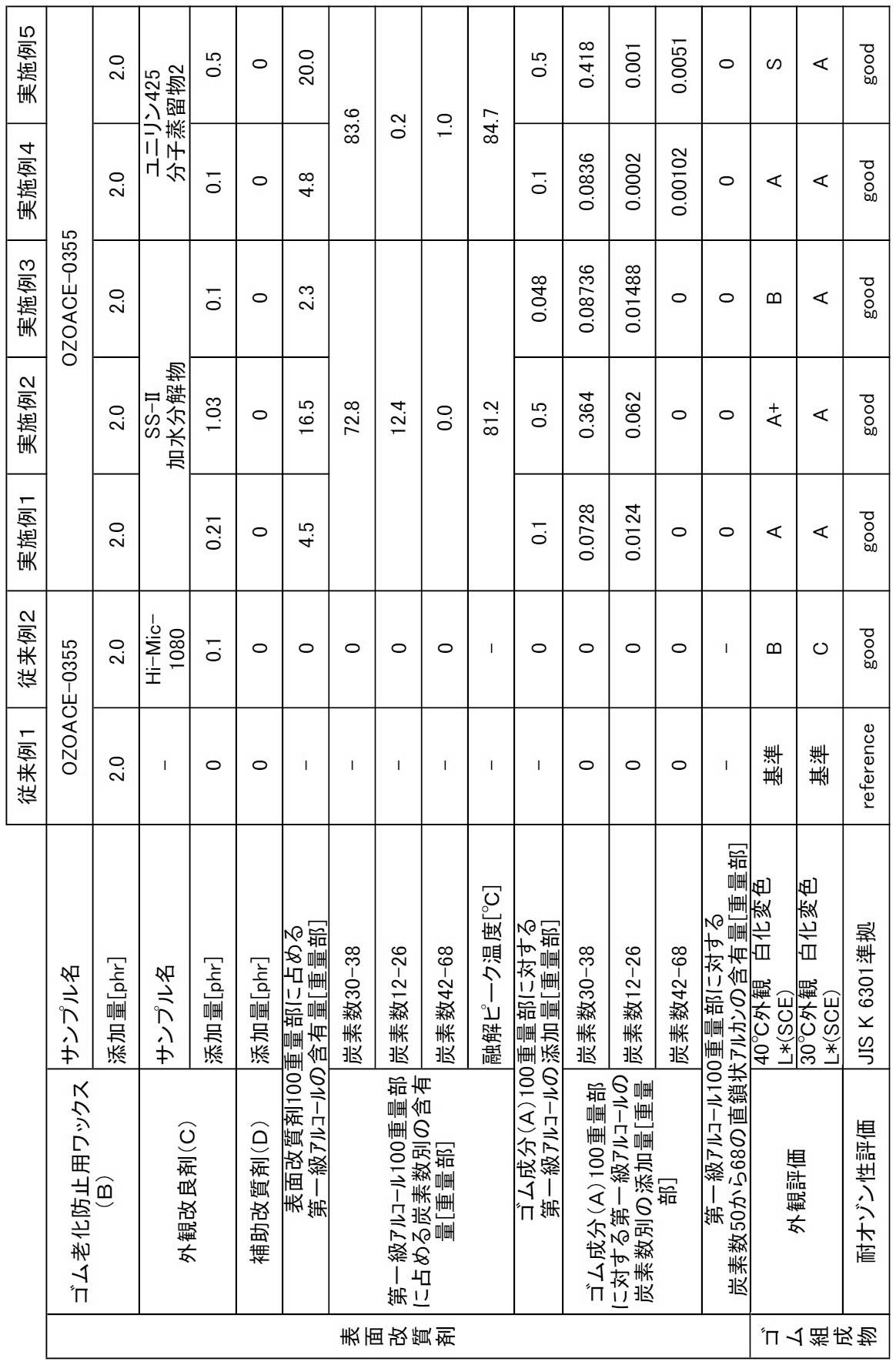
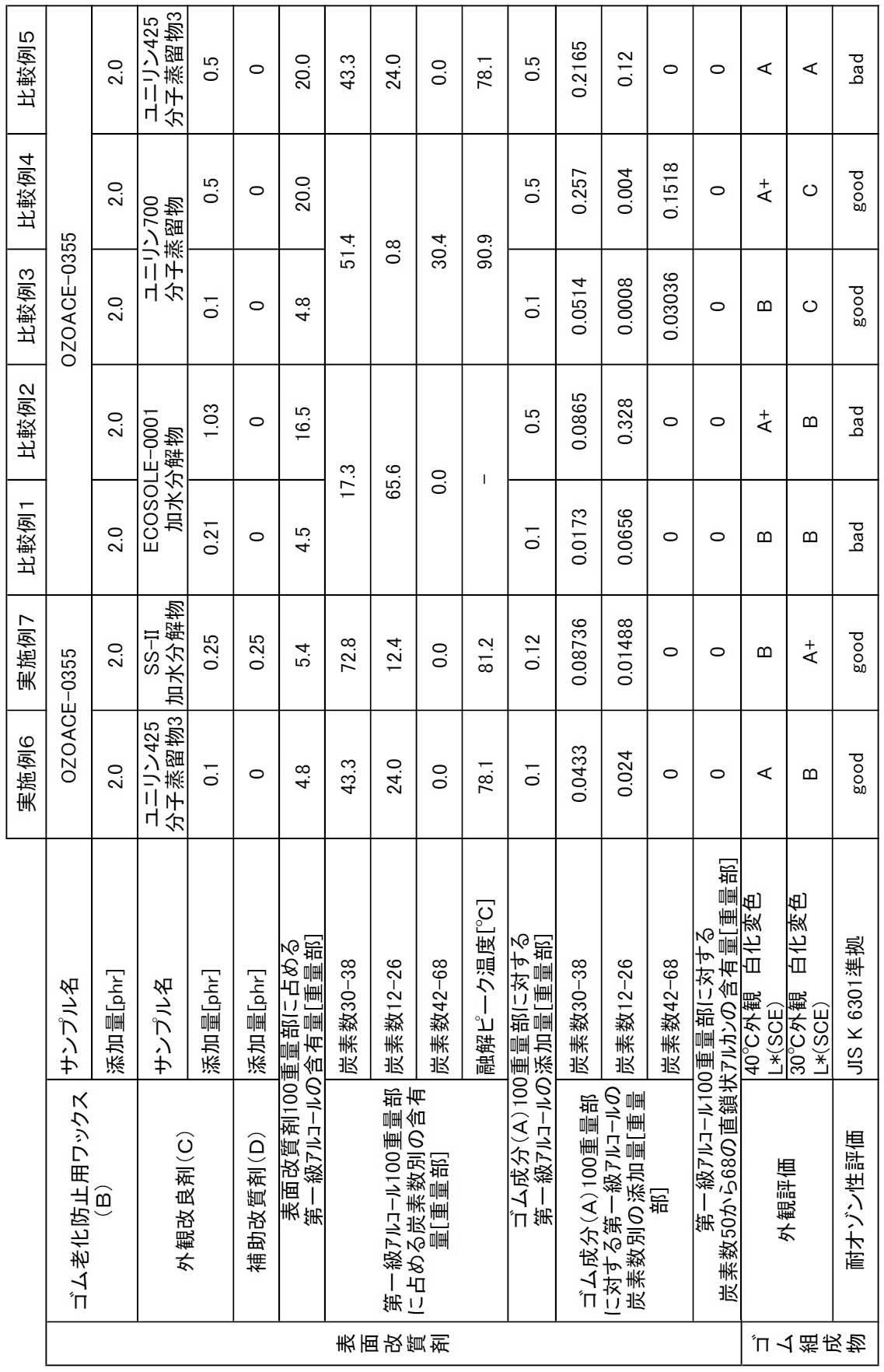
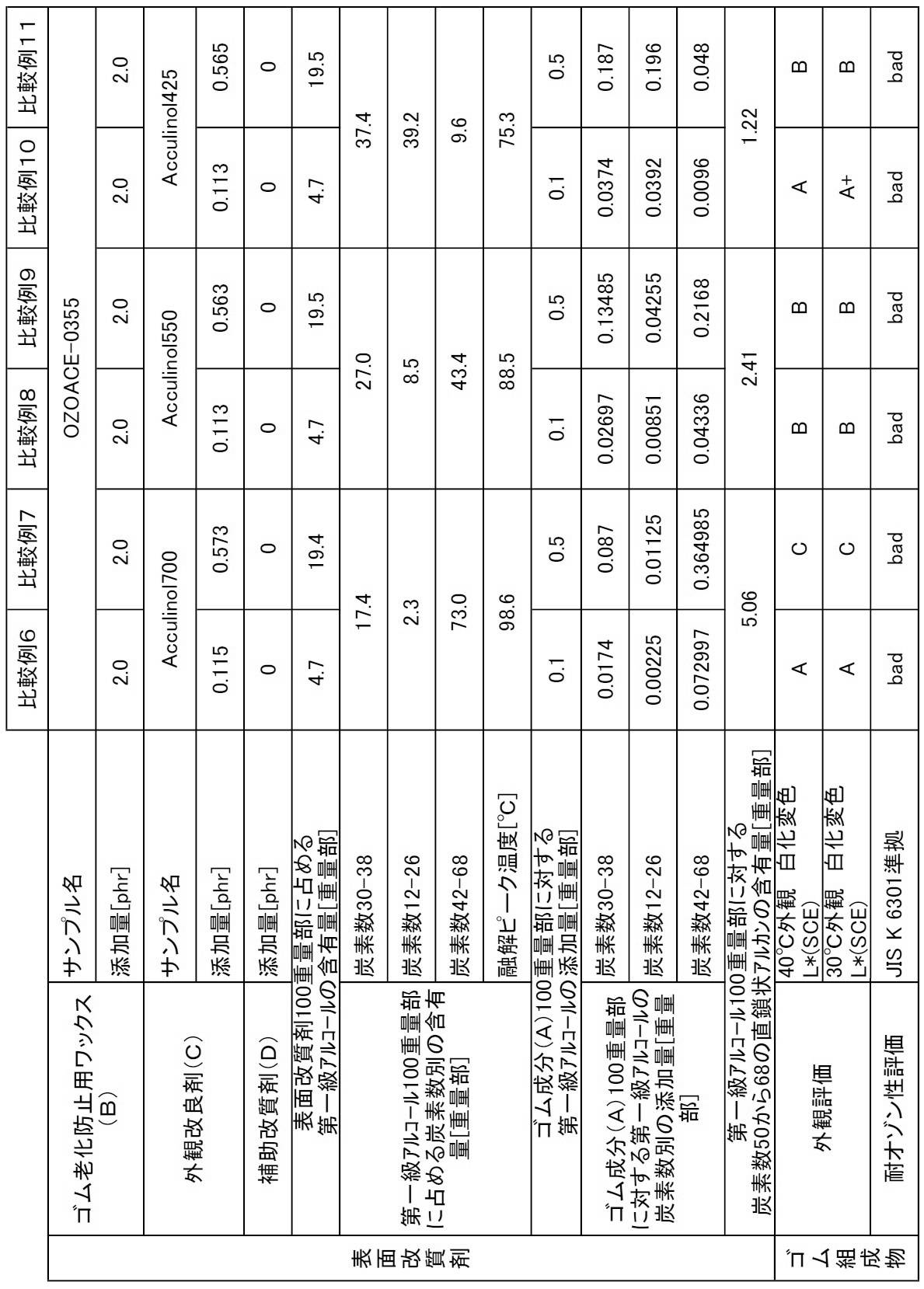
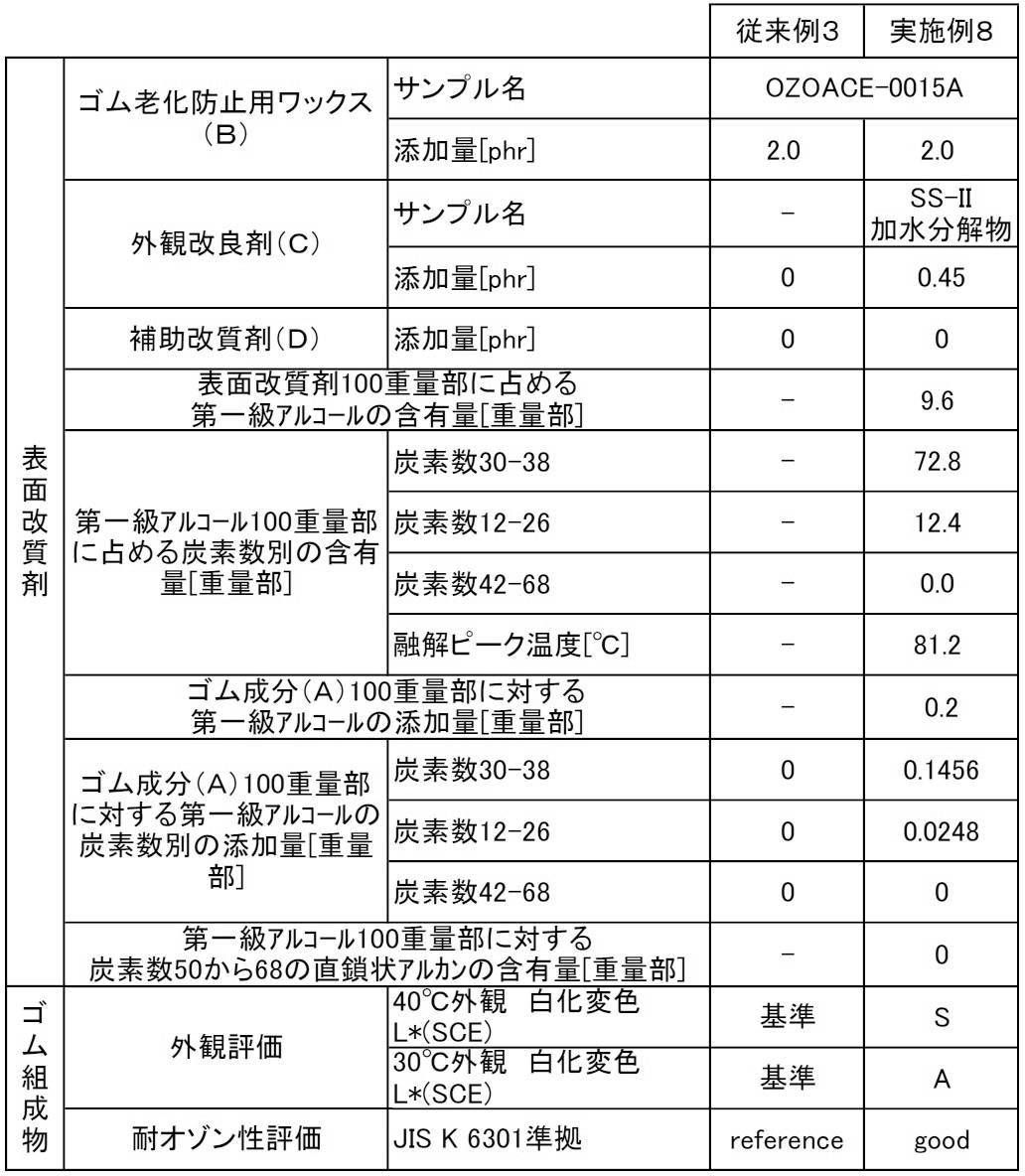
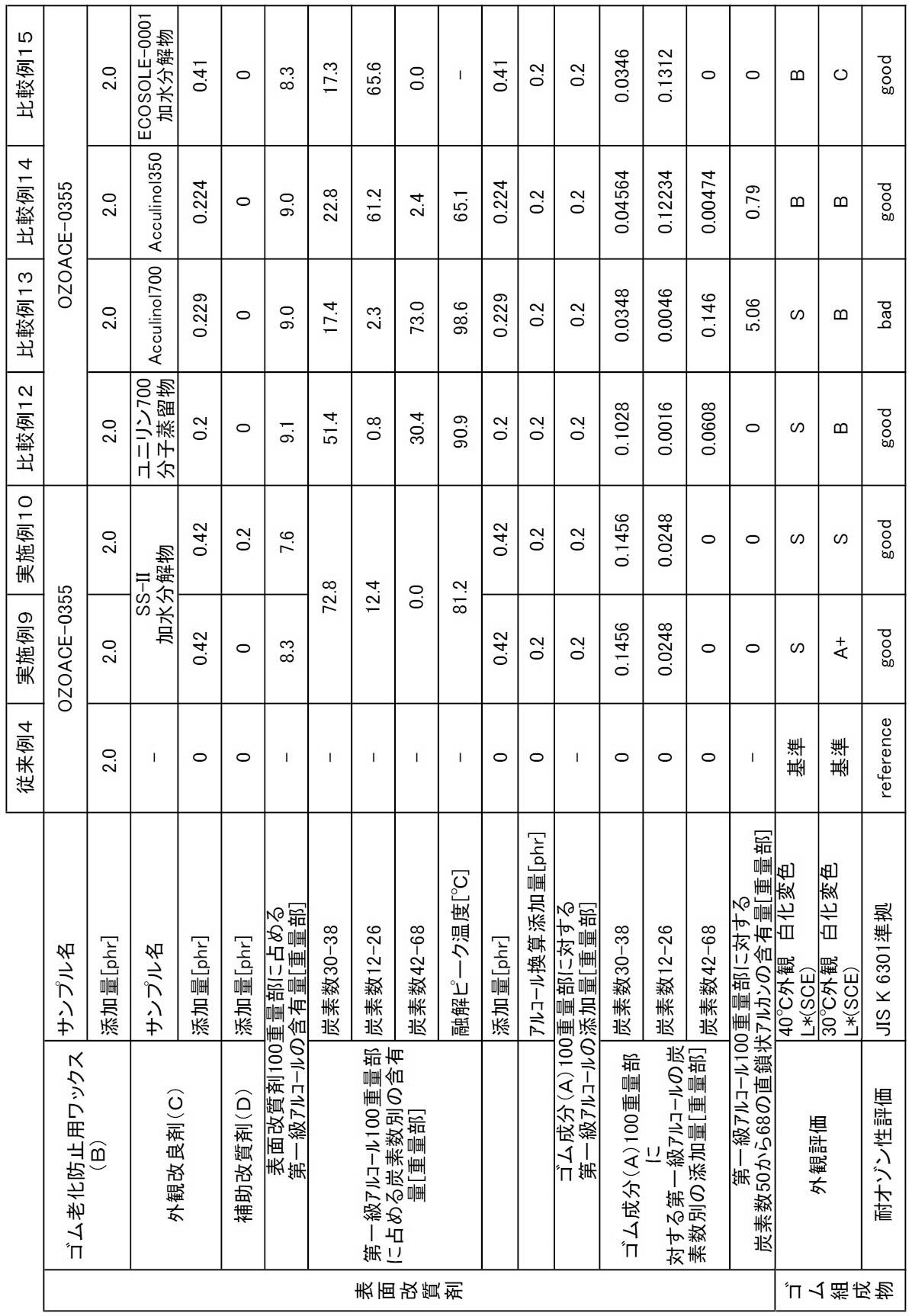


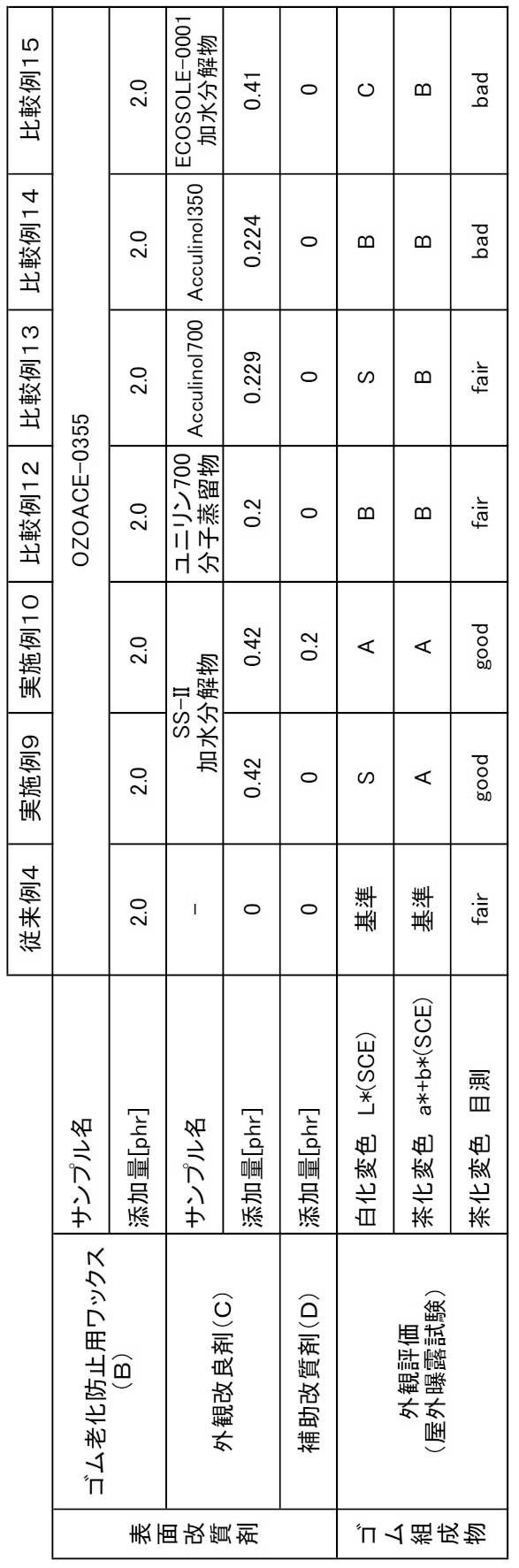
表2~表5の結果より、ゴム成分(A)として混合ゴム(NR/BR)を用いた場合について、次のことが理解される。
比較例1、2では、白化変色試験の結果は特に問題はなかったが、耐オゾン性が低下した。これは、第一級アルコール100重量部に占める炭素数が30から38の成分の含有量が好ましい範囲より少なく、炭素数が12から26の成分の含有量が好ましい範囲を超えているためであると考えられる。
比較例1、2では、白化変色試験の結果は特に問題はなかったが、耐オゾン性が低下した。これは、第一級アルコール100重量部に占める炭素数が30から38の成分の含有量が好ましい範囲より少なく、炭素数が12から26の成分の含有量が好ましい範囲を超えているためであると考えられる。
比較例3、4では、耐オゾン性試験の結果は良好であったが、30℃での白化変色試験の結果が非常に悪かった。これは、第一級アルコール100重量部に占める炭素数が42から68の成分の含有量が好ましい範囲を超えているためであると考えられる。なお、従来例2についても、耐オゾン性試験の結果は良好であったが、30℃での白化変色試験の結果が非常に悪かった。
比較例5は、表面改質剤に含まれる第一級アルコール100重量部に占める炭素数別の成分の含有量が好ましい範囲内にあり、白化変色試験の結果は特に問題はなかったが、ゴム組成物において、ゴム成分(A)100重量部に対する第一級アルコールの炭素数が12から26の成分の含有量が0.1重量部を超えており、耐オゾン性試験の結果が非常に悪かった。
比較例6~11は、いずれも市販の合成高級アルコールを用いた例であり、すべての例において耐オゾン性が低下した。
比較例6では、第一級アルコール100重量部に占める炭素数が30から38の成分の含有量が好ましい範囲より少なく、炭素数42から68の成分の含有量が好ましい範囲より多いにも関わらず、外観改良効果が得られた。これは、外観改良効果を持つ炭素数50以上のノルマルアルカンの含有量が比較的多いためであると理解される。一方、比較例7では炭素数が42から68の成分の含有量が好ましい範囲を超えており、ゴム成分(A)100重量部に対する第一級アルコールの添加量が0.5重量部であるので、ゴム組成物における炭素数が42から68の成分の添加量が多くなり、ゴム組成物の外観が大きく損なわれたと考えられる。また、炭素数が30から38の成分の含有量が好ましい範囲より少ないため、ゴム組成物に対する外観改良効果が十分に得られなかったと考えられる。比較例8、9では、炭素数が30から38の成分の含有量が好ましい範囲より少なく、炭素数が42から68の成分の含有量が好ましい範囲より多かったため外観改良効果が得られなかったと理解される。比較例6~9で、炭素数が12から26の成分の含有量が好ましい範囲にあるにも関わらず、耐オゾン性試験の結果が悪かったのは、炭素数50以上のノルマルアルカンの含有量が多いためと考えられる。
比較例10、11では、第一級アルコール100重量部に占める炭素数が30から38の成分の含有量が好ましい範囲内にあるため、比較例10のようにゴム成分(A)100重量部に対する第一級アルコールの添加量を0.1重量部とした場合に、ゴム組成物に対する一定の外観改良効果が得られたと理解される。一方、比較例11のようにゴム成分(A)100重量部に対する第一級アルコールの添加量を0.5重量部とすると、ゴム組成物における炭素数が42から68の成分の添加量が多くなるため、ゴム組成物に対する外観改良効果が低下したと考えられる。比較例10、11ともに、炭素数が12から26の成分の含有量が好ましい範囲を超えているため、耐オゾン性が低下したと考えられる。
以上のように、市販の合成高級アルコールを用いた場合、いずれも耐オゾン性が低下し、また、外観改良効果が十分得られない場合があった。
これに対し、実施例1~6では、40℃及び30℃の両方の温度条件で白化変色試験の結果が良好であり、加えて、耐オゾン性にも優れていた。また、実施例7のように補助改質剤を添加した例においても、白化変色試験及び耐オゾン性試験の両方で優れた結果が得られた。このように、本発明の表面改質剤を含有させることにより、耐オゾン性を損なうことなく、ゴム組成物の外観性を向上することができることが確認された。
また、実施例8に示すように、表面改質剤に含有させるゴム老化防止用ワックス(B)を実施例1~7とは異なるものを用いた場合でも、ゴム組成物の耐オゾン性を損なうことなく、外観性を向上することができることが確認された。
また、実施例8に示すように、表面改質剤に含有させるゴム老化防止用ワックス(B)を実施例1~7とは異なるものを用いた場合でも、ゴム組成物の耐オゾン性を損なうことなく、外観性を向上することができることが確認された。
また、表7及び8の結果より、屋外曝露試験においても、実施例1、2、4~6及び8で白化変色及び茶化変色が抑制され、従来例1、2、及び3より優れていることが確認された。
次に、表6及び表9の結果より、ゴム成分(A)としてスチレンブタジエンゴム(SBR)を用いた場合について、次のことが理解される。
比較例12では、白化変色試験、耐オゾン性試験の結果は特に問題はなかったが、屋外曝露試験における目測での茶化変色評価において外観が茶色みがかっており、実用上好ましくない。これは、第一級アルコール100重量部に占める炭素数が42から68の成分の含有量が好ましい範囲を超えているためであると考えられる。
比較例13、14は、市販の合成高級アルコールを用いた例である。
比較例13では、白化変色試験の結果は特に問題はなかったが、屋外曝露試験における目測での茶化変色評価において外観が茶色みがかっていた。これは、第一級アルコール100重量部に占める炭素数が30から38の成分の含有量が好ましい範囲より少なく、炭素数が42から68の成分の含有量が好ましい範囲を超えているためであると考えられる。なお、耐オゾン性が低下し、かつ40℃での白化変色試験及び屋外曝露試験における白化変色の評価結果が良好であったのは、炭素数50以上のノルマルアルカンの含有量が多いためであると理解される。
比較例14では、白化変色試験、耐オゾン性試験の結果は特に問題はなかったが、屋外曝露試験における目測での茶化変色評価において外観に明らかな茶化変色がみられた。これは、第一級アルコール100重量部に占める炭素数が30から38の成分の含有量が好ましい範囲より少なく、炭素数が12から26の成分の含有量が好ましい範囲を超えているためであると考えられる。
比較例15では、耐オゾン性試験の結果は良好であったが、30℃での白化変色試験の結果が非常に悪かった。また、屋外曝露試験における白化変色及び目測での茶化変色の評価結果も非常に悪かった。これは、第一級アルコール100重量部に占める炭素数が30から38の成分の含有量が好ましい範囲より少なく、炭素数が12から26の成分の含有量が好ましい範囲を超えているためであると考えられる。
これに対し、実施例9、10では、40℃及び30℃の両方の温度条件で白化変色試験の結果が非常に良好であり、加えて、耐オゾン性にも優れていた。また、屋外曝露試験においても、白化変色及び茶化変色が抑制され、従来例4及び比較例12~15より優れていることが確認された。
なお、本実施例では、ゴム成分(A)として、天然ゴムとブタジエンゴムを重量部で1:1の割合で配合した混合ゴム(NR/BR)及びスチレンブタジエンゴム(SBR)を用いた例を示したが、配合比の異なる混合ゴム、あるいは、他の種類のゴムを用いた場合にも、同様の結果が得られることが期待される。
以上、本発明の実施形態を詳述してきたが、具体的な形態はこれらの実施形態に限られるものではなく、本発明の要旨を逸脱しない範囲における設計の変更等があっても本発明に含まれる。
Claims (9)
- 炭化水素系のゴム老化防止用ワックス(B)と、外観改良剤(C)を含有するゴム組成物用表面改質剤であって、前記ゴム組成物用表面改質剤100重量部に占める直鎖である一価の第一級アルコールの含有量が1.5重量部を超え、35重量部未満であり、前記第一級アルコール100重量部に占める炭素数が30から38の成分の含有量が35重量部を超え、炭素数が12から26の成分の含有量が25重量部未満であり、炭素数が42から68の成分の含有量が25重量部未満であるゴム組成物用表面改質剤。
- 前記ゴム組成物用表面改質剤100重量部に占める前記第一級アルコールの含有量が2重量部を超え、25重量部未満である請求項1に記載のゴム組成物用表面改質剤。
- 前記第一級アルコール100重量部に占める炭素数が30から38の成分の含有量が70重量部を超え、炭素数が12から26の成分の含有量が15重量部未満であり、炭素数が42から68の成分の含有量が5重量部未満である請求項1又は2に記載のゴム組成物用表面改質剤。
- 植物蝋の加水分解物を含有する請求項1から3のいずれか一項に記載のゴム組成物用表面改質剤。
- 前記植物蝋がライスワックスである請求項4に記載のゴム組成物用表面改質剤。
- ゴム成分(A)と、請求項1から5のいずれか一項に記載のゴム組成物用表面改質剤を含有するゴム組成物であって、前記ゴム成分(A)100重量部に対して、前記ゴム組成物用表面改質剤の前記第一級アルコールの炭素数が12から26の成分の含有量が0.1重量部以下であるゴム組成物。
- 前記ゴム成分(A)100重量部に対して、前記ゴム組成物用表面改質剤の前記ゴム老化防止用ワックス(B)の含有量が0.1~10重量部であり、前記ゴム組成物用表面改質剤の前記第一級アルコールの含有量が0.03~1重量部である請求項6に記載のゴム組成物。
- 前記ゴム成分(A)100重量部に対して、前記ゴム組成物用表面改質剤の前記外観改良剤(C)の含有量が0.03~5重量部である請求項6又は7に記載のゴム組成物。
- 請求項6から8のいずれか一項に記載のゴム組成物を用いて作製した空気入りタイヤ。
Priority Applications (6)
| Application Number | Priority Date | Filing Date | Title |
|---|---|---|---|
| CN201880066794.8A CN111212872B (zh) | 2017-10-17 | 2018-08-28 | 橡胶组合物用表面改性剂及含有该改性剂的橡胶组合物 |
| MYPI2020001212A MY193769A (en) | 2017-10-17 | 2018-08-28 | Surface modifier for rubber composition, and rubber composition containing same |
| EP18867853.6A EP3699227A4 (en) | 2017-10-17 | 2018-08-28 | SURFACE MODIFIER FOR RUBBER COMPOSITION AND RUBBER COMPOSITION WITH IT |
| JP2019549138A JP6878611B2 (ja) | 2017-10-17 | 2018-08-28 | ゴム組成物用表面改質剤及びこれを含有するゴム組成物 |
| KR1020207004160A KR102628623B1 (ko) | 2017-10-17 | 2018-08-28 | 고무 조성물용 표면 개질제 및 이것을 함유하는 고무 조성물 |
| US16/646,247 US11390749B2 (en) | 2017-10-17 | 2018-08-28 | Surface modifier for rubber composition, and rubber composition containing same |
Applications Claiming Priority (4)
| Application Number | Priority Date | Filing Date | Title |
|---|---|---|---|
| JP2017-200827 | 2017-10-17 | ||
| JP2017200827 | 2017-10-17 | ||
| JP2017244751 | 2017-12-21 | ||
| JP2017-244751 | 2017-12-21 |
Publications (1)
| Publication Number | Publication Date |
|---|---|
| WO2019077885A1 true WO2019077885A1 (ja) | 2019-04-25 |
Family
ID=66173609
Family Applications (1)
| Application Number | Title | Priority Date | Filing Date |
|---|---|---|---|
| PCT/JP2018/031731 Ceased WO2019077885A1 (ja) | 2017-10-17 | 2018-08-28 | ゴム組成物用表面改質剤及びこれを含有するゴム組成物 |
Country Status (8)
| Country | Link |
|---|---|
| US (1) | US11390749B2 (ja) |
| EP (1) | EP3699227A4 (ja) |
| JP (1) | JP6878611B2 (ja) |
| KR (1) | KR102628623B1 (ja) |
| CN (1) | CN111212872B (ja) |
| MY (1) | MY193769A (ja) |
| TW (1) | TWI758540B (ja) |
| WO (1) | WO2019077885A1 (ja) |
Cited By (2)
| Publication number | Priority date | Publication date | Assignee | Title |
|---|---|---|---|---|
| JP2021155583A (ja) * | 2020-03-27 | 2021-10-07 | 住友ゴム工業株式会社 | ゴム組成物及びタイヤ |
| WO2022209783A1 (ja) * | 2021-03-31 | 2022-10-06 | 横浜ゴム株式会社 | タイヤ用ゴム組成物 |
Families Citing this family (1)
| Publication number | Priority date | Publication date | Assignee | Title |
|---|---|---|---|---|
| CN112552694B (zh) * | 2019-09-26 | 2022-08-23 | 彤程化学(中国)有限公司 | 一种新型防护蜡及其在二烯烃橡胶领域的应用 |
Citations (8)
| Publication number | Priority date | Publication date | Assignee | Title |
|---|---|---|---|---|
| JPS4990739A (ja) * | 1972-12-29 | 1974-08-29 | ||
| JPH06212187A (ja) | 1993-01-14 | 1994-08-02 | Miyoshi Oil & Fat Co Ltd | ワックスの長鎖脂肪酸と高級アルコールとの分離方法 |
| JP2002060547A (ja) | 2000-08-23 | 2002-02-26 | Nippon Seiro Co Ltd | コ゛ム組成物 |
| JP2004217633A (ja) * | 2002-12-25 | 2004-08-05 | Nof Corp | 高級アルコールの製造方法 |
| JP2010138272A (ja) * | 2008-12-11 | 2010-06-24 | Yokohama Rubber Co Ltd:The | タイヤトレッド用ゴム組成物 |
| JP2011089098A (ja) | 2009-10-23 | 2011-05-06 | Nippon Seiro Co Ltd | ゴム組成物 |
| JP2013227385A (ja) * | 2012-04-24 | 2013-11-07 | Sumitomo Rubber Ind Ltd | タイヤ用ゴム組成物及び空気入りタイヤ |
| JP5475579B2 (ja) | 2010-07-13 | 2014-04-16 | 住友ゴム工業株式会社 | タイヤ用ゴム組成物及び空気入りタイヤ |
Family Cites Families (10)
| Publication number | Priority date | Publication date | Assignee | Title |
|---|---|---|---|---|
| JPS6025833Y2 (ja) | 1977-09-30 | 1985-08-02 | 東芝テック株式会社 | コ−ド巻取装置 |
| JPS5475579U (ja) | 1977-11-08 | 1979-05-29 | ||
| US7498366B2 (en) * | 2006-07-07 | 2009-03-03 | Sumitomo Rubber Industries, Ltd. | Rubber composition for sidewall and pneumatic tire having sidewall using same |
| KR20100024933A (ko) * | 2007-06-05 | 2010-03-08 | 스미토모 고무 고교 가부시키가이샤 | 타이어용 고무 조성물, 타이어 부재, 베이스 트레드용 고무 조성물, 베이스 트레드 및 타이어 |
| JP5470219B2 (ja) * | 2010-10-25 | 2014-04-16 | 住友ゴム工業株式会社 | タイヤ用ゴム組成物及び空気入りタイヤ |
| JP5391312B2 (ja) * | 2011-09-26 | 2014-01-15 | 住友ゴム工業株式会社 | タイヤ外層用ゴム組成物及び空気入りタイヤ |
| BR112015008275A2 (pt) * | 2012-10-20 | 2017-07-04 | Clariant Finance Bvi Ltd | produtos da oxidação da cera do farelo de arroz |
| JP6151991B2 (ja) * | 2013-07-05 | 2017-06-21 | 住友ゴム工業株式会社 | タイヤ用ゴム組成物及び空気入りタイヤ |
| JP5960732B2 (ja) * | 2013-07-05 | 2016-08-02 | 住友ゴム工業株式会社 | タイヤ用ゴム組成物及び空気入りタイヤ |
| JP6644253B2 (ja) * | 2015-12-02 | 2020-02-12 | 横浜ゴム株式会社 | ゴム組成物及びホース |
-
2018
- 2018-08-28 KR KR1020207004160A patent/KR102628623B1/ko active Active
- 2018-08-28 WO PCT/JP2018/031731 patent/WO2019077885A1/ja not_active Ceased
- 2018-08-28 EP EP18867853.6A patent/EP3699227A4/en not_active Withdrawn
- 2018-08-28 CN CN201880066794.8A patent/CN111212872B/zh active Active
- 2018-08-28 MY MYPI2020001212A patent/MY193769A/en unknown
- 2018-08-28 US US16/646,247 patent/US11390749B2/en active Active
- 2018-08-28 JP JP2019549138A patent/JP6878611B2/ja active Active
- 2018-09-10 TW TW107131685A patent/TWI758540B/zh active
Patent Citations (9)
| Publication number | Priority date | Publication date | Assignee | Title |
|---|---|---|---|---|
| JPS4990739A (ja) * | 1972-12-29 | 1974-08-29 | ||
| JPH06212187A (ja) | 1993-01-14 | 1994-08-02 | Miyoshi Oil & Fat Co Ltd | ワックスの長鎖脂肪酸と高級アルコールとの分離方法 |
| JP2002060547A (ja) | 2000-08-23 | 2002-02-26 | Nippon Seiro Co Ltd | コ゛ム組成物 |
| JP2004217633A (ja) * | 2002-12-25 | 2004-08-05 | Nof Corp | 高級アルコールの製造方法 |
| JP2010138272A (ja) * | 2008-12-11 | 2010-06-24 | Yokohama Rubber Co Ltd:The | タイヤトレッド用ゴム組成物 |
| JP2011089098A (ja) | 2009-10-23 | 2011-05-06 | Nippon Seiro Co Ltd | ゴム組成物 |
| JP5475579B2 (ja) | 2010-07-13 | 2014-04-16 | 住友ゴム工業株式会社 | タイヤ用ゴム組成物及び空気入りタイヤ |
| JP2013227385A (ja) * | 2012-04-24 | 2013-11-07 | Sumitomo Rubber Ind Ltd | タイヤ用ゴム組成物及び空気入りタイヤ |
| JP5457492B2 (ja) | 2012-04-24 | 2014-04-02 | 住友ゴム工業株式会社 | タイヤ用ゴム組成物及び空気入りタイヤ |
Non-Patent Citations (2)
| Title |
|---|
| ISAO MATSUMOTO, ET AL.: "Systematic Analysis of Natural Raw Waxes (Carnauba Wax, Candelilla Wax and Bees Wax) and Pattern-Analysis of Carbon Chain Length of Their Components", NIPPON KAGAKUA KAISHI, vol. 1972, 10 May 1972 (1972-05-10), pages 951 - 957, XP055597417 * |
| See also references of EP3699227A4 |
Cited By (5)
| Publication number | Priority date | Publication date | Assignee | Title |
|---|---|---|---|---|
| JP2021155583A (ja) * | 2020-03-27 | 2021-10-07 | 住友ゴム工業株式会社 | ゴム組成物及びタイヤ |
| JP7484311B2 (ja) | 2020-03-27 | 2024-05-16 | 住友ゴム工業株式会社 | ゴム組成物及びタイヤ |
| WO2022209783A1 (ja) * | 2021-03-31 | 2022-10-06 | 横浜ゴム株式会社 | タイヤ用ゴム組成物 |
| JP2022156284A (ja) * | 2021-03-31 | 2022-10-14 | 横浜ゴム株式会社 | タイヤ用ゴム組成物 |
| JP7173198B2 (ja) | 2021-03-31 | 2022-11-16 | 横浜ゴム株式会社 | タイヤ用ゴム組成物 |
Also Published As
| Publication number | Publication date |
|---|---|
| KR20200067830A (ko) | 2020-06-12 |
| CN111212872B (zh) | 2022-07-19 |
| EP3699227A4 (en) | 2021-08-04 |
| TWI758540B (zh) | 2022-03-21 |
| US20200207987A1 (en) | 2020-07-02 |
| US11390749B2 (en) | 2022-07-19 |
| EP3699227A1 (en) | 2020-08-26 |
| MY193769A (en) | 2022-10-27 |
| TW201922887A (zh) | 2019-06-16 |
| JPWO2019077885A1 (ja) | 2020-04-16 |
| CN111212872A (zh) | 2020-05-29 |
| JP6878611B2 (ja) | 2021-05-26 |
| KR102628623B1 (ko) | 2024-01-24 |
Similar Documents
| Publication | Publication Date | Title |
|---|---|---|
| JP5638966B2 (ja) | タイヤ用ゴム組成物及びトラック・バス用タイヤ | |
| JP6113189B2 (ja) | ゴム組成物及びそれを用いたタイヤ | |
| US8969454B2 (en) | Vegetable oil derivatives as extender oils for elastomer compositions | |
| JP6878611B2 (ja) | ゴム組成物用表面改質剤及びこれを含有するゴム組成物 | |
| JP5480790B2 (ja) | サイドウォール又はトレッド用ゴム組成物及び空気入りタイヤ | |
| JP5470219B2 (ja) | タイヤ用ゴム組成物及び空気入りタイヤ | |
| JPH11199711A (ja) | ゴム組成物 | |
| JP5662384B2 (ja) | サイドウォール用ゴム組成物及び空気入りタイヤ | |
| JP5662388B2 (ja) | タイヤ用ゴム組成物及びスタッドレスタイヤ | |
| JP6532078B2 (ja) | ゴム組成物及びそれから製造したタイヤ部品又は部材 | |
| JP5687661B2 (ja) | タイヤ用ゴム組成物及び空気入りタイヤ | |
| WO2023013781A1 (ja) | タイヤ用ゴム組成物及びタイヤ | |
| JP2011089098A (ja) | ゴム組成物 | |
| JP2013163713A (ja) | タイヤ用ゴム組成物及びそれを用いたタイヤ | |
| JP5687660B2 (ja) | タイヤ用ゴム組成物及び空気入りタイヤ | |
| JP2000071711A (ja) | タイヤ用ゴム組成物 | |
| JP7173198B2 (ja) | タイヤ用ゴム組成物 | |
| JP2004300361A (ja) | タイヤ用未加硫ゴム組成物及びタイヤ | |
| JP2004300362A (ja) | タイヤ用未加硫ゴム組成物及びタイヤ | |
| JP5869433B2 (ja) | タイヤ用ゴム組成物及び空気入りタイヤ | |
| JP2002060547A (ja) | コ゛ム組成物 | |
| WO2015005384A1 (ja) | ゴム組成物およびそれを用いた空気入りタイヤ | |
| JP2016113492A (ja) | タイヤサイドウォール用ゴム組成物 | |
| JPS6031541A (ja) | ゴム組成物 | |
| JP2008255162A (ja) | 空気入りタイヤ |
Legal Events
| Date | Code | Title | Description |
|---|---|---|---|
| 121 | Ep: the epo has been informed by wipo that ep was designated in this application |
Ref document number: 18867853 Country of ref document: EP Kind code of ref document: A1 |
|
| ENP | Entry into the national phase |
Ref document number: 2019549138 Country of ref document: JP Kind code of ref document: A |
|
| NENP | Non-entry into the national phase |
Ref country code: DE |
|
| ENP | Entry into the national phase |
Ref document number: 2018867853 Country of ref document: EP Effective date: 20200518 |