WO2019078027A1 - 硬化性組成物、膜、硬化物、医療用部材 - Google Patents
硬化性組成物、膜、硬化物、医療用部材 Download PDFInfo
- Publication number
- WO2019078027A1 WO2019078027A1 PCT/JP2018/037287 JP2018037287W WO2019078027A1 WO 2019078027 A1 WO2019078027 A1 WO 2019078027A1 JP 2018037287 W JP2018037287 W JP 2018037287W WO 2019078027 A1 WO2019078027 A1 WO 2019078027A1
- Authority
- WO
- WIPO (PCT)
- Prior art keywords
- group
- formula
- hydrogen atom
- alkyl group
- substituent
- Prior art date
- Legal status (The legal status is an assumption and is not a legal conclusion. Google has not performed a legal analysis and makes no representation as to the accuracy of the status listed.)
- Ceased
Links
Classifications
-
- C—CHEMISTRY; METALLURGY
- C08—ORGANIC MACROMOLECULAR COMPOUNDS; THEIR PREPARATION OR CHEMICAL WORKING-UP; COMPOSITIONS BASED THEREON
- C08F—MACROMOLECULAR COMPOUNDS OBTAINED BY REACTIONS ONLY INVOLVING CARBON-TO-CARBON UNSATURATED BONDS
- C08F220/00—Copolymers of compounds having one or more unsaturated aliphatic radicals, each having only one carbon-to-carbon double bond, and only one being terminated by only one carboxyl radical or a salt, anhydride ester, amide, imide or nitrile thereof
- C08F220/02—Monocarboxylic acids having less than ten carbon atoms; Derivatives thereof
- C08F220/10—Esters
- C08F220/34—Esters containing nitrogen, e.g. N,N-dimethylaminoethyl (meth)acrylate
- C08F220/36—Esters containing nitrogen, e.g. N,N-dimethylaminoethyl (meth)acrylate containing oxygen in addition to the carboxy oxygen, e.g. 2-N-morpholinoethyl (meth)acrylate or 2-isocyanatoethyl (meth)acrylate
- C08F220/365—Esters containing nitrogen, e.g. N,N-dimethylaminoethyl (meth)acrylate containing oxygen in addition to the carboxy oxygen, e.g. 2-N-morpholinoethyl (meth)acrylate or 2-isocyanatoethyl (meth)acrylate containing further carboxylic moieties
-
- C—CHEMISTRY; METALLURGY
- C08—ORGANIC MACROMOLECULAR COMPOUNDS; THEIR PREPARATION OR CHEMICAL WORKING-UP; COMPOSITIONS BASED THEREON
- C08F—MACROMOLECULAR COMPOUNDS OBTAINED BY REACTIONS ONLY INVOLVING CARBON-TO-CARBON UNSATURATED BONDS
- C08F122/00—Homopolymers of compounds having one or more unsaturated aliphatic radicals each having only one carbon-to-carbon double bond, and at least one being terminated by a carboxyl radical and containing at least one other carboxyl radical in the molecule; Salts, anhydrides, esters, amides, imides or nitriles thereof
- C08F122/10—Esters
- C08F122/1006—Esters of polyhydric alcohols or polyhydric phenols, e.g. ethylene glycol dimethacrylate
-
- A—HUMAN NECESSITIES
- A61—MEDICAL OR VETERINARY SCIENCE; HYGIENE
- A61L—METHODS OR APPARATUS FOR STERILISING MATERIALS OR OBJECTS IN GENERAL; DISINFECTION, STERILISATION OR DEODORISATION OF AIR; CHEMICAL ASPECTS OF BANDAGES, DRESSINGS, ABSORBENT PADS OR SURGICAL ARTICLES; MATERIALS FOR BANDAGES, DRESSINGS, ABSORBENT PADS OR SURGICAL ARTICLES
- A61L27/00—Materials for grafts or prostheses or for coating grafts or prostheses
- A61L27/28—Materials for coating prostheses
- A61L27/34—Macromolecular materials
-
- C—CHEMISTRY; METALLURGY
- C07—ORGANIC CHEMISTRY
- C07C—ACYCLIC OR CARBOCYCLIC COMPOUNDS
- C07C271/00—Derivatives of carbamic acids, i.e. compounds containing any of the groups, the nitrogen atom not being part of nitro or nitroso groups
- C07C271/06—Esters of carbamic acids
- C07C271/08—Esters of carbamic acids having oxygen atoms of carbamate groups bound to acyclic carbon atoms
- C07C271/10—Esters of carbamic acids having oxygen atoms of carbamate groups bound to acyclic carbon atoms with the nitrogen atoms of the carbamate groups bound to hydrogen atoms or to acyclic carbon atoms
- C07C271/16—Esters of carbamic acids having oxygen atoms of carbamate groups bound to acyclic carbon atoms with the nitrogen atoms of the carbamate groups bound to hydrogen atoms or to acyclic carbon atoms to carbon atoms of hydrocarbon radicals substituted by singly-bound oxygen atoms
-
- C—CHEMISTRY; METALLURGY
- C07—ORGANIC CHEMISTRY
- C07C—ACYCLIC OR CARBOCYCLIC COMPOUNDS
- C07C309/00—Sulfonic acids; Halides, esters, or anhydrides thereof
- C07C309/01—Sulfonic acids
- C07C309/02—Sulfonic acids having sulfo groups bound to acyclic carbon atoms
- C07C309/03—Sulfonic acids having sulfo groups bound to acyclic carbon atoms of an acyclic saturated carbon skeleton
- C07C309/13—Sulfonic acids having sulfo groups bound to acyclic carbon atoms of an acyclic saturated carbon skeleton containing nitrogen atoms, not being part of nitro or nitroso groups, bound to the carbon skeleton
- C07C309/14—Sulfonic acids having sulfo groups bound to acyclic carbon atoms of an acyclic saturated carbon skeleton containing nitrogen atoms, not being part of nitro or nitroso groups, bound to the carbon skeleton containing amino groups bound to the carbon skeleton
-
- C—CHEMISTRY; METALLURGY
- C08—ORGANIC MACROMOLECULAR COMPOUNDS; THEIR PREPARATION OR CHEMICAL WORKING-UP; COMPOSITIONS BASED THEREON
- C08F—MACROMOLECULAR COMPOUNDS OBTAINED BY REACTIONS ONLY INVOLVING CARBON-TO-CARBON UNSATURATED BONDS
- C08F2/00—Processes of polymerisation
-
- C—CHEMISTRY; METALLURGY
- C08—ORGANIC MACROMOLECULAR COMPOUNDS; THEIR PREPARATION OR CHEMICAL WORKING-UP; COMPOSITIONS BASED THEREON
- C08F—MACROMOLECULAR COMPOUNDS OBTAINED BY REACTIONS ONLY INVOLVING CARBON-TO-CARBON UNSATURATED BONDS
- C08F2/00—Processes of polymerisation
- C08F2/46—Polymerisation initiated by wave energy or particle radiation
- C08F2/48—Polymerisation initiated by wave energy or particle radiation by ultraviolet or visible light
-
- C—CHEMISTRY; METALLURGY
- C08—ORGANIC MACROMOLECULAR COMPOUNDS; THEIR PREPARATION OR CHEMICAL WORKING-UP; COMPOSITIONS BASED THEREON
- C08F—MACROMOLECULAR COMPOUNDS OBTAINED BY REACTIONS ONLY INVOLVING CARBON-TO-CARBON UNSATURATED BONDS
- C08F20/00—Homopolymers and copolymers of compounds having one or more unsaturated aliphatic radicals, each having only one carbon-to-carbon double bond, and only one being terminated by only one carboxyl radical or a salt, anhydride, ester, amide, imide or nitrile thereof
- C08F20/02—Monocarboxylic acids having less than ten carbon atoms, Derivatives thereof
- C08F20/10—Esters
- C08F20/34—Esters containing nitrogen, e.g. N,N-dimethylaminoethyl (meth)acrylate
- C08F20/36—Esters containing nitrogen, e.g. N,N-dimethylaminoethyl (meth)acrylate containing oxygen in addition to the carboxy oxygen, e.g. 2-N-morpholinoethyl (meth)acrylate or 2-isocyanatoethyl (meth)acrylate
-
- C—CHEMISTRY; METALLURGY
- C08—ORGANIC MACROMOLECULAR COMPOUNDS; THEIR PREPARATION OR CHEMICAL WORKING-UP; COMPOSITIONS BASED THEREON
- C08F—MACROMOLECULAR COMPOUNDS OBTAINED BY REACTIONS ONLY INVOLVING CARBON-TO-CARBON UNSATURATED BONDS
- C08F220/00—Copolymers of compounds having one or more unsaturated aliphatic radicals, each having only one carbon-to-carbon double bond, and only one being terminated by only one carboxyl radical or a salt, anhydride ester, amide, imide or nitrile thereof
- C08F220/02—Monocarboxylic acids having less than ten carbon atoms; Derivatives thereof
- C08F220/10—Esters
- C08F220/38—Esters containing sulfur
- C08F220/387—Esters containing sulfur and containing nitrogen and oxygen
-
- C—CHEMISTRY; METALLURGY
- C08—ORGANIC MACROMOLECULAR COMPOUNDS; THEIR PREPARATION OR CHEMICAL WORKING-UP; COMPOSITIONS BASED THEREON
- C08F—MACROMOLECULAR COMPOUNDS OBTAINED BY REACTIONS ONLY INVOLVING CARBON-TO-CARBON UNSATURATED BONDS
- C08F220/00—Copolymers of compounds having one or more unsaturated aliphatic radicals, each having only one carbon-to-carbon double bond, and only one being terminated by only one carboxyl radical or a salt, anhydride ester, amide, imide or nitrile thereof
- C08F220/02—Monocarboxylic acids having less than ten carbon atoms; Derivatives thereof
- C08F220/52—Amides or imides
- C08F220/54—Amides, e.g. N,N-dimethylacrylamide or N-isopropylacrylamide
- C08F220/56—Acrylamide; Methacrylamide
-
- C—CHEMISTRY; METALLURGY
- C08—ORGANIC MACROMOLECULAR COMPOUNDS; THEIR PREPARATION OR CHEMICAL WORKING-UP; COMPOSITIONS BASED THEREON
- C08F—MACROMOLECULAR COMPOUNDS OBTAINED BY REACTIONS ONLY INVOLVING CARBON-TO-CARBON UNSATURATED BONDS
- C08F222/00—Copolymers of compounds having one or more unsaturated aliphatic radicals, each having only one carbon-to-carbon double bond, and at least one being terminated by a carboxyl radical and containing at least one other carboxyl radical in the molecule; Salts, anhydrides, esters, amides, imides, or nitriles thereof
- C08F222/10—Esters
- C08F222/1006—Esters of polyhydric alcohols or polyhydric phenols
- C08F222/102—Esters of polyhydric alcohols or polyhydric phenols of dialcohols, e.g. ethylene glycol di(meth)acrylate or 1,4-butanediol dimethacrylate
-
- C—CHEMISTRY; METALLURGY
- C09—DYES; PAINTS; POLISHES; NATURAL RESINS; ADHESIVES; COMPOSITIONS NOT OTHERWISE PROVIDED FOR; APPLICATIONS OF MATERIALS NOT OTHERWISE PROVIDED FOR
- C09D—COATING COMPOSITIONS, e.g. PAINTS, VARNISHES OR LACQUERS; FILLING PASTES; CHEMICAL PAINT OR INK REMOVERS; INKS; CORRECTING FLUIDS; WOODSTAINS; PASTES OR SOLIDS FOR COLOURING OR PRINTING; USE OF MATERIALS THEREFOR
- C09D135/00—Coating compositions based on homopolymers or copolymers of compounds having one or more unsaturated aliphatic radicals, each having only one carbon-to-carbon double bond, and at least one being terminated by a carboxyl radical, and containing at least another carboxyl radical in the molecule, or of salts, anhydrides, esters, amides, imides or nitriles thereof; Coating compositions based on derivatives of such polymers
-
- A—HUMAN NECESSITIES
- A61—MEDICAL OR VETERINARY SCIENCE; HYGIENE
- A61K—PREPARATIONS FOR MEDICAL, DENTAL OR TOILETRY PURPOSES
- A61K6/00—Preparations for dentistry
-
- A—HUMAN NECESSITIES
- A61—MEDICAL OR VETERINARY SCIENCE; HYGIENE
- A61L—METHODS OR APPARATUS FOR STERILISING MATERIALS OR OBJECTS IN GENERAL; DISINFECTION, STERILISATION OR DEODORISATION OF AIR; CHEMICAL ASPECTS OF BANDAGES, DRESSINGS, ABSORBENT PADS OR SURGICAL ARTICLES; MATERIALS FOR BANDAGES, DRESSINGS, ABSORBENT PADS OR SURGICAL ARTICLES
- A61L27/00—Materials for grafts or prostheses or for coating grafts or prostheses
- A61L27/14—Macromolecular materials
- A61L27/16—Macromolecular materials obtained by reactions only involving carbon-to-carbon unsaturated bonds
Definitions
- the present invention relates to a curable composition, a film, a cured product, and a medical member.
- artificial organs and medical instruments and the like are originally made of a material that is compatible with substances that constitute a living body and that are not easily contaminated. For example, it is desirable not to cause inflammatory reaction and rejection reaction to those introduced for a long time into the human body such as artificial blood vessels, catheters, stents, artificial bones and dentures. In addition, replacement due to contamination leads to burden on patients. For this reason, it is desirable that the artificial organ and the medical device or the like be formed of a material that has a small interaction with biological substances such as proteins, blood cells, and cells, that is, the above-mentioned biological substances do not easily adhere (adhere).
- Patent Document 1 discloses “a biomaterial non-adhesive material containing a polymer compound (A) containing a repeating unit derived from a sulfobetaine monomer having a predetermined structure”.
- a curable composition containing a sulfobetaine monomer having the above-described predetermined structure and a (meth) acrylate monomer or N- [tris (3-acrylamidopropoxymethyl) methyl] acrylamide as a crosslinking agent.
- their cured products biomaterial non-adhesive materials
- the cured product (biological material non-adhesive material) is also required to have excellent substrate adhesion.
- body fluid e.g., saliva, blood, etc.
- excellent substrate adhesion means that the film peels off the substrate even after the film-coated substrate having the substrate and the film formed on the substrate is immersed in the aqueous liquid. It means that it does not show or it is hard to peel off.
- medical devices such as an artificial blood vessel, a catheter, a stent, an artificial bone, and a denture, are mentioned, for example.
- the present inventors prepared the curable composition described in the Example column of patent document 1, and examined the physical property of the cured
- this invention makes it a subject to provide the curable composition which can give the hardened
- Another object of the present invention is to provide a cured product and a film having excellent adhesion to a substrate and excellent biocompatibility.
- this invention makes it a subject to provide the medical member provided with the said hardened
- a curable composition comprising one or more betaine monomers selected from the group consisting of a compound represented by Formula (1) described later and a compound represented by Formula (2) described later.
- [3] [1] or [2], further comprising one or more monomers selected from the group consisting of compounds represented by formula (A1) described later and compounds represented by formula (A2) described later The curable composition as described in-.
- [4] One or more repeating units selected from the group consisting of a repeating unit derived from a compound represented by Formula (1) described later and a repeating unit derived from a compound represented by Formula (2) described later A membrane containing the polymer compound.
- [5] A cured product formed by curing the curable composition according to any one of [1] to [3].
- [6] The cured product according to [5], which is in the form of a film.
- the cured product according to [5] or [6] which is used as a biomaterial.
- a medical member comprising a substrate, and the cured product according to any one of [5] to [7] disposed on the substrate.
- [10] A compound represented by Formula (2) described later.
- the curable composition which can provide the hardened
- a numerical range represented using “to” means a range including numerical values described before and after “to” as the lower limit value and the upper limit value.
- (meth) acrylamide is a concept encompassing either or both of acrylamide and methacrylamide, and the terms “(meth) acrylic”, “(meth) acrylate” and “(meth) acryloyl” The same applies to In the present specification, when there are a plurality of substituents and linking groups etc.
- substituents etc. represented by specific symbols, or when a plurality of substituents etc. are simultaneously defined, each substituent is It means that they may be the same as or different from each other. The same applies to the definition of the number of substituents and the like.
- substituents etc. represented by specific symbols, or when a plurality of substituents etc. are simultaneously defined, each substituent is It means that they may be the same as or different from each other. The same applies to the definition of the number of substituents and the like.
- the notations not describing substitution and non-substitution include those having no substituent and those having a substituent.
- the "alkyl group” includes not only an alkyl group having no substituent (unsubstituted alkyl group) but also an alkyl group having a substituent (substituted alkyl group).
- biological substance is intended to broadly encompass substances that constitute a living body and substances that are related to a living body. For example, it is meant to include proteins, cells, tissues in which cells are collected, peptides, vitamins, hormones, blood cells, antigens, antibodies, bacteria, viruses and the like.
- biomaterial adhesion-inhibiting property means not only that adhesion does not occur at all, but even if adhesion is observed, improvement in adhesion (reduction of the amount of adhesion) may be seen before and after application. It means that. Therefore, it is the meaning which not only prevention of adhesion but suppression of adhesion is also included as a concept.
- the composition of the present invention As a feature point of the curable composition of the present invention (hereinafter, also referred to as “the composition of the present invention”), it is represented by a compound represented by the formula (1) described later and a formula (2) described later
- the point which contains one or more betaine monomers (Hereafter, it is also mentioned a "specific betaine monomer") chosen from the group which consists of compounds is mentioned.
- the specific betaine monomer contains two or more polymerizable groups and contains a urethane bond or a urea bond, and it is presumed that this structure contributes to the improvement of the substrate adhesion.
- the film formed of the specific betaine monomer is excellent in the crosslink density (in other words, the crosslink density is high).
- the specific betaine monomer contains a hydrogen bond group called a urethane bond or a urea bond
- the film formed by the specific betaine monomer is a compact film due to intermolecular hydrogen bond formation via the hydrogen bond group. It becomes.
- the synergy of these action mechanisms even when the membrane-coated substrate having the substrate and the film formed on the substrate is immersed in the aqueous liquid, the aqueous liquid to the interface between the substrate and the membrane is It is presumed that the invasion is suppressed.
- the said specific betaine monomer shows the outstanding biocompatibility by the betaine site
- composition of the present invention contains one or more betaine monomers selected from the group consisting of a compound represented by the following formula (1) and a compound represented by the following formula (2).
- betaine has positive charge and negative charge at positions not adjacent to each other in the same molecule, and hydrogen atoms are not bonded to atoms having positive charge, so that charge as a whole molecule is It refers to a compound that does not have (intramolecular salt).
- R 1 represents a hydrogen atom or an alkyl group.
- the carbon number of the alkyl group represented by R 1 is not particularly limited, but is preferably 1 to 15, more preferably 1 to 10, still more preferably 1 to 6, and particularly preferably 1 to 3.
- the alkyl group may be linear, branched or cyclic. Examples of the alkyl group include methyl group, ethyl group, n-propyl group, isopropyl group, n-butyl group, t-butyl group, n-hexyl group, cyclopentyl group and cyclohexyl group.
- the alkyl group may have a substituent.
- the substituent which the alkyl group may have is not particularly limited, and examples thereof include a substituent W described later. Among them, a hydrogen atom or an alkyl group having 1 to 6 carbon atoms is preferable as R 1 , and a hydrogen atom or an alkyl group having 1 to 3 carbon atoms is more preferable.
- R 2 and R 3 each independently represent an alkyl group.
- the alkyl group represented by R 2 and R 3 has the same meaning as the alkyl group represented by R 1 , and preferred embodiments are also the same.
- R 1A represents an oxygen atom or NR 101 .
- R 101 represents a hydrogen atom or an alkyl group.
- the alkyl group represented by R 101 has the same meaning as the alkyl group represented by R 1 , and preferred embodiments are also the same.
- R 101 a hydrogen atom is preferable.
- a represents an integer of 2 to 6; a is preferably 2 to 4 and more preferably 2 or 3 in that the adhesion to a substrate is more excellent.
- L 1 contains a urethane bond (—NH—CO—O— or —O—CO—NH—) or a urea bond (—NH—CO—NH—) and may contain —O— (a + 1 )
- L 1 is linked to a a monovalent group represented by the following formula (X) and a nitrogen atom (cationized nitrogen atom) specified in the formula (1).
- R ⁇ 1 > and R ⁇ 1A> are synonymous with R ⁇ 1 > in said Formula (1), and R ⁇ 1A >. * Represents a connecting position with L 1 .
- the carbon number of the aliphatic hydrocarbon group represented by L 1 is not particularly limited, but is, for example, 1 to 30, preferably 1 to 20, more preferably 1 to 15, and still more preferably 1 to 12. Moreover, the said aliphatic hydrocarbon group may have a substituent.
- the substituent which the aliphatic hydrocarbon group may have is not particularly limited, and examples thereof include a substituent W described later.
- a carbon atom is usually positioned at a position adjacent to a nitrogen atom (a cationized nitrogen atom) specified in the chemical formula and at a position adjacent to R 1A .
- Examples of L 1 include a linking group represented by the following formula (1A-1) or a linking group represented by the following formula (1A-2).
- R 103 represents a hydrogen atom or a substituent. Although it does not restrict
- L 101 to L 107 each represent a single bond, or an alkylene group which may contain —O—, a urethane bond, or a urea bond. .
- one or more of L 101 to L 103 each represent an alkylene group containing a urethane bond or a urea bond and which may contain -O-
- one or more of L 104 to L 107 each represent an alkylene group containing a urethane bond or a urea bond and optionally containing —O—.
- the carbon number of the alkylene group which may contain —O—, a urethane bond or a urea bond represented by L 101 to L 107 is not particularly limited, but is preferably 1 to 12, more preferably 1 to 6, and 1 To 3 is more preferable.
- the alkylene group which may contain —O—, a urethane bond or a urea bond represented by L 101 to L 107 may be linear, branched or cyclic.
- Q * represents a connecting position with a monovalent group represented by the above formula (X), and * represents a connecting with a nitrogen atom (cationized nitrogen atom) specified in the formula (1) Represents a position.
- L 101 to L 107 may further have a substituent.
- the substituent is not particularly limited, and examples thereof include a substituent W described later.
- a carbon atom is usually located at the connection position with Q * or at the connection position with the nitrogen atom (the cationized nitrogen atom) specified in the formula (1).
- L 2 is, -O -, - NR 104 - , - CO-, or a divalent alkylene group which may contain a linking group comprising a combination thereof.
- R 104 represents a hydrogen atom or a substituent.
- the substituent represented by R 104 is not particularly limited, and examples thereof include a substituent W described later. Among them, a hydrogen atom is preferable as R 104 .
- -O represented by L 2 -, - NR 104 - , - CO-, or the number of carbon atoms of the divalent alkylene group which may contain a linking group comprising a combination thereof is not particularly limited, for example, 1 to It is 30, preferably 1 to 20, more preferably 1 to 15, and still more preferably 1 to 12.
- a carbon atom is usually located at a position adjacent to the nitrogen atom (cationized nitrogen atom) specified in the chemical formula.
- the said alkylene group may have a substituent.
- -O represented by L 2 -, - NR 104 - , - CO-, or is not particularly limited as the substituent which may have the alkylene group include a divalent linking group comprising a combination thereof, For example, the substituent W mentioned later is mentioned.
- R 4 and R 6 each independently represent a hydrogen atom or an alkyl group.
- the alkyl group represented by R 4 and R 6 has the same meaning as the alkyl group represented by R 1 in the above formula (1), and the preferred embodiments are also the same. Among them, a hydrogen atom or an alkyl group having 1 to 6 carbon atoms is preferable as R 4 and R 6 , and a hydrogen atom or an alkyl group having 1 to 3 carbon atoms is more preferable.
- R 5 represents an alkyl group. Examples of the alkyl group represented by R 5 include R in the above formula (1) Has the same meaning as the alkyl group represented by 2 and R 3, preferred embodiments are also the same.
- R 1B and R 1C independently represents an oxygen atom or NR 102 .
- R 102 represents a hydrogen atom or an alkyl group.
- an alkyl group represented by R 102 it is synonymous with the alkyl group represented by R 101 in said Formula (1), and its preferable aspect is also the same.
- R 102 a hydrogen atom is preferable.
- b and c each independently represent an integer of 1 to 5; However, 2 ⁇ b + c ⁇ 6.
- b + c is preferably 2 to 4, and more preferably 2 or 3.
- b 1 to 3 is preferable, and 1 is more preferable.
- c is preferably 1 to 3, and more preferably 1.
- L 3 contains a urethane bond (—NH—CO—O— or —O—CO—NH—) or a urea bond (—NH—CO—NH—) and may contain —O— (b + 1 )
- L 3 is linked to b monovalent groups represented by the following formula (Y) and a nitrogen atom (cationized nitrogen atom) specified in the formula (1).
- R 4 and R 1B are synonymous with R 4 in said formula (2), and R 1B . * Represents the connection position to the L 3.
- the carbon number of the aliphatic hydrocarbon group represented by L 3 is not particularly limited, but is, for example, 1 to 30, preferably 1 to 20, more preferably 1 to 15, and still more preferably 1 to 12. Moreover, the said aliphatic hydrocarbon group may have a substituent.
- the substituent which the aliphatic hydrocarbon group may have is not particularly limited, and examples thereof include a substituent W described later.
- a carbon atom is usually located at the position adjacent to the nitrogen atom (the cationized nitrogen atom) specified in the chemical formula and the position adjacent to R 1B .
- L 3 for example, a linking group represented by the following formula (2A-1), a linking group represented by the following formula (2A-2), and a linking group represented by the following formula (2A-3) are It can be mentioned.
- R 201 to R 203 each represents a hydrogen atom or a substituent. Although it does not restrict
- L 201 to L 209 each represents a single bond, or an alkylene group which may contain —O—, a urethane bond, or a urea bond. Represent.
- L 201 to L 202 each represent an alkylene group containing a urethane bond or a urea bond and which may contain —O—
- any one or more of L 203 to L 205 each represents an alkylene group containing a urethane bond or a urea bond and optionally containing -O-
- L Any one or more of 206 to L 209 each represent an alkylene group containing a urethane bond or a urea bond and optionally containing -O-.
- the carbon number of the alkylene group which may contain —O—, a urethane bond or a urea bond represented by L 201 to L 209 is not particularly limited, but is preferably 1 to 12, more preferably 1 to 6, and 1 To 3 is more preferable.
- the alkylene group which may contain —O—, a urethane bond or a urea bond represented by L 201 to L 209 may be linear, branched or cyclic.
- P * represents a connection position with the monovalent group represented by the above formula (Y), and * is a connection with a nitrogen atom (cationized nitrogen atom) specified in the formula (2) Represents a position.
- L 201 to L 209 may further have a substituent.
- the substituent is not particularly limited, and examples thereof include a substituent W described later.
- a carbon atom is usually located at the connection position with P * or at the connection position with the nitrogen atom (cationized nitrogen atom) specified in the formula (2).
- L 4 contains a urethane bond (—NH—CO—O— or —O—CO—NH—) or a urea bond (—NH—CO—NH—), and may contain —O— (c + 1 ) Represents an aliphatic hydrocarbon group of valence. That is, L 4 is linked to c monovalent groups represented by the following formula (Z) and a nitrogen atom (cationized nitrogen atom) specified in the formula (2).
- R 6 and R 1C are synonymous with R 6 in said formula (2), and R 1C . * Represents the connection position to the L 4.
- the carbon number of the aliphatic hydrocarbon group represented by L 4 is not particularly limited, but is, for example, 1 to 30, preferably 1 to 20, more preferably 1 to 15, and still more preferably 1 to 12. Moreover, the said aliphatic hydrocarbon group may have a substituent.
- the substituent which the aliphatic hydrocarbon group may have is not particularly limited, and examples thereof include a substituent W described later.
- a carbon atom is usually located at a position adjacent to the nitrogen atom (cationized nitrogen atom) specified in the chemical formula and at a position adjacent to R 1C .
- L 4 for example, a linking group represented by the following formula (3A-1), a linking group represented by the following formula (3A-2), or a linking group represented by the following formula (3A-3) is It can be mentioned.
- R 301 to R 303 each represents a hydrogen atom or a substituent. Although it does not restrict
- L 301 to L 309 each represent a single bond, or an alkylene group which may contain -O-, a urethane bond, or a urea bond. Represent.
- one or more of L 301 to L 302 each represent an alkylene group containing a urethane bond or a urea bond and which may contain -O-;
- any one or more of L 303 to L 305 each represents an alkylene group containing a urethane bond or a urea bond and optionally containing -O-, and in the above formula (3A-3), L Any one or more of 306 to L 309 each represent an alkylene group containing a urethane bond or a urea bond and optionally containing -O-.
- the carbon number of the alkylene group which may contain —O—, a urethane bond or a urea bond represented by L 301 to L 309 is not particularly limited, but is preferably 1 to 12, more preferably 1 to 6, and 1 To 3 is more preferable.
- the alkylene group which may contain —O—, a urethane bond or a urea bond represented by L 301 to L 309 may be linear, branched or cyclic.
- W * represents a connecting position with a monovalent group represented by the above formula (Z), and * represents a connection with a nitrogen atom (cationized nitrogen atom) specified in the formula (2) Represents a position.
- L 301 to L 309 may further have a substituent.
- the substituent is not particularly limited, and examples thereof include a substituent W described later.
- a carbon atom is usually located at the connection position with W * or at the connection position with the nitrogen atom (cationized nitrogen atom) specified in Formula (2).
- the total number of the number of P * s in L 3 and the number of W * s in L 4 is 2 to 6.
- L 5 represents, -O -, - NR 204 - , - CO-, or a divalent alkylene group which may contain a linking group comprising a combination thereof.
- R 204 represents a hydrogen atom or a substituent.
- the substituent represented by R 204 is not particularly limited, and examples thereof include a substituent W described later. Among them, a hydrogen atom is preferable as R 204 .
- the L 5, has the same meaning as L 2 in the formula (1), preferred embodiments are also the same.
- the specific betaine monomer can be synthesized according to known methods.
- the specific betaine monomers may be used alone or in combination of two or more.
- the content of the betaine monomer (the total amount of plural kinds, if any) is preferably 10 to 99% by mass, more preferably 20 to 85% by mass with respect to the total solid content of the composition. And 50 to 85% by mass are more preferable.
- solid content intends the component which comprises hardened
- the composition of the present invention may contain a monomer copolymerizable with the specific betaine monomer (hereinafter, also simply referred to as “copolymerizable monomer”) in that the adhesion to a substrate is further improved.
- the copolymerizable monomers are not particularly limited, and include monomers having an ethylenically unsaturated group, such as (meth) acrylate monomers; (meth) acrylamide monomers; (meth) acrylic acid, crotonic acid, And monomers having an ethylenically unsaturated group containing a carboxyl group (carboxylic acid group-containing monomers) such as itaconic acid; and monomers having a betaine structure.
- the number of ethylenically unsaturated bonds in the monomer having an ethylenically unsaturated group is not particularly limited, but is preferably 1 to 8, more preferably 1 to 4, and still more preferably 1 or 2.
- a (meth) acrylate monomer, a (meth) acrylamide monomer, or a monomer having a betaine structure other than the specific betaine monomer is preferable.
- (meth) acrylate-based monomer examples include methyl (meth) acrylate, ethyl (meth) acrylate, n-butyl (meth) acrylate, 2-ethylhexyl (meth) acrylate, 2-methoxyethyl (meth) acrylate, 2 -Hydroxyethyl (meth) acrylate, 2-hydroxy 1,3-propylene diol diacrylate, 2-hydroxypropyl (meth) acrylate, 3- (meth) acryloyloxypropyl sulfonic acid, N, N-dimethylaminoethyl (meth) Acrylate, N, N-diethylaminoethyl (meth) acrylate, polyalkylene glycol mono (meth) acrylate, polyalkylene glycol di (meth) acrylate, 2- (meth) acryloyloxyethy
- Examples of the (meth) acrylamide monomer include (meth) acrylamide, N-methyl (meth) acrylamide, N-2- hydroxyethyl (meth) acrylamide, and a polyfunctional (meth) represented by the formula (A) shown below ) And acrylamide compounds.
- the polyfunctional (meth) acrylamide compound represented by the formula (A) will be described below.
- R 20 represents a hydrogen atom or a methyl group.
- the plurality of R 20 may be the same or different.
- X represents a p-valent linking group. p represents an integer of 2 to 4;
- the X is not particularly limited, and includes, for example, one or more divalent linking groups selected from the group consisting of -O-, -S-, -NR A- , -CO-, and the following formula (B)
- the carbon number of the alkylene group is not particularly limited, and is, for example, 1 to 100.
- R A represents a hydrogen atom or an alkyl group (for example, having 1 to 6 carbon atoms, preferably 1 to 3 carbon atoms).
- R 20 is a hydrogen atom or a methyl group. Moreover, * represents a connection position.
- T 1 to T 7 each independently represent a single bond or a divalent linking group.
- the divalent linking group is not particularly limited, and includes, for example, one or more divalent linking groups selected from the group consisting of -O-, -S-, -NR A- , and -CO-.
- an alkylene group having 1 to 10 carbon atoms which may be mentioned. Among them, an alkylene group having 2 to 4 carbon atoms each containing —O— is more preferable as T 1 to T 7 from the viewpoint of more excellent substrate adhesion.
- a carbon atom be located at a position adjacent to the nitrogen atom in the amide group shown in the above formula (A).
- R 24 represents a hydrogen atom or a substituent.
- the substituent represented by R 24 is not particularly restricted but includes, for example, the substituent W described later, and in particular, it may be any of an alkyl group (linear, branched or cyclic).
- the carbon number is preferably 1 to 10, and more preferably 1 to 6.
- R 24 represents a hydrogen atom or an alkyl group (for example, having 1 to 6 carbon atoms, preferably 1 to 3 carbon atoms).
- the polyfunctional (meth) acrylamide compound represented by the above formula (A) is a compound represented by the following formula (A1) or a compound represented by the following formula (A2) in that the biocompatibility is more excellent. preferable.
- each R 20 independently represents a hydrogen atom or a methyl group.
- the plurality of R 20 may be the same or different.
- L 20 each independently represents —O—, an alkylene group having 2 to 4 carbon atoms, or a divalent linking group formed by combining these.
- a carbon atom is preferably positioned adjacent to the nitrogen atom in the amide group specified in the chemical formula. That is, as a group adjacent to the nitrogen atom in the amide group, an alkylene group having 2 to 4 carbon atoms is preferably positioned.
- divalent linking group combining these examples include, for example, -OCH 2 CH 2- , -OCH 2 CH 2 CH 2- , -OCH 2 CH 2 CH 2 CH 2- , -CH 2 OCH 2- ,
- An alkylene group having 2 to 4 carbon atoms including —O— such as —CH 2 OCH 2 CH 2 — and —CH 2 OCH 2 CH 2 CH 2 —, and — (O-alkylene group (2 to carbon atoms) 4)) groups represented by n -and the like can be mentioned.
- n represents an integer of 2 or more.
- the upper limit is not particularly limited, but may be about 10.
- an alkylene group having a carbon number of 2 to 4 containing -O- is preferable as L 20 in that the adhesion to a substrate and the biocompatibility are more excellent.
- a plurality of L 20 may be the same or different.
- each R 20 independently represents a hydrogen atom or a methyl group.
- Each of R 21 and R 23 independently represents —O—, an alkylene group having 1 to 4 carbon atoms, or a divalent linking group obtained by combining these.
- a carbon atom is usually located at a position adjacent to the nitrogen atom in the amide group specified in the chemical formula.
- an alkylene group having 1 to 4 carbon atoms is preferably positioned.
- n represents an integer of 2 or more.
- the upper limit is not particularly limited, but may be about 10.
- R 21 and R 23 each independently have an alkylene group having 1 to 4 carbon atoms, or 1 to 4 carbon atoms containing —O— as it is more excellent in substrate adhesion and biocompatibility.
- the alkylene group of is more preferred.
- R 22 represents —O—, an alkylene group having 1 to 4 carbon atoms, a group represented by the following formula (B), or a divalent linking group combining these.
- divalent linking group combining these include the groups described above for R 21 and R 23 .
- R 22 is an alkylene group having 1 to 4 carbon atoms, an alkylene group having 1 to 4 carbon atoms including —O—, or a group represented by the formula (B The group represented by) is more preferable.
- L 21 and L 22 each independently represent a single bond or a group represented by Formula (B).
- R 22 represents the formula (B)
- each of L 21 and L 22 is preferably a single bond.
- * represents a bonding position.
- R 20 represents a hydrogen atom or a methyl group, and * represents a linking position. Usually, a carbon atom is located at *.
- polyfunctional (meth) acrylamide compound represented by Formula (A) can also utilize various commercial items, and can synthesize
- the betaine monomer other than the specific betaine monomer is not particularly limited, and examples thereof include monomers having a betaine structure such as a sulfobetaine structure, a phosphobetaine structure, and a carboxybetaine structure.
- the skeleton of the betaine monomer which may be contained in the composition of the invention is not particularly limited, but an acrylate monomer or an acrylamide monomer is preferable.
- Specific examples of the betaine monomer include those described in, for example, International Publication WO 2017/018146.
- compounds represented by the following formula (C) are preferable in terms of more excellent biocompatibility.
- R 30 represents a hydrogen atom or an alkyl group.
- the alkyl group represented by R 30, has the same meaning as the alkyl group represented by R 1 in Formula (1) described above, preferred embodiments are also the same. Among them, a hydrogen atom or an alkyl group having 1 to 6 carbon atoms is preferable as R 30 , and a hydrogen atom or an alkyl group having 1 to 3 carbon atoms is more preferable.
- L 30 represents an oxygen atom or -NR A- .
- R A represents a hydrogen atom or an alkyl group.
- R 31 represents a monovalent group represented by the following formula (I), a monovalent group represented by the following formula (II), or a monovalent group represented by the following formula (III).
- L 31 and L 32 each independently represent a divalent linking group.
- L 31 and L 32 are not particularly limited, but may be a C 1-10 alkylene group optionally containing a hetero atom (which may be linear, branched or cyclic, but linear Preferred)) is preferred.
- the number of carbon atoms of the above-mentioned alkylene group is more preferably 1 to 6, still more preferably 1 to 4, and particularly preferably 2 to 4.
- R 32 and R 33 each independently represent an alkyl group.
- the carbon number of the alkyl group represented by R 32 and R 33 is not particularly limited, but is preferably 1 to 6, and more preferably 1 to 3.
- the alkyl group may be linear, branched or cyclic. Examples of the alkyl group include a methyl group, an ethyl group, an n-propyl group and an isopropyl group.
- the alkyl group may have a substituent.
- the substituent which the alkyl group may have is not particularly limited, and examples thereof include a substituent W described later. * Represents a bonding position.
- L 33 and L 34 each independently represent a divalent linking group.
- the divalent linking group represented by L 33 and L 34 has the same meaning as the divalent linking group represented by L 31 and L 32 in the above-mentioned formula (I), and the preferred embodiments are also the same.
- Each of R 34 to R 36 independently represents an alkyl group.
- the alkyl group represented by R 34 to R 36 has the same meaning as the alkyl group represented by R 32 and R 33 in formula (I) described above, and the preferred embodiments are also the same.
- * represents a bonding position.
- L 35 and L 36 each independently represent a divalent linking group.
- the divalent linking group represented by L 35 and L 36 has the same meaning as the divalent linking group represented by L 31 and L 32 in the above-mentioned formula (I), and the preferred embodiments are also the same.
- R 37 and R 38 each independently represent an alkyl group.
- the alkyl group represented by R 37 and R 38 has the same meaning as the alkyl group represented by R 32 and R 33 in Formula (I) described above, and the preferred embodiments are also the same.
- * represents a bonding position.
- R 31 a group represented by the formula (I) or a group represented by the formula (II) is preferable as R 31 from the viewpoint of more excellent biocompatibility.
- the above betaine monomer can be synthesized by a known method.
- the above copolymerizable monomers may be used alone or in combination of two or more.
- the content of the copolymerizable monomer (the total of the monomers when there is a plurality of types) is preferably 0 to 60% by mass, and 10 to 50% by mass with respect to the total solid content of the composition. % Is more preferable, and 10 to 40% by mass is more preferable.
- the content of the betaine monomer (if there is a plurality of types, the total thereof) in the composition of the present invention is 0 with respect to the total solid content of the composition. -30% by mass is preferable, and 10-25% by mass is more preferable.
- An alkyl group preferably an alkyl group having 1 to 20 carbon atoms
- an alkenyl group preferably an alkenyl group having 2 to 20 carbon atoms
- an alkynyl group preferably an alkynyl group having 2 to 20 carbon atoms
- a cycloalkyl group preferably Is a cycloalkyl group having 3 to 20 carbon atoms
- an aryl group preferably an aryl group having 6 to 26 carbon atoms
- a heterocyclic group preferably a heterocyclic group having 2 to 20 carbon atoms.
- At least one oxygen atom A sulfur atom or a 5- or 6-membered heterocyclic group having a nitrogen atom is more preferable), an alkoxy group (preferably an alkoxy group having 1 to 20 carbon atoms), an aryloxy group (preferably 6 to 26 carbon atoms) An aryloxy group), an alkoxycarbonyl group (preferably an alkoxycarbonyl group having a carbon number of 2 to 20), an aryloxycarbonyl group (preferably, An aryloxycarbonyl group having an atomic number of 6 to 26), an amino group (preferably an amino group having a carbon number of 0 to 20, an alkylamino group, or an arylamino group, for example, amino, N, N-dimethylamino, N, N- Diethylamino, N-ethylamino, anilino etc.), sulfamoyl group (preferably sulfamoyl group having 0 to 20 carbon atoms), acyl group (preferably acyl
- R P is a hydrogen atom, a hydroxyl group or a substituent.
- each group mentioned by these substituent W may further substitute the said substituent W.
- the said substituent is an acidic group or a basic group, you may form the salt.
- the compound, the substituent, the linking group and the like contain an alkyl group, an alkylene group, an alkenyl group, an alkenylene group, an alkynyl group, an alkynylene group and the like, these may be cyclic or linear, and may be linear or branched And may be substituted or unsubstituted as described above.
- the composition of the present invention preferably contains an initiator.
- the initiator is not particularly limited, but a thermal polymerization initiator or a photopolymerization initiator is preferred.
- the photopolymerization initiator for example, alkyne phenone type photopolymerization initiator, methoxy ketone type photopolymerization initiator, acyl phosphine oxide type photopolymerization initiator, hydroxy ketone type photopolymerization initiator (for example, IRGACURE 184; 1, 2 - ⁇ -hydroxyalkylphenone), amino ketone photopolymerization initiator (eg, 2-methyl-1- [4- (methylthio) phenyl] -2-morpholino-propan-1-one (IRGACURE (registered trademark) 907)) And oxime based photoinitiators, oxyphenyl acetate based photoinitiators (IRGACURE (registered trademark) 754), and the like.
- initiators include, for example, azo polymerization initiators (for example, V-50, V-601), persulfate polymerization initiators, persulfate polymerization initiators, redox polymerization initiators, etc. It can be mentioned.
- the initiator may be used alone or in combination of two or more.
- the content of the initiator (the total of multiple initiators, if any) is not particularly limited, but is preferably 0.5 to 10% by mass, based on the total solid content of the composition. 5 mass% is more preferable.
- the composition of the present invention preferably contains a solvent.
- a solvent for example, water, organic solvents (eg, esters such as ethyl acetate and n-butyl acetate; aromatic hydrocarbons such as toluene and benzene; aliphatic hydrocarbons such as n-hexane and n-heptane) Cycloaliphatic hydrocarbons such as cyclohexane and methylcyclohexane; ketones such as methyl ethyl ketone (MEK), methyl isobutyl ketone and cyclohexanone; alcohols such as methanol and butanol) and mixed solvents thereof.
- alcohol solvents such as methanol and ethanol are preferable from the viewpoint that surface unevenness during coating is less likely to occur.
- a solvent may be used individually by 1 type, and may use 2 or more types together.
- the content of the solvent (the total of multiple solvents, if present) is preferably 0.5 to 95% by mass, more preferably 1 to 90% by mass, with respect to the total mass of the composition. 10 to 80% by mass is more preferable.
- the composition of this invention may contain components other than each component mentioned above.
- Such components include, for example, binder resins, polyfunctional amines, polyfunctional thiols, surfactants, plasticizers, surface lubricants, leveling agents, softeners, antioxidants, antioxidants, light stabilizers, ultraviolet light Absorbents, inorganic or organic fillers, metal powders and the like can be mentioned.
- the binder resin is not particularly limited, but, for example, acrylic resin, styrene resin, vinyl resin, polyolefin resin, polyester resin, polyurethane resin, polyamide resin, polycarbonate resin, polydiene resin, epoxy resin And silicone resins, cellulose polymers, and chitosan polymers.
- composition of the present invention is not particularly limited, and known methods can be adopted.
- curable composition can be prepared by stirring by a well-known means.
- the cured product of the present invention is formed by curing the composition of the present invention described above.
- the shape of the cured product can be appropriately selected according to the application. Examples of the shape of the cured product include powder and film (film), and among them, the film is preferable.
- the film thickness is not particularly limited, but is, for example, 0.1 to 300 ⁇ m, and more preferably 1 to 100 ⁇ m.
- cured material of this invention contains the high molecular compound containing the repeating unit derived from the specific betaine monomer mentioned above.
- the method for producing the cured product (cured film) of the present invention is not particularly limited.
- the above-described composition of the present invention is applied onto a substrate, and then heating or light irradiation (for light, for example, ultraviolet light) , Visible light, X-rays, etc.).
- a material of a base material For example, a metal material, a ceramic material, a plastic material etc. are mentioned.
- the type of the plastic material include polyethylene terephthalate, polybutylene terephthalate, polyethylene naphthalate, polyethylene, polypropylene, cellophane, diacetyl cellulose, triacetyl cellulose, acetyl cellulose butyrate, polyvinyl chloride, polyvinylidene chloride, polyvinyl alcohol, Ethylene-vinyl acetate copolymer, polystyrene, polycarbonate, polymethylpentene, polysulfone, polyetheretherketone, polyethersulfone, polyetherimide, polyimide, fluorocarbon resin, nylon, acrylic resin, polyamide, cycloolefin, nylon, and poly Ether sulfan etc.
- the shape of the substrate is not particularly limited, and may be plate-like or three-dimensional.
- the method for applying the composition of the present invention is not particularly limited, and examples thereof include dip, roll coat, kiss roll coat, gravure coat, reverse coat, roll brush, spray coat, dip roll coat, bar coat, spin coat, knife coat Methods such as air knife coating, curtain coating, and lip coating, and extrusion coating using a die coater or the like.
- the method for heating is not particularly limited, and examples thereof include methods using a fan dryer, an oven, an infrared dryer, a heating drum, and the like.
- the heating temperature is not particularly limited, but is preferably 30 to 150 ° C., and more preferably 40 to 120 ° C.
- the heating time is not particularly limited, but is usually 1 minute to 6 hours.
- the drying time in the coating apparatus is 1 to 20 minutes, and the heating temperature at the time of heating after coating (for example, heating in a wound form) is preferably from room temperature to 50.degree.
- light irradiation for example, low pressure mercury lamp, medium pressure mercury lamp, high pressure mercury lamp, metal halide lamp, deep-UV (ultraviolet) light, LED (light emitting diode) lamp, xenon lamp, chemical lamp, carbon arc lamp etc.
- the energy of light irradiation is not particularly limited, but is preferably 0.1 to 10 J / cm 2 .
- the cured product of the present invention exhibits excellent substrate adhesion and can suppress or prevent the adhesion of biological substances such as cells and blood components.
- cured material of this invention can be used for an artificial organ, a medical device, etc. as a material (biomaterial) applied to a biological body.
- the cured product of the present invention may be used as a filler for a resin composition to be a material of an artificial organ and a medical device, etc., or it may be disposed on the surface of an artificial organ and a medical device etc. It may be used as In addition, as a medical instrument, a denture, an artificial dialysis membrane, a catheter etc. are mentioned, for example.
- the artificial organ is a member incorporated into the human body for the purpose of long-term treatment and the like, and examples thereof include artificial blood vessels, stents, artificial organs, artificial bones, artificial valves, and cultured skin.
- the cured product of the present invention is preferably used as a dental material or an adhesive for artificial bones, among others.
- the medical device of the present invention comprises a substrate and a cured product disposed on the substrate.
- the above-mentioned base material intends the above-mentioned artificial instrument, medical instrument, etc., for example, those made of the above-mentioned metal material, ceramic material, and plastic material. Specific examples of the base include dentures and artificial bones.
- the above-mentioned cured film for example, the above-mentioned cured film-like corresponds.
- composition of ex (1) composition of ex (1)
- the method of synthesizing ex (1) will be described as an example of the method of synthesizing the specific betaine monomer.
- Intermediate a (5 g, 11.6 mmol), 1,4-butane sultone (1.9 g, 14.0 mmol), 4-hydroxy-2,2,6,6-tetramethylpiperidine 1-oxyl free radical (60 mg, 0 .35 mmol) and methanol (6 mL) were mixed and stirred at 80 ° C. for 48 hours.
- the reaction solution was cooled to room temperature and concentrated under reduced pressure.
- composition of ex (2) to ex (4) The above ex (2) to ex (4) were synthesized according to the synthesis method of the above ex (1).
- composition of ex (5) was synthesized according to the following synthesis scheme. That is, for intermediate (a), in place of 1,4-butanesultone, chloroacetic acid potassium salt was used, and instead of methanol, IPA was used and synthesized in the same manner as ex (1).
- Curable composition 1 to 30 Each component shown in the following Table 1 was dissolved in a solvent (methanol) to prepare a curable composition (curable composition 1 to 30) having a solid content concentration of 20% by mass.
- the solid content means all components other than the solvent.
- the numerical value in Table 1 represents content (mass%) of each component with respect to the total solid of a curable composition.
- “Irg 2959” corresponds to a polymerization initiator (“IRGACURE 2959”, manufactured by BASF Corporation).
- A The coating rate was 90% or more.
- B The coverage was 70% or more and less than 90%.
- C The coating rate was 50% or more and less than 70%.
- D The coverage was less than 50%.
- the prepared coated membrane-coated acrylic substrate is placed in a 6-well plate, and mouse-derived fibroblasts (3T3 cells) are dispersed in Dulbecco's modified Eagle's medium so that the seeding density is 1.0 ⁇ 10 5 cells / cm 2.
- the cells were cultured at 37 ° C. and 5% carbon dioxide for 48 hours using an incubator. Thereafter, the above-mentioned coated film-attached acrylic substrate was taken out, and it was confirmed by using a phase contrast microscope (inverted cubic research microscope, manufactured by Olympus Corporation) whether or not the cells were attached. The magnification was 4 times.
Landscapes
- Chemical & Material Sciences (AREA)
- Organic Chemistry (AREA)
- Health & Medical Sciences (AREA)
- Medicinal Chemistry (AREA)
- Polymers & Plastics (AREA)
- Chemical Kinetics & Catalysis (AREA)
- Life Sciences & Earth Sciences (AREA)
- Public Health (AREA)
- Dermatology (AREA)
- General Health & Medical Sciences (AREA)
- Epidemiology (AREA)
- Veterinary Medicine (AREA)
- Transplantation (AREA)
- Oral & Maxillofacial Surgery (AREA)
- Animal Behavior & Ethology (AREA)
- Engineering & Computer Science (AREA)
- Materials Engineering (AREA)
- Wood Science & Technology (AREA)
- Addition Polymer Or Copolymer, Post-Treatments, Or Chemical Modifications (AREA)
- Materials For Medical Uses (AREA)
- Dental Preparations (AREA)
- Organic Low-Molecular-Weight Compounds And Preparation Thereof (AREA)
Abstract
優れた基材密着性、及び優れた生体適合性を有する硬化物を与え得る硬化性組成物を提供する。また、優れた基材密着性、及び優れた生体適合性を有する硬化物及び膜を提供する。また、上記硬化物を備えた医療用部材を提供する。硬化性組成物は、式(1)で表される化合物、及び式(2)で表される化合物からなる群より選ばれる1つ以上のベタインモノマーを含む。
Description
本発明は、硬化性組成物、膜、硬化物、及び医療用部材に関する。
人工臓器及び医療器具等は、本来、生体を構成する物質と適合し、且つ、汚損しにくい材料で作製されることが望ましい。例えば、人工血管、カテーテル、ステント、人工骨、及び義歯等の人体に長期にわたって導入されるものに対し、炎症反応及び拒絶反応を起こさないことが望まれる。また、汚損による交換は患者の負担につながる。このため、人工臓器及び医療器具等が、タンパク質、血球、及び細胞等の生体物質との相互作用が小さい、すなわち上記生体物質が付着(接着)しにくい材料で形成されることが望まれる。
例えば、特許文献1では、「所定構造のスルホベタインモノマーに由来する繰り返し単位を含む高分子化合物(A)を含有してなる生体物質非接着性材料」を開示している。特許文献1の実施例では、上記所定構造のスルホベタインモノマーと、架橋剤として、(メタ)アクリレート系モノマー又はN-[トリス(3-アクリルアミドプロポキシメチル)メチル]アクリルアミドと、を含む硬化性組成物及びその硬化物(生体物質非接着性材料)が具体的に開示されている。
例えば、特許文献1では、「所定構造のスルホベタインモノマーに由来する繰り返し単位を含む高分子化合物(A)を含有してなる生体物質非接着性材料」を開示している。特許文献1の実施例では、上記所定構造のスルホベタインモノマーと、架橋剤として、(メタ)アクリレート系モノマー又はN-[トリス(3-アクリルアミドプロポキシメチル)メチル]アクリルアミドと、を含む硬化性組成物及びその硬化物(生体物質非接着性材料)が具体的に開示されている。
一方、硬化物(生体物質非接着性材料)には、基材密着性が優れることも求められる。生体内において、通常、人工臓器及び医療器具等は、水を主成分とする体液(例えば、唾液、血液等)に対する接触頻度が高い状況で使用される。このため、ここでいう「基材密着性に優れる」とは、基材と基材上に形成された膜とを有する膜付き基材を水性液体に浸漬させた後も膜が基材から剥がれない、又は剥がれにくい性質を示すことを意味する。なお、基材としては、例えば、人工血管、カテーテル、ステント、人工骨、及び義歯等医療器具が挙げられる。
本発明者らは、特許文献1の実施例欄に記載された硬化性組成物を調製してその硬化物の物性について検討したところ、上記硬化物は、昨今における基材密着性の要求レベルを必ずしも満たすものではなく、より一層の改善を必要とすること明らかとした。
そこで、本発明は、優れた基材密着性、及び優れた生体適合性を有する硬化物を与え得る硬化性組成物を提供することを課題とする。
また、本発明は、優れた基材密着性、及び優れた生体適合性を有する硬化物及び膜を提供することを課題とする。
また、本発明は、上記硬化物を備えた医療用部材を提供することを課題とする。
また、本発明は、優れた基材密着性、及び優れた生体適合性を有する硬化物及び膜を提供することを課題とする。
また、本発明は、上記硬化物を備えた医療用部材を提供することを課題とする。
本発明者らは、上記課題を達成すべく鋭意検討した結果、硬化性組成物が所定構造のベタインモノマーを含むことで上記課題が解決できることを見出し、本発明を完成させた。
すなわち、以下の構成により上記目的を達成することができることを見出した。
すなわち、以下の構成により上記目的を達成することができることを見出した。
〔1〕 後述する式(1)で表される化合物、及び後述する式(2)で表される化合物からなる群より選ばれる1つ以上のベタインモノマーを含む、硬化性組成物。
〔2〕 上記式(1)中、A1がS=Oであり、上記式(2)中、A2がS=Oである、〔1〕に記載の硬化性組成物。
〔3〕 更に、後述する式(A1)で表される化合物、及び後述する式(A2)で表される化合物からなる群より選ばれる1つ以上のモノマーを含む、〔1〕又は〔2〕に記載の硬化性組成物。
〔4〕 後述する式(1)で表される化合物に由来する繰り返し単位、及び後述する式(2)で表される化合物に由来する繰り返し単位からなる群より選ばれる1つ以上の繰り返し単位を含む高分子化合物を含む、膜。
〔5〕 〔1〕~〔3〕のいずれかに記載の硬化性組成物を硬化して形成される、硬化物。
〔6〕 膜状である、〔5〕に記載の硬化物。
〔7〕 生体用材料として用いられる、〔5〕又は〔6〕に記載の硬化物。
〔8〕 基材と、基材上に配置された〔5〕~〔7〕のいずれかに記載の硬化物と、を含む、医療用部材。
〔9〕 後述する式(1)で表される化合物。
〔10〕 後述する式(2)で表される化合物。
〔2〕 上記式(1)中、A1がS=Oであり、上記式(2)中、A2がS=Oである、〔1〕に記載の硬化性組成物。
〔3〕 更に、後述する式(A1)で表される化合物、及び後述する式(A2)で表される化合物からなる群より選ばれる1つ以上のモノマーを含む、〔1〕又は〔2〕に記載の硬化性組成物。
〔4〕 後述する式(1)で表される化合物に由来する繰り返し単位、及び後述する式(2)で表される化合物に由来する繰り返し単位からなる群より選ばれる1つ以上の繰り返し単位を含む高分子化合物を含む、膜。
〔5〕 〔1〕~〔3〕のいずれかに記載の硬化性組成物を硬化して形成される、硬化物。
〔6〕 膜状である、〔5〕に記載の硬化物。
〔7〕 生体用材料として用いられる、〔5〕又は〔6〕に記載の硬化物。
〔8〕 基材と、基材上に配置された〔5〕~〔7〕のいずれかに記載の硬化物と、を含む、医療用部材。
〔9〕 後述する式(1)で表される化合物。
〔10〕 後述する式(2)で表される化合物。
本発明によれば、優れた基材密着性、及び優れた生体適合性を有する硬化物を与え得る硬化性組成物を提供できる。
また、本発明によれば、優れた基材密着性、及び優れた生体適合性を有する硬化物及び膜を提供できる。
また、本発明によれば、上記硬化物を備えた医療用部材を提供できる。
また、本発明によれば、優れた基材密着性、及び優れた生体適合性を有する硬化物及び膜を提供できる。
また、本発明によれば、上記硬化物を備えた医療用部材を提供できる。
以下、本発明について詳細に説明する。
以下に記載する構成要件の説明は、本発明の代表的な実施態様に基づいてなされることがあるが、本発明はそのような実施態様に制限されるものではない。
なお、本明細書において、「~」を用いて表される数値範囲は、「~」の前後に記載される数値を下限値及び上限値として含む範囲を意味する。
本明細書において、「(メタ)アクリルアミド」とは、アクリルアミド及びメタアクリルアミドのいずれか又は双方を包含する概念であり、「(メタ)アクリル」「(メタ)アクリレート」「(メタ)アクリロイル」の用語についても同様の意味である。
本明細書において、特定の符号で表示された置換基及び連結基等(以下、置換基等という)が複数あるとき、又は、複数の置換基等を同時に規定するときには、それぞれの置換基等は互いに同一でも異なっていてもよいことを意味する。このことは、置換基等の数の規定についても同様である。
更に、本明細書中、基(原子団)の表記において、置換及び無置換を記していない表記は、置換基を有さないものと共に置換基を有するものをも包含するものである。例えば、「アルキル基」とは、置換基を有さないアルキル基(無置換アルキル基)のみならず、置換基を有するアルキル基(置換アルキル基)をも包含するものである。
以下に記載する構成要件の説明は、本発明の代表的な実施態様に基づいてなされることがあるが、本発明はそのような実施態様に制限されるものではない。
なお、本明細書において、「~」を用いて表される数値範囲は、「~」の前後に記載される数値を下限値及び上限値として含む範囲を意味する。
本明細書において、「(メタ)アクリルアミド」とは、アクリルアミド及びメタアクリルアミドのいずれか又は双方を包含する概念であり、「(メタ)アクリル」「(メタ)アクリレート」「(メタ)アクリロイル」の用語についても同様の意味である。
本明細書において、特定の符号で表示された置換基及び連結基等(以下、置換基等という)が複数あるとき、又は、複数の置換基等を同時に規定するときには、それぞれの置換基等は互いに同一でも異なっていてもよいことを意味する。このことは、置換基等の数の規定についても同様である。
更に、本明細書中、基(原子団)の表記において、置換及び無置換を記していない表記は、置換基を有さないものと共に置換基を有するものをも包含するものである。例えば、「アルキル基」とは、置換基を有さないアルキル基(無置換アルキル基)のみならず、置換基を有するアルキル基(置換アルキル基)をも包含するものである。
本明細書において「生体物質」とは、生体を構成する物質及び生体に関与する物質を広く包含する意味である。例えば、タンパク質、細胞、細胞が集まった組織、ペプチド、ビタミン、ホルモン、血球、抗原、抗体、細菌、及びウイルス等を含む意味である。
また、本明細書において、「生体物質付着抑制性」とは、全く付着しないことはもとより、付着が見られても、適用の前後で付着性に改善(付着量の減少)が見られればよいことを意味する。したがって、付着の防止のみならず、付着の抑制も概念として含む意味である。
また、本明細書において、「生体物質付着抑制性」とは、全く付着しないことはもとより、付着が見られても、適用の前後で付着性に改善(付着量の減少)が見られればよいことを意味する。したがって、付着の防止のみならず、付着の抑制も概念として含む意味である。
[硬化性組成物]
本発明の硬化性組成物(以下、「本発明の組成物」ともいう。)の特徴点としては、後述する式(1)で表される化合物、及び後述する式(2)で表される化合物からなる群より選ばれる1つ以上のベタインモノマー(以下、「特定ベタインモノマー」ともいう)を含む点が挙げられる。
上記特定ベタインモノマーは、重合性基を2個以上含み、且つ、ウレタン結合又はウレア結合を含んでおり、この構造が、基材密着性の向上に寄与していると推測される。より詳細に説明すると、特定ベタインモノマーは、重合性基が2個以上であるため、特定ベタインモノマーにより形成される膜は、架橋密度に優れる(言い換えると架橋密度が高い)。また、特定ベタインモノマーはウレタン結合又はウレア結合という水素結合基を含むため、特定ベタインモノマーにより形成される膜は、上記水素結合基を介した水素結合が分子間で形成されることにより緻密な膜となる。これらの作用機序が相乗した結果として、基材と基材上に形成された膜とを有する膜付き基材を水性液体に浸漬した際においても、基材と膜の界面への水性液体の侵入が抑制されるものと推測される。
また上記特定ベタインモノマーは、化合物中のベタイン部位により、優れた生体適合性を示す。
本発明の硬化性組成物(以下、「本発明の組成物」ともいう。)の特徴点としては、後述する式(1)で表される化合物、及び後述する式(2)で表される化合物からなる群より選ばれる1つ以上のベタインモノマー(以下、「特定ベタインモノマー」ともいう)を含む点が挙げられる。
上記特定ベタインモノマーは、重合性基を2個以上含み、且つ、ウレタン結合又はウレア結合を含んでおり、この構造が、基材密着性の向上に寄与していると推測される。より詳細に説明すると、特定ベタインモノマーは、重合性基が2個以上であるため、特定ベタインモノマーにより形成される膜は、架橋密度に優れる(言い換えると架橋密度が高い)。また、特定ベタインモノマーはウレタン結合又はウレア結合という水素結合基を含むため、特定ベタインモノマーにより形成される膜は、上記水素結合基を介した水素結合が分子間で形成されることにより緻密な膜となる。これらの作用機序が相乗した結果として、基材と基材上に形成された膜とを有する膜付き基材を水性液体に浸漬した際においても、基材と膜の界面への水性液体の侵入が抑制されるものと推測される。
また上記特定ベタインモノマーは、化合物中のベタイン部位により、優れた生体適合性を示す。
以下、本発明の組成物が含む各成分について詳述する。
〔特定ベタインモノマー〕
本発明の組成物は、下記式(1)で表される化合物、及び下記式(2)で表される化合物からなる群より選ばれる1つ以上のベタインモノマーを含む。なお、ベタインとは、一般的に、正電荷と負電荷とを同一分子内の隣り合わない位置に持ち、正電荷をもつ原子には水素原子が結合しておらず、分子全体としては電荷を持たない化合物(分子内塩)をいう。
〔特定ベタインモノマー〕
本発明の組成物は、下記式(1)で表される化合物、及び下記式(2)で表される化合物からなる群より選ばれる1つ以上のベタインモノマーを含む。なお、ベタインとは、一般的に、正電荷と負電荷とを同一分子内の隣り合わない位置に持ち、正電荷をもつ原子には水素原子が結合しておらず、分子全体としては電荷を持たない化合物(分子内塩)をいう。
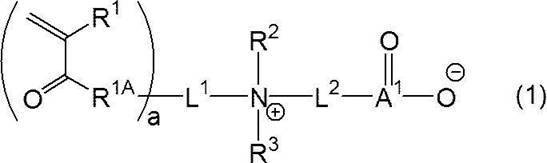
式(1)中、R1は、水素原子、又はアルキル基を表す。
R1で表されるアルキル基の炭素数は特に制限されないが、1~15が好ましく、1~10がより好ましく、1~6が更に好ましく、1~3が特に好ましい。アルキル基としては、直鎖状、分岐鎖状、及び環状のいずれであってもよい。
アルキル基としては、例えば、メチル基、エチル基、n-プロピル基、イソプロピル基、n-ブチル基、t-ブチル基、n-ヘキシル基、シクロペンチル基、及びシクロへキシル基等が挙げられる。
アルキル基は、置換基を有していてもよい。アルキル基が有し得る置換基としては特に制限されないが、例えば、後述する置換基Wが挙げられる。
R1としては、なかでも、水素原子、又は炭素数1~6のアルキル基が好ましく、水素原子、又は炭素数1~3のアルキル基がより好ましい。
R1で表されるアルキル基の炭素数は特に制限されないが、1~15が好ましく、1~10がより好ましく、1~6が更に好ましく、1~3が特に好ましい。アルキル基としては、直鎖状、分岐鎖状、及び環状のいずれであってもよい。
アルキル基としては、例えば、メチル基、エチル基、n-プロピル基、イソプロピル基、n-ブチル基、t-ブチル基、n-ヘキシル基、シクロペンチル基、及びシクロへキシル基等が挙げられる。
アルキル基は、置換基を有していてもよい。アルキル基が有し得る置換基としては特に制限されないが、例えば、後述する置換基Wが挙げられる。
R1としては、なかでも、水素原子、又は炭素数1~6のアルキル基が好ましく、水素原子、又は炭素数1~3のアルキル基がより好ましい。
R2及びR3は、それぞれ独立に、アルキル基を表す。
R2及びR3で表されるアルキル基としては、R1で表されるアルキル基と同義であり、好適態様も同じである。
R2及びR3で表されるアルキル基としては、R1で表されるアルキル基と同義であり、好適態様も同じである。
R1Aは、酸素原子、又はNR101を表す。
R101は、水素原子、又はアルキル基を表す。R101で表されるアルキル基としては、R1で表されるアルキル基と同義であり、好適態様も同じである。R101としては、水素原子が好ましい。
R101は、水素原子、又はアルキル基を表す。R101で表されるアルキル基としては、R1で表されるアルキル基と同義であり、好適態様も同じである。R101としては、水素原子が好ましい。
aは2~6の整数を表す。
aとしては、基材密着性がより優れる点で、2~4が好ましく、2又は3がより好ましい。
aとしては、基材密着性がより優れる点で、2~4が好ましく、2又は3がより好ましい。
L1は、ウレタン結合(-NH-CO-O-、又は-O-CO-NH-)又はウレア結合(-NH-CO-NH-)を含み、-O-を含んでいてもよい(a+1)価の脂肪族炭化水素基を表す。つまり、L1は、a個の下記式(X)で表される1価の基、及び、式(1)中に明示される窒素原子(カチオン化した窒素原子)と連結する。

上記式(X)中、R1、及びR1Aは、上記式(1)中のR1、及びR1Aと同義である。*は、L1との連結位置を表す。
L1で表される脂肪族炭化水素基の炭素数は特に制限されないが、例えば、1~30であり、1~20が好ましく、1~15がより好ましく、1~12が更に好ましい。
また、上記脂肪族炭化水素基は、置換基を有していてもよい。脂肪族炭化水素基が有し得る置換基としては特に制限されないが、例えば、後述する置換基Wが挙げられる。
なお、L1において、化学式中に明示される窒素原子(カチオン化した窒素原子)に隣接する位置、及びR1Aに隣接する位置には、通常、炭素原子が位置する。
また、上記脂肪族炭化水素基は、置換基を有していてもよい。脂肪族炭化水素基が有し得る置換基としては特に制限されないが、例えば、後述する置換基Wが挙げられる。
なお、L1において、化学式中に明示される窒素原子(カチオン化した窒素原子)に隣接する位置、及びR1Aに隣接する位置には、通常、炭素原子が位置する。
L1としては、例えば、下記式(1A-1)で表される連結基、又は下記式(1A-2)で表される連結基が挙げられる。

上記式(1A-1)中、R103は、水素原子又は置換基を表す。上記置換基としては特に制限されないが、例えば、後述する置換基Wが挙げられる。
また、上記式(1A-1)~式(1A-2)中、L101~L107は、単結合、又は、-O-、ウレタン結合、若しくはウレア結合を含んでいてもよいアルキレン基を表す。
但し、上記式(1A-1)中、L101~L103のいずれか1つ以上は、ウレタン結合又はウレア結合を含み、-O-を含んでいてもよいアルキレン基を表し、上記式(1A-2)中、L104~L107のいずれか1つ以上は、ウレタン結合又はウレア結合を含み、-O-を含んでいてもよいアルキレン基を表す。
L101~L107で表される-O-、ウレタン結合、若しくはウレア結合を含んでいてもよいアルキレン基の炭素数は特に制限されないが、1~12が好ましく、1~6がより好ましく、1~3が更に好ましい。なお、L101~L107で表される-O-、ウレタン結合、若しくはウレア結合を含んでいてもよいアルキレン基は、直鎖状、分岐鎖状、及び環状のいずれであってもよい。
また、Q*は、上記式(X)で表される1価の基との連結位置を表し、*は、式(1)中に明示される窒素原子(カチオン化した窒素原子)との連結位置を表す。
また、上記式(1A-1)~式(1A-2)中、L101~L107は、単結合、又は、-O-、ウレタン結合、若しくはウレア結合を含んでいてもよいアルキレン基を表す。
但し、上記式(1A-1)中、L101~L103のいずれか1つ以上は、ウレタン結合又はウレア結合を含み、-O-を含んでいてもよいアルキレン基を表し、上記式(1A-2)中、L104~L107のいずれか1つ以上は、ウレタン結合又はウレア結合を含み、-O-を含んでいてもよいアルキレン基を表す。
L101~L107で表される-O-、ウレタン結合、若しくはウレア結合を含んでいてもよいアルキレン基の炭素数は特に制限されないが、1~12が好ましく、1~6がより好ましく、1~3が更に好ましい。なお、L101~L107で表される-O-、ウレタン結合、若しくはウレア結合を含んでいてもよいアルキレン基は、直鎖状、分岐鎖状、及び環状のいずれであってもよい。
また、Q*は、上記式(X)で表される1価の基との連結位置を表し、*は、式(1)中に明示される窒素原子(カチオン化した窒素原子)との連結位置を表す。
上記L101~L107は、更に置換基を有していてもよい。置換基としては特に制限されないが、例えば、後述する置換基Wが挙げられる。なお、L101~L107において、Q*との連結位置、又は式(1)中に明示される窒素原子(カチオン化した窒素原子)との連結位置には、通常、炭素原子が位置する。
L2は、-O-、-NR104-、-CO-、又はこれらを組み合わせた2価の連結基を含んでいてもよいアルキレン基を表す。
R104は、水素原子、又は置換基を表す。R104で表される置換基としては特に制限されないが、例えば、後述する置換基Wが挙げられる。R104としては、なかでも、水素原子が好ましい。
L2で表される-O-、-NR104-、-CO-、又はこれらを組み合わせた2価の連結基を含んでいてもよいアルキレン基の炭素数は特に制限されないが、例えば、1~30であり、1~20が好ましく、1~15がより好ましく、1~12が更に好ましい。
なお、L2において、化学式中に明示される窒素原子(カチオン化した窒素原子)に隣接する位置には、通常、炭素原子が位置する。
また、上記アルキレン基は、置換基を有していてもよい。L2で表される-O-、-NR104-、-CO-、又はこれらを組み合わせた2価の連結基を含んでいてもよいアルキレン基が有し得る置換基としては特に制限されないが、例えば、後述する置換基Wが挙げられる。
A1は、S=O、又は炭素原子を表す。生体適合性がより優れる点で、A1は、S=Oが好ましい。
R104は、水素原子、又は置換基を表す。R104で表される置換基としては特に制限されないが、例えば、後述する置換基Wが挙げられる。R104としては、なかでも、水素原子が好ましい。
L2で表される-O-、-NR104-、-CO-、又はこれらを組み合わせた2価の連結基を含んでいてもよいアルキレン基の炭素数は特に制限されないが、例えば、1~30であり、1~20が好ましく、1~15がより好ましく、1~12が更に好ましい。
なお、L2において、化学式中に明示される窒素原子(カチオン化した窒素原子)に隣接する位置には、通常、炭素原子が位置する。
また、上記アルキレン基は、置換基を有していてもよい。L2で表される-O-、-NR104-、-CO-、又はこれらを組み合わせた2価の連結基を含んでいてもよいアルキレン基が有し得る置換基としては特に制限されないが、例えば、後述する置換基Wが挙げられる。
A1は、S=O、又は炭素原子を表す。生体適合性がより優れる点で、A1は、S=Oが好ましい。
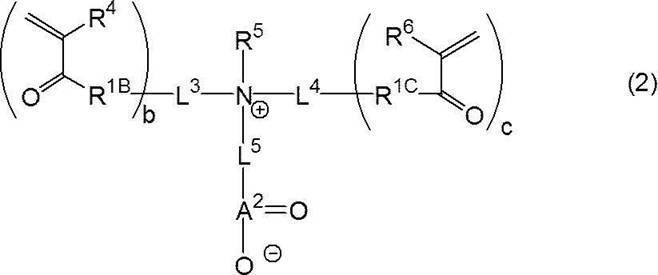
上記式(2)中、R4及びR6は、それぞれ独立に、水素原子、又はアルキル基を表す。R4及びR6で表されるアルキル基としては、上記式(1)中のR1で表されるアルキル基と同義であり、好適態様も同じである。R4及びR6としては、なかでも、水素原子、又は炭素数1~6のアルキル基が好ましく、水素原子、又は炭素数1~3のアルキル基がより好ましい。
R5は、アルキル基を表す。R5で表されるアルキル基としては、上記式(1)中のR
2及びR3で表されるアルキル基と同義であり、好適態様も同じである。
R1B及びR1Cは、それぞれ独立に、酸素原子、又はNR102を表す。R102は、水素原子、又はアルキル基を表す。R102で表されるアルキル基としては、上記式(1)中のR101で表されるアルキル基と同義であり、好適態様も同じである。R102としては、水素原子が好ましい。
R5は、アルキル基を表す。R5で表されるアルキル基としては、上記式(1)中のR
2及びR3で表されるアルキル基と同義であり、好適態様も同じである。
R1B及びR1Cは、それぞれ独立に、酸素原子、又はNR102を表す。R102は、水素原子、又はアルキル基を表す。R102で表されるアルキル基としては、上記式(1)中のR101で表されるアルキル基と同義であり、好適態様も同じである。R102としては、水素原子が好ましい。
b及びcは、それぞれ独立に、1~5の整数を表す。但し、2≦b+c≦6である。
基材密着性がより優れる点で、b+cは、2~4が好ましく、2又は3がより好ましい。bとしては、1~3が好ましく、1がより好ましい。また、cとしては、1~3が好ましく、1がより好ましい。
基材密着性がより優れる点で、b+cは、2~4が好ましく、2又は3がより好ましい。bとしては、1~3が好ましく、1がより好ましい。また、cとしては、1~3が好ましく、1がより好ましい。
L3は、ウレタン結合(-NH-CO-O-、又は-O-CO-NH-)又はウレア結合(-NH-CO-NH-)を含み、-O-を含んでいてもよい(b+1)価の脂肪族炭化水素基を表す。つまり、L3は、b個の下記式(Y)で表される1価の基、及び、式(1)中に明示される窒素原子(カチオン化した窒素原子)と連結する。
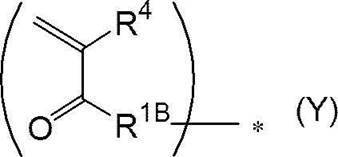
上記式(Y)中、R4、及びR1Bは、上記式(2)中のR4、及びR1Bと同義である。*は、L3との連結位置を表す。
L3で表される脂肪族炭化水素基の炭素数は特に制限されないが、例えば、1~30であり、1~20が好ましく、1~15がより好ましく、1~12が更に好ましい。
また、上記脂肪族炭化水素基は、置換基を有していてもよい。脂肪族炭化水素基が有し得る置換基としては特に制限されないが、例えば、後述する置換基Wが挙げられる。
なお、L3において、化学式中に明示される窒素原子(カチオン化した窒素原子)に隣接する位置、及びR1Bに隣接する位置には、通常、炭素原子が位置する。
また、上記脂肪族炭化水素基は、置換基を有していてもよい。脂肪族炭化水素基が有し得る置換基としては特に制限されないが、例えば、後述する置換基Wが挙げられる。
なお、L3において、化学式中に明示される窒素原子(カチオン化した窒素原子)に隣接する位置、及びR1Bに隣接する位置には、通常、炭素原子が位置する。
L3としては、例えば、下記式(2A-1)で表される連結基、下記式(2A-2)で表される連結基、及び下記式(2A-3)で表される連結基が挙げられる。

上記式(2A-1)及び上記式(2A-2)中、R201~R203は、水素原子又は置換基を表す。上記置換基としては特に制限されないが、例えば、後述する置換基Wが挙げられる。
また、上記式(2A-1)~上記式(2A-3)中、L201~L209は、単結合、又は、-O-、ウレタン結合、若しくはウレア結合を含んでいてもよいアルキレン基を表す。但し、上記式(2A-1)中、L201~L202のいずれか1つ以上は、ウレタン結合又はウレア結合を含み、-O-を含んでいてもよいアルキレン基を表し、上記式(2A-2)中、L203~L205のいずれか1つ以上は、ウレタン結合又はウレア結合を含み、-O-を含んでいてもよいアルキレン基を表し、上記式(2A-3)中、L206~L209のいずれか1つ以上は、ウレタン結合又はウレア結合を含み、-O-を含んでいてもよいアルキレン基を表す。
L201~L209で表される-O-、ウレタン結合、若しくはウレア結合を含んでいてもよいアルキレン基の炭素数は特に制限されないが、1~12が好ましく、1~6がより好ましく、1~3が更に好ましい。なお、L201~L209で表される-O-、ウレタン結合、若しくはウレア結合を含んでいてもよいアルキレン基は、直鎖状、分岐鎖状、及び環状のいずれであってもよい。
また、P*は、上記式(Y)で表される1価の基との連結位置を表し、*は、式(2)中に明示される窒素原子(カチオン化した窒素原子)との連結位置を表す。
また、上記式(2A-1)~上記式(2A-3)中、L201~L209は、単結合、又は、-O-、ウレタン結合、若しくはウレア結合を含んでいてもよいアルキレン基を表す。但し、上記式(2A-1)中、L201~L202のいずれか1つ以上は、ウレタン結合又はウレア結合を含み、-O-を含んでいてもよいアルキレン基を表し、上記式(2A-2)中、L203~L205のいずれか1つ以上は、ウレタン結合又はウレア結合を含み、-O-を含んでいてもよいアルキレン基を表し、上記式(2A-3)中、L206~L209のいずれか1つ以上は、ウレタン結合又はウレア結合を含み、-O-を含んでいてもよいアルキレン基を表す。
L201~L209で表される-O-、ウレタン結合、若しくはウレア結合を含んでいてもよいアルキレン基の炭素数は特に制限されないが、1~12が好ましく、1~6がより好ましく、1~3が更に好ましい。なお、L201~L209で表される-O-、ウレタン結合、若しくはウレア結合を含んでいてもよいアルキレン基は、直鎖状、分岐鎖状、及び環状のいずれであってもよい。
また、P*は、上記式(Y)で表される1価の基との連結位置を表し、*は、式(2)中に明示される窒素原子(カチオン化した窒素原子)との連結位置を表す。
上記L201~L209は、更に置換基を有していてもよい。置換基としては特に制限されないが、例えば、後述する置換基Wが挙げられる。なお、L201~L209において、P*との連結位置、又は式(2)中に明示される窒素原子(カチオン化した窒素原子)との連結位置には、通常、炭素原子が位置する。
L4は、ウレタン結合(-NH-CO-O-、又は-O-CO-NH-)又はウレア結合(-NH-CO-NH-)を含み、-O-を含んでいてもよい(c+1)価の脂肪族炭化水素基を表す。つまり、L4は、c個の下記式(Z)で表される1価の基、及び、式(2)中に明示される窒素原子(カチオン化した窒素原子)と連結する。
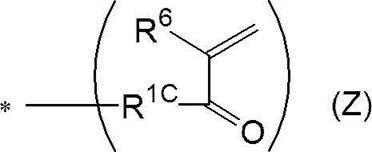
上記式(Z)中、R6、及びR1Cは、上記式(2)中のR6、及びR1Cと同義である。*は、L4との連結位置を表す。
L4で表される脂肪族炭化水素基の炭素数は特に制限されないが、例えば、1~30であり、1~20が好ましく、1~15がより好ましく、1~12が更に好ましい。
また、上記脂肪族炭化水素基は、置換基を有していてもよい。脂肪族炭化水素基が有し得る置換基としては特に制限されないが、例えば、後述する置換基Wが挙げられる。
なお、L4において、化学式中に明示される窒素原子(カチオン化した窒素原子)に隣接する位置、及びR1Cに隣接する位置には、通常、炭素原子が位置する。
また、上記脂肪族炭化水素基は、置換基を有していてもよい。脂肪族炭化水素基が有し得る置換基としては特に制限されないが、例えば、後述する置換基Wが挙げられる。
なお、L4において、化学式中に明示される窒素原子(カチオン化した窒素原子)に隣接する位置、及びR1Cに隣接する位置には、通常、炭素原子が位置する。
L4としては、例えば、下記式(3A-1)で表される連結基、下記式(3A-2)で表される連結基、又は下記式(3A-3)で表される連結基が挙げられる。

上記式(3A-1)及び上記式(3A-2)中、R301~R303は、水素原子又は置換基を表す。上記置換基としては特に制限されないが、例えば、後述する置換基Wが挙げられる。
また、上記式(3A-1)~上記式(3A-3)中、L301~L309は、単結合、又は、-O-、ウレタン結合、若しくはウレア結合を含んでいてもよいアルキレン基を表す。但し、上記式(3A-1)中、L301~L302のいずれか1つ以上は、ウレタン結合又はウレア結合を含み、-O-を含んでいてもよいアルキレン基を表し、上記式(3A-2)中、L303~L305のいずれか1つ以上は、ウレタン結合又はウレア結合を含み、-O-を含んでいてもよいアルキレン基を表し、上記式(3A-3)中、L306~L309のいずれか1つ以上は、ウレタン結合又はウレア結合を含み、-O-を含んでいてもよいアルキレン基を表す。
L301~L309で表される-O-、ウレタン結合、若しくはウレア結合を含んでいてもよいアルキレン基の炭素数は特に制限されないが、1~12が好ましく、1~6がより好ましく、1~3が更に好ましい。なお、L301~L309で表される-O-、ウレタン結合、若しくはウレア結合を含んでいてもよいアルキレン基は、直鎖状、分岐鎖状、及び環状のいずれであってもよい。
また、W*は、上記式(Z)で表される1価の基との連結位置を表し、*は、式(2)中に明示される窒素原子(カチオン化した窒素原子)との連結位置を表す。
また、上記式(3A-1)~上記式(3A-3)中、L301~L309は、単結合、又は、-O-、ウレタン結合、若しくはウレア結合を含んでいてもよいアルキレン基を表す。但し、上記式(3A-1)中、L301~L302のいずれか1つ以上は、ウレタン結合又はウレア結合を含み、-O-を含んでいてもよいアルキレン基を表し、上記式(3A-2)中、L303~L305のいずれか1つ以上は、ウレタン結合又はウレア結合を含み、-O-を含んでいてもよいアルキレン基を表し、上記式(3A-3)中、L306~L309のいずれか1つ以上は、ウレタン結合又はウレア結合を含み、-O-を含んでいてもよいアルキレン基を表す。
L301~L309で表される-O-、ウレタン結合、若しくはウレア結合を含んでいてもよいアルキレン基の炭素数は特に制限されないが、1~12が好ましく、1~6がより好ましく、1~3が更に好ましい。なお、L301~L309で表される-O-、ウレタン結合、若しくはウレア結合を含んでいてもよいアルキレン基は、直鎖状、分岐鎖状、及び環状のいずれであってもよい。
また、W*は、上記式(Z)で表される1価の基との連結位置を表し、*は、式(2)中に明示される窒素原子(カチオン化した窒素原子)との連結位置を表す。
上記L301~L309は、更に置換基を有していてもよい。置換基としては特に制限されないが、例えば、後述する置換基Wが挙げられる。なお、L301~L309において、W*との連結位置、又は式(2)中に明示される窒素原子(カチオン化した窒素原子)との連結位置には、通常、炭素原子が位置する。
なお、式(2)において、L3におけるP*の個数とL4におけるW*の個数との合計数は2~6個である。
L5は、-O-、-NR204-、-CO-、又はこれらを組み合わせた2価の連結基を含んでいてもよいアルキレン基を表す。
R204は、水素原子、又は置換基を表す。R204で表される置換基としては特に制限されないが、例えば、後述する置換基Wが挙げられる。R204としては、なかでも、水素原子が好ましい。
L5としては、上記式(1)中のL2と同義であり、好適態様も同じである。
A2は、S=O、又は炭素原子を表す。生体適合性がより優れる点で、A2は、S=Oが好ましい。
R204は、水素原子、又は置換基を表す。R204で表される置換基としては特に制限されないが、例えば、後述する置換基Wが挙げられる。R204としては、なかでも、水素原子が好ましい。
L5としては、上記式(1)中のL2と同義であり、好適態様も同じである。
A2は、S=O、又は炭素原子を表す。生体適合性がより優れる点で、A2は、S=Oが好ましい。
特定ベタインモノマーの合成方法については、公知の方法に準じて合成できる。
特定ベタインモノマーは、1種単独で使用してもよいし、2種以上を併用してもよい。
本発明の組成物中、ベタインモノマーの含有量(複数種存在する場合はその合計)は、組成物の全固形分に対して、10~99質量%が好ましく、20~85質量%がより好ましく、50~85質量%が更に好ましい。
なお、本明細書において、固形分とは、硬化物を構成する成分を意図し、溶剤は含まれない。モノマーは硬化物を構成する成分であるため、液体であっても固形分に含まれる。
本発明の組成物中、ベタインモノマーの含有量(複数種存在する場合はその合計)は、組成物の全固形分に対して、10~99質量%が好ましく、20~85質量%がより好ましく、50~85質量%が更に好ましい。
なお、本明細書において、固形分とは、硬化物を構成する成分を意図し、溶剤は含まれない。モノマーは硬化物を構成する成分であるため、液体であっても固形分に含まれる。
以下に、特定ベタインモノマーの具体例を例示するが、本発明はこれに制限されない。

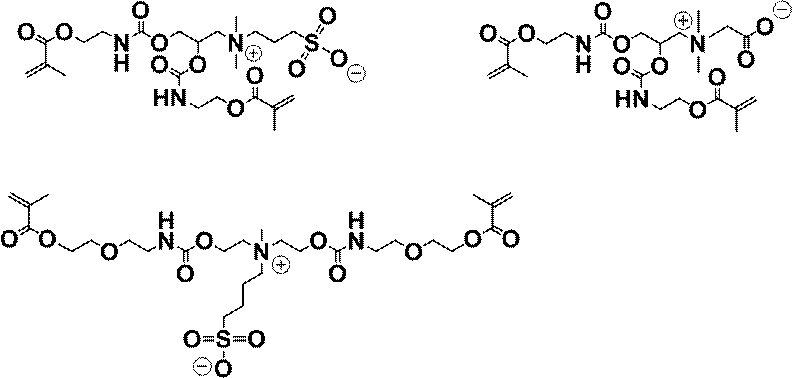
〔共重合可能なモノマー〕
本発明の組成物は、基材密着性がより向上する点で、特定ベタインモノマーと共重合可能なモノマー(以後、単に「共重合可能なモノマー」ともいう)を含んでいてもよい。
上記共重合可能なモノマーとしては特に制限されず、エチレン性不飽和基を有するモノマーが挙げられ、例えば、(メタ)アクリレート系モノマー;(メタ)アクリルアミド系モノマー;(メタ)アクリル酸、クロトン酸、及びイタコン酸等の、カルボキシル基を含むエチレン性不飽和基を有するモノマー(カルボン酸基含有モノマー);及びベタイン構造を有するモノマー等が挙げられる。なお、エチレン性不飽和基を有するモノマーにおけるエチレン性不飽和結合の分子内の数は特に制限されないが、1~8個が好ましく、1~4個がより好ましく、1又は2個が更に好ましい。
上記共重合可能なモノマーとしては、(メタ)アクリレート系モノマー、(メタ)アクリルアミド系モノマー、又は、特定ベタインモノマー以外のベタイン構造を有するモノマー等が好ましい。
本発明の組成物は、基材密着性がより向上する点で、特定ベタインモノマーと共重合可能なモノマー(以後、単に「共重合可能なモノマー」ともいう)を含んでいてもよい。
上記共重合可能なモノマーとしては特に制限されず、エチレン性不飽和基を有するモノマーが挙げられ、例えば、(メタ)アクリレート系モノマー;(メタ)アクリルアミド系モノマー;(メタ)アクリル酸、クロトン酸、及びイタコン酸等の、カルボキシル基を含むエチレン性不飽和基を有するモノマー(カルボン酸基含有モノマー);及びベタイン構造を有するモノマー等が挙げられる。なお、エチレン性不飽和基を有するモノマーにおけるエチレン性不飽和結合の分子内の数は特に制限されないが、1~8個が好ましく、1~4個がより好ましく、1又は2個が更に好ましい。
上記共重合可能なモノマーとしては、(メタ)アクリレート系モノマー、(メタ)アクリルアミド系モノマー、又は、特定ベタインモノマー以外のベタイン構造を有するモノマー等が好ましい。
<(メタ)アクリレート系モノマー>
上記(メタ)アクリレート系モノマーとしては、例えば、メチル(メタ)アクリレート、エチル(メタ)アクリレート、n-ブチル(メタ)アクリレート、2-エチルヘキシル(メタ)アクリレート、2-メトキシエチル(メタ)アクリレート、2-ヒドロキシエチル(メタ)アクリレート、2-ヒドロキシ1,3-プロピレンジオールジアクリレート、2-ヒドロキシプロピル(メタ)アクリレート、3-(メタ)アクリロイルオキシプロピルスルホン酸、N,N-ジメチルアミノエチル(メタ)アクリレート、N,N-ジエチルアミノエチル(メタ)アクリレート、ポリアルキレングリコールモノ(メタ)アクリレート、ポリアルキレングリコールジ(メタ)アクリレート、2-(メタ)アクリロイルオキシエチルメチルスルホキシド、テトラエチレングリコールジメタクリレート、ウレタンジメタクリレート、及びトリメチロールプロパントリ(メタ)アクリレート等が挙げられる。
上記(メタ)アクリレート系モノマーとしては、例えば、メチル(メタ)アクリレート、エチル(メタ)アクリレート、n-ブチル(メタ)アクリレート、2-エチルヘキシル(メタ)アクリレート、2-メトキシエチル(メタ)アクリレート、2-ヒドロキシエチル(メタ)アクリレート、2-ヒドロキシ1,3-プロピレンジオールジアクリレート、2-ヒドロキシプロピル(メタ)アクリレート、3-(メタ)アクリロイルオキシプロピルスルホン酸、N,N-ジメチルアミノエチル(メタ)アクリレート、N,N-ジエチルアミノエチル(メタ)アクリレート、ポリアルキレングリコールモノ(メタ)アクリレート、ポリアルキレングリコールジ(メタ)アクリレート、2-(メタ)アクリロイルオキシエチルメチルスルホキシド、テトラエチレングリコールジメタクリレート、ウレタンジメタクリレート、及びトリメチロールプロパントリ(メタ)アクリレート等が挙げられる。
<(メタ)アクリルアミド系モノマー>
上記(メタ)アクリルアミド系モノマーとしては、(メタ)アクリルアミド、N-メチル(メタ)アクリルアミド、N-2-ヒドロキシエチル(メタ)アクリルアミド、及び以下に示す式(A)で表される多官能(メタ)アクリルアミド化合物等が挙げられる。
以下に、式(A)で表される多官能(メタ)アクリルアミド化合物について説明する。
上記(メタ)アクリルアミド系モノマーとしては、(メタ)アクリルアミド、N-メチル(メタ)アクリルアミド、N-2-ヒドロキシエチル(メタ)アクリルアミド、及び以下に示す式(A)で表される多官能(メタ)アクリルアミド化合物等が挙げられる。
以下に、式(A)で表される多官能(メタ)アクリルアミド化合物について説明する。
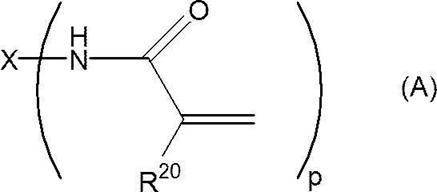
式中、R20は、水素原子、又はメチル基を表す。なお、複数あるR20はそれぞれ同一でも異なってもよい。
Xはp価の連結基を表す。pは2~4の整数を表す。
Xとしては特に制限されないが、例えば、-O-、-S-、-NRA-、-CO-、及び下記式(B)からなる群より選ばれる1つ以上の2価の連結基を含んでいてもよいアルキレン基、下記式(T1)で表される基、並びに、下記式(T2)で表される基が挙げられる。なお、アルキレン基の炭素数としては特に制限されないが、例えば、1~100である。上記RAは、水素原子、又はアルキル基(例えば、炭素数1~6であり、炭素数1~3が好ましい)を表す。
Xはp価の連結基を表す。pは2~4の整数を表す。
Xとしては特に制限されないが、例えば、-O-、-S-、-NRA-、-CO-、及び下記式(B)からなる群より選ばれる1つ以上の2価の連結基を含んでいてもよいアルキレン基、下記式(T1)で表される基、並びに、下記式(T2)で表される基が挙げられる。なお、アルキレン基の炭素数としては特に制限されないが、例えば、1~100である。上記RAは、水素原子、又はアルキル基(例えば、炭素数1~6であり、炭素数1~3が好ましい)を表す。
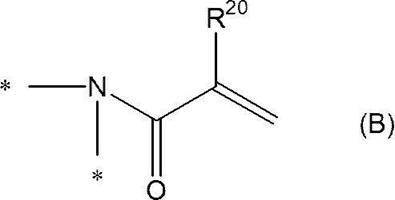
式(B)中、R20は、水素原子、又はメチル基である。また、*は、連結位置を表す。
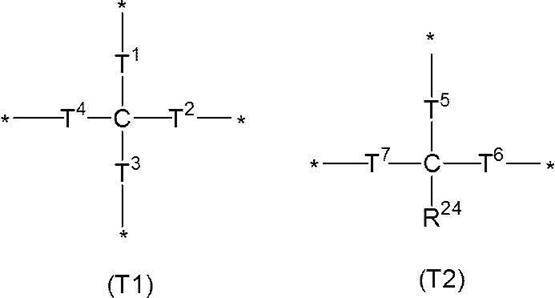
上記式(T1)及び式(T2)中、T1~T7は、それぞれ独立に、単結合、又は2価の連結基を表す。2価の連結基としては、特に制限されないが、例えば、-O-、-S-、-NRA-、及び-CO-からなる群より選ばれる1つ以上の2価の連結基を含んでいてもよい、炭素数1~10のアルキレン基が挙げられる。なかでも、基材密着性がより優れる点で、T1~T7としては、各々独立に、-O-を含む炭素数2~4のアルキレン基がより好ましい。なお、T1~T7において、上記式(A)中に明示されるアミド基中の窒素原子に隣接する位置には、炭素原子が位置することが好ましい。
また、上記式(T2)で表される基中、R24は、水素原子、又は置換基を表す。R24で表される置換基としては特に制限されないが、例えば、後述する置換基Wが挙げられ、なかでも、アルキル基(直鎖状、分岐鎖状、及び環状のいずれであってもよい。炭素数は、1~10が好ましく、1~6がより好ましい)が好ましい。上記R24は、水素原子、又はアルキル基(例えば、炭素数1~6であり、炭素数1~3が好ましい)を表す。
また、上記式(T2)で表される基中、R24は、水素原子、又は置換基を表す。R24で表される置換基としては特に制限されないが、例えば、後述する置換基Wが挙げられ、なかでも、アルキル基(直鎖状、分岐鎖状、及び環状のいずれであってもよい。炭素数は、1~10が好ましく、1~6がより好ましい)が好ましい。上記R24は、水素原子、又はアルキル基(例えば、炭素数1~6であり、炭素数1~3が好ましい)を表す。
上記式(A)で表される多官能(メタ)アクリルアミド化合物は、生体適合性がより優れる点で、下記式(A1)で表される化合物、又は下記式(A2)で表される化合物が好ましい。
(式(A1)で表される化合物)

式(A1)中、R20は、それぞれ独立に、水素原子、又はメチル基を表す。なお、複数あるR20はそれぞれ同一でも異なってもよい。
L20は、それぞれ独立に、-O-、炭素数2~4のアルキレン基、又はこれらを組み合わせた2価の連結基を表す。なお、L20において、化学式中に明示されるアミド基中の窒素原子に隣接する位置には、炭素原子が位置することが好ましい。つまり、アミド基中の窒素原子に隣接する基としては、炭素数2~4のアルキレン基が位置することが好ましい。
上記「これらを組み合わせた2価の連結基」としては、例えば、-OCH2CH2-、-OCH2CH2CH2-、-OCH2CH2CH2CH2-、-CH2OCH2-、-CH2OCH2CH2-、及び-CH2OCH2CH2CH2-等の-O-を含む炭素数2~4のアルキレン基、並びに、-(O-アルキレン基(炭素数2~4))n-で表される基等が挙げられる。ここで、nは、2以上の整数を表す。上限は特に制限されないが、10程度が挙げられる。
なお、「これらを組み合わせた2価の連結基」として例示した各基において、2つの結合箇所のどちらがアミド基に結合しても構わない。
なかでも、基材密着性と生体適合性がより優れる点で、L20としては、-O-を含む炭素数2~4のアルキレン基が好ましい。
また、複数あるL20は同一であっても、異なってもよい。
L20は、それぞれ独立に、-O-、炭素数2~4のアルキレン基、又はこれらを組み合わせた2価の連結基を表す。なお、L20において、化学式中に明示されるアミド基中の窒素原子に隣接する位置には、炭素原子が位置することが好ましい。つまり、アミド基中の窒素原子に隣接する基としては、炭素数2~4のアルキレン基が位置することが好ましい。
上記「これらを組み合わせた2価の連結基」としては、例えば、-OCH2CH2-、-OCH2CH2CH2-、-OCH2CH2CH2CH2-、-CH2OCH2-、-CH2OCH2CH2-、及び-CH2OCH2CH2CH2-等の-O-を含む炭素数2~4のアルキレン基、並びに、-(O-アルキレン基(炭素数2~4))n-で表される基等が挙げられる。ここで、nは、2以上の整数を表す。上限は特に制限されないが、10程度が挙げられる。
なお、「これらを組み合わせた2価の連結基」として例示した各基において、2つの結合箇所のどちらがアミド基に結合しても構わない。
なかでも、基材密着性と生体適合性がより優れる点で、L20としては、-O-を含む炭素数2~4のアルキレン基が好ましい。
また、複数あるL20は同一であっても、異なってもよい。
(式(A2)で表される化合物)

式(A2)中、R20は、それぞれ独立に、水素原子、又はメチル基を表す。
R21及びR23は、各々独立に、-O-、炭素数1~4のアルキレン基、又はこれらを組み合わせた2価の連結基を表す。なお、R21及びR23において、化学式中に明示されるアミド基中の窒素原子に隣接する位置には、通常、炭素原子が位置する。アミド基中の窒素原子に隣接する基としては、炭素数1~4のアルキレン基が位置することが好ましい。
上記「これらを組み合わせた2価の連結基」としては、例えば、-OCH2-、-OCH2CH2-、-OCH2CH2CH2-、-OCH2CH2CH2CH2-、-CH2OCH2-、-CH2OCH2CH2-、及び-CH2OCH2CH2CH2-等の-O-を含む炭素数1~4のアルキレン基、並びに、-(O-アルキレン基(炭素数1~4))n-で表される基等が挙げられる。ここで、nは、2以上の整数を表す。上限は特に制限されないが、10程度が挙げられる。
なお、「これらを組み合わせた2価の連結基」として例示した各基において、2つの結合箇所のどちらがアミド基に結合しても構わない。
なかでも、基材密着性と生体適合性がより優れる点で、R21及びR23としては、各々独立に、炭素数1~4のアルキレン基、又は、-O-を含む炭素数1~4のアルキレン基がより好ましい。
R21及びR23は、各々独立に、-O-、炭素数1~4のアルキレン基、又はこれらを組み合わせた2価の連結基を表す。なお、R21及びR23において、化学式中に明示されるアミド基中の窒素原子に隣接する位置には、通常、炭素原子が位置する。アミド基中の窒素原子に隣接する基としては、炭素数1~4のアルキレン基が位置することが好ましい。
上記「これらを組み合わせた2価の連結基」としては、例えば、-OCH2-、-OCH2CH2-、-OCH2CH2CH2-、-OCH2CH2CH2CH2-、-CH2OCH2-、-CH2OCH2CH2-、及び-CH2OCH2CH2CH2-等の-O-を含む炭素数1~4のアルキレン基、並びに、-(O-アルキレン基(炭素数1~4))n-で表される基等が挙げられる。ここで、nは、2以上の整数を表す。上限は特に制限されないが、10程度が挙げられる。
なお、「これらを組み合わせた2価の連結基」として例示した各基において、2つの結合箇所のどちらがアミド基に結合しても構わない。
なかでも、基材密着性と生体適合性がより優れる点で、R21及びR23としては、各々独立に、炭素数1~4のアルキレン基、又は、-O-を含む炭素数1~4のアルキレン基がより好ましい。
式(A2)中、R22は、-O-、炭素数1~4のアルキレン基、下記式(B)で表される基、又は、これらを組み合わせた2価の連結基を表す。
上記「これらを組み合わせた2価の連結基」としては、例えば、上記R21及びR23にて述べた基が挙げられる。なお、式(B)で表される基と他の基とを組み合わせる場合は、式(B)で表される基中の窒素原子には炭素数1~4のアルキレン基が結合することが好ましい。
なかでも、基材密着性と生体適合性がより優れる点で、R22としては、炭素数1~4のアルキレン基、-O-を含む炭素数1~4のアルキレン基、又は、式(B)で表される基がより好ましい。
上記「これらを組み合わせた2価の連結基」としては、例えば、上記R21及びR23にて述べた基が挙げられる。なお、式(B)で表される基と他の基とを組み合わせる場合は、式(B)で表される基中の窒素原子には炭素数1~4のアルキレン基が結合することが好ましい。
なかでも、基材密着性と生体適合性がより優れる点で、R22としては、炭素数1~4のアルキレン基、-O-を含む炭素数1~4のアルキレン基、又は、式(B)で表される基がより好ましい。
L21及びL22は、それぞれ独立に、単結合、又は式(B)で表される基を表す。
R22が式(B)を表す場合には、L21及びL22はいずれも単結合が好ましい。
式(B)中、*は結合位置を表す。
R22が式(B)を表す場合には、L21及びL22はいずれも単結合が好ましい。
式(B)中、*は結合位置を表す。
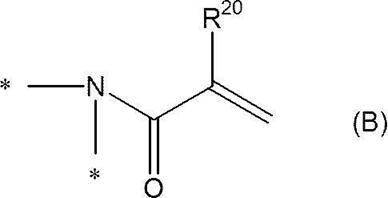
式(B)中、R20は、水素原子、又はメチル基を表し、*は連結位置を示す。なお、通常、*には炭素原子が位置する。
以下に、式(A)で表される多官能(メタ)アクリルアミド化合物の具体例を例示するが、本発明はこれに制限されない。
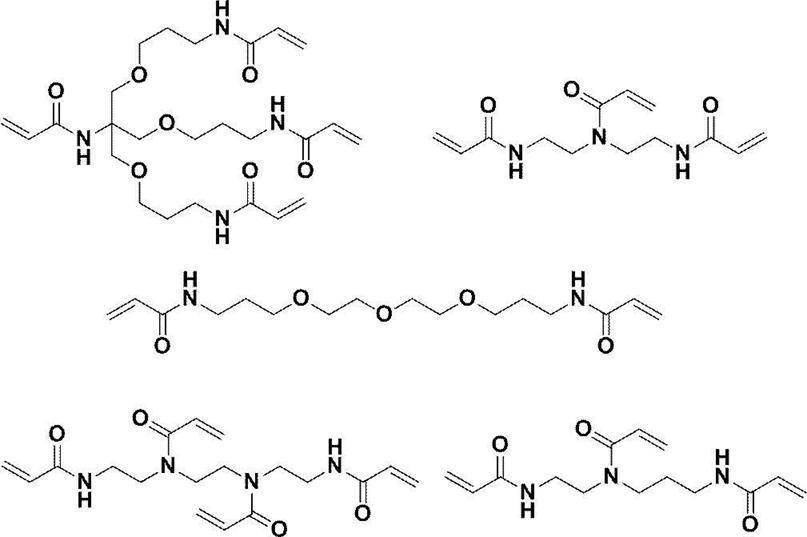

なお、式(A)で表される多官能(メタ)アクリルアミド化合物は、各種市販品を利用することもできるし、公技番号2013-502654号記載の方法により合成できる。
<ベタインモノマー>
特定ベタインモノマー以外のベタインモノマーとしては特に制限されず、例えば、スルホベタイン構造、ホスホベタイン構造、及びカルボキシベタイン構造等のベタイン構造を含むモノマーが挙げられる。また、発明の組成物が含み得るベタインモノマーの骨格は特に制限されないが、アクリレート系モノマー、又はアクリルアミド系モノマーが好ましい。ベタインモノマーとしては、具体的には、例えば、国際公開2017/018146号公報等に記載されたものが挙げられる。
上記ベタインモノマーとしては、なかでも、生体適合性がより優れる点で、下記式(C)で表される化合物が好ましい。
特定ベタインモノマー以外のベタインモノマーとしては特に制限されず、例えば、スルホベタイン構造、ホスホベタイン構造、及びカルボキシベタイン構造等のベタイン構造を含むモノマーが挙げられる。また、発明の組成物が含み得るベタインモノマーの骨格は特に制限されないが、アクリレート系モノマー、又はアクリルアミド系モノマーが好ましい。ベタインモノマーとしては、具体的には、例えば、国際公開2017/018146号公報等に記載されたものが挙げられる。
上記ベタインモノマーとしては、なかでも、生体適合性がより優れる点で、下記式(C)で表される化合物が好ましい。
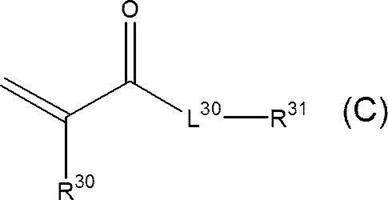
式(C)中、R30は、水素原子、又はアルキル基を表す。
R30で表されるアルキル基としては、上述した式(1)中のR1で表されるアルキル基と同義であり、好適態様も同じである。R30としては、なかでも、水素原子、又は炭素数1~6のアルキル基が好ましく、水素原子、又は炭素数1~3のアルキル基がより好ましい。
L30は、酸素原子、又は-NRA-を表す。
RAは、水素原子、又はアルキル基を表す。RAで表されるアルキル基としては、上述した式(1)中のR101で表されるアルキル基と同義であり、好適態様も同じである。RAとしては、なかでも、水素原子が好ましい。
R31は、下記式(I)で表される1価の基、下記式(II)で表される1価の基、又は下記式(III)で表される1価の基を表す。
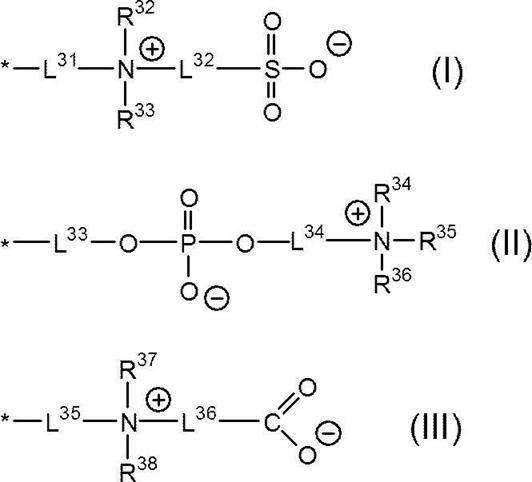
R30で表されるアルキル基としては、上述した式(1)中のR1で表されるアルキル基と同義であり、好適態様も同じである。R30としては、なかでも、水素原子、又は炭素数1~6のアルキル基が好ましく、水素原子、又は炭素数1~3のアルキル基がより好ましい。
L30は、酸素原子、又は-NRA-を表す。
RAは、水素原子、又はアルキル基を表す。RAで表されるアルキル基としては、上述した式(1)中のR101で表されるアルキル基と同義であり、好適態様も同じである。RAとしては、なかでも、水素原子が好ましい。
R31は、下記式(I)で表される1価の基、下記式(II)で表される1価の基、又は下記式(III)で表される1価の基を表す。
上記式(I)中、L31及びL32は、それぞれ独立に、2価の連結基を表す。
L31及びL32としては特に制限されないが、ヘテロ原子を含んでいてもよい炭素数1~10のアルキレン基(直鎖状、分岐鎖状、及び環状のいずれであってもよいが、直鎖状が好ましい。)が好ましい。上記アルキレン基の炭素数は、なかでも、1~6がより好ましく、1~4が更に好ましく、2~4が特に好ましい。
L31及びL32としては特に制限されないが、ヘテロ原子を含んでいてもよい炭素数1~10のアルキレン基(直鎖状、分岐鎖状、及び環状のいずれであってもよいが、直鎖状が好ましい。)が好ましい。上記アルキレン基の炭素数は、なかでも、1~6がより好ましく、1~4が更に好ましく、2~4が特に好ましい。
R32及びR33は、それぞれ独立に、アルキル基を表す。
R32及びR33で表されるアルキル基の炭素数は特に制限されないが、1~6が好ましく、1~3がより好ましい。アルキル基としては、直鎖状、分岐鎖状、及び環状のいずれであってもよい。
アルキル基としては、例えば、メチル基、エチル基、n-プロピル基、及びイソプロピル基が挙げられる。
アルキル基は、置換基を有していてもよい。アルキル基が有し得る置換基としては特に制限されないが、例えば、後述する置換基Wが挙げられる。
*は結合位置を表す。
R32及びR33で表されるアルキル基の炭素数は特に制限されないが、1~6が好ましく、1~3がより好ましい。アルキル基としては、直鎖状、分岐鎖状、及び環状のいずれであってもよい。
アルキル基としては、例えば、メチル基、エチル基、n-プロピル基、及びイソプロピル基が挙げられる。
アルキル基は、置換基を有していてもよい。アルキル基が有し得る置換基としては特に制限されないが、例えば、後述する置換基Wが挙げられる。
*は結合位置を表す。
上記式(II)中、L33及びL34は、それぞれ独立に、2価の連結基を表す。
L33及びL34で表される2価の連結基としては、上述した式(I)中のL31及びL32で表される2価の連結基と同義であり、好適態様も同じである。
R34~R36は、それぞれ独立に、アルキル基を表す。
R34~R36で表されるアルキル基としては、上述した式(I)中のR32及びR33で表されるアルキル基と同義であり、好適態様も同じである。
*は結合位置を表す。
L33及びL34で表される2価の連結基としては、上述した式(I)中のL31及びL32で表される2価の連結基と同義であり、好適態様も同じである。
R34~R36は、それぞれ独立に、アルキル基を表す。
R34~R36で表されるアルキル基としては、上述した式(I)中のR32及びR33で表されるアルキル基と同義であり、好適態様も同じである。
*は結合位置を表す。
上記式(III)中、L35及びL36は、それぞれ独立に、2価の連結基を表す。
L35及びL36で表される2価の連結基としては、上述した式(I)中のL31及びL32で表される2価の連結基と同義であり、好適態様も同じである。
R37及びR38は、それぞれ独立に、アルキル基を表す。
R37及びR38で表されるアルキル基としては、上述した式(I)中のR32及びR33で表されるアルキル基と同義であり、好適態様も同じである。
*は結合位置を表す。
L35及びL36で表される2価の連結基としては、上述した式(I)中のL31及びL32で表される2価の連結基と同義であり、好適態様も同じである。
R37及びR38は、それぞれ独立に、アルキル基を表す。
R37及びR38で表されるアルキル基としては、上述した式(I)中のR32及びR33で表されるアルキル基と同義であり、好適態様も同じである。
*は結合位置を表す。
R31としては、なかでも、生体適合性がより優れる点で、式(I)で表される基、又は式(II)で表される基が好ましい。
上記ベタインモノマーは、公知の方法により合成できる。
以下に、ベタインモノマーの具体例を例示するが、本発明はこれに制限されない。
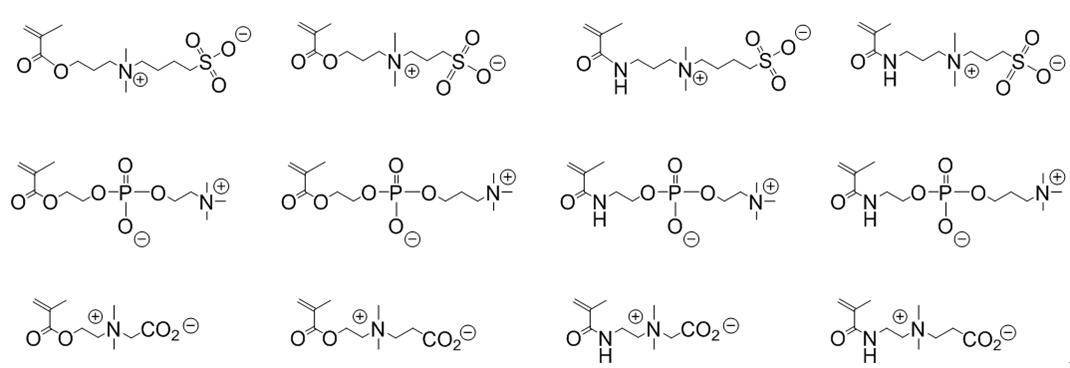
上記共重合可能なモノマーは、1種単独で使用してもよいし、2種以上を併用してもよい。
本発明の組成物中、上記共重合可能なモノマーの含有量(複数種存在する場合はその合計)は、組成物の全固形分に対して、0~60質量%が好ましく、10~50質量%がより好ましく、10~40質量%が更に好ましい。なお、上記共重合可能なモノマーがベタインモノマーである場合、本発明の組成物中、ベタインモノマーの含有量(複数種存在する場合はその合計)は、組成物の全固形分に対して、0~30質量%が好ましく、10~25質量%がより好ましい。
本発明の組成物中、上記共重合可能なモノマーの含有量(複数種存在する場合はその合計)は、組成物の全固形分に対して、0~60質量%が好ましく、10~50質量%がより好ましく、10~40質量%が更に好ましい。なお、上記共重合可能なモノマーがベタインモノマーである場合、本発明の組成物中、ベタインモノマーの含有量(複数種存在する場合はその合計)は、組成物の全固形分に対して、0~30質量%が好ましく、10~25質量%がより好ましい。
(置換基群W)
アルキル基(好ましくは炭素数1~20のアルキル基)、アルケニル基(好ましくは炭素数2~20のアルケニル基)、アルキニル基(好ましくは炭素数2~20のアルキニル基)、シクロアルキル基(好ましくは炭素数3~20のシクロアルキル基)、アリール基(好ましくは炭素数6~26のアリール基)、ヘテロ環基(好ましくは炭素数2~20のヘテロ環基である。少なくとも1つの酸素原子、硫黄原子、窒素原子を有する5又は6員環のヘテロ環基がより好ましい。)、アルコキシ基(好ましくは炭素数1~20のアルコキシ基)、アリールオキシ基(好ましくは炭素数6~26のアリールオキシ基)、アルコキシカルボニル基(好ましくは炭素数2~20のアルコキシカルボニル基)、アリールオキシカルボニル基(好ましくは炭素数6~26のアリールオキシカルボニル基)、アミノ基(好ましくは炭素数0~20のアミノ基、アルキルアミノ基、又は、アリールアミノ基、例えば、アミノ、N,N-ジメチルアミノ、N,N-ジエチルアミノ、N-エチルアミノ、アニリノ等)、スルファモイル基(好ましくは炭素数0~20のスルファモイル基)、アシル基(好ましくは炭素数1~20のアシル基)、アシルオキシ基(好ましくは炭素数1~20のアシルオキシ基)、カルバモイル基(好ましくは炭素数1~20のカルバモイル基)、アシルアミノ基(好ましくは炭素数1~20のアシルアミノ基、例えば、アセチルアミノ基、ベンゾイルアミノ基等)、アルキルチオ基(好ましくは炭素数1~20のアルキルチオ基)、アリールチオ基(好ましくは炭素数6~26のアリールチオ基)、アルキルスルホニル基(好ましくは炭素数1~20のアルキルスルホニル基)、アリールスルホニル基(好ましくは炭素数6~22のアリールスルホニル基)、アルキルシリル基(好ましくは炭素数1~20のアルキルシリル基)、アリールシリル基(好ましくは炭素数6~42のアリールシリル基)、アルコキシシリル基(好ましくは炭素数1~20のアルコキシシリル基)、アリールオキシシリル基(好ましくは炭素数6~42のアリールオキシシリル基)、ホスホリル基(好ましくは炭素数0~20のホスホリル基、例えば、-OP(=O)(RP)2)、ホスホニル基(好ましくは炭素数0~20のホスホニル基、例えば、-P(=O)(RP)2)、ホスフィニル基(好ましくは炭素数0~20のホスフィニル基、例えば、-P(RP)2)、(メタ)アクリロイル基、(メタ)アクリロイルオキシ基、(メタ)アクリロイルイミノ基((メタ)アクリルアミド基)、ヒドロキシル基、チオール基、カルボキシル基、リン酸基、ホスホン酸基、スルホン酸基、シアノ基、及びハロゲン原子(例えばフッ素原子、塩素原子、臭素原子、及びヨウ素原子等)が挙げられる。なお、RPは水素原子、ヒドロキシル基、又は置換基である。
また、これらの置換基Wで挙げた各基は、上記の置換基Wが更に置換していてもよい。
また、上記置換基が酸性基又は塩基性基のときはその塩を形成していてもよい。
化合物、置換基、及び連結基等が、アルキル基、アルキレン基、アルケニル基、アルケニレン基、アルキニル基、又はアルキニレン基等を含むとき、これらは環状でも鎖状でもよく、また直鎖でも分岐していてもよく、上記のように置換されていても無置換でもよい。
アルキル基(好ましくは炭素数1~20のアルキル基)、アルケニル基(好ましくは炭素数2~20のアルケニル基)、アルキニル基(好ましくは炭素数2~20のアルキニル基)、シクロアルキル基(好ましくは炭素数3~20のシクロアルキル基)、アリール基(好ましくは炭素数6~26のアリール基)、ヘテロ環基(好ましくは炭素数2~20のヘテロ環基である。少なくとも1つの酸素原子、硫黄原子、窒素原子を有する5又は6員環のヘテロ環基がより好ましい。)、アルコキシ基(好ましくは炭素数1~20のアルコキシ基)、アリールオキシ基(好ましくは炭素数6~26のアリールオキシ基)、アルコキシカルボニル基(好ましくは炭素数2~20のアルコキシカルボニル基)、アリールオキシカルボニル基(好ましくは炭素数6~26のアリールオキシカルボニル基)、アミノ基(好ましくは炭素数0~20のアミノ基、アルキルアミノ基、又は、アリールアミノ基、例えば、アミノ、N,N-ジメチルアミノ、N,N-ジエチルアミノ、N-エチルアミノ、アニリノ等)、スルファモイル基(好ましくは炭素数0~20のスルファモイル基)、アシル基(好ましくは炭素数1~20のアシル基)、アシルオキシ基(好ましくは炭素数1~20のアシルオキシ基)、カルバモイル基(好ましくは炭素数1~20のカルバモイル基)、アシルアミノ基(好ましくは炭素数1~20のアシルアミノ基、例えば、アセチルアミノ基、ベンゾイルアミノ基等)、アルキルチオ基(好ましくは炭素数1~20のアルキルチオ基)、アリールチオ基(好ましくは炭素数6~26のアリールチオ基)、アルキルスルホニル基(好ましくは炭素数1~20のアルキルスルホニル基)、アリールスルホニル基(好ましくは炭素数6~22のアリールスルホニル基)、アルキルシリル基(好ましくは炭素数1~20のアルキルシリル基)、アリールシリル基(好ましくは炭素数6~42のアリールシリル基)、アルコキシシリル基(好ましくは炭素数1~20のアルコキシシリル基)、アリールオキシシリル基(好ましくは炭素数6~42のアリールオキシシリル基)、ホスホリル基(好ましくは炭素数0~20のホスホリル基、例えば、-OP(=O)(RP)2)、ホスホニル基(好ましくは炭素数0~20のホスホニル基、例えば、-P(=O)(RP)2)、ホスフィニル基(好ましくは炭素数0~20のホスフィニル基、例えば、-P(RP)2)、(メタ)アクリロイル基、(メタ)アクリロイルオキシ基、(メタ)アクリロイルイミノ基((メタ)アクリルアミド基)、ヒドロキシル基、チオール基、カルボキシル基、リン酸基、ホスホン酸基、スルホン酸基、シアノ基、及びハロゲン原子(例えばフッ素原子、塩素原子、臭素原子、及びヨウ素原子等)が挙げられる。なお、RPは水素原子、ヒドロキシル基、又は置換基である。
また、これらの置換基Wで挙げた各基は、上記の置換基Wが更に置換していてもよい。
また、上記置換基が酸性基又は塩基性基のときはその塩を形成していてもよい。
化合物、置換基、及び連結基等が、アルキル基、アルキレン基、アルケニル基、アルケニレン基、アルキニル基、又はアルキニレン基等を含むとき、これらは環状でも鎖状でもよく、また直鎖でも分岐していてもよく、上記のように置換されていても無置換でもよい。
〔開始剤〕
本発明の組成物は、開始剤を含むことが好ましい。
開始剤としては特に制限されないが、熱重合開始剤又は光重合開始剤が好ましい。
光重合開始剤としては、例えば、アルキンフェノン系光重合開始剤、メトキシケトン系光重合開始剤、アシルフォスフィンオキサイド系光重合開始剤、ヒドロキシケトン系光重合開始剤(例えば、IRGACURE184;1,2-α-ヒドロキシアルキルフェノン)、アミノケトン系光重合開始剤(例えば、2-メチル-1-[4-(メチルチオ)フェニル]-2-モルホリノ-プロパン-1-オン(IRGACURE(登録商標)907))、オキシム系光重合開始剤、及びオキシフェニル酢酸エステル系光重合開始剤(IRGACURE(登録商標)754)等が挙げられる。
その他の開始剤としては、例えば、アゾ系重合開始剤(例えば、V-50、V-601)、過硫酸塩系重合開始剤、過硫酸物系重合開始剤、及びレドックス系重合開始剤等が挙げられる。
本発明の組成物は、開始剤を含むことが好ましい。
開始剤としては特に制限されないが、熱重合開始剤又は光重合開始剤が好ましい。
光重合開始剤としては、例えば、アルキンフェノン系光重合開始剤、メトキシケトン系光重合開始剤、アシルフォスフィンオキサイド系光重合開始剤、ヒドロキシケトン系光重合開始剤(例えば、IRGACURE184;1,2-α-ヒドロキシアルキルフェノン)、アミノケトン系光重合開始剤(例えば、2-メチル-1-[4-(メチルチオ)フェニル]-2-モルホリノ-プロパン-1-オン(IRGACURE(登録商標)907))、オキシム系光重合開始剤、及びオキシフェニル酢酸エステル系光重合開始剤(IRGACURE(登録商標)754)等が挙げられる。
その他の開始剤としては、例えば、アゾ系重合開始剤(例えば、V-50、V-601)、過硫酸塩系重合開始剤、過硫酸物系重合開始剤、及びレドックス系重合開始剤等が挙げられる。
開始剤は、1種単独で使用してもよいし、2種以上を併用してもよい。
本発明の組成物中、開始剤の含有量(複数種存在する場合はその合計)は特に制限されないが、組成物の全固形分に対して、0.5~10質量%が好ましく、1~5質量%がより好ましい。
本発明の組成物中、開始剤の含有量(複数種存在する場合はその合計)は特に制限されないが、組成物の全固形分に対して、0.5~10質量%が好ましく、1~5質量%がより好ましい。
〔溶剤〕
本発明の組成物は、溶剤を含むことが好ましい。
溶剤としては、例えば、水、有機溶剤(例えば、酢酸エチル及び酢酸n-ブチル等のエステル類;トルエン及びベンゼン等の芳香族炭化水素類;n-ヘキサン及びn-ヘプタン等の脂肪族炭化水素類;シクロヘキサン及びメチルシクロヘキサン等の脂環式炭化水素類;メチルエチルケトン(MEK)、メチルイソブチルケトン、及びシクロヘキサノン等のケトン類;メタノール及びブタノール等のアルコール類等)、及びこれらの混合溶剤が挙げられる。
なかでも、塗工時の面状ムラが起きにくい観点から、メタノール、及びエタノール等のアルコール溶剤が好ましい。
本発明の組成物は、溶剤を含むことが好ましい。
溶剤としては、例えば、水、有機溶剤(例えば、酢酸エチル及び酢酸n-ブチル等のエステル類;トルエン及びベンゼン等の芳香族炭化水素類;n-ヘキサン及びn-ヘプタン等の脂肪族炭化水素類;シクロヘキサン及びメチルシクロヘキサン等の脂環式炭化水素類;メチルエチルケトン(MEK)、メチルイソブチルケトン、及びシクロヘキサノン等のケトン類;メタノール及びブタノール等のアルコール類等)、及びこれらの混合溶剤が挙げられる。
なかでも、塗工時の面状ムラが起きにくい観点から、メタノール、及びエタノール等のアルコール溶剤が好ましい。
溶剤は、1種単独で使用してもよいし、2種以上を併用してもよい。
本発明の組成物中、溶剤の含有量(複数種存在する場合はその合計)は、組成物全質量に対して、0.5~95質量%が好ましく、1~90質量%がより好ましく、10~80質量%が更に好ましい。
本発明の組成物中、溶剤の含有量(複数種存在する場合はその合計)は、組成物全質量に対して、0.5~95質量%が好ましく、1~90質量%がより好ましく、10~80質量%が更に好ましい。
〔その他の成分〕
本発明の組成物は、上述した各成分以外の成分を含んでいてもよい。そのような成分としては、例えば、バインダ樹脂、多官能アミン、多官能チオール、界面活性剤、可塑剤、表面潤滑剤、レベリング剤、軟化剤、酸化防止剤、老化防止剤、光安定剤、紫外線吸収剤、無機又は有機の充填剤、及び金属粉等が挙げられる。
バインダ樹脂としては特に制限されないが、例えば、アクリル系樹脂、スチレン系樹脂、ビニル系樹脂、ポリオレフィン系樹脂、ポリエステル系樹脂、ポリウレタン系樹脂、ポリアミド系樹脂、ポリカーボネート系樹脂、ポリジエン系樹脂、エポキシ系樹脂、シリコーン系樹脂、セルロース系重合体、及びキトサン系重合体等が挙げられる。
本発明の組成物は、上述した各成分以外の成分を含んでいてもよい。そのような成分としては、例えば、バインダ樹脂、多官能アミン、多官能チオール、界面活性剤、可塑剤、表面潤滑剤、レベリング剤、軟化剤、酸化防止剤、老化防止剤、光安定剤、紫外線吸収剤、無機又は有機の充填剤、及び金属粉等が挙げられる。
バインダ樹脂としては特に制限されないが、例えば、アクリル系樹脂、スチレン系樹脂、ビニル系樹脂、ポリオレフィン系樹脂、ポリエステル系樹脂、ポリウレタン系樹脂、ポリアミド系樹脂、ポリカーボネート系樹脂、ポリジエン系樹脂、エポキシ系樹脂、シリコーン系樹脂、セルロース系重合体、及びキトサン系重合体等が挙げられる。
〔硬化性組成物の調製方法〕
本発明の組成物の調製方法は特に制限されず、公知の方法を採用できる。例えば、上記各成分を混合した後、公知の手段により撹拌することによって硬化性組成物を調製できる。
本発明の組成物の調製方法は特に制限されず、公知の方法を採用できる。例えば、上記各成分を混合した後、公知の手段により撹拌することによって硬化性組成物を調製できる。
[硬化物]
本発明の硬化物は、上述した本発明の組成物を硬化して形成される。硬化物は、用途に応じてその形状を適宜選択できる。硬化物の形状としては、例えば、粉末状及び膜状(フィルム状)が挙げられるが、なかでも、膜状であることが好ましい。
硬化物を膜状とする場合、膜厚は特に制限されないが、例えば、0.1~300μmであり、1~100μmがより好ましい。
なお、本発明の硬化物は、上述した特定ベタインモノマーに由来する繰り返し単位を含む高分子化合物を含む。
本発明の硬化物は、上述した本発明の組成物を硬化して形成される。硬化物は、用途に応じてその形状を適宜選択できる。硬化物の形状としては、例えば、粉末状及び膜状(フィルム状)が挙げられるが、なかでも、膜状であることが好ましい。
硬化物を膜状とする場合、膜厚は特に制限されないが、例えば、0.1~300μmであり、1~100μmがより好ましい。
なお、本発明の硬化物は、上述した特定ベタインモノマーに由来する繰り返し単位を含む高分子化合物を含む。
〔硬化物(硬化膜)の製造方法〕
本発明の硬化物(硬化膜)を製造する方法は特に制限されないが、例えば、上述した本発明の組成物を基材上に塗布し、その後、加熱又は光照射(光としては、例えば、紫外線、可視光線及びX線等が挙げられる。)することで硬化させる方法が挙げられる。
本発明の硬化物(硬化膜)を製造する方法は特に制限されないが、例えば、上述した本発明の組成物を基材上に塗布し、その後、加熱又は光照射(光としては、例えば、紫外線、可視光線及びX線等が挙げられる。)することで硬化させる方法が挙げられる。
基材の材質としては特に制限されず、例えば、金属材料、セラミック材料、及びプラスチック材料等が挙げられる。
上記プラスチック材料の種類としては、例えば、ポリエチレンテレフタレート、ポリブチレンテレフタレート、ポリエチレンナフタレート、ポリエチレン、ポリプロピレン、セロファン、ジアセチルセルロース、トリアセチルセルロース、アセチルセルロースブチレート、ポリ塩化ビニル、ポリ塩化ビニリデン、ポリビニルアルコール、エチレン-酢酸ビニル共重合体、ポリスチレン、ポリカーボネート、ポリメチルペンテン、ポリスルホン、ポリエーテルエーテルケトン、ポリエーテルスルホン、ポリエーテルイミド、ポリイミド、フッ素樹脂、ナイロン、アクリル樹脂、ポリアミド、シクロオレフィン、ナイロン、及びポリエーテルサルファン等が挙げられる。
また、金属材料の種類としては、金、ステンレス鋼、コバルトクロム合金、アマルガム合金、銀パラジウム合金、金銀パラジウム合金、チタン、ニッケルチタン合金、及び白金等が挙げられる。
また、セラミック材料の種類としては、ハイドロキシアパタイト等が挙げられる。
なお、基材の形状は特に制限されず、板状であっても、立体形状であってもよい。
上記プラスチック材料の種類としては、例えば、ポリエチレンテレフタレート、ポリブチレンテレフタレート、ポリエチレンナフタレート、ポリエチレン、ポリプロピレン、セロファン、ジアセチルセルロース、トリアセチルセルロース、アセチルセルロースブチレート、ポリ塩化ビニル、ポリ塩化ビニリデン、ポリビニルアルコール、エチレン-酢酸ビニル共重合体、ポリスチレン、ポリカーボネート、ポリメチルペンテン、ポリスルホン、ポリエーテルエーテルケトン、ポリエーテルスルホン、ポリエーテルイミド、ポリイミド、フッ素樹脂、ナイロン、アクリル樹脂、ポリアミド、シクロオレフィン、ナイロン、及びポリエーテルサルファン等が挙げられる。
また、金属材料の種類としては、金、ステンレス鋼、コバルトクロム合金、アマルガム合金、銀パラジウム合金、金銀パラジウム合金、チタン、ニッケルチタン合金、及び白金等が挙げられる。
また、セラミック材料の種類としては、ハイドロキシアパタイト等が挙げられる。
なお、基材の形状は特に制限されず、板状であっても、立体形状であってもよい。
本発明の組成物を塗布する方法は特に制限されないが、例えば、浸漬、ロールコート、キスロールコート、グラビアコート、リバースコート、ロールブラッシュ、スプレーコート、ディップロールコート、バーコート、スピンコート、ナイフコート、エアーナイフコート、カーテンコート、及びリップコート、並びに、ダイコーター等による押出しコート法等の方法が挙げられる。
加熱する方法は特に制限されず、例えば、送風乾燥機、オーブン、赤外線乾燥機、及び加熱ドラム等を用いる方法が挙げられる。
加熱の温度は特に制限されないが、30~150℃が好ましく、40~120℃がより好ましい。
加熱の時間は特に制限されないが、通常、1分~6時間である。塗布装置中で乾燥する場合には1~20分であり、また、塗布後の加熱(例えば、巻き取り形態での加熱)の際の加熱温度は、室温~50℃が好ましい。
加熱の温度は特に制限されないが、30~150℃が好ましく、40~120℃がより好ましい。
加熱の時間は特に制限されないが、通常、1分~6時間である。塗布装置中で乾燥する場合には1~20分であり、また、塗布後の加熱(例えば、巻き取り形態での加熱)の際の加熱温度は、室温~50℃が好ましい。
光照射する方法としては、例えば、低圧水銀灯、中圧水銀灯、高圧水銀灯、メタルハライドランプ、Deep-UV(ultraviolet)光、LED(light emitting diode)ランプ、キセノンランプ、ケミカルランプ、及びカーボンアーク灯等による方法が挙げられる。光照射のエネルギーは特に制限されないが、0.1~10J/cm2が好ましい。
<用途>
本発明の硬化物は、優れた基材密着性を示し、且つ、細胞及び血液成分等の生体物質の付着を抑制又は防止できる。本発明の硬化物は、生体に適用される材料(生体用材料)として、人工器官及び医療器具等に使用できる。具体的には、本発明の硬化物は、人工器官及び医療器具等の素材となる樹脂組成物の充填剤として使用してもよいし、人工器官及び医療器具等の表面に配置してコーティング材として使用してもよい。なお、医療器具としては、例えば、義歯、人工透析膜、及び、カテーテル等が挙げられる。人工器官としては、人体に長期間治療等の目的で組み込まれる部材をいい、例えば、人工血管、ステント、人工臓器、人工骨、人工弁、及び培養皮膚等が挙げられる。
本発明の硬化物は、なかでも、歯科用材料、又は人工骨用接着剤として使用されることが好ましい。
本発明の硬化物は、優れた基材密着性を示し、且つ、細胞及び血液成分等の生体物質の付着を抑制又は防止できる。本発明の硬化物は、生体に適用される材料(生体用材料)として、人工器官及び医療器具等に使用できる。具体的には、本発明の硬化物は、人工器官及び医療器具等の素材となる樹脂組成物の充填剤として使用してもよいし、人工器官及び医療器具等の表面に配置してコーティング材として使用してもよい。なお、医療器具としては、例えば、義歯、人工透析膜、及び、カテーテル等が挙げられる。人工器官としては、人体に長期間治療等の目的で組み込まれる部材をいい、例えば、人工血管、ステント、人工臓器、人工骨、人工弁、及び培養皮膚等が挙げられる。
本発明の硬化物は、なかでも、歯科用材料、又は人工骨用接着剤として使用されることが好ましい。
〔医療用部材〕
本発明の医療用部材は、基材と、基材上に配置された硬化物と、を含む。
上記基材とは、上述した人工器具及び医療器具等を意図し、例えば、上述したような金属材料、セラミック材料、及びプラスチック材料を材質とするものが挙げられる。上記基材としては、具体的には、義歯及び人工骨等が挙げられる。
また、上記硬化膜としては、例えば、上述した膜状の硬化物が該当する。
本発明の医療用部材は、基材と、基材上に配置された硬化物と、を含む。
上記基材とは、上述した人工器具及び医療器具等を意図し、例えば、上述したような金属材料、セラミック材料、及びプラスチック材料を材質とするものが挙げられる。上記基材としては、具体的には、義歯及び人工骨等が挙げられる。
また、上記硬化膜としては、例えば、上述した膜状の硬化物が該当する。
以下に実施例に基づいて本発明を更に詳細に説明する。以下の実施例に示す材料、使用量、割合、処理内容、及び処理手順等は、本発明の趣旨を逸脱しない限り適宜変更できる。したがって、本発明の範囲は以下に示す実施例により限定的に解釈されるべきものではない。
[硬化性組成物の調製]
〔各種成分〕
<特定ベタインモノマー>
以下に、表1に示される特定ベタインモノマー(ex(1)~ex(4))を示す。
〔各種成分〕
<特定ベタインモノマー>
以下に、表1に示される特定ベタインモノマー(ex(1)~ex(4))を示す。

(ex(1)の合成)
以下に、特定ベタインモノマーの合成方法について、ex(1)の合成方法を一例に挙げて示す。
以下に、特定ベタインモノマーの合成方法について、ex(1)の合成方法を一例に挙げて示す。

3-(ジメチルアミノ)-1,2-プロパンジオール(10g、83.9mmol)、テトラヒドロフラン(THF、50mL)を混合し、ここへ、メタクリル酸2-イソシアナトエチル(27.34g、176mmol)をテトラヒドロフラン(50mL)に希釈した溶液を滴下した。更に「ネオスタンU600」(日東化成社(製)、538mg)をテトラヒドロフラン(10mL)に希釈した溶液を発熱に注意しながら、上述の溶液へ滴下し、室温で12時間撹拌した。反応溶液を減圧濃縮し、得られた粗生成物をシリカゲルカラムクロマトグラフィー(溶出液:酢酸エチル~酢酸エチル:メタノール=4:1)に供することで精製し、中間体a(30g、収率83%)を得た。
中間体a(5g、11.6mmol)、1,4-ブタンスルトン(1.9g,14.0mmol)、4-ヒドロキシ-2,2,6,6-テトラメチルピペリジン1-オキシルフリーラジカル(60mg、0.35mmol)、及びメタノール(6mL)を混合し、80℃で48時間撹拌した。反応溶液を室温まで冷却し、減圧濃縮した。得られた粗生成物をシリカゲルカラムクロマトグラフィー(溶出液:アセトン~アセトン:メタノール=1:1~メタノール)に供することで精製し、ex(1)(5g、収率76%)を得た。1H NMR(Nuclear Magnetic Resonance)にて、目的物であることを確認した。
1H NMR (メタノール-d4, 400MHz) δ: 1.82 (2H, t), 1.93 (6H, s), 1.93-2.09 (2H,m), 2.88 (2H, t), 3.15 (6H, s), 3.34-3.44 (6H, m), 3.57-3.78 (2H, m), 4.08-4.30 (6H, m), 5.63 (2H, s), 6.12 (2H, s).
また、ESI-MS(Electrospray Ionization-Mass Spectrometry)にて、目的物の分子量相当のピークを確認した。
中間体a(5g、11.6mmol)、1,4-ブタンスルトン(1.9g,14.0mmol)、4-ヒドロキシ-2,2,6,6-テトラメチルピペリジン1-オキシルフリーラジカル(60mg、0.35mmol)、及びメタノール(6mL)を混合し、80℃で48時間撹拌した。反応溶液を室温まで冷却し、減圧濃縮した。得られた粗生成物をシリカゲルカラムクロマトグラフィー(溶出液:アセトン~アセトン:メタノール=1:1~メタノール)に供することで精製し、ex(1)(5g、収率76%)を得た。1H NMR(Nuclear Magnetic Resonance)にて、目的物であることを確認した。
1H NMR (メタノール-d4, 400MHz) δ: 1.82 (2H, t), 1.93 (6H, s), 1.93-2.09 (2H,m), 2.88 (2H, t), 3.15 (6H, s), 3.34-3.44 (6H, m), 3.57-3.78 (2H, m), 4.08-4.30 (6H, m), 5.63 (2H, s), 6.12 (2H, s).
また、ESI-MS(Electrospray Ionization-Mass Spectrometry)にて、目的物の分子量相当のピークを確認した。
(ex(2)~ex(4)の合成)
上記ex(1)の合成方法に従い、上記ex(2)~ex(4)を合成した。
(ex(5)の合成)
以下の合成スキームに従い、ex(5)を合成した。すなわち、中間体(a)に対して、1,4-ブタンスルトンの代わりにクロロ酢酸カリウム塩を用い、メタノールの代わりにIPAを用いた以外はex(1)と同様の方法で合成した。
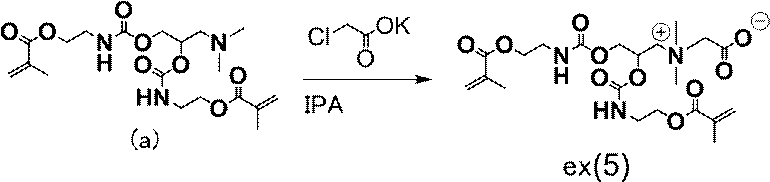
上記ex(1)の合成方法に従い、上記ex(2)~ex(4)を合成した。
(ex(5)の合成)
以下の合成スキームに従い、ex(5)を合成した。すなわち、中間体(a)に対して、1,4-ブタンスルトンの代わりにクロロ酢酸カリウム塩を用い、メタノールの代わりにIPAを用いた以外はex(1)と同様の方法で合成した。
<共重合可能なモノマー>
以下に、表1に示される共重合可能なモノマー(B(1)~B(16))を示す。
以下に、表1に示される共重合可能なモノマー(B(1)~B(16))を示す。
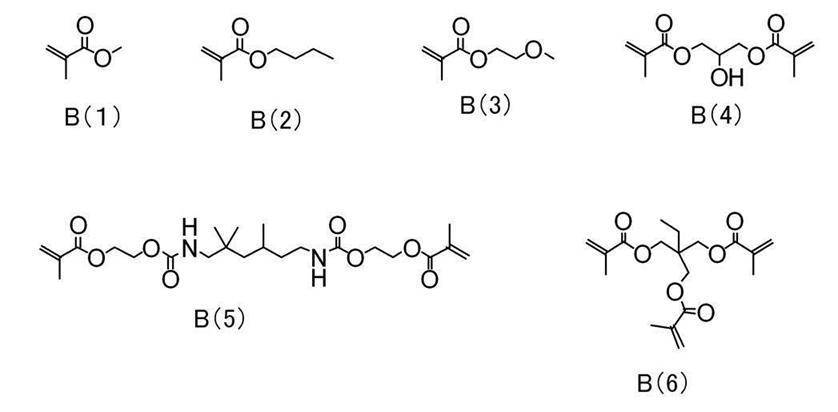

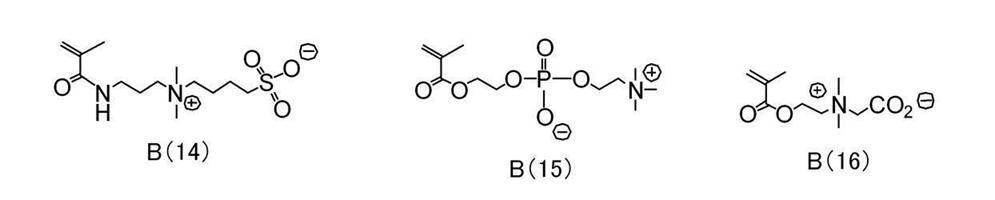
<比較用ベタインモノマー>
以下に、表1に示される比較用ベタインモノマー(com(1)~com(4))
を示す。
以下に、表1に示される比較用ベタインモノマー(com(1)~com(4))
を示す。
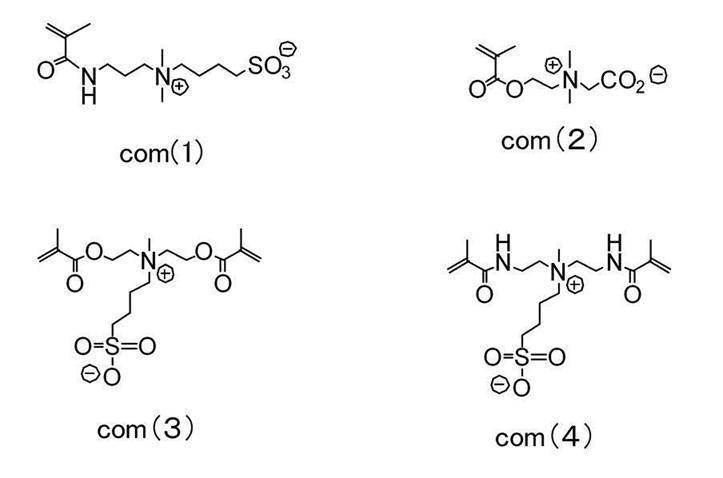
〔硬化性組成物の調製〕
下記表1に示す各成分を溶剤(メタノール)に溶解させ、固形分濃度が20質量%の硬化性組成物(硬化性組成物1~30)を調製した。なお、硬化性組成物において、固形分とは、溶剤以外の全ての成分を意味する。
なお、表1中における数値は、硬化性組成物の全固形分に対する各成分の含有量(質量%)を表す。また、「Irg2959」は、重合開始剤(「IRGACURE2959」、BASF社製)に該当する。
下記表1に示す各成分を溶剤(メタノール)に溶解させ、固形分濃度が20質量%の硬化性組成物(硬化性組成物1~30)を調製した。なお、硬化性組成物において、固形分とは、溶剤以外の全ての成分を意味する。
なお、表1中における数値は、硬化性組成物の全固形分に対する各成分の含有量(質量%)を表す。また、「Irg2959」は、重合開始剤(「IRGACURE2959」、BASF社製)に該当する。
〔膜の作製〕
<基材密着性評価用及び生体適合性評価用のコート膜の作製>
基材(アクリル板(メーカー名:ミスミ、型番:ACA))上に、調製した硬化性組成物を膜厚が約5μmとなるように塗布し、スピンコートで乾燥させた。その後、アイグラフィック社製「ECS-401G(商品名)」UV(ultraviolet)露光機(光源:高圧水銀ランプ)を用いて、4J/cm2の露光量となるよう露光し、基材密着性評価用及び生体適合性評価用のコート膜を作製した。
<基材密着性評価用及び生体適合性評価用のコート膜の作製>
基材(アクリル板(メーカー名:ミスミ、型番:ACA))上に、調製した硬化性組成物を膜厚が約5μmとなるように塗布し、スピンコートで乾燥させた。その後、アイグラフィック社製「ECS-401G(商品名)」UV(ultraviolet)露光機(光源:高圧水銀ランプ)を用いて、4J/cm2の露光量となるよう露光し、基材密着性評価用及び生体適合性評価用のコート膜を作製した。
〔評価〕
<基材密着性試験>
作製したコート膜付きアクリル板をPBS(Phosphate buffered saline)溶液中に、
37℃にて48時間浸漬した。その後、コート膜付きアクリル板を溶液から引き上げ、アクリル板上に残ったコート膜(以下、「残存コート膜」ともいう。)の面積から基材密着性を評価した。アクリル板の面積に対する残存コート膜の面積を被膜率として百分率で表し、下記評価基準に基づいて評価を行った。基材密着性の評価については、「B」以上の場合を合格とした。結果を表1に示す。
<基材密着性試験>
作製したコート膜付きアクリル板をPBS(Phosphate buffered saline)溶液中に、
37℃にて48時間浸漬した。その後、コート膜付きアクリル板を溶液から引き上げ、アクリル板上に残ったコート膜(以下、「残存コート膜」ともいう。)の面積から基材密着性を評価した。アクリル板の面積に対する残存コート膜の面積を被膜率として百分率で表し、下記評価基準に基づいて評価を行った。基材密着性の評価については、「B」以上の場合を合格とした。結果を表1に示す。
(評価基準)
「A」:被膜率が90%以上だった。
「B」:被膜率が70%以上、90%未満だった。
「C」:被膜率が50%以上、70%未満だった。
「D」:被膜率が50%未満だった。
「A」:被膜率が90%以上だった。
「B」:被膜率が70%以上、90%未満だった。
「C」:被膜率が50%以上、70%未満だった。
「D」:被膜率が50%未満だった。
<生体適合性の評価(細胞付着試験)>
作製したコート膜付きアクリル基材を6ウェルプレートに入れ、ダルベッコ改変イーグル培地に、マウス由来繊維芽細胞(3T3細胞)を播種密度を1.0×10⁵個/cm2となるように分散させ、インキュベーターを使って37℃、5%二酸化炭素条件で48時間培養した。
その後、上記コート膜付きアクリル基材を取り出し、位相差顕微鏡(倒立方リサーチ顕微鏡、オリンパス社製)を用いて細胞が付着しているかどうかを確認した。拡大倍率は4倍とした。
この作業を10枚のコート膜付きアクリル基材に対して実施し、細胞が付着していたコート膜付きアクリル基材の個数で下記のように評価した。生態適合性の評価については、「C」以上の場合が合格であり、実用上「B」以上が好ましい。結果を表1に示す。
なお、表1中の生体適合性欄において「-」と表示される場合、膜剥がれにより評価ができなかったことを意味する。
(評価基準)
「S」:0~1個
「A」:2~3個
「B」:4~6個
「C」:7~9個
「D」:10個以上
作製したコート膜付きアクリル基材を6ウェルプレートに入れ、ダルベッコ改変イーグル培地に、マウス由来繊維芽細胞(3T3細胞)を播種密度を1.0×10⁵個/cm2となるように分散させ、インキュベーターを使って37℃、5%二酸化炭素条件で48時間培養した。
その後、上記コート膜付きアクリル基材を取り出し、位相差顕微鏡(倒立方リサーチ顕微鏡、オリンパス社製)を用いて細胞が付着しているかどうかを確認した。拡大倍率は4倍とした。
この作業を10枚のコート膜付きアクリル基材に対して実施し、細胞が付着していたコート膜付きアクリル基材の個数で下記のように評価した。生態適合性の評価については、「C」以上の場合が合格であり、実用上「B」以上が好ましい。結果を表1に示す。
なお、表1中の生体適合性欄において「-」と表示される場合、膜剥がれにより評価ができなかったことを意味する。
(評価基準)
「S」:0~1個
「A」:2~3個
「B」:4~6個
「C」:7~9個
「D」:10個以上
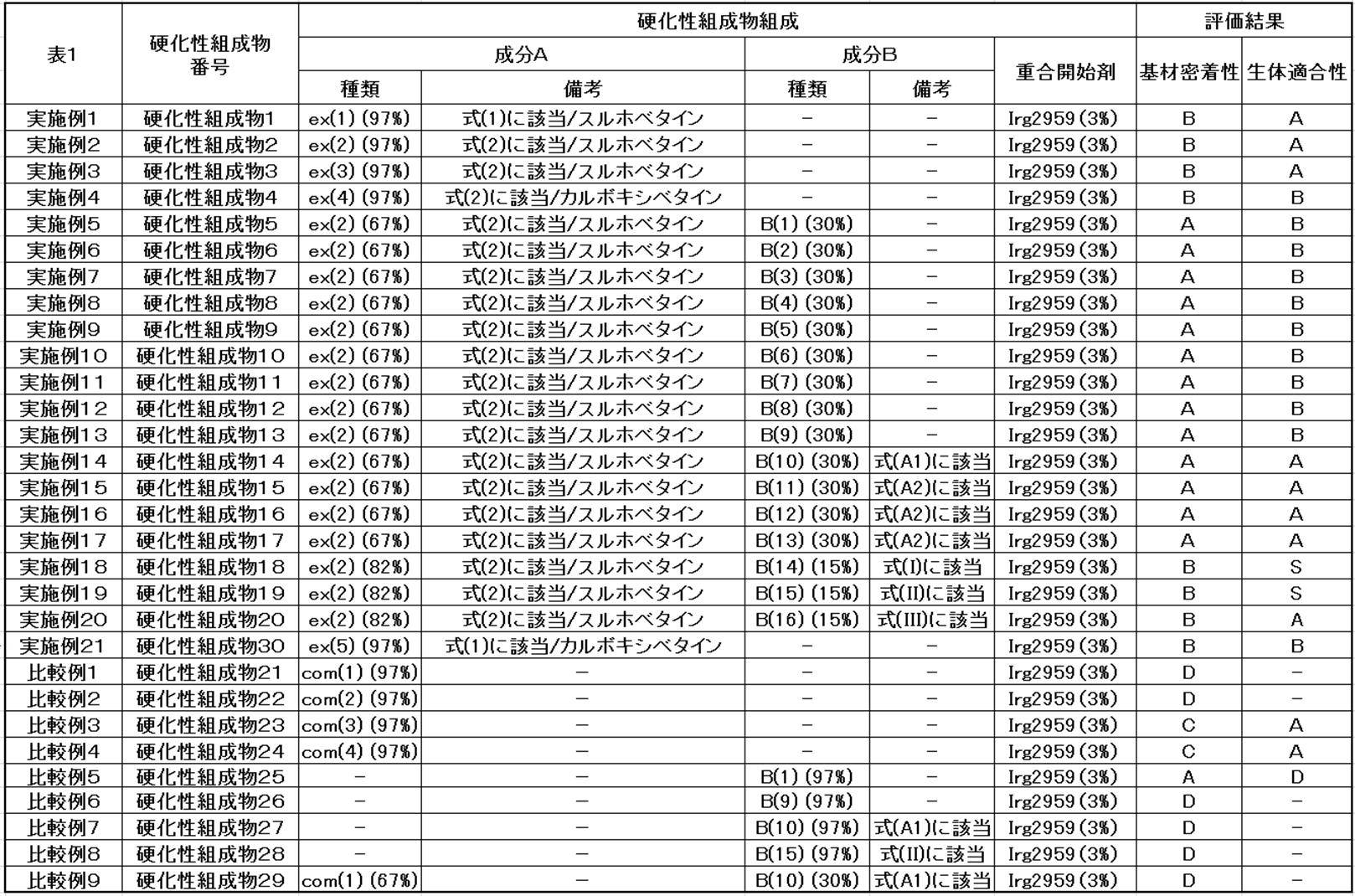
第1表の結果から、実施例の硬化性組成物によれば、基材密着性に優れ、且つ、生体適合性に優れた硬化物が得られることが確認された。
また、実施例1~4の対比から、式(1)で表される化合物中のA1及び、式(2)で表される化合物中のA2がS=Oである場合(つまり、スルホベタイン構造を有する場合)、生体適合性がより優れることが確認された。
実施例5~17の対比から、共重合可能なモノマーとして、式(A1)で表される化合物及び式(A2)で表される化合物からなる群より選ばれる多官能(メタ)アクリルアミド化合物を使用した場合、基材密着性及び生体適合性がより優れることが確認された。
また、実施例1~4の対比から、式(1)で表される化合物中のA1及び、式(2)で表される化合物中のA2がS=Oである場合(つまり、スルホベタイン構造を有する場合)、生体適合性がより優れることが確認された。
実施例5~17の対比から、共重合可能なモノマーとして、式(A1)で表される化合物及び式(A2)で表される化合物からなる群より選ばれる多官能(メタ)アクリルアミド化合物を使用した場合、基材密着性及び生体適合性がより優れることが確認された。
一方、比較例の硬化性組成物により得られる硬化物では、所望の要求を満たさないことが確認された。
Claims (10)
- 下記式(1)で表される化合物、及び下記式(2)で表される化合物からなる群より選ばれる1つ以上のベタインモノマーを含む、硬化性組成物。

式中、R1は、水素原子、又はアルキル基を表す。R2及びR3は、それぞれ独立に、アルキル基を表す。R1Aは、酸素原子、又はNR101を表す。R101は、水素原子、又はアルキル基を表す。aは2~6の整数を表す。L1は、ウレタン結合又はウレア結合を含み、-O-を含んでいてもよい(a+1)価の脂肪族炭化水素基を表す。L2は、-O-、-NR104-、-CO-、又はこれらを組み合わせた2価の連結基を含んでいてもよいアルキレン基を表す。R104は、水素原子、又は置換基を表す。A1は、S=O、又は炭素原子を表す。
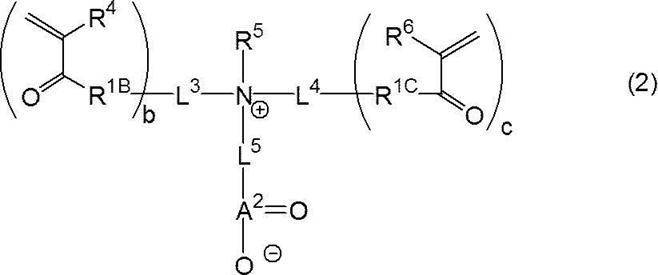
式中、R4及びR6は、それぞれ独立に、水素原子、又はアルキル基を表す。R5は、アルキル基を表す。R1B及びR1Cは、それぞれ独立に、酸素原子、又はNR102を表す。R102は、水素原子、又はアルキル基を表す。b及びcは、それぞれ独立に、1~5の整数を表す。但し、2≦b+c≦6である。L3は、ウレタン結合又はウレア結合を含み、-O-を含んでいてもよい(b+1)価の脂肪族炭化水素基を表し、L4は、ウレタン結合又はウレア結合を含み、-O-を含んでいてもよい(c+1)価の脂肪族炭化水素基を表す。L5は、-O-、-NR204-、-CO-、又はこれらを組み合わせた2価の連結基を含んでいてもよいアルキレン基を表す。R204は、水素原子、又は置換基を表す。A2は、S=O、又は炭素原子を表す。 - 前記式(1)中、A1がS=Oであり、前記式(2)中、A2がS=Oである、請求項1に記載の硬化性組成物。
- 更に、下記式(A1)で表される化合物、及び下記式(A2)で表される化合物からなる群より選ばれる1つ以上のモノマーを含む、請求項1又は2に記載の硬化性組成物。
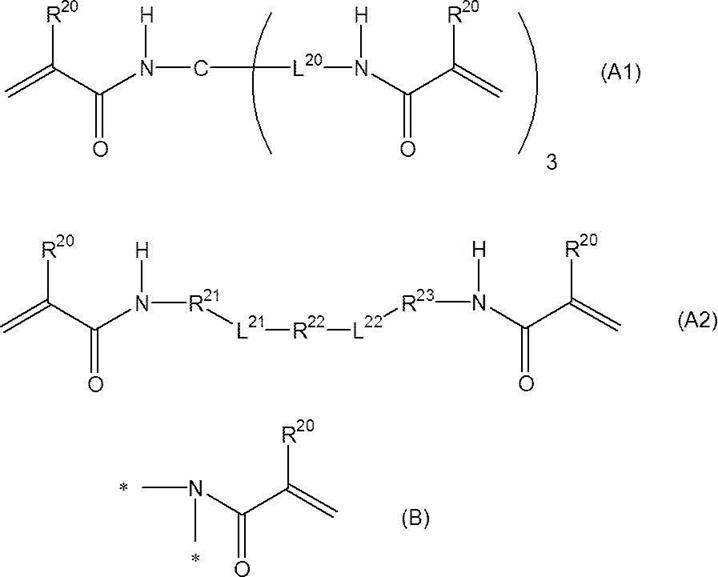
式(A1)中、R20は、それぞれ独立に、水素原子、又はメチル基を表す。L20は、それぞれ独立に、-O-、炭素数2~4のアルキレン基、又はこれらを組み合わせた2価の連結基を表す。なお、複数あるR20はそれぞれ同一でも異なってもよい。
式(A2)中、R20は、それぞれ独立に、水素原子、又はメチル基を表す。R21及びR23は、それぞれ独立に、-O-、炭素数1~4のアルキレン基、又はこれらを組み合わせた2価の連結基を表す。R22は、-O-、炭素数1~4のアルキレン基、式(B)で表される基、又はこれらを組み合わせた2価の連結基を表す。L21及びL22は、それぞれ独立に、単結合、又は式(B)で表される基を表す。
式(B)中、R20は水素原子、又はメチル基を表す。*は結合位置を表す。 - 下記式(1)で表される化合物に由来する繰り返し単位、及び下記式(2)で表される化合物に由来する繰り返し単位からなる群より選ばれる1つ以上の繰り返し単位を含む高分子化合物を含む、膜。
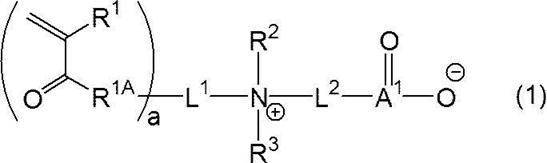
式中、R1は、水素原子、又はアルキル基を表す。R2及びR3は、それぞれ独立に、アルキル基を表す。R1Aは、酸素原子、又はNR101を表す。R101は、水素原子、又はアルキル基を表す。aは2~6の整数を表す。L1は、ウレタン結合又はウレア結合を含み、-O-を含んでいてもよい(a+1)価の脂肪族炭化水素基を表す。L2は、-O-、-NR104-、-CO-、又はこれらを組み合わせた2価の連結基を含んでいてもよいアルキレン基を表す。R104は、水素原子、又は置換基を表す。A1は、S=O、又は炭素原子を表す。

式中、R4及びR6は、それぞれ独立に、水素原子、又はアルキル基を表す。R5は、アルキル基を表す。R1B及びR1Cは、それぞれ独立に、酸素原子、又はNR102を表す。R102は、水素原子、又はアルキル基を表す。b及びcは、それぞれ独立に、1~5の整数を表す。但し、2≦b+c≦6である。L3は、ウレタン結合又はウレア結合を含み、-O-を含んでいてもよい(b+1)価の脂肪族炭化水素基を表し、L4は、ウレタン結合又はウレア結合を含み、-O-を含んでいてもよい(c+1)価の脂肪族炭化水素基を表す。L5は、-O-、-NR204-、-CO-、又はこれらを組み合わせた2価の連結基を含んでいてもよいアルキレン基を表す。R204は、水素原子、又は置換基を表す。A2は、S=O、又は炭素原子を表す。 - 請求項1~3のいずれか1項に記載の硬化性組成物を硬化して形成される、硬化物。
- 膜状である、請求項5に記載の硬化物。
- 生体用材料として用いられる、請求項5又は請求項6に記載の硬化物。
- 基材と、基材上に配置された請求項5~7のいずれか1項に記載の硬化物と、を含む、医療用部材。
- 下記式(1)で表される化合物。
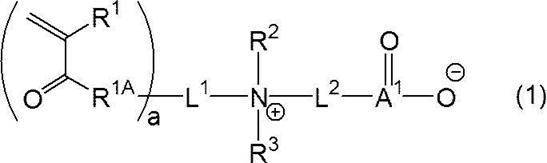
式中、R1は、水素原子、又はアルキル基を表す。R2及びR3は、それぞれ独立に、アルキル基を表す。R1Aは、酸素原子、又はNR101を表す。R101は、水素原子、又はアルキル基を表す。aは2~6の整数を表す。L1は、ウレタン結合又はウレア結合を含み、-O-を含んでいてもよい(a+1)価の脂肪族炭化水素基を表す。L2は、-O-、-NR104-、-CO-、又はこれらを組み合わせた2価の連結基を含んでいてもよいアルキレン基を表す。R104は、水素原子、又は置換基を表す。A1は、S=O、又は炭素原子を表す。 - 下記式(2)で表される化合物。
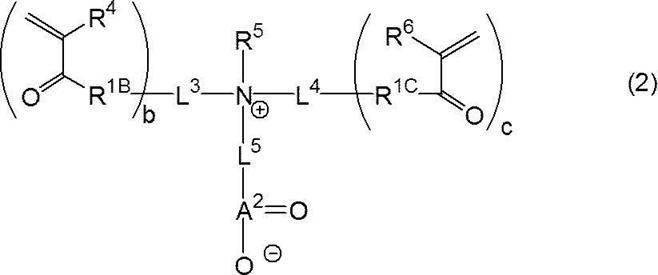
式中、R4及びR6は、それぞれ独立に、水素原子、又はアルキル基を表す。R5は、アルキル基を表す。R1B及びR1Cは、それぞれ独立に、酸素原子、又はNR102を表す。R102は、水素原子、又はアルキル基を表す。b及びcは、それぞれ独立に、1~5の整数を表す。但し、2≦b+c≦6である。L3は、ウレタン結合又はウレア結合を含み、-O-を含んでいてもよい(b+1)価の脂肪族炭化水素基を表し、L4は、ウレタン結合又はウレア結合を含み、-O-を含んでいてもよい(c+1)価の脂肪族炭化水素基を表す。L5は、-O-、-NR204-、-CO-、又はこれらを組み合わせた2価の連結基を含んでいてもよいアルキレン基を表す。R204は、水素原子、又は置換基を表す。A2は、S=O、又は炭素原子を表す。
Priority Applications (4)
| Application Number | Priority Date | Filing Date | Title |
|---|---|---|---|
| CN201880063324.6A CN111164115B (zh) | 2017-10-18 | 2018-10-04 | 固化性组合物、膜、固化物及医疗用部件 |
| EP18868285.0A EP3699202B1 (en) | 2017-10-18 | 2018-10-04 | Curable composition, film, cured product, and medical member |
| JP2019549201A JP6890672B2 (ja) | 2017-10-18 | 2018-10-04 | 硬化性組成物、膜、硬化物、医療用部材 |
| US16/835,738 US11130831B2 (en) | 2017-10-18 | 2020-03-31 | Curable composition, film, cured product, and medical member |
Applications Claiming Priority (2)
| Application Number | Priority Date | Filing Date | Title |
|---|---|---|---|
| JP2017-201929 | 2017-10-18 | ||
| JP2017201929 | 2017-10-18 |
Related Child Applications (1)
| Application Number | Title | Priority Date | Filing Date |
|---|---|---|---|
| US16/835,738 Continuation US11130831B2 (en) | 2017-10-18 | 2020-03-31 | Curable composition, film, cured product, and medical member |
Publications (1)
| Publication Number | Publication Date |
|---|---|
| WO2019078027A1 true WO2019078027A1 (ja) | 2019-04-25 |
Family
ID=66174431
Family Applications (1)
| Application Number | Title | Priority Date | Filing Date |
|---|---|---|---|
| PCT/JP2018/037287 Ceased WO2019078027A1 (ja) | 2017-10-18 | 2018-10-04 | 硬化性組成物、膜、硬化物、医療用部材 |
Country Status (5)
| Country | Link |
|---|---|
| US (1) | US11130831B2 (ja) |
| EP (1) | EP3699202B1 (ja) |
| JP (1) | JP6890672B2 (ja) |
| CN (1) | CN111164115B (ja) |
| WO (1) | WO2019078027A1 (ja) |
Cited By (2)
| Publication number | Priority date | Publication date | Assignee | Title |
|---|---|---|---|---|
| CN114026139A (zh) * | 2019-06-27 | 2022-02-08 | Prc-迪索托国际公司 | 用于可电沉积的涂层组合物的加成聚合物 |
| JP2023096908A (ja) * | 2021-12-27 | 2023-07-07 | 日油株式会社 | ウイルス付着抑制剤及びウイルス付着抑制方法 |
Families Citing this family (1)
| Publication number | Priority date | Publication date | Assignee | Title |
|---|---|---|---|---|
| EP3699210A4 (en) * | 2017-10-18 | 2020-09-23 | FUJIFILM Corporation | HARDENABLE COMPOSITION, FILM, HARDENED PRODUCT AND MEDICAL ELEMENT |
Citations (6)
| Publication number | Priority date | Publication date | Assignee | Title |
|---|---|---|---|---|
| WO2005113620A1 (ja) * | 2004-05-20 | 2005-12-01 | Osaka Organic Chemical Ind., Ltd. | 生体適合性材料 |
| JP2012031400A (ja) * | 2010-06-30 | 2012-02-16 | Fujifilm Corp | 新規な重合性組成物及びそれに用いる重合性化合物、並びに新規な重合性組成物を用いた画像形成材料及び平版印刷版原版 |
| CN103880714A (zh) * | 2014-03-20 | 2014-06-25 | 中国农业大学 | 含两性离子的水溶性交联剂及其制备方法与应用 |
| WO2016067795A1 (ja) | 2014-10-29 | 2016-05-06 | 富士フイルム株式会社 | 生体物質非接着性材料、硬化性組成物、これらを用いた人工器官および医療器具 |
| WO2017006850A1 (ja) * | 2015-07-03 | 2017-01-12 | 日産化学工業株式会社 | 生体物質の付着抑制能を有するイオンコンプレックス材料及びその製造方法 |
| WO2017018146A1 (ja) | 2015-07-29 | 2017-02-02 | 富士フイルム株式会社 | 硬化性組成物、コーティングおよび積層体 |
Family Cites Families (18)
| Publication number | Priority date | Publication date | Assignee | Title |
|---|---|---|---|---|
| DE1211156B (de) * | 1963-06-14 | 1966-02-24 | Bayer Ag | Verfahren zur Herstellung von ungesaettigten Sulfonsaeurebetainen durch Umsetzen eines tertiaeren Amins mit einem Sulton |
| JPH06157694A (ja) * | 1992-11-17 | 1994-06-07 | Nippon Kayaku Co Ltd | 放射線硬化性樹脂組成物およびその硬化物 |
| JPH06157693A (ja) * | 1992-11-17 | 1994-06-07 | Nippon Kayaku Co Ltd | 放射線硬化性樹脂組成物およびその硬化物 |
| JP4132912B2 (ja) * | 2002-03-26 | 2008-08-13 | 日東電工株式会社 | ゲル電解質とその製造方法とその利用 |
| JP2004091690A (ja) * | 2002-09-02 | 2004-03-25 | Nitto Denko Corp | 重合性ゲル化剤担持多孔質フィルムとその製造とその利用 |
| JP4156495B2 (ja) * | 2003-11-07 | 2008-09-24 | 日東電工株式会社 | ゲル電解質とその製造方法とその利用 |
| AU2008345590B2 (en) * | 2007-12-21 | 2014-10-30 | Microvention, Inc. | Hydrogel filaments for biomedical uses |
| JP2009198868A (ja) * | 2008-02-22 | 2009-09-03 | Fujifilm Corp | 染料含有ネガ型硬化性組成物、カラーフィルタ及びその製造方法、並びに固体撮像素子 |
| JP5800812B2 (ja) * | 2009-08-28 | 2015-10-28 | スリーエム イノベイティブ プロパティズ カンパニー | 重合性イオン液体混合物を含む組成物及び物品並びに硬化方法 |
| WO2011057219A2 (en) * | 2009-11-06 | 2011-05-12 | University Of Washington Through Its Center For Commercialization | Crosslinked zwitterionic hydrogels |
| JP5624880B2 (ja) * | 2009-12-28 | 2014-11-12 | 富士フイルム株式会社 | 平版印刷版原版及び平版印刷版の作製方法 |
| JP2011154367A (ja) * | 2009-12-28 | 2011-08-11 | Fujifilm Corp | 平版印刷版の作製方法 |
| US10501562B2 (en) * | 2015-03-18 | 2019-12-10 | University Of Kansas | Co-initiator and co-monomer for use in preparing polymer related compositions, methods of manufacture, and methods of use |
| WO2016196633A1 (en) * | 2015-06-01 | 2016-12-08 | William Marsh Rice University | Surface coating method to improve implantable device biocompatibility |
| WO2017073437A1 (ja) * | 2015-10-29 | 2017-05-04 | 富士フイルム株式会社 | 防汚膜、防汚膜形成用組成物、防汚膜積層体、および防汚膜積層体の製造方法 |
| JP6534611B2 (ja) * | 2015-12-07 | 2019-06-26 | クラレノリタケデンタル株式会社 | 自己接着性歯科用コンポジットレジン |
| JP6726211B2 (ja) | 2015-12-07 | 2020-07-22 | クラレノリタケデンタル株式会社 | 歯科用接着材 |
| EP3699210A4 (en) * | 2017-10-18 | 2020-09-23 | FUJIFILM Corporation | HARDENABLE COMPOSITION, FILM, HARDENED PRODUCT AND MEDICAL ELEMENT |
-
2018
- 2018-10-04 CN CN201880063324.6A patent/CN111164115B/zh active Active
- 2018-10-04 WO PCT/JP2018/037287 patent/WO2019078027A1/ja not_active Ceased
- 2018-10-04 EP EP18868285.0A patent/EP3699202B1/en active Active
- 2018-10-04 JP JP2019549201A patent/JP6890672B2/ja active Active
-
2020
- 2020-03-31 US US16/835,738 patent/US11130831B2/en active Active
Patent Citations (6)
| Publication number | Priority date | Publication date | Assignee | Title |
|---|---|---|---|---|
| WO2005113620A1 (ja) * | 2004-05-20 | 2005-12-01 | Osaka Organic Chemical Ind., Ltd. | 生体適合性材料 |
| JP2012031400A (ja) * | 2010-06-30 | 2012-02-16 | Fujifilm Corp | 新規な重合性組成物及びそれに用いる重合性化合物、並びに新規な重合性組成物を用いた画像形成材料及び平版印刷版原版 |
| CN103880714A (zh) * | 2014-03-20 | 2014-06-25 | 中国农业大学 | 含两性离子的水溶性交联剂及其制备方法与应用 |
| WO2016067795A1 (ja) | 2014-10-29 | 2016-05-06 | 富士フイルム株式会社 | 生体物質非接着性材料、硬化性組成物、これらを用いた人工器官および医療器具 |
| WO2017006850A1 (ja) * | 2015-07-03 | 2017-01-12 | 日産化学工業株式会社 | 生体物質の付着抑制能を有するイオンコンプレックス材料及びその製造方法 |
| WO2017018146A1 (ja) | 2015-07-29 | 2017-02-02 | 富士フイルム株式会社 | 硬化性組成物、コーティングおよび積層体 |
Non-Patent Citations (3)
| Title |
|---|
| JOURNAL OF TECHNICAL DISCLOSURE NO. 2013-502654 |
| See also references of EP3699202A4 |
| ZHANG, LEI ET AL.: "Zwitterionic hydrogels implanted in mice resist the foreign-body reaction", NATURE BIOTECHNOLOGY, vol. 31, no. 6, 12 May 2013 (2013-05-12), pages 553 - 557, XP055595196, ISSN: 1087-0156, DOI: 10.1038/nbt.2580 * |
Cited By (3)
| Publication number | Priority date | Publication date | Assignee | Title |
|---|---|---|---|---|
| CN114026139A (zh) * | 2019-06-27 | 2022-02-08 | Prc-迪索托国际公司 | 用于可电沉积的涂层组合物的加成聚合物 |
| CN114026139B (zh) * | 2019-06-27 | 2023-08-08 | Prc-迪索托国际公司 | 用于可电沉积的涂层组合物的加成聚合物 |
| JP2023096908A (ja) * | 2021-12-27 | 2023-07-07 | 日油株式会社 | ウイルス付着抑制剤及びウイルス付着抑制方法 |
Also Published As
| Publication number | Publication date |
|---|---|
| EP3699202A4 (en) | 2020-09-23 |
| CN111164115B (zh) | 2021-11-23 |
| JP6890672B2 (ja) | 2021-06-18 |
| EP3699202B1 (en) | 2022-12-21 |
| JPWO2019078027A1 (ja) | 2020-11-26 |
| EP3699202A1 (en) | 2020-08-26 |
| US20200270384A1 (en) | 2020-08-27 |
| CN111164115A (zh) | 2020-05-15 |
| US11130831B2 (en) | 2021-09-28 |
Similar Documents
| Publication | Publication Date | Title |
|---|---|---|
| JP6353923B2 (ja) | 生体物質非接着性材料、硬化性組成物、これらを用いた人工器官および医療器具 | |
| Lee et al. | Catechol-thiol-based dental adhesive inspired by underwater mussel adhesion | |
| JP6890672B2 (ja) | 硬化性組成物、膜、硬化物、医療用部材 | |
| CN102775831A (zh) | 在材料表面紫外表固化接枝两性离子凝胶涂层的方法 | |
| JP4719146B2 (ja) | 生体適合性材料 | |
| JP2017082174A (ja) | ポリマー、ポリマー溶液及びポリマー被覆基板 | |
| JP6872629B2 (ja) | 硬化性組成物、膜、硬化物、医療用部材 | |
| JP6986090B2 (ja) | 硬化性組成物、膜、硬化物、医療用部材 | |
| JP7199065B2 (ja) | 細胞付着用シート | |
| JP2005154477A (ja) | 紫外線硬化型キトサン誘導体を用いた医療用接着剤および医療用被覆剤 | |
| US10669435B2 (en) | Process for producing an antibacterial coating composition for implants | |
| JPWO2020066608A1 (ja) | 生体物質非接着性材料、組成物および化合物 | |
| JP7129071B2 (ja) | 組成物および硬化膜付き医療器具 | |
| CN106413665A (zh) | 粘接方法、粘接用成套用具以及粘接材料 | |
| JP7644498B2 (ja) | 双性イオン化合物、その製造方法及び用途 | |
| JP2022064603A (ja) | 生体用硬化性組成物、生体用接着性部材、及び、生体接着方法 | |
| Xu et al. | Recent Physical Interaction-based Bioadhesives | |
| WO2022019297A1 (ja) | 抗血栓性の細胞付着用シート、シート付き医療用器具 | |
| JP2017141211A (ja) | 歯科用粘膜調整材 | |
| JP2025035301A (ja) | 造影剤を含有する細胞凝集塊の製造方法及びそれにより得られる細胞凝集塊 | |
| HK40049710B (zh) | 适用於印刷的树脂组合物及印刷方法 |
Legal Events
| Date | Code | Title | Description |
|---|---|---|---|
| 121 | Ep: the epo has been informed by wipo that ep was designated in this application |
Ref document number: 18868285 Country of ref document: EP Kind code of ref document: A1 |
|
| ENP | Entry into the national phase |
Ref document number: 2019549201 Country of ref document: JP Kind code of ref document: A |
|
| NENP | Non-entry into the national phase |
Ref country code: DE |
|
| ENP | Entry into the national phase |
Ref document number: 2018868285 Country of ref document: EP Effective date: 20200518 |