WO2019087697A1 - オルガノポリシロキサン組成物、並びに有機ケイ素化合物及びその製造方法 - Google Patents
オルガノポリシロキサン組成物、並びに有機ケイ素化合物及びその製造方法 Download PDFInfo
- Publication number
- WO2019087697A1 WO2019087697A1 PCT/JP2018/037526 JP2018037526W WO2019087697A1 WO 2019087697 A1 WO2019087697 A1 WO 2019087697A1 JP 2018037526 W JP2018037526 W JP 2018037526W WO 2019087697 A1 WO2019087697 A1 WO 2019087697A1
- Authority
- WO
- WIPO (PCT)
- Prior art keywords
- group
- integer
- general formula
- mass
- represented
- Prior art date
- Legal status (The legal status is an assumption and is not a legal conclusion. Google has not performed a legal analysis and makes no representation as to the accuracy of the status listed.)
- Ceased
Links
- 0 C[N+]([O-])OC(*)(*)N* Chemical compound C[N+]([O-])OC(*)(*)N* 0.000 description 2
Classifications
-
- C—CHEMISTRY; METALLURGY
- C07—ORGANIC CHEMISTRY
- C07F—ACYCLIC, CARBOCYCLIC OR HETEROCYCLIC COMPOUNDS CONTAINING ELEMENTS OTHER THAN CARBON, HYDROGEN, HALOGEN, OXYGEN, NITROGEN, SULFUR, SELENIUM OR TELLURIUM
- C07F7/00—Compounds containing elements of Groups 4 or 14 of the Periodic Table
- C07F7/02—Silicon compounds
- C07F7/08—Compounds having one or more C—Si linkages
- C07F7/18—Compounds having one or more C—Si linkages as well as one or more C—O—Si linkages
- C07F7/1804—Compounds having Si-O-C linkages
-
- C—CHEMISTRY; METALLURGY
- C08—ORGANIC MACROMOLECULAR COMPOUNDS; THEIR PREPARATION OR CHEMICAL WORKING-UP; COMPOSITIONS BASED THEREON
- C08L—COMPOSITIONS OF MACROMOLECULAR COMPOUNDS
- C08L83/00—Compositions of macromolecular compounds obtained by reactions forming in the main chain of the macromolecule a linkage containing silicon with or without sulfur, nitrogen, oxygen or carbon only; Compositions of derivatives of such polymers
- C08L83/04—Polysiloxanes
- C08L83/06—Polysiloxanes containing silicon bound to oxygen-containing groups
-
- C—CHEMISTRY; METALLURGY
- C07—ORGANIC CHEMISTRY
- C07F—ACYCLIC, CARBOCYCLIC OR HETEROCYCLIC COMPOUNDS CONTAINING ELEMENTS OTHER THAN CARBON, HYDROGEN, HALOGEN, OXYGEN, NITROGEN, SULFUR, SELENIUM OR TELLURIUM
- C07F7/00—Compounds containing elements of Groups 4 or 14 of the Periodic Table
- C07F7/02—Silicon compounds
- C07F7/08—Compounds having one or more C—Si linkages
- C07F7/18—Compounds having one or more C—Si linkages as well as one or more C—O—Si linkages
-
- C—CHEMISTRY; METALLURGY
- C07—ORGANIC CHEMISTRY
- C07F—ACYCLIC, CARBOCYCLIC OR HETEROCYCLIC COMPOUNDS CONTAINING ELEMENTS OTHER THAN CARBON, HYDROGEN, HALOGEN, OXYGEN, NITROGEN, SULFUR, SELENIUM OR TELLURIUM
- C07F7/00—Compounds containing elements of Groups 4 or 14 of the Periodic Table
- C07F7/02—Silicon compounds
- C07F7/08—Compounds having one or more C—Si linkages
- C07F7/18—Compounds having one or more C—Si linkages as well as one or more C—O—Si linkages
- C07F7/1804—Compounds having Si-O-C linkages
- C07F7/1872—Preparation; Treatments not provided for in C07F7/20
- C07F7/1876—Preparation; Treatments not provided for in C07F7/20 by reactions involving the formation of Si-C linkages
-
- C—CHEMISTRY; METALLURGY
- C07—ORGANIC CHEMISTRY
- C07F—ACYCLIC, CARBOCYCLIC OR HETEROCYCLIC COMPOUNDS CONTAINING ELEMENTS OTHER THAN CARBON, HYDROGEN, HALOGEN, OXYGEN, NITROGEN, SULFUR, SELENIUM OR TELLURIUM
- C07F7/00—Compounds containing elements of Groups 4 or 14 of the Periodic Table
- C07F7/02—Silicon compounds
- C07F7/08—Compounds having one or more C—Si linkages
- C07F7/18—Compounds having one or more C—Si linkages as well as one or more C—O—Si linkages
- C07F7/1804—Compounds having Si-O-C linkages
- C07F7/1872—Preparation; Treatments not provided for in C07F7/20
- C07F7/188—Preparation; Treatments not provided for in C07F7/20 by reactions involving the formation of Si-O linkages
-
- C—CHEMISTRY; METALLURGY
- C08—ORGANIC MACROMOLECULAR COMPOUNDS; THEIR PREPARATION OR CHEMICAL WORKING-UP; COMPOSITIONS BASED THEREON
- C08G—MACROMOLECULAR COMPOUNDS OBTAINED OTHERWISE THAN BY REACTIONS ONLY INVOLVING UNSATURATED CARBON-TO-CARBON BONDS
- C08G77/00—Macromolecular compounds obtained by reactions forming a linkage containing silicon with or without sulfur, nitrogen, oxygen or carbon in the main chain of the macromolecule
- C08G77/04—Polysiloxanes
- C08G77/14—Polysiloxanes containing silicon bound to oxygen-containing groups
- C08G77/18—Polysiloxanes containing silicon bound to oxygen-containing groups to alkoxy or aryloxy groups
-
- C—CHEMISTRY; METALLURGY
- C08—ORGANIC MACROMOLECULAR COMPOUNDS; THEIR PREPARATION OR CHEMICAL WORKING-UP; COMPOSITIONS BASED THEREON
- C08G—MACROMOLECULAR COMPOUNDS OBTAINED OTHERWISE THAN BY REACTIONS ONLY INVOLVING UNSATURATED CARBON-TO-CARBON BONDS
- C08G77/00—Macromolecular compounds obtained by reactions forming a linkage containing silicon with or without sulfur, nitrogen, oxygen or carbon in the main chain of the macromolecule
- C08G77/04—Polysiloxanes
- C08G77/22—Polysiloxanes containing silicon bound to organic groups containing atoms other than carbon, hydrogen and oxygen
- C08G77/24—Polysiloxanes containing silicon bound to organic groups containing atoms other than carbon, hydrogen and oxygen halogen-containing groups
-
- C—CHEMISTRY; METALLURGY
- C08—ORGANIC MACROMOLECULAR COMPOUNDS; THEIR PREPARATION OR CHEMICAL WORKING-UP; COMPOSITIONS BASED THEREON
- C08K—Use of inorganic or non-macromolecular organic substances as compounding ingredients
- C08K5/00—Use of organic ingredients
- C08K5/54—Silicon-containing compounds
- C08K5/541—Silicon-containing compounds containing oxygen
- C08K5/5415—Silicon-containing compounds containing oxygen containing at least one Si—O bond
- C08K5/5419—Silicon-containing compounds containing oxygen containing at least one Si—O bond containing at least one Si—C bond
-
- C—CHEMISTRY; METALLURGY
- C09—DYES; PAINTS; POLISHES; NATURAL RESINS; ADHESIVES; COMPOSITIONS NOT OTHERWISE PROVIDED FOR; APPLICATIONS OF MATERIALS NOT OTHERWISE PROVIDED FOR
- C09J—ADHESIVES; NON-MECHANICAL ASPECTS OF ADHESIVE PROCESSES IN GENERAL; ADHESIVE PROCESSES NOT PROVIDED FOR ELSEWHERE; USE OF MATERIALS AS ADHESIVES
- C09J183/00—Adhesives based on macromolecular compounds obtained by reactions forming in the main chain of the macromolecule a linkage containing silicon, with or without sulfur, nitrogen, oxygen, or carbon only; Adhesives based on derivatives of such polymers
- C09J183/04—Polysiloxanes
- C09J183/06—Polysiloxanes containing silicon bound to oxygen-containing groups
-
- C—CHEMISTRY; METALLURGY
- C07—ORGANIC CHEMISTRY
- C07F—ACYCLIC, CARBOCYCLIC OR HETEROCYCLIC COMPOUNDS CONTAINING ELEMENTS OTHER THAN CARBON, HYDROGEN, HALOGEN, OXYGEN, NITROGEN, SULFUR, SELENIUM OR TELLURIUM
- C07F7/00—Compounds containing elements of Groups 4 or 14 of the Periodic Table
- C07F7/02—Silicon compounds
- C07F7/04—Esters of silicic acids
-
- C—CHEMISTRY; METALLURGY
- C08—ORGANIC MACROMOLECULAR COMPOUNDS; THEIR PREPARATION OR CHEMICAL WORKING-UP; COMPOSITIONS BASED THEREON
- C08G—MACROMOLECULAR COMPOUNDS OBTAINED OTHERWISE THAN BY REACTIONS ONLY INVOLVING UNSATURATED CARBON-TO-CARBON BONDS
- C08G77/00—Macromolecular compounds obtained by reactions forming a linkage containing silicon with or without sulfur, nitrogen, oxygen or carbon in the main chain of the macromolecule
- C08G77/04—Polysiloxanes
- C08G77/14—Polysiloxanes containing silicon bound to oxygen-containing groups
- C08G77/16—Polysiloxanes containing silicon bound to oxygen-containing groups to hydroxyl groups
-
- C—CHEMISTRY; METALLURGY
- C08—ORGANIC MACROMOLECULAR COMPOUNDS; THEIR PREPARATION OR CHEMICAL WORKING-UP; COMPOSITIONS BASED THEREON
- C08G—MACROMOLECULAR COMPOUNDS OBTAINED OTHERWISE THAN BY REACTIONS ONLY INVOLVING UNSATURATED CARBON-TO-CARBON BONDS
- C08G77/00—Macromolecular compounds obtained by reactions forming a linkage containing silicon with or without sulfur, nitrogen, oxygen or carbon in the main chain of the macromolecule
- C08G77/60—Macromolecular compounds obtained by reactions forming a linkage containing silicon with or without sulfur, nitrogen, oxygen or carbon in the main chain of the macromolecule in which all the silicon atoms are connected by linkages other than oxygen atoms
-
- C—CHEMISTRY; METALLURGY
- C08—ORGANIC MACROMOLECULAR COMPOUNDS; THEIR PREPARATION OR CHEMICAL WORKING-UP; COMPOSITIONS BASED THEREON
- C08K—Use of inorganic or non-macromolecular organic substances as compounding ingredients
- C08K3/00—Use of inorganic substances as compounding ingredients
- C08K3/18—Oxygen-containing compounds, e.g. metal carbonyls
- C08K3/24—Acids; Salts thereof
- C08K3/26—Carbonates; Bicarbonates
- C08K2003/265—Calcium, strontium or barium carbonate
Definitions
- the present invention relates to an organopolysiloxane composition which gives a silicone rubber cured product which exhibits excellent magnesium alloy adhesion by cold curing.
- the invention also relates to novel organosilicon compounds.
- the present invention relates to a novel carboxylic acid silyl ester group-containing organosilicon compound which is useful as a silane coupling agent, a silylating agent, an adhesion auxiliary agent, etc.
- a silicone rubber obtained by curing a room temperature curable organopolysiloxane composition is excellent in its safety, durability as a rubber, and adhesiveness, and therefore, it relates to architecture, transport equipment, electric electronic Parts are widely used, etc.
- amino group-containing alkoxysilane compound ⁇ -aminopropyltriethoxysilane, ⁇ -aminopropyltrimethoxysilane, ⁇ -aminopropylmethyldimethoxysilane, ⁇ -aminopropylmethyldiethoxysilane, N- ⁇ -aminoethyl - ⁇ -aminopropylmethyldimethoxysilane, N-benzyl- ⁇ -aminopropyltrimethoxysilane, N-phenyl- ⁇ -aminopropyltrimethoxysilane, ⁇ -aminoethylaminomethylphenethyl trimethoxysilane, N- [m-amino Methylphenylmethyl] - ⁇ -aminopropyltrimethoxysilane and the like are known (Patent Document 1: JP-A-2008-163143), and as an epoxy group-containing alkoxysilane
- Patent Document 2 Japanese Patent Application Laid-Open No. 2004-307723) Gazette.
- methacryl group-containing alkoxysilane compounds 3-methacryloxypropyltrimethoxysilane, 3-methacryloxypropyltriethoxysilane, 3-methacryloxypropylmethyldimethoxysilane, 3-methacryloxypropylmethyldiethoxysilane, etc. are known.
- mercapto group-containing alkoxysilane compounds 3-mercaptopropyltrimethoxysilane, 3-mercaptopropylmethyldimethoxysilane, and the like are known (Patent Document 4: JP-A-2006-156964). JP-A-9-12861).
- many alkoxysilane compounds are already used as adhesion assistants, but the demand for improvement of adhesion and adhesion to a substrate is increasing year by year.
- magnesium alloys represented by AZ-91D are characterized by their light weight and high strength, corrosion resistance, designability, and recyclability, and thus mobile phones, digital video, digital cameras, liquid crystal projectors, plasma displays, personal computers, MD players , Information electronic devices such as DVD recorders, electrical components, automobile oil pans, intake manifolds, lock housing parts, steering upper brackets, steering wheel brackets, etc., and are often used for transport equipment members, and good self-adhesion to these members There is a need for an organopolysiloxane composition for the adhesion of magnesium alloys having the properties.
- Patent Document 6 proposes a composition using a silicone oil and an inorganic compound containing a metal element having a smaller ionization tendency than magnesium as a curing agent.
- attachment to a magnesium alloy is achieved by using the acidic silane coupling agent whose pH of a 5% aqueous solution of a silane coupling agent is 7 or less.
- JP 2007-204575 A reports adhesion to a magnesium alloy by using, as a filler, an organopolysiloxane having a terminal silethylene bond in a base oil and a zinc compound.
- Patent Document 5 the effectiveness of an amino group-containing silane adhesion promoter such as ⁇ -aminopropyltrialkoxysilane and trialkoxypropylethylenediamine is insufficient, and in Patent Documents 6 and 8, the filler used And because it is limited to the base oil, it lacks the freedom of material design.
- Patent Document 7 has a disadvantage in that the use of the acid silane coupling agent exemplified as described above reduces the adhesion of magnesium alloy after the chemical resistance test.
- the present invention has been made in view of the above circumstances, and an organopolysiloxane composition which cures at room temperature by moisture in the atmosphere (crosslinking by condensation reaction) to give a silicone rubber cured product having good self-adhesiveness to a magnesium alloy
- an organopolysiloxane composition for magnesium alloy bonding is an object of the present invention to provide an organopolysiloxane composition for magnesium alloy bonding.
- Another object of the present invention is to provide a novel organosilicon compound useful for a silane coupling agent, a silylating agent, an adhesion aiding agent, etc. which further improves adhesion and adhesion to a substrate, and a method for producing the same. Do.
- the present inventors use a compound having in one molecule an alkoxysilyl group and a carboxylic acid silyl ester group represented by the general formula (3) described later. It has been found that the adhesion and adhesion to the substrate can be improved by the effect of the carboxylic acid after hydrolysis.
- the present invention provides the following organopolysiloxane composition, an organosilicon compound and a method for producing the same.
- A 100 parts by mass of organopolysiloxane represented by the following general formula (1) and / or (2) HO (SiR 2 O) n H (1)
- R is the same or different and is a substituted or unsubstituted monovalent hydrocarbon group having 1 to 10 carbon atoms, and n is an integer of 10 or more.
- Y is an oxygen atom or an alkylene group having 2 to 5 carbon atoms, and m is independently 0 or 1
- B Organosilicon compounds other than the components (A) and (C) having at least three hydrolysable groups bonded to a silicon atom in one molecule and / or partial hydrolytic condensates thereof: 0.1 ⁇ 50 parts by mass
- C Silane coupling agent represented by the following general formula (3): 0.1 to
- Process for producing an organosilicon compound represented by [7] The carboxylic acid silyl ester compound having an aliphatic unsaturated group at the end represented by the above general formula (5) is a compound represented by the following general formula (6) (Wherein k is the same as above) And a carboxylic acid having an aliphatic unsaturated group at the end represented by the following general formula (7) (Wherein, R 3 and b are as defined above, and X is a halogen atom)
- the manufacturing method of the organosilicon compound as described in [6] which is obtained by making it react with the halosilane represented by these.
- the organopolysiloxane composition of the present invention is a silicone rubber cured product which exhibits excellent magnesium alloy adhesiveness by cold curing, and is particularly useful as an organopolysiloxane composition for magnesium alloy bonding.
- the novel organosilicon compound of the present invention has an alkoxysilyl group and a carboxylic acid silyl ester group in one molecule, and a highly active carboxyl group is regenerated by hydrolysis.
- the room temperature curable organopolysiloxane composition added exhibits high adhesion and adhesiveness with the substrate.
- the organopolysiloxane composition of the present invention comprises the following components (A) to (C).
- R is the same or different and is a substituted or unsubstituted monovalent hydrocarbon group having 1 to 10 carbon atoms, and n is an integer of 10 or more.
- R and n are as described above, Y is an oxygen atom or an alkylene group having 2 to 5 carbon atoms, and m is independently 0 or 1
- R 1 , R 2 and R 3 are the same or different monovalent hydrocarbon groups having 1 to 10 carbon atoms, k is an integer of 3 to 14, and a is an integer of 0 to 2) , B is an integer of 0 to 3.
- the organopolysiloxane of component (A) used in the organopolysiloxane composition of the present invention acts as the main component (base polymer) of the composition of the present invention, and is represented by the following general formula (1) and / or (2) It is shown by.
- R is the same or different and is a substituted or unsubstituted monovalent hydrocarbon group having 1 to 10 carbon atoms, and n is an integer of 10 or more.
- R is the same or different and is a substituted or unsubstituted monovalent hydrocarbon group having 1 to 10 carbon atoms, n is an integer of 10 or more, and Y is an oxygen atom or 2 to 5 carbon atoms
- m is independently 0 or 1.
- R is an unsubstituted or halogen-substituted monovalent hydrocarbon group having 1 to 10 carbon atoms, and examples thereof include alkyl groups such as methyl, ethyl and propyl; A cycloalkyl group such as a group; an alkenyl group such as a vinyl group and an allyl group; an aryl group such as a phenyl group and a tolyl group; and a hydrogen atom bonded to a carbon atom of these groups is partially substituted with a halogen atom And examples thereof include 3,3,3-trifluoropropyl and the like.
- a methyl group, a vinyl group, a phenyl group and a 3,3,3-trifluoropropyl group are preferable, and a methyl group is particularly preferable.
- Plural R in the general formulas (1) and (2) may be the same or different groups.
- n is an integer of 10 or more, and in particular, an integer such that the viscosity of this diorganopolysiloxane at 25 ° C. is in the range of 25 to 500,000 mPa ⁇ s, preferably in the range of 500 to 100,000 mPa ⁇ s.
- the viscosity is a value at 25 ° C. measured by a rotational viscometer (for example, BL type, BH type, BS type, cone plate type, rheometer, etc.).
- the value of n giving such a viscosity may be an integer of usually 10 to 2,000, preferably 20 to 1,500, more preferably 50 to 1,000.
- Y is an oxygen atom or an alkylene group having 2 to 5 carbon atoms, and examples of the alkylene group having 2 to 5 carbon atoms include ethylene, propylene and butylene. Ru. Among these, Y is preferably an oxygen atom or an ethylene group.
- m is independently 0 or 1.
- the component (B) used in the organopolysiloxane composition of the present invention acts as a crosslinking agent (curing agent) and has at least three hydrolyzable groups bonded to a silicon atom in one molecule ( A hydrolyzable organosilicon compound and / or a partial hydrolytic condensate thereof other than the component A) and the component (C), and as the organosilicon compound, a hydrolyzable organosilane represented by the following general formula (4) Compound and / or partial hydrolysis condensate thereof (that is, an organosiloxane oligomer having at least two, preferably three or more hydrolyzable groups remaining in a molecule formed by partially hydrolytic condensation of the organosilane compound Is preferred.
- R 4 c SiR 5 4-c (4) (Wherein, R 4 is a monovalent hydrocarbon group, R 5 is a hydrolyzable group, c is 0 or 1, preferably 1.)
- the hydrolyzable group R 5 for example, a ketoxime group, an alkoxy group, an acyloxy group, and an alkenyloxy group.
- ketoxime group having 3 to 8 carbon atoms such as dimethyl ketoxime group, methyl ethyl ketoxime group, methyl isobutyl ketoxime group, methoxy group, ethoxy group, propoxy group, isopropoxy group, butoxy group, isobutoxy group, sec -An alkoxy group having 1 to 4 carbon atoms, such as 1-butoxy group and tert-butoxy group, especially 1 or 2 alkoxy group, an acyloxy group having 2 to 4 carbon atoms such as acetoxy group and propionoxy group, vinyloxy group, allyloxy group, propenoxy group, isopropenoxy group
- alkenyloxy groups having 2 to 4 carbon atoms such as groups.
- the remaining group R 4 bonded to a silicon atom other than the hydrolyzable group is not particularly limited as long as it is a monovalent hydrocarbon group, but specifically, a methyl group, an ethyl group, a propyl group
- monovalent hydrocarbon groups having 1 to 10 carbon atoms such as alkyl groups such as butyl, alkenyl groups such as vinyl, and aryl groups such as phenyl.
- alkyl groups such as butyl
- alkenyl groups such as vinyl
- aryl groups such as phenyl.
- a methyl group, an ethyl group, a vinyl group and a phenyl group are preferable.
- component (B) examples include tetrakis (methylethyl ketoxime) silane, methyltris (dimethylketoxime) silane, methyltris (methylethylketoxime) silane, ethyltris (methylethylketoxime) silane, methyltris (methylisobutylketoxime) silane
- Ketooxime silanes such as vinyltris (methylethyl ketoxime) silane (alias: vinyltributanoximsilane), methyltrimethoxysilane, vinyltrimethoxysilane, phenyltrimethoxysilane, tetramethoxysilane, vinyltriethoxysilane, tetraethoxysilane
- alkoxysilanes such as methyltriacetoxysilane, acetoxysilanes such as vinyltriacetoxysilane, and methyltriisopropyl Nokishishiran, vinyltriiso
- Component (B) is used in an amount of 0.1 to 50 parts by mass, preferably 5 to 30 parts by mass, per 100 parts by mass of component (A).
- amount is less than 0.1 parts by mass, sufficient crosslinking can not be obtained, and it is difficult to obtain a target composition having rubber elasticity.
- amount exceeds 50 parts by mass, the obtained cured product tends to have reduced mechanical properties.
- (B) are those in which the formula as component (4), in the molecule (SiR 2 O) in which no bifunctional repeating structure of diorganosiloxane units is at a point represented by n (The silane coupling of the component (C) described later in that the component (B) is clearly differentiated from the component A) and the component (B) does not have a carboxylic acid silyl ester bond in the molecule. The agents are also clearly differentiated.
- the silane coupling agent of component (C) used in the organopolysiloxane composition of the present invention has 1 to 4 carboxylic acid silyl ester bonds in the molecule, and the composition of the present invention is cured at room temperature It is essential to impart good magnesium alloy adhesion to the resulting cured product (silicone rubber).
- an acid-based silane coupling agent is effective for improving adhesion to a magnesium alloy.
- the silane coupling agent having a carboxylic acid silyl ester group used in the present invention the carboxyl group is protected with a silyl group when uncured, but the carboxyl group is regenerated by the elimination of the silyl group by hydrolysis during curing. As a result, the adhesion to the magnesium alloy is improved.
- improvement in storage stability and chemical resistance is also achieved.
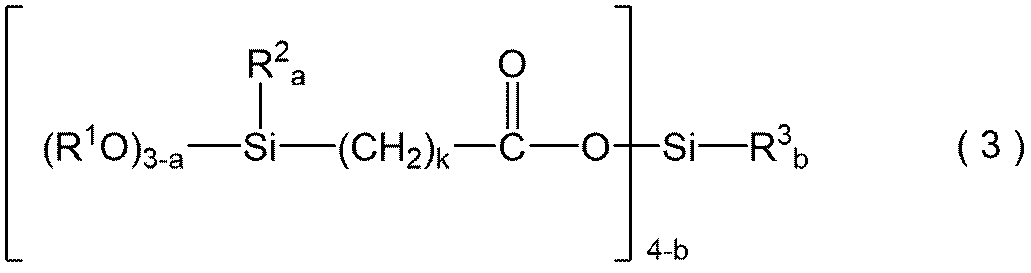
- the carboxylic acid silyl ester group-containing silane coupling agent according to the present invention has a structure represented by the following general formula (3). (Wherein, R 1 , R 2 and R 3 are the same or different monovalent hydrocarbon groups having 1 to 10 carbon atoms, k is an integer of 3 to 14, and a is an integer of 0 to 2) , B is an integer of 0 to 3.)
- the monovalent hydrocarbon group having 1 to 10 carbon atoms represented by R 1 , R 2 and R 3 in the general formula (3) is preferably a monovalent hydrocarbon group having 1 to 7 carbon atoms.
- R 1 constituting the hydrolyzable group as R 1 O- for example, a methyl group, an ethyl group, a propyl group, an alkyl group such as isopropyl group; vinyl group; cycloalkyl groups such as cyclohexyl group And saturated or unsaturated aliphatic hydrocarbon groups such as alkenyl group such as allyl group; aryl groups such as phenyl group and tolyl group; aromatic hydrocarbon groups such as aralkyl group such as benzyl group and phenylethyl group etc.
- groups having 1 to 7 carbon atoms are preferable, and for example, alkyl groups such as methyl, ethyl, propyl and isopropyl are preferable, and methyl and ethyl are particularly preferable.
- R 2 for example, alkyl groups such as methyl group, ethyl group, propyl group and isopropyl group; cycloalkyl groups such as cyclohexyl group; saturated or unsaturated fatty acids such as alkenyl group such as vinyl group and allyl group Group hydrocarbon groups; aryl groups such as phenyl group and tolyl group; and aromatic hydrocarbon groups such as aralkyl group such as benzyl group and phenylethyl group.
- alkyl groups such as methyl group, ethyl group, propyl group and isopropyl group
- cycloalkyl groups such as cyclohexyl group
- saturated or unsaturated fatty acids such as alkenyl group such as vinyl group and allyl group
- hydrocarbon groups aryl groups such as phenyl group and tolyl group
- aromatic hydrocarbon groups such as aralkyl group such as benzyl group and phenylethyl group
- groups having 1 to 7 carbon atoms are preferable, and examples thereof include alkyl groups such as methyl, ethyl, propyl and isopropyl, alkenyl groups such as vinyl, and aryl groups such as phenyl, and particularly methyl Preferred is a group, an ethyl group or a phenyl group.
- R 3 is derived from a silyl group protecting a carboxyl group, and is an unsubstituted or substituted monovalent hydrocarbon group having 1 to 10 carbon atoms, and examples thereof include a methyl group, an ethyl group, a propyl group and an isopropyl group Alkyl groups; cycloalkyl groups such as cyclohexyl group; saturated or unsaturated aliphatic hydrocarbon groups such as alkenyl group such as vinyl group and allyl group; aryl groups such as phenyl group and tolyl group; benzyl group, phenylethyl group And aromatic hydrocarbon groups such as aralkyl groups.
- groups having 1 to 7 carbon atoms are preferable, and examples thereof include alkyl groups such as methyl, ethyl and propyl, alkenyl groups such as vinyl, and aryl groups such as phenyl, particularly methyl and ethyl.
- alkyl groups such as methyl, ethyl and propyl
- alkenyl groups such as vinyl
- aryl groups such as phenyl, particularly methyl and ethyl.
- Preferred is a group, a vinyl group or a phenyl group.
- k represents the repeating number of the saturated hydrocarbon group of the spacer connecting the hydrolyzable alkoxysilyl group of the silane coupling agent and the carboxylic acid silyl ester group.
- the repeating number k of the methylene group in the alkylene group represented by the spacer-(CH 2 ) k- is preferably an integer of 3 to 14, more preferably an integer of 5 to 13, and still more preferably 6 to 11. It is an integer, particularly preferably an integer of 8 to 11, and particularly preferably an integer of 8 to 10. If the number of spacers is less than 3, the synthesis becomes difficult, and if the number of spacers is more than 14, the molecular weight may be too high and adhesion may be reduced.
- the value of a is an integer of 0 to 2, preferably 0.
- the value of b is an integer of 0 to 3, preferably an integer of 1 to 3, more preferably 2 or 3, and when the value of b is 2 or 3, the structure of R 3 May be the same as or different from each other.
- R 3 is an aliphatic saturated monovalent hydrocarbon group such as an alkyl group or the like, it is in the alkylene group represented by — (CH 2 ) k — which is a spacer.
- the repeating number k of the methylene group is desirably an integer of 6 to 14, preferably an integer of 6 to 11, and more preferably an integer of 8 to 10.
- the organosilicon compound of the present invention useful as a silane coupling agent having a carboxylic acid silyl ester group is, for example, a carboxylic acid having an aliphatic unsaturated group (ethylenically unsaturated group or alkenyl group) at one end and a halosilane.
- the silyl ester compound can be produced by reacting an alkoxysilane having an SiH group (hydrosilyl group) in the presence of a catalyst. (Wherein, R 3 , b and k are as defined above)
- k is an integer of 6 to 14, preferably an integer of 6 to 11, Preferably, it is an integer of 8 to 10.
- the carboxylic acid silyl ester compound which has an aliphatic unsaturated group (an ethylenic unsaturated group or an alkenyl group) represented by General formula (5) can be manufactured by the following method. Following general formula (6) (Wherein k is the same as above) And a carboxylic acid having an aliphatic unsaturated group (an ethylenically unsaturated group or an alkenyl group) at the end represented by the following general formula (7) (Wherein, R 3 and b are as defined above, and X is a halogen atom) Can be produced by reacting in the presence of a hydrogen halide scavenger at, for example, 0 ° C. to 150 ° C., preferably 0 ° C. to 60 ° C., for about 30 minutes to 10 hours.
- a hydrogen halide scavenger at, for example, 0 ° C. to 150 ° C., preferably 0 ° C. to 60 ° C.
- examples of the halogen atom of X include a fluoro group, a chloro group, a bromo group and an iodo group, but a chloro group is preferable from the viewpoint of easy availability.
- the molar ratio (halogen atom / carboxyl group) of the halogen atom in the halosilane to the carboxyl group in the carboxylic acid having a saturated group (ethylenically unsaturated group or alkenyl group) is preferably 1 to 2, more preferably 1.0 to It is desirable to set it as 1.4.
- Examples of the hydrogen halide scavenger include tertiary amine compounds such as trimethylamine, triethylamine, tributylamine and pyridine.
- the amount of the hydrogen halide scavenger used is preferably 0.8 to 3 moles, and more preferably 1 to 2 moles, per mole of the halogen atoms in the halosilane represented by the formula (7).
- the organosilicon compound of the present invention can be produced by reacting an alkoxysilane in the presence of a catalyst.
- an alkoxysilyl compound (hydrosilyl group-containing (organo) alkoxysilane) represented by the following general formula (5) (Wherein, R 3 , b and k are as defined above) Is selected from, for example, 40 ° C. to 200 ° C., preferably 60 ° C., in the presence of a platinum group metal catalyst, and a carboxylic acid silyl ester compound having an aliphatic unsaturated group (ethylenically unsaturated group or alkenyl group) at the end thereof It is obtained by reacting at about 120 ° C. for about 30 minutes to about 15 hours.
- the alkoxysilyl compound (hydrosilyl group-containing (organo) alkoxysilane) represented by the formula (8) and the aliphatic unsaturated group at the end represented by the formula (5) (ethylenically unsaturated group or alkenyl group)
- the reaction ratio with the carboxylic acid silyl ester compound having an aliphatic unsaturated group is the molar ratio of the SiH group of the alkoxysilyl compound to the terminal aliphatic unsaturated group of the carboxylic acid silyl ester compound having an aliphatic unsaturated group at the terminal (SiH group / terminal fat Group unsaturated group) is preferably 0.5 to 2, more preferably 1 to 2, and still more preferably 1.0 to 1.5.
- platinum group metal catalysts used herein include chloroplatinic acid, alcohol solution of chloroplatinic acid, reaction product of chloroplatinic acid and alcohol, platinum olefin compound complex, platinum vinyl group-containing siloxane complex, platinum-supported carbon, etc. .
- the amount of the platinum group metal catalyst used may be a so-called catalytic amount, and the mass of the platinum group metal relative to the total mass of the carboxylic acid silyl ester compound having an aliphatic unsaturated group at the terminal and the alkoxysilane having an SiH group
- the amount is preferably 0.1 to 1,000 ppm, particularly preferably 0.3 to 100 ppm, in terms of conversion.
- any of the above production methods may be added with a solvent at the time of reaction
- the solvent is not particularly limited, and examples thereof include aromatic hydrocarbons such as toluene, xylene and benzene, pentane, hexane, heptane, nonane, Aliphatic hydrocarbons such as octane and decane, ethers such as dimethyl ether, methyl ethyl ether, tetrahydrofuran and dioxane, perchloroethane, perchloroethylene, halogenated hydrocarbons such as trichloroethane, chloroform and carbon tetrachloride, and dimethylformamide Amides, and esters such as ethyl acetate, methyl acetate, butyl acetate and the like can be mentioned.
- the organosilicon compound of the present invention has an alkoxysilyl group and a carboxylic acid silyl ester group in one molecule, and a highly active carboxyl group is regenerated by hydrolysis, the room temperature to which the organosilicon compound is added
- the curable organopolysiloxane composition exhibits high adhesion and adhesiveness with the substrate. Therefore, the organosilicon compound of the present invention is useful as a silane coupling agent, a silylating agent, an adhesion promoter and the like.
- the compounding amount of the carboxylic acid silyl ester group-containing silane coupling agent of the component (C) is 0.1 to 15 parts by mass, preferably 0.3 to 10 parts by mass with respect to 100 parts by mass of the component (A).
- the amount is less than 0.1 parts by mass, sufficient magnesium alloy adhesion can not be obtained, and when the amount is more than 15 parts by mass, the cured product becomes hard and brittle, which is disadvantageous in cost.
- a filler in the organopolysiloxane composition of the present invention, (D) a filler can be blended, and as the filler, a reinforcing or non-reinforcing filler for imparting rubber physical properties to the composition is used. be able to.
- a filler specifically, surface-treated or non-treated fumed silica, precipitated silica, wet silica, carbon powder, talc, bentonite, calcium carbonate, zinc carbonate, magnesium carbonate for surface treated or non-treated Examples thereof include calcium oxide, zinc oxide, magnesium oxide, aluminum oxide, aluminum hydroxide and the like which are surface-treated or untreated, and these may be used alone or in combination of two or more.
- the blending amount of the filler is preferably in the range of 1 to 500 parts by mass, more preferably 5 to 450 parts by mass with respect to 100 parts by mass of the component (A). If the amount is less than 1 part by mass, sufficient adhesive strength to the target magnesium alloy may not be obtained due to insufficient rubber strength, and if it exceeds 500 parts by mass, the viscosity of the material may be high and the workability may be inferior.
- the organopolysiloxane composition of the present invention may contain generally known additives and catalysts other than the above components unless it adversely affects the curability at room temperature and the self-adhesion to a magnesium alloy.
- Condensation reaction catalysts may be used.
- Additives include polyether as a thixotropic agent, pigment, colorant such as dye, heat resistance improver such as bengara and cerium oxide, cold resistance improver, rust inhibitor, plasticizer, potassium methacrylate, etc. Examples thereof include oil resistance improvers and the like, and if necessary, fungicides, antibacterial agents and the like are also added.
- the catalyst condensation reaction catalyst
- examples of the catalyst include organic tin compounds, organic suzukilate compounds, alkoxy titanium compounds, organic metal compounds such as titanium chelate compounds, and silicon compounds having a guanidyl group.
- silane coupling agents i.e., other than the above components
- a so-called carbon functional silane compound having a functional group-containing monovalent hydrocarbon group and at least two hydrolyzable groups in the molecule may be used in combination.
- Methacryloxy group-containing alkoxysilanes such as alkoxysilane, 3-methacryloxypropyltrimethoxysilane, 3-methacryloxypropyltriethoxysilane, 3-methacryloxypropylmethyldimethoxysilane, 3-methacryloxypropylmethyldiethoxysilane, 3-mercapto Mercapto-containing alkoxysilanes such as propyltrimethoxysilane and 3-mercaptopropylmethyldimethoxysilane, N- (1,3-dimethylidene) -3-aminopropyltrimethoxysilane, N (1,3-dimethyl-butylidene) -3-like ketimine group-containing alkoxysilanes such as aminopropyltriethoxysilane may be exemplified.
- the preparation method of the organopolysiloxane composition of the present invention is not particularly limited, and it can be obtained by mixing predetermined amounts of the respective components according to a conventional method.
- the organopolysiloxane composition of the present invention when used for magnesium alloy adhesion, hardens (crosslinks) by condensation reaction with moisture in the air at normal temperature (23 ° C. ⁇ 10 ° C.), thereby forming a magnesium alloy with a chemical conversion. It gives a silicone rubber cured product which exhibits good self-adhesiveness without any treatment.
- the organopolysiloxane composition is cured by standing at room temperature (23 ° C. ⁇ 10 ° C.).
- the molding method, curing conditions, etc. adopt known methods and conditions according to the type of composition. can do.
- the viscosity is a value at 25 ° C. measured by a rotational viscometer according to the method defined in JIS Z 8803.
- Synthesis Example 2 50 g (0.27 mol) of 10-undecylenic acid, 34 g (0.135 mol) of diphenyldichlorosilane, 300 ml of toluene in a 500 ml separable flask equipped with a reflux condenser, a dropping funnel, a stirrer, and a thermometer
- 30 g (0.3 mol) of triethylamine was added dropwise over 30 minutes under an ice bath. After completion of the addition, the reaction is carried out at room temperature for 6 hours, and then triethylamine hydrochloride generated by filtration is removed, and then toluene and unreacted substances are removed (evaporated) at 150 ° C.
- Synthesis Example 1 In a 500 ml separable flask equipped with a reflux condenser, a dropping funnel, a stirrer and a thermometer, 128 g (0.5 mole) of 10-undecylenic acid trimethylsilyl ester obtained in Synthesis Example 1 0.5% Karstedt 0.1 g of a catalyst (platinum olefin compound complex) toluene solution was added and heated to 80.degree. Next, 61 g (0.5 mol) of trimethoxysilane was added dropwise over 2 hours while adjusting the temperature range to 80 to 100 ° C. After completion of the dropwise addition, the reaction is carried out at 80 ° C. for 8 hours, and then the unreacted product is removed at 150 ° C.
- a catalyst platinum olefin compound complex
- Synthesis Example 2 In a 500 ml separable flask equipped with a reflux condenser, a dropping funnel, a stirrer and a thermometer, 25 g (0.045 mol) of bis (10-undecylenic acid) diphenylsilyl ester obtained in Synthesis Example 2; 0.05 g of a 5% Karstedt catalyst (platinum olefin compound complex) toluene solution was added, and the mixture was heated to 80 ° C. Next, 15 g (0.12 mol) of trimethoxysilane was added dropwise over 2 hours while adjusting the temperature range to 80 to 100 ° C. After completion of the dropwise addition, the reaction is carried out at 80 ° C.
- a 5% Karstedt catalyst platinum olefin compound complex
- Synthesis Example 3 In a 500 ml separable flask equipped with a reflux condenser, a dropping funnel, a stirrer and a thermometer, 66 g (0.3 mol) of 3-butenoic acid phenyldimethylsilyl ester obtained in Synthesis Example 3 0.5% 0.05 g of a Karlstedt catalyst (platinum olefin compound complex) toluene solution was added and heated to 80 ° C. Next, 36 g (0.3 mol) of trimethoxysilane was added dropwise over 2 hours while adjusting the temperature range to 80 to 100 ° C. After completion of the dropwise addition, the reaction is carried out at 80 ° C.
- a Karlstedt catalyst platinum olefin compound complex
- Synthesis Example 4 In a 500 ml separable flask equipped with a reflux condenser, a dropping funnel, a stirrer and a thermometer, 29 g (0.1 mol) of tris (3-butenoic acid) methylsilyl ester obtained in Synthesis Example 4; 0.05 g of a 5% Karstedt catalyst (platinum olefin compound complex) toluene solution was added, and the mixture was heated to 80 ° C. Next, 36 g (0.3 mol) of trimethoxysilane was added dropwise over 2 hours while adjusting the temperature range to 80 to 100 ° C. After completion of the dropwise addition, the reaction is carried out at 80 ° C.
- a 5% Karstedt catalyst platinum olefin compound complex
- Synthesis Example 5 In a 500 ml separable flask equipped with a reflux condenser, a dropping funnel, a stirrer, and a thermometer, 36 g (0.1 mol) of the tetra (3-butenoic acid) silyl ester obtained in Synthesis Example 5 (0.5 mol) % Karstedt catalyst (platinum olefin compound complex) 0.05 g of a toluene solution was added and heated to 80 ° C. Next, 48 g (0.4 mol) of trimethoxysilane was added dropwise over 2 hours while adjusting the temperature range to 80 to 100 ° C. After completion of the dropwise addition, the reaction is carried out at 80 ° C.
- Karstedt catalyst platinum olefin compound complex
- Synthesis Example 6 In a 500 ml separable flask equipped with a reflux condenser, a dropping funnel, a stirrer and a thermometer, 128 g (0.5 mole) of 10-undecylenic acid trimethylsilyl ester obtained in Synthesis Example 1 0.5% Karstedt 0.1 g of a catalyst (platinum olefin compound complex) toluene solution was added and heated to 80.degree. Next, 53 g (0.5 mol) of methyldimethoxysilane was added dropwise over 2 hours while adjusting the temperature range to 80 to 100 ° C. After completion of the dropwise addition, the reaction is carried out at 80 ° C.
- a catalyst platinum olefin compound complex
- Synthesis Example 7 In a 500 ml separable flask equipped with a reflux condenser, a dropping funnel, a stirrer and a thermometer, 128 g (0.5 mole) of 10-undecylenic acid trimethylsilyl ester obtained in Synthesis Example 1 0.5% Karstedt 0.1 g of a catalyst (platinum olefin compound complex) toluene solution was added and heated to 80.degree. Next, 82 g (0.5 mol) of triethoxysilane was added dropwise over 2 hours while adjusting the temperature range to 80 to 100 ° C. After completion of the dropwise addition, the reaction is carried out at 80 ° C. for 8 hours, and then the unreacted product is removed at 150 ° C.
- a catalyst platinum olefin compound complex
- Example 1 100 parts of dimethylpolysiloxane blocked by a hydroxyl group (silanol group) in which both ends of a molecular chain having a viscosity of 20,000 mPa ⁇ s are bonded to a silicon atom, and the surface is treated with paraffin (component D) 100 parts of calcium is uniformly mixed, and (B component) 9 parts of vinyltributanoxysilane, 0.6 part of dibutyltin dilaurate, and (C component) 11-trimethoxysilylundecane obtained in Synthesis Example 1 Composition 1 was prepared by adding 1 part of acid trimethylsilyl ester and mixing until uniform with moisture protection.
- Example 2 In Example 1, (C component) instead of 1 part of (C component) 11-trimethoxysilylundecanoic acid trimethylsilyl ester, (B component) bis (11-trimethoxysilyl undecanoic acid) diphenylsilyl ester obtained in Synthesis Example 2 Composition 2 was similarly prepared except using a part.
- Example 3 In Example 1, (C component) 1 part of 4-trimethoxysilylbutanoic acid phenyldimethylsilyl ester obtained in Synthesis Example 3 (C component) instead of 1 part of (C component) 11-trimethoxysilylundecanoic acid trimethylsilyl ester Composition 3 was similarly prepared except that it was used.
- Example 4 In Example 1, in place of 1 part of (C component) 11-trimethoxysilylundecanoic acid trimethylsilyl ester, tris (4-trimethoxysilylbutenoic acid) methyl silyl ester 1 obtained in Synthesis Example 4 (C component) Composition 4 was similarly prepared except using a part.
- Example 5 In Example 1, (C component) instead of 1 part of (C component) 11-trimethoxysilylundecanoic acid trimethylsilyl ester, (C component) 1 part of tetra (4-trimethoxysilylbutanoic acid) silyl ester obtained in Synthesis Example 5 Composition 5 was similarly prepared except using.
- Example 6 In Example 1, (C component) 1 part of 11-methyldimethoxysilylundecanoic acid trimethylsilyl ester obtained in Synthesis Example 6 was used instead of 1 part of (C component) 11-trimethoxysilylundecanoic acid trimethylsilyl ester Composition 6 was similarly prepared except that
- Example 7 In Example 1, (C component) 1 part of 11-triethoxysilylundecanoic acid trimethylsilyl ester obtained in Synthesis Example 7 was used in place of 1 part of (C component) 11-trimethoxysilylundecanoic acid trimethylsilyl ester Composition 7 was similarly prepared except that
- Comparative Example 1 Composition 8 similarly to Example 1 except that 1 part of N-2- (aminoethyl) -3-aminopropyltrimethoxysilane was used instead of (C component) 11-trimethoxysilylundecanoic acid trimethylsilyl ester. was prepared.
- each of the compositions immediately after preparation prepared in Examples 1 to 7 and Comparative Examples 1 and 2 described above has an adhesion area of 2.5 mm. 2.
- a shear adhesion test sample having an adhesion thickness of 1 mm was produced. After aging for 7 days at 23 ° C. and 50% RH, the shear adhesion and the cohesive failure rate were measured according to the method defined in JIS K 6249, and the cohesive failure rates were compared. The results are shown in Table 1.
- the organosilicon compound of the present invention can be incorporated into a room temperature curable organopolysiloxane composition (silicone rubber composition) to obtain magnesium, which is a hard-to-adhere material to a silicone rubber cured product which is a cured product of the composition. It has been found to impart excellent adhesion to the alloy. On the other hand, magnesium alloy adhesion has not been achieved with amine-based adhesion aids that are conventionally used widely. Therefore, the organosilicon compound of the present invention can impart more excellent adhesion as compared with conventional adhesion assistants by being added to a room temperature curable organopolysiloxane composition.
- Example 8 (Component A) The surface was treated with fatty acid to 100 parts by mass of dimethylpolysiloxane blocked by a hydroxyl group (silanol group) having a viscosity of 5,000 mPa ⁇ s and both molecular chain terminals bonded to a silicon atom (Component D) 100 parts by mass of ground calcium carbonate (product name: MC coated P-20, made by Maruo calcium) and mixed in a mixer, then (B component) 10 parts by mass of vinyltributanoxymsilane, 0.1% dioctyltin dilaurate Part by mass, (Component C) 1 part by mass of 4-trimethoxysilylbutanoic acid trimethylsilyl ester obtained in Synthesis Reference Example 1 was added and thoroughly mixed under reduced pressure to obtain Composition 10.
- Component D 100 parts by mass of ground calcium carbonate (product name: MC coated P-20, made by Maruo calcium) and mixed in a mixer, then (B component) 10 parts by mass
- Example 9 (Component A) The surface was treated with fatty acid to 100 parts by mass of dimethylpolysiloxane blocked by a hydroxyl group (silanol group) having a viscosity of 5,000 mPa ⁇ s and both molecular chain terminals bonded to a silicon atom (Component D) 100 parts by mass of ground calcium carbonate (product name: MC coated P-20, made by Maruo calcium) and mixed in a mixer, then (B component) 10 parts by mass of vinyltributanoxymsilane, 0.1% dioctyltin dilaurate Part by mass, (Component C) 1 part by mass of the 11-trimethoxysilylundecanoic acid trimethylsilyl ester obtained in Synthesis Example 1 was added and thoroughly mixed under reduced pressure to obtain a composition 11.
- Component D 100 parts by mass of ground calcium carbonate (product name: MC coated P-20, made by Maruo calcium) and mixed in a mixer, then
- B component 10
- Example 10 (Component A) The surface was treated with fatty acid to 100 parts by mass of dimethylpolysiloxane blocked by a hydroxyl group (silanol group) having a viscosity of 5,000 mPa ⁇ s and both molecular chain terminals bonded to a silicon atom (Component D) 100 parts by mass of ground calcium carbonate (product name: MC coated P-20, made by Maruo calcium) and mixed in a mixer, then (B component) 10 parts by mass of vinyltributanoxymsilane, 0.1% dioctyltin dilaurate Part by mass, (Component C) 1 part by mass of bis (11-trimethoxysilylundecanoic acid) diphenylsilyl ester obtained in Synthesis Example 2 was added and thoroughly mixed under reduced pressure to obtain Composition 12.
- Component D 100 parts by mass of ground calcium carbonate (product name: MC coated P-20, made by Maruo calcium) and mixed in a mixer, then
- Example 11 (Component A) The surface was treated with fatty acid to 100 parts by mass of dimethylpolysiloxane blocked by a hydroxyl group (silanol group) having a viscosity of 5,000 mPa ⁇ s and both molecular chain terminals bonded to a silicon atom (Component D) 100 parts by mass of ground calcium carbonate (product name: MC coated P-20, made by Maruo calcium) and mixed in a mixer, then (B component) 10 parts by mass of vinyltributanoxymsilane, 0.1% dioctyltin dilaurate Part by mass, (Component C) 1 part by mass of 11-trimethoxysilylundecanoic acid trimethylsilyl ester obtained in Synthesis Example 1 N- (1,3-Dimethylbutylidene) -3-aminopropyltrimethoxysilane (product name) 1 part by mass of KBM-9103P (manufactured by Shin-Et
- Comparative Example 3 (Component A) The surface was treated with fatty acid to 100 parts by mass of dimethylpolysiloxane blocked by a hydroxyl group (silanol group) having a viscosity of 5,000 mPa ⁇ s and both molecular chain terminals bonded to a silicon atom (Component D) 100 parts by mass of ground calcium carbonate (product name: MC coated P-20, made by Maruo calcium) and mixed in a mixer, then (B component) 10 parts by mass of vinyltributanoxymsilane, 0.1% dioctyltin dilaurate The parts by mass and 1 part by mass of 3-aminopropyltrimethoxysilane were added and thoroughly mixed under reduced pressure to obtain Composition 14.
- Component D 100 parts by mass of ground calcium carbonate (product name: MC coated P-20, made by Maruo calcium) and mixed in a mixer, then (B component) 10 parts by mass of vinyltributanoxymsilane, 0.1% dio
- Comparative Example 4 (Component A) The surface was treated with fatty acid to 100 parts by mass of dimethylpolysiloxane blocked by a hydroxyl group (silanol group) having a viscosity of 5,000 mPa ⁇ s and both molecular chain terminals bonded to a silicon atom (Component D) 100 parts by mass of ground calcium carbonate (product name: MC coated P-20, made by Maruo calcium) and mixed in a mixer, then (B component) 10 parts by mass of vinyltributanoxymsilane, 0.1% dioctyltin dilaurate A part by mass and 1 part by mass of allyl succinic anhydride silane (product name; X-31-967C, manufactured by Shin-Etsu Chemical Co., Ltd.) were added and thoroughly mixed under reduced pressure to obtain a composition 15.
- Comparative Example 5 (Component A) The surface was treated with fatty acid to 100 parts by mass of dimethylpolysiloxane blocked by a hydroxyl group (silanol group) having a viscosity of 5,000 mPa ⁇ s and both molecular chain terminals bonded to a silicon atom (Component D) 100 parts by mass of ground calcium carbonate (product name: MC coated P-20, made by Maruo calcium) and mixed in a mixer, then (B component) 10 parts by mass of vinyltributanoxymsilane, 0.1% dioctyltin dilaurate A part by mass and 1 part by mass of 3-butenoic acid trimethylsilyl ester obtained in Synthesis Example 6 were added and thoroughly mixed under reduced pressure to obtain a composition 16.
- Component D 100 parts by mass of ground calcium carbonate (product name: MC coated P-20, made by Maruo calcium) and mixed in a mixer, then (B component) 10 parts by mass of vinyltributanoxymsi
- Each composition immediately after preparation prepared in these Examples 8 to 11 and Comparative Examples 3 to 5 was poured into a 2 mm mold, and aged for 7 days at 23 ° C. and 50% RH to obtain a 2 mm thick rubber sheet.
- Rubber physical properties (hardness, elongation at break, tensile strength) were measured from a 2 mm thick sheet according to JIS K6249.
- Each of the compositions immediately after preparation prepared in each of Examples 8 to 11 and Comparative Examples 3 to 5 was treated using a magnesium alloy plate (AZ-91D) having a width of 25 mm and a length of 50 mm, and an adhesion area of 2.5 mm 2.
- a shear adhesion test sample with an adhesion thickness of 1 mm was produced. After aging for 7 days at 23 ° C. and 50% RH, the shear adhesion and the cohesive failure rate were measured according to the method defined in JIS K 6249, and the cohesive failure rates were compared.
- the obtained cured silicone rubber sheet and shear adhesion test sample are immersed in CVTF oil [trade name: ULTRA Honda Multi Matic Fluid] and heated to 150 ° C. The test was carried out for 7 days and then tested in the same manner as in the initial stage of production to conduct a chemical resistance confirmation test.
- CVTF oil trade name: ULTRA Honda Multi Matic Fluid
- compositions of Examples 8 to 11 having the carboxylic acid silyl ester group-containing silane coupling agent of the present invention have high adhesiveness to AZ-91D both in the initial stage of production and after the chemical resistance test. I understand that.
- adhesiveness did not appear at all with respect to AZ-91D, and chemical resistance was also deteriorated.
- Comparative Example 4 using the allyl succinic anhydride silane coupling agent had good adhesiveness at the beginning of production, it peeled off from AZ-91D after the chemical resistance test.
Landscapes
- Chemical & Material Sciences (AREA)
- Organic Chemistry (AREA)
- Chemical Kinetics & Catalysis (AREA)
- Health & Medical Sciences (AREA)
- Medicinal Chemistry (AREA)
- Polymers & Plastics (AREA)
- Compositions Of Macromolecular Compounds (AREA)
- Adhesives Or Adhesive Processes (AREA)
Abstract
Description
また、本発明は、新規な有機ケイ素化合物に関するものである。特にシランカップリング剤、シリル化剤、接着助剤などとして有用である新規カルボン酸シリルエステル基含有有機ケイ素化合物及びその製造方法に関する。
室温硬化性オルガノポリシロキサン組成物の硬化物(シリコーンゴム硬化物)の使用用途には高い接着性が要求されることが多く、接着性付与剤として、アミノ基やエポキシ基、メタクリル基、メルカプト基などの官能性基含有一価炭化水素基を持つ加水分解性オルガノシラン化合物(カーボンファンクショナルシラン又はシランカップリング剤)を室温硬化性オルガノポリシロキサン組成物中に添加することで、基材との密着性や接着性を改善してきた。
また、本発明は、さらに基材との密着・接着性を向上させるシランカップリング剤、シリル化剤、接着助剤などに有用である新規有機ケイ素化合物及びその製造方法を提供することを目的とする。
さらに、本発明者らは、マグネシウム合金被着体の特殊性に着目して鋭意検討を行った結果、(A)後述する一般式(1)及び/又は(2)で示されるオルガノポリシロキサン、(B)一分子中にケイ素原子に結合した加水分解可能な基を少なくとも3個有する、(A)成分及び(C)成分以外の有機ケイ素化合物及び/又はその部分加水分解縮合物、(C)後述する一般式(3)で示されるカルボン酸シリルエステル結合を有する特定分子構造のシランカップリング剤、及び好ましくは(D)少なくとも1種の充填剤を含有するオルガノポリシロキサン組成物が、大気中の湿気(縮合反応による架橋)により常温(23℃±10℃)で硬化してマグネシウム合金に対して良好な自己接着性を有するシリコーンゴム硬化物を与えることを見出した。
即ち、ガラス等に代表される一般の被着体に対しては、アミノ基含有シラン接着促進剤が有効であるが、マグネシウム合金に対しては、3-アミノプロピルトリメトキシシランを用いた後述の比較例の結果からも明らかな通り、接着性に劣るものであるが、カルボン酸シリルエステル結合を有する特定分子構造のシランカップリング剤を用いた場合、マグネシウム合金との接着性が飛躍的に向上し、かつ従来技術と比較しても耐薬品性にも優れることを見出し、本発明をなすに至ったものである。
[1]
(A)下記一般式(1)及び/又は(2)で示されるオルガノポリシロキサン:100質量部、
HO(SiR2O)nH (1)
(式中、Rは同一又は異種の炭素数1~10の非置換もしくはハロゲン原子置換の一価炭化水素基であり、nは10以上の整数である。)

(B)一分子中にケイ素原子に結合した加水分解可能な基を少なくとも3個有する、(A)成分及び(C)成分以外の有機ケイ素化合物及び/又はその部分加水分解縮合物:0.1~50質量部、
(C)下記一般式(3)で示されるシランカップリング剤:0.1~15質量部
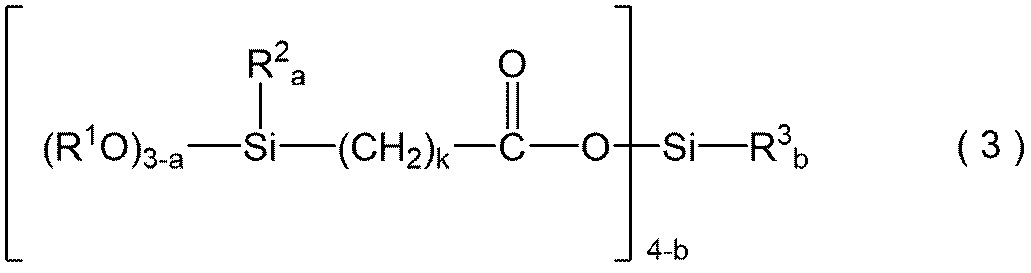
を含有してなるオルガノポリシロキサン組成物。
[2]
(B)成分が、下記一般式(4)で示される加水分解性オルガノシラン化合物及び/又はその部分加水分解縮合物である[1]に記載のオルガノポリシロキサン組成物。
R4 cSiR5 4-c (4)
(式中、R4は一価炭化水素基であり、R5は加水分解性基である。cは0又は1である。)
[3]
さらに、(D)成分として少なくとも1種の充填剤を(A)成分100質量部に対して1~500質量部含有してなる[1]又は[2]に記載のオルガノポリシロキサン組成物。
[4]
マグネシウム合金接着用である[1]~[3]のいずれかに記載のオルガノポリシロキサン組成物。
[5]
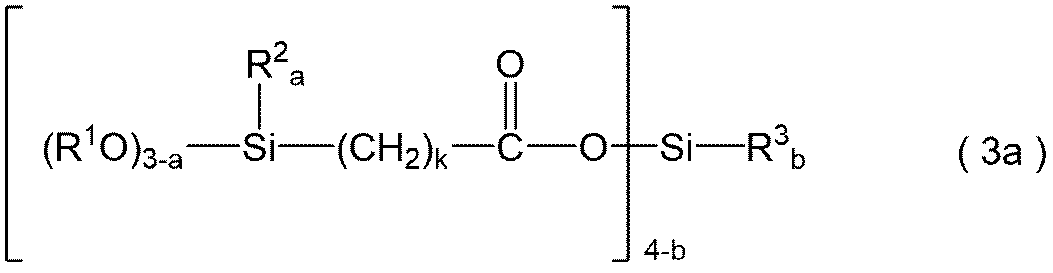
下記一般式(3a)で示される有機ケイ素化合物。
[6]
下記一般式(5)
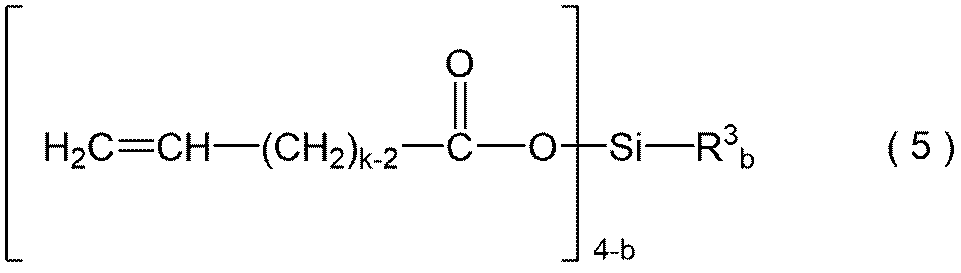
で表される末端に脂肪族不飽和基を有するカルボン酸シリルエステル化合物と、下記一般式(8)
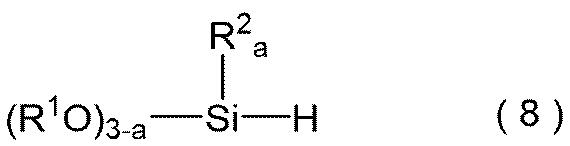
で表されるアルコキシシランとを反応させる工程を含有する下記一般式(3a)
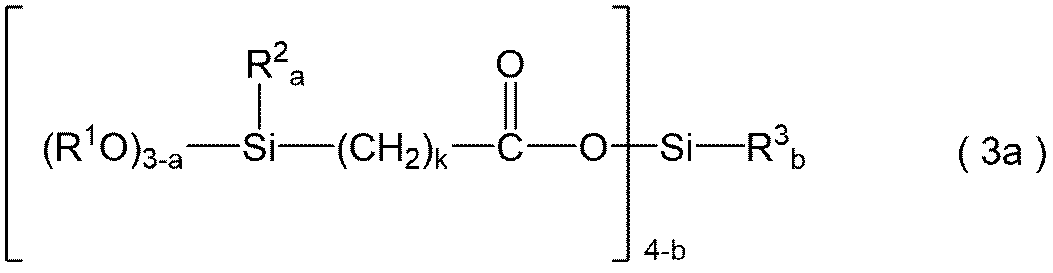
で示される有機ケイ素化合物の製造方法。
[7]
上記一般式(5)で表される末端に脂肪族不飽和基を有するカルボン酸シリルエステル化合物が、下記一般式(6)

で表される末端に脂肪族不飽和基を有するカルボン酸と、下記一般式(7)

で表されるハロシランとを反応させて得られるものである[6]に記載の有機ケイ素化合物の製造方法。
また、本発明の新規有機ケイ素化合物は、アルコキシシリル基とカルボン酸シリルエステル基を一分子中に有しており、加水分解によって高活性なカルボキシル基が再生されることから、該有機ケイ素化合物を添加した室温硬化性オルガノポリシロキサン組成物は、基材との高い密着・接着性を発現する。
(A)下記一般式(1)及び/又は(2)で示されるオルガノポリシロキサン、
HO(SiR2O)nH (1)
(式中、Rは同一又は異種の炭素数1~10の非置換もしくはハロゲン原子置換の一価炭化水素基であり、nは10以上の整数である。)

(B)一分子中にケイ素原子に結合した加水分解可能な基を少なくとも3個有する、(A)成分及び(C)成分以外の有機ケイ素化合物及び/又はその部分加水分解縮合物、
(C)下記一般式(3)で示されるシランカップリング剤。
本発明のオルガノポリシロキサン組成物に用いられる(A)成分のオルガノポリシロキサンは、本発明組成物の主剤(ベースポリマー)として作用するものであり、下記一般式(1)及び/又は(2)で示されるものである。
HO(SiR2O)nH (1)
(式中、Rは同一又は異種の炭素数1~10の非置換もしくはハロゲン原子置換の一価炭化水素基であり、nは10以上の整数である。)

mは独立に0又は1である。
本発明のオルガノポリシロキサン組成物に用いる(B)成分は、架橋剤(硬化剤)として作用するものであり、一分子中にケイ素原子に結合した加水分解可能な基を少なくとも3個有する、(A)成分及び(C)成分以外の、加水分解性有機ケイ素化合物及び/又はその部分加水分解縮合物であり、該有機ケイ素化合物としては、下記一般式(4)で示される加水分解性オルガノシラン化合物及び/又はその部分加水分解縮合物(即ち、該オルガノシラン化合物を部分的に加水分解縮合して生成する分子中に残存加水分解性基を少なくとも2個、好ましくは3個以上有するオルガノシロキサンオリゴマー)が好ましい。
R4 cSiR5 4-c (4)
(式中、R4は一価炭化水素基であり、R5は加水分解性基である。cは0又は1であり、好ましくは1である。)
また、加水分解性基以外のケイ素原子に結合した残余の基R4は、一価炭化水素基であれば特に限定されるものではないが、具体的には、メチル基、エチル基、プロピル基、ブチル基等のアルキル基、ビニル基等のアルケニル基、フェニル基等のアリール基などの炭素数1~10の一価炭化水素基が例示される。これらの中でも、メチル基、エチル基、ビニル基、フェニル基が好ましい。
本発明のオルガノポリシロキサン組成物に用いる(C)成分のシランカップリング剤は、分子中に1~4個のカルボン酸シリルエステル結合を有するものであり、本発明の組成物を常温硬化して得られる硬化物(シリコーンゴム)に良好なマグネシウム合金接着性を付与するために必須のものである。特許文献7でも述べられているが、マグネシウム合金への接着性向上には酸系シランカップリング剤が有効である。本発明で使用するカルボン酸シリルエステル基を有するシランカップリング剤は、未硬化時にはカルボキシル基はシリル基で保護されているが、硬化時に加水分解によってシリル基が脱離することでカルボキシル基が再生することにより、マグネシウム合金への接着力向上を実現する。また、高活性のカルボキシル基をシリル基で保護することによって、保存安定性や耐薬品性の向上も達成している。

また、式中bの値は0~3の整数であり、好ましくは1~3の整数であり、さらに好ましくは2又は3であり、bの値が2及び3の場合は、R3の構造は互いに同一でも異種であってもよい。





で表される末端に脂肪族不飽和基(エチレン性不飽和基又はアルケニル基)を有するカルボン酸と、下記一般式(7)

で表されるハロシランを、ハロゲン化水素捕捉剤存在下で、例えば、0℃~150℃、好ましくは0℃~60℃で、30分~10時間程度反応させることによって製造することができる。
ハロゲン化水素捕捉剤の使用量は、式(7)で表されるハロシラン中のハロゲン原子1モルに対して0.8~3モル、特に1~2モルとすることが好ましい。
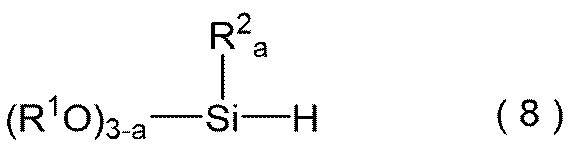
で表されるアルコキシシリル化合物(ヒドロシリル基含有(オルガノ)アルコキシシラン)と、下記一般式(5)

で表される末端に脂肪族不飽和基(エチレン性不飽和基又はアルケニル基)を有するカルボン酸シリルエステル化合物を、白金族金属触媒存在下で、例えば、40℃~200℃、好ましくは60℃~120℃で、30分~15時間程度反応させることによって得られる。
白金族金属触媒の使用量は、所謂触媒量でよく、末端に脂肪族不飽和基を有するカルボン酸シリルエステル化合物とSiH基を有するアルコキシシラン類との合計質量に対して、白金族金属の質量換算で0.1~1,000ppmであることが好ましく、特に0.3~100ppmの量であることが好ましい。
本発明のオルガノポリシロキサン組成物においては、(D)充填剤を配合することができ、該充填剤としては、本組成物にゴム物性を付与するための補強性、非補強性充填剤を用いることができる。このような充填剤として、具体的には、表面処理又は無処理の煙霧質シリカ、沈降性シリカ、湿式シリカ、カーボン粉、タルク、ベントナイト、表面処理又は無処理の炭酸カルシウム、炭酸亜鉛、炭酸マグネシウム、表面処理又は無処理の酸化カルシウム、酸化亜鉛、酸化マグネシウム、酸化アルミニウム、水酸化アルミニウム等が例示され、これらは1種を単独で又は2種以上を併用することができる。
また、本発明のオルガノポリシロキサン組成物には、室温での硬化性やマグネシウム合金への自己接着性等に悪影響を与えない限り、上記成分以外に一般に知られている添加剤、触媒(特に、縮合反応触媒)などを使用しても差し支えない。添加剤としては、チクソ性向上剤としてのポリエーテル、顔料、染料などの着色剤、ベンガラ及び酸化セリウムなどの耐熱性向上剤、耐寒性向上剤、防錆剤、可塑剤、メタクリル酸カリウムなどの耐油性向上剤等が挙げられ、必要に応じて防かび剤、抗菌剤なども添加される。触媒(縮合反応触媒)としては、有機スズエステル化合物、有機スズキレート化合物、アルコキシチタン化合物、チタンキレート化合物などの有機金属化合物やグアニジル基を有するケイ素化合物などが挙げられる。
本発明のオルガノポリシロキサン組成物の調製方法は特に限定されず、上記各成分の所定量を常法に準じて混合することにより得ることができる。
本発明のオルガノポリシロキサン組成物は、マグネシウム合金接着用として用いた場合、常温(23℃±10℃)において大気中の湿気によって縮合反応により硬化(架橋)することによって、マグネシウム合金に対して化成処理なしでも良好な自己接着性を示すシリコーンゴム硬化物を与えるものである。
また、上記オルガノポリシロキサン組成物は、室温(23℃±10℃)で放置することにより硬化するが、その成形方法、硬化条件などは、組成物の種類に応じた公知の方法、条件を採用することができる。
還流管、滴下ロート、撹拌機、温度計を備えた容量1,000mlのセパラブルフラスコに、10-ウンデシレン酸を184g(1モル)、トリメチルクロロシランを119g(1.1モル)、トルエンを500ml加え、氷浴下でトリエチルアミン111g(1.1モル)を1時間かけて滴下した。滴下終了後、6時間室温(23℃、以下同じ)で反応させたのち、濾過により発生したトリエチルアミン塩酸塩を除去し、さらに150℃、300Paでトルエン及び未反応物を除去(留去)することにより、目的物の10-ウンデシレン酸トリメチルシリルエステルを得た(収量226g、収率72%)。
1H-NMR(400MHz,CDCl3)δ5.46(m,3H),2.48(t,2H),1.88(m,2H),1.08(brs,16H),0.28(s,9H)
還流管、滴下ロート、撹拌機、温度計を備えた容量500mlのセパラブルフラスコに、10-ウンデシレン酸を50g(0.27モル)、ジフェニルジクロロシランを34g(0.135モル)、トルエンを300ml加え、氷浴下でトリエチルアミン30g(0.3モル)を30分かけて滴下した。滴下終了後、6時間室温で反応させたのち、濾過により発生したトリエチルアミン塩酸塩を除去し、さらに150℃、300Paでトルエン及び未反応物を除去(留去)することにより、目的物のビス(10-ウンデシレン酸)ジフェニルシリルエステルを得た(収量59g、収率79%)。
1H-NMR(400MHz,CDCl3)δ7.36(m,10H),2.51(t,4H),1.88(m,4H),1.08(brs,32H),0.28(s,18H)
還流管、滴下ロート、撹拌機、温度計を備えた容量500mlのセパラブルフラスコに、3-ブテン酸を43g(0.5モル)、フェニルジメチルクロロシランを94g(0.55モル)、トルエンを300ml加え、氷浴下でトリエチルアミン55g(0.55モル)を30分かけて滴下した。滴下終了後、6時間室温で反応させたのち、濾過により発生したトリエチルアミン塩酸塩を除去し、さらに100℃、300Paでトルエン及び未反応物を除去(留去)することにより、目的物の3-ブテン酸フェニルジメチルシリルエステルを得た(収量78g、収率71%)。
1H-NMR(400MHz,CDCl3)δ7.32(m,5H),5.72(m,3H),2.48(t,2H),0.31(s,6H)
還流管、滴下ロート、撹拌機、温度計を備えた容量500mlのセパラブルフラスコに、3-ブテン酸を52g(0.6モル)、メチルトリクロロシランを29g(0.2モル)、トルエンを300ml加え、氷浴下でトリエチルアミン60g(0.6モル)を30分かけて滴下した。滴下終了後、6時間室温で反応させたのち、濾過により発生したトリエチルアミン塩酸塩を除去し、さらに150℃、300Paでトルエン及び未反応物を除去(留去)することにより、目的物のトリス(3-ブテン酸)メチルシリルエステルを得た(収量52g、収率88%)。
1H-NMR(400MHz,CDCl3)δ5.72(m,9H),2.48(t,6H),0.29(s,3H)
還流管、滴下ロート、撹拌機、温度計を備えた容量500mlのセパラブルフラスコに、3-ブテン酸を69g(0.8モル)、テトラクロロシランを33g(0.2モル)、トルエンを300ml加え、氷浴下でトリエチルアミン80g(0.8モル)を30分かけて滴下した。滴下終了後、6時間室温で反応させたのち、濾過により発生したトリエチルアミン塩酸塩を除去し、さらに150℃、300Paでトルエン及び未反応物を除去(留去)することにより、目的物のテトラ(3-ブテン酸)シリルエステルを得た(収量61g、収率83%)。
1H-NMR(400MHz,CDCl3)δ5.72(m,12H),2.48(t,8H)
還流管、滴下ロート、撹拌機、温度計を備えた容量1,000mlのセパラブルフラスコに、3-ブテン酸を86g(1モル)、トリメチルクロロシランを119g(1.1モル)、トルエンを500ml加え、氷浴下でトリエチルアミン111g(1.1モル)を1時間かけて滴下した。滴下終了後、6時間室温(23℃、以下同じ)で反応させたのち、濾過により発生したトリエチルアミン塩酸塩を除去し、さらに120℃、2,000Paでトルエン及び未反応物を除去(留去)することにより、目的物の3-ブテン酸トリメチルシリルエステルを得た(収量108g、収率68%)。
1H-NMR(400MHz,CDCl3)δ5.72(m,3H),2.48(t,2H),0.28(s,9H)
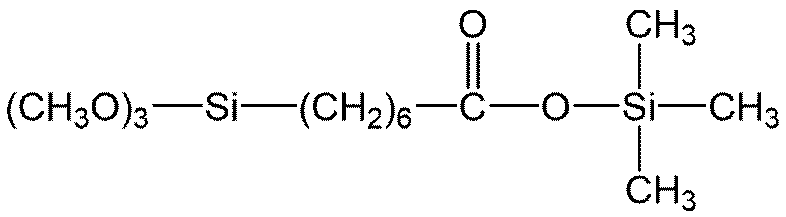
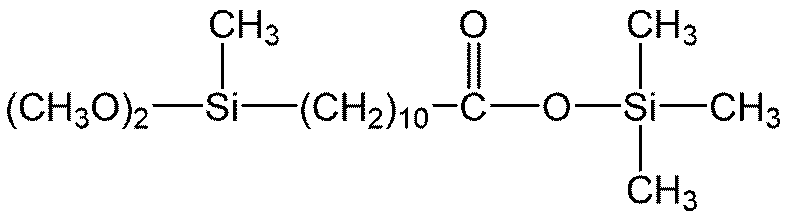
還流管、滴下ロート、撹拌機、温度計を備えた容量500mlのセパラブルフラスコに、合成例1で得られた10-ウンデシレン酸トリメチルシリルエステルを128g(0.5モル)、0.5%カールステッド触媒(白金オレフィン化合物錯体)トルエン溶液を0.1g加え、80℃に加温した。次にトリメトキシシラン61g(0.5モル)を温度範囲が80~100℃になるよう調整しながら、2時間かけて滴下した。滴下終了後、80℃で8時間反応させたのち、150℃、300Paで未反応物を除去することにより、下記化学式(9)で示される、目的物11-トリメトキシシリルウンデカン酸トリメチルシリルエステルを得た(収量212g、収率91%)。
1H-NMR(400MHz,CDCl3)δ3.82(s,9H),2.18(t,2H),1.51(m,2H),1.08(brs,14H),0.78(t,2H),0.28(s,9H)

還流管、滴下ロート、撹拌機、温度計を備えた容量500mlのセパラブルフラスコに、合成例2で得られたビス(10-ウンデシレン酸)ジフェニルシリルエステルを25g(0.045モル)、0.5%カールステッド触媒(白金オレフィン化合物錯体)トルエン溶液を0.05g加え、80℃に加温した。次にトリメトキシシラン15g(0.12モル)を温度範囲が80~100℃になるよう調整しながら、2時間かけて滴下した。滴下終了後、80℃で8時間反応させたのち、150℃、300Paで未反応物を除去することにより、下記化学式(10)で示される、目的物ビス(11-トリメトキシシリルウンデカン酸)ジフェニルシリルエステルを得た(収量39g、収率93%)。
1H-NMR(400MHz,CDCl3)δ7.36(m,10H),3.82(s,18H),2.18(t,4H),1.51(m,4H),1.08(brs,28H),0.78(t,4H),0.28(s,18H)

還流管、滴下ロート、撹拌機、温度計を備えた容量500mlのセパラブルフラスコに、合成例3で得られた3-ブテン酸フェニルジメチルシリルエステルを66g(0.3モル)、0.5%カールステッド触媒(白金オレフィン化合物錯体)トルエン溶液を0.05g加え、80℃に加温した。次にトリメトキシシラン36g(0.3モル)を温度範囲が80~100℃になるよう調整しながら、2時間かけて滴下した。滴下終了後、80℃で8時間反応させたのち、100℃、300Paで未反応物を除去することにより、下記化学式(11)で示される、目的物4-トリメトキシシリルブタン酸フェニルジメチルシリルエステルを得た(収量79g、収率91%)。
1H-NMR(400MHz,CDCl3)δ7.18(m,10H),3.82(s,9H),2.26(t,2H),1.86(m,2H),0.78(t,2H),0.31(s,6H)

還流管、滴下ロート、撹拌機、温度計を備えた容量500mlのセパラブルフラスコに、合成例4で得られたトリス(3-ブテン酸)メチルシリルエステルを29g(0.1モル)、0.5%カールステッド触媒(白金オレフィン化合物錯体)トルエン溶液を0.05g加え、80℃に加温した。次にトリメトキシシラン36g(0.3モル)を温度範囲が80~100℃になるよう調整しながら、2時間かけて滴下した。滴下終了後、80℃で8時間反応させたのち、150℃、300Paで未反応物を除去することにより、下記化学式(12)で示される、目的物トリス(4-トリメトキシシリルブテン酸)メチルシリルエステルを得た(収量60g、収率93%)。
1H-NMR(400MHz,CDCl3)δ3.82(s,27H),2.26(t,6H),1.86(m,6H),0.78(t,6H),0.29(s,3H)

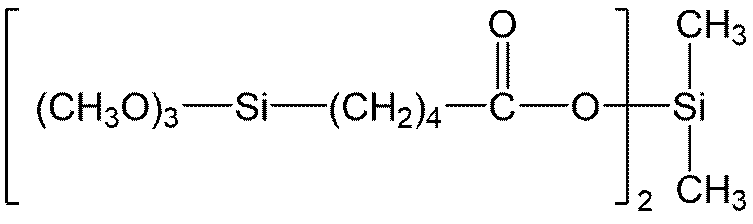
還流管、滴下ロート、撹拌機、温度計を備えた容量500mlのセパラブルフラスコに、合成例5で得られたテトラ(3-ブテン酸)シリルエステルを36g(0.1モル)、0.5%カールステッド触媒(白金オレフィン化合物錯体)トルエン溶液を0.05g加え、80℃に加温した。次にトリメトキシシラン48g(0.4モル)を温度範囲が80~100℃になるよう調整しながら、2時間かけて滴下した。滴下終了後、80℃で8時間反応させたのち、150℃、300Paで未反応物を除去することにより、下記化学式(13)で示される、目的物のテトラ(4-トリメトキシシリルブタン酸)シリルエステルを得た(収量75g、収率90%)。
1H-NMR(400MHz,CDCl3)δ3.82(s,36H),2.26(t,8H),1.86(m,8H),0.78(t,8H)

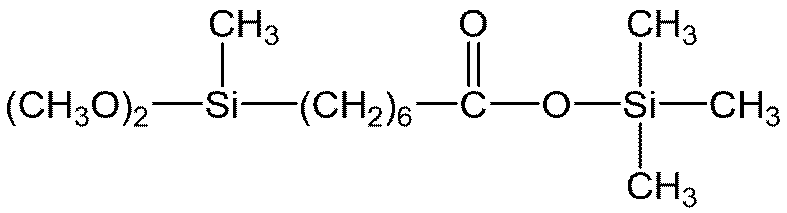
還流管、滴下ロート、撹拌機、温度計を備えた容量500mlのセパラブルフラスコに、合成例1で得られた10-ウンデシレン酸トリメチルシリルエステルを128g(0.5モル)、0.5%カールステッド触媒(白金オレフィン化合物錯体)トルエン溶液を0.1g加え、80℃に加温した。次にメチルジメトキシシラン53g(0.5モル)を温度範囲が80~100℃になるよう調整しながら、2時間かけて滴下した。滴下終了後、80℃で8時間反応させたのち、150℃、300Paで未反応物を除去することにより、下記化学式(14)で示される、目的物11-メチルジメトキシシリルウンデカン酸トリメチルシリルエステルを得た(収量196g、収率94%)。
1H-NMR(400MHz,CDCl3)δ3.82(s,6H),2.18(t,2H),1.51(m,2H),1.08(brs,14H),0.78(t,2H),0.38(s,3H),0.28(s,9H)

還流管、滴下ロート、撹拌機、温度計を備えた容量500mlのセパラブルフラスコに、合成例1で得られた10-ウンデシレン酸トリメチルシリルエステルを128g(0.5モル)、0.5%カールステッド触媒(白金オレフィン化合物錯体)トルエン溶液を0.1g加え、80℃に加温した。次にトリエトキシシラン82g(0.5モル)を温度範囲が80~100℃になるよう調整しながら、2時間かけて滴下した。滴下終了後、80℃で8時間反応させたのち、150℃、300Paで未反応物を除去することにより、下記化学式(15)で示される、目的物11-トリエトキシシリルウンデカン酸トリメチルシリルエステルを得た(収量219g、収率92%)。
1H-NMR(400MHz,CDCl3)δ3.92(q,6H),2.18(t,2H),1.89(t,9H),1.51(m,2H),1.08(brs,14H),0.78(t,2H),0.28(s,9H)

還流管、滴下ロート、撹拌機、温度計を備えた容量500mlのセパラブルフラスコに、合成例6で得られた3-ブテン酸トリメチルシリルエステルを79g(0.5モル)、0.5%カールステッド触媒(白金オレフィン化合物錯体)を0.1g加え、80℃に加温した。次にトリメトキシシラン61g(0.5モル)を温度範囲が80~100℃になるよう調整しながら、2時間かけて滴下した。滴下終了後、80℃で8時間反応させたのち、130℃、300Paで未反応物を除去することにより、下記式(16)で示される、目的物4-トリメトキシシリルブタン酸トリメチルシリルエステルを得た(収量124g、収率89%)。
1H-NMR(400MHz,CDCl3)δ3.82(s,9H),2.26(t,2H),1.86(m,2H),0.78(t,2H),0.28(s,9H)

(A成分)粘度20,000mPa・sの分子鎖両末端がケイ素原子に結合した水酸基(シラノール基)で封鎖されたジメチルポリシロキサン100部と、表面をパラフィンで処理した(D成分)重質炭酸カルシウム100部を均一に混合し、これに(B成分)ビニルトリブタノキシムシラン9部、ジブチル錫ジラウレート0.6部、及び(C成分)合成実施例1で得られた11-トリメトキシシリルウンデカン酸トリメチルシリルエステル1部を加え、湿気遮断下で均一になるまで混合して組成物1を調製した。
実施例1において、(C成分)11-トリメトキシシリルウンデカン酸トリメチルシリルエステル1部の代わりに、(C成分)合成実施例2で得られたビス(11-トリメトキシシリルウンデカン酸)ジフェニルシリルエステル1部を用いた以外は同様に組成物2を調製した。
実施例1において、(C成分)11-トリメトキシシリルウンデカン酸トリメチルシリルエステル1部の代わりに、(C成分)合成実施例3で得られた4-トリメトキシシリルブタン酸フェニルジメチルシリルエステル1部を用いた以外は同様に組成物3を調製した。
実施例1において、(C成分)11-トリメトキシシリルウンデカン酸トリメチルシリルエステル1部の代わりに、(C成分)合成実施例4で得られたトリス(4-トリメトキシシリルブテン酸)メチルシリルエステル1部を用いた以外は同様に組成物4を調製した。
実施例1において、(C成分)11-トリメトキシシリルウンデカン酸トリメチルシリルエステル1部の代わりに、(C成分)合成実施例5で得られたテトラ(4-トリメトキシシリルブタン酸)シリルエステル1部を用いた以外は同様に組成物5を調製した。
実施例1において、(C成分)11-トリメトキシシリルウンデカン酸トリメチルシリルエステル1部の代わりに、(C成分)合成実施例6で得られた11-メチルジメトキシシリルウンデカン酸トリメチルシリルエステル1部を用いた以外は同様に組成物6を調製した。
実施例1において、(C成分)11-トリメトキシシリルウンデカン酸トリメチルシリルエステル1部の代わりに、(C成分)合成実施例7で得られた11-トリエトキシシリルウンデカン酸トリメチルシリルエステル1部を用いた以外は同様に組成物7を調製した。
実施例1において、(C成分)11-トリメトキシシリルウンデカン酸トリメチルシリルエステルの代わりに、N-2-(アミノエチル)-3-アミノプロピルトリメトキシシラン1部を用いた以外は同様に組成物8を調製した。
実施例1において、(C成分)11-トリメトキシシリルウンデカン酸トリメチルシリルエステルの代わりに、3-アミノプロピルトリメトキシシラン1部を用いた以外は同様に組成物9を調製した。

(A成分)粘度が5,000mPa・sで、分子鎖両末端がケイ素原子に結合した水酸基(シラノール基)で封鎖されたジメチルポリシロキサン100質量部に、表面を脂肪酸で処理した(D成分)重質炭酸カルシウム(製品名;MCコートP-20、丸尾カルシウム製)100質量部を加えて混合機で混合した後、(B成分)ビニルトリブタノキシムシラン10質量部、ジオクチルスズジラウレート0.1質量部、(C成分)合成参考例1で得られた4-トリメトキシシリルブタン酸トリメチルシリルエステル1質量部を加えて減圧下で完全に混合し、組成物10を得た。
(A成分)粘度が5,000mPa・sで、分子鎖両末端がケイ素原子に結合した水酸基(シラノール基)で封鎖されたジメチルポリシロキサン100質量部に、表面を脂肪酸で処理した(D成分)重質炭酸カルシウム(製品名;MCコートP-20、丸尾カルシウム製)100質量部を加えて混合機で混合した後、(B成分)ビニルトリブタノキシムシラン10質量部、ジオクチルスズジラウレート0.1質量部、(C成分)合成実施例1で得られた11-トリメトキシシリルウンデカン酸トリメチルシリルエステル1質量部を加えて減圧下で完全に混合し、組成物11を得た。
(A成分)粘度が5,000mPa・sで、分子鎖両末端がケイ素原子に結合した水酸基(シラノール基)で封鎖されたジメチルポリシロキサン100質量部に、表面を脂肪酸で処理した(D成分)重質炭酸カルシウム(製品名;MCコートP-20、丸尾カルシウム製)100質量部を加えて混合機で混合した後、(B成分)ビニルトリブタノキシムシラン10質量部、ジオクチルスズジラウレート0.1質量部、(C成分)合成実施例2で得られたビス(11-トリメトキシシリルウンデカン酸)ジフェニルシリルエステル1質量部を加えて減圧下で完全に混合し、組成物12を得た。
(A成分)粘度が5,000mPa・sで、分子鎖両末端がケイ素原子に結合した水酸基(シラノール基)で封鎖されたジメチルポリシロキサン100質量部に、表面を脂肪酸で処理した(D成分)重質炭酸カルシウム(製品名;MCコートP-20、丸尾カルシウム製)100質量部を加えて混合機で混合した後、(B成分)ビニルトリブタノキシムシラン10質量部、ジオクチルスズジラウレート0.1質量部、(C成分)合成実施例1で得られた11-トリメトキシシリルウンデカン酸トリメチルシリルエステル1質量部、N-(1,3-ジメチルブチリデン)-3-アミノプロピルトリメトキシシラン(製品名;KBM-9103P、信越化学工業社製)1質量部を加えて減圧下で完全に混合し、組成物13を得た。
(A成分)粘度が5,000mPa・sで、分子鎖両末端がケイ素原子に結合した水酸基(シラノール基)で封鎖されたジメチルポリシロキサン100質量部に、表面を脂肪酸で処理した(D成分)重質炭酸カルシウム(製品名;MCコートP-20、丸尾カルシウム製)100質量部を加えて混合機で混合した後、(B成分)ビニルトリブタノキシムシラン10質量部、ジオクチルスズジラウレート0.1質量部、3-アミノプロピルトリメトキシシラン1質量部を加えて減圧下で完全に混合し、組成物14を得た。
(A成分)粘度が5,000mPa・sで、分子鎖両末端がケイ素原子に結合した水酸基(シラノール基)で封鎖されたジメチルポリシロキサン100質量部に、表面を脂肪酸で処理した(D成分)重質炭酸カルシウム(製品名;MCコートP-20、丸尾カルシウム製)100質量部を加えて混合機で混合した後、(B成分)ビニルトリブタノキシムシラン10質量部、ジオクチルスズジラウレート0.1質量部、アリルコハク酸無水物シラン(製品名;X-31-967C、信越化学工業社製)1質量部を加えて減圧下で完全に混合し、組成物15を得た。
(A成分)粘度が5,000mPa・sで、分子鎖両末端がケイ素原子に結合した水酸基(シラノール基)で封鎖されたジメチルポリシロキサン100質量部に、表面を脂肪酸で処理した(D成分)重質炭酸カルシウム(製品名;MCコートP-20、丸尾カルシウム製)100質量部を加えて混合機で混合した後、(B成分)ビニルトリブタノキシムシラン10質量部、ジオクチルスズジラウレート0.1質量部、合成例6で得られた3-ブテン酸トリメチルシリルエステル1質量部を加えて減圧下で完全に混合し、組成物16を得た。
また、これら実施例8~11及び比較例3~5で調製された調製直後の各組成物を、幅25mm、長さ50mmのマグネシウム合金板(AZ-91D)を用いて接着面積2.5mm2、接着厚さ1mmのせん断接着試験体を作製した。23℃,50%RHで7日間養生した後、せん断接着力と凝集破壊率をJIS K6249に規定する方法に準じて測定し、凝集破壊率を比較した。

Claims (7)
- (A)下記一般式(1)及び/又は(2)で示されるオルガノポリシロキサン:100質量部、
HO(SiR2O)nH (1)
(式中、Rは同一又は異種の炭素数1~10の非置換もしくはハロゲン原子置換の一価炭化水素基であり、nは10以上の整数である。)

(B)一分子中にケイ素原子に結合した加水分解可能な基を少なくとも3個有する、(A)成分及び(C)成分以外の有機ケイ素化合物及び/又はその部分加水分解縮合物:0.1~50質量部、
(C)下記一般式(3)で示されるシランカップリング剤:0.1~15質量部

を含有してなるオルガノポリシロキサン組成物。 - (B)成分が、下記一般式(4)で示される加水分解性オルガノシラン化合物及び/又はその部分加水分解縮合物である請求項1に記載のオルガノポリシロキサン組成物。
R4 cSiR5 4-c (4)
(式中、R4は一価炭化水素基であり、R5は加水分解性基である。cは0又は1である。) - さらに、(D)成分として少なくとも1種の充填剤を(A)成分100質量部に対して1~500質量部含有してなる請求項1又は2に記載のオルガノポリシロキサン組成物。
- マグネシウム合金接着用である請求項1~3のいずれか1項に記載のオルガノポリシロキサン組成物。
- 下記一般式(3a)で示される有機ケイ素化合物。

- 下記一般式(5)

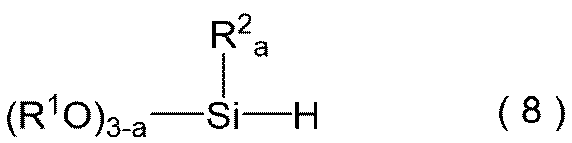
で表される末端に脂肪族不飽和基を有するカルボン酸シリルエステル化合物と、下記一般式(8)
で表されるアルコキシシランとを反応させる工程を含有する下記一般式(3a)

で示される有機ケイ素化合物の製造方法。 - 上記一般式(5)で表される末端に脂肪族不飽和基を有するカルボン酸シリルエステル化合物が、下記一般式(6)

で表される末端に脂肪族不飽和基を有するカルボン酸と、下記一般式(7)

で表されるハロシランとを反応させて得られるものである請求項6に記載の有機ケイ素化合物の製造方法。
Priority Applications (6)
| Application Number | Priority Date | Filing Date | Title |
|---|---|---|---|
| CN201880070638.9A CN111278924B (zh) | 2017-10-31 | 2018-10-09 | 有机聚硅氧烷组合物以及有机硅化合物及其制造方法 |
| EP18874509.5A EP3705535B1 (en) | 2017-10-31 | 2018-10-09 | Organopolysiloxane composition, and organic silicon compound and production method therefor |
| JP2019550946A JP7176527B2 (ja) | 2017-10-31 | 2018-10-09 | オルガノポリシロキサン組成物、並びに有機ケイ素化合物及びその製造方法 |
| KR1020207015354A KR102702853B1 (ko) | 2017-10-31 | 2018-10-09 | 오가노폴리실록산 조성물, 및 유기 규소 화합물 및 그 제조 방법 |
| US16/760,074 US11319413B2 (en) | 2017-10-31 | 2018-10-09 | Organopolysiloxane composition, and organic silicon compound and production method therefor |
| US17/708,317 US11834556B2 (en) | 2017-10-31 | 2022-03-30 | Organopolysiloxane composition, and organic silicon compound and production method therefor |
Applications Claiming Priority (4)
| Application Number | Priority Date | Filing Date | Title |
|---|---|---|---|
| JP2017-210283 | 2017-10-31 | ||
| JP2017210246 | 2017-10-31 | ||
| JP2017210283 | 2017-10-31 | ||
| JP2017-210246 | 2017-10-31 |
Related Child Applications (2)
| Application Number | Title | Priority Date | Filing Date |
|---|---|---|---|
| US16/760,074 A-371-Of-International US11319413B2 (en) | 2017-10-31 | 2018-10-09 | Organopolysiloxane composition, and organic silicon compound and production method therefor |
| US17/708,317 Division US11834556B2 (en) | 2017-10-31 | 2022-03-30 | Organopolysiloxane composition, and organic silicon compound and production method therefor |
Publications (1)
| Publication Number | Publication Date |
|---|---|
| WO2019087697A1 true WO2019087697A1 (ja) | 2019-05-09 |
Family
ID=66331716
Family Applications (1)
| Application Number | Title | Priority Date | Filing Date |
|---|---|---|---|
| PCT/JP2018/037526 Ceased WO2019087697A1 (ja) | 2017-10-31 | 2018-10-09 | オルガノポリシロキサン組成物、並びに有機ケイ素化合物及びその製造方法 |
Country Status (6)
| Country | Link |
|---|---|
| US (2) | US11319413B2 (ja) |
| EP (1) | EP3705535B1 (ja) |
| JP (1) | JP7176527B2 (ja) |
| KR (1) | KR102702853B1 (ja) |
| CN (1) | CN111278924B (ja) |
| WO (1) | WO2019087697A1 (ja) |
Families Citing this family (2)
| Publication number | Priority date | Publication date | Assignee | Title |
|---|---|---|---|---|
| WO2025147791A1 (en) * | 2024-01-08 | 2025-07-17 | Henkel Ag & Co. Kgaa | One-component silicone rubber composition, article thereof and method for manufacturing same |
| CN119570440B (zh) * | 2025-01-24 | 2025-05-02 | 宁波聚力新材料科技有限公司 | 一种双组分快速固化有机硅密封胶及其制备方法 |
Citations (13)
| Publication number | Priority date | Publication date | Assignee | Title |
|---|---|---|---|---|
| JPH02282389A (ja) * | 1989-04-21 | 1990-11-19 | Toshiba Silicone Co Ltd | 有機ケイ素化合物 |
| JPH06220313A (ja) * | 1993-01-28 | 1994-08-09 | Sekisui Chem Co Ltd | 不飽和ポリエステル樹脂組成物 |
| US5405766A (en) * | 1992-03-26 | 1995-04-11 | Her Majesty The Queen In Right Of Canada, As Represented By The Minister Of National Defence | Immobilization of biologically active protein on a support with a 7-18 carbon spacer and a bifunctional phospholipid |
| JPH0912861A (ja) | 1995-06-30 | 1997-01-14 | Asahi Glass Co Ltd | 硬化性組成物 |
| JP2003535152A (ja) | 1999-11-17 | 2003-11-25 | ロックタイト コーポレイション | マグネシウム合金コンポーネントシール用の流体耐性シリコーン組成物 |
| JP2004307723A (ja) | 2003-04-09 | 2004-11-04 | Shin Etsu Chem Co Ltd | 室温速硬化性飽和炭化水素系重合体組成物及び複層ガラス |
| JP2005097173A (ja) * | 2003-09-25 | 2005-04-14 | Shin Etsu Chem Co Ltd | γ,δ−不飽和カルボン酸及びそのシリルエステルの製造方法、カルボキシル基を有する有機ケイ素化合物及びその製造方法 |
| JP2005298558A (ja) * | 2004-04-07 | 2005-10-27 | Shin Etsu Chem Co Ltd | マグネシウム合金接着用オルガノポリシロキサン組成物 |
| JP2006156964A (ja) | 2004-10-14 | 2006-06-15 | Yazaki Corp | 充填剤入りエポキシ樹脂組成物及びその製造法 |
| JP3818365B2 (ja) | 2001-04-09 | 2006-09-06 | 信越化学工業株式会社 | マグネシウム合金接着用オルガノポリシロキサン組成物 |
| JP2007204575A (ja) | 2006-02-01 | 2007-08-16 | Shin Etsu Chem Co Ltd | 耐薬品性に優れるマグネシウム合金接着用オルガノポリシロキサン組成物 |
| JP2008163143A (ja) | 2006-12-27 | 2008-07-17 | Momentive Performance Materials Japan Kk | 室温硬化性ポリオルガノシロキサン組成物 |
| JP2018070480A (ja) * | 2016-10-27 | 2018-05-10 | 信越化学工業株式会社 | カルボン酸シリルエステル基含有アルコキシシラン化合物およびその製造方法 |
Family Cites Families (9)
| Publication number | Priority date | Publication date | Assignee | Title |
|---|---|---|---|---|
| US4604478A (en) * | 1985-05-17 | 1986-08-05 | Dow Corning Corporation | Method for silalactone preparation and use |
| US5502144A (en) * | 1994-07-15 | 1996-03-26 | University Of Cincinnati | Composition and method for preparing silicone elastomers |
| US7311972B2 (en) | 2004-10-14 | 2007-12-25 | Yazaki Corporation | Filled epoxy resin compositions |
| JP2007106944A (ja) * | 2005-10-17 | 2007-04-26 | Shin Etsu Chem Co Ltd | 室温硬化性オルガノポリシロキサン組成物 |
| CN101875710B (zh) * | 2010-06-30 | 2012-05-23 | 长兴化学材料(珠海)有限公司 | 硅氧烷基光引发聚合丙烯酸酯/二氧化硅纳米材料及制法 |
| KR20160098234A (ko) * | 2013-12-11 | 2016-08-18 | 주식회사 쿠라레 | 열 가소성 엘라스토머 조성물, 성형체 및 접착제 |
| US20160319079A1 (en) * | 2013-12-17 | 2016-11-03 | Wacker Chemie Ag | Cross-linkable silicone composition |
| US9744119B2 (en) * | 2014-12-16 | 2017-08-29 | Momentive Performance Materials Inc. | Cosmetic composition and method of preparation |
| CN105925129B (zh) * | 2016-05-19 | 2018-07-10 | 江苏固格澜栅防护设施有限公司 | 自腐蚀电位响应型自修复防腐涂层、制备方法及应用 |
-
2018
- 2018-10-09 US US16/760,074 patent/US11319413B2/en active Active
- 2018-10-09 EP EP18874509.5A patent/EP3705535B1/en active Active
- 2018-10-09 JP JP2019550946A patent/JP7176527B2/ja active Active
- 2018-10-09 WO PCT/JP2018/037526 patent/WO2019087697A1/ja not_active Ceased
- 2018-10-09 CN CN201880070638.9A patent/CN111278924B/zh active Active
- 2018-10-09 KR KR1020207015354A patent/KR102702853B1/ko active Active
-
2022
- 2022-03-30 US US17/708,317 patent/US11834556B2/en active Active
Patent Citations (14)
| Publication number | Priority date | Publication date | Assignee | Title |
|---|---|---|---|---|
| JPH02282389A (ja) * | 1989-04-21 | 1990-11-19 | Toshiba Silicone Co Ltd | 有機ケイ素化合物 |
| US5405766A (en) * | 1992-03-26 | 1995-04-11 | Her Majesty The Queen In Right Of Canada, As Represented By The Minister Of National Defence | Immobilization of biologically active protein on a support with a 7-18 carbon spacer and a bifunctional phospholipid |
| JPH06220313A (ja) * | 1993-01-28 | 1994-08-09 | Sekisui Chem Co Ltd | 不飽和ポリエステル樹脂組成物 |
| JPH0912861A (ja) | 1995-06-30 | 1997-01-14 | Asahi Glass Co Ltd | 硬化性組成物 |
| JP2003535152A (ja) | 1999-11-17 | 2003-11-25 | ロックタイト コーポレイション | マグネシウム合金コンポーネントシール用の流体耐性シリコーン組成物 |
| JP3818365B2 (ja) | 2001-04-09 | 2006-09-06 | 信越化学工業株式会社 | マグネシウム合金接着用オルガノポリシロキサン組成物 |
| JP2004307723A (ja) | 2003-04-09 | 2004-11-04 | Shin Etsu Chem Co Ltd | 室温速硬化性飽和炭化水素系重合体組成物及び複層ガラス |
| JP2005097173A (ja) * | 2003-09-25 | 2005-04-14 | Shin Etsu Chem Co Ltd | γ,δ−不飽和カルボン酸及びそのシリルエステルの製造方法、カルボキシル基を有する有機ケイ素化合物及びその製造方法 |
| JP2005298558A (ja) * | 2004-04-07 | 2005-10-27 | Shin Etsu Chem Co Ltd | マグネシウム合金接着用オルガノポリシロキサン組成物 |
| JP4553110B2 (ja) | 2004-04-07 | 2010-09-29 | 信越化学工業株式会社 | マグネシウム合金接着用オルガノポリシロキサン組成物 |
| JP2006156964A (ja) | 2004-10-14 | 2006-06-15 | Yazaki Corp | 充填剤入りエポキシ樹脂組成物及びその製造法 |
| JP2007204575A (ja) | 2006-02-01 | 2007-08-16 | Shin Etsu Chem Co Ltd | 耐薬品性に優れるマグネシウム合金接着用オルガノポリシロキサン組成物 |
| JP2008163143A (ja) | 2006-12-27 | 2008-07-17 | Momentive Performance Materials Japan Kk | 室温硬化性ポリオルガノシロキサン組成物 |
| JP2018070480A (ja) * | 2016-10-27 | 2018-05-10 | 信越化学工業株式会社 | カルボン酸シリルエステル基含有アルコキシシラン化合物およびその製造方法 |
Non-Patent Citations (5)
| Title |
|---|
| ABE, HIROKAZU ET AL.: "Construction of the Ordered Surface Immobilized Bioactive Peptide with Mesogenic Group ", JOURNAL OF JAPANESE SOCIETY FOR BIOMATERIALS, vol. 15, no. 3, 1997, pages 113 (15) - 120 (22), XP009520529, ISSN: 0910-304X * |
| ANNIS, D. ALLEN ET AL.: "Polymer-supported chiral Co(salen) complexes: synthetic applications and mechanistic investigations in the hydrolytic kinetic resolution of terminal epoxides", JOURNAL OF THE AMERICAN CHEMICAL SOCIETY, vol. 121, no. 17, 1999, pages 4147 - 4154, XP002357570, ISSN: 0002-7863 * |
| PETRUNIN, M. A ET AL.: "Interphase interactions in the metal-siloxane anticorrosion coating system", ZASHCHITA METALLOV, vol. 26, no. 5, 1990, pages 759 - 765, XP009520528, ISSN: 0044-1856 * |
| See also references of EP3705535A4 |
| SEVERNYI, V. V. ET AL.: "Effect of coupling agents on the adhesion properties of compositions based on siloxane rubbers of cold vulcanization", KAUCHUK I REZINA, vol. 11, 1976, pages 12 - 15, XP009520527, ISSN: 0022-9466 * |
Also Published As
| Publication number | Publication date |
|---|---|
| EP3705535A1 (en) | 2020-09-09 |
| EP3705535B1 (en) | 2025-06-04 |
| JPWO2019087697A1 (ja) | 2020-11-19 |
| US20210206924A1 (en) | 2021-07-08 |
| CN111278924B (zh) | 2023-07-21 |
| US11319413B2 (en) | 2022-05-03 |
| KR102702853B1 (ko) | 2024-09-05 |
| JP7176527B2 (ja) | 2022-11-22 |
| CN111278924A (zh) | 2020-06-12 |
| EP3705535A4 (en) | 2021-08-18 |
| KR20200070393A (ko) | 2020-06-17 |
| US20220220260A1 (en) | 2022-07-14 |
| US11834556B2 (en) | 2023-12-05 |
Similar Documents
| Publication | Publication Date | Title |
|---|---|---|
| US9644124B2 (en) | Silicon-containing compound having alkoxysilyl-ethylene group at its terminal, room temperature-curable organopolysiloxane composition, and molded product obtained by curing the composition | |
| JP6497390B2 (ja) | 室温硬化性オルガノポリシロキサン組成物及び該室温硬化性オルガノポリシロキサン組成物の硬化物である成形物 | |
| JP6747507B2 (ja) | 室温硬化性組成物、シーリング材並びに物品 | |
| EP3119847B1 (en) | Alkoxy group-containing silicones with reactive functional groups of defined reactivity | |
| JP3714861B2 (ja) | 室温硬化性オルガノポリシロキサン組成物 | |
| WO2015093139A1 (ja) | 多成分系室温硬化性オルガノポリシロキサン組成物、該組成物の硬化物及び該硬化物からなる成型物 | |
| JP7557268B2 (ja) | 室温硬化性オルガノポリシロキサン組成物の製造方法、室温硬化性オルガノポリシロキサン組成物及び物品、並びに自動車ヘッドライト用シーリング材 | |
| WO2014097573A1 (ja) | 新規エチニル基含有オルガノポリシロキサン化合物、分子鎖両末端エチニル基含有直鎖状オルガノポリシロキサン化合物の製造方法、アルコキシシリル-エチレン基末端オルガノシロキサンポリマーの製造方法、室温硬化性組成物及びその硬化物である成形物 | |
| WO2022113437A1 (ja) | 室温硬化性オルガノポリシロキサン組成物及び物品並びに加水分解性オルガノシラン化合物及びその製造方法 | |
| JP2018087348A (ja) | 室温硬化性組成物、シーリング材及び物品 | |
| US11834556B2 (en) | Organopolysiloxane composition, and organic silicon compound and production method therefor | |
| JP6760223B2 (ja) | 室温硬化性オルガノポリシロキサン組成物、およびこれを含有するシール剤、コーティング剤、接着剤、成形物 | |
| US10428183B2 (en) | Room temperature-curable resin composition containing an aluminum chelate compound | |
| JP4912754B2 (ja) | 室温硬化性オルガノポリシロキサン組成物 | |
| KR101132563B1 (ko) | 마그네슘 합금 접착용 오르가노폴리실록산 조성물 | |
| WO2023068094A1 (ja) | 室温硬化性オルガノポリシロキサン組成物、接着剤、シール剤及びコーティング剤 | |
| JP7831496B2 (ja) | 室温硬化性樹脂組成物及び物品 | |
| JP6315100B2 (ja) | 新規有機チタン化合物、該有機チタン化合物の製造方法、硬化触媒及び室温硬化性オルガノポリシロキサン組成物 | |
| JP6988736B2 (ja) | オルガノポリシロキサン組成物 | |
| JP2022001611A (ja) | 室温硬化性オルガノポリシロキサン組成物及び物品 | |
| JP7800552B2 (ja) | オルガノポリシロキサン化合物、室温硬化性オルガノポリシロキサン組成物、及び物品 |
Legal Events
| Date | Code | Title | Description |
|---|---|---|---|
| 121 | Ep: the epo has been informed by wipo that ep was designated in this application |
Ref document number: 18874509 Country of ref document: EP Kind code of ref document: A1 |
|
| ENP | Entry into the national phase |
Ref document number: 2019550946 Country of ref document: JP Kind code of ref document: A |
|
| NENP | Non-entry into the national phase |
Ref country code: DE |
|
| ENP | Entry into the national phase |
Ref document number: 20207015354 Country of ref document: KR Kind code of ref document: A |
|
| ENP | Entry into the national phase |
Ref document number: 2018874509 Country of ref document: EP Effective date: 20200602 |
|
| WWG | Wipo information: grant in national office |
Ref document number: 2018874509 Country of ref document: EP |