WO2019087761A1 - フェライト系ステンレス鋼板およびその製造方法 - Google Patents
フェライト系ステンレス鋼板およびその製造方法 Download PDFInfo
- Publication number
- WO2019087761A1 WO2019087761A1 PCT/JP2018/038400 JP2018038400W WO2019087761A1 WO 2019087761 A1 WO2019087761 A1 WO 2019087761A1 JP 2018038400 W JP2018038400 W JP 2018038400W WO 2019087761 A1 WO2019087761 A1 WO 2019087761A1
- Authority
- WO
- WIPO (PCT)
- Prior art keywords
- less
- content
- hot
- ferritic stainless
- steel sheet
- Prior art date
- Legal status (The legal status is an assumption and is not a legal conclusion. Google has not performed a legal analysis and makes no representation as to the accuracy of the status listed.)
- Ceased
Links
Classifications
-
- C—CHEMISTRY; METALLURGY
- C22—METALLURGY; FERROUS OR NON-FERROUS ALLOYS; TREATMENT OF ALLOYS OR NON-FERROUS METALS
- C22F—CHANGING THE PHYSICAL STRUCTURE OF NON-FERROUS METALS AND NON-FERROUS ALLOYS
- C22F1/00—Changing the physical structure of non-ferrous metals or alloys by heat treatment or by hot or cold working
- C22F1/002—Changing the physical structure of non-ferrous metals or alloys by heat treatment or by hot or cold working by rapid cooling or quenching; cooling agents used therefor
-
- C—CHEMISTRY; METALLURGY
- C21—METALLURGY OF IRON
- C21D—MODIFYING THE PHYSICAL STRUCTURE OF FERROUS METALS; GENERAL DEVICES FOR HEAT TREATMENT OF FERROUS OR NON-FERROUS METALS OR ALLOYS; MAKING METAL MALLEABLE, e.g. BY DECARBURISATION OR TEMPERING
- C21D6/00—Heat treatment of ferrous alloys
-
- C—CHEMISTRY; METALLURGY
- C21—METALLURGY OF IRON
- C21D—MODIFYING THE PHYSICAL STRUCTURE OF FERROUS METALS; GENERAL DEVICES FOR HEAT TREATMENT OF FERROUS OR NON-FERROUS METALS OR ALLOYS; MAKING METAL MALLEABLE, e.g. BY DECARBURISATION OR TEMPERING
- C21D6/00—Heat treatment of ferrous alloys
- C21D6/004—Heat treatment of ferrous alloys containing Cr and Ni
-
- C—CHEMISTRY; METALLURGY
- C21—METALLURGY OF IRON
- C21D—MODIFYING THE PHYSICAL STRUCTURE OF FERROUS METALS; GENERAL DEVICES FOR HEAT TREATMENT OF FERROUS OR NON-FERROUS METALS OR ALLOYS; MAKING METAL MALLEABLE, e.g. BY DECARBURISATION OR TEMPERING
- C21D6/00—Heat treatment of ferrous alloys
- C21D6/005—Heat treatment of ferrous alloys containing Mn
-
- C—CHEMISTRY; METALLURGY
- C21—METALLURGY OF IRON
- C21D—MODIFYING THE PHYSICAL STRUCTURE OF FERROUS METALS; GENERAL DEVICES FOR HEAT TREATMENT OF FERROUS OR NON-FERROUS METALS OR ALLOYS; MAKING METAL MALLEABLE, e.g. BY DECARBURISATION OR TEMPERING
- C21D6/00—Heat treatment of ferrous alloys
- C21D6/007—Heat treatment of ferrous alloys containing Co
-
- C—CHEMISTRY; METALLURGY
- C21—METALLURGY OF IRON
- C21D—MODIFYING THE PHYSICAL STRUCTURE OF FERROUS METALS; GENERAL DEVICES FOR HEAT TREATMENT OF FERROUS OR NON-FERROUS METALS OR ALLOYS; MAKING METAL MALLEABLE, e.g. BY DECARBURISATION OR TEMPERING
- C21D6/00—Heat treatment of ferrous alloys
- C21D6/008—Heat treatment of ferrous alloys containing Si
-
- C—CHEMISTRY; METALLURGY
- C21—METALLURGY OF IRON
- C21D—MODIFYING THE PHYSICAL STRUCTURE OF FERROUS METALS; GENERAL DEVICES FOR HEAT TREATMENT OF FERROUS OR NON-FERROUS METALS OR ALLOYS; MAKING METAL MALLEABLE, e.g. BY DECARBURISATION OR TEMPERING
- C21D8/00—Modifying the physical properties of ferrous metals or ferrous alloys by deformation combined with, or followed by, heat treatment
- C21D8/02—Modifying the physical properties of ferrous metals or ferrous alloys by deformation combined with, or followed by, heat treatment during manufacturing of plates or strips
-
- C—CHEMISTRY; METALLURGY
- C21—METALLURGY OF IRON
- C21D—MODIFYING THE PHYSICAL STRUCTURE OF FERROUS METALS; GENERAL DEVICES FOR HEAT TREATMENT OF FERROUS OR NON-FERROUS METALS OR ALLOYS; MAKING METAL MALLEABLE, e.g. BY DECARBURISATION OR TEMPERING
- C21D8/00—Modifying the physical properties of ferrous metals or ferrous alloys by deformation combined with, or followed by, heat treatment
- C21D8/02—Modifying the physical properties of ferrous metals or ferrous alloys by deformation combined with, or followed by, heat treatment during manufacturing of plates or strips
- C21D8/0221—Modifying the physical properties of ferrous metals or ferrous alloys by deformation combined with, or followed by, heat treatment during manufacturing of plates or strips characterised by the working steps
- C21D8/0226—Hot rolling
-
- C—CHEMISTRY; METALLURGY
- C21—METALLURGY OF IRON
- C21D—MODIFYING THE PHYSICAL STRUCTURE OF FERROUS METALS; GENERAL DEVICES FOR HEAT TREATMENT OF FERROUS OR NON-FERROUS METALS OR ALLOYS; MAKING METAL MALLEABLE, e.g. BY DECARBURISATION OR TEMPERING
- C21D8/00—Modifying the physical properties of ferrous metals or ferrous alloys by deformation combined with, or followed by, heat treatment
- C21D8/02—Modifying the physical properties of ferrous metals or ferrous alloys by deformation combined with, or followed by, heat treatment during manufacturing of plates or strips
- C21D8/0247—Modifying the physical properties of ferrous metals or ferrous alloys by deformation combined with, or followed by, heat treatment during manufacturing of plates or strips characterised by the heat treatment
- C21D8/0263—Modifying the physical properties of ferrous metals or ferrous alloys by deformation combined with, or followed by, heat treatment during manufacturing of plates or strips characterised by the heat treatment following hot rolling
-
- C—CHEMISTRY; METALLURGY
- C21—METALLURGY OF IRON
- C21D—MODIFYING THE PHYSICAL STRUCTURE OF FERROUS METALS; GENERAL DEVICES FOR HEAT TREATMENT OF FERROUS OR NON-FERROUS METALS OR ALLOYS; MAKING METAL MALLEABLE, e.g. BY DECARBURISATION OR TEMPERING
- C21D8/00—Modifying the physical properties of ferrous metals or ferrous alloys by deformation combined with, or followed by, heat treatment
- C21D8/02—Modifying the physical properties of ferrous metals or ferrous alloys by deformation combined with, or followed by, heat treatment during manufacturing of plates or strips
- C21D8/0278—Modifying the physical properties of ferrous metals or ferrous alloys by deformation combined with, or followed by, heat treatment during manufacturing of plates or strips involving a particular surface treatment
-
- C—CHEMISTRY; METALLURGY
- C21—METALLURGY OF IRON
- C21D—MODIFYING THE PHYSICAL STRUCTURE OF FERROUS METALS; GENERAL DEVICES FOR HEAT TREATMENT OF FERROUS OR NON-FERROUS METALS OR ALLOYS; MAKING METAL MALLEABLE, e.g. BY DECARBURISATION OR TEMPERING
- C21D9/00—Heat treatment, e.g. annealing, hardening, quenching or tempering, adapted for particular articles; Furnaces therefor
- C21D9/46—Heat treatment, e.g. annealing, hardening, quenching or tempering, adapted for particular articles; Furnaces therefor for sheet metals
-
- C—CHEMISTRY; METALLURGY
- C22—METALLURGY; FERROUS OR NON-FERROUS ALLOYS; TREATMENT OF ALLOYS OR NON-FERROUS METALS
- C22C—ALLOYS
- C22C38/00—Ferrous alloys, e.g. steel alloys
-
- C—CHEMISTRY; METALLURGY
- C22—METALLURGY; FERROUS OR NON-FERROUS ALLOYS; TREATMENT OF ALLOYS OR NON-FERROUS METALS
- C22C—ALLOYS
- C22C38/00—Ferrous alloys, e.g. steel alloys
- C22C38/001—Ferrous alloys, e.g. steel alloys containing N
-
- C—CHEMISTRY; METALLURGY
- C22—METALLURGY; FERROUS OR NON-FERROUS ALLOYS; TREATMENT OF ALLOYS OR NON-FERROUS METALS
- C22C—ALLOYS
- C22C38/00—Ferrous alloys, e.g. steel alloys
- C22C38/002—Ferrous alloys, e.g. steel alloys containing In, Mg, or other elements not provided for in one single group C22C38/001 - C22C38/60
-
- C—CHEMISTRY; METALLURGY
- C22—METALLURGY; FERROUS OR NON-FERROUS ALLOYS; TREATMENT OF ALLOYS OR NON-FERROUS METALS
- C22C—ALLOYS
- C22C38/00—Ferrous alloys, e.g. steel alloys
- C22C38/02—Ferrous alloys, e.g. steel alloys containing silicon
-
- C—CHEMISTRY; METALLURGY
- C22—METALLURGY; FERROUS OR NON-FERROUS ALLOYS; TREATMENT OF ALLOYS OR NON-FERROUS METALS
- C22C—ALLOYS
- C22C38/00—Ferrous alloys, e.g. steel alloys
- C22C38/04—Ferrous alloys, e.g. steel alloys containing manganese
-
- C—CHEMISTRY; METALLURGY
- C22—METALLURGY; FERROUS OR NON-FERROUS ALLOYS; TREATMENT OF ALLOYS OR NON-FERROUS METALS
- C22C—ALLOYS
- C22C38/00—Ferrous alloys, e.g. steel alloys
- C22C38/06—Ferrous alloys, e.g. steel alloys containing aluminium
-
- C—CHEMISTRY; METALLURGY
- C22—METALLURGY; FERROUS OR NON-FERROUS ALLOYS; TREATMENT OF ALLOYS OR NON-FERROUS METALS
- C22C—ALLOYS
- C22C38/00—Ferrous alloys, e.g. steel alloys
- C22C38/18—Ferrous alloys, e.g. steel alloys containing chromium
- C22C38/40—Ferrous alloys, e.g. steel alloys containing chromium with nickel
- C22C38/42—Ferrous alloys, e.g. steel alloys containing chromium with nickel with copper
-
- C—CHEMISTRY; METALLURGY
- C22—METALLURGY; FERROUS OR NON-FERROUS ALLOYS; TREATMENT OF ALLOYS OR NON-FERROUS METALS
- C22C—ALLOYS
- C22C38/00—Ferrous alloys, e.g. steel alloys
- C22C38/18—Ferrous alloys, e.g. steel alloys containing chromium
- C22C38/40—Ferrous alloys, e.g. steel alloys containing chromium with nickel
- C22C38/44—Ferrous alloys, e.g. steel alloys containing chromium with nickel with molybdenum or tungsten
-
- C—CHEMISTRY; METALLURGY
- C22—METALLURGY; FERROUS OR NON-FERROUS ALLOYS; TREATMENT OF ALLOYS OR NON-FERROUS METALS
- C22C—ALLOYS
- C22C38/00—Ferrous alloys, e.g. steel alloys
- C22C38/18—Ferrous alloys, e.g. steel alloys containing chromium
- C22C38/40—Ferrous alloys, e.g. steel alloys containing chromium with nickel
- C22C38/46—Ferrous alloys, e.g. steel alloys containing chromium with nickel with vanadium
-
- C—CHEMISTRY; METALLURGY
- C22—METALLURGY; FERROUS OR NON-FERROUS ALLOYS; TREATMENT OF ALLOYS OR NON-FERROUS METALS
- C22C—ALLOYS
- C22C38/00—Ferrous alloys, e.g. steel alloys
- C22C38/18—Ferrous alloys, e.g. steel alloys containing chromium
- C22C38/40—Ferrous alloys, e.g. steel alloys containing chromium with nickel
- C22C38/48—Ferrous alloys, e.g. steel alloys containing chromium with nickel with niobium or tantalum
-
- C—CHEMISTRY; METALLURGY
- C22—METALLURGY; FERROUS OR NON-FERROUS ALLOYS; TREATMENT OF ALLOYS OR NON-FERROUS METALS
- C22C—ALLOYS
- C22C38/00—Ferrous alloys, e.g. steel alloys
- C22C38/18—Ferrous alloys, e.g. steel alloys containing chromium
- C22C38/40—Ferrous alloys, e.g. steel alloys containing chromium with nickel
- C22C38/50—Ferrous alloys, e.g. steel alloys containing chromium with nickel with titanium or zirconium
-
- C—CHEMISTRY; METALLURGY
- C22—METALLURGY; FERROUS OR NON-FERROUS ALLOYS; TREATMENT OF ALLOYS OR NON-FERROUS METALS
- C22C—ALLOYS
- C22C38/00—Ferrous alloys, e.g. steel alloys
- C22C38/18—Ferrous alloys, e.g. steel alloys containing chromium
- C22C38/40—Ferrous alloys, e.g. steel alloys containing chromium with nickel
- C22C38/52—Ferrous alloys, e.g. steel alloys containing chromium with nickel with cobalt
-
- C—CHEMISTRY; METALLURGY
- C22—METALLURGY; FERROUS OR NON-FERROUS ALLOYS; TREATMENT OF ALLOYS OR NON-FERROUS METALS
- C22C—ALLOYS
- C22C38/00—Ferrous alloys, e.g. steel alloys
- C22C38/18—Ferrous alloys, e.g. steel alloys containing chromium
- C22C38/40—Ferrous alloys, e.g. steel alloys containing chromium with nickel
- C22C38/54—Ferrous alloys, e.g. steel alloys containing chromium with nickel with boron
-
- C—CHEMISTRY; METALLURGY
- C22—METALLURGY; FERROUS OR NON-FERROUS ALLOYS; TREATMENT OF ALLOYS OR NON-FERROUS METALS
- C22F—CHANGING THE PHYSICAL STRUCTURE OF NON-FERROUS METALS AND NON-FERROUS ALLOYS
- C22F1/00—Changing the physical structure of non-ferrous metals or alloys by heat treatment or by hot or cold working
- C22F1/08—Changing the physical structure of non-ferrous metals or alloys by heat treatment or by hot or cold working of copper or alloys based thereon
-
- C—CHEMISTRY; METALLURGY
- C21—METALLURGY OF IRON
- C21D—MODIFYING THE PHYSICAL STRUCTURE OF FERROUS METALS; GENERAL DEVICES FOR HEAT TREATMENT OF FERROUS OR NON-FERROUS METALS OR ALLOYS; MAKING METAL MALLEABLE, e.g. BY DECARBURISATION OR TEMPERING
- C21D2211/00—Microstructure comprising significant phases
- C21D2211/005—Ferrite
Definitions
- the present invention relates to a ferritic stainless steel sheet and a method for producing the same, and more particularly to a ferritic stainless steel sheet excellent in toughness and excellent in corrosion resistance, which is useful for using a flange member, and a method for producing the same.
- the exhaust gas path of a car is composed of various parts such as an exhaust manifold, a muffler, a catalyst, a flexible tube, a center pipe and a front pipe.
- fastening parts called flanges are often used.
- the flange applied to such exhaust system components needs to have sufficient rigidity. From this, a thick-walled (for example, 5 mm or more in plate thickness) flange is applied to such an exhaust system component.
- the flange is manufactured by processing such as punching other than press forming, and ordinary steel has been used.
- flange materials applied to parts exposed to high temperature exhaust gas such as an EGR (Exhaust Gas Recirculation, EGR) system are required to have sufficient corrosion resistance. Therefore, the application of stainless steel which is superior in corrosion resistance to ordinary steel, in particular, ferritic stainless steel which has a relatively small coefficient of thermal expansion and which hardly generates a thermal stress has been studied. As a result, a ferritic stainless steel plate having a large thickness (for example, 5 mm or more in thickness) applicable to a thick flange is strongly required.
- EGR exhaust Gas Recirculation
- a ferritic stainless steel having a large thickness has a problem of low temperature toughness. For example, many press cracks at the time of flange manufacture occur in winter. From these facts, there is a strong demand for improvement in toughness of a ferritic stainless steel having a large thickness.
- Patent Document 1 For such market requirements, for example, in Patent Document 1, C: 0.02% or less, N: 0.02% or less, Si: 0.005 to 1.0%, Ni: 0 in mass%. 1 to 1.0%, Mn: 0.1 to 3.0%, P: 0.04% or less, S: 0.0100% or less, Cr: 10% or more to 18% or less, and further Ti : 0.05 to 0.30%, Nb: 0.01 to 0.50%, containing one or two kinds, and the total of Ti and Nb is 8 (C + N) to 0.75%, the balance Is composed of Fe and unavoidable impurities, and has a ⁇ p of 70% or more, a ferrite grain size of 20 ⁇ m or less, and a martensite formation amount of 70% or less (a Charpy impact value at ⁇ 40 ° C.
- a stainless steel sheet excellent in 50 J / cm 2 or more) is disclosed.
- (gamma) p (%) is evaluated using following (i) Formula (In patent document 1, it describes with (1) Formula).
- ⁇ p 420 (% C) + 470 (% N) + 23 (% Ni) + 9 (% Cu) + 7 (% Mn)-11.5 (% Cr)-11.5 (% Si)-12 (% Mo) -23 (% V)-47 (% Nb)-49 (% Ti)-52 (% Al) + 189
- (% X) shows the mass ratio of each component X.
- An object of the present invention is to provide a ferritic stainless steel sheet which is more excellent in toughness and excellent in corrosion resistance and a method of manufacturing the same.
- more excellent toughness means that the Charpy impact value at ⁇ 50 ° C. is 100 J / cm 2 or more.
- having excellent corrosion resistance means that the rusting rate after performing three cycles of the salt spray cycle test defined in JIS H 8502 is 25% or less.
- the present inventors conducted detailed studies to solve the above problems. As a result, the following findings were obtained.
- the metal structure is refined and the Charpy impact value at -50 ° C. is 100 J / cm 2 or more.
- the average grain size of the metal structure it is possible to effectively suppress the occurrence of cracks in the burring portion when processing into a thick flange having the burring portion. It can be fully commercialized to a thick flange having a burring portion.
- Hot-rolled sheet annealing at a temperature is an effective means for refining the metal structure and obtaining a Charpy impact value of -100 J / cm 2 or more at -50 ° C.
- the present invention has been made based on the above findings, and the gist of the present invention is as follows. [1] by mass%, C: 0.001 to 0.020%, Si: 0.05 to 0.35%, Mn: 0.05 to 1.00%, P: not more than 0.04%, S: 0.01% or less, Al: 0.001 to 0.300%, Cr: 10.0 to 13.0%, Ni: 0.75 to 1.50%, Ti: 0.05 to 0.35%, N: 0.001 to 0.020%, and ⁇ I [%] of the following formula (1) is 65% or more, and the balance has a component composition consisting of Fe and unavoidable impurities, A ferritic stainless steel sheet having an average grain size of 45 ⁇ m or less in a metal structure.
- Ni, Mn, Cu, Si, Cr, and Mo in Formula (1) represent content (mass%) of each component, and let the component which is not contained be zero.
- V 0.01 to 0.20%
- Nb 0.01 to 0.10%
- Zr 0.01 to 0.20% in mass%
- REM 0.001 to 0.100%
- B 0.0002 to 0.0025%
- Mg 0.0005 to 0.0030%
- Ca 0 by mass%
- a method for producing a ferritic stainless steel sheet comprising: a hot rolling step of performing hot rolling; and a hot rolled sheet annealing step of hot rolled sheet annealing of the hot rolled steel sheet obtained in the hot rolling step at 750 to 1050 ° C.
- ferritic stainless steel sheet which is more excellent in toughness and excellent in corrosion resistance.
- the ferritic stainless steel sheet of the present invention can be suitably used for thick flanges and the like.
- the present inventors used a variety of ferritic stainless steel plates with a thickness of 5.0 mm to form flanges having a 30 mm diameter flange hole with a burred portion that lifts 10 mm from the surface of the steel plate as it is as blank (as punched out).
- the inventors examined in detail the relationship between the low toughness and the metallographic structure. As a result, it was found that the toughness was lowered as the average grain size of the steel sheet was larger. Then, forming to the above-mentioned flange was tried using various ferritic stainless steel plates (board thickness 5.0 mm). As a result, it was found that, in a steel plate having an average crystal grain size exceeding 45 ⁇ m, the toughness is lowered and a crack is easily generated. When the average crystal grain size is 45 ⁇ m or less, the toughness is excellent and the punching workability of the steel plate is good.
- the average crystal grain size is 45 ⁇ m or less, and the Charpy impact value at ⁇ 50 ° C. is 100 J / cm 2 or more.
- the said average grain size can be measured by the measuring method of the Example mentioned later.
- the Charpy impact value is a value measured in accordance with JIS Z 2242 (2005) as described later.
- the C content is in the range of 0.001% to 0.020%.
- the C content is preferably 0.003% or more, more preferably 0.004% or more. Further, the C content is preferably 0.015% or less, more preferably 0.012% or less.
- Si 0.05 to 0.35%
- Si has the effect of concentrating on the oxide film formed at the time of welding to improve the corrosion resistance of the welded portion, and is also an element useful as a deoxidizing element in the steel making process. These effects are obtained by containing Si of 0.05% or more, and the effect becomes larger as the content is larger.
- Si has the effect of promoting the formation of a ferrite phase. If Si is contained in excess of 0.35%, a predetermined amount of austenite phase is not sufficiently formed at the time of heating in the hot rolling step. The desired metallographic structure can not be obtained even if hot rolling and hot rolled sheet annealing are performed under the following conditions. Therefore, the Si content is set to 0.05% or more and 0.35% or less.
- the Si content is preferably 0.10% or more. Further, the Si content is preferably 0.30% or less.
- Mn 0.05 to 1.00% Mn has the effect of promoting the formation of the austenite phase. In order to acquire the effect, it is necessary to contain 0.05% or more of Mn. However, if the Mn content exceeds 1.00%, precipitation of MnS, which is a starting point of corrosion, is promoted, and the corrosion resistance is lowered. Therefore, the Mn content is set to 0.05% or more and 1.00% or less.
- the Mn content is preferably 0.20% or more. Also, the Mn content is preferably 0.80% or less, more preferably 0.70% or less.
- P 0.04% or less
- P is an element inevitably contained in steel and is an element harmful to corrosion resistance and workability, and therefore it is preferable to reduce as much as possible. If the P content exceeds 0.04%, the formability is markedly reduced due to solid solution strengthening. Therefore, the P content is 0.04% or less.
- the P content is preferably 0.03% or less.
- S 0.01% or less S is also an element inevitably contained in steel like P, and is an element harmful to corrosion resistance and workability, and therefore, it is preferable to reduce as much as possible. In particular, when the S content exceeds 0.01%, the corrosion resistance is significantly reduced. Therefore, the S content is 0.01% or less.
- the S content is preferably 0.008% or less, more preferably 0.003% or less.
- Al 0.001 to 0.300%
- Al is an effective deacidifying agent. Furthermore, since Al has a stronger affinity to nitrogen than Cr, when nitrogen penetrates the weld, it has the effect of precipitating nitrogen as Al nitride instead of Cr nitride to suppress sensitization. These effects are obtained by containing Al 0.001% or more. However, if the Al content exceeds 0.300%, it is not preferable because the penetration during welding decreases and the weldability decreases. Therefore, the Al content is in the range of 0.001% to 0.300%. The Al content is preferably 0.010% or more. Further, the Al content is preferably 0.200% or less, more preferably 0.100% or less, and still more preferably 0.050% or less.
- Cr 10.0 to 13.0% Cr is the most important element to ensure corrosion resistance. If the content is less than 10.0%, corrosion resistance necessary for automobile exhaust parts can not be obtained. On the other hand, when Cr is contained in excess of 13.0%, a predetermined amount of austenite phase is formed at the time of heating in the hot rolling process even if the steel component is adjusted to ⁇ I represented by predetermined formula (1) described later In order to avoid this, even if hot rolling and hot rolled sheet annealing are performed under the conditions specified by the present invention, the desired metallographic structure can not be obtained. Therefore, the Cr content is in the range of 10.0% to 13.0%. The Cr content is preferably 10.5% or more. Further, the Cr content is preferably 12.0% or less, more preferably 11.7% or less.
- Ni 0.75 to 1.50%
- Ni is an austenite-forming element, and has an effect of increasing the amount of austenite generated at the time of heating before rolling in the hot rolling process.
- a two-phase structure of a ferrite phase and an austenite phase including an austenite phase of 70% or more in volume ratio is obtained at the time of slab heating in the hot rolling process.
- the metallographic structure is a two-phase structure of a ferrite phase and an austenite phase, the heterophase interface between the ferrite phase and the austenite phase functions as an obstacle to grain growth, so that the metal structure before hot rolling is refined.
- the Ni content is set to 0.75% or more and 1.50% or less.
- the Ni content is preferably 0.80% or more. Further, the Ni content is preferably 1.20% or less, more preferably 1.00% or less.
- Ti 0.05 to 0.35%
- Ti preferentially combines with C and N to suppress the precipitation of Cr carbonitrides, and has the effect of reducing the recrystallization temperature and suppressing the drop in corrosion resistance caused by the sensitization due to the precipitation of Cr carbonitrides. is there. In order to obtain such an effect, it is necessary to contain 0.05% or more of Ti. On the other hand, if the Ti content exceeds 0.35%, the toughness is significantly reduced due to the formation of coarse TiN, and even if the technology of the present invention is applied, a predetermined toughness can not be obtained. Further, the content of Ti of more than 0.35% is not preferable in production because coarse Ti carbo-nitrides are formed in the casting process to cause surface defects. Therefore, the Ti content is set to 0.05% or more and 0.35% or less. The Ti content is preferably 0.10% or more. Further, the Ti content is preferably 0.30% or less, more preferably 0.15% or less.
- the N content is in the range of 0.001% to 0.020%.
- the N content is preferably 0.005% or more, more preferably 0.007% or more. Further, the N content is preferably 0.015% or less, more preferably 0.012% or less.
- ⁇ I [%] 65% or more
- ⁇ I [%] is determined using the following equation (1) for evaluating the stability of the austenite phase.
- ⁇ I [%] 24 Ni + 12 Mn + 6 Cu-18 Si-12 Cr-12 Mo + 188 (1)
- Ni, Mn, Cu, Si, Cr, and Mo in Formula (1) represent content (mass%) of each component, and let the component which is not contained be zero.
- the austenite-forming element has a positive coefficient
- the ferrite-forming element has a negative coefficient, and the respective values were experimentally obtained with reference to the Castro equation.
- the remainder other than the above is Fe and unavoidable impurities.
- an unavoidable impurity O (oxygen) etc. are mentioned, and if content of O is 0.01% or less, it is permissible.
- one or more groups selected from the following groups A to C can be contained.
- Group A Cu: 0.01 to 1.00%, Mo: 0.01 to 1.00%, W: 0.01 to 0.20%, Co: 0.01 to 0.20% Or two or more
- group B V: 0.01 to 0.20%, Nb: 0.01 to 0.10%, and Zr: 0.01 to 0.20% one or more
- group C REM: 0.001 to 0.100%
- B 0.0002 to 0.0025%
- Mg 0.0005 to 0.0030%
- Ca 0.0003 to 0.0030%
- Cu 0.01 to 1.00%
- Cu is an element that is particularly effective in improving the corrosion resistance in an aqueous solution or when a weakly acidic water droplet is attached. Furthermore, Cu has the effect of promoting the formation of the austenite phase. This effect is obtained by containing 0.01% or more, and the effect becomes higher as the Cu content is larger. However, if Cu is contained in excess of 1.00%, the hot workability may be reduced to induce surface defects. Furthermore, there are cases where descaling after annealing becomes difficult. Therefore, when it contains Cu, Cu content is made into the range of 0.01% or more and 1.00% or less. When Cu is contained, the Cu content is preferably 0.10% or more. When Cu is contained, the Cu content is preferably 0.50% or less.
- Mo 0.01 to 1.00%
- Mo is an element that significantly improves the corrosion resistance of stainless steel. This effect is obtained by containing 0.01% or more of Mo, and the effect improves as the content increases.
- Mo has the effect of promoting the formation of a ferrite phase, and when the Mo content exceeds 1.00%, a predetermined amount of austenite phase is not sufficiently formed at the time of heating in the hot rolling process. The desired metallographic structure can not be obtained even if hot rolling and hot rolled sheet annealing are performed under the following conditions. Therefore, when it contains Mo, Mo content is made into 0.01% or more and 1.00% or less. When Mo is contained, the Mo content is preferably 0.10% or more, more preferably 0.30% or more. Moreover, when it contains Mo, Mo content is preferably 0.80% or less, more preferably 0.50% or less.
- W 0.01 to 0.20% Like Mo, W has the effect of improving the corrosion resistance. This effect is obtained by containing 0.01% or more of W. On the other hand, if W is contained in excess of 0.20%, the strength may increase, which may lead to a decrease in manufacturability due to an increase in rolling load or the like. Therefore, when W is contained, the W content is in the range of 0.01% or more and 0.20% or less. When W is contained, the W content is preferably 0.05% or more. When W is contained, the W content is preferably 0.15% or less.
- Co 0.01 to 0.20%
- Co is an element that improves the toughness. This effect is obtained by containing 0.01% or more of Co. On the other hand, when the Co content exceeds 0.20%, the processability may be reduced. Therefore, when Co is contained, the Co content is in the range of 0.01% to 0.20%.
- V 0.01 to 0.20% V forms carbonitrides with C and N, suppresses sensitization during welding, and improves the corrosion resistance of the welded portion. This effect is obtained when the V content is 0.01% or more. On the other hand, when the V content exceeds 0.20%, the processability and the toughness may be significantly reduced. Therefore, when V is contained, V content is made into 0.01% or more and 0.20% or less. When V is contained, the V content is preferably 0.02% or more. Moreover, when V is contained, V content is preferably 0.10% or less.
- Nb 0.01 to 0.10%
- Nb has the effect of refining the crystal grains. This effect is obtained by containing 0.01% or more of Nb.
- Nb also has the effect of raising the recrystallization temperature, and if the Nb content exceeds 0.10%, the annealing temperature required to cause sufficient recrystallization in hot-rolled sheet annealing becomes excessively high. In some cases, it is not possible to obtain a metal structure having an average crystal grain size of 45 ⁇ m or less. Therefore, when Nb is contained, the Nb content is in the range of 0.01% or more and 0.10% or less. When Nb is contained, the Nb content is preferably 0.05% or less.
- Zr 0.01 to 0.20% Zr combines with C and N and has an effect of suppressing sensitization. This effect is obtained by containing 0.01% or more of Zr. On the other hand, if the content of Zr exceeds 0.20%, the workability may be significantly reduced. Therefore, when Zr is contained, the Zr content is in the range of 0.01% to 0.20%. When containing Zr, the Zr content is preferably 0.10% or less.
- REM 0.001 to 0.100% REM (Rare Earth Metals: rare earth metal) has the effect of improving the oxidation resistance, and suppresses the formation of an oxide film (welded temper collar) at the weld to suppress the formation of a Cr-deficient region immediately below the oxide film. This effect is obtained by containing 0.001% or more of REM. On the other hand, if the content of REM is more than 0.100%, the productivity such as acid washability at the time of cold rolling annealing may be reduced. Therefore, when REM is contained, the REM content is in the range of 0.001% to 0.100%. When REM is contained, the REM content is preferably 0.050% or less.
- B 0.0002 to 0.0025%
- B is an element effective to improve the secondary processing brittleness after deep drawing. This effect is obtained by setting the B content to 0.0002% or more. On the other hand, if B is contained in excess of 0.0025%, processability and toughness may be reduced. Therefore, when it contains B, B content is taken as the range of 0.0002% or more and 0.0025% or less. When B is contained, the B content is preferably 0.0003% or more. When B is contained, the B content is preferably 0.0012% or less.
- Mg 0.0005 to 0.0030%
- Mg has the effect of suppressing the coarsening of Ti carbo-nitrides. This effect is obtained by containing 0.0005% or more of Mg.
- the Mg content exceeds 0.0030%, the surface properties of the steel may be deteriorated. Therefore, when Mg is contained, the Mg content is in the range of 0.0005 to 0.0030%.
- the Mg content is preferably 0.0010% or more.
- the Mg content is preferably 0.0020% or less.
- Ca 0.0003 to 0.0030%
- Ca is an effective component to prevent the clogging of the nozzle due to the crystallization of Ti-based inclusions that are easily generated during continuous casting. The effect is obtained by containing 0.0003% or more of Ca.
- the Ca content is more than 0.0030%, the corrosion resistance may be reduced due to the formation of CaS. Therefore, when it contains Ca, Ca content is made into the range of 0.0003% or more and 0.0030% or less.
- the Ca content is preferably 0.0005% or more.
- the Ca content is preferably 0.0015% or less, more preferably 0.0010% or less.
- the present inventors have intensively studied the method of improving the toughness in a ferritic stainless steel sheet, and preferably heat a steel slab having an appropriate steel component at preferably 1050 to 1250 ° C. and then preferably hot roll it in three or more passes.
- a metal structure having an average crystal grain size of 45 ⁇ m or less is obtained, and the Charpy impact value at 50 ° C. is 100 J
- the toughness was significantly improved to be at least 2 cm 2 .
- the desired corrosion resistance can also be obtained.
- the present inventors diligently studied, from both the steel component and the hot rolling method, an effective method for obtaining a fine structure after hot-rolled sheet annealing.
- the content of steel components in particular Si, Mn, Cr and Ni, is controlled within an appropriate range, slab heating is performed at an appropriate temperature in the hot rolling process, and austenite phase containing ferrite phase + austenite phase It turned out that it is effective to form a phase structure and perform hot rolling.
- the heterophase interface between the ferrite phase existing before heating and the austenite phase generated at the time of heating suppresses coarsening of crystal grains, so before hot rolling A fine equiaxed structure is obtained at the stage of. Then, by performing predetermined hot rolling, processing strain to be a recrystallization site is sufficiently accumulated in the hot-rolled sheet annealing in the next step, and a fine metal structure is obtained by the hot-rolled sheet annealing in the next step. Toughness can be expressed.
- Hot-rolled steel after slab heating at 1050 to 1250 ° C is adjusted for the steels adjusted so that the above-mentioned equation (1) combining the content of elements Si and Cr and negative coefficients to each of Si and Cr holds was devised to do.
- Hot-rolled sheet annealing is a process of recrystallizing the worked structure formed by hot rolling. Therefore, it is necessary to carry out annealing at a temperature at which sufficient recrystallization occurs.
- hot-rolled sheet annealing is performed at an excessively high temperature, although recrystallization occurs, significant coarsening of recrystallized grains occurs, and a predetermined fine structure can not be obtained.
- the inventors investigated in detail the relationship between the grain size of recrystallized grains and the annealing temperature. As a result, it has been found that by suppressing the hot-rolled sheet annealing temperature to 1050 ° C. or less, it is possible to suppress the formation of coarse recrystallized grains that the toughness is reduced.
- molten steel having the above-described component composition is melted by a known method such as a converter, an electric furnace, a vacuum melting furnace or the like, and made into a steel material (slab) by a continuous casting method or an ingot-bunch method.
- Heating temperature of steel slab 1050 to 1250 ° C
- the steel slab is heated at 1050 to 1250 ° C. and subjected to hot rolling.
- the heating time at the heating temperature is not particularly limited, but heating is preferably performed for 1 to 24 hours.
- the heating temperature is less than 1050 ° C., the formation ratio of the austenite phase becomes low, and a fine metal structure can not be obtained, so that excellent toughness can not be obtained.
- the heating temperature of the steel slab is made 1250 ° C. or less.
- direct feed rolling may be performed without heating the steel material.
- the rough rolling conditions are not particularly limited. If the cast structure has been effectively broken before the finish hot rolling, it is preferable to set the cumulative rolling reduction in rough rolling to 65% or more, since the refining effect in the subsequent slab heating is further promoted. Thereafter, it is rolled to a predetermined thickness by finish hot rolling.
- Hot-rolled sheet annealing temperature 750 to 1050 ° C
- hot-rolled sheet annealing is performed after the completion of the hot rolling.
- the rolled structure formed in the hot rolling process is recrystallized.
- rolling strain is effectively applied in the hot rolling step, and coarsening of recrystallization in hot-rolled sheet annealing is suppressed by increasing recrystallization sites. In order to obtain this effect, it is necessary to carry out hot-rolled sheet annealing in the range of 750 to 1050.degree.
- the hot-rolled sheet annealing temperature is in the range of 750 ° C. or more and 1050 ° C. or less.
- the hot-rolled sheet annealing temperature is in the range of 750 ° C. or more and 900 ° C. or less.
- the ferritic stainless steel sheet obtained as described above may be subjected to a descaling treatment by shot blasting or acid washing, if necessary. Furthermore, in order to improve the surface quality, grinding, polishing or the like may be performed. After that, cold rolling and cold rolled sheet annealing may be performed.
- the metallographic structure of the ferritic stainless steel sheet obtained in the present invention is a ferrite single phase or a total of 3% or less (volume ratio) of one or both of a martensite and a retained austenite phase, and the balance is a ferrite phase.
- the ferritic stainless steel plate of the present invention has a Charpy impact value at -50 ° C. of 100 J / cm 2 or more.
- a Charpy impact value at -50 ° C. of 100 J / cm 2 or more.
- the plate thickness is not particularly limited, but is preferably 5.0 mm or more, and more preferably 8.0 mm or more, because it is desirable that the plate thickness can be applied to a thick flange. Moreover, 15.0 mm or less is preferable and, as for plate
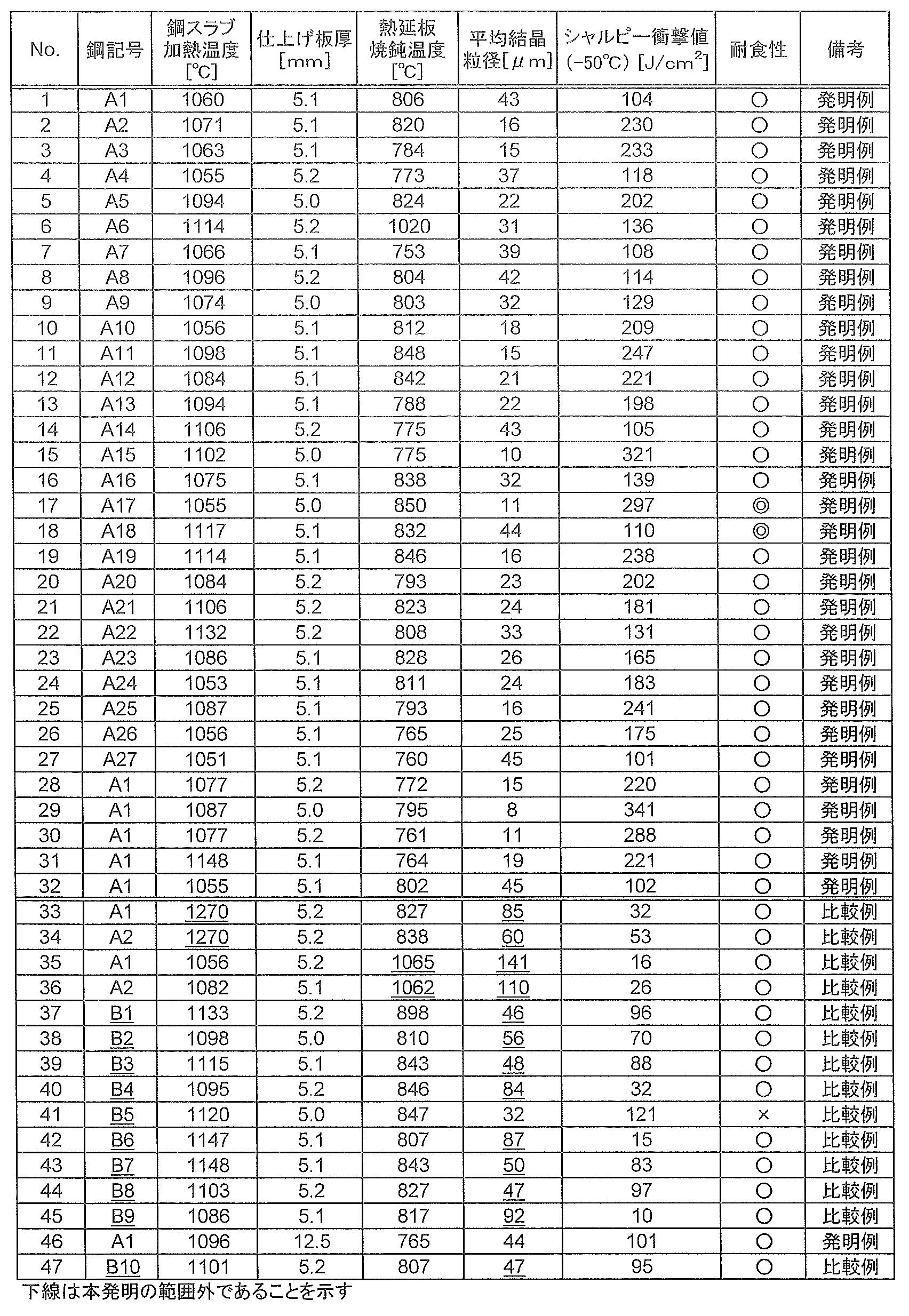
- the molten stainless steel having the component composition shown in Table 1 was made into a 100 kg steel slab by vacuum induction melting. Subsequently, it hot-rolled on the manufacturing conditions shown in Table 2, and was set as the hot rolled sheet steel of the finish plate thickness shown in Table 2. The hot rolled steel sheet is subjected to hot rolled sheet annealing to obtain a hot rolled annealed steel sheet. In addition, hot-rolled sheet annealing was performed holding the hot-rolled sheet annealing temperature shown in Table 2 for 8 h. The following evaluation was performed about the hot-rolled annealing steel plate obtained by the above.
- the average grain size was measured by the EBSD (Electron Back Scattering Diffraction) method. The measurement conditions were set to a step of 0.4 ⁇ m at a measurement magnification of 500 times. The obtained data was defined as a grain boundary of 15 ° or more in orientation difference by OIM (Orientation Imaging Microscopy) analysis software manufactured by TSL Solutions, Inc., and the equivalent circle diameter was calculated. The value calculated from the average value of the obtained equivalent circle diameters was taken as the average crystal grain size.
- OIM Orientation Imaging Microscopy
- Salt spray cycle test 1 cycle of salt spray (5 mass% NaCl, 35 ° C, spray 2hr) ⁇ drying (60 ° C, 4hr, relative humidity 40%) ⁇ wetting (50 ° C, 2hr, relative humidity) 95%) As, went 3 cycles.
- the surface of the test piece after 3 cycles of salt spray cycle test is photographed, the rusting area of the test piece surface is measured by image analysis, and the ratio of rusting area to the area of the rusting area measurement portion Rust area / area of the rust area measurement portion) ⁇ 100 [%]) was calculated.
- the rusted area measurement portion is a portion excluding the portion of the outer periphery 15 mm of the test piece.
- the rusted area was the area of the rusted portion and the flow rusted portion.
- the rusting rate of 10% or less is regarded as pass ( ⁇ ) with particularly excellent corrosion resistance, 10% to 25% or less as pass (o), and 25% or more as rejection (x).
- the steel components, the hot rolling conditions, and the hot-rolled sheet annealing conditions satisfy the range of the present invention.
- 1 to 32 and 46 fine metal structures having an average crystal grain size of 45 ⁇ m or less were obtained, and a predetermined Charpy impact value was obtained.
- the rusting rate is 25% or less in any case and also has sufficient corrosion resistance.
- the corrosion resistance was further improved with a rusting rate of 10% or less.
- the slab heating temperature exceeds the range of the present invention. 33, and no.
- the slab heating temperature exceeds the range of the present invention. 33, and no.
- a predetermined amount of austenite phase is formed at the time of heating in the hot rolling process and rolling is performed at a predetermined cumulative reduction ratio, recovery of working strain occurs because the rolling temperature is excessively high and recrystallization site In the hot-rolled sheet annealing step, coarsening of recrystallized grains is likely to occur, and a predetermined Charpy impact value can not be obtained.
- the steel sheet A1 and the steel sheet A2 are used, and the hot-rolled sheet annealing temperature exceeds the range of the present invention. 35, and no. In No. 36, as a result of the occurrence of significant coarsening of the formed recrystallized grains, a predetermined Charpy impact value was not obtained.
- No. 40 although predetermined hot rolling and hot rolled sheet annealing were performed, as austenite phase was not sufficiently generated at the time of heating in the hot rolling process, as a result, the refining of the metal structure is sufficiently performed in the hot rolled sheet annealing process. It did not occur, and a predetermined Charpy impact value was not obtained.
- the ferritic stainless steel sheet obtained by the present invention is particularly suitable for applications where excellent toughness is required, for example, application to flanges and the like.
Landscapes
- Chemical & Material Sciences (AREA)
- Engineering & Computer Science (AREA)
- Mechanical Engineering (AREA)
- Materials Engineering (AREA)
- Metallurgy (AREA)
- Organic Chemistry (AREA)
- Physics & Mathematics (AREA)
- Thermal Sciences (AREA)
- Crystallography & Structural Chemistry (AREA)
- Heat Treatment Of Sheet Steel (AREA)
- Heat Treatment Of Steel (AREA)
Abstract
Description
なお、γp(%)は下記(i)式(特許文献1では(1)式と表記)を用いて評価する。
γp=420(%C)+470(%N)+23(%Ni)+9(%Cu)+7(%Mn)-11.5(%Cr)-11.5(%Si)-12(%Mo)-23(%V)-47(%Nb)-49(%Ti)-52(%Al)+189 (i)
なお、(%X)は、各成分Xの質量割合を示す。
[1]質量%で、C:0.001~0.020%、Si:0.05~0.35%、Mn:0.05~1.00%、P:0.04%以下、S:0.01%以下、Al:0.001~0.300%、Cr:10.0~13.0%、Ni:0.75~1.50%、Ti:0.05~0.35%、N:0.001~0.020%を含有し、かつ、下記式(1)からなるγI[%]が65%以上であり、残部がFeおよび不可避的不純物からなる成分組成を有し、金属組織の平均結晶粒径が45μm以下である、フェライト系ステンレス鋼板。
γI[%]=24Ni+12Mn+6Cu-18Si-12Cr-12Mo+188 (1)
なお、式(1)中のNi、Mn、Cu、Si、CrおよびMoは、各成分の含有量(質量%)をあらわし、含有しない成分は0とする。
[2]前記成分組成に加えて、質量%で、Cu:0.01~1.00%、Mo:0.01~1.00%、W:0.01~0.20%、Co:0.01~0.20%の1種または2種以上を含有する、上記[1]に記載のフェライト系ステンレス鋼板。
[3]前記成分組成に加えて、質量%で、V:0.01~0.20%、Nb:0.01~0.10%、Zr:0.01~0.20%の1種または2種以上を含有する、上記[1]または[2]に記載のフェライト系ステンレス鋼板。
[4]前記成分組成に加えて、質量%で、REM:0.001~0.100%、B:0.0002~0.0025%、Mg:0.0005~0.0030%、Ca:0.0003~0.0030%の1種または2種以上を含有する、上記[1]~[3]のいずれかに記載のフェライト系ステンレス鋼板。
[5]上記[1]~[4]のいずれかに記載のフェライト系ステンレス鋼板の製造方法であって、前記成分組成を有する鋼スラブに対して、1050~1250℃で加熱後、熱間圧延を行う熱間圧延工程と、該熱間圧延工程で得られた熱延鋼板を750~1050℃で熱延板焼鈍する熱延板焼鈍工程とを有する、フェライト系ステンレス鋼板の製造方法。
なお、上記平均結晶粒径は、後述する実施例の測定方法にて測定することができる。また、上記シャルピー衝撃値は、後述するようにJIS Z 2242(2005)に準拠して測定した値である。
以下、特に断らない限り、成分の含有量の単位である「%」は「質量%」を意味する。
Cを0.020%超えて含有すると、加工性および耐食性の低下が顕著になる。C含有量が少ないほど耐食性および加工性の観点では好ましいが、C含有量を0.001%未満にするためには精錬に時間がかかり製造上好ましくない。よって、C含有量は0.001%以上0.020%以下の範囲とする。C含有量は、好ましくは0.003%以上であり、より好ましくは0.004%以上である。また、C含有量は、好ましくは0.015%以下であり、より好ましくは0.012%以下である。
Siは溶接時に形成される酸化皮膜に濃縮して溶接部の耐食性を向上させる効果があるとともに、製鋼工程における脱酸元素としても有用な元素である。これらの効果は0.05%以上のSiの含有により得られ、含有量が多いほどその効果は大きくなる。一方、Siはフェライト相の生成を促進する効果があり、0.35%を超えてSiを含有すると、熱間圧延工程における加熱時に所定量のオーステナイト相が十分に生成しないため、本発明が規定する条件で熱間圧延および熱延板焼鈍を行っても、所望の金属組織が得られない。よって、Si含有量は0.05%以上0.35%以下とする。Si含有量は、好ましくは0.10%以上である。また、Si含有量は、好ましくは0.30%以下である。
Mnはオーステナイト相の生成を促進する効果がある。その効果を得るためには0.05%以上のMnの含有が必要である。しかし、Mn含有量が1.00%を超えると、腐食の起点となるMnSの析出が促進され、耐食性が低下する。よって、Mn含有量は0.05%以上1.00%以下とする。Mn含有量は、好ましくは0.20%以上である。また、Mn含有量は、好ましくは0.80%以下であり、より好ましくは0.70%以下である。
Pは鋼に不可避的に含まれる元素であり、耐食性および加工性に対して有害な元素であるので可能な限り低減することが好ましい。P含有量が0.04%を超えると固溶強化により加工性が顕著に低下する。よって、P含有量は0.04%以下とする。P含有量は、好ましくは0.03%以下である。
SもPと同様に鋼に不可避的に含まれる元素であり、耐食性および加工性に対して有害な元素であるので可能な限り低減するのが好ましい。特に、S含有量が0.01%を超えると耐食性が顕著に低下する。よって、S含有量は0.01%以下とする。S含有量は、好ましくは0.008%以下であり、より好ましくは0.003%以下である。
Alは有効な脱酸剤である。さらに、Alは窒素との親和力がCrよりも強いため、溶接部に窒素が侵入した場合に、窒素をCr窒化物ではなくAl窒化物として析出させて、鋭敏化を抑制する効果がある。これらの効果は、Alを0.001%以上含有することで得られる。しかし、0.300%を超えるAlを含有すると、溶接時の溶け込み性が低下して溶接性が低下するので好ましくない。よって、Al含有量は0.001%以上0.300%以下の範囲とする。Al含有量は、好ましくは0.010%以上である。また、Al含有量は、好ましくは0.200%以下であり、より好ましくは0.100%以下であり、さらに好ましくは0.050%以下である。
Crは耐食性を確保するために最も重要な元素である。その含有量が10.0%未満では、自動車排気部品に必要な耐食性が得られない。一方、13.0%を超えてCrを含有すると、鋼成分を後述する所定の式(1)で示されるγIに調整しても、熱間圧延工程における加熱時に所定量のオーステナイト相が生成しないために、本発明が規定する条件で熱間圧延および熱延板焼鈍を行っても、所望の金属組織が得られない。よって、Cr含有量は10.0%以上13.0%以下の範囲とする。Cr含有量は、好ましくは10.5%以上である。また、Cr含有量は、好ましくは12.0%以下であり、より好ましくは11.7%以下である。
Niはオーステナイト生成元素であり、熱間圧延工程における圧延加工前の加熱時に生成するオーステナイト量を増加させる効果がある。本発明においては、鋼成分を調整することによって、熱間圧延工程におけるスラブ加熱時に体積率で70%以上のオーステナイト相を含むフェライト相+オーステナイト相の二相組織となる。金属組織がフェライト相+オーステナイト相の二相組織となる場合、フェライト相とオーステナイト相との異相界面が結晶粒成長の障害として機能するため、熱間圧延加工前の金属組織が微細化する。その上で、所定の熱間圧延により再結晶サイトとなる加工ひずみを蓄積させ、次工程の熱延板焼鈍により再結晶を生じさせることにより微細な金属組織が得られ、優れた靭性が発現する。これらの効果は、Niを0.75%以上含有することで得られる。一方、Ni含有量が1.50%を超えると、結晶粒の微細化による改善効果が飽和するとともに加工性が低下する。さらには、応力腐食割れが発生しやすくなる。よって、Ni含有量は0.75%以上1.50%以下とする。Ni含有量は、好ましくは0.80%以上である。また、Ni含有量は、好ましくは1.20%以下であり、より好ましくは1.00%以下である。
TiはC、Nと優先的に結合して、Cr炭窒化物の析出を抑制し、再結晶温度を低下させるとともにCr炭窒化物の析出による鋭敏化に起因した耐食性の低下を抑制する効果がある。このような効果を得るためには0.05%以上のTiの含有が必要である。一方、Ti含有量が0.35%を超えると粗大なTiNの生成に起因した著しい靭性の低下が生じ、本発明の技術を適用しても所定の靭性が得られない。また、0.35%超のTiの含有は、鋳造工程において粗大なTi炭窒化物が生成し、表面欠陥を引き起こすため製造上好ましくない。よって、Ti含有量は0.05%以上0.35%以下とする。Ti含有量は、好ましくは0.10%以上である。また、Ti含有量は、好ましくは0.30%以下であり、より好ましくは0.15%以下である。
N含有量が0.020%を超えると、加工性および耐食性の低下が顕著になる。加工性および耐食性の観点からN含有量は低いほど好ましいが、N含有量を0.001%未満にまで低減するには長時間の精錬が必要となり、製造コストの上昇および生産性の低下を招くため好ましくない。よって、N含有量は0.001%以上0.020%以下の範囲とする。N含有量は、好ましくは0.005%以上であり、より好ましくは0.007%以上である。また、N含有量は、好ましくは0.015%以下であり、より好ましくは0.012%以下である。
下記式(1)で示されるγIが65%を下回ると熱間圧延開始前のスラブ加熱温度において、金属組織はオーステナイト量が不十分なため、微細な金属組織が得られない。よって、γI[%]は65%以上とする。なお、γI[%]はオーステナイト相の安定度を評価する下記式(1)を用いて求める。
γI[%]=24Ni+12Mn+6Cu-18Si-12Cr-12Mo+188 (1)
なお、式(1)中のNi、Mn、Cu、Si、CrおよびMoは、各成分の含有量(質量%)をあらわし、含有しない成分は0とする。
上記式(1)において、オーステナイト生成元素は正の係数、フェライト生成元素は負の係数を持ち、それぞれの値はCastroの式を参考にして実験的に求めた。
(A群)Cu:0.01~1.00%、Mo:0.01~1.00%、W:0.01~0.20%、Co:0.01~0.20%の1種または2種以上
(B群)V:0.01~0.20%、Nb:0.01~0.10%、Zr:0.01~0.20%の1種または2種以上
(C群)REM:0.001~0.100%、B:0.0002~0.0025%、Mg:0.0005~0.0030%、Ca:0.0003~0.0030%の1種または2種以上
Cuは水溶液中や弱酸性の水滴が付着した場合の耐食性を向上させるのに特に有効な元素である。さらに、Cuはオーステナイト相の生成を促進する効果がある。この効果は0.01%以上の含有により得られ、その効果はCu含有量が多いほど高くなる。しかし、1.00%を超えてCuを含有すると、熱間加工性が低下して表面欠陥を誘引する場合がある。さらには焼鈍後の脱スケールが困難となる場合もある。そのため、Cuを含有する場合は、Cu含有量は0.01%以上1.00%以下の範囲とする。Cuを含有する場合、Cu含有量は、好ましくは0.10%以上である。また、Cuを含有する場合、Cu含有量は、好ましくは0.50%以下である。
Moはステンレス鋼の耐食性を顕著に向上させる元素である。この効果は0.01%以上のMoの含有によって得られ、その効果は含有量が多いほど向上する。一方、Moはフェライト相の生成を促進する効果があり、Mo含有量が1.00%を超えると、熱間圧延工程における加熱時に所定量のオーステナイト相が十分に生成しないため、本発明が規定する条件で熱間圧延および熱延板焼鈍を行っても、所望の金属組織が得られない。よって、Moを含有する場合は、Mo含有量は0.01%以上1.00%以下とする。Moを含有する場合、Mo含有量は、好ましくは0.10%以上であり、より好ましくは0.30%以上である。また、Moを含有する場合、Mo含有量は、好ましくは0.80%以下であり、より好ましくは0.50%以下である。
WはMoと同様に耐食性を向上させる効果がある。この効果は0.01%以上のWの含有により得られる。一方、0.20%を超えてWを含有すると強度が上昇し、圧延荷重の増大等による製造性の低下を招く場合がある。そのため、Wを含有する場合は、W含有量は0.01%以上0.20%以下の範囲とする。Wを含有する場合、W含有量は、好ましくは0.05%以上である。また、Wを含有する場合、W含有量は、好ましくは0.15%以下である。
Coは靭性を向上させる元素である。この効果は0.01%以上のCoの含有によって得られる。一方、Co含有量が0.20%を超えると加工性が低下する場合がある。よって、Coを含有する場合は、Co含有量は0.01%以上0.20%以下の範囲とする。
VはC、Nと炭窒化物を形成し、溶接時の鋭敏化を抑制して溶接部の耐食性を向上させる。この効果はV含有量が0.01%以上で得られる。一方、V含有量が0.20%を超えると加工性および靭性が顕著に低下する場合がある。よって、Vを含有する場合は、V含有量は0.01%以上0.20%以下とする。Vを含有する場合、V含有量は、好ましくは0.02%以上である。また、Vを含有する場合、V含有量は、好ましくは0.10%以下である。
Nbは結晶粒を微細化させる効果がある。この効果は0.01%以上のNbの含有で得られる。一方、Nbは再結晶温度を上昇させる効果もあり、Nb含有量が0.10%を超えると熱延板焼鈍にて十分な再結晶を生じさせるために必要な焼鈍温度が過度に高温となって、平均結晶粒径が45μm以下の金属組織を得ることができない場合がある。よって、Nbを含有する場合には、Nb含有量は0.01%以上0.10%以下の範囲とする。Nbを含有する場合、Nb含有量は、好ましくは0.05%以下である。
ZrはC、Nと結合して鋭敏化を抑制する効果がある。この効果は0.01%以上のZrの含有により得られる。一方、0.20%を超えてZrを含有すると加工性が顕著に低下する場合がある。よって、Zrを含有する場合、Zr含有量は0.01%以上0.20%以下の範囲とする。Zrを含有する場合、Zr含有量は、好ましくは0.10%以下である。
REM(Rare Earth Metals:希土類金属)は耐酸化性を向上させる効果があり、溶接部の酸化皮膜(溶接テンパーカラー)形成を抑制して酸化皮膜直下におけるCr欠乏領域の形成を抑制する。この効果は、REMを0.001%以上含有することで得られる。一方、0.100%を超えてREMを含有すると冷延焼鈍時の酸洗性などの製造性を低下させる場合がある。そのため、REMを含有する場合、REM含有量は0.001%以上0.100%以下の範囲とする。REMを含有する場合、REM含有量は、好ましくは0.050%以下である。
Bは深絞り成形後の耐二次加工脆性を改善するために有効な元素である。この効果はBの含有量を0.0002%以上にすることで得られる。一方、0.0025%を超えてBを含有すると加工性と靭性が低下する場合がある。よって、Bを含有する場合、B含有量は0.0002%以上0.0025%以下の範囲とする。Bを含有する場合、B含有量は、好ましくは0.0003%以上である。また、Bを含有する場合、B含有量は、好ましくは0.0012%以下である。
本発明のようにTiを含有する鋼においては、Ti炭窒化物が粗大化すると靭性が低下する場合がある。この点について、MgはTi炭窒化物の粗大化を抑制する効果を有する。この効果は、0.0005%以上のMgを含有することで得られる。一方で、Mg含有量が0.0030%を超えると、鋼の表面性状を悪化させてしまう場合がある。よって、Mgを含有する場合、Mg含有量は0.0005~0.0030%の範囲とする。Mgを含有する場合、Mg含有量は、好ましくは0.0010%以上である。また、Mgを含有する場合、Mg含有量は、好ましくは0.0020%以下である。
Caは、連続鋳造の際に発生しやすいTi系介在物の晶出によるノズルの閉塞を防止するのに有効な成分である。その効果は0.0003%以上のCaを含有することで得られる。一方、0.0030%を超えてCaを含有すると、CaSの生成により耐食性が低下する場合がある。よって、Caを含有する場合、Ca含有量は0.0003%以上0.0030%以下の範囲とする。Caを含有する場合、Ca含有量は、好ましくは0.0005%以上である。また、Caを含有する場合、Ca含有量は、好ましくは0.0015%以下であり、より好ましくは0.0010%以下である。
本発明者らは、フェライト系ステンレス鋼板において靭性を向上させる手法について鋭意検討結果、適切な鋼成分を有する鋼スラブを好ましくは1050~1250℃で加熱した後、好ましくは3パス以上で熱間圧延し、得られた熱延鋼板に対して、750~1050℃で熱延板焼鈍を行うことにより、平均結晶粒径が45μm以下の金属組織が得られ、-50℃でのシャルピー衝撃値が100J/cm2以上と靭性が大幅に向上することを知見した。さらに、所望の耐食性も得られることを知見した。
フェライト系ステンレス鋼は熱間圧延において動的再結晶がほとんど生じず、圧延による加工ひずみの回復が生じやすい傾向がある。そのため、従来技術による熱間圧延では圧延によって導入された加工ひずみの過度な回復が生じて加工ひずみを熱間圧延後まで効果的に維持することができない。その結果、再結晶サイトが不十分となり次工程の熱延板焼鈍において微細な再結晶組織を得ることができない。
鋼スラブを、1050~1250℃で加熱し、熱間圧延に供する。前記加熱温度での加熱時間は、特に限定されないが、好ましくは1~24時間加熱する。加熱温度が1050℃未満では、オーステナイト相の生成割合が低くなって微細な金属組織が得られなくなり、優れた靭性が得られない。一方、加熱温度があまりに高くなると酸化質量の増加に伴うスケールロスの増大につながるため、鋼スラブの加熱温度は1250℃以下とする。但し、鋼スラブに熱間圧延を施すに際し、鋳造後の鋼スラブが1050℃以上の温度域にある場合には、鋼素材を加熱することなく直送圧延してもよい。
本発明では上記熱間圧延終了後に熱延板焼鈍を行う。熱延板焼鈍において、熱間圧延工程で形成させた圧延加工組織を再結晶させる。本発明では熱間圧延工程において効果的に圧延ひずみを付与し、再結晶サイトを増加させることによって熱延板焼鈍における再結晶の粗大化を抑制する。この効果を得るためには熱延板焼鈍を750~1050℃の範囲で行う必要がある。焼鈍温度が750℃未満では再結晶が不十分なため熱延ひずみに起因した残留応力が残存して、熱延焼鈍後の平坦度が保てない。一方、焼鈍温度が1050℃を超えると、再結晶粒は、著しい粗大化が生じ、所望の金属組織が得られない。そのため、熱延板焼鈍温度は750℃以上1050℃以下の範囲とする。好ましくは、熱延板焼鈍温度は750℃以上900℃以下の範囲である。なお、熱延板焼鈍の保持時間および手法に特に限定はなく、箱焼鈍(バッチ焼鈍)、連続焼鈍のいずれで実施してもかまわない。
以上により得られた熱延焼鈍鋼板について、以下の評価を行った。
平均結晶粒径は、EBSD(Electron Back Scattering Diffraction)法により測定した。測定条件は、測定倍率500倍でステップ0.4μmとした。得られたデータは株式会社TSLソリューションズ社OIM(Orientation Imaging Microscopy)解析ソフトにより方位差15°以上を粒界と定義し、円相当直径を算出した。得られた円相当直径の平均値から算出した値を平均結晶粒径とした。
熱延焼鈍鋼板の板幅中央部から、JIS Z 2242(2005)に準拠したVノッチシャルピー試験片を前記鋼板の板厚のままで圧延方向が長手となるように採取し、該試験片についてJIS Z 2242(2005)に準拠して-50℃におけるシャルピー衝撃値を測定した。-50℃におけるシャルピー衝撃値が100J/cm2以上を合格、100J/cm2未満を不合格とした。
熱延焼鈍鋼板から、60×80mmの試験片を採取し、表面を#600エメリーペーパーにより研磨仕上げした後に端面部および裏面をシールした試験片を作製し、JIS H 8502に規定された塩水噴霧サイクル試験に供した。塩水噴霧サイクル試験は、塩水噴霧(5質量%NaCl、35℃、噴霧2hr)→乾燥(60℃、4hr、相対湿度40%)→湿潤(50℃、2hr、相対湿度≧95%)を1サイクルとして、3サイクル行った。塩水噴霧サイクル試験を3サイクル実施後の試験片表面を写真撮影し、画像解析により試験片表面の発錆面積を測定し、発錆面積測定部分の面積との比率から発錆率(試験片中の発錆面積/発錆面積測定部分の面積)×100[%])を算出した。発錆面積測定部分とは、試験片の外周15mmの部分を除いた部分である。なお、発錆面積は発錆部分および、流れ錆部分の面積とした。発錆率10%以下を特に優れた耐食性で合格(◎)、10%超25%以下を合格(○)、25%超を不合格(×)とした。

Claims (5)
- 質量%で、
C:0.001~0.020%、
Si:0.05~0.35%、
Mn:0.05~1.00%、
P:0.04%以下、
S:0.01%以下、
Al:0.001~0.300%、
Cr:10.0~13.0%、
Ni:0.75~1.50%、
Ti:0.05~0.35%、
N:0.001~0.020%
を含有し、かつ、下記式(1)からなるγI[%]が65%以上であり、残部がFeおよび不可避的不純物からなる成分組成を有し、
金属組織の平均結晶粒径が45μm以下である、フェライト系ステンレス鋼板。
γI[%]=24Ni+12Mn+6Cu-18Si-12Cr-12Mo+188 (1)
なお、式(1)中のNi、Mn、Cu、Si、CrおよびMoは、各成分の含有量(質量%)をあらわし、含有しない成分は0とする。 - 前記成分組成に加えて、質量%で、
Cu:0.01~1.00%、
Mo:0.01~1.00%、
W:0.01~0.20%、
Co:0.01~0.20%の1種または2種以上を含有する、請求項1に記載のフェライト系ステンレス鋼板。 - 前記成分組成に加えて、質量%で、
V:0.01~0.20%、
Nb:0.01~0.10%、
Zr:0.01~0.20%の1種または2種以上を含有する、請求項1または2に記載のフェライト系ステンレス鋼板。 - 前記成分組成に加えて、質量%で、
REM:0.001~0.100%、
B:0.0002~0.0025%、
Mg:0.0005~0.0030%、
Ca:0.0003~0.0030%の1種または2種以上を含有する、請求項1~3のいずれかに記載のフェライト系ステンレス鋼板。 - 請求項1~4のいずれかに記載のフェライト系ステンレス鋼板の製造方法であって、
前記成分組成を有する鋼スラブに対して、1050~1250℃で加熱後、熱間圧延を行う熱間圧延工程と、
該熱間圧延工程で得られた熱延鋼板を750~1050℃で熱延板焼鈍する熱延板焼鈍工程とを有する、フェライト系ステンレス鋼板の製造方法。
Priority Applications (9)
| Application Number | Priority Date | Filing Date | Title |
|---|---|---|---|
| CN202411652503.7A CN119615019A (zh) | 2017-10-30 | 2018-10-16 | 铁素体系不锈钢板及其制造方法 |
| CN201880070416.7A CN111295458A (zh) | 2017-10-30 | 2018-10-16 | 铁素体系不锈钢板及其制造方法 |
| ES18873329T ES2883114T3 (es) | 2017-10-30 | 2018-10-16 | Chapa de acero inoxidable ferrítico y método para fabricar la misma |
| EP18873329.9A EP3666917B1 (en) | 2017-10-30 | 2018-10-16 | Ferritic stainless-steel sheet and method for manufacturing same |
| KR1020207011817A KR20200057760A (ko) | 2017-10-30 | 2018-10-16 | 페라이트계 스테인리스 강판 및 그의 제조 방법 |
| US16/758,551 US20200347475A1 (en) | 2017-10-30 | 2018-10-16 | Ferritic stainless steel sheet and method for manufacturing the same |
| JP2019505000A JP6536763B1 (ja) | 2017-10-30 | 2018-10-16 | フェライト系ステンレス鋼板およびその製造方法 |
| MX2020004428A MX2020004428A (es) | 2017-10-30 | 2018-10-16 | Chapa de acero inoxidable ferritico y metodo para fabricar la misma. |
| KR1020227016128A KR102603113B1 (ko) | 2017-10-30 | 2018-10-16 | 페라이트계 스테인리스 강판 및 그의 제조 방법 |
Applications Claiming Priority (2)
| Application Number | Priority Date | Filing Date | Title |
|---|---|---|---|
| JP2017-209061 | 2017-10-30 | ||
| JP2017209061 | 2017-10-30 |
Publications (1)
| Publication Number | Publication Date |
|---|---|
| WO2019087761A1 true WO2019087761A1 (ja) | 2019-05-09 |
Family
ID=66333017
Family Applications (1)
| Application Number | Title | Priority Date | Filing Date |
|---|---|---|---|
| PCT/JP2018/038400 Ceased WO2019087761A1 (ja) | 2017-10-30 | 2018-10-16 | フェライト系ステンレス鋼板およびその製造方法 |
Country Status (8)
| Country | Link |
|---|---|
| US (1) | US20200347475A1 (ja) |
| EP (1) | EP3666917B1 (ja) |
| JP (1) | JP6536763B1 (ja) |
| KR (2) | KR20200057760A (ja) |
| CN (2) | CN111295458A (ja) |
| ES (1) | ES2883114T3 (ja) |
| MX (1) | MX2020004428A (ja) |
| WO (1) | WO2019087761A1 (ja) |
Cited By (1)
| Publication number | Priority date | Publication date | Assignee | Title |
|---|---|---|---|---|
| WO2020084987A1 (ja) * | 2018-10-25 | 2020-04-30 | Jfeスチール株式会社 | フェライト系ステンレス熱延焼鈍鋼板およびその製造方法 |
Families Citing this family (4)
| Publication number | Priority date | Publication date | Assignee | Title |
|---|---|---|---|---|
| MX2024008719A (es) * | 2022-04-06 | 2024-07-22 | Nippon Steel Corp | Miembro estructural de rebarbado. |
| KR20240096251A (ko) * | 2022-12-19 | 2024-06-26 | 주식회사 포스코 | 충격인성이 향상된 페라이트계 스테인리스강 및 그 제조방법 |
| CN117286422B (zh) * | 2023-08-09 | 2024-06-18 | 北京首钢吉泰安新材料有限公司 | 一种不锈钢合金及其制备方法与应用 |
| CN117583831A (zh) * | 2023-11-08 | 2024-02-23 | 临海市三江工程机械制造有限公司 | 一种不锈钢法兰的加工方法 |
Citations (4)
| Publication number | Priority date | Publication date | Assignee | Title |
|---|---|---|---|---|
| JPS5871331A (ja) * | 1981-10-21 | 1983-04-28 | Nisshin Steel Co Ltd | フエライト系ステンレス鋼の熱間圧延方法 |
| JP2007016310A (ja) * | 2005-06-09 | 2007-01-25 | Jfe Steel Kk | ベローズ素管用フェライト系ステンレス鋼板 |
| JP2016191150A (ja) | 2015-03-30 | 2016-11-10 | 新日鐵住金ステンレス株式会社 | 靭性に優れたステンレス鋼板およびその製造方法 |
| WO2018199062A1 (ja) * | 2017-04-27 | 2018-11-01 | Jfeスチール株式会社 | フェライト系ステンレス熱延焼鈍鋼板およびその製造方法 |
Family Cites Families (5)
| Publication number | Priority date | Publication date | Assignee | Title |
|---|---|---|---|---|
| JP3788311B2 (ja) * | 2001-10-31 | 2006-06-21 | Jfeスチール株式会社 | フェライト系ステンレス鋼板及びその製造方法 |
| KR100762151B1 (ko) * | 2001-10-31 | 2007-10-01 | 제이에프이 스틸 가부시키가이샤 | 딥드로잉성 및 내이차가공취성이 우수한 페라이트계스테인리스강판 및 그 제조방법 |
| JP4721916B2 (ja) * | 2005-01-24 | 2011-07-13 | 新日鐵住金ステンレス株式会社 | 成形時の面内異方性が小さく耐リジング性及び耐肌荒れ性に優れたフェライト系ステンレス鋼薄板及びその製造方法 |
| JP5908936B2 (ja) * | 2014-03-26 | 2016-04-26 | 新日鐵住金ステンレス株式会社 | フランジ用フェライト系ステンレス鋼板とその製造方法およびフランジ部品 |
| KR102088341B1 (ko) * | 2015-07-17 | 2020-03-12 | 제이에프이 스틸 가부시키가이샤 | 페라이트계 스테인리스 열연 강판 및 열연 어닐링판, 그리고 그들의 제조 방법 |
-
2018
- 2018-10-16 KR KR1020207011817A patent/KR20200057760A/ko not_active Ceased
- 2018-10-16 US US16/758,551 patent/US20200347475A1/en not_active Abandoned
- 2018-10-16 JP JP2019505000A patent/JP6536763B1/ja active Active
- 2018-10-16 ES ES18873329T patent/ES2883114T3/es active Active
- 2018-10-16 CN CN201880070416.7A patent/CN111295458A/zh active Pending
- 2018-10-16 EP EP18873329.9A patent/EP3666917B1/en active Active
- 2018-10-16 CN CN202411652503.7A patent/CN119615019A/zh active Pending
- 2018-10-16 KR KR1020227016128A patent/KR102603113B1/ko active Active
- 2018-10-16 WO PCT/JP2018/038400 patent/WO2019087761A1/ja not_active Ceased
- 2018-10-16 MX MX2020004428A patent/MX2020004428A/es unknown
Patent Citations (4)
| Publication number | Priority date | Publication date | Assignee | Title |
|---|---|---|---|---|
| JPS5871331A (ja) * | 1981-10-21 | 1983-04-28 | Nisshin Steel Co Ltd | フエライト系ステンレス鋼の熱間圧延方法 |
| JP2007016310A (ja) * | 2005-06-09 | 2007-01-25 | Jfe Steel Kk | ベローズ素管用フェライト系ステンレス鋼板 |
| JP2016191150A (ja) | 2015-03-30 | 2016-11-10 | 新日鐵住金ステンレス株式会社 | 靭性に優れたステンレス鋼板およびその製造方法 |
| WO2018199062A1 (ja) * | 2017-04-27 | 2018-11-01 | Jfeスチール株式会社 | フェライト系ステンレス熱延焼鈍鋼板およびその製造方法 |
Non-Patent Citations (1)
| Title |
|---|
| See also references of EP3666917A4 |
Cited By (2)
| Publication number | Priority date | Publication date | Assignee | Title |
|---|---|---|---|---|
| WO2020084987A1 (ja) * | 2018-10-25 | 2020-04-30 | Jfeスチール株式会社 | フェライト系ステンレス熱延焼鈍鋼板およびその製造方法 |
| JPWO2020084987A1 (ja) * | 2018-10-25 | 2021-02-15 | Jfeスチール株式会社 | フェライト系ステンレス熱延焼鈍鋼板およびその製造方法 |
Also Published As
| Publication number | Publication date |
|---|---|
| MX2020004428A (es) | 2020-08-06 |
| US20200347475A1 (en) | 2020-11-05 |
| CN111295458A (zh) | 2020-06-16 |
| KR20220065904A (ko) | 2022-05-20 |
| CN119615019A (zh) | 2025-03-14 |
| EP3666917A1 (en) | 2020-06-17 |
| EP3666917A4 (en) | 2020-08-05 |
| KR20200057760A (ko) | 2020-05-26 |
| JPWO2019087761A1 (ja) | 2019-11-14 |
| EP3666917B1 (en) | 2021-07-07 |
| JP6536763B1 (ja) | 2019-07-03 |
| ES2883114T3 (es) | 2021-12-07 |
| KR102603113B1 (ko) | 2023-11-16 |
Similar Documents
| Publication | Publication Date | Title |
|---|---|---|
| JP6536763B1 (ja) | フェライト系ステンレス鋼板およびその製造方法 | |
| JP6304469B1 (ja) | フェライト系ステンレス熱延焼鈍鋼板およびその製造方法 | |
| WO2017135240A1 (ja) | Nb含有フェライト系ステンレス熱延鋼板及びその製造方法、並びにNb含有フェライト系ステンレス冷延鋼板及びその製造方法 | |
| JP6432720B1 (ja) | フェライト系ステンレス熱延焼鈍鋼板およびその製造方法 | |
| CN107835865B (zh) | 铁素体系不锈钢热轧钢板和热轧退火板以及它们的制造方法 | |
| JP6892011B2 (ja) | フェライト系ステンレス鋼板およびその製造方法 | |
| JP6311633B2 (ja) | ステンレス鋼およびその製造方法 | |
| JP6036645B2 (ja) | 低温靭性に優れたフェライト−マルテンサイト2相ステンレス鋼およびその製造方法 | |
| JP7038799B2 (ja) | フェライト系ステンレス熱延焼鈍鋼板およびその製造方法 | |
| JP6424867B2 (ja) | フェライト相とマルテンサイト相の2相からなる鋼組織を有するステンレス鋼およびその製造方法 | |
| WO2014045476A1 (ja) | フェライト系ステンレス鋼 | |
| JP2025014954A (ja) | フェライト系ステンレス熱延焼鈍鋼板およびその製造方法 |
Legal Events
| Date | Code | Title | Description |
|---|---|---|---|
| ENP | Entry into the national phase |
Ref document number: 2019505000 Country of ref document: JP Kind code of ref document: A |
|
| 121 | Ep: the epo has been informed by wipo that ep was designated in this application |
Ref document number: 18873329 Country of ref document: EP Kind code of ref document: A1 |
|
| ENP | Entry into the national phase |
Ref document number: 2018873329 Country of ref document: EP Effective date: 20200311 |
|
| ENP | Entry into the national phase |
Ref document number: 20207011817 Country of ref document: KR Kind code of ref document: A |
|
| NENP | Non-entry into the national phase |
Ref country code: DE |
|
| WWG | Wipo information: grant in national office |
Ref document number: MX/A/2020/004428 Country of ref document: MX |