WO2019088075A1 - Alliage résistant à la chaleur et tube de réaction - Google Patents
Alliage résistant à la chaleur et tube de réaction Download PDFInfo
- Publication number
- WO2019088075A1 WO2019088075A1 PCT/JP2018/040264 JP2018040264W WO2019088075A1 WO 2019088075 A1 WO2019088075 A1 WO 2019088075A1 JP 2018040264 W JP2018040264 W JP 2018040264W WO 2019088075 A1 WO2019088075 A1 WO 2019088075A1
- Authority
- WO
- WIPO (PCT)
- Prior art keywords
- heat
- resistant alloy
- reaction tube
- rem
- test
- Prior art date
- Legal status (The legal status is an assumption and is not a legal conclusion. Google has not performed a legal analysis and makes no representation as to the accuracy of the status listed.)
- Ceased
Links
Images
Classifications
-
- C—CHEMISTRY; METALLURGY
- C22—METALLURGY; FERROUS OR NON-FERROUS ALLOYS; TREATMENT OF ALLOYS OR NON-FERROUS METALS
- C22C—ALLOYS
- C22C38/00—Ferrous alloys, e.g. steel alloys
- C22C38/02—Ferrous alloys, e.g. steel alloys containing silicon
-
- C—CHEMISTRY; METALLURGY
- C22—METALLURGY; FERROUS OR NON-FERROUS ALLOYS; TREATMENT OF ALLOYS OR NON-FERROUS METALS
- C22C—ALLOYS
- C22C19/00—Alloys based on nickel or cobalt
- C22C19/03—Alloys based on nickel or cobalt based on nickel
- C22C19/05—Alloys based on nickel or cobalt based on nickel with chromium
-
- C—CHEMISTRY; METALLURGY
- C22—METALLURGY; FERROUS OR NON-FERROUS ALLOYS; TREATMENT OF ALLOYS OR NON-FERROUS METALS
- C22C—ALLOYS
- C22C30/00—Alloys containing less than 50% by weight of each constituent
-
- C—CHEMISTRY; METALLURGY
- C22—METALLURGY; FERROUS OR NON-FERROUS ALLOYS; TREATMENT OF ALLOYS OR NON-FERROUS METALS
- C22C—ALLOYS
- C22C38/00—Ferrous alloys, e.g. steel alloys
-
- C—CHEMISTRY; METALLURGY
- C22—METALLURGY; FERROUS OR NON-FERROUS ALLOYS; TREATMENT OF ALLOYS OR NON-FERROUS METALS
- C22C—ALLOYS
- C22C38/00—Ferrous alloys, e.g. steel alloys
- C22C38/005—Ferrous alloys, e.g. steel alloys containing rare earths, i.e. Sc, Y, Lanthanides
-
- C—CHEMISTRY; METALLURGY
- C22—METALLURGY; FERROUS OR NON-FERROUS ALLOYS; TREATMENT OF ALLOYS OR NON-FERROUS METALS
- C22C—ALLOYS
- C22C38/00—Ferrous alloys, e.g. steel alloys
- C22C38/04—Ferrous alloys, e.g. steel alloys containing manganese
-
- C—CHEMISTRY; METALLURGY
- C22—METALLURGY; FERROUS OR NON-FERROUS ALLOYS; TREATMENT OF ALLOYS OR NON-FERROUS METALS
- C22C—ALLOYS
- C22C38/00—Ferrous alloys, e.g. steel alloys
- C22C38/06—Ferrous alloys, e.g. steel alloys containing aluminium
-
- C—CHEMISTRY; METALLURGY
- C22—METALLURGY; FERROUS OR NON-FERROUS ALLOYS; TREATMENT OF ALLOYS OR NON-FERROUS METALS
- C22C—ALLOYS
- C22C38/00—Ferrous alloys, e.g. steel alloys
- C22C38/18—Ferrous alloys, e.g. steel alloys containing chromium
- C22C38/40—Ferrous alloys, e.g. steel alloys containing chromium with nickel
- C22C38/44—Ferrous alloys, e.g. steel alloys containing chromium with nickel with molybdenum or tungsten
-
- C—CHEMISTRY; METALLURGY
- C22—METALLURGY; FERROUS OR NON-FERROUS ALLOYS; TREATMENT OF ALLOYS OR NON-FERROUS METALS
- C22C—ALLOYS
- C22C38/00—Ferrous alloys, e.g. steel alloys
- C22C38/18—Ferrous alloys, e.g. steel alloys containing chromium
- C22C38/40—Ferrous alloys, e.g. steel alloys containing chromium with nickel
- C22C38/48—Ferrous alloys, e.g. steel alloys containing chromium with nickel with niobium or tantalum
-
- C—CHEMISTRY; METALLURGY
- C22—METALLURGY; FERROUS OR NON-FERROUS ALLOYS; TREATMENT OF ALLOYS OR NON-FERROUS METALS
- C22C—ALLOYS
- C22C38/00—Ferrous alloys, e.g. steel alloys
- C22C38/18—Ferrous alloys, e.g. steel alloys containing chromium
- C22C38/40—Ferrous alloys, e.g. steel alloys containing chromium with nickel
- C22C38/50—Ferrous alloys, e.g. steel alloys containing chromium with nickel with titanium or zirconium
-
- C—CHEMISTRY; METALLURGY
- C22—METALLURGY; FERROUS OR NON-FERROUS ALLOYS; TREATMENT OF ALLOYS OR NON-FERROUS METALS
- C22C—ALLOYS
- C22C38/00—Ferrous alloys, e.g. steel alloys
- C22C38/18—Ferrous alloys, e.g. steel alloys containing chromium
- C22C38/40—Ferrous alloys, e.g. steel alloys containing chromium with nickel
- C22C38/58—Ferrous alloys, e.g. steel alloys containing chromium with nickel with more than 1.5% by weight of manganese
Definitions
- the present invention relates to a heat-resistant alloy used for a reaction tube or the like that generates hydrocarbon gas, and more specifically to a heat-resistant alloy that can preferably form an Al oxide layer on the surface.
- Olefins such as ethylene and propylene, and styrenic hydrocarbons such as styrene monomer, in a thermal decomposition apparatus, hydrocarbon raw material gas and steam fluid are caused to flow through a reaction tube heated from the outside, so that the raw material fluid is in the reaction temperature range It is produced by heating and pyrolysis.
- reaction tube Since the reaction tube is exposed to a high temperature atmosphere and is susceptible to the effects of oxidation, carburization, nitriding and the like due to the flowing source gas, etc., excellent resistance to these is required. For this reason, an austenitic heat-resistant alloy excellent in high temperature strength is used for the reaction tube.
- a metal oxide layer is formed on the surface during use in a high temperature atmosphere, and this oxide layer serves as a barrier to protect the base material in the high temperature atmosphere.
- Cr in the matrix is oxidized as these metal oxides to form Cr oxides (mainly composed of Cr 2 O 3 )
- the Cr oxides have low density, so oxygen or carbon
- the penetration prevention function is not sufficient, and internal oxidation may occur in a high temperature atmosphere, and the oxide layer may be enlarged.
- Cr oxide is easily peeled off in repeated cycles of heating and cooling, and even if it does not reach peeling, the function of preventing the infiltration of oxygen and carbon from the external atmosphere is insufficient, so it passes through the oxide layer.
- the reaction tube when the Al content in the reaction tube is increased, the ductility of the material is deteriorated to cause a decrease in high temperature strength.
- the reaction tube sometimes takes a long length by welding a plurality of tube bodies, but when the content of Al increases, the weldability of the tube bodies decreases, which may cause weld cracking. is there.
- the object of the present invention is to provide a heat-resistant alloy and a reaction tube which are excellent in oxidation resistance, mechanical properties such as tensile ductility, and weldability.
- REM Rare earth element
- the heat-resistant alloy of the present invention is further At mass%, It contains at least one selected from the group of more than W: 0% and not more than 1.0%, and Mo: more than 0% and not more than 0.5%.
- the heat-resistant alloy of the present invention is It is desirable that an Al oxide layer be formed on the surface.
- the heat-resistant alloy of the present invention is It can be a centrifugal force cast body.
- the heat-resistant alloy of the present invention is Use in a high temperature atmosphere of 500 ° C. to 1150 ° C. is preferred.
- the reaction tube of the present invention is It has a tube main body which consists of a heat-resistant alloy of the above-mentioned composition.
- reaction tube of the present invention is The pipe bodies are connected by welding.
- the heat-resistant alloy according to the present invention can form Al oxide in preference to Cr, thereby suppressing formation of Cr oxide. Therefore, problems such as peeling of the Cr oxide can be suppressed.
- the amount of Al added is as low as 1.5% to 4.5%, the decrease in mechanical properties can be suppressed.
- the heat-resistant alloy of the present invention is excellent in weldability because the amount of addition of Al is low, the occurrence of weld cracking and the like can be suppressed even when welding heat-resistant alloys.
- the tube body produced by the heat-resistant alloy of the present invention is excellent in oxidation resistance and weldability, so that the reaction tube produced by welding the tube bodies has a high temperature of 500 ° C. to 1100 ° C. It is extremely suitable as a reaction tube for producing olefinic and styrenic hydrocarbons under environmental conditions.
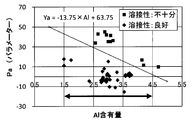
- FIG. 1 is a graph showing the results of regression analysis of a test piece based on weldability, with the Pa value as the vertical axis and the Al content as the horizontal axis.
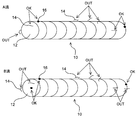
- FIG. 2 is explanatory drawing which shows the criterion of a crack and a point-like defect used for determination of a bead crack test.
- the heat-resistant alloy of the present invention is formed into a tubular shape to form a tube body, and the tube bodies can be welded to be used as a reaction tube.
- a hydrocarbon gas raw material or the like flows through the inside of the reaction tube, and the reaction tube is heated from the outside, and can be used for the production of olefins such as ethylene and hydrocarbons such as styrene.
- C 0.35% to 0.7%
- C has the effect of improving the castability and enhancing the high temperature creep rupture strength.
- it combines with Ti, Nb, Cr and the like to form carbides, and has an effect of enhancing high-temperature strength. For this reason, at least 0.35% is contained.
- the content is too large, primary carbides of Cr 7 C 3 are likely to be formed widely, transformation of Al to the inner surface of the reaction tube is inhibited, and supply shortage of Al occurs, resulting in Al 2 O 3 Such formation of Al oxides is suppressed.
- excessive precipitation of secondary carbides leads to a decrease in ductility and toughness. Therefore, the upper limit is 0.7%.
- the C content is more preferably 0.35% to 0.5%.
- Si more than 0% and 1.5% or less Si is contained as a deoxidizer for a molten metal alloy and to improve the fluidity of the molten metal alloy and improve the oxidation resistance.
- the upper limit of the content of Si is 1.5%.
- the content of Si is more preferably 1.0% or less.
- Mn more than 0% and 2.0% or less Mn serves as a deoxidizer for the molten alloy, and fixes S in the molten metal to improve weldability and to improve ductility.
- the content of Mn is more preferably 1.0% or less.
- Cr 22.0% to 40.0% Cr contributes to the improvement of the high temperature strength and the repeated oxidation resistance. Further, Cr, together with Ni and Fe, exhibits excellent heat resistance in a high temperature range exceeding 1000 ° C., and also forms a primary carbide with C and N to improve high temperature creep rupture strength. And an oxide layer is formed with Al, and the characteristics excellent in oxidation resistance and corrosion resistance are brought about to a heat-resistant alloy. Therefore, it is contained at least 22.0% or more. On the other hand, the excessive formation of Cr carbides and Cr nitrides causes a decrease in ductility, so the upper limit of the content is 40.0%. The content of Cr is more preferably 22.0% to 36.0%.
- Ni 25.0% to 48.3%
- Ni is an element necessary for securing repeated oxidation resistance and stability of metal structure, securing high temperature creep strength, and stabilizing austenitization of a heat-resistant alloy. Moreover, it contributes to the improvement of high temperature strength and oxidation resistance together with Cr. Furthermore, when the content of Ni is low, the content of Fe is relatively large, which inhibits the formation of Al oxide. For this reason, at least 25.0% or more is contained. On the other hand, even if Ni is added excessively, its effect is saturated, and also it is economically disadvantageous, so the upper limit is made 52.0%. The content of Ni is more preferably 29.0% to 50.0%. The upper limit of the content of Ni is preferably 48.3%, and more preferably 46.0%.
- Al 1.5% to 4.5%
- Al is an essential element for forming an Al oxide in a heat-resistant alloy.
- the formation of the Al oxide improves the carburization resistance and coking resistance of the heat-resistant alloy together with the Cr oxide.
- Al forms a ⁇ ′ phase with Ni to strengthen the austenite phase of the heat-resistant alloy. For this reason, Al is contained 1.5% or more.
- excessive addition of Al causes a decrease in ductility, and the ⁇ 'phase becomes unstable, leading to the formation of an embrittled phase.
- excessive addition of Al causes deterioration of castability and reduces the cleanliness of the heat-resistant alloy. Therefore, the upper limit is set to 4.5%.
- the content of Al is more preferably 2.0% to 4.0%.
- Ti 0.01% to 0.6%
- Ti is an element that easily forms a carbide, and is an essential element to contribute to the improvement of creep rupture strength and the improvement of high temperature tensile strength. Therefore, Ti: 0.01% or more is contained.
- the upper limit is Ti: 0.6%.
- the content of Ti is more preferably 0.05% to 0.30%.
- Ya -13.75 ⁇ Al + 63.75
- the element displayed above is not contained as Pa, the value of the said element is handled as zero.
- the weldability and oxidation resistance (formation of an Al oxide layer) of the heat-resistant alloy can be secured by satisfying the above formulas for Pa and Ya.
- the above Pa is a formula relating to the content of each element of C, Si, Ni and Ti.
- test pieces with various contents of these elements and Al contents are prepared, data on weldability of the test piece is acquired based on the bead placement test, and weldability is obtained from the obtained data.
- Weldability is obtained from the obtained data.
- Pa refers to its influence coefficient
- positive C and Si are elements that adversely affect weldability, and the larger the numerical value (absolute value), the higher the degree of adverse effect.
- Ni and Ti whose influence coefficients are negative, are elements for improving weldability, and the larger the numerical value (same), the better the influence.
- FIG. 1 is a plot of the test piece with the vertical axis representing Pa and the horizontal axis representing the content of Al, and those with good weldability are rhombic and those with poor weldability are square It is plotting.
- the target Al: 1.5% to 4.5%) of the above-mentioned range of the content of Al is used as a target .
- Ya -13.75 ⁇ Al + 63.75
- Ya -13.75 ⁇ Al + 63.75
- the following elements can be contained in the heat-resistant alloy as required.
- Rare earth element 0.01% to 0.2%
- REM means 18 kinds of elements in which Y, Hf and Sc are added to 15 kinds of lanthanum series from La to Lu in the periodic table.
- the REM to be contained in the heat-resistant alloy can be mainly composed of Ce, La, Nd, and these three elements preferably account for about 80% or more of the total rare earth elements in total, more preferably about 90% or more. is there.
- REM contributes to the stabilization of the Al oxide layer, and since it is an active metal, the adhesion of the Al oxide layer can be enhanced. Further, REM is desirably contained because it prevents spoke ring breakage of the oxide layer due to temperature change and further contributes to improvement in oxidation resistance by forming a solid solution in the base material.
- REM is contained 0.01% or more.
- REM preferentially forms an oxide and causes a decrease in the cleanliness and ductility of the base material, so the upper limit is made 0.2%.
- the content of REM is more preferably 0.01% to 0.18%.
- W more than 1.0% and less than 1.0%
- Mo more than 0% and less than 0.5%
- Nb 0.01% to 2.0%
- Nb is an element that easily forms carbides, and contributes to the improvement of creep rupture strength and the improvement of high temperature tensile strength. Nb also contributes to the improvement of the age ductility. Therefore, Nb: 0.01% or more, desirably 0.1% or more.
- the upper limit of Nb is 2.0%, preferably 1.6%.
- REM rare earth element
- Pa ⁇ 11.1 + 28. 1 ⁇ C + 29.2 ⁇ Si ⁇ 0.25 ⁇ Ni-45.6 ⁇ Ti + 18.0 ⁇ REM-16.6 ⁇ Nb.
- Nb is an element that has a negative influence coefficient at Pa and improves weldability, and has a favorable effect on weldability.
- the heat-resistant alloy can be, for example, a tube main body made of a centrifugal force cast body formed cylindrically by centrifugal force casting.
- the tube body can be configured in a straight tubular shape, a U-shape, or the like, and a reaction tube can be produced by welding these. Since the pipe body made of the heat-resistant alloy of the present invention is excellent in weldability, the welding of the pipe bodies can be well performed while suppressing the occurrence of weld cracking and the like, and the reaction tube obtained has sufficient joint strength , Mechanical characteristics can be secured.
- an Al oxide layer be formed on the inner surface in order to suppress carburization and coking of hydrocarbon gas.
- the Al oxide layer can be formed by performing an Al oxide layer forming process. This Al oxide layer forming treatment can be carried out by heat treating the tube main body or the reaction tube in an oxidizing atmosphere as an independent step, or can be carried out in a high temperature atmosphere when used in a thermal decomposition apparatus. it can.
- Al oxide layer forming process an oxidizing gas containing oxygen less than 1% by volume, in the steam and the oxidizing atmosphere which CO 2 has been mixed, 900 ° C.
- the heat-resistant alloy preferably 1000 ° C., more preferably above 1050 ° C. Heat treatment at temperature is preferred. In this case, one hour or more is preferable.
- the inner surface of the tube main body is in contact with oxygen, and Al, Cr, Ni, Si, Fe, etc. diffused to the surface of the base material are oxidized to form an oxide layer.
- Al forms an oxide in preference to Cr, Ni, Si, and Fe.
- a part of Al in the base material is also transferred to the surface to form an oxide, and an Al oxide layer mainly composed of Al 2 O 3 is formed.
- the reaction tube can exhibit excellent oxidation resistance when used in a high temperature atmosphere by forming an Al oxide layer on the inner surface. Therefore, the reaction tube is suitable for use in producing olefin-based or styrene-based hydrocarbons by flowing hydrocarbon gases at 500 ° C. to 1100 ° C. and thermally decomposing them.
- Test pieces (thickness 25 mm or less and thickness 25 mm or more) of alloy composition (unit: mass%, balance Fe and unavoidable impurities) listed in Table 1 are respectively prepared by centrifugal force casting, and bead placement test is performed in the following manner It implemented and judged the crack nature by welding.
- the invention example is the test No. Test No. 11-23 and a comparative example. 31-38.
- REM indicates the total amount of Ce, La, and Y.
- "*" is attached to elements which are out of the component composition of the present invention in the comparative example. That is, test No. 31 is excessive W, no. 32, No. No. 33 does not contain Ti, and no.
- No. 33 is excessive in REM
- no. No. 34 to 36 indicate excessive Si
- no. No. 37 is excessive Al
- No. No. 38 is a comparative example which satisfies the alloy composition of the present invention but does not satisfy Pa ⁇ Ya as shown below.
- Pa and Ya were calculated about each test piece of Table 1, and the magnitude correlation of these was compared.
- Table 1 for the test pieces satisfying Pa ⁇ Ya, a check mark is written in the “Pa ⁇ Ya” column. Referring to Table 1, test No. It is understood that none of 33 to 36 and 38 satisfy Pa ⁇ Ya. No. Although the component range of each element is included in the scope of the present invention, the comparative example of Pa> Ya is 38.
- test surface of the test piece was machined with a grinder to smooth the surface.
- the test surface is a portion to be a weld groove and a portion that is thermally affected by welding.
- the condition bead placement test shown in Table 2 was performed by TIG welding on the test pieces for which the test surface was confirmed to be sound.
- the bead is a straight bead and the bead length is 50 to 100 mm.
- Test No. 1 which is an invention example. 11 to 23 all had evaluations of cracking property of "A" or "B", but test No. 1 which is a comparative example. All of the samples 31 to 38 were evaluated as "C" for the evaluation of cracking.
- test No. 1 in which the component range of each element is included in the present invention. It is to be noted that in No. 38, the evaluation of crackability is “C”, because Pa is larger than Ya and does not satisfy Pa ⁇ Ya.
- both Pa of the invention example is a negative value
- Ya is a positive value. From this, it can be confirmed that preferably Pa ⁇ 0, Ya> 0, and more preferably Ya> 15.
- the heat-resistant alloy of the present invention can be applied not only to the reaction tube according to the above embodiment, but also to products required for heat resistance, oxidation resistance, etc. such as kilns, retorts, burner tubes and radiant tubes. .
Landscapes
- Chemical & Material Sciences (AREA)
- Engineering & Computer Science (AREA)
- Materials Engineering (AREA)
- Mechanical Engineering (AREA)
- Metallurgy (AREA)
- Organic Chemistry (AREA)
- Production Of Liquid Hydrocarbon Mixture For Refining Petroleum (AREA)
- Heat Treatment Of Articles (AREA)
Abstract
Priority Applications (7)
| Application Number | Priority Date | Filing Date | Title |
|---|---|---|---|
| KR1020197015536A KR102303628B1 (ko) | 2017-11-06 | 2018-10-30 | 내열합금 및 반응관 |
| US16/464,807 US11136655B2 (en) | 2017-11-06 | 2018-10-30 | Heat-resistant alloy, and reaction tube |
| CN202311671344.0A CN117626130A (zh) | 2017-11-06 | 2018-10-30 | 耐热合金和反应管 |
| MYPI2019003119A MY185571A (en) | 2017-11-06 | 2018-10-30 | Heat-resistant alloy, and reaction tube |
| EP18873730.8A EP3683325A4 (fr) | 2017-11-06 | 2018-10-30 | Alliage résistant à la chaleur et tube de réaction |
| CN201880004729.2A CN110023526A (zh) | 2017-11-06 | 2018-10-30 | 耐热合金和反应管 |
| CA3049514A CA3049514C (fr) | 2017-11-06 | 2018-10-30 | Alliage resistant a la chaleur et tube de reaction |
Applications Claiming Priority (6)
| Application Number | Priority Date | Filing Date | Title |
|---|---|---|---|
| JP2017-213608 | 2017-11-06 | ||
| JP2017213608 | 2017-11-06 | ||
| JP2018-082803 | 2018-04-24 | ||
| JP2018082803A JP6422608B1 (ja) | 2017-11-06 | 2018-04-24 | 耐熱合金及び反応管 |
| JP2018-194816 | 2018-10-16 | ||
| JP2018194816A JP6934462B2 (ja) | 2017-11-06 | 2018-10-16 | 耐熱合金及び反応管 |
Publications (1)
| Publication Number | Publication Date |
|---|---|
| WO2019088075A1 true WO2019088075A1 (fr) | 2019-05-09 |
Family
ID=66331859
Family Applications (1)
| Application Number | Title | Priority Date | Filing Date |
|---|---|---|---|
| PCT/JP2018/040264 Ceased WO2019088075A1 (fr) | 2017-11-06 | 2018-10-30 | Alliage résistant à la chaleur et tube de réaction |
Country Status (4)
| Country | Link |
|---|---|
| CN (1) | CN117626130A (fr) |
| MY (1) | MY185571A (fr) |
| SA (1) | SA519402053B1 (fr) |
| WO (1) | WO2019088075A1 (fr) |
Cited By (1)
| Publication number | Priority date | Publication date | Assignee | Title |
|---|---|---|---|---|
| EP3708688A4 (fr) * | 2017-11-06 | 2021-07-21 | Kubota Corporation | Produit en acier utilisé en contact avec un matériau en acier |
Citations (6)
| Publication number | Priority date | Publication date | Assignee | Title |
|---|---|---|---|---|
| JPS5093817A (fr) * | 1973-12-25 | 1975-07-26 | ||
| JPS5178612A (ja) | 1974-12-29 | 1976-07-08 | Fujitsu Ltd | Denwakokanshisutemu |
| JPS5739159A (en) | 1980-08-19 | 1982-03-04 | Nippon Steel Corp | Austenite type heat resistant and oxidation resistant cast alloy forming a 2 o3film on surface thereof |
| JPH09243284A (ja) * | 1996-03-12 | 1997-09-19 | Kubota Corp | 内面突起付き熱交換用管 |
| JP2013227655A (ja) * | 2012-03-30 | 2013-11-07 | Kubota Corp | アルミナバリア層を有する鋳造製品 |
| JP2016132019A (ja) * | 2015-01-21 | 2016-07-25 | 株式会社クボタ | 耐熱管の溶接構造 |
-
2018
- 2018-10-30 MY MYPI2019003119A patent/MY185571A/en unknown
- 2018-10-30 CN CN202311671344.0A patent/CN117626130A/zh active Pending
- 2018-10-30 WO PCT/JP2018/040264 patent/WO2019088075A1/fr not_active Ceased
-
2019
- 2019-06-16 SA SA519402053A patent/SA519402053B1/ar unknown
Patent Citations (6)
| Publication number | Priority date | Publication date | Assignee | Title |
|---|---|---|---|---|
| JPS5093817A (fr) * | 1973-12-25 | 1975-07-26 | ||
| JPS5178612A (ja) | 1974-12-29 | 1976-07-08 | Fujitsu Ltd | Denwakokanshisutemu |
| JPS5739159A (en) | 1980-08-19 | 1982-03-04 | Nippon Steel Corp | Austenite type heat resistant and oxidation resistant cast alloy forming a 2 o3film on surface thereof |
| JPH09243284A (ja) * | 1996-03-12 | 1997-09-19 | Kubota Corp | 内面突起付き熱交換用管 |
| JP2013227655A (ja) * | 2012-03-30 | 2013-11-07 | Kubota Corp | アルミナバリア層を有する鋳造製品 |
| JP2016132019A (ja) * | 2015-01-21 | 2016-07-25 | 株式会社クボタ | 耐熱管の溶接構造 |
Cited By (1)
| Publication number | Priority date | Publication date | Assignee | Title |
|---|---|---|---|---|
| EP3708688A4 (fr) * | 2017-11-06 | 2021-07-21 | Kubota Corporation | Produit en acier utilisé en contact avec un matériau en acier |
Also Published As
| Publication number | Publication date |
|---|---|
| SA519402053B1 (ar) | 2022-06-22 |
| CN117626130A (zh) | 2024-03-01 |
| MY185571A (en) | 2021-05-21 |
Similar Documents
| Publication | Publication Date | Title |
|---|---|---|
| JP6422608B1 (ja) | 耐熱合金及び反応管 | |
| RU2553136C1 (ru) | Металлический материал, устойчивый к карбюризации | |
| US20100034690A1 (en) | Carburization resistant metal material | |
| JPWO2019168119A1 (ja) | オーステナイト系ステンレス鋼溶接継手 | |
| WO2006013727A1 (fr) | Joint fixe et matériau de soudage de celui-ci | |
| KR101764040B1 (ko) | 피복 아크 용접봉 | |
| KR20150103250A (ko) | 고강도 2.25Cr-1Mo-V강용 서브머지드 아크 용접 와이어 및 용접 금속 | |
| WO2019131954A1 (fr) | Alliage résistant à la chaleur à base d'austénite | |
| JP6309576B2 (ja) | アルミナバリア層を有するエチレン製造用反応管 | |
| TWI736762B (zh) | 堆焊用合金、焊接用粉末及反應管 | |
| JP2015205288A (ja) | 強度、靭性および耐sr割れ性に優れた溶接金属 | |
| JP2021049572A (ja) | オーステナイト系ステンレス鋼溶接継手 | |
| WO2019088075A1 (fr) | Alliage résistant à la chaleur et tube de réaction | |
| JP3895089B2 (ja) | 耐浸炭性及び耐メタルダスティング性にすぐれる耐熱合金 | |
| KR102645013B1 (ko) | 이종모재 접합용 용접 금속 및 이를 이용한 용접 방법 | |
| JP5977054B2 (ja) | アルミナバリア層を有する鋳造製品の製造方法 | |
| HK40105160A (zh) | 耐热合金和反应管 | |
| JP6335247B2 (ja) | 内面突起付反応管 | |
| WO2020170928A1 (fr) | Matériau de soudage pour aciers réfractaires ferritiques à haute teneur en cr | |
| JP4023288B2 (ja) | 耐浸炭性に優れた金属複合管 | |
| JPH05195138A (ja) | すぐれた耐浸炭性と高温低応力条件下における高いクリープ破断強度を備える耐熱合金 | |
| JPH07258783A (ja) | 耐浸炭性に優れた耐熱合金 | |
| JPH07258782A (ja) | 耐浸炭性に優れた耐熱合金 | |
| JP2021080510A (ja) | オーステナイト系耐熱鋼溶接継手 | |
| JP2019136756A (ja) | 9Cr−1Mo鋼溶接用TIGワイヤ |
Legal Events
| Date | Code | Title | Description |
|---|---|---|---|
| ENP | Entry into the national phase |
Ref document number: 20197015536 Country of ref document: KR Kind code of ref document: A |
|
| 121 | Ep: the epo has been informed by wipo that ep was designated in this application |
Ref document number: 18873730 Country of ref document: EP Kind code of ref document: A1 |
|
| ENP | Entry into the national phase |
Ref document number: 3049514 Country of ref document: CA |
|
| ENP | Entry into the national phase |
Ref document number: 2018873730 Country of ref document: EP Effective date: 20200415 |
|
| NENP | Non-entry into the national phase |
Ref country code: DE |